

Commercial ICT Smart Solutions for the Elderly: State of the Art and Future Challenges in the Smart Furniture Sector


 , , , ,
  ,
,  ,
,  and
and 
Abstract
1. Introduction
2. Methods
2.1. Data Selection from ISI Web of Knowledge Database
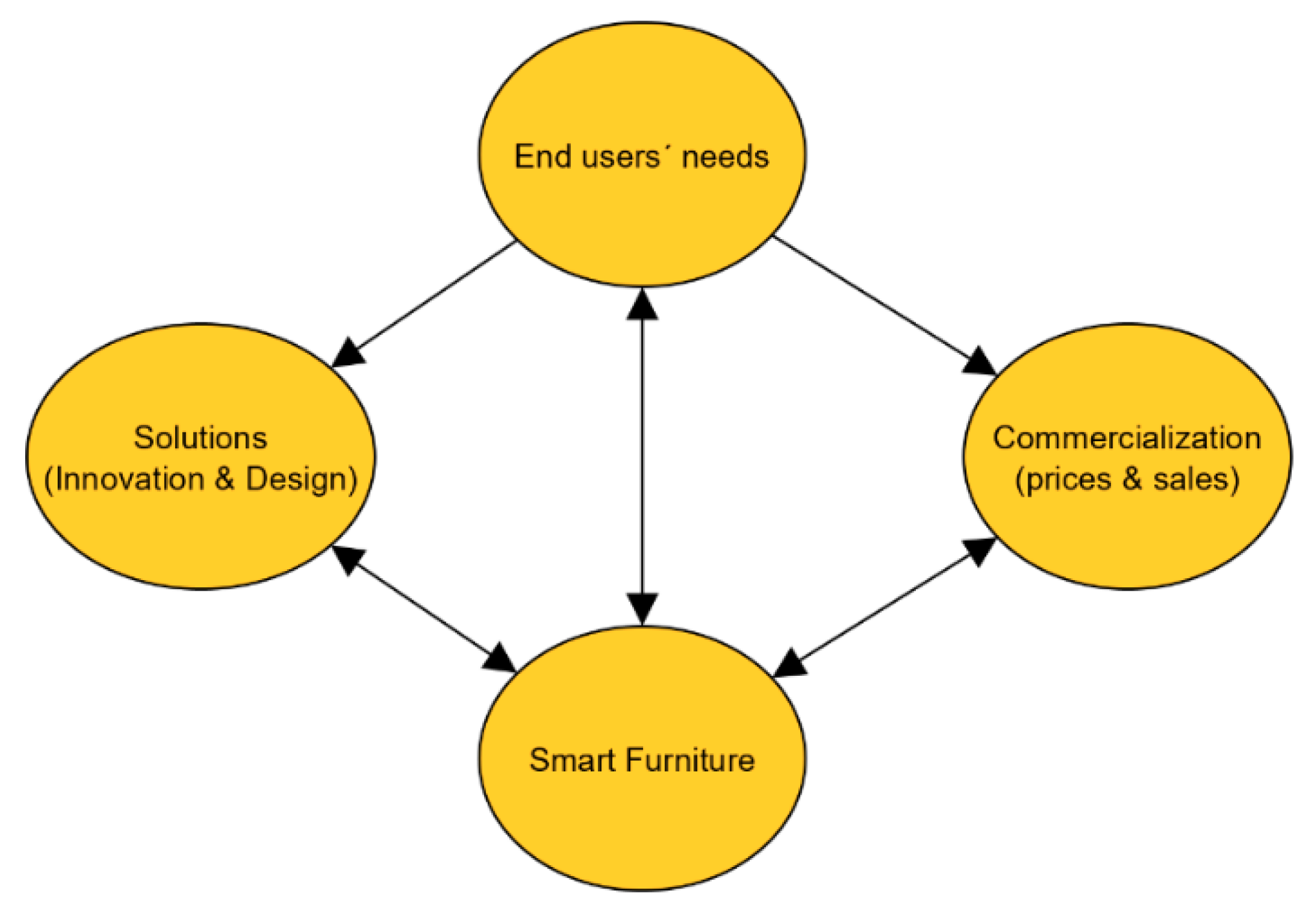
2.2. Commercial Smart Furniture and ICT Solutions Analysis Using Web Sources and Company Materials
2.3. Patent Analysis
3. Results
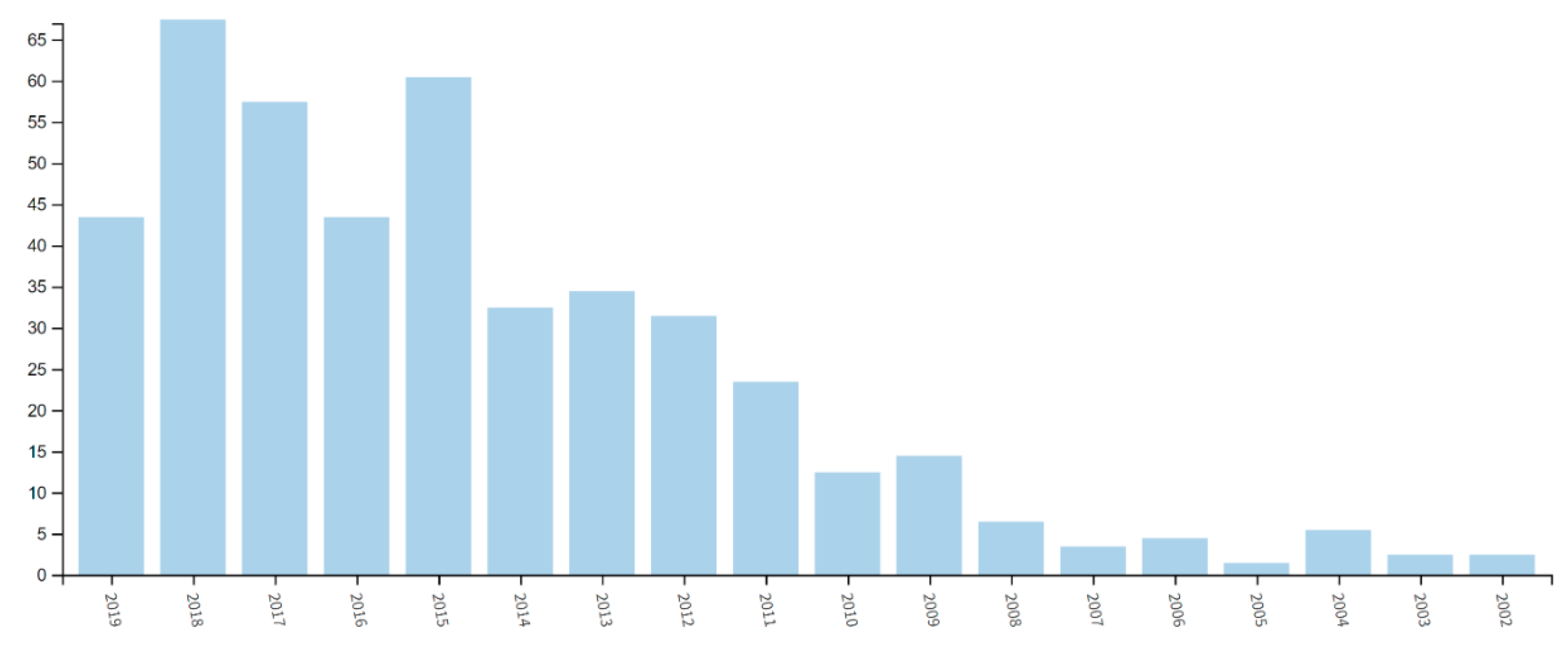
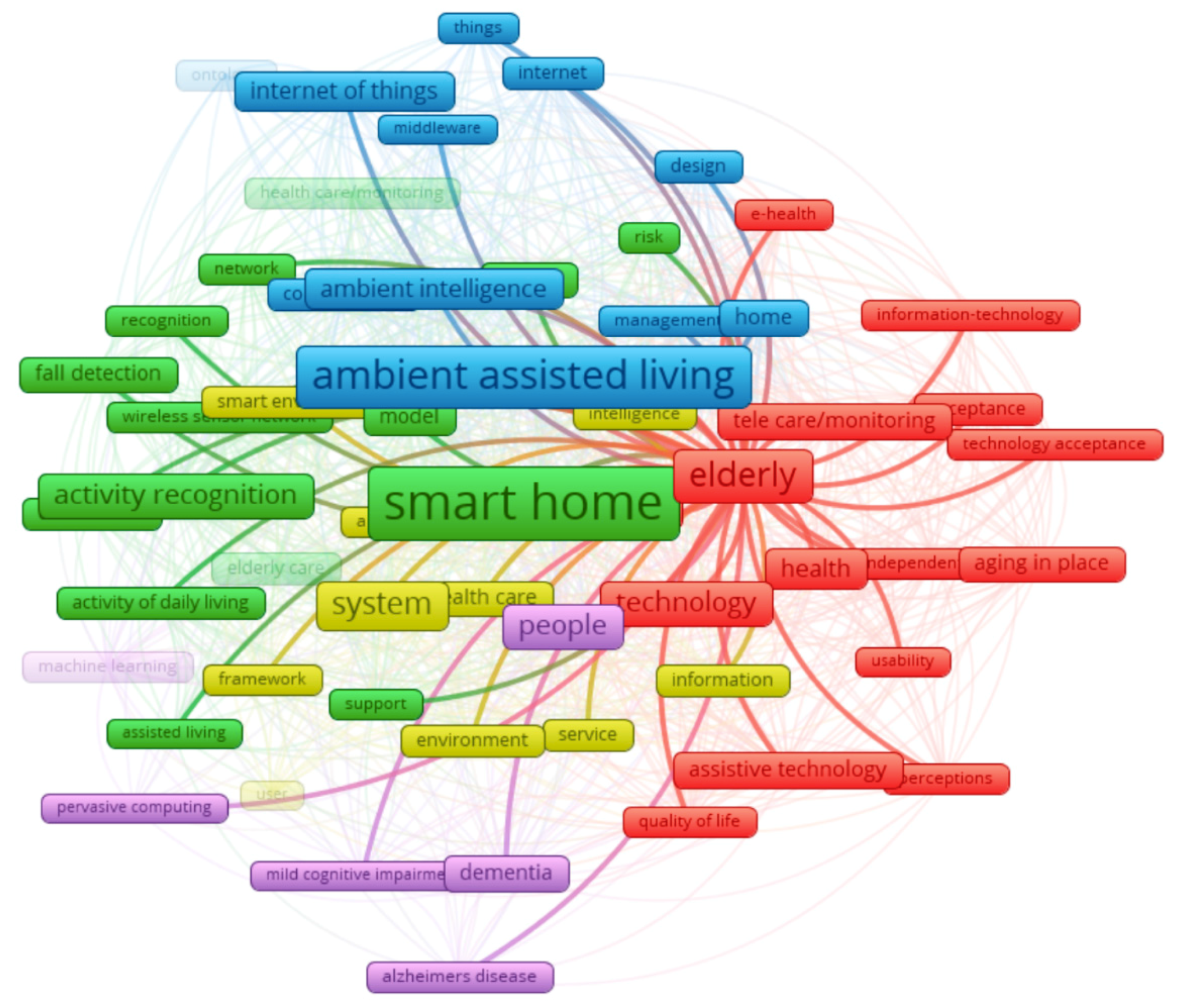
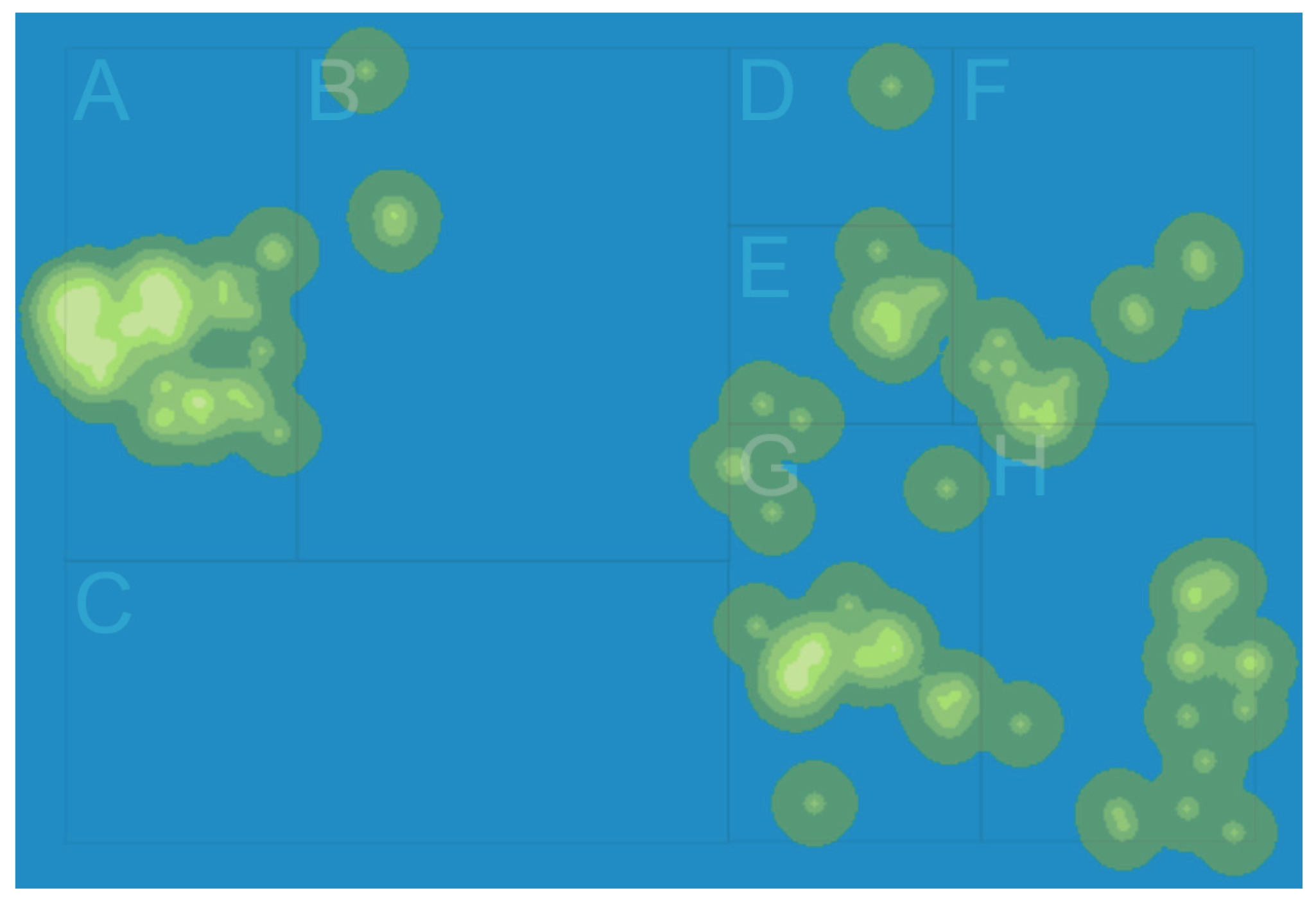
3.1. Literature Review
3.2. Selected Commercial Smart Furniture and ICT Solutions
- Sensors—which sensors are used within the Smart solution
- Active effect—what is the output of the solution to the (Smart) environment
- Remote—if the solution provides remote access
- Mobile—if the solution can control or monitor via a mobile device
- User—what experience level is needed to use the solution
- Smart—can the solution be characterized as Smart?
- Potential—is there potential to attach the solution to the Smart environment as it is?
- Price (€)—value of the solution
3.3. Patent Applications of Smart Furniture Solutions
3.3.1. Review of Selected Smart Furniture Patents
3.3.2. Summary of Selected Smart Furniture Patents
3.4. Technological Achievements of the Smart Entities Embedded in the Smart Furniture
- Decoupling Smart Features from Smart Objects: Current practices typically connect a physical object with a specific scenario, thus they are tightly coupled with the application scenario which limits the reusability of the smart objects. Developers and designers need to tend that Smart objects should be designed in a generic manner, such that the Smart features are independent of the physical object.
- Developing General Purpose Applications Independent of Smart Objects: Smart solutions need to be designed as much independent and decoupled as possible. Applications for Smart objects need to be designed in a generic way so that the same application could run on multiple Smart objects, and one Smart object could host multiple applications.
- Involving End Users in the Deployment, Configuration and Maintenance Processes: There is still a research gap between research projects and commercial Smart solutions. Focus on the end user as the final customer is still a challenge. The need to design Smart objects systems in a more human-centric way, and also involving end users in the process, leads to higher acceptability and a greater feeling of having control due to their active participations [109,117].
4. Discussion
Smart Furniture-Related Costs and Literature Gaps
5. Future Challenges
- verifying the acceptance of a virtual assistant by people who are not very experienced in technology, and ensure that the user is friendly, so that the solution is not only technologically functional, but acceptable by the target group, which can suffer from many limitations (reduced haptic sensitivity, decreased vision, hearing, mobility),
- voice user interfaces can benefit the senior population, as they are more intuitive than touch screens, which can be challenging for people with limited dexterity,
- any future IoT initiatives will need to be implemented in line with a strategy for transforming the fundamental culture and policy,
- one of the greatest barriers to IoT deployment remains to ensure adequate security. Dangerous components, widespread malware and any low-efficiency attempts to take traditional security measures on IoT networks pose huge challenges for all potential IoT users,
- and finally, for many consumers out there, they still need to be convinced that they absolutely need these things, and should continue to digitize their lives, homes and workplaces.
6. Conclusions
Author Contributions
Funding
Acknowledgments
Conflicts of Interest
Availability of Data and Materials
References
- Maresova, P.; Tomsone, S.; Lameski, P.; Madureira, J.; Mendes, A.; Zdravevski, E.; Chorbev, I.; Trajkovik, V.; Ellen, M.; Rodil, K. Technological Solutions for Older People with Alzheimer’s Disease: Review. Curr. Alzheimer Res. 2018, 15, 975–983. [Google Scholar] [CrossRef] [PubMed]
- Bleda, A.L.; Fernández-Luque, F.J.; Rosa, A.; Zapata, J.; Maestre, R. Smart Sensory Furniture Based on WSN for Ambient Assisted Living. IEEE Sens. J. 2017, 17, 5626–5636. [Google Scholar] [CrossRef]
- Krejcar, O.; Maresova, P.; Selamat, A.; Melero, F.J.; Barakovic, S.; Husic, J.B.; Herrera-Viedma, E.; Frischer, R.; Kuca, K. Smart Furniture as a Component of a Smart City—Definition Based on Key Technologies Specification. IEEE Access 2019, 7, 94822–94839. [Google Scholar] [CrossRef]
- Honeyager, M. 25 Ideas for Creating Smart Multifunctional Rooms. Freshome.com. Available online: https://freshome.com/multifunctional-rooms-ideas/ (accessed on 20 August 2019).
- Ghersi, I.; Mariño, M.; Miralles, M.T. Smart medical beds in patient-care environments of the twenty-first century: A state-of-art survey. BMC Med. Inform. Decis. Mak. 2018, 18, 63. [Google Scholar] [CrossRef]
- Panasonic. Care Service Robot is First in the World to Obtain ISO13482. Panasonic Newsroom Global. Available online: http://news.panasonic.com/global/topics/2014/26411.html (accessed on 20 August 2019).
- Collins, W.F., Jr.; Allen, J.M.; Huster, K.A.; Riley, C.W.; Glidewell, P.A.; Vanderpohl, I.J.; Schuman, R.J.; Howell, B.E.; Wildman, T.D. Wireless Bed Connectivity. US8284047B2, 9 October 2012. [Google Scholar]
- Medical Dealer Staff. Market Analysis: Hospital Beds. Medical Dealer—Buy and Sell New and Used Medical Equipment. Available online: https://medicaldealer.com/market-analysis-hospital-beds/ (accessed on 20 August 2019).
- Farage, M.A.; Miller, K.W.; Ajayi, F.; Hutchins, D. Design Principles to Accommodate Older Adults. Glob. J. Health Sci. 2012, 4, 2–25. [Google Scholar] [CrossRef]
- Ruef, B. Design for the elderly How to get their needs? Presented at the Innovage Regional Development Policies in Eco-friendly Independent Living for the Elderly, Ancona, Italy. September 2012. Available online: http://www.innovage-project.eu/sites/default/files/1stIntermediateEvent_Workshop_BrigitteRuef.pdf (accessed on 8 January 2020).
- Pinto, M.R.; De Medici, S.; Van Sant, C.; Bianchi, A.; Zlotnicki, A.; Napoli, C. Ergonomics, gerontechnology, and design for the home-environment. Appl. Ergon. 2000, 31, 317–322. [Google Scholar] [CrossRef]
- Aldridge, M.D.; Kelley, A.S. The Myth Regarding the High Cost of End-of-Life Care. Am. J. Public Health 2015, 105, 2411–2415. [Google Scholar] [CrossRef]
- Dieleman, J.L.; Baral, R.; Birger, M.; Bui, A.L.; Bulchis, A.; Chapin, A.; Hamavid, H.; Horst, C.; Johnson, E.K.; Joseph, J.; et al. US Spending on Personal Health Care and Public Health, 1996–2013. JAMA 2016, 316, 2627–2646. [Google Scholar] [CrossRef]
- Ten More Technologies Which Could Change Our Lives—Think Tank. Available online: http://www.europarl.europa.eu/thinktank/en/document.html?reference=EPRS_IDA(2017)598626 (accessed on 31 December 2019).
- Pisano, G.P. You need an innovation strategy. Harv. Bus. Rev. 2015, 2015, 12. [Google Scholar]
- Matulova, P.; Stemberkova, R.; Zdralek, P.; Maresova, P.; Kuca, K. Innovation vouchers as a segment of regional innovation strategy. In Proceedings of the 4th World Conference on Business, Economics and Management (Wcbem-2015), Ephesus, Turkey, 30 April–2 May 2015; Bektas, C., Ed.; Elsevier Science Bv: Amsterdam, The Netherlands, 2015; Volume 26, pp. 842–848. [Google Scholar]
- Innovation Strategy 2019–2030-CzechTrade Offices. Available online: https://www.czechtradeoffices.com/en/eg/news/innovation-strategy-2019–2030 (accessed on 26 December 2019).
- Cassiman, B.; Veugelers, R. In search of complementarity in innovation strategy: Internal R & D and external knowledge acquisition. Manag. Sci. 2006, 52, 68–82. [Google Scholar]
- Adner, R. Match your innovation strategy to your innovation ecosystem. Harv. Bus. Rev. 2006, 84, 98–107, 148. [Google Scholar] [PubMed]
- How to Successfully Bring New Products to Market. IndustryWeek. Available online: https://www.industryweek.com/innovation/article/22025235/how-to-successfully-bring-new-products-to-market (accessed on 31 December 2019).
- Griffin, A.; Price, R.L.; Vojak, B.A.; Hoffman, N. Serial Innovators’ processes: How they overcome barriers to creating radical innovations. Ind. Mark. Manag. 2014, 43, 1362–1371. [Google Scholar] [CrossRef]
- Tokuda, Y.; Iwasaki, S.; Sato, Y.; Nakanishi, Y.; Koike, H. Ubiquitous Display for Dynamically Changing Environment. In Proceedings of the CHI ’03 Extended Abstracts on Human Factors in Computing Systems, Ft. Lauderdale, FL, USA, 5–10 April 2003; ACM: New York, NY, USA, 2003; pp. 976–977. [Google Scholar]
- Sleep Number Beds. Mattresses, Bedding, Pillows and More. SleepNumber.com. Available online: https://www.sleepnumber.com/ (accessed on 20 August 2019).
- Burgess, M. There’s Now a Sofa You Can Control from Your Phone. Wired, UK. 8 April 2016. Available online: https://www.wired.co.uk/article/lift-bit-internet-of-things-sofa (accessed on 8 January 2020).
- Fever Scout. Fever Scout: Continuous Temperature Monitoring Thermometer. Fever Scout. Available online: https://feverscout.com/ (accessed on 21 August 2019).
- Dancer, S.J. Controlling Hospital-Acquired Infection: Focus on the Role of the Environment and New Technologies for Decontamination. Clin. Microbiol. Rev. 2014, 27, 665–690. [Google Scholar] [CrossRef] [PubMed]
- Tanner, B.D. Reduction in infection risk through treatment of microbially contaminated surfaces with a novel, portable, saturated steam vapor disinfection system. Am. J. Infect. Control 2009, 37, 20–27. [Google Scholar] [CrossRef] [PubMed]
- Sexton, J.D.; Tanner, B.D.; Maxwell, S.L.; Gerba, C.P. Reduction in the microbial load on high-touch surfaces in hospital rooms by treatment with a portable saturated steam vapor disinfection system. Am. J. Infect. Control 2011, 39, 655–662. [Google Scholar] [CrossRef]
- LG. LG Styler: Clothing Care System. Available online: https://www.lg.com/ca_en/lgstyler (accessed on 15 September 2019).
- Fonesalesman. FurniQi Side Table. Fonesalesman. Available online: https://www.fonesalesman.com/products/furniqi-side-table (accessed on 20 August 2019).
- Miller, H. Live OS: Height-Adjustable Desks. Available online: https://www.hermanmiller.com/products/smart-office/smart-furnishings/live-os/ (accessed on 21 August 2019).
- Sukeda, H.; Horry, Y.; Maruyama, Y.; Hoshino, T. Information-accessing furniture to our everyday lives more comfortable. In Proceedings of the 2006 Digest of Technical Papers International Conference on Consumer Electronics, Vegas, NV, USA, 7–11 January 2006; pp. 25–26. [Google Scholar]
- Cheng, J.; Zhou, B.; Sundholm, M.; Lukowicz, P. Smart Chair: What can simple pressure sensors under the chairs legs tell us about user activity? In Proceedings of the Seventh International Conference on Mobile Ubiquitous Computing, Systems, Services and Technologies, Porto, Portugal, 29 September–3 October 2013; pp. 81–84. [Google Scholar]
- Wang, B.; Cheng, J.; Zhou, B.; Amiraslanov, O.; Lukowicz, P.; Zhang, M. Smart-chairs: Ubiquitous Presentation Evaluation Based on Audience’s Activity Recognition. In Proceedings of the 11th International Conference on Mobile and Ubiquitous Systems: Computing, Networking and Services, Brussels, Belgium, 17 November 2014; pp. 350–351. [Google Scholar]
- Infurmia. Design archives. News Infurma: Online Magazine of the International Habitat Portal. Design, Contract, Interior Design, Furniture, Lighting and Decoration. Available online: https://news.infurma.es/Noticias/design (accessed on 17 September 2019).
- Google Store. Nest ×Yale Lock—Key-Free Smart Deadbolt. Available online: https://store.google.com/us/product/nest_x_yale_lock?hl=en-US&GoogleNest (accessed on 21 August 2019).
- Tyler, L. Pantelligent: The Smart Frying Pan That’s Essential to Any New Cook. Business Insider. Available online: https://www.businessinsider.com/pantelligent-smart-frying-pan-review-2016-5 (accessed on 21 August 2019).
- Indiegogo Inc. SmartyPans: World’s First Smart Cooking Pan. Indiegogo. Available online: https://www.indiegogo.com/projects/1603219 (accessed on 21 August 2019).
- SmartyPans, I. SmartyPans. Available online: https://smartypans.io (accessed on 21 August 2019).
- Somabar. Somabar® Robot Bartender. somabar. Available online: https://www.somabar.com (accessed on 21 August 2019).
- BeautyTech.jp. Coming Soon: A Revolutionary Smart Mirror by Panasonic. Medium. Available online: https://medium.com/beautytech-jp/coming-soon-a-revolutionary-smart-mirror-by-panasonic-8bcd0d77152e (accessed on 21 August 2019).
- Digital Habits. Open Mirror: Digital Mirror. Habits. Available online: https://shop.digitalhabits.it/products/digital-mirror-smart-furniture-open-mirror (accessed on 21 August 2019).
- Hyundai Livart. Hyundai Livart Range of Products. Available online: https://www.hyundailivart.co.kr/en/laboratory/cartfication.lvt (accessed on 15 September 2019).
- IKEA. Smart Home. Online Retail Store. Available online: https://www.ikea.com/us/en/catalog/categories/departments/home_electronics/smart_home/ (accessed on 15 September 2019).
- Samsung. Samsung Family Hub Smart Fridge. Samsung Electronics America. Available online: /us/explore/family-hub-refrigerator/overview/ (accessed on 17 September 2019).
- Elflow, B.; Cooling MistTM. Elbron’s Cooling Mist. Available online: http://www.elflow.nl/cooling-mist/ (accessed on 22 August 2019).
- Guderian, C.C. Identifying Emerging Technologies with Smart Patent Indicators: The Example of Smart Houses. Int. J. Innov. Technol. Manag. 2018, 16, 1950040. [Google Scholar] [CrossRef]
- Ericson, B.C. Sensor Elements to Detect Object Movement Relative to a Surface. US20190120871A1, 25 April 2019. [Google Scholar]
- Choi, W.S.; Yang, J. Power Supply Device and Smart Furniture Comprising the Same. KR101938605B1, 10 April 2019. [Google Scholar]
- Qiao, H.; Wang, H. Smart Furniture, Transmitter, Furniture Positioning Identification System and Method. CN109375617A, 22 February 2019. [Google Scholar]
- Torres, E. Smart Bed. US20190053751A1, 21 February 2019. [Google Scholar]
- Liu, F. A Kind of Intelligent Desk with Positioning Function. CN208510288U, 19 February 2019. [Google Scholar]
- Liu, F. A Kind of Intelligent Table with Display Hidden Function. CN208510299U, 19 February 2019. [Google Scholar]
- Wang, W.; Luo, L.; Zhong, W.; Chen, X. A Kind of Contactless Tank Bracket Class Dynamic Monitoring System Based on Light Source Scanning. CN208506248U, 15 February 2019. [Google Scholar]
- Anonymous. A Kind of Adjustable Household Decompression Traction Intelligent Bed of Main Bed Board. CN109259918A, 25 January 2019. [Google Scholar]
- Zheng, B. A Kind of Intelligence Ventilation Furniture Door. CN109281590A, 29 January 2019. [Google Scholar]
- Yang, J.; Huang, Y.; Ding, Z.; Zhang, K.; Wu, R. Household Goods with Stereoscopic Display Device. CN208444094U, 29 January 2019. [Google Scholar]
- Long, Z. A Kind of External Hanging Type Intelligentized Furniture of Exterior Wall Capable of Washing. CN109235915A, 18 January 2019. [Google Scholar]
- Zhou, B.; Chen, Y. A Kind of Intelligent Antitheft Method Based on Wireless Communication. CN109255912A, 22 January 2019. [Google Scholar]
- Zeng, G. Rotating Bed. TW201838606A, 1 November 2018. [Google Scholar]
- Xu, Y. A Kind of Embedded Data Line Socket in Intelligentized Furniture. CN109066231A, 21 December 2018. [Google Scholar]
- Cai, Z. A Kind of Intelligentized Furniture Easy to Remove. CN109043860A, 21 December 2018. [Google Scholar]
- Hu, Y. A Kind of Smart Home Supporting Structure. CN109140193A8, 1 February 2019. [Google Scholar]
- Hu, N.; Ma, H.; Zhan, Z. A Kind of Smart Home System Based on Wireless Sensor Network. CN208297949U, 28 December 2018. [Google Scholar]
- Zhu, R. A Kind of Environmental Protection Knitting Palm Mattress. CN208286743U, 28 December 2018. [Google Scholar]
- Yang, J. A Foldable Bed Capable of Being Used as a Wall Cabinet. CN109008406A, 18 December 2018. [Google Scholar]
- Guo, Y. Sleeping Bed for Preventing Snoring. CN208144814U, 27 November 2018. [Google Scholar]
- Peng, H. Smart Bed. CN108836597A, 20 November 2018. [Google Scholar]
- Guo, Z.; Chen, D. Smart Curtain Control System Based on Zigbee. CN108836095A, 20 November 2018. [Google Scholar]
- Fang, X.; Chen, W.; He, J.; Huang, D. Smart Tea Table with Illuminating Devices on Edge. CN108813961A, 16 November 2018. [Google Scholar]
- Dong, C. Intelligent Furniture Integrating System Performing Self-Adaptive Adjustment According to Human Body Features. CN108784653A, 13 November 2018. [Google Scholar]
- Wang, J. Voice Control System and Method and Smart Furniture. CN108809782A, 13 November 2018. [Google Scholar]
- Song, G. Energy-Saving Heating Floor. CN108756135A, 6 November 2018. [Google Scholar]
- Zeng, G.H. Expansion Pad Massage Device. TW201827032A, 1 August 2018. [Google Scholar]
- Huang, L. Smart Furniture. CN108720269A, 2 November 2018. [Google Scholar]
- Guo, W. Intelligent Air Purifier Is Used to Furniture. CN208011930U, 26 October 2018. [Google Scholar]
- Wu, Y.; Hua, D. Iot Electronic Control Smart Home Sports Hand Ring. CN107569817A, 12 January 2018. [Google Scholar]
- Gao, H.; Jian, Z.; Cai, C. Smart Home Control System Based on Wireless Communication. CN107786399A, 9 March 2018. [Google Scholar]
- Xiong, Z. Smart Door and Window Control Panel. CN207337103U, 8 May 2018. [Google Scholar]
- Guo, Y. Intelligent Electric Bed. CN208144818U, 27 November 2018. [Google Scholar]
- Chen, L.; Xiang, H.; Liu, Y.; Lin, W.; Zhu, J.; Li, J. Photocatalyst Furniture. CN204620355U, 9 September 2015. [Google Scholar]
- Doughty, K.; Cameron, K.; Garner, P. Three Generations of Telecare of the Elderly. J. Telemed. Telecare 1996, 2, 71–80. [Google Scholar] [CrossRef]
- Hyer, K.; Rudick, L. The effectiveness of personal emergency response systems in meeting the safety monitoring needs of home care clients. J. Nurs. Adm. 1994, 24, 39–44. [Google Scholar] [CrossRef]
- Stokke, R. The Personal Emergency Response System as a Technology Innovation in Primary Health Care Services: An Integrative Review. J. Med. Internet Res. 2016, 18. [Google Scholar] [CrossRef]
- Miguel, K.D.S.; Lewin, G.; Burton, E.L.; Howat, P.; Boldy, D.; Toye, C. Personal emergency alarms: Do health outcomes differ for purchasers and nonpurchasers? Home Health Care Serv. Q. 2017, 36, 164–177. [Google Scholar] [CrossRef]
- Doughty, K. Monitoring Elderly People. GB2348726A, 11 October 2000. [Google Scholar]
- Huang, Y. Digital Smart Furniture. CN108669790A, 19 October 2018. [Google Scholar]
- Wnag, G.; Zhang, B.; Li, Y. Smart Furniture System. CN108614440A, 28 September 2018. [Google Scholar]
- Shen, L. Wireless Switch Device of Smart Home. CN108597211A, 28 September 2018. [Google Scholar]
- Zeng, M. Smart Desk. CN207855322U, 14 September 2018. [Google Scholar]
- Ying, Y. Integrated Furniture Based on Smart Internet of Things and Used in Dormitory. CN108508759A, 7 September 2018. [Google Scholar]
- Ge, X. Smart Home Systems Audio Control Device. CN207817519U, 4 September 2018. [Google Scholar]
- Li, Y. Smart Home Furniture. CN108464656A, 31 August 2018. [Google Scholar]
- Chen, Y. Intelligent Furniture. CN108337603A, 27 July 2018. [Google Scholar]
- Chen, D. Smart Tea Table with Display Screen for Furniture. CN108175186A, 19 June 2018. [Google Scholar]
- Zhang, S.; Qiu, D.; Huang, X.; Liu, J.; Huang, H.; Qin, L.; Liu, S.; Chen, S. Smart Lighting Control System. CN206807826U, 26 December 2017. [Google Scholar]
- Shao, A. Furniture Cabinet with Smart Dehumidification and Drying Function. CN107467918A, 15 December 2017. [Google Scholar]
- Zhang, L. Intelligent Furniture Glass Window. CN107386888A, 24 November 2017. [Google Scholar]
- Dang, M. Smart Toilet Mirror. CN107319726A, 7 November 2017. [Google Scholar]
- Xu, Y. Smart Sofa Having Heating and Alarming Functions. CN107157175A, 15 September 2017. [Google Scholar]
- Zhang, X. An Intelligent Home Data Acquisition, Analysis, Encryption Method and System. CN107104950B, 4 May 2018. [Google Scholar]
- Ge, C. Automatically installed smart curtain. CN106859258B, 19 July 2019. [Google Scholar]
- Xu, Y. Smart Home Sofa with Temperature Sensing Function. CN106820741A, 13 June 2017. [Google Scholar]
- Kim, J. Smart Furniture. KR101736804B1, 29 May 2017. [Google Scholar]
- Lee, S. The Smart Furniture. KR20170056978A, 24 May 2017. [Google Scholar]
- Yang, L. Smart Furniture. US20170160709A1, 8 June 2017. [Google Scholar]
- Geng, J. Smart Window with Monitoring Fine Particles and Wireless Transmission Function. CN205314856U, 15 June 2016. [Google Scholar]
- Lin, H. Hand-Supported Parallel Bars Smart Office Chair for Exercise and Weight Loss of Internet Plus Clerk. CN105167443A, 23 December 2015. [Google Scholar]
- Poslad, S. Ubiquitous Computing: Smart Devices, Environments and Interactions/Stefan Poslad; Wiley: Chichester, UK, 2009; ISBN 978-0-470-77944-6. [Google Scholar]
- Albreshne, A. Modelling and Controlling Smart Residential Environments: The GF4SRE Software Framework and the GPL4SRE Domain Specific Language; Thesis No. 1937; UniPrint: Fribourg, Switzerland, 2015; Available online: https://www3.unifr.ch/inf/softeng/en/assets/public/files/research/research_topics/DR_Albreshne.pdf (accessed on 8 January 2020).
- Yanagihara, T.; Sakakibara, H.; Ohsawa, R.; Ideuchi, M.; Kohtake, N.; Masayuki, I.; Takashio, K.; Tokuda, H. A self configurable topology-aware network for smart materials. In Proceedings of the 25th IEEE International Conference on Distributed Computing Systems Workshops, Columbus, OH, USA, 6–10 June 2005; pp. 469–474. [Google Scholar]
- Kohtake, N.; Ohsawa, R.; Yonezawa, T.; Matsukura, Y.; Iwai, M.; Takashio, K.; Tokuda, H. u-Texture: Self-Organizable Universal Panels for Creating Smart Surroundings. In Proceedings of the UbiComp 2005: Ubiquitous Computing, Tokyo, Japan, 11–14 September 2005; Beigl, M., Intille, S., Rekimoto, J., Tokuda, H., Eds.; Springer: Berlin/Heidelberg, Germany, 2005; pp. 19–36. [Google Scholar]
- Sun, Z.; Hao, L.; Song, B.; Yang, R.; Cao, R.; Cheng, Y. Periodic reference tracking control approach for smart material actuators with complex hysteretic characteristics. Smart Mater. Struct. 2016, 25. [Google Scholar] [CrossRef]
- Maheshwari, M.; Annamdas, V.G.M.; Pang, J.H.L.; Asundi, A.; Tjin, S.C. Crack monitoring using multiple smart materials; fiber-optic sensors & piezo sensors. Int. J. Smart Nano Mater. 2017, 8, 41–55. [Google Scholar]
- Culler, D.; Long, J. A Prototype Smart Materials Warehouse Application Implemented Using Custom Mobile Robots and Open Source Vision Technology Developed Using EmguCV. Procedia Manuf. 2016, 5, 1092–1106. [Google Scholar] [CrossRef]
- Sikeridis, D.; Tsiropoulou, E.E.; Devetsikiotis, M.; Papavassiliou, S. Socio-Physical Energy-Efficient Operation in the Internet of Multipurpose Things. In Proceedings of the 2018 IEEE International Conference on Communications (ICC), Kansas, MO, USA, 20–24 May 2018; IEEE: Kansas, MO, USA, 2018; pp. 1–7. [Google Scholar]
- Fahim, K.; Fernando, L. Tatsuo Nakajima Three Challenges for Future Smart Object Systems. In Proceedings of the 2nd International Workshop on Smart Products: Building Block of Ambient Intelligence (AmI-Block’08), in Conjunction with AmI 2008, the 2008 European Conference of Ambient Intelligence, Nurnberg, Germany, 19–22 November 2008. [Google Scholar]
- Lichtenthaler, E. Technology intelligence processes in leading European and North American multinationals. RD Manag. 2004, 34, 121–135. [Google Scholar] [CrossRef]
- Ernst, H.; Omland, N. The Patent Asset Index—A new approach to benchmark patent portfolios. World Pat. Inf. 2011, 33, 34–41. [Google Scholar] [CrossRef]
- Vaida, C.; Gherman, B.; Dragomir, M.; Iamandis, O.; Banyai, D. Smart Furniture—Quo Vadis. In Proceedings of the 3rd International Conference on Quality and Innovation in Engineering and Management, Cluj-Napoca, Romania, 1–5 July 2014; pp. 493–498. Available online: https://www.researchgate.net/publication/293803304_SMART_FURNITURE_-_QUO_VADIS (accessed on 8 January 2020).
- MarketsandMarkets. European Smart Home Market Size, Growth, Trend and Forecast to 2024. Market Research Report. Available online: https://www.marketsandmarkets.com/Market-Reports/european-smart-homes-market-1290.html (accessed on 21 September 2019).
- Allameh, E.; Jozam, M.H.; de Vries, B.; Timmermans, H.; Beetz, J.; Mozaffar, F. The role of Smart Home in Smart Real Estate. J. Eur. Real Estate Res. 2012. [Google Scholar] [CrossRef]
- Lafontaine, F. Pricing Decisions in Franchised Chains: A Look at the Restaurant and Fast-Food Industry; The National Bureau of Economic Research: Cambridge, MA, USA, 1995; Available online: https://www.nber.org/papers/w5247 (accessed on 8 January 2020). [CrossRef]
- Minkler, A.P. Why Firms Franchise: A Search Cost Theory. J. Inst. Theor. Econ. JITE Z. Für Gesamte Staatswiss. 1992, 148, 240–259. [Google Scholar]
- Calderon-Monge, E.; Pastor-Sanz, I.; Huerta-Zavala, P. Economic Sustainability in Franchising: A Model to Predict Franchisor Success or Failure. Sustainability 2017, 9, 1419. [Google Scholar] [CrossRef]
- Rosado-Serrano, A.; Paul, J.; Dikova, D. International franchising: A literature review and research agenda. J. Bus. Res. 2018, 85, 238–257. [Google Scholar] [CrossRef]
- Wider Project Green growing of SMEs-Innovation and Development in Energy Sector in Mediterranean Area. Central European Initiative. Available online: https://www.cei.int/news/4593/wider-project-green-growing-of-smes-innovation-and-development-in-energy-sector-in-mediterranean (accessed on 14 September 2019).
- Institute of Medicine (US) Committee on Quality of Health Care in America. Improving the 21st-Century Health Care System; National Academies Press (US): Washington, DC, USA, 2001; Volume 2. [Google Scholar]
- Panda, S.; Goel, K. Design of Smart Furniture for a Smart City; BTech, National Institute of Technology: Rourkela, Odisha, India, 2015; Available online: https://pdfs.semanticscholar.org/661c/0ed4d9f985c0cd7c034bdae05261654185f0.pdf (accessed on 1 January 2020).
- Prakash, B. Patient Satisfaction. J. Cutan. Aesthet. Surg. 2010, 3, 151–155. [Google Scholar] [CrossRef]
- Zhang, Y.; Tzortzopoulos, P.; Kagioglou, M. Healing built-environment effects on health outcomes: Environment–occupant–health framework. Build. Res. Inf. 2019, 47, 747–766. [Google Scholar] [CrossRef]
- Bor, M.; Vidler, J.; Roedig, U. LoRa for the Internet of Things. In Proceedings of the 2016 International Conference on Embedded Wireless Systems and Networks, Graz, Austria, 15–17 February 2016; Junction Publishing; pp. 361–366. Available online: https://eprints.lancs.ac.uk/id/eprint/77615/1/MadCom2016_LoRa_MAC.pdf (accessed on 1 January 2020).
- Hwang, L.-C.; Chen, C.-S.; Ku, T.-T.; Shyu, W.-C. A bridge between the smart grid and the Internet of Things: Theoretical and practical roles of LoRa. Int. J. Electr. Power Energy Syst. 2019, 113, 971–981. [Google Scholar] [CrossRef]
- Sikeridis, D.; Tsiropoulou, E.E.; Devetsikiotis, M.; Papavassiliou, S. Energy-Efficient Orchestration in Wireless Powered Internet of Things Infrastructures. IEEE Trans. Green Commun. Netw. 2019, 3, 317–328. [Google Scholar] [CrossRef]
- Krejcar, O.; Frischer, R. Batteryless Powering of Remote Sensors with Reversed Peltier Power Source for Ubiquitous Environments. Int. J. Distrib. Sens. Netw. 2013, 9, 789405. [Google Scholar] [CrossRef]
- Song, C.; Lopez-Yela, A.; Huang, Y.; Segovia-Vargas, D.; Zhuang, Y.; Wang, Y.; Zhou, J. Novel Quartz Clock with Integrated Wireless Energy Harvesting and Sensing Functions. IEEE Trans. Ind. Electron. 2018, 66. [Google Scholar] [CrossRef]
- Almeida, A.; Mulero, R.; Rametta, P.; Urosevic, V.; Andric, M.; Patrono, L. A critical analysis of an IoT-aware AAL system for elderly monitoring. FUTURE Gener. Comput. Syst. 2019, 97, 598–619. [Google Scholar] [CrossRef]
- Borelli, E.; Paolini, G.; Antoniazzi, F.; Barbiroli, M.; Benassi, F.; Chesani, F.; Chiari, L.; Fantini, M.; Fuschini, F.; Galassi, A.; et al. HABITAT: An IoT Solution for Independent Elderly. Sensors 2019, 19, 1258. [Google Scholar] [CrossRef]
- Rahman, M.A.; Hossain, M.S. A cloud-based virtual caregiver for elderly people in a cyber physical IoT system. Clust. Comput. 2019, 22, 2317–2330. [Google Scholar] [CrossRef]
- Pal, D.; Funilkul, S.; Charoenkitkarn, N.; Kanthamanon, P. Internet-of-Things and Smart Homes for Elderly Healthcare: An End User Perspective. IEEE Access 2018, 6, 10483–10496. [Google Scholar] [CrossRef]
- Tsirmpas, C.; Kouris, I.; Anastasiou, A.; Giokas, K.; Iliopoulou, D.; Koutsouris, D. An Internet of Things platform architecture for supporting ambient assisted living environments. Technol. Health Care 2017, 25, 391–401. [Google Scholar] [CrossRef]
- Yared, R.; Abdulrazak, B. Ambient Technology to Assist Elderly People in Indoor Risks. Computers 2016, 5, 22. [Google Scholar] [CrossRef]
- Alkhomsan, M.N.; Hossain, M.A.; Rahman, S.M.M.; Masud, M. Situation Awareness in Ambient Assisted Living for Smart Healthcare. IEEE Access 2017, 5, 20716–20725. [Google Scholar] [CrossRef]
- Jones, E.; Pike, J.; Marshall, T.; Ye, X. Quantifying the relationship between increased disability and health care resource utilization, quality of life, work productivity, health care costs in patients with multiple sclerosis in the US. Bmc Health Serv. Res. 2016, 16, 294. [Google Scholar] [CrossRef] [PubMed]
- Ahmed, E.; Yaqoob, I.; Gani, A.; Imran, M.; Guizani, M. Internet-Of-Things-Based Smart Environments: State of The Art, Taxonomy, And Open Research Challenges. IEEE Wirel. Commun. 2016, 23, 10–16. [Google Scholar] [CrossRef]
- Xiao, F.; Miao, Q.; Xie, X.; Sun, L.; Wang, R. Indoor Anti-Collision Alarm System Based on Wearable Internet of Things for Smart Healthcare. IEEE Commun. Mag. 2018, 56, 53–59. [Google Scholar] [CrossRef]
- Pham, M.; Mengistu, Y.; Do, H.; Sheng, W. Delivering home healthcare through a Cloud-based Smart Home Environment (CoSHE). FUTURE Gener. Comput. Syst. 2018, 81, 129–140. [Google Scholar] [CrossRef]
- Choi, D.; Choi, H.; Shon, D. Future changes to smart home based on AAL healthcare service. J. Asian Archit. Build. Eng. 2019, 18, 194–203. [Google Scholar] [CrossRef]
- Pal, D.; Papasratorn, B.; Chutimaskul, W.; Funilkul, S. Embracing the Smart-Home Revolution in Asia by the Elderly: An End-User Negative Perception Modeling. IEEE Access 2019, 7, 38535–38549. [Google Scholar] [CrossRef]
- Curumsing, M.K.; Fernando, N.; Abdelrazek, M.; Vasa, R.; Mouzakis, K.; Grundy, J. Emotion-oriented requirements engineering: A case study in developing a smart home system for the elderly. J. Syst. Softw. 2019, 147, 215–229. [Google Scholar] [CrossRef]
- Chang, W.-W.; Sung, T.-J.; Huang, H.-W.; Hsu, W.-C.; Kuo, C.-W.; Chang, J.-J.; Hou, Y.-T.; Lan, Y.-C.; Kuo, W.-C.; Lin, Y.-Y.; et al. A smart medication system using wireless sensor network technologies. Sens. Actuators Phys. 2011, 172, 315–321. [Google Scholar] [CrossRef]
- Suárez-Varela, M.T.M. Study on the use of a smart pillbox to improve treatment compliance [Estudio sobre la utilidad del pastillero para mejorar el cumplimiento terapéutico]. Aten. Primaria 2009, 41, 185–191. [Google Scholar] [CrossRef] [PubMed]
- Salgia, A.S.; Ganesan, K.; Raghunath, A. Smart pill box. Indian J. Sci. Technol. 2015, 8, 95–100. [Google Scholar] [CrossRef]
- Wu, H.-K.; Wong, C.-M.; Liu, P.-H.; Peng, S.-P.; Wang, X.-C.; Lin, C.-H.; Tu, K.-H. A smart pill box with remind and consumption confirmation functions. In Proceedings of the 2015 IEEE 4th Global Conference on Consumer Electronics, Osaka, Japan, 27–30 October 2015; pp. 658–659. [Google Scholar]
- Tsai, H.-L.; Tseng, C.H.; Wang, L.-C.; Juang, F.-S. Bidirectional smart pill box monitored through internet and receiving reminding message from remote relatives. In Proceedings of the 2017 IEEE International Conference on Consumer Electronics—Taiwan (ICCE-TW), Taipei, Taiwan, 12–14 June 2017; Institute of Electrical and Electronics Engineers Inc.: Piscataway, NJ, USA, 2017; pp. 393–394. [Google Scholar]
- Nijiya Jabin Najeeb, P.K.; Rimna, A.; Safa, K.P.; Silvana, M.; Adarsh, T.K. Pill care-the smart pill box with remind, authenticate and confirmation function. In Proceedings of the 2018 International Conference on Emerging Trends and Innovations in Engineering and Technological Research (ICETIETR), Ernakulam, India, 11–13 July 2018; Vishwanath, N.P.S., Ed.; Institute of Electrical and Electronics Engineers Inc.: Piscataway, NJ, USA, 2018. [Google Scholar]
- Treskes, R.W.; Van der Velde, E.T.; Schoones, J.W.; Schalij, M.J. Implementation of smart technology to improve medication adherence in patients with cardiovascular disease: Is it effective? Expert Rev. Med. Devices 2018, 15, 119–126. [Google Scholar] [CrossRef]
- Shailaja, M.; Lokeshwaran, K.; Sheik Faritha Begum, S. Smart medication pill box for blind people with pulse sensor. Int. J. Recent Technol. Eng. 2019, 8, 388–395. [Google Scholar]
- Memo Box Mini: Smallest Smart Pillbox. Kickstarter. Available online: https://www.kickstarter.com/projects/661527809/smart-pillbox (accessed on 7 October 2019).
- The Smart Pill Box with Brains & Beauty. EllieGrid. Available online: https://elliegrid.com/ (accessed on 7 October 2019).
- Liif. It’s Not Just a Pill Reminder. Tricella. Available online: https://www.tricella.com/ (accessed on 7 October 2019).
- Digital Pill Box Dispenser. America’s #1 Digital Pill Box Dispenser. Available online: https://medqpillbox.com/ (accessed on 7 October 2019).
- Automatic Pill Dispenser for the Elderly-Maya. MedMinder. Available online: https://www.medminder.com/pill-dispensers-2/maya-pill-dispenser/ (accessed on 7 October 2019).
- Automatic Pill Dispenser 28-Day Medication Organizer w/Alarm Reminder. LiveFine. Available online: https://www.livefineproducts.com/products/ivpilldcgrp-automatic-pill-dispenser-28-day-electronic-medication-organizer-with-alarm-reminders (accessed on 7 October 2019).
- MedCenter Monthly Pill Organizer. MedCenter Systems. Available online: https://www.medcentersystems.com/product-p/7025-6.htm (accessed on 7 October 2019).
- Automatic Pill Dispenser DoseControl with Clear Lid—English Version. Available online: https://www.medcontrol.eu/c/automatic-electronic-pill-dispenser-with-alarm-medcontrol/automatic-pill-dispenser-with-clear-lid?gclid=EAIaIQobChMIo4jozIaK5QIVD8DeCh1NjwVpEAAYASAAEgJsmPD_BwE (accessed on 7 October 2019).

| Source Titles | Record Count | % of 439 |
|---|---|---|
| Sensors | 39 | 8.88 |
| Journal of ambient intelligence and smart environments | 19 | 4.33 |
| Personal and ubiquitous computing | 12 | 2.73 |
| IEEE access | 11 | 2.51 |
| Journal of ambient intelligence and humanized computing | 9 | 2.05 |
| Indoor and built environment | 8 | 1.82 |
| Ambient intelligence and smart environments | 7 | 1.60 |
| Handbook of ambient assisted living technology for healthcare rehabilitation and well-being | 6 | 1.37 |
| Journal of medical systems | 6 | 1.37 |
| IEEE communications magazine | 5 | 1.14 |
| Field: Research Areas | Record Count | % of 439 |
|---|---|---|
| Computer science | 212 | 48.29 |
| Engineering | 112 | 25.51 |
| Telecommunications | 83 | 18.91 |
| Instruments instrumentation | 48 | 10.93 |
| Medical informatics | 45 | 10.25 |
| Chemistry | 43 | 9.80 |
| Electrochemistry | 40 | 9.11 |
| Health care sciences services | 35 | 7.97 |
| Geriatrics gerontology | 28 | 6.38 |
| Mathematical computational biology | 15 | 3.42 |
| Field: Countries/Regions | Record Count | % of 439 |
|---|---|---|
| Spain | 48 | 10.934% |
| Italy | 40 | 9.112% |
| France | 39 | 8.884% |
| USA | 39 | 8.884% |
| England | 36 | 8.200% |
| South Korea | 35 | 7.973% |
| Germany | 32 | 7.289% |
| China | 31 | 7.062% |
| Canada | 20 | 4.556% |
| Netherlands | 19 | 4.328% |
| Name | Focus | Sensors | Active Effect | Battery | Remote | Mobile | Communication Protocol | User | Smart | Potential | Price (€) |
|---|---|---|---|---|---|---|---|---|---|---|---|
| Hyundai Livart [43] | Living room, kitchen | - | Air cleaner by UV LED Violeds | 220 V | Yes | Yes | - | Basic | No | No | - |
| IKEA [44] | Range of household smart items | - | Lightning control, wireless charging, wireless speakers | 2x AAA/230 V | Yes | Yes | 2400 MHz~2483.5 MHz | Basic | No | No | Varying prices (e.g., wireless electric blind sells for €162) |
| Smart Sofa [24] | Households | Posture monitoring | Furniture shape change | 230 V | Yes | Yes | IoT/WiFI | Basic | No | No | 800–12,000 |
| Smart BED [10,11] | Households | Heart rate, temperature, sleep monitoring, breath rate | Foot warming, bed shape change, lightning control | - | Yes | Yes | - | Basic | No/passive functions | No | 1500–4000 |
| FurniQi Smart Table [30] | Households | - | Charging mobile phones | 230 V | No | No | - | Ignorant | No | No | 180 |
| LG Clothing Steamer [29] | Households | - | Cleaning clothing (E. coli and S. epidermidis), steam, drying, | 120 V/1500 W | Yes | Yes | WiFi, SmartThinQ Technology | Basic | No | No | 1800 |
| Elflow Cooling Mist [46] | SoHo | Temperature, humidity | Mist generator | - | - | Yes | - | Basic | No | No | - |
| Fever scout [25] | Households | Temperature, humidity, pressure | No | Chargeable | Yes | Yes | BLE (max range 13 ft) | Basic | Yes | Yes | 60 |
| Google Nest Yale Smart lock [36] | Households | - | Lock, voice recognition | 4xAA LiPol | Yes | Yes | Weave AES 128-bit and Bluetooth | Basic | Yes | Yes | 250 |
| Panasonic Mirror [41] | Households | Skin condition, image processing, | Recommendations on what product use | - | Yes | Yes | - | Basic | Yes | Yes | 950 |
| Somabar robot bartender [40] | SoHo | Flowmeter, temp | Drink maker | 230 V | No | No | WiFi | Basic | No | No | 390 |
| Samsung Family Hub 3.0 Smart Fridge [45] | Households | Camera, Thermostat, Bixby | Display schedule, shopping list, music syncing | 230 V | Yes | Yes | WiFi/Bluetooth | Basic/Advanced | Yes | Yes | 2100–2200 |
| Smarty Pans [37,39] | Households | Temperature, weight | Diet monitoring | Magnetic charging | Yes | Yes | BLE 5.0 | Basic/Advanced | No | No | 200 |
| Smart Chair [33] | SoHo | Pressure, pressure distribution | Movement in the seated position | 5500 mAh/36 h | Yes | No | 2.4 GHz ZigBee | Scientist | No | Yes | Medical: 1800–2700 Posture: 1400 |
| Herman Miller Live OS Smart table [31] | SoHo | - | Height change | - | Yes | Yes | Live OS—ANT wireless mesh network | Basic | No | No | 1450 |
| Infurma Actiu Smart chair [35] | SoHo | Posture, air quality, temperature, humidity, lighting and noise levels. | Chair design | - | Yes | Yes | Smart IoT | Basic | Yes | No | - |
| Section | Technology | Count |
|---|---|---|
| Electrical Engineering | Electrical machinery, apparatus, energy | 5 |
| Audio-visual technology | 3 | |
| Telecommunications | 1 | |
| Digital communication | 4 | |
| Computer technology | 2 | |
| IT methods for management | 1 | |
| Instruments | Optics | 1 |
| Measurement | 3 | |
| Control | 13 | |
| Medical technology | 6 | |
| Chemistry | Surface technology, coating | 1 |
| Chemical engineering | 2 | |
| Mechanical Engineering | Thermal processes and apparatus | 2 |
| Mechanical elements | 1 | |
| Other Fields | Furniture, games | 27 |
| Other consumer goods | 2 | |
| Civil engineering | 6 |
| S/N | Inventor | Description | Patent Right Holder | Patent Issue Date | Country |
|---|---|---|---|---|---|
| 1 | [48] | Embedded sensors that disallow damage of an item (e.g., smartphone) by notifying users during vibrational movement on a surface (e.g., a table) | PayPal | April 2019 | U.S.A. |
| 2 | [49] | Power supply unit on all kinds of smart furniture | Filament and Co., Ltd. | April 2019 | Korea |
| 3 | [50] | Transmitter-based smart system for multi-directional positioning of a table | Beijing Hongtai Tongchuang Information Technology Co., Ltd. | February 2019 | China |
| 4 | [51] | Pressurized sensor smart bed | Evelyn Torres | February 2019 | U.S.A. |
| 5 | [52] | Position and posture management desk | Woka Smart Furniture (Guangzhou) Co., Ltd. | February 2019 | China |
| 6 | [53] | Automated display desk | Woka Smart Furniture (Guangzhou) Co., Ltd. | February 2019 | China |
| 7 | [54] | Light source-based monitoring system | Zhejiang Institute of Furniture and Hardware | February 2019 | China |
| 8 | [55] | Physiology-supporting decompression bed | Jining Yinzhou District Reading Wood Furniture Co., Ltd. | January 2019 | China |
| 9 | [56] | Smart ventilation-assisting doors | Taizhou Zhizi Technology Co., Ltd. | January 2019 | China |
| 10 | [57] | Stereoscope-based furniture design | Group Rui Co. Ltd. | January 2019 | China |
| 11 | [58] | Smart external windows/wall cleanser | Dongguan Fangfan Intelligent Technology Co., Ltd. | January 2019 | China |
| 12 | [59] | Automated theft detection unit | Nanjing Haiyin Communication Equipment Co., Ltd. | January 2019 | China |
| 13 | [60] | Stationary and rotatable bed frame | Huizhou Fuleshi Smart Home Co., Ltd. | November 2018 | Taiwan |
| 14 | [61] | Hidden smart furniture socket | Dongguan Lianzhou Intellectual Property Management Co., Ltd. | December 2018 | China |
| 15 | [62] | Movable drying system | Hefei Digital Electronic Information Technology Co., Ltd. | December 2018 | China |
| 16 | [63] | Automated supporting unit | Tianjin Nanyang Hushi Furniture Manufacturing Co., Ltd. | February 2019 | China |
| 17 | [64] | Wireless smart home unit | Heilongjiang University | December 2018 | China |
| 18 | [65] | Environmentally friendly matrass | Dongtai Daidaihong Furniture Co., Ltd. | December 2018 | China |
| 19 | [66] | Multipurpose smart bed | Anlu Shengmao Smart Home Design Co., Ltd. | December 2018 | China |
| 20 | [67] | Snoring-disallowing bed | Cixi Lianxing Intelligent Furniture Co., Ltd. | November 2018 | China |
| 21 | [68] | Fatigue-preventing smart bed | Zhejiang Yueqiang Furniture Technology Co., Ltd. | November 2018 | China |
| 22 | [69] | Zigbee-based weather monitoring curtains | Foshan University of Science and Technology | November 2018 | China |
| 23 | [70] | Lighting table with smart functions | Chizhou Qingxi Information Technology Service Co., Ltd. | July 2018 | China |
| 24 | [71] | Physiology-enhancing smart furniture (with chair and mattress features) | Teslink (Beijing) Technology Co., Ltd. | November 2018 | China |
| 25 | [72] | Household voice identification unit | Wang Jianlong | November 2018 | China |
| 26 | [73] | Heating floor with energy efficiency | Xiaogan Kaixin Smart Home Design Co., Ltd. | November 2018 | China |
| 27 | [74] | Massage and rest chair/bed unit | Huizhou Fuleshi Smart Home Co., Ltd. | August 2018 | Taiwan |
| 28 | [75] | A smart furniture unit | Hangzhou Siwenke Technology Co., Ltd. | November 2018 | China |
| 29 | [76] | Smart air-purifying unit | Zhengzhou Weihaojia Electronic Technology Co., Ltd. | October 2018 | China |
| 30 | [87] | Automated furniture | Huang Yonghuai | October 2018 | China |
| 31 | [88] | Automated radio-frequency-based furniture | Xi′an University of Technology | October 2018 | China |
| 32 | [89] | Smart switch unit | Huzhou Nanxun Meiruixin Furniture Co., Ltd. | September 2018 | China |
| 33 | [90] | Smart desk structure | Huisen Furniture (Longnan) Co., Ltd. | September 2018 | China |
| 34 | [91] | IoT-based furniture | Chongqing Zhengluo Education Technology Co., Ltd. | September 2018 | China |
| 35 | [92] | Automated audio controller | Guangzhou Pengyi Intelligent Technology Co., Ltd. | September 2018 | China |
| 36 | [93] | Smart multipurpose furniture | Zhongshan Qujia Intelligent Furniture Co., Ltd. | August 2018 | China |
| 37 | [94] | Voice-enhancing furniture unit | Hangzhou Zhiren Construction Engineering Co., Ltd. | July 2018 | China |
| 38 | [95] | Automated tea table with embedded display unit | Chengdu New Kaiers Furniture Co., Ltd. | June 2018 | China |
| 39 | [79] | Automated joint control unit for windows and doors | Xiong Zhicheng | May 2018 | China |
| 40 | [78] | Wireless mobile furniture controller | Wuhu Le Ruisi Information Consulting Co., Ltd. | March 2018 | China |
| 41 | [77] | IoT-enabled sport hand band | Zhuhai Liangchuang Intelligent Internet of Things Research Institute Co., Ltd. | January 2018 | China |
| 42 | [96] | Wireless lighting controller | Hubei Institute for Nationalities, Hubei Kelan Technology Co., Ltd. | December 2017 | China |
| 43 | [97] | Smart cabinet with embedded dryer and dehumidifier | Hefei Chaoying Industrial Design Co., Ltd. | December 2017 | China |
| 44 | [98] | Multipurpose self-cleaning window | Yanggu Zhuowei Smart Home Co., Ltd. | November 2017 | China |
| 45 | [99] | Multipurpose intelligent mirror | Xiaochang County Ruike Intelligent Technology Co., Ltd. | November 2017 | China |
| 46 | [100] | Heat and alarm-based sofa | Haining Haipai Furniture Co., Ltd. | September 2017 | China |
| 47 | [101] | Data storage and decoding furniture | Ningxia Lingzhi Technology Co., Ltd. | August 2017 | China |
| 48 | [102] | Smart curtains | Anhui Meier Fashion Home Shade Manufacturing Co., Ltd. | June 2017 | China |
| 49 | [103] | Temperature-regulating sofa | Haining Haipai Furniture Co., Ltd. | June 2017 | China |
| 50 | [104] | Automated wardrobe | Jaeki Kim | May 2017 | Korea |
| 51 | [105] | Light-sensing convertible and detachable furniture unit | Sungyong Lee | May 2017 | Korea |
| 52 | [106] | Health-monitoring furniture | Furniture of America Inc | June 2017 | U.S.A. |
| 53 | [107] | Wireless particle monitoring window | Henan Linghai Whole Furniture Co., Ltd. | June 2016 | China |
| 54 | [108] | Exercise-enabled office/home sport chair | Wuxi Tongchun New Energy Technology Co., Ltd. | December 2015 | China |
| 55 | [81] | Air purifier and foul remover photocatalytic unit | Guangdong Zuofan Smart Home Technology Co., Ltd. | September 2015 | China |
| 56 | [86] | Elderly monitoring unit | Kevin Doughty | October 2000 | U.K. |
| 57 | [80] | Sleep-enhancing electric bed | ixi Lianxing Intelligent Furniture Co., Ltd. | November 2018 | China |
© 2020 by the authors. Licensee MDPI, Basel, Switzerland. This article is an open access article distributed under the terms and conditions of the Creative Commons Attribution (CC BY) license (http://creativecommons.org/licenses/by/4.0/).
Share and Cite
Frischer, R.; Krejcar, O.; Maresova, P.; Fadeyi, O.; Selamat, A.; Kuca, K.; Tomsone, S.; Teixeira, J.P.; Madureira, J.; Melero, F.J. Commercial ICT Smart Solutions for the Elderly: State of the Art and Future Challenges in the Smart Furniture Sector. Electronics 2020, 9, 149. https://doi.org/10.3390/electronics9010149
Frischer R, Krejcar O, Maresova P, Fadeyi O, Selamat A, Kuca K, Tomsone S, Teixeira JP, Madureira J, Melero FJ. Commercial ICT Smart Solutions for the Elderly: State of the Art and Future Challenges in the Smart Furniture Sector. Electronics. 2020; 9(1):149. https://doi.org/10.3390/electronics9010149
Chicago/Turabian StyleFrischer, Robert, Ondrej Krejcar, Petra Maresova, Oluwaseun Fadeyi, Ali Selamat, Kamil Kuca, Signe Tomsone, João Paulo Teixeira, Joana Madureira, and Francisco Jose Melero. 2020. "Commercial ICT Smart Solutions for the Elderly: State of the Art and Future Challenges in the Smart Furniture Sector" Electronics 9, no. 1: 149. https://doi.org/10.3390/electronics9010149
APA StyleFrischer, R., Krejcar, O., Maresova, P., Fadeyi, O., Selamat, A., Kuca, K., Tomsone, S., Teixeira, J. P., Madureira, J., & Melero, F. J. (2020). Commercial ICT Smart Solutions for the Elderly: State of the Art and Future Challenges in the Smart Furniture Sector. Electronics, 9(1), 149. https://doi.org/10.3390/electronics9010149

