Article

Statistical Disturbance Detection Algorithm for Control of Camera Module Miniature Actuators
Department of Radio & Information Communications Engineering, Chungnam National University, Daejeon 34134, Republic of Korea
*
Authors to whom correspondence should be addressed.
Electronics 2026, 15(9), 1925; https://doi.org/10.3390/electronics15091925
Submission received: 12 March 2026 / Revised: 27 April 2026 / Accepted: 1 May 2026 / Published: 2 May 2026

Abstract

This paper proposes disturbance detection algorithms to mitigate the oscillations in smartphone camera module actuators induced by external shocks (e.g., drop events). Smartphone camera modules operate under volumetric constraints with inter-component trade-offs. Specifically, the limited space leads to insufficient performance because actuators are unstable under external disturbances. To optimize actuator function, we define the dynamic model of a voice coil motor (VCM) actuator, a controller model, and a shock disturbance model and perform worst-case operational analysis with MATLAB/Simulink (R2015a) simulations. Moreover, we propose two disturbance detection techniques: a phase-based detection algorithm that statistically analyzes the phase difference between the control input and the position feedback signal to detect disturbances and a frequency-based detection algorithm that uses discrete Fourier transform (DFT) to identify the characteristic spectral component of disturbances at 500 Hz. According to the simulation results, both methods reduce recovery time upon disturbance. Furthermore, the frequency-based algorithm achieves faster recovery performance than the phase-based detection algorithm. The phase-based detection method offers low computational complexity but increased processing latency, while the frequency-based detection method requires more memory capacity. The proposed techniques are anticipated to improve the recovery time of smartphone camera modules under disturbances, thereby enhancing system robustness and contributing to a more stable user imaging experience by mitigating image blur.

1. Introduction

Smartphones serve as platforms for multimedia content generation, social network connectivity, and information exchange. Since the introduction of the Kyocera VP-200 in 1999, mobile phone cameras have evolved to performance levels comparable to digital single-lens reflex (DSLR) systems. The global market of mobile phone camera modules is forecast to be worth USD 47.87 billion in 2026 and is expected to reach USD 85.81 billion by 2035 [1]. Furthermore, mobile camera module technologies are being extended to other industries (e.g., aerospace, robotics, mobility, and AI). Typically, the smartphone camera is implemented as a module integrated within the mobile phone. Therefore, the module envelope is dictated by the device form factor. The limited dimensions of the module also place volume constraints on the lens assembly, actuator, and image sensor, resulting in performance trade-offs. This study focuses on the actuator as a component of the camera module. Typically, actuators have less available space than lenses and image sensors. Due to physical space constraints, the sizes of the magnet and coil for actuator driving force are limited. As a result, gain margin of the actuator is not sufficient, and ensuring stability can be challenging. Various techniques have been studied to mitigate these issues. Approaches to securing reliability and stability include improving hardware and software. Hardware technology optimizes coils, magnets, and mass to minimize friction, but these measures have inherent limitations. In general, software technology is a controller-based improvement, which will be discussed in detail in this paper [2,3,4,5,6,7]. Furthermore, software-related technologies have recently advanced rapidly using artificial intelligence methods. In particular, deep learning–based research has led to significant improvements in accuracy. With the enhancement of on-device AI technologies, these approaches are increasingly being applied to miniaturized and stand-alone systems. The detection algorithm proposed in this study is expected to be utilized in the development of model-based deep learning. Also, it is possible to use research in multimodal approaches based on reversible guidance and cyclical knowledge distillation to solve important problems such as mode collapse, the loss of high-frequency details, and the complexities of long-tail data [8,9].
This study modeled worst-case actuator scenarios with numerical simulations and proposes solutions. We simulate external shocks during closed-loop position control and define oscillation as the worst-case operating condition. In real-world camera modules, oscillations can persist or even malfunction. From a smartphone user’s perspective, actuator oscillation leads to poor performance because it causes image blurring and is perceived as a severe failure. Therefore, this study proposes a disturbance detection technique and a recovery algorithm to stabilize the actuator and minimize the impact of shocks.

2. The Structure and Modeling of the Actuator

2.1. Structure of Actuator for Camera Module

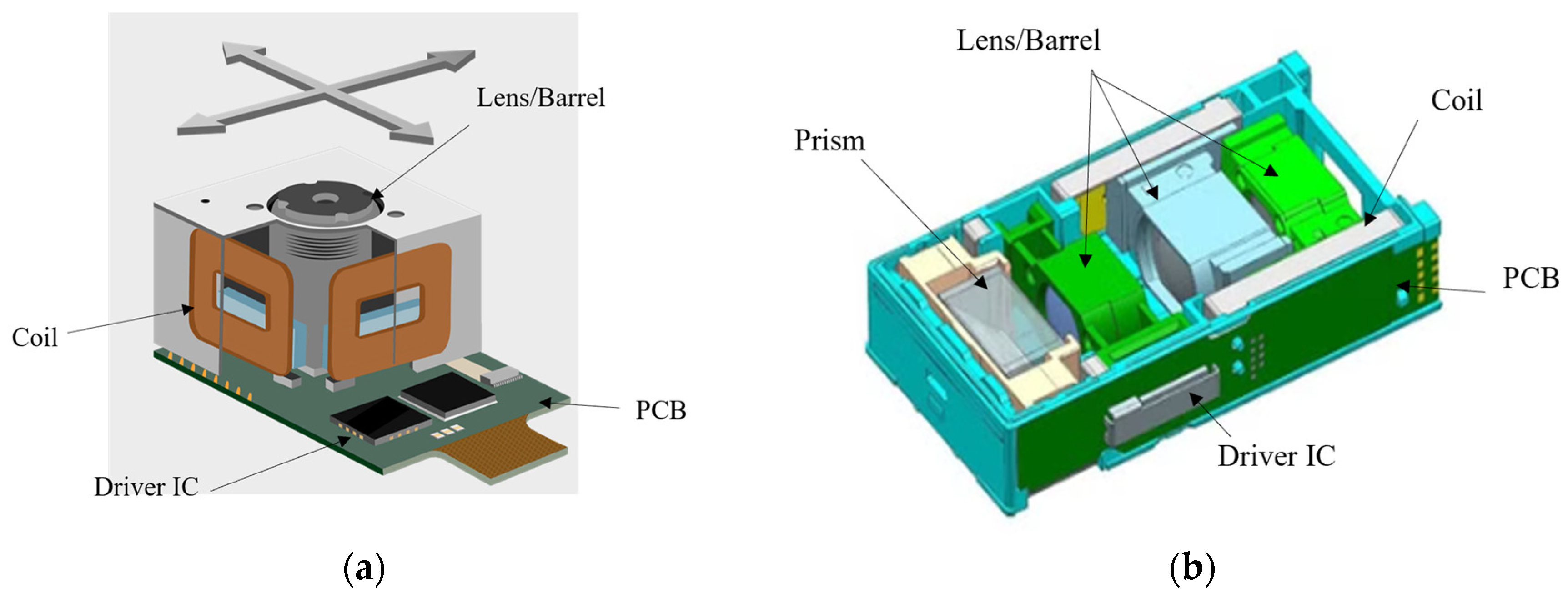
The mobile camera structures for smartphones considered in this study are shown in Figure 1 [10,11]. Figure 1a shows a vertically stacked architecture, in which the lens and barrel are arranged along the z-axis. Figure 1b shows a folded architecture (i.e., periscope), in which the lens and barrel are arranged horizontally. In the folded configuration, a prism folds the optical path to reduce the module z-height. The difference between the two architectures is determined by their effective focal length (EFL).
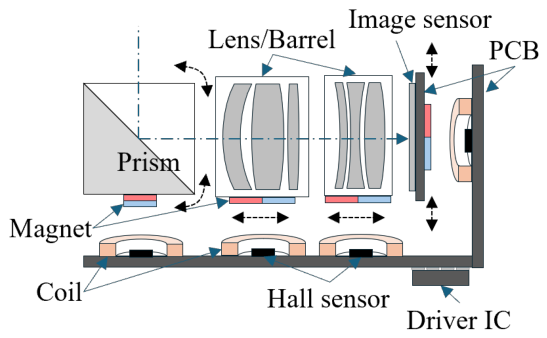
In the vertically stacked architecture, a long EFL optical path causes increases in the z-height of the camera module, thickening the mobile phone. Therefore, the folded architecture, in which the lens lays horizontally, is advantageous under form factor constraints. This study considers the configuration where the actuator is applied to the folded camera module architecture, with the required travel range being longer than in vertically stacked modules. Consequently, higher closed-loop bandwidth and faster dynamic response are required. The block diagram of the folded camera module is shown in Figure 2. Functionally, the module consists of an optical part, an electrical part, and a mechanical part.
The optical part comprises the lens assembly and prism, which collect and reflect the optical path along the folded path. The mechanical part includes the actuator for the positioning of the optical elements and the housing, which provides structural integrity and environmental protection. The electrical part employs an image sensor to transmit the electrical signal of the image scene and uses an image sensor and a printed circuit board (PCB) to route and interface these signals externally. It also integrates the actuator control components, including the Hall sensor and controller IC. Actuators mainly use VCM technology, as shown in Figure 2. A VCM consists of a permanent magnet, a coil, and a position sensor (e.g., Hall sensor) for position control. Since the coil requires electrical connection, it is difficult to assemble it to the moving part, and thus, a magnet is attached to the latter. The VCM generates actuation force based on the Lorentz force principle by driving current into the coil to adjust the position of the moving element. The Lorentz force is given by the following expression (1) [12]:
F = B i L
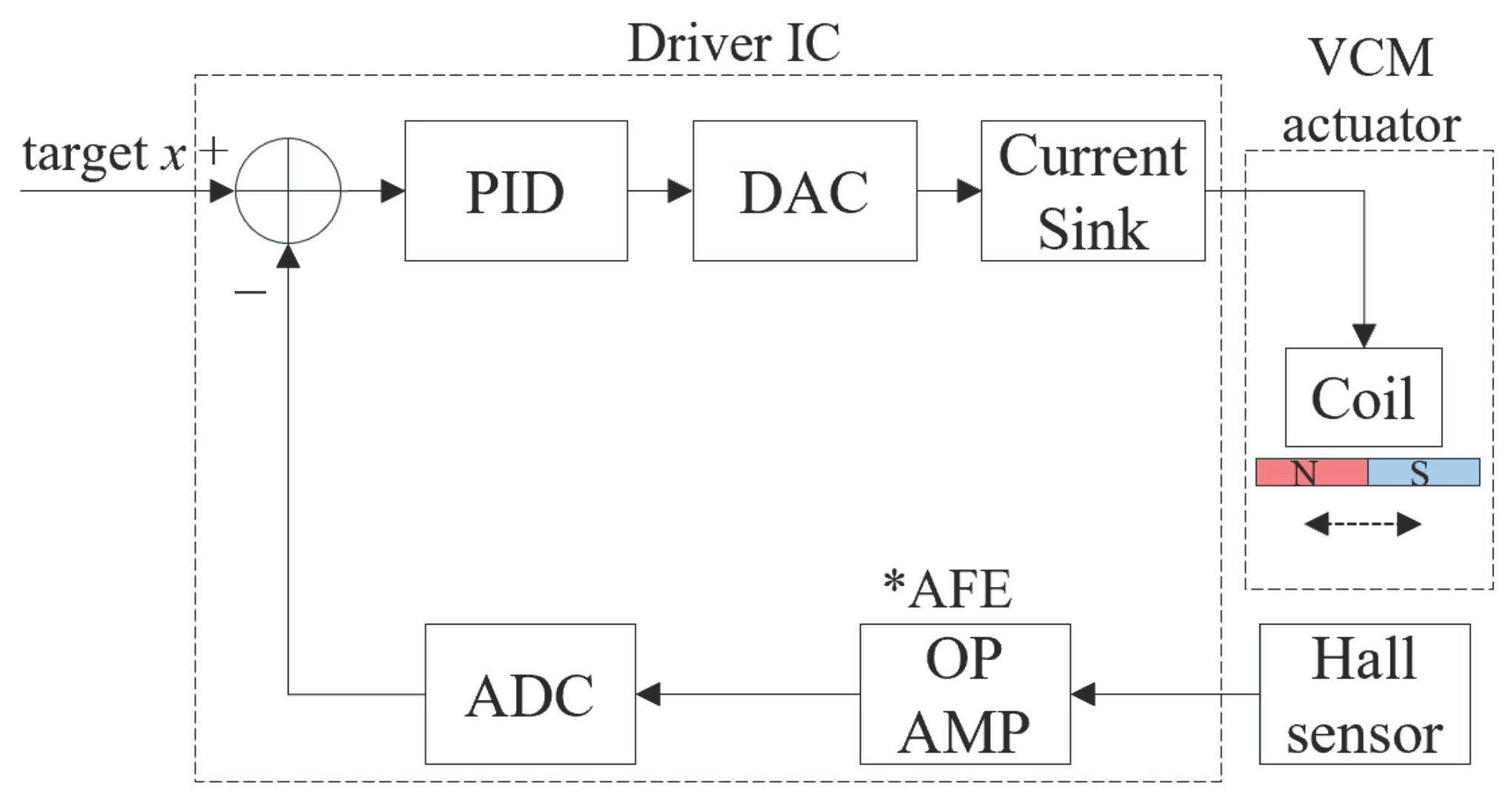
In (1), F denotes the electromagnetic force, B the magnetic flux density generated by the permanent magnet, L the effective length of the current path within the magnetic field, and i the coil current. In camera modules, a driver IC generates the Lorentz driving force and adjusts the position of the optical components based on feedback control. Figure 3 illustrates the actuator control block diagram using the driver IC [13,14,15,16,17], which integrates an analog front end (AFE), which amplifies the hall sensor signal for the ADC; an analog-to-digital converter (ADC), which digitizes the amplified signal; a processor, which PID-controls computations; and a digital-to-analog converter (DAC), which converts the digital PID output into an analog signal. The output analog drives a current-sink stage, in which the current is induced in the coil. The coil current generates the Lorentz force with the magnet and thus with the moving optical payload. As the magnet position changes, the Hall sensor output varies through the feedback loop. The driver IC adjusts the current value to achieve the target position and reduce disturbances.

2.2. Modeling of Camera Module Actuator

For computer simulation, the actuator dynamics are modeled using Newton’s second law. The equation of motion is given in (2) [5]:
m d 2 x t d t + B m d x t d t = K f i t
where i ( t ) denotes the coil current, m the mass of the moving payload, B m the damping coefficient, K f the force constant (converts current to force), and x ( t ) the position as a function of time.
By simplifying the Laplace transformation and setting parameters to zero under the initial conditions of the actual actuator, assuming zero initial conditions, (2) can be expressed in the Laplace domain as the plant transfer function G p ( s ) , as shown in (3):
G p s = x s i s = K f s m s + B m
The simulation model was parameterized using measurements from a real-world actuator, whose parameters are summarized in Table 1. A detailed mechanical principle of the actuator is beyond the scope of this study.
The moving payload mass is m = 2   g , and the measured damping ratio is B m = 0.00003   m N · s / m m . By substituting the actuator parameters from Table 1 into (3), the plant transfer function is obtained as shown in (4):
G p s = x s i s = 0.12 s 2 s + 0.00003
A PID controller was applied to control the actuator model in (4). The controller transfer function u P I D ( s ) is given in (5) [18]:
u P I D s = K p + K i s + K d K n s s + K n
where K p , K i , K d , and K n are the proportional, integral, derivative, and derivative filter gain, respectively. The tuning parameter was optimized using the Ziegler–Nichols method, which is an empirical approach widely employed in practice. The tuning objective was to ensure that actuator settling occurred within the one image frame period to prevent motion blur. Therefore, the settling time should be shorter than 8 milliseconds (ms) for a typical video frame rate of 120 frames per second (fps). The resulting controller gains are provided in (6)–(9):
K p = 13 × 10 6
K i = 3 × 10 6
K d = 12 × 10 3
K n = 18 × 10 3
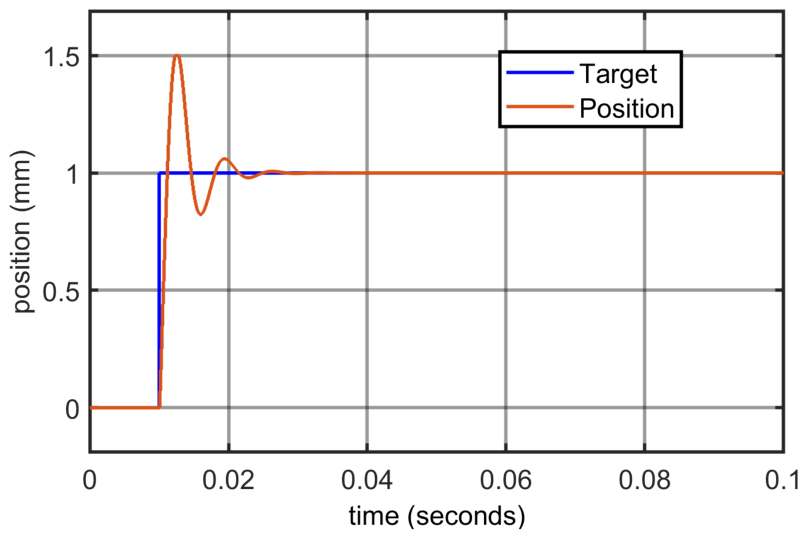
The response characteristics for the actuator model in (4) and the controller model in (5)–(9) are shown in Figure 4. The settling time is about one millisecond, with a tolerance of 10%.
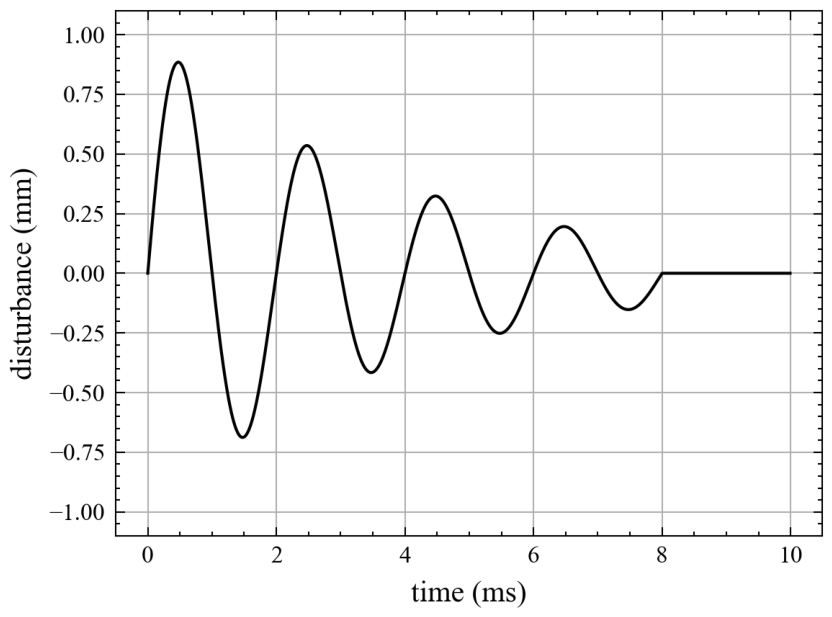
In this study, the disturbance under consideration is an impact event corresponding to a handset drop onto the floor. The shock model transmitted to the camera module follows parameter values reported in prior work [19]. The shock-induced displacement of the moving payload is represented in (10):
D [ t ] = A d e 2 π t s f t sin 2 π f d t s t
The sampling time is t s = 1 ms, t = 1 , 2,3 , and the disturbance amplitude A d   and frequency f d   at the camera module depend on impact severity, following [19]; we adopt A d = 1   and f d = 500   Hz .
The simulation results based on (10) are shown in Figure 5. In the real-world actuator, a transient oscillatory jitter (ringing) is observed, and the oscillation tends to persist for approximately 8 ms. In this paper, the assumption of a 500 Hz disturbance is based on actual experimental results, as referenced in [19], conducted under representative mobile device conditions. During disturbance events such as shocks or drops, the vibration frequency is primarily determined by the weight and stiffness of the system and thus remains relatively stable across typical scenarios rather than being influenced by environmental variations. In fact, similar frequencies have been reported in related studies, supporting the representativeness of this parameter. Furthermore, if minor frequency variations occur, the Driver IC registers can be adjusted to tune the frequency values as parameters, making experimental optimization feasible. Importantly, the proposed statistical detection algorithms are designed to remain effective even under slightly different shock profiles, thereby ensuring robustness in practical applications.

3. The Algorithm for Miniature Actuator Control

3.1. Proposed Phase-Based Detection Algorithm

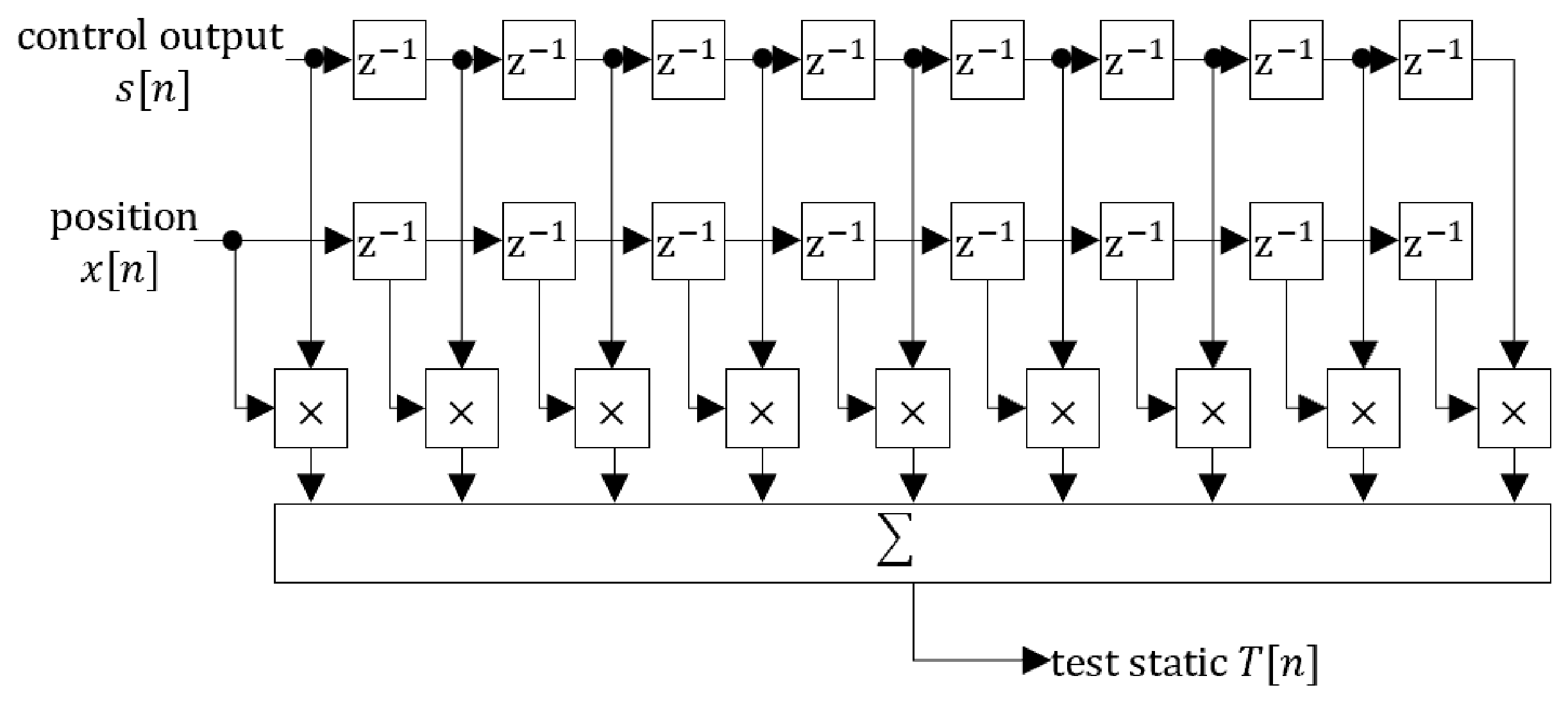
The detection processes are important for minimizing the effects of disturbances. In this study, we propose two methods for detecting disturbances. The first approach is a phase-based disturbance detection algorithm that exploits the phase difference between the command signal from the controller and the position feedback signal from the actuator. When the phase lag exceeds 180 , the closed-loop system reaches an unstable status. Then, the phase difference is detected using statistical techniques, following [20]; test statistic T [ n ]   can be implemented in the form of a matched filter, as given in (11):
T [ n ] = n = 0 N 1 x n s n
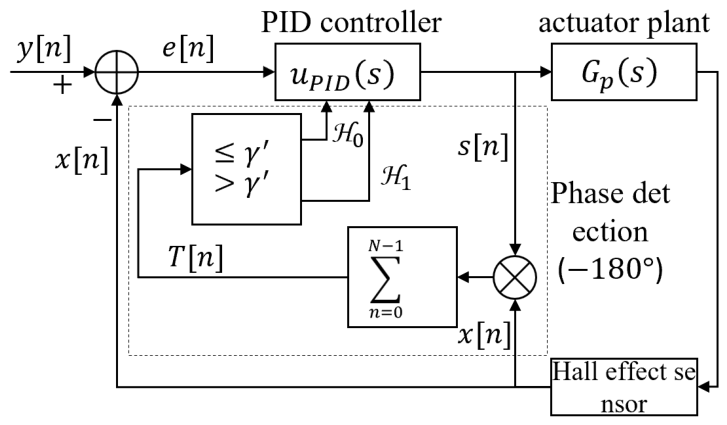
The control signal is generated by the driver IC, and thus, is known a priori, allowing it to be treated as a deterministic control signal s [ n ] . The position signal x [ n ] is acquired from the Hall sensor, and N denotes the number of samples. The phase difference is calculated by computing the correlation between s [ n ] and x [ n ] to form test statistic T [ n ] . When s [ n ] and x [ n ] are in phase, T [ n ] assumes positive values; when they are out of phase ( 180 ), T [ n ] becomes negative. Accordingly, disturbance presence is decided by comparing T [ n ] against a threshold γ . The control block diagram with the phase detection algorithm derived from (11) applied is shown in Figure 6, where y [ n ] denotes the target position command for the moving payload, x [ n ] is the Hall position sensor output representing the payload position, and e [ n ] is the position error between the target and the current position. The error signal drives the PID compensator u P I D ( s ) , which outputs the control current corresponding to the command signal s [ n ] .
The resulting current is applied to the actuator, G p ( s ) , generating the Lorentz force to translate the moving payload. For phase detection, T [ n ] is computed from N samples of x [ n ] and s [ n ] , enabling the estimation of the phase difference for disturbance detection. Decision threshold γ is selected according to the Neyman–Pearson criterion for hypothesis testing. According to Equation (11), once the test statistic is derived from the received signal, it is necessary to determine whether a disturbance has been detected. The detection decision is made by comparing the magnitude of the test statistic against a threshold, which can be appropriately derived through statistical analysis. In discrete time, the test statistic T [ n ] can be expressed as T ( x ) in terms of the received signal x in continuous time, for the purpose of statistical representation. If the null hypothesis, H 0 , is accepted, the controller assumes a disturbance-free stable condition; if the alternative hypothesis, H 1 , is accepted, a disturbance is considered to exist. Using the disturbance model in (11), the observation model for the phase detector can be expressed as in (12):
T ( x ) ~ N 0 ,   σ 2 / N u n d e r H 0 N A ,   σ 2 / N u n d e r H 1
where A denotes the disturbance amplitude, and σ 2 is the noise variance with w [ n ] N ( 0 , σ 2 ) [20]. In addition, under the null hypothesis ( H 0 ), if test statistic T ( x ) exceeds threshold γ , the controller erroneously decides that a disturbance exists, and the probability of this incorrect determination is defined as the false alarm probability, P F A . In a white Gaussian noise (WGN) environment, P F A can be derived as in (13) and (14), where P r { } denotes the probability density function (PDF):
P F A = P r T x > γ ;   H 0
P F A = Q γ σ 2 / N  
Decision threshold γ is derived from (14) to give (15):
γ = σ 2 N Q 1 P F A  
Under the alternative hypothesis, H 1 , if test statistic T ( x ) exceeds threshold γ , the controller correctly assumes the presence of a disturbance. Moreover, the detection probability, P D , is defined accordingly and can be expressed as shown in (16) and (17):
P D = P r T x > γ ;   H 1
P D = Q γ A σ 2 / N  
Using (15) and (17), the result in (18) is obtained, where the signal-to-noise ratio is defined as S N R = ( N A 2 ) / σ 2 :
P D = Q Q 1 P F A N A 2 σ 2
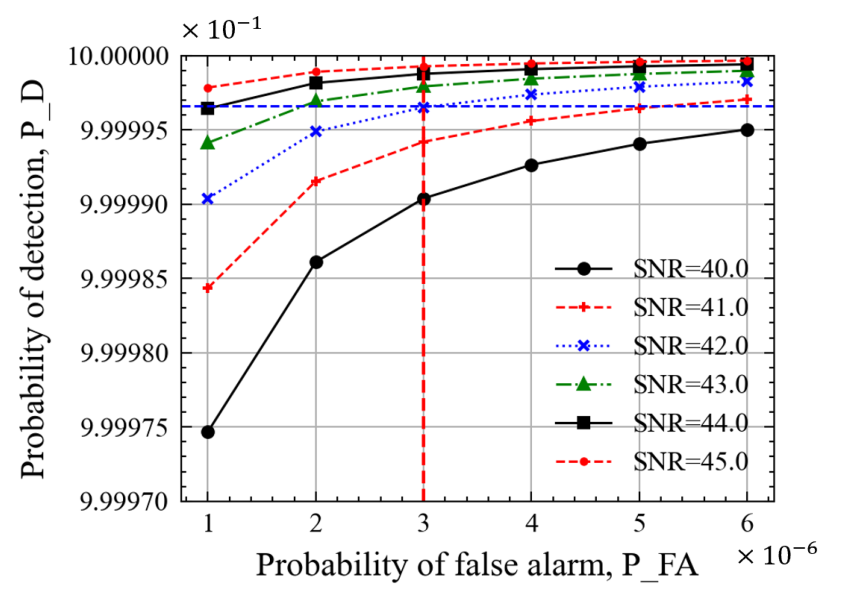
The false alarm probability and detection probability as functions of the SNR are calculated using (15) and (18) and are depicted in Figure 7.
The function Q ( x ) denotes the Gaussian Q-function, i.e., the complementary cumulative distribution function (CCDF), and the approximated formula in (19) is used for calculation:
Q x 1 2 π x exp 1 2 x 2
In a real-world controller, the number of received samples ( N ) increases processing latency. With a driver IC sampling period T s = 0.1   ms , we set N = 8 to limit the detection latency below 1 ms. The actuator has a measured position error of about 2.8   μ m , and the control operates with a 6.4   μ m step size. Consequently, the SNR is about 42 . With P D being targeted at the six-sigma level (i.e., under 3.4   ppm ) and P F A being constrained to the six-sigma level, the decision threshold is γ = 2.335 .

3.2. Proposed Frequency-Based Detection Algorithm

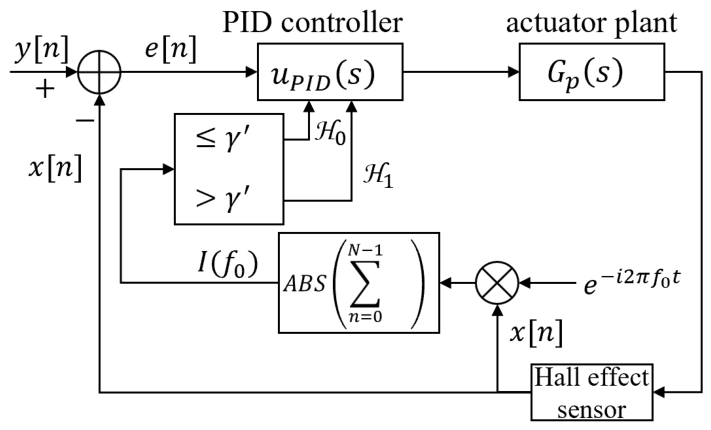
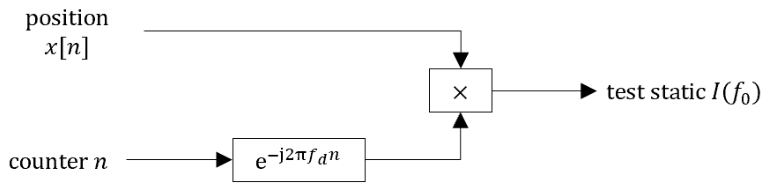
The second proposed algorithm is based on the frequency spectrum of the disturbance. The disturbance model derived in Figure 5 has a dominant component at f = 500   Hz . We propose a detection algorithm using discrete Fourier transform (DFT) that identifies this component according to the spectral magnitude at the known disturbance frequency. Test statistic I ( f 0 ) is defined as the magnitude of the DFT at f 0 , as given in (20):
I f 0 = A B S n = 0 N 1 x n e i 2 π f 0 t  
f = f 0 = 500   Hz is the disturbance frequency, x [ n ] is the position signal, N is the number of samples, and T s is the sampling period. In the DFT, the number of samples ( N ) governs the spectral resolution. For a given sampling frequency f s , f is as given in (21):
f = f s N
Therefore, to ensure that the minimum frequency satisfies Δ f < f 0 , the minimum number of samples is given by (22):
N f s f 0
In the real-world implementation, the driver IC operates at a sampling frequency of f s = 10   kHz . Therefore, the number of samples is N = 10   k H z / 500   H z = 20 . The control block diagram for frequency-based detection based on (20) is shown in Figure 8.

4. Simulation Results

4.1. Results of the Proposed Phase-Based Detection Algorithm

The simulation was conducted using MathWorks MATLAB/Simulink (R2015a). For the phase-based detection algorithm, as depicted in the simulation block diagram in Figure 9, test statistic T [ n ] was computed from N = 8 samples to satisfy a processing latency below 1   ms .
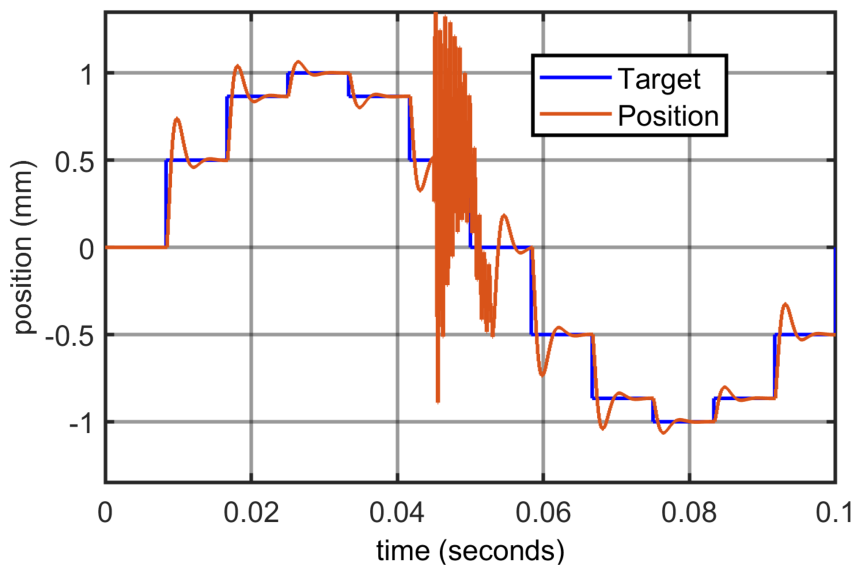
The experimental condition was set as a worst-case scenario, assuming a sinusoidal trajectory for the moving payload with amplitude ±1 mm, injecting a disturbance at t = 45 ms, and changing the target value so that the error in the feedback loop is amplified. The results are shown in Figure 10, where the solid curve represents the target command and the dashed–dot curve denotes the position value. The disturbance-induced settling time is about 1.2 ms.
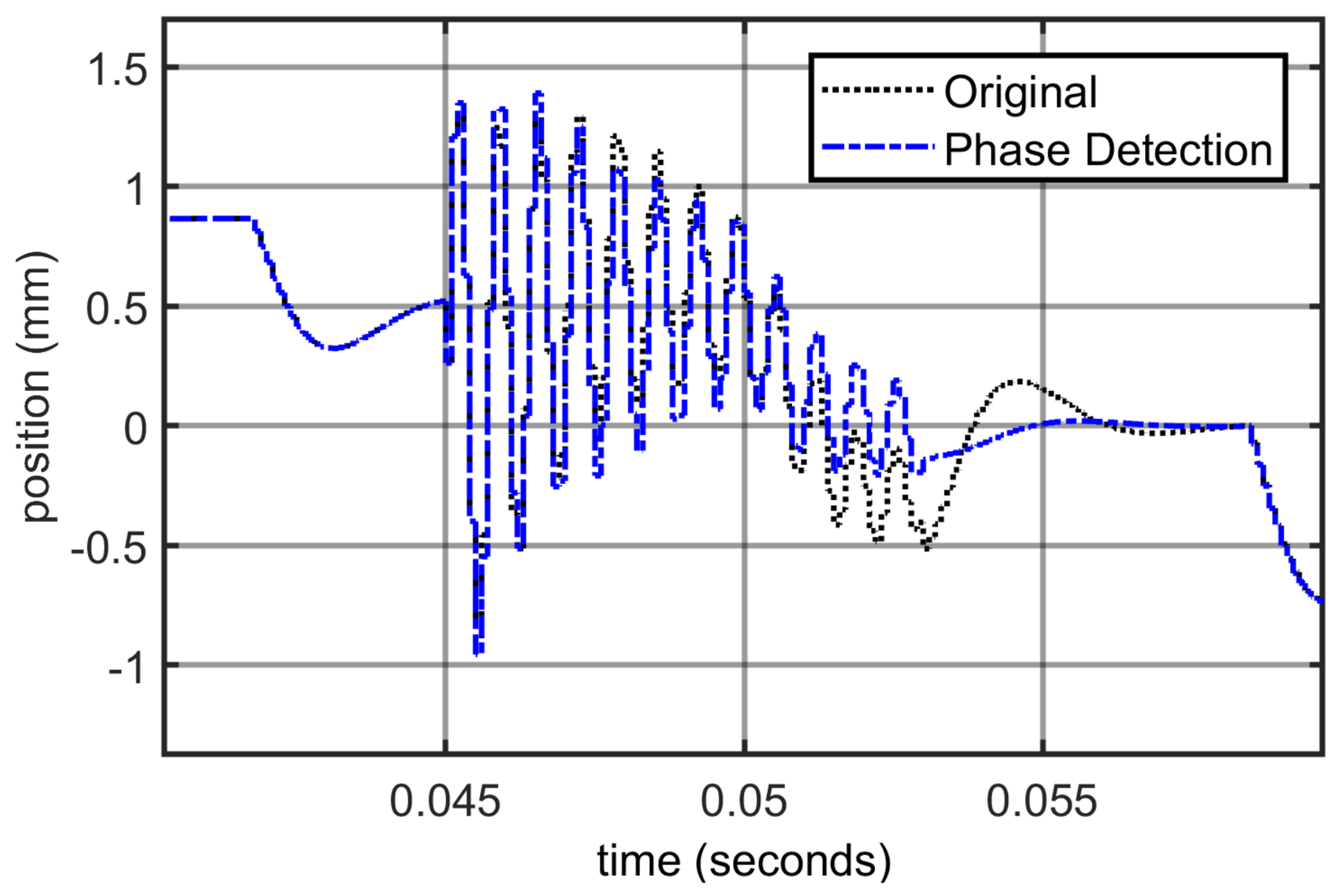
The simulation results of the phase-based detection method are presented in Figure 11. The solid trace shows the position signal under disturbance without recovery algorithm, while the dashed–dot trace represents the recovered trajectory obtained by the proposed phase detection algorithm. A reduction in the settling time due to disturbances to about 1ms was observed, indicating effective closed-loop recovery.

4.2. Results of the Proposed Frequency-Based Detection Algorithm

In the proposed frequency detection algorithm, the DFT function for test statistic I ( f 0 ) is created by multiplying the frequency components by the position signal (Figure 12). Since complex number calculations are difficult in actual driver ICs, frequency components are stored in LUT memory and calculated.
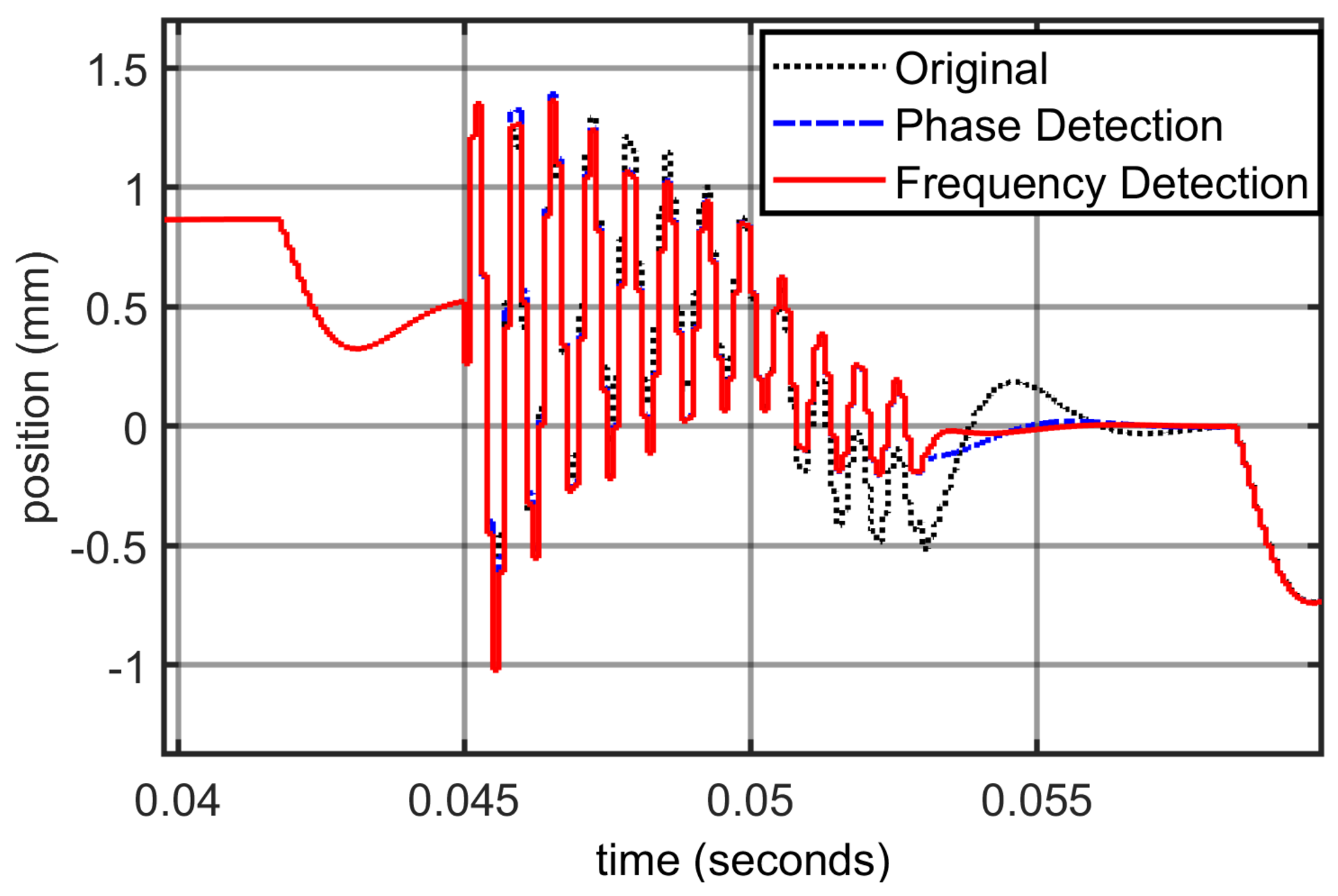
The simulation results of the frequency-based detection scheme are shown in Figure 13. The solid trace denotes the original signal without recovery, the dashed–dot trace represents the trajectory recovered by the phase-based detection approach, and the dashed trace corresponds to the recovery obtained by the frequency-based detection approach.
As the simulation results show, it was observed that the frequency-based detection algorithm provides the best recovery performance, up to 3 ms. Although it takes up more memory space for DFT calculations, the required resources are usually available in the driver IC. Therefore, the frequency-based method is recommended as the first choice, while the phase-based detection method is recommended when on-chip memory capacity is limited.

5. Conclusions

In this paper, we propose disturbance detection algorithms to mitigate disturbance-induced phenomena during actuator operation. The developed statistical detection methods include phase-based and frequency-based detectors and are validated with numerical simulations. In this paper, simulations were conducted using actual hardware parameters and drop-test parameters. The assumption of a 500 Hz disturbance is based on actual experimental results under mobile device conditions, as referenced in [17]. Moreover, in cases where minor frequency variations occur, the Driver IC registers can be adjusted to tune the frequency values as parameters, thereby enabling experimental optimization. Therefore, with the flexible applicability of frequency tuning, the proposed approach is able to accommodate a wide range of practical conditions. Both methods demonstrate effectiveness in reducing closed-loop recovery time after disturbances. The phase detection is simple to implement using a correlator, but processing delay increases as the number of samples increases. Frequency detection is mathematically simple but requires memory for complex number operations. The algorithms proposed in this paper are anticipated to improve the recovery time of smartphone camera modules under disturbances, thereby enhancing system robustness and contributing to a more stable user imaging experience by mitigating image blur. In addition, since the statistical algorithms presented in this paper have a simple structure, they are expected to be efficiently utilized in future model-based reinforcement learning using deep learning technology.

Author Contributions

Conceptualization, J.O.; Methodology, J.O.; Software, J.O.; Validation, J.O.; Formal analysis, J.O.; Investigation, J.O.; Resources, J.O.; Data curation, J.O.; Writing—original draft, J.O.; Writing—review & editing, C.E.; Visualization, J.O.; Supervision, C.E.; Project administration, C.E. All authors have read and agreed to the published version of the manuscript.

Funding

This research received no external funding.

Data Availability Statement

The original contributions presented in this study are included in the article. Further inquiries can be directed to the corresponding author(s).

Conflicts of Interest

The authors declare no conflict of interest.

References

  1. Mobile Phone Camera Module Market. businessresearchinsights.com. Available online: https://www.businessresearchinsights.com/market-reports/mobile-phone-camera-module-market-110470 (accessed on 9 January 2026).
  2. Chen, Z.; Lin, Z.; Yue, C.; Yu, F.; Jia, H. Servo control of VCM driven pointing mirror based on command filtered adaptive backstepping. In Proceedings of the IEEE International Conference on Information and Automation (ICIA), Ningbo, China, 1–3 August 2016; pp. 1056–1061. [Google Scholar]
  3. Chao, P.C.P.; Chen, Y.-H.; Tsai, C.-H.; Chen, W.-D. Design and Development of a New Two-DOF Rotational Optical Image Stabilizer. In Proceedings of the 2011 8th Asian Control Conference (ASCC), Kaohsiung, Taiwan, 15–18 May 2011; pp. 1037–1049. [Google Scholar]
  4. Yu, H.C.; Chen, T.C.; Liu, C.S. Adaptive Fuzzy Logic Proportional-Integral-Derivative Control for a Miniature Autofocus Voice Coil Motor Actuator With Retaining Force. IEEE Trans. Magn. 2014, 50, 8203204. [Google Scholar] [CrossRef]
  5. Liu, T.S.; Yeh, C.W. Positioning control of voice coil motor with shorted turn. In Proceedings of the IEEE Mediterranean Electrotechnical Conference, Valletta, Malta, 26–28 April 2010; pp. 1153–1158. [Google Scholar]
  6. Chang, H.J.; Kim, P.J.; Song, D.S.; Choi, J.Y. Optical image stabilizing system using multirate fuzzy PID controller for mobile device camera. IEEE Trans. Consum. Electron. 2009, 55, 303–311. [Google Scholar] [CrossRef]
  7. Liu, C.S.; Lin, P.D.; Lin, P.H.; Ke, S.S.; Chang, Y.H.; Horng, J.B. Design and Characterization of Miniature Auto-Focusing Voice Coil Motor Actuator for Cell Phone Camera Applications. IEEE Trans. Magn. 2009, 45, 155–159. [Google Scholar] [CrossRef]
  8. Yan, J.; Wang, Q.; Cheng, Y.; Su, Z.; Zhang, F.; Zhong, M.; Liu, L.; Jin, B.; Zhang, W. Optimized single-image super-resolution reconstruction: A multimodal approach based on reversible guidance and cyclical knowledge distillation. Eng. Appl. Artif. Intell. 2024, 133, 108496. [Google Scholar] [CrossRef]
  9. Wang, X.; Jiang, H.; Dong, Y.; Mu, M. Spatial-channel collaborative multi-scale graph interaction deep transfer learning for unsupervised rotating machinery fault diagnosis. Eng. Appl. Artif. Intell. 2026, 176, 114691. [Google Scholar] [CrossRef]
  10. What Is the Difference Between a Periscope and Telephoto Camera? xda-developers.com. Available online: https://www.xda-developers.com/periscope-camera-vs-telephoto-camera (accessed on 9 January 2026).
  11. Imaging, TDK Inven-Sense. invensense.tdk.com. Available online: https://invensense.tdk.com/technology/imaging/ (accessed on 9 January 2026).
  12. Eun, C. Comparison of the Driving Modes of an Audio Power Amplifier Considering the Characteristics of the Loudspeaker Voltage Drive vs Current Drive. J. Korea Multimed. Soc. 2017, 20, 1551–1558. [Google Scholar]
  13. µ-Step System Lens Drivers for Digital Cameras. rohm.com. Available online: https://www.rohm.com/products/motor-actuator-drivers/digital-still-camera/bu24033gw-product (accessed on 9 January 2026).
  14. Solenoid Drivers. ti.com. Available online: https://www.ti.com/product-category/motor-drivers/solenoid/overview.html (accessed on 9 January 2026).
  15. AD5398 Datasheet and Product Info. analog.com. Available online: https://www.analog.com/en/products/ad5398.html (accessed on 9 January 2026).
  16. Gong, J.; Luo, J. Rapid and Precise Zoom Lens Design Based on Voice Coil Motors with Tunnel Magnetoresistance Sensors. Appl. Sci. 2024, 14, 6990. [Google Scholar] [CrossRef]
  17. Gong, J.; Liu, D.; Luo, J. The Systematic Design of Voice Coil Motor Structures for Rapid Zoom Optical Lens. Actuators 2025, 14, 332. [Google Scholar] [CrossRef]
  18. Sun, H.; Mnati, M.J.; Ibrahim, M.N.; den Bossche, A.V. A Tuning Method for the Derivative Filter in PID Controller with Delay Time. In Proceedings of the International Conference on Mechanical and Aerospace Engineering (ICMAE), Budapest, Hungary, 10–13 July 2018; pp. 574–578. [Google Scholar]
  19. Zhou, C.Y.; Yu, T.X.; Suhir, E. Design of Shock Table Tests to Mimic Real-Life Drop Conditions. IEEE Trans. Compon. Packag. Technol. 2009, 32, 832–837. [Google Scholar] [CrossRef]
  20. Kay, S.M. Fundamentals of Statistical Signal Processing–Detection Theory, Volume II; Prentice Hall Signal Processing Series; Prentice Hall: Englewood Cliffs, NJ, USA, 1998; pp. 60–85. [Google Scholar]
Figure 1. Structure of the camera module with actuator: (a) vertically stacked architecture; (b) folded-type architecture.
Electronics 15 01925 g001
Figure 2. Block diagram of folded camera module.
Electronics 15 01925 g002
Figure 3. Block diagram of control flow using driver IC for the actuator.
Electronics 15 01925 g003
Figure 4. Step response of the actuator and controller.
Electronics 15 01925 g004
Figure 5. Modeling of disturbance caused by dropping the phone.
Electronics 15 01925 g005
Figure 6. Phase-based detection test statistics and block diagram.
Electronics 15 01925 g006
Figure 7. Signal-to-noise ratio versus detection probability of false alarm.
Electronics 15 01925 g007
Figure 8. Frequency detection test statistics and block diagram.
Electronics 15 01925 g008
Figure 9. Block diagram of phase-based detection.
Electronics 15 01925 g009
Figure 10. Effect of disturbance injection on actuator moving without recovery algorithm.
Electronics 15 01925 g010
Figure 11. Result of proposed phase-based detection algorithm.
Electronics 15 01925 g011
Figure 12. Block diagram of frequency-based detection.
Electronics 15 01925 g012
Figure 13. The comparison result of detection algorithm.
Electronics 15 01925 g013
Table 1. Parameters of the VCM actuator.
ParameterValueParameterValue
Thickness ratio1.25Force constant (mN/mm)0.12
Turn number160Resistance of coil (ohm)27.5
Coil diameter (mm)0.05Inductance of coil (uH)42.6
Coil thickness (mm)0.4Mass of moving part (g)2
Coil width (mm)1.0Damping ratio (mN·s/mm)0.00003
Disclaimer/Publisher’s Note: The statements, opinions and data contained in all publications are solely those of the individual author(s) and contributor(s) and not of MDPI and/or the editor(s). MDPI and/or the editor(s) disclaim responsibility for any injury to people or property resulting from any ideas, methods, instructions or products referred to in the content.