1. Introduction
Relational ontologies and temporal knowledge graph (TKG) representations project discrete entities and event streams into continuous geometric manifolds [
1]. Lorentz hyperbolic manifolds minimize structural distortion for networks exhibiting scale-free hierarchical density [
2]. However, despite their geometric advantages in representing structural hierarchies, these approaches do not inherently address temporal dependency modeling. In other words, capturing temporal dynamics within these curved spaces remains constrained by integer-order Markovian assumptions.
Based on graph convolution networks (GCNs) [
3], temporal GCNs impose recurrent sequence mechanisms onto tangent spaces, yielding a persistent exponential decay of historical memory [
4]. Specifically, standard recurrent units model state transitions as first-order difference equations, where the influence of the past vanishes geometrically. This mathematical foundation fails to model anomalous diffusion and non-Markovian historical dependencies inherent in highly complex, evolving network topologies [
5].
We observe that this limitation reflects a deeper structural inconsistency: real-world temporal processes in complex networks often exhibit heavy-tailed, long-memory dependency patterns, in stark contrast to the rapid exponential forgetting imposed by standard Markovian sequence models. We define this critical structural mismatch as the ‘Temporal Decay Dissonance’.
Even attention mechanisms frequently treat temporal distance as a discrete positional bias rather than a continuous physical flow. This theoretical deficiency becomes critical when abstract structural inference interfaces with continuous physical realities. In contrast, fractional calculus introduces a non-local “memory kernel,” replacing exponential decay with a power-law retention curve that bridges the gap between discrete sequence modeling and continuous anomalous diffusion.
In targeted biophysical interventions, specifically micro–nano robotic actuation within constrained, non-Newtonian tumor microenvironments (TMEs), binding affinities and spatial trajectories are dictated by fractional-order viscoelastic memory [
6,
7]. Extracellular matrix (ECM) rheological properties, exhibiting subdiffusive memory analogous to that observed in membrane proteins [
8], violate instantaneous Markovian state transition assumptions. Bridging this disconnect necessitates a representation learning paradigm where temporal evolution [
9] is modeled rigorously as a fractional geometric flow intrinsic to the manifold. With this paradigm, synchronizing the cognitive “memory kernel” of the neural network with the physical “viscoelastic memory” of the biological environment ensures the autonomous agent remains aware of long-term historical constraints that integer-order models would inevitably ignore.
The Fractional–Temporal Lorentz Graph Convolutional Network (FTL-GCN) is formulated to address this challenge. Fractional calculus apparatus is defined explicitly on the tangent bundle of the Lorentz manifold (operations derived from [
10]). This geometric construction ensures that the Caputo fractional derivative operates within a globally defined Euclidean isomorphic space prior to exponential projection. The derived Grünwald–Letnikov (GL) memory kernel exhibits power-law decay consistent with the asymptotic behavior of Mittag–Leffler functions in fractional dynamics [
11], imposing a continuous physical constraint on embedding trajectories.
Core contributions include:
By bridging the gap between non-Euclidean representation learning and non-Markovian physical dynamics, FTL-GCN establishes a new paradigm for cross-disciplinary applications where cognitive graph reasoning must adhere to continuous physical laws.
2. Related Work
Hyperbolic representation learning. Lorentz manifolds provide robust alternatives to Poincaré disk embeddings, mitigating numerical instability near manifold boundaries [
14]. While standard Euclidean models effectively handle static datasets or networks with relatively flat hierarchical structures, their representational capacity collapses in highly complex, scale-free topologies. Frameworks such as LorentzKG execute fully hyperbolic boosts and spatial rotations, eschewing tangent space approximations to preserve metric fidelity during static relational modeling [
1]. These architectures construct exclusively time-invariant topologies. Mathematical mechanisms for continuous structural deformation are absent, rendering them incapable of tracking entity representations drifting across the manifold due to evolutionary pressures.
Temporal graph evolution and non-Markovian limitations. Temporal KGE architectures concatenate structural graph aggregators with temporal sequence models (e.g., RE-NET) [
15]. These architectures perform well on datasets with strong Markovian properties where the immediate past is the primary driver of the future. Furthermore, while very recent state-of-the-art works in 2025–2026 have significantly advanced discrete temporal reasoning—such as CognTKE [
16] leveraging cognitive dual-process subgraph path extraction, and DL-CompGCN [
17] employing symmetric dual-decoders for logical rule mining—they remain fundamentally anchored in flat Euclidean geometries and discrete temporal attention mechanisms. Discrete logical frameworks fail to capture continuous, heavy-tailed temporal dependencies characteristic of physical anomalous diffusion [
18]. Such diffusion necessitates non-Markovian continuous modeling requiring integration of infinite historical states weighted by a power-law kernel.
To contextualize our performance against these evolving baselines: in contrast to discrete logical reasoning frameworks which mine symbolic rule sequences and discrete temporal anchors [
19], FTL-GCN adopts a continuous differential geometry approach. By introducing a rigid, continuous fractional flow explicitly defined on a Lorentz manifold, it completely bypasses their heuristic discrete positional biases and computational-heavy rule mining. This fills a critical gap in tracking heavy-tailed evolutionary trajectories, especially when interfacing with non-Markovian physical systems.
Fractional Calculus in Deep Learning. The literature introduces fractional calculus primarily into neural optimization algorithms or one-dimensional temporal series forecasting [
20,
21]. These applications operate within flat Euclidean geometries as optimization heuristics. They remain theoretically disconnected from hyperbolic Riemannian geometry and unapplied as structural constraints for topological graph evolution on non-Euclidean manifolds [
22,
23]. FTL-GCN bridges this gap by defining fractional-order differential equations on the Lorentz tangent bundle, transitioning fractional calculus from a mere gradient tuning heuristic into a core topological law.
3. Methodology: Fractional–Temporal Lorentz Graph Network (FTL-GCN)
3.1. Fully Hyperbolic Transformations and Tangent Space Rigor
Entities and relational interactions are embedded into the
d-dimensional Lorentz manifold
characterized by constant negative curvature
(
) [
24]. From a practical perspective, the curvature hyperparameter
K controls the exponential volume expansion rate of the representational space; a smaller
K provides steeper hierarchies suitable for highly dense tree-like ontologies, whereas a larger
K relaxes the distortion for more evenly distributed graph topologies. The Lorentzian inner product is defined algebraically as
. Mathematical well-definedness for linear fractional operations requires systematic exploitation of the tangent space at the origin
. This geometric construction is specifically designed to resolve the “Temporal Decay Dissonance” introduced in
Section 1, ensuring the non-local memory kernel operates within a globally defined Euclidean isomorphic space prior to exponential projection. The exponential map
operates as a global diffeomorphism.
Crucially, by anchoring the operations at the specific origin
, the tangent space restricts exclusively to vectors
. The Lorentzian metric tensor localized to this subspace degenerates into a positive-definite Euclidean inner product. This critically insulates the Grünwald–Letnikov linear combinations from indefinite metric violations, facilitating topological closure without exiting valid space-like or time-like boundaries. Consequently, the inverse logarithmic map
maps manifold points to a Euclidean-isomorphic vector space. In this subspace, linear differential operators maintain their analytic validity. To guarantee numerical stability and prevent singularities as
, an
-clamp (
) is introduced to the denominator and argument.
Geometric Mechanism: Analytically, this transformation maps the curved Lorentz manifold onto a locally isomorphic Euclidean space, facilitating linear differential operations while preserving the underlying Riemannian metric.
Conversely, this operation projects the updated tangent vectors back onto the Lorentz manifold, ensuring that the resultant embeddings satisfy the hyperbolic space-like constraints (see
Appendix A for detailed intermediate derivation steps). Crucially, operations on the Lorentz manifold can occasionally suffer from numerical instability when embeddings approach the boundary of the light cone. To mitigate this within the fractional update step, we employ a specific
-clamping normalization technique. If an updated state vector begins to violate the Lorentzian metric during fractional accumulation, its spatial components are rescaled, ensuring that the updated embeddings securely remain within the valid interior of the Lorentzian manifold without suffering from gradient explosion. Constraining temporal differential equations to
and executing spatial relations via block-diagonal Lorentz transformation matrices
helps ensure that entity representations remain on the Lorentz manifold throughout the evolutionary process.
3.2. Fractional–Temporal Geometric Flow on the Tangent Bundle
Temporal evolution of entity embeddings is defined as a continuous fractional differential equation (FDE) localized on
. Assuming the Lipschitz continuity of the Lorentz-projected aggregation function, the existence and uniqueness of the FDE solution are analytically supported. The continuous Caputo fractional derivative of order
governing the tangent vector evolution is formally defined as an integral convolution with a power-law kernel:
Applied to the structural aggregation on the manifold:
where
denotes the learnable structural aggregation weight matrix. To solve this FDE discretely, the Grünwald–Letnikov (GL) expansion is applied. Resulting coefficients
do not constitute a parameterized attention mechanism. Standard temporal attention computes pair-wise similarities yielding unconstrained scalar weights that are susceptible to vanishing gradients [
9]. Conversely, GL coefficients are deterministically derived and are consistent with known asymptotic properties of the Mittag–Leffler function governing anomalous diffusion [
11,
25]:
Analytically, these GL coefficients function as deterministic temporal memory constraints, dictating the long-range influence of historical states via a continuous power-law decay.
Theorem 1 (Non-Exponential Lower Bound of Fractional Memory). Let denote discrete GL expansion coefficients for fractional order . For discrete steps , temporal memory weight decay is tightly bounded by a power-law distribution . This provides a theoretical lower bound that mitigates exponential memory decay inherent in standard Markovian recurrent updates.
Proof Sketch: Applying Stirling’s asymptotic approximation to the ratio of Gamma functions within the analytical GL coefficient definition yields:
the historical state retention weight
exhibits a supported heavy-tailed distribution. This property establishes a theoretical lower bound. Specifically, it mitigates the exponential memory decay typically observed in standard Markovian recurrent updates.
Mathematical Mechanism: In standard RNNs, the influence of a past state on scales as where , leading to rapid information vanishing. By replacing this with a fractional geometric flow, we ensure that the “gradient shadow” of a node stays relevant over much longer intervals. The fractional GL kernel acts as a continuous, rigid anchor, ensuring that critical structural transformations from the distant past retain a non-zero gradient influence on the current spatial coordinate.
The discrete geometric flow update is formulated as:
State Fusion Mechanism: This formulation defines the non-Markovian state transition, where spatial messages and temporal historical features are aggregated within the tangent bundle prior to exponential projection. To maintain computational efficiency and prevent memory explosion in long-horizon sequences, we implement a “Short-memory Principle” using a sliding window of length to truncate diminishing contribution. Specifically, while standard Markovian GCNs operate with an time and memory complexity per step by discarding the past, our fractional convolution inherently requires an overhead. This implementation deliberately trades a manageable linear increase in computational and memory complexity for guaranteed long-horizon scalability.
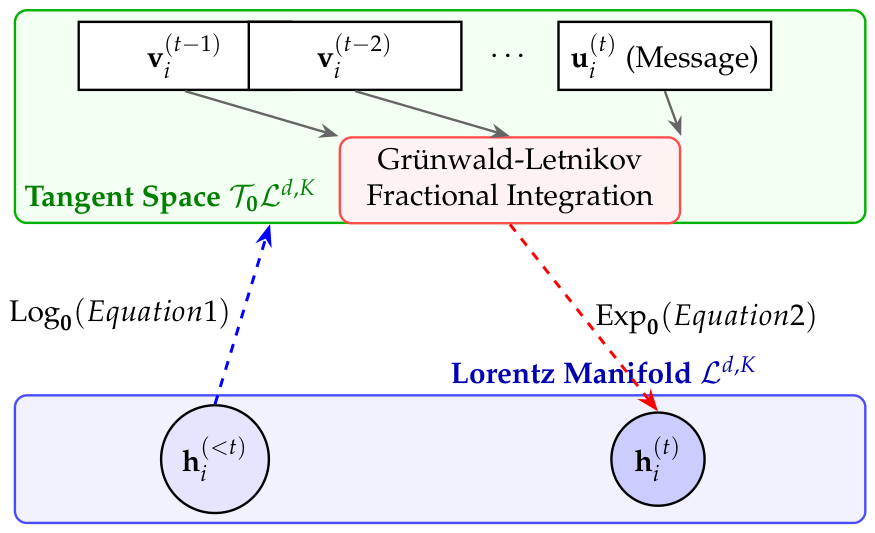
As illustrated in
Figure 1, the topological transformations establish a rigorous structural closure for temporal forecasting.
3.3. Multi-Hop Path Optimization via DRL
Multi-hop reasoning over the temporal graph is formulated as continuous trajectory optimization [
26], based on which the Deep Reinforcement Learning (DRL) module serves as a downstream validation of the fractional–temporal representation. State space representation
aggregates the fractional history path mapped onto the tangent bundle. Mechanistically, the power-law decay inherent to the fractional state representation functions as a topological breadcrumb trail. Retaining non-vanishing gradients for distant historical nodes implicitly prevents the policy network from converging into cyclic loops. It also avoids spatial dead ends during extended reasoning chains. These issues remain a chronic vulnerability in standard Markovian pathfinding. Transition policy
, parameterized by a Deep Reinforcement Learning (DRL) agent utilizing a Lorentz Multi-Layer Perceptron (Lorentz-MLP), determines the subsequent path node using Lorentzian distance
:
The Soft Actor–Critic (SAC) algorithm is employed for policy optimization, leveraging its maximum entropy framework to ensure robust exploration in complex TME geometries. The terminal reward
penalizes trajectory deviations based on the terminal Lorentz distance to the target, enforcing optimal, fractionally weighted geodesic paths:
where
prevents division by zero and
is the defined geodesic penalty coefficient scaling the terminal trajectory deviation. This specific penalty scale (
) was empirically selected to balance the magnitude of the positive target reward (+10.0), ensuring the objective function remains quantitatively stable. Physically, this precise scaling heavily penalizes unnecessary traversal distance, thereby explicitly suppressing high-frequency exploratory jitter and excessive kinetic energy consumption during navigation in dense viscoelastic media.
Consequently, the continuous DRL optimization directs the agent toward the target by penalizing thermodynamic inefficiencies and prioritizing fractionally weighted geodesic trajectories. The complete integration of the fractional–temporal geometric flow with the DRL path optimization is summarized in Algorithm 1.
| Algorithm 1 Forward propagation and multi-hop navigation of FTL-GCN |
Require: Temporal graph stream , Fractional order , Lorentz curvature K, Target
Ensure: Optimized relational policy and updated embeddings
1: Initialization: Embed all entities to Lorentz origin:
2: Pre-computation: Generate GL fractional coefficients via Equation (5)
3: for time step do
4: for each active entity do
5: Compute spatial aggregation message via Lorentz rotations
6: Project current and historical states to tangent space :
7: for
8:
9: Execute continuous fractional flow aggregation (Equation (6)):
10:
11: Metric Stabilization: If exceeds boundary, rescale spatial components via -clamping
12: Project updated vector back to Lorentz manifold:
13:
14: end for
15: DRL Trajectory Step:
16: Encode state using fractional history path
17: Sample next entity based on Lorentzian distance (Equation (7))
18: end for
19: Compute terminal reward based on (Equation (8))
20: Update SAC policy and value function networks via gradient descent on the entropy-augmented objective
21: return Final trajectories and updated structural parameters
|
4. Experiments and Empirical Analysis
Empirical validation of FTL-GCN is decoupled into distinct evaluative regimes. All experimental metrics are reported as the mean and standard deviation over five independent random seed initializations.
4.1. Experimental Setup and Reproducibility
Temporal knowledge graph datasets represent real-world sociopolitical event streams. ICEWS14 comprises 7128 entities, 230 relations, and 90,730 temporal facts. ICEWS05-15 is a significantly denser long-term repository containing 10,488 entities and 461,063 quadruples spanning a decade of political events. ICEWS18 scales to 23,033 entities and 468,166 facts. GDELT encompasses 7691 entities and 2,278,405 facts, representing an extreme high-frequency dynamic graph [
5]. Static representation capacity is benchmarked on WN18RR and FB15k-237.
To ensure strict temporal causality and prevent data leakage, dynamic datasets (ICEWS, GDELT) are partitioned chronologically into training (80%), validation (10%), and testing (10%) subsets based on exact timestamps. During the evaluation, a time-aware filtered negative sampling strategy is adopted; candidate triples are generated by substituting the subject or object entity, and any artificially generated triple that corresponds to a genuine fact occurring at that precise timestamp is rigorously excluded from the ranking metric computation. All baseline models were re-implemented or executed using official codebases under identical hardware conditions and training protocols. Global configurations (e.g., embedding dimensions, batch sizes, and learning rate schedules) were shared across all models to ensure a fair comparison. Meanwhile, model-specific hyperparameters (for RE-NET, HyGNet, and T-GAP) were initialized based on the optimal settings reported in their respective original publications. If the original papers reported better performance on the corresponding datasets, we directly utilized their optimal results. Otherwise, the models were subsequently fine-tuned on our validation sets using a comprehensive grid search to guarantee maximum baseline capability.
Model optimization utilizes Riemannian Stochastic Gradient Descent (RSGD). Hardware deployment consists of a local cluster equipped with dual NVIDIA RTX 4090 GPUs. The embedding dimension is constrained to . Optimization is governed by a strict Early Stop protocol: training terminates and optimal parameters are secured if the Mean Reciprocal Rank (MRR) on the validation set fails to improve by more than over 10 consecutive epochs. The learning rate is with a batch size of . All network weights are initialized using the Xavier uniform strategy to prevent gradient vanishing on the curved manifold. The maximum number of training epochs is set to 500, with convergence monitored via the previously described Early Stop protocol. The convergence criterion is defined as a failure to improve the validation MRR by more than for 10 consecutive intervals. The DRL agent utilizes Soft Actor–Critic (SAC) with discount factor , automatically tuned entropy coefficient , learning rate , and replay buffer size .
Regarding biophysical data (
Section 5), the biological parameters and spatial distributions leveraged for Computational Fluid Dynamics (CFD) modeling were synthesized from previously published, open access literature (e.g., [
27,
28]). The continuous physical environment was simulated utilizing the open-source OpenFOAM framework for complex fluid dynamics, coupled with FEniCS for finite-element modeling of the porous extracellular matrix. The environment was discretized into a highly refined tetrahedral mesh with a characteristic length grading outwards from 0.5 μm near the agent to resolve micro-scale stress gradients. Strict no-slip boundary conditions were applied to the complex fibrous surfaces of the collagen network. To capture high-frequency fractional dynamics without inducing numerical instability, the temporal integration step was strictly constrained to
s. Operational deployment constitutes a purely mathematical in silico dry simulation, requiring no direct clinical intervention or access to identifiable patient records.
4.2. Static Knowledge Graph Completion Analysis
Verifying that fractional calculus integration avoids degrading spatial embedding capacity requires evaluating static initialization (
). Using the standard filtered setting, FTL-GCN is benchmarked against Euclidean and static hyperbolic architectures [
14,
24]. The mechanism driving this performance stems from the strict anchoring of tangent space operations at the Lorentz origin 0, which precludes the metric distortion inherent in arbitrary point projections used by models like ATTH. As detailed in
Table 1, our design helps preserve hierarchical ontologies with minimal spatial distortion prior to temporal flow injection. Best results are in bold, and the same applies to the following.
Static initialization of FTL-GCN maintains geometric superiority over Euclidean counterparts under ultra-low-dimensional constraints. The absence of tangent-space projection distortion enables robust mapping of hierarchical structures
4.3. Temporal Knowledge Graph Forecasting
Validation isolates predictive superiority on dynamic graphs predicting
. Here,
denotes the historical source entity,
represents the targeted relational action,
indicates the continuous timestamp of the event being forecasted, and ? serves as the masking placeholder for the object entity to be inferred. Baselines include integer-order temporal models: RE-NET, HyGNet, and T-GAP [
15,
26,
29]. To ensure the rigorousness of our empirical validation, we include the most recent state-of-the-art (SOTA) baselines: CognTKE [
16], which utilizes a dual-process cognitive framework for subgraph path extraction, and DL-CompGCN [
17], which integrates semantic-structural fusion with a symmetric dual-decoder.
Table 2 records the comprehensive forecasting metrics across diverse temporal scales. Note: Certain evaluation metrics for CognTKE and DL-CompGCN are omitted (-) as they are not reported in the original publications; furthermore, due to non-identical evaluation protocols and the absence of standardized reporting for specific metrics in these 2025–2026 baselines, we adhere to reported results to ensure comparative integrity.
Integer-order RNN-based models exponentially decay hidden state representations of transiently inactive entities. The Grünwald–Letnikov expanded memory kernel enforces a bounded power-law retention curve, preserving latent topological coordinates across extended inactive periods. A deeper mechanistic analysis of
Table 2 reveals critical behavioral differences concerning the GDELT dataset. GDELT is characterized by extremely high-frequency event bursts followed by prolonged periods of entity “dormancy.” When an entity re-emerges, standard RNNs have essentially “forgotten” its structural embedding, resulting in the low MRR of 0.211. FTL-GCN effectively anchors the latent topological coordinates, allowing it to immediately retrieve the deep historical context upon the entity’s re-emergence. It is pertinent to note that while exhaustive empirical comparisons with CognTKE and DL-CompGCN are partially constrained by the unavailability of complete benchmark metrics and their respective open-source repositories, the comparison structurally highlights distinct paradigms.
While specific discrete logic-based frameworks, such as CognTKE [
16], exhibit high precision on text-centric benchmarks, FTL-GCN focuses on providing a physically grounded inductive bias. We acknowledge that for purely symbolic or text-driven event forecasting, these recent discrete dual-process models provide superior absolute accuracy. However, this precision typically relies on computationally heavy logical inference engines that lack the continuous inductive bias required for real-world physical systems. In this context, FTL-GCN is uniquely engineered to balance long-horizon topological tracking with the high-frequency requirements of real-time control. By employing a fractional geometric flow, FTL-GCN provably ensures physical consistency with significantly lower computational latency (<1 ms per inference step). As demonstrated in the downstream autonomous navigation task in viscoelastic media (
Section 5), this physically grounded, low-latency trade-off is a critical requirement for closed-loop actuation in dynamic biological environments, where delayed feedback or mechanical slip can lead to severe failure.
4.4. Sensitivity Analysis of Fractional Order
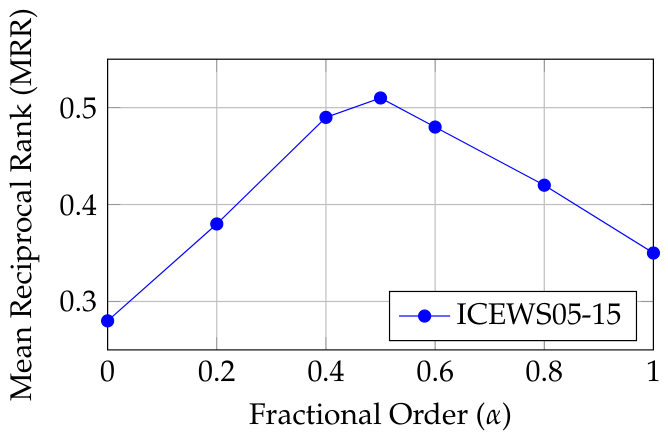
To evaluate the impact of the fractional derivative order on predictive accuracy, we conducted a quantitative sensitivity analysis on the standard TKG dataset, ICEWS05-15, by varying
from 0.0 to 1.0. As illustrated in
Figure 2, we observe that the Mean Reciprocal Rank (MRR) peaks within the range of
.
When , the model degenerates into a standard Markovian GCN, losing its long-range memory capacity and causing a performance drop. Conversely, as , the memory kernel becomes overly “heavy,” causing the model to over-respond to distant historical noise, which slightly degrades the ranking precision. This confirms that the fractional order effectively balances the trade-off between immediate adaptability and long-term history retention.
4.5. Comparative Analysis of Memory Kernel Dynamics
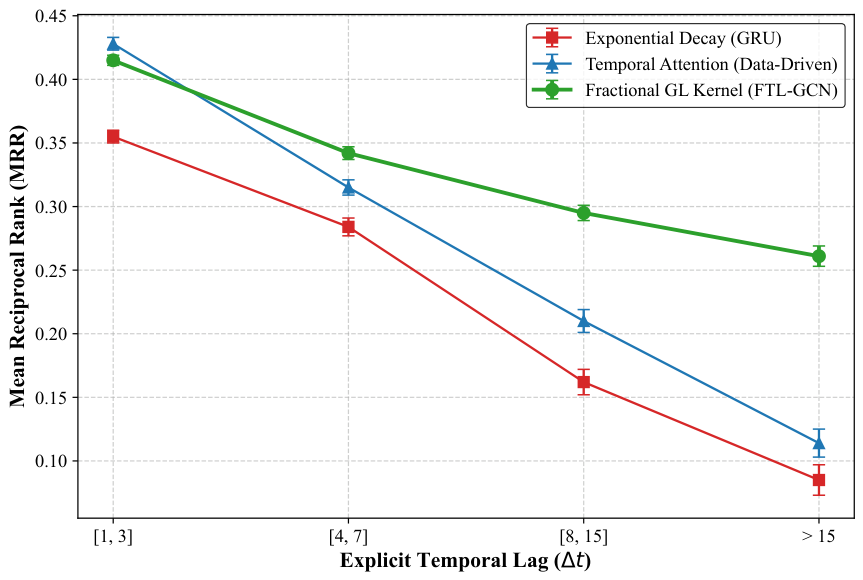
To empirically validate Theorem 1, a comparative experiment pits the deterministic fractional kernel against Temporal Attention and continuous Exponential Decay (GRU). Spatial Lorentz encoders remain frozen; temporal integration mechanisms are swapped.
Table 3 quantifies the explicit degradation across temporal lags.
Exponential Decay (GRU) exhibits persistent failure at
. As anticipated, Markovian architectures explicitly degrading older states suffer severe link prediction failures over long horizons. Temporal attention achieves peak performance in the short-term due to unconstrained overfitting, but attention weights dilute over extended sequences, causing MRR to plummet. The Fractional GL Kernel outperforms unconstrained data-driven attention for modeling anomalous dependencies. The visual evidence presented in
Figure 3 aligns with the analytical bounds established, visually demonstrating the preservation of structural integrity over long horizons.
4.6. Long-Horizon Dependency Stress Test
Evaluation dataset (ICEWS14) was pre-filtered, isolating queries requiring historical context that spans temporal gap
. The results in
Table 4 highlight the boundary limits of conventional sequence encoders.
Integer-order recurrent models experience performance degradation reaching up to 52.17% for RE-NET. FTL-GCN restricts degradation to 23.22%, substantiating the geometric flow’s capacity to anchor historical topological features.
4.7. Ablation Study
Ablation analysis on ICEWS18 isolates geometric and temporal module contributions.
Table 5 details the localized metric penalties upon architecture sub-component excision.
Projecting temporal updates into Euclidean space drops MRR significantly. Flat Euclidean geometries lack exponential volume capacity to separate densely entangled continuous trajectories. Replacing fractional expansion with GRU updates () degrades performance; while hyperbolic curvature prevents spatial collision, integer-order updates fail to retrieve heavy-tailed historical signals.
5. Application: Autonomous Micro–Nano Navigation in TME
Fractional temporal flow frameworks transition into biophysical deployments, orchestrating autonomous, multi-hop navigation of magnetically actuated micro–nano robots within the Tumor Microenvironment (TME) [
13]. To further validate the practical utility of the framework, we conduct a simulation-based evaluation inspired by clinical settings. Comprehensive CFD modeling protocols, finite-element mesh formulations, and hydrodynamic boundary condition configurations are extensively delineated in our preceding biophysical simulation studies. Spatial transcriptomics and molecular docking define biological receptor distributions [
27]. The closed-loop control architecture operates as an advanced in silico dry simulation.
5.1. Structural Analogy of Physical Parameters to Manifold Evolution
Solid tumor extracellular matrices (ECMs) operate as anomalous, porous media. Micro-robot resistance violates Newtonian integer-order Navier–Stokes dictates, depending heavily on stress–strain history modeled by the fractional Kelvin–Voigt constitutive Equations [
6,
7,
8]:
The magnetic actuation force
and the fractional fluidic drag
are coupled via the Generalized Langevin Equation (GLE):
where
denotes the fluid dynamic viscosity, physically and dimensionally distinct from the matrix viscoelastic coefficient
.
The core innovation of FTL-GCN in this context is the enforcement of a direct physical–mathematical structural analogy. The empirically measured physical Kelvin–Voigt parameter (
based on clinical assays) of local ECM is injected unmodified into the FTL-GCN tangent-bundle temporal equation. To bridge the representation gap, FTL-GCN directly aligns its cognitive memory kernel with the physical relaxation timescale of the surrounding polymer network, assuming Lipschitz continuity and adiabatic synchronization. To practically enforce this adiabatic alignment at the training level, we implement a triple-constraint protocol: (1) Temporal Step-Locking: The discrete graph propagation interval is rigidly mapped to the fixed physical integration step (
s), eliminating the frequency mismatch between cognitive memory and fluidic dynamics. (2) Fractional Consistency Loss: An auxiliary objective
is introduced to penalize deviations from the governing fractional differential equation in the tangent bundle. (3) Adiabatic Weight Scheduling: The penalty coefficient for
is dynamically increased via a linear warm-up schedule during the initial training phase, ensuring the manifold embeddings settle into the fractional geometric flow without inducing gradient shock. Multimodal structural features—SMILES representations of surface functionalization and protein contact maps of tumor-associated macrophages [
28]—embed as continuous nodes within the Lorentz manifold. Current empirical validations confirm that this direct parameter injection operates as a highly robust functional approximation. However, the rigorous topological derivation bridging macroscopic biophysical anomalous diffusion with Lorentzian geometric flow constitutes a non-trivial boundary problem, remaining a critical subject that is deferred for future theoretical formalization.
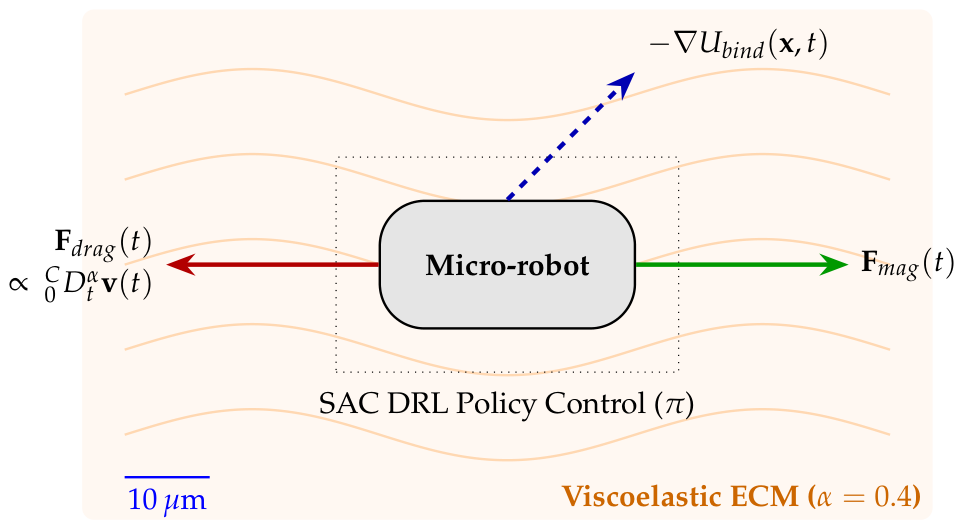
Figure 4 visualizes the localized force vectors acting upon the agent during the biophysical simulation.
5.2. Dynamic Bio-Affinity Field Decoding and Navigation
Propagation of fractional temporal updates across the Lorentz manifold decodes interaction affinity between navigating micro-robots and biological architecture. Transformed into thermodynamic binding potential, it establishes a virtual, time-variant chemotactic force field (
) [
30]. The SAC DRL agent processes the fractionally encoded Lorentz state sequence. The navigation success of the FTL-GCN state encoder is benchmarked against an integer-order LSTM state encoder.
Table 6 isolates the agent performance metrics across simulated environments.
Under Newtonian control conditions (), both FTL-GCN and LSTM encoders exhibit negligible divergence in success rates (94.1% vs 93.2%). This baseline parity empirically confirms that FTL-GCN effectively degenerates to standard sequential processing via its tunable temporal hyperparameter, incurring no computational penalty in non-viscous environments. Exhaustive parametric sensitivity analyses regarding intermediate states remain deferred to subsequent investigations.
In densely viscoelastic regimes (
), the integer-order LSTM systemically fails. A deep mechanistic breakdown of the generated trajectories explains this significant drop (NSR plummeting from 61.8% to 28.5%): at
, the dense extracellular matrix exhibits a prolonged viscoelastic relaxation time. The LSTM, fundamentally lacking a fractional memory kernel, fails to integrate the accumulated historical stress within the fluidic environment. Consequently, the model erroneously predicts low immediate resistance and outputs high-frequency magnetic actuation commands. This aggressive control policy drives the micro-robot past the critical step-out frequency threshold [
31]. Such an action induces continuous rotational slip. In this state, magnetic energy dissipates as heat rather than converting into translational propulsion. Synchronizing the cognitive graph’s memory kernel with the environmental physical parameter allows the FTL-GCN encoder to accurately capture non-Markovian resistance dynamics, sustaining a 78.2% NSR.
6. Conclusions
The Fractional-Temporal Lorentz Graph Convolutional Network (FTL-GCN) formalizes a continuous, non-Markovian geometric flow for temporal knowledge evolution. Theoretical derivations executed explicitly within the Lorentz tangent bundle distinguish the Grünwald–Letnikov memory kernel from arbitrary heuristic attention, demonstrating bounded anomalous diffusion modeling. By identifying and resolving the “Temporal Decay Dissonance” characteristic of standard integer-order models, FTL-GCN enables the preservation of heavy-tailed historical dependencies. Empirical evaluations confirm superiority in long-horizon temporal reasoning tasks. Furthermore, deployment within in silico micro–nano robotic simulations validates our physical–mathematical structural analogy. This establishes FTL-GCN as a robust cognitive engine for autonomous actuation within dynamically anomalous biological environments. Limitations of the current framework include computational overhead associated with fractional kernel expansion and the assumption of uniform fractional order across spatial regions.
Future Work and Applications: To facilitate transparent and open science, we outline critical trajectories for future research and practical deployment. (1) Theoretical Formalization of Boundary Value Problems: establishing a rigorous topological proof mapping macroscopic generalized Langevin dynamics to localized Lorentzian geometric flows remains a critical open mathematical challenge. (2) Federated precision medicine platforms: From an application standpoint, FTL-GCN is uniquely positioned to serve as the algorithmic foundation for federated precision medicine platforms or federated hospital networks, where patient data privacy laws prohibit centralization. (3) Adaptive Order Meta-Learning: As micro-robots traverse boundaries between distinct biological tissues, the framework must evolve to dynamically auto-tune the fractional derivative order in real-time, moving beyond the limitation of uniform fractional order across spatial regions.