1. Introduction
With the proliferation of Internet of Things (IoT) devices, deploying blockchain in resource-constrained edge networks has attracted significant attention [
1,
2,
3]. However, traditional Practical Byzantine Fault Tolerance (PBFT) [
4], with its
communication complexity, struggles to meet the high concurrency demands of large-scale Edge Server clusters. Furthermore, existing lightweight consensus solutions often overlook the issue of data loss caused by the malfeasance of the Edge Gateway acting as the Primary node.
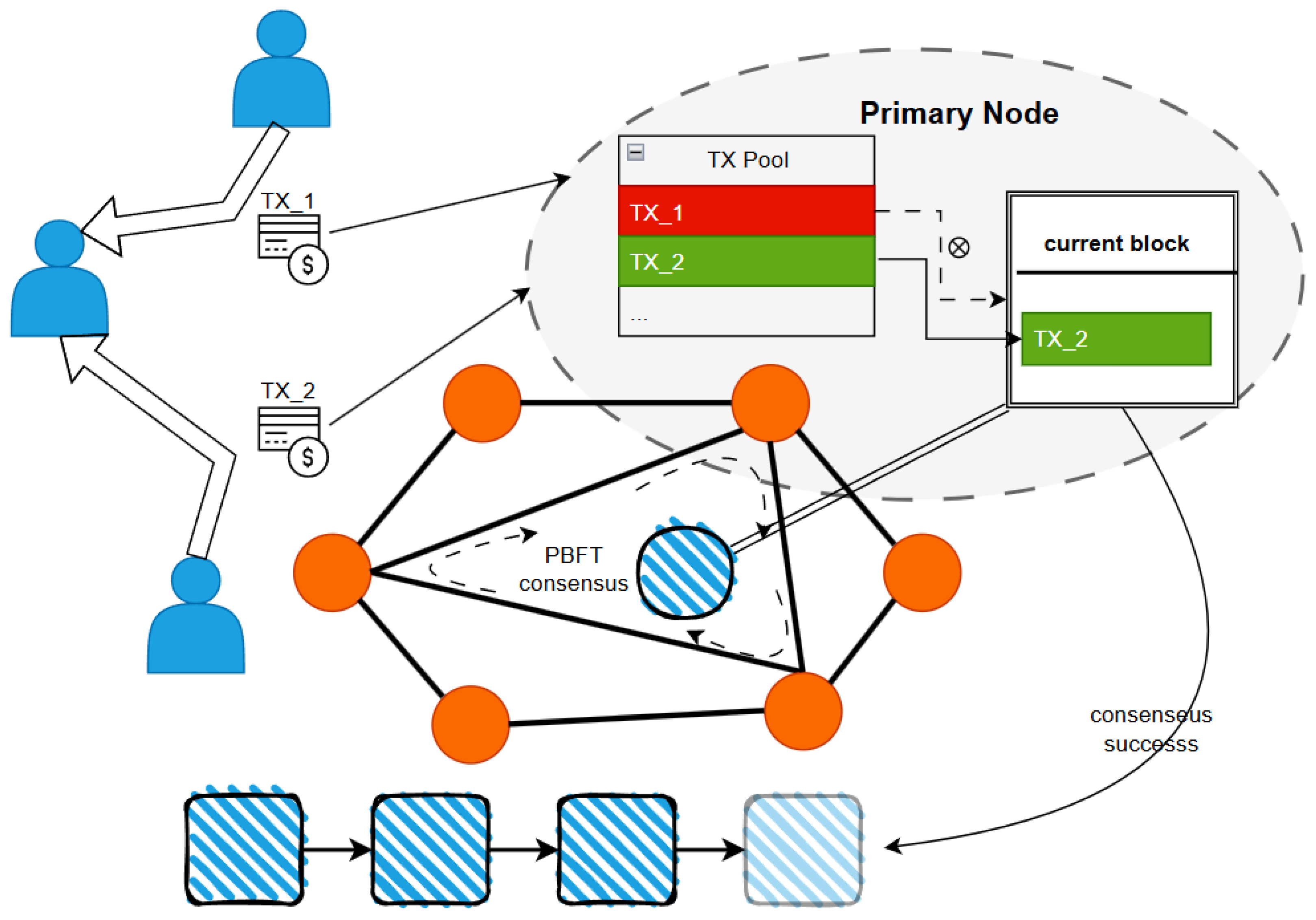
The core architecture of PBFT relies on a centralized primary node to sort and pack transactions into blocks and initiate the consensus process. This design concentrates immense power in a single entity, leading to two severe risks. First, the primary node constitutes a single point of performance bottleneck; if it crashes or is attacked, the entire network will stall until it recovers through a time-consuming view change process. Second, a more insidious threat is that a malicious or profit-driven primary can engage in transaction censorship by selectively ignoring or delaying requests from specific users, thereby undermining the system’s data integrity and service reliability, as illustrated in
Figure 1. In mission-critical IoT scenarios with extremely high demands for data integrity, such as Industrial Internet of Things (IIoT) and Supply Chain Monitoring [
5,
6], this censorship risk becomes particularly prominent. Acting as a centralized bottleneck, a malicious Primary node can launch Selective Forwarding Attacks [
7,
8]. For instance, it may deliberately discard or delay critical alarm messages from specific sensors to hide anomalies in the production system, thereby eroding the security foundation of the entire monitoring network.
To address these challenges, it is urgent to build a novel BFT consensus mechanism that is not only decentralized and robust but also capable of adapting to the high concurrency and resource-constrained characteristics of Edge Computing environments. Although existing research has attempted to mitigate this problem through methods like random primary election, most have failed to fundamentally strip the primary of its ultimate control over block content. Our work is directly motivated by this gap. We aim to fundamentally dismantle the excessive centralization of power in PBFT, especially to deprive the primary of its ability to unilaterally censor transactions.
To this end, we propose a novel consensus protocol named DC-PBFT (Decoupled PBFT), specifically tailored for Edge-IoT architectures. The protocol introduces a system of checks and balances by decoupling core powers, perfectly matching the heterogeneous network structure composed of high-performance Edge Servers and lightweight IoT devices.
The main contributions of this paper can be summarized in the following four points:
Proposed and implemented a Proposer-Primary decoupling framework for power balancing, limiting single-node power and enhancing censorship resistance.
Designed a hybrid election mechanism combining stake and dynamic reputation, using weighted random sampling to improve fairness and resist Sybil attacks.
Constructed an economic and reputation incentive model that aligns node interests with network security through rewards and penalties.
Validated the protocol through rigorous theoretical analysis and simulation experiments. The analysis results show that DC-PBFT effectively enhances censorship resistance and security while maintaining performance overhead within an acceptable range, demonstrating good overall performance.
The structure of the rest of the paper is organized as follows:
Section 2 reviews related work and background knowledge;
Section 3 elaborates on the system model of DC-PBFT;
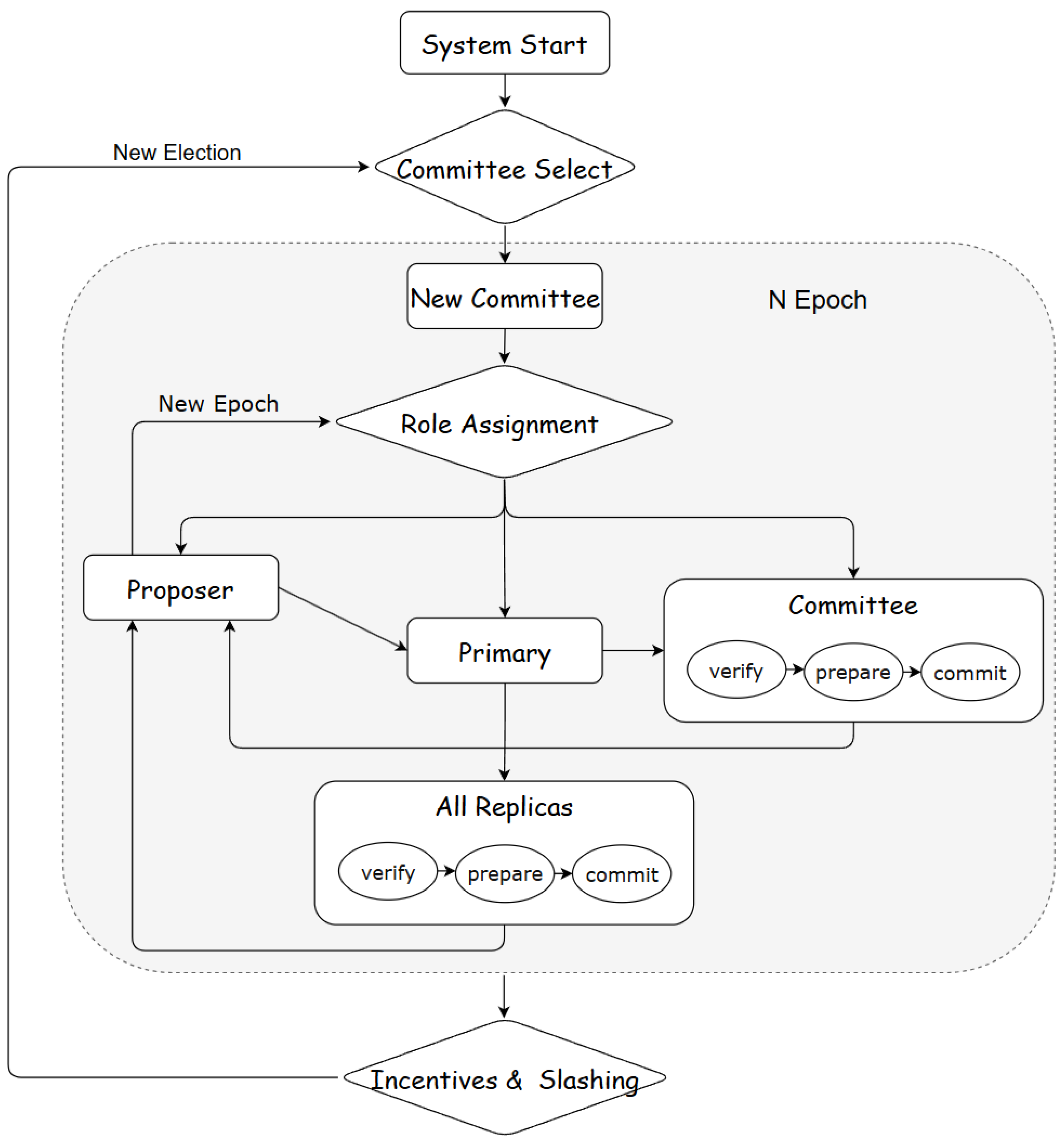
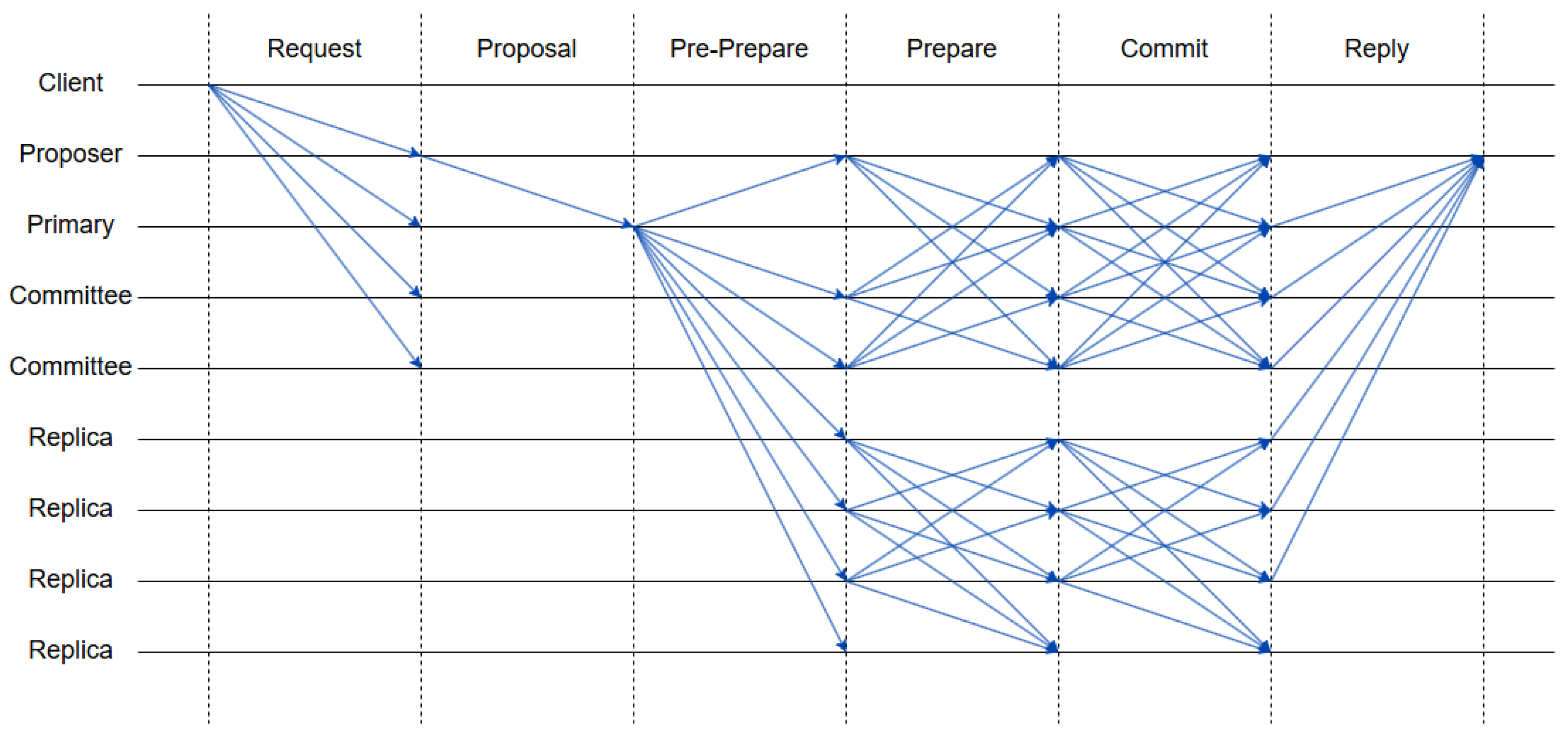
Section 4 presents the core protocol design, including the lifecycle, election mechanism, role rotation, and consensus flow;
Section 5 provides a theoretical analysis and proof of the protocol’s security;
Section 6 will showcase the performance evaluation and experimental results;
Section 7 concludes the paper and discusses future research directions.
2. Related Work and Background
2.1. PBFT Consensus Algorithm
Byzantine Fault Tolerance (BFT) [
9] is a fundamental problem in the field of distributed systems, aiming to ensure that a system can reach consensus even when some nodes may exhibit arbitrary malicious behavior (i.e., Byzantine failures). The Practical Byzantine Fault Tolerance (PBFT) [
4] protocol proposed by Castro and Liskov is a landmark work in this field, as it was the first to reduce the complexity of BFT algorithms from exponential to polynomial, making their application in practical systems feasible.
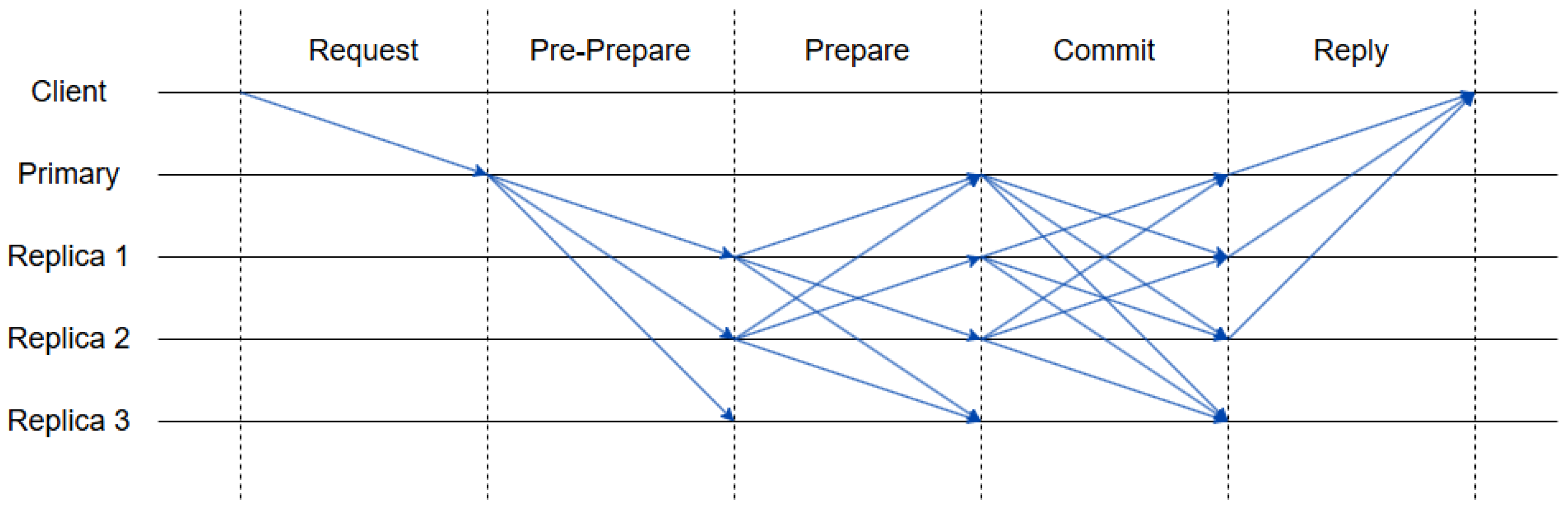
PBFT employs a Primary-driven three-phase protocol—pre-prepare, prepare, commit—to achieve consensus, as illustrated in
Figure 2. Its advantage lies in providing deterministic instant finality and ensuring security as long as the number of faulty nodes does not exceed one-third of the total. However, the centralized nature of its architecture also introduces inherent flaws: the primary node not only becomes a performance bottleneck but also holds absolute power in ordering and packaging transactions. This creates opportunities for a malicious primary node to engage in transaction censorship, which is concealed and difficult to effectively constrain within the protocol itself.
2.2. Improvements to PBFT
To mitigate the inherent centralization risks and performance bottlenecks of PBFT, both academic and industrial communities have explored various improvement pathways. One category of early solutions retains the role of the primary node but seeks to decentralize authority through frequent rotation or randomized selection. For instance, Tendermint [
10] employs a deterministic round-robin succession mechanism for selecting the block proposer. Further research [
11] has introduced the use of Verifiable Random Functions (VRF) [
12] for primary node election, enhancing the unpredictability and fairness of the selection process. However, such approaches do not fundamentally resolve the issue: within any given view or term, the elected primary node still retains unconstrained power over block proposal, leaving the risk of censorship unaddressed.
Another, more radical category of solutions completely abandons the concept of a primary node, allowing all replica nodes to participate in consensus on an equal footing, i.e., “leaderless” protocols. For example, HoneyBadgerBFT [
13] utilizes an Asynchronous Common Subset (ACS) protocol [
14], enabling each node to independently propose transactions, thereby achieving strong censorship resistance. The trade-off, however, is a significant increase in communication overhead and higher consensus latency, which limits its applicability in high-performance scenarios. Furthermore, recent studies have explored tailoring PBFT for IoT environments. For instance, Dong et al. [
15] proposed IPBFT, which utilizes a voting sort clustering mechanism to reduce communication overhead and introduces group signatures to enhance privacy protection.
Significant efforts have focused on optimizing PBFT’s communication complexity, which is typically
. Threshold signature [
16] techniques allow multiple signatures from replicas to be aggregated into a single, constant-size signature, reducing communication overhead in phases like commit and lowering complexity closer to
. Protocols like SBFT [
17] and HotStuff [
18] leverage this approach. HotStuff further introduces pipelining techniques, allowing consensus phases for different blocks to overlap, significantly boosting throughput, although it places stringent requirements on primary node stability and network conditions. Zyzzyva [
19] introduced optimistic execution paths, assuming favorable network conditions and primary node honesty to reduce communication, but require complex fallback mechanisms when assumptions fail. DBFT [
20] attempts to improve scalability by segregating node roles, though this might lead to centralization concerns.
Decoupling the responsibilities of transaction dissemination/ordering from the core consensus mechanism has emerged as a promising direction for high performance. Narwhal and Tusk [
21] is an example, using a DAG-based mempool for reliable transaction broadcast and a separate consensus protocol for ordering batches, achieving very high throughput. While these works share the concept of role separation, their focus is primarily performance optimization, differing from our goal of enhancing censorship resistance through explicit power balancing between distinct proposer and primary roles.
Furthermore, integrating reputation models [
22] into BFT consensus to improve leader selection reliability and overall security has become a popular direction. RepChain [
23] calculates reputation based on voting behavior within shards to select leaders. PrestigeBFT [
24] evaluates server reputation based on past behavior to select more trustworthy primary nodes. Others like RSHS [
25], BtRal [
26], RVC [
27], CRPBFT [
28] and TRBFT [
29] utilize diverse metrics (service quality, consensus participation, edge computing metrics) and strategies (node evaluation, random selection, optimized communication structures) to leverage reputation.
While these improvements address various limitations of PBFT, none fully tackle the fundamental issue of unilateral censorship power held by the primary node within a given consensus round through a dedicated power-balancing mechanism like the one proposed in DC-PBFT.
2.3. Comparison of Role Decoupling Mechanisms
To clearly articulate the novelty of DC-PBFT, it is essential to distinguish its decoupling mechanism from existing works. While several prominent BFT protocols have adopted role separation, their fundamental design objectives and security guarantees differ significantly, as summarized below.
Protocols such as HotStuff and SBFT introduce role separation primarily to optimize communication complexity and computational overhead. HotStuff utilizes a star topology where the leader acts as a central collector for threshold signatures, reducing message complexity to . SBFT decouples the execution layer from the consensus layer. In standard PBFT, all replicas must both order and execute every transaction; SBFT, however, designates a small group of consensus replicas strictly to order transactions, while a separate set of execution nodes handles the computationally heavy smart contract execution. Despite these optimizations, the core power in both HotStuff and SBFT remains strictly centralized. The designated leader still retains the unilateral, dictatorial authority to select transactions, sequence them, and initiate consensus. If a leader becomes malicious, it can execute selective censorship attacks by deliberately ignoring specific transactions. Because this decoupling only offloads redundant computation or communication, rather than restricting the leader’s sequencing power, the protocol offers no native resistance against censorship.
Protocols like HoneyBadgerBFT achieve strong censorship resistance by entirely abandoning the concept of a primary node. It relies on an Asynchronous Common Subset (ACS) protocol and threshold encryption, allowing all nodes to propose transactions simultaneously. While this guarantees that no single node can censor transactions, the heavy reliance on complex cryptographic primitives and asynchronous broadcast protocols incurs an extremely high computational and latency overhead, making it impractical for resource-constrained Edge-IoT environments.
In contrast to the above approaches, the decoupling in DC-PBFT is engineered strictly for power balancing. DC-PBFT actively dismantles dictatorial control by dividing the traditional primary responsibilities into two distinct, cross-validating roles. Specifically, the Proposer is solely responsible for transaction aggregation and block assembly, whereas the Primary is exclusively tasked with validation and consensus initiation. A malicious Proposer cannot force consensus on a censored block without the Primary’s validation, and a malicious Primary cannot initiate consensus without a valid proposal. Coupled with VRF-based dynamic role rotation, this separation of powers ensures rapid recovery from censorship attempts, achieving robust censorship resistance without the paralyzing performance overhead of fully asynchronous protocols.
Table 1 provides a detailed theoretical comparison between DC-PBFT and highly relevant existing works across key dimensions.
3. System Model
This chapter aims to establish a clear and rigorous foundation for the subsequent protocol design and analysis. We will sequentially define the network communication environment upon which the protocol relies, the core components and concepts constituting the system, and the threat model we aim to defend against.
3.1. Network and Communication Model
We assume the protocol operates within a Partially Synchronous Network [
30] environment. This model more closely reflects real-world distributed system environments and possesses the following specific characteristics:
There exists an unknown Global Stabilization Time (GST) in the network. After GST, the network recovers synchrony, and any message sent by an honest node will be received by another honest node within a known but potentially unknown delay bound, .
Before GST, the network can be completely asynchronous, where message delivery may suffer arbitrary delays or even loss.
This assumption implies that the network allows for temporary partitions or large-scale congestion but will not fail permanently. This provides a basis for designing consensus protocols that can tolerate network anomalies while still guaranteeing eventual liveness.
3.2. System Components and Core Definitions
This section aims to formally define the core entities comprising the DC-PBFT protocol and their key operational concepts, establishing a foundation for subsequent protocol design and analysis. The normal operation of the protocol relies on the coordinated work of nodes playing different roles and adherence to a series of core operational rules.
Node Roles The participating entities in the protocol are divided into the following categories based on their responsibilities.
Replica: Serving as the fundamental units constituting the entire consensus network, all replica nodes store the complete ledger state and are responsible for executing confirmed transactions. They form the candidate pool for elections and may assume more specific consensus roles based on election results and protocol rules.
Consensus Committee (CC): At the beginning of each epoch, an elite subset of size is selected from qualified replica nodes through a specific election mechanism. They act as data aggregation hubs for the region, responsible for ordering and packaging high-concurrency requests from IoT terminals.
Replica Network (RN): Composed of all qualified replica nodes that meet the minimum staking requirement but were not elected into the Consensus Committee, its size is . The Replica Network exists as an independent parallel validation layer, synchronously receiving block proposals issued by the Primary node along with the Consensus Committee, and independently executing the PBFT voting phases (Prepare, Commit) among its internal members to audit the consensus results of the Consensus Committee.
Proposer: At a specific block height, a node dynamically assigned from within the Consensus Committee. Its core responsibility is to collect pending transactions from the transaction pool, validate their legitimacy, and package them into a new candidate block.
Primary: At a specific block height, also a node dynamically assigned from within the Consensus Committee. It is responsible for receiving and validating the candidate block submitted by the Proposer, then constructing a PRE-PREPARE message and broadcasting it to all nodes participating in consensus across the network, thereby formally initiating the three-phase consensus voting for that block.
Client: Refers to lightweight IoT terminals. Being resource-constrained, they do not store the ledger or participate in consensus voting. They are solely responsible for collecting data, performing digital signatures, and broadcasting transaction requests to nearby Edge Nodes.
The operation of the protocol follows several Core Operational Concepts.
Epoch: The protocol operates in basic time units called epochs. Within a complete epoch, the membership composition of the Consensus Committee remains fixed, ensuring the stability of the consensus core during that period. The duration of an epoch can be adjusted based on network status or governance parameters.
View: Inherited from the classic PBFT concept, a view represents one or more rounds of consensus attempts led by a specific Primary node. The View Change mechanism is triggered when the network suspects the current Primary has failed or is malicious, serving as an important mechanism to guarantee protocol liveness.
Stake: Refers to the economic capital voluntarily locked and staked by replica nodes to gain eligibility for election. The stake amount is not only a participation threshold but also an important measure of a node’s commitment to network security, playing a role in election and penalty mechanisms.
Reputation Score: As a quantitative measure of a node’s long-term reliability, the reputation score is dynamically assessed based on the node’s historical behavioral performance during the consensus process. It is a key factor influencing the probability of being elected to the committee and is updated by the subsequently defined reward and penalty incentive mechanism, aiming to guide nodes toward behaviors consistent with the overall interests of the network.
3.3. Threat Model
We assume the system faces a Byzantine adversary and adopt the Byzantine Fault Model. Assume that at any given moment, the total number of nodes participating in consensus is , among which there are at most f Byzantine nodes, and the remaining are honest nodes. To ensure the safety of the protocol’s final arbitration, the entire network must satisfy the classic BFT assumption, namely . Concurrently, the normal operation of the protocol, especially during the parallel consensus phase, relies on the election mechanism being able to ensure that the distribution of Byzantine nodes within the Consensus Committee and the Replica Network does not violate the condition within their respective groups.
The adversary is subject to the following limitations: The adversary cannot break the cryptographic primitives relied upon by the protocol, for example, they cannot forge the digital signatures of honest nodes or break hash functions. The total number of Byzantine nodes controlled by the adversary at any moment cannot exceed f. Furthermore, the adversary cannot disrupt network communication indefinitely; that is, the network will eventually enter a synchronous state according to the partial synchrony assumption.
5. Security Analysis
This chapter aims to perform formal analysis and proof of the key security properties of the DC-PBFT protocol under the system model and threat model defined in
Section 3. We will sequentially provide detailed arguments for the protocol’s consistency, liveness, and its core design objective, censorship resistance.
5.1. Consistency
Consistency is the core safety property of a consensus protocol, ensuring that all honest nodes have a unified view of the ledger state, meaning the protocol does not produce “forks.” Specifically, within the DC-PBFT protocol, this implies that under the partial synchrony network model and the Byzantine fault model (where the entire network ), no two honest replica nodes will finally confirm two different blocks, B and , at the same block height h.
The protocol guarantees this through its unique two-phase confirmation mechanism. A block can only be finally confirmed via one of two paths: first, during the parallel consensus phase, both the Consensus Committee and the Replica Network reach a consensus on the block; second, after a disagreement arises in the parallel phase, an arbitration consensus involving all nodes ultimately decides to accept the block.
It is impossible for two different blocks, B and , to be finally confirmed at the same height h. Firstly, they cannot both be confirmed via the “unanimous success” path. If block B achieves unanimous success, it means both the Consensus Committee and the Replica Network reached a consensus on it. Assuming the Replica Network temporarily satisfies the Byzantine fault tolerance condition internally, then according to the consistency guarantee of the PBFT protocol itself, the honest nodes within the Replica Network cannot subsequently reach a consensus on another different block . Therefore, cannot obtain confirmation from the Replica Network, failing to meet the “unanimous success” condition.
Secondly, two different blocks cannot both be confirmed via the “arbitration confirmation” path either. The arbitration consensus involves all N nodes and is a standard BFT process conducted under the premise that the entire network satisfies . According to classic BFT theory, all honest nodes will inevitably reach a single, consistent decision regarding the arbitration outcome. Thus, arbitration cannot simultaneously confirm two different blocks.
Finally, it is also impossible for one block to be confirmed via “unanimous success” and another via “arbitration confirmation.” If block B is confirmed through “unanimous success,” this means there was no disagreement between the Consensus Committee and the Replica Network. According to the protocol rules, the arbitration consensus would not be triggered at all in this case. Consequently, block cannot be confirmed via the arbitration path.
In summary, the DC-PBFT protocol, by combining the efficient path of parallel consensus with the ultimate safety guarantee of arbitration consensus, ensures that under all circumstances, all honest nodes will only finally confirm a single, unique block state at the same block height, thereby satisfying the consistency requirement.
5.2. Liveness
Liveness guarantees that the protocol can continuously make progress, eventually confirming legitimate transactions submitted to the network. DC-PBFT ensures liveness through its view change mechanism and the partial synchrony network assumption.
Should the proposer or the primary node fail, for example by failing to perform duties before a timeout, the protocol will trigger the view change mechanism. By broadcasting VIEW-CHANGE messages, the failed primary will be replaced, ensuring the consensus process can be taken over and continued by a new, honest primary node, which will eventually be selected.
To prevent the system from entering an infinite loop of view changes, the protocol employs an exponential backoff strategy for timeout timers. Combined with the partial synchrony network model, which guarantees bounded message delay after the Global Stabilization Time, the timeout duration will eventually exceed the actual network delay. As long as an honest primary is eventually selected and the network enters a synchronous state, consensus, whether through the normal process or arbitration, will successfully complete, breaking any cycle and ensuring the protocol can continuously produce new blocks, even if they are empty blocks. Therefore, legitimately submitted transactions that are continuously broadcast will eventually be included by an honest proposer and confirmed, satisfying the liveness requirement.
Furthermore, DC-PBFT exhibits strong resilience against arbitration-based stalling attacks. A concern might be whether a specific subgroup of Byzantine nodes could intentionally and repeatedly force the network into the high-cost global arbitration state to degrade performance. This is prevented by the protocol’s definitive fault attribution and strict penalty mechanisms. If malicious nodes intentionally trigger a disagreement (e.g., a malicious Primary sending conflicting proposals to the Consensus Committee and Replica Network), the subsequent global arbitration will irrefutably determine the valid block. Nodes that voted against the arbitrated truth are subsequently identified as malicious and subjected to Major Slashing (complete confiscation of staked tokens and reputation reset). Because the economic cost of initiating such an attack is devastating, an attacker can trigger a stall at most once before losing all consensus privileges. Therefore, intentionally forcing arbitration constitutes an unsustainable “suicide attack”, guaranteeing the long-term liveness and operational efficiency of the network.
5.3. Censorship Resistance
Definition 1 (Eventual Censorship Resistance)
. Assume the network has reached the Global Stabilization Time (GST) and the Consensus Committee (CC) satisfies the Byzantine assumption . A consensus protocol provides Eventual Censorship Resistance if, for any valid transaction that has been broadcast to the CC, the probability that is not finalized within k consecutive consensus rounds, denoted as , is strictly bounded by an exponentially decreasing function: As the number of rounds , . This guarantees that a persistent adversary cannot censor a transaction indefinitely with non-negligible probability.
Theorem 1. DC-PBFT satisfies Eventual Censorship Resistance as defined in Definition 1.
Proof. To censor a valid transaction , the adversary must prevent it from being included in a finalized block. We analyze the probability of this happening in a single consensus round , assuming the network is post-GST.
Case 1: An honest node is selected as the Proposer. By protocol rules, an honest Proposer will include all valid transactions (including ) available in its mempool into the candidate block , and sign it. Due to the Proposer-Primary decoupling mechanism, the Primary node cannot unilaterally alter the content of (as it is protected by the Proposer’s digital signature ). If the Primary is honest, it broadcasts , and since , will be finalized by the CC. If the Primary is malicious and refuses to broadcast , it triggers a View Change. The VRF-based rotation guarantees that a new Primary will eventually be selected. Since is already constructed and signed, the protocol rules dictate that the new Primary must process the pending valid proposal. Thus, if the Proposer is honest, will eventually be finalized in round or its subsequent view changes.
Case 2: A malicious node is selected as the Proposer. In this scenario, the malicious Proposer can intentionally omit from block . Consequently, cannot be finalized in round .
Probability Analysis: The role of Proposer is determined dynamically via a VRF based on the unpredictable hash of the previous block. Assuming the VRF output is uniformly distributed, the probability that a specific node is selected as the Proposer is proportional to its presence in the CC. Since the CC contains at most
malicious nodes out of
total nodes, the probability
that a malicious node is elected as Proposer in any given round is exactly:
Given the BFT safety assumption
, we have:
Because the VRF seed changes completely unpredictably from block to block (driven by
), the election events across different rounds are cryptographically independent. Therefore, the probability that
is censored for
k consecutive rounds (i.e., malicious proposers are drawn
k times in a row) is:
As , . This proves that the probability of an adversary successfully censoring a transaction indefinitely is negligible. □
Remark 1 (Impact of Reputation Mechanism)
. While the mathematical bound above relies on the static assumption of malicious nodes, the dynamic reputation mechanism in DC-PBFT further tightens this bound in practice. If a malicious node happens to be selected as Proposer and engages in systematic censorship (e.g., consistently ignoring high-fee transactions), it will be identified during the Replica Network (RN) parallel auditing process or subsequent client complaints. The resulting severe penalty (reputation drop to 0, stake slashing) will immediately remove the node from the candidate pool for future epochs, effectively reducing over time and accelerating the decay rate of .
5.4. Security Against Adaptive Adversaries
To rigorously evaluate the robustness of the hybrid election mechanism, this section defines a formidable adversary model and provides formal proofs of the protocol’s security against randomness seed manipulation and long-term reputation exploitation.
Definition 2 (Adaptive Adversary)
. An adaptive adversary is assumed to be computationally bounded and capable of observing all public states, including blocks, VRF outputs, and reputation scores. can dynamically corrupt up to f nodes at any moment but is strictly prohibited from breaking underlying cryptographic primitives, such as hash functions, digital signatures, and Verifiable Random Functions (VRFs).
Theorem 2 (Unpredictability and Bias-Resistance of the Election Seed)
. An adaptive adversary cannot bias the election probability of any node by manipulating the randomness seed .
Proof. The election seed is derived from the hash of the last finalized block of the preceding period: . To execute a grinding attack—testing multiple block payloads to generate a favorable hash— must be able to unilaterally modify the finalized block. However, according to DC-PBFT consensus rules, a block is finalized only after accumulating at least valid COMMIT signatures from the Consensus Committee. Even if controls malicious nodes and serves as the Proposer, it cannot forge the signatures of the remaining honest nodes. Any alteration to the block payload invalidates the existing honest signatures, thereby preventing the block from reaching consensus. Consequently, is compelled to accept the naturally generated, unpredictable hash as the VRF input, ensuring the election process is strictly bias-resistant. □
Theorem 3 (Resistance to Reputation Manipulation and Sleeper Attacks)
. Under the asymmetric penalty model, the expected utility of a “sleeper attack”—maintaining honest behavior long-term to maximize reputation for a single severe malicious act—is strictly negative for any rational adaptive adversary .
Proof. Let be the expected utility of a sleeper attack. We define , where represents the illicit gain from a single violation, is the immediate economic penalty, and is the present value of lost future rewards.
According to the penalty mechanism defined in
Section 4.5.2, a severe violation triggers Major Slashing:
(complete confiscation of the staked tokens) and an instantaneous reputation reset to zero (
). Consequently, the node’s future election probability drops precipitously, rendering
. Conversely, reputation accumulation is intentionally designed as a slow, linear process (
), making the time cost to restore reputation to previous levels prohibitively high. Since the sum of the direct financial slashing and the severe opportunity cost of lost future block rewards (
) is mathematically guaranteed to significantly outweigh any bounded single-block gain
, we have
. Therefore, the optimal strategy for a rational adversary
is continuous honest behavior, satisfying the requirement for incentive compatibility. □
5.5. Game-Theoretic Analysis of Incentive Compatibility
To formally analyze the incentive compatibility of DC-PBFT, we model the decision-making process of a rational node
i using an Expected Utility function. For any action
a (honest or malicious), the node’s expected utility
over an infinite horizon is defined as:
where
is the immediate block reward,
is the economic penalty (slashing),
is the discount factor,
is the dynamic reputation score at future period
t resulting from action
a, and
is the probability of being elected to the consensus committee (which is directly proportional to reputation
).
is the average reward per period.
Based on this model, we analyze two primary attack vectors:
1. Strategic Reputation Manipulation (Sleeper Attack): An adaptive adversary may behave honestly for a long time to maximize its reputation
, and then launch a severe attack (e.g., double signing) to gain a one-time illicit profit
. However, according to our penalty mechanism, a severe violation results in total stake confiscation (
) and an instantaneous reputation reset to zero (
). Consequently, the future election probability
drops to zero. The expected utility of the attack is:
Conversely, the utility of continuous honest behavior is . Since the discounted future rewards of a high-reputation node infinitely accumulate and is significant, it strictly guarantees that . The optimal strategy for a rational node is continuous honesty.
2. Collusion between CC and RN Members: To successfully manipulate consensus via collusion, adversaries must simultaneously control key positions in both the consensus committee and the replica network within the same period. Let
be the probability of successfully achieving this distribution. As proven in
Section 5.3, due to the VRF-based dynamic rotation and hypergeometric distribution,
is mathematically negligible (
). The expected utility of a collusion attempt is:
Given , the expected utility is heavily dominated by the slashing penalty and reputation destruction, rendering . Thus, forming a collusion cartel is irrational and economically self-destructive.
5.6. Parameter Sensitivity and Incentive Compatibility Bounds
To prove the stability of the system, this section conducts a sensitivity analysis on the core parameters based on the expected utility function. To ensure incentive compatibility, the reward multiplier
for the Proposer must be large enough to resist potential off-chain bribes
. The theoretical condition for honesty is:
where
is the probability of being detected during arbitration. Given our high-probability arbitration mechanism,
. Setting
provides a massive safety margin, ensuring that honest block proposal is always the optimal strategy.
To prevent passive validation (saving computational cost
), the parameters must satisfy:
Our analysis shows that setting and effectively combines immediate economic loss with long-term reduction in election probability, eliminating the profit margin for passive validation.
6. Performance Analysis
This section presents the findings of performance testing experiments conducted on the DC-PBFT protocol. The experimental environment utilized the Ubuntu 20.04 operating system, an AMD 9600X CPU, and was equipped with 32 GB of RAM; the experimental code was implemented in C++. The simulation was configured with a partial synchrony network model, where the base inter-node latency was set to 50 ms and the bandwidth was limited to 100 Mbps. To comprehensively evaluate the protocol under various attack intensities, the number of Byzantine nodes, denoted as f, is controlled by the global Byzantine ratio (). In experiments where the total network size N varies, f dynamically scales according to this ratio. In experiments with a fixed N, the exact number of Byzantine nodes f is explicitly specified. The workload was generated by simulated clients continuously submitting 256-byte transactions. We use the Ed25519 elliptic curve algorithm for digital signatures and SHA-256 as the hash function.
The simulation was configured within a fully connected network topology, operating under a partial synchrony model. To emulate realistic network fluctuations in Edge-IoT environments, we introduced network jitter: the inter-node latency follows a normal distribution with a mean of 50 ms and a standard deviation of 5 ms ().
To ensure strict statistical significance, all quantitative results reported in this section represent the average of 20 independent simulation runs using different random seeds. The duration of each standard run was set to process a total of 1000 blocks. In the performance visualization figures, error bars are included to indicate the 95% confidence intervals, illustrating the statistical variability across these independent executions.
6.1. Disagreement Rate Analysis
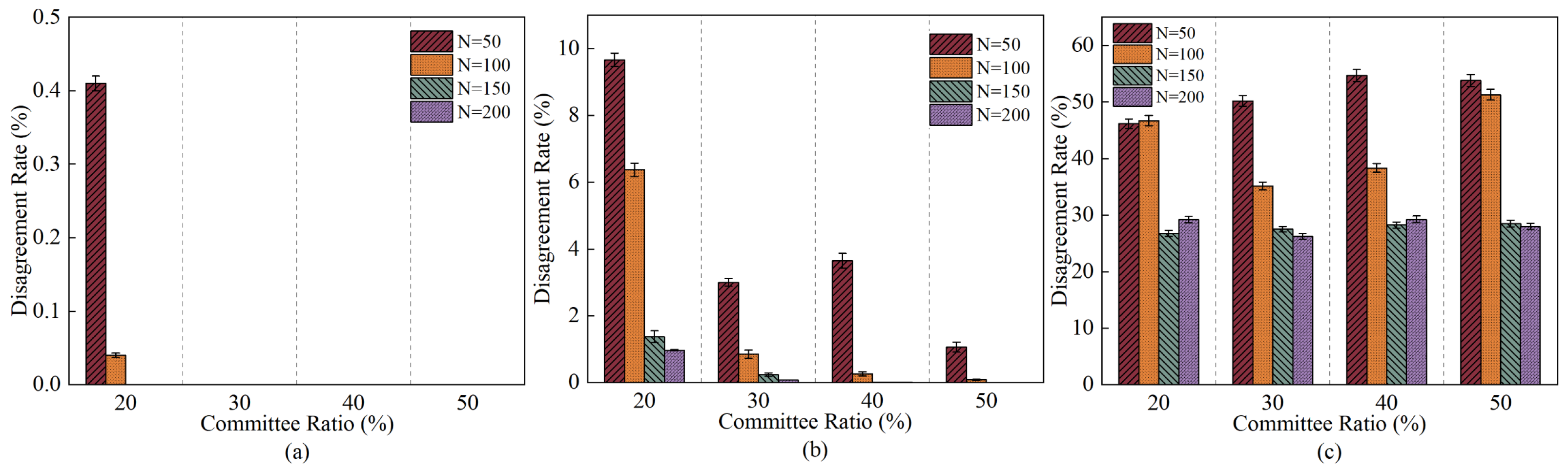
In the DC-PBFT protocol, when the consensus results of the Consensus Committee (CC) and the Replica Network (RN) are inconsistent, a high-cost arbitration consensus is triggered. Therefore, the disagreement rate is a key internal metric for measuring the protocol’s stability and practical operational efficiency. In our experiments, we found that the disagreement rate is influenced by two main factors: the total number of nodes and the proportion of committee nodes.
Figure 5 shows how these three factors—global Byzantine node ratio (
), consensus committee size ratio (
), and total number of nodes (
N)—affect the disagreement rate.
The experimental results indicate that as the global Byzantine node ratio increases, the overall magnitude of the disagreement rate rises significantly, showing that attack intensity is the primary factor affecting stability. The DC-PBFT protocol consistently exhibits a unified trend across different network scales (N): the greater the total number of nodes, the lower the disagreement rate. At with and , the disagreement rate is as high as nearly 70%, whereas in a larger network with under the same conditions, the disagreement rate drops to approximately 35%, a stability improvement of nearly 50%. Furthermore, the committee ratio (p) is also a critical tuning parameter. Under high attack intensity (), increasing p from 20% to 40% can reduce the disagreement rate for nodes by approximately 19%. This demonstrates that consensus disagreements caused by random distribution can be effectively suppressed by appropriately configuring the committee ratio and increasing the network scale, thereby ensuring the robustness of the DC-PBFT protocol.
6.2. Robustness and Parameter Analysis
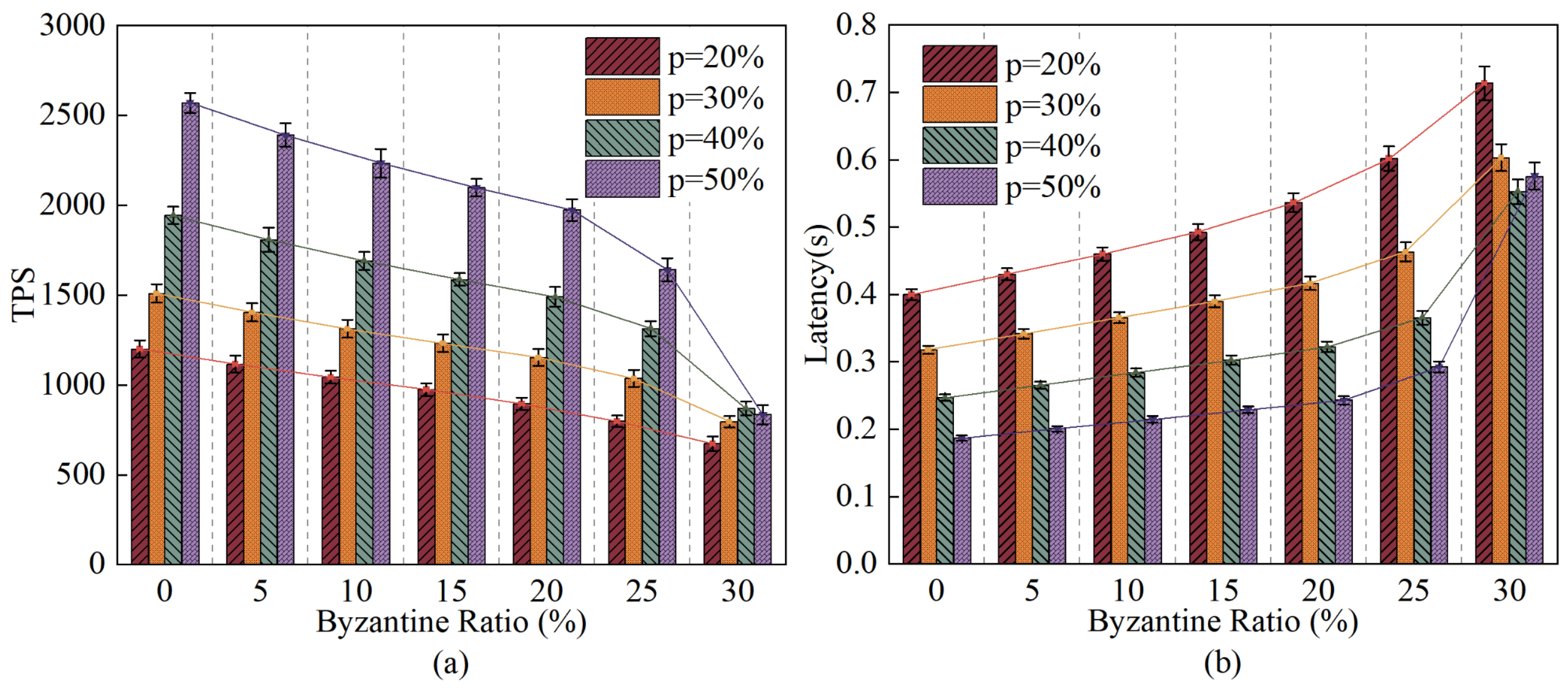
Given that disagreements trigger high-cost arbitration consensus, an increase in the disagreement rate inevitably leads to a decrease in overall system throughput and an increase in transaction latency. We experimentally quantify the interaction effect of two key parameters, the global Byzantine node ratio () and the committee ratio (p), on the actual performance of the DC-PBFT protocol. We fixed the total network size at and measured the throughput (TPS) and average transaction latency (Latency) under different global Byzantine node ratios and different committee ratios.
The experimental results are depicted in
Figure 6. As the Byzantine node ratio increases, the throughput of all configurations trends downward, while latency correspondingly rises. However, the magnitude of this performance degradation is closely correlated with the committee ratio
p. Under the
condition, the
configuration exhibits the poorest robustness, with its throughput dropping the fastest and its latency increasing the most significantly. In contrast, the
configuration consistently demonstrates the highest throughput and the lowest latency. This also illustrates that small-scale committees are more susceptible to triggering high-cost arbitration under high attack intensity, leading to severe performance deterioration. Therefore, selecting a more balanced committee ratio is crucial for DC-PBFT to maintain high performance and stability in Byzantine environments.
Performance Boundary Analysis Under Worst-Case Scenarios To comprehensively evaluate the protocol’s robustness, we analyzed the performance degradation boundary of DC-PBFT under the worst-case scenario. The worst case occurs when the network experiences severe partition faults, or a few malicious nodes with high weights launch a suicide attack, intentionally causing a severe disagreement between the consensus committee and replica nodes, thereby forcing the entire network into the dispute arbitration phase. In this extreme state, the parallel optimization of DC-PBFT temporarily fails, and the protocol’s communication complexity boundary degrades to
. At this point, the theoretical boundary for system throughput and latency will briefly drop to the baseline level of classic PBFT (e.g., in our experiment at
, the degradation boundary is approximately 158 TPS and 1.17 s latency, as shown in
Figure 7). However, due to the protocol’s strict built-in penalty mechanism, the malicious nodes initiating the attack will be immediately evicted after the arbitration round is completed. Therefore, the performance penalty in the worst-case scenario is strictly confined to the current single consensus period, and the system will subsequently quickly recover to the efficient parallel consensus norm.
6.3. Scalability Analysis
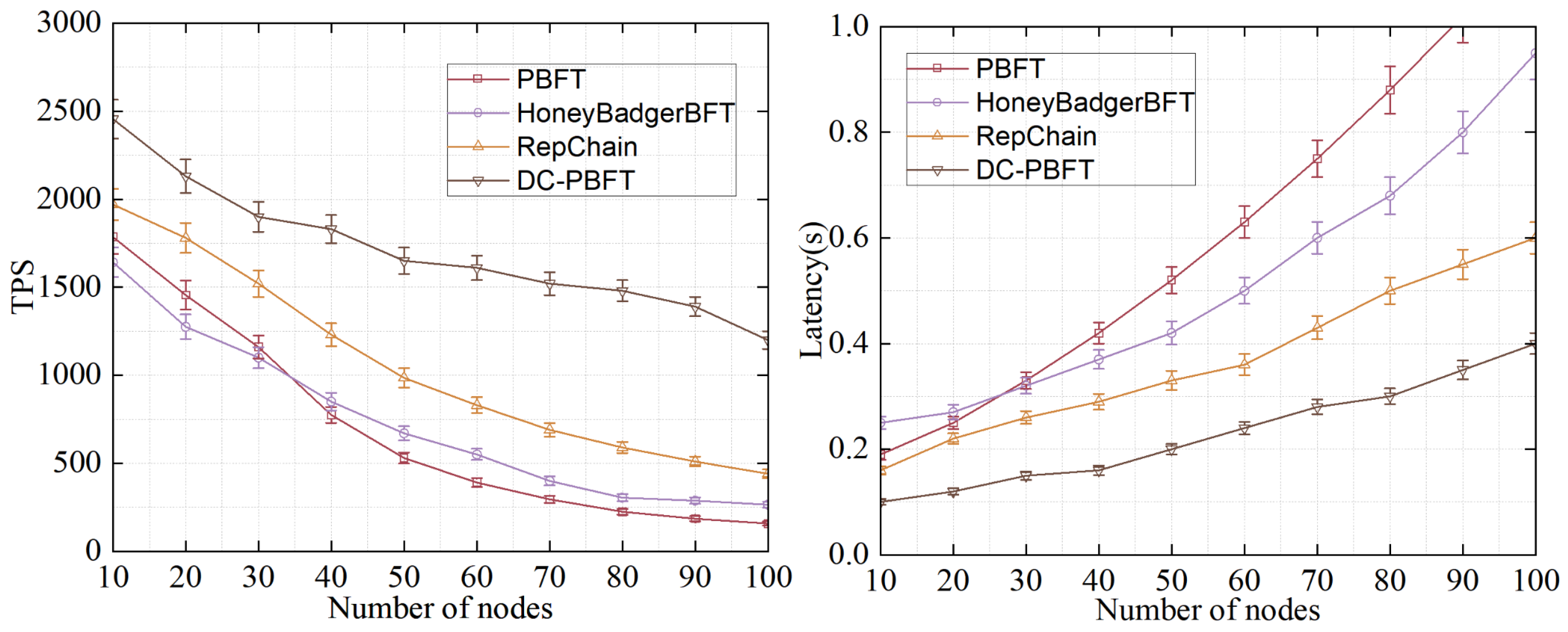
To evaluate the scalability of DC-PBFT, we incrementally increased the total number of nodes under identical settings with no Byzantine nodes, assessing its TPS and consensus delay against the baseline protocols PBFT [
4], HoneyBadgerBFT [
13], and RepChain [
23] under an ideal network condition with exactly zero Byzantine nodes (
, i.e.,
). To guarantee a fair comparison, the baseline HoneyBadgerBFT was configured using the standard benchmark parameters from its official repository and original paper. Specifically, the ACS (Asynchronous Common Subset) subset size was set to 10 nodes, and the transaction batch size was set to 500 transactions per block. As depicted in
Figure 8, while the throughput of all protocols declines and consensus latency rises with an increase in the number of nodes, the performance disparity widens. DC-PBFT consistently demonstrates significant advantages over all baseline algorithms in terms of both throughput and latency.
Compared to classic PBFT, PBFT’s communication complexity causes its performance to degrade sharply with growth. At , PBFT’s average latency reaches 1.17 s, and its throughput drops to approximately 158 TPS. In contrast, DC-PBFT at still maintains a high throughput of approximately 1200 TPS and a low latency of 0.4 s. Even when compared to the similarly optimized RepChain and the censorship-resistant HoneyBadgerBFT, DC-PBFT exhibits a clear performance advantage. This indicates that DC-PBFT’s parallel grouping architecture effectively mitigates the communication bottleneck, demonstrating superior performance and scalability in medium-to-large network environments.
While our empirical simulation is bounded at due to hardware limitations, the scalability trend for larger networks (e.g., or ) can be reliably projected through theoretical communication complexity. Classic PBFT’s message complexity grows quadratically at . In contrast, DC-PBFT’s parallel grouping decouples this into . For instance, in a hypothetical network of with a committee ratio of (), standard PBFT would generate messages proportional to 1,000,000. DC-PBFT, however, would generate messages proportional to 580,000, achieving a theoretical reduction in network load. This mathematical divergence guarantees that as N scales further, the performance gap between DC-PBFT and baseline algorithms will continue to widen favorably.
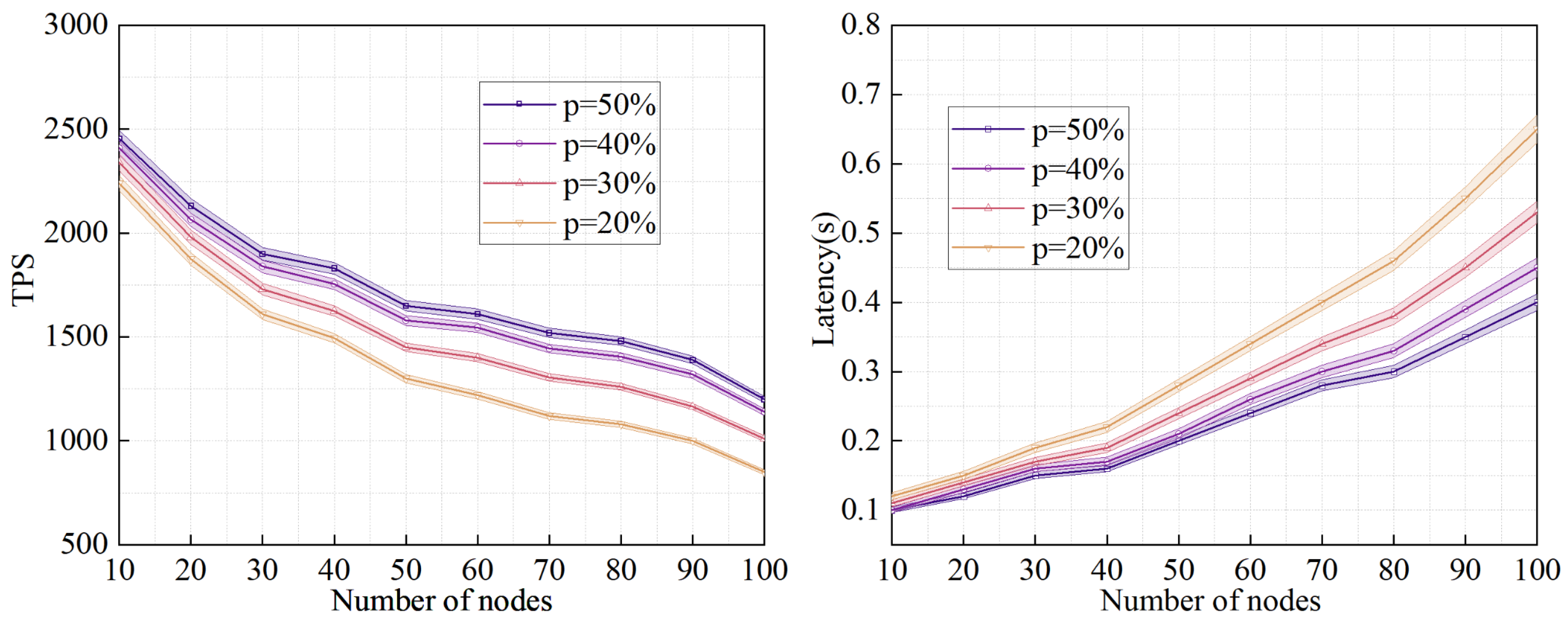
To further explore the robustness and adaptability of DC-PBFT, we conducted a sensitivity analysis on the committee ratio
p.
Figure 7 comprehensively illustrates both the system’s throughput and latency across different
p values (20%, 30%, 40% and 50%) with 95% confidence intervals.
The results reveal that serves as the optimal configuration for both performance and robustness. From a performance perspective, the total communication complexity is bounded by . When , the network load is perfectly balanced between the Consensus Committee and the Replica Network, minimizing the quadratic communication overhead. As p decreases (e.g., to 20%), the Replica Network becomes overloaded with of the nodes, leading to severe local congestion, which drops the throughput to 850 TPS and spikes the latency to 0.65 s at .
From a robustness perspective, a smaller p introduces a higher variance in the hypergeometric distribution during node election, increasing the risk of malicious nodes temporarily dominating the committee. Therefore, maintaining not only maximizes parallel efficiency but also minimizes the probability of triggering the high-cost global arbitration, demonstrating the protocol’s strong structural robustness.
6.4. Long-Term Stability Analysis
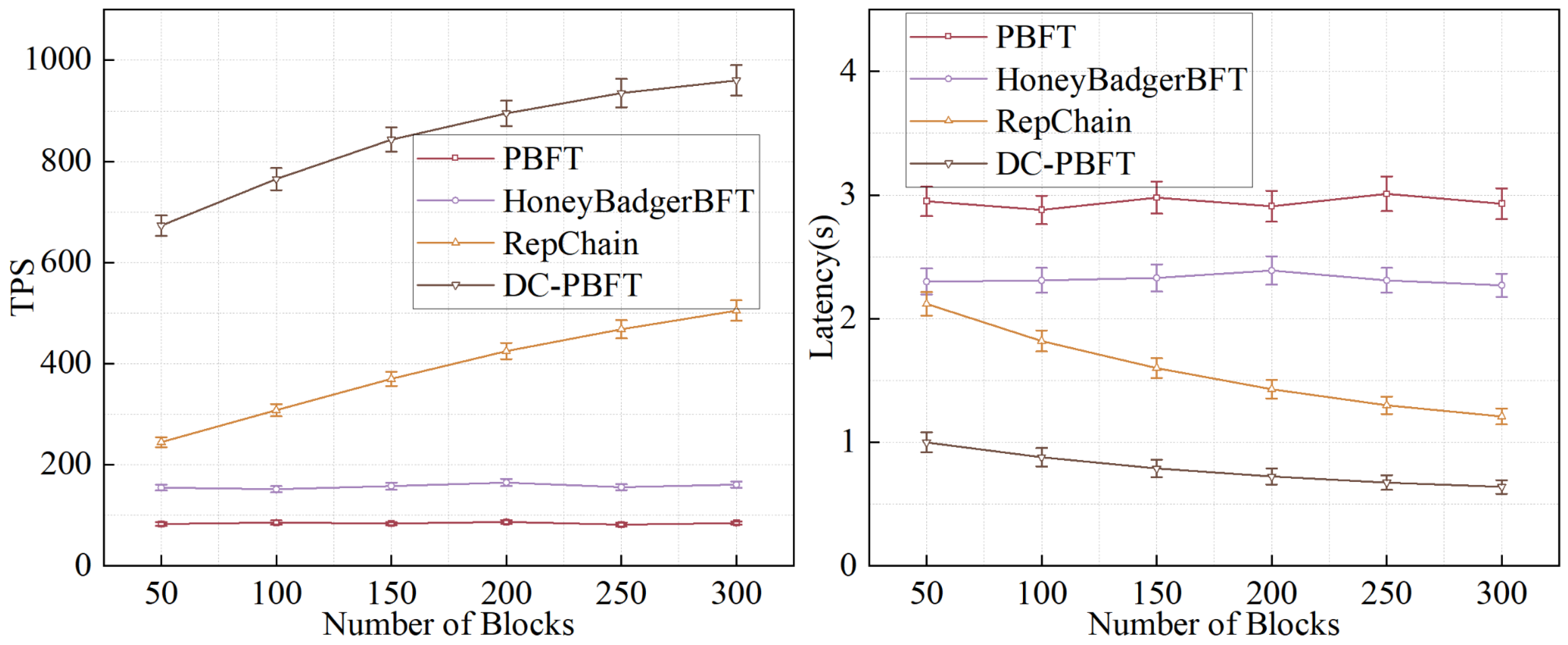
After introducing a reputation mechanism, merely testing the protocol’s short-term performance is insufficient. The core value of the reputation mechanism lies in its long-term effect—dynamically adjusting node influence based on historical behavior, thereby gradually purifying the consensus environment and improving the system’s long-term stability and performance under sustained attack. To evaluate the long-term effectiveness of the DC-PBFT reputation mechanism, we measured and compared the performance evolution of each protocol over time (measured by the number of blocks) in a malicious environment with a sustained presence of Byzantine nodes ().
Specifically, the simulation spans a continuous duration of 300 blocks. To comprehensively evaluate the general effectiveness of the reputation mechanism against diverse attack patterns, the Byzantine nodes are programmed to execute a Mixed Byzantine Strategy. This includes random subsets of malicious nodes performing minor violations (e.g., node timeouts), moderate violations (e.g., passive non-voting), and severe safety attacks (e.g., double-signing). Furthermore, the reputation system dynamically responds to these behaviors using an event-driven update mechanism evaluated at each block’s finalization and period transition. The specific decay parameters applied in the simulation align with our theoretical incentive model: for honest participation, and dynamic penalty weights of corresponding to the severity of the detected violations.
The experimental results are shown in
Figure 9. It can be clearly observed that the PBFT and HoneyBadgerBFT protocols, which lack a dynamic reputation mechanism, exhibit performance at a low, stable level throughout the entire runtime. PBFT’s throughput consistently fluctuates around 80 TPS, while HoneyBadgerBFT is around 150 TPS. Their respective latencies also remain stable at approximately 2.9 s and 2.3 s, with neither showing any performance improvement. In contrast, RepChain and DC-PBFT, which utilize reputation mechanisms, demonstrate significant self-recovery capabilities and long-term robustness. As the number of blocks increases, the reputation systems of both protocols take effect, continuously identifying and penalizing malicious nodes, thereby reducing their influence in consensus, such as DC-PBFT lowering the probability of low-reputation nodes being elected to the committee. This is also directly reflected in performance: RepChain’s throughput steadily increases from an initial 245 TPS to 505 TPS, an increase of over
; DC-PBFT’s throughput climbs from 673 TPS to 960 TPS. In terms of latency, RepChain’s latency is optimized from 2.1 s down to 1.1 s, while DC-PBFT’s latency decreases from 1.0 s to 0.6 s, remaining the lowest throughout.
This indicates that the reputation mechanism is critical for ensuring long-term stability under sustained attack. DC-PBFT not only exhibits superior robustness over all baseline algorithms in the initial phase of an attack, but its reputation mechanism also effectively drives system performance recovery to a higher level.
6.5. Censorship Resistance Analysis
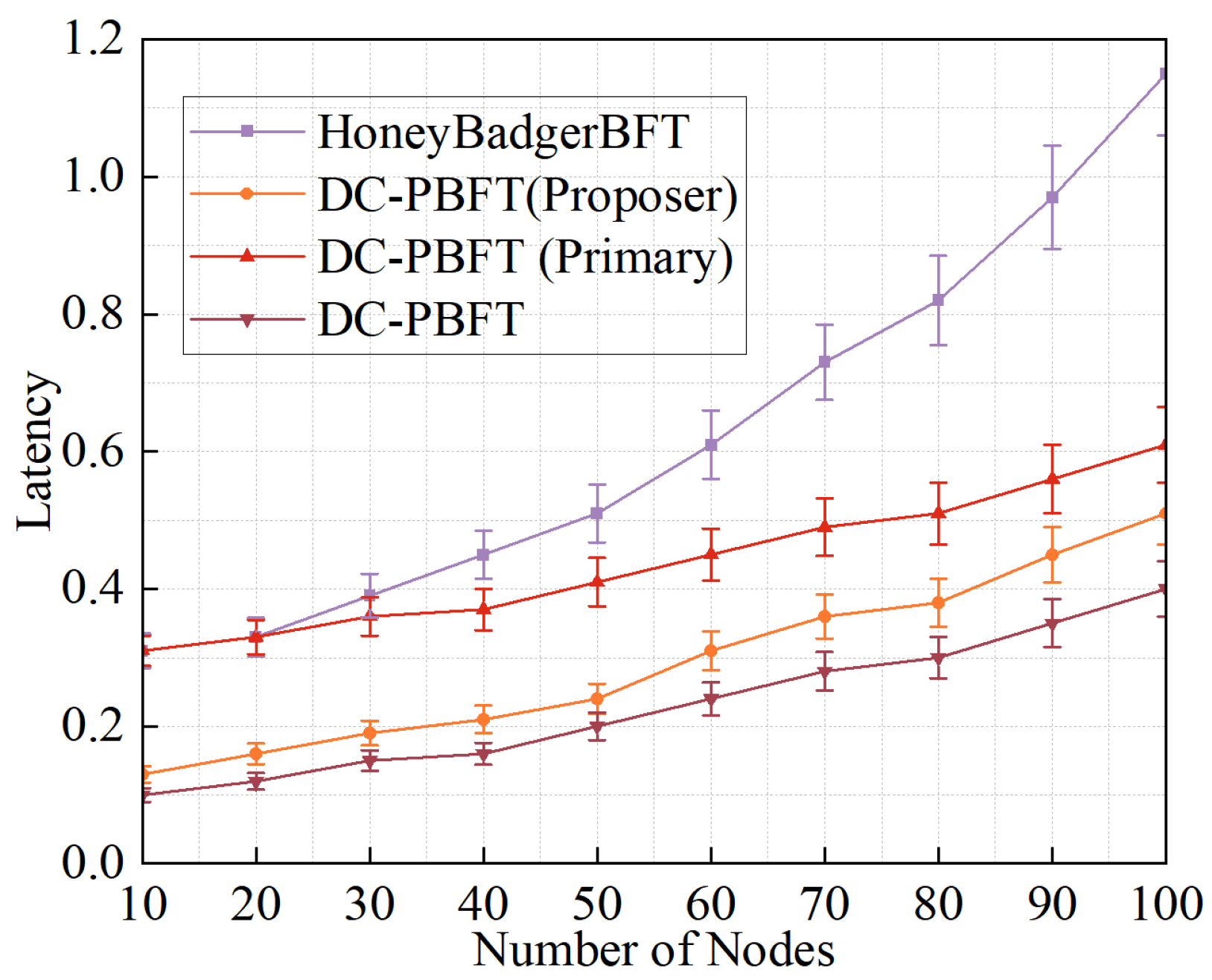
To directly evaluate DC-PBFT’s core design objective, namely its ability to resist malicious censorship, we simulated targeted censorship attacks and measured the average confirmation latency accumulated by targeted transactions over 300 blocks. The two comparison setups were a probability of the Proposer being malicious and a probability of the Primary being malicious, respectively. When the Proposer was malicious, it would always ignore the target transactions; when the Primary was malicious, it would refuse to broadcast the block proposal containing the target transactions. We compare DC-PBFT’s performance under these two attacks against its baseline performance (no censorship) and against the censorship-resistant HoneyBadgerBFT in an environment with Byzantine nodes. Since the confirmation rate for targeted transactions in PBFT and RepChain approaches under such sustained malicious leader attacks, they were not included in this latency comparison chart.
The experimental results are depicted in
Figure 10. The graph clearly illustrates the performance cost and scalability of different censorship resistance mechanisms. HoneyBadgerBFT, while guaranteeing a
confirmation rate through threshold encryption, incurs high latency due to its inherent asynchronous nature and cryptographic overhead, reaching approximately 1.1 s at N = 100 and exhibiting the lowest performance among all scenarios. In contrast, the baseline performance of DC-PBFT is only 0.4 s at N = 100. When subjected to a Proposer censorship attack, the protocol recovers via the VRF role rotation mechanism at a low cost, with the average latency increasing only slightly to approximately 0.51 s at N = 100. When subjected to a Primary censorship attack, the protocol relies on the more costly view change mechanism to recover, causing the latency to increase to approximately 0.61 s at N = 100. It is noteworthy that the latency curve for the Primary attack scenario also has a slightly steeper slope than the Proposer attack scenario, indicating that the overhead of a view change is more sensitive to the total network size, N, than role rotation.
This experiment demonstrates that DC-PBFT successfully achieves its censorship resistance design goal, guaranteeing transaction liveness. Compared to HoneyBadgerBFT, DC-PBFT in an network reduces the latency cost of censorship resistance by approximately (vs. Primary attack) to (vs. Proposer attack). This clearly proves that DC-PBFT, through its decoupling and dynamic rotation mechanisms, achieves a superior balance between censorship resistance and system performance.
To evaluate the protocol’s resilience against complex, coordinated threats, we simulated the Cumulative Confirmation Rate of 1000 targeted transactions under three scenarios: Baseline (0% malicious), Scenario A (Proposer and Primary collude to censor), and Scenario B (30% of the Consensus Committee colludes and takes turns censoring).
As shown in
Table 3, under Scenario A, the targeted transactions face a 100% censorship rate during the first block cycle since the colluding leaders control the proposal phase. However, due to the VRF-based dynamic role rotation, their monopoly is immediately broken in subsequent cycles, and the confirmation rate jumps to 99.8% by Block 3. Under Scenario B, the probability of continuous censorship decays exponentially. While the initial confirmation rate is reduced to 70.5% (proportional to the honest node ratio), the cumulative confirmation rate surpasses 99% by the 4th block.
These results mathematically and practically demonstrate that while collusion can cause predictable, short-term delays, the DC-PBFT protocol strictly guarantees a 100% final confirmation rate for all valid transactions.
7. Conclusions
This paper addresses the performance bottlenecks and IoT data censorship risks caused by the centralization of power in the classic PBFT consensus protocol. We designed and implemented DC-PBFT, a censorship-resistant BFT protocol tailored for Edge Computing. The core innovation of this protocol is the introduction of a power-balancing mechanism by decoupling the roles of the Proposer and the Primary, supplemented by VRF-based dynamic role rotation, which fundamentally eliminates the arbitrary power of any single node.
To support this architecture, we designed a parallel group consensus process where a Consensus Committee leads the consensus, and a Replica Network performs independent, parallel auditing. When a disagreement arises, the protocol guarantees final consistency through a global arbitration consensus. Furthermore, the protocol includes a complete incentive model. This model ensures incentive compatibility between node interests and network security by utilizing a hybrid election mechanism that combines PoS with dynamic reputation, as well as an economic reward system based on a dynamic relative share model and a tiered penalty mechanism.
It should be noted that the current empirical evaluation is subject to certain hardware and environmental constraints. Due to simulation hardware limitations, our node scale is bounded at 200 nodes. While the theoretical communication complexity analysis in
Section 6.3 confirms the scalability advantage of the proposer-primary decoupling, practical performance in larger-scale environments remains to be further validated. Furthermore, the current evaluations are conducted in a controlled baseline network, whereas real-world Edge-IoT environments are typically characterized by severe network fluctuations and frequent node churn. Therefore, future research will primarily focus on three directions: (1) deploying DC-PBFT in more extensive distributed testbeds to evaluate large-scale performance limits; (2) integrating the protocol with advanced network emulators to rigorously test resilience and develop secure dynamic membership mechanisms under highly unstable, high-churn conditions; and (3) exploring more efficient, lightweight arbitration schemes.