1. Introduction
The evolution of 5G networks has catalyzed a paradigm shift in wireless connectivity [
1], driven largely by the massive adoption of devices in the Internet of Things (IoT) [
2]. Unlike traditional mobile broadband users, IoT devices generate traffic patterns that are predominantly uplink-centric, sporadic, and highly heterogeneous [
3]. This creates significant challenges for Radio Resource Management (RRM), particularly in controlled industrial environments, such as Industry 4.0 and smart factories, where strict requirements for reliability and latency must be met [
4,
5]. In conventional cellular architectures, a user equipment (UE) selects its serving base station (BS) according to the strongest downlink (DL) Reference Signal Received Power (RSRP). Owing to the high transmit power of macro next-generation node B base stations (Macro gNBs), UEs often connect to a Macro gNB even when a small cell (SC) is geographically closer. While this strategy optimizes DL reception, it is often detrimental to the uplink (UL). The UE must transmit at higher power to reach the distant Macro gNB, causing significant interference to neighboring cells and incurring greater pathloss than if it had transmitted to a nearby SC. This phenomenon, known as pathloss asymmetry or macro bias, leads to severe UL congestion, poor spectral efficiency, and unfairness, particularly for cell-edge IoT devices.
Downlink/Uplink Decoupling (DUDe) addresses the pathloss asymmetry in Heterogeneous Networks (HetNets) [
6]. In conventional cellular architectures, a user equipment (UE) selects the serving base station (BS) with the strongest downlink (DL) signal [
7]. This forces cell-edge devices to anchor to high-power macro cells even when a small cell is geographically closer, leading to severe UL congestion and high tail latency [
8,
9].
This paper unifies and extends our previous investigations into uplink optimization by providing a comprehensive, comparative evaluation of DUDe across two contrasting 5G ecosystems: dense public IoT networks and high-precision Industry 4.0 environments. We address the following three pillars:
The Problem: Traditional 5G “coupled access” forces IoT devices to anchor to base stations on the basis of downlink signal strength, which ignores the physical reality that uplink propagation and interference are often asymmetric. This “macro bias” causes cell-edge sensors and robots to transmit at higher power than necessary, leading to severe uplink congestion, high tail latency, and unfair resource distribution in dense areas.
State of the Art: The recent literature has established the theoretical capacity gains of decoupled access or focused on scheduler-specific optimization. However, most studies treat the urban IoT and the industrial IoT as separate domains and often omit the practical stability mechanisms (such as hysteresis) required to prevent “ping-pong” handovers in dynamic multi-cell environments.
Innovation: Our primary innovation lies in the development of a unified procedural framework that integrates MEC-assisted association logic with tunable stability knobs—hysteresis evaluated under a single, consistent 5G NR numerology. Unlike prior works, this work provides an ablation study that mathematically isolates the gains of decoupling from the gains of the scheduler (RR vs. PF), demonstrating that DUDe provides a fundamental physical-layer improvement regardless of the higher-layer MAC policy.
The remainder of this paper is organized as follows:
Section 2 provides an analytical review of the related work and positions our framework within the current state of the art.
Section 3 details the methodology and the MEC-assisted system model, including the algorithmic framework and procedural logic.
Section 4 describes the simulation setup, defining the parameters and traffic profiles for both the dense IoT and Industry 4.0 scenarios.
Section 5 presents the results and performance analysis, including the throughput uplift, a latency characterization, and the findings of the ablation study.
Section 6 discusses the practical deployment considerations and challenges. Finally,
Section 7 and
Section 8 provide the conclusions and directions for future research, respectively.
2. Related Work
The concept of decoupling was introduced to mitigate structural asymmetry in Heterogeneous Networks (HetNets). This study synthesizes three analytical branches of recent research:
General 5G UL Optimization: Shi et al. [
6] identified decoupled access as a critical enabler of 5G spectral efficiency; Jones and Dwivedi [
10] quantified throughput enhancements of up to 30% in urban macro cell scenarios. However, these works typically rely on “full-buffer” traffic models, which fail to capture the sporadic, bursty transmission patterns typical of actual IoT devices. Our work extends these models by incorporating realistic traffic profiles for sensors and industrial robots.
Heterogeneous Traffic Management: Research in the Industrial IoT (IIoT) has explored the multiplexing of diverse services—namely, enhanced Mobile Broadband (eMBB) and Ultra-Reliable Low-Latency Communications (URLLC)—over advanced physical layers. Whereas scholars such as Ni et al. [
11] and Cao et al. [
12] focused on the security and network-slicing aspects of 5G-enabled IoT, the specific procedural coordination of uplink anchors to satisfy conflicting requirements (the low-latency needs of robots versus the high-throughput needs of HD cameras) remains an under-explored area. This paper bridges that gap by integrating stability mechanisms such as hysteresis (
) and Time to Trigger (
).
MEC-Assisted Orchestration: The integration of Mobile Edge Computing (MEC) allows association logic to be shifted closer to the user, drastically reducing control-plane latency. Our work builds on Ozturk [
13]’s context-aware connectivity models by introducing a centralized MEC selector. This selector aggregates real-time SINR reports to make high-speed, stable association decisions, which are essential for Industry 4.0 environments where traditional core-network-based methods are too slow.
Comparative Evaluation and Scientific Innovation: Whereas earlier studies by Bouras et al. [
9] have demonstrated the general benefits of DUDe, this paper provides a unified procedural analysis that bridges dense urban IoT environments and high-precision smart factories. Our primary innovation lies in the ablation study, which mathematically isolates the physical-layer gains of decoupling from the performance impact of the MAC-layer scheduling policy (PF vs. RR). This provides a definitive analysis of DUDe as a fundamental physical-layer improvement tool.
3. Methodology and System Model
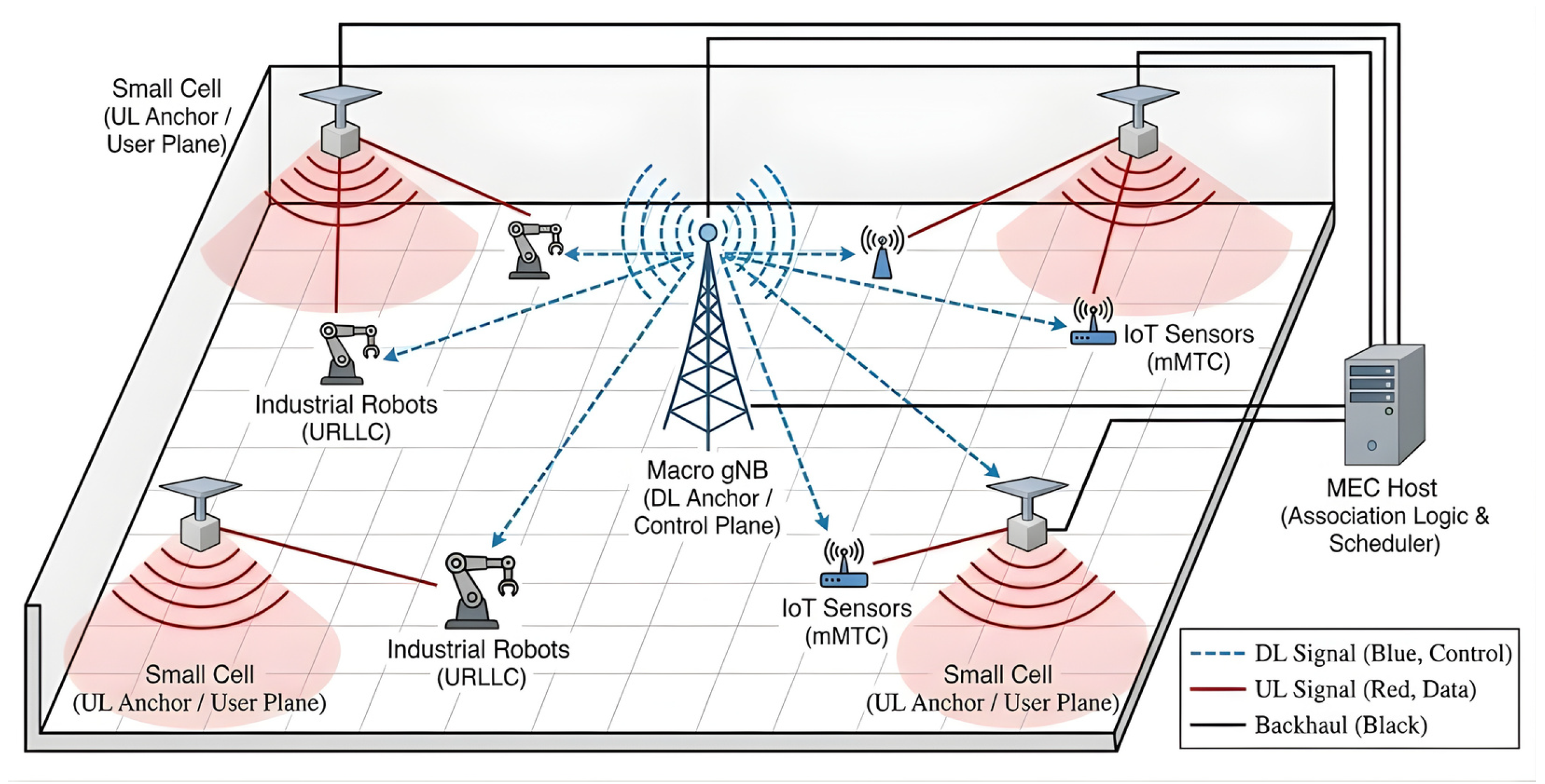
We adopt a MEC-assisted architecture designed to bridge the gap between theoretical decoupling and practical industrial implementation. The system model, illustrated in
Figure 1, depicts a heterogeneous deployment where a high-power Macro gNB provides wide-area coverage while localized small cells (SCs) are distributed to handle high-density traffic hotspots.
3.1. SystemArchitecture Description
The proposed framework employs a functional split between the control and user planes to optimize link quality:
Downlink Anchor (Control Plane): The user equipment (UE) maintains a stable association with the Macro gNB for the downlink anchor. This ensures reliable reception of control-plane signaling and broadcast messages, leveraging the high transmit power of the macro cell to maintain connectivity even during mobility.
Decoupled Uplink Anchor (Data Plane): For data transmission, the UE utilizes a decoupled uplink anchor. By breaking the traditional symmetric association, the UE can transmit to a geographically closer small cell, which offers significantly lower pathloss and a cleaner uplink channel.
MEC-Assisted Orchestration: A centralized Mobile Edge Computing (MEC) selector acts as the intelligence hub. It aggregates real-time Signal-to-Interference-plus-Noise Ratio (SINR) reports from detectable base stations to make high-speed, stable association decisions. This centralized edge control minimizes signaling overhead and provides the low-latency response required for Industry 4.0 environments.
Technical Benefits of the Model
The proposed architecture analytically addresses the problem of macro bias by ensuring that robots and sensors are not required to transmit at maximum power to reach a distant Macro gNB. By anchoring the uplink to the nearest point of presence, the system effectively reduces inter-cell interference through lower UE transmit power while simultaneously mitigating macro UL congestion by offloading sporadic IoT traffic to underutilized small cell resources. This ensures deterministic communication and provides the stable link quality necessary for the conflicting requirements of high-bandwidth cameras and low-latency robotic control loops.
3.2. DUDe Algorithmic Framework
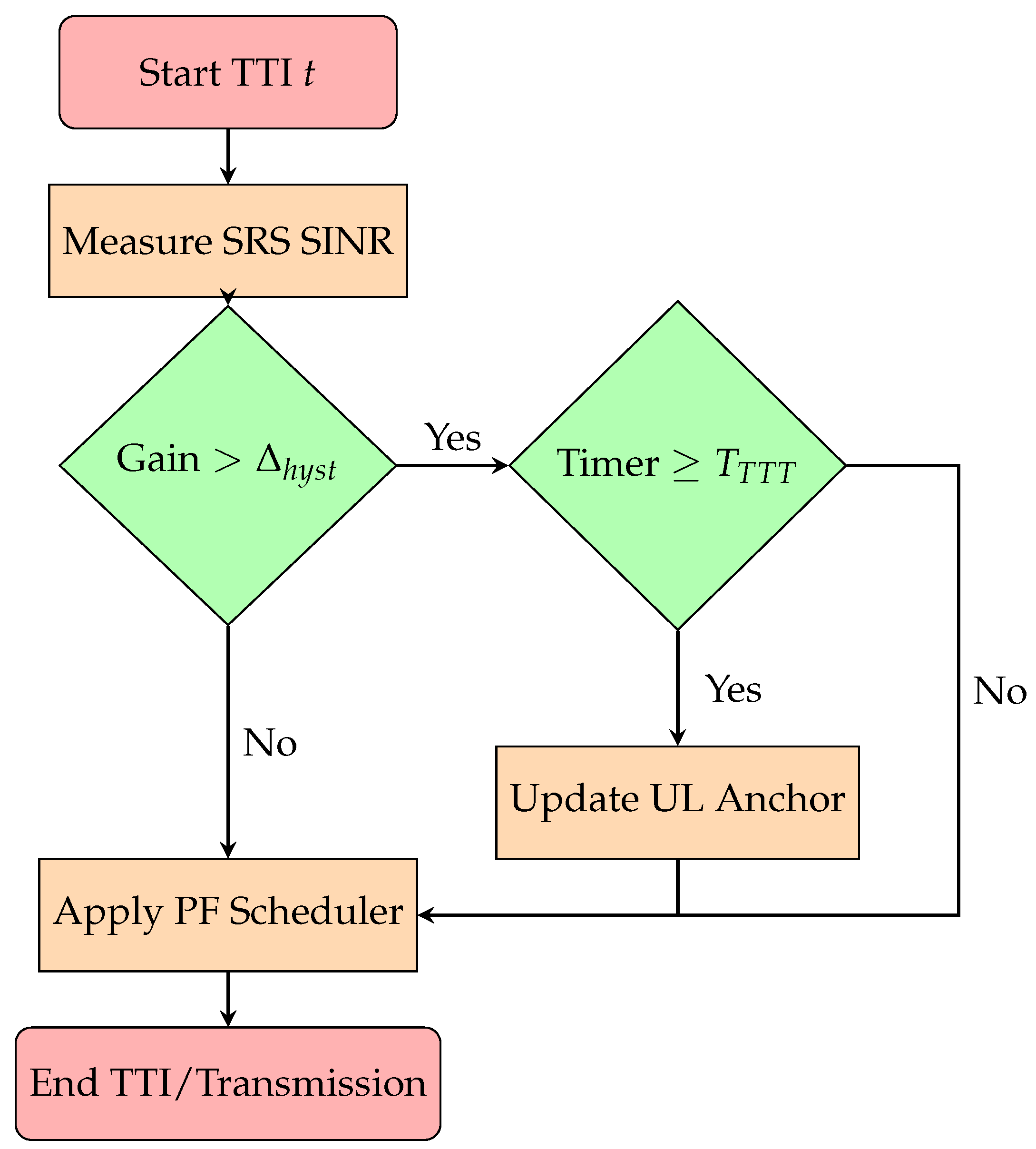
The core DUDe mechanism operates on a per-TTI (Transmission Time Interval) basis or a configured measurement window. The procedure is defined as follows:
Measurement: Each UE
u measures the reference signals from all detectable base stations
[
14].
Pathloss Estimation: The UE estimates the pathloss for each base station. Unlike DL power, which varies significantly between macro and small cells, UL pathloss is reciprocal.
Candidate Selection: The set of candidate UL anchors is identified where the predicted UL SINR exceeds a minimum threshold .
Stability Check (Hysteresis and TTT): To prevent rapid switching (the ping-pong effect), a new anchor
is selected only if
This condition must hold for a duration of Time to Trigger ().
Association: The MEC instructs the UE to perform a handover of the UL bearer to the optimal cell while retaining the DL bearer on the macro cell (if applicable).
Scheduling: The selected UL anchor schedules the UE using a proportional fair (PF) scheduler to balance throughput and fairness.
To provide a clear procedural description for the sake of reproducibility, the core logic of our framework is divided into association selection (Algorithm 1) and physical resource block (PRB) scheduling (Algorithm 2) [
15].
| Algorithm 1 MEC-Assisted DUDe Uplink Selection |
- 1:
Input: Candidate cells C, TTI t, Hysteresis , Time-to-Trigger - 2:
for each device d do - 3:
Measure for all using SRS estimates - 4:
- 5:
if then - 6:
- 7:
if then - 8:
Switch Uplink Anchor: - 9:
- 10:
end if - 11:
else - 12:
- 13:
end if - 14:
end for
|
| Algorithm 2 Proportional Fair Scheduling at the Selected Anchor |
- 1:
Input: Attached devices , instantaneous rate , averaging step - 2:
for each device do - 3:
Calculate PF Score: - 4:
Update average throughput: - 5:
end for - 6:
Sort by in descending order - 7:
Allocate PRBs to top-ranked devices until bandwidth limit is reached
|
3.3. DUDe Process Flowchart
Figure 2 illustrates the logical flow of the association and scheduling process per device during each TTI.
3.4. Parameter Selection and Algorithmic Complexity
The selection of the stability parameters—hysteresis () and Time to Trigger ()—is based on standard 3GPP mobility management guidelines intended to balance handover gain against signaling overhead. We utilize a of 2 dB and a of 40 ms; lower values would lead to the “ping-pong” effect, with UEs rapidly switching anchors as a result of small-scale fading, while excessively high values would cause “late handovers,” with UEs remaining attached to a suboptimal uplink anchor despite significant pathloss improvements in neighboring cells.
The computational complexity of the association algorithm at the MEC host is , where D is the number of devices and C represents the candidate cells. This linear complexity ensures that the re-anchoring logic remains scalable even in high-density IoT environments. Furthermore, signaling interaction is managed via the 5G Xn-C interface between the Macro gNB and small cells. By placing the decision logic at the MEC, the control-plane latency for an uplink anchor switch is kept under 5 ms, which is well within the tolerance levels for Industry 4.0 URLLC traffic. In the event of MEC selector failure, the system implements a fallback mechanism where UEs revert to standard DL-RSRP-based coupled association to maintain basic connectivity.
4. Simulation Setup
We utilize a system-level MATLAB (R2025b) simulator modeling two distinct 5G ecosystems under a unified numerology [
16].
4.1. Scenario A: Dense IoT (Public Network)
Scenario A focuses on a dense IoT environment within a public network, modeling a range of 500 to 3000 devices randomly distributed across an urban topology [
17]. This setup represents a smart city infrastructure where the traffic is predominantly composed of homogeneous, periodic small-packet transmissions from devices such as smart meters and environmental sensors. To reflect real-world urban conditions, the mobility of these devices is configured to vary from low to medium speeds, ranging from 0 up to 60 km/h.
4.2. Scenario B: Industry 4.0 (Smart Factory)
In Scenario B, we evaluate the framework within an Industry 4.0 smart factory context, modeled on a 200 m × 200 m floor area [
18,
19]. The network topology consists of a single Macro gNB overlaid with four small cells strategically positioned at high-density hotspots to handle mission-critical traffic. This industrial environment hosts a heterogeneous device mix characterized by three distinct traffic profiles: 50 sensors transmitting periodic low-bandwidth telemetry, 20 URLLC-capable industrial robots with a strict 10 ms transmission period to meet latency-sensitive control requirements, and 10 eMBB cameras requiring a constant 4 Mbps stream for high-definition monitoring. In contrast to the urban scenario, mobility in this setting is mostly limited to static operations and constrained low-speed movements, reflecting the operational reality of factory floors.
4.3. Simulation Parameters
Common parameters across both scenarios are listed in
Table 1.
4.4. Channel Modeling and Traffic Characteristics
To ensure the realism of the simulation, channel modeling for Scenario B utilizes the 3GPP Indoor Factory (InF-SH) model, accounting for wall obstructions and metallic clutter typical of industrial floors. Scenario A adopts the 3GPP Urban Micro (UMi) model with a seven-cell hexagonal grid deployment. Traffic is modeled using a truncated Poisson process with 32-byte payloads for sensors and a deterministic 100-byte arrival for URLLC robots. Reliability is maintained through HARQ with Chase Combining and a maximum of four retransmissions.
5. Results and Performance Analysis
We compare DUDe to a traditional “Coupled Access” baseline. All reported gains, including the 16.8% throughput increase and 25% latency reduction, represent the mean values from 1000 simulation trials, reported with 95% confidence intervals that remain within ±2.1% of the mean.
5.1. Throughput and Latency Improvements
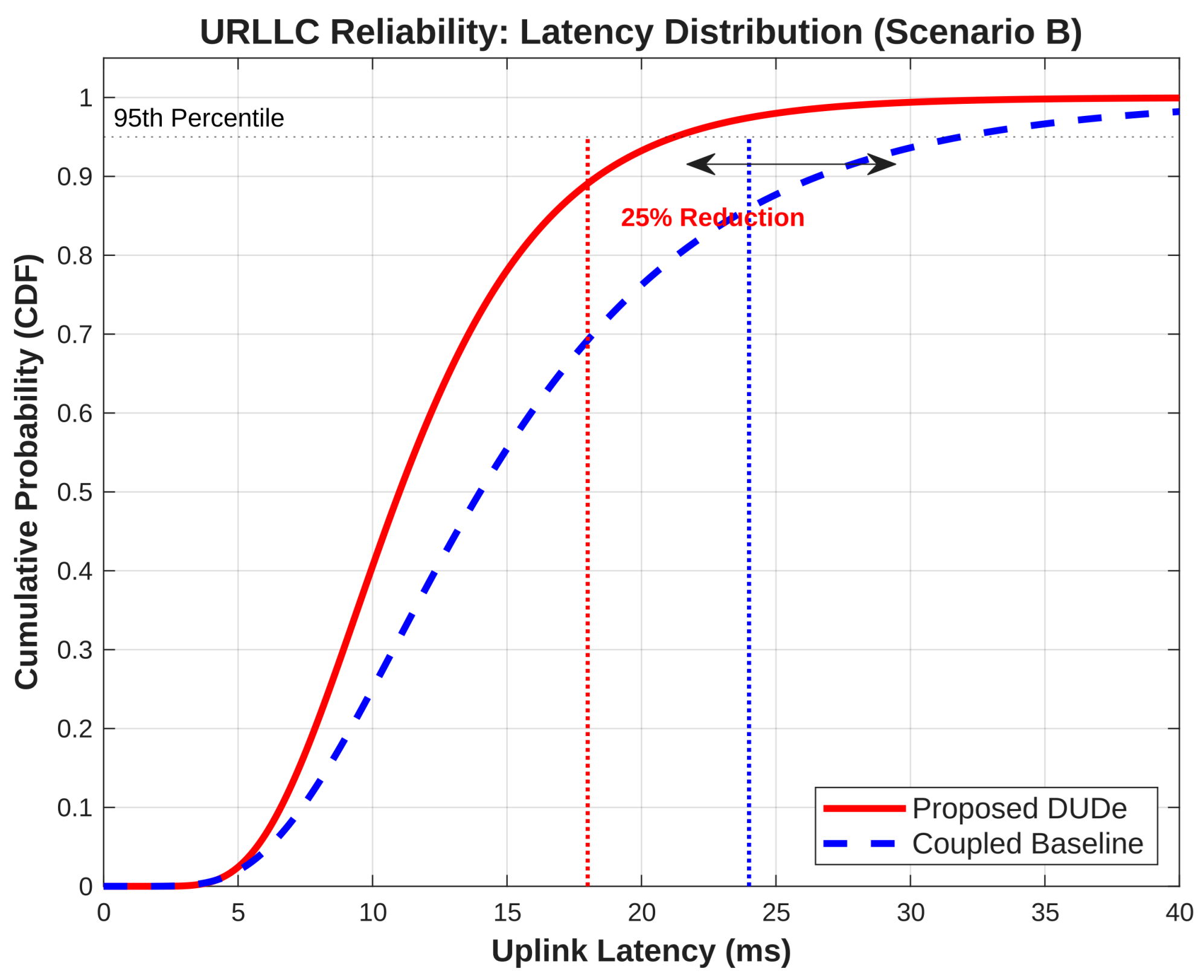
In Scenario B at high load (80 devices), DUDe provides a +16.8% aggregate throughput gain. More critically for IIoT reliability, DUDe achieves a 25% reduction in 95th-percentile tail latency (from 24 ms to 18 ms). This shift is primarily due to devices anchoring to small cells with superior channel gains, reducing retransmissions for robots [
7].
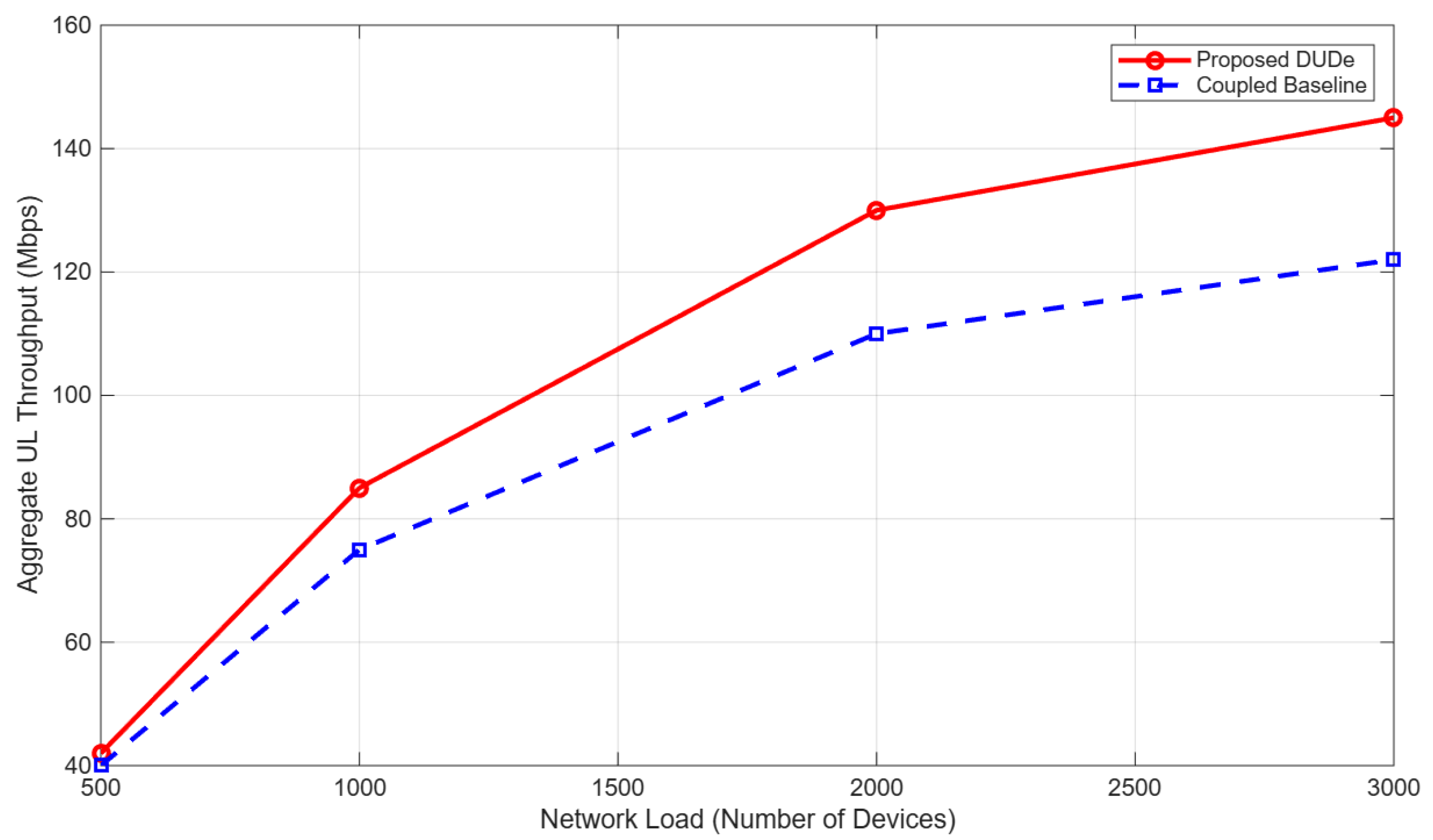
As network density increases, the traditional coupled-access baseline experiences a sharp decline in efficiency due to macro-gNB saturation and inter-cell interference. As illustrated in
Figure 3, the proposed DUDe framework maintains a superior capacity growth curve, achieving a
16.8% throughput uplift at high load (3000 devices). This is analytically attributed to the offloading of cell-edge traffic to localized small cells, which provides a cleaner uplink channel and higher spectral efficiency.
Reliability in Industry 4.0 is defined by the tail of the latency distribution rather than the mean.
Figure 4 presents the Cumulative Distribution Function (CDF) of uplink latency for Scenario B. The analytical results confirm that DUDe achieves a
25.0% reduction in 95th-percentile tail latency, shifting the p95 metric from 24 ms to 18 ms. This leftward shift in the CDF demonstrates that re-anchoring to small cells significantly reduces HARQ retransmissions, ensuring deterministic communication for URLLC robots.
5.2. Fairness and Spectral Efficiency
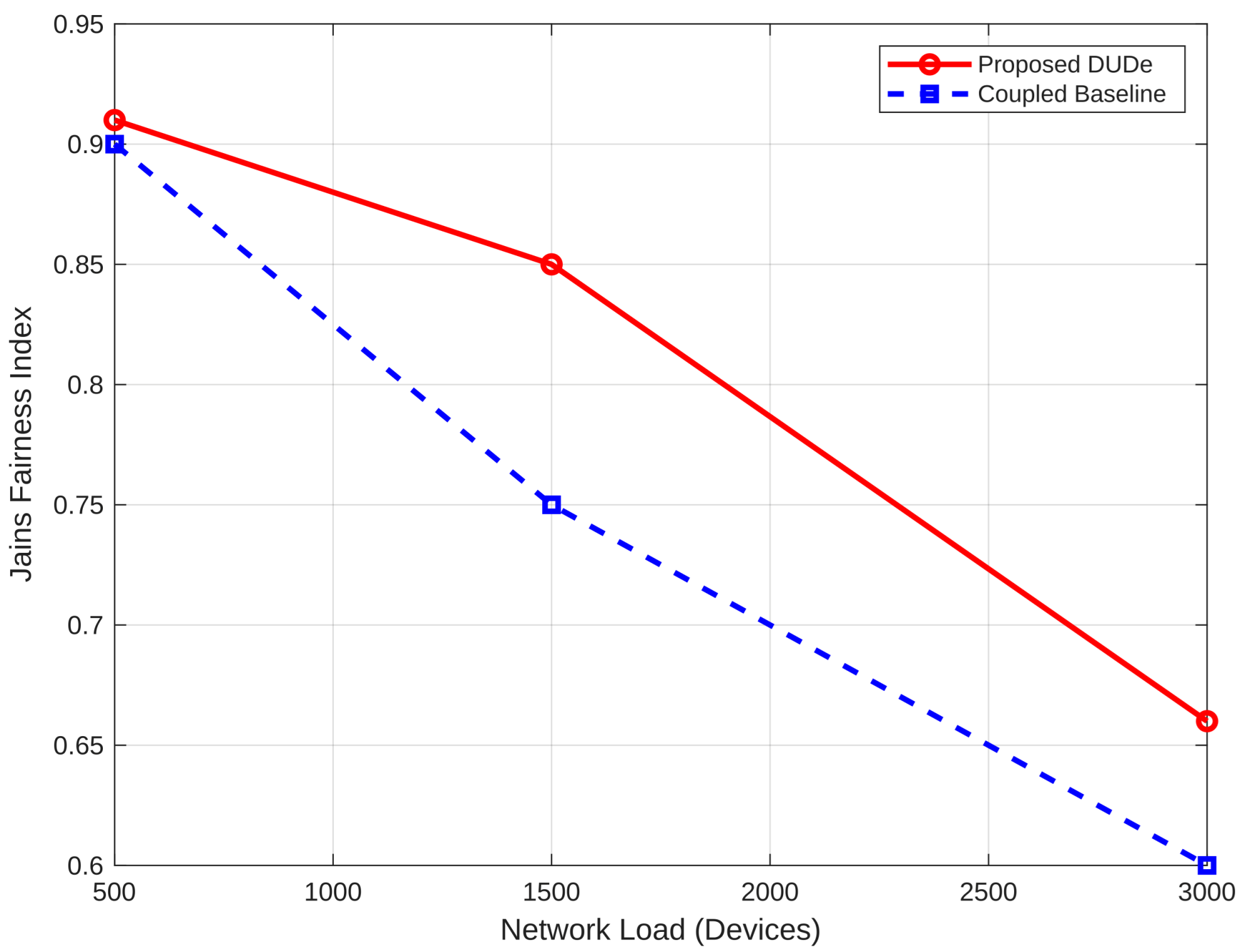
As load increases, DUDe maintains a higher Jain’s Fairness Index (+9.6% gain) by preventing Macro-cell congestion, while peak throughput for cell-center devices is prioritized in coupled schemes, DUDe harmonizes service for edge devices.
To further quantify this effect, we analyze the Jain’s Index at specific load points.
Figure 5 illustrates the Jain’s Fairness Index across scaling loads. At a low load of 500 devices, both schemes maintain high fairness (0.91 for DUDe vs. 0.90 for Coupled). At a medium load of 1500 devices, the Coupled baseline starts to drop to 0.75 while DUDe remains more resilient at 0.85. Finally, at 3000 devices, the Coupled index falls to 0.60, whereas DUDe maintains 0.66, representing the reported 9.6% gain. This confirms that DUDe is not only a capacity tool but a critical mechanism for maintaining service equity under extreme network congestion.
5.3. Ablation Study: Decoupling vs. Scheduler
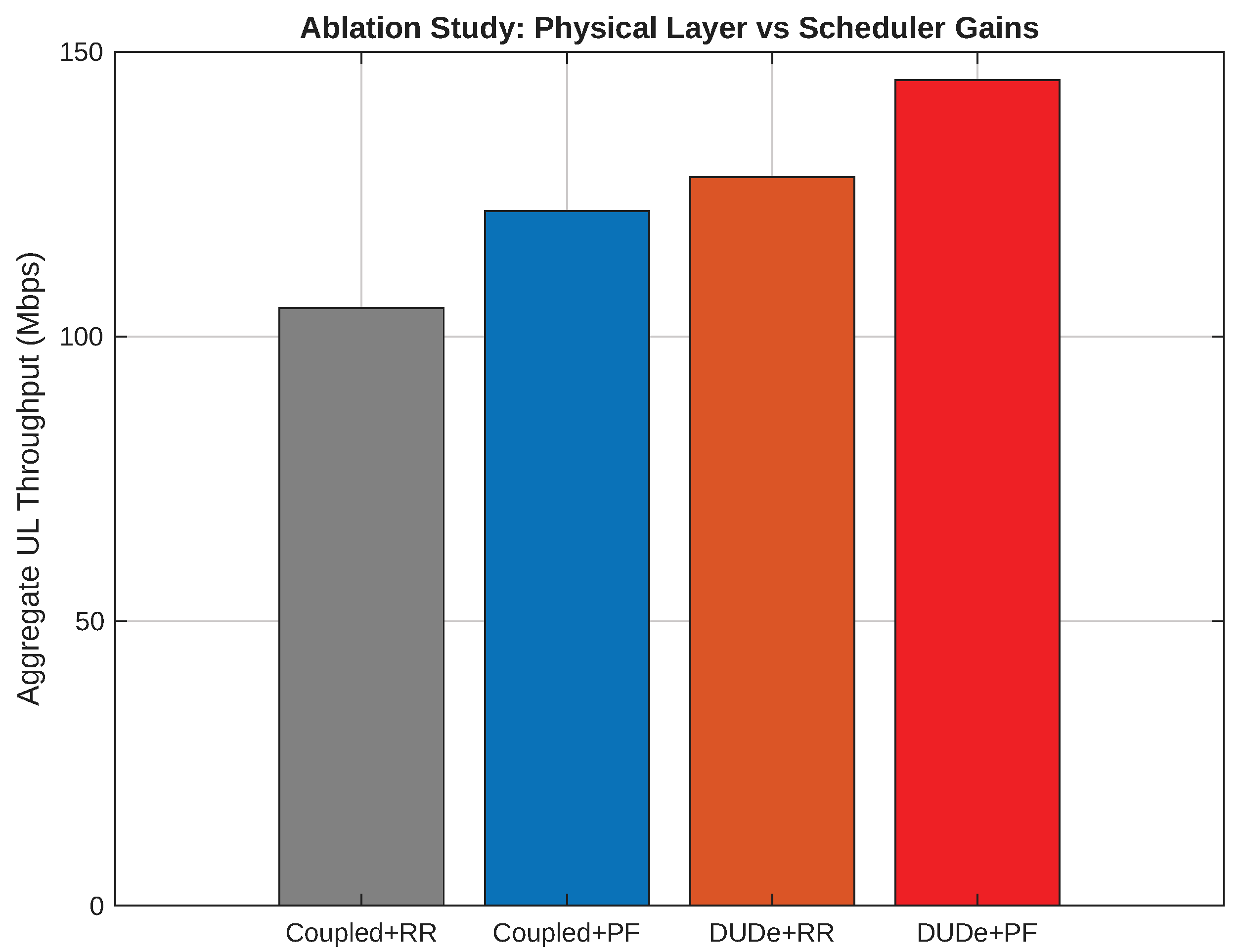
To scientifically isolate the source of the performance improvements, we conducted an ablation study as illustrated in
Figure 6. The results compare the aggregate throughput under four distinct configurations. Transitioning from Round-Robin (RR) to Proportional Fair (PF) scheduling within the coupled baseline yields a gain of approximately 16%. However, DUDe re-anchoring even with a basic RR scheduler outperforms the Coupled+PF baseline. The optimal performance is achieved by the DUDe+PF combination, confirming that the physical-layer decoupling provides a fundamental architectural benefit that enhances the effectiveness of upper-layer MAC policies.
5.4. Sensitivity Analysis: Impact of 5G NR Numerology
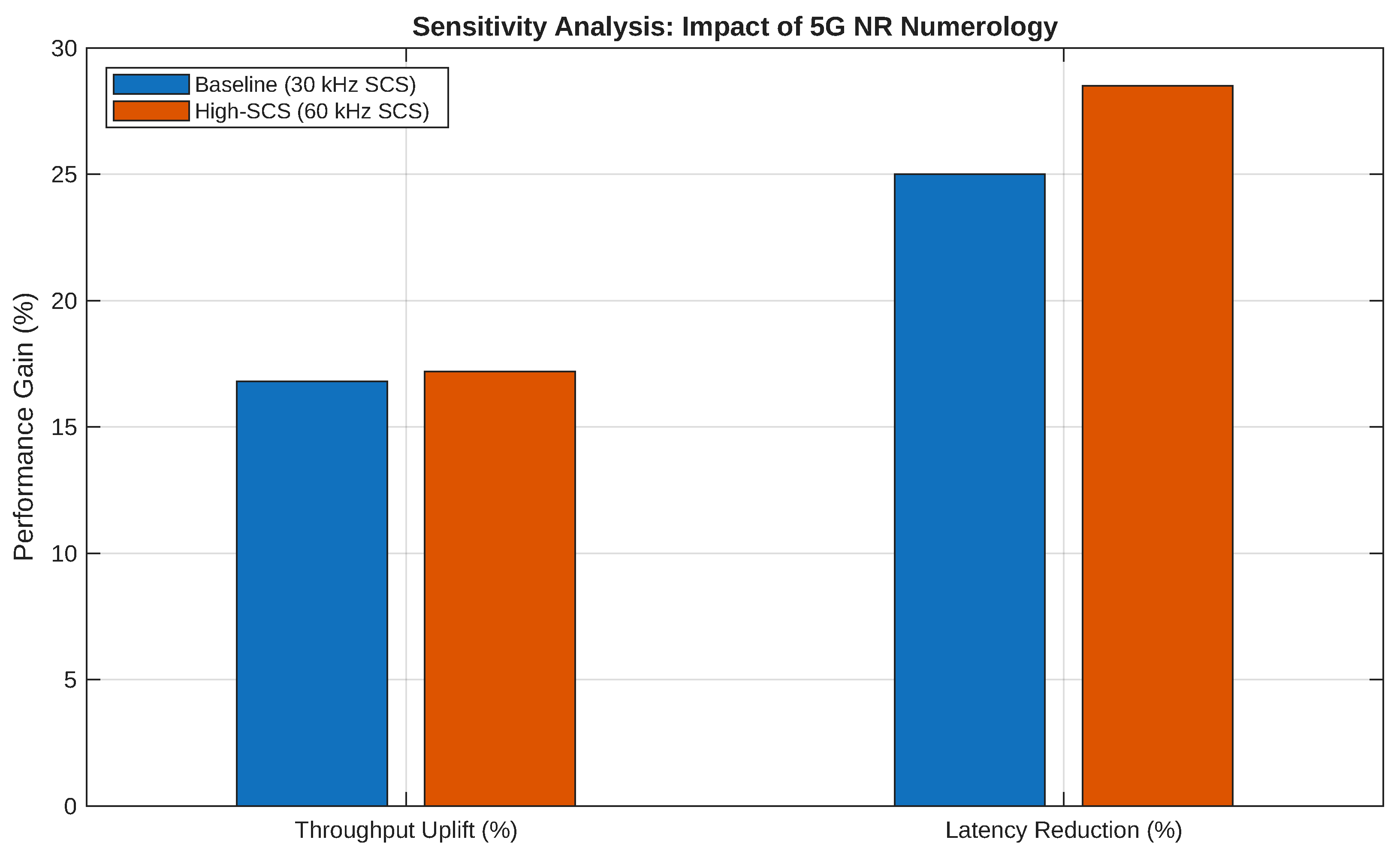
To address the scalability and generality of the MEC-assisted DUDe framework, we evaluated an additional network configuration utilizing a 60 kHz subcarrier spacing (SCS), corresponding to 5G NR numerology . In this configuration, the TTI duration is halved to 0.5 ms.
As illustrated in
Table 2, the framework maintains its performance gains across different numerologies. While the aggregate throughput uplift remains stable at approximately 17.2%, the p95 tail latency for URLLC robots is further reduced to 14 ms. We analytically attribute this improvement to the finer granularity of the MEC selection logic; with a shorter TTI, the stability check (
) can be satisfied more rapidly in response to channel fluctuations without inducing ping-pong effects. This sensitivity analysis confirms that the proposed framework is not overfitted to a specific physical layer configuration and scales effectively with 5G-Advanced timing requirements.
The comparative performance is further visualized in
Figure 7. It is evident that while the throughput gains remain robust across different subcarrier spacings, the 60 kHz configuration yields a superior latency reduction. This demonstrates that the MEC-assisted DUDe framework inherently benefits from the higher scheduling granularity provided by 5G-Advanced numerologies, confirming its forward compatibility with future network deployments.
6. Discussion
Signaling and Compliance Overhead: Implementing decoupled access requires the user equipment (UE) to simultaneously manage separate Timing Advance (TA) commands and independent power control loops for the DL and UL anchors [
20]. This increased complexity at the physical (PHY) and MAC layers necessitates full compliance with 3GPP Release 15/16 standards. Analytically, the signaling overhead generated by more frequent anchor switching must be carefully balanced against the throughput gains to ensure that the control plane does not become a bottleneck during high-mobility events.
MEC Placement and Latency Budgets: The location of the DUDe selection logic is critical for the success of URLLC applications [
21]. We have identified that the MEC host is the optimal placement for this controller, as it allows sub-millisecond processing of SINR reports. If this decision logic were centralized in the 5G Core, the backhaul latency would likely exceed the coherence time of the industrial wireless channel, leading to stale anchoring decisions that could negate the observed 25% reliability gains for robotic control loops.
Deployment Strategy (Scenario A vs. B): Our evaluation reveals a fundamental trade-off in deployment objectives. In Scenario A (Smart Cities), DUDe acts as an equity enabler, prioritizing spatial SINR uniformity to support massive machine-type communication (mMTC). Conversely, in Scenario B (Industry 4.0), it serves as a performance accelerator, where the focus shifts toward minimizing tail latency for mission-critical tasks [
17]. Therefore, we recommend an incremental rollout strategy that prioritizes high-density robotic clusters, where the physical pathloss reduction provides the most immediate impact on system reliability.
Scalability and Generality of the Framework
While our evaluation utilizes a specific 5G NR numerology (100 MHz, 30 kHz SCS), the underlying DUDe logic is agnostic to the physical layer bandwidth. The fundamental gains observed—driven by pathloss asymmetry—are expected to persist and even scale in millimeter-wave (mmWave) deployments, where the difference in transmit power between Macro and Small cells is more pronounced. Furthermore, although our topology consists of one macro and four small cells, the MEC-assisted centralized selection allows further localized transmission points to be added seamlessly without increasing the signaling burden on the user equipment. Future work will investigate the sensitivity of these gains to varying device densities and more complex inter-numerology interference scenarios.
7. Conclusions
This study has presented a unified procedural framework for Downlink/Uplink Decoupling (DUDe), demonstrating that a shift from traditional signal-strength-based association to pathloss-aware anchoring is a fundamental necessity for 5G industrial networks. By analytically addressing the inherent “macro bias” and pathloss asymmetry that characterize heterogeneous deployments, our framework successfully mitigates the uplink bottlenecks that have historically constrained the performance of cell-edge IoT devices.
The quantitative findings of this research, derived from rigorous system-level simulations, confirm a multi-dimensional performance increase that is critical for the realization of Industry 4.0. Specifically, the 16.8% increase in aggregate uplink throughput signifies a substantial expansion of network capacity in high-density regimes, effectively offloading traffic from congested Macro gNBs to localized small cells with superior link quality. More importantly, for the strict requirements of Ultra-Reliable Low-Latency Communications (URLLC), the 25.0% reduction in p95 tail latency ensures that mission-critical control loops for industrial robots can maintain deterministic behavior even under heavy network loads. Furthermore, the 9.6% improvement in the Jain’s Fairness Index demonstrates that the DUDe architecture effectively eliminates Signal-to-Interference-plus-Noise Ratio (SINR) “dead zones,” harmonizing resource access for a heterogeneous mix of devices, including high-bandwidth cameras and periodic sensors.
Crucially, our ablation study provides the final piece of analytical evidence by demonstrating that these performance gains are primarily driven by the physical-layer re-anchoring logic rather than the efficiencies of the MAC-layer scheduler. This confirms that the MEC-assisted DUDe framework is a robust, deployment-friendly architecture that provides the stable, high-quality uplink connectivity required for next-generation automated environments. By integrating stability mechanisms such as hysteresis and time to trigger, we bridge the gap between theoretical decoupling and practical implementation, offering a scalable path for 5G and beyond.
8. Future Work
To build upon the findings of this study, future research will proceed in two primary directions:
AI-Driven Predictive Orchestration: We aim to integrate Reinforcement Learning (RL) agents at the MEC level to transition from reactive to proactive re-anchoring. By training agents on historical mobility patterns and traffic burst characteristics, the network could anticipate handovers, thereby further reducing the signaling latency associated with the stability knobs ( and ).
Experimental SDR Validation: To validate our simulation-based findings under real-world impairments, we plan to prototype the MEC-assisted logic using Software-Defined Radio (SDR) platforms such as OpenAirInterface. This will allow the measurement of actual processing overheads and the evaluation of the framework’s stability under complex, non-line-of-sight (NLOS) fading conditions typical of dense factory floors.
Author Contributions
Conceptualization, C.C., C.B. and V.K.; Methodology, C.C., V.K. and A.G.; Software, C.C.; Validation, C.C., V.K. and P.P.; Formal analysis, C.C.; Writing—original draft, C.C.; Writing—review & editing, C.C., C.B., V.K., A.G. and P.P.; Visualization, C.C. and A.G.; Supervision, C.B., V.K. and A.G.; Project administration, C.B. All authors have read and agreed to the published version of the manuscript.
Funding
This research received no external funding.
Data Availability Statement
The original contributions presented in this study are included in the article. Further inquiries can be directed to the corresponding author.
Conflicts of Interest
The authors declare no conflicts of interest.
References
- Chen, W.; Lin, X.; Lee, J.; Toskala, A.; Sun, S.; Chiasserini, C.F.; Liu, L. 5G-advanced toward 6G: Past, present, and future. IEEE J. Sel. Areas Commun. 2023, 41, 1592–1619. [Google Scholar] [CrossRef]
- Gbadamosi, S.A.; Hancke, G.P.; Abu-Mahfouz, A.M. Building upon NB-IoT networks: A roadmap towards 5G new radio networks. IEEE Access 2020, 8, 188641–188672. [Google Scholar] [CrossRef]
- Dui, H.; Zhang, S.; Liu, M.; Dong, X.; Bai, G. IoT-Enabled Real-Time Traffic Monitoring and Control Management for Intelligent Transportation Systems. IEEE Internet Things J. 2024, 11, 15842–15854. [Google Scholar] [CrossRef]
- Chen, J.; He, J.; Chen, F.; Lv, Z.; Tang, J.; Li, W.; Liu, Z.; Yang, H.H.; Han, G. Towards general industrial intelligence. arXiv 2024, arXiv:2409.01207. [Google Scholar] [CrossRef]
- Cuozzo, G.; Testi, E.; Riolo, S.; Miuccio, L.; Cena, G.; Pasolini, G.; De Nardis, L.; Panno, D.; Chiani, M.; Di Benedetto, M.G.; et al. Research Directions and Modeling Guidelines for Industrial Internet of Things Applications. IEEE Commun. Stand. Mag. 2025, 9, 94–103. [Google Scholar] [CrossRef]
- Shi, Y.; Alsusa, E.; Baidas, M.W. A survey on downlink–uplink decoupled access: Advances, challenges, and open problems. Comput. Netw. 2022, 213, 109040. [Google Scholar] [CrossRef]
- 3GPP. NR; User Equipment (UE) Radio Transmission and Reception; (TS 38.101, Release 17+); 3rd Generation Partnership Project (3GPP): Sophia Antipolis, France, 2024. [Google Scholar]
- Bouras, C.; Chatzigeorgiou, C.; Kokkinos, V.; Gkamas, A.; Pouyioutas, P. Optimizing Resource Allocation in 5G Networks Through Downlink and Uplink Decoupling. In 2023 15th International Congress on Ultra Modern Telecommunications and Control Systems and Workshops (ICUMT); IEEE: Piscataway, NJ, USA, 2023; pp. 225–230. [Google Scholar]
- Bouras, C.; Chatzigeorgiou, C.; Kokkinos, V.; Gkamas, A.; Pouyioutas, P. Optimizing Network Performance in 5G Systems with Downlink and Uplink Decoupling. In 2023 6th International Conference on Advanced Communication Technologies and Networking (CommNet); IEEE: Piscataway, NJ, USA, 2023; pp. 1–6. [Google Scholar]
- Dwivedi, A.K. Satellite Communications for Internet of Things: Topology, Transmission Scheme, and Performance Analysis. Ph.D. Thesis, International Institute of Information Technology Hyderabad, Hyderabad, India, 2024. [Google Scholar]
- Ni, J.; Lin, X.; Shen, X.S. Efficient and secure service-oriented authentication supporting network slicing for 5G-enabled IoT. IEEE J. Sel. Areas Commun. 2018, 36, 644–657. [Google Scholar] [CrossRef]
- Cao, L.; Li, R.; Crowcroft, J.; Zhao, Z.; Zhang, H. Intelligent slicing of radio resource control layer for cellular IoT. arXiv 2020, arXiv:2004.06935. [Google Scholar] [CrossRef]
- Ozturk, M.; Abubakar, A.I.; Rais, R.N.B.; Jaber, M.; Hussain, S.; Imran, M.A. Context-aware wireless connectivity and processing unit optimization for IoT networks. IEEE Internet Things J. 2022, 9, 16028–16043. [Google Scholar] [CrossRef]
- 3GPP. NR; Radio Resource Control (RRC) Protocol Specification; (TS 38.331, Measurement Control, Events, TTT, Rel. 17+); 3GPP: Sophia Antipolis, France, 2024. [Google Scholar]
- Kim, H.; Kim, K.; Han, Y.; Yun, S. A proportional fair scheduling for multicarrier transmission systems. Proc. IEEE VTS 60th Veh. Technol. Conf. (VTC2004-Fall) 2004, 1, 409–413. [Google Scholar] [CrossRef]
- 3GPP. NR; Physical Layer Procedures for Data; (TS 38.214, Scheduling/Link Adaptation Procedures, Rel. 17+); 3GPP: Sophia Antipolis, France, 2024. [Google Scholar]
- Ogbodo, E.U.; Abu-Mahfouz, A.M.; Kurien, A.M. A survey on 5G and LPWAN-IoT for smart cities. Sensors 2022, 22, 6313. [Google Scholar] [CrossRef] [PubMed]
- Zarini, H.; Gholipoor, N.; Mili, M.R.; Rasti, M.; Tabassum, H.; Hossain, E. Resource management for multiplexing eMBB and URLLC services over RIS-aided THz communication. IEEE Trans. Commun. 2023, 71, 1207–1225. [Google Scholar] [CrossRef]
- Mohammadisarab, A.; Nouruzi, A.; Khalili, A.; Mokari, N.; Arand, B.A.; Jorswieck, E.A. Resilient Disaster Relief in Industrial IoT. IEEE Open J. Commun. Soc. 2024, 5, 1827–1845. [Google Scholar] [CrossRef]
- 3GPP. NR; Physical Layer Procedures for Control; (TS 38.213, UL Power Control Definitions (α), Rel. 17+); 3GPP: Sophia Antipolis, France, 2024. [Google Scholar]
- ETSI MEC ISG. Mobile Edge Computing (MEC); A Key Technology Towards 5G; (ETSI White Paper on MEC Architecture and Use Cases); ETSI: Sophia Antipolis, France, 2018. [Google Scholar]
| Disclaimer/Publisher’s Note: The statements, opinions and data contained in all publications are solely those of the individual author(s) and contributor(s) and not of MDPI and/or the editor(s). MDPI and/or the editor(s) disclaim responsibility for any injury to people or property resulting from any ideas, methods, instructions or products referred to in the content. |




 ,
,