1. Introduction
Edge Computing (EC), also known as a cloudlet or micro-datacenter, is a computing architecture that consists of geo-distributed, interconnected, and resource-constrained nodes located at the proximity of the network [
1,
2,
3,
4]. By pushing computational cloud resources to the network edge, low-latency services can be provisioned closer to the data source, mobility support for the mobile users is enhanced, and intelligence in the Internet of Things (IoT) environment is empowered. Furthermore, it has been seen as enabling architecture for several domains, primarily IoT-based environments, and is thus rapidly adopted in, e.g., smart cities, smart factories, robotics, smart homes and buildings, and driverless vehicles [
5,
6,
7]. Moreover, the massive proliferation of IoT devices raises the need for EC, as the number of IoT devices is expected to reach over 32.1 billion by 2030. Hence, EC is a research opportunity hotspot for academia and has potential economic impact due to its potential role in enhancing service performance and responsiveness, especially for emergent technologies.
In a smart-campus environment, which is a subset of smart city applications, the EC paradigm is considered a promising and enabling architecture for transforming traditional university campuses into smart ecosystems [
8,
9,
10,
11]. By leveraging its resources, university services can be provided effectively, efficiently, and autonomously. These services are made available on demand for researchers, staff, students, and visitors. Services may include, but are not limited to, smart classrooms (SC), housing, irrigation systems, smart grids, pollution monitoring, and campus security applications. For instance, EC resources can be used to provide SC services [
12]. It is utilized to facilitate and automate the evaluation of submitted assignments using intelligent video management systems. This functionality can be further extended to monitor the students’ learning curve by personalizing learning experience. The latency requirement for these scenarios requires efficient task allocation mechanism to fulfill such requirement.
Campus visitors can also utilize edge services, such as Augmented Reality (AR) applications, while moving around the campus. AR provides interactive information related to the campus’ attractive locations or historical buildings aiming to enhance visitors’ experience. Such service requires mobility awareness and continuous connectivity to avoid service disruption. In fact, the characteristics of smart-campus services vary significantly in terms of workload, execution time, and data size, whereas their Quality-of-Service (QoS) metrics are also service-dependent. Additionally, user mobility around the campus may have a significant impact on service failure, as users can move at different speeds based on the mobility mode, such as walking, e-scooters, bikes, or cars. The fulfillment of QoS metrics, especially for latency-sensitive applications, that also takes users’ mobility into consideration can be achieved by an efficient task allocation approach through edge-cloud architecture.
This research employs a fuzzy-logic-based approach to optimize task allocation as an online problem in edge-cloud environments with consideration of prioritizing latency-sensitive applications, users’ mobility awareness, and efficient edge resource utilization. It has been seen as a promising approach that can handle the growth, complexity, and uncertainty that are inherited from the smart-campus environments, as well as its high complexity and computational requirements [
7,
13,
14,
15]. It is an if–then rule-based approach that can consider multiple conflicting parameters, such as user speed, service priority, network bandwidth, and resource availability. Several research efforts have been conducted to tackle uncertainty problems using several techniques, including the fuzzy-logic approach [
13,
14,
16,
17,
18].
Although extensive research, such as [
13,
15,
16], has been conducted with consideration of mobility and application latency sensitivity, the use of fuzzy logic for real-time task allocation in smart-campus environments remains limited and requires further investigation and evaluation. Moreover, this research aims to optimize resource utilization and prioritize latency-sensitive applications, as well as aiming to be mobility-aware, which is represented by end-device speed in the orchestration decisions. Yet, most of existing solutions employed fuzzy logic in general domains, such as [
19,
20,
21], where mixed applications are considered. Moreover, limited research effort targets smart campuses, such as [
11,
22], where neither address the task allocation problem. In [
19], a two-tier fuzzy-based workload orchestration is proposed for collaborative edge-cloud without targeting a specific domain.
Therefore, this paper proposes a context-aware fuzzy-based task allocation framework for smart-campus environments that is able to allocate end-device tasks to most suitable EC resources. The proposed approach also incorporates centralized cloud-computing resources based on predefined fuzzy rules, which means that the cloud can be selected as a candidate resource when some fuzzy rules are applicable. For instance, in case of an IoT device having low speed and its requested service being classified as a latency-tolerant application, it can be offloaded to the cloud. However, the offloading process to the cloud is not always the case, where the consideration of the edge node resource availability must be evaluated. The contribution of this paper can be summarized as follows.
A context-aware two-tier fuzzy-based task orchestration framework, referred to as the Mobility Fuzzy-based Model (MFBM), is proposed for smart-campus environments. The proposed model incorporates multiple factors, which are task characteristics, user mobility status via mobility speed, and resource availability, in the task orchestration process in order to satisfy three main objectives, which are task priority, resource utilization efficiency, and execution rate. It targets collaborative edge-cloud resources by dynamically offloading the workload to the most suitable resources in accordance with predefined rules. A lightweight decision-making algorithm is developed to prioritize latency-sensitive applications, maximize edge resource utilization, and maximize the execution rate taking into consideration user mobility awareness in the smart campus domain.
A thorough simulation-based performance evaluation is conducted under diverse and dynamic scenarios, including smart campus daytime and nighttime conditions and applications, to examine the effectiveness of the proposed fuzzy-based solution. Both day and night scenario investigations contribute to understanding the smart campus workload requirements over day and night periods. Additionally, a benchmark, i.e., Sonmez, is considered to assess the ability to generalize the proposed model for off-campus applications.
An extensive experimental evaluation of the proposed fuzzy-based model is performed against two representative benchmarks, aiming to highlight the superiority and effectiveness of the proposed approach under varying workloads and scenarios.
The remainder of this paper is organized as follows.
Section 2 reviews the related work focusing on studies that target task orchestration over both edge and cloud layers. This is followed by
Section 3, which presents the system model.
Section 4 introduces the mobility fuzzy-logic system architecture, including parameters and membership functions, as well as the decision levels considered in the approach.
Section 5 describes experimental design, covering the evaluation scenarios, simulation-related parameters, and evaluation metrics. The results of experiments conducted are presented and discussed in
Section 6. Finally,
Section 7 concludes the paper and presents the future work plan.
2. Related Work
The task orchestration process determines the responsible resources for executing the submitted tasks by mobile devices. In the context of EC, it has been an active research topic since the emergence of the EC paradigm, driven by continuous development as well as the massive shift of IoT applications towards the network edge. Task allocation across EC nodes is not a trivial task, whereby the edge environment consists of distributed and resource-limited resources, i.e., network, computational, and energy resources. This is more challenging when cloud resources are considered, where the service prioritization mechanism becomes essential. Task allocation has been widely addressed in the literature by using several approaches, such as deep learning, fuzzy logic, and Mixed Integer Linear Programming. The selection of the candidate approach is factor-dependent and is related to, but not limited to, application type, scenario, domain, historical data availability, system architecture, and optimization objectives.
Fuzzy logic has been widely adopted in task orchestration problems, demonstrating its ability to deal with task orchestration as an online problem, particularly, in environments with uncertainty [
14]. Fuzzy logic is adopted in this paper due to three main reasons: (1) its promising results in handling uncertainty in the EC as demonstrated by several research studies, such as [
7,
15,
16,
19,
20,
23]; (2) the consideration of event-driven task allocation for mobile devices, which is classified as an online and real-time orchestration problem; and (3) the lack of fuzzy-based model evaluation in smart-campus environments.
Several studies have proposed fuzzy-based models for IoT applications, which can be classified into single-tier fuzzy logic systems and multi-tier fuzzy logic systems. A recent study [
16] proposes a single-tier fuzzy-based model for the Internet of Vehicles, targeting vehicle-to-vehicle scenarios. It aims to optimize several parameters related to the execution rate, resource utilization efficiency, and overall system delay, with primary focus on latency-sensitive applications. It evaluates the candidate edge nodes by scoring their ability to handle the tasks based on task priority and using four input variables, which are the physical proximity of the edge node, the urgency of the task, vehicle speed, and the computational power of the node. Simulation-based experiments are conducted using integrated environments, namely the Simulation of Urban Mobility and the Adaptive Neuro-Fuzzy Inference System. The experiments lack fuzzy-based benchmarks, which instead consider, e.g., the Generalized Heuristic Greedy offloading approach, the next fit algorithm, and the random policy algorithm.
A novel fuzzy logic method is proposed to manage the campus parking areas by identifying available parking bays and providing parking recommendations [
22]. Although parking management optimization in smart campuses is the aim, task allocation in edge-cloud is not considered. Similarly, fuzzy logic is employed in enhancing the indoor atmosphere in heating, ventilation, and air-conditioning systems for SCs, instead of the task allocation problem [
11].
Fuzzy logic also demonstrated its strength in the smart city domain, as illustrated in [
17], which proposes a single-tier fuzzy-based service placement strategy. It adopts microservice applications where an application consists of microservices that can be either placed on the same node or distributed across different nodes. Placement decisions are made based on the fuzzy logic model, which determines the performance level of the candidate nodes where the cloud can be utilized once the placement on the edge is impossible. Several input variables are considered, which are the node’s Central Processing Unit (CPU) load, memory usage, the available node bandwidth, the load required for running the service’s blocks, and the service’s required bandwidth. The evaluation is conducted using EdgeCloudSim, taking two benchmarks into consideration. Unlike the earlier presented studies, the performance evaluation does not present sufficient details regarding the simulated applications nor evaluation metrics that highlight its effectiveness in terms of cost objectives. In contrast, our study targets a specific domain, which is the smart city domain, and provides experimental validation to the considered objectives. Similarly, a service placement strategy, which is molded as a set of microservices, using fuzzy logic is proposed to enable fast and low-cost deployment in edge infrastructure [
17]. EdgeCloudSim is also used to evaluate the proposed strategy.
A fuzzy inference mechanism for data-driven applications is proposed to make offloading decisions based on data overlapping, task delay sensitivity, and Virtual Machine (VM) utilization [
24]. Three offloading options can be made, which are the local node, i.e., the nearest edge node, the neighbor edge node, or the cloud. EdgeCloudSim is used in evaluating the proposed mechanism against cloud-based and EC-based mechanisms, which utilize only the edge layer. Compared to our work, classical benchmarks are considered, whereas it is essential to use fuzzy-logic approaches to demonstrate its effectiveness.
A novel generic fuzzy-based logic offloading algorithm for edge-cloud architecture is introduced in [
7] for latency-sensitive applications, with overall service time optimization as the primary objective. It uses four input variables, which are VM utilization, task length, network demand, and task delay sensitivity, with belief in its significance in supporting the targeted objective. Several experiments are conducted using EdgeCloudSim with three benchmarks. Although the experiments show remarkable results over various evaluation metrics, the results lack sufficient details to show the effectiveness of the proposed algorithm in terms of latency-sensitive applications. In [
16], a fuzzy-based offloading scheme is proposed. It utilizes EC, which is a mobile vehicle, to process resource-intensive vehicular tasks to optimize the execution rate and system delay. Tasks are offloaded to another vehicle by prioritizing tasks based on their urgency using the fuzzy model. Two offloading layers are considered, which are the local mobile vehicle and another vehicle.
Several fuzzy-based models are designed using multi-tier architecture. For instance, a two-step multi-objective fuzzy-based strategy is introduced in [
20]. It aims to enhance resource utilization, reduce the task failure rate, and reduce the service time by prioritizing the tasks to be executed in collaborative edge-cloud environments. This study adopts the same offloading decisions that are adopted by [
7], which can be the local edge, the neighbor edge, or the cloud. Further, the same input variables are considered, except the network demand is replaced by Wide Area Network (WAN) bandwidth to account for the network bandwidth once the cloud resource is selected. The first step considers edge node resources, i.e., the local node or the neighbor node, while the second step considers edge and cloud resources. Four different applications and benchmarks are used to evaluate the proposed strategy using EdgeCloudSim. Although the proposed model efficiently offloads the workload to the most suitable layer, which outperforms other benchmarks, a clear limitation is the evaluation of the proposed model to deal with latency-sensitive applications. This is due to the absence of application details and the presented results that aggregate results across all applications regardless of the specifications of individual applications.
In [
23], a collaborative fuzzy-logic task-offloading scheme for mobile EC-enabled densely deployed small-cell networks is proposed. It evaluates the edge node load to determine the candidate nodes, which can be the local, neighbor Small Base Station Multi-access Edge Computing (SBS-MEC) server or the cloud, which is not considered as part of the fuzzy system decision. The cloud layer is selected only when there is no collaboration between the edge nodes. It uses five input variables, which are the task size, the delay sensitivity of the task, the local SBS-MEC VM utilization, network delay, and the neighbor SBS-MEC VM utilization. The evaluation is conducted using EdgeCloudSim, which considers the AR application and non-fuzzy logic models as benchmarks.
A two-tier fuzzy logic workload orchestration model for EC is proposed in [
19]. The adoption of two stages is to reduce the handling node complexity. The first stage selects the best candidate node at the edge layer, whereas the second stage compares the edge with the cloud. Computational, network, and task requirements are considered to make the offloading decision that can be the local edge node, the alternative edge node, or the cloud. A comprehensive evaluation is conducted using EdgeCloudSim and taking into consideration the multi-application scenario and both the fuzzy-based and the non-fuzzy models as benchmarks. A major limitation is that optimization objectives are not explicitly defined.
A two-stage belief rule-based orchestration model built based on fuzzy logic is proposed in [
21]. The first stage makes offloading decisions across the edge layer using CPU utilization of both the local and the least loaded edge and the Metropolitan Area Network (MAN) delay, while the second stage compares the candidate edge with the cloud using the CPU utilization of the candidate edge node, WAN bandwidth, delay sensitivity, and the CPU utilization of cloud. Indeed, making utilization-based decisions for the cloud represents a key limitation as it, by nature, has unlimited capacity.
In [
25], fuzzy logic and EC are employed to optimize the distributed generation placement and extend electric vehicle lifespan in the smart grid. EC is used to monitor the energy, execute the fuzzy inference algorithm, and reduce the central grid overload by neighboring coordination. The proposed framework can optimize battery life, reduce latency, and improve reliability. The study, however, does not focus on task orchestration through the edge-cloud environment, where it employs the edge to run the fuzzy logic system. In [
13], a two-stage fuzzy-based scheduling technique is proposed for the vehicle ad hoc network, aiming to minimize latency and energy consumption while enhancing response time. The simulation experiments are conducted using iFogSim to model the vehicle ad hoc scenario.
Fuzzy logic can be designed with a three-stage system as proposed in [
15], which introduces task prioritization and a three-level fuzzy logic manager. The manager decides the processing resource which can utilize the mobile device, the local edge node, the alternative edge node, or the cloud. The first step determines whether the task should be processed on a mobile device or the local edge node. The second stage decides between the local edge and the candidate edge. The third stage decides between the best edge node and the cloud. It uses EdgeCloudSim to evaluate the proposed model, taking four different applications with different requirements into consideration. The key strength of this paper is the detailed performance evaluation to show the effectiveness of the proposed model for each considered application under various benchmarks.
There are other approaches that are used to orchestrate the IoT tasks, such as prediction models and reinforcement learning. In [
26], an offloading approach is proposed to optimize the latency of both the network and the execution time. A prediction algorithm is also proposed to predict the specifications of mobile applications, which helps in decision-making. Reinforcement learning is another method that shows its ability to orchestrate edge tasks, which employs deep learning in [
27]. A reinforcement-based framework for dynamic service placement in the EC environment is introduced. It aims to minimize the delay under the constraints of physical resources and operational costs. As part of the solution, a service migration mechanism is proposed to avoid invalid status in the decision.
Table 1 below compares the most relevant studies under five criteria to position and highlight the significance of this study compared to the literature. The literature analysis reveals a clear research gap in the exploration of the fuzzy-based approach in the workload orchestration process in smart-campus environments. Furthermore, most of existing studies either focus on general edge-cloud environments or consider a subset of critical factors, such as latency and resource utilization, whereas a domain-specific approach and the impact of multiple factor combinations in a unified decision-making framework can significantly enhance the overall system performance. So, this gap is related to the research domain, i.e., a smart campus, taking mobility awareness, resource utilization efficiency, and latency-sensitive application prioritization into consideration.
Therefore, this paper proposes a context-aware fuzzy-logic-based workload orchestration technique that prioritizes latency-sensitive applications to be executed closer to the end device, hence reducing the overall system latency. Unlike existing approaches, it incorporates multiple factors, including user mobility speed as a mobility indicator, tasks’ delay sensitivity, and resource availability, in the decision-making process, aiming to efficiently utilize edge nodes by maximizing the edge execution rate and resulting in higher resource utilization, while maintaining low latency for latency-sensitive applications by processing them closer to the end devices and enabling cloud utilization in accordance with predefined fuzzy rules. Such a technique can enable the balance between the considered objectives. Indeed, both service time for latency-sensitive applications and efficient resource utilization are significant factors in EC. On one hand, EC emerged to reduce the latency caused by utilizing cloud resources that are located away from the data source. On the other hand, edge nodes are resource-limited by nature.
3. System Modeling
In edge-cloud environments, services demanded by the end-devices, e.g., IoT devices, can be executed on either edge or cloud resources. Hence, a multi-tier approach is the most suitable system architecture that can be used to model the paper’s environment. It is modeled using three layers, which are the end-devices layer, the edge layer, and the cloud layer, where each layer has distinct functions.
Let assume that
denotes the set of end-devices, such as IoT devices, smart watches, and smartphones, that are located on the end-devices layer. These devices are connected to the upper layer, which is the edge layer, via either the Wireless Local Area Network or telecom-based networks. Further, they instantiate service requests
to access a wide range of applications
that are deployed on both edge and cloud layers. Each
has specific requirements that are modeled as
; these notations are defined in
Table 2. Once a
is processed by the candidate layer, i.e., the edge or the cloud, the response is sent back to the end device
. These applications and services, notated as
, are related to the smart campus domain, such as smart emergency (SE) and smart parking (SP). Each application has its own requirements, which are
, as defined in
Table 2. Further details regarding the requirements of the adopted applications are presented in
Section 5.2.
The edge layer, which is the intermediate layer located at the network proximity, consists of a set of geo-distributed and resource-restricted nodes represented as
, which are responsible for processing the requested services
, and the edge orchestrator, whereby it is responsible for making offloading decisions. Offloading decisions can be local processing on the local edge node
, the most suitable neighbor edge node
, or the cloud, which is based on fuzzy logic rules as illustrated in
Section 4. The edge node can be seen as a micro-datacenter that is a virtualized environment with the ability to run various applications on demand.
The top layer is the cloud layer, where the huge and unlimited datacenter resides. This layer can be utilized once the defined fuzzy logic rules are met. These cases include processing the latency-tolerant requests in case of edge nodes being fully utilized.
4. Fuzzy Logic System Architecture
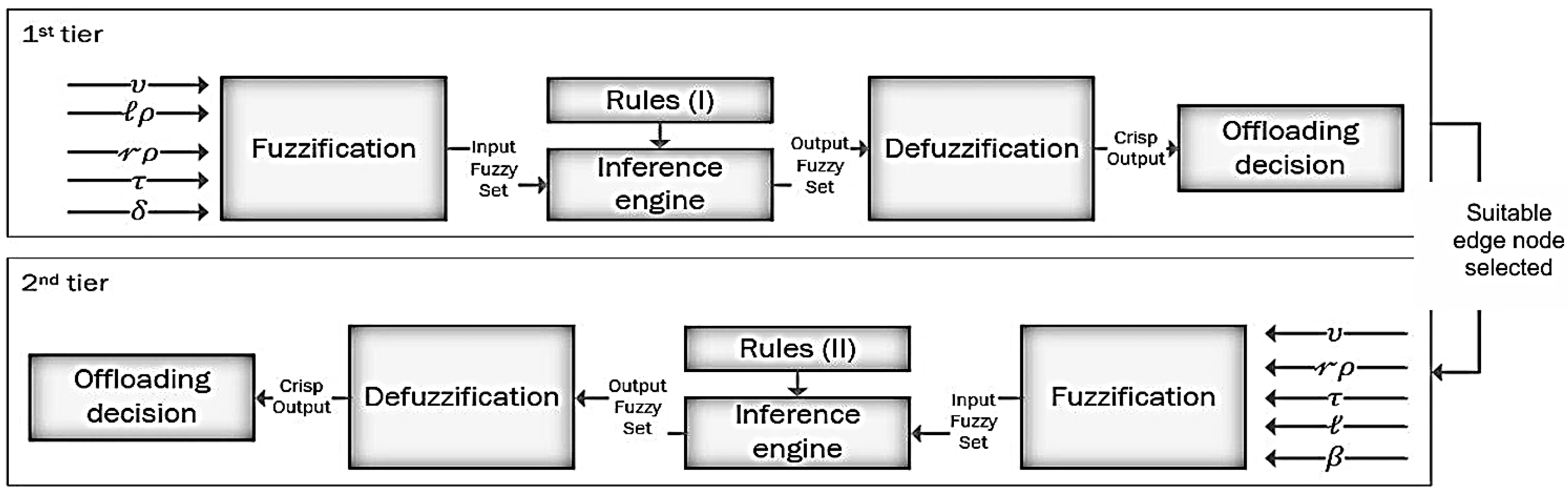
In highly dynamic environments like edge-cloud environments, uncertainty is a fundamental issue that represents a significant challenge towards the efficient task orchestration process, aiming to optimize resource utilization enhancement, latency minimization, and execution rate maximization with mobility awareness. Hence, a multi-tier fuzzy-logic-based approach is employed to perform efficient task orchestration across edge-cloud environments, considering these objectives. A fuzzy-based model is capable of orchestrating the received requests by the IoT devices to decide the most suitable offloading resource, whereby there are three candidates which are local edge node, most suitable neighbor edge node, or cloud. The offloading decision is taken based on a two-tier fuzzy logic system model, as illustrated in
Figure 1 and Algorithm 1.
| Algorithm 1. Two-tiers offloading decision for the proposed MFBM |
i:
ii:
iii:
iv:
v:
vi:
vii:
viii:
ix:
x:
1:
2:
3:
4:
5:
6:
7:
8:
9: | Input: Values of the input variables
: request generated by an end device
: Device speed
: Local edge utilization
: Remote edge utilization
: Task delay sensitivity
: MAN delay
: Task length
: WAN bandwidth
Output: offloading_decision (local edge, remote edge, cloud)
Begin
do
)
Target_node ← candidate edge node (local or neighbored node)
)
Target_node ← (candidate edge node or cloud)
offloading_decision ← Target_node
End for
End |
To present the details of the proposed fuzzy system, the fuzzy generic architecture is used, which consists of three main parts, which are fuzzification, inference engine, and defuzzification, as depicted in
Figure 1. The details of these parts in relation to the proposed two-tier MFBM are presented below.
4.1. First-Tier Fuzzy Logic System Architecture
The first tier in the proposed fuzzy-logic system architecture uses the input variables to decide the processing location of the received task, which can either be the local edge, i.e., the edge node that received the task, or it can be offloaded to the nearest suitable edge node.
4.1.1. Fuzzification
Fuzzification is the process of converting input variables into fuzzy sets using defined membership functions. As depicted in
Figure 1, five input variables are selected at this tier, which are device speed, local edge utilization, remote edge utilization, task delay sensitivity, and MAN delay, which are represented as
,
,
,
, and
, respectively. The selection of these input variables is critical, as they directly contribute to system objective fulfillment. The
device speed variable is adopted as high-level indicator for user mobility behavior in a campus, which is a critical variable in offloading the decision-making process. For instance, when user speed is classified as fast and a latency-sensitive application is requested, it is important to classify this user as high-priority in execution on the local or the nearest edge node, as the connection is most likely to be lost. Hence, this variable enables mobility-aware orchestration by adapting offloading decisions based on user movement. Three linguistic terms are used for the speed variable, which are slow, medium, and fast, representing the device’s mobility speed. Three membership functions are employed, namely left shoulder
, trapezoidal, and right shoulder
, to quantify the linguistic terms, as described in Equations (1)–(3).
The
local edge utilization variable is a key indicator of the current load of the node connected to the end-device. The awareness of local edge utilization helps in deciding whether to process the request on the local node, which helps reduce MAN resource consumption, overall latency, and task execution rate improvement, or to offload it to the nearest node to avoid high latency and task failure, especially in hotspot areas. The linguistic terms that are used for the local edge variable are low, medium, and high. The membership functions for these terms are left shoulder
, triangular, and right shoulder
, as described in Equations (4)–(6).
The remote edge utilization variable is the utilization of an edge node that has the lowest load. The evaluation of this node is important to help keep the latency-sensitive applications close to the data source by processing them on the edge layer. Furthermore, it also helps utilize edge nodes effectively, hence achieving a better execution rate on the edge. Likewise, remote edge utilization adopts the same linguistic terms and membership functions that are adopted in local edge utilization.
The
task delay sensitivity variable is used as an indicator to determine the task delay sensitivity, as it represents the tolerance of the task in terms of execution time, hence supporting QoS fulfillment. Low, medium, and high are linguistic terms are used for the task delay variable classes and left shoulder
, triangular, and right shoulder
are membership functions for these terms, as described in Equations (7)–(9).
Lastly, the
MAN delay variable is a critical factor when making offloading decisions to a remote edge node, as offloading might be impossible once the MAN is congested. The selected linguistic terms are low, medium, and high, which correspond to left shoulder
, triangular, and right shoulder
, respectively, as described in Equations (10)–(12).
The selection of these variables, i.e.,
,
,
, and
, and their membership functions are inspired by [
19], as they have a significant contribution in QoS fulfillment. This work, however, extends and enhances the model by considering more variables to provide fine-grained offloading decisions. Their integration and configuration in this paper specifically aim to address workload orchestration in a domain-specific environment, i.e., a smart campus, which is not considered in [
19]. Additionally, the integration of user mobility awareness and the framework objectives, which are task priority, resource utilization efficiency, and execution rate enhancement are novel aspects of the designed framework. A summary of the input variables is shown in
Table 3.
4.1.2. Inference Engine
This step aims to specify the fuzzy output, which will be used in the defuzzification stage, based on the input variables and by using a series of linguistic rules. In fuzzy systems, these rules are if–then-based and make the final decision. For instance,
IF is Fast AND is Low AND is Low AND is Low AND is High THEN offloading decision is Local edge. The design of these rules is a critical process, as the overall system performance, including the targeted objectives, will be significantly influenced by them. Therefore, the rules and their corresponding decisions are carefully designed by a knowledgeable domain expert and supported by insights gained from the literature. Further, these rules capture the intuitive relationships between the selected system parameters. In the proposed fuzzy model, 234 fuzzy rules are specified, as there are five input variables with three linguistic terms, which represent the possible combinations. These rule decisions are carefully reviewed to cover all possible combinations and ensure logical consistency to avoid conflicting decisions. A sample of the defined fuzzy rules is listed in
Table 4.
4.1.3. Defuzzification
The last step maps the inference engine outputs into a single crisp value that is in human-friendly format. The centroid defuzzifier is adopted following [
19].
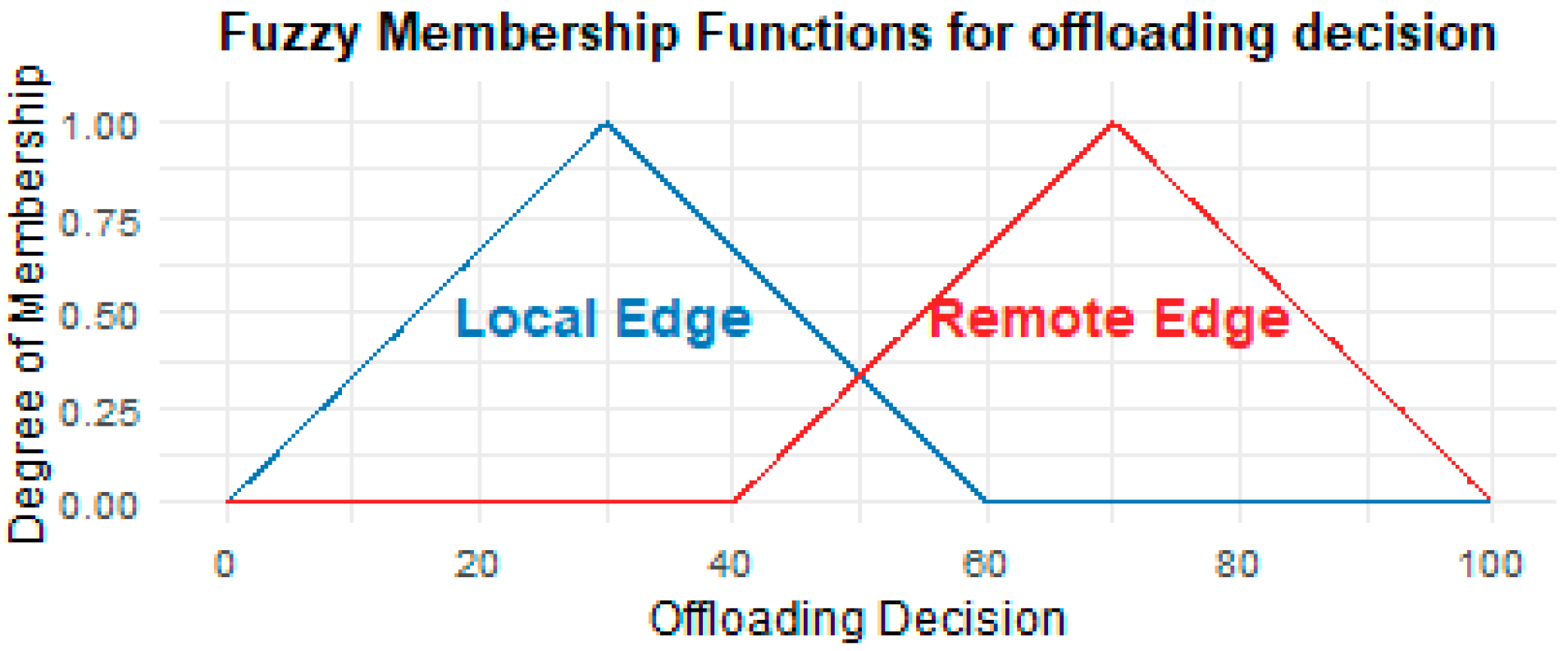
Figure 2 shows the membership functions that specify the offloading decision classes, namely the local edge node and the remote edge node.
4.2. Second-Tier Fuzzy Logic System Architecture
The second tier in the proposed MFBM architecture uses five different input variables, as shown in
Figure 1, to decide the processing resources that are responsible for handling the received task. The decisions of this tier can either be an edge node or the cloud layer, where more and unlimited resources are available. The utilization of the cloud layer is influenced by some factors where task delay sensitivity and user mobility speed are the cornerstone variables.
4.2.1. Fuzzification
Five variables are selected, which are device speed, remote edge utilization, task delay sensitivity, task length, and WAN bandwidth, and notated as , , , , and , respectively. The device speed variable represents the user mobility speed, which is used to make offloading decisions. Its membership functions are similar to those used in the first tier, which are left shoulder , trapezoidal, and right shoulder , for slow, medium, and high linguistic terms, respectively. The remote edge utilization is the candidate edge node that is selected in the first tier. The consideration of this variable is to examine the effectiveness of utilizing this node compared to the cloud in accordance with other variables. This is critical, as the candidate node might be overloaded, which leads to higher execution time, and a higher task failure rate is expected. The task-delay-sensitivity variable is used as an indicator to determine task priority in processing, as it represents the tolerance of the task in terms of execution time; hence, this variable contributes to QoS fulfillment.
The
task length, which is calculated as the number of instructions per second, is important due to the limited capacity of edge nodes which may be unable to accommodate requests with a huge number of instructions. It can be used as an indicator of the amount of the execution time required. Alongside other variables, it contributes to efficient edge utilization and QoS fulfillment, where some request can have better performance once they are offloaded to the cloud, especially those with computationally intensive workloads. Three linguistic terms are used, which are low, medium, and high, and
left shoulder, triangular, and
right shoulder as membership functions are adopted for these terms, respectively, as described in Equations (13)–(15).
The
WAN bandwidth variable must be considered when deciding to offload to the cloud layer. Although the cloud layer consideration is beneficial, offloading some workload might be ineffective. For instance, an intelligent parking application is requested, which is a latency-tolerant application, and can be executed on the cloud. However, the execution of this application on the cloud might not always be visible, as the network might be congested, hence resulting in high delay that might exceed the acceptable QoS requirements. Like the previous variable, low, medium, and high are adopted as linguistic terms, and
left shoulder, triangular, and
right shoulder as membership functions, as represented in Equations (16)–(18).
Both input variables, i.e., the task length and the WAN bandwidth, are inspired by [
19] and carefully reviewed and integrated into this paper by a knowledgeable domain expert. A summary of the presented variables is listed in
Table 5.
4.2.2. Inference Engine
This step specifies the fuzzy output based on the input variables using fuzzy rules. As stated in the first tier, a knowledgeable domain expert defines these rules based on the most suitable offloading location in accordance with the input variables and their relationships. A sample of the fuzzy rules is listed in
Table 6.
4.2.3. Defuzzification
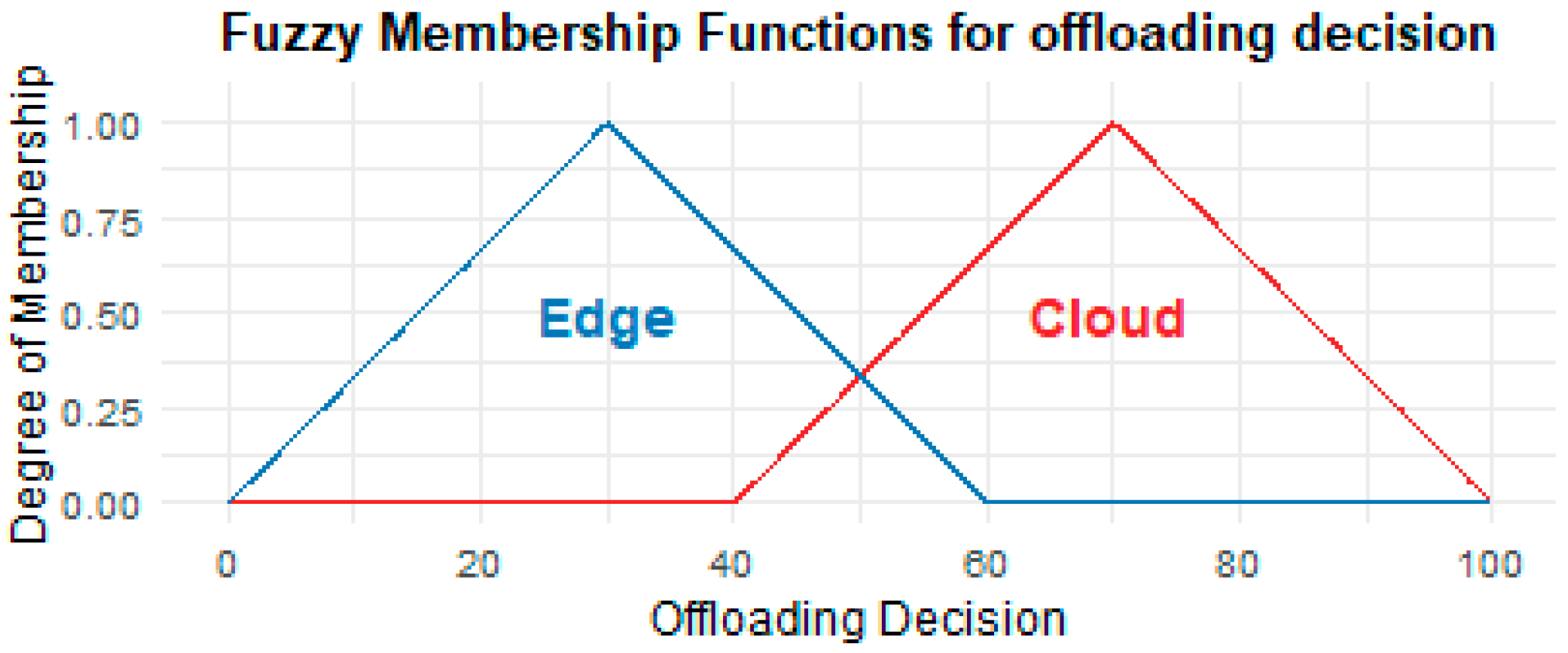
At this step, the crips value will be derived from the inference engine output. The offloading decision classes, which are the remote edge node and the cloud, are shown in
Figure 3, and are adopted based on [
19].
4.3. Offloading Decision Algorithm
In Algorithm 1, when given a set of requests submitted by the end devices, the objective is to make offloading decisions to the most suitable resources, which can either be the local edge node, the neighbor node, or the cloud. The decision is made while taking several input variables into consideration, which are device speed, local edge utilization, remote edge utilization, task delay sensitivity, MAN delay, task length, and WAN bandwidth.
For each incoming request submitted by an end device (line 2) that requires being offloaded to the most suitable resources, the first tier of the MEBM uses as the input variables for deciding where to offload the request within the edge layer (lines 3 and 4). The second tier then uses as the input variablesto compare the candidate edge node with the cloud (lines 5 and 6). The final offloading decision is made by selecting the targeted node (line 7).
The computational complexity of the proposed algorithm is , where n is the number of requests submitted by the end devices, as a linear amount of time is required to execute the algorithm.
7. Conclusions and Future Work
This research introduces a context-aware fuzzy-based system architecture for a smart-campus environment in collaborative edge-cloud architecture. Through extensive evaluation in smart-campus scenarios, the proposed system architecture effectively prioritizes latency-sensitive applications to be executed closer to end devices. Furthermore, it improves the execution rate by accommodating about 30% more tasks compared to the selected benchmarks. This can reach about 70% improvement compared to other selected benchmarks for latency-sensitive applications, showing its strength in execution rate enhancement and latency-sensitive application prioritization. This improvement in the execution rate enhances the utilization of edge nodes twice compared to the selected baseline approaches. Indeed, the proposed MFBM can be applied across other sectors with similar objectives, as demonstrated through the experiments using the Sonmez benchmark.
Although the targeted objectives are achieved, there are several possible directions that can be followed to ensure the robustness of the proposed framework and explore possible performance improvements. For instance, the sensitivity of the designed fuzzy rules can be further analyzed and investigated to evaluate framework robustness. This can include the evaluation of the proposed framework on larger-scale campuses with different scenario conditions, such as network conditions and mobility behavior. Additionally, a direct experiment can be conducted to measure the overhead on the CPU and memory when running the proposed MFBM on real edge hardware, which is important to evaluate its effectiveness. Moreover, advanced and sophisticated benchmarks, e.g., machine learning and deep learning approaches, can be considered to have a wider overview on the performance of the proposed MFBM framework. Another important direction is the elimination of the reasons behind task failure, e.g., MAN and mobility, by considering some optimization approaches. Mobility, which is modeled at a high-level, is another main direction that can be further investigated as a standalone challenge. Several mobility aspects can be explored by modeling different mobility patterns, handoff costs, service migrations, and intermittent connectivity. Lastly, scalability and heterogeneity are key aspects in EC environments, where the performance of the proposed MFBM can be systematically and thoroughly evaluated under large-scale and heterogeneous edge environments.