Review

Agent Technology for Agricultural Intelligence: Methodological Framework and Applications

Yantai Research Institute, China Agricultural University, Yantai 264003, China
*
Author to whom correspondence should be addressed.
Electronics 2026, 15(8), 1547; https://doi.org/10.3390/electronics15081547
Submission received: 7 February 2026 / Revised: 25 March 2026 / Accepted: 31 March 2026 / Published: 8 April 2026
(This article belongs to the Section Artificial Intelligence)

Abstract

Agricultural intelligent agent technology features autonomy in multimodal perception, scalability for cross-scenario collaboration and adaptability via closed-loop optimization, serving as a core technological pillar for industrial intelligent upgrading and refined production management. This paper systematically elucidates its technical essence and methodological framework, focusing on five key aspects: multimodal heterogeneous data perception and fusion, scenario-oriented knowledge modeling and dynamic memory, intelligent decision-making and planning, embodied artificial intelligence, and closed-loop feedback optimization. On this basis, the paper outlines its core agricultural applications in four domains: crop cultivation, efficient utilization of agricultural resources, intelligent upgrading of agricultural technologies and equipment, and collaborative governance of the entire agricultural industry chain. From an interdisciplinary “AI + Agriculture” perspective, the paper further analyzes its future development directions, aiming to provide insights for improving agricultural intelligent agent technologies and promoting their industrial application to accelerate agricultural intelligent transformation. This study constructs a three-dimensional integrated methodological framework encompassing technological analysis, application mapping and trend forecasting, systematically summarizes its agricultural application scenarios and technological evolution characteristics, enriches the theoretical system and methodological construction of agricultural intelligent agent research, and provides a reusable analytical paradigm for agricultural intelligent agent research and practice.

1. Introduction

With the widespread adoption of generative AI and large-model technologies, industrial technologies and production models across sectors are undergoing another revolutionary technological advancement and a breakthrough leap in productivity systems. In the intelligent development of agriculture, agent technology—as the foundational unit for intelligent decision-making—can transform multimodal data into dynamically interconnected decision-making bases [1,2]. This enables precise allocation of agricultural resources, proactive prediction of crop growth cycles, and effective risk management. Therefore, gaining an in-depth understanding of its underlying logic and mastering the core methodological system for its development and application holds significant theoretical and practical importance. This study constructs a three-layer research framework around agricultural intelligent agent technology: the core technology layer takes multimodal data as input, integrates information through MMHDPF, and then utilizes the large model core agent to accumulate scenario-based knowledge and store memory. On this basis, Intelligent Decision-Making and Planning (IDP) is carried out, combining Embodied Artificial Intelligence (EAI) and Closed-Loop Feedback Optimization (CLFO) to achieve iterative model optimization, ultimately producing standardized decision models and technical solutions; the agricultural application layer takes the core technological outcomes as input and, relying on multi-agent systems, achieves collaborative scheduling and intelligent execution in four major scenarios: crop cultivation, resource utilization, equipment upgrading, and industrial chain governance, forming practical application results and operational data; the future evolution layer takes application effectiveness and technological bottlenecks as input and gradually upgrades through three stages: single-agent scenario application, distributed multi-agent collaboration, and AI agricultural ecosystem construction, feeding back into core technology iteration and application scenario expansion. Figure 1 outlines the framework of this paper, clearly presenting the aforementioned research logic and overall structure.
Data from the Ministry of Agriculture and Rural Affairs indicates that digital coverage among China’s small and medium-sized farming households remains below 30% [3], highlighting the urgency and complexity of China’s agricultural intelligent transformation and upgrading. Facing the pressing needs of 7 million new agricultural business entities nationwide [4], agent technology stands as at least one key approaches to unlocking agricultural digital transformation. This paper therefore explores agent technology and its application research in agriculture: First, it analyzes agent technology and its classifications; subsequently, it elaborates on the core technologies and methodological frameworks of agents; further, it comprehensively reviews current research progress on agent technology applications in agriculture; finally, it projects future research and application trends for agent technology and methodologies from an agricultural perspective. This paper aims to provide reference directions and methodological support for future research, development and applications of agent technology and methodologies in agriculture-related fields.

2. The Concept of Agent Technology and Its Proposed Classification System

The core essence of an agent lies in its capacity to perceive the environment, autonomously make decisions, and take actions to achieve predetermined objectives. This concept was first proposed by Professor Minsky. With technological advancements, research on agricultural agents has evolved into two distinct streams within the agricultural sector: traditional agent research and modern agent research driven by large language models. Both streams revolve around the core logic of “perception-decision-action”, exhibiting complementary developmental trajectories. Traditional agent research centers on Agent-Based Modeling (ABM) and classical Multi-Agent Systems (MAS), relying on rule-based programming as its technical foundation. Primarily used for simulation and explanation, it enables functions like resource allocation simulation in agriculture but lacks autonomous learning capabilities. LLM-driven modern agents, core to large language models, integrate multiple technologies to solve practical tasks. They represent the core technology for agricultural intelligent transformation, addressing the shortcomings of traditional ABM and MAS.
To comprehensively systematize the methodology of agricultural intelligent agent technology, this paper integrates existing research findings and proposes a classification framework based on technological evolution logic, agricultural scenario adaptability, and methodological reusability requirements. This framework categorizes agricultural intelligent agents across two dimensions: individual agents and multi-agent systems. The first dimension focuses on single-agent systems, while the second dimension centers on multi-agent systems.
Single-agent systems can be subdivided into various individual forms based on their functions and objectives, Task-Oriented Agent [5], Collaborative Agent [6], Interactive Agent [7], Monitoring Agent [8], and other individual forms. Multi-agent systems are composed of multiple single agents, each performing distinct roles to collaboratively accomplish complex tasks. Table 1 summarizes the four distinct forms of single agents across four dimensions: type, functionality, core objectives, and output formats.
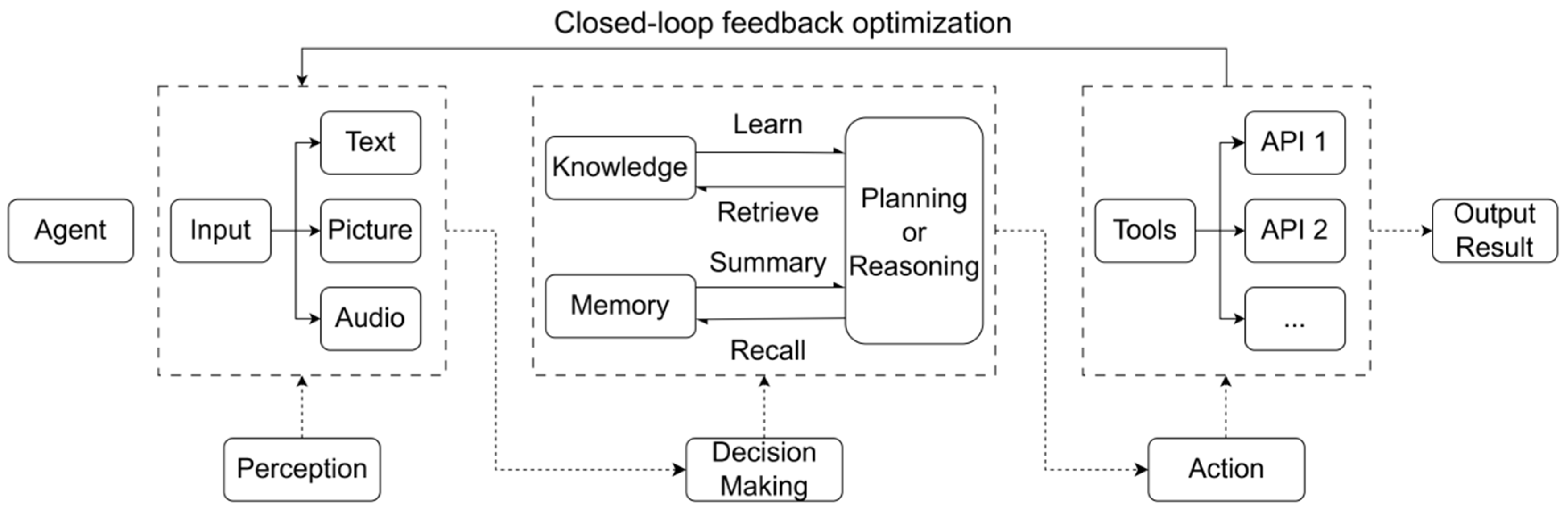
In the methodological system of agent technology, a single agent is organically composed of modules such as observation, thought, action, and memory. It is an independent intelligent unit with the capabilities of perception, decision-making, execution, and memory, and can autonomously complete task loops in specific scenarios [9]. The multi-agent system proposed in this paper takes the aforementioned four types of single agents as its basic units. A multi-agent system is formed by integrating environmental factors [10], standardized operating procedures (SOPs) [11], evaluation mechanisms [12], and other components on the foundation of single agents, thereby creating a system with holistic functionality and specific objective requirements. They can handle complex scenarios and multiple concurrent tasks that would be difficult for a single agent to manage. The flowchart of the agent constructed using this framework is shown in Figure 2.

3. Key Technologies of the Agent

The core operational mechanism of this intelligent agent relies on reasoning and decision-making based on dynamically changing environmental information, selecting and executing corresponding actions to interact with the environment. This process is then executed through multi-round iterative loops until the predefined goal is achieved [13]. This operational mechanism involves five key technologies: (1) Multimodal Heterogeneous Data Perception and Fusion (MMHDPF), (2) scenario-oriented knowledge modeling and dynamic memory, (3) Intelligent Decision-making and Planning (IDP), (4) Embodied Artificial Intelligence (EAI), and (5) Closed-Loop Feedback Optimization (CLFO). This paper therefore focuses on reviewing these five technologies to provide valuable insights for agent technology applications in the field of agricultural intelligence.

3.1. Multimodal Heterogeneous Data Perception and Fusion

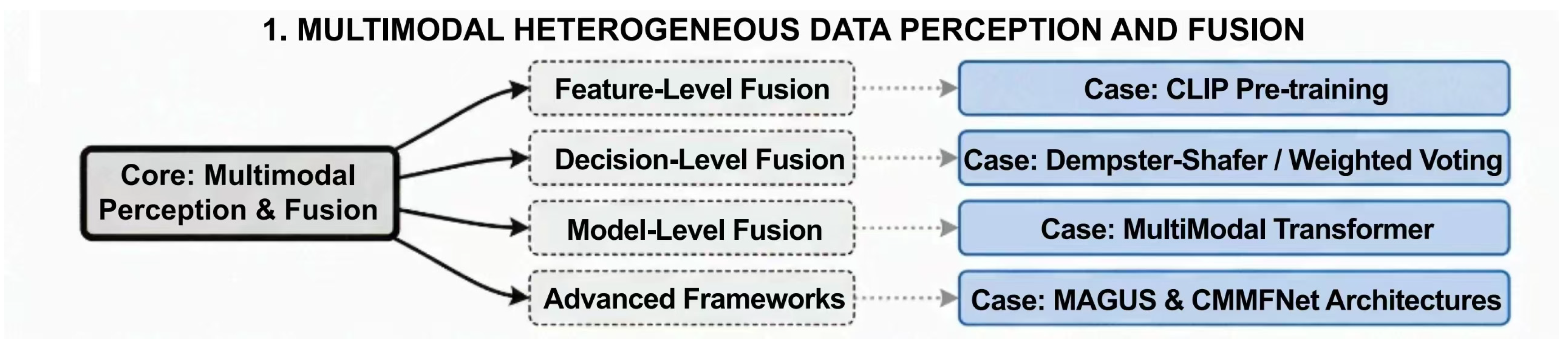
As a core technology enabling agents to comprehend their environments, Multimodal Heterogeneous Data Perception and Fusion (MMHDPF) aims to integrate visual, auditory, textual, and other heterogeneous data modalities. By leveraging the complementarity of multimodal data, it enhances the accuracy and comprehensiveness of semantic understanding in complex multimodal scenarios, enabling precise cognition of intricate environments [14]. MMHDPF primarily encompasses three typical approaches: feature-level fusion [15,16], decision-level fusion [17,18,19], and model-level fusion [20,21,22].
Different fusion methods rely on key components such as feature extraction, semantic alignment, spatio-temporal synchronization, and cross-modal association for practical implementation. The rational design and efficient coordination of these components form the core foundation for ensuring the accuracy of an agent’s environmental perception. However, the fusion challenges posed by multimodal heterogeneous data have long been a bottleneck constraining the development of MMHDPF technologies. The semantic gap between heterogeneous modalities makes it difficult to uniformly align feature spaces, while the spatio-temporal asynchrony of modal data further increases fusion complexity. Addressing this issue, Xu XC et al. proposed a multi-agent collaborative perception and heterogeneous information fusion framework for vehicle cyber-physical systems (VCPS) [23]. This framework, through a multi-agent decoupled architecture, enables flexible fusion-based transformation and semantic alignment of multimodal heterogeneous data. Effectively resolved the feature space mapping issue across heterogeneous modalities. However, existing methods still face the challenge of insufficient cross-modal deep semantic association mining. Therefore, Zhang et al. proposed the Collaborative Multimodal Fusion Network (CMMFNet) [24]. This network leverages the transformer modules to achieve cross-modal associations among heterogeneous modalities, elevating the perception capabilities of multi-agent systems in complex scenarios composed of heterogeneous data. It represents a breakthrough from shallow feature alignment to deep semantic understanding. The visual representation of perception fusion technology is shown in Figure 3.

3.2. Scenario-Oriented Knowledge Modeling and Dynamic Memory

Building upon multimodal perception capabilities, agents require robust knowledge representation and memory mechanisms to support intelligent decision-making. Within the agent framework, knowledge and memory serve as fundamental components for decision-making and action execution. They provide essential support for subsequent efficient operations, forming the logical foundation for agents to enable autonomous cognition in multimodal environments and sustain continuous optimization within dynamic scenarios. Through training on massive corpora, LLMs acquire the capacity to store vast linguistic knowledge. This core capability is further empowered within LLM-based agents, becoming a vital source of their knowledge reserves. However, LLMs are prone to hallucination issues that compromise decision accuracy. Simultaneously, a fundamental trade-off exists between knowledge modeling fidelity and the efficient retrieval of modeled knowledge. To address this trade-off, some researchers have explored mitigation approaches such as internal knowledge editing or external knowledge base invocation. Among knowledge editing approaches, the most prevalent methods are the AnyEdit autoregressive editing paradigm [25], constrained optimization [26], and the LTE framework [27].
For knowledge base retrieval applications, many researchers combine LLM-based agents with Retrieval-Augmented Generation (RAG) to deliver high accuracy [28], rapid response, and stable processing in complex scenarios involving multimodal data fusion and dynamic information updates. Liu et al. proposed an AI agent-based fault perception and diagnosis method integrating agent-associated alarm analysis with embodied RAG to achieve rapid and precise network fault localization [29]. However, in large-scale distributed network environments, the trade-off between retrieval efficiency and knowledge base update frequency in single-agent architectures still holds room for optimization. Building upon this foundation, Peng et al. integrated RAG with LLM-based multi-agent systems [30], converting user queries into precise Structured Query Language (SQL). Compared to traditional rule-based methods, this approach achieved over 80% accuracy with execution times as low as 11.74 s. These two cases demonstrate that integrating RAG with LLM-based agent technology not only effectively mitigates large model hallucination issues but also achieves a critical breakthrough in balancing knowledge modeling fidelity and invocation efficiency. Although the two aforementioned studies have achieved remarkable results in their respective fields, the balancing mechanism between knowledge retrieval recall and semantic understanding accuracy in RAG technology, as well as strategies for maintaining knowledge consistency in multi-agent collaboration, still require further exploration.
The dynamic memory module, another essential component for LLM-based agent decision-making and actions, primarily consists of Long-Term Memory (LTM) and Short-Term Memory (STM). From a performance optimization perspective, common approaches to enhancing dynamic memory capabilities include extending the length limitation of the backbone architecture [31], memory summarizing [32], and memory compressing [33].
Essentially, knowledge modeling and dynamic memory serve as the core foundations for LLM-based agents to enable autonomous cognition. By acquiring knowledge to supplement the precise information required by LLMs, and then leveraging memory storage to reliably retrieve this information, these approaches can mitigate the inherent hallucination flaws of LLMs. This, in turn, drives improvements in both accuracy and efficiency for LLM-based agents in multimodal cognition and scenario optimization. The visual representation of knowledge modeling and dynamic memory technology is shown in Figure 4.

3.3. Intelligent Decision-Making and Planning

With knowledge and memory as the foundation, agents must leverage intelligent decision-making and planning capabilities to execute complex tasks. Intelligent Decision-making and Planning (IDP), as a critical component of the agent technology framework, focuses on reasoning and planning. Reasoning handles immediate logical deduction, while planning coordinates future execution paths. The synergy between reasoning and planning enables agents to efficiently process multi-step logical tasks. During reasoning, logical inference serves as the cornerstone of agent decision-making. At the LLM level, logical reasoning is achieved through a series of prompting methods, exemplified by Chain of Thought (CoT). Planning capabilities focus on determining subsequent action paths while continuously reflecting and optimizing during execution. Task implementation involves two critical steps: Plan Formulation and Plan Reflection [34].
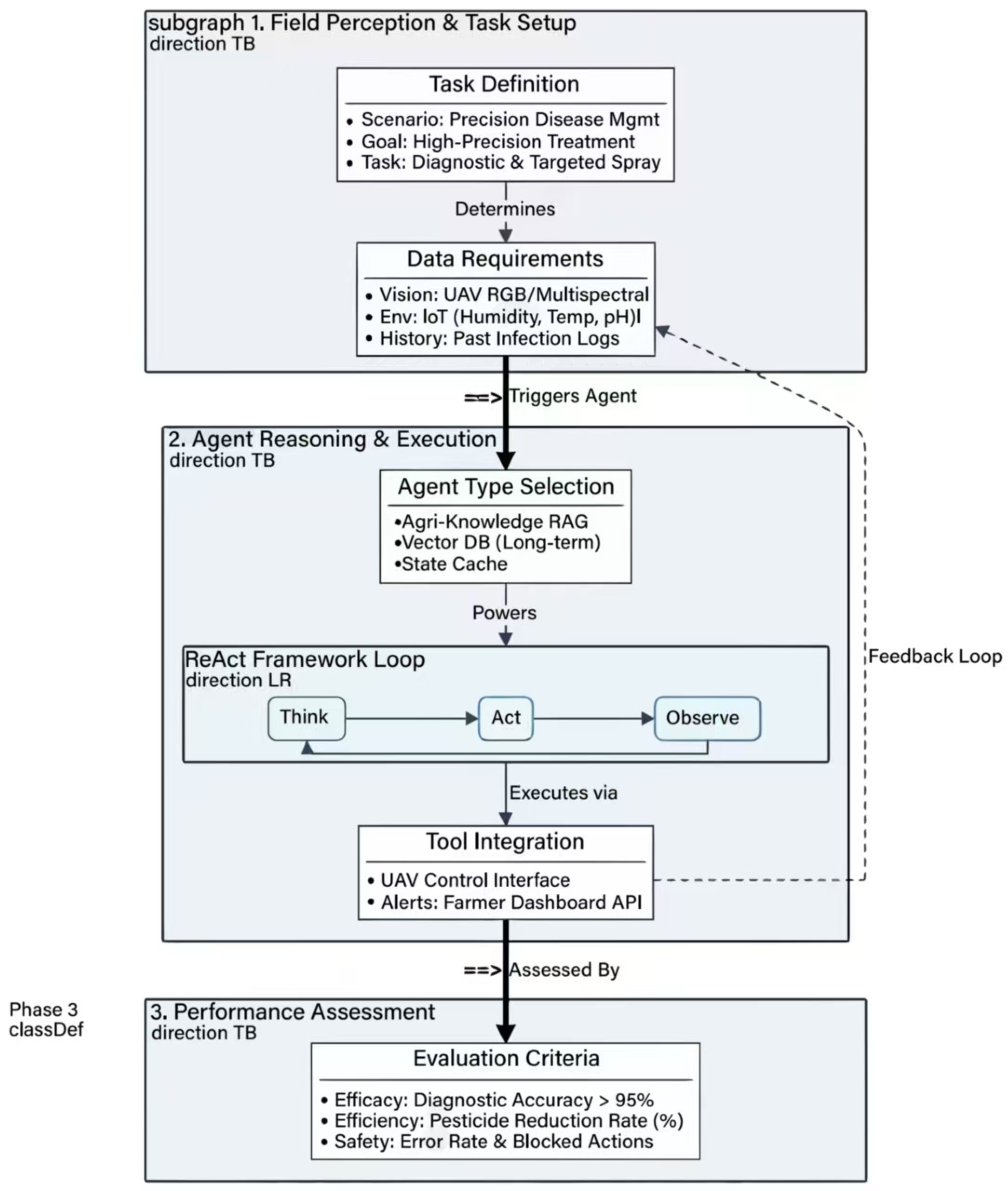
Building upon the theoretical foundations of reasoning and planning systems for intelligent decision-making, translating agents from virtual to real-world deployment requires leveraging engineered agent architectures. The Reasoning and Acting (ReAct) framework serves as a crucial bridge, integrating reasoning and planning to enable practical implementation. In 2022, Yao et al. pioneered the ReAct framework [35], a seminal paradigm for deeply integrating LLM reasoning capabilities with external actions. By employing explicit reasoning processes akin to thought chains and dynamic programming strategies, it effectively addresses the limitations of traditional LLMs in real-time decision-making tasks. These limitations include the absence of closed-loop planning and plan reflection, excessive reliance on internal knowledge, and insufficient real-time information exchange. This breakthrough propels agents from theoretical conception to practical engineering applications. However, the ReAct framework still faces challenges such as deviation of reasoning trajectories from objectives and constrained action decisions. To address these shortcomings, subsequent academic research has pursued a series of improvements. Karina Romanova et al. employed the ReAct framework to explicitly define objectives for structured data extraction during multimodal information retrieval [36]. By leveraging enhanced chain-of-thought reasoning and a standardized planning process, they effectively mitigated reasoning drift issues arising from multimodal data heterogeneity. This application advanced the practical deployment of ReAct in domain-specific structured data extraction scenarios. These explorations provided crucial support for advancing the practical application of the ReAct framework. Subsequently, the Plan and Execute process further decomposed tasks into planning tasks and sequential execution, forming a clearer closed-loop cycle of planning-execution-planning reflection. This serves as a critical extension enabling agents to transition from theoretical paradigms to engineering implementation. The visual representation of intelligent decision planning is shown in Figure 5.

3.4. Embodied Artificial Intelligence

While decision-making determines what actions to take, Embodied Artificial Intelligence (EAI) enables agents to physically execute these decisions in real-world environments. EAI serves as the critical bridge in translating intelligent decisions into physical interactions. During an agent’s engagement with dynamic environments, embodied intelligence demonstrates the capacity to comprehend and modify the environment while continuously updating its own state in real time. Serving as a vital bridge between intelligent systems and physical reality, embodied intelligence relies on an indivisible atomic action system. This system can be subdivided into different categories such as observation [37], manipulation [38], and navigation [39].
To advance embodied intelligence, tools are regarded as critical enabling elements. The agent’s utilization of tools has evolved from initial exploration to systematic integration and ultimately to innovative applications [6]. In the early stages, agents lacked a systematic tool usage framework, making it difficult to support the efficient coordination of fundamental atomic actions such as observation, manipulation, and navigation. Rodney Brooks concept of behaviorist robotics [40], emphasizing embodied interaction between agents and environments, laying the theoretical foundation for tool-supported observation and perception, physical manipulation, environmental navigation, and tool-environment adaptation. However, this theory still exhibits limited generalization capabilities in complex and dynamic environments. By the early 21st century, breakthroughs emerged in fusion technologies combining imitation learning and reinforcement learning. Building upon this, subsequent research integrated such learning mechanisms with tool invocation scenarios, enabling agents to systematically invoke tools. This resolved the rigidity of traditional hard-coded tool invocation and achieved autonomous tool invocation. Richard S. Sutton proposed the Temporal Difference Learning (TD Learning) method [41]. This method relies on a mechanism that continuously allocates credit based on prediction errors, enabling agents to dynamically evaluate and optimize tool usage effectiveness. It effectively enhances observation accuracy, operational robustness, and navigation efficiency, but still faces the challenge of slow convergence in high-dimensional tool spaces. With further technological advancements, Wölflein G et al. constructed a benchmark system for tool creation, covering 15 cross-domain complex computational tasks and accompanied by over 100 unit test cases [42], enabling agents to evolve from integrating complex tool combinations to creating novel tools. This evolution further enhances agents’ capabilities for tool coordination and environmental interaction across multi-task scenarios such as observation, manipulation, and navigation. This significantly enhanced agents’ deep understanding and innovation capabilities regarding tools. Large models, with their powerful learning and reasoning capabilities, continuously drive the integration and innovation of complex tools, providing robust support for agents’ autonomous decision-making and efficient execution across diverse scenarios. The visual representation of embodied intelligence technology is shown in Figure 6.

3.5. Closed-Loop Feedback Optimization

To continuously improve performance, agents rely on Closed-Loop Feedback Optimization (CLFO) mechanisms that refine strategies based on execution outcomes. The essence of CLFO lies in establishing a cycle that refines strategies based on feedback signals. Specifically, it converts user feedback on an agent’s actions into adjustment instructions, enabling the agent to calibrate its strategy in real time. This enters an iterative loop for continuous strategy refinement, ultimately achieving an iterative upgrade from passive execution to active optimization.
From a theoretical evolution perspective, closed-loop feedback optimization traces back to the foundational stage of reinforcement learning theory. In the 1980s, Richard S. Sutton proposed Temporal Difference Learning (TD Learning) [41]. This method integrated Monte Carlo methods with dynamic programming, establishing a mechanism where immediate feedback drives policy updates, laying the theoretical groundwork for real-time adjustments in closed-loop feedback. The advantage of this method lies in its ability to update policies without waiting for the entire round to conclude, significantly enhancing learning efficiency. Building upon immediate feedback, Christopher Watkins introduced the Q-Learning algorithm [43]. This approach centers on real-time updates to the action-value function using feedback signals, marking the first transformation of closed-loop feedback into quantifiable policy formulas. This enhanced the measurability and precision of closed-loop feedback optimization. However, the algorithm faced the dimensionality challenge in high-dimensional spaces. To address this challenge, Mnih V et al. proposed the Deep Q-Network (DQN) algorithm: by integrating deep neural networks with Q-Learning [44], DQN enabled the processing of high-dimensional sensory inputs via neural network function approximation, thus mitigating the dimensionality problem in value-based reinforcement learning.
With the rise of LLMs, closed-loop feedback optimization has entered a phase integrating human and autonomous feedback. In developing Chinchilla, Ouyang J et al. employed Reinforcement Learning from Human Feedback (RLHF) [45]. This approach translates human evaluations of model outputs into feedback signals, resolving the challenge of manually defining reward signals in traditional reinforcement learning. This enables model outputs to better align with human values and usage habits. However, RLHF relies heavily on manual annotation, which is subject to limitations such as high annotation costs, strong subjectivity, and difficulty in covering long-tail scenarios. These constraints hinder its scalability in large-scale applications. Additionally, numerous researchers have proposed self-evolving agent paradigms [46], integrating agents with compiler-verified code and frameworks like TextGrad and other technologies [47]. These approaches promote the evolution of the agent from manual feedback to autonomous feedback. This achieves a paradigm shift in feedback mechanisms—transitioning from external dependency to endogenous drive. The visual representation of the closed-loop feedback optimization technology is shown in Figure 7.

4. Application of Agents in Agriculture

As a key driver of intelligent transformation in agriculture, agricultural intelligent agent technology is now widely applied across multiple agricultural sectors, shown in Table 2, including crop cultivation, efficient utilization of agricultural resources, intelligent upgrading of agricultural technology and equipment, and collaborative governance of the entire agricultural industry chain. Through multimodal perception, cross-scenario coordination, and closed-loop optimization, this technology enhances agricultural production quality and efficiency, thereby playing a vital role in promoting sustainable, precise, and efficient agricultural development. The visual representation of the application of agents in agriculture is shown in Figure 8.

4.1. Crop Cultivation

In the field of crop cultivation, agricultural agents integrate the complex system simulation capabilities of traditional agent-based modeling (ABM) with the multi-agent collaboration logic of classical multi-agent systems (MAS). Endowed with perception and decision-making capacities, these agents achieve end-to-end empowerment, ranging from cultivation process simulation to precise execution. Owing to its accurate simulation of nonlinear dynamics in complex systems, traditional ABM has become the most widely used conventional agent technology in crop cultivation. The research on this technology originates from the gap between the limitations of traditional crop cultivation models and the practical requirements of agricultural production. Traditional models such as the Agricultural Production Systems Simulator (APSIM) and the Decision Support System for Agrotechnology Transfer (DSSAT) are widely used in crop cultivation [48,49]. Although these two models can effectively simulate crop cultivation processes, they struggle to capture the complex interactions inherent in multi-agent decentralized decision-making. To address this issue, Alfons Balmann et al. proposed coupling traditional ABM with the Agricultural Policy Simulator (AgriPoliS) [50]. This integrated model simulates changes in farm structures, providing scientific decision support for optimizing crop cultivation management and policy formulation under multi-agent coordination. However, this model faces limitations when confronting environmental fluctuations due to its reliance on simplified assumptions. Particularly under the influence of factors such as resource constraints, risk preferences, and information asymmetry, farmers’ actual decision-making often deviates from the model’s projections. In response, Malte Grosse et al. developed a MAS framework [51]. By integrating multi-source data including meteorological conditions, agricultural machinery operation status, and logistics scheduling, this framework overcomes traditional models’ dependence on simplified assumptions. It achieves comprehensive simulation of the entire rice harvesting process, covering multi-agent coordination and dynamic decision-making across all stages—from pre-harvest planning and in-harvest operations to post-harvest processing.
Meanwhile, to explore development pathways for crop cultivation across diverse scenarios and address challenges in extreme environments, Barak Garty et al. employed NetLogo to construct a traditional agent-based model [52]. Under agent decision-making, they simulated grape cultivation in the Negev region during the Byzantine period. This simulation validated drought mitigation strategies and water resource utilization, offering new research perspectives for agricultural systems confronting challenges like disasters and resource fluctuations. However, this model exhibits limited validation accuracy under conditions of scarce historical data and faces challenges in generalizing to other crops and regions. To address data scarcity in low-income regions, Raúl López i Losada et al. proposed integrating agent-based Life Cycle Assessment (AB-LCA) with regional data adaptation methods [53]. By enhancing agents’ perception capabilities regarding multi-agent data—such as soil, climate, and production activities—within finite regions, this approach strengthens simulation capabilities for joint decision-making analysis of multi-agent agricultural production structures.
Despite the continuous advancement of multimodal agricultural data collection technologies such as sensor field measurements and drone aerial photography, agricultural intelligent agents still face limitations when processing noisy or low-resolution images. Consequently, agricultural intelligent agent research in crop cultivation has progressively shifted toward multi-technology integration. Ibrahim Alrashdi et al. proposed integrating a decentralized multi-agent framework with Convolutional Neural Networks (CNNs) and reinforcement learning to design an olive tree disease detection system [54]. This system first utilizes CNN to extract image features from drone aerial imagery and field sensors. Subsequently, multiple agents integrate these image features with other data sources. Finally, reinforcement learning enhances the system’s adaptability. However, the system exhibits insufficient generalization capabilities in complex dynamic environments and has limited capacity for mining deep semantic associations from multi-source heterogeneous data. To this end, Markus J. Buehler et al. proposed a graph-based generative agent prototype system [55]. This prototype system possesses multimodal perception capabilities for dynamic physical environments and multi-source monitoring data, enabling more precise simulation of the operational mechanisms of dynamic natural systems. This provides scientific basis and precise support for collaborative decision-making among multiple agents in complex scenarios.
In the field of crop cultivation, perception and integration, along with decision-making and planning, are the most core technological components. The former supports the precise recognition of multi-source data such as crop growth and pests, while the latter drives planting simulation, dynamic decision-making, and execution optimization.

4.2. Efficient Utilization of Agricultural Resources

The efficient utilization of agricultural resources is one of the core issues in sustainable agricultural development. Its fundamental essence lies in optimizing resource allocation efficiency and balancing supply–demand relationships to support sustainable agricultural development. In water resource utilization, particularly in water-scarce regions, water resource allocation directly impacts the security and stability of water, energy, and food systems. To address resource conflicts arising from agricultural water imbalances, Soheila Zarei et al. proposed the System Dynamics and Agent-Based (SD-AB) method [56]. This approach integrates the NSGA-II algorithm with the Analytic Hierarchy Process (AHP), achieving a 355% increase in water allocation and a 23.96% reduction in energy demand in Iran’s Zayandeh Rud Basin while optimizing food resource matching efficiency. However, while this approach excels in optimizing macro-level resource allocation, it inadequately captures the heterogeneous decision-making behavior of micro-level agricultural entities, making it difficult to precisely identify the differentiated response mechanisms of individual farmers within water trading markets. Sule Ozkal et al. demonstrated that traditional ABM can accurately simulate heterogeneous decision-making among agricultural agents in water trading [57], providing a methodological framework for regulating water supply and demand. Sousa et al. coupled traditional ABM with hydrological models through data-driven integration to simulate farmer cooperative water withdrawal behaviors in Brazilian river basins [58], thereby refining pathways for collaborative water resource management.
Beyond water resources, low-carbon transformation and efficiency optimization of other resources also inject new momentum into green agricultural development. To promote low-carbon and intensive agricultural resource use, Ilias Faiud et al. constructed a traditional ABM model incorporating variables such as electricity prices and costs [59], accurately predicting the photovoltaic energy adoption rate in Ireland’s dairy industry for 2022 and providing quantitative evidence for renewable energy promotion in agriculture. However, this model focuses on static predictions of energy adoption rates and lacks a dynamic analysis of the trade-offs between environmental and economic benefits during resource conversion processes. Based on this, Zhang J et al. developed a traditional agent-based environmental and economic evaluation model [60]. By analyzing the carbon sequestration and emission reduction value of straw alongside its energy conversion potential, this model provides support for optimizing agricultural resource efficiency.
In agricultural resource governance, environmental management and labor force security represent key directions. Biré et al. designed a traditional agent-based RÁC game simulation prototype [61], integrating agricultural irrigation scenarios, farm waste management, and village governance contexts. This enables stakeholders to simulate village chief decision-making, balancing yield assurance with pollutant emission control in agricultural environments. Kimmich C et al. Constructed and deployed a traditional ABM model using Austrian agriculture as a case study [62], effectively mitigating agricultural labor efficiency losses under climate change and providing macro-level references for agricultural climate adaptation and labor resource security. The two approaches, addressing human-induced environmental risks and natural climate risks respectively, have jointly advanced the systematic and refined development of agricultural resource management.
The efficient utilization of agricultural resources centers on IDP and scenario-oriented knowledge modeling with dynamic memory; the former achieves the optimal allocation of resources such as water, energy, and carbon, while the latter ensures the accurate application and dynamic updating of resource decision-making knowledge.

4.3. Intelligent Upgrading of Agricultural Technology and Equipment

In the process of agricultural modernization, the intelligent upgrading of agricultural technology and equipment is a core requirement for addressing dynamic and complex scenarios and achieving cross-scenario coordination. Multi-agent technology based on the classification system proposed in this paper, with its distributed processing, flexible scalability, and cross-component collaboration capabilities, is emerging as a key solution to overcome the pain points of traditional agricultural technology and equipment—namely, difficulties in balancing multiple objectives, insufficient decision adaptability, and low coordination efficiency.
At the technical optimization level, agricultural intelligent agent technology precisely addresses the challenges of decision adaptability and multi-objective balancing in agriculture through the customized application of Multi-Agent Reinforcement Learning (MARL). Baja H et al. developed reinforcement learning agents incorporating NUE reward functions and action constraints [63]. Under scenarios with diverse soil types and varying initial nitrogen levels, this system adaptively adjusts fertilization strategies to achieve a balanced outcome across multiple objectives: ensuring crop yields, reducing nitrogen losses, and maintaining soil nutrients. However, this model focuses on static optimization within a single agronomic scenario. When applied to complex agricultural systems involving multi-device coordination and dynamic task allocation, its decision-making framework exhibits significant limitations in scalability and real-time responsiveness. To overcome this limitation, Bao et al. proposed a multi-agent deep reinforcement learning prototype solution with Action Masking (AM) to address task offloading requirements for safety-critical drone-assisted smart farms [64]. This approach dynamically allocates tasks based on a Deep Dual Q-Network (DDQN), effectively mitigating the trade-off between efficiency and safety in multi-scenario management for smart agriculture through dynamic adaptation in agricultural decision-making.
Notably, when addressing complex tasks like path planning, Multi-Agent Coverage Path Planning (MCPP) represents an alternative technical approach within agricultural multi-agent technologies. Lee HS et al. proposed an offline MCPP algorithm based on multi-agent cooperative graph-adaptive K-means for non-grid structures like road networks [65]. By modifying the cost function and introducing a clustering-level graph, this algorithm overcomes traditional methods’ limitations—restriction to quasi-grid environments and susceptibility to local minima—enabling robust multi-agent MCPP operation in path planning. However, this approach still faces limitations in practical application, including high computational complexity, strong reliance on prior environmental knowledge, and difficulty in handling real-time dynamic changes, which constrain its widespread adoption in large-scale agricultural scenarios. To overcome these bottlenecks, other researchers have deeply integrated reinforcement learning with MCPP to empower agents with autonomous learning and dynamic adaptation capabilities. José P. Carvalho et al. combines multi-agent reinforcement learning with customized Rainbow DQN and value decomposition networks [66], transforming MCPP into a stochastic game. This enables the MCPP algorithm to efficiently cover dynamic scenarios such as autonomous scaling of agent numbers, adaptive map size adjustments, and dynamic obstacle changes. Although this approach has made significant progress in dynamic adaptability, issues such as high training costs, low sample efficiency, and insufficient interpretability of multi-agent collaborative strategies remain to be addressed. With the rapid evolution of Deep Reinforcement Learning (DRL), multi-agent reinforcement learning offers novel approaches for coordinating control in such complex systems. Building upon Single-Agent Deep Reinforcement Learning (SADRL) and Multi-Agent Deep Reinforcement Learning (MADRL), Nesi et al. achieved a dynamic equilibrium between traffic flow efficiency and congestion delays at complex urban intersections by integrating real-time traffic flow sensing [67], distributed agent decision-making, and dynamic signal control mechanisms. Transferring this technology to agricultural applications could enable the development of an intelligent operation system capable of autonomously sensing farmland environments, dynamically adjusting working paths, and collaboratively prioritizing tasks. This approach offers a feasible pathway for optimizing coordination and enhancing efficiency in multi-robot cluster operations.
The development direction of agricultural equipment lies in the autonomous coordination of multi-device clusters and scenario-based operations [68]. Agricultural intelligent Agent technology provides technical support for this goal through the deep integration of multi-agent architecture, digital twins, and high-fidelity simulation. Addressing the challenges of complexity and dynamism in agricultural scenarios, Yogeswaranathan Kalyani et al. proposed integrating agents with digital twin technology [69]. Leveraging the advantages of multi-agent systems in distributed processing, scalability, and interoperability, this approach enables multi-device clusters to address complex dynamic scenarios and meet collaborative operation requirements. Gutierrez-Cejudo J et al. proposed the Agri-ROS multi-agent architecture [70]. Based on Unity3D (https://unity.com/, accessed on 30 March 2026), ROS (https://www.ros.org/, accessed on 30 March 2026), and Agrobots-SIM (https://www.agrobot.com/, accessed on 30 March 2026), it constructed a high-fidelity simulation system for agricultural robot fleets. This simulation system integrates the Smart Python Agent Development Environment (SPADE) (https://spade-mas.readthedocs.io/, accessed on 30 March 2026) and the Flexible Intelligent Virtual Environment Designer (FIVED), specifically addressing the challenges of weak network connectivity and dispersed farm layouts in rural areas. It enables autonomous coordinated operations for agricultural robot fleets in harsh, fragmented agricultural environments [71]. Addressing the inability to distinguish dynamic obstacles and resource wastage in traditional agricultural human-device navigation, Chen W et al. proposed a hierarchical cost map navigation scheme integrating semantic information [71]. By consolidating semantic information across different scenarios, this system provides effective support for human-like decision-making in complex environments for future multi-device cluster multi-agent collaborative systems. The aforementioned studies integrate agent technology with digital twins, high-fidelity simulation, and semantic information, collectively offering promising prospects for the development of autonomous coordination and scenario-based operations in agricultural equipment.
The core technological components for upgrading agricultural technology and equipment are EAI and CLFO. The former carries out the physical execution of tasks such as agricultural machinery operations and robot control, while the latter enables coordinated operation of equipment clusters and continuous iterative optimization of strategies.

4.4. Collaborative Governance Across the Entire Agricultural Industrial Chain

In the transition toward intelligent and intensive agriculture, agricultural intelligent agent technology facilitates coordinated governance across the entire industrial chain, integrating production, distribution, and decision-making processes. Within agricultural supply chains, agricultural intelligent agents serve as intelligent schedulers and risk forecasters, driving the shift from static planning to dynamic responsiveness. The Sim-Opt simulation method proposed by Elham Shadkam et al. employs agents to simulate the behavioral logic of farmers [72], processors, and distributors within the supply chain, significantly enhancing supply chain resilience and mitigating disruption risks. In the field of smart agriculture harvesting and transportation, Xiang Guo et al. further proposed the simulation model of Q-learning-assisted Memetic Algorithm (Q-MA) [73]. This approach enables agents to act as adaptive decision-making entities, dynamically selecting optimal local search operators to achieve joint scheduling of harvesting and transport vehicles. Notably, agricultural intelligent agent technology covers both end-to-end closed-loop optimization and specialized scenarios like agricultural machinery scheduling. For closed-loop optimization, Aitor López-Sánchez et al. proposed the Distributed Multi-Agent System Architecture (DIMASA) [74], abstracting autonomous agricultural machinery like self-driving tractors and mobile agricultural robots as decision-making agents. Through column generation techniques, it achieved scalability and fairness in closed-loop path planning. The aforementioned research applies agent technology in the process of agricultural system intelligence in three aspects: the agricultural supply chain, smart agriculture harvesting and transportation, and agricultural machinery scheduling for full-chain closed-loop optimization, collectively providing technical support for the collaborative governance of the entire agricultural industry chain.
Addressing data silos and decision inefficiency, agricultural intelligent agent technology transforms fragmented information into reusable value for farmers through data integration and decision support. In smallholder farming contexts, Daniel Hill et al. abstracted smallholder farmers as independent decision-making agent individual [75], and built a simulation model of agricultural operations. These agents integrated household survey data, land cover types, and soil nutrient data to clearly quantify the income-enhancing effects of coffee contracting, helping farmers overcome transaction cost barriers. In Internet of Things (IoT) data sharing scenarios, Akbar NA et al. developed a LLM-driven Agent-based Data Sharing (ADS) simulation model [76]. By integrating semantic web technology with agent-based design and Large Language Models (LLMs), they resolved interoperability challenges among heterogeneous IoT devices. This closed-loop optimization chain enables seamless cross-platform flow of farmers’ production data, providing real-time field management guidance. However, the simulation accuracy of the ADS framework remains insufficient due to the lack of integration of dynamic agricultural scenario factors. However, the model still has limitations in data semantic understanding and device behavior prediction, making it difficult to accurately capture the real decision-making logic of farmers. Mahdi Taraghi et al. found that traditional agent-based simulation model based on the Theory of Planned Behavior (TPB) exhibit decision-simulation deviations from actual behavior due to inadequate integration of farmer psychology and social network influences [77]. Addressing this behavioral modeling defect, Will M et al. significantly improved the accuracy of policy adoption simulations in the German Agricultural Environmental Schemes (AES) policy simulation evaluation [78]. This was achieved by optimizing agent behavior logic through two steps—farming acceptance and compensation demands—while incorporating farmer social network factors.
Governance innovation in agricultural systems fundamentally balances the interests of multiple stakeholders. Agricultural intelligent agent technology, through strategy simulators and policy testers, establishes a robust theoretical and practical foundation for governance mechanism design. In sustainable agriculture, Xinlin Chen et al. constructed a tripartite evolutionary game model involving government [79], farmers, and consumers. By abstracting each actor as a decision-making agent, they simulated the impact of subsidy and incentive mechanisms on farmers’ green production behaviors. They proposed a multi-stakeholder governance strategy to shift farmers from passive compliance to active participation in policy formulation. However, the model focuses on a single policy dimension and fails to fully consider the impact of market structure and power distribution on system transformation. Williams TG et al. further integrated market structures into the agent simulation model [80], simulating power dynamics among farmers, consumers, markets, and the state. They found that a sustainable transformation could be triggered when 20% of farmers and consumers adopted sustainable values, offering crucial insights for limiting power concentration and designing inclusive policies. However, traditional agent models suffer from exogenous policy staticization and limitations in accommodating trade-offs. To address this, Zeng YC et al. developed an endogenous institutional agent model [81]. Embedded within a land system model, this framework achieves a closed-loop optimization process encompassing policy intervention, effect simulation, diminishing marginal identification, conflict resolution, and dynamic strategy adjustment, providing more practical tools for governing strategy refinement.
The collaborative governance of the entire industry chain highly depends on distributed IDP and CLFO; the former supports distributed collaborative scheduling among multiple entities within the industry chain, while the latter achieves full-chain data interoperability, strategy optimization, and closed-loop risk management.

5. Conclusions and Outlook

In the agricultural intelligent Agent technology system, traditional Agent frameworks and modern LLM-driven Agent frameworks exhibit a complementary development trend. At the methodological level, traditional Agents focus on rule-based modeling and causal simulation, offering strong interpretability, low computational cost, and reliance on a priori rules and structured assumptions; LLM-driven Agents leverage large models to achieve autonomous reasoning, multimodal fusion, and dynamic memory, demonstrating prominent adaptability but requiring greater data and computational resources. At the application level, scenarios with clear rules, limited data, and an emphasis on policy simulation, resource allocation deduction, and farmer behavior modeling are more suitable for traditional Agent frameworks; scenarios with data-intensive multimodal inputs, complex dynamic environments, real-time intelligent decision-making, agricultural machinery collaboration, and full-chain industry implementation benefit more from LLM-driven frameworks. The collaboration of both can cover the entire chain from simulation interpretation to engineering implementation, jointly promoting the digitalization and intelligence transformation of agriculture.
This study systematically organizes the proposed classification framework, core technological development trajectory, and application practices across four key agricultural domains by constructing a three-dimensional integrated methodological framework encompassing technological analysis, scenario adaptation, and trend forecasting. It achieves several original outcomes: This work systematically summarizes the triple adaptation principles of technology, scenarios, and stakeholders, thereby clarifying the key transformation pathways for technology implementation. It also maps out a full-industry-chain application spectrum and multi-agent coordination mechanisms, thus providing a reusable analytical paradigm and practical reference for promoting the industrialization of intelligent agent technologies in agriculture.
However, amid this burgeoning development, agricultural intelligent agent technology still faces significant challenges requiring urgent breakthroughs in key dimensions such as agricultural data governance, technology implementation, and enhancing farmers’ digital literacy.

5.1. Agricultural Data Bottlenecks

Multi-source heterogeneity, insufficient data acquisition, and security/privacy concerns of agricultural data remain prominent, forming key bottlenecks that constrain their deep development. In agricultural environments, integrating multimodal data proves difficult due to sensor heterogeneity, thereby hindering collaborative analysis. Additionally, agricultural sensors are susceptible to environmental interference, and data transmission often deviates from actual conditions, thus exacerbating uncertainties in data and behavioral assumptions while increasing data distortion. Furthermore, agricultural data security and privacy protection require urgent reinforcement, as sensitive information—such as farmers’ planting strategies and soil nutrient levels—faces leakage risks during collection and sharing.
To address these challenges, unified agricultural data standards must be established, alongside the development of cross-modal large models supporting multi-agent collaboration. To tackle challenges in collaborative agricultural data analysis, we can leverage the robust multi-source data fusion capabilities of cross-modal large models to overcome sensor heterogeneity barriers. Integrate multimodal data—including meteorological, soil, and crop growth information—to provide agricultural intelligent agents with precise decision-making foundations. To address data bias and distortion caused by environmental interference, the intelligent analysis and repair capabilities of cross-modal large models can be leveraged, supplemented by agricultural intelligent agents dynamically adjusting decision logic to enhance robustness against uncertain data. Regarding leakage risks in data collection and sharing, the security protection mechanisms of cross-modal large models, combined with agricultural intelligent agents’ permission management capabilities, can establish a comprehensive data security and privacy protection system to ensure the safety of sensitive information during transmission.

5.2. Challenges in Technology Implementation

Agricultural intelligent agent technical model development, long reliant on simulated assumptions and simplified frameworks, has achieved breakthroughs in certain scenarios but still faces challenges such as limited scalability and low adaptability to diverse scenarios and stakeholders. This hinders the models’ ability to fully accommodate the dynamic, complex nature of agricultural production and the practical demands of multi-stakeholder interactions. For instance, the simplified assumptions of agricultural machinery scheduling agents cannot account for sudden weather changes during field operations, while water resource allocation models oversimplify the strategic interactions among farmers, ultimately causing decision-making discrepancies from actual production practices.
Given the profound demand for intelligent decision-making in agricultural modernization, future development should focus on scalable, ecosystem-oriented model technologies. Key challenges include dynamic adaptive modeling, resilient scalable architectures, and multi-agent collaborative simulation. Leveraging cloud-native and federated learning technologies, researchers should construct model architectures scalable across regions and scenarios. Utilizing metaverse and multimodal interaction technologies, we can build an agricultural intelligent decision-making ecosystem capable of simulating multi-agent, multi-scenario collaboration. This will ultimately drive the evolution of agricultural intelligent agent models toward dynamic intelligence and universal adaptability.

5.3. Limitations in Farmers’ Digital Literacy

Currently, farmers in China generally exhibit shortcomings in individual capabilities, characterized by low digital literacy and limited access to agricultural technologies. Despite the fact that China’s agricultural technology progress efficiency has reached 63.2%, most green technologies developed by higher education institutions struggle to achieve effective implementation due to insufficient corporate collaboration and inadequate adaptability. The interweaving of the dual-sided predicament—farmers’ inability to “adopt” technologies and technologies’ failure to “transfer”—has resulted in a distinct transformation gap between academic research and development and industrial application.
To address these pain points, a multi-faceted solution combining AI agent empowerment and multi-party collaboration can be implemented. Developing an agricultural expert agent that provides real-time production guidance to farmers through conversational interfaces directly addresses the gap in farmers’ technical reception capabilities. Leveraging the agricultural intelligent agent to build a bridge between universities, enterprises, and farmers integrates green technology achievements from universities, matches them with enterprise production needs, and delivers easy-to-use, scenario-based tools to farmers. Simultaneously, mechanisms such as technology equity dividends and technology transfer risk funds enable advanced academic technologies to be transformed through the agricultural intelligent agent into actionable production solutions for farmers.

Author Contributions

Conceptualization, Y.L.; methodology, Y.L. and J.W.; validation, Y.L. and J.W.; data curation, Y.L., J.W. and Z.Y.; writing—original draft preparation, Y.L.; writing—review and editing, Y.L., J.W., Z.Y. and H.Z.; visualization, Y.L.; supervision, J.W. and H.Z.; project administration, H.Z.; funding acquisition, H.Z. All authors have read and agreed to the published version of the manuscript.

Funding

This research received no external funding.

Data Availability Statement

Data availability is not applicable to this article as no new data were created or analyzed in this study.

Acknowledgments

During the preparation of this work, the authors used Doubt-Seed 1.8 to improve the language of this manuscript. The authors have reviewed and edited the output and take full responsibility for the content of this publication.

Conflicts of Interest

The authors declare no conflicts of interest.

Abbreviations

The following abbreviations are used in this manuscript:
AB-LCAAgent-Based Life Cycle Assessment
ABMAgent-Based Modeling
ADSAgent-based Data Sharing
AC-BenchAPI Challenge Bench
AESAgricultural Environmental Schemes
AMAction Masking
APSIMAgricultural Production Systems Simulator
AHPAnalytic Hierarchy Process
AgriPoliSAgricultural Policy Simulator
Agri-ROSAgricultural Robot Operating System
CMMFNetCollaborative Multi-modal Fusion Network
CNNConvolutional Neural Networks
CLFOClosed-Loop Feedback Optimization
CoTChain of Thought
DDQNDeep Dual Q-Network
DIMASADistributed Multi-Agent System Architecture
DQNDeep Q-Network
DSSATDecision Support System for Agrotechnology Transfer
EAIEmbodied Artificial Intelligence
GBDTGradient Boosting Decision Tree
IDPIntelligent Decision-Making and Planning
IoTInternet of Things
LLMLarge Language Model
LTMLong-Term Memory
MAGUSMulti-Agent Guided Unified Multi-modal System
MCPPMulti-Agent Coverage Path Planning
MM-TransformerMultiModal Transformer
MMHDPFMulti-modal Heterogeneous Data Perception Fusion
MASMulti-Agent Systems
NSGA-IINon-dominated Sorting Genetic Algorithm II
NUENitrogen Use Efficiency
Q-MAQ-learning-assisted Memetic Algorithm
RAGRetrieval-Augmented Generation
RLHFReinforcement Learning from Human Feedback
ROSRobot Operating System
SPADESmart Python Agent Development Environment
SOPStandardized Operating Procedure
SQLStructured Query Language
STMShort-Term Memory
SD-ABSystem Dynamics and Agent-Based
TD LearningTemporal Difference Learning
TPBTheory of Planned Behavior
UAVUnmanned Aerial Vehicle

References

  1. Evans, A.J. An Introduction to MultiAgent Systems. Appl. Spat. Anal. Policy 2011, 4, 69–71. [Google Scholar] [CrossRef]
  2. Rouchier, J. Multi-agent system: An introduction to distributed artificial intelligence. JASSS-J. Artif. Soc. Soc. Simul. 2001, 4, U213–U219. [Google Scholar]
  3. Bureau of Agriculture. Available online: https://www.gov.cn/zhengce/zhengceku/202410/content_6983057.htm (accessed on 7 December 2025).
  4. The State Council Information Office of the People’s Republic of China. Available online: http://www.scio.gov.cn/live/2025/35756/xgbd/202504/t20250417_891222_m.html (accessed on 7 December 2025).
  5. Li, G.; Hammoud, H.; Itani, H.; Khizbullin, D.; Ghanem, B. Camel: Communicative agents for “mind” exploration of large language model society. Adv. Neural Inf. Process. Syst. 2023, 36, 51991–52008. [Google Scholar]
  6. Zhai, D.S.; Du, R.Z.; Qu, Q.W. A TRIZ-AI Agent-Based Method for Constructing Domain Knowledge Bases. Intell. Mag. 2025, 44, 1–10. [Google Scholar]
  7. Hildebrand, M.; Eliëns, A.; Huang, Z.S.; Visser, C. Interactive agents learning their environment. In Lecture Notes in Artificial Intelligence; Rist, T., Aylett, R., Ballin, D., Rickel, J., Eds.; Springer: Berlin/Heidelberg, Germany, 2003; Volume 2792, pp. 13–17. ISBN 3-540-20003-7. [Google Scholar]
  8. Shah, N.; Chao, K.; Godwin, N.; James, A. Diagnosing plan failure in multi-agent systems using plan abstract knowledge. In Proceedings of the Ninth International Conference on Computer Supported Cooperative Work in Design, 2005; IEEE: New York, NY, USA, 2005; pp. 446–451. [Google Scholar]
  9. Zhou, Z.; Wang, S.; Huang, A.; Lou, J.; Tang, W.; Navarro-Alarcon, D. KITNet: A Region-Attention-Activated Trajectory Predictor with Hierarchical Graph Neural Network in Dynamic-Mutant Multi-Agent System. IEEE Trans. Intell. Transp. 2026, 27, 1861–1877. [Google Scholar] [CrossRef]
  10. Lohani, M.; Stokes, C.; Dashan, N.; Mccoy, M.; Bailey, C.A.; Rivers, S.E. A Framework for Human-Agent Social Systems: The Role of Non-technical Factors in Operation Success. Adv. Hum. Factors Robot. Unmanned Syst. 2017, 499, 137–148. [Google Scholar] [CrossRef]
  11. Wu, H.; Jiao, H.; Hou, S.; Liang, J.; Shen, Z.; Zhao, A.; Qing, Y.; Jin, F.; Guan, X.; Gui, Z. GeoColab: An LLM-based multi-agent collaborative framework for geospatial code generation. Int. J. Digit. Earth 2025, 18, 2569405. [Google Scholar] [CrossRef]
  12. Wu, J.; Xu, X.; Xie, F. Research on Trust Model and Its Evaluation Mechanism Based on Agent Persuasion. In Proceedings of the 2010 2nd IEEE International Conference on Information and Financial Engineering; IEEE: New York, NY, USA, 2010; pp. 757–760. [Google Scholar]
  13. Foerster, J.N.; Assael, Y.M.; de Freitas, N.; Whiteson, S. Learning to Communicate with Deep Multi-Agent Reinforcement Learning. In Proceedings of the 30th International Conference on Neural Information Processing Systems; ACM: New York, NY, USA, 2016; Volume 29. [Google Scholar]
  14. Hou, X.; Wang, W.; Yang, L.; Lin, H.; Feng, J.; Min, H.; Zhao, X. DriveAgent: Multi-Agent Structured Reasoning with LLM and Multimodal Sensor Fusion for Autonomous Driving. IEEE Robot. Autom. Lett. 2025, 10, 12189–12196. [Google Scholar] [CrossRef]
  15. Liu, L.; Su, X.; Wang, X.; Gao, G. Convolutional masked encoder and contrastive learning for small-scale medical language-image pre-training. Biomed. Signal Proces. 2026, 111, 108308. [Google Scholar] [CrossRef]
  16. Basir, O.; Zhu, H. Analysis and exploration of multi-sensor images: A cooperative multi-agent approach. In Proceedings of the CITSA/ISAS 2005: 2nd International Conference on Cybernetics and Information Technologies Systems and Applications: 11th International Conference on Information Systems Analysis and Synthesis; International Institute of Informatics and Systemics (IIIS): Orlando, FL, USA, 2005; Volume 1, pp. 12–17. [Google Scholar]
  17. Li, Y.; Yu, A.W.; Meng, T.; Caine, B.; Ngiam, J.; Peng, D.; Shen, J.; Lu, Y.; Zhou, D.; Le, Q.V.; et al. DeepFusion: Lidar-Camera Deep Fusion for Multi-Modal 3D Object Detection. In Proceedings of the 2022 IEEE/CVF Conference on Computer Vision and Pattern Recognition (CVPR); IEEE: New York, NY, USA, 2022; pp. 17161–17170. [Google Scholar] [CrossRef]
  18. Jing, T. An Evidence Fusion Method Using Generalized Mahalanobis Distance in Dempster-Shafer Theory. In Proceedings of 2015 4th International Conference on Computer Science and Network Technology (ICCSNT 2015); IEEE: New York, NY, USA, 2015; pp. 470–473. [Google Scholar]
  19. Endo, S.; Touma, K.; Yamada, K. The Weighted Voting Methods for Consultation Algorithms in Shogi. AIP Conf. Proc. 2014, 1618, 738–741. [Google Scholar] [CrossRef]
  20. Pang, S.; Morris, D.; Radha, H. CLOCs: Camera-LiDAR Object Candidates Fusion for 3D Object Detection. In Proceedings of the 2020 IEEE/RSJ International Conference on Intelligent Robots and Systems (Iros); IEEE: New York, NY, USA, 2020; pp. 10386–10393. [Google Scholar] [CrossRef]
  21. Park, S.; Choi, E. Multimodal Transformer with a Low-Computational-Cost Guarantee. In Proceedings of the 2024 IEEE International Conference on Acoustics, Speech and Signal Processing, ICASSP 2024; IEEE: New York, NY, USA, 2024; pp. 6125–6129. [Google Scholar] [CrossRef]
  22. Xia, Y.; Chen, J. Traffic Flow Forecasting Method based on Gradient Boosting Decision Tree. In Proceedings of the 2017 5th International Conference On Frontiers of Manufacturing Science and Measuring Technology (FMSMT 2017); Atlantis Press: Dordrecht, The Netherlands, 2017; Volume 130, pp. 413–416. [Google Scholar]
  23. Xu, X.; Liu, K.; Dai, P.; Xie, R.; Cao, J.; Luo, J. Cooperative Sensing and Heterogeneous Information Fusion in VCPS: A Multi-Agent Deep Reinforcement Learning Approach. IEEE Trans. Intell. Transp. 2024, 25, 4876–4891. [Google Scholar] [CrossRef]
  24. Zhang, L.; Wang, B.; Zhao, Y.; Yuan, Y.; Zhou, T.; Li, Z. Collaborative Multimodal Fusion Network for Multiagent Perception. IEEE Trans. Cybern. 2025, 55, 486–498. [Google Scholar] [CrossRef] [PubMed]
  25. Jiang, H.; Fang, J.; Zhang, N.; Wan, M.; Ma, G.; Wang, X.; He, X.; Chua, T. AnyEdit: Edit Any Knowledge Encoded in Language Models. In Proceedings of the 42nd International Conference on Machine Learning; ACM: New York, NY, USA, 2025; pp. 27510–27533. [Google Scholar]
  26. Li, K.; Hu, Q.; Liu, Q.; Zeng, Z.; Cheng, F. A Predefined-Time Consensus Algorithm of Multi-Agent System for Distributed Constrained Optimization. IEEE Trans. Netw. Sci. Eng. 2024, 11, 957–968. [Google Scholar] [CrossRef]
  27. Tiwana, M.I. Self Organizing Networks: A Reinforcement Learning approach for self-optimization of LTE Mobility parameters. Automatika 2014, 55, 504–513. [Google Scholar] [CrossRef]
  28. Zhang, Z.; Wu, Y.; Zheng, X. Social Intelligence Enhancement Methods for LLM Agents Based on Retrieval-Augmented Generation. In Proceedings of the 2024 China Automation Congress (CAC); IEEE: New York, NY, USA, 2024; pp. 5769–5774. [Google Scholar] [CrossRef]
  29. Liu, W.; Wei, F.; Xu, C.; Li, B. Construction and Implementation of Broadband Installation and Maintenance Agent Based on Multimodal Large Language Models. Telecom Eng. Tech. Stand. 2025, 38, 35–43. [Google Scholar] [CrossRef]
  30. Peng, Z.; Kuai, X.; Ke, S.; Dong, X.; Guo, R. Enhancing geodatabases operability: Advanced human-computer interaction through RAG and Multi-Agent Systems. Big Earth Data 2025, 9, 217–242. [Google Scholar] [CrossRef]
  31. Xie, G.; Xu, H.; Li, Y.; Wang, C.; Zhong, B.; Hu, X. Consensus Seeking in Large-Scale Multiagent Systems with Hierarchical Switching-Backbone Topology. IEEE Trans. Neural Netw. Learn. Syst. 2024, 35, 15810–15824. [Google Scholar] [CrossRef] [PubMed]
  32. Zhang, Z.; Dai, Q.; Bo, X.; Ma, C.; Li, R.; Chen, X.; Zhu, J.; Dong, Z.; Wen, J. A Survey on the Memory Mechanism of Large Language Model-based Agents. ACM Trans. Inform. Syst. 2025, 43, 6. [Google Scholar] [CrossRef]
  33. Gonzalez-Sahagun, G.; Conant-Pablos, S.E.; Ortiz-Bayliss, J.C.; Cruz-Duarte, J.M. A Generalist Reinforcement Learning Agent for Compressing Multiple Convolutional Networks Using Singular Value Decomposition. IEEE Access 2024, 12, 136131–136147. [Google Scholar] [CrossRef]
  34. Yao, S.; Yu, D.; Zhao, J.; Shafran, I.; Griffiths, T.L.; Cao, Y.; Narasimhan, K. Tree of Thoughts: Deliberate Problem Solving with Large Language Models. In Proceedings of the 37th International Conference on Neural Information Processing Systems; ACM: New York, NY, USA, 2023. [Google Scholar]
  35. Yao, S.; Zhao, J.; Yu, D.; Du, N.; Shafran, I.; Narasimhan, K.; Cao, Y. ReAct: Synergizing Reasoning and Acting in Language Models. In ICLR, 2023; ICLR: Appleton, WI, USA, 2023. [Google Scholar]
  36. Odobesku, R.; Romanova, K.; Mirzaeva, S.; Zagorulko, O.; Sim, R.; Khakimullin, R.; Razlivina, J.; Dmitrenko, A.; Vinogradov, V. nanoMINER: Multimodal Information Extraction for Nanomaterials. In AI for Accelerated Materials Design; ICLR: Appleton, WI, USA, 2025. [Google Scholar]
  37. Mu, Y.; Zhang, Q.; Hu, M.; Wang, W.; Ding, M.; Jin, J.; Wang, B.; Dai, J.; Qiao, Y.; Luo, P. EmbodiedGPT: Vision-Language Pre-Training via Embodied Chain of Thought. In Proceedings of the 37th International Conference on Neural Information Processing Systems; ACM: New York, NY, USA, 2023. [Google Scholar]
  38. Yu, C.; Wang, P. Dexterous Manipulation for Multi-Fingered Robotic Hands with Reinforcement Learning: A Review. Front. Neurorobot. 2022, 16, 861825. [Google Scholar] [CrossRef]
  39. Liu, Q.; Wang, G.; Liu, Z.; Wang, H. Visuomotor Navigation for Embodied Robots with Spatial Memory and Semantic Reasoning Cognition. IEEE Trans. Neural Netw. Learn. Syst. 2025, 36, 9512–9523. [Google Scholar] [CrossRef]
  40. Brooks, R.A. A Robust Layered Control-System for a Mobile Robot. IEEE J. Robot. Autom. 1986, 2, 14–23. [Google Scholar] [CrossRef]
  41. Sutton, R.S. Learning to predict by the methods of temporal differences. Mach. Learn. 1988, 3, 9–44. [Google Scholar] [CrossRef]
  42. Woelflein, G.; Ferber, D.; Truhn, D.; Arandjelovic, O.; Kather, J.N. LLM Agents Making Agent Tools. In Proceedings of the 63rd Annual Meeting of the Association for Computational Linguistics, (Volume 1: Long Papers); Association for Computational Linguistics: Stroudsburg, PA, USA, 2025; pp. 26092–26130. [Google Scholar]
  43. Watkins, C.; Dayan, P. Q-Learning. Mach. Learn. 1992, 8, 279–292. [Google Scholar] [CrossRef]
  44. Mnih, V.; Kavukcuoglu, K.; Silver, D.; Rusu, A.A.; Veness, J.; Bellemare, M.G.; Graves, A.; Riedmiller, M.; Fidjeland, A.K.; Ostrovski, G.; et al. Human-level control through deep reinforcement learning. Nature 2015, 518, 529–533. [Google Scholar] [CrossRef] [PubMed]
  45. Hoffmann, J.; Borgeaud, S.; Mensch, A.; Buchatskaya, E.; Cai, T.; Rutherford, E.; Casas, D.D.L.; Hendricks, L.A.; Welbl, J.; Clark, A.; et al. Training Compute-Optimal Large Language Models. In Proceedings of the 36th International Conference on Neural Information Processing Systems; ACM: New York, NY, USA, 2022. [Google Scholar]
  46. Yang, J.; Govindarajan, V.; Al-Shamri, M.Y.H.; Aldossary, H.; Ksibi, A.; Shaikh, Z.A.; Por, L.Y.; Qi, K. NeuroAgent-X: A Self-Evolving Cognitive Agent for Securing Consumer IoT Systems Against AI-Enabled Anomalies and Adversarial Threats. IEEE Trans. Consum. Electr. 2025, 71, 12226–12235. [Google Scholar] [CrossRef]
  47. Zhang, Y.; Lin, Y.; Tian, L.; Yang, X. Leveraging LLM-based multi-agent simulations to boost participatory design education: An experimental exploration in residential area design. Sustain. Cities Soc. 2025, 131, 106761. [Google Scholar] [CrossRef]
  48. Keating, B.A.; Carberry, P.S.; Hammer, G.L.; Probert, M.E.; Robertson, M.J.; Holzworth, D.; Huth, N.I.; Hargreaves, J.; Meinke, H.; Hochman, Z.; et al. An overview of APSIM, a model designed for farming systems simulation. Eur. J. Agron. 2003, 18, 267–288. [Google Scholar] [CrossRef]
  49. Jones, J.W.; Hoogenboom, G.; Porter, C.H.; Boote, K.J.; Batchelor, W.D.; Hunt, L.A.; Wilkens, P.W.; Singh, U.; Gijsman, A.J.; Ritchie, J.T. The DSSAT cropping system model. Eur. J. Agron. 2003, 18, 235–265. [Google Scholar] [CrossRef]
  50. Happe, K.; Kellermann, K.; Balmann, A. Agent-based analysis of agricultural policies: An illustration of the agricultural policy simulator AgriPoliS, its adaptation and behavior. Ecol. Soc. 2006, 11, 49. [Google Scholar] [CrossRef]
  51. Grosse, M.; Honda, K.; Thies, P.; Specht, C. Discrete Event Simulation Based on a Multi-Agent System for Japanese Rice Harvesting Operations. Agriculture 2025, 15, 1745. [Google Scholar] [CrossRef]
  52. Garty, B.; Gambash, G.; Levy, S.T.; Bar-Oz, G. Wine economy in Byzantine Shivta (Negev, Israel): Exploring the role of runoff agriculture and droughts through Agent-Based Modeling. PLoS ONE 2025, 20, e325204. [Google Scholar] [CrossRef]
  53. Lopez I Losada, R.; Larsson, C.; Brady, M.V.; Wilhelmsson, F.; Hedlund, K. Advancing sustainability transformations in agriculture: An agent-based life cycle assessment for supporting policymaking. Sustain. Prod. Consum. 2025, 60, 96–110. [Google Scholar] [CrossRef]
  54. Alrashdi, I.; Abozeid, A. An efficient deep-learning model for olive tree diseases diagnosis in Al-Jouf region. Alex. Eng. J. 2025, 130, 709–723. [Google Scholar] [CrossRef]
  55. Buehler, M.J. Towards Agentic AI for Science: Hypothesis Generation, Comprehension, Quantification, and Validation. In Proceedings of the Companion Proceedings of the ACM on Web Conference 2025; ACM: New York, NY, USA, 2025; pp. 1643–1644. [Google Scholar]
  56. Zarei, S.; Bozorg-Haddad, O.; Nikoo, M.R.; Loaiciga, H.A. A disaggregated system dynamics and agent-based modeling of the water-energy-food nexus for optimizing water allocation. Sci. Rep. 2025, 15, 34973. [Google Scholar] [CrossRef] [PubMed]
  57. Ozkal, S.; Bertone, E.; Stewart, R.A. A Systematic Review of Agent-Based Modelling in Agricultural Water Trading. Water 2025, 17, 869. [Google Scholar] [CrossRef]
  58. Sousa, D.S.; Silva, E.P.; Alves, C.D.M.A.; Minoti, R.T.; Vergara, F.E. Coupling data-driven agent-based and hydrological modelling to explore the effect of collective water allocation strategies in environmental flows. J. Hydrol. 2025, 652, 132670. [Google Scholar] [CrossRef]
  59. Faiud, I.; Mason, K.; Schukat, M. Modelling Solar PV Adoption in Irish Dairy Farms Using Agent-Based Modelling. In Machine Learning and Principles and Practice of Knowledge Discovery in Databases; Springer: Cham, Switzerland, 2025; pp. 292–300. [Google Scholar]
  60. Zhang, J.; Zhuge, C.; Huang, Q.; Wang, B.; Li, Y.; Oosterveer, P. Farmers’ decisions on crop residues utilization, greenhouse gases reduction and subsidy of crop residue-based bioenergy: An agent-based life cycle model. Sustain. Prod. Consum. 2025, 55, 24–36. [Google Scholar] [CrossRef]
  61. Biré, L.; Phung, Q.N.; Taillandier, P.; Phung, D.A.; Nguyen, N.D.; Drogoul, A. RÁC: A Serious Agent-Based Simulation Game to Drive Discussion on Waste Management in Vietnamese Irrigation Systems. J. Artif. Soc. Soc. Simul. 2025, 28, 4. [Google Scholar] [CrossRef]
  62. Kimmich, C.; Weyerstraß, K.; Czypionka, T.; Fauster, N.F.; Kinner, M.; Laa, E.; Mateeva, L.; Plank, K.; Ulrici, L.; Zenz, H.; et al. Economic impact of labor productivity losses induced by heat stress: An agent-based macroeconomic approach. Clim. Change 2025, 178, 36. [Google Scholar] [CrossRef]
  63. Baja, H.; Kallenberg, M.G.J.; Berghuijs, H.N.C.; Athanasiadis, I.N. Adaptive fertilizer management for optimizing nitrogen use efficiency with constrained reinforcement learning. Comput. Electron. Agr. 2025, 237, 110554. [Google Scholar] [CrossRef]
  64. Bao, T.; Syed, A.; Sean Kennedy, W.; Erol-Kantarci, M. Sustainable Task Offloading in Secure UAV-Assisted Smart Farm Networks: A Multi-Agent DRL with Action Mask Approach. IEEE Trans. Netw. Serv. Manag. 2025, 22, 3191–3200. [Google Scholar] [CrossRef]
  65. Lee, H.; Lee, M. Multi-Agent Coverage Path Planning Using Graph-Adapted K-Means in Road Network Digital Twin. Electronics 2025, 14, 3921. [Google Scholar] [CrossRef]
  66. Carvalho, J.P.; Aguiar, A.P. Multi-Agent Reinforcement Learning for Zero-Shot Coverage Path Planning with Dynamic UAV Networks. Robot. Auton. Syst. 2026, 195, 105163. [Google Scholar] [CrossRef]
  67. Fereidooni, Z.; Palesi, L.A.I.; Nesi, P. Multi-Agent Optimizing Traffic Light Signals Using Deep Reinforcement Learning. IEEE Access 2025, 13, 106974–106988. [Google Scholar] [CrossRef]
  68. Shalash, O.; Emad, A.; Fathy, F.; Alzogby, A.; Sallam, M.; Naser, E.; El-Sayed, M.; Khatab, E. Fusion of Robotics, AI, and Thermal Imaging Technologies for Intelligent Precision Agriculture Systems. Sensors 2025, 25, 6844. [Google Scholar] [CrossRef]
  69. Kalyani, Y.; Collier, R. The role of multi-agents in digital twin implementation: Short survey. ACM Comput. Surv. 2024, 57, 1–15. [Google Scholar] [CrossRef]
  70. Gutierrez Cejudo, J.; Enguix Andres, F.; Lujak, M.; Carrascosa Casamayor, C.; Fernandez, A.; Hernandez Lopez, L. Towards Agrirobot Digital Twins: Agri-RO5-A Multi-Agent Architecture for Dynamic Fleet Simulation. Electronics 2024, 13, 80. [Google Scholar] [CrossRef]
  71. Chen, W.; Zhao, X.; Shang, H. Multi-layer Semantic Map Based Navigation for Mobile Robots in Agriculture Environment. In Intelligent Robotics and Applications, ICIRA 2024, Pt III; Springer: Singapore, 2025; Volume 15203, pp. 16–30. [Google Scholar] [CrossRef]
  72. Shadkam, E.; Irannezhad, E. A comprehensive review of simulation optimization methods in agricultural supply chains and transition towards an agent-based intelligent digital framework for agriculture 4.0. Eng. Appl. Artif. Intel. 2025, 143, 109930. [Google Scholar] [CrossRef]
  73. Guo, X.; Pan, Q.; Zhang, W.; Miao, Z.; Jing, X.; Sang, H. A Q-learning-assisted memetic algorithm for joint vehicle scheduling problem for harvesting and transportation in smart agriculture. Swarm Evol. Comput. 2025, 96, 102007. [Google Scholar] [CrossRef]
  74. Lopez-Sanchez, A.; Lujak, M.; Semet, F.; Billhardt, H. Fair and efficient multi-agent routing for cooperative and autonomous agricultural fleets with implements. Comput. Oper. Res. 2026, 185, 107252. [Google Scholar] [CrossRef]
  75. Hill, D.; Cacho, O.; Moss, J. Landscape, welfare, and distributional trade-offs from smallholder agroforestry contracting: An agent-based model approach. Agr. Syst. 2025, 230, 104493. [Google Scholar] [CrossRef]
  76. Akbar, N.A.; Lenzitti, B.; Tegolo, D. A Novel Approach for Leveraging Agent-Based Experts on Large Language Models to Enable Data Sharing Among Heterogeneous IoT Devices in Agriculture. In Proceedings of the Aixia 2024—Advances in Artificial Intelligence; Springer: Cham, Switzerland, 2025; Volume 15450, pp. 12–22. [Google Scholar] [CrossRef]
  77. Taraghi, M.; Yoder, L. Integrating the theory of planned behavior in agent-based models: A systematic review of applications of pro-environmental behaviors. Ecol. Model. 2025, 508, 111231. [Google Scholar] [CrossRef]
  78. Will, M.; Jaeger, F.; Mueller, B. Farmer decision-making on agri-environmental schemes: An agent-based modelling approach to evaluate different policy designs in Saxony, Germany. Agr. Syst. 2025, 229, 104439. [Google Scholar] [CrossRef]
  79. Chen, X.; Teng, Y.; Du, G. Evolutionary game analysis of multi-agent behaviour decisions about sustainable agriculture. Int. J. Clim. Change Strateg. Manag. 2025, 17, 760–783. [Google Scholar] [CrossRef]
  80. Williams, T.G.; Brown, C.; Diogo, V.; Magliocca, N.R.; Molla, N.; Rounsevell, M.D.A.; Zagaria, C.; Verburg, P.H. Power dynamics shape sustainability transitions in a modeled food system. One Earth 2025, 8, 101158. [Google Scholar] [CrossRef]
  81. Zeng, Y.; Raymond, J.; Brown, C.; Byari, M.; Rounsevell, M. Simulating endogenous institutional behaviour and policy implementation pathways within the land system. Ecol. Model. 2025, 501, 111032. [Google Scholar] [CrossRef]
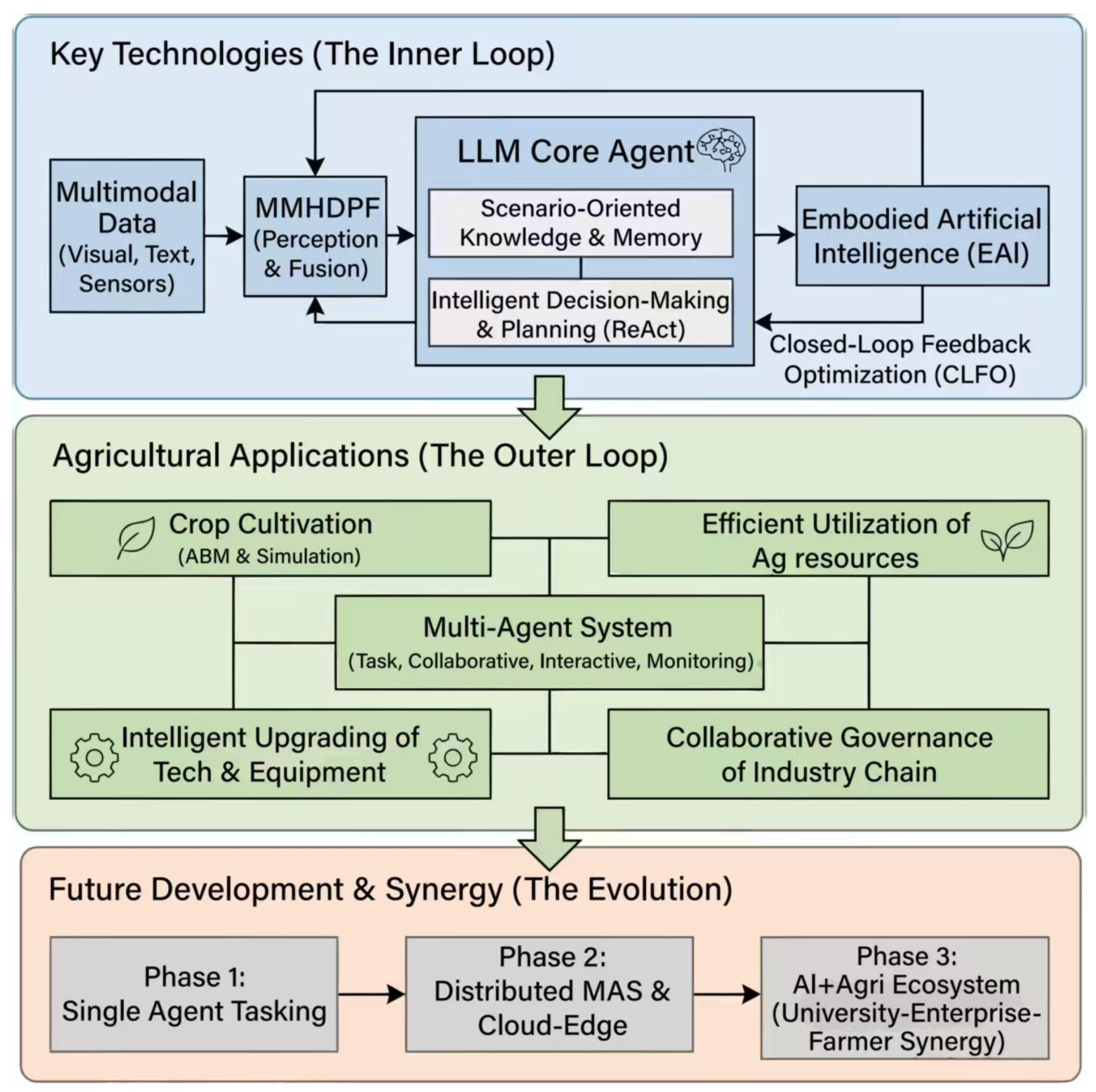
Figure 1. Three-dimensional integrated framework structure diagram.
Electronics 15 01547 g001
Figure 2. Single agent flowchart.
Electronics 15 01547 g002
Figure 3. Mapping diagram of multimodal heterogeneous data perception fusion.
Electronics 15 01547 g003
Figure 4. Scenario-oriented knowledge modeling and dynamic memory technology mapping.
Electronics 15 01547 g004
Figure 5. Mapping diagram of intelligent decision-making and planning.
Electronics 15 01547 g005
Figure 6. Embodied artificial intelligence technology mapping.
Electronics 15 01547 g006
Figure 7. Closed-loop feedback optimization technology mapping.
Electronics 15 01547 g007
Figure 8. Application diagram of agent in agricultural scenarios.
Electronics 15 01547 g008
Table 1. Comparison of single-agent types.
TypeFunctionalityCore ObjectivesOutput Formats
Task-Oriented AgentBreak down tasks, execute and implement, provide feedback on resultsAccurately and efficiently complete single or sequential tasks assigned by humans, ultimately delivering predetermined results.Structured data or deliverable documents
Collaborative AgentMulti-agent collaboration, task division, and dynamic coordinationCollaborate with humans or other agents to efficiently accomplish complex tasks that cannot be achieved independently by a single entity, ultimately achieving globally optimal collaborative outcomes.Instruction list or process flow document
Interactive AgentNatural interaction, intent understanding, continuous optimizationBuilding a user-friendly bridge between humans and systems, accurately understanding and responding to human intent, and continuously enhancing interaction experiences and efficiency.Bidirectional conversion of information formats
Monitoring AgentEnvironmental awareness, anomaly detection, early warning and responseContinuously monitor the status of target objects, promptly detect and respond to abnormal conditions, ensuring the stability and security of systems or environments.Early warning notifications and anomaly reports
Table 2. Core technologies—application scenarios communication matrix.
Application DomainCore Supporting TechnologiesTypical Input DataTypical Agricultural TasksCore Evaluation MetricsMajor Deployment Challenges
Crop CultivationMultimodal Perception & Fusion, Intelligent Decision-MakingUAV imagery, soil/meteorological dataDisease detection, growth simulation, precision managementDetection accuracy, yield prediction errorSensor noise, low image resolution
Efficient Agricultural Resource UtilizationIntelligent Decision-Making, Scenario Knowledge ModelingHydrological, energy consumption, carbon emission dataWater allocation, low-carbon energy use, waste managementResource matching efficiency, carbon reduction rateHeterogeneous micro-subject behaviors, supply–demand balancing
Smart Agricultural EquipmentEmbodied AI, Closed-Loop Feedback OptimizationSpatial maps, equipment operational statusMulti-machine collaborative path planning, autonomous operationPath coverage rate, operation latency, NUEWeak network, hardware failures in complex terrain
Whole Industrial Chain Collaborative GovernanceDistributed Decision-Making, Closed-Loop OptimizationIoT logs, supply chain traces, policy dataData sharing, harvest-transport scheduling, policy simulationSupply chain resilience, algorithm fairness, policy adoption rateData silos, privacy risks, low digital literacy
Disclaimer/Publisher’s Note: The statements, opinions and data contained in all publications are solely those of the individual author(s) and contributor(s) and not of MDPI and/or the editor(s). MDPI and/or the editor(s) disclaim responsibility for any injury to people or property resulting from any ideas, methods, instructions or products referred to in the content.