Article

Blockchain-Based Mixed-Node Auction Mechanism

1
School of Information Engineering, Jiangsu College of Tourism, Yangzhou 225000, China
2
School of Information Engineering, Yangzhou University, Yangzhou 225000, China
*
Author to whom correspondence should be addressed.
Electronics 2026, 15(7), 1516; https://doi.org/10.3390/electronics15071516
Submission received: 8 March 2026 / Revised: 1 April 2026 / Accepted: 3 April 2026 / Published: 4 April 2026
(This article belongs to the Special Issue Novel Methods Applied to Security and Privacy Problems, Volume II)

Abstract

Blockchain-based auctions often utilize smart contracts to automate auction rules, with much research focusing on enhancing privacy and fairness through cryptographic techniques. However, the authenticity of external data input into these systems is frequently overlooked. In particular, rational nodes may manipulate bidding data by submitting false types to maximize their utility, compromising market fairness and the reliability of auction outcomes. The aim of this study is to propose an alternative blockchain-based auction mechanism to incentivize nodes to report types honestly. We propose the Mixed-Node Advertising Auction (MNAA) mechanism for digital advertising auctions on blockchain systems. MNAA integrates quasi-linear and value maximization utility models to design allocation and pricing rules that eliminate nodes’ incentives to misreport their types, ensuring the authenticity of data submitted to the auction. To enhance efficiency, MNAA employs state channel technology and off-chain smart contracts, reducing main chain interactions. Theoretical analysis confirms that MNAA incentivizes truthful behavior and ensures security and correctness. Simulation results show that MNAA outperforms Generalized Second Price (GSP), Mixed Bidders with Private Classes (MPR), and Vickrey–Clarke–Grooves (VCG) auctions in terms of liquid social welfare (LSW), publisher revenue, and allocation efficiency, while also improving the transaction throughput and showing good performance in terms of transaction costs and latency.

1. Introduction

Digital advertising is one of the most successful applications of auction theory and also a major revenue source for online platforms such as Google, Facebook, Alibaba, and Baidu. According to statistics, Google, as the market leader, generated a net revenue of USD 65.6 billion from digital advertising in 2024, accounting for 79% of its total revenue (https://www.statista.com/statistics/271527/forecast-of-revenues-from-paid-search-in-the-us/, accessed on 23 March 2026).
In recent years, a significant trend has emerged in the digital advertising field, namely the transition towards programmatic media trading models. Programmatic advertising is designed for small advertisers and advertising publishers, aiming to simplify their entry into the online advertising market. In the programmatic model, advertisers connect with demand-side platforms through trading desks. The demand-side platforms then link the trading desks with ad networks and trading platforms. Publishers usually disclose inventory information through trading platforms, ad networks, or direct trading desks. Digital ad auctions in such programmatic models face issues such as low transparency, data leakage, susceptibility to fraud, as well as the ease of using common event-driven pricing models, which impact the fairness of transactions [1]. Due to the massive transaction volume, solving these issues through digital ad auctions alone is extremely challenging.
Blockchain technology offers alternative solutions to these challenges in digital advertising, incentivizes participation, and ensures transaction integrity among the various stakeholders in the ecosystem. Its features, including transparency, decentralization, and tamper-proof properties, allow for recording data from various sources in distributed databases, reducing the reliance on intermediaries [2]. By employing techniques such as secure multi-party computation protocols [3], commitment mechanisms, zero-knowledge proofs [4], and ring signature technologies [5], data privacy can be protected while supporting the public verification of auction results. This enables the more flexible disclosure of permissions and the quantification of intangible assets. Therefore, blockchain technology can enhance customer-centric, secure, and open innovation, building trust between advertisers and publishers and increasing the intensity of value exchange.
However, the aforementioned studies primarily focus on enhancing the privacy and fairness of auction processes by leveraging smart contracts, cryptographic techniques, and public verifiability mechanisms. While these approaches improve confidentiality and auditability, they overlook the authenticity of external data inputs within blockchain-based auction systems. In particular, they fail to address the risk that a node’s reported type may misrepresent his/her true valuation of the auctioned resource. For example, a node might value a resource at 10 but deliberately report a value of 6. In typical digital advertising scenarios, advertisements are allocated and the corresponding payments are calculated through auction mechanisms like the Vickrey–Clarke–Groves (VCG) or Generalized Second Price (GSP) mechanisms [6]. Additionally, these auction rules are deployed on smart contracts for automatic execution.
Existing analyses of VCG and GSP are mainly based on a quasi-linear utility model, where advertisers aim to optimize the difference between the allocation value and payment. With the development of automated bidding technology, advertisers’ bidding behavior is constrained by the return on investment (ROI) rate [7] (defined as the minimum acceptable ratio between the value that an advertiser derives from an allocated ad slot and the amount that the advertiser pays for it: r o i = m i n v a l u e p a y m e n t ), which limits their payment to a certain proportion of the value of the ad slot. When the r o i rate approaches 1, advertisers are honest in the quasi-linear utility model, meaning that their reported value to the system is their true value. However, when r o i 2 , the quasi-linear utility model no longer ensures that the advertiser’s bidding behavior is honest, and such behavior can only be captured by the value maximization model [8]. Nevertheless, both the quasi-linear utility model and the value maximization model can only ensure the honesty of certain advertisers: the former imposes constraints on advertisers with lower ROIs, while the latter applies constraints to those with higher ROIs. In practical ad auctions, advertisers may have different ROI rate constraints, which raises the issue of how to design a truthful mechanism to ensure that the data submitted by advertisers to the blockchain auction system is truthful when both types of advertisers coexist. Although technologies such as Oracle [9] verify the correctness of specific real-world conditions, i.e., whether auctioned resources were delivered as agreed, they do not address strategic misreporting by nodes. Consequently, Oracle solutions fail to guarantee the truthfulness of external data inputs. Furthermore, integrating Oracle incurs additional costs and introduces vulnerability to single points of failure when relying on a sole Oracle service.
Given that auction mechanisms fundamentally involve designing allocation and pricing rules as strategic games, the incentives generated by these rules directly influence participant behavior. Therefore, by formulating appropriate allocation and pricing rules, we can eliminate incentives for dishonest reporting and ensure the authenticity of external data submitted to the blockchain-based auction system. Accordingly, the primary problem that we aim to address is as follows.
Question 1: How can we design auction rules for blockchain-based auction systems that ensure the authenticity of external data submitted by participating nodes?
Moreover, the transaction efficiency of blockchain-based auctions is inherently dependent on the underlying consensus algorithm. Due to the decentralized architectures of blockchain systems, all participating nodes must reach a consensus on the auction outcomes. When processing a large volume of transaction data, the consensus process may incur substantial network overhead, thereby degrading the overall auction throughput. To improve the transaction efficiency, Xiao et al. [10] proposed a novel node reputation evaluation model, which selects consensus nodes based on their classification results, enhancing the system’s transaction performance. Similarly, Chen et al. [11] optimized consensus mechanisms by constructing communication- and transaction-directed acyclic graphs, enabling the faster confirmation of transaction sets and improving system throughput. Beyond consensus optimization, techniques such as state channels [12] offer promising alternatives for enhancing blockchain transaction efficiency. Luo et al. [13] introduced a chained relay mechanism to synchronize channel-related information across blockchains and developed a channel management protocol to support cross-chain micropayments, improving on-chain transaction efficiency. For industrial applications, Lohr et al. [14] designed a state channel-based fair exchange protocol that reduces the cost overhead associated with fair exchange while increasing the execution efficiency. Zhang et al. [15] proposed the Boros protocol, a state channel-based solution for off-chain cross-channel value transfers. This protocol shortens off-chain payment paths and reduces the time overhead associated with multichannel transactions, which in turn enhances the transaction throughput. Nevertheless, the aforementioned research on state channels primarily focuses on designing general frameworks that remain agnostic to specific application domains, rather than tailoring them to domain-specific scenarios. Therefore, the second problem that we aim to address is as follows.
Question 2: How can we leverage state channel technology to efficiently execute auction processes for specific blockchain-based auction scenarios?
To address the aforementioned challenges, we propose a truthful multiparameter Mixed-Node Advertising Auction (MNAA) mechanism. MNAA is tailored to the characteristics of digital advertising auctions and is designed to ensure the authenticity and reliability of external data submitted by nodes to the blockchain-based auction system. Specifically, MNAA requires nodes (advertisers) to submit two pieces of private information regarding their reported types to compete for a limited number of advertising slots: (1) the ROI rate and (2) a bid. These private types are then reported to the blockchain-based auction system. Meanwhile, MNAA integrates the quasi-linear utility model with the value maximization utility model to design allocation and pricing rules. By carefully constructing incentives induced by these rules, MNAA encourages nodes to report their private types truthfully in order to maximize their utility. This design eliminates the incentive for strategic misreporting and ensures the authenticity and reliability of external data submitted to the blockchain-based auction system, which addresses Question 1. Subsequently, by leveraging state channel technology, we construct a set of MNAA smart contracts that execute digital advertising auctions within off-chain state channels. This design reduces the frequency of interactions with the main blockchain, improves the auction efficiency, and addresses Question 2. Finally, theoretical analysis demonstrates that the MNAA mechanism satisfies the key economic property of incentive compatibility, which validates its ability to ensure the authenticity of externally submitted data within blockchain-based auction systems, while also ensuring the security of the MNAA smart contracts. Simulation results further confirm the good performance of the MNAA mechanism and smart contracts. Our main contributions are summarized as follows.
1.
To ensure the authenticity of external data submitted by nodes to blockchain-based auction systems, we propose the MNAA mechanism. By integrating the quasi-linear utility model with the value maximization utility model, we design allocation and pricing rules that eliminate nodes’ incentives to misreport their types, thereby encouraging the truthful submission of data to the blockchain.
2.
To enhance the transaction efficiency in digital advertising auctions on the blockchain, we design a set of MNAA smart contracts based on state channel technology. These smart contracts preserve the trustless and tamper-resistant properties of the blockchain while offloading the auction process to off-chain state channels and managing only auction states and payments on-chain.
3.
Theoretical analysis confirms that the MNAA mechanism satisfies key economic properties, while its smart contracts are verified in terms of both security and performance. Simulation results show that MNAA outperforms mainstream auction models in terms of liquid social welfare (LSW), publisher revenue, and allocation efficiency. Additionally, the MNAA smart contracts improve the transaction throughput and demonstrate good performance in terms of transaction costs and latency, highlighting their scalability.
The remainder of this paper is organized as follows. Section 2 reviews related work. Section 3 describes the basic definitions and assumptions. Section 4 models and analyzes the MNAA mechanism. Section 5 designs the MNAA smart contracts. Section 6 presents the relevant theoretical analysis. Section 7 details the design and results of the experiments. Section 8 presents the discussion and limitations, while Section 9 outlines the conclusions.

2. Related Work

As a decentralized, tamper-resistant, and anonymous technology, blockchain has garnered significant attention from both academia and industry in recent years. Auctions, as a fundamental market mechanism, play a critical role in ensuring efficient resource allocation and transaction fairness and have been extensively studied and applied across various domains. With the continuous advancement of smart contracts, blockchain now offers a decentralized, secure, and cost-effective trusted execution environment for implementing auction mechanisms [16].

2.1. Digital Advertising Auction Mechanism

In recent years, with millions of digital ad auctions taking place every day in real time, modern online advertising platforms have adopted automated bidding services. These services allow advertisers to set high-level marketing goals for their campaigns, which are then automatically handled by the system. In these automated bidding scenarios, budget constraints and ROI rate limitations have become key factors in auction design. While auction mechanisms for budget-constrained bidders have been studied in the literature [17], research on auction design for ROI rate-constrained bidders is still in its early stages. For ROI rate-constrained bidders, there is a clear minimum ratio between the value that they receive and the payment that they make. Unlike budget constraints, which set a hard upper limit on the payment amount, the payment cap established by ROI rate constraints is linearly related to the allocated value. Previous studies [18,19] show that ROI rate constraints are more consistent with real-world empirical data compared to budget constraints.
However, when an advertiser’s ROI rate approaches 1, the quasi-linear utility model effectively captures the advertiser’s bid objective while ensuring that the mechanism adheres to individual rationality, i.e., ensuring non-negative utility for all participating advertisers. Meanwhile, when r o i 2 , the value derived from the ad slot significantly outweighs the payment, thereby violating the assumptions of the quasi-linear utility model. In such cases, advertisers’ behavior can be more accurately modeled using the value maximization utility model [8]. Although Lv et al. [20] proposed an optimal auction mechanism for advertisers with ROI rate constraints, their method determines ad slot allocation solely based on bid values, without considering how ROI rates influence allocation and pricing outcomes. To address this limitation, Lv et al. [21] later used the quasi-linear and value maximization utility models together to design the Mixed Bidders with Private Classes (MPR) mechanism, which more comprehensively captures the diverse bidding behaviors of advertisers. This work inspired the design of our MNAA mechanism, which explicitly models the influence of ROI rate constraints on advertisers’ bidding strategies and, consequently, on ad slot allocation and pricing. Guided by this, we design allocation and pricing rules that incentivize advertisers to report their types truthfully. Unlike the MPR mechanism, which compromises publisher revenue to achieve incentive compatibility, our MNAA mechanism adopts alternative pricing strategies that simultaneously uphold incentive compatibility and sustain a stable publisher revenue, thereby enhancing its practical applicability in real-world digital advertising scenarios.

2.2. Blockchain-Based Digital Advertising Auctions

In the application of blockchain in digital advertising, blockchain technology improves the transparency of data and operational procedures across the entire advertising supply chain, reduces invalid expenditures for advertisers, and promotes the sustainable growth of the digital advertising ecosystem. AdChain, a digital advertising platform built on Ethereum, constructs an advertiser ranking registry to dynamically track the delivery statuses of various digital advertisements (ads), thus improving the advertising efficiency [22]. The Ubex platform leverages smart contracts to enable the automatic purchasing and delivery of digital ads, reducing advertisers’ costs and increasing the efficiency of ad transactions [23]. To further enhance the transparency of advertising campaigns, Liu et al. [24] proposed a blockchain-based privacy-preserving smart advertising network, in which smart contracts are used to design cryptographic authenticators that serve as public commitments to transparency and support the public verifiability of advertising activities. Moreover, as digital advertising platforms often adopt sealed-bid auction mechanisms that fail to ensure the public verifiability of auction results, Yang et al. [25] developed a sealed-bid auction protocol based on fully homomorphic encryption, allowing any node to verify the correctness of the winner’s proof. This supports the public verifiability of auction outcomes and enhances the reliability of blockchain-enabled digital advertising auctions.
The aforementioned studies primarily adopt blockchain as the underlying infrastructure to facilitate auction operations, emphasizing improvements in privacy and fairness. However, they often overlook the authenticity of external data inputs to the blockchain-based auction system. To address this gap, we focus on digital advertising auctions as a representative application scenario and propose a truthful multiparameter MNAA mechanism. By designing appropriate allocation and pricing rules, MNAA eliminates nodes’ incentives to misreport their types, therefore ensuring that the external inputs submitted to the blockchain-based auction system remain authentic and trustworthy.

2.3. Smart Contract Design

Smart contracts provide transparent, secure, and automated execution mechanisms for transactions on the blockchain. Existing blockchain-based smart contract auction protocols mainly focus on providing verifiable transaction processes. For example, Nguyen et al. [26] designed a smart contract supporting a double-auction algorithm to address the issue of iterative double auctions relying on trusted third parties. Bouaicha et al. [27] proposed a blockchain-based English auction framework, combining smart contracts with a dynamic penalty mechanism to suppress collusive bidding behaviors. These smart contract designs mainly focus on using smart contracts to implement auctions, and they do not effectively utilize the incentives generated by the auction rules to eliminate the motives for malicious behavior among participants.
Additionally, in transaction scenarios, the redundancy of the smart contract source code is prominent, as logically related but differently typed transactions are handled by different smart contracts, which increases code duplication. To address this, the AdapT framework has been proposed, which defines abstract transaction and smart contract classes to provide a generic smart contract framework that is independent of any specific business scenario, thereby improving the transaction efficiency [28]. Although our proposed NMAA mechanism can be implemented using the AdapT framework, directly embedding auction participants into the blockchain smart contract may lead to increased transaction fees. Considering that state channel technology can reduce transaction costs while improving the transaction efficiency [29], we adopt it to enable the off-chain execution of smart contracts without altering trust assumptions.

3. Basic Definitions and Assumptions

Assume a digital advertising auction involving a single node (publisher) who offers m ads slots, denoted by M a d = { 1 , 2 , , m } , associated with a specific keyword prior to the auction. A total of n advertisers participate in the auction, where 1 m n . Each advertiser can be assigned at most one ad slot, and each ad slot can be allocated to at most one advertiser in a single round of the auction.
Definition 1. 
The MNAA mechanism is defined as a 5-tuple M = < N , V , T , X , P > , where
N = { 1 , 2 , , n } is the finite set of advertisers;
V = { v 1 , v 2 , , v n } is the set of all possible private valuations of advertisers;
T = { t 1 , t 2 , , t n } is the set of types reported by advertisers to the mechanism; each type is a 2-tuple t i = < b i , r o i i > , where b i is the bid submitted by advertiser i N , and  r o i i is i’s reported ROI rate, b i v i , r o i i R + ;
X = { x 1 , x 2 , , x m } denotes the set of ad slot allocation results; it indicates that advertiser i’s ad is displayed on the ad slot l M a d if x i l = 1 ; otherwise, it is not;
P = { p 1 , p 2 , , p m } denotes the set of ad slot pricing results, and  p i l is the payment made by advertiser i for slot l.
It is assumed that the digital advertising auction adopts the pay-per-click model, whereby advertisers incur a cost only when a user clicks on the displayed ad link. Let v i denote the value that advertiser i derives from a single click, and  v i is assumed to be independent of the ad position. Let F i : [ 0 , v ¯ ] [ 0 , 1 ] denote the cumulative distribution function of advertiser i’s value v i [ 0 , v ¯ ] , which is assumed to follow a uniform distribution over the interval [ 0 , 1 ] . The corresponding probability density function is denoted by f i = F i , and it satisfies f i > 0 over its support. Assume that, for each advertiser i, the valuation v i and the ROI rate r o i i are private and independent information. The valuation v i is independently and identically distributed according to F i .
In digital advertising auctions, the click-through rate (CTR) c l of ad slot l is defined as the ratio of the number of clicks to the number of impressions. It is assumed that the CTR depends solely on the position of the ad slot, is independent of the identity of the advertiser, and is not affected by the total number of available ad slots. Ad slots are indexed in descending CTR order, such that c 1 c 2 c m 0 .
The distribution functions F i of advertisers i and the CTR c l of ad slot l are assumed to be common knowledge. Let t i = ( t 1 , t 2 , , t i 1 , t i + 1 , , t n ) represent the reported types of all advertisers other than i. Similarly, let v i denote the valuations of all advertisers other than i and  f i ( v i ) denote the joint probability density function other than v i . Suppose that advertiser i’s truthful report is t i = ( b i , r o i i ) , where b i = v i . Let t i ^ = ( b i ^ , r o i i ^ ) be the misreported type, where b i ^ b i and/or r o i ^ i r o i i . Since a higher CTR ad slot does not necessarily yield higher revenue for advertisers—that is, the CTR and ROI rate are not directly correlated—it is assumed that the CTR is only related to the advertiser’s valuation.
Definition 2 
(Advertiser’s Utility [8]). Assume that there exists a threshold ROI rate r o i * such that the behavior of advertisers with r o i < r o i * can be captured by the quasi-linear utility model, while the behavior of advertisers with r o i r o i * can be characterized by the value maximization model. The utility obtained by advertiser i upon being allocated ad slot l is given by
u i l = ( v i l p i l ) x i l , r o i i < r o i * v i l x i l , r o i i r o i * .
Definition 3 
(Incentive Compatibility [8]). For advertiser i N , if the condition u i ( t i , t i ) u i ( t i ^ , t i ) , t i ^ t i , t i holds, then the MNAA mechanism is incentive-compatible.
Definition 4 
(Individual Rationality [8]). For advertiser i N , if the condition p i k ( t i , t i ) v i , k M a d holds, then the MNAA mechanism satisfies individual rationality.

4. Design of MNAA Mechanism

4.1. Optimal Determination of the Number of Ad Slots

Advertisers targeting the same keyword typically operate within the same industry; consequently, the ads displayed concurrently often exhibit high similarity and substitutability. Even when users click on all displayed ad links before making a purchase decision, suggesting that the number of ad slots does not directly affect the overall CTR, the substitutable nature of the advertised products may cause users to purchase from competing advertisers. In other words, increasing the number of displayed ads can dilute the conversion rate of individual ads, thereby diminishing the per-click value for certain advertisers.
We define this phenomenon, wherein an improper configuration of the number of ad slots reduces the value perceived by advertisers, as value disutility. When the publisher allocates a given number of ad slots, the advertiser’s value disutility function h ( l ) is defined as a twice-differentiable function with domain [ 1 , n ] and co-domain ( 0 , 1 ] ,
h ( l ) = 1 l 1 N ( e z 1 ) , l [ 1 , m ] , z [ 0 , 1 ] .
Specifically, when h ( l = 1 ) = 1 and h ( l , z ) l < 0 , 2 h ( l , z ) l 2 0 , it indicates that the number of ad slots has a direct impact on the advertiser’s perceived value. When z = 0 , we have h ( l ) = 1 , implying that the advertiser’s value is not affected by the number of ad slots. Moreover, when z 0 , and we have h ( l ) z < 0 , this suggests that, under a fixed number of ad slots, an increase in the value of z makes the advertiser’s value more susceptible to the influence of the quantity of ad slots.
Assume that the CTR is independent of both the number of ad slots and the advertisers’ ROI rate. All advertisers bidding for the same keyword share a common value disutility function h ( l ) , which is common knowledge. Let v i h ( l ) denote the value of advertiser i. According to the properties of the function h ( l ) , the advertiser’s value decreases as the number of ad slots increases, with the rate of decrease accelerating accordingly. If the MNAA mechanism satisfies incentive compatibility, then the expected payment of advertiser i, given the reported type t i and a total of l allocated ad slots, is given by
E [ p i l ( t i ) ] = h ( l ) 0 v ¯ p r i m ( t i ) f ( b i | t i ) d ( b i | t i ) .
Here, ( b i | t i ) denotes the bid b i submitted by advertiser i when reporting t i . For ease of analysis, let b i = ( b i | t i ) , and we have
E [ p i l ( t i ) ] = h ( l ) 0 v ¯ b i c i l ( t i ) f ( b i ) d b i 0 v ¯ ( c i l ( t i ) c i l ( 0 ) ) f ( b i ) d b i .
Given that c i l ( 0 ) = 0 v ¯ c i l ( b i ) f i ( b i ) d b i holds, it follows that
E [ p i l ( t i ) ] = h ( l ) 0 v ¯ b i c i l ( t i ) f ( b i ) d b i 0 v ¯ c i l ( t i ) 1 F ( b i ) f ( b i ) f ( b i ) d b i = h ( l ) 0 v ¯ c i l ( t i ) ( b i 1 F ( b i ) f ( b i ) ) f ( b i ) d b i .
Let 1 F ( b i ) f ( b i ) = θ ( t i | l ) , and, when the MNAA mechanism satisfies incentive compatibility, we have v i = b i , which implies
E [ p i l ( t i ) ] = l = 1 m h ( l ) c i l ( t i ) θ ( t i | l ) .
Therefore, when there are n advertisers, the expected revenue of the publisher is given by
R p = i = 1 n l = 1 m h ( l ) c i l ( t i ) θ ( t i | l ) .
The objective of the publisher is to maximize his/her expected revenue. Accordingly, the optimal number of ad slots l * for a given keyword is determined by
l * = argmax L M a d R p = argmax L M a d i N l L h ( l ) c i l ( t i ) θ ( t i | l ) .
where L = { 1 , 2 , , l * } M a d , l * m denotes the set of ad slots corresponding to the optimal number l * .

4.2. Algorithm Design of the MNAA Mechanism

The core idea of the MNAA mechanism is that the payment p i l made by advertiser i for the allocated ad slot l is independent of the reported type t i . Specifically, if advertiser i is allocated slot l, then the payment p i l remains unchanged regardless of whether i misreports his/her type as t ^ i = < b ^ i , r o i i ^ > , b ^ i b i and/or r o i i ^ r o i i , as long as the allocation result, i.e., the assignment of ad slots, remains unchanged.
The complete pseudocode of the MNAA mechanism is presented in Algorithm 1. The mechanism begins by sorting all advertisers’ bids in non-increasing order and selecting the top l * highest bidders as winners, who are then added to the winner set W. The l * + 1 th highest bid is used as the base price for the ad slot payment (Lines 1–3). Next, the MNAA mechanism partitions the advertisers in the winner set W into groups based on the reported ROI rates. Following the ROI classification approach proposed in [7], we define the threshold r o i * = 2 and select advertisers with r o i r o i * to assign to group H R , while those with r o i < r o i * are assigned to group L R (Lines 4–5). Let j L R l denote the advertiser (excluding the current advertiser i) in group L R who submits the highest bid for ad slot l.
Algorithm 1 Mixed-Node Advertising Auction (MNAA) Mechanism
Input: The types T of all advertisers, ad slots L, and CTR c for all slots.
Output: The result set of ad slot allocation X and payment P for each advertiser.
1:Sort all advertisers in non-incremental order by their bids according to the types;
2:Sort all ad slots in non-decreasing order by the CTR;
3:Let W be the set of top l * advertisers by their bids;
4:Divide advertiser i in W with r i r * into Group H R ;
5:Divide advertiser j in W with r j < r * into Group L R ;
// Initialize ad slot prices based on advertisers’ bids in Group W.
6:if  W  then
7:    for  l 1 to l *  do
8:        initialize the price p l o of ad slot l by Equation (9);
9:    end for
10:else
11:     p l 0 ;
12:end if
// Allocate the ad slots for advertisers in Group L R .
13:while  L and L R  do
14:     i argmin ( b i ) , i L R ;
15:     l argmax l L ( b i p l ) c l ;
16:     π i l , x i l 1
17:     L L { l } , X X { x i l } ;
    // Update the ad slot prices.
18:     i n d e x i the index of the ith advertiser in set W;
19:    if  π i i n d e x i  then
20:        for  π i + 1 up to i n d e x i  do
21:              p l p l 1 ;
22:        end for
23:        update the price p l of ad slot l by Equation (10);
24:    else
25:         p l p l 0 ;
26:    end if
27:end while
// Allocate the remaining ad slots for advertisers in Group H R .
28:while  L and H R  do
29:    for  j H R  do
30:         l argmax l L b j c l ;
31:         x j l 1 ;
32:         L L { l } , X X { x j l } ;
33:    end for
34:end while
35:for  i W  do
36:     p i l p l ;
37:     P P { p i l } ;
38:end for
39:return  X , P .
Subsequently, the prices of all ad slots are initialized based on the bids submitted by advertisers in the winner set W and the ( l * + 1 ) th highest bid. Specifically, the price for ad slot l is set to the bid of the advertiser ranked ( l + 1 ) th. In the specific case whereby l = 1 , the corresponding payment is given by p 1 = b l * + 1 (Lines 6–12), so we have
p l 0 = b l + 1 , 1 < l l * b l * + 1 , l = 1 .
Next, leveraging the quasi-linear utility model, MNAA allocates to each advertiser in group L R the ad slot that maximizes their utility, defined as the difference between the value of the assigned slot and the corresponding payment. In the event of a tie, the ad slot with the higher CTR is selected. Let π i = l denote the assignment indicating that advertiser i is allocated ad slot l (Lines 13–27). Subsequently, the prices of the ad slots are updated based on the allocation outcomes for advertisers in group L R ,
p l = max { p l 0 , p L R l } ,
where
p L R l = 1 c l ( b j L R l ) c l + 1 + p m a x l ( c l c l + 1 ) p m a x l = max { p l | p l < p l 0 } , l L .
Finally, for the remaining ad slots, the MNAA mechanism allocates them to advertisers in group H R by selecting the slots that maximize their utility under the value maximization utility model, i.e., each advertiser receives the ad slot that yields the highest valuation (Lines 28–34). Each assigned advertiser pays the corresponding price of the allocated slot, while those who are not assigned a slot incur no payment (Lines 35–38). The MNAA mechanism then returns the final allocation outcomes along with the associated payments for all participating advertisers (Line 39).
Example 1. 
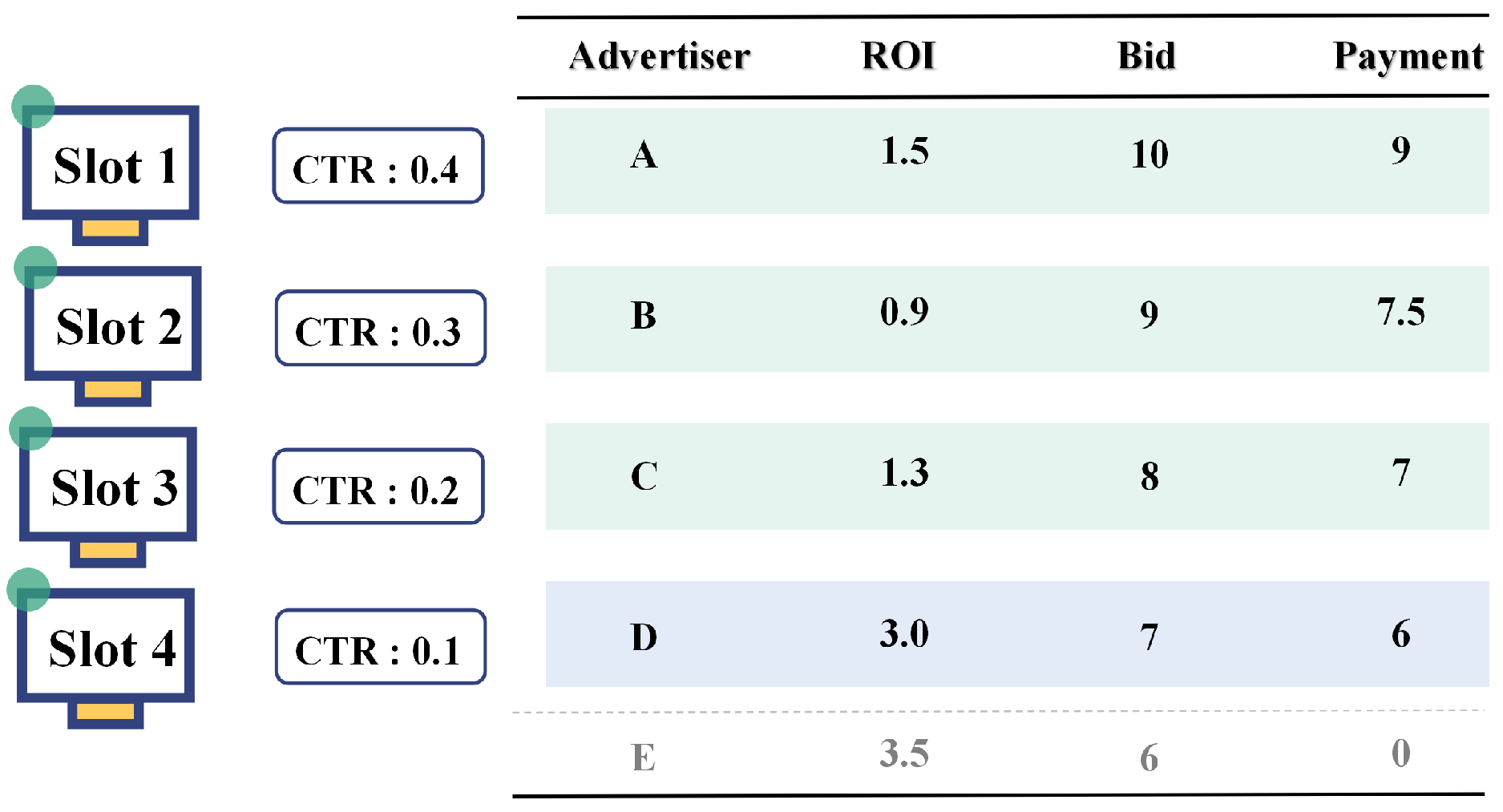
Suppose that there are five advertisers competing for l * = 4 ad slots, with the ROI rate threshold r * = 2 . The relevant information regarding the CTR, advertisers’ ROI rates, bids, and payments is depicted in Figure 1. In the MNAA mechanism, we first select the four highest-bidding advertisers as winners based on their bids. We place Advertiser D, with r o i 2 , in Group H R (light blue background), while assigning advertisers A, B, and C, with r o i < 2 , to Group L R (light green background). Next, we initialize the prices of all ad slots, i.e., p 1 = 9 , p 2 = 8 , p 3 = 7 , p 4 = 6 . We then calculate the utility of Advertiser C on the four ad slots, u C 1 = 0 , u C 2 = 0 , u C 3 = 0.3 , u C 4 = 0.2 , respectively, and the optimal one, i.e., ad slot 3, is allocated to Advertiser C. As Advertiser C is the third-highest bidder among the winners, we only need to update the price of slot 2 to p 2 = 7.5 . Similarly, Advertiser B receives slot 2, and Advertiser A is assigned slot 1. The updated slot prices are as follows: p 1 = 9 , p 2 = 7.5 , p 3 = 7 , p 4 = 6 . Finally, for the remaining ad slots, we assign the slot that maximizes the value for Advertiser D, resulting in slot 4 being assigned to Advertiser D.

5. Design of MNAA Smart Contracts

5.1. Overview of MNAA Smart Contracts

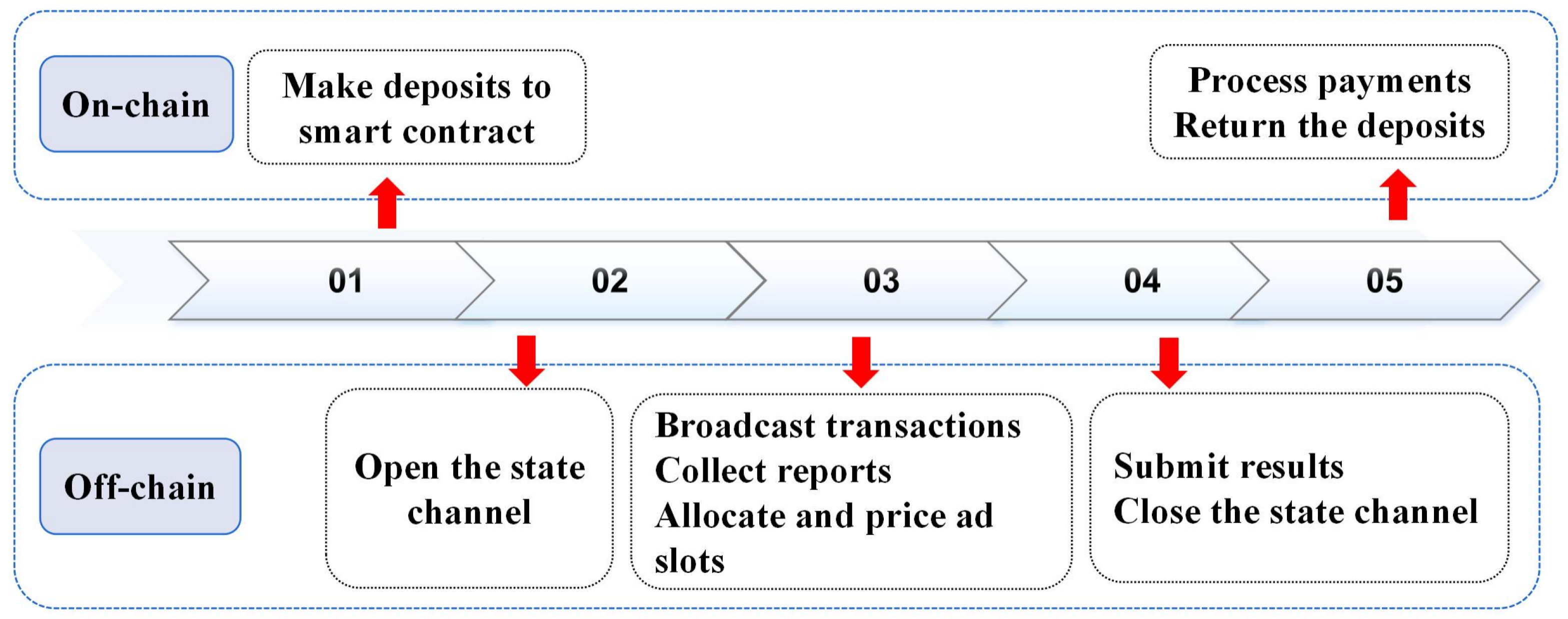
If the MNAA mechanism is deployed directly on the Ethereum blockchain, each time that an advertiser (node) invokes a smart contract to participate in the auction, a new transaction is created. In practical settings, where numerous nodes may simultaneously compete for ad slots, such frequent on-chain interactions tend to accumulate transaction data rapidly and induce significant latency. To address this limitation, we design a set of MNAA smart contracts based on state channel technology. This approach offloads the execution of digital advertising auctions from the main blockchain to off-chain state channels, which reduces the number of on-chain operations and enhances the transaction efficiency. Unlike purely on-chain execution, the state channel architecture maintains both security and correctness. In the event that a malicious node attempts to manipulate the auction results, honest participants can revert to the main chain and preserve system integrity. Additionally, in the event of a dispute over the auction outcome, participants can trigger the dispute-addressing process by invoking the relevant smart contract. Figure 2 illustrates the execution flow of digital advertising auctions using the MNAA smart contracts. Before an auction begins, each node makes a deposit into the smart contract. Upon completion of the auction, the deposit is refunded to the corresponding node. For analytical simplicity, we assume that all nodes possess sufficient account balances to meet the deposit requirements.
Next, the system opens the state channel, within which participating nodes execute the MNAA mechanism off-chain to carry out the auction. At this stage, each node first broadcasts a transaction containing his/her reported type to the other nodes. This transaction is only propagated among nodes that agree to open the state channel and express an intent to participate in the current auction, thereby enhancing transaction privacy. Upon receiving the transaction, each node verifies its validity and collects the types submitted by the other participants. The system then randomly selects one node, denoted as i * , to execute the MNAA mechanism. Let G i * = < X , P > represent the resulting auction state produced by i * , where X denotes the allocation results and P is the corresponding payment. Node i * then broadcasts state G i * to the others. Upon receiving G i * , each node verifies the included signatures and auction results. If G i * passes verification, the node propagates it to the rest of the network. Otherwise, the node triggers the smart contract to initiate the dispute-addressing process. Once the participating nodes reach a consensus on the state G i * , the agreed state is committed to the blockchain. Upon finalization, the system closes the state channel, settles the corresponding payments on-chain, and returns the deposits to the respective nodes.
In the aforementioned process, the blockchain is invoked only twice. During the auction execution phase, no transactions are submitted to the blockchain, meaning that the transaction latency is solely determined by the communication network among participating nodes. This design avoids performance degradation caused by high on-chain latency.
To safeguard the integrity and security of transactions and smart contracts, we adopt the Ethereum ECDSA signature scheme [30], which prevents unauthorized tampering or forgery. We further assume that the MNAA smart contracts are free from code vulnerabilities and logical inconsistencies. Moreover, the MNAA smart contracts are required to satisfy the following five security properties [26].
1.
Input Independence: Nodes do not know the true data of the reported types before verifying the data submitted by other nodes.
2.
Verifiability: It should be possible to verify whether a node has correctly executed the smart contract.
3.
Robustness: The auction process should not be affected by invalid types or malicious nodes.
4.
Non-repudiation: Nodes cannot deny that they have submitted a type.
5.
Liveness: When all nodes behave honestly, off-chain messages can be processed promptly. Meanwhile, in the presence of malicious nodes, the system will ensure that all messages are processed within a predictable and bounded time frame.
To fulfill the aforementioned security requirements, we draw inspiration from the work of Nguyen et al. [26] and modify and extend their idealized protocols to design our MNAA smart contracts tailored to the MNAA mechanism. The MNAA smart contracts comprise three sub-contracts: the account management contract F B C , the dispute-addressing contract F J u d g e , and the auction execution contract F M N A A . The contracts F B C and F J u d g e operate on-chain to manage node account balances and address disputes, respectively, while F M N A A runs off-chain to execute the MNAA mechanism.
In our study, we adopt the synchronous network model and define δ as the maximum transmission delay for off-chain messages between any pair of nodes. This ensures that each node can retrieve the current state of the smart contract within time δ . We assume that any modification to the smart contracts is completed within a bounded time Δ , where δ Δ , implying that blockchain updates, although not instantaneous, can be executed within a predictable and bounded time frame.
After node i N pays the required deposit, i first commits to his/her type t i by generating a commitment c m t i = h a s h ( t i , n o n c e i ) , where n o n c e i is a random number. During the subsequent verification phase, i reveals both t i and n o n c e i to enable other nodes to verify the correctness of i’s commitment. Nodes that fail to submit their data within the prescribed time are disqualified from the current auction round and forfeit their deposits.

5.2. MNAA Smart Contract Design

5.2.1. Account Management Contract F B C

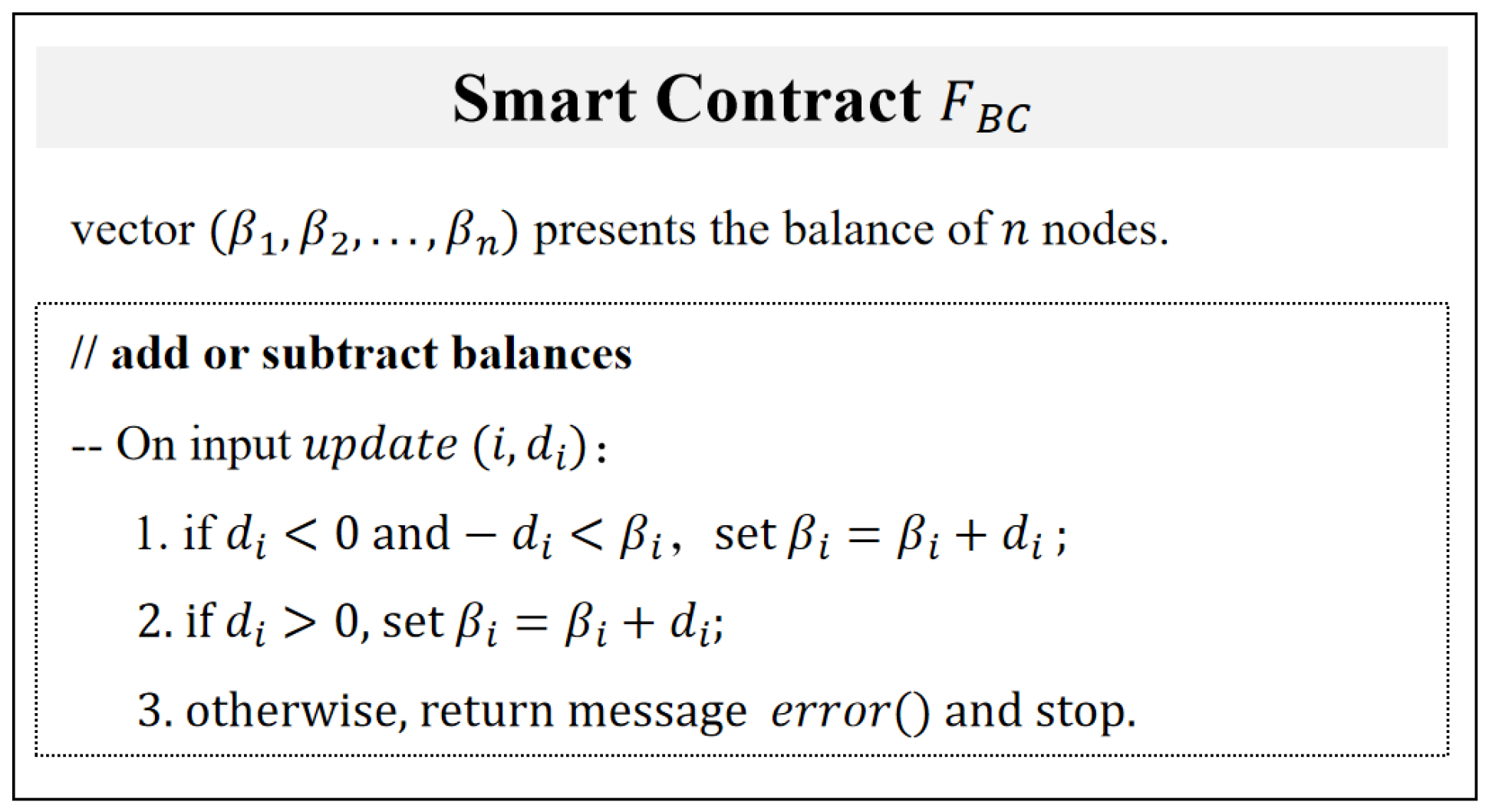
The blockchain accounts of participating nodes are managed by the smart contract F B C , under the assumption that the set of nodes N is known before the opening of the state channel and that the contract remains publicly accessible to the entire network. As illustrated in Figure 3, when contract F B C receives an account balance update message u p d a t e ( i , d i ) , it will decrease i’s account balance if the deposit d i is negative and does not exceed the account balance; if the deposit d i is positive, it will increase the account balance. Otherwise, the contract will return a message e r r o r ( ) and halt the process.

5.2.2. Dispute-Addressing Contract F J u d g e

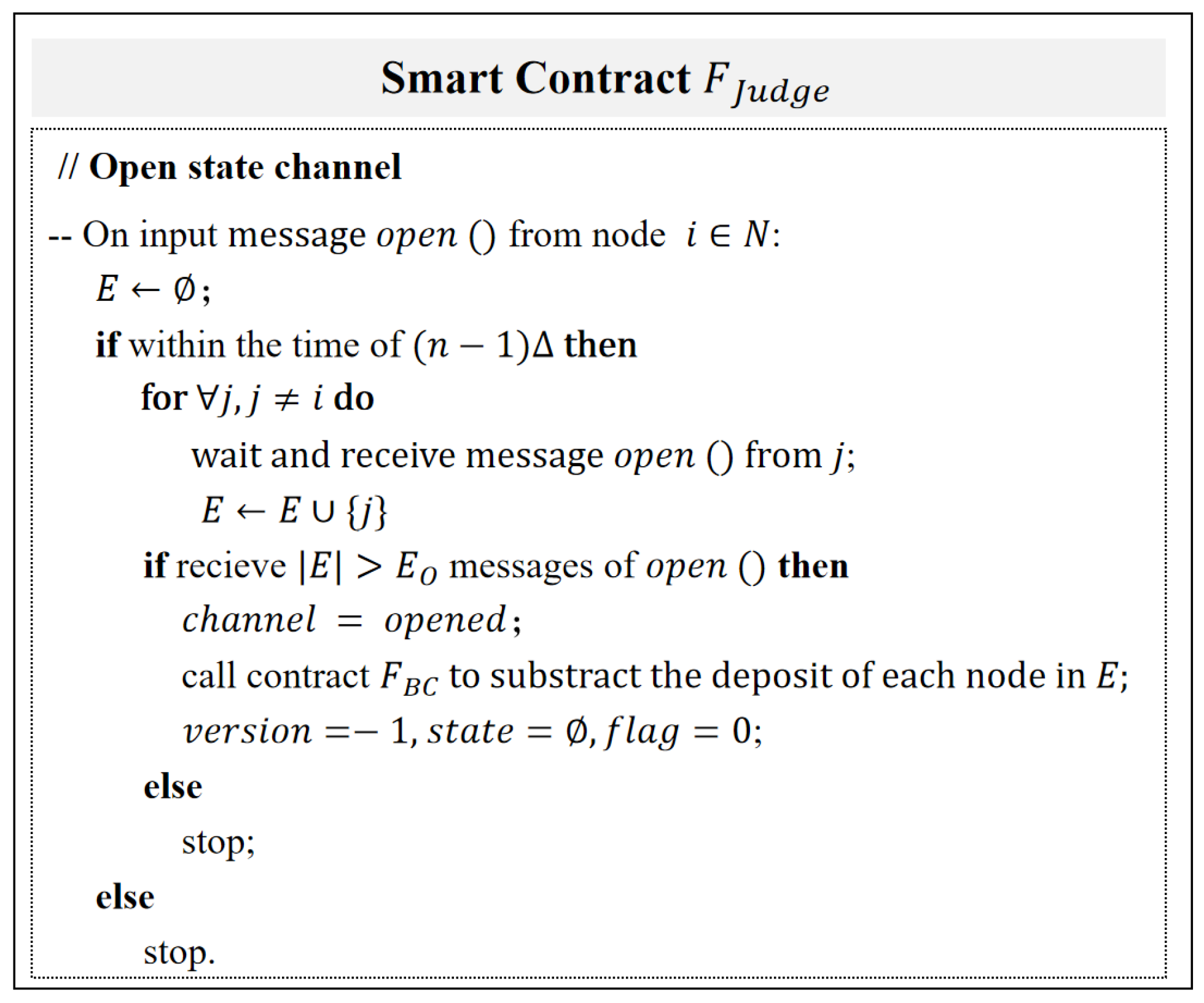
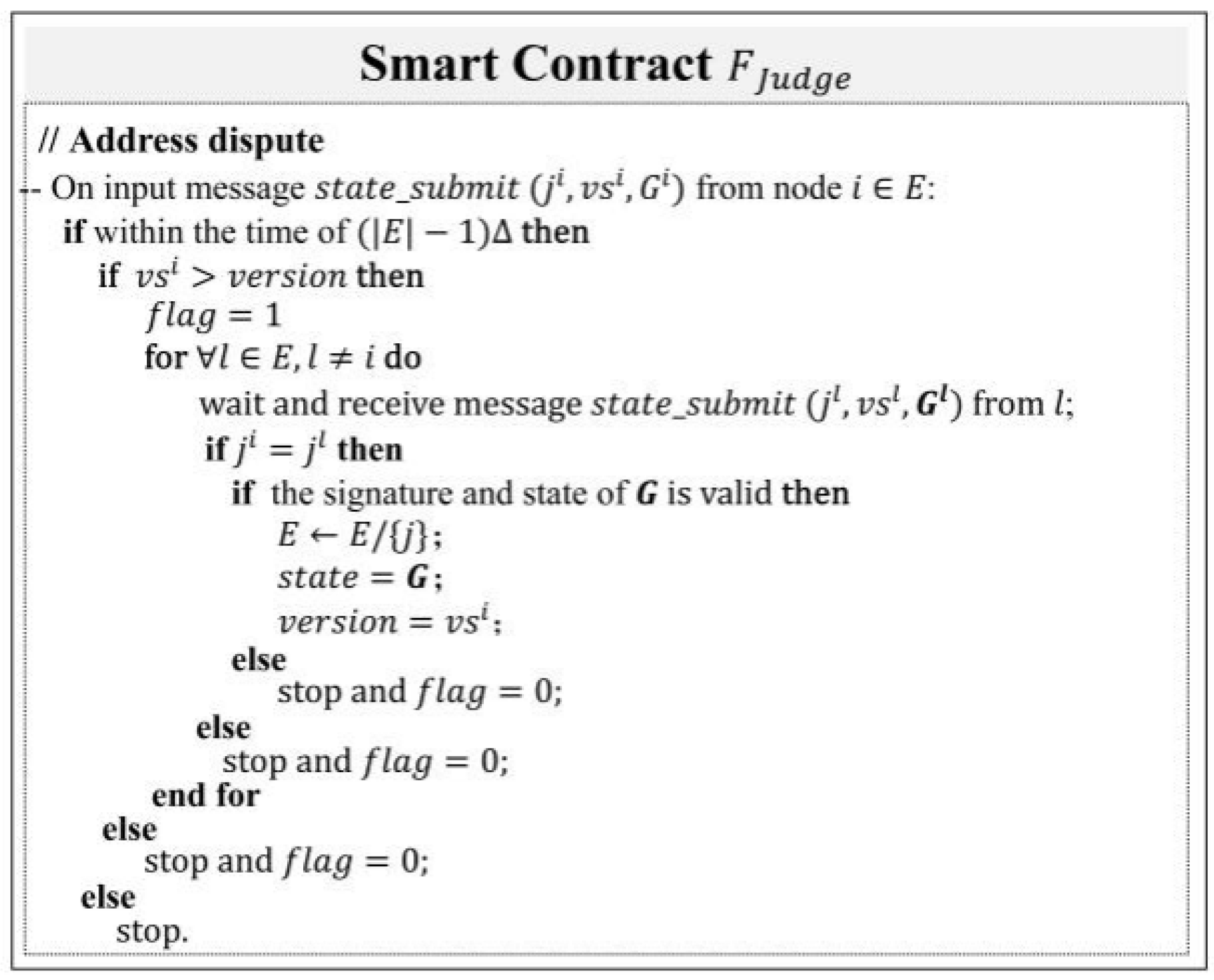
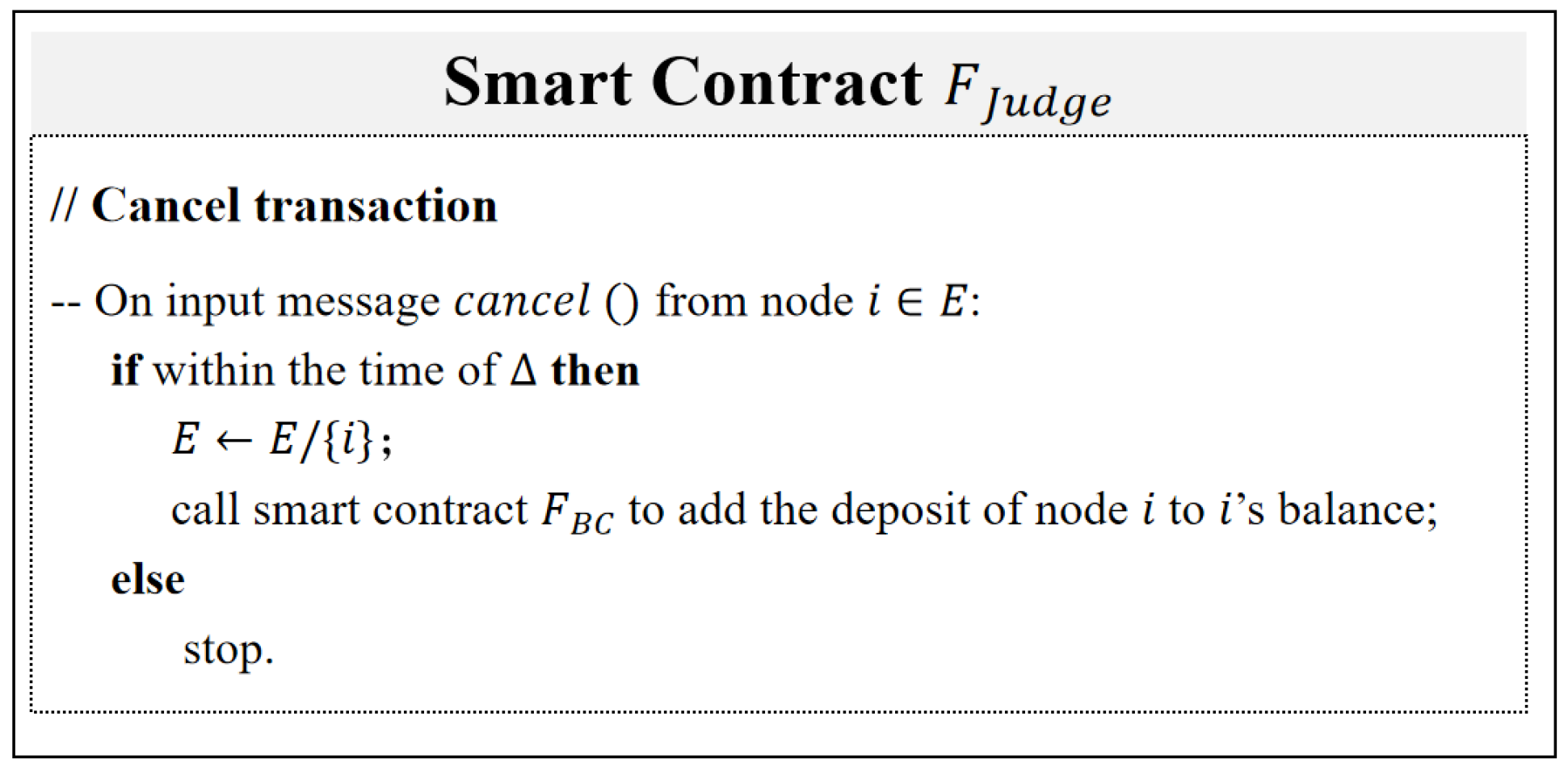
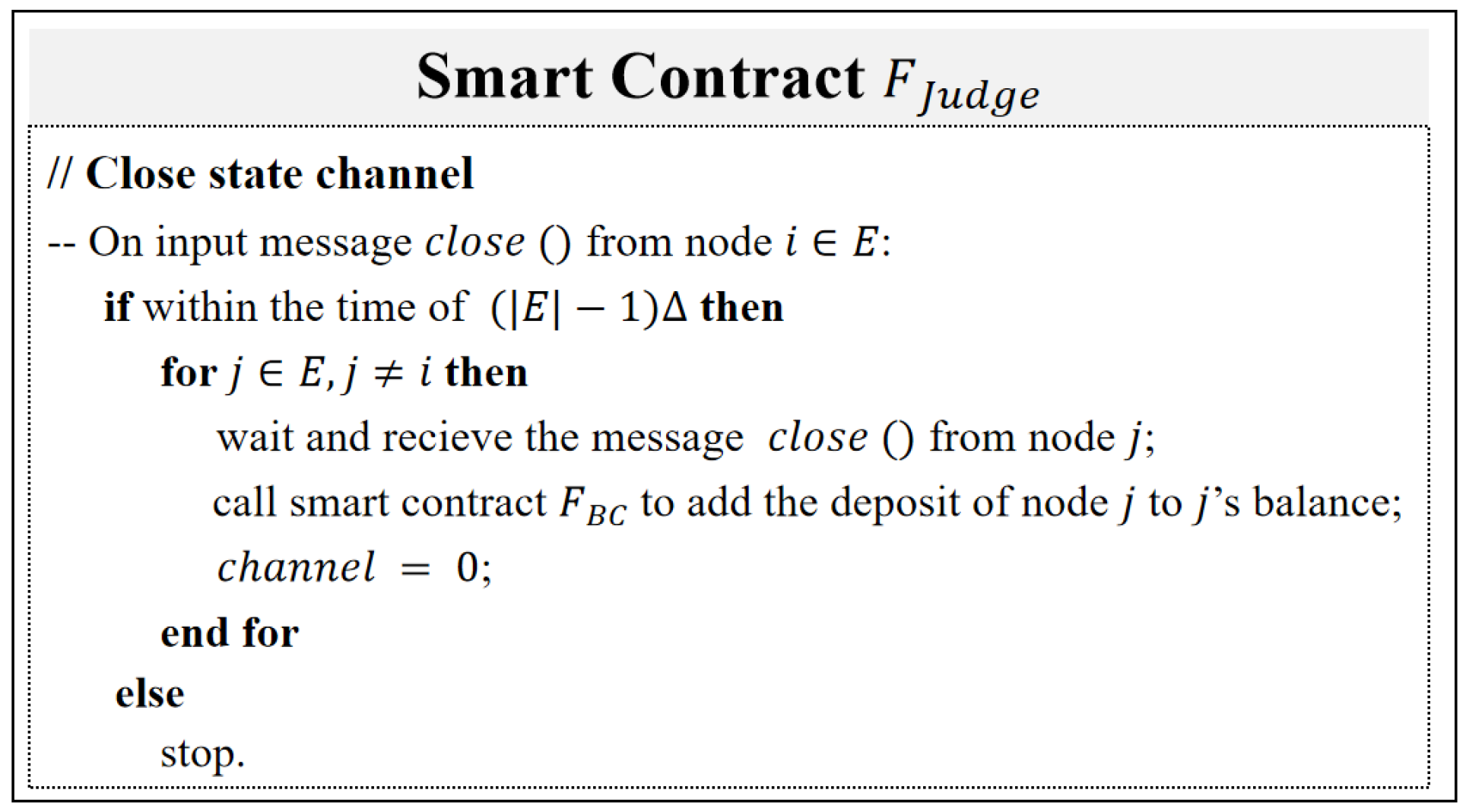
The function of contract F J u d g e is to handle disputes regarding the execution results of the MNAA mechanism. As shown in Figure 4, Figure 5, Figure 6 and Figure 7, the contract supports four functions: opening the state channel, addressing disputes, revoking transactions, and closing the state channel.
First, for a node i that wishes to participate in the current auction, it sends a message o p e n ( ) to request the opening of the state channel. As shown in Figure 4, assuming that the message quantity threshold is E 0 , contract F J u d g e waits for ( n 1 ) Δ time. If it collects more than E 0 messages o p e n ( ) , the state channel is opened, and the state is updated to c h a n n e l = o p e n e d . Nodes that wish to join the auction and request to open the state channel are added to the set E, and the smart contract F B C is called to deduct the deposits from the relevant nodes.
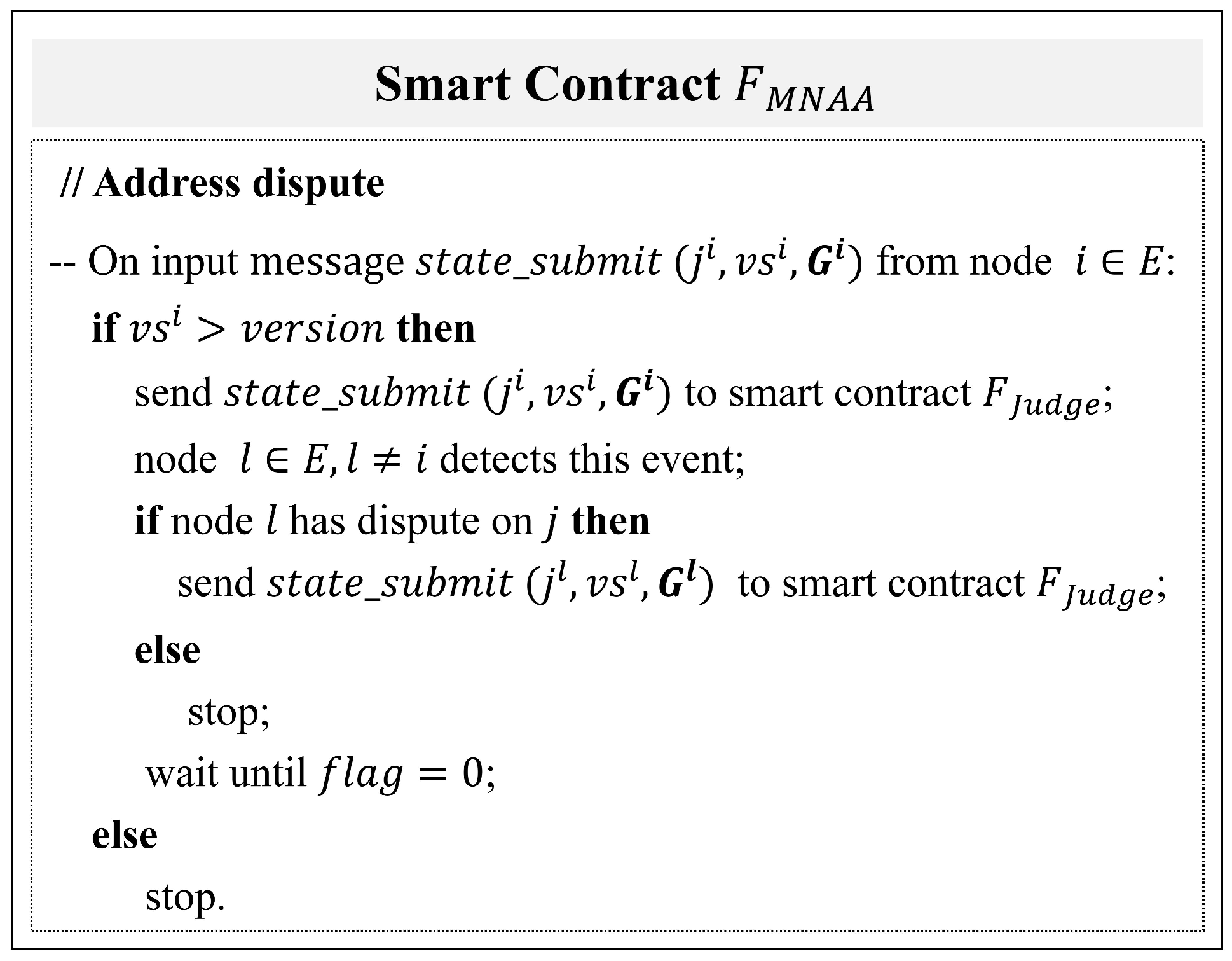
Then, as illustrated in Figure 5, if node i E has a dispute regarding the auction results of another node j E , i j , i sends a message s t a t e _ s u b m i t ( j i , v s i , G i ) to invoke the dispute-addressing process. If the version number v s submitted by node i is higher than the current version number v e r s i o n , the dispute-addressing status is set to f l a g = 1 . After waiting for ( | E | 1 ) Δ time, other nodes, excluding node i, also dispute node j, and, after verifying the signature and the correctness of status G i , node j is removed and the current status is set to G i , resulting in node j losing his/her deposit.
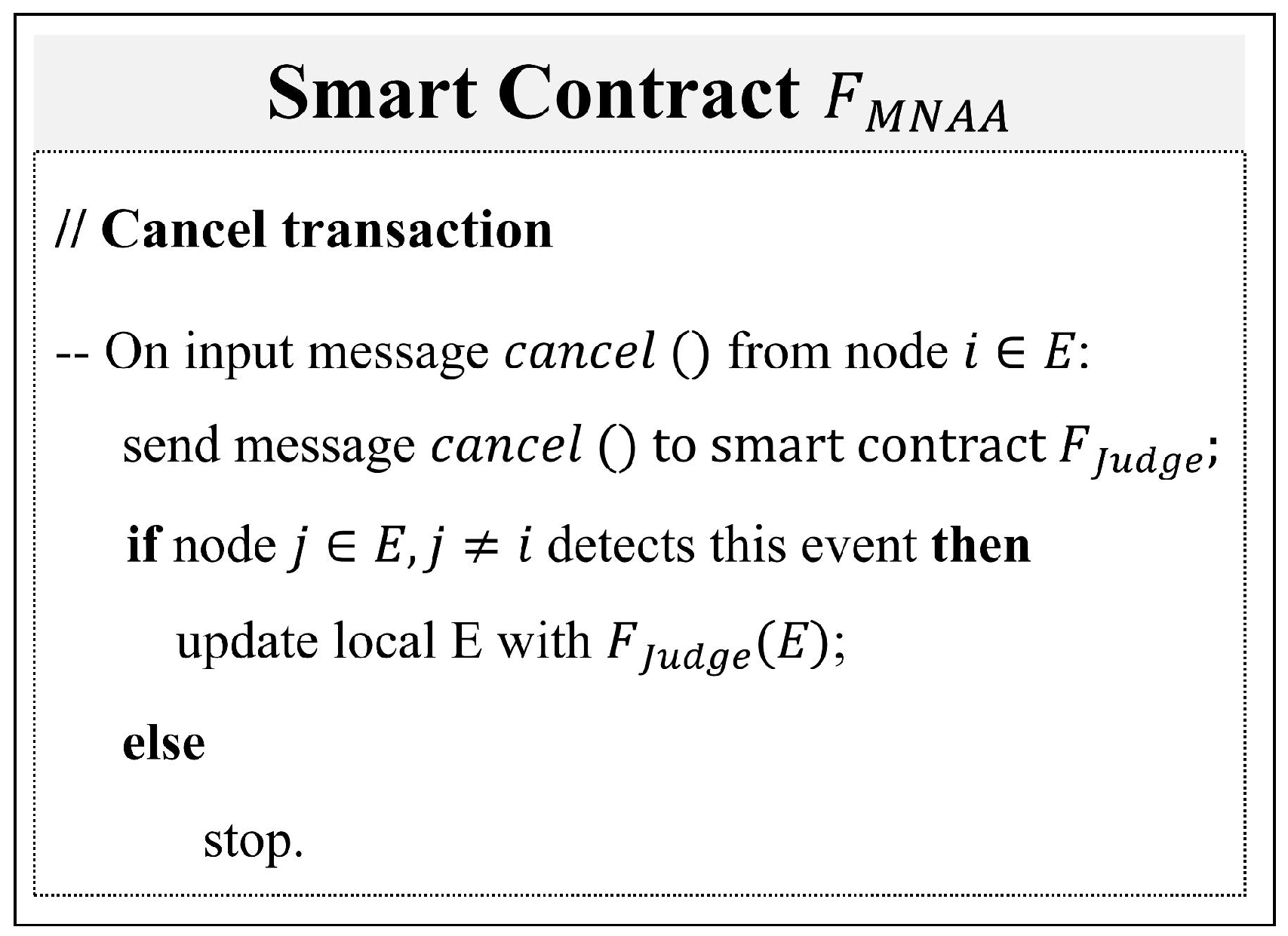
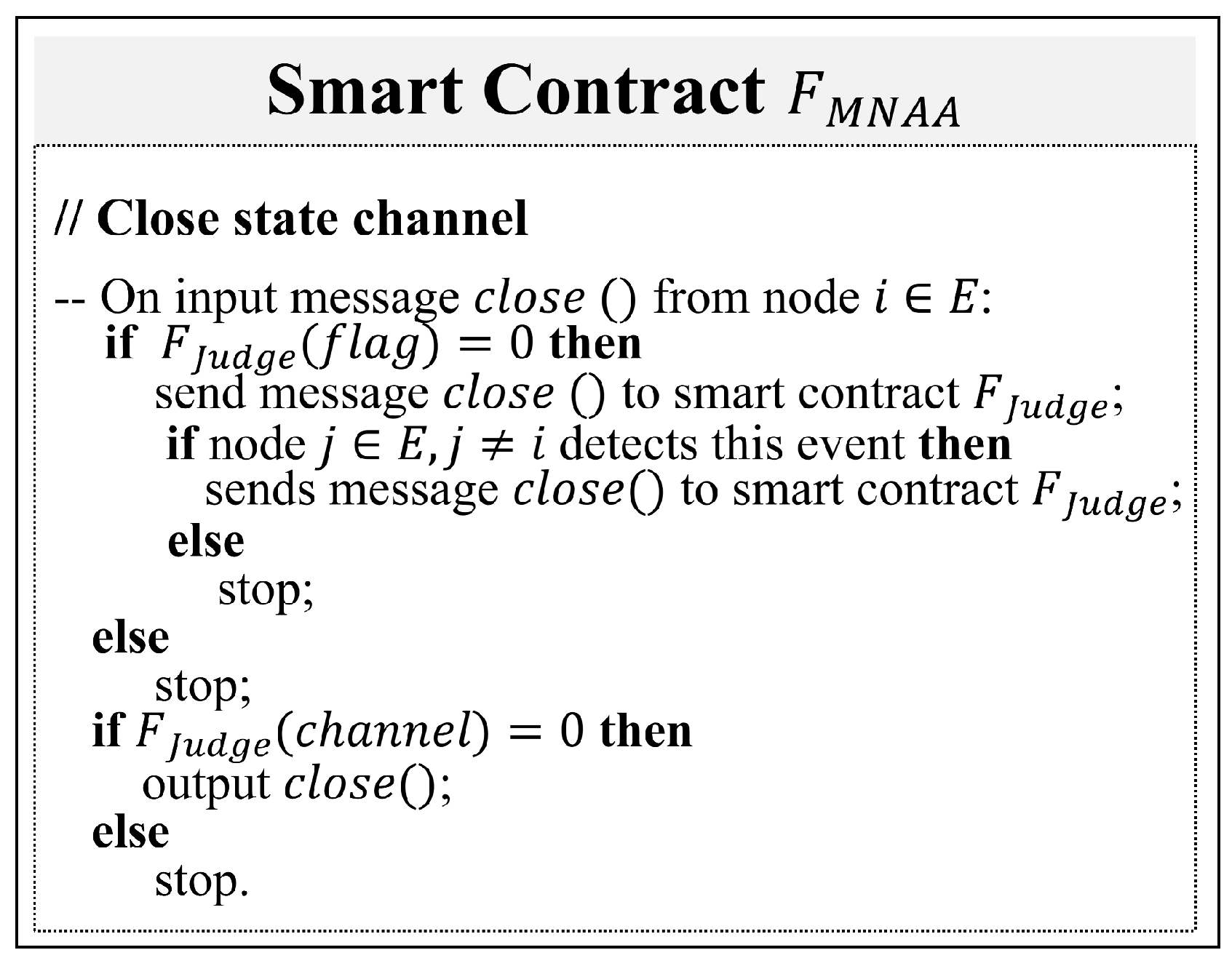
Furthermore, node i can send a message c a n c e l ( ) to revoke his/her transaction, as shown in Figure 6, and the deposit will be returned to the blockchain account. Finally, as depicted in Figure 7, node i sends a message c l o s e ( ) to request the closure of the state channel, and, after the state channel is closed, the state is updated to c h a n n e l = 0 .

5.2.3. Auction Contract F M N A A

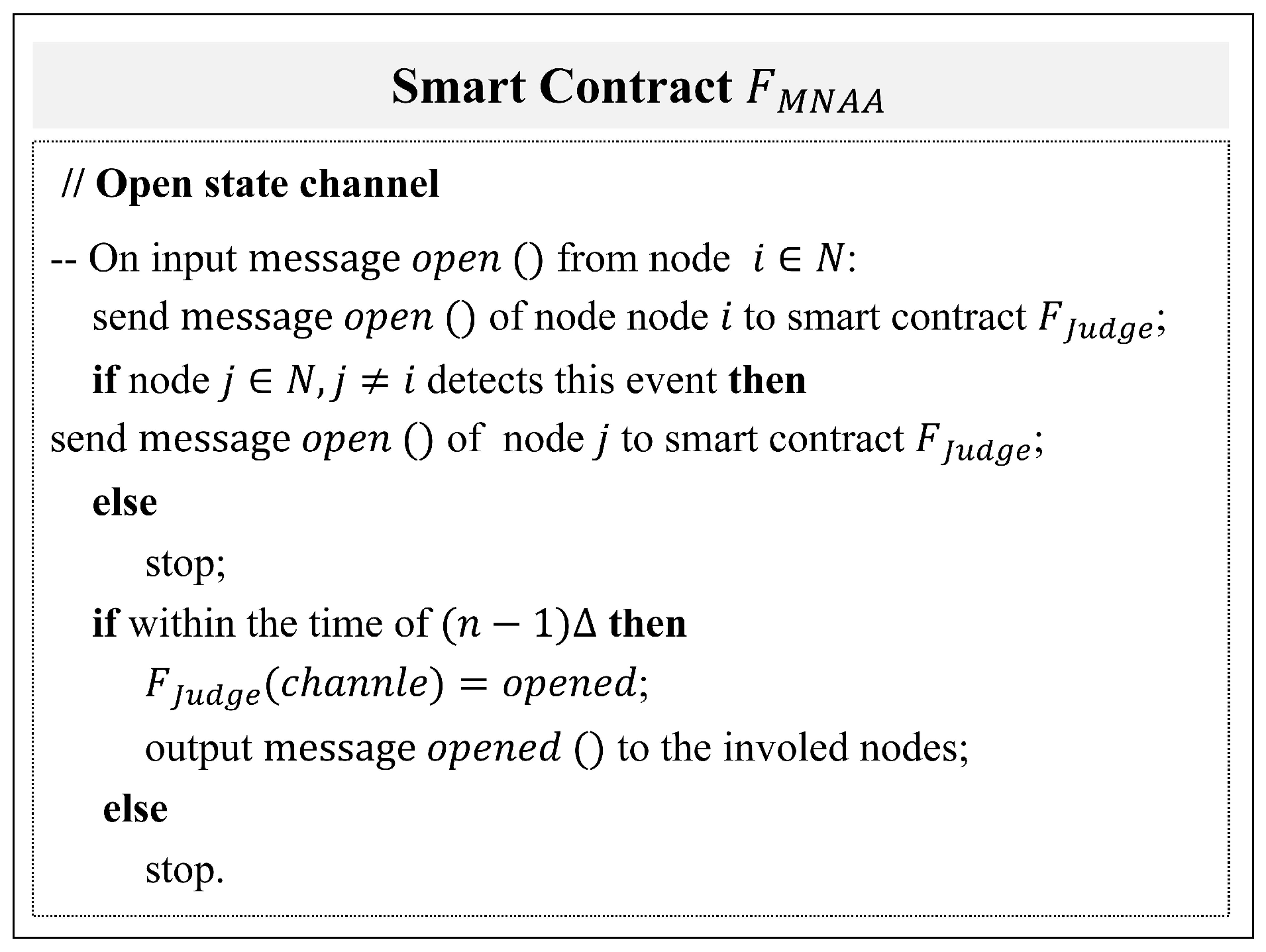
The auction contract F M N A A executes the MNAA mechanism in the off-chain state channel. As illustrated in Figure 8, Figure 9, Figure 10, Figure 11 and Figure 12, contract F M N A A supports five functions: opening the state channel, addressing disputes, allocating and pricing ad slots, revoking transactions, and closing the state channel.
First, as shown in Figure 8, node i N , who wishes to join the current auction, sends a message o p e n ( ) to request the opening of the state channel, and message o p e n ( ) is sent to contract F J u d g e by F M N A A . Since message o p e n ( ) is visible across the entire network, any node j N can detect this event. When node j also wishes to participate in the auction and agrees to open the channel, he/she will send message o p e n ( ) to contract F J u d g e . After waiting for ( n 1 ) Δ time, when contract F J u d g e collects sufficient agreements to open the state channel, the message o p e n e d ( ) is sent to the relevant nodes to confirm that the channel has been opened.
When a node raises a dispute concerning the auction execution outcome, as illustrated in Figure 9, he/she initiates the resolution process by sending a message s t a t e _ s u b m i t ( ) to the contract F M N A A , thereby triggering the dispute-addressing procedure. If the message s t a t e _ s u b m i t ( ) is valid, it is sent to contract F J u d g e by contract F M N A A , and the state variable is set as f l a g = 1 . Upon detecting this event, and if any other nodes also raise disputes, they will send messages s t a t e _ s u b m i t ( ) as well. After waiting for a time period of ( | E | 1 ) Δ , and when the state variable of contract F J u d g e is set to f l a g = 0 , the dispute-addressing process is concluded.
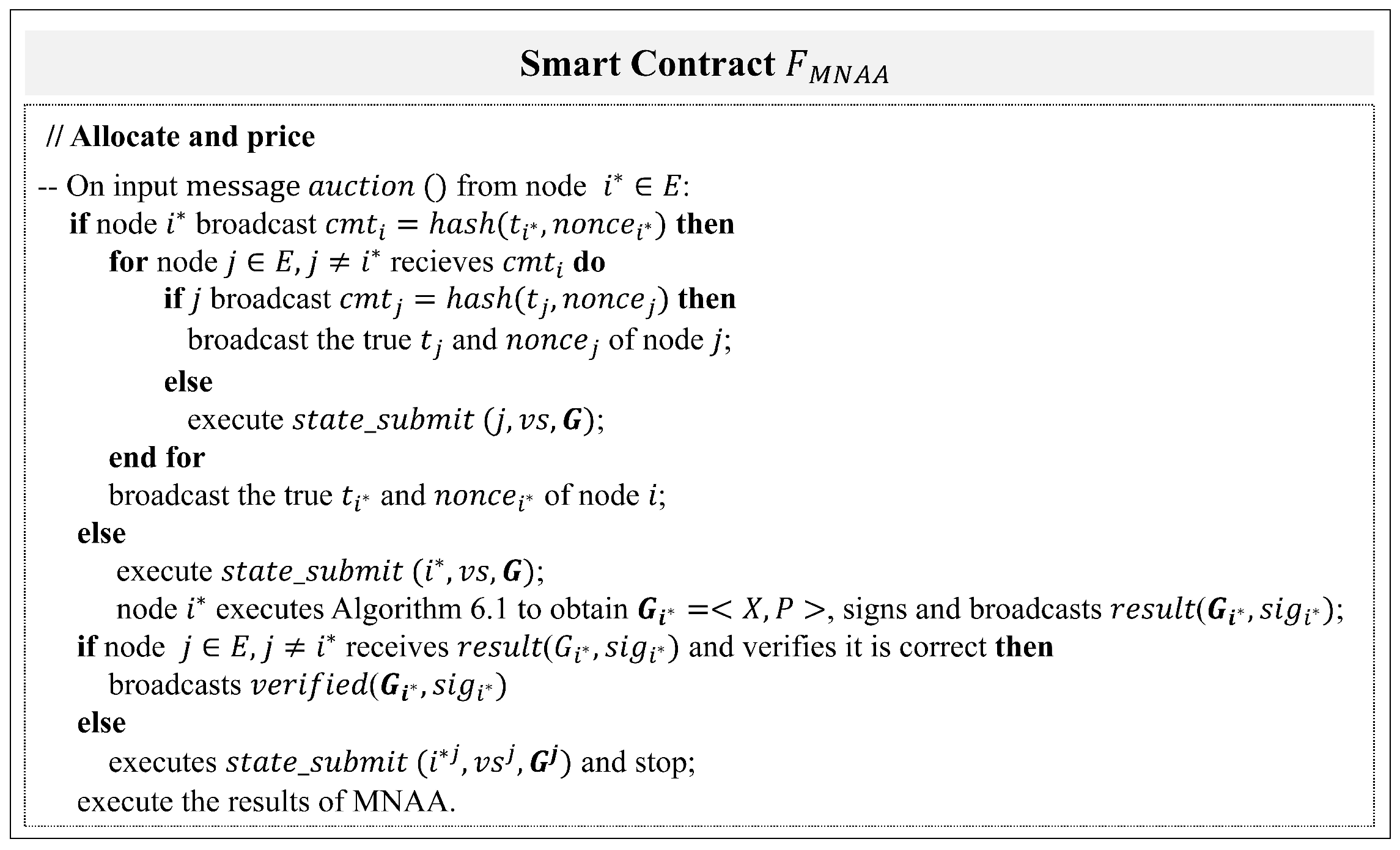
Next, as shown in Figure 10, the system randomly selects node i * to execute the MNAA mechanism (Algorithm 1). Node i * first broadcasts his/her commitment c m t i regarding his/her type t i , and the other nodes that receive this message also broadcast their commitments. Subsequently, both node i and the other nodes broadcast their true data regarding the types and random numbers. If any node refuses to send the data or sends invalid data, the other nodes will send message s t a t e _ s u b m i t ( ) to eliminate that node, causing him/her to lose his/her deposit. Then, node i * executes the MNAA mechanism, obtaining the state G i * of allocation and pricing; i * signs it and broadcasts message r e s u l t ( G i * , s i g i * ) , which is verified by the other nodes. If the verification of message r e s u l t ( G i * , s i g i * ) is correct and valid, the auction result is executed; otherwise, message s t a t e _ s u b m i t ( ) is sent to eliminate node i * .
If any node wishes to exit the auction to avoid losing his/her deposit, as shown in Figure 11, the message c a n c e l ( ) is sent from contract F M N A A to contract F J u d g e to revoke the transaction. After detecting this event, the other nodes will update their local set E to ensure consistency. Finally, as shown in Figure 12, when a node sends message c l o s e ( ) to request the closure of the state channel, contract F M N A A first checks for any ongoing disputes. If there are no disputes, and if other nodes also send message c l o s e ( ) to request closure, the state channel is then closed. After closure, the nodes’ payments are processed on-chain, and the deposits are refunded to the corresponding nodes.

6. Analysis of MNAA Mechanism Properties and Smart Contract Security

6.1. Analysis of MNAA Mechanism Properties

According to Equation (6), when the number of ad slots increases from l 1 to l, where l L , the marginal revenue Δ R p of the publisher is defined as
Δ R p = R p ( l ) R p ( l 1 ) = i = 1 n h ( l ) c i l ( t i ) θ ( t i | l ) + ( h ( l ) h ( l 1 ) ) l = 1 l 1 c i l ( t i ) θ ( t i | l ) .
When the number of ad slots increases from l 1 to l, the value of the ad placed at the original l 1 slot decreases due to the impact of the newly added l-th ad slot. For the newly added l-th ad, if θ ( t i | l ) < 0 , the revenue of the publisher will decrease; otherwise, it will increase.
Lemma 1. 
When the value disutility function h ( l ) is concave, the marginal revenue Δ R p ( l ) of the publisher decreases monotonically, where l L .
Proof. 
By Equation (12), we have that
Δ R p ( l + 1 ) Δ R p ( l ) = i = 1 n ( h ( l + 1 ) c i l + 1 ( t i ) θ ( t i | l + 1 ) h ( l ) c i l ( t i ) θ ( t i | l ) + h ( l + 1 ) h ( l ) ( h ( l ) h ( l 1 ) ) l = 1 l 1 c i l ( t i ) θ ( t i | l ) )
As h ( · ) < 0 and h ( · ) 0 , we can deduce that h ( l + 1 ) h ( l ) < 0 and h ( l + 1 ) h ( l ) < h ( l ) h ( l 1 ) . Considering that the distribution function F i of advertiser i N is regular, we have that θ ( t i | l + 1 ) 0 , θ ( t i | l + 1 ) θ ( t i | l ) , ( h ( l + 1 ) h ( l ) ( h ( l ) h ( l 1 ) ) ) l = 1 l 1 c i l ( t i ) θ ( t i | l ) 0 . As F i is uniformly distributed on [ 0 , v ¯ ] , we can derive that
i = 1 n θ ( t i | l ) = α 0 v ¯ ( 1 F ( b ) ) l 1 F ( b ) n l ( b 1 F ( b ) f ( b ) ) f ( b ) d b = v ¯ n + 1 l n + 1 .
Here, α = n ! ( n l ) ! ( l 1 ) ! . Taking the partial derivative of Equation (14) with respect to l, we obtain that i = 1 n θ ( t i | l ) l < 0 . Thus, we find that i = 1 n θ ( t i | l ) is a monotonically decreasing function of the number of ads l, and i = 1 n θ ( t i | l + 1 ) < i = 1 n θ ( t i | l ) . As c i l + 1 ( t i ) c i l ( t i ) , we can derive that i = 1 n ( h ( l + 1 ) c i l + 1 ( t i ) θ ( t i | l + 1 ) < h ( l ) c i l ( t i ) θ ( t i | l ) . In summary, Δ R p ( l + 1 ) Δ R p ( l ) < 0 , which concludes the proof. □
Proposition 1. 
For l L , if Δ R p ( l + 1 ) < 0 and Δ R p ( l ) 0 , the optimal number of ad slots denoted by l * is unique.
Proof. 
By Lemma 1, we observe that the marginal revenue of the publisher decreases monotonically, indicating the existence of a unique optimal number of ad slots. When Δ R p ( l + 1 ) < 0 and Δ R p ( l ) 0 , it implies that, when the number of ad slots increases from l 1 to l, the publisher’s revenue increases, but, when it further increases from l to l + 1 , the publisher’s revenue decreases. □
Theorem 1. 
The MNAA mechanism is individually rational.
Proof. 
When slot l L is allocated to advertiser i, we analyze two different cases, which are as follows.
1.
p i l = p L R l . This case implies that p m a x l ( c l c l + 1 ) > p l o c l b j L R l c l + 1 . From Equation (11), it shows that b j L R l b l + 1 = p l o , so that p m a x l ( c l c l + 1 ) p l o ( c l c l + 1 ) , and we have p m a x l p l o . Advertiser i’s utility at slot l is u i l = v i c l ( b j L R l c l + 1 + p m a x l ( c l c l + 1 ) . As v i b j L R l , we can observe that u i l 0 .
2.
p i l = p l o . We know that p l o b i v i via Equation (10), and we can derive that u i l 0 .
Combining case 1 and case 2, we conclude that an advertiser’s payment will not exceed his/her value, so the MNAA mechanism is individually rational. □
Proposition 2. 
For advertisers i H R and j H R , i j ; if b i > b j , then we have c π i > c π j .
Proof. 
According to the allocation rule of the MNAA mechanism (Line 30 in Algorithm 1), for advertiser i N with r o i i r o i * , a higher bid will result in a slot with a higher CTR—that is, if b i > b j , then we have c π i > c π j . □
To prove the incentive-compatible property of the MNAA mechanism, it is necessary to analyze the changes in the marginal payment for advertiser i N when moving from slot l L to slot l ¯ L with a higher CTR. The marginal payment [8] is defined as
Δ ( p i l , p i l ¯ ) = p i l ¯ c i l ¯ p i l c i l c i l ¯ c i l , c i l ¯ > c i l .
Lemma 2. 
If ad slot l is allocated to advertiser i N , we have Δ ( p i l , p i l ¯ ) b i .
Proof. 
Let the payment of advertiser i for slot l be p i l and that for slot l ¯ be p i l ¯ . By Theorem 1, we have that b i c l p i l c l , b i c l ¯ p i l ¯ c l ¯ . By Equation (10), when p i l = p l o , the partial derivative of the payment p i l with respect to CTR c l is p i l c l c l = b l + 1 0 ; moreover, when p i l = p L R l , the partial derivative of the payment p i l with respect to CTR c l is p i l c l c l = b j L R l + p m a x l 0 . So, the payment p i l is a monotonically increasing function of CTR c l . From this, we can infer that b i c i l ¯ b i c i l p i l ¯ c i l ¯ p i l c i l 0 , so that Δ ( p i l , p i l ¯ ) b i . □
Proposition 3. 
For advertisers i , j L R , i j ; if b i > b j , then we have c π i > c π j .
Proof. 
For i L R , we assume that c π j > c π i and u j π j 0 ; when b i > b j , advertiser j, who bids lower, obtains a slot with a higher CTR π j , indicating that j would choose the slot π j when facing the same bid and slot prices, while an advertiser i who bids higher would choose the slot π i .
Let π j ¯ denote the slot with a higher CTR, such that c π j ¯ > c π j > c π i . By Lemma 2, when advertiser j switches from slot π i to slot π j ¯ , the marginal payment is Δ ( p j π i , p j π j ¯ ) b j , resulting in a payment for slot π j ¯ that is p j π j ¯ p j π i + b j v j . Consequently, advertiser j will experience non-positive utility u i π j ¯ 0 , leading to a contradiction. □
Theorem 2. 
The MNAA mechanism is incentive-compatible.
Proof. 
Assuming that all advertisers report their types truthfully, let i ¯ N and i ̲ N represent the closest preceding and succeeding advertisers to i, respectively. Correspondingly, advertiser i obtains ad slot π i with v i and pays p i π i ; advertiser i ¯ obtains ad slot π i ¯ with v i ¯ and pays p i ¯ π i ¯ ; advertiser i ̲ obtains ad slot π i ̲ with v i ̲ and pays p i ̲ π i ̲ , where v i ̲ v i v i ¯ . Let u i π i ( t i , t i ) 0 be the utility of advertiser i when reporting t i honestly. When advertiser i misreports t i ^ , it may alter the ad slot allocation results. Let the new ad slot be denoted as π i , and we discuss the following four cases.
1.
When π i ̲ π i π i ¯ , it implies that misreporting by i has not changed the ad slot, i.e., π i = π i . In this case, if the ad slot allocation results for other advertisers remain unchanged, the payment p i π i ( t i ^ ) = p i π i ( t i ) remains the same for advertiser i. For advertiser i H R , the utility u i π i ( t i ^ , t i ) = v i x i π i = u i π i ( t i , t i ) , and, for i L R , the utility u i π i ( t i ^ , t i ) = ( v i p i π i ) x i π i = u i π i ( t i , t i ) , indicating that the utility of advertiser i through misreporting cannot be improved.
2.
When π i > π i ¯ , it indicates that advertiser i, by misreporting t i ^ , has obtained an ad slot π i with a higher CTR. By Lemma 2, we know that advertiser i pays an increased amount for ad slot π i , denoted as p i π i = p i π i ¯ + Δ ( p i π i ¯ , p i π i ) p i π i ¯ + b i ¯ . For advertiser i H R , his/her utility u i π i ( t i ^ , t i ) = v i x i π i v i x i π i = u i π i ( t i , t i ) . However, in this case, advertiser i would pay more for ad slot π i than his/her value, i.e., the maximum willing-to-pay value, resulting in negative utility: v i p i π i v i p i π i ¯ b i ¯ v i p i π i ¯ v i ¯ 0 . This violates individual rationality as stated in Theorem 1. Therefore, advertiser i would not choose to misreport to obtain slot π i . Similarly, for advertiser i L R , his/her utility u i π i ( t i ^ , t i ) = ( v i p i π i ) x i π i ( v i p i π i ¯ v i ¯ ) x i π i 0 u i π i ( t i , t i ) , indicating that i would prefer to report truthfully to obtain ad slot π i .
3.
When π i < π i ̲ , it means that advertiser i, by misreporting t i ^ , has obtained an ad slot π i with a lower CTR. For advertiser i H R , his/her utility is u i π i ( t i ^ , t i ) = v i x i π i v i x i π i = u i π i ( t i , t i ) . Advertiser i, when faced with ad slots π i and π i , would prefer to choose the one with higher utility, which is π i . For advertiser i L R , his/her utility is u i π i ( t i ^ , t i ) = ( v i p i π i ) x i π i . By Lemma 2, we know that ( v i p i π i ) x i π i ( v i p i π i ) x i π i . This implies that u i π i ( t i ^ , t i ) u i π i ( t i , t i ) , so advertiser i would prefer to report truthfully to obtain ad slot π i .
4.
When advertiser i’s misreporting does not result in obtaining any slot, the utility of i is u i ( t i ^ , t i ) = 0 u i π i ( t i , t i ) . In this case, i cannot achieve better utility through misreporting.
Therefore, the MNAA mechanism is incentive-compatible. □
Theorem 2 demonstrates that the MNAA mechanism removes the incentive for nodes to misreport. It incentivizes nodes to truthfully submit their valuations and corresponding ROI rates to the blockchain-based auction system, thereby ensuring the authenticity and reliability of external data input into the system.

6.2. Analysis of MNAA Smart Contracts

6.2.1. Security Analysis

Our MNAA smart contracts satisfy several critical security properties, including input independence, verifiability, robustness, non-repudiation, and liveness, as analyzed below.
1.
Input Independence: Firstly, due to the incentive compatibility of the MNAA mechanism, participating nodes are motivated to submit truthful types t. Secondly, each node must broadcast a commitment c m t to his/her type t during the commitment phase. Moreover, c m t is generated using the cryptographic hash function, which ensures that other nodes cannot infer the underlying bid b or ROI rate r o i before the verification phase. Therefore, the MNAA smart contracts guarantee input independence.
2.
Verifiability: During auction execution, if any node disputes the results submitted by another, he/she can issue message s t a t e _ s u b m i t ( ) to invoke the smart contract F J u d g e . This contract verifies both the signature and the correctness of the auction results. Hence, the MNAA smart contracts ensure verifiability.
3.
Robustness: By broadcasting message s t a t e _ s u b m i t ( ) , malicious node can be excluded from the auction by other nodes and consequently forfeit his/her deposit. Any node that wishes to withdraw from the auction may send the message c a n c l e ( ) , upon which the system refunds his/her deposit and continues the auction among the remaining nodes. Therefore, the MNAA smart contracts satisfy the robustness property.
4.
Non-repudiation: Since the smart contract F J u d g e records the most recent types reported by all participating nodes, and the blockchain ensures tamper resistance by design, the on-chain data cannot be easily altered or deleted. Therefore, the MNAA smart contracts satisfy the non-repudiation property.
5.
Liveness: The MNAA smart contracts can be invoked by honest nodes upon a timeout to resume the auction process, thereby preventing malicious nodes from deliberately delaying execution. When all participating nodes behave honestly, the computational complexity of the auction remains constant at O ( 1 ) . Meanwhile, in the presence of malicious nodes, the worst-case computational complexity is bounded by O ( Δ ) , where time Δ indicates that all operations can be completed within a predictable and finite time frame. Thus, the MNAA smart contracts satisfy the liveness property.
To further illustrate the security of the MNAA smart contracts, we employ the universal composability (UC) security framework to analyze the security. The UC security model characterizes security via computational indistinguishability: as long as the real execution of the smart contracts cannot be distinguished by any environment from executions under a simulator (which may include adversarial faults), the smart contracts can be considered secure. Let R e s u l t ( F , i , E ) denote the results of interactions between an environment E, a participant i N , and all parties executing the smart contract F.
Definition 5 
(UC Security [31]). The smart contract is said to be UC-secure if, for any participant i N , there exists a simulator S such that, for any environment E, R e s u l t ( F , i , E ) and R e s u l t ( F , S , E ) are computationally indistinguishable.
Proposition 4. 
The MNAA smart contracts are UC-secure.
Proof. 
The core of UC security analysis lies in ensuring that, within the same execution round, the environment E receives exactly the same messages from both the ( F J u d g e , F B C ) model and the simulator S . Furthermore, in any round, the messages exchanged among entities and the internal states of all parties are identical between the ( F J u d g e , F B C ) model and S . The key idea of the proof strategy is to construct a simulator S that handles faulty participants and, during its interaction with F M N A A , emulates the ( F J u d g e , F B C ) model. Accordingly, S maintains an internal copy of the ( F J u d g e , F B C ) model. It is further assumed that, whenever the smart contract F M N A A receives a message from a participant, the simulator S also receives the same message. For the sake of simplicity, these operations are omitted in the description of S . As S runs a local instance of ( F J u d g e , F B C ) , it can access messages sent by faulty parties within the model, as well as messages sent by honest participant i to F J u d g e . Consequently, S can ensure that F M N A A updates its ledger in the same manner as in the ( F J u d g e , F B C ) model. Under the assumptions provided in Section 5.1, and assuming that participant i issues a request via process P r o i , the analysis proceeds as follows.
For opening the state channel:
  • If P r o i is corrupted, after P r o i sends message o p e n ( ) to F J u d g e , the simulator S waits for Δ rounds. Then, P r o i sends o p e n ( ) to F M N A A to ensure that F M N A A receives the message in the same round as F J u d g e , followed by a wait period of 1 + ( n 1 ) Δ rounds. If the state channel in F M N A A shows c h a n n e l = o p e n e d , this indicates that P r o i has sent message o p e n ( ) to E.
  • If P r o j , j i N is corrupted, P r o i sends message o p e n ( ) to F M N A A , and S waits for Δ rounds. Process P r o j sends o p e n ( ) to F J u d g e , after which S sends o p e n ( ) to F M N A A and waits for ( n 1 ) Δ rounds. If the state channel in F M N A A shows c h a n n e l = o p e n e d , this indicates that P r o j has sent o p e n ( ) to E.
In the above cases, whenever the state channel shows c h a n n e l = o p e n e d , either P r o i or P r o j sends o p e n ( ) to E. Accordingly, S also sends o p e n ( ) to E in the same round. Therefore, it follows that, in both the ( F J u d g e , F B C ) model and the simulator S , the environment E receives identical messages in the same rounds.
For closing the state channel:
  • If P r o i is corrupted, when P r o i sends message c l o s e ( ) to F J u d g e , if the dispute-handling flag f l a g = 1 in F M N A A , then S waits for Δ rounds. Subsequently, P r o i sends c l o s e ( ) to F M N A A to ensure that F J u d g e receives c l o s e ( ) in the same round. S then waits for ( 1 + ( n 1 ) ) Δ rounds. If f l a g = 0 in F M N A A , then P r o i sends c l o s e ( ) to E.
  • If P r o j , j i N is corrupted, when P r o i sends message c l o s e ( ) to F M N A A , S waits for Δ rounds. If P r o j sends c l o s e ( ) to F J u d g e , then S sends c l o s e ( ) to F M N A A and waits for ( n 2 ) Δ rounds. If f l a g = 0 in F M N A A , then P r o j sends c l o s e ( ) to E.
In the process of closing the state channel, the environment E receives messages in the same rounds in a completely consistent manner.
For canceling a transaction:
  • If P r o i is corrupted, P r o i sends message c a n c l e ( ) to F J u d g e , and S waits for Δ rounds. P r o i then sends c a n c l e ( ) to F M N A A to ensure that F J u d g e receives the same message c a n c l e ( ) in the same round.
  • If P r o j , j i N is corrupted, P r o i sends c a n c l e ( ) to F M N A A . If P r o j updates its local state, the simulator S also updates its local state accordingly.
In both cases, the simulator S ensures that the messages exchanged among entities are fully consistent with those in the ( F J u d g e , F B C ) model. Consequently, the environment E receives messages in the same rounds in a completely consistent manner.
In summary, the MNAA smart contracts F realize the ideal smart contract F M N A A in the hybrid model ( F J u d g e , F B C ) , so that the MNAA smart contracts are UC-secure. □

6.2.2. Worst-Case Analysis of On-Chain Disputes

The MNAA smart contracts offload the core auction process to off-chain state channels, which reduces on-chain transactions and gas consumption. However, the on-chain F J u d g e contract is still responsible for dispute resolution, deposit management, and channel closure. In the worst-case scenario, a large number of nodes simultaneously triggering on-chain disputes could place substantial demands on system resources.
Let n denote the number of participating nodes and m be the number of ad slots. If each node submits dispute message s t a t e _ s u b m i t ( ) for every other node on-chain, the maximum number of on-chain transactions T m a x can be expressed as
T m a x = n × ( n 1 ) .
In other words, each node submits disputes for the other n 1 nodes. Assuming that each on-chain transaction consumes an average of G t x gas, the total gas consumption in the worst case is
G m a x = T m a x × G t x = n ( n 1 ) G t x .
Given a block gas limit G b l o c k , the minimum number of blocks required to process all disputes is
B m i n = G m a x G b l o c k .
Assuming a block generation time of Δ b l o c k , the maximum on-chain dispute resolution delay is
Δ m a x = B m i n × Δ b l o c k = n ( n 1 ) G t x G b l o c k × Δ b l o c k .
For instance, if there are n = 100 nodes, and each on-chain transaction consumes G t x = 30,000 gas, the block gas limit is G b l o c k = 30,000,000 gas, and the block time is Δ b l o c k = 15 s, then we have T m a x = 9900 , G m a x = 297,000,000 gas, B m i n = 10 blocks, and Δ m a x 2.5 min.
The worst-case scenario, in which all nodes simultaneously submit disputes, represents a highly unlikely extreme. In practice, the MNAA mechanism is designed such that the auction rules incentivize the majority of nodes to behave honestly, as theoretically demonstrated, thereby preventing the occurrence of large-scale malicious disputes. Furthermore, the core auction process of the MNAA mechanism is executed off-chain within state channels, so that the vast majority of operations do not require on-chain transactions. Consequently, even in the worst-case scenario, the impact on the overall auction efficiency and system responsiveness remains acceptable.

6.2.3. Rationale and Practical Feasibility of the MNAA Smart Contract Design

The set of MNAA smart contracts is designed to offload the digital advertising auction process to off-chain state channels. In the theoretical analysis, it is assumed that all node accounts have sufficient funds to pay deposits, off-chain message transmission delays do not exceed δ , and on-chain state updates can be completed within Δ time. In practice, these assumptions are reasonable, because node deposits can be enforced through minimum deposit requirements, ensuring the effectiveness of economic incentives; point-to-point networks within state channels can control off-chain communication delays, and, combined with timeout mechanisms and batched on-chain settlements, transaction finality is guaranteed; and the random selection of a node to execute the MNAA mechanism can be implemented using off-chain or on-chain randomness, preventing collusion and manipulation. In practical deployment, the MNAA mechanism ensures the truthfulness and non-repudiation of multiparameter auctions while reducing on-chain gas consumption and transaction latency. The core auction logic is executed off-chain, with on-chain operations triggered only for settlement, transaction cancellation, or dispute resolution. Even in the worst-case scenario, where multiple nodes simultaneously submit disputes, the increase in on-chain transactions and gas consumption can be mitigated through dispute-addressing and economic penalty mechanisms, thereby maintaining system stability. The state channel design further enhances system scalability, allowing the mechanism to sustain low on-chain overhead and predictable latency even as the numbers of nodes and ad slots increase. Moreover, to ensure security and robustness, the MNAA smart contracts employ ECDSA signature verification and dispute resolution mechanisms, preventing malicious nodes from tampering with auction outcomes. When nodes act honestly, off-chain messages can be processed within predictable time frames. This design balances the simplifications of theoretical analysis with practical deployment feasibility, enabling the MNAA mechanism to implement blockchain-based digital advertising auctions that are efficient, scalable, economically rational, and fair, while protecting the utility of advertisers and ad publishers.
It is also important to note that the design of the MNAA auction mechanism assumes rational participants—a standard premise in auction theory and game theory. In real-world digital advertising markets, advertisers and publishers are typically driven by economic incentives, making the rationality assumption a reasonable approximation. By combining the quasi-linear utility model and value maximization model, MNAA can predict node bidding behavior under different auction rules and design incentive-compatible allocation and pricing rules to encourage honest reporting, thereby ensuring the authenticity of data submitted to the blockchain auction system. Although the model assumes rational behavior, occasional deviations may occur in practice. Coupled with the dispute-addressing approach, the impact of such anomalous behaviors can be limited to an acceptable range.

7. Simulation Experiment and Analysis

In this section, we first evaluate the performance of our MNAA mechanism and compare it with the mechanisms of GSP, VCG, and MRP in terms of the LSW, publisher’s revenue, and ad slot allocation efficiency. Subsequently, we build a simulated Ethereum environment to deploy the auction network, where digital advertising auctions are executed via MNAA smart contracts, and we measure the performance in terms of throughput. The simulation results demonstrate that our approach is feasible and effective when operating in the blockchain environment.

7.1. Experimental Setup

The simulation environment is built on Ubuntu 22.04.2 LTS, using Visual Studio Code version 1.77.1, Python 3.11.3, and PyTorch 2.2.0. For setting the CTR for ad slots, we use the A n t M 2 C dataset provided by the Ant Group [32] (https://www.atecup.cn/ods, accessed on 26 February 2026).
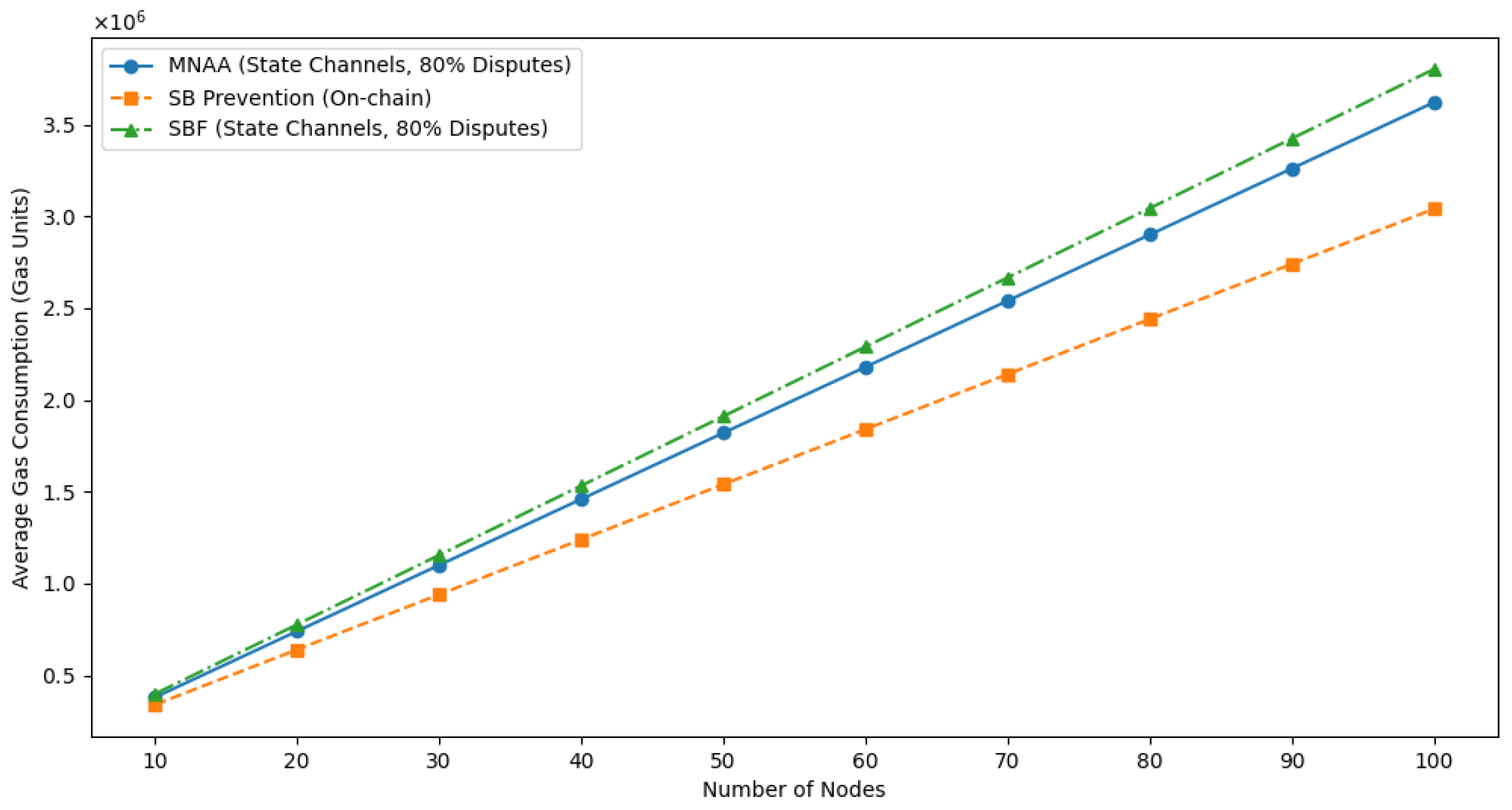
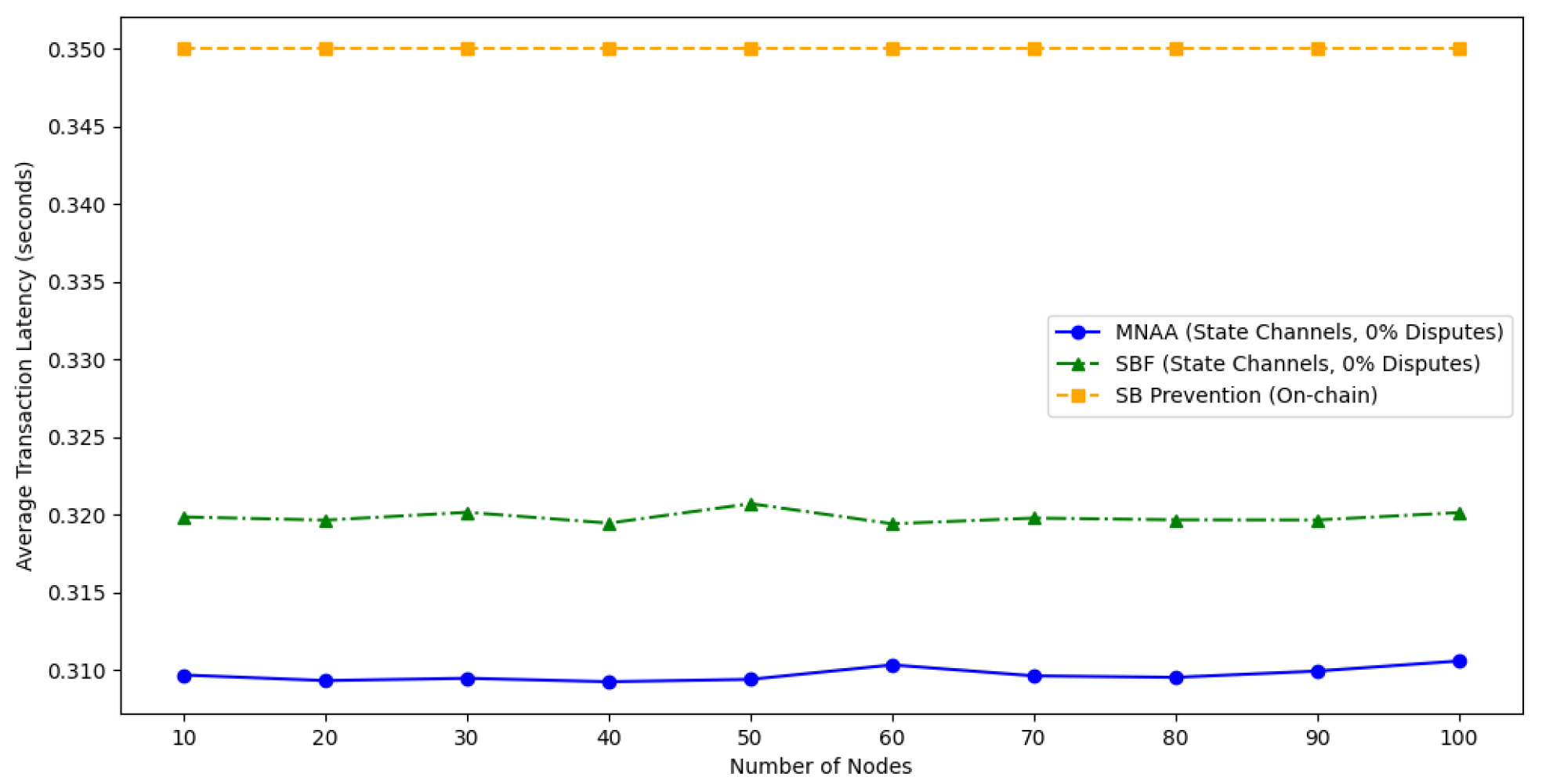
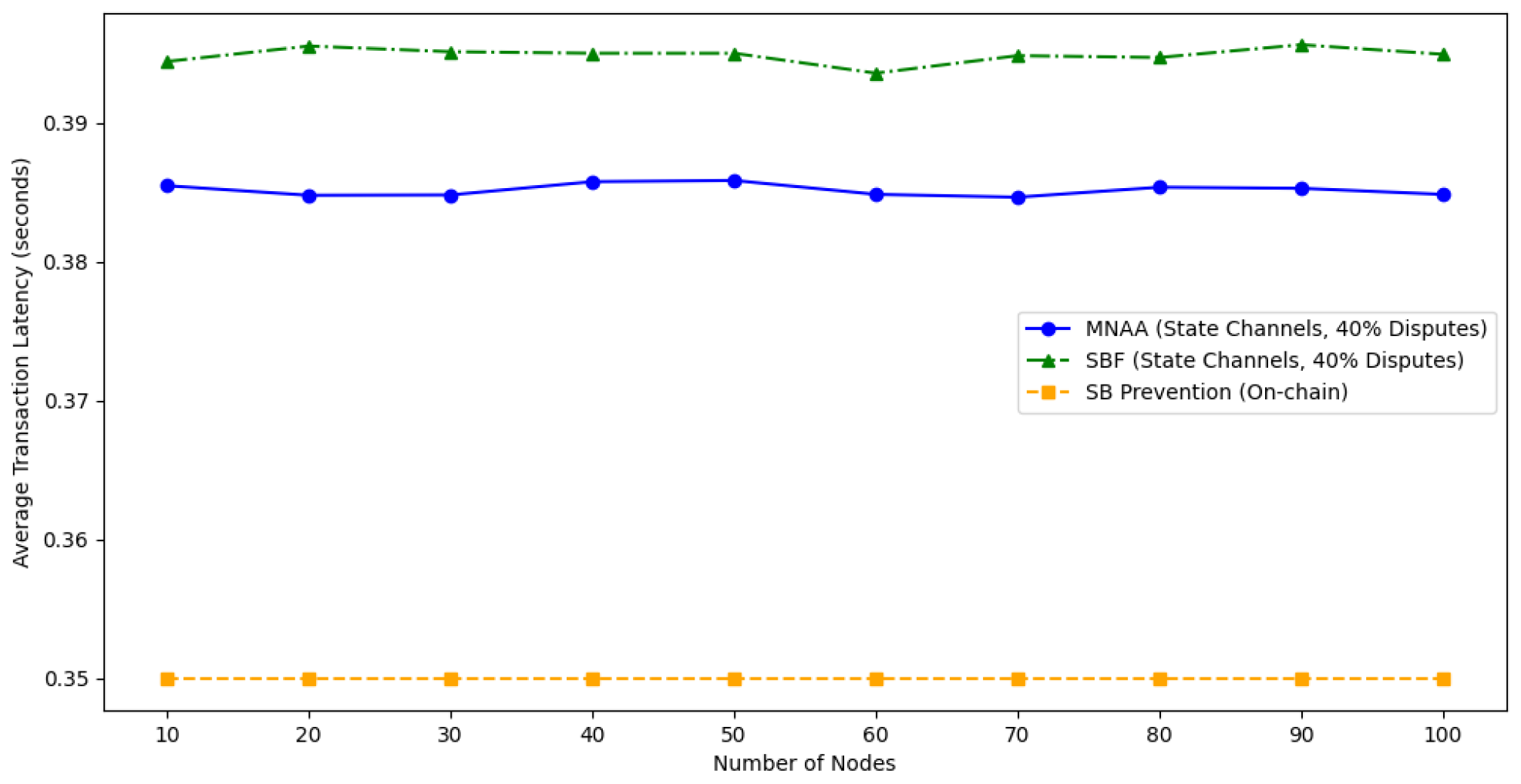
In the simulation experiments, we systematically generated advertiser nodes and ad slots to model auctions in digital advertising markets of varying scale. The number of advertiser nodes ranged from 1 to 1000, increasing in steps of 10, with each node representing a single advertiser; the number of ad slots ranged from 1 to 10; and each experimental run had a fixed number of slots. Each advertiser’s bid was uniformly randomly generated within the interval [ 0 , 10 ] according to his/her true value, ensuring randomness and fairness of bidding. The advertiser’s ROI rate was randomly drawn from the interval ( 0 , 4 ] , with a threshold of r o i * = 2 serving as a reference in the quasi-linear utility model and value maximization model. For each set of parameters, auctions were conducted according to the rules of the MNAA, VCG, GSP, and MPR mechanisms, and key metrics including advertiser payment, publisher revenue, and ad slot allocation efficiency were recorded. In addition, we compared the MNAA scheme with the SB Prevention [27] scheme (which does not employ state channels) and the SBF [29] scheme (which adopts state channels) in terms of gas consumption and transaction latency. To ensure the stability and reproducibility of the results, each parameter configuration was repeated 100 times, and the average values were used for analysis. Other parameter settings used in the experiments are listed in Table 1.
The performance evaluation metrics used to compare MNAA with the GSP, VCG, and MRP mechanisms are defined as follows.
1.
Liquid Social Welfare (LSW): Traditional social welfare is defined as the sum of all advertisers’ utilities and the publisher’s revenue, and it applies only to mechanisms like GSP and VCG. Therefore, we exclude GSP and VCG from the LSW simulation analysis. For advertisers whose r o i exceeds the threshold r o i * , their utility functions exclude payments that offset the publisher’s revenue. Hence, with the assumption that the MNAA mechanism satisfies incentive compatibility, we define LSW as the sum of all advertisers’ willingness to pay under the given ad slot allocation result X [33],
L S W ( X ) = i = 1 n l = 1 m v i l c l x i l
2.
Publisher’s Revenue R ( x ) : We define R ( x ) as the total payment collected from all participating advertisers,
R ( X ) = i = 1 n l = 1 m p i l c l x i l
3.
Allocation Efficiency A ( x ) : We define A ( x ) as the ratio between the winning advertiser i’s bid b i l and the highest bid b m a x l among all candidates competing for the same ad slot l,
A ( X ) = b i l b m a x l

7.2. Experimental Result Analysis

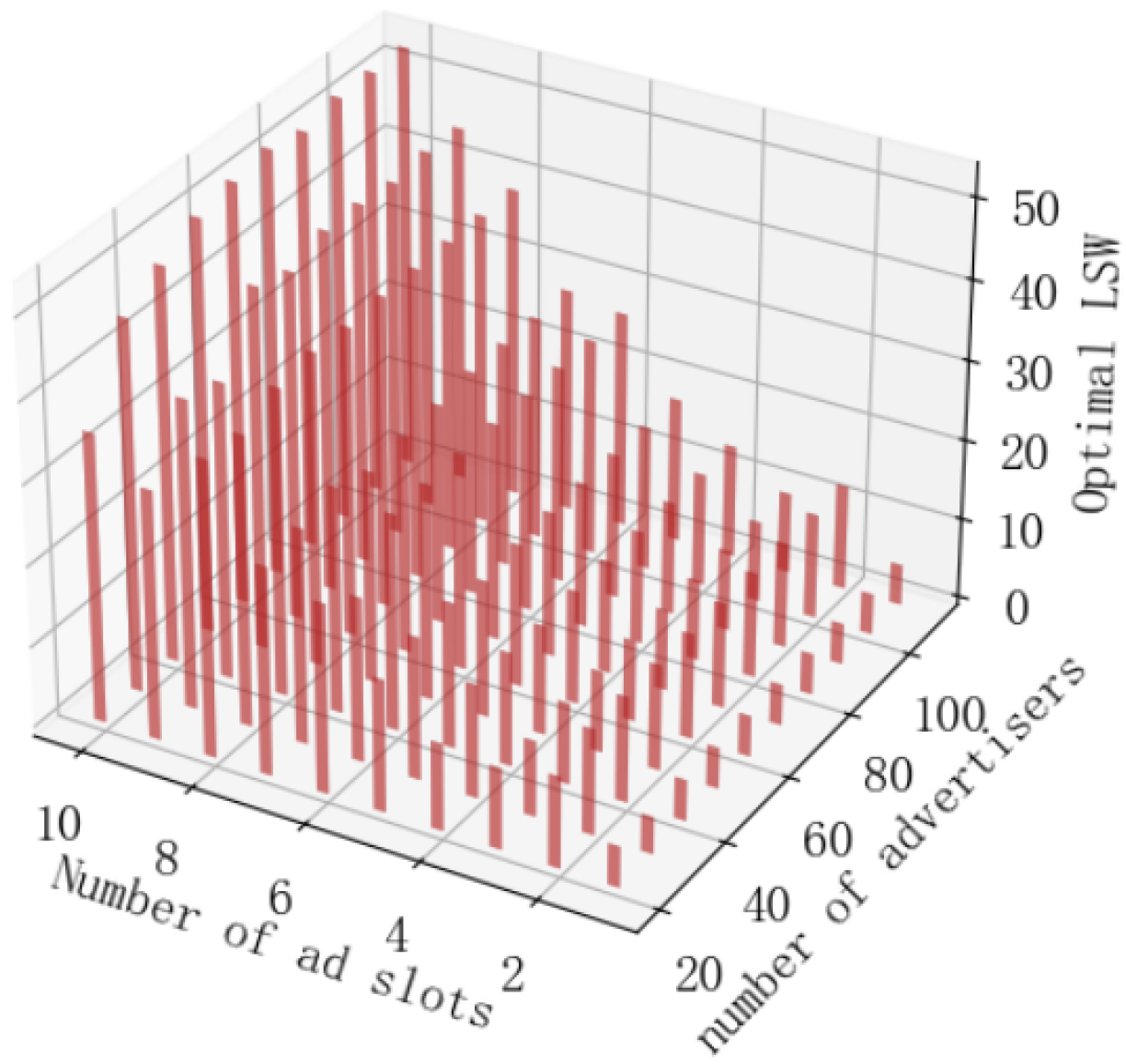
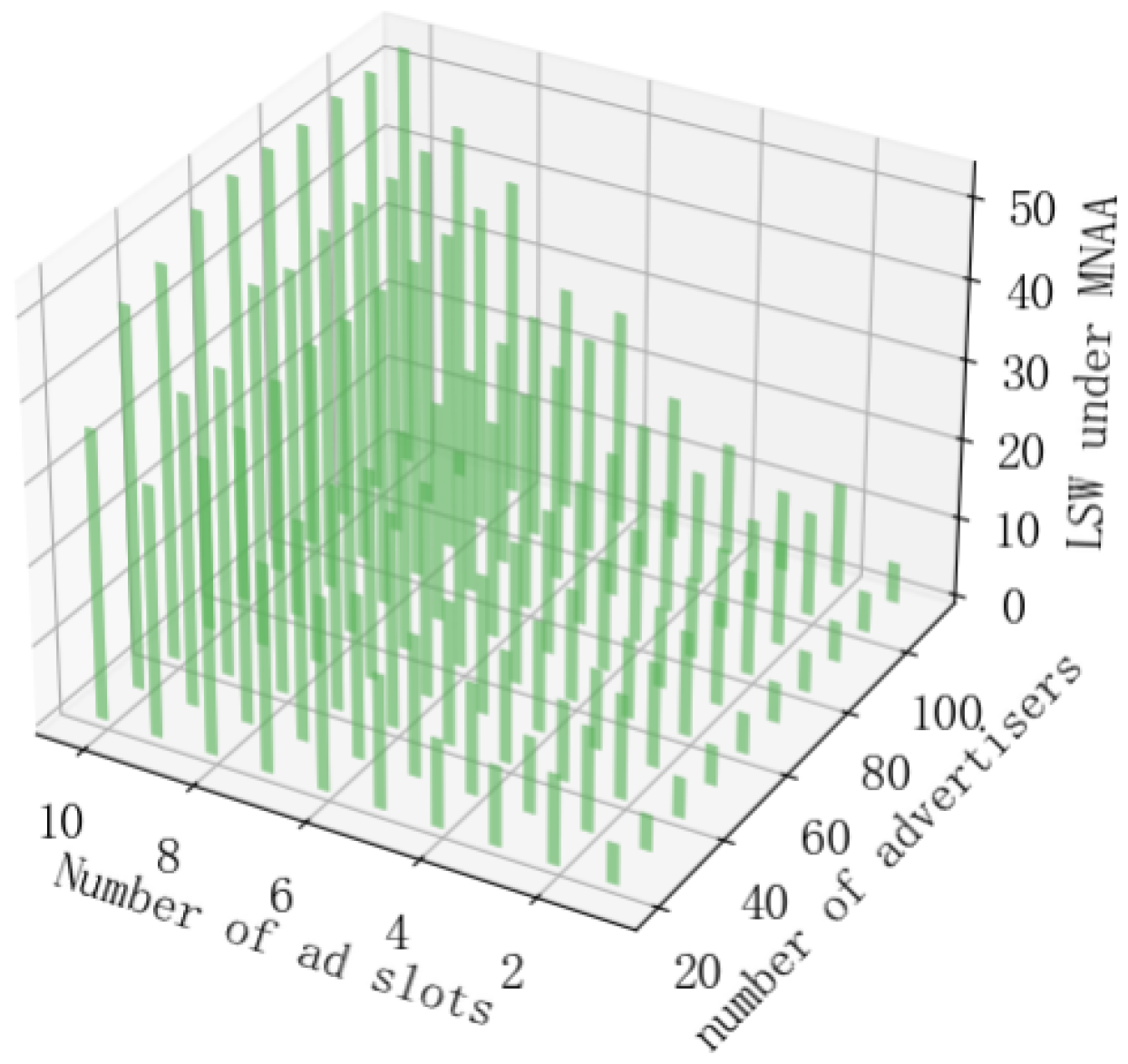
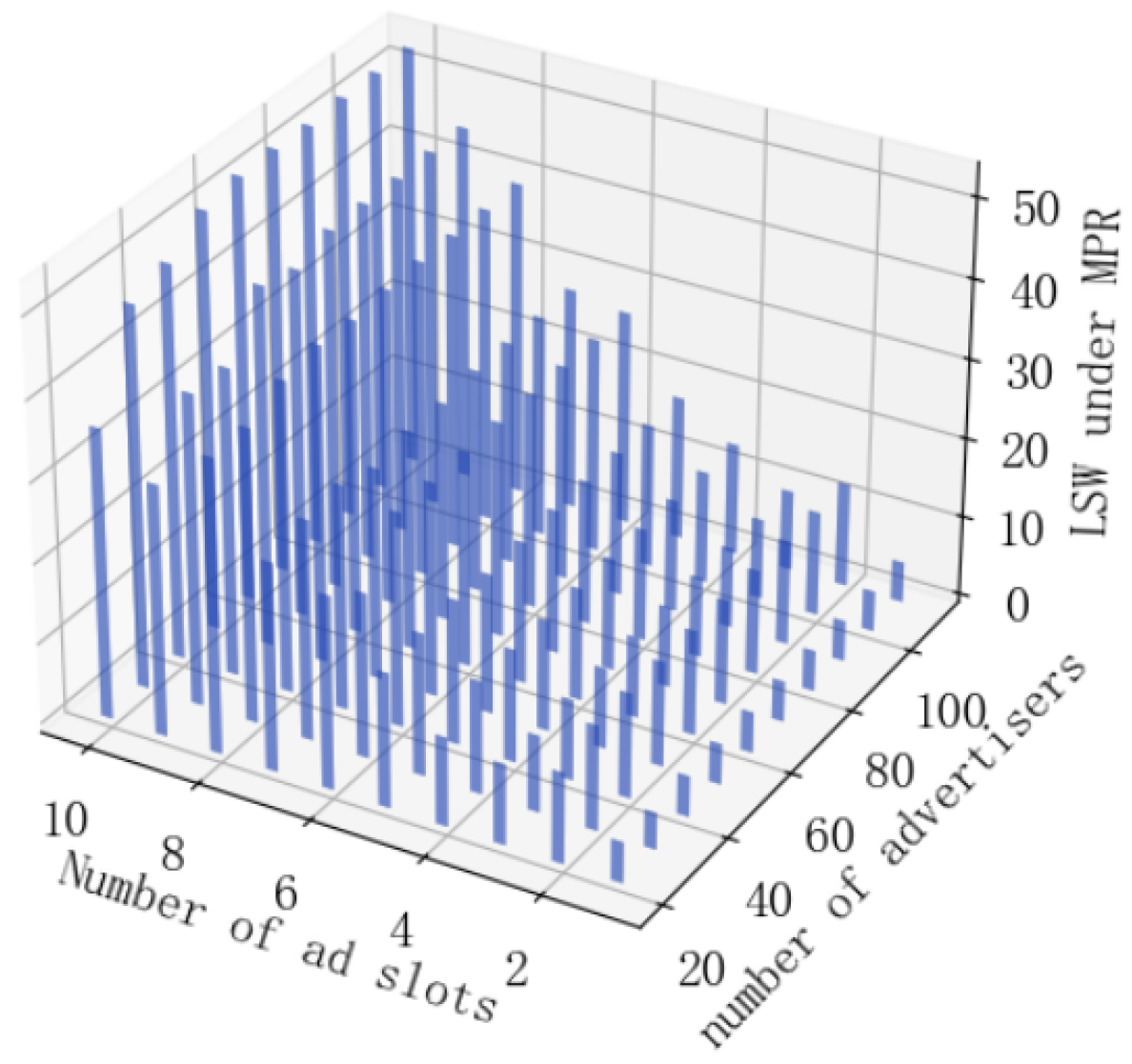
Figure 13, Figure 14 and Figure 15 present the performance comparison between the MNAA and MPR mechanisms in terms of LSW. The advertiser’s value v is assumed to follow a uniform distribution over the interval [ 1 , 10 ] . Figure 13 shows the optimal LSW, which serves as the benchmark for comparison. Overall, the LSW achieved by the MNAA mechanism closely approximates the optimal value and consistently exceeds that of the MPR mechanism. When the number of ad slots is small, the MNAA mechanism yields an LSW value that is nearly equal to the optimal one. However, as the number of ad slots increases, the LSW begins to decline. This decline occurs because the MNAA mechanism allocates ad slots to advertisers with lower ROI rates based on the quasi-linear utility model, rather than using the value-maximizing utility model.
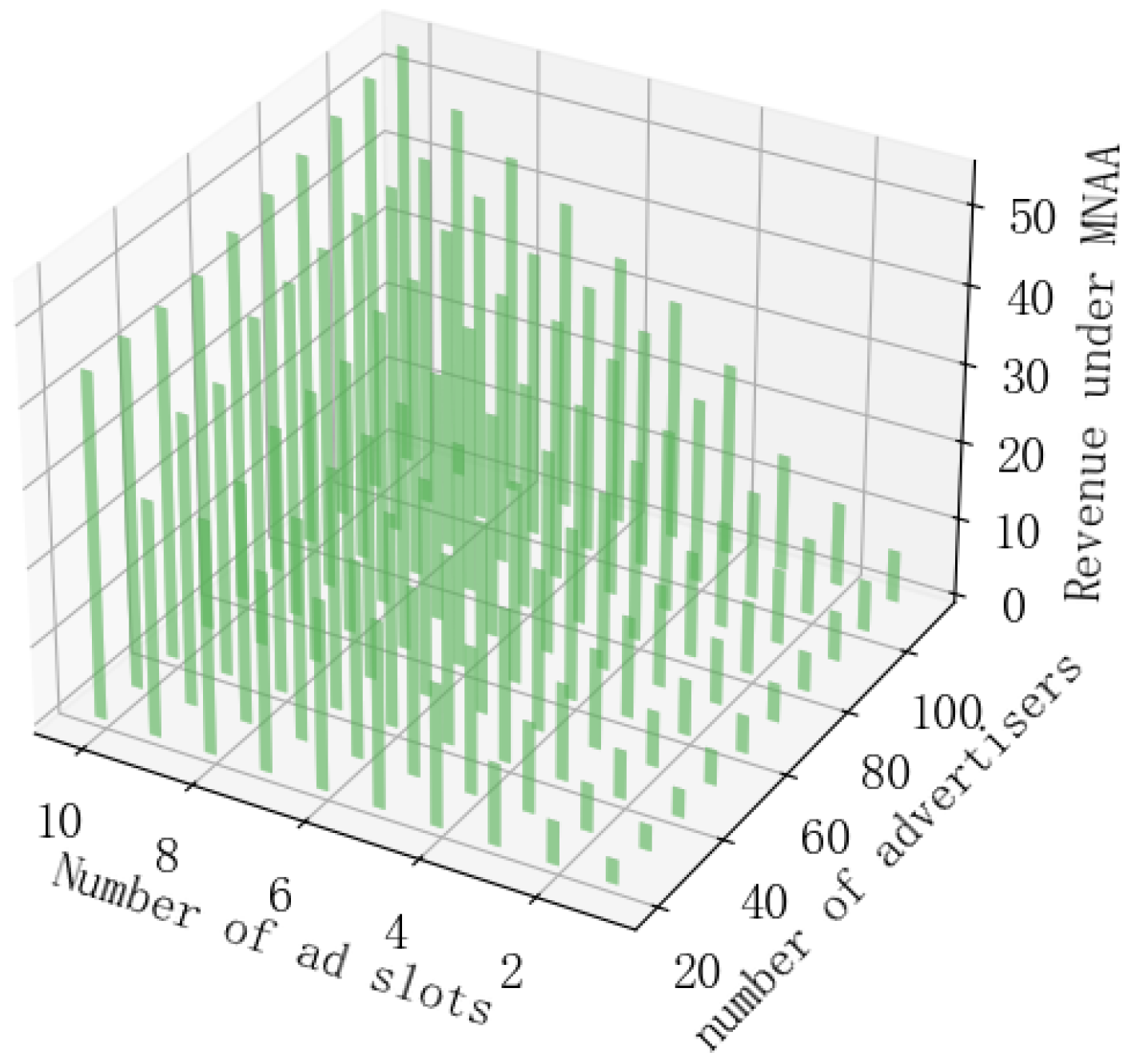
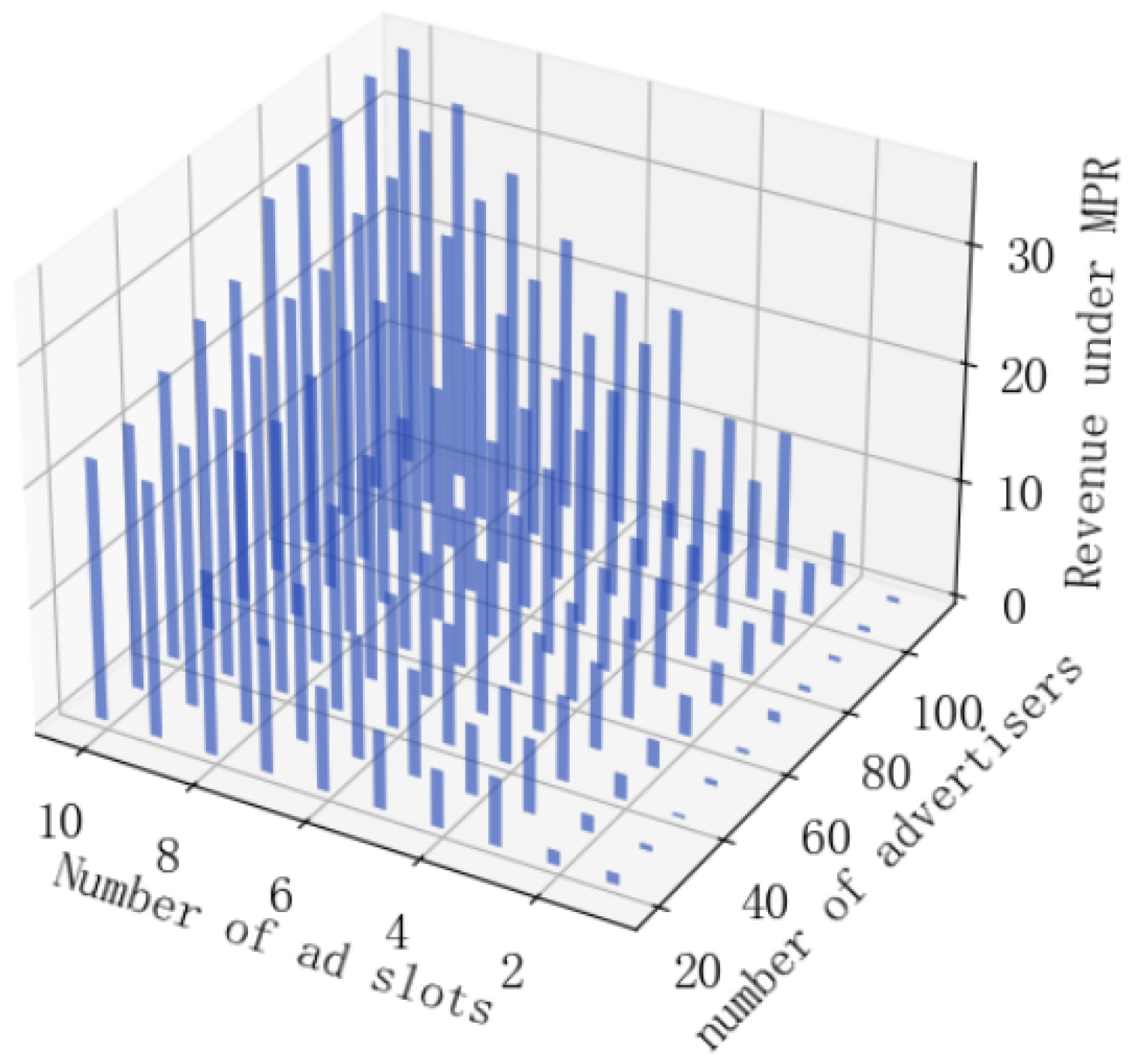
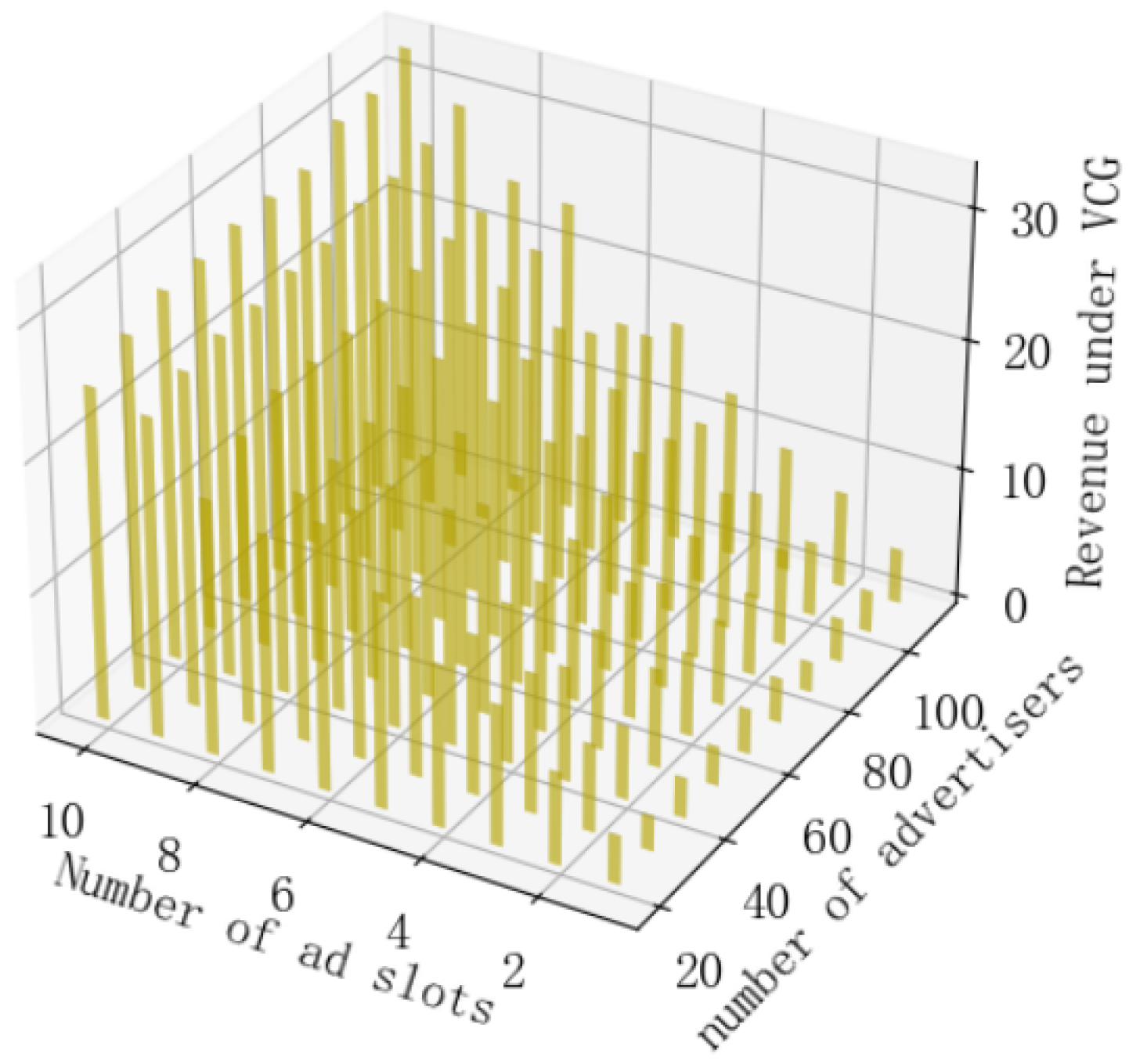
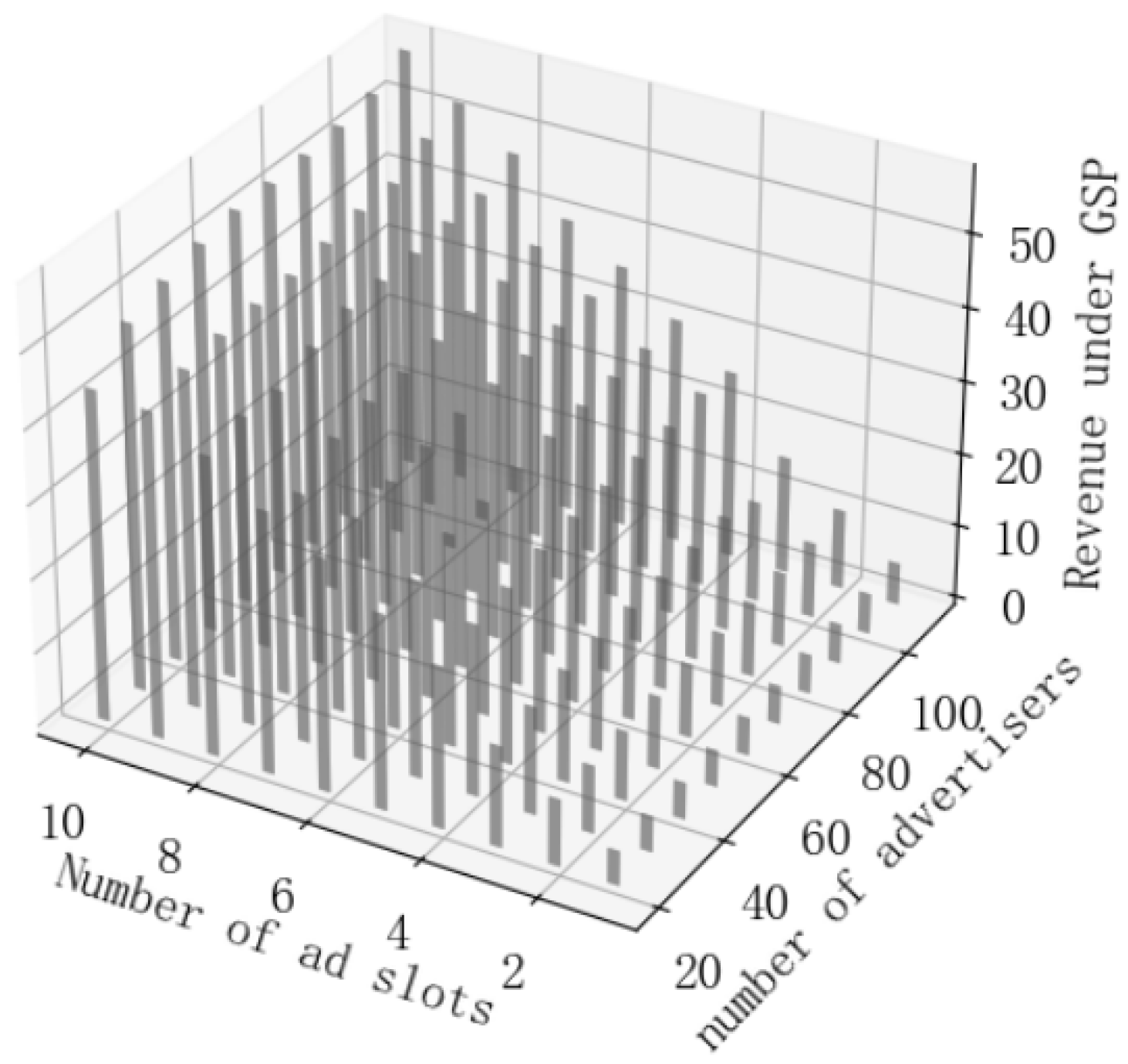
Figure 16, Figure 17, Figure 18 and Figure 19 illustrate the comparison of the publisher’s revenue across different auction mechanisms as the number of ad slots increases from 1 to 10. The GSP mechanism achieves the highest revenue due to its second price payment rule. As the numbers of ad slots and advertisers increase, the revenue under the MNAA mechanism can reach levels comparable to those of GSP. This is because MNAA adopts a GSP-like approach to setting initial prices and incorporates the effect of the second-highest bid in the price update process. In contrast, the VCG mechanism determines payments based on the marginal externalities of other advertisers, which results in lower publisher revenues compared to both GSP and MNAA. Moreover, the publisher’s revenue under MNAA exceeds that of the MPR mechanism. This advantage arises from MNAA’s strategy of initializing ad slot prices based on all advertisers’ bids and dynamically updating the prices according to the actual allocation results. In comparison, the MPR mechanism sets the price of an ad slot to zero when no advertiser bid is available as a reference price. On average, the MNAA mechanism increases the publisher revenue by 35.39% compared to MPR and by 57.22% compared to VCG.
The simulation results for ad slot allocation efficiency are presented in Table 2. In both the GSP and VCG mechanisms, advertiser bids serve as the sole parameter for determining allocation and pricing. Since both mechanisms adopt a highest-bid-wins allocation rule, they achieve the highest level of allocation efficiency. In contrast, the MNAA and MPR mechanisms are multiparameter mechanisms that incorporate additional parameters to ensure truthfulness, which results in a partial trade-off in terms of allocation efficiency. Nevertheless, the MNAA mechanism consistently outperforms the MPR mechanism in terms of allocation efficiency. This is primarily because, during the allocation phase, the MPR mechanism computes and assigns initial prices for only a subset of ad slots, whereas the MNAA mechanism computes and allocates all ad slots based on their initialized prices.
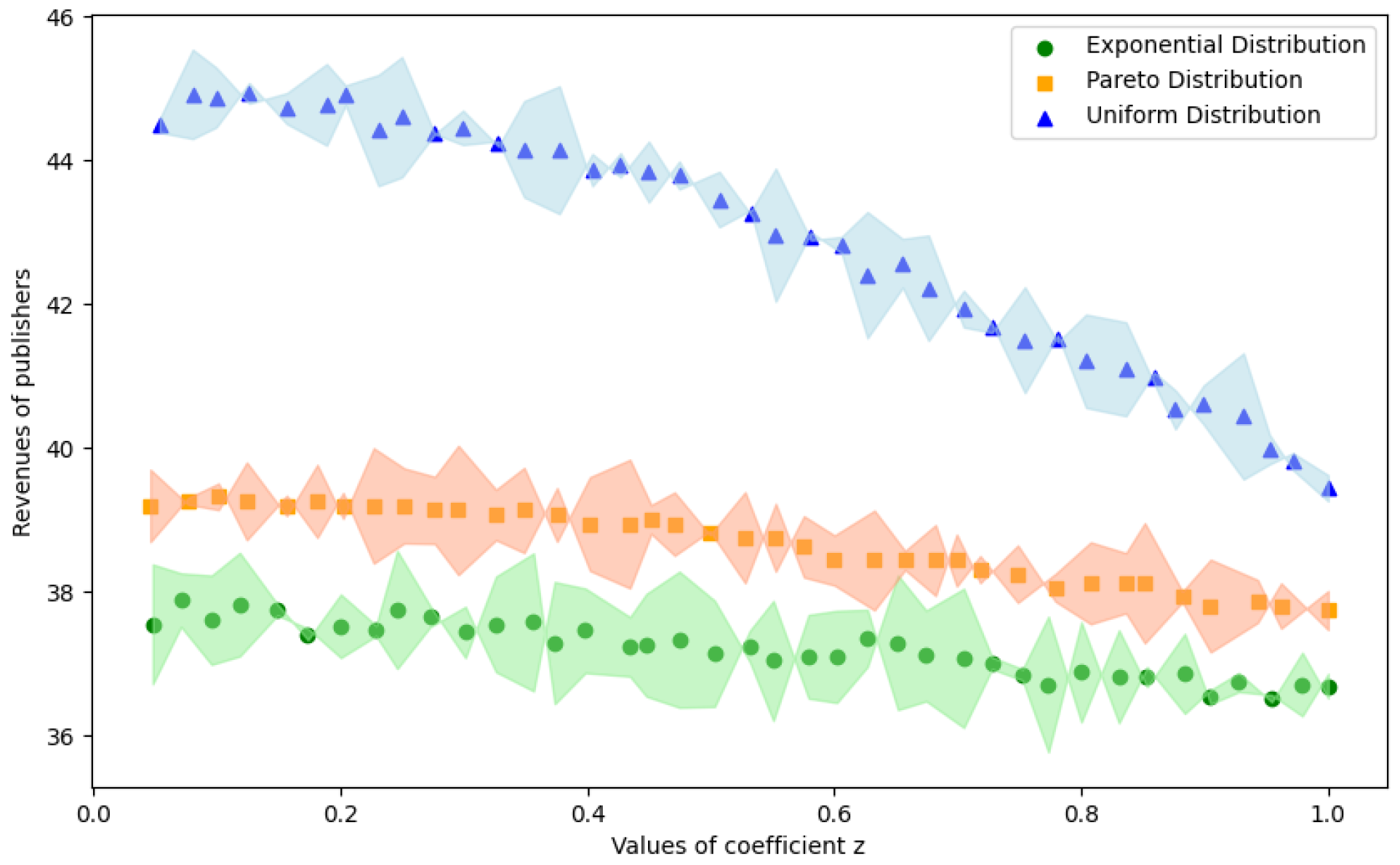
In real-world digital advertising environments, the MNAA mechanism experiences a slight loss in ad slot allocation efficiency in order to ensure the truthfulness of bids in multiparameter auctions. However, as indicated by the results in Figure 16, Figure 17, Figure 18 and Figure 19 and Table 2, MNAA increases the revenue of publishers compared to MPR and VCG. Although the allocation efficiency of MNAA is slightly lower than that of GSP, this does not negatively impact the revenue of publishers. The minor efficiency loss is traded off for truthful bidding by advertisers and higher earnings for publishers, which is generally acceptable from the perspective of publishers. From the perspective of the market and platform, transaction commissions constitute the primary sources of revenue, which are paid by publishers. As publisher revenue is increased under MNAA, the slight loss in allocation efficiency does not reduce the market or platform revenue. Moreover, MNAA helps to mitigate the risk of false bids, contributing to a healthier and more sustainable market environment. Therefore, this minor efficiency loss is also acceptable from the platform perspective.
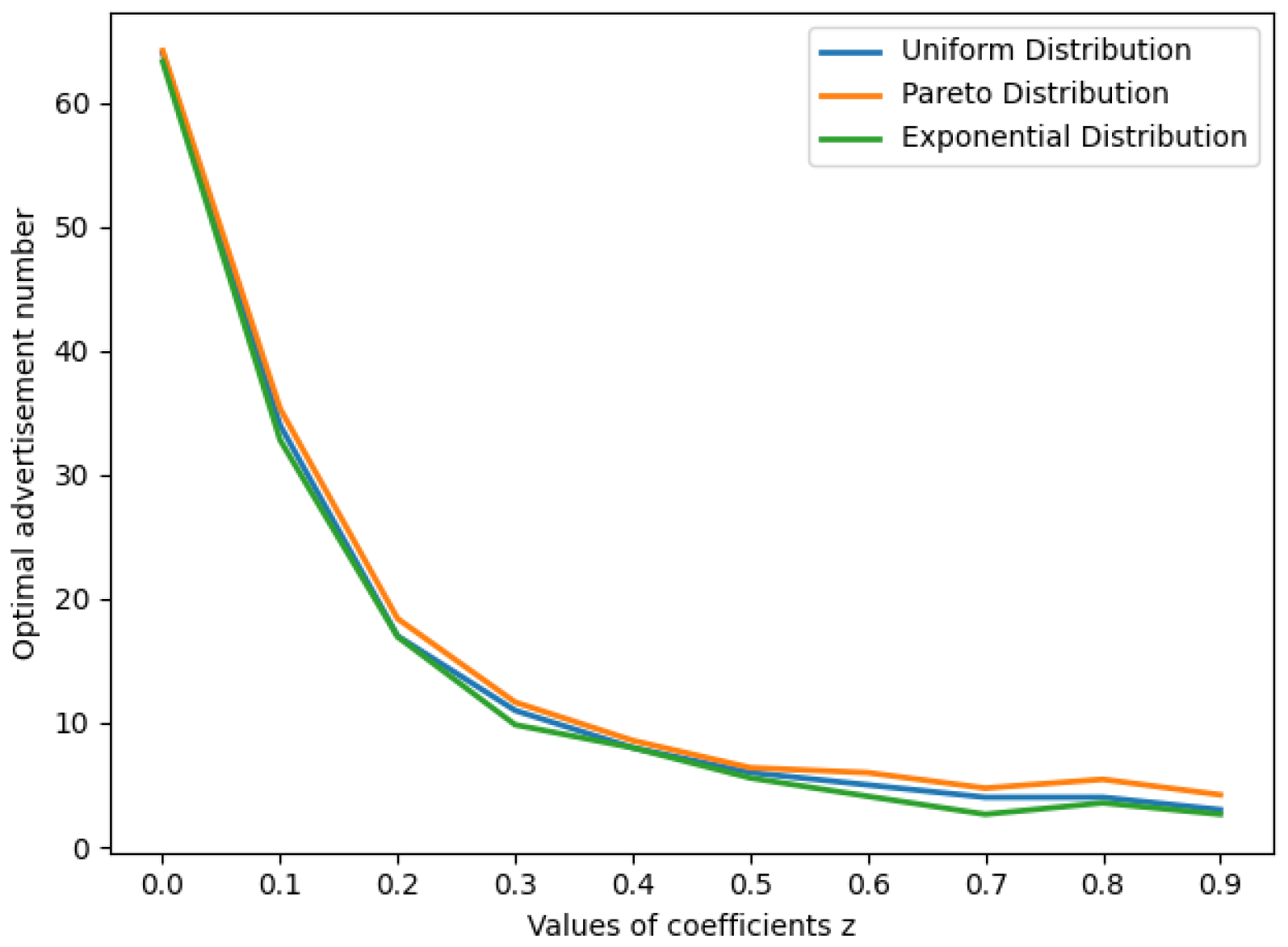
As the coefficient z increases, the negative value utility function h ( l ) for advertisers decreases, leading to a reduction in advertisers’ bids. Consequently, this lowers the revenue of publishers. To mitigate the impact of the negative value utility function, publishers can strategically reduce the number of ad slots. Across all three value distributions, we observe that the optimal number of ad slots decreases as the coefficient z increases (Figure 20). Simultaneously, a reduction in the number of ad slots implies a decrease in the source of revenue for the publisher. Consequently, the revenue of the publisher continuously decreases across all three value distributions (Figure 21), where the shaded area in the figure represents the revenue values for each experiment, while the scattered points indicate the mean revenue.
Figure 22 illustrates the impact of the MNAA smart contracts on the transaction throughput of digital advertising auctions. As the number of advertisers (nodes) increases, the transaction throughput exhibits a declining trend in both scenarios, with and without the MNAA smart contract. This decline results from the communication overhead imposed by the state channel architecture when offloading the auction process off-chain via the MNAA smart contracts. In large-scale participation, this overhead can reduce the throughput. However, compared to executing auctions without the MNAA smart contracts, the MNAA-enabled approach demonstrates a more stable decline in throughput, thereby exhibiting better scalability.
Figure 23, Figure 24 and Figure 25 illustrate the comparison of the gas consumption among the MNAA, SBF [29], and SB Prevention [27] schemes. Similarly to MNAA, the SBF scheme employs state channel technology to migrate the core auction process off-chain, whereas the SB Prevention scheme does not utilize state channels, meaning that all smart contract calls are executed on-chain. Nevertheless, even with off-chain execution, on-chain operations are still required for settlement, transaction cancellation, and dispute resolution, resulting in measurable differences in actual gas consumption. Specifically, in the MNAA mechanism, a node is randomly selected within the state channel to execute the auction logic, with the blockchain recording only the final allocation state, a limited number of disputes, and the closure of the state channel. In contrast, the SBF scheme requires that each settlement or dispute submission triggers an on-chain transaction, including signature verification and state updates. Consequently, as the dispute ratio increases, the number of on-chain operations in SBF slightly exceeds that of MNAA. When the dispute ratio is below 80%, the majority of auction operations in both MNAA and SBF are performed off-chain, with only a small fraction of transactions submitted on-chain. Compared to the fully on-chain SB Prevention scheme, where all bids and settlements are executed on-chain, the number of on-chain transactions and the gas consumption in MNAA and SBF are substantially reduced, demonstrating clear advantages under low-dispute conditions. As the dispute ratio increases further, more nodes submit on-chain dispute transactions, significantly raising the number of on-chain operations in the state channel schemes. When the dispute ratio exceeds 80%, the average gas consumption in MNAA and SBF may surpass that of SB Prevention. Nevertheless, state channel technology maintains clear benefits: even under high-dispute conditions, the core auction process continues to execute off-chain, and only settlement and dispute operations trigger on-chain transactions. Therefore, the overall gas consumption remains lower than that of a fully on-chain auction.
As shown in Figure 26 and Figure 27, when there is no dispute, the MNAA scheme exhibits the lowest transaction latency. This is because, in MNAA, nodes only need to submit the final allocation state on-chain after completing the off-chain computations, resulting in a minimal number of on-chain transactions and avoiding the confirmation delays associated with fully on-chain execution, as in the SB Prevention scheme. Although the SBF scheme also employs state channels, it involves slightly more on-chain settlement operations, which leads to marginally higher latency than in MNAA. When the dispute ratio exceeds 40%, the transaction latency in both MNAA and SBF surpasses that of SB Prevention. This increase is due to a large number of nodes simultaneously triggering on-chain dispute and settlement operations, where the state channel is required to submit these operations to the blockchain for validation, signature verification, and deposit handling, thereby increasing the confirmation time. Nevertheless, the MNAA latency remains lower than that of SBF. This is because MNAA optimizes on-chain settlement and dispute handling within the state channel by, e.g., randomly selecting nodes to execute the auction, reducing unnecessary on-chain interactions, and employing batch settlement strategies, thereby maintaining lower latency than SBF even under high-dispute conditions.

8. Discussion and Limitations

In our study, the proposed MNAA mechanism and smart contract design provide an alternative solution for blockchain-based digital advertising auctions. The theoretical analysis and simulation experiments demonstrate that our methods can enhance both data authenticity and transaction efficiency within blockchain systems. However, there are still several limitations in the current approach.
First, to ensure the authenticity of the MNAA mechanism, we have imposed some trade-offs in terms of social welfare for the participating nodes. Future research will focus on optimizing MNAA to improve the overall social welfare, aiming to strike a balance between data authenticity and the welfare of the participants.
Second, we assume that all nodes remain online during the execution of the MNAA smart contracts. In real-world applications, however, issues such as node failures or network disconnections may introduce delays. Therefore, another direction for future research will be to further enhance the robustness and scalability of the smart contract framework to address such challenges.
Finally, the current blockchain implementation is still in the proof-of-concept stage and has not undergone large-scale or real-world testing, lacking sufficient empirical validation. Therefore, to enhance the practical value of the research, we plan to deploy the system on a real-world testnet, i.e., Ethereum Sepolia, in the next phase and collect relevant experimental data. This will help to validate the performance of the MNAA mechanism and smart contracts on an actual blockchain platform and further assess their scalability and efficiency. Additionally, we will conduct cross-platform testing to ensure that the proposed approach can adapt to the practical application requirements across different blockchain environments. These efforts will lay the foundation for the future deployment of MNAA in real-world applications and provide empirical support for its optimization.

9. Conclusions

In response to the limitation that existing blockchain-based digital advertising auction systems overlook the authenticity of externally submitted data, we design the multiparameter MNAA mechanism. MNAA integrates the quasi-linear utility model with the value maximization utility model to formulate allocation and pricing rules. By generating appropriate incentives through rule selection, MNAA mitigates nodes’ motivation to misreport their types, thereby enhancing the accuracy and credibility of data submitted to the blockchain-based auction system. To ensure the efficient execution of digital advertising auctions on the blockchain, we also design a set of MNAA smart contracts based on state channel technology. By migrating the auction process off-chain, these contracts reduce interactions with the main chain, improving the transaction throughput while demonstrating strong performance in terms of transaction costs and latency. Finally, the theoretical analysis and simulation experiments validate the feasibility and effectiveness of the MNAA mechanism and its corresponding smart contracts.

Author Contributions

Conceptualization, X.L. and J.Z.; methodology, X.L.; software, Ubuntu 22.04.2 LTS, Visual Studio Code version 1.77.1, Python 3.11.3, and PyTorch 2.2.0 X.L.; validation, X.L.; formal analysis, X.L.; investigation, X.L. and J.Z.; resources, J.Z.; data curation, X.L.; writing—original draft preparation, X.L.; writing—review and editing, X.L. and J.Z.; visualization, X.L.; supervision, J.Z.; project administration, J.Z.; funding acquisition, J.Z. All authors have read and agreed to the published version of the manuscript.

Funding

This work was supported by the National Natural Science Foundation of China (No. 61872313); the 03 Special Project and 5G Project of Jiangxi Science and Technology Department (No. 20232ABC03A31); the Special Innovation Fund for Medical Innovation and Transformation Clinical Translational Research Project of Yangzhou University (No. AHYZUZHXM202103); the Science and Technology on Near-Surface Detection Laboratory (No. 6142414220509); the Startup Foundation for Introducing Talent of NUIST (No. 2023r061); the Postgraduate Research Innovation Program of Jiangsu Province (No. KYCX22_3503); and the Outstanding Doctor of the Lvyang Golden Phoenix Program (YZLYJFJH2022YXBS140).

Institutional Review Board Statement

Not applicable.

Data Availability Statement

The data and relevant code for this research work are stored in GitHub: https://github.com/lxsherry000/Blockchain-based-Mixed-Nodes-Advertising-Auction-Mechanism (accessed on 27 March 2026).

Conflicts of Interest

The authors declare no conflicts of interest.

References

  1. Stallone, V.; Wetzels, M.; Mahr, D.; Klaas, M. Enhancing digital advertising with blockchain technology. J. Interact. Mark. 2024, 59, 76–98. [Google Scholar] [CrossRef]
  2. Joo, M.; Kim, S.H.; Ghose, A.; Wilbur, K.C. Designing distributed ledger technologies, like blockchain, for advertising markets. Int. J. Res. Mark. 2023, 40, 12–21. [Google Scholar] [CrossRef]
  3. Galal, H.S.; Youssef, A.M. Verifiable sealed-bid auction on the Ethereum blockchain. In Proceedings of the Financial Cryptography and Data Security, St. Kitts, Saint Kitts and Nevis, 18 February 2019; pp. 265–278. [Google Scholar]
  4. Wu, X.; Liu, H.; Wu, F.; Yu, F.; Ling, H. A low-cost and verifiable sealed bid auction protocol based on smart contracts. In Proceedings of the IEEE International Conference on Blockchain and Cryptocurrency, Shanghai, China, 2–5 May 2022; pp. 1–3. [Google Scholar]
  5. Sharma, G.; Verstraeten, D.; Saraswat, V.; Dricot, J.M.; Markowitch, O. Anonymous sealed-bid auction on ethereum. Electronics 2021, 10, 2340. [Google Scholar] [CrossRef]
  6. Singh, S.; Pandey, A.K.; Kamal, A.; Swain, S.; Gourisaria, M.K.; Bandyopadhyay, A. E-commerce Trading using VCG Auction Mechanism in Metaverse. In Proceedings of the World Conference on Communication & Computing, Chengdu, China, 12–14 April 2024; pp. 1–5. [Google Scholar]
  7. Balseiro, S.R.; Deng, Y.; Mao, J.; Mirrokni, V.S.; Zuo, S. The landscape of auto-bidding auctions: Value versus utility maximization. In Proceedings of the 22nd ACM Conference on Economics and Computation, Budapest, Hungary, 18–23 July 2021; pp. 132–133. [Google Scholar]
  8. Lu, P.; Xu, C.; Zhang, R. Auction design for value maximizers with budget and return-on-spend constraints. In Proceedings of the International Conference on Web and Internet Economics, Shanghai, China, 4–8 December 2023; pp. 474–491. [Google Scholar]
  9. Liu, X.; Feng, J. Trusted blockchain oracle scheme based on aggregate signature. J. Comput. Commun. 2021, 9, 95–109. [Google Scholar] [CrossRef]
  10. Xiao, J.; Luo, T.; Li, C.; Zhou, J.; Li, Z. CE-PBFT: A high availability consensus algorithm for large-scale consortium blockchain. J. King Saud Univ.-Comput. Inf. Sci. 2024, 36, 101957–101970. [Google Scholar] [CrossRef]
  11. Chen, Y.; Zhang, Y.; Zhuang, Y.; Miao, K.; Pouriyeh, S.; Han, M. Efficient and secure blockchain consensus algorithm for heterogeneous industrial internet of things nodes based on double-DAG. IEEE Trans. Ind. Inform. 2024, 20, 6300–6312. [Google Scholar] [CrossRef]
  12. Negka, L.D.; Spathoulas, G.P. Blockchain state channels: A state of the art. IEEE Access 2021, 9, 160277–160298. [Google Scholar] [CrossRef]
  13. Luo, X.; Xue, K.; Sun, Q.; Lu, J. CrossChannel: Efficient and scalable cross-chain transactions through cross-and-off-blockchain micropayment channel. IEEE Trans. Dependable Secur. Comput. 2024, 22, 649–663. [Google Scholar] [CrossRef]
  14. Lohr, M.; Peldszus, S.; Jürjens, J.; Staab, S. Fast, Favorable, and Fair Blockchain-based Exchange of Digital Goods using State Channels. In Proceedings of the IEEE International Conference on Blockchain and Cryptocurrency (ICBC), Dublin, Ireland, 27–31 May 2024; pp. 279–287. [Google Scholar]
  15. Zhang, J.; Ye, Y.; Wu, W.; Luo, X. Boros: Secure and efficient off-blockchain transactions via payment channel hub. IEEE Trans. Dependable Secur. Comput. 2021, 20, 407–421. [Google Scholar] [CrossRef]
  16. Liu, X.; Liu, L.; Yuan, Y.; Long, Y.H.; Li, S.X.; Wang, F.Y. When blockchain meets auction: A comprehensive survey. IEEE Trans. Comput. Soc. Syst. 2024, 11, 4242–4254. [Google Scholar] [CrossRef]
  17. Amanatidis, G.; Klumper, S.; Markakis, E.; Schäfer, G.; Tsikiridis, A. Partial allocations in budget-feasible mechanism design: Bridging multiple levels of service and divisible agents. ACM Trans. Econ. Comput. 2025, 13, 1–28. [Google Scholar] [CrossRef]
  18. Aggarwal, G.; Fikioris, G.; Zhao, M. No-regret algorithms in non-truthful auctions with budget and roi constraints. In Proceedings of the ACM on Web Conference, Sydney, NSW, Australia, 28 April–2 May 2025; pp. 1398–1415. [Google Scholar]
  19. Castiglioni, M.; Nuara, A.; Romano, G.; Spadaro, G.; Trovò, F.; Gatti, N. Safe Online Bid Optimization with Return on Investment and Budget Constraints. In Proceedings of the 31st ACM SIGKDD Conference on Knowledge Discovery and Data Mining, Toronto, ON, Canada, 3–7 August 2025; pp. 73–81. [Google Scholar]
  20. Lv, H.; Bei, X.; Zheng, Z.; Wu, F. Auction Design for Bidders with Ex Post ROI Constraints. In Proceedings of the International Conference on Web and Internet Economics, Shanghai, China, 4–8 December 2023; pp. 492–508. [Google Scholar]
  21. Lv, H.; Zhang, Z.; Zheng, Z.; Liu, J.; Yu, C.; Liu, L.; Cui, L.; Wu, F. Utility maximizer or value maximizer: Mechanism design for mixed bidders in online advertising. Proc. AAAI Conf. Artif. Intell. 2023, 37, 5789–5796. [Google Scholar] [CrossRef]
  22. Nassirzadeh, B.; Heinle, A.; Leonardos, S.; Hasan, A.; Ganesh, V. AdChain: Decentralized Header Bidding. In Proceedings of the International Conference on Mathematical Research for Blockchain Economy, Malaga, Spain, 9–11 July 2024; pp. 265–283. [Google Scholar]
  23. Rahman, K.T. Applications of blockchain technology for digital marketing: A systematic review. In Blockchain Technology and Applications for Digital Marketing; IGI Global: Hershey, PA, USA, 2021; pp. 16–31. [Google Scholar]
  24. Liu, D.; Huang, C.; Ni, J.; Lin, X.; Shen, X. Blockchain-based smart advertising network with privacy-preserving accountability. IEEE Trans. Netw. Sci. Eng. 2021, 8, 2118–2130. [Google Scholar] [CrossRef]
  25. Yang, B.; Chen, L.; Shen, J.; Wang, H.; Ma, Y. FHE-Based Publicly Verifiable Sealed-bid Auction Protocol atop Cross-blockchain. IEEE Trans. Netw. Serv. Manag. 2025, 22, 832–845. [Google Scholar] [CrossRef]
  26. Nguyen, T.D.; Thai, M.T. Trustless framework for iterative double auction based on blockchain. In Proceedings of the Security and Privacy in Communication Networks: 15th EAI International Conference, SecureComm, 2019; Springer: Cham, Switzerland, 2019; Volume 1, pp. 3–22. [Google Scholar]
  27. Bouaicha, M.A.; Destefanis, G.; Montanaro, T.; Lasla, N.; Patrono, L. Shill bidding prevention in decentralized auctions using smart contracts. Inf. Sci. 2025, 718, 122374. [Google Scholar] [CrossRef]
  28. Górski, T. AdapT: A reusable package for implementing smart contracts that process transactions of congruous types. Softw. Impacts 2024, 21, 100694. [Google Scholar] [CrossRef]
  29. Samuel, K.R.; Joseph, S.S.; Vas, R.A.; Singh, N.; Mahamuni, C.V. Scalable Blockchain Framework for Decentralized Energy Trading in Smart Grids Using Auction-Based Algorithms. In Proceedings of the IEEE International Conference on Interdisciplinary Approaches in Technology and Management for Social Innovation, Gwalior, India, 6–8 March 2025; pp. 1–7. [Google Scholar]
  30. Li, M. The advance of ethereum digital signature. Highlights Sci. Eng. Technol. 2023, 39, 1159–1163. [Google Scholar] [CrossRef]
  31. Banerjee, A.; Tewari, H. Multiverse of hawkness: A universally-composable mpc-based hawk variant. Cryptography 2022, 6, 39–61. [Google Scholar] [CrossRef]
  32. Huan, Z.; Ding, K.; Li, A.; Zhang, X.; Min, X.; He, Y.; Zhang, L.; Zhou, J.; Mo, L.; Gu, J.; et al. AntM2 C: A Large Scale Dataset For Multi-Scenario Multi-Modal CTR Prediction. arXiv 2023, arXiv:2308.16437. [Google Scholar]
  33. Bachrach, Y.; Ceppi, S.; Kash, I.A.; Key, P.; Khani, M.R. Mechanism design for mixed bidders. In Proceedings of the 25th International Conference on World Wide Web, Montreal, QC, Canada, 11–15 April 2016; pp. 215–225. [Google Scholar]
Figure 1. Information about ad slots and advertisers when using the MNAA mechanism.
Electronics 15 01516 g001
Figure 2. Illustration of the auction process executed via MNAA smart contracts.
Electronics 15 01516 g002
Figure 3. Demonstration of smart contract F B C functions.
Electronics 15 01516 g003
Figure 4. Smart contract F J u d g e function of opening state channel.
Electronics 15 01516 g004
Figure 5. Smart contract F J u d g e function of addressing disputes.
Electronics 15 01516 g005
Figure 6. Smart contract F J u d g e function of revoking transaction.
Electronics 15 01516 g006
Figure 7. Smart contract F J u d g e function of closing state channel.
Electronics 15 01516 g007
Figure 8. Smart contract F M N A A function of opening state channel.
Electronics 15 01516 g008
Figure 9. Smart contract F M N A A function of addressing disputes.
Electronics 15 01516 g009
Figure 10. Smart contract F M N A A function of allocating and pricing ad slots.
Electronics 15 01516 g010
Figure 11. Smart contract F M N A A function of revoking transaction.
Electronics 15 01516 g011
Figure 12. Smart contract F M N A A function of closing state channel.
Electronics 15 01516 g012
Figure 13. Optimal LSW.
Electronics 15 01516 g013
Figure 14. LSW of MNAA.
Electronics 15 01516 g014
Figure 15. LSW of MPR.
Electronics 15 01516 g015
Figure 16. Revenues from MNAA.
Electronics 15 01516 g016
Figure 17. Revenues from MPR.
Electronics 15 01516 g017
Figure 18. Revenues from VCG.
Electronics 15 01516 g018
Figure 19. Revenues from GSP.
Electronics 15 01516 g019
Figure 20. Impact of z on optimal number of ads.
Electronics 15 01516 g020
Figure 21. Impact of z on revenue of publisher.
Electronics 15 01516 g021
Figure 22. Impact of MNAA smart contracts on transaction throughput.
Electronics 15 01516 g022
Figure 23. Gas consumption with a 10% dispute rate.
Electronics 15 01516 g023
Figure 24. Gas consumption with a 40% dispute rate.
Electronics 15 01516 g024
Figure 25. Gas consumption with a 80% dispute rate.
Electronics 15 01516 g025
Figure 26. Latency without dispute.
Electronics 15 01516 g026
Figure 27. Latency with a 40% dispute rate.
Electronics 15 01516 g027
Table 1. Experimental parameters.
ParameterDescriptionValue
nNode (advertiser) number[1, 1000]
mSlot number[1, 10]
bAdvertiser’s bid[0, 10]
r o i Advertiser’s ROI rate(0, 4]
r o i * Threshold of ROI2
zCoefficients of function h ( l ) [0, 1]
Table 2. Ad slot allocation efficiency results.
Number of Ad SlotsMNAAMPRGSPVCG
10.997770.997771.001.00
20.997320.996421.001.00
30.997890.996841.001.00
40.997090.997091.001.00
50.996900.994161.001.00
60.996150.996151.001.00
70.995490.994091.001.00
80.982640.981461.001.00
90.983510.983511.001.00
100.980380.979021.0001.00
Disclaimer/Publisher’s Note: The statements, opinions and data contained in all publications are solely those of the individual author(s) and contributor(s) and not of MDPI and/or the editor(s). MDPI and/or the editor(s) disclaim responsibility for any injury to people or property resulting from any ideas, methods, instructions or products referred to in the content.