1. Introduction
Microstrip patch antennas are widely used in communications and wireless applications. As is well known, one of their main disadvantages is their narrow impedance bandwidth, which is one of the major limitations to their operation, particularly in emerging wireless applications, like wireless networks, mobile communications, satellite, radar, i-maging, research on Oceanic Engineering, biomedicine, and others. Their narrow impe-dance bandwidth also implies a tight radiation bandwidth. Various solutions have been researched, analyzed, and proposed to solve the narrow matching bandwidth of this type of antenna, such as the use of thicker substrates, slots in the patch, the use of resonant structures, using metamaterial-inspired structures, as well as modifications to the antenna (on or/and around the patch or/and in the ground plane), and others.
Yasuto Mushiake presented the self-complementary structure, which has the pro-perty of constant input impedance in the frequency [
1,
2,
3,
4]. Although the qualifying adjective “complementary” was already used by G. Deschamps in [
5], was in [
3] where the term
self-complementary was first used by Y. Mushiake. Prof. Mushiake called his achieved analytical results the “
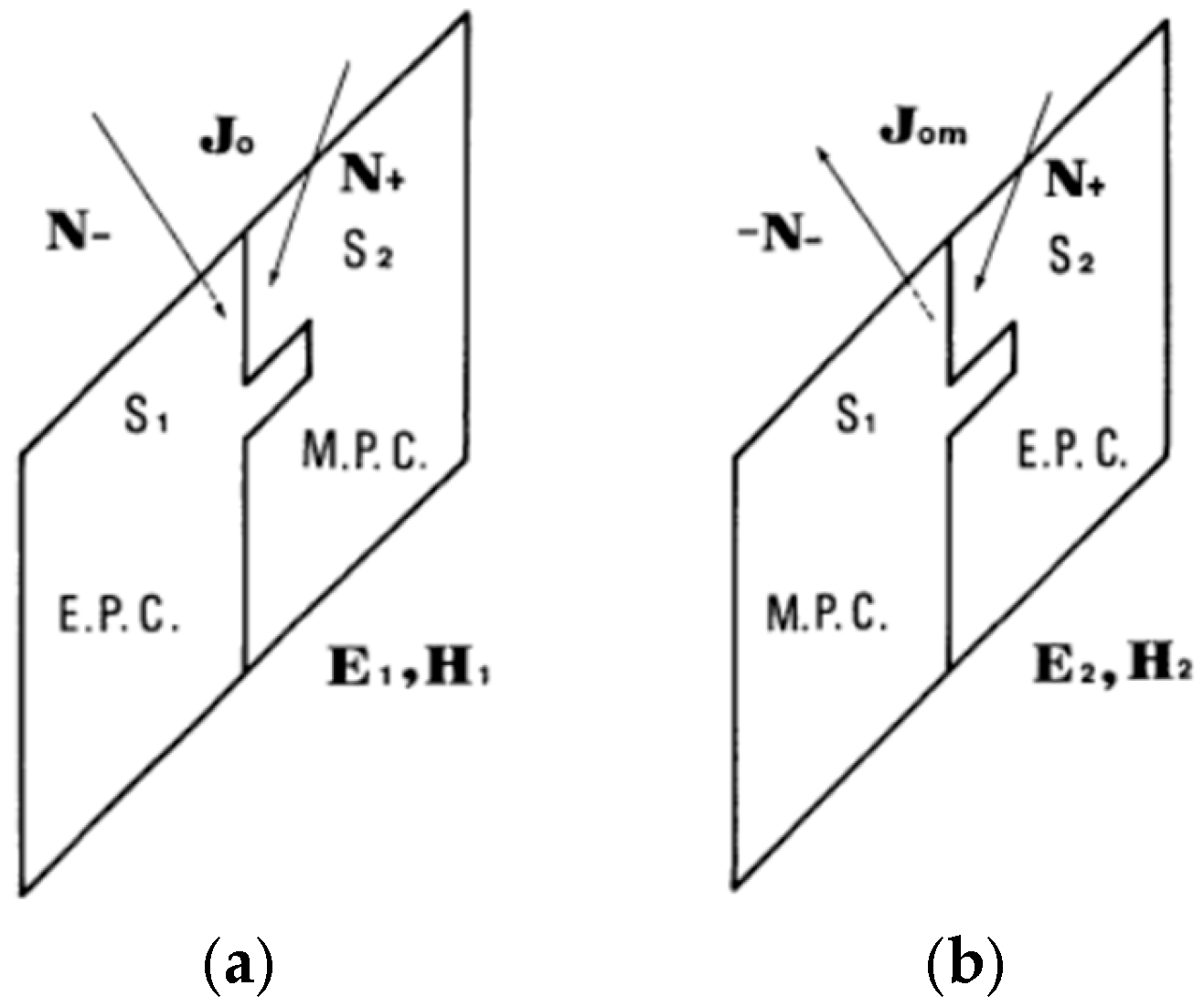
Self-complementarity Principle” [
4,
6]. It has been applied mostly in wire and printed antennas by Mushiake and other engineers and researchers, mainly when the self-complementary parts (the conductive element and its complementary counterpart) are situated close to and next to each other in the same plane and layer [
1,
2,
3,
4,
5,
6]. This topology, initially discovered and used by Mushiake, will be referred to as
self-complementary structures situated contiguously in the same plane.
The self-complementarity concept was applied to broadband antennas. Using this principle, V. Rumsey obtained important results, which he classified and called
frequency-independent antennas [
7]. Later, R. Duhamel and D. Isbell proposed logarithmic-periodic dipole antenna arrays [
8,
9]. Mushiake obtained very good results in applying the self-complementarity concept, both to simple and three-dimensional antenna configurations [
1,
2,
3,
4,
5,
6,
10,
11,
12,
13,
14]. Many radia-ting elements using the self-complementarity approach have been proposed in the scientific and technical literature, some of which can be found in [
1,
2,
3,
4,
5,
6,
11,
12,
13,
14,
15,
16,
17]. Some of these approaches, applying the
Self-complementarity Principle in a single plane, and in the same layer of the dielectric substrate of printed circuit boards (PCBs) in the case of printed devices, use different shapes, such as ring resonators, X-shape, fractals, and others.
However, few studies and developments involving the self-complementarity concept have been carried out using two or more layers of printed circuit boards, where one of the parts of the structure is on one of the layers of the PCB, and its complementary part is on the next and parallel layer. This topology will be referred to as “
self-complementary structures situated or arranged geometrically in stacking”. Mushiake and other researchers and engineers have been working in the research and development of antennas using
self-complementary structures arranged in stacking. E. Abdo-Sanchez et al. proposed a self-complementary structure arranged in stacking as a radiating element [
18]. It consists of a slot excited by a microstrip line in two-port and transmission configurations, with a complementary stub perpendicular to the microstrip line and situated in stacking and aligned to the slot [
18]. This two-port structure has a large matching and wide radiation bandwidths. Subsequently, this structure was analyzed and presented as a broadband dispersive delay line by M. K. Mandal et al. in [
19], where different shapes at the ends of the complementary part were studied. Afterwards, the authors of [
18] proposed this structure as a broadband radiating element based on microstrip–slot coupling for series-fed arrays [
20]. In [
21], a wideband two-port microstrip-fed circular patch with its complementary slot etched on its ground plane, forming a
self-complementary structure arranged in stacking, was proposed by Yordanis Alonso-Roque et al. This structure has a very wide matching bandwidth and good radiation characteristics.
The analysis, design, and measurement results of a broadband two-port microstrip rectangular patch radiating element in transmission configuration, using the concept of self-complementarity in stacking arrangement, are presented here. This proposed antenna e-lement exhibits ultra-wideband matching (11 GHz, i.e., BWsim-relative-match = 200%), clean li-near polarization, radiation in both hemispheres—which are conserved and considerably stable in a wide frequency range (from 1 to 6 GHz)—, good gain from 2 to 8 GHz, and adequate radiation efficiency from 1 to 8 GHz, which are comparable to, or even higher than, other similar radiating elements with two-port self-complementarity in a stacking arrangement and in transmission configuration, as well as to others which do not necessarily have these three characteristics. This antenna element has a wide operating bandwidth (1 to 8 GHz, BWsim-operation = 7 GHz, operation center frequency fo [operation] = 4.5 GHz, 63.6% of BWsim-match, and 156% of fo [operation]). In addition, other main and merits ra-diation characteristics are good and suitable in wide frequency ranges: attractive flatness of the gain in both main broadside radiation directions (Theta = 0° and Theta = 180°) from 3.3 to 6.3 GHz (3 GHz, i.e., 27% of BWsim-match, 43% of BWsim-rad), and very good flatness of the radiation efficiency from 4 to 7.5 GHz (3.5 GHz, i.e., 32% of BWsim-match, and 50% of BWsim-rad). Moreover, it would be used in different applications, which mainly require broadband operation, such as broadcasting, wireless networks, mobile communications, satellite, radar, imaging, Oceanic Engineering research, biomedicine, and others. Furthermore, the proposed antenna element could be used in different antenna arrays with linear polarization, such as broadband or/and multiband series-fed antenna arrays, wideband or/and multiband corporative arrays, even with broad matching behavior in one or more frequency ranges in the cases of multiband performance, and others.
This paper is structured as follows. In
Section 1, an introduction to the object of the research line and different proposed solutions is presented, followed by a brief presentation of the new approach and applicability under consideration. In
Section 2, the contribution of this research work to the
state of the art of broadband antenna elements and antennas is expressed, mainly in the field of two-port radiating elements in transmission arrangement, in special cases when they use the self-complementarity concept, and even others, which do not use two-port structures in transmission configuration and use the self-complementarity concept. After that, a summary of the theory of the
Self-complementarity Principle is briefly explained in
Section 3. In
Section 4, the main results of the design of the classical two-port rectangular patch radiating element, in transmission configuration, which will be used as the
reference antenna, are shown. In
Section 5, a self-complementary structure geometrically arranged in stacking, with similar shapes and sizes as the reference antenna, and using a slot, is depicted. Here, the results of an illustrative design and an electromagnetic analysis of a wideband self-complementary microwave device are highlighted. Furthermore, the influence of the slot dimensions (length and width) on the S-parameters is presented in this section. The calculated radiation characteristics of the proposed broadband self-complementary device are then described. Also, a comparison of the analysis results of the proposed antenna element with those of the reference antenna is presented in this section. In
Section 6, the measurement results of both S-parameters and radiation patterns of the proposed structure are expressed, analyzed, and compared with their corresponding computation results.
Section 7 compares the obtained results of the proposed radiating element with other wideband ones, mainly using the concept of self-complementarity, already exhibited in the scientific and technical literature. In
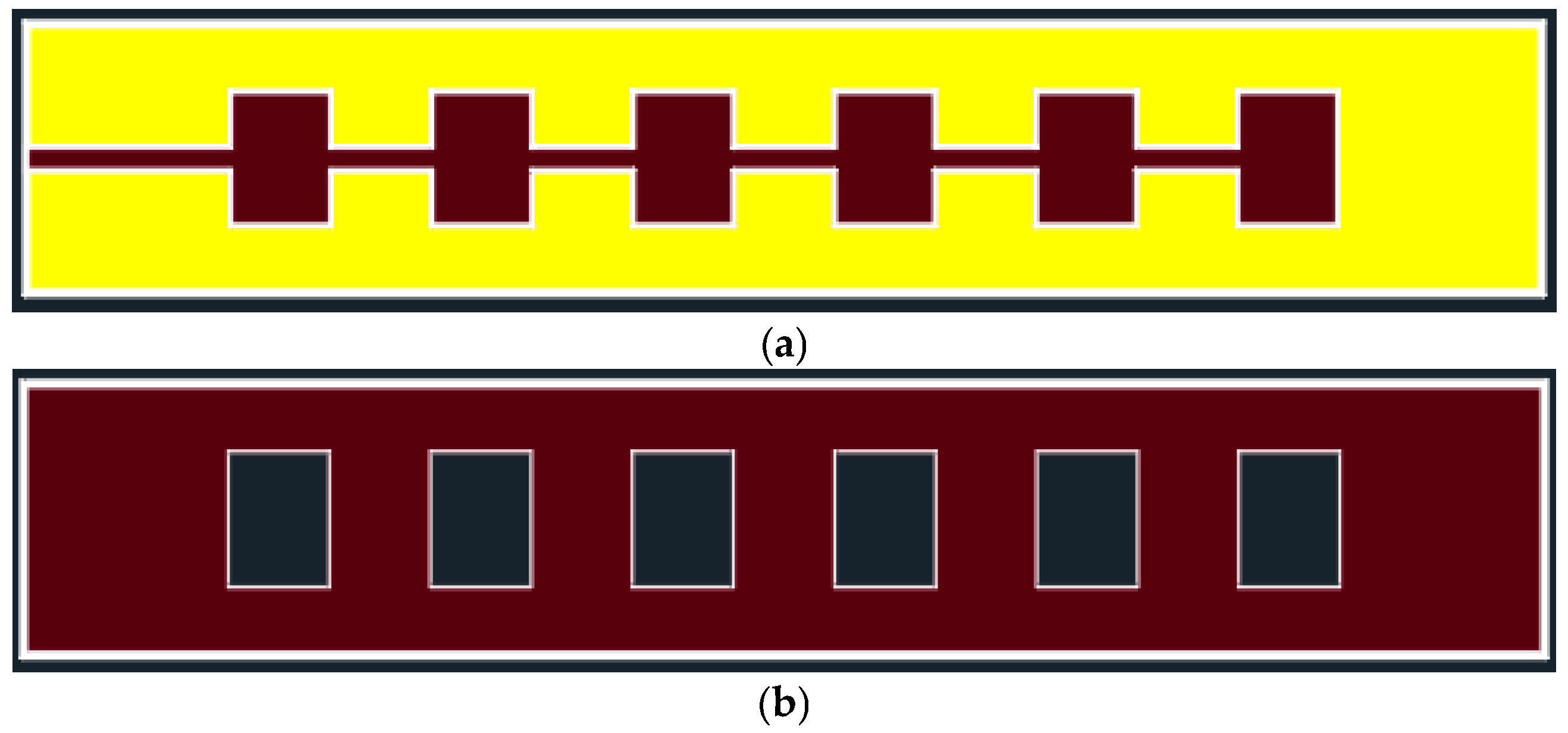
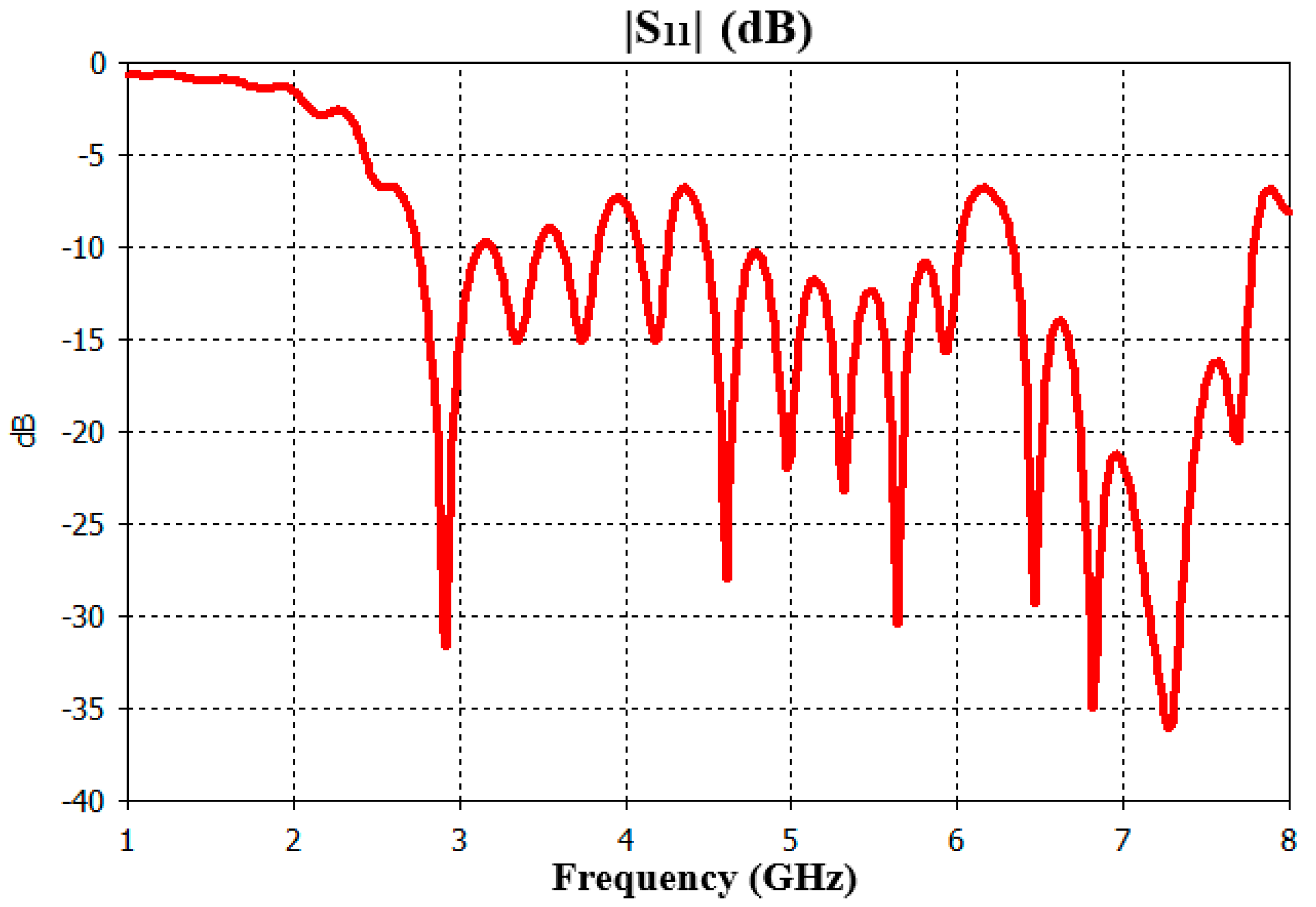
Section 8, a summary of the results of the calculated impedance matching bandwidth and radiation characte-ristics of an illustrative uniform series-fed antenna arrays with six elements of the proposed broadband antenna element is described, with the objective to show the use of the proposed radiating element in this type of antenna array. Here, the broadband and multiband behavior in the mentioned series-fed antenna array is also highlighted, even with wide matching in one or more frequency ranges in the cases of multiband matching performance, which is possible to achieve in this type of antenna using radiating elements like the one proposed here. Finally,
Section 9 summarizes the conclusions of this work.
2. Previous Works and Current Contribution
Self-complementary structures have been applied mainly in wire and printed antennas by Y. Mushiake and other engineers and researchers, primarily when both parts (the conductive part and its complementary one) are located very close and next to each other in the same plane, and in an identical layer of the dielectric substrate in the cases of printed devices [
1,
2,
3,
4,
5,
6]. It is the topology initially proposed and used by Y. Mushiake and others, and, henceforward, it will be referred to as
self-complementary structures situated conti-guously in the same plane. Most of the solutions of this type of structure used in microwave devices and antennas, and presented in the knowledge fields of Electromagnetism, Microwave Engineering, Electronics, Antennas, and Telecommunications, have this topology.
After an exhaustive review of the databases of the scientific and technical publications in the aforementioned knowledge fields carried out by the authors of this study, we consider that there are few research works and results conducted with the aim to know, understand, and apply their theoretical basis from both Electromagnetism and Circuit Fundamentals in the applicability of self-complementary structures in antennas. This poor contribution to the mentioned state of the art is much more marked when the parts of the self-complementary structure are in parallel layers of the dielectric substrate (in stacking).
From the knowledge of the authors of this work, the use of self-complementary structures in parallel layers of a dielectric substrate (henceforward,
self-complementary structures in stacking arrangement), applied to two-port patch radiating elements in transmission configuration, even with high operation bandwidth, as reached in this work, has not been presented in the scientific–technical publication databases in the aforementioned knowledge fields, mainly in letters, journals, and magazines. It is also known that there are no research results of wideband self-complementary structures in stacking arrangement, where at least the cause of obtaining the broadband response in the impedance matching is expressed, explained, and justified, except for [
21].
The use of
self-complementary structures in stacking arrangement in two-port microstrip patch antennas in transmission configuration was carried out and presented for the first time to the international scientific–technical communities of the mentioned scientific and technical knowledge fields by Yordanis Alonso-Roque et al. in [
21].
One of the main advantages and contributions of the work presented here to the mentioned scientific–technical knowledge fields is the obtaining of broadband impedance matching, good radiation patterns, wide radiation bandwidth, and other main radiation and merits characteristics in a two-port microstrip rectangular patch radiating element in transmission configuration using the
self-complementarity concept. It is important to highlight that this is based on a postulate with a solid electromagnetic theoretical basis, which was discovered by Y. Mushiake [
1,
2,
3,
4,
6], and he called it the “
Self-Complementarity Principle” (
note: more knowledge on this can be found in
Section 3).
This research work describes a full-wave electromagnetic analysis as well as the design and measurement results of the mentioned broadband two-port radiating element in transmission configuration, using the self-complementarity concept in stacking arrangement. It has good linear polarization, bidirectional broadside radiation patterns with considerable conservation in the frequency, as well as adequate gain and radiation efficiency values within very broad frequency ranges, and, consequently, it has wide operation bandwidth, mainly comparing this one with similar ones and others (not necessarily with two feeding ports, in transmission configuration, and using the self-complementarity concept) found in the mentioned corresponding state of the art. In addition, it has very good flatness of gain and radiation efficiency over wide frequency ranges. This antenna element is not complex, is compact, has little weight, and is easy and flexible to design and manufacture. In addition, it could be used as a radiating element in different types of linear polarized antenna arrays, such as series-fed antenna arrays and corporative-type arrays, both with wideband or/and multiband matching behavior, even with broad matching in one or more frequency ranges –in the case of multiband matching performance–, and others.
Another of the main goals and contributions of this work is to show the applicability specifically of the self-complementary structures in stacking arrangement to a two-port microstrip patch antenna element in transmission configuration. Concretely, this goal consists of making it known that the mentioned applicability in a two-port rectangular patch radiating element in transmission configuration is an excellent solution to increase the matching and radiation bandwidths, as well as to improve some of the main radiation characteristics and merit figures, even the behaviors of at least some of them in the frequency, and very wide operation bandwidth.
From the physical-inside, performance, and technical points of view, another advantage of this research work is the use of the self-complementarity concept, particularly on the mentioned microstrip patch antenna element, which provides added value for wideband or/and multiband radiating elements, taking into account the inherent, known and proven benefits of this type of antenna: compactness, low weight, the possibility of obtaining different operation modes, and the versatility to achieve different performance in terms of impedance matching, polarization, transmission and radiation characteristics, and others, even many of those over considerable frequency ranges.
Therefore, the technique proposed here to achieve wide bandwidths for both mat-ching and radiation is unique and simple, and it allows us, with a singular form, to enhance some main and merits radiation characteristics, even in the frequency and, consequently, a wide operation bandwidth, in the studied topology of the microstrip patch antenna element. Without a doubt, the novel applicability of a very solid electromagnetic principle in a two-port microstrip antenna element in transmission configuration is presented here, primarily reaching very good results for some of the antenna’s fundamental parameters and merit figures in the analyzed and proposed topology.
Finally, it is important to express that
Section 6 provides a comparison of the proposed structure with other broadband printed antenna elements with one or two feeding ports, in transmission configuration, and using or not the self-complementarity concept, found in the current corresponding
state of the art in publications in the knowledge fields of Electromagnetism, Microwave Engineering, Electronics, Antennas, and Telecommunications, which confirms the contribution of this article to the mentioned
state of the art.
5. Analysis and Design of the Proposed Broadband Two-Port Radiating Element
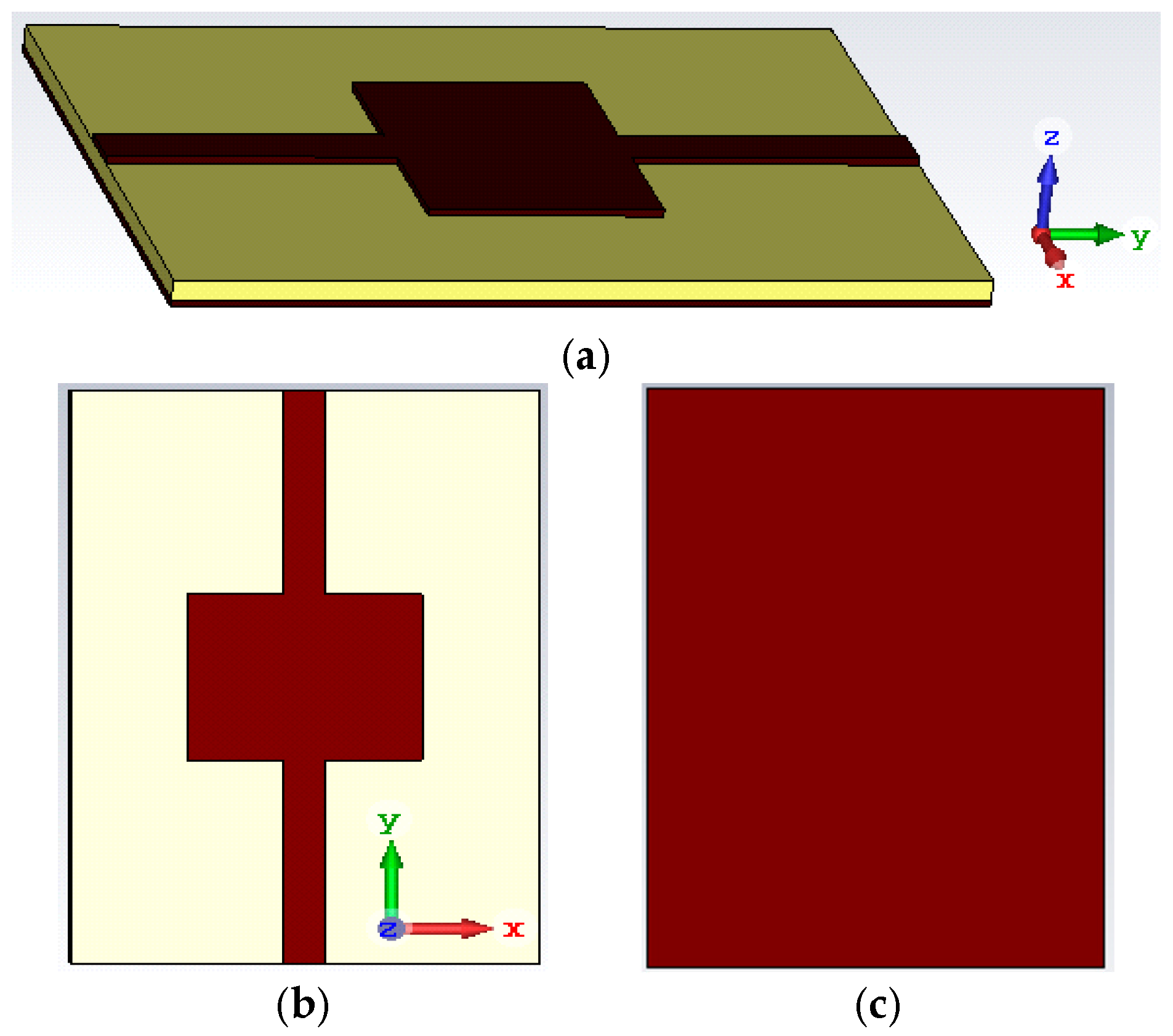
The proposed structure is a two-port rectangular patch antenna element, fed by a microstrip line, in transmission configuration, like the
reference antenna. It also has a slot engraved into its ground plane, with the same shape (rectangular) and equal dimensions as the patch, and it is in stacking arrangement and aligned with respect to the patch. In other words, the patch and the slot constitute a
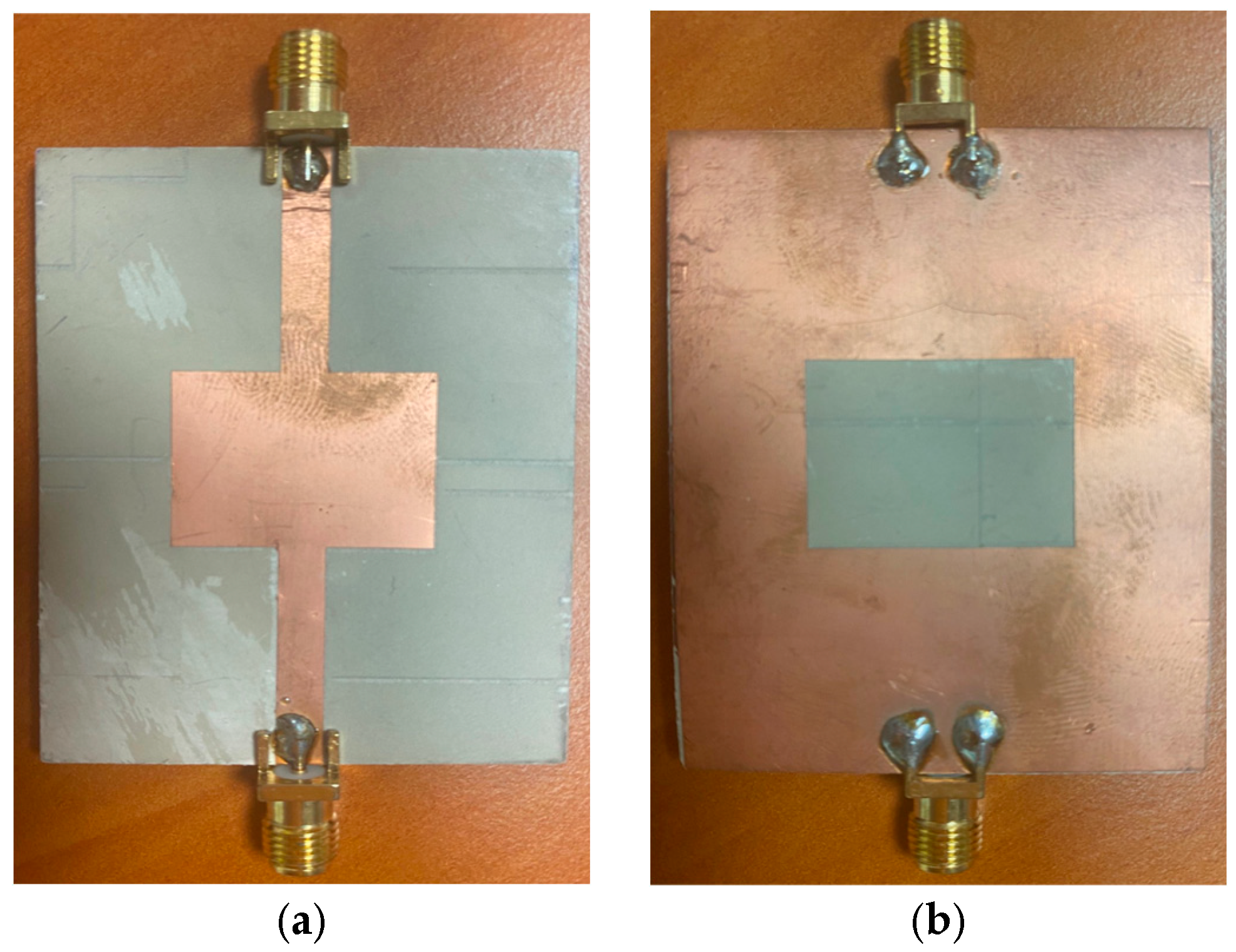
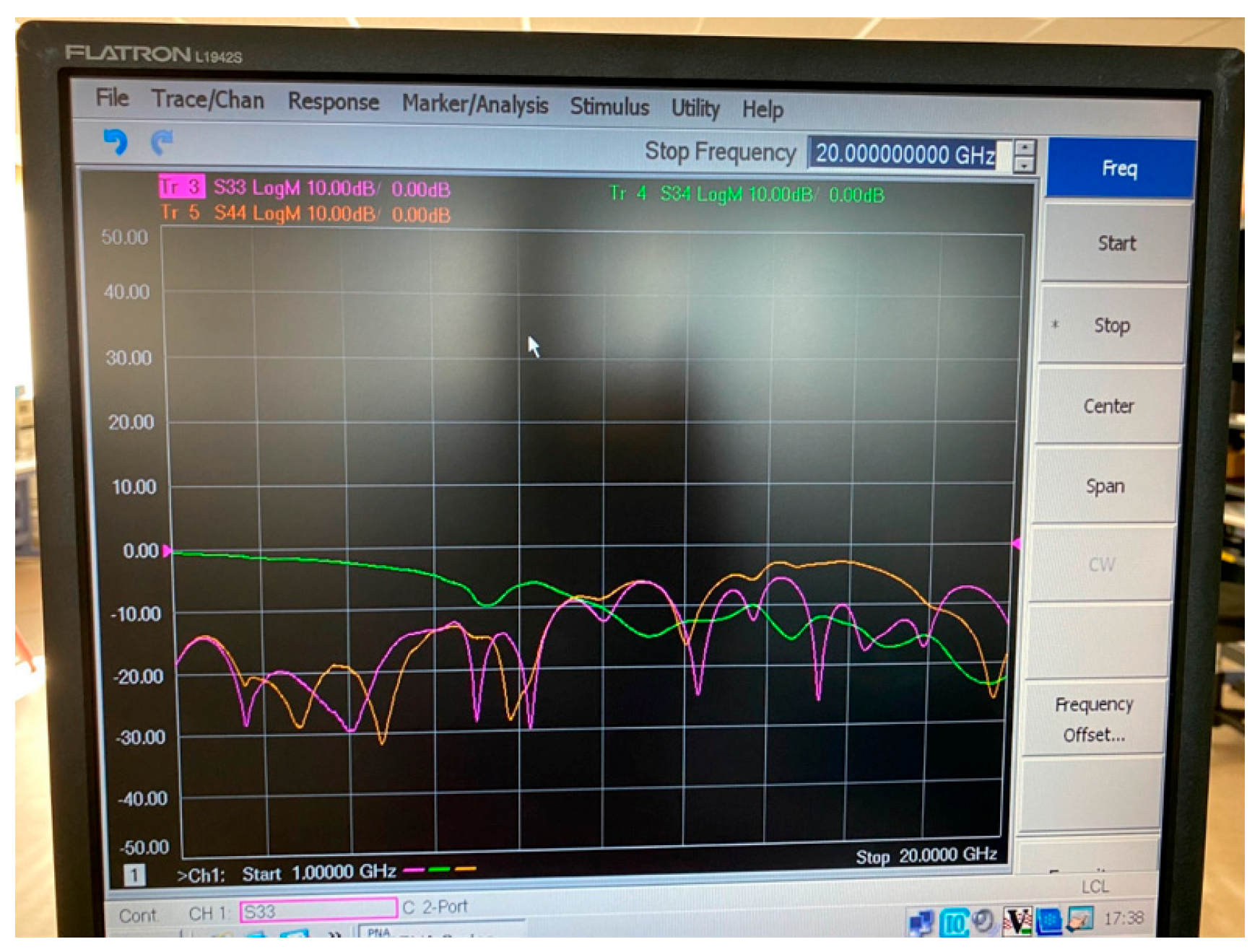
self-complementary structure in stacking arrangement, aligned in two-port and transmission configuration and excited by a microstrip line. The dielectric substrate used in this two-port topology is the same Duroid RO3003 as that of the reference antenna. Photographs of one of the fabricated and measured prototypes are shown in
Figure 6.
To carry out the proof of concept and the applicability of self-complementary structures arranged in stacking in a two-port microstrip-fed rectangular patch antenna in transmission configuration, an electromagnetic (EM) analysis and an illustrative design of this two-port self-complementary topology, with equal dimensions and using the same rectangular coordinate system as the
reference antenna, were performed. They were carried out with the help of a full-wave EM analysis. The dimensions of this design are as follows: microstrip line width
WL = 3.8 mm, patch length
Lp ≈
λg [5 GHz]/2 ≈ 17.3 mm (in the direction of the longitudinal axis,
y-axis in
Figure 6), patch width
Wp = 21.2 mm (in the direction of transverse axis,
x-axis in
Figure 6), ground length
Lg = 60 mm (in the longitudinal axis,
y-axis in
Figure 6), ground width
Wg = 2
Wp = 42.4 mm (in the transverse axis,
x-axis), slot length
Lslot =
Wp = 21.2 mm (in the transverse axis,
x-axis), and slot width
Wslot=
Lp ≈
λg[5 GHz]/2 ≈ 17.3 mm (in the longitudinal axis,
y-axis). This element is completely symmetrical with respect to both axes ‘
x’ and ‘
y’. The results of an illustrative design and an electromagnetic analysis are described below.
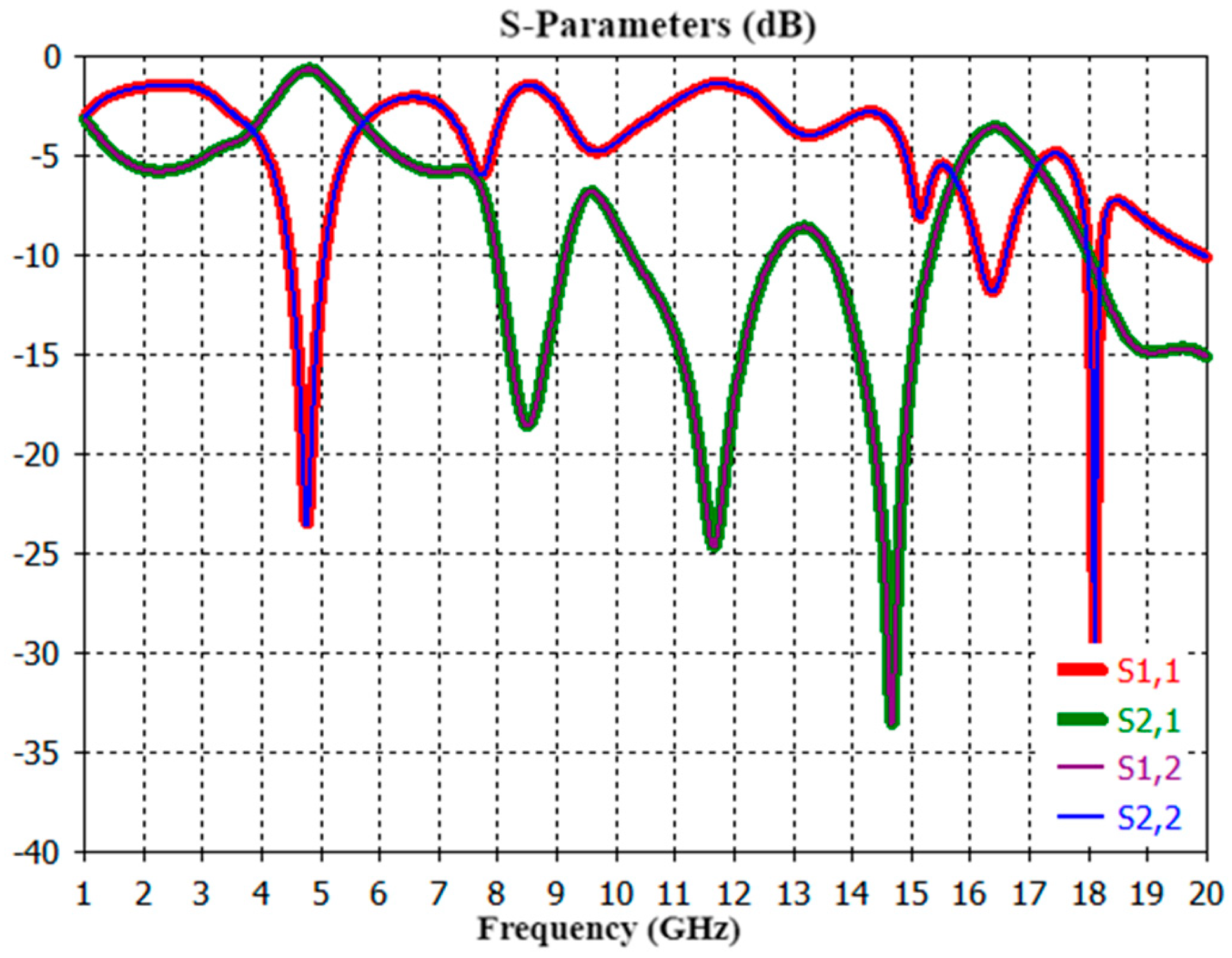
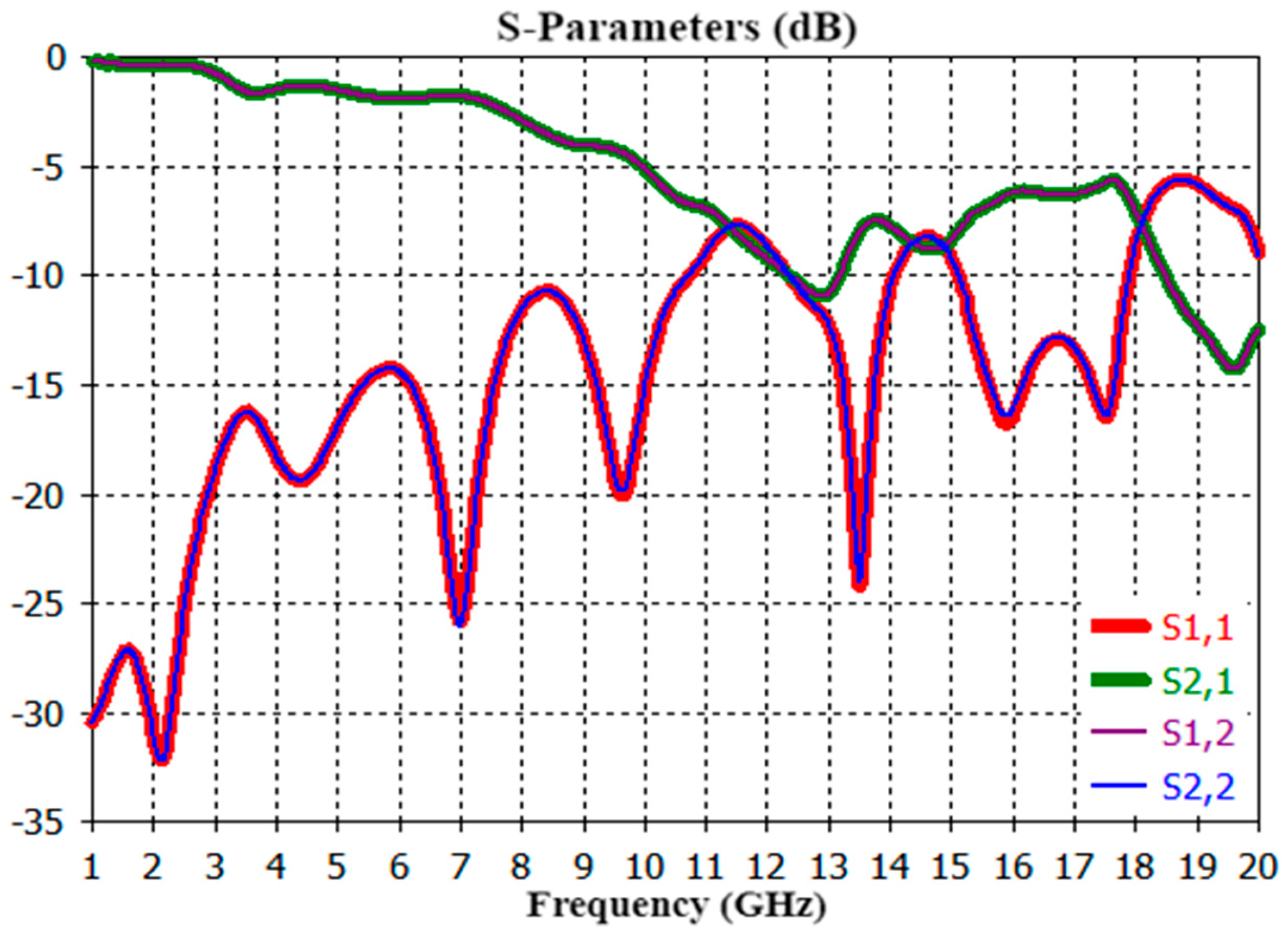
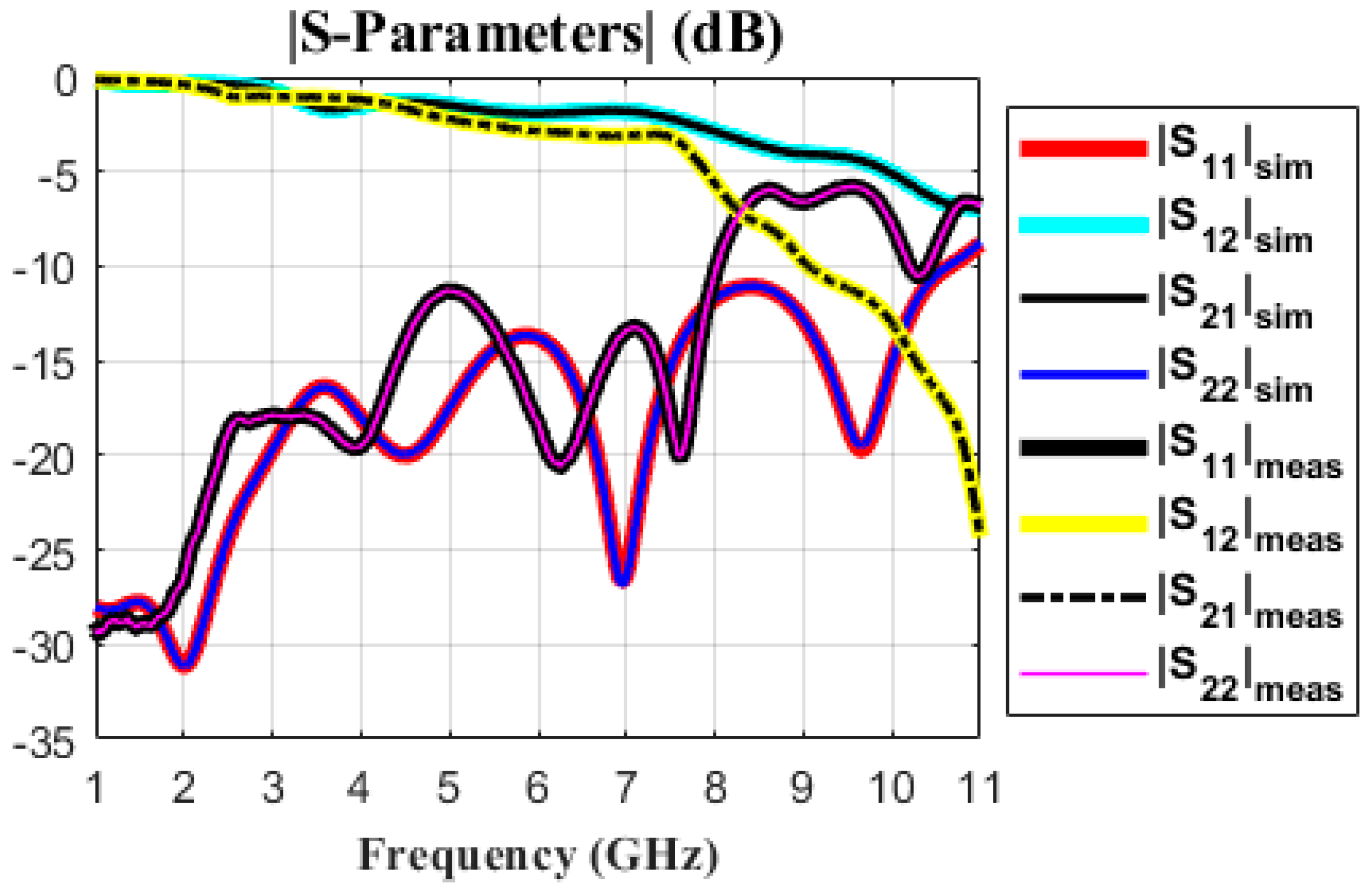
Figure 7 shows the calculated
S-parameters of this self-complementary structure. As can be seen, it has an ultra-broad 10 dB return loss bandwidth of about 11 GHz, which is 200% of its center frequency, 5.5 GHz (computed relative matching bandwidth with regard to narrowband antennas, taken as a reference magnitude). The transmission coefficient (|
S21|) decreases with the frequency in a range from 7 to 13 GHz, with values from about −0.2 to −6.7 dB. Then, it is important to note that |
S21| is quite flat, practically from 1 to 3 GHz and from 4 to 7 GHz, with values higher than −2 dB up to 7 GHz, which is a significant improvement compared to the
reference antenna. Moreover, it is important to highlight that |
S21| decreases from 7 to 13 GHz in a practically linear manner. Hence, it has a useful transmission behavior from port 1 to port 2 within its impedance matching bandwidth, mainly from 1 to 7 GHz, which is a very good result considering that it could be used in series-fed antenna arrays.
The matching bandwidth is very wide, even compared with other two-port and single-port radiating elements that can be found in the current scientific–technical databases [
11,
12,
13,
14,
15,
16,
17,
18,
19,
20,
21,
22,
23,
24,
25,
26,
27,
28,
29,
30,
31,
32,
33,
34,
35,
36,
37,
38,
39,
40,
41,
42,
43,
44], mainly if the self-complementarity concept in two-port elements with transmission arrangements is involved.
An interesting aspect of this element is that the ultra-wideband matching behavior can be achieved using adequate combinations of width–length values of both the patch and the slot, which provide flexibility to the design of this structure.
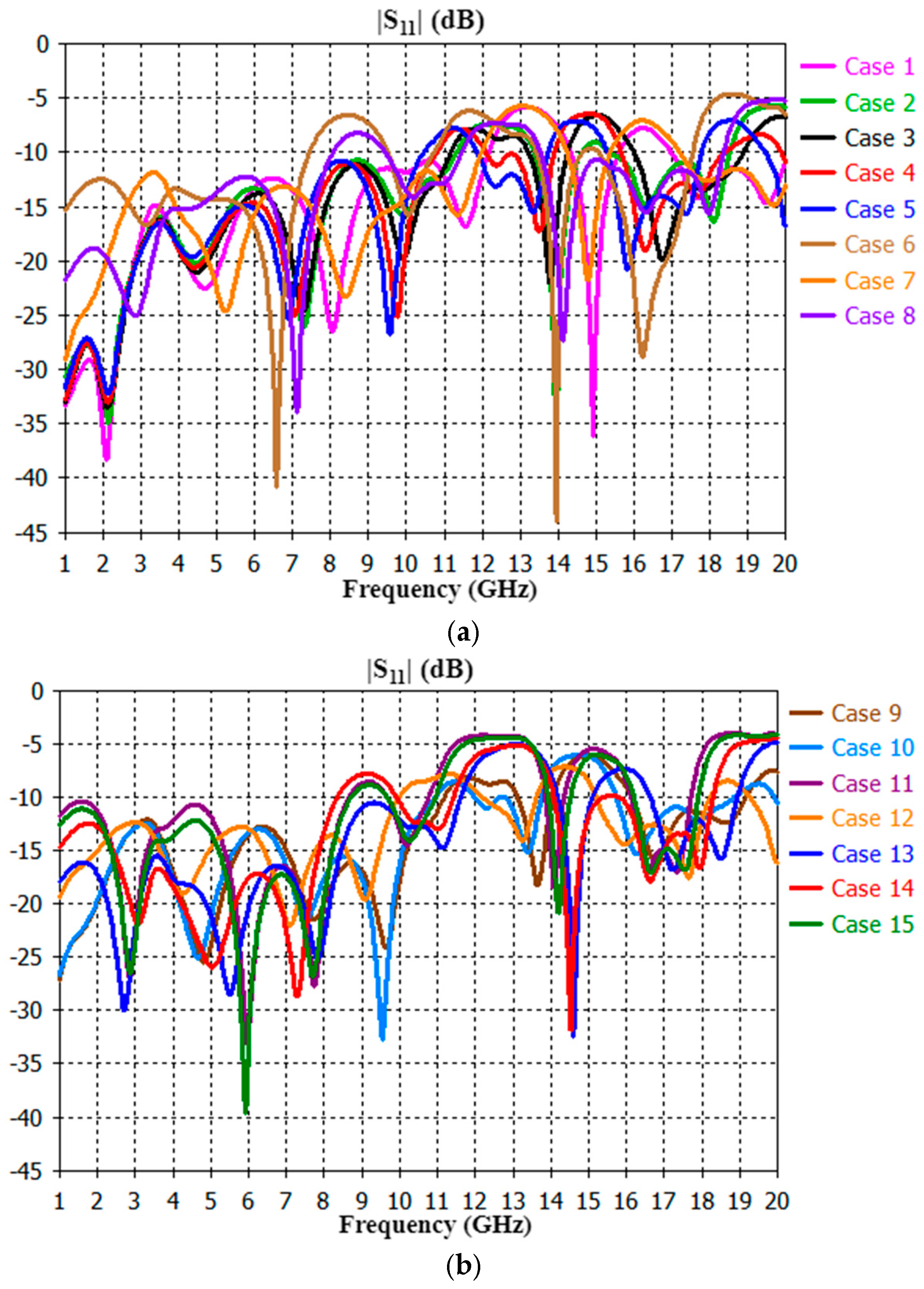
Figure 8 shows some of the several cases of broadband impedance matching obtained with different width and length values for both the patch and the slot.
Table 1 shows the impedance matching bandwidths and relative matching bandwidth, considering the antenna’s narrow bandwidth concept and taking the matching bandwidth´s minimum frequency
fmin, which is considered approximately 1 GHz in the majority of the studied cases, which correspond to the cases shown in
Figure 8. As can be observed, for
Lp =
Wslot and
Wp = Lslot, it is possible to achieve broadband matching (Cases from 1 to 5 in
Table 1), and, generally, these are the cases of the highest mat-ching bandwidths. In addition, for the cases where
Lp =
Wslot and
Wp ≈
Lslot (Cases from 6 to 10 in
Table 1) and
Lp ≈
Wslot and
Wp ≈
Lslot (Cases from 11 to 15 in
Table 1), it is also possible to reach wideband impedance matching. It should be noted that, in all fifteen examples presented in
Table 1, the calculated relative impedance bandwidth is greater than 150%.
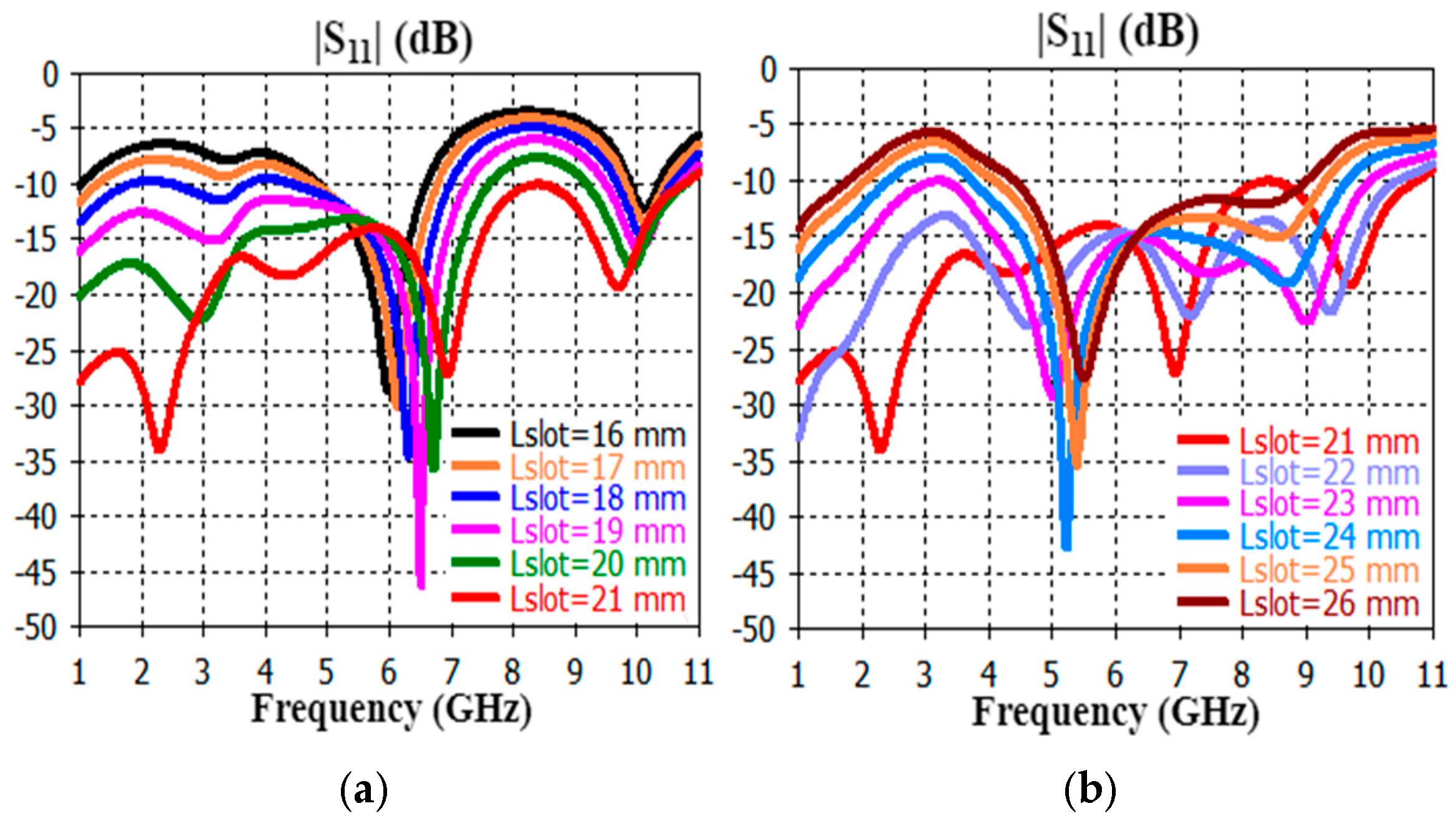
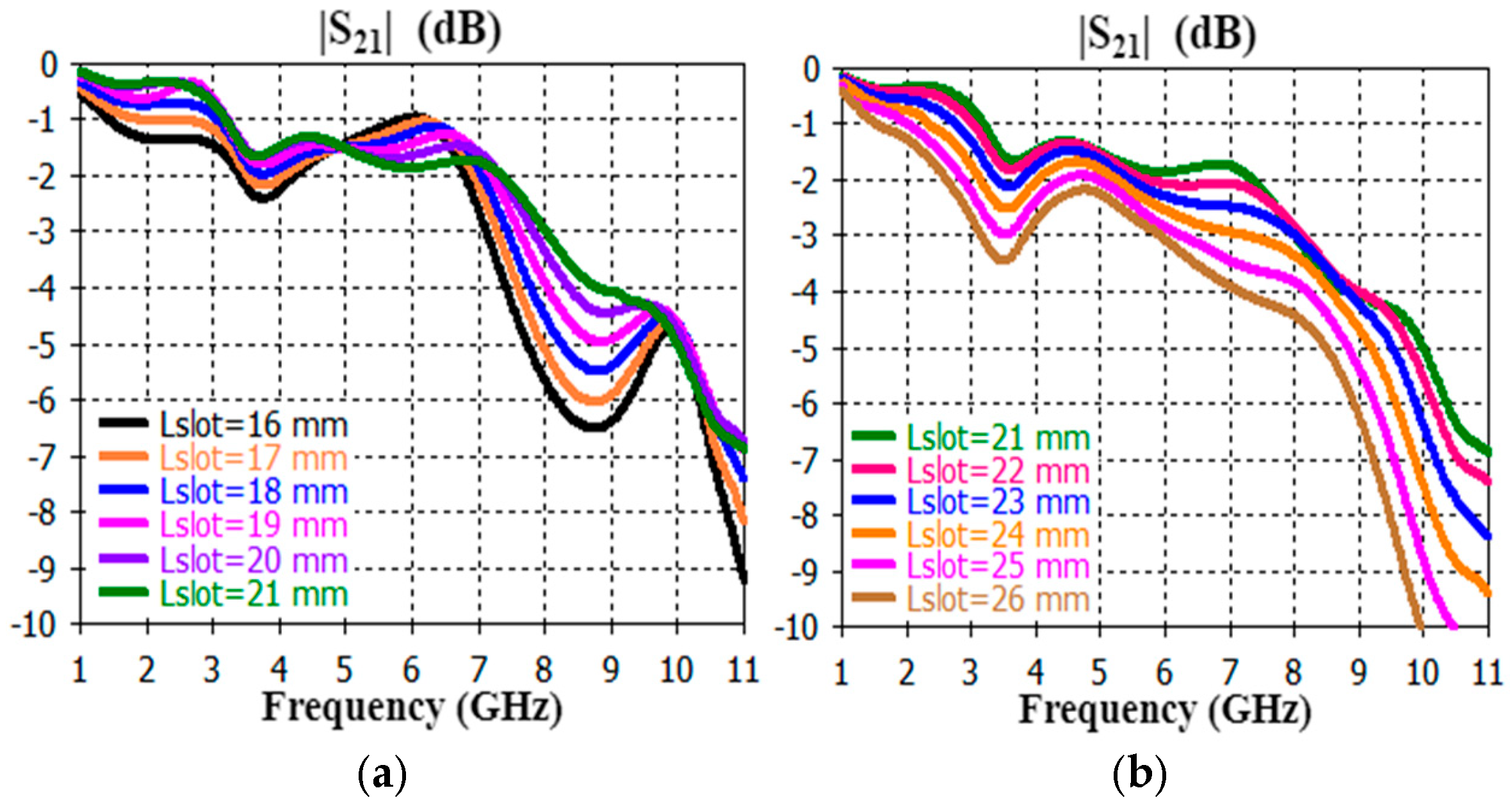
Full-wave electromagnetic analysis of the slot dimensions, using fixed (constant) patch dimensions equal to the reference antenna, was carried out. It revealed that increa-sing the slot length, approximating the constant patch width value (
Lslot ≤
Wp), improved the impedance matching, with a slight increase in the center frequency of impedance matching bandwidth, as well as an increase in the impedance matching bandwidth, changing from a narrowband to wideband response. In addition, there is an increase in the transmission coefficient |
S21|, mainly from 1 GHz to the center frequency of the mat-ching bandwidth (5.5 GHz), while it decreases from the center frequency to the end of the matching bandwidth. These behaviors are presented in
Figure 9a and
Figure 10a, respectively.
Table 1.
Matching bandwidths for some width–length combinations of both patch and complementary slot of the analyzed and proposed structure.
Table 1.
Matching bandwidths for some width–length combinations of both patch and complementary slot of the analyzed and proposed structure.
| Case | Lp (mm) | Wslot
(mm) | Wp (mm) | Lslot (mm) | BW (GHz) | BWrelative-match
(%) |
|---|
| 1 | 15 | 15 | 19 | 19 | 11 | 169 |
| 2 | 16 | 16 | 21 | 21 | 10 | 182 |
| 3 | 18 | 18 | 19 | 19 | 10 | 167 |
| 4 | 19 | 19 | 19 | 19 | 9.8 | 166 |
| 5 | 20 | 20 | 19 | 19 | 9 | 164 |
| 6 | 17 | 17 | 21 | 20 | 6.4 | 152 |
| 7 | 15 | 15 | 19 | 20 | 11 | 169 |
| 8 | 16 | 16 | 21 | 20 | 7 | 175 |
| 9 | 18 | 18 | 19 | 20 | 10 | 167 |
| 10 | 19 | 19 | 19 | 20 | 10 | 168 |
| 11 | 17 | 15 | 21 | 19 | 7.5 | 157 |
| 12 | 17 | 18 | 2 | 23 | 9 | 164 |
| 13 | 16 | 15 | 20 | 19 | 7.5 | 176 |
| 14 | 16 | 15 | 21 | 19 | 7.4 | 157 |
| 15 | 17 | 15 | 21 | 19 | 7.7 | 159 |
For slot length values greater than the fixed-width patch (
Lslot >
Wp), the results are mostly opposite to the previous ones: a deterioration in impedance matching, a decrease in the impedance bandwidth, and a slight increase in the impedance bandwidth’s center frequency are obtained. Moreover, a reduction in the transmission from port 1 to port 2 (|
S21|) from 1 GHz to the center frequency and an increase (|
S21|) from the center frequency to the end of the matching bandwidth are reached.
Figure 9b and
Figure 10b show these performances.
Figure 9.
Influence of Lslot in |S11| of the proposed antenna element in its matching bandwidth for different cases: (a) Lslot approximating and equal to Wp (Lslot ≤ Wp); (b) Lslot > Wp.
Figure 9.
Influence of Lslot in |S11| of the proposed antenna element in its matching bandwidth for different cases: (a) Lslot approximating and equal to Wp (Lslot ≤ Wp); (b) Lslot > Wp.
Figure 10.
Influence of Lslot in |S21| of the proposed antenna element in its matching bandwidth for the following cases: (a) Lslot approximating and equal to Wp (Lslot ≤ Wp); (b) Lslot > Wp.
Figure 10.
Influence of Lslot in |S21| of the proposed antenna element in its matching bandwidth for the following cases: (a) Lslot approximating and equal to Wp (Lslot ≤ Wp); (b) Lslot > Wp.
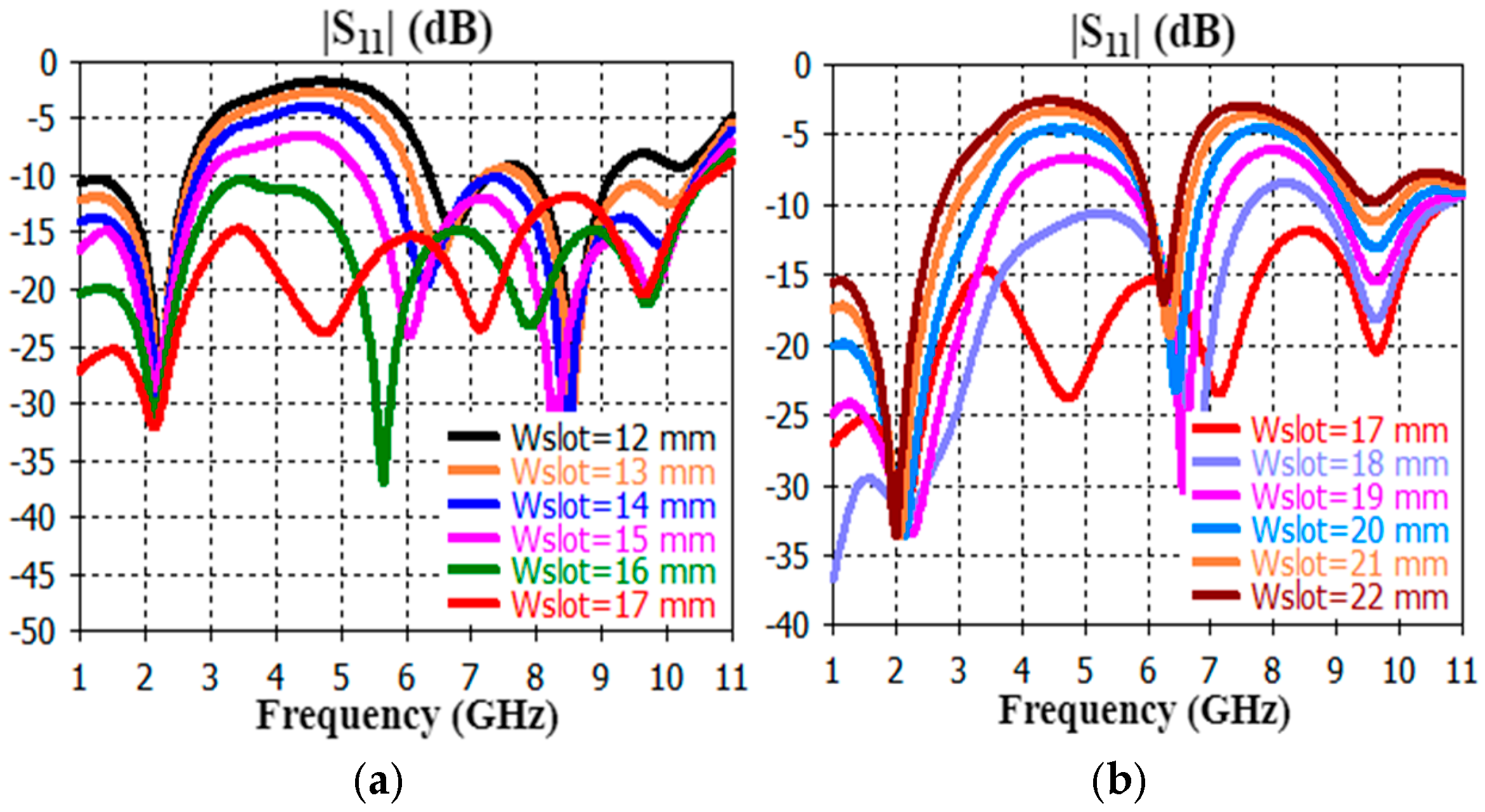
The performed full-wave EM analysis also allows us to establish that increasing the slot width, approximating to the constant patch length value (
Wslot ≤
Lp), leads to an enhancement in the impedance matching and a slight decrease in the center frequency of the matching bandwidth. Similarly to the mentioned cases, where
Lslot ≤
Wp, in these cases (
Wslot ≤
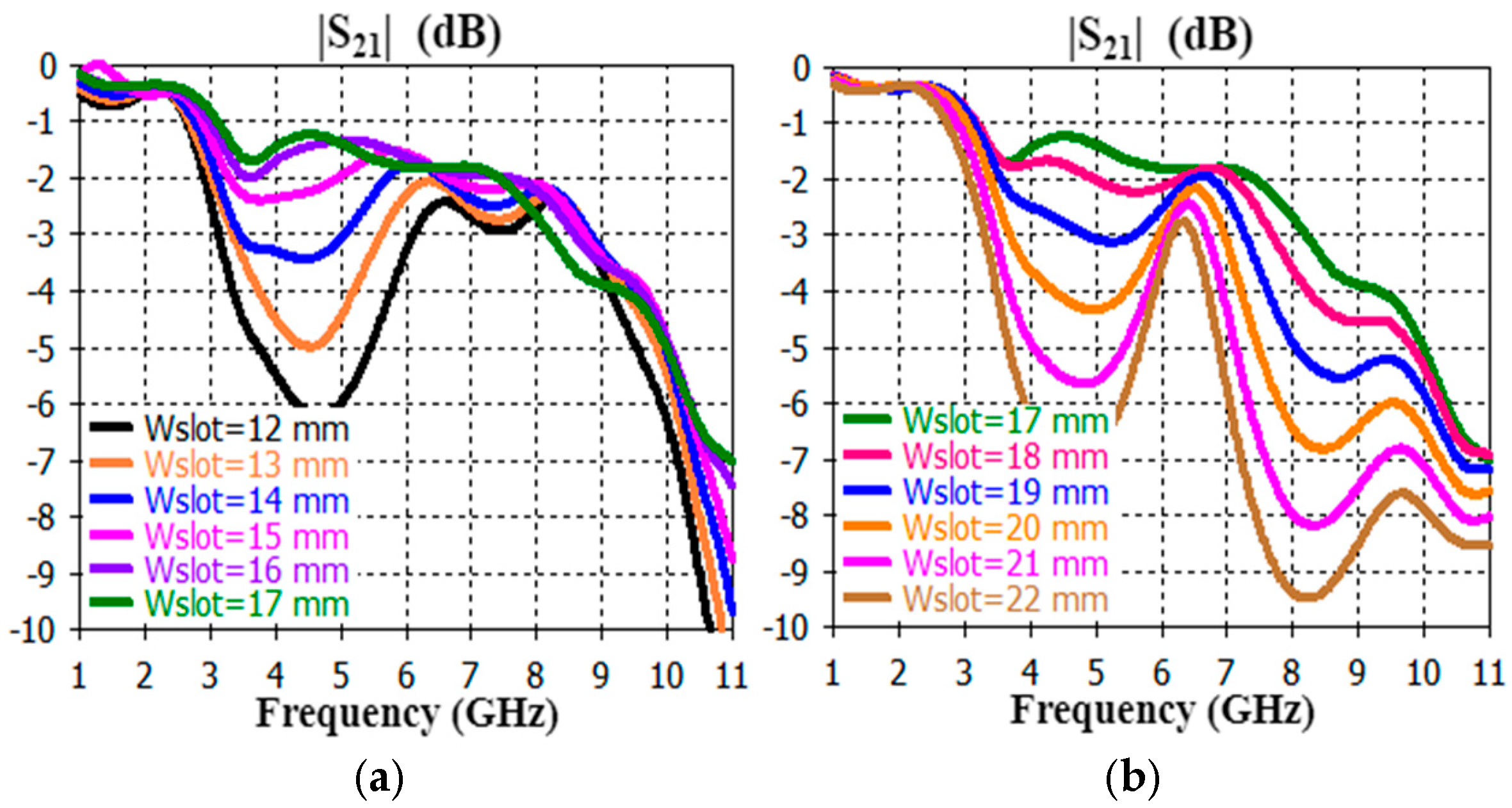
Lp), the impedance bandwidth also changes from narrowband to wideband, and an increase in the transmission coefficient—evaluated by means of |
S21|—is achieved. This can be seen in
Figure 11a and
Figure 12a.
On the contrary, when the slot width is larger than the fixed patch length (
Wslot >
Lp), the effect is mainly the opposite to the previous case: a worsening of the impedance mat-ching and the corresponding matching bandwidth and a decrease in |
S21| arise. In addition, a slight decrease in the matching bandwidth’s center frequency value is observed.
Figure 11b and
Figure 12b show these behaviors.
Moreover, is important to express that the knowledge of the influence of the slot dimensions (the length Lslot and the width Wslot) in |S11| and |S21| is useful in the design of two-port elements, mainly in radiating elements for linear series-fed antenna arrays, where it is necessary to know and control the impedance matching, transmission, and power delivered by each radiating element to the next one, as well as the radiated power, and, consequently, the radiation efficiency of the antenna array.
Figure 11.
Influence of Wslot in |S11| of the proposed antenna element in its matching bandwidth for: (a) Wslot approximating and equal to Lp (Wslot ≤ Lp); (b) Wslot > Lp.
Figure 11.
Influence of Wslot in |S11| of the proposed antenna element in its matching bandwidth for: (a) Wslot approximating and equal to Lp (Wslot ≤ Lp); (b) Wslot > Lp.
Figure 12.
Influence of Wslot in |S21| of the proposed antenna element in its matching bandwidth for: (a) Wslot approximating and equal to Lp (Wslot ≤ Lp); (b) Wslot > Lp.
Figure 12.
Influence of Wslot in |S21| of the proposed antenna element in its matching bandwidth for: (a) Wslot approximating and equal to Lp (Wslot ≤ Lp); (b) Wslot > Lp.
After analyzing the influence of the slot dimensions on the
S-parameters, it can be concluded that for the best performance in terms of impedance matching, its correspon-ding bandwidth and transmission coefficient are obtained when the slot is the complementary part and has dimensions similar to the patch (cases where
Lslot ≈
Wp and
Wslot ≈
Lp). Consequently, radiation efficiency should also increase for these cases. In this sense, it is important to highlight that a very wide impedance bandwidth can be reached when two complementary structures with the same shape, arranged in stacking and aligned, have approximately the same dimensions and are appropriately designed in two-port topology, like in transmission configuration. This result was also similarly obtained in [
18,
19,
20,
21], which allows us to ratify the above-mentioned statement and conclusion. Moreover, these results also corroborate the theory proposed by Mushiake on two electromagnetically
self-complementary structures situated contiguously, mainly with the approach of the
Principle of Self-Complementarity [
1,
2,
3,
4,
6] but, in this case, in stacking arrangement.
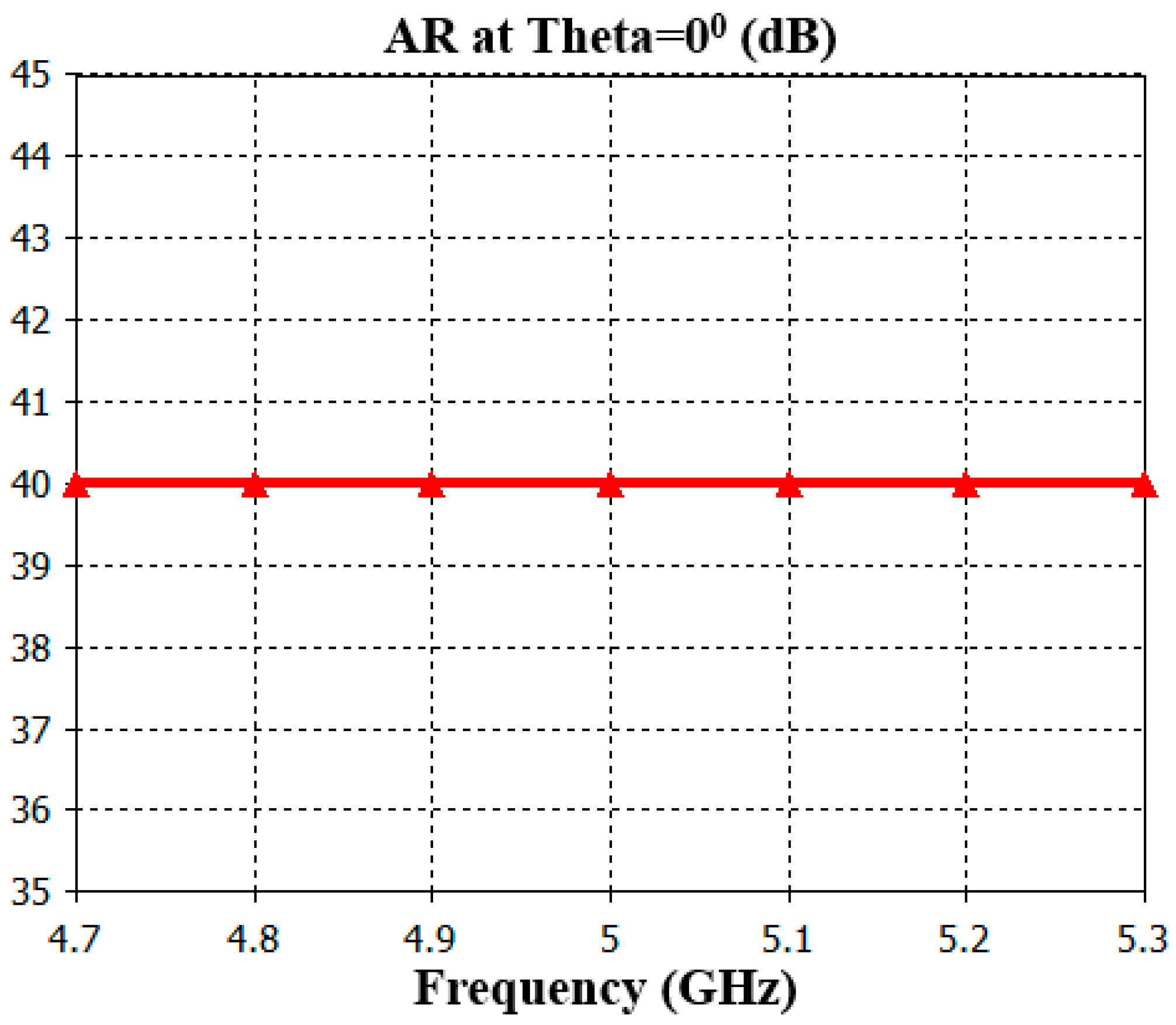
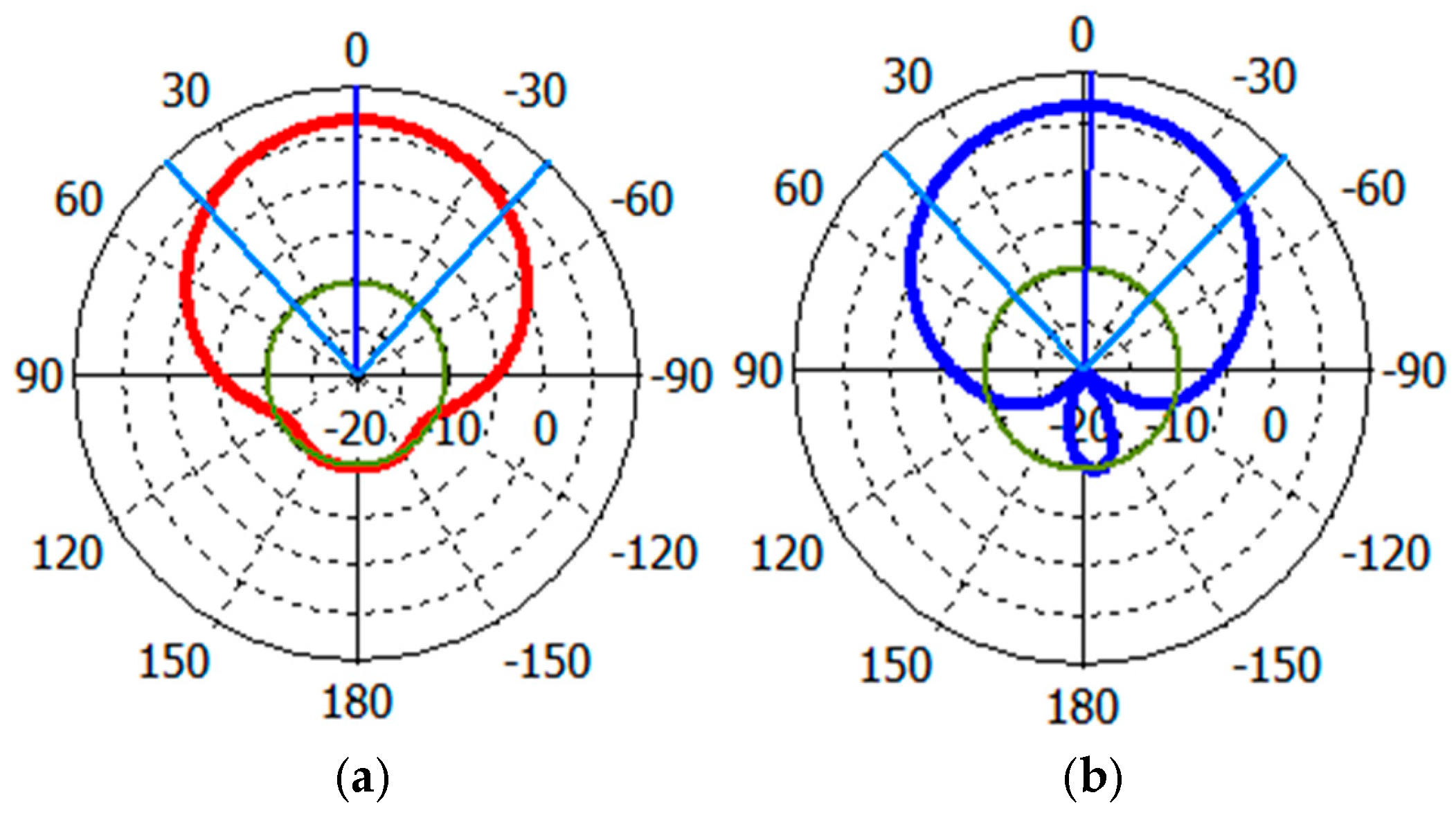
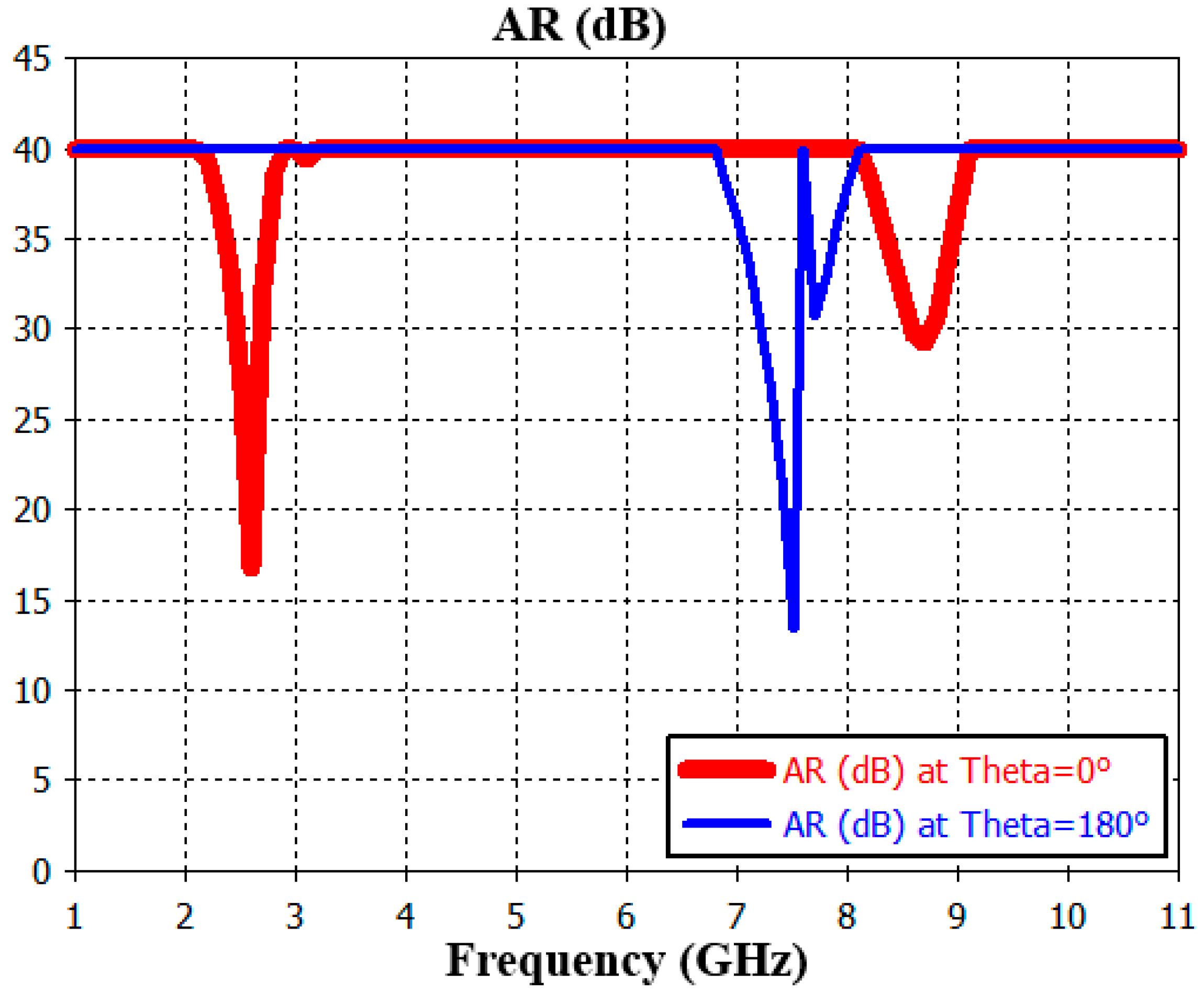
Figure 13 shows the computed absolute value of the axial ratio (AR) of the proposed structure in both main radiation broadside directions (in this case, Theta = 0° and Theta = 180°), within its impedance matching bandwidth (1–11 GHz). It has values around 40 dB at both mentioned main directions in practically all matching bandwidths, except with the minimums of 16.8 dB in 2.6 GHz and 29.3 dB in 8.7 GHz at Theta = 0°, and 13.3 dB in 7.5 GHz at Theta = 180°. These results suggest that this radiating element has linear polarization around both main broadside directions, with adequate purity of linear polarization.
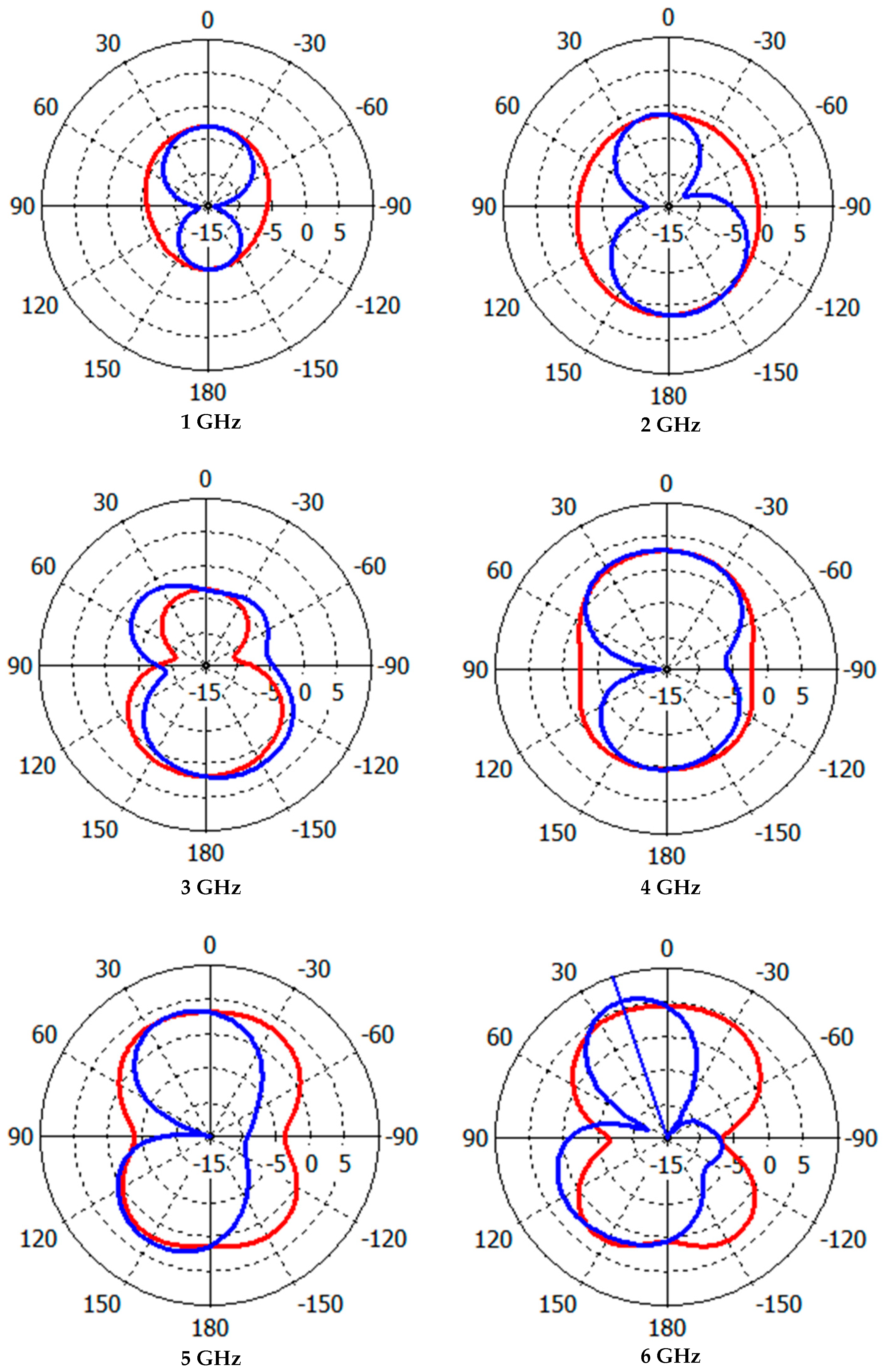
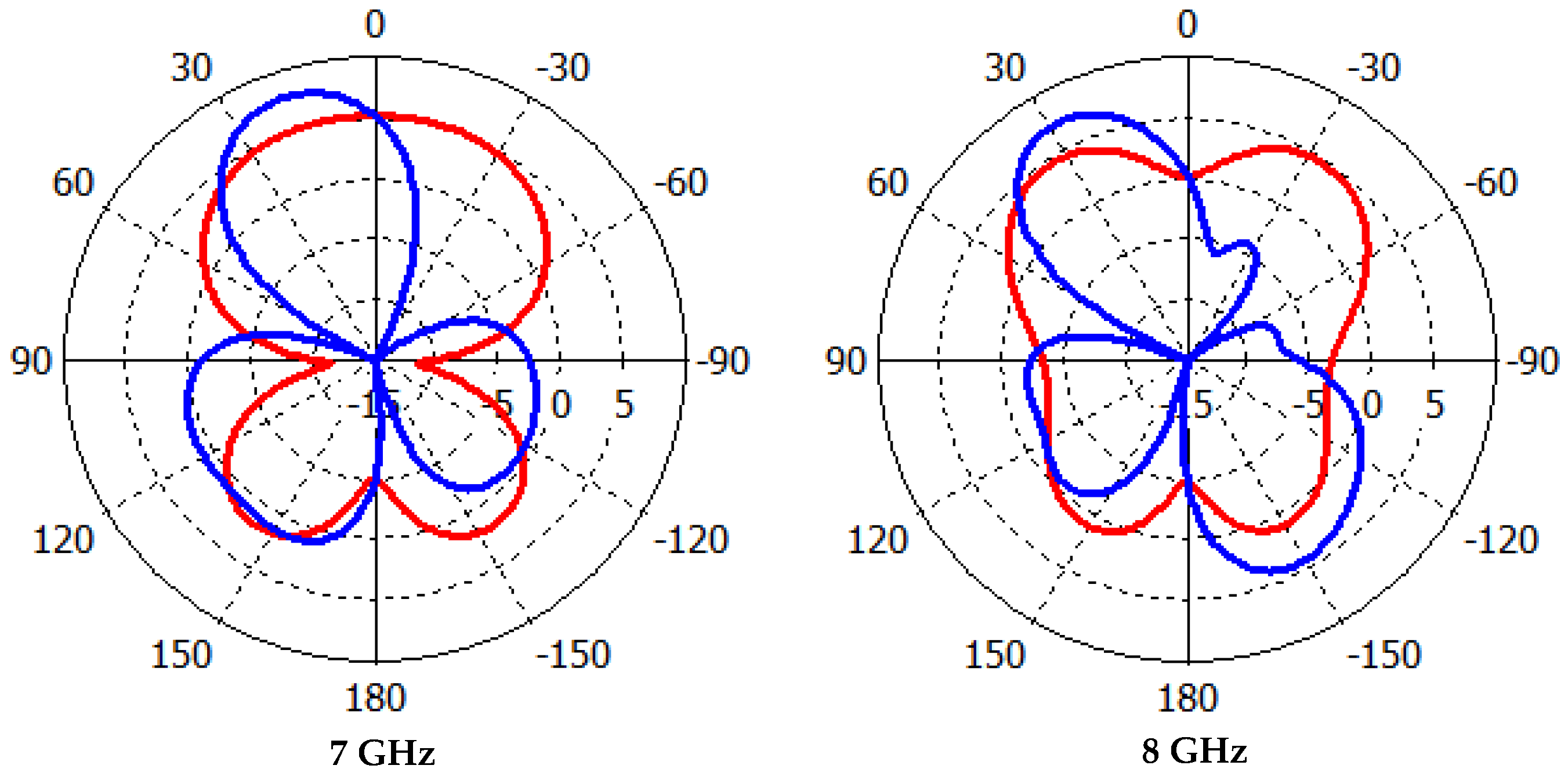
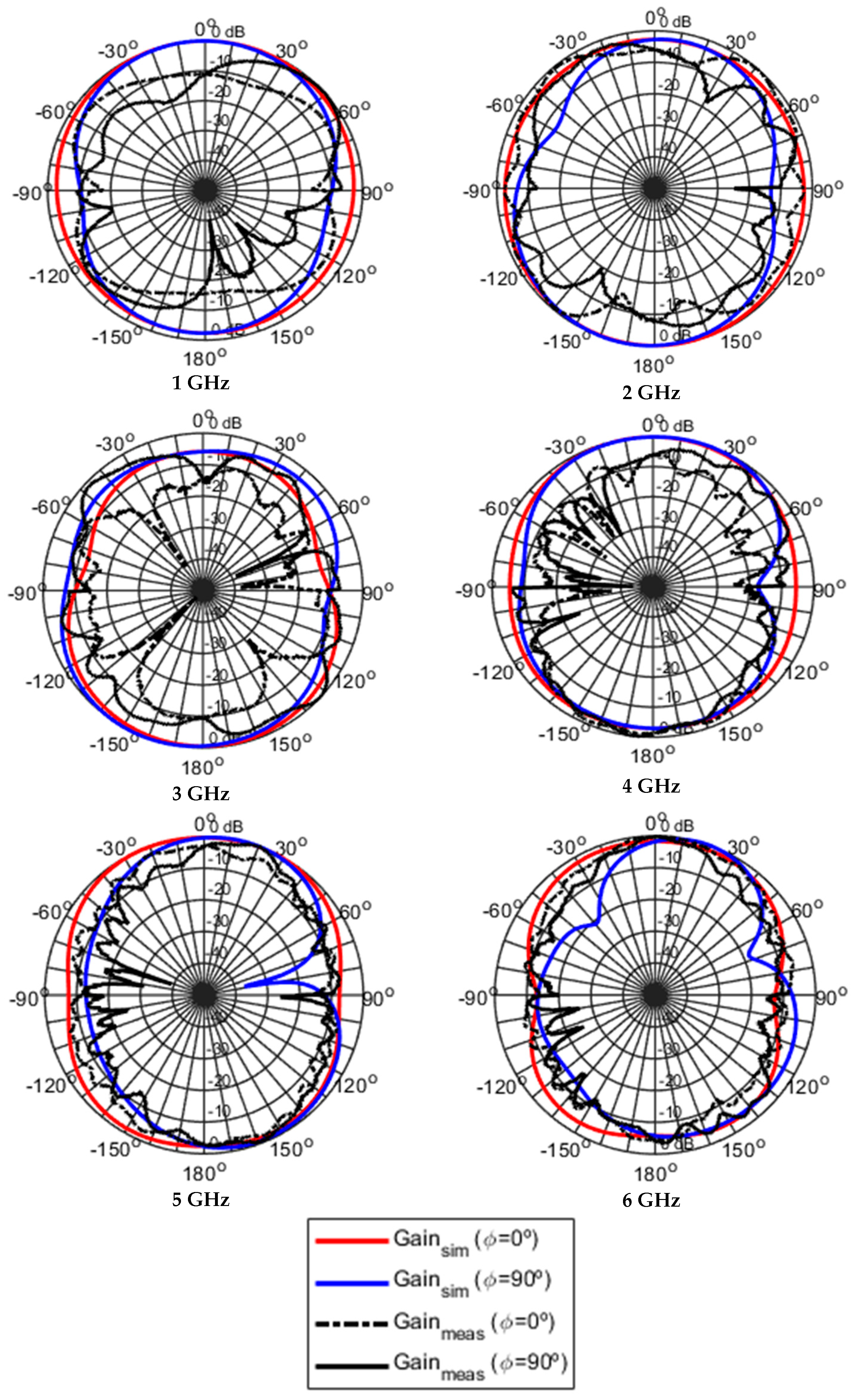
Figure 14 and
Figure 15 show the computed polar radiation patterns of the co-polar components of absolute gain (in dB) of the analyzed two-port self-complementary structure at the main radiation planes, from 1 to 8 GHz. Obviously, the broadband element radiates toward both hemispheres (bidirectional broadside). These radiation plots show a small asymmetry and a small angular displacement in the main lobe in the longitudinal plane (
y-
z plane,
E-plane), due to the presence of the microstrip line from the second port. Bidirectional broadside radiation is the main difference in the radiation characteristics compared to their classical counterpart (the reference antenna), which obviously radiates only toward the hemisphere of the patch. From the computed results, the analyzed structure can be considered to be like an antenna, being possible to express that their radiation patterns are assumable from 1 to 8 GHz, and the gain has appropriate values from approximately 3 to 8 GHz. Hence, if it is considered an antenna, its radiation bandwidth must be taken from 3 to 8 GHz (BW
sim-rad [antenna] = 5 GHz, radiation center frequency
fo [sim-rad] = 5.5 GHz, i.e., 45.5% of BW
sim-match, and 91% of
fo [sim-rad]).
Figure 13.
Calculated absolute axial ratio (AR in dB) of the proposed broadband radiating element, within its matching bandwidth, in the main broadside radiation directions: Theta = 0° (red line) and Theta = 180° (blue line).
Figure 13.
Calculated absolute axial ratio (AR in dB) of the proposed broadband radiating element, within its matching bandwidth, in the main broadside radiation directions: Theta = 0° (red line) and Theta = 180° (blue line).
On the other hand, if it is to be used like a radiating element for antenna arrays, like series-fed ones and corporative-feeding types, then the radiation patterns and the gain are adequate from 1 to 8 GHz (BWsim-rad [radiating element] = 7 GHz, fo [sim-rad] = 4.5 GHz, i.e., 63.6% of BWsim-match, and 156% of fo [sim-rad]). Moreover, it is important to highlight that for the analyzed structure used like an antenna or as a radiating element for antenna arrays, their radiation patterns are conserved and considerably stable from 1 to 6 GHz, mainly in the longitudinal plane (taking into account, necessarily and with primordial importance, antenna arrays fed in series configuration).
In
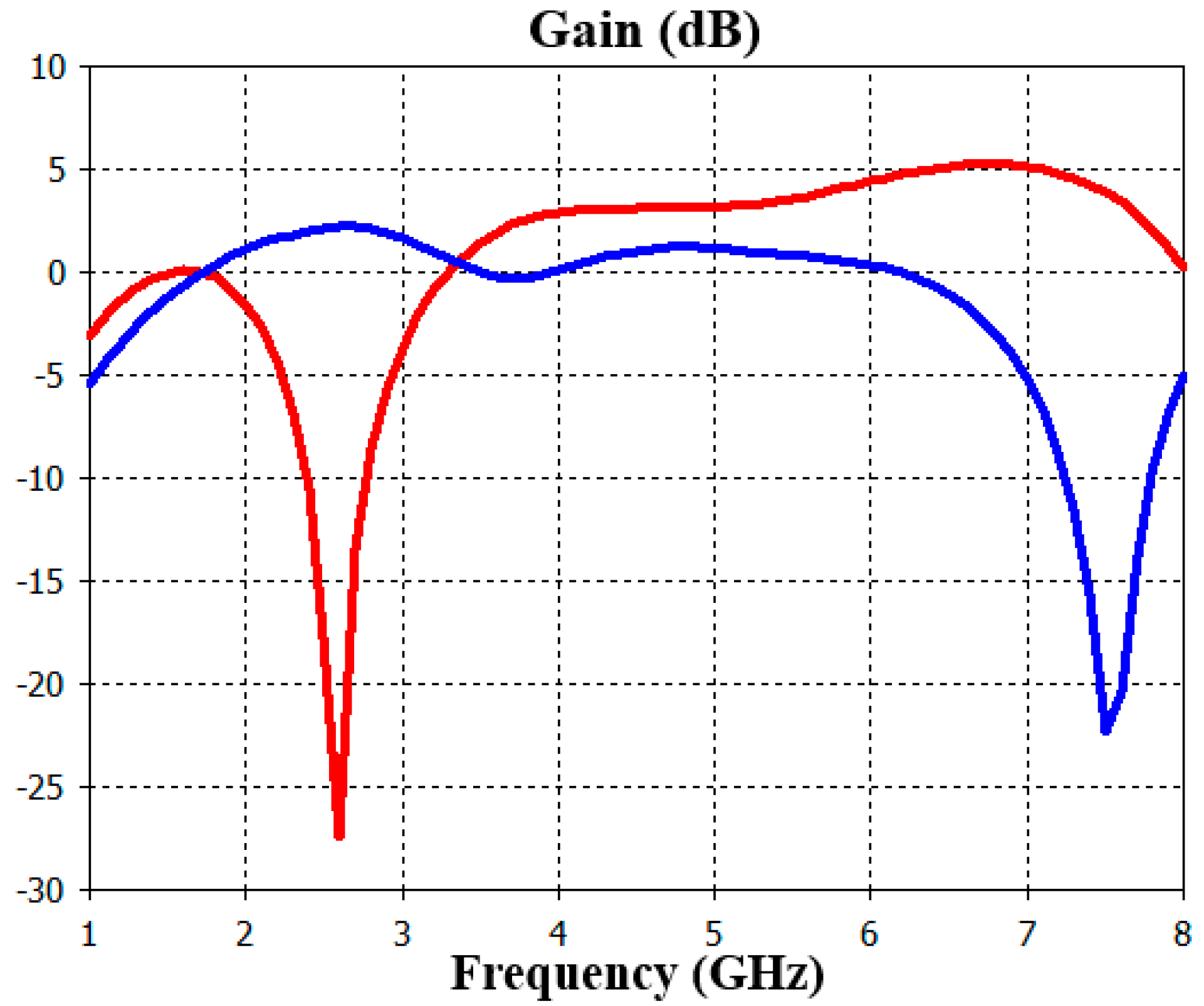
Figure 16, the behavior of the computed absolute gain of the analyzed antenna element at the main broadside radiation directions Theta = 0° and Theta = 180°, from 1 to 8 GHz, is shown
. As can be observed, the gain has good values in the majority of the studied frequency ranges (from 1.7 to 8 GHz), distributed in the two mentioned main broadside directions. In this frequency range, at any of the mentioned two main broadside directions, the gain mostly has values higher than 0 dB (G = 1), with the exception of two minimums (in 2.5 GHz at Theta = 0°, and in 7.5 GHz at Theta = 180°). It has a maximum value of approximately 7.8 dB at 7 GHz in the hemisphere that contains the patch. At Theta = 0° (main broadside direction, in the plane that contains the patch), the gain increases with the frequency from 2.5 to 7 GHz. In this plane and direction, the gain shows a very good flatness, considering a maximum variation of 2 dB, from 3.5 to 7 GHz (3.5 GHz, i.e., 32% of BW
sim-match, and 50% of BW
sim-rad approximately). Similarly, for the other broadside direction, Theta = 180° (plane that contains the slot), a little variation in the gain with the frequency and an adequate flatness from 2 to 6.5 GHz (4.5 GHz, i.e., 41% of BW
sim-match, and 64% of BW
sim-rad approximately) are achieved. Then, with this criterion, it is possible to establish that this two-port device has good gain flatness in the frequency, speci-fically from 3.5 to 6.5 GHz, in both main broadside directions (3 GHz, i.e., 27% of BW
sim-match, and 43% of BW
sim-rad approximately). These are very good and significant results obtained for an antenna element, mainly considering that the losses increase with the frequency in the printed antennas; consequently, the gain and radiation efficiency decrease with the frequency. Hence, as is well known, it is difficult to obtain high values of gain in printed radiating elements at very high frequencies, such as the studied microwave frequency range, and even more difficult with a broadband operation response. In addition, the losses of this type of antenna element increase notably with the length in antenna arrays, such as series-fed ones, obviously due to their length. Moreover, it is important to highlight, again, the good flatness reached in the gain in both mentioned main broadside directions from 3.5 to 6.5 GHz. Therefore, the mentioned gains in frequency are good and suitable, mainly if this antenna e-lement could be used in antenna arrays, such as series-fed ones.
Figure 14.
Calculated polar radiation patterns of co-polar components in terms of gain (in dB) in the proposed broadband radiating element from 1 to 6 GHz in the main radiation planes: transverse plane (Phi = 0°, H-Plane, red line), and longitudinal plane (Phi = 90°, E-Plane, blue line).
Figure 14.
Calculated polar radiation patterns of co-polar components in terms of gain (in dB) in the proposed broadband radiating element from 1 to 6 GHz in the main radiation planes: transverse plane (Phi = 0°, H-Plane, red line), and longitudinal plane (Phi = 90°, E-Plane, blue line).
Figure 15.
Calculated polar radiation patterns of co-polar components in terms of gain (in dB) in the proposed broadband radiating element for 7 and 8 GHz in the main radiation planes: transverse plane (Phi = 0°, H-Plane, red line), and longitudinal plane (Phi = 90°, E-Plane, blue line).
Figure 15.
Calculated polar radiation patterns of co-polar components in terms of gain (in dB) in the proposed broadband radiating element for 7 and 8 GHz in the main radiation planes: transverse plane (Phi = 0°, H-Plane, red line), and longitudinal plane (Phi = 90°, E-Plane, blue line).
Figure 16.
Calculated absolute gain in the proposed structure from 1 to 8 GHz in the main broadside radiation directions: Theta = 0° (red line), and Theta = 180° (blue line).
Figure 16.
Calculated absolute gain in the proposed structure from 1 to 8 GHz in the main broadside radiation directions: Theta = 0° (red line), and Theta = 180° (blue line).
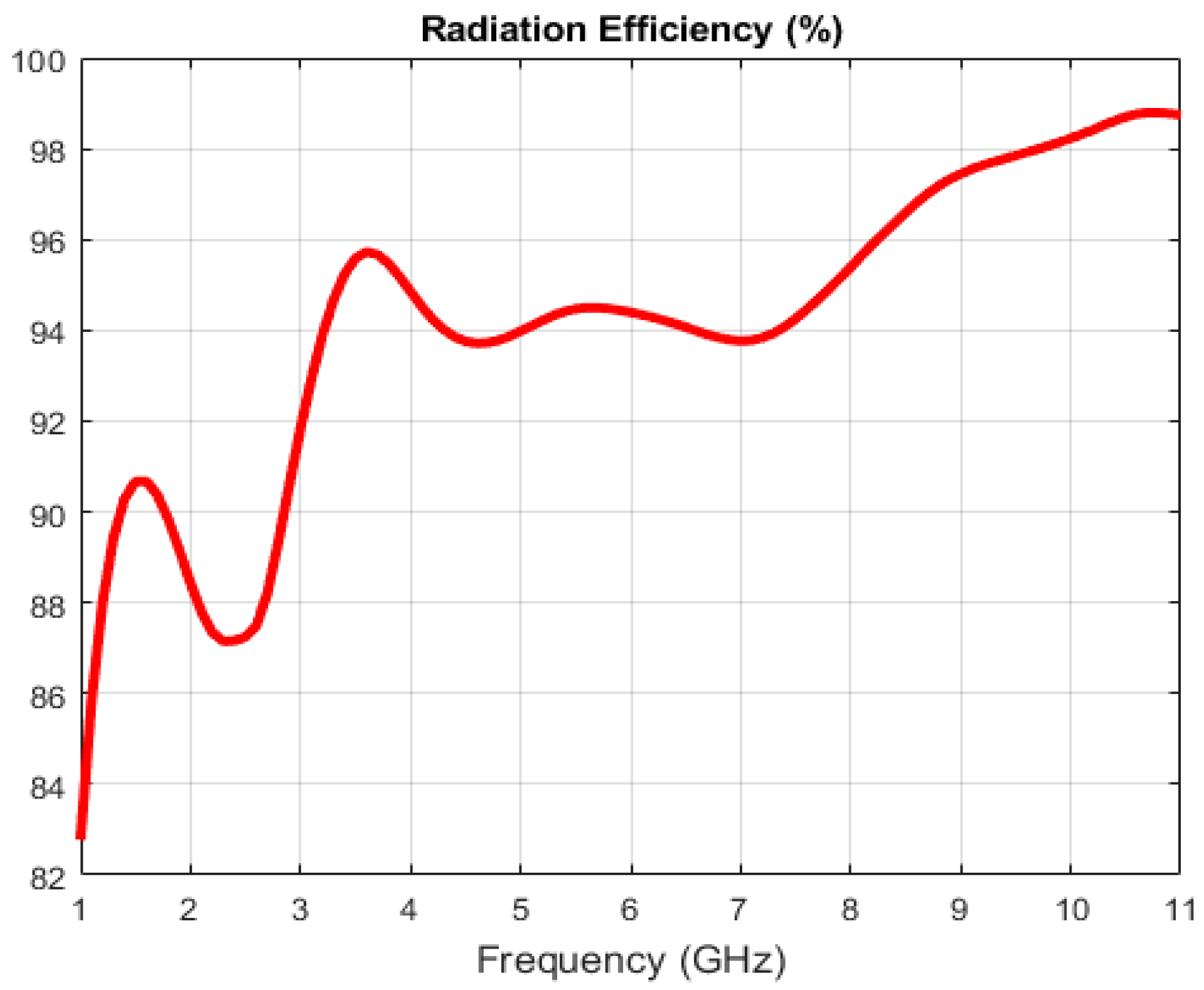
The simulated radiation efficiency of the analyzed and proposed structure with a load impedance
ZL = 50 Ω at the end of port 2, within its impedance matching bandwidth, is shown in
Figure 17. It has very good values of radiation efficiency in this frequency range and has a radiation efficiency bandwidth from 1 to 8 GHz (BW[
ηrad] = 7 GHz, i.e., 63.6% of BW
sim-match, and 100% of BW
sim-rad approx.). Specifically, it has values between approximately 83% and 96% from 1 to 8 GHz, which are very good results, and they allow us to consider it like an antenna, even as a radiating element for antenna arrays, such as series-fed ones. It is important to highlight that the radiation efficiency increases with the frequency from 1 to 1.5 GHz, from 2.5 to 3.5 GHz, and from 7.2 to 11 GHz. The radiation efficiency has little variation from 94 to 96% between 3.5 and 8 GHz (
in 4.5 GHz, 41% of its BW
sim-match, and 64% of BW
sim-rad), so that it has adequate stability for radiation efficiency with the frequency, mostly around the reference design center frequency (5 GHz). Furthermore, it has good flatness for this parameter in the frequency, particularly from 4 to 8 GHz, considering a maximum variation of approximately 1% (4 GHz, 36% of its BW
sim-match, and 57% of its BW
sim-rad), which are also very good results.
According to the achieved computed results of the radiation patterns, of the gain, and of the radiation efficiency within its matching bandwidth previously analyzed and commented on, a radiation bandwidth from 1 to 8 GHz is assumable (BWsim-rad = 7 GHz), which represents approximately 63.6% of its computed matching bandwidth and 156% of its computed radiation’s center frequency (4.5 GHz). In this frequency range, the mentioned patterns show only low radiation in the antenna’s plane.
If the calculated results of the matching bandwidth and the main radiation characteristics are considered together in this illustrative design example, it is possible to express that this radiating element has broadband performance with a very wide operation bandwidth of at least 7 GHz, limited mainly by the radiation patterns. This means that this element could also be used at other frequencies if the radiation patterns are not critical specifications. Moreover, the transmission coefficient of this antenna element is less than or around −2 dB within its wide operation bandwidth. In general, these are promising results for a two-port antenna element in transmission arrangement, primarily because it could be used in series-fed antenna arrays.
These results, together with those obtained in the previous work of [
21], allow us to conclude that the proper design of two-port self-complementary printed patch–slot structures, stacked and aligned, with the same shape and approximately equal dimensions, constitutes antenna elements with large matching and broad radiation bandwidths and, consequently, a wide operation bandwidth. Moreover, it is possible to obtain good radiation characteristics and merits parameters in this stacked printed topology.
7. Comparison of the Proposed Broadband Antenna Element with Previous Works
In this section, the proposed antenna element based on the concept of
self-complementary structures in staking arrangement is compared to previous similar broadband radiating elements (with two-port self-complementarity in stacking arrangement, and in transmission configuration) that have already been presented in the scientific and technical literature.
Table 2 exhibits the results obtained with the new antenna element proposed here (“
This work” in
Table 2) and with the recent similar wideband two-port radiating element (using the self-complementarity concept in stacking arrangement). With the goal to complete a more exhaustive valuation of the contribution of this work to the mentioned
state of the art, a comparison of the results obtained in this work with wideband antenna elements with one and two feeding ports, with and without self-complementarity, was performed and is presented in this section.
Firstly, the new antenna element is compared with the broadband slot radiating element based on microstrip–slot coupling, which was presented in [
20]. The antenna element of [
20] has a simulated and measured 10 dB return loss bandwidth of approximately 16 GHz (i.e., relative matching bandwidth about 200%), while the illustrative example design proposed here is approximately 11 GHz (i.e., BW
sim-relative-match = 200%). The radiation bandwidth of [
20] is considered to be approximately 5.8 GHz (from 5.4 to 11.2 GHz, ra-diation center frequency
fo [rad] = 8.3 GHz, i.e., BW
sim-relative-rad ≈ 70%). The new antenna element proposed here has bidirectional broadside radiation (radiates to both hemispheres) like in [
20]. The proposed illustrative antenna element has wide computed and measured bandwidths of impedance matching of 11 and 8 GHz, respectively. The radiation bandwidth and relative radiation bandwidth of the proposed radiating element here (7 GHz, i.e., 63.4% of its computed matching bandwidth, and 156% of its computed radiation center frequency) are bigger than in [
20]. It is important to highlight that the results obtained in the proposed antenna element can be improved, due to it being an example of an illustrative design, it is not optimized, and the measurements of the main fundamental para-meters and merits characteristics would be improved (even they would be surpassed by the mentioned results reached in [
20]). The new radiating element has higher gain than [
20]. Moreover, the proposed antenna element has the inherent advantages of patch antennas, such as simplicity, compactness, more modes of field distribution and performances, versatility in polarization and radiation, the possibility to reject modes, and o-thers, which are not possible to achieve in the slot, nor in the broadband slot radiating element based on microstrip–slot coupling characterized and presented in [
20]. The ra-diation efficiency of [
20] within its impedance matching bandwidth is low, and it has a maximum value of 23%.
Table 2.
Comparison of the results obtained in the proposed radiating element with the state of the art in recent wideband two-port self-complementary radiating element in transmission configuration.
Table 2.
Comparison of the results obtained in the proposed radiating element with the state of the art in recent wideband two-port self-complementary radiating element in transmission configuration.
| Ref. | Type of Radiating Element | Match. Freq. Range [GHz]
Calc
/
Meas | BWmatch
[GHz]
Calc
/
Meas | fo [match]
[GHz]
Calc
/
Meas | BW[relative-match]
[%]
Calc
/
Meas | Type of
Radiation | Rad. Freq. Range [GHz]
Calc
/
Meas | BWrad
[GHz]
Calc
/
Meas | fo[rad]
[GHz]
Calc
/
Meas | BW[relative-rad]
[%]
Calc
/
Meas | Gmax
[dB]
Calc | Rad. Efficiency
[%]
Calc |
|---|
| [This work] | Proposed Radiating Element | Up to 11/
≈8 | ≈11
/
≈8 | 5.5
/
4 | 200
/
200 | Bidirectional
Broadside | 1–8
/
2–6 | 7
/
4 | 4.5
/
4 | ≈156
/
≈100 | 7.5
(@ 6 GHz) | * 83 to 96% |
| [20] | 2 Port-
Complementary Microstrip-Slot Coupling | Up to 16/
Up to 16 | 16
/
16 | 8
/
8 | 200
/
200 | Bidirectional
Broadside | N.A.
/
N.A. | 5.8
/
N.A. | 8.3
/
N.A. | 70
/
N.A. | N.A.
/
N.A. | 10–23 |
| [28] | 2 Port-Cavity-Backed Slot (CBS) | 3 to 6.8
/
3 to 6.7 | 3.8
/
3.7 | 4.9
/
4.9 | 78
/
76 | Unidirectional Broadside | 4–6.7
/
4–6.7 | 2.7
/
2.7 | 5.4
/
5.4 | 50
/
48 | ≤0
/
≤0 | 3–30 |
| [29] | 2 Port-Compact I-Microstrip-Slot Coupling | 5–16
/
N.A. | 11
/
N. A. | 10.5
/
N. A. | 105
/
N.A. | Bidirectional
Broadside | N.A.
/
N.A. | N.A.
/
N.A. | N.A.
/
N.A. | N.A.
/
N.A. | N.A.
/
N.A. | 22–32 |
| [30] | 2 Port-
Microstrip-Slot Coupled Radiating Structure (RS) with I-Shaped Resonators | Up to 16 GHz/
N.A. | 16
/
N.A. | 8
/
N.A. | 200
/
N.A. | Bidirectional
Broadside with improvement in F/B ratio. | 4–13.6
/
N.A. | 9.6
/
N.A. | 8.8
/
N.A. | 109
/
N.A. | Dmax sim ≈ 7dBi
(Gmax is N.A.) | Up to 42 |
| [31] | 2 Port Microstrip-Slot Coupled RS with Radiation Efficiency Enhancement | 2 main matching bandwidths
Lowest:
0.5–5/N.A.
Highest:
12.5–16/N.A. | Lowest:
Up to 4.5
/
N.A.
Highest:
3.5
/
N.A. | Lowest:
2.75/
N.A.
High: 14.25/
N.A. | Lowest:
164
/
N.A.
Highest:
25
/
N.A. | Bidirectional
Broadside | N.A.
/
N.A. | N.A.
/
N.A. | N.A.
/
N.A. | N.A.
/
N.A. | Enhancement of the directivity respect to [20,29,30]. | Up to 35 |
In [
28], a wideband two-port cavity-backed slot (
CBS, hereinafter) using the concept of self-complementarity in stacking arrangement, useful for series-fed antenna arrays, is described. It has a wide impedance bandwidth of 3.7 GHz, with a corresponding matching center frequency of 4.9 GHz (i.e., BW
sim-relative-match = 76%), so that the new antenna element presented here surpasses the matching bandwidth [
28]. The radiating element of [
28] has unidirectional broadside radiation, while the antenna element proposed here radiates toward both hemispheres (bidirectional broadside). Another disadvantage of [
28] is that the slot mode is present in this radiating element, which is set to lower maximum matching and operation frequencies, which does not occur in the proposed antenna element. On the other hand, Ref. [
28] has a radiation bandwidth of 2.7 GHz (from 4 to 6.7 GHz,
fo [rad] = 5.4 GHz, i.e., BW
sim-relative-rad = 50%), which is less than of [
20] and of the new proposed antenna element. In addition, the radiating element presented in [
28] is more complex to design and manufacture than that proposed here and in [
20]. In addition, within its impedance bandwidth, it has values of radiation efficiency between 3% and 30%, which is lower than in [
20], which is translated into large series-fed antenna arrays to obtain the required gain and radiation efficiency with regard to [
20] and other similar ones. Hence, the proposed antenna element is higher than [
28] in some important fundamental and merit antenna parameters, such as impedance matching bandwidth, matching center frequency, relative matching bandwidth, radiation bandwidth, radiation center frequency, relative radiation bandwidth, and operation bandwidth.
A compact two-port I-microstrip–slot coupling radiating element, which has similar topology to [
20], was presented in [
29]. It has a simulated impedance bandwidth of 11 GHz (from 5 to 16 GHz,
fo [sim-match] = 10.5 GHz, i.e., BW
sim-relative-match = 105%), and it exhibits bidirectional broadside radiation. In addition, there is a size reduction with respect to [
20]. Despite the results in [
29], the proposed antenna element here has a matching bandwidth approximately equal to that in [
29], with a lower matching center frequency and a cor-responding relative matching bandwidth greater than [
29]. The radiation bandwidth is not available in [
29], so it cannot be compared in terms of this parameter with the proposed antenna element and the rest. In addition, Ref. [
29] has a radiation efficiency from approximately 22% to 32%, which is bigger than that in [
20] and [
28]. The proposed ra-diating element here is mostly better than [
29].
Most of the authors in [
29] proposed a wideband two-port radiating element in [
30]. It consists of microstrip–slot coupled exciting I-shaped resonators. It shows a computed impedance bandwidth of up to approximately 16 GHz (
fo [match] = 8 GHz, i.e., BW
sim-relative-match ≈ 200%), which is approximately equal to [
20] and comparable with the proposed antenna element and [
28]. However, the radiating element analyzed in [
30] shows an improvement in radiation in the patch plane containing the I-shaped resonators (increasing the directivity) and an enhancement in the radiation efficiency from 25% to 42%, which is higher than that achieved in [
20,
28,
29]. Consequently, Ref. [
30] presents an improvement in the calculated radiation bandwidth (from 4 to 13.6 GHz, BW
sim-rad ≈ 9.6 GHz,
fo [sim-rad] = 8.8 GHz, i.e., BW
sim-relative-rad = 109%), which is higher than that of the new antenna element presented here, in [
20] and [
28].
Subsequently, most of the authors of [
29,
30] analyzed and presented a radiating element coupled with a two-port broadband microstrip slot with improved radiation efficiency in [
31], which was incorporated into the above-mentioned
state of the art. However, once again, it has a narrower matching bandwidth than that achieved in the new antenna element. The radiation bandwidth is not available in [
29] and is not clearly defined or expressed in [
31], so this antenna element parameter cannot be compared with the rest of those studied.
As a summary of the results found in the
state of the art corresponding to recent two-port radiating elements in transmission configuration based on self-complementary structures in stacking arrangement, it can be stated that Ref. [
20] has the widest impedance matching bandwidth, followed by [
30], the proposed radiating element proposed here, with [
29], [
31] and [
28] (in this order). The relative impedance bandwidth of the new antenna element shows the highest result, followed by [
20], [
30], [
31], [
29], and [
28] (in this order), which is more important than the matching bandwidth, because the relative one takes into account the matching center frequency (it is more approximated to the operation frequency). The proposed radiating element and the antenna elements of [
20,
29,
30,
31] have broadside radiation in both hemispheres (bidirectional), while [
28] is unidirectional. It is also worth noting that [
30] has the highest radiation bandwidth, followed by the proposed antenna element here, [
20] and [
28] (this parameter is not available in [
29,
31]). In this sense, Ref. [
20] has the largest matching bandwidth of the studied cases (with the exception of [
30], which is equal to [
20]), while Ref. [
30] has the biggest radiation bandwidth. On the other hand, the radiating element of [
28] has the smallest matching, radiation and corresponding relative bandwidths. Taking into account that the operation bandwidth is determined mostly in these cases by the radiation bandwidth, and the relative radiation bandwidth considers the center radiation frequency, which is a very important parameter because it determines the operation frequency, then the relative radiation bandwidth is a better parameter in these cases to analyze and determine the operation bandwidth. So, due to the proposed radiating element, here is a new approach for wideband two-port radiating elements in transmission configuration using self-complementarity in stacking arrangement. It has a bigger relative radiation bandwidth and, consequently, has higher operation bandwidth compared with the rest, and it also has a considerably high maximum gain and very good other antenna fundamental parameters and merit characteristics, even in terms of frequency. Hence, it is considered that the proposed antenna element is one of the above-mentioned similar ones with the best fundamental and functioning parameters. Therefore, it is possible to include the proposed antenna element in the
state of the art in wideband two-port radiating elements in transmission configuration, mainly using the self-complementarity concept in stacking arrangement.
Below, a comparison of the results found in the proposed antenna element with those obtained in other self-complementary and non-self-complementary structures, both with feeding of a single port or of two ports, in transmission configuration, is also presented.
A single-port self-complementary microstrip-fed slot-coupled patch antenna was presented in [
32]. In this case, the patch and its complementary part (rectangular slot) are contiguous in the same plane. In addition, the printed structure self-complementary with the first one was added in staking configuration to increase the matching and operation bandwidths. Despite these topologies, they exhibit wide relative impedance bandwidths of approximately 56% and 51%, respectively, which do not exceed the radiating element proposed in this study or the above-mentioned ones. It has unidirectional broadside ra-diation, with a radiation bandwidth of at least 6.5 to 11 GHz (4.5 GHz,
fo [rad] = 8.8 GHz, i.e., BW
relative-rad ≈ 51%). In addition, it has an adequate front-to-back ratio. The impedance matching and radiation bandwidths are not larger than those of the antenna element a-nalyzed and proposed here.
A broadband single-port printed quasi-self-complementary antenna based on a dipole, for WLAN application, was announced in [
33]. This antenna has a printed part (like a T-shaped strip), and its self-complementary part is contiguous to the first one in the same plane and axis but in the opposite direction, with both being in the same layer. It has a measured matching bandwidth of 1.5 GHz for a center frequency of
fo [match] = 5.5 GHz (i.e., BW
relative-match = 27%), which is very low compared to the above-compared ones, including the proposed antenna element. In addition, it has a radiation bandwidth like the matching one and very good values of gain (more than 3 dB) within its operation bandwidth. However, the proposed radiating element here has bigger impedance, radiation bandwidths, and maximum gain than [
33].
In [
34], a printed single-port half-disc quasi-self-complementary antenna for band-notched ultra-wideband (UWB) applications was proposed. It consists of a quarter-circular patch and a self-complementary counterpart (quarter-circular slot) contiguous to the first one, on the same plane and layer. It was analyzed from 2 to 13 GHz, showing a notched band from approximately 1 to 2 GHz and from 5.02 to 6.07 GHz. Hence, its si-mulated and measured broad impedance bandwidths are approximately 6 GHz (from 6 to 12 GHz,
fo [match] = 9 GHz, i.e., BW
relative-match = 67%), and it is not higher than the proposed radiating element and the other mentioned ones. Their radiation patterns were measured at 4, 7, and 9 GHz, and they can be considered acceptable, but, of course, it is not bigger than the new antenna element proposed here. It is important to highlight that it is a single-port fed antenna too, like [
32,
33], while the aforementioned studies are mostly two-port radiating elements in transmission arrangement. These self-complementary antennas and their comparisons are only to demonstrate that very good results can be achieved with the proposed antenna element, mainly giving an overview of the impedance and radiation bandwidths that can be obtained in similar single-port self-complementary antennas, as well as the other mentioned main performance characteristics.
A compact single-port self-complementary antenna for portable UWB applications was presented in [
35]. It has a very wide simulated and measured impedance bandwidth of approximately 8.5 GHz (from 3 to 12 GHz,
fo [match] = 7.75 GHz, i.e., BW
relative-match = 110%). This matching frequency range is less than the proposed antenna element but higher than the aforementioned ones. Its radiation bandwidth is not clearly defined and expressed in [
35]; therefore, it cannot be compared with the antenna element proposed here and with the rest. Again, it is important to express that it is an antenna fed with one port, and the rest are mostly in two-port and transmission configuration. Once again, this comparison is only used to provide a simple idea of the matching and radiation bandwidths, the corresponding center frequencies, and the corresponding relative bandwidths in self-complementary single- and two-port antenna elements.
In [
36], a single-port quasi-self-complementary rectangular printed antenna in contiguous arrangement was introduced. It has two impedance matching bandwidths, 100 MHz (4.1% at 2.45 GHz) and 2.7 GHz (48.9% at 5.5 GHz), which were validated using measurements. Both cases of matching bandwidths are no bigger than the above-mentioned ones, neither the two-port nor the single-port ones, including the radiating element proposed here. In addition, it has good radiation patterns at 2.45 and 5.5 GHz, but its radiation bandwidth is not clearly defined and expressed; therefore, it cannot be compared with the one proposed here and with the rest. Without a doubt, this antenna does not surpass, in terms of matching and radiation bandwidths and, therefore, also in terms of operation range, the antenna element proposed here.
A two-port ultra-wideband Vivaldi antenna with dual polarization and radar cross-section (RCS) reduction was proposed in [
37], mainly for measurement systems of near-field radiation. It has a wide 10 dB return loss bandwidth in both ports of approximately 4.2 GHz (from 1.8 to 6 GHz,
fo [match] = 3.9 GHz, i.e., BW
sim-relative-match = 108%) and other good performance characteristics, like isolation between theirs ports of more than 23 dB, a rea-lized gain of more than 4 dBi within its impedance bandwidth, and averaged monostatic RCS reduction of less than −30 dB. It has dual linear polarization and a radiation bandwidth of approximately 3 GHz (from 2 to 5 GHz,
fo [rad] = 3.5 GHz, i.e., BW
sim-relative-rad ≈ 86%). As can be analyzed, Ref. [
37] does not surpass the proposed antenna element here in terms of matching and radiation bandwidths and in their corresponding relative bandwidths.
A broadband compact printed single-port antenna for wireless biotelemetry for future leadless pacemakers was introduced in [
38]. Basically, Ref. [
38] consists of a slotted printed single-port antenna. It exhibits a wide matching bandwidth of approximately 3.4 GHz (from 0.76 to 4.15 GHz,
fo [match] = 2.46 GHz, i.e., BW
sim-relative-match = 138%), which does not surpass the proposed antenna element, nor [
20,
28,
29,
30], and others. This radiating element has practically omnidirectional radiation patterns mainly at 0.915, 1.4, and 2.45 GHz, but it is no bigger than the proposed antenna element here. Again, it is important to consider that [
38] features a single-port antenna, while the one proposed here and the other ones compared previously are two-port structures in transmission configuration.
We believe that the results obtained in the proposed broadband two-port rectangular patch radiating element in transmission configuration, using the concept of self-complementary structures in stacking arrangement, allow us to establish that it can also be considered as a contribution to the
state of the art in broadband two-port printed radiating elements in transmission configuration, mainly using the self-complementarity concept in stacking [
4,
6,
7,
8,
9,
10,
11], respect to single-port self-complementary topologies both contiguous and in stacking arrangements [
12,
13,
14,
15,
16,
17,
32,
33,
34,
35,
36], regarding to two-port stacked self-complementary radiating elements [
18,
19,
20,
21,
28,
29,
30,
31], and to other wideband printed antennas [
22,
23,
24,
25,
26,
27,
37,
38,
39,
40,
41,
42,
43,
44].
9. Conclusions
The first and foremost conclusion of the present work is that the use of the self-complementary concept in two-port rectangular patch antennas in transmission and stacking configurations increases both bandwidths: impedance matching and radiation. In this sense, and in a general way, it can be stated that two dual electromagnetically complementary structures of the same arbitrary shape, situated vertically in stacking arrangement and aligned, with similar dimensions, in a common dielectric substrate, and fed directly by a microstrip line, provide ultra-wide matching and broad radiation bandwidths.
Second, only two physical dimensions need to be adjusted to achieve the wideband behavior in the proposed antenna element: the length and width of the slot. Therefore, it only has two degrees of freedom to obtain the mentioned broadband performance, and its design is simple and easy.
Third, its design is flexible, due to there being many possible length–width combinations for both the patch and its complementary part (the slot), which allow it to reach the broadband matching behavior.
Fourth, with this antenna element, it is also possible to obtain very good results in some of the main radiation parameters and other merit performance characteristics, as follows: good and pure linear polarization, appropriate radiation patterns, adequate conservation in the frequency, as well as attractive gain and radiation efficiency values, and very good flatness of the last two mentioned parameters over wide frequency ranges. Consequently, it is possible to establish that it has a very wide operation bandwidth.
As a final remark, the analyzed broadband two-port self-complementary rectangular patch structure is simple, compact, has low-weight, and its synthesis and manufacturing are easy and flexible. The radiating element with an impedance load ZL = 50 Ω at the end of port 2 is well suited like an antenna in both existing and emergent wireless applications, where broadband operation is required, such as radiobroadcasting, fixed radio links, wireless networks (Wi-Fi and WiMAX), mobile communications, satellite applications, radar, biomedicine, radiofrequency imaging, Oceanic Engineering research, biomedicine, and others. Furthermore, it could be used as a radiating element in different antenna arrays with wideband or/and multiband operation, such as series-fed ones and others, which could be used in the mentioned applications or/and others.