Article

Low-Profile Transmitarray Antennas with Reflective Phase Compensation and Polarization-Selective Folding

Department of Electronic Engineering, National Taipei University of Technology, Taipei 10608, Taiwan
*
Author to whom correspondence should be addressed.
Electronics 2026, 15(7), 1506; https://doi.org/10.3390/electronics15071506
Submission received: 28 February 2026 / Revised: 29 March 2026 / Accepted: 1 April 2026 / Published: 3 April 2026

Abstract

This paper presents a study of low-profile transmitarray antennas using two folded design approaches for microwave energy focusing. One approach realizes profile reduction through reflective phase compensation, whereas the other uses polarization-selective path folding. Prototypes are fabricated and measured, and their aperture performance is evaluated using gain, aperture efficiency, and first-sidelobe level as practical indicators of focusing quality and unwanted radiation outside the main beam. For the reflective phase-compensation design, dual-linear-polarized operation is maintained, and a height reduction of 52% is achieved. The measured broadside gain is reduced by 2.6–2.7 dB for x polarization and 1.6–1.7 dB for y polarization, while the first sidelobe increases by 3.7–6.6 dB for x polarization and by 5.1 dB in the y–z plane for y polarization. For the polarization-selective folded design, the feed-to-aperture distance is reduced from 165 mm to 43.5 mm, giving a compression factor of about 3.8. The measured peak gain is reduced by 3.4 dB, and the first sidelobe increases from −19.9 dB to −13.2 dB in the E-plane and from −16.8 dB to −12.9 dB in the H-plane. The comparison shows that reflective phase compensation is more suitable when dual-linear-polarized operation is required, whereas polarization-selective path folding is more suitable when stronger profile compression is prioritized and single-polarized operation is acceptable.

1. Introduction

Transmitarray antennas form high-gain beams by placing phase-controllable unit cells on a planar aperture to reconstruct a transmitted wavefront. In a conventional design, the feed-to-aperture spacing is set by the focal geometry, so the overall height scales with both the focal distance and the aperture size. Because illumination quality and beam quality depend on the focal-length-to-diameter ratio (F/D), F/D is usually not chosen to be very small, and the profile becomes difficult to reduce when a large aperture is required. Folded-path transmitarrays address this constraint by extending the electrical propagation path inside a smaller physical height using internal reflections or additional phase-control interfaces.
One major folded-path approach uses polarization-selective routing. A thin polarizer or metasurface controls reflection and transmission so the wave follows a longer electrical path before exiting the aperture. Early implementations used ultrathin transmission polarizers as the folding interface [1]. Metasurface-based polarizers were then introduced to improve bandwidth and profile flexibility [2], and differential excitation was used to add controllable phase delay along the folded path [3]. Wideband folded transmitarrays combining the folding interface with magnetoelectric dipole elements have also been reported [4]. Polarization-selective folding has been extended to circular polarization using metasurfaces that support both folding and wavefront control [5,6]. Although polarization selectivity is intrinsic to this mechanism, dual linear polarization can be retained when the folding interface and aperture are co-designed to support two orthogonal channels [7,8]. Related variants include multifunctional metasurfaces with two-sided wavefront control [9], double-fold configurations using curved polarizers [10], and reconfigurable folded transmitarrays [11]. Additional broadband designs based on polarization-selective folding interfaces indicate continued efforts toward bandwidth extension under low-profile constraints [12].
A second approach folds the path through reflection inside a compact cavity and supplies the phase shortage by reflective phase compensation. In this strategy, the low-profile structure is treated as a coupled reflective cavity in which engineered phase control is introduced within the folded stack to recover the desired output wavefront. Metasurface-based implementations embed explicit phase manipulation in the folded structure to maintain beam formation [13]. Metal-only folded transmitarrays further show that dielectric loading is not required for folded propagation and profile reduction [14,15]. Folded transmitarrays have also been hybridized with Fabry–Perot cavities, where the folded path reduces height while the cavity contributes to radiation control [16]. The mechanism is closely related to folded reflectarrays and hybrid folded transmitarray–reflectarray architectures, which exploit internal reflection while retaining aperture-based phase synthesis [17]. Extremely compact designs described as reflectarrays with additional phase compensation illustrate this reflective folding concept [18], and bifunctional folded transmit/reflect arrays extend it by combining reflective and transmissive phase control within one interface [19]. Since reflective phase-compensation folding is not inherently tied to polarization conversion, it is compatible with dual-linear-polarized operation, and dual-polarized folded transmitarrays based on this approach have been reported [20].
Recent low-profile aperture antennas have also integrated additional functions beyond profile reduction. For example, dual-band low-profile and shared-aperture hybrid antennas were reported in [21,22]. In low-profile transmitarray research, recent efforts have further considered sidelobe control, wideband performance, beam control, and efficiency improvement [23,24]. These studies show that compact aperture designs are being developed along multiple directions. However, polarization-selective folding and reflective phase-compensation folding are still commonly treated as separate design routes. Therefore, a direct mechanism-level comparison of their folding penalties remains insufficient in the literature.
Although both routes reduce profile by extending the electrical path in a compact height, they are usually presented as separate design families. Polarization-selective folding forms the path by polarization-dependent reflection and transmission, while reflective phase-compensation folding forms the path by internal reflection and an engineered reflection phase. Because published designs typically differ in aperture size, operating frequency, polarization handling, and phase-synthesis implementation, it remains difficult to relate the two mechanisms on a common physical basis or to compare their penalties under comparable constraints, particularly when low profile, phase control, and dual-linear polarization are considered together.
This paper addresses this gap by treating polarization-based folding and reflective phase-compensation folding as two realizations of wave-path extension within reduced height and by comparing each folded design to its own full-height reference under the same focal-ratio constraint. Two representative designs are developed: a polarization-selective folded transmitarray and a dual-linear-polarized folded transmitarray based on reflective phase compensation. Full-wave simulations and measurements are used to quantify profile reduction and to evaluate the folding-induced changes in polarization behavior and radiation performance.

2. Folded Transmitarray Based on Reflective Phase Compensation

2.1. Full-Height Design

This section develops a reflective phase-compensation folded transmitarray. A full-height dual-linear-polarized transmitarray is first established as the reference, as shown in Figure 1, because the folded design is intended to reproduce the same aperture phase synthesis with reduced height. The aperture contains 14 × 14 unit cells and occupies 98 mm × 98 mm (4.6 λ × 4.6 λ at 14.12 GHz, where λ is the wavelength). The operating frequency of 14.12 GHz was selected as a representative Ku-band design point, which lies within the 14.0–14.5 GHz range commonly used for fixed-satellite-service uplinks.
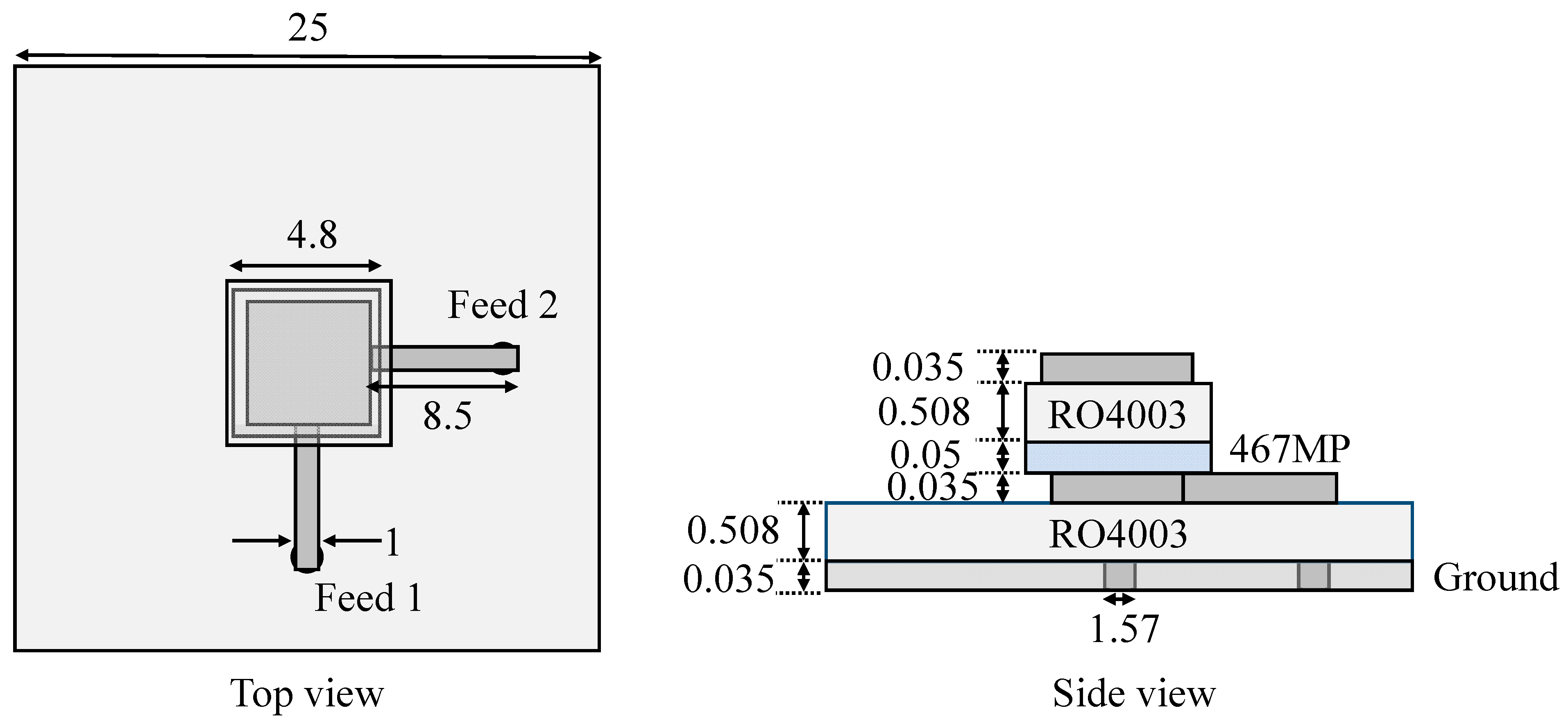
The aperture is illuminated by a dual-linear-polarized stacked-patch feed, the geometry of which is demonstrated in Figure 2. The radiating patches are printed on Rogers RO4003 (thickness 0.508 mm, dielectric constant εr = 3.55, and loss tangent tanδ = 0.0027). The stacked layers are bonded using a 3M 467MP adhesive film (thickness 0.05 mm, εr = 2.72, tanδ = 0.017). Two orthogonal ports excite x and y polarizations, and the feed network is symmetric, so the two ports have identical electrical path lengths. The feed operates over 13.7–14.7 GHz. At 14.12 GHz, the simulated reflection coefficients are −21.5 dB and −21.8 dB for the two ports, and their impedance responses remain closely matched across the band, avoiding polarization-dependent excitation imbalance prior to aperture illumination.
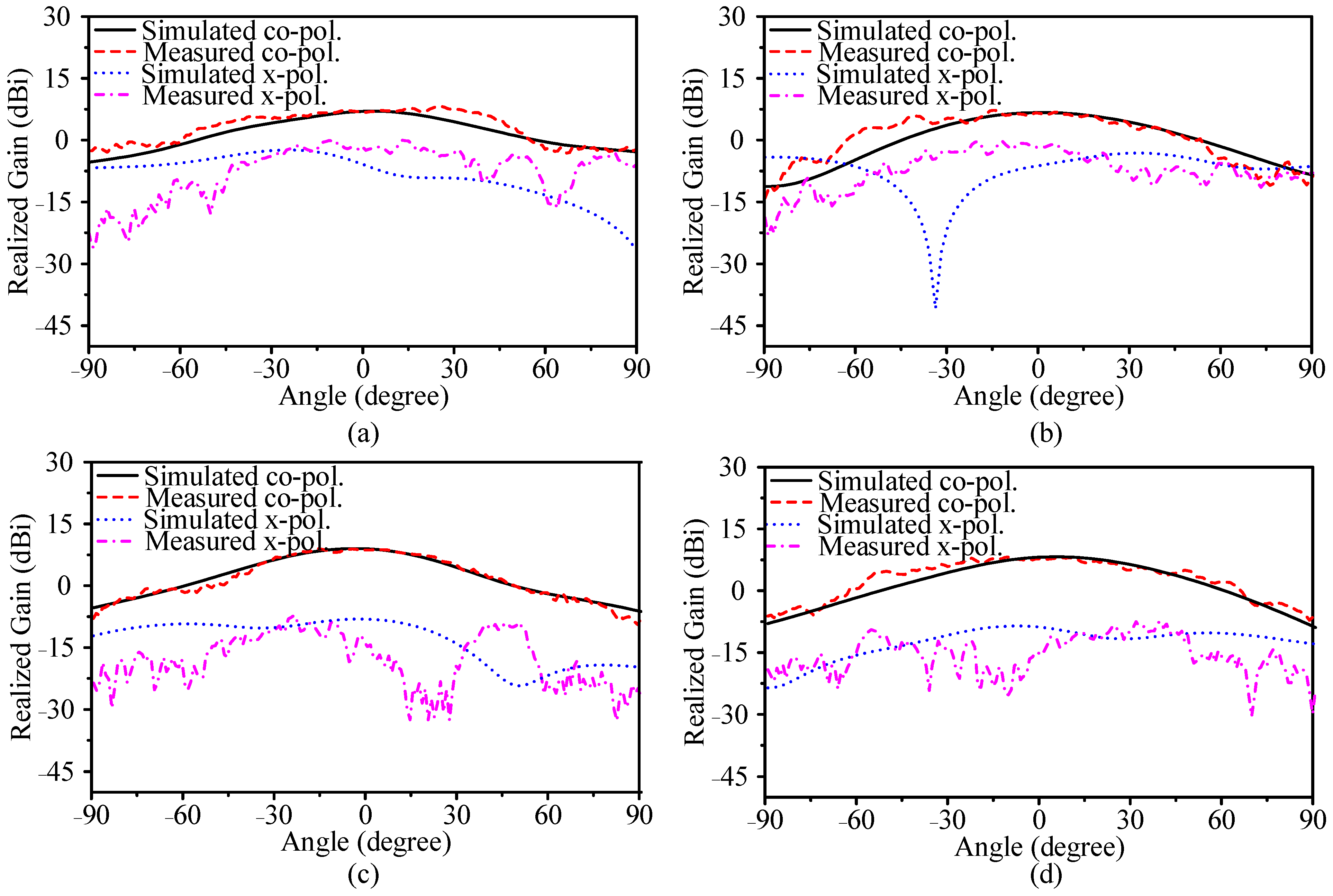
Figure 3 shows the simulated and measured pattern of the feeding patch. At 14.12 GHz, the half-power beamwidths (HPBWs) are 78° in the E-plane and 82° in the H-plane for both ports, indicating similar illumination for x and y polarizations. Based on this illumination, F/D is chosen by balancing spillover loss and phase error across the aperture: smaller F/D increases illumination uniformity but increases edge phase deviation, while larger F/D reduces phase error at the cost of higher spillover. Here, F/D = 0.55 is selected and used as the reference focal geometry.
A quantitative justification can be obtained from the feed beamwidth and the aperture-edge illumination angle. For a square aperture, the edge is seen from the feed at about 48.0°, 42.3°, and 37.6° for F/D = 0.45, 0.55, and 0.65, respectively. Since the measured half-power beamwidths of the patch feed at 14.12 GHz are 78° in the E-plane and 82° in the H-plane, the corresponding half-power angle is about 39–41°. Therefore, F/D = 0.55 places the aperture edge close to the half-power region of the feed pattern, providing a practical balance between sufficient edge illumination and excessive phase deviation at small focal distance.
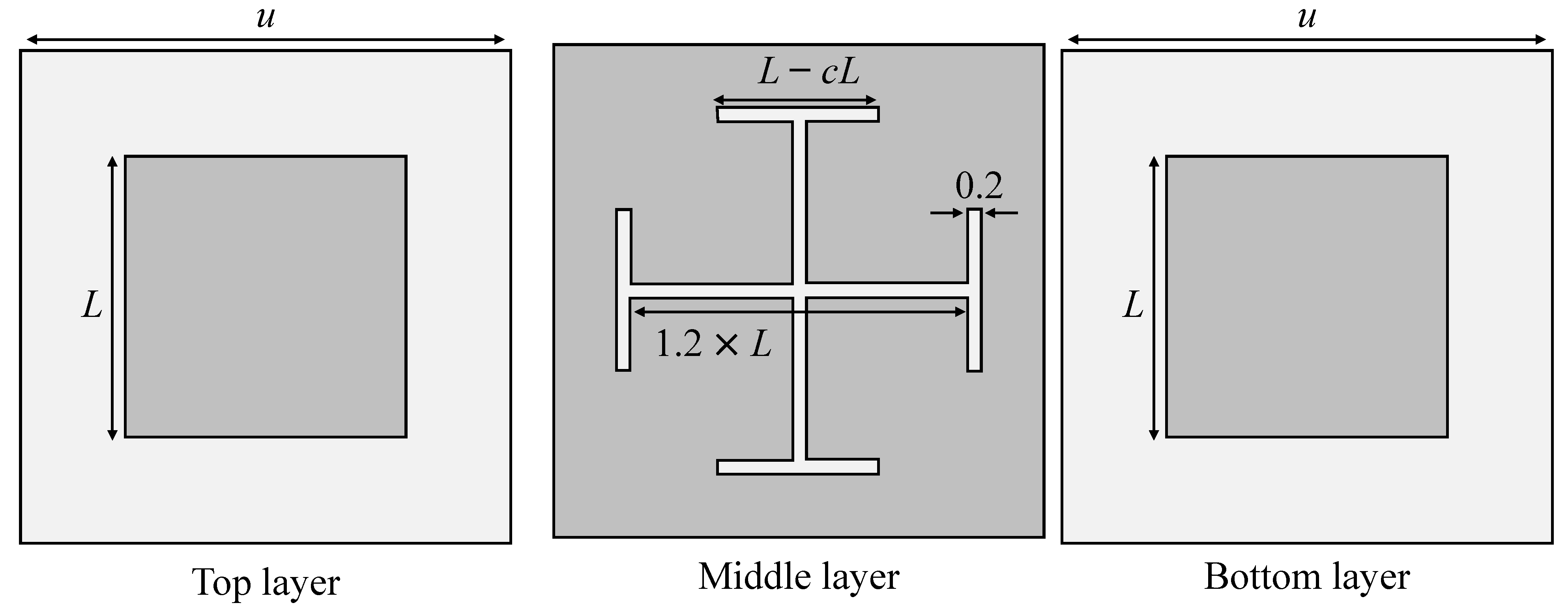
A dual-linear-polarized transmissive unit cell is then used to synthesize the required aperture phase distribution. Figure 4 shows the unit cell structure, which is arranged on a square lattice with period u = 98 mm/14 = 7 mm. It is a three-metal-layer, three-dielectric-layer stacked transmission structure. All dielectric layers use RO4003, with 0.035 mm copper metallization. Air spacers of 1.1 mm provide the interlayer separation. The top and bottom layers are square patches, and the middle layer is a cross-shaped slot. Because the geometry is symmetric with respect to the x and y axes, the tuning mechanism is the same for both polarizations under normal incidence.
The unit-cell phase library is obtained using periodic full-wave simulation under θ = 0° (incident from −z, transmitted toward +z). Phase is mainly controlled by the patch side length, denoted by L, with additional tuning through the cross-slot parameters, denoted by cL. Usable designs are selected with transmission loss within 1 dB.
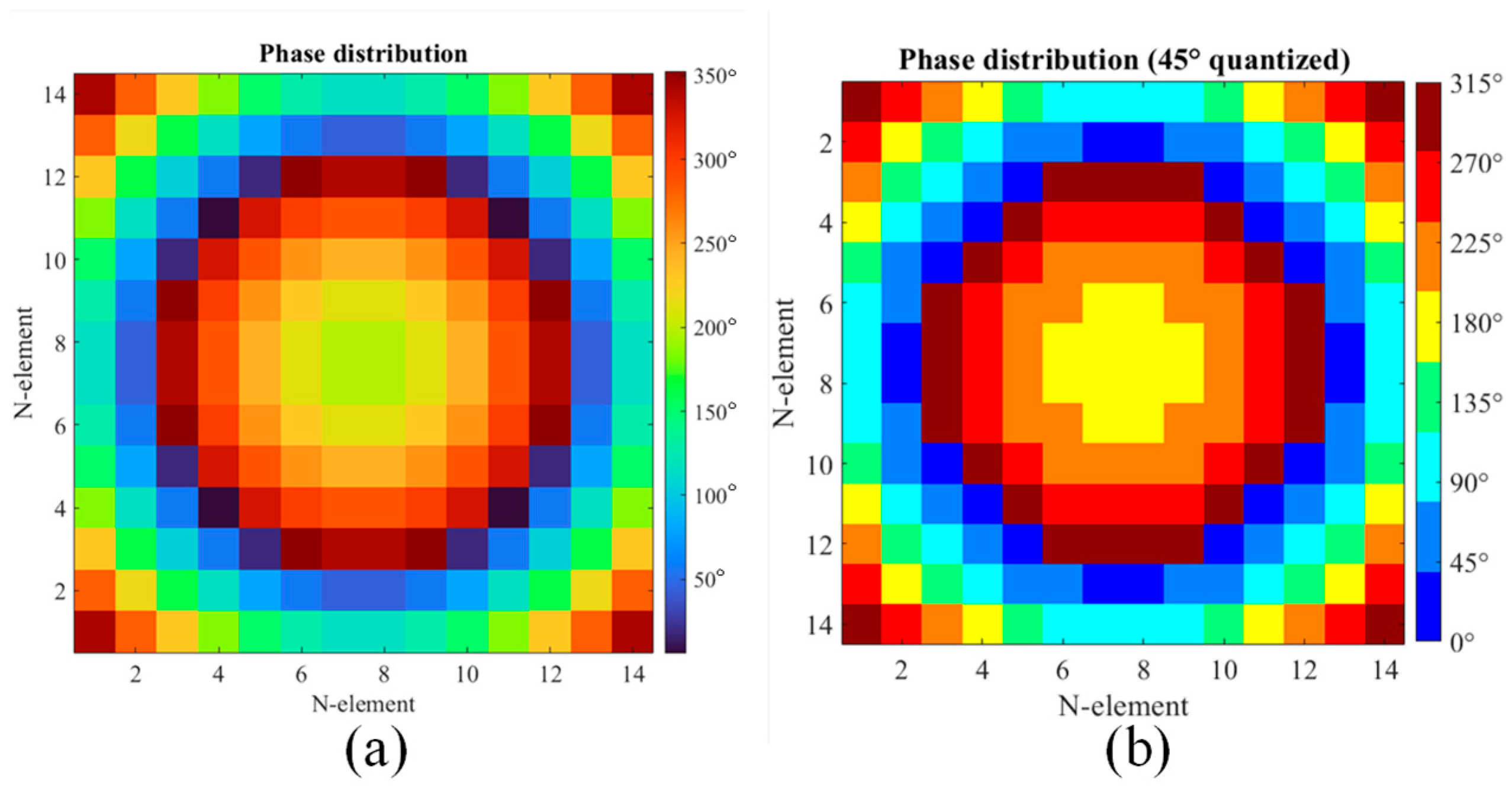
With the phase library established above, the required compensation phase for the ith unit cell is computed from the focal geometry as φc,i = k(did0). Here, φc,i is the required transmission phase at the ith cell, di is the distance from the feed phase center to the center of the ith cell, d0 is the corresponding distance to the center cell, and k = 2π/λ is the free-space wavenumber. The resulting continuous phase distribution is then quantized into eight discrete phase states with an intended step of about 45°. The 14 × 14 aperture is implemented by assigning to each lattice position the unit-cell geometry whose transmitted phase best matches the required quantized phase, as shown in Figure 5.
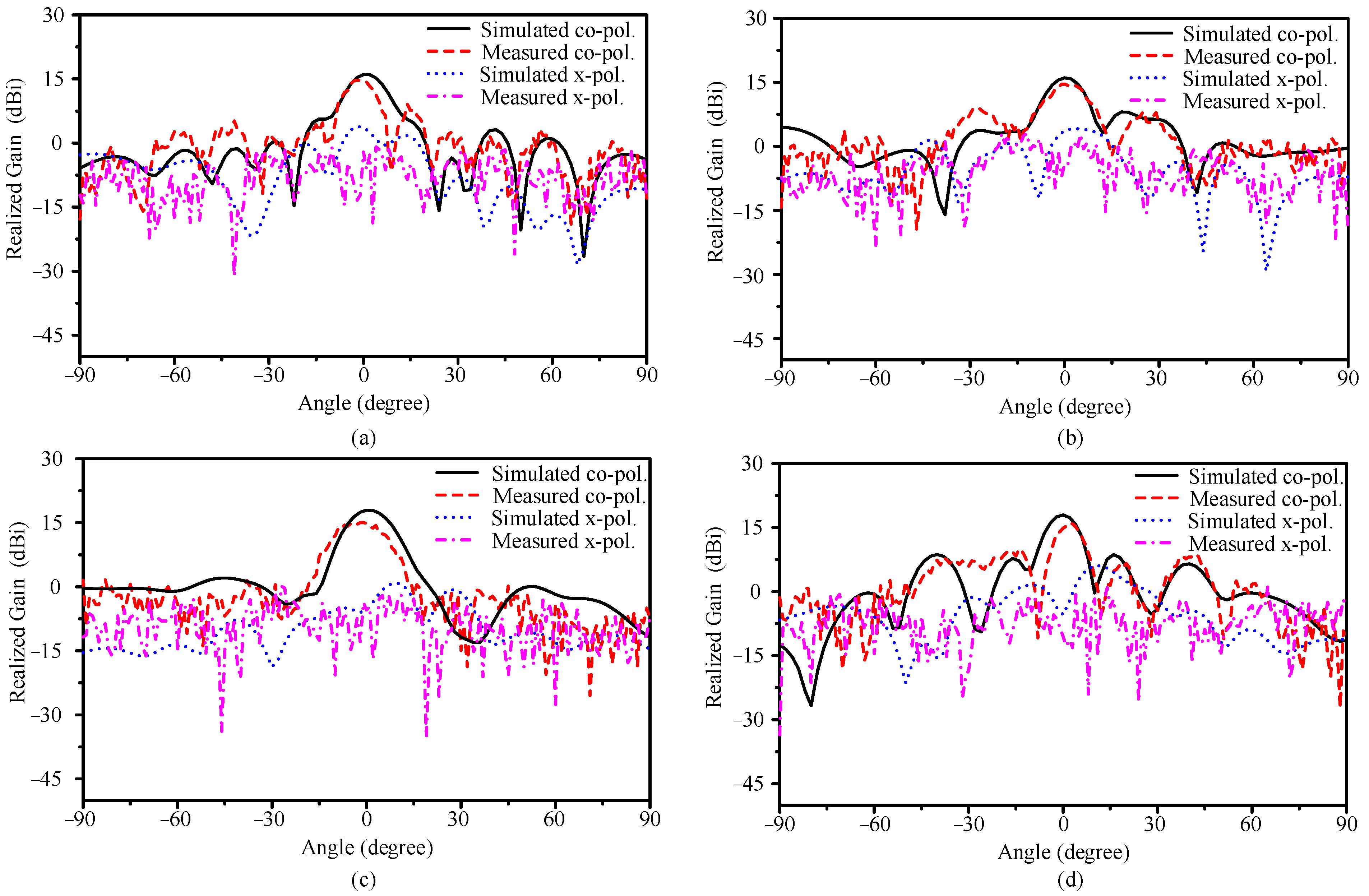
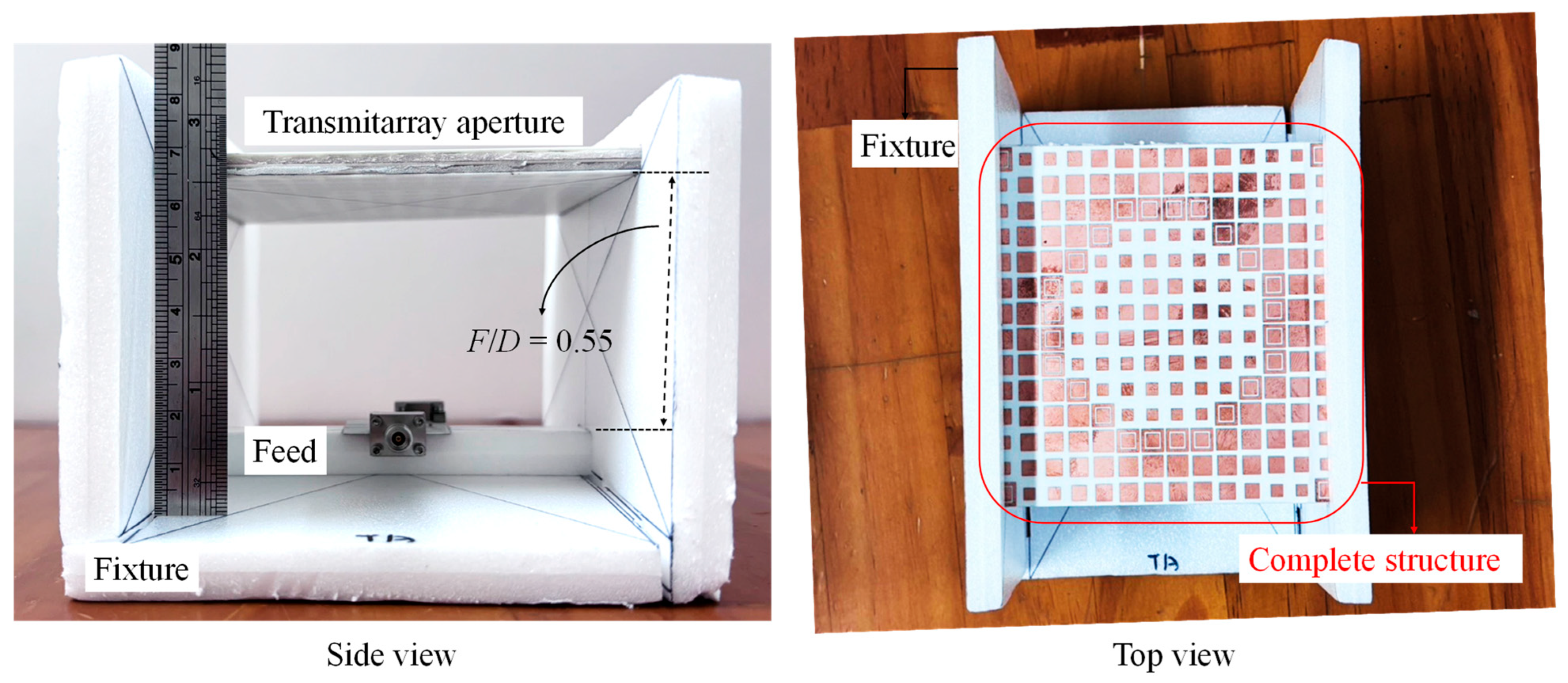
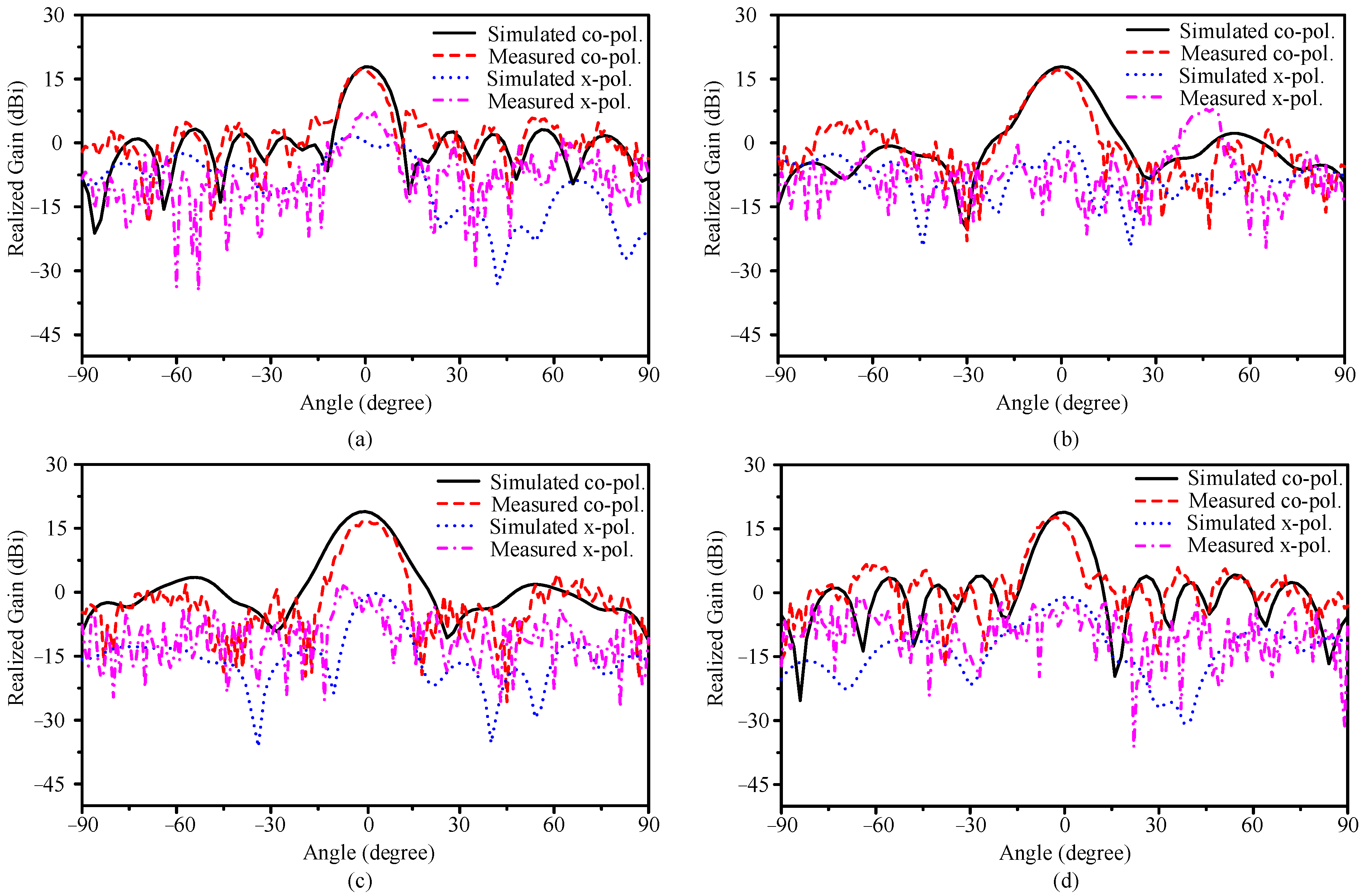
Afterward, a full-height prototype is fabricated, as shown in Figure 6. In the simulation, the −10 dB reflection coefficient bandwidths are 13.9–14.3 GHz (for x polarization) and 13.7–14.4 GHz (for y polarization). In the measurement, the impedance bandwidths are 13.9–14.4 GHz (for x polarization) and 14.0–14.4 GHz (for y polarization). Radiation patterns at 14.12 GHz are shown in Figure 7. The simulated peak gains are 18.0 dBi and 19.3 dBi for x and y polarizations, respectively, corresponding to simulated aperture efficiencies of 23.6% and 31.8%. In the measurement, the broadside gains in the x–z plane are 17.4 dBi and 16.7 dBi for x and y polarizations, respectively. The corresponding measured aperture efficiencies are 20.6% and 17.6% in the x–z plane and 19.4% and 21.3% in the y–z plane for x- and y-polarized excitation. This full-height design serves as the reference for evaluating folding-induced changes.

2.2. Folded Design

The folded design keeps the same 14 × 14 grid with u = 7 mm for both the transmitarray aperture and the reflective phase-compensation surface. The objective is to reduce the longitudinal height by folding the feed-to-aperture path while preserving the full-height aperture phase-synthesis target. The folded configuration uses a reflective phase-compensation surface, so the folding mechanism does not depend on polarization-selective transmission.
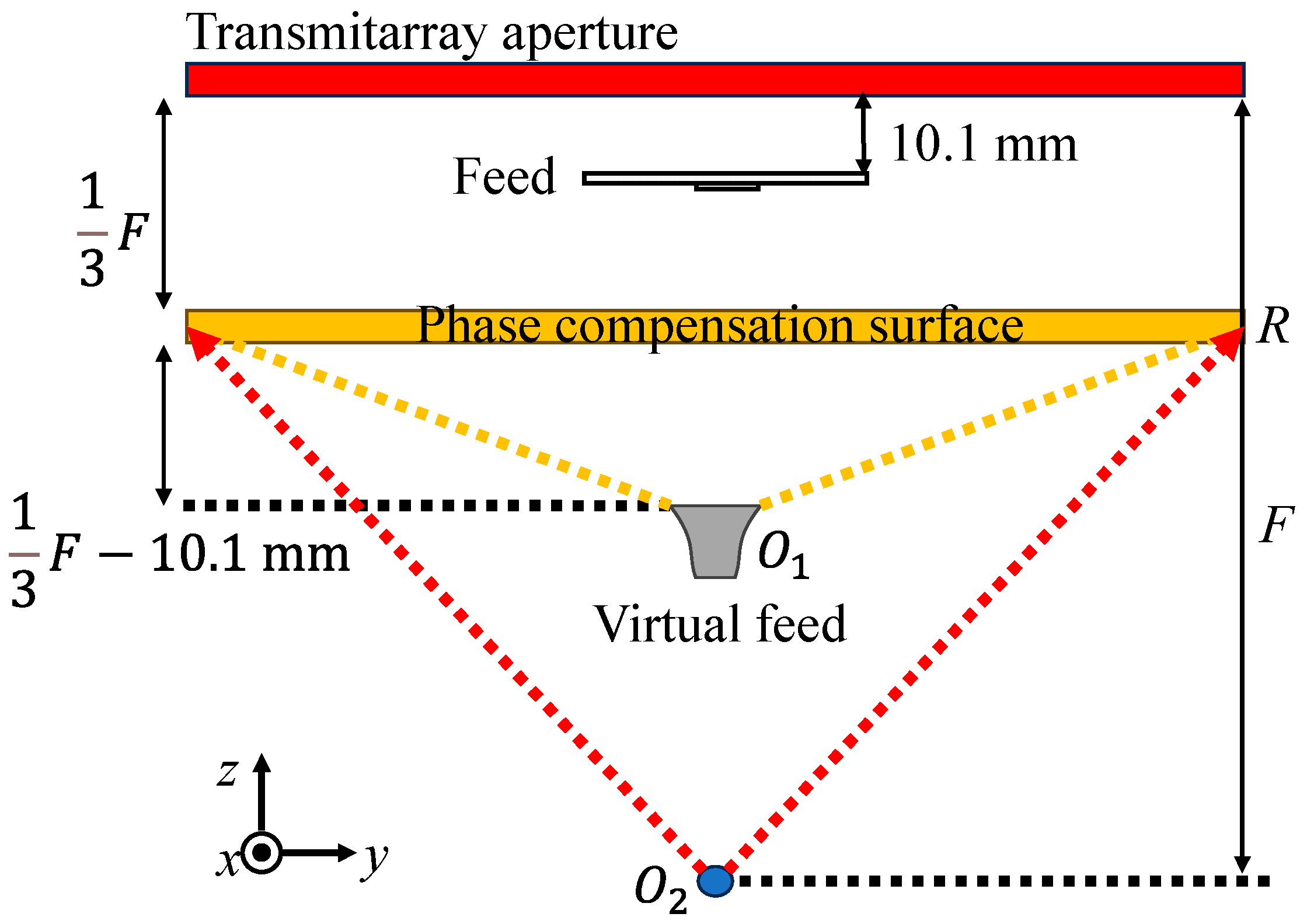
The folded-path formation is interpreted using the planar-reflector model in Figure 8. The feed field propagates to a reflective surface and then reflects toward the transmitarray aperture. If the reflective surface is approximated as an ideal perfect electric conductor, the reflected field is equivalent to radiation from an image source O1. Let h denote the separation between the reflective surface and the transmitarray aperture. Under the image-source interpretation, the distance from O1 to the transmitarray plane is 2h. When h is reduced below 0.5F, the shortened propagation distance cannot reproduce the phase evolution associated with the full-height focal geometry unless additional phase delay is introduced.
For the present design, the full-height reference uses a focal distance of 53.9 mm, whereas the folded spacing is reduced to 25.9 mm. This shortens the central propagation path by 28.0 mm, which corresponds to approximately 474° of phase at 14.12 GHz, or 114° after removing one full cycle. The corresponding path reduction is about 17.4 mm for an edge cell and about 18.3 mm for a corner cell, corresponding to approximately 295° and 311°, respectively. Therefore, the phase shortage refers to the spatially varying propagation phase deficit introduced by profile reduction, which must be restored by the reflective phase-compensation surface.
This phase shortage is supplied by imposing a position-dependent reflection phase on the phase-compensation surface. At the ith lattice location on the compensation surface, the in-plane coordinates are xi and yi. Let O1R denote the distance from the image source O1 to this location, and let O2R denote the corresponding reference distance associated with the full-height focal geometry. The additional path difference required at the ith location is Δdi = O1RO2R. The reflection phase required for compensation is therefore [7,8]
ϕ Δ c = k 0 x i 2 + y i 2 + h 2 x i 2 + y i 2 + ( F h ) 2 + ϕ 0
where ϕ Δ c is the required reflection phase, and ϕ0 sets the phase reference. Using Equation (1), the continuous reflection-phase distribution is calculated and then quantized into eight discrete phase states with an intended step of about 45°. The compensation surface is implemented on the same 14 × 14 grid as the transmitarray aperture, and each lattice position is assigned one of the eight states according to the discretized phase target.
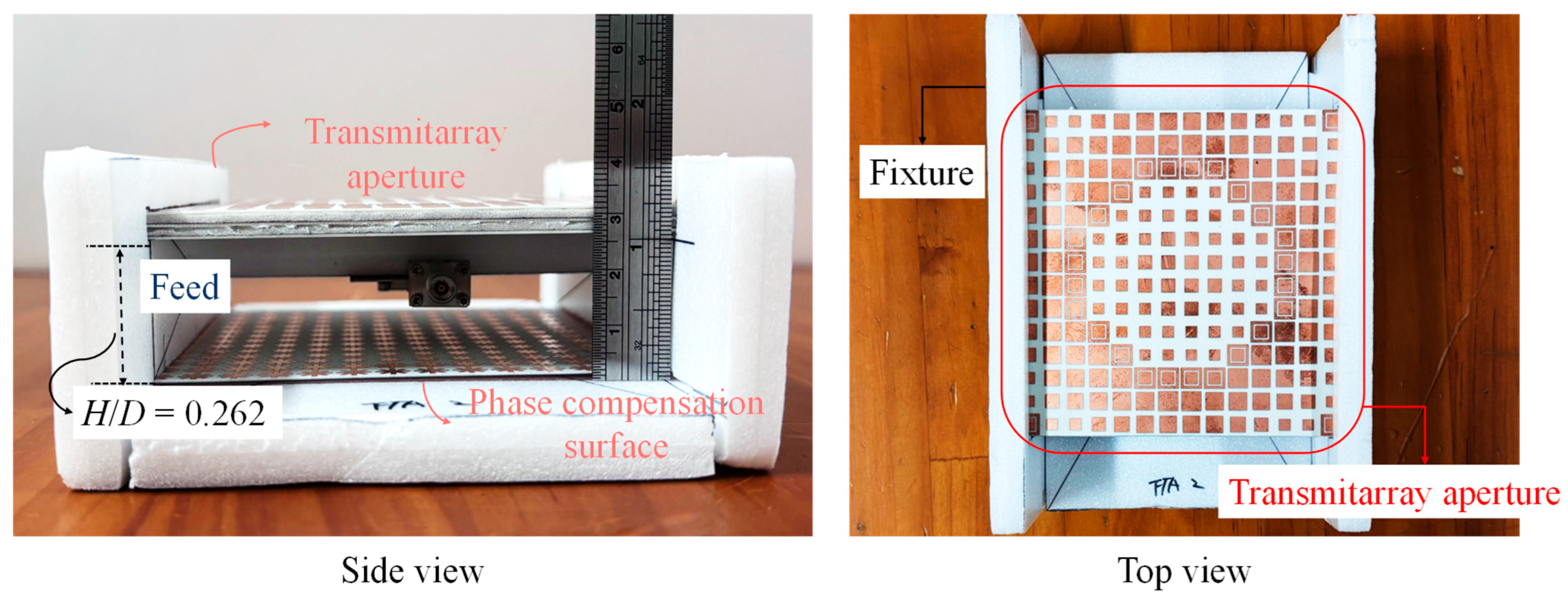
The folded prototype assembly is shown in Figure 9. The feed is placed between the aperture and the phase-compensation surface. The feed-to-aperture spacing is fixed at 10.1 mm, consisting of 10.0 mm reserved for the coaxial connector height and 0.1 mm from two 0.05 mm adhesive layers. Let H denote the separation between the aperture plane and the phase-compensation surface. Under the ideal image-source condition, the folded geometry is often approximated by H = F/3. Under this condition, the feed-to-compensation-surface spacing becomes F/3 − 10.1 mm. Finally, the simulated results indicate that maximum peak gain can be determined by H = 25.7 mm, corresponding to H/D ≈ 0.262.
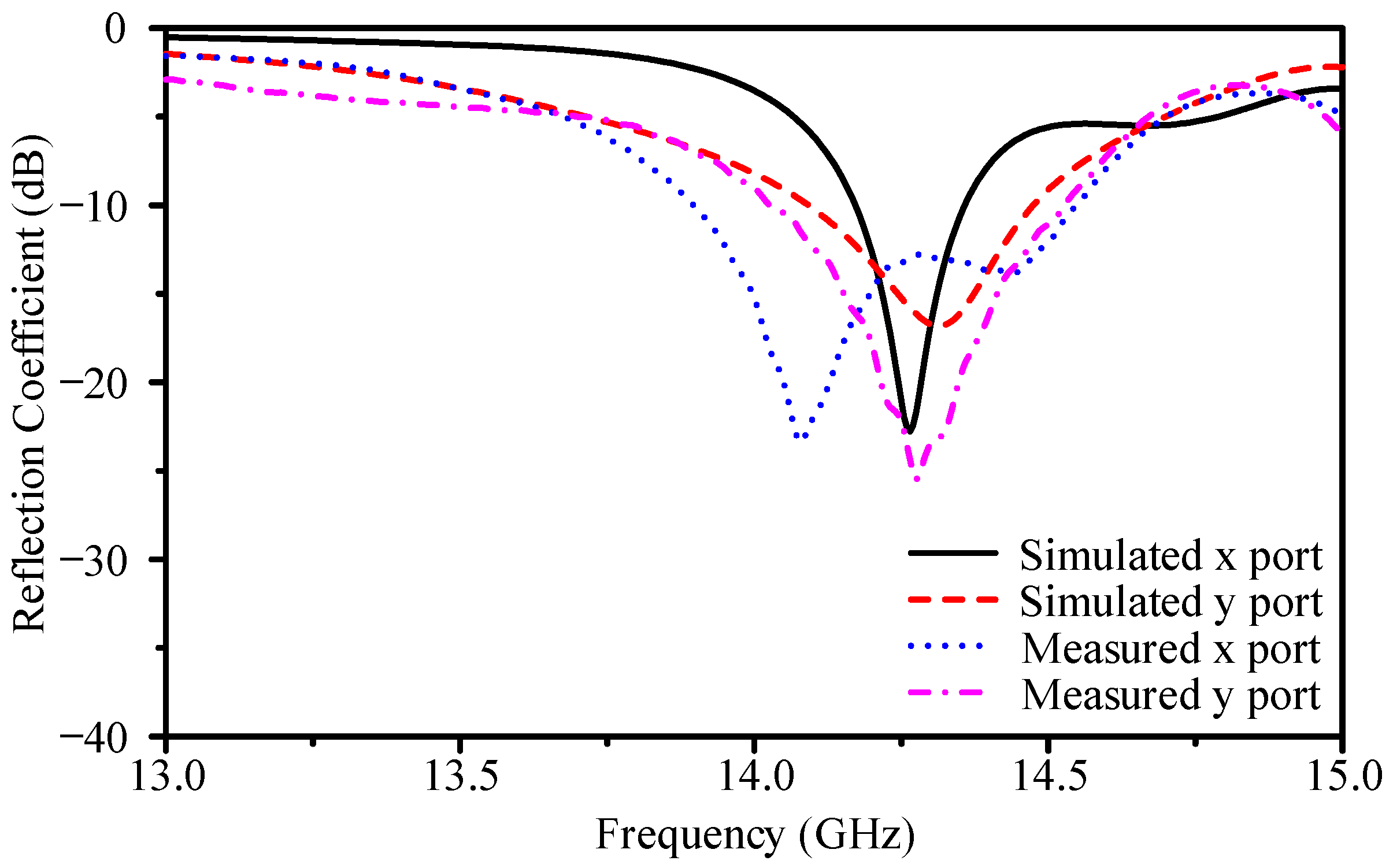
The simulated reflection coefficient at 14.12 GHz is −9.1 dB for x polarization and −9.6 dB for y polarization, which is slightly above the −10 dB criterion at the design frequency, as shown in Figure 10. This result indicates a slight shift in the matching minimum relative to 14.12 GHz rather than poor impedance behavior, because both polarizations still exhibit measured −10 dB impedance bandwidth around the design frequency. In the measurement, the impedance bandwidths are 13.9–14.6 GHz for x polarization and 14.0–14.5 GHz for y polarization, corresponding to 4.6% and 3.5% fractional bandwidth.
Radiation patterns at 14.12 GHz are shown in Figure 11. In the x–z plane, the measured maximum gains are 14.7 dBi for x polarization and 15.1 dBi for y polarization, and the measured broadside gains are 14.6 dBi and 14.8 dBi. The simulated and measured HPBWs are 11.3° and 9.8° for x polarization and 12.9° and 16.0° for y polarization. The simulated and measured cross-polarization discrimination (XPDs) are 12.1 dB and 16.7 dB for x polarization and 22.6 dB and 20.3 dB for y polarization. Although the measured XPD for x polarization is slightly higher than the simulated value, Figure 11 shows that the simulated and measured co- and cross-polarized patterns are in general agreement, so this difference is interpreted as normal variation in the extracted cross-polarized level rather than a change in polarization behavior. The simulated and measured first sidelobe levels (SLLs) are −10.4 dB and −5.7 dB for x polarization and −15.8 dB and −13.5 dB for y polarization.
In the y–z plane, the measured maximum gains are 14.6 dBi for x polarization and 16.1 dBi for y polarization, and the measured broadside gains are 14.6 dBi and 14.9 dBi. The simulated and measured HPBWs are 11.5° and 11.8° for x polarization and 11.8° and 13.2° for y polarization. The simulated and measured XPDs are 11.3 dB and 13.7 dB for x polarization and 20.6 dB and 22.5 dB for y polarization. The simulated and measured first SLLs are −10.8 dB and −8.5 dB for x polarization and −17.3 dB and −17.2 dB for y polarization. Accordingly, the aperture efficiencies are 11.1% in the x–z plane and 10.7% in the y–z plane for x polarization, and 12.1% in the x–z plane and 15.3% in the y–z plane for y polarization.

2.3. Discussion

With the full-height reference in Section 2.1 and the folded prototype in Section 2.2 sharing the same aperture and phase-synthesis target, the folding penalty is quantified by within-design changes in gain, aperture efficiency, and SLL.
First of all, the gain and aperture efficiency drops quantify how much loss occurs inside the folded cavity. For x polarization, the 2.6–2.7 dB broadside-gain reduction is consistent with the aperture efficiency drop from about 20% to about 11% across the two principal planes. For y polarization, the smaller 1.6–1.7 dB gain reduction matches the more moderate efficiency drop, from 17.6% to 12.1% in the x–z plane and from 21.3% to 15.3% in the y–z plane. This points out the trade-off for a low-profile design.
More specifically, the penalty in reflective phase-compensation folding can be separated into two contributors: One is a reflection-related loss introduced by the compensation surface and the compact folded cavity. The other is residual phase error caused by discretizing the required continuous reflection-phase distribution into eight states with an intended step of about 45°. Therefore, the gain and aperture efficiency reduction are interpreted as the combined result of dissipative loss and finite-state phase-synthesis error, while the sidelobe increase indicates that these effects also distort the realized aperture excitation.
In addition, the SLLs indicate where much of the main-beam radiation redistributes. For x polarization, the first sidelobe rises by 3.7 dB in the x–z plane and 6.6 dB in the y–z plane, which points to distortion of the effective aperture field, not only added loss. If the penalty were dominated by dissipation alone, the pattern shape would be closer to the full-height case, and SLLs would shift less. Instead, the sidelobe growth shows that folding changes the amplitude and phase distribution across the aperture, redistributing radiated power from the main lobe into sidelobes.
The y-polarized results reinforce this interpretation because the sidelobe change is strongly plane dependent. The x–z plane shows a small improvement from −12.4 dB to −13.5 dB, while the y–z plane degrades from −11.2 dB to −6.1 dB. This asymmetry indicates that the folded configuration perturbs the aperture excitation differently along the two principal cuts, so a single sidelobe number is not sufficient to characterize the penalty. Because the feed is centered and the full-height reference does not show the same degree of plane-dependent distortion, this asymmetry is attributed mainly to coupled-cavity effects introduced by the folded configuration, while fabrication and assembly tolerances are considered secondary contributors. Taken together, the gain, efficiency, and SLL changes show that reflective phase-compensation folding can preserve dual-linear polarization but introduces a coupled-cavity excitation that is most clearly exposed by sidelobe growth, with the largest penalty occurring for x polarization and for the y–z plane under y-polarized excitation.

3. Folded Transmitarray Based on Polarization-Selective Path Folding

3.1. Full-Height Design

This section develops profile reduction using polarization-selective path folding. A full-height reference is first established and then converted into a folded configuration by adding a polarization-selective folding interface.
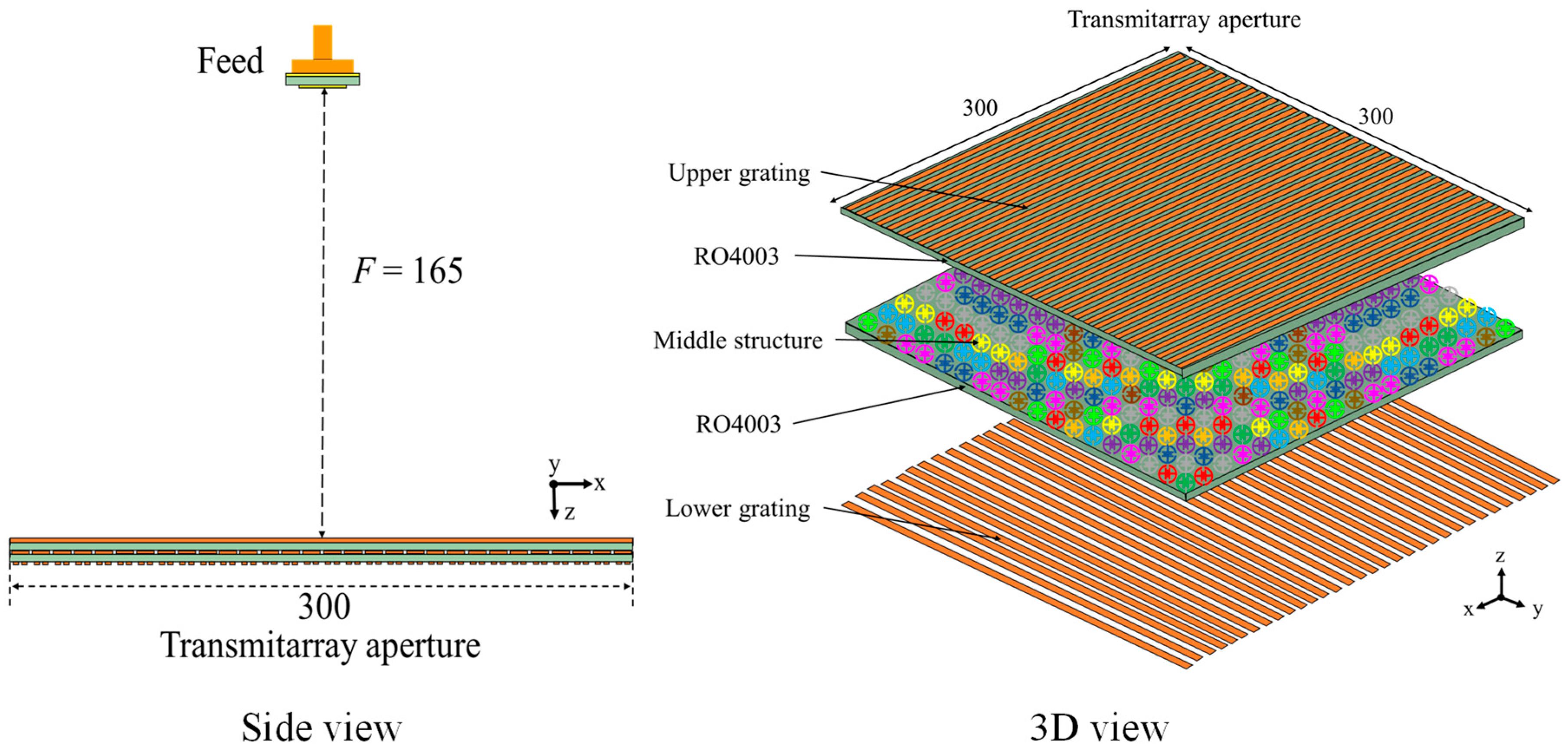
The reference design operates at 11.7 GHz and uses a 300 mm × 300 mm aperture implemented as a 30 × 30 lattice, as shown in Figure 12. The focal ratio is kept the same as the previous section, F/D = 0.55, giving a feed-to-aperture distance F = 165 mm. The reference geometry places the aperture in the x–y plane and the feed on the boresight axis at z = F. The feed is a coaxial-fed microstrip patch with single linear polarization because the folding mechanism relies on polarization conversion and is not implemented as a dual-polarized structure. The patch is re-optimized for 11.7 GHz with a length of 6.1 mm and a width of 11 mm.
The full-height transmitarray applies standard wavefront reconstruction. The spherical wave from the feed is constructively interfered with by the aperture so that the transmitted field has a nearly uniform phase in the broadside direction. The unit cell also performs polarization conversion in transmission, so the transmitted field is rotated to the orthogonal linear polarization relative to the incident field.
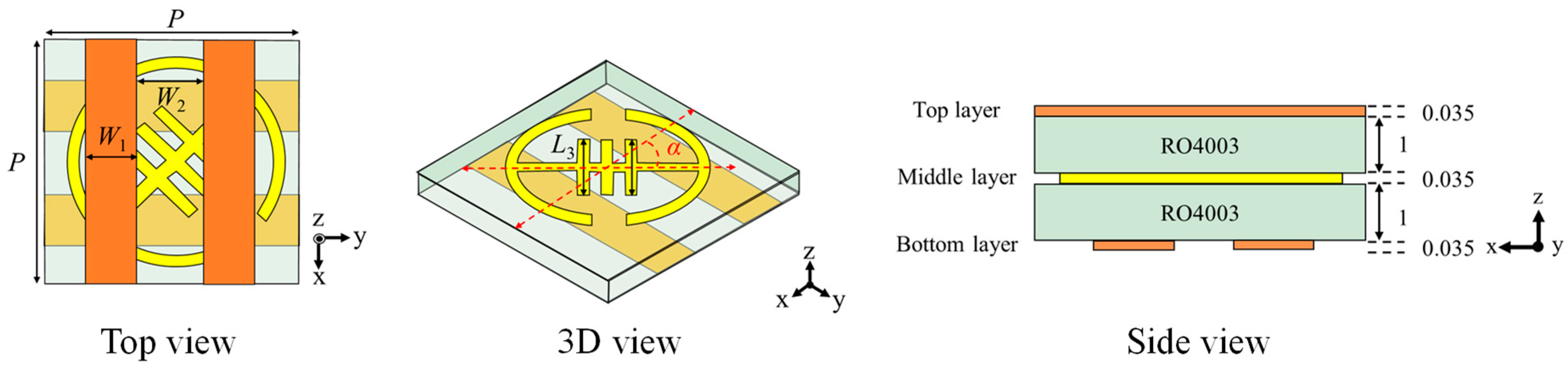
Phase control is implemented using the polarization-converting transmissive unit cell in Figure 13. The unit cell is a three-metal-layer structure on the same RO4003. The top and bottom layers are grating patterns, and the middle layer is a ring resonator with a diagonal bridge. The period is P = 10 mm, and the grating width is W1 = 2.0 mm. The transmitted phase for the converted polarization is tuned by sweeping the design parameter denoted by L3 from 4.5 mm to 6.5 mm. Two rotated versions of the same topology, −45° and +45°, are included to span the required phase range.
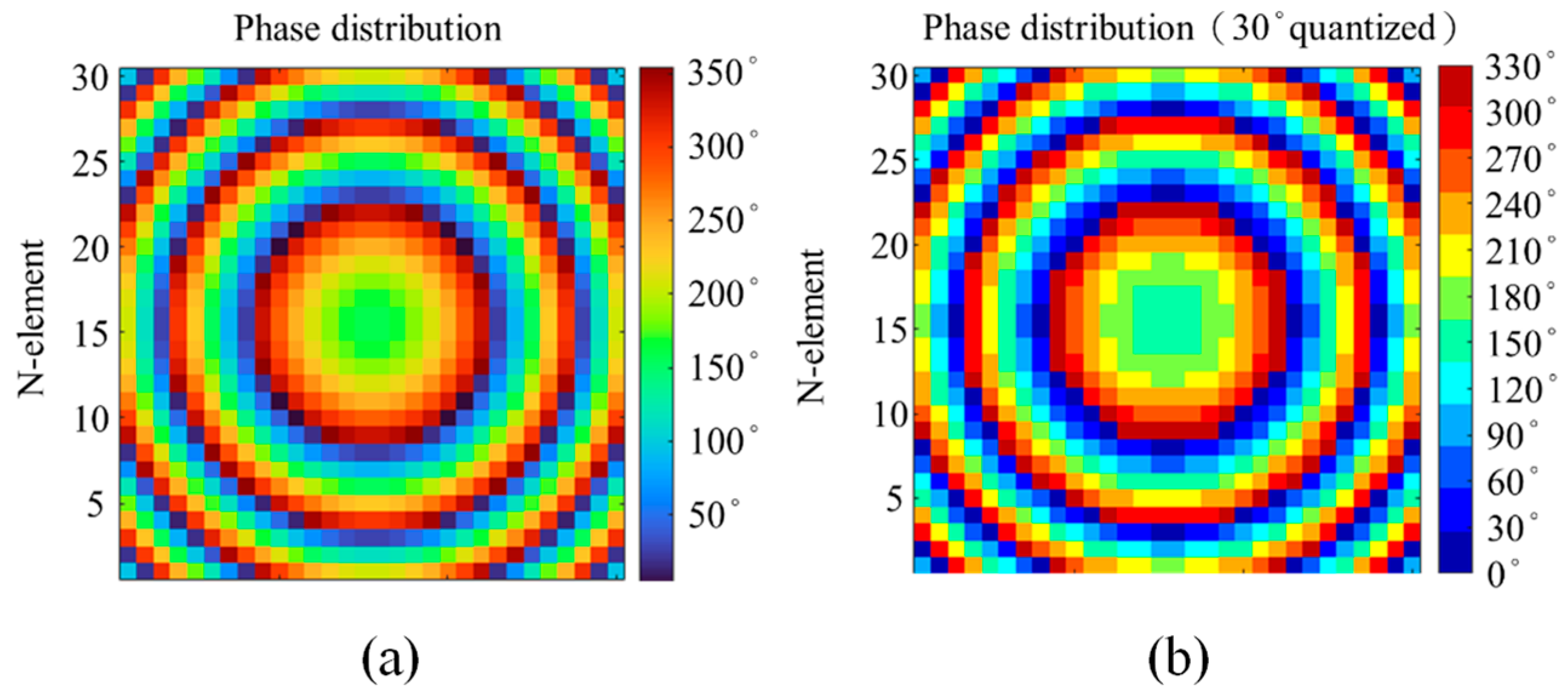
The continuous phase distribution required by the focal geometry is computed and mapped to 12 discrete phase states with an intended step of 30°. Each lattice position is assigned the unit cell with the closest transmitted phase, as shown in Figure 14.
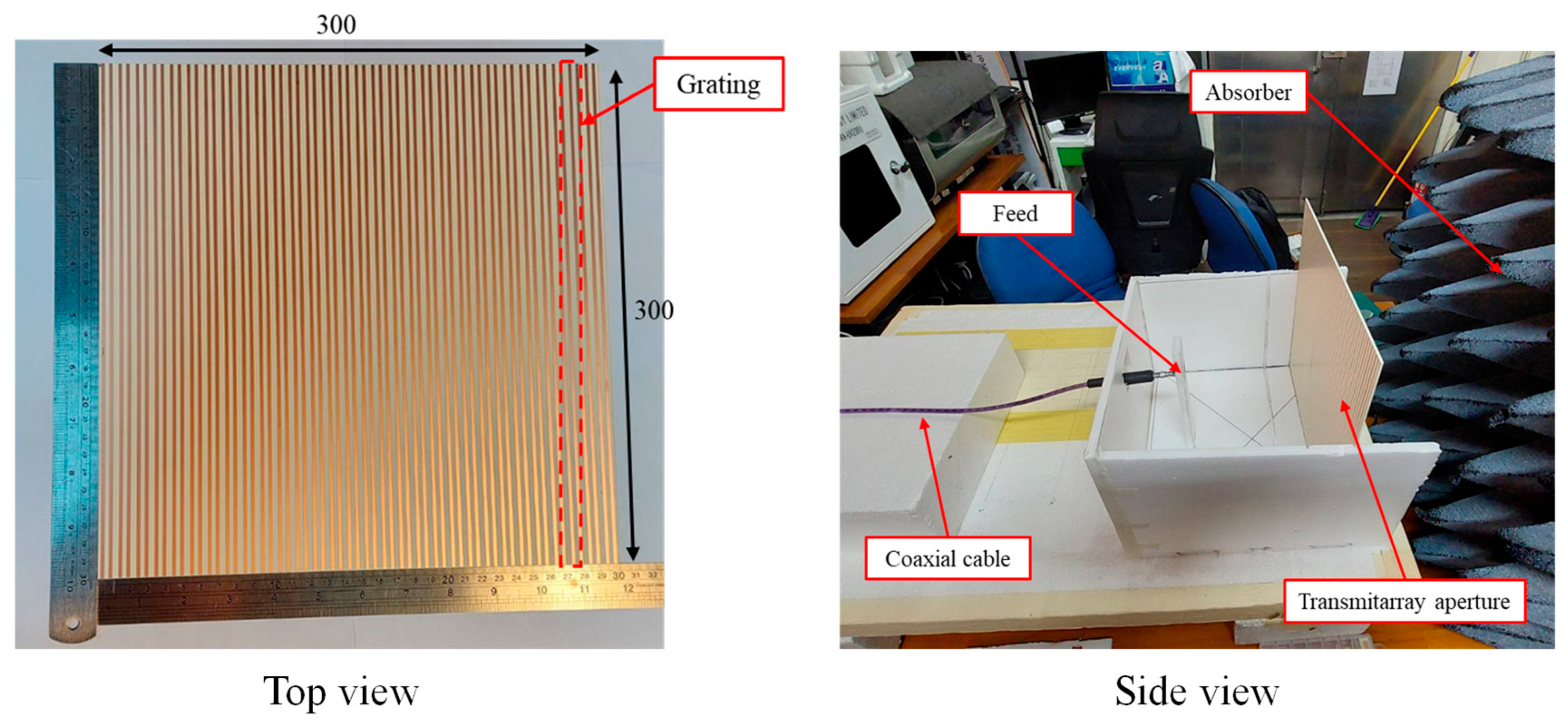
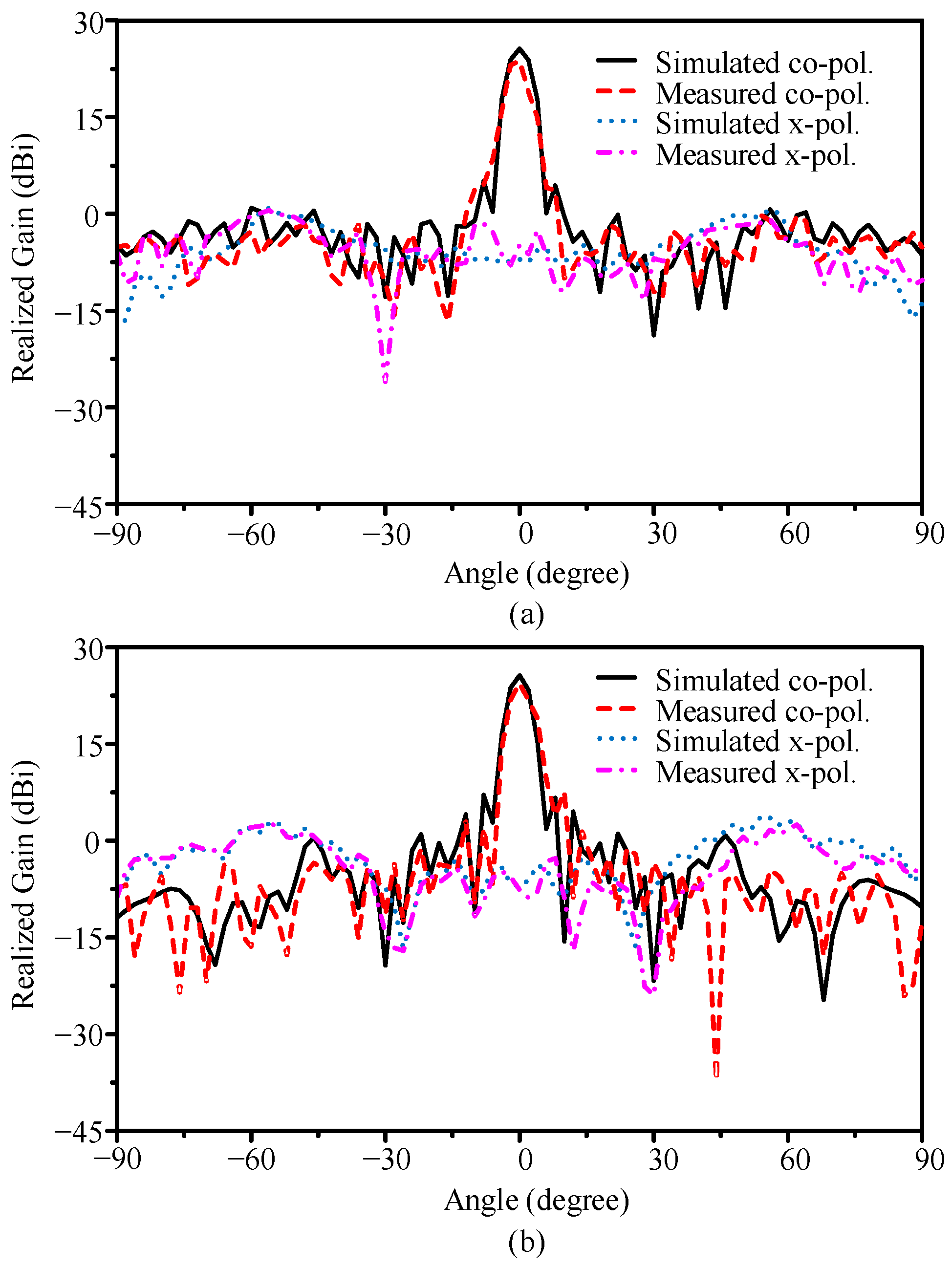
A prototype is fabricated, as shown in Figure 15. The simulated impedance bandwidth is 11.13–11.80 GHz, corresponding to 5.9%, and the measured −10 dB bandwidth is 11.11–11.93 GHz, corresponding to 7.1%. Radiation patterns at 11.7 GHz are shown in Figure 16. In the simulation, the peak gain is 25.6 dBi with 21.1% aperture efficiency, and the HPBWs are 4.8° in the E-plane and 4.5° in the H-plane, with XPD of 33.3 dB. In the measurement, the peak gain is 24.4 dBi with 16.1% aperture efficiency, and the HPBWs are 3.9° and 4.3°, with XPD of 32.0 dB. The measured gain is 1.2 dB lower than the simulation, consistent with fabrication tolerance, alignment, and material-parameter deviation.
Over frequency, the simulated gain remains above 24 dBi from 10.81 GHz to 11.93 GHz, and the measured gain remains above 24 dBi from 10.89 GHz to 11.79 GHz. The simulated antenna efficiency remains above 70% from 10.97 GHz to 12.13 GHz, and the measured antenna efficiency exceeds 70% from 11.25 GHz to 11.98 GHz. This full-height design serves as the reference for the folded implementation in Section 3.2.

3.2. Folded Design

With the full-height reference as the baseline, the same Ku-band transmitarray aperture is converted into a folded-path configuration by adding a polarization-selective folding interface while keeping the aperture size, lattice, and phase synthesis unchanged. The folded structure introduces two additional layers: a polarization-selective grating and a reflective polarization-conversion surface (PCS). The grating determines which polarization is reflected or transmitted, and the PCS provides polarization conversion on reflection.
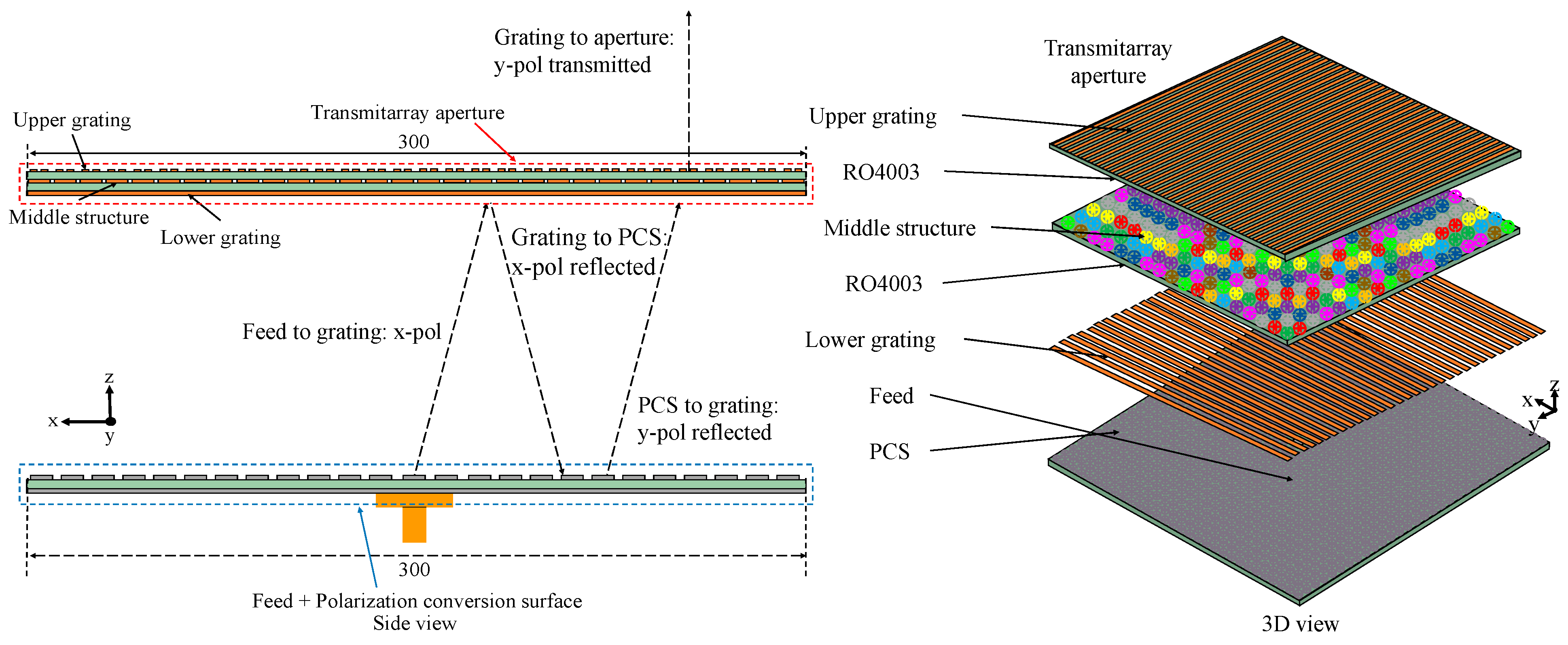
The folded configuration is shown in Figure 17. A metal grating is placed below the transmitarray aperture, and the PCS is inserted between the feed and the aperture stack. The wave path is formed by polarization-guided routing. The patch feed radiates an x-polarized field toward the grating. Because the grating strips are parallel to x polarization, the incident field is reflected while remaining x polarized. The reflected field then propagates downward and illuminates the PCS, where the asymmetric conductor pattern converts x polarization to y polarization upon reflection. The y-polarized reflected field propagates upward again and passes through the grating because its polarization is orthogonal to the grating strips, then exits through the transmitarray aperture to form the main beam. This reflection–conversion–transmission sequence extends the electrical path inside a reduced physical height, enabling the same phase-synthesis target to be applied with a shorter feed-to-aperture distance.
The PCS uses a ring-based topology backed by a continuous ground plane, so it functions as a reflective polarization converter. The PCS unit cell has a period of 10 mm and is implemented on the same RO4003. The key tuning parameter is the central strip length (denoted by L4), selected as L4 = 5.7 mm to maximize polarization-conversion at 11.7 GHz. Under normal incidence with x-polarized excitation, the simulated cross-polarized reflection magnitude is 0.93 at 11.7 GHz, and the co-polar reflection magnitude is 0.09, giving a polarization conversion ratio of 99%.
Although an idealized folded-path picture suggests that the height approaches one-third of the full-height focal geometry, the optimum H depends on the PCS–grating coupling, the reflection phase delay of the interfaces, and the field distribution in the multilayer cavity. For this reason, H/D is determined by a parametric sweep from 0.125 to 0.185, using peak gain and field quality as the optimization metrics. Accordingly, H/D = 0.145, corresponding to H = 43.5 mm. This reduces the feed-to-aperture distance from 165 mm in the full-height reference to 43.5 mm in the folded configuration.
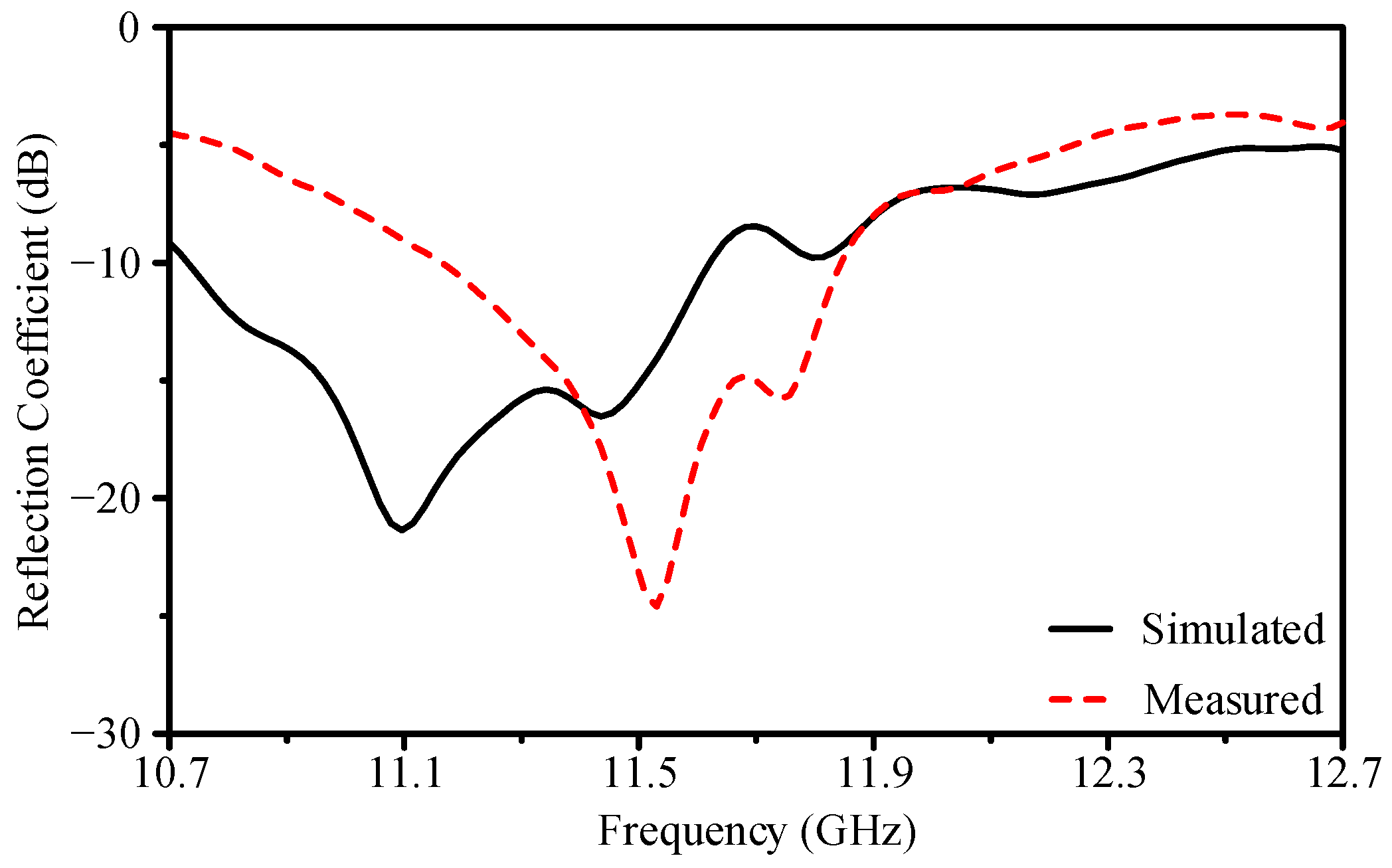
A folded prototype is fabricated and measured. The simulated and measured impedance results are shown in Figure 18. At 11.7 GHz, the simulated reflection coefficient is −8.5 dB, and the measured reflection coefficient is −15.1 dB. The measured impedance bandwidth is 11.16–11.84 GHz, corresponding to 5.9% fractional bandwidth. Therefore, the folded design still satisfies the conventional −10 dB matching requirement in the measurement, and the simulated value at 11.7 GHz is interpreted as a small frequency shift in the matching minimum in the coupled folded structure.
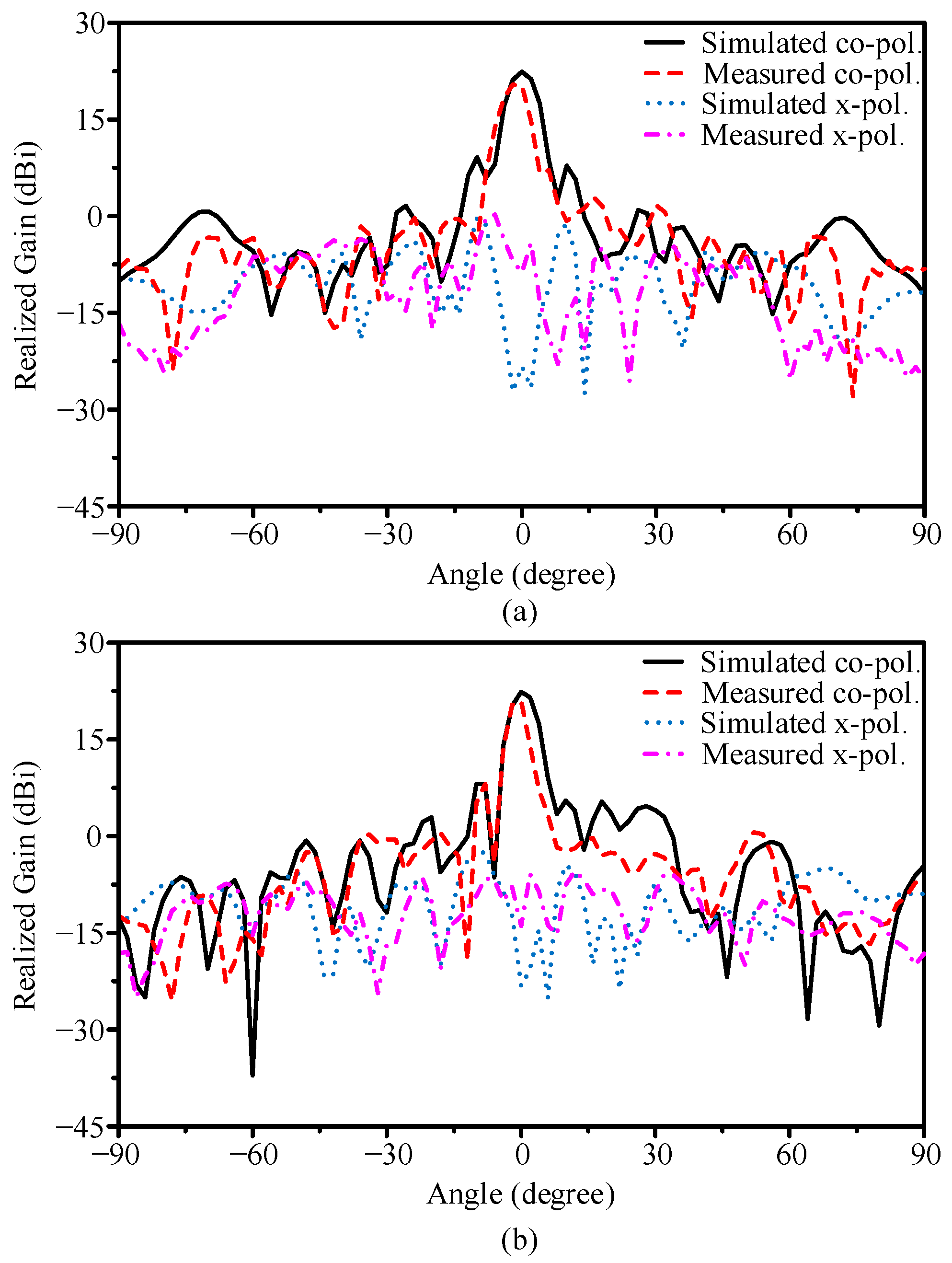
The simulated and measured E-plane and H-plane patterns at 11.7 GHz are shown in Figure 19. In the simulation, the peak gain is 22.4 dBi with an aperture efficiency of 10.1%, and the HPBWs are 5.8° in the E-plane and 5.3° in the H-plane. The simulated XPD is 45.7 dB. In the measurement, the peak gain is 21.0 dBi with an aperture efficiency of 7.3%, and the HPBWs are 5.6° in the E-plane and 3.6° in the H-plane. The measured XPD is 34.9 dB. Over frequency, the simulated gain remains above 20 dBi from 11.13 GHz to 11.86 GHz, and the measured gain remains above 20 dBi from 11.39 GHz to 11.94 GHz, while both the simulation and measurement show a gain drop to about 15 dBi near 12.2 GHz. The simulated radiation efficiency at 11.7 GHz is 56.3%, and the measured value is 41.2%, and both decrease with increasing frequency.

3.3. Discussion

The full-height reference and the folded configuration use the same aperture size, the same 30 × 30 lattice with P = 10 mm, and the same phase distribution. The comparison, therefore, isolates the impact of polarization-selective folding on radiation performance. The full-height case forms the beam through single-pass illumination with F = 165 mm and F/D = 0.55, while the folded case forms the beam through a reflection–conversion–transmission path inside a compact cavity with H = 43.5 mm and H/D = 0.145.
The profile reduction is significant. The feed-to-aperture distance decreases from 165 mm to 43.5 mm, giving a compression factor of about 3.8. However, the trade-off is reduced gain and reduced aperture efficiency. At 11.7 GHz, the measured peak gain decreases from 24.4 dBi in the full-height reference to 21.0 dBi in the folded configuration, and the measured aperture efficiency decreases from 16.1% to 7.3%. These drops are consistent with the fact that the folded field reaches the aperture through additional interfaces, including reflection at the grating, polarization-converting reflection at the PCS, and transmission through the grating, which introduce loss and perturb the effective amplitude and phase distribution illuminating the aperture.
A more quantitative indication is available from the PCS unit-cell result. At 11.7 GHz, the simulated cross-polarized reflection magnitude is 0.93, and the co-polar reflection magnitude is 0.09, corresponding to a polarization-conversion ratio of 99%. This shows that the PCS itself performs the required polarization-converting reflection efficiently, so the overall efficiency drop cannot be attributed to PCS conversion loss alone. Instead, the measured reduction from 16.1% to 7.3% in aperture efficiency and from 24.4 dBi to 21.0 dBi in peak gain is interpreted as the cumulative effect of non-ideal reflection and transmission at the grating together with additional amplitude-phase perturbation caused by coupling inside the folded cavity.
The sidelobe change shows how the folded cavity reshapes the effective aperture field. In the E-plane, the first SLL changes from −19.9 dB to −13.2 dB, and the second SLL changes from −20.3 dB to −17.4 dB. In the H-plane, the first SLL changes from −16.8 dB to −12.9 dB, and the second SLL changes from −22.0 dB to −20.4 dB. Relative to the full-height reference, the first SLL increases by 6.7 dB in the E-plane and 3.9 dB in the H-plane. This sidelobe growth indicates that the dominant folding penalty is not only loss, but distortion of the effective aperture excitation caused by coupling and multiple reflections inside the compact cavity.

4. Discussion on Folded-Path Formation and Phase Synthesis

4.1. Comparison of Mechanism-Level Features

A direct comparison of folded transmitarrays is often blurred by differences in aperture size and operating frequency. This also includes differences in lattice size and unit-cell period; therefore, the present study does not compare absolute sidelobe levels between the 14 × 14 and 30 × 30 apertures, but instead compares the folded and full-height cases within each design, where the aperture size, lattice, and phase target are kept unchanged. For this reason, the present study does not treat the two fabricated prototypes as a one-to-one hardware benchmark; instead, each folded implementation is compared with its own full-height reference under the same aperture and focal-ratio condition, so that the reported results represent mechanism-dependent within-design folding penalties. Here, the comparison is restricted to within-design deltas, meaning each folded prototype is evaluated against its own full-height reference under the same focal-ratio constraint. The metrics are normalized height, radiation penalty, and sidelobe change because these quantities directly indicate whether folding preserves the intended aperture excitation.
The two implementations create the required phase in different ways once the physical propagation distance is reduced. In reflective phase compensation, folding is produced by one internal reflection, and the phase shortage is supplied explicitly by a spatially engineered reflection phase on a compensation surface, so wavefront control is shared by two coupled phase-control planes. In polarization-selective folding, the folded path is formed by polarization routing. A grating enforces polarization-dependent reflection and transmission, and the PCS converts polarization on reflection so the wave follows a reflection–conversion–transmission route. Under the condition used in Section 3, the aperture phase map is unchanged before and after folding, so the folding interfaces act as a path-forming subsystem, and their non-idealities appear as perturbations to the illumination seen by the aperture.
These mechanisms lead to different achievable normalized heights. In Section 2, the height is reduced by 52%, but the realized spacing is H/D ≈ 0.262, higher than the geometric estimate H/D ≈ 0.183 implied by HF/3. This indicates that, in a compact reflective cavity, pushing toward the geometric minimum strengthens coupling and interface-induced distortion enough that the best operating point shifts to a larger H. In Section 3, the folded structure achieves H/D = 0.145 and reduces the feed-to-aperture distance from 165 mm to 43.5 mm, giving a compression factor of about 3.8. The smaller H/D is consistent with multi-interface routing, where the electrical path extension is produced by the reflection–conversion–transmission sequence rather than by a single geometric fold.
The radiation penalties show a common outcome across both mechanisms: folding changes the complex aperture excitation that actually forms the main beam. In Section 2, the broadside-gain reduction is 2.6–2.7 dB for x polarization and 1.6–1.7 dB for y polarization, accompanied by aperture efficiency drops from 20.6% and 19.4% to 11.1% and 10.7% for x polarization and from 17.6% and 21.3% to 12.1% and 15.3% for y polarization. In Section 3, the measured peak gain drops from 24.4 dBi to 21.0 dBi, and the aperture efficiency drops from 16.1% to 7.3%. These within-design drops indicate that, even when the phase map is nominally preserved, the folded cavity alters amplitude taper and residual phase error through coupling and interface phase delays.
Sidelobe behavior provides the most sensitive signature of this distortion. In Section 2, the first SLL increases for x polarization by 3.7 dB in the x–z plane and 6.6 dB in the y–z plane, while y polarization shows plane-dependent distortion, including a 5.1 dB sidelobe increase in the y–z plane. In Section 3, the first SLL rises from −19.9 dB to −13.2 dB in the E-plane and from −16.8 dB to −12.9 dB in the H-plane. Across both mechanisms, sidelobe growth indicates that folding redistributes power away from the main beam because the realized aperture field deviates from the full-height reference, not simply because additional loss is introduced.
Polarization capability separates the two approaches at the system level. Reflective phase compensation does not require polarization routing and therefore supports the dual-linear-polarized operation. Polarization-selective folding is tied to a specific polarization sequence and is implemented here as single polarized, so extending it to dual-linear polarization requires the folding interfaces to support two orthogonal channels simultaneously without cross-coupling.

4.2. Design Guidance for Low-Profile Transmitarrays

The results indicate that profile reduction should be selected based on whether the target application prioritizes polarization capability, compression, or sidelobe control. If dual-linear polarization is required, reflective phase compensation is the more compatible architecture because folded-path formation is not polarization-selective. The key design task is then to treat H as an optimization variable rather than enforcing HF/3, because the optimum height is shifted by coupling and interface phase delay. In this class, reflection-phase quantization accuracy and cavity coupling jointly control the gain and sidelobe penalties, so the design target should be stated as an acceptable gain drop and sidelobe increase for a chosen H/D, not height reduction alone.
If maximum compression is the primary goal and single polarization is acceptable, polarization-selective folding provides a more direct route to small H/D. The tradeoff is that beam formation becomes interface-dominated. The grating and PCS must be treated as a coupled subsystem with the feed and aperture at the chosen H, because their combined reflection, conversion, transmission, and mutual coupling govern both efficiency loss and sidelobe rise.
If a low sidelobe is the priority, sidelobe change should be treated as a primary constraint. In both mechanisms, sidelobes rise once folding distorts the effective aperture excitation. This indicates that the practical limit of profile reduction is set by the point where the folded cavity can no longer preserve the intended complex aperture field, even if the designed phase map is unchanged. In all cases, folded transmitarrays should be designed and reported as coupled cavity systems, where H/D is chosen by quantified tradeoffs in gain, aperture efficiency, and sidelobe level rather than by geometric rules alone.

5. Conclusions

Two folded low-profile transmitarrays, namely reflective phase compensation and polarization-selective path folding, are developed and measured under the same focal-ratio constraint in this paper. The novelty of this work is established through a comparative analysis of two distinct folded transmitarray mechanisms on the basis of design route, implementation structure, and normalized folding penalty, rather than through a direct benchmark against previously published single-technique designs. In both prototypes, substantial profile reduction is achieved together with measurable main-beam and pattern penalties. For reflective phase compensation, a height reduction of 52% is achieved. The measured broadside gain is reduced by 2.6–2.7 dB for x polarization and by 1.6–1.7 dB for y polarization, while the first sidelobe is increased by 3.7–6.6 dB for x polarization and by 5.1 dB in the y–z plane for y polarization. For polarization-selective folding, the feed-to-aperture distance is reduced from 165 mm to 43.5 mm, corresponding to a compression factor of about 3.8. The measured peak gain is reduced by 3.4 dB, and the first sidelobe is increased from −19.9 dB to −13.2 dB in the E-plane and from −16.8 dB to −12.9 dB in the H-plane. The primary factor in choosing between the two mechanisms is whether dual-linear-polarized operation is required or stronger profile compression is prioritized under single-polarized operation. These quantified changes in gain, aperture efficiency, and sidelobe level observed in this study provide practical guidance for choosing an appropriate folded transmitarray scheme under polarization constraints.

Author Contributions

Conceptualization, Y.-S.C.; methodology, Y.-L.L. and Y.-C.T.; software, Y.-L.L. and Y.-C.T.; validation, Y.-L.L. and Y.-C.T.; formal analysis, Y.-L.L. and Y.-C.T.; investigation, Y.-L.L. and Y.-C.T.; resources, Y.-S.C.; data curation, Y.-L.L. and Y.-C.T.; writing—original draft preparation, Y.-S.C.; writing—review and editing, Y.-S.C.; visualization, Y.-L.L. and Y.-C.T.; supervision, Y.-S.C.; project administration, Y.-S.C.; funding acquisition, Y.-S.C. All authors have read and agreed to the published version of the manuscript.

Funding

This work was supported by the National Science and Technology Council (NSTC), Taiwan, under Contract NSTC 113-2221-E-027-085-MY3.

Data Availability Statement

The data presented in this study are contained within the article.

Conflicts of Interest

The authors declare no conflict of interest.

References

  1. Ge, Y.; Lin, C.; Liu, Y. Broadband folded transmitarray antenna based on an ultrathin transmission polarizer. IEEE Trans. Antennas Propag. 2018, 66, 5974–5981. [Google Scholar] [CrossRef]
  2. Li, T.-J.; Wang, G.-M.; Cai, T.; Li, H.-P.; Liang, J.-G.; Lou, J. Broadband folded transmitarray antenna with ultralow profile based on metasurfaces. IEEE Trans. Antennas Propag. 2021, 69, 7017–7022. [Google Scholar] [CrossRef]
  3. YCao, Y.; Yang, W.; Xue, Q.; Che, W. A broadband low-profile transmitarray antenna by using differentially driven transmission polarizer with true-time delay. IEEE Trans. Antennas Propag. 2022, 70, 1529–1534. [Google Scholar]
  4. Xiang, B.-J.; Luk, K.-M. A wideband low-profile folded transmitarray antenna based on magnetoelectric dipole elements. IEEE Trans. Antennas Propag. 2023, 71, 8659–8667. [Google Scholar] [CrossRef]
  5. Yang, J.; Chen, S.T.; Chen, M.; Ke, J.C.; Chen, M.Z.; Zhang, C.; Yang, R.; Li, X.; Cheng, Q.; Cui, T.J. Folded transmitarray antenna with circular polarization based on metasurface. IEEE Trans. Antennas Propag. 2021, 69, 806–814. [Google Scholar] [CrossRef]
  6. Yang, W.; Chen, K.; Luo, X.; Qu, K.; Zhao, J.; Jiang, T.; Feng, Y. Polarization-selective bifunctional metasurface for high-efficiency millimeter-wave folded transmitarray antenna with circular polarization. IEEE Trans. Antennas Propag. 2022, 70, 8184–8194. [Google Scholar] [CrossRef]
  7. Wang, M.; Sun, K.; Wu, G.-B.; Chan, C.H. On folded transmitarray with dual polarization. IEEE Trans. Antennas Propag. 2024, 72, 1343–1351. [Google Scholar] [CrossRef]
  8. Xiang, B.-J.; Luk, K.-M. A wideband dual-linearly polarized folded ME-dipole transmitarray antenna with low H/F ratio. IEEE Trans. Antennas Propag. 2024, 72, 466–475. [Google Scholar] [CrossRef]
  9. Yang, C.; Wu, G.-B.; Zheng, D.; Chan, K.F.; Chan, C.H. An ultralow-profile folded transmitarray antenna based on a multifunctional metasurface with both-sided wavefront control. IEEE Trans. Antennas Propag. 2023, 71, 7804–7812. [Google Scholar] [CrossRef]
  10. Zhai, Z.; Lin, F.; Yang, Y.; Sun, H. Additively manufactured wideband low-profile bidirectional 2-D beam-scanning antenna using double folded transmitarrays with curved polarizers. IEEE Trans. Antennas Propag. 2024, 72, 476–486. [Google Scholar] [CrossRef]
  11. Li, T.-J.; Wang, G.-M.; Guo, W.-L.; Xin, K.-W.; Han, J.-Q.; Li, H.-P. Reconfigurable folded transmitarray antenna with low profile based on metasurfaces. IEEE Antennas Wirel. Propag. Lett. 2023, 22, 611–615. [Google Scholar]
  12. MWu, M.; Rao, W.; Guo, L. A broadband and high-efficiency folded transmitarray antenna. Microw. Opt. Technol. Lett. 2024, 66, e70006. [Google Scholar]
  13. Chatterjee, S.; Gupta, Y.; Maulik, A.; Bhattacharyya, S. An optimized phase-controlled metasurface-based low-profile folded transmitarray (FTA) antenna. IEEE Trans. Antennas Propag. 2025, 73, 3316–3321. [Google Scholar] [CrossRef]
  14. Lei, H.; Jia, Y.; Zhong, Y.C.; Liu, Z.; Shi, G.; Liu, Y. A low-profile metal-only folded transmitarray antenna based on asymmetric transmission chiral metasurface. IEEE Trans. Antennas Propag. 2024, 72, 9480–9485. [Google Scholar] [CrossRef]
  15. Jiang, H.; Song, L.; Guo, L. A low-profile and low-cost metal-only folded transmitarray antenna. IEEE Antennas Wirel. Propag. Lett. 2025, 24, 1352–1356. [Google Scholar]
  16. Wang, Q.; Sihvola, A.; Qi, J. A novel procedure to hybridize the folded transmitarray and Fabry–Perot cavity with low antenna profile and flexible design frequency. IEEE Antennas Wirel. Propag. Lett. 2024, 23, 2501–2505. [Google Scholar] [CrossRef]
  17. Zhu, J.; Yang, Y.; Liao, S.; Xue, Q. Dual-band antenna hybridizing folded transmitarray and folded reflectarray. IEEE Trans. Antennas Propag. 2022, 70, 3070–3075. [Google Scholar]
  18. QChen, Q.; Yang, F.; Chen, K.; Xu, L.; Chen, Y.; Hu, J.; Yang, S. An extremely compact folded transmitarray antenna based on reflectarray with additional phase compensation. IEEE Trans. Antennas Propag. 2024, 72, 9474–9479. [Google Scholar] [CrossRef]
  19. Chatterjee, S.; Gupta, Y.; Bhattacharyya, S. Design of a metasurface-based bifunctional folded transmit/reflect array antenna. In Proceedings of the IEEE Microwave, Antennas, and Propagation Conference (MAPCON), Hyderabad, India, 9–13 December 2024; pp. 1–4. [Google Scholar]
  20. Li, G.; Ge, Y.; Chen, Z. A compact multibeam folded transmitarray antenna at Ku-band. IEEE Antennas Wirel. Propag. Lett. 2021, 20, 808–812. [Google Scholar] [CrossRef]
  21. Liu, W.; Li, S.; Chen, L.; Zhang, C.; Qu, M.; Deng, L. Dual-band low-profile hybrid antenna for bidirectional radiation. IEEE Antennas Wirel. Propag. Lett. 2025, 24, 2129–2133. [Google Scholar]
  22. Ma, Z.L.; Tang, Y.; Xue, Q.; Che, W.; Wang, K.X. Dual-band shared-aperture antenna hybridizing patch and transmitarray with large frequency ratio and wideband characteristics. IEEE Trans. Antennas Propag. 2025, 73, 2485–2496. [Google Scholar] [CrossRef]
  23. Jiang, X.; Xu, W.; Gao, S.; Zhang, Q.; Wang, Z.; Yang, X.-X. A sidelobe-reduced wideband flat-gain low-profile transmitarray using a simple amplitude control and phase error compensation. IEEE Trans. Antennas Propag. 2025, 73, 6414–6425. [Google Scholar] [CrossRef]
  24. Liu, W.; Li, S.; Chen, L.; Zhang, C.; Deng, L. A broadband high-efficiency spin-decoupled folded transmitarray antenna with independent beam control. IEEE Trans. Antennas Propag. 2024, 72, 8058–8063. [Google Scholar]
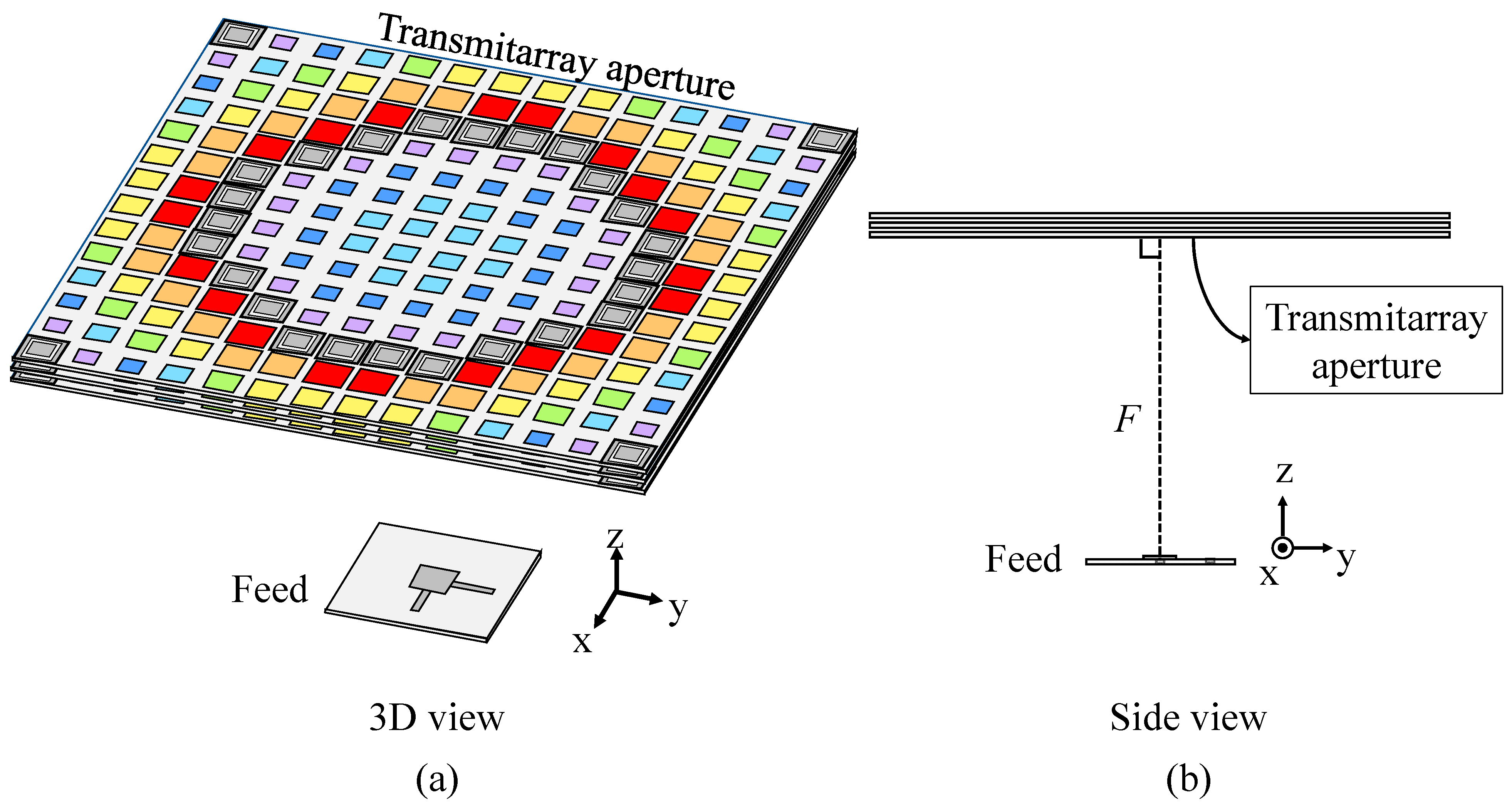
Figure 1. Full-height transmitarray reference geometry for the reflective phase-compensation folded design: (a) perspective view of the full transmitarray configuration, including the aperture and feed antenna; (b) side view indicating the focal distance F. The different colors indicate different unit-cell geometries used for phase compensation. Cells with the same color have the same structure and realize the same target phase response.
Electronics 15 01506 g001
Figure 2. Dual-linear-polarized stacked-patch feed antenna with two orthogonal ports for x- and y-polarized excitation.
Electronics 15 01506 g002
Figure 3. Simulated and measured realized-gain patterns of the feed at 14.12 GHz: (a) x–z plane with x-polarized excitation. (b) y–z plane with x-polarized excitation. (c) x–z plane with y-polarized excitation. (d) y–z plane with y-polarized excitation.
Electronics 15 01506 g003
Figure 4. Geometry of the dual-linear-polarized transmissive unit cell.
Electronics 15 01506 g004
Figure 5. Aperture compensation phase for the full-height transmitarray at 14.12 GHz: (a) Continuous phase map. (b) Eight-level quantized phase map used for 14 × 14 unit-cell placement.
Electronics 15 01506 g005
Figure 6. Fabricated full-height transmitarray prototype for the reflective phase-compensation study.
Electronics 15 01506 g006
Figure 7. Simulated and measured realized-gain patterns of the full-height transmitarray at 14.12 GHz: (a) x–z plane with x-polarized excitation. (b) y–z plane with x-polarized excitation. (c) x–z plane with y-polarized excitation. (d) y–z plane with y-polarized excitation.
Electronics 15 01506 g007
Figure 8. Folded-path principle for reflective phase compensation with image-source interpretation and reflection-phase synthesis.
Electronics 15 01506 g008
Figure 9. Fabricated folded transmitarray prototype using reflective phase compensation.
Electronics 15 01506 g009
Figure 10. Simulated and measured reflection coefficients of the phase-compensation folded transmitarray.
Electronics 15 01506 g010
Figure 11. Simulated and measured realized-gain patterns of the phase-compensation folded transmitarray at 14.12 GHz: (a) x–z plane with x-polarized excitation. (b) y–z plane with x-polarized excitation. (c) x–z plane with y-polarized excitation. (d) y–z plane with y-polarized excitation.
Electronics 15 01506 g011
Figure 12. Full-height reference geometry for the polarization-selective folding study.
Electronics 15 01506 g012
Figure 13. Geometry of the polarization-converting transmissive unit cell.
Electronics 15 01506 g013
Figure 14. Aperture compensation phase for the full-height transmitarray at 11.7 GHz: (a) Continuous phase map. (b) Twelve-level quantized phase map used for 30 × 30 unit-cell placement.
Electronics 15 01506 g014
Figure 15. Fabricated full-height transmitarray prototype for the polarization-selective folding study.
Electronics 15 01506 g015
Figure 16. Simulated and measured realized-gain patterns of the full-height transmitarray at 11.7 GHz: (a) E-plane, (b) H-plane.
Electronics 15 01506 g016
Figure 17. Folded transmitarray configuration using polarization-selective path folding with grating and polarization-conversion surface.
Electronics 15 01506 g017
Figure 18. Simulated and measured reflection coefficient of the polarization-selective folded transmitarray.
Electronics 15 01506 g018
Figure 19. Simulated and measured realized-gain patterns of the polarization-selective folded transmitarray at 11.7 GHz. (a) E-plane, (b) H-plane.
Electronics 15 01506 g019
Disclaimer/Publisher’s Note: The statements, opinions and data contained in all publications are solely those of the individual author(s) and contributor(s) and not of MDPI and/or the editor(s). MDPI and/or the editor(s) disclaim responsibility for any injury to people or property resulting from any ideas, methods, instructions or products referred to in the content.