Article

Capacitance Reduction in IGCT-Based MMC Through Elevated Ripple Tolerance Under Linear Modulation Constraints


1
Guangzhou Power Supply Bureau, Guangdong Power Grid Corporation, China Southern Power Grid Co., Ltd., Guangzhou 510620, China
2
Department of Electrical Engineering, Tsinghua University, Beijing 100084, China
*
Author to whom correspondence should be addressed.
Electronics 2026, 15(7), 1468; https://doi.org/10.3390/electronics15071468
Submission received: 5 March 2026 / Revised: 21 March 2026 / Accepted: 25 March 2026 / Published: 1 April 2026
(This article belongs to the Special Issue Power Electronics and Multilevel Converters)

Abstract

Modular multilevel converters (MMCs) for high-voltage direct current (HVDC) transmission require substantial submodule (SM) capacitance to limit capacitor voltage ripple, resulting in bulky and costly converter valves. The integrated gate-commutated thyristor (IGCT), with its higher voltage rating and lower conduction loss compared to the insulated-gate bipolar transistor (IGBT), enables a significant reduction in the number of SMs per arm, offering a pathway toward compact converter design. This paper investigates how the reduced SM count of IGCT-based MMCs affects the feasibility and benefit of operating with elevated capacitor voltage ripple to further decrease SM capacitance. An analytical framework is developed to evaluate the modulation boundary under increased ripple, explicitly accounting for the voltage ripple coupling (CVR) effect and circulating-current suppression. A ripple-tolerance coefficient κ is introduced, and its optimal value is determined by identifying the inflection point beyond which the achievable AC voltage output begins to decline. For a ±500 kV/2000 MW IGCT-MMC case study using 6.5 kV devices with 250 SMs per arm, the proposed method reduces the per-unit energy storage requirement by up to 39.4% compared with conventional-ripple operation. Simulation and prototype experimental results on a 400 V, 3 kW, 4-SM/arm test bench validate the analytical predictions and confirm the practical feasibility of the approach.

1. Introduction

Long-distance large-scale renewable energy integration and increasing urban load demand are driving the expansion of high-voltage direct current (HVDC) transmission based on modular multilevel converters (MMCs) [1,2]. In MMC-based HVDC systems, each submodule (SM) contains a DC capacitor that supports the SM voltage. Because the arm power fluctuates over the fundamental cycle, large SM capacitances are typically required to keep the capacitor voltage ripple within acceptable limits. In many converter designs, the DC capacitors occupy more than 60% of the SM volume and account for a significant share of the overall cost [3,4,5]. Such bulky converter valves are impractical for offshore platforms and hinder deployment in space-constrained urban environments where flexible DC interconnection is increasingly demanded [4,5,6].
Existing approaches to reducing SM capacitance can be classified into three broad categories. The first category reshapes arm energy fluctuations through circulating-current injection or harmonic compensation [7,8,9,10,11,12]. While injecting second-harmonic circulating currents can suppress capacitor voltage ripple, it increases arm-current stress and converter losses [7,12]. Third-harmonic injection can expand the AC voltage margin but is constrained by grounding arrangements and insulation requirements [13,14,15,16,17,18]. The second category exploits the negative-voltage output capability of full-bridge SMs to extend the modulation range and reduce capacitor voltage ripple [19,20,21,22,23]. Although these topology-assisted methods are effective, they require additional switching devices, partially offsetting cost and footprint benefits. The third category directly increases the allowable capacitor voltage ripple ratio while keeping the voltage peak unchanged, thereby enabling the use of smaller capacitors [24,25,26,27]. This elevated-ripple approach, first studied for STATCOM applications [24,25] and later extended to the MMC [26], does not require topology changes and can achieve substantial capacitance reductions. In [28], an improved design methodology was proposed that employs over-insertion to avoid increasing the SM count, and introduces whole-operating-range linear modulation and maximum selectable valve-side AC voltage as key design constraints. That work provides a rigorous framework for determining the optimal ripple level for general-purpose MMCs. However, existing studies on elevated-ripple MMC operation have focused exclusively on converters using insulated-gate bipolar transistors (IGBTs) and have not considered how the choice of switching device affects the achievable capacitance reduction and the associated design trade-offs.
The integrated gate-commutated thyristor (IGCT) has emerged as a competitive alternative to the IGBT for high-power MMC applications [29,30,31]. Compared with the IGBT, the IGCT offers higher voltage and current ratings—with commercially available devices reaching 6.5 kV—lower conduction losses, simpler wafer-scale manufacturing, superior failure short-circuit capability, and higher long-term reliability [29,32]. In an MMC, the higher per-device voltage rating of the IGCT enables a significant reduction in the number of SMs per arm. For instance, using 6.5 kV IGCTs with an SM operating voltage of 4000 V, a ±500 kV system requires only 250 SMs per arm, compared with approximately 500 SMs when using 4.5 kV IGBTs at 2000 V per SM. This reduced SM count directly lowers the baseline capacitance demand and alters the quantitative relationship between ripple tolerance and capacitance saving. Despite these advantages, the combination of IGCT device characteristics with elevated-ripple operation has not been investigated.
However, the reduced SM count in an IGCT-based MMC also introduces specific challenges. Fewer SMs per arm means each SM must handle a larger share of the arm energy fluctuation, leading to higher per-SM capacitor voltage ripple for the same absolute capacitance. In addition, the IGCT requires a more complex gate-drive unit with active gate control and di/dt-limiting snubber circuits. Furthermore, the coarser voltage steps associated with fewer SMs may slightly increase harmonic distortion, although this effect is mitigated by modern NLM strategies. These characteristics make it particularly important to understand how the elevated-ripple design interacts with the inherent properties of the IGCT-MMC, which is the focus of this paper.
This paper addresses this gap by analyzing elevated-ripple operation specifically for IGCT-based MMCs. The main contributions are as follows:
(1)
An analytical framework is developed to evaluate the modulation boundary under elevated ripple. A modulation envelope function g(t) is defined that incorporates the CVR effect and the second-harmonic reference from circulating-current suppression control (CCSC). The framework enables accurate determination of the maximum achievable valve-side AC voltage across the entire PQ operating range.
(2)
The optimal ripple-tolerance coefficient κ for IGCT-MMC is determined by identifying the inflection point of the modulation margin curve. It is shown that the reduced SM count inherent to IGCT-based designs amplifies the relative benefit of elevated-ripple operation. For a ±500 kV/2000 MW case study using 6.5 kV IGCTs with 250 SMs per arm, the per-unit energy storage requirement is significantly reduced compared with conventional-ripple operation.
The remainder of this paper is organized as follows. Section 2 presents the IGCT-MMC topology and the principle of capacitance reduction through elevated ripple tolerance. Section 3 develops the modulation boundary analysis framework and investigates the influence mechanism of the ripple-tolerance coefficient. Section 4 presents simulation and experimental validation results for the case study. Section 5 concludes the paper.

2. Operating Principle and Control of IGCT ER-MMC

2.1. Topology and Operating Principle of ER-MMC

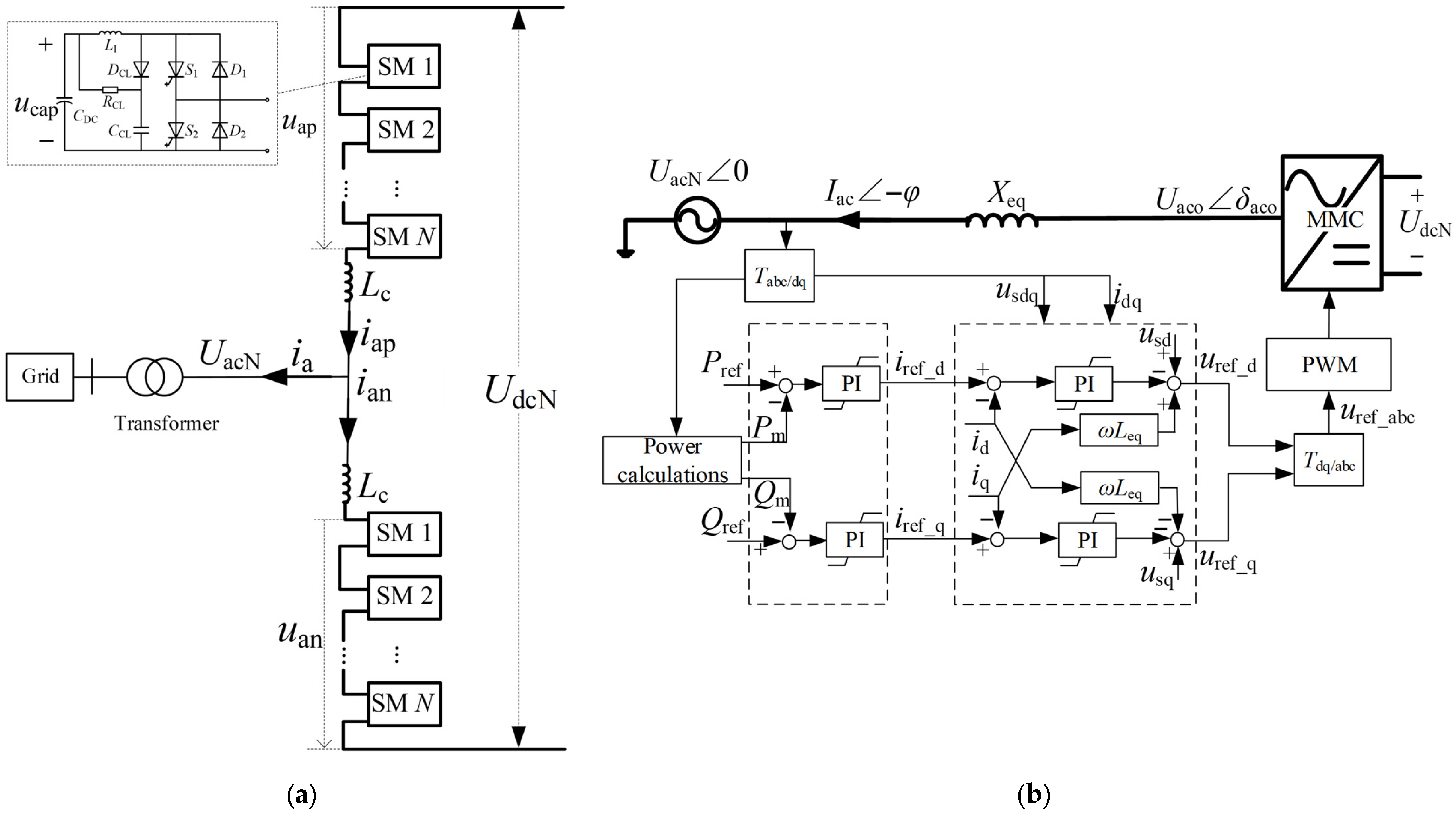
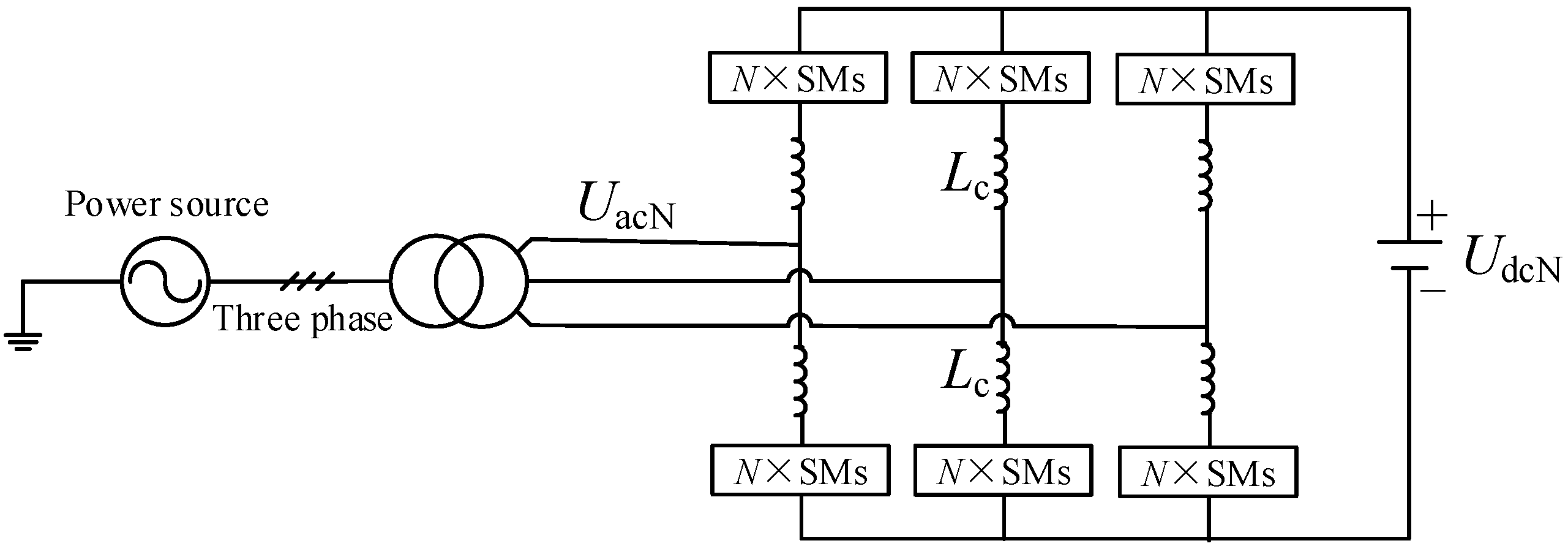
Figure 1 shows a typical MMC topology and the corresponding control structure used in MMC-HVDC. As shown in Figure 1a, the DC side is connected to the DC transmission line, and UdcN represents the rated DC voltage of MMC and the MMC-HVDC. Each bridge arm contains N series-connected submodules (SMs), and the nominal capacitor voltage, which is the base value, is defined in (1). The AC side of the MMC is connected to the grid through a connection transformer, and UacN represents the rated AC voltage on the valve side. Figure 1b shows the equivalent circuit. The MMC is connected to the source through an equivalent reactance Xeq, which includes the transformer leakage reactance and the MMC arm bridge reactance.
U capN = U dcN N
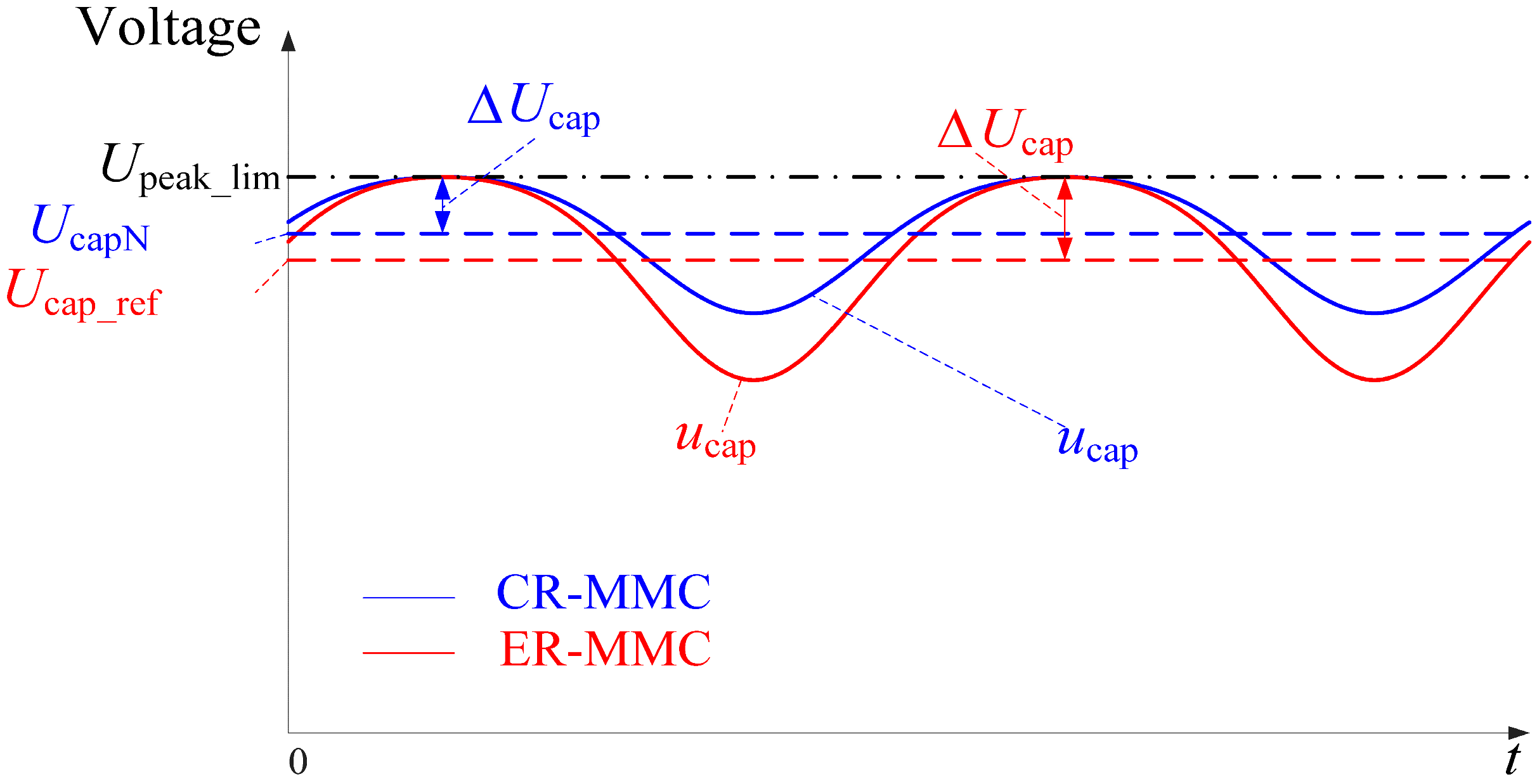
Figure 2 shows the waveform of the SM capacitor voltage in the MMC. Because there is energy fluctuation in the arm bridges, the voltage contains a ripple component. In most existing studies and applications (CR-MMC), the DC component of the capacitor voltage is set at the nominal value UcapN. The ripple ratio of the capacitor voltage is defined as the ratio between the ripple amplitude and the DC component of the voltage, and it is usually designed as 10%, so the peak capacitor voltage is limited to within 1.1 pu.
The principle of SM capacitor design is to limit the ripple ratio and make sure that the peak voltage does not exceed the limit. The allowable ripple ratio is usually inversely related to the capacitor value. When the ripple ratio is set to 10%, the required capacitor is large, and this leads to high cost and large equipment size. This is undesirable for power companies and motivates this research, especially in load-centred cities and environments with high power demand but limited space [5,6].
The elevated-ripple MMC (ER-MMC) fortunately can reduce the SM capacitor value by increasing the allowable ripple ratio while keeping the peak capacitor voltage within the limit. To keep the safety margin of the switching devices unchanged, the peak capacitor voltage must always remain below the same limit Upeak_lim, no matter how high the allowable ripple ratio is. Its per-unit value is defined in (2).
U peak _ lim * = U peak _ lim U capN
From Figure 2, the ER-MMC increases the voltage fluctuation range and the ripple ratio by actively reducing the DC component of the SM capacitor voltage while keeping the peak voltage unchanged. The ripple-tolerance coefficient κ is defined to represent the level of reduction in the DC component of the capacitor voltage, as shown in (3).
κ = U capN U cap _ ref
When the peak capacitor voltage remains unchanged, the allowable ripple ratio changes with the ripple-tolerance coefficient as shown in (4).
ε max = U peak _ lim U cap _ ref U cap _ ref = κ U peak _ lim * 1
Accordingly, a larger κ means a lower DC component and a higher allowable ripple ratio. Because the SM capacitor value is roughly inversely proportional to the allowable ripple ratio, an increase in κ allows the use of a smaller capacitor value.

2.2. Control Strategy of ER-MMC

The ER-MMC can still use the typical nearest level modulation (NLM) to determine the number of inserted SMs in the upper and lower arm bridges. As shown in Figure 1b, the MMC controller generates a reference voltage to make the output active power (or DC voltage) and reactive power reach their targets. Taking phase A as an example, the controller generates the following fundamental AC voltage, as shown in (5).
u ref ( t ) = 2 U ref sin ( ω t + δ ref ) = M ref U dcN 2 sin ( ω t + δ ref )
In (5), Uref and δref represent the amplitude and phase of the reference voltage. The modulation index Mref is defined in (6).
M 1 = 2 U ref U dcN / 2
In ER-MMC controller, a circulating current suppression control (CCSC) is usually included to eliminate the second-order circulating current between the arm bridges. After considering the second-order reference voltage component generated by the CCSC, the following set of conditions can be obtained in (7).
6 c 1 κ 2 M 1 I ac * cos ( θ 1 φ ) + 2 c 1 κ 2 M 1 M 2 I ac * cos θ 1 + φ sin θ 2 2 c 1 κ 2 M 1 3 I ac * cos θ 1 + φ cos 2 θ 1 2 c 1 κ 2 M 1 M 2 I ac * sin ( θ 2 + φ + θ 1 ) 2 c 1 κ 2 M 1 M 2 I ac * 3 sin ( θ 2 φ θ 1 ) + κ M 2 U ¯ cap * cos θ 2 = 0 6 c 1 κ 2 M 1 I ac * sin ( θ 1 φ ) 2 c 1 κ 2 M 1 M 2 I ac * cos θ 1 + φ cos θ 2 2 c 1 κ 2 M 1 3 I ac * cos θ 1 + φ sin 2 θ 1 + 2 c 1 κ 2 M 1 M 2 I ac * cos ( θ 2 + φ + θ 1 ) + 2 c 1 κ 2 M 1 M 2 I ac * 3 cos ( θ 2 φ θ 1 ) + κ M 2 U ¯ cap * sin θ 2 = 0
In (7), c1 is the CVR effect coefficient, and it is calculated in (8).
c cvr = 1 8 U acN * ω E nom
Enom is the nominal energy base of the converter, and it is calculated in (9).
E nom = 1 2 C d U capN 2 × N × 6 S N
By combining (8) and (9), the reference voltage of the arm bridges can be expressed in (10).
u ref _ ap ( t ) = 1 2 U dcN M ref 2 U dcN sin ( ω t + δ ref ) + M 2 2 U dcN sin ( 2 ω t + β 2 ) u ref _ an ( t ) = 1 2 U dcN + M ref 2 U dcN sin ( ω t + δ ref ) + M 2 2 U dcN sin ( 2 ω t + β 2 )
In (10), M2 and β2 represent the amplitude and phase of the second-order reference voltage injected for CCSC. When the NLM is used, the number of inserted SMs in each arm bridge is obtained by dividing the arm reference voltage by the DC component of the SM capacitor voltage. It has
n ap ( t ) = u ref _ ap ( t ) U capN / κ = κ N 1 2 M ref 2 sin ( ω t + δ ref ) + M 2 2 sin ( 2 ω t + β 2 ) n an ( t ) = u ref _ an ( t ) U capN / κ = κ N 1 2 + M ref 2 sin ( ω t + δ ref ) + M 2 2 sin ( 2 ω t + β 2 )
Ignore the second-order reference voltage component from CCSC. When the SM capacitor voltage is reduced to UcapN/κ, the total number of operated modules in the upper and lower arm bridges increases from N to κN. Accordingly, the key point is how the reduction in the DC component of the capacitor voltage and the increase in voltage ripple affect the AC output voltage capability, that is, their impact on the linear modulation region. Because each arm bridge contains N SMs, the number of inserted modules must satisfy the following constraint to ensure linear modulation:
0 n ap , n ( t ) N
Because κ of the ER-MMC is greater than 1.0, to satisfy (12), the maximum fundamental modulation index Mref of the ER-MMC is lower than that of the CR-MMC. At first glance, this means that reducing the DC component of the capacitor voltage weakens the AC voltage output capability of the ER-MMC. However, this finding does not consider the effect of capacitor voltage ripple on the AC voltage.
In practice, voltage fluctuation produces a fundamental component on the AC side through the modulation process, so the actual AC output voltage can deviate from the reference voltage. This paper defines this deviation as the CVR effect. When the ripple-effect-induced deviation is added to the AC reference voltage, it affects the AC output voltage. Under specific operating conditions, this deviation can increase the achievable AC voltage output capability of the MMC, which is defined here as ripple-induced voltage compensation.
Based on the theories of the CVR effect and ripple-induced voltage compensation, it is possible to reduce the DC component of the capacitor voltage and increase the allowable ripple ratio while keeping the AC voltage capability and output power range of the IGCT MMC. In this way, a compact IGCT ER-MMC with reduced capacitor usage can be achieved.

3. Analysis of IGCT ER-MMC Based on Ripple-Induced Voltage Compensation

The analytical framework developed in this section is based on the following assumptions: (A1) steady-state operation: the MMC has reached a periodic steady state; (A2) balanced three-phase system: the AC grid voltage and MMC arm parameters are symmetrically balanced; (A3) ideal voltage balancing among SMs: all SMs within the same arm have identical capacitor voltages at any instant, achieved through sorting-based balancing; (A4) harmonic truncation: the capacitor voltage ripple is expanded up to the third harmonic, with higher-order terms neglected; (A5) negligible arm resistance: ohmic losses in arm inductors and switching devices are excluded from the modulation analysis; (A6) perfect CCSC performance: the CCSC fully eliminates the second-harmonic circulating current. Assumptions (A1) and (A2) are standard for steady-state MMC analysis. Assumption (A3) introduces minor error proportional to one step voltage (UcapN/N), which is small when N = 250. Assumption (A4) is validated by simulation comparisons in Section 4. Assumptions (A5) and (A6) have minimal impact on the modulation boundary, as confirmed by the close match between analytical and simulation results.

3.1. Analysis of the CVR Effect

The capacitor voltages of the upper and lower arm bridge SMs in the MMC can be expressed in (13).
u cap _ ap ( t ) = U ¯ cap + Δ u ˜ cap _ ap t u cap _ an ( t ) = U ¯ cap + Δ u ˜ cap _ an t
In (13), Ūcap represents the actual value of the DC component of the capacitor voltage. Δũcap_ap and Δũcap_an represent the fluctuation components of the upper and lower arm bridge SMs. These fluctuation components contain several frequency components, as shown in (14).
Δ u ˜ cap _ ap t = Δ u ˜ cap 1 t + Δ u ˜ cap 2 t + Δ u ˜ cap 3 t Δ u ˜ cap _ an t = Δ u ˜ cap 1 t + Δ u ˜ cap 2 t Δ u ˜ cap 3 t
Δũcap1, Δũcap2, and Δũcap3 represent the fundamental, second-order, and third-order ripple components, respectively. Based on existing steady-state analysis models of the MMC, their detailed expressions are given in (15).
Δ u ˜ cap 1 = 2 κ I ac 4 ω C d cos ω t φ + 2 κ M 2 I ac 8 ω C d sin ω t + β 2 + φ + 2 κ M ref 2 I ac 8 ω C d cos δ ref + φ cos ω t + δ ref Δ u ˜ cap 2 = 2 κ M ref I ac 16 ω C d sin 2 ω t + δ ref φ 2 κ M ref M 2 I ac 16 ω C d cos δ ref + φ cos 2 ω t + β 2 Δ u ˜ cap 3 = 2 κ M 2 I ac 24 ω C d sin 3 ω t + β 2 φ
When the effect of capacitor voltage fluctuation is considered, the actual output voltage of the arm bridges can be expressed as follows.
u ap ( t ) = n ap ( t ) U ¯ cap + Δ u ˜ cap _ ap ( t ) u an ( t ) = n an ( t ) U ¯ cap + Δ u ˜ cap _ an ( t )
The actual AC output voltage of the MMC is given by the differential-mode component of the upper and lower arm bridge voltages, and its expression is shown below.
u diff ( t )   = n an ( t ) U ¯ cap + Δ u ˜ cap _ an ( t ) n ap ( t ) U ¯ cap + Δ u ˜ cap _ ap ( t ) 2 = n an ( t ) n ap ( t ) 2 U ¯ cap + n an ( t ) Δ u ˜ cap _ an ( t ) n ap ( t ) Δ u ˜ cap _ ap ( t ) 2
Therefore, the actual fundamental AC output voltage of the MMC is the fundamental component of (17). Existing methods usually ignore the CVR effect and assume that the AC-side output voltage is equal to the reference voltage in (5). However, (17) shows that the fluctuation components of the capacitor voltage cause the actual output voltage of the MMC to deviate from the reference value, and this produces a CVR effect deviation.
In (17), the first term on the right side of the equation represents the AC voltage output produced by the DC component of the capacitor voltage. Because of the CVR effect, the actual DC component of the capacitor voltage is not always equal to the reference value Ucap_ref. When the DC-side voltage is UdcN, the actual DC component of the capacitor voltage shifts from the reference value Ucap_ref by ΔŪ under the CVR effect. The per-unit expression of this deviation is given as follows.
To clarify the notation used herein: Ucap,ref denotes the controller voltage setpoint (equal to UcapN/κ), which the NLM uses to calculate the number of inserted SMs. The actual DC component of the capacitor voltage in steady state is denoted as Ūcap, which differs from Ucap_ref by the CVR-induced offset ΔŪcap. The required converter output voltage Uconv is determined by the power operating condition via (25) and (26). The controller does not iteratively search for the correct reference; rather, the steady-state modulation index Mref is uniquely determined by the system of Equations (24)–(26).
Physically, this DC shift can be understood through the energy balance in the arm. In steady state, the net energy flowing into each SM capacitor over one fundamental cycle must be zero. The modulation process creates cross-coupling between the capacitor voltage ripple and the fundamental-frequency arm current, producing additional DC power terms. To maintain energy equilibrium, the actual DC component of the capacitor voltage must shift slightly from the reference value. This shift adjusts the DC current component so that the total DC power exchange returns to zero. The CVR-induced DC offset is therefore a natural and predictable consequence of operating with elevated ripple.
U ¯ cap * = U cap _ ref * + Δ U ¯ cap *
In (18), ΔŪ*cap represents the per-unit DC voltage deviation, and its calculation is given in (19).
Δ U ¯ cap * = 4 c cvr κ M ref I ac * sin ( δ ref + φ ) + c cvr κ M ref M 2 I ac * cos ( β 2 + φ δ ref )
In (19), c1 is a coefficient related to the MMC parameters. The second term on the right side of (17) represents the output voltage on the AC side that is generated by the capacitor voltage fluctuation through the modulation process. As shown in (17), both nap(tũcap_ap(t) and nap(tũcap_an(t) contain fundamental components. Accordingly, the per-unit form of the actual AC output voltage of the IGCT MMC can be expressed as follows.
u aco * ( t ) = u ref * ( t ) + Δ u ac 1 * ( t ) + Δ u ac 2 * ( t ) Ripple-induced   deviation
In (20), uref is the per-unit value of the reference voltage, and it is calculated as shown in (21).
u ref * ( t ) = 1 2 n an n ap U cap _ ref U dcN / 2 = M ref sin ( ω t + δ ref )
In practice, uref is the per-unit reference voltage that is sent to the modulation stage in (5). Δu*ac1 represents the deviation of the fundamental AC output voltage caused by the shift in the DC component of the capacitor voltage, and its per-unit value is calculated in (22).
Δ u ac 1 * ( t ) = M ref Δ U ¯ cap * sin ( ω t + δ ref )
Δu*ac2 represents the deviation of the fundamental AC output voltage caused by the capacitor voltage ripple. It can be obtained by substituting (8) and (12) into (17) and then extracting the fundamental AC component.
The total voltage deviation on the AC side caused by the CVR effect is the sum of Δuac1 and Δuac2, and its detailed calculation is given as follows.
Δ u ac * t = Δ u ac 1 * ( t ) + Δ u ac 2 * ( t ) = 8 c 1 κ 2 I ac * 1 M 2 2 6 + M ref 2 8 sin δ ref + φ sin ω t + δ ref + 8 c 1 κ 2 I ac * 1 M 2 2 6 3 M ref 2 8 cos δ ref + φ cos ω t + δ ref c 1 κ 2 M ref 2 M 2 I ac * cos δ ref + φ sin ( ω t + β 2 δ ref )
As shown in (12), the linear modulation state of the IGCT MMC depends on the magnitude of the reference voltage, and this determines whether the number of inserted SMs in the arm bridges exceeds the limit.
The MMC AC side connects to the grid through a transformer, as shown in Figure 1b. When the valve-side AC voltage rating UacN and equivalent connection reactance Xeq are fixed, the converter’s actual AC output voltage depends on its output power.
When checking linear modulation, if the CVR effect is ignored, the reference voltage is usually assumed to be equal to the actual output voltage. However, the CVR effect causes a deviation between the actual output voltage and the reference voltage. Because the required AC output voltage is determined by the operating power condition, once the output power target is fixed, the required voltage is also known.
When there is a CVR effect deviation between the reference voltage and the actual output voltage, the closed-loop controller in Figure 1b adjusts the reference voltage until the actual output voltage reaches the required value. For a given output power or output current, let the required output voltage amplitude and phase be Uaco, based on UdcN/2, and δaco. Because the actual output voltage in (20) must be equal to the required output voltage, substituting (21) to (23) into (20) gives the following set of equations.
U conv * cos δ conv = 8 c 1 κ 2 I ac * 1 M 2 2 6 + M 1 2 8 sin φ + κ M 1 U ¯ cap * cos θ 1   + 4 c 1 κ 2 M 1 2 I ac * cos θ 1 + φ sin θ 1   c 1 κ 2 M 1 2 M 2 I ac * cos θ 1 + φ cos ( β 2 θ 1 ) U conv * sin δ conv = 8 c 1 κ 2 I ac * 1 M 2 2 6 + M 1 2 8 cos φ + κ M 1 U ¯ cap * sin θ 1   c 1 κ 2 M 1 2 M 2 I ac * cos θ 1 + φ sin ( β 2 θ 1 )   4 c 1 κ 2 M 1 2 I ac * cos θ 1 + φ cos θ 1
In (24), the required output voltage Uconv and δconv can be calculated from the equivalent circuit shown in Figure 1b as follows.
U conv * = U ac , max * ( 1 + X eq * I ac * sin φ ) 2 + ( X eq * I ac * cos φ ) 2
δ conv = arctan X eq * I ac * cos φ 1 + X eq * I ac * sin φ
In (25), U*ac,max represents the nominal valve-side AC voltage in per-unit form based on UdcN/2.
From the above, for any given operating condition, the required MMC output voltage can be obtained from (25) and (26). By substituting these results into (24), the corresponding reference voltage amplitude M1 and phase θ1 can be obtained. Then, by substituting the reference voltage into (11) and (12), the required number of inserted SMs in the arm bridges can be calculated, and linear modulation can be checked using (11) and (12).

3.2. Linear Modulation of IGCT ER-MMC Considering the CVR Effect

The following analysis takes one arm bridge as an example to study linear modulation, and the modulation envelope is defined in (27).
f modu ( t ) = κ 1 2 + M 1 2 sin ( ω t + θ 1 ) + M 2 2 sin ( 2 ω t + θ 2 )
gpeak and gvalley represent the peak value and valley value of the modulation envelope within one fundamental period, as given in (28).
g peak = max f modu ( t ) g valley = min f modu ( t ) 0 t T 1
In (28), T1 is the fundamental period. The linear modulation constraint in (12) can be transformed into the following form. In other words, the condition for linear modulation is that the peak value gpeak is less than 1.0 and the valley value gvalley is greater than 0, as shown in (29).
g peak 1 and g valley 0
From (27), gpeak and gvalley are jointly affected by the ripple-tolerance coefficient κ, the fundamental reference component M1θ1, and the second-order reference voltage component M2δ2. At the same time, both M1θ1, and M2δ2 change with κ.
Since the capacitor voltage ripple increases with κ, the fundamental voltage deviation caused by the CVR effect also increases. Also, larger voltage ripple can cause larger second-order circulating current, so the second-order reference voltage generated by CCSC also increases. Therefore, the linear modulation condition of the MMC is affected by these factors in a complex way.

3.3. Verification of Ripple-Effect Impact on IGCT MMC

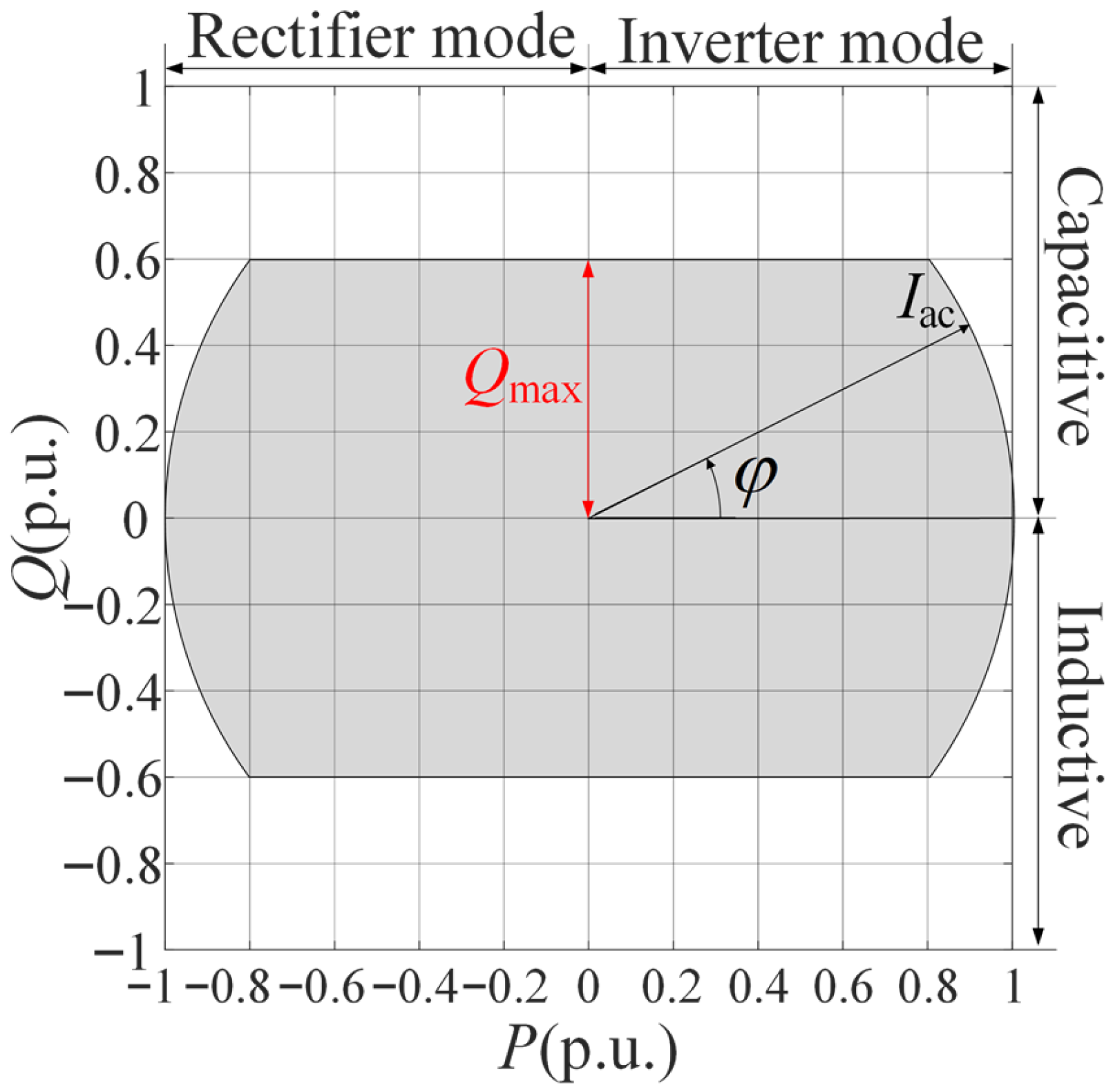
A 2000 MW/±500 kV IGCT MMC is used as a test objective to analyze the effects of the ripple-tolerance coefficient κ, the CVR effect deviation, and the second-order reference voltage on MMC linear modulation. The main parameters are listed in Table 1. The operating range of the MMC can be represented by the PQ diagram in Figure 3.
In practical applications, the required reactive power of the MMC is usually smaller than the rated active power, and its value depends on grid demand [30]. In the figure, Qmax represents the maximum required reactive power, and different values of Qmax are considered in the analysis.

3.3.1. Analysis of Fundamental Reference Voltage Effect on Linear Modulation

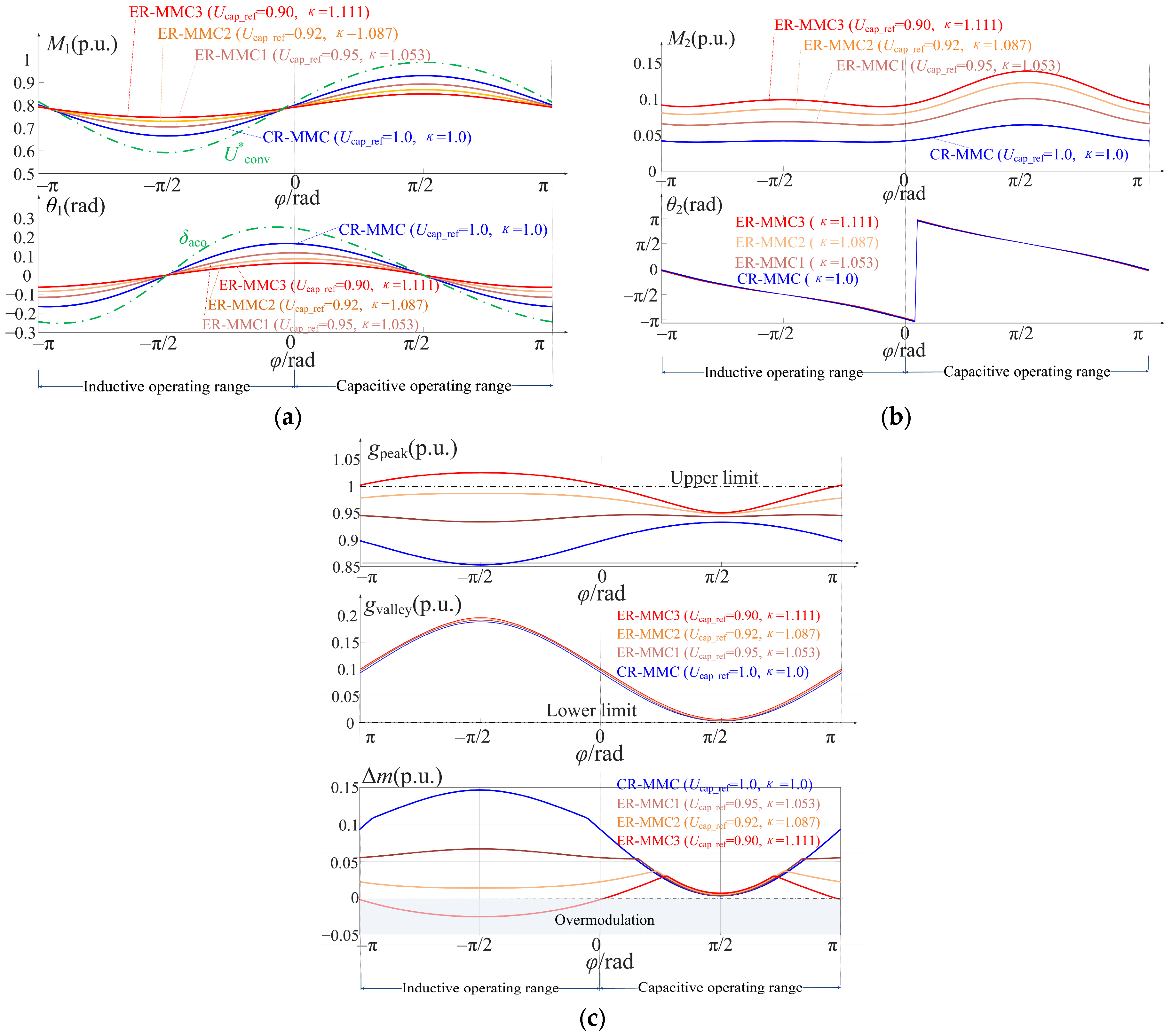
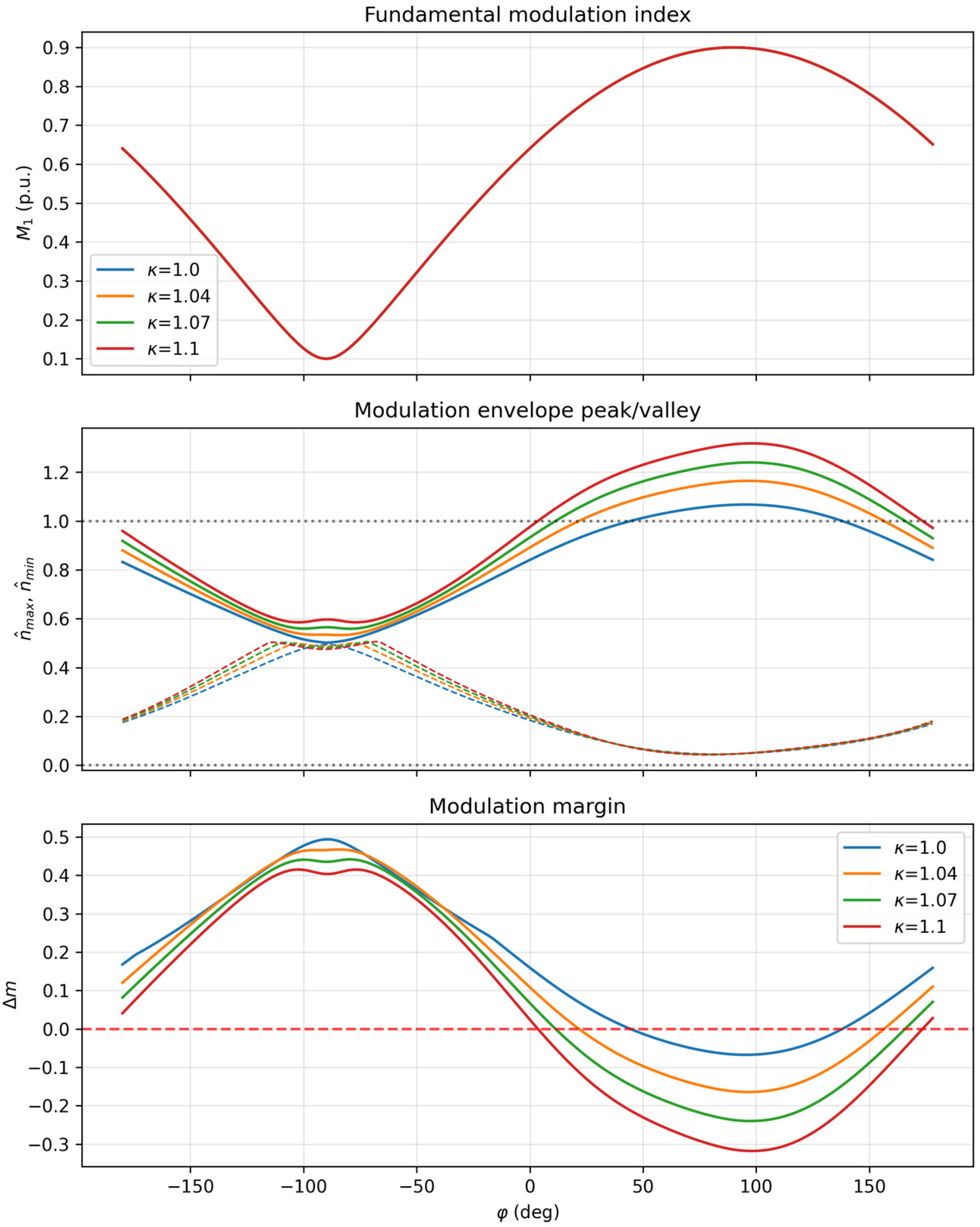
When Qmax = 1.0 pu, as the operating point moves along the PQ boundary, Figure 4a compares the changes in the fundamental reference voltage amplitude of the CR-MMC and the ER-MMC. Three different values of the ripple-tolerance coefficient κ are studied for the ER-MMC. In Figure 4a, the amplitude and phase of the actual required MMC output voltage at different operating points are shown by dashed lines. For both the CR-MMC and the ER-MMC, the reference voltage amplitude Mref is different from the required output voltage amplitude U*aco, and this deviation changes with the operating condition and with κ.
In the inductive operating region (−π ≤ φ ≤ 0), the reference voltage amplitude Mref is larger than the actual AC output voltage amplitude U*aco. The maximum deviation appears at the rated inductive reactive power point (φ = −π/2). Further analysis shows that a larger κ leads to a larger Mref. This is unfavorable for linear modulation, because a larger Mref moves gpeak and gvalley closer to the modulation limits.
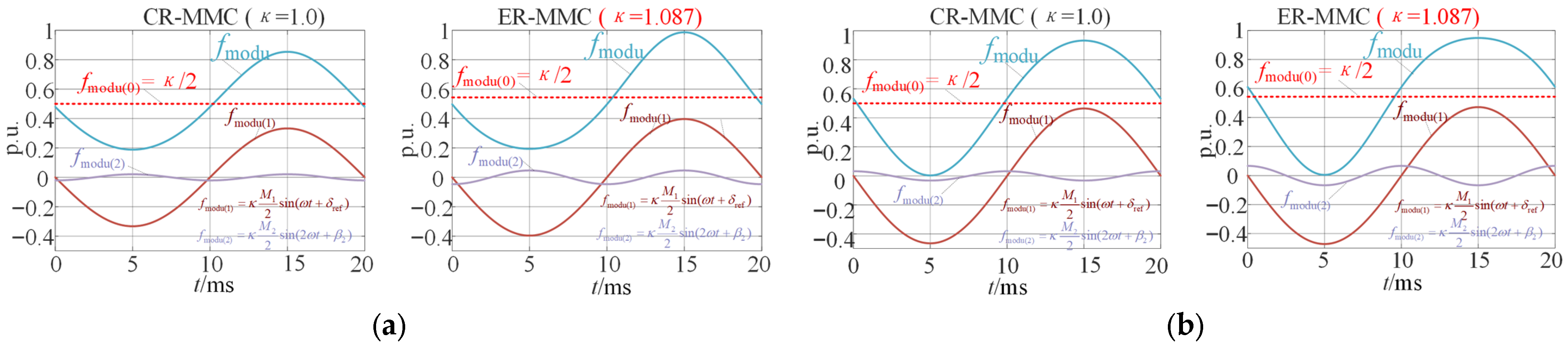
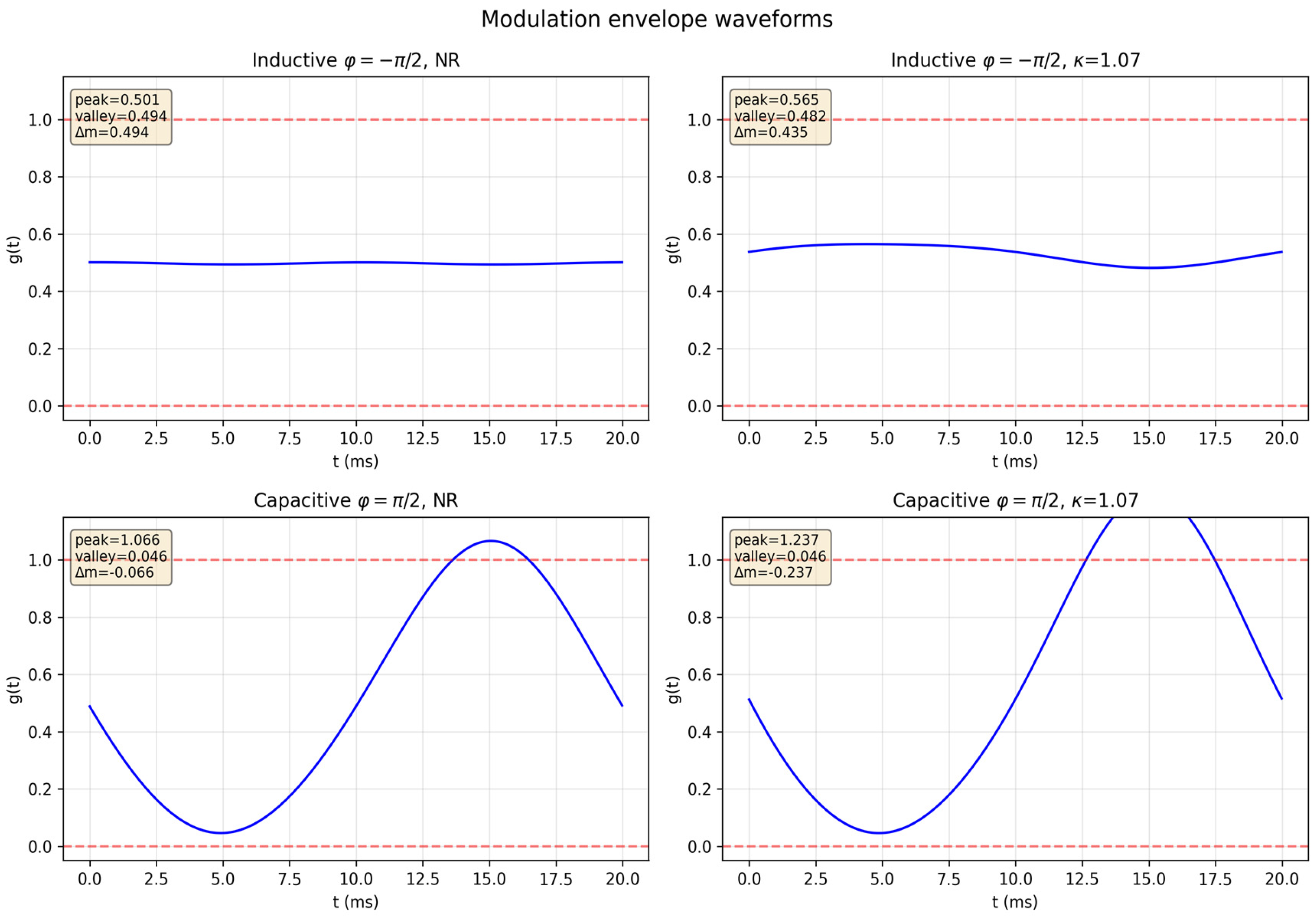
Figure 5a shows the modulation envelope at the rated inductive reactive power point (φ = −π/2) when κ = 1.087. Although the actual output voltages of the CR-MMC and ER-MMC are the same, the fundamental component of the ER-MMC is clearly larger. However, because the required output voltage is relatively low in the inductive region, this negative effect does not always lead to overmodulation.
Figure 5b shows the modulation envelope at the rated capacitive reactive power point (φ = π/2) when κ = 1.087. Because of the combined effect of smaller Mref and larger κ, the fundamental components of the modulation envelopes of the CR-MMC and ER-MMC are almost the same. This shows that the AC voltage output capability of the ER-MMC does not decrease under this condition. In the capacitive region, this feature is important for avoiding overmodulation when κ increases.

3.3.2. Effect of Second-Order CCSC Reference on Modulation Boundary

Figure 4b also shows how the amplitude and phase of the second-order reference voltage generated by CCSC change with operating conditions. When κ increases, the capacitor voltage ripple increases, so the required second-order reference voltage for suppressing circulating current also increases. Therefore, as κ increases, the effect of the second-order reference voltage on linear modulation becomes more obvious. From the phase of the second-order voltage, its phase is roughly opposite in the inductive and capacitive regions, so its effects on linear modulation in these two regions are also opposite.
At the rated inductive reactive power point (φ = −π/2) shown in Figure 5a, the peak of the second-order reference voltage coincides with the peak and valley of the fundamental reference voltage. This shifts the modulation envelope upward. As a result, the peak value gpeak moves closer to the upper modulation limit, and the valley value gvalley moves farther from the lower limit. At the rated capacitive reactive power point (φ = π/2) shown in Figure 5b, the valley of the second-order reference voltage coincides with the peak and valley of the fundamental reference voltage. This shifts the modulation envelope downward. As a result, gpeak moves farther from the upper limit, and gvalley moves closer to the lower limit.
Analysis of Ripple-Tolerance Coefficient Effect on Linear Modulation
The ripple-tolerance coefficient κ of the ER-MMC is always greater than 1.0. It always shifts the modulation envelope upward. This moves the peak closer to the upper linear modulation limit and moves the valley farther from the lower limit. At the same time, as κ increases, the fundamental reference voltage Mrefδref and the second-order reference voltage M2δ2 also change. Therefore, the effects of these three factors must be analyzed together.
Comprehensive Modulation Boundary Analysis
In the capacitive region, the combined effects of ripple deviation and second-order reference voltage reduce gpeak. This offsets the negative effect of increasing κ on the peak value. For gvalley, although a larger second-order reference voltage tends to reduce it, the ripple deviation and larger κ help keep it above the lower modulation limit.
As a result, in the capacitive region, the peak and valley values do not easily cross the modulation limits when κ increases. The simulation results confirm this conclusion. As shown in Figure 4c, in the capacitive region, gpeak changes very little as κ increases, especially at the rated capacitive reactive power point. The gvalley curves are also almost the same. Therefore, increasing κ does not increase the risk of overmodulation in this region, provided that it remains below the inflection point.
In the inductive region, the situation is opposite. In this region, ripple deviation and second-order reference voltage have similar effects to κ, and all of them increase gpeak. As shown in Figure 4c, gpeak rises clearly as κ increases. Therefore, the risk of overmodulation increases in this region when κ increases.
By considering both upper and lower modulation limits, the modulation margin is defined as follows in (30).
Δ m = min g valley 0 ,   1.0 g peak
For any operating point, if Δfmargin is greater than zero, the point satisfies linear modulation. When Δfmargin is close to zero, the margin is small. When Δfmargin is less than zero, overmodulation occurs.
In capacitive operating conditions, the MMC requires a higher AC output voltage. Therefore, as shown in Figure 4c, before κ reaches a certain limit, the operating point with the smallest margin is still in the capacitive region. Because the Δfmargin curves for different κ values almost overlap in this region, increasing κ has little effect on AC voltage capability and does not affect the minimum margin over the whole PQ range.
However, in the inductive region, the margin decreases as κ increases. This is because κ, ripple deviation, and second-order reference voltage together increase gpeak. When κ exceeds a certain value, the margin in the inductive region becomes smaller than that in the capacitive region. It then determines the minimum margin over the whole PQ range. As shown in Figure 4c, overmodulation appears in the inductive region when κ is larger than a certain value.
Analysis of AC Voltage Output Capability and Capacitor Usage of IGCT ER-MMC
As shown in Figure 4, before the ripple-tolerance coefficient κ reaches a certain value, linear modulation can be achieved over the whole PQ operating range. Therefore, the problem becomes how to quantitatively evaluate the effect of κ on AC voltage output capability and how to determine the optimal value of κ.
The rated valve-side AC voltage U*acN has a decisive influence on linear modulation. For a given operating condition, a lower rated valve-side voltage means a lower required AC output voltage, which helps achieve linear modulation. However, when the rated valve-side voltage is designed to be higher, the rated arm bridge current can be reduced, converter losses can be reduced, and capacitor usage can also be reduced.
Accordingly, for a given DC voltage and PQ operating range, the rated valve-side AC voltage should be increased as much as possible while keeping the modulation margin positive at all operating points. This means that linear modulation must be satisfied under all conditions. The maximum rated valve-side AC voltage that satisfies this requirement is defined as the maximum achievable valve-side AC voltage U*acN_LML, based on UdcN/2.
Under a given DC voltage, equivalent reactance, and PQ range, U*acN_LML represents the AC voltage output capability of the MMC. At this voltage level, all required operating points satisfy linear modulation.
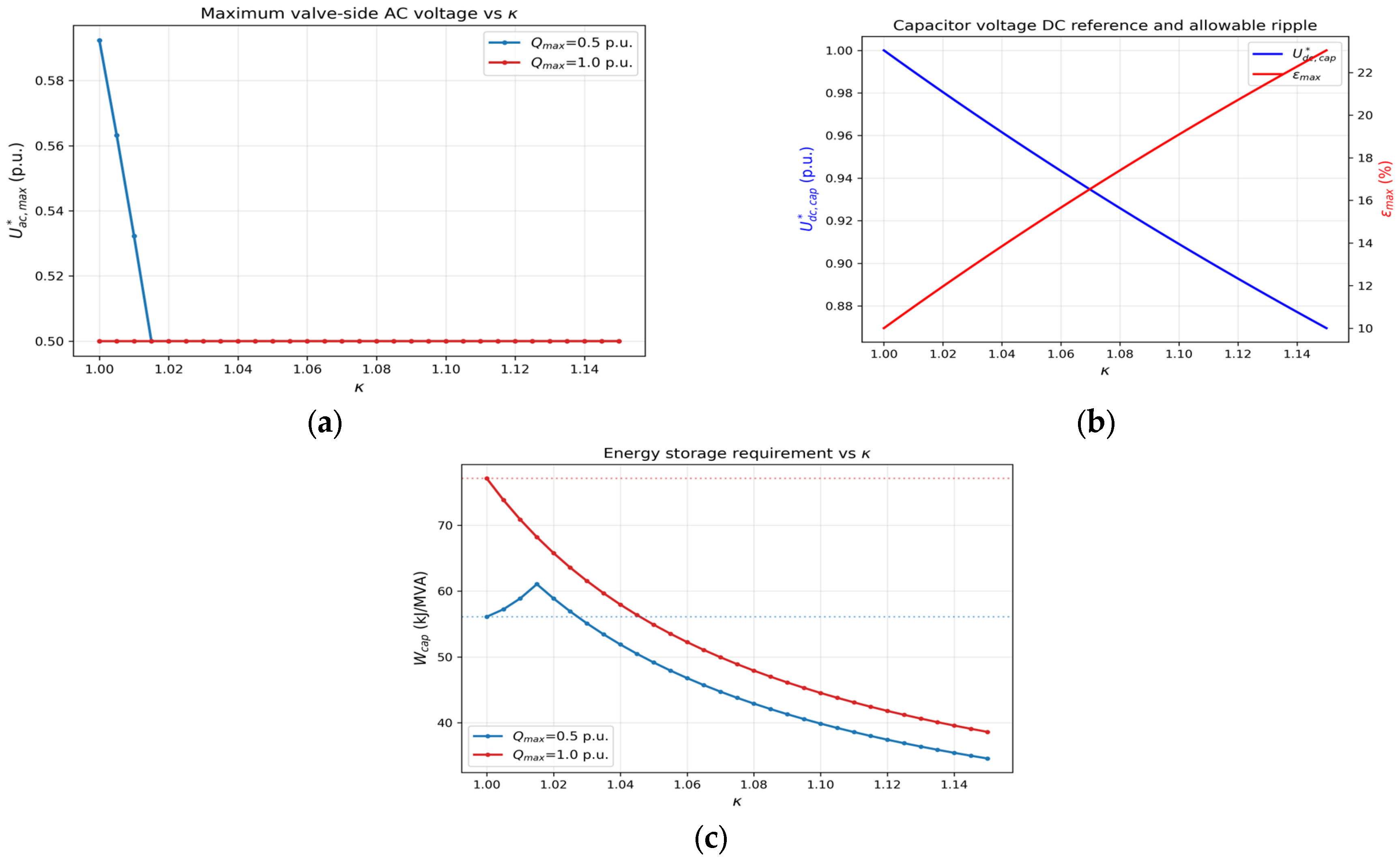
For the MMC example in Table 1, Figure 6a shows how UacN_LML changes with κ. UacN_LML is also affected by the maximum reactive power Qmax. When Qmax is larger, the voltage drop on the equivalent reactance is larger, so the rated valve-side voltage must be lower to ensure linear modulation. This study considers two cases: Qmax = 1.0 pu and Qmax = 0.5 pu.
For a given Qmax, before κ reaches a certain value, U*acN_LML remains unchanged as κ increases. This result is consistent with the conclusion in Figure 4. This is because, before κ reaches the turning point, the overall linear modulation condition is determined by the capacitive region, and the margin in this region is almost not affected by κ. However, as κ increases further, the modulation margin in the inductive region gradually decreases. When κ exceeds a certain value, the minimum margin in the inductive region becomes smaller than that in the capacitive region, and it determines the overall linear modulation condition. At this point, U*acN_LML must be reduced to ensure linear modulation in the inductive region and to ensure that the converter satisfies the linear modulation constraint under all conditions.
As shown in Figure 6a, when Qmax = 1.0 pu, U*acN_LML remains at 0.79 before κ increases to 1.087. When Qmax = 0.5 pu, UacN_LML remains at 0.86 before κ increases to 1.053. When κ exceeds a certain value, U*acN_LML starts to decrease. This means that the rated valve-side AC voltage must be reduced to ensure linear modulation under all operating conditions. As shown in Figure 6b, the reference value of the DC component of the capacitor voltage decreases as κ increases. When the peak capacitor voltage is kept unchanged, the allowable ripple ratio increases with κ. Because the SM capacitor value is generally inversely proportional to the allowable ripple ratio, increasing the allowable ripple ratio can greatly reduce capacitor usage. The total capacitor usage is evaluated using the per-unit energy storage requirement of the MMC, and it is defined in (31).
W cap = 1 2 C d U peak _ lim 2 × N × 6 S N
In (31), Cd represents the SM capacitor value, and SN represents the rated capacity of the converter. The design of the per-unit energy storage requirement must ensure that the peak capacitor voltage does not exceed the limit under all operating conditions.
Figure 6c shows the calculated per-unit energy storage requirement for Qmax = 1.0 pu and Qmax = 0.5 pu. Before κ reaches the turning point, the per-unit energy storage requirement decreases clearly as κ increases. When κ exceeds the turning point, the change trend becomes flat. This is because, after κ exceeds the turning point, U*acN_LML starts to decrease to maintain linear modulation. This increases the rated AC current of the MMC and increases the energy fluctuation in the arm bridges. This effect offsets the benefit of a higher allowable ripple ratio. As a result, the reduction in per-unit energy storage requirement becomes smaller. Therefore, setting κ at the turning point can minimize the required per-unit energy storage requirement. As shown in Figure 6c, when Qmax = 0.5 pu and the rated valve-side AC voltage is 0.86 pu, the ER-MMC increases κ to 1.053. At this point, the DC reference of the capacitor voltage drops to 0.95 pu, and the allowable ripple ratio rises to 15.8%. The per-unit energy storage requirement is reduced from 37.89 kJ/MVA for the CR-MMC to 26.95 kJ/MVA, which is a reduction of 28.8%.
When Qmax = 1.0 pu and the rated valve-side AC voltage is 0.79 pu, the IGCT ER-MMC increases κ to 1.087. At this point, the DC reference of the capacitor voltage drops to 0.92 pu, and the allowable ripple ratio rises to 19.6%. The capacitor per-unit energy storage requirement is reduced from 55.99 kJ/MVA for the IGCT CR-MMC to 33.92 kJ/MVA, which is a reduction of 39.4%.
The optimal κ is formally defined as the inflection point of the U*acN,LML versus κ curve, i.e., the value of κ at which U*acN,LML begins to decline. The existence of this inflection point is a fundamental property of the elevated-ripple MMC modulation structure, arising from the competing margins in the inductive and capacitive operating regions. Its numerical value, however, depends on system-specific parameters including N, Xeq, Qmax, and the peak voltage limit. For example, a larger Qmax shifts the inflection point to a smaller κ. Therefore, the optimal κ must be computed for each specific design case using the analytical framework presented in this paper. At the optimal κ, the comprehensive performance impact is limited: conduction losses increase by less than 2% due to the slightly higher CCSC current, while the control architecture (NLM + CCSC) remains unchanged. Since the peak capacitor voltage is held constant, device voltage stress is unaffected.
To evaluate the feasibility of full-range linear modulation under elevated ripple, the modulation margin Δm is computed at 36 evenly spaced operating points along the circular PQ boundary. Figure 7 presents the results for κ = 1.0 (CR-MMC), 1.05, 1.10, and 1.15. For the CR-MMC, Δm remains positive throughout, confirming that the conventional design guarantees linear modulation across all operating conditions. As κ increases to 1.10, the margin in the capacitive region (φ > 0) decreases noticeably due to the CVR effect, whereas the inductive region retains an adequate margin. At κ = 1.15, negative values of Δm appear in the deep-capacitive zone, indicating saturation. These results demonstrate that κ ≈ 1.10 is an appropriate upper bound for the ±500 kV/2000 MW IGCT-MMC.
Figure 8 compares the modulation envelope g(t) waveforms for the CR-MMC (κ = 1.0) and the ER-MMC (κ = 1.10) at three representative operating points. In each case, the shaded band defines the permissible modulation range; the fundamental reference must remain within this band to ensure linear operation. For the ER-MMC, the wider ripple band is clearly visible. In the capacitive case, the fundamental reference approaches the upper boundary, consistent with the reduced Δm observed in Figure 7. In contrast, the inductive case preserves a larger margin, confirming the asymmetric impact of the CVR effect.

3.4. Comprehensive Engineering Impact of Elevated-Ripple Operation

While the preceding analysis demonstrates significant capacitance reduction at the optimal κ, it is important to evaluate the comprehensive engineering impact to confirm that no other performance dimension is adversely affected. This subsection addresses conduction losses, thermal stress, and reliability considerations.
The conduction loss of the IGCT is primarily determined by the arm current, which depends on the AC-side current and the circulating current. At the optimal κ = 1.087, the rated valve-side AC voltage U*acN,LML remains unchanged compared to the CR-MMC case (before the inflection point), so the rated arm current does not increase. The additional second-harmonic circulating current required for CCSC does increase slightly with κ, but its contribution to total losses is small (typically <2% increase in total conduction loss), as shown in Table 2.
Figure 7. Modulation margin Δm across the PQ operating boundary for different ripple-tolerance coefficients κ. The circular S = SN boundary is sampled at 36 operating points. Darker bars indicate smaller margin; negative values denote modulation saturation.
Electronics 15 01468 g007
Figure 8. Modulation envelope g(t) waveforms at representative operating points (P = 1.0 p.u., Q = 0/±1.0 p.u.) for CR-MMC (κ = 1.0) and ER-MMC (κ = 1.10). The shaded band indicates the permissible modulation range.
Electronics 15 01468 g008
Since the arm current increase is marginal at the optimal κ, the thermal stress on IGCT devices remains well within the safe operating area. The IGCT’s inherently superior thermal performance, enabled by its press-pack packaging with double-sided cooling, provides an additional margin.
Regarding reliability, the capacitor voltage peak remains unchanged at 1.1 p.u., preserving the same voltage stress on devices. The reduced capacitor size may actually improve reliability by reducing the probability of capacitor failure, which is a dominant failure mode in MMC submodules. The wider voltage swing does increase capacitor ripple current stress, but this is within the rating of standard film capacitors used in MMC applications.
In summary, at the optimal κ, the converter achieves a 28.8–39.4% reduction in capacitance with negligible penalties in other performance dimensions.

4. Simulation Studies and Experimental Validations

4.1. Simulation Results

A model was built using the parameters listed in Table 1, and simulations are used to validate the feasibility of the IGCT ER-MMC. As shown in Figure 9, the AC side of the MMC is connected to the AC grid through a transformer, and the rated valve-side AC voltage is set to U*acN_LML. The DC side of the MMC is connected to an equivalent DC source. The peak limit of the capacitor voltage is set to 1.1 pu. The SM capacitor value and the ripple-tolerance coefficient κ are set based on the theoretical results in Figure 6.
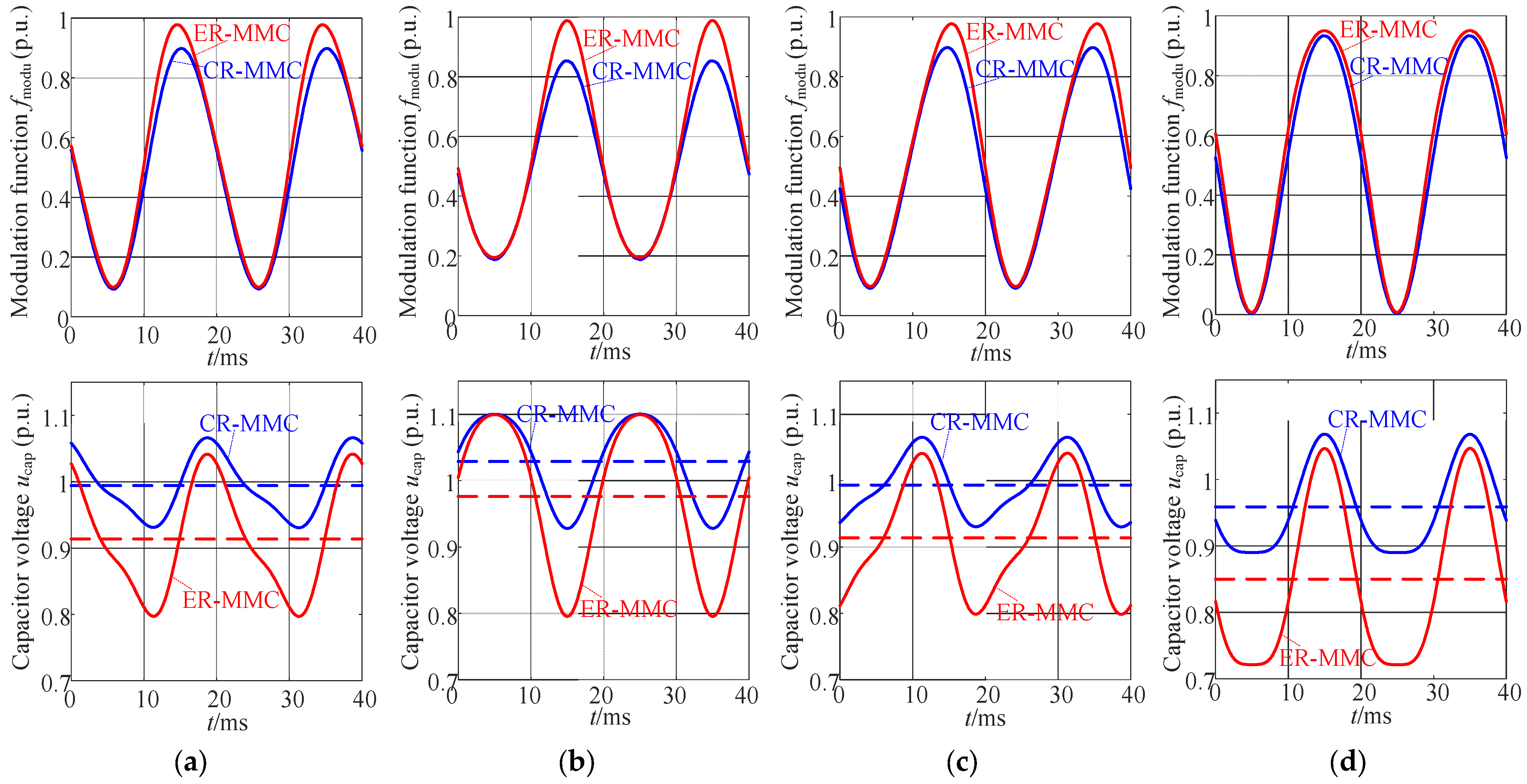
Figure 10 shows the modulation envelope functions and capacitor voltage waveforms at Qmax = 1.0 pu. Based on the theoretical results in Figure 6, the parameters are designed as follows: the rated valve-side AC voltage is set to the linear modulation limit U*acN_LML = 0.79 pu, and the ripple-tolerance coefficient is κ = 1.087.
For the IGCT CR-MMC, the unit energy storage requirement is 55.99 kJ/MVA (Cd = 24.1 mF). In contrast, for the ER-MMC, the required unit energy storage is reduced to 33.92 kJ/MVA (Cd = 14.6 mF). As indicated by the dashed curves in Figure 10, the DC component of the capacitor voltage in the ER-MMC is lower than that in the CR-MMC, and the corresponding ripple ratio is higher. Under the condition that the maximum capacitor voltage peak does not exceed the limit, the capacitor requirement of the ER-MMC is significantly reduced.
The modulation envelopes in Figure 8 indicate that all operating points within the specified PQ range satisfy the linear modulation condition. In general, the maximum AC output voltage is required at the rated capacitive reactive power operating point (φ = π/2). As shown in Figure 10d, the waveforms of the CR-MMC and ER-MMC at this operating point almost coincide and both satisfy the linear modulation constraint. This is consistent with the theoretical results in Figure 4, indicating that increasing κ does not affect the modulation margin at the rated capacitive operating point.
Figure 10a–c show the waveforms under remaining operating conditions. In these cases, the peak values of the modulation envelope functions in the ER-MMC are higher than those in the CR-MMC, especially at the rated inductive reactive power operating point (φ = −π/2). This result also agrees with the theoretical analysis in Figure 4, which shows that in the inductive operating region, the modulation peak gpeak increases with κ. However, since the required AC output voltage in this region is relatively low, the linear modulation constraint is still satisfied. With the designed value of κ, full-range linear modulation is achieved under all operating conditions.
For the IGCT CR-MMC, the unit energy storage requirement is designed as 37.89 kJ/MVA (Cd = 16.3 mF), whereas for the ER-MMC, it is reduced to 26.95 kJ/MVA (Cd = 11.6 mF). The simulation results are like those in Figure 10. The capacitor voltage peaks remain within the specified limits under all operating conditions, and linear modulation is satisfied throughout the entire operating range.
The simulation results are in good agreement with the theoretical analysis, which verifies the correctness of the IGCT ER-MMC design methodology and confirms that the IGCT ER-MMC can effectively reduce the required capacitor size.
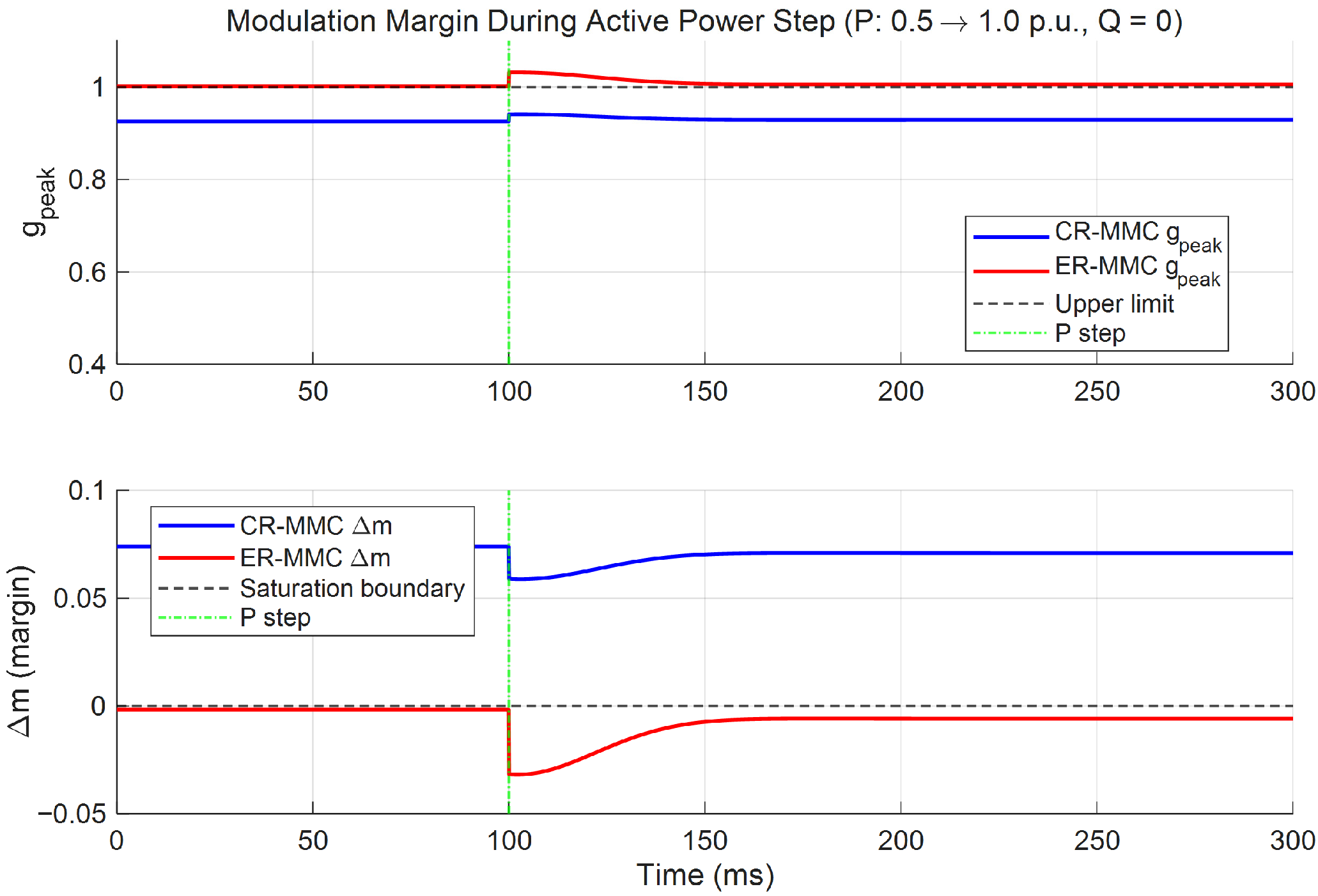
To verify the dynamic response robustness under elevated-ripple operation, Figure 11 presents the modulation envelope peak gpeak and the modulation margin during an active power step from 0.5 p.u. to 1.0 p.u. (Q = 0). During the transient, the modulation envelope exhibits a brief overshoot due to CCSC settling, but the margin remains positive throughout. The ER-MMC shows a smaller transient margin than the CR-MMC, as expected, but does not approach saturation. These results confirm that the NLM-based sorting algorithm and CCSC maintain stable voltage balancing under elevated ripple, and that the optimal κ provides a sufficient transient margin for typical power ramp rates.

4.2. Experimental Results

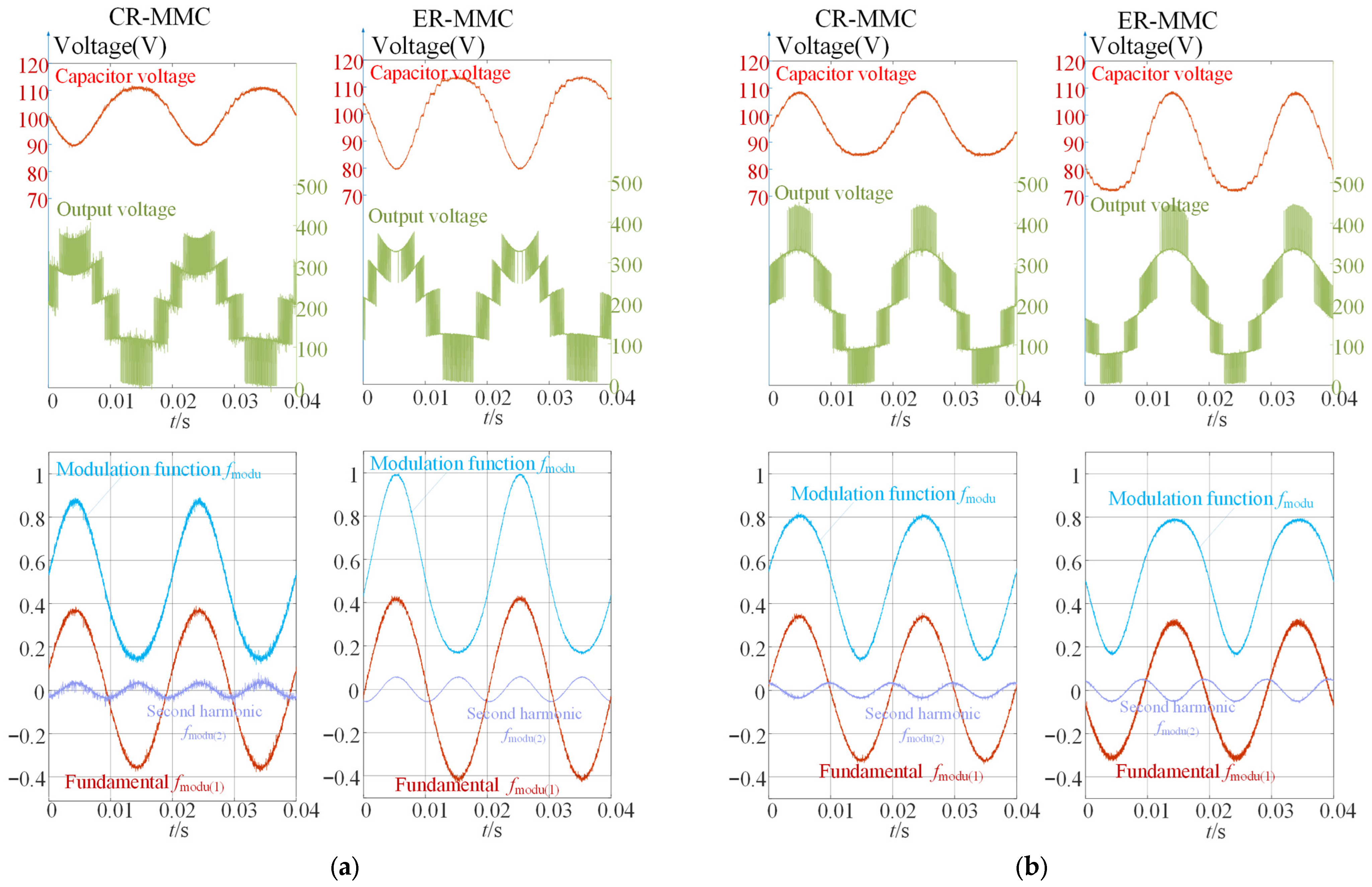
The proposed IGCT ER-MMC was further validated and compared with IGCT CR-MMC through experiments on a physical prototype, whose configuration is like the simulation system shown in Figure 9. The AC side of the prototype is connected to a four-quadrant grid simulator, while the DC side is supplied by a DC source. The main parameters are listed in Table 3. The prototype operates in power control mode. For the CR-MMC, κ = 1.0 and the submodule capacitance is 1.17 mF; for the ER-MMC, κ = 1.053 and the submodule capacitance is 0.78 mF. This indicates that the ER-MMC reduces the required capacitance by approximately 30% compared with the CR-MMC. Figure 12 presents the experimental waveforms obtained from the prototype tests.
The experimental prototype and the full-scale system share the same per-unit scaling principles. The per-unit modulation index Mref, the ripple-tolerance coefficient κ, and the per-unit energy storage requirement Wcap (kJ/MVA) are dimensionless quantities that remain invariant under voltage and power scaling, provided that the per-unit arm inductance and per-unit equivalent reactance are preserved. Differences in the number of SMs (N = 4 versus 250) affect only the fidelity of the NLM voltage approximation, not the underlying modulation boundary governed by the continuous envelope function g(t). Therefore, the prototype results can be extrapolated to the full-scale system with confidence.
Although the voltage ripple of the ER-MMC is higher than that of the CR-MMC, the peak values remain below the designed limits. This demonstrates the feasibility of reducing the capacitance using the proposed ER-MMC. Figure 12 presents the modulation envelopes together with their fundamental and second-harmonic components.
Under the maximum inductive reactive power operating mode shown in Figure 12a, the fundamental component amplitude (κMref/2) of the ER-MMC is higher than that of the CR-MMC. Both the ripple-effect deviation and the injected second-harmonic voltage required for circulating current suppression increase with κ, and the peak and valley of the fundamental component coincide with the peaks of the second-harmonic component. In addition, the increase in κ raises the DC component of the modulation envelope function. As a result, the peak value gpeak of the ER-MMC modulation envelope function is significantly larger than that of the CR-MMC, leading to a reduced modulation margin. This is consistent with the theoretical analysis in Figure 5a.
Under the maximum capacitive reactive power output mode (3 kVar, φ = π/2) shown in Figure 12b, the fundamental component amplitude (κMref/2) of the ER-MMC is slightly lower than that of the CR-MMC, which agrees with the theoretical results in Figure 5b. In this case, the increase in ripple-effect deviation with higher κ leads to a significant reduction in Mref compared with the CR-MMC. Unlike the inductive operating condition, the second-harmonic reference voltage helps to reduce the peak-to-valley variation in the modulation envelope function.
Specifically, in the capacitive operating region, at the peak points, the ripple-effect deviation and the second-harmonic reference voltage offset the influence of increasing κ; at the valley points, the ripple-effect deviation and the increase in κ counteract the reduction caused by the second-harmonic component. Consequently, the peak and valley values of the modulation envelope function, as well as the modulation margin, are almost unaffected by the increase in κ. This observation is also consistent with the theoretical analysis in Figure 5b.

5. Conclusions

This paper has investigated elevated-ripple operation as a capacitance reduction strategy specifically for IGCT-based MMCs. An analytical framework based on a modulation envelope function g(t) has been developed to evaluate the linear modulation boundary under increased capacitor voltage ripple, accounting for the CVR effect and circulating-current suppression control.
The analysis reveals that the modulation margin Δm in the inductive operating region is primarily affected by the CVR effect as the ripple-tolerance coefficient increases, while the margin in the capacitive region decreases more gradually. This behavior defines an optimal κ range for maximizing capacitance saving without compromising the full-range linear modulation capability.
For a ±500 kV/2000 MW IGCT-MMC using 6.5 kV devices with 250 SMs per arm, operating at the optimal κ (κ = 1.087 for Qmax = 1.0 p.u., κ = 1.053 for Qmax = 0.5 p.u.) reduces the per-unit energy storage requirement from approximately 37.89 kJ/MVA to 26.95 kJ/MVA for Qmax = 0.5 p.u. (a 28.8% reduction), and from 55.99 kJ/MVA to 33.92 kJ/MVA for Qmax = 1.0 p.u. (a 39.4% reduction). The IGCT’s higher voltage rating enables fewer SMs per arm compared with IGBT-based designs, which inherently reduces the baseline capacitance demand and makes the relative benefit of elevated-ripple operation more pronounced.
The proposed approach provides a practical design guideline for compact IGCT-MMC converter valves targeting urban HVDC interconnection and offshore renewable energy integration, where high power density and reduced footprint are essential.

Author Contributions

Conceptualization, J.X. and Z.Y.; methodology, J.X. and Z.Y.; software, J.W. and Z.Y.; validation, J.W., Z.F. and J.O.; formal analysis, J.X. and J.W.; investigation, Z.F. and J.O.; resources, Z.Y.; data curation, J.O. and Z.Y.; writing—original draft preparation, J.X.; writing—review and editing, Z.Y., J.W. and P.G.; visualization, Z.F. and Z.Y.; supervision, Z.Y.; project administration, Z.Y.; funding acquisition, J.X. and Z.Y. All authors have read and agreed to the published version of the manuscript.

Funding

This research was funded by the Science and Technology Project of China Southern Power Grid, grant number 030100KC24070042.

Data Availability Statement

The raw data supporting the conclusions of this article will be made available by the authors on request.

Conflicts of Interest

Authors J.X., J.W., Z.F. and J.O. were employed by the company Guangdong Guangzhou Power Supply Bureau China Southern Power Grid Company Limited. The remaining authors declare that the research was conducted in the absence of any commercial or financial relationships that could be construed as a potential conflict of interest.

References

  1. Yuan, Z.; Guo, P.; Liu, G.; Zhao, Y.; Shi, Z. Review on control and protection for renewable energy integration through VSC-HVDC. High Volt. Eng. 2020, 46, 1460–1475. [Google Scholar] [CrossRef]
  2. Guo, P.; Yuan, Z.; Ma, T.; Sheng, C.; Song, M.; Dai, S.; Luo, P.; Li, L. Study of 160 kV/1 kA R-SFCL design and application in Nanao MMC–MTDC project. IEEE Trans. Appl. Supercond. 2022, 32, 5400111. [Google Scholar] [CrossRef]
  3. Song, Q.; Yang, W.; Zhao, B.; Meng, J.; Xu, S.; Zhu, Z. Low-capacitance modular multilevel converter operating with high capacitor voltage ripples. IEEE Trans. Ind. Electron. 2019, 66, 7456–7467. [Google Scholar] [CrossRef]
  4. Liu, G.; Wang, L.; Cui, K.; Guo, P.; Dai, H.; Guo, M.; Xin, L. Assessment of flexible interconnection strategies for the integration of electric vehicles and renewable energy in load-centric distribution networks. Glob. Energy Interconnect. 2025, 8, 447–459. [Google Scholar] [CrossRef]
  5. Guo, P.; Tian, Z.; Yuan, Z.; Qu, L.; Zhang, X.; Zhang, X. Future-proofing city power grids: FID-based efficient interconnection strategies for major load-centred environments. IET Renew. Power Gener. 2024, 18, 3003–3019. [Google Scholar] [CrossRef]
  6. Wang, H.; Guo, P.; Shi, S.; Fang, C.; Yuan, Z. Application status and prospects of flexible interconnection technology for multi-station areas in medium-voltage distribution network. Autom. Electr. Power Syst. 2025, 59, 13–23. [Google Scholar] [CrossRef]
  7. Li, X.; Song, Q.; Liu, W.; Xu, S.; Zhu, Z.; Li, X. Performance analysis and optimization of circulating current control for modular multilevel converter. IEEE Trans. Ind. Electron. 2016, 63, 716–727. [Google Scholar] [CrossRef]
  8. Li, X.; Meng, J.; Song, Q.; Liu, W.; Xu, S.; Zhu, Z. Analysis and reduction method of MMC capacitor voltage ripple operation boundary based on circulating-current control. In Proceedings of the 2018 IEEE Energy Conversion Congress and Exposition (ECCE); IEEE: New York, NY, USA, 2018; pp. 3038–3043. [Google Scholar]
  9. Picas, R.; Pou, J.; Ceballos, S.; Agelidis, V.G.; Saeedifard, M. Minimization of the capacitor voltage fluctuations of a modular multilevel converter by circulating current control. In Proceedings of the IECON 2012—38th Annual Conference on IEEE Industrial Electronics Society, Montreal, QC, Canada, 25–28 October 2012; pp. 4985–4991. [Google Scholar]
  10. Zhao, C.; Li, Y.; Xu, F.; Li, Z.; Wang, P.; Lei, M. Capacitor voltage ripples characterization and reduction of hybrid modular multilevel converter with circulating current injection. In Proceedings of the 2017 IEEE Energy Conversion Congress and Exposition (ECCE); IEEE: New York, NY, USA, 2017; pp. 4560–4567. [Google Scholar]
  11. Meng, J.; Song, Q.; Sun, Q.; Li, X.; Xu, S. Optimization control strategy of capacitor voltage for modular multilevel converter based on mathematical analysis of circulating current. High Volt. Eng. 2019, 45, 882–889. [Google Scholar] [CrossRef]
  12. Tang, C.; Zhao, J.; Thiringer, T. Circulating currents and losses analysis of an MMC with using SVM-based common mode voltage reduction strategy for a wind turbine application. In Proceedings of the 2022 IEEE Energy Conversion Congress and Exposition (ECCE); IEEE: New York, NY, USA, 2022; pp. 1–7. [Google Scholar]
  13. Sun, H.; Huang, J.; Ma, L. Analysis and optimization on third harmonic injection strategy for steady-state operation of modular multilevel converter. J. North China Electr. Power Univ. 2020, 47, 32–41. [Google Scholar] [CrossRef]
  14. Yuan, B.; Mei, N.; Chen, D.; Li, T.; Zheng, Y. Influences of third harmonic injection on the operation characteristics of MMC system. High Volt. Eng. 2022, 46, 1060–1068. [Google Scholar] [CrossRef]
  15. Li, T.; Mei, N.; Chen, D.; Le, B.; Ma, W. Dynamic phasor model of modular multilevel converter with third harmonic injection scheme. Power Syst. Technol. 2019, 43, 3384–3393. [Google Scholar] [CrossRef]
  16. Rong, F.; Tao, H.; Rao, H.; Zhou, B.; Huang, S. Optimal method of third harmonic injection to MMC value. High Volt. Appar. 2019, 55, 20–26. [Google Scholar]
  17. Meng, J.; Zhou, Y.; Zhang, N.; Song, Q. A third-order harmonic injection method for low-capacitance modular multilevel converters with high ripples. Adv. Technol. Electr. Eng. Energy 2021, 40, 1–8. [Google Scholar]
  18. Zhao, C.; Wang, Z.; Li, Z.; Wang, P.; Li, Y. Characteristics analysis of capacitor voltage ripples and dimensioning of full-bridge MMC with zero sequence voltage injection. IEEE J. Emerg. Sel. Top. Power Electron. 2018, 7, 2106–2115. [Google Scholar] [CrossRef]
  19. Wang, Q.; Ding, J.; Liu, H.; Xiao, J.; Shen, G. Feasibility of third harmonic injection modulation strategy for MMC-HVDC transmission system. Autom. Electr. Power Syst. 2018, 42, 104–110. [Google Scholar]
  20. Hu, J.; Xiang, M.; Lin, L.; Lu, M.; Zhu, J.; He, Z. Improved design and control of FBSM MMC with boosted AC voltage and reduced DC capacitance. IEEE Trans. Ind. Electron. 2018, 65, 1919–1930. [Google Scholar] [CrossRef]
  21. Song, Q.; Yang, W.; Zhao, B.; Xu, S.; Rao, H.; Zhu, Z. Energy storage requirement reduction using negative-voltage states of a full-bridge modular multilevel converter. IEEE Trans. Power Electron. 2019, 34, 5243–5255. [Google Scholar] [CrossRef]
  22. Judge, P.D.; Chaffey, G.; Merlin, M.M.C.; Clemow, P.R.; Green, T.C. Dimensioning and modulation index selection for the hybrid modular multilevel converter. IEEE Trans. Power Electron. 2017, 33, 3837–3851. [Google Scholar] [CrossRef]
  23. Zhou, Y.; Song, Q.; Zhang, N.; Gao, S.; Meng, J. Unified analysis model for expanding linear modulation region of MMC and its influence on arm power fluctuation. High Volt. Eng. 2021, 47, 4451–4461. [Google Scholar] [CrossRef]
  24. Li, Z.; Gou, L.; Song, Q.; Tang, B.; Zhao, B.; Han, L.; Wang, K. Reduction in submodule capacitance in FB-and HYB-MMCs with variable DC voltages. IEEE Trans. Ind. Electron. 2023, 70, 5808–5818. [Google Scholar] [CrossRef]
  25. Isobe, T.; Shiojima, D.; Kato, K.; Hernandez, Y.R.R.; Shimada, R. Full-Bridge reactive power compensator with minimized-equipped capacitor and its application to static var compensator. IEEE Trans. Power Electron. 2016, 31, 224–234. [Google Scholar] [CrossRef]
  26. Isobe, T.; Zhang, L.; Iijima, R.; Tadano, H.; Kawanami, Y.; Terazono, K. Experimental verification of capacitance reduction in MMC-based STATCOM. In Proceedings of the 2016 IEEE Energy Conversion Congress and Exposition (ECCE), Milwaukee, WI, USA, 18–22 September 2016; IEEE: New York, NY, USA, 2016. [Google Scholar]
  27. Farivar, G.; Townsend, C.D.; Hredzak, B.; Pou, J.; Agelidis, V.G. Low-capacitance cascaded H-bridge multilevel StatCom. IEEE Trans. Power Electron. 2017, 32, 1744–1754. [Google Scholar] [CrossRef]
  28. Yu, Q.; Deng, F.; Tang, Y. Low-capacitance modular multilevel converters under average capacitor voltage reduction control. In Proceedings of the IECON 2022 48th Annual Conference of the IEEE Industrial Electronics Society, Brussels, Belgium, 17–22 October 2022; IEEE: New York, NY, USA, 2022. [Google Scholar]
  29. Meng, J.; Song, Q.; Sun, Q.; Xu, S.; Zhao, B.; Yu, Z.; Zeng, R. Rethinking linear modulation range of modular multilevel converters. IEEE Trans. Power Electron. 2023, 38, 7241–7255. [Google Scholar] [CrossRef]
  30. Vemulapati, U.; Rahimo, M.; Arnold, M.; Wikström, T.; Vobecky, J.; Backlund, B.; Stiasny, T. Reverse conducting IGCTs for voltage source converters. In Proceedings of the 19th European Conference on Power Electronics and Applications (EPE), Warsaw, Poland, 11–14 September 2017; pp. 1–8. [Google Scholar]
  31. Linder, S.; Klaka, S.; Frecker, M.; Carroll, E.; Zeller, H. A new range of reverse conducting gate-commutated thyristors. In Proceedings of the Power Electronics Specialist Conference (PESC); IEEE: New York, NY, USA, 1998; pp. 1117–1124. [Google Scholar]
  32. Wang, J.; Liang, J.; Gao, F.; Dong, X.; Wang, C.; Zhao, B. A closed-loop time-domain analysis method for modular multilevel converter. IEEE Trans. Power Electron. 2017, 32, 7494–7508. [Google Scholar] [CrossRef]
Figure 1. MMC topology and control structure: (a) MMC topology. (b) Equivalent circuit and control diagram.
Electronics 15 01468 g001
Figure 2. Capacitor voltage waveforms of CR-MMC and ER-MMC.
Electronics 15 01468 g002
Figure 3. ER-MMC PQ boundary in normal operation.
Electronics 15 01468 g003
Figure 4. Key curves of IGCT CR-MMC and IGCT ER-MMC with PQ operating range: (a) M1 and θ1; (b) M2 and β2; (c) gpeak, gvalley, and Δm.
Electronics 15 01468 g004
Figure 5. Modulation waveforms of IGCT CR-MMC and IGCT ER-MMC: (a) Inductive Mode; (b) Capacitive Mode.
Electronics 15 01468 g005
Figure 6. Key metrics of ER-MMC versus κ: (a) U*ac,max; (b) U*cap_ref and εmax; (c) Wcap.
Electronics 15 01468 g006
Figure 9. Simulation system structure diagram.
Electronics 15 01468 g009
Figure 10. Simulation waveforms under typical conditions (Qmax = 1.0 p.u., κ = 1.087, U*ac,max = 0.79): (a) rectifier mode (φ = −π); (b) inductive mode (φ = −π/2); (c) inverter mode (φ = 0); (d) capacitive mode (φ = π/2).
Electronics 15 01468 g010
Figure 11. Dynamic response during active power step from 0.5 p.u. to 1.0 p.u. (Q = 0): modulation envelope peak gpeak and modulation margin.
Electronics 15 01468 g011
Figure 12. Experimental waveforms in inductive and capacitive operating modes: (a) Inductive Mode (φ = −π/2); (b) Capacitive Mode (φ = π/2).
Electronics 15 01468 g012
Table 1. Main parameters of IGCT-MMC in verification.
ItemCR-MMCER-MMC 1ER-MMC 2ER-MMC 3
Rated Active Power2000 MW
Rated DC Voltage1000 kV (±500 kV)
Number of Bridge Modules250
Capacitor Voltage Base4000 V
Capacitor Voltage Peak 1.1 p.u.
Equivalent Connection Reactance0.10 p.u.
Arm Inductance0.12 p.u.
Transformer Leakage Reactance0.04 p.u.
Valve-side Voltage(see analysis)
Capacitor Voltage Reference1.00.950.920.9
Ripple-Tolerance Coefficient1.01.0531.0871.111
Submodule Capacitance24.116.914.613.4
Table 2. Comparison of IGCT-based and IGBT-based MMC solutions.
ItemIGBT CR-MMCIGBT ER-MMCIGCT CR-MMCIGCT ER-MMC
Device Rating4.5 kV4.5 kV6.5 kV6.5 kV
SM Voltage2000 V2000 V4000 V4000 V
SMs per Arm500500250250
κ1.01.0871.01.087
U*acN,LML (p.u.)0.850.850.790.79
Wcap (kJ/MVA)~40~2855.9933.92
Wcap Reduction~30%39.4%
Cond. Loss (rel.)1.0~1.02~0.65~0.66
Table 3. Main parameters of IGCT MMC prototype.
ItemCR-MMCER-MMC
Rated Active Power3000 W
Rated DC Voltage400 V
Rated AC Voltage100 V
Number of Submodules per Arm4
Capacitor Voltage Base100 V
Capacitor Peak Voltage113 V
Arm Inductance5 mH
DC Capacitor Voltage Reference 100 V95 V
Ripple-Tolerance Coefficient11.053
Submodule Capacitance1.17 mF0.78 mF
Disclaimer/Publisher’s Note: The statements, opinions and data contained in all publications are solely those of the individual author(s) and contributor(s) and not of MDPI and/or the editor(s). MDPI and/or the editor(s) disclaim responsibility for any injury to people or property resulting from any ideas, methods, instructions or products referred to in the content.