1. Introduction
Power converters are widely utilized in numerous applications, such as consumer electronics, electric vehicles, renewable energy systems, data centers, telecommunication infrastructure, industrial automation, medical devices, household appliances, lighting systems, and audio–visual equipment. Regardless of the application domain, a power converter must exhibit robust dynamic behavior and maintain stable operation in the presence of disturbances.
Like other dynamic systems, power converters are inherently exposed to various internal and external disturbances, including input voltage fluctuations, load variations, component tolerances, and measurement noise. These disturbances not only complicate the control design, but also degrade the system performance, efficiency, and reliability [
1]. As modern power converters demand a higher dynamic response, tighter voltage regulation, and improved energy efficiency, the development of robust control strategies capable of rejecting disturbances in real time has become increasingly important.
Classical linear controllers, such as PI/PID controllers, have been widely used in industrial applications for many years because of their simple structures and ease of implementation. However, their performance deteriorates significantly under rapidly changing operating conditions, strong nonlinearities, and uncertainties in the system parameters. Moreover, with the widespread adoption of advanced microcontrollers and digital signal processors, the simplicity of classical controllers is no longer considered an advantage [
2]. Consequently, traditional PI/PID control strategies are gradually being replaced by modern control approaches that offer superior disturbance rejection capabilities and enhanced robustness. Among these modern methods, Active Disturbance Rejection Control (ADRC) has emerged as a promising approach that provides higher adaptability and robustness without requiring an exact mathematical model of the system [
2].
ADRC was first proposed by Han as a nonlinear control algorithm [
3]. The core of the ADRC framework is an observer that estimates the total disturbance, including external disturbances and system uncertainties. This observer treats the total disturbance as an additional system state and is referred to as the Extended State Observer (ESO).
The original ADRC proposed by Han employs a Nonlinear Extended State Observer (NLESO) and is consequently known as Nonlinear Active Disturbance Rejection Control (NLADRC) [
2]. Despite its robustness, the NLADRC involves numerous parameters that must be tuned, thereby limiting its applicability in practical engineering implementations. To address this limitation, Gao introduced a linear version that preserves many of the advantages of the original method while simplifying the tuning process [
4]. This version uses a Linear Extended State Observer (LESO) and is commonly referred to as Linear Active Disturbance Rejection Control (LADRC) [
3].
Numerous studies have investigated the application of the LADRC in power converter control. From a control strategy perspective, existing studies can be categorized into pure LADRC/ADRC-based control, hybrid LADRC/LESO-based control schemes, and LESO-assisted advanced control strategies.
Pure LADRC/ADRC-based control strategies constitute a significant portion of the literature. An LESO-based ADRC was proposed for the closed-loop control of a dual active bridge (DAB) series resonant converter, where the feedback law and observer were optimized to reduce estimation errors and improve stability and dynamic performance [
5]. A fractional-order LADRC was introduced in [
6] for a buck converter to enhance the response speed, disturbance rejection capability, and control accuracy, with validation through simulations and experiments. A series-compensation-based ADRC was developed for DAB power supplies feeding pulsed loads, improving the suppression of ramp, acceleration, and sinusoidal disturbances while reducing the steady-state error; disturbance estimation accuracy was enhanced by integrating a PID block [
7]. An LESO-based ADRC focusing on estimating disturbances in the system gain was proposed to eliminate steady-state errors caused by time-varying disturbances and was validated on a floating boost converter [
8]. Similarly, in [
9], the LADRC was applied to an LLC resonant converter for electric vehicle chargers, where a compensation function was introduced to improve the LESO prediction accuracy while reducing the computational burden. A dual-loop LESO-based LADRC was proposed for a DC–DC boost converter to address output voltage instability caused by non-minimum phase behavior, input voltage variations, and load disturbances, and its effectiveness was demonstrated through both simulation and experimental studies [
10].
Hybrid LADRC/LESO-based control strategies have been proposed to combine disturbance rejection capability with complementary control mechanisms. LADRC was applied to unified power flow control of modular multilevel converters, where an additional disturbance observer was employed to enhance LESO’s disturbance prediction capability [
11]. A feedforward control strategy combining LESO and super-twisting sliding mode control was proposed for a DAB DC–DC converter in off-grid hydrogen production systems [
12]. An adaptive control approach combining LESO with a phase-locked loop observer (PLLO) was presented for a DAB DC–DC converter, in which the transient behavior was regulated by the PLLO and the steady-state behavior was handled by the LESO [
13]. A combined LADRC–sliding mode control (SMC) strategy was developed for a DAB converter in a distributed electric propulsion system, achieving an improved dynamic response and robustness [
14]. A decentralized and decoupled LADRC-based control strategy was proposed for input-series output-parallel (ISOP) DAB converters, where two LESOs were employed to decouple the voltage regulation and input voltage-sharing loops, thereby mitigating coupling-induced oscillations and enhancing scalability [
15].
LESO-assisted advanced control strategies, in which LESO is integrated into predictive or nonlinear control frameworks, represent another important research direction. A model-free LESO-based model predictive control (MPC) strategy was proposed for a non-isolated AC–DC–DC converter, achieving superior disturbance rejection against model uncertainties, external disturbances, and load variations compared with the conventional MPC [
16]. The LESO was formulated in continuous time and discretized using the Euler method as follows: An LESO-based finite-set ultra-local MPC (FS-ULMPCC) was proposed for an AC–DC converter in direct-driven wind energy systems, yielding improved steady-state performance [
17]. An LESO-based MPC was developed for a three-phase interleaved bidirectional DC–DC converter to enhance its robustness against uncertainties and external disturbances [
18]. An LESO-based sliding mode control (SMC) scheme was proposed for the output voltage regulation of a buck–boost converter, where the LESO estimated matched and unmatched disturbances and the SMC handled voltage regulation; experimental validation was conducted using a dSPACE-based HIL platform [
19]. An LADRC-based SMC strategy was applied to bus voltage regulation of an AC–DC converter in DC distribution networks, and the performance was verified through simulations [
20].
Power converter applications have been widely studied with respect to Linear Active Disturbance Rejection Control (LADRC). A significant portion of these studies has focused primarily on simulation-based evaluations. While some implementations have been carried out in hardware-in-the-loop (HIL) laboratory setups, only a few have employed high-performance digital platforms such as FPGA or DSP. With the exception of [
16], in all the surveyed studies, the Linear Extended State Observer (LESO), which is the core component of LADRC, was designed in continuous time. In [
16], discretization is treated at a basic level using the Euler method, which is known to provide low accuracy compared to methods such as Zero-Order Hold (ZOH).
Our comprehensive literature review revealed a notable gap in the discrete implementation of the LADRC, particularly in power converter applications. The accurate estimation of state variables is critical for control performance. In discrete-time observer-based control systems, employing the most recent output sample is commonly referred to as the current estimator approach. This technique can significantly enhance the accuracy and reliability of the discrete control action. To the best of our knowledge, no comprehensive study has addressed the current estimator-based discrete-time LESO for power converter control. This situation limits the translation of the LADRC from simulations to real-world power converter systems.
This paper presents a systematic approach to the discrete implementation of Linear Active Disturbance Control (LADRC), addressing the gap in the existing literature. In this study, the Linear Extended State Observer (LESO), which is the core component of the LADRC, was discretized using the Zero-Order Hold (ZOH) method. In digital control applications, the ZOH method differs from the Euler, FOH, and Tustin methods in terms of its low computational load and physical consistency. The Euler, FOH, and Tustin methods exhibit limitations in terms of discretization accuracy, computational complexity, and distortion in the high-frequency dynamics, respectively.
The discrete-time LESO is designed current estimator form, which utilizes the most recent output sample. This enhances the estimation accuracy of the discrete time LESO. In addition, discrete-time Linear Active Disturbance Rejection Control (D-LADRC) incorporating a current-estimator-based Linear Extended State Observer (CE-LESO) was implemented on a power converter using a microcontroller.
This study also presents a systematic approach to parameter tuning and a practical method for sampling time selection in CE-LESO-based D-LADRC implementations. Overall, this study contributes to the field of Active Disturbance Rejection Control by systematizing the discrete design process and simplifying the experimental realization. It also aims to reduce dependence on high-level software tools such as embedded code generators.
This study systematically and comparatively examines LESO estimator topologies and discretization methods based on criteria such as estimation error, noise sensitivity, recovery time, sampling time, PWM latency, and sampling frequency sensitivity. In this context, the combination of the evaluation of the current-estimator-based LESO structure and Zero-Order Hold discretization approach provides a meaningful contribution to the limited literature on discrete LADRC design for high-frequency power converters.
The remainder of this paper is organized as follows.
Section 2 presents the state-space model of the buck converter, feedback linearization, continuous-time LESO design, discretization of the LESO using the ZOH method in the current estimator form, D-LADRC parameter tuning, and CE-LESO-based D-LADRC block diagram of the buck converter.
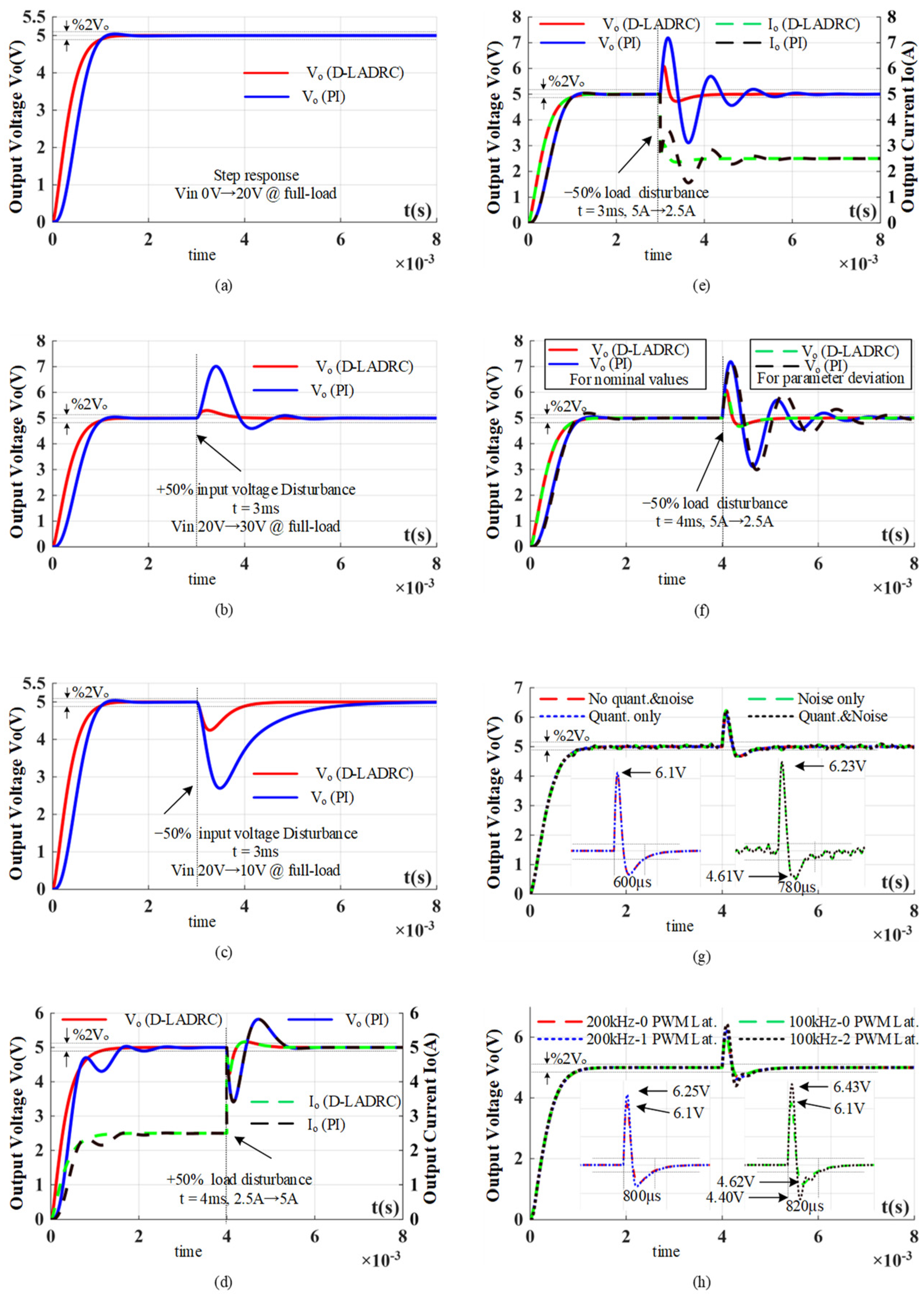
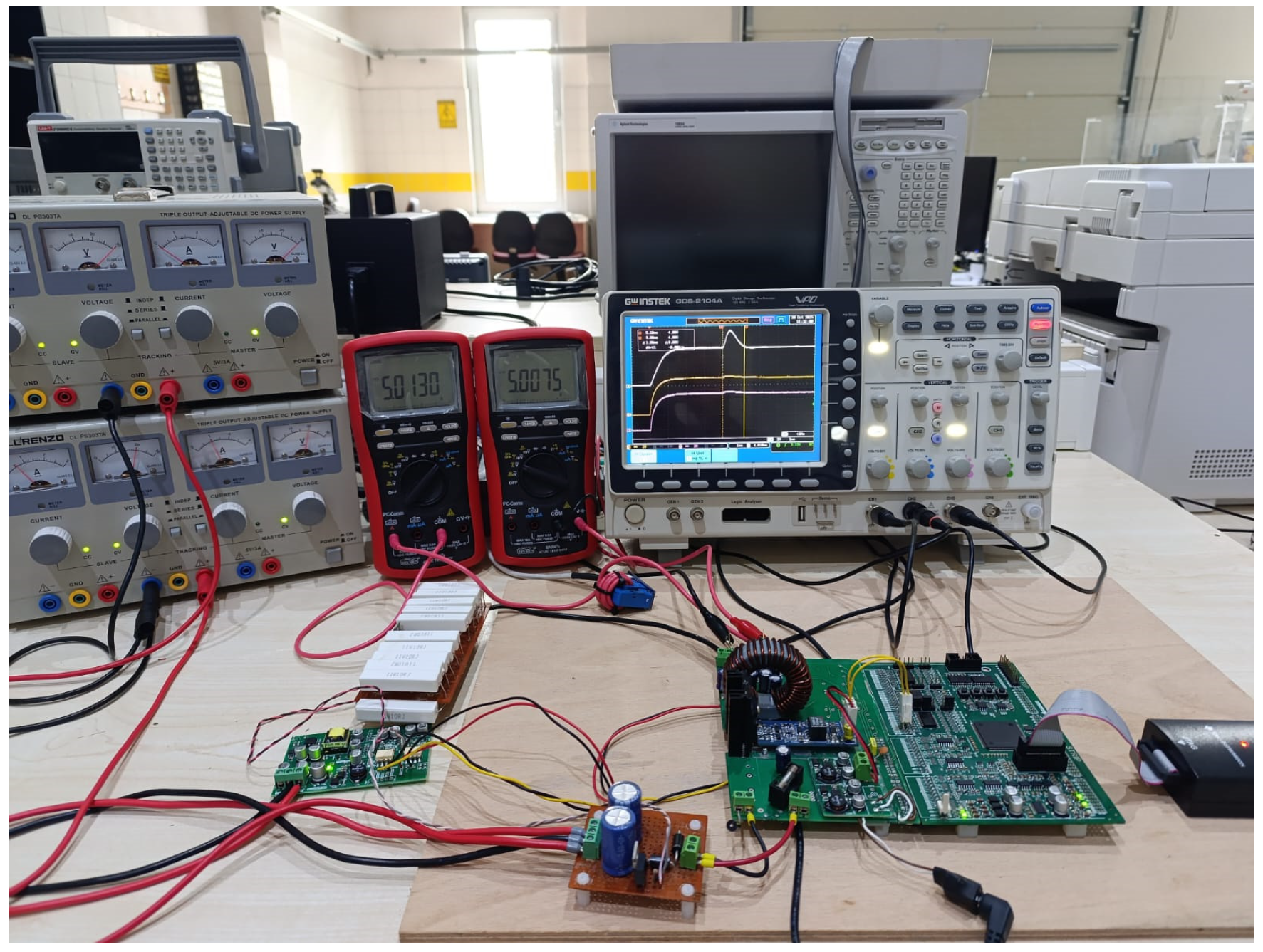
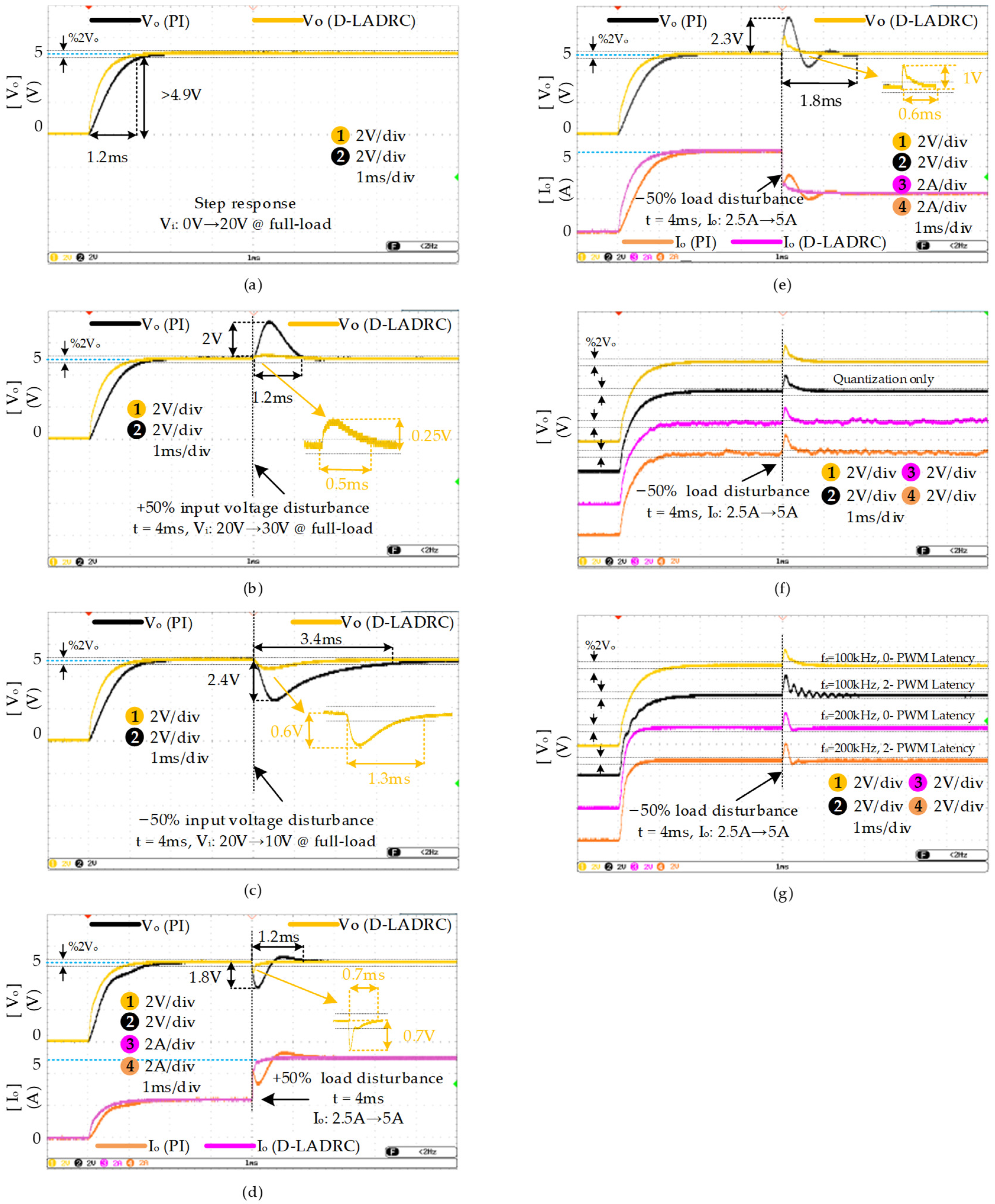
Section 3 presents the simulation and experimental results comparing the CE-LESO-based D-LADRC with a classical PI controller. Finally,
Section 4 and
Section 5 present the discussion and conclusions of the study, respectively.
2. CE-LESO-Based D-LADRC of Buck Converter
2.1. State Space Model
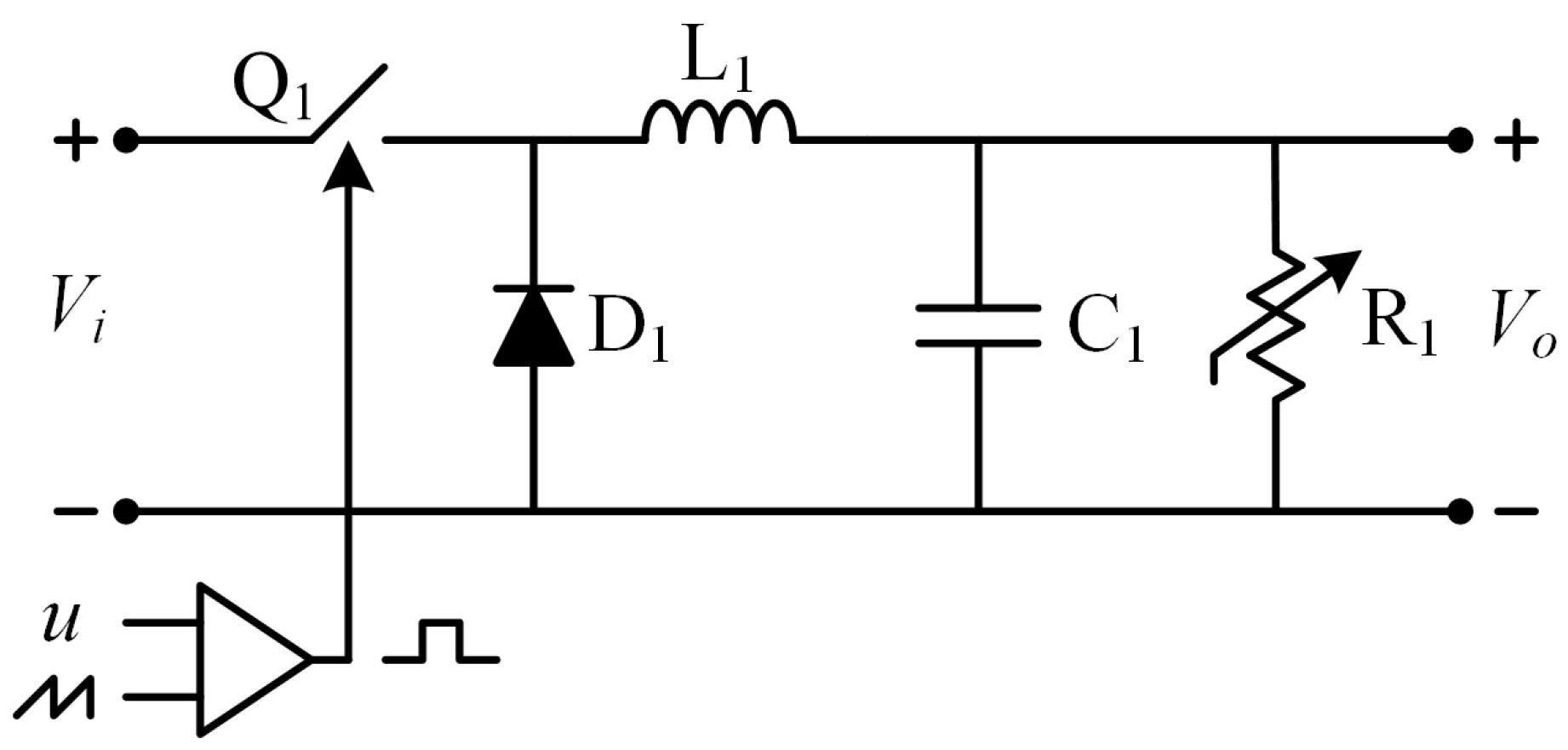
The circuit topology of the buck converter, as illustrated in
Figure 1, consists of an inductance (
), a capacitance (
), and two semiconductor switches (
and
). The load supplied by the converter is represented by the variable resistance (
). The input and output voltages of the buck converter are denoted as
and
, respectively, and
denotes the control signal. The control signal is converted into switching pulses using a pulse-width modulator (PWM). The output voltage of the buck converter is regulated by adjusting the control signal
.
The dynamics of the buck converter can be expressed in the standard state-space form by employing the state-space averaging method. The standard state-space representation of a single-input single-output (SISO) system is defined by (1).
Accordingly, the dynamics of the buck converter can be represented in standard form as in (2).
where
and
denote the state variables representing the output voltage (
) and its time derivative (
), respectively.
For an ideal buck converter, the state equations can be derived from the state-space model, as given in (3).
The generalized nonideal state-space model of the buck converter, which incorporates parameter uncertainties and external disturbances, is expressed as follows:
Here,
denotes the lumped disturbance that represents the effects of model uncertainties and external disturbances. The term
denotes the system gain defined in (5).
2.2. Feedback Linearization
In the feedback linearization control approach, the nonlinear dynamics of a system, including the effects of disturbances, can be canceled such that the closed-loop dynamics are transformed into linear dynamics. Therefore, the closed-loop behavior of a nonlinear system can be analyzed and controlled using conventional linear control techniques. A second-order nonlinear system in the controllable canonical form is given by (6).
where
and
is a function dependent on the state variables. The function
may be either linear or nonlinear. Assuming
, the control input can be selected as shown in (7).
The system is then transformed into an integrator chain. If the system output
is required to track a reference,
can be chosen as in (9), enabling the tracking error to converge to zero by using linear control methods.
By substituting (9) into (8) with respect to reference
, the following expression is obtained:
where
denotes the tracking error. The coefficients
and
are selected such that the roots of (10) lie in the left half of the complex plane, ensuring that the tracking error
converges to zero as
. As the reference of the buck converter is constant, it is clear that
.
The characteristic equation of the system given by (10) can be expressed as
For simplicity and to achieve the fastest response without overshoot, the roots of the characteristic equation are chosen to coincide with the real axis. Therefore, the feedback linearization gains can be expressed as and , where is the closed-loop control bandwidth.
To implement feedback linearization, function in (7) must be measured. However, measuring is often impossible or costly. In this case, if can be estimated by an observer, the system can be controlled using feedback linearization. The Linear Extended State Observer (LESO) treats the unmeasurable function as an additional state and attempts to estimate it.
2.3. Linear Extended State Observer
The extended state equations of the system defined in (6), in which the lumped disturbances are treated as new state variables, can be expressed as follows:
Here,
represents the extended state that includes model uncertainties and external disturbances, referred to as lumped disturbances, and also corresponds to the function
given in (4). When the above set of equations is expressed in the vector–matrix form, the extended state-space model of the system is obtained, as shown in (13). It can be observed that although the buck converter to be controlled is a second-order system, the extended system formed by incorporating lumped disturbances has a third-order structure.
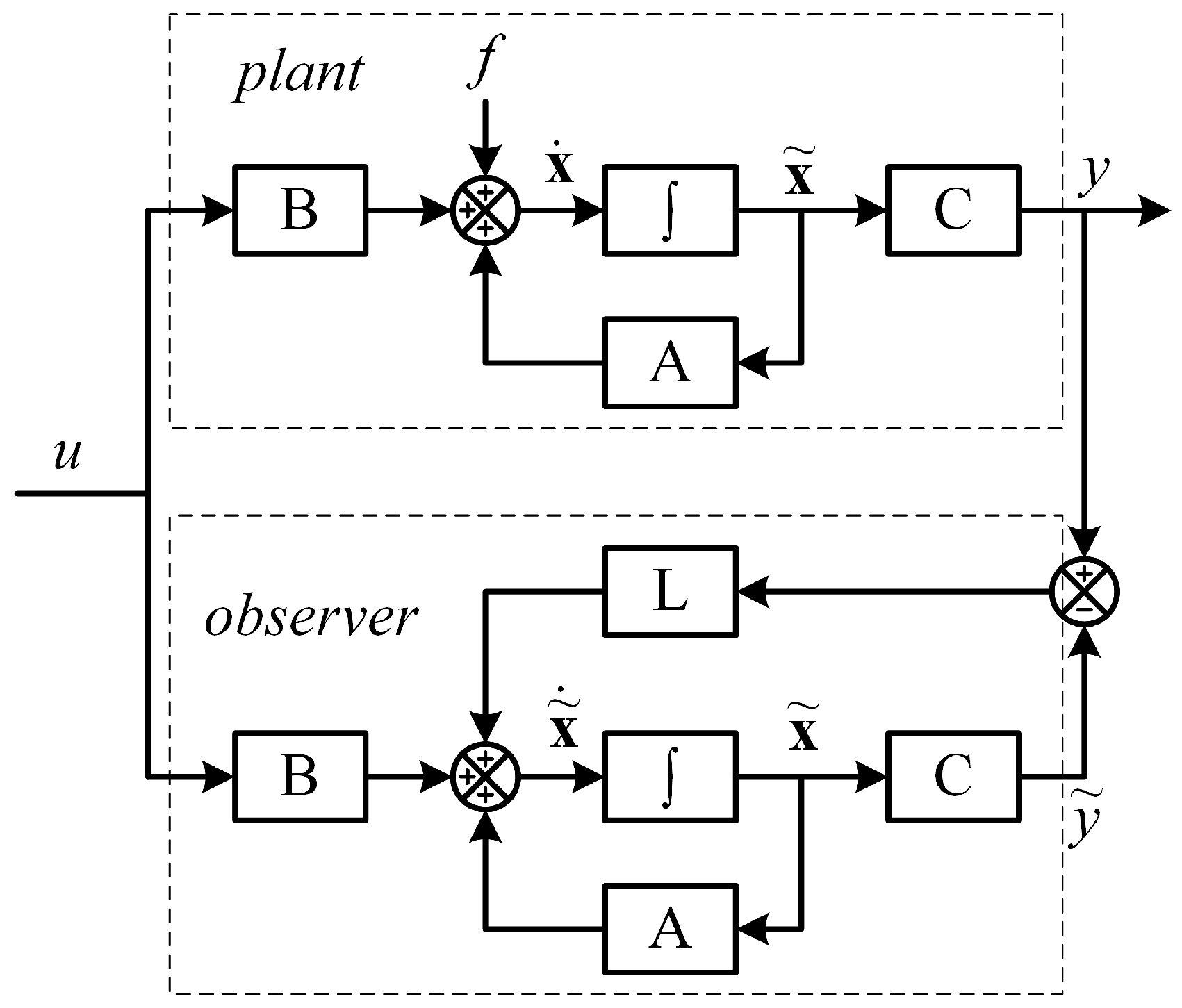
The extended system described in (13) along with its corresponding observer is depicted in the block diagram in
Figure 2.
In the block diagram, let
and
denote the actual and estimated states of the system and let
and
represent the measured and estimated outputs, respectively. Accordingly, the continuous-time observer for the system can be designed as:
The error dynamics of the observer are given by Equation (15).
Because the variations in the disturbances and estimation error are physically bounded, the system output is asymptotically stable [
16].
If the observer gain matrix
is chosen such that the eigenvalues of the observer lie in the left half of the complex plane, then the observer is guaranteed to be stable. For convenience and to achieve the fastest convergence without an overshoot, the observer poles can be selected as coincident on the left half of the complex plane, as indicated in (16), as follows:
The characteristic polynomial of the observer and corresponding gain matrix
, which places this characteristic polynomial at the desired closed-loop pole locations denoted by
P, can be determined as follows:
2.4. Discretization of the LESO
The Linear Extended State Observer (LESO), designed in continuous time, must be discretized to enable its implementation on a microcontroller. In this study, the Zero-Order Hold (ZOH) method was employed for the discretization of the LESO. First, the discretization of a continuous-time system given in the standard state-space form using the ZOH method is addressed, and the discretization of the continuous-time LESO, as expressed in (13), is presented.
The discrete-time state-space representation of a continuous-time system, given in the standard form by (1), is presented in (18).
Here,
,
,
and
represent the matrices of the discrete time system. Assuming a sampling period of
and employing the ZOH method, the discrete-time system matrices can be expressed as:
Based on the above information, applying the ZOH to (13) yields the discrete-time LESO matrices as follows:
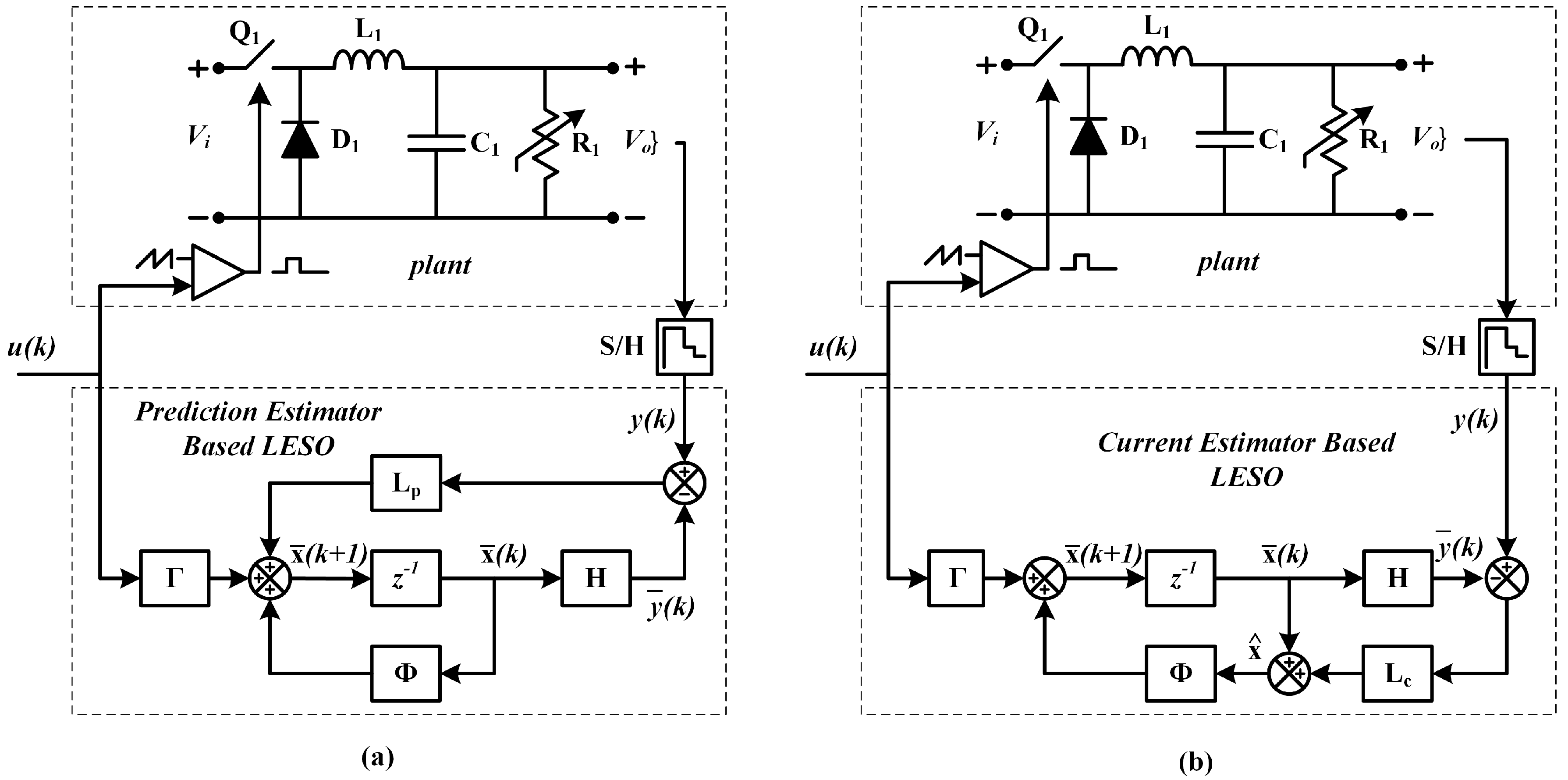
In discrete-time observer design, two types of estimators are commonly employed for state-variable estimation: the prediction and current estimators. While the Prediction Estimator relies on output measurements up to
to estimate the state variables, the Current Estimator makes use of the most recent measurements up to
. In this study, the Current Estimator was selected to prevent additional delays and improve the system response in the discrete-time observer design.
Figure 3 presents block diagrams of the discrete-time observer types and the dynamic equations of the Prediction Estimator, as illustrated in
Figure 3a can be expressed as follows:
Here,
represents the feedback gain of the prediction estimator-based LESO, and
denotes the matrix of the estimated state variables. The error dynamics of the observer can be expressed as follows:
By choosing such that the roots of the characteristic polynomial of (22) lie within the unit circle, the observer is ensured to be asymptotically stable, and for any initial error , the error gradually converges to zero.
To simplify the design process, the poles of the prediction-Estimator-based LESO can be selected to be coincident and located inside the unit circle in the z-plane. Considering parameter
, which represents the closed-loop pole locations of the discrete-time LESO, the matrix
containing the desired pole locations for a third-order LESO is obtained as follows:
The observer characteristic equation is given by (24).
Thus, the LESO gain matrix derived from the prediction estimator is obtained as shown in (25).
A relationship exists between the feedback gain matrices of the prediction and current estimators, as expressed in (26).
The locations of the poles of the discrete-time LESO based on the prediction estimator can be calculated using the following equation, taking the continuous-time LESO poles given in (16) as a reference, with
as the sampling period:
To validate discrete-time LESO structures a second order system was selected with a natural angular frequency
. For this second-order system, current estimator (CE) and prediction estimator (PE)-based third-order observers were obtained using zero-order hold (ZOH) and Euler discretization methods. Within this scope, four LESO variants were created: CE-LESO ZOH, CE-LESO Euler, PE-LESO ZOH, and PE-LESO Euler. For a fair comparison, a sampling period
and an observer bandwidth
ω0 = 20,000 rad/s were selected for all observer types. The corresponding pole placement parameter
β was calculated as 0.4493 for the given sampling period and bandwidth. A noise with an RMS value of 20 × 10
−3 p.u. (2% of the output value) was injected into the output channel
. Note that 1 p.u. corresponds to the nominal output. The injected noise was modeled as band-limited white noise, and the bandwidth was selected as 10% of the sampling frequency (
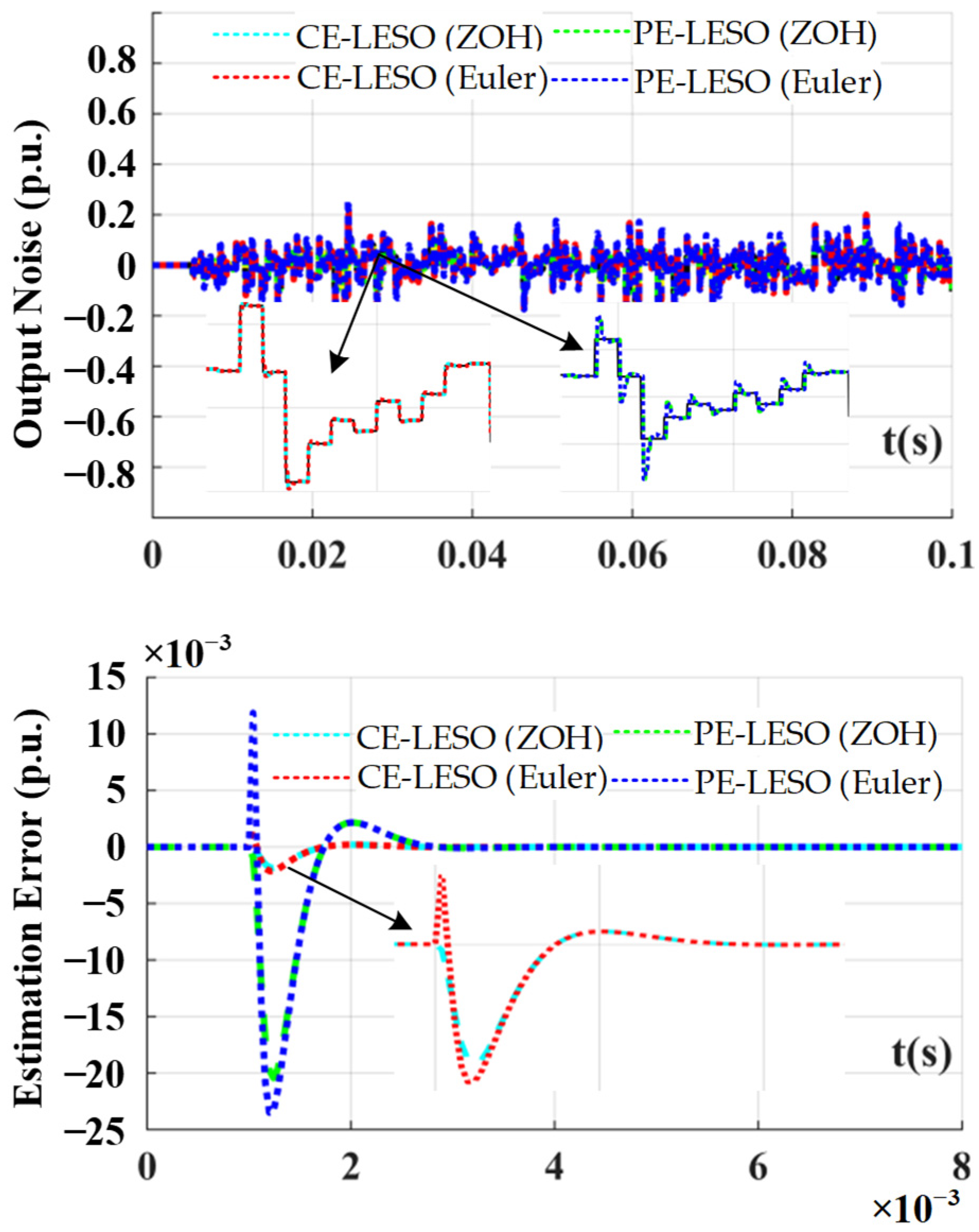
). The noise sensitivity (NS) metric was calculated over a 100 ms evaluation period. The estimation error and recovery time metrics were obtained from the step-input disturbance. The results are presented in
Figure 4 and summarized in
Table 1. Accordingly, it has been demonstrated that the CE-LESO structures provide lower estimation errors, especially when used in conjunction with ZOH discretization. Furthermore, it has been observed that the CE-LESO structures exhibit lower sensitivity to measurement noise and faster recovery behavior for both ZOH and Euler discretization methods. In contrast, the PE- LESO structures showed poor performance in all evaluation metrics. This result demonstrates that a ZOH-discretized CE-LESO achieves a higher estimation accuracy, comparable noise sensitivity, and recovery time in digital control applications.
2.5. D-LADRC Parameter Tuning
In CE-LESO-based D-LADRC, three parameters need to be adjusted: , , and . Here, represents the bandwidth of the state feedback controller, is the bandwidth of the LESO, and denotes the sampling time.
The appropriate selection of
can be performed by trial and error according to the settling time criterion of the output voltage of the buck converter.
can be determined as in (28) to ensure that the estimation error of LESO converges rapidly to zero [
21].
The sampling time T should be selected such that the pole locations given in (27) remain sufficiently distant from the unit circle. If the sampling time is too long, the pole locations given in (27) will be very close to the unit circle, making the observer excessively sensitive to parameter variations.
2.6. Design Procedure
In this section, the step-by-step design procedure of the D-LADRC is presented to guide researchers who intend to implement the controller in discrete time. In this context, the fundamental steps to be followed in the design of the discrete-time structure of the controller are explained in detail, and the key considerations during the implementation process are discussed.
Step 1. Determine system order () and gain : Because active disturbance rejection control (ADRC) does not require a complete mathematical model of the system, the system order () and gain () can be determined through simulation-based methods such as sweep analysis. However, as mathematical models of power converters are widely available in the literature, it is recommended to determine these parameters based on a mathematical model.
Step 2. Determine closed-loop bandwidth, : can be determined either through a trial-and-error approach or by applying optimization techniques. Based on our experimental observations, an initial estimate of , where denotes the natural frequency of the system, provides a reliable starting point for further tuning.
Step 3. Define linear function and its coefficients: To achieve feedback linearization, the function should be determined according to the order of the system. Once is defined, the gains can be calculated according to the system order, as shown in (11).
Step 4. Define Closed-loop bandwidth of LESO,
: For the selection of
, a range of
is recommended to enable the LESO to track the system rapidly [
21].
Step 5. Determine the sampling time, : The sampling period should be determined such that the discrete-time closed-loop control poles remain sufficiently within the unit circle in the z-domain. An excessively large sampling period causes the poles to approach the unit circle, thereby leading to slower system dynamics and reduced stability margin. Conversely, excessively small sampling times drive the poles too close to the origin, resulting in increased noise amplification and greater sensitivity to sampling and actuation delays. In this context, the sampling time should be considered to achieve a balanced placement that ensures closed-loop stability, dynamic response speed, and noise robustness. The sampling time should be selected such that the desired pole locations β of the discrete-time LESO remain inside the unit circle in the z-plane. The recommended range for β is 0.3–0.7.
Step 6. Calculate LESO matrices: The matrices , , , and are computed using (20), (25), and (26) respectively.
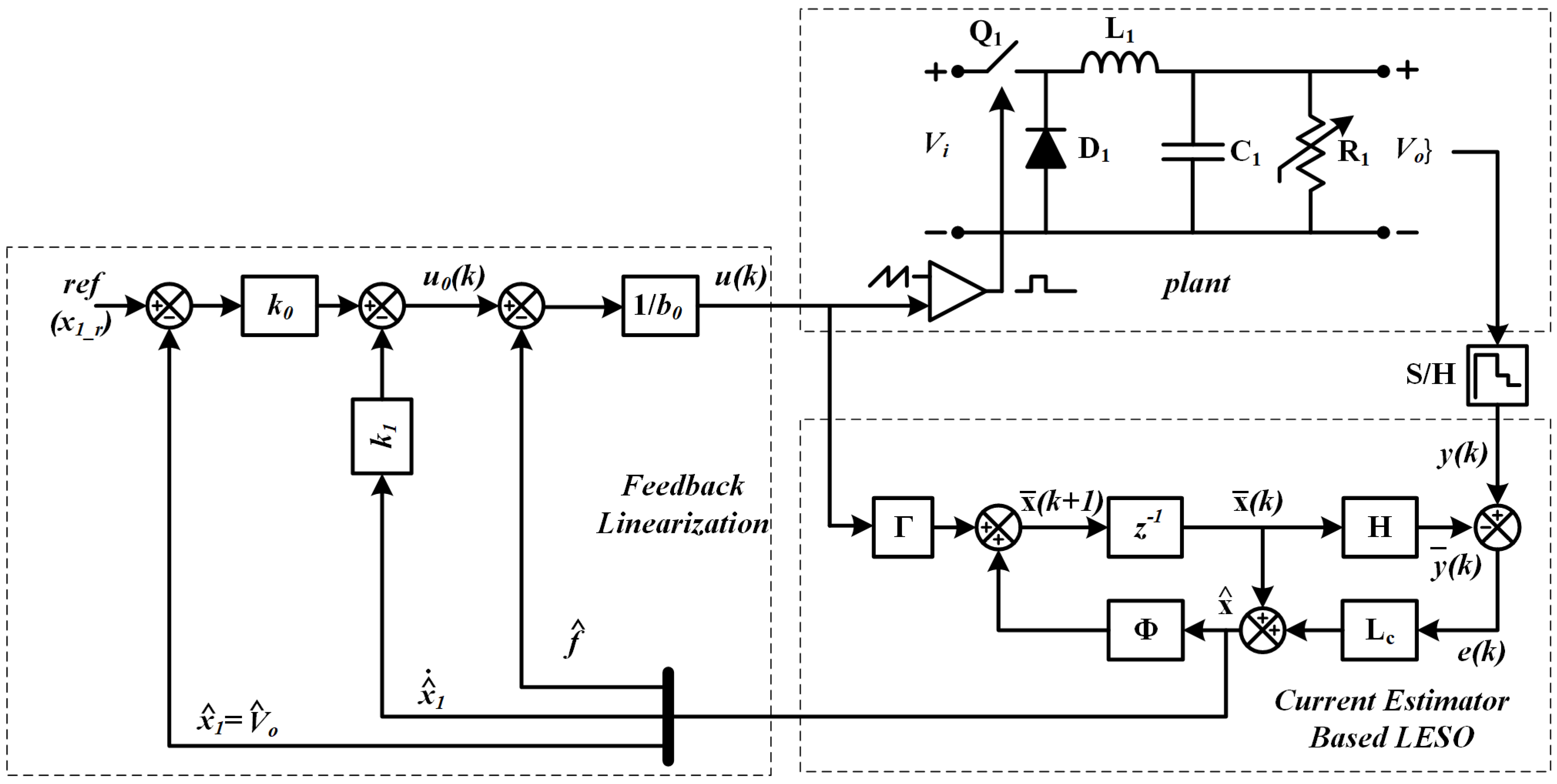
Figure 5 shows the block diagram of the buck converter controlled by a discrete-time current estimator-based LESO within the D-LADRC framework. Both simulation and experimental investigations were performed based on this block diagram. In this setup, an LESO incorporating a current estimator was employed to estimate the output voltage of the buck converter, its variations, and the states associated with the disturbances.
Subsequently, through feedback linearization, the buck converter was linearized with respect to the disturbances, enabling the output voltage dynamics to be addressed using linear control techniques. The control signals generated by these linear control methods are then converted into pulse-width modulation (PWM) signals via a comparator and applied to the buck converter.