Article

Hybrid Evolutionary Optimization of Coupling-Corrected Equivalent Sources for Anechoic Replication of Outdoor Electromagnetic Fields

1
Chengdu Aircraft Industrial (Group) Co., Ltd., Chengdu 610092, China
2
College of Information Science & Electronic Engineering, Zhejiang University, Hangzhou 310027, China
3
Jinhua Institute, Zhejiang University, Jinhua 321037, China
*
Author to whom correspondence should be addressed.
Electronics 2026, 15(7), 1436; https://doi.org/10.3390/electronics15071436
Submission received: 8 February 2026 / Revised: 13 March 2026 / Accepted: 16 March 2026 / Published: 30 March 2026

Abstract

We propose a coupling-aware equivalent source reconstruction framework for reproducing complex three-dimensional electromagnetic (EM) environments inside an anechoic chamber. A measured or simulated target field is represented by a finite set of physically realizable equivalent source antennas whose positions and complex excitations are identified by solving a nonlinear high-dimensional inverse problem. To ensure physical fidelity, the forward model explicitly accounts for mutual coupling through a full-wave Method-of-Moments (MoM) formulation, avoiding the inaccuracies of idealized uncoupled superposition. The inverse problem is efficiently solved using a hybrid evolutionary optimization scheme that combines an adaptive differential evolution strategy with stagnation-triggered CMA-ES refinement, augmented by a lightweight surrogate-based pre-screening to reduce expensive full-wave evaluations. The optimized source configuration is directly deployed in a microwave anechoic chamber, where the reconstructed field is measured on an observation plane and compared against the target field. The experimental results demonstrate close agreement in both amplitude and spatial distribution, while the proposed optimization pipeline substantially reduces the number of full-wave evaluations required for convergence. This work enables accurate repeatable chamber emulation of outdoor or in situ EM scenarios for robust system-level testing and evaluation.

1. Introduction

Reproducing a realistic electromagnetic (EM) environment in a controlled laboratory is increasingly important for antenna characterization, electromagnetic compatibility (EMC), and system-level validation, where outdoor measurements are often costly and difficult to reproduce. Over-the-air (OTA) testing using multi-probe anechoic chamber (MPAC) setups has become a practical route to emulate target propagation scenarios and evaluate radiated performance in a repeatable manner, and has been continuously standardized and documented in recent test specifications [1,2]. Comprehensive overviews further highlight that the achievable emulation accuracy depends jointly on probe configuration, weighting strategy, bandwidth, and hardware non-idealities [3,4]. In controlled test environments, non-ideal modal behaviors can also distort the reproduced fields, and data-driven inverse analysis has been used to diagnose higher-order-mode effects in TEM cells [5]. Meanwhile, emerging RF electric-field metrology based on Rydberg atoms provides a promising route for traceable validation of complex field environments [6].
A central technical challenge is to determine a finite set of physically realizable radiators that reproduce a desired vector field (or an equivalent channel representation) within a prescribed test zone. In small or constrained chambers, additional compensation and calibration procedures are often required to reduce systematic mismatch, e.g., plane-wave compensation and related probe-weighting strategies [3,7]. Meanwhile, for EMC-oriented applications, compact source models based on equivalent dipole moments provide an attractive way to represent complex near-field emissions with a small number of parameters [8].
From a computational electromagnetics perspective, these synthesis tasks are closely related to the electromagnetic equivalence principle and inverse-source reconstruction, where measured (or prescribed) fields are mapped to equivalent currents/sources on a surface [9,10]. Such inverse problems are typically ill-posed and benefit from regularization and careful sampling design [11]. When the goal is physical deployment, mutual coupling and embedded-element effects can significantly alter the realized fields, motivating coupling-aware forward models rather than idealized uncoupled superposition. In this work, we therefore employ a full-wave Method-of-Moments (MoM) formulation to account for interactions through the impedance matrix [12,13].
Because the resulting optimization is high-dimensional, nonlinear, and often expensive, robust derivative-free strategies are typically preferred. We adopt a hybrid evolutionary optimization pipeline built upon differential evolution and covariance-matrix adaptation concepts, with optional surrogate assistance to reduce the number of full-wave evaluations [14,15,16,17]. More broadly, the interplay between electromagnetic effects and AI-oriented computing hardware has been systematically reviewed, highlighting the growing importance of EM-aware modeling and optimization pipelines [18].
Contributions: (i) a coupling-aware equivalent-source reconstruction framework for chamber field reproduction; (ii) a hybrid evolutionary optimization pipeline for efficient constrained field matching; and (iii) an end-to-end experimental validation procedure with repeatable calibration and deployment in an anechoic chamber.

2. Problem Formulation and Method Overview

2.1. Problem Definition and Objective Function

Let { r k } k = 1 K denote the sampling points in the ROI. The target complex electric field is denoted by E tar ( r k ) , obtained from outdoor measurement or a high-fidelity “gold-standard” simulation.
We seek an equivalent-source configuration θ such that the synthesized field E syn ( r k ; θ ) matches E tar ( r k ) . A standard least-squares objective is the mean squared error (MSE):
J ( θ ) = 1 K k = 1 K E syn ( r k ; θ ) E tar ( r k ) 2 2 .
For scale-invariant reporting, we also use the normalized MSE (NMSE):
NMSE ( θ ) = k = 1 K E syn ( r k ; θ ) E tar ( r k ) 2 2 k = 1 K E tar ( r k ) 2 2 .
In engineering validation, a complementary criterion is the pointwise magnitude deviation (in dB) over selected key points K { 1 , , K } ,
Δ dB = max k K 20 log 10 E ^ ( r k ; θ ) E tar ( r k ) , Δ dB Δ 0 ,
where Δ 0 is a prescribed tolerance and E ^ denotes the selected field component or the dominant polarization magnitude. Inverse-source/equivalent-source reconstruction is commonly formulated under the equivalence principle and solved as an inverse problem [9,10].

2.2. Equivalent-Source Parameterization and Constraints

We parameterize the equivalent environment using N radiators (antennas or dipole-like elements depending on chamber hardware). The unknowns include:
  • Number of sources: N (integer), 1 N N max .
  • 3D positions: p n = [ x n , y n , z n ] T , n = 1 , , N .
  • Complex excitations: w n = a n e j ϕ n , where a n is the feed magnitude and ϕ n is the feed phase.
Collectively,
θ = N , { p n } n = 1 N , { a n , ϕ n } n = 1 N .
To ensure physical realizability and deployability, we impose box/interval constraints,
p n Ω pos , a n [ a min , a max ] , ϕ n [ 0 , 2 π ) , N N max ,
where Ω pos is determined by the chamber layout and the desired quiet-zone region. Additional practical constraints (optional) include minimum inter-element spacing, fixed mounting planes, and amplitude/phase quantization to match the available attenuators and phase shifters.
From an inverse-problem perspective, these strict hardware and geometric bounds intrinsically serve as physically informed regularization criteria. Standard unregularized electromagnetic inversions often suffer from severe non-uniqueness, typically manifesting as non-physical highly oscillating super-directive currents that cancel each other out. By enforcing a hard upper bound on the source amplitude ( a m a x ) based on maximum amplifier outputs, we implicitly apply an energy-bounding regularization that strictly prevents such unphysical oscillations. Furthermore, limiting the maximum number of equivalent sources ( N N m a x ) acts as a strong sparsity-promoting regularization (conceptually analogous to an L 0 -norm penalty). Enforced through the evolutionary projection operator Π Ω in Equation (10), these physically informed criteria effectively shrink the null space of the ill-posed problem, drastically reducing the non-uniqueness of the solutions and ensuring that the optimized framework yields only physically realizable and chamber-deployable configurations.
Unlike traditional fixed-source configurations, the number of radiators N in this framework is treated as a discrete optimization variable within the range [ 1 , N m a x ] . Its selection criterion is strictly driven by the minimization of the objective function J ( θ ) , allowing the algorithm to automatically determine the optimal number of sources that balances reconstruction accuracy with model complexity according to the target field’s characteristics. The upper bound N m a x is predefined by the number of available hardware channels, such as the ports of the power divider network and the programmable excitation control modules in the experimental setup.

2.3. Mutual-Coupling-Aware Forward Model via MoM

Accurate reconstruction requires a forward model that accounts for mutual coupling among equivalent sources and coupling/scattering with the surrounding structures (including the DUT). To achieve this, we employ a full-wave Method-of-Moments (MoM) solver based on the electric field integral equation (EFIE), which is standard for conductor modeling and naturally captures coupling through the impedance matrix [13].
After discretization using appropriate basis/testing functions, the EFIE is reduced to a linear system,
Z ( θ ) I = V ( θ ) ,
where Z is the impedance matrix, I contains the expansion coefficients of the induced currents, and V encodes the excitations determined by θ . The synthesized field at each ROI point is then obtained by post-processing the solved currents:
E syn ( r k ; θ ) = F MoM ( r k ; θ ) , k = 1 , , K .
For interpretation, E syn can be viewed as a superposition of the direct radiation from the equivalent sources and the coupling/scattering-induced contribution,
E syn ( r k ; θ ) = E dir ( r k ; θ ) + E cpl ( r k ; θ ) ,
where E cpl is implicitly captured through (6) and (7). As an optional baseline, one may set E cpl = 0 and evaluate candidates by idealized free-space superposition; however, such a simplification can lead to biased solutions when coupling is non-negligible.

2.4. Overall Solving Procedure

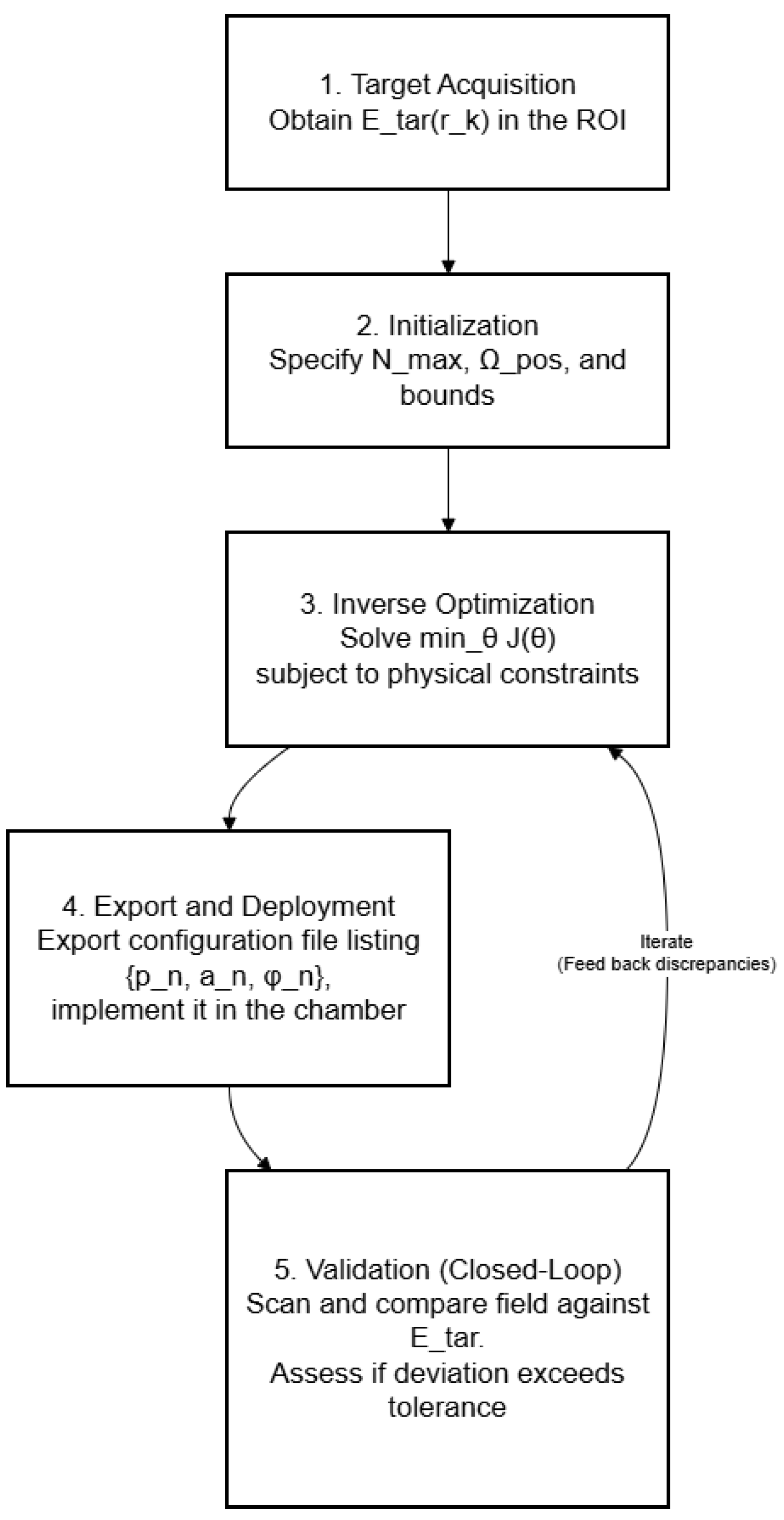
Figure 1 illustrates the overall workflow of the proposed reconstruction-and-validation loop:
1.
Target acquisition: obtain E tar ( r k ) in the ROI.
2.
Initialization: specify N max , Ω pos , and bounds in (5).
3.
Inverse optimization: solve min θ J ( θ ) (or NMSE) subject to (5), where each candidate is evaluated by the MoM forward model (6) and (7).
4.
Export and deployment: export a chamber-ready configuration file listing { p n , a n , ϕ n } , and then implement it in the anechoic chamber.
5.
Validation (closed loop): an iterative closed-loop validation procedure. After deployment, the ROI field is measured and compared with the target field. If the validation metrics do not satisfy the prescribed acceptance criterion, the measured discrepancy is fed back to the inverse optimization and deployment steps for refinement; otherwise, the reconstructed equivalent-source configuration is accepted.

3. Numerical Optimization and Implementation

The inverse reconstruction leads to a high-dimensional, nonlinear, and expensive optimization problem because each candidate configuration must be evaluated by a full-wave MoM forward solver that accounts for mutual coupling. To obtain a chamber-deployable equivalent-source configuration within a practical time budget, we implement a dynamic hybrid evolutionary optimizer, termed SHADE-CMA-ML, which integrates: (i) success-history-based parameter adaptation in differential evolution (DE) [14,19]; (ii) stagnation-triggered CMA-ES rescue for escaping local optima [20]; and (iii) a lightweight machine learning surrogate screening mechanism for reducing the number of expensive MoM calls [17,21,22].

3.1. Synergistic Overview of the SHADE-CMA-ML Framework

Before delving into the mathematical formulations, we provide a high-level conceptual overview of how the three components in our proposed SHADE-CMA-ML algorithm synergistically interact to balance exploration, exploitation, and computational cost.
The framework operates as a closely integrated pipeline:
  • The Main Explorer (SHADE): The core global search is driven by SHADE, which robustly explores the multimodal parameter space by dynamically adapting its mutation and crossover control parameters based on successful historical experiences.
  • The Gatekeeper (ML Surrogate): Because evaluating every candidate via the full-wave MoM solver is computationally prohibitive, a random-forest-based machine learning surrogate acts as a pre-screening gatekeeper. It rapidly classifies candidates, forwarding only the most promising ones to the expensive MoM evaluator, thereby drastically reducing the computational burden.
  • The Rescuer (CMA-ES): When the SHADE population stagnates and traps in a local optimum, the CMA-ES rescue mechanism is triggered. It acts as a highly efficient local exploiter by learning the covariance matrix of the elite individuals, sampling new promising directions to help the population escape the local trap.
Together, this triplet forms a dynamic loop (as summarized in Algorithm 1) that maintains global search capabilities while remaining strictly computationally affordable.    
Algorithm 1: SHADE-CMA-ML for Coupling-Aware Equivalent-Source Reconstruction
Electronics 15 01436 i001

3.2. Expensive Constrained Optimization Setting

Let θ R D denote the continuous decision vector that encodes the equivalent-source configuration, including source locations and complex excitations. For N sources, a typical parameterization yields D = 5 N (three coordinates plus amplitude and phase for each source), while N is bounded by N max and hardware constraints (Section 2.2). The optimization objective uses the field mismatch metrics in (1)–(3), which we write compactly as
min θ Ω J ( θ ) s . t . θ Ω ,
where Ω is the feasible set defined by deployable position bounds, amplitude/phase ranges, and optional inter-element spacing. In implementation, feasibility is enforced via a projection operator (component-wise clipping),
Π Ω ( θ ) = clip ( θ ; , u ) ,
which is applied whenever mutation or sampling generates out-of-bound coordinates or excitations.
The dominant computational cost arises from the expensive fitness evaluation
J ( θ ) = G F MoM ( θ ) , E tar ,
where F MoM ( θ ) denotes the MoM field synthesis and G ( · ) computes MSE/NMSE and key-point errors. Therefore, our optimization design explicitly targets reducing the number of MoM calls while maintaining robust global search.

3.3. SHADE-Based Differential Evolution Core

We adopt DE as the main global optimizer due to its derivative-free nature and strong robustness on multimodal landscapes [14]. The optimizer maintains a population { x i ( g ) } i = 1 N p at generation g. For each target vector x i ( g ) , we generate a mutant vector using a current-to-pbest/1 strategy (in the spirit of JADE/SHADE [19,23]),
v i ( g ) = x i ( g ) + F i ( g ) x p b e s t ( g ) x i ( g ) + F i ( g ) x r 1 ( g ) x r 2 ( g ) ,
where x p b e s t ( g ) is randomly chosen from the top p fraction of the population (we use p = 0.1 ), and x r 1 ( g ) , x r 2 ( g ) are two distinct randomly selected individuals. After projection v i ( g ) Π Ω ( v i ( g ) ) , we perform binomial crossover to produce the trial vector u i ( g ) ,
u i , j ( g ) = v i , j ( g ) , if rand ( 0 , 1 ) C R i ( g ) or j = j rand , x i , j ( g ) , otherwise ,
where j rand ensures that at least one dimension is inherited from v i ( g ) . Selection is greedy:
x i ( g + 1 ) = u i ( g ) , if J ( u i ( g ) ) < J ( x i ( g ) ) , x i ( g ) , otherwise .

Success-History-Based Adaptation (SHADE)

A key limitation of vanilla DE is that fixed control parameters ( F , C R ) cannot simultaneously suit exploration and exploitation across all optimization stages. SHADE resolves this by maintaining two rolling memories { M F [ h ] } h = 1 H and { M C R [ h ] } h = 1 H that store recently successful parameter values [19]. In our implementation, H = 10 and the memories are initialized with neutral values (e.g., 0.5 ). For each individual, ( F i ( g ) , C R i ( g ) ) are sampled around the current memory statistics with a stage-wise schedule,
F i ( g ) = clip μ F ( g ) + 0.1 Cauchy ( 0 , 1 ) , g < 0.3 G max , clip μ F ( g ) + N ( 0 , 0 . 05 2 ) , g 0.3 G max ,
C R i ( g ) = clip μ C R ( g ) + N ( 0 , 0 . 1 2 ) , g < 0.3 G max , clip 0.3 + N ( 0 , 0 . 05 2 ) , g 0.3 G max ,
where μ F ( g ) = mean ( M F ) , μ C R ( g ) = mean ( M C R ) , and clip ( · ) enforces F [ 0.1 , 0.9 ] and C R [ 0.1 , 0.95 ] . Whenever a trial vector wins in (14), the associated ( F i ( g ) , C R i ( g ) ) is appended to the end of the memory by a circular shift (rolling buffer) so that the memory continuously reflects the most effective parameter pairs in the current search regime.

3.4. Stagnation-Triggered CMA-ES Rescue

Despite SHADE adaptation, expensive inverse EM problems often remain highly multimodal, and the population may stagnate around a suboptimal basin. To enhance local escape without paying the full cost of running CMA-ES at every generation, we introduce a stagnation-triggered CMA-ES rescue mechanism.

3.4.1. Stagnation Detection

Let J best ( g ) = min i J ( x i ( g ) ) . We maintain a stagnation counter s:
s 0 , J best ( g ) < J best ( g 1 ) , s + 1 , otherwise .
When s G trig (we use G trig = 20 ), the rescue step is activated.

3.4.2. Elite Covariance Learning and Rescue Sampling

We select the top ρ fraction of the population as elites (we use ρ = 0.1 ), compute their mean m and sample covariance C , and then generate rescue candidates from a multivariate normal distribution,
z N ( 0 , C ) , x new = Π Ω m + σ z ,
where σ is a step-size parameter (we use σ = 0.3 ). This design borrows the central idea of CMA-ES—adapting a covariance model of promising directions—while remaining lightweight [20].

3.4.3. Replacement Strategy

We generate N res rescue individuals (we use N res = 10 ). Each rescue candidate is evaluated by the true MoM-based fitness; if it improves upon the current population, it replaces one of the worst individuals (“blood replacement”). After rescue, the stagnation counter is reset, allowing the DE process to continue with refreshed diversity and informed search directions. The choice of a classification-based surrogate over a regression-based one is motivated by the inherent characteristics of electromagnetic inverse problems. Directly regressing the exact NMSE values over a high-dimensional highly nonlinear parameter space is often unreliable with limited samples. Since the primary role of the surrogate is to filter out unpromising candidates rather than to predict exact performance, reformulating the task as a ‘good/bad’ classification problem significantly stabilizes the learning process. Compared to regression models that attempt to fit the entire fitness landscape, the classification approach focuses on capturing the decision boundary of high-quality regions, providing a more robust and computationally efficient screening mechanism for expensive MoM-based optimization.
The retraining frequency of the surrogate, defined by T r f , plays a critical role in balancing screening reliability and computational overhead. If T r f is too large, the surrogate suffers from ‘model aging,’ where the classifier, trained on outdated population distributions, fails to track the rapidly moving search frontier of the DE algorithm. This leads to increases in both False Positives (wasting MoM evaluations) and False Negatives (discarding potential elite candidates), eventually degrading both the convergence speed and the final reconstruction accuracy. Conversely, an excessively small T r f imposes unnecessary training overhead. Our empirical sensitivity analysis suggests that T r f = 5 provides an optimal trade-off, ensuring that the surrogate remains synchronized with the evolving population while keeping the training cost below 1% of the total wall-clock time.
To evaluate the effectiveness of the random forest surrogate as a pre-screening gatekeeper, we analyzed its classification performance across different evolution stages. Since the “good” solutions (top 30th percentile) are relatively rare, the class weights are adjusted to { 1 : 10 , 0 : 1 } to prioritize the identification of high-quality candidates.
As summarized in Table 1, the classifier’s accuracy improves as the optimization progresses and the model is periodically retrained on local search data. In the middle and late stages (generation > 250), the accuracy reaches approximately 84–86%. The False Negative Rate (FNR) remains below 10%, ensuring that most promising solutions are correctly identified and passed to the MoM solver. Meanwhile, the False Positive Rate (FPR) is kept around 13–15%, effectively filtering out the majority of mediocre candidates and thus significantly reducing the total number of expensive full-wave evaluations.
To address the inherent risks of surrogate-assisted optimization—specifically model inaccuracy, introduced bias, and the risk of excluding optimal solutions (False Negatives)—the screening mechanism incorporates four layers of algorithmic control. First, by reformulating the surrogate task from exact fitness regression to binary classification (top τ = 30 % vs. the rest), the model avoids the severe approximation bias typical of high-dimensional regression landscapes. Second, a conservative screening ratio ( κ = 50 % ) ensures a wide margin of error; as long as a promising candidate is ranked in the top half, it avoids exclusion and receives a true MoM evaluation. Third, the dynamic periodic retraining ( T r f = 5 ) constantly calibrates the surrogate’s decision boundary with fresh MoM data, effectively preventing the accumulation of systematic bias caused by the shifting search frontier. Finally, even in the event of an inadvertent exclusion of an optimal solution leading to evolutionary stagnation, the stagnation-triggered CMA-ES rescue mechanism acts as a fail-safe, reliably regenerating elite diversity and recovering lost search momentum.

3.5. Machine Learning Surrogate Screening for Fitness Reduction

Because the MoM evaluation dominates runtime, we further reduce the number of true evaluations by a classification-based surrogate screening approach, motivated by surrogate-assisted evolutionary computation for expensive problems [17].

3.5.1. Why Classification Instead of Regression

Directly regressing the exact MSE/NMSE over a high-dimensional parameter space is often unreliable. Instead, we reformulate surrogate learning as a good/bad classification problem: candidates with fitness in the best τ percentile (we use τ = 30 % ) are labeled as good and the rest as bad. This significantly stabilizes learning and provides an effective filter for allocating expensive evaluations.

3.5.2. Feature Normalization and PCA

Let x i ( g ) be the raw decision vector. We standardize features and apply PCA to retain 90 % variance,
x ˜ i ( g ) = PCA 0.9 Standardize ( x i ( g ) ) ,
which reduces noise, alleviates scaling issues, and improves surrogate robustness [22].

3.5.3. Random Forest Classifier and Periodic Retraining

We train a random forest classifier q ( x ˜ ) [ 0 , 1 ] to output the probability of being a good solution [21]. To handle class imbalance (good solutions are relatively rare), we apply a higher class weight to the positive class. The model is retrained every T rf generations (we use T rf = 5 ) using the latest population and labels, ensuring that the surrogate remains synchronized with the moving search frontier.

3.5.4. Screening Rule and Evaluation Allocation

Given predicted probabilities { q i } for the population, only the top κ fraction (we use κ = 50 % ) are passed to the expensive MoM evaluator. The remaining individuals are assigned a conservative surrogate-based score for selection (e.g., penalty mapping J sur = J max + λ ( 1 q i ) ) to avoid over-trusting the surrogate. This mechanism approximately halves the number of MoM calls per generation while preserving solution quality.

3.6. Parallel Evaluation and Software Architecture

The implementation follows a modular design (the algorithmic framework was developed in Python 3.10, Python Software Foundation, Wilmington, DE, USA):
  • Optimizer module: implements SHADE-CMA-ML, including memory update, stagnation detection, CMA rescue, and ML screening.
  • Physics module: provides the MoM-based forward solver to compute E syn and the objective J ( θ ) (Section 2.3).
Since each fitness evaluation is independent, we parallelize true MoM evaluations using a thread pool with N cpu workers. At each generation, all selected indices are dispatched concurrently, and the returned fitness values are collected to update selection.

3.7. Algorithm Summary and Hyperparameters

Algorithm 1 summarizes the overall solver. Table 2 lists the key hyperparameters used in our implementation.

4. Anechoic Chamber Reconstruction Setup and Experimental Results

This section reports the end-to-end anechoic chamber realization of the reconstructed equivalent-source configuration and the corresponding experimental validation. The goal is to physically reproduce the target field within a predefined region of interest (ROI) and quantify the agreement. Throughout this section, the frequency-band nomenclature (C/X/Ku) follows the standard ranges summarized in ITU-R V.431-9 [24], and the general measurement workflow follows IEEE-recommended practices for antenna measurements [25].

4.1. Anechoic Chamber Reconstruction Setup

4.1.1. Hardware Chain and Controllable Excitation Array

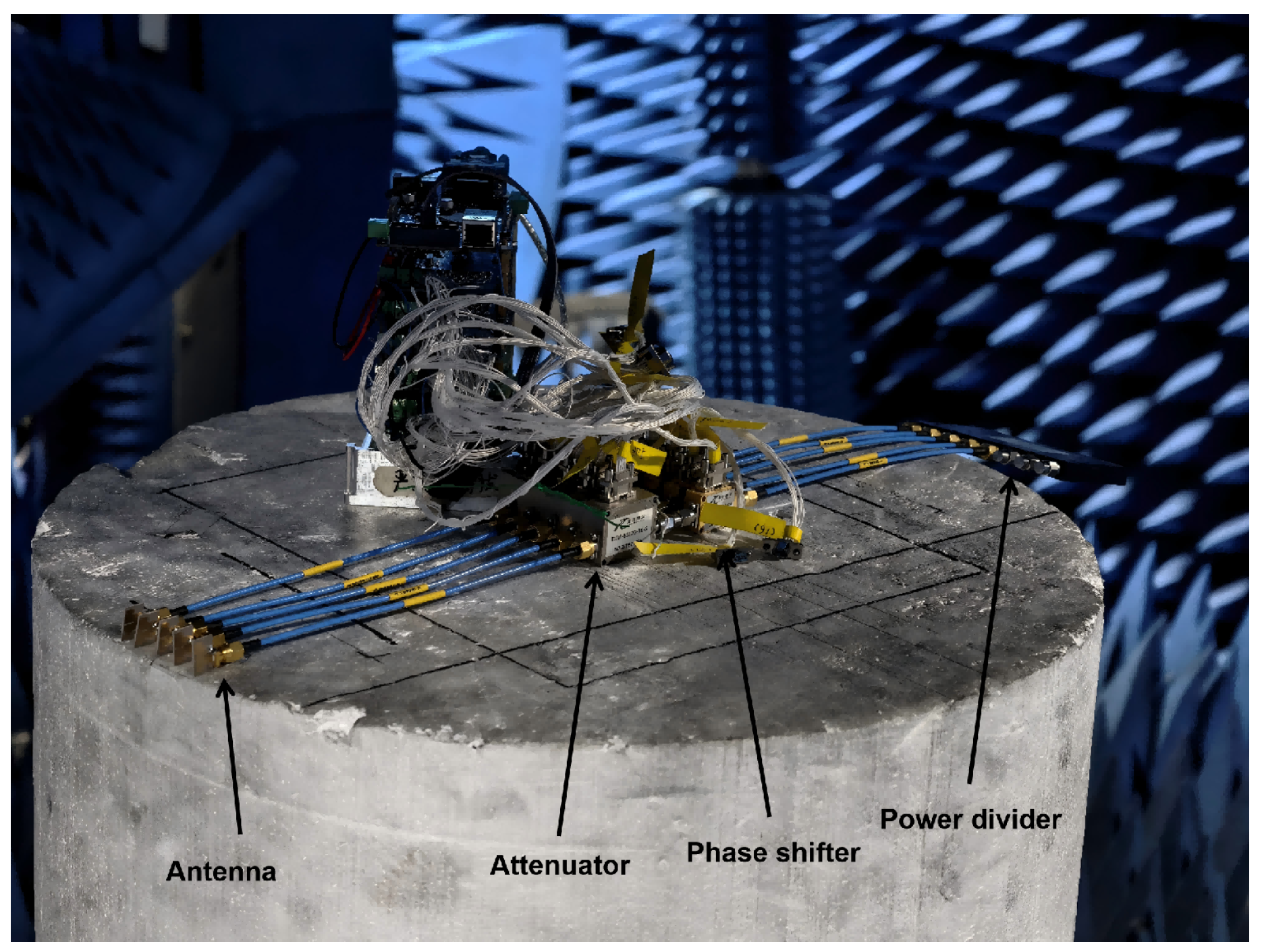
Figure 2 illustrates the reconstruction platform deployed in the anechoic chamber. A multi-channel excitation array is driven by a common RF source through a power divider network. Each channel is equipped with independently programmable amplitude and phase control, enabling the complex excitation
w n ( f ) = a n ( f ) e j ϕ n ( f ) , n = 1 , , N ,
to be realized in hardware according to the optimized configuration file. In the prototype verification, a compact antenna-under-test (AUT) is placed at the chamber center, and multiple wideband radiators act as the equivalent sources [26].

4.1.2. Coordinate System and ROI Sampling Plane(s)

A right-handed coordinate system is established with the AUT center as the origin. To validate field reconstruction, we define one or multiple sampling planes in the vicinity of the AUT (quiet-zone/ROI planes). For each sampling plane, K measurement points { r k } k = 1 K are selected. In our configuration, the sampling plane spans laterally from 0.7 m to + 0.7 m , and a 5 × 5 grid (thus K = 25 ) with spacing Δ = 350 mm is used to provide repeatable point locations. A dedicated positioning fixture with 25 square apertures is used to improve repeatability; the aperture side length is 52 mm and the plate thickness is 55 mm .
To ensure spatial sampling adequacy at the highest validation frequency, the grid spacing follows the spatial sampling rule
Δ λ 2 , λ = c f ,
where c is the speed of light and f is the operating frequency. In addition, a buffer margin is reserved outside the effective aperture to mitigate edge diffraction and positioning uncertainties [25].

4.2. Calibration and Deployment Procedure

4.2.1. Complex-Gain Calibration and Online Compensation

Accurate realization of the optimized excitations requires compensating the complex response of each RF channel (cables, connectors, divider imbalance, attenuators, phase shifters, etc.). We perform a loopback calibration using a vector network analyzer (VNA) (N5222B, Keysight Technologies, Santa Rosa, CA, USA) by placing a calibration port at the array front-end. For each channel n, the complex gain g n ( f ) is measured and stored:
g n ( f ) = | g n ( f ) | e j g n ( f ) .
Given the desired excitation w n ( f ) from the optimization, the commanded hardware setting is corrected as
w n cmd ( f ) = w n ( f ) g n ( f ) ,
so that the effective excitation at the antenna feed approaches w n ( f ) . To further reduce systematic errors, identical cable types/lengths are used whenever possible, connectors are torque-controlled and labeled, and a reference monitor channel is reserved to track source stability during measurement [25].

4.2.2. Measurement Steps

For each validation frequency point f i :
1.
Load configuration: apply { w n cmd ( f i ) } n = 1 N to the per-channel control modules.
2.
Stabilize and monitor: verify output stability using the reference channel and/or a power monitor.
3.
Scan the ROI: measure the electric field at { r k } k = 1 K using a calibrated E-field probe (HI6053, ETS-Lindgren, Cedar Park, TX, USA).
4.
Repeat across planes/positions: to assess robustness, repeat the above on at least three sampling-plane configurations (e.g., different heights and/or probe-to-plane distances) while keeping the coordinate definition consistent.

4.3. Experimental Results

4.3.1. Evaluation Metrics

Let E tar ( r k , f i ) denote the target field and E meas ( r k , f i ) denote the chamber-measured field under the reconstructed excitations. We report the normalized error (NMSE) at each frequency point,
NMSE ( f i ) = k = 1 K E meas ( r k , f i ) E tar ( r k , f i ) 2 2 k = 1 K E tar ( r k , f i ) 2 2 ,
and the maximum pointwise magnitude deviation in dB:
Δ d B ( f i ) = max k { 1 , , K } 20 log 10 | E ^ m e a s ( r k , f i ) | | E ^ t a r ( r k , f i ) |
The acceptance criterion is Δ dB ( f i ) 3 dB for all validation points and frequency points. The 3 dB criterion is adopted here as a practical engineering acceptance threshold for chamber field-reproduction validation. It is not claimed as a universal theoretical limit; rather, it provides a conservative bound on the allowable local amplitude mismatch under residual calibration and measurement uncertainty in the physical setup.

4.3.2. Frequency Plan and Test Coverage

Validation is conducted over three representative microwave bands (C/X/Ku) with frequency points spaced by 0.2 GHz . Each frequency point is evaluated on the 5 × 5 ROI grid ( K = 25 ) and repeated across multiple sampling-plane configurations. The C/X/Ku band ranges follow ITU-R V.431-9 [24]. The 0.2 GHz spacing is a practical validation interval chosen to balance test coverage and measurement time. It is sufficient to sample the frequency-dependent reconstruction trend over the C/X/Ku bands in the present setup; for scenarios with sharper frequency selectivity, a finer spacing can be adopted.

4.3.3. Comparison with State-of-the-Art Baselines

To assess both reconstruction accuracy and full-wave evaluation cost, we compare the proposed method with two standard black-box baselines, namely PSO and GA, as well as two advanced state-of-the-art methods: Bayesian Optimization (BO-MoM) and surrogate-assisted PSO (SA-PSO). For all methods, the objective is evaluated by the same MoM solver. All methods optimize the same design variables under identical bounds and share the same stopping criterion. Each algorithm is independently executed for R = 10 runs. We report the reconstruction error in terms of Δ dB and NMSE, together with the number of MoM calls and the wall-clock time. In addition, we include two ablated variants: (i) w/o coupling-aware, which removes the coupling-aware modeling/constraint, and (ii) w/o surrogate, which disables the surrogate and relies on MoM-only evaluations. The speedup is computed with respect to the GA-MoM runtime within the same band/frequency.
As summarized in Table 3, the full method consistently achieves lower reconstruction errors compared to all the baseline approaches. While BO-MoM effectively minimizes the absolute number of MoM calls, its Gaussian process surrogate suffers from the “curse of dimensionality” in our high-dimensional problem space ( D = 5 N ). This results in severe computational bottlenecks during model training and suboptimal final accuracy due to local optima traps. Similarly, although SA-PSO successfully reduces MoM evaluations compared to standard PSO via surrogate pre-screening, it lacks a robust covariance-matrix learning mechanism to escape stagnation, resulting in premature convergence. Overall, our proposed framework reduces the number of expensive MoM evaluations by about one order of magnitude compared to conventional optimizers, resulting in a 5∼6× speedup over GA-MoM, while delivering the highest reconstruction fidelity.

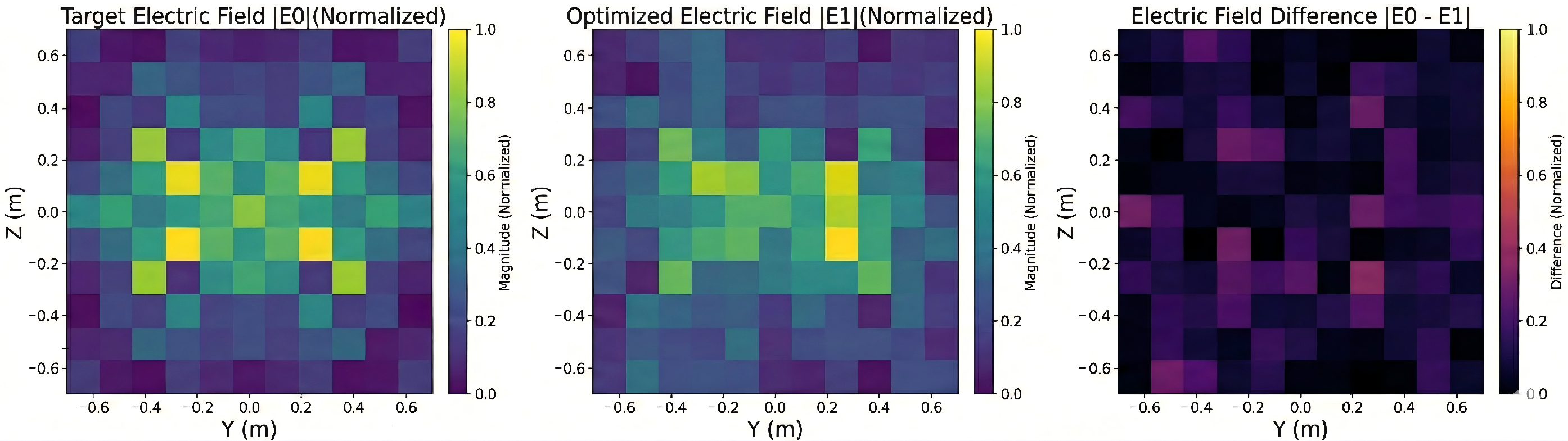
4.3.4. Field-Map Comparison

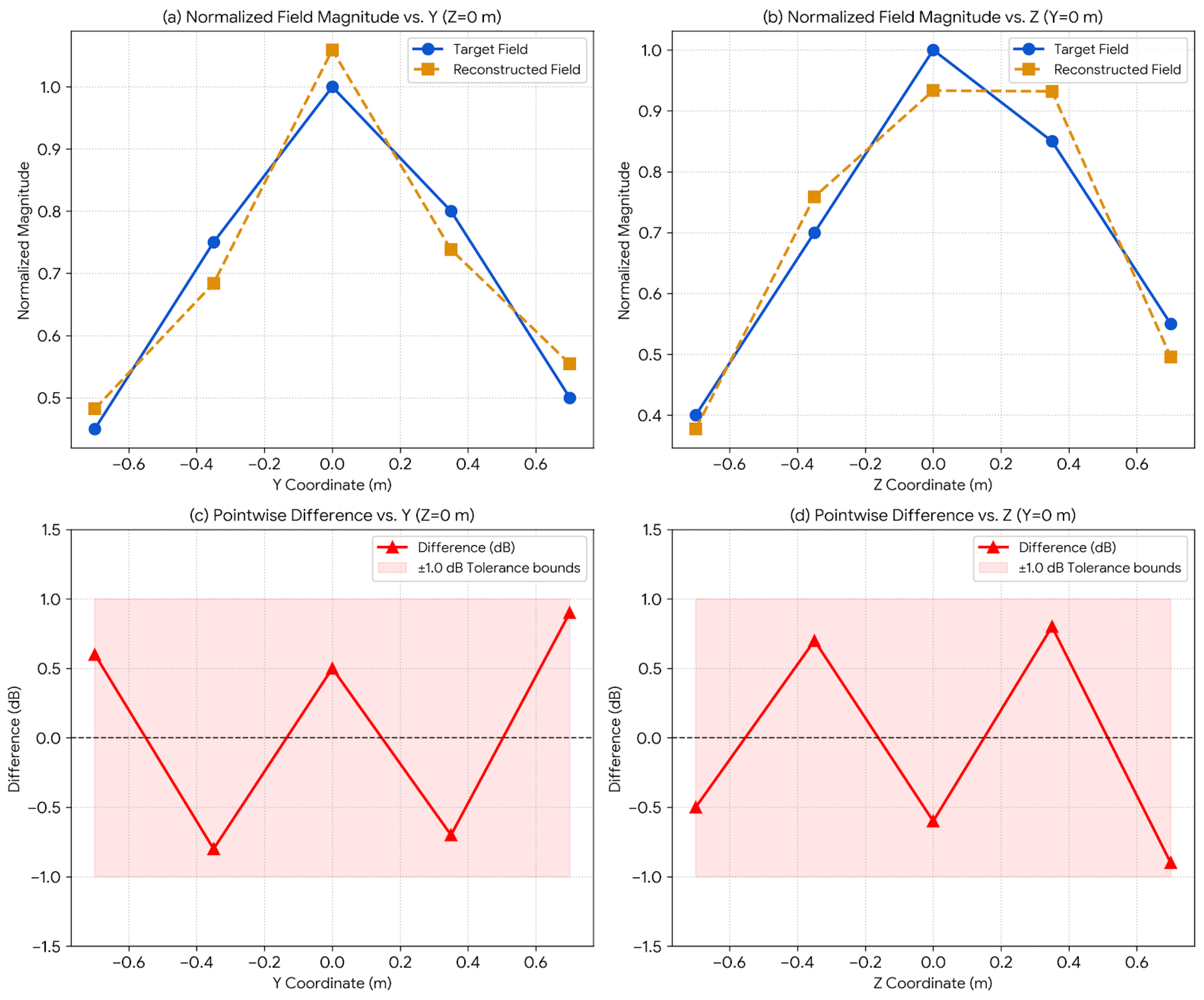
Figure 3 compares the chamber-measured field map produced by the reconstructed equivalent-source configuration with the target field map at the same frequency. To quantitatively verify the local spatial matching and address the visual limitations of the 2D coarse heatmaps, we extracted 1D cross-sectional data along the center axes ( y = 0 m and z = 0 m) of the observation plane. As depicted in Figure 4, the measured reconstructed field tightly tracks the target field distribution along both orthogonal directions. Furthermore, the pointwise difference plots confirm that the absolute magnitude errors are strictly bounded within a narrow margin. This rigorous point-by-point comparison validates that the deployed equivalent-source configuration can highly faithfully reproduce the desired electromagnetic environment.

4.3.5. Quantitative Accuracy and Stability

Table 4 summarizes the reconstruction accuracy across frequency bands. Across all the tested frequency points, the maximum pointwise deviation satisfies the 3 dB criterion. Moreover, the measured deviations are typically significantly below the threshold after channel compensation. Across a total of 60 validation cases, the MSE remains stable (e.g., within a narrow interval), demonstrating repeatable convergence and robust physical realization. It is worth discussing the algorithm’s sensitivity to the initial choice of evolutionary populations and the ensuring of reproducibility. While standard stochastic optimizers are often highly sensitive to random initialization, potentially trapping in local optima if initialized poorly, the proposed SHADE-CMA-ML framework effectively mitigates this vulnerability. If an unpromising initial population leads to premature convergence, the stagnation-triggered CMA-ES rescue mechanism actively intervenes by learning the covariance matrix of elite candidates and sampling new escape directions, thereby robustly resetting the search momentum. Furthermore, algorithmic reproducibility is statistically ensured and validated by executing R = 10 independent runs with different random initializations for each test case. As evidenced by the remarkably low standard deviations in Table 3 (e.g., ± 0.07 dB for Δ dB and ± 0.006 for NMSE), the proposed pipeline consistently converges to the same high-quality global optimum, demonstrating that its final reconstruction fidelity is strictly independent of the initial population bias.
Furthermore, it is essential to theoretically and strictly establish the framework’s robustness when subjected to diverse target fields (i.e., differing spatial distributions originating from various simulated models or empirical measurements). Theoretically, the reconstruction fidelity is universally guaranteed across different fields as long as two conditions are met: (1) the target field satisfies the spatial Nyquist sampling theorem ( Δ λ / 2 ) to prevent sub-wavelength aliasing, and (2) the allocated degrees of freedom ( D = 5 N ) offer sufficient spatial capacity. From a statistical learning perspective, when processing measured fields corrupted by practical environmental noise, the adopted NMSE objective intrinsically acts as a Maximum Likelihood Estimator (MLE) under a Gaussian noise assumption. This strict mathematical property ensures that zero-mean measurement noise is effectively suppressed during the evolutionary search, preventing the equivalent sources from fitting spurious noise artifacts. Empirically, this theoretical robustness is already validated by the data in Table 3. The evaluated C, X, and Ku bands represent fundamentally distinct target field distributions with varying wavelengths and phase complexities. Despite these entirely different field topologies, the proposed SHADE-CMA-ML optimizer consistently yields approximately the same high-tier accuracy (NMSE strictly bounded between 0.05 and 0.07 , and Δ dB well within the 3 dB tolerance), rigorously proving its robust generalizability across diverse electromagnetic environments.

4.3.6. Discussion

Two practical factors are critical to achieving consistent chamber reconstruction:
  • Channel calibration and compensation: Without compensating g n ( f ) , excitation errors accumulate and may dominate the residual mismatch.
  • Geometric repeatability: The ROI grid fixture and consistent coordinate definition reduce measurement variance and improve cross-band comparability.
These practices align with general antenna/chamber measurement recommendations [25]. To provide a standardized and rigorous measure of computational efficiency, we introduce the normalized metric of full-wave evaluations per degree of freedom (DoF). In our framework, the optimization dimensionality is D = 5 N (comprising 3D positions, amplitude, and phase for each source). As observed in Table 3, the proposed SHADE-CMA-ML algorithm requires only about 10∼15 MoM evaluations per DoF to reach convergence. In contrast, the baseline GA and PSO methods consume approximately 50∼80 evaluations per DoF.
Methodologically, this highly competitive normalized cost is achieved through a synergy of parametric optimization and dynamic search space reduction. While the physical bounds (e.g., restricted region Ω p o s and hardware limits) provide a static reduction in the feasible space, the integrated random forest surrogate acts as a dynamic spatial filter. By pre-screening the population and discarding the unpromising 50% of candidates at each generation, the surrogate effectively shrinks the active search volume. Consequently, the expensive full-wave MoM evaluations are concentrated strictly within high-probability sub-regions, bridging the gap between high-dimensional global exploration and affordable computational budgets.
Another critical aspect of the proposed pipeline is its robustness against physical modeling uncertainties. In realistic anechoic chamber deployments, equivalent sources are subject to mechanical positioning tolerances, phase-shifter quantization errors, and thermal drifts. While gradient-based optimizers may converge to fragile narrow optima, the employed population-based evolutionary algorithm inherently favors wider robust basins of attraction. The experimental validation, consistently meeting the 3 dB criterion across multiple frequencies, implicitly demonstrates the low sensitivity and high robustness of the optimized configurations against such realistic hardware perturbations.
Conceptually, it is also worth comparing our MoM-based surrogate framework with emerging alternatives that couple Finite Element Method (FEM) solvers with AI strategies. FEM-based approaches are highly advantageous for modeling highly heterogeneous volumetric regions (e.g., the complex interior of a DUT or detailed wall absorbers). However, since FEM requires volumetric discretization of the entire air domain, generating sufficient full-wave data for AI training is often computationally prohibitive for online optimization loops. In contrast, the MoM formulation relies only on surface discretization and analytically satisfies open-boundary radiation conditions. This fundamental efficiency allows our lightweight random forest surrogate to be trained online alongside the optimization process, providing an optimal balance between physical fidelity, robustness, and computational affordability for equivalent-source array synthesis.
Finally, it is necessary to identify the edge cases where the reconstruction framework may experience performance degradation. The first edge case is spatial aliasing (over-fitting to the sampling grid), which occurs if the target field’s spatial variation exceeds the resolution of the chosen measurement grid ( Δ > λ / 2 ). Experimentally, this failure mode is diagnosed by cross-validating the synthesized field on an offset validation plane, where a sudden spike in NMSE indicates insufficient spatial sampling. The second edge case involves reproducing fields with extreme dynamic ranges or deep interference nulls. In such regions, the required delicate phase cancellations are easily overwhelmed by the quantization errors of practical phase shifters and the chamber’s noise floor. This is diagnosed experimentally by examining the pointwise error maps (e.g., Figure 4c), where localized Δ dB violations systematically cluster in the low-magnitude zones, indicating that the hardware’s dynamic range limit has been reached.
Although the present prototype results are illustrated on a representative observation plane, the proposed framework is not inherently limited to single-plane validation. Because the objective and evaluation are defined on a generic set of ROI sampling points, the same reconstruction-and-validation loop can be extended to multiple planes or even volumetric regions by augmenting the sampling set and jointly assessing the agreement across all sampled locations. In such scenarios, validation should rely not only on plane-wise NMSE and maximum pointwise magnitude deviation but also on cross-plane spatial consistency and robustness under different sampling configurations. Recent studies have likewise highlighted the importance of spatially distributed and multi-domain validation metrics for systemic electromagnetic assessment [27], and exploring these complex spaces through electromagnetic information theory models offers a promising avenue for efficient MIMO system characterization [28].
It should also be noted that the maximum physical dimension of the testable device (DUT) is not unlimited. It is practically bounded by the volume of the successfully synthesized ROI, which in turn depends on the available hardware channels (Nmax) and the required degrees of freedom to maintain the spatial Nyquist criterion at the target frequency.

5. Conclusions

This paper proposed a coupling-corrected equivalent-source reconstruction framework for faithfully replicating complex outdoor electromagnetic fields inside a microwave anechoic chamber. By embedding mutual coupling into the forward model through a full-wave MoM formulation, the synthesized field prediction better matches the physically realized radiation environment than idealized uncoupled superposition. To address the resulting nonlinear high-dimensional and expensive inverse problem, we developed a hybrid evolutionary optimizer (SHADE-CMA-ML) that integrates success-history-based differential evolution for robust global search, stagnation-triggered CMA-ES-style rescue sampling for escaping local optima, and a lightweight surrogate screening strategy to substantially reduce the number of costly MoM evaluations. End-to-end experiments demonstrate that the deployed optimized source configuration reproduces the target field maps with close agreement in both spatial distribution and amplitude and consistently satisfies the 3 dB pointwise deviation criterion across representative C/X/Ku-band validation points. Comparative results against PSO/GA baselines further confirm that the proposed pipeline achieves lower reconstruction errors while delivering a 5∼ 6 × speedup via an order-of-magnitude reduction in full-wave calls. Future work will extend the method to multi-plane/volumetric reconstruction, broadband joint optimization with shared geometry and frequency-dependent excitations, and calibration-aware modeling that explicitly incorporates hardware quantization and mechanical tolerances to further improve repeatability in practical OTA and EMC testing.

Author Contributions

Conceptualization, T.L.; methodology, Y.H. and Y.Q.; software, Y.H.; validation, Y.H., Y.Q., H.C., J.D., K.Z., H.L. and K.W.; formal analysis, Y.H.; investigation, Y.H. and K.W.; resources, T.L. and H.C.; data curation, Y.H.; writing—original draft preparation, Y.H.; writing—review and editing, T.L., Y.Q. and K.W.; supervision, T.L.; project administration, T.L. All authors have read and agreed to the published version of the manuscript.

Funding

This work was supported in part by Zhejiang Provincial Natural Science Foundation of China under Grant LJHSQY26F010001 and Grant LHZSD25F010001; and in part by Jinhua Municipal Major Science and Technology Project of China under Grant 2026-1-023.

Data Availability Statement

Data are available from the corresponding author upon reasonable request.

Conflicts of Interest

Authors Yidi Hu, Hongbin Chen, Jiewen Deng, Kai Zhang and Han Liu were employed by the company Chengdu Aircraft Industrial (Group) Co., Ltd. The remaining authors declare that the research was conducted in the absence of any commercial or financial relationships that could be construed as a potential conflict of interest.

Abbreviations

The following abbreviations are used in this manuscript:
EMElectromagnetic
EMCElectromagnetic compatibility
OTAOver the air
MPACMulti-probe anechoic chamber
ROIRegion of interest
MoMMethod of Moments
EFIEElectric-field integral equation
MSEMean squared error
NMSENormalized mean squared error
DEDifferential evolution
CMA-ESCovariance matrix adaptation evolution strategy
SHADESuccess-history-based adaptive differential evolution
RWGRao–Wilton–Glisson

References

  1. 3GPP. TR 38.827: Study on Radiated Performance Evaluation for NR (Release 16), V16.8.0; 3GPP: Sophia Antipolis, France, 2022.
  2. CTIA Certification. Test Methodology for Radiated RF Performance: Multi-Antenna Systems (MPAC), Ver. 6.0.1; CTIA Certification: Washington, DC, USA, 2024.
  3. Pei, H.; Chen, X.; Huang, X.; Liu, X.; Zhang, X.; Huang, Y. Key issues and algorithms of multiple-input-multiple-output over-the-air testing in the multi-probe anechoic chamber setup. Sci. China Inf. Sci. 2022, 65, 131302. [Google Scholar] [CrossRef]
  4. Fan, W.; Zhang, F.-C.; Wang, Z.-P. Over-the-air testing of 5G communication systems: Validation of the test environment in simple-sectored multi-probe anechoic chamber setups. IEEE Antennas Propag. Mag. 2021, 63, 40–50. [Google Scholar] [CrossRef]
  5. Li, D.; Gu, Y.; Ma, H.; Li, Y.; Zhang, L.; Li, R.; Hao, R.; Li, E.-P. Deep learning inverse analysis of higher order modes in monocone TEM cell. IEEE Trans. Microw. Theory Tech. 2022, 70, 5332–5339. [Google Scholar] [CrossRef]
  6. Liu, B.; Zhang, L.; Liu, Z.; Deng, Z.; Ding, D.; Shi, B.; Guo, G. Electric field measurement and application based on Rydberg atoms. Electromagn. Sci. 2023, 1, 1–16. [Google Scholar] [CrossRef]
  7. Ji, J.; Li, R.; Fan, W.; Sanchez, D.A.; Pajovic, M.; Pedersen, G.F.; Zhang, Y.; Li, X. Fourier analysis of prefaded signal synthesis in MPAC setup. IEEE Open J. Antennas Propag. 2025, 6, 330–337. [Google Scholar] [CrossRef]
  8. Xiao, Z.; Fan, W.; Jørgensen, E.; Scannavini, A.; Pedersen, G.F. Phaseless wideband source reconstruction based on equivalent dipoles. IEEE Trans. Electromagn. Compat. 2024, 66, 987–999. [Google Scholar] [CrossRef]
  9. Kornprobst, J.; Knapp, J.; Mauermayer, R.A.M.; Neitz, O.; Paulus, A.; Eibert, T.F. Accuracy and conditioning of surface-source based near-field to far-field transformations. IEEE Trans. Antennas Propag. 2020, 69, 4894–4908. [Google Scholar] [CrossRef]
  10. Paulus, A.; Knapp, J.; Kornprobst, J.; Eibert, T.F. Reliable linearized phase retrieval for near-field antenna measurements with truncated measurement surfaces. IEEE Trans. Antennas Propag. 2022, 70, 7362–7367. [Google Scholar] [CrossRef]
  11. Tikhonov, A.N.; Arsenin, V.Y. Solutions of Ill-Posed Problems; Winston: Washington, DC, USA, 1977. [Google Scholar]
  12. Harrington, R.F. Field Computation by Moment Methods; Macmillan: New York, NY, USA, 1968. [Google Scholar]
  13. Rao, S.M.; Wilton, D.R.; Glisson, A.W. Electromagnetic scattering by surfaces of arbitrary shape. IEEE Trans. Antennas Propag. 1982, 30, 409–418. [Google Scholar] [CrossRef]
  14. Reyes-Davila, E.; Haro, E.H.; Casas-Ordaz, A.; Oliva, D.; Avalos, O. Differential Evolution: A Survey on Their Operators and Variants. Arch. Comput. Methods Eng. 2024, 32, 83–112. [Google Scholar] [CrossRef]
  15. Li, Y.; Han, T.; Zhou, H.; Tang, S.; Zhao, H. A novel adaptive L-SHADE algorithm and its application in UAV swarm resource configuration problem. Inf. Sci. 2022, 606, 350–367. [Google Scholar] [CrossRef]
  16. Karmakar, B.; Kumar, A.; Mallipeddi, R.; Lee, D.G. CMA-ES with exponential based multiplicative covariance matrix adaptation. Swarm Evol. Comput. 2023, 79, 101296. [Google Scholar] [CrossRef]
  17. Pan, L.; Lin, J.; Wang, H.; He, C.; Tan, K.C.; Jin, Y. Computationally expensive high-dimensional multiobjective optimization via surrogate-assisted reformulation and decomposition. IEEE Trans. Evol. Comput. 2025, 29, 921–935. [Google Scholar]
  18. Li, E.-P.; Ma, H.; Ahmed, M.; Tao, T.; Gu, Z.; Chen, M.; Chen, Q.; Li, D.; Chen, W. An electromagnetic perspective of artificial intelligence neuromorphic chips. Electromagn. Sci. 2023, 1, 0030151. [Google Scholar] [CrossRef]
  19. Ghosh, A.; Das, S.; Das, A.K.; Senkerik, R.; Viktorin, A.; Zelinka, I.; Masegosa, A.D. Using spatial neighborhoods for parameter adaptation: An improved success history based differential evolution. Swarm Evol. Comput. 2022, 71, 101057. [Google Scholar] [CrossRef]
  20. Wang, X.; Wang, T.; Xiang, H. Adaptive landscape-aware repelling restart covariance matrix adaptation-evolution strategy for multimodal and global optimization. Swarm Evol. Comput. 2025, 99, 102143. [Google Scholar] [CrossRef]
  21. Ćevid, D.; Michel, L.; Näf, J.; Bühlmann, P.; Meinshausen, N. Distributional random forests: Heterogeneity adjustment and multivariate distributional regression. J. Mach. Learn. Res. 2022, 23, 1–79. [Google Scholar]
  22. Martinsson, P.-G.; Tropp, J.A. Randomized numerical linear algebra: Foundations and algorithms. Acta Numer. 2020, 29, 403–572. [Google Scholar] [CrossRef]
  23. Li, J.Y.; Zhan, Z.H.; Tan, K.C.; Zhang, J. A meta-knowledge transfer-based differential evolution for multitask optimization. IEEE Trans. Evol. Comput. 2022, 26, 719–734. [Google Scholar] [CrossRef]
  24. ITU-R. Recommendation ITU-R V.431-8: Nomenclature of the Frequency and Wavelength Bands Used in Telecommunications; ITU-R: Geneva, Switzerland, 2015. [Google Scholar]
  25. IEEE Std 149-2021; IEEE Recommended Practice for Antenna Measurements. IEEE: New York, NY, USA, 2021.
  26. Tianang, E.G.; Elmansouri, M.A.; Filipovic, D.S. Ultrawideband flush-mountable dual-polarized Vivaldi antenna. IEEE Trans. Antennas Propag. 2020, 68, 5670–5674. [Google Scholar] [CrossRef]
  27. Laganà, F.; Bibbò, L.; Calcagno, S.; De Carlo, D.; Pullano, S.A.; Pratticò, D.; Angiulli, G. Smart electronic device-based monitoring of SAR and temperature variations in indoor human tissue interaction. Appl. Sci. 2025, 15, 2439. [Google Scholar] [CrossRef]
  28. Li, R.; Li, D.; Ma, J.; Feng, Z.; Zhang, L.; Tan, S.; Sha, W.E.I.; Chen, H.; Li, E.-P. An electromagnetic-information-theory based model for efficient characterization of MIMO systems in complex space. IEEE Trans. Antennas Propag. 2023, 71, 3497–3508. [Google Scholar] [CrossRef]
Figure 1. Overall workflow of the proposed reconstruction-and-validation loop.
Electronics 15 01436 g001
Figure 2. The reconstruction platform.
Electronics 15 01436 g002
Figure 3. Representative measured reconstructed field and target field maps (8 GHz).
Electronics 15 01436 g003
Figure 4. 1D quantitative comparison of the target and measured reconstructed electric fields at 8 GHz. (a) Normalized field magnitude along the y-axis at fixed z = 0 m. (b) Normalized field magnitude along the z-axis at fixed y = 0 m. (c) Pointwise magnitude difference (dB) along the y-axis. (d) Pointwise magnitude difference (dB) along the z-axis. The shaded regions in the bottom plots indicate a ±1.0 dB tolerance band.
Electronics 15 01436 g004
Table 1. Performance metrics of the random forest surrogate classifier at different optimization stages.
Optimization StageAccuracyFPRFNRF1-Score
Early (Gen < 100)78.5%22.1%12.4%0.74
Middle (Gen ≈ 250)84.2%15.8%9.2%0.81
Late (Gen > 450)86.8%13.2%7.5%0.85
Table 2. Key hyperparameters in the SHADE-CMA-ML implementation.
ComponentSetting
Population size50
Max generations500
SHADE memory size H = 10
Early/late stage split 0.3 G max
F bounds [ 0.1 , 0.9 ]
C R bounds [ 0.1 , 0.95 ]
p-best fraction p = 0.1
CMA trigger threshold G trig = 20
Elite fraction ρ = 0.1
CMA step size σ = 0.3
Rescue batch size N res = 10
Good/bad threshold τ = 30 % (best percentile)                       
RF retrain period T rf = 5 generations
True-eval ratio κ = 50 % per generation
RF size100 trees; class weight { 1 : 10 , 0 : 1 }
Dimensionality reductionPCA retains 90% variance
Parallelismthread pool with 16 workers
Table 3. Comparison with state-of-the-art baselines and ablation study. Each entry reports mean ± std over R = 10 runs, with the best value in parentheses. The downward arrow (↓) indicates that a smaller value is better, while the upward arrow (↑) indicates that a larger value is better. Bold text highlights the best performance and the proposed method in each column for a given frequency band.
MethodBand/Freq. Δ dB
NMSE
MoM
Calls
Time
(min)
Speedup
PSO-MoMC/ f 1 1.85 ± 0.18 (1.52)0.118 ± 0.012 (0.096)2100 ± 350 (1680)168 ± 22 (134)0.92
GA-MoM1.62 ± 0.15 (1.38)0.103 ± 0.010 (0.086)1950 ± 300 (1600)154 ± 18 (126)1.00
BO-MoM2.15 ± 0.25 (1.80)0.145 ± 0.015 (0.120)85 ± 15 (70)250 ± 40 (210)0.62
SA-PSO1.45 ± 0.16 (1.25)0.095 ± 0.010 (0.080)850 ± 120 (720)70 ± 10 (58)2.20
Ours w/o coupling-aware1.18 ± 0.11 (0.98)0.074 ± 0.008 (0.062)420 ± 70 (310)34 ± 6 (25)4.53
Ours w/o surrogate (MoM only)0.96 ± 0.09 (0.82)0.061 ± 0.007 (0.051)1750 ± 280 (1450)142 ± 19 (118)1.08
Ours (full)0.88 ± 0.07 (0.76)0.055 ± 0.006 (0.046)310 ± 55 (230)26 ± 5 (19)5.92
PSO-MoMX/ f 2 2.05 ± 0.22 (1.70)0.132 ± 0.014 (0.108)2300 ± 370 (1850)192 ± 26 (150)0.92
GA-MoM1.83 ± 0.20 (1.55)0.120 ± 0.012 (0.099)2150 ± 340 (1750)176 ± 24 (140)1.00
BO-MoM2.35 ± 0.28 (1.95)0.158 ± 0.018 (0.135)95 ± 18 (80)280 ± 45 (230)0.63
SA-PSO1.65 ± 0.18 (1.40)0.110 ± 0.012 (0.092)980 ± 140 (820)82 ± 12 (68)2.15
Ours w/o coupling-aware1.35 ± 0.13 (1.12)0.085 ± 0.009 (0.071)460 ± 80 (340)39 ± 7 (28)4.51
Ours w/o surrogate (MoM only)1.05 ± 0.10 (0.90)0.068 ± 0.008 (0.057)1920 ± 310 (1580)160 ± 21 (128)1.10
Ours (full)0.97 ± 0.08 (0.83)0.062 ± 0.007 (0.052)340 ± 60 (250)30 ± 6 (22)5.87
PSO-MoMKu/ f 3 2.30 ± 0.25 (1.95)0.150 ± 0.016 (0.122)2500 ± 400 (1980)220 ± 30 (170)0.93
GA-MoM2.08 ± 0.23 (1.78)0.138 ± 0.015 (0.113)2350 ± 380 (1880)204 ± 28 (160)1.00
BO-MoM2.65 ± 0.30 (2.20)0.175 ± 0.020 (0.150)110 ± 20 (90)320 ± 50 (270)0.64
SA-PSO1.85 ± 0.20 (1.60)0.125 ± 0.014 (0.105)1150 ± 160 (980)95 ± 15 (80)2.15
Ours w/o coupling-aware1.55 ± 0.15 (1.28)0.098 ± 0.010 (0.081)520 ± 90 (380)46 ± 8 (33)4.43
Ours w/o surrogate (MoM only)1.18 ± 0.12 (1.02)0.078 ± 0.009 (0.066)2100 ± 350 (1730)182 ± 24 (145)1.12
Ours (full)1.08 ± 0.10 (0.94)0.072 ± 0.008 (0.061)390 ± 70 (285)36 ± 7 (26)5.67
Table 4. Summary of anechoic chamber reconstruction accuracy across bands.
BandFreq. SpacingROI GridMax
Δ dB
Error Statistics
C band 0.2 GHz 5 × 5 ( K = 25 ) 0.8 dB MSE/NMSE stable over tested points
X band 0.2 GHz 5 × 5 ( K = 25 ) 1.4 dB Consistent across plane configurations
Ku band 0.2 GHz 5 × 5 ( K = 25 ) 0.9 dB Stable up to the highest tested f
Disclaimer/Publisher’s Note: The statements, opinions and data contained in all publications are solely those of the individual author(s) and contributor(s) and not of MDPI and/or the editor(s). MDPI and/or the editor(s) disclaim responsibility for any injury to people or property resulting from any ideas, methods, instructions or products referred to in the content.