2. Materials and Methods
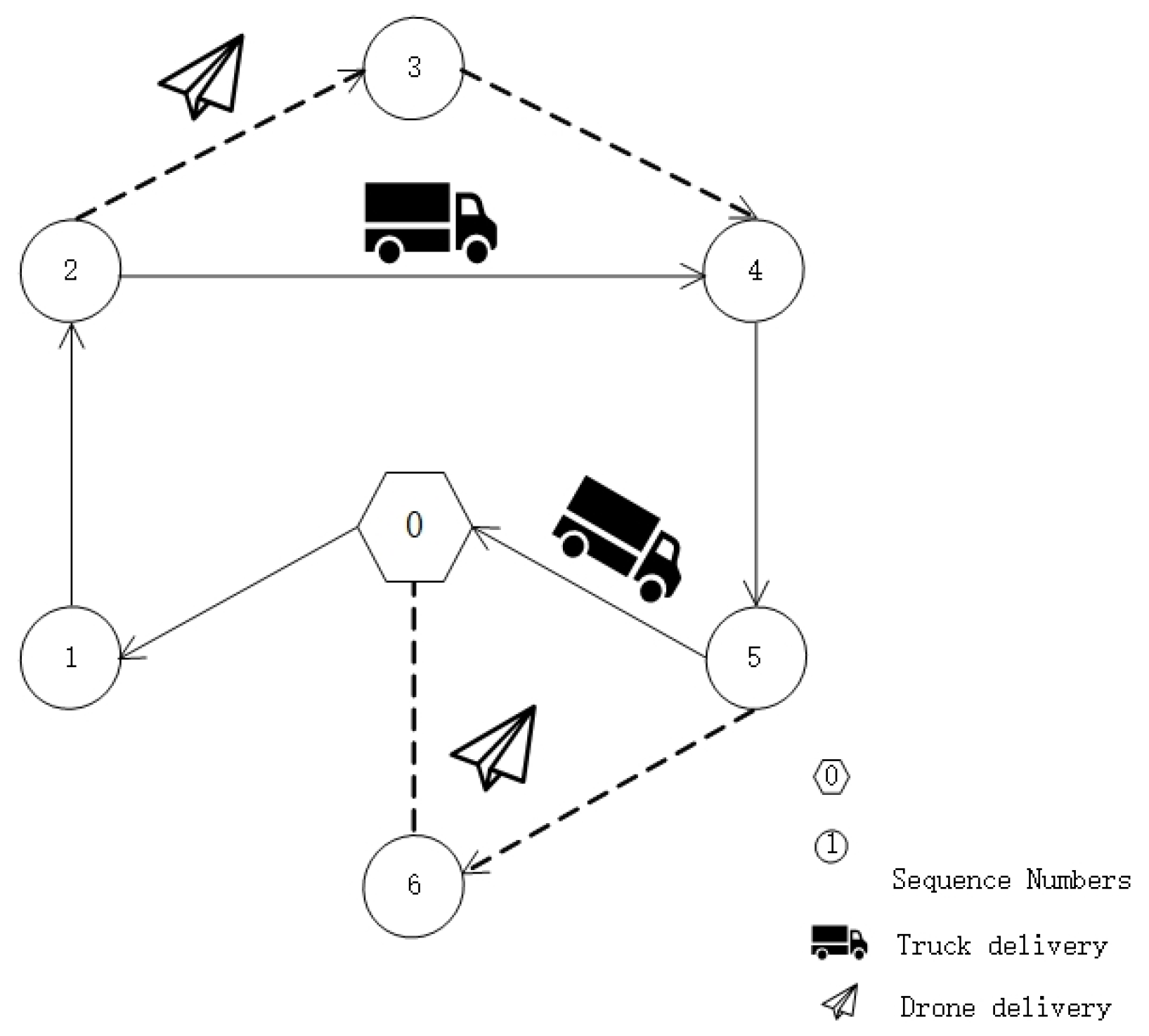
Based on the above problem description, the emergency relief distribution problem with coordinated truck–drone transportation can be decomposed into two subproblems: (i) transportation mode selection for the truck and the drone, and (ii) route selection for both vehicles. As shown in
Figure 1, a schematic diagram of collaborative transport between a single drone and a single truck.
In the mode selection subproblem, we consider the following factors: (1) certain nodes cannot be served by the drone due to operational restrictions (e.g., no-fly zones); (2) real-time weather conditions may preclude drone service at some nodes; (3) temporal synchronization between the drone and the truck is required, including coordination of drone launch, service, and recovery with the truck’s schedule; and (4) the goal is to determine a mode assignment that minimises the overall completion time.
In the route selection subproblem, the key decisions are to: (1) identify truck and drone routes that minimise the total delivery time, and (2) account for weather-induced variations in drone flight time when determining the optimal routes.
We adopt the following assumptions:
A single distribution center is considered, equipped with one truck and one drone.
The truck and the drone can perform deliveries independently.
At a rendezvous location, either vehicle may wait for the other.
Each demand node is served exactly once, either by the truck or by the drone.
In each sortie, the drone serves at most one demand node.
The speed ratio between the drone and the truck is assumed to be constant but can be adjusted; different parameters can be set for different scenarios.
Vehicle capacity constraints are ignored. The truck is assumed to carry sufficient supplies to satisfy the demands of all nodes assigned to it, and the drone is assumed to carry sufficient supplies to satisfy the demand of the single node served in a sortie.
The effect of payload weight on the drone’s battery consumption is neglected.
Delivery service time, charging time, and other service-related times are not considered.
Based on the above assumptions, the key issues in solving the cooperative transportation routing problem between the drone and the truck can be summarised as follows: the endurance of the drone; the determination of whether the drone is able to take off; the determination of the drone’s launch and landing nodes; the determination of whether the drone is able to land; and the travel time of both the drone and the truck.
Schematic Diagram of Cooperative Transport Between a Single Truck and a Single Drone.
This paper provides definitions and explanations of the parameters and variables required for this model, as shown in
Table 1,
Table 2 and
Table 3.
A single UAV mission (sortie) is represented by a ternary arc
: the UAV takes off from a permitted truck node
, serves customer
, and is recovered at a permitted recovery node
. The binary variable
indicates whether sortie
is executed. To map the takeoff–service–recovery events to weather time windows, three types of time-window selection indicator variables are introduced:
which indicate that the takeoff, service, and recovery events of sortie
, respectively, occur in weather window
.
If a sortie is executed, each of the three events must select exactly one weather window:
In addition, Big-M constraints are used to bind the event time variables to the selected weather-window interval. Taking the takeoff event as an example (if takeoff occurs at node
and its time is denoted by
), we have
The service and recovery events can be similarly bound to using and together with their corresponding time variables.
Weather feasibility constraints and linear flight-time reformulation
- (i)
Feasibility (no-fly) constraints
When the takeoff/service/recovery event of sortie
is assigned to window
, the corresponding node must satisfy the flyability requirement:
Meanwhile, whether customer node
permits UAV service is indicated by
; thus, it must hold that
- (ii)
Linearization of flight time
Let the baseline UAV flight time from node
to node
under normal weather be
. This paper incorporates the weather impact into the two flight segments
and
in a linear manner using an “event-window multiplier correction”:
On this basis, the UAV endurance constraint is written as
The objective function aims to minimise the total time, specifically the shortest time for the drone-equipped truck to return to the distribution center, or the shortest time for the drone and truck to arrive at the distribution center at a later time.
Risk indicators
are divided into 5 intervals, each corresponding to different flight time multipliers. The flight time multiplier function is as follows:
- (1)
After completing deliveries, trucks must return to the distribution center.
- (2)
Trucks are prohibited from returning to the starting point or departing again from the destination.
- (3)
Truck flow balancing at customer points ensures each truck visits a customer exactly once.
- (4)
Customers can only choose either drone or truck delivery; orders cannot be fulfilled simultaneously by both drones and trucks, nor can they be delivered repeatedly by either drones or trucks.
- (5)
Only when the truck follows the actual curve can the drone perform its mission during this period, and the drone must be recovered from its departure point.
- (6)
When the target point is a no-fly zone, the drone cannot directly access it.
- (7)
Truck travel sequence: If the truck travels along the arc, the time the truck reaches point A is no earlier than time B.
- (8)
Waiting within the node, the departure time is used no earlier than the arrival time.
- (9)
Flight time during the takeoff phase of drone operations.
- (10)
Flight time during the landing phase of drone operations.
- (11)
The truck must wait at the drop-off point until the drone has completed its landing, allowing both the drone and the truck to wait for each other.
- (12)
Drone endurance constraints.
- (13)
MTZ subring elimination.
- (14)
If the drone performs a mission, select one time window each for takeoff, delivery, and landing; if the mission is not performed, all time windows are 0.
- (15)
The takeoff time must fall within the selected time window.
- (16)
The service time must fall within the selected time window.
- (17)
The landing time must fall within the selected time window.
- (18)
Ensure weather conditions at the departure point are suitable for flight.
- (19)
Guarantee that the weather at the service location is suitable for flying.
- (20)
Guarantee the weather will be flyable at the recovery point.
- (21)
The completion time shall not be earlier than the time of return to the distribution center.
This paper constructs a MILP model to describe the constraints of truck–drone collaborative delivery under no-fly zones and dynamic weather conditions. Given that this problem is NP-hard and direct computation is costly, a hybrid genetic algorithm combined with local search is employed during the solution phase. To avoid secondary uncertainties caused by real-time weather changes during the solution process, dynamic weather is treated as an exogenous time-varying input and processed in two stages:
- (1)
During the case generation phase of dynamic weather simulation, a continuous-time weather risk sequence is generated for each node on a unified system timeline, which is then discretised into time windows to obtain . Based on , the flight time multiplier and flyable indication for each node within each time window are precomputed.
- (2)
Path optimization during the solution phase treats , , and as known input parameters, disregarding replanning caused by weather updates during execution.
Therefore, during the solution phase, there is no need to generate weather conditions on-site. Instead, by querying the pre-generated and based on the time window index corresponding to the current time, the feasibility verification under weather conditions and flight time calculation can be completed.
To incorporate continuously varying weather conditions into a mixed-integer programming model, the time dimension is discretised. Continuous time
is divided into time windows
, resulting in
. The system timeline is a continuous variable
. The system operation timeline is partitioned into multiple time windows of equal length, denoted as the set
. Each time window has a duration of
, and the
th time window corresponds to the interval
.
The correspondence between continuous time
and time window index
is as follows:
To embed the decision-making process of continuous system timeline into MILP and incorporate dynamic weather effects, this paper discretises the real-time weather process into a set of weather time windows of fixed length . For any , its start and end points are defined as: (30) and (31). In the example, Δ = 30 (unit time) is selected. The choice of Δ reflects a trade-off between precision and scale: a smaller Δ captures weather variations more finely, but the binary choice variables related to weather windows (such as ) and their corresponding Big-M constraints will grow approximately linearly with |G|, significantly increasing the difficulty of solving the MILP.
Within each time window, assuming the weather conditions at node remain approximately constant, the weather risk level at node during time window is denoted by weather risk indicator A. The timing of drone takeoff, delivery, and landing events can be mapped to corresponding time windows to enable “window-based lookup” for weather constraint verification and flight time calculation. This discretization method ensures the model’s linearizability for solubility while approximating the impact of time-varying weather on drone flight feasibility and duration. In the example, is selected. Weather risk indicator is discretized into by time window.
The dynamic weather system is constructed independently from the drone–truck collaborative transportation system, accounting for the impact of weather conditions on drone flight operations. The development of this weather system must address the following critical issues:
- (1)
Configuration between real-time weather data and algorithm-generated weather data.
- (2)
Short-term stability of the weather system, ensuring consistent weather queries at the same time and location.
- (3)
Randomness within the weather system, guaranteeing unpredictable weather patterns across different locations and time periods.
To address the discrepancy between real-world weather time and algorithmic weather time, the system employs cumulative time. This cumulative time represents the elapsed period since the start of the drone–truck collaborative transport system, specifically from when the truck carrying the drone departs the distribution center. This cumulative time serves as the algorithmic time, which is then converted to real-world time at a fixed ratio. The calculation formula is shown in Equation (33).
where
represents the actual weather time, and
represents the system cumulative time.
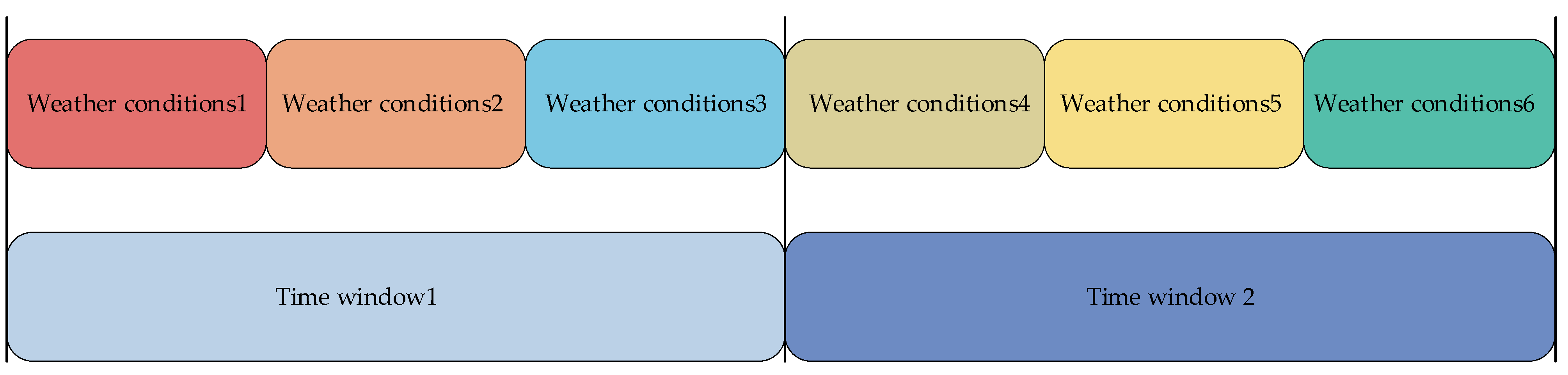
To ensure short-term stability of the weather system, it is necessary to guarantee that multiple queries at the same time and node return identical weather conditions. A fully randomised weather system cannot meet this requirement. Therefore, a time window with a fixed interval based on system time is established, ensuring identical weather queries within the same time window. In this system, the time interval is set to 30 system cumulative time units, forming a time window. Starting from the system cumulative time, the first 30 system cumulative time units constitute Time Window 1, the next 30 system cumulative time units form Time Window 2, and so on. A diagram illustrating the specific time window is shown in
Figure 2.
To account for the randomness of weather systems, it is necessary to ensure that weather conditions exhibit randomness across different locations and times, thereby establishing varying weather risks. The original weather risk comprises three components: base risk, actual time weather risk, and disturbance impact. The base weather risk is randomly assigned, while the actual weather risk is derived by substituting the actual time into the function.
Among these, represents the original weather risk indicator for node at time , denotes the baseline risk level for node , signifies the daily cycle fluctuation amplitude, and G indicates the disturbance factor.
Multiple sampling points are taken along a continuous time axis. For each time window
, the set of all sampling points within that window is aggregated according to the following Formula (36) to obtain the complete weather trajectory.
Let node have a weather risk indicator at continuous time . For any , the risk process over the interval is discretely aggregated into an in-window risk level . To ensure reproducibility, this paper adopts a conservative aggregation method of “taking the maximum value within the time window”: (36)
Based on node risk threshold , define flight feasibility indicator . Simultaneously, to characterise the increase in flight duration caused by risks, introduce the flight time multiplier A for node within time window . This paper precomputes . from (either using piecewise constant or piecewise linear forms; to maintain MILP linearity, piecewise constant mapping is adopted here). Consequently, is precomputed for all nodes and time windows prior to modeling and serves as a known parameter input for the MILP.
For easy reference, a parameter summary table has been created, as shown in
Table 4:
Typical MILP scale under time discretization (number of binary variables and constraints).
The additional binary variables introduced by time-window discretization are mainly . For each , each type corresponds to variables. Therefore, the total number of newly introduced binary variables is . Correspondingly, the number of unique time-window selection constraints is ; the number of time-window interval binding constraints (upper and lower bounds) is approximately ; and the number of weather feasibility constraints is approximately . Hence, the scale of variables and constraints introduced by discretization grows approximately linearly with .
Since branch-and-bound solvers are sensitive to binary variables and Big-M constraints, when decreases and consequently increases, the MILP solving time increases significantly. Therefore, heuristic methods are adopted as the primary solution strategy for medium- and large-scale instances in this study, while MILP solvers are applied to small-scale instances to verify feasibility and modeling correctness (with the solving time and optimality gap reported).
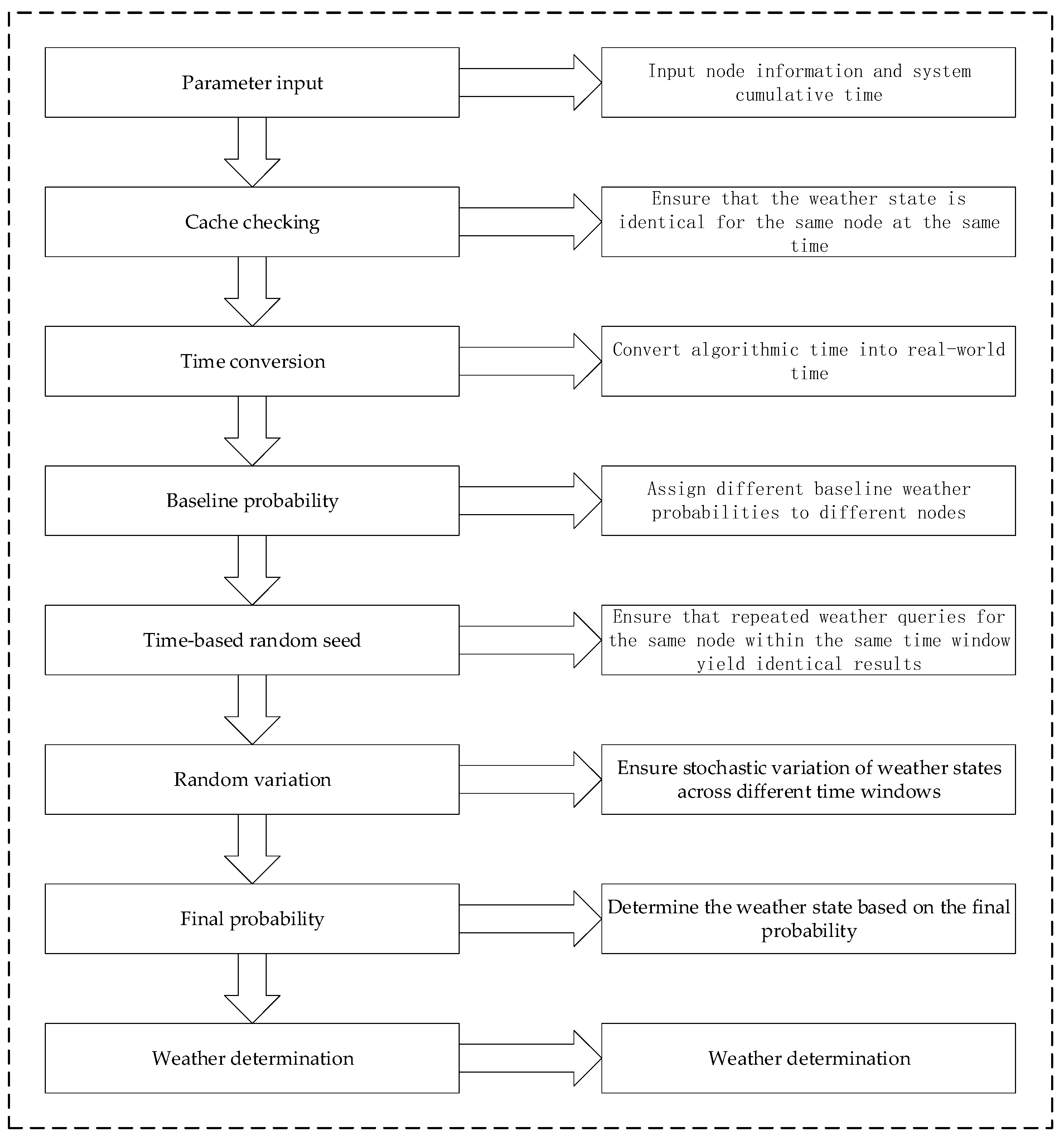
The overall workflow of the weather system is illustrated in
Figure 3. First, node and system cumulative time are input into the weather system to generate initial weather probabilities for each node, with an appropriate time interval (time window) set. Next, the system processes the cumulative time to derive the actual time. Then, the actual time is fed into the actual weather calculation function. Finally, the weather conditions for each node at different times are obtained.
The pseudocode for the weather system is as follows (Algorithm 1):
| Algorithm 1: Dynamic Weather Simulator (offline generation with time-window stability) |
Input: node set , time windows , window length , sampling step , mapping factor , parameters , , disturbance scale threshold , random seed (and optional spatial correlation ).
Output: , , for all , .
1. Initialise RNG with . Initialise cache Cache for all .
2. For each time window :
2.1 Compute window endpoints
2.2 Construct sampling time set
2.3 (Optional spatial correlation) Draw a global disturbance
2.4 For each node
If exists, set and continue.
Else, for each sampling time :
(a) Convert to real time .
(b) Draw local disturbance .
(c) Set disturbance
(d) Compute original risk
(e) Clip to obtain
Aggregate within window
store
3. For each :
3.1 Compute flyability indicator
3.2 Compute flight-time multiplier from using a predefined mapping (e.g., piecewise-constant or piecewise-linear).
4. Return |
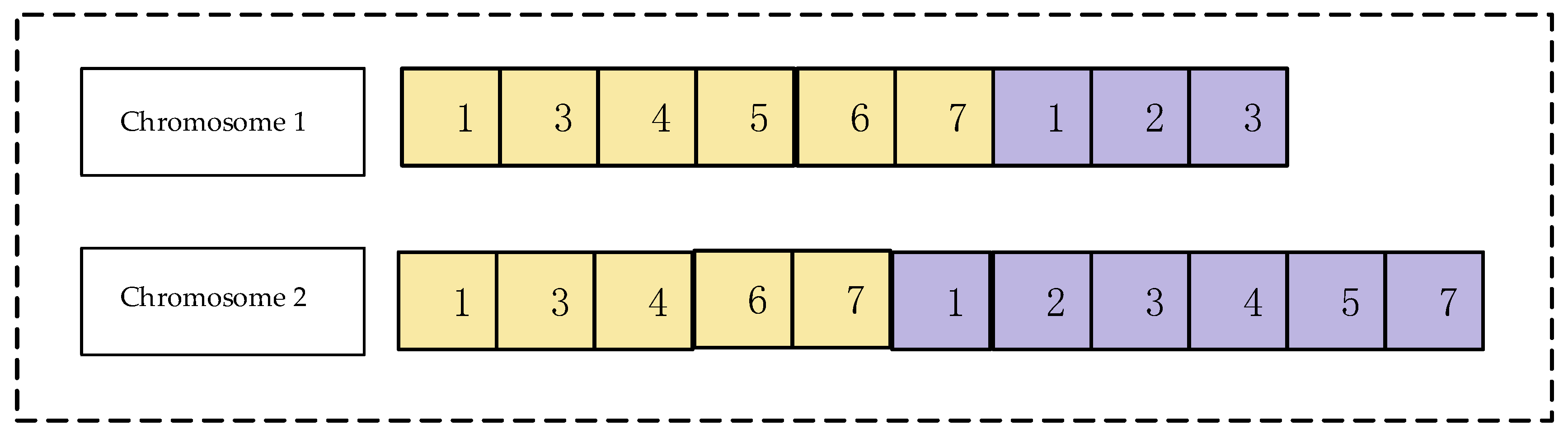
A two-part encoding scheme is adopted for the UAV–truck system. The front segment is indicative of the truck route, whereas the rear segment encodes UAV sorties as triplets, with each triplet consisting of a launch node, a service (delivery) node, and a recovery (landing) node. As demonstrated in the accompanying figure, the sequence from 0 to 9 in the front segment signifies that the truck visits all demand nodes, while the trailing “2–3–4” denotes the UAV’s launch node, serviced node, and recovery node, respectively. Consequently, (2, 3, 4) constitutes a UAV sortie triplet.
The front segment exhibits a fixed length across chromosomes, as it enumerates the complete set of nodes in the truck tour. In contradistinction, the number of customers served by the UAV is not known a priori. This results in a variable-length rear segment, and consequently, chromosomes with different overall lengths. For instance, Chromosome 1 contains a single UAV-served customer, whereas Chromosome 2 contains two UAV-served customers, resulting in different chromosome lengths. As illustrated in the accompanying figure, the UAV serves one node in Chromosome 1, with the remaining nodes being served by the truck. In Chromosome 2, the UAV serves two nodes, while the remaining nodes are served by the truck. As shown in
Figure 4, the yellow nodes represent truck delivery points, and the purple nodes represent drone delivery points.
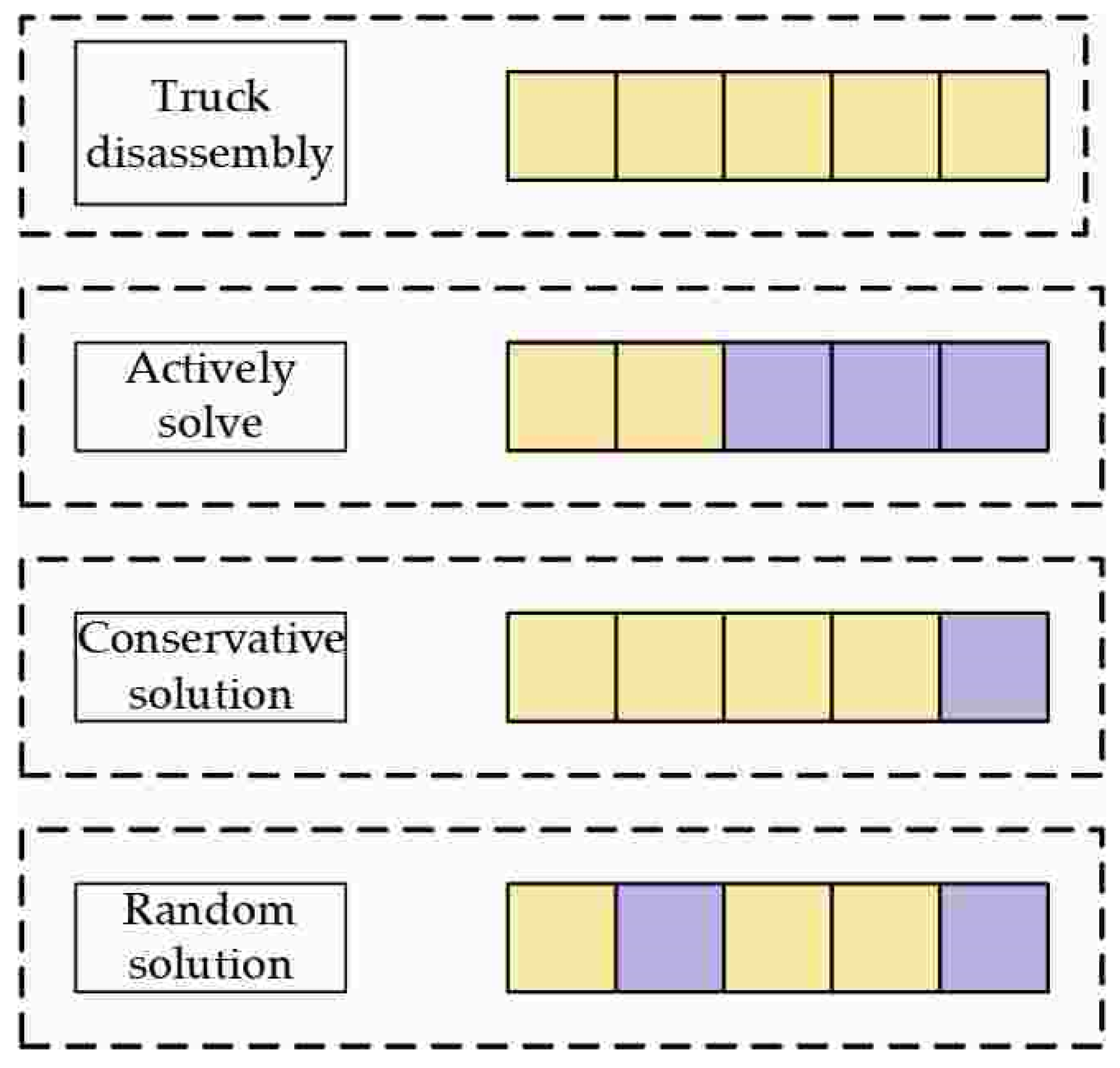
The initialization scheme is shown in
Figure 5. The initial population is generated using four chromosome-construction strategies: a truck-only solution, an aggressive solution, a conservative solution, and a random solution. In the truck-only solution, all customers are served by the truck. In the aggressive solution, the allocation of customers to either the truck or the UAV is determined by the feasibility of assigning them to the UAV, with priority given to the UAV. In the conservative solution, customers may also be assigned to either mode, and the UAV remains the preferred option. However, the number of UAV deployments is capped to limit UAV utilisation. In the random solution, customers are assigned to either the truck or the UAV without any deployment cap or preference bias.
Following the construction of the chromosome, a feasibility check is conducted. In the event of any customers being absent, they are to be inserted into the truck route. Conversely, in the event of duplicate customers being present, they are to be removed. As demonstrated in the accompanying figure, nodes serviced by trucks are highlighted in yellow, whereas those serviced by UAVs are highlighted in purple. It is important to note that different service assignments correspond to different initialization outcomes.
The fitness value is defined as the reciprocal of the total completion time; therefore, a longer travel time yields a lower fitness value. The process of fitness evaluation is conducted in accordance with the following sequence of steps:
The primary objective of this study is to verify customer coverage. Prior to the computation of fitness, it is imperative to ascertain that the solution encompasses all demand nodes.
The second element to be considered is that of feasibility (constraint) checking. The designed algorithm is integrated with the mathematical model to determine whether a solution satisfies all constraints, such as the constraint that the truck must depart from the depot and return to the depot after completing deliveries, and each customer can be served exactly once by either the truck or the UAV.
Thirdly, consideration must be given to meteorological conditions and restrictions pertaining to air travel. The system is utilised to ascertain the meteorological conditions experienced during UAV flight, thereby evaluating the viability of take-off and the projected duration of the flight.
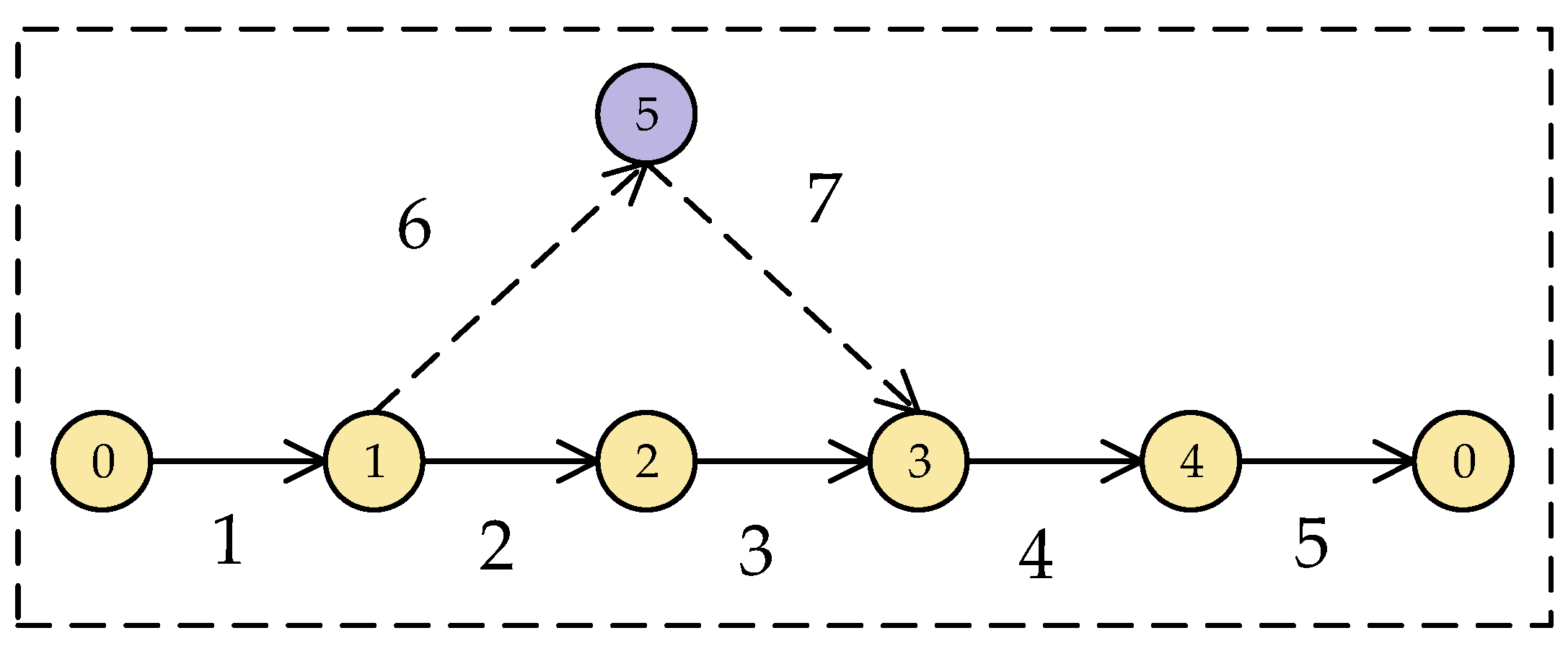
The fourth method is that of fitness mapping. The calculation of fitness is dependent on the total duration of the route. The critical aspects of total-time evaluation include the calculation of (i) the synchronization time at truck–UAV rendezvous nodes and (ii) the truck arrival times at nodes. In the
Figure 6, yellow circles represent truck-served nodes and purple circles represent UAV-served nodes. The total time is defined as the time required for the truck to depart from node 0, complete all deliveries, and return to node 0, while accounting for customers serviced by the UAV. During the interval between nodes 1 and 3, the truck and the UAV operate in parallel: the UAV serves node 5 while the truck serves nodes 1, 2, and 3. Consequently, the time at which the system can proceed beyond node 3 is determined by the maximum of the truck’s and the UAV’s arrival times at node 3. In the given example, the UAV requires 13 min whereas the truck requires 5 min; therefore, the UAV time governs. Consequently, when computing the overall completion time, particular attention must be paid to the truck arrival times and to synchronization at truck–UAV rendezvous nodes.
- (1)
Elite Preservation Strategy
The elite preservation strategy is defined as the process of maintaining a subset of high-fitness individuals following evolutionary operations such as crossover and mutation. In this particular paradigm, individuals are evaluated according to their level of fitness, and a subset of the most effective solutions is replicated directly into the subsequent generation. This mechanism has the capacity to accelerate convergence, improve algorithmic stability, and prevent the loss of high-quality individuals due to stochastic genetic operations.
In this study, the implementation of elite preservation is articulated as such. Firstly, in each generation, a fixed proportion of high-fitness individuals is retained. Secondly, the globally best individuals identified to date are documented, thereby ensuring that, in the event of the algorithm displaying aberrant behaviour in a specific generation, these elite solutions can be retrieved to resume the search from reliable incumbents. Thirdly, the number of elite individuals is subject to dynamic adjustment. Proportional retention is congruent with the fundamental principle of elitism, thereby facilitating accelerated convergence through the consolidation of the search within the high-quality regions of the solution space. The global recording of the most accomplished individuals serves as a safeguard against the occasional occurrence of performance degradation during the course of evolution. Finally, the dynamic adaptation of the elite size has been shown to facilitate a balance between exploitation and exploration. In instances where the population exhibits limited improvement over multiple generations, the elite set is reduced and the proportion of non-elite individuals is increased. This, in turn, leads to an expansion in search diversity and, by extension, the explored region of the solution space is effectively enlarged.
- (2)
Adaptive Parameters
Adaptive parameters are adjusted dynamically according to functional rules, rather than being treated as fixed constants. In the proposed algorithm, adaptivity is incorporated in two distinct aspects: firstly, in the mutation rate, and secondly, in the number of elite individuals. The iterative generation of offspring in a genetic algorithm can be interpreted as a search process over the solution space. In order to alleviate premature convergence and reduce the likelihood of becoming trapped in local optima, an adaptive mutation rate is employed. The precise formulation of the adaptive mutation rate is as follows:
In the formula, denotes the baseline mutation rate, denotes the number of stagnation generations, and denotes the adaptive mutation rate. As the value increases, the mutation rate is increased accordingly, which promotes broader exploration of the solution space and helps the algorithm escape local optima. The number of elite solutions is adjusted in a similar manner: based on the stagnation generations, the corresponding parameter is increased or decreased to expand or contract the search scope.
- (3)
Tournament Selection
Tournament selection is a process of random sampling, whereby a predetermined number of individuals are selected from a given population. The individual with the highest level of fitness is then chosen as the parent. The strategy under discussion has been shown to be effective in preserving population diversity, as evidenced by its implementation in the sampling process. This is achieved by permitting individuals with a lower level of fitness to participate. When combined with elitism, tournament selection achieves a balance between randomness (exploration) and determinism (exploitation).
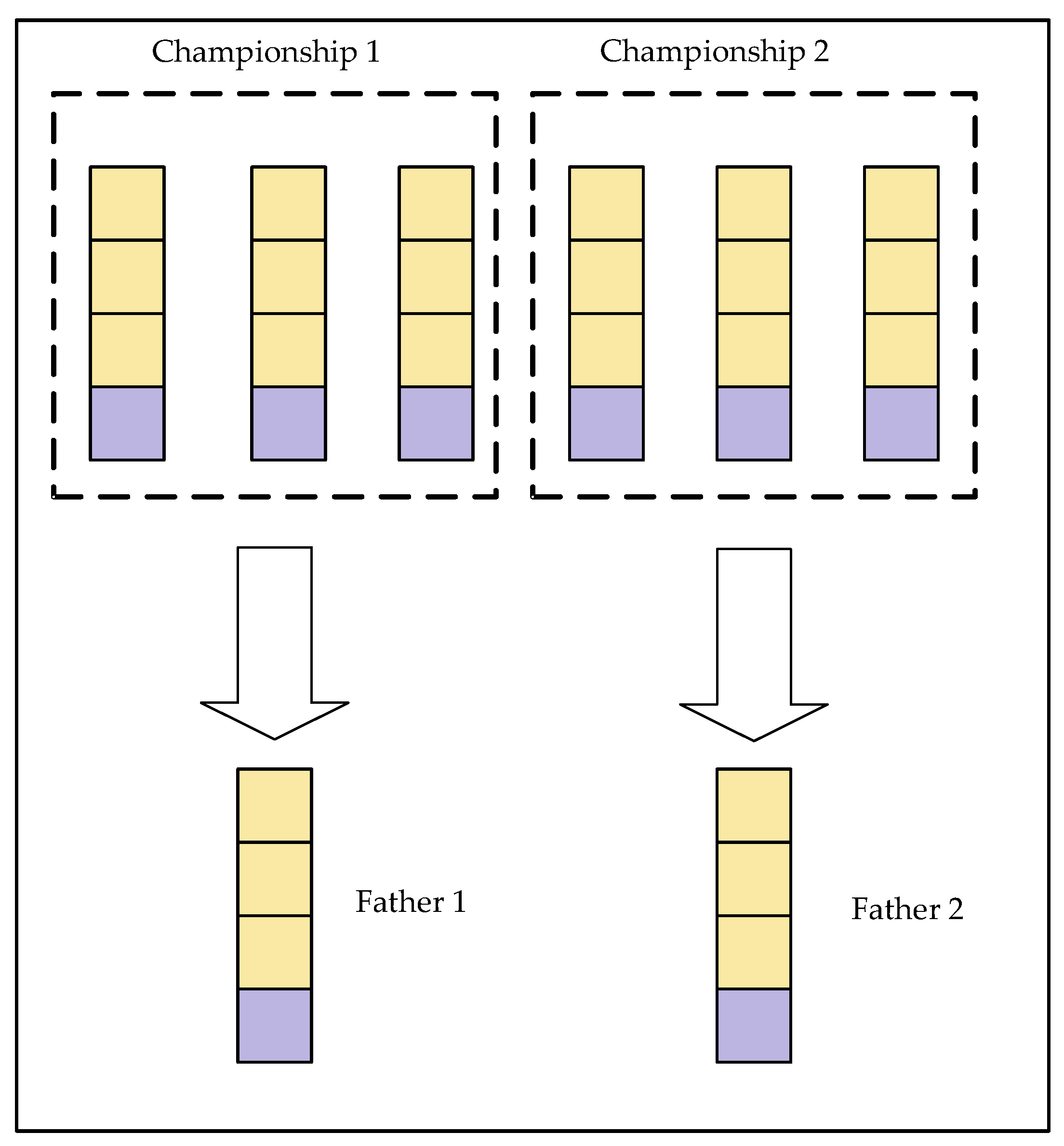
In the proposed algorithm, tournament selection is used to determine parent individuals. Subsequent to the initialisation of the population, a predetermined number of individuals is randomly selected to constitute a tournament. The candidates are then evaluated based on their level of fitness, and the individual who demonstrates the highest level of aptitude is selected as a parent. It is imperative to note that the identical procedure is applied in every generation subsequent to the population update. As demonstrated in the accompanying figure, the nodes in yellow are representative of customers serviced by trucks, while those in purple correspond to customers serviced by UAVs. In the context of a tournament comprising three events, the initial tournament (hereafter referred to as ‘Tournament 1’) employs a fitness ranking system to select Parent 1. Subsequent tournaments are structured in a similar manner. As shown in
Figure 7, a diagram of the tournament.
- (4)
Crossover and Mutation
In consideration of the two-part encoding, which comprises a truck route and UAV triplets, it is acknowledged that individual lengths may vary due to the variable number of UAV sorties. Consequently, crossover and mutation are performed separately for the UAV segment and the truck segment. In the context of the truck segment, three distinct crossover operators are employed: order crossover (OX), partially mapped crossover (PMX), and edge recombination crossover (ERX).
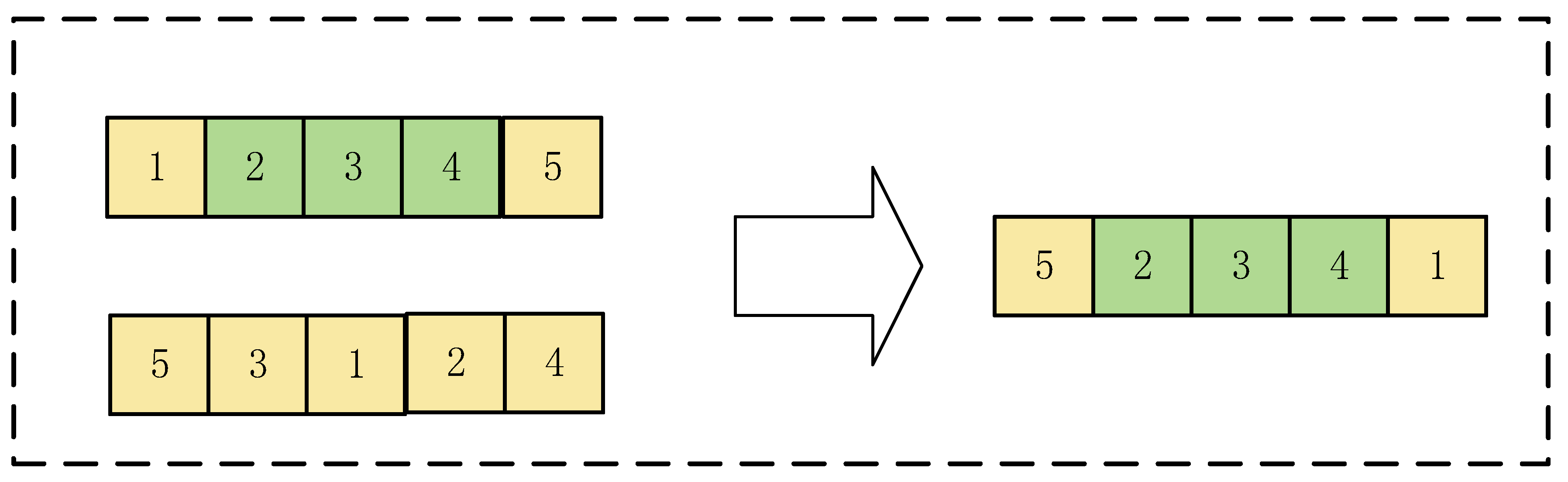
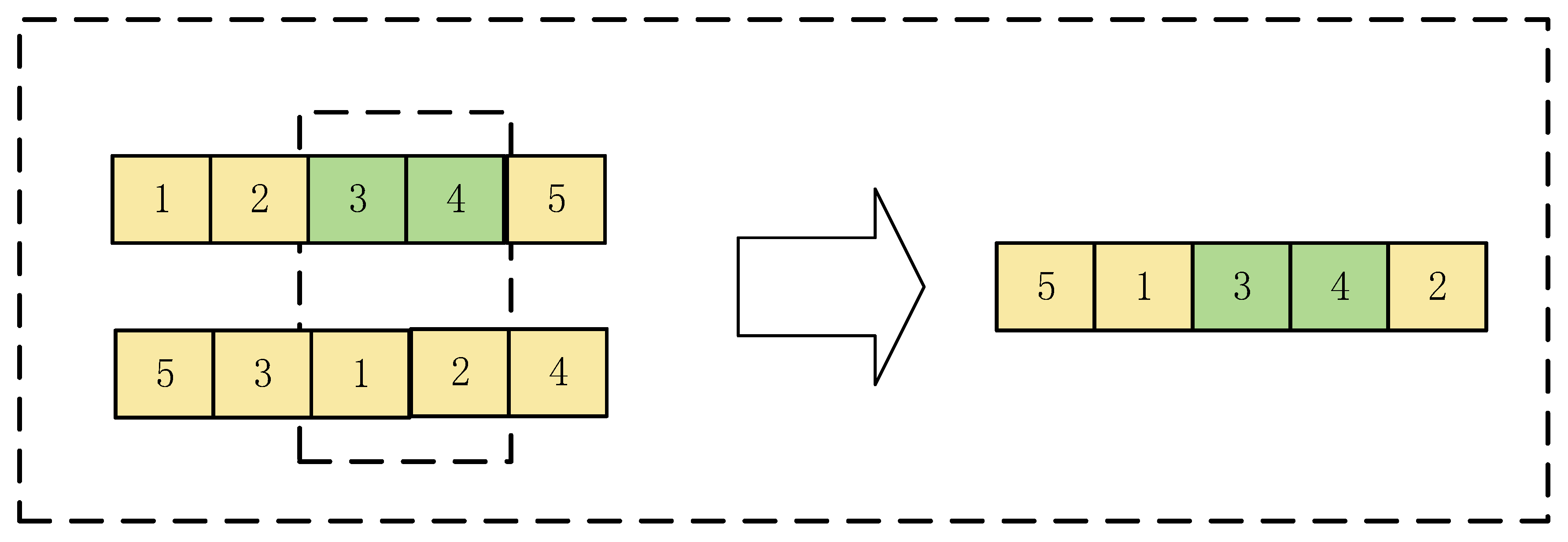
The order crossover (OX) is illustrated in the
Figure 8 below. The upper chromosome is designated as Parent 1, while the lower chromosome is labelled Parent 2. Each individual is indexed from 0 to 4, and the crossover segment is selected from index 1 to index 3 (highlighted in green in Parent 1). The offspring inherits the genes at indices 1–3 from Parent 1. The remaining positions are then filled by scanning Parent 2, starting from index 4, yielding the visiting order 4, 5, 3, 1, 24, 5, 3, 1, 2. Following the removal of the nodes already contained within the inherited segment (i.e., 2, 3, and 4), the remaining nodes are then inserted sequentially (i.e., 5 and 1), thus completing Offspring 1.
The concept of partially mapped crossover (PMX) is illustrated in the accompanying
Figure 9. The crossover segment is selected from indices 2 to 3; the green segment taken from Parent 1 is {3, 4}. A mapping is then constructed between the two parents over this segment, namely 3 versus 1 and 4 versus 2. The remaining positions of the offspring are initially filled using the corresponding genes from Parent 2.
Specifically, the first position in Parent 2 is 5, which is inserted directly. The second position in Parent 2 is 3, but this value is a duplication of a gene already present in the inherited segment. Therefore, it is replaced according to the mapping, yielding 1. In a similar manner, the fifth position in Parent 2 is 4, which is also a duplicate. This is replaced by its mapped counterpart, 2. Consequently, the resulting offspring is [5, 1, 3, 4, 2].
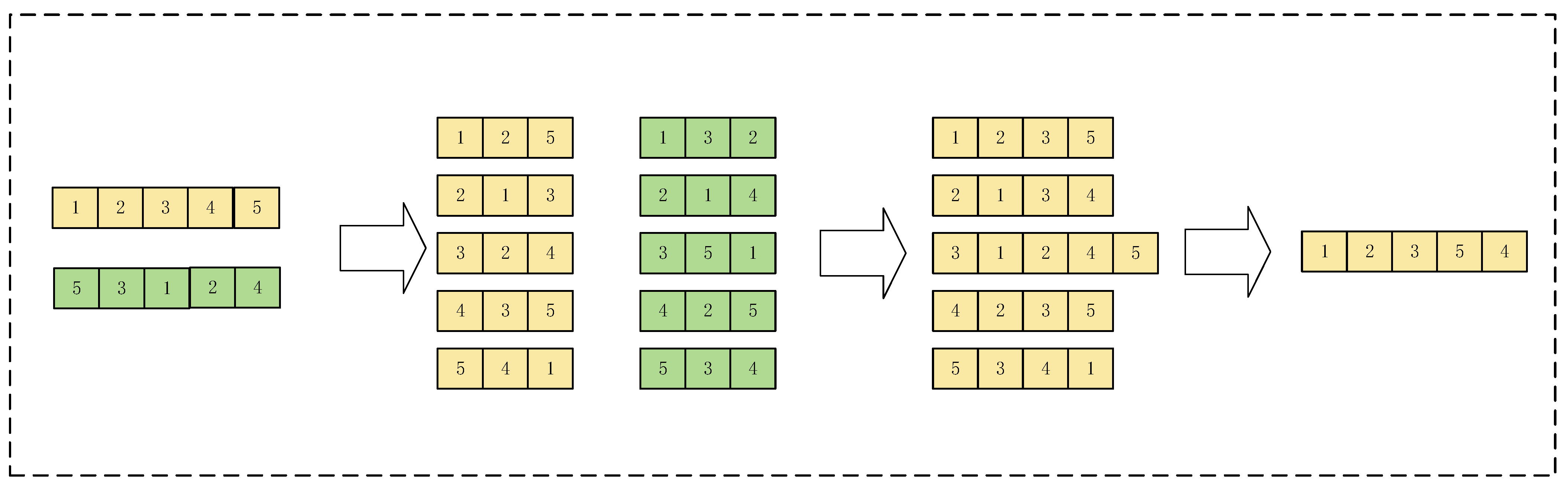
The concept of edge recombination crossover (ERX) is illustrated in the accompanying figure. ERX places significant emphasis on the preservation of adjacency information, that is to say, the connections between neighbouring nodes (edges). In the provided example, Parent 1 is represented by the colour yellow, and Parent 2 by green. Initially, the adjacency relationships among nodes are identified separately for both parents (as illustrated in Step 2), and an adjacency list is subsequently constructed by merging the neighbour sets from the two parents (Step 3). In conclusion, the offspring is generated in accordance with a predetermined selection rule.
The procedure delineated in the
Figure 10 can be summarised as follows:
The initial point of departure is designated as node 1. Its candidate neighbors are {2, 3, 5}. For each candidate, the number of remaining neighbours is to be counted after the removal of node 1 from its adjacency list. The subsequent node is selected as the candidate with the minimal neighbour count. In this instance, nodes 2 and 5 have the lowest counts, and either can be selected.
Following the selection of node 2, the adjacent nodes are determined to be 1, 3 and 4. With the previously selected node 1 excluded from the analysis, a comparison of the neighbour counts of nodes 3 and 4 is warranted. Given the equal counts, either 3 or 4 can be selected.
Following the selection of node 3, the adjacent nodes are determined to be 4 and 5. With the already selected nodes {1, 2} excluded from the analysis, a comparison of the neighbour counts of 4 and 5 is warranted. It is evident that the counts are equal on this occasion, and therefore it can be concluded that either node may be selected.
Following the selection of node 5, it is observed that only node 4 remains. Consequently, the offspring has been completed.
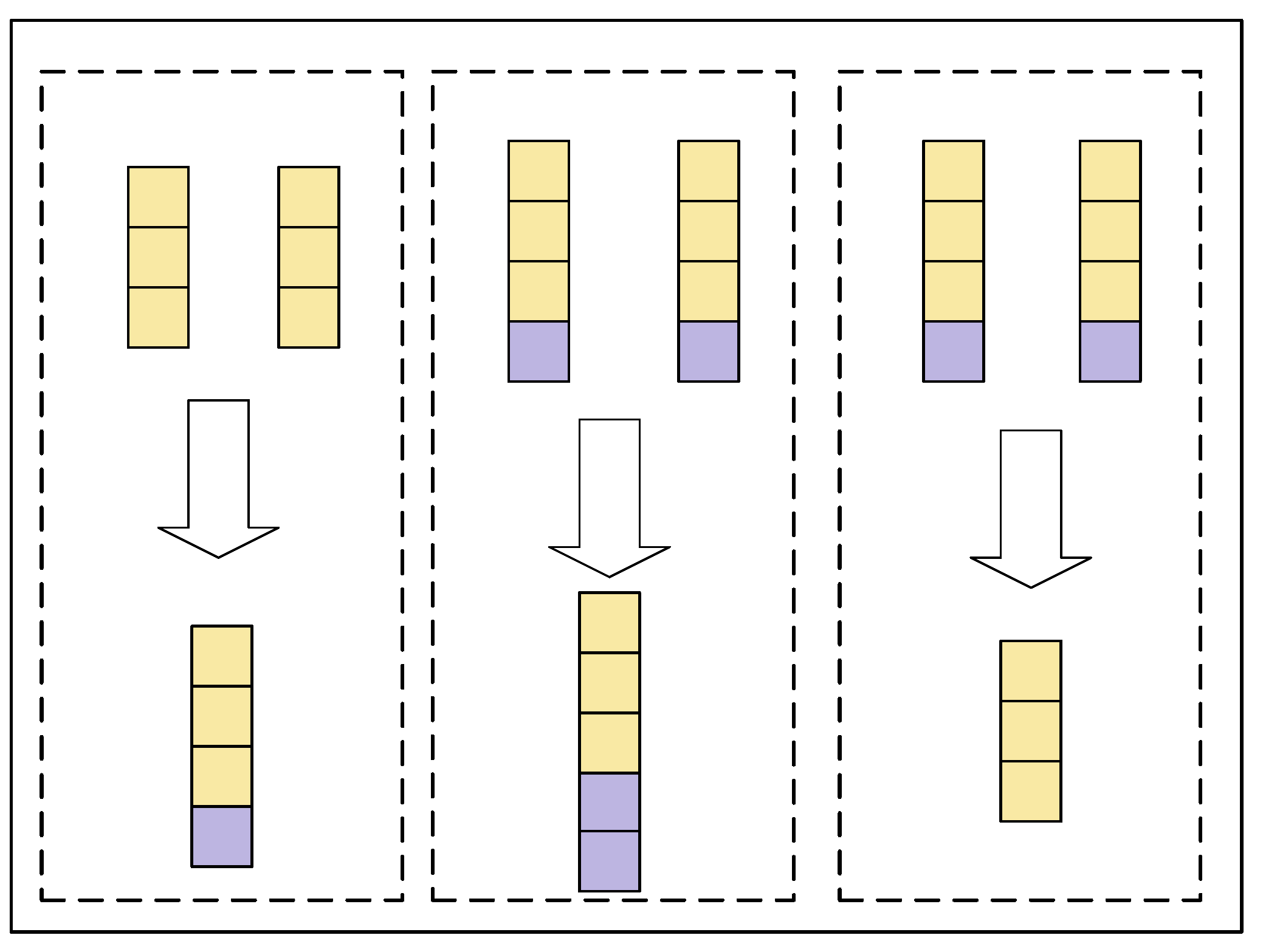
The implementation of UAV crossover is primarily achieved through three distinct operations: the regeneration of UAV triplets, the direct inheritance of UAV triplets, and the deletion of UAV triplets. As demonstrated in the accompanying
Figure 11, yellow nodes are indicative of customers who are served by trucks, while purple nodes denote those served by UAVs. The initial panel corresponds to UAV-triplet regeneration, the subsequent panel to UAV-triplet inheritance, and the final panel to UAV-triplet deletion. It is evident that the UAV crossover performs recombination primarily within the set of triplets that have been presented in the parents. Additionally, the UAV crossover has the capacity to insert UAV triplets that are compatible with the newly generated truck route.
The term “mutation” is comprised of three constituent components: firstly, the specification of an adaptive mutation rate; secondly, truck-route mutation; and thirdly, UAV-node mutation. The adaptive variability rate is demonstrated in the formula and can be instantiated via different functional forms to emulate different evolutionary dynamics across iterations.
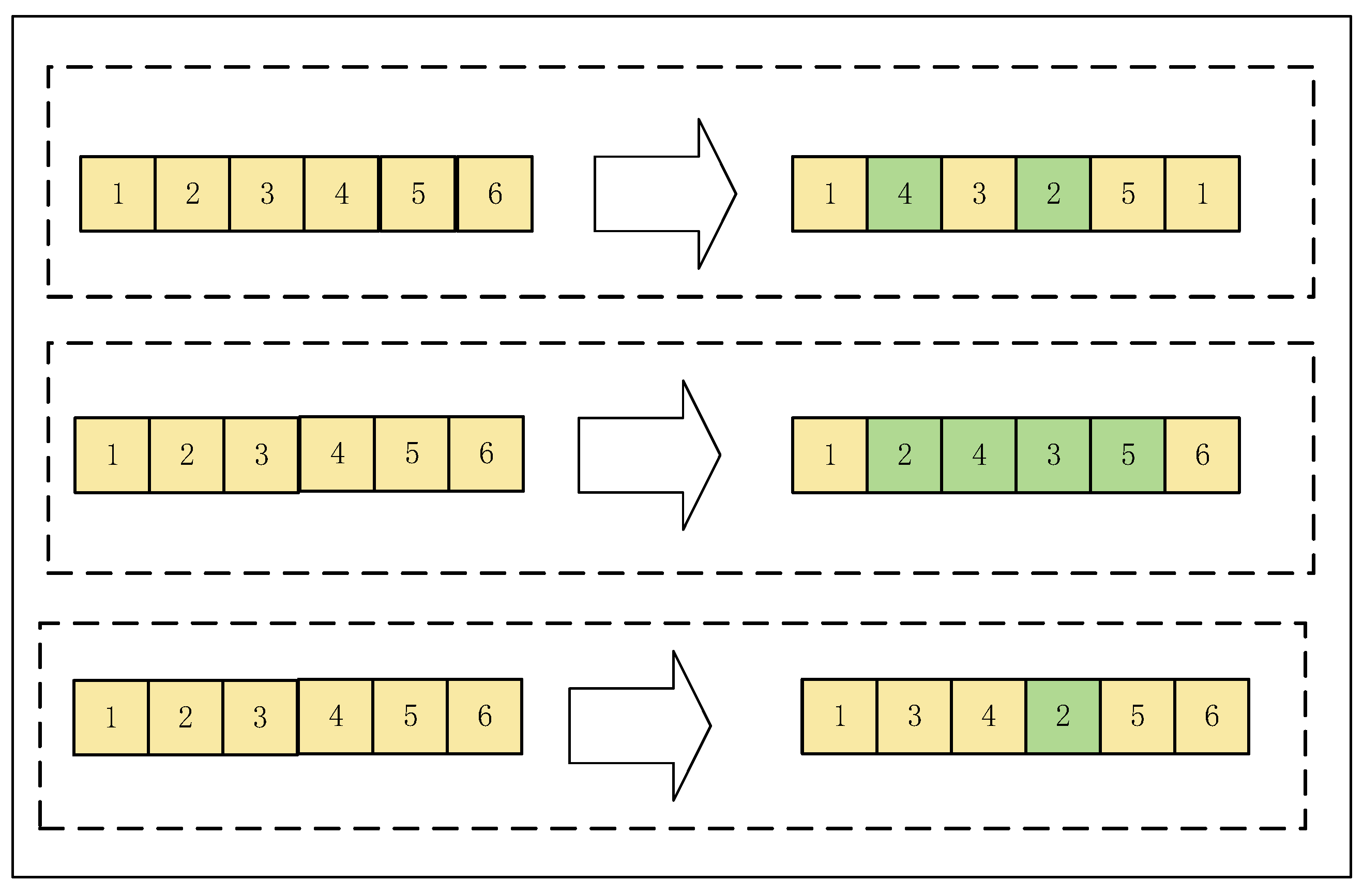
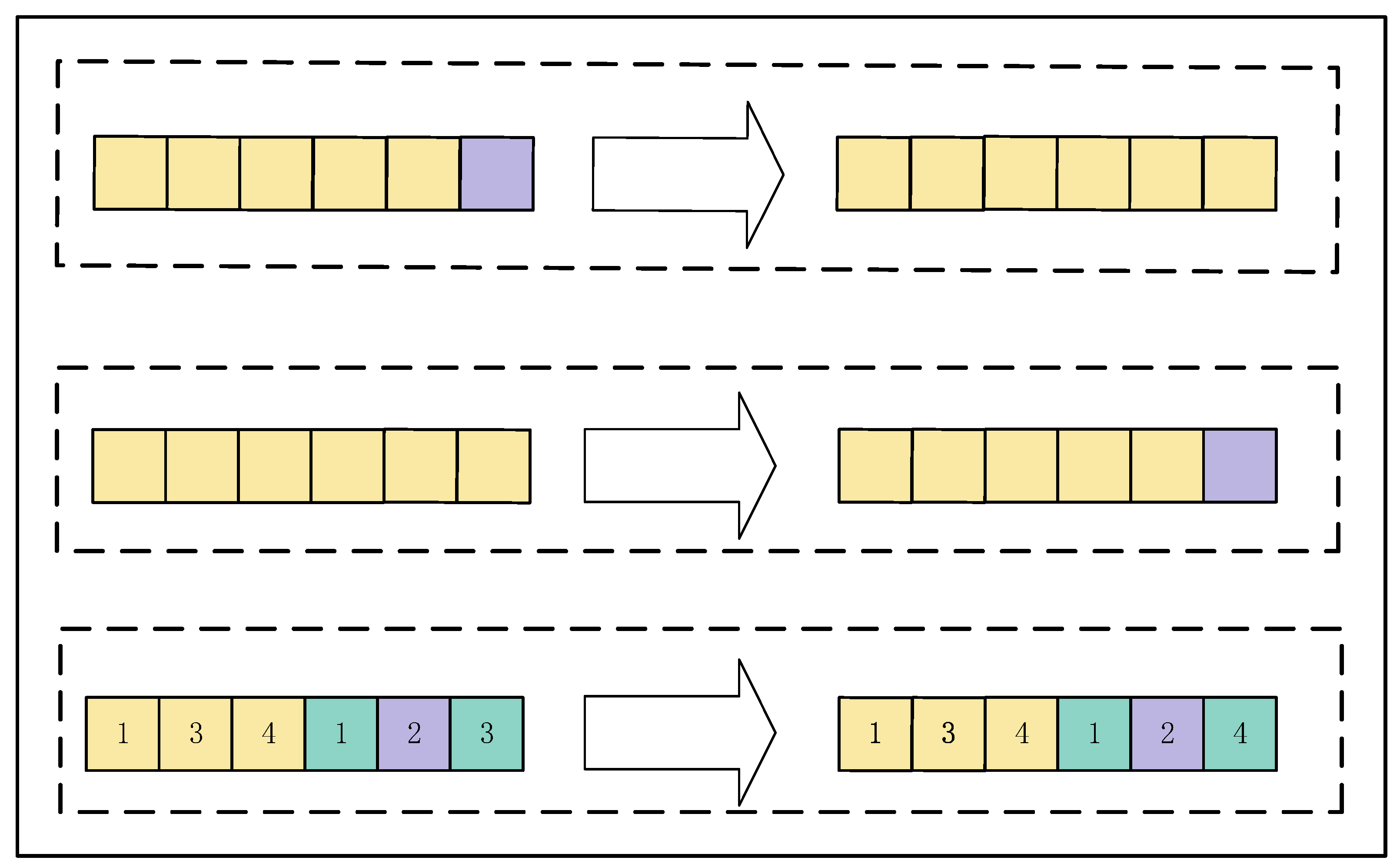
The implementation of truck-route mutation is achieved through the utilisation of three distinct operators: namely, swap mutation, in-version mutation, and insertion mutation. The random selection of two nodes on the truck route and subsequent exchange of their positions is known as swap mutation. Inversion mutation is a process that involves the selection of a specific sequence of nodes on a given graph. In this context, the two boundary nodes are kept fixed, while all intermediate nodes are reversed. This process is referred to as “inversion mutation” because it involves the inversion of a specific sequence of nodes. Insertion mutation involves the random selection of a node and its subsequent relocation to a different position in the route. As demonstrated in the accompanying figure, the initial panel illustrates the process of swap mutation, whereby nodes 2 and 4 are exchanged. The subsequent panel delineates the inversion mutation, characterised by the reversal of the segment between nodes 2 and 5. The final panel illustrates the insertion mutation, which involves the insertion of node 2 immediately following node 4. As shown in
Figure 12, a diagram illustrating changes in the truck’s path.
The implementation of UAV-related mutation is achieved through the utilisation of three operators: The following procedures are to be followed:
- (i)
The conversion of a UAV-served node into a truck-served node;
- (ii)
The conversion of a truck-served node into a UAV-served node;
- (iii)
The modification of the UAV launch and recovery nodes. As illustrated in the
Figure 13, yellow nodes are used to denote truck-served customers, purple nodes are used to denote UAV-served customers, and blue nodes are used to denote UAV launch and recovery points. The initial panel provides a visual representation of the conversion of a UAV-served node to a truck-served node. The subsequent panel offers a visual depiction of the conversion of a truck-served node to a UAV-served node. Finally, the third panel illustrates the modification of the UAV recovery node from node 3 to node 4.
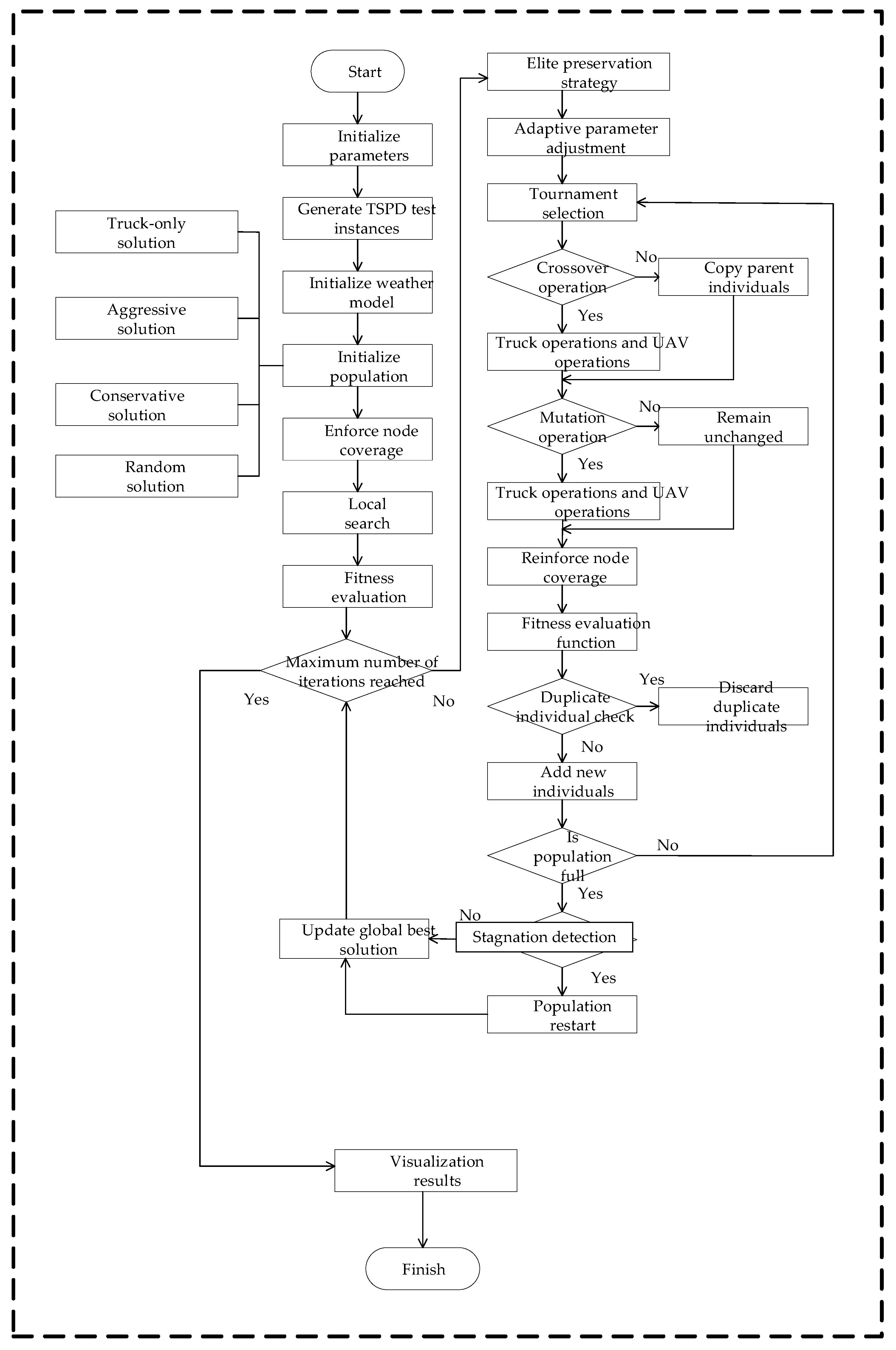
The proposed UAV-truck solution algorithm is designed as follows:
The initialization of parameters and the generation of instances are prerequisites for the subsequent steps in the process. The initial steps in the sequence of events comprise the initialisation of algorithmic parameters, the generation of benchmark instances, and the initialisation of the weather system.
The subsequent stage of the process is population initialisation and preprocessing. The initialisation of the population and subsequent classification of individuals into four distinct groups is imperative: namely, truck-only solutions, aggressive solutions, conservative solutions, and random solutions. Subsequently, the coverage checking procedure should be performed, followed by the application of local search in order to refine the solutions.
The third component of the study is the fitness evaluation. The feasibility of the solution is evaluated by checking compliance with the model constraints, and the total delivery time is computed, which is subsequently converted into the fitness value.
The termination check is the fourth step in the process. In the event that the maximum number of iterations is reached, the results should be visualised; otherwise, the process should be moved on to the next iteration.
The fifth point for consideration is that of evolutionary iteration. The population should be evolved according to the prescribed elite preservation strategy, adaptive-parameter scheme, and tournament-selection setting.
Sixthly, there is the concept of crossover and mutation with local improvement. With specified probabilities, perform crossover and mutation operations; subsequent to these operations, apply local search to further improve the offspring solutions.
The process of re-evaluation and subsequent ranking is a key component of the methodology. The subsequent steps involve the re-computation of fitness, the comparison of individuals, and the ranking of the population according to their level of fitness.
In this section, the eighth point to consider is the handling of duplicates and the completion of populations. Following two rounds of fitness evaluation, it is imperative to verify the absence of duplicate individuals. In the event of duplicates existing, these should be removed; otherwise, newly generated individuals should be added to form the updated population.
The ninth issue pertains to the identification of stagnation and the subsequent initiation of a restart or update process. It is imperative to monitor whether the population is stagnating, that is to say, whether the best (or overall) fitness remains unchanged across iterations. In the event of stagnation being detected, the population should be restarted; otherwise, the global best solution should be updated.
The final termination and visualisation process is the concluding stage of the procedure. It is imperative to verify whether the iteration limit has been attained. In the event that this is the case, the final results should be output and visualised; if not, the iteration process should be continued. The algorithm flowchart is shown in
Figure 14.
4. Discussion
- (1)
The impact of the ratio of the speed of the drone to that of the truck on the solution results.
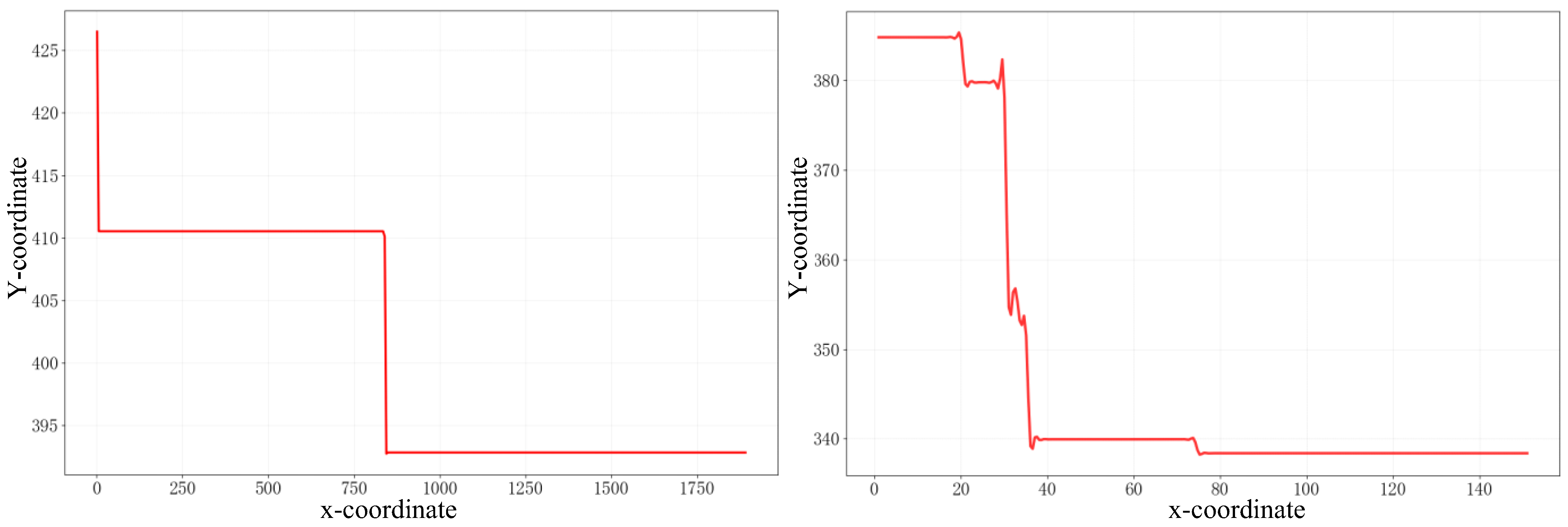
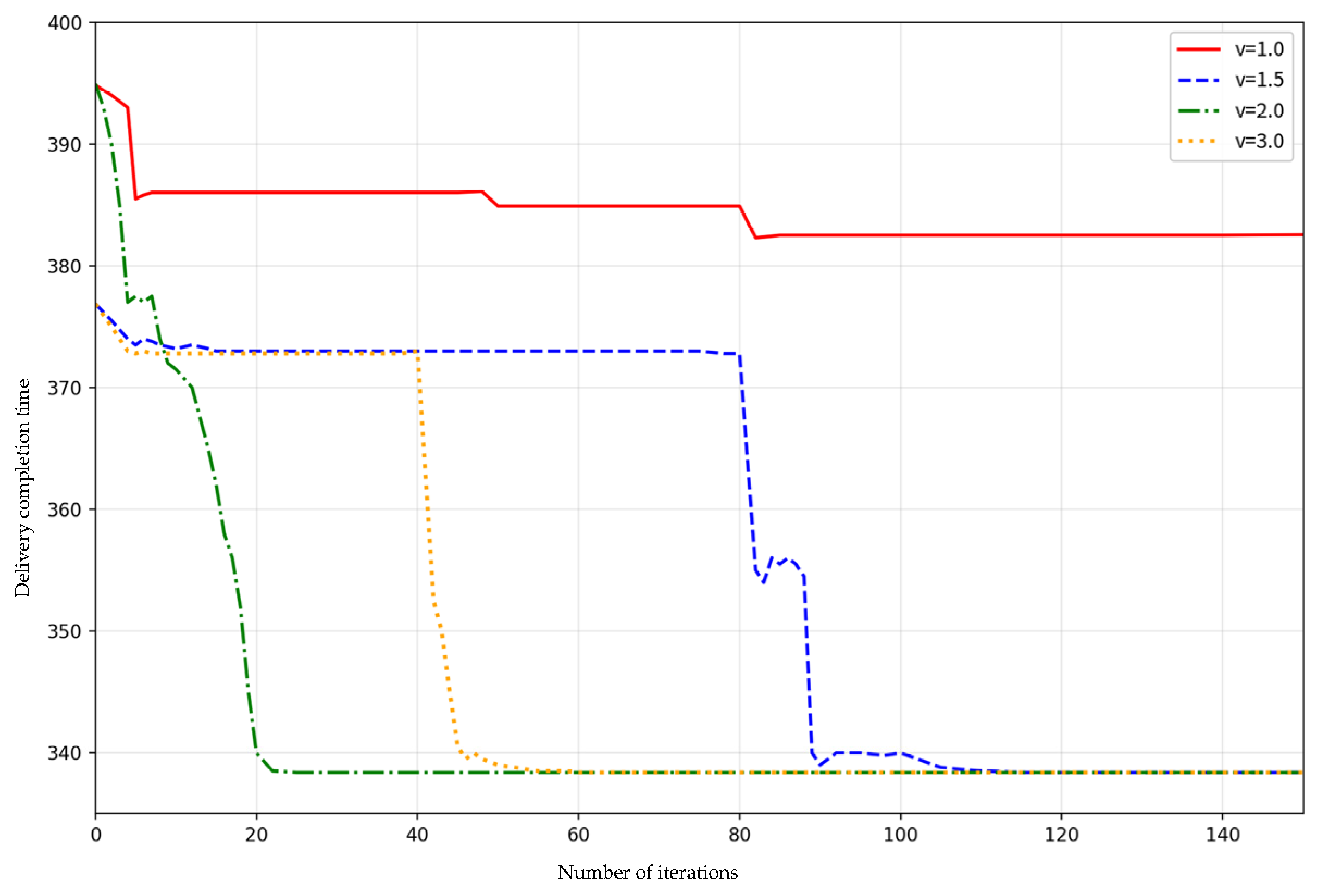
In studying the UAV–truck cooperative delivery problem, the speed ratio between the UAV and the truck is assumed to be 2.0. To investigate the effect of the speed ratio on solution quality, four experiments are conducted. The UAV-to-truck speed ratio is set to 1.0 in Experiment 1, 1.5 in Experiment 2, 2.0 in Experiment 3, and 3.0 in Experiment 4. The coordinates of the depot and demand nodes are fixed across all experiments, and all other parameters remain identical.
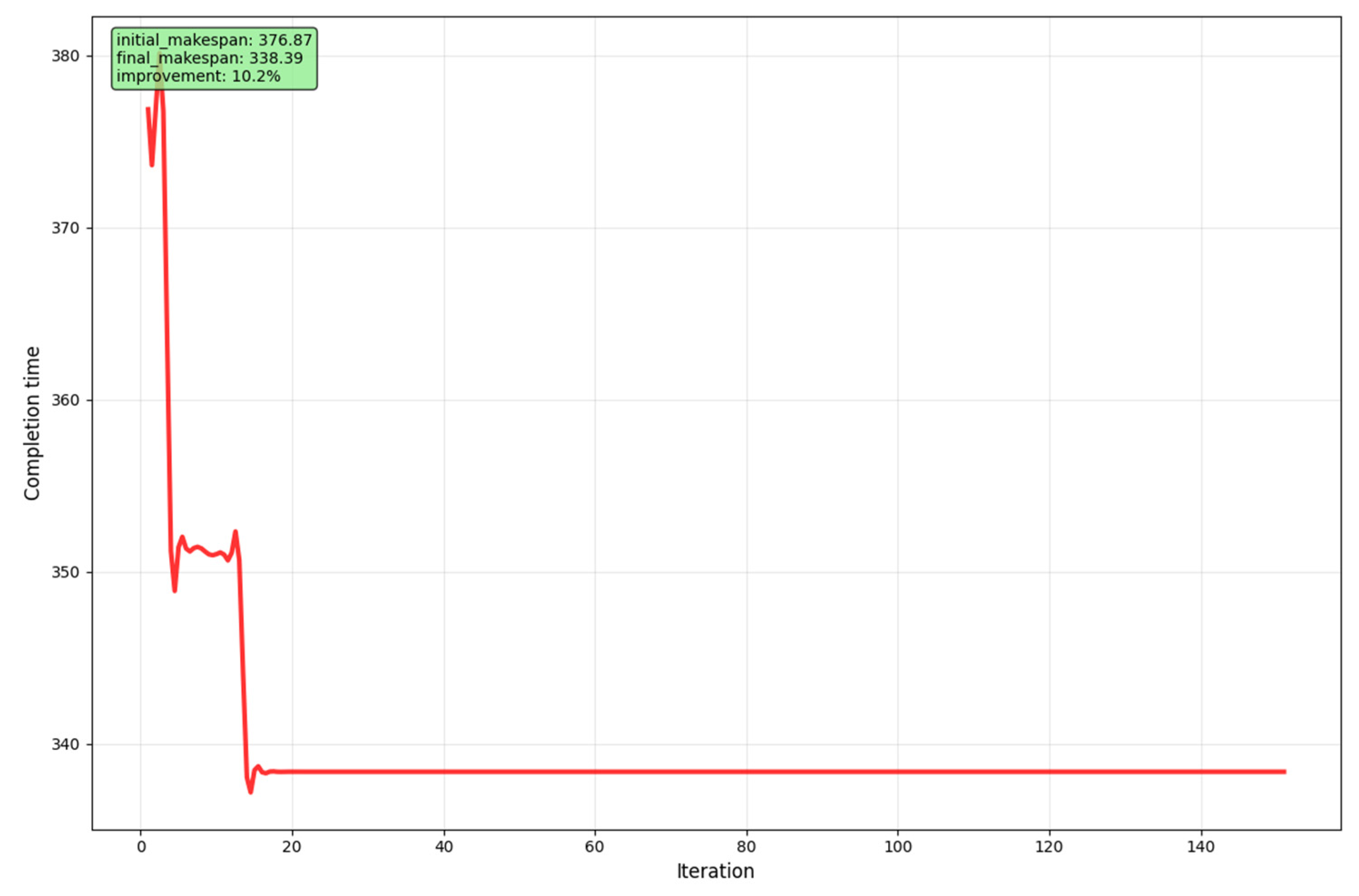
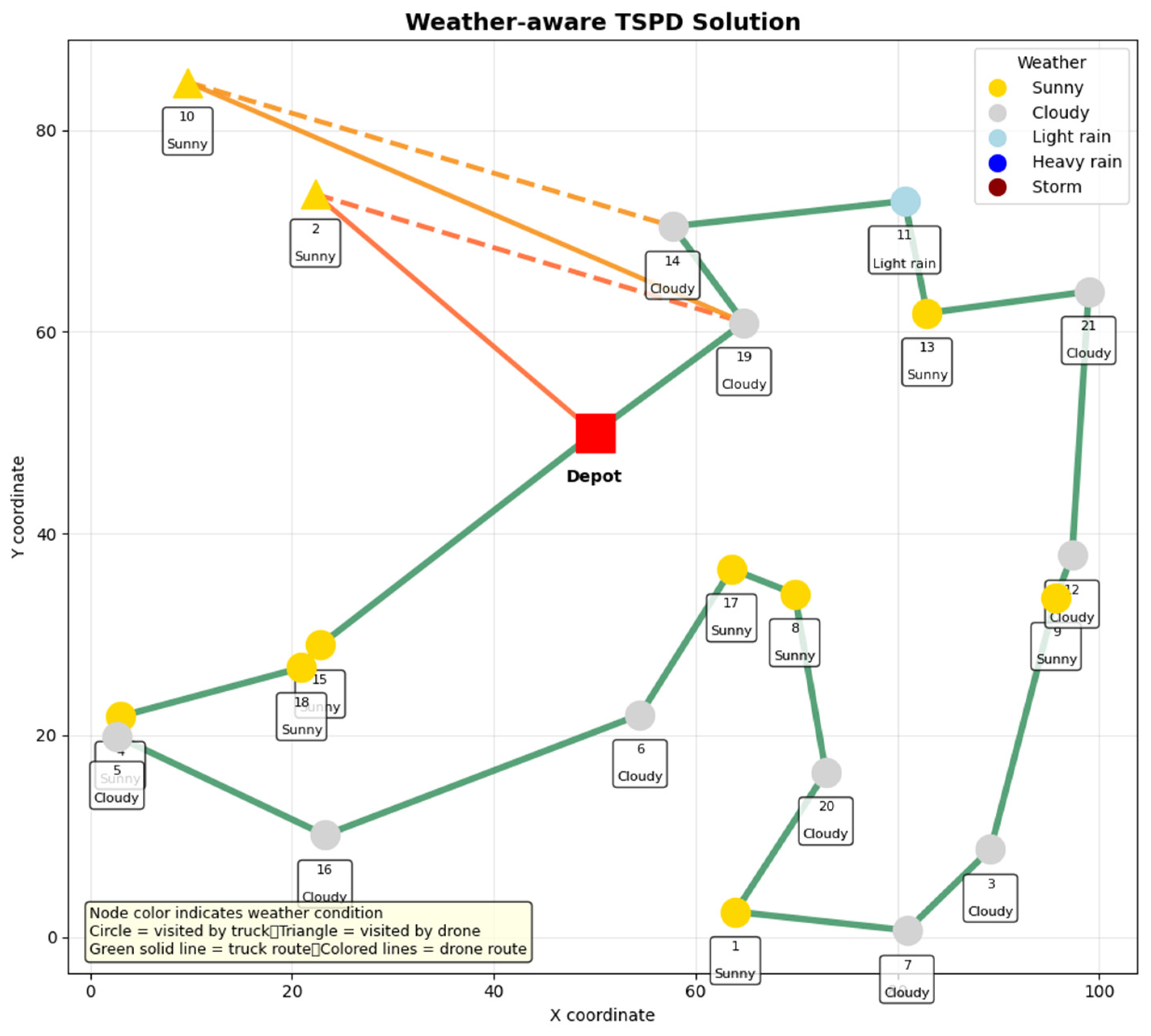
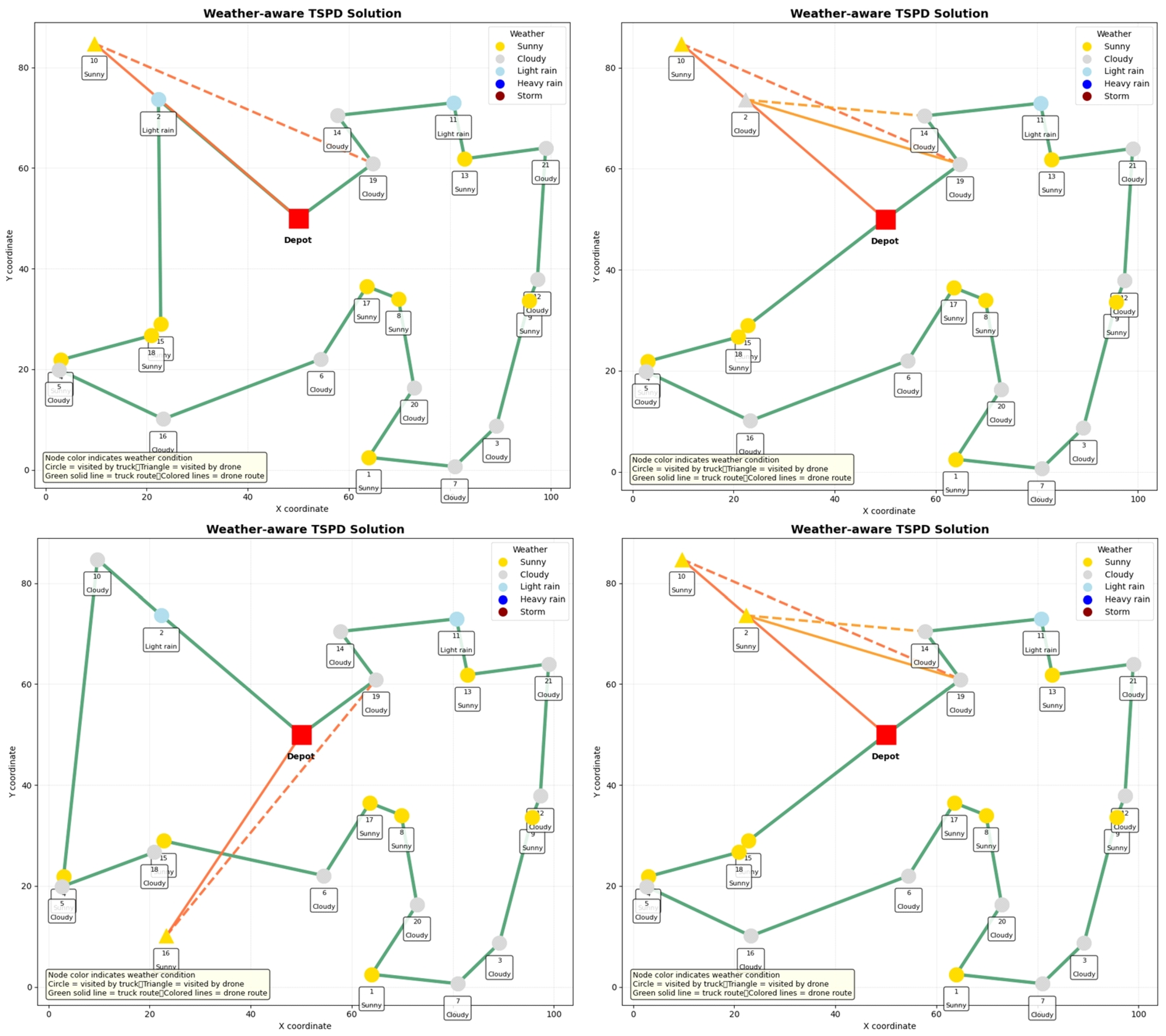
For each speed ratio, the convergence curve over iterations and the final delivery routes are plotted. The convergence curves indicate that the best performance is achieved when the UAV-to-truck speed ratio equals 2.0, as this setting converges the fastest and yields the shortest completion time. When the speed ratio is 1.0 or 3.0, the final delivery time is the same as that obtained with a ratio of 2.0, but more iterations are required to reach convergence. The final routing plots further show that the truck route is identical for speed ratios of 1.0, 2.0, and 3.0; however, the UAV route obtained at a ratio of 2.0 is superior to those at ratios of 1.0 and 3.0. This observation is consistent with the convergence-curve results, where the speed ratio of 2.0 produces the best overall outcome. The iteration costs and final path results are shown in
Figure 23 and
Figure 24.
- (2)
Impact of Weather Conditions on the Delivery Time in UAV–Truck Cooperative Routing
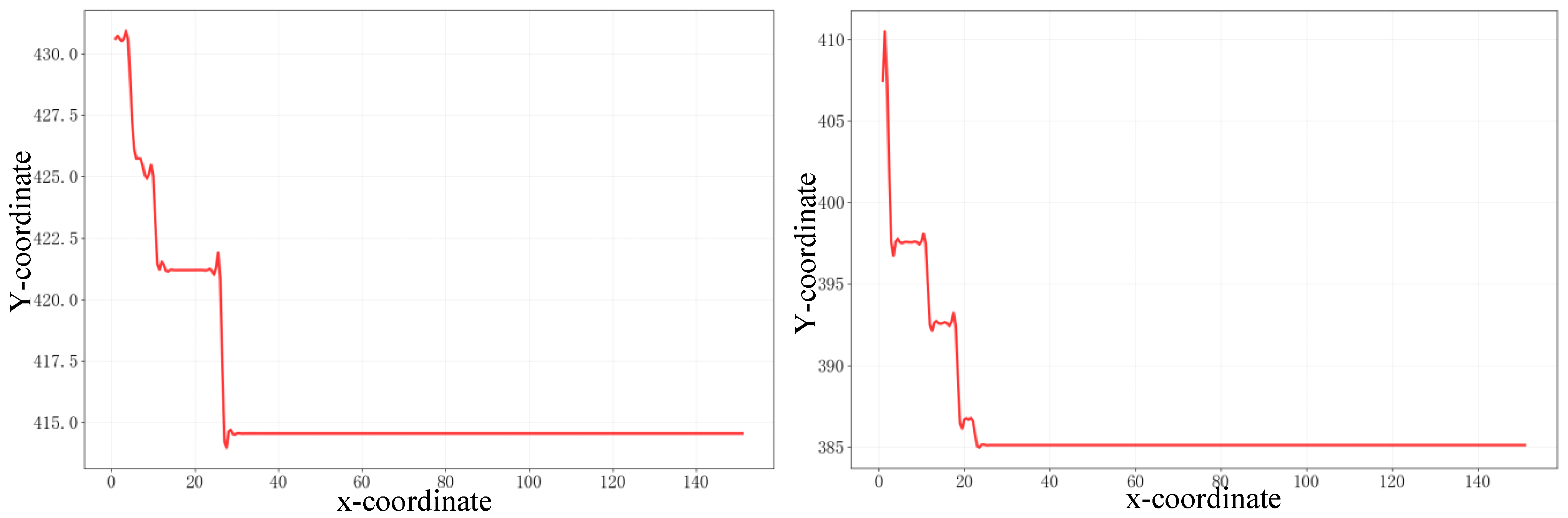
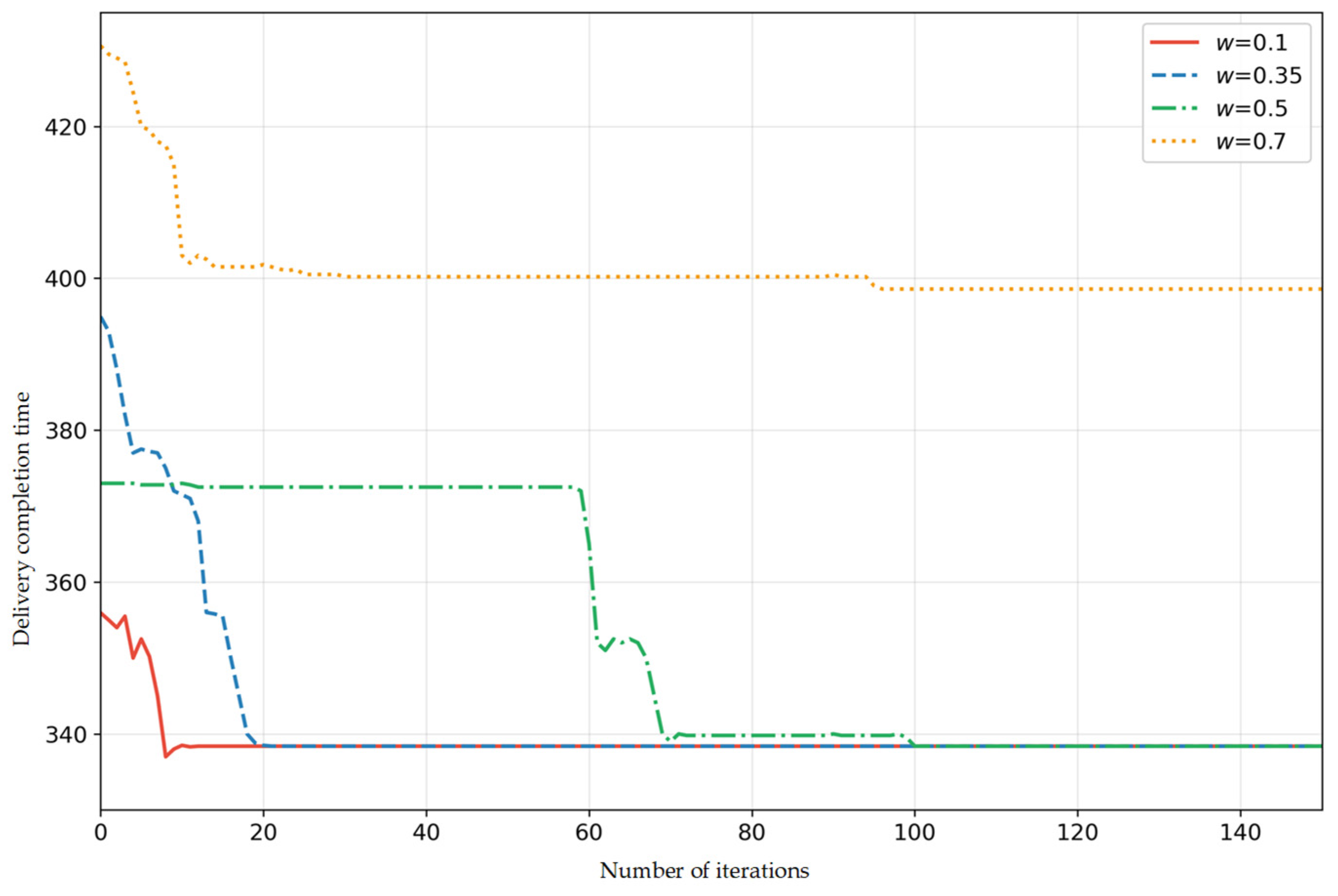
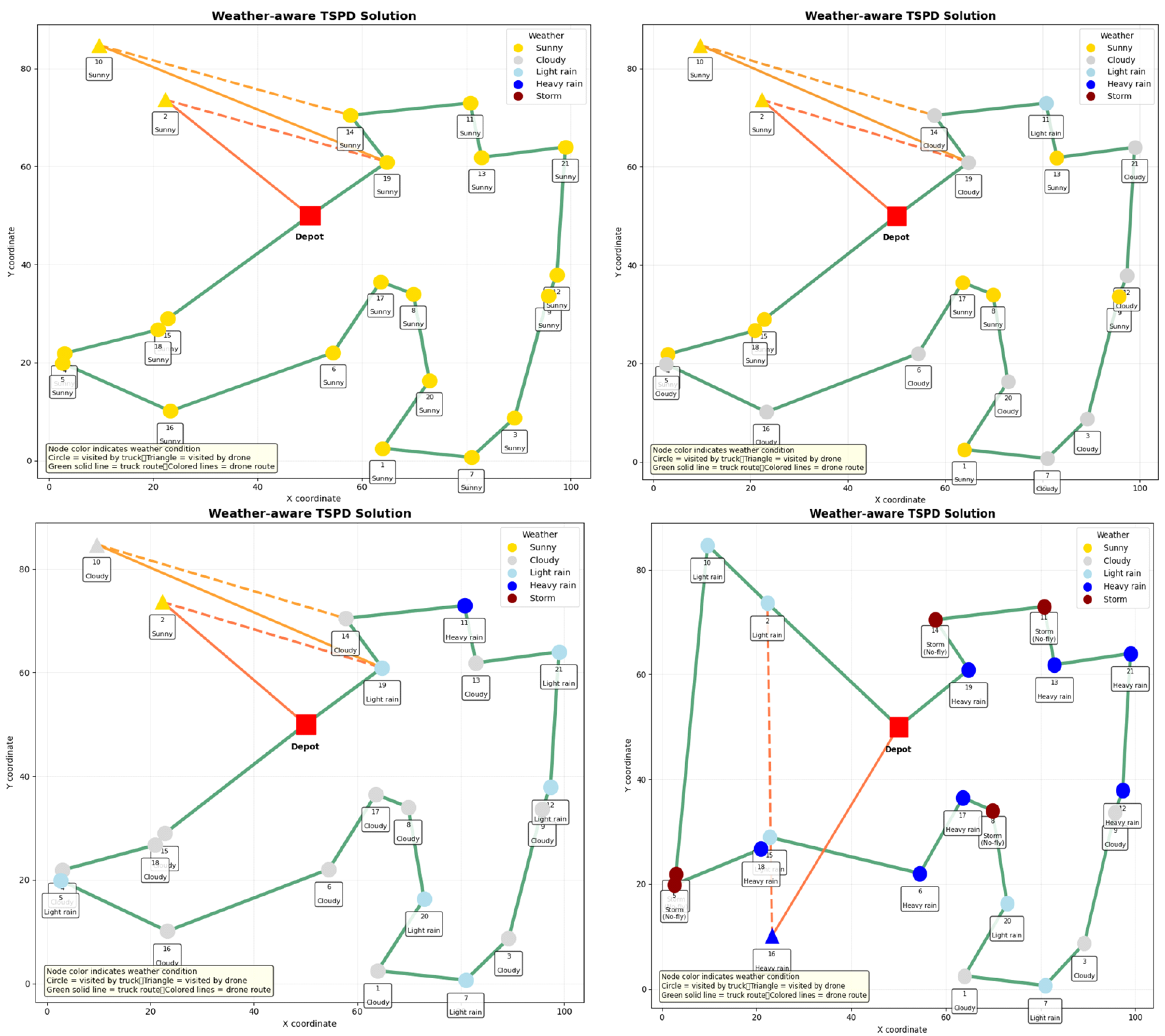
To investigate how weather conditions affect the delivery time of the UAV–truck cooperative transportation system, this study focuses on the setting of the baseline probability of adverse weather. Four experimental groups are designed by assigning the baseline adverse-weather probability to 0.1, 0.35, 0.5, and 0.7, respectively. To illustrate the influence of different baseline probabilities, both the convergence curves (objective value versus iteration) and the final UAV–truck routing maps are plotted.
From the convergence curves, the following observations can be made:
- (1)
Baseline adverse-weather probability = 0.1.
The initial solution time is 355.95, and the final solution time is 338.39, corresponding to an improvement of 4.9%. Because weather conditions are generally favorable, the initial solutions are of relatively high quality, leaving limited room for further improvement.
- (2)
Baseline adverse-weather probability = 0.35.
The initial solution time is 394.95, and the final solution time is 338.39, yielding a 14.3% improvement. As weather begins to deteriorate, the quality of the initial solution decreases, while the final solution remains unchanged; consequently, the relative improvement becomes larger.
- (3)
Baseline adverse-weather probability = 0.5.
The initial solution time is 373.83, and the final solution time is 338.39, resulting in a 9.5% improvement. Although weather conditions further worsen, the initial solution in this case is better than that under the baseline probability of 0.35. However, more iterations are required to reach the best value than in the 0.35 case. This suggests that the algorithm may occasionally generate a high-quality initial solution even under more adverse conditions; nevertheless, as the frequency of adverse weather increases, optimization becomes more difficult, and more iterations (and hence more computational effort) are needed to converge to the final solution.
- (4)
Baseline adverse-weather probability = 0.7.
The initial solution time is 430.61, and the final solution time is 398.58, corresponding to a 7.4% improvement. Under highly frequent adverse weather, the initial solution quality is poor and the algorithm requires substantially more optimization iterations to reach the best solution, in the order of approximately 100 generations.
From the final UAV–truck routing maps, consistent patterns can be observed across different baseline adverse-weather probabilities. When the baseline probability is 0.1, almost all nodes experience sunny conditions, which aligns with the convergence curve showing a high-quality initial solution. When the baseline probability increases to 0.35, one light-rain event appears and cloudy conditions occur at 10 nodes; consequently, the initial solution quality deteriorates due to weather impacts, and the initial completion time increases to 394.95. When the baseline probability is 0.5, the instance contains two heavy-rain events, five light-rain events, and 10 cloudy events, and multiple iterations are required before the algorithm converges to the optimal solution. When the baseline probability further increases to 0.7, thunderstorms occur as many as eight times, heavy rain occurs seven times, and light rain occurs four times. The frequent occurrence of thunderstorms substantially restricts UAV utilization, while heavy rain increases UAV flight times. These observations are consistent with the convergence results: the initial solutions are of low quality, the optimization process requires longer convergence, and the final solution quality is also reduced. The iteration costs and final path results are shown in
Figure 25 and
Figure 26.
- (3)
Impact of the UAV’s Reachability of Customer Nodes on Delivery Time
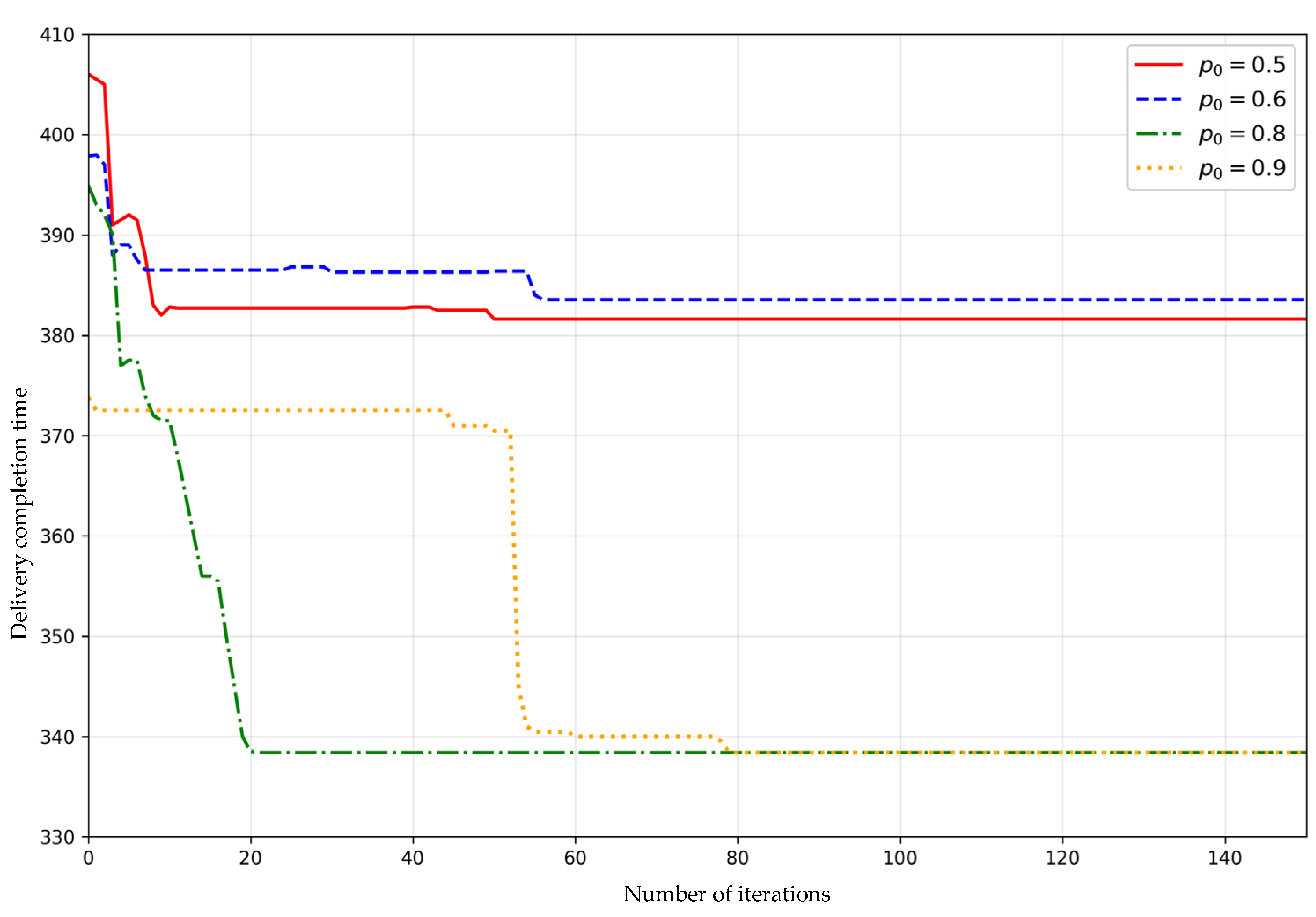
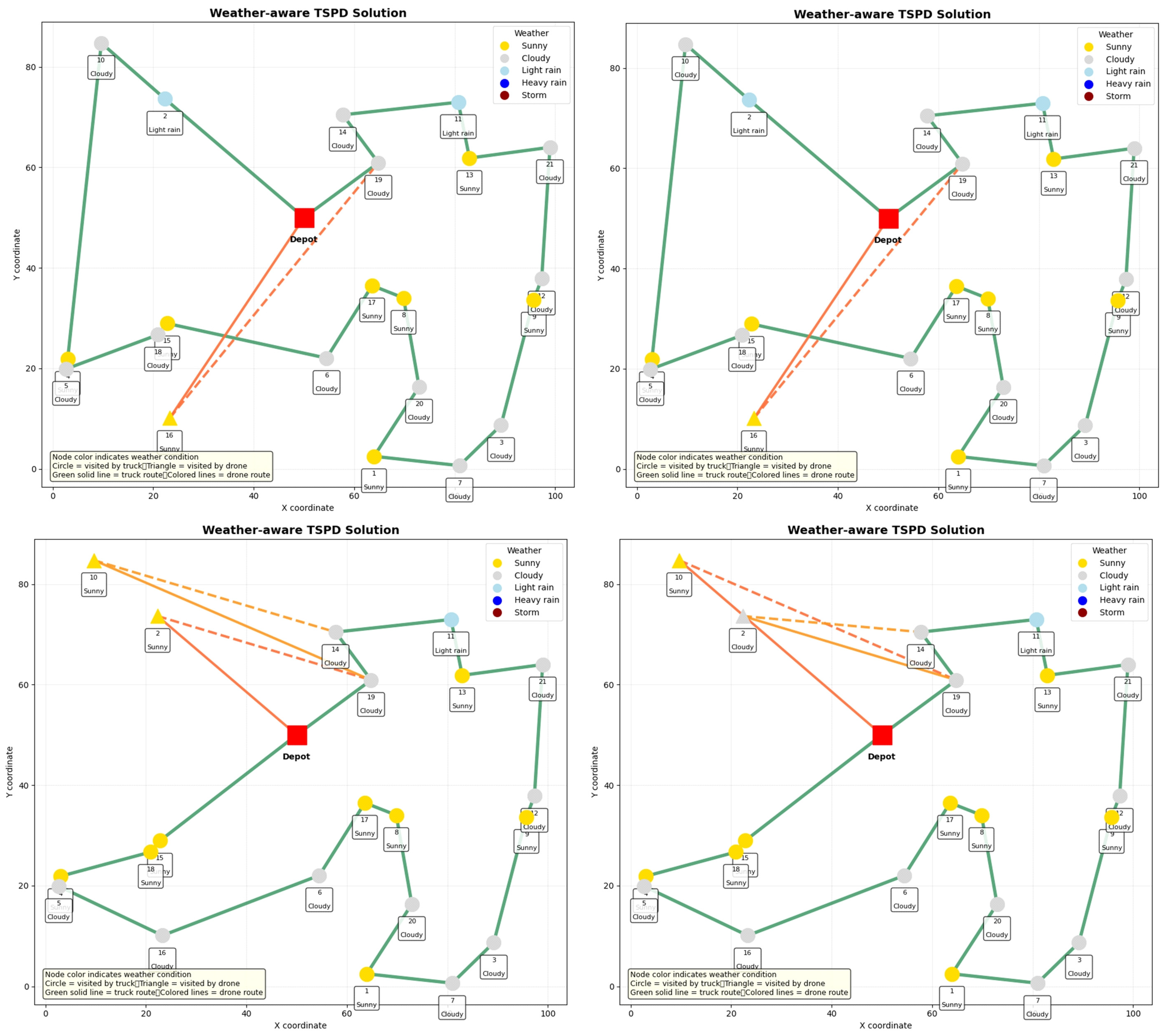
Before the truck and UAV depart from the depot, some customer nodes are not serviceable by the UAV. To examine how the UAV’s initial reachability affects delivery performance, four experiments are conducted with the initial UAV-reachability probability set to 0.5, 0.6, 0.8, and 0.9, respectively. For each setting, convergence curves (objective value versus iteration) and the final UAV–truck routing maps are generated to demonstrate the impact of different reachability levels. This parameter is used only for random instance generation of customer-node accessibility to UAV service.
From the convergence curves, the following results are observed:
- (1)
Initial reachability probability = 0.5.
The initial solution is 406.01 and the final solution is 381.60, corresponding to a 6.0% improvement. When the UAV can serve only about half of the nodes, the initial completion time is high and the final solution quality is relatively poor.
- (2)
Initial reachability probability = 0.6.
The initial solution is 397.87 and the final solution is 383.55, yielding a 3.6% improvement. With a 10% increase in reachable nodes relative to the 0.5 case, the initial solution improves, whereas the final solution remains broadly similar.
- (3)
Initial reachability probability = 0.8.
The initial solution is 394.95 and the final solution is 338.39, resulting in a 14.3% improvement. When the UAV can serve 80% of the nodes, both the initial and final solution qualities improve.
- (4)
Initial reachability probability = 0.9.
The initial solution is 373.83 and the final solution is 338.39, corresponding to a 9.5% improvement. In general, the initial solution quality increases as the proportion of UAV-reachable nodes increases.
The final routing maps further indicate that, as the initial UAV reachability probability increases, UAV utilization tends to increase overall and its deployment becomes more reasonable within the cooperative routing plan. The iteration costs and final path results are shown in
Figure 27 and
Figure 28.
- (4)
Impact of UAV Flight Range on Delivery Time
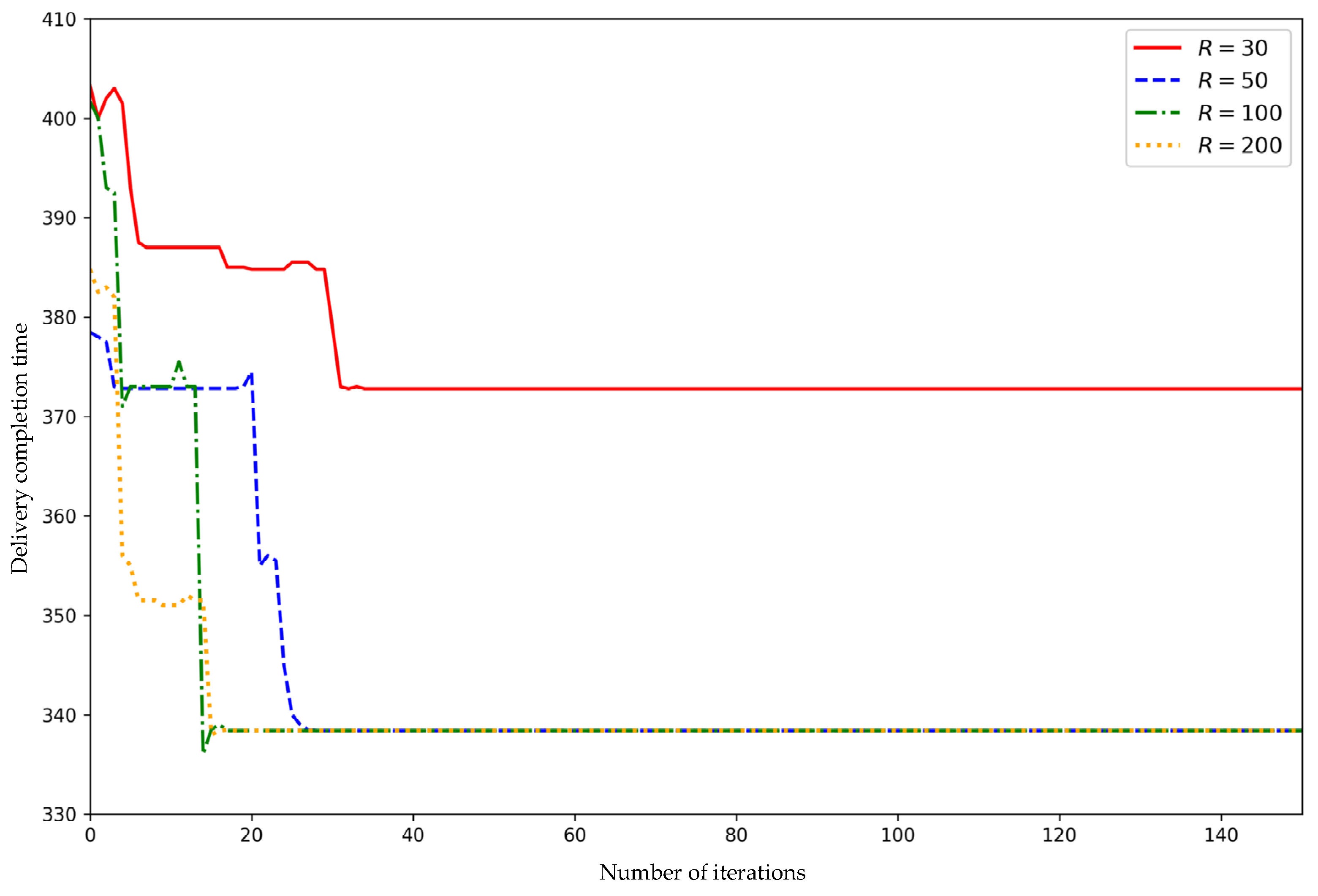
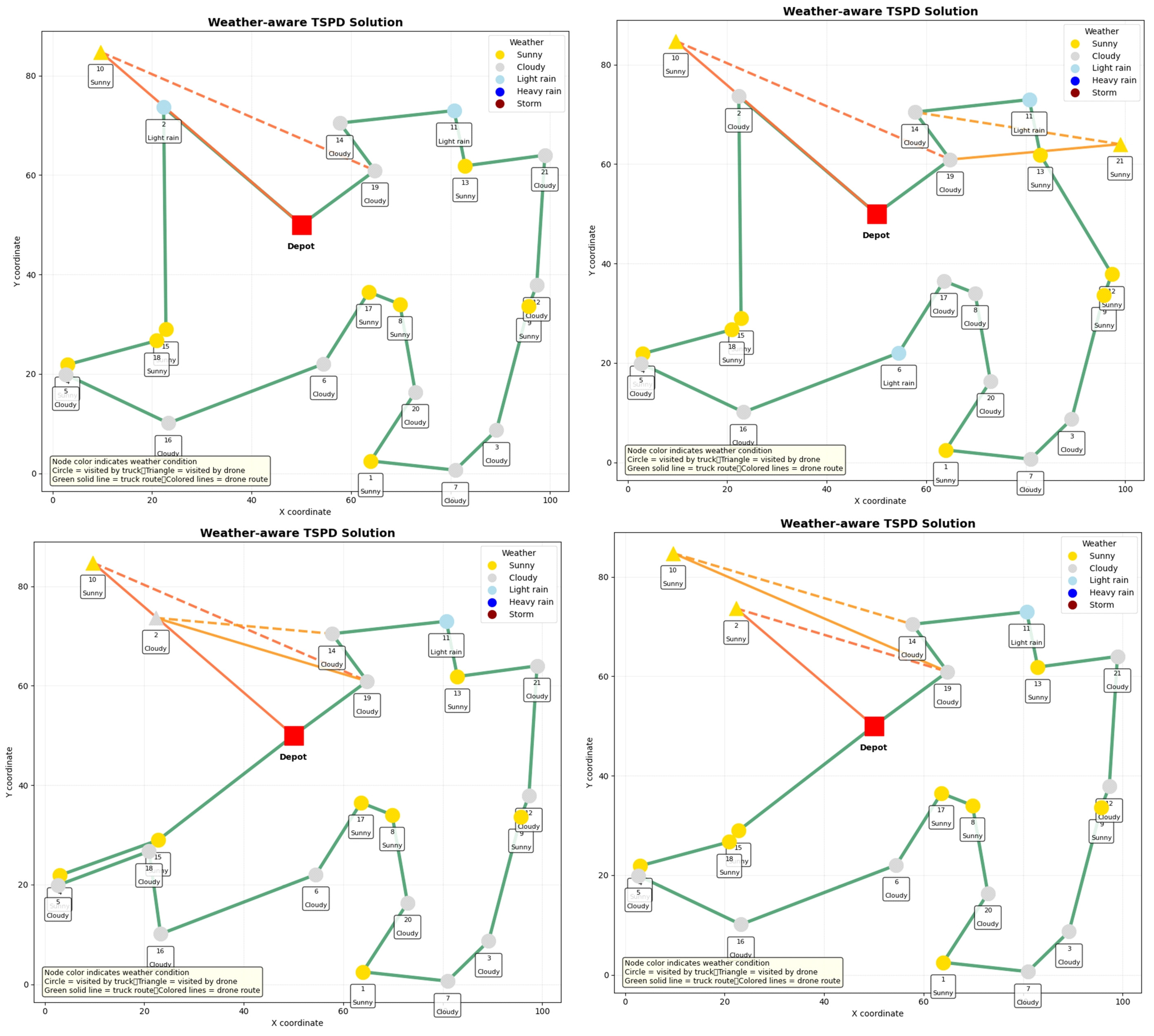
To examine the effect of UAV flight range on the overall delivery time, four settings are considered, with the UAV flight range set to 30, 50, 100, and 200, respectively. For each setting, convergence curves (objective value versus iteration) and the final UAV–truck routing maps are plotted to illustrate the impact of different flight-range limits.
- (1)
Flight range = 30.
The initial solution is 403.25 and the final solution is 372.77, corresponding to a 7.6% improvement. With a limited flight range, the initial solution quality is low and the final solution remains worse than those obtained under larger ranges.
- (2)
Flight range = 50.
The initial solution is 378.46 and the final solution is 338.39, yielding a 10.6% improvement. As the flight range increases, solution quality improves, and the final objective value matches that obtained under other (larger) range settings.
- (3)
Flight range = 100.
The initial solution is 401.66 and the final solution is 338.39, corresponding to a 15.8% improvement. Although the flight range is larger, the initial solution quality is lower than that in the 50-range case; nevertheless, the final solution achieves the same value as those under ranges of 50 and 200.
- (4)
Flight range = 200.
The initial solution quality further decreases relative to the 100-range case, although it still does not improve to the level achieved when the range is 50. The final solution remains identical to those obtained under ranges of 50 and 100.
Overall, increasing the UAV flight range tends to facilitate better final solutions up to a point, while the quality of the initial solutions does not necessarily improve monotonically with the range, reflecting the stochasticity of initialization and the nonconvex nature of the search landscape. The iteration costs and final path results are shown in
Figure 29 and
Figure 30.
The results of the parameter-sensitivity experiments on delivery time in the UAV–truck cooperative transportation setting are summarised in
Table 9. It is observed that the best delivery time of 338.39 repeatedly appears across multiple parameter configurations, which may be attributable to limitations of the randomly generated test instance.
To mitigate the potential bias induced by the instance design, the number of iterations required to reach the best objective value is additionally computed and compared. The UAV-to-truck speed ratio has a pronounced impact on optimization performance, and there exists an optimal ratio at which the cooperative delivery efficiency is maximised. When the baseline adverse-weather probability is at a low to moderate level (0.1–0.5), the algorithm can effectively avoid weather-related risks and maintain relatively favorable delivery times. However, once this probability exceeds 0.7, the delivery time deteriorates substantially. The UAV’s initial availability (reachability) has a decisive effect on the best achievable delivery time: only when availability is sufficiently high can the system attain the strongest cooperative benefits and the shortest delivery time. With respect to UAV flight range, an effective threshold is observed. Below this threshold, limited endurance restricts UAV deployment and results in longer delivery times. Once the threshold is exceeded, further increases in flight range yield diminishing returns in terms of delivery-time reduction, although they can enlarge the feasible search space and improve routing flexibility.
The near-identical final makespans obtained at UAV-to-truck speed ratios of 1.0, 2.0, and 3.0 suggest that the benefit of increasing UAV speed is subject to a structural saturation effect in the tested instance. This is because the objective is the system-level completion time rather than the UAV flight time alone. Under truck–UAV synchronization constraints, the completion of a cooperative segment is determined by the slower side at the rendezvous node. Therefore, once the UAV becomes sufficiently fast, the active bottleneck shifts to truck travel, waiting, and synchronization feasibility, so further speed increases yield only limited marginal improvement. In addition, weather-window feasibility and endurance constraints may prevent faster UAV motion from being fully translated into additional effective sorties. Hence, the convergence of different speed settings to the same final completion time is mainly attributable to synchronization bottlenecks, route-structure saturation, and instance-specific feasibility limitations.
Overall, the findings of this study are not only of theoretical interest, but also of considerable practical relevance. First, in emergency logistics and disaster-relief operations, road accessibility, local weather variations, and temporary no-fly restrictions are often highly uncertain, making static delivery plans difficult to implement effectively. The proposed truck–UAV cooperative framework explicitly incorporates dynamic weather and no-fly constraints into a unified optimization process, thereby providing more feasible and time-efficient decision support for emergency supply distribution, post-disaster replenishment, and rapid medical delivery. Second, in urban last-mile logistics, the results regarding the UAV-to-truck speed ratio, initial UAV accessibility, and UAV flight-range threshold suggest that the performance of a cooperative delivery system depends not simply on increasing UAV speed, but more importantly on appropriate system configuration and coordination design. This insight can help logistics operators make better decisions on UAV fleet configuration, rendezvous-point planning, task allocation, and dynamic replanning strategies. Finally, the results show that delivery performance deteriorates substantially when the probability of adverse weather becomes high, indicating that real-world deployment should place particular emphasis on weather-aware risk monitoring, early warning, and online route adjustment. Therefore, the proposed method has strong application potential in emergency logistics, disaster response, and intelligent last-mile delivery under uncertain environmental conditions.




 ,
,