1. Introduction
With the intensifying global energy crisis and environmental pollution, the energy transition within the transportation sector has become a focal point of international concern. The rapid deployment of Electric Vehicles (EVs) is widely recognized as a pivotal strategy for mitigating greenhouse gas emissions and reducing dependence on fossil fuels [
1]. In China, the development of the New Energy Vehicle (NEV) industry has ascended to the level of a national strategy, with robust policy incentives driving exponential market growth [
2]. However, the large-scale adoption of EVs is currently impeded by the “range anxiety” of users, which stems primarily from the lagging construction of charging infrastructure and irrational spatial layouts [
3]. A well-developed, scientifically planned charging network is a fundamental prerequisite for the sustainable development of the EV ecosystem [
4]. Consequently, the optimization of charging station locations and capacities has emerged as an urgent academic and practical challenge.
1.1. Literature Review
The problem of charging station planning has evolved from macro-qualitative analyses to complex, multi-objective quantitative modeling. Early research primarily focused on minimizing construction and operation costs from the operator’s perspective [
5]. However, recent studies emphasize that planning based solely on economic indicators often neglects the service quality experienced by users and the operational stability required by the power grid [
6]. Contemporary models have therefore shifted towards multi-objective frameworks [
7]. For instance, Zhang et al. introduced comprehensive models that simultaneously minimize investment costs and maximize user coverage [
8]. Further expanding this scope, researchers have integrated environmental externalities, such as carbon emission reductions, into the objective function to align with low-carbon city goals [
9].
Incorporating user behavior and traffic dynamics has become a critical trend in the recent literature. Unlike traditional gas stations, EV charging involves significant temporal costs [
10]. Li et al. utilized queuing theory to quantify user waiting times, aiming to minimize the total generalized cost of charging [
11]. To address the stochastic nature of travel demand, recent studies have employed origin-destination (OD) analysis and traffic flow data to predict charging loads more accurately [
12]. Additionally, the spatiotemporal distribution of EV charging demand is also influenced by dynamic traffic management. For instance, V2X-enabled platoon control can reshape regional congestion patterns [
13], indicating that future spatial planning models should gradually shift towards traffic-control-aware frameworks. Building upon this, recent high-level studies have highlighted the necessity of integrating user-side costs. Building upon this, recent high-level studies have highlighted the necessity of integrating user-side costs, such as travel distance and queuing delays, with grid-side stability metrics to form a comprehensive evaluation framework [
14]. Researchers have increasingly adopted multi-stakeholder models to balance the conflicting interests among charging station operators, EV users, and power distribution networks. By minimizing the “total social cost,” these advanced models ensure both the economic viability of the infrastructure and the efficiency of the charging service [
15]. Moreover, the interaction between charging loads and the power grid cannot be overlooked [
16]. Uncoordinated high-power charging can lead to voltage deviations and increased network losses [
17]. Therefore, recent planning models often include grid security constraints, such as nodal voltage limits and transformer capacities, to ensure the safe operation of the distribution network [
18].
Technologically, the site selection problem is characterized as Non-deterministic Polynomial-time hard (NP-hard), requiring robust optimization algorithms [
19]. Heuristic and meta-heuristic algorithms have become the dominant solution methods due to their ability to handle non-linear constraints [
20]. Genetic Algorithms (GA) and Particle Swarm Optimization (PSO) are among the most widely used [
21]. However, standard PSO suffers from inherent limitations, particularly the tendency to lose population diversity and fall into local optima during the later stages of iteration [
22]. To overcome these drawbacks, scholars have proposed various improvements, such as adaptive inertia weights and hybrid algorithms combining PSO with other heuristics [
23]. Despite these advances, maintaining a balance between global exploration and local exploitation remains a challenge in high-dimensional solution spaces [
24].
Furthermore, regarding service area partitioning, traditional administrative boundaries often fail to reflect actual service proximity [
25]. Geometric approaches, particularly Voronoi diagrams, have gained attention for their ability to dynamically partition space based on distance [
26]. Compared to fixed-radius circular coverage or static grid divisions, Voronoi diagrams can strictly divide continuous geographical spaces into mutually exclusive service zones based on the proximity principle [
27]. This dynamic spatial partitioning method effectively resolves the ambiguity of charging demand allocation in overlapping areas. Furthermore, it provides an accurate geographical boundary for precisely matching station capacity with localized demand, adapting to the dynamic emplacement of charging facilities [
28]. While utilized in logistics and substation planning, the application of weighted Voronoi diagrams to defining EV charging service boundaries remains under-explored [
29]. This is particularly true in combination with advanced swarm intelligence for simultaneous location and capacity optimization [
30]. However, most existing studies rely on deterministic assumptions, neglecting real-world uncertainties such as equipment failures and grid disturbances. Recent research, such as the robust framework proposed by Loaiza-Quintana et al. [
31], has highlighted the critical importance of system resilience under such disruptions. While this study focuses on foundational optimization under typical demand conditions, we explicitly address the implications of robustness and future extensions in the discussion section.
1.2. Research Gap and Contribution
Existing literature reveals two primary limitations: first, most studies employ static service area divisions, failing to account for the adaptive spatial matching between station capacity and regional demand density [
31]. Second, standard optimization algorithms often exhibit premature convergence when solving complex multi-objective models [
32]. Addressing these gaps, this study proposes an integrated planning method that combines weighted Voronoi diagrams with an improved Chaotic Catfish Particle Swarm Optimization (CPSO) algorithm [
33]. By utilizing the “catfish effect” to disrupt stagnant populations, the proposed algorithm aims to overcome the premature convergence issues of standard PSO [
34]. The model constructs a “Total Social Cost” framework, integrating construction costs, user travel and queuing costs, and grid network loss costs [
35]. This approach aims to provide effective strategies for urban EV charging network planning by deeply integrating spatial geometry with improved intelligent algorithms [
36].
However, it is crucial to emphasize that the fundamental contribution of this study lies in addressing the practical complexities of urban EV charging planning, rather than the algorithmic modification itself. The CPSO algorithm and Voronoi diagrams are employed strictly as robust problem-solving tools to navigate the highly non-linear, NP-hard nature of the proposed “Total Social Cost” spatial allocation model. By prioritizing the practical balance among operators, users, and the power grid, this framework aims to provide actionable and economically viable planning schemes.
The remainder of this paper is organized as follows:
Section 2 details the methodologies for estimating regional charging demand and baseline station quantity.
Section 3 introduces the dynamic service area partitioning method based on Voronoi diagrams.
Section 4 establishes the comprehensive location and capacity optimization model, integrating the cost functions, constraints, the “Total Social Cost” evaluation framework, and the CPSO algorithm.
Section 5 presents a comprehensive case study in Shenyang, including sensitivity and comparative analyses. Finally,
Section 7 concludes the paper.
2. Determination of Charging Demand and Number of Stations
Before presenting the mathematical models, the practical problem must be explicitly defined. At its core, optimizing urban EV charging infrastructure is a coupled spatial allocation and capacity sizing problem governed by complex physical and economic constraints. Because urban charging demand is highly heterogeneous—typically concentrating around commercial hubs and major intersections—traditional static administrative boundaries fail to reflect users’ actual proximity and dynamic charging behaviors. Consequently, a scientific layout must adaptively partition service areas based on geometric distance to minimize travel times, while simultaneously determining the precise number of chargers required at each site. Failing to balance these aspects inevitably leads to either severe queuing congestion from undersizing, or equipment idling and potential grid overloads from oversizing. By minimizing the aforementioned “Total Social Cost”, this study resolves the NP-hard challenge of matching heterogeneous charging demand with optimal station deployment.
2.1. Determination of Charging Demand and Station Quantity
The charging demand within a planning area is directly correlated with the volume of electric vehicles (EVs) operating on the road network. This study employs the intersection node method, utilizing traffic flow at road intersections as discrete nodes to quantify regional charging requirements. It should be noted that, to align with the macroscopic nature of upper-level spatial planning, this formulation serves as an aggregated spatial proxy rather than a micro-level behavioral simulation. Instead of tracking discrete trip lengths, temporal arrival choices, or heterogeneous State-of-Charge (SOC) distributions, we utilize aggregated intersection traffic volumes in conjunction with an implicit average SOC depletion assumption to estimate the regional daily energy demand.
Let
be the number of road segments connected to intersection node
, and let
denote the
-th road segment connected to node
, where
. If
represents the traffic flow density of the
-th road segment connected to node
at time
, then the total traffic flow density at intersection node
at time
is expressed as:
Assuming there are
intersection nodes within the planning area, the total charging demand
over the time interval
is calculated as follows:
where
: Proportion of EVs in the area.
: Proportion of EVs requiring charging.
: Average battery capacity of EVs.
: Number of intersection nodes.
2.2. Determination of the Number of Stations
The range for the number of charging stations is estimated using total demand and station capacity limits (
):
where
3. Charging Station Service Area Division Based on Voronoi Diagram
Service area partitioning is a fundamental prerequisite for accurate site optimization and capacity allocation. In this study, the Voronoi diagram is adopted as the core spatial partitioning tool, driven by both practical user charging behaviors and computational modeling requirements. The underlying logic for this adoption is threefold.
First, it mathematically aligns with the user “proximity principle.” EV drivers typically exhibit nearest-station selection behavior to minimize travel time. A Voronoi polygon geometrically ensures that all demand points within its boundary are strictly closer to its focal station than to any other, perfectly simulating this rational choice. Second, it eliminates overlapping service areas. Unlike traditional fixed-radius coverage methods that often result in intersecting zones, Voronoi diagrams strictly partition the continuous spatial area into discrete, mutually exclusive service zones. This geometric property effectively resolves the ambiguity of demand allocation and prevents the double-counting of charging loads in overlapping areas. Third, it facilitates dynamic spatial matching. As the optimization algorithm continuously updates station coordinates during its iterations, the Voronoi diagram enables the iterative and automatic re-delineation of service boundaries. This iterative spatial matching is a critical prerequisite for accurately quantifying the localized charging demand and configuring the optimal capacity for each individual station.
It is important to clarify that the term ‘adaptive’ or ‘iterative spatial’ used in the context of Voronoi partitioning in this study refers strictly to the spatial re-delineation of service boundaries during the algorithmic optimization iterations (as station coordinates are continuously updated by the CPSO algorithm). It does not imply real-time temporal or operational dynamics (such as time-varying traffic flows or intra-day user queuing behaviors). The proposed framework functions as an iterative spatial matching mechanism to optimize the long-term static layout.
Formally, a Voronoi diagram is defined as a set of polygons where each polygon contains all points closer to its respective “growth nucleus” (charging station) than to any other nucleus in the set
. Let
be a set of points on a plane; the V-diagram can then be defined as:
where
represents the Euclidean distance between and
represents the -th growth nucleus point on the plane.
4. Establishment of the Location and Capacity Library
Establishing a scientific and reasonable location and capacity library is the foundation for achieving optimal planning of charging stations. This chapter will construct a mathematical model from three dimensions: construction and operation costs of charging stations, user loss costs, and physical constraints during the planning process. By introducing the improved Catfish Particle Swarm Optimization (CPSO) algorithm and a capacity determination model, a complete location and capacity optimization system is formed.
4.1. Cost Modeling
The annualized construction and operation and maintenance (O&M) cost (
) for the charging stations is formulated as:
where
is the discount rate and is the project operational lifespan;
and represent the infrastructure investment and equipment procurement costs for station , respectively;
is the annual frequency of charging sessions per vehicle, and is the average cost per charge;
denotes the total number of vehicles within the service radius of station ;
is the annual maintenance fee for the station;
is the number of staff members at station , and is their average monthly wag.
4.2. Cost Depletions
To implement a “user-centric” planning philosophy, implicit losses are quantified as explicit economic costs. These include energy consumption during travel to the station and time costs incurred during queuing:
where
is the number of charging demand points within the charging station’s service area;
is the distance from demand point to the charging station ;
is the number of users requiring charging at demand point ;
is the power consumption per 100 km for type- electric vehicles;
is the cost per unit of power consumption (electricity price);
is the average waiting time for users at the charging station;
is the user’s time cost (value of time).
4.3. Constraints
The model enforces physical and service constraints, including a maximum service radius () to ensure accessibility and a minimum inter-station distance () to prevent redundant coverage.
Service Distance Constraint ensuring the distance from any demand point to the nearest station does not exceed the maximum allowable threshold.
where
Station Spacing Constraint ensuring a minimum straight-line distance between stations to avoid redundant coverage.
where
4.4. Catfish Particle Swarm Optimization (CPSO)
4.4.1. Principles of Standard Particle Swarm Optimization
The Particle Swarm Optimization (PSO) algorithm is a stochastic evolutionary computation technique based on swarm intelligence. Within a $D$-dimensional search space, the algorithm simulates the collaborative foraging behavior of bird flocks. Each “particle” represents a potential solution, and its evolutionary trajectory is guided by two critical extrema: the particle’s own historical optimal position, termed the individual best (), and the overall population’s current optimal position, termed the global best ().
Consider a population
consisting of
particles. The position vector of the
-th particle is denoted as
, and its velocity vector as
. Particles update their states according to the following kinematic equations:
where
is the inertia weight used to balance the algorithm’s exploration and exploitation capabilities;
and are acceleration coefficients (learning factors);
is a random operator uniformly distributed in
4.4.2. Introduction of the Catfish Effect Operator
In addressing highly non-linear and multi-constrained optimization problems—such as the site selection for electric vehicle charging stations—traditional PSO frequently encounters the challenge of premature convergence. During the later stages of iteration, the population exhibits a strong tendency toward homogenization. Consequently, particles often become trapped in local basins of the solution space, losing search precision and failing to transcend potential barriers to reach the global optimum.
To break the stagnation of the evolutionary process, this study introduces the Catfish Effect mechanism by constructing a heuristic perturbation operator [
37]. This biologically inspired mechanism prevents premature convergence by forcing trapped particles into new search regions, a strategy whose robustness has been continuously validated in recent complex optimization scenarios [
38]. The core logic involves a stagnation detection mechanism: if the global best solution
fails to show significant incremental improvement over
consecutive generations, the algorithm is deemed to be in a state of stagnation. At this juncture, the Catfish operator is triggered to apply a forced displacement to a subset of particles trapped in local optima.
The velocity perturbation formula incorporating the Catfish operator is defined as:
where
and are perturbation gain coefficients. The physical significance of this operator lies in imparting a centripetal impulse to the particles, forcing them to deviate from their current local clusters and achieving a secondary, comprehensive coverage of the search space.
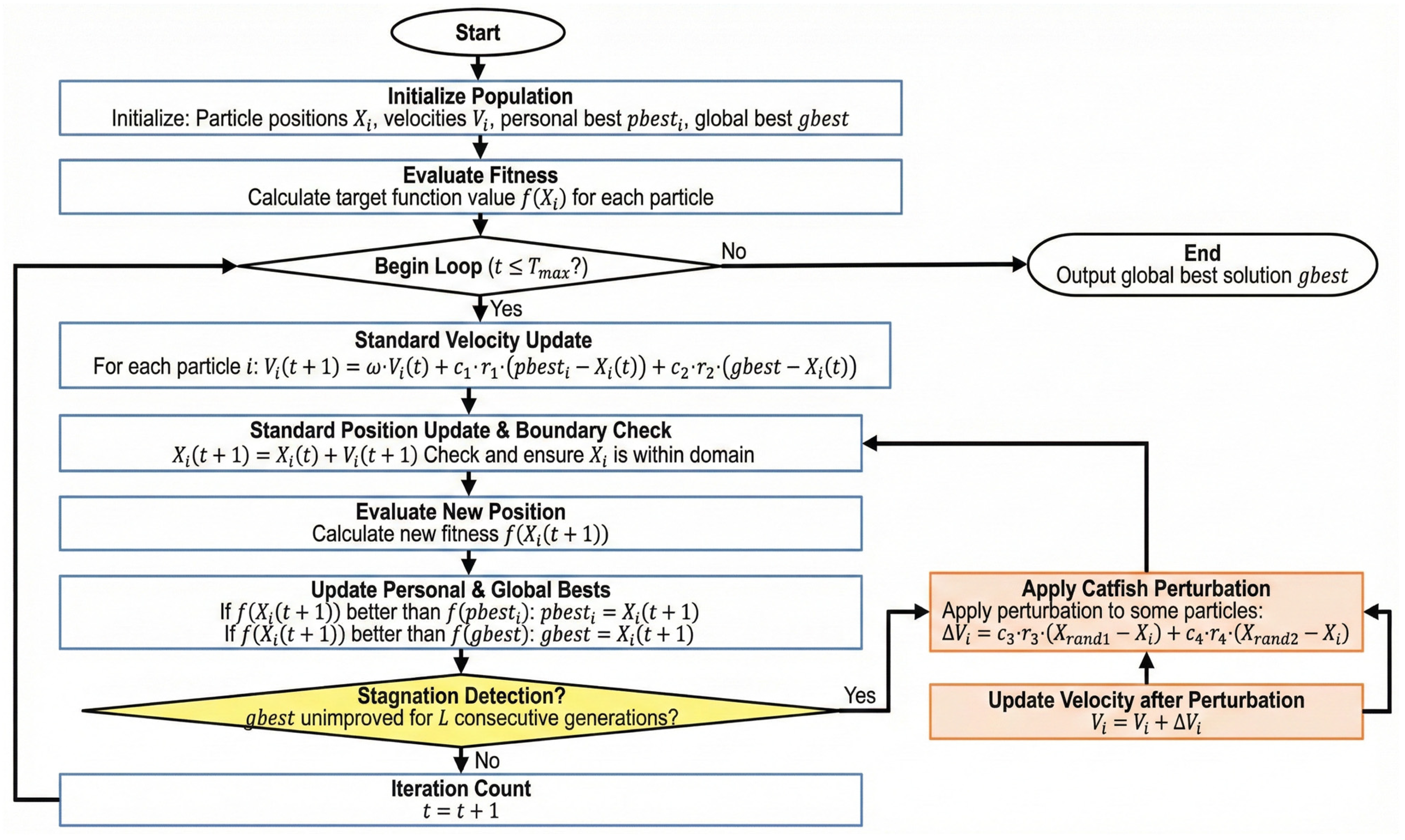
The detailed logical structure of the proposed algorithm is illustrated in
Figure 1.
By integrating catfish-inspired perturbations to counteract swarm homogenization, the CPSO algorithm prevents premature convergence and ensures high-quality global solutions for complex site selection problems while maintaining high computational efficiency.
4.5. Capacity Determination Algorithm
After determining the optimal locations for charging stations, appropriately configuring the number of chargers is essential to ensure service quality while controlling construction costs. The core principle of capacity determination is the total charging demand within each station’s service area. To prevent facility idling or queueing congestion, the construction scale must be determined based on the total load demand, individual charger power, and operational efficiency within the service area.
The formula for calculating the number of chargers required at a charging station is as follows:
where
is the total charging demand,
is the power of a single charger,
is the effective operating time,
is the charger utilization rate.
5. Determination of the Optimal Location and Capacity Scheme
The planning of EV charging stations involves multiple stakeholders, and optimizing based on a single economic indicator rarely achieves overall system optimality. Operators seek to minimize construction and O&M costs, EV users aim to minimize travel and waiting costs, and city planning focuses on the spatial concentration penalty caused by excessive localized station integration. To balance these interests, this study introduces the “Total Social Cost” as the final evaluation metric. This index integrates charging station construction and O&M costs, user loss costs, and an additional spatial concentration penalty, aiming to identify a balance point that maximizes overall social welfare (i.e., minimizes total cost).
The optimization objective function, aimed at minimizing the total social cost, is defined as follows:
where
represents the annual cost of grid network losses for the charging stations:
In the context of city-scale spatial planning, evaluating grid impacts through a full AC optimal power flow model is computationally prohibitive and requires detailed data often unavailable at the early planning stage. Therefore, Equation (15) adopts a macroscopic, capacity-based estimation. This framework focuses on the upper-level spatial layout, providing a preliminary economic evaluation of grid integration.
6. Case Study Analysis
6.1. Research Area Overview and Data
This study selects the core areas of the Heping, Shenhe, and Tiexi districts in Shenyang (approximately 150 km
2) as the research subject. Using the intersection node method, 20 major road intersections within the study area were selected as charging demand statistics points. Traffic flow data for each intersection node, obtained through field surveys and transportation department data, are presented in
Table 1.
Based on the traffic flow density in
Table 1, the total charging demand within the study area was calculated using Equations (1) and (2). Taking a 12 h weekday calculation cycle as an example, the sum of traffic flow density at each intersection node is approximately 820,000 veh/h. The converted total regional charging demand is approximately 541,200 kWh/day, providing data support for estimating the number of charging stations.
Key parameters for the case study, determined based on the current EV development in Shenyang and future planning combined with relevant literature, are set in
Table 2.
Based on the parameters in
Table 2 (e.g., 55 kWh battery capacity, 3 km maximum service radius) and the total charging demand, the estimated range for the number of charging stations is between 80 and 120 using Equations (3) and (4). This range limits the search space for the optimization algorithm.
6.2. Calculation of Charging Demand and Station Quantity
According to the formula, the total weekday charging demand is kWh/day. Based on Equations (3) and (4), the estimated number of charging stations ranges from 80 to 120.
6.3. Initial Layout and Algorithm Parameters
Using the geometric center method, 20 initial charging station locations were selected as the growth nuclei for the Voronoi diagram. Their specific coordinates and corresponding districts are shown in
Table 3.
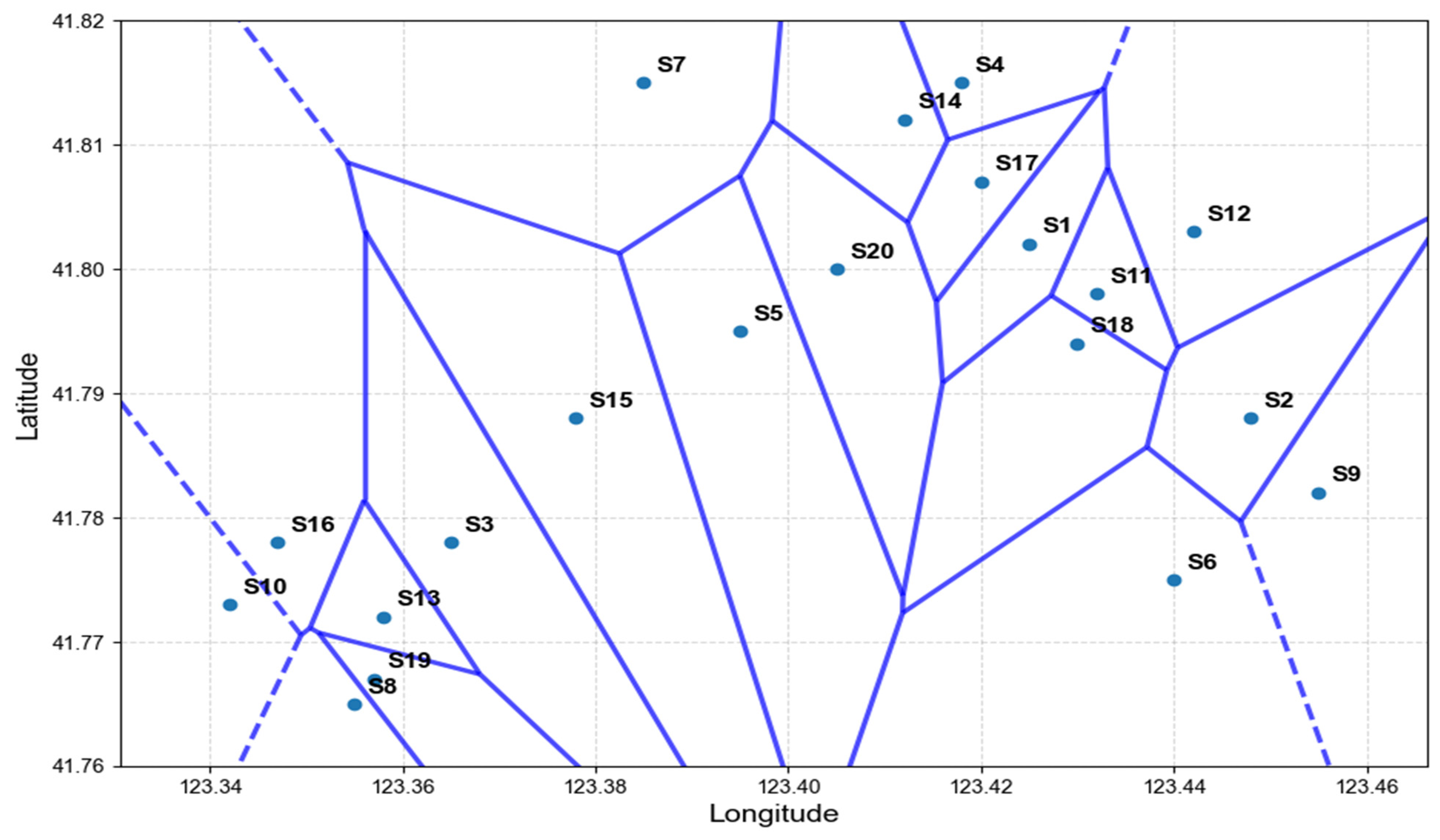
Voronoi diagrams were constructed for each initial station in
Table 3, partitioning the study area into 20 service zones. The results show relatively uniform areas with an average coverage of approximately 7.5 km
2, validating the feasibility of using Voronoi diagrams for automatic service area partitioning.
Figure 2 illustrates the partitioning of the core research area in Shenyang into 20 non-overlapping polygonal service zones, utilizing the 20 selected initial station locations as growth nuclei (indicated by blue scatter points) based on Voronoi geometric principles. As observed from the figure, the resulting service areas possess well-defined boundaries and provide full coverage of the entire planning region. The service scope of each station is relatively uniform, with an average coverage area of approximately 7.5 km
2. This partitioning method effectively delineates the fundamental service responsibility zone for each charging station, thereby providing explicit spatial constraints for subsequent fine-grained site selection and capacity optimization.
To guarantee algorithmic convergence and search efficiency, the specific parameter configurations for the Catfish Particle Swarm Optimization (CPSO) algorithm employed in this study were established through extensive experimentation and a review of relevant literature, as detailed in
Table 4.
The scheme for
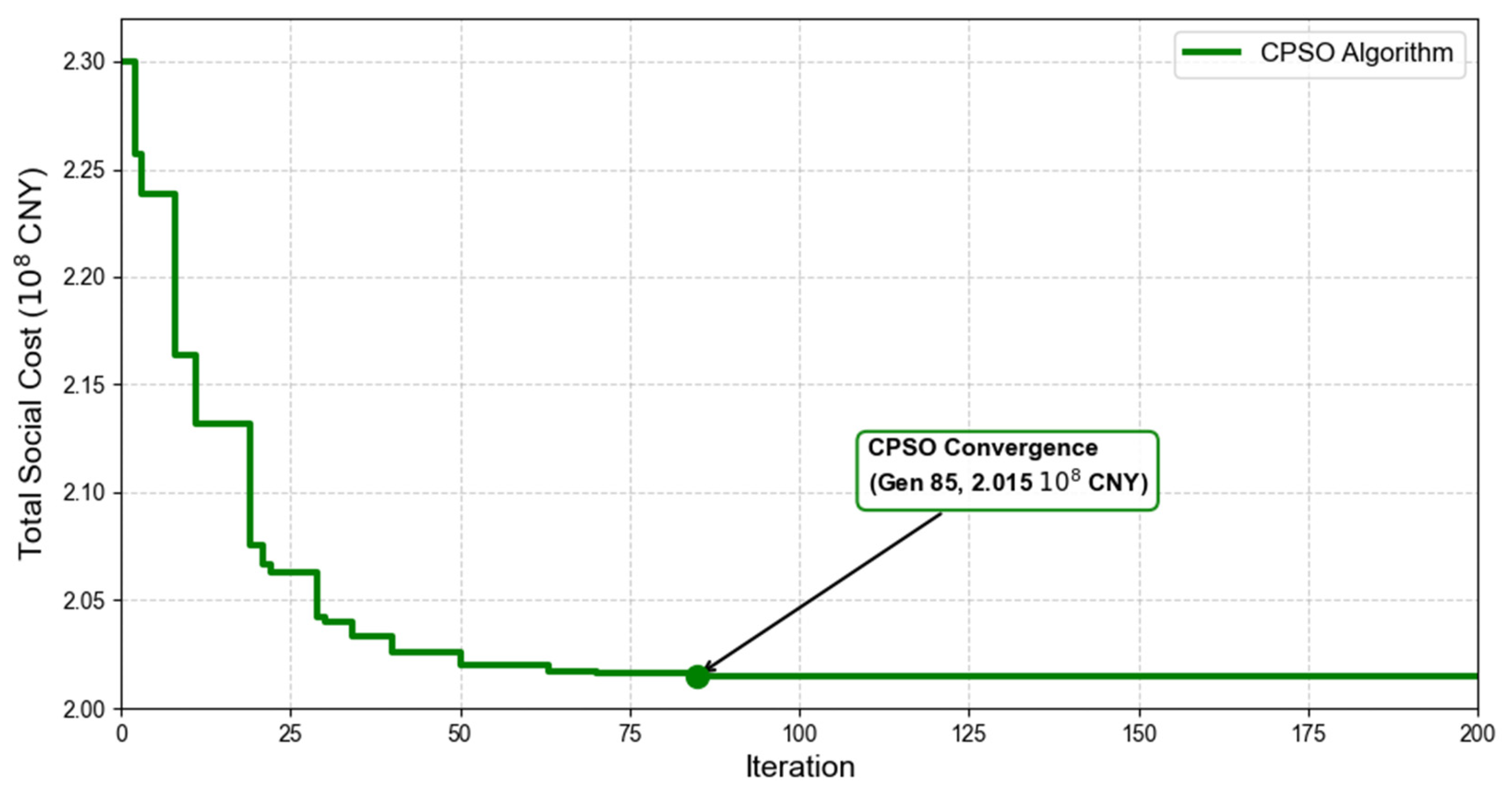
stations was solved using these parameters, with the convergence performance shown in
Figure 3. The algorithm converged at the 85th generation, with a corresponding total user cost of 201.5 million CNY/year. This demonstrates the rapid convergence of the CPSO algorithm and its ability to avoid premature convergence through the catfish operator’s perturbation mechanism.
As illustrated in
Figure 3, the algorithm reaches convergence at the 85th generation, with the total user cost corresponding to the global optimal solution being 201.5 million CNY per year. This convergence curve clearly demonstrates the rapid convergence characteristics of the Catfish Particle Swarm Optimization (CPSO) algorithm for the location and capacity planning problem. By employing the perturbation mechanism of the catfish operator, the algorithm effectively circumvents premature convergence, thereby ensuring the economic feasibility of the final planning scheme.
6.4. Optimization Results and Comparison
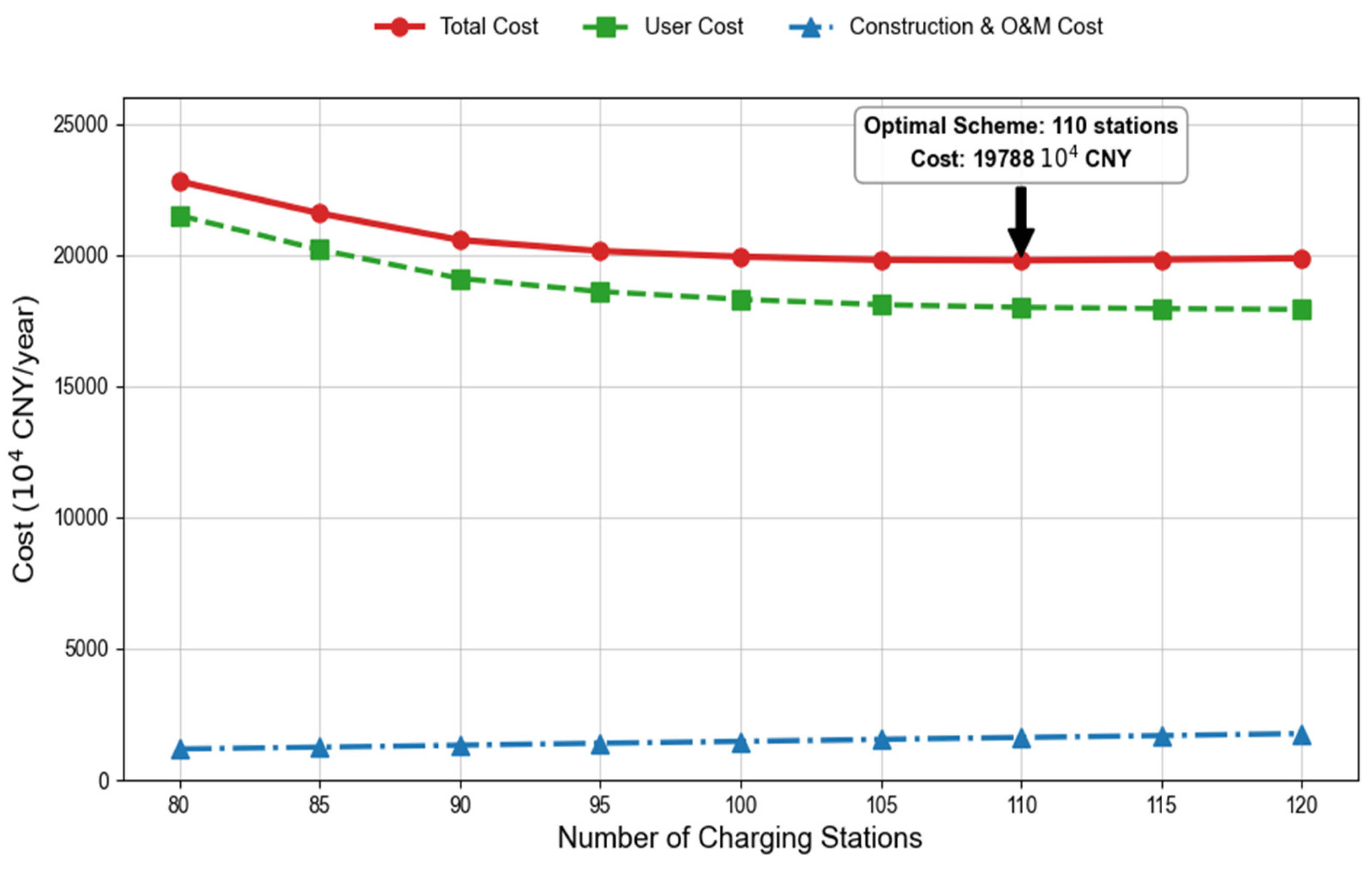
To determine the optimal number of charging stations, economic evaluations and comparative analyses were conducted for different scenarios with the number of stations ranging from 80 to 120. The resulting cost data for each component are summarized in
Table 5.
As indicated by the data in
Table 5, user loss costs gradually decrease as the number of charging stations increases, whereas construction and O&M costs, along with network loss costs, exhibit a steady upward trend. A comprehensive comparison reveals that the minimum total social cost is achieved at 110 stations, amounting to 1.979 × 10
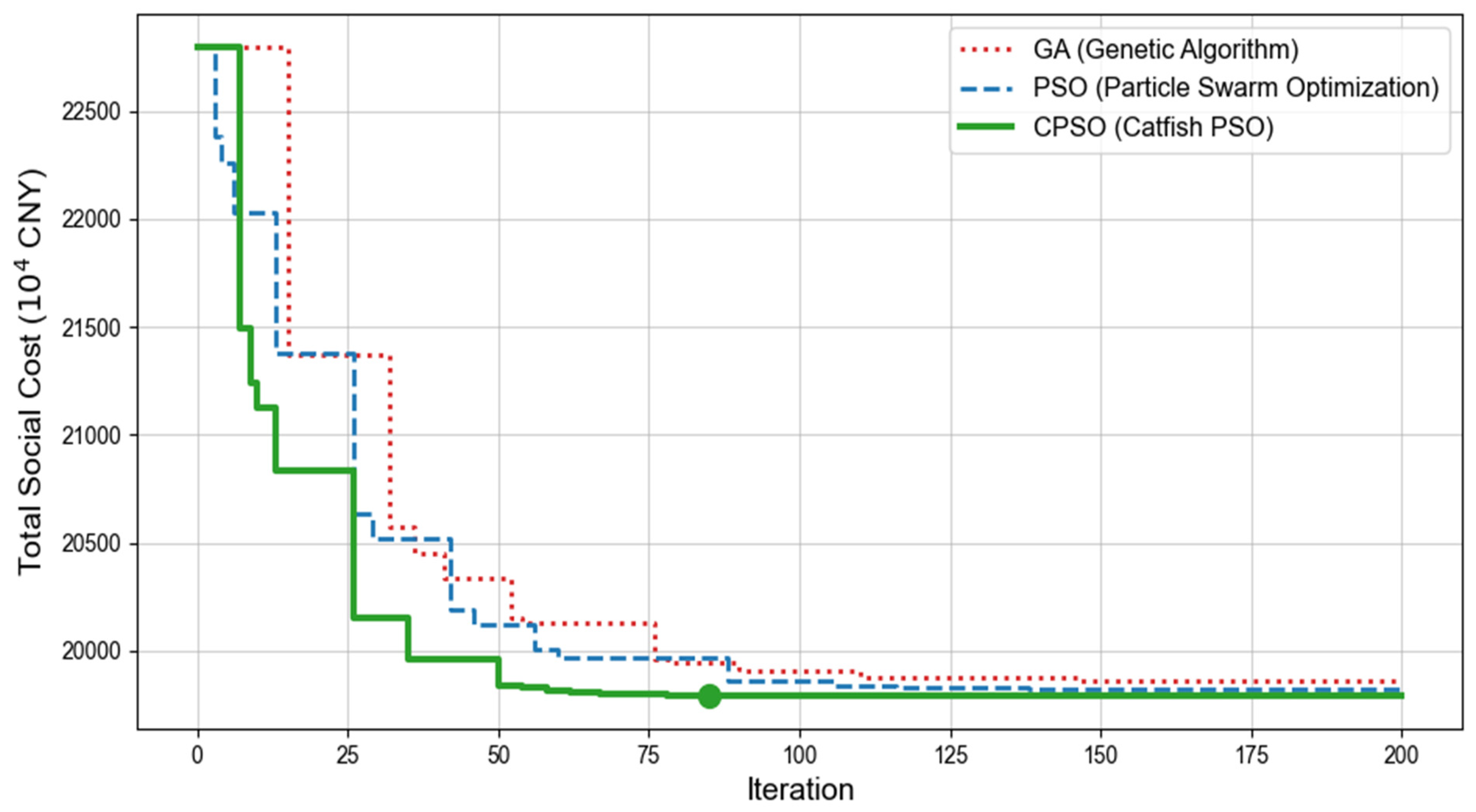
8 CNY/year, identifying this as the economically optimal scheme. To verify the optimization effectiveness of the proposed CPSO algorithm, it was compared with the standard Particle Swarm Optimization (PSO) and Genetic Algorithm (GA) under identical conditions; the performance test results are illustrated in
Figure 4.
Figure 4 provides a visual comparison of the convergence performance among GA, PSO, and the proposed CPSO algorithm regarding the optimization of total social cost. The stepwise descent pattern observed in the curves represents the discrete updates of the global best solution during the evolutionary process. The curves indicate that the CPSO algorithm (solid green line) possesses a distinct convergence advantage, reaching a stable state in approximately 85 generations. This performance notably outperforms GA and PSO highlighting the efficacy of the catfish operator in stimulating population vitality.
Regarding search precision, while GA and PSO exhibit extended stagnation periods and are prone to trapping in local optima—resulting in premature plateauing—the CPSO algorithm effectively utilizes the catfish effect to trigger jump behavior after periods of search stagnation. This allows the algorithm to overcome premature convergence and ultimately identify a superior global optimal solution of 197.88 million CNY. The distinct vertical drops in the CPSO curve further validate its enhanced capability to escape local extrema and solve complex non-linear programming problems. To rigorously evaluate performance, each algorithm was executed independently for 30 runs under identical conditions. A non-parametric Wilcoxon rank-sum test (
) was also conducted to verify the statistical significance of the improvements. The comprehensive results are summarized in
Table 6.
As detailed in
Table 6, CPSO achieves the most competitive average solution and exhibits the smallest Standard Deviation, demonstrating highly robust stability across multiple runs. Furthermore, the Wilcoxon test yields
against both PSO and GA. Being strictly below the 0.05 threshold, this statistically confirms that CPSO’s superiority is highly significant. In addition to stability, CPSO maintains a distinct advantage in computational efficiency, converging in just 85 generations (15 min). This comprehensive statistical and computational advantage validates the effectiveness of the proposed catfish operator.
6.5. Sensitivity Analysis
The proposed demand forecasting model relies on key parameters, primarily the EV adoption ratio
. To assess the stability of the optimization results against parameter uncertainty, a sensitivity analysis was conducted. We varied the EV adoption ratio
by
and
from the baseline value (8.0%). The corresponding fluctuations in total daily charging demand and the resulting optimal number of stations
are detailed in
Table 7.
As shown in
Table 8, while the total charging demand scales linearly with the EV penetration rate, the optimal number of stations
exhibits a sub-linear, relatively stable variation, fluctuating only between 105 and 115 stations. This non-linear buffering is due to the spatial coverage constraints
which require a minimum number of stations regardless of demand drops, and the capacity redundancy of the optimized layout which absorbs slight demand surges. This analysis confirms that the proposed planning scheme (110 stations) maintains its economic applicability and operational stability under mild mid-term demand fluctuations.
6.6. Determination of the Optimal Scheme
By synthesizing the cost–benefit analysis of various scenarios and integrating the discussion on the relationship between the number of stations and the total social cost, the optimal layout for electric vehicle (EV) charging stations in the core areas of Shenyang is finalized, as illustrated in
Figure 5.
The nadir of the cost curve occurs at 110 stations, representing the minimum total social cost. This point serves as the optimal equilibrium between construction investment and user convenience; hence, 110 charging stations are determined as the optimal planning quantity for this study area. The specific configuration for each administrative district is detailed in
Table 8.
As indicated in
Table 7, the optimal planning scheme involves the construction of 110 charging stations with a cumulative total of 880 chargers and a total investment of approximately 143 million CNY This scheme achieves comprehensive coverage of charging demand within the planning area, with all key performance indicators reaching ideal levels: the average distance for users to travel to a station is controlled within 1.5 km, and the average station waiting time does not exceed 15 min. Simultaneously, the total social cost is restricted to 1.979 × 10
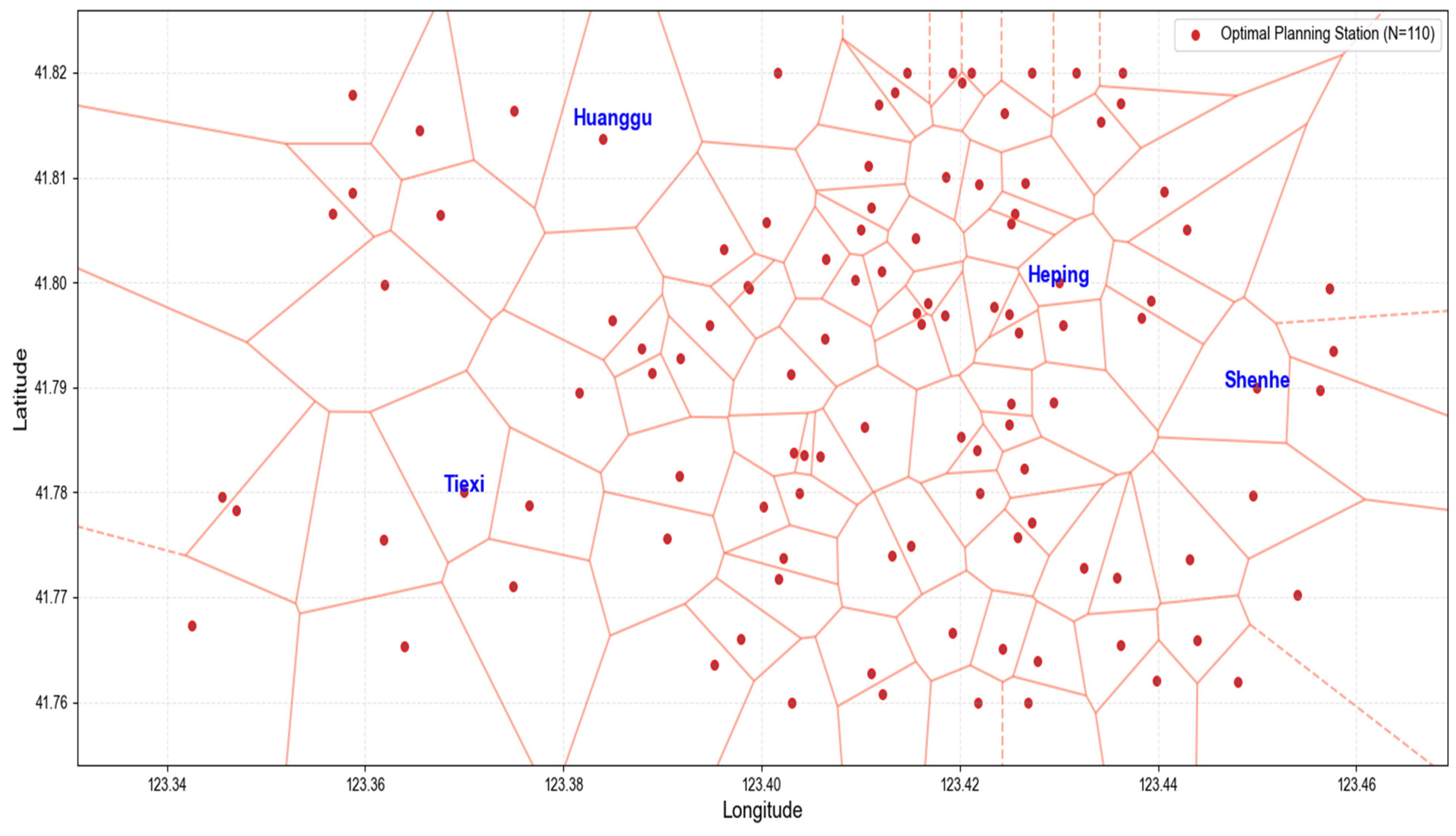
8 CNY/year, successfully realizing the dual objectives of enhancing service quality and minimizing total social costs. The specific site selection results are presented in
Figure 6.
Figure 6 illustrates the final site selection scheme (N = 110) obtained using the CPSO algorithm. Compared with the initial layout (
Figure 2), the optimized distribution of charging stations exhibits a pronounced characteristic of “demand-driven clustering”. Stations are more densely situated in core commercial hubs with high traffic flow, such as Taiyuan Street in Heping District and Zhong Street in Shenhe District, effectively reducing the service radius to under 1 km and shortening user waiting times. In contrast, stations in peripheral areas like Tiexi District and Huanggu District are distributed relatively sparsely but uniformly to ensure baseline coverage requirements. This layout pattern of “core densification and global coverage” intuitively validates the effectiveness of the proposed model in balancing user convenience with construction costs.
7. Conclusions
This paper presents an integrated planning framework for EV charging stations by synthesizing Voronoi diagrams with the Catfish Particle Swarm Optimization (CPSO) algorithm. While utilizing established methodological foundations, the study distinguishes itself through a comprehensive ‘Total Social Cost’ model that encompasses construction, operation, user losses, and grid impacts. This approach effectively balances conflicting stakeholder interests, enabling a holistic evaluation of planning schemes beyond single-dimensional economic indicators.
Compared with traditional Genetic Algorithms (GA) and standard PSO, the CPSO algorithm demonstrates superior global search capabilities and convergence performance, with a 38% improvement in convergence speed and a 1.8% increase in solution quality, effectively overcoming premature convergence. The case study confirms that the optimal scheme for Shenyang’s core area involves 110 charging stations with a total investment of 143 million CNY and a minimum total social cost of 1.979 × 10⁸ CNY/year. This method is logically rigorous and broadly applicable, providing a significant theoretical basis and technical support for urban new energy transportation infrastructure planning.
While this study proposes an effective upper-level spatial planning framework, several limitations must be acknowledged. First, the charging demand estimation relies on a macroscopic proxy model; it does not explicitly capture micro-level physical dynamics such as discrete state-of-charge (SOC) distributions, temporal variations in vehicle arrivals, or precise user queuing choices. Second, to maintain computational tractability at the city scale, the grid impact is quantified using a macroscopic capacity penalty rather than a physical Alternating Current Optimal Power Flow (AC OPF) model. Future research will focus on integrating Agent-Based Modeling (ABM) to simulate dynamic user decision-making behaviors and coupling the spatial optimization with detailed distribution network constraints to further enhance the micro-level fidelity of the planning scheme.
Author Contributions
W.M.: Data curation, Formal analysis, Methodology, Software, Validation, Visualization, Writing–original draft, Writing–review&editing; G.J.: Funding acquisition, Project administration, Supervision; N.L.: Formal analysis, Resources; Y.T.: Formal analysis, Resources; G.C.: Investigation, Validation; S.L.: Investigation, Validation. All authors have read and agreed to the published version of the manuscript.
Funding
This research received no external funding.
Data Availability Statement
The data presented in this study, specifically the traffic flow data obtained through field surveys and transportation department records, are openly available within the article (
Table 1).
Conflicts of Interest
The authors declare no conflict of interest.
References
- Bibri, S.E. The IoT for smart sustainable cities of the future: An analytical framework for sensor-based big data applications for environmental sustainability. Sustain. Cities Soc. 2018, 38, 230–253. [Google Scholar] [CrossRef]
- Zhang, W.; Wu, B.; Li, W.; Lai, X. Discussion on Development Trend of Battery Electric Vehicles in China and Its Energy Supply Mode. Power Syst. Technol. 2009, 33, 1–5. [Google Scholar] [CrossRef]
- Pevec, D.; Babic, J.; Podobnik, V. Electric vehicle range anxiety: An obstacle for the personal transportation decarbonization. In Proceedings of the 2019 International Conference on Smart Power & Internet Energy Systems (SPIES), Melbourne, Australia, 25–27 April 2019; pp. 1–6. [Google Scholar]
- Zeb, M.Z.; Imran, K.; Khattak, A.; Janjua, A.K.; Pal, A.; Nadeem, M.; Zhang, J.; Khan, S. Optimal Placement of Electric Vehicle Charging Stations in the Active Distribution Network. IEEE Access 2020, 8, 68124–68134. [Google Scholar] [CrossRef]
- Zhang, L.; Brown, T.; Samuelsen, S. Evaluation of charging infrastructure requirements and operating costs for plug-in electric vehicles. J. Power Sources 2019, 414, 328–337. [Google Scholar] [CrossRef]
- Ahmad, F.; Iqbal, A.; Ashraf, I.; Marzband, M.; khan, I. Optimal location of electric vehicle charging station and its impact on distribution network: A review. Energy Rep. 2022, 8, 2314–2333. [Google Scholar] [CrossRef]
- Wang, S.; Dong, Z.Y.; Luo, F.J.; Meng, K.; Zhang, Y. Stochastic collaborative planning of electric vehicle charging stations and power distribution system. IEEE Trans. Ind. Inform. 2018, 14, 321–331. [Google Scholar] [CrossRef]
- Lazari, V.; Chassiakos, A. Multi-Objective Optimization of Electric Vehicle Charging Station Deployment Using Genetic Algorithms. Appl. Sci. 2023, 13, 4867. [Google Scholar] [CrossRef]
- Li, X.; Zhou, K. Multi-objective cold chain logistic distribution center location based on carbon emission. Environ. Sci. Pollut. Res. 2021, 28, 32396–32404. [Google Scholar] [CrossRef]
- Daina, N.; Sivakumar, A.; Polak, J.W. Modelling electric vehicle use: A survey on the methods. Renew. Sustain. Energy Rev. 2017, 68, 447–460. [Google Scholar] [CrossRef]
- Li, S.; Huang, Y.; Mason, S.J. A multi-period optimization model for the deployment of public electric vehicle charging stations on network. Transp. Res. Part C Emerg. Technol. 2016, 65, 128–143. [Google Scholar] [CrossRef]
- Guler, N. Smart allocation and sizing of fast charging stations: A metaheuristic solution. Int. J. Sustain. Energy 2024, 43, 2350970. [Google Scholar] [CrossRef]
- Peng, J.; Shangguan, W.; Chai, L.; Chen, J.; Peng, C.; Cai, B. V2X-Enabled Platoon Control for Aperiodic Congestion Mitigation via Moving Bottlenecks in Mixed Traffic Environments. IEEE Trans. Veh. Technol. 2005, 1–13. [Google Scholar] [CrossRef]
- Wang, Z.; Zou, J.; Tu, J.; Li, X.; Liu, J.; Wu, H. Towards Sustainable EV Infrastructure: Site Selection and Capacity Planning with Charger Type Differentiation and Queuing-Theoretic Modeling. World Electr. Veh. J. 2024, 15, 600. [Google Scholar] [CrossRef]
- Wu, Y.; Lu, Y.; Zhu, Z.; Holguín-Veras, J. Optimizing Electric Vehicle Charging Infrastructure on Highways: A Multi-Agent-Based Planning Approach. Sustainability 2023, 15, 13634. [Google Scholar] [CrossRef]
- Deb, S.; Tammi, K.; Kalita, K.; Mahanta, P. Impact of electric vehicle charging stations on power grid: A review. Energies 2018, 11, 178. [Google Scholar] [CrossRef]
- Luo, L.; Gu, W.; Wu, Z.; Zhou, S. Joint planning of distributed generation and electric vehicle charging stations considering real-time charging navigation. Appl. Energy 2019, 242, 1274–1284. [Google Scholar] [CrossRef]
- Deb, S.; Tammi, K.; Gao, X.-Z.; Kalita, K.; Mahanta, P. A Hybrid Multi-Objective Chicken Swarm Optimization and Teaching Learning Based Algorithm for Charging Station Placement Problem. IEEE Access 2020, 8, 92573–92590. [Google Scholar] [CrossRef]
- Jiale; Liu, Z.; Wang, X. Public charging station location determination for electric ride-hailing vehicles based on an improved genetic algorithm. Sustain. Cities Soc. 2021, 74, 103181. [Google Scholar] [CrossRef]
- Hou, H.; Tang, J.; Zhao, B.; Zhang, L.; Wang, Y.; Xie, C. Optimal Planning of Electric Vehicle Charging Station Considering Mutual Benefit of Users and Power Grid. World Electr. Veh. J. 2021, 12, 244. [Google Scholar] [CrossRef]
- Zhang, Q.; Liang, Y. Charging station planning scheme by making efficient use of soft computing techniques for low carbon transition. Carbon Manag. 2024, 15, 2373884. [Google Scholar] [CrossRef]
- Dong, J.; Liu, C.; Lin, Z. Charging infrastructure planning for promoting battery electric vehicles: An activity-based approach using multiday travel data. Transp. Res. Part C Emerg. Technol. 2014, 38, 44–55. [Google Scholar] [CrossRef]
- Kulkarni, A. A City-Agnostic Framework to Determine Optimal Location and Sizing of Electric Vehicle Charge Stations. In Proceedings of the 2023 IEEE 2nd International Conference on Data, Decision and Systems (ICDDS), Bangalore, India, 1–3 December 2023; pp. 1–6. [Google Scholar]
- Moradi, M.H.; Abedini, M. A combination of genetic algorithm and particle swarm optimization for optimal DG location and sizing in distribution systems. Int. J. Electr. Power Energy Syst. 2012, 34, 66–74. [Google Scholar] [CrossRef]
- Bouzid, A.M.; Elloumi, S. Voronoi-based heuristics for the location of charging stations. Comput. Oper. Res. 2020, 115, 104847. [Google Scholar]
- Tang, X.; Liu, J.; Wang, X.; Xiong, J. Electric vehicle charging station planning based on weighted Voronoi diagram. In Proceedings of the 2011 International Conference on Transportation, Mechanical, and Electrical Engineering (TMEE), Changchun, China, 16–18 December 2011; pp. 1297–1300. [Google Scholar] [CrossRef]
- Boonprong, S.; Punturasan, N.; Varnakovida, P.; Prechathamwong, W. Towards Sustainable Urban Mobility: Voronoi-Based Spatial Analysis of EV Charging Stations in Bangkok. Sustainability 2024, 16, 4729. [Google Scholar] [CrossRef]
- Jordán, J.; Palanca, J.; Del Val, E.; Julian, V.; Botti, V. A Multi-Agent System for the Dynamic Emplacement of Electric Vehicle Charging Stations. Appl. Sci. 2018, 8, 313. [Google Scholar] [CrossRef]
- Liu, Z.; Wen, F.; Ledwich, G. Optimal planning of electric-vehicle charging stations in distribution systems. IEEE Trans. Power Deliv. 2013, 28, 102–110. [Google Scholar] [CrossRef]
- Li, Y.; Pei, W.; Xu, D. Electric Vehicle Charging Station Planning Based on Immune Algorithm and Voronoi Diagram. In 2021 40th Chinese Control Conference (CCC); IEEE: Piscataway, NJ, USA, 2021; pp. 1532–1537. [Google Scholar]
- Quintana, C.L.; Arbelaez, A.; Climent, L. Robust eBuses charging location problem. IEEE Open J. Intell. Transp. Syst. 2022, 3, 856–871. [Google Scholar] [CrossRef]
- Linjuan, Z.; Han, F.; Zhiheng, Z.; Shangbing, W.; Jinbin, Z. Site selection and capacity determination of charging stations considering the uncertainty of users’ dynamic charging demands. Front. Energy Res. 2024, 11, 1295043. [Google Scholar] [CrossRef]
- Luo, C.; Huang, Y.-F.; Gupta, V. Placement of EV Charging Stations—Balancing Benefits Among Multiple Entities. IEEE Trans. Smart Grid 2017, 8, 759–768. [Google Scholar] [CrossRef]
- Chuang, L.Y.; Tsai, S.W.; Yang, C.H. Chaotic catfish particle swarm optimization for solving global numerical optimization problems. Appl. Math. Comput. 2011, 217, 6900–6916. [Google Scholar] [CrossRef]
- Demiryürek, H.K.; Bozali, B.; Öztürk, A. Optimal Placement and Cost Analysis of Electric Vehicle Charging Stations Using Metaheuristic Optimization. Appl. Sci. 2025, 15, 11729. [Google Scholar] [CrossRef]
- Saleh, H. Empowering User-Centric Selection of Electric Vehicles Charging Stations: A Hybrid Approach Using the Best–Worst Method and Grey Relational Analysis. World Electr. Veh. J. 2024, 15, 575. [Google Scholar] [CrossRef]
- E. Seilabi, S.; Pourgholamali, M.; Miralinaghi, M.; Homem de Almeida Correia, G.; Li, Z.; Labi, S. Sustainable Planning of Electric Vehicle Charging Stations: A Bi-Level Optimization Framework for Reducing Vehicular Emissions in Urban Road Networks. Sustainability 2025, 17, 1. [Google Scholar] [CrossRef]
- Rajwar, K.; Deep, K.; Das, S. An exhaustive review of the metaheuristic algorithms for search and optimization: Taxonomy, applications, and open challenges. Artif. Intell. Rev. 2023, 56, 13187–13257. [Google Scholar] [CrossRef]
| Disclaimer/Publisher’s Note: The statements, opinions and data contained in all publications are solely those of the individual author(s) and contributor(s) and not of MDPI and/or the editor(s). MDPI and/or the editor(s) disclaim responsibility for any injury to people or property resulting from any ideas, methods, instructions or products referred to in the content. |