1. Introduction
With the continuously increasing installed capacity of wind and photovoltaic generation, power systems are being accelerated toward a power-electronics-dominated paradigm [
1]. In typical scenarios such as the integration of offshore wind farms via high-voltage direct current (HVDC) systems [
2], the grid is characterized by wide-range variations in short-circuit ratio (SCR), a standard indicator of grid strength, low inertia, and insufficient damping [
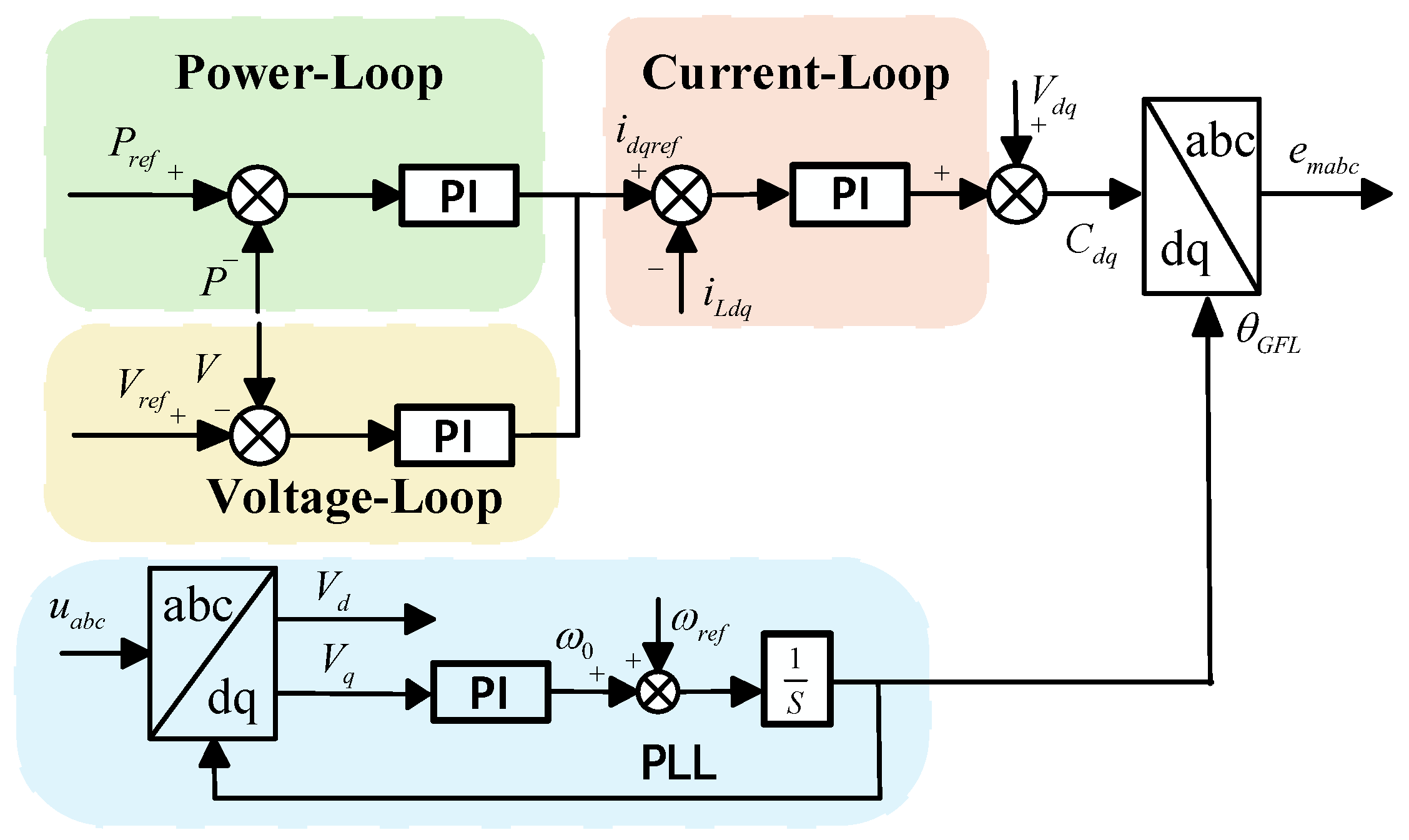
3]. As two representative grid-interfacing technologies, grid-forming (GFM) and grid-following (GFL) converters critically determine overall system stability through their control performance. However, a single control mode cannot satisfy all operating conditions. Specifically, GFL control relies on a phase-locked loop (PLL) to track the grid voltage, and in weak grids, low-frequency synchronization oscillations may be excited due to coupling between the PLL bandwidth and grid impedance [
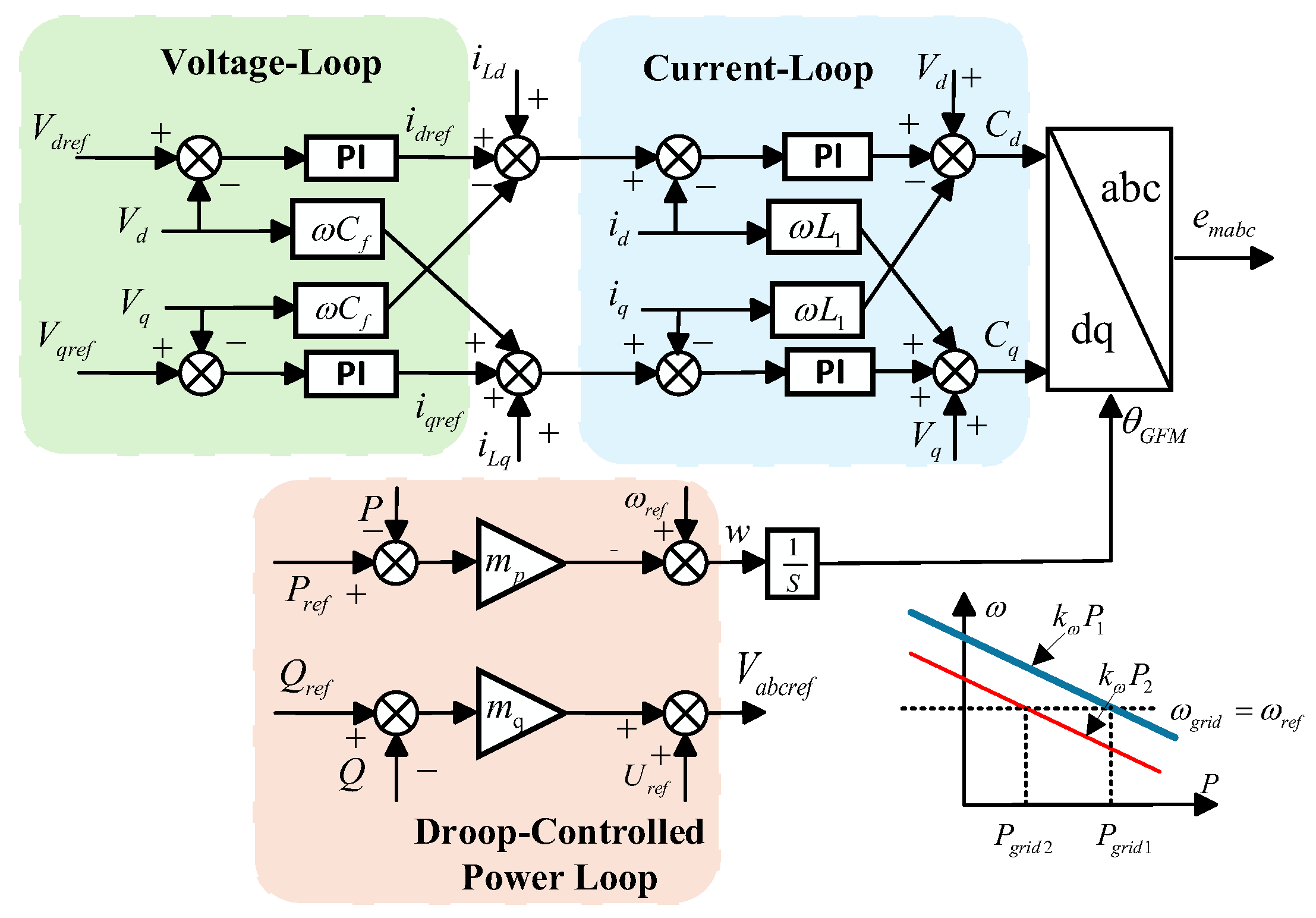
4]. By contrast, although GFM control can emulate synchronous-machine behavior and provide active support [
5,
6], under strong-grid conditions, high-frequency resonances may be triggered by interactions between the converter’s equivalent output impedance and the grid impedance, and overcurrent risks may arise under large disturbances [
7,
8]. Therefore, developing a GFL–GFM hybrid control architecture that achieves wide-range grid-strength adaptability and disturbance-free transitions is essential for overcoming stability bottlenecks in high-renewable-penetration power systems.
To address the coordinated operation of GFM and GFL converters, systematic investigations have been conducted on hybrid-system modeling, stability analysis, and control design. In [
4,
9], a frequency-domain impedance model of a parallel GFL–GFM system was established, and the impact of converter capacity ratios on damping characteristics was analyzed, indicating that appropriate sizing can effectively suppress oscillations. Ref. [
10] systematically examined sizing rules for mixed GFM–GFL grid integration from the perspective of key influencing factors, providing guidance for capacity allocation and stability-oriented design. A duality theory between GFL and GFM control was proposed in [
11], revealing their intrinsic relationship at the control-architecture level. In [
12], a sixth-order transient model of the hybrid system was developed; however, due to the complexity of the high-order state matrix, closed-form stability conditions are difficult to obtain. The dynamic coupling mechanisms across multiple time scales were investigated in [
13] using a state-space framework, and an impedance-based generalized stability criterion was presented in [
14]. Collectively, these studies provide an important theoretical foundation for understanding steady-state characteristics and parameter tuning in hybrid systems. However, in the practical operation of modern power systems, the SCR at the point of interconnection (POI) is no longer a static constant but instead exhibits pronounced wide-range time variability. As reported in [
15], due to intermittency and weather uncertainty, stochastic renewable-power fluctuations can directly cause dynamic drift in the system’s effective grid strength. Ref. [
16] further revealed an explicit coupling between multi-plant SCR and nodal injected power, implying that dispatch changes can correspond to substantial variations in grid strength. It was explicitly noted in [
17] that conventional stability assessment based on static grid strength cannot meet real-time operational requirements. To enhance wide-range adaptability to grid-strength variations, ref. [
18] analyzed transient stability during multi-mode switching, and a hybrid control framework based on virtual synchronous machine concepts or modified outer-loop characteristics was proposed in [
19] to combine GFL power-tracking capability with GFM voltage-support advantages. The effectiveness of GFM solutions in improving transient synchronization stability and voltage support in weak grids was validated in [
20].
Although substantial progress has been made in steady-state modeling and equilibrium-point control, GFL–GFM coordinated operation still faces major challenges when grid strength varies continuously over a wide range. Specifically, most existing coordination strategies adopt fixed ratios or logic-based mode switching to combine GFL and GFM control [
21]. Near the critical grid-strength boundary, this discontinuous regulation can cause abrupt changes in control weighting, leading to transient voltage/current impacts and potentially inducing unintended frequent switching under measurement noise [
22]. More importantly, the coupling mechanisms over the full parameter space have not been systematically elucidated, and how parameter sensitivity evolves with SCR remains unclear [
13,
14]. As SCR changes, dominant poles and stability boundaries shift significantly, making conventional fixed-point analysis insufficient for quantifying the stability-feasible region and the hybrid-control advantage region [
23]. The lack of visualization based on global parameter boundaries makes it difficult to implement unified scheduling that simultaneously ensures steady-state performance and transient smoothness during cross-regime operation.
The D-partition (D-decomposition) method can construct stability regions and track their boundary evolution in the parameter plane, thereby providing quantitative guidance for converter tuning [
24,
25]. Accordingly, the D-partition method is introduced to quantitatively characterize the stability-advantage space of hybrid control from the viewpoint of geometric evolution in the parameter plane. On this basis, a smooth switching function is designed to ensure that the fusion weight varies continuously with SCR and transitions smoothly across regions, thereby enabling disturbance-free switching and improving robustness and stability preservation from weak to strong grids.
The main contributions of this paper are summarized as follows:
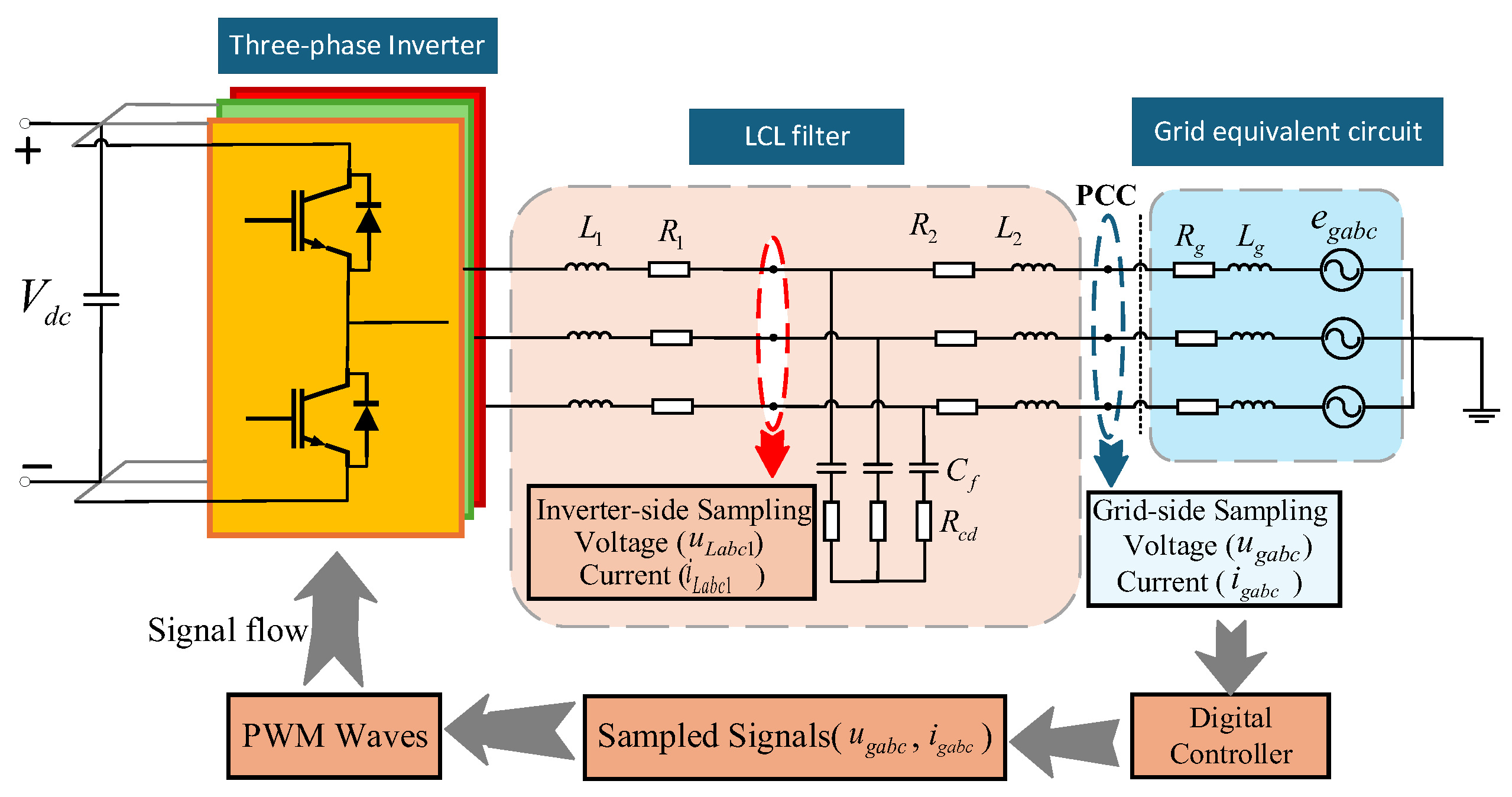
First, the topology of a three-phase grid-connected converter with an LCL filter is described, and a unified GFL–GFM control model incorporating the fusion path is established.
Second, a unified GFL–GFM frequency-domain characteristic equation that includes the fusion weight is established based on the D-partition method and a sequence-impedance stability criterion. The design is evaluated under a set of multi-dimensional specifications, namely gain margin, phase margin, and bandwidth. The constrained stability region is computed and visualized in the parameter space to quantify the enlarged advantage region and tuning benefits over single-mode control.
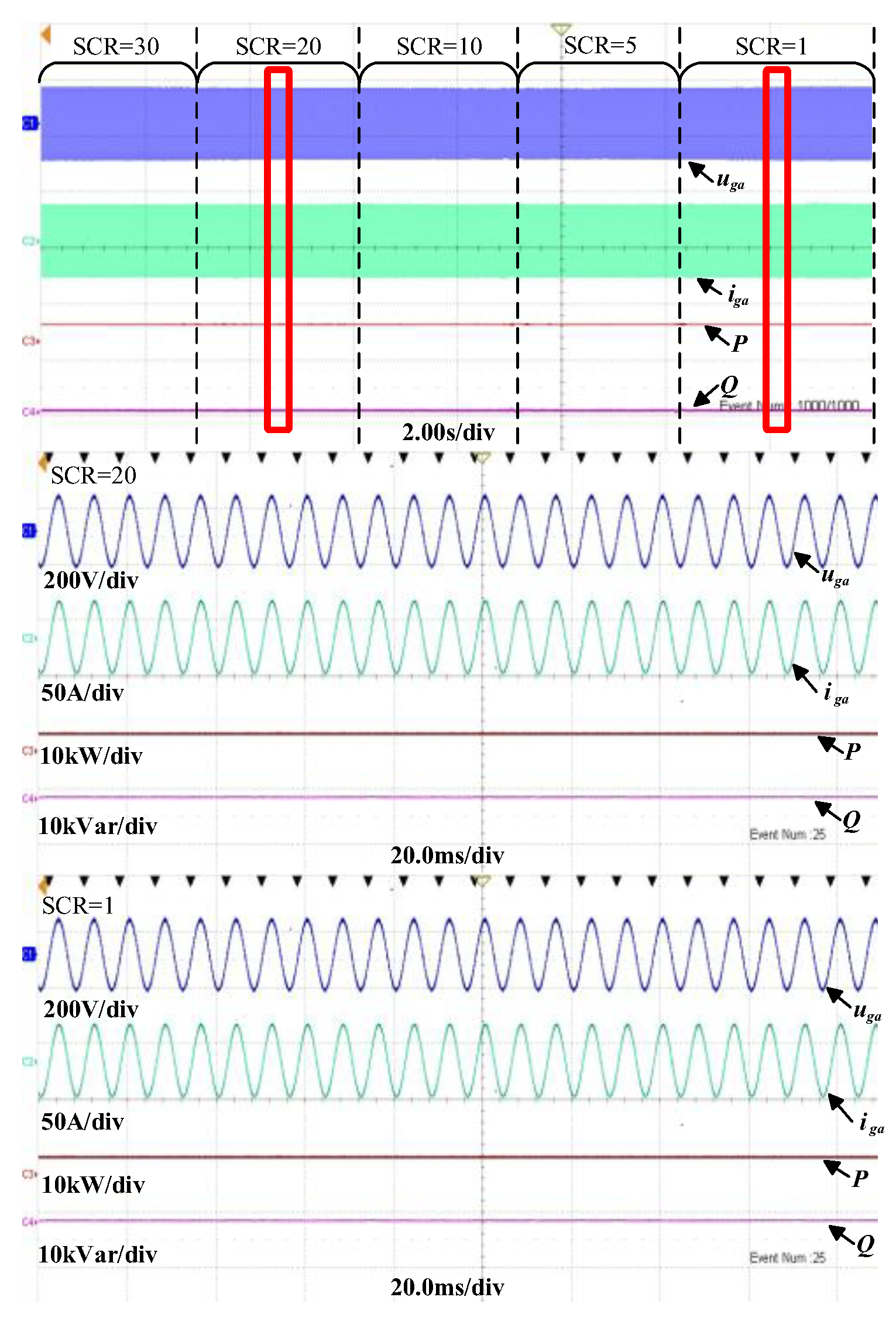
Third, a hierarchical smooth fusion strategy across multiple D-zones is proposed to address discontinuous weighting and transient impacts near the SCR threshold. A continuously differentiable switching curve is constructed to realize adaptive fusion and disturbance-free transition, while additional constraints are introduced in strong-grid regions to mitigate oscillation risks associated with excessively large fusion coefficients.
Finally, simulations and experiments are conducted to validate the proposed strategy in enlarging the weak-grid stability region, suppressing switching-induced transient oscillations, and improving wide-range operating adaptability.
3. Converter Modeling and Stability Analysis Based on the D-Partition Method
3.1. Sequence-Impedance Modeling
To reveal the frequency-domain impedance-coupling characteristics between the converter and the grid and to support parameter-domain mapping, positive- and negative-sequence impedance models are established on the basis of the unified open-loop model using the harmonic linearization method [
27]. Model validity is then verified by frequency-sweep comparisons. Since the stability boundary under the considered operating conditions is dominated by the positive-sequence impedance, the loop gain is formulated using the positive-sequence model, and parameter-domain mapping analysis is performed accordingly. According to impedance-based stability theory, the positive-sequence output impedance of the fusion-controlled system,
, is defined around the balanced operating point as
where
and
denote the small-signal perturbations of the positive-sequence voltage and current, respectively. Considering the weighted-output property of the fusion converter, the positive-sequence output impedance can be expressed as a weighted combination of the impedances under GFM and GFL control, i.e.,
where
and
are the converter positive-sequence output impedances corresponding to the GFM and GFL control modes, respectively, evaluated under identical plant parameters and the same linearized operating point.
The grid positive-sequence equivalent impedance depends on SCR: a smaller SCR indicates a weaker grid and corresponds to a larger magnitude of the equivalent grid impedance. For stability analysis, the positive-sequence loop gain
is defined within the positive-sequence impedance framework as
In this expression, denotes the grid positive-sequence equivalent impedance parameterized by SCR.
The corresponding positive-sequence stability characteristic equation is given as follows:
With the loop gain defined in (13), the positive-sequence closed-loop system is stable when the Nyquist plot of the loop gain in (14) satisfies the Nyquist stability criterion with respect to the critical point .
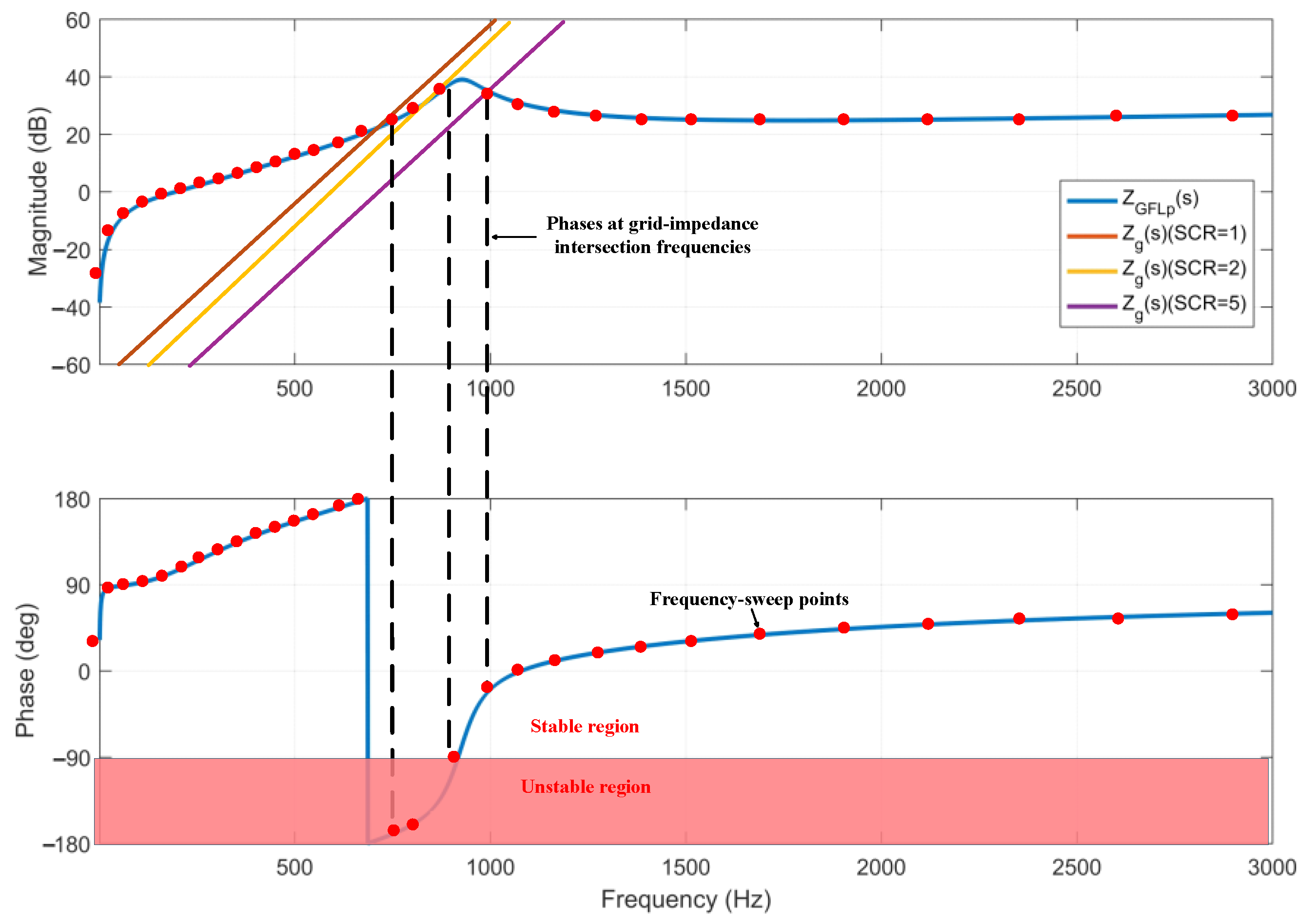
To validate the positive-sequence impedance model and the associated stability criterion established in (11)–(14), a grid-connected model including the complete control loops was implemented in an electromagnetic transient simulation platform. Under
pu and
, small-signal frequency sweeps from 100 to 3000 Hz were applied for different SCR values. As shown in
Figure 6, the theoretically calculated frequency response of the positive-sequence equivalent impedance agrees well with the sweep-identified results in both magnitude and phase, thereby validating the accuracy of the proposed unified frequency-domain model.
Furthermore, the frequency range in which the output-impedance phase is below is defined as the capacitive negative damping (CND) band. The analysis indicates that when SCR is <2, the GFL-mode output impedance is prone to coupling with the grid impedance in the CND band, thereby triggering instability.
3.2. Principle of the D-Partition Method and Its Equivalence to the Sequence-Impedance Approach
Although sequence-impedance modeling can determine system stability under specific operating conditions, it provides limited visualization for controller-parameter tuning. To enable a quantitative parameter-domain representation of stability constraints, the D-partition method is employed to analytically map frequency-domain stability conditions onto the controller-parameter plane. Moreover, the equivalence between the D-partition method and the sequence-impedance criterion is established in terms of mathematical form, and a unified characteristic equation with clear physical interpretation is formulated, thereby providing a consistent framework for subsequent feasible-region analysis and tuning-boundary determination.
3.2.1. Impedance-Characteristic Boundary Under the Sequence-Impedance Approach
By examining the characteristic equation formed by the converter positive-sequence output impedance and the grid impedance and recasting it over a common denominator and rearranging it with respect to the controller parameters, the mapping relationship to the D-partition characteristic equation can be directly revealed.
According to (13)–(14), the positive-sequence stability boundary satisfies
Considering that the converter’s closed-loop output impedance
is determined by the open-loop impedance
and the loop gain
. With
,
is given by
where
is the open-loop positive-sequence output impedance under the same plant boundary conditions as in (16),
denotes the generalized plant, and
denotes the PI controller to be tuned.
By substituting (16) into the impedance criterion
and rewriting the resulting expression over a common denominator, the following form is obtained:
To eliminate the integral term
in the denominator, both sides of (17) are multiplied by
, and the expression is rearranged and grouped with respect to the controller parameters
and
, yielding a unified characteristic equation in terms of the control parameters:
In these expressions,
and
are the coefficient terms associated with the integral gain
and proportional gain
respectively, where
,
, and
are the polynomial coefficients of the characteristic equation rearranged for
and
, whereas
is a constant term independent of the controller parameters. Moreover,
,
, and
are uniquely determined by the system impedance characteristics:
3.2.2. Analytical Determination of the Parameter-Stability Boundary Using the D-Partition Method
According to the D-partition principle [
24], the crossing of the imaginary axis by the roots of the characteristic equation corresponds to a critical stability condition. For a given fusion coefficient
and grid strength (SCR), the stability boundary in the parameter plane consists of the zero-root boundary and the purely imaginary-root boundary.
Let the characteristic root in (18) be
. By substituting this into the unified characteristic equation and separating the real and imaginary parts, the following expressions are obtained:
where
is the imaginary unit, and
is the angular frequency.
is defined in (18).
and
denote the real and imaginary parts of
, respectively, i.e.,
. Similarly,
and
. Here,
and
are the PI gains to be tuned.
By applying Cramer’s rule, analytical expressions of the parameter boundary can be obtained, where
and
denote the boundary values of the proportional and integral gains at frequency
, respectively.
The scanning trajectories defined by (21)–(22) are mapped onto the
plane to trace the complex-domain locus
corresponding to the characteristic roots crossing the imaginary axis. Together with the static-gain boundary
determined by
, the parameter-stability region
in which all closed-loop characteristic roots lie in the left-half plane can be identified using the Boundary Crossing Rule. Accordingly, the following expression is obtained:
where
denotes the zero-frequency boundary,
denotes the infinite-frequency boundary,
is the highest order of
, and
denotes the boundary generated by purely imaginary-root crossings.
By comparison with (18), the sequence-impedance analysis and the D-partition method are mathematically equivalent. The former characterizes converter–grid interaction stability through the frequency-domain impedance ratio, whereas the latter parameterizes the same stability condition and maps it onto the – plane. Consequently, a stability-feasible parameter region can be constructed from the boundary curves, providing a geometric interpretation that facilitates controller tuning.
3.3. Converter Stability Analysis Using the D-Partition Method
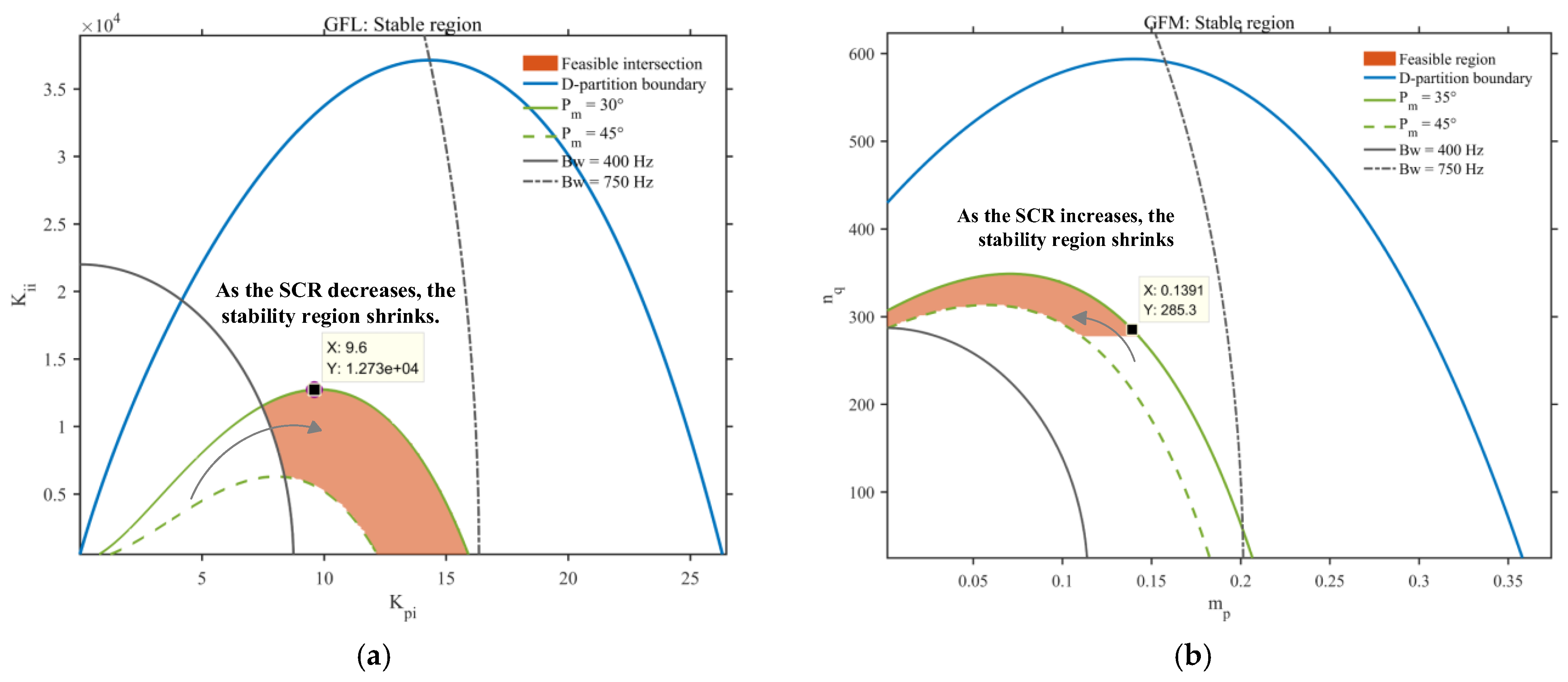
Based on the analytical boundary expressions derived using the D-partition method, the stability regions of the single-mode controllers are analyzed under different SCR conditions. To ensure satisfactory dynamic performance, additional constraints on gain margin, phase margin, and control bandwidth are imposed on the stability regions: , , and . The feasible region satisfying the comprehensive requirements is obtained as the intersection of these constraints.
As shown in
Figure 7, the evolution of the feasible regions for the GFL controller parameters
and the GFM droop parameters
is compared. If the PI parameters are selected within the stable region, satisfactory dynamic response and steady-state performance can be simultaneously ensured under ideal grid conditions.
The blue curves represent the D-partition stability boundaries, and the shaded regions indicate the feasible intersections that satisfy the performance constraints. As SCR decreases, the feasible regions of both modes shrink. In comparison, the GFL mode is more sensitive to weak grids and exhibits a more pronounced reduction in the feasible intersection, whereas the GFM mode retains a non-negligible feasible range in the weak-grid regime, although it is likewise constrained by the performance requirements. These results provide the basis for subsequent weight scheduling of the fusion strategy over the full SCR range.
3.4. Fusion Advantage Region
The analytical model of parameter stability boundaries established using the D-partition method is intended to quantitatively evaluate the robustness gain of the fusion control strategy under wide-range grid-strength variations. By constructing feasible-region sets for the single-mode controllers (GFL and GFM) and the fusion mode, a fusion-advantage metric is defined, and its distribution in the parameter space and its variation with SCR are characterized.
3.4.1. Set-Theoretic Definition and Mapping of Stability Regions
For a given grid strength (SCR), the parameter-stability-region sets corresponding to the GFL and GFM modes are defined as
In these expressions, denotes the feasible region of the GFL mode in the parameter plane under a given SCR, satisfying both stability and performance constraints; denotes the feasible region of the GFM mode in the parameter plane under the same SCR; and and denote the corresponding two-dimensional real spaces of the parameter coordinates.
For the fusion control strategy, a stability region
can be obtained for
. Accordingly, the global joint feasible region of the fusion controller under a given SCR, denoted as
[
28], is defined as
where
denotes the stability–performance feasible region of the fusion controller in the
plane for a given SCR and droop-parameter pair
;
denotes the corresponding comprehensive constraint set;
denotes the PI-parameter search domain;
denotes the stability-constraint set determined by the D-partition criterion; and
denotes the dynamic-performance constraint set.
3.4.2. Fusion Advantage Region and Area Gain
To quantify the gain of the fusion strategy relative to the single-mode schemes, a fusion-advantage-region metric is introduced. The baseline feasible region for the single-mode schemes is defined as follows:
where
denotes the combined feasible region formed by the two endpoint modes, i.e., single GFL and single GFM.
Both
and
are obtained as the intersection of the stability-constraint set
and the performance-constraint set
. Accordingly, the fusion advantage region of the fusion strategy relative to the endpoint modes,
, is defined as
The corresponding area gain ratio
[
29] is defined as follows:
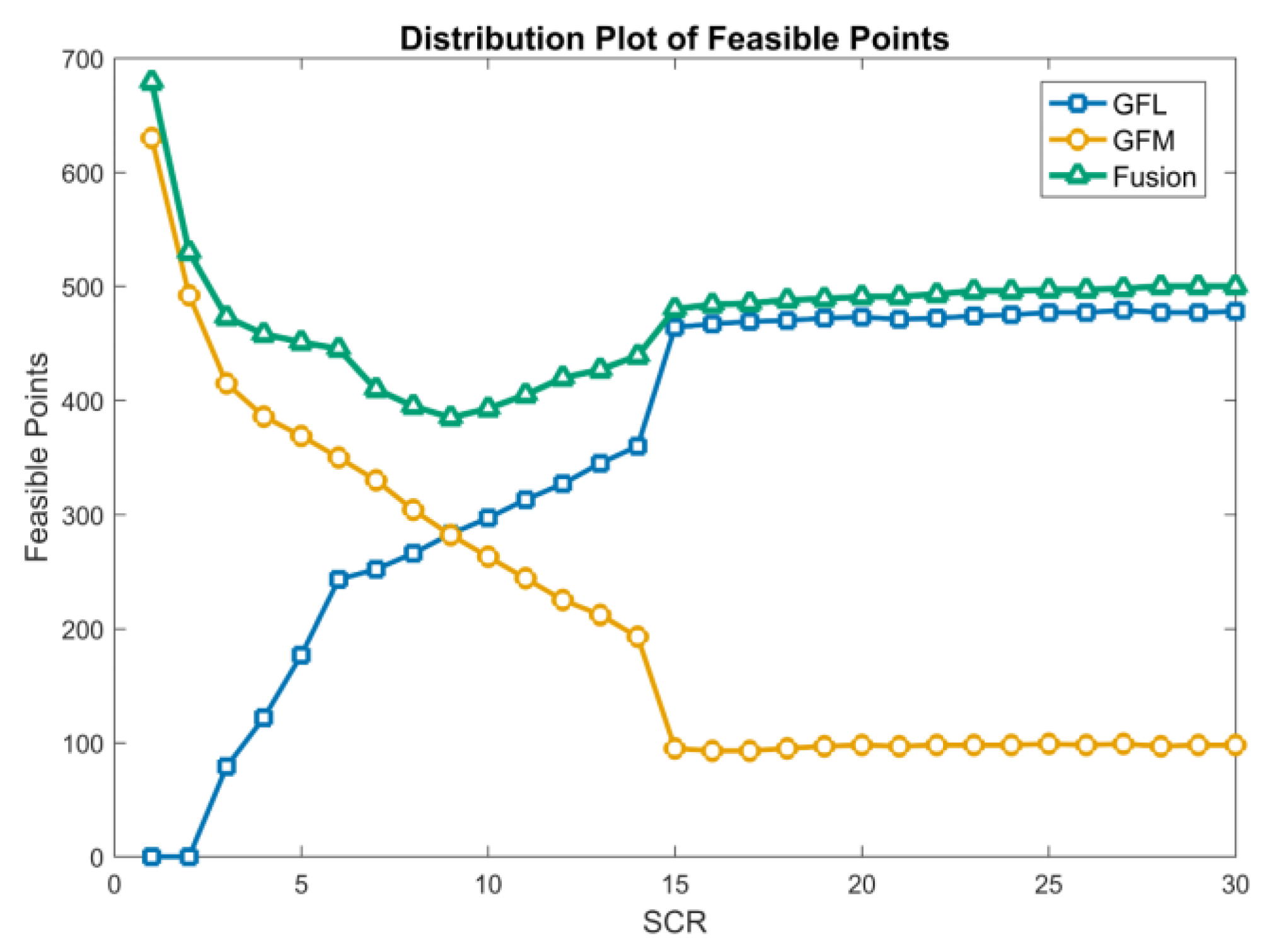
To provide an intuitive representation of the change in feasible solutions under different SCR conditions, the number of feasible points satisfying both stability and performance constraints,
, is counted.
Figure 8 compares
for the three control schemes. It can be observed that the feasible-point counts of the single GFL and single GFM schemes decrease markedly as SCR varies, whereas the fusion scheme maintains a higher and smoother
over the entire SCR scan range. This indicates that fusion control can continuously provide a larger stability–performance feasible set under grid-strength fluctuations, thereby significantly improving robustness and tunability in weak-grid conditions.
To further characterize the stability margin in the parameter space, a stability-region area maximization principle is proposed, and the stability-region area index under a given
is defined as follows:
where
denotes the area of the feasible region in the
plane for the given SCR and fusion ratio
, and
is the differential area element.
Here, is jointly determined by the D-partition stability boundary and the performance constraints. The same performance constraints as those defined above are adopted here.
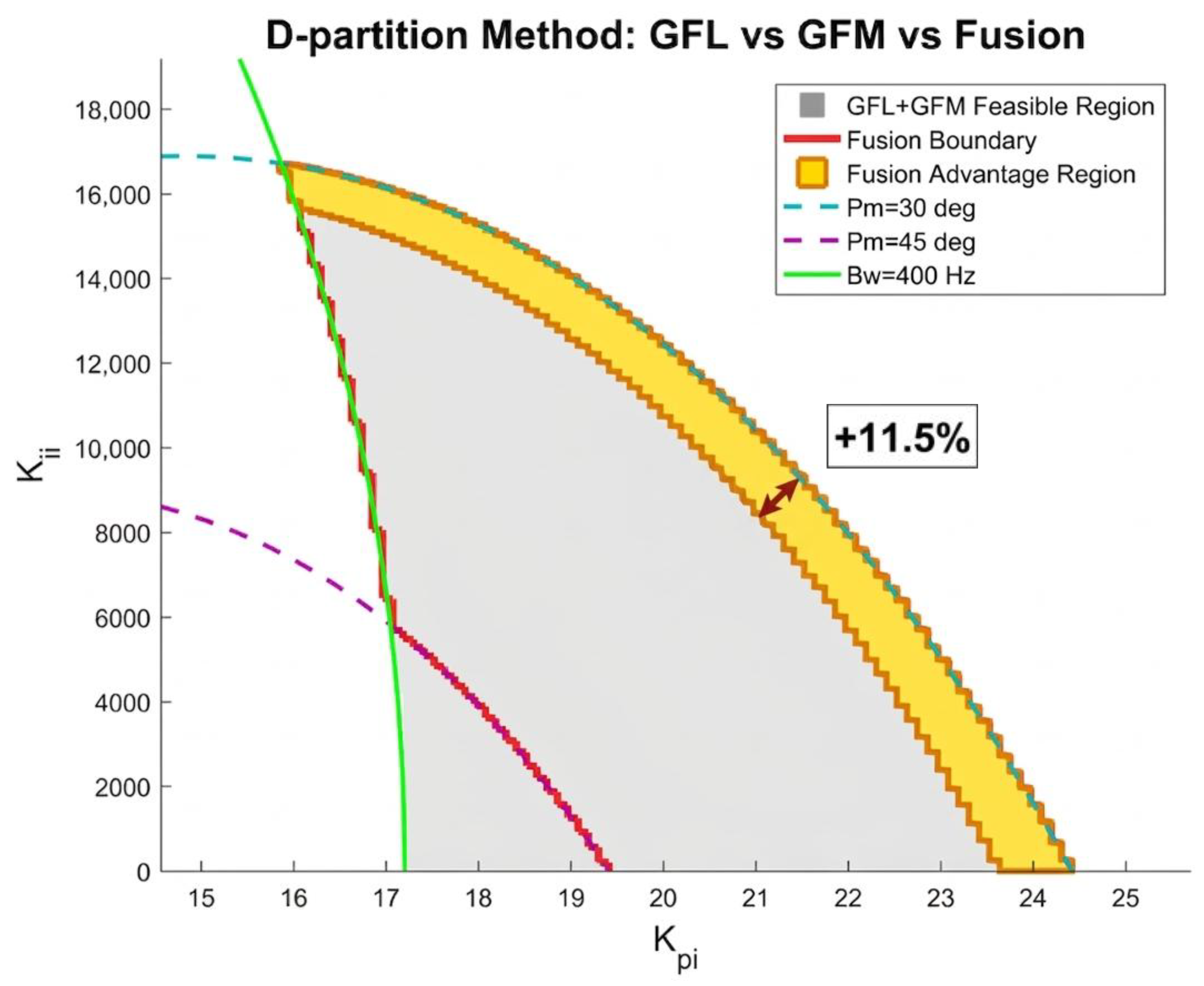
As shown in
Figure 9, under the weak-grid condition of SCR = 1, the feasible-region area of the fusion control strategy is increased by approximately 11.5% relative to
, indicating that the fusion strategy enlarges the tunable parameter set under combined stability and performance constraints.
However, if the fusion ratio is selected as a fixed value or via simple piecewise switching, weight jumps may occur at partition boundaries when SCR fluctuates, thereby inducing transient shocks and reducing the stability margin. To address the inherent limitations of such discontinuous switching strategies, a D-zone-based fusion-weight curve construction method is developed for the full SCR range, such that the fusion weight varies continuously with grid strength, enabling adaptive disturbance-free transitions between GFM and GFL characteristics.
4. Adaptive Disturbance-Free Switching Control Strategy Based on the D-Partition Method
To satisfy both stability and dynamic-performance requirements under weak- and strong-grid conditions, the SCR axis is partitioned into four typical regions, and a nominal fusion ratio
is assigned to each region to reflect the required weighting between GFM and GFL control across grid strengths. The region boundaries and the corresponding piecewise specification are given later in this section. The allowable range of the fusion coefficient is specified as follows:
where
denotes the fusion ratio scheduled as a function of SCR, and
and
denote the lower and upper bounds, respectively.
If a piecewise-constant value (e.g., ) is directly adopted, discontinuous jumps arise at region boundaries and may lead to control-weight chattering. To suppress boundary discontinuities and improve practical robustness, the piecewise curve should be made continuous and smoothed.
4.1. Adaptive Disturbance-Free Switching Strategy
A hyperbolic-tangent-based smoothing weight
is defined as
where
is the smoothing-weight function with
,
is the center point of the boundary between adjacent regions, and
is the smoothing factor that determines the transition width.
Taking the nominal values
and
of two adjacent regions as an example, a smoothing weight
is introduced, and the fusion ratio
is continuousized near the boundary as follows:
In this expression, and denote the preselected nominal fusion ratios for two adjacent SCR intervals, respectively.
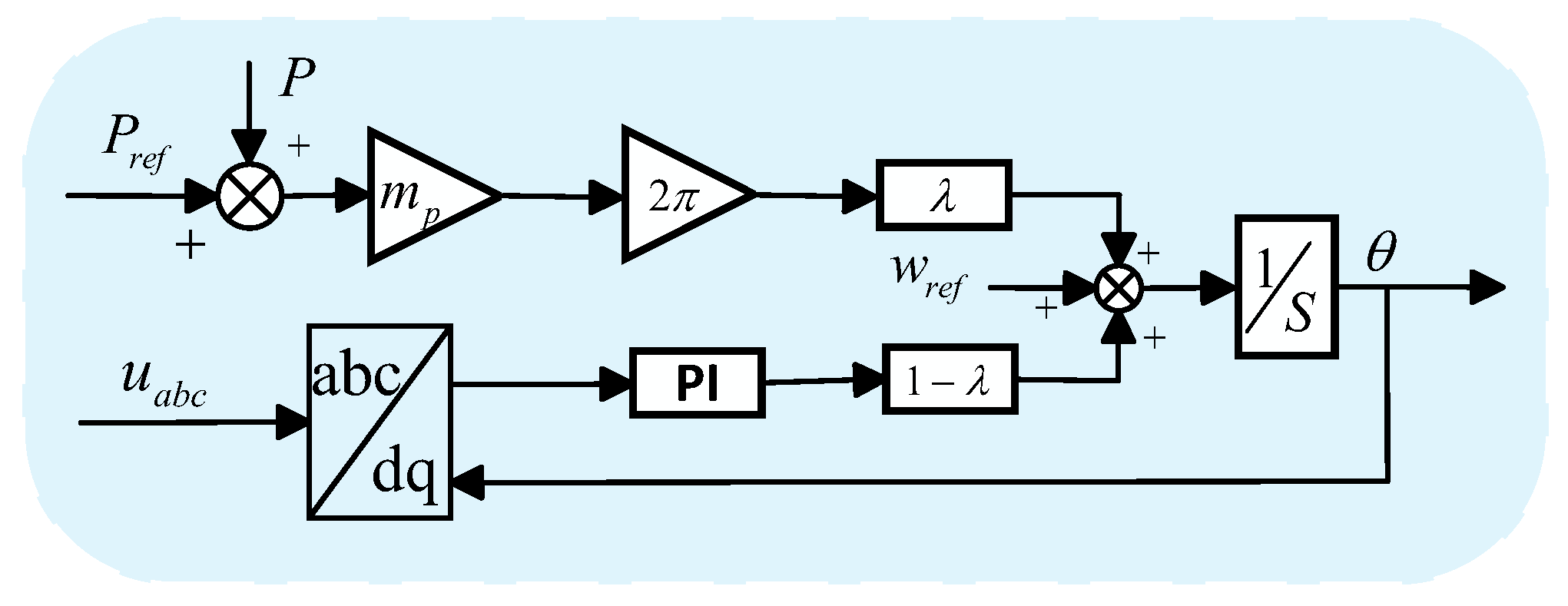
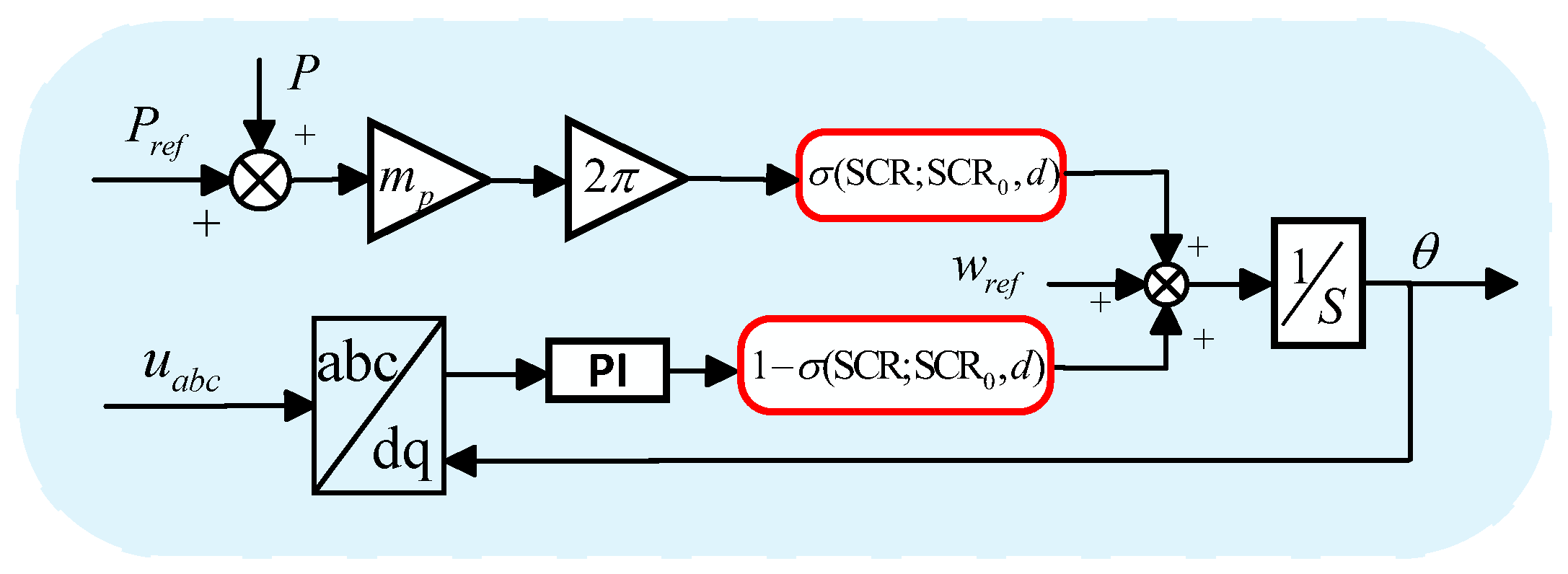
Furthermore, the modulation voltage reference of the fusion controller can be expressed as follows:
where
denotes the reference frequency produced by the fusion controller, and
and
denote the reference frequencies under the single GFM and single GFL modes, respectively.
The corresponding control block diagram is shown in
Figure 10.
This recursive structure enables smooth transitions in the multi-dimensional parameter space, thereby achieving disturbance-free switching. For any SCR operating point, the first- and second-order derivatives of the control gain, and , remain continuous, effectively suppressing gain discontinuities caused by hard switching and the resulting control non-smoothness.
4.2. D-Zone Fusion-Coefficient Curve
To achieve seamless interconnection among multiple regions, a cascaded recursive form is further constructed. The SCR range is partitioned into four typical regions with switching thresholds
,
, and
, and the corresponding smoothing factors are
,
, and
. The nominal fusion coefficients are denoted by
, equivalently written as
–
. The boundary weight at the
-th interface is defined as follows:
where
denotes the smoothing weight at the
-th region boundary,
denotes the corresponding SCR threshold, and
is the associated smoothing factor.
The nominal values for each region are specified as follows:
where
denotes the piecewise nominal fusion ratio, and
denote the preselected nominal fusion ratios for the corresponding SCR intervals.
To mitigate the risk of high-frequency resonance caused by an excessively large gain
in the strong-grid regime, the nominal value in the strong-grid region can be further modified using a linear constraint as follows:
Here, denotes the baseline fusion proportion in the high-SCR region after correction via a linear constraint; is the reference fusion proportion for this region; and is the slope coefficient of the linear constraint.
On this basis, a hierarchical smoothing and bumpless switching scheme was adopted to enable seamless inter-region coordination, thereby yielding the final fusion coefficient:
In Equation (37), denotes the intermediate fusion proportion obtained by smoothly transitioning from to in the vicinity of the threshold . In Equation (38), denotes the intermediate fusion proportion after further smoothing near the threshold . In Equation (39), is the final grid-strength-adaptive smooth switching function over a wide SCR range. Equations (37)–(39) ensure that varies continuously over the entire SCR range and effectively suppresses abrupt weight changes introduced at region boundaries by piecewise switching.
In practical implementations, real-time SCR estimation is inherently susceptible to measurement noise and delays. To guarantee robustness against such uncertainties, the raw estimated SCR is first processed through an LPF before evaluating Equation (34). Furthermore, the hyperbolic tangent functions physically act as buffers via the smoothing factors (). This dual mechanism ensures that even if the filtered SCR fluctuates around the thresholds, the final fusion weight updates continuously without inducing oscillatory mode-jumping.
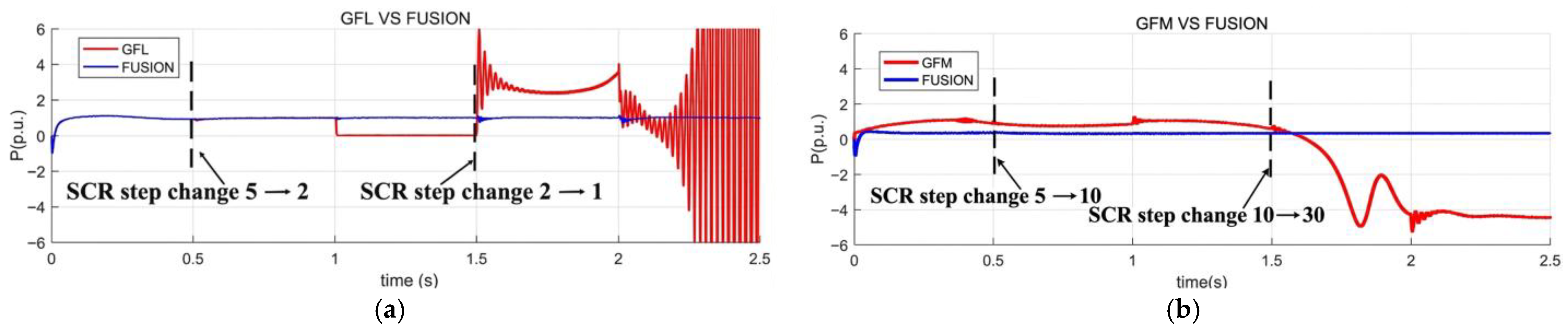
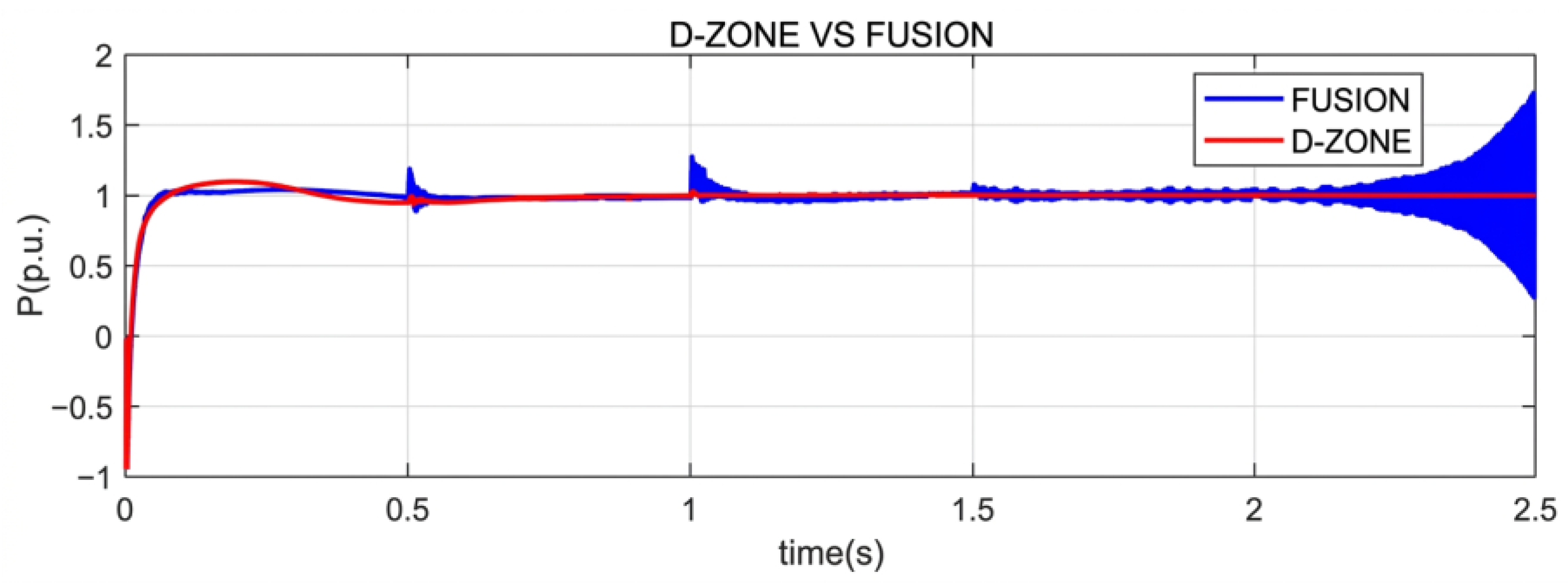
A comparison of the active-power dynamic responses under different SCR conditions is presented in
Figure 11 for the fixed-fusion and D-zone strategies. The results indicate that the D-zone response remains smoother as SCR transitions across regions, with no pronounced spikes or high-frequency oscillations, demonstrating that the bumpless transition of
effectively mitigates transient disturbances caused by abrupt weight variations.
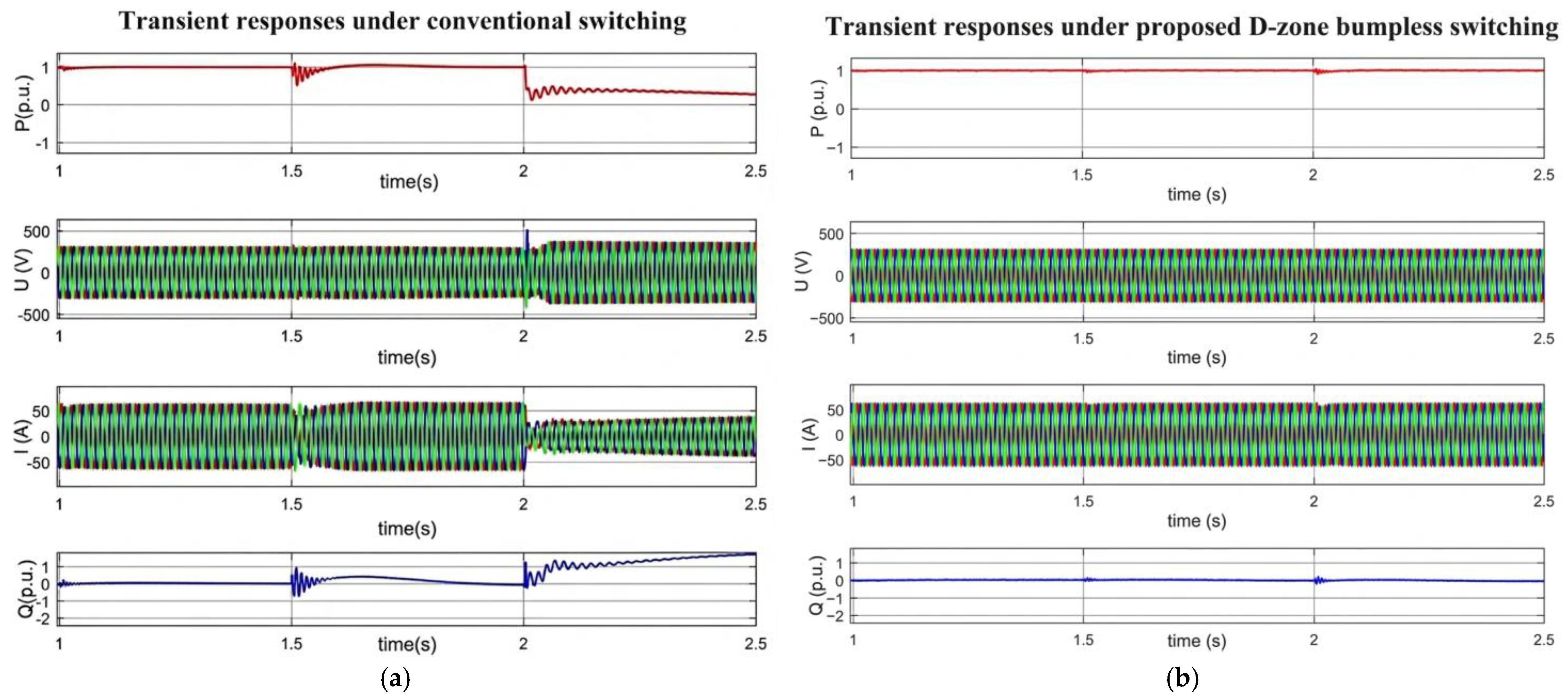
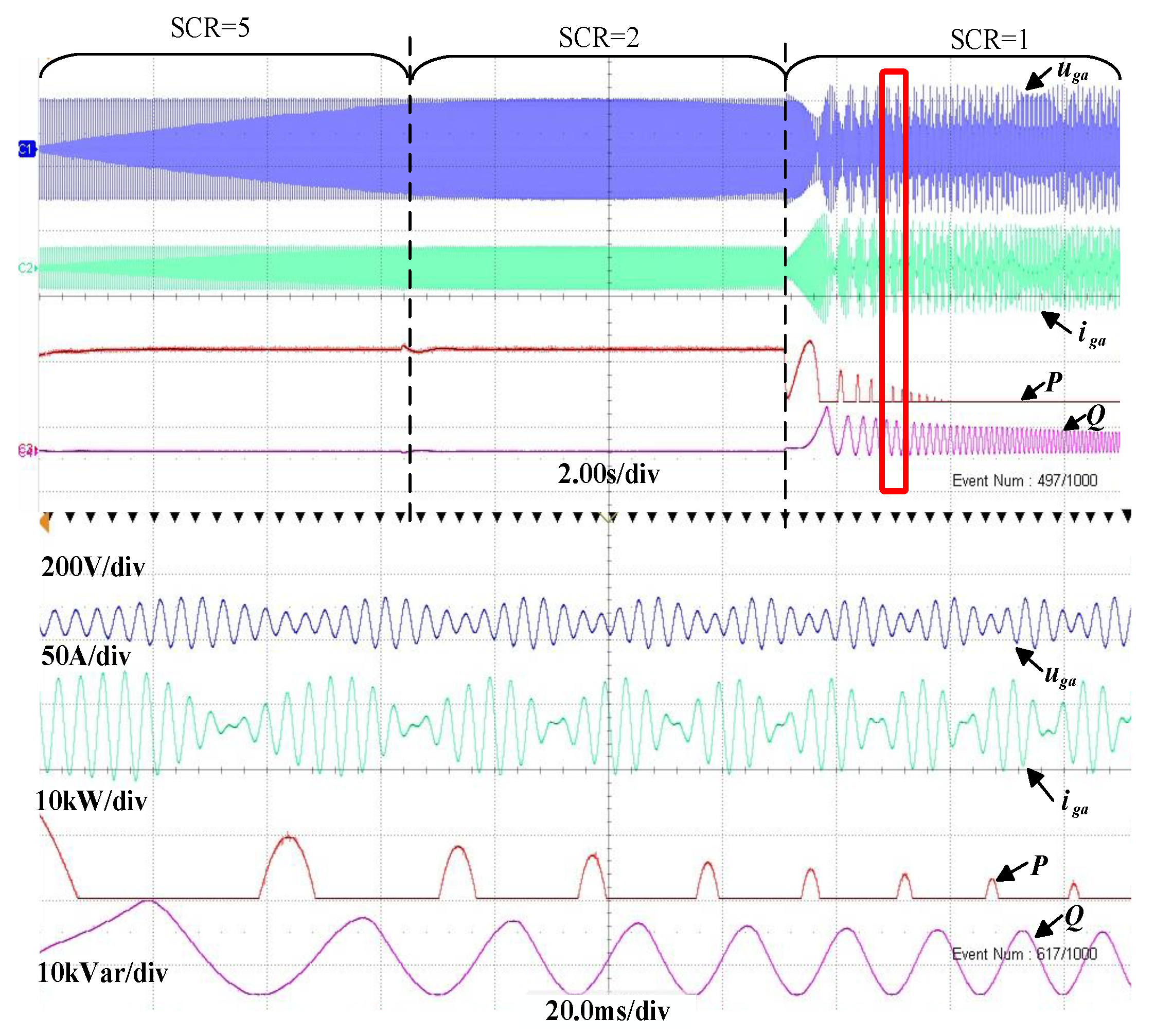
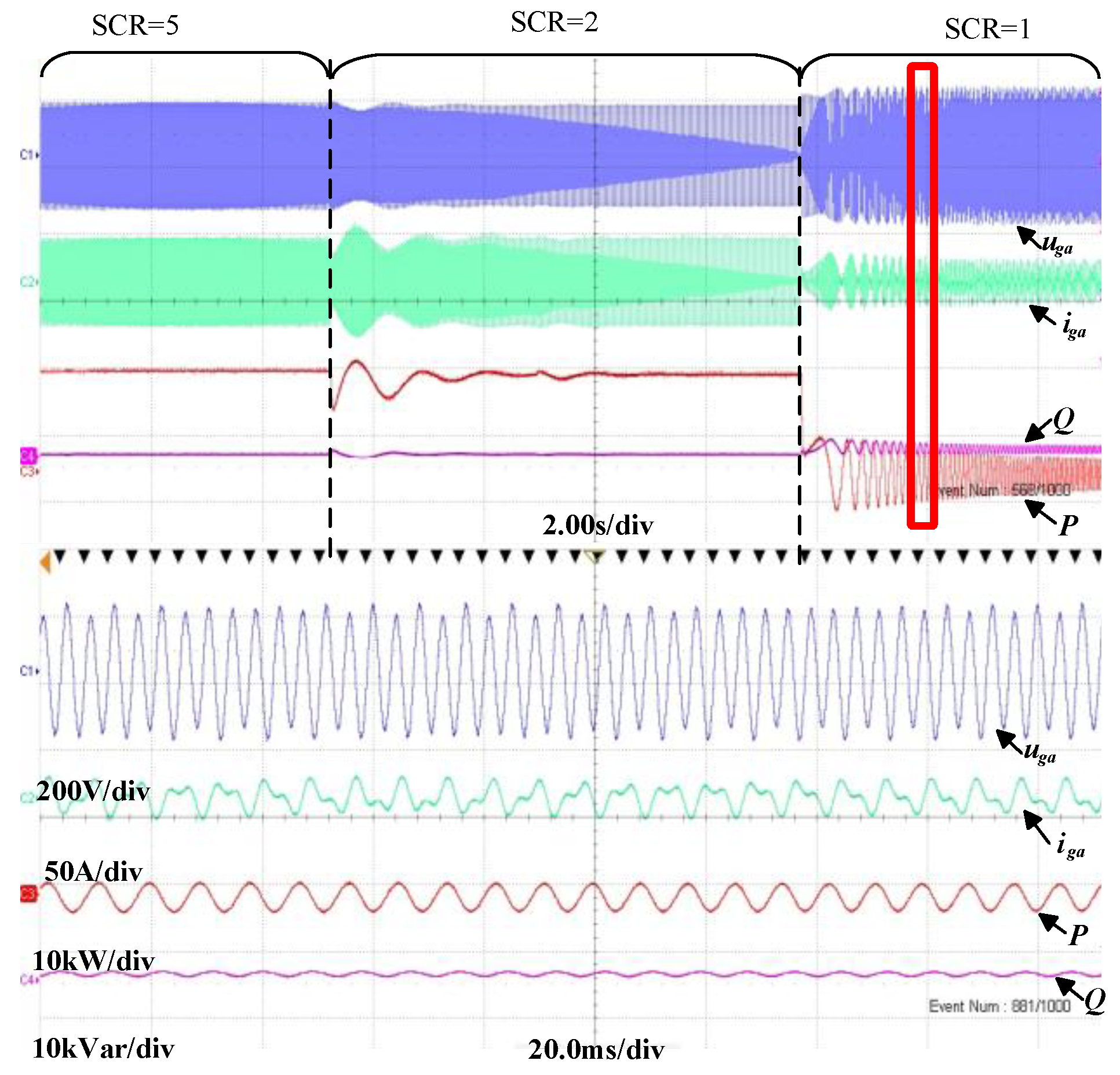
To further investigate the multi-variable dynamic characteristics during grid-strength transitions, a comprehensive time-domain simulation was conducted, as shown in
Figure 12. By evaluating the point of common coupling (PCC) voltage, grid current, active power, and reactive power, this analysis establishes a direct comparative baseline for the subsequent experimental verification.
As illustrated in
Figure 12, conventional switching strategies induce severe transient voltage distortions and massive current spikes at the instants of grid-strength transitions. These simulated transients theoretically reveal the physical roots of the instability tendencies. In contrast, the proposed D-zone strategy maintains highly stable and smooth waveforms across all physical variables throughout the wide-range SCR reduction, demonstrating excellent transient suppression capabilities.
To validate the superiority of the proposed D-zone bumpless switching strategy, comparisons were conducted over the full SCR range against hysteresis switching [
26], traditional piecewise switching [
30], and hard switching [
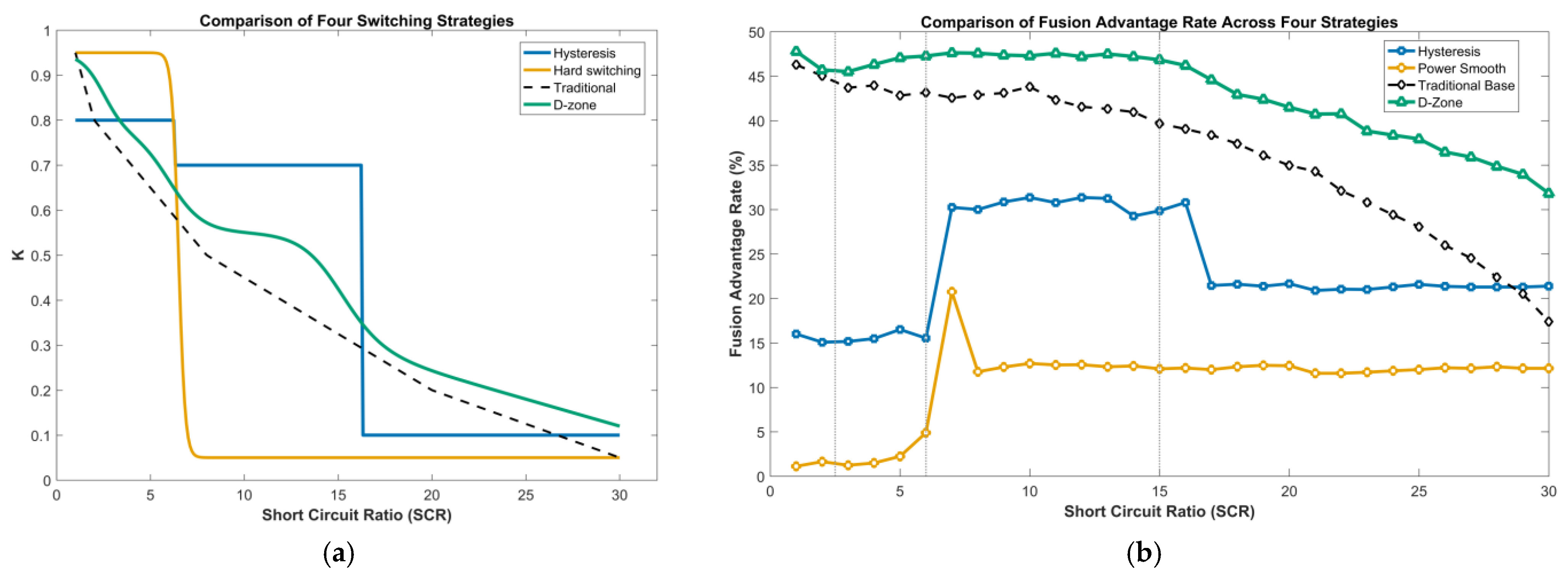
31]; the gain-evolution trajectories of the four strategies are shown in
Figure 13.
As shown in
Figure 13a, hard switching exhibits discontinuous jumps, traditional piecewise switching still tends to trigger chattering at region boundaries, and linear switching is continuous but struggles to simultaneously satisfy stability-margin and performance constraints in weak grids. In contrast, the D-zone strategy achieves bumpless transitions at partition boundaries while constraining
in the strong-grid region.
Figure 13b further shows that the D-zone strategy maintains a higher and smoother fusion advantage ratio over a wider SCR range, reaching 43.11%, which indicates that the benefits of fusion control can be released more consistently across a broad range of grid strengths.
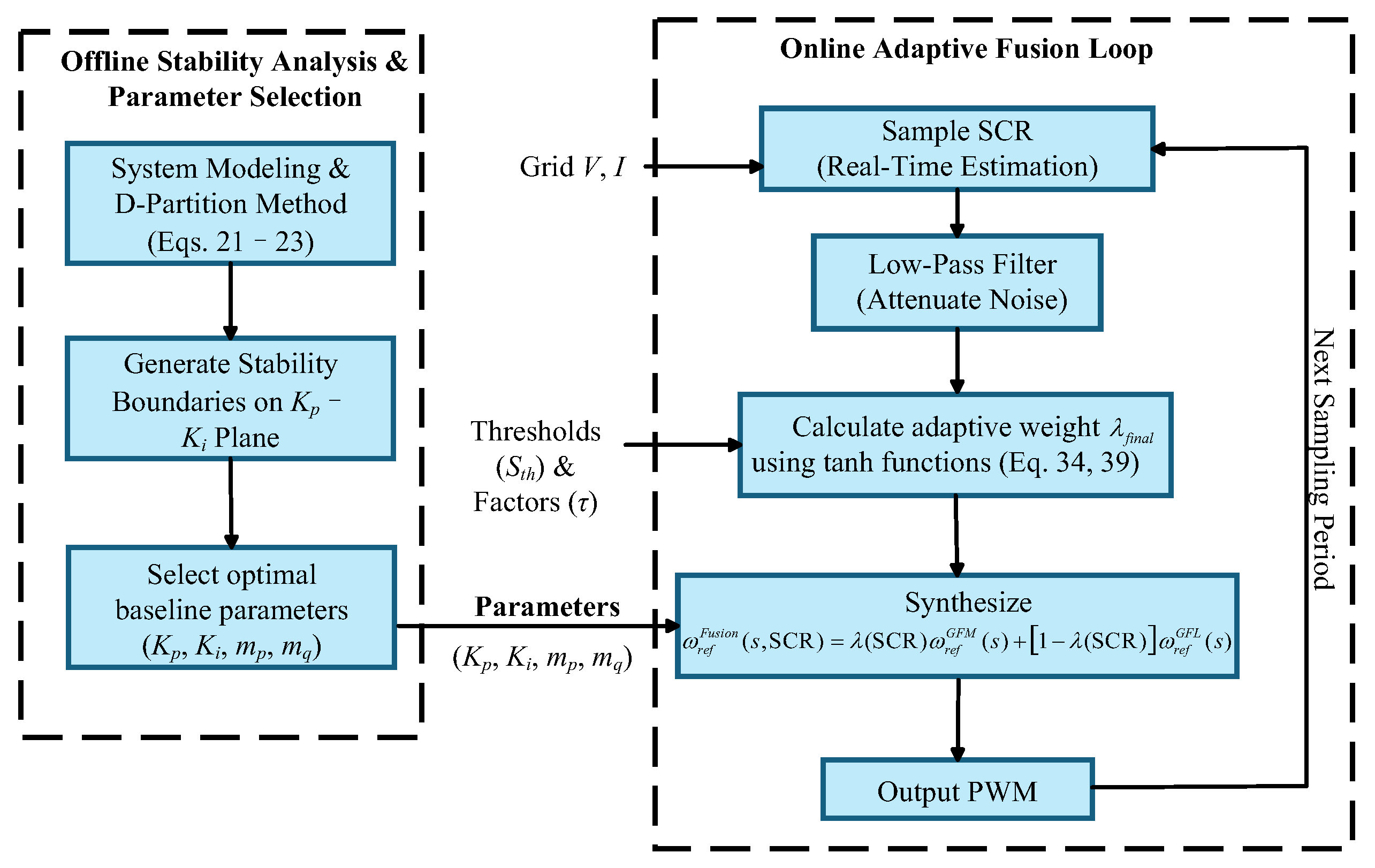
To explicitly demonstrate the practical replicability of the proposed method, the complete execution framework is illustrated in
Figure 14. The control system is structurally decoupled into an offline analysis phase and an online execution loop. The complex stability boundary mapping via the D-partition method is strictly executed offline to determine the switching thresholds alongside the optimal baseline parameters, specifically
,
,
, and
. Consequently, the real-time digital signal processor (DSP) execution is computationally highly efficient. This process requires only grid strength estimation, LPF for noise attenuation, and the arithmetic calculation of the continuous fusion weight
to synthesize the final pulse-width modulation (PWM) commands.