Deep Learning for Joint Pilot, Channel Feedback and Sub-Array Hybrid Beamforming in FDD Massive MU-MIMO-OFDM Systems


Abstract
1. Introduction
1.1. Related Works
1.2. Contributions
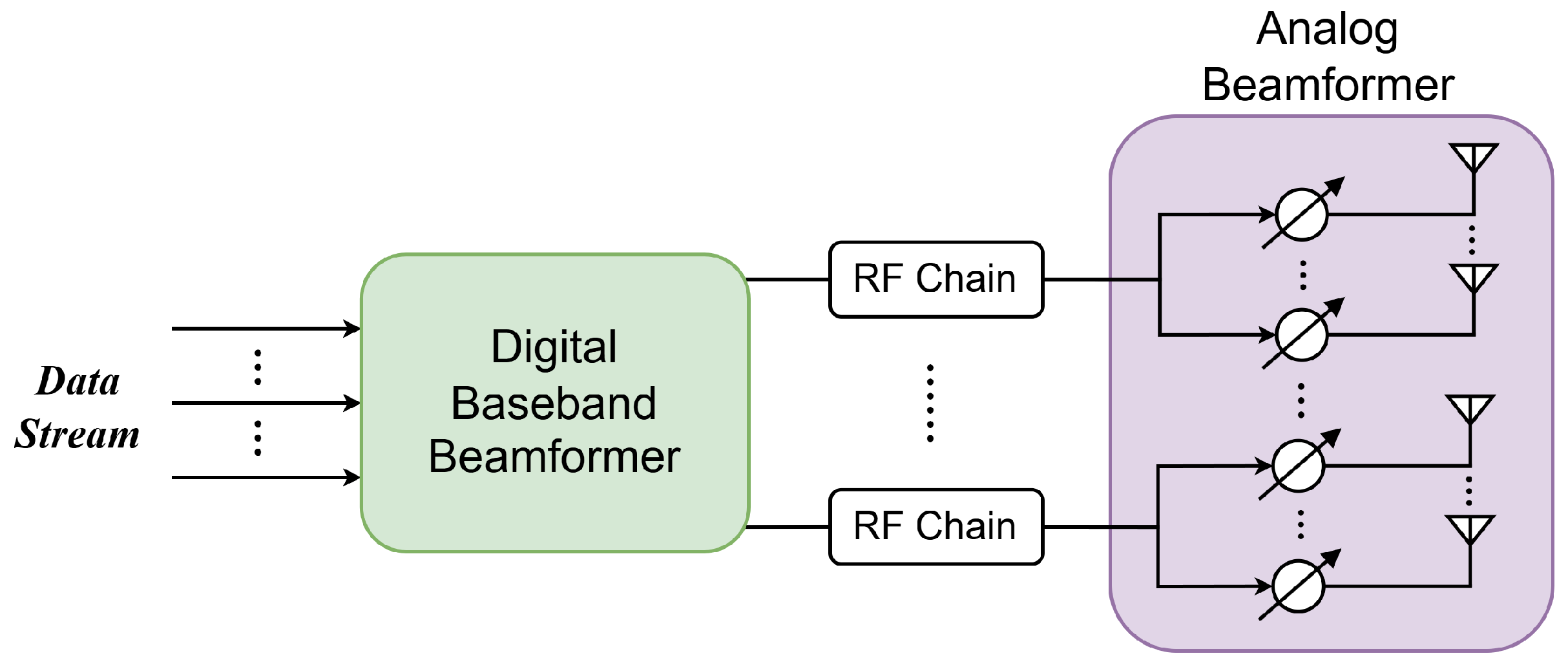
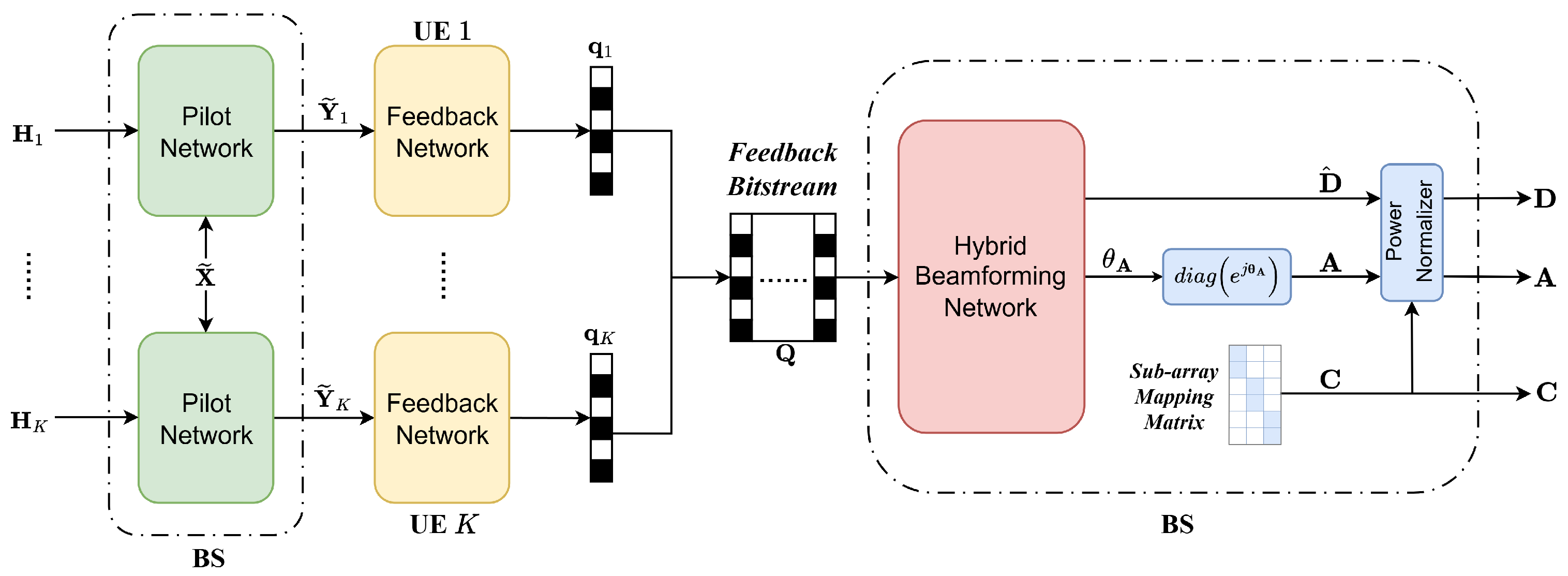
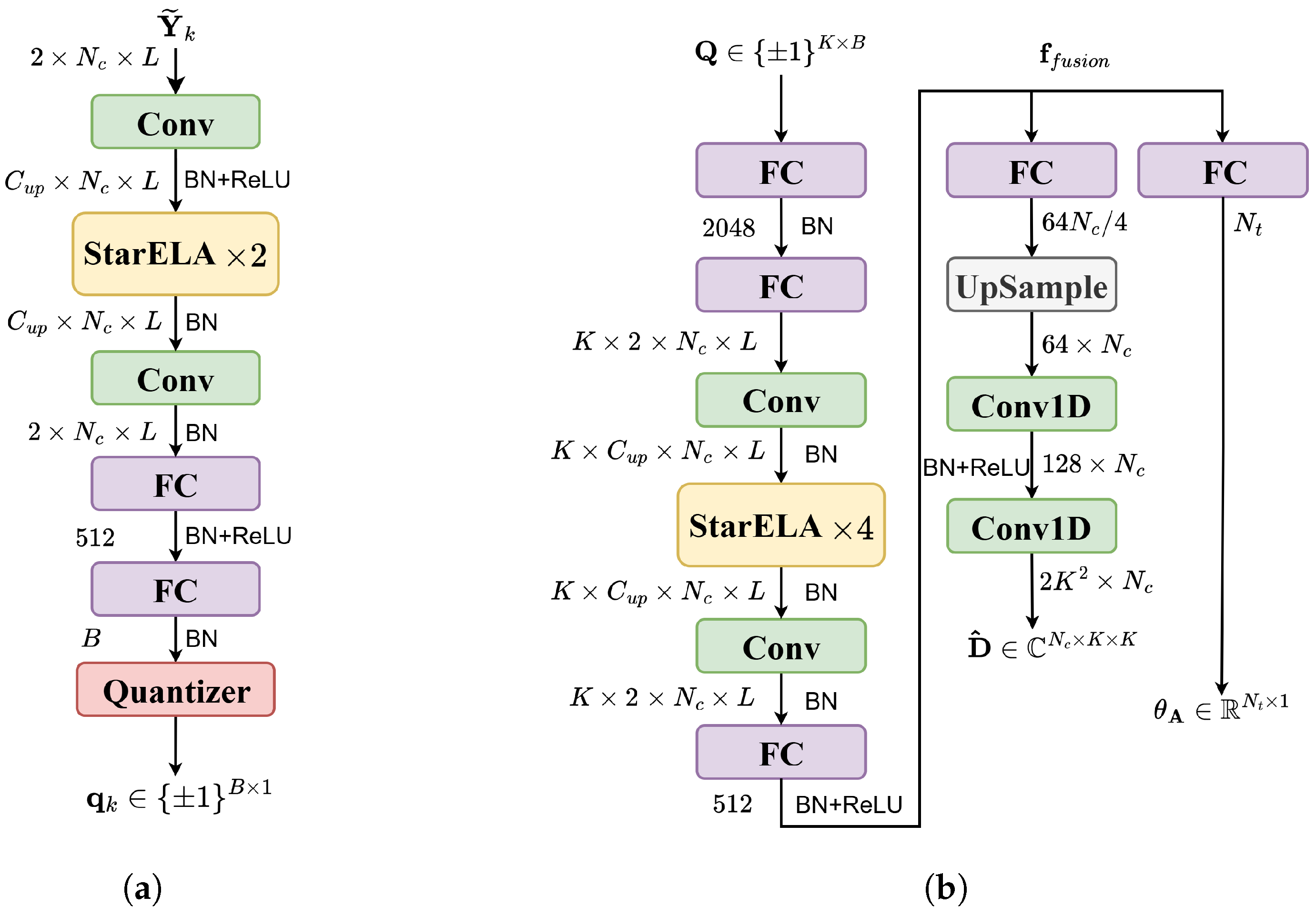
- We introduce the sub-array hybrid beamforming architecture into FDD MU-MIMO-OFDM systems and propose a DL-based end-to-end framework for joint pilot training, CSI feedback, and hybrid beamforming. The proposed framework, comprising the pilot network, the feedback network, and the beamforming network, is trained unsupervisedly to maximize the system sum rate. It adaptively learns task-oriented pilot patterns and feedback features, avoiding explicit channel estimation and feedback in conventional separated designs.
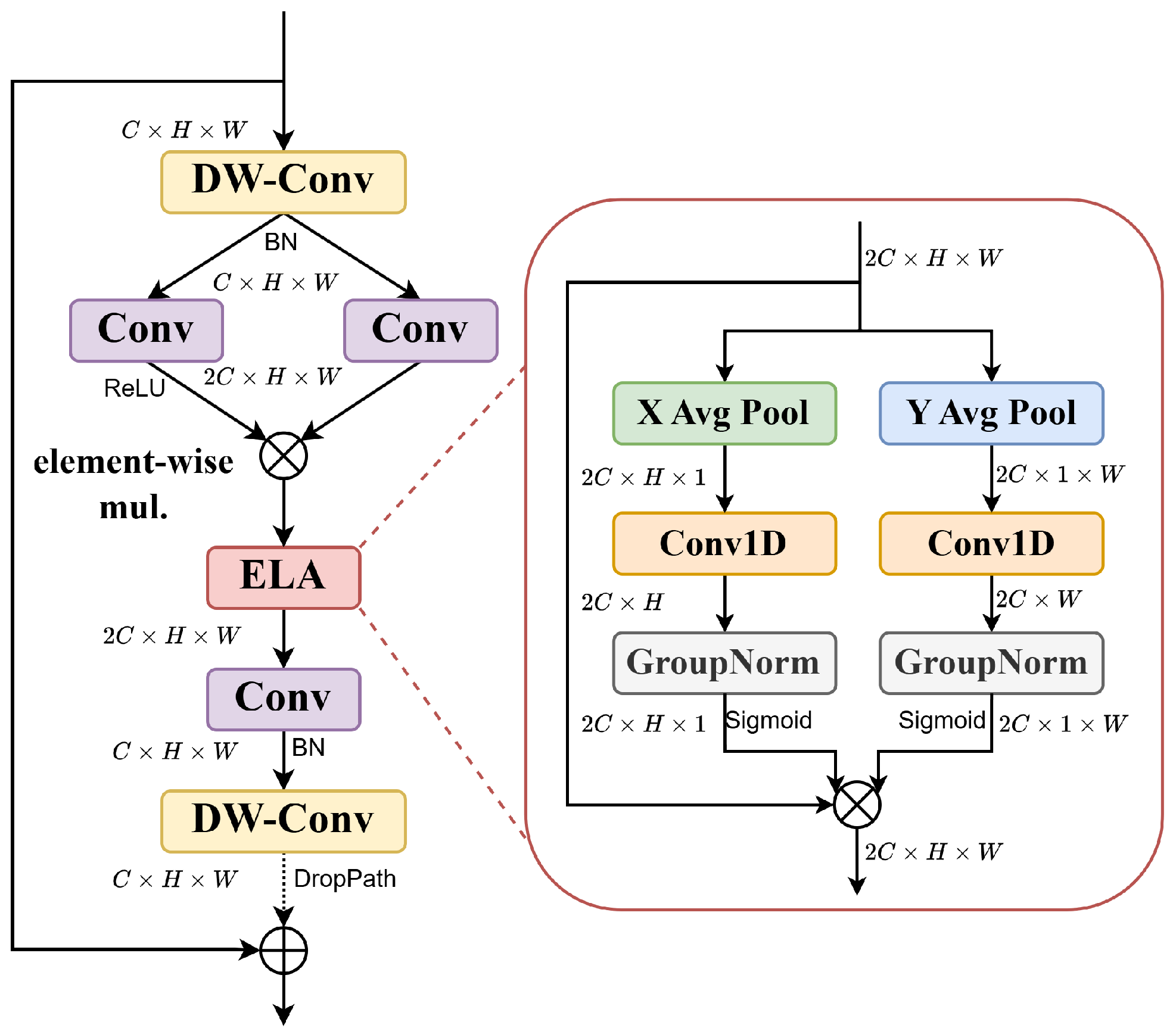
- We design a star efficient location attention (StarELA) module that combines the implicit high-dimensional mapping capability of star operations (element-wise multiplication) with the position-aware local interaction modeling of efficient location attention (ELA) [27]. As the core block in both the feedback and beamforming networks, StarELA improves channel feature extraction efficiency and effectiveness.
- We propose a seed generation and interpolation upsampling strategy for the digital beamforming branch of the beamforming network at the BS. By exploiting strong inter-subcarrier correlation in wideband OFDM channels, this mechanism reduces model parameters while preserving frequency–domain smoothness and generalization of the generated digital beamformers.
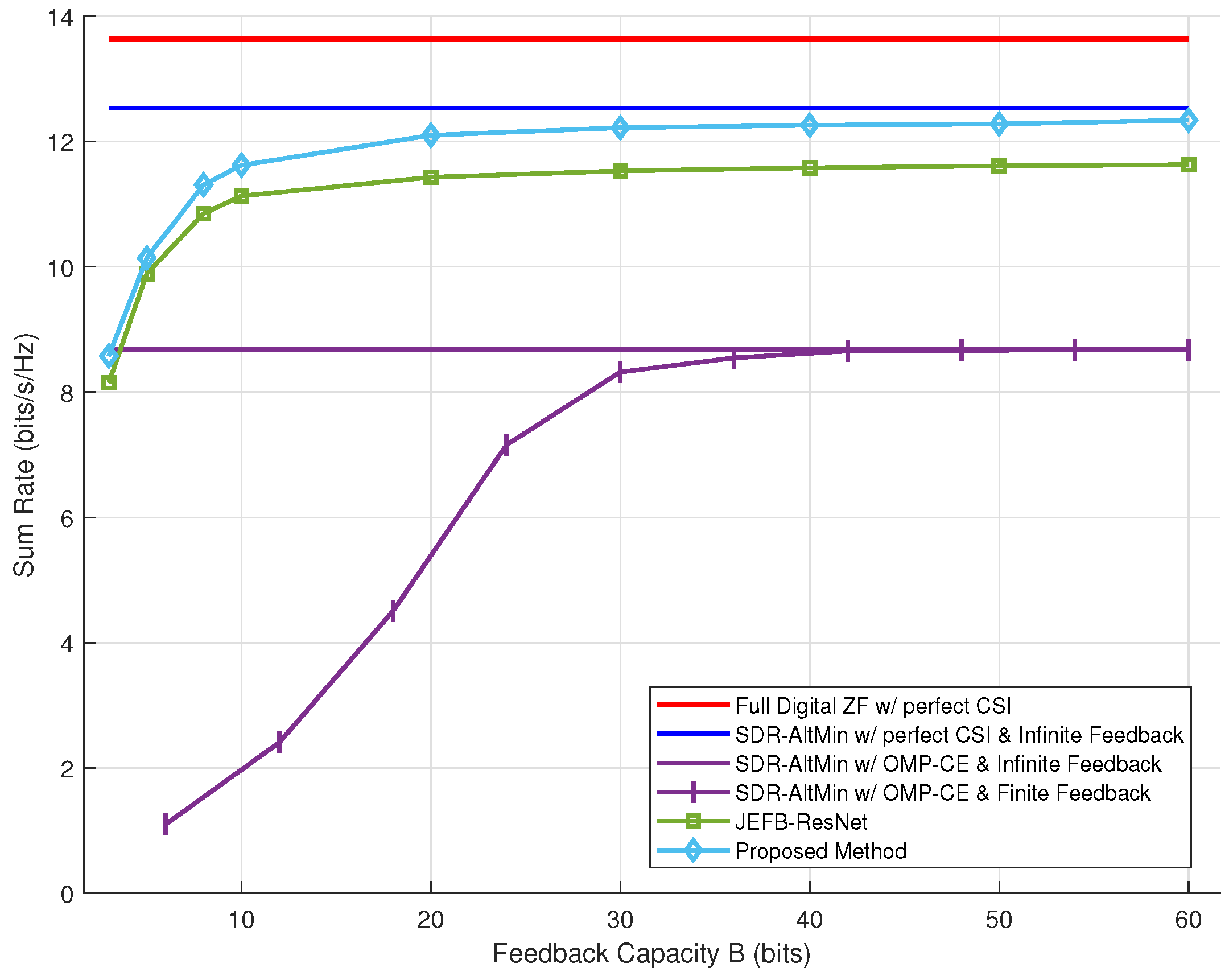
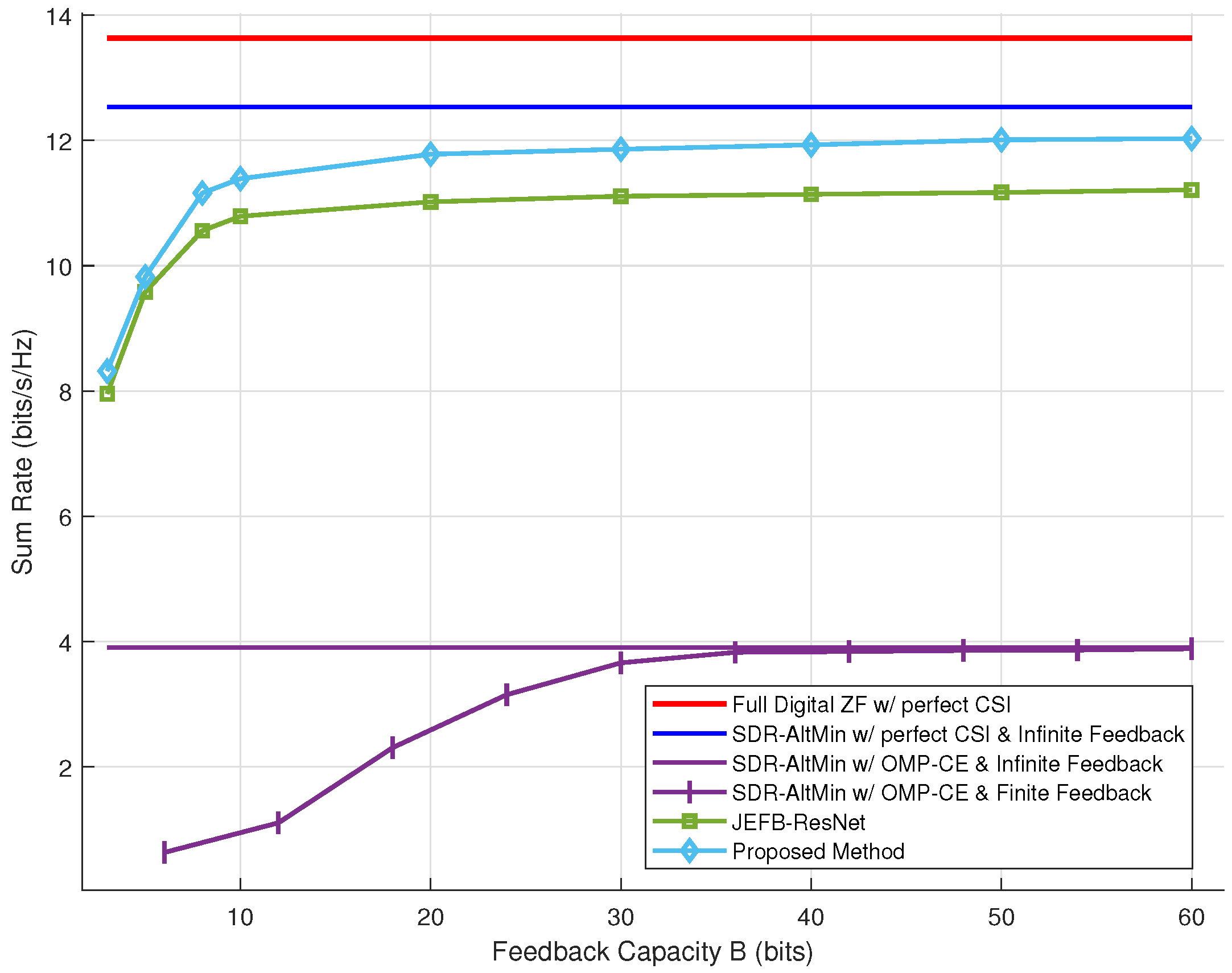
- Simulation results demonstrate that the proposed method approaches the performance of conventional sub-array hybrid beamforming with ideal CSI and outperforms existing deep learning baselines under different feedback bit budgets, exhibiting superior robustness even with limited pilot overhead.
2. System Model and Problem Formulation
2.1. System Model
2.2. Problem Formulation
3. Proposed Method
3.1. StarELA Module
3.2. Pilot Network
3.3. Feedback Network
3.4. Hybrid Beamforming Network
3.4.1. Multi-User Feature Refinement and Fusion
3.4.2. Hybrid Beamformer Generation
- Seed Generation: Exploiting the frequency correlation of channels, we first map to a low-resolution seed tensor , where is hidden channel dimension, denotes the number of seed nodes and is the downsampling factor.
- Interpolation and Refinement: To recover full-band resolution, is upsampled along the frequency dimension via linear interpolation to obtain coarse features . According to the channel model in Equation (4), the frequency–domain evolution across subcarriers is governed by a complex exponential function. However, since the subcarrier interval covered by the downsampling factor S is typically much smaller than the channel coherence bandwidth, this exponential phase rotation can be effectively approximated as a locally linear transformation. Therefore, we adopt a simple and lightweight linear interpolation for upsampling. Subsequently, we introduce a convolution block composed of 1D convolution, BN, and ReLU to compensate for any linear approximation errors and recover the precise nonlinear channel dynamics.
4. Numerical Results
4.1. Experimental Settings and Benchmarks
4.1.1. System Parameters and Dataset Generation
4.1.2. Training Settings
4.1.3. Benchmarks
- Full Digital ZF with Perfect CSI: The BS is assumed to have perfect CSI and performs fully digital ZF beamforming. This serves as a theoretical upper bound.
- SDR-AltMin with Perfect CSI and Infinite Feedback: With perfect CSI at the BS, hybrid beamforming is designed using semidefinite relaxation based AltMin (SDR-AltMin) [5], representing the upper bound of conventional hybrid beamforming without estimation or feedback distortion.
- SDR-AltMin with OMP-CE and Infinite Feedback: Each UE estimates downlink CSI via orthogonal matching pursuit (OMP) [30], and the estimated CSI is fed back losslessly. The BS then applies SDR-AltMin.
- SDR-AltMin with OMP-CE and Finite Feedback: Each UE first performs OMP-based channel estimation, then quantizes path gain and AoD using Lloyd-Max quantization [31] for limited feedback; the BS reconstructs CSI and applies SDR-AltMin.
- JEFB-ResNet: As a deep learning baseline, we re-implement the residual network-based joint channel estimation feedback beamforming model (JEFB-ResNet) [17] and adapt it to the sub-array architecture for fair comparison.
4.2. Performance Comparison
5. Conclusions
Author Contributions
Funding
Data Availability Statement
Conflicts of Interest
References
- Wang, C.X.; You, X.; Gao, X.; Zhu, X.; Li, Z.; Zhang, C.; Wang, H.; Huang, Y.; Chen, Y.; Haas, H.; et al. On the road to 6G: Visions, requirements, key technologies, and testbeds. IEEE Commun. Surv. Tutor. 2023, 25, 905–974. [Google Scholar] [CrossRef]
- Wang, Z.; Zhang, J.; Du, H.; Niyato, D.; Cui, S.; Ai, B.; Debbah, M.; Letaief, K.B.; Poor, H.V. A tutorial on extremely large-scale MIMO for 6G: Fundamentals, signal processing, and applications. IEEE Commun. Surv. Tutor. 2024, 26, 1560–1605. [Google Scholar] [CrossRef]
- Guo, J.; Wen, C.K.; Jin, S.; Li, G.Y. Overview of deep learning-based CSI feedback in massive MIMO systems. IEEE Trans. Commun. 2022, 70, 8017–8045. [Google Scholar] [CrossRef]
- Chowdary, A.; Bazzi, A.; Chafii, M. Uplink and downlink communications fusion for enhanced radar sensing. In Proceedings of the IEEE International Workshop on Signal Processing Advances in Wireless Communications (SPAWC), Shanghai, China, 25–28 September 2023; pp. 446–450. [Google Scholar] [CrossRef]
- Yu, X.; Shen, J.C.; Zhang, J.; Letaief, K.B. Alternating minimization algorithms for hybrid precoding in millimeter wave MIMO systems. IEEE J. Sel. Top. Signal Process. 2016, 10, 485–500. [Google Scholar] [CrossRef]
- Guo, Y.; Li, L.; Wen, X.; Chen, W.; Han, Z. Sub-array based hybrid precoding design for downlink millimeter-wave multi-user massive MIMO systems. In Proceedings of the International Conference on Wireless Communications and Signal Processing (WCSP), Nanjing, China, 11–13 October 2017; pp. 1–4. [Google Scholar] [CrossRef]
- Qin, Z.; Fan, J.; Liu, Y.; Gao, Y.; Li, G.Y. Sparse representation for wireless communications: A compressive sensing approach. IEEE Signal Process. Mag. 2018, 35, 40–58. [Google Scholar] [CrossRef]
- Xing, Y.; Chen, Y.; Yang, L. MMSE-based wideband hybrid precoding for massive MIMO systems. In Proceedings of the International Conference on Information and Communication Technology Convergence (ICTC), Jeju, Republic of Korea, 19–21 October 2016; pp. 18–20. [Google Scholar] [CrossRef]
- Dai, L.; Gao, X.; Quan, J.; Han, S. Near-optimal hybrid analog and digital precoding for downlink mmWave massive MIMO systems. In Proceedings of the IEEE International Conference on Communications (ICC), London, UK, 8–12 June 2015; pp. 1334–1339. [Google Scholar] [CrossRef]
- Wen, C.K.; Shih, W.T.; Jin, S. Deep learning for massive MIMO CSI feedback. IEEE Wirel. Commun. Lett. 2018, 7, 748–751. [Google Scholar] [CrossRef]
- Lu, Z.; Wang, J.; Song, J. Multi-resolution CSI feedback with deep learning in massive MIMO system. In Proceedings of the IEEE International Conference on Communications (ICC), Dublin, Ireland, 7–11 June 2020; pp. 1–6. [Google Scholar] [CrossRef]
- Guo, J.; Wen, C.K.; Jin, S.; Li, G.Y. Convolutional neural network-based multiple-rate compressive sensing for massive MIMO CSI feedback: Design, simulation, and analysis. IEEE Trans. Wirel. Commun. 2020, 19, 2827–2840. [Google Scholar] [CrossRef]
- Cui, Y.; Guo, A.; Song, C. TransNet: Full attention network for CSI feedback in FDD massive MIMO system. IEEE Wirel. Commun. Lett. 2022, 11, 903–907. [Google Scholar] [CrossRef]
- Zhao, K.; Wu, H.; Xiong, Y.; Zhu, L.; Xu, M. StarCANet: A compact and efficient neural network for massive MIMO CSI feedback. IEEE Wirel. Commun. Lett. 2025, 14, 540–544. [Google Scholar] [CrossRef]
- Tang, L.; Sun, Y.; Yao, S.; Xu, X.; Chen, H.; Luo, Z. Efficient multiple-input–multiple-output channel state information feedback: A semantic-knowledge-base-driven approach. Electronics 2025, 14, 1666. [Google Scholar] [CrossRef]
- Sohrabi, F.; Attiah, K.M.; Yu, W. Deep learning for distributed channel feedback and multiuser precoding in FDD massive MIMO. IEEE Trans. Wirel. Commun. 2021, 20, 4044–4057. [Google Scholar] [CrossRef]
- Wu, M.; Gao, Z.; Gao, Z.; Wu, D.; Yang, Y.; Huang, Y. Deep learning-based hybrid precoding for FDD massive MIMO-OFDM systems with a limited pilot and feedback overhead. In Proceedings of the IEEE International Conference on Communications Workshops (ICC Workshops), Seoul, Republic of Korea, 16–20 May 2022; pp. 318–323. [Google Scholar] [CrossRef]
- Sun, Q.; Zhao, H.; Wang, J.; Chen, W. Deep learning-based joint CSI feedback and hybrid precoding in FDD mmWave massive MIMO systems. Entropy 2022, 24, 441. [Google Scholar] [CrossRef]
- Gao, Z.; Wu, M.; Hu, C.; Gao, F.; Wen, G.; Zheng, D.; Zhang, J. Data-driven deep learning based hybrid beamforming for aerial massive MIMO-OFDM systems with implicit CSI. IEEE J. Sel. Areas Commun. 2022, 40, 2894–2913. [Google Scholar] [CrossRef]
- Guo, Y.; Chen, W.; Xu, J.; Li, L.; Ai, B. Deep joint CSI feedback and multiuser precoding for MIMO OFDM systems. IEEE Trans. Veh. Technol. 2025, 74, 1730–1735. [Google Scholar] [CrossRef]
- Lu, Z.; Zhang, X.; Zeng, R.; Wang, J. Towards efficient subarray hybrid beamforming: Attention network-based practical feedback in FDD massive MU-MIMO Systems. arXiv 2023. [Google Scholar] [CrossRef]
- Carpi, F.; Venkatesan, S.; Du, J.; Viswanathan, H.; Garg, S.; Erkip, E. Learned precoding-oriented CSI Feedback in multi-cell multi-user MIMO Systems. IEEE Trans. Wirel. Commun. 2026, 25, 2359–2372. [Google Scholar] [CrossRef]
- El Ayach, O.; Rajagopal, S.; Abu-Surra, S.; Pi, Z.; Heath, R.W. Spatially sparse precoding in millimeter wave MIMO systems. IEEE Trans. Wirel. Commun. 2014, 13, 1499–1513. [Google Scholar] [CrossRef]
- Florio, A.; Avitabile, G.; Coviello, G. A linear technique for artifacts correction and compensation in phase interferometric angle of arrival estimation. Sensors 2022, 22, 1427. [Google Scholar] [CrossRef] [PubMed]
- Myers, N.J.; Kannu, A.P. Impact of channel estimation errors on single stream MIMO beamforming. IEEE Commun. Lett. 2017, 21, 1345–1348. [Google Scholar] [CrossRef]
- Pourmohammad, A.S.; Amirhossein, N.; Chen, S.C.; Rong-Ho, L. Deep learning-enhanced hybrid beamforming design with regularized SVD under imperfect channel information. Mathematics 2026, 14, 509. [Google Scholar] [CrossRef]
- Xu, W.; Wan, Y.; Zhao, W. ELA: Efficient location attention for deep convolution neural networks. J. Real-Time Image Process. 2025, 22, 1–14. [Google Scholar] [CrossRef]
- Sohrabi, F.; Yu, W. Hybrid digital and analog beamforming design for large-scale antenna arrays. IEEE J. Sel. Top. Signal Process. 2016, 10, 501–513. [Google Scholar] [CrossRef]
- Ma, X.; Dai, X.; Bai, Y.; Wang, Y.; Fu, Y. Rewrite the stars. In Proceedings of the IEEE/CVF Conference on Computer Vision and Pattern Recognition (CVPR), Seattle, WA, USA, 16–22 June 2024; pp. 5694–5703. [Google Scholar] [CrossRef]
- Tropp, J.A.; Gilbert, A.C. Signal recovery from random measurements via orthogonal matching pursuit. IEEE Trans. Inf. Theory 2007, 53, 4655–4666. [Google Scholar] [CrossRef]
- Lloyd, S. Least squares quantization in PCM. IEEE Trans. Inf. Theory 1982, 28, 129–137. [Google Scholar] [CrossRef]


Disclaimer/Publisher’s Note: The statements, opinions and data contained in all publications are solely those of the individual author(s) and contributor(s) and not of MDPI and/or the editor(s). MDPI and/or the editor(s) disclaim responsibility for any injury to people or property resulting from any ideas, methods, instructions or products referred to in the content. |
© 2026 by the authors. Licensee MDPI, Basel, Switzerland. This article is an open access article distributed under the terms and conditions of the Creative Commons Attribution (CC BY) license.
Share and Cite
Zhao, K.; Wu, H.; Yao, W.; Xiong, Y. Deep Learning for Joint Pilot, Channel Feedback and Sub-Array Hybrid Beamforming in FDD Massive MU-MIMO-OFDM Systems. Electronics 2026, 15, 1255. https://doi.org/10.3390/electronics15061255
Zhao K, Wu H, Yao W, Xiong Y. Deep Learning for Joint Pilot, Channel Feedback and Sub-Array Hybrid Beamforming in FDD Massive MU-MIMO-OFDM Systems. Electronics. 2026; 15(6):1255. https://doi.org/10.3390/electronics15061255
Chicago/Turabian StyleZhao, Kai, Haiyi Wu, Wei Yao, and Yong Xiong. 2026. "Deep Learning for Joint Pilot, Channel Feedback and Sub-Array Hybrid Beamforming in FDD Massive MU-MIMO-OFDM Systems" Electronics 15, no. 6: 1255. https://doi.org/10.3390/electronics15061255
APA StyleZhao, K., Wu, H., Yao, W., & Xiong, Y. (2026). Deep Learning for Joint Pilot, Channel Feedback and Sub-Array Hybrid Beamforming in FDD Massive MU-MIMO-OFDM Systems. Electronics, 15(6), 1255. https://doi.org/10.3390/electronics15061255