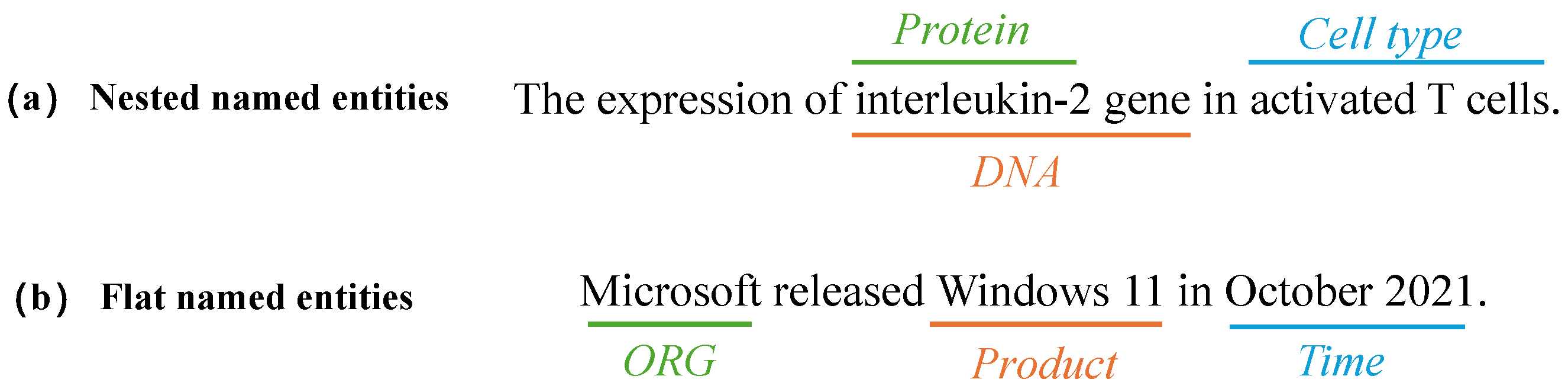
In this section, we evaluate our method on three common nested NER datasets ACE2004, ACE2005, and GENIA.
4.1. Data Sets
In order to completely test the performance of the proposed model in the task of nested Named Entity Recognition, three representative standard datasets are selected: ACE2004, ACE2005 and GENIA. These three datasets cover distinct application domains and have the structure of multi-level and multi-type entity nesting, which are able to successfully evaluate the model’s capacity to recognize entities under complicated semantic relationships. We further evaluate MHGAT on KBP2017 and GermEval2014 to validate generalization across datasets and languages. Details as shown in the
Table 1 and
Table 2.
The ACE2004 dataset was generated by the Linguistic Data Consortium (LDC) and contains English (158,000 words) text classified for entities. The dataset has seven entity categories; ORG, GPE, PER, LOC, FAC, VEH, and WEA. More than 45% of the mentions create a nested structure with other mentions. We adopted the same approach as in the previous study by Wan [
26] and divided the dataset into training, development and test sets in 8:1:1.
The ACE2005 dataset defines the same seven entity types as ACE2004. The distinction is that the ACE2005 dataset defines 6 types of coarse-grained inter-entity relationships, while the ACE2004 dataset defines 7 types of coarse-grained inter-entity relationships. Similarly, in this work, the ACE2005 dataset is divided into training, development and testing according to Wan [
26].
The GENIA [
37] dataset is derived from the biomedical domain and contains medical items manually annotated from PubMed literature. The dataset is published by the GENIA project and consists of five main entity types: DNA, RNA, cellline, celltype, and protein. The defining aspect of GENIA is the high density of nested entities, e.g., a “protein” item may be nested within a larger “cellline” description. For example, a “protein” entity may be nested within a lengthier “cellline” description. This structure imposes higher structural modeling skills on Named Entity Recognition models, and is ideal for use as a high-level benchmark for testing nested structure identification capabilities. We preprocessed the dataset using the same settings as Finkel [
38] and Lu [
14]. The dataset is separated into training set, development set and test set according to 8.1:0.9:1.
The KBP2017 [
39] dataset is a component of the Knowledge Base Population challenge, concentrating on Named Entity Recognition and Entity Linking. It comprises news items in English that include numerous elements such as PER (person), LOC (place), ORG (organization), and temporal expressions. The dataset assesses models’ proficiency in entity recognition and their linkage to a knowledge base, focusing on cross-domain and cross-lingual issues.
The GermEval2014 dataset is a German-language Named Entity Recognition (NER) benchmark derived from Wikipedia and online news sources. It contains around 31,000 words and more than 590,000 tags, categorized into four types of named entities: PER (person), ORG (organization), LOC (place), and OTH/MISC (other/miscellaneous). It is extensively utilized for assessing NER models on German text, encompassing tasks that entail nested entities and cross-lingual generalization. For syntactic preprocessing on GermEval2014, we employ a German dependency parser from the Stanza toolkit (trained on UD German treebanks) to obtain dependency heads and relation labels, and we adopt the Berkeley Neural Parser (benepar) German constituency model benepar_de2 to generate constituency trees.
4.3. Baseline Model
In order to completely examine the performance of the approach suggested in this research, a variety of representative benchmark models were picked for the experimental section, covering the current mainstream methods for diverse modeling ideas.
Neural-layered [
9]: Layer-by-layer recognition of nested entities by dynamically stacking planar NER layers.
Pyramid-Basic [
16]: Layered prediction of entities of different lengths based on the pyramid structure to enhance inter-layer interactions.
TCSF [
40]: Designing a network based on spanning relationships to improve classification using location features.
Biaffine [
13]: A graph-based dependency resolution method is utilized to offer a comprehensive perspective of the input through a dual-simulation model.
BiFlaG [
41]: Using BiLSTM and graph convolutional networks to jointly learn entity dependencies.
HGN [
22]: Nested entities are considered as a whole and a hyperedge labeling method is used to avoid the multi-labeling problem.
Negative-samples [
42]: Introducing IoU loss to deal with the hard negative-samples problem and alleviate data imbalance.
Span-level [
26]: Enhancement of span representation by constructing span-level graphs through retrieval.
SRCNN [
43]: Utilized a CNN to represent spatial relationships inside the score matrix.
PANNER [
44]: Constructing heterogeneous graphs based on lexical information to enhance entity information modeling.
MLSG [
19]: Designing a multi-label attention module to model the relationship between candidate labels for different states.
Span-prototype [
45]: Constructing entity prototypes for each category based on a network of prototypes.
Span and Region [
46]: Classification using Triaffine attention combining spanning boundaries and internal information.
BFSN2NER [
47]: Focusing on contextual semantics and boundary categories to pinpoint entity spans.
NTAM/MAJM [
48]: Adopting transitional attention mechanism and multi-marker fusion model respectively to improve the boundary judgment accuracy.
RLAN [
49]: Employs a recursive label attention architecture with level-reflected label embeddings and inner-entity pre-training to explicitly model hierarchical nesting while alleviating error propagation.
2D-sentence [
50]: Fusion of multi-scale 2D sentence representations encoding semantic features at different granularities.
SPLR [
51]: Introduces a single-boundary-point, length-aware span framework enhanced by knowledge embedding strategies for improved long and same-type nested entity recognition.
GSSDAF [
52]: Models and filters valid semantic dependencies among global spans through dependency-aware attention mechanisms.
4.5. Analysis of Experimental Results
This research conducted experiments on three representative public datasets—ACE2004, ACE2005, and GENIA—to thoroughly assess the overall performance of the proposed model MHGAT in the nested named entity identification task. We chose various prominent nested entity recognition models as benchmarks, including conventional sequence labeling techniques (e.g., BiLSTM-CRF), span classification approaches (e.g., Span-prototype and Span-level Graph), and graph structure modeling methods (e.g., BiFlaG and PANNER). The experimental findings are presented in
Table 3.
In the ACE2004 dataset, MHGAT attained an F1 score of 88.9, surpassing the majority of models, particularly GSSDAF (2025) and SPLR (2025). The precision (P) was 89.3 and the recall (R) was 88.1, indicating a favorable equilibrium between precision and recall. The strengths of MHGAT arise from its multi-scale graph attention mechanism and hierarchical multi-head GAT, which allow the model to effectively capture intricate syntactic structures and dependencies, particularly in the context of nested entities. MHGAT comprehensively comprehends the multi-tiered interactions among entities via multi-scale sampling, guaranteeing high recall, while its optimized graph architecture significantly diminishes false positives, hence enhancing precision. BFSN2NER (2024) and MLSG (2023) attained F1 scores of 86.6 and 88.1, respectively, indicating superior performance. Nonetheless, MHGAT’s hierarchical perception and graph structure modeling shown enhanced efficacy in managing long-distance relationships and intricate entities.
On the ACE2005 dataset, MHGAT attained an F1 score of 87.9, once more outperforming its competitors. The precision (P) was 88.2, and the recall (R) was 87.6, nearing the performance of the Span-Region (2023) and Span-prototype (2023) models. In recall, MHGAT’s multi-level graph modeling effectively captured intricate entity interactions that conventional models may overlook. Although MHGAT has a little deficiency in precision (88.7) compared to Span-Region (2023), it excels in recall, especially in identifying multi-level links and nested entities. The Span-Region and Span-prototype models enhance precision and recall; nonetheless, they predominantly depend on sequential modeling and exhibit a deficiency in depth and hierarchical comprehension of graph structures. Consequently, MHGAT’s efficacy on the ACE2005 dataset illustrates that graph modeling capabilities provide substantial benefits in identifying multi-scale and intricate structures.
In the GENIA dataset, MHGAT attains an F1 score of 82.2, marginally inferior to SPLR (2025) and GSSDAF (2025), which exhibit F1 ratings of 86.9 and 86.1, respectively. Precision (P) is 83.2, while recall (R) is 81.1. While MHGAT excels in both precision and recall, there remains potential for enhancement regarding biological items within the GENIA dataset. Entities in GENIA, including proteins and gene names, generally exhibit more intricate structures and profound dependencies. Although MHGAT’s graph attention mechanism may identify certain associations, additional tuning is required for enhanced adaptation to the biological domain. Relative to SPLR (2025) and GSSDAF (2025), MHGAT’s F1 score on GENIA is marginally inferior. The advantage of SPLR and GSSDAF in entity recognition within the biomedical domain may stem from their employment of more precise semantic encoding and hierarchical characteristics while processing fine-grained entities.
Ultimately, MHGAT exhibits outstanding performance on the ACE2004 and ACE2005 datasets, particularly showcasing notable strengths in intricate entity detection and the capturing of long-distance dependencies. Its performance on the GENIA dataset is commendable; yet, there is potential for enhancement relative to the most recent SPLR (2025) and GSSDAF (2025). Future enhancements may be achieved by refining the model’s domain adaptability and the detailed modeling of graph structures to further improve its efficacy in biomedical domains and intricate entity recognition tasks.
4.9. Ablation Experiment
To assess the efficacy of the model’s module design and critical hyperparameters, we performed ablation experiments on the general domain dataset ACE2005 and the biomedical domain dataset GENIA.
4.9.1. Module Ablation Experiment
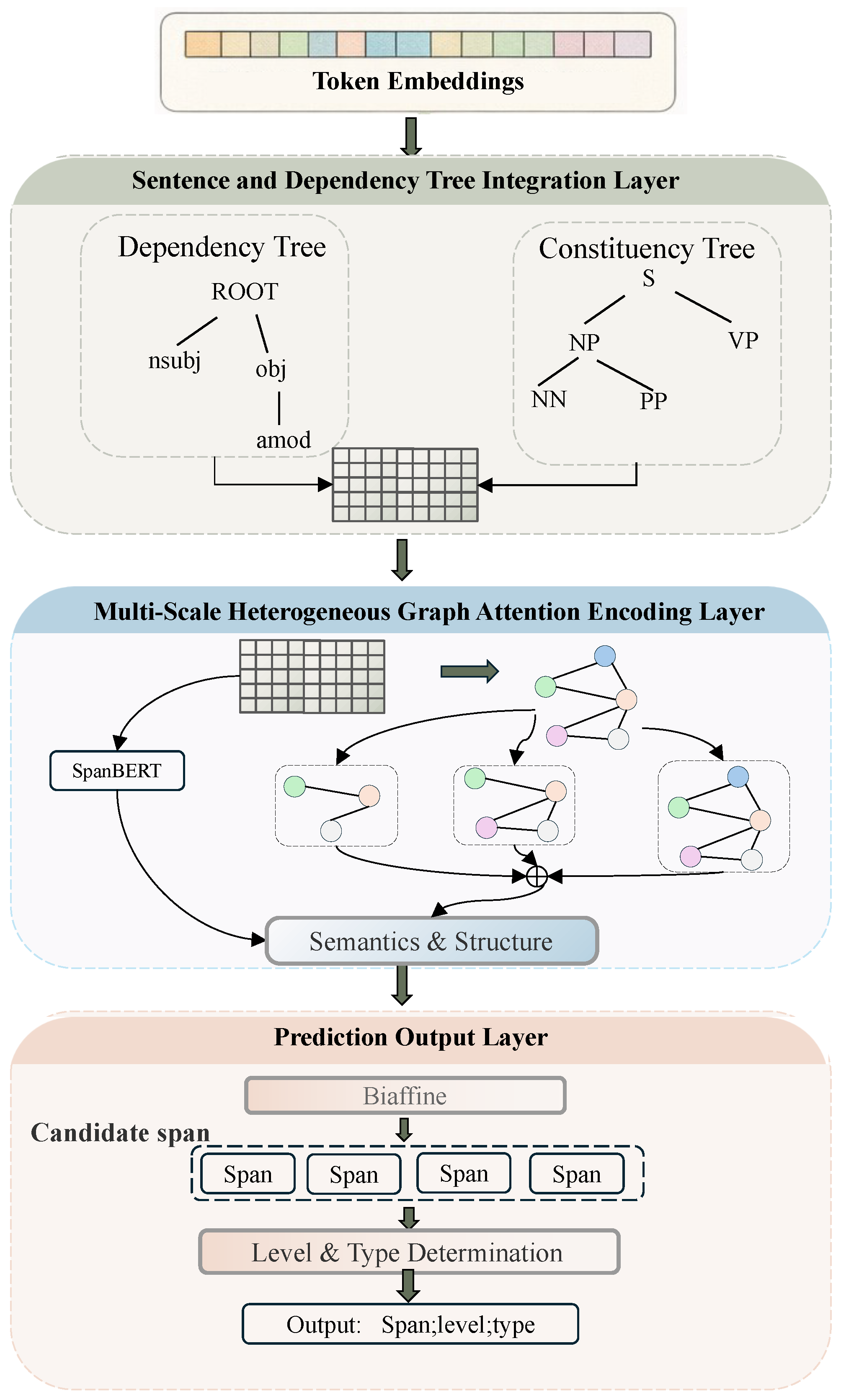
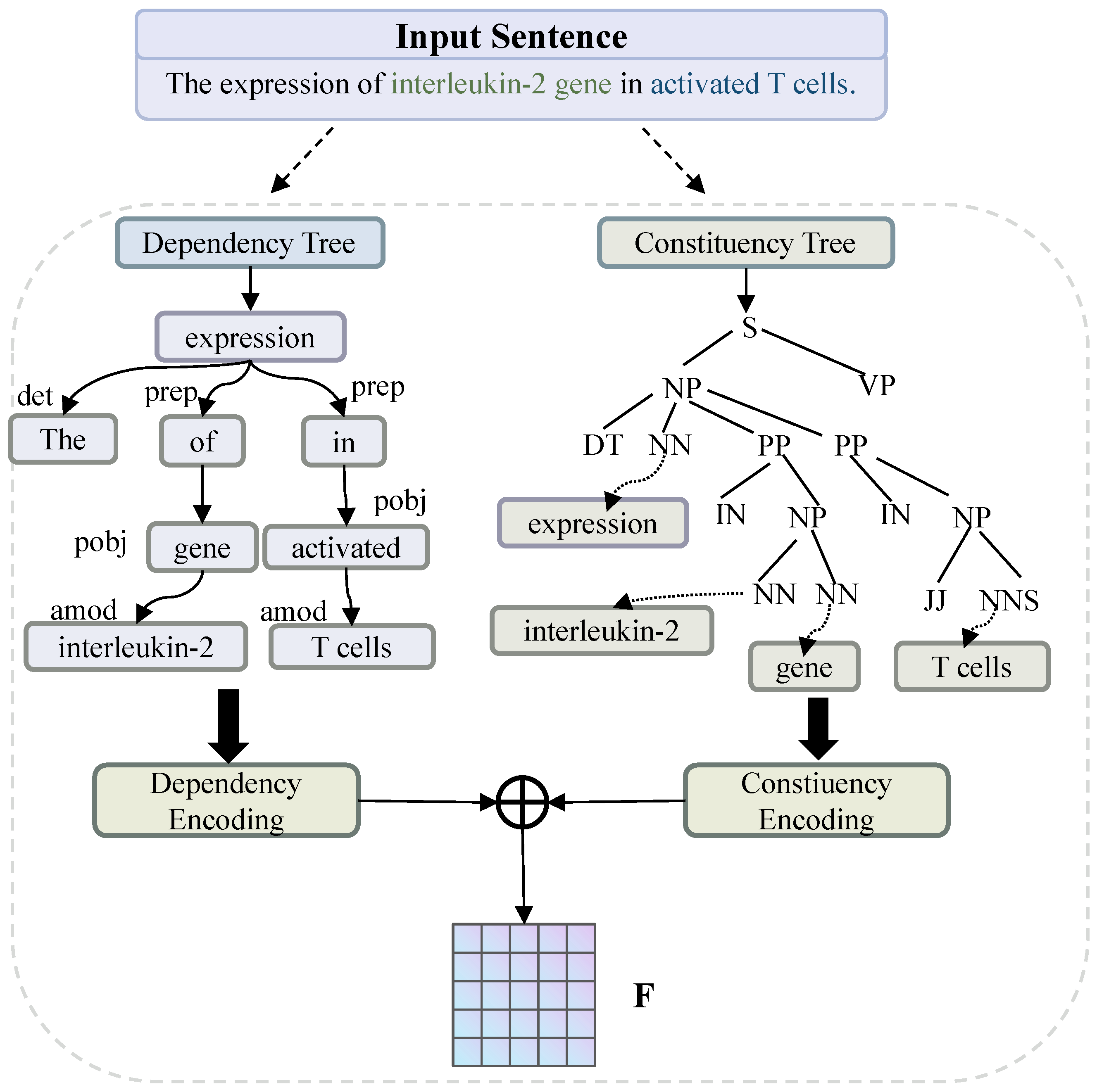
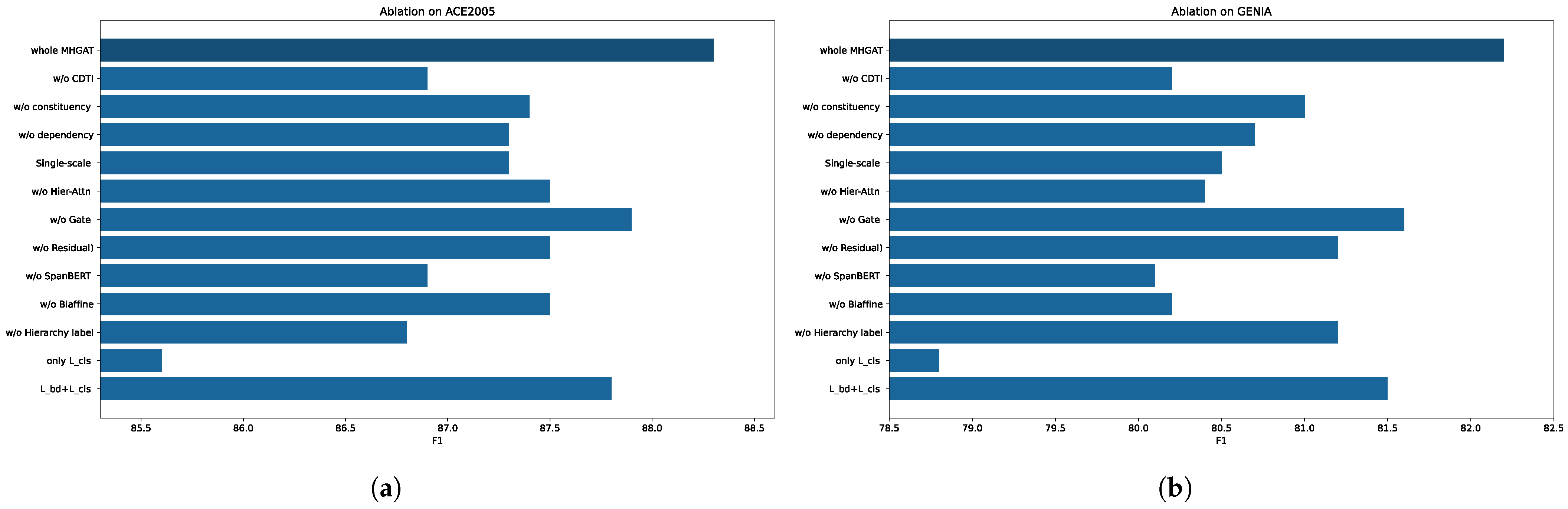
Module ablation seeks to assess the impact of various components on overall performance. Utilizing the comprehensive model as a benchmark, we systematically eliminate or substitute essential components individually and assess their performance under identical training and evaluation conditions to evaluate the influence of each module on nested entity span localization, category identification, and hierarchical relationship modeling. This experiment examines: the necessity of merging syntactic and dependency trees; the potential for multi-scale subgraph sampling to provide cross-scale structural information enhancement; the ability of hierarchical awareness attention to improve differentiation among entities with varying nesting depths; and the effectiveness of integrating semantic and structural residuals to mitigate the semantic disconnection issue arising from exclusive structural modeling. Particular experimental outcomes are presented in
Table 7 and
Figure 5.
The comprehensive model attains cutting-edge results on both ACE2005 (88.3) and GENIA (82.2), illustrating the effective synergy among the proposed SDTI dual-tree integration, multi-scale structural modeling, hierarchical perceptual attention, semantic/structural fusion, and candidate selection and hierarchical learning modules. Performance degradation predominantly occurs in four critical domains: structural entry quality, semantic enhancement capability, candidate span quality control, and joint training objectives. This suggests that the performance ceiling of nested entity recognition is collectively influenced by “reliable boundary candidates + complementary representations + hierarchical consistency constraints.”
SDTI serves as the basis for later modeling. The elimination of SDTI results in substantial deterioration (ACE: 88.3 → 86.9; GENIA: 82.2 → 80.2), signifying that integrating the mapping of syntactic tree and dependency tree data into a unified graph space is essential for maintaining structural anchors and hierarchical restrictions. Subsequent ablation research indicated that the elimination of either constituency or dependence resulted in diminished performance, as they respectively furnish phrase boundary constraints and long-distance dependency information. Moreover, GENIA exhibits heightened sensitivity to dependency, aligning with the occurrence of extensive modification chains and inter-phrase dependencies in biological literature.
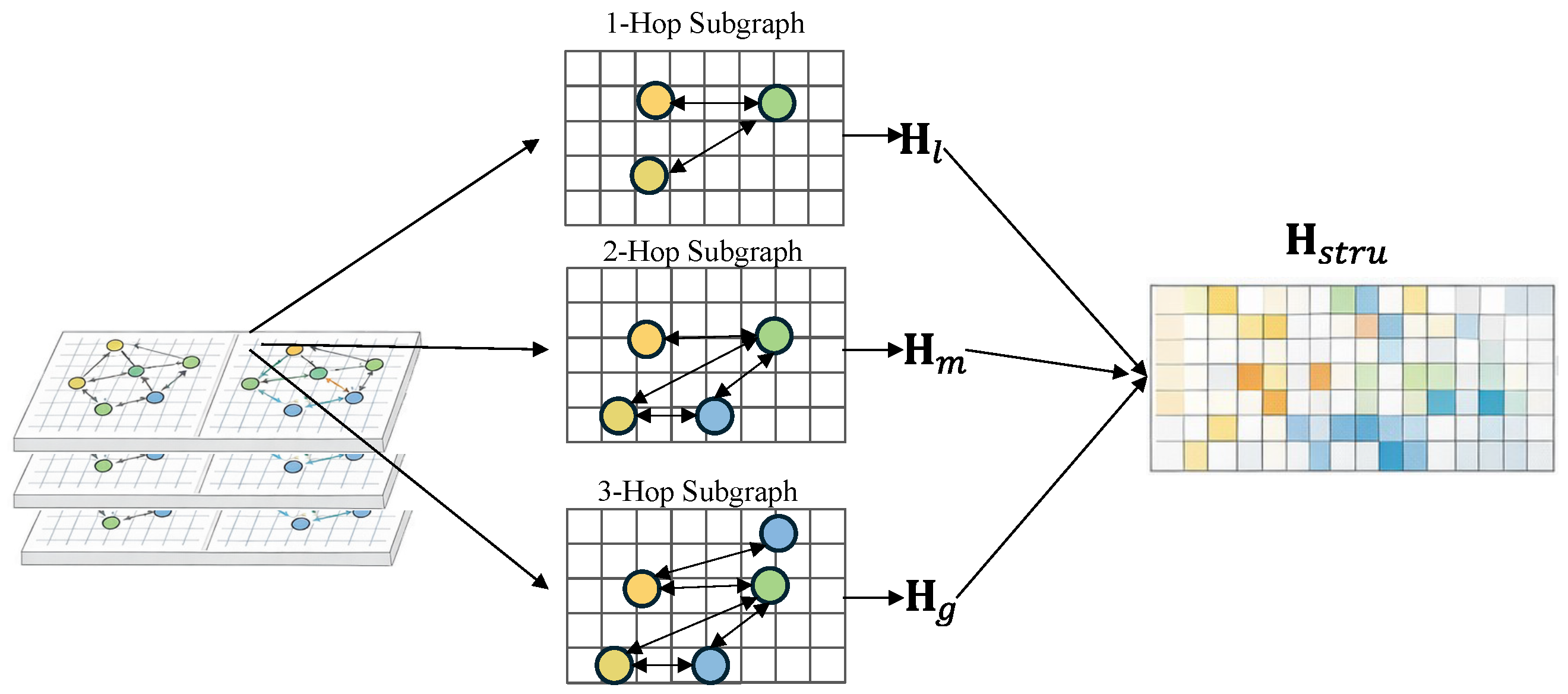
Multi-scale structural propagation and hierarchical awareness attention are fundamental to deep nesting modeling. The reduction to a singular scale led to a notable decline in performance (ACE: 88.3 → 87.3; GENIA: 82.2 → 80.5), suggesting that dependence exclusively on local neighborhoods is inadequate for addressing the mid-to-long-range structural relationships necessary for deep nesting. The elimination of hierarchical awareness attention resulted in consistent degradation, indicating that hierarchical weighting can mitigate the “averaging” of information across several levels and enhance internal entity signals. Conversely, the elimination of gating fusion resulted in just a marginal reduction, suggesting that multi-scale information itself has a more substantial role, whereas the gating mechanism solely functions to adaptively distribute weights across scales to enhance robustness.
The semantic–structural fusion mechanism is essential for representation stability and type differentiation. The elimination of residual connections diminishes performance, suggesting that residuals can maintain essential signals and alleviate representation degradation during offset fusion. The elimination of SpanBERT semantic improvements leads to a more pronounced decline in performance (ACE: 88.3 → 86.9; GENIA: 82.2 → 80.1), indicating that structural encoding is more inclined towards boundary localization, whereas fine-grained category distinction is more dependent on semantic context. Moreover, GENIA’s type differentiation is more complex, rendering it more susceptible to semantic improvements.
The quality control and joint monitoring of candidates directly dictate the overall maximum limit. Eliminating double affine border screening leads to a more pronounced decline in performance on GENIA, suggesting that in contexts with denser nesting and more complex candidate combinations, a high-quality candidate set is essential for mitigating false positives. The loss ablation study further substantiates the need for boundary supervision: the most substantial performance decline transpires when solely classification loss is employed (ACE: 88.3 → 85.6; GENIA: 82.2 → 78.8), although there is a notable recovery upon the incorporation of boundary loss. Eliminating hierarchical connection learning leads to a small decline in performance, suggesting that its primary role is to enhance parent-child entity consistency, mitigate span conflicts, and improve the reliability of nested structures.
Table 8 quantifies the contribution of the three core modules. Removing SDTI yields the largest degradation, dropping F1 by 1.4 on ACE2005 (88.3 → 86.9) and 2.0 on GENIA (82.2 → 80.2), indicating that dual-tree feature integration is the most critical component, especially under biomedical domain complexity. Replacing MSSA with a single-scale encoder decreases F1 by 1.0 (ACE2005) and 1.7 (GENIA), confirming that explicit multi-scale modeling is essential for capturing cross-scale dependencies in nested entities. Finally, removing the semantic–structure residual fusion causes a smaller but consistent drop of 0.8 on ACE2005 and 1.0 on GENIA, suggesting it mainly stabilizes representation learning and improves robustness. Overall, SDTI and MSSA contribute the majority of the gains, while residual fusion provides complementary improvements.
4.9.2. Feature Encoding Dimension Ablation
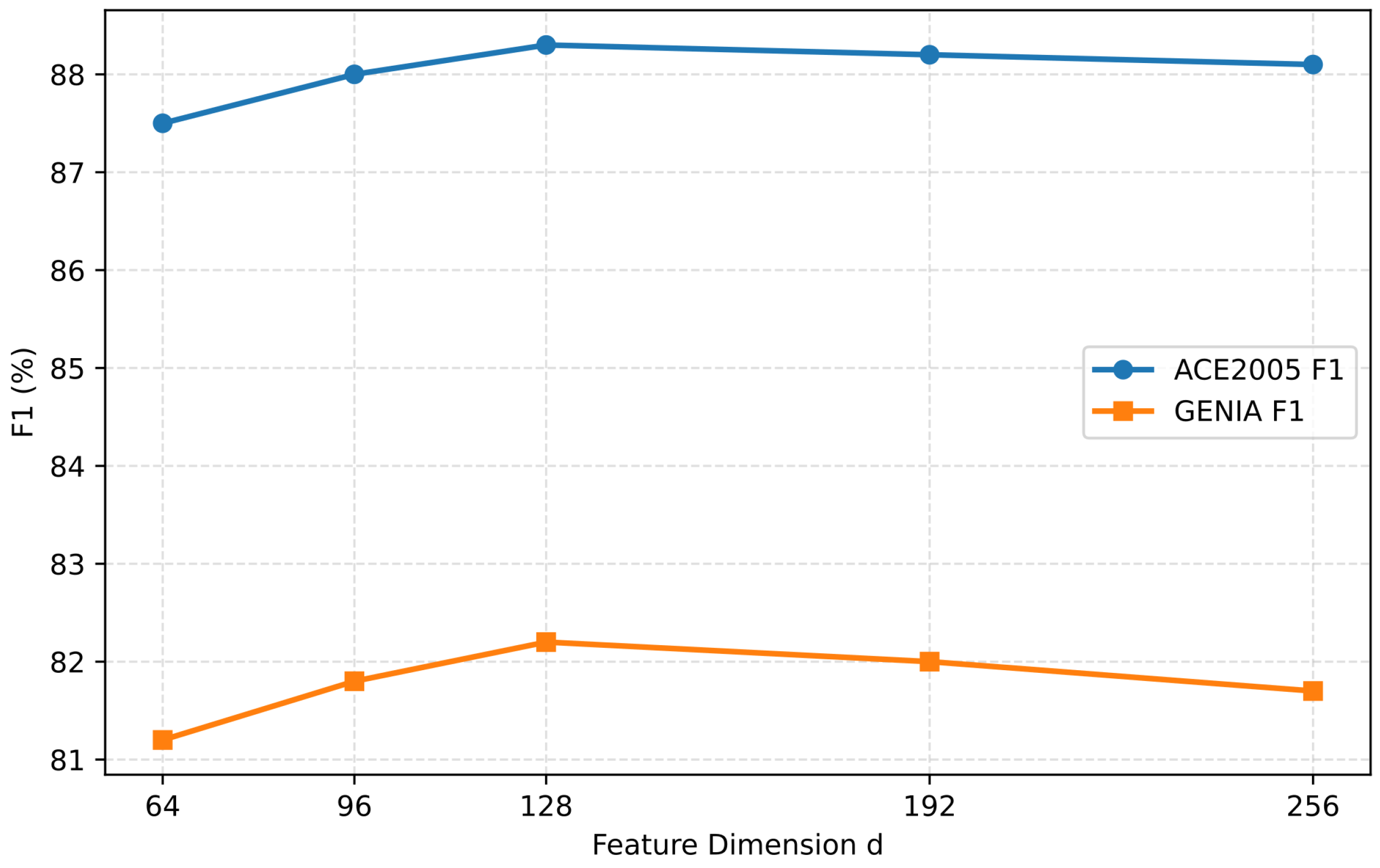
To assess the influence of feature encoding dimension on model performance, while maintaining constant hyperparameters, we established the feature dimension d at 64, 96, 128, 192, and 256, and analyzed the outcomes on the ACE2005 and GENIA datasets. As shown in
Figure 6, the experimental results and line graphs indicate that both curves demonstrate a pattern of initial increase, followed by stabilization and a slight decline, with optimal performance occurring at d = 128.
The most notable enhancement in model performance is observed when d increases from 64 to 128: the F1 score on ACE2005 rises from 87.5 to 88.3 (+0.8), while the F1 score on GENIA increases from 81.2 to 82.2 (+1.0). This suggests that in low-dimensional contexts, the model’s capacity to represent structural information, including syntactic and dependency relations as well as graph structure propagation, is constrained, hindering a comprehensive characterization of complex semantics and boundary cues. Increasing dimensionality appropriately can enhance node representation capacity and improve attention aggregation, resulting in stable gains.
As dimensionality increases to 192 and 256, the performance on both datasets does not show further improvement; rather, it exhibits a slight decline or variability. Specifically, ACE2005 scores are 88.2 and 88.1 at 192 and 256, respectively, while GENIA scores are 82.0 and 81.7. The line graph indicates that the ACE2005 curve approaches a plateau after d ≥ 96, suggesting that the model exhibits reduced sensitivity to dimensionality within this dataset. The decline in GENIA is significant, suggesting that in domain-specific data, high dimensionality tends to cause parameter redundancy and complicates training, which may result in mild overfitting or inadequate optimization, ultimately reducing generalization performance.
In conclusion, d = 128 optimally balances enhanced representational capacity with training stability and generalization, resulting in the highest F1 scores on both datasets (ACE2005: 88.3, GENIA: 82.2). Consequently, the experiments conducted in this paper will default to a feature encoding dimension of d = 128.
4.9.3. GAT Layer Ablation
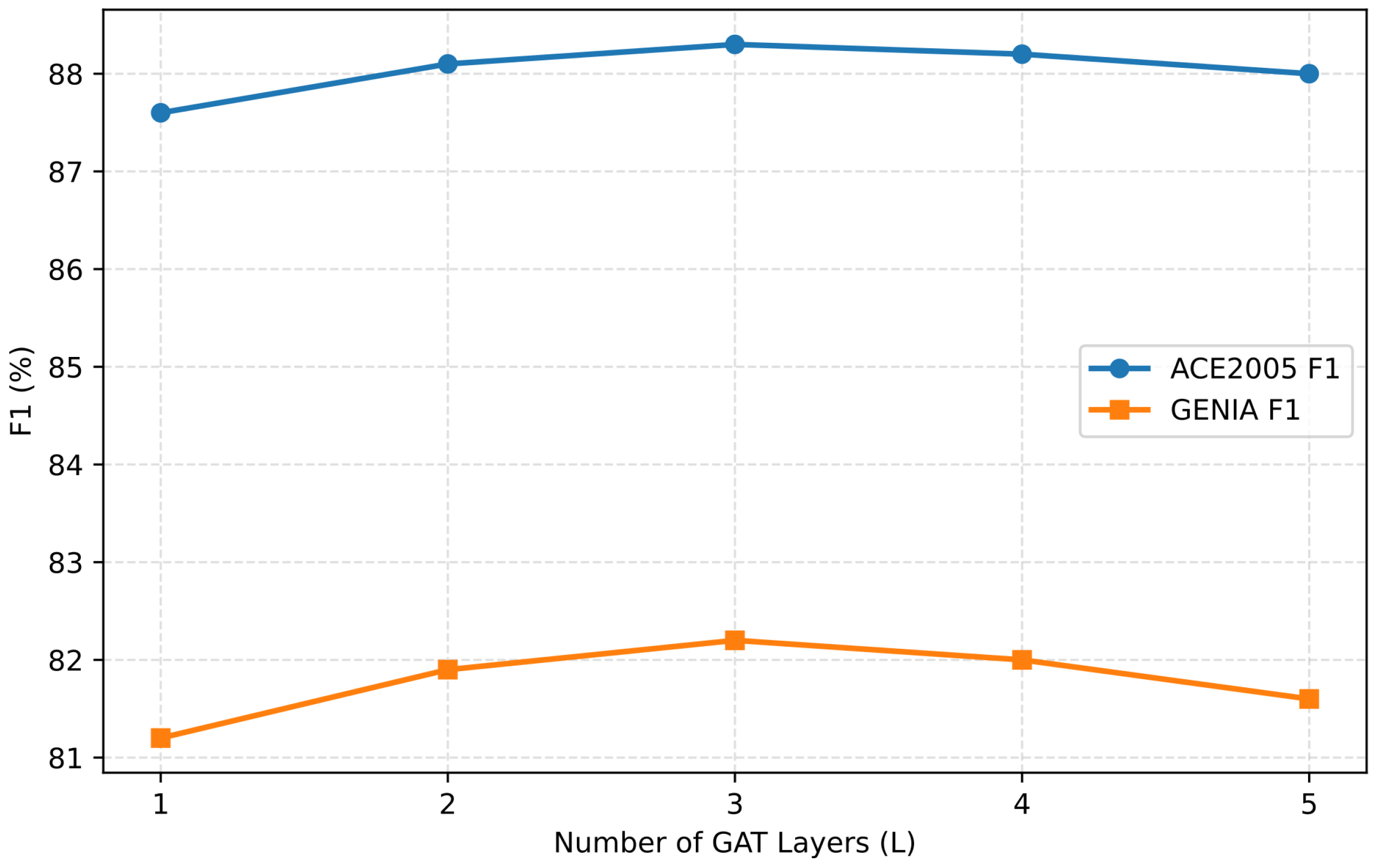
Keeping constant hyperparameters, the number of stacked layers in a graph attention network (GAT) was adjusted at 1, 2, 3, 4, and 5 to test the effect on model performance. ACE2005 and GENIA datasets were compared. The experimental results are shown in
Figure 7, with both curves “initially increasing with the number of layers, peaking at 3 layers, and then gradually declining,” providing a clear ideal GAT layer trade-off point for structural information modeling.
As layers increase from 1 to 3, performance improves: ACE2005’s F1 score climbs from 87.6 to 88.3 (+0.7), while GENIA’s rises from 81.2 to 82.2 (+1.0). This shows that shorter GATs, such as layer 1, can only aggregate neighborhoods within a limited range, preventing multi-hop dependency information from propagating and fusing in the graph structure. Increasing the number of layers helps the model leverage relational routes in the graph, improving structural and semantic feature representation and recognition performance.
As layers 4–5 grow, both datasets indicate a slight drop in performance: ACE2005 scores 88.2 and 88.0, whereas GENIA scores 82.0 and 81.6. ACE2005’s line graph shows a slower decline than GENIA’s. Deeper graph networks frequently oversmooth and diffuse noise. Node representations converge as layers propagate, reducing entity boundaries and class disparities. As information from distant or irrelevant neighborhoods is introduced and amplified, attention aggregation becomes more susceptible to noise interference. In scenarios with limited data scale or complex domain distributions, adding layers increases model complexity and complicates optimization, increasing the chance of generalization decline. Therefore, GENIA is more sensitive to layer count.
The 3-layer GAT has the greatest F1 scores on both datasets (ACE2005: 88.3, GENIA: 82.2), balancing structural this study. This further motivates our explicit multi-scale subgraph encoding, which preserves controllable receptive fields without relying on excessively deep propagation.
4.9.4. GAT Attention Head Number Ablation
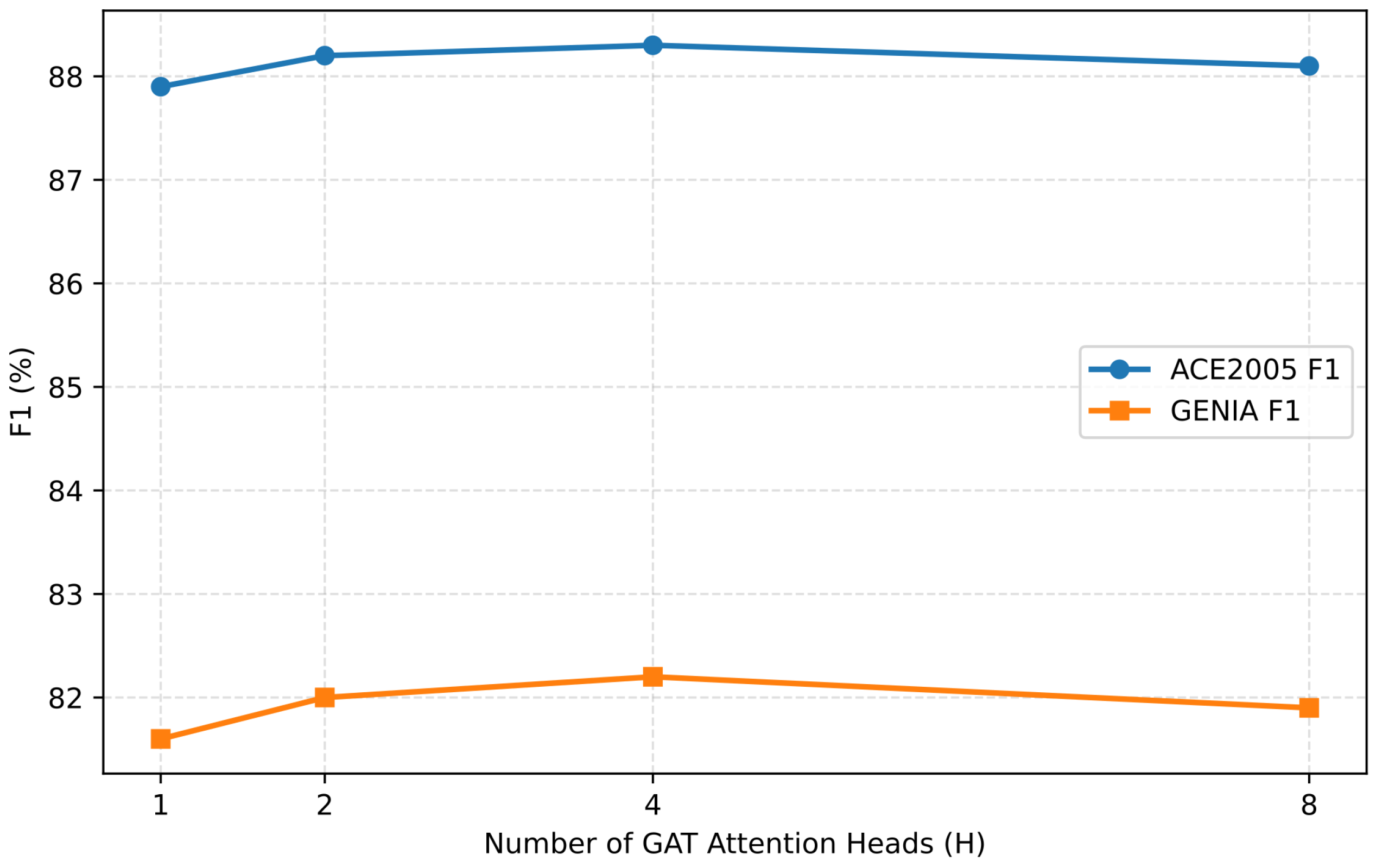
To study how the multi-head attention mechanism in heterogeneous graph attention networks (GAT) affects joint structural–semantic modeling, we modify only the number of attention heads per GAT layer and leave all other hyperparameters fixed. In particular, set the head number to
The experimental results are shown in
Figure 8: ACE2005 and GENIA F1 scores continuously improve from 1 to 4 and peak at
. When the number of heads is increased to
, performance on both datasets degrades slightly, exhibiting a “increase-then-decrease” trend.
Our framework transforms the constituency tree and dependency tree into a heterogeneous graph and uses a three-layer GAT for message forwarding. For neighborhood aggregation, multi-head attention provides multiple parallel “views” to capture diverse structural cues and interaction patterns. This explains the continuous improvements from 1 to 4 for H. After the GAT, our model creates three subgraphs at different granularities/scales and combines them using hierarchy-aware attention, integrating multi-view representation. When H is too large (e.g., 8), heads may become redundant or create noisy aggregation. Increased parameterization makes optimization difficult and may degrade structural information propagation generalization. The F1 score drops little, with GENIA dropping more.
4.9.5. Multi-Scale Subgraph Attention Head Ablation
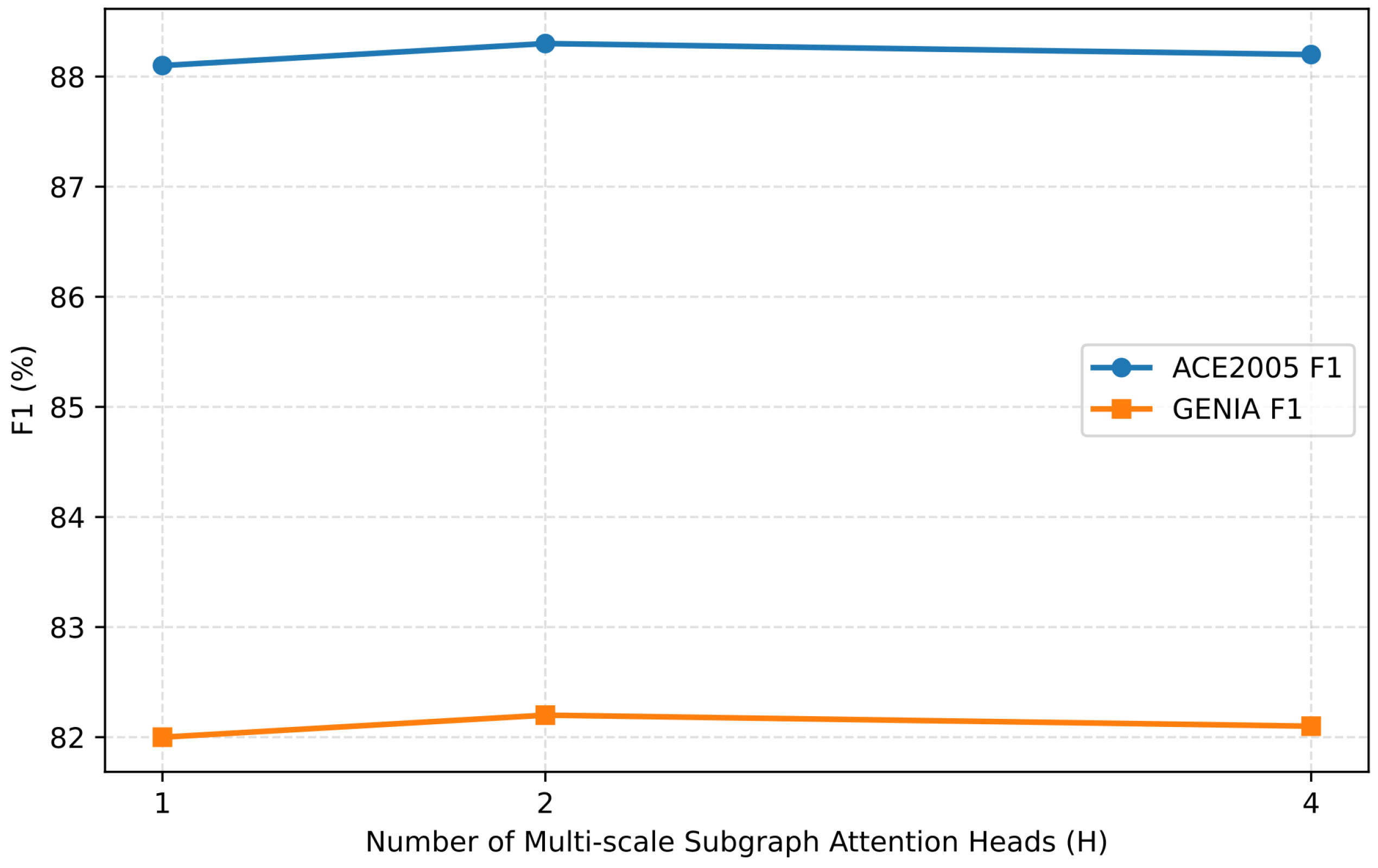
In this study, we examined the role of hierarchical perceptual attention in the semantic integration of three-scale subgraphs. We kept the heterogeneous graph construction methodology, three-layer GAT, and other hyperparameters constant, only changing the number of heads
in the attention. Experimental results are shown in
Figure 9. The F1 score for both datasets increases from 1 to 2, peaking at
. However, as the number of heads increases to 4, performance decreases, indicating an overall trend of “initial increase followed by decrease, albeit with minor fluctuations”.
After heterogeneous graph attention encoding, the model constructs three subgraphs of different scales and dimensions from the same graph and learns semantic representations for each. Multi-scale subgraph attention weights and fuses three-way subgraph representations. H = 1 allows only one fusion pattern, which prevents the simultaneous evaluation of complementing subgraph information at different scales, such as local structure cues and semantic consistency indications. When H = 2, the multi-head mechanism can simultaneously acquire two complementary fusion approaches, leading to enhanced stability in weighting and a broader integration of multi-view semantics, so achieving optimal performance. Since the fusion object is a fixed three-way subgraph representation, increasing H to 4 may cause weight allocation dispersion or head redundancy. This may increase training noise and instability, lowering performance slightly.
4.9.6. Two-Way Combination Verification
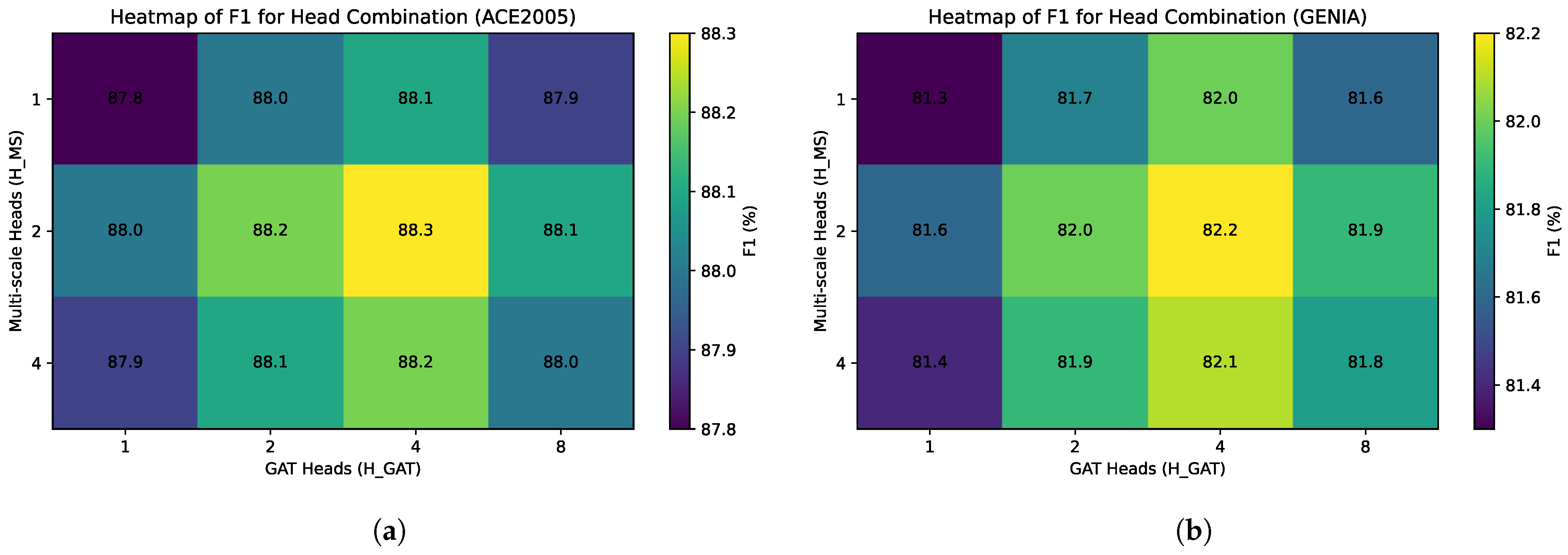
To further examine whether coupling exists between the encoding stage (heterogeneous GAT) and the multi-scale subgraph fusion stage (multi-scale attention/hierarchy-aware attention), we conduct a cross-combination study while keeping all other hyperparameters fixed. Specifically, the number of GAT attention heads and multi-scale attention heads are varied as
The heatmap results on both datasets are shown in
Figure 10, with the optimal performance achieved at
indicating that this configuration provides the best trade-off between representational capacity and training stability.
From the perspective of the GAT encoding stage (fixing ), both ACE2005 and GENIA exhibit an increasing performance trend from , followed by a slight decrease at 8. This behavior can be explained by the heterogeneous graph construction, where constituency and dependency trees are integrated and propagated through a three-layer GAT. Increasing the number of heads from 1 to 4 provides multiple aggregation views, enabling the model to capture syntactic boundaries, dependency relations, and cross-span interactions more comprehensively. However, when , redundancy and noisy aggregation among attention heads emerge, while optimization difficulty increases, leading to reduced generalization, particularly on GENIA, which is more sensitive to noise and training instability.
From the perspective of the multi-scale fusion stage (fixing ), consistently yields the most stable performance, outperforming both and . This aligns with the design of the multi-scale subgraph modeling: after GAT encoding, three structural views are fused to learn complementary semantics. A single head () limits fusion capacity, whereas too many heads () disperse attention weights and introduce redundancy due to the fixed number of fusion branches.
Overall, the results suggest no strong coupling constraint between the two attention modules. The GAT encoder achieves optimal structural propagation at , while the fusion module reaches optimal semantic integration at . Combining them yields the best performance on both datasets; therefore, the default setting used in subsequent experiments is
4.9.7. Fusion Strategy in SDTI
To examine whether the feature fusion in the Syntax and Dependency Tree Integration (SDTI) layer is sufficient and well-justified, we compare our default fusion strategy against two stronger alternatives. As shown in
Table 9, our method (simple concatenation followed by a learnable projection) achieves the best performance on both datasets, reaching 88.3 F1 on ACE2005 and 82.2 F1 on GENIA. Replacing concatenation with gated fusion results in a clear drop on ACE2005 (86.8, −1.5) and a smaller but consistent drop on GENIA (81.1, −1.1). Attention-weighted fusion performs better than gated fusion on ACE2005 (87.1) but yields the lowest GENIA score (80.5, −1.7 vs. ours). These results suggest that early fusion does not necessarily benefit from more complex interaction functions. Concatenation preserves heterogeneous structural cues from constituency and dependency sources without imposing strong coupling, while the subsequent graph encoder can learn task-specific interactions. In contrast, gating/attention introduces additional parameters and may over-emphasize noisy structural signals, which is particularly detrimental in the biomedical domain, leading to weaker generalization on GENIA.