Article

Variable Cutoff Frequency Low-Pass Attenuator Based on Memristor with Sharp Roll-Off Characteristic


1
College of Computer, National University of Defense Technology, Changsha 410073, China
2
Institution of Remote Sensing Equipment, Beijing 100039, China
3
State Key Laboratory of Electronic Thin Films and Integrated Devices, University of Electronic Science and Technology of China, Chengdu 611731, China
4
National Key Laboratory of Integrated Circuits and Microsystems, Chongqing 400060, China
*
Authors to whom correspondence should be addressed.
Electronics 2026, 15(6), 1164; https://doi.org/10.3390/electronics15061164
Submission received: 12 January 2026 / Revised: 7 March 2026 / Accepted: 9 March 2026 / Published: 11 March 2026

Abstract

Frequency-selective attenuation is widely needed in integrated analog front-ends, yet conventional on-chip RC low-pass filters occupy unfeasibly large silicon areas for low-frequency cutoffs and inherently introduce cumulative phase lag. Motivated by the nonlinear, frequency-dependent state evolution of memristive devices, this work experimentally demonstrates a highly compact, capacitor-free memristor–resistor network that functions as a variable-cutoff, zero-phase-lag resistive attenuator. An Au/HfO2/Au memristor (15 µm × 15 µm) is connected in series with a load resistor and characterized over a wide frequency range. By leveraging the finite time constant of internal ionic drift, the attenuation bandwidth is strictly programmable via the device’s initial resistance. Cutoff frequencies of approximately 10 Hz, 1 kHz, and 10 kHz are achieved for initial resistances of 400 k Ω ± 30 k Ω , 300 k Ω ± 30 k Ω , and 200 k Ω ± 30 k Ω , respectively. Remarkably, the nonlinear state-switching mechanism enables a steep post-cutoff attenuation rate approaching −60 dB/dec—equivalent to a cascaded third-order RC network—using only a single nanoscale device. Rather than functioning as a strictly linear time-invariant (LTI) filter, the proposed circuit operates as a state-adaptive edge-processor. Its inherent amplitude-dependent dynamics and total absence of reactive poles make it exceptionally suited for highly specialized, area-constrained applications, including zero-phase closed-loop noise suppression, frequency-to-amplitude conversion, and amplitude-aware event-driven sensory preprocessing.

1. Introduction

1.1. Background

In 1971, based on the fundamental relationship among current, voltage, charge, and flux, Professor L. O. Chua theorized the existence of a fourth fundamental circuit element: the memristor (short for memory resistor), alongside the resistor, capacitor, and inductor [1]. With the dimension of ohms ( Ω ), the memristor was mathematically defined by the relationship between charge (q) and flux ( ϕ ) : d ϕ = M d q . Five years later, Chua and Sung Mo Kang introduced a class of nonlinear dynamical systems known as memristive systems [2]. Although researchers continued searching for a physical device demonstrating the memristor’s properties for nearly 30 years, success remained elusive until 2008. That year, a team at HP Labs led by Dmitri B. Strukov declared they had found the memristor [3]. In their seminal paper, they proposed a model and demonstrated its potential for direct use in memory applications. Their achievement sparked a global research effort, leading to the development of new manufacturing methods [4] and more accurate models [5,6]. Due to its memory feature, scientists quickly realized the memristor could be applied in digital circuits [7], analog circuits [8], and neural networks [9]. In analog signal conditioning, memristors have been used to implement frequency-selective attenuation functions, typically in combination with conventional reactive components [5,10,11,12].

1.2. Related Work

Recent progress in memristor research has substantially broadened the controllability of device states through materials engineering, stack optimization, and mechanism understanding, enabling circuit behaviors beyond a static “programmable resistor.” Comprehensive surveys have covered the landscape from device/material innovations to system-level integration, outlining opportunities in memory, in-memory computing, and neuromorphic hardware [13,14]. In particular, the rapid growth of two-dimensional (2D) materials and emerging conductors has emphasized novel switching physics and scalability prospects [15,16,17,18], while flexible and wearable implementations further expand the application space and constraints [19]. Alongside these directions, low-power operation has become a central theme for practical deployment in large-scale arrays and edge intelligence [20].
At the device-mechanism level, prior work repeatedly highlights two properties that are especially relevant to analog signal-conditioning: (i) nonlinear switching dynamics with finite response speed and (ii) threshold-like state transitions under electrical excitation [17,21,22]. These characteristics imply that the effective resistance of a memristor can depend not only on amplitude and history, but also on the time scale of excitation, suggesting an underexplored route toward compact frequency-selective attenuation.
At the computation and system levels, memristors have enabled a diverse set of neuromorphic and learning-oriented demonstrations, including reservoir computing for temporal tasks, synaptic primitives, multiferroic synapse concepts, and Bayesian inference engines [23,24,25,26]. Hybrid integration trends, such as memristor–transistor co-design for neuromorphic functionality, further indicate a trajectory toward deeper heterogeneous integration [27]. In parallel, modeling and characterization studies have examined the relationship between resistive-switching memories and idealized memristor formulations, and have quantified non-idealities such as parasitics that can materially affect circuit behavior [28,29]. Beyond computing, application-oriented studies also demonstrate that memristive dynamics can be leveraged in security and information processing, e.g., encryption using multi-synaptic memristor-based neural networks, while earlier synaptic devices remain representative milestones in the evolution of the field [30,31].
From a circuit-design perspective, memristors have been incorporated into analog signal-processing blocks, including frequency-selective attenuation functions implemented together with conventional passive components [5,10,11,12]. In many reported “memristor-based filters,” the memristor mainly serves as a tunable element inside an otherwise classical topology (e.g., RC-type networks or adaptive structures). Consequently, the achievable cutoff and roll-off characteristics are still fundamentally constrained by reactive poles, component area, and linear time-invariant assumptions, rather than being governed by the intrinsic state-evolution dynamics of the device.
Departing from classical filter designs, this work utilizes the frequency-dependent effective resistance inherent to memristor state evolution as the primary mechanism for highly compact low-pass attenuation. Rather than increasing the classical filter order—which necessitates impractically large capacitor areas for low-frequency cutoffs—we intentionally operate the device in a nonlinear regime where it dynamically transitions between resistance states across different frequencies. This physics-driven approach achieves an aggressive post-cutoff attenuation slope nearing 60 dB / dec , performing equivalently to a cascaded third-order RC network. We experimentally validate this mechanism with an Au/HfO2/Au memristor, demonstrating that the apparent cutoff frequency can be strictly programmed (ranging from approximately 10 Hz to 10 kHz) via the device’s initial resistance state. Crucially, rather than treating intrinsic amplitude sensitivity and thermal variations as traditional linear time-invariant (LTI) “non-idealities” that must be suppressed, we conceptually reframe them as adaptive, event-driven features ideal for specialized edge deployments. Because this attenuation is governed entirely by dynamic resistance scaling and exhibits strictly zero phase shift—completely avoiding reactive energy storage—we designate the proposed circuit as a state-adaptive frequency-selective resistive attenuator, definitively setting it apart from standard LTI low-pass filters.

1.3. Significance and Contributions

This research investigates a capacitor-free, state-adaptive resistive attenuator based on a memristor. Moving beyond conventional LTI frameworks, the primary contributions of this paper are:
  • Capacitor-Free, Zero-Phase-Lag Attenuation: We provide experimental demonstration of a frequency-tunable attenuator that leverages internal ionic drift dynamics to achieve a steep, variable cutoff (approaching 60 dB / dec ). This is accomplished without introducing the cumulative phase lag inherently caused by capacitive reactive poles.
  • Reframing Nonlinear Dynamics as Adaptive Features: Through quantitative evaluation of the device’s amplitude dependence and thermal response, we demonstrate how these apparent LTI “imperfections” effectively serve as hardware-efficient mechanisms for environmental adaptability and amplitude-threshold-triggered gating.
  • Edge-Computing Application Paradigms: We discuss practical implementation boundaries and propose tailored application scenarios—such as zero-phase closed-loop noise suppression, passive FSK demodulation, and amplitude-aware event-driven preprocessing—where the intrinsic nonlinearities of the device provide unique system-level advantages over classical LTI front-ends.

1.4. Organization of the Paper

The structure of this manuscript is organized as follows:
  • Section 2 describes the Au/HfO2/Au memristor, the physical origins of its frequency-dependent resistance, and introduces the proposed attenuator circuit configuration and measurement setup.
  • Section 3 outlines the methodology employed to measure and analyze the device’s transient and steady-state performance.
  • Section 4 details the experimental results, comprehensively characterizing the frequency-dependent response, state-programming capabilities, and the bounded harmonic distortion of the attenuator.
  • Section 5 discusses practical considerations by comparing the macroscopic attenuation roll-off with a classical 3rd-order RC network and evaluating the device’s bounded thermal dependence.
  • Section 6 highlights the specific potential of the proposed state-adaptive attenuator for integrated edge-preprocessing, with a focus on zero-phase systems and amplitude-aware event-driven architectures.
  • Section 7 concludes the study and outlines future research directions for asynchronous neuromorphic front-ends.

2. Device, Circuit, and Operating Principle

2.1. Memristor Device and Physical Origin of Frequency Dependence

The measured frequency-dependent resistance originates from internal state evolution in the Au / HfO 2 / Au structure, widely associated with ionic/vacancy motion and the formation/rupture (or modulation) of conductive filaments in the HfO 2 layer. Under low-frequency excitation, each half-cycle persists long enough for appreciable drift/diffusion of mobile species, enabling the state to move toward a lower-resistance condition. As the excitation frequency increases, field reversals occur faster than the state-evolution time scale; consequently, the internal state cannot follow the waveform and the device tends to remain in (or return to) a high-resistance state. This finite response speed produces an apparent transition frequency where the resistance changes sharply.

2.2. Circuit Configuration

Figure 1 shows the tested circuit: a memristor in series with a resistor network, with the output taken across the load. Throughout this paper we describe the resulting behavior as a “memristor-based low-pass attenuator” (i.e., a frequency-selective resistive attenuator). Although its magnitude response can resemble a low-pass characteristic, the selectivity is predominantly produced by nonlinear, excitation-dependent state evolution (threshold-like switching) rather than reactive pole(s) in a classical LTI filter.
We use a 15 μm × 15 μm memristor with an Au / HfO 2 / Au stack. The signal source has an internal resistance R s = 50 Ω and the output is terminated by R load = 50 Ω . Unless otherwise stated, the excitation is a sinusoid
V s ( t ) = 0.4 sin ( 2 π f t ) ,
applied for ten cycles at each frequency.

2.3. Effective Voltage Across the Memristor (Measurement Setup)

Because R s and R load form a series chain with the memristor, the memristor voltage amplitude is
V mem ( f ) = V s · R mem ( f ) R s + R mem ( f ) + R load .
For initialized high-resistance states (hundreds of k Ω ), V mem is close to V s . If the memristor switches toward low resistance (hundreds of Ω ), the divider reduces V mem , which in turn can affect subsequent state evolution; this interaction is one reason the response can be amplitude-dependent.

3. Measurement Methodology

3.1. Initialization and Repeatability

To reduce history dependence, the memristor was re-initialized to a defined high-resistance state (HRS) before each frequency test. A brief programming pulse was applied to set the device into the target initial resistance window, after which the sinusoidal stimulus was applied and the response recorded. This procedure ensures that each frequency point is measured from a comparable starting state.

3.2. Resistance Extraction

For each frequency, we recorded the instantaneous voltage and current and computed an effective resistance as R = V / I , averaged over the final cycles of the ten-cycle burst to reduce transient effects. This produces a steady-state resistance estimate R mem ( f ) suitable for building the statistical distributions in Section 4.2.

4. Experimental Results

4.1. Transient Waveforms

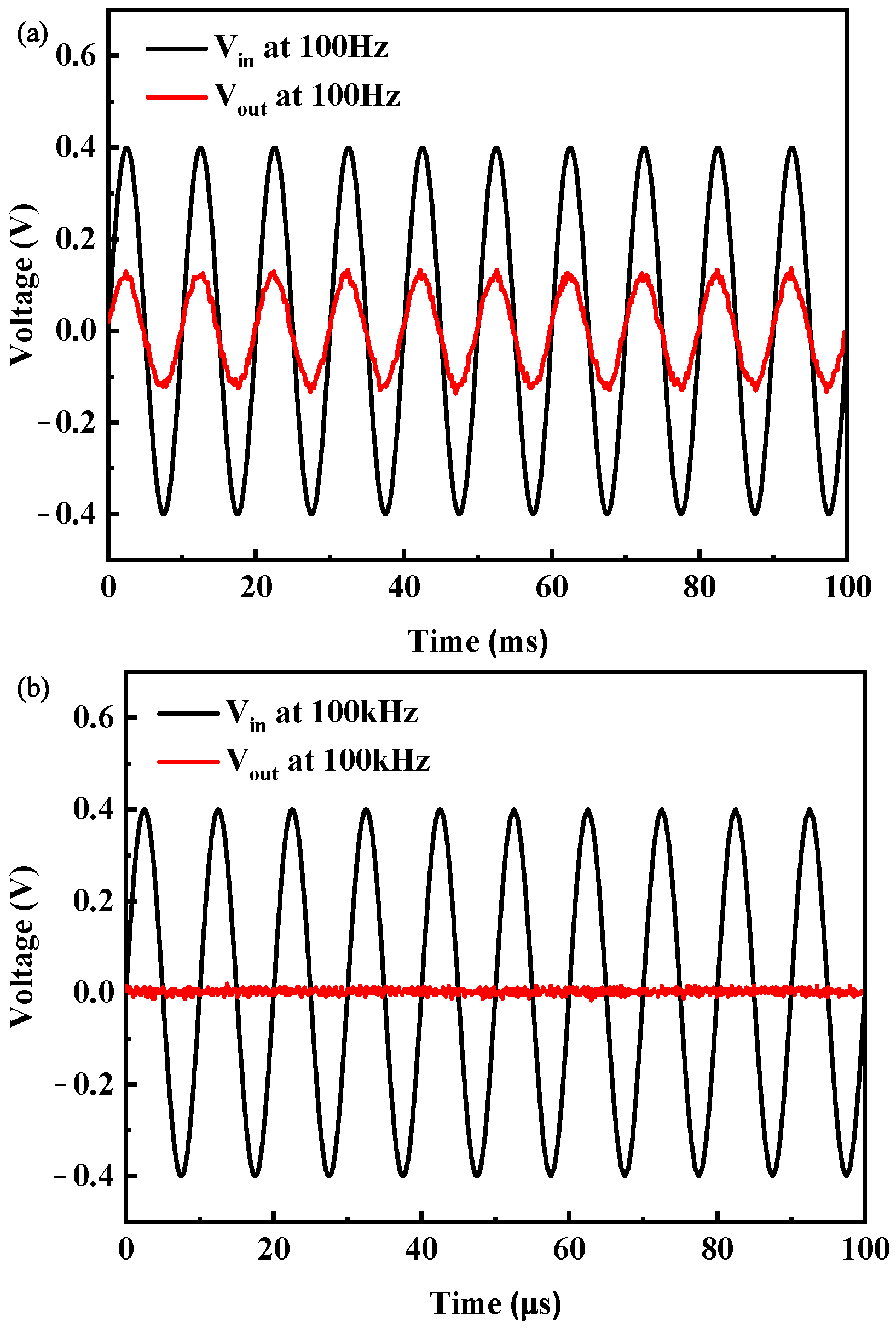
Figure 2 shows representative time-domain measurements (oscilloscope traces across R load ). At a low frequency (e.g., 100 Hz ), the output remains a sinusoid with a measurable amplitude, indicating that the divider operates in a lower-resistance regime during the burst. At a high frequency (e.g., 100 kHz ), the output is strongly attenuated, consistent with the memristor remaining in (or returning to) an HRS, which suppresses current through the load.
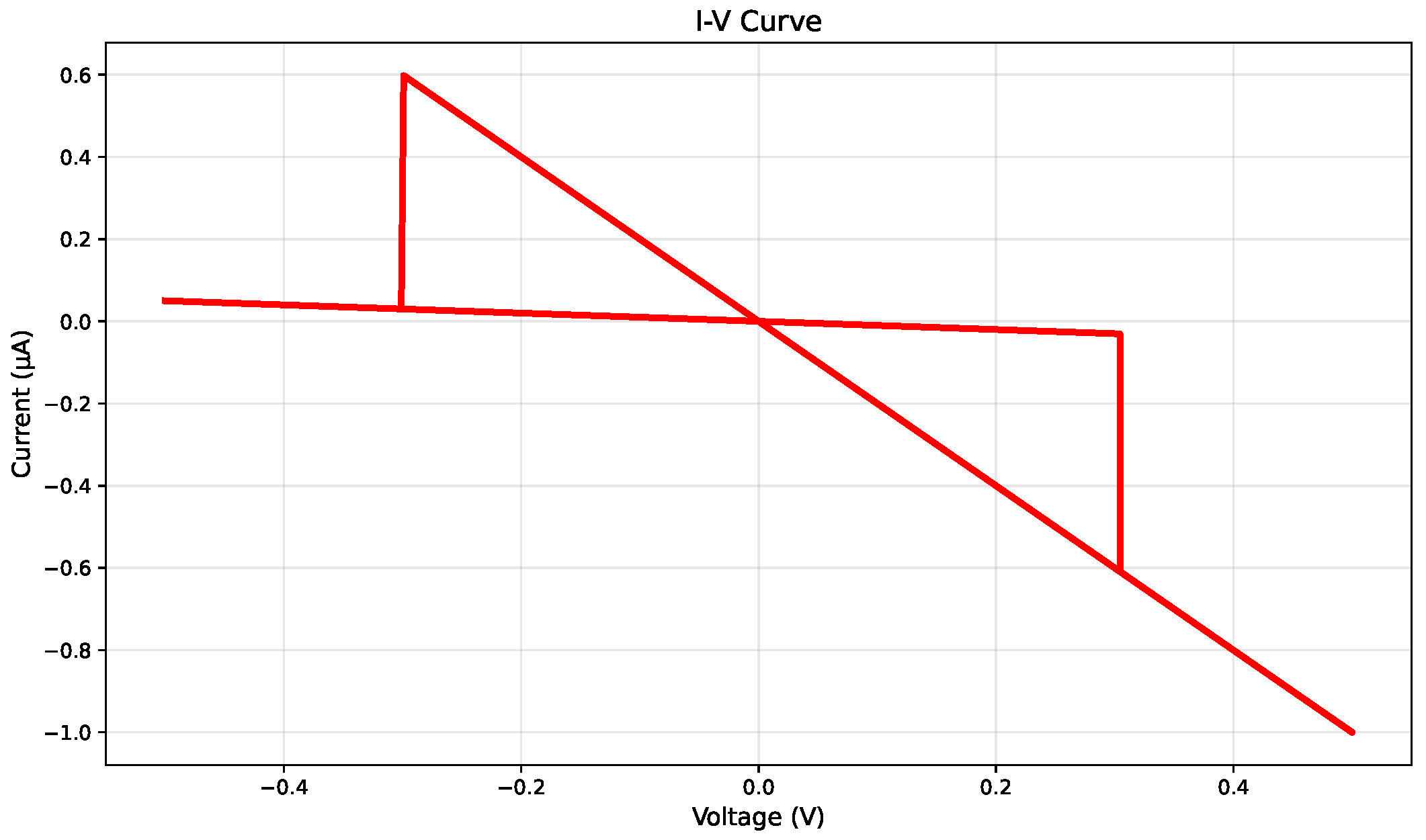
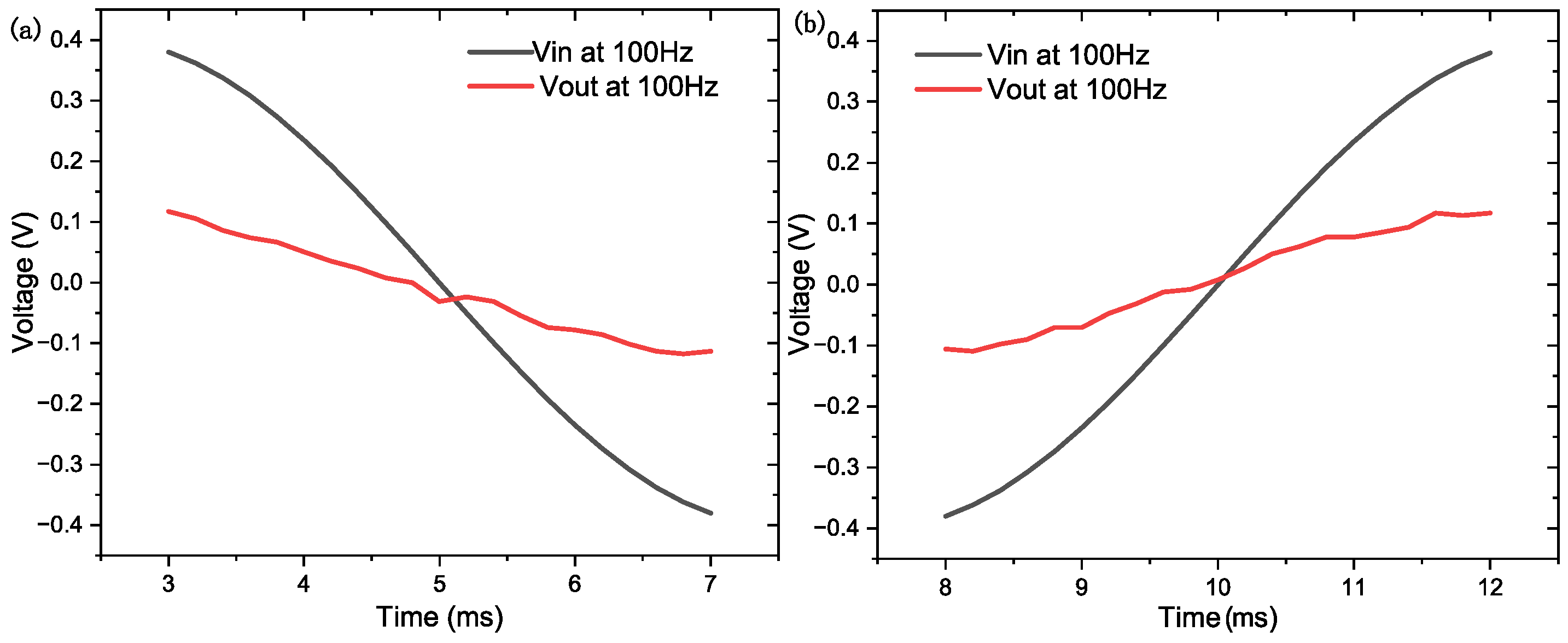
Because memristors exhibit pinched hysteresis in their IV characteristics (Figure 3), the device inherently introduces some degree of nonlinear distortion across the full AC cycle. However, this nonlinearity is not uniformly distributed. Specifically, around the zero-crossing region, the applied voltage falls significantly below the state-switching threshold ( | V | V t h ). This near-zero voltage temporarily halts the internal ionic drift, effectively freezing the device state. Consequently, the memristor operates temporarily as a static, passive resistor, making the zero-crossing region actually the most highly linear portion of the dynamic cycle. While high-resolution zoom-in measurements (Figure 4) confirm this smooth and linear continuous behavior near zero volts, we acknowledge that visual inspection of this specific linear region alone is insufficient for rigorous analog characterization of the entire waveform’s distortion.
To quantitatively evaluate this hysteresis-induced nonlinearity, we calculate the Total Harmonic Distortion (THD), defined as:
THD = n = 2 V n 2 V 1 × 100 % ,
where V 1 is the RMS amplitude of the fundamental component and V n represents the RMS amplitude of the n-th harmonic component.
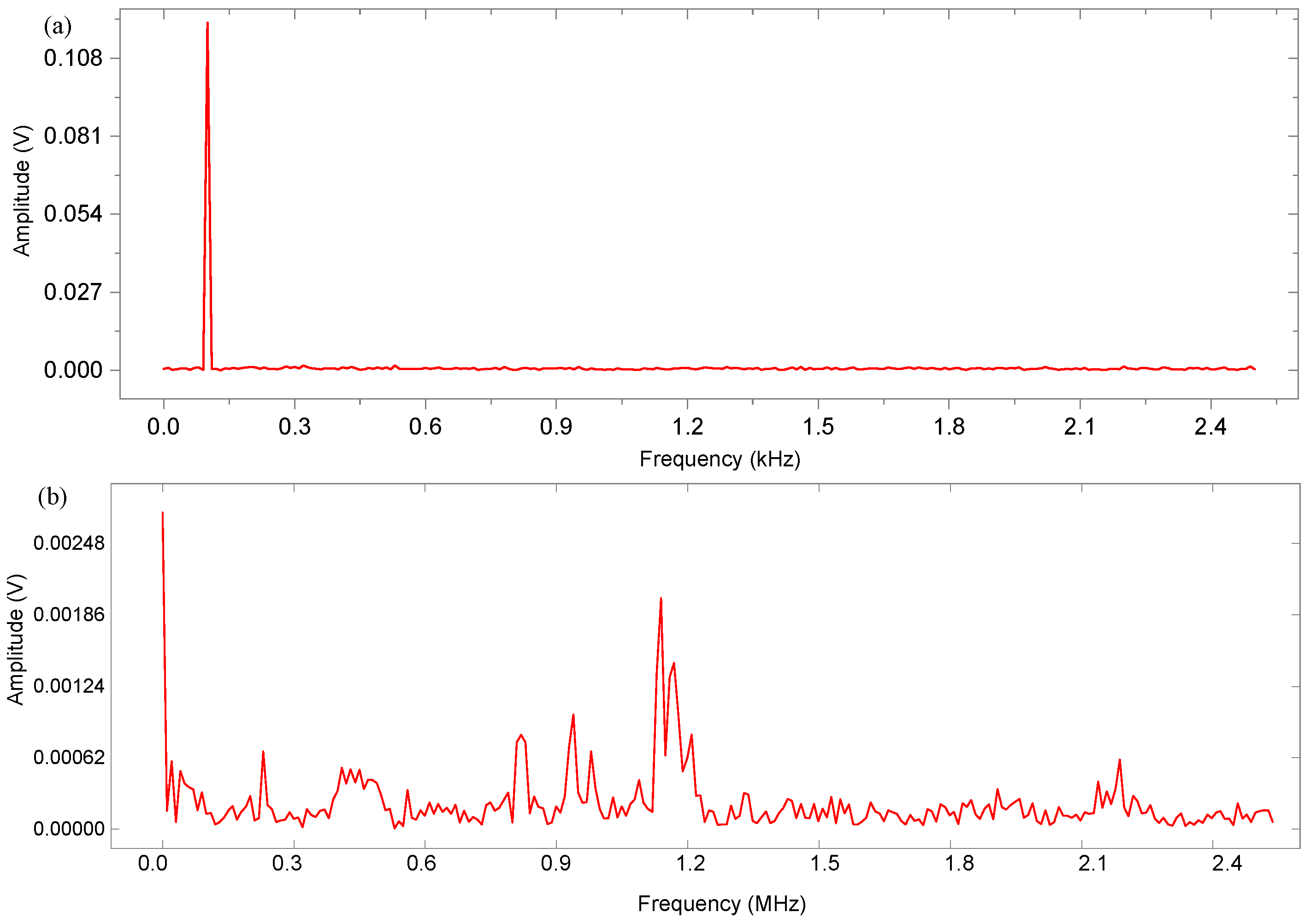
Because the memristor is nonlinear, harmonic components may appear in the output. To visualize spectral content, we performed FFT analysis on V out corresponding to Figure 2. The FFT magnitude spectra in Figure 5 illustrate the relative harmonic content in low- and high-frequency cases.
For the low-frequency passband case ( f = 100 Hz ), the state predominantly remains in a low-resistance regime with minimal active switching per cycle, yielding a measured THD of 1.67 % . This quantitative metric confirms that while hysteresis-induced distortion is physically present (as expected, THD > 0 ), it remains bounded at a relatively low level within the deep passband.
For the high-frequency case ( f = 100 kHz ), the output amplitude is strongly attenuated and no statistically significant fundamental component can be reliably extracted above the noise floor. In this regime, the circuit effectively suppresses the signal rather than transmitting a distorted waveform. Consequently, THD is not meaningfully defined for this condition, since harmonic distortion requires a detectable fundamental component as reference.
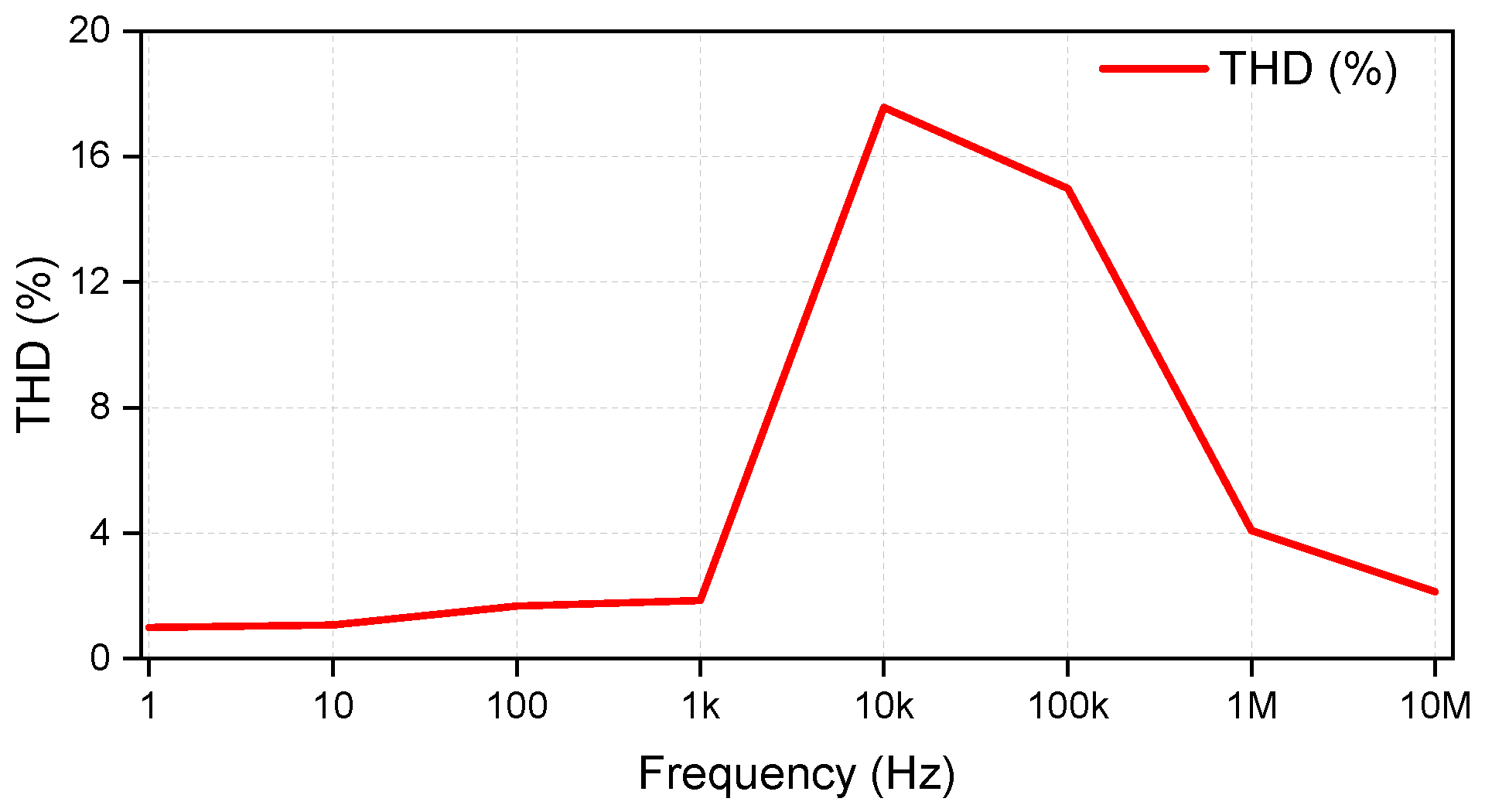
However, it is crucial to note that the THD is not uniform across the frequency spectrum. As frequency approaches the transition region (near the apparent cutoff), partial state evolution occurs within each half-cycle. In this regime, the hysteresis loops are maximized, causing the THD to peak. This incomplete state evolution inherently introduces nonlinear distortion, as illustrated in the THD versus frequency plot (Figure 6).
While a classical LTI filter maintains strict linearity through its transition band, the proposed memristive device trades transition-band linearity for an ultra-compact, capacitor-free attenuation roll-off. This intrinsic trade-off dictates that the device is best suited for applications where the signal operates predominantly in either the deep passband or the deep stopband, or in specific event-driven scenarios where transition-band distortion is an acceptable compromise for achieving zero-phase attenuation (as further discussed in Section 6).
These quantitative results demonstrate that although dynamic resistance scaling inevitably introduces overall harmonic distortion, this nonlinearity remains tightly bounded (e.g., 1.67 % THD) within the deep passband. Furthermore, it confirms that the attenuation mechanism in the stopband is fundamentally governed by high-resistance state retention, effectively suppressing energy transfer without introducing aggressive waveform clipping or high-frequency regenerative noise.

4.2. Resistance Statistics Versus Frequency

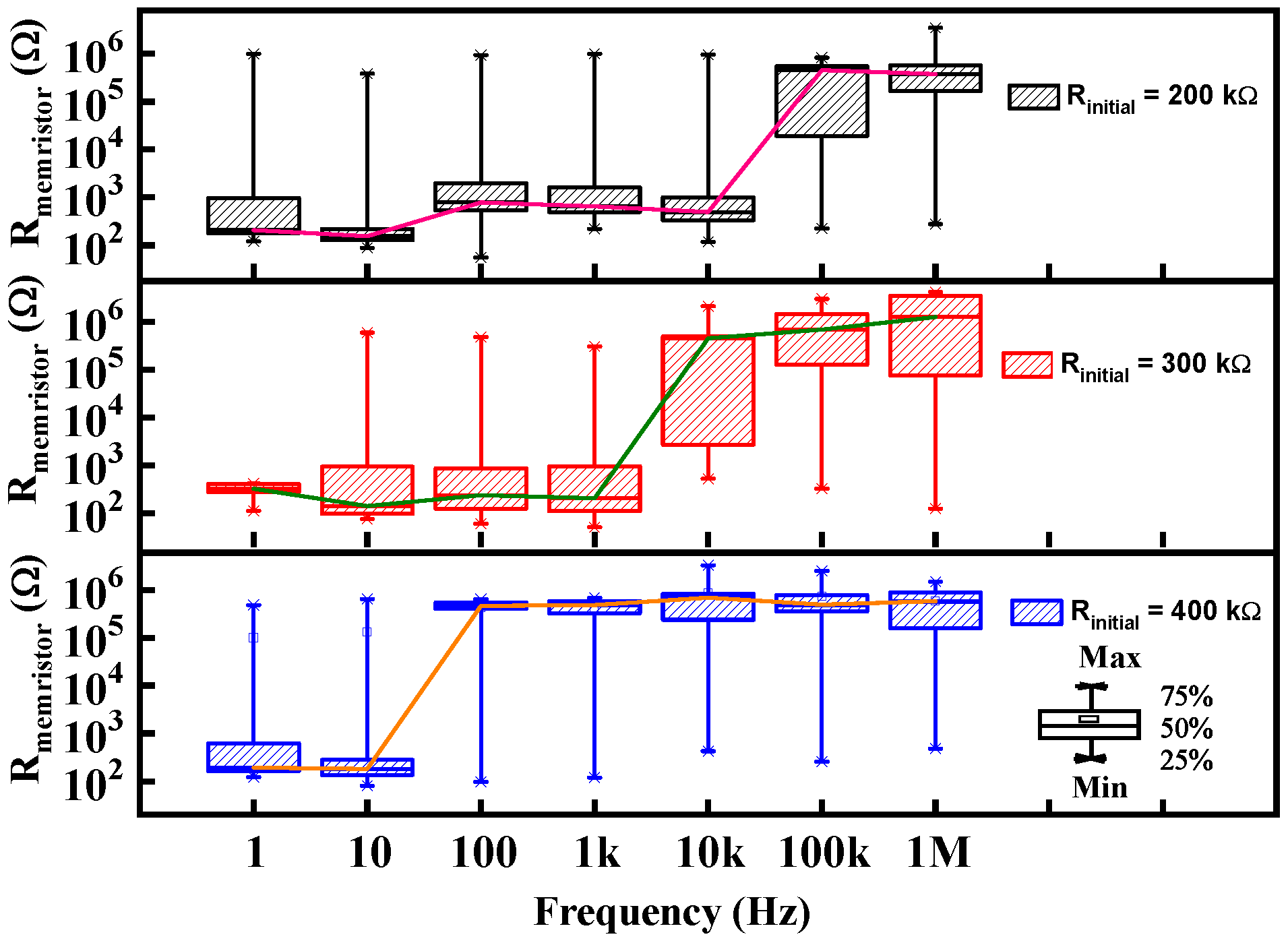
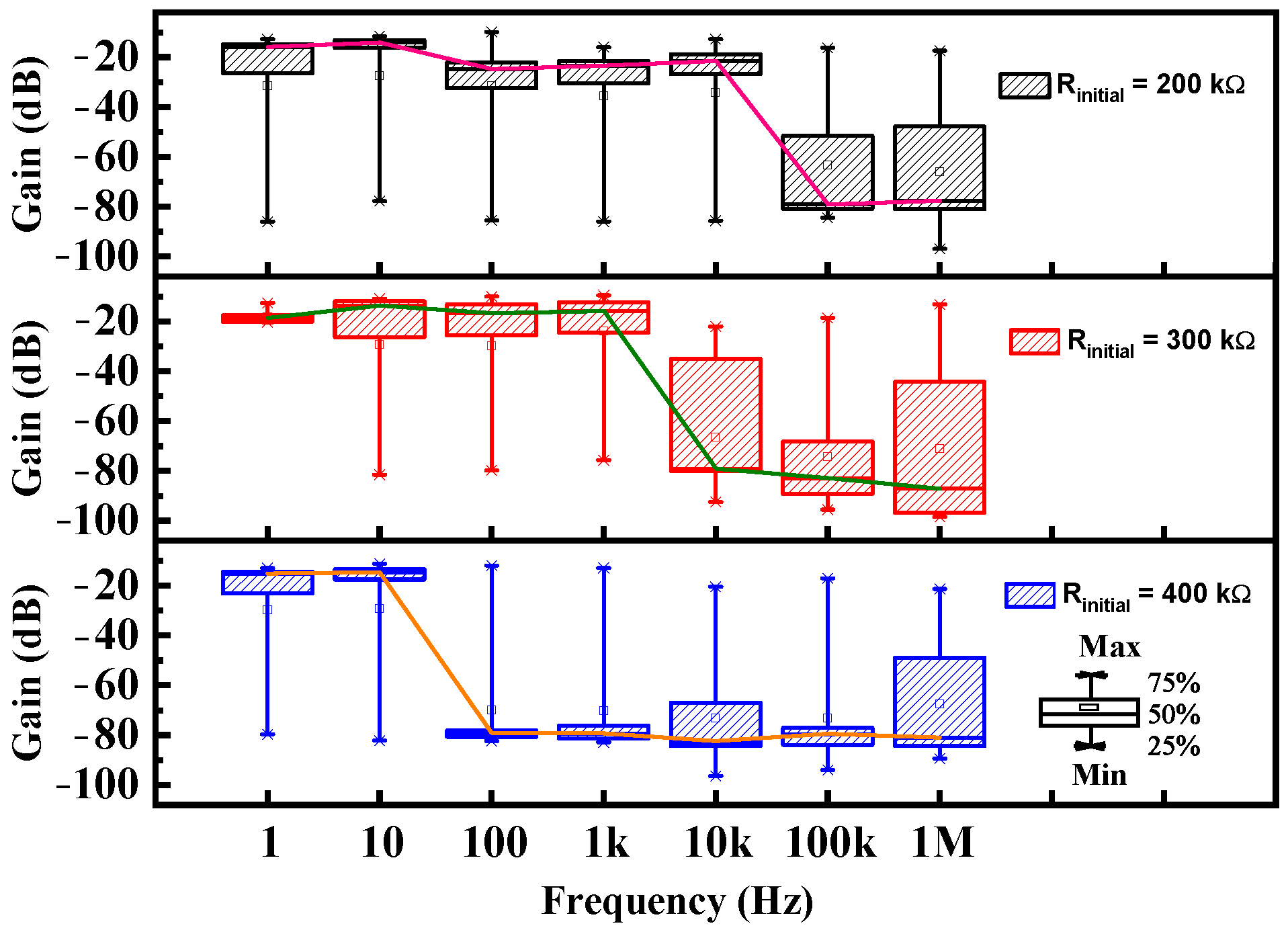
To quantify how resistance depends on excitation frequency, we prepared three device groups with initial resistances of approximately 200 k Ω ± 30 k Ω , 300 k Ω ± 30 k Ω , and 400 k Ω ± 30 k Ω . For each group, five devices were measured at 1 Hz , 10 Hz , 100 Hz , 1 kHz , 10 kHz , 100 kHz , and 1 MHz using the ten-cycle sinusoidal burst described above. Figure 7 summarizes the resulting resistance distributions; error bars indicate standard deviation across devices.
As frequency increases, the measured resistance tends to rise toward an HRS-like level, consistent with a finite state-evolution time scale. Importantly, the transition region (where resistance rapidly changes with frequency) shows the largest device-to-device variability, which directly affects cutoff-frequency precision (discussed in Section 5).

4.3. Normalized Magnitude Response and Tunable Cutoff

Given the predominantly resistive configuration, the output across the load can be approximated by a divider relationship. With R load fixed and R mem ( f ) obtained from Figure 7, an effective gain can be written as
G ( f ) = V out V in R load R load + R mem ( f ) .
Here V in denotes the voltage applied to the series chain; the measurement setup includes R s and R load , so the plotted gain should be interpreted as the effective gain under this calibrated environment.
Figure 8 shows the measured normalized gain versus frequency. The apparent cutoff frequency shifts with the programmed initial resistance: approximately 10 kHz , 1 kHz , and 10 Hz for initial resistances of 200 k Ω ± 30 k Ω , 300 k Ω ± 30 k Ω , and 400 k Ω ± 30 k Ω , respectively. The rapid resistance transition produces a steep magnitude change that can approach 60 dB / dec over the measured range. This steepness is a behavioral consequence of state switching (threshold-like transition), not the result of three LTI poles.

4.4. Amplitude Dependence


Because the memristor’s state evolution relies fundamentally on voltage-time integration, the transition frequency is inherently amplitude-dependent. Figure 9 illustrates the measured frequency response under different input amplitudes, using the same initialization protocol (initial resistance of approximately 300 k Ω ). For this batch of devices, the SET voltage threshold is slightly below 0.3 V . Consequently, when the input amplitude remains below this threshold, the internal ionic drift is heavily restricted. The memristor remains entirely in its high-resistance state (HRS) across all frequencies, and the load resistor receives only a negligible fraction of the voltage. While classical LTI systems view such amplitude-dependent cutoff shifting as a nonlinear limitation requiring strict amplitude regulation, this behavior is actually highly advantageous for event-driven architectures. As the amplitude decreases, the effective state drive weakens, naturally shifting the cutoff frequency lower to suppress small-signal background noise. Conversely, high-amplitude events accelerate state evolution, dynamically expanding the bandwidth. This intrinsic property enables the device to function as an amplitude-aware adaptive front-end, a concept that will be further explored in Section 6.

4.5. Phase Response

To provide a Bode-style characterization, we measured the phase difference between V out and V in across the investigated frequency range. Unlike conventional RC low-pass filters, which exhibit a monotonic phase lag due to reactive energy storage, the measured phase here remains close to 0 . This confirms that the circuit operates predominantly as a resistive divider and does not realize a classical LTI filter pole.
At first glance, a near-zero phase response may suggest that the attenuation mechanism is purely amplitude-based, similar to a limiter or clipper. However, the proposed circuit is fundamentally different from a simple amplitude limiter in both mechanism and behavior. In a conventional limiter, attenuation is determined by the instantaneous signal amplitude exceeding a static threshold, and the output response depends only on the current input value, with no memory of prior excitation.
In contrast, the attenuation observed here arises from the finite-time state evolution of the memristor. The internal resistance is governed by a state variable whose dynamics integrate the applied voltage over time. As a result, frequency directly influences whether the memristor state can follow the excitation: at low frequencies, each half-cycle persists long enough to drive the state toward a low-resistance condition, whereas at high frequencies, rapid polarity reversals prevent significant state evolution, keeping the device in a high-resistance state.
Therefore, although the instantaneous transfer is resistive and exhibits near-zero phase shift, the frequency selectivity originates from the mismatch between the excitation period and the intrinsic state-evolution time constant of the memristor. This distinguishes the proposed circuit from a memoryless amplitude limiter and justifies interpreting it as a frequency-selective resistive attenuator rather than a simple energy-based clipping element or a classical reactive low-pass filter.

4.6. Simulation Note

The circuit-level simulations were performed using the Verilog-A compact model for oxide-based RRAM proposed by Jiang et al. [32]. The model describes resistive switching through an internal state variable associated with conductive filament gap modulation and incorporates nonlinear ionic drift dynamics, field-enhanced transport, and bounded state evolution within physically defined limits.
In this work, the published Verilog-A implementation was directly integrated into the circuit simulator without structural modification. Unless otherwise specified, the parameter set reported in [32] was adopted, with scaling adjustments applied only to align the simulated high- and low-resistance states with the experimentally measured resistance range of the fabricated devices.
Although the original model was calibrated for generic oxide-based RRAM structures, it captures the essential filament-gap modulation mechanism widely observed in valence-change-type HfO2 memristors. The Au/HfO2/Au devices studied here exhibit gradual, voltage-driven resistance evolution consistent with filamentary conduction; therefore, the compact model provides a physically reasonable phenomenological representation for circuit-level analysis. Electrode-specific interface effects are not explicitly resolved, and the model should be interpreted as a state-dependent conductance description rather than a fully materials-resolved simulation.
For interpretive clarity, the observed attenuation trends can be qualitatively understood as resulting from resistance evolution between high- and low-conductance regimes under periodic excitation. However, all quantitative simulation results reported in this work were obtained directly from the referenced compact model rather than from an abstract threshold-switching approximation.
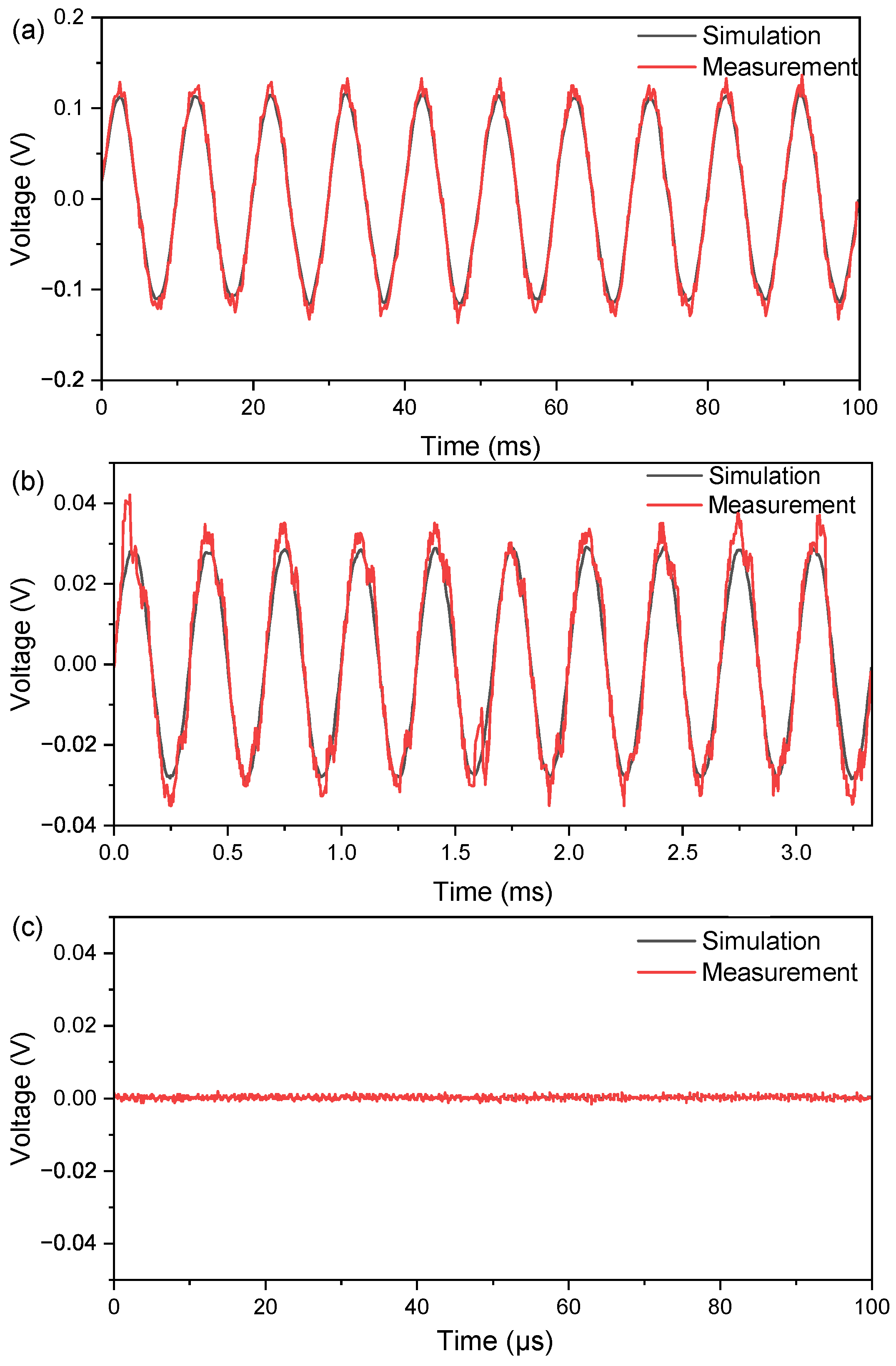
While our primary objective in utilizing this phenomenological model is to capture the macroscopic resistance-switching trends at room temperature rather than achieving perfectly identical microscopic waveforms, we evaluated the simulated transient responses against the experimental measurements to ensure behavioral consistency.
As shown in Figure 10a–c, while the microscopic waveform profiles exhibit some discrepancies due to the inherent stochastic nature of actual ionic drift in the physical device, the macroscopic amplitude attenuation trends are highly consistent across the distinct frequency regimes. Because the proposed attenuator relies fundamentally on macroscopic energy suppression rather than highly linear waveform preservation, successfully capturing this finite state-evolution time scale and the resulting amplitude dynamics ensures that the model provides a robust and highly reliable foundation for the circuit-level behavioral analysis presented herein.

5. Discussion and Practical Considerations

5.1. Interpretation Beyond Classical LTI Filters

The circuit is dominated by resistive division, and the sharp roll-off arises from nonlinear state switching rather than pole-zero placement. Therefore, while the magnitude curve may resemble that of a higher-order LPF over a limited range, it should not be interpreted as an LTI transfer function with a fixed pole count. In particular, the cutoff frequency depends on the programmed initial state and on excitation conditions (e.g., amplitude), and the response may vary with prior history.

5.2. Variability and Calibration

Figure 7 shows notable device-to-device variability, especially near the transition region. In large-scale deployment, this variability can broaden the cutoff-frequency spread. Practical mitigation strategies include (i) trimming or calibration circuits to program R init more precisely, (ii) factory calibration using a small set of frequency test points, or (iii) closed-loop tuning that adjusts the programmed state to meet a target attenuation at a reference frequency.

5.3. Load Dependence and Buffering

Because attenuation is produced by a divider involving R load , changes in the following-stage input impedance can alter the effective response. A buffer amplifier (e.g., an op-amp voltage follower) can isolate the divider from load variations and stabilize the observed cutoff/attenuation profile.

5.4. Endurance and Retention

This work focuses on demonstrating frequency-dependent resistance and the resulting attenuation behavior. Full endurance and retention characterization (e.g., cycle-to-failure statistics under repeated program/erase and long-term state drift under AC excitation) is outside the present scope but is important for continuous or frequently reprogrammed operation.

5.5. Temperature Dependence of Ionic Drift and Cutoff Stability

Temperature is an important factor for ionic-drift-based memristive devices. In valence-change-type HfO2 systems, the mobility of oxygen vacancies or other mobile ionic species is commonly described, to first order, by an Arrhenius-type relationship:
μ ( T ) exp E a k T ,
where E a denotes an effective activation energy, k is Boltzmann’s constant, and T is the absolute temperature. This expression represents a simplified thermally activated transport model and does not explicitly account for field-enhanced drift, interface effects, or series-resistance limitations, which may also influence the overall dynamics.
Because the state evolution rate of a filamentary memristor is coupled to ionic mobility, the characteristic time scale associated with resistance transition can be qualitatively expressed as
τ ( T ) 1 μ ( T ) .
Accordingly, the intrinsic state-evolution time constant is expected to decrease with increasing temperature. Since the apparent cutoff frequency in the proposed attenuator emerges from the competition between the excitation period and the state-evolution time scale, a qualitative relationship can be expressed as
f c ( T ) 1 τ ( T ) .
Under this simplified framework, an increase in temperature accelerates ionic motion, shortens the effective transition time, and therefore tends to shift the apparent cutoff frequency upward. However, the exact temperature dependence of f c is device-specific and may deviate from a pure Arrhenius form due to nonlinear electric-field effects, partial filament modulation, and interaction with the external resistor network.
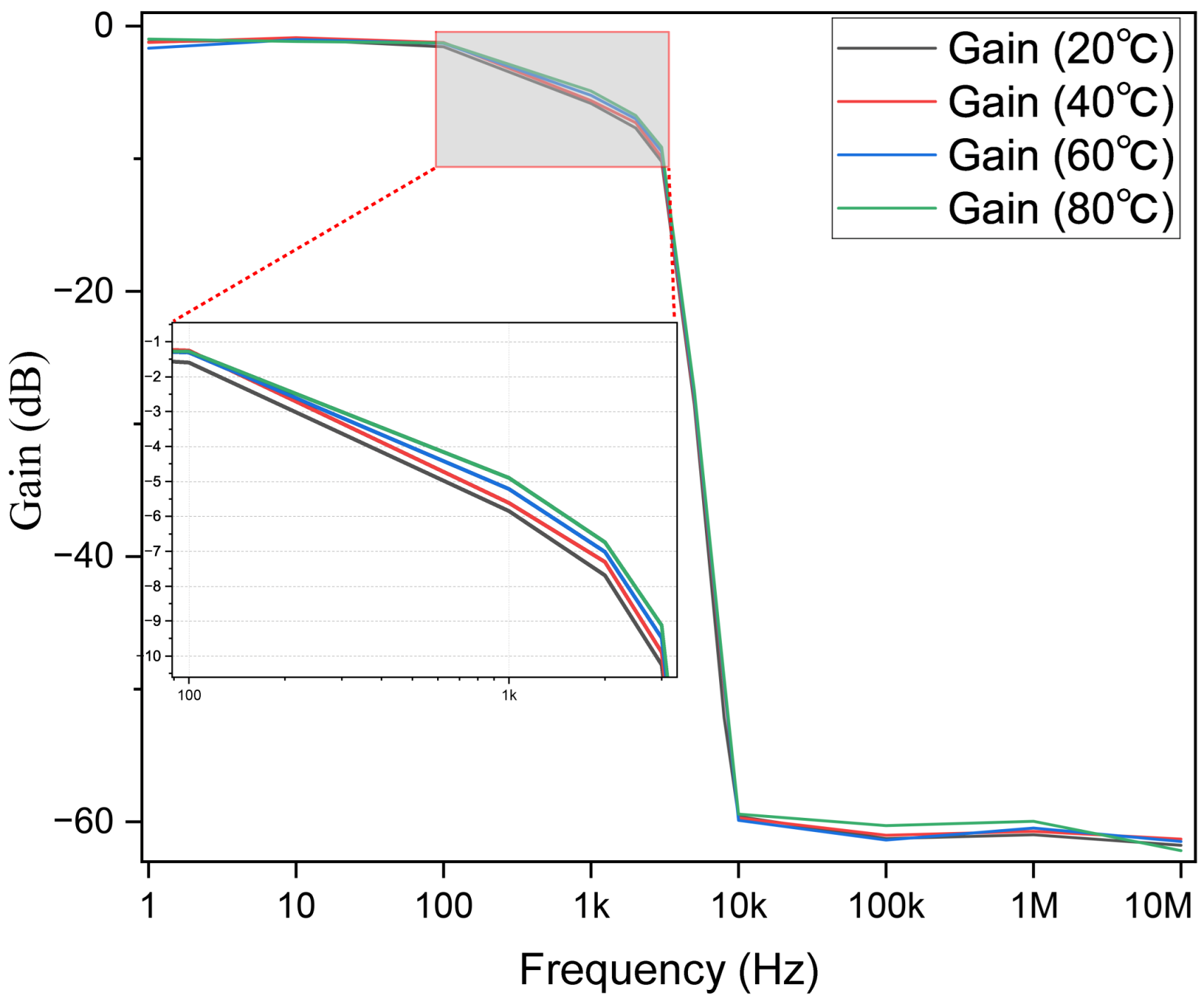
Because the utilized Verilog-A compact model lacks built-in support for dynamic temperature variations, we experimentally characterized the thermal response of the fabricated devices. The measurements were conducted across an ambient temperature range from 20 °C to 80 °C, with an initial resistance of approximately 300 k Ω and an input amplitude of 0.4 V . As shown in Figure 11, the apparent cutoff frequency increases slightly with increasing temperature, corresponding to a gain variation of approximately 2–3 dB per 20 °C increment. This observation aligns with theoretical expectations, confirming that thermally accelerated ionic drift slightly reduces the state-transition time constant.
Crucially, while this thermal dependence is physically measurable, the magnitude of the shift remains tightly bounded. The observed variation is moderate and does not lead to circuit instability, nor does it destroy the macroscopic energy suppression in the high-frequency stopband. Therefore, for the proposed specialized edge applications operating within standard commercial temperature ranges, this minor thermal fluctuation is an acceptable physical trade-off that does not critically impair the overall frequency-attenuation functionality of the circuit.

5.6. Attenuation Roll-Off Comparison: Memristive Device vs. 3rd-Order RC Network

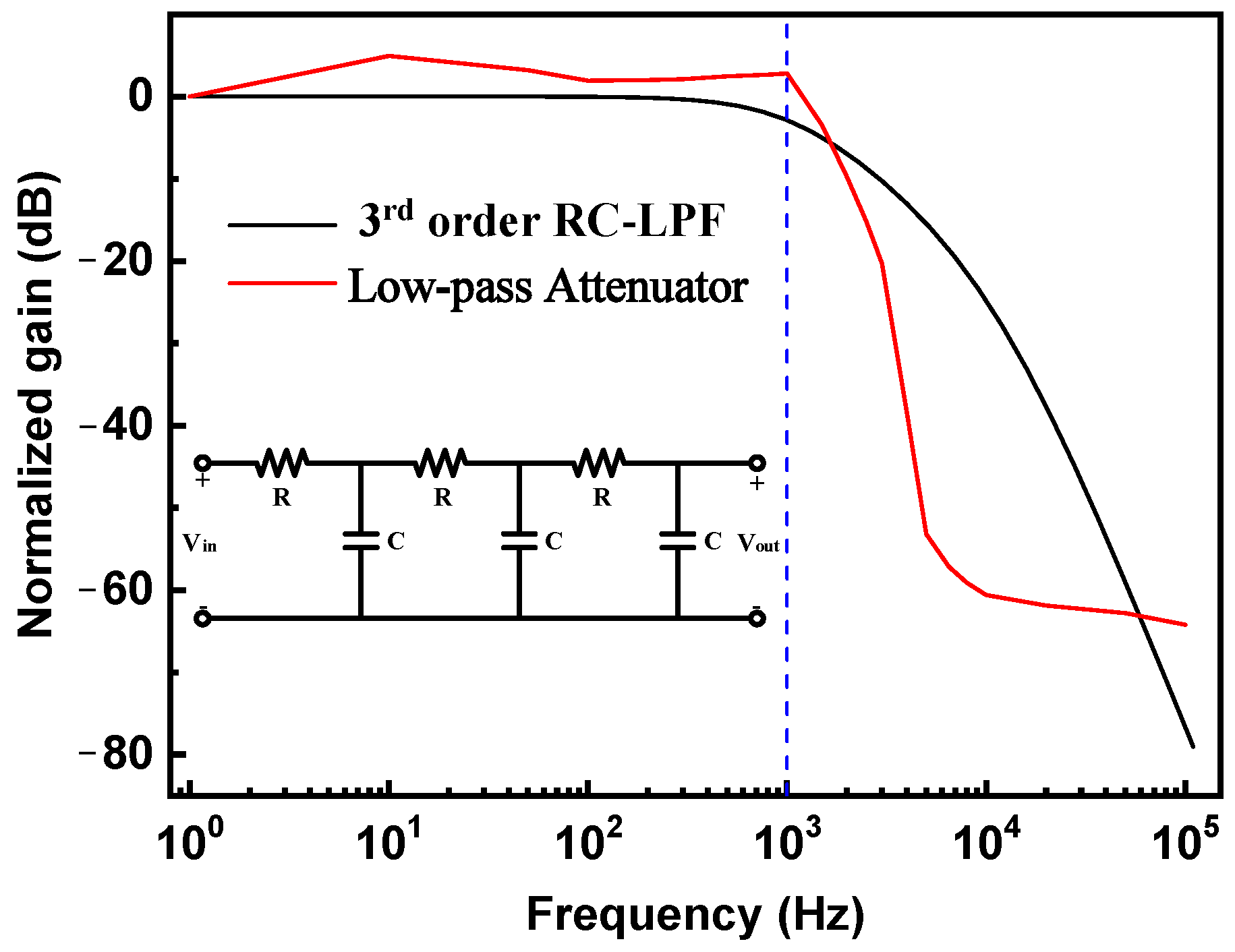
To rigorously evaluate the high-frequency suppression capability of the proposed attenuator, it is instructive to compare its macroscopic gain response with that of a classical LTI filter. To achieve a stopband roll-off of 60 dB / dec , a conventional passive approach requires a cascaded 3rd-order RC low-pass network. Figure 12 presents a pure gain-versus-frequency comparison between the theoretical 3rd-order RC filter and the measured response of our proposed memristive attenuator.
It is crucial to note that while the axes resemble a conventional frequency response, the curve for the proposed device is strictly a macroscopic amplitude gain profile rather than a classical Bode plot. A traditional Bode magnitude plot characterizes an LTI system governed by a linear transfer function, involving reactive energy storage (capacitors) that intrinsically introduces severe cumulative phase lag. In contrast, the 60 dB / dec roll-off in the proposed circuit is driven entirely by the finite state-evolution time of the memristor’s ionic drift under alternating polarity.
Despite this fundamental difference in underlying physics, both approaches yield an equivalent 60 dB / dec attenuation slope in the stopband. However, the classical 3rd-order RC network requires three discrete capacitors, which consume an unfeasibly large silicon area for low-frequency cutoffs. The proposed memristive attenuator accomplishes this aggressive roll-off using only a single nanoscale device and a load resistor, offering an unprecedented area advantage for specialized edge-computing and event-driven front-ends where LTI phase continuity is not strictly required.

6. Applications: Adaptive Edge-Preprocessing and Zero-Phase Systems

As demonstrated in Section 4 and Section 5.6, the proposed memristor-based attenuator achieves a steep post-cutoff attenuation rate that can approach −60 dB/dec. In classical LTI filter design, achieving this magnitude of roll-off requires a cascaded third-order RC network, which inherently relies on the placement of multiple reactive poles and consumes an unfeasibly large silicon area for low-frequency applications.
However, it is critical to emphasize that the steepness in the proposed circuit arises from nonlinear, excitation-dependent state switching (a threshold-driven resistance transition) rather than a classical pole-based attenuation process. Because the circuit fundamentally diverges from a classical LTI filter, it is not intended to replace highly linear, precision sensor front-ends. Instead, its unique physical properties—specifically its amplitude-dependent cutoff and lack of reactive energy storage—open novel application avenues where classical filters fail or introduce unnecessary complexity:
  • Adaptive Amplitude-Aware Preprocessing (Level-Crossing): Unlike a static LTI filter that blindly attenuates all high frequencies, the memristor’s apparent cutoff frequency naturally shifts with the input signal amplitude. In modern event-driven sensor interfaces, an advanced analog front-end must intentionally suppress small-amplitude background noise while rapidly triggering high-bandwidth responses only when critical high-amplitude events cross a physical threshold [33]. The proposed circuit inherently physically embodies this amplitude-threshold-triggered gate: it aggressively filters out low-amplitude high-frequency noise by remaining in a high-resistance state, but dynamically expands its bandwidth to pass high-amplitude transient anomalies, ensuring vital event information is not smoothed out.
  • Zero-Phase-Lag Noise Suppression: The device suppresses high-frequency signals strictly through dynamic resistance scaling rather than reactive energy storage. Consequently, it achieves severe high-frequency attenuation without introducing the cumulative phase lag characteristic of capacitive poles. Any phase delay introduced by classical low-pass filters severely degrades the phase margin and stability of closed-loop controllers [34]. While the proposed device lacks the capability to perform complex, high-fidelity mixed-signal filtering, it presents significant potential for specific zero-phase response applications. In closed-loop systems where strictly maintaining zero-phase continuity for stability is prioritized over linear waveform preservation, this attenuator could serve as a promising, ultra-compact hardware primitive for aggressive noise suppression.
  • Frequency-to-Amplitude Conversion for FSK Demodulation: In ultra-low-power IoT communications, Frequency-Shift Keying (FSK) modulates data by alternating between discrete single frequencies (e.g., passing a 1 kHz tone for bit ‘1’ and a 100 kHz tone for bit ‘0’). Because these signals are separated in time rather than mixed, the proposed attenuator can act directly as a passive, capacitor-free demodulation front-end. It naturally allows the 1 kHz baseband signal to integrate and pass (outputting a large voltage amplitude) while physically locking into a high-resistance state to strongly attenuate the 100 kHz signal. This effectively converts frequency shifts into stark amplitude variations, allowing a simple subsequent envelope detector to extract the digital ‘0’ and ‘1’ bits without the immense area overhead of complex mixers or active LC tank circuits.
By framing the circuit as a state-adaptive, nonlinear edge-processor rather than a static LTI filter, its inherent amplitude dependencies and non-reactive physical mechanisms are transformed from analog design flaws into hardware-efficient features.
To illustrate the hardware efficiency required for the aforementioned edge applications, consider a third-order RC LPF using three 1 k Ω resistors (common in integrated circuits). To obtain nominal 3 dB cutoff frequencies of 100 Hz , 10 kHz , and 100 kHz , the required capacitances are on the order of 3 μ F , 30 nF , and 3 nF , respectively. As an example, the area of a 30 fF capacitor is approximately 300 μ m 2 , while a 30 nF capacitor requires 3 × 10 7 μ m 2 (although capacitors of this size are usually not found in integrated circuits). By comparison, the memristor area used here is 225 μ m 2 , highlighting the exceptional compactness of memristor-enabled filtering/attenuation.

7. Conclusions

In this work, we proposed and experimentally validated a highly compact, capacitor-free memristive low-pass attenuator. Unlike classical linear time-invariant (LTI) filters that rely on reactive energy storage, the proposed architecture leverages the finite state-evolution time of ionic drift to achieve frequency-dependent dynamic resistance scaling. Our results demonstrate that this single-device configuration can achieve a steep post-cutoff attenuation rate approaching 60 dB / dec . While this roll-off magnitude is equivalent to a cascaded third-order RC network, it is accomplished entirely through nonlinear state switching, offering unprecedented area efficiency and strictly zero-phase-lag attenuation that overcomes the phase-margin bottlenecks of traditional capacitive poles.
Because the attenuation mechanism is fundamentally governed by voltage-time integration rather than fixed reactive poles, the circuit’s behavior naturally diverges from classical LTI systems. We comprehensively analyzed its intrinsic nonlinearities, demonstrating that while dynamic resistance scaling introduces bounded harmonic distortion, the macroscopic energy suppression remains robust. Additionally, while the device exhibits a measurable thermal dependence, our experimental characterization confirms that this variation remains tightly bounded and does not compromise macroscopic circuit stability under standard operating conditions. Furthermore, the apparent cutoff frequency is inherently dependent on the input signal amplitude. Rather than viewing this as an analog design flaw, we established that it functions as a hardware-efficient, event-driven mechanism. It intrinsically suppresses low-amplitude high-frequency noise while dynamically expanding bandwidth for high-amplitude transient events.
While the proposed device lacks the capability to perform high-fidelity mixed-signal filtering for complex continuous waveforms, it is not intended to replace precision LTI front-ends. Instead, it serves as a highly specialized, state-adaptive hardware primitive. By trading classical transition-band linearity for an ultra-compact footprint, the attenuator presents significant potential for specific edge-processing scenarios, including zero-phase closed-loop noise suppression, frequency-to-amplitude conversion for FSK demodulation, and amplitude-aware event-driven sensory interfaces.
Ultimately, this work conceptually shifts the application of memristors from static programmable resistors within classical topologies to dynamic, state-adaptive frequency attenuators. Future research will explore the integration of these zero-phase, event-driven primitives into broader asynchronous edge-computing architectures to dynamically process sparse environmental stimuli with minimal hardware overhead.

Author Contributions

Conceptualization, J.L.; methodology, X.L.; software, J.W.; formal analysis, S.L.; investigation, Y.W.; data curation, Y.W.; writing—original draft preparation, X.L.; writing—review and editing, X.L.; visualization, Y.L.; supervision, J.W.; project administration, Y.L. All authors have read and agreed to the published version of the manuscript.

Funding

This work was supported in part by the National Natural Science Foundation of China (NSFC) under projects No. 62404033 and 62404034, the National Key Laboratory of Integrated Circuits and Microsystems under project No. JCKY2023210C010, and the Scientific Research Fundation of the Education Department of Sichuan Province, China under project No. 2024NSFSC1435.

Data Availability Statement

The original contributions presented in this study are included in the article. Further inquiries can be directed to the corresponding author.

Conflicts of Interest

The authors declare no conflicts of interest.

Abbreviations

The following abbreviations are used in this manuscript:
RCResistor–capacitor
LRSLow Resistance State
HRSHigh Resistance State

References

  1. Chua, L.O. Memristor—The Missing Circuit Element. IEEE Trans. Circuit Theory 1971, 18, 507–519. [Google Scholar] [CrossRef]
  2. Chua, L.O.; Kang, S.M. Memristive Devices and Systems. Proc. IEEE 1976, 64, 209–223. [Google Scholar] [CrossRef]
  3. Strukov, D.B.; Snider, G.S.; Stewart, D.R.; Stanley Williams, R. The Missing Memritor Found. Nature 2008, 453, 80–83. [Google Scholar] [CrossRef] [PubMed]
  4. Prodromakis, T.; Michelakis, K.; Toumazou, C. Fabrication and Electrical Characteristics of Memristors with TiO2/TiO3+x active layers. In Proceedings of the 2010 IEEE international Symposium on Circuits and Systems, Paris, France, 30 May–2 June 2010; pp. 1520–1522. [Google Scholar]
  5. Mahvash, M.; Parker, A.C. A Memristor SPICE Model for Designing Memristor Circuits. In Proceedings of the 2010 53rd IEEE International Midwest Symposium on Circuits and Systems, Seattle, WA, USA, 1–4 August 2010; pp. 989–992. [Google Scholar]
  6. Kvatinsky, S.; Friedman, E.G.; Kolodny, A.; Weiser, U.C. TEAM: Threshold Adaptive Memristor Model. In IEEE Transactions on Circuits and Systems I: Regular Papers; IEEE: New York, NY, USA, 2013; pp. 211–221. [Google Scholar]
  7. Rajendran, J.; Manem, H.; Karri, R.; Rose, G.S. Memristor based Programmable Threshold Logic Array. In Proceedings of the 2010 IEEE/ACM International Symposium on Nanoscale Architectures, Anaheim, CA, USA, 17–18 June 2010; IEEE: New York, NY, USA, 2010; pp. 5–10. [Google Scholar]
  8. Shin, S.; Kim, K.; Kang, S.M. Memristor Applications for Programmable Analog ICs. IEEE Trans. Nanotechnol. 2011, 10, 266–274. [Google Scholar] [CrossRef]
  9. Adhikari, S.P.; Yang, C.; Kim, H.; Chua, L.O. Memristor Bridge Synapse-Based Neural Network and Its Learning. IEEE Trans. Neural Netw. Learn. Syst. 2012, 23, 1426–1435. [Google Scholar] [CrossRef]
  10. Ascoli, A.; Corinto, F.; Mirchev, M.; Gilli, M. Memristor-based Filtering Applications. In Proceedings of the 2013 14th IEEE Latin-American Test Workshop (LATW), Cordoba, Argentina, 3–5 April 2013; IEEE: New York, NY, USA, 2013; pp. 1–6. [Google Scholar]
  11. Driscoll, T.; Quinn, J.; Klein, S.; Kim, H.T.; Kim, B.J.; Pershin, Y.V.; Di Ventra, M.; Basov, D.N. Memristive Adaptive Filters. Appl. Phys. Lett. 2010, 97, 093502. [Google Scholar] [CrossRef]
  12. Wang, W.D.; Yu, Q.; Xu, C.X.; Cui, Y.H. Study of Filter Characteristcs Based on PWL Memristor. In Proceedings of the International Conference on Communications, Circuits and Systems 2009, Milpitas, CA, USA, 23–25 July 2009; IEEE: New York, NY, USA, 2009; pp. 969–973. [Google Scholar]
  13. Xiao, Y.; Gao, C.; Jin, J.; Sun, W.; Wang, B.; Bao, Y.; Liu, C.; Huang, W.; Zeng, H.; Yu, Y. Recent Progress in Neuromorphic Computing from Memristive Devices to Neuromorphic Chips. Adv. Devices Instrum. 2024, 5, 0044. [Google Scholar] [CrossRef]
  14. Xiao, Y.; Jiang, B.; Zhang, Z.; Ke, S.; Jin, Y.; Wen, X.; Ye, C. A review of memristor: Material and structure design, device performance, applications and prospects. Sci. Technol. Adv. Mater. 2023, 24, 2162323. [Google Scholar] [CrossRef]
  15. Park, S.; Naqi, M.; Lee, N.; Park, S.; Hong, S.; Lee, B.H. Recent Advancements in 2D Material-Based Memristor Technology Toward Neuromorphic Computing. Micromachines 2024, 15, 1451. [Google Scholar] [CrossRef]
  16. Nirmal, K.A.; Kumbhar, D.D.; Kesavan, A.V.; Dongale, T.D.; Kim, T.G. Advancements in 2D Layered Material Memristors. npj 2D Mater. Appl. 2024, 8, 1–27. [Google Scholar] [CrossRef]
  17. Teixeira, H.; Dias, C.; Silva, A.V.; Ventura, J. Advances on MXene-Based Memristors for Neuromorphic Computing: A Review on Synthesis, Mechanisms, and Future Directions. ACS Nano 2024, 18, 21685–21713. [Google Scholar] [CrossRef] [PubMed]
  18. Zhou, H.; Li, S.; Ang, K.-W.; Zhang, Y.-W. Recent Advances in In-Memory Computing: Exploring Memristor and Memtransistor Arrays with 2D Materials. Nano-Micro Lett. 2024, 16, 121. [Google Scholar] [CrossRef]
  19. Lin, W.; Sun, B.; Mao, S.; Qin, J.; Yang, Y.; Liu, M.; Rao, Z.; Yang, Y.; Zhao, Y. Flexible Memristors for Implantable Applications. ACS Appl. Nano Mater. 2025, 8, 2073–2105. [Google Scholar] [CrossRef]
  20. Xia, Z.; Sun, X.; Wang, Z.; Meng, J.; Jin, B.; Wang, T. Low-Power Memristor for Neuromorphic Computing. IEEE Trans. Nanotechnol. 2025, 17, 217. [Google Scholar]
  21. Nibhanupudi, S.S.T.; Roy, A.; Veksler, D.; Coupin, M.; Matthews, K.C.; Disiena, M.; Singh, J.V.; Gearba-Dolocan, I.R.; Warner, J.; Kulkarni, J.P.; et al. Ultra-fast switching memristors based on two-dimensional materials. Nat. Commun. 2024, 15, 2334. [Google Scholar] [CrossRef]
  22. Silva, C.; Deuermeier, J.; Zhang, W.; Carlos, E.; Barquinha, P.; Martins, R.; Kiazadeh, A. Perspective: Zinc-Tin Oxide Based Memristors for Sustainable and Flexible In-Memory Computing Edge Devices. Adv. Electron. Mater. 2023, 9, 2300286. [Google Scholar] [CrossRef]
  23. Singh, A.; Choi, S.; Wang, G.; Daimari, M.; Lee, B.-G. Analysis and Fully Memristor-Based Reservoir Computing for Temporal Data Classification. Neural Netw. 2025, 182, 106925. [Google Scholar] [CrossRef] [PubMed]
  24. Das, H.; Febbo, R.D.; Rizzo, C.P.; Chakraborty, N.N.; Plank, J.S.; Rose, G.S. Optimizations for a Current-Controlled Memristor-Based Neuromorphic Synapse Design. IEEE J. Emerg. Sel. Top. Circuits Syst. 2023, 13, 889–900. [Google Scholar] [CrossRef]
  25. Huang, W.; Fang, Y.-W.; Yin, Y.; Tian, B.; Zhao, W.; Hou, C.; Ma, C.; Li, Q.; Tsymbal, E.Y.; Duan, C.-G.; et al. Solid-State Synapse Based on Magnetoelectrically Coupled Memristor. arXiv 2025, arXiv:2501.19304. [Google Scholar] [CrossRef]
  26. Harabi, K.-E.; Hirtzlin, T.; Turck, C.; Vianello, E.; Laurent, R.; Droulez, J.; Bessière, P.; Portal, J.-M.; Bocquet, M.; Querlioz, D. A Memristor-Based Bayesian Machine. Nat. Electron. 2023, 6, 52–63. [Google Scholar] [CrossRef]
  27. Hadiyawarman; Budiman, F.; Hernowo, D.G.O.; Pandey, R.R.; Tanaka, H. Recent progress on fabrication of memristor and transistor-based neuromorphic devices for high signal processing speed with low power consumption. Jpn. J. Appl. Phys. 2018, 57, 03EA06. [Google Scholar] [CrossRef]
  28. Kim, J.; Pershin, Y.V.; Yin, M.; Datta, T.; Di Ventra, M. An Experimental Proof that Resistance-Switching Memories Are Not Memristors. Adv. Electron. Mater. 2020, 6, 2000010. [Google Scholar] [CrossRef]
  29. Jeong, Y.; Zidan, M.A.; Lu, W.D. Parasitic Effect Analysis in Memristor-Array-Based Neuromorphic Systems. IEEE Trans. Nanotechnol. 2018, 17, 184–193. [Google Scholar] [CrossRef]
  30. Sahu, D.P.; Jetty, P.; Jammalamadaka, S.N. Graphene Oxide Based Synaptic Memristor Device for Neuromorphic Computing. Nanotechnology 2021, 32, 155701. [Google Scholar] [CrossRef] [PubMed]
  31. Mao, T.; Wang, B.; Sun, H.; Liu, Y.; Liu, S.; Liu, Y. A Multi-Synaptic Memristor-Based Neural Network and Its Encryption Application. Microelectron. J. 2024, 168, 106981. [Google Scholar] [CrossRef]
  32. Jiang, Z.; Yu, S.; Wu, Y.; Engel, J.H.; Guan, X.; Wong, H.-S.P. Verilog-A compact model for oxide-based resistive random access memory (RRAM). In Proceedings of the 2014 International Conference on Simulation of Semiconductor Processes and Devices, Yokohama, Japan, 9–11 September 2014; IEEE: Piscataway, NJ, USA, 2014; pp. 41–44. [Google Scholar]
  33. Saeed, M.; Wang, Q.; Märtens, O.; Larras, B.; Frappé, A.; Cardiff, B.; John, D. Evaluation of Level-Crossing ADCs for Event-Driven ECG Classification. IEEE Trans. Biomed. Circuits Syst. 2021, 15, 1129–1139. [Google Scholar] [CrossRef] [PubMed]
  34. de Lima, P.V.S.G.; Neto, R.C.; Neves, F.A.S.; Bradaschia, F.; de Souza, H.E.P.; Barbosa, E.J. Zero-Phase FIR Filter Design Algorithm for Repetitive Controllers. Energies 2023, 16, 2451. [Google Scholar] [CrossRef]
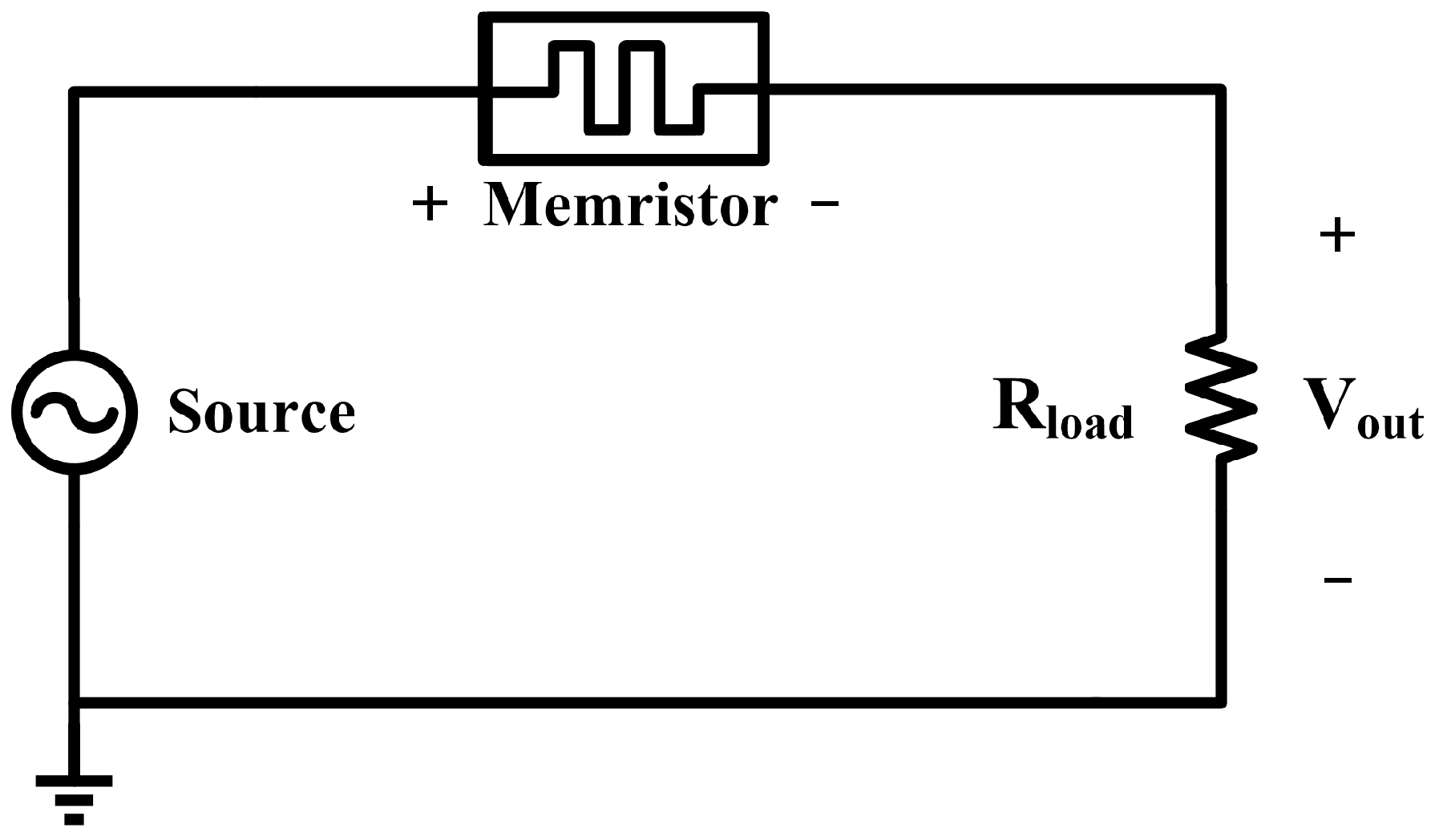
Figure 1. Schematic diagram of the memristor-based LPF (frequency-dependent resistive attenuator).
Electronics 15 01164 g001
Figure 2. Transient waveforms of the memristor-based attenuator measured across R load : (a) f = 100 Hz (passband case); (b) f = 100 kHz (stopband case).
Electronics 15 01164 g002
Figure 3. I–V curve showing pinched hysteresis and threshold-like switching (∼0.3 V ).
Electronics 15 01164 g003
Figure 4. High-resolution zoom-in of the zero-crossing region for the 100 Hz excitation: (a) negative-to-positive transition; (b) positive-to-negative transition.
Electronics 15 01164 g004
Figure 5. FFT magnitude spectra of the measured V out corresponding to Figure 2: (a) f = 100 Hz ; (b) f = 100 kHz .
Electronics 15 01164 g005
Figure 6. Measured Total Harmonic Distortion (THD) across the frequency spectrum, highlighting the expected distortion peak within the transition band due to partial state evolution.
Electronics 15 01164 g006
Figure 7. Statistical distribution of memristor resistance versus excitation frequency for three programmed initial-resistance groups (five devices per group).
Electronics 15 01164 g007
Figure 8. Normalized gain versus frequency of the memristor-based low-pass attenuator for three programmed initial-resistance groups, showing a tunable apparent cutoff frequency and sharp post-cutoff attenuation.
Electronics 15 01164 g008
Figure 9. Input-amplitude sensitivity of the memristor-based low-pass attenuator: normalized gain versus frequency measured at different input amplitudes (e.g., 0.2 V, 0.3 V, 0.4 V and 1 V) for the same programmed initial resistance.
Electronics 15 01164 g009
Figure 10. Comparison of experimental and simulated transient responses at specific frequencies: (a) low-frequency passband (100 Hz), (b) transition band (3 kHz), and (c) high-frequency stopband (100 kHz).
Electronics 15 01164 g010
Figure 11. Measured normalized gain versus frequency from 20 °C to 80 °C ( V amp = 0.4 V , R init 300 k Ω ), demonstrating the bounded thermal variation of the cutoff frequency.
Electronics 15 01164 g011
Figure 12. Gain-frequency comparison demonstrating that the proposed single-device memristive attenuator achieves a 60 dB / dec stopband roll-off, equivalent to a classical 3rd-order RC network, without requiring bulky on-chip capacitors. The blue dotted line indicates that the cut-off frequencies of the two are unified to 1 kHz.
Electronics 15 01164 g012
Disclaimer/Publisher’s Note: The statements, opinions and data contained in all publications are solely those of the individual author(s) and contributor(s) and not of MDPI and/or the editor(s). MDPI and/or the editor(s) disclaim responsibility for any injury to people or property resulting from any ideas, methods, instructions or products referred to in the content.