Article

A Systematic, Scalable, and Interpretable Mapping of Artificial Intelligence Research in Leukemia Using a Hybrid Machine Learning and Qualitative Framework

by
Reem Alharthi
1,
Rashid Mehmood
2,* and
Aiiad Albeshri
1
1
Department of Computer Science, Faculty of Computing and Information Technology, King Abdulaziz University, Jeddah 21589, Saudi Arabia
2
Faculty of Computer and Information Systems, Islamic University of Madinah, Madinah 42351, Saudi Arabia
*
Author to whom correspondence should be addressed.
Electronics 2026, 15(5), 1078; https://doi.org/10.3390/electronics15051078
Submission received: 20 January 2026 / Revised: 25 February 2026 / Accepted: 2 March 2026 / Published: 4 March 2026

Abstract

Artificial intelligence (AI) has been increasingly applied to leukemia research, spanning diagnostic, prognostic, therapeutic, and translational domains. However, the rapid growth and methodological diversity of this literature present challenges for existing reviews, which are often constrained by limited scope, narrow clinical focus, or reliance on either manual or purely bibliometric approaches. As a result, cross-domain relationships, evolving methodological trends, and the interaction between data modalities and clinical objectives remain insufficiently understood. This paper presents a systematic, AI-assisted literature analysis of AI applications in leukemia, combining scalable machine-driven discovery with author-led qualitative interpretation. Using a PRISMA-guided screening process, a corpus of 2338 peer-reviewed publications retrieved from Scopus (1990–2024) is analyzed through semantic text representation and unsupervised clustering. An iterative human–machine process is employed to identify and refine 23 analytical parameters grouped into five macro-parameters, enabling structured organization of the research landscape across diagnostic, prognostic, therapeutic, genetic, and methodological dimensions. Building on this structured representation, in-depth qualitative analysis is conducted by the authors across parameters and macro-parameters, synthesizing methodological developments, data usage patterns, application domains, and commonly used datasets. The resulting analysis provides a coherent, interpretable mapping of AI-driven leukemia research, supporting cross-domain comparison and identification of research concentrations, fragmentation, and emerging directions. By integrating large-scale automation with domain-informed qualitative analysis in a reusable analytical pipeline, this work contributes a rigorous and transferable framework for structured literature analysis in leukemia and related biomedical domains.

1. Introduction

Healthcare is fundamental to human well-being, with cancer remaining one of the most urgent global health challenges. As a group of diseases defined by uncontrolled cell growth, cancer affects millions worldwide and continues to impose a heavy public health burden. Within this spectrum, leukemia stands out as an especially aggressive malignancy. Arising in the blood-forming tissues of the bone marrow and lymphatic system, leukemia is marked by the uncontrolled production of abnormal white blood cells (WBC) that crowd out healthy cells and disrupt normal physiological functions [1]. According to a study conducted in 2021 [2], the global burden of leukemia reached nearly 461,000 new cases and 320,000 deaths. Its impact is particularly severe in children, where it is the most common form of cancer, while in adults it often presents with worse prognoses. The danger of leukemia lies in its rapid progression and the life-threatening complications it causes, underscoring the importance of early diagnosis and timely intervention. Patients typically require prolonged and intensive care, including chemotherapy, stem-cell transplantation, strict infection control, and continuous monitoring [3,4]. Such comprehensive treatment, supported by ongoing medical research and innovation, remains central to improving survival and quality of life in the fight against this disease.
The growing global burden of cancer [5] has created an urgent need for more efficient and automated systems within healthcare. This demand for streamlined processes and advanced data analysis has paved the way for the integration of artificial intelligence (AI) into clinical practice. Building on its proven success in diverse fields such as search engines, autonomous vehicles, and financial fraud detection, AI has shown remarkable promise in healthcare [6]. Its core strength lies in the ability to process and identify patterns in vast datasets with a speed and accuracy that can surpass human capacity. In oncology, significant efforts are underway to develop AI tools capable of analyzing genetic data and medical images, predicting treatment responses, and supporting more precise and personalized decision-making.
Leukemia is no exception to this momentum, yet the disease presents a unique set of challenges that make AI integration both complex and necessary. It is not a single disease but a diverse group of cancers, each with distinct subtypes and molecular profiles [7]. This heterogeneity makes accurate diagnosis, which often requires integrating multiple data modalities such as blood smears, bone marrow biopsies, flow cytometry, and genomic sequencing, particularly demanding. Treatment management is equally complex, complicated by the need for personalized approaches, the risk of drug resistance, and severe therapy-related side effects. Continuous monitoring and individualized care are therefore essential but place significant burdens on patients and healthcare systems. To address these multi-dimensional challenges, considerable research efforts have focused on leveraging AI as a means of innovation in leukemia care. AI applications span the entire clinical continuum, from automating the classification of bone marrow and peripheral blood cells (PBS) to integrating multi-omics datasets for more accurate subtype prediction. In addition, predictive models are being developed to forecast treatment responses and identify potential adverse effects, thereby supporting personalized therapy planning. Although still evolving, these approaches highlight the potential of AI to mitigate the complexities of leukemia diagnosis and management, ultimately enhancing the precision, timeliness, and personalization of patient care. AI-enabled leukemia research has expanded rapidly, generating a large and increasingly diverse body of work spanning diagnostic, prognostic, therapeutic, and translational domains [8]. Advances in machine learning, data availability, and computational methods have contributed to this growth, resulting in a literature that varies widely in clinical focus, data modalities, and methodological approaches.
At the same time, the scale and heterogeneity of this research landscape make it challenging for conventional literature reviews to provide an up-to-date, holistic, and methodologically consistent understanding of the field. Existing surveys are often constrained by limited scope, focusing on specific leukemia subtypes [9,10], individual clinical tasks such as detection [11,12], or single data modalities, particularly microscopic imaging [13]. While such reviews offer valuable depth within their chosen focus, they provide limited visibility into how methods, datasets, and clinical objectives connect across the broader leukemia care continuum, and they struggle to capture cross-domain trends and emerging research directions as the field continues to evolve [14].
Conventional manual literature reviews remain essential for expert interpretation and contextual understanding, particularly in clinically complex domains such as leukemia [15,16]. However, as the volume and diversity of AI-driven research continue to increase, manual reviews are inherently constrained by time, scale, and reviewer subjectivity [9,13,17]. They typically depend on early cut-off dates, selective sampling, or narrow thematic boundaries, which limits their ability to comprehensively capture cross-domain relationships, evolving methodological patterns, and emerging research directions across the full literature landscape [18,19].
Automated and tool-assisted literature analysis offers a complementary capability by enabling large-scale, systematic, and reproducible exploration of extensive research corpora [8,20]. Such approaches can process thousands of publications consistently and support the identification of latent thematic structures, methodological overlaps, and research clusters that may not be apparent through narrative synthesis alone [21]. At the same time, automated review methodologies remain an active area of research, with ongoing challenges related to semantic interpretability, methodological transparency, and domain-specific validation. Consequently, many existing automated reviews rely primarily on bibliometric indicators such as keyword frequency, citation counts, or co-authorship networks, which provide useful high-level signals but offer limited insight into deeper conceptual structure and clinical relevance [22,23].
These limitations highlight the need for hybrid review approaches that combine the scalability and consistency of automated analysis with expert-driven interpretation and qualitative synthesis. Such integration enables both comprehensive coverage and meaningful understanding, supporting structured discovery while preserving the contextual reasoning required to interpret complex biomedical research.
To address the limitations of existing manual and automated literature reviews, this paper presents a systematic, AI-assisted synthesis of research on artificial intelligence applications in leukemia. The approach builds conceptually on our prior PEARL methodology [24] (see Section 3), which demonstrated the value of combining scalable automation with semantically informed, human-in-the-loop analysis for structured literature exploration, while remaining methodologically distinct and specifically adapted to the characteristics and challenges of the leukemia research domain.
The primary contribution of this work is a reproducible analytical framework that integrates automated semantic analysis with author-driven domain expertise to support large-scale literature structuring and interpretation. At the first stage, an iterative human–machine knowledge discovery process is employed, in which contextual language representations and unsupervised learning support pattern detection and clustering across the literature, while the authors apply their domain expertise to interpret, refine, and stabilize parameters and macro-parameters. This iterative refinement process ensures conceptual coherence, clinical relevance, and interpretability, addressing limitations commonly associated with fully automated or purely bibliometric review approaches.
In this context, parameters are used as structured analytical constructs that capture the key characteristics, variables, and functional dimensions through which a complex research field can be systematically understood, analyzed, and compared.
Building on this structured information representation, the second stage involves qualitative analysis conducted by the authors, drawing on their domain expertise, within each parameter and macro-parameter. The literature associated with each analytical category is examined in depth to synthesize methodological trends, application domains, data usage, and reported outcomes, enabling cross-parameter reasoning and higher-level interpretation of the field. Together, these stages produce an information structure that extends beyond a static taxonomy, capturing relationships across research themes and supporting an in-depth understanding of research concentration, fragmentation, and emerging directions in AI-driven leukemia research. This hybrid human–machine process combines scalability with interpretive depth and provides a transferable foundation for structured literature analysis in other domains.
Using this framework, this work analyses a corpus of 2338 peer-reviewed publications retrieved from Scopus, ensuring broad and consistent coverage of artificial intelligence research related to leukemia. The literature is organized into 23 parameters grouped under five macro-parameters: Disease Detection & Diagnostics, Treatment & Therapy Development, Patient Outcomes & Prognosis, Genetics & Genomics, and Technological & Methodological Innovations. These parameters are identified through an AI-assisted, human-in-the-loop discovery process and are subsequently used as analytical lenses for qualitative analysis conducted by the authors, drawing on their domain expertise. In particular, over 200 high-relevance articles are examined in depth to support qualitative synthesis within and across parameters and macro-parameters.
This paper provides a high-level and systematic view of the field rather than a paper-by-paper technical comparison, synthesizing how machine learning methods and data modalities are applied across core application domains. In addition, it consolidates a practical overview of widely used leukemia datasets and commonly adopted AI approaches reported in the literature. The methodology follows a Preferred Reporting Items for Systematic Reviews and Meta-Analyses (PRISMA)-guided review process, supported by a scalable machine-learning pipeline that incorporates semantic text representations, unsupervised clustering, and iterative human refinement. This pipeline is implemented as a reusable software workflow developed by the authors to enable structured literature analysis and is designed to be transferable to other research domains.
Collectively, this process results in a structured and interpretable mapping of AI-driven leukemia research, integrating methodological trends, data modalities, application domains, and benchmark datasets within a coherent parameterized framework. The resulting synthesis provides both a comprehensive overview of the field and a foundation for identifying gaps, convergence points, and future research opportunities.
The remainder of this paper is structured as follows. Section 2 reviews existing surveys and clarifies the methodological and analytical gaps that motivate this work. Section 3 describes the methodology and the system tool design underlying the literature collection and AI-assisted analysis. In Section 4, we present a quantitative analysis of the BERTopic results for AI in leukemia, including cluster identification and relationships among 23 parameters and five macro-parameters. Section 5 through Section 9 build on these results by providing a focused thematic analysis of each macro-parameter, progressing from the overall research landscape to detailed domain-specific insights. Section 10 presents key leukemia datasets and machine learning approaches that underpin diagnostic, analytical, and predictive advancements across the field. Section 11 consolidates cross-cutting insights, challenges, and future directions. Finally, Section 12 concludes the paper.

2. Related Works

The rapid growth of research on artificial intelligence applications in leukemia has led to a parallel increase in review and survey studies aimed at synthesizing developments across diagnostic, prognostic, therapeutic, and translational domains. These reviews differ substantially in their scope, methodological approach, and analytical depth, reflecting broader trade-offs between scalability and interpretability in literature synthesis. Broadly, existing works can be categorized into automated or bibliometric reviews, which emphasize large-scale coverage and quantitative indicators, and manual or conventional reviews, which prioritize expert-driven qualitative interpretation but are typically constrained in scope and scale.
This section reviews and critically examines existing surveys through this lens, focusing on how different review methodologies structure the research landscape, the types of data and AI methods they emphasize, and the limitations that arise from their respective design choices. Automated and tool-assisted reviews are discussed first, highlighting their ability to process large corpora alongside current limitations in semantic interpretability and conceptual structuring. Manual and narrative reviews are then examined, emphasizing their depth of clinical and methodological insight while noting constraints related to coverage, reproducibility, and updateability.
To support comparison across review approaches, Table 1, Table 2 and Table 3 provide structured summaries of representative studies, contrasting their scope, data sources, analytical techniques, and synthesis strategies. These comparisons are used to identify recurring methodological patterns and limitations in the existing literature, setting the foundation for the research gap articulated in Section 2.3 and motivating the hybrid, parameterized analysis framework introduced in this paper.

2.1. Reviews of AI Applications Employing Automated Bibliometric Tools

Despite the growing interest in AI-driven leukemia research, our investigation found that the use of automated analytical tools for literature analysis remains limited, with only four works identified through our search that employ such methods. Most existing reviews continue to rely on manual or conventional approaches, with minimal integration of advanced techniques for literature clustering, conceptual mapping, or thematic modeling tools that enable efficient, unbiased, and scalable exploration of a rapidly expanding research landscape. Among the few works that do incorporate automated analysis, most rely primarily on traditional statistical or bibliometric software, without fully leveraging the capabilities offered by AI-based methodologies.
Table 1 provides details of the survey papers that use automated tools to investigate the application of AI in leukemia, and these papers are discussed in this section. For each work, we outline the survey’s primary focus, describe the methodological approach and analytical tools employed, report the number of articles collected, analyzed, and cited along with the period covered, and provide remarks on the publication year and other pertinent contextual information. Al-Obeidat et al. [20] conducted a systematic review and meta-analysis of ten works evaluating AI models, including convolutional neural networks (CNNs), for acute myeloid leukemia (AML) diagnosis from blood smear images. Using the “metafor” and “metagen” R packages, they aggregated accuracy and sensitivity metrics and applied both fixed and random effects models to assess performance and heterogeneity.
Achir et al. [22] conducted a bibliometric analysis of large number of publications related to leukemia types, of which only 368 were specifically related to CNN-based AI applications in leukemia and were included in their analysis. Their review was structured around three distinct areas, each analyzed separately: risk factors in leukemia, leukemia subtypes, and AI applications. Using VOSviewer, they applied keyword co-occurrence, co-authorship mapping, and citation network analysis to examine research patterns across the three areas. While the work offers valuable insights into broader leukemia research, the analysis of AI, with a focus on CNNs and based on a relatively small subset, represents a tertiary focus within the overall review.
El Alaoui et al. [8] conducted bibliometric analysis using the Biblioshiny interface analyzing publication trends, keyword frequency, and thematic evolution to map research activity in AI applications in hematology management. The survey covers works published between 2015 and 2021 and may not reflect more recent developments. Aydin [23] presented a systematic literature review (SLR) with bibliometric analysis, utilizing VOSviewer and the Biblioshiny to explore publication trends, co-authorship networks, and keyword co-occurrence patterns over time in AI-driven leukemia research.
Overall, this body of work remains limited in scale, with only four survey studies adopting automated or bibliometric approaches to analyze AI research in leukemia. While these studies demonstrate the potential of large-scale and reproducible literature analysis, they primarily rely on bibliometric indicators or shallow textual features, offering limited semantic interpretability and little support for structured, concept-level synthesis across diagnostic, prognostic, and therapeutic domains.

2.2. Manual Reviews of AI Applications in Leukemia

Conventional literature reviews on AI applications in leukemia have typically focused on specific tasks, such as diagnosis, or on subtypes of the disease, such as AML or chronic lymphocytic leukemia (CLL). Notably, none of these reviews have used automated or tool-assisted methods to systematically analyze the related body of work. We divide them in two sub-areas and discuss them below. Table 2 and Table 3 detail each sub-area’s focus, methodology, number of works collected and cited, time span covered, publication year, and key remarks.

2.2.1. Surveys on Image-Based Research in Leukemia

A subset of surveys [9,10,11,12,13,18,25], comprising seven articles (Table 2), has focused exclusively on reviewing AI approaches for image-based detection and diagnosis of leukemia. These works are methodologically diverse but limited in scope, concentrating primarily on the evaluation of models used for classification, segmentation, and feature extraction in hematologic imaging. For example, Aria et al. [11] conducted a systematic review centered on automated detection using PBS images, reflecting a narrow focus on a single task (detection) and a single modality (images). Aby et al. [12] broadened the data types to include gene expression and bone marrow data, yet still concentrated exclusively on detection, without reporting the number of works initially collected. Within this group [9,10,11,12,13,18,25], two reviews follow systematic methodologies such as PRISMA to assess segmentation and classification strategies in acute lymphoblastic leukemia (ALL) [9,10], while others examine trends across selected works on AI-based leukemia detection, with particular attention to recurring methods such as DL and CNN architectures [11]. Technical contributions in this subset also include categorization of ML and DL methods across imaging and gene expression data [12], classification of works by algorithm type to identify prevailing approaches [25], and examination of computer-aided diagnosis (CAD) pipeline structures, detailing stages such as preprocessing, segmentation, and feature selection [18].

2.2.2. Surveys on Single Leukemia Types

A separate body of literature [14,15,17,19,26], comprising five articles (Table 3), concentrates on chronic leukemia, covering both CLL and chronic myeloid leukemia (CML). Ram et al. [14] reviewed AI models developed for diagnosis, prognosis, and treatment support in CML, using a structured method but limiting the discussion to that single subtype. Elhadary et al. [26] similarly focused on CLL, examining AI tools for diagnostic and clinical evaluation. Stagno et al. [15] discussed AI applications in CML management, including treatment response and drug discovery, while Bernardi et al. [19] explored early diagnostic and prognostic tools across clinical and molecular inputs. Elhadary et al. [17] also reviewed CML-specific models, assessing their performance in various clinical settings. Despite differences in methodology and data types, all these reviews remain confined to individual leukemia types, without extending across subtypes or broader applications.
Other leukemia subtypes have been addressed in two works (Table 3). Alhajahjeh and Nazha [27] focus on AML and myelodysplastic syndromes (MDS), reviewing ML methods used in the analysis of genomic, epigenomic, and bone marrow imaging data. The second work examines AI applications in acute promyelocytic leukemia (APL) [16], focusing on diagnostic use cases involving cytomorphology, flow cytometry, omics-based studies, and standard laboratory parameters. These reviews similarly remain limited to specific clinical applications, without extending into broader evaluations of AI’s role across the full leukemia care continuum.
The surveys discussed in this section (Section 2.2) reflect a diverse but fragmented examination of AI applications in leukemia. Seven of the fourteen surveys focus on specific tasks, data types, or leukemia subtypes and are based on conventional narrative review methods. While these studies provide valuable expert-driven insights within narrowly defined domains, only eight of the fourteen works adopt systematic review methodologies, none employ tool-assisted or automated analysis, and very few attempt to synthesize trends across diagnostic, prognostic, and therapeutic applications. As a result, cross-domain integration, reproducibility, and holistic understanding of the AI-driven leukemia research landscape remain limited.

2.3. Research Gap

Read across the reviewed literature, existing surveys on artificial intelligence applications in leukemia reveal several persistent limitations that constrain holistic understanding of the field. Automated and bibliometric reviews remain limited in number (four) and, while capable of processing large publication corpora, primarily rely on surface-level indicators such as keywords, citation patterns, or basic clustering techniques. As a result, these approaches offer limited semantic interpretability and provide little support for structured, concept-level synthesis across diagnostic, prognostic, and therapeutic domains. In contrast, manual and conventional reviews provide valuable expert-driven insights but are typically constrained by selective coverage, narrow thematic focus, and limited scale, often centering on specific leukemia subtypes, clinical tasks, or data modalities.
Because diagnostic strategies, prognostic modeling, therapeutic decision-making, and leukemia subtypes are inherently interconnected, developments in one area frequently influence data availability, methodological assumptions, and research priorities in others. The absence of analytical perspectives that explicitly account for such interdependencies restricts the ability of existing reviews to capture cross-domain relationships and evolving research dynamics across the leukemia care continuum.
More fundamentally, existing reviews have not systematically attempted to organize the literature using explicit analytical constructs that can structure a rapidly expanding and heterogeneous research field. Instead, methodological developments, data usage patterns, and application domains are often discussed in isolation, without a coherent representation that supports comparison, integration, or higher-level reasoning across diagnostic, prognostic, therapeutic, and translational contexts. In this setting, analytical constructs refer to structured conceptual categories that organize the literature according to recurring dimensions, such as methods, data modalities, clinical objectives, or application contexts, rather than ad hoc thematic groupings.
In addition, existing surveys do not integrate large-scale automation with sustained expert interpretation within a unified analytical framework. Automated approaches are applied without iterative human refinement, while manual reviews rely on narrative synthesis. Furthermore, existing reviews do not provide reusable analytical pipelines or transferable tools that would support systematic updating or application to related biomedical domains.
These limitations motivate the need for a holistic review framework that integrates AI-assisted large-scale literature analysis with expert-led qualitative synthesis, supports structured organization of research through explicit analytical constructs (parameters), and enables coherent interpretation across methods, datasets, and application domains. Addressing these gaps is essential for developing an up-to-date, interpretable, and methodologically rigorous understanding of artificial intelligence research across the full leukemia care continuum.

3. Methodology and System Tool Design

3.1. Overview of the Integrated Methodological Framework

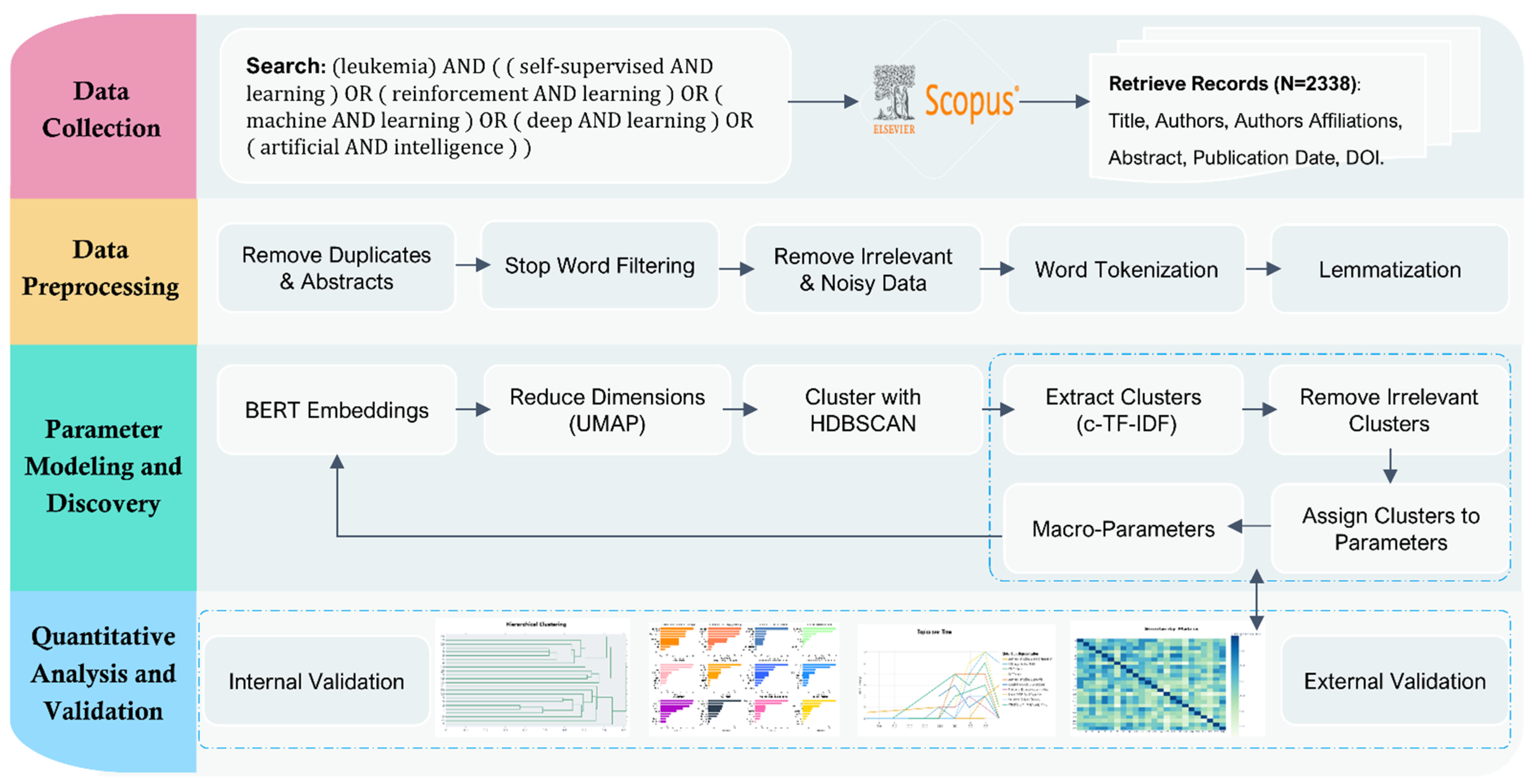
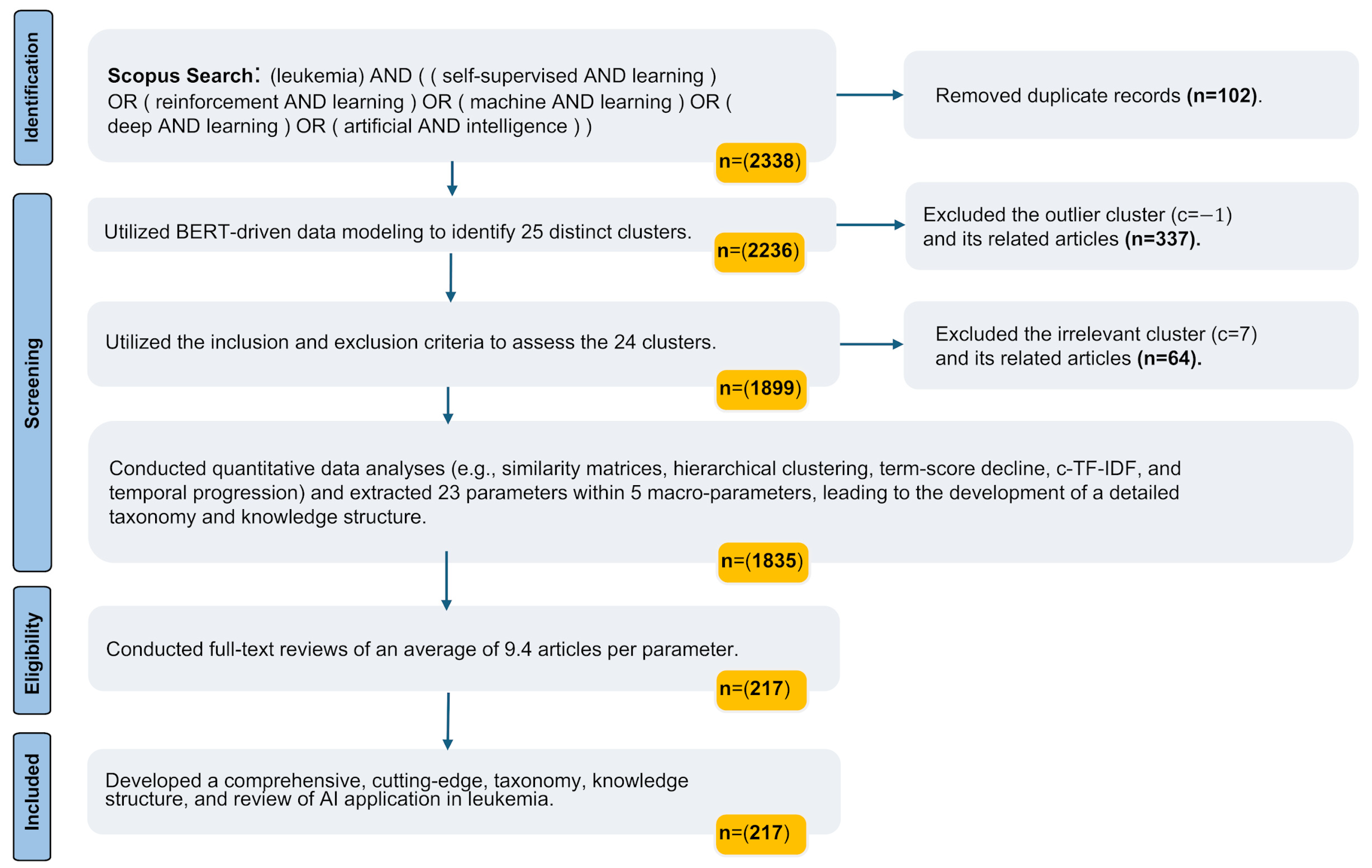
To ensure a rigorous, scalable, and interpretable examination of artificial intelligence research in leukemia, we employed an integrated methodology from our earlier work, PEARL [24], which combines AI-driven clustering techniques (Figure 1) with the systematic procedures outlined in the PRISMA principles (Figure 2). This hybrid design integrates automated, machine-driven literature structuring with expert-led qualitative validation, enabling both large-scale coverage and domain-informed interpretability.
The framework is operationalized through a multi-stage analytical pipeline that begins with structured literature retrieval and preprocessing, proceeds through semantic representation and unsupervised cluster discovery, and culminates in iterative human–machine validation and qualitative synthesis. Algorithm 1 (Master Algorithm) provides a formal representation of this architecture by mathematically defining the end-to-end workflow illustrated in Figure 1. The subsequent subsections describe each stage of this workflow in detail.
Algorithm 1: Master Algorithm
Input: ScopusSearchQuery
Output: Articles with labeled parameters and visualizations
1:
CSV_file ← ScopusDataCollection(ScopusSearchQuery)
2:
article_DF ← read_CSV(CSV_file)
3:
processed_articles ← dataPreProcessing(article_DF)
4:
for each embedding_model ∈ EmbeddingModels do
5:
    document_embedding ← createBERT_Embedding(processed_articles, embedding_model)
6:
    for each cluster_number ∈ {N, N + 5, N + 10,…, M} do
7:
        (clusters, coherence) ← ClusteringAlgorithm(document_embedding, cluster_number)
8:
        storeResults(clusters, coherence, cluster_number)
9:
    end for
10:
    best_clusters_number ← selectBestClusterNumberBasedOnCoherence()
11:
    cluster_set ← retrieveClusters(best_clusters_number)
12:
end for
13:
stable_clusters ← humanMachineValidationAndRefinement(cluster_set)
14:
parameters ← defineAndLabelParameters(stable_clusters)
15:
refined_parameters ← PRISMA_GuidedParameterRefinement(parameters)
16:
macro_parameters ← groupParametersIntoMacroParameters(refined_parameters)
17:
parameter_visualization(refined_parameters, macro_parameters)

3.2. Data Collection and PRISMA-Guided Screening

To develop a targeted and systematically analyzable dataset, we retrieved literature from the Scopus database using the query: “(leukemia) AND ((self-supervised AND learning) OR (reinforcement AND learning) OR (machine AND learning) OR (deep AND learning) OR (artificial AND intelligence))”. The data collection, conducted on 23 May 2024, initially yielded 2338 articles. In alignment with PRISMA guidelines, we applied a two-stage screening process. The first stage involved the application of inclusion criteria (outlined in Table 4), prioritizing English-language publications explicitly referencing both leukemia and AI-related terms. Subsequently, we applied exclusion criteria to filter out irrelevant records, including duplicates, articles lacking abstracts, and those without explicit mentions of leukemia and AI (or associated keywords such as machine learning or deep learning) in their abstracts. This refinement process resulted in a dataset of 2236 articles, providing a clean and thematically relevant foundation for AI-driven clustering and analysis. The dataset is public available at [28].
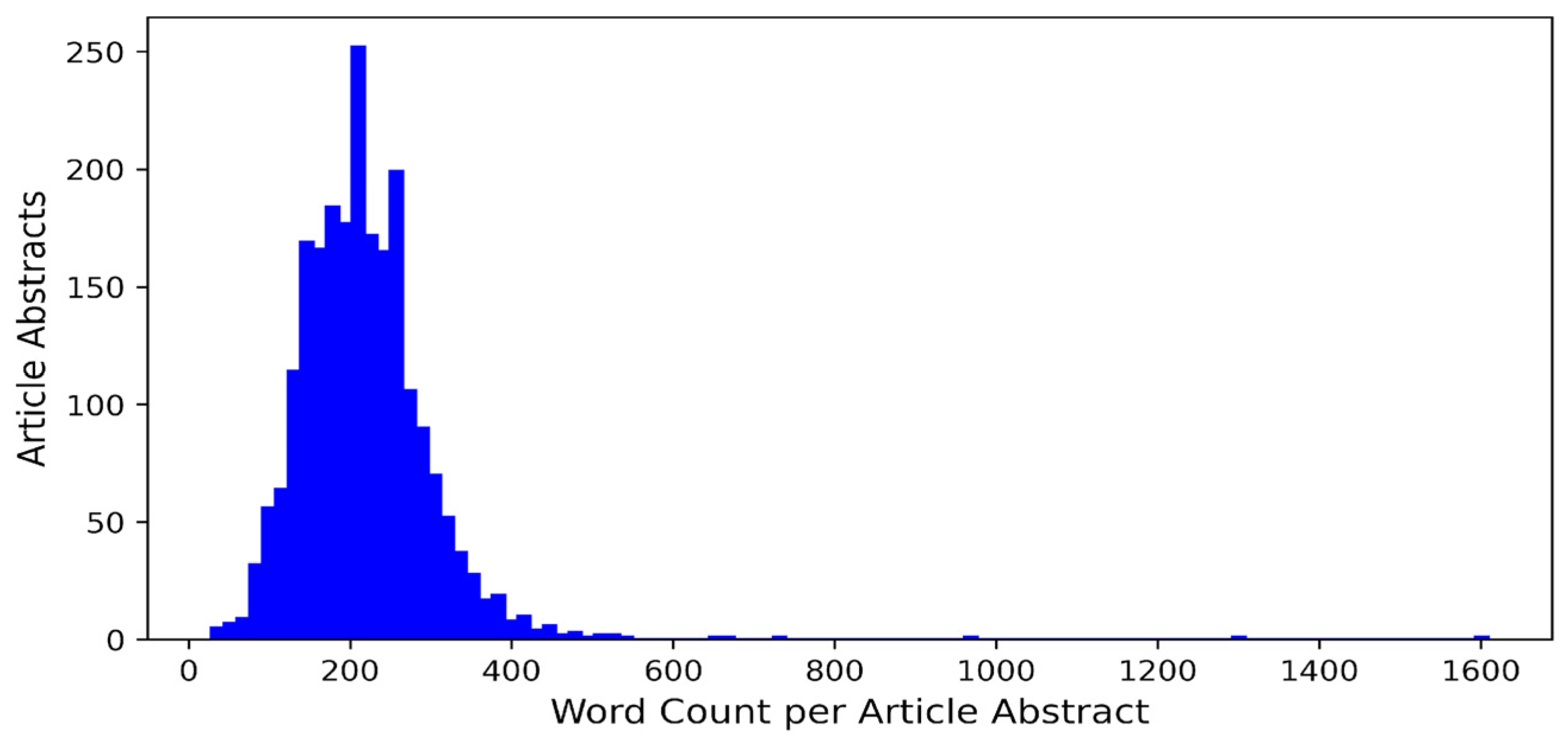
Figure 3 illustrates a histogram that characterizes the frequency distribution of word counts within the abstracts of all articles included in the Scopus-derived dataset, providing insight into the textual length variability of the corpus. The x-axis represents the number of words per abstract, while the y-axis shows the frequency of abstracts within each word count bin. The distribution is unimodal and shows a strong right bias, indicating that most abstracts are relatively short, with a peak (mode) around 200 words and the central 50% (interquartile range) falling between 165 and 257 words. Despite this concentration, the range spans from 28 to 1609 words, with a long right tail reflecting a small number of significantly longer abstracts.

3.3. Text Preprocessing and Semantic Representation

To prepare the article abstracts in the Scopus-derived dataset for AI-driven clustering, we implemented a structured preprocessing pipeline. Standard natural language processing techniques were applied, including stop word filtering, elimination of irrelevant or noisy content, word tokenization, and lemmatization, using Python packages such as pandas [29] and NLTK [30].
The pre-processed abstracts were transformed into fixed-dimensional vector representations utilizing the SentenceTransformer implementation of the BAAI/bge-small-en model [31], thereby capturing and encoding their underlying semantic structures. Abstracts were selected as the primary textual unit to ensure scalability, consistency across the corpus, and reproducibility, acknowledging that this choice trades off depth for breadth, which is discussed further in the limitations section.
These semantic embeddings were subsequently subjected to dimensionality reduction via Uniform Manifold Approximation and Projection (UMAP) and clustered using Hierarchical Density-Based Spatial Clustering of Applications with Noise (HDBSCAN), both integrated within the BERTopic framework (See Algorithm 2). Within BERTopic [32], clusters were characterized by extracting statistically salient terms through class-based Term Frequency–Inverse Document Frequency (c-TF-IDF) [33], followed by refinement with KeyBERT and Maximal Marginal Relevance (MMR) to enhance contextual relevance and minimize redundancy.
Algorithm 2: Clustering Algorithm
Input: document_embedding, cluster_number
Output: clusters, coherence_metrics
1:
umap_embedding ← UMAP_DimensionReduction (document_embedding)
2:
HDBSCAN_clusters ← HDBSCAN_Clustering (umap_embedding)
3:
cluster_docs ← group_documents (documents, HDBSCAN_clusters)
4:
cluster_TFIDF ← extract_keywords (cluster_docs)
5:
reduced_clusters ← reduce_clusters (cluster_TFIDF, cluster_number)
6:
coherence_metrics ← computeTopicCoherence (reduced_clusters, cluster_TFIDF)
7:
model ← saveModel (BERTopicModel)
8:
return reduced_clusters, coherence_metrics

3.4. Automated Cluster Discovery and Clustering

Incorporating BERT into the analytical pipeline marked a pivotal advancement, as it bridged the structured methodological framework of PRISMA with the adaptive capabilities of AI-powered modeling. As noted earlier, BERTopic employed class-based term frequency–inverse document frequency (c-TF-IDF) to extract the most salient terms in each cluster, thereby identifying key groupings and revealing deeper insights into their underlying thematic structure.
Within the BERTopic framework, semantic embeddings were first reduced using UMAP to preserve local semantic structure while enabling effective density-based clustering (see Algorithm 2). UMAP was configured with 15 neighbors, 5 components, a minimum distance of 0.0, cosine similarity, and a fixed random state. Density-based clustering was then conducted using HDBSCAN applied to the reduced embeddings, using Euclidean distance, a minimum cluster size of 15, and the excess-of-mass cluster selection method.
Through this process, BERTopic initially defined 24 clusters comprising 1899 articles and 337 outlier documents, excluding the outlier cluster (c = −1) (see Figure 2). A subsequent manual screening against the inclusion and exclusion criteria outlined in Table 4 refined this set to 23 clusters and 1835 articles by removing the irrelevant clusters.
Following the initial BERTopic-based clustering, an iterative human–machine process was guided by explicit and systematic criteria to ensure transparency and consistency. The dataset was clustered using different numbers of clusters ranging from 20 to 30, and through an iterative combination of quantitative and qualitative evaluation, we selected 24 clusters (for analysis of different number of clusters and embedding models, see Section 4). Following automated clustering, each cluster was reviewed using representative abstracts, top-ranked c-TF-IDF keywords, and cluster size to assess semantic coherence and relevance to AI applications in leukemia. Clusters were validated by confirming that the included abstracts addressed a common clinical objective, data modality, or methodological theme, as reflected by shared high-weight keywords and consistent document content; clusters with low coherence or weak relevance to the study scope were excluded.
While the PEARL framework allows merging clusters based on semantic overlap or thematic similarity, this step was not required, as the automated clustering produced stable and well-separated clusters. Refinement was therefore limited to excluding low-coherence or outlier-dominated clusters and validating cluster stability. For the retained clusters, we browsed representative articles from each cluster to understand the characteristics of each cluster, establish clear boundaries between them, and assign coherent cluster labels. Retained clusters were subsequently organized into parameters and macro-parameters, as described in Section 3.5.
All core computational steps rely on established, publicly documented libraries (SentenceTransformers, UMAP, HDBSCAN, BERTopic), with custom logic limited to orchestration and expert-guided validation.

3.5. Human–Machine Validation and Parameter Construction

Parameter construction and validation were carried out through an explicit human–machine process, building on the clustering outputs described in Section 3.4. Based on the validated and labeled clusters identified in the previous stage, we organized stable clusters into interpretable parameters and subsequently grouped them into higher-level macro-parameters. We employed a data-driven approach that combined quantitative analysis and visualization to systematically define and validate parameters and macro-parameters. Following the PRISMA methodology, the dataset was thoroughly structured and analyzed using distance-based similarity measures, hierarchical grouping algorithms, and c-TF-IDF. This multistep process supported the systematic construction and refinement of coherent parameters across the collection of documents. Ultimately, we defined 23 distinct parameters and five macro-parameters, which served as the basis for iterative refinement cycles aimed at achieving semantic clarity and internal consistency.
To enable focused qualitative depth while preserving scalability, we selected an average of 9.4 articles per parameter for full-text reading, resulting in 217 full-text articles (approximately 10% of the overall dataset). These articles were selected to be representative of each parameter’s scope and internal diversity, providing a robust foundation for in-depth inspection and synthesis.
Within the workflow defined in Algorithm 1 (Steps 13–16), the structured transition from clusters to analytically defined parameters and macro-parameters was operationalized through a consensus-based expert refinement process. Following coherence-based cluster selection, all three authors conducted collaborative analytical review sessions, functioning as a consensus-based expert panel, to interpret and stabilize the retained clusters. Clusters were evaluated using predefined and consistently applied criteria, including semantic coherence reflected in c-TF-IDF keyword distributions, representative abstracts, inter-cluster similarity patterns, hierarchical clustering structure, and systematic differentiation across clinical objective, methodological approach, data modality, and application context. Where additional contextual verification was required, targeted full-text examination of representative articles was conducted.
Each cluster was examined to determine whether it represented a distinct analytical construct or required structural adjustment in accordance with the PEARL framework. In most cases, a stable cluster corresponded to a single parameter; where thematic overlap, internal heterogeneity, or boundary ambiguity was detected, expert-driven operations (merging, splitting, or reassignment) were performed to ensure conceptual distinctiveness and interpretability. Parameter naming was established through descriptive summarization informed by high-weight c-TF-IDF keywords and joint expert discussion.
Macro-parameters were subsequently derived inductively from structured relationships among parameters, supported by similarity patterns and quantitative validation analyses, yielding higher-level groupings that reflected coherent thematic organization across the research landscape. This multi-stage refinement proceeded through structured iteration until predefined stability criteria were satisfied across parameters and macro-parameters.
The internal logic of this refinement stage is formalized in Algorithm 3, which specifies the expert-guided iterative decision process. Structural adjustments were performed only when predefined conditions were met, including demonstrable thematic overlap, internal heterogeneity within a cluster, or stronger similarity alignment with alternative macro-parameter groupings. The refinement loop terminated when semantic coherence, conceptual distinctiveness, and structural alignment were jointly satisfied, as evidenced by stability in similarity patterns and absence of boundary ambiguity during expert review.
Algorithm 3: Iterative Expert-Guided Parameter Refinement Algorithm
Input: cluster_set from coherence-based selection
Output: Finalized refined_parameters and macro_parameters
1:
Initialize ParameterSet ← cluster_set
2:
Set RefinementFlag ← TRUE
3:
while RefinementFlag = TRUE do
4:
    RefinementFlag ← FALSE
5:
    for each parameter p in ParameterSet do
6:
        Evaluate semantic coherence using:
7:
            c-TF-IDF keyword distribution
8:
            Representative abstracts
9:
            Targeted full-text review (if required)
10:
            Inter-cluster similarity matrix
11:
            Hierarchical structure alignment
12:
        if thematic overlap detected between parameters then
13:
            Merge overlapping parameters
14:
            RefinementFlag ← TRUE
15:
        end if
16:
        if parameter contains multiple distinct objectives or modalities then
17:
            Split parameter into conceptually distinct groups.
18:
            RefinementFlag ← TRUE
19:
        end if
20:
        if parameter shows stronger alignment with alternative macro-parameter then
21:
            Reassign parameter
22:
            RefinementFlag ← TRUE
23:
        end if
24:
    end for
25:
    Recompute macro-parameter grouping consistency
26:
    Validate structural stability using similarity and hierarchical signals
27:
end while
28:
return Finalized refined_parameters and macro_parameters
It is important to clarify that Algorithm 3 does not represent a fully automated optimization procedure with fixed numeric thresholds. Rather, it formalizes a structured human–machine validation protocol in which refinement decisions are guided by explicitly defined semantic and structural criteria. Cluster overlap refers to the degree of semantic proximity between clusters, as reflected in embedding similarity patterns, shared high-weight terms, and overlapping macro-parameter associations. Internal heterogeneity refers to semantic dispersion within a cluster, assessed through embedding variance, cluster coherence measures, and qualitative evaluation of thematic consistency across assigned macro-parameters.
Refinement actions, including merging or splitting, were performed only when these criteria indicated measurable structural ambiguity or reduced interpretability. Convergence of the iterative loop was achieved when macro-parameter assignments stabilized across successive iterations and inter-cluster distinctiveness was maximized, as evidenced by coherent similarity structures and absence of boundary instability during expert validation. The objective of this process is not to identify a mathematically unique optimal clustering solution, but to construct a stable, semantically interpretable, and procedurally reproducible taxonomy under clearly articulated decision constraints.
External evaluation was carried out by comparing them against established trends in leukemia research and global healthcare research. To broaden the analytical scope, an array of supplementary sources, including internationally recognized publications, was examined to position the results within a wider scholarly framework. These external references contributed to framing current methodologies, identifying dominant research trajectories, and suggesting pathways for continued inquiry and advancement in the field.

3.6. Visualization for Analysis and Interpretation

Visualization methods played an essential role in supporting the dataset refinement, validation, and results presentation stages by revealing meaningful patterns, structural relationships, and coherence across macro-parameters and parameters. We employed techniques such as similarity matrices, cluster hierarchies, and c-TF-IDF scores to assess thematic alignment, ensure consistency, and detect outliers within the parameters. These visualizations were generated using standard Python libraries such as Matplotlib [34] and Seaborn [35], providing clear, data-driven illustrations that enhanced the interpretability of the results. By making latent structures visible and supporting the iterative refinement process, visualization served as both an analytical and communicative tool that reinforced the overall validation strategy.

4. Quantitative Analysis Results

In this section, we present the quantitative analysis results of academic research on AI in leukemia. To systematically define and validate the parameters and macro-parameters, we examined the clusters produced by the BERT-based modeling process using coherence metrics alongside multiple visualization techniques, including term scoring, intercluster distance mapping, hierarchical clustering, and similarity matrix analysis. These analyses were used to assess cluster coherence, semantic relationships, and the overall structural organization of the research landscape.

4.1. Selecting Number of Clusters

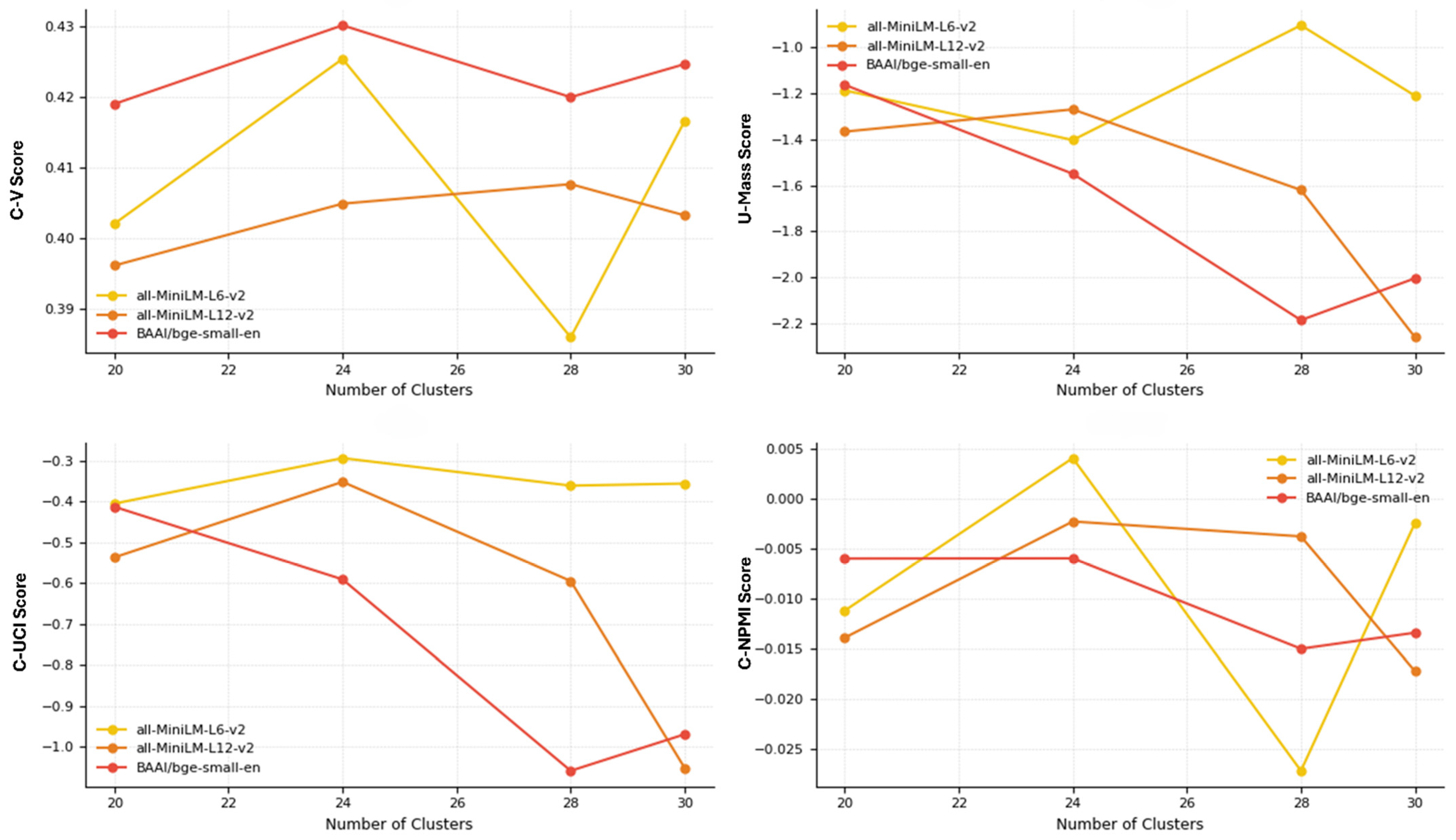
Figure 4 reports coherence metrics (C-V, U-Mass, C-UCI, and C-NPMI) computed for representative cluster numbers, where higher values indicate better coherence. To determine the optimal number of clusters, we systematically evaluated cluster numbers from 20 to 30 using three sentence embedding models, all-MiniLM-L6-v2, all-MiniLM-L12-v2, and BAAI/bge-small-en. Cluster quality was assessed using four complementary coherence metrics that capture different aspects of semantic coherence and word co-occurrence structure. Specifically, C-V reflects semantic interpretability based on word similarity and co-occurrence, where higher positive values indicate better coherence. U-Mass is a corpus-based likelihood metric that typically yields negative values, with scores closer to zero indicating more coherent clusters. C-UCI measures word association using pointwise mutual information and favors higher or less negative values, while C-NPMI is a normalized PMI metric bounded between −1 and 1, where higher and preferably positive values indicate stronger semantic coherence.
Figure 4 shows how cluster coherence varies with the number of clusters from 20 to 30 across the three embedding models as evaluated by the four coherence metrics The figure is arranged as a 2 × 2 grid, with each subplot displaying one coherence metric (C-V, U-Mass, C-UCI, C-NPMI) plotted against the number of clusters. It highlights differences in coherence trends across cluster numbers, illustrating that coherence does not change monotonically as the number of clusters increases.
Across all embedding models and coherence metrics, 24 clusters emerge as the most suitable choice. At this configuration, all three models achieve their highest or near highest C-V scores, indicating strong semantic interpretability, while U-Mass values are consistently less negative than those observed at higher cluster numbers. Likewise, C-UCI attains its best or near best levels at 24 clusters across models, and C-NPMI either peaks or remains comparatively high, in contrast to the marked degradation observed at 28 and 30 clusters. Although the 20-cluster configuration yields reasonable coherence, it is generally outperformed by the 24-clusters solution across multiple metrics.
While the BAAI/bge-small-en model shows a slight preference for 20 clusters under certain metrics, the 24-cluster configuration was ultimately selected for two reasons. First, it represents the strongest overall agreement across all three embedding models and all four coherence metrics, providing a more robust and model-agnostic solution. Second, qualitative inspection of the clustering results indicates that the 20-cluster configuration tends to merge several conceptually distinct clusters into broader and less specific groupings, whereas the 24-cluster configuration produces more clearly differentiated and well abstracted clusters. Collectively, these quantitative and qualitative considerations support the selection of 24 clusters as a balanced and well justified choice for the final analysis.
For the final modeling and results reported in this paper, we adopted BAAI/bge-small-en, guided by evidence from the Massive Text Embedding Benchmark (MTEB) [36], which reports stronger clustering performance for BGE-family models compared with lightweight MiniLM-based embeddings. Based on this external benchmark evidence and our internal coherence analysis, this model was used consistently for all downstream analyses.

4.2. Establishing Clustering Stability

As elaborated in the previous section (Section 4.1), to ensure structural robustness, cluster selection was evaluated across multiple embedding models and a range of cluster granularities, using four complementary coherence metrics. The final configuration was retained only when cross-model convergence and metric agreement were observed. This approach prioritizes thematic stability at the structural level of the literature landscape.
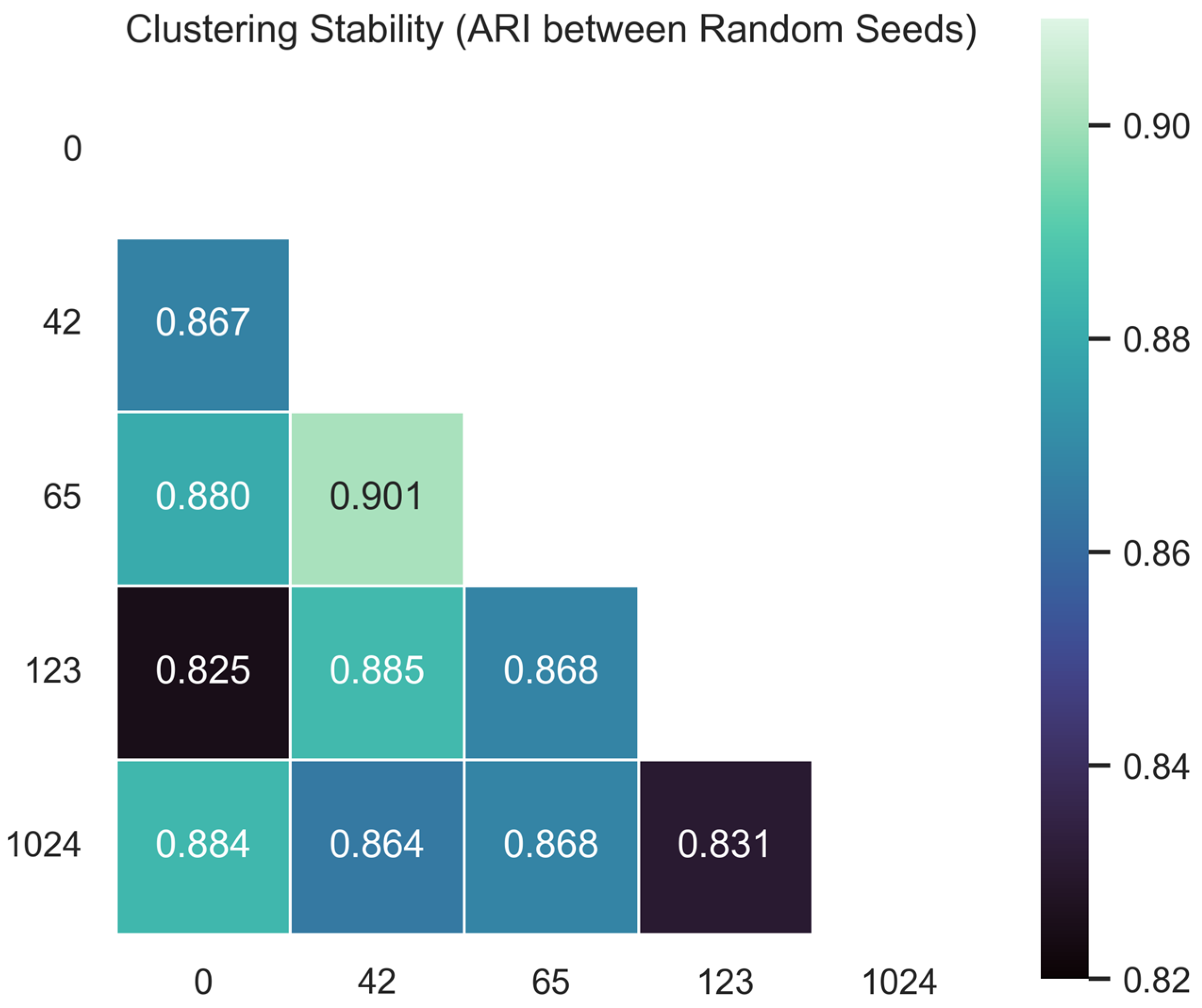
Moreover, in this section, we assess clustering stability by repeating the full analysis pipeline using multiple random seeds controlling the stochastic initialization of the UMAP embedding. Random seeds are integer values that initialize the pseudo-random number generator and can lead to small variations in the resulting low-dimensional representation and subsequent clustering assignments. The analysis was repeated using five seeds (0, 42, 65, 123, and 1024); for each run, the UMAP embedding was recomputed and clustering was performed using HDBSCAN with identical parameter settings. Agreement between clustering results obtained from different runs was quantified using the Adjusted Rand Index (ARI) metric, computed with the scikit-learn implementation [37]. The ARI measures similarity between two clustering assignments while correcting for chance agreement and can be expressed as:
A R I = R I E [ R I ] m a x ( R I ) E [ R I ]
where RI denotes the Rand Index, E [ R I ] is the expected agreement under random labeling, and m a x ( R I )   =   1 . ARI values range from −1 to 1, where 1 indicates identical cluster assignments. Pairwise comparisons across all runs yielded consistently high ARI values (≈0.82–0.90), as shown in Figure 5, indicating strong agreement between clustering outcomes and supporting the stability of the identified 24-cluster structure across different random initializations.
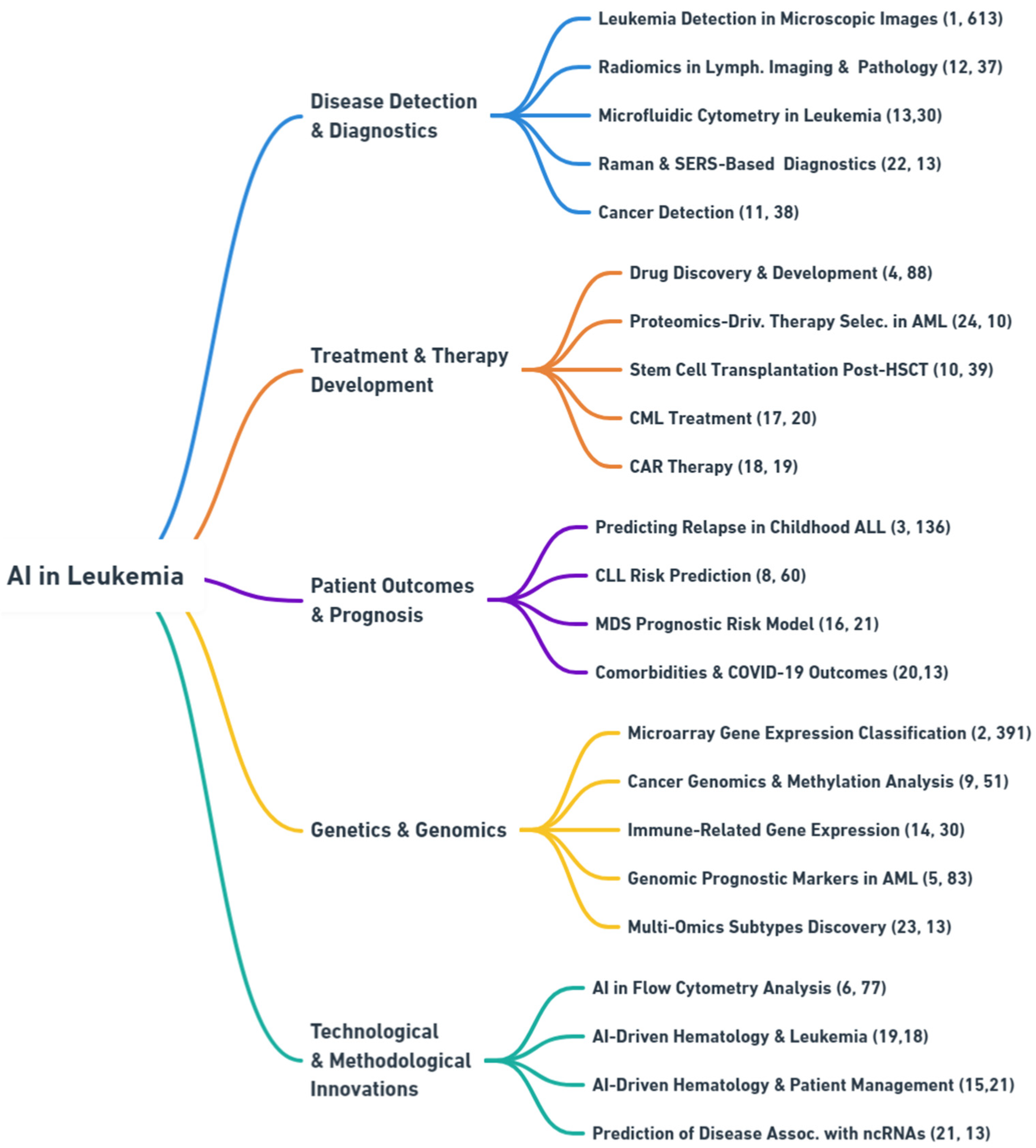
Figure 6 presents the taxonomy derived from the final clustering results. The first level of the taxonomy shows the macro-parameters, while the second level details the individual parameters, each linked to its cluster number and document count. For instance, the parameter “Leukemia Detection in Microscopic Images (1, 613)” corresponds to cluster 1 and includes 613 documents.
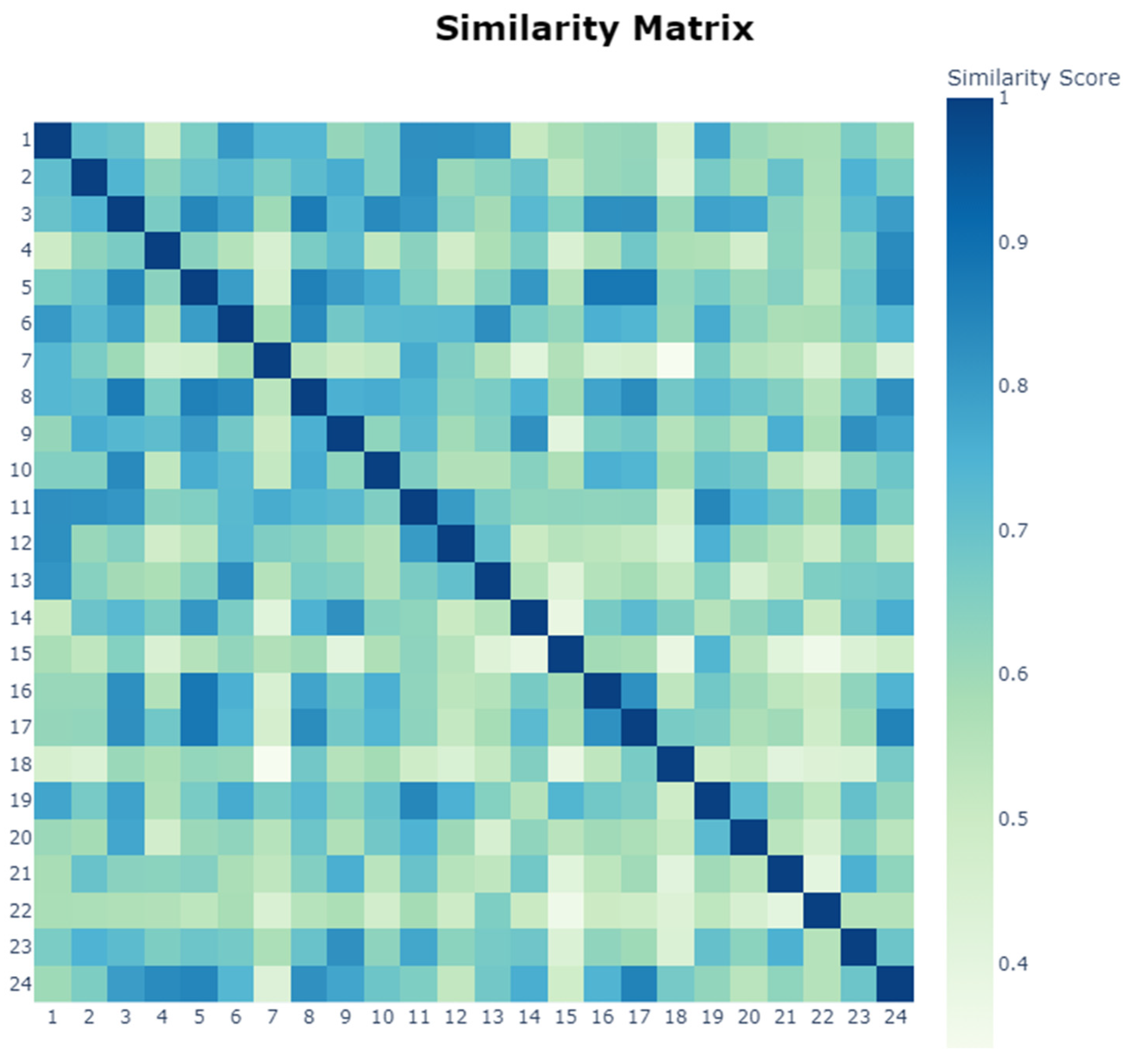
Figure 7 presents the similarity matrix between the 24 clusters. Both the x-axis and y-axis represent the clusters, with each cell indicating the similarity score between a given pair. The matrix similarity scores are computed using cosine similarity, defined as
C o s i n e   S i m i l a r i t y = A B A B
where A B denotes the dot product between cluster embeddings and A B represents the product of their magnitudes. The color scale ranges from lighter shades, reflecting lower similarity, to darker shades, reflecting higher similarity. This visualization highlights both the internal consistency of clusters and the varying degrees of overlap among them, with darker off-diagonal regions reflecting stronger relationships between different clusters. For instance, Cluster 1 (Leukemia Detection in Microscopic Images) demonstrates high similarity with Cluster 13 (Microfluidic Cytometry in Leukemia), as shown by the darker cell at their intersection. This indicates that the two clusters are more closely related, both addressing leukemia detection through distinct modalities: Cluster 1 relies on microscopic imaging, whereas Cluster 13 utilizes microfluidic cytometry. Despite the methodological differences, their shared focus on diagnostic detection underscores their close relationship.
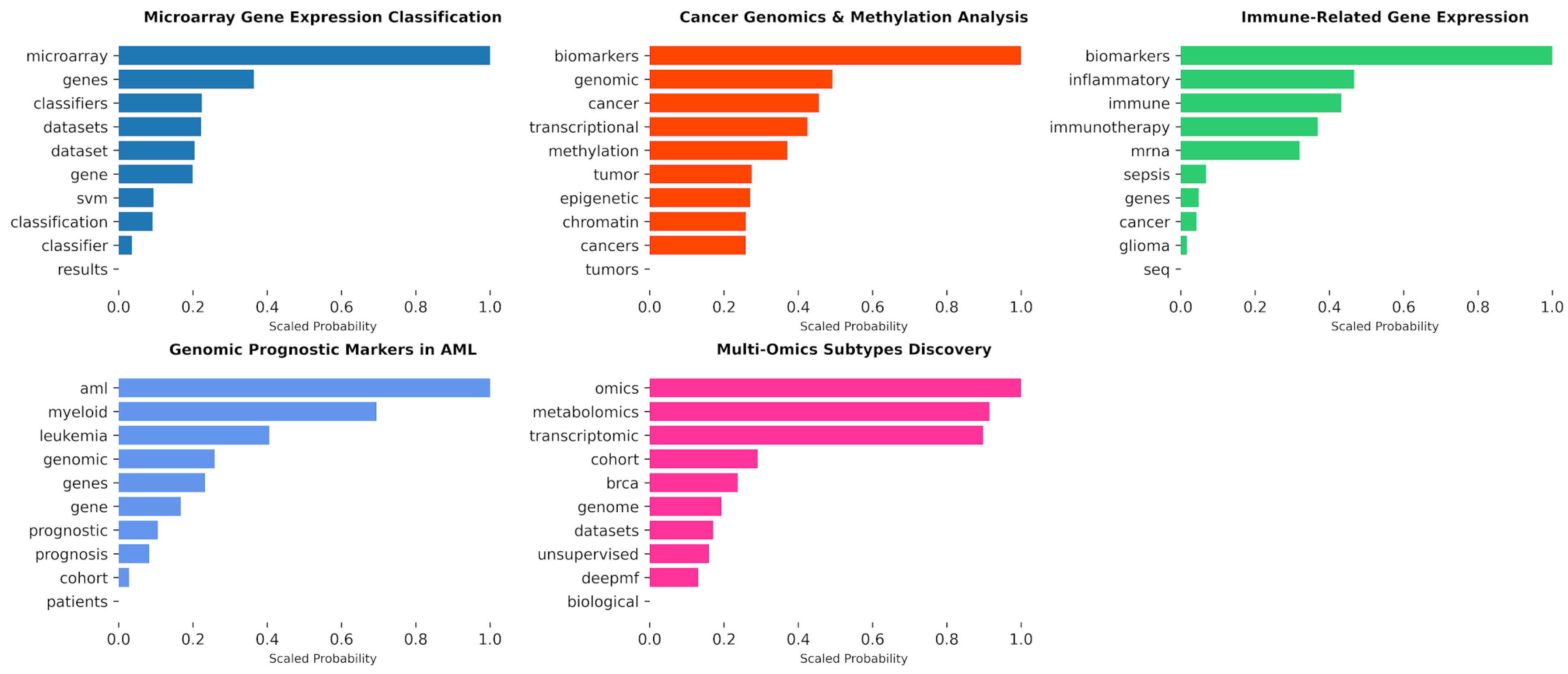
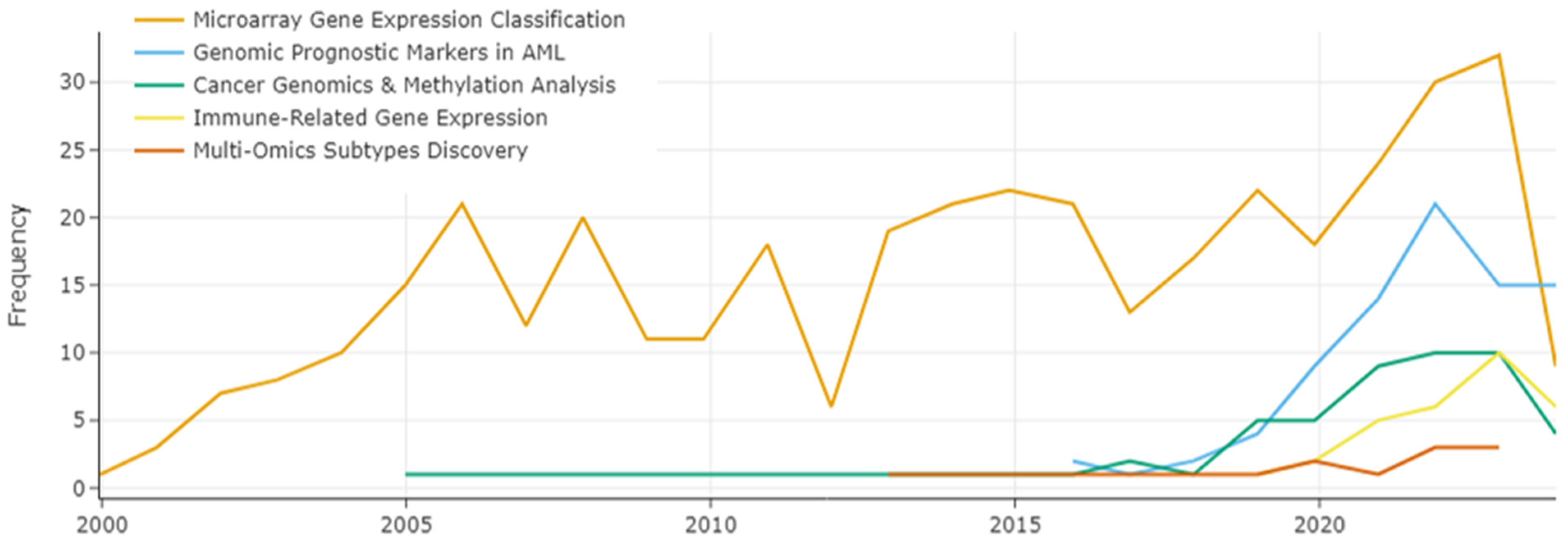
Beyond individual cluster relationships, the similarity matrix reveals structural patterns that align closely with the macro-parameter taxonomy. Within Genetic & Genomic, strong similarity is evident among Microarray Gene Expression Classification (Cluster 2), Cancer Genomics & Methylation Analysis (9), and Genomic Prognostic Markers in AML (5), with additional alignment involving Immune-Related Gene Expression (14), reflecting shared molecular and omics-based analytical foundations. In Disease Detection & Diagnostics, elevated similarity appears among Leukemia Detection in Microscopic Images (1), Cancer Detection (11), and Microfluidic Cytometry in Leukemia (13), indicating coherent diagnostic modeling despite modality differences. Within Patient Outcomes & Prognosis, Predicting Relapse in Childhood ALL (3), CLL Risk Prediction (8), and MDS Prognostic Risk Model (16) demonstrate closely aligned patterns centered on risk stratification and survival modeling. Similarly, in Treatment & Therapy Development, strong connections are visible among Drug Discovery & Development (4), Proteomics-Driven Therapy Selection in AML (24), and CML Treatment (17), highlighting biomarker-informed therapeutic optimization and treatment strategy modeling. In addition to strong intra-macro cohesion, significant cross-macro connections are evident. The high similarity between Genomic Prognostic Markers in AML (5) and Proteomics-Driven Therapy Selection in AML (24) reflects their shared focus on AML-specific multi-omics integration and advanced machine learning frameworks for prognostic stratification and therapy guidance, thereby linking genomic risk modeling with proteomics-based drug-response optimization. These inter-macro similarities indicate that, although the taxonomy is organized into well-defined modules, precision medicine pipelines act as structural bridges that maintain both conceptual coherence and translational continuity across domains. When considered alongside the temporal trajectories presented in Section 11, these structural proximities suggest developmental alignment between foundational genomic modeling and downstream diagnostic and therapeutic expansion, reinforcing a systems-level interpretation without implying deterministic causality.
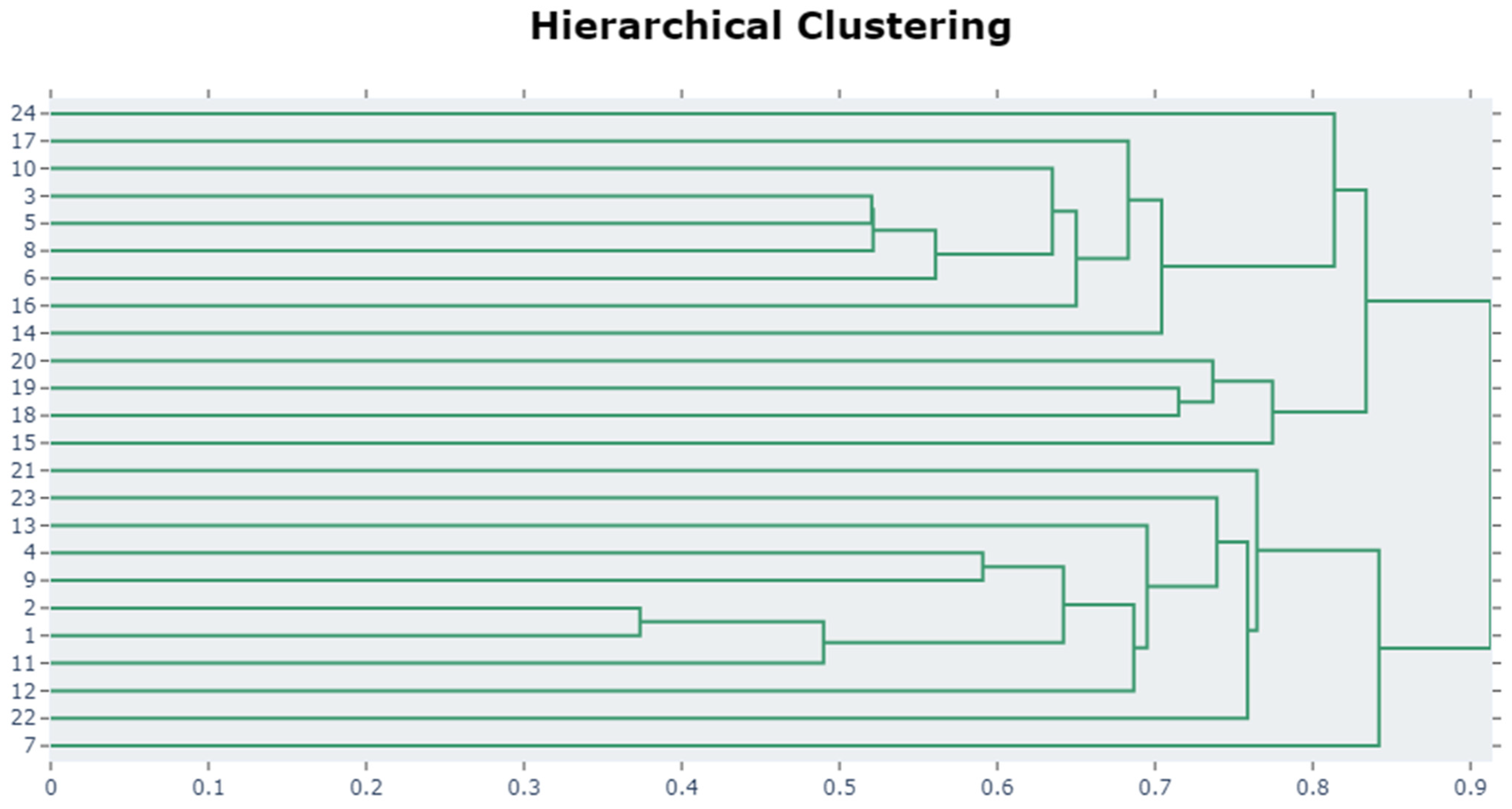
Figure 8 shows the hierarchical clustering of the 24 clusters. Each leaf on the x-axis corresponds to one cluster, while the horizontal scale represents the distance (or dissimilarity) between them. Clusters joined by shorter branches are more closely related, whereas those connected at higher levels are less similar. For example, Clusters 3 and 8 merge at a low distance, indicating strong similarity, whereas Clusters 20 and 24 join only at a higher distance, reflecting weaker relationships. Cluster 7, which was later removed from further analysis, appears isolated in the hierarchical clustering. Unlike other clusters that merge at relatively low distances, Cluster 7 connects to the rest of the structure only at a high dissimilarity threshold. This indicates that its content does not align closely with the other clusters and lacks strong relationships with them, justifying its exclusion from subsequent qualitative analysis.
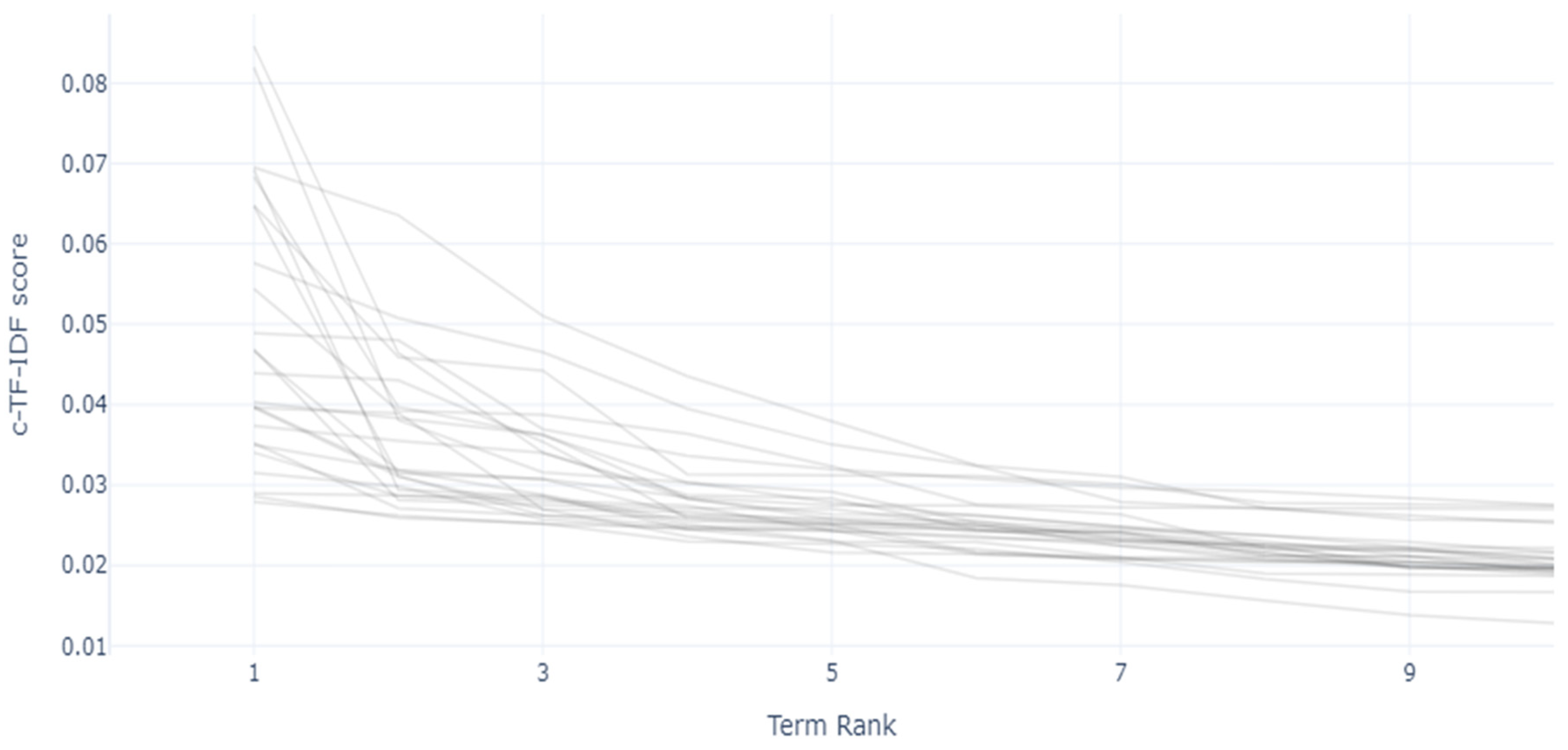
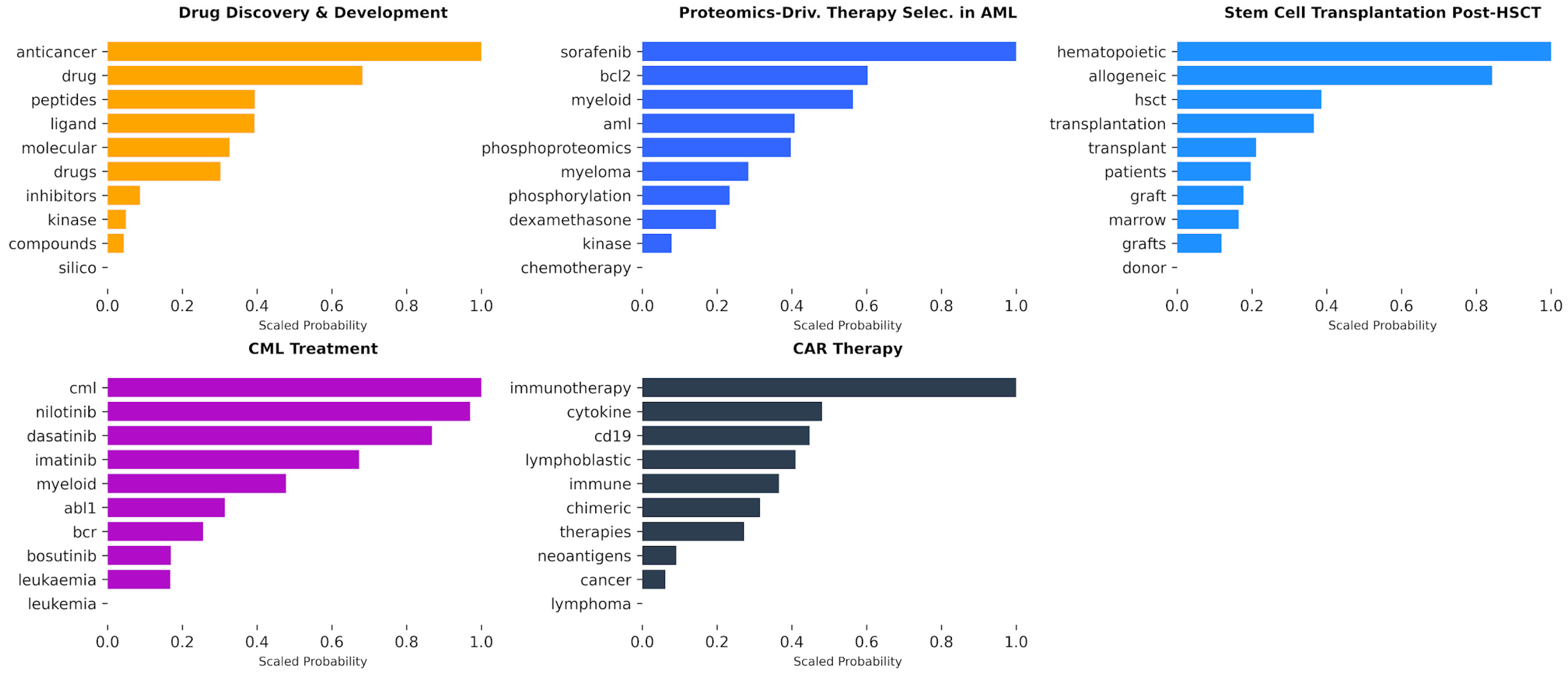
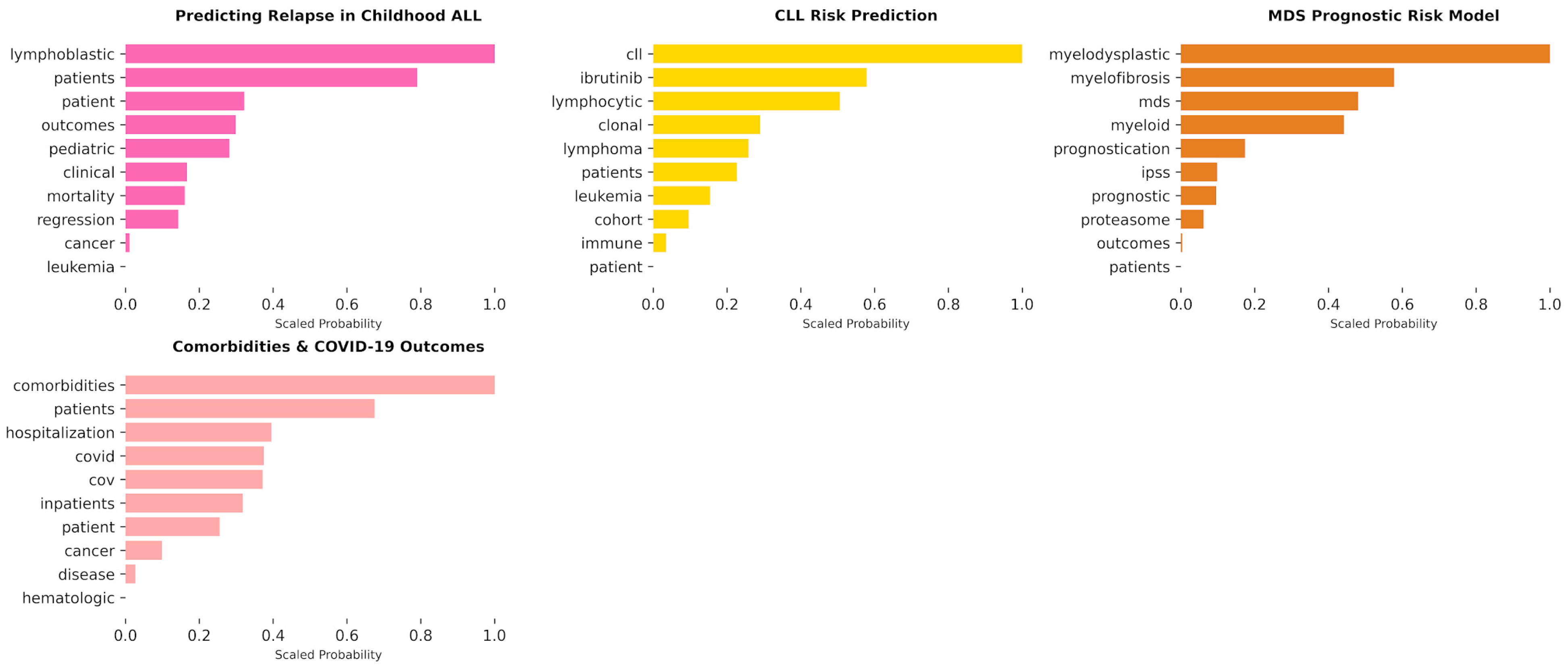
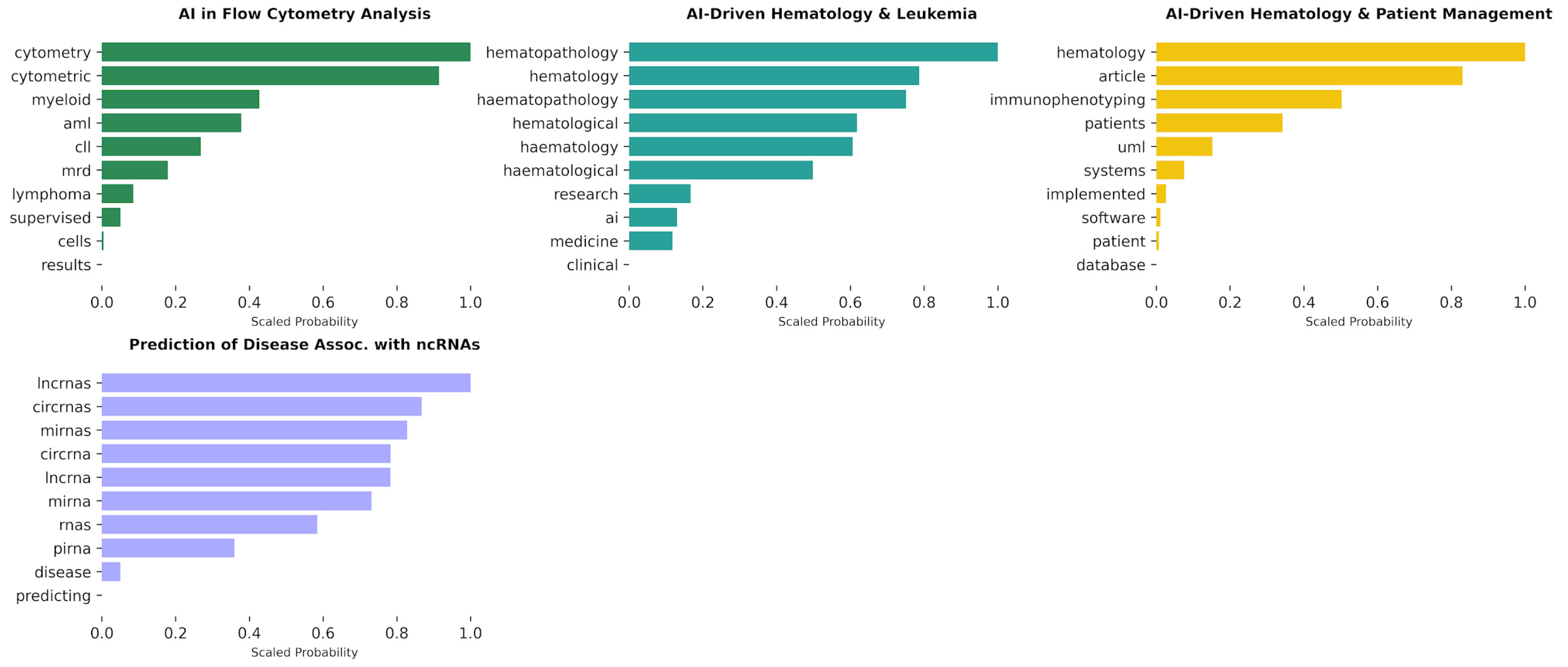
Figure 9 shows the ranked terms for each cluster based on their c-TF-IDF scores. The x-axis represents the rank of terms within each cluster, while the y-axis indicates their corresponding c-TF-IDF values. Higher scores on the left reflect the most representative terms of a cluster, whereas the scores gradually decrease as the rank increases. The downward trend across all lines highlights how only a small number of top-ranked terms carry the greatest discriminative power, while lower-ranked terms contribute less to distinguishing clusters. In addition, we extracted the c-TF-IDF scores of the top 10 keywords for each parameter. As discussed in Section 3, these scores were central to quantitatively analyzing cluster boundaries, assigning meaningful names, and defining parameters. To provide further insight into these scores, parameter-level results are presented in the subsequent sections, grouped by each macro-parameter accompanied by a figure displaying the top 10 keywords of its parameters.
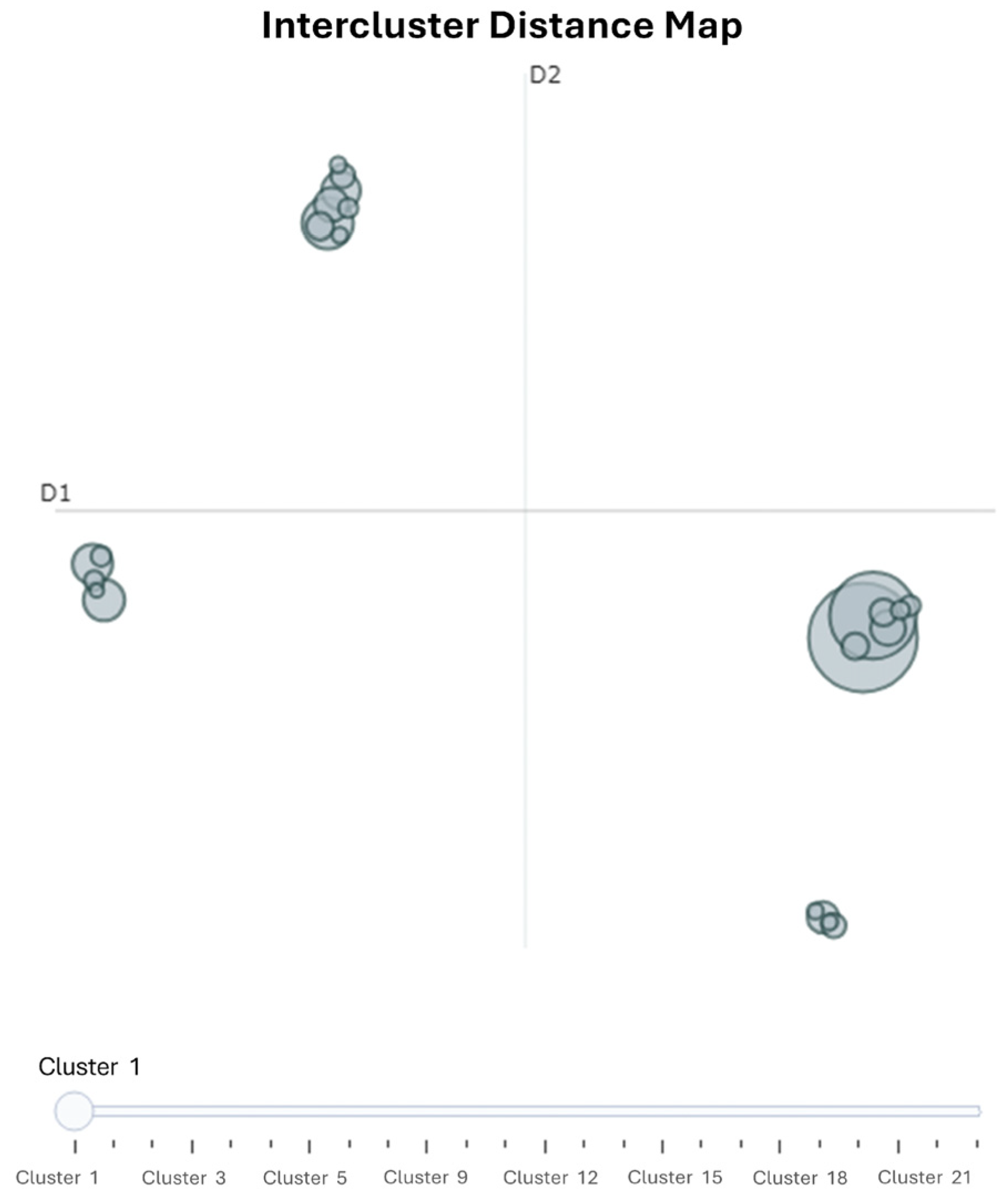
Figure 10 shows the Intercluster Distance Map. Each circle represents a cluster, with its size reflecting the number of documents it contains. The two axes (D1 and D2) are derived from dimensionality reduction and capture the main directions of variation among clusters. Clusters that lie closer together are more similar, while those farther apart are more distinct. The plot reveals potential cluster-grouping: clusters that form tight groupings suggest coherent research themes that can be meaningfully combined, whereas isolated clusters indicate independent areas of study. This spatial distribution therefore provides an early indication of how parameters align with broader macro-parameter categories.
The visual analytics presented in this section enabled a comprehensive quantitative analysis through which we identified and validated the parameters and macro-parameters. By examining the resulting clusters, we evaluated their semantic relationships and excluded those not relevant to AI in leukemia. This iterative process refined the clusters into meaningful parameters and grouped them into broader macro-parameters. These results provide a coherent classification of research themes and reveal the underlying knowledge structure and taxonomy of the field of AI in leukemia.
Having established the overall landscape through quantitative analysis, we now turn to qualitatively examine key developments in AI applications for leukemia across five major areas. Each area is represented by a macro-parameter that reflects a distinct thematic focus within the literature. The following sections are structured around these areas; namely, Disease Detection & Diagnostics, Treatment & Therapy Development, Patient Outcomes & Prognosis, Genetics & Genomics, and Technological & Methodological Innovations.

5. Disease Detection & Diagnostics

Building on the quantitative analysis in Section 4, which identified 23 parameters grouped under five macro-parameters and mapped their relationships, we now turn to a focused thematic analysis. In this section, we examine the first macro-parameters, Disease Detection & Diagnostics, in depth, integrating qualitative insights to interpret AI methods, diagnostic techniques, and their impact on early detection and leukemia subtype classification. Subsequent sections (Section 6, Section 7, Section 8 and Section 9) apply the same approach to the remaining macro-parameters, providing a detailed exploration of each domain.
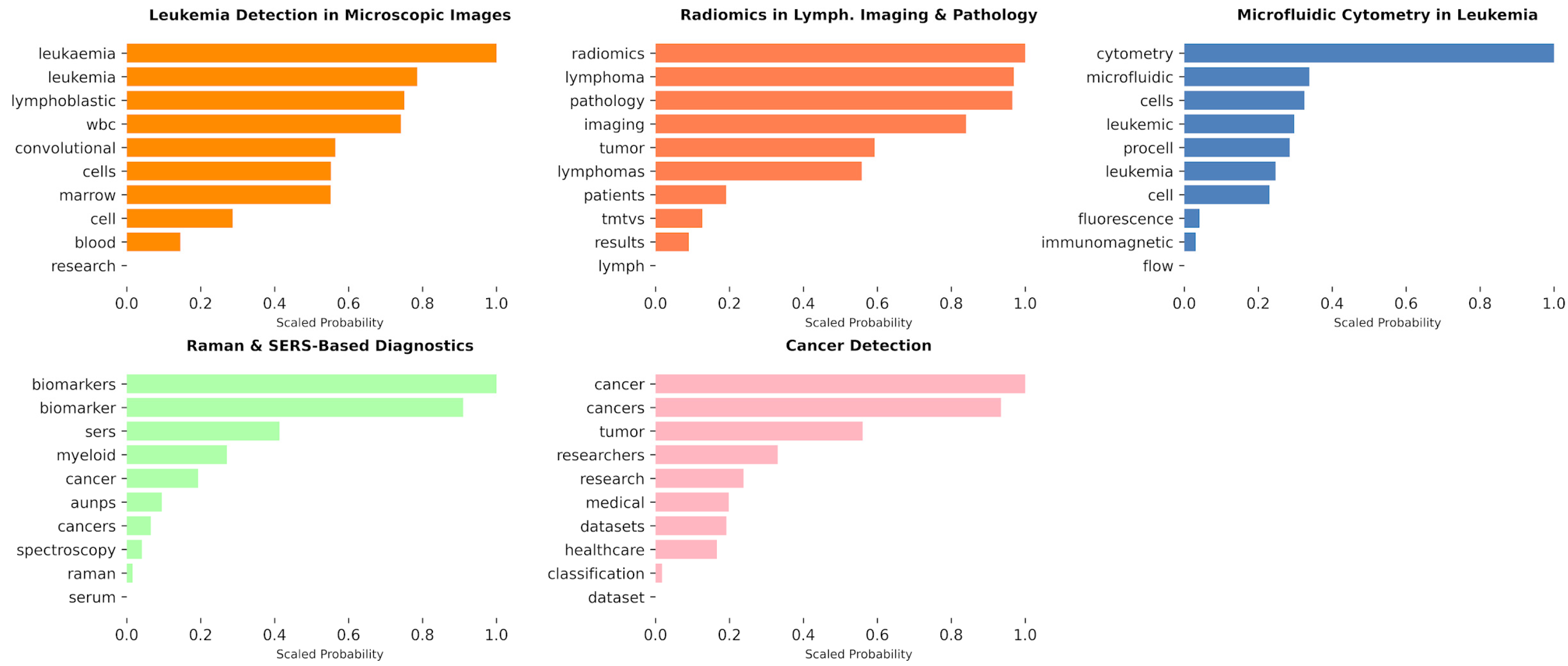
Disease Detection & Diagnostics captures the transformative role of AI in revolutionizing the early detection, and diagnosis of leukemia and related cancers. Throughout the literature, AI consistently emerges as a powerful tool for enhancing the accuracy, speed, and depth of diagnostic processes, particularly in complex and data-intensive medical fields such as oncology. Figure 11 depicts the top 10 keyword c-TF-IDF scores for each parameter within Disease Detection & Diagnostics. The y-axis lists the most representative keywords extracted for each parameter, while the x-axis shows their corresponding scaled c-TF-IDF scores. Higher values on the x-axis indicate stronger importance of the keyword in defining the parameter.
One of the clearest examples of AI’s impact in diagnostics is in the use of microscopic imaging to detect leukemia, as discussed in Leukemia Detection in Microscopic Images research. Here, CNNs have demonstrated exceptional capability in processing and analyzing images of blood and bone marrow samples [38,39]. These models can differentiate between various types of WBC and support the classification of leukemic cells such as lymphoblasts and myeloblasts, which are key indicators of ALL and AML [40,41]. This level of precision is critical in early diagnosis, where AI-driven analysis allows clinicians to identify leukemia sooner, leading to timely treatment interventions that are essential for improving patient outcomes [42]. Moreover, the ability of AI to process large-scale, high-resolution images provides a significant advantage in overcoming the variability and subjectivity that often accompany traditional manual diagnostic approaches [43,44].
The power of AI in image-based diagnostics extends beyond leukemia. Radiomics in Lymphoma Imaging & Pathology reveals how AI enhances the analysis of complex imaging data, particularly in detecting subtle radiological patterns associated with lymphoma [45]. By applying ML and DL algorithms to imaging modalities such as Positron Emission Tomography (PET) and Computed Tomography (CT) scans, AI can extract radiomics features that are indicative of underlying tumor biology [46]. This capability allows for more accurate differentiation between lymphoma subtypes as demonstrated by a deep learning-based approach employing an improved CNN architecture to classify Mantle Cell Lymphoma, Follicular Lymphoma, and CLL [45]. Furthermore, these methods contribute to more reliable predictions of treatment outcomes, enhancing clinical decision-making [47]. Importantly, AI in radiomics is not limited to imaging alone. Its integration with histopathological data, providing rich information about tissue structure and cellular morphology, can significantly enhance diagnostic accuracy and prognostic prediction [48,49,50].
Microfluidic Cytometry in Leukemia emphasizes AI’s role in cytometry and microfluidic technologies, which are pivotal for processing leukemia cells at the single-cell level [51]. The integration of AI with imaging flow cytometry has enabled the simultaneous analysis of multiple cellular parameters, allowing for a richer understanding of cellular heterogeneity in leukemia. This capability is particularly valuable in disease detection, as demonstrated by the Inception V3-SIFT-Scattering Net (ISSC-Net) [52], a deep learning framework applied to 2D light scattering images from single unstained cells, which enables label-free classification of T-ALL and B-ALL subtypes with promising performance. By refining single-cell analysis, AI contributes to the early detection of leukemia [53] and supports the development of more personalized treatment strategies that target specific cell populations contributing to disease progression [54]. Moreover, AI’s role in label-free diagnostics, which bypasses traditional staining methods, accelerates the diagnostic process and reduces costs key benefits for both clinical practice and research settings [55].
AI’s integration with molecular diagnostics, particularly through Raman spectroscopy and Surface-Enhanced Raman Scattering (SERS), has significantly advanced the detection of leukemia [56]. These techniques generate complex spectral data that AI handles effectively at processing, enabling the identification of subtle molecular features associated with hematological malignancies. For instance, ML methods such as PCA combined with Raman spectroscopy have been used to detect KMT2A-rearranged B-cell precursor ALL, a high-risk leukemia subtype, by identifying distinct, label-free spectral biomarkers [57]. In a similar application, a 1D-CNN trained on SERS spectra of serum samples successfully distinguished AML and other cancers, offering a rapid and non-invasive diagnostic approach without the need for targeted labeling [58]. This level of molecular analysis supports early leukemia detection and can even reveal drug resistance patterns, which are critical for guiding treatment decisions [56,59]. The ability of AI to interpret large volumes of spectral data in real-time enhances both the sensitivity and specificity of leukemia diagnostics, pushing the boundaries of early detection and continuous disease monitoring [60].
Recent works confirm that AI markedly raises diagnostic accuracy across many malignancies, including leukemic subtypes, by exploiting complementary data modalities. Supervised algorithms achieve high-fidelity leukemia recognition when benchmarked across two decades of work [61], and combined neural network, Random Forest (RF) and Support Vector Machine (SVM)-based pipelines cleanly separate prostate, lymphoma, leukemia and other tumors in structured clinical datasets [62]. Advanced CNNs both spot cancerous lesions and forecast survival trajectories from medical images [63], while hybrid computer-vision frameworks that chain pre-processing, segmentation and ML classifiers sharpen biopsy-image interpretation across nine major cancer categories [64]. Finally, an integrated cell-free-DNA assay analyzed by proprietary ML offers a minimally invasive screen for seven canine cancers, including lymphoma, osteosarcoma and leukemia, achieving 71% sensitivity at 98.7% specificity [64]. These works illustrate AI’s cross-modal power to deliver rapid, highly accurate and clinically meaningful detection across diverse cancer types, prominently including hematologic disease.
Disease Detection & Diagnostics highlight the profound impact of AI on leukemia diagnostics. Across microscopic imaging [40,41], cytometry [52], histopathology [48,49,50], and molecular spectroscopy [57], AI consistently enhances diagnostic precision and speed, with each application tailored to extract maximal insight from a specific data type. By enhancing the classification of leukemic subtypes, uncovering subtle histopathological and radiological patterns, and interpreting complex spectral signatures, AI systems are facilitating earlier detection, guiding risk stratification, and informing personalized treatment decisions [42,55]. These developments signify not merely incremental improvements, but a paradigm shift toward more predictive, individualized, and data-driven oncology diagnostics [51,55]. As demonstrated throughout the literature, AI’s cross-platform diagnostic capacity marks a critical advancement in managing hematologic malignancies and exemplifies the future trajectory of precision medicine.
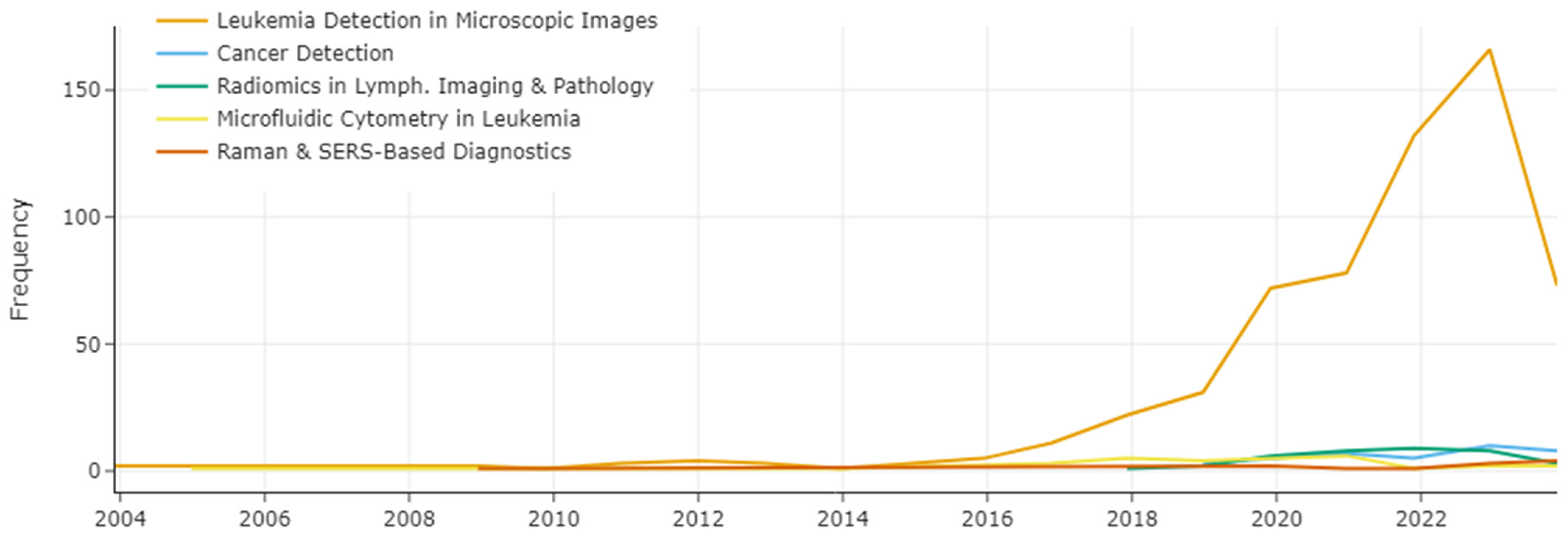
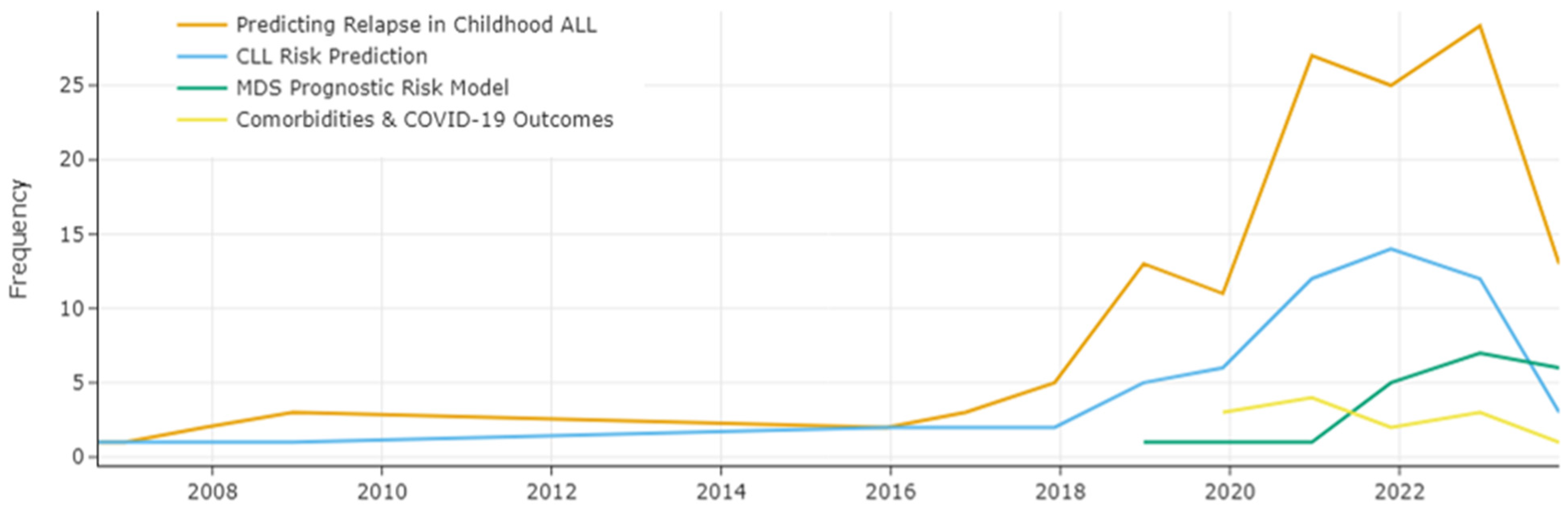
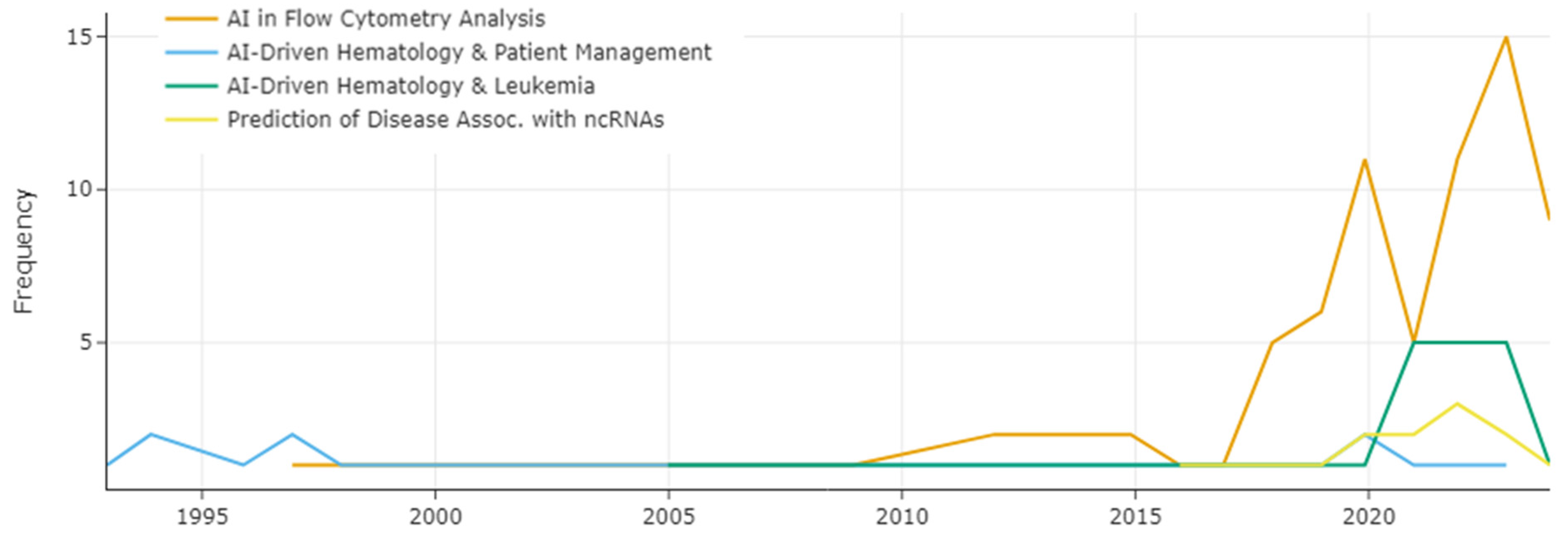
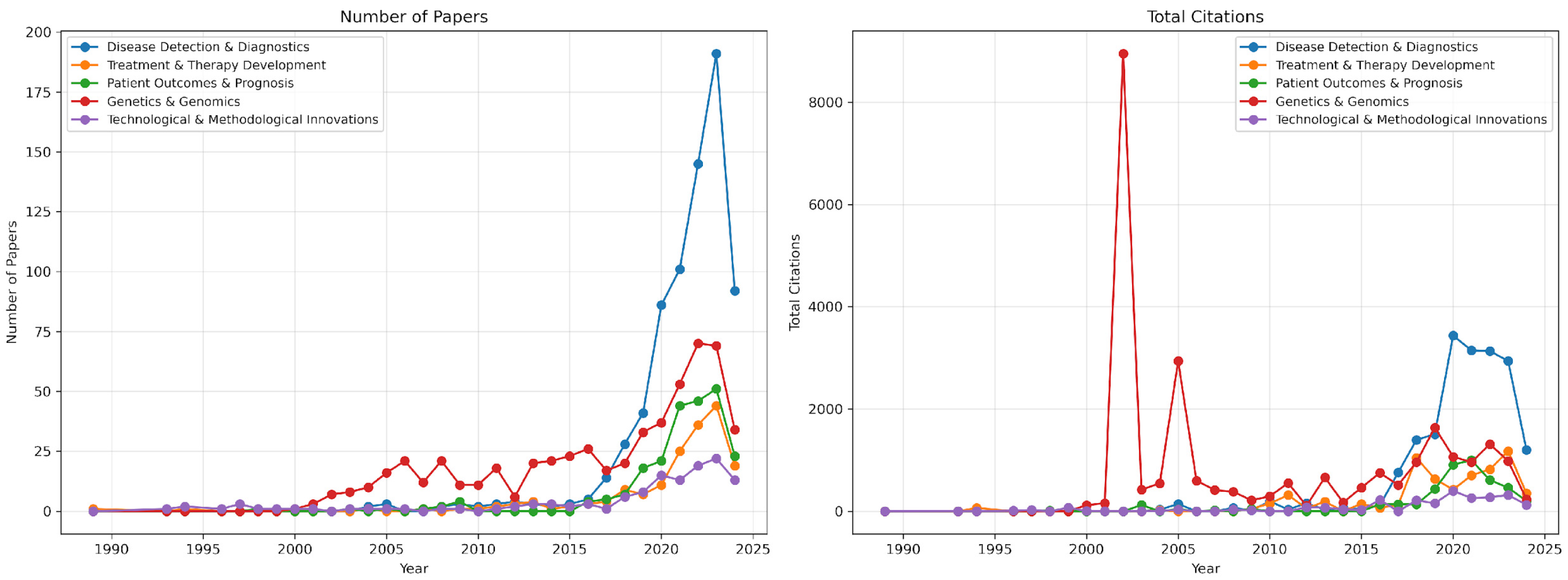
Figure 12 illustrates the temporal progression of research activity in Disease Detection & Diagnostics. The plot shows a generally sustained increase in output across all parameters, as indicated by the y-axis. As observed in the figure, all parameters exhibit gradual growth, with the most pronounced increase occurring in Leukemia Detection in Microscopic Images, particularly in recent years. Other parameters show more modest but consistent upward trends. The apparent decline toward the end of this figure, as well as in subsequent temporal progression figures, reflects incomplete data for 2024, since the dataset was collected on 23 May 2024.

6. Treatment & Therapy Development

The integration of AI in leukemia research, particularly within treatment and therapy-development efforts, is reshaping hematologic oncology by enabling more efficient, personalized, and subtype-targeted strategies to combat the disease. Figure 13 shows the top 10 keywords and their c-TF-IDF scores for the parameters within Treatment & Therapy Development.
A notable area of progress is drug discovery and development, where AI has contributed to accelerating the identification of potential compounds for leukemia treatment [65]. For instance, by integrating extreme gradient boosting (XGBOOST) and DeepDock into a virtual screening workflow, researchers successfully identified and optimized novel PIM2 inhibitors with strong activity against hematologic malignancies, including AML and anaplastic large cell lymphoma (ALCL) [66]. This computational approach not only reduces the time and cost associated with traditional drug development but also allows for the rapid prototyping of promising compounds, ultimately leading to more effective preclinical trials [67,68]. AI has also proven instrumental in drug repurposing, where existing pharmaceuticals are repurposed for leukemia treatment, streamlining the drug development process and offering new therapeutic avenues [69,70].
In personalized medicine, AI’s ability to process genomic and proteomic data is advancing the development of treatments tailored to individual genetic profiles, particularly in leukemia [71]. AI-driven drug response models use molecular features to reveal how specific genomic alterations influence therapy outcomes and guide personalized treatment design. For example, the DREMO framework [72] integrates multi-omics data, such as gene expression, mutations, and drug properties, from cancer cell lines into a multilayer similarity network. Using low-dimensional representation learning and machine learning enables the prediction of drug–cell line responses, offering a valuable model for exploring drug sensitivity and supporting individualized therapeutic strategies. Building on this, the PDSP model [73] extends AI-based prediction to drug combinations by leveraging patient-specific gene expression and ex vivo single-drug response data. Trained initially on large-scale cell line synergy datasets, PDSP is fine-tuned with individual patient profiles to enhance combination therapy predictions, achieving a 27% improvement in accuracy for leukemia patients compared to cell-line-only models, highlighting how such approaches can bring AI-driven treatment optimization closer to individual leukemia patients and further advance precision oncology.
AI has also demonstrated remarkable potential in optimizing proteomics-driven therapy selection, particularly in AML. For instance, RF classifiers [74] applied to high-dimensional Reverse-Phase Protein Arrays (RPPA) data distilled a 14-protein signature that predicts individual responses to venetoclax combined with hypomethylating agents versus conventional chemotherapy, illustrating how AI can convert complex proteomic landscapes into highly accurate treatment recommendations. Extending this strategy, DRUML [75] integrates proteomic and phosphoproteomic measurements into an ensemble of tree-based, linear, kernel, and neural models to rank over 400 candidate drugs for each patient, achieving robust performance in validation across 53 independent datasets. At single-cell resolution, CyTOF-derived phospho-signaling profiles [76] feed an elastic-net model that links 24 h post-treatment signaling dynamics to five-year remission outcomes, enabling AI-guided escalation for high-risk patients while sparing responders unnecessary toxicity. Finally, proteomics-anchored XGBoost classifiers [77] identify AXL- and PKC-mediated rewiring as predictors of sorafenib failure; subsequent in vitro and PDX experiments confirm that co-inhibiting AXL/PKC restores drug sensitivity, underscoring the power of AI-extracted resistance circuits for real-time optimization of AML therapy.
Stem cell transplantation, another cornerstone in leukemia treatment, has also benefited from AI’s integration, particularly in refining predictive models for post-transplant outcomes. ML models are increasingly used to forecast critical post-transplant outcomes, including survival rates and the likelihood of complications [78,79]. Tools such as the AL-EBMT score exemplify how AI-driven approaches can provide clinicians with robust predictions of mortality and overall survival following allogeneic hematopoietic stem cell transplantation (HSCT) in acute leukemia patients, thereby supporting informed decision-making and personalized care [78]. Beyond survival prediction, AI methods have enabled the development of more sophisticated risk stratification systems for transplant-related complications, such as post-transplant lymphoproliferative disorder, by incorporating a wider range of patient and treatment factors [80]. The application of AI extends further into the prediction and monitoring of graft-versus-host disease (GvHD), leveraging gene expression and epigenetic profiling to identify patients at risk for both acute and chronic manifestations [81,82]. In pediatric populations, where diagnosis of chronic GvHD can be particularly challenging, ML classifiers that integrate cellular and plasma biomarkers with clinical features have demonstrated strong predictive performance, paving the way for earlier detection and tailored interventions [83]. Collectively, these advancements highlight AI’s expanding role in enhancing the precision and personalization of stem cell transplantation outcomes.
In CML, AI has significantly advanced molecular monitoring and treatment optimization, such as through predictive models for Tyrosine Kinase Inhibitor (TKI) efficacy [17,84,85]. AI-driven models support both the selection of optimal TKI therapies through analysis of molecular and clinical patient data [86], and the proactive prediction and monitoring of associated adverse events through advanced text mining and network analysis [84]. The integration of molecular profiling into CML treatment planning highlights further the role of AI-driven models in personalizing therapies based on individual biomarker patterns, ensuring patients receive the most effective treatment for their specific disease characteristics [87,88]. Notably, AI and ML have identified biomarkers such as MCP-1 and IL-6 that predict treatment-free remission [85], as well as molecular subtypes and diagnostic markers such as HDC and IRF4, which inform targeted therapy strategies and improve overall treatment success [89].
CAR T-cell therapy, a groundbreaking approach for treating hematological malignancies, is increasingly supported by AI to address key clinical challenges. AI has been suggested as a tool to optimize clinical-grade CAR T-cell products, particularly by analyzing single-cell RNA sequencing data to guide cell engineering and treatment decisions [90,91]. Beyond personalization, AI also advances safety monitoring for patients receiving CAR T-cell therapy. For example, ML models leveraging quantitative EEG features have been developed to detect and grade immune effector cell-associated neurotoxicity syndrome (ICANS), demonstrating strong correlation with clinical severity and supporting timely clinical intervention [92]. Similarly, decision tree models applied to clinical and biomarker data have been used to predict the onset of severe cytokine release syndrome (CRS), a major complication of CAR T-cell therapy [93]. ML models have also been used to explore the epigenetic landscape of CAR T-cells. By analyzing DNA methylation patterns, researchers built classifiers to distinguish between CAR-transduced and untransduced T-cells, identifying key methylated genes and providing insights into T-cell function and potential avenues for CAR T-cell optimization [94].
Through the analysis of literature on AI in leukemia treatment, it becomes evident that the unifying theme across these advancements is AI’s ability to personalize treatments based on patient-specific molecular and genetic data. Whether through improving drug discovery [65], optimizing transplantation outcomes [78], or enhancing molecular monitoring [85], AI is a critical tool in the shift towards precision medicine. The integration of proteomics, genomics, and AI allows for more accurate predictions of treatment responses [72], facilitating tailored interventions that address the unique drivers of each patient’s disease. As these innovations continue to develop, the role of AI in leukemia research is set to grow, offering new hope for patients with resistant or refractory forms of the disease [76], ultimately improving survival rates and long-term outcomes across the spectrum of leukemia treatments.
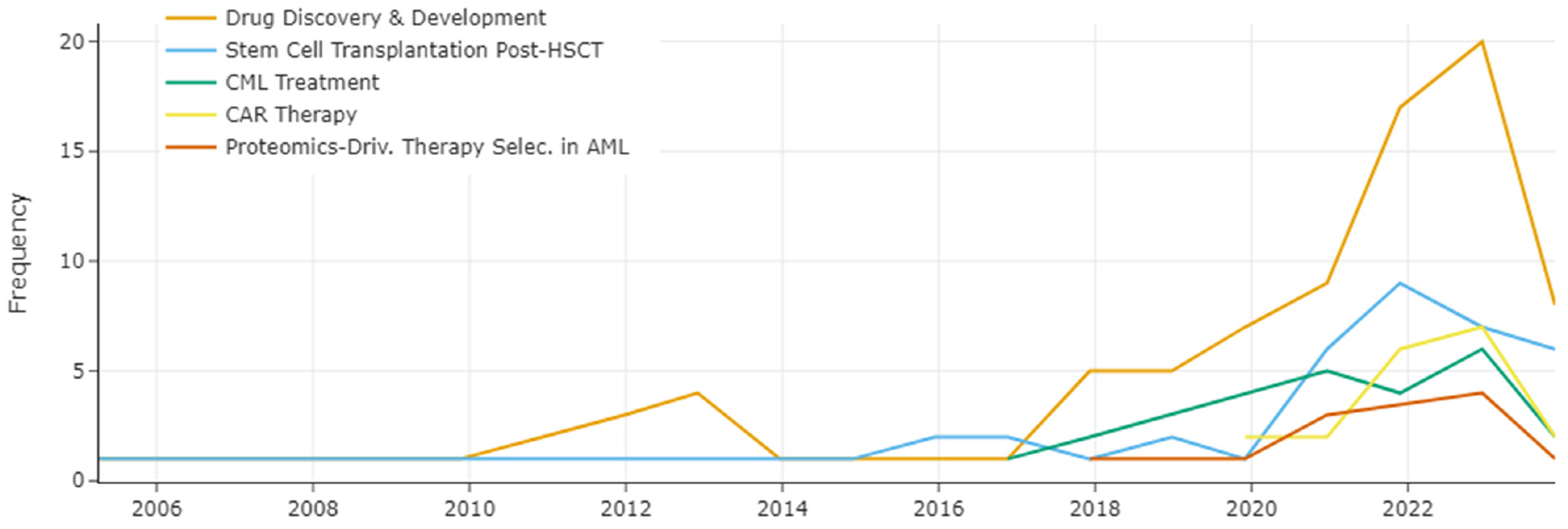
Figure 14 illustrates the temporal progression of research in Treatment & Therapy Development, highlighting trends and changes in publication activity over time. The figure shows a gradual increase in publication output across all parameters over time. As observed, Drug Discovery & Development exhibits the most pronounced growth, particularly in recent years, while other parameters such as Stem Cell Transplantation Post-HSCT, CAR Therapy, and CML Treatment display more moderate but steady increases.

7. Patient Outcomes & Prognosis

The integration of AI into the clinical management of hematologic malignancies, particularly leukemia, has demonstrated a profound impact on improving patient outcomes and prognosis. Figure 15 highlights the top 10 keywords and their c-TF-IDF scores for the parameters within Patient Outcomes & Prognosis.
In the context of pediatric ALL, AI has played a pivotal role in enhancing diagnostic accuracy, optimizing treatment regimens, and predicting clinical outcomes, including relapse risk [95]. By analyzing genetic and molecular data, AI models have enabled more accurate risk stratification, which is essential for identifying high-risk pediatric patients early in their disease course [96,97]. This early detection, combined with AI-driven tools for relapse prediction, has allowed clinicians to intervene more effectively, applying aggressive treatments when necessary and ultimately improving survival rates.
Building on these advancements, recent works have demonstrated that AI’s predictive capabilities in pediatric oncology, particularly for forecasting relapse risk and other clinically relevant outcomes, are not only more accurate than traditional statistical models but also increasingly actionable. For example, Fitter et al. [98] presented an ML model that identified a two-gene expression signature (CKLF and IL1B) predictive of relapse at diagnosis, thereby enhancing risk stratification and guiding risk-adapted treatment strategies. This capacity to generate timely data-driven insights enables clinicians to make earlier therapeutic adjustments, potentially lowering relapse rates and improving long-term outcomes [95,99]. Beyond relapse prediction, ML models have also demonstrated utility in pediatric leukemia research by enabling interpretable clinical predictions from small-scale tabular datasets. For example, Al-Hussaini et al. [100] developed an interpretable ML framework to predict treatment-related infections in pediatric AML and ALL and identified key clinical and biological factors, such as chemotherapy regimen, CNS involvement, leukemia type, and Down syndrome that contribute to infection risk. In parallel, AI-driven models show promise in supporting personalized treatment planning in pediatric oncology, such as predicting chemotherapy response or treatment modality needs, by leveraging genetic and clinical data [101,102]. However, full integration into clinical decision support systems remains an area of ongoing development.
In CLL, AI’s utility extends beyond relapse prediction, offering advanced insights into disease progression and risk stratification. For instance, an AI-based electrocardiography model was shown to predict atrial fibrillation risk in newly diagnosed CLL patients, potentially aiding clinicians in risk stratification and treatment planning [103]. In parallel, ML methods leveraging high-dimensional RNA sequencing data and gene correlation networks have proven effective in identifying molecular signatures associated with CLL evolution and in predicting disease progression. These data-driven models support more accurate risk stratification and could contribute to monitoring disease trajectories over time, thereby assisting clinicians in identifying patients at heightened risk of rapid progression [104]. Furthermore, the integration of ML survival models with unsupervised clustering techniques has improved the interpretability of time-to-event predictions, allowing clinicians to better identify CLL patients at imminent risk of requiring treatment and supporting more personalized management strategies [105].
AI’s impact in managing CLL is further evidenced by its role in monitoring clonal evolution, a hallmark of the disease’s progression. Advanced machine learning and clustering techniques have enhanced the resolution with which clinicians can detect and characterize leukemic clones from high-throughput sequencing data, thereby improving insights into clonal architecture and enabling more effective tracking of repertoire dynamics over time [106,107]. This approach is complemented by AI’s integration of immune system data, offering a more holistic view of patient health and enabling more personalized risk stratification based on immune dysfunction, which is common in CLL patients [108,109].
In the field of MDS and chronic myelomonocytic leukemia (CMML), AI models such as AIPSS have advanced prognostication by integrating clinical data and outperforming traditional systems such as the Revised International Prognostic Scoring System (R-IPSS) in predicting overall survival and leukemia-free survival [110,111]. The ability to generalize AI models such as AIPSS-MF across diverse patient populations highlights their robustness, offering highly accurate risk stratification and guiding treatment decisions for myelofibrosis, outperforming standard prognostic scores [112]. Similarly, the AIPSS-MDS model provides enhanced prognostic accuracy for myelodysplastic syndromes compared to established systems [113].
AI’s contributions extend to comorbidities, particularly in the context of COVID-19 outcomes in leukemia patients [114]. The pandemic presented significant challenges for patients with hematologic malignancies, who are at increased risk of severe complications due to compromised immune systems [115]. Advanced AI and ML models have enabled clinicians to predict mortality risk at hospital admission by integrating data on comorbidities, demographics, and key laboratory markers, thus supporting early identification of high-risk individuals [114]. Techniques such as RF and Gaussian Mixture Models have further classified patterns of comorbidities, improving the prediction of severe outcomes among hospitalized patients [116]. Beyond risk prediction, AI has also played a role in evaluating patient responses to COVID-19 vaccination, identifying subgroups, especially those with aggressive hematologic diseases, who are less likely to develop adequate antibody responses, thereby guiding clinicians in optimizing care strategies [117].
The growing body of literature underscores the transformative impact of AI on patient outcomes and prognosis across hematologic malignancies. From early relapse prediction in pediatric ALL [97] to dynamic clonal monitoring in CLL [106,107] and improved prognostication in MDS [110,111], AI has consistently advanced clinical decision-making. By analyzing complex datasets encompassing genetic, transcriptomic, and immune profiles, AI-driven models enable highly accurate risk stratification and tailored therapeutic interventions, allowing for timely and effective care. In pediatric ALL, AI supports the early identification of high-risk cases and informs treatment adjustments [98,99], while in CLL, it utilizes electrocardiography data to assist in risk stratification and guide personalized management strategies [103]. Beyond malignancy-specific applications, AI demonstrates versatility in addressing comorbidities, including predicting risks and personalizing care in the context of COVID-19 [116]. As these technologies evolve and continue to assimilate multimodal datasets, their potential to reshape hematologic care and enhance survival outcomes across diverse clinical contexts becomes increasingly evident.
Figure 16 shows the temporal progression of research in Patient Outcomes & Prognosis, capturing shifts in focus across the years. The figure shows an overall increase in publication output across the parameters over time. As observed, Predicting Relapse in Childhood ALL exhibits the most pronounced growth, particularly in recent years, while CLL Risk Prediction and MDS Prognostic Risk Model show more moderate but steady increases. Research related to Comorbidities & COVID-19 Outcomes is concentrated in recent years.

8. Genetics & Genomics

The research within Genetics & Genomics provides a detailed view of the genetic and molecular underpinnings of leukemia, highlighting how AI and multi-omics approaches are transforming diagnosis, prognosis, and treatment. Figure 17 illustrates the top keywords and their c-TF-IDF scores for the parameters within Genetics & Genomics.
The cornerstone of this body of work is research into Microarray Gene Expression Classification. Microarray data have been widely analyzed using ML models to detect leukemia and distinguish between its subtypes, such as ALL and AML [118,119]. ML techniques, particularly SVM, have shown strong performance in improving classification accuracy in leukemia-related research [120,121]. More advanced methods, including ensemble learning and kernel-based approaches such as wavelet transforms and RBF kernel ridge regression, have further enhanced results by addressing the high dimensionality and noise inherent in gene expression data [122,123,124]. The integration of gene expression profiles with other biological information, such as methylation data, has also been shown to improve model interpretability and predictive performance, offering a deeper analytical perspective [125]. Feature selection techniques that reduce dimensionality while preserving relevant information are also critical for handling the high-dimensionality characteristic of microarray data, as seen in methods using KPCA and SVM-based approaches [126,127,128].
AI’s application in cancer research extends beyond gene expression into both epigenetic and transcriptomic domains, where it has significantly contributed to the analysis of DNA methylation patterns and gene regulation. In epigenetics, ML-driven studies have identified methylation biomarkers linked to chromatin-regulating gene mutations, providing mechanistic insights and potential diagnostic markers, including in leukemia [129]. DL models such as stacked denoising autoencoders have further enabled more accurate prediction of CpG methylation states, advancing biomarker discovery in hematologic malignancies [130]. Beyond epigenetics, AI-based genomic classifiers such as OncoNPC predict the primary tumor origins in cancers of unknown primary using somatic mutation data, helping define clinically evidence-based subgroups [131]. Likewise, the Clone to Mutation (CloMu) model applies neural networks and reinforcement learning to infer mutation trajectories and clonal fitness, with validated performance in leukemia cohorts [132]. In transcriptomics, tools such as the Tempus Tumor Origin (Tempus TO) assay leverage RNA sequencing and machine learning to classify cancer subtypes with high accuracy, underscoring the value of transcriptomic profiling in CUP diagnosis and treatment [133].
AI does not just affect gene expression and epigenetics; it has also deepened our understanding of immune-related genes in cancer, with important ramifications for diagnosis, prognosis, and treatment. For example, ML methods using LASSO and SVM-RFE have defined an anoikis-related prognostic signature in melanoma linking differentially expressed genes to immune cell infiltration and drug sensitivity [134]. Pan-cancer studies have further highlighted HOXB7 as an immune-associated biomarker whose expression correlates with checkpoint genes, tumor mutational burden, and patient survival across diverse tumor types, suggesting its promise for immunotherapy development [135]. Beyond oncology, similar ML frameworks have been applied in non-hematologic diseases; for example, for identifying immune infiltration markers in atherosclerosis (FHL5, IBSP, SCRG1), some of which are also implicated in T-cell leukemia pathways and resolving tissue-specific inflammatory signatures in asthma through multi-tissue transcriptomic profiling, illustrating the broader applicability of these computational techniques across disease contexts [136,137].
In the context of AML, AI has emerged as a powerful tool for improving risk stratification and guiding treatment by integrating genomic and clinical data. Through unsupervised hierarchical clustering, ML techniques have identified distinct genomic clusters with variable responses to therapies such as chemotherapy and hypomethylating agents, underscoring the relevance of genetic profiles in therapeutic decision-making [138]. Additionally, ML methods such as LASSO, SVM-RFE, and RF have uncovered key prognostic markers including DNM1, MEIS1, and SUSD3, which show strong associations with survival, immune subtypes, and immune checkpoints in AML [139]. By leveraging multi-omics data, AI further enables the identification of immune-related subtypes in AML that influence prognosis, supporting more refined patient stratification [140]. Prognostic models using ML methods such as stacking and RSF demonstrate enhanced predictive accuracy by combining genomic features with clinical variables [141]. Moreover, biomarkers such as SELL and KLRB1, identified using ML techniques such as XGBoost and Random Ferns, offer promising diagnostic and therapeutic avenues for AML by leveraging immune heterogeneity patterns observed in rheumatoid arthritis [142].
A promising advancement in leukemia research lies in the application of AI to multi-omics data for the discovery of disease subtypes and therapeutic stratification. Multi-view and collaborative learning frameworks, such as VaCoL, have shown that jointly optimizing survival prediction and subgroup identification using integrated omics datasets can enhance clinical outcome modeling [143]. Similarly, the MIS-Kmeans algorithm facilitates highly accurate disease subtyping by integrating multi-cohort and multi-level omics data, incorporating prior biological knowledge to improve clustering performance and feature selection [144]. DeepMF, a deep matrix factorization approach, demonstrates enhanced efficacy in cancer subtype discovery, including achieving high clustering accuracy on leukemia datasets through the integration of mRNA, miRNA, and protein profiles [145]. Additionally, machine learning-driven integration of phosphoproteomics, transcriptomics, and signaling dynamics has been utilized to uncover early predictors of chemotherapy response in AML, reinforcing the potential of multi-omics and AI in precision oncology [76]. Collectively, these approaches highlight the transformative role of AI in leveraging complex omics data to uncover biologically meaningful subtypes and inform therapeutic decisions in leukemia.
These results emphasize AI’s transformative impact on leukemia research. Across gene expressions, epigenetic markers, immune gene expressions, and genomic prognostic markers, AI enhances diagnostic precision [120], improves prognostic models [141], and facilitates the development of personalized treatment strategies [142]. The integration of multi-omics data across various studies reveals AI’s ability to manage complex, high-dimensional datasets, which is critical for identifying the subtle genetic and epigenetic changes that drive leukemia [143,145]. Furthermore, AI’s role in identifying immune and inflammatory biomarkers suggests that immunotherapy will play a growing role in leukemia treatment [134,135]. By integrating these insights into a cohesive framework, AI not only advances our understanding of leukemia’s genetic and molecular mechanisms but also paves the way for more tailored, effective treatment options that are responsive to the specific profiles of individual patients [139,140,141]. This evolving understanding of leukemia holds great promise for improving clinical outcomes and enhancing patient care.
Figure 18 presents the temporal progression of research in Genetics & Genomics, reflecting changes in publication frequency over time. The figure shows sustained publication activity across the parameters over time, with Microarray Gene Expression Classification exhibiting the highest and most consistent output throughout the period. In more recent years, Genomic Prognostic Markers in AML shows a notable increase, while Cancer Genomics & Methylation Analysis and Immune-Related Gene Expression display gradual growth. Multi-Omics Subtypes Discovery appears later in the timeline and remains comparatively limited.

9. Technological & Methodological Innovations

The integration of AI in leukemia research, especially within Technological & Methodological Innovations, reveals significant advancements across multiple dimensions. Figure 19 shows the top 10 keywords and associated c-TF-IDF scores for parameters linked to Technological & Methodological Innovations.
In flow cytometry analysis, AI models, particularly supervised learning techniques, have demonstrated improved diagnostic accuracy, especially in the detection of Minimal Residual Disease (MRD) in AML and ALL [146,147]. These AI-driven models, such as ensemble learning algorithms such as XGBoost and RF, have demonstrated strong performance in analyzing complex flow cytometry datasets. By reducing interpretative subjectivity and enhancing sensitivity, they support a more accurate MRD detection and disease classification both critical for assessing relapse risk and guiding treatment strategies [147,148]. For example, in AML, AI-based flow cytometry with transfer learning and deep neural networks can automate MRD detection. This approach allows knowledge gained from one leukemia type to be applied to another, improving the detection of malignant cells in data-limited settings such as ALL and supporting better prognostic assessments [149]. The use of AI in CLL is equally promising, with deep learning models demonstrating expert-level accuracy in MRD detection and significantly reducing analysis time, thereby enhancing clinical workflow efficiency [150].
This progress is not limited to flow cytometry but extends across broader AI applications in hematology and leukemia research. AI-driven hematology systems, leveraging real-world data and ML techniques, are increasingly complementing traditional clinical trials, offering insights into patient responses to treatment and new drug approvals [151,152]. These systems are also enhancing how leukemia and other hematologic diseases are diagnosed, with ML models improving differential diagnosis and enabling the prediction of patient-specific outcomes important steps toward more personalized approaches to hematologic care [153,154]. Beyond diagnostics, AI models are reshaping therapeutic decision-making by analyzing complex datasets to tailor treatments to individual patients, thereby reducing adverse effects and improving survival rates [154,155]. Furthermore, the integration of AI into clinical workflows such as in managing treatment protocols and predicting platelet demand ensures timely, efficient care delivery, particularly in resource-limited healthcare settings [152].
AI’s expanding role in patient management systems further underscores its transformative impact on clinical care. In leukemia diagnosis, for example, AI-driven expert systems integrate rule-based logic with deep neural networks to interpret complex clinical data, automate diagnostic reasoning, and clear, evidence-based insights that support timely and informed decision-making [156]. In pediatric leukemia, ML models such as multiclass boosted decision trees are used to analyze patient medical data and produce predictive diagnostic outcomes, supporting physicians in clinical decision-making [157]. Moreover, AI-powered software platforms assist in managing large volumes of patient data, enhancing system-level integration and equipping healthcare teams with real-time, detailed information for ongoing monitoring and adaptive treatment strategies [156,158]. Beyond diagnostics and clinical decisions, AI also improves the efficiency of healthcare delivery by automating administrative processes, reducing the time clinicians spend on non-clinical tasks, and ultimately contributing to better patient satisfaction [158].
Furthermore, AI’s capabilities in computational prediction of disease associations with non-coding RNAs (ncRNAs) offer new insights into leukemia pathogenesis and potential therapeutic targets. By focusing on long non-coding RNAs (lncRNAs) and circular RNAs (circRNAs), AI models such as LDA-DLPU and AutoEdge-CCP have advanced the identification of molecular markers in hematologic and other cancers, with LDA-DLPU specifically predicting novel lncRNA associations in leukemia [159,160]. These models leverage DL to predict interactions between ncRNAs and leukemia, enhancing our understanding of the molecular landscape and laying the groundwork for innovations in diagnostic and treatment research [161]. For example, microRNAs (miRNAs) are key regulators in biological processes, and AI-driven models, such as deep attention autoencoders combined with recursive feature elimination, have demonstrated high accuracy in predicting miRNA-disease associations, including those related to leukemia, thereby supporting future research in diagnostic and therapeutic development [162].
Technological & Methodological Innovations continue to demonstrate that AI’s integration into cytometry and hematology is transforming the landscape of leukemia research and care. From enhancing cytometric data interpretation [147] to refining therapeutic decisions through patient-specific molecular data [155,161], AI facilitates diagnostic precision and treatment personalization. The convergence of AI-driven cytometry, real-world clinical data, and predictive computational models promises a future where efficient, individualized care is the standard [151,152]. Notably, incorporation of ncRNAs into AI-driven models reflects their emerging importance in leukemia research, enabling more detailed molecular insights and supporting the discovery of potential diagnostic biomarkers and therapeutic targets [160,161].
AI’s potential to unify these technological and methodological innovations into a cohesive clinical toolkit exemplifies how interdisciplinary advancements are being harnessed to enhance leukemia research and treatment. By streamlining workflows, improving diagnostic speed, and enabling personalized medicine approaches, AI ensures that the future of leukemia care is more tailored, efficient, and responsive to individual patient needs. This application of advanced analytics and predictive modeling through AI underscores its vital role in tackling the complexities of leukemia, ultimately contributing to improved healthcare outcomes.
Figure 20 depicts the temporal progression of research in Technological & Methodological Innovations, emphasizing trends in innovation-related research activity. The figure shows relatively limited publication activity in earlier years, followed by increased output across the parameters in more recent periods. As observed, AI in Flow Cytometry Analysis exhibits the most pronounced growth in recent years. AI-Driven Hematology & Leukemia and Prediction of Disease Association with ncRNAs also show emerging upward trends, while AI-Driven Hematology & Patient Management displays more sporadic activity over time.

10. Datasets and ML Methods in Leukemia

In this section, we present key datasets and machine learning (ML) methodologies used in leukemia research. Section 10.1 provides an overview of major leukemia datasets, detailing their data modalities, characteristics, and research and clinical applications. Section 10.2 then examines methodological prevalence by outlining the foundational and widely adopted ML approaches that define the dominant baseline across leukemia AI studies, including their applications in medical imaging diagnostics, gene analysis, subtype classification using radiomics and cell morphology, treatment risk assessment, and patient outcome prediction. Section 10.3 complements this perspective by focusing on methodological advancement, highlighting architecturally enhanced, hybrid, and performance-optimized implementations that demonstrate superior predictive performance or task-specific refinement across problem domains. This layered organization distinguishes between commonly adopted methodological baselines and high-performance, frontier-oriented refinements, thereby preserving analytical clarity while illustrating both the mainstream landscape and its evolving performance frontier. Together, these subsections provide a structured understanding of how datasets and ML methodologies collectively drive advancements in leukemia diagnosis, research, and treatment.

10.1. Key Datasets in Leukemia Research

Here, we discuss key datasets that serve as foundational resources in leukemia research. These datasets encompass diverse data modalities, ranging from genomic and transcriptomic profiles to proteomic and imaging data, and serve as foundational resources for investigating leukemia biology, refining diagnostics, informing therapeutic strategies, and advancing personalized medicine. A selection of these datasets is summarized in Table 5.
TCGA (The Cancer Genome Atlas) [163] and TARGET (Therapeutically Applicable Research to Generate Effective Treatments) [164] are two pivotal genomic resources that exemplify this complementary design in genomic profiling efforts. TCGA offers extensive molecular data across 33 types of cancer, encompassing over 20,000 primary cancers. Its genomic, epigenomic, transcriptomic, and proteomic datasets form the backbone of multi-omics cancer research. In leukemia, particularly AML, TCGA has been instrumental in uncovering key biomarkers through gene expression profiling, mutation analysis, and survival studies, ultimately contributing to prognosis prediction and immune response characterization [128,139,141]. Meanwhile, TARGET brings a pediatric focus, concentrating on ALL and AML. It provides critical genomic and transcriptomic data tailored to identifying therapeutic targets in younger populations. TARGET has been extensively used for prognostic stratification in T-cell ALL (T-ALL) [165], relapse prediction in high-risk pediatric B-cell ALL (B-ALL) [99], and for contributing to the validation of a prognostic lncRNA-mRNA signature in childhood ALL, alongside GEO datasets [166]. Its application extends to forecasting chemotherapy responses, alongside TCGA and GEO datasets [102].
Complementing these genomic resources are GEO (Gene Expression Omnibus) and NCBI (National Center for Biotechnology Information) [167], both of which provide vital repositories for leukemia-related molecular data. GEO specializes in high-throughput functional genomics, offering datasets that include gene expression, microRNA expression, and proteomics. Its diverse datasets, such as GSE6891 and GSE7186 [168,169], have been crucial in identifying prognostic genes in AML [170] and supporting ML models for leukemia subtype classification and outcome prediction [89]. While GEO, hosted by NCBI, specializes in gene expression data, NCBI also provides a broader suite of genomic resources, such as gene sequences (via GenBank) and variation data (via dbSNP and dbVar), supporting in-depth molecular research. This platform facilitates gene expression analysis, validates predictions from ML models, and advance drug discovery and repurposing efforts [171,172]. Collectively, these repositories provide researchers with the tools to dissect leukemia’s molecular underpinnings and translate results into evidence-based therapeutic strategies.
Another key dataset, GDSC (Genomics of Drug Sensitivity in Cancer) [173], integrates genomic profiles with drug sensitivity data from cancer cell lines, including leukemia. GDSC plays a pivotal role in identifying genetic markers of drug sensitivity and resistance, helping researchers understand AML’s response to treatments and develop personalized combination therapies [174,175]. Its focus on linking genomic data to therapeutic outcomes bridges the gap between molecular research and clinical application.
Table 5. A selection of widely used datasets in the leukemia research.
DatasetData ModalityDescriptionUsage/Applications
TCGA
AML
Genomic & ClinicalMulti-omics database with AML genomic, epigenomic, and transcriptomic data from 200+ patients.
  • Used for multi-omics cancer analysis, including gene expression, survival, and mutation studies [128,176,177]
  • Used for AML research in biomarker discovery, prognosis, and immune response analysis [139,141]
TARGETGenomic & TranscriptomicPediatric cancer dataset with gene expression and mutation data for ALL and AML.
  • Used for prognostic stratification in T-ALL [165], relapse prediction in pediatric B-ALL [99], and validating prognostic signatures in childhood ALL [166]
  • TARGET, TCGA, and GEO were used to forecast chemotherapy responses in cancers, including leukemia [102]
GEO GSE6891
GSE7186
GenomicGene expression datasets for AML and ALL (e.g., GSE6891, GSE7186).
  • Identifies prognostic genes in AML [170], analyzes gene expression in CML and supports ML models for classifying leukemia subtypes and predicting outcomes [89]
NCBI LeukemiaGenomic & ClinicalProvides genomic, biochemical, and molecular data essential for leukemia research.
  • Analyzes gene expression profiles [171], supports drug repurposing, target discovery, and small-molecule identification [172]
ALL-IDBImageBlood cell images dataset for ALL diagnosis.
  • Aids automated blood cell classification [178,179], and early detection of ALL using blood cell images [180,181,182]
TCIAImagePublic repository of cancer-related medical imaging, including leukemia datasets.
  • Enhances leukemia detection with DL [183,184], radiomic feature extraction for diagnostic precision [185], and ALL classification [39]
BCCDImageDataset with 364 images and 4888 labeled WBC, RBC, and platelet objects.
  • Develops ML models for leukemia diagnosis [38,186], WBC classification, and abnormal cell detection [187,188]
LISCImageBlood cell images for WBC segmentation and classification.
  • Improves WBC segmentation models [189,190], and automates diagnosis and classification of leukemia [191,192,193]
CNMC LeukemiaImageContains 15,114 microscopic images of WBC across two classes.
  • Supports ML and DL methods for diagnosing and classifying ALL [9,194,195]
GDSCDrug-Gene InteractionsGenomic and drug sensitivity data from cancer cell lines, including leukemia.
  • Identifies potential drugs for treating AML [175] and validates drug combinations supporting personalized treatment strategies [174]
ClinicalTrials.govClinical Trial DataClinical trials database covering leukemia and other malignancies.
  • Tracks leukemia-focused clinical trials, supports treatment response modeling for personalized care [196,197] and evaluates treatment success and side effects [198]
Datasets such as ALL-IDB [199], TCIA (The Cancer Imaging Archive) [200], BCCD (Blood Cell Count Dataset) [201], LISC (Leukocyte Image Segmentation and Classification) [202], and CNMC-Leukemia-2019 [203] play a central role in advancing research in imaging and automated diagnostics. ALL-IDB provides a collection of blood cell images used to develop automated systems for classifying blood cells and diagnosing ALL. Its role in early detection studies has been transformative [178,179]. Similarly, TCIA offers a repository of cancer-related medical imaging data, including leukemia-specific datasets, which supports the development of ML and DL models for leukemia detection and classification. For example, radiomic feature extraction from TCIA data has been used to improve diagnostic modeling and to support disease characterization, highlighting the dataset’s utility in imaging-based computational analysis [39,183,184,185].
The BCCD and LISC datasets further advance imaging-based leukemia research by focusing on blood cell classification and segmentation. BCCD includes labeled images of WBCs, red blood cells (RBCs), and platelets, facilitating the development of CNN-based models for identifying abnormal cells indicative of leukemia [38,186,187,188]. LISC complements this by specializing in WBC segmentation and classification, improving the accuracy and reliability of diagnostic models [189,190,191,192,193]. Meanwhile, the CNMC-Leukemia-2019 dataset, with its extensive collection of over 15,114 microscopic WBC images, drives machine and DL innovations in diagnosing and classifying ALL, significantly advancing automated diagnostic systems [9,194,195].
Finally, ClinicalTrials.gov [204] serves as a global registry of leukemia-related clinical trials across all phases, providing essential information on study design, recruitment status, therapeutic strategies, and treatment outcomes. Its broad scope supports clinical decision-making and helps refine therapeutic strategies [196,197,198].
These datasets discussed in this section provide a robust and diverse foundation for leukemia research. By integrating genomic, transcriptomic, proteomic, and imaging data, they empower researchers to address challenges ranging from drug discovery and biomarker identification to the development of advanced ML models for automated diagnostics and personalized treatment approaches. Their complementary roles underscore the collaborative nature of modern leukemia research, driving innovation and improving patient outcomes.

10.2. Widely Used ML Methodes for Leukemia Research

Here, we discuss key ML models that are fundamental to leukemia research, each supporting various classification, prediction, and data analysis needs across imaging, clinical, and genomic datasets (see Table 6 for a selection of ML methods). By applying different approaches, these models enhance diagnostic accuracy, aid in prognostic predictions, and support personalized treatment strategies in leukemia.
CNN-based DL models are crucial in visual data analysis for leukemia diagnosis, leveraging convolutional layers to automatically learn spatial hierarchies in images. CNNs are widely applied to classify WBC and analyze cellular morphology, which assists in detecting leukemia and cell-related abnormalities [187]. Advanced architectures, including ResNet, are used to extract features from medical images such as CT, MRI, and histopathological slides for the detection and classification of cancerous tissues [50,206,209]. Similarly, VGG networks perform feature extraction and segmentation, supporting blood cell classification in leukemia diagnostics [205,208]. Autoencoders, another CNN-based model, compress and reconstruct medical images, preserving key features that contribute to more accurate leukemia classification [207].
SVM and logistic regression (LR) are commonly employed in leukemia research for classification and feature selection tasks. SVM classifies blood cells [210], distinguishing normal from abnormal cells in diseases such as ALL [211], while also being used in genomic research to identify disease-relevant genes and biomarkers [227]. Additionally, SVM enhances decision models for predicting patient outcomes and optimizing diagnostics when combined with ensemble models [212,213,214]. Similarly, LR has been applied to leukemia microarray data for both classification and feature selection, enabling the prioritization of informative genes and the reduction of diagnostic dimensionality [218,219,220].
RF and XGBoost are both ensemble methods used to handle high-dimensional data and support robust classification and regression tasks. RF constructs multiple decision trees, analyzing blood smear images to classify leukemia subtypes and identifying morphological features relevant to diagnosis [215,216,217]. RF is also instrumental in predicting patient outcomes and analyzing survival rates, especially in AML, where it aids in identifying biomarkers and prognostic indicators [105,113,176]. Similarly, XGBoost, an optimized gradient-boosting algorithm, is frequently applied in leukemia research to classify ALL using WBC images [221] and to analyze multiparameter flow cytometry data for MRD detection [147]. XGBoost also plays a key role in predicting treatment-related complications and assessing risk factors in high-dose therapies [223], classifying AML subtypes based on immunophenotypic profiles [222].
Finally, K-Nearest Neighbors (KNN) and Naive Bayes contribute to classification and probabilistic analysis in leukemia research. KNN classifies ALL as benign or malignant based on PBS images, following feature selection for optimized classification [224]. It has also been widely employed in gene expression-based cancer classification tasks, either as a standalone classifier or as part of hybrid and ensemble models [225]. Naive Bayes, particularly the Gini index-based Fuzzy Naive Bayes (GFNB) classifier, is used to classify blast cells in ALL from blood smear images, providing an efficient solution for handling multi-cell image data [226].
These ML methods enable advanced data analysis across diverse applications in leukemia research, from subtype classification and outcome prediction to genomic feature selection and automated diagnostics. Their combined use enhances the accuracy, efficiency, and personalization of leukemia research, driving advancements in precision medicine and oncology. The approaches outlined in this section reflect widely adopted and methodologically established ML methods that characterize much of the current AI landscape in leukemia research. The following section builds upon this foundation and examines architecturally enhanced, hybrid, and optimization-driven implementations that demonstrate strong predictive performance and refined task-specific modeling across diverse clinical and molecular settings.

10.3. High-Performing ML Methods for Leukemia

This section highlights selected ML methods used in leukemia research that have demonstrated notable performance across various problem domains (See Table 7). We curated the methods based on their relevance to specific challenges within the field, ensuring each problem domain is represented by one or two key methods. For each method, the table outlines the employed frameworks, detailing feature extraction techniques, classifiers, datasets, and evaluation metrics, where such information is reported.
CNN-based models, particularly those leveraging transfer learning such as GoogLeNet, Inception-v3, MobileNet-v2, Xception, DenseNet-201, and Inception-ResNet-v2, demonstrated outstanding performance in classifying ALL versus non-ALL cells [228], achieving 100% accuracy on the ALL-IDB1 and ALL-IDB2 datasets without requiring segmentation or manual feature extraction. These results reflect the power of deep feature extraction in small, well-labeled image datasets, though concerns remain regarding the models’ ability to generalize to broader, more heterogeneous clinical populations. Similar high performance was observed with EfficientNet-B3 [229] and ResNet/DenseNet-based models [230] across various imaging conditions, where EfficientNet-B3 was employed as a unified architecture for ALL detection using the CNMC_Leukemia dataset, functioning as both the feature extractor and classifier [229]. The model achieved 98.31% accuracy, 97.83% recall, 97.82% specificity, 98.29% average precision, and a 98.05% DSC, indicating reliable performance within an end-to-end classification pipeline that does not require separate pre-processing or feature engineering stages. A related work addressed the classification of low-intensity leukemia images using ResNet-34 and DenseNet-121 [230] as feature extractors and classifiers. When applied across the ASH and ALL-IDB datasets, the models reached an average accuracy of 98.8%, precision and sensitivity of 98.65%, and specificity of 98.85%, confirming the robustness of these architectures even in suboptimal visual conditions.
While CNNs are also presented in Section 10.2 as widely adopted models for leukemia image analysis, the works highlighted in the previous paragraph move beyond conventional standalone deployment by incorporating transfer learning from large-scale pretrained architectures (e.g., GoogLeNet, Inception variants, DenseNet-201, EfficientNet-B3) and leveraging architectural scaling strategies to enhance representational capacity. These implementations further emphasize end-to-end optimization, eliminating manual segmentation and handcrafted feature extraction while maintaining strong predictive performance across diverse and low-intensity imaging conditions. The emphasis is therefore not solely on CNN utilization as a model class, but on performance-oriented architectural refinement and robustness enhancement aimed at improving predictive reliability and generalization potential.
In cell segmentation and classification research, a two-stage pipeline that integrated a modified U-Net for WBC nucleus segmentation with an RBF-SVM [188] for cell classification achieved a Dice score of 0.972 and 99.42% classification accuracy on the ALL-IDB2 dataset. This method, validated also on Raabin-WBC, LISC, and BCCD datasets, highlights the advantage of combining task-specific segmentation networks with classical classifiers for highly accurate cell-type discrimination. In contrast to the standalone SVM and CNN applications described in Section 10.2, this approach adopts a task-decomposed and performance-oriented hybrid architecture in which segmentation and classification are explicitly separated yet strategically interconnected. The modified U-Net is optimized for accurate nucleus boundary delineation, while the RBF-SVM operates on the refined segmented outputs to enhance discriminative accuracy. This coordinated design allows independent optimization of each analytical stage, thereby improving segmentation fidelity and downstream classification performance. The methodological distinction lies not in the individual components themselves, but in their structured integration within a unified pipeline designed to maximize overall system accuracy across multiple validation datasets.
A different approach [231] developed a universal framework for medical image segmentation, integrating DL with traditional clustering and swarm intelligence. Applied to diverse datasets including Magnetic Resonance Imaging (MRI) for brain, dermoscopic for skin, microscopic for blood leukemia, and CT scan images for lungs, the K-means with CNN module achieved the highest segmentation accuracy of 96.45%. This indicates promising flexibility across imaging domains for effective medical image segmentation. This framework further extends the role of CNN beyond conventional segmentation usage by embedding it within a clustering and swarm-optimization scheme, enabling adaptive parameter tuning and improved segmentation performance across heterogeneous imaging modalities. The distinction therefore arises from optimization-driven integration and cross-domain flexibility rather than from isolated CNN deployment alone.
Beyond image-based applications, ML methods were also applied to multi-omics datasets, where dimensionality reduction played a key role. VWMRmR [128] emerged as the most effective feature selector in a comparative analysis involving mRMR, INMIFS, DFS, and SVM-RFE-CBR, consistently producing feature subsets with low RR (0.0487–0.1958) and high RE (2.275–4.8581). When paired with classifiers such as Naive Bayes, KNN, AdaBoost, and C4.5, the VWMRmR-selected features yielded top accuracy in 7 out of 20 test cases, reaching as high as 87.83% with KNN on exon expression data and reinforcing the importance of redundancy-aware selection in high-dimensional biological data. Prognostic modeling for AML also integrated multi-layered data, where an RF classifier [176] trained on clinical variables, e.g., age, ELN risk category, TP53 mutation, and 197 survival-associated genes achieved an AUC of 0.75 in five-fold cross-validation on TCGA and 0.72 on the independent OHSU cohort.
Extending the baseline application of RF classifiers discussed in Section 10.2, the implementation described in the previous paragraph situates the model within a structured multi-layer data integration framework that combines clinical characteristics, mutational profiles, and survival-associated gene expression features. Rather than operating on a single homogeneous feature space, the RF classifier benefits from similarity network fusion (SNF), which integrates heterogeneous data modalities into unified patient similarity representations. This integration strengthens prognostic subgroup discrimination beyond conventional single-layer RF modeling, highlighting the added value of layered analytical design and multi-omics integration rather than classifier selection alone. More specifically, SNF identified three distinct prognostic subgroups, further supporting the contribution of integrated multi-layer stratification within this predictive framework.
In gene expression-based leukemia classification, a hybrid logistic vector trees (LVTrees) [232] ensemble consisting of LR, SVM, and extra-trees classifiers achieved 100% accuracy on microarray data from GSE28497 and GSE9476 after reducing the original 22,283-gene set to 400 features using a Chi-squared test and addressing class imbalance through ADASYN. Rather than applying LR and SVM as independent classifiers, this layered ensemble configuration embeds them within a coordinated architecture that integrates statistically guided feature reduction (Chi-squared selection), dimensionality compression, and class-imbalance correction through ADASYN. By reducing the original high-dimensional gene space to a structured subset prior to ensemble learning, the framework simultaneously addresses the curse of dimensionality and imbalance-related bias. The observed performance gains are therefore attributable not solely to classifier selection, but to the deliberate orchestration of preprocessing, feature selection, and ensemble aggregation within a high-dimensional genomic context.
A contrasting approach by Mallick et al. [233] adopted a five-layer feed-forward DNN trained on gene expression profiles from 72 bone marrow samples (47 ALL, 25 AML) comprising 7128 genes and achieved 98.2% accuracy and 97.9% specificity without any explicit feature selection. This model demonstrates the feasibility of end-to-end deep learning in simplifying data pipelines while retaining high accuracy. Unlike feature-engineered pipelines discussed previously, this five-layer feed-forward DNN performs automated hierarchical representation learning directly from high-dimensional gene expression inputs without explicit feature selection. The architecture enables internal abstraction of complex gene expression patterns, effectively transferring the burden of feature engineering to the network’s learned parameters. This end-to-end configuration simplifies the analytical workflow while maintaining strong predictive performance, distinguishing it from conventional approaches that rely on external dimensionality reduction or manual variable selection prior to classification.
In batch-effect correction in scRNA-seq data, dynamic version of Adversarial Information Factorization AIF [234] was introduced as an adversarial learning framework that disentangles biological signal from technical noise. Evaluated on five datasets, including a 30,334-cell AML cohort with 35 batches and 21 cell types, AIF achieved ≥92% cell-type purity after correction, improved clustering F1 scores by 8% over tools such as Harmony and Seurat, and exceeded 0.90 AUC in differential expression analysis. These results underscore the value of adversarial training for preserving biological fidelity in single-cell transcriptomics while minimizing technical artifacts.
The studies summarized in Table 7 were selected to represent recent high-performing ML approaches applied to diverse leukemia-related tasks, including image-based classification, segmentation, prognosis prediction, and multi-omics analysis. Inclusion was guided by reported predictive performance together with methodological robustness, such as the use of cross-validation, independent test cohorts, or multiple datasets. Although attention was paid to data diversity, favoring works that evaluated models across heterogeneous sources (e.g., multiple imaging datasets, public gene expression repositories, or multi-center cohorts) rather than single, narrowly defined datasets, the reported performance metrics should be interpreted in the context of dataset size, validation strategy, and data heterogeneity. These factors are critical for assessing the generalizability and clinical relevance of ML models in leukemia research.

11. Discussion

Here we discuss the broader significance of our findings by consolidating cross-cutting insights. In Section 11.1, we interpret key results in the context of existing research, while in Section 11.2, we examine overarching challenges and outline future directions to guide continued advancement in the field. Section 11.3 addresses the theoretical and practical implications of the results, and Section 11.4 discusses the limitations of this work.

11.1. Synthesis of Key Findings Across Domains

The comprehensive analysis of the subject, viewed through the lens of the five macro-parameters—namely, Disease Detection & Diagnostics, Treatment & Therapy Development, Patient Outcomes & Prognosis, Genetics & Genomics, and Technological & Methodological Innovations—reveals a multi-dimensional landscape in which AI serves as an integrative force, pushing the boundaries of leukemia research and clinical care. This analysis identifies not only how AI influences individual domains but also the profound interconnections and feedback loops among them. By examining these parameters, holistically, in a cross-cutting manner, it becomes evident that AI is fundamentally changing leukemia research and treatment, driving a paradigm shift toward more tailored, data-driven, and personalized healthcare.

11.1.1. Holistic Diagnostic Improvements and Early Intervention

Across Disease Detection & Diagnostics, AI’s capacity to integrate diverse data sources, including microscopic images, radiological scans, cytometry outputs, and molecular biomarkers brings unprecedented accuracy and speed to leukemia diagnosis. From CNN-based image analysis that differentiates leukemic cells in bone marrow samples to advanced radiomics approaches by extracting subtle imaging biomarkers, the improved diagnostic acumen has immediate implications for clinical practice [40,48,51,58,235]. This cascades directly into other macro-parameters. For instance, the refined diagnostic precision ensures that Genetics & Genomics are carried out on correctly classified patient subgroups, leading to more reliable downstream studies [131,138,139]. Enhanced detection at an earlier stage also allows for timely interventions, impacting Treatment & Therapy Development by enabling immediate, patient specific therapeutic strategies [72,74,76]. The improved accuracy and swiftness of diagnosis support better prognostic modeling and, ultimately, positively influence Patient Outcomes & Prognosis.

11.1.2. Linking Genetic Insights to Tailored Treatment

Genetics & Genomics shows that AI’s ability to manage high dimensional, multi-omics datasets encompassing gene expression, DNA methylation, mutation profiling, and immune gene signatures provides a granular view of leukemia’s molecular underpinnings [144,145,236]. AI uncovers gene expression patterns that differentiate ALL from AML, identifies crucial epigenetic marks, and links immune gene signatures to survival outcomes [118,119,129,139,140]. These results are not merely academic; they inform the Treatment & Therapy Development domain by guiding drug discovery pipelines, offering insight into patient subtypes susceptible to targeted therapies, and aiding the selection of agents that might circumvent known resistance mechanisms [74,77,85]. By synchronizing genetic biomarkers with therapeutic design, AI ensures treatments are increasingly aligned with the unique molecular profile of each patient’s disease, reinforcing the notion of personalized oncology [72]. Furthermore, these genetic insights refine prognostic models contributing directly to Patient Outcomes & Prognosis by allowing clinicians to stratify patients into risk categories and anticipate treatment responses [97,102,135,139].

11.1.3. From Drug Discovery to Personalized Therapeutics

Treatment & Therapy Development illustrates AI’s success in accelerating drug discovery and refining therapy choices. By analyzing large molecular interaction networks, AI identifies novel compounds, repurposes existing drugs, and designs multi target inhibitors [66,67,69]. Such computational methods shorten the preclinical development pipeline and ensure that therapy development is informed by genomic data, improving the odds of clinically meaningful results. When seen in the context of disease detection, these novel therapies become more impactful: a more accurate early detection means that the right patient receives the right drug earlier in the disease course [42]. Moreover, the interplay between AI-driven genomic research and therapy design drives a feedback loop genetic insights inform targeted therapy development, and therapy responses yield new genomic data that refine predictive models [72,142]. This cycle continuously improves the precision and adaptability of leukemia therapies, providing a foundation for long-term improvements in Patient Outcomes & Prognosis.

11.1.4. Elevating Prognosis and Long-Term Patient Management

AI’s integration into Patient Outcomes & Prognosis is anchored by its predictive power. Multiple studies indicate that AI models outperform conventional statistical approaches in predictive tasks, including estimating relapse risk, stratifying high-risk subpopulations (notably in pediatric ALL and CLL), and optimizing treatment decisions related to timing and intensity [98,99,100]. By correlating molecular signatures and immune markers with clinical endpoints, AI-driven prognostic models empower clinicians to make data-driven decisions, balancing therapeutic aggressiveness with treatment tolerability [101,102]. These predictive capabilities, linked back to Genetics & Genomics and refined by insights from Disease Detection & Diagnostics, also inform long term patient management strategies. Synergy is particularly evident in contexts such as stem cell transplantation, where AI models predict engraftment success or GvHD complications, or in CML management, where AI refines TKI therapy selection [81,86]. These advances lead to a scenario where not only are outcomes improved, but the treatment journey itself becomes more navigable, patient centric, and informed by continuous learning.

11.1.5. Technological Convergence and Methodological Innovation

Technological & Methodological Innovations highlight how AI’s role extends beyond clinical and research silos, driving systemic transformations in leukemia research and care. AI-driven cytometry models, particularly supervised learning techniques such as XGBoost and deep neural networks, significantly enhance MRD detection accuracy in AML and CLL [146,147]. Integration of AI with real-world clinical data offers deeper insights into treatment efficacy and supports personalized therapy planning [151,152]. Concurrently, computational models linking non-coding RNA profiles, such as lncRNAs and circRNAs, with leukemia pathogenesis illustrate how AI enables the discovery of new molecular markers and therapeutic targets [159,160]. These technological advancements continuously feedback into improved diagnostics, more accurate prognostic models, and better individualized treatment strategies [147,155,161]. Moreover, the convergence of ML, DL, imaging analysis, multi-omics integration, and expert systems enhances workflow efficiencies, reduces manual interpretation, and supports faster, more accurate clinical decision-making [156,158]. By automating repetitive tasks and managing complex datasets, AI frees clinicians and researchers to focus on critical, high-complexity decisions, ultimately improving patient care and accelerating research advancements [152,158].
The major trend in leukemia research and treatment follows a synergistic cycle in which robust diagnostics inform genetic research, genetic insights shape therapy development, refined therapies improve patient outcomes, and technological advances streamline each step of this process. At the core of this evolving landscape is the principle of personalization, where AI-driven models integrate genetic, immunological, and clinical data to tailor interventions. This data-driven personalization replaces traditional one-size-fits-all strategies, acknowledging that each patient’s leukemia is biologically unique. Simultaneously, AI-driven enhancements in imaging, cytometry, genomics, and prognostic modeling contribute to improved precision and reduced uncertainty in clinical decision-making. Physicians now have access to tools that provide evidence-based predictions regarding relapses, therapy responses, and treatment complications, enabling more informed and effective patient management. Further, AI’s computational power is actively shortening the translational gap between research results and clinical applications. By optimizing genetic and drug discovery pipelines, AI accelerates the movement of molecular discoveries from laboratory research to therapeutic innovation, ensuring that scientific advancements have a direct and timely impact on patient care.

11.1.6. Systems-Level Interpretation and Cross-Validation

To further contextualize the structural implications of these findings, Figure 21 presents the evolution of research macro-parameters over time, integrating both annual publication counts and total citation accumulation for each category. The left panel illustrates the volume of research activity across macro-parameters, while the right panel displays the total citations associated with articles published in each year. Importantly, citation values correspond to the total citations accrued by articles published in that specific year, rather than citations received within that year alone. This distinction ensures that the visualization reflects the long-term scientific impact of research themes relative to their publication period.
The directional thematic development observed in the temporal trajectories in Figure 21 aligns with broader international transformations in biomedical data science and artificial intelligence. The sustained growth in Genetic & Genomic beginning in the early 2000s coincides with the post-genomic expansion following the completion of the Human Genome Project and the rapid adoption of high-throughput sequencing technologies. This period marked a global shift toward molecular characterization of hematologic malignancies, including the identification of recurrent cytogenetic abnormalities and gene mutations, which subsequently became predictive biomarkers incorporated into computational modeling frameworks for diagnosis, risk stratification, and outcome prediction. Subsequent WHO classification updates for hematologic malignancies increasingly integrated molecular criteria, reinforcing the foundational role of genomics in disease stratification.
However, the sharp acceleration observed across multiple macro-parameters after approximately 2015 cannot be explained by molecular advances alone. This inflection point temporally aligns with the maturation of deep learning methodologies, large-scale computational infrastructure, and increased accessibility of biomedical datasets. Breakthroughs in convolutional neural networks, representation learning, and GPU-accelerated computation catalyzed widespread adoption of AI in medical imaging, omics integration, and survival modeling. As a result, Disease Detection & Diagnostics, Patient Outcomes & Prognosis, and Treatment & Therapy Development exhibit parallel growth trajectories during the deep learning era.
The similarity matrix analysis (Figure 7) further supports this dual-driver interpretation. Genomic clusters demonstrate structural proximity to both diagnostic and therapy-focused clusters, reflecting biomarker-informed modeling. At the same time, methodological clusters exhibit transversal connectivity across all domains, suggesting that computational innovation is broadly associated with cross-domain expansion rather than confined to a single research area.
Taken in synthesis, the research landscape reflects the parallel influence of two major international trends: molecular data expansion and computational capability expansion. Genomic characterization expanded the representational feature space of leukemia research by introducing high-dimensional molecular attributes into disease modeling, while advances in machine learning enabled scalable integration of high-dimensional data into diagnostic, prognostic, and therapeutic frameworks. The resulting pattern is best understood as structured co-development, characterized by temporally aligned and mutually reinforcing advancements in biological discovery and computational innovation.
To independently examine whether the structural patterns identified through the PEARL framework reflect broader bibliometric topology, we conducted a complementary term co-occurrence analysis using VOSviewer [237] (Figure 22 and Figure 23). The resulting network map (Figure 22) reveals clearly differentiated yet interconnected thematic clusters corresponding to genomics, diagnostic imaging and classification, patient outcomes, and treatment-related research. The overlay visualization (Figure 23) further indicates temporal stratification, with earlier concentrations around gene and genomics-related terminology and more recent prominence of deep learning, CNN, image-based, and classification-related terms.
The convergence between our clustering-based macro-parameter structure and the independently generated VOSviewer co-occurrence topology strengthens the interpretation of structured thematic evolution. While VOSviewer identifies term-level co-occurrence patterns, the PEARL framework extends this by organizing research into analytically defined parameters and macro-parameters validated through similarity analysis, hierarchical structure, and expert-guided refinement. Thus, the external bibliometric mapping does not replace the proposed framework but rather provides independent structural corroboration of its thematic coherence.
Across these converging signals, temporal trajectories, citation dynamics, and independent co-occurrence structures suggest a layered systems-level pattern of development in AI-driven leukemia research. Foundational biological modeling and genomic analysis appear prominently in earlier phases, followed by the rapid expansion of classification and deep learning-based diagnostics, and subsequent integration into outcome prediction and therapeutic contexts.
Importantly, this interpretation reflects temporal and structural correspondence inferred from observed sequencing and proximity, and does not imply mechanistic causation or formally tested statistical causality. The domains likely evolve through reciprocal reinforcement, where clinical challenges stimulate molecular investigation, molecular discoveries motivate predictive modeling, and computational advances amplify capabilities across the entire system.

11.2. Challenges and Future Directions

The analysis of challenges and future directions across the AI-driven leukemia research landscape yields insights that help clarify broader pathways for progress in the field. Across diverse application domains, recurring themes emerge, including data quality and availability, personalized medicine, interdisciplinary collaboration, and model interpretability. This section examines results collectively across these dimensions, highlighting shared challenges and opportunities that reflect broader systemic needs shaping the future of AI in leukemia research.

11.2.1. Data Quality and Integration

One of the most pervasive challenges in AI-driven leukemia research is data quality and integration, a concern echoed across the whole field. Whether in Disease Detection & Diagnostics or Genetics & Genomics, the success of AI models is heavily dependent on the availability of large, well-annotated, and representative datasets [238,239,240]. The complexity of leukemia, with its various subtypes and individual patient variations, demands datasets that encompass diverse genetic, clinical, and imaging data. However, current datasets are often limited in size and scope, leading to potential biases and reduced generalizability of models.
Across the literature, future work suggests that the integration of multi-omics data combining genomics, proteomics, transcriptomics, and even imaging data could provide a more comprehensive understanding of leukemia biology [197]. This integration is central to advancing fields such as personalized medicine and treatment efficacy predictions. However, successfully implementing such multimodal approaches will require significant advancements in data standardization as, currently, data from different sources vary in format, quality, and dimensionality.
The need for robust data-sharing practices is emphasized across the board [153], particularly in Treatment & Therapy Development, where the integration of diverse data sources is critical for drug discovery, and in Patient Outcomes & Prognosis, where AI models require longitudinal data for highly accurate predictions. Standardizing data collection and ensuring that it is sufficiently representative of global populations will be crucial for developing AI systems that generalize well across different clinical settings and patient populations.

11.2.2. Personalized Medicine and Treatment Adaptation

Personalized medicine is a recurrent theme across the literature. Both Disease Detection & Diagnostics [54] and Genetics & Genomics [142] point to the enormous potential of AI in tailoring diagnostics and treatment plans to individual patients based on their unique genetic and molecular profiles. AI-driven platforms capable of analyzing multi-omics data could revolutionize personalized medicine by identifying specific mutations, biomarkers, and therapeutic targets for different leukemia subtypes, thereby optimizing treatment efficacy and minimizing adverse effects.
The challenge here lies not only in the development of such predictive models but also in their clinical translation. Personalized medicine requires continuous monitoring of patient responses, and the dynamic adaptation of treatment plans based on real-time data, as highlighted in both Patient Outcomes & Prognosis [107,108] and Treatment & Therapy Development [78]. The practical implementation of such systems will demand sophisticated AI models that can integrate genetic data with clinical and treatment history, requiring significant advancements in both AI algorithms and healthcare infrastructure.
Moreover, AI could be pivotal in predicting drug resistance and treatment sensitivity, as noted in Treatment & Therapy Development [72]. The ability to anticipate how different leukemia subtypes will respond to specific drugs could lead to more effective treatment regimens, particularly in combating drug resistance, a major obstacle in leukemia therapy. This personalization of treatment underscores the necessity of AI models that not only predict outcomes but can adjust strategies in real-time based on emerging patient data.

11.2.3. Interdisciplinary Collaboration and Integration

A consistent insight across the literature is the need for effective interdisciplinary collaboration. The fusion of AI with fields such as oncology, bioinformatics, and genomics is essential for developing robust AI-driven diagnostic and treatment models. However, fostering such collaboration is a significant challenge, as indicated in the discussions on Technological & Methodological Innovations [241] and Genetics & Genomics [197]. The future of AI in leukemia research lies at the intersection of multiple disciplines, where innovations in one field (such as genomics) can drive breakthroughs in others (such as clinical diagnostics).
To realize the potential of AI in leukemia, future efforts must focus on creating platforms that facilitate interdisciplinary research and data sharing, while addressing the challenges of integrating knowledge from distinct domains. For example, Disease Detection & Diagnostics highlights the potential of multimodal approaches [242,243], but combining genetic, imaging, and clinical data requires specialized algorithms and collaborative research between data scientists and clinicians. AI models must be adaptable to various types of data while remaining interpretable and clinically relevant.
Furthermore, Treatment & Therapy Development emphasizes the complexity of drug–target interactions [67], requiring insights from pharmacology, molecular biology, and AI to predict treatment outcomes effectively. Overcoming these barriers to collaboration will be critical to developing AI-driven solutions that are not only technically advanced but also clinically feasible.

11.2.4. Model Interpretability and Ethical Concerns

Another critical challenge that spans the literature is the interpretability and transparency of AI models. Across Genetics & Genomics, Patient Outcomes & Prognosis, and Technological & Methodological Innovations, the “black box” nature of many AI models is identified as a barrier to clinical adoption. Clinicians need to trust AI tools and understand how predictions are made to incorporate them into their decision-making processes confidently.
Developing explainable AI (XAI) methods that allow for transparent and interpretable decision-making processes is essential [21]. This is particularly important in sensitive fields such as healthcare, where patient outcomes depend on the accuracy and reliability of AI recommendations. Ethical and legal challenges are also highlighted across the macro-parameters, especially in the use of patient data, where privacy and data security remain paramount. AI systems must be designed to protect patient confidentiality while providing evidence-based insights for clinicians. Future research must address these concerns by developing robust ethical frameworks for AI in healthcare, particularly in areas such as data sharing, patient consent, and algorithmic transparency.

11.2.5. Translational and Clinical Considerations in Leukemia Research

One of the major challenges in the AI-driven leukemia research field is addressing translational research gaps between methodological advances and real-world clinical adoption. Across several macro-parameters many works emphasize high classification accuracy and predictive performance yet remain limited to retrospective evaluations without clinical validation or integration into routine diagnostic workflows [228,229,232]. This pattern reflects a broader tendency to prioritize algorithmic performance over deployment readiness, interpretability, and clinical usability [244]. At the same time, there are emerging efforts within the literature that attempt to move toward bridging these translational gaps. For example, some works move beyond proof-of-concept models by validating AI systems on large clinical cohorts and linking predictions to clinically meaningful outcomes, thereby addressing the gap between accuracy-driven research and clinical relevance [245]. Others seek to translate molecular AI advances into practice by integrating machine learning with routinely available diagnostic tests, such as next-generation sequencing and tumor cell measurements, to support clinically actionable subtype classification rather than purely exploratory molecular profiling [246]. In addition, a limited number of works demonstrate movement toward deployment-oriented research by implementing AI systems within clinical workflows, evaluating their use by clinicians in real decision-making scenarios, and validating performance under real-world operational constraints such as low-dose imaging or routine clinical data acquisition, thereby directly addressing issues of workflow integration, usability, and clinical acceptance [247,248]. While these works demonstrate initial progress toward clinical translation, they represent only a small fraction of the broader literature. Future efforts should further emphasize validation-focused, interpretable, and deployment-aware research to align AI methodologies with real-world clinical workflows and translational priorities. In this context, our prior work on FIXAIH [21] provides a generalizable framework aimed at supporting translational AI research in healthcare settings, with an explicit emphasis on real-world implementation. Related approaches have been applied in EYE-WD [249] for women’s diabetes and EYE-GDM [250] for gestational diabetes mellitus, illustrating how AI models can be evaluated in applied clinical settings. These examples highlight the feasibility of translating AI research into actionable clinical decision-support tools and inform strategies for addressing translational gaps in healthcare research.
In addition to technical performance, the clinical translation of AI in leukemia is increasingly shaped by challenges related to data privacy, algorithmic bias, and medical equity, which remain underrepresented in current research. Data privacy [251] is a major barrier to large-scale AI development, as regulatory constraints limit data sharing; recent efforts to address this include privacy-preserving approaches such as decentralized learning frameworks and synthetic data generation, which enable collaborative model development while mitigating re-identification risks [252,253]. Algorithmic bias may arise when training data fails to capture biological and clinical heterogeneity, with emerging evidence showing reduced AI performance in specific subgroups such as atypical immunophenotypes, highlighting the need for systematic subgroup validation and bias-aware model design [254].
From a medical equity perspective, most leukemia AI studies originate from high-resource settings, raising concerns about generalizability and access. Although a small number of studies have reported AI model development and local validation in low- and middle-income countries (LMIC), these efforts remain limited in scope and are typically based on single-center hospital datasets without large-scale or multicenter external validation. For example, hospital-based studies in Iran [101] and Bangladesh [255] demonstrate localized model validation; however, no evidence was identified of multicenter LMIC validation studies spanning diverse geographic regions. This indicates that equity-focused validation in leukemia AI research remains structurally underdeveloped. This observation aligns with recent reviews emphasizing the importance of including low- and middle-income regions in multicenter AI studies to reduce inequity and improve real-world applicability [256]. To address this gap, future research should prioritize multicenter collaboration in LMIC contexts and adopt technically feasible pathways for resource-constrained environments, including lightweight model architectures optimized for low computational requirements, federated learning frameworks that enable decentralized training without cross-border data transfer, and edge-deployable inference systems capable of operating within limited infrastructure settings. Integrating such strategies may help improve accessibility, robustness, and real-world applicability across diverse healthcare systems.

11.2.6. The Road Ahead

The results across the literature reveal that the future of AI in leukemia research is deeply intertwined with advancements in data science, personalized medicine, and interdisciplinary collaboration. To fully harness the transformative potential of AI in leukemia research and care, several systemic challenges must be addressed. These include the critical need for data standardization and integration, as harmonizing diverse genetic, clinical, and imaging datasets will enable more advanced AI models capable of driving personalized medicine and improving diagnostic accuracy. At present, this limitation directly affects large-scale multi-omics integration and adaptive real-time treatment optimization, which remain among the most challenging emerging directions due to constrained interoperability across heterogeneous data sources and the lack of robust infrastructure for continuous, real-time data acquisition and model updating in routine clinical practice. Equally important is strengthening model interpretability and trust; AI tools must be transparent and explainable so clinicians can confidently act on their outputs, underscoring the importance of ethical systems that safeguard patient privacy and data security. In addition, the future will be shaped by personalized and adaptive treatment platforms that tailor interventions to individual patient profiles and adjust dynamically based on real-time data, requiring continued advances in models able to integrate multi-omics information with clinical records. Finally, sustained interdisciplinary collaboration across AI, oncology, genomics, and clinical medicine will be essential for building shared knowledge systems and truly comprehensive AI-driven solutions.

11.3. Theoretical and Practical Implications

Theoretically, this work extends the literature on AI-based and systematic review methodologies by addressing limitations identified in Section 2. Existing reviews of AI research in leukemia predominantly adopt either manual narrative approaches [9,13,17], which offer rich interpretation but are limited in scale and reproducibility, or automated and bibliometric analyses [20,22,23], which enable large-scale coverage but rely mainly on surface-level indicators such as keyword frequencies, citation patterns, or basic clustering. Building on these observations, this study complements existing approaches by explicitly conceptualizing and operationalizing an iterative human–machine analytical process, in which semantic modeling and unsupervised clustering (via BERTopic) are embedded within a human iterative refinement cycle rather than treated as standalone automation. Instead of producing static topic outputs, the framework theorizes analytical parameters and macro-parameters as emergent constructs that are progressively stabilized through interaction between machine-driven discovery and human iterative interpretation. In doing so, this work extends existing theoretical perspectives on automated literature analysis by demonstrating how interpretability, conceptual coherence, and domain relevance can be systematically integrated into large-scale review methodologies, specifically within the complex and heterogeneous domain of leukemia research.
From a practical perspective, this work provides a structured and reproducible mechanism for navigating and interpreting the rapidly expanding literature on AI applications in leukemia. All core analytical steps rely on openly documented algorithms and explicitly defined parameters, with expert involvement governed by transparent validation criteria rather than ad hoc intervention, ensuring reproducibility and minimizing black-box behavior.
By combining a PRISMA-guided review process with BERTopic-based semantic clustering and a human iterative refinement cycle, the proposed framework enables large bodies of literature to be organized into clinically and methodologically meaningful parameters without sacrificing interpretability. Compared with traditional topic models such as LDA, which rely on bag-of-words assumptions and predefined topic distributions, BERTopic better captures semantic similarity across diverse and interdisciplinary texts, making it more suitable for the heterogeneous nature of AI-driven leukemia research [257]. This supports the identification of research concentrations, fragmentation, and underexplored areas across diagnostic, prognostic, therapeutic, genetic, and methodological dimensions.
For clinicians, method developers, and policymakers, the resulting structured mapping offers a high-level, evidence-informed view of how AI methods, data modalities, and clinical objectives align across the leukemia care continuum. Importantly, this contribution is intended to support evidence synthesis, gap identification, and translational prioritization rather than to evaluate or recommend individual clinical AI models, which require task-specific validation and, in many cases, multi-center clinical trials. Beyond leukemia, the framework functions as a transferable analytical pipeline applicable to other complex biomedical domains facing similar challenges of scale, heterogeneity, and interpretability.

11.4. Limitations

This section discusses the key limitations of this work and their potential impact. A limitation of this study is the exclusive inclusion of English-language publications. This decision was made to ensure consistency in semantic modeling and qualitative interpretation within the AI-based analysis pipeline. However, restricting the dataset to English-language literature may have excluded relevant studies published in other languages, particularly regional or locally focused research. As a result, some methodological developments or clinical perspectives in AI-driven leukemia research may be underrepresented. Future work could address this limitation by incorporating multilingual datasets and cross-lingual language models.
Another limitation relates to the use of BERTopic and the corresponding reliance on article abstracts for semantic representation. BERTopic is well suited to short, information-dense texts in which core research objectives, methods, and contributions are clearly articulated, whereas applying the model to long documents can reduce topic coherence due to extended narrative structure and semantic dilution [32]. For this reason, abstracts were used as a standardized and concise representation of each study, supporting robust and scalable semantic clustering. While this design choice may limit the capture of detailed methodological or contextual information that appears only in full-text articles, this limitation is mitigated through iterative quantitative analysis of abstracts and c-TF-IDF-based keyword extraction to characterize the semantic structure of each cluster and support coherent parameter discovery within a scalable methodology. These machine-driven results are further refined through iterative human-in-the-loop analysis, including the selection and full-text examination of representative high-relevance articles per parameter. Future work will investigate integrating full-text representations at earlier stages of the analysis to further enhance semantic richness and parameter resolution.
Finally, while the similarity matrix provides structural insight into inter-cluster relationships and developmental proximity, the present work does not employ formal graph-theoretic network measures such as modularity, centrality, or structural hole analysis, nor does it implement econometric causal inference techniques (e.g., Granger causality or structural equation modeling). The study therefore characterizes structural alignment and co-evolutionary patterns within the research ecosystem rather than deterministic mechanistic relationships. Future research may extend this framework by integrating quantitative network metrics, longitudinal citation-network modeling, and advanced temporal analytical approaches to further evaluate parameter cohesion and directional influence.

12. Conclusions

This paper presented a structured and AI-assisted analysis of research on artificial intelligence applications in leukemia, addressing limitations in existing reviews related to scale, scope, and analytical coherence. By examining a large and diverse corpus of peer-reviewed literature, the work responds to the growing need for review methodologies capable of keeping pace with rapid methodological development while supporting meaningful cross-domain interpretation.
The proposed hybrid approach integrates scalable machine-driven literature analysis with author-led qualitative interpretation, enabling systematic organization of the research landscape through explicit analytical parameters and macro-parameters. This parameterized representation supports coherent comparison across diagnostic, prognostic, therapeutic, genetic, and methodological domains, and facilitates examination of how advances in data, algorithms, and clinical objectives interact across the leukemia care continuum. In doing so, the work moves beyond descriptive aggregation and offers an interpretable mapping of methodological trends, application focus, and dataset usage.
The findings highlight both areas of concentrated research activity and regions of fragmentation, where methodological development, data integration, or cross-domain synthesis remain limited. These insights provide a foundation for more informed research planning, methodological alignment, and identification of underexplored opportunities within AI-driven leukemia research. Beyond its current application, the analytical framework and pipeline developed in this work are inherently reusable, transferable across biomedical and non-biomedical domains, and longitudinally updateable. As artificial intelligence techniques, data modalities, and research priorities continue to evolve, the pipeline can be systematically rerun on newly retrieved literature to generate updated structural domain maps. This capacity positions the framework as a living analytical instrument, capable of periodically tracking thematic shifts, methodological transitions, and emerging research trajectories across leukemia research and other scientific and interdisciplinary domains where large-scale literature structuring and structured human–machine validation are required.
While this work focuses on leukemia, the methodological contributions extend beyond a single disease context. The integration of AI-assisted large-scale analysis with structured, domain-informed interpretation offers a generalizable approach for navigating complex and rapidly expanding research fields, supporting both comprehensive coverage and interpretive depth in future literature studies.

Author Contributions

Conceptualization, R.A. and R.M.; methodology, R.A. and R.M.; software, R.A.; validation, R.A., R.M. and A.A.; formal analysis, R.A., R.M. and A.A.; investigation, R.A., R.M. and A.A.; resources, R.M. and A.A.; data curation, R.A.; writing—original draft preparation, R.A. and R.M.; writing—review and editing, R.M. and A.A.; visualization, R.A.; supervision, R.M. and A.A.; project administration, R.M. and A.A.; funding acquisition, R.M. and A.A. All authors have read and agreed to the published version of the manuscript.

Funding

This article is derived from a research grant funded by the Research, Development, and Innovation Authority (RDIA), Kingdom of Saudi Arabia, with grant number 12615-iu-2023-IU-R-2-1-EI-.

Data Availability Statement

The data were collected from the Scopus database and are available for download from Scopus.

Conflicts of Interest

The authors declare no conflicts of interest.

Abbreviations

AIArtificial IntelligenceUMAPUniform Manifold Approximation and Projection
ALCLAnaplastic Large Cell LymphomalncRNAsLong Non-Coding RNAs
ALLAcute Lymphoblastic LeukemiaLRLogistic Regression
AMLAcute Myeloid LeukemiaLVTreesHybrid Logistic Vector Trees
APLAcute Promyelocytic LeukemiaMDSMyelodysplastic Syndromes
AUCArea Under the CurveMLMachine Learning
BCCDBlood Cell Count DatasetMRDMinimal Residual Disease
CADComputer-Aided DiagnosisNCBINational Center for Biotechnology Information
CLLChronic Lymphocytic LeukemiaPBSPeripheral Blood Smear
CMLChronic Myeloid LeukemiaPETPositron Emission Tomography
CMMLChronic Myelomonocytic LeukemiaPRISMAPreferred Reporting Items for Systematic Reviews and Meta-Analyses
CNNConvolutional Neural NetworksRBCsRed Blood Cells
CRSCytokine Release SyndromeRERepresentation Entropy
CTComputed TomographyRFRandom Forest
c-TF-IDFClass-Based Term Frequency–Inverse Document Frequency RPPAReverse-Phase Protein Arrays
DLDeep LearningR-IPSSRevised International Prognostic Scoring System
GDSCGenomics of Drug Sensitivity in CancerRRRelative Redundancy
GEOGene Expression OmnibusSERSSurface-Enhanced Raman Scattering
GFNBGini Index-Based Fuzzy Naive BayesSLRSystematic Literature Review
GvHDGraft-Versus-Host DiseaseSNFSimilarity Network Fusion
HDBSCANHierarchical Density-Based Spatial Clustering of Applications with NoiseSVMSupport Vector Machine
HSCTHematopoietic Stem Cell TransplantationTARGETTherapeutically Applicable Research to Generate Effective Treatments
ICANSImmune Effector Cell Associated Neurotoxicity SyndromeTCGAThe Cancer Genome Atlas
IDBImage DatabaseTCIAThe Cancer Imaging Archive
KNNK-Nearest NeighborsTKITyrosine Kinase Inhibitor
LISCLeukocyte Image Segmentation and ClassificationWBCWhite Blood Cells
MMRMaximal Marginal Relevance XGBoostExtreme Gradient Boosting
ncRNAsNon-Coding RNAsXAIExplainable AI

References

  1. Jurkowska, H.; Wróbel, M.; Jasek-Gajda, E.; Rydz, L. Sulfurtransferases and Cystathionine Beta-Synthase Expression in Different Human Leukemia Cell Lines. Biomolecules 2022, 12, 148. [Google Scholar] [CrossRef]
  2. Hu, C.; Chen, W.; Zhang, P.; Shen, T.; Xu, M. Global, Regional, and National Burden of Leukemia: Epidemiological Trends Analysis from 1990 to 2021. PLoS ONE 2025, 20, e0325937. [Google Scholar] [CrossRef]
  3. PDQ Adult Treatment Editorial Board. Acute Lymphoblastic Leukemia Treatment (PDQ®). In PDQ Cancer Information Summaries; National Cancer Institute: Bethesda, MD, USA, 2025. [Google Scholar]
  4. Biswal, S.; Godnaik, C. Incidence and Management of Infections in Patients with Acute Leukemia Following Chemotherapy in General Wards. Ecancermedicalscience 2013, 7, 310. [Google Scholar] [CrossRef] [PubMed]
  5. Bray, F.; Laversanne, M.; Sung, H.; Ferlay, J.; Siegel, R.L.; Soerjomataram, I.; Jemal, A. Global Cancer Statistics 2022: GLOBOCAN Estimates of Incidence and Mortality Worldwide for 36 Cancers in 185 Countries. CA Cancer J. Clin. 2024, 74, 229–263. [Google Scholar] [CrossRef] [PubMed]
  6. Kuwaiti, A.; Nazer, A.; Al-Reedy, K.; Al-Shehri, A.; Al-Muhanna, S.; Subbarayalu, A.; Al Muhanna, A.V.; Al-Muhanna, D.; Al Kuwaiti, A.; Nazer, K.; et al. A Review of the Role of Artificial Intelligence in Healthcare. J. Pers. Med. 2023, 13, 951. [Google Scholar] [CrossRef] [PubMed]
  7. Pratiwi, L.; Mashudi, F.H.; Ningtyas, M.C.; Sutanto, H.; Romadhon, P.Z. Genetic Profiling of Acute and Chronic Leukemia via Next-Generation Sequencing: Current Insights and Future Perspectives. Hematol. Rep. 2025, 17, 18. [Google Scholar] [CrossRef] [PubMed]
  8. El Alaoui, Y.; Elomri, A.; Qaraqe, M.; Padmanabhan, R.; Taha, R.Y.; El Omri, H.; EL Omri, A.; Aboumarzouk, O. A Review of Artificial Intelligence Applications in Hematology Management: Current Practices and Future Prospects. J. Med. Internet Res. 2022, 24, e36490. [Google Scholar] [CrossRef]
  9. Raina, R.; Gondhi, N.K.; Chaahat; Singh, D.; Kaur, M.; Lee, H.N. A Systematic Review on Acute Leukemia Detection Using Deep Learning Techniques. Arch. Comput. Methods Eng. 2023, 30, 251–270. [Google Scholar] [CrossRef]
  10. Ur Rahman, S.I.; Abbas, N.; Ali, S.; Salman, M.; Alkhayat, A.; Khan, J.; Hussain, D.; Gu, Y.H. Deep Learning and Artificial Intelligence-Driven Advanced Methods for Acute Lymphoblastic Leukemia Identification and Classification: A Systematic Review. Comput. Model. Eng. Sci. 2025, 142, 1199–1231. [Google Scholar] [CrossRef]
  11. Aria, M.; Javanmard, Z.; Pishdad, D.; Jannesari, V.; Keshvari, M.; Arastonejad, M.; Safdari, R.; Akbari, M.E. Towards Diagnostic Intelligent Systems in Leukemia Detection and Classification: A Systematic Review and Meta-Analysis. J. Evid. Based Med. 2025, 18, e70005. [Google Scholar] [CrossRef] [PubMed]
  12. Aby, A.E.; Salaji, S.; Anilkumar, K.K.; Rajan, T. A Review on Leukemia Detection and Classification Using Artificial Intelligence-Based Techniques. Comput. Electr. Eng. 2024, 118, 109446. [Google Scholar] [CrossRef]
  13. Ghaderzadeh, M.; Asadi, F.; Hosseini, A.; Bashash, D.; Abolghasemi, H.; Roshanpour, A. Machine Learning in Detection and Classification of Leukemia Using Smear Blood Images: A Systematic Review. Sci. Program. 2021, 2021, 9933481. [Google Scholar] [CrossRef]
  14. Ram, M.; Afrash, M.R.; Moulaei, K.; Parvin, M.; Esmaeeli, E.; Karbasi, Z.; Heydari, S.; Sabahi, A. Application of Artificial Intelligence in Chronic Myeloid Leukemia (CML) Disease Prediction and Management: A Scoping Review. BMC Cancer 2024, 24, 1026. [Google Scholar] [CrossRef]
  15. Stagno, F.; Russo, S.; Murdaca, G.; Mirabile, G.; Alvaro, M.E.; Nasso, M.E.; Zemzem, M.; Gangemi, S.; Allegra, A. Utilization of Machine Learning in the Prediction, Diagnosis, Prognosis, and Management of Chronic Myeloid Leukemia. Int. J. Mol. Sci. 2025, 26, 2535. [Google Scholar] [CrossRef]
  16. Găman, M.-A.; Dugăe¸sescu, M.; Popescu, D.C.; Găman, M.-A.; Dugăe¸sescu, M.D.; Drago¸s, D.; Popescu, C. Applications of Artificial Intelligence in Acute Promyelocytic Leukemia: An Avenue of Opportunities? A Systematic Review. J. Clin. Med. 2025, 14, 1670. [Google Scholar] [CrossRef]
  17. Elhadary, M.; Elsabagh, A.A.; Ferih, K.; Elsayed, B.; Elshoeibi, A.M.; Kaddoura, R.; Akiki, S.; Ahmed, K.; Yassin, M. Applications of Machine Learning in Chronic Myeloid Leukemia. Diagnostics 2023, 13, 1330. [Google Scholar] [CrossRef]
  18. Shah, A.; Naqvi, S.S.; Naveed, K.; Salem, N.; Khan, M.A.U.; Alimgeer, K.S. Automated Diagnosis of Leukemia: A Comprehensive Review. IEEE Access 2021, 9, 132097–132124. [Google Scholar] [CrossRef]
  19. Bernardi, S.; Vallati, M.; Gatta, R. Artificial Intelligence-Based Management of Adult Chronic Myeloid Leukemia: Where Are We and Where Are We Going? Cancers 2024, 16, 848. [Google Scholar] [CrossRef] [PubMed]
  20. Al-Obeidat, F.; Hafez, W.; Rashid, A.; Jallo, M.K.; Gador, M.; Cherrez-Ojeda, I.; Simancas-Racines, D. Artificial Intelligence for the Detection of Acute Myeloid Leukemia from Microscopic Blood Images; a Systematic Review and Meta-Analysis. Front. Big Data 2024, 7, 1402926. [Google Scholar] [CrossRef]
  21. Alghamdi, S.; Mehmood, R.; Alqurashi, F.; Alzahrani, A. Paving the Roadmap for XAI and IML in Healthcare: Data-Driven Discoveries and the FIXAIH Framework. SSRN Preprint 2025. [Google Scholar] [CrossRef]
  22. Achir, A.; Debbarh, I.; Zoubir, N.; Battas, I.; Medromi, H.; Moutaouakkil, F. Advances in Leukemia Detection and Classification: A Systematic Review of AI and Image Processing Techniques. F1000Research 2024, 13, 1536. [Google Scholar] [CrossRef]
  23. Aydin, F. Artificial Intelligence as Applied to Leukemia Research: A Dual Approach of Literature Review and Bibliometric Exploration. Yeditepe J. Health Sci. 2025, 1, 10–22. [Google Scholar] [CrossRef]
  24. Alsaigh, R.; Mehmood, R.; Katib, I.; Yigitcanlar, T. Governing AI in Society: Explainable Analysis of Research Using The PEARL Methodology, The Frame-AI Framework, and Regulatory Alignment Gaps. SSRN 2026. [Google Scholar] [CrossRef]
  25. Anilkumar, K.K.; Manoj, V.J.; Sagi, T.M. A Review on Computer Aided Detection and Classification of Leukemia. Multimed. Tools Appl. 2024, 83, 17961–17981. [Google Scholar] [CrossRef]
  26. Elhadary, M.; Elshoeibi, A.M.; Badr, A.; Elsayed, B.; Metwally, O.; Elshoeibi, A.M.; Mattar, M.; Alfarsi, K.; AlShammari, S.; Alshurafa, A.; et al. Revolutionizing Chronic Lymphocytic Leukemia Diagnosis: A Deep Dive into the Diverse Applications of Machine Learning. Blood Rev. 2023, 62, 101134. [Google Scholar] [CrossRef]
  27. Alhajahjeh, A.; Nazha, A. Unlocking the Potential of Artificial Intelligence in Acute Myeloid Leukemia and Myelodysplastic Syndromes. Curr. Hematol. Malig. Rep. 2024, 19, 9–17. [Google Scholar] [CrossRef]
  28. Alharthi, R.; Mehmood, R.; Albeshri, A. A Scopus Dataset for Systematic and AI-Based Analysis of AI Research in Leukemia. Mendeley Data 2026, 1. [Google Scholar] [CrossRef]
  29. McKinney, W. Data Structures for Statistical Computing in Python. Scipy 2010, 445, 51–56. [Google Scholar] [CrossRef]
  30. Bird, S. Edward Loper and Ewan Klein GitHub-Nltk/Nltk: NLTK Source. Available online: https://github.com/nltk/nltk (accessed on 13 May 2025).
  31. Pretrained Models—Sentence Transformers Documentation. Available online: https://www.sbert.net/docs/sentence_transformer/pretrained_models.html (accessed on 18 September 2025).
  32. Grootendorst, M. BERTopic: Neural Topic Modeling with a Class-Based TF-IDF Procedure. arXiv 2022, arXiv:2203.05794. [Google Scholar]
  33. 5. c-TF-IDF-BERTopic. Available online: https://maartengr.github.io/BERTopic/api/ctfidf.html (accessed on 13 May 2025).
  34. Hunter, J.D. Matplotlib: A 2D Graphics Environment. Comput. Sci. Eng. 2007, 9, 90–95. [Google Scholar] [CrossRef]
  35. Seaborn. Heatmap—Seaborn 0.13.2 Documentation. Available online: https://seaborn.pydata.org/generated/seaborn.heatmap.html (accessed on 13 May 2025).
  36. Muennighoff, N.; Tazi, N.; Magne, L.; Reimers, N. MTEB: Massive Text Embedding Benchmark. In Proceedings of the 17th Conference of the European Chapter of the Association for Computational Linguistics, Dubrovnik, Croatia, 2–6 May 2023; Association for Computational Linguistics: Stroudsburg, PA, USA, 2023; pp. 2014–2037. [Google Scholar] [CrossRef]
  37. Chacón, J.E.; Rastrojo, A.I. Minimum Adjusted Rand Index for Two Clusterings of a given Size. Adv. Data Anal. Classif. 2023, 17, 125–133. [Google Scholar] [CrossRef]
  38. Ratheesh, S.; Breethi, A.A. Deep Learning Based Non-Local k-Best Renyi Entropy for Classification of White Blood Cell Subtypes. Biomed. Signal Process. Control 2024, 90, 105812. [Google Scholar] [CrossRef]
  39. Ikechukwu, A.V.; Murali, S. I-Net: A Deep CNN Model for White Blood Cancer Segmentation and Classification. Int. J. Adv. Technol. Eng. Explor. 2022, 9, 1448–1464. [Google Scholar] [CrossRef]
  40. Saidani, O.; Umer, M.; Alturki, N.; Alshardan, A.; Kiran, M.; Alsubai, S.; Kim, T.H.; Ashraf, I. White Blood Cells Classification Using Multi-Fold Pre-Processing and Optimized CNN Model. Sci. Rep. 2024, 14, 3570. [Google Scholar] [CrossRef] [PubMed]
  41. Mohamed, H.; Elsheref, F.K.; Kamal, S.R. A New Model for Blood Cancer Classification Based on Deep Learning Techniques. Int. J. Adv. Comput. Sci. Appl. 2023, 14, 422–429. [Google Scholar] [CrossRef]
  42. Ramesh, G.; Thouti, S. Study of Machine Learning Algorithms on Early Detection of Leukemia. E3S Web Conf. 2024, 472, 03013. [Google Scholar] [CrossRef]
  43. Wang, Y.; Ma, R.; Ma, X.; Cui, H.; Xiao, Y.; Wu, X.; Zhou, Y. Shape-Aware Fine-Grained Classification of Erythroid Cells. Appl. Intell. 2023, 53, 19115–19127. [Google Scholar] [CrossRef]
  44. Barrera, K.; Merino, A.; Molina, A.; Rodellar, J. Automatic Generation of Artificial Images of Leukocytes and Leukemic Cells Using Generative Adversarial Networks (Syntheticcellgan). Comput. Methods Programs Biomed. 2023, 229, 107314. [Google Scholar] [CrossRef]
  45. Khelil, H.; El Moumene Zerari, A.; Djerou, L. Accurate Diagnosis of Non-Hodgkin Lymphoma on Whole-Slide Images Using Deep Learning. In Proceedings of the 2022 IEEE 9th International Conference on Sciences of Electronics, Technologies of Information and Telecommunications, SETIT, Hammamet, Tunisia, 28–30 May 2022; pp. 447–451. [Google Scholar] [CrossRef]
  46. Zhang, Q.; Hu, Y.; Zhou, C.; Zhao, Y.; Zhang, N.; Zhou, Y.; Yang, Y.; Zheng, H.; Fan, W.; Liang, D.; et al. Reducing Pediatric Total-Body PET/CT Imaging Scan Time with Multimodal Artificial Intelligence Technology. EJNMMI Phys. 2024, 11, 1. [Google Scholar] [CrossRef]
  47. Pinochet, P.; Eude, F.; Becker, S.; Shah, V.; Sibille, L.; Toledano, M.N.; Modzelewski, R.; Vera, P.; Decazes, P. Evaluation of an Automatic Classification Algorithm Using Convolutional Neural Networks in Oncological Positron Emission Tomography. Front. Med. 2021, 8, 628179. [Google Scholar] [CrossRef]
  48. Chudobiński, C.; Świderski, B.; Antoniuk, I.; Kurek, J. Enhancements in Radiological Detection of Metastatic Lymph Nodes Utilizing AI-Assisted Ultrasound Imaging Data and the Lymph Node Reporting and Data System Scale. Cancers 2024, 16, 1564. [Google Scholar] [CrossRef]
  49. Steinbuss, G.; Kriegsmann, M.; Zgorzelski, C.; Brobeil, A.; Goeppert, B.; Dietrich, S.; Mechtersheimer, G.; Kriegsmann, K. Deep Learning for the Classification of Non-Hodgkin Lymphoma on Histopathological Images. Cancers 2021, 13, 2419. [Google Scholar] [CrossRef]
  50. Zhang, X.; Zhang, K.; Jiang, M.; Yang, L. Research on the Classification of Lymphoma Pathological Images Based on Deep Residual Neural Network. Technol. Health Care 2021, 29, S335–S344. [Google Scholar] [CrossRef]
  51. Çelebi, F.; Tasdemir, K.; Icoz, K. Deep Learning Based Semantic Segmentation and Quantification for MRD Biochip Images. Biomed. Signal Process. Control 2022, 77, 103783. [Google Scholar] [CrossRef]
  52. Sun, J.; Wang, L.; Liu, Q.; Tárnok, A.; Su, X. Deep Learning-Based Light Scattering Microfluidic Cytometry for Label-Free Acute Lymphocytic Leukemia Classification. Biomed. Opt. Express 2020, 11, 6674. [Google Scholar] [CrossRef] [PubMed]
  53. Li, Z.; Zhang, X.; Peng, J.; Su, X. Automatic Classification of Leukemic Cells by Label-Free Light-Sheet Flow Cytometry with Machine Learning. In Proceedings of the 2021 Optoelectronics Global Conference, OGC, Shenzhen, China, 15–18 September 2021; pp. 217–220. [Google Scholar] [CrossRef]
  54. Yellen, B.B.; Zawistowski, J.S.; Czech, E.A.; Sanford, C.I.; SoRelle, E.D.; Luftig, M.A.; Forbes, Z.G.; Wood, K.C.; Hammerbacher, J. Massively Parallel Quantification of Phenotypic Heterogeneity in Single-Cell Drug Responses. Sci. Adv. 2021, 7, eabf9840. [Google Scholar] [CrossRef] [PubMed]
  55. Wang, L.; Liu, Q.; Xie, L.; Shao, C.; Su, X. Automatic Characterization of Leukemic Cells with 2D Light Scattering Static Cytometry. In Proceedings of the 2017 Chinese Automation Congress, CAC, Jinan, China, 20–22 October 2017; pp. 5925–5928. [Google Scholar] [CrossRef]
  56. Laskowska, P.; Mrowka, P.; Glodkowska-Mrowka, E. Raman Spectroscopy as a Research and Diagnostic Tool in Clinical Hematology and Hematooncology. Int. J. Mol. Sci. 2024, 25, 3376. [Google Scholar] [CrossRef]
  57. Leszczenko, P.; Nowakowska, A.M.; Jakubowska, J.; Pastorczak, A.; Zabczynska, M.; Mlynarski, W.; Baranska, M.; Ostrowska, K.; Majzner, K. Raman Spectroscopy Can Recognize the KMT2A Rearrangement as a Distinct Subtype of Leukemia. Spectrochim. Acta A Mol. Biomol. Spectrosc. 2024, 314, 124173. [Google Scholar] [CrossRef]
  58. Xiong, C.C.; Zhu, S.S.; Yan, D.H.; Yao, Y.D.; Zhang, Z.; Zhang, G.J.; Chen, S. Rapid and Precise Detection of Cancers via Label-Free SERS and Deep Learning. Anal. Bioanal. Chem. 2023, 415, 3449–3462. [Google Scholar] [CrossRef]
  59. Anjikar, A.; Iwasaki, K.; Paneerselvam, R.; Hole, A.; Chilakapati, M.K.; Noothalapati, H.; Dutt, S.; Yamamoto, T. Discernable Machine Learning Methods for Raman Micro-Spectroscopic Stratification of Mitoxantrone-Induced Drug-Resistant Cells in Acute Myeloid Leukemia. J. Raman Spectrosc. 2024, 55, 882–890. [Google Scholar] [CrossRef]
  60. Lin, X.; Lin, D.; Chen, Y.; Lin, J.; Weng, S.; Song, J.; Feng, S. High Throughput Blood Analysis Based on Deep Learning Algorithm and Self-Positioning Super-Hydrophobic SERS Platform for Non-Invasive Multi-Disease Screening. Adv. Funct. Mater. 2021, 31, 2103382. [Google Scholar] [CrossRef]
  61. Perumalraja, R.; Felcia Logan’s Deshna, B.; Swetha, N. Statistical Performance Review on Diagnosis of Leukemia, Glaucoma and Diabetes Mellitus Using AI. Stat. Med. 2024, 43, 1227–1237. [Google Scholar] [CrossRef]
  62. Ebolo, S.U.J.; Makinde, O.S.; Mpinda, B.N. Classification Analysis of Some Cancer Types Using Machine Learning. In Safe, Secure, Ethical, Responsible Technologies and Emerging Applications; Springer: Cham, Switzerland, 2024; Volume 566, pp. 216–233. [Google Scholar] [CrossRef]
  63. Shahin, M.; Chen, F.F.; Hosseinzadeh, A.; Maghanaki, M. Deploying Deep Convolutional Neural Network to the Battle against Cancer: Towards Flexible Healthcare Systems. Inform. Med. Unlocked 2024, 47, 101494. [Google Scholar] [CrossRef]
  64. Flory, A.; Ruiz-Perez, C.A.; Clavere-Graciette, A.G.; Rafalko, J.M.; OKell, A.L.; Flesner, B.K.; McLennan, L.M.; Hicks, S.C.; Nakashe, P.; Phelps-Dunn, A.; et al. Clinical Validation of a Blood-Based Liquid Biopsy Test Integrating Cell-Free DNA Quantification and next-Generation Sequencing for Cancer Screening in Dogs. J. Am. Vet. Med. Assoc. 2024, 262, 665–673. [Google Scholar] [CrossRef] [PubMed]
  65. Han, B.; Ma, X.; Zhao, R.; Zhang, J.; Wei, X.; Liu, X.; Liu, X.; Zhang, C.; Tan, C.; Jiang, Y.; et al. Development and Experimental Test of Support Vector Machines Virtual Screening Method for Searching Src Inhibitors from Large Compound Libraries. Chem. Cent. J. 2012, 6, 139. [Google Scholar] [CrossRef] [PubMed]
  66. Chen, X.; Zhao, J.; Chen, R.; Shen, L.; Lu, J.; Guo, Y.; Chi, X.; Geng, S.; Zhang, Q.; Pan, Z.; et al. Identification and Assessment of New PIM2 Inhibitors for Treating Hematologic Cancers: A Combined Approach of Energy-Based Virtual Screening and Machine Learning Evaluation. Arch. Pharm. 2024, 357, e2300516. [Google Scholar] [CrossRef]
  67. Luo, Y.; Duan, G.; Zhao, Q.; Bi, X.; Wang, J. DTKGIN: Predicting Drug-Target Interactions Based on Knowledge Graph and Intent Graph. Methods 2024, 226, 21–27. [Google Scholar] [CrossRef]
  68. Liu, X.H.; Ma, X.H.; Tan, C.Y.; Jiang, Y.Y.; Go, M.L.; Low, B.C.; Chen, Y.Z. Virtual Screening of Bl Inhibitors from Large Compound Libraries by Support Vector Machines. J. Chem. Inf. Model. 2009, 49, 2101–2110. [Google Scholar] [CrossRef]
  69. To, K.K.W.; Cho, W.C. Drug Repurposing to Circumvent Immune Checkpoint Inhibitor Resistance in Cancer Immunotherapy. Pharmaceutics 2023, 15, 2166. [Google Scholar] [CrossRef] [PubMed]
  70. Chen, J.; Wang, X.; Ma, A.; Wang, Q.E.; Liu, B.; Li, L.; Xu, D.; Ma, Q. Deep Transfer Learning of Cancer Drug Responses by Integrating Bulk and Single-Cell RNA-Seq Data. Nat. Commun. 2022, 13, 6494. [Google Scholar] [CrossRef]
  71. Wang, C.; Xu, P.; Zhang, L.; Huang, J.; Zhu, K.; Luo, C. Current Strategies and Applications for Precision Drug Design. Front. Pharmacol. 2018, 9, 787. [Google Scholar] [CrossRef]
  72. Yu, L.; Zhou, D.; Gao, L.; Zha, Y. Prediction of Drug Response in Multilayer Networks Based on Fusion of Multiomics Data. Methods 2021, 192, 85–92. [Google Scholar] [CrossRef]
  73. Kuru, H.I.; Cicek, A.E.; Tastan, O. From Cell Lines to Cancer Patients: Personalized Drug Synergy Prediction. Bioinformatics 2022, 40, btae134. [Google Scholar] [CrossRef] [PubMed]
  74. de Camargo Magalhães, E.S.; Hubner, S.E.; Brown, B.D.; Qiu, Y.; Kornblau, S.M. Proteomics for Optimizing Therapy in Acute Myeloid Leukemia: Venetoclax plus Hypomethylating Agents versus Conventional Chemotherapy. Leukemia 2024, 38, 1046–1056. [Google Scholar] [CrossRef]
  75. Gerdes, H.; Casado, P.; Dokal, A.; Hijazi, M.; Akhtar, N.; Osuntola, R.; Rajeeve, V.; Fitzgibbon, J.; Travers, J.; Britton, D.; et al. Drug Ranking Using Machine Learning Systematically Predicts the Efficacy of Anti-Cancer Drugs. Nat. Commun. 2021, 12, 1850. [Google Scholar] [CrossRef]
  76. Tislevoll, B.S.; Hellesøy, M.; Fagerholt, O.H.E.; Gullaksen, S.E.; Srivastava, A.; Birkeland, E.; Kleftogiannis, D.; Ayuda-Durán, P.; Piechaczyk, L.; Tadele, D.S.; et al. Early Response Evaluation by Single Cell Signaling Profiling in Acute Myeloid Leukemia. Nat. Commun. 2023, 14, 115. [Google Scholar] [CrossRef]
  77. Nasimian, A.; Al Ashiri, L.; Ahmed, M.; Duan, H.; Zhang, X.; Rönnstrand, L.; Kazi, J.U. A Receptor Tyrosine Kinase Inhibitor Sensitivity Prediction Model Identifies AXL Dependency in Leukemia. Int. J. Mol. Sci. 2023, 24, 3830. [Google Scholar] [CrossRef] [PubMed]
  78. Shouval, R.; Bonifazi, F.; Fein, J.; Boschini, C.; Oldani, E.; Labopin, M.; Raimondi, R.; Sacchi, N.; Dabash, O.; Unger, R.; et al. Validation of the Acute Leukemia-EBMT Score for Prediction of Mortality Following Allogeneic Stem Cell Transplantation in a Multi-Center GITMO Cohort. Am. J. Hematol. 2017, 92, 429–434. [Google Scholar] [CrossRef] [PubMed]
  79. Suermondt, H.J.; Amylon, M.D. Probabilistic Prediction of the Outcome of Bone-Marrow Transplantation. Available online: https://www.scopus.com/record/display.uri?eid=2-s2.0-0024941349&origin=inward&txGid=c25fa1df26bbd7c07bdff3c82d38dbf7 (accessed on 24 November 2024).
  80. Lee, C.C.; Hsu, T.C.; Kuo, C.C.; Liu, M.A.; Abdelfattah, A.M.; Chang, C.N.; Yao, M.; Li, C.C.; Wu, K.H.; Chen, T.C.; et al. Validation of a Post-Transplant Lymphoproliferative Disorder Risk Prediction Score and Derivation of a New Prediction Score Using a National Bone Marrow Transplant Registry Database. Oncologist 2021, 26, e2034–e2041. [Google Scholar] [CrossRef] [PubMed]
  81. Webster, A.P.; Ecker, S.; Moghul, I.; Liu, X.; Dhami, P.; Marzi, S.; Paul, D.S.; Kuxhausen, M.; Lee, S.J.; Spellman, S.R.; et al. Donor Whole Blood DNA Methylation Is Not a Strong Predictor of Acute Graft versus Host Disease in Unrelated Donor Allogeneic Haematopoietic Cell Transplantation. Front. Genet. 2024, 15, 1242636. [Google Scholar] [CrossRef]
  82. Rowley, S.D.; Gunning, T.S.; Pelliccia, M.; Della Pia, A.; Lee, A.; Behrmann, J.; Bangolo, A.; Jandir, P.; Zhang, H.; Kaur, S.; et al. Using Targeted Transcriptome and Machine Learning of Pre- and Post-Transplant Bone Marrow Samples to Predict Acute Graft-versus-Host Disease and Overall Survival after Allogeneic Stem Cell Transplantation. Cancers 2024, 16, 1357. [Google Scholar] [CrossRef] [PubMed]
  83. Cuvelier, G.D.E.; Ng, B.; Abdossamadi, S.; Nemecek, E.R.; Melton, A.; Kitko, C.L.; Lewis, V.A.; Schechter, T.; Jacobsohn, D.A.; Harris, A.C.; et al. A Diagnostic Classifier for Pediatric Chronic Graft-versus-Host Disease: Results of the ABLE/PBMTC 1202 Study. Blood Adv. 2023, 7, 3612–3623. [Google Scholar] [CrossRef] [PubMed]
  84. Mehra, N.; Varmeziar, A.; Chen, X.; Kronick, O.; Fisher, R.; Kota, V.; Mitchell, C.S. Cross-Domain Text Mining to Predict Adverse Events from Tyrosine Kinase Inhibitors for Chronic Myeloid Leukemia. Cancers 2022, 14, 4686. [Google Scholar] [CrossRef]
  85. Pavlovsky, C.; Vasconcelos Cordoba, B.; Sanchez, M.B.; Moiraghi, B.; Varela, A.; Custidiano, R.; Fernandez, I.; Freitas, M.J.; Ventriglia, M.V.; Bendek, G.; et al. Elevated Plasma Levels of IL-6 and MCP-1 Selectively Identify CML Patients Who Better Sustain Molecular Remission After TKI Withdrawal. J. Hematol. Oncol. 2023, 16, 43. [Google Scholar] [CrossRef]
  86. Banjar, H.; Ranasinghe, D.; Brown, F.; Adelson, D.; Kroger, T.; Leclercq, T.; White, D.; Hughes, T.; Chaudhri, N. Modelling Predictors of Molecular Response to Frontline Imatinib for Patients with Chronic Myeloid Leukaemia. PLoS ONE 2017, 12, e0168947. [Google Scholar] [CrossRef]
  87. Krishnan, V.; Schmidt, F.; Nawaz, Z.; Venkatesh, P.N.; Lee, K.L.; Ren, X.; Chan, Z.E.; Yu, M.; Makheja, M.; Rayan, N.A.; et al. A Single-Cell Atlas Identifies Pretreatment Features of Primary Imatinib Resistance in Chronic Myeloid Leukemia. Blood 2023, 141, 2738–2755. [Google Scholar] [CrossRef] [PubMed]
  88. Wu, A.; Yen, R.; Grasedieck, S.; Lin, H.; Nakamoto, H.; Forrest, D.L.; Eaves, C.J.; Jiang, X. Identification of Multivariable MicroRNA and Clinical Biomarker Panels to Predict Imatinib Response in Chronic Myeloid Leukemia at Diagnosis. Leukemia 2023, 37, 2426–2435. [Google Scholar] [CrossRef]
  89. Zhong, F.M.; Yao, F.Y.; Yang, Y.L.; Liu, J.; Li, M.Y.; Jiang, J.Y.; Zhang, N.; Xu, Y.M.; Li, S.Q.; Cheng, Y.; et al. Molecular Subtypes Predict Therapeutic Responses and Identifying and Validating Diagnostic Signatures Based on Machine Learning in Chronic Myeloid Leukemia. Cancer Cell Int. 2023, 23, 61. [Google Scholar] [CrossRef]
  90. Dagar, G.; Gupta, A.; Masoodi, T.; Nisar, S.; Merhi, M.; Hashem, S.; Chauhan, R.; Dagar, M.; Mirza, S.; Bagga, P.; et al. Harnessing the Potential of CAR-T Cell Therapy: Progress, Challenges, and Future Directions in Hematological and Solid Tumor Treatments. J. Transl. Med. 2023, 21, 449. [Google Scholar] [CrossRef]
  91. Boretti, A. Improving Chimeric Antigen Receptor T-Cell Therapies by Using Artificial Intelligence and Internet of Things Technologies: A Narrative Review. Eur. J. Pharmacol. 2024, 974, 176618. [Google Scholar] [CrossRef]
  92. Eckhardt, C.A.; Sun, H.; Malik, P.; Quadri, S.; Santana Firme, M.; Jones, D.K.; van Sleuwen, M.; Jain, A.; Fan, Z.; Jing, J.; et al. Automated Detection of Immune Effector Cell-Associated Neurotoxicity Syndrome via Quantitative EEG. Ann. Clin. Transl. Neurol. 2023, 10, 1776–1789. [Google Scholar] [CrossRef]
  93. Wei, Z.; Xu, J.; Zhao, C.; Zhang, M.; Xu, N.; Kang, L.; Lou, X.; Yu, L.; Feng, W. Prediction of Severe CRS and Determination of Biomarkers in B Cell-Acute Lymphoblastic Leukemia Treated with CAR-T Cells. Front. Immunol. 2023, 14, 1273507. [Google Scholar] [CrossRef]
  94. Song, J.; Huang, F.M.; Chen, L.; Feng, K.Y.; Jian, F.; Huang, T.; Cai, Y.D. Identification of Methylation Signatures Associated with CAR T Cell in B-Cell Acute Lymphoblastic Leukemia and Non-Hodgkin’s Lymphoma. Front. Oncol. 2022, 12, 976262. [Google Scholar] [CrossRef]
  95. Pan, L.; Liu, G.; Lin, F.; Zhong, S.; Xia, H.; Sun, X.; Liang, H. Machine Learning Applications for Prediction of Relapse in Childhood Acute Lymphoblastic Leukemia. Sci. Rep. 2017, 7, 7402. [Google Scholar] [CrossRef]
  96. Velasco, P.; Bautista, F.; Rubio, A.; Aguilar, Y.; Rives, S.; Dapena, J.L.; Pérez, A.; Ramirez, M.; Saiz-Ladera, C.; Izquierdo, E.; et al. The Relapsed Acute Lymphoblastic Leukemia Network (ReALLNet): A Multidisciplinary Project from the Spanish Society of Pediatric Hematology and Oncology (SEHOP). Front. Pediatr. 2023, 11, 1269560. [Google Scholar] [CrossRef]
  97. Mosquera Orgueira, A.; Krali, O.; Pérez Míguez, C.; Peleteiro Raíndo, A.; Díaz Arias, J.Á.; González Pérez, M.S.; Pérez Encinas, M.M.; Fernández Sanmartín, M.; Sinnet, D.; Heyman, M.; et al. Refining Risk Prediction in Pediatric Acute Lymphoblastic Leukemia through DNA Methylation Profiling. Clin. Epigenetics 2024, 16, 49. [Google Scholar] [CrossRef]
  98. Fitter, S.; Bradey, A.L.; Kok, C.H.; Noll, J.E.; Wilczek, V.J.; Venn, N.C.; Law, T.; Paisitkriangkrai, S.; Story, C.; Saunders, L.; et al. CKLF and IL1B Transcript Levels at Diagnosis Are Predictive of Relapse in Children with Pre-B-Cell Acute Lymphoblastic Leukaemia. Br. J. Haematol. 2021, 193, 171–175. [Google Scholar] [CrossRef]
  99. Bohannan, Z.S.; Coffman, F.; Mitrofanova, A. Random Survival Forest Model Identifies Novel Biomarkers of Event-Free Survival in High-Risk Pediatric Acute Lymphoblastic Leukemia. Comput. Struct. Biotechnol. J. 2022, 20, 583–597. [Google Scholar] [CrossRef]
  100. Al-Hussaini, I.; White, B.; Varmeziar, A.; Mehra, N.; Sanchez, M.; Lee, J.; DeGroote, N.P.; Miller, T.P.; Mitchell, C.S. An Interpretable Machine Learning Framework for Rare Disease: A Case Study to Stratify Infection Risk in Pediatric Leukemia. J. Clin. Med. 2024, 13, 1788. [Google Scholar] [CrossRef]
  101. Kashef, A.; Khatibi, T.; Mehrvar, A. Prediction of Cranial Radiotherapy Treatment in Pediatric Acute Lymphoblastic Leukemia Patients Using Machine Learning: A Case Study at MAHAK Hospital. Asian Pac. J. Cancer Prev. 2020, 21, 3211–3219. [Google Scholar] [CrossRef]
  102. Borisov, N.; Sorokin, M.; Tkachev, V.; Garazha, A.; Buzdin, A. Cancer Gene Expression Profiles Associated with Clinical Outcomes to Chemotherapy Treatments. BMC Med. Genom. 2020, 13, 111. [Google Scholar] [CrossRef] [PubMed]
  103. Christopoulos, G.; Attia, Z.I.; Achenbach, S.J.; Rabe, K.G.; Call, T.G.; Ding, W.; Leis, J.F.; Muchtar, E.; Kenderian, S.S.; Wang, Y.; et al. Artificial Intelligence Electrocardiography to Predict Atrial Fibrillation in Patients with Chronic Lymphocytic Leukemia. JACC CardioOncol. 2024, 6, 251–263. [Google Scholar] [CrossRef]
  104. Kosvyra, A.; Maramis, C.; Chouvarda, I. A Data-Driven Approach to Build a Predictive Model of Cancer Patients’ Disease Outcome by Utilizing Co-Expression Networks. Comput. Biol. Med. 2020, 125, 103971. [Google Scholar] [CrossRef]
  105. Chen, D.; Goyal, G.; Go, R.S.; Parikh, S.A.; Ngufor, C.G. Improved Interpretability of Machine Learning Model Using Unsupervised Clustering: Predicting Time to First Treatment in Chronic Lymphocytic Leukemia. JCO Clin. Cancer Inform. 2019, 3, 1–11. [Google Scholar] [CrossRef]
  106. Abdollahi, N.; Jeusset, L.; De Septenville, A.L.; Ripoche, H.; Davi, F.; Bernardes, J.S. A Multi-Objective Based Clustering for Inferring BCR Clonal Lineages from High-Throughput B Cell Repertoire Data. PLoS Comput. Biol. 2022, 18, e1010411. [Google Scholar] [CrossRef]
  107. Halper-Stromberg, E.; McCall, C.M.; Haley, L.M.; Lin, M.T.; Vogt, S.; Gocke, C.D.; Eshleman, J.R.; Stevens, W.; Martinson, N.A.; Epeldegui, M.; et al. CloneRetriever: An Automated Algorithm to Identify Clonal B and T Cell Gene Rearrangements by Next-Generation Sequencing for the Diagnosis of Lymphoid Malignancies. Clin. Chem. 2021, 67, 1524–1533. [Google Scholar] [CrossRef]
  108. Gargiulo, E.; Teglgaard, R.S.; Faitova, T.; Niemann, C.U. Immune Dysfunction and Infection—Interaction between CLL and Treatment: A Reflection on Current Treatment Paradigms and Unmet Needs. Acta Haematol. 2024, 147, 86–100. [Google Scholar] [CrossRef] [PubMed]
  109. Subramaniam, N.; Bottek, J.; Thiebes, S.; Zec, K.; Kudla, M.; Soun, C.; Panal, E.D.D.; Lill, J.K.; Pfennig, A.; Herrmann, R.; et al. Proteomic and Bioinformatic Profiling of Neutrophils in CLL Reveals Functional Defects That Predispose to Bacterial Infections. Blood Adv. 2021, 5, 1259–1272. [Google Scholar] [CrossRef]
  110. Mosquera Orgueira, A.; Perez Encinas, M.M.; Diaz Varela, N.; Wang, Y.H.; Mora, E.; Diaz-Beya, M.; Montoro, M.J.; Pomares Marin, H.; Ramos Ortega, F.; Tormo, M.; et al. Validation of the Artificial Intelligence Prognostic Scoring System for Myelodysplastic Syndromes in Chronic Myelomonocytic Leukaemia: A Novel Approach for Improved Risk Stratification. Br. J. Haematol. 2024, 204, 1529–1535. [Google Scholar] [CrossRef] [PubMed]
  111. Mosquera Orgueira, A.; Perez Encinas, M.M.; Diaz Varela, N.A.; Mora, E.; Díaz-Beyá, M.; Montoro, M.J.; Pomares, H.; Ramos, F.; Tormo, M.; Jerez, A.; et al. Machine Learning Improves Risk Stratification in Myelodysplastic Neoplasms: An Analysis of the Spanish Group of Myelodysplastic Syndromes. Hemasphere 2023, 7, E961. [Google Scholar] [CrossRef]
  112. Duminuco, A.; Mosquera-Orgueira, A.; Nardo, A.; Di Raimondo, F.; Palumbo, G.A. AIPSS-MF Machine Learning Prognostic Score Validation in a Cohort of Myelofibrosis Patients Treated with Ruxolitinib. Cancer Rep. 2023, 6, e1881. [Google Scholar] [CrossRef]
  113. Mosquera-Orgueira, A.; Pérez-Encinas, M.; Hernández-Sánchez, A.; González-Martínez, T.; Arellano-Rodrigo, E.; Martínez-Elicegui, J.; Villaverde-Ramiro, Á.; Raya, J.M.; Ayala, R.; Ferrer-Marín, F.; et al. Machine Learning Improves Risk Stratification in Myelofibrosis: An Analysis of the Spanish Registry of Myelofibrosis. Hemasphere 2023, 7, E818. [Google Scholar] [CrossRef]
  114. Faucheux, L.; Bassolli de Oliveira Alves, L.; Chevret, S.; Rocha, V. Comparison of Characteristics and Laboratory Tests of COVID-19 Hematological Patients from France and Brazil during the Pre-Vaccination Period: Identification of Prognostic Profiles for Survival. Hematol. Transfus. Cell Ther. 2023, 45, 306–316. [Google Scholar] [CrossRef]
  115. Assi, T.; Samra, B.; Dercle, L.; Rassy, E.; Kattan, J.; Ghosn, M.; Houot, R.; Ammari, S. Screening Strategies for COVID-19 in Patients with Hematologic Malignancies. Front. Oncol. 2020, 10, 1267. [Google Scholar] [CrossRef]
  116. Arévalo-Lorido, J.C.; Carretero-Gómez, J.; Casas-Rojo, J.M.; Antón-Santos, J.M.; Melero-Bermejo, J.A.; López-Carmona, M.D.; Palacios, L.C.; Sanz-Cánovas, J.; Pesqueira-Fontán, P.M.; de la Peña-Fernández, A.A.; et al. The Importance of Association of Comorbidities on COVID-19 Outcomes: A Machine Learning Approach. Curr. Med. Res. Opin. 2022, 38, 501–510. [Google Scholar] [CrossRef] [PubMed]
  117. Rodríguez-Belenguer, P.; Piñana, J.L.; Sánchez-Montañés, M.; Soria-Olivas, E.; Martínez-Sober, M.; Serrano-López, A.J. A Machine Learning Approach to Identify Groups of Patients with Hematological Malignant Disorders. Comput. Methods Programs Biomed. 2024, 246, 108011. [Google Scholar] [CrossRef]
  118. Ilyas, M.; Aamir, K.M.; Manzoor, S.; Deriche, M. Linear Programming Based Computational Technique for Leukemia Classification Using Gene Expression Profile. PLoS ONE 2023, 18, e0292172. [Google Scholar] [CrossRef] [PubMed]
  119. Tasnim, A.; Islam, B. Analysis of Different Feature Selection Techniques on Different Machine Learning Approaches to Classify Leukemia Subclasses. In Proceedings of the 2022 IEEE International Women in Engineering (WIE) Conference on Electrical and Computer Engineering (WIECON-ECE 2022); IEEE: Piscataway, NJ, USA, 2022; pp. 36–40. [Google Scholar] [CrossRef]
  120. Al-Azani, S.; Alkhnbashi, O.S.; Ramadan, E.; Alfarraj, M. Gene Expression-Based Cancer Classification for Handling the Class Imbalance Problem and Curse of Dimensionality. Int. J. Mol. Sci. 2024, 25, 2102. [Google Scholar] [CrossRef]
  121. Aziz, R.; Verma, C.K.; Srivastava, N. A Fuzzy Based Feature Selection from Independent Component Subspace for Machine Learning Classification of Microarray Data. Genom. Data 2016, 8, 4–15. [Google Scholar] [CrossRef]
  122. Ganesh, S.; Nachimuthu, M. Improving Cancer Classification Using Deep Reinforcement Learning with Convolutional LSTM Networks. Rev. D’intelligence Artif. 2023, 37, 1367–1376. [Google Scholar] [CrossRef]
  123. Sahu, B.; Dash, S. Multi-Filter Wrapper Enhanced Machine Learning Model for Cancer Diagnosis. In Intelligent Systems and Machine Learning; Springer: Cham, Switzerland, 2023; Volume 470, pp. 64–78. [Google Scholar] [CrossRef]
  124. Mohapatra, P.; Chakravarty, S.; Dash, P.K. Microarray Medical Data Classification Using Kernel Ridge Regression and Modified Cat Swarm Optimization Based Gene Selection System. Swarm Evol. Comput. 2016, 28, 144–160. [Google Scholar] [CrossRef]
  125. Patel, N.; Passi, K.; Jain, C.K. Improving Prediction Accuracy of Microarray Cancer Data with Non-Negative Matrix Factorization and Its Variant. In Proceedings of the 2020 IEEE International Conference on Bioinformatics and Biomedicine, BIBM, Seoul, Republic of Korea, 16–19 December 2020; pp. 2227–2234. [Google Scholar] [CrossRef]
  126. Ha, V.S.; Nguyen, H.N. C-KPCA: Custom Kernel PCA for Cancer Classification. In Machine Learning and Data Mining in Pattern Recognition; Lecture Notes in Computer Science (Including Subseries Lecture Notes in Artificial Intelligence and Lecture Notes in Bioinformatics); Springer: Cham, Switzerland, 2016; Volume 9729, pp. 459–467. [Google Scholar] [CrossRef]
  127. Niijima, S.; Kuhara, S. Recursive Gene Selection Based on Maximum Margin Criterion: A Comparison with SVM-RFE. BMC Bioinform. 2006, 7, 543. [Google Scholar] [CrossRef]
  128. Bhadra, T.; Mallik, S.; Hasan, N.; Zhao, Z. Comparison of Five Supervised Feature Selection Algorithms Leading to Top Features and Gene Signatures from Multi-Omics Data in Cancer. BMC Bioinform. 2022, 23, 153. [Google Scholar] [CrossRef] [PubMed]
  129. Bell, C.G. Epigenomic Insights into Common Human Disease Pathology. Cell. Mol. Life Sci. 2024, 81, 178. [Google Scholar] [CrossRef] [PubMed]
  130. Wang, Y.; Liu, T.; Xu, D.; Shi, H.; Zhang, C.; Mo, Y.Y.; Wang, Z. Predicting DNA Methylation State of CpG Dinucleotide Using Genome Topological Features and Deep Networks. Sci. Rep. 2016, 6, 19598. [Google Scholar] [CrossRef] [PubMed]
  131. Moon, I.; LoPiccolo, J.; Baca, S.C.; Sholl, L.M.; Kehl, K.L.; Hassett, M.J.; Liu, D.; Schrag, D.; Gusev, A. Machine Learning for Genetics-Based Classification and Treatment Response Prediction in Cancer of Unknown Primary. Nat. Med. 2023, 29, 2057–2067. [Google Scholar] [CrossRef]
  132. Ivanovic, S.; El-Kebir, M. Modeling and Predicting Cancer Clonal Evolution with Reinforcement Learning. Genome Res. 2023, 33, 1078–1088. [Google Scholar] [CrossRef]
  133. Michuda, J.; Breschi, A.; Kapilivsky, J.; Manghnani, K.; McCarter, C.; Hockenberry, A.J.; Mineo, B.; Igartua, C.; Dudley, J.T.; Stumpe, M.C.; et al. Validation of a Transcriptome-Based Assay for Classifying Cancers of Unknown Primary Origin. Mol. Diagn. Ther. 2023, 27, 499–511. [Google Scholar] [CrossRef]
  134. Liu, J.; Ma, R.; Chen, S.; Lai, Y.; Liu, G. Anoikis Patterns via Machine Learning Strategy and Experimental Verification Exhibit Distinct Prognostic and Immune Landscapes in Melanoma. Clin. Transl. Oncol. 2024, 26, 1170–1186. [Google Scholar] [CrossRef]
  135. Li, C.; Mao, X.; Song, L.; Sheng, J.; Yang, L.; Huang, X.; Wang, L. Unveiling HOXB7 as a Novel Diagnostic and Prognostic Biomarker through Pan-Cancer Computer Screening. Comput. Biol. Med. 2024, 176, 108562. [Google Scholar] [CrossRef] [PubMed]
  136. Ye, Z.; Wang, X.K.; Lv, Y.H.; Wang, X.; Cui, Y.C. The Integrated Analysis Identifies Three Critical Genes as Novel Diagnostic Biomarkers Involved in Immune Infiltration in Atherosclerosis. Front. Immunol. 2022, 13, 905921. [Google Scholar] [CrossRef] [PubMed]
  137. Ghosh, D.; Ding, L.; Bernstein, J.A.; Mersha, T.B. The Utility of Resolving Asthma Molecular Signatures Using Tissue-Specific Transcriptome Data. G3 Genes Genomes Genet. 2020, 10, 4049–4062. [Google Scholar] [CrossRef] [PubMed]
  138. Park, S.; Kim, T.Y.; Cho, B.S.; Kwag, D.; Lee, J.M.; Kim, M.; Kim, Y.; Koo, J.; Raman, A.; Kim, T.K.; et al. Prognostic Value of European LeukemiaNet 2022 Criteria and Genomic Clusters Using Machine Learning in Older Adults with Acute Myeloid Leukemia. Haematologica 2024, 109, 1095–1106. [Google Scholar] [CrossRef]
  139. Cheng, Y.; Yang, X.; Wang, Y.; Li, Q.; Chen, W.; Dai, R.; Zhang, C. Multiple Machine-Learning Tools Identifying Prognostic Biomarkers for Acute Myeloid Leukemia. BMC Med. Inform. Decis. Mak. 2024, 24, 2. [Google Scholar] [CrossRef]
  140. Zhong, F.; Yao, F.; Jiang, J.; Yu, X.; Liu, J.; Huang, B.; Wang, X. CD8 + T Cell-Based Molecular Subtypes with Heterogeneous Immune Landscapes and Clinical Significance in Acute Myeloid Leukemia. Inflamm. Res. 2024, 73, 329–344. [Google Scholar] [CrossRef]
  141. Wang, X.; Sun, H.; Dong, Y.; Huang, J.; Bai, L.; Tang, Z.; Liu, S.; Chen, S. Development and Validation of a Cuproptosis-Related Prognostic Model for Acute Myeloid Leukemia Patients Using Machine Learning with Stacking. Sci. Rep. 2024, 14, 2802. [Google Scholar] [CrossRef]
  142. Jiang, C.; Jiang, W.; Liu, P.; Sun, W.; Teng, W. Exploring the Relationship between Immune Heterogeneity Characteristic Genes of Rheumatoid Arthritis and Acute Myeloid Leukemia. Discov. Oncol. 2024, 15, 1. [Google Scholar] [CrossRef]
  143. Liu, C.; Wu, S.; Jiang, D.; Yu, Z.; Wong, H.S. View-Aware Collaborative Learning for Survival Prediction and Subgroup Identification. IEEE Trans. Biomed. Eng. 2023, 70, 307–317. [Google Scholar] [CrossRef] [PubMed]
  144. Huo, Z.; Zhu, L.; Ma, T.; Liu, H.; Han, S.; Liao, D.; Zhao, J.; Tseng, G. Two-Way Horizontal and Vertical Omics Integration for Disease Subtype Discovery. Stat. Biosci. 2020, 12, 1–22. [Google Scholar] [CrossRef]
  145. Chen, L.; Xu, J.; Li, S.C. DeepMF: Deciphering the Latent Patterns in Omics Profiles with a Deep Learning Method. BMC Bioinform. 2019, 20, 648. [Google Scholar] [CrossRef]
  146. Verbeek, M.W.C.; van der Velden, V.H.J. The Evolving Landscape of Flowcytometric Minimal Residual Disease Monitoring in B-Cell Precursor Acute Lymphoblastic Leukemia. Int. J. Mol. Sci. 2024, 25, 4881. [Google Scholar] [CrossRef]
  147. Shopsowitz, K.; Lofroth, J.; Chan, G.; Kim, J.; Rana, M.; Brinkman, R.; Weng, A.; Medvedev, N.; Wang, X. MAGIC-DR: An Interpretable Machine-Learning Guided Approach for Acute Myeloid Leukemia Measurable Residual Disease Analysis. Cytom. B Clin. Cytom. 2024, 106, 239–251. [Google Scholar] [CrossRef]
  148. Gross, Z.; Veyrat-Masson, R.; Grange, B.; Huet, S.; Verney, A.; Traverse-Glehen, A.; Ruminy, P.; Baseggio, L. Diagnosis of Chronic B-Cell Lymphoproliferative Disease in Peripheral Blood = How Machine Learning May Help to the Interpretation of Flow Cytometry Data. Hematol. Oncol. 2024, 42, e3245. [Google Scholar] [CrossRef] [PubMed]
  149. Li, J.L.; Chang, T.Y.; Wang, Y.F.; Ko, B.S.; Tang, J.L.; Lee, C.C. A Knowledge-Reserved Distillation with Complementary Transfer for Automated FC-Based Classification Across Hematological Malignancies. In Proceedings of the Annual International Conference of the IEEE Engineering in Medicine and Biology Society, EMBS, Montreal, QC, Canada, 20–24 July 2020; pp. 5482–5485. [Google Scholar] [CrossRef]
  150. Salama, M.E.; Otteson, G.E.; Camp, J.J.; Seheult, J.N.; Jevremovic, D.; Holmes, D.R.; Olteanu, H.; Shi, M. Artificial Intelligence Enhances Diagnostic Flow Cytometry Workflow in the Detection of Minimal Residual Disease of Chronic Lymphocytic Leukemia. Cancers 2022, 14, 2537. [Google Scholar] [CrossRef]
  151. Passamonti, F.; Corrao, G.; Castellani, G.; Mora, B.; Maggioni, G.; Della Porta, M.G.; Gale, R.P. Using Real-World Evidence in Haematology. Best Pract. Res. Clin. Haematol. 2024, 37, 101536. [Google Scholar] [CrossRef]
  152. Engelke, M.; Schmidt, C.S.; Baldini, G.; Parmar, V.; Hosch, R.; Borys, K.; Koitka, S.; Turki, A.T.; Haubold, J.; Horn, P.A.; et al. Optimizing Platelet Transfusion through a Personalized Deep Learning Risk Assessment System for Demand Management. Blood 2023, 142, 2315–2326. [Google Scholar] [CrossRef]
  153. Gedefaw, L.; Liu, C.F.; Ip, R.K.L.; Tse, H.F.; Yeung, M.H.Y.; Yip, S.P.; Huang, C.L. Artificial Intelligence-Assisted Diagnostic Cytology and Genomic Testing for Hematologic Disorders. Cells 2023, 12, 1755. [Google Scholar] [CrossRef] [PubMed]
  154. Guleria, D.; Garg, V.K. Role of Artificial Intelligence in Haematological Disorder. In Proceedings of the 2023 3rd International Conference on Innovative Sustainable Computational Technologies, CISCT, Dehradun, India, 8–9 September 2023. [Google Scholar] [CrossRef]
  155. Davids, J.; Ashrafian, H. AIM in Haematology. In Artificial Intelligence in Medicine; Springer: Cham, Switzerland, 2022; pp. 1425–1440. [Google Scholar] [CrossRef]
  156. Burnashev, R.A.; Gabdrahmanov, R.G.; Amer, I.F.; Vakhitov, G.Z.; Enikeev, A.I. Research on the Development of Expert Systems Using Artificial Intelligence. In Information Systems Architecture and Technology: Proceedings of 40th Anniversary International Conference on Information Systems Architecture and Technology—ISAT 2019; Advances in Intelligent Systems and Computing; Springer: Cham, Switzerland, 2020; Volume 1051, pp. 233–242. [Google Scholar] [CrossRef]
  157. Mendoza-Vasquez, D.; Salazar-Chavez, S.; Ugarte, W. Technological Model Using Machine Learning Tools to Support Decision Making in the Diagnosis and Treatment of Pediatric Leukemia. In Proceedings of the 17th International Conference on Web Information Systems and Technologies–WEBIST; Universidad Peruana de Ciencias Aplicadas: Lima, Peru, 2021; pp. 346–353. [Google Scholar]
  158. Nikitaev, V.G.; Pronichev, A.N.; Polyakov, E.V.; Kudryavtseva, I.O. Design of Medical Database for Medical Decision Support System in Laboratory Diagnosis of Acute Leukaemia. J. Phys. Conf. Ser. 2019, 1189, 012029. [Google Scholar] [CrossRef]
  159. Chen, Y.; Wang, J.; Wang, C.; Zou, Q. AutoEdge-CCP: A Novel Approach for Predicting Cancer-Associated CircRNAs and Drugs Based on Automated Edge Embedding. PLoS Comput. Biol. 2024, 20, e1011851. [Google Scholar] [CrossRef]
  160. Peng, L.; Huang, L.; Lu, Y.; Liu, G.; Chen, M.; Han, G. Identifying Possible LncRNA-Disease Associations Based on Deep Learning and Positive-Unlabeled Learning. In Proceedings of the 2022 IEEE International Conference on Bioinformatics and Biomedicine, BIBM, Las Vegas, NV, USA, 6–8 December 2022; pp. 168–173. [Google Scholar] [CrossRef]
  161. Fan, C.; Lei, X.; Pan, Y. Prioritizing CircRNA–Disease Associations with Convolutional Neural Network Based on Multiple Similarity Feature Fusion. Front. Genet. 2020, 11, 540751. [Google Scholar] [CrossRef]
  162. Sujamol, S.; Vimina, E.; Krishnakumar, U. Improving MiRNA Disease Association Prediction Accuracy Using Integrated Similarity Information and Deep Autoencoders. IEEE/ACM Trans. Comput. Biol. Bioinform. 2023, 20, 1125–1136. [Google Scholar] [CrossRef]
  163. The Cancer Genome Atlas Program (TCGA)—NCI. Available online: https://www.cancer.gov/ccg/research/genome-sequencing (accessed on 25 June 2025).
  164. Therapeutically Applicable Research to Generate Effective Treatments (TARGET)—NCI. Available online: https://www.cancer.gov/ccg/research/genome-sequencing/target (accessed on 25 June 2025).
  165. Zhang, L.; Zhou, L.; Wang, Y.; Li, C.; Liao, P.; Zhong, L.; Geng, S.; Lai, P.; Du, X.; Weng, J. Deep Learning-Based Transcriptome Model Predicts Survival of T-Cell Acute Lymphoblastic Leukemia. Front. Oncol. 2022, 12, 1057153. [Google Scholar] [CrossRef]
  166. Qi, H.; Chi, L.; Wang, X.; Jin, X.; Wang, W.; Lan, J. Identification of a Seven-LncRNA-MRNA Signature for Recurrence and Prognostic Prediction in Relapsed Acute Lymphoblastic Leukemia Based on WGCNA and LASSO Analyses. Anal. Cell. Pathol. 2021, 2021, 6692022. [Google Scholar] [CrossRef]
  167. Sayers, E.W.; Beck, J.; Bolton, E.; Brister, J.R.; Chan, J.; Connor, R.; Feldgarden, M.; Fine, A.M.; Funk, K.; Hoffman, J.; et al. Database Resources of the National Center for Biotechnology Information in 2025. Nucleic Acids Res. 2025, 53, 13–14. [Google Scholar] [CrossRef]
  168. Verhaak, R.G.W.; Wouters, B.J.; Erpelinck, C.A.J.; Abbas, S.; Beverloo, H.B.; Lugthart, S.; Löwenberg, B.; Delwel, R.; Valk, P.J.M. Prediction of Molecular Subtypes in Acute Myeloid Leukemia Based on Gene Expression Profiling. Haematologica 2009, 94, 131–134. [Google Scholar] [CrossRef] [PubMed]
  169. Andersson, A.; Ritz, C.; Lindgren, D.; Edén, P.; Lassen, C.; Heldrup, J.; Olofsson, T.; Råde, J.; Fontes, M.; Porwit-MacDonald, A.; et al. Microarray-Based Classification of a Consecutive Series of 121 Childhood Acute Leukemias: Prediction of Leukemic and Genetic Subtype as Well as of Minimal Residual Disease Status. Leukemia 2007, 21, 1198–1203. [Google Scholar] [CrossRef]
  170. Li, X.; Qi, J.; Song, X.; Xu, X.; Pan, T.; Wang, H.; Yang, J.; Han, Y. DLC1 Deficiency at Diagnosis Predicts Poor Prognosis in Acute Myeloid Leukemia. Exp. Hematol. Oncol. 2022, 11, 74. [Google Scholar] [CrossRef]
  171. Sheet, S.; Ghosh, R.; Ghosh, A. Recognition of Cancer Mediating Genes Using MLP-SDAE Model. Syst. Soft Comput. 2024, 6, 200079. [Google Scholar] [CrossRef]
  172. He, D.; Wang, R.; Xu, Z.; Wang, J.; Song, P.; Wang, H.; Su, J. The Use of Artificial Intelligence in the Treatment of Rare Diseases: A Scoping Review. Intractable Rare Dis. Res. 2024, 13, 12–22. [Google Scholar] [CrossRef] [PubMed]
  173. Yang, W.; Soares, J.; Greninger, P.; Edelman, E.J.; Lightfoot, H.; Forbes, S.; Bindal, N.; Beare, D.; Smith, J.A.; Thompson, I.R.; et al. Genomics of Drug Sensitivity in Cancer (GDSC): A Resource for Therapeutic Biomarker Discovery in Cancer Cells. Nucleic Acids Res. 2013, 41, D955–D961. [Google Scholar] [CrossRef] [PubMed]
  174. Jafari, M.; Mirzaie, M.; Bao, J.; Barneh, F.; Zheng, S.; Eriksson, J.; Heckman, C.A.; Tang, J. Bipartite Network Models to Design Combination Therapies in Acute Myeloid Leukaemia. Nat. Commun. 2022, 13, 2128. [Google Scholar] [CrossRef] [PubMed]
  175. Lopes, B.A.; Poubel, C.P.; Teixeira, C.E.; Caye-Eude, A.; Cavé, H.; Meyer, C.; Marschalek, R.; Boroni, M.; Emerenciano, M. Novel Diagnostic and Therapeutic Options for KMT2A-Rearranged Acute Leukemias. Front. Pharmacol. 2022, 13, 749472. [Google Scholar] [CrossRef]
  176. Lai, B.; Lai, Y.; Zhang, Y.; Zhou, M.; OuYang, G. Survival Prediction in Acute Myeloid Leukemia Using Gene Expression Profiling. BMC Med. Inform. Decis. Mak. 2022, 22, 57. [Google Scholar] [CrossRef] [PubMed]
  177. Pasca, S.; Turcas, C.; Jurj, A.; Teodorescu, P.; Iluta, S.; Hotea, I.; Bojan, A.; Selicean, C.; Fetica, B.; Petrushev, B.; et al. The Influence of Methylating Mutations on Acute Myeloid Leukemia: Preliminary Analysis on 56 Patients. Diagnostics 2020, 10, 263. [Google Scholar] [CrossRef]
  178. Habchi, Y.; Bouddou, R.; Aimer, A.F. Image Classification of Leukemia Cancer Using Wavelet Deep Neural Network. Prz. Elektrotechniczny 2024, 2024, 238–243. [Google Scholar] [CrossRef]
  179. Shahzad, M.; Ali, F.; Shirazi, S.H.; Rasheed, A.; Ahmad, A.; Shah, B.; Kwak, D. Blood Cell Image Segmentation and Classification: A Systematic Review. PeerJ Comput. Sci. 2024, 10, e1813. [Google Scholar] [CrossRef]
  180. Saeed, U.; Kumar, K.; Khuhro, M.A.; Laghari, A.A.; Shaikh, A.A.; Rai, A. DeepLeukNet—A CNN Based Microscopy Adaptation Model for Acute Lymphoblastic Leukemia Classification. Multimed. Tools Appl. 2024, 83, 21019–21043. [Google Scholar] [CrossRef]
  181. Abedy, H.; Ahmed, F.; Qaisar Bhuiyan, M.N.; Islam, M.; Ali, M.N.; Shamsujjoha, M. Leukemia Prediction from Microscopic Images of Human Blood Cell Using HOG Feature Descriptor and Logistic Regression. In Proceedings of the International Conference on ICT and Knowledge Engineering, Bangkok, Thailand, 21–23 November 2018; pp. 7–12. [Google Scholar] [CrossRef]
  182. Mishra, S.; Sharma, L.; Majhi, B.; Sa, P.K. Microscopic Image Classification Using DCT for the Detection of Acute Lymphoblastic Leukemia (ALL). In Proceedings of the International Conference on Computer Vision and Image Processing; Advances in Intelligent Systems and Computing; Springer: Singapore, 2017; Volume 459, pp. 171–180. [Google Scholar] [CrossRef]
  183. Naing, K.M.; Kittichai, V.; Tongloy, T.; Chuwongin, S.; Boonsang, S. The Detection and Classification of Acute Myeloid Leukaemia Blood Cell Images Based on Different YOLO Approaches. Bull. Electr. Eng. Inform. 2024, 13, 1147–1158. [Google Scholar] [CrossRef]
  184. Alshoraihy, A.; Ibrahim, A.; Issa, H.H.B. Leukemia Classification Using EfficientNetB5: A Deep Learning Approach. In Proceedings of the 2024 Conference of Young Researchers in Electrical and Electronic Engineering, ElCon, Saint Petersburg, Russian, 29–31 January 2024; pp. 929–931. [Google Scholar] [CrossRef]
  185. Liu, K.; Hu, J. Classification of Acute Myeloid Leukemia M1 and M2 Subtypes Using Machine Learning. Comput. Biol. Med. 2022, 147, 105741. [Google Scholar] [CrossRef]
  186. Üzen, H.; Fırat, H. A Hybrid Approach Based on Multipath Swin Transformer and ConvMixer for White Blood Cells Classification. Health Inf. Sci. Syst. 2024, 12, 33. [Google Scholar] [CrossRef] [PubMed]
  187. Fırat, H. Classification of Microscopic Peripheral Blood Cell Images Using Multibranch Lightweight CNN-Based Model. Neural Comput. Appl. 2024, 36, 1599–1620. [Google Scholar] [CrossRef]
  188. Balasubramanian, K.; Gayathri Devi, K.; Ramya, K. Classification of White Blood Cells Based on Modified U-Net and SVM. Concurr. Comput. 2023, 35, e7862. [Google Scholar] [CrossRef]
  189. Amin, J.; Sharif, M.; Anjum, M.A.; Siddiqa, A.; Kadry, S.; Nam, Y.; Raza, M. 3D Semantic Deep Learning Networks for Leukemia Detection. Comput. Mater. Contin. 2021, 69, 785–799. [Google Scholar] [CrossRef]
  190. Rohaziat, N.; Tomari, M.R.M.; Zakaria, W.N.W.; Othman, N. White Blood Cells Detection Using YOLOv3 with CNN Feature Extraction Models. Int. J. Adv. Comput. Sci. Appl. 2020, 11, 459–467. [Google Scholar] [CrossRef]
  191. Khan, S.; Sajjad, M.; Abbas, N.; Escorcia-Gutierrez, J.; Gamarra, M.; Muhammad, K. Efficient Leukocytes Detection and Classification in Microscopic Blood Images Using Convolutional Neural Network Coupled with a Dual Attention Network. Comput. Biol. Med. 2024, 174, 108146. [Google Scholar] [CrossRef] [PubMed]
  192. Tali, R.V.; Borra, S. Channel Fusion Filter and Invariant Scattering Network-Based Leukocyte Image Discrimination Framework. Int. J. Intell. Eng. Syst. 2024, 17, 880–894. [Google Scholar] [CrossRef]
  193. Kutlu, H.; Avci, E.; Özyurt, F. White Blood Cells Detection and Classification Based on Regional Convolutional Neural Networks. Med. Hypotheses 2020, 135, 109472. [Google Scholar] [CrossRef] [PubMed]
  194. Jain, S.; Vishnawat, P.; Shukla, P.K.; Khatri, N. Detection of Acute Lymphoblastic Leukemia Using CollateNet. In Proceedings of the International Conference on Technological Advancements in Computational Sciences, ICTACS, Tashkent, Uzbekistan, 1–3 November 2023; pp. 1095–1100. [Google Scholar] [CrossRef]
  195. Mathury, P.; Piplani, M.; Sawhney, R.; Jindal, A.; Shah, R.R. Mixup Multi-Attention Multi-Tasking Model for Early-Stage Leukemia Identification. In Proceedings of the ICASSP, IEEE International Conference on Acoustics, Speech and Signal Processing, Barcelona, Spain, 4–8 May 2020; pp. 1045–1049. [Google Scholar] [CrossRef]
  196. Shen, M.Z.; Hong, S.D.; Wang, J.; Zhang, X.H.; Xu, L.P.; Wang, Y.; Yan, C.H.; Chen, H.; Chen, Y.H.; Han, W.; et al. A Predicted Model for Refractory/Recurrent Cytomegalovirus Infection in Acute Leukemia Patients After Haploidentical Hematopoietic Stem Cell Transplantation. Front. Cell. Infect. Microbiol. 2022, 12, 862526. [Google Scholar] [CrossRef]
  197. Rosenberg, L.; Levaux, H.; Levine, R.L.; Shah, A.; Denmark, J.; Hereema, N.; Owen, M.; Kalk, S.; Kenny, N.; Vinson, G.; et al. Streamlined Operational Approaches and Use of E-Technologies in Clinical Trials: Beat Acute Myeloid Leukemia Master Trial. Ther. Innov. Regul. Sci. 2021, 55, 926–935. [Google Scholar] [CrossRef]
  198. Saussele, S.; Richter, J.; Guilhot, J.; Gruber, F.X.; Hjorth-Hansen, H.; Almeida, A.; Janssen, J.J.W.M.; Mayer, J.; Koskenvesa, P.; Panayiotidis, P.; et al. Discontinuation of Tyrosine Kinase Inhibitor Therapy in Chronic Myeloid Leukaemia (EURO-SKI): A Prespecified Interim Analysis of a Prospective, Multicentre, Non-Randomised, Trial. Lancet Oncol. 2018, 19, 747–757. [Google Scholar] [CrossRef]
  199. Labati, R.D.; Piuri, V.; Scotti, F. All-IDB: The Acute Lymphoblastic Leukemia Image Database for Image Processing. In Proceedings of the International Conference on Image Processing, ICIP, Brussels, Belgium, 11–14 September 2011; pp. 2045–2048. [Google Scholar] [CrossRef]
  200. Clark, K.; Vendt, B.; Smith, K.; Freymann, J.; Kirby, J.; Koppel, P.; Moore, S.; Phillips, S.; Maffitt, D.; Pringle, M.; et al. The Cancer Imaging Archive (TCIA): Maintaining and Operating a Public Information Repository. J. Digit. Imaging 2013, 26, 1045. [Google Scholar] [CrossRef] [PubMed]
  201. GitHub—Shenggan/BCCD_Dataset: BCCD (Blood Cell Count and Detection) Dataset Is a Small-Scale Dataset for Blood Cells Detection. Available online: https://github.com/Shenggan/BCCD_Dataset (accessed on 26 June 2025).
  202. Rezatofighi, S.H.; Soltanian-Zadeh, H. Automatic Recognition of Five Types of White Blood Cells in Peripheral Blood. Comput. Med. Imaging Graph. 2011, 35, 333–343. [Google Scholar] [CrossRef]
  203. Gupta, R.; Gehlot, S.; Gupta, A. C-NMC: B-Lineage Acute Lymphoblastic Leukaemia: A Blood Cancer Dataset. Med. Eng. Phys. 2022, 103, 103793. [Google Scholar] [CrossRef]
  204. Home | ClinicalTrials.Gov. Available online: https://clinicaltrials.gov/ (accessed on 26 June 2025).
  205. Aziz, M.T.; Mahmud, S.M.H.; Goh, K.O.M.; Nandi, D. Addressing Label Noise in Leukemia Image Classification Using Small Loss Approach and PLOF with Weighted-Average Ensemble. Egypt. Inform. J. 2024, 26, 100479. [Google Scholar] [CrossRef]
  206. Awujoola, O.J.; Aniemeka, T.E.; Abioye, O.A.; Awujoola, A.E.; Ajakaiye, F.; Adelegan, O.R. Improving Leukemia Detection Accuracy: Contrast Limited Adaptive Histogram Equalization-Enhanced Image Preprocessing Combined ResNet101 and Haralick Feature Extraction. In Enhancing Medical Imaging with Emerging Technologies; IGI Global Scientific Publishing: Hershey, PA, USA, 2024; pp. 99–132. [Google Scholar] [CrossRef]
  207. Lu, Q.; Wang, B.; He, Q.; Zhang, Q.; Guo, L.; Li, J.; Li, J.; Ma, Q. A Blood Cell Classification Method Based on MAE and Active Learning. Biomed. Signal Process. Control 2024, 90, 105813. [Google Scholar] [CrossRef]
  208. Davamani, K.A.; Jawahar, M.; Anbarasi, L.J.; Ravi, V.; Al Mazroa, A.; Robin, C.R.R. Deep Transfer Learning Technique to Detect White Blood Cell Classification in Regular Clinical Practice Using Histopathological Images. Multimed. Tools Appl. 2024, 84, 5699–5723. [Google Scholar] [CrossRef]
  209. Prodhan, K.H.; Ara Amin, I.; Das, A.J.; Monir Uddin, M. Bone Marrow Classification Using Hematologic Malignancies Dataset. In Proceedings of the 2023 26th International Conference on Computer and Information Technology, ICCIT, Cox’s Bazar, Bangladesh, 13–15 December 2023. [Google Scholar] [CrossRef]
  210. Rani, B.S.; Geetha, B.; Shivaprasad Yadav, S.G.; Shivakanth, G.; Manjula, B.M. Deep Learning Based Cancer Detection in Bone Marrow Using Histopathological Images. In Proceedings of the 2023 IEEE International Conference on Integrated Circuits and Communication Systems, ICICACS, Raichur, India, 24–25 February 2023. [Google Scholar] [CrossRef]
  211. Vijayan, S.; Venkatachalam, R. Classification of Acute Lymphocytic Leukemic Blood Cell Images Using Hybrid CNN-Enhanced Ensemble SVM Models and Machine Learning Classifiers. Int. J. Recent Innov. Trends Comput. Commun. 2023, 11, 304–314. [Google Scholar] [CrossRef]
  212. Nguyen, H.N.; Ohn, S.Y.; Park, J.; Park, K.S. Combined Kernel Function Approach in SVM for Diagnosis of Cancer. In Advances in Natural Computation; Lecture Notes in Computer Science; Springer: Berlin/Heidelberg, Germany, 2005; Volume 3610, pp. 1017–1026. [Google Scholar] [CrossRef]
  213. Grimm, C.; Herling, C.D.; Komnidi, A.; Hussong, M.; Kreuzer, K.A.; Hallek, M.; Schweiger, M.R. Evaluation of a Prognostic Epigenetic Classification System in Chronic Lymphocytic Leukemia Patients. Biomark. Insights 2022, 17, 11772719211067972. [Google Scholar] [CrossRef] [PubMed]
  214. Saha, S.; Soliman, A.; Rajasekaran, S. A Robust and Stable Gene Selection Algorithm Based on Graph Theory and Machine Learning. Hum. Genom. 2021, 15, 66. [Google Scholar] [CrossRef]
  215. Patil, A.P.; Hiremath, M. Machine Learning Model to Detect Chronic Leukemia in Microscopic Blood Smear Images. In Proceedings of the IEEE InC4 2023—2023 IEEE International Conference on Contemporary Computing and Communications, Bangalore, India, 21–22 April 2023. [Google Scholar] [CrossRef]
  216. Dasariraju, S.; Huo, M.; McCalla, S. Detection and Classification of Immature Leukocytes for Diagnosis of Acute Myeloid Leukemia Using Random Forest Algorithm. Bioengineering 2020, 7, 120. [Google Scholar] [CrossRef] [PubMed]
  217. Alagu, S.; Bagan, K.B. Computer Assisted Classification Framework for Detection of Acute Myeloid Leukemia in Peripheral Blood Smear Images. In Innovations in Computational Intelligence and Computer Vision; Advances in Intelligent Systems and Computing; Springer: Singapore, 2021; Volume 1189, pp. 403–410. [Google Scholar] [CrossRef]
  218. Rodrigues, V.; Deusdado, S. Metalearning Approach for Leukemia Informative Genes Prioritization. J. Integr. Bioinform. 2020, 17, 20190069. [Google Scholar] [CrossRef]
  219. Nguyen, T.T.H.; Van Nguyen, P.; Tran, Q.V.; Vo, N.X.; Vo, T.Q. Cancer Classification from Microarray Data for Genomic Disorder Research Using Optimal Discriminant Independent Component Analysis and Kernel Extreme Learning Machine. Int. J. Numer. Method. Biomed. Eng. 2020, 36, e3372. [Google Scholar] [CrossRef]
  220. Hassan, S.S.; Ruusuvuori, P.; Latonen, L.; Huttunen, H. Flow Cytometry-Based Classification in Cancer Research: A View on Feature Selection. Cancer Inform. 2016, 15, 75–85. [Google Scholar] [CrossRef]
  221. Ramaneswaran, S.; Srinivasan, K.; Vincent, P.M.D.R.; Chang, C.Y. Hybrid Inception v3 XGBoost Model for Acute Lymphoblastic Leukemia Classification. Comput. Math. Methods Med. 2021, 2021, 2577375. [Google Scholar] [CrossRef]
  222. Liu, Q.; Qi, L.; Yang, M.; Zhang, X.; Li, F.; Wei, H.; Wang, J. Immunophenotype Distinctions of CEBPA Mutation Subtypes in Acute Myeloid Leukemia. Int. J. Lab. Hematol. 2023, 45, 743–750. [Google Scholar] [CrossRef] [PubMed]
  223. Jian, C.; Chen, S.; Wang, Z.; Zhou, Y.; Zhang, Y.; Li, Z.; Jian, J.; Wang, T.; Xiang, T.; Wang, X.; et al. Predicting Delayed Methotrexate Elimination in Pediatric Acute Lymphoblastic Leukemia Patients: An Innovative Web-Based Machine Learning Tool Developed through a Multicenter, Retrospective Analysis. BMC Med. Inform. Decis. Mak. 2023, 23, 148. [Google Scholar] [CrossRef] [PubMed]
  224. Sallam, N.M.; Saleh, A.I.; Arafat Ali, H.; Abdelsalam, M.M. An Efficient Strategy for Blood Diseases Detection Based on Grey Wolf Optimization as Feature Selection and Machine Learning Techniques. Appl. Sci. 2022, 12, 10760. [Google Scholar] [CrossRef]
  225. Mahfouz, M.A.; Shoukry, A.; Ismail, M.A. EKNN: Ensemble Classifier Incorporating Connectivity and Density into KNN with Application to Cancer Diagnosis. Artif. Intell. Med. 2021, 111, 101985. [Google Scholar] [CrossRef]
  226. Das, B.K.; Dutta, H.S. GFNB: Gini Index–Based Fuzzy Naive Bayes and Blast Cell Segmentation for Leukemia Detection Using Multi-Cell Blood Smear Images. Med. Biol. Eng. Comput. 2020, 58, 2789–2803. [Google Scholar] [CrossRef] [PubMed]
  227. Chen, L.; Li, J.; Chang, M. Cancer Diagnosis and Disease Gene Identification via Statistical Machine Learning. Curr. Bioinform. 2020, 15, 956–962. [Google Scholar] [CrossRef]
  228. Anilkumar, K.K.; Manoj, V.J.; Sagi, T.M. Automated Detection of Leukemia by Pretrained Deep Neural Networks and Transfer Learning: A Comparison. Med. Eng. Phys. 2021, 98, 8–19. [Google Scholar] [CrossRef]
  229. Abd El-Ghany, S.; Elmogy, M.; El-Aziz, A. Computer-Aided Diagnosis System for Blood Diseases Using EfficientNet-B3 Based on a Dynamic Learning Algorithm. Diagnostics 2023, 13, 404. [Google Scholar] [CrossRef] [PubMed]
  230. Arivuselvam, B.; Sudha, S. Leukemia Classification Using the Deep Learning Method of CNN. J. X-Ray Sci. Technol. 2022, 30, 567–585. [Google Scholar] [CrossRef] [PubMed]
  231. Kaushal, C.; Islam, M.K.; Althubiti, S.A.; Alenezi, F.; Mansour, R.F. A Framework for Interactive Medical Image Segmentation Using Optimized Swarm Intelligence with Convolutional Neural Networks. Comput. Intell. Neurosci. 2022, 2022, 7935346. [Google Scholar] [CrossRef]
  232. Rupapara, V.; Rustam, F.; Aljedaani, W.; Shahzad, H.F.; Lee, E.; Ashraf, I. Blood Cancer Prediction Using Leukemia Microarray Gene Data and Hybrid Logistic Vector Trees Model. Sci. Rep. 2022, 12, 1000. [Google Scholar] [CrossRef]
  233. Mallick, P.K.; Mohapatra, S.K.; Chae, G.S.; Mohanty, M.N. Convergent Learning–Based Model for Leukemia Classification from Gene Expression. Pers. Ubiquitous Comput. 2023, 27, 1103–1110. [Google Scholar] [CrossRef]
  234. Monnier, L.; Cournède, P.H. A Novel Batch-Effect Correction Method for ScRNA-Seq Data Based on Adversarial Information Factorization. PLoS Comput. Biol. 2024, 20, e1011880. [Google Scholar] [CrossRef] [PubMed]
  235. Zanoni, L.; Bezzi, D.; Nanni, C.; Paccagnella, A.; Farina, A.; Broccoli, A.; Casadei, B.; Zinzani, P.L.; Fanti, S. PET/CT in Non-Hodgkin Lymphoma: An Update. Semin. Nucl. Med. 2023, 53, 320–351. [Google Scholar] [CrossRef]
  236. Chierici, M.; Bussola, N.; Marcolini, A.; Francescatto, M.; Zandonà, A.; Trastulla, L.; Agostinelli, C.; Jurman, G.; Furlanello, C. Integrative Network Fusion: A Multi-Omics Approach in Molecular Profiling. Front. Oncol. 2020, 10, 1065. [Google Scholar] [CrossRef]
  237. van Eck, N.; Waltman, L. Software Survey: VOSviewer, a Computer Program for Bibliometric Mapping. Scientometrics 2009, 84, 523–538. [Google Scholar] [CrossRef] [PubMed]
  238. Zhou, W.; Altman, R.B. Data-Driven Human Transcriptomic Modules Determined by Independent Component Analysis. BMC Bioinform. 2018, 19, 327. [Google Scholar] [CrossRef]
  239. Zhu, X.L.; Shen, H.B.; Sun, H.; Duan, L.X.; Xu, Y.Y. Improving Segmentation and Classification of Renal Tumors in Small Sample 3D CT Images Using Transfer Learning with Convolutional Neural Networks. Int. J. Comput. Assist. Radiol. Surg. 2022, 17, 1303–1311. [Google Scholar] [CrossRef] [PubMed]
  240. Weijler, L.; Kowarsch, F.; Reiter, M.; Hermosilla, P.; Maurer-Granofszky, M.; Dworzak, M. FATE: Feature-Agnostic Transformer-Based Encoder for Learning Generalized Embedding Spaces in Flow Cytometry Data. In Proceedings of the 2024 IEEE/CVF Winter Conference on Applications of Computer Vision (WACV), Waikoloa, HI, USA, 3–8 January 2024; pp. 7941–7949. [Google Scholar] [CrossRef]
  241. Duetz, C.; Bachas, C.; Westers, T.M.; Van De Loosdrecht, A.A. Computational Analysis of Flow Cytometry Data in Hematological Malignancies: Future Clinical Practice? Curr. Opin. Oncol. 2020, 32, 162–169. [Google Scholar] [CrossRef] [PubMed]
  242. Sivalingam, N.P.; Chinnasamy, S.; Suruli Muniyandi, T. An Effective Chronic Lymphocytic Leukemia Detection Method Using Hybrid Optimization Aware Random Multimodal Deep Learning. Concurr. Comput. 2022, 34, e7012. [Google Scholar] [CrossRef]
  243. Zhang, X.; Song, B.; Carlino, M.J.; Li, G.; Ferchen, K.; Chen, M.; Thompson, E.N.; Kain, B.N.; Schnell, D.; Thakkar, K.; et al. An Immunophenotype-Coupled Transcriptomic Atlas of Human Hematopoietic Progenitors. Nat. Immunol. 2024, 25, 703–715. [Google Scholar] [CrossRef]
  244. Fan, B.E.; Yong, B.S.J.; Li, R.; Wang, S.S.Y.; Aw, M.Y.N.; Chia, M.F.; Chen, D.T.Y.; Neo, Y.S.; Occhipinti, B.; Ling, R.R.; et al. From Microscope to Micropixels: A Rapid Review of Artificial Intelligence for the Peripheral Blood Film. Blood Rev. 2024, 64, 101144. [Google Scholar] [CrossRef] [PubMed]
  245. Ko, B.S.; Wang, Y.F.; Li, J.L.; Li, C.C.; Weng, P.F.; Hsu, S.C.; Hou, H.A.; Huang, H.H.; Yao, M.; Lin, C.T.; et al. Clinically Validated Machine Learning Algorithm for Detecting Residual Diseases with Multicolor Flow Cytometry Analysis in Acute Myeloid Leukemia and Myelodysplastic Syndrome. EBioMedicine 2018, 37, 91–100. [Google Scholar] [CrossRef] [PubMed]
  246. Mu, Y.; Chen, Y.; Meng, Y.; Chen, T.; Fan, X.; Yuan, J.; Lin, J.; Pan, J.; Li, G.; Feng, J.; et al. Machine Learning Models-Based on Integration of next-Generation Sequencing Testing and Tumor Cell Sizes Improve Subtype Classification of Mature B-Cell Neoplasms. Front. Oncol. 2023, 13, 1160383. [Google Scholar] [CrossRef] [PubMed]
  247. Bury, J.; Hurt, C.; Roy, A.; Bradburn, M.; Cross, S.; Fox, J.; Saha, V. A Quantitative and Qualitative Evaluation of LISA, a Decision Support System for Chemotherapy Dosing in Childhood Acute Lymphoblastic Leukaemia. Stud. Health Technol. Inform. 2004, 107, 197–201. [Google Scholar] [CrossRef]
  248. Wang, T.; Qiao, W.; Wang, Y.; Wang, J.; Lv, Y.; Dong, Y.; Qian, Z.; Xing, Y.; Zhao, J. Deep Progressive Learning Achieves Whole-Body Low-Dose 18F-FDG PET Imaging. EJNMMI Phys. 2022, 9, 82. [Google Scholar] [CrossRef] [PubMed]
  249. Alghamdi, S.; Mehmood, R.; Alqurashi, F.; Alghamdi, T.; AlAhmadi, A.; Ghazali, S. EYE and EYE-WD: Clinically Validated, Interpretable Ensemble Learning for Women’s Diabetes. SSRN Preprint 2025. [Google Scholar] [CrossRef]
  250. Alghamdi, S.; Mehmood, R.; Alqurashi, F.; Alghamdi, T.; Ghazali, S.; AlAhmadi, A. EYE-GDM: Clinically Validated, Explainable Ensemble Learning for Gestational Diabetes. Int. J. Adv. Comput. Sci. Appl. 2025, 16, 358. [Google Scholar] [CrossRef]
  251. Alsaigh, R.; Mehmood, R.; Katib, I.; Liang, X.; Alshanqiti, A.; Corchado, J.M.; See, S. Harmonizing AI Governance Regulations and Neuroinformatics: Perspectives on Privacy and Data Sharing. Front. Neuroinform. 2024, 18, 1472653. [Google Scholar] [CrossRef]
  252. Warnat-Herresthal, S.; Schultze, H.; Shastry, K.L.; Manamohan, S.; Mukherjee, S.; Garg, V.; Sarveswara, R.; Händler, K.; Pickkers, P.; Aziz, N.A.; et al. Swarm Learning for Decentralized and Confidential Clinical Machine Learning. Nature 2021, 594, 265–270. [Google Scholar] [CrossRef] [PubMed]
  253. Eckardt, J.N.; Hahn, W.; Röllig, C.; Stasik, S.; Platzbecker, U.; Müller-Tidow, C.; Serve, H.; Baldus, C.D.; Schliemann, C.; Schäfer-Eckart, K.; et al. Mimicking Clinical Trials with Synthetic Acute Myeloid Leukemia Patients Using Generative Artificial Intelligence. npj Digit. Med. 2024, 7, 76. [Google Scholar] [CrossRef] [PubMed]
  254. Bazinet, A.; Wang, A.; Li, X.; Jia, F.; Mo, H.; Wang, W.; Wang, S.A. Automated Quantification of Measurable Residual Disease in Chronic Lymphocytic Leukemia Using an Artificial Intelligence-Assisted Workflow. Cytom. B Clin. Cytom. 2024, 106, 264–271. [Google Scholar] [CrossRef] [PubMed]
  255. Hossain, M.A.; Muzahidul Islam, A.K.M.; Islam, S.; Shatabda, S.; Ahmed, A. Symptom Based Explainable Artificial Intelligence Model for Leukemia Detection. IEEE Access 2022, 10, 57283–57298. [Google Scholar] [CrossRef]
  256. Kotsyfakis, S.; Iliaki-Giannakoudaki, E.; Anagnostopoulos, A.; Papadokostaki, E.; Giannakoudakis, K.; Goumenakis, M.; Kotsyfakis, M. The Application of Machine Learning to Imaging in Hematological Oncology: A Scoping Review. Front. Oncol. 2022, 12, 1080988. [Google Scholar] [CrossRef]
  257. Egger, R.; Yu, J. A Topic Modeling Comparison Between LDA, NMF, Top2Vec, and BERTopic to Demystify Twitter Posts. Front. Sociol. 2022, 7, 886498. [Google Scholar] [CrossRef]
Figure 1. AI in leukemia: Methodology and Architecture.
Electronics 15 01078 g001
Figure 2. AI in leukemia: PRISMA Diagram.
Electronics 15 01078 g002
Figure 3. AI in leukemia Dataset: The Histogram.
Electronics 15 01078 g003
Figure 4. Coherence metrics (C-v, U-Mass, C-UCI, and C-NPMI) computed for representative cluster numbers. Higher values indicate better coherence.
Electronics 15 01078 g004
Figure 5. Stability analysis of the 24-cluster configuration using ARI across random seeds.
Electronics 15 01078 g005
Figure 6. AI in leukemia: Taxonomy and Knowledge Structure.
Electronics 15 01078 g006
Figure 7. AI in leukemia: Cluster Similarity Matrix.
Electronics 15 01078 g007
Figure 8. AI in leukemia: Hierarchical Clustering diagram.
Electronics 15 01078 g008
Figure 9. AI in leukemia: Cluster Term Score Decline.
Electronics 15 01078 g009
Figure 10. AI in leukemia: Cluster Distance Map.
Electronics 15 01078 g010
Figure 11. Keyword c-TF-IDF scores (Disease Detection & Diagnostics).
Electronics 15 01078 g011
Figure 12. Temporal progression of Disease Detection & Diagnostics.
Electronics 15 01078 g012
Figure 13. Keyword c-TF-IDF scores (Treatment & Therapy Development).
Electronics 15 01078 g013
Figure 14. Temporal progression of Treatment & Therapy Development.
Electronics 15 01078 g014
Figure 15. Keyword c-TF-IDF scores (Patient Outcomes & Prognosis).
Electronics 15 01078 g015
Figure 16. Temporal progression of Patient Outcomes & Prognosis.
Electronics 15 01078 g016
Figure 17. Keyword c-TF-IDF scores (Genetics & Genomics).
Electronics 15 01078 g017
Figure 18. Temporal progression of Genetics & Genomics.
Electronics 15 01078 g018
Figure 19. Keyword c-TF-IDF scores (Technological & Methodological Innovations).
Electronics 15 01078 g019
Figure 20. Temporal progression of Technological & Methodological Innovations.
Electronics 15 01078 g020
Figure 21. Evolution of research macro-parameters over time. Annual publication counts (left) and total citations (right) are shown for each macro-parameter category, illustrating the development of research activity and its scientific impact across research on AI in leukemia.
Electronics 15 01078 g021
Figure 22. Terms co-occurrence map of AI & Leukemia Dataset (Generated by VOSviewer).
Electronics 15 01078 g022
Figure 23. Terms co-occurrence overlay visualization map of AI & Leukemia Dataset (Generated by VOSviewer).
Electronics 15 01078 g023
Table 1. Related Works (Employing Automated Bibliometric Tools).
Ref.SummaryMethodologyArticles *Gaps/Remarks
Al-Obeidat et al. [20]A performance evaluation of AI-based approaches for the detection and diagnosis of AML based on microscopic images.
  • PRISMA
  • metafor
  • metagen
  • c = 2565
  • a = 10
  • d = 86
  • 2016–2023
  • Y = 2025
  • Narrow focus: single task (AML detection), single modality (images)
  • Not a literature review; focuses on evaluating AI model performance for AML diagnosis
Achir et al. [22]A review of leukemia research trends, with separate analyses of risk factors, leukemia subtypes, and CNN-based AI applications.
  • PRISMA
  • VOSviewer
  • c = 368
  • a = 368
  • d = 40
  • 2019–2024
  • Y = 2024
  • One data modality (images)
  • Limited AI coverage; main focus on risk factors and leukemia subtypes
  • Limited to basic bibliometric indicators, e.g., keyword co-occurrence with AI
El Alaoui et al. [8]A review of AI applications in hematologic malignancies for screening, diagnosis, and treatment support.
  • Biblioshiny
  • c = 567
  • a = 144
  • d = 145
  • 2015–2021
  • Y = 2022
  • Limited thematic depth; basic trend and keyword analysis
  • Covers works up to 2021; may not reflect recent developments
Aydin [23]A systematic bibliometric review of global trends, institutions, and keywords in AI for leukemia management.
  • SLR
  • VOSviewer
  • Bibliometrix
  • c = 5264
  • a = 720
  • d = 30
  • 1989–2023
  • Y = 2025
  • Primarily bibliometric; lacks deeper thematic or methodological exploration
  • Research discussion based on a relatively small subset of reviewed papers
This workAI-assisted literature analysis of artificial intelligence research in leukemia, structured across diagnostic, prognostic, and therapeutic domains using a parameterized framework.
  • PRISMA-guided screening
  • Semantic text representation (BERT)
  • Unsupervised clustering (HDBSCAN, UMAP)
  • Author-led qualitative interpretation
  • c = 2338
  • a = 2236
  • d = 239
  • 1990–2024
  • Y = 2025
  • Hybrid AI-assisted and qualitative analysis
  • Parameter-based structuring of methods, data modalities, and application domains
  • Reusable analytical pipeline applicable across research domains
* Total number of collected (c), analyzed (a), and cited (d) papers in the research. Y = the year of publication.
Table 2. Manual Reviews of AI Applications in Leukemia (Image-Based Surveys).
Ref.SummaryArticles *Gaps/Remarks
Aria et al.
[11]
A systematic literature review of AI -based methods for automated detection and classification of leukemia from PBS images.
  • c = 1325
  • d = 144
  • 2015–2023
  • Y = 2025
  • Narrow focus: single task (detection), single modality (PBS images)
Aby et al.
[12]
A review of AI methods for leukemia detection using gene expression, bone marrow, and PBS data.
  • d = 135
  • 2018–2023
  • Y = 2024
  • Narrow focus: single task (detection)
Anilkumar
et al. [25]
A review of CAD systems for leukemia detection, categorizing ML- and DL-based approaches that use image analysis for classification.
  • d = 85
  • 2005–2022
  • Y = 2023
  • Narrow focus: single task (detection), single modality (images)
Raina et al. [9]A PRISMA review of DL methods for acute leukemia detection from PBS images, covering preprocessing, segmentation, feature extraction, and classification.
  • c = 164
  • d = 108
  • 2017–2021
  • Y = 2023
  • Narrow focus: single task (detection), single modality (images)
Shah
et al. [18]
A review of CAD systems for leukemia detection, detailing preprocessing, segmentation, feature extraction, and ML/DL-based classification performance.
  • d = 215
  • 2021
  • Y = 2021
  • Narrow focus: single task (detection), single modality (images)
Ghaderzadeh
et al. [13]
A PRISMA review of ML-based PBS image processing pipelines, spanning acquisition to classification.
  • c = 116
  • d = 82
  • 2015–2020
  • Y = 2021
  • Narrow focus: single task (detection), single modality (images)
Ur Rahman
et al. [10]
A PRISMA review of AI-driven, CNN-centric segmentation and classification techniques for the detection of ALL in PBS and BM.
  • c = 1413
  • d = 142
  • 2005–2024
  • Y = 2025
  • Narrow focus: single task (ALL detection), single modality (images)
* Total number of collected (c) and cited (d) papers in the research. Y = the year of publication.
Table 3. Manual Reviews of AI Applications in Leukemia (Single-Type Leukemia Surveys).
Ref.SummaryArticles *Gaps/Remarks
Ram et al. [14]A PRISMA review of AI-driven diagnostic, prognostic, and personalized therapy models for CML.
  • c = 176
  • d = 40
  • 2011–2023
  • Y = 2024
  • Narrow focus: Single leukemia type (CML)
Elhadary
et al. [26]
A PRISMA review of AI applications in CLL, highlighting their role in diagnosis, classification, and clinical evaluation.
  • c = 170
  • d = 48
  • To 2023
  • Y = 2023
  • Narrow focus: Single leukemia type (CLL)
Stagno
et al. [15]
A narrative review of AI applications in CML management, from diagnosis and treatment response prediction to drug discovery.
  • d = 89
  • 2003–2024
  • Y = 2025
  • Narrow focus: Single leukemia type (CML)
Bernardi
et al. [19]
A review of AI in CML focusing on early diagnosis and prognosis using imaging, biochemical, molecular, and clinical data.
  • d = 84
  • 2003–2023
  • Y = 2024
  • Narrow focus: Single leukemia type (CML)
Elhadary
et al. [17]
A PRISMA review evaluating the performance and limitations of ML models in the diagnosis, prognosis, and treatment of CML.
  • c = 92
  • d = 51
  • 2012–2022
  • Y = 2023
  • Narrow focus: Single leukemia type (CML)
Alhajahjeh
et al. [27]
A review exploring the current applications and implementation challenges of AI in AML and MDS.
  • d = 35
  • 2024
  • Y = 2024
  • Narrow focus: Two leukemia types (MDS/AML)
Găman
et al. [16]
A PRISMA review of AI-driven APL diagnostics and management using clinical, cytological, flow cytometry, and omics data.
  • c = 109
  • d = 60
  • 2016–2025
  • Y = 2025
  • Narrow focus: Single leukemia type (APL)
* Total number of collected (c) and cited (d) papers in the research. Y = the year of publication.
Table 4. AI in leukemia: Inclusion and Exclusion Criteria.
Inclusion CriteriaExclusion Criteria
  • Articles addressing AI in leukemia and their related topics.
  • Articles unrelated to AI in leukemia and their related topics.
  • Clusters generated by BERT that are relevant to this work’s objectives.
  • Outlier or irrelevant clusters that do not align with this work’s focus.
  • Articles relevant to each parameter underwent a complete review to assess their validity and form a thorough, up-to-date analysis of AI’s role in Leukemia.
  • Duplicate entries identified during the cleaning process and articles without abstract.
Table 6. A selection of widely used ML methods in leukemia research.
MethodDescriptionUsages
CNN/DL ModelsDeep architectures (e.g., ResNet, VGG, U-Net) for hierarchical visual feature extraction.Leukemia diagnostics via feature extraction, pattern classification, and segmentation in medical imaging (e.g., CT, MRI, histopathology) [50,187,205,206,207,208,209].
SVMA supervised ML algorithm that finds the optimal boundary to classify data into distinct categories.Used for blood cell classification [210], diagnosing ALL and other blood diseases [211], and gene analysis for early cancer detection [212]; enhances decision models for predicting patient outcomes and improving diagnostics [212,213,214].
RFEnsemble of randomized decision trees, aggregating outputs by voting (classification) or averaging (regression).Classifies leukemia subtypes using radiomics, cell morphology, and clinical data [215,216,217]; predicts treatment outcomes, survival, and relapses in AML and myelofibrosis; identifies key genes and biomarkers in genomic data for outcome forecasting [105,113,176].
LRLinear model estimating class probabilities by fitting a logistic function to predictor variables.Analyzes leukemia microarray data for subtype classification; selects informative genes to streamline classification and reduce dimensionality in diagnostic modeling [218,219,220].
XGBoostRegularized gradient boosting framework that builds decision trees sequentially to minimize prediction error.Classifies ALL from microscopic images [221] and analyzes flow cytometry data for MRD detection [147], identifies AML subtypes from immunophenotypes [222] and predicts treatment-related complications in high-dose methotrexate therapy [223].
KNNNon-parametric classification using majority vote of k nearest neighbors.Classifies ALL as benign or malignant from blood smear images [224], and widely applied in gene expression-based cancer classification [225].
Naive BayesProbabilistic classifier assuming conditional independence between features, applying Bayes’ theorem for prediction.Applied to classify ALL by counting and classifying blast cells in blood smear images via a Gini index-based Fuzzy Naive Bayes classifier [226].
Table 7. A Selection of High-Performing ML Methods for Leukemia.
MethodProblem DomainFeature Extractor
/Classifier
DatasetMetrics *Remark
GoogLeNet/Inception-v3 [228]Leukemia classification (ALL vs. Normal/Non-ALL).GoogLeNet, Inceptionv3, MobileNet, Xception, DenseNet, Inception-ResNetALL-IDB1 and ALL-IDB2.Acc: 100Pre-trained models achieve 100% accuracy on small-scale data, except for AlexNet and VGG-16.
EfficientNet-B3 [229]ALL detection.EfficientNet-B3CNMC_
Leukemia
Acc: 98.31
Rec: 97.83
Sep: 97.82
AP: 98.29
DSC: 98.05
EfficientNet-B3 was used end-to-end, trained directly on the dataset.
DCNN
[230]
Leukemia classification based on low-intensity images.ResNet-34, DenseNet-121ASH and ALL-IDBAcc: 98.8
Prec: 98.65
Sens: 98.65
Spec: 98.85
Results are averaged across both datasets.
U-Net [188]Segment and classify WBC.Modified U-Net architecture and
RBF-SVM
Raabin-WBC, LISC, BCCD, ALL-IDB2Dice: 0.972
Acc: 99.42
Modified U-Net segments WBC nuclei; RBF-SVM classifies leukemic vs. normal cells.
CNN-PSO [231]Medical image segmentation.CNN
k-means
A dataset of MRI, thermographic, microscopic, and CT images.Acc: 96.45CNN and PSO optimize K-means for medical image segmentation.
VWMRmR [128]Dimensionality reduction in multi-omics data.VWMRmR
Naive Bayes, KNN, AdaBoost
TCGA (LAML)RR:0.0487–0.1958
RE: 2.275–4.8581
K-means with CNN module showed best performance across diverse medical image modalities.
RF- SNF [176]AML prognosis prediction.RF for risk scoring; SNF for multi-omics clusteringTCGA, and OHSUAUC (TCGA: 0.75 and
OHSU: 0.72)
RF-derived risk score predicts survival; SNF groups patients into three prognostic clusters.
LVTrees [232]Leukemia classification using microarray gene.Hybrid LVTrees (Logistic Regression, SVC, Extra-Trees)GSE28497 and GSE9476Acc: 100Chi-square feature selection; ADASYN oversampling.
DNN [233]Classify acute leukemia subtypes from gene expression data.DNNPublic dataset of 72 samples with 7128 genes.Acc: 98.21
Spec: 97.9
DNN demonstrated notable performance over traditional ML and earlier DL models.
AIF [234]ScRNA-seq batch-effect correction.CVAE encoder, adversarial discriminator batch classifierBenchmark cohorts and clinical AML (16 patients, ~30 k cells)Cell-type purity: ≥ 92% retention
AUC (F1-score curves): > 0.90
AIF consistently outperformed methods such as Harmony, Seurat, and scVI in F1 scores, especially on raw/unprocessed data.
* DSC: Dice Similarity Coefficient (DSC), AUC: Area Under the Curve, Spec: Specificity, Sens: Sensitivity, Rec: Recall, Acc: Accuracy, Prec: Precision, AP: Average Precision, RE: Representation Entropy, RR: Redundancy Rate.
Disclaimer/Publisher’s Note: The statements, opinions and data contained in all publications are solely those of the individual author(s) and contributor(s) and not of MDPI and/or the editor(s). MDPI and/or the editor(s) disclaim responsibility for any injury to people or property resulting from any ideas, methods, instructions or products referred to in the content.