Digital Twin-Driven Dynamic Reactive Power and Voltage Optimization for Large Grid-Connected PV Stations

Abstract
1. Introduction
- (1)
- A plant-level digital twin architecture is established to achieve real-time synchronization between physical PV systems and their virtual counterparts, enabling dynamic and predictive Volt/VAR decision-making.
- (2)
- A security-aware multi-objective optimization model is formulated by jointly considering voltage deviation, reactive power loss, and voltage stability margin through explicit L-index constraints.
- (3)
- A DT-oriented adaptive PSO strategy is tailored to meet real-time stability-constrained optimization requirements, emphasizing system-level integration and engineering applicability rather than standalone algorithmic novelty.
- (4)
- Comprehensive case studies on modified IEEE 33-bus and 53-bus systems validate the effectiveness, scalability, and robustness of the proposed framework under high PV penetration and practical uncertainties.
2. Materials and Methods
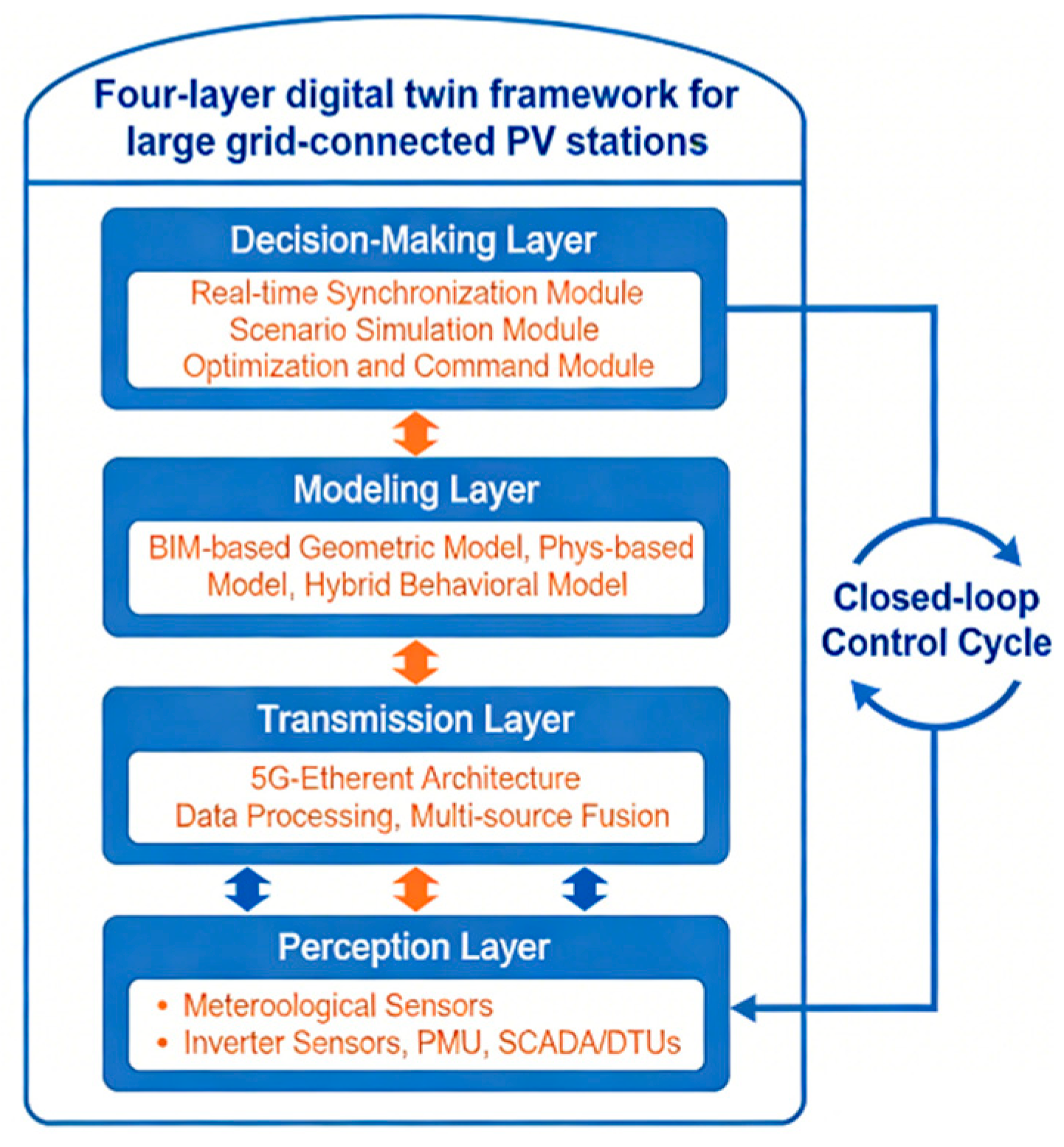
2.1. Digital Twin Framework and Multi-Source Data Processing
- (1)
- a Real-time Synchronization Module that continuously calibrates the digital model using preprocessed measurements;
- (2)
- a Scenario Simulation Module that performs short-horizon predictive analyses under anticipated disturbances; and
- (3)
- an Optimization and Command Module that solves the Volt/VAR optimization problem and dispatches optimal setpoints to PV inverters, OLTCs, and capacitor banks. This closed-loop architecture ensures that optimization decisions remain consistent with the evolving physical system states, thereby avoiding control obsolescence.
2.2. Dynamic Modeling and Real-Time Simulation
2.3. Optimization Model with Explicit Stability Constraints
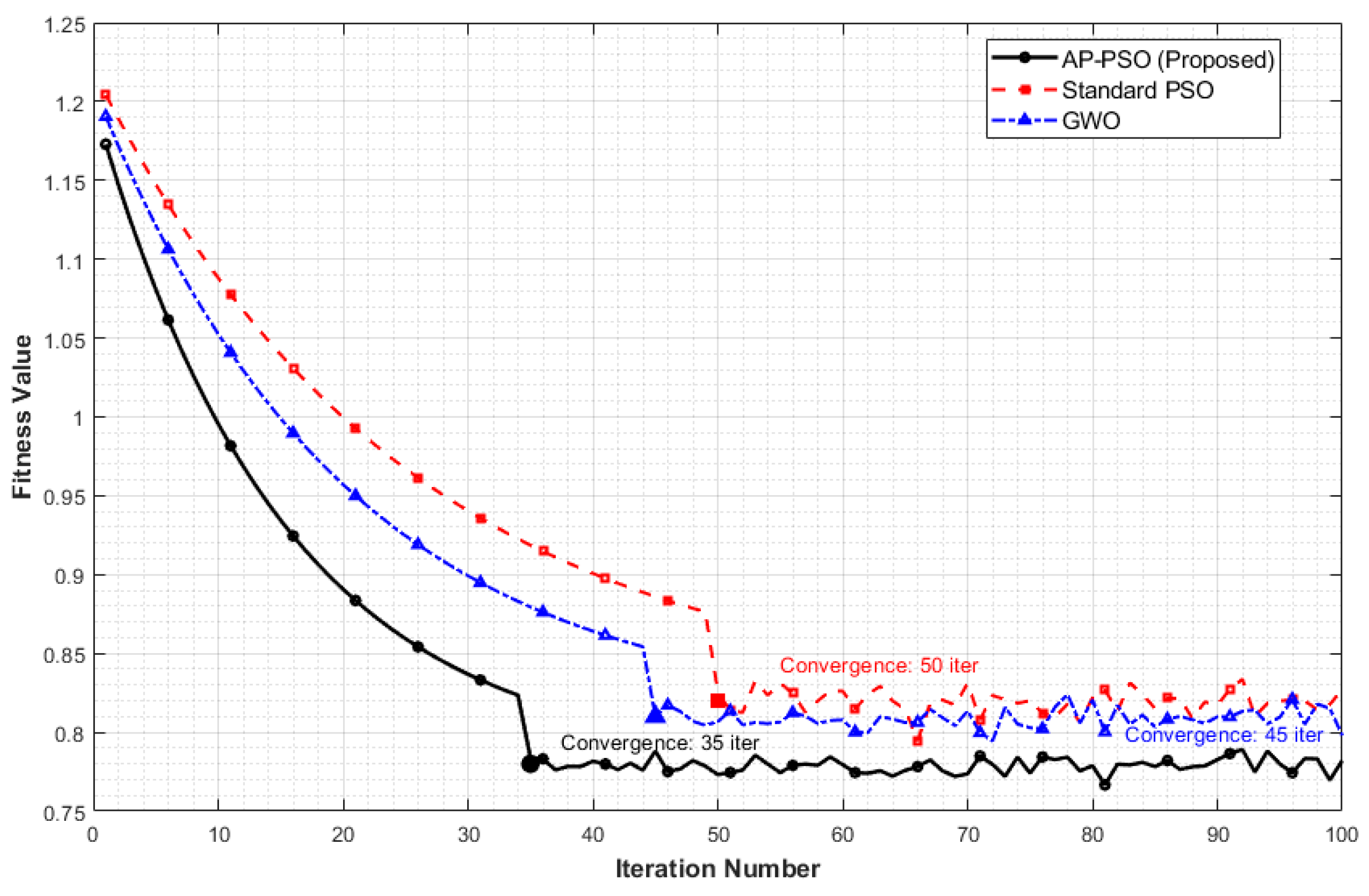
2.4. Adaptive Parameter Particle Swarm Optimization Algorithm
- (1)
- Initialize swarm (population = 50, random positions within bounds);
- (2)
- Evaluate fitness via the objective and penalty functions;
- (3)
- Update personal best () and global best () positions;
- (4)
- Adaptively adjust parameters ;
- (5)
- Update particle velocities and positions;
- (6)
- Repeat steps 2–5 until convergence or reaching iterations, then output the global optimal solution.
2.5. Validation Setup and Performance Metrics
2.5.1. Test System Configuration
2.5.2. Experimental Scenarios and Comparative Strategies
- (1)
- Steady Irradiance: Simulates clear-sky conditions with stable irradiance between 800 and 1000 W/m2.
- (2)
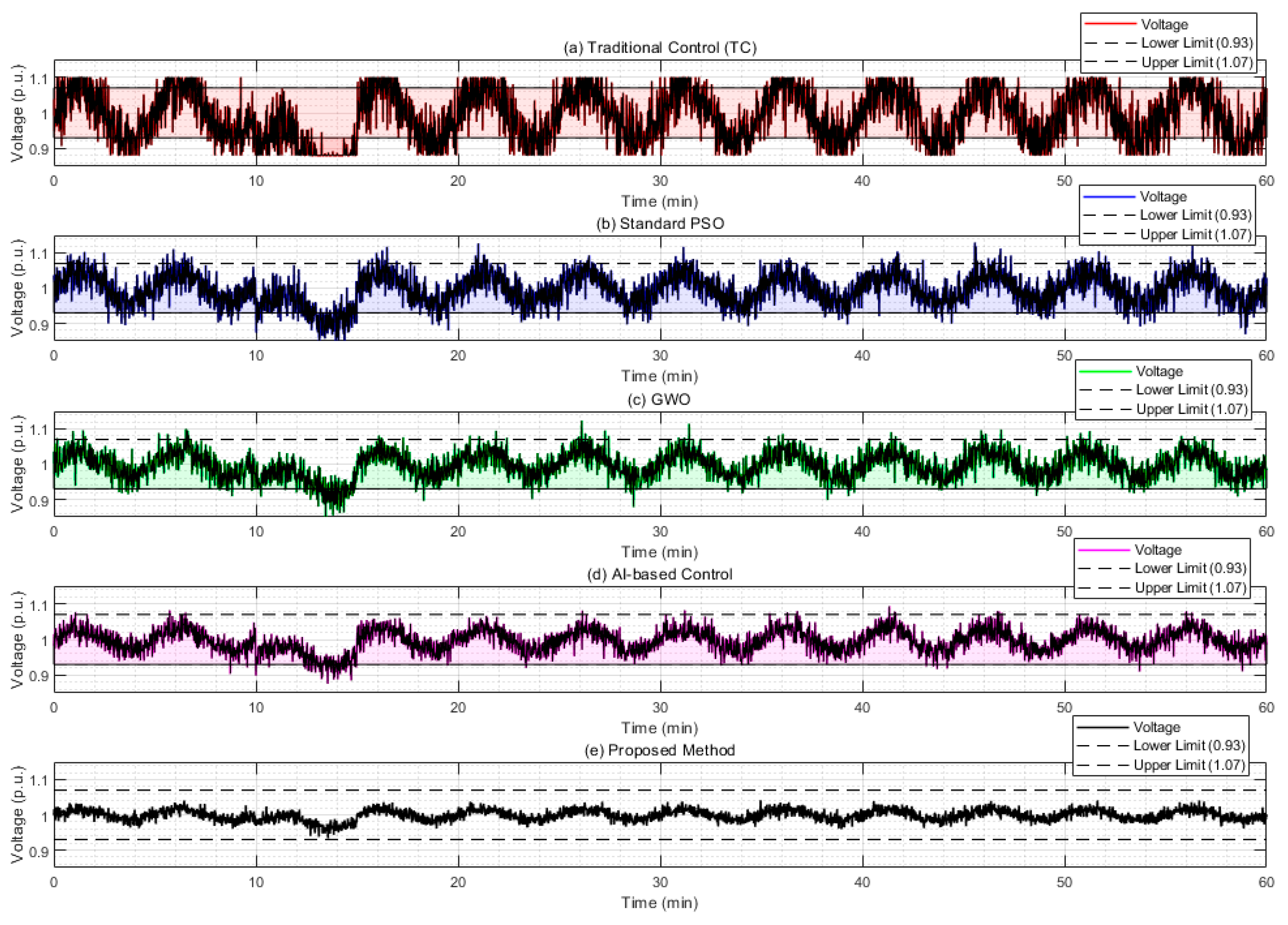
- Dynamic Irradiance: Introduces a cloud-transient event, modeling a 30% irradiance drop from 900 W/m2 to 630 W/m2 over a 5 min period.
- (3)
- High-Penetration: Evaluates system stress by increasing the PV installed capacity to 45 MW in the 33-bus system and 75 MW in the 53-bus system.
- (4)
- The proposed method is benchmarked against four representative control strategies:
- (5)
- Traditional Control (TC): A conventional industry strategy employing constant power factor control, fixed OLTC taps, and discrete capacitor switching.
- (6)
- Standard PSO: A static Volt/VAR optimization method utilizing a fixed-parameter PSO algorithm without DT support.
- (7)
- GWO-based Optimization: A static optimization approach using the Gray Wolf Optimizer, recognized for its performance in power system applications.
- (8)
- AI-based Control (AI): A data-driven strategy using an LSTM network for reactive power dispatch, devoid of explicit stability constraints.
2.5.3. Performance Metrics and Evaluation Standards
- (1)
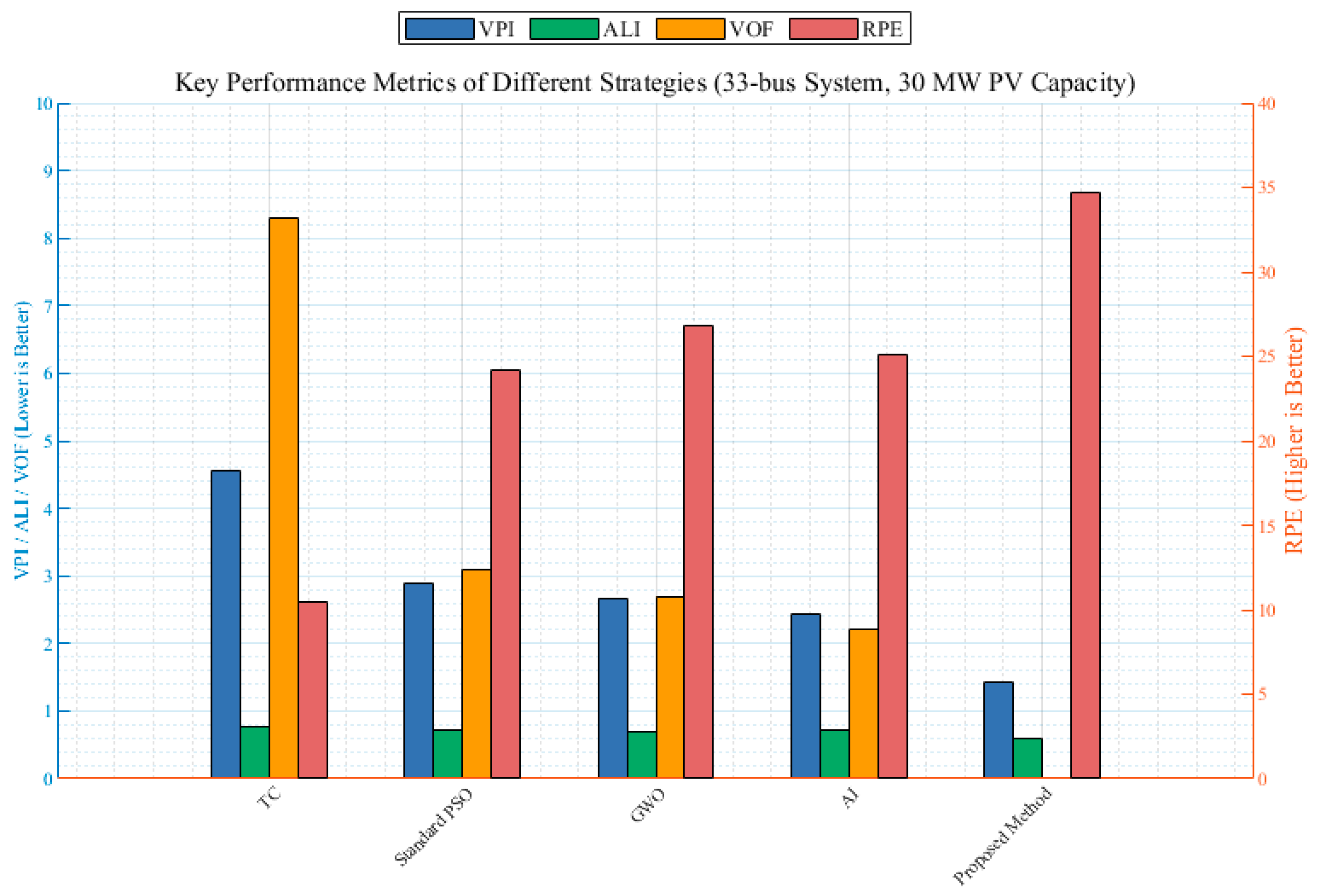
- Voltage Profile Index (VPI): Measures the average absolute voltage deviation across all system nodes, expressed as a percentage. Lower values indicate superior voltage regulation:
- (2)
- Average L-Index (ALI): The mean value of the nodal voltage stability L-indices, serving as a direct indicator of the system-wide proximity to voltage collapse. A lower ALI denotes a greater stability margin.
- (3)
- Reactive Power Efficiency (RPE): Quantifies the effectiveness of reactive power utilization by calculating the percentage reduction in reactive power losses relative to the total reactive power input.
- (4)
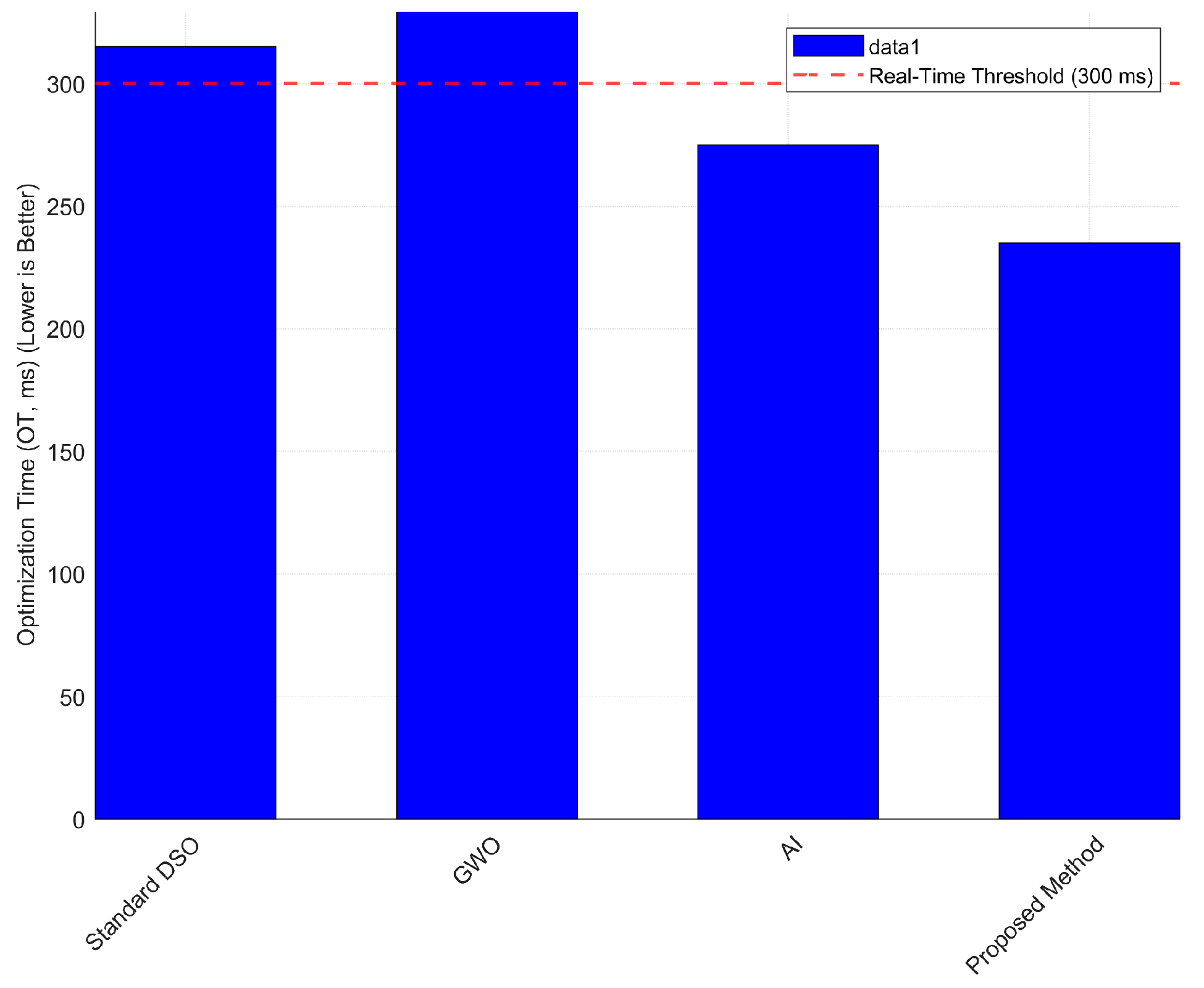
- Optimization Time (OT): Quantifies the effectiveness of reactive power utilization by calculating the percentage reduction in reactive power losses relative to the total reactive power input.
3. Results and Analysis
3.1. Voltage Quality and Static Voltage Stability
3.2. Reactive Power Efficiency and Real-Time Performance
3.2.1. Real-Time Performance
3.2.2. Impact of Reactive Compensation Device Combination
3.3. Scalability and Robustness
3.3.1. Scalability to Large-Scale PV Stations
3.3.2. Robustness to Uncertainties
3.3.3. Algorithm Comparison
3.4. Ablation Study and Component Contribution Analysis
- (1)
- DT–AP-PSO (Proposed Method): the complete framework including data quality control, adaptive hybrid modeling, and real-time DT synchronization;
- (2)
- DT without Data Quality Control: removing LSTM-based missing data reconstruction, Dempster–Shafer fusion, and isolation forest-based anomaly detection, while retaining DT synchronization and optimization;
- (3)
- DT without Adaptive Modeling: disabling GRU-based parameter correction and using fixed physical model parameters;
- (4)
- Static Optimization without DT: applying AP-PSO on a static network model without real-time digital twin synchronization.
4. Discussion
5. Conclusions
Author Contributions
Funding
Data Availability Statement
Conflicts of Interest
Abbreviations
| PV | Photovoltaic |
| DT | Digital Twin |
| AP-PSO | Adaptive Parameter Particle Swarm Optimization |
| OLTC | On-Load Tap Changer |
| CBs | Capacitor Banks |
| PVGUs | PV Generation Units |
| VPI | Voltage Profile Index |
| ALI | Average L-Index |
| RPE | Reactive Power Efficiency |
| OT | Optimization Time |
| PMU | Phasor Measurement Unit |
| SCADA | Supervisory Control and Data Acquisition |
| BIM | Building Information Modeling |
| GRU | Gated Recurrent Unit |
| HIL | Hardware-in-the-Loop |
| SVG | Static Var Generator |
| SVC | Static Var Compensator |
References
- Li, Y. Modeling and Stability Analysis of Microgrids Integrated with Power-Electronics-Interfaced Distributed Energy Resources. In Energy Materials Science and Engineering: From New Devices to AI Power Systems; Springer Nature: Cham, Switzerland, 2025; pp. 255–276. [Google Scholar]
- Ryan, L.; Dillon, J.; La Monaca, S.; Mueller, S.; Schifflechner, S.; Schiller, J.; Bertsch, V. Assessing the system and investor value of utility-scale solar PV. Renew. Sustain. Energy Rev. 2016, 64, 506–517. [Google Scholar] [CrossRef]
- Aziz, S.; Ahmed, I.; Khan, K.; Alotaibi, M.A.; Malik, S.A.; Khan, I.A.; Hussain, S.; Darwish, M.M.F. Emerging trends and approaches for designing net-zero low-carbon integrated energy networks: A review of current practices. Arab. J. Sci. Eng. 2024, 49, 6163–6185. [Google Scholar] [CrossRef]
- He, C.; Geng, H.; Rajashekara, K.; Lin, X.; Sun, H.; Wu, W.; Ma, J.; Yang, G. Analysis and control of frequency stability in low-inertia power systems: A review. IEEE/CAA. J. Autom. Sin. 2024, 11, 2363–2383. [Google Scholar] [CrossRef]
- Huang, Y.; Wang, D.; Shang, L.; Yuan, X.; Chi, Y.; Hu, J. Modeling and stability analysis of DC-link voltage control in multi-VSCs with integrated to weak grid. IEEE Trans. Energy Convers. 2017, 32, 1127–1138. [Google Scholar] [CrossRef]
- Li, P.; Wang, Y.; Liu, Y.; Han, Z.; Wang, X.; Wang, H.; Wu, G. Impedance modeling and mechanism analysis of low-frequency oscillations in single-phase MMC-RPC integrated vehicle-grid coupling system. IEEE Trans. Power Electron. 2023, 38, 4820–4839. [Google Scholar] [CrossRef]
- Kalanithi, K.; Samuel, G.G.; Malathi, M.; Sathyaseelan, M. Adaptive Model Predictive Control for Solar Thermal Systems Under Dynamic Conditions. Iran. J. Sci. Technol. Trans. Electr. Eng. 2025, 49, 1–22. [Google Scholar] [CrossRef]
- Alzahrani, S.; Shah, R.; Mithulananthan, N. Examination of effective VAr with respect to dynamic voltage stability in renewable rich power grids. IEEE Access 2021, 9, 75494–75508. [Google Scholar] [CrossRef]
- Kommey, B.; Tamakloe, E.; Adom-Bamfi, G. An alternative design and implementation of a solid state on-load tap changer. J. Mechatron. Electr. Power Veh. Technol. 2021, 12, 104–109. [Google Scholar] [CrossRef]
- Dai, Y.; Noebels, M.; Preece, R.; Panteli, M. Risk assessment and mitigation of cascading failures using critical line sensitivities. IEEE Trans. Power Syst. 2023, 39, 3937–3948. [Google Scholar] [CrossRef]
- Ahmed, E.E.E.; Demirci, A.; Poyrazoglu, G.; Terzija, V. An equitable active power curtailment framework for overvoltage mitigation in PV-rich active distribution networks. IEEE Trans. Sustain. Energy 2024, 15, 2745–2757. [Google Scholar] [CrossRef]
- Fang, Y.; Qu, J.; Pong, B.M.H.; Lu, J.; Liu, C. Quasi-static modeling and optimization of two-layer PCB resonators in wireless power transfer systems for 110-kV power grid online monitoring equipment. IEEE Trans. Ind. Electron. 2021, 69, 1400–1410. [Google Scholar] [CrossRef]
- Ghosal, M.; Vallem, M.; Nguyen, Q.H.; Vungarala, J.K.; Wu, D.; Zhang, X.; Ke, X.; Huang, R.; Fan, R.; Du, W. Real-time simulation of coordinated sub-transmission volt-var control tool under high distributed PV penetration. In Proceedings of the 2020 IEEE Power & Energy Society Innovative Smart Grid Technologies Conference (ISGT), Washington, DC, USA, 17–20 February 2020; pp. 1–5. [Google Scholar]
- Jia, Z.; Yu, D.; Wang, Z.; Wu, N.; Wang, S. Complex network optimization for fixed-time continuous action iteration dilemma by using reinforcement learning. IEEE Trans. Netw. Sci. Eng. 2024, 11, 3771–3781. [Google Scholar] [CrossRef]
- Djenouri, D.; Bagaa, M. Synchronization protocols and implementation issues in wireless sensor networks: A review. IEEE Syst. J. 2014, 10, 617–627. [Google Scholar] [CrossRef]
- Jafari, R.; Refaat, S.S.; Paykani, A.; Kouzani, A.Z.; Mahmud, M.A. Reinforcement Learning for Torque Vectoring in Electric Vehicles: A Review of Stability-Oriented Control and Energy Optimization Techniques. IEEE Open J. Veh. Technol. 2025, 7, 354–380. [Google Scholar] [CrossRef]
- Al-Hchaimi, A.A.J.; Hussien, N.A.; Muhsen, Y.R.; Al-Mansoori, S. Enhancing Cybersecurity in Cyber-Physical Systems: An Explainable AI Approach for Intrusion Detection. In Proceedings of the 2025 5th International Conference on Emerging Smart Technologies and Applications (eSmarTA), Ibb, Yemen, 5–6 August 2025; pp. 1–8. [Google Scholar]
- Alvarez-Alvarado, M.S.; Donaldson, D.L.; Recalde, A.A.; Jimenez-Estevez, G.A.; Ault, G.W.; Shafiee, M. Power system reliability and maintenance evolution: A critical review and future perspectives. IEEE Access 2022, 10, 51922–51950. [Google Scholar] [CrossRef]
- Bâra, A.; Oprea, S.-V. Enabling coordination in energy communities: A Digital Twin model. Energy Policy 2024, 184, 113910. [Google Scholar] [CrossRef]
- Onggo, B.S.; Corlu, C.G.; Juan, A.A.; Monks, T.; de la Torre, R. Combining symbiotic simulation systems with enterprise data storage systems for real-time decision-making. Enterp. Inf. Syst. 2021, 15, 230–247. [Google Scholar] [CrossRef]
- Rana, S. AI-driven fault detection and predictive maintenance in electrical power systems: A systematic review of data-driven approaches, digital twins, and self-healing grids. Am. J. Adv. Technol. Eng. Solut. 2025, 1, 258–289. [Google Scholar] [CrossRef]
- Pan, Y.H.; Qu, T.; Wu, N.Q.; Yang, H.; Guo, H.Z.; Li, S.D.; Huang, G.Q. Digital twin based real-time production logistics synchronization system in a multi-level computing architecture. J. Manuf. Syst. 2021, 58, 246–260. [Google Scholar] [CrossRef]
- Krishnaveni, S.; Chen, T.M.; Sathiyanarayanan, M.; Chokkalingam, B.; Mihet-Popa, L. CyberDefender: An integrated intelligent defense framework for digital-twin-based industrial cyber-physical systems. Clust. Comput. 2024, 27, 7273–7306. [Google Scholar] [CrossRef]
- Alayande, A.S.; Hassan, A.O.; Olobaniyi, F. L-Index-Based Technique for Voltage Collapse Prediction and Voltage Stability Enhancement in Electrical Power Systems. ABUAD J. Eng. Res. Dev. 2024, 7, 260–277. [Google Scholar] [CrossRef]
- Goldstein, A.; Maragal, D. Synchrophasor measurement system industry standards and guidance: A comprehensive overview. IEEE Trans. Power Deliv. 2024, 39, 1687–1696. [Google Scholar] [CrossRef]
- Ji, Y.; Li, D.; Yuan, G.; Wang, Z.; Zhao, Y.; Li, Y. Noise reduction of time domain electromagnetic data: Application of a combined wavelet denoising method. Radio Sci. 2016, 51, 680–689. [Google Scholar] [CrossRef]
- Zhou, Y.; Wang, S.; Wu, T.; Guan, J. For-backward LSTM-based missing data reconstruction for time-series Landsat images. GIScience Remote Sens. 2022, 59, 410–430. [Google Scholar] [CrossRef]
- Alonso, S.; Morán, A.; Pérez, D.; García-Olalla, O.; Benítez-Sánchez, R.K.; Fernández, C. Gap imputation in related multivariate time series through recurrent neural network-based denoising autoencoder. Integr. Comput.-Aided Eng. 2024, 31, 157–172. [Google Scholar] [CrossRef]
- Sun, X.; Zeng, P. A DS Evidence Theory-Based Method for Multi-Source Information Fusion in Advanced Systems: Synergistic Intelligence. In Proceedings of the 2024 4th International Conference on Big Data, Artificial Intelligence and Risk Management, Chengdu, China, 15–17 November 2024; pp. 503–508. [Google Scholar]
- Xiao, F.; Wen, J.; Pedrycz, W. Complex evidence theory for multisource data fusion. Chin. J. Inf. Fusion 2024, 1, 134–159. [Google Scholar] [CrossRef]
- Xu, H.; Pang, G.; Wang, Y.; Cao, B. Deep isolation forest for anomaly detection. IEEE Trans. Knowl. Data Eng. 2023, 35, 12591–12604. [Google Scholar] [CrossRef]
- Jo, H.; Lee, J.K.; Lee, Y.C.; Lee, J.S.; Shin, J.W. Generative artificial intelligence and building design: Early photorealistic render visualization of façades using local identity-trained models. J. Comput. Des. Eng. 2024, 11, 85–105. [Google Scholar] [CrossRef]
- Ramasubramanian, D.; Yu, L.; Cheng, Y.; Kim, J.H.; Tan, J.; Pourbeik, P.; Soni, H.; Fan, R.; Zhang, Y.; Kou, G.; et al. Techniques and Methods for Validation of Inverter-Based Resource Unit and Plant Simulation Models Across Multiple Simulation Domains: An Engineering Judgment-Based Approach. IEEE Power Energy Mag. 2024, 22, 55–65. [Google Scholar] [CrossRef]
- Jia, S.; Wang, X.; Xu, Y.J.; Liu, S.; Wang, L. A new data-driven model to predict monthly runoff at watershed scale: Insights from deep learning method applied in data-driven model. Water Resour. Manag. 2024, 38, 5179–5194. [Google Scholar] [CrossRef]
- Yang, N.; Yang, C.; Xing, C.; Ye, D.; Jia, J.; Chen, D.; Huang, Y.; Zhang, L.; Huang, B. Deep learning-based SCUC decision-making: An intelligent data-driven approach with self-learning capabilities. IET Gener. Transm. Distrib. 2022, 16, 629–640. [Google Scholar] [CrossRef]
- Azab, M. High performance decoupled active and reactive power control for three-phase grid-tied inverters using model predictive control. Prot. Control. Mod. Power Syst. 2021, 6, 1–19. [Google Scholar] [CrossRef]
- Sheikh, F.; Prokscha, A.; Batra, A.; Upadhyaya, G.S.; Hadidimoud, S.; Al-Sabbagh, M.N.; El-Sallabi, H.M.; Kaiser, T. Towards continuous real-time plant and insect monitoring by miniaturized THz systems. IEEE J. Microw. 2023, 3, 913–937. [Google Scholar] [CrossRef]
- Zhao, K.; Zhu, Y.; Tian, H.; Tang, J.; Wang, J. An L-index based static voltage stability support capability evaluation method for wind farms. In Proceedings of the 2024 9th Asia Conference on Power and Electrical Engineering (ACPEE), Shanghai, China, 11–13 April 2024; pp. 2331–2336. [Google Scholar]
- Phimtakhob, T.; Chayakulkheeree, K. Microgrid Voltage Stability Indices Improvement Using Particle Swarm Optimization. In Proceedings of the 2024 12th International Electrical Engineering Congress (iEECON), Pattaya, Thailand, 6–8 March 2024; pp. 1–6. [Google Scholar]
- Huang, B.; Wang, J. Applications of physics-informed neural networks in power systems-a review. IEEE Trans. Power Syst. 2022, 38, 572–588. [Google Scholar] [CrossRef]
- IEEE Standard 1547-2018; IEEE Standard for Interconnection and Interoperability of Distributed Energy Resources with Associated Electric Power Systems Interfaces. IEEE: New York, NY, USA, 2018.





| Strategy | VPI | ALI | VOF | RPE | OT |
|---|---|---|---|---|---|
| TC | 4.56 | 0.76 | 8.3 | 10.5 | - |
| Standard PSO | 2.89 | 0.71 | 3.1 | 24.2 | 315 |
| GWO | 2.67 | 0.69 | 2.7 | 26.8 | 330 |
| AI | 2.43 | 0.73 | 2.2 | 25.1 | 275 |
| Proposed Method | 1.42 | 0.60 | 0 | 34.7 | 230 |
| TC | 4.56 | 0.76 | 8.3 | 10.5 | - |
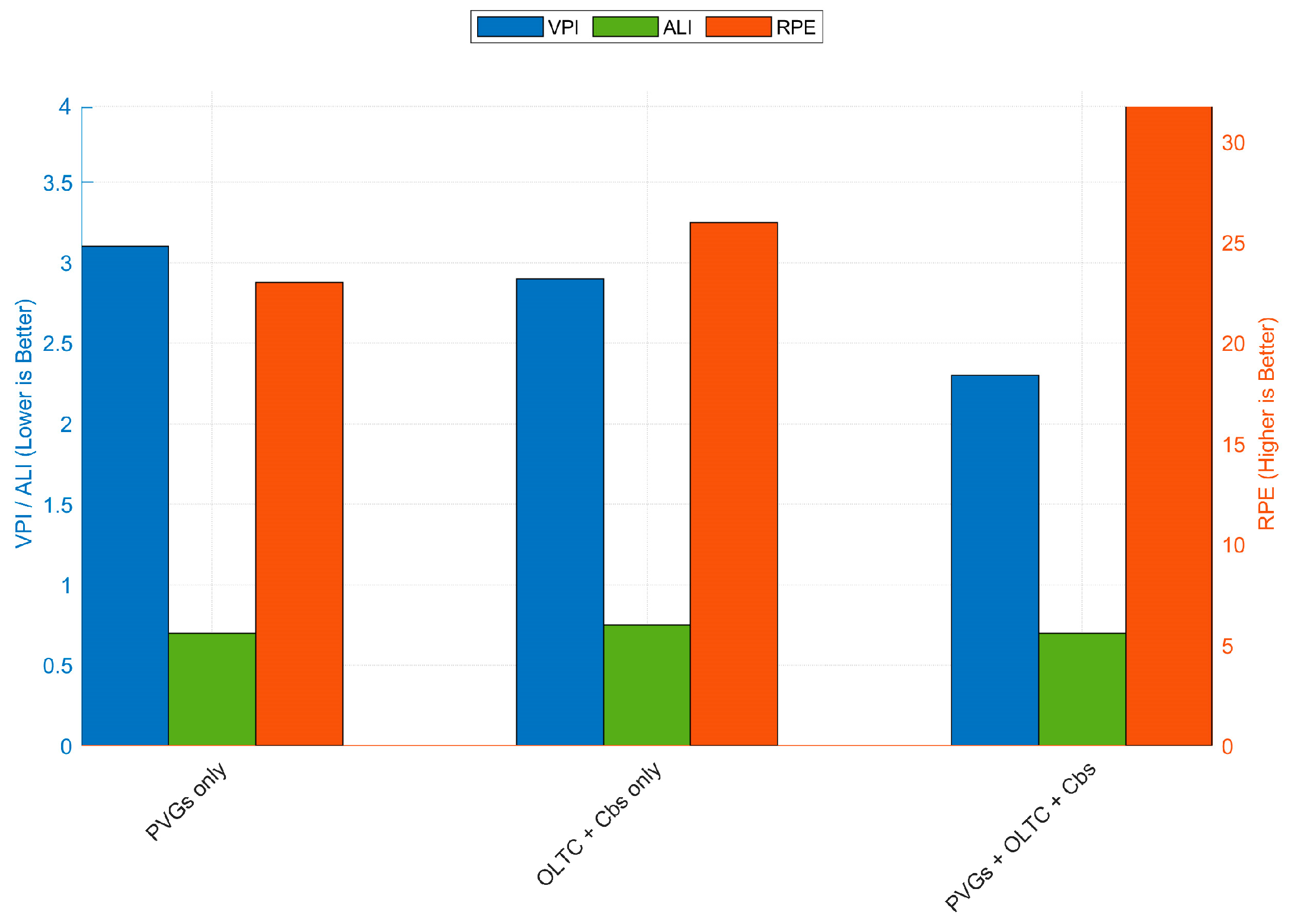
| Combination | VPI | ALI | RPE |
|---|---|---|---|
| PVGUs only | 3.12 | 0.68 | 22.3 |
| OLTC + CBs only | 2.87 | 0.72 | 25.6 |
| PVGUs + OLTC + CBs | 2.31 | 0.65 | 32.1 |
| Method | VPI | ALI | RPE | OT |
|---|---|---|---|---|
| Proposed Method | 1.42 | 0.6 | 34.7 | 230 |
| DT w/o Data Quality Control | 1.72 | 0.63 | 29.8 | 235 |
| DT w/o Adaptive Modeling | 1.59 | 0.71 | 31.2 | 232 |
| Static Optimization w/o DT | 1.92 | 0.74 | 27.6 | 290 |
Disclaimer/Publisher’s Note: The statements, opinions and data contained in all publications are solely those of the individual author(s) and contributor(s) and not of MDPI and/or the editor(s). MDPI and/or the editor(s) disclaim responsibility for any injury to people or property resulting from any ideas, methods, instructions or products referred to in the content. |
© 2026 by the authors. Licensee MDPI, Basel, Switzerland. This article is an open access article distributed under the terms and conditions of the Creative Commons Attribution (CC BY) license.
Share and Cite
Shi, Q.; Zhou, J. Digital Twin-Driven Dynamic Reactive Power and Voltage Optimization for Large Grid-Connected PV Stations. Electronics 2026, 15, 821. https://doi.org/10.3390/electronics15040821
Shi Q, Zhou J. Digital Twin-Driven Dynamic Reactive Power and Voltage Optimization for Large Grid-Connected PV Stations. Electronics. 2026; 15(4):821. https://doi.org/10.3390/electronics15040821
Chicago/Turabian StyleShi, Qianqian, and Jinghua Zhou. 2026. "Digital Twin-Driven Dynamic Reactive Power and Voltage Optimization for Large Grid-Connected PV Stations" Electronics 15, no. 4: 821. https://doi.org/10.3390/electronics15040821
APA StyleShi, Q., & Zhou, J. (2026). Digital Twin-Driven Dynamic Reactive Power and Voltage Optimization for Large Grid-Connected PV Stations. Electronics, 15(4), 821. https://doi.org/10.3390/electronics15040821