


Abstract
This paper presents an adaptive virtual oscillator control in coordination with an adaptive filter to mitigate subsynchronous oscillations in grid-forming converters caused by series compensation. Although series compensation enhances power transfer capability and transient stability margins, it can introduce subsynchronous resonance, leading to subsynchronous oscillations. Virtual oscillator control fed with set points is made dispatchable for grid-forming control to ensure the power-sharing, fast-synchronization, and subsynchronous oscillation damping capability of inverters. In this paper, taking advantage of power reserves in grid-forming operation, virtual oscillator control law is modified to dynamically change the set power point during low-resonance conditions to mitigate subsynchronous oscillations. Moreover, to overcome the limited damping capability of adaptive VOC during severe-resonance conditions, a coordinated adaptive adjustment of the grid-side filter inductance based on the modified power set point is designed. The IEEE’s first benchmark model is altered by integration with a 1000 MW grid-forming inverter in a MATLAB R2024b/Simulink environment. The previously proposed dispatchable virtual oscillator control and electronic-based FACT device, i.e., thyristor-controlled series capacitor, are implemented and analyzed under the same test system for the sake of comparison with the designed coordinated strategy. The simulation results are investigated in the time domain and frequency domain, and by calculating performance indices to verify the effectiveness of the proposed scheme. The overall analysis justifies the mitigated, low transient overshoot and high power quality of subsynchronous oscillations by using the designed strategy with varying compensation levels.
1. Introduction
Voltage source converters (VSCs), which serve as the primary components of power-electronic-based power systems, play a vital role in energy conversion and advanced control functions [1,2]. However, converters operating in grid-following (GFL) mode that rely on a phase-locked loop (PLL) for grid synchronization can become prone to oscillations when operating in weak-grid conditions [3]. This approach involves the inverters estimating the existing stable grid frequency and adjusting their injected current to match pre-determined power set points [3]. In converter-dominant grids, traditional control strategies become inadequate for maintaining stability and synchronization due to lack of inertia. To address this issue and achieve a stable inverter-based grid, grid-forming control methods have been proposed [4,5]. A grid-forming inverter goes beyond merely tracking power; it functions as a controlled voltage source capable of adjusting its power output through storage or curtailment and can contribute to enhancing grid stability [6]. With the integration of renewable generation and grid-forming control, parts of the grid can operate independently if necessary, maintaining synchronization and load sharing.
The traditional GFM control scheme focuses on droop control due to its simple implementation and backward compatibility, making it a desirable solution recognized by utilities and practitioners [7]. However, the associated phasor models are accurately defined only when operating near the synchronous steady state [8]. Recent advances in GFM control have introduced virtual oscillator control (VOC) as a promising alternative to droop and machine-emulation schemes [9,10]. VOC synchronizes power converters through the natural synchronization behavior of nonlinear oscillators, allowing decentralized coordination without explicit grid voltage measurements or phase-locked loops. This enables inherently fast-synchronization, damped, and robust performance under weak-grid and unbalanced conditions. However, the basic VOC primarily aims for self-synchronization rather than precise power dispatch, limiting its applicability in large-scale systems requiring coordinated active and reactive power sharing. To address this limitation, dispatchable virtual oscillator control has been developed, integrating droop-like steady-state power regulation within the oscillator dynamics. This approach preserves the strong synchronization and stability characteristics of VOC, making dispatchable VOC a practical and scalable candidate for grid-forming mode in converter-dominated grids [11,12].
Distributed energy resources (DERs) are strategically located based on the optimal power-generating environment, irrespective of proximity to customers. Thus, transmission to load hubs via transmission lines is required. As load demand increases, additional units must be installed, necessitating the expansion of the transmission network by adding extra lines. However, it is not cost-effective to install new units and transmission lines for only a marginal increase in load demand. An alternative, more effective strategy is to increase the power transfer capacity of existing transmission lines using fixed series compensation (FSC), which also strengthens transient stability margins [13]. Although FSC provides economic benefits, it is vulnerable to challenges such as subsynchronous resonance (SSR). SSR is caused by the interaction between the compensated line and the power source, leading to subsynchronous oscillations (SSOs) at frequencies below the system’s rated frequency.
Subsynchronous resonance (SSR) became a major focus of interest following its incidence in the southern Texas grid in 2009 [14]. Subsequently, subsynchronous oscillations (SSOs) were identified in Minnesota and Hebei, China, in 2012 [15,16]. More recently, Dominion Energy reported 22 Hz oscillations in RMS voltage related to a solar PV farm in the eastern U.S. in 2021 [17]. Following this, 7 Hz SSOs were detected in Australia’s West Murray Zone between 2015 and 2019, particularly under conditions of a weak system with high integration of DERs [18]. Research and analytical studies indicate that subsynchronous oscillations (SSOs) can arise from the induction-generator effect (IGE), interactions within control systems, or interactions between grid converters. The IGE arises in rotating machines when the rotor’s effective resistance falls below that of the network. This condition triggers subsynchronous oscillations (SSOs) at frequencies lower than the system’s nominal frequency [19]. In a grid energized by a static source, the grid-side converter (GSC) can exhibit capacitive reactance, resulting in negatively damped subsynchronous oscillations (SSOs). This effect is more pronounced in weak grids with high line inductance, leading to low resonance frequencies. When these frequencies coincide with any torsional modes or control system frequencies, the voltage source converter (VSC) can amplify the oscillations [13].
To counteract oscillations resulting from series compensation, a range of techniques have been developed. These techniques fall into two primary categories: flexible AC transmission systems (FACTS) and control-based strategies. FACTS methods employ power electronic devices like thyristor-controlled series capacitors (TCSCs), static synchronous compensators (STATCOMs), and gate-controlled series capacitors (GCSCs) [20,21,22]. While these methods effectively mitigate subsynchronous oscillations (SSOs), they can lead to low power quality due to electronic switching and are expensive [20]. Conversely, control-based schemes provide a more cost-effective solution but may result in less damping and longer settling times for SSOs associated with electrical variables compared to FACTS schemes.
A recently designed grid-forming scheme, i.e., virtual oscillator control (VOC) with dispatchability, exhibits improved dynamic performance and integrates an embedded droop control law that remains close to the steady state [23]. This leads to better voltage regulation compared to conventional droop control, while still maintaining load sharing capabilities. VOC is employed to regulate the converter’s output voltage by oscillating its fundamental harmonic and adjusting for phase and magnitude errors during dynamic conditions [24]. Traditional droop control and virtual oscillator control (VOC) have been studied and compared regarding small-signal stability, synchronization, and SSO damping capabilities [23,24,25]. Moreover, robust adaptive supplementary control for SSO damping and a review of virtual synchronous generators in terms of transient stability have been recently presented [26,27]. However, these control schemes relying on supplementary damping loops target transient stability and SSO damping without complete mitigation, designed for a traditional grid-following (GFL) mode of operation rather than GFM mode. The VOC can dampen SSO compared to traditional droop control schemes due to its fast synchronization capability in low-SSR conditions [23,24]. However, the complete mitigation of SSO and response in high-SSR conditions are not addressed. In this paper, the proposed adaptive VOC mitigates SSO effectively during low-SSR conditions, while in severe-SSR conditions, only adaptive VOC cannot hold the increased set power point for long and results in low-magnitude oscillations. Hence, additional adaptive filter modification is added in coordination with adaptive control law of VOC to address the limitation of adaptive VOC in cases of severe SSR or limited active power reserves. Beyond series-compensated lines, the proposed strategy is applicable to weak and converter-dominated power systems as justified by variation in compensation levels varying grid strength, including HVDC-connected AC grids and future low-inertia networks where resonance-related stability challenges are expected to increase.
The primary contributions and analysis techniques of this article are outlined as follows:
- The IEEE’s first benchmark model has been modified by using a GFM-controlled VSC instead of a traditional multi-mass flexible shaft. This modified system is used in MATLAB/Simulink to test the proposed GFM control strategy.
- Dispatchable VOC is modified by updating its control law adaptively depending upon the active power reserve to mitigate the SSOs caused by the series-compensated line.
- To address the limitation of power reserves in the case of severe-SSR conditions, an additional control, i.e., grid-side inductance of the filter, changes adaptively based on the same adaptively changing active set power point.
- Time-domain and frequency-domain simulations of the adaptive VOC in coordination with the adaptive filter are carried out to analyze the magnitude and specific frequency of SSO and are critically investigated by comparative analysis with previously presented VOC without any modification under low- and severe-SSR conditions. Additionally, the traditionally used thyristor-controlled series capacitor (TCSC) is also implemented under severe-SSO conditions to authenticate the efficient response of the proposed scheme.
- Total harmonic distortions (THDs) are calculated through the Fast Fourier Transform (FFT) tool in Matlab/Simulink to justify better power quality with the proposed scheme.
- Fundamental performance evaluation indices are computed for the mentioned control schemes to further validate the effectiveness of the designed scheme.
2. System Modeling
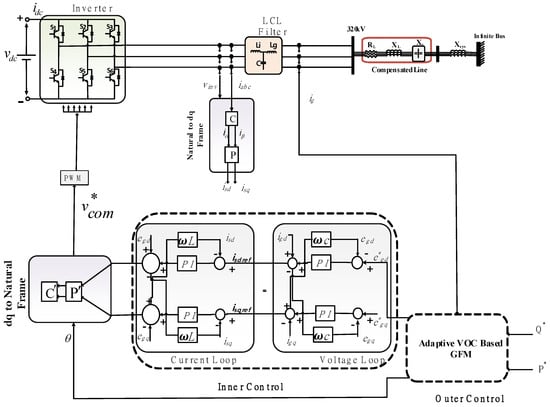
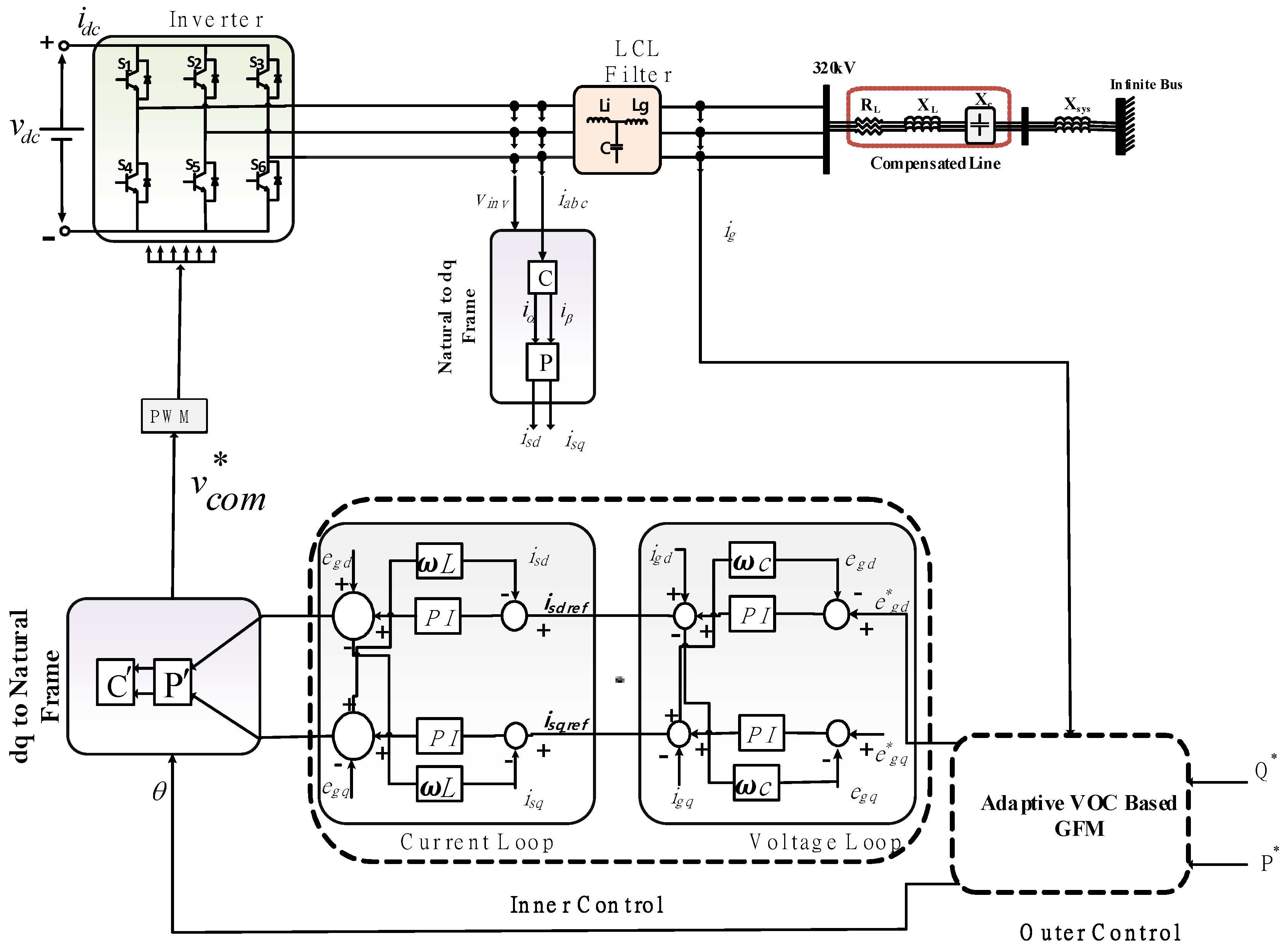
The trending developments in DERs predict a pure inverter-based energized electric network in the near future with GFM-controlled schemes. For the simulation of GFM-controlled IBRs, a MATLAB/Simulink model developed by the MIGRATE project is used in integration with the IEEE’s first benchmark model (IBM), which is susceptible to subsynchronous resonance (SSR) [28]. The adopted test system is incorporated with a two-level voltage source inverter with a power capacity of 1000 MW. Furthermore, the test system features a 640 V DC source that can be energized by renewable sources, an LCL filter, and GFM control mechanisms that incorporate dispatchable VOC law. The adaptive VOC-controlled VSC environment as a test system is used as shown in Figure 1. However, the proposed VOC modified by integration of an adaptive scheme is discussed and depicted in Figure 2 of Section 3. The adaptive GFM-controlled VSC is subsequently connected to an infinite grid via a 320 kV transmission line of 25 kilometers (km) with a line inductance of 0.955 mili Henry per km and capacitance of 100 micro Farad per km. The transmission line connecting the VSC to the infinite grid has been modified to include a series capacitor, allowing for the adjustment of its capacitance as a percentage of the overall system impedance.
Figure 1.
Modified IEEE first benchmark test system with GFM-controlled inverter.
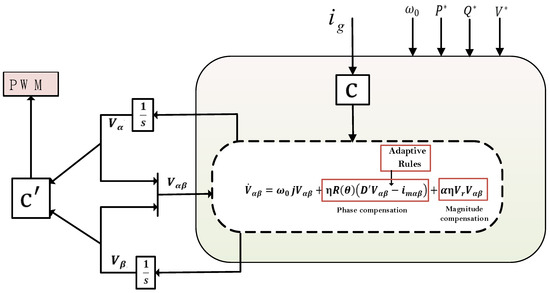
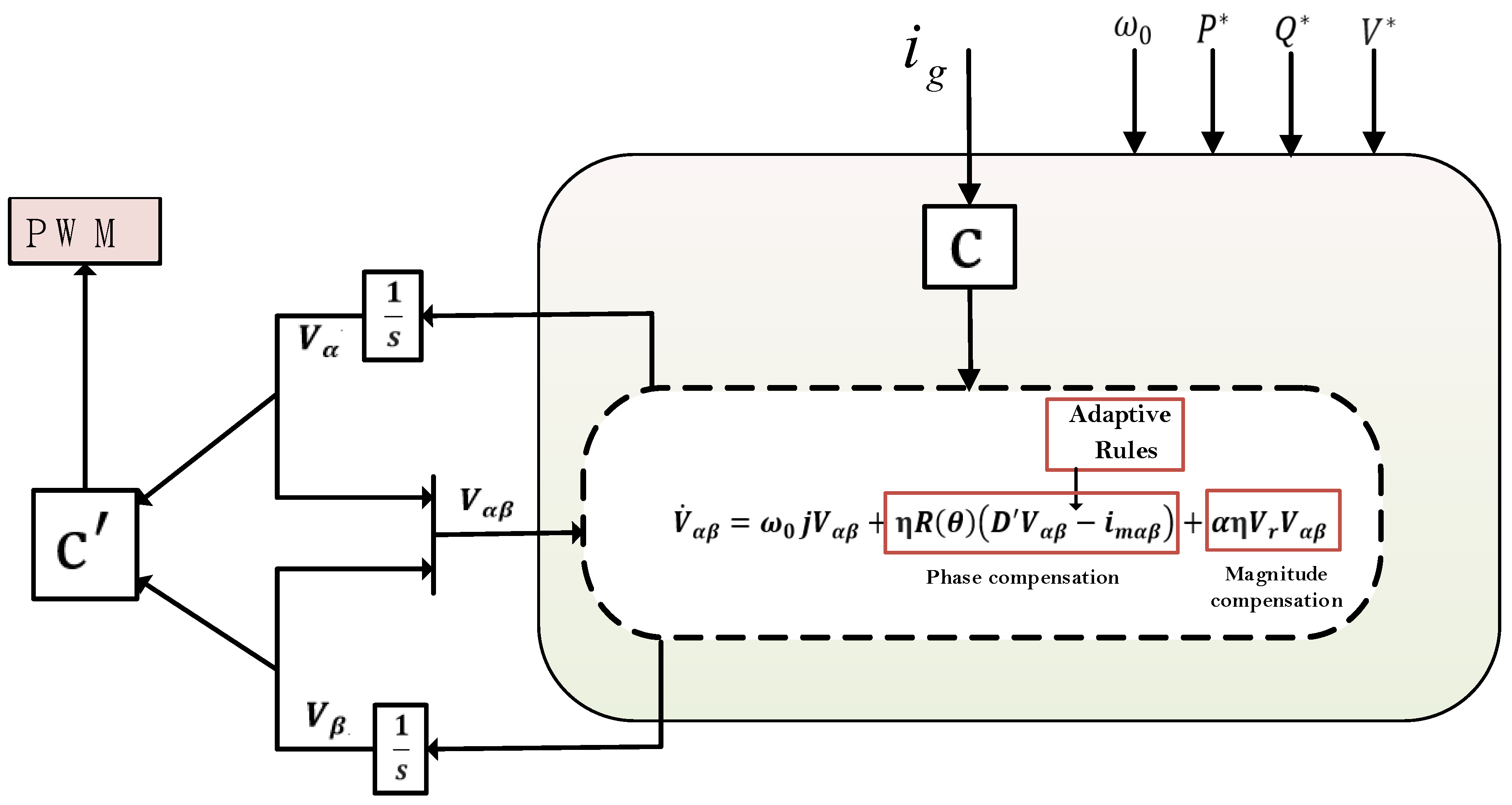
Figure 2.
Adaptive virtual oscillator controller.
The overall parameters of the test system are tabulated in Table A1 of Appendix A.
3. Grid-Forming VOC and Proposed Strategy
This section elaborates the working principle of dispatchable VOC, which is highly capable of synchronization and power sharing [29]. Proposed adaptive coordinated strategies are discussed subsequently.
The typical grid-forming structure comprises dual control blocks, i.e., outer and inner control blocks, as used in the test model of Figure 1, to achieve controlled pulse-width modulation (PWM) [30]. These control loops take the measured variables from the grid in the natural frame, i.e., abc frame, and carry out their control in the d-q frame, aiming for simple and fast processing. Such transformation is obtained through Clark’s and Park’s conversion formulations, as expressed in Equations (1) and (2).
The inner control block further consists of voltage and current control loops to obtain controlled and high-quality power. This aim is achieved by using proportional–integral (PI) controllers to make sure error is compensated for in both loops. The transfer function of the PI controller is characterized by the proportional and integral gains for the voltage and current loops, as specified in Equation (3) and Equation (4), respectively.
In Equations (3) and (4), the proportional gains for the voltage and current loops are represented by and , respectively. Similarly, and represent the integral gains for the voltage and current loops, respectively. These gains play a pivotal role in determining the control system’s performance, governing aspects such as power system stability, power tracking, and dynamic behavior.
These controlled variables in the dq frame are again transformed to the abc frame for pulse-width modulation (PWM) signal generation using inverse transform of Equations (3) and (4).
3.1. Design of Adaptive Virtual Oscullator (VOC) Controller
Traditionally used nonlinear virtual oscillators, such as the Vander Pol oscillator (VPO) and Dead-Zone Oscillators (DZOs), have the capacity to improve synchronization capabilities and provide equal power sharing for islanded grids [31]. However, there are restrictions on how they can be used in grid-connected operations. Mostly because of their structural characteristics, these methods are not inherently dispatchable [32]. This shortcoming is caused by the oscillators’ single input being the feedback of output current, with no other inputs to determine set points. As a result, these oscillators lack the ability to manage power during dynamical situations, acting similarly to a grid-following inverter. In [33], the virtual oscillator control (VOC) is designed to integrate dispatchability, since its control mechanism contains power set points that allow power system operators to establish power targets for individual inverters. Furthermore, it has been found that dispatchable virtual oscillator control functions like conventional oscillators when power set points are eliminated [34]. Figure 2 demonstrates the pattern of a proposed adaptive VOC for a three-phase inverter which modifies the power set values dynamically. Notably, dispatchable VOC is controlled by a mathematical equation that imitates a conventional oscillator instead of the physical elements of traditional oscillators (such as inductors and capacitors). Ref [35] offers a thorough understanding of this mathematical analysis that takes into account the prerequisites for attaining almost global asymptotic stability.
During the event of resonance, an increase in input active power provides damping of subsynchronous oscillation (SSO) [30,36]. Leveraging the reserved power of grid-forming-controlled resources to achieve equal power-sharing capability in parallel operation, the set active power point is controlled adaptively during SSO.
Hence, the fundamental VOC law is modified by adaptively changing the real power set point as in Equation (5).
The modified VOC in Equation (5) can be expressed in parts as follows:
(a). The first part of the control law represents the core aspect of the oscillator, which modulates a voltage signal based on the desired magnitude and the system’s angular frequency , defined as
Here, is the nominal angular frequency, j is the rotation matrix, which maintains the inverter output voltage, which equals in the steady state.
(b). The second part, i.e., phase compensation, is given as
This part uses power set points to reduce the phase error between the reference current and the inverter’s measured output current ‘’. The stability of the entire system is dependent on the synchronization gain ‘η’. The steps involved in obtaining this gain and are outlined in [37], as the virtual VOC has inherent droop characteristics, which can be analyzed by re-arranging the VOC law, i.e., Equation (5), in matrix form, depicted in Equation (8) below.
By comparing the term in Equation (8) with the right-hand side of Equation (5), we get the active power droop coefficient as , while by comparing the term in Equation (8) with Equation (5), we get the reactive power droop coefficient as . Hence, the value of synchronization gain “ and voltage gain “” can be determined based on the system’s nominal voltage and allowable drooping characteristics.
To establish the reference powers, which must satisfy the power-flow equations, the inverter operator needs information about line and angle set points. However, the inverter operator often does not have access to this data. Thus, utilizing a decentralized control strategy, as explained in [35], requires modifying the power flow while determining , which is influenced by the active power changing adaptively during SSO.
Expanding the term in Equation (7) with adaptive real power lends more clarity to the proposed control law, as given in Equation (9).
Here, is a modified rotation matrix during dynamic conditions:
Here, θ: = tan − 1(). So, depends on the inductance-to-resistance ratio ‘’ and reference values, along with set points. representing adaptive real power, is given as
whereas
is the real power required from the source during SSR events to mitigate SSO, which depends upon the measured power ‘’ during SSO. Furthermore, elaborating the working principle of the proposed adaptive scheme, Equation (11) can be expressed as
where is the set real power during the steady state. However, during SSO events, the absolute value of measured power increases and its magnitude depends upon the severity of SSO. So, the source power, i.e., , adjusts its value according to the magnitude of SSO in power.
(c). The third part, ‘Voltage magnitude compensation’, designed to compensate for the deviation between the desired magnitude and the measured voltage, is expressed as
Here, the productive gain represents the magnitude regulation, while is a voltage regulator and is expressed as
The shift from GFM to GFL operation can be provided by Equation (14), in addition to voltage regulation. The product of α and η can be adjusted in this scenario to change the operational mode. When αη = 0, GFM mode switches to GFL mode, as indicated in [34]. If there is no term in Equation (5) to sustain voltage in this scenario, the VSC cannot modify the source bus voltage without tracking grid variables.
3.2. Design of Adaptive Filter Inductance
During higher compensation levels, the SSO becomes unstable and distorted using VOC. In such a scenario, the adaptively changing set power point of VOC law fails to hold the updated set point due to limited power reserves to mitigate the high magnitude of SSO. As a result, low-magnitude SSO occurs even with adaptive VOC. To counteract this limitation, the grid-side inductance of the LCL filter is increased adaptively using a variable inductor controlled by the minimum value of change in set power.
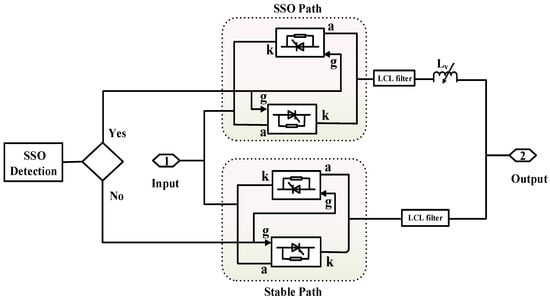
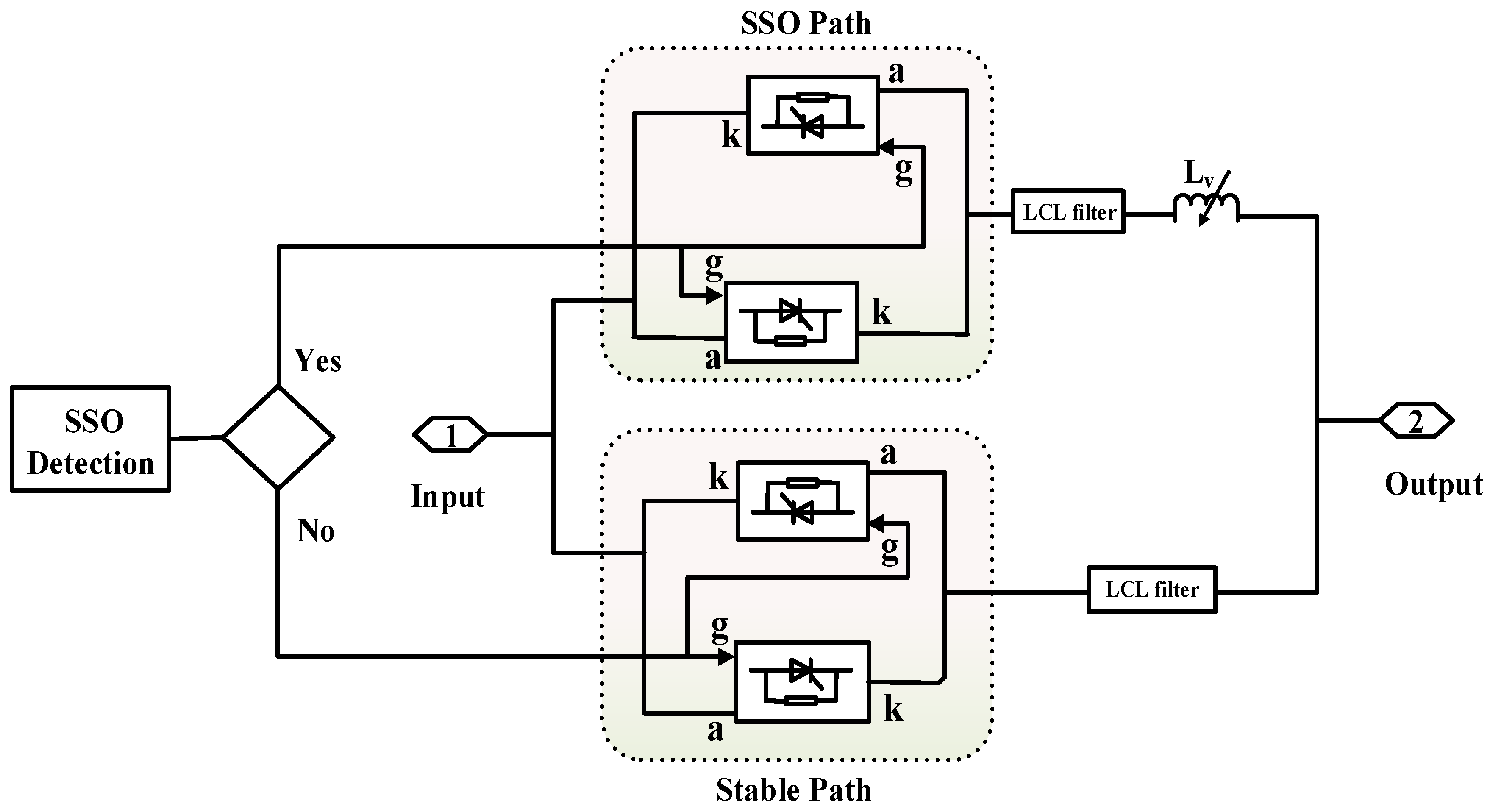
The variable inductance to the grid side is added through dual-path electronic-based switches operating alternatively through SSO detection by comparing the magnitude of active measured power (Pm) and the set point (Pset) per unit. The value of variable inductance (Lv) for an adaptive filter obtained by the difference in per-unit set and measured power is very low due to the low magnitude of SSO as compared to the designed filter inductance of the system. Meanwhile, during SSO mitigation by adaptive VOC, the circuit bypasses the adaptive filter and follows the system-designed normal filter, as shown in Figure 3. The adaptive grid-side inductance is designed as a discrete, event-triggered resonance-shaping mechanism, with its adjustment range and speed selected to shift the resonant frequency away from subsynchronous modes while avoiding interaction with inner control dynamics. Despite the added hardware complexity, the proposed adaptive inductance remains practically feasible due to its low-speed, event-triggered operation and per-unit scalability, making it suitable for mitigating severe SSOs beyond the capability of control-only approaches. The range of additional grid-side inductance varies between 6 mH and 8 mH depending upon the level of series compensation specific to this test model. The rated inductance of grid-side inductance is 66 mH, which shows that the range of additional inductance is approximately 9% to 12% of the rated value.
Figure 3.
Adaptive grid-side filter inductance strategy.
The parameters k, a, and g represent the cathode, anode, and gate of the thyristors operating antiparallel to conduct alternating current for stable and SSO paths. Meanwhile, the input and output are the connections at the source side and grid side.
4. Results and Discussion
The resilience of dispatchable VOC in minimizing SSO due to subsynchronous resonance was verified previously in comparison with other promising GFM control schemes [25]. However, to mitigate these oscillations, the previously used conventional VOC law is modified by including the proposed adaptive control strategy. Moreover, the limitation of the proposed adaptive VOC is identified and countered by the design of additional coordination of the adaptive filter. The SSO-prone IEEE first benchmark model modified via energizing through inverter-based distributed resources is tested by employing dispatchable VOC with and without adaptive strategies to analyze the SSO mitigation capability of the mentioned control schemes. Additionally, the conventionally used FACT device, i.e., thyristor-controlled series capacitor (TCSC), is used under severe-SSO condition, and its response is compared with the proposed coordinated strategy. For this analysis, MATLAB simulations are performed in the time domain to assess the mitigation of SSO and also in the frequency domain to evaluate the accurate SSO frequency and total harmonic distortions (THDs). Furthermore, a comparative analysis of these schemes is undertaken by assessing multiple error indices, such as the integral absolute error (IAE), integral square error (ISE), and integral time-weighted absolute error (ITAE). Series compensation is applied to the transmission line at 1 s during the simulation, with different compensation levels being considered. The following section presents detailed simulation results and three distinct performance evaluation techniques to assess the subsynchronous oscillation (SSO) mitigation capabilities of the proposed strategy, focusing on damping effectiveness, rapid settling time, and minimal overshoot response.
4.1. Analysis at Low Compensation Levels
The time-domain and frequency-domain analysis for the proposed adaptive VOC strategy is carried out with the aim of verifying its SSO mitigation capability and specific value of frequency. The SSO mitigation capability of adaptive VOC is examined at two different levels of compensation, as the severity of SSO is directly related to the compensation level, and compared with traditionally adopted VOC law.
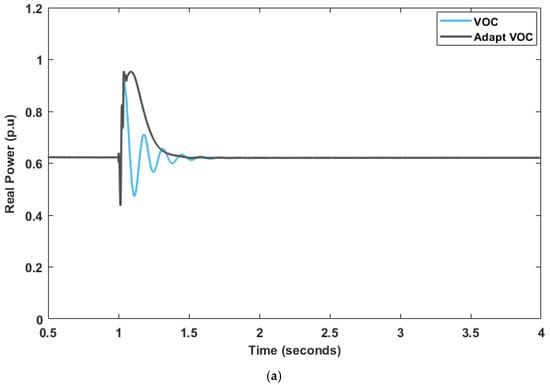
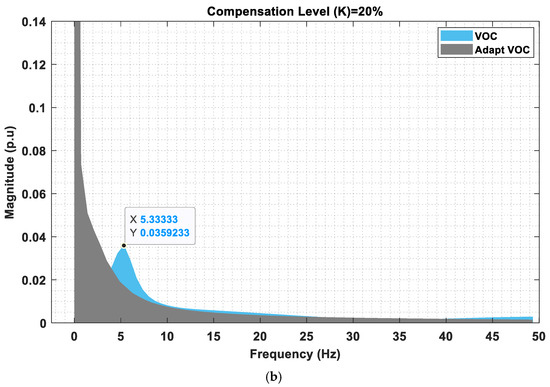
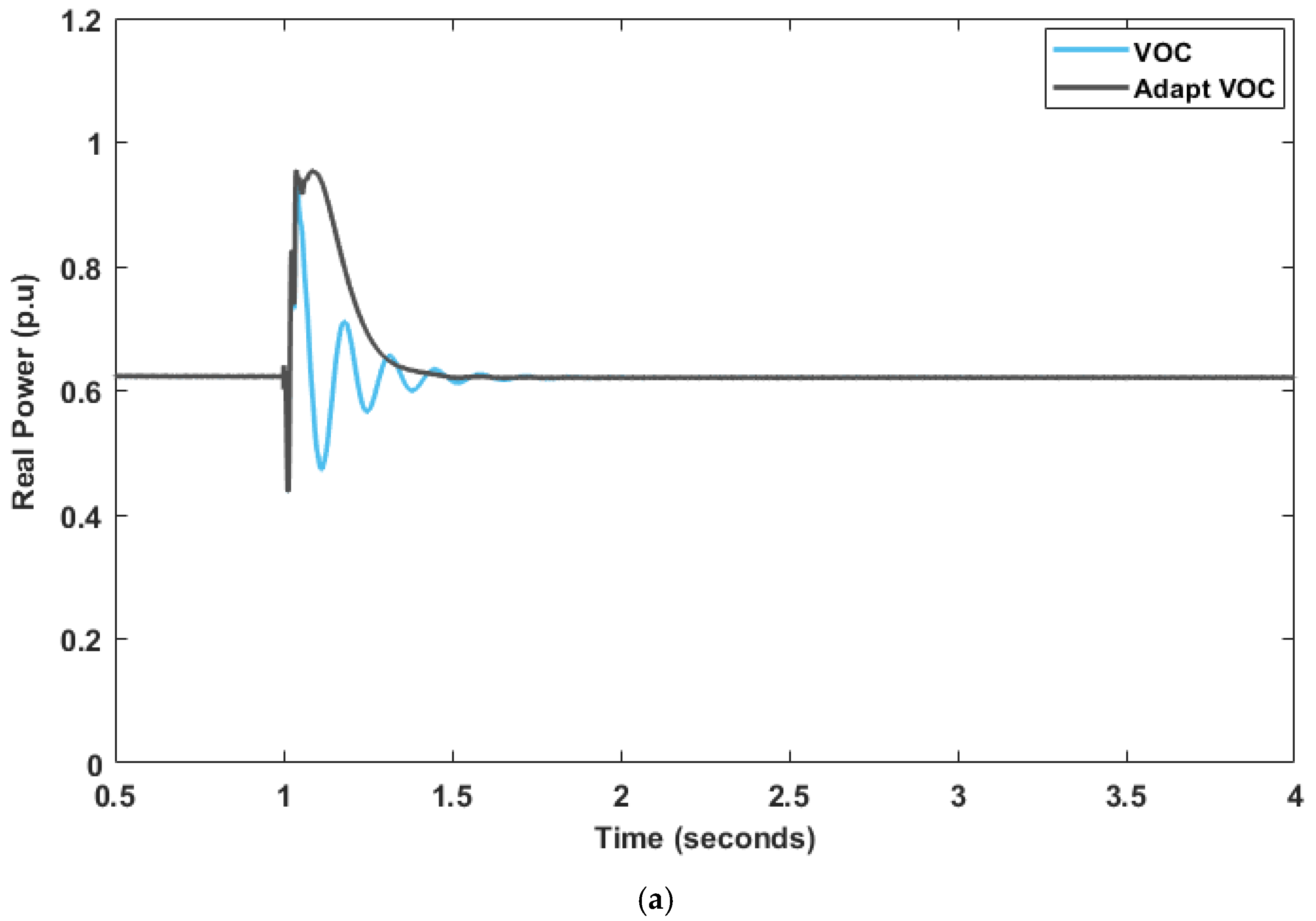
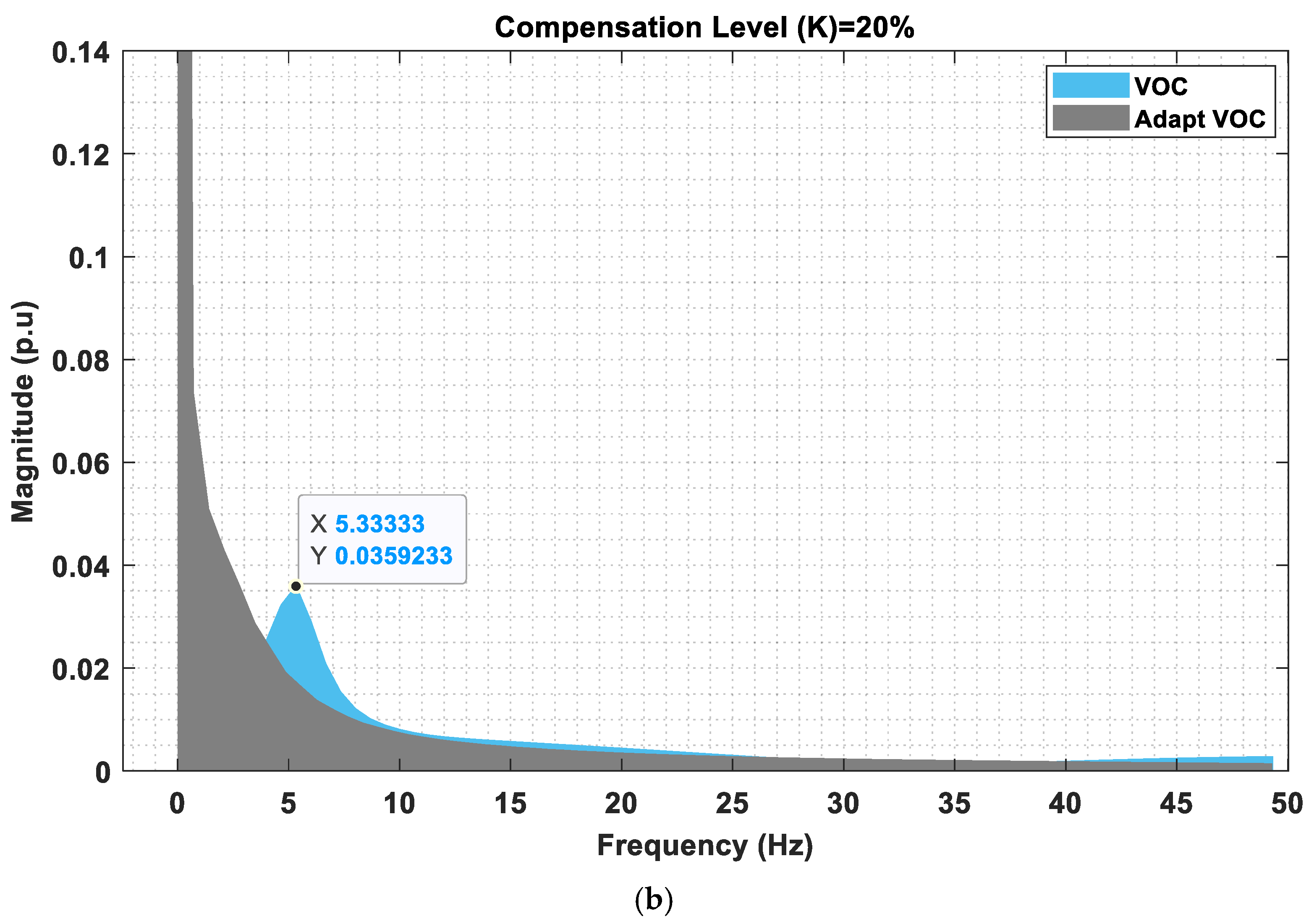
Considering the low level of compensation, i.e., 20% of the system impedance as shown in Figure 4, without the adaptive strategy, VOC shows damped SSO oscillating power for approximately three cycles. However, by including the adaptive scheme with VOC, the oscillatory response is mitigated due to the adaptive provision of reserved power according to the magnitude of SSO. Adaptive VOC maintains the adaptively increased set power point until approximately 0.3 s as the settling time, while for VOC, the settling time is 0.9 s and it is oscillatory in nature as depicted by the time-domain response in Figure 4a. Moreover, the magnitude and frequency of SSO are shown in Figure 4b to authenticate the time-domain response. The VOC responds at 5.333 Hz of SSO, while the adaptive VOC gives negligible magnitude at low frequency, showing the momentary increase in set power.
Figure 4.
Time-domain (a) and frequency-domain (b) response of SSO at 20% compensation level.
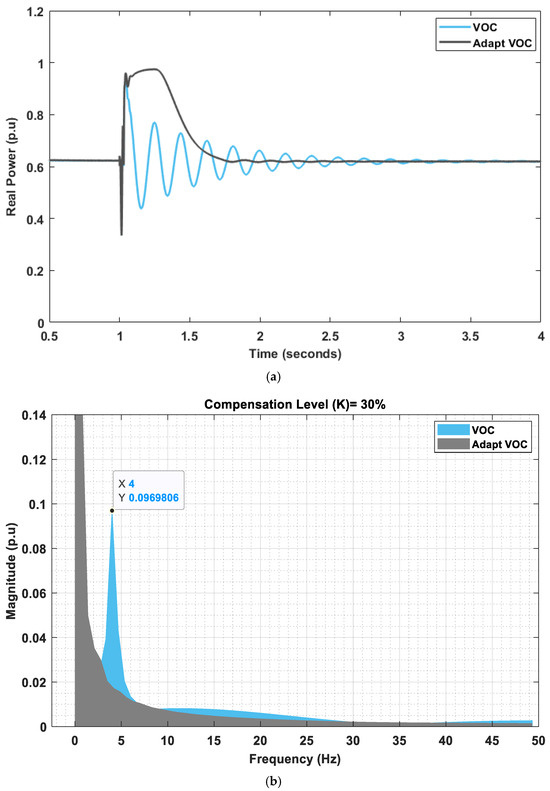
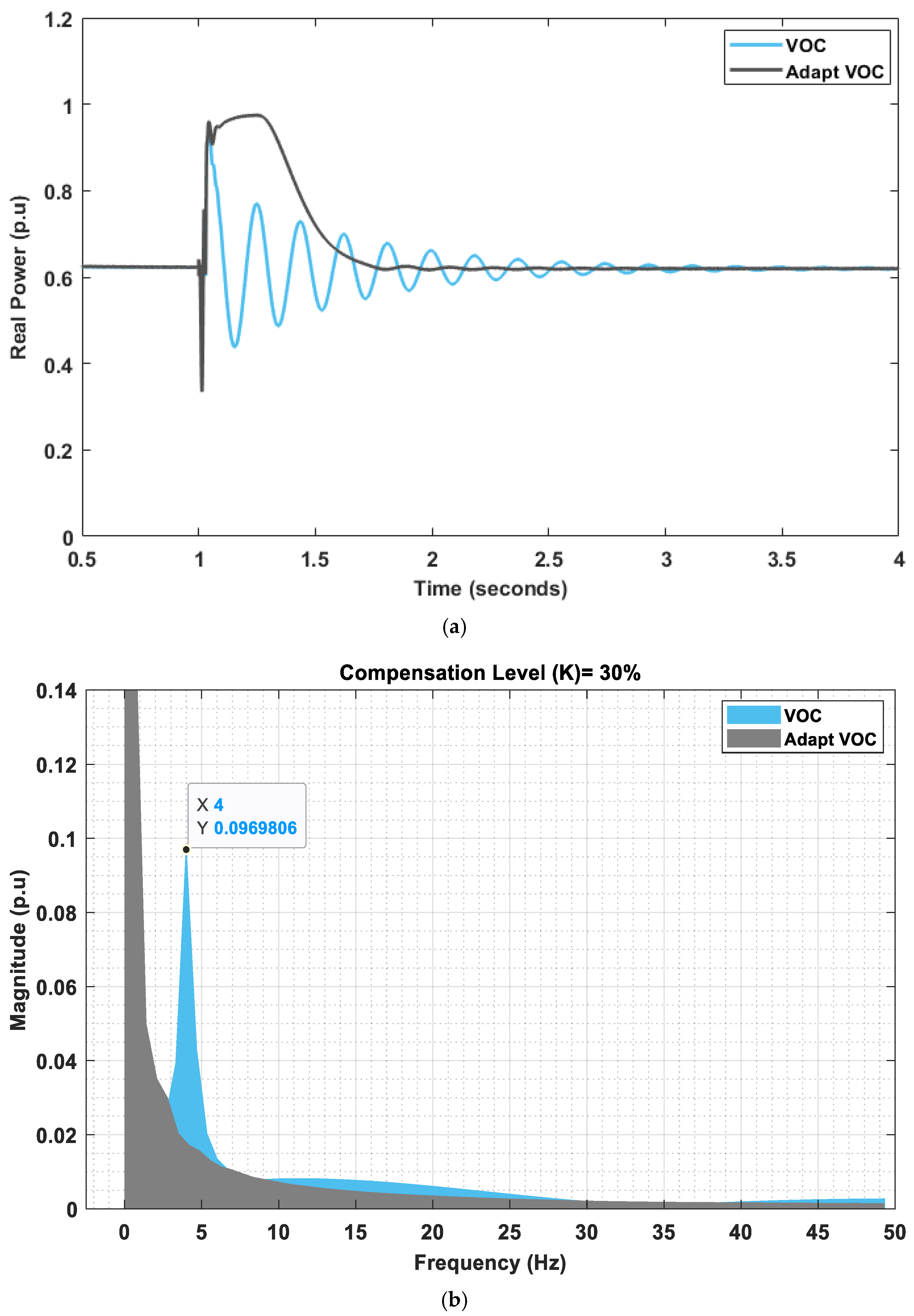
To elaborate the SSO mitigation capability of the proposed adaptive VOC more clearly, it is tested at 30% compensation levels, which also shows stable SSO. In the case of a 30% compensation level, time-domain analysis clearly depicts that the proposed adaptive VOC can mitigate the SSO effectively. As the compensation level is increased, the SSO magnitude is increased as compared to 20% compensation in Figure 4, causing the adaptive VOC to hold the set power point for a longer time adaptively to mitigate the SSO. It can be noted that without the adaptive scheme, the VOC results in decaying SSO loss at approximately 4 s of simulation time, as depicted in Figure 5a.
Figure 5.
Time-domain (a) and frequency-domain (b) response of SSO at 30% compensation level.
Frequency-domain analysis for a 30% compensation level, shown in Figure 5b, reveals the specific frequency of SSO, i.e., 4 Hz, with higher magnitude as compared to 20% compensation. Meanwhile, adaptive VOC can completely mitigate SSO with a high magnitude at very low frequency, proving that it maintains the adaptively changed set power point for a longer time.
The additional energy required for SSO damping is proportional to the area under the adaptive power deviation curve and remains bounded due to the per-unit formulation of the adaptive VOC. At lower compensation levels, the rapid decay of subsynchronous oscillations results in a smaller area under the adaptive power deviation curve, indicating a lower energy requirement, as depicted in Figure 4. As the compensation level increases, oscillation decay becomes slower, increasing the cumulative energy demand despite the bounded power magnitude, as shown in Figure 5. This trend explains the progressive energy burden on adaptive VOC with increasing compensation.
4.2. Analysis at Higher Compensation Levels
The simulation response of VOC and adaptive VOC is determined at higher compensation levels to analyze the effectiveness of the proposed adaptive VOC under sustained- and unstable (distorted)-SSO conditions. To aid such analysis, simulations are carried out at higher compensation levels, i.e., 35% and 40%. It is found that the SSO mitigation capability of adaptive VOC is compromised under severe-SSO conditions due to the limited power reserves to completely mitigate SSO. Under severe compensation levels, the prolonged duration of oscillations significantly increases the cumulative energy demand, exceeding the practical power reserve of adaptive VOC. The proposed adaptive inductance mitigates SSOs by reshaping system resonance, thereby eliminating the need for additional energy injection.
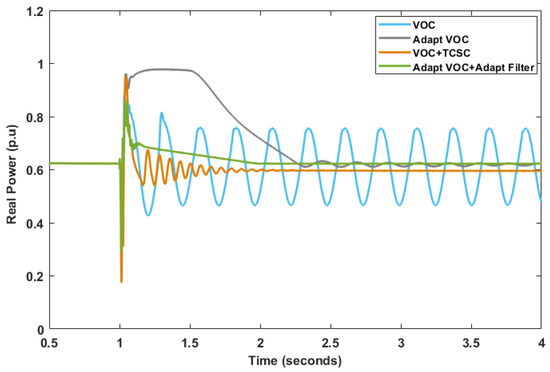
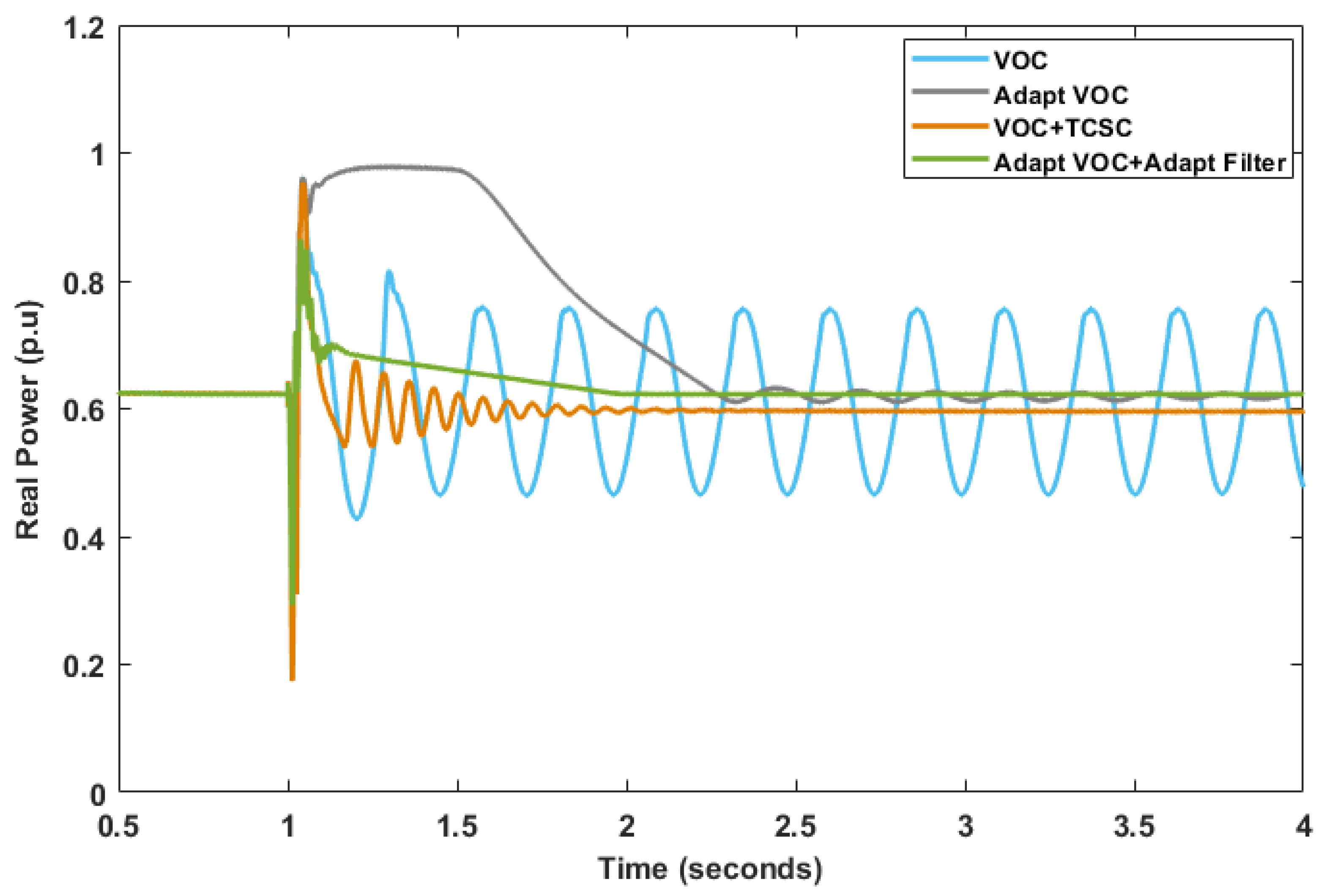
Figure 6 depicts the sustained SSO response at a 35% compensation level by using VOC. However, employing the adaptive VOC strategy, the magnitude of SSO is significantly reduced but low-magnitude oscillations still remain and it takes a long time to settle at the set point, unlike the low-compensation-level cases discussed in Section 4.1. To handle this limitation of adaptive VOC, an additional strategy, i.e., adaptive filter circuit control, activates by SSO detection. Hence, the low-magnitude SSOs are completely mitigated and settle fast by the coordination of the adaptive filter with adaptive VOC, as shown in Figure 6. Additionally, the response of the conventionally used electronic-based FACTS device i.e., TCSC, under the same compensation level results in high-spike and high-frequency oscillation due to the switching of thyristors with power loss due to the resistance in series with the LC circuit of the TCSC to avoid resonance between the inductor (L) and capacitor (C), representing limitations of the TCSC, as in [20]. However, the proposed scheme results in smooth, low-spike and set power tracking response.
Figure 6.
Response of SSO with various strategies at 35% compensation level.
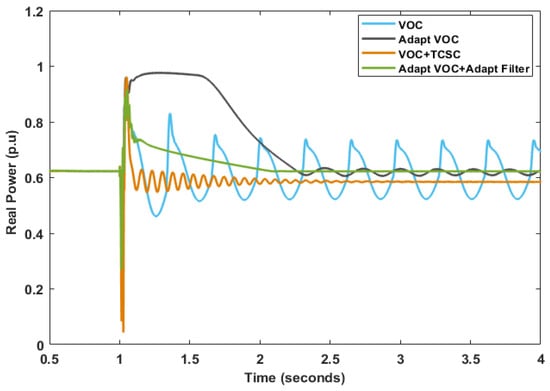
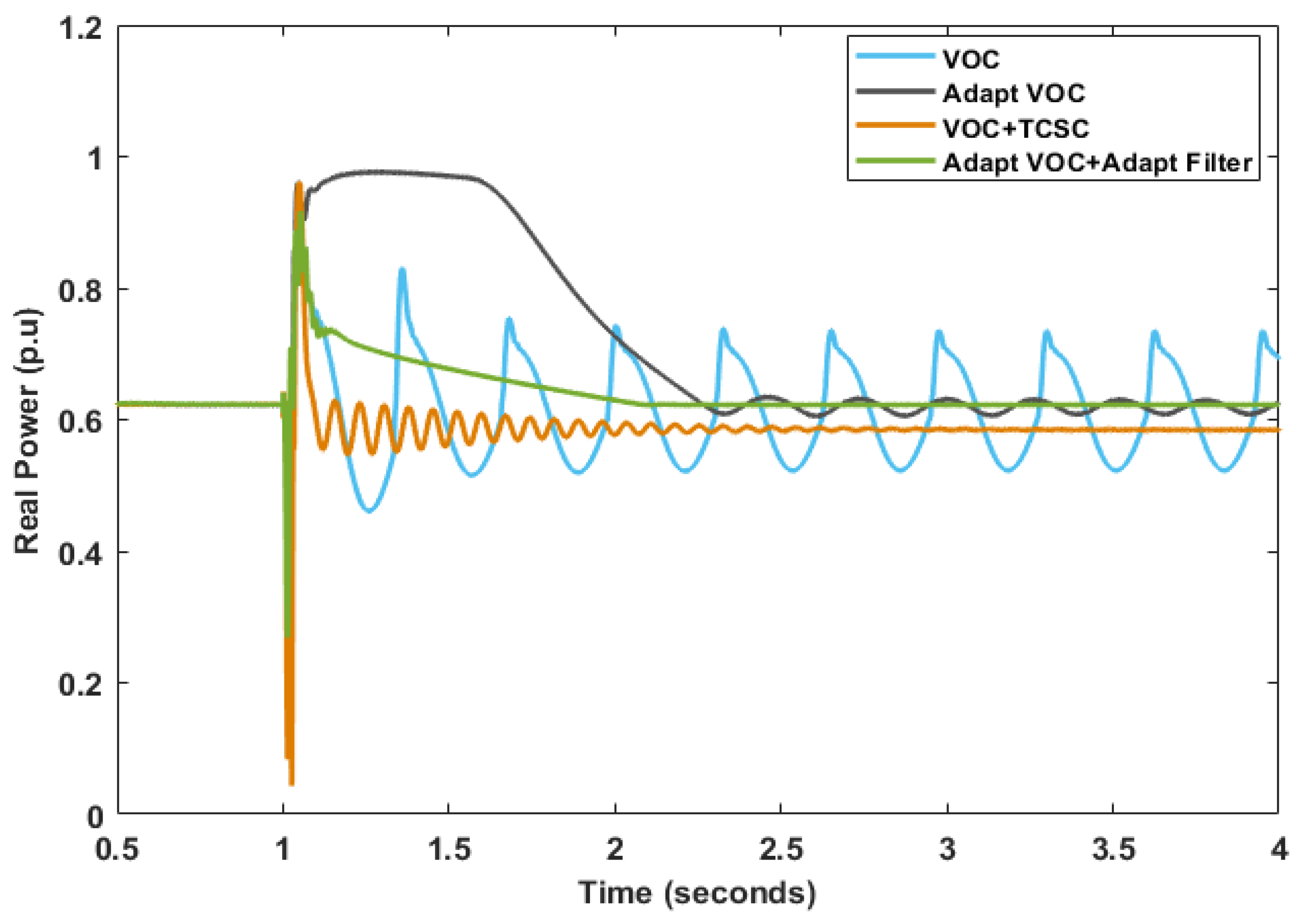
To investigate the response beyond sustained oscillations, the simulations are carried out at a 40% compensation level. The SSO becomes distorted and sustained with VOC rather than rising due to the droop characteristics of VOC, as discussed in the exploration of Equation (8). By employing adaptive VOC, the distorted unstable response of SSO is minimized but comparatively, with high magnitude proportional to the case of sustained SSO with a 35% compensation level, as demonstrated in Figure 7. Furthermore, along with higher magnitude, the settling time of SSO at 40% compensation is higher than at the 35% compensation level as well, which shows that more energy is required to dampen these oscillations. The response of SSO with the traditionally adopted TCSC again shows high transitional spikes, while the SSO settling time is increased further. To counter the mentioned limitation of adaptive VOC and the TCSC, the implementation of adaptive filter control circuitry in combination with adaptive VOC mitigates the SSO with a low settling time, low transitional spikes and smooth response.
Figure 7.
Response of SSO with various strategies at 40% compensation level.
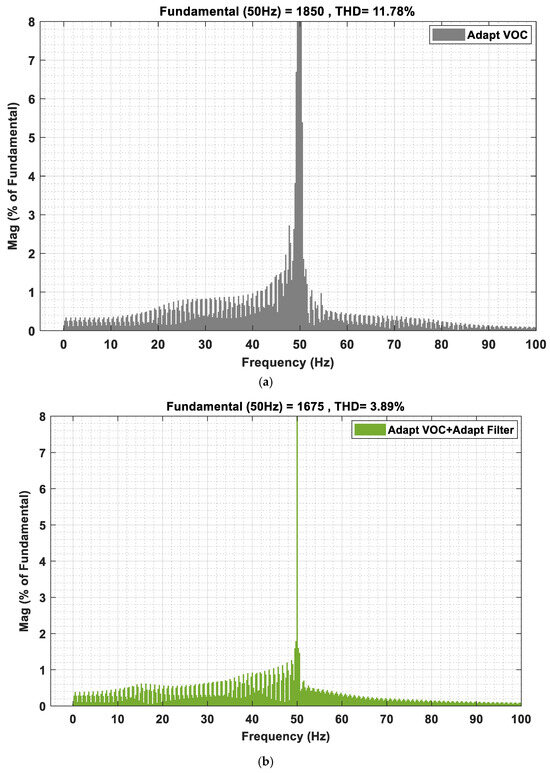
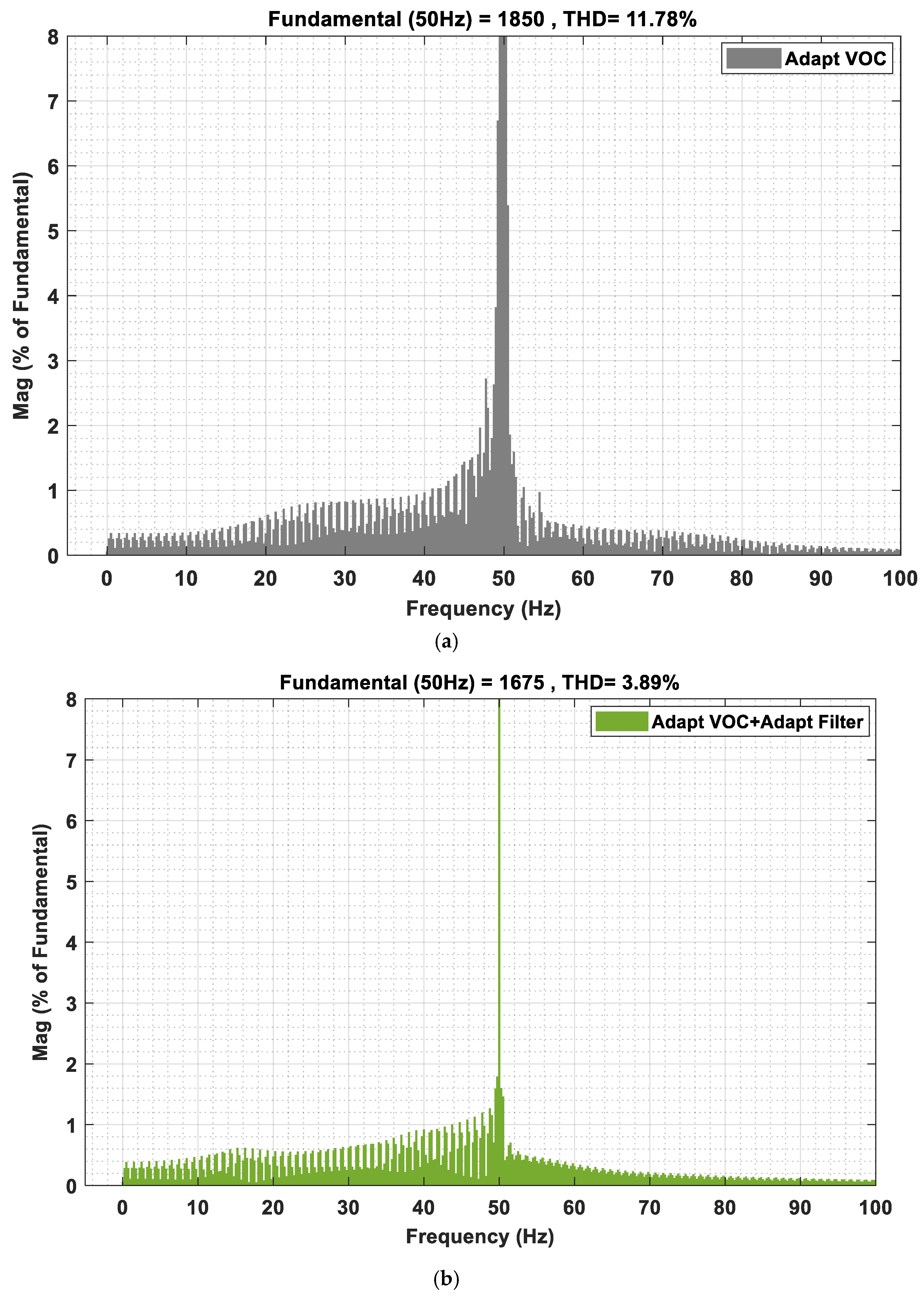
Moreover, to authenticate the mitigation capability of the proposed coordination of adaptive strategies without compromising the quality of the current waveform, frequency-domain analysis is carried out using the Fast Fourier Transform (FFT) analysis tool in Matlab/Simulink. Thus, the low-magnitude oscillation with adaptive VOC relative to the smooth response of coordination of adaptive strategies in time-domain analysis can be effectively authenticated through total harmonic distortion (THD). Hence, THD in percent is investigated relative to the fundamental value at severely high compensation levels with the adaptive VOC strategy and coordination of adaptive VOC with the adaptive filter control strategy.
Starting analysis at 35% compensation, the THD value for adaptive VOC is only 11.78% while that in coordination with the adaptive filter is 3.89% of the fundamental value, as depicted in Figure 8a,b. These values of THD show the approximately 67% efficient behavior of the proposed strategy at higher compensation levels. The lower the THD, the higher the quality of the power, which authenticates that the proposed adaptive coordinated scheme results in smooth response as compared to the adaptive VOC and does not compromise the quality of the power by fast mitigation of SSO as well.
Figure 8.
THD analysis at 35% compensation level. (a) Adaptive VOC. (b) Adaptive VOC with adaptive filter.
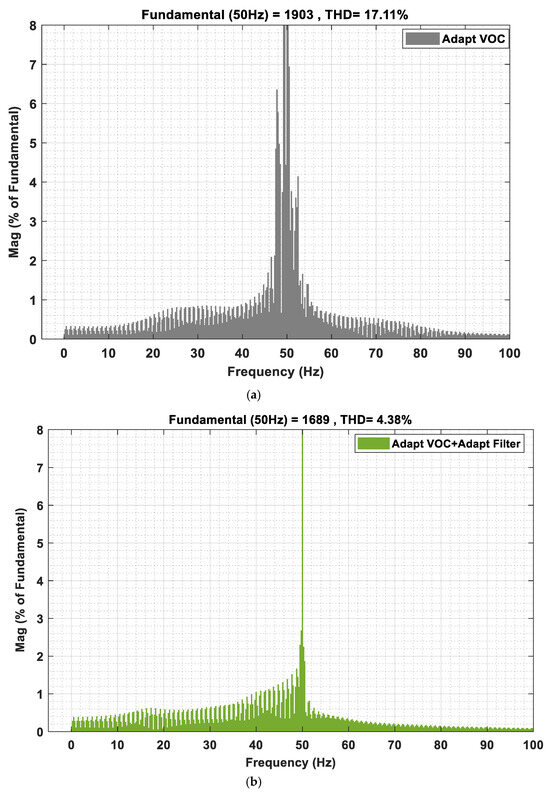
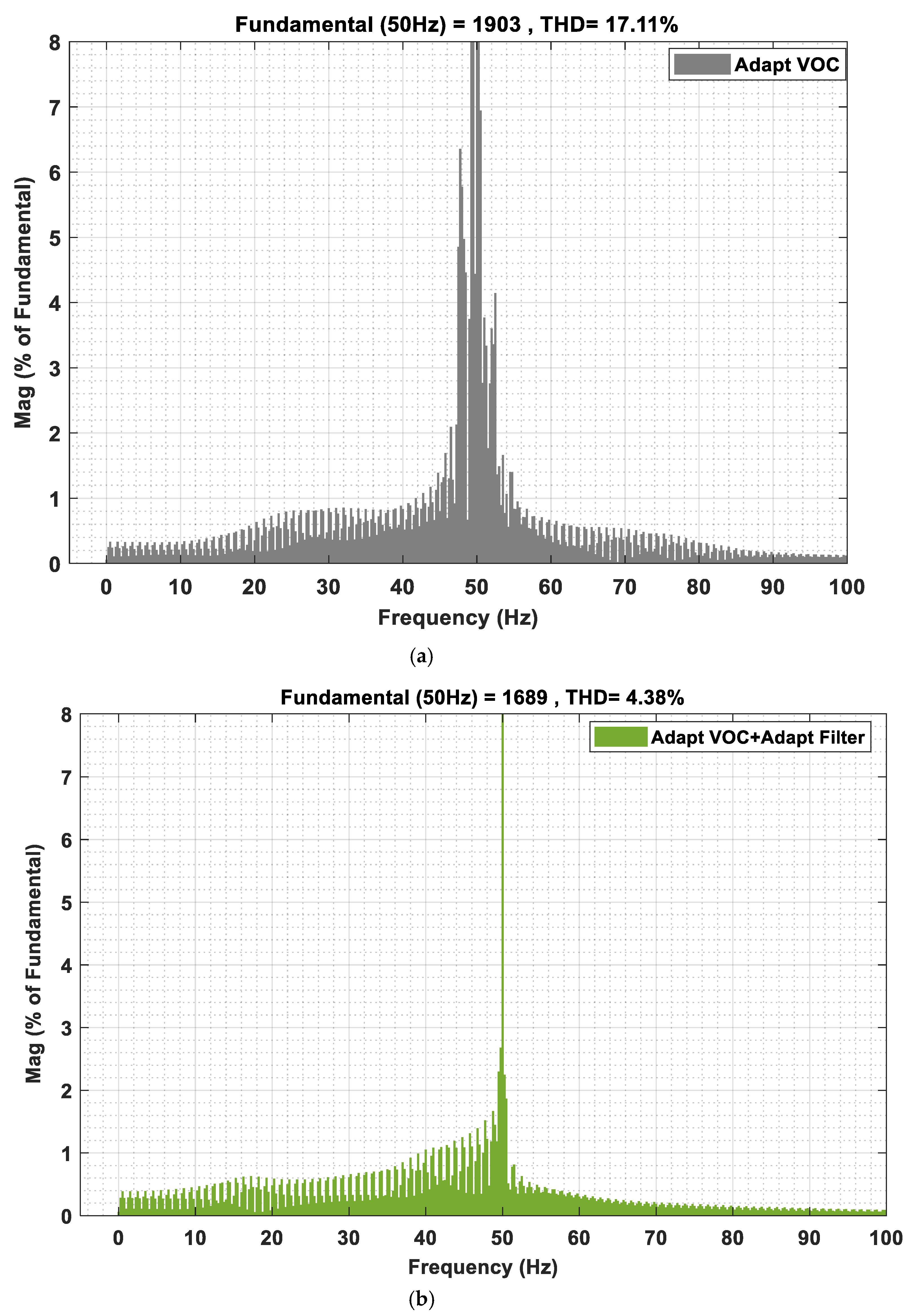
Similarly, the THD in the case of a 40% compensation level with proposed coordination of the adaptive scheme in comparison with adaptive VOC is given in Figure 9a,b. The THD value for adaptive VOC is 17.11%, while by implementation of the proposed coordination of the adaptive strategy, the THD is reduced to 4.38%. This reduction in THD shows improvement in power quality by approximately 74%, showing smooth and stable response, authenticating time-domain response. It can be noted that with an increasing compensation level, the THD values also increase due to the rise in magnitude of SSOs.
Figure 9.
THD analysis at 40% compensation level. (a) Adaptive VOC. (b) Adaptive VOC with adaptive filter.
4.3. Performance Evaluation Indices
The performance of adaptive GFM control VOC in combination with the adaptive filter is specifically evaluated by calculating the magnitude of transient spikes, later deviations, and overall deviation from reference values. Three distinct performance indices, i.e., integral absolute error (IAE), integral square error (ISE), and integral time-weighted absolute error (ITAE), are assessed by implementing the mathematical functions for the mentioned performance metrics throughout the simulation. Among these metrics, ISE emphasizes penalizing large-magnitude errors, where a lower ISE value indicates superior performance in mitigating transient spikes. ITAE, on the other hand, focuses on penalizing later-stage errors, with a lower ITAE indicating faster settling of SSO. Meanwhile, IAE measures the overall deviation from the nominal value.
These techniques are applied to the oscillatory power for various combinations of VOC with designed adaptive strategies and without adaptive strategies. Table 1 and Table 2 present the calculated values of these performance metrics under severely high compensation levels.
Table 1.
Performance metrics of GFM control schemes at 35% compensation.
Table 2.
Performance metrics of GFM control schemes at 40% compensation.
At 35% compensation, the adaptive VOC in coordination with the adaptive filter circuit exhibits the lowest values among all metrics, validating its ability to minimize transients and ensure a fast settling response. In contrast, the VOC without any adaptive strategy shows the highest errors, while adaptive VOC results in errors lying between the proposed coordinated strategy and VOC, as demonstrated in Table 1.
The values of performance metrics for an unstable SSO level of compensation, i.e., 40% of system impedance, are provided in Table 2. These metrics show that the variance from nominal power in terms of spikes, settling time and overall variance of the proposed adaptive VOC+ adaptive filter strategy is significantly reduced. Adaptive VOC outperforms the VOC without the adaptive strategy due to it taking advantage of the increased set power point adaptively. However, the proposed coordination of the adaptive strategy shows better performance than adaptive VOC due to involvement of additional adaptive filter circuitry. In the overall analysis for unstable compensation levels, the proposed coordination of the adaptive strategy gives the lowest values for all considered metrics, which authenticates its better performance as compared to the adaptive VOC and VOC-alone schemes.
5. Conclusions
This article proposes an adaptively controlled VOC and explores its limitations as a GFM control scheme to mitigate the SSO caused by a series-compensated line energized with converter-based resources. The SSO mitigation capability of the proposed adaptive VOC is verified by comparing it with previously presented VOC separately at low levels of compensation. The limitation of adaptive VOC under unstable-SSO conditions is addressed and countered by the design and coordination of adaptive filter circuitry with adaptive VOC. Furthermore, the proposed scheme is compared with the traditionally used FACT device, i.e., TCSC, under severe-SSO conditions to authenticate the better performance of the designed schemes. The simulation analysis is carried out through time-domain, frequency-domain and performance metric calculations to justify the effectiveness of the adaptive coordinated scheme in comparison with the conventional VOC law and TCSC. The error index calculation results in approximately 20–50% reduction in short-term and long-term errors at various compensation levels with the proposed scheme. In terms of power quality, the THD analysis shows approximately 67–74% reduction in THD, which verifies the better power quality response of the proposed scheme as well. These different types of analysis authenticate that the proposed adaptive strategies effectively mitigate SSO with minimum spikes and fast settling time without compromising on power quality, as they result in low THD as compared to the conventionally used control-based VOC and FACTS-based TCSC.
Author Contributions
Conceptualization, S.U.I. and S.K.; Investigation, S.U.I.; Methodology, S.U.I.; Software, S.U.I.; Validation, S.U.I. and S.K.; Visualization, S.U.I. and S.K.; Supervision, S.K.; Writing—original draft preparation, S.U.I.; Writing—review and editing, S.K. All authors have read and agreed to the published version of the manuscript.
Funding
This work was supported by the Korea Institute of Energy Technology Evaluation and Planning (KETEP) grant funded by the Korea government (MOTIE) (RS-2024-00421642, Development of operation performance evaluation technology for AC/DC hybrid distribution system).
Data Availability Statement
The data presented in this study are available on request from the corresponding author.
Conflicts of Interest
The authors declare no conflicts of interest.
Appendix A
Table A1.
Rated parameters of the test model.
References
- Gregor, R.; Toledo, S.; Maqueda, E.; Pacher, J. Part I—Advancements in Power Converter Technologies: A Focus on SiC-MOSFET-Based Voltage Source Converters. Energies 2023, 16, 5994. [Google Scholar] [CrossRef] [Scilit]
- Xiong, L.; Liu, X.; Liu, Y.; Zhuo, F. Modeling and stability issues of voltage-source converter-dominated power systems: A review. CSEE J. Power Energy Syst. 2020, 8, 1530–1549. [Google Scholar]
- Han, F.; Zhang, X.; Li, M.; Li, F.; Zhao, W. Stability Control for Grid-Connected Inverters Based on Hybrid-Mode of Grid-Following and Grid-Forming. IEEE Trans. Ind. Electron. 2023, 71, 10750–10760. [Google Scholar] [CrossRef] [Scilit]
- Kroposki, B.; Johnson, B.; Zhang, Y.; Gevorgian, V.; Denholm, P.; Hodge, B.-M.; Hannegan, B. Achieving a 100% Renewable Grid: Operating Electric Power Systems with Extremely High Levels of Variable Renewable Energy. IEEE Power Energy Mag. 2017, 15, 61–73. [Google Scholar] [CrossRef] [Scilit]
- Beiter, P.; Elchinger, M.; Tian, T. Renewable Energy Data Book; US Department of Energy’s National Renewable Energy Laboratory (NREL): Washington, DC, USA, 2016.
- Grünbaum, R.; Halvarsson, P.; Jones, P. Series compensation for extended utilization of power transmission systems. In Proceedings of the 9th IET International Conference on AC and DC Power Transmission, London, UK, 19–21 October 2010; Available online: https://digital-library.theiet.org/content/conferences/10.1049/cp.2010.0966 (accessed on 20 January 2025).
- Matevosyan, J.; MacDowell, J.; Miller, N.; Badrzadeh, B.; Ramasubramanian, D.; Isaacs, A.; Quint, R.; Quitmann, E.; Pfeiffer, R.; Urdal, H.; et al. A future with inverter-based resources: Finding strength from traditional weakness. IEEE Power Energy Mag. 2021, 19, 18–28. [Google Scholar] [CrossRef] [Scilit]
- Paolone, M.; Gaunt, T.; Guillaud, X.; Liserre, M.; Meliopoulos, S.; Monti, A.; Van Cutsem, T.; Vittal, V.; Vournas, C. Fundamentals of Power Systems Modelling in the Presence of Converter-Interfaced Generation. Electr. Power Syst. Res. 2020, 189, 106811. [Google Scholar] [CrossRef] [Scilit]
- Tôrres, L.A.B.; Hespanha, J.P.; Moehlis, J. Power supply synchronization without communication. In Proceedings of the 2012 IEEE Power and Energy Society General Meeting, San Diego, CA, USA, 22–26 July 2012; IEEE: New York, NY, USA, 2012; pp. 1–6. [Google Scholar]
- Johnson, B.B.; Dhople, S.V.; Hamadeh, A.O.; Krein, P.T. Synchronization of parallel single-phase inverters with virtual oscillator control. IEEE Trans. Power Electron. 2013, 29, 6124–6138. [Google Scholar] [CrossRef] [Scilit]
- Abrantes-Ferreira, A.J.G.; Lima, A.M. Comparative performance analysis of grid-forming strategies applied to disconnectable microgrids. In Proceedings of the 2021 Brazilian Power Electronics Conference (COBEP 2021), João Pessoa, Brazil, 7–10 November 2021; pp. 1–8. [Google Scholar]
- Lu, M.; Dutta, S.; Purba, V.; Dhople, S.; Johnson, B. A grid-compatible virtual oscillator controller: Analysis and design. In Proceedings of the 2019 IEEE Energy Conversion Congress and Exposition (ECCE), Baltimore, MD, USA, 29 September–3October 2019; IEEE: New York, NY, USA, 2019; pp. 2643–2649. [Google Scholar]
- Li, W.; Sha, P.; Li, C.; Deng, J.; Hu, Y.; Peng, L.; Xiang, Z.; Wang, C.; Li, P.; He, C. Dynamic series suppression strategy for sub-synchronous oscillation in DFIG-based wind farms connected to series-compensated network. Int. J. Electr. Power Energy Syst. 2025, 171, 110977. [Google Scholar] [CrossRef] [Scilit]
- Denis, G.; Prevost, T.; Debry, M.; Xavier, F.; Guillaud, X.; Menze, A. The Migrate project: The challenges of operating a transmission grid with only inverter-based generation. A grid-forming control improvement with transient current-limiting control. IET Renew. Power Gener. 2018, 12, 523–529. [Google Scholar] [CrossRef] [Scilit]
- Australian Energy Market Operator (AEMO). West Murray Zone Sub-Synchronous Oscillations—October 2022: Summary of Real-Time Observations from August 2020 to December 2021; National Electricity Market: Melbourne, VIC, Australia, 2022. [Google Scholar]
- Abdeen, M.; Li, H.; Kamel, S.; Khaled, A.; El-Dabah, M.; Kharrich, M.; Sindi, H.F. A Recent Analytical Approach for Analysis of Sub-Synchronous Resonance in Doubly-Fed Induction Generator-Based Wind Farm. IEEE Access 2021, 9, 68888–68897. [Google Scholar] [CrossRef] [Scilit]
- Torres, L.A.B.; Hespanha, J.P.; Moehlis, J. Synchronization of Identical Oscillators Coupled Through a Symmetric Network with Dynamics: A Constructive Approach with Applications to Parallel Operation of Inverters. IEEE Trans. Autom. Control 2015, 60, 3226–3241. [Google Scholar] [CrossRef] [Scilit]
- Jouini, T.; Arghir, C.; Dörfler, F. Grid-Friendly Matching of Synchronous Machines by Tapping into the DC Storage. IFAC-PapersOnLine 2016, 49, 192–197. [Google Scholar] [CrossRef] [Scilit]
- Rathnayake, D.B.; Akrami, M.; Phurailatpam, C.; Me, S.P.; Hadavi, S.; Jayasinghe, G.; Zabihi, S.; Bahrani, B. Grid Forming Inverter Modeling, Control, and Applications. IEEE Access 2021, 9, 114781–114807. [Google Scholar] [CrossRef] [Scilit]
- Zheng, X.; Xu, Z.; Zhang, J. A supplementary damping controller of TCSC for mitigating SSR. In Proceedings of the 2009 IEEE Power & Energy Society General Meeting, Calgary, AB, Canada, 26–30 July 2009; Available online: https://ieeexplore.ieee.org/document/5275956 (accessed on 12 February 2024).
- Padiyar, K.R.; Prabhu, N. Design and performance evaluation of subsynchronous damping controller with STATCOM. IEEE Trans. Power Deliv. 2006, 21, 1398–1405. [Google Scholar] [CrossRef] [Scilit]
- de Jesus, F.D.; Watanabe, E.H.; de Souza, L.F.W.; Alves, J.E.R. SSR and power oscillation damping using gate-controlled series capacitors (GCSC). IEEE Trans. Power Deliv. 2007, 22, 1806–1812. [Google Scholar] [CrossRef] [Scilit]
- Johnson, B.; Rodriguez, M.; Sinha, M.; Dhople, S. Comparison of virtual oscillator and droop control. In Proceedings of the 2017 IEEE 18th Workshop on Control and Modeling for Power Electronics (COMPEL), Stanford, CA, USA, 9–12 July 2017; pp. 1–6. [Google Scholar]
- Islam, S.U.; Kim, S. Comparative Analysis of Sub-Synchronous Oscillations with Various Grid-Forming Control Schemes Under Series-Compensated Line. IEEE Access 2024, 12, 132763–132772. [Google Scholar] [CrossRef] [Scilit]
- Ameli, S.; Karunaratne, L.; Chaudhuri, N.R.; Lagoa, C. Robust Adaptive Supplementary Control for Damping Weak-Grid SSOs Involving IBRs. IEEE Trans. Power Syst. 2025, 40, 4322–4335. [Google Scholar] [CrossRef] [Scilit]
- Shi, R.; Li, J.; Zhang, X.; Li, J.; Dong, Z. A comprehensive review and prospect of transient damping methods for grid-forming virtual synchronous generator. Eng. Sci. Technol. Int. J. 2025, 71, 102196. [Google Scholar] [CrossRef] [Scilit]
- Shi, Y.; Gu, X.; Yin, X.; Feng, S.; Zhang, S. Design of droop controller in islanded microgrids using multi-objective optimization based on accurate small-signal model. IET Power Electron. 2022, 15, 1093–1109. [Google Scholar] [CrossRef] [Scilit]
- Qoria, T.; Jouini, T.; Cross, D.; Markovic, U.; Denis, G.; Prevost, T. Data Underlying the Research of a 3 Bus Model for Full Inverter System, Migrate WP3; 4TU.Centre for Research Data: Delft, The Netherlands, 2018. [Google Scholar]
- Anttila, S.; Döhler, J.S.; Oliveira, J.G.; Boström, C. Grid Forming Inverters: A Review of the State of the Art of Key Elements for Microgrid Operation. Energies 2022, 15, 5517. [Google Scholar] [CrossRef] [Scilit]
- Guerrero, J.M.; Vasquez, J.C.; Matas, J.; de Vicuna, L.G.; Castilla, M. Hierarchical Control of Droop-Controlled AC and DC Microgrids—A General Approach Toward Standardization. IEEE Trans. Ind. Electron. 2011, 58, 158–172. [Google Scholar] [CrossRef] [Scilit]
- Sinha, M.; Dörfler, F.; Johnson, B.B.; Dhople, S.V. Uncovering droop control laws embedded within the nonlinear dynamics of van der pol oscillators. IEEE Trans. Control Network Syst. 2017, 4, 347–358. [Google Scholar] [CrossRef] [Scilit]
- Milano, F.; Dörfler, F.; Hug, G.; Hill, D.J.; Verbič, G. Foundations and Challenges of Low-Inertia Systems (Invited Paper). In Proceedings of the 2018 Power Systems Computation Conference (PSCC), Dublin, Ireland, 11–15 June 2018; pp. 1–25. [Google Scholar]
- Groß, D.; Colombino, M.; Brouillon, J.; Dorfler, F. The effect of transmission-line dynamics on grid-forming dispatchable virtual oscillator control. IEEE Trans. Control Netw. Syst. 2019, 6, 1148–1160. [Google Scholar] [CrossRef] [Scilit]
- Lu, M. Virtual Oscillator Grid-Forming Inverters: State of the Art, Modeling, and Stability. IEEE Trans. Power Electron. 2022, 37, 11579–11591. [Google Scholar] [CrossRef] [Scilit]
- Seo, G.S.; Colombino, M.; Subotic, I.; Johnson, B.; Gros, D.; Dorfler, F. Dispatchable virtual oscillator control for decentralized inverter dominated power systems: Analysis and experiments. In Proceedings of the 2019 IEEE Applied Power Electronics Conference and Exposition (APEC), Anaheim, CA, USA, 17–21 March 2019; IEEE: New York, NJ, USA, 2019; pp. 561–566. [Google Scholar]
- Islam, S.U.; Kim, S. Design and Implementation of Optimal Control Scheme for DFIG Based Wind Plant to Mitigate Sub-Synchronous Resonance Issues. IEEE Access 2023, 11, 141162–141171. [Google Scholar] [CrossRef] [Scilit]
- Colombino, M.; Gross, D.; Brouillon, J.-S.; Dörfler, F. Global phase and magnitude synchronization of coupled oscillators with application to the control of grid-forming power inverters. IEEE Trans. Autom. Control 2023, 64, 4496–4511. [Google Scholar] [CrossRef] [Scilit]

Disclaimer/Publisher’s Note: The statements, opinions and data contained in all publications are solely those of the individual author(s) and contributor(s) and not of MDPI and/or the editor(s). MDPI and/or the editor(s) disclaim responsibility for any injury to people or property resulting from any ideas, methods, instructions or products referred to in the content. |
© 2026 by the authors. Licensee MDPI, Basel, Switzerland. This article is an open access article distributed under the terms and conditions of the Creative Commons Attribution (CC BY) license.