Empirical Analysis of Heterogeneous Multi-Orbit Satellite Networks for Communication Resilience in Island Regions

 ,
, 
Abstract
1. Introduction
- 1.
- Conducting long-duration, empirical performance benchmarking of GEO, MEO, and LEO satellite links to establish a reliable performance baseline.
- 2.
- Quantifying the key technical challenges, such as latency instability and TCP throughput degradation, that any integration strategy must overcome.
- 3.
- Proposing a conceptual system architecture and a set of SD-WAN policy design considerations derived directly from our empirical findings.
2. Communication Resilience Challenges in Island Nations
3. Multi-Orbit Satellite Technology Overview
3.1. GEO Satellites
3.2. MEO Satellites
3.3. LEO Satellites
4. Foundational Performance Benchmarking
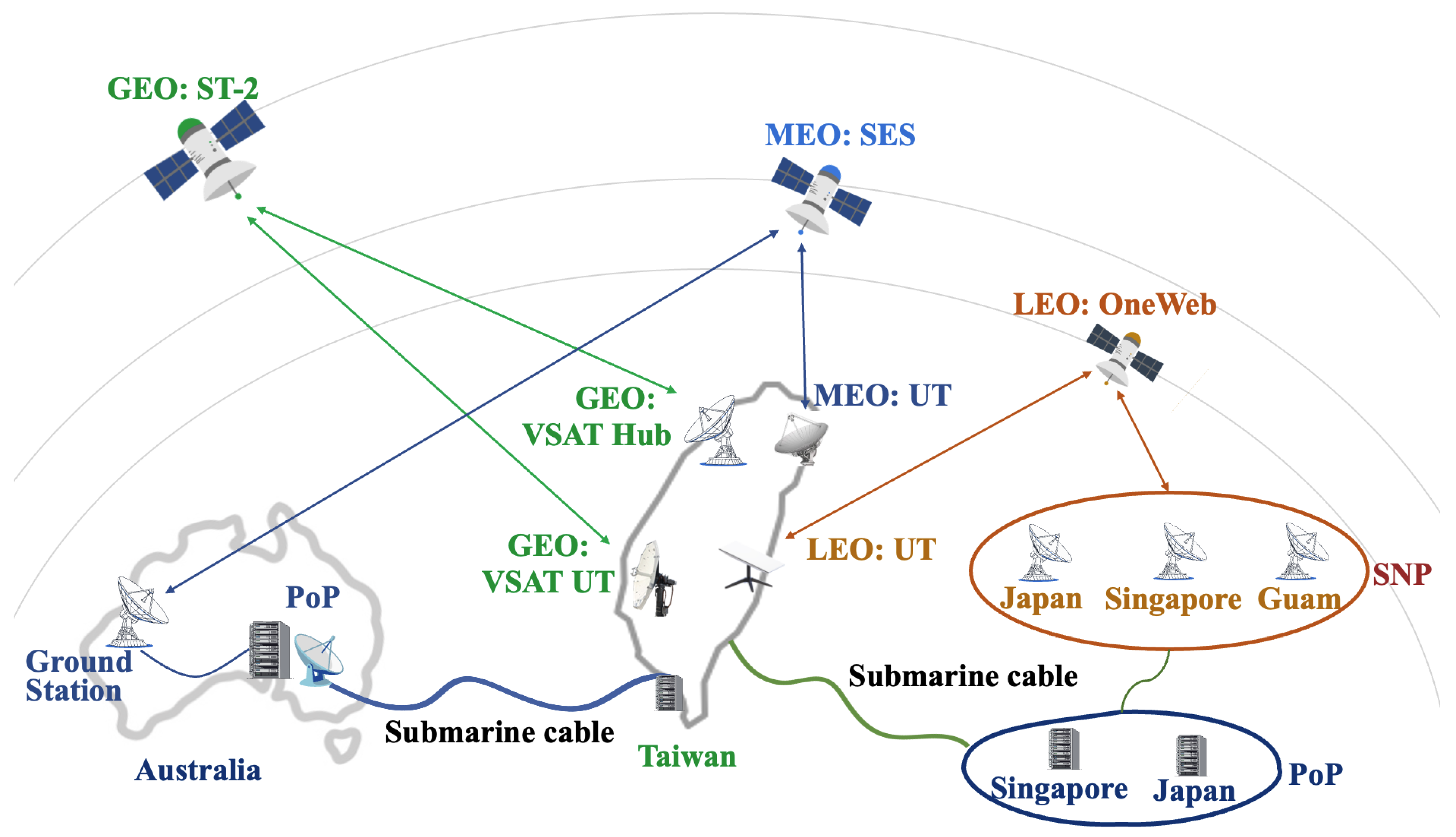
4.1. Test Methodology
- 1.
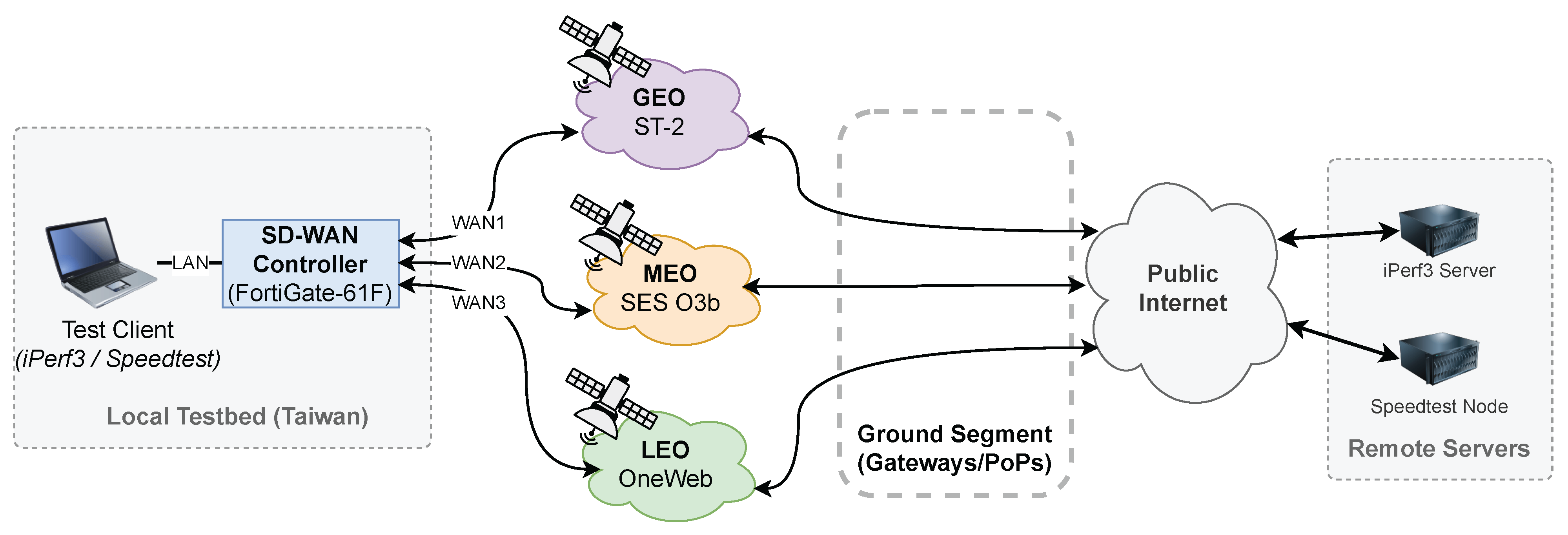
- Source IP: Traffic is divided equally between SD-WAN members. Sessions that start at the same source address use the same route.
- 2.
- Sessions: The traffic is distributed based on the number of sessions that are connected through the member.
- 3.
- Spillover: The highest priority member is used until bandwidth exceeds ingress and egress thresholds. Additional traffic is sent through the next SD-WAN member.
- 4.
- Source-Destination IP: Traffic is divided equally. Sessions that start at the same source IP address and go to the same destination IP address use the same route.
- 5.
- Volume: The workload is distributed based on the number of packets that are going through the member.
4.2. Empirical Results and Analysis
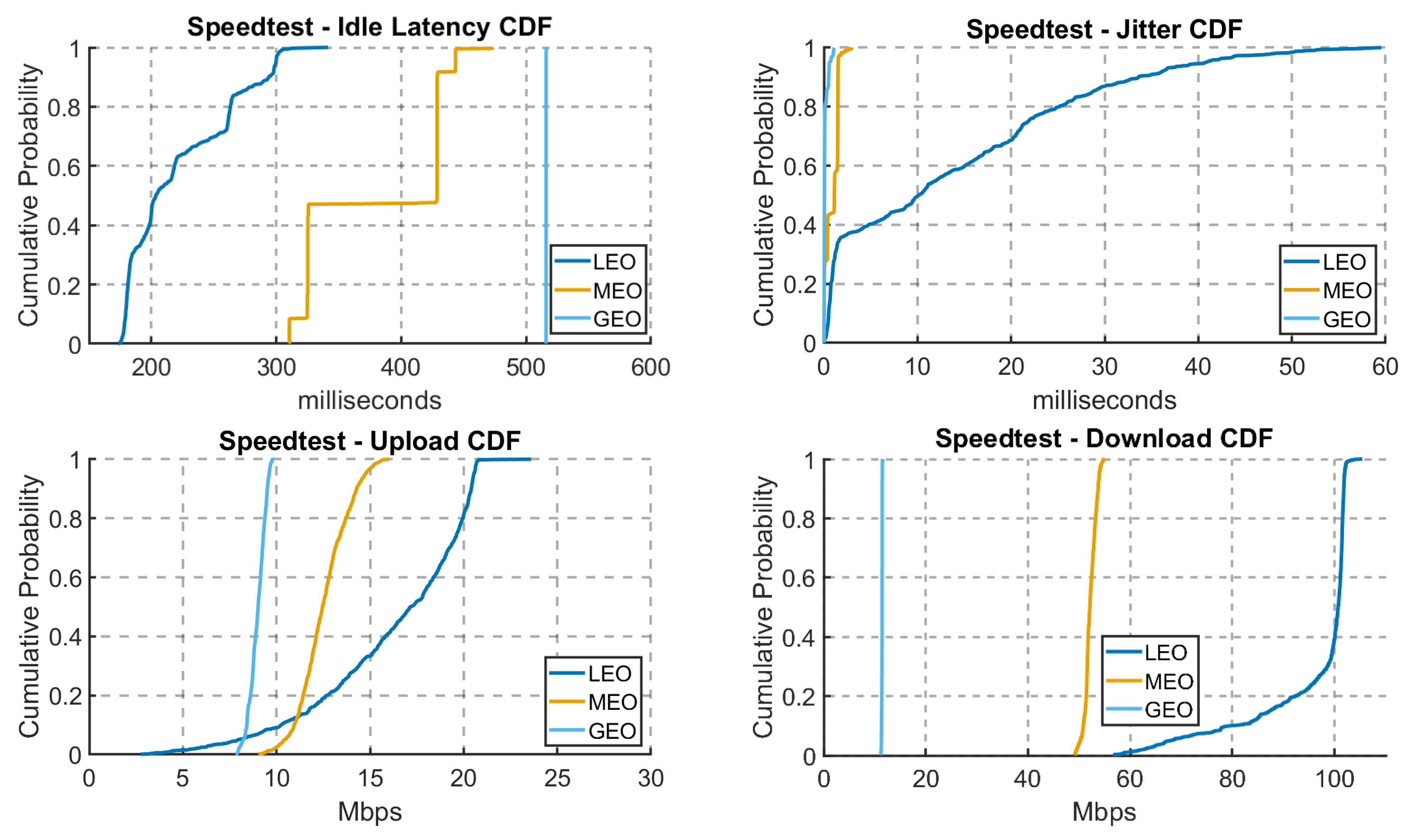
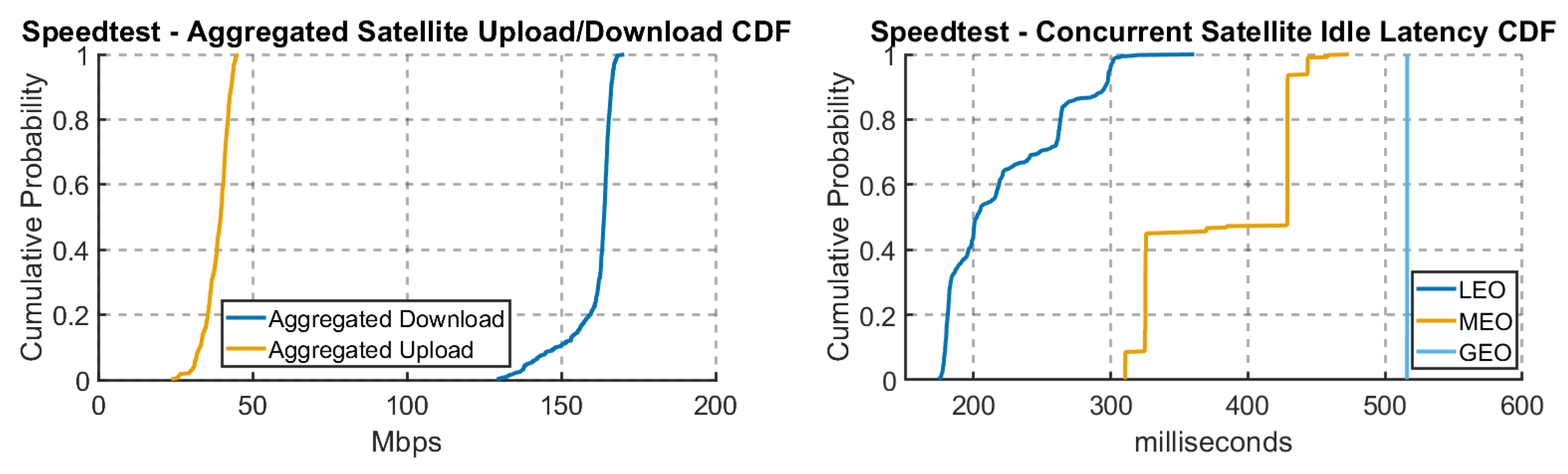
- Latency Distribution Analysis: As expected, the GEO link exhibited extreme stability. Its CDF curve is nearly vertical, indicating that the vast majority of packets arrive within a negligible deviation from the median of 515.98 ms. In contrast, the LEO latency distribution exhibits a much shallower slope and a distinct “long tail.” While the median LEO latency is lower at 203.58 ms, the gradual rise of the curve confirms significant variability, with the 99th percentile () extending to 303.88 ms. This volatility is a critical design constraint.
- Jitter Analysis: The steep, step-like nature of the GEO and MEO CDFs demonstrates low and stable jitter, with 99th percentile () values remaining below 1.04 ms. In contrast, LEO exhibited a much more gradual slope and significant tail instability, where jitter spiked to 52.38 ms at the 99th percentile—a sharp increase from its median of 10.13 ms. This finding suggests that without proper mitigation (e.g., jitter buffers configured by the SD-WAN), LEO links may be unsuitable for high-quality real-time voice and video streams, even with their high bandwidth.
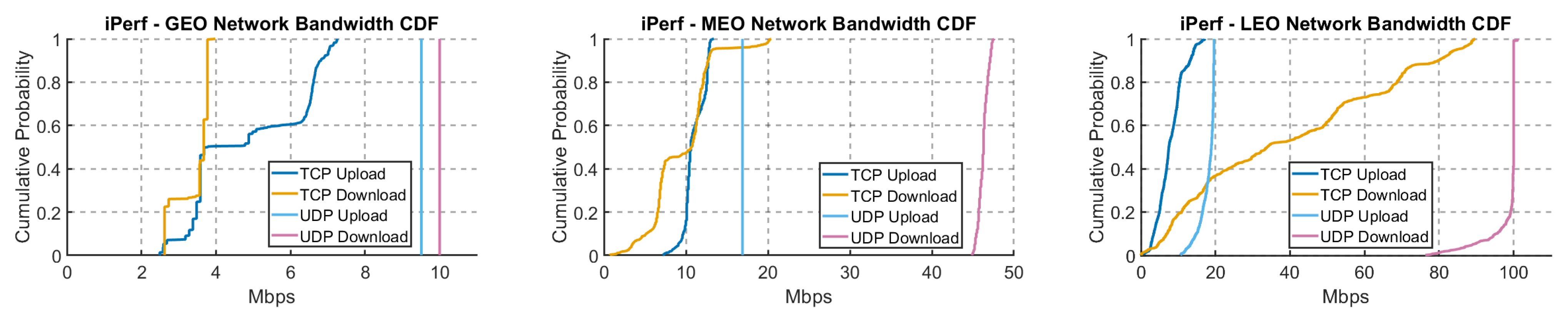
- Bandwidth Stability: While all links generally met their provisioned bandwidth, the LEO throughput CDF showed considerable variability in the lower percentiles, occasionally dropping below 60/5 Mbps. This underscores the need for an SD-WAN policy that can dynamically shift traffic if the primary LEO link’s performance degrades temporarily.

| Metric | GEO (ST-2) | MEO (SES) | LEO (OneWeb) | Unit |
|---|---|---|---|---|
| Service Plan | ||||
| Provisioned Bandwidth (DL/UL) | 10/10 | 50/20 | 100/20 | Mbps |
| Latency & Stability (from Speedtest) | ||||
| Median Latency () | 515.98 | 428.68 | 203.58 | ms |
| 95th Percentile Latency () | 516.01 | 443.49 | 299.75 | ms |
| Peak Latency () | 516.04 | 443.52 | 303.88 | ms |
| Median Jitter () | 0.06 | 1.12 | 10.13 | ms |
| 95th Percentile Jitter () | 0.06 | 1.53 | 40.81 | ms |
| Peak Jitter () | 1.04 | 2.57 | 52.38 | ms |
| Downlink Throughput (from iPerf3) | ||||
| Median TCP Throughput () | 3.67 | 10.70 | 33.95 | Mbps |
| Median UDP Throughput () | 10.00 | 46.30 | 100.00 | Mbps |
| TCP Efficiency (TCP Throughput/Provisioned BW) | 36.7 | 21.4 | 33.9 | % |
| Packet Loss (from iPerf3 UDP Test) | ||||
| Average Download Packet Loss Rate | 0.04 | 8.16 | 5.24 | % |
| Average Upload Packet Loss Rate | 0.09 | 13.29 | 10.55 | % |
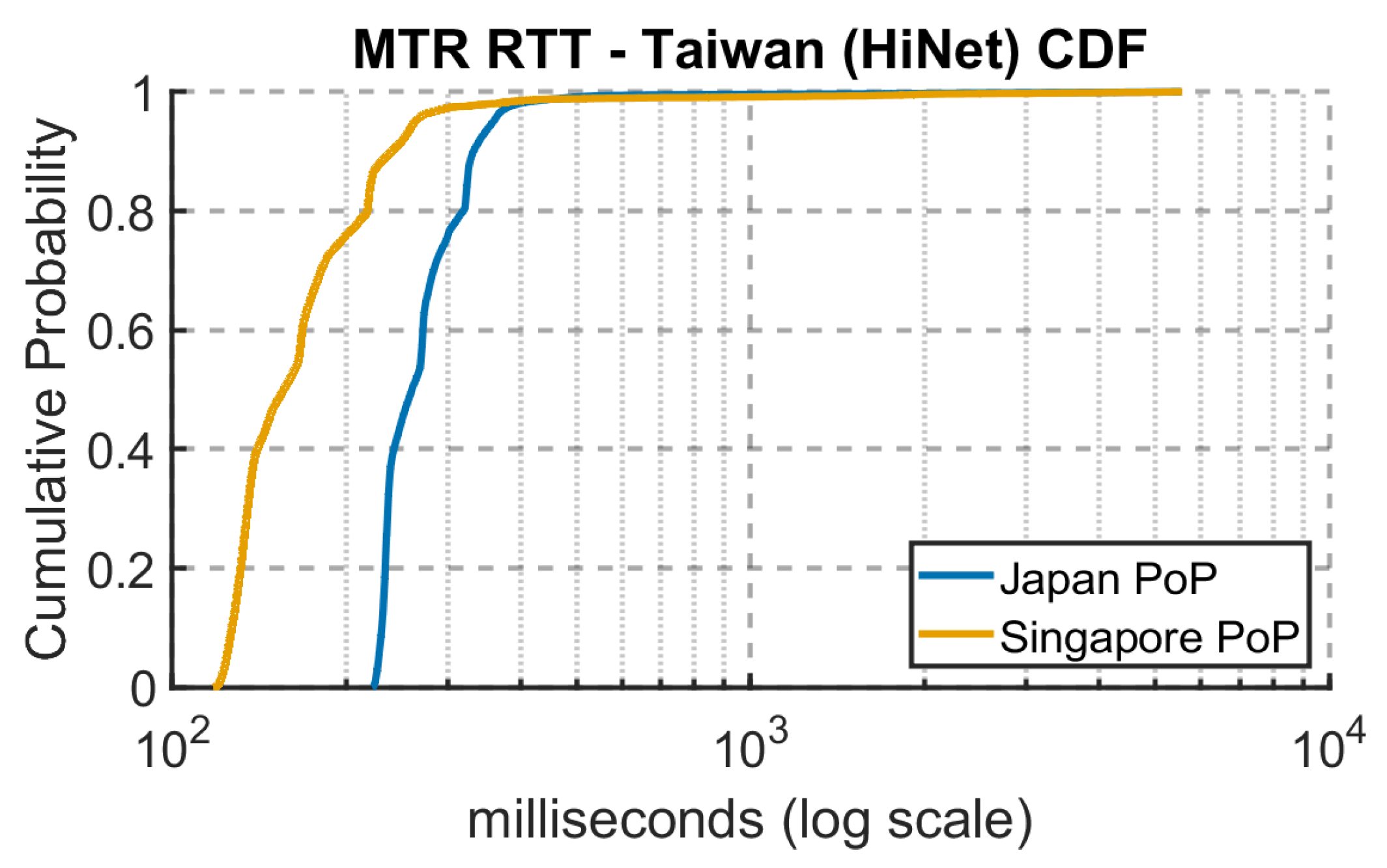
| CDF Metric | LEO (via Japan PoP) | LEO (via Singapore PoP) | Latency Reduction () |
|---|---|---|---|
| Median Latency () | 259.85 ms | 155.97 ms | 103.88 ms |
| Tail Latency () | 359.33 ms | 262.80 ms | 96.53 ms |
4.3. Theoretical Analysis of TCP Throughput Degradation
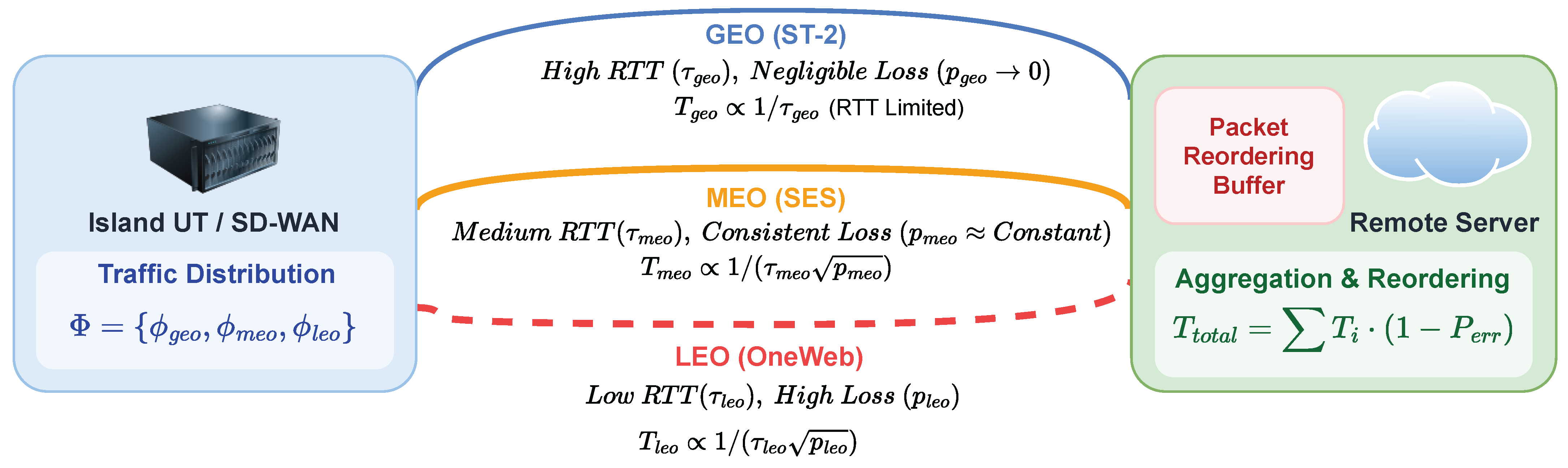
- GEO scenario: While p is negligible (), the dominant factor is the large (≈516 ms). As , the theoretical throughput is inherently capped regardless of available bandwidth.
- MEO scenario: The empirical results for MEO present a unique case validating the Mathis model. Although MEO latency (≈428 ms) is lower than GEO, the measured packet loss rate p was high (≈8%). According to Equation (1), TCP throughput is inversely proportional to . This substantial loss factor p severely penalized the TCP throughput, resulting in the lowest TCP efficiency (21.4%) among all three orbits as observed in Table 2. This confirms that even with stable latency, non-negligible packet loss is detrimental to standard TCP streams.
- LEO scenario: Although is significantly lower (≈200 ms), our measurements indicate a fluctuating packet loss rate p (average 5.24%) due to handover dynamics and terrestrial routing variations. Since , even minor spikes in packet loss cause the TCP congestion window to collapse aggressively. This collapse is intrinsic to loss-based algorithms like CUBIC, which misinterpret the stochastic packet loss characteristic of LEO handovers as a signal of network congestion. Consequently, the algorithm aggressively reduces the transmission rate in accordance with the Mathis model, failing to utilize the full link capacity.
5. Proposed Architecture for Multi-Orbit Integration
5.1. Conceptual System Architecture
5.2. Challenges in Simplistic Link Aggregation
6. Design Considerations for SD-WAN Integration Policies
6.1. General SD-WAN Policy Strategies
6.2. The Critical Role of Protocol-Specific Performance
- 1.
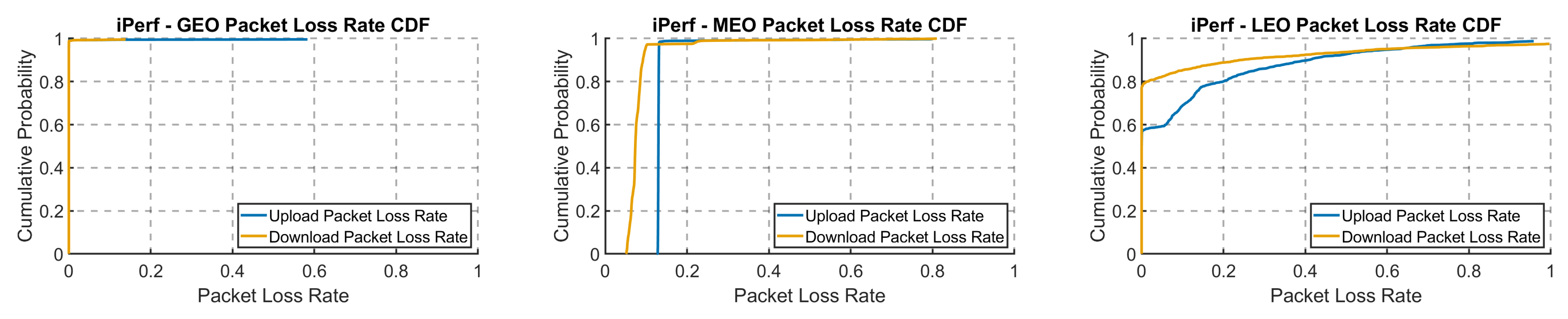
- Loss Magnitude: The packet loss patterns differ significantly. LEO exhibits an average download loss of 5.24%, which is non-trivial but lower than the MEO test link. However, the LEO loss is “bursty” (concentrated in handover intervals), whereas GEO maintains a near-perfect 0.04% average.
- 2.
- MEO Behavior: Our MEO test link showed a higher average loss (8.16% DL/13.29% UL). Unlike LEO, this loss was consistent throughout the test duration (indicated by the steep vertical rise in the CDF), suggesting a constant link constraint rather than dynamic instability. It is important to interpret the MEO packet loss data within the context of our experimental setup. While MEO constellations are theoretically capable of near-zero loss transmission (similar to fiber-in-the-sky), our empirical results in Table 2 recorded an average packet loss of approximately 8–13%. Unlike the stochastic and bursty loss observed in LEO links due to handovers, the MEO loss profile was remarkably consistent (as shown in Figure 11). This suggests that the observed loss is likely attributable to specific rate-limiting policies or congestion at the terrestrial backhaul points rather than orbital dynamics. However, this high constant loss significantly impacts TCP efficiency, providing a critical stress test for the resilience analysis.
- 3.
- Impact: While LEO’s average loss is lower, its variability means TCP congestion controls often trigger aggressively during handover spikes, causing the “sawtooth” throughput performance observed in Figure 10.
6.3. Strategy 1: Intelligent Failover for High Availability
- Design: The SD-WAN is configured to utilize the best-performing link (typically LEO) as the primary connection.
- Thresholds: Guided by the empirical performance bounds in Figure 6, failover thresholds (e.g., LEO latency ms) are defined to trigger application-aware routing. High-bandwidth streams are offloaded to the MEO link; despite exhibiting a higher average packet loss () than LEO, the MEO link sustained a median UDP throughput of Mbps, significantly outperforming GEO. Conversely, critical control signaling is rerouted to the GEO link, prioritizing its quasi-error-free transmission ( loss) to ensure delivery reliability.
- Benefit: This approach maximizes service continuity by aligning link characteristics with application needs—maintaining throughput for bulk data via MEO while guaranteeing message delivery for critical operations via GEO.
6.4. Strategy 2: Application-Aware Routing for Quality of Service (QoS)
- Design: The SD-WAN identifies traffic by application type.
- Policies: (1) Real-time Traffic (VoIP, Video Conferencing): Route exclusively over the link with the lowest latency and jitter (typically LEO, provided it is stable). Do not split these sessions across multiple links. (2) Bulk Data Transfer (FTP, Cloud Backup): Route over the link with the highest available bandwidth (MEO or LEO), or consider routing over GEO if other links are congested, as these applications are less sensitive to latency. (3) General Web Browsing (TCP-heavy): Assign to a single, stable link to avoid the TCP out-of-sequence issue.
- Benefit: This approach maximizes the utility of each link’s unique characteristics, ensuring that application performance is aligned with link capabilities.
6.5. Impact of Dense Constellations and Emerging Protocols
7. Conclusions and Future Work
Author Contributions
Funding
Data Availability Statement
Conflicts of Interest
Abbreviations
| GEO | Geostationary Earth Orbit |
| IQR | Interquartile Range |
| LEO | Low Earth Orbit |
| MEO | Medium Earth Orbit |
| MPLS | Multiprotocol Label Switching |
| MTR | My Traceroute |
| PEP | Performance Enhancing Proxy |
| PoP | Point of Presence |
| QoS | Quality of Service |
| RTT | Round-Trip Time |
| SD-WAN | Software-Defined Wide Area Network |
| SNP | Satellite Network Portal |
| TCP | Transmission Control Protocol |
| UDP | User Datagram Protocol |
| UT | User Terminal |
| VSAT | Very Small Aperture Terminal |
| WAN | Wide Area Network |
References
- Chen, L.; Tang, F.; Li, X.; Liu, J.; Zhu, Y.; Yu, J. Adaptive Network Management Service Based on Control Relation Graph for Software-Defined LEO Satellite Networks in 6G. IEEE Trans. Serv. Comput. 2024, 17, 3122–3139. [Google Scholar] [CrossRef]
- Li, M.; Lukyanenko, A.; Cui, Y. Network coding based multipath TCP. In Proceedings of the IEEE INFOCOM Workshops, Orlando, FL, USA, 25–30 March 2012; pp. 25–30. [Google Scholar] [CrossRef]
- Yang, W.; Dong, P.; Cai, L.; Tang, W. Loss-Aware Throughput Estimation Scheduler for Multi-Path TCP in Heterogeneous Wireless Networks. IEEE Trans. Wirel. Commun. 2021, 20, 3336–3349. [Google Scholar] [CrossRef]
- Laniewski, D.; Lanfer, E.; Aschenbruck, N. Measuring Mobile Starlink Performance: A Comprehensive Look. IEEE Open J. Commun. Soc. 2025, 6, 1266–1283. [Google Scholar] [CrossRef]
- Wu, J.; Su, S.; Wang, X.; Zhang, J.; Gao, Y. Accelerating Handover in Mobile Satellite Network. In Proceedings of the IEEE INFOCOM 2024—IEEE Conference on Computer Communications, Vancouver, BC, Canada, 20–23 May 2024; pp. 531–540. [Google Scholar] [CrossRef]
- Leung, K.c.; Li, V.O.; Yang, D. An Overview of Packet Reordering in Transmission Control Protocol (TCP): Problems, Solutions, and Challenges. IEEE Trans. Parallel Distrib. Syst. 2007, 18, 522–535. [Google Scholar] [CrossRef]
- Borgianni, L.; Adami, D.; Giordano, S. Optimizing Network Performance and Reliability with an Integrated SD-WAN and Satellite 6G Architecture. In Proceedings of the 2023 2nd International Conference on 6G Networking (6GNet), Paris, France, 18–20 October 2023; pp. 1–4. [Google Scholar] [CrossRef]
- International Telecommunication Union (ITU). International Advisory Body on Submarine Cable Resilience—Summit Declaration (Nigeria, 2025). 2025. Available online: https://web.archive.org/web/20251201001028/https://www.itu.int/digital-resilience/submarine-cables/wp-content/uploads/sites/2/2025/02/summit-declaration-nigeria-2025.pdf (accessed on 3 February 2026).
- Speidel, U.; Cocker, E.; Vingelmann, P.; Heide, J.; Medard, M. Can network coding bridge the digital divide in the pacific? In Proceedings of the 2015 International Symposium on Network Coding (NetCod), Sydney, Australia, 22–24 June 2015; pp. 86–90. [Google Scholar] [CrossRef]
- United Nations Office for the Coordination of Humanitarian Affairs (OCHA). Tonga: Volcanic Eruption Situation Report No. 4 (10 February 2022). 2022. Available online: https://web.archive.org/web/20251207164559/https://www.unocha.org/publications/report/tonga/tonga-volcanic-eruption-situation-report-no-4-10-february-2022 (accessed on 3 February 2026).
- Wu, C.C. Typhoon Morakot: Key Findings from the Journal TAO for Improving Prediction of Extreme Rains at Landfall. Bull. Am. Meteorol. Soc. 2013, 94, 155–160. [Google Scholar] [CrossRef]
- Liu, Z.W. Taiwan Typhoon Soudelor Record: A Visit to the “Isolated Island” of Wulai. BBC News Chinese Correspondent Report. 2015. Available online: https://web.archive.org/web/20240813034143/https://www.bbc.com/zhongwen/trad/china/2015/08/150811_taiwan_typhoon_witness (accessed on 3 February 2026). (In Chinese)
- Lee, C.F.; Chou, H.T.; Tsao, T.C.; Hsu, C.H.; Huang, C.H.; Liao, W.S. Heliu Debris Flow Induced by Typhoon Soudelor: Failure Mechanism and Numerical Simulation. 2016. Available online: https://web.archive.org/web/20260203164446/https://cswcs.org.tw/AllDataPos/JournalPos/VOL47/NO4/jcswc47(4)171-184_20.pdf (accessed on 3 February 2026). (In Chinese)
- Kobayashi, M. Experience of Infrastructure Damage Caused by the Great East Japan Earthquake and Countermeasures Against Future Disasters. IEEE Commun. Mag. 2014, 52, 23–29. [Google Scholar] [CrossRef]
- Al-Hraishawi, H.; Chougrani, H.; Kisseleff, S.; Lagunas, E.; Chatzinotas, S. A Survey on Nongeostationary Satellite Systems: The Communication Perspective. IEEE Commun. Surv. Tutor. 2023, 25, 101–132. [Google Scholar] [CrossRef]
- Bazzi, A.; Ying, M.; Kanhere, O.; Rappaport, T.S.; Chafii, M. ISAC Imaging by Channel State Information Using Ray Tracing for Next Generation 6G. IEEE J. Sel. Top. Electromagn. Antennas Propag. 2025, 1, 135–149. [Google Scholar] [CrossRef]
- Ministry of Digital Affairs, Taiwan. Ministry of Digital Affairs and TTC Transported Low-Earth Orbit Satellite Equipment to Tianxiang to Assist in Establishing a Disaster Relief Communication Network. 2024. Available online: https://web.archive.org/web/20250414013242/https://moda.gov.tw/en/press/press-releases/12020 (accessed on 3 February 2026).
- Kokkoniemi-Tarkkanen, H.; Ahola, K.; Suomalainen, J.; Höyhtyä, M.; Säynevirta, M.; Kivistö, A. Mission-Critical Connectivity Over LEO Satellites: Performance Measurements Using OneWeb System. IEEE Aerosp. Electron. Syst. Mag. 2025, 40, 18–30. [Google Scholar] [CrossRef]
- Kodheli, O.; Lagunas, E.; Maturo, N.; Sharma, S.K.; Shankar, B.; Montoya, J.F.M.; Duncan, J.C.M.; Spano, D.; Chatzinotas, S.; Kisseleff, S.; et al. Satellite Communications in the New Space Era: A Survey and Future Challenges. IEEE Commun. Surv. Tutor. 2021, 23, 70–109. [Google Scholar] [CrossRef]
- SES. Full Year 2023 Results: Strategic Execution and Financial Performance. 2024. Available online: https://web.archive.org/web/20250717144915/https://www.ses.com/sites/default/files/2024-02/2402-SES-FY-2023-Press-Release-FINAL.pdf (accessed on 3 February 2026).
- Chunghwa Telecom. Satellite Transponder Rental. 2016. Available online: https://web.archive.org/web/20250423021626/https://www.cht.com.tw/home/campaign/gxc/c6-en/satellite-strs/index.html (accessed on 3 February 2026).
- SES Space & Defense. O3b mPOWER: Flexible, Secure, & Fiber-Fast SATCOM. 2024. Available online: https://web.archive.org/web/20240812142937/https://sessd.com/wp-content/uploads/2024/02/WEBSITE_SESSD-O3b-mPOWER-datasheet.pdf (accessed on 3 February 2026).
- SES. O3b mPOWER Government Services. 2023. Available online: https://web.archive.org/web/20240712095453/https://www.ses.com/sites/default/files/2023-05/brochure-o3b-mpower-government-services_0.pdf (accessed on 3 February 2026).
- Chunghwa Telecom. Chunghwa Telecom Reports Un-Audited Consolidated Operating Results for the First Quarter of 2023. 2023. Available online: https://web.archive.org/web/20251206095621/https://www.cht.com.tw/en/home/cht/messages/2023/0509-1530 (accessed on 3 February 2026).
- Maral, G.; Bousquet, M.; Sun, Z. Satellite Communications Systems: Systems, Techniques and Technology; John Wiley & Sons: Hoboken, NJ, USA, 2020. [Google Scholar]
- Su, Y.; Liu, Y.; Zhou, Y.; Yuan, J.; Cao, H.; Shi, J. Broadband LEO Satellite Communications: Architectures and Key Technologies. IEEE Wirel. Commun. 2019, 26, 55–61. [Google Scholar] [CrossRef]
- Giambene, G.; Kota, S.; Pillai, P. Satellite-5G Integration: A Network Perspective. IEEE Netw. 2018, 32, 25–31. [Google Scholar] [CrossRef]
- Astranis. Chunghwa Telecom and Astranis Sign Strategic Agreement to Launch Taiwan’s First Dedicated Satellite. Available online: https://web.archive.org/web/20260114123922/https://www.astranis.com/blog/chunghwa-telecom-and-astranis-sign-strategic-agreement-to-launch-taiwans-first-dedicated-satellite (accessed on 3 February 2026).
- Federal Communications Commission (FCC). DA 23-114: Order and Authorization (Project Kuiper). 2023. Available online: https://web.archive.org/web/20251127044839/https://docs.fcc.gov/public/attachments/DA-23-114A1.pdf (accessed on 3 February 2026).
- Mathis, M.; Semke, J.; Mahdavi, J.; Ott, T. The macroscopic behavior of the TCP congestion avoidance algorithm. SIGCOMM Comput. Commun. Rev. 1997, 27, 67–82. [Google Scholar] [CrossRef]
- Vatalaro, F.; Corazza, G.; Caini, C.; Ferrarelli, C. Analysis of LEO, MEO, and GEO global mobile satellite systems in the presence of interference and fading. IEEE J. Sel. Areas Commun. 1995, 13, 291–300. [Google Scholar] [CrossRef]
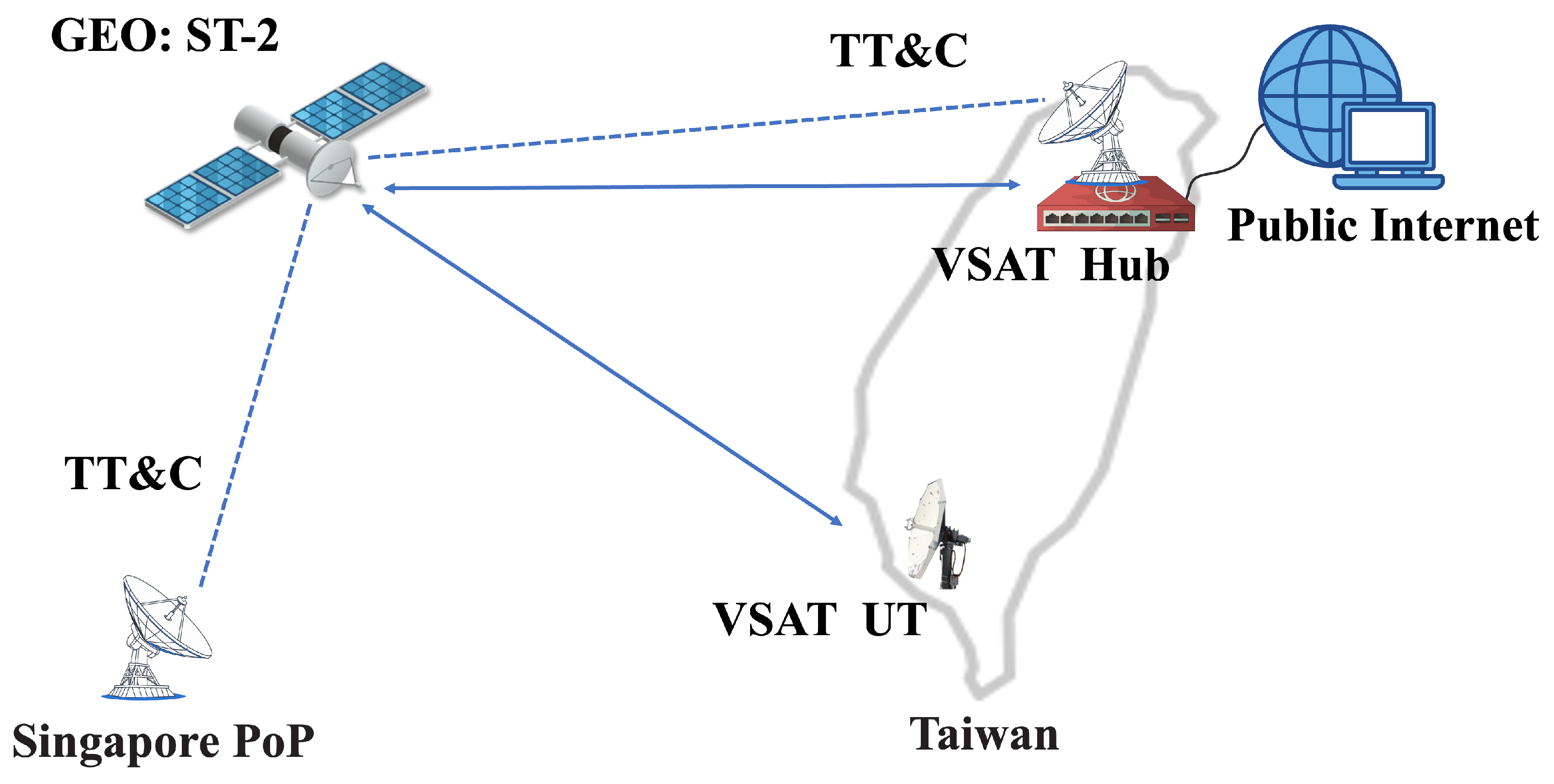
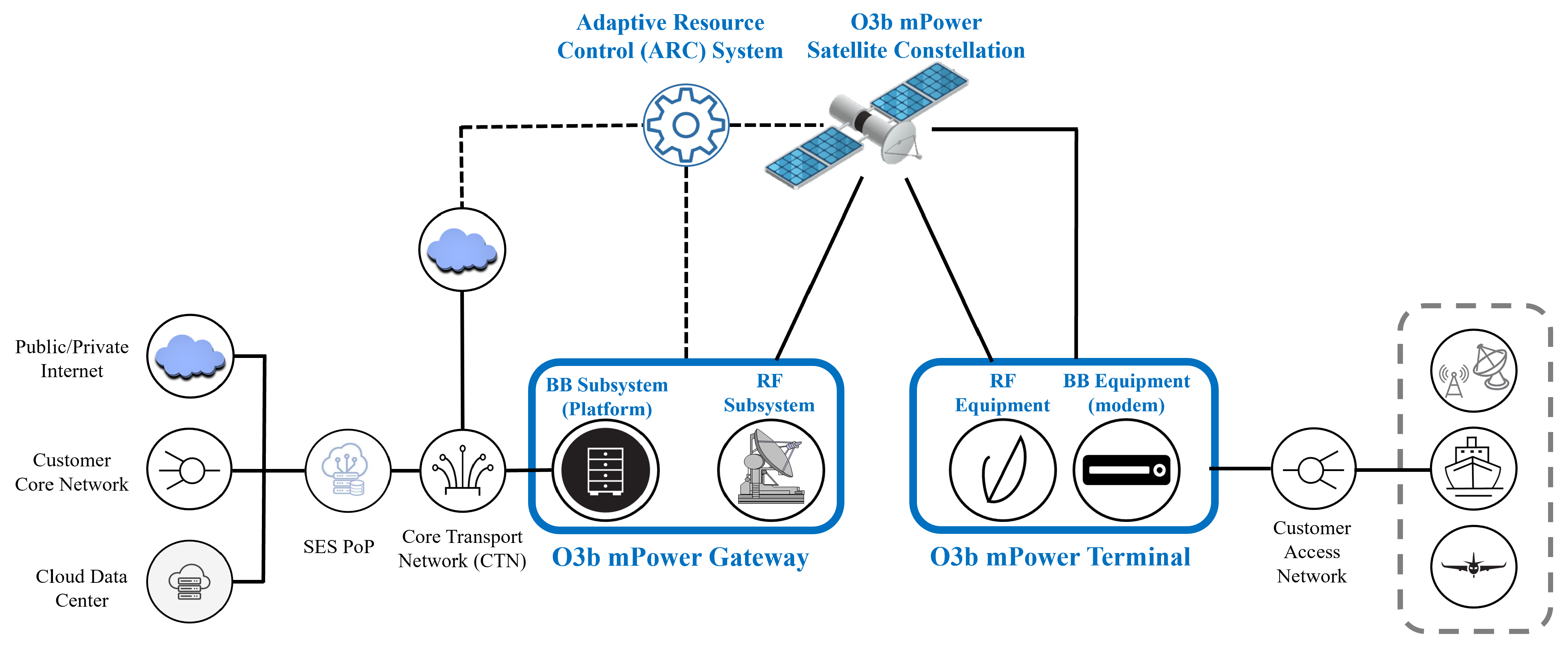



| Parameter | GEO (ST-2) | MEO (SES O3b mPOWER) | LEO (OneWeb) [18] |
|---|---|---|---|
| Satellite Orbit Altitude (km) | 35,786 [15] | 8063 [19] | 1200 |
| Number of Orbits | 1 | 1 | 12 |
| Satellites per Orbit | 1 | 13 (Total Planned) [20] | 49 |
| Beam Coverage | Wide (Regional) [21] | Flexible beam sizes | 1667 × 65 km |
| Beam Capacity | N/A (Transponder-based) | Dynamic ratio * | 400/80 Mbps |
| (Forward/Return) | (Up to 10 Gbps per link) [22] | ||
| User Link Frequency | 10.95–12.75/14.0–14.5 | 17.7–20.2/27.5–30.0 | 10.7–12.7/14.0–14.5 |
| (DL/UL) (GHz) |
Disclaimer/Publisher’s Note: The statements, opinions and data contained in all publications are solely those of the individual author(s) and contributor(s) and not of MDPI and/or the editor(s). MDPI and/or the editor(s) disclaim responsibility for any injury to people or property resulting from any ideas, methods, instructions or products referred to in the content. |
© 2026 by the authors. Licensee MDPI, Basel, Switzerland. This article is an open access article distributed under the terms and conditions of the Creative Commons Attribution (CC BY) license.
Share and Cite
Lin, Y.-C.; Choong, T.W.; Pang, Z.C.; Chuang, P.-H.; Huang, Y.-C.; Chen, M.-T.; Leu, J.-S. Empirical Analysis of Heterogeneous Multi-Orbit Satellite Networks for Communication Resilience in Island Regions. Electronics 2026, 15, 773. https://doi.org/10.3390/electronics15040773
Lin Y-C, Choong TW, Pang ZC, Chuang P-H, Huang Y-C, Chen M-T, Leu J-S. Empirical Analysis of Heterogeneous Multi-Orbit Satellite Networks for Communication Resilience in Island Regions. Electronics. 2026; 15(4):773. https://doi.org/10.3390/electronics15040773
Chicago/Turabian StyleLin, Yi-Cheng, Tuck Wai Choong, Zheng Cheng Pang, Ping-Hsiang Chuang, Yao-Ching Huang, Ming-Te Chen, and Jenq-Shiou Leu. 2026. "Empirical Analysis of Heterogeneous Multi-Orbit Satellite Networks for Communication Resilience in Island Regions" Electronics 15, no. 4: 773. https://doi.org/10.3390/electronics15040773
APA StyleLin, Y.-C., Choong, T. W., Pang, Z. C., Chuang, P.-H., Huang, Y.-C., Chen, M.-T., & Leu, J.-S. (2026). Empirical Analysis of Heterogeneous Multi-Orbit Satellite Networks for Communication Resilience in Island Regions. Electronics, 15(4), 773. https://doi.org/10.3390/electronics15040773