Article

Stability Analysis for Bidirectional V2G Power Conversion Systems in Electric Vehicles

1
College of Electrical Engineering, Sichuan University, Chengdu 610065, China
2
State Grid Sichuan Electric Power Company Nanchong Power Supply Company, Nanchong 637000, China
*
Author to whom correspondence should be addressed.
Electronics 2026, 15(4), 740; https://doi.org/10.3390/electronics15040740
Submission received: 24 December 2025 / Revised: 1 February 2026 / Accepted: 6 February 2026 / Published: 9 February 2026
(This article belongs to the Special Issue Stability Analysis and Control of Smart Grids)

Abstract

With the growing adoption of electric vehicles (EVs), vehicle-to-grid (V2G) technology has emerged as an effective means to enhance grid flexibility through functions such as frequency regulation and peak shaving. However, the integration of a large number of power electronic devices via V2G has also raised serious concerns about grid stability. This paper first introduces the circuit configuration of a bidirectional V2G energy conversion system and proposes a novel converter equivalent circuit, i.e., Y-type and Z-type equivalence. A unified small-signal model of the V2G system is then established. From this model, the mathematical expressions for the AC bus current and DC bus voltage under various operating conditions are derived, leading to a common denominator factor, termed the generalized stability factor D ( S ) . Unlike conventional methods that rely on Nyquist diagrams, the distribution of poles and zeros of D ( S ) is intuitively identified by analyzing its magnitude-frequency and phase-frequency characteristics. The existence of zeros in D ( S ) is used as the stability criterion for the system. Finally, a simulation model of a clustered V2G energy conversion system is developed. Through systematic reduction in the DC-side capacitance in four distinct operational scenarios, our simulations successfully predicted and validated the emergence of characteristic oscillations at 870 Hz, 730 Hz, 843 Hz, and 893 Hz. This demonstrates the efficacy of the proposed stability criterion across various operating conditions.

1. Introduction

The popularization of electric vehicles has brought a series of advantages to the modern power grid, but it has also brought many challenges. Vehicle-to-grid (V2G) technology [1] can realize bidirectional energy flow between electric vehicles and the power grid, which helps to improve the flexibility and stability of the power grid. As the proportion of renewable energy in the power system continues to increase, V2G technology is gradually becoming a promising solution that can effectively support the stable operation and optimized scheduling of the power system.
The V2G bidirectional energy conversion system is the core energy conversion system for realizing bidirectional energy interaction between electric vehicles (EVs) and the power grid [2,3], and its performance is directly related to the safety and stable operation of the entire system. The V2G system needs to frequently switch between multiple working modes, such as charging (grid-to-vehicle) and discharging (vehicle-to-grid). As the number of chargers operating in parallel in a system increases, the dynamic interaction between multiple devices intensifies, easily triggering voltage and current oscillations under conditions such as mode switching or sudden load changes, thereby threatening the system’s stable operation [4,5,6]. In-depth research reveals that the stability of the system depends, on the one hand, on grid-side interactions and is also profoundly influenced, on the other hand, by the time-varying parameter of the battery unit’s health state. Relevant research, such as that by Cavus and Bell [7], is dedicated to its precise characterization.
For V2G bidirectional energy conversion systems, there are various operating modes, such as charging and discharging. Furthermore, the equivalent circuits differ between these modes, causing the system’s equivalent model to change with the operating state. In this context, existing stability analysis methods, such as the traditional impedance criterion [8,9,10,11], often struggle to adapt to the model changes brought about by multi-mode operation due to their dependence on specific network topologies. These methods suffer from limited applicability, complex analysis processes, and difficulties in establishing a unified stability criterion, thus posing challenges to system design and reliable operation. Therefore, researching a stability analysis method that can adapt to complex and variable operating conditions to achieve accurate stability assessment of V2G systems under different operating states is of great significance.
The stability of distributed power systems has been extensively studied. In 1976, Middlebrook proposed a stability criterion based on impedance ratio, defining the impedance ratio as the ratio of source impedance to load impedance [12], Z s / Z l , where Z s represents the output impedance of the source converter and Z l represents the input impedance of the load converter. It should be noted that this criterion is only applicable to cascaded systems where the source converter is a voltage source structure; when the source converter is a current source, the equivalent loop gain of the system should be Z l / Z s . In contrast, Sun proposed a reverse impedance ratio criterion for grid-connected inverters in reference [13], which was Z l / Z s . Based on these two types of impedance ratio criteria, subsequent research has made extensive progress in system design and stability enhancement. On this basis, Zhong and Zhang pointed out [14] that the stability of any two-stage cascaded system can be evaluated by a unified impedance and form Z l + Z s . To further handle multi-voltage-level systems, Lu et al. [15] divided the three-stage DC microgrid into a power supply section and a load section and defined the overall system impedance ratio as the ratio of the total output impedance of the power supply side to the total input impedance of the load side.
However, the V2G bidirectional energy conversion system has a complex structure, making it difficult to categorize it simply as a traditional power supply type or load type converter. Furthermore, existing stability analysis methods struggle to provide a unified criterion for the system under different operating conditions. To address these issues, this paper proposes a novel converter-equivalent method applicable to V2G bidirectional energy-conversion systems. This method categorizes all converters in the system into three categories: Z-type converters (bus-voltage-controlled type), Y-type converters (bus-current-controlled type), and intermediate converters (bidirectional power-flow type, including Z-Y and Y-Z types). By performing equivalent modeling of each part of the system, mathematical expressions for the AC bus current and DC bus voltage are derived under various operating conditions. After integration and transformation, it is found that the expressions for AC bus current and DC bus voltage share a common denominator factor. This paper defines this common factor as the system’s universal stability factor D ( S ) , and based on this, proposes a unified stability criterion applicable to various operating conditions, namely, judging system stability by analyzing the existence or absence of zeros in D ( S ) . Regarding the identification of zeros and poles in D ( S ) , unlike the methods in references [16,17,18,19,20,21] that rely on Nyquist plots or root locus plots to determine the distribution of zeros and poles, this paper proposes a zero-pole analysis method based on Bode plots, identifying the distribution of zeros and poles by observing changes in their amplitude and phase frequency characteristics. This criterion has been effectively verified in a V2G bidirectional energy conversion system.
The main contributions of this paper include (1) a novel converter modeling method based on Y/Z-type equivalence, establishing a unified modeling framework applicable to multiple operating conditions; (2) derivation of a generalized stability factor D ( S ) as a unified criterion for system stability analysis; and (3) development of a Bode plot-based stability analysis method for V2G bidirectional energy conversion systems, significantly improving the efficiency and intuitiveness of system stability assessment.
The arrangement of the subsequent chapters of this article is as follows. Firstly, in Section 2, the circuit structure of the V2G bidirectional energy conversion system and its equivalent converter method are established. Secondly, in Section 3, the mathematical model of the system is derived, and the corresponding stability criteria are given. The fourth section verifies the effectiveness of the proposed stability criteria through frequency-domain and time-domain simulations under various operating conditions in the MATLAB/Simulink environment. Section 5 compares the method proposed in this article with existing methods. In Section 6, the future work is prospected and arranged. Finally, in Section 7, the conclusions are drawn.

2. Circuit Structure and Equivalent Method of V2G Bidirectional Energy Conversion System

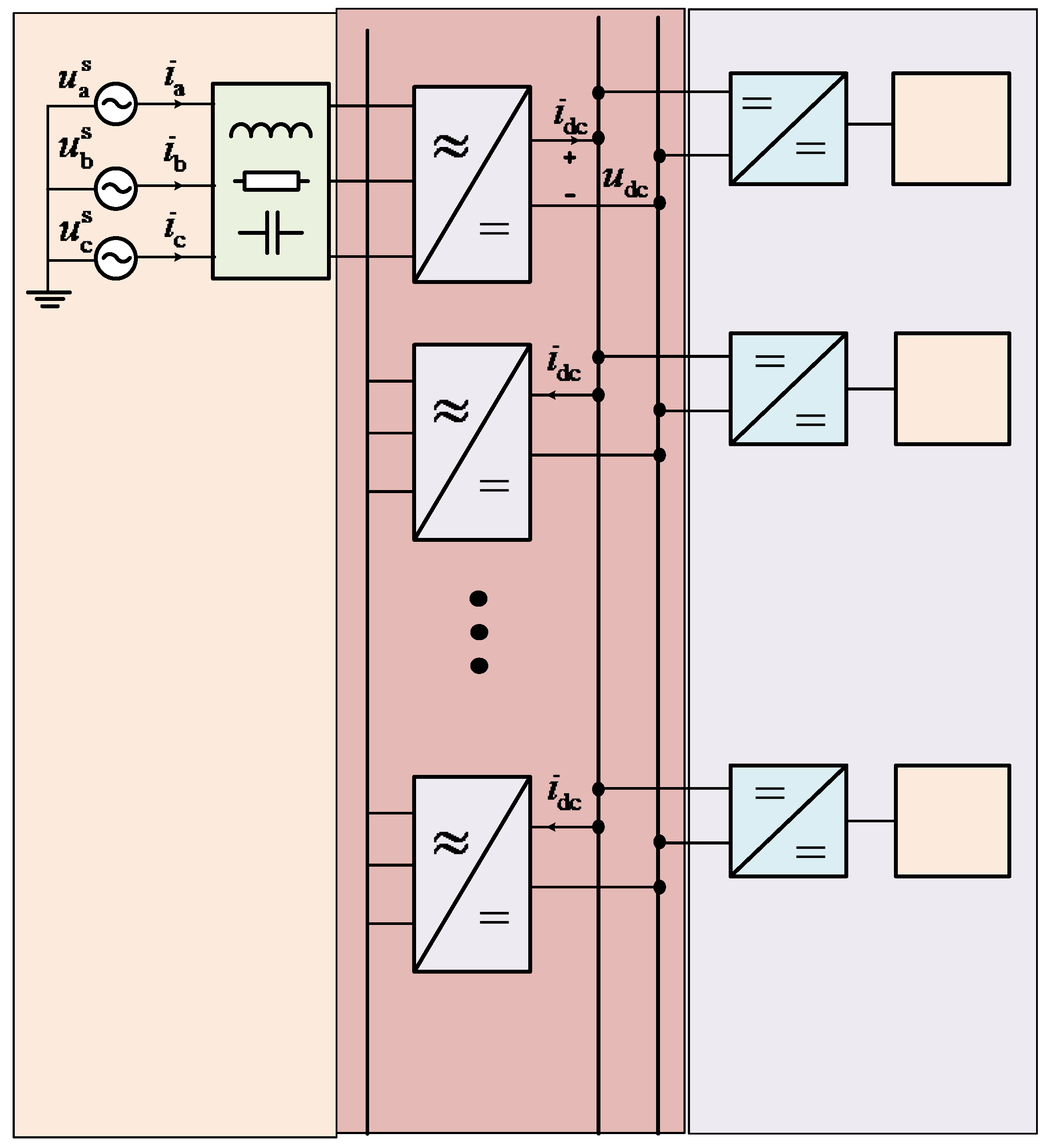
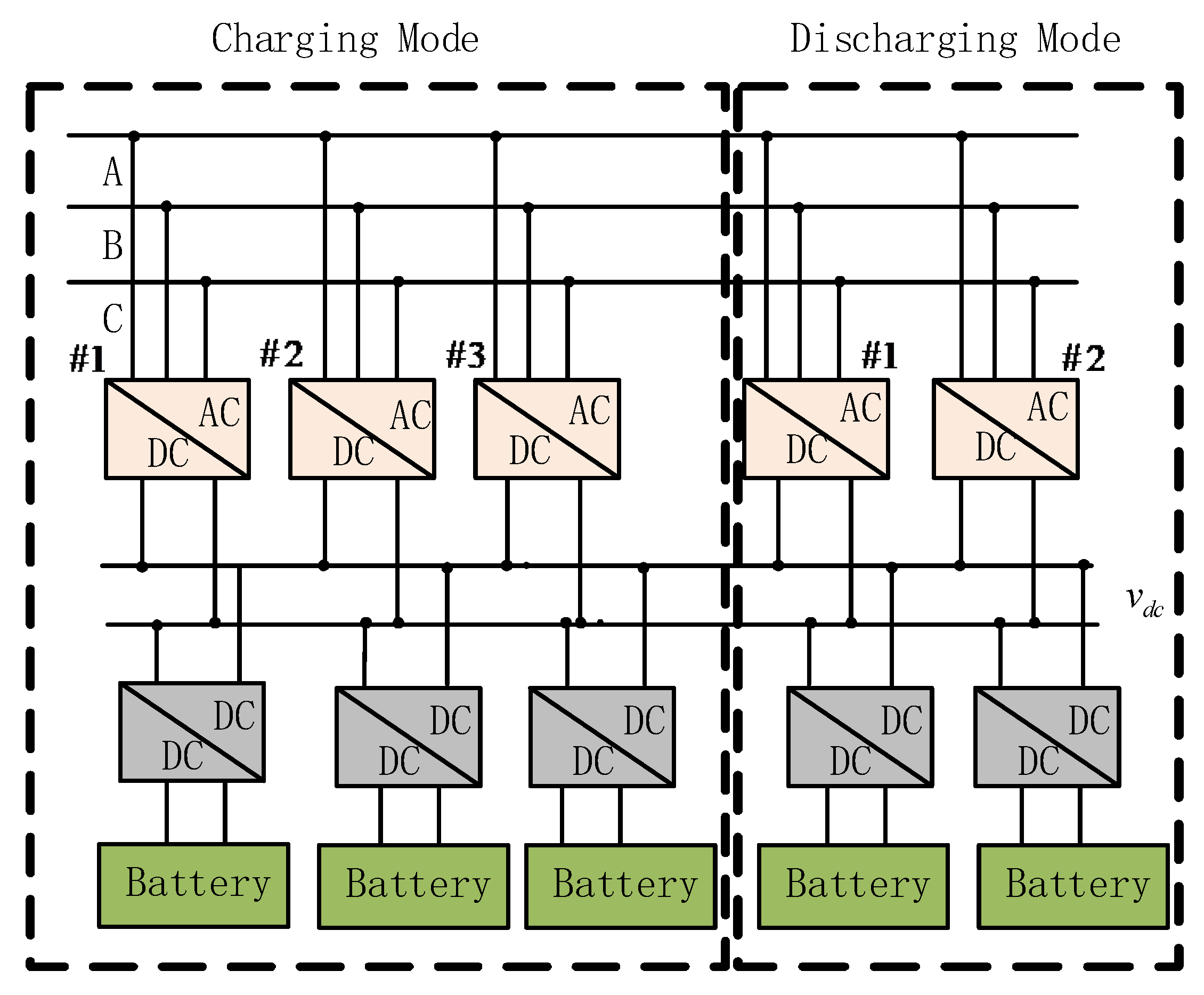
The electric vehicle charging and discharging system is a key interface for realizing the interconnection between electric vehicles and the AC power grid, as well as for performing bidirectional energy conversion. The topology of its V2G system is shown in Figure 1.
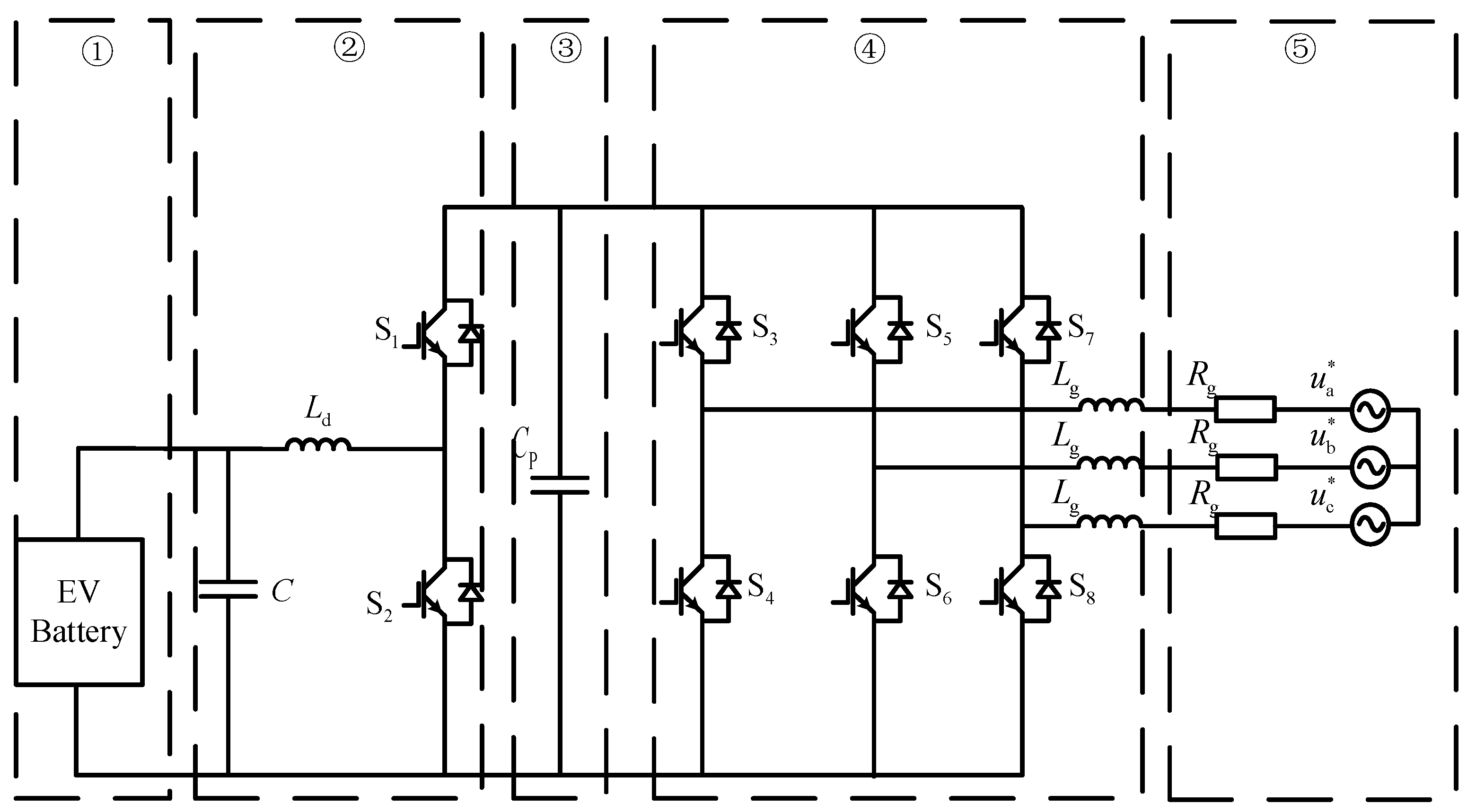
V2G bidirectional power conversion systems can be broadly categorized into single-stage and two-stage configurations based on their circuit structures. Figure 1 illustrates the two-stage system, whose primary distinction from the single-stage topology lies in the inclusion of a bidirectional DC-DC conversion stage. The two-stage system comprises three main sections: the grid-side converter, the intermediate power converter, and the battery-side converter. The intermediate stage typically employs a bidirectional AC-DC converter, with common topologies including three-phase voltage-source PWM rectifiers, T-type three-level rectifiers, and Vienna rectifiers. The battery side consists of a bidirectional DC-DC converter and the vehicle battery, where frequently adopted topologies include the bidirectional buck–boost, Cuk, SEPIC, and isolated dual-active-bridge converters. In this work, the specific circuit configuration selected is a three-phase PWM rectifier for the AC-DC stage and a buck–boost converter for the DC-DC stage.
Figure 2 depicts the circuit topology adopted in this study. In the V2G system of an electric vehicle, ① the EV battery serves as the core bidirectional energy source. Its power is conditioned by ② a bidirectional DC/DC converter for voltage regulation to maintain DC bus stability. ③ The DC bus capacitor acts as a crucial energy buffer, ensuring dynamic stability during charging and discharging mode transitions. The power then flows through ④ a bidirectional AC/DC converter, which employs a three-phase PWM structure to switch between grid-to-vehicle charging and vehicle-to-grid discharging modes, thereby enabling safe and controlled bidirectional energy exchange with ⑤ the AC grid.
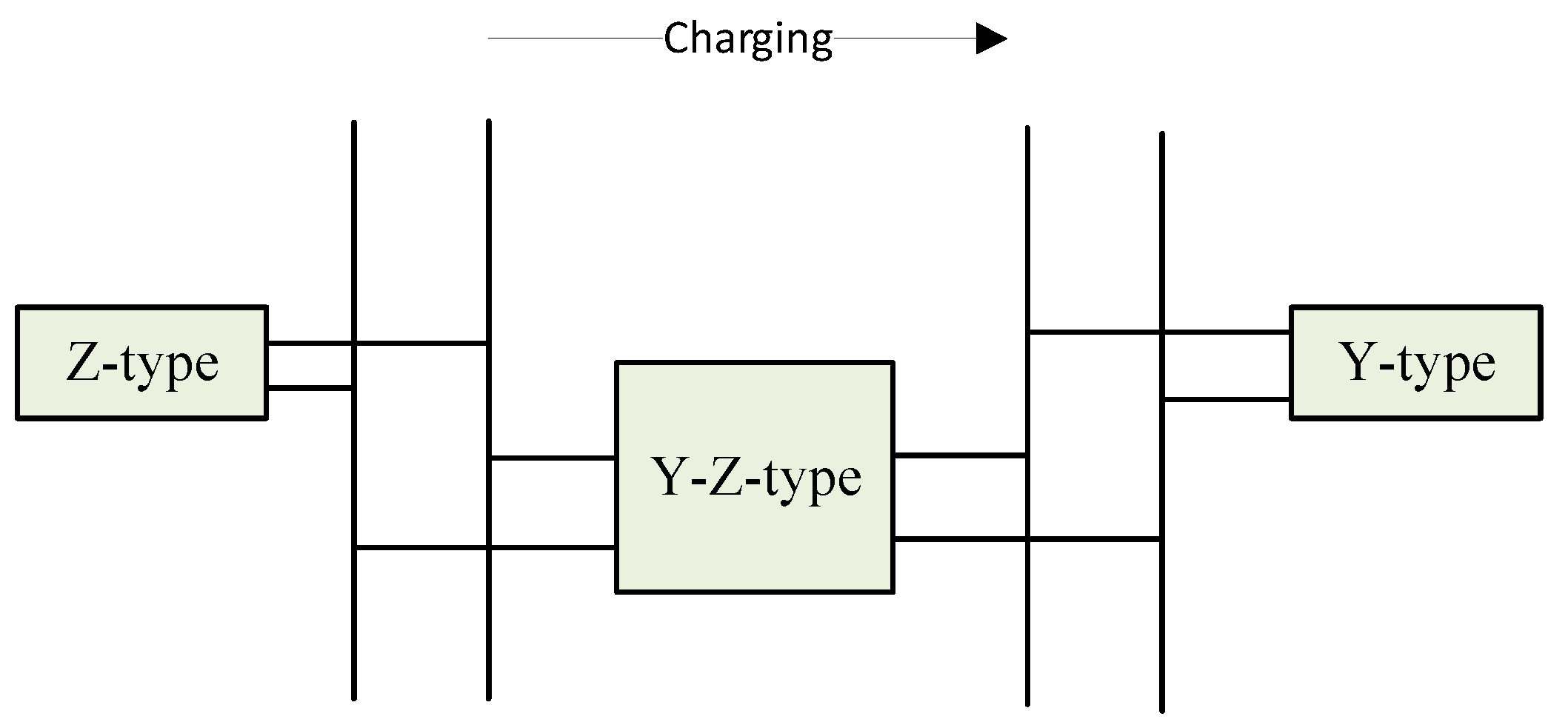
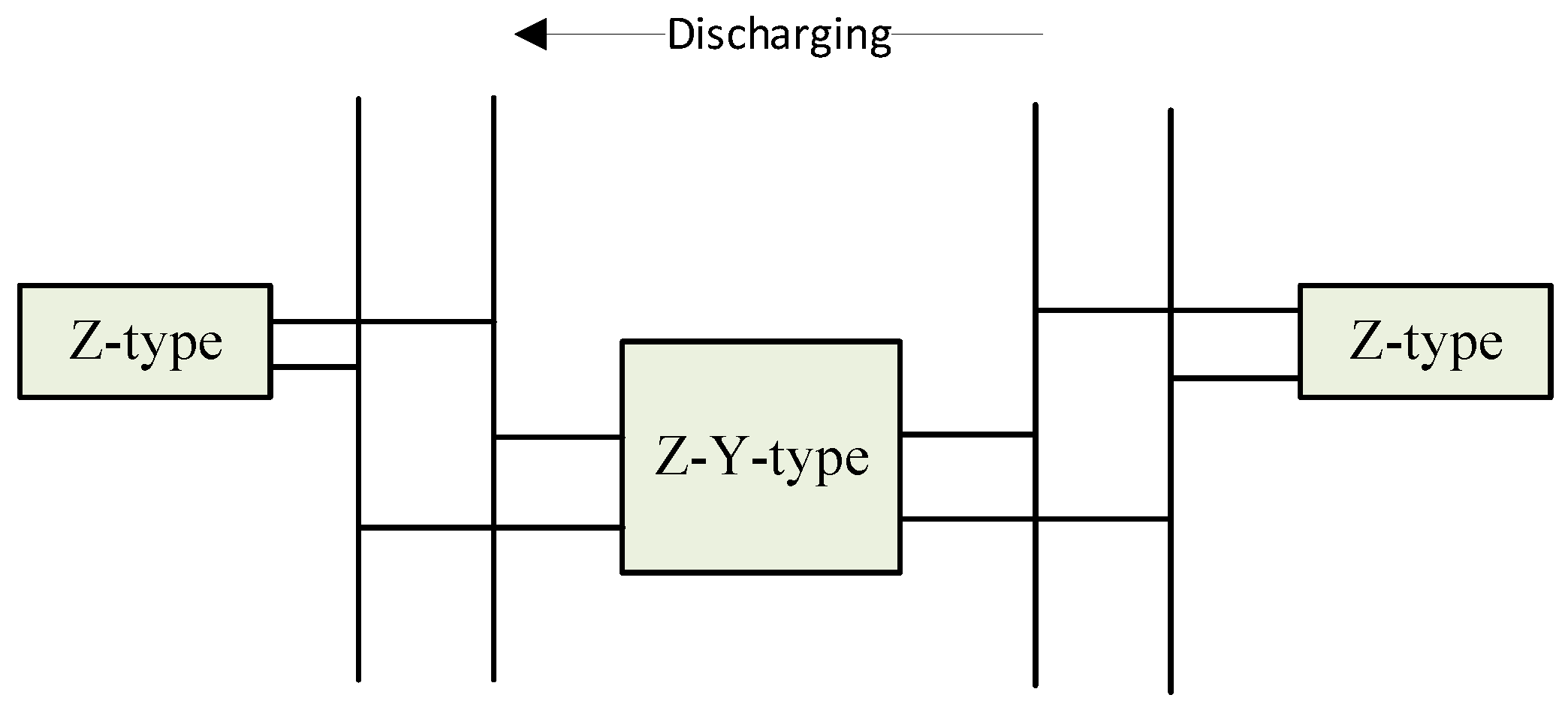
In V2G bidirectional energy conversion systems, power conversion units can be categorized into two types based on their control methods: bus-voltage-controlled converters (Z-type converters) and bus-current-controlled converters (Y-type converters). Specifically, Z-type converters use the voltage parameter at their bus-side ports as the dominant control variable, while Y-type converters dynamically regulate energy transfer by controlling the current parameter at their bus-side ports.
Referring to the definitions of Z-type and Y-type converters, the grid-side converter is used to stabilize the AC bus voltage, and therefore can be considered a Z-type network. The battery-side converter, in the charging state (energy flow from the grid side to the battery side), controls the DC bus output current, and therefore can be considered a Y-type converter. In the discharging state (energy flow from the battery side to the grid side), it is used to control the DC bus voltage, and therefore can be considered a Z-type converter. For the intermediate converter, in the charging state, it is equivalent to the Y-type converter and Z-type converter from different bus ports. Therefore, this intermediate converter is considered a Y-Z type converter, and the system equivalent model is shown in Figure 3. In the discharging state, the intermediate converter is equivalent to the Z-type converter and the Y-type converter. Therefore, this intermediate converter is considered a Y-Z type converter, and the system equivalent model is shown in Figure 4.

3. Small-Signal Model and Stability Criterion of V2G Bidirectional Energy Conversion System

3.1. Description and Modeling of a Single V2G Bidirectional Energy Conversion System

This section is devoted to constructing a small-signal model within the dq-frame. The core premise is that the stability criterion proposed herein is a universal framework. Even within the stationary abc-frame, the unified common denominator term can be derived as long as the small-signal characteristics of the converter ports are acquired and the respective transfer functions are established. Thus, the validity of this criterion transcends any specific coordinate system.
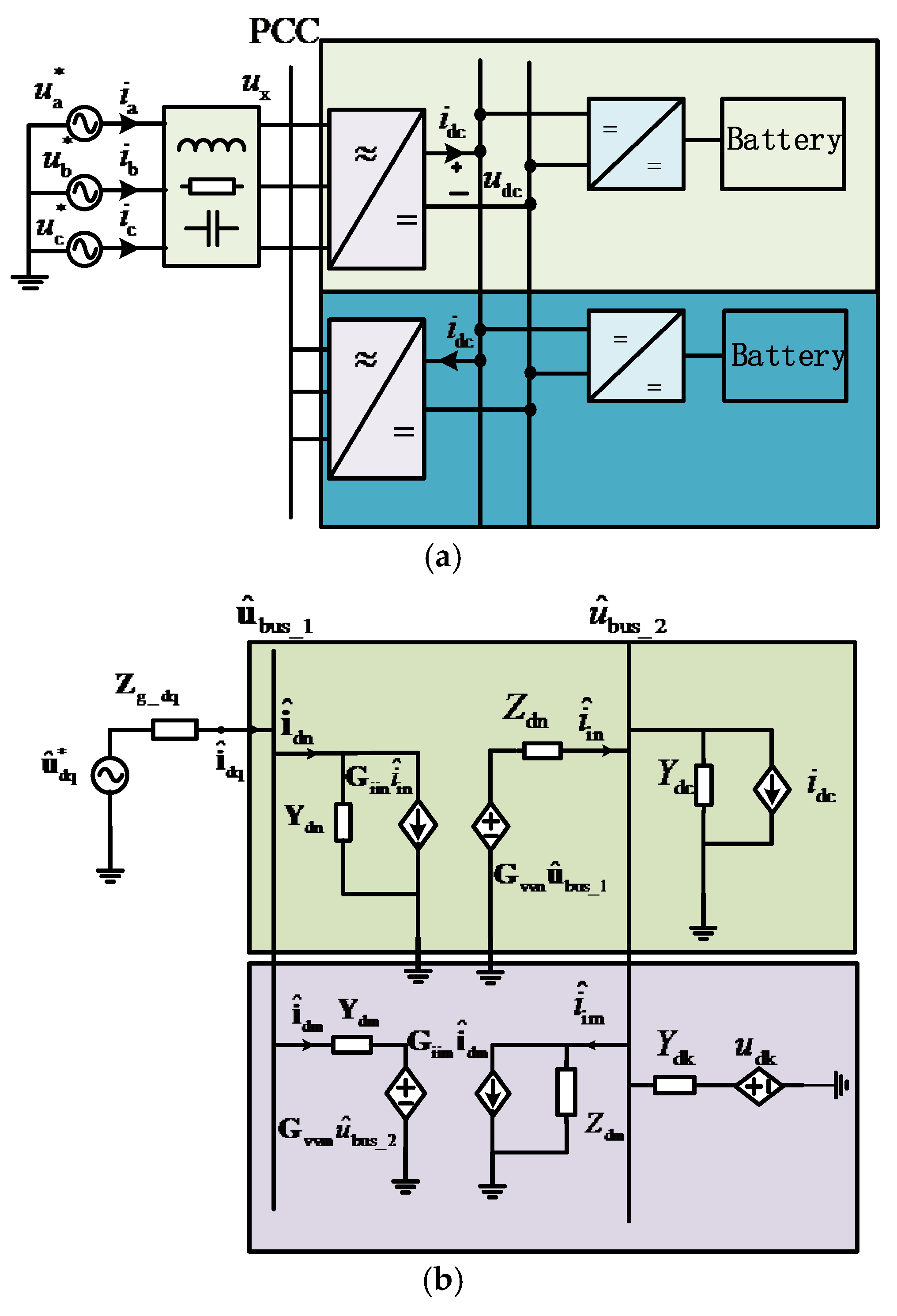
Consider the independent operation of a single V2G bidirectional energy conversion system; its system structure is shown in Figure 5a. Figure 5a illustrates the equivalent model of the charging and discharging states in a typical V2G bidirectional energy conversion system. This system mainly consists of a three-phase symmetrical AC power supply u x ( x = a , b , c ), given a grid impedance Z g , two AC-DC converters (one charging and one discharging), and two DC-DC converters (one charging and one discharging). The AC-DC converters generate a stable DC bus voltage, where u dc , i a , i b , i c are grid currents, and u x is the voltage at the PCC.
Figure 5b shows the simplified small-signal model of the system shown in Figure 5a. The variables in bold are matrices or vectors.
On the grid side, the small-signal equation can be expressed as folows:
u ^ bus _ 1 ( s ) = u ^ dq ( s ) Z g _ dq ( s ) i ^ dq ( s )
where u ^ dq ( s ) = [ u d , u q ] T , and i ^ dq ( s ) = [ i d , i q ] T for a series three-phase inductor L g and a three-phase resistor R g , the grid-side impedance Z g _ dq ( s ) can be expressed as:
Z g _ dq ( s ) = s L g ω 0 L g ω 0 L g s L g + R g
where ω 0 is the fundamental angular frequency of the AC grid.
AC-DC converters can be modeled as generalized two-port networks in both charging and discharging states. In the charging state, the two-port network can be represented as follows:
i ^ dq ( s ) u ^ bus _ 2 ( s ) = Y dn ( s ) G iin ( s ) G vvn ( s ) Z dn ( s ) u ^ bus _ 1 ( s ) i ^ in ( s )
where Y dn ( s ) is the AC-side input admittance matrix, G iin ( s ) is the transfer function vector from i ^ dc ( s ) to i ^ dq ( s ) , G vvn ( s ) is the transfer function vector from u ^ bus _ 1 ( s ) to u ^ bus _ 2 ( s ) , and Z dn ( s ) is the DC output impedance.
In the discharge state, the two-port network can be represented as follows:
u ^ bus _ 1 ( s ) i ^ im ( s ) = 1 Y dm ( s ) G vvm ( s ) G iim ( s ) 1 Z dm ( s ) i ^ dm ( s ) u ^ bus _ 2 ( s )
where Y dm ( s ) is the AC side input admittance matrix, G iim ( s ) is the transfer function vector from i ^ dm ( s ) to i ^ im ( s ) , G vvm ( s ) is the transfer function vector from u ^ bus _ 1 ( s ) to u ^ bus _ 2 ( s ) , and Z dm ( s ) is the DC output impedance.
The voltage–current relationship between the third-stage battery-side converter modules can be represented by KVL and KCL, where Y dc ( s ) is the converter’s equivalent input admittance, i ^ dc ( s ) is its corresponding equivalent current source, Y dk ( s ) is the converter’s equivalent output admittance, and u dk ( s ) is its corresponding equivalent voltage source. In the charging state, the expression for the battery-side converter is as follows:
i ^ in ( s ) = Y dc ( s ) u ^ bus _ 2 ( s ) + i ^ dc ( s )
In the discharging state, the expression for the battery-side converter is as follows:
i ^ im ( s ) = [ u dk ( s ) u bus _ 2 ( s ) ] Y dk ( s )

3.2. Stability Analysis of V2G Bidirectional Energy Conversion System

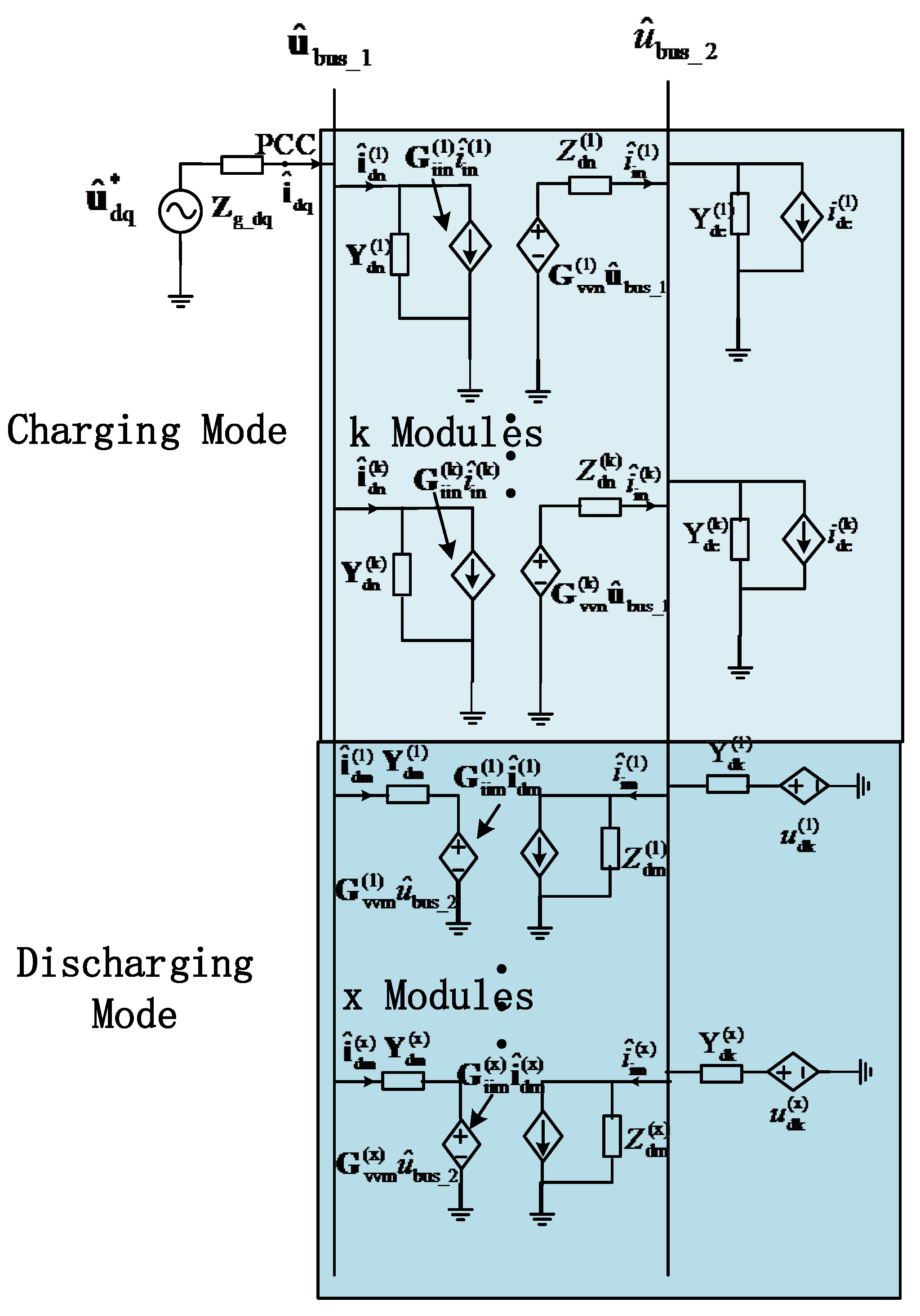
When multiple V2G bidirectional energy conversion systems operate simultaneously, the system model is shown in Figure 6. During the operation of the V2G bidirectional energy conversion system, each unit typically exhibits differentiated operating modes: some units perform charging operations from the grid to the electric vehicle, while others perform discharging operations from the electric vehicle to the grid. To accurately describe the interactions among multiple converters, this paper adopts the following notation convention: the system comprises k converters in charging mode (denoted by superscript (k), k = 1, 2, ⋯, k) and x converters in discharging mode (denoted by superscript (x), x = 1, 2, ⋯, x). For instance, Z dn ( k ) represents the DC output impedance of the k-th converter operating in charging mode, while Z dm ( x ) denotes the DC output impedance of the x-th converter in discharging mode.
Here, the grid current i ^ dq s is the sum of the currents of all AC-DC converters operating in charging and discharging states, which is expressed as follows:
i ^ dq ( s ) = k = 1 K i ^ dn ( k ) ( s ) + x = 1 X i ^ dm ( x ) ( s )
For a single-charge converter, substituting Equations (1), (2), and (5) into Equation (3) yields the expression for the current i ^ d n ( k ) ( s ) on the AC bus side of the converter in a single-charge state:
i ^ dn ( k ) ( s ) = u ^ bus _ 1 ( s ) Y dn ( k ) ( s ) + G iin ( k ) ( s ) Y dc ( k ) ( s ) [ G vvn ( k ) ( s ) u ^ bus _ 1 ( s ) Z dn ( k ) ( s ) i dc ( k ) ( s ) ] 1 + Z dn ( k ) ( s ) Y dc ( k ) ( s ) + i dc ( k ) ( s )
For a converter in a single discharge state, substituting Equations (1), (2), and (6) into Equation (4) yields the expression for the current on the AC bus side of the converter in a single discharge state i ^ d m ( x ) ( s ) , which is calculated as follows:
i ^ dm ( x ) ( s ) = Y dm ( x ) u ^ bus _ 1 ( s ) 1 + Y dk ( x ) ( s ) Z dm ( x ) ( s ) G vvm ( x ) ( s ) Y d k ( x ) ( s ) u ^ d k ( x ) ( s ) Z dm ( x ) ( s ) 1 + Z dm ( x ) ( s ) Y dk ( x ) ( s ) + G vvm ( x ) ( s ) G im ( x ) ( s ) Y dm ( x ) ( s )
By integrating Equations (7)–(9), the expression for the AC bus current i ^ dq ( s ) can be derived as follows:
i ^ dq ( s ) = 1 D ( s ) N i ( s ) u ^ bus _ 1 ( s ) + k = 1 K M k ( s ) i ^ dn ( k ) ( s ) + x = 1 X P x ( s ) i ^ dm ( x ) ( s )
N i ( s ) = adj D matrix ( s )
M k ( s ) = adj D matrix ( s ) Z g _ dq ( s ) G iin ( k ) ( s ) 1 + Z dn ( k ) ( s ) Y dc ( k ) ( s )
P x ( s ) = adj D matrix ( s ) Z g _ dq ( s ) G iim ( x ) ( s ) 1 + Z dm ( x ) ( s ) Y dk ( x ) ( s )
D matrix ( s ) = I + Z g _ dq ( s ) k = 1 K A ( k ) ( s ) + x = 1 X C ( x ) ( s )
By integrating Equations (7), (9), (10), and (11)–(14), the expression for the DC bus voltage u ^ bus _ 2 ( s ) can be obtained as follows:
u ^ bus _ 2 ( s ) = 1 D ( s ) N v ( s ) u ^ dq s ( s ) + k = 1 K M k ( s ) i ^ dn ( k ) ( s ) + x = 1 X P x ( s ) i ^ dm ( x ) ( s )
N v ( s ) = det D matrix ( s ) G vvn ( k ) ( s ) I Z g _ dq ( s ) A ( k ) ( s ) 1
M k ( s ) = Z dn ( k ) ( s ) 1 + Y dc ( k ) ( s ) G vvn ( k ) ( s ) I Z g _ dq ( s ) A ( k ) ( s ) 1 Z g _ dq ( s ) G in ( k ) ( s ) 1 + Z dn ( k ) ( s ) Y dc ( k ) ( s )
P x ( s ) = G vvm ( x ) ( s ) I Z g _ dq ( s ) C ( x ) ( s ) 1 Z g _ dq ( s ) G iim ( x ) ( s ) 1 + Z dm ( x ) ( s ) Y dk ( x ) ( s )
where
D ( s ) = det I + Z g _ dq ( s ) k = 1 K A ( k ) ( s ) + x = 1 X C ( x ) ( s )
A ( k ) ( s ) = Y dn ( k ) ( s ) + G iin ( k ) ( s ) Y dc ( k ) ( s ) G vvn ( k ) ( s ) 1 + Z dn ( k ) ( s ) Y dc ( k ) ( s )
C ( x ) ( s ) = Y dm ( x ) ( s ) + G iim ( x ) ( s ) Y dk ( x ) ( s ) G vvm ( x ) ( s ) 1 + Z dm ( x ) ( s ) Y dk ( x ) ( s )
D ( S ) is used to reflect the impedance-matching condition among various components in the V2G bidirectional energy-conversion system. In linear system theory, the stability of a closed-loop system is determined by the locations of the poles of its transfer function, where the poles correspond to the roots of the system’s characteristic equation. By comparing the closed-loop transfer function expressions in Equations (10) and (15), it is clear that D ( S ) constitutes the characteristic polynomial of the overall system. Consequently, the roots of D ( S ) represent the system poles. The necessary and sufficient condition for system stability is that all poles lie in the left-half plane; equivalently, the D ( S ) must have no zeros in the right half-plane (RHP).

3.3. Stability Criterion Based on System Universal Stability Factor D ( S )

Since the input–output transfer function of the system is as shown in the above equation, the stability of the V2G bidirectional energy conversion system requires both the AC bus current i ^ d q ( s ) and the u ^ bus _ 2 ( s ) bus voltage to be stable. To further discuss the stability of the system, three basic assumptions are proposed: (1) the grid voltage u dq s ( s ) is stable; (2) the AC-DC converter can operate stably independently, regardless of whether it is in a charging or a discharging state, that is Y dn ( s ) , G iin ( s ) , G vvn ( s ) , Z dn ( s ) , Y dm ( s ) , G vvm ( s ) , G iim ( s ) , Z d m ( s ) have no right half-plane (RHP) poles; (3) the battery-side converter module can operate stably independently, regardless of whether it is in a charging or a discharging state, Y dk ( s ) , Y dc ( s ) have no right half-plane (RHP) poles, and i dc ( s ) as well as u dk ( s ) are bounded. Then, combining Equations (7)–(14), the system’s universal stability factor D ( S ) can be obtained, because Y dn ( s ) , G iin ( s ) , G vvn ( s ) , Z dn ( s ) , Y dm ( s ) , G vvm ( s ) , G iim ( s ) , Z dm ( s ) , Y dk ( s ) , Y dc ( s ) do not contain right half-plane (RHP) poles. Therefore, when the universal stability factor D ( S ) does not contain right-half-plane (RHP) zeros, when Z ( D ( S ) ) = 0 , the entire system is stable.
For Bode plot-based stability analysis, system stability can be assessed by calculating the number of times the phase of D ( S ) intersects with ( 2 k ± 1 ) π ( k = 0 ,   1 ,   2 ) . However, simply observing the phase change of D ( S ) cannot accurately predict system stability. A more intuitive and feasible approach is to determine the number of RHP zeros or poles in the entire system by examining the consistency of amplitude and phase changes. An RHP zero may cause the amplitude to increase by 20   dB while the phase decreases by 90°; an RHP pole may cause the amplitude to decrease by 20   dB while the phase increases by 90°. The identification process for RHP zeros and poles in D ( S ) is as follows:
Z ( D ( S ) ) P ( D ( S ) ) = 1 2 × d | D ( S ) | d f f osc _ f osc + 20 dB / dec D ( S ) f osc _ f osc + 90 °
where f o s c + and f o s c represent the frequencies occurring before and after the oscillation.
To address the potential coexistence of RHP poles and zeros in D ( S ) , the number of RHP poles P ( D ( S ) ) in D ( S ) should be checked before assessing the overall system stability.
From Equation (15), D ( S ) is constructed using closed-loop transfer functions from Equations (7)–(11). Therefore, the number of RHP poles in P ( D ( S ) ) depends on the RHP poles of Y dn ( s ) , G iin ( s ) , G vvn ( s ) , Z dn ( s ) , Y dm ( s ) , G vvm ( s ) , G iim ( s ) , Z dm ( s ) , Y dk ( s ) , Y dc ( s ) ; therefore,
P ( D ( S ) ) = k = 1 K P ( G iin ( k ) ) + P ( G vvn ( k ) ) + P ( Z dn ( k ) ) + P ( Y dc ( k ) ) + P ( Y dn ( k ) ) + x = 1 X P ( Z dm ( x ) ) + P ( G vvm ( x ) ) + P ( G im ( x ) ) + P ( Y dm ( x ) ) + P ( Y dk ( x ) )
As mentioned earlier, if each converter operates stably on its own, then none of the closed-loop transfer functions Y dn ( s ) , G iin ( s ) , G vvn ( s ) , Z dn ( s ) , Y dm ( s ) , G vvm ( s ) , G iim ( s ) , Z dm ( s ) , Y dk ( s ) , Y dc ( s ) mentioned above have RHP poles.
P ( G iin ( k ) ) = P ( G vvn ( k ) ) = P ( Z dn ( k ) ) = P ( Y dc ( k ) ) = P ( Y dn ( k ) ) = P ( Z dm ( x ) ) = P ( G vvm ( x ) ) = P ( G iim ( x ) ) = P ( Y dm ( x ) ) = P ( Y dk ( x ) ) = 0
From the above equation, it can be seen that the unified stability factor D ( S ) under all operating conditions does not have RHP poles. Therefore, we only need to determine the number of zeros in D ( S ) through stability analysis based on the Bode plot to evaluate the stability of the system. The stability criteria for the V2G bidirectional energy conversion system are as follows.
When all power converters of the system are operating under charging conditions, i.e., under the conditions of K 0 , X = 0 , these values are substituted into the expression of the universal stability factor D ( S ) . When D ( S ) does not have RHP zeros, the stability of the system can be directly predicted by the Bode plot of Equation (22).
When all power converters of the system are operating under discharging conditions, i.e., under the conditions of K = 0 , X 0 , when D ( S ) does not have RHP zeros, the stability of the system can be directly predicted by the Bode plot of Equation (22).
When the power converters of the system are operating under conditions where both conditions exist, i.e., under the condition of K 0 , X 0 , when D ( S ) does not have RHP zeros, the stability of the system can be directly predicted by the Bode plot of Equation (22).
Therefore, the proposed stability criterion is a one-step method.

4. Simulation Verification and Analysis

This study employs a two-stage topology for the V2G system: a front-end three-phase PWM converter for AC-DC power conversion and a rear-end buck–boost converter for DC voltage regulation. This configuration effectively supports bidirectional energy flow, meeting the operational requirements of the V2G system under various conditions.
Regarding the control strategy, a classic dual-loop voltage and current control scheme [21,22] is adopted. To validate the effectiveness of the stability criterion proposed in Section 3 and its universality under different operating conditions, a simulation model of a clustered V2G bidirectional energy conversion system is developed. The simulation encompasses four typical operational scenarios: single-unit charging, single-unit discharging, simultaneous charging and discharging, and clustered charging operation. Each charging unit utilizes a consistent circuit structure and control strategy.
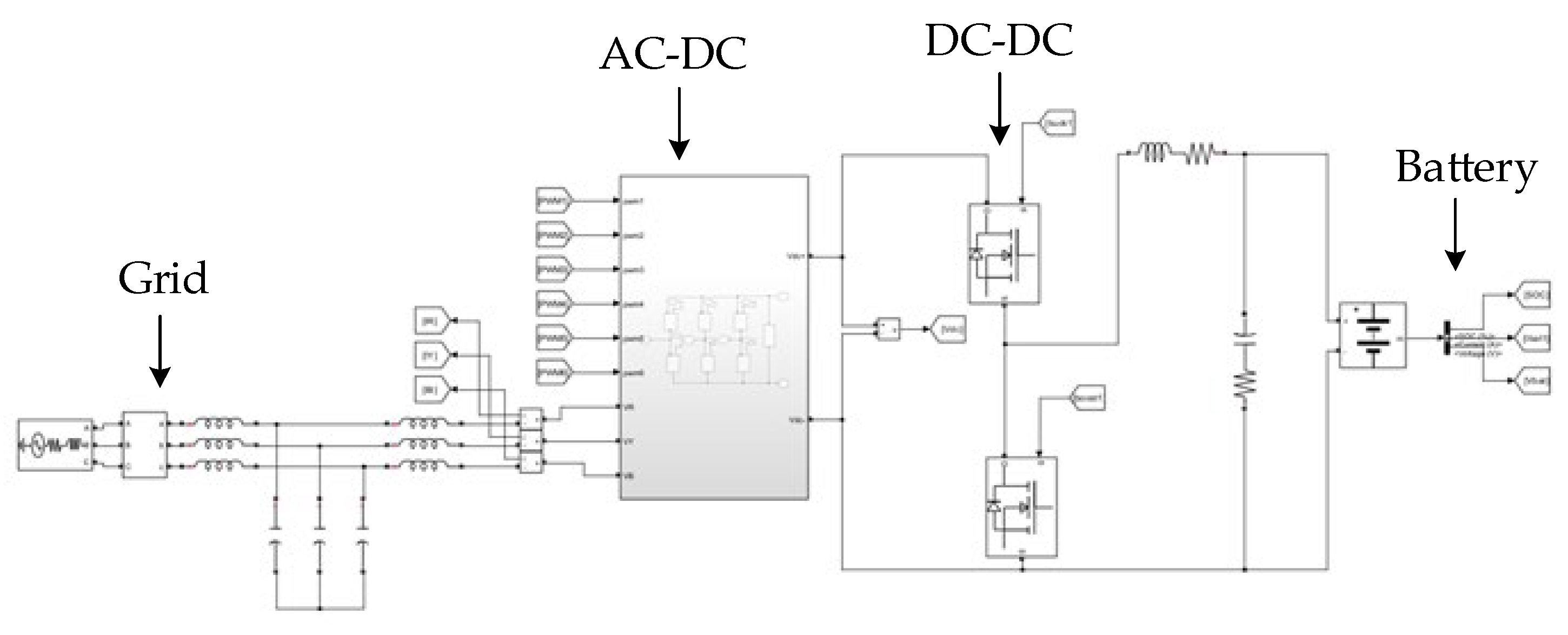
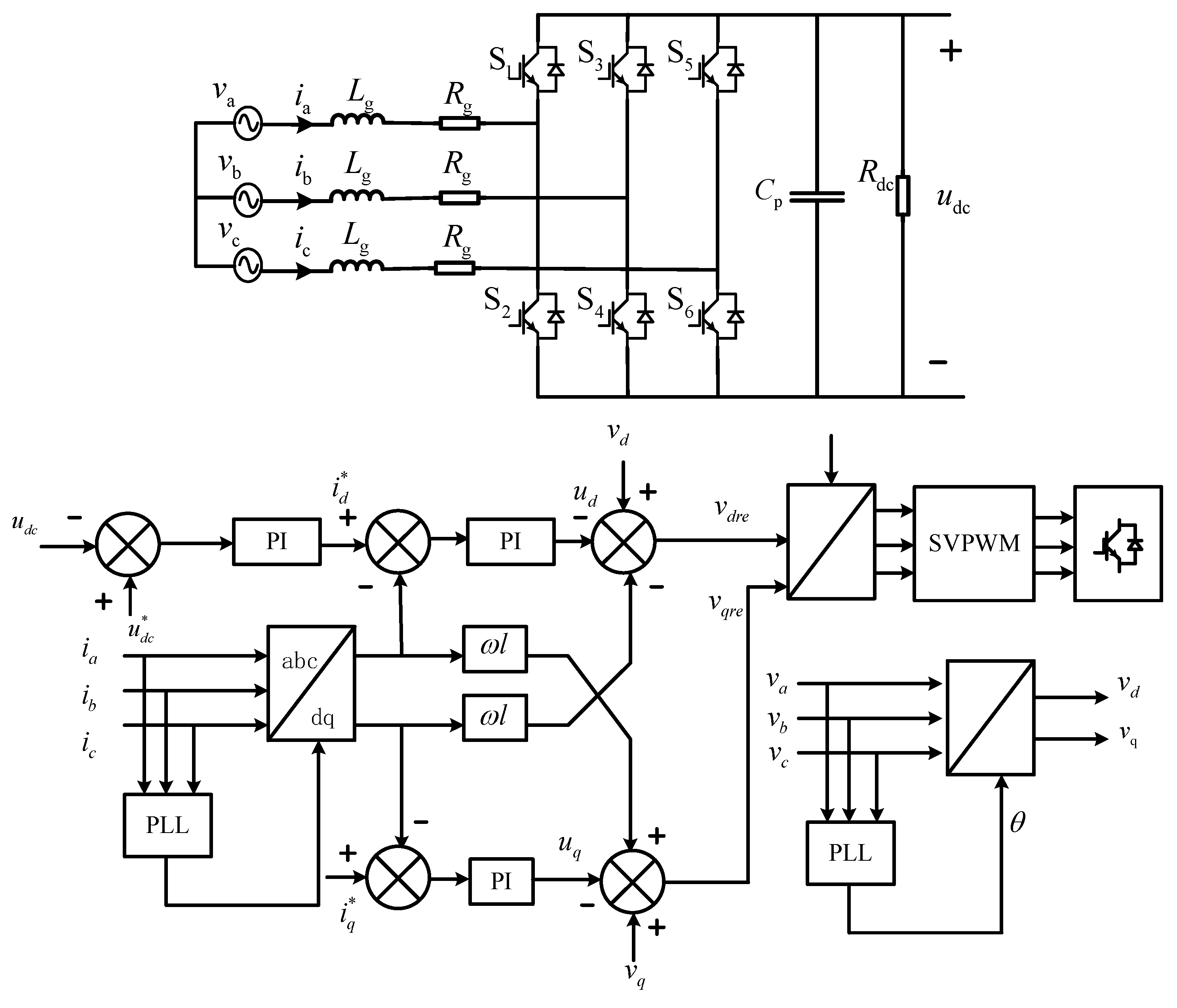
The system’s charging topology is illustrated in Figure 7. A single charging unit comprises a three-phase grid, an AC-DC converter, and a subsequent DC-DC converter. The AC-DC converter implements a dual closed-loop control strategy, consisting of an outer voltage loop and an inner current loop, to achieve bidirectional energy flow between the grid and the battery. The specific circuit structure and the corresponding control block diagram are shown in Figure 8.
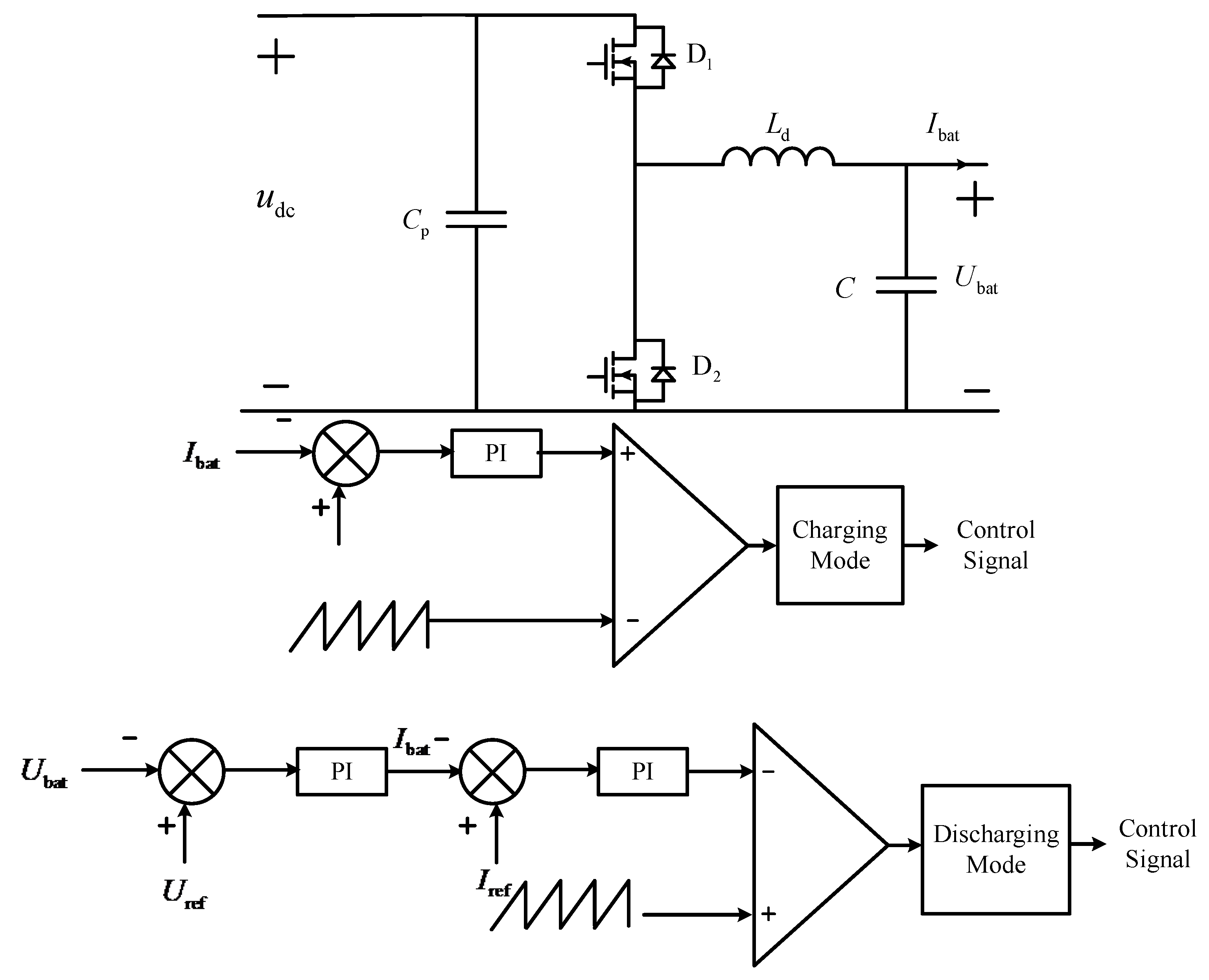
The subsequent buck–boost converter uses a dual closed-loop control method (voltage and current) to ensure bidirectional energy flow. The circuit structure and control block diagram are shown in Figure 9.

4.1. Stability Verification of the System Charger in Charging State

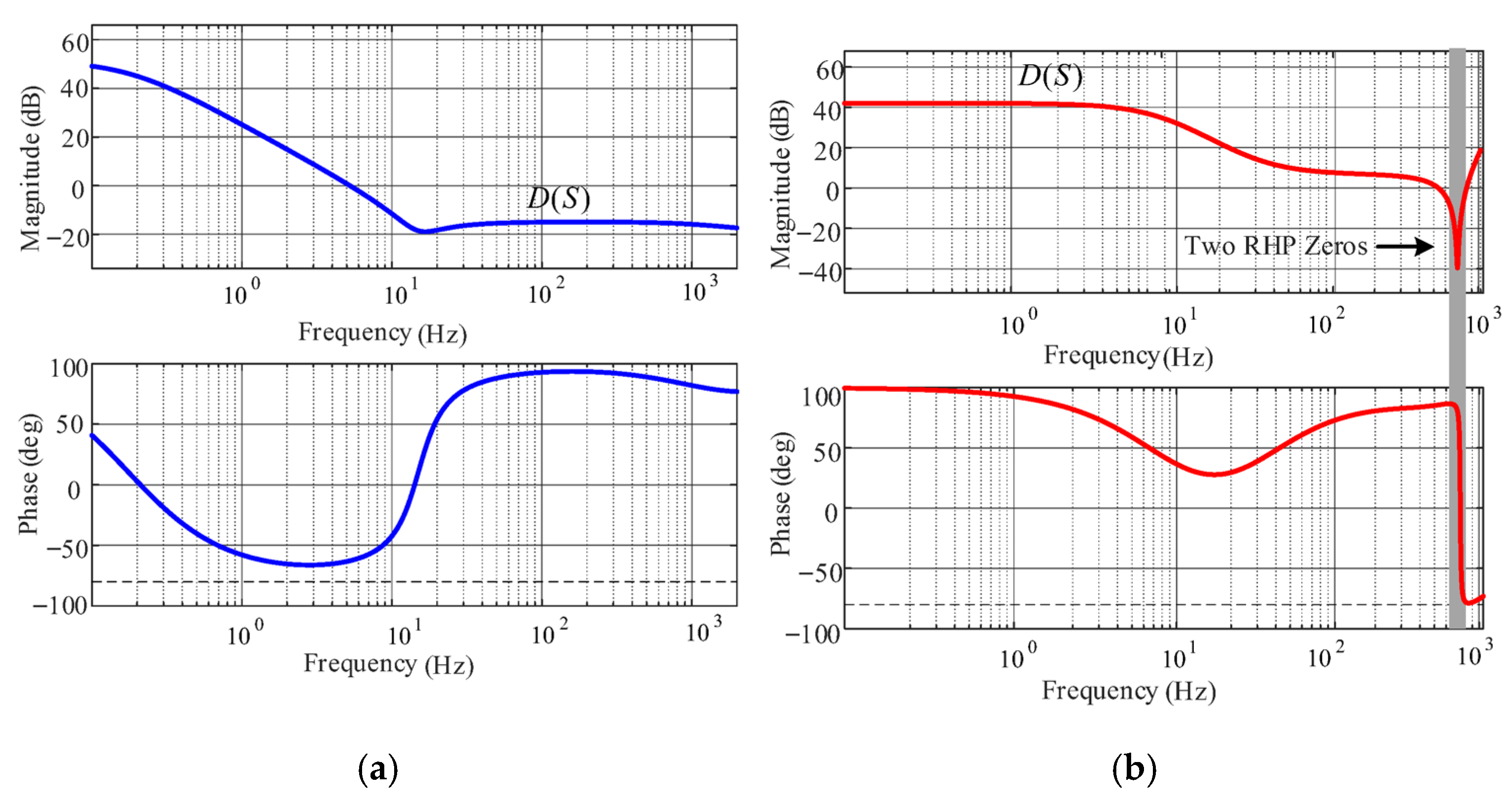
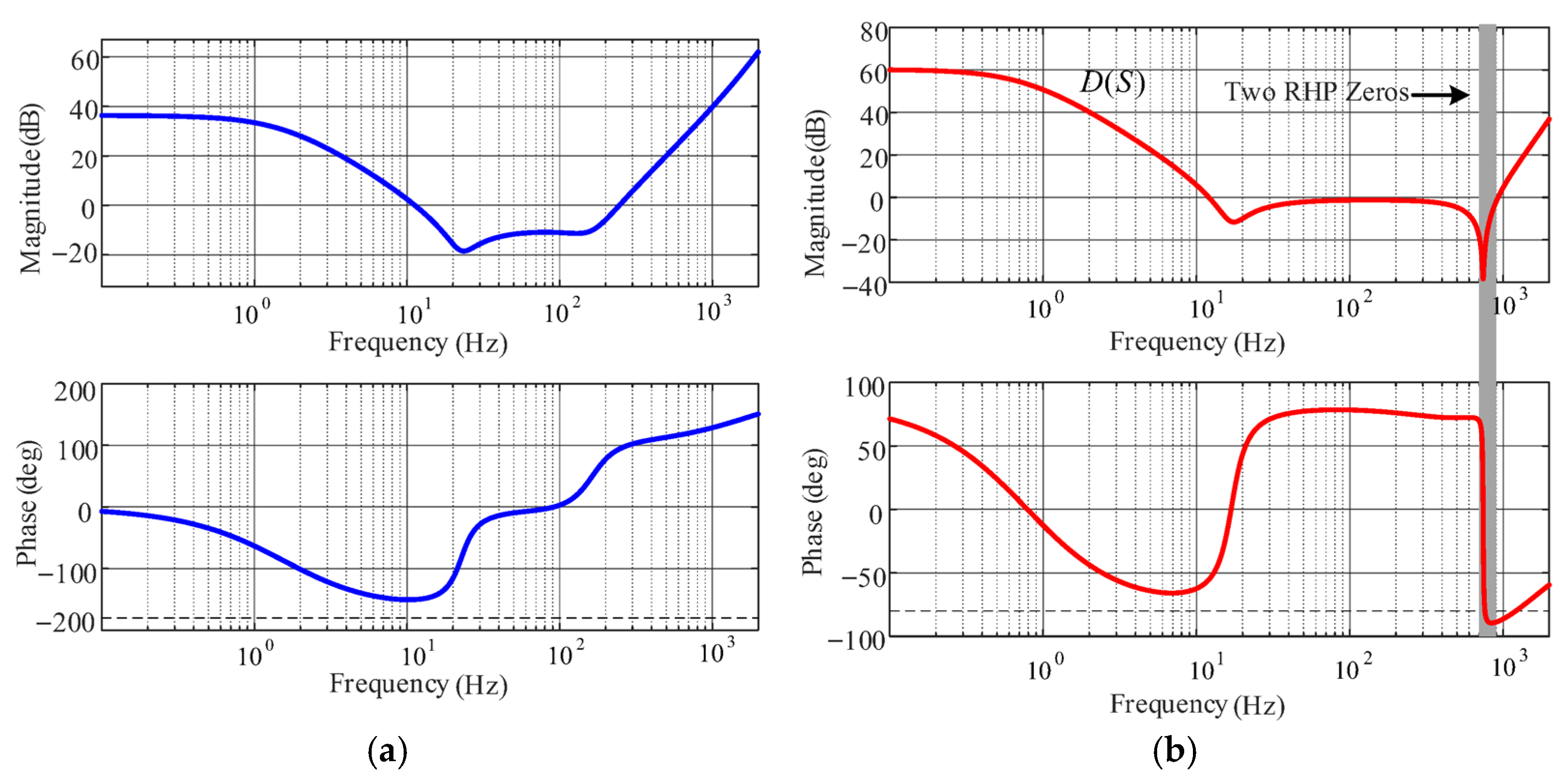
Table 1 provides the parameter information of the main circuit. Substituting the main circuit parameters into the specific expressions of the three-phase PWM rectifier and buck–boost circuit, the Bode plot of the general stability factor D ( S ) can be obtained. Figure 10b shows the case when C p = 330 μ F , and Figure 10a shows the case when C p = 560 μ F does not produce RHP zeros. Therefore, the system is in a stable state in the frequency domain analysis. However, Figure 10b shows two RHP zeros at an oscillation frequency of 870 Hz, which is unstable, as calculated by Equation (22).
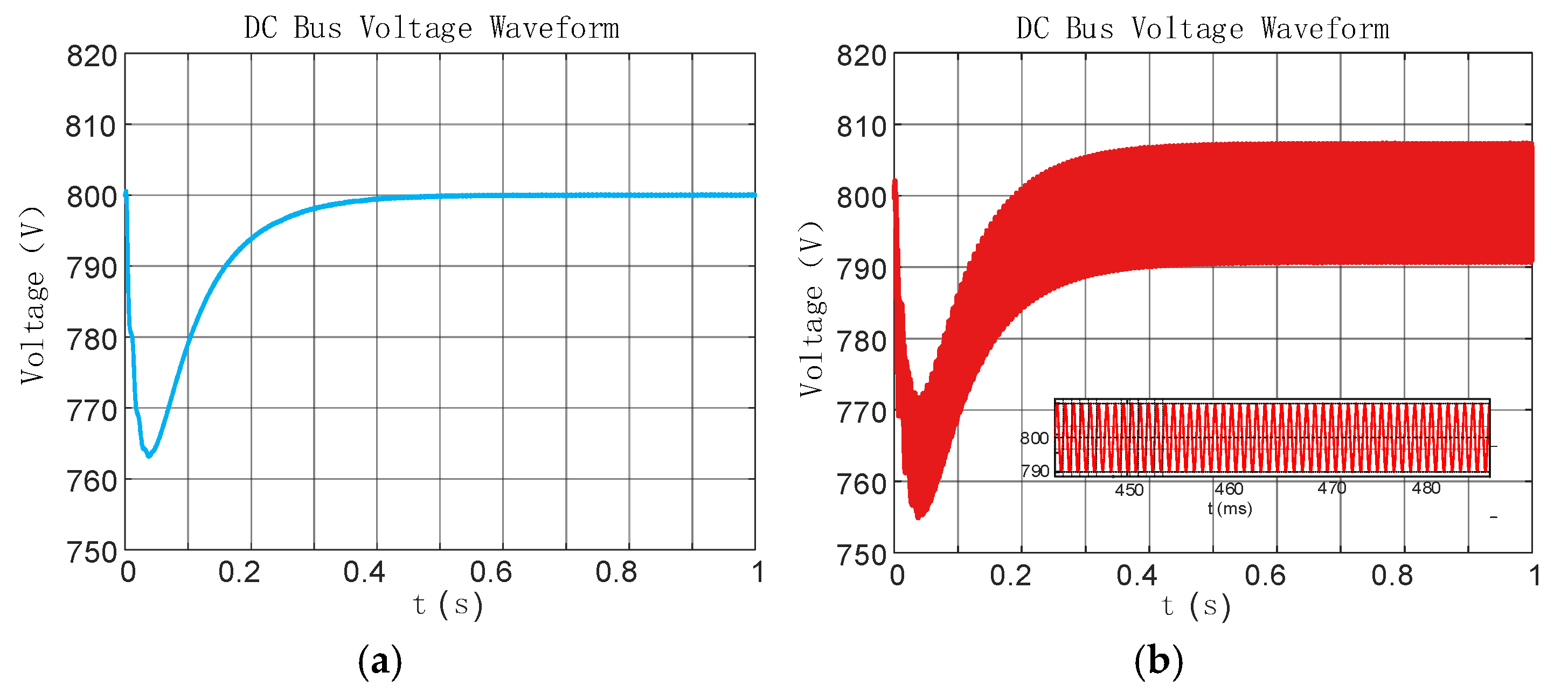
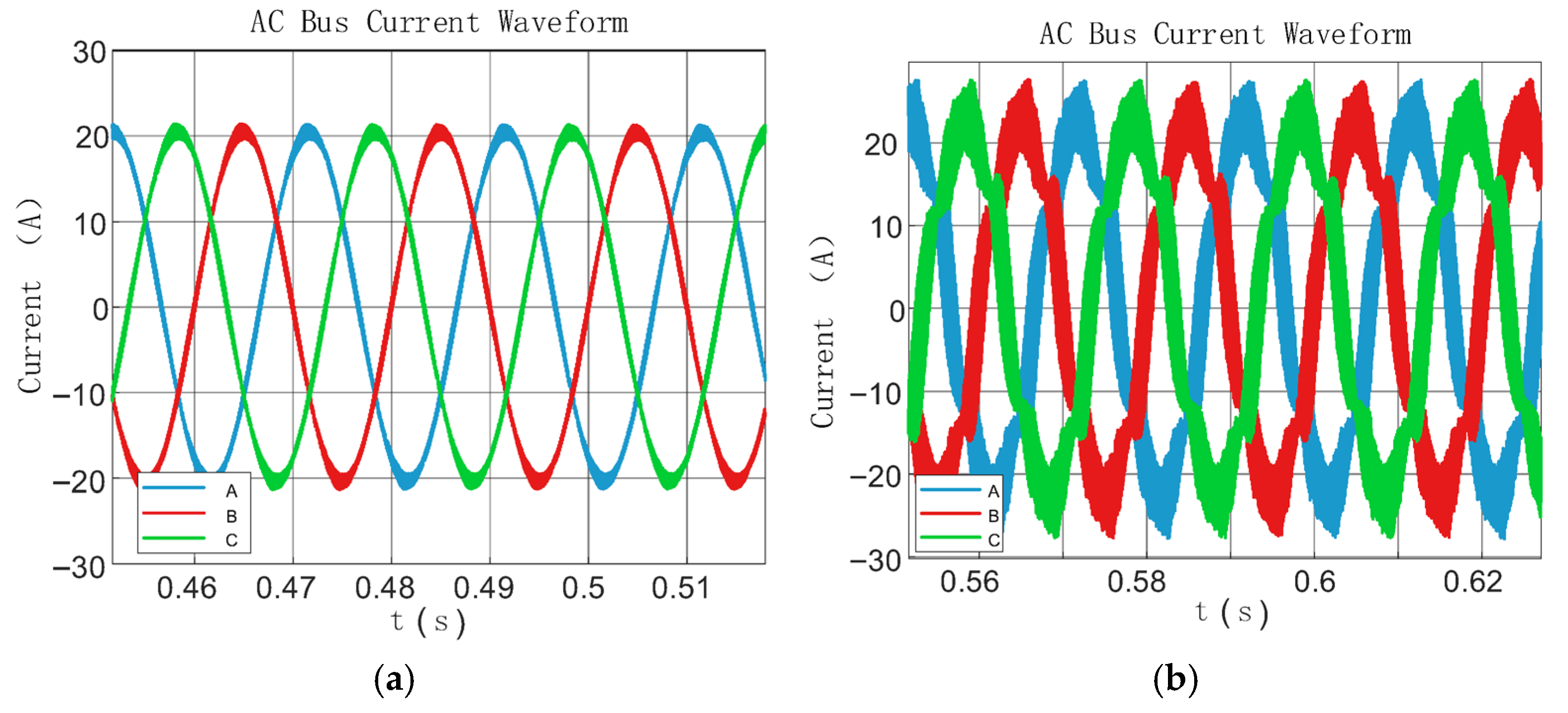
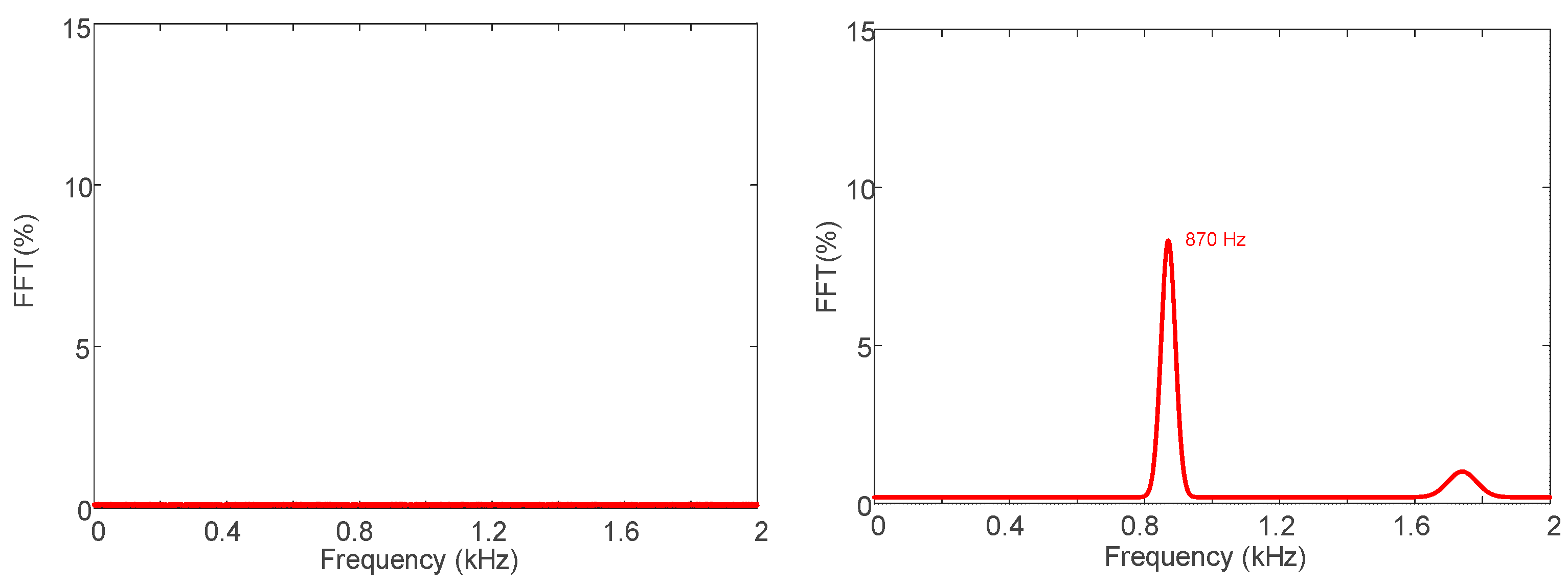
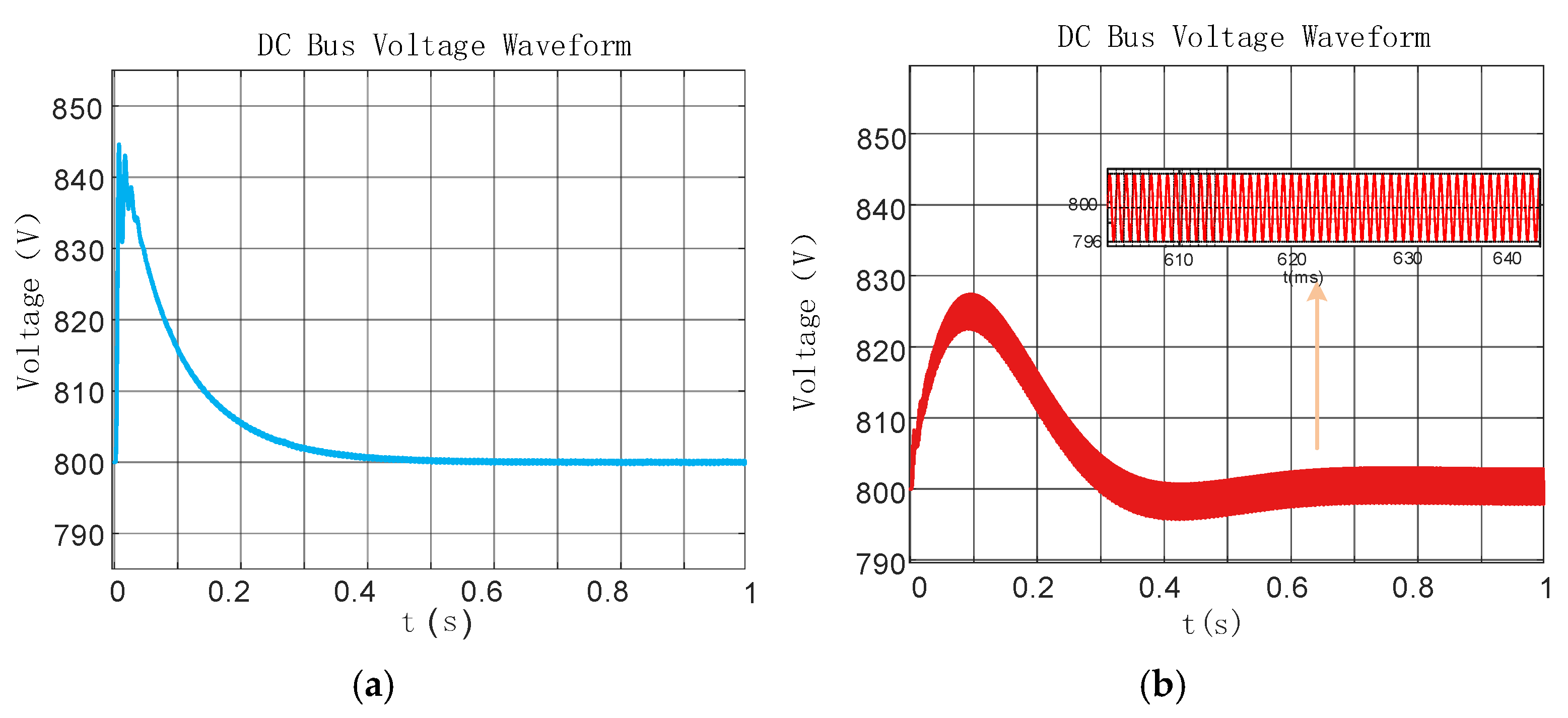
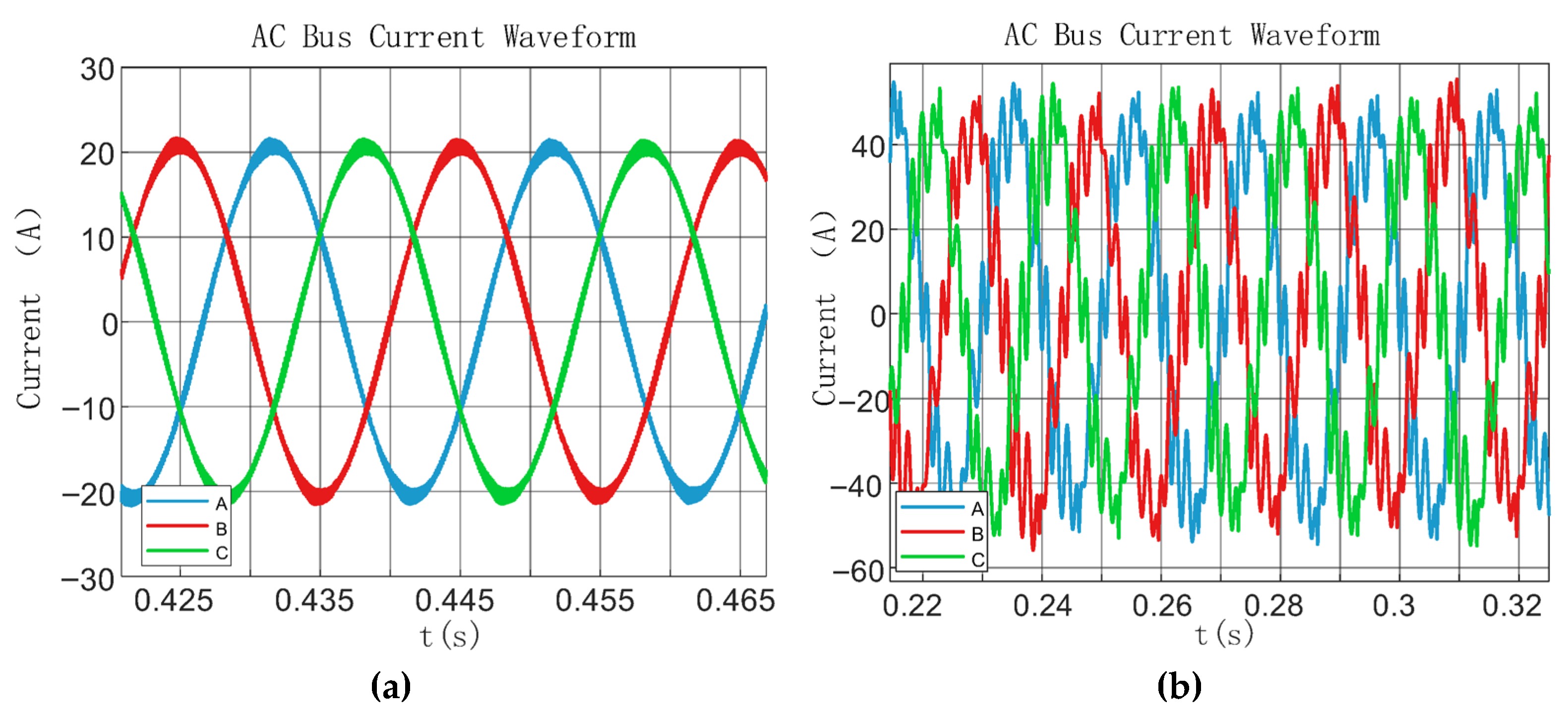
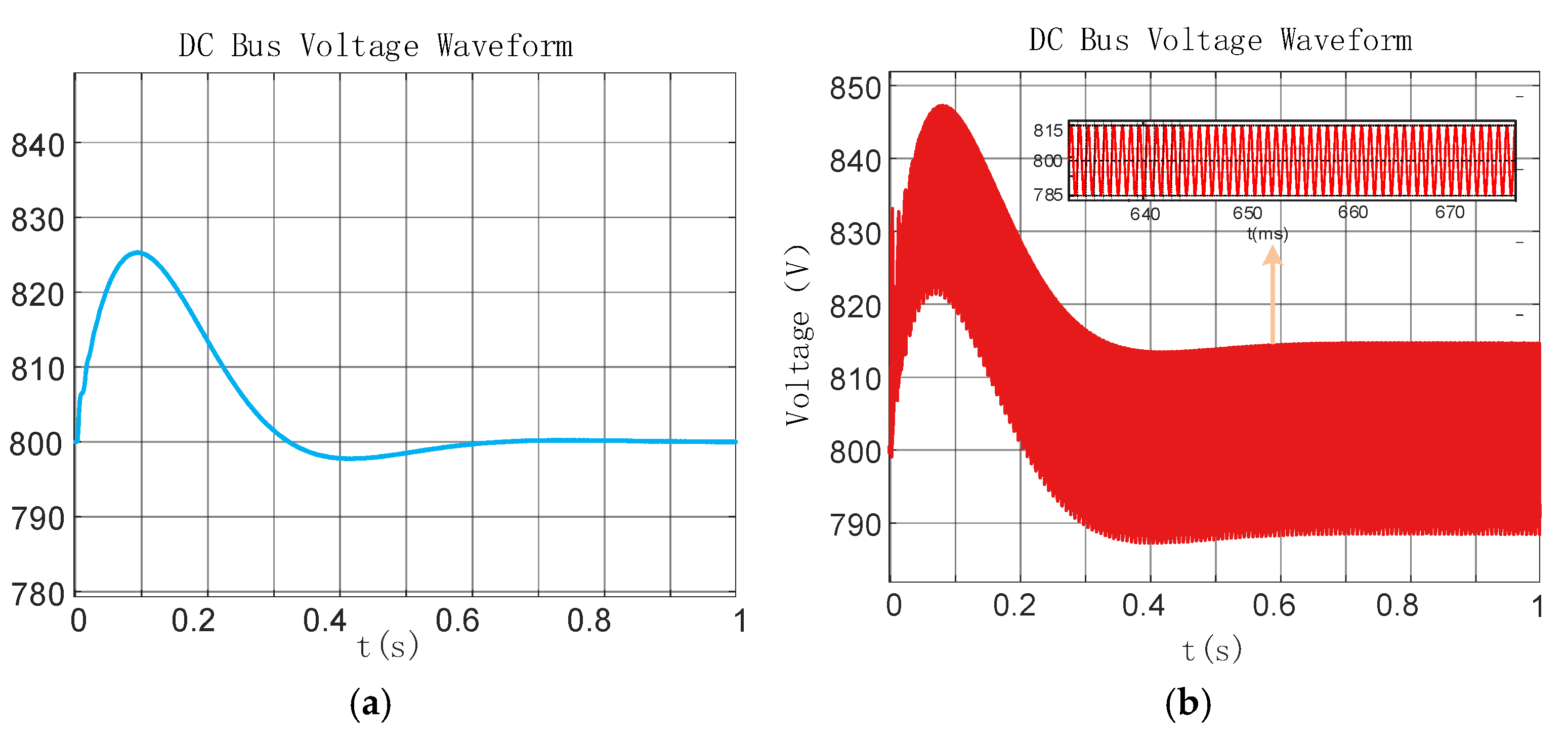
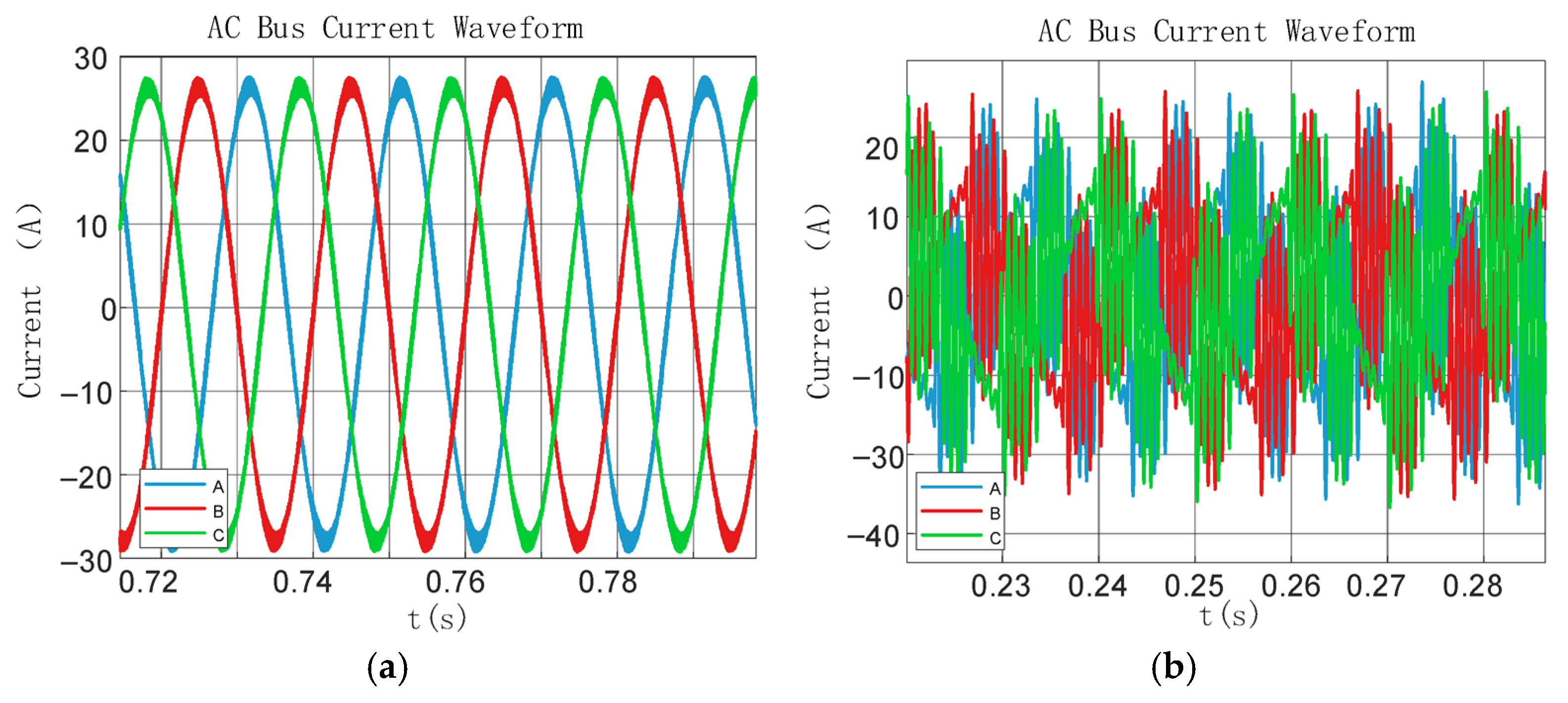
Observations in Figure 10 and Figure 11 show that when the general stability factor D ( S ) , determined by the Bode plot, has an RHP zero, it is in an unstable operating state in the frequency domain. The waveforms of its DC bus voltage and AC bus current in the time domain are also unstable. When C P = 560 μ F , the general stability factor D ( S ) , determined by the Bode plot, does not have an RHP zero, meaning it is in a stable operating state in the frequency domain. Its DC bus voltage u ^ bus _ 2 is stable at 800 V in the time domain, and the AC bus current is stable as well. When the load C P changes from 560 μ F to 330 μ F , the system exhibits anti-resonance at 870 Hz, and the phase of D ( S ) drops by 180 ° indicating that D ( S ) has two RHP zeros, leading to system instability. Observations in Figure 11 and Figure 12 show that when the load is at C P = 330 μ F , both the DC bus voltage and AC bus current oscillate. From the FFT analysis in Figure 13, it can be observed that the DC bus voltage has generated an oscillation at 870 Hz. The consistency between the time-domain and frequency-domain waveforms confirms that stability analysis is feasible when the charger is operating in the charging state.

4.2. Stability Verification of the System Charger in Discharge State

When only the charger in discharge state is operating in the system, the specific general stability factor D ( S ) can be derived by substituting the parameters of the PWM converter and buck–boost converter (main circuit parameters are consistent with Table 1). he resulting Bode plot of D ( S ) is shown in Figure 14.
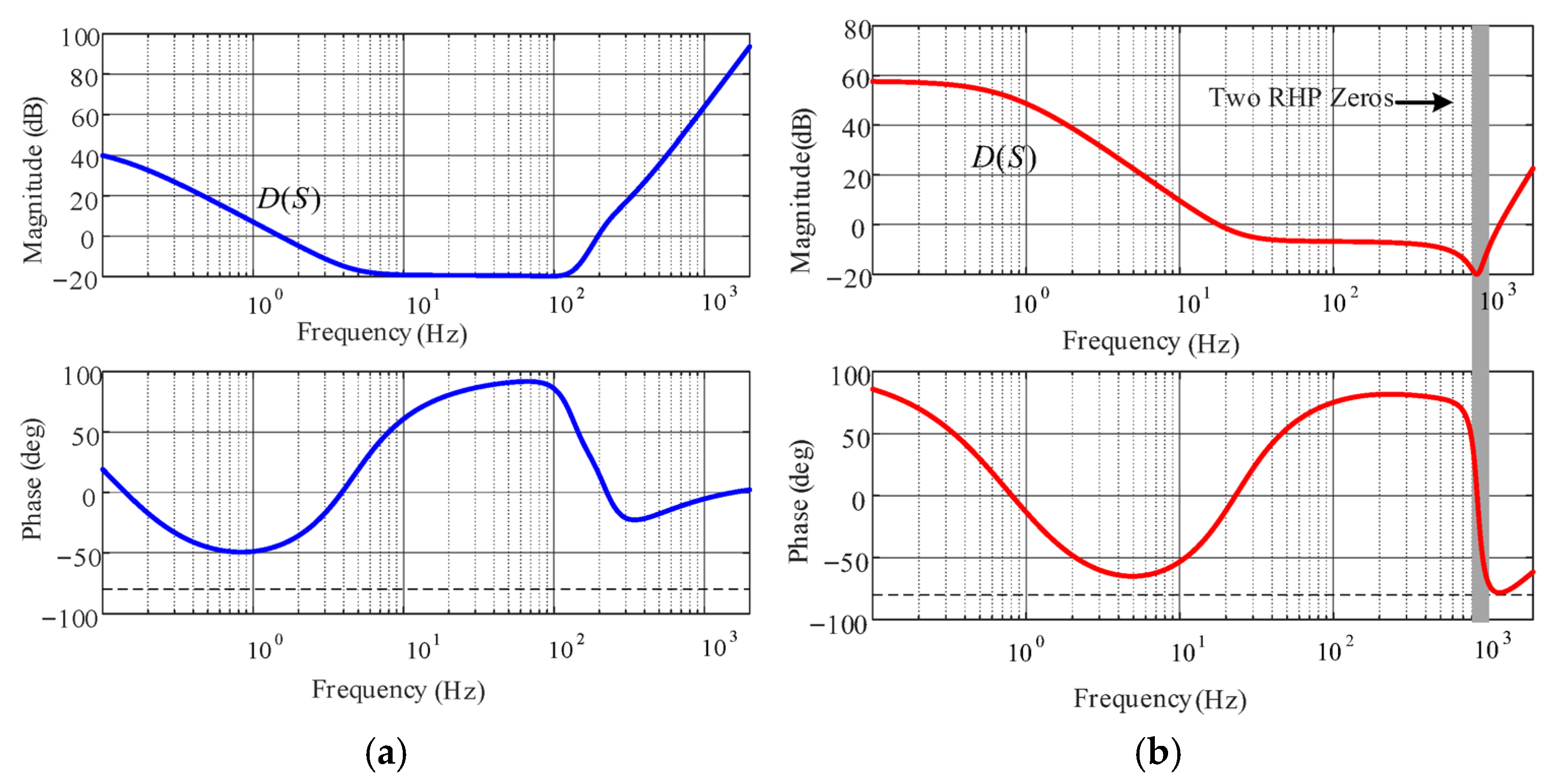
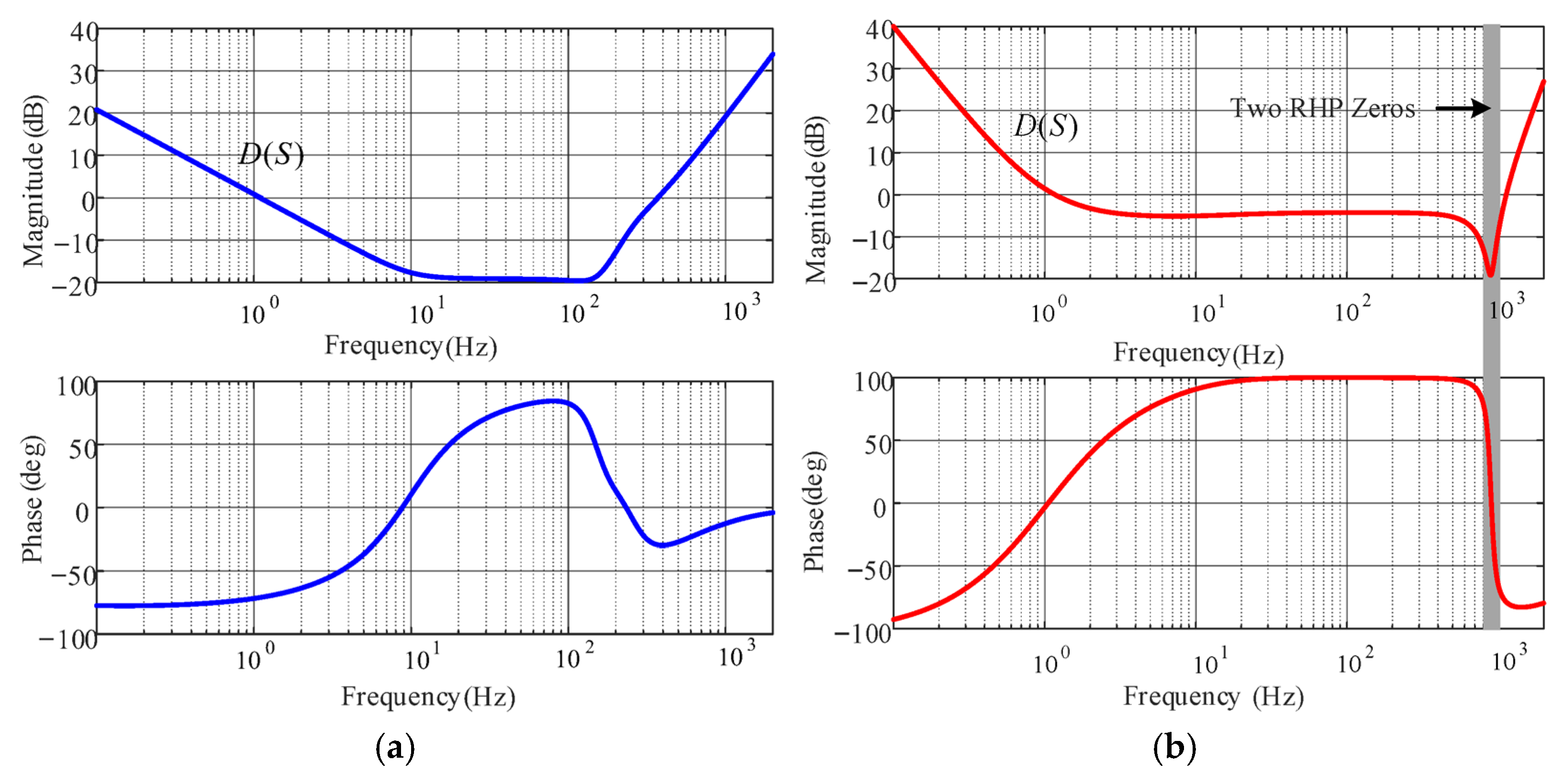
By observation, Figure 14a is the Bode plot of C P = 560 μ F when D ( S ) . Under this load condition, D ( S ) did not find the RHP zero, so the system is stable. Figure 14b is the Bode plot of D ( S ) when C P = 330 μ F . At the oscillation frequency of 730 Hz, it can be calculated by Equation (22) that there are two RHP zeros, and the system is unstable.
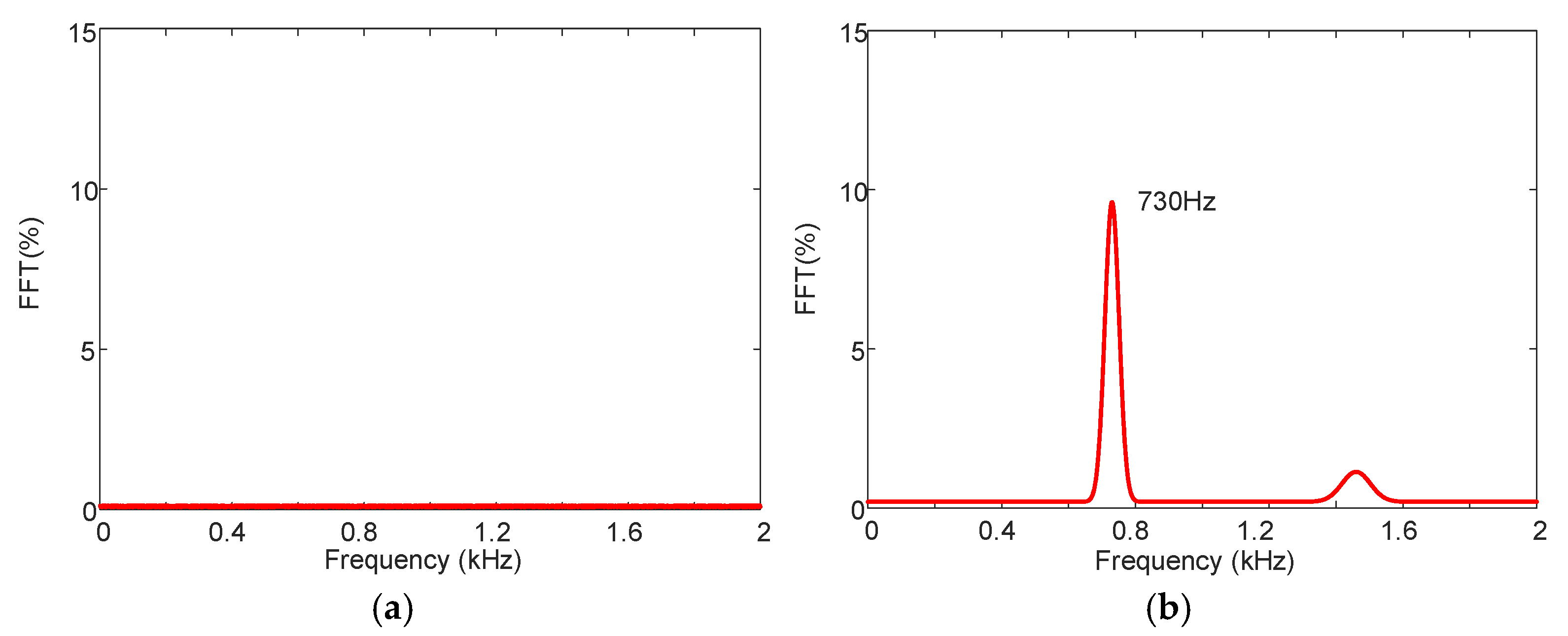
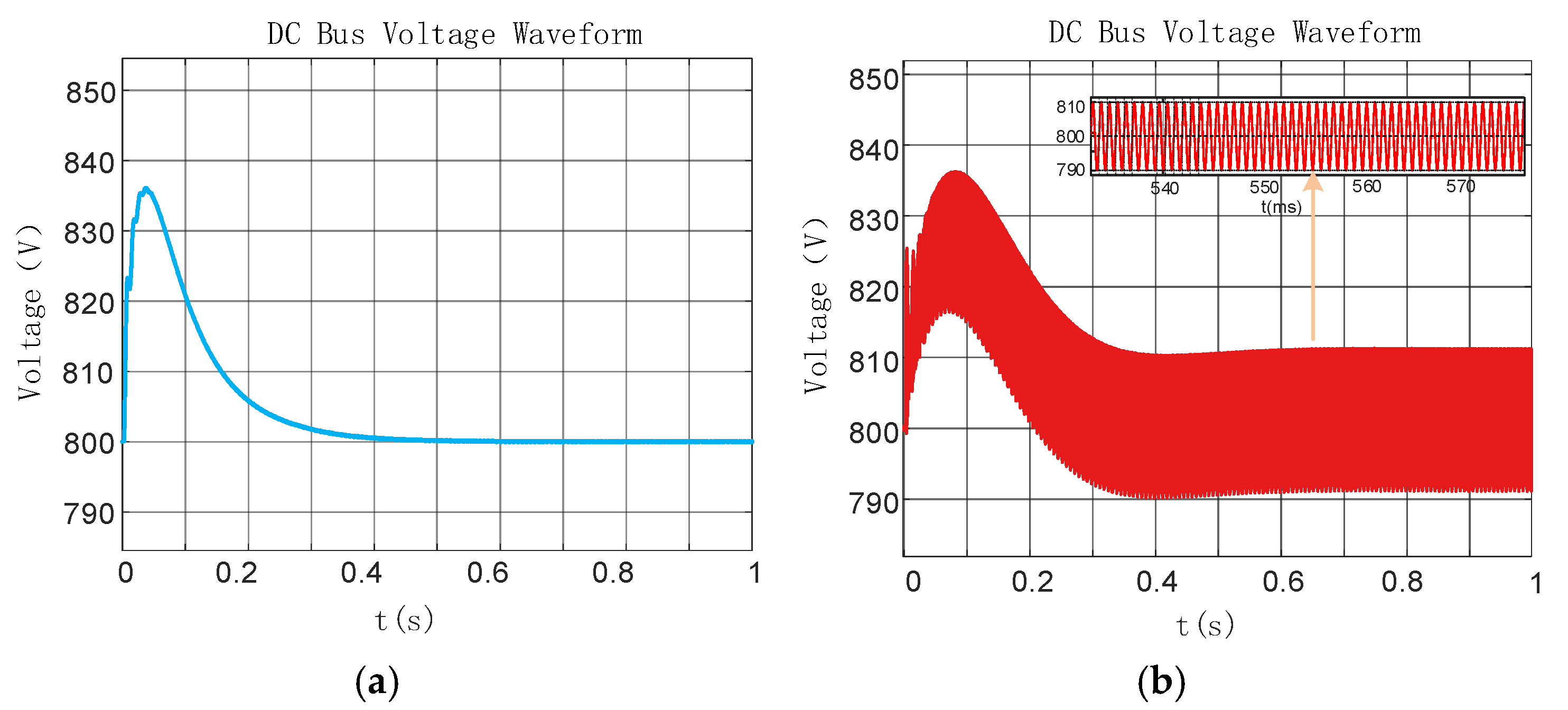
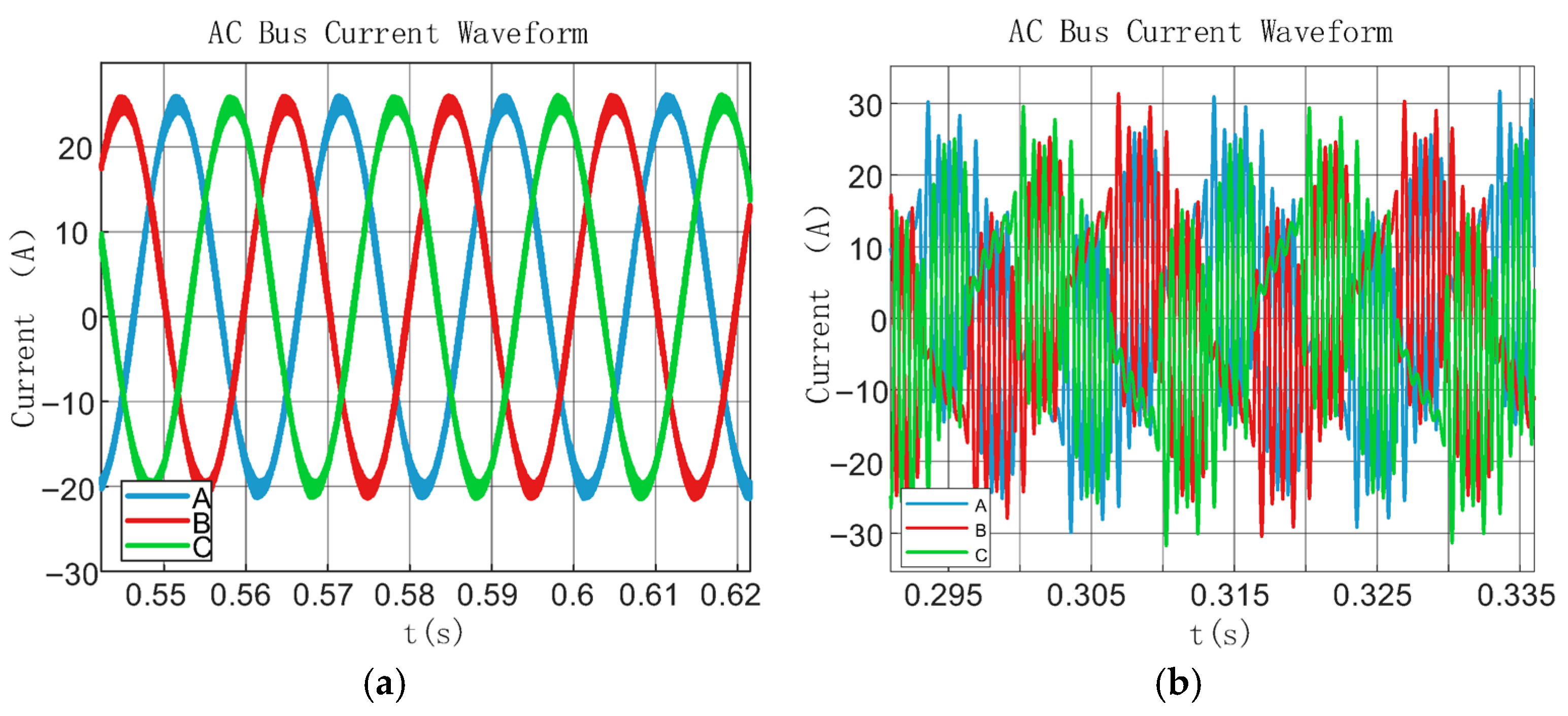
Observations in Figure 15 and Figure 16 show that when the general stability factor D ( S ) , determined by the Bode plot, has an RHP zero, the system is unstable in the frequency domain. The DC bus voltage and AC bus current waveforms in the time domain are also unstable. When C P = 560 μ F , the general stability factor D ( S ) , determined by the Bode plot, does not have an RHP zero, indicating a stable operating state in the frequency domain. The DC bus voltage u ^ bus _ 2 in the time domain is stable at 800 V; the AC bus current is also stable. When the load C P changes from 560 μ F to 330 μ F , the system exhibits anti-resonance at 730 Hz, and the phase of D ( S ) drops by 180 ° , indicating the presence of two RHP zeros in D ( S ) , leading to system instability. Observations in Figure 15 and Figure 16 show that when the load is C P = 330 μ F , both the DC bus voltage and AC bus current oscillate. From the FFT analysis in Figure 17, it can be observed that the DC bus voltage has generated an oscillation at 730 Hz. The consistency between the time- and frequency-domain waveforms demonstrates that stability analysis is feasible when the charger is operating in a discharging state.

4.3. Stability Verification of the System Charger Under Charge and Discharge States

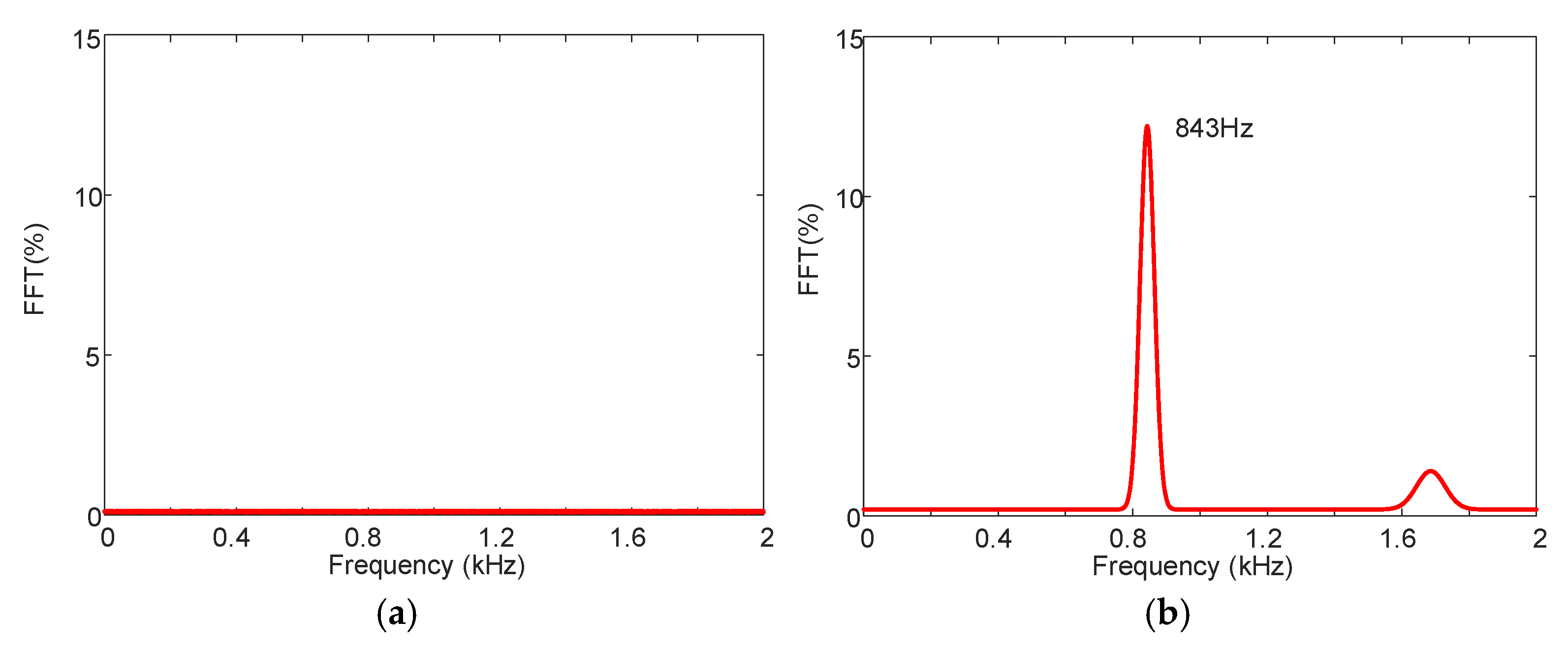
When there is one charger operating in charging mode and another operating in discharging mode simultaneously in the system, the circuit parameters are shown in Table 2. Substituting the specific parameters of the PWM inverter and buck–boost converter, the specific general stability factor D ( S ) of this system can be obtained, and the Bode plot of D ( S ) is shown in Figure 18. Figure 18a shows the case where C P 1 , C P 2 = 560 μ F , and Figure 18b shows the case where C P 1 , C P 2 = 330 μ F . Observing the Bode plot, it can be seen that Figure 18a does not produce RHP zeros. Therefore, the system is in a stable state in the frequency domain analysis. Figure 18b shows two RHP zeros at an oscillation frequency of 843 Hz, which is unstable, as calculated by Equation (22).
As observed in Figure 19 and Figure 20, when the general stability factor D ( S ) is determined by the Bode plot to have an RHP zero, it is in an unstable operating state in the frequency domain. The waveforms of its DC bus voltage and AC bus current in the time domain are also unstable. When C P 1 , C P 2 = 560 μ F , the general stability factor D ( S ) , determined by the Bode plot, does not have an RHP zero, meaning it is in a stable operating state in the frequency domain. Its time-domain waveforms of the DC bus voltage u ^ bus _ 2 are stable at 800 V, and the AC bus current is also stable. When C P 1 , C P 2 changes from 560 μ F to 330 μ F , the system exhibits anti-resonance at 843 Hz, and the phase of D ( S ) decreases by 180°, indicating the presence of two RHP zeros in D ( S ) , leading to system instability. As observed in Figure 19 and Figure 20, at C P 1 , C P 2 = 330 μ F , both the DC bus voltage and AC bus current oscillate. From the FFT analysis in Figure 21, it can be observed that the DC bus voltage has generated an oscillation at 843 Hz. The consistency between the time-domain and frequency-domain waveforms demonstrates that stability analysis is feasible when the charger is operating in a discharging state.

4.4. Stability Verification of Clustered V2G Bidirectional Energy Conversion System

If the system involves multiple chargers operating simultaneously (i.e., multiple chargers in charging state and multiple chargers in discharging state), the system topology is shown in Figure 22. The circuit structure and control method of each charger are consistent with the simulations in Section 3.1 and Section 3.2. This system includes chargers in three charging states and chargers in two discharging states. The simulation circuit for this model is constructed, and the circuit parameters are shown in Table 3.
By substituting the specific parameters of the PWM inverter, PWM rectifier, and buck–boost converter, the specific general stability factor D ( S ) of this system can be obtained, and the Bode plot of D ( S ) is shown in Figure 23.
Figure 23a is the Bode plot of rectifier 1, rectifier 3, and inverter 2 when C P = 560 μ F . Figure 23b is the case when C P = 330 μ F . Observation of the Bode plot shows that no RHP zeros are generated in Figure 23a, so the system is in a stable state in the frequency domain analysis. However, Figure 23b shows two RHP zeros at an oscillation frequency of 893 Hz, which is unstable, as calculated by Equation (22).
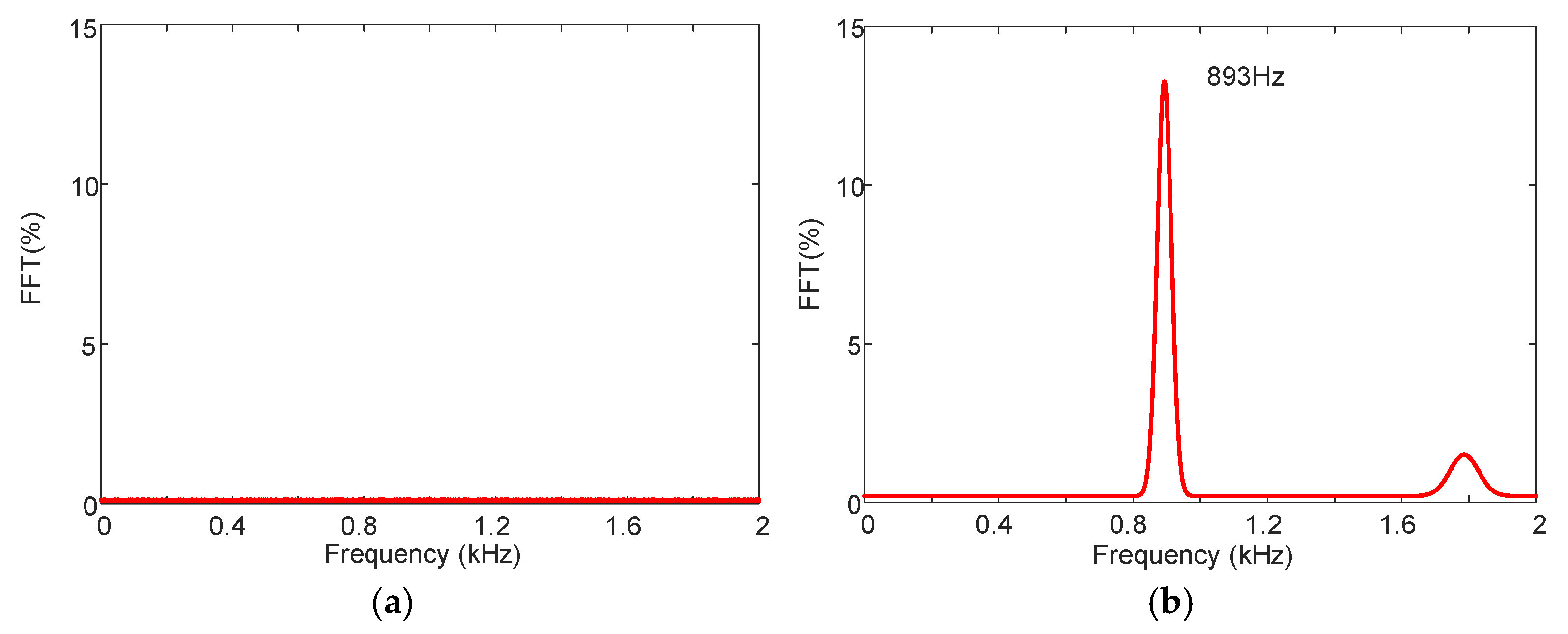
By comparing Figure 24 and Figure 25, it can be seen that when the general stability factor D ( S ) , according to the Bode plot, has an RHP zero, it is in an unstable operating state under frequency-domain conditions. The waveforms of its DC bus voltage and AC bus current in the time domain are also unstable. When C P = 560 μ F , the general stability factor D ( S ) , according to the Bode plot, does not have an RHP zero, meaning it is in a stable operating state under frequency-domain conditions. Its DC bus voltage u ^ bus _ 2 in the time domain is stable at 800 V, and the AC bus current is also stable. When the load D ( S ) changes from 560 μ F to 330 μ F , the system exhibits anti-resonance at 893 Hz, and the phase of D ( S ) drops by 180°, indicating that D ( S ) has two RHP zeros, leading to system instability. As observed in Figure 24 and Figure 25, at C P = 330 μ F , both the DC bus voltage and AC bus current oscillate. From the FFT analysis in Figure 26, it can be observed that the DC bus voltage has generated an oscillation at 893 Hz. The consistency between the time-domain and frequency-domain waveforms demonstrates that stability analysis is feasible under the operating conditions of the clustered V2G bidirectional energy conversion system.

5. Comparison

This section presents an intuitive comparison between the proposed method and traditional impedance-ratio criteria [11,12], as well as small-signal modeling approaches [17,19]. When modeling and analyzing a V2G bidirectional energy conversion system, traditional methods require independent modeling for each operating condition, making the process relatively cumbersome. In contrast, the method proposed in this paper requires only a single modeling procedure, resulting in a more streamlined workflow. In terms of applicability, the proposed method is broadly suitable for various bidirectional energy flow systems, whereas traditional impedance-ratio analysis is typically limited to simple cascaded systems, and traditional small-signal modeling often relies on specific circuit topologies. Furthermore, when dealing with different operating conditions, traditional methods struggle to derive a unified and effective stability criterion. In stability result analysis, traditional approaches mostly employ Nyquist plots, which are less intuitive than the Bode plots used in this study. The above comparison summary can be presented in Table 4.

6. Discussion

The unified stability criterion based on the generalized stability factor D ( S ) established in this study can effectively evaluate system stability under idealized assumptions. However, it still exhibits notable limitations in practical engineering application scenarios. The phase lag introduced by digital control delay directly impacts the system’s stability margin [22]. The interaction between phase-locked loop (PLL) dynamics and converter impedance may induce negative damping characteristics or even introduce right-half-plane zeros [23,24]. Furthermore, controller saturation nonlinearity can shift the system operating point outside the region where the linear model remains valid [25]. These factors can alter the system’s equivalent impedance characteristics, thereby affecting the accurate determination of stability boundaries.
To enhance the engineering applicability of this criterion, future research will primarily advance in the following two aspects. In terms of modeling, the explicit incorporation of delay elements and PLL small-signal models will be used to refine the existing Y/Z equivalent model, aiming to more accurately represent the dynamic characteristics of the actual system. Regarding the analytical method, the describing function method will be integrated with Lyapunov stability theory to develop a stability-enhanced criterion capable of handling nonlinear conditions such as saturation, thereby extending the applicability of this framework to more complex operating conditions.

7. Conclusions

This paper proposes a unified stability analysis and criterion for V2G bidirectional energy conversion systems. By establishing a systematic model applicable to different operating conditions, the transfer functions of DC bus voltage and AC bus current are derived, and their common denominator term, the unified stability factor D ( S ) , is extracted. Based on the constructed stability criterion, the system modeling and stability analysis process is significantly simplified. Regarding the zero-pole analysis of D ( S ) , this paper proposes an intuitive discrimination method based on Bode plots. By observing the amplitude-frequency and phase-frequency characteristic curves, the zero-pole distribution can be determined, which is simpler and more intuitive than the traditional frequency domain method relying on Nyquist plots. To verify the universality of the proposed criterion, simulations were conducted under four typical operating modes: (1) single-unit charging; (2) single-unit discharging; (3) mixed charging and discharging operation; and (4) multi-unit operation. The results show that, under different modes, the Bode plot based on the criterion can accurately predict the system stability and oscillation frequency. The time-domain simulation waveforms are highly consistent with the frequency-domain analysis results, verifying the effectiveness of the criterion. The method proposed in this paper provides a unified and practical solution for the stability analysis of V2G bidirectional energy conversion systems.

Author Contributions

Conceptualization, Y.J. and M.L.; methodology, Y.J.; validation, Y.J. and M.L.; formal analysis, Y.J.; investigation, Y.J.; resources, Y.J., Q.Z., and M.L.; data curation, Y.J.; writing—original draft preparation, Y.J.; writing—review and editing, Y.J. and M.L.; project administration, Q.Z., R.Z., and H.C.; funding acquisition, Q.Z. and M.L. All authors have read and agreed to the published version of the manuscript.

Funding

This work was supported by the Young Scientists Program of the National Natural Science Foundation of China (Grant No. 62303334), titled “Research on Destabilization Mechanisms and Adaptive Stabilization Control of DC Microgrids under Cyber-Attack Threats”. the National Natural Science Foundation of China under Grant 62303334, Science and Technology Project of Sichuan Electric Power Company of State Grid (521903230004).

Data Availability Statement

The datasets used and/or analyzed during the current study are available from the corresponding author upon reasonable request.

Conflicts of Interest

Author Renjian Zhang and Haiquan Cao were employed by the Company State Grid Sichuan Electric Power Company Nanchong Power Supply Company. The authors declare that the research was conducted in the absence of any commercial or financial relationships that could be construed as a potential conflict of interest.

References

  1. Li, B.; Wei, S.; Bai, X.; Chen, B.; Yang, Y. Siting and Sizing Planning Strategy for Electric Vehicle Charging and Discharging Stations in Vehicle-Grid Interaction. Proc. CSU-EPSA 2025, 37, 38–47+57. [Google Scholar]
  2. Yang, J.; Wang, M.; Zhang, Y.; Wang, D.; Ye, F. Applying power battery of electric vehicle for regulating peak in grid. East China Electr. Power 2010, 38, 1685–1687. [Google Scholar]
  3. Zhao, J.; Wen, F.; Yang, A.; Xin, J. Impacts of electric vehicles on power systems as well as the associated dispatching and control problem. Autom. Electr. Power Syst. 2011, 35, 29. [Google Scholar]
  4. Li, Z.; Zhao, S.; Liu, Y. Control Strategy and Application of Electric Vehicle Distributed Energy Storage. Power Syst. Technol. 2016, 40, 442–450. [Google Scholar]
  5. Shi, R.; Li, S. Review on Electric Vehicle V2G Technology. Proc. CSU-EPSA 2019, 31, 28–37. [Google Scholar]
  6. Ma, H.; Gu, J.; Li, T.; Zhang, Q.; Yu, Z.; Liu, F. Impact and Analysis of Electric Vehicle Charging and Discharging on Distribution Network Power Quality Based on Synchronized Waveform. In Proceedings of the 2024 4th Power System and Green Energy Conference (PSGEC), Shanghai, China, 22–24 August 2024; pp. 447–451. [Google Scholar]
  7. Cavus, M.; Bell, M. Enabling smart grid resilience with deep learning-based battery health prediction in EV fleets. Batteries 2025, 11, 283. [Google Scholar] [CrossRef]
  8. Zhang, X.; Ruan, X.; Tse, C.K. Impedance-based local stability criterion for DC distributed power systems. IEEE Trans. Circuits Syst. I: Regul. Pap. 2015, 62, 916–925. [Google Scholar] [CrossRef]
  9. Lin, Q.; Wen, B.; Burgos, R. RHP poles trajectory study for D–Q impedance-based stability monitoring using a power-hardware-in-the-looptest. IEEE J. Emerg. Sel. Top. Power Electron. 2024, 12, 1560–1572. [Google Scholar] [CrossRef]
  10. He, B.; Chen, W.; Mu, H.; Zhan, D.; Zhang, C. Small-signal stability analysis and criterion of triple-stage cascaded DC system. IEEE J. Emerg. Sel. Top. Power Electron. 2022, 10, 2576–2586. [Google Scholar] [CrossRef]
  11. Feng, X.; Liu, J.; Lee, F. Impedance specification for stable DC distributed power systems. IEEE Trans. Power Electron. 2002, 17, 157–162. [Google Scholar] [CrossRef]
  12. Middlebrook, R.D. Input filter considerations in design and application of switching regulators. In Proceedings of the IEEE Industry Applications Society Annual Meeting, Chicago, IL, USA, 11–14 October 1976; pp. 366–382. [Google Scholar]
  13. Sun, J. Impedance-based stability criterion for grid-connected inverters. IEEE Trans. Power Electron. 2011, 26, 3075–3078. [Google Scholar] [CrossRef]
  14. Zhong, Q.-C.; Zhang, X. Impedance-sum stability criterion for power electronic systems with two converters/sources. IEEE Access 2019, 7, 21254–21265. [Google Scholar] [CrossRef]
  15. Lu, X.; Sun, K.; Guerrero, J.M.; Vasquez, J.C.; Huang, L.; Wang, J. Stability enhancement based on virtual impedance for DC microgrids with constant power loads. IEEE Trans. Smart Grid 2015, 6, 2770–2783. [Google Scholar] [CrossRef]
  16. Carrasco, J.M.; Franquelo, L.G.; Bialasiewicz, J.T.; Galvan, E.; PortilloGuisado, R.; Prats, M.A.M.; Leon, J.I.; Moreno-Alfonso, N. Power-electronic systems for the grid integration of renewable energy sources: A survey. IEEE Trans. Ind. Electron. 2006, 53, 1002–1016. [Google Scholar] [CrossRef]
  17. Liao, Y.; Wang, X. Impedance-based stability analysis for interconnected converter systems with open-loop RHP poles. IEEE Trans. Power Electron. 2020, 35, 4388–4396. [Google Scholar] [CrossRef]
  18. Riccobono, A.; Santi, E. Comprehensive review of stability criteria for DC power distribution systems. IEEE Trans. Ind. Appl. 2014, 50, 3525–3535. [Google Scholar] [CrossRef]
  19. Feng, F.; Zhang, X.; Zhang, J.; Gooi, H.B. Stability enhancement via controller optimization and impedance shaping for dual active bridgebased energy storage systems. IEEE Trans. Ind. Electron. 2021, 68, 5863–5874. [Google Scholar] [CrossRef]
  20. Zhang, Q.; Mao, M.; Ke, G.; Zhou, L.; Xie, B. Stability problems of PV inverter in weak grid: A review. IET Power Electron. 2020, 13, 2165–2174. [Google Scholar] [CrossRef]
  21. Lumbreras, D.; Barrios, E.L.; Urtasun, A.; Ursua, A.; Marroyo, L.; Sanchis, P. On the stability of advanced power electronic converters: The generalized bode criterion. IEEE Trans. Power Electron. 2019, 34, 9247–9262. [Google Scholar] [CrossRef]
  22. Fukuda, S.; Yoda, T. A novel current-tracking method for active filters based on a sinusoidal internal model. IEEE Trans. Ind. Appl. 2001, 37, 888–895. [Google Scholar] [CrossRef]
  23. Blaabjerg, F.; Teodorescu, R.; Liserre, M.; Timbus, A.V. Overview of control and grid synchronization for distributed power generation systems. IEEE Trans. Ind. Electron. 2006, 53, 1398–1409. [Google Scholar] [CrossRef]
  24. Wen, B.; Boroyevich, D.; Burgos, R.; Mattavelli, P.; Shen, Z. Analysis of D-Q small-signal impedance of grid-tied inverters. IEEE Trans. Power Electron. 2016, 31, 675–687. [Google Scholar] [CrossRef]
  25. Preindl, M.; Schaltz, E.; Thogersen, P. Switching frequency reduction using model predictive direct current control for high-power voltage source inverters. IEEE Trans. Ind. Electron. 2011, 58, 2826–2835. [Google Scholar] [CrossRef]
Figure 1. System architecture of a V2G bidirectional power converter.
Electronics 15 00740 g001
Figure 2. Circuit structure of the V2G bidirectional charger.
Electronics 15 00740 g002
Figure 3. System equivalent model under charging mode.
Electronics 15 00740 g003
Figure 4. System equivalent model under discharging mode.
Electronics 15 00740 g004
Figure 5. Single V2G bidirectional power conversion system: (a) architecture of a single V2G bidirectional power conversion system; (b) small-signal model of a single V2G bidirectional power conversion system.
Electronics 15 00740 g005
Figure 6. Small-signal model of the V2G bidirectional power conversion system.
Electronics 15 00740 g006
Figure 7. A single V2G bidirectional energy conversion system simulation model built in SIMULINK.
Electronics 15 00740 g007
Figure 8. Circuit structure and control block diagram of the AC-DC module.
Electronics 15 00740 g008
Figure 9. Circuit structure and control block diagram of the DC-DC module.
Electronics 15 00740 g009
Figure 10. Bode plot of D ( S ) under charging conditions: (a) C P = 560 μ F ; (b) C P = 330 μ F .
Electronics 15 00740 g010
Figure 11. Voltage waveform under charging conditions: (a) C P = 560 μ F ; (b) C P = 330 μ F .
Electronics 15 00740 g011
Figure 12. Current waveform under charging conditions: (a) C P = 560 μ F ; (b) C P = 330 μ F .
Electronics 15 00740 g012
Figure 13. FFT analysis of voltage: (a) C P = 560 μ F ; (b) C P = 330 μ F .
Electronics 15 00740 g013
Figure 14. Bode plot of D ( S ) under discharging conditions: (a) C P = 560 μ F ; (b) C P = 330 μ F .
Electronics 15 00740 g014
Figure 15. Voltage waveform under discharging conditions: (a) C P = 560 μ F ; (b) C P = 330 μ F .
Electronics 15 00740 g015
Figure 16. Current waveform under discharging conditions: (a) C P = 560 μ F ; (b) C P = 330 μ F .
Electronics 15 00740 g016
Figure 17. FFT analysis of voltage: (a) C P = 560 μ F ; (b) C P = 330 μ F .
Electronics 15 00740 g017
Figure 18. Bode plot of D ( S ) under charging/discharging conditions: (a) C P 1 , C P 2 = 560 μ F ; (b) C P 1 , C P 2 = 330 μ F .
Electronics 15 00740 g018
Figure 19. Voltage waveform under charging/discharging conditions: (a) C P 1 , C P 2 = 560 μ F ; (b) C P 1 , C P 2 = 330 μ F .
Electronics 15 00740 g019
Figure 20. Current waveform under charging/discharging conditions: (a) C P 1 , C P 2 = 560 μ F ; (b) C P 1 , C P 2 = 330 μ F .
Electronics 15 00740 g020
Figure 21. FFT analysis of voltage: (a) C P 1 , C P 2 = 560 μ F ; (b) C P 1 , C P 2 = 330 μ F .
Electronics 15 00740 g021
Figure 22. Simplified schematic diagram of the clustered V2G charger system.
Electronics 15 00740 g022
Figure 23. Bode plot of D ( S ) for the clustered V2G charger: (a) C P = 560 μ F ; (b) C P = 330 μ F .
Electronics 15 00740 g023
Figure 24. DC voltage waveform of the clustered V2G charger: (a) C P = 560 μF; (b) C P = 330 μF.
Electronics 15 00740 g024
Figure 25. AC current waveform of the clustered V2G charger: (a) C P = 560 μF; (b) C P = 330 μF.
Electronics 15 00740 g025
Figure 26. FFT analysis of voltage: (a) C P = 560 μF; (b) C P = 330 μF.
Electronics 15 00740 g026
Table 1. Key parameters of the V2G bidirectional charger circuit.
ParametersNumerical Values
RMS Line Voltage380 V
Input Voltage Frequency50 Hz
Sampling Frequency10 kHz
Output Bus Voltage800 V
AC Side Filter Inductor L g 17 mH
DC Side Capacitor C p 560 μ F
Buck–Boost Capacitor C625 μ F
Lithium Battery Model360 V/300 Ah
Table 2. Key parameters of the circuit under charging and discharging modes.
ParametersNumerical Values
RMS Line Voltage380 V
Input Voltage Frequency50 Hz
Sampling Frequency10 kHz
Output Bus Voltage800 V
AC Side Filter Inductor L g 17 mH
PWM Rectifier Capacitor C p 1 560 μ F
PWM Inverter Capacitor C p 2 560 μ F
Buck–Boost Capacitor (Charging State) C 1 625 μ F
Buck–Boost Capacitor (Discharging State) C 2 625 μ F
Lithium Battery Model360 V/300 Ah
Table 3. Key parameters for the circuit simulation of the clustered V2G charger system.
ParametersNumerical Values
RMS Line Voltage380 V
Input Voltage Frequency50 Hz
Sampling Frequency10 kHz
Output Bus Voltage800 V
AC Side Filter Inductor L g 17 mH
Charging Mode Capacitor #1 C P 1 560 μ F
Charging Mode Capacitor #2 C P 2 440 μ F
Charging Mode Capacitor #3 C P 3 560 μ F
Discharging Mode Capacitor #1 C P 4 440 μ F
Discharging Mode Capacitor #2 C P 5 560 μ F
Buck–Boost Capacitor in Charging State C 1 625 μ F
Buck–Boost Capacitor in Discharge State C 2 625 μ F
Lithium Battery Model360 V/300 Ah
Table 4. Comparison of the proposed method with existing methods.
MethodsProposed MethodsTraditional Impedance Ratio Methods [11,12]Traditional Small-Signal Modeling [17,19]
ComplexityLowMediumHigh
UnityUnified conclusionLack of a unified conclusionLack of a unified conclusion
Analysis of IntuitivenessHigh (Bode plot)Low (Nyquist)Low (Nyquist)
Scope of ApplicationMultimodal and variable-structure systemSimple cascaded systemsSpecific topological structures
Disclaimer/Publisher’s Note: The statements, opinions and data contained in all publications are solely those of the individual author(s) and contributor(s) and not of MDPI and/or the editor(s). MDPI and/or the editor(s) disclaim responsibility for any injury to people or property resulting from any ideas, methods, instructions or products referred to in the content.