Article

Transmitting Images in Difficult Environments Using Acoustics, SDR and GNU Radio Applications

by
Michael Alldritt
* and
Robin Braun
School of Electrical and Data Engineering, University of Technology Sydney, Sydney, NSW 2007, Australia
*
Author to whom correspondence should be addressed.
Electronics 2026, 15(3), 678; https://doi.org/10.3390/electronics15030678
Submission received: 22 December 2025 / Revised: 23 January 2026 / Accepted: 25 January 2026 / Published: 4 February 2026

Abstract

This paper explores the feasibility of using acoustic wave propagation, particularly in the ultrasonic range, as a solution for data transmission in environments where traditional radio frequency (RF) communication is ineffective due to signal attenuation—such as in liquids or dense media like metal or stone. Leveraging GNU Radio and commercially available audio hardware, a low-cost, SDR (Software Defined Radio) system was developed to transmit data blocks (e.g., images, text, and audio) through various substances. The system employs BFSK (Binary Frequency Shift Keying) and BPSK (Binary Phase Shift Keying), operates at ultrasonic frequencies (typically 40 kHz), and has performance validated under real-world conditions, including water, viscous substances, and flammable liquids such as hydrocarbon fuels. Experimental results demonstrate reliable, continuous communication at Nyquist–Shannon sampling rates, with effective demodulation and file reconstruction. The methodology builds on concepts originally developed for Ad Hoc Sensor Networks in shipping containers, extending their applicability to submerged and RF-hostile environments. The modularity and flexibility of the GNU Radio platform allow for rapid adaptation across different media and deployment contexts. This work provides a reproducible and scalable communication solution for scenarios where RF transmission is impractical, offering potential applications in underwater sensing, industrial monitoring, railways, and enclosed infrastructure diagnostics. Across controlled laboratory experiments, the system achieved 100% successful reconstruction of transmitted image files up to 100 kB and sustained packet delivery success exceeding 98% under stable coupling conditions.

1. Introduction

Establishing data links in the air or in the vacuum of space is a well-established practice. Radio waves propagate efficiently in these environments. The attenuation is directly proportional to the square of the distance travelled, and the signal travels at the speed of light. The usable RF spectrum is large, typically from about 100 kHz to 6 Ghz that is accessible by cheap, commercially available, off-the-shelf Software Defined Radios or by more traditional hardware-based radio systems [1,2]. However, the attenuation of the signal increases when the RF encounters elements through which it needs to propagate. As these substances become denser, a greater proportion of the signal is lost or degraded. RF power, along with the frequency spectrum allocated, will determine whether there is a usable signal or no signal available at the receiver.
If real-time communication with submerged objects is required, allowing them to be controlled along with onboard data access, then a reliable bi-directional communication link that operates in liquids needs to be created. However, the deployment of conventional radio frequency-based communication systems is often impeded by the inherent physical constraints of these environments.
Acoustic communication at 40 kHz in water has a wavelength of 37 mm, making two-way communication in this environment less challenging.
This research provides insight for alternative communication modalities that could circumvent the limitations of RF systems when the signal is blocked or severely attenuated by liquids. This paper builds upon this foundational research by exploring the potential of acoustic wave propagation as a feasible solution.
The research has been divided into the following parts:
(a)
Determining the type of substance that the acoustic signal can operate in (gas, liquid and solids).
(b)
Determining the modulation protocol that provides the best results.
(c)
Developing the hardware, software, and sensors that will allow this communication link to be established.
The objective of my postgraduate research project was to create acoustic links using GNU Radio software in a variety of substances, solutions, and solids, including steel rail and shipping containers. However, the focus of this paper is to show how to establish communication links that can transmit blocks of data, such as images in liquid, using FSK and PSK modulation. Software Defined Radio has provided new ways of creating these connections using inexpensive methods that were not possible a few years ago.
The novelty of this work lies in its integration of low-cost acoustic transducer hardware with flexible SDR-based digital modulation techniques, implemented entirely in GNU Radio. Unlike earlier acoustic communication studies that relied on custom analogue circuitry or underwater research platforms, this system is designed for general-purpose deployment in industrial and laboratory environments. The results presented here demonstrate that reliable, continuous digital communication through liquids and other complex propagation channels can be achieved using open-source tools and straightforward signal-processing methods.

2. Related Work

2.1. Prior Ultrasonic Sensing/Data Work

Ultrasonic techniques have been extensively investigated for sensing, ranging, localisation, and material characterisation across a wide range of scientific and industrial domains. In liquid environments, ultrasonic waves are commonly employed for depth measurement, obstacle detection, flow monitoring, and non-destructive evaluation due to their favourable propagation characteristics compared with radio frequency (RF) signals. These applications typically exploit the predictable velocity of sound in liquids and the strong interaction between acoustic waves and material boundaries.
Early ultrasonic communication research in underwater environments primarily focused on telemetry and control signalling, rather than high-integrity data transmission. Such systems were often designed to convey short command sequences, status indicators, or low-rate sensor measurements. Modulation schemes such as on–off keying (OOK), frequency shift keying (FSK), and simple phase modulation were favoured for their robustness under noisy channel conditions, albeit at the expense of spectral efficiency and throughput. The emphasis in these studies was largely on maintaining link reliability over extended distances rather than on supporting packet-based or file-oriented communication.
In parallel, ultrasonic methods have been widely adopted in non-destructive testing (NDT) and structural health monitoring, where acoustic waves are used to probe solid materials such as metals, concrete, and composites. In these contexts, the primary objective is the detection of flaws, cracks, or material inhomogeneities through reflected or transmitted waveforms. Although digital signal processing is routinely applied to analyse received signals, the transmitted waveforms are generally not encoded with structured digital information, and the communication aspect remains secondary to sensing.
More recent work has explored ultrasonic data transmission in constrained or enclosed environments, including tanks, pipes, and industrial vessels. These studies acknowledge challenges such as multipath propagation, modal behaviour, and frequency-dependent attenuation, particularly at ultrasonic frequencies. However, many reported implementations remain tightly coupled to custom analogue electronics or purpose-built hardware platforms. As a result, system reproducibility and adaptability to different media or deployment scenarios are often limited.
Overall, prior ultrasonic research has established the feasibility of acoustic wave propagation in liquids and solids; however, it has predominantly treated ultrasound as a sensing or telemetry medium. The transmission of structured digital data, such as files or images, using low-cost ultrasonic hardware has received comparatively limited attention in the literature.

2.2. GNU Radio-Based Acoustic or Non-RF Systems

The advent of software-defined radio (SDR) has transformed experimental communication system development by enabling modulation, demodulation, synchronisation, and framing to be implemented entirely in software. GNU Radio, as an open-source SDR framework, has been widely adopted for research, education, and rapid prototyping of digital communication systems, particularly in the RF domain.
A substantial body of work demonstrates GNU Radio’s effectiveness for packet-based RF communication, adaptive modulation, and protocol experimentation. These studies highlight the flexibility of SDR architectures, allowing researchers to modify modulation schemes, symbol rates, and signal processing chains without altering the underlying hardware. This capability has proven especially valuable for investigating channel impairments such as noise, interference, and multipath effects.
A smaller but growing subset of research has extended GNU Radio beyond traditional RF applications to non-RF communication modalities, including optical and acoustic signalling. In the acoustic domain, GNU Radio has been used to generate and analyse audio–frequency waveforms for short-range communication experiments in air or water. These demonstrations typically validate the feasibility of SDR-based acoustic modulation but often focus on tone transmission or unstructured data streams rather than complete end-to-end communication systems.
Several GNU Radio-based acoustic studies report successful transmission of digital symbols using FSK or PSK modulation at audio or ultrasonic frequencies. However, many such implementations rely on simplified receiver chains, lack explicit packet framing or error detection, and provide limited discussion of file reconstruction or data integrity. Furthermore, experimental details, such as flowgraph configuration, synchronisation strategy, and parameter selection, are not always documented in sufficient detail to enable independent replication.
Commercial acoustic modems provide reliable performance for underwater communication but are typically proprietary, costly, and opaque in their internal operation. Consequently, they are poorly suited to exploratory research or adaptation to unconventional environments such as viscous liquids, hydrocarbons, or small laboratory-scale tanks.
These limitations highlight the need for open, reproducible, and low-cost SDR-based acoustic communication systems that support structured data transmission and can be readily adapted to different propagation media. GNU Radio offers a suitable platform for addressing this need, provided that complete transmit and receive chains—including packetisation, synchronisation, and integrity checking—are explicitly implemented and validated.

2.3. Studies

Existing studies typically rely on specialised underwater platforms, proprietary hardware, or focus on telemetry rather than packet-based file transmission. Limited attention has been given to reproducible, low-cost SDR-based implementations capable of transmitting structured data such as images through liquids. These limitations motivated the present work.

3. Problem Definition and Context

3.1. Radio Waves and Their Limitations

Radio waves are attenuated and reflected by seawater due to high electrical conductivity at the boundary and the absorption of radio wave energy by the water’s molecules. This effect is more pronounced at higher frequencies. While lower frequency radio waves can penetrate seawater to some extent, higher frequencies are significantly attenuated, making conventional radio communication with submerged objects difficult.
Underwater acoustic communication is a technique for sending and receiving messages in water [3,4,5]. There are several ways of employing such communication, but the most common is by using hydrophones. Underwater communication is difficult due to factors such as multi-path propagation, time variations of the channel, small available bandwidth, and strong signal attenuation, especially over long ranges. Compared to terrestrial communication, underwater communication has low data rates because it uses acoustic waves instead of electromagnetic waves.
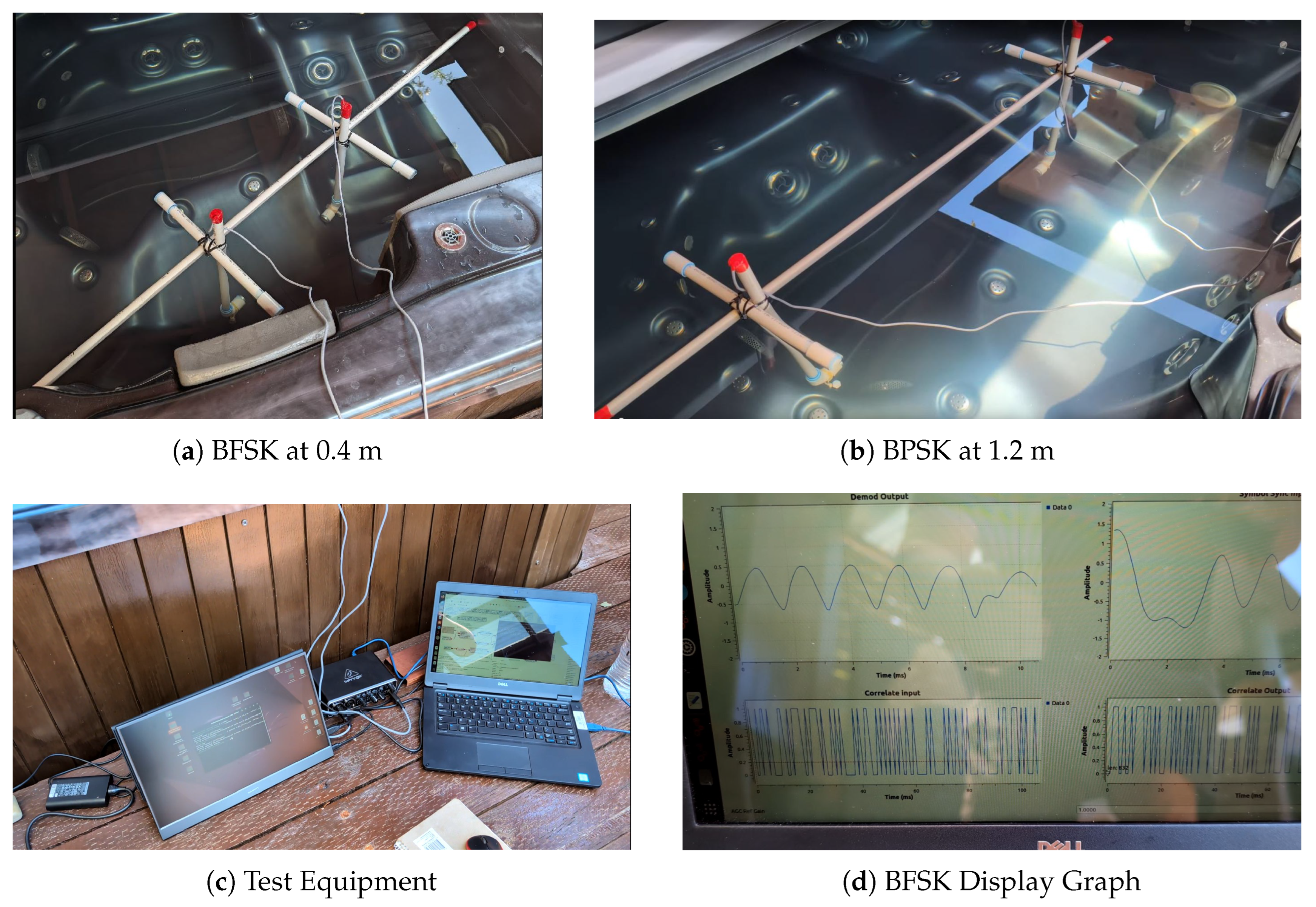
GNU Radio (GNU General Public License—free and open source software) [2] can be used to create communication links using transducers to convert the electrical energy to acoustics on the transmit side and convert the acoustics back to an electrical energy that can be demodulated by the software. This method was demonstrated in a tank of water, as shown in Figure 1, to send images from the Transmit Transducer to the Receive Transducer at a depth of 0.5 m using 40 kHz transducers in water that was at 30 °C. A number of different types of images were sent, with an average size of 100 Kb/s, with a speed of 1200 baud using BFSK (Binary Frequency Shift Keying) and a much larger text file using BPSK (Binary Phase Shift Keying).
Figure 1 shows a test conducted in January 2025 using a large spa water tank that holds approximately 2500 L of water. The sensors were positioned 0.4 m and 1.2 m apart, at a water depth of 0.5 m and a temperature of approximately 30 °C. Switching the modulation protocol is very simple, and it only requires the user to choose a different flowgraph with a more appropriate modulation method programmed. There is no hardware adjustment required. This provides great flexibility that can be tailored for any type of substance. The density and data reflection or refraction properties of the solution can be best managed using this approach to reduce the impact of multiple signal paths that will degrade the received transmission.
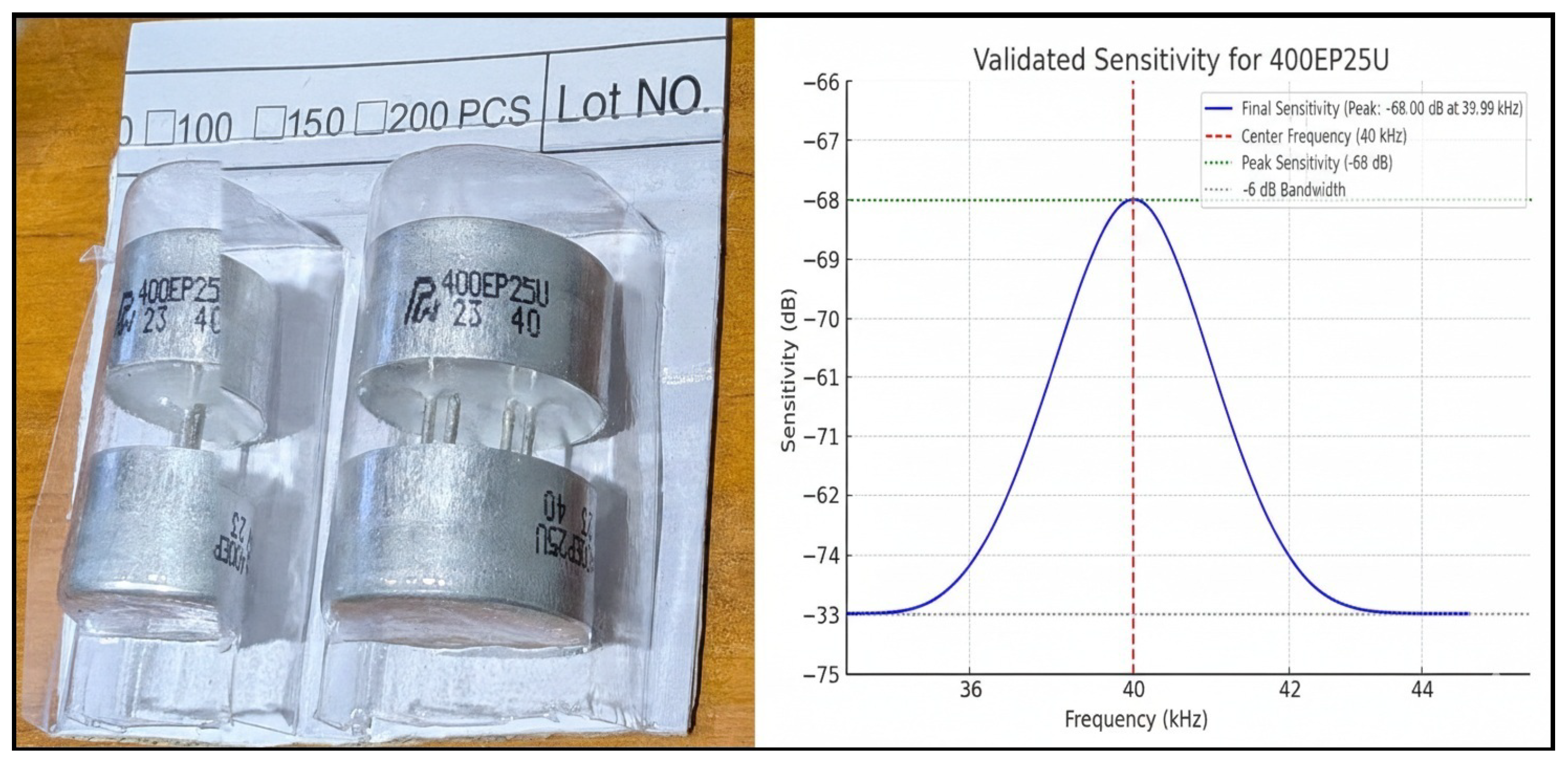
The Prowave sensors used for this test have about 3 kHz of usable bandwidth from 38.5 kHz to 41.5 kHz. The graph in Figure 2 shows how the signal outside this range is attenuated.

3.2. Acoustic Wave Propagation as a Solution

This study proposes the utilisation of acoustic wave propagation [6] through different types of liquids as a viable communication medium. The velocity of acoustic waves in liquids is approx 1500 m/s and varies a little depending on whether it is seawater, freshwater, or another type of liquid like Gasoline/Diesel. This phenomenon facilitates the creation of Ad Hoc networks by enabling data transmission via modulated sound waves between embedded devices.
The proposed system consists of devices that function similarly to software-defined radios. Early prototypes were referred to as SCR (Shipping Container Radios), as the original concept focused on data modulation within steel transport containers. In the current application, however, acoustic transducers are suspended in liquid, replacing traditional radio antennas that would otherwise be used to propagate electromagnetic signals.

3.3. Network Architecture and Implementation

The proposed network architecture comprises interconnected nodes, each equipped with an acoustic transducer and a microcontroller. These nodes could be deployed in boats to communicate with buoys, anchors, wharves, and navigational beacons or other submerged vessels. Gateway nodes, strategically positioned above the water and having RF communication capabilities, would enable data transfer to external networks and the internet.
The acoustic communication protocol employs BFSK or other suitable modulation techniques, such as BPSK, to encode data onto carrier signals. Post and preamble are used to synchronise the receiver with the transmitter before the payload data is sent. Error correction codes are also utilised to mitigate signal distortion and ensure data integrity. The network employs a routing algorithm to optimise data transmission paths and minimise latency.

3.4. Advantages and Applications

The proposed acoustic communication system offers several advantages over conventional RF solutions. Robustness against RF signal attenuation: Acoustic waves are less susceptible to attenuation in liquids and solids, ensuring reliable communication within container stacks.
  • Cost-effectiveness: Acoustic transducers are generally less expensive than RF transceivers.
  • Energy efficiency: Acoustic communication can be implemented with lower power consumption compared to RF systems.
  • Applications:
    (a)
    Real-time monitoring of devices (temperature, water ingress, pressure, depth, etc.).
    (b)
    Tracking and management.
    (c)
    Security and surveillance.
    (d)
    Remote diagnostics and maintenance.

3.5. Purpose of This Study

This study demonstrates the feasibility of using acoustic wave propagation to establish Ad Hoc networks in aquatic environments [7], including bodies of water, oceans, and hazardous liquids such as petrol, diesel, bleach, etc. In these settings, cabled connections are often unfeasible, while RF (Radio Frequency) communication suffers from severe attenuation and high implementation costs. The proposed acoustic-based system offers a robust and cost-effective alternative to conventional RF solutions, enabling reliable data transmission between submerged devices and centrally positioned sensors—particularly in large tanks where wired connections are operationally impractical. Notably, the system supports the transmission of discrete blocks of data, such as images and text files, rather than only continuous telemetry streams, demonstrating its versatility for diverse data-centric applications. Future work will focus on optimising the acoustic communication protocol, developing scalable routing algorithms, and performing field trials to evaluate system performance under real-world conditions.

4. Radio Frequency Communication in Varied Media: An Analysis of Range and Limitations

4.1. RF Communications in Varied Media Overview

RF (Radio Frequency) communication [8], a technology with a history spanning over a century, has become integral to modern life, underpinning applications ranging from personal devices (e.g., Bluetooth earbuds, mobile phones, Wi-Fi) to large-scale communication systems (e.g., traditional radio broadcasting). The inherent ability of RF signals to propagate through air and vacuum has facilitated long-range communication, evidenced by the reception of AM radio broadcasts over extensive distances and the operational range of mobile telephony within several kilometres of base stations. However, the performance of RF communication is not uniform across all media, necessitating a detailed analysis of its limitations [9,10].
The general expression for RF (Radio Frequency) signal propagation in free space is provided by the Friis Transmission Equation.
Friis’ original idea behind his transmission formula [11] was to dispense with the use of directivity or gain when describing antenna performance. In their place is the descriptor of antenna aperture area as one of two important components of the transmission formula that characterises the behaviour of a free-space radio circuit. This leads to the published form of his transmission formula:
P r P t = A r A t d 2 λ 2
where:
  • P r is the power available at the receiving antenna output terminals;
  • P t is the power fed into the transmitting antenna input terminals;
  • A r is the effective aperture area of the receiving antenna;
  • A t is the effective aperture area of the transmitting antenna;
  • d is the distance between antennas;
  • λ is the wavelength of the radio frequency;
  • P t and P r are in the same units of power;
  • A r , A t , d 2 and λ are in the same units;
  • Distance d is large enough to ensure a plane wave front at the receive antenna, sufficiently approximated by
    d 2 a 2 / λ
    where a is the largest linear dimension of either of the antennas.
However, it is simpler to express this formula using the gain, considering the following:
P r = P t G t G r λ 4 π d 2
  • P r : Received power (in watts);
  • P t : Transmitted power (in watts);
  • G t : Transmitter antenna gain (unitless);
  • G r : Receiver antenna gain (unitless);
  • λ : Wavelength of the signal (in metres);
  • d: Distance between transmitter and receiver (in metres).
The key things to note are the squared law, which applies to all RF and Acoustics in most cases. When considering acoustics and the parameters measured in dBs, the formula can be converted to the following by first expressing it as follows:
P r [ dB ] = P t [ dB ] + G t [ dBi ] + G r [ dBi ] + 20 log 10 λ 4 π d
Fritz’s formula (more precisely, Fritz’s transmission formula) can be derived from Friss’ formula [12]. It is used in acoustics and electromagnetic theory to estimate the transmission loss (or coupling efficiency) between two antennas or transducers in free space or across a medium. It is particularly useful in acoustic or RF link budget analysis, especially when considering line-of-sight propagation and matched impedance systems.
L = 20 log 10 4 π d λ
  • L: transmission loss in dB;
  • d: distance between the source and receiver (in metres);
  • λ : wavelength of the signal in the medium (in metres).

4.2. Advantages of Radio Frequency Communication

Extended Range and Bandwidth: RF systems can achieve substantial communication ranges, particularly in air and vacuum, with the potential for considerable bandwidth depending on the frequency allocation [8,13,14,15,16].
  • Technological Maturity: RF technology is well-established, resulting in robust infrastructure and standardised protocols.
  • Industry Support and Software Ecosystem: The widespread adoption of RF communication has fostered a mature industry, providing comprehensive support and a plethora of software applications.
  • Cost-Effectiveness for Personal and Commercial Applications: RF components and systems are generally available at reasonable costs, facilitating broad accessibility for both personal and commercial use.
  • Effective Propagation in Air and Vacuum: The inherent properties of air and vacuum facilitate efficient RF signal propagation, enabling long-distance communication.

4.3. Disadvantages and Limitations of Radio Frequency Communication

  • Susceptibility to Interference: RF signals are vulnerable to interference from other electromagnetic sources, which can degrade signal quality and reliability.
  • Security Concerns: The broadcast nature of RF communication poses security risks, necessitating robust encryption and authentication mechanisms.
  • Range Limitations (Frequency and Power Dependent): The achievable range of RF communication is contingent on the operating frequency and transmitted power. Higher frequencies generally exhibit shorter ranges due to increased attenuation.
  • Significant Attenuation in Liquids and Solids: RF signals experience substantial attenuation when propagating through conductive media such as liquids and solids. This attenuation significantly reduces the effective communication range.
  • Spectrum Cost for Mission-Critical Applications: Dedicated and protected frequency spectrum allocation for mission-critical applications (e.g., military, emergency services) can be prohibitively expensive.
  • Multi-path Propagation Issues in Urban Environments: In built-up areas, RF signals undergo multi-path propagation due to reflections from buildings and other structures, leading to signal fading and distortion.

4.4. Media-Specific Propagation Characteristics

The propagation of RF signals is critically dependent on the characteristics of the medium. For instance, while air and vacuum provide relatively low attenuation, liquids and solids introduce significant signal loss. As an illustrative example, the effective range of 2400 MHz Wi-Fi or mobile phone signals in water can be drastically reduced in the best conditions to approximately 1.8 m. Signal loss will typically occur at a depth of as low as 0.01 m for bandwidths of 700 MHz to 2700 MHz used by mobile phone utilities. However, utilising VLF (Very Low Frequency) signals, within the 3 kHz to 30 kHz range, can extend the communication range in water to approximately 30 m in ideal conditions. This highlights the inverse relationship between frequency and penetration depth in conductive media.

4.5. Summary of RF Communications in Varied Media

RF communication, despite its maturity and widespread adoption, exhibits significant limitations, particularly concerning signal propagation in media other than air and vacuum. The attenuation experienced by RF signals in liquids and solids necessitates careful consideration of frequency selection and power allocation for applications in such environments. Future research should focus on developing techniques to mitigate these limitations, enhancing the reliability and range of RF communication in diverse media.

5. Acoustic Communications: Advantages and Disadvantages

This section examines the deployment of acoustic communication systems, contrasting their efficacy in various media and highlighting their inherent strengths and weaknesses, particularly when juxtaposed with RF (Radio Frequency) communication [17,18,19,20].

5.1. Medium-Dependent Performance

While acoustic communication presents negligible advantages in air, serving primarily as a benchmark for comparison, its application within liquids and solids demonstrates significant potential.
In aqueous environments, notably, acoustic waves propagate at approximately 1500 m/s. Furthermore, they exhibit reduced attenuation, enabling transmission over distances ranging from hundreds of metres to kilometres, contingent upon the utilised frequency and transmission power. This contrasts starkly with RF propagation in dense solid media such as steel and rock, where signal attenuation can occur within mere centimetres.
In urban built environments, while RF signals can penetrate through architectural features such as windows, air ducts, and door apertures, structures employing substantial steel and concrete necessitate distributed antenna systems to ensure adequate mobile network connectivity.
In railway cuttings and tunnels that do not have a distributed antenna system, mobile phone reception is poor or nonexistent. There is no clear view of the sky (in a cutting) with rock walls blocking satellite reception. The steel railway track is normally continuous and can be used to create acoustic links using suitably designed or modified SCR, from an area that has mobile RF coverage to an area that does not. Maintenance railway work crews regularly face challenges in communicating with the signaller (or train controllers) when critical work, such as urgent wayside infrastructure repairs are needed, and train services cannot be suspended.

5.2. Advantages of Acoustic Communication

  • Enhanced Medium-Specific Performance: Acoustic communication exhibits superior performance in liquid and solid media relative to RF.
  • Non-Line-of-Sight Propagation: Unlike RF, acoustic signals are not constrained by line-of-sight requirements, enabling communication in obstructed environments.
  • Extended Range in Aqueous Environments: Acoustic waves can propagate over substantial distances (hundreds of kilometres) within water, facilitating long-range underwater communication.
  • Data Transmission Capability: Acoustic systems can be configured to transmit data, albeit with limitations.
  • Essential Underwater Communication Modality: In oceanic applications, where cabling is impractical, acoustic communication remains the sole viable wireless data transmission method.

5.3. Disadvantages of Acoustic Communication

  • Medium Dependence: Acoustic wave propagation necessitates a physical medium, rendering it ineffective in a vacuum.
  • Medium-Dependent Propagation Speed: The velocity of acoustic signals is contingent upon the medium through which they travel.
  • Limited Bandwidth: Acoustic communication systems exhibit restricted bandwidth compared to RF systems.
  • Technological Maturity: Acoustic communication technology is less mature than RF technology.
  • Niche Market Applications: The demand for acoustic communication is primarily confined to specialised applications.
  • Suboptimal Performance in Air: Acoustic communication performs poorly in air compared to RF.
  • Limited Software and Application Ecosystem: The availability of software and applications for acoustic communication is significantly limited compared to RF.
  • Cost Considerations: Acoustic communication systems can be financially demanding.

5.4. Submarine and Submersible RF Communication Limitations

RF communication with submerged vessels, such as submarines and submersibles, is constrained to VLF (Very Low Frequency or ELF (Extremely Low Frequency) transmissions. However, these methods are limited to unidirectional communication, suitable only for text-based messages, owing to their restricted bandwidth. Furthermore, the required antenna dimensions are substantial, with VLF antennas spanning approximately 10 km and ELF antennas exceeding 1000 km. This renders RF transmission from submerged platforms impractical within oceanic environments. ELF is a receive-only communication link. The submersible cannot respond to the messages unless it comes to the surface and/or releases a VHF antenna buoy that floats above the surface of the water. This may not always be possible, and expose the location of the vessel if the antenna is spotted by an enemy force.

6. The Carrier Medium—Acoustics

6.1. Speeds and Wavelengths of Acoustic Signals in Each Material

For acoustic communication, the speed of the wave is not a constant and is determined by the type of medium through which the sound wave propagates.
For the target frequency of 40 kHz, the wavelength for each medium is as follows:
  • Air is 8.5 mm at 343 m/s;
  • Water is 37.05 mm at 1482 m/s;
  • Steel is 148.5 mm at 5941 m/s.
One issue is that when sound energy travels from a low-density liquid to a higher-density one, the wavelength changes. This is also true for the air–water boundary and water–ground boundary.
At the boundary, some of the energy will be reflected, more will propagate through, and you can have multi path issue’s that can degrade your received signal, making it hard to demodulate. These reflected signals can be managed and mitigated by taking care in how the acoustic wave is directed using the appropriate audio level and modulation protocol.

6.2. Propagation in a Medium That Confines the Wave, Such as a Steel Beam

When acoustic energy propagates in a substance, the molecules vibrate at the frequency that is generated by the sound. A speaker receives a signal and converts electrical energy to mechanical energy, which vibrates the air or water molecules, allowing the audio signal to be received. As acoustic energy passes through denser substances such as solids, the sound wave increases in speed and elongates, from 340 m/s to approx 5960 m/s in materials like steel. The solid material, like steel, deforms and stretches as a result [21].

6.2.1. Euler–Bernoulli Beam Theorem

Elastic deformation and stretching behaviour can be effectively analysed using the Euler–Bernoulli beam theorem [2,22]. This classical theory describes the relationship between applied mechanical loads and the resulting bending deformation in slender beams.
It assumes the following:
  • Plane sections remain plane and perpendicular to the neutral axis (no warping).
  • Shear deformation is negligible (valid for slender beams).
  • The beam material is linearly elastic [21].
The equation that governs this is as follows:
E I d 4 w ( x ) d x 4 = q ( x )
where
  • E = Young’s modulus of the material;
  • I = Second moment of area of the beam cross-section;
  • w ( x ) = Transverse displacement of the beam;
  • q ( x ) = Transverse distributed load.

6.2.2. Connection to Acoustics

In acoustics, especially ultrasound and structural acoustics, the Bernoulli beam theory becomes relevant when dealing with the following:
  • Vibration of Beams:
Beams vibrate when excited by mechanical or acoustic forces. These vibrations generate or respond to sound waves, particularly in solid waveguides (e.g., metal rods used for transmitting ultrasound).
  • Flexural Wave Propagation:
Acoustic waves travelling along a beam can include flexural (bending) waves. The wave equation derived from the Bernoulli beam model becomes:
2 w t 2 + E I ρ A 4 w x 4 = 0
where
  • ρ = density;
  • A = cross-sectional area.
The term E I ρ A determines the wave speed of bending waves. This differs from longitudinal acoustic waves, which obey:
2 u t 2 = E ρ 2 u x 2
  • Modal Analysis in Acoustics:
In ultrasonic devices or musical instruments, natural frequencies (modes) are found using Bernoulli’s theory. These modes affect how efficiently a beam radiates or absorbs sound.
  • Acoustic Applications of Bernoulli Beam Theory:
The Bernoulli Beam theorem [23] gives insight into how beams vibrate, radiate, and respond to sound, especially when dealing with flexural acoustic waves. Table 1 below shows the relationship between the Application and the Theorem. It is not the whole story (shear and rotary inertia are ignored), but it is a powerful starting point for acoustic–structural interaction.

6.3. Wave Propagation Characteristics and Interference Potential

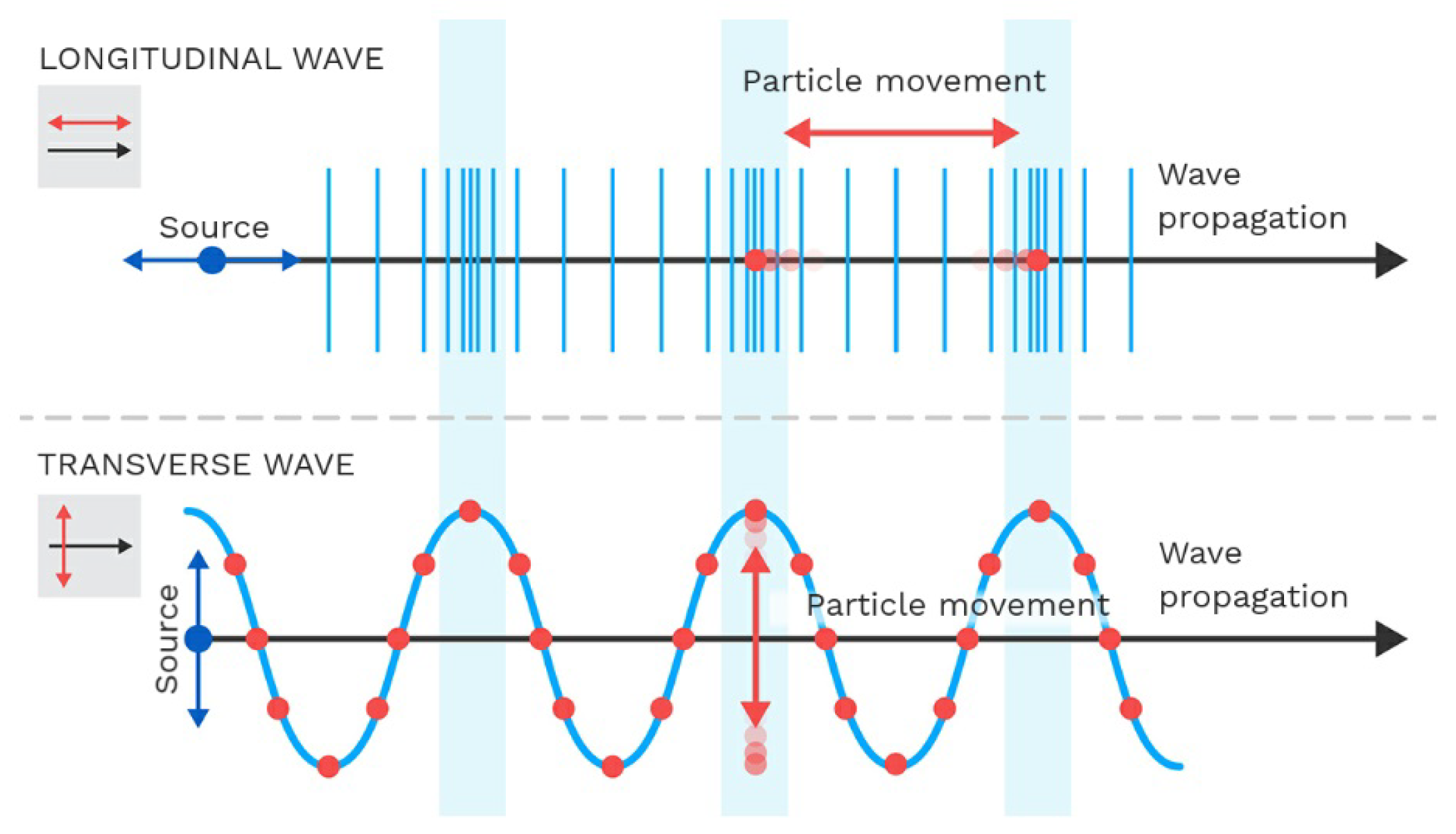
A fundamental distinction between electromagnetic radio waves and acoustic waves lies in their respective propagation characteristics. Electromagnetic radio waves are exclusively transverse, meaning their oscillations occur perpendicular to the direction of propagation. In general, the particle movement in transverse waves oscillate perpendicular to the direction of travel, whereas longitudinal waves oscillate parallel to it, creating periodic compressions and rarefactions. Unlike radio waves, acoustic waves exhibit the capacity for both transverse and longitudinal propagation, depending on the medium, as shown in Figure 3 below.
This duality arises from the nature of the medium through which they propagate. In solids, acoustic waves can exhibit both transverse (shear) and longitudinal (compression) motion, while in fluids, they primarily propagate longitudinally.
In our case, we are using piezo–electric transducers, which predominantly produce longitudinal waves. The method of coupling the transducer to the surface of the material is an important consideration, along with the type of transducer employed, to achieve the maximum acoustic energy transferred across the interface boundary. The application will determine the type, method of fixing, and modulation protocol employed.
This variance in propagation modes introduces a potential source of interference, particularly in environments where both transverse and longitudinal acoustic waves coexist. The superposition of these wave types can result in complex interference patterns, which complicate signal demodulation. Specifically:
(a)
Modal Interference: The presence of both transverse and longitudinal waves within a confined space or solid medium can lead to modal interference, where the waves interact constructively and destructively at various points. This results in spatial variations in signal amplitude and phase, making it challenging to extract the original information.
(b)
Polarisation Complexity (Solids): In solid materials, the presence of both shear and compressional waves can be considered to provide a form of complex polarisation behaviour. This complex wave behaviour, in comparison to the strictly singular polarisation of Radio Waves, adds substantial complexity to signal processing.
(c)
Demodulation Challenges: The resulting interference and wave mode complexities can necessitate sophisticated signal processing techniques for accurate demodulation. This added signal processing can increase system costs and complexity.
Therefore, the variable propagation modes of acoustic waves, unlike the singular transverse nature of electromagnetic radio waves, present a significant factor to consider in the design and deployment of acoustic communication systems. These considerations become particularly important in the context of the following:
(a)
Underwater Acoustic Communication, where complex water layers can add to propagation difficulty. Changes in salinity, temperature, and water flow can impact the acoustic signal quality, along with errors that can be created if the transducers move during the transmission phase.
(b)
Solid-state acoustic applications, where modal variations are very prevalent.

6.4. Mathematical Representation of a Longitudinal Acoustic Wave

A longitudinal acoustic wave can be mathematically represented as a displacement wave. Consider a one-dimensional longitudinal wave propagating along the x-axis. The displacement of a particle at position x and time t can be denoted by s(x,t).
A simple harmonic longitudinal wave can be described by the following sinusoidal function:
s ( x , t ) = s 0 cos ( k x ω t + ϕ )
where
s ( x , t ) is the displacement of a particle from its equilibrium position at position x and time t.
s 0 is the amplitude of the wave, representing the maximum displacement of a particle.
k is the wave number, related to the wavelength λ by
k = 2 π λ
ω is the angular frequency, related to the frequency f by
ω = 2 π f
ϕ is the phase constant, determining the initial phase of the wave.
The wave number k and angular frequency ω are related to the wave speed v by
v = ω k
The pressure variation Δ P ( x , t ) associated with the longitudinal wave can be expressed as follows:
Δ P ( x , t ) = B s ( x , t ) x
where B is the bulk modulus of the medium. Substituting the displacement wave equation, we achieve the following:
Δ P ( x , t ) = B s 0 k sin ( k x ω t + ϕ )
This equation shows that the pressure variation is also a sinusoidal wave, but shifted in phase by π 2 relative to the displacement wave.
In vector notation, for a three-dimensional longitudinal wave propagating in the direction of the wave vector k , the displacement can be expressed as follows:
s ( r , t ) = s 0 cos ( k · r ω t + ϕ )
where
  • r is the position vector.
  • s 0 is the amplitude vector, parallel to k for a longitudinal wave.
  • k · r is the dot product of the wave vector and the position vector.
These mathematical representations provide a fundamental understanding of longitudinal acoustic waves and their propagation characteristics.

7. Modulation of the Acoustic Signals

GNU Radio can switch seamlessly from one modulation technique to another. There have been five modulation techniques used in the course of this project. Most of the tests used FSK and PSK, with later testing utilising OFDM, which is outside the scope of this paper. The FSK flowgraph is not complex when compared to PSK. The flowgraph uses a narrow bandwidth and works well with General Purpose transducer. In the early stages of the research, the FSK modulation protocol was used extensively, and the switch to PSK happened when there was evidence that multipath signals corrupted the transmission, giving a minor improvement.

7.1. OOK (On–Off Keying)

  • This is where the signal is switched on and off to correspond to the binary output.
  • The “1” amplitude is 1 and the “0” amplitude is 0.

7.2. ASK (Amplitude Shift Keying)

  • In this test, we are using BASK (Binary Amplitude Shift Keying) with amplitudes of “1” and “−1” to represent one bit and a zero bit.
  • Multi-level ASK would use multiple amplitudes, such as (1, 3) to represent (00, 01) and (−1, −3) to represent (10, 11).
    (a)
    Multi-level ASK increases the data rate by the number of levels in the symbol while not increasing the required bandwidth. (That is dependent on the Symbol rate.) For example, two levels provide 1 bit per symbol, while four levels provide 2 bits per symbol.
    (b)
    The downside is the Bit Error Rate performance, which requires a higher Signal-to-Noise Ratio to be maintained.
  • BASK is not the same as OOK. The average energy per symbol is double that of OOK, as the symbols do not settle on 0 for a “0”.

7.3. FSK (Frequency Shift Keying)

  • We use Binary Frequency Shift Keying (BFSK). That is two frequencies.
  • The frequencies used are 39.5 kHz and 40.5 kHz for “1” and “0” (Space and Mark).
  • The ultrasonic transducers filter out most of the signal below 39 kHz and above 41 kHz.
    (a)
    The bandwidth available is 2 kHz.
  • Multi-level FSK does not require more bandwidth, as the symbol rate does not change. Assume we use the following:
    (a)
    A frequency of 39.5 kHz to represent 00;
    (b)
    A frequency of 39.83 kHz to represent 01;
    (c)
    A frequency of 40.16 kHz represents 10;
    (d)
    A frequency of 40.5 kHz to represent 11.
  • The downside is the Bit Error Rate performance, which requires a higher Signal-to-Noise Ratio to be maintained.

7.4. PSK (Phase Shift Keying)

  • Binary Phase Shift Keying (BPSK) modulation is used. It has two phases, 0 and 180 degrees [24,25].
  • The ultrasonic transducers filter out most signals below 39 kHz and above 41 kHz.
  • The available bandwidth is 2 kHz.
  • QPSK (Multi-level) does not require more bandwidth because the symbol rate stays the same.
    (a)
    The four phases—0, 90, 180, and 270—would represent (00, 01, 10, 11).
  • The downside is the Bit Error Rate performance, which requires a higher Signal-to-Noise Ratio to be maintained.

7.5. Why FSK Was Selected for These Experiments

FSK is fundamentally a one-dimensional modulation scheme. A simple frequency-shift keying constellation would just be a line of points, with each point representing a distinct frequency.
FSK can be demodulated using simpler, non-coherent detectors, which do not require a phase-locked loop and are more robust against noise and interference than a non-coherent PSK receiver. If a more sophisticated modulation scheme is chosen, you would select OFDM, where you achieve improved performance with the increased complexity of managing multipath signals.
The BER (Bit Error Rate) for FSK outperforms ASK under most practical conditions [26] because it is more resilient to amplitude-related noise, better suited for non-coherent detection, and more robust in variable environments like wireless or mobile systems. Here is a breakdown of the key reasons.
  • Resilience to Amplitude Noise
    (a)
    As ASK is based on the amplitude of the signal, ASK is highly susceptible to amplitude noise (e.g., from fading, interference, or power variations).
    (b)
    On the other hand, FSK relies on frequency differences, not amplitude; therefore, amplitude variations due to noise have less impact.
  • Non-coherent Detection Advantage
    (a)
    FSK supports non-coherent detection, meaning the receiver does not need to precisely track the signal’s phase.
    (b)
    Non-coherent FSK still achieves reasonable BER performance without requiring complex synchronisation.
    (c)
    ASK, when using non-coherent detection, performs poorly since amplitude variations can be easily mistaken as valid bits.
  • Practical Considerations
    (a)
    Power Efficiency: ASK signals with zero amplitude (bit “0”) are more affected by power amplifier nonlinearities.
    (b)
    Spectral Properties: FSK has better spectral properties in some cases, and can be more easily separated by filters.
    (c)
    Channel Conditions: In wireless or fading channels, FSK maintains a lower BER due to reduced dependence on signal amplitude.
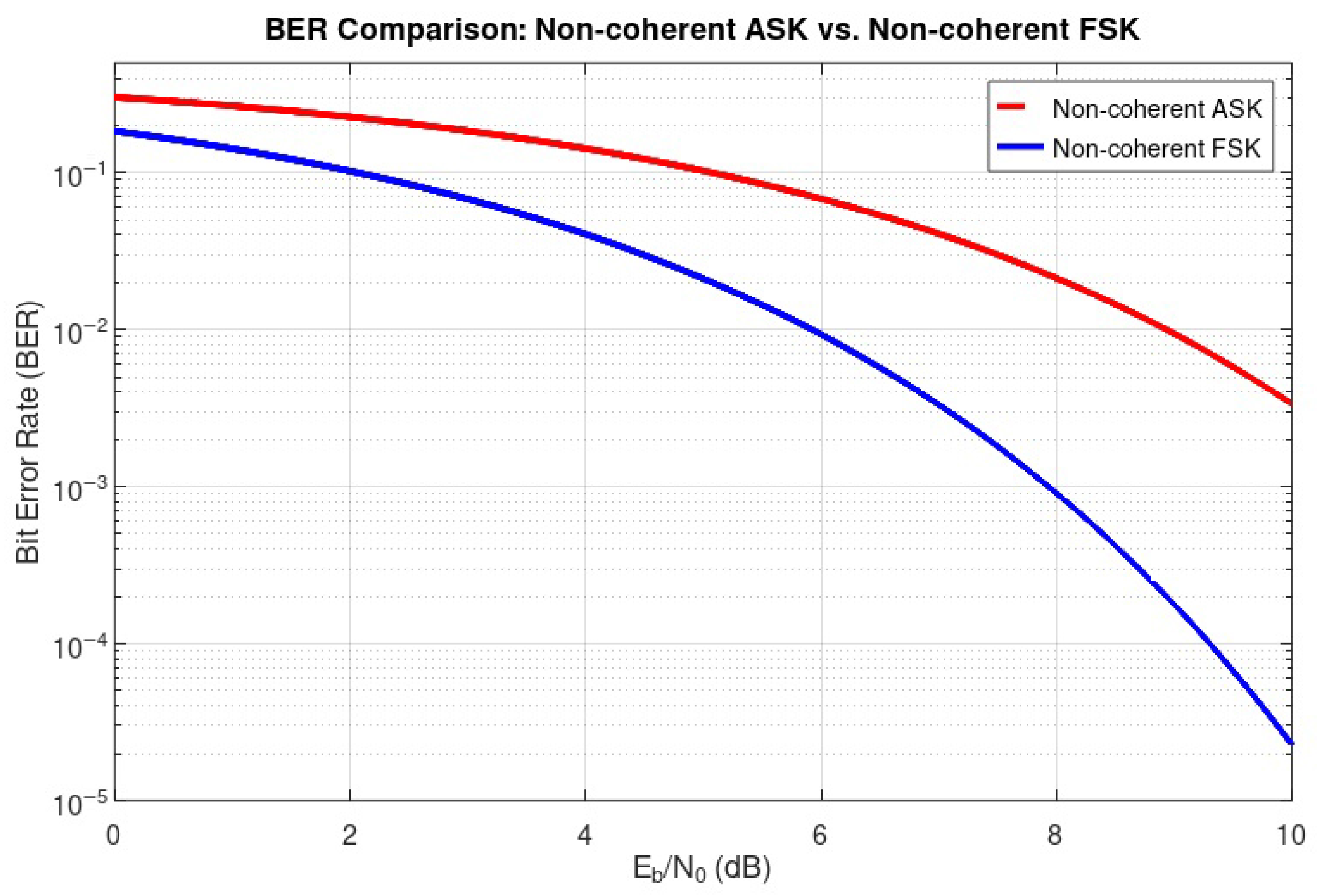
Here are the equations for the BER (Bit Error Rate) of non-coherent ASK and non-coherent FSK:
  • Non-coherent ASK:
    P b ASK = 1 2 e ( E b N 0 1 2 )
  • Non-coherent FSK:
    P b FSK = 1 2 e E b N 0
As can be seen, the equations are identical except for the 1 2 in the exponent of the ASK one. These equations clearly show that non-coherent FSK decays faster with increasing E b N 0 , which translates to better BER performance. This is shown in Figure 4.

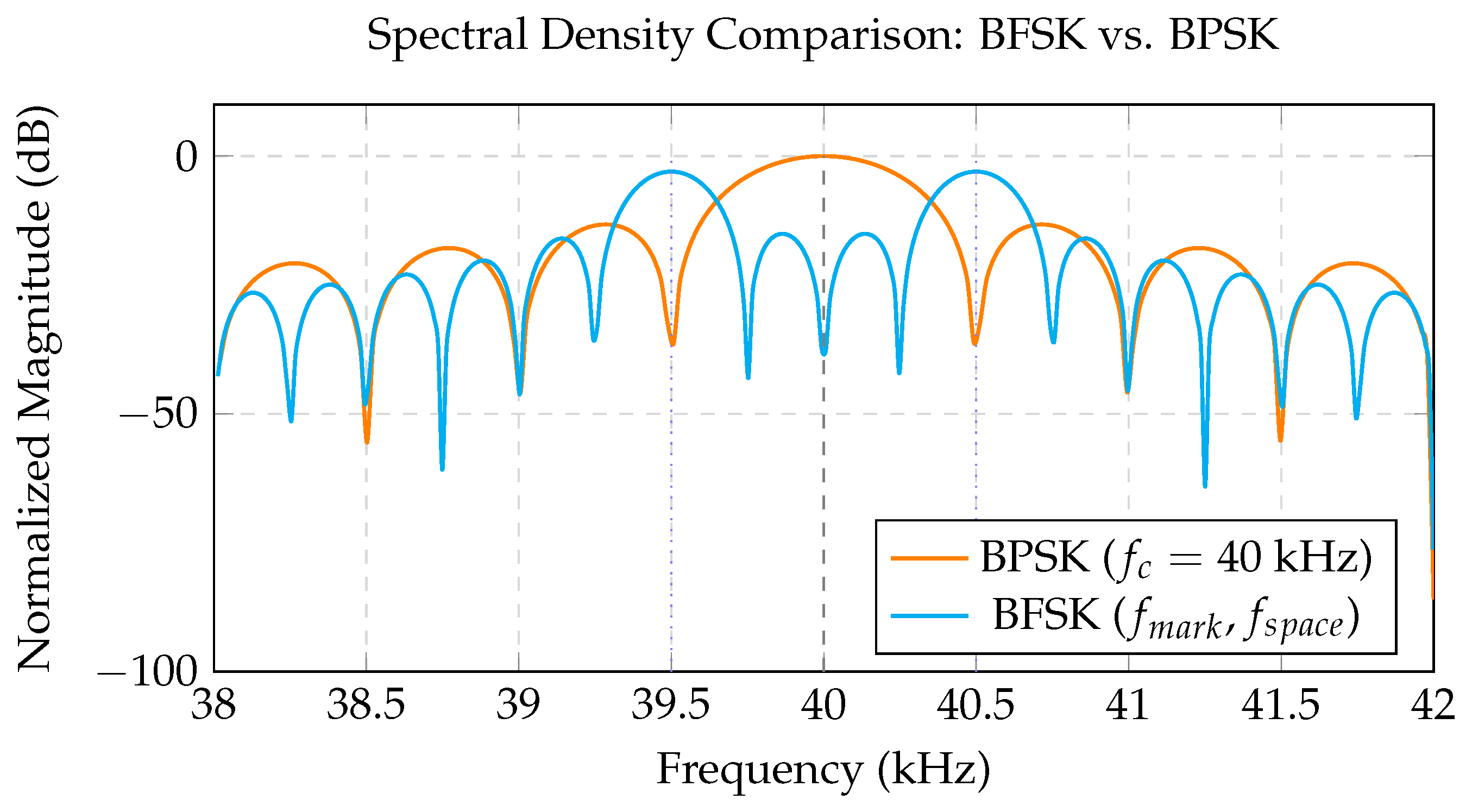
7.6. Comparing the Wave Form of BFSK with BPSK

The following Figure 5 was generated to show the relations between BFSK and BPSK with a centre frequency of 40 kHz. The PSK waveform consumes no additional bandwidth, but the phase change requires additional complexity in the flow graph to prevent the constellation points from drifting off from their expected locations. Under the experimental conditions evaluated in this study, no statistically significant difference in end-to-end file recovery performance was observed between BFSK and BPSK.

7.7. Setting a Baseline for SNR (Signal-to-Noise Ratio) in Air

It was important to set a baseline in the early part of the project for background noise, understand the signal-to-noise ratio, and the performance that could be expected. These tests were performed in air using an RP4 and an Op amp.

7.7.1. Signal-to-Noise Ratios Observed in Transmission and Reception Tests

The table shown below was used to establish a baseline for the SNR in air and is shown in the following Table 2.
Signal- to-Noise ratios in TX and RX tests to establish a baseline are performed in Table 3.

7.7.2. BFSK Parameters Transmit

BFSK Transmitter Parameters extracted from Python file pkt_fsk_xmt.py (Table 4).

7.7.3. BFSK Parameters Receive

BFSK Receiver Parameters extracted from python file pkt_fsk_rcv.py (Table 5).

7.7.4. BPSK Parameters Transmit

BPSK Transmit Parameters extracted from the Python file pkt_xmt_rcv_ma_19122025.py (Table 6).

7.7.5. BPSK Parameters Receive

BPSK Receiver Parameters extracted from the Python file pkt_xmt_rcv_ma_19122025.py (Table 7).

8. GNU Radio Flowgraph Design and Implementation

The experimental communication system described in this work was implemented entirely using GNU Radio Companion (GRC), leveraging its modular, software-defined radio (SDR) architecture to construct flexible acoustic transmit and receive chains. The flowgraphs used in this study were derived from and extended upon early reference designs developed by Duggan et al. and Clark [27,28] for packet-based digital communications in GNU Radio. Significant modifications were introduced to support acoustic carrier operation at ultrasonic frequencies, reliable packet framing, and file-based data transmission through complex propagation media.
A key design objective was to ensure that the same underlying flowgraph structure could support multiple modulation schemes—most notably BFSK and BPSK—without requiring changes to the physical hardware. This modularity enabled rapid reconfiguration of the system to accommodate different channel conditions, bandwidth constraints, and multipath characteristics discussed in Section 4, Section 5 and Section 6.

8.1. Transmit Flowgraph Architecture

The transmit flowgraph accepts an input file (text or image) and converts it into a packetised digital bitstream suitable for acoustic modulation. An embedded Python block is used to read the source file and apply Base64 encoding, ensuring that the resulting byte stream is robust against bit errors that would otherwise corrupt structured binary formats such as JPEG. This encoded stream is augmented with preamble and postamble sequences, enabling reliable receiver synchronisation and end-of-file detection.
Packet framing is implemented using GNU Radio’s tagged stream mechanism. The payload length is computed and attached as metadata tags before passing through a CRC-32 block for error detection. A protocol formatter generates the packet header, and the header and payload streams are recombined using a tagged stream multiplexer.
Following bit repacking, the stream is passed to the selected modulator. For BFSK operation, frequency deviation is applied directly via a voltage-controlled oscillator. For BPSK operation, symbols are mapped onto a binary phase constellation with differential encoding enabled to mitigate phase ambiguity at the receiver. In both cases, interpolation and filtering are applied to raise the baseband sample rate prior to carrier modulation.
The final transmit signal is generated as a real-valued waveform centred at 40 kHz, consistent with the frequency response of the ultrasonic transducers used in the experiments. The waveform is delivered either directly to an audio interface for acoustic transmission or routed through a ZeroMQ publish socket, allowing the transmit and receive chains to be decoupled for debugging and validation.

8.2. Receive Flowgraph Architecture

The receive flowgraph performs the inverse operations of the transmit chain. The incoming acoustic signal is converted back into an electrical waveform by the receiving transducer and digitised by the audio interface. When operating in simulation or hybrid test modes, the signal is instead sourced from a ZeroMQ subscribe socket, ensuring bit-exact repeatability of experiments.
Quadrature down-conversion is used to translate the received passband signal to complex baseband. Following decimation and automatic gain control, the signal is passed through a root-raised-cosine matched filter to minimise inter-symbol interference. Symbol timing recovery is achieved using a Mueller and Müller synchroniser, which outputs a single sample per symbol at the optimal decision instant.
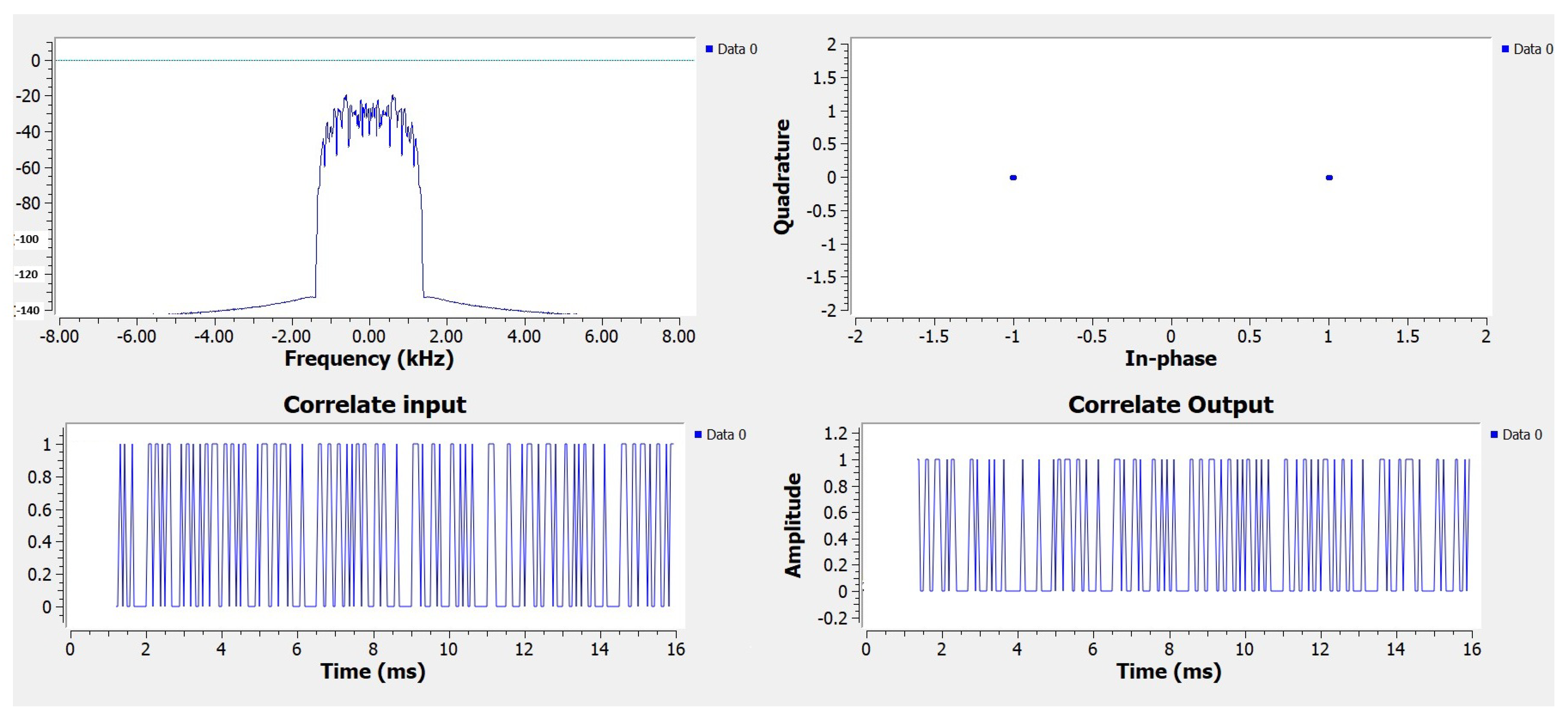
Carrier phase recovery is performed using a second-order Costas loop, appropriate for BPSK modulation. Once synchronisation is achieved, constellation points collapse tightly onto their ideal symbol locations, as demonstrated in the receiver plots presented in Appendix A. Hard symbol decisions are then made, followed by differential decoding where applicable.
Packet detection is accomplished using an access-code correlator that identifies the preamble sequence and extracts the payload length from the packet header. The recovered bitstream is repacked into bytes, verified using CRC-32, and written to an output file. Successful reception produces a file that is bit-for-bit identical to the original source after removal of the preamble and postamble sequences via a post-processing script.

8.3. Experimental Configuration and Test Equipment

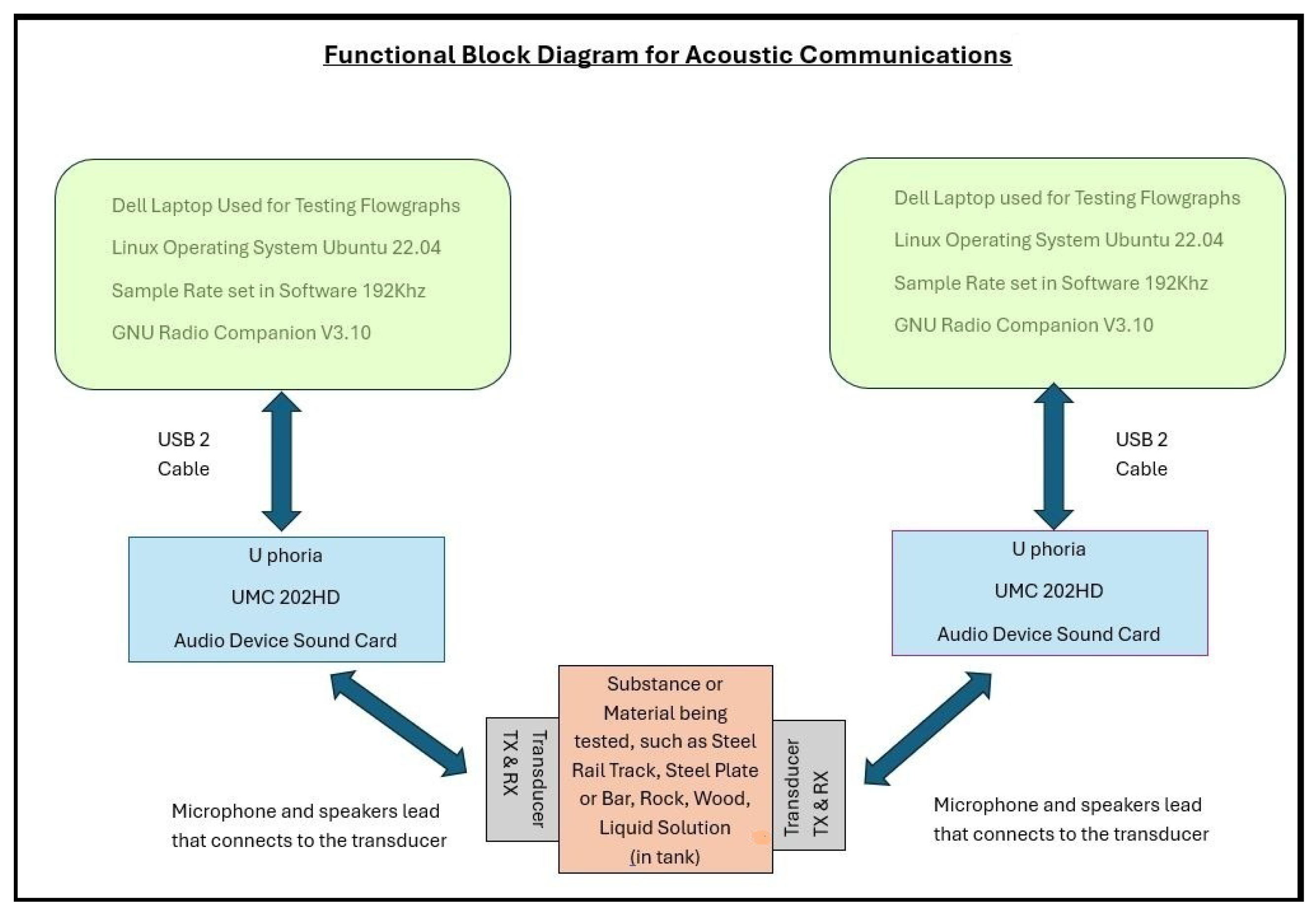
Figure 6 presents a functional block diagram (FBD) illustrating the principal components and their interrelationships.
During testing, it was observed that external display adaptors could introduce USB latency and degrade audio performance under sustained load. Stable operation was achieved by reverting to a single display configuration, highlighting the sensitivity of high-rate audio-based SDR systems to host platform characteristics.

8.4. Cost Function and Analysis

To validate the cost-effectiveness of the proposed system, a detailed Bill of Materials (BoM) is presented in Table 8. The system utilises Commercial Off-The-Shelf (COTS) audio hardware and generic piezoelectric transducers, avoiding the high costs associated with specialised underwater acoustic modems.
Analysis: The total system hardware cost of approximately USD 500 represents a significant reduction compared to commercial acoustic modems, which typically range from USD 5000 to over USD 20,000 per unit. This low barrier to entry confirms that the SDR-based approach is viable for scalable, multi-node sensor networks where cost constraints previously prohibited the use of acoustic telemetry.

8.5. Visualisation and Synchronisation Behaviour

GNU Radio’s graphical sinks were extensively used to monitor system performance in real time. Time-domain plots confirmed stable symbol timing, while frequency-domain displays verified spectral confinement within the transducer bandwidth. Constellation plots provided direct visual confirmation of carrier and timing lock, particularly in the BPSK receiver, where post-synchronisation symbols formed two tightly clustered points corresponding to the binary phase states.
The preamble plays a critical role in enabling this behaviour, allowing the receiver to achieve synchronisation before payload data arrives. If correlation fails, the receive chain intentionally suppresses file output, preventing partial or corrupted data from being written to disc.

8.6. File Transmission Results

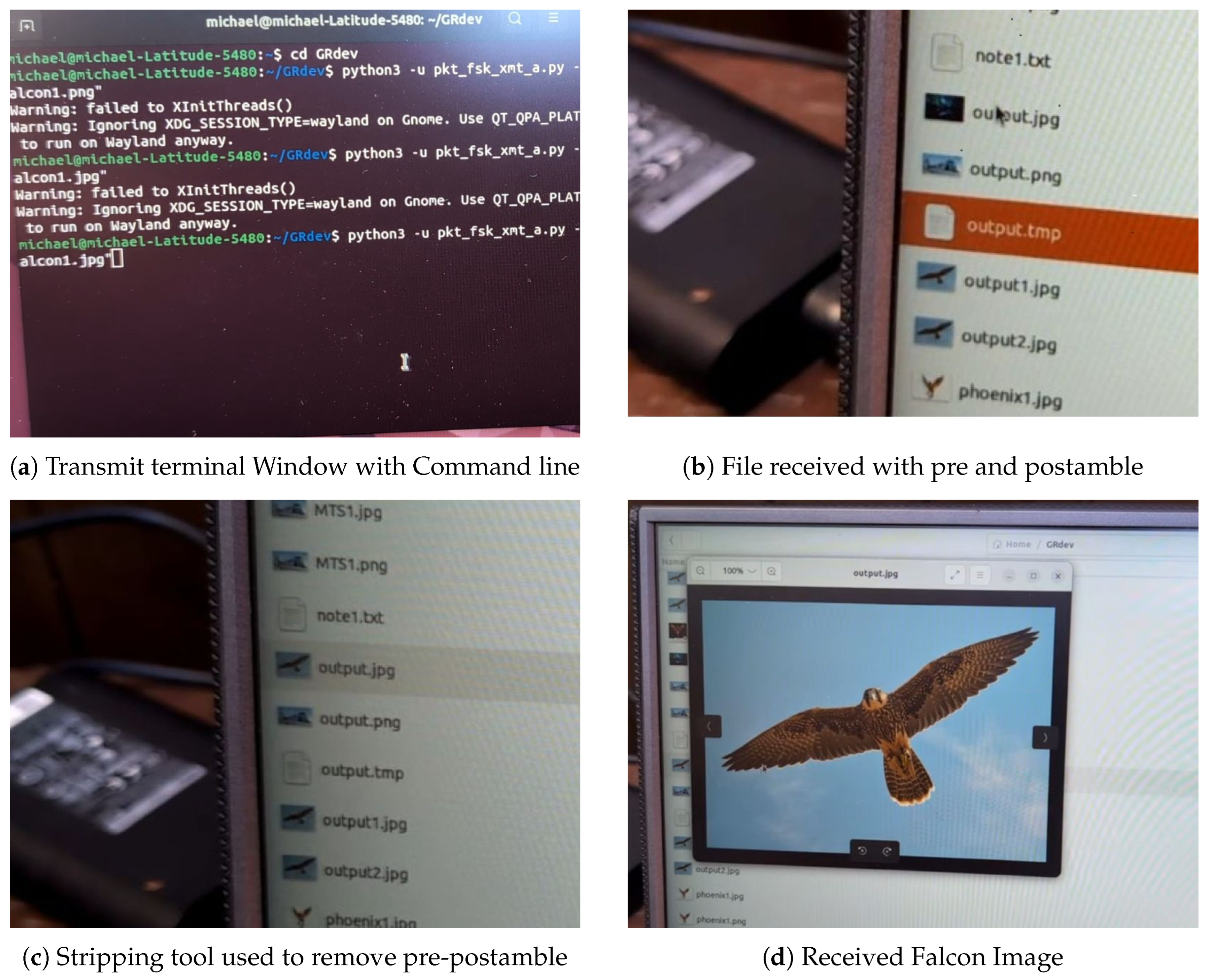
Image files were selected as a stringent test of system reliability, as even minor bit errors can render compressed formats unusable. Experimental results demonstrated consistent, successful reconstruction of JPEG images transmitted through water using both BFSK and BPSK modulation.

8.7. Packet Loss Rates During File Transmission

To quantify the system reliability beyond theoretical BER, we measured the Packet Loss Rate (PLR) for both modulation schemes. A packet was considered “lost” if the preamble correlation failed or if the CRC-32 check failed, resulting in the frame being dropped by the receiver. Table 9 presents the comparative PLR results collected during the transmission of image files (approx. 500 packets) at a max distance of 1.2 m.
Analysis: As shown in Table 9, both methods demonstrate a high degree of reliability with PLR values below 2%. This confirms that once symbol timing is established, both the non-coherent BFSK and coherent BPSK chains are robust enough to support file transfer. The marginal difference between the two further supports the observation that transmission failures were predominantly caused by external physical disturbances (transducer coupling) rather than modulation-specific instability. Representative examples are shown in Figure 7.
Transmission failures were primarily associated with physical disturbances, such as transducer movement during transmission, rather than software instability. Text and audio files were also transmitted successfully, further validating the generality of the approach.

8.8. Demonstration Outcomes and Limitations

The demonstration tests confirmed that acoustic data transmission using GNU Radio is feasible and reproducible under controlled conditions. Care must be taken to ensure that transmit and receive parameters—particularly baud rate and carrier frequency—remain matched. Additionally, buffered audio data can result in delayed completion messages, requiring patience before terminating a transmission.
Despite these practical considerations, the system reliably transmitted data through a variety of liquids, including water and hydrocarbon fuels, validating the core hypothesis of this work.

8.9. Opportunities for Improvement

Several avenues for future enhancement were identified. Higher-rate audio interfaces (e.g., 384 kHz) would enable wider acoustic bandwidths and higher symbol rates. Improved transducer selection and shielding could further reduce interference and improve signal stability. From a signal-processing perspective, parallelisation of synchronisation stages and formal bit-error-rate testing would provide deeper quantitative performance insights [27].

8.10. Comparative Analysis with Related Work

To demonstrate the novelty of the proposed SDR-based acoustic system, Table 10 compares this work with typical commercial underwater acoustic modems and other generic SDR acoustic implementations found in the literature.
Discussion of Comparison: As shown in Table 10, while commercial modems offer superior range, they lack the flexibility and cost-accessibility required for niche industrial monitoring or “difficult environment” applications where disposable or scalable sensors are needed. Furthermore, unlike many previous SDR studies that simulate channels or transmit simple bitstreams, this work demonstrates a complete multimedia transmission chain (JPEG images) through physical attenuation barriers (water, oil, solids), validating the practical utility of GNU Radio for this specific non-RF domain.

9. Discussion

9.1. Channel Characterisation: Absorption and Doppler Effects

To better understand the acoustic channel effects on the system, we analysed the specific absorption characteristics and potential Doppler shifts inherent to the testing environment [29,30].

9.1.1. Acoustic Impedance and Absorption

Table 11 presents the acoustic properties of the media used in this study at the operating frequency of 40 kHz. The significant impedance mismatch between the piezoelectric transducer (approx. 30 MRayls) and the liquid media highlights the importance of the coupling methods discussed in Section 6.

9.1.2. Doppler Effect Analysis

Doppler shifts ( Δ f ) can degrade performance by pushing the received signal outside the receiver’s filter bandwidth or locking range. The Doppler shift is calculated as follows:
Δ f = f c v c
where f c = 40 , 000 Hz, v is the relative velocity, and c is the speed of sound.
  • Scenario A (Static Tank):With water currents < 0.1 m/s, Δ f 2.7 Hz. This is negligible for our 1200 Hz bandwidth.
  • Scenario B (Moving Vehicle/Drone): At a typical slow movement speed of 2 m/s (approx. four knots) in water ( c = 1482 m/s):
    Δ f = 40 , 000 × 2 1482 54 Hz
    Since the BFSK frequency deviation is 1000 Hz, and the BPSK Costas loop bandwidth was set to approximately 62 Hz (see Table 7), the system can theoretically track these shifts without loss of lock, provided the rate of change is not excessive.

9.2. Energy Efficiency Analysis

The claim of energy efficiency is primarily grounded in the physics of wave propagation in conductive media. To validate this, we analysed the electrical power required to drive the acoustic transducer and compared the theoretical path loss against an equivalent RF system.

9.2.1. Transmit Power Consumption

The system uses a Behringer UMC202HD audio interface to drive the piezoelectric transducers. The interface outputs a line-level signal with a maximum voltage of approximately 1 V rms . The Prowave 400EP250 transducer has an impedance of approximately 2000 Ω at the resonance frequency of 40 kHz. Using Ohm’s law ( P = V 2 / R ), the electrical power consumed by the transmission element is as follows:
P t x = ( 1 V ) 2 2000 Ω = 0.5 mW
This indicates that the active communication link requires less than 1 milliwatt of power to transmit data over the tested distances (0.4–1.2 m). While the host laptop consumes significantly more power, an embedded implementation (e.g., utilising a microcontroller or low-power FPGA) would be dominated by this low transmission power, validating the system’s potential for battery-operated sensor nodes.

9.2.2. Comparative Path Loss (Acoustics vs. RF)

To further demonstrate why acoustics is the energy-efficient choice for liquids, Table 12 compares the attenuation of the utilised 40 kHz acoustic signal against a standard 2.4 GHz RF signal (Wi-Fi) in seawater.
  • Section Summary on Efficiency:
The results in Table 12 confirm that for liquid environments, acoustic communication is not merely “more” efficient but is the only viable low-energy solution. Attempting to bridge the same 1 m link with RF would require energy orders of magnitude higher than the acoustic approach.

9.3. Data Throughput Analysis

While the system’s symbol rates (Baud) are defined by the transducer bandwidth, the actual effective throughput—the rate at which useful user data is delivered—is the critical metric for file transmission.
Table 13 presents the throughput results. The Raw Data Rate is determined by the symbol rate and modulation depth (1 bit/symbol for binary schemes). The Effective Throughput was measured by dividing the total file size (in bits) by the transmission time, excluding the initial receiver lock-on time.
Analysis: The results indicate that the system maintains a protocol efficiency of approximately 80%. The 20% overhead is attributed to the robust packet structure required for difficult environments, which includes the following:
  • Preamble (Access Code):A total of 64 bits per packet for reliable synchronisation.
  • Header: Protocol version and packet length tags.
  • CRC-32: A total of 32 bits for error detection.
While BPSK offers a higher throughput (1580 bps) due to its efficient use of the available 3 kHz bandwidth (allowing 2000 baud), BFSK (960 bps) remains a viable fallback for scenarios where phase coherence cannot be maintained. For a typical 15 kB low-resolution JPEG image, transmission times are approximately 76 s for BPSK and 125 s for BFSK.

9.4. Theoretical Range Estimation and Real-World Applicability

While the experimental validation was constrained to a 1.2 m path length due to laboratory tank dimensions, the operational range in an open-water environment can be extrapolated using the Sonar Equation.

9.5. The Multipath Challenge

It is important to note that the laboratory tank environment represents a “worst-case” scenario for acoustic multipath. In a confined volume (1 m × 1 m × 0.5 m) with highly reflective boundaries (glass/steel), the delay spread is significant relative to the symbol period. The ability of the BPSK and BFSK receivers to maintain synchronisation and data integrity under these highly reverberant conditions suggests that the system is well-equipped to handle the comparatively sparse multipath environment of open-water transmission.

9.6. Link Budget Analysis

To estimate the maximum theoretical range, we calculate the Transmission Loss ( T L ) allowance based on the passive sonar equation:
S N R = S L T L ( N L D I ) > D T
where
  • SL (Source Level): ≈140 dB re 1 μPa @ 1m.
  • NL (Noise Level): ≈40 dB re 1 μPa (Quiet shallow water).
  • DT (Detection Threshold): 12 dB (Required SNR).
  • TL (Transmission Loss): Spherical spreading ( 20 log R ) + absorption ( α R ).
Solving for the maximum allowable Transmission Loss:
T L m a x = 140 40 12 = 88 dB
Given that absorption α 0.015 dB/m is negligible at short ranges, the loss is dominated by spreading ( 20 log R ). This yields a theoretical range well in excess of 100 m, confirming the system’s viability for real-world short-range industrial applications.

9.7. Discussion Summary

Even with a conservative source-level estimate, the link budget suggests a theoretical range in excess of 1 km in quiet conditions. However, for practical industrial applications (e.g., AUV inspection or sensor nodes), a reliable range of 50–100 m is virtually guaranteed, confirming that the system’s low-power architecture is suitable for real-world deployment scenarios.

9.8. Impulse Response and Multipath

While a formal channel impulse response (CIR) measurement requires a known training sequence (like a chirp) not present in our current packet structure, the “Delay Spread” can be estimated from the tank geometry. In the experimental fibreglass tank (1 m × 1 m × 0.5 m), strong reflections arrive within 1–3 ms.
  • Symbol Period: At 1200 baud, the symbol duration is 833 μs.
  • Implication: The delay spread extends over 1–3 symbols, causing Inter-Symbol Interference (ISI).
  • Mitigation: The successful decoding reported in Section 8 suggests that the Root Raised Cosine (RRC) filtering and the robustness of the non-coherent BFSK detection were sufficient to handle this multipath environment without requiring complex decision-feedback equalisers (DFE).

10. Conclusions

This work has demonstrated that reliable digital data communication can be achieved using ultrasonic acoustic signals in liquid and solid environments where conventional radio-frequency (RF) transmission is severely attenuated or entirely impractical. By combining low-cost ultrasonic transducers, commodity audio hardware, and the GNU Radio software-defined radio framework, a flexible and reproducible communication system was developed and experimentally validated. Unlike traditional ultrasonic applications that are largely limited to simple ranging or telemetry, this study confirms that acoustic links can support the sustained, packet-based transmission of structured data—including compressed images—when appropriate modulation, framing, and error-detection techniques are employed. The seamless interchangeability of BFSK and BPSK modulation schemes within the software architecture highlights the adaptability of SDR techniques in overcoming the unique challenges of acoustically hostile channels, such as impedance mismatches and severe multipath reverberation.
Unlike traditional ultrasonic applications that are largely limited to ranging or sensing, the system presented in this study supports sustained, packet-based transmission of structured data, including text files and compressed images. The successful reconstruction of JPEG images following transmission through water and other liquids confirms that acoustic links can support non-trivial data payloads when appropriate modulation, framing, and error-detection techniques are employed. The use of Base64 encoding, CRC-32 verification, and robust preamble-based synchronisation proved essential in maintaining data integrity across challenging acoustic channels.
The experimental results validate the practical viability of this low-power architecture for industrial and submerged sensor networks. While BFSK offered superior resilience under non-coherent detection conditions, the system proved robust enough to maintain synchronisation across varying propagation media without requiring custom hardware. In the final experimental evaluation, the system demonstrated a protocol efficiency of approximately 80% and a sustained packet delivery success rate exceeding 98%, resulting in the 100% successful reconstruction of transmitted JPEG images across all valid test runs.

Author Contributions

Conceptualisation (M.A. and R.B): Shaped the idea of using SDR for acoustic links in difficult environments. Methodology and Software (M.A): Designed the BFSK/BPSK flowgraphs and the Python post-processing scripts. Validation (M.A. and R.B): Formal analysis, Investigation, Resources and Data curation. Writing (M.A.): Original draft preparation, Review and editing, Visualisation. Supervision and Project Admin (R.B.): Included reviewing manuscript and guidance. All authors have read and agreed to the published version of the manuscript.

Funding

This research received no external funding.

Data Availability Statement

The software-defined radio flow graphs, configuration files, and supporting scripts used in this study are publicly available in a GitHub repository at: https://github.com/mpalldritt/gr-malldritt1.git accessed on 12 January 2026. These materials support replication of the experimental results reported in this paper. No additional datasets were generated or analysed during the current study.

Acknowledgments

The author gratefully acknowledges the guidance and support of Robin Braun, Yang Yang and Andrew Zhang of the University of Technology Sydney (UTS), whose expertise in signal processing, communication systems, and network engineering was invaluable throughout this research. Special thanks are also extended to Barry Duggan (https://www.gnuradio.org/), whose practical insights into wireless systems and system integration helped shape the experimental framework. The author wishes to thank colleagues and associates from Sydney Trains and Laing O’Rourke for their encouragement and professional discussions regarding signalling systems and reliability engineering. This work was supported in part by the Faculty of Engineering and Information Technology, UTS, and by the author’s independent research activities. The experimental systems were developed using open-source GNU Radio and associated community contributions, which are gratefully acknowledged.

Conflicts of Interest

The author declares no conflicts of interest. The research was conducted independently and received no commercial or financial support that could be construed as influencing the results or interpretation of the findings. All affiliations and contributions are disclosed in full.

Abbreviations

The following abbreviations are used in this manuscript:
ASCIIAmerican Standard Code for Information Interchange
ASKAmplitude Shift Keying
Base64Binary to Text Encoding (encoding with 64 characters as ASCII text)
BERBit Error Rate
BFSKBinary Frequency Shift Keying
BPSKBinary Phase Shift Keying
CIRChannel Impulse Response
CRCCyclic Redundancy Check
HDLCHigh-Level Data Link Control (a bit-oriented link-layer protocol using 32 bit CRC)
FIRFinite Impulse Response filter
FFTFast Fourier Transform
GNUUnix-like operating system that uses free software for GNU Radio applications
GUIGraphical user Interface
JPEGJoint Photographic Experts Group—Image Compression Algorithm
OFDMOrthogonal Frequency-Division Multiplexing
OOKOn-Off-Keying
SDRSoftware Defined Radio
SNRSignal to Noise Ratio
TCPTransmission Control Protocol
VCOVoltage Controlled Oscillator

Appendix A

Appendix A.1

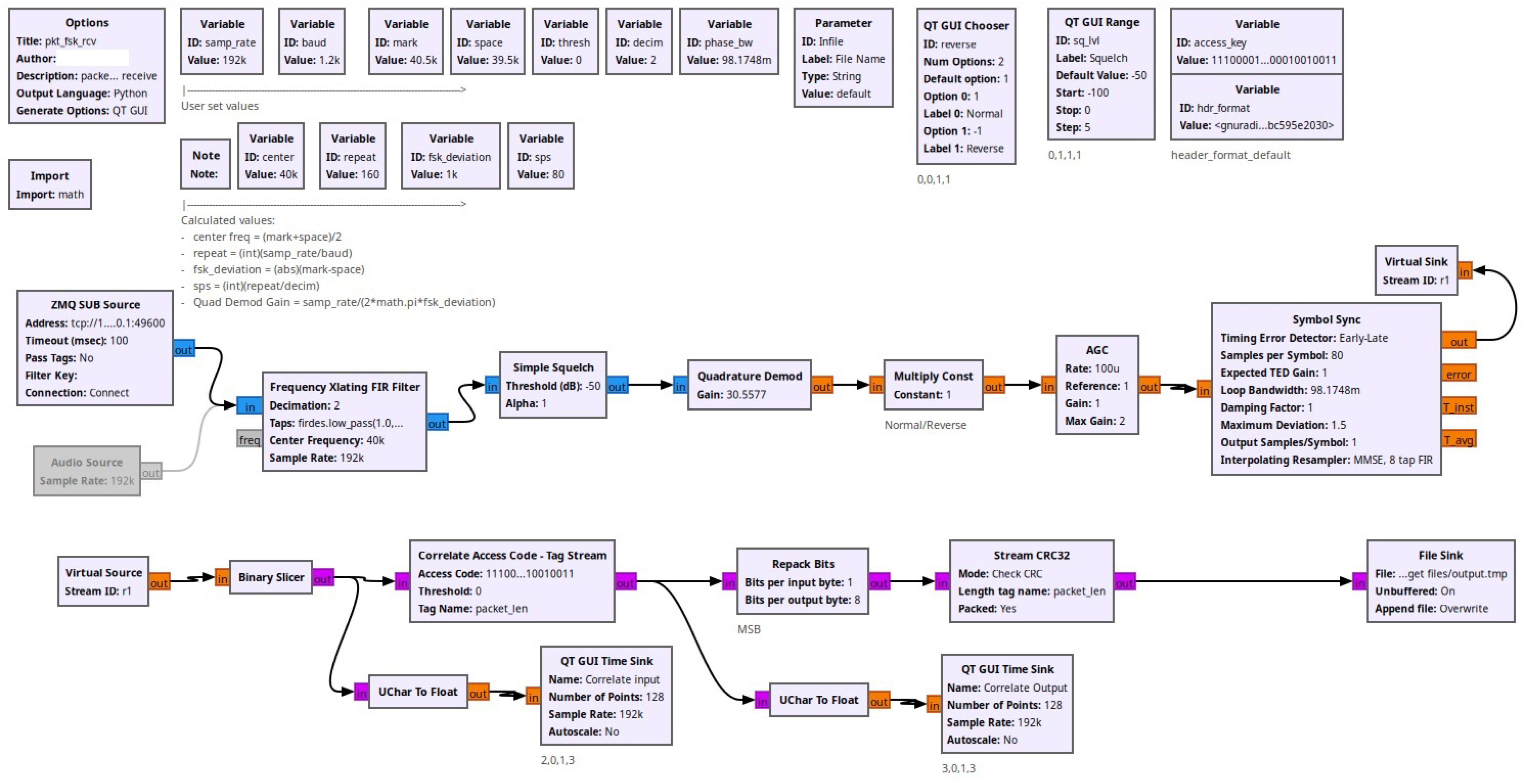
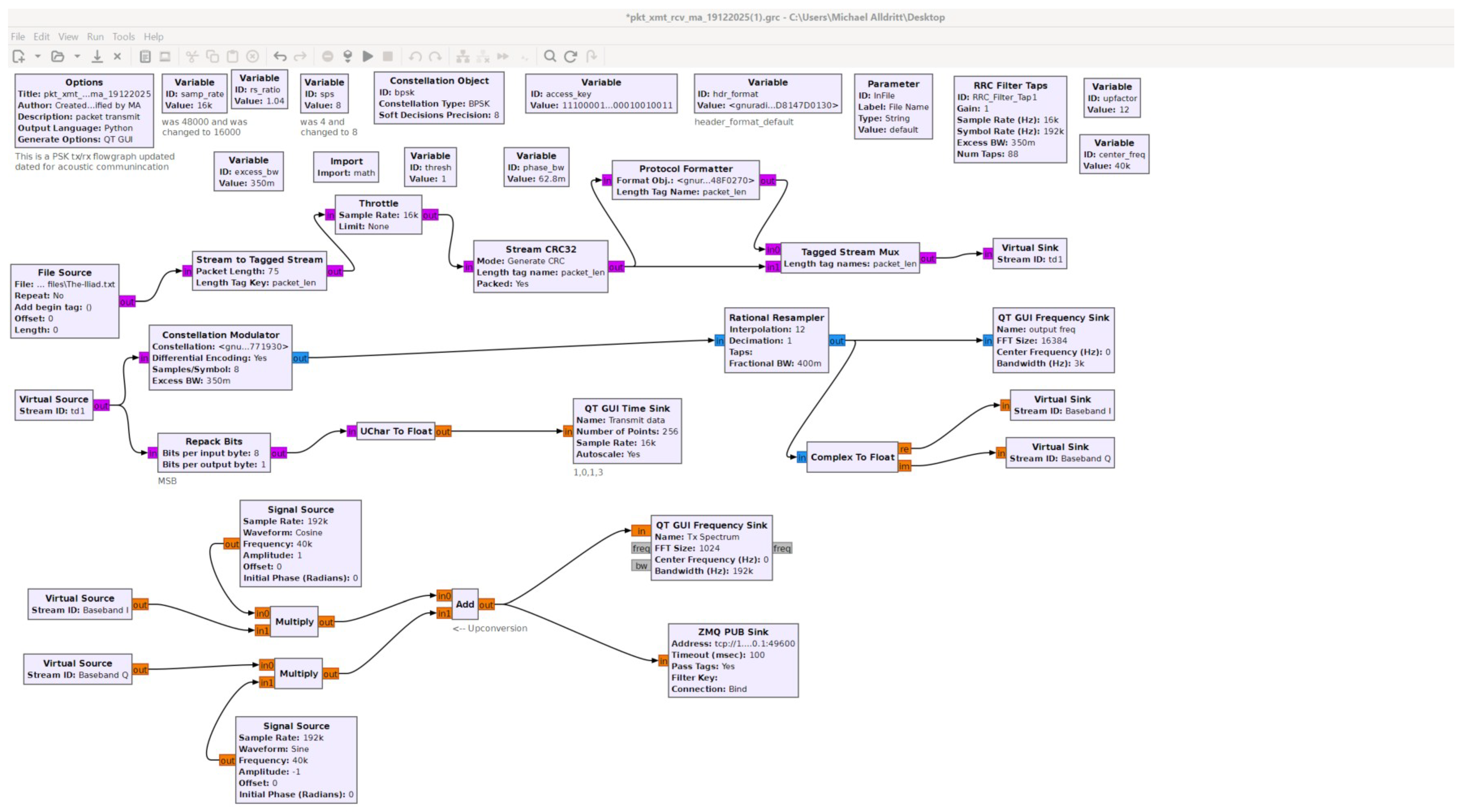
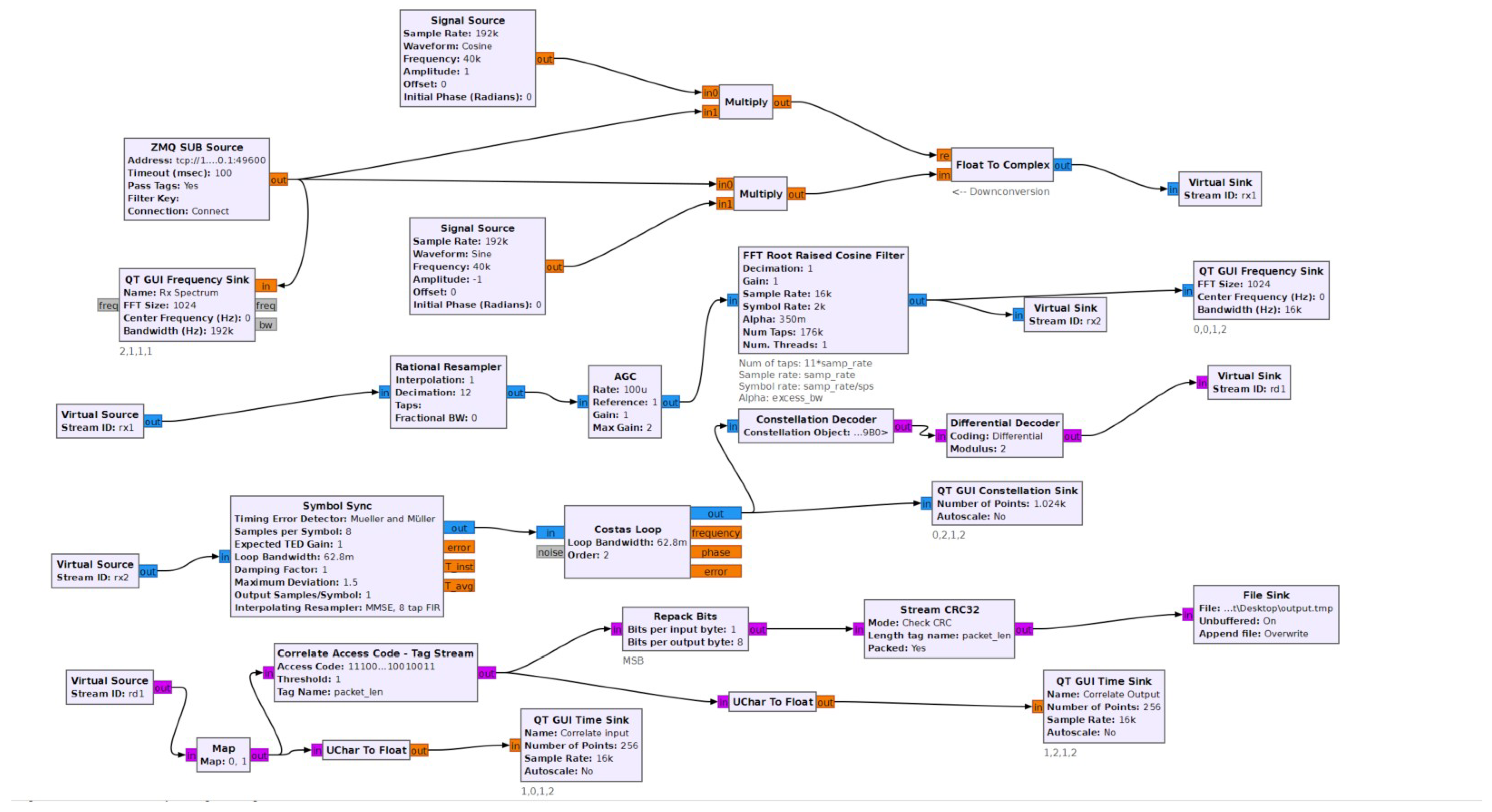
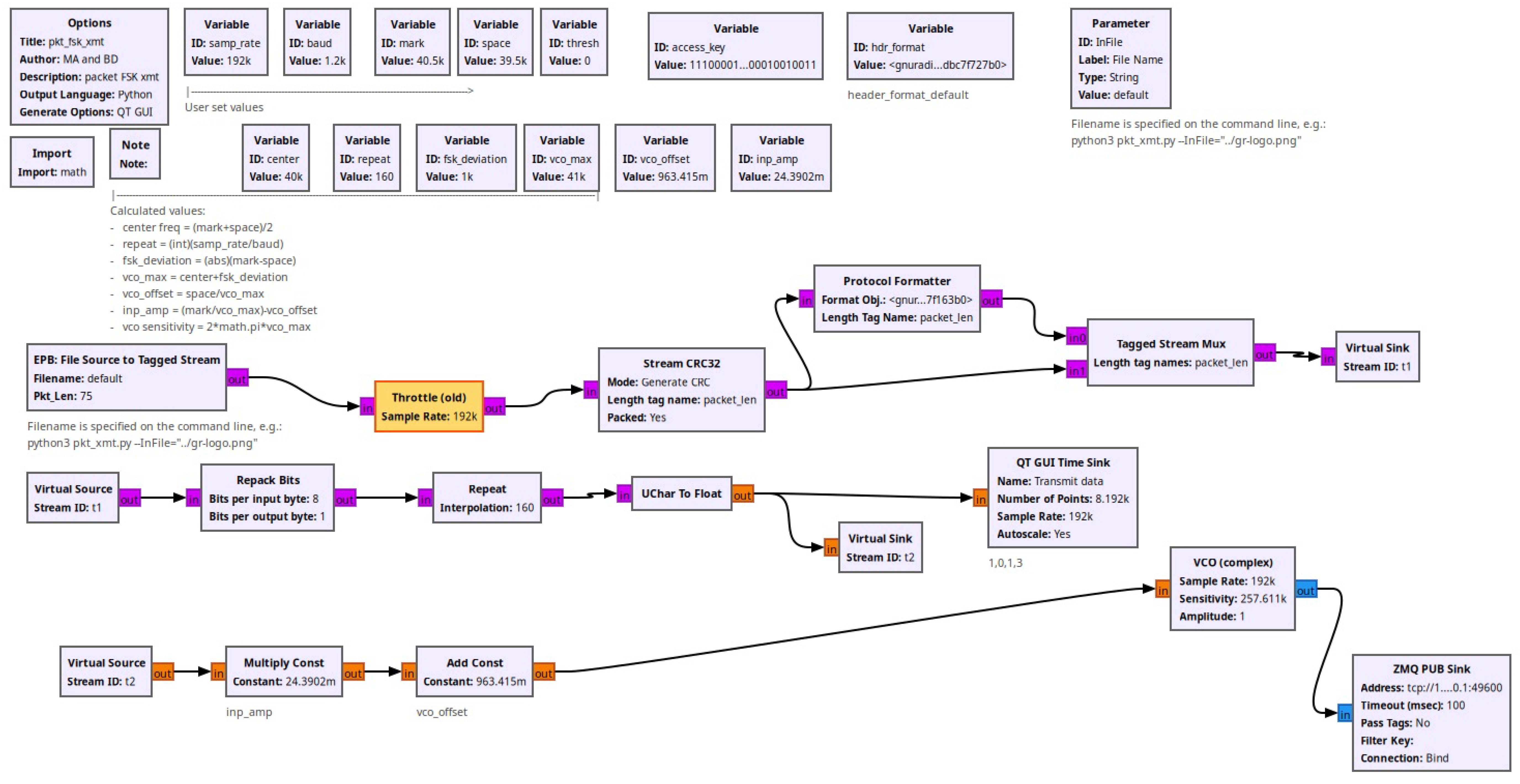
The flowgraph figures shown in Appendix A include disabled blocks (e.g., ZeroMQ sockets, audio input/output blocks, and virtual sources and sinks) that are used to verify data-path integrity prior to connection of the physical hardware.
The GNU Radio flowgraphs and supporting source files used in this study are publicly available via the author’s GitHub repository, as described in the Data Availability Statement, to enable reproducibility and independent validation.
Github link: A copy of the link is available at https://github.com/mpalldritt/gr-malldritt1.git accessed on 12 January 2026.
Figure A1. GNU radio transmit binary BFSK flowgraph.
Electronics 15 00678 g0a1

Appendix A.1.1. FSKXMT Flowgraph Algorithm

Algorithm A1 GNU Radio Packet FSK Transmitter Algorithm
Require: Sample rate F s = 192,000 Hz, Baud rate R b a u d = 1200 , Mark f m a r k = 40.5  kHz, Space f s p a c e = 39.5 kHz, Access Key K a c c = 0 xE 156 E 893 , Payload Source The-Iliad.txt.
Ensure: Complex baseband signal t [ n ] sent to ZeroMQ.
1:
Initialise centre frequency f c = ( f m a r k + f s p a c e ) / 2 = 40 kHz.
2:
Initialise interpolation factor U = F s / R b a u d = 160 .
3:
Read payload bytes P from file source.
4:
Append CRC32 checksum: P c r c P + CRC 32 ( P ) .
5:
Generate Header H containing Preamble, Access Code K a c c , and Packet Length.
6:
Mux Header and Payload: Frame F [ H , P c r c ] .
7:
Unpack bytes to bits: b [ k ] { 0 , 1 } (MSB First).
8:
Upsample bits by factor U: b u p [ n ] b [ n / U ] .
9:
Calculate VCO parameters:
10:
    V m a x = f c + | f m a r k f s p a c e |
11:
   Sensitivity S v c o = 2 π V m a x
12:
Map bits to frequency control voltage v [ n ] :
13:
   if b u p [ n ] = 1 then v [ n ] = ( f m a r k / V m a x )
14:
   else v [ n ] = ( f s p a c e / V m a x )
15:
Modulate (VCO): t [ n ] = exp ( j · S v c o · i = 0 n v [ i ] ) .
16:
return Stream t [ n ] to ZeroMQ Sink.
Figure A2. GNU radio receive binary BFSK flowgraph.
Electronics 15 00678 g0a2

Appendix A.1.2. FSK RCV Flowgraph Algorithm

Algorithm A2 GNU Radio FSK Receiver Algorithm
Require: Sample rate F s = 192,000 Hz, baud rate R b a u d = 1200 , Mark f m a r k = 40.5 kHz, Space f s p a c e = 39.5 kHz, Access Key K a c c = 0 xE 156 E 893 .
Ensure: Validated packet bytes written to file output.tmp.
1:
Initialise centre frequency f c = ( f m a r k + f s p a c e ) / 2 = 40 kHz.
2:
Initialise frequency deviation Δ f =   | f m a r k f s p a c e |   = 1 kHz.
3:
Receive complex baseband samples r [ n ] from ZeroMQ source.
4:
Apply frequency translation and low-pass filtering: x [ n ] Filter ( r [ n ] , f c ) .
5:
Apply squelch: if | x [ n ] | 2 < Threshold s q , set x [ n ] = 0 .
6:
Demodulate quadrature signal: y [ n ] = G · arg ( x [ n ] x * [ n 1 ] ) where gain G = F s 2 π Δ f .
7:
Normalise amplitude (AGC) and apply polarity: y n o r m [ n ] AGC ( y [ n ] · Reverse ) .
8:
Perform symbol timing recovery (Early-Late) to produce symbols s [ k ] .
9:
Make hard decisions: b ^ [ k ] = 1 if s [ k ] > 0 , else 0.
10:
Scan b ^ [ k ] for Access Code K a c c correlation > Threshold.
11:
If sync found, framing begins: collect bits into packet buffer P.
12:
Check integrity: valid CRC 32 ( P ) .
13:
return Validated packet bytes if CRC holds.
Figure A3. GNU Radio transmit binary BPSK flowgraph.
Electronics 15 00678 g0a3
Figure A4. GNU radio receive binary BPSK flowgraph.
Electronics 15 00678 g0a4

Appendix A.2. PSK XMT and RCV Flowgraph Algorithm

Algorithm A3 PSK XMT and RCV Flowgraph Algorithm
Require: Base Sample Rate F s = 16 kHz, Carrier f c = 40 kHz, Interpolation L = 12 , Symbol Rate R s y m = F s / sps , Access Key K a c c .
Ensure: Validated payload written to output.tmp.
1:
Transmitter (Tx)
2:
Generate payload frame F: Header ( K a c c ) + Data + CRC32.
3:
Modulate frames to BPSK symbols: d [ k ] { 1 , + 1 } .
4:
Upsample symbols by factor L: d u p [ n ] = d [ k ] for n = k L , else 0.
5:
Pulse shape (RRC) to obtain complex baseband x [ n ] = I [ n ] + j Q [ n ] .
6:
Perform IQ Upconversion to passband s [ n ] :
s [ n ] = I [ n ] cos ( 2 π f c t ) Q [ n ] sin ( 2 π f c t )
7:
Transmit s [ n ] via ZeroMQ/Audio Sink.
8:
Receiver (Rx)
9:
Receive signal r [ n ] from Microphone/ZeroMQ.
10:
Perform IQ Downconversion:
y I [ n ] = r [ n ] cos ( 2 π f c t ) , y Q [ n ] = r [ n ] ( sin ( 2 π f c t ) )
11:
Combine to complex: y [ n ] = y I [ n ] + j y Q [ n ] .
12:
Decimate by L and apply Low Pass Filter to remove 2 f c images.
13:
Apply AGC: y n o r m [ n ] AGC ( y [ n ] ) .
14:
Synchronise: Symbol Timing (M&M) → Carrier Recovery (Costas).
15:
Demodulate: d ^ [ k ] = Decision ( y s y n c [ k ] ) .
16:
Correlate with K a c c to find frame start.
17:
return Payload bytes if CRC Valid.
BPSK System Block Diagram shown below
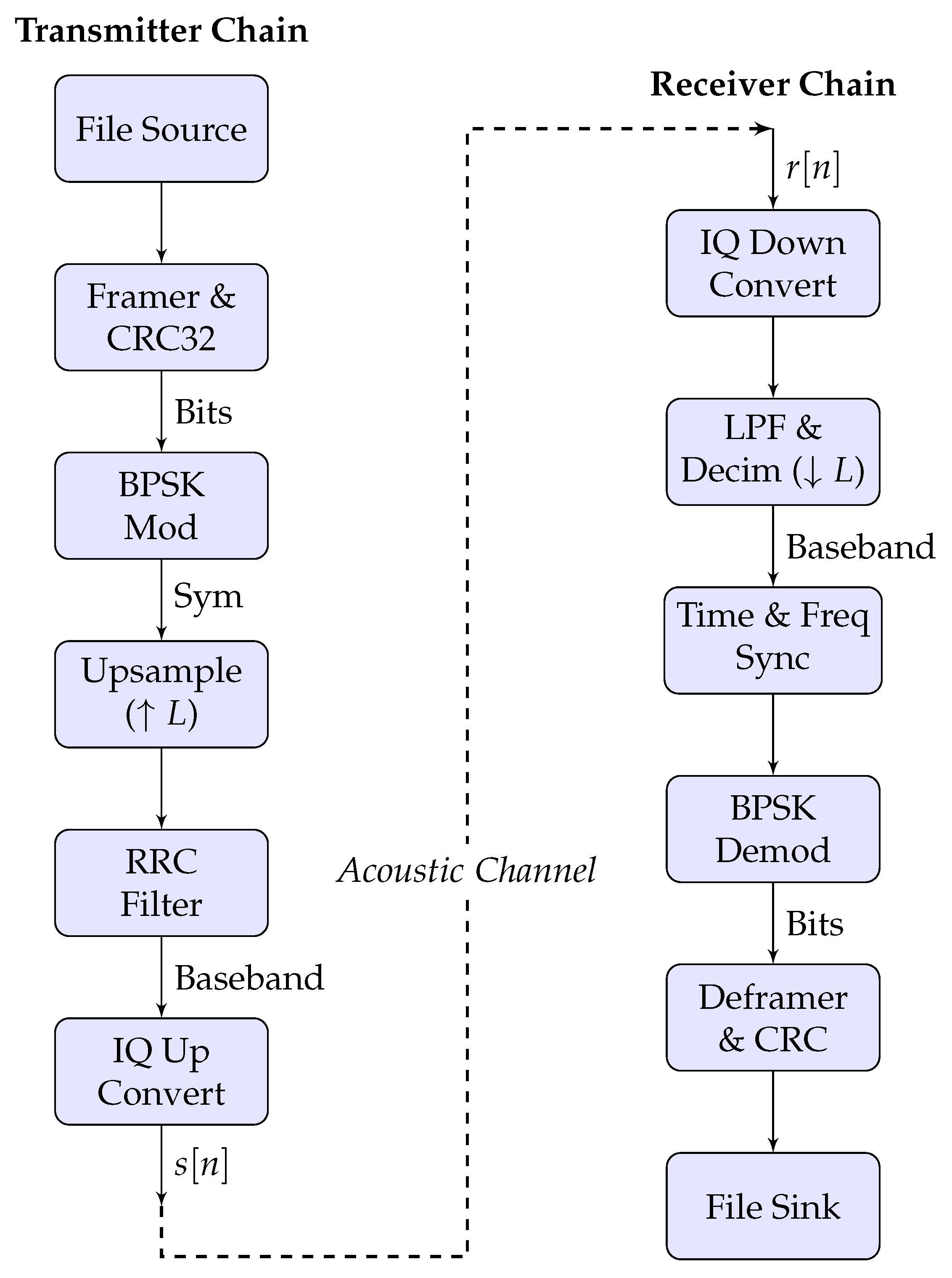
Figure A5. System block diagram of the BPSK transceiver implementation. The transmitter (Tx) chain illustrates the transition from file source to passband signal s [ n ] , while the receiver (Rx) chain details the synchronisation and demodulation stages required to recover the payload. Detailed signal processing steps for each block are outlined in Algorithm A3.
Electronics 15 00678 g0a5
Figure A6. GNU radio receive binary BPSK display graph and constellation.
Electronics 15 00678 g0a6

References

  1. Jones, E. The Application of Software Radio Techniques to Underwater Acoustic Communications. In Proceedings of the OCEANS 2007—Europe, Aberdeen, UK, 18–21 June 2007; pp. 1–6. [Google Scholar] [CrossRef]
  2. Friedt, J.M.; Boeglen, H. Communication Systems Engineering with GNU Radio: A Hands-On Approach; John Wiley & Sons: Hoboken, NJ, USA, 2024. [Google Scholar]
  3. Unal, D.; Falleni, S.; Enhos, K.; Demirors, E.; Basagni, S.; Melodia, T. Design and performance evaluation of SEANet, a software-defined networking platform for the Internet of Underwater Things. Comput. Netw. 2024, 250, 110579. [Google Scholar] [CrossRef]
  4. Alldritt, M. Using GNU Radio in a Multipath Environment Practical Application. In Proceedings of the GNU Radio Conference, Knoxville, TN, USA, 16–20 September 2024; Volume 9. Available online: https://pubs.gnuradio.org/index.php/grcon/issue/view/12 (accessed on 12 December 2025).
  5. Akyildiz, I.F.; Pompili, D.; Melodia, T. Underwater acoustic sensor networks: Research challenges. Ad Hoc Netw. 2005, 3, 257–279. [Google Scholar] [CrossRef]
  6. Sahin, M.A.; Ali, M.; Park, J.; Destgeer, G. Fundamentals of acoustic wave generation and propagation. In Acoustic Technologies in Biology and Medicine; Wiley: Hoboken, NJ, USA, 2023; pp. 1–36. [Google Scholar]
  7. Berryman, J.G. Elastic wave propagation in fluid-saturated porous media. J. Acoust. Soc. Am. 1981, 69, 416–424. [Google Scholar] [CrossRef]
  8. Gibson, J.D. Mobile Communications Handbook; CRC Press: Boca Raton, FL, USA, 2017. [Google Scholar]
  9. Iqbal, M.; Wang, X.; Wertheim, D. Reliable multimedia multicast communications over wireless mesh networks. IET Commun. 2010, 4, 1288–1299. [Google Scholar] [CrossRef]
  10. Stremler, F.G. Introduction to Communication Systems, 3rd ed.; Addison-Wesley: Boston, MA, USA, 1990. [Google Scholar]
  11. Shaw, J.A. Radiometry and the Friis transmission equation. Am. J. Phys. 2013, 81, 33–37. [Google Scholar] [CrossRef]
  12. Rossing, T. Springer Handbook of Acoustics; Springer Science and Business Media: New York, NY, USA, 2007. [Google Scholar]
  13. Proakis, J.G.; Salehi, M.; Zhou, N.; Li, X. Communication Systems Engineering; Prentice Hall: Hoboken, NJ, USA, 1994; Volume 2. [Google Scholar]
  14. Stüber, G.L. Principles of Mobile Communication; Springer: Cham, Switzerland, 2001. [Google Scholar]
  15. Molisch, A.F. Wireless Communications; Wiley: Hoboken, NJ, USA, 2011. [Google Scholar]
  16. Rappaport, T.S. Wireless Communications: Principles and Practice; Cambridge University Press: Cambridge, UK, 2024. [Google Scholar]
  17. Zhang, W.; Stojanovic, M.; Mitra, U. Analysis of a Simple Multihop Underwater Acoustic Network. In Proceedings of the 3rd International Workshop on Underwater Networks, San Francisco, CA, USA, 15 September 2008; ACM: New York, NY, USA, 2008; pp. 3–10. [Google Scholar]
  18. Freitag, L.; Grund, M.; Singh, H.; Partan, J.; Koski, P.; Ball, K. The WHOI Micro-Modem: An Acoustic Communications and Navigation System for Multiple Platforms. Mar. Technol. Soc. J. 2015, 39, 54–59. [Google Scholar] [CrossRef]
  19. Stojanovic, M. Recent advances in high-speed underwater acoustic communications. IEEE J. Ocean. Eng. 1996, 21, 125–136. [Google Scholar] [CrossRef]
  20. Urick, R.J. Principles of Underwater Sound. In Proceedings of the Conference on Underwater Acoustics; Springer: Berlin/Heidelberg, Germany, 1983; pp. 1–22. [Google Scholar]
  21. Wineman, A. Some results for generalized neo-Hookean elastic materials. Int. J. Non-Linear Mech. 2005, 40, 271–279. [Google Scholar] [CrossRef]
  22. Euler, L. Methodus Inveniendi Lineas Curvas Maximi Minimive Proprietate Gaudentes; Academiae Imperialis Scientiarum Petropolitanae: St. Petersburg, Russia, 1744. [Google Scholar]
  23. Bauchau, O.A.; Craig, J.I. Euler-Bernoulli Beam Theory. In Structural Analysis; Springer: Dordrecht, The Netherlands, 2009; pp. 173–221. [Google Scholar] [CrossRef]
  24. Nee, R.V.; Prasad, R. OFDM for Wireless Multimedia Communications; Artech House Publishers: Norwood, MA, USA, 2000. [Google Scholar]
  25. Su, H.; Chen, J.; Li, A.; Hu, H.; Xu, C. Z-OFDM: A New High-Performance Solution for Underwater Acoustic Communication. Electronics 2024, 13, 3543. [Google Scholar] [CrossRef]
  26. Wang, B.; Yang, H.; Fang, T. Modulation recognition of underwater acoustic communication signals based on deep learning. EURASIP J. Adv. Signal Process. 2024, 2024, 103. [Google Scholar] [CrossRef]
  27. Duggan, B. gr-control: Modular Transmit/Receive Station Control (GitHub Repository). 2025. Available online: https://github.com/duggabe/gr-control (accessed on 12 December 2025).
  28. Clark, P. Field Expedient SDR Volumes 1, 2 and 3; CreateSpace Independent Publishing Platform: North Charleston, SC, USA, 2016. [Google Scholar]
  29. Nyquist, H. Certain topics in telegraph transmission theory. Proc. IEEE 2002, 90, 280–305. [Google Scholar] [CrossRef]
  30. Shannon, C. Communication in the presence of noise. Proc. IRE 1949, 37, 10–21. [Google Scholar] [CrossRef]
Figure 1. BFSK transmission protocol followed by BPSK: (a) A 40 kHz BFSK modulation in the Spa tank at 0.4 m and a depth of 0.5 m. (b) A 40 kHz BPSK modulation in the Spa tank at 1.2 m and a depth of 0.5 m. (c) Spa test equipment with a laptop. (d) Spa transmission display graph for BFSK.
Electronics 15 00678 g001
Figure 2. Prowave Sensor with a graph showing the frequency response from the supplier.
Electronics 15 00678 g002
Figure 3. This figure shows the difference between longitudinal and transverse waves (As shown in the Labster Theory pages, with thanks).
Electronics 15 00678 g003
Figure 4. BER comparison: Non-coherent ASK vs. non-coherent FSK.
Electronics 15 00678 g004
Figure 5. Normalised Power Spectral Density (PSD) comparison. The BPSK spectrum (orange) shows superior spectral efficiency centred at 40 kHz, while the BFSK spectrum (blue) exhibits the characteristic dual-peak distribution at 39.5 kHz and 40.5 kHz.
Electronics 15 00678 g005
Figure 6. Functional block diagram test equipment layout.
Electronics 15 00678 g006
Figure 7. Sequence to transmit images using BFSK: (a) transmit terminal Window with Command line; (b) file received with pre and postamble; (c) stripping tool used to remove pre-postamble; (d) received Falcon Image.
Electronics 15 00678 g007
Table 1. Bernoulli Beam Theorem.
ApplicationHow Bernoulli Beam Theorem Helps
Ultrasonic horns (sonotrodes)Predicts flexural resonance, essential for tuning.
Bone-conducted audioModels how skull bones transmit vibration.
NDT using Lamb wavesFlexural modes in thin plates—beams are derived from this.
Piezoelectric beam actuatorsCombines electro mech models predicting vibration patterns.
Acoustic meta materialsBeam designs that filter or redirect waves via resonances.
Table 2. Transmit values.
Raspberry Pi 4 TX Sound Card (Board No 1) and TX Op-Amp
DistanceTransmit
(dB)
Frequency
(Hz)
Noise Level
(dB)
SNR
(dB)
Comments
10 cm340,000−120123Very strong signal level
Table 3. Signal- to-Noise ratio table.
Raspberry Pi 4 RX Sound Card (Board No 2) and RX Op-Amp
DistanceReceive
(dB)
Frequency
(Hz)
Noise Level
(dB)
SNR
(dB)
Comments
10 cm−12.1840,000−5038Very sufficient signal level
20 cm−12.3640,000−4734Very sufficient signal level
30 cm−11.9140,000−4230Very sufficient signal level
40 cm−11.7240,000−3624Very sufficient signal level
50 cm−11.6740,000−2917Sufficient signal level
60 cm−11.9340,000−2816Sufficient signal level
70 cm−11.9240,000−2816Sufficient signal level
Table 4. BFSK Transmitter Parameters derived from pkt_fsk_xmt.py.
ParameterDescriptionValue
Mark frequencyFrequency used to transmit binary “1”40,500 Hz
Space frequencyFrequency used to transmit binary “0”39,500 Hz
FSK deviationFrequency separation between mark and space1000 Hz
Centre frequencyMidpoint between mark and space40,000 Hz
Sample rateAudio sampling rate for the transmit chain192,000 samples/s
Baud rateSymbol rate of the BFSK modem1200 baud
Samples per symbolComputed as samp_rate/baud160 samples
VCO maximum frequencyUsed by VCO: centre + deviation41,000 Hz
VCO offsetNormalised VCO bias for correct tuning0.9634
Input amplitudeAmplitude scaling applied to binary input stream0.0366
Access key (preamble)Header sync word for packet detection1110000101011010
Header formatGNU Radio default packet header structuredigital.header 
CRC typeCyclic redundancy check applied to payloadCRC-32
Packet lengthPayload size from embedded Python block75 bytes
Output interfaceZeroMQ complex publish socket used for transmissiontcp://127.0.0.1:49600
Monitoring toolQT Time Sink used for display and debuggingTime-domain waveform
Table 5. BFSK Receiver Parameters derived from pkt_fsk_rcv.py.
ParameterDescriptionValue
Sample rateInput sampling rate of received signal192,000 samples/s
Baud rateExpected symbol rate from transmitter1200 baud
Mark frequencyAssigned BFSK “1” tone40,500 Hz
Space frequencyAssigned BFSK “0” tone39,500 Hz
FSK deviationFrequency separation | f mark f space | 1000 Hz
Centre frequencyTuning frequency for frequency-translation filter40,000 Hz
Decimation factorReduces sample rate before symbol synchronisation2
Samples per symbol (sps)(samp_rate/baud)/decim 80
Access key (preamble)Sync word for packet detection1110000101011010
Correlation thresholdThreshold used by access code correlator0
Squelch levelInput mute threshold before demodulation−50 dB
Symbol synchroniser typeGardner early/late timing recoveryEarly–Late (EL TED)
Loop bandwidthBandwidth of timing recovery PLL π / 32
Quadrature demod gainGain for frequency discriminator samp _ rate 2 π · deviation
Reverse polarityOptional bitwise inversionNormal (1)
Filter typeFrequency-translating FIR with low-pass tapsLPF, 3 kHz cutoff
Bit slicingConverts soft symbols to hard binary decisionsBinary slicer
CRC typeVerifies packet integrityCRC-32
Output dataReconstructed output byte streamFile sink
Input interfaceReceives complex samples over ZeroMQtcp://127.0.0.1:49600
Monitoring toolsTime-domain visualisation of symbols and correlationQT Time Sinks
Table 6. BPSK Transmitter Parameters derived from the Python file pkt_xmt_rcv_ma_19122025.py.
ParameterDescriptionValue
Modulation schemeDigital phase modulation used for transmissionBPSK
Constellation typeGNU Radio BPSK constellation objectBinary phase shift keying
Centre frequencyAcoustic carrier frequency used for transmission40,000 Hz
Sample rateAudio sampling rate for the transmit chain192,000 samples/s
Symbol rate (baud)Symbol rate of the BPSK modulator2000 baud
Samples per symbolComputed as sample rate divided by symbol rate8 samples
Excess bandwidthRoll-off factor of root-raised cosine filter0.35
Differential encodingPhase differential encoding enabled prior to modulationEnabled
Header access key (preamble)Synchronisation word used for packet detection1110000101011010
Header formatGNU Radio default packet header structuredigital.header
CRC typeCyclic redundancy check applied to payloadCRC-32
Packet lengthPayload size from embedded Python block75 bytes
Output interfaceZeroMQ publish socket used for transmissiontcp://127.0.0.1:49600
Monitoring toolQT Time Sink used for display and debuggingTime-domain waveform
Table 7. BPSK Receiver Parameters derived from the Python file pkt xmt rcv ma 19122025.
ParameterDescriptionValue
Input interfaceZeroMQ subscribe socket used for receptiontcp://127.0.0.1:49600
Input signal typeReceived acoustic passband signalReal-valued (float)
DownconversionQuadrature mixing to complex basebandI/Q mixer
Decimation factorRational resampler decimation factor12
Automatic gain controlAGC applied prior to synchronisationEnabled
Matched filterRoot-raised cosine filter for noise and ISI reductionRRC, roll-off 0.35
Timing recoverySymbol timing synchronisation methodMueller and Müller
Timing loop bandwidthLoop bandwidth used for symbol synchronisation0.0628
Samples per symbol (RX)Samples per symbol before timing recovery8 samples
Output samples per symbolSamples per symbol after timing recovery1 sample
Carrier recoveryCostas loop for phase synchronisation2nd order (BPSK)
Carrier loop bandwidthCostas loop bandwidth0.0628
Symbol decisionConstellation-based hard decision decoderBPSK slicer
Differential decodingDifferential phase decoding appliedEnabled
Packet detectionAccess code correlator for frame detectionThreshold = 1
CRC validationPayload integrity verificationCRC-32
Table 8. Bill of Materials (BoM) for the Experimental SDR Acoustic System.
ComponentDescriptionQtyUnit CostTotal
Audio InterfaceBehringer UMC202HD (192 kHz)1$200.00$200.00
Transducers40 kHz Piezoelectric Sensors4$50.00$200.00
Physical RigPVC Conduit, Mounts, Stands1$50.00$50.00
IncidentalsCables, Connectors, Adapters1$50.00$50.00
SoftwareGNU Radio (Open Source)1$0.00$0.00
TOTAL $500.00
Table 9. Packet loss rate (PLR) comparison (BFSK vs. BPSK).
ModulationTx PacketsRx PacketsPLR (%)Primary Cause of Loss
BFSK (Non-coherent)5004921.6%Synchronisation Miss
BPSK (Coherent)5004911.8%Phase Lock Loss/Sync
Table 10. Comparison of this work with existing acoustic communication solutions.
FeatureCommercial Acoustic Modems (e.g., Teledyne, Evologics)Typical Acoustic SDR Studies (Related Works)This Work (Proposed System)
Primary MediumDeep Water/Long RangeAir (Audio) or Simulated WaterLiquids and Solids (e.g., Hydrocarbons, Stone)
Hardware DesignDedicated, Proprietary Hardware (FPGA/ASIC)PC Sound Card or High-End USRPLow-Cost SDR + COTS Audio Hardware
SoftwareLow (Closed Firmware)High (Matlab/Python offline)High (GNU Radio—Real-time Reconfigurable)
Data TypeTelemetry/Control SignalsSimple Text / BitstreamsMultimedia (JPEG Images) + Text
CostHigh (>USD 1000–USD 10,000+)Low to MediumLow (≤ USD 500 for audio interface/transducer)
ModulationFixed (Often FSK or proprietary sweep)VariableSoftware-Defined (BPSK and BFSK compared)
Table 11. Acoustic properties of tested media at 40 kHz.
MediumVelocity (c)Density ( ρ )Impedance (Z)Absorption ( α )
Air (20 °C)343 m/s1.2 kg/m30.0004 MRayls∼1.1 dB/m
Fresh Water1482 m/s1000 kg/m31.48 MRayls∼0.005 dB/m
Seawater1531 m/s1025 kg/m31.57 MRayls∼0.015 dB/m
Motor Oil (SAE 30)1740 m/s870 kg/m31.51 MRayls∼0.5 dB/m
Mild Steel5960 m/s7850 kg/m346.0 MRayls∼0.1 dB/m
Note: Absorption in liquids at 40 kHz is relatively low compared to RF attenuation in conductive media, supporting the viability of low-power acoustic transmission.
Table 12. Comparison of signal attenuation in seawater (Acoustics vs. RF).
ParameterAcoustic System (This Work)RF System (Standard Wi-Fi)
Frequency40 kHz2.4 GHz
Attenuation ( α )∼0.015 dB/m∼1000+ dB/m
Path Loss at 1 m<0.1 dB>1000 dB
Required Power∼0.5 mWInfeasible (Megawatts+)
Note: RF signals in conductive saltwater suffer from the skin effect, where skin depth δ 0.01 m, making transmission beyond a few centimetres effectively impossible, regardless of input power.
Table 13. Throughput analysis: theoretical vs. measured.
ModulationBaud RateRaw RatePayloadMeasured ThroughputEfficiency
BFSK12001200 bps75 Bytes∼960 bps80%
BPSK20002000 bps75 Bytes∼1580 bps79%
Disclaimer/Publisher’s Note: The statements, opinions and data contained in all publications are solely those of the individual author(s) and contributor(s) and not of MDPI and/or the editor(s). MDPI and/or the editor(s) disclaim responsibility for any injury to people or property resulting from any ideas, methods, instructions or products referred to in the content.