3.1. Proposed DetNet Framework
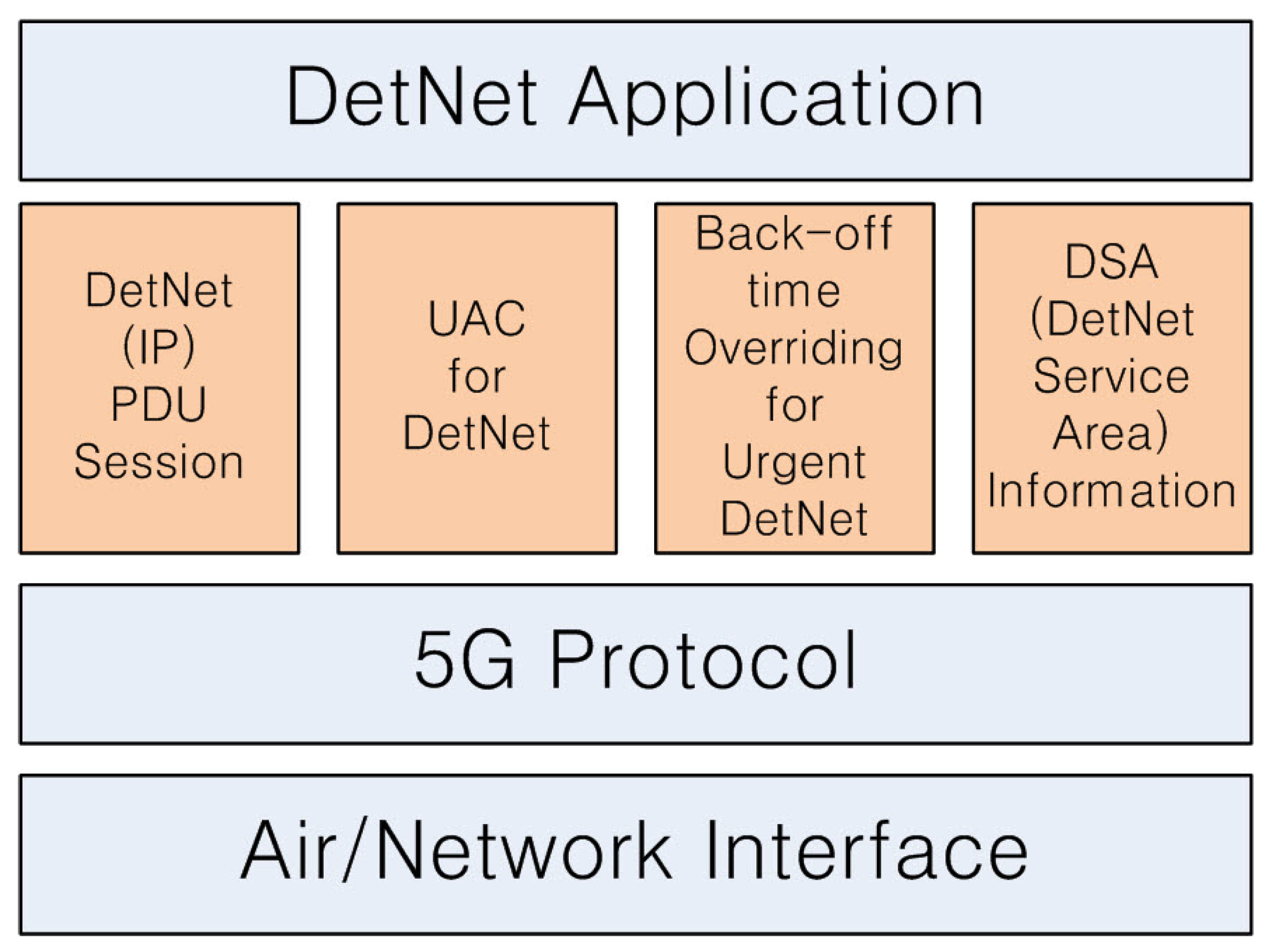
The proposed DetNet framework operates based on existing 5G protocols (such as NAS, RRC, and IP protocols). Four new functionalities exist in the proposed DetNet framework: support for the IP-based DetNet PDU session, support for DetNet in UAC, support for urgent DetNet transmission, and support for DetNet service connectivity. It assumes presence of the existing 3GPP Release 17/18 architecture and does not introduce modifications to the physical layer or radio scheduling mechanisms. Instead, the framework extends existing NAS and RRC procedures to support deterministic traffic handling while maintaining backward compatibility with legacy 3GPP systems.
The proposed DetNet PDU session type is designed as a logical extension of existing IPv4/IPv6 and Ethernet PDU sessions. It reuses the standard PDU session establishment, modification, and release procedures defined in 3GPP, without introducing new user-plane protocols or radio-layer changes. As a result, legacy PDU session types and DetNet PDU sessions can coexist within the same 5G system.
A UE can smoothly migrate from a non-DetNet PDU session to a DetNet PDU session by either triggering a standard PDU session modification procedure or establishing a parallel DetNet PDU session. This migration does not disrupt ongoing services and allows gradual adoption of deterministic communication when required.
When multiple PDU sessions are active simultaneously, resource isolation is achieved through existing 5G QoS mechanisms. DetNet traffic is mapped to dedicated QoS flows with reserved resources and bounded-delay characteristics, while non-DetNet traffic follows conventional best-effort or QoS-aware scheduling. This ensures that deterministic services are protected from interference caused by other concurrent PDU sessions.
3.1.1. Support for IP-Based DetNet PDU Session
To support IP-based DetNet PDU sessions for 3GPP 5GS, a new PDU session type for DetNet must be defined as “DetNet” in the proposed DetNet framework.
When a UE must establish a PDU session for a DetNet service or application, the UE NAS sets “DetNet” to the PDU session setup request message as the IP PDU session type for DetNet and sends this PDU session setup request message to the 5GC. If the network supports the DetNet PDU session requested by the UE, the network responds that the PDU session setup has accepted the message from the UE. If the network does not support the DetNet PDU session requested by the UE, the network responds to the PDU session setup by rejecting messages with a cause value. Thus, the UE cannot use a DetNet PDU session with the network but can use other PDU sessions (e.g., IPv4 or IPv6) if applicable.
The introduction of a DetNet PDU session type is designed to be fully backward-compatible with existing 3GPP systems. The proposed session type reuses the standard PDU session establishment and management procedures, and does not require modifications to the radio access protocol stack or user-plane packet forwarding mechanisms. From an implementation perspective, the required adaptation is mainly limited to NAS signaling interpretation and policy control functions (e.g., SMF and PCF) in the 5G Core network.
If the serving network does not support the DetNet PDU session type, the PDU session establishment request is rejected using existing 3GPP-defined cause values, allowing the UE to fall back to conventional IP or Ethernet PDU sessions when applicable. As a result, legacy networks and UEs can coexist without service disruption. Compared to introducing new user-plane protocols or radio scheduling mechanisms, the adaptation cost of the proposed approach is relatively low, as it relies on control-plane extensions and configuration-level support rather than fundamental architectural changes.
The proposed framework does not redefine bandwidth reservation or resource scheduling mechanisms. Instead, it is designed to operate in coordination with existing 5G core network functions, particularly the Policy Control Function (PCF) and the User Plane Function (UPF), which are responsible for policy management and resource enforcement.
For DetNet services, deterministic transmission requirements, such as latency bounds and minimum bandwidth guarantees, are translated into policy rules managed by the PCF. These rules define the QoS parameters and resource reservation policies associated with DetNet PDU sessions. The UPF enforces the resource allocation decisions by mapping DetNet traffic to dedicated QoS flows with reserved bandwidth and appropriate scheduling priority. This ensures isolation between DetNet and non-DetNet traffic at the user-plane level.
Bandwidth and computing resource allocation can be dynamically adjusted based on network load and service priority. When congestion is detected, policy updates from the PCF allow the UPF to adapt resource allocation while preserving the deterministic performance requirements of DetNet services.
A dedicated DetNet PDU session type is introduced to explicitly distinguish DetNet traffic from conventional IP and Ethernet traffic. This separation enables independent policy control, precise QoS mapping, and clear interaction with access and congestion control mechanisms, which would be difficult to guarantee when reusing existing PDU session types.
3.1.2. Support for DetNet in UAC
To support DetNet in UAC, a new access category “MO DetNet” and RRC establishment cause “mo-DetNet” must be defined for the NAS layer, and the new barring control information must also be defined for the RRC layer in the proposed DetNet framework.
When a UE detects mobile-originated DetNet signaling/data, it decides on an access category and identity for the mobile-originated DetNet signaling/data, and provides this access category and identity to the RRC layer. The UE RRC performs a UAC check for mobile-originated DetNet signaling/data with the provided access category and access identity from the NAS layer and barring control information from the network. If the UAC check passes, the RRC initiates an RRC connection setup request message to the network with RRC establishment cause “mo-DetNet” for the mobile-originated DetNet signaling/data. If the UAC check does not pass, the RRC informs the NAS that the access attempt for the mobile-originated DetNet signaling/data is barred.
3.1.3. Support for Urgent DetNet Transmission
To support urgent DetNet transmissions, the UAC skip and back-off time overriding indications are introduced in the proposed DetNet framework.
(i) UAC skip for urgent DetNet transmission: When a UE detects urgent mobile-originated DetNet signaling/data, the UE NAS decides an access category and identity for the urgent mobile-originated DetNet signaling/data with a UAC skip indication, and provides this access category and identity with a UAC skip indication to the RRC layer. If the UE RRC is provided with the UAC skip indication from the NAS layer, the UE RRC skips the UAC check for mobile-originated DetNet signaling/data. Thus, the RRC initiates an RRC connection setup request message to the network with the RRC establishment cause “mo-DetNet” for urgent mobile-originated DetNet signaling/data.
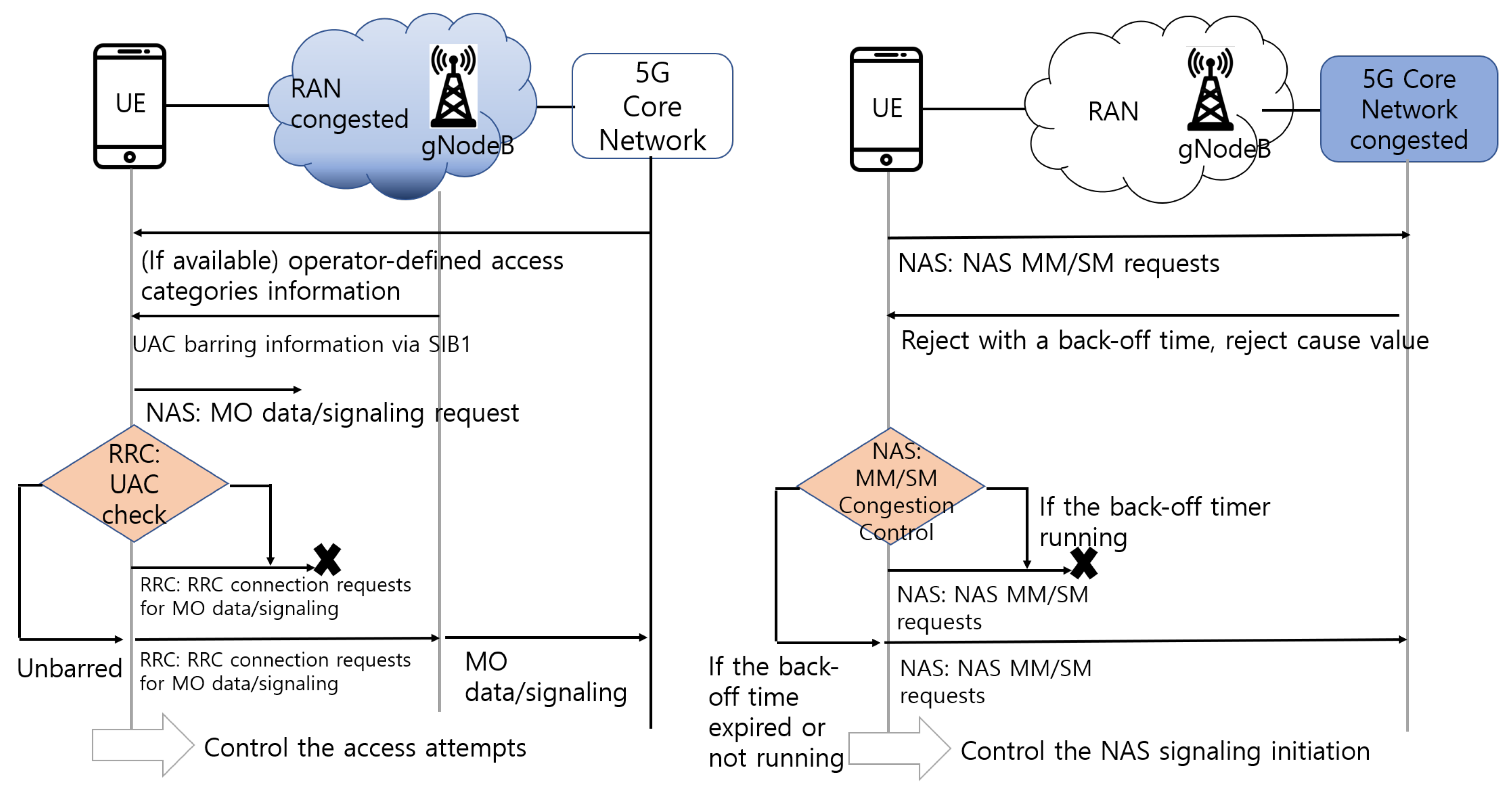
(ii) Back-off time overriding for urgent DetNet transmission: During registration, the DetNet-capable UE provides the DetNet signaling configuration to the 5GC, indicating that the signaling of the UE can provide the DetNet data service. Under network congestion, if the back-off time is provided by the network, the UE operates the back-off timer with the provided back-off time and does not initiate any NAS signaling to the network.
When a UE detects an urgent DetNet signaling/data transmission, but the back-off timer is running, the UE NAS can initiate NAS signaling for urgent DetNet signaling/data with a DetNet signaling overriding indication and sends the NAS signaling message to the network. The network processes this NAS signaling message with the DetNet signaling overriding indication as the meaning of exceptional handling for urgent DetNet data transmission even if network congestion occurs. If the network receives a NAS signaling message without the DetNet signaling overriding indication, then the network rejects the NAS signaling message and does not process it. Therefore, urgent DetNet signaling and data can be promptly transmitted and processed.
(iii) UAC skip and back-off time overriding for urgent DetNet transmission: As explained earlier, the congestion control is operated independently from UAC. It means even if the back-off time overriding mechanism is performed to transmit urgent DetNet traffic in the NAS layer, the urgent DetNet traffic could be barred because of UAC operation in the RRC layer. Therefore, both the back-off time overriding and UAC skip mechanism should be considered to promptly transmit urgent DetNet traffic.
Under network congestion, if a UE detects an urgent DetNet signaling/data transmission, but the back-off timer is running, the UE NAS can initiate NAS signaling for urgent DetNet signaling/data with a DetNet signaling overriding indication and UAC skip indication, and passes the NAS signaling message to the RRC layer. The RRC layer passes UAC check based on the UAC skip indication and sends the NAS signaling message to the network. The network processes this NAS signaling message with the DetNet signaling overriding indication for urgent DetNet data transmission even if network congestion occurs. Therefore, with the UAC check and back-off timer running, urgent DetNet signaling and data can be promptly transmitted and processed.
When urgent DetNet data is generated at the UE, the NAS layer classifies the traffic as urgent DetNet traffic and attaches both a UAC skip indication and a back-off time overriding indication. This NAS message is then passed to the RRC layer, which bypasses the access barring check based on the received indication and initiates the RRC connection establishment procedure. Subsequently, the NAS signaling message containing the overriding indication is delivered to the 5GC for exceptional processing under congestion conditions.
3.1.4. Support for DetNet Service Connectivity
According to the current requirements of 5GS, there is no support for DetNet service connectivity. DetNet service connectivity means that a UE can obtain a DetNet-PDU session connectivity to get a DetNet service promptly.
To support timely DetNet services in between DetNet and non-DetNet service areas, the DSA indication and information are defined in the proposed DetNet framework. The DSA indication implies that the DetNet-capable UE requests DSA information from the network and the DSA information means the network informs the UE of the DSAs, which consists of tracking area identity (TAI) lists.
A DSA-capable UE requests DSA information with the DSA indication from the network during registration or UE configuration update procedure. If the network supports the DetNet service, it provides DSA information to the UE. Therefore, the UE is aware of the DSAs.
Using the DSA information, the UE can recognize which the DetNet areas are among the service areas using the TAI lists. When the DetNet capable UE moves from the non-DSA to the DSA, the DetNet-capable UE can be aware of this DSA using the stored DSA information; thus, the UE can perform the DetNet PDU session setup procedure to immediately obtain the DetNet service. DSA information can be provided from the network to UE during the (periodic) registration or UE configuration update procedure. The overall proposed DetNet framework for 3GPP 5GS is shown in
Figure 3.
DSA information is provided to the UE during existing registration or UE configuration update procedures, avoiding additional signaling overhead. The information is semi-static and updated only when necessary, making the proposed service connectivity mechanism lightweight and suitable for practical deployment.
3.2. UAC-Based Access Control Extension
The proposed UAC extension does not introduce additional signaling procedures or new message types. It relies on existing system information broadcasting (e.g., SIB1) and standard RRC connection establishment procedures defined in 3GPP. As a result, the signaling overhead in terms of message frequency and message size remains unchanged compared to the legacy UAC mechanism.
By enforcing access barring decisions at an earlier stage, the proposed mechanism prevents unnecessary RRC connection attempts and subsequent NAS signaling exchanges during congestion. This early filtering effect reduces redundant signaling toward both the RAN and the 5G Core network, especially under high access load conditions.
From a network perspective, the reduction of failed or rejected access attempts translates into lower processing load at the gNodeB and core network functions. Therefore, although the UAC mechanism itself remains lightweight, its extension contributes to an overall reduction in network burden during congestion scenarios.
The newly introduced MO DetNet access category is assigned a priority level lower than emergency calls and high-priority access categories, but higher than regular mobile-originated traffic. This priority ordering ensures that critical emergency services are always protected while still enabling preferential access for deterministic DetNet traffic.
The barring control parameters for the MO DetNet category, such as barring probability thresholds and activation conditions, are configured by the network based on congestion levels and operator policies. For example, MO DetNet access may be barred only under severe overload conditions, using a lower barring probability compared to regular mobile-originated traffic.
The UAC skip and back-off time overriding mechanism does not bypass or weaken existing 5G security procedures. It is applied only to UEs that have successfully completed standard authentication and authorization procedures. All access decisions remain under network control and are enforced based on validated subscription and policy information.
Before enabling UAC skip or back-off overriding, the network verifies the legitimacy of the DetNet service request. This verification includes UE identity authentication, subscription profile inspection, and DetNet service authorization through control-plane functions such as AMF, SMF, and PCF.
Although a UE may indicate an urgent DetNet transmission request, the final decision to apply UAC skip or back-off override is made exclusively by the network. This network-centric decision model prevents malicious terminals from abusing the mechanism to unfairly occupy network resources. Furthermore, the application of the UAC skip mechanism is subject to operator-defined policies, such as limited activation frequency, strict trigger conditions, and congestion-aware restrictions. These constraints further reduce the risk of resource abuse.
Therefore, the proposed urgent DetNet access mechanism operates within the existing 3GPP security framework and introduces no additional security vulnerabilities.
3.3. Emergency Transmission Mechanism
The proposed emergency transmission mechanism does not modify or relax existing 5G security procedures. All emergency-related transmissions are protected by standard 3GPP security mechanisms, including mutual authentication, NAS security, and integrity and ciphering protection. The mechanism operates within the authorized PDU session context and does not allow unauthorized traffic prioritization.
The activation of emergency transmission is based on predefined and well-defined conditions rather than heuristic or ad hoc decisions. Typical trigger conditions include emergency service indication, operator-configured policy rules, or explicit congestion state information provided by the network. The proposed framework assumes that the validity of emergency traffic is verified by existing control-plane functions (e.g., AMF and PCF).
While the UE may indicate an emergency service request, the final decision on enabling emergency transmission is made by the network based on policy and authorization checks. This separation prevents misuse of the emergency mechanism and ensures controlled operation.
Therefore, the proposed emergency transmission mechanism is policy-driven, securely controlled, and activated only under clearly defined conditions, eliminating ambiguity in both security handling and trigger logic.