Article

High-Performance D-Band Frequency Multiplier Using Aligned Carbon Nanotube Schottky Barrier Diodes


1
School of Integrated Circuits, Beijing University of Posts and Telecommunications, Beijing 100876, China
2
Research Center for Carbon-Based Electronics, School of Electronics, Peking University, Beijing 100871, China
*
Author to whom correspondence should be addressed.
Electronics 2026, 15(3), 537; https://doi.org/10.3390/electronics15030537
Submission received: 3 January 2026 / Revised: 20 January 2026 / Accepted: 23 January 2026 / Published: 26 January 2026

Abstract

Millimeter-wave (mmWave)/terahertz (THz) devices relying on conventional semiconductor technologies face significant performance bottlenecks, constraining their use in next-generation electronic systems. To address these challenges, this work demonstrates high-performance THz Schottky barrier diodes (SBDs) based on aligned carbon nanotube (ACNT) arrays, and the realization of a D-band second-harmonic frequency multiplier. The ACNT-SBDs exhibit superior electrical and radio-frequency (RF) characteristics, achieving a forward current density of 0.14 mA·μm−1 at −1.3 V and an intrinsic cutoff frequency (fC) of 506 GHz. The developed small-signal model of diodes shows close agreement with measurements, with S-parameter relative errors below 0.7% from 100 MHz to 67 GHz. The implemented 154 GHz D-band multiplier achieved a maximum output power of −18.97 dBm and a minimum conversion loss of 27.92 dB, outperforming previously reported frequency multipliers based on carbon nanotubes or two-dimensional (2D) materials. This study not only establishes the outstanding high-frequency response, nonlinear efficiency, and integration potential of ACNT-based devices but also provides a promising technical pathway for future THz communication and sensing applications.

1. Introduction

Wireless communication, imaging, and sensing systems are rapidly advancing towards higher operating frequencies and greater integration levels. The mmWave band (30–300 GHz) offers compelling advantages for these applications, including high spatial resolution, system miniaturization, and adaptability to complex environments. However, its practical implementation faces significant challenges at both the device and circuit levels [1]. The performance of solid-state mmWave frequency multipliers is fundamentally constrained by insertion loss, thermal management, and reliability limitations associated with conventional semiconductor technologies and their native substrates. These constraints significantly reduce output efficiency and hinder the practical realization of highly integrated systems at mmWave frequencies [2]. Consequently, further improvement in mmWave and THz frequency multipliers relies not only on circuit-level optimization but, more critically, on breakthroughs in the intrinsic electrical properties of nonlinear devices. An ideal nonlinear device should exhibit high carrier transport velocity to enable efficient frequency conversion and stable operation under high-frequency conditions.
Carbon nanotubes (CNTs), with their quasi-one-dimensional charge transport, present a promising alternative due to several superior intrinsic electrical properties. Their high carrier mobility, high saturation drift velocity, and extremely low intrinsic capacitance provide a strong foundation for high-frequency nonlinear applications [3,4,5,6]. Carbon-based electronic devices have been extensively explored in flexible electronics [7,8], high-frequency signal transceivers [9,10,11], and high-speed information processing systems [12,13,14]. Although low-dimensional material-based SBDs have demonstrated notable progress in the gigahertz (GHz) frequency range in recent years, their practical operation above 100 GHz is still a challenge [15,16]. By comparison, high-purity ACNT arrays offer a realistic and scalable route toward high-frequency, high-speed, and low-power electronic systems [17,18]. Nevertheless, most reported CNT-based frequency conversion devices are still confined to the sub-mmWave regime and suffer from low conversion efficiency [19,20,21], falling short of the stringent requirements for emerging fifth-generation (5G) and future sixth-generation (6G) communication systems in terms of operational frequency and power efficiency.
In this work, we address this gap by developing and characterizing high-performance Schottky barrier diodes based on aligned carbon nanotube arrays (ACNT-SBDs), and successfully implementing a D-band frequency multiplier. The fabricated ACNT-SBD (W = 60 μm) achieves a forward current density of 0.14 mA·μm−1 at a bias voltage of −1.3 V and exhibits an intrinsic cutoff frequency (fC) as high as 506 GHz, outperforming the SBD devices based on 2D materials and oxide semiconductors. A small-signal model was established, accurately de-embedding the intrinsic device behavior from the parasitic effects of the ground–signal–ground (GSG) pads. This model exhibited excellent accuracy, with a relative error between measured and simulated S-parameters of less than 0.7% across the 100 MHz to 67 GHz range under multiple bias conditions. Leveraging this optimized ACNT-SBD, we designed and implemented a 154 GHz D-band frequency multiplier integrating passive harmonic filtering network. The multiplier delivered a maximum output power of −18.97 dBm with a minimum conversion loss of 27.92 dB, outperforming previously reported multipliers based on CNT transistors and 2D materials. This work not only establishes the outstanding high-frequency response, nonlinear efficiency, and integration potential of ACNT-based devices but also provides a promising technical pathway for future THz communication and sensing applications.

2. Materials and Methods

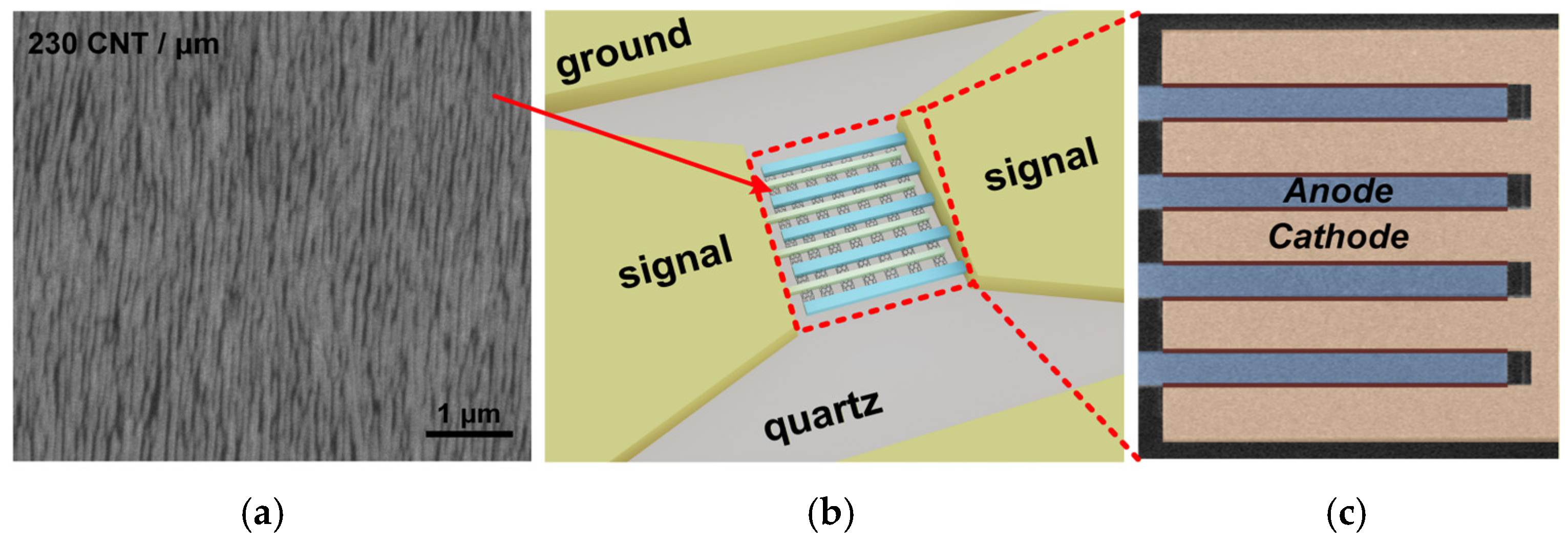
ACNT array film with a density of 230 CNT·μm−1 was formed on a quartz substrate using the dimension-limited self-alignment (DLSA) method [22], and the corresponding scanning electron microscopy (SEM) image is shown in Figure 1a. Prior to device fabrication, interface pretreatment was carried out, consisting of an yttrium (Y) oxide cleaning process followed by high-temperature annealing. Specifically, a 3 nm thick Y metal layer was deposited onto the ACNT arrays by electron-beam evaporation (EBE). The deposited sample was then annealed on a hot plate at 300 °C for 30 min to fully oxidize the Y layer into yttrium oxide (Y2O3). The resulting Y2O3 layer was then etched in dilute hydrochloric acid for 20 min and rinsed with ultrapure water until a clean surface was obtained. Subsequently, the sample was annealed at 600 °C for 3 h in an inert N2/H2 mixed atmosphere to remove residual polycarbazole (PCz) molecules wrapping the CNTs and to improve the contact quality between the CNTs and metal electrodes.
A three-dimensional schematic of the complete device structure is shown in Figure 1b. The device active region was defined using electron-beam lithography (EBL) combined with oxygen plasma etching. Titanium/gold (Ti/Au, 20/60 nm) and palladium/gold (Pd/Au, 20/60 nm) metal stacks were sequentially deposited by EBE to serve as the Schottky anode and ohmic cathode, respectively. The detailed structure of the device core region is illustrated in Figure 1c. Standard two-port GSG probe pads were fabricated using photolithography and EBE for subsequent direct-current (DC) characterization and high-frequency measurements.
The sample covered with the ACNT array film was annealed in a tube furnace (Thermo Scientific Lindberg/Blue M Moldatherm 1100 °C, Thermo Fisher Scientific, Waltham, MA, USA). SEM images of the ACNT array film and ACNT-SBD were obtained using a Sigma 300 microscope (ZEISS, Oberkochen, Germany). Electrical characteristics of the ACNT-SBDs were measured at room temperature using a Keithley 4200 semiconductor characterization system (Keithley Instruments, Cleveland, OH, USA) combined with a probe station (MPI TS200-SE, MPI Corporation, Munich, Germany). Patterning of the ACNT-SBDs was carried out using an EBL system (Raith 150, Raith GmbH, Dortmund, Germany), and metal deposition was performed using an EBE system (Kurt J. Lesker Company, Jefferson Hills, PA, USA).

3. Results and Discussion

3.1. Electrical and RF Characterization of ACNT-SBDs

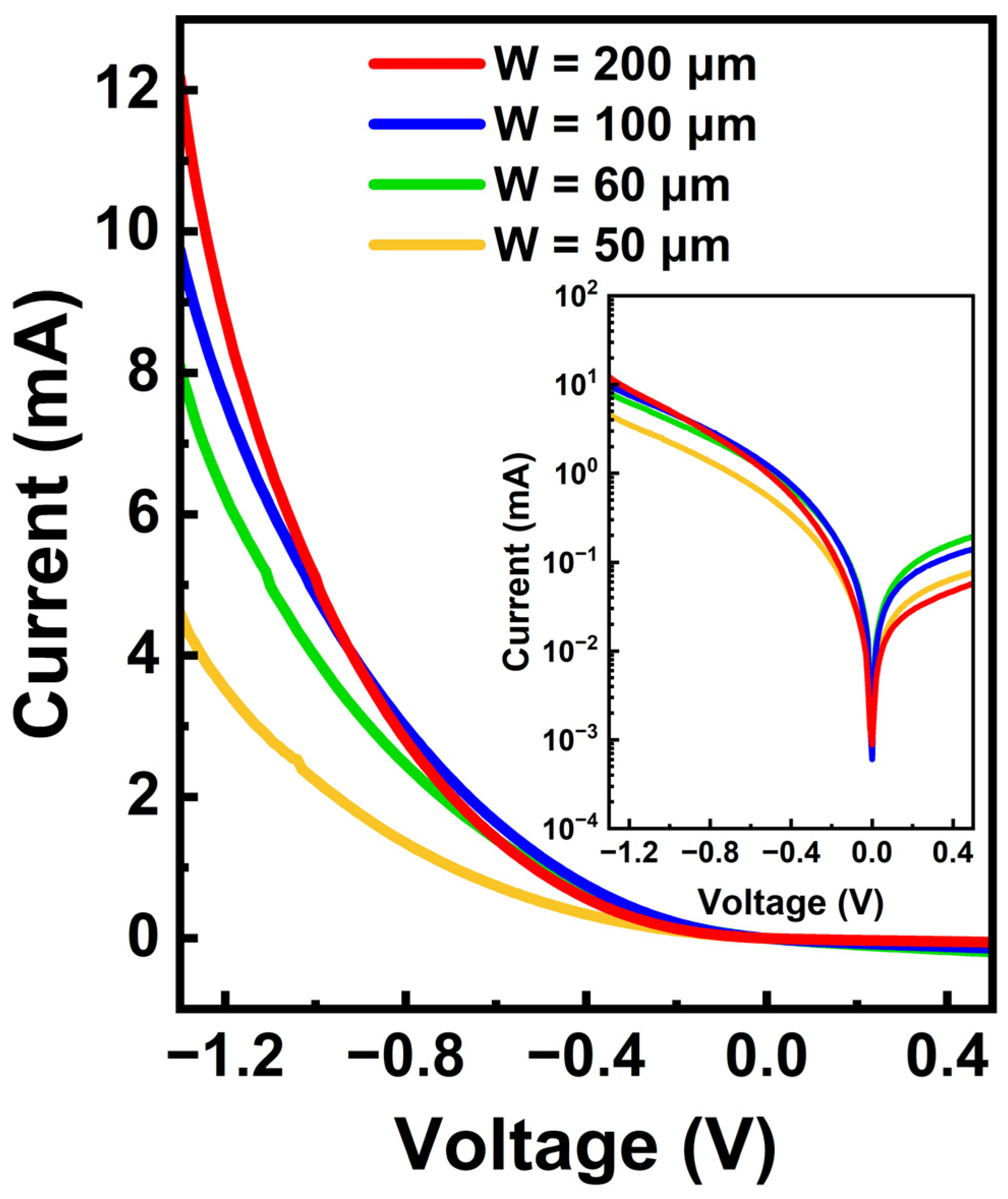
The electrode spacing was fixed at 150 nm, and devices with four different channel widths (W = 50, 60, 100, and 200 μm) were fabricated. Figure 2 presents the I–V characteristics of the ACNT-SBDs. Among them, the device with a channel width of 60 μm achieves a forward current density of 0.14 mA·μm−1 at a bias voltage of −1.3 V. As the channel width increases, the metal–CNT contact area correspondingly expands, leading to an increased number of parallel carrier transport channels within the active region and, consequently, enhanced current conduction capability.
The forward current–voltage characteristics were analyzed using the thermionic emission theory, expressed as follows
I = I s e x p q ( V I R s ) n k T 1 ,
where the I, Is, q, V, Rs, n, k, and T denote the total current, reverse saturation current, elementary charge, applied voltage, series resistance, ideality factor, Boltzmann constant, and absolute temperature, respectively. The reverse saturation current Is can be further defined as follows
I s = A A T 2 e x p q Φ B k T ,
where A is the effective diode area, A* is the effective Richardson constant, and ΦB is the effective Schottky barrier height. By fitting the exponential region of the forward I–V curve, the ideality factor n and the effective Schottky barrier height ΦB were extracted. The extracted parameters are summarized in Table 1.
As summarized in Table 1, the extracted ideality factors deviate noticeably from unity, indicating that the carrier transport in the ACNT-SBDs cannot be solely described by ideal thermionic emission or diffusion mechanisms [23]. Meanwhile, the effective Schottky barrier heights extracted from the forward I–V characteristics lie in the range of 0.211–0.265 eV, consistent with reported values for metal–carbon nanotube contacts. The variation in ΦB among devices with different channel widths is mainly associated with the non-uniform CNT/metal interface, including contact inhomogeneity and local variations in CNT properties.
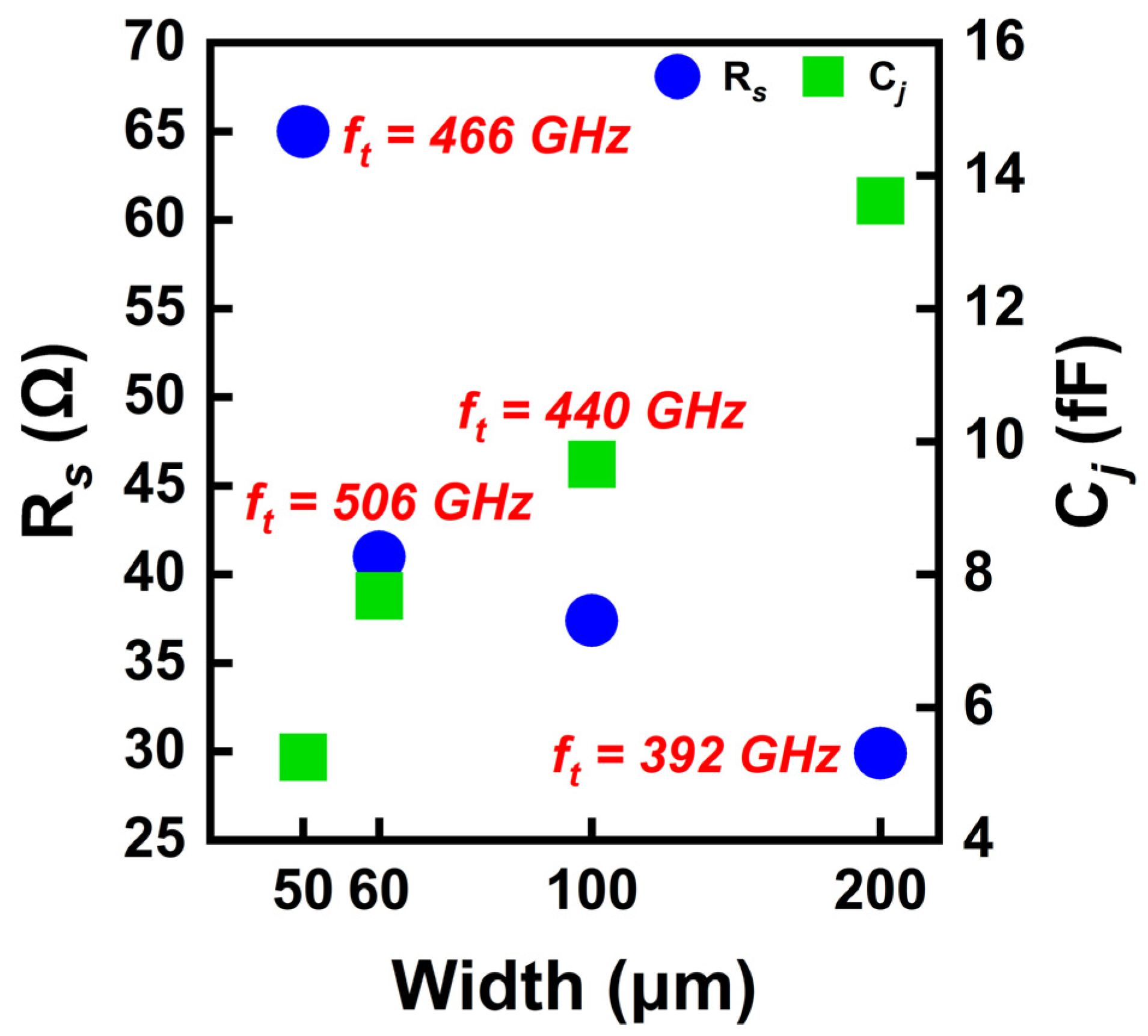
Variations in device width also induce systematic changes in the on-state series contact resistance (Rs-on) and the off-state junction capacitance (Cj-off), as shown in Figure 3. Under a fixed S, the increase in W introduces multiple parallel transport channels, which significantly reduces the effective series resistance according to the parallel resistance model. The Schottky junction capacitance originates from the space-charge region formed at the metal–semiconductor interface, and its magnitude is positively correlated with the effective contact area. It can be approximately described by a parallel-plate capacitor model,
C = ε 0 ε r A d   ,
where A is the effective contact area, ε0 is the vacuum permittivity, εr is the relative permittivity of the semiconductor, and d is the width of the space-charge region. As the device width increases, the effective contact area A of the Schottky junction increases accordingly, while the space-charge width d remains nearly constant under a fixed bias, resulting in a monotonic increase in junction capacitance. In addition, the enlarged electrode dimensions introduce extra parasitic capacitance, further amplifying the increase in Cj-off. The high-frequency performance of a SBD can be evaluated by its intrinsic fc, defined as follows
f c = 1 2 π R s - o n C j - o f f   ,
Figure 3 summarizes the extracted fc for devices with different W. The device with a channel width of 60 μm exhibits an fc as high as 506 GHz.
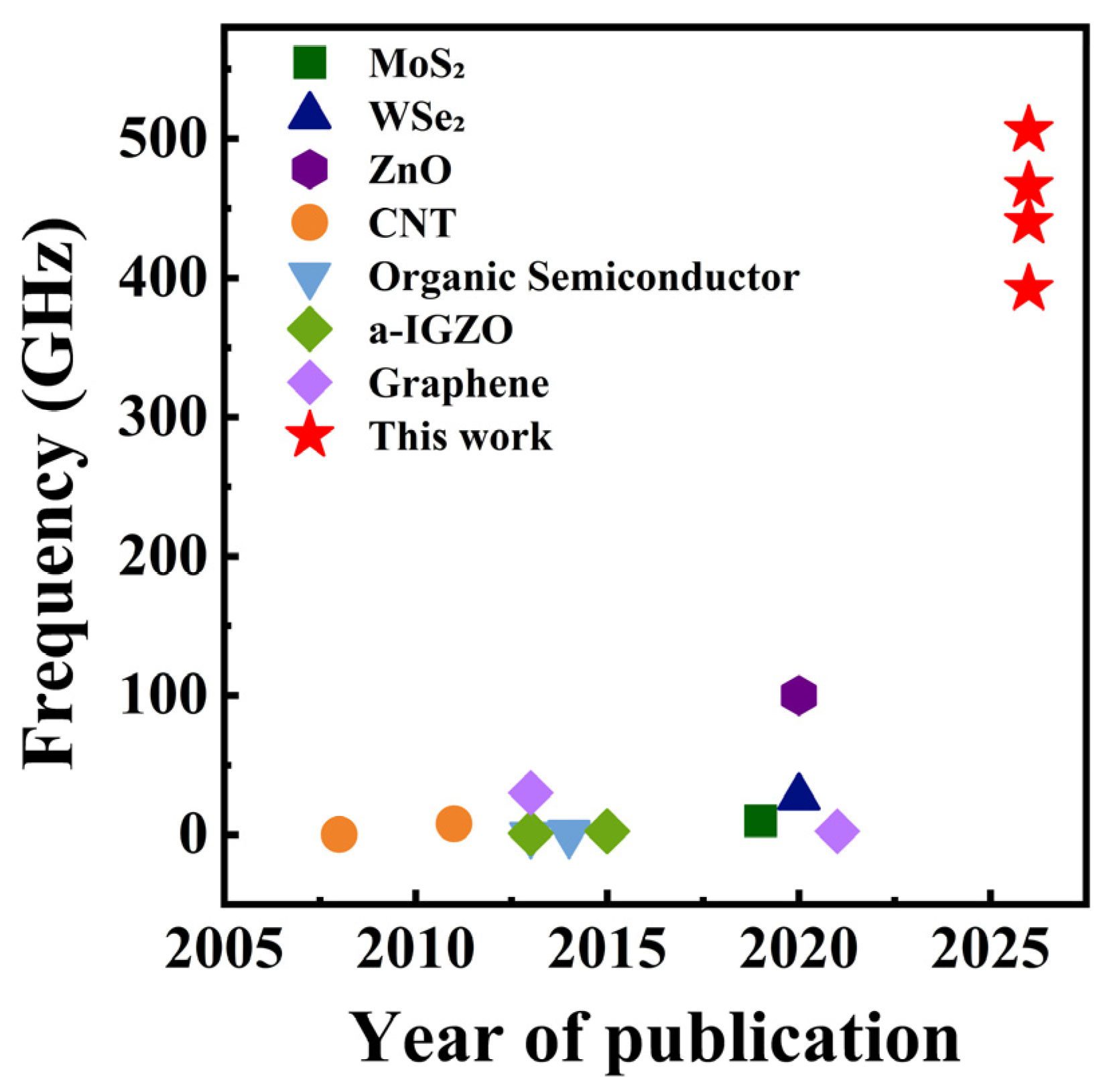
Figure 4 further compares the fc achieved in this work with those of diodes based on CNTs, 2D materials, metal oxides, and organic semiconductors [23,24,25,26,27,28,29,30,31,32,33,34,35,36]. Benefiting from the exceptionally high carrier mobility of ACNTs, the present device demonstrates superior high-frequency characteristics, highlighting its strong potential for THz applications.
Therefore, the channel width directly modulates the number of carrier transport channels and the effective contact area, thereby governing the on-state resistance, junction capacitance, and overall high-frequency response of the device. These results provide important guidance for the structural optimization of ACNT-SBDs. In particular, for RF applications, the fc is jointly determined by Rs-on and Cj-off; minimizing a single parameter alone is insufficient to achieve optimal device performance. Instead, a balanced design of geometric parameters, including W and S, is required to simultaneously optimize electrical conduction and frequency response.

3.2. Modeling of ACNT-SBDs

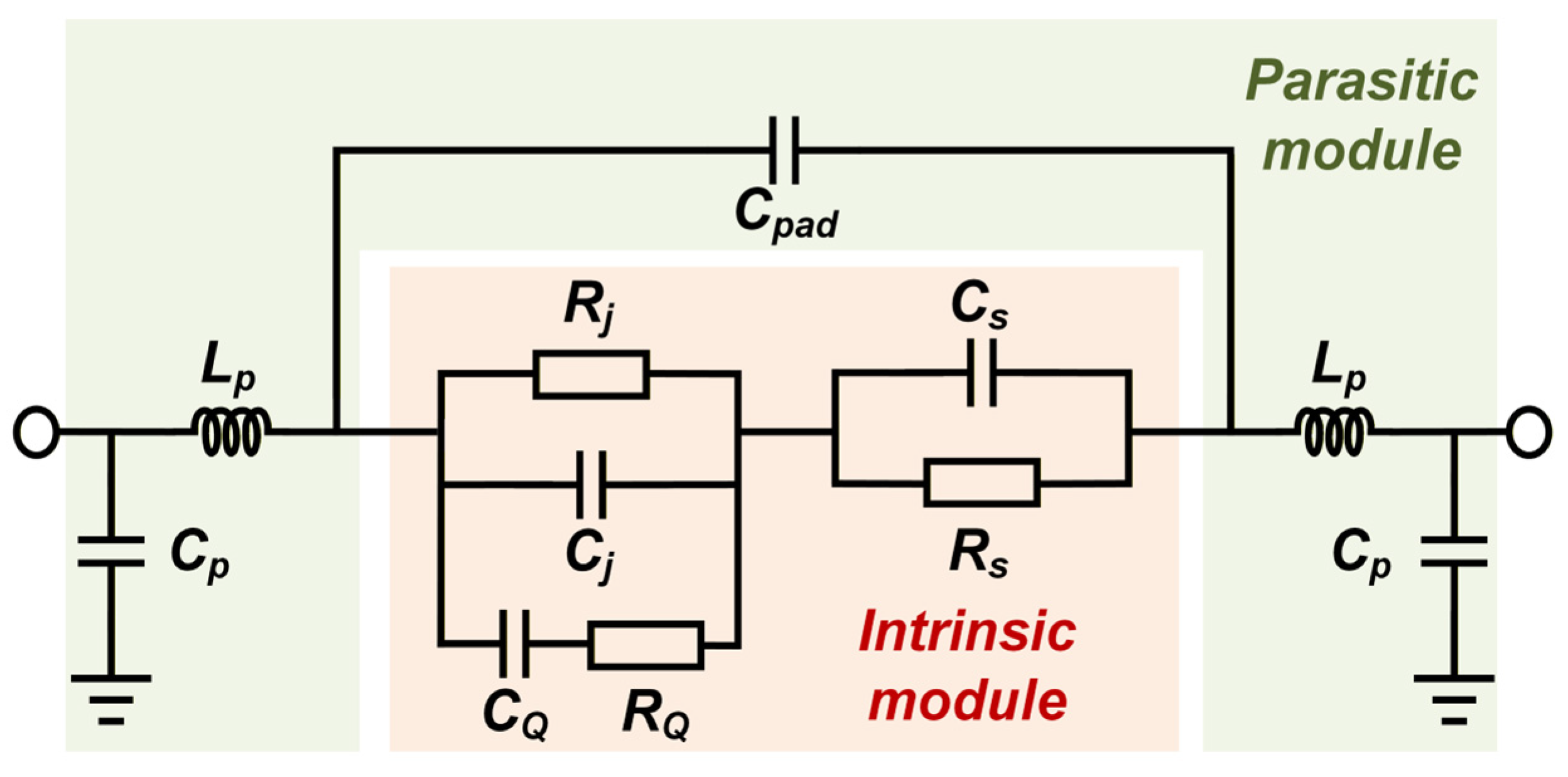
Based on the measured two-port S-parameter data, a corresponding small-signal model was established and the core parameters were extracted, with the model topology illustrated in Figure 5. The model consists of two main components: intrinsic core module and parasitic module. The intrinsic core module describes the carrier transport behavior and junction capacitance characteristics of the CNT–metal Schottky junction, while the parasitic module accounts for high-frequency non-ideal effects introduced by the GSG pads. Through optimized design, the GSG pads were engineered to minimize signal coupling and scattering during high-frequency measurements. The parasitic parameters extracted using an open–through de-embedding structure are Lp ≈ 23.7 pH, Cp ≈ 0.42 fF, Cpad ≈ 4.6 fF, and a series resistance of about 0.1 Ω.
Within the intrinsic core module, Rj represents the Schottky junction resistance, Cj denotes the Schottky junction capacitance, and Rs corresponds to the ohmic contact resistance. In addition, an extra ohmic capacitance Cs is introduced to describe non-ideal contact behavior arising from polymer residues remaining from the CNT sorting process. The capacitance Cs decreases primarily with the reduction in the effective electrode area (channel length × width) and is nearly independent of the applied bias voltage. To further accurately capture the intrinsic properties of the CNT, a parallel coupling capacitance CQ is included to represent the electrostatic capacitance of the ACNTs and inter-tube coupling effects, together with a resistance RQ to model coupling capacitance-related losses induced by the ACNTs under high-frequency operation.
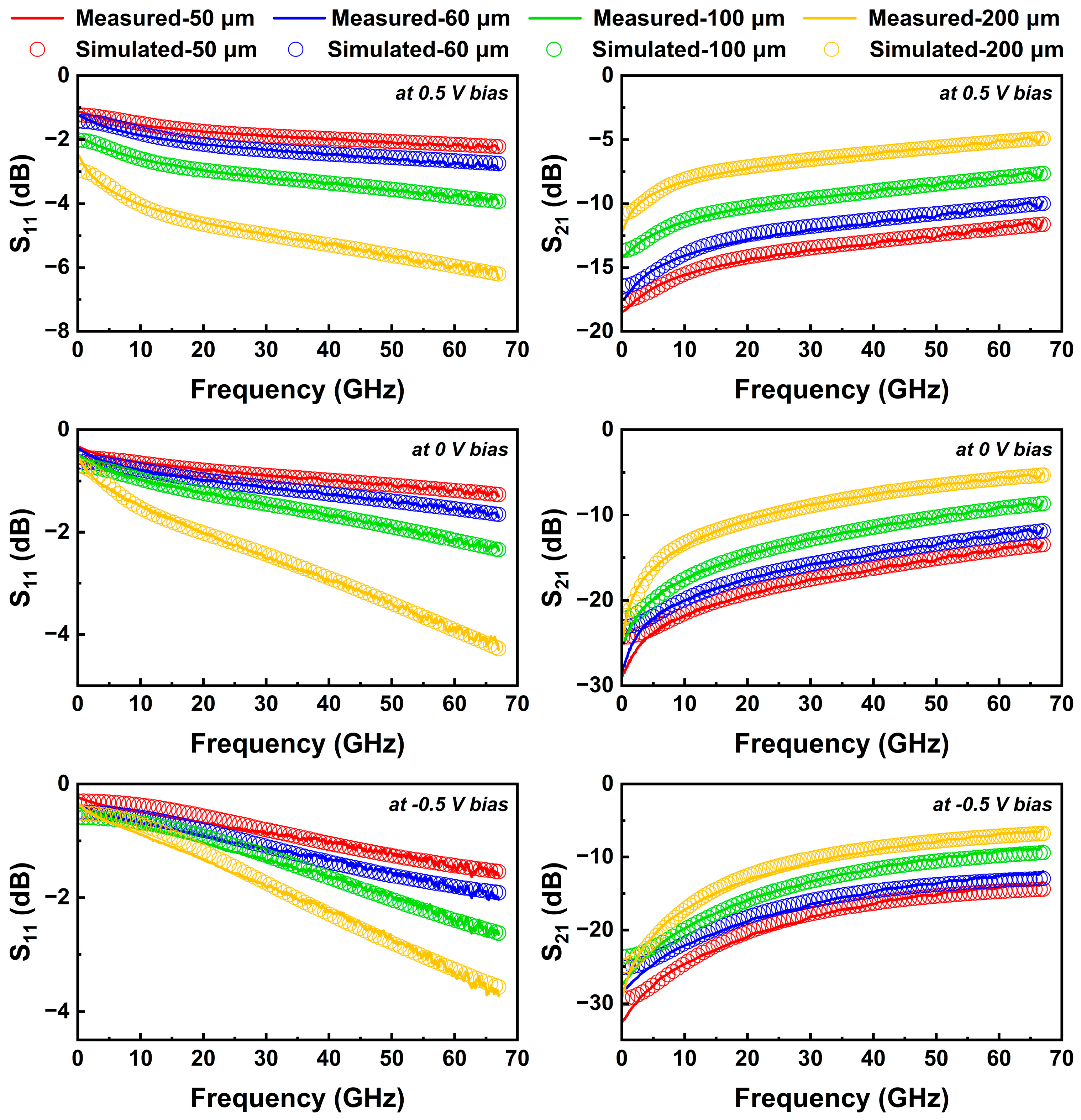
Figure 6 compares the measured S-parameters with the simulated results for devices with different channel widths under bias voltages of −0.5 V, 0 V, and 0.5 V. Across the entire measured frequency range from 100 MHz to 67 GHz, excellent agreement is observed between the experimental data and model simulations. The model effectively captures the combined influence of the bias-dependent junction capacitance Cj and the ohmic capacitance Cs, enabling the simulated curves to accurately follow the measured S-parameter variations with bias voltage and thus precisely reflect the high-frequency transmission and reflection characteristics of the devices. It should be noted that the proposed small-signal model is bias-dependent, with the parameters of the diode core extracted under different applied bias conditions, while the model structure itself remains scalable through geometric dimension scaling.
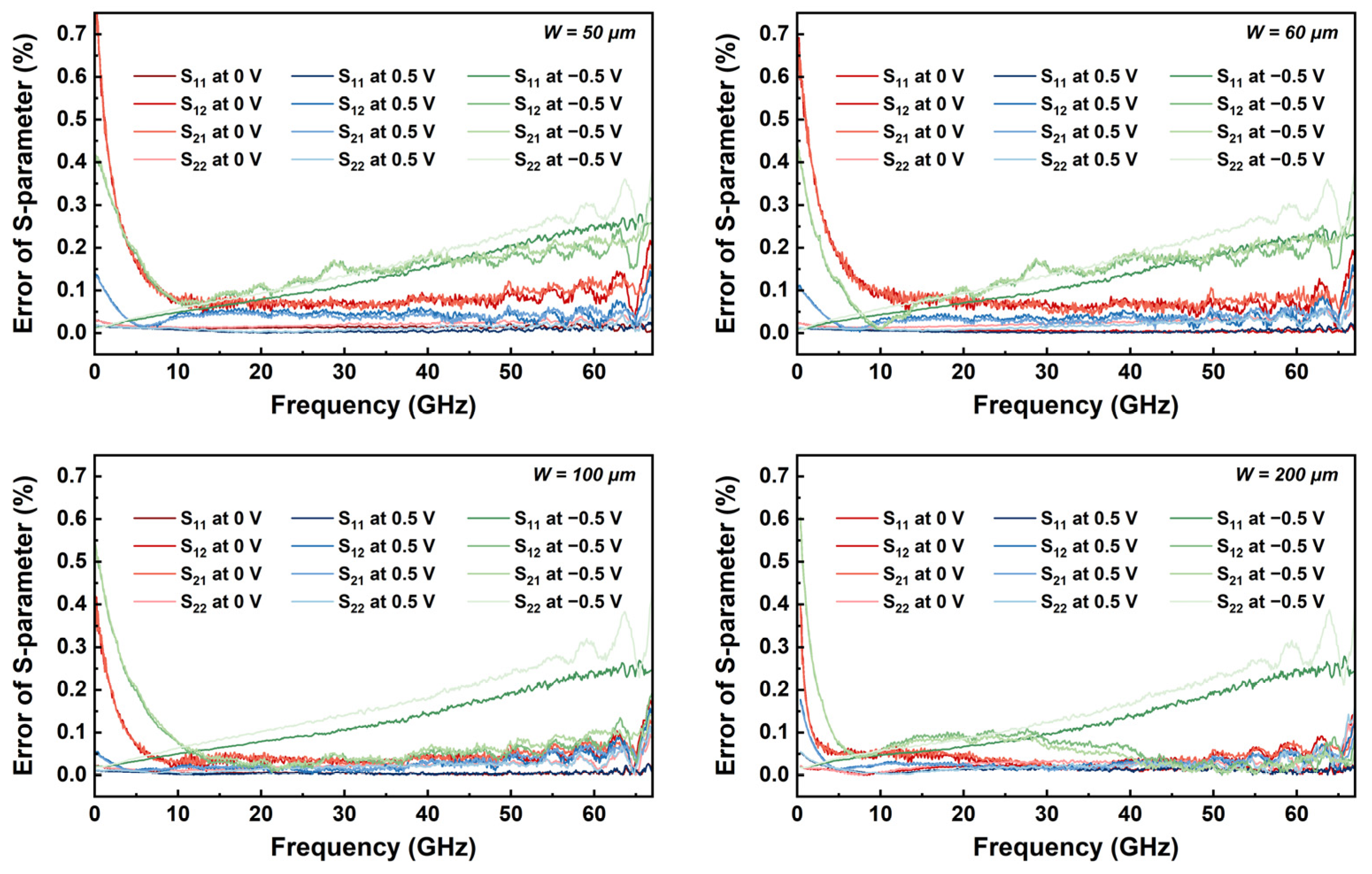
To quantitatively evaluate the applicability of the small-signal model, an error analysis was performed. Figure 7 presents the frequency-dependent relative errors between the measured and simulated S11, S12, S22, and S21 parameters for devices with different widths under multiple bias conditions (0 V and ±0.5 V). Across the full frequency range, the S-parameter errors for all devices remain at low levels under various bias conditions. In the low- to mid-frequency transition region (100 MHz–10 GHz), device operation gradually shifts from DC/quasi-static transport to small-signal alternating current (AC) response. In this regime, residual parasitic effects associated with the measurement ports—such as bias networks, cable losses, and non-ideal probe contacts—are amplified in the reflected signals, resulting in a moderate increase in normalized error. In the stable mid-frequency region, the relative S-parameter error remains approximately 0.2%, indicating that the proposed model accurately captures the essential RF behavior of the devices. As the frequency further increases, the error gradually rises, primarily due to increased insertion loss intrinsic to the devices at high frequencies, as well as uncertainties introduced by probe contact variation, calibration drift, and system noise during high-frequency measurements. These factors collectively amplify deviations in both transmission and reflection parameters at higher frequencies; nevertheless, the overall error remains below 0.4%, demonstrating excellent modeling accuracy. Consequently, this scalable model enables the effective design and simulation of impedance matching networks for CNT diode circuits.

3.3. D-Band Frequency Multiplier Based on ACNT-SBD

As discussed in Section 3.1, the device with a channel width 60 μm, which achieves an optimal trade-off between conduction performance and frequency characteristics, was selected for the fabrication of the D-band frequency multiplier. In this design, a zero-bias ACNT-SBD is employed as the nonlinear core device. This approach not only exploits the optimal nonlinear characteristics of the diode under zero-bias operation but also simplifies both fabrication and measurement complexity. From a circuit perspective, conventional frequency multipliers typically consist of three key building blocks: a matching network, a SBD active unit, and filtering networks. In this work, the operating frequency of the frequency multiplier is extended to 154 GHz. By comparison, previously reported bipolar transistor-based frequency multipliers utilizing ACNT arrays exhibited a maximum output frequency of 40 GHz with a conversion loss as high as 36 dB [19,20,21].
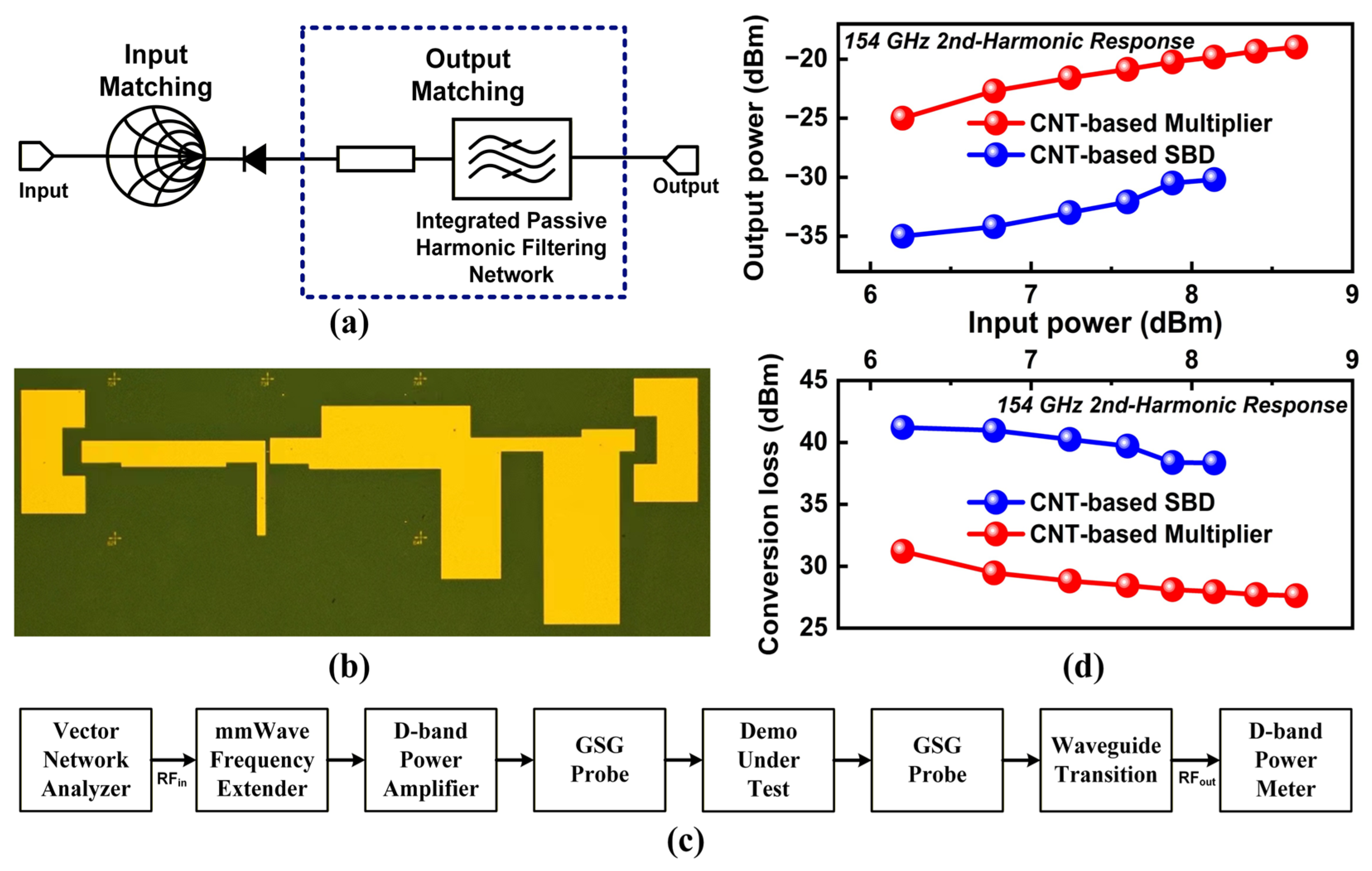
Figure 8a illustrates the topology of the proposed second-harmonic (×2) frequency multiplier circuit operating at 154 GHz. Unlike conventional designs in which the matching network and filter are implemented as separate functional blocks, an integrated passive harmonic filtering network is introduced in this work. This integrated network simultaneously fulfills three functions: effective suppression of the fundamental frequency component, efficient extraction of the second harmonic, and impedance matching for the nonlinear device. By adopting a harmonic impedance focusing technique, the proposed design achieves more precise circuit control while significantly reducing the chip footprint, thereby improving the utilization efficiency of CNT material. Figure 8b shows an optical micrograph of the fabricated circuit on wafer. The circuit metallization was realized by EBE of Ti/Au. To mitigate skin effect-induced losses in the mmWave band [37], the metal thickness was increased to 500 nm. Meanwhile, the quartz substrate was thinned to 100 μm, and a backside ground metallization was also deposited by EBE to serve as the reference ground.
Figure 8c illustrates the mmWave measurement setup used for characterizing the D-band frequency multiplier. The input signal was generated by a vector network analyzer (N5247B, Keysight Technologies, Santa Rosa, CA, USA) and subsequently up-converted by a mmWave frequency extender (N5293A-01, Keysight Technologies, Santa Rosa, CA, USA). After amplification by a D-band power amplifier, sufficient drive power in the 75–110 GHz frequency range was delivered to the device under test. Prior to device measurements, the input signal path was calibrated using a power meter and power sensor, taking into account the losses introduced by coaxial cables, the frequency extender, and the GSG probe, thereby determining the actual input power at the probe tip. For output power measurements, the device was contacted using GSG probes, and the output signal was routed through the probe and a waveguide-to-coaxial transition to a power meter (E4416A, Keysight Technologies, Santa Rosa, CA, USA). The total insertion loss of the output signal path was calibrated in advance, including the losses associated with the GSG probe and the waveguide transition. The reported output power was obtained by correcting the power meter readings with the calibrated transmission losses.
Figure 8d presents the measured output power and conversion loss of both the D-band frequency multiplier circuit and the standalone ACNT-SBD as functions of input power. The input frequency was set to 77 GHz, corresponding to a second-harmonic output frequency of 154 GHz. As the input power increases, the second-harmonic output power of both the circuit and the device exhibits an approximately linear increase. Notably, the CNT-based frequency multiplier consistently delivers higher output power across the entire input power range. The proposed frequency multiplier achieves a maximum output power of −18.97 dBm and a minimum conversion loss of 27.92 dB, whereas the standalone ACNT-SBD (W = 60 μm) without circuit optimization exhibits a maximum output power of only −30.2 dBm and a minimum multiplication loss of 38.34 dB, with all reported results obtained from measurements. These results not only confirm the effectiveness of the proposed circuit design but also directly demonstrate the strong nonlinear frequency conversion capability of ACNT-SBDs in the mmWave regime. To the best of our knowledge, this work represents the first experimental realization of a D-band frequency multiplier based on ACNT-SBDs.
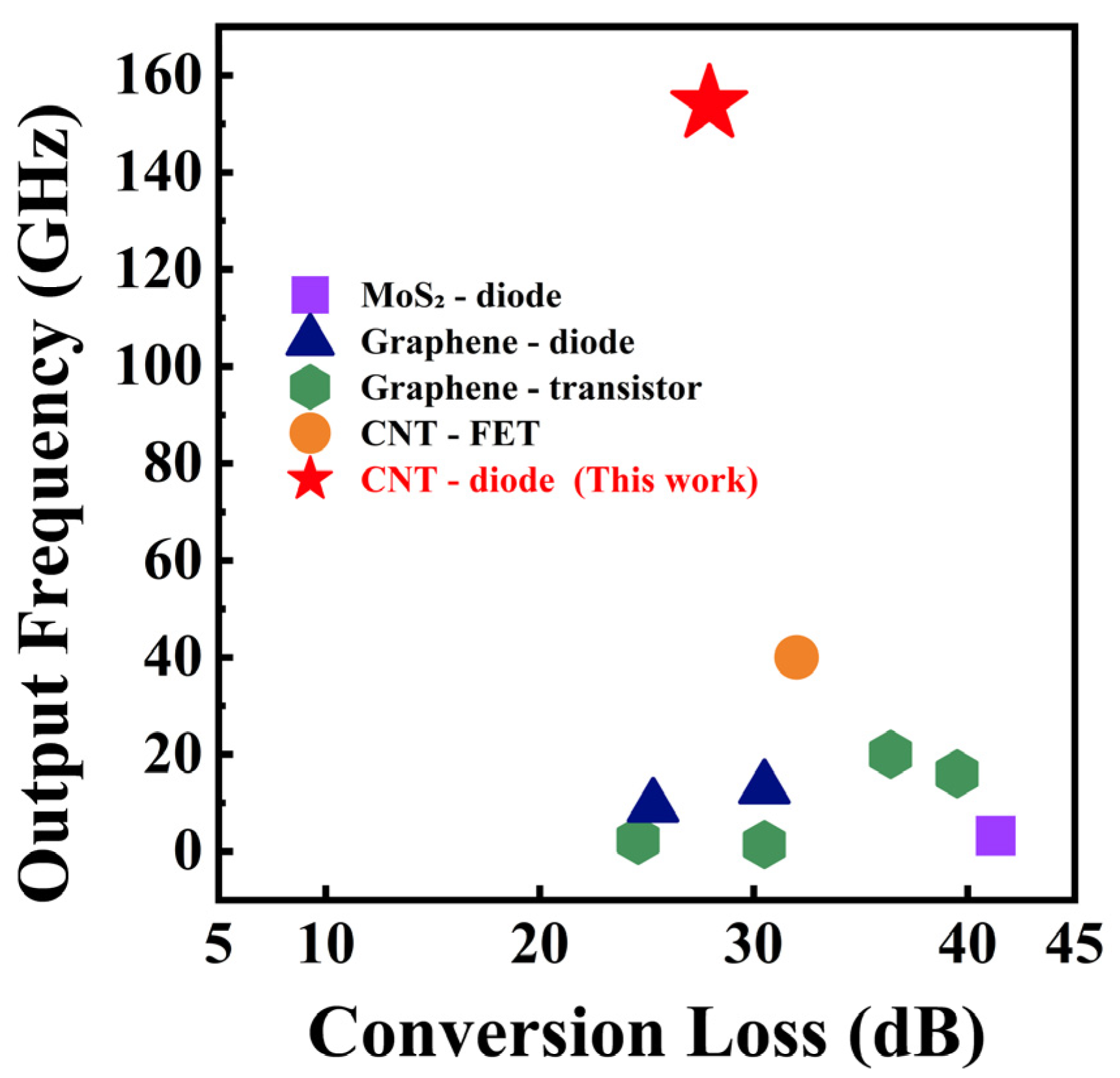
Figure 9 compares the performance of the proposed frequency multiplier with previously reported frequency multipliers based on CNT transistors and other 2D materials [15,16,19,38,39,40,41,42]. The present work achieves a higher output frequency together with competitive conversion loss, highlighting the advantages of ACNT-SBD for scalable mmWave and sub-THz frequency generation.

4. Conclusions

In conclusion, this work presents a systematic study of ACNT-SBDs, covering device fabrication, DC and RF characterization, small-signal modeling, and circuit-level implementation. ACNT-SBDs with a fixed electrode spacing and varying channel widths were fabricated, among which the 60 μm-wide device exhibited the best overall performance, delivering a forward current density of 0.14 mA·μm−1 at −1.3 V and an intrinsic cutoff frequency (fC) of 506 GHz. These results confirm the excellent high-frequency capability of ACNT-SBDs enabled by the high carrier mobility of CNTs. A physics-based small-signal model incorporating both intrinsic device behavior and parasitic effects was established and experimentally validated, showing excellent agreement with measured S-parameters from 100 MHz to 67 GHz under different bias conditions, with relative errors consistently below 0.7%. A 154 GHz second-harmonic D-band frequency multiplier based on a zero-bias ACNT-SBD and an integrated passive harmonic filtering network was successfully demonstrated. The proposed multiplier delivers a maximum output power of −18.97 dBm and a minimum conversion loss of 27.92 dB, outperforming previously reported frequency multipliers based on CNT transistors and 2D materials. Notably, this work constitutes the first experimental demonstration of a D-band frequency multiplier enabled by ACNT-SBDs.
Overall, this study highlights the strong high-frequency response, nonlinear conversion efficiency, and integration potential of ACNT-based devices, providing a viable technological route toward future THz communication and sensing systems.

Author Contributions

Conceptualization, H.L. and L.D.; methodology, L.D. and H.L.; validation, L.D. and J.W.; formal analysis, L.D.; investigation, L.D.; resources, H.L.; data curation, L.D. and J.W.; writing—original draft preparation, L.D.; writing—review and editing, L.D. and H.L.; supervision, H.L.; project administration, H.L.; funding acquisition, H.L. All authors have read and agreed to the published version of the manuscript.

Funding

This research was funded by the National Key Research and Development Program (grant number 2024YFA1209700) and the Peking Nanofab Laboratory.

Data Availability Statement

Data are contained within the article.

Conflicts of Interest

The authors declare no conflicts of interest.

Abbreviations

The following abbreviations are used in this manuscript:
mmWavemillimeter-wave
THzterahertz
ACNTaligned carbon nanotube
SBDSchottky barrier diode
Selectrode spacing
Wchannel width
RFradio frequency
fCcutoff frequency
CNTcarbon nanotube
GHzgigahertz
5Gfifth-generation
6Gsixth-generation
ACNT-SBDaligned carbon nanotube Schottky barrier diode
GSGground–signal–ground
DLSAdimension-limited self-alignment
SEMscanning electron microscopy
Yyttrium
EBEelectron-beam evaporation
Y2O3yttrium oxide
PCzpolycarbazole
EBLelectron-beam lithography
Tititanium
Augold
Pdpalladium
DCdirect-current
Lchannel length
ACalternating current

References

  1. Hemadeh, I.A.; Satyanarayana, K.; El-Hajjar, M.; Hanzo, L. Millimeter-Wave Communications: Physical Channel Models, Design Considerations, Antenna Constructions, and Link-Budget. IEEE Commun. Surv. Tutor. 2018, 20, 870–913. [Google Scholar] [CrossRef]
  2. Mehdi, I.; Siles, J.V.; Lee, C.; Schlecht, E. THz Diode Technology: Status, Prospects, and Applications. Proc. IEEE 2017, 105, 990–1007. [Google Scholar] [CrossRef]
  3. Javey, A.; Guo, J.; Wang, Q.; Lundstrom, M.; Dai, H. Ballistic Carbon Nanotube Field-Effect Transistors. Nature 2003, 424, 654–657. [Google Scholar] [CrossRef]
  4. Rutherglen, C.; Jain, D.; Burke, P. Nanotube Electronics for Radiofrequency Applications. Nat. Nanotechnol. 2009, 4, 811–819. [Google Scholar] [CrossRef] [PubMed]
  5. Guo, J.; Hasan, S.; Javey, A.; Bosman, G.; Lundstrom, M. Assessment of High-Frequency Performance Potential of Carbon Nanotube Transistors. IEEE Trans. Nanotechnol. 2005, 4, 715–721. [Google Scholar] [CrossRef]
  6. Akturk, A.; Pennington, G.; Goldsman, N.; Wickenden, A. Electron Transport and Velocity Oscillations in a Carbon Nanotube. IEEE Trans. Nanotechnol. 2007, 6, 469–474. [Google Scholar] [CrossRef]
  7. Tang, J.; Cao, Q.; Tulevski, G.; Jenkins, K.A.; Nela, L.; Farmer, D.B.; Han, S.J. Flexible CMOS Integrated Circuits Based on Carbon Nanotubes with Sub-10 ns Stage Delays. Nat. Electron. 2018, 1, 191–196. [Google Scholar] [CrossRef]
  8. Conti, S.; Pimpolari, L.; Calabrese, G.; Worsley, R.; Majee, S.; Polyushkin, D.K.; Paur, M.; Pace, S.; Keum, D.H.; Fabbri, F.; et al. Low-Voltage 2D Materials-Based Printed Field-Effect Transistors for Integrated Digital and Analog Electronics on Paper. Nat. Commun. 2020, 11, 3566. [Google Scholar] [CrossRef] [PubMed]
  9. Zhou, J.; Liu, L.; Shi, H.; Zhu, M.; Cheng, X.; Ren, L.; Ding, L.; Peng, L.M.; Zhang, Z. Carbon Nanotube Based Radio Frequency Transistors for K-Band Amplifiers. ACS Appl. Mater. Interfaces 2021, 13, 37465–37472. [Google Scholar] [CrossRef]
  10. Shi, H.; Ding, L.; Zhong, D.; Han, J.; Liu, L.; Xu, L.; Sun, P.; Wang, H.; Zhou, J.; Fang, L.; et al. Radiofrequency Transistors Based on Aligned Carbon Nanotube Arrays. Nat. Electron. 2021, 4, 405–415. [Google Scholar] [CrossRef]
  11. Zhou, J.; Ren, L.; Li, H.; Cheng, X.; Pan, Z.; Zhang, Z.; Ding, L.; Peng, L.M. Carbon Nanotube Radiofrequency Transistors with fT/fMAX of 376 / 318 GHz. IEEE Electron Device Lett. 2023, 44, 329–332. [Google Scholar] [CrossRef]
  12. Li, J.; Li, M.; Chen, Z.; Shao, S.; Gu, W.; Gu, Y.; Fang, Y.; Zhao, J. Large Area Roll-to-Roll Printed Semiconducting Carbon Nanotube Thin Films for Flexible Carbon-Based Electronics. Nanoscale 2023, 15, 5317–5326. [Google Scholar] [CrossRef]
  13. Wei, N.; Gao, N.; Xu, H.; Liu, Z.; Gao, L.; Jiang, H.; Tian, Y.; Chen, Y.; Du, X.; Lian-Mao, P. Wafer-Scale Fabrication of Carbon-Nanotube-Based CMOS Transistors and Circuits with High Thermal Stability. Nano Res. 2022, 15, 9875–9880. [Google Scholar] [CrossRef]
  14. Sun, P.; Wei, N.; Zhang, P.; Yang, Y.; Zhu, M.; Shi, H.; Peng, L.-M.; Zhang, Z. How to Build Good Inverters from Nanomaterial-Based Transistors. Nano Res. 2023, 16, 12594–12600. [Google Scholar] [CrossRef]
  15. Hamed, A.; Saeed, M.; Wang, Z.; Shaygan, M.; Neumaier, D.; Negra, R. X-Band MMIC Balanced Frequency Doubler Based on Graphene Diodes. In Proceedings of the 2019 IEEE MTT-S International Microwave Symposium (IMS), Boston, MA, USA, 2–7 June 2019; pp. 930–933. [Google Scholar] [CrossRef]
  16. Hou, Y.; Ding, M.L.; Fang, Y.; Hou, X.; Zhong, X.; Guo, Y.; Guo, T. Multilayer Graphene Frequency Doubler Using Direct-Current Bias and Reflector Networks. J. Phys. D Appl. Phys. 2021, 54, 175103. [Google Scholar] [CrossRef]
  17. Maine, S.; Koechlin, C.; Rennesson, S.; Jaeck, J.; Salort, S.; Chassagne, B.; Pardo, F.; Pelouard, J.-L.; Haïdar, R. Complex Optical Index of Single-Wall Carbon Nanotube Films in the 0.6–800 μm Spectral Range. Appl. Opt. 2012, 51, 3031–3034. [Google Scholar] [CrossRef] [PubMed]
  18. Rutherglen, C.; Kane, A.A.; Marsh, P.F.; Cain, T.A.; Hassan, B.I.; AlShareef, M.R.; Zhou, C.; Galatsis, K. Wafer-Scalable, Aligned Carbon Nanotube Transistors Operating at Frequencies of Over 100 GHz. Nat. Electron. 2019, 2, 530–539. [Google Scholar] [CrossRef]
  19. Wang, Z.; Liang, S.; Zhang, Z.; Liu, H.; Zhong, H.; Ye, L.; Wang, S.; Zhou, W.; Liu, J.; Chen, Y.; et al. Scalable Fabrication of Ambipolar Transistors and Radio-Frequency Circuits Using Aligned Carbon Nanotube Arrays. Adv. Mater. 2014, 26, 645–652. [Google Scholar] [CrossRef]
  20. Che, Y.; Lin, Y.-C.; Kim, P.; Zhou, C. T-Gate Aligned Nanotube Radio Frequency Transistors and Circuits with Superior Performance. ACS Nano 2013, 7, 4343–4350. [Google Scholar] [CrossRef]
  21. Qian, J.; Cheng, X.; Zhou, J.; Cao, J.; Ding, L. Aligned Carbon Nanotubes-Based Radiofrequency Transistors for Amplitude Amplification and Frequency Conversion at Millimeter Wave Band. ACS Nano 2023, 17, 14742–14749. [Google Scholar] [CrossRef] [PubMed]
  22. Liu, L.; Han, J.; Xu, L.; Zhou, J.; Zhao, C.; Ding, S.; Shi, H.; Xiao, M.; Ding, L.; Ma, Z.; et al. Aligned, High-Density Semiconducting Carbon Nanotube Arrays for High-Performance Electronics. Science 2020, 368, 850–856. [Google Scholar] [CrossRef]
  23. Cobas, E.D.; Anlage, S.M.; Fuhrer, M.S. Single Carbon Nanotube Schottky Diode Microwave Rectifiers. IEEE Trans. Microw. Theory Tech. 2011, 59, 2710–2716. [Google Scholar] [CrossRef]
  24. Zhang, X.; Grajal, J.; Vazquez-Roy, J.L.; Radhakrishna, U.; Wang, X.; Chern, W.; Zhou, L.; Lin, Y.; Shen, P.-C.; Ji, X.; et al. Two-Dimensional MoS2-Enabled Flexible Rectenna for Wi-Fi-Band Wireless Energy Harvesting. Nature 2019, 566, 368–372. [Google Scholar] [CrossRef]
  25. Georgiadou, D.G.; Semple, J.; Sagade, A.A.; Forstén, H.; Rantakari, P.; Lin, Y.-H.; Alkhalil, F.; Seitkhan, A.; Loganathan, K.; Faber, H.; et al. 100 GHz Zinc Oxide Schottky Diodes Processed from Solution on a Wafer Scale. Nat. Electron. 2020, 3, 718–725. [Google Scholar] [CrossRef]
  26. Kaur, A.; Yang, X.; Chahal, P. CNTs and Graphene-Based Diodes for Microwave and Millimeter-Wave Circuits on Flexible Substrates. IEEE Trans. Compon. Packag. Manuf. Technol. 2016, 6, 1763–1772. [Google Scholar] [CrossRef]
  27. Yang, S.J.; Park, K.T.; Im, J.; Hong, S.; Lee, Y.; Min, B.-W.; Kim, K.; Im, S. Ultrafast 27 GHz Cutoff Frequency in Vertical WSe2 Schottky Diodes with Extremely Low Contact Resistance. Nat. Commun. 2020, 11, 3306. [Google Scholar] [CrossRef] [PubMed]
  28. Kaur, A.; Yang, X.; Park, K.Y.; Chahal, P. Reduced Graphene Oxide Based Schottky Diode on Flex Substrate for Microwave Circuit Applications. In Proceedings of the 2013 IEEE 63rd Electronic Components and Technology Conference, Las Vegas, NV, USA, 28–31 May 2013; pp. 178–182. [Google Scholar] [CrossRef]
  29. Chasin, A.; Nag, M.; Bhoolokam, A.; Myny, K.; Steudel, S.; Schols, S.; Genoe, J.; Gielen, G.; Heremans, P. Gigahertz Operation of a-IGZO Schottky Diodes. IEEE Trans. Electron Devices 2013, 60, 3407–3412. [Google Scholar] [CrossRef]
  30. Zhang, J.; Li, Y.; Zhang, B.; Wang, H.; Xin, Q.; Song, A. Flexible Indium–Gallium–Zinc–Oxide Schottky Diode Operating Beyond 2.45 GHz. Nat. Commun. 2015, 6, 7561. [Google Scholar] [CrossRef] [PubMed]
  31. Steudel, S.; Myny, K.; Vicca, P.; Cheyns, D.; Genoe, J.; Heremans, P. Ultra-High Frequency Rectification Using Organic Diodes. In Proceedings of the 2008 IEEE International Solid-State Circuits Conference (ISSCC), San Francisco, CA, USA, 3–7 February 2008; pp. 130–131. [Google Scholar] [CrossRef]
  32. Altazin, S.; Clerc, R.; Gwoziecki, R.; Verilhac, J.-M.; Boudinet, D.; Pananakakis, G.; Ghibaudo, G.; Chartier, I.; Coppard, R. Physics of the Frequency Response of Rectifying Organic Schottky Diodes. J. Appl. Phys. 2014, 115, 064507. [Google Scholar] [CrossRef]
  33. Heljo, P.S.; Li, M.; Lilja, K.E.; Majumdar, H.S.; Lupo, D. Printed Half-Wave and Full-Wave Rectifier Circuits Based on Organic Diodes. IEEE Trans. Electron Devices 2013, 60, 870–874. [Google Scholar] [CrossRef]
  34. Sani, N.; Robertsson, M.; Cooper, P.; Wang, X.; Svensson, M.; Ersman, P.A.; Norberg, P.; Nilsson, M.; Nilsson, D.; Liu, X.; et al. All-Printed Diode Operating at 1.6 GHz. Proc. Natl. Acad. Sci. USA 2014, 111, 11943–11948. [Google Scholar] [CrossRef]
  35. Sani, N.; Wang, X.; Granberg, H.; Ersman, P.A.; Crispin, X.; Dyreklev, P.; Engquist, I.; Gustafsson, G.; Berggren, M. Flexible Lamination-Fabricated Ultra-High Frequency Diodes Based on Self-Supporting Semiconducting Composite Film of Silicon Micro-Particles and Nano-Fibrillated Cellulose. Sci. Rep. 2016, 6, 28921. [Google Scholar] [CrossRef] [PubMed]
  36. Fan, C.Y.; Wei, M.D.; Uzlu, B.; Wang, Z.; Neumaier, D.; Negra, R. Fully Integrated 2.4-GHz Flexible Rectifier Using Chemical-Vapor-Deposition Graphene MMIC Process. IEEE Trans. Electron Devices 2021, 68, 1326–1333. [Google Scholar] [CrossRef]
  37. Kuhn, W.B.; Ibrahim, N.M. Analysis of Current Crowding Effects in Multiturn Spiral Inductors. IEEE Trans. Microw. Theory Tech. 2001, 49, 31–38. [Google Scholar] [CrossRef]
  38. Fang, Y.; Sheng, H.X.; Zhong, X.L.; Guo, Y. Characteristic Analysis of Microwave Multilayer MoS2 and Graphene Frequency Tripler. J. Electromagn. Waves Appl. 2019, 33, 972–980. [Google Scholar] [CrossRef]
  39. Wang, H.; Hsu, A.; Kim, K.K.; Kong, J.; Palacios, T. Gigahertz Ambipolar Frequency Multiplier Based on CVD Graphene. In Proceedings of the International Electron Devices Meeting (IEDM), San Francisco, CA, USA, 6–8 December 2010. [Google Scholar] [CrossRef]
  40. Dragoman, M.; Neculoiu, D.; Deligeorgis, G.; Konstantinidis, G.; Dragoman, D.; Cismaru, A.; Muller, A.A.; Plana, R. Millimeter-Wave Generation via Frequency Multiplication in Graphene. Appl. Phys. Lett. 2010, 97, 043507. [Google Scholar] [CrossRef]
  41. Lv, H.; Wu, H.Q.; Liu, J.B.; Niu, J.; Yu, J.; Huang, C.; Li, J.; Xu, Q.; Wu, X. Monolithic Graphene Frequency Multiplier Working at 10 GHz Range. In Proceedings of the 2014 International Symposium on VLSI Technology, Systems and Application (VLSI-TSA), Hsinchu, Taiwan, 28–30 April 2014. [Google Scholar] [CrossRef]
  42. Mohamed, S.; Hamed, A.; Palacios, P.; Uzlu, B.; Wang, Z.; Baskent, E.; Negra, R. Voltage-Tunable Thin Film Graphene-Diode-Based Microwave Harmonic Generator. IEEE Microw. Wirel. Compon. Lett. 2021, 31, 733–736. [Google Scholar] [CrossRef]
Figure 1. (a) SEM image of ACNTs array with density of 230 CNT·μm−1; (b) schematic of the diode; (c) structure of the ACNT-SBD.
Electronics 15 00537 g001
Figure 2. Measured I–V characteristics of p-type ACNT-SBDs with different channel widths. Insets: semi-log plot of the I–V curves.
Electronics 15 00537 g002
Figure 3. Extracted on-state contact resistances, off-state junction capacitance, and cutoff frequencies of ACNT-SBDs.
Electronics 15 00537 g003
Figure 4. Cutoff frequencies of ACNT-SBDs. Comparison with CNTs, 2D materials, metal oxides, and organic semiconductors devices.
Electronics 15 00537 g004
Figure 5. Small-signal model of the ACNT-SBD.
Electronics 15 00537 g005
Figure 6. Comparison of measured and simulated S-parameters for ACNT-SBDs with different channel widths under various bias voltages.
Electronics 15 00537 g006
Figure 7. Comparison of error values between measured and simulated S-parameters for ACNT-SBDs with different channel widths under various bias voltages.
Electronics 15 00537 g007
Figure 8. (a) Schematic of the proposed frequency multiplier; (b) photograph of the fabricated frequency multiplier; (c) mmWave measurement setup; (d) output power (top) and conversion loss (bottom) of frequency multiplier and ACNT-SBD, measured at an input frequency of 77 GHz and an output frequency of 154 GHz. The red symbols represent the CNT-based multiplier, while the blue symbols represent the CNT-based SBD.
Electronics 15 00537 g008
Figure 9. Comparison of our ACNT-SBD-based frequency multiplier with other CNT transistor-based frequency multiplier and 2D-material-based frequency multipliers in terms of conversion loss.
Electronics 15 00537 g009
Table 1. Extracted parameters of ACNT-SBDs with different channel widths.
Extracted
Parameter
W = 50 μmW = 60 μmW = 100 μmW = 200 μm
n3.6893.7943.5563.161
ΦB (eV)0.2270.2110.2270.265
Disclaimer/Publisher’s Note: The statements, opinions and data contained in all publications are solely those of the individual author(s) and contributor(s) and not of MDPI and/or the editor(s). MDPI and/or the editor(s) disclaim responsibility for any injury to people or property resulting from any ideas, methods, instructions or products referred to in the content.