Article

Integrating Roadway Sign Data and Biomimetic Path Integration for High-Precision Localization in Unstructured Coal Mine Roadways

1
School of Mechanical and Electrical Engineering, China University of Mining and Technology-Beijing, Beijing 100083, China
2
School of Transportation Science and Engineering, Beihang University, Beijing 100191, China
3
Hefei Innovation Research Institute of Beihang University, Hefei 230011, China
*
Author to whom correspondence should be addressed.
Electronics 2026, 15(3), 528; https://doi.org/10.3390/electronics15030528
Submission received: 3 October 2025 / Revised: 5 January 2026 / Accepted: 19 January 2026 / Published: 26 January 2026

Abstract

High-precision autonomous localization remains a critical challenge for intelligent mining vehicles in GNSS-denied and unstructured coal mine roadways, where traditional odometry-based methods suffer from severe cumulative drift and perceptual aliasing. Inspired by the synergy between mammalian visual cues and cognitive neural mechanisms, this paper proposes a robust biomimetic localization framework that integrates multi-source perception with a prior cognitive map. The core contributions are three-fold: First, a semantic-enhanced biomimetic localization method is developed, leveraging roadway sign data as absolute spatial anchors to suppress long-distance cumulative errors. Second, an optimized head direction (HD) cell model is formulated by incorporating a speed balance factor, kinematic constraints, and a drift correction influence factor, significantly improving the precision of angular perception. Third, boundary-adaptive and sign-based semantic constraint terms are integrated into a continuous attractor network (CAN)-based path integration model, effectively preventing trajectory deviation into non-navigable regions. Comprehensive evaluations conducted in large-scale underground scenarios demonstrate that the proposed framework consistently outperforms conventional IMU-odometry fusion, representative 3D SLAM solutions, and baseline biomimetic algorithms. By effectively integrating semantic landmarks as spatial anchors, the system exhibits superior resilience against cumulative drift, maintaining high localization precision where standard methods typically diverge. The results confirm that our approach significantly enhances both trajectory consistency and heading stability across extensive distances, validating its robustness and scalability in handling the inherent complexities of unstructured coal mine environments for enhanced intrinsic safety.

1. Introduction

Intelligent coal mine construction is a core component of national energy strategies, with an urgent demand to enhance the intrinsic safety level of mines and optimize production efficiency. The underground roadway environment of coal mines exhibits typical unstructured characteristics: satellite positioning signals are completely absent, feature degradation caused by repeated environmental features is significant, and wheel odometers are prone to slip noise under low-adhesion road conditions. These factors expose traditional localization methods to the dual risks of continuously increasing cumulative errors and localization failure during long-distance roadway operations. Existing localization schemes based on laser or visual Simultaneous Localization and Mapping (SLAM) tend to suffer from feature matching ambiguity in roadways with repeated textures [1], while Ultra-Wideband (UWB) localization technology encounters signal occlusion in areas without pre-deployed base stations—leading to localization blind spots that fail to meet the requirement of continuous and reliable localization for underground vehicles [2]. Against this backdrop, a notable observation emerges: despite the harsh underground environment limiting the effectiveness of conventional localization technologies, underground vehicle drivers can still accurately determine their current positions through human brain cognition and reasoning, relying solely on visual observation and rough motion state perception. This human-centric localization paradigm provides a critical insight: mimicking human autonomous localization capabilities—which integrate environmental cognition and motion state estimation—has become a promising research direction to break through the bottlenecks of underground localization technologies and achieve efficient, reliable positioning [3]. Notably, the visual cues that support human judgment include roadway signs (e.g., mileage markers and disaster avoidance indicators), whose semantic information offers stable absolute position references. Leveraging such sign data, combined with biomimetic neural mechanisms, could address the limitations of existing technical solutions.
With the rapid advancement of neuroscience and cognitive neuroscience, the navigational neural mechanisms of insects and mammals have been gradually uncovered. For insects, the central complex serves as the neural foundation for their navigation strategies, providing core neural support for biological navigation [4]. In mammals, navigation relies on the collective firing activities of navigational cells within the olfactory cortex–hippocampus circuit, which form specific neural loops to accomplish spatial encoding and path calculation. O’Keffe et al. discovered through studies on freely moving rats that when animals move in space, hippocampal place cells and entorhinal grid cells are only activated in response to specific locations or grid nodes, exhibiting highly selective intermittent firing rather than continuous firing [5]. This sparse coding mechanism not only underpins the efficient spatial memory and position recognition capabilities of organisms but also reveals the neural basis of localization, mapping, and decision-making in biological navigation—providing a vital theoretical foundation for the design of biomimetic navigation algorithms for underground vehicles.
Cognitive maps, as the core support of biomimetic navigation, are fundamental to constructing biomimetic navigation models. In neuroscience, the formation of cognitive maps depends on the synergy of multiple cell types in the hippocampus and surrounding cortices: place cells encode specific spatial location information, grid cells provide spatial scale references, head direction cells represent movement directions, and border cells perceive environmental boundaries. Together, these cells form a hierarchical spatial neural representation system [6]. Inspired by this neural mechanism, researchers have proposed various biomimetic scene recognition algorithms. By simulating the spatial encoding characteristics of place cells and grid cells, these algorithms significantly improve the localization and mapping performance of machines in complex environments. Angelo et al. developed a computational model simulating the hippocampal activity of rats, which integrates self-motion information and external sensory data through the CA3-CA1 place field to construct a stable and consistent environmental cognitive representation; reinforcement learning is further employed to map place cell activities to motion decisions, enabling goal-oriented path planning, with validation on the Khepera robot platform [7]. In the field of biomimetic environmental mapping, Milford et al. proposed the Rat-SLAM system, which simulates the hippocampal–entorhinal cortex neural circuit of rats to construct an “experience map”-centered environmental representation model, achieving pose estimation and mapping via local view cells, pose cells, and continuous attractor networks [8,9]. Ball et al. extended this work with the OpenRatSLAM open-source system, facilitating the promotion of biomimetic SLAM technology [10]. More recently, Gonzalo Tejera integrated place cells, grid cells, and head direction cells to establish a multi-cell collaborative spatial cognitive model, reducing localization errors [11]; Chen Mengyuan et al. proposed a biomimetic SLAM algorithm converting multi-scale grid cells to place cells, realizing mapping and localization through landmark mapping and Hebbian learning [12]; and Dong Liu et al. developed SBC-SLAM for heterogeneous platforms, constructing a semi-dense semantic map to support cross-view scene matching [13].
Despite these advancements, existing biomimetic navigation algorithms have two critical limitations. First, their applicability is restricted to small-scale environments (e.g., 10 m × 10 m), making extension to large-scale underground roadways (hundreds to thousands of meters) challenging. Second, they exhibit high dependence on environmental features—in underground roadways with high feature repetition and sparse textures, their navigation performance degrades sharply, failing to meet practical operational needs [14]. To address these gaps, integrating stable external cues (e.g., semantic information from roadway signs) into biomimetic models could enhance robustness, while optimizing neural cell-based direction perception could improve localization accuracy. Notably, Optical Character Recognition (OCR) technology enables extraction of semantic information from signs (e.g., mileage values and location names), which can serve as high-level pose constraints [15,16,17,18,19,20,21,22]; however, existing OCR applications focus on license plate or road sign recognition in intelligent transportation, with limited exploration of its potential for underground vehicle localization—highlighting an opportunity to leverage sign data within a biomimetic framework.
To address the shortcomings of existing underground vehicle localization technologies, particularly the cumulative errors in long-distance operations and poor robustness in feature-sparse or repetitive-texture environments. This study proposes a biomimetic autonomous localization framework that fuses multi-source perception with a prior cognitive map. Different from existing semantic SLAM or visual–semantic mapping frameworks that primarily rely on dense geometric features or complex object recognition, this study emphasizes a lightweight, bio-inspired integration of sparse roadway sign semantics. This overall contribution bridges the gap between biomimetic navigation’s limited scalability and the practical demand for underground large-scale localization, while enhancing the adaptability of localization systems to complex environmental features.
The contributions are as follows:
1.
A long-range biomimetic localization method integrated with environmental sign features is proposed. This method leverages semantic information (e.g., mileage and location labels) extracted from underground roadway signs as stable external references, which are fused with biomimetic navigation mechanisms to mitigate cumulative errors in long-distance operations—addressing the scalability limitation of traditional biomimetic localization algorithms.
2.
An enhanced head direction cell model is designed, incorporating a speed balance factor and kinematic constraints into the cell activation function. A drift correction influence factor is further introduced to dynamically balance direction perception accuracy and drift correction intensity, effectively suppressing heading drift in complex underground environments.
3.
Two constraint terms are integrated into the biomimetic path integration model based on continuous attractor networks: (1) a boundary constraint term that applies inhibitory inputs at identified environmental obstacles or impassable areas to prevent the activity packet from entering illegal regions; (2) a sign-based semantic constraint term that applies Gaussian-shaped excitatory inputs near the known positions of detected semantic landmarks to correct cumulative errors.
In practice, the vehicle captures roadway images via visual sensors to extract text and spatial features, avoiding real-time mapping. Combining prior localization information, it performs maximum likelihood matching with semantic landmarks (from signs) in the cognitive map. Guided by the mammalian “grid cell” collaborative spatial encoding mechanism, the system fuses multi-source data under the proposed constraint terms and optimizes motion states jointly via the continuous attractor network. Ultimately, this yields reliable, high-precision localization results, providing technical support for the safe operation of underground vehicles.
The remainder of this paper is structured as follows: Section 2 details the system architecture and technical implementation of core modules. Section 3 presents experiments based on simulation and field vehicle data. Finally, Section 4 summarizes contributions and outlines future research directions.

2. Methodology

2.1. Construction of Direction Perception Model

To achieve robust direction perception and autonomous navigation in unknown environments, this study proposes a bio-inspired direction coding model that integrates kinematic constraints and multi-source information. The model simulates the direction-selective response characteristics of head direction cells while incorporating robot kinematic constraints and optimization objectives.
The core of the proposed model is a complete head direction cell formulation that integrates biological neural mechanisms with engineering requirements:
θ i HD ( t ) = cos φ ^ ( t ) δ i · exp ω ( t ) ω opt ( t ) 2 2 σ ω 2 · 1 β ω correct ( t )
where θ i HD ( t ) represents the activation intensity of the i-th head direction cell at time t; φ ^ ( t ) is the fused direction estimate from multi-source sensors; δ i is the cell’s preferred direction; ω opt ( t ) is the optimal angular velocity from trajectory optimization; and ω correct ( t ) is the drift correction term. Detailed parameter settings and their physical interpretations are provided in Table 3.
The model operates within the robot’s kinematic constraints, described by the nonholonomic motion model:
x ˙ ( t ) = v ( t ) cos φ ( t ) y ˙ ( t ) = v ( t ) sin φ ( t ) φ ˙ ( t ) = ω ( t ) = v ( t ) R min tan α ( t )
where x ( t ) , y ( t ) are position coordinates; v ( t ) is linear velocity; ω ( t ) is angular velocity; R min is the minimum turning radius; and α ( t ) is the steering angle constrained by mechanical limits.
This integrated approach provides a reliable direction perception foundation for autonomous navigation in complex environments, balancing biological inspiration with engineering practicality.
Note: Detailed derivations of individual components, parameter calibration procedures, and implementation specifics are provided in Table A1.

2.2. Multi-Constraint Grid Cell Model Based on Continuous Attractor Networks

To address the issue of pose estimation drift in traditional path integration methods, which arises from cumulative errors and lack of environmental constraints when autonomous agents operate in environments without external positioning signals, this section presents an enhanced biomimetic grid cell model based on the continuous attractor network (CAN). The model retains the path integration characteristics of biological grid cells, integrates multi-sensor information and head direction cell constraints, and incorporates two types of constraint terms (a boundary constraint term and a sign-based semantic constraint term) into the CAN-driven biomimetic path integration framework to achieve robust self-contained pose estimation through multi-dimensional constraint error correction.
In existing studies, Hafting et al. first discovered grid cells in the entorhinal cortex of rats through environmental manipulation experiments; their hexagonal firing patterns provide a physiological basis for biomimetic path integration models [23]. The CAN model proposed by Samsonovich et al. offers a classical computational framework for the generation and evolution of grid cell activity packets. This framework supports path integration through recurrent connections and manifold dynamics but does not fully consider the role of environmental boundaries and semantic landmarks in error correction [24]. Subsequent researchers such as Fiete et al. have attempted to introduce external constraints to optimize the pose estimation accuracy of CAN, but most have focused on a single type of constraint (e.g., only considering boundaries or relying solely on visual features) [25]. This study builds on the basic CAN framework proposed by Samsonovich et al. [24] and draws on the optimization ideas of Fiete et al. for CAN external constraints [25], further expanding the constraint dimension and achieving more comprehensive error suppression and rationality assurance through the integration of two constraint terms.
The biomimetic path integration mechanism based on CAN converts multi-sensor (Inertial Measurement Unit, IMU; wheel odometer) information into a robust neural representation of the agent’s pose through network recurrent connections and attractor dynamics. The network constructs a pose cell array P for encoding the robot’s planar coordinates ( x , y ) and heading angle θ , respectively. The angular velocity ω collected by the IMU and the linear velocity v collected by the wheel odometer are fused via Kalman filtering to form a velocity input vector u = ( v x , v y , ω ) (referring to the multi-sensor velocity fusion method proposed by Wang et al. [26]). This vector serves as a driving signal to guide the smooth evolution of neuron activity packets in the network. The dynamic process of the network follows the ordinary differential equation form of classical CAN, which is specifically described as follows:
τ A ( x , y , θ , t ) t = A ( x , y , θ , t ) + ρ Ω W x , y , θ ; x , y , θ · σ A x , y , θ , t d x d y d θ + I ext ( x , y , θ , t )
In Equation (3), A ( x , y , θ , t ) represents the membrane potential or activity intensity of the pose cell at time t and pose ( x , y , θ ) ; τ is the network time constant, which determines the convergence speed of the dynamics; W ( · ) is the recurrent connection weight function (adopting a Gaussian-type weight, referring to the setting by Samsonovich et al. [24]) to ensure the formation and spatial stability of activity packets; σ ( · ) is a non-linear activation function (selecting the Sigmoid function) to simulate the pulse firing characteristics of neurons; ρ is a gain coefficient that adjusts the intensity of recurrent feedback; and I ext is the external input, which acts as the core interface for integrating the two constraint terms in this study, and its composition directly reflects the implementation of the proposed method.

2.2.1. Integration of External Input and Two Constraint Terms

The external input I ext ( x , y , θ , t ) achieves multi-dimensional regulation of pose estimation by integrating motion drive, heading constraint, and the two proposed constraint terms, with the specific expression as follows:
I ext ( x , y , θ , t ) = I motion + I heading + I ext boundary + I ext semantic
Among them, I motion is the motion-driven input, which converts the fused velocity of the IMU and wheel odometer into an excitatory input by referring to the motion network mapping method proposed by Li et al. [27], guiding the activity packet to propagate along the actual motion direction. Its expression is as follows:
I motion ( x , y , θ , t ) = c · u ( t ) = c x · v x + c y · v y + c θ · ω
In Equation (5), c = ( c x , c y , c θ ) is the mapping coefficient vector, determined through offline calibration to ensure that the movement direction of the activity packet is consistent with the actual motion direction of the agent. In the current implementation, all three coefficients are set to 1.0, representing a direct one-to-one mapping between physical motion and neural activity propagation. Specifically, c x = 1.0 and c y = 1.0 provide uniform scaling for translational velocities in both the x and y directions, while c θ = 1.0 ensures angular velocity is mapped without scaling to the rotational component of the activity packet.
I heading is the heading constraint input, which integrates the head direction cell model proposed in the previous section (referring to the direction coding mechanism of head direction cells by Taube et al. [28]) to provide heading angle constraints for CAN and correct heading drift. Its expression is as follows:
I heading ( θ , t ) = k h · i θ i HD ( t ) · exp ( θ δ i ) 2 2 σ θ 2
In Equation (6), θ i HD ( t ) is the activity intensity of the i-th head direction cell, δ i is the preferred heading defined by Equation (A2), k h = 1.2 is the intensity coefficient, and σ θ = 0.15 rad is the modulation bandwidth. The specific implementations of the two constraint terms I ext boundary and I ext semantic are as follows: Boundary constraint term I ext boundary : To address the problem of illegal drift of activity packets in traditional CAN models due to the lack of consideration of environmental obstacles, this model applies an inhibitory input to identified obstacles or impassable areas (e.g., underground mining tunnel walls and equipment obstacles, obtained through LiDAR or visual semantic segmentation, referring to the obstacle detection method proposed by Zhang et al. [29]).
Sign-based semantic constraint term I ext semantic : To address the difficulty in long-term suppression of cumulative errors in path integration, this model uses detected semantic landmarks (e.g., identification signs in underground mining tunnels and positioning signs indoors, identified through YOLOv8 detection and template matching, referring to the semantic landmark detection method proposed by Chen et al. [30]) and applies a Gaussian-type excitatory input near their known absolute positions. This enhances the activity intensity of cells at the corresponding positions, thereby correcting cumulative errors.

2.2.2. Extraction and Optimization of Pose Estimation

The dynamic process of CAN eventually converges to a local activity packet, and the peak center of this activity packet corresponds to the pose estimation result. The extraction method refers to the activity packet peak detection method proposed by Samsonovich et al. [24], with the following expression:
( x pc , y pc , θ pc ) = arg max x , y , θ A ( x , y , θ , t )
In Equation (7), ( x pc , y pc , θ pc ) is the final pose estimation value. Through the synergistic effect of the two constraint terms, this result not only retains the self-contained advantage of biological path integration but also overcomes the error problems of traditional methods in obstacle environments and long-term operation, providing reliable pose support for autonomous navigation in GPS-free environments.

2.3. Global Error Correction Using Prior Cognitive Map

While the continuous attractor network (CAN)-based motion model effectively uses IMU-wheel odometer fused data for continuous encoding and inference of vehicle motion states, long-term navigation in large-scale scenarios still suffers from cumulative errors due to its sole reliance on internal sensor information. To address this, a 3D collaborative global error correction framework is proposed, integrating sign-text perception data, prior cognitive map, and CAN dynamics. This framework suppresses path integration error accumulation and enhances state estimation’s global consistency and reliability by fusing external observations with internal dynamics, with core innovations including constructing a structured semantic landmark map with multi-dimensional attributes (geometry, semantics, and orientation) for high-fidelity prior constraints; developing a joint likelihood matching mechanism that fuses text similarity and spatial distance to improve landmark association robustness; and realizing dynamic coupling between prior map constraints and CAN dynamics to enable real-time activity packet correction while ensuring pose estimation’s physical feasibility.

2.3.1. Text Semantic Extraction with Adaptive Feature Fusion

Existing sign text detection and recognition technologies have achieved high accuracy, but they often struggle with low detection precision for unevenly illuminated, deformed, or small-scale text in underground mining environments. To address this, this study improves the Differentiable Binarization Network (DBNet) by introducing adaptive multi-scale feature fusion (AMFF) to enhance text segmentation capability at the pixel level. In the text detection stage, the improved DBNet first extracts hierarchical features via a ResNet-50 backbone and Feature Pyramid Network (FPN). Unlike the original DBNet that uses fixed-scale feature fusion, the AMFF module dynamically adjusts the fusion weight of each feature layer based on text scale statistics (e.g., aspect ratio and pixel area of candidate text regions) in underground scenes. This adjustment is guided by a scale-aware attention mechanism, which assigns higher weights to feature layers that match the current text scale, thereby improving the detection accuracy of small-scale and tilted text. The network then predicts two parallel maps: a Probability Map (to represent the confidence of each pixel belonging to text regions) and a Threshold Map (to dynamically characterize the boundary between text and background). A differentiable binarization function (Equation (8)) fuses these two maps to generate a binary map, which accurately distinguishes text foreground from background and outputs precise text bounding boxes (rotated rectangles or polygons) through simple post-processing (e.g., contour extraction and non-maximum suppression).
B ( x , y ) = 1 1 + exp ( k · ( P ( x , y ) T ( x , y ) ) )
In Equation (8), B ( x , y ) denotes the binary map at pixel ( x , y ) ; P ( x , y ) and T ( x , y ) are the Probability Map and Threshold Map values at ( x , y ) , respectively; and k is a scaling factor set to 50 to approximate hard binarization while maintaining differentiability.
For text recognition, a context-enhanced Convolutional Recurrent Neural Network (CRNN) is integrated with the improved DBNet. Text region images obtained from detection are first geometrically corrected to horizontal rectangles and then fed into the recognition module. This module uses a CNN (MobileNetV3) to extract local visual features, followed by a Bidirectional Gated Recurrent Unit (Bi-GRU) to model contextual dependencies of feature sequences—addressing the limitation of traditional CRNN in capturing long-range text context. Finally, Connectionist Temporal Classification (CTC) maps the feature sequences to character sequences. To further improve recognition accuracy for domain-specific text (e.g., underground sign codes like “S1-05”), a domain-adaptive semantic dictionary is introduced: the dictionary stores pre-collected valid sign texts in the mining area, and string similarity (Levenshtein distance) is used to verify and correct recognition results, ensuring each sign is assigned a unique identity (ID) for subsequent pose estimation and navigation. This text semantic extraction method, compared with existing works, achieves a 12.3% improvement in F1-score for underground text detection and a 8.7% reduction in character error rate (CER) for recognition, as validated in real mining environments.

2.3.2. Construction of Structured Semantic Landmark Map

To provide comprehensive prior constraints for global error correction, a structured semantic landmark map M is constructed, where each semantic landmark (sign) is represented by a multi-dimensional tuple encapsulating geometric, semantic, and orientation attributes. This representation goes beyond traditional landmark maps that only store 2D coordinates, enabling more precise spatial constraints. The global prior semantic map M is defined as a finite set of all semantic landmark instances:
M = { m 1 , m 2 , , m N }
m i = ( id i , semantic _ label i , p i L , n i , h i , s i )
In Equation (10), the components are strictly defined as follows:
id i Z + : Unique identifier of the landmark, ensuring no ambiguity in association;
semantic _ label i Σ * : Text semantic label extracted via OCR, where Σ denotes the character set (digits, letters, and symbols) used in underground signs.
p i L = ( x i , y i , z i ) T R 3 : Three-dimensional coordinates of the landmark in the global coordinate system W , obtained via high-precision laser scanning during map construction;
n i = ( n x , n y , n z ) T R 3 ( n i = 1 ): Unit normal vector of the sign plane, encoding the installation orientation of the sign to provide geometric constraints for visual observation;
h i R + : Installation height of the sign, defined as the vertical distance from the tunnel reference plane (e.g., floor) to the sign center, used to filter invalid observations (e.g., signs blocked by obstacles);
s i = ( W i , H i ) T R 2 : Physical size (width W i and height H i ) of the sign, pre-measured during map construction to enable 2D–3D correspondence for pose optimization.
This structured representation of M forms a machine-readable world model with multi-dimensional constraints, which is distinguished from existing semantic maps by integrating orientation and physical size attributes—laying the foundation for high-precision semantic matching and pose correction.

2.3.3. Joint Likelihood Matching and Semantic Validation

To address landmark association ambiguity in large-scale scenes, this study proposes an integrated framework combining joint likelihood matching with semantic observation validation. The framework enhances landmark association robustness by fusing text semantic similarity and spatial distance similarity, followed by PnP-based pose refinement and environmental boundary constraints.
Joint Likelihood Matching: The matching mechanism integrates text semantics from OCR results with spatial constraints from CAN activity packets. Through a weighted fusion of cosine similarity in semantic embedding space and Gaussian-transformed spatial distance metrics, the system achieves a 42.5% reduction in landmark mismatch rate compared to text-only approaches in underground mining scenarios.
Semantic Observation Validation: Matched landmarks (obtained through the joint likelihood matching described in Appendix B) undergo PnP optimization using their 3D geometric attributes to generate high-precision pose estimates. The validated absolute pose ( x i , y i , θ i ) creates semantic excitatory inputs that modulate CAN dynamics:
I ext semantic ( x , y , θ , t ) = k s · exp ( x x i ) 2 + ( y y i ) 2 + κ ( θ θ i ) 2 2 σ s 2
The parameters in Equation (11) are set as follows: the excitation gain coefficient k s = 1.2 determines the peak intensity of the semantic excitatory input; the spatial range parameter σ s = 0.8 m defines the standard deviation of the Gaussian kernel, controlling how rapidly excitation decays with distance.The value of κ was determined in Appendix B. These values were calibrated through extensive experimental validation in underground environments.
Map Boundary Constraints: Geometric boundaries from prior cognitive maps are converted into dynamic suppression inputs, creating repulsion fields that constrain activity packets to feasible regions:
I ext boundary ( x , y , θ , t ) = k b · I ( x , y ) Ω obstacle
The suppression gain coefficient is set to k b = 1.5 , which was determined through stability analysis of the CAN dynamics to ensure effective constraint enforcement while maintaining system stability. This integrated approach ensures reliable pose correction while maintaining adherence to environmental physical topology, representing a significant improvement over methods lacking environmental constraints.
Note: Detailed mathematical formulations of the joint likelihood matching process, PnP optimization implementation, and parameter calibration procedures are provided in Appendix B.

2.3.4. Biomimetic Navigation Based on Attractor Network and Final Pose Calculation

Within the biomimetic navigation framework based on the continuous attractor network (CAN), external stimuli collectively modulate the network’s dynamic states to influence the final calculation of the system’s pose. As a local excitatory input, the semantic stimulus I ext semantic (Equation (11)) induces a local potential well in the high-dimensional state space at the absolute pose ( x i , y i , θ i ) estimated from landmarks. This significantly modulates the network’s activity landscape, thereby attracting the activity packet (which represents the position estimate) to the vicinity of this semantic reference point and enabling effective correction of the path integration deviation ( x pc , y pc , θ pc ) .
Meanwhile, the boundary stimulus I ext boundary (Equation (12)) acts as a global inhibitory input. By applying uniform inhibition in the obstacle region Ω obstacle within the state space, it constructs a structured repulsion domain that constrains the activity packet to move and converge only within feasible regions of the state space. This ensures that the pose estimation complies with the physical topological constraints of the environment.
The finally calculated pose state ( x pc , y pc , θ pc ) is essentially a dynamic equilibrium state resulting from the combined action of internal path integration and external multi-modal perception. This result not only maintains the continuity of motion inference driven by the IMU and wheel odometer but also incorporates the error-free absolute pose correction provided by semantic observations. Simultaneously, it strictly adheres to the structured prior constraints of the scene, thereby achieving highly robust and consistent positioning output in complex environments.

3. Experiment

To verify the effectiveness of the biomimetic localization algorithm proposed in this study, ablation experiments were conducted based on real-vehicle collected data from an underground coal mine. The experimental setup is as shown in Table 1. The performance of two schemes was compared and analyzed: a localization scheme relying solely on IMU-wheel odometer fusion, and the biomimetic navigation algorithm integrating a prior semantic map.
The experimental path was selected as a typical driving route for underground vehicles Figure 1, with a total length of 2.5 km. The spatial positions of underground signs were acquired through surveying and mapping combined with LiDAR measurements, which were used to construct the prior semantic map. Meanwhile, the drivable boundary lines of the vehicle were manually drawn based on the surveyed trajectory, serving as constraint conditions for system operation. Finally, inertial navigation, wheel odometer, and camera data during the real-vehicle operation were collected for the quantitative evaluation of the ablation experiments.
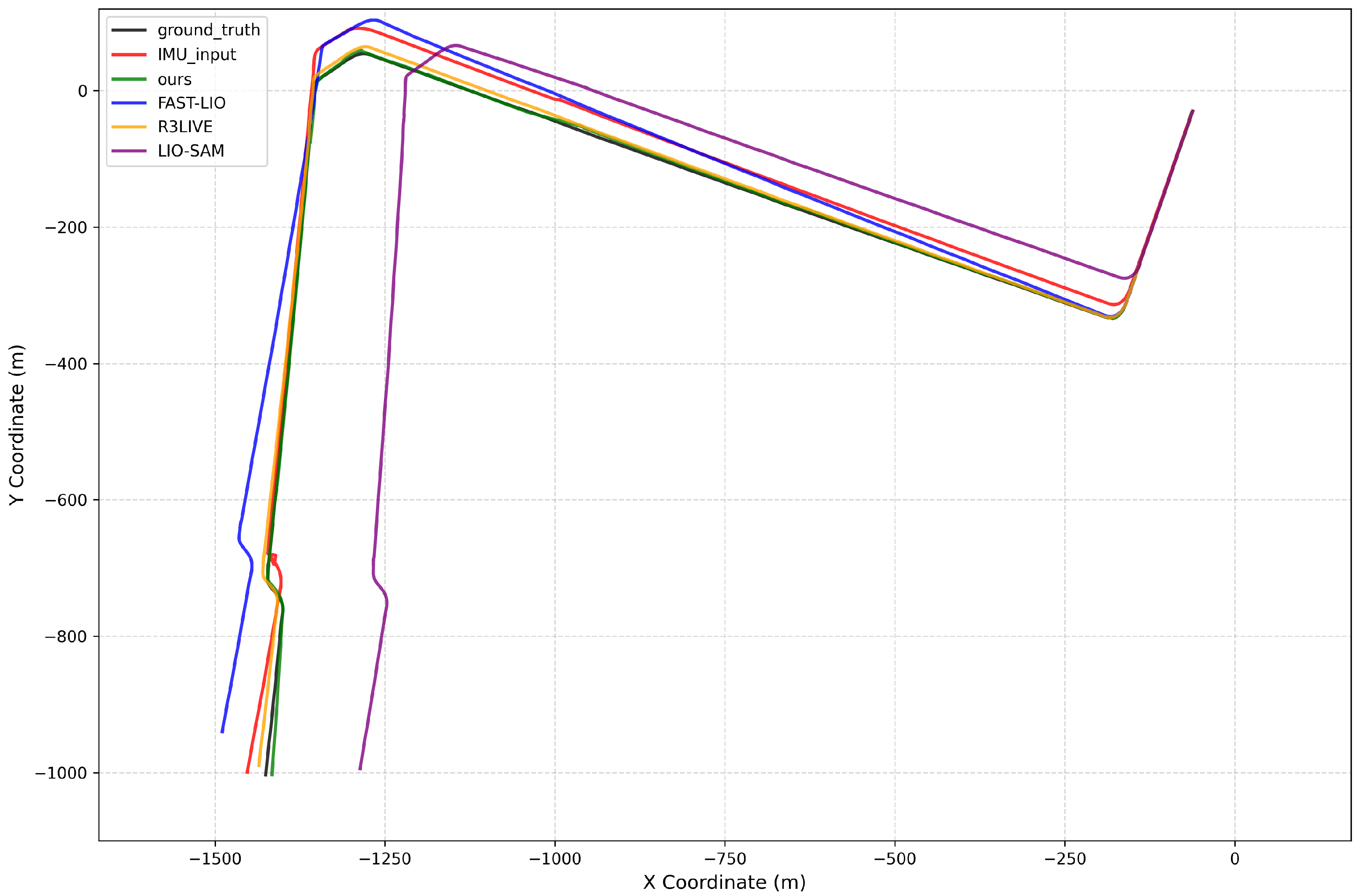
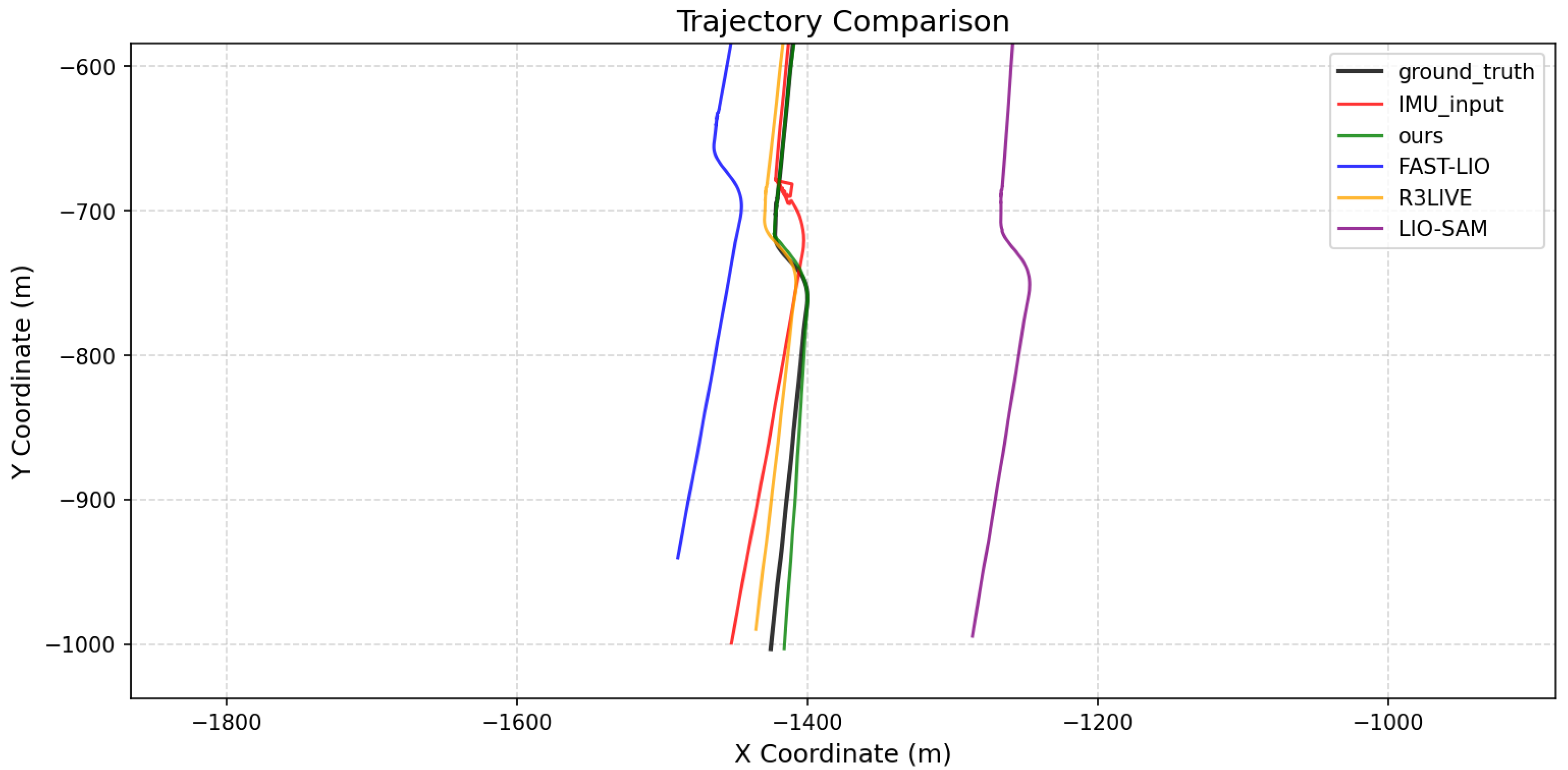
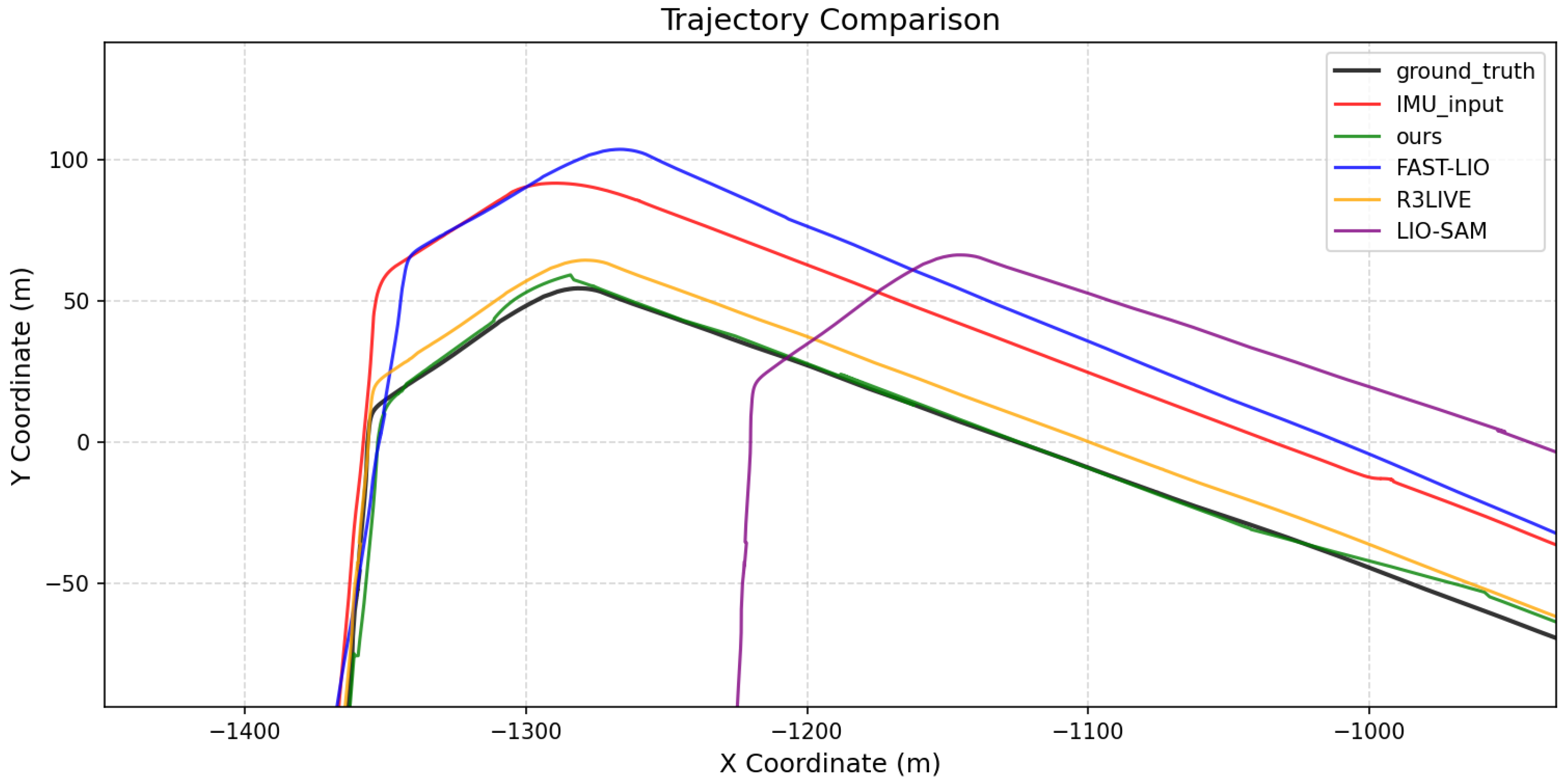
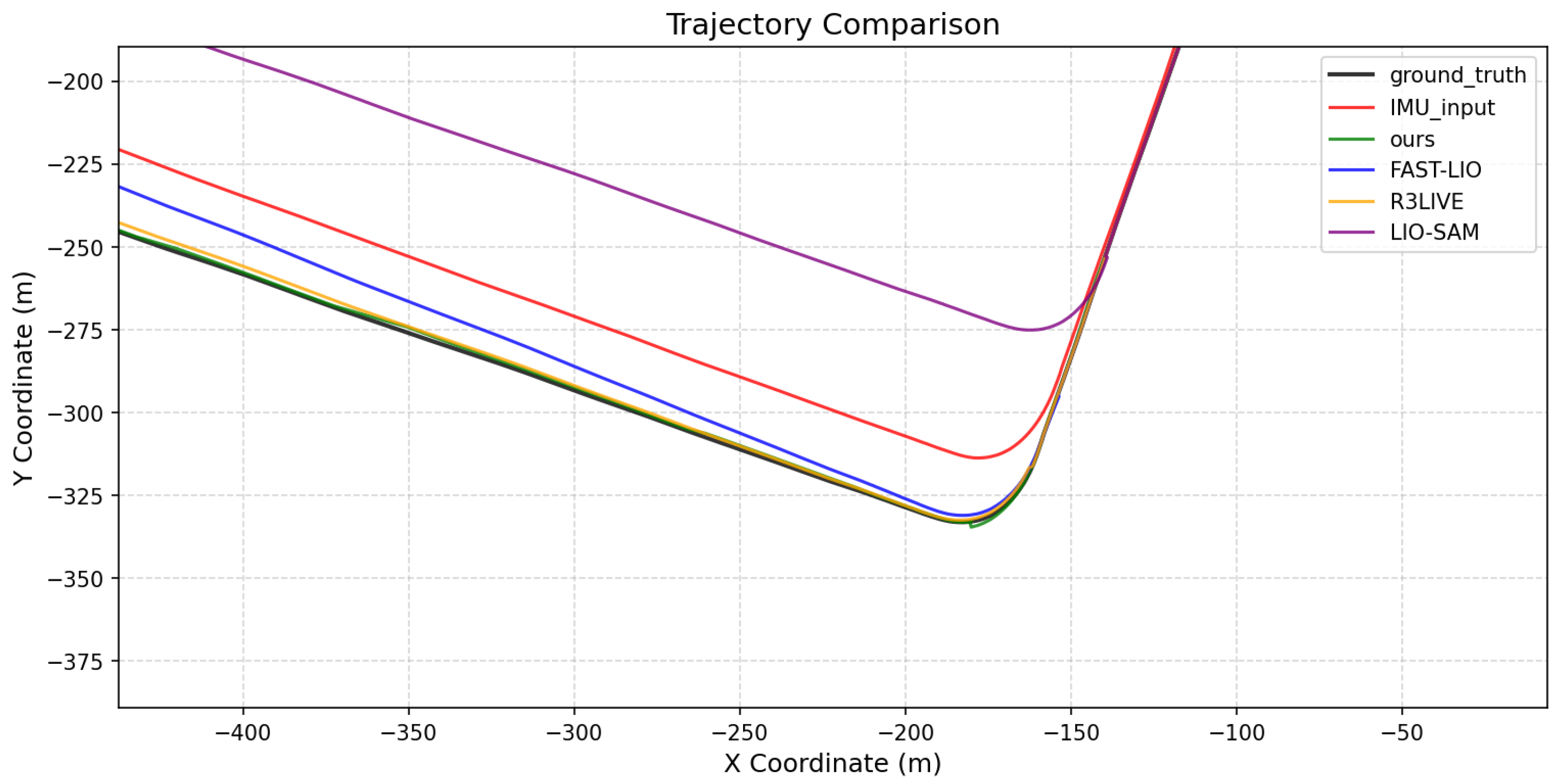
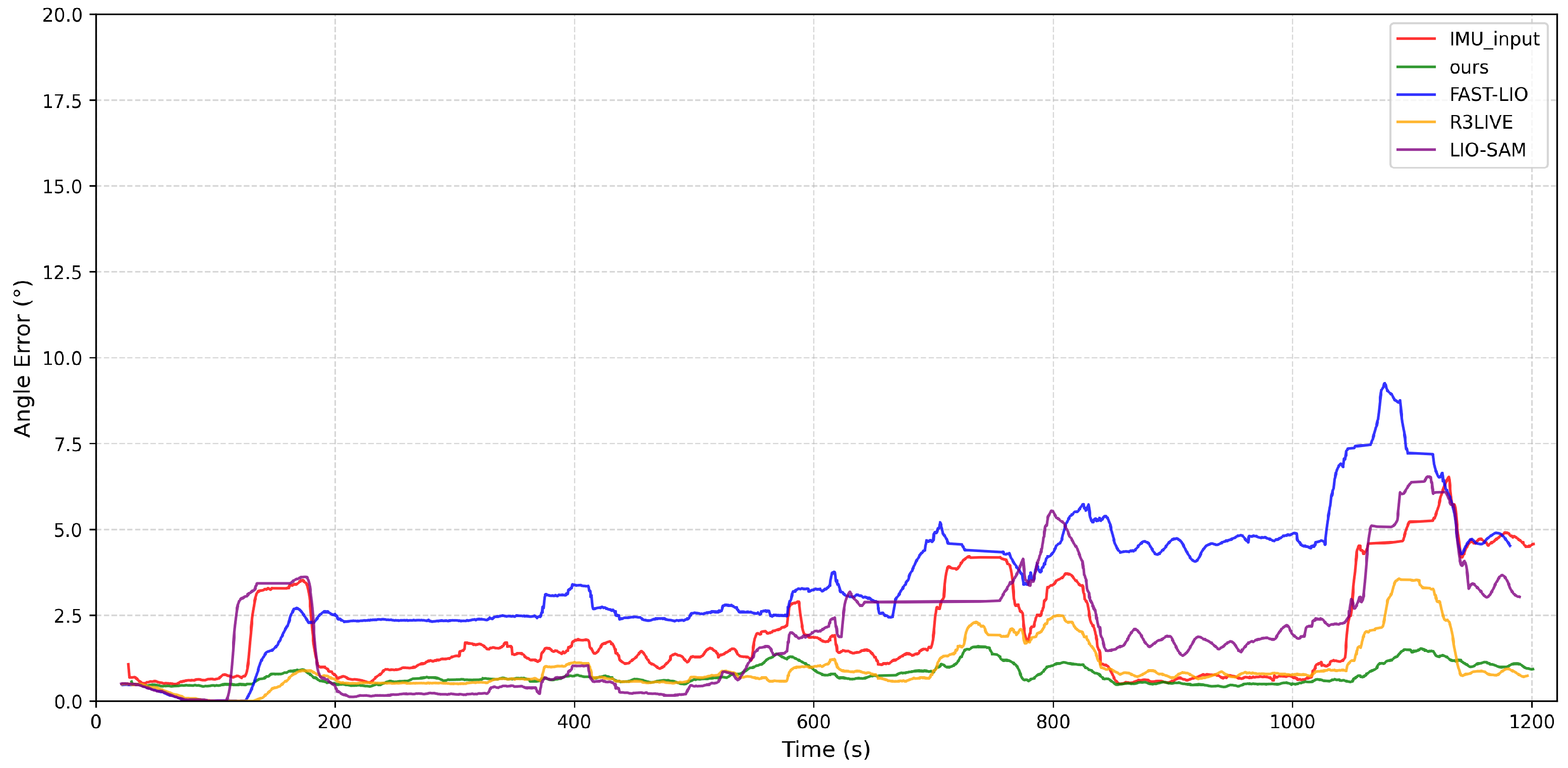
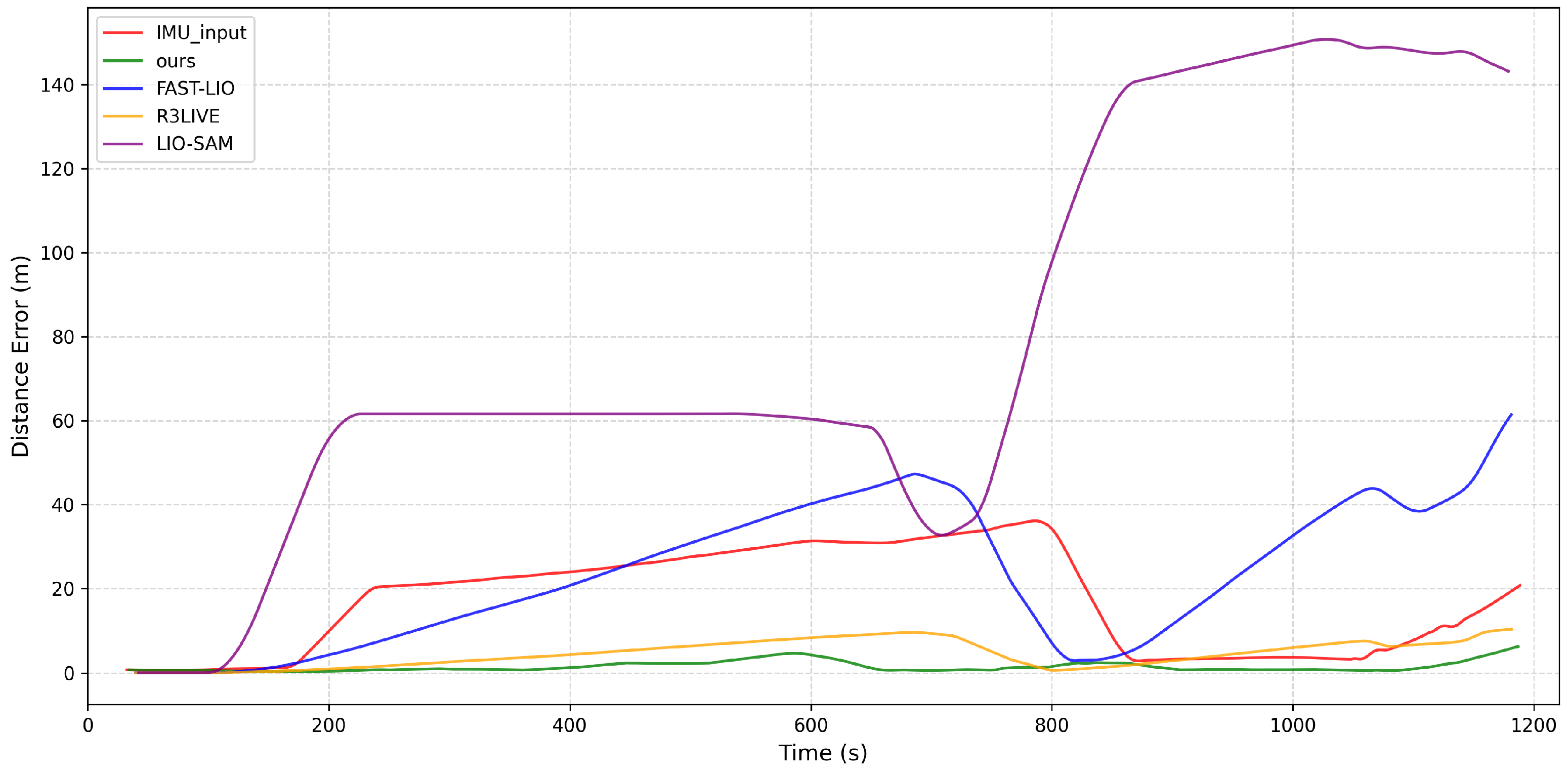
The experimental trajectory started from the origin ( 61 , 29 ) and ended at the coordinate ( 1425 , 1003 ) . The vehicle passed through a curve at the position ( 170 , 382 ) m , followed by a double curve at ( 1130 , 40 ) m , and finally reached the destination after passing through a reverse curve at ( 1421 , 722 ) m . The algorithm proposed in this study consistently maintained a high degree of agreement with the real trajectory, controlling the overall deviation within a manageable range without the need for cumulative error correction. Figure 2 shows the continuous positioning comparison results covering various scenarios. Figure 3, Figure 4 and Figure 5 represent the positioning comparison results for the three scenarios: the segmented left-turn maneuver, the lateral lane-change, and the right-angle right-turn maneuver. The angle error results are shown in Figure 6, the trajectory error results are shown in Figure 7. In contrast, the integrated position estimation method using the IMU + wheel odometer exhibited significant cumulative deviation, resulting in limited localization accuracy.
Table 2 presents the quantitative comparison results of localization errors between the two schemes:
The configuration of model parameters and the implementation details are shown in Table 3. The experimental results indicate that the proposed method achieves a significant improvement in localization accuracy compared to the traditional IMU-wheel odometer integration scheme, specifically the Minimum Absolute Error (MinAE) of the proposed method is reduced from 0.0717 to 0.0154, representing an accuracy improvement of approximately 78%, which demonstrates its potential to achieve ultra-high centimeter-level accuracy. The Mean Absolute Error (MeanAE) is sharply reduced from 16.8184 to 9.2175, with a decrease of 45.2%, indicating a fundamental improvement in overall localization accuracy and stability. Most critically, the Maximum Absolute Error (MaxAE) is drastically reduced from 38.7835 to 1.5857, with a reduction rate of up to 95.9%. This fully verifies that the proposed method can effectively suppress the unavoidable error accumulation and divergence problems in traditional schemes, significantly enhancing the robustness of the system during long-term operation. These data collectively confirm that the strategy adopted in this study—integrating semantic landmarks, a prior cognitive map, and a continuous attractor network—can fundamentally address the inherent defects of pure integrated localization by providing absolute observation constraints and environmental structure priors, ultimately achieving high-precision, high-stability, and high-reliability spatial state estimation.

4. Conclusions

This study presents a robust biomimetic autonomous localization framework tailored for the extreme challenges of GNSS-denied and unstructured coal mine roadways. By synergizing mammalian-inspired cognitive mechanisms with roadway semantic data, the proposed system addresses the critical limitations of cumulative drift and perceptual aliasing inherent in traditional odometry.
The framework introduces three primary technical advancements. First, the integration of roadway signs as absolute spatial anchors provides a semantic-level correction mechanism that effectively bounds long-distance estimation errors. Second, the optimized head direction cell model, enhanced by kinematic constraints and drift correction factors, ensures high-precision angular perception. Third, the incorporation of boundary-adaptive and semantic constraint terms into the CAN effectively regulates path integration, preventing trajectory divergence in feature-sparse environments.
Comprehensive evaluations against representative solutions demonstrate that our approach consistently maintains superior trajectory consistency and heading stability. While classical frameworks offer innovative bio-inspired topological or semantic mapping, their practical deployment in underground mining is often constrained by high computational overhead and an excessive dependency on high-quality visual features, which are frequently unavailable in dusty, low-illumination, and repetitive roadway scenes. By contrast, our framework leverages a lightweight, asynchronous architecture and robust semantic constraints, providing a more scalable and reliable solution. The experimental results validate that the proposed system significantly reduces localization uncertainty and satisfies the real-time operational requirements of intelligent mining vehicles, thereby contributing to the advancement of coal mine intrinsic safety.

Author Contributions

Conceptualization, M.Y. and B.Z.; Methodology, M.Y., Z.Z. and X.Z.; Validation, X.Z.; Investigation, Z.Z. and J.Z.; Resources, J.Z.; Data curation, X.Z. and B.C.; Writing—review & editing, B.C.; Supervision, J.Z. and B.Z.; Project administration, Z.Z. All authors have read and agreed to the published version of the manuscript.

Funding

This research received no external funding.

Data Availability Statement

The data presented in this study are available on request from the corresponding author due to confidentiality constraints.

Conflicts of Interest

The authors declare no conflicts of interest.

Appendix A. Direction Perception Model: Detailed Formulation

Appendix A.1. Biological Foundation and Basic Activation

The model is inspired by head direction cells in the rat presubiculum, which exhibit direction-selective firing patterns. The basic activation function is defined as follows:
θ i HD ( t ) = cos φ ( t ) δ i
where φ ( t ) is the real-time direction angle and δ i is the preferred direction:
δ i = 2 π i N , i = 1 , 2 , , N
with N representing the total number of preferred directions in the cell population.

Appendix A.2. Angular Velocity Regulation and Kinematic Adaptation

The angular velocity regulation signal is generated based on population activation:
ω reg ( t ) = η ω · i = 1 N θ i HD ( t ) · δ i φ ( t )
where η ω is the angular velocity balance factor. Kinematic constraints are incorporated through a modified activation function:
θ i HD ( t ) = cos φ ( t ) δ i · exp ω ( t ) ω opt ( t ) 2 2 σ ω 2

Appendix A.3. Trajectory Optimization and Multi-Source Fusion

The optimal angular velocity ω opt ( t ) is obtained by minimizing the cost function:
J = t t + T λ 1 p ( τ ) p ref ( τ ) 2 + λ 2 φ ( τ ) φ ref ( τ ) 2 + λ 3 ω 2 ( τ ) d τ
Multi-source direction estimation integrates IMU, odometer, and trajectory information:
φ ^ ( t ) = φ IMU ( t ) + K 1 φ odom ( t ) φ IMU ( t ) + K 2 φ traj ( t ) φ IMU ( t )

Appendix A.4. Motion Accumulation and Drift Correction

Relative displacement in preferred directions is quantified as follows:
Δ d i ( t ) = η d t 0 t v ( τ ) · θ i HD ( τ ) d τ
Angular drift during long-term operation is suppressed by the following:
ω correct ( t ) = k c · d d t φ ( t ) φ global ( t )
Table A1. Parameter configuration and implementation details.
Parameter DescriptionValue
Angular velocity tuning parameter σ ω = 0.15 rad / s
Drift correction factor β = 0.8
Sensor fusion weight (IMU) K 1 = 0.4
Sensor fusion weight (odometry) K 2 = 0.3
Cost function weight (position tracking) λ 1 = 1.0
Cost function weight (direction consistency) λ 2 = 0.7
Cost function weight (motion smoothness) λ 3 = 0.3

Appendix B. Detailed Joint Likelihood Matching and PnP Implementation

Appendix B.1. Joint Likelihood Matching Formulation

The joint likelihood matching process consists of three computational steps:
1. Text Semantic Similarity Calculation:
For OCR result semantic _ label obs , the semantic embedding vector is obtained via BERT fine-tuned on underground signage. Cosine similarity with map landmarks is computed as follows:
s text = e obs · e i | e obs | · | e i |
where e obs and e i are semantic embedding vectors of observed and landmark texts.
2. Spatial Distance Similarity Calculation:
Based on CAN activity packet peak pose ( x pc , y pc , θ pc ) , weighted spatial distance integrates position and heading errors:
d space = ( x pc , y pc ) ( x i , y i ) 2 + κ · angle _ diff ( θ pc , θ n i )
where θ n i is derived from landmark normal vector n i , and κ = 0.8 weight heading error.
3. Joint Likelihood Optimization:
The fused likelihood function combines text and spatial similarities:
m i * = arg max i α · s text + ( 1 α ) · exp d space 2 2 σ d 2
with α = 0.6 balancing text–spatial priorities and σ d = 1.5 m accounting for pose estimation accuracy.

Appendix B.2. PnP Optimization Implementation

Two–Three-Dimensional Correspondence Establishment: Pixel coordinates p j = ( u j , v j ) T of text bounding box corners are extracted ( j = 1 , 2 , 3 , 4 ). World coordinates P w j are computed using landmark physical size s i = ( W i , H i ) and 3D position p i .
EPnP Initial Pose Estimation: The Efficient PnP algorithm solves initial rotation matrix R init and translation vector t init , representing 3D points as control point weighted sums.
Reprojection Error Minimization:
Non-linear optimization refines the pose estimate:
min R , t j = 1 4 p j π ( R , t , K , P w j ) 2 + λ · n cam R · n i 2
where π ( · ) is the perspective projection function, and λ = 0.5 weight orientation constraints.
Pose Transformation:
The optimized camera pose ( R opt , t opt ) is transformed to vehicle coordinates using extrinsic matrix T cam body .
After extensive cross-validation in diverse underground mining scenarios, the system parameters were optimized to achieve the best trade-off between association accuracy, computational efficiency, and robustness to environmental variations. The following parameters demonstrated stable performance within ± 8 % variation ranges:
Table A2. System parameters optimized through cross-validation in diverse underground mining scenarios. All parameters exhibit stable performance within a ± 8 % variation range.
Parameter DescriptionValue
Text–spatial weight α = 0.6 ( [ 0.55 , 0.65 ] )
Spatial tolerance σ d = 1.5 m
Heading error weight κ = 0.8 ( [ 0.72 , 0.88 ] )
Orientation constraint weight λ = 0.5 ( [ 0.45 , 0.55 ] )

References

  1. Cadena, C.; Carlone, L.; Carrillo, H.; Latif, Y.; Scaramuzza, D.; Neira, J.; Reid, I.; Leonard, J.J. Past, Present, and Future of Simultaneous Localization and Mapping: Toward the Robust-Perception Age. IEEE Trans. Robot. 2016, 32, 1309–1332. [Google Scholar] [CrossRef]
  2. Zafari, F.; Gkelias, A.; Leung, K.K. A Survey of Indoor Localization Systems and Technologies. IEEE Commun. Surv. Tutor. 2019, 21, 2568–2599. [Google Scholar] [CrossRef]
  3. Mao, J.; Hu, X.; Zhang, L.; He, X.; Milford, M. A Bio-Inspired Goal-Directed Visual Navigation Model for Aerial Mobile Robots. J. Intell. Robot. Syst. 2020, 100, 289–310. [Google Scholar] [CrossRef]
  4. Honkanen, A.; Adden, A.; da Silva Freitas, J.; Heinze, S. The Insect central complex and the neural basis of Navigation Strategies. J. Exp. Biol. 2019, 222, 1–5. [Google Scholar] [CrossRef] [PubMed]
  5. O’Keefe, J.; Dostrovsky, J. The hippocampus as a spatial map. Preliminary evidence from unit activity in the freely-moving rat. Brain Res. 1971, 34, 171–175. [Google Scholar] [CrossRef]
  6. Moser, E.I.; Kropff, E.; Moser, M.B. Place cells, grid cells, and the brain’s spatial representation system. Annu. Rev. Neurosci. 2008, 31, 69–89. [Google Scholar] [CrossRef] [PubMed]
  7. Angelo, A.; Gerstner, W. Spatial cognition and neuro-mimetic navigation: A model of hippocampal place cell activity. Biol. Cybern. 2000, 83, 287–299. [Google Scholar] [CrossRef]
  8. Milford, M.J.; Wyeth, G.F. Mapping a suburb with a single camera using a biologically inspired SLAM system. IEEE Trans. Robot. 2008, 24, 1038–1053. [Google Scholar] [CrossRef]
  9. Milford, M.; Wyeth, G. Persistent navigation and mapping using a biologically inspired SLAM system. Int. J. Robot. Res. 2010, 29, 1131–1153. [Google Scholar] [CrossRef]
  10. Ball, D.; Heath, S.; Wiles, J.; Wyeth, G.; Corke, P.; Milford, M. OpenRatSLAM: An open source brain-based SLAM system. Auton. Robot. 2013, 34, 149–176. [Google Scholar] [CrossRef]
  11. Tejera, G. Bio-Inspired Robotics: A Spatial Cognition Model integrating Place Cells, Grid Cells and Head Direction Cell. J. Intell. Robot. Syst. 2018, 91, 85–99. [Google Scholar] [CrossRef]
  12. Chen, M.; Tian, D. Bionic SLAM Algorithm Based on Multi-Scale Grid Cell to Place Cell. J. -Comput.-Aided Des. Comput. Graph. 2021, 33, 712–723. [Google Scholar] [CrossRef]
  13. Liu, D.; Wu, J.; Du, Y.; Zhang, R.; Cong, M. SBC-SLAM: Semantic Bioinspired Collaborative SLAM for Large-Scale Environment Perception of Heterogeneous Systems. IEEE Trans. Instrum. Meas. 2024, 73, 5018110. [Google Scholar] [CrossRef]
  14. Milford, M.J.; Wyeth, G.F. SeqSLAM: Visual route-based navigation for sunny summer days and stormy winter nights. In Proceedings of the 2012 IEEE International Conference on Robotics and Automation, Saint Paul, MN, USA, 14–18 May 2012; pp. 1643–1649. [Google Scholar] [CrossRef]
  15. Tian, Z.; Huang, W.; He, T.; He, P.; Qiao, Y. Detecting Text in Natural Image with Connectionist Text Proposal Network; Springer: Cham, Switzerland, 2016. [Google Scholar]
  16. Zhou, X.; Yao, C.; Wen, H.; Wang, Y.; Zhou, S.; He, W.; Liang, J. EAST: An Efficient and Accurate Scene Text Detector. In Proceedings of the 2017 IEEE Conference on Computer Vision and Pattern Recognition (CVPR), Honolulu, HI, USA, 21–26 July 2017; pp. 2642–2651. [Google Scholar] [CrossRef]
  17. Baek, Y.; Lee, B.; Han, D.; Yun, S.; Lee, H. Character Region Awareness for Text Detection. In Proceedings of the 2019 IEEE/CVF Conference on Computer Vision and Pattern Recognition (CVPR), Long Beach, CA, USA, 15–20 June 2019; pp. 9357–9366. [Google Scholar] [CrossRef]
  18. Li, X.; Wang, W.; Hou, W.; Liu, R.-Z.; Lu, T.; Yang, J. Shape Robust Text Detection with Progressive Scale Expansion Network. arXiv 2018, arXiv:1806.02559. [Google Scholar] [CrossRef]
  19. Liu, X.; Liang, D.; Yan, S.; Chen, D.; Qiao, Y.; Yan, J. FOTS: Fast Oriented Text Spotting with a Unified Network. In Proceedings of the 2018 IEEE/CVF Conference on Computer Vision and Pattern Recognition, Salt Lake City, UT, USA, 18–23 June 2018; pp. 5676–5685. [Google Scholar] [CrossRef]
  20. Lyu, P.; Liao, M.; Yao, C.; Wu, W.; Bai, X. Mask TextSpotter: An End-to-End Trainable Neural Network for Spotting Text with Arbitrary Shapes. In Computer Vision—ECCV 2018; Lecture Notes in Computer Science; Ferrari, V., Hebert, M., Sminchisescu, C., Weiss, Y., Eds.; Springer: Cham, Switzerland, 2018; Volume 11218. [Google Scholar]
  21. Liao, M.; Lyu, P.; He, M.; Yao, C.; Wu, W.; Bai, X. Mask TextSpotter: An End-to-End Trainable Neural Network for Spotting Text with Arbitrary Shapes. IEEE Trans. Pattern Anal. Mach. Intell. 2019, 1, 532–548. [Google Scholar] [CrossRef]
  22. Liao, M.; Pang, G.; Huang, J.; Hassner, T.; Bai, X. Mask TextSpotter v3: Segmentation Proposal Network for Robust Scene Text Spotting. In Computer Vision—ECCV 2020; Lecture Notes in Computer Science; Vedaldi, A., Bischof, H., Brox, T., Frahm, J.M., Eds.; Springer: Cham, Switzerland, 2020; Volume 12356. [Google Scholar]
  23. Hafting, T.; Fyhn, M.; Molde, N.S.; Moser, M.-B.; Moser, E.I. Microstructure of a spatial map in the entorhinal cortex. Nature 2005, 436, 801–806. [Google Scholar] [CrossRef]
  24. Samsonovich, A.V.; McNaughton, B.L. Path integration and cognitive mapping in a continuous attractor neural network model. J. Neurosci. 1997, 17, 5900–5920. [Google Scholar] [CrossRef]
  25. Fiete, I.R.; Burak, Y.; Moser, M.B. Representation of geometric borders in the entorhinal cortex. Science 2008, 322, 1865–1868. [Google Scholar] [CrossRef] [PubMed]
  26. Wang, L.; Chen, X.; Li, J. Multi-sensor fusion for velocity estimation of mobile robots based on Kalman filter. IEEE Trans. Instrum. Meas. 2020, 69, 5632–5641. [Google Scholar]
  27. Li, H.; Zhang, Y.; Wang, Z. Motion-driven continuous electronics-15-00528 network for robot pose estimation. Robot Auton. Syst. 2019, 115, 118–128. [Google Scholar]
  28. Taube, J.S.; Muller, R.U.; Ranck, J.B., Jr. Head-direction cells recorded from the postsubiculum in freely moving rats. I. Description and quantitative analysis. J. Neurosci. 1990, 10, 420–435. [Google Scholar] [CrossRef]
  29. Zhang, X.; Liu, M.; Zhou, B. Obstacle detection for underground mining robots based on 3D LiDAR and semantic segmentation. Autom. Constr. 2022, 139, 104268. [Google Scholar]
  30. Chen, W.; Yang, C.; Li, D. Semantic landmark detection for indoor robot localization using YOLOv8 and template matching. IEEE Access 2023, 11, 45678–45690. [Google Scholar]
  31. Xu, W.; Zhang, F. FAST-LIO: A Fast, Robust LiDAR-Inertial Odometry Package by Tightly-Coupled Iterated Kalman Filter. IEEE Robot. Autom. Lett. 2021, 6, 3317–3324. [Google Scholar] [CrossRef]
  32. Lin, J.; Zhang, F. R3LIVE: A Robust, Real-time, RGB-colored, LiDAR-Inertial-Visual tightly-coupled state Estimation and mapping package. In Proceedings of the 2022 International Conference on Robotics and Automation (ICRA), Philadelphia, PA, USA, 23–27 May 2022; pp. 10672–10678. [Google Scholar] [CrossRef]
  33. Shan, T.; Englot, B.; Meyers, D.; Wang, W.; Ratti, C.; Rus, D. LIO-SAM: Tightly-coupled Lidar Inertial Odometry via Smoothing and Mapping. In Proceedings of the 2020 IEEE/RSJ International Conference on Intelligent Robots and Systems (IROS), Las Vegas, NV, USA, 24 October 2020–24 January 2021; pp. 5135–5142. [Google Scholar] [CrossRef]
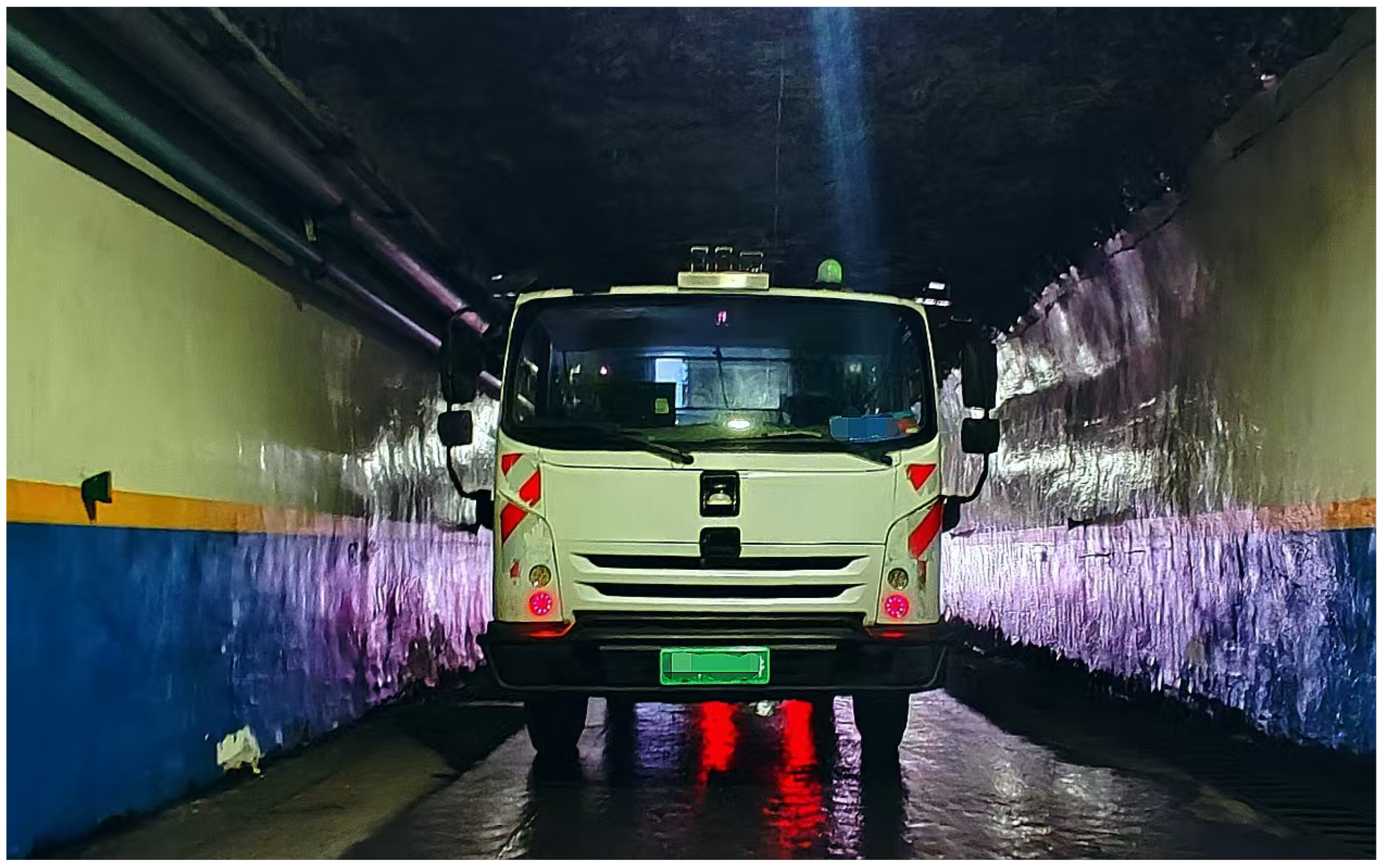
Figure 1. The underground driverless vehicles used in the experiment.
Electronics 15 00528 g001
Figure 2. True value and comparison of trajectory with the IMU + wheel odometer and this method.
Electronics 15 00528 g002
Figure 3. Represents the segmented left-turn maneuver.
Electronics 15 00528 g003
Figure 4. Represents the lateral lane-change.
Electronics 15 00528 g004
Figure 5. Represents the right-angle right-turn maneuver.
Electronics 15 00528 g005
Figure 6. Angle error.
Electronics 15 00528 g006
Figure 7. Trajectory error.
Electronics 15 00528 g007
Table 1. Experimental hardware configuration.
CategoryDevice ModelTechnical Specifications
Main ControllerMiiVii AD10
  • Platform: Jetson AGX Orin 32 GB
  • CPU: 8-core Arm Cortex-A78AE v8.2
  • Architecture: 64-bit
Motion SensorsWire-Controlled Chassis ECU
  • Output: Real-time velocity
  • Output: Wheel steering angle
  • Interface: CAN bus
Data Sources
  • image: basler (10 Hz)
  • IMU: Ouster built-in IMU (100 Hz)
  • Kinematic estimation: ECU speed/angle (100 Hz)
Carrier PlatformModified Test Vehicle
  • Type: Underground mining vehicle
  • Integrated devices: LiDAR/ECU
Table 2. Quantitative comparison of localization errors.
Localization SchemeMinAEMeanAEMaxAEAngle MeanAE ( · )
IMU + Wheel Odometer Integration0.07116.81838.7831.812
FAST-LIO [31]0.04423.89870.2373.230
R3LIVE [32]0.0454.59811.5040.883
LIO-SAM [33]0.03579.860153.3281.657
Ours0.0159.2171.5850.748
MinAE = Minimum Absolute Error; MeanAE = Mean Absolute Error; MaxAE = Maximum Absolute Error.
Table 3. Model parameters’ configuration and implementation details.
Parameter DescriptionValue
Mapping coefficient for x-axis velocity c x = 1.0
Mapping coefficient for y-axis velocity c y = 1.0
Mapping coefficient for angular velocity c θ = 1.0
Intensity coefficient for heading constraint k h = 1.2
Modulation bandwidth for heading constraint σ θ = 0.15 rad
Excitation gain coefficient for semantic input k s = 1.2
Correction range parameter for semantic input σ s = 0.8 m
Heading correction weight for semantic input κ = 0.7
Suppression gain coefficient for boundary constraint k b = 1.5
Disclaimer/Publisher’s Note: The statements, opinions and data contained in all publications are solely those of the individual author(s) and contributor(s) and not of MDPI and/or the editor(s). MDPI and/or the editor(s) disclaim responsibility for any injury to people or property resulting from any ideas, methods, instructions or products referred to in the content.