Article

Industrial-Grade Differential Interference Contrast Inspection System for Unpatterned Wafers

1
Skyverse Technology Co., Ltd., Shenzhen 518110, China
2
School of Mechanical Engineering, Xi’an Jiaotong University, Xi’an 710049, China
*
Author to whom correspondence should be addressed.
These authors contributed equally to this work.
Electronics 2026, 15(3), 518; https://doi.org/10.3390/electronics15030518
Submission received: 2 December 2025 / Revised: 16 January 2026 / Accepted: 17 January 2026 / Published: 26 January 2026

Abstract

In the field of optical inspection for unpatterned wafer surfaces, this paper presents a novel inspection system designed to meet the semiconductor industry’s growing demand for high efficiency and cost-effectiveness. The system is built around the principles of simplicity, stability, speed, and low cost. Its core is a low-speed stepping rotary line-scan architecture. This architecture is integrated with a two-step phase-shifting algorithm. The combination leverages line-scan differential interference contrast (DIC) technology. This aims to transform DIC technology—traditionally used for detailed observation—into an industrialized solution capable of rapid, accurate quantitative measurement. Experimental validation on an equivalent platform confirms strong performance. The system achieves an imaging uniformity exceeding 85% across dual channels. Its Modulation Transfer Function (MTF) value is greater than 0.55 at 71.8 lp/mm. The vertical detection clearly resolves 3 nm standard height steps. Additionally, the throughput exceeds 80 wafers per hour. The proposed line-scan DIC system achieves both high inspection accuracy and industrial-grade scanning speed, delivering robust performance and reliable operation.

1. Introduction

As the cornerstone of the entire semiconductor industry chain, the surface quality of silicon wafers has become a critical determinant of the performance, reliability, and manufacturing yield of final semiconductor devices [1]. Unpatterned wafers serve as the foundational substrate for hundreds of subsequent fabrication processes. Even minor surface defects can be significantly amplified during key steps such as photolithography, etching, and thin-film deposition. These defects may evolve into fatal flaws, including circuit opens, short circuits, or parameter deviations. They directly compromise device performance and long-term reliability. Consequently, implementing comprehensive, precise, and efficient surface defect inspection on unpatterned wafers at the earliest stage of the manufacturing process is an essential measure to ensure product quality and process stability.
Unpatterned wafer inspection systems commonly integrate dark-field scattering and bright-field differential interference contrast (DIC) detection to achieve comprehensive defect coverage [2]. Dark-field detection employs laser grazing-incidence illumination to capture scattered light from high-aspect-ratio surface features—such as particles, pits, and scratches—enabling high-speed screening and serving as a cornerstone of modern inspection workflows [3]. However, this method exhibits limited sensitivity to large-area, low-topography planar defects. These defects include water stains, epitaxial haze, and post-chemical mechanical polishing (CMP) residues. The limitation arises from weak scattering signals. These signals are predominantly confined to the specular reflection direction. Consequently, it results in poor signal-to-noise ratios (SNR) [4]. Bright-field DIC is widely used to address this limitation due to its exceptional vertical resolution. It is so sensitive to sub-nanometer surface height gradients that it produces pronounced grayscale contrast, allowing reliable detection of subtle planar anomalies [5,6,7]. The advancement of semiconductor process nodes imposes higher demands on the lateral resolution and throughput of unpatterned wafer inspection. Conventional point-scanning DIC systems face inherent trade-offs [8], where their optical configurations limit spatial resolution for defect characterization, and serial scanning mechanisms constrain productivity. Emerging AI-enhanced methods offer solutions. DefectGLM employs a two-stage adaptation strategy for accurate identification of numerous defect types [9]. Meanwhile, SEM-CLIP adapts Contrastive Language-Image Pre-training for nanoscale defect detection in SEM images, incorporating specialized attention mechanisms and expert-informed text prompts to improve analysis precision [10]. These reports contain rich semantic information, such as defect location, shape, size, and class. This approach enriches defect analysis with comprehensive descriptions. These advanced methods primarily focus on computational analysis, creating a demand for more efficient and cost-effective hardware inspection platforms.
To overcome the limitations of current technologies, this paper proposes a novel bright-field detection system that combines high-speed line-scan imaging with DIC. The core innovations of this work are threefold. First, we introduce a low-speed stepping rotary line-scan architecture that mainly reconciles the inherent trade-offs between point-scanning (slow speed) and area-array scanning (difficult balance among resolution, field of view, and cost). Second, we develop and integrate a two-step phase-shifting algorithm specifically adapted for continuous-motion line-scan imaging. This enables a transition from qualitative observation to full-field, quantitative, nanometer-level height measurement. Finally, through innovative optical path and motion-control design, the system achieves high performance while significantly reducing system complexity and cost. This provides a viable pathway for translating high-precision DIC technology from the laboratory to the production line. The following sections describe the DIC optical principles and the line-scan system design. Experiments show the system improves lateral resolution from tens of micrometers to 7 μm, reliably detects 3 nm height steps, and achieves a throughput of 80 wafers per hour (300 mm diameter). This system is expected to provide a competitive industrial solution for yield control in semiconductor front-end manufacturing.

2. Optical Principles and Design

This chapter explains the core optical principles and design of the line-scan DIC inspection system. It covers the fundamental physics of DIC microscopic imaging and the phase unwrapping methods used to extract quantitative data from DIC images.

2.1. DIC Microscopic Imaging

DIC microscopy uses lateral shear of polarized light [11], splitting the imaging light wave from its copy by a small distance—smaller than the system’s resolution limit—then recombining them to create interference. This converts the sample’s phase gradient into intensity variations, greatly enhancing contrast. The technique offers high spatial resolution, no halo artifacts, and optical tomography capability.
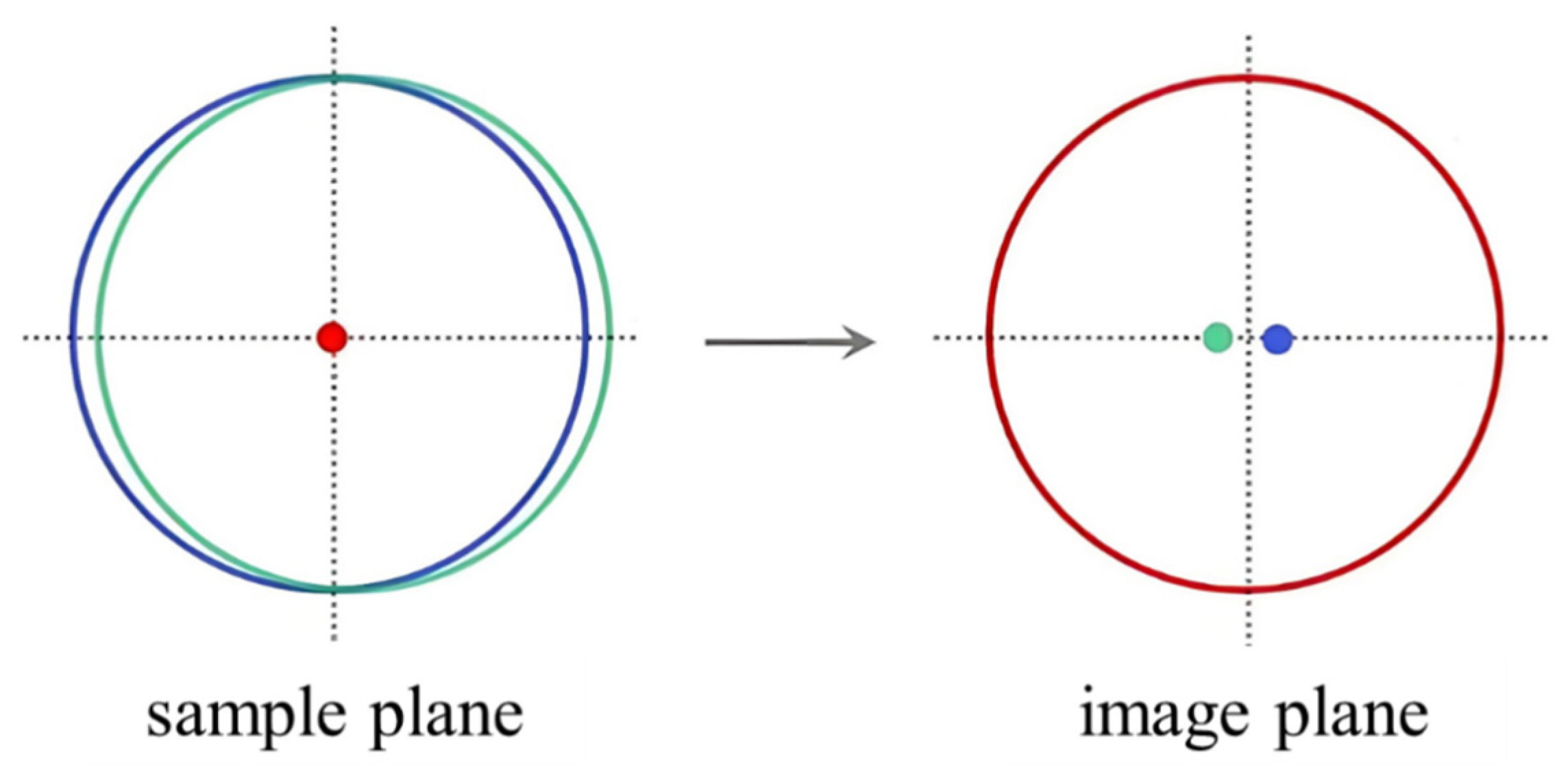
Figure 1 shows the beam splitting mechanism in a conventional DIC microscopy system. The illumination light is split into two beams separated by a small distance, each illuminating part of the sample. These beams are then collected by the objective lens and recombined at its rear focal plane. The combined light interferes at the image plane to form the DIC image.
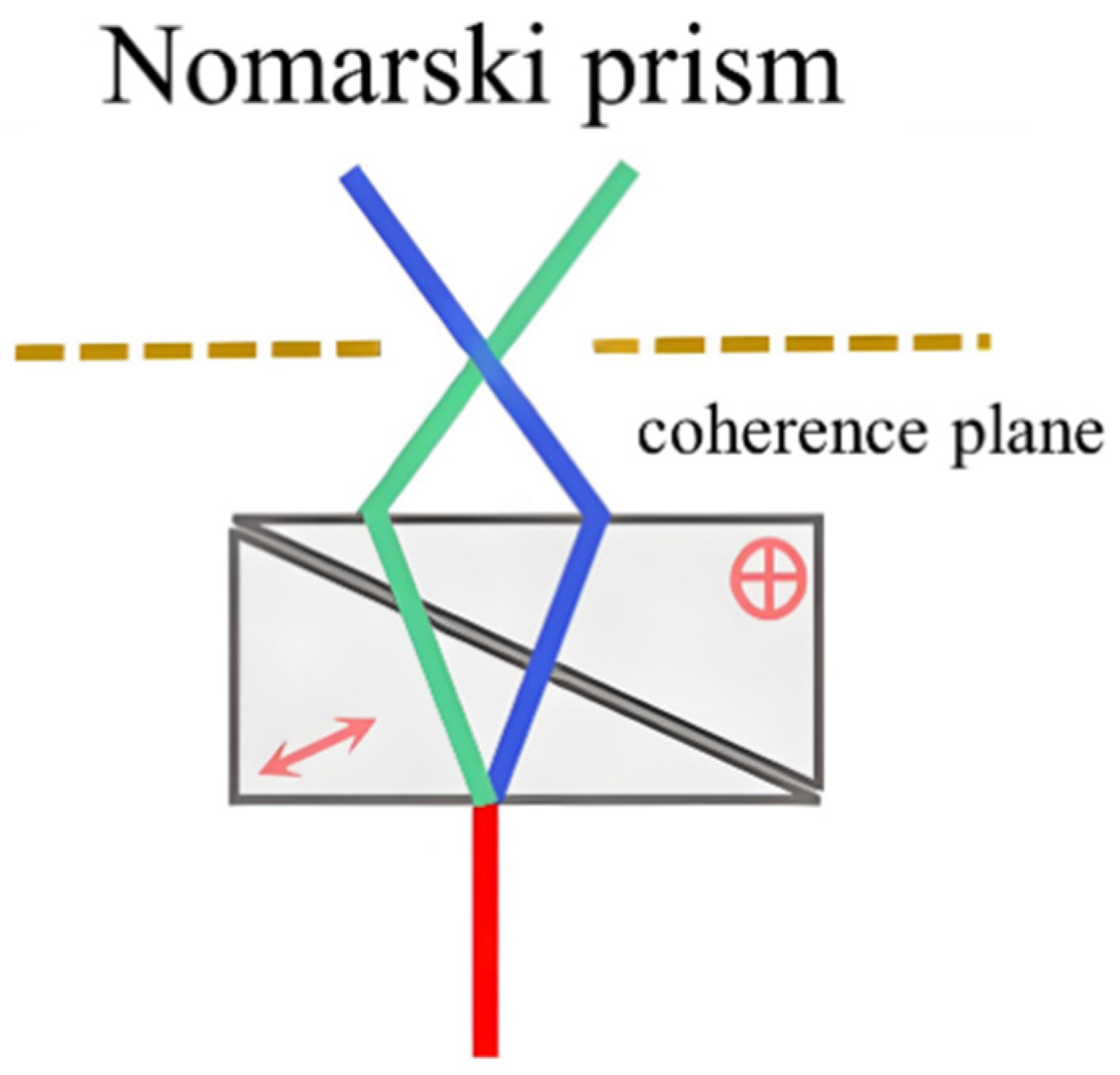
The key component for beam splitting is the Nomarski prism. As shown in Figure 2, it consists of two quartz wedge plates with optical axes perpendicular or at a specific angle to each other. The prism splits incident light into two orthogonally polarized beams, with perpendicular polarization directions and a defined separation angle. The basic principles and operation of DIC microscopy [12] are as follows:
First, polarization and shearing: light from an un-polarized source passes through a polarizer, becoming linearly polarized. It then enters the first Nomarski prism, which splits the beam into two coherent, orthogonally polarized beams separated by a small lateral displacement. This shear distance is typically below the microscope’s resolution limit, so the beams probe closely spaced points on the sample.
Second, introducing phase difference: the two sheared beams pass through the objective lens and focus onto the sample surface, where they are reflected (or transmitted). Because the beams strike slightly different positions ( Δ x ) on the surface, any height variation in that direction ( d h / d x 0 ) causes a difference in their optical paths. In reflective systems, the optical path difference (OPD) Γ is proportional to the height gradient ( d h / d x ):
Γ = Δ x ( d h / d x ) ( 2 n ) ,
h is the surface height and n is the refractive index of the surrounding medium. The OPD directly causes a phase difference between the two beams.
Furthermore, combining and interfering: the two reflected beams, carrying phase difference information, pass again through the objective lens and enter a second Nomarski prism (in a reflecting system, typically the same prism). The prism recombines them into a single beam, but they retain their orthogonal polarization states and the acquired phase difference ( δ ).
Finally, polarization analysis and imaging: the combined beam passes through an analyzer, whose polarization transmission axis is typically set at 90° to the polarizer (extinction configuration) and at 45° to the polarization directions of both sheared beams. The analyzer aligns components of the two orthogonally polarized beams into the same direction, enabling interference. The intensity of the resulting light ( I ) depends not only on background intensity but also on the phase difference between the beams. Under ideal conditions, it can be expressed as I sin 2 ( δ / 2 ) .
Since the phase difference ( δ ) is proportional to the height gradient on the sample surface, the camera-detected image intensity directly reflects the surface slope. Flat regions with zero slope appear as neutral gray, while sloped areas show brighter or darker intensities depending on the slope direction and magnitude. This produces a pseudo-3D image with strong shadow relief.

2.2. Principle of Phase Unwrapping

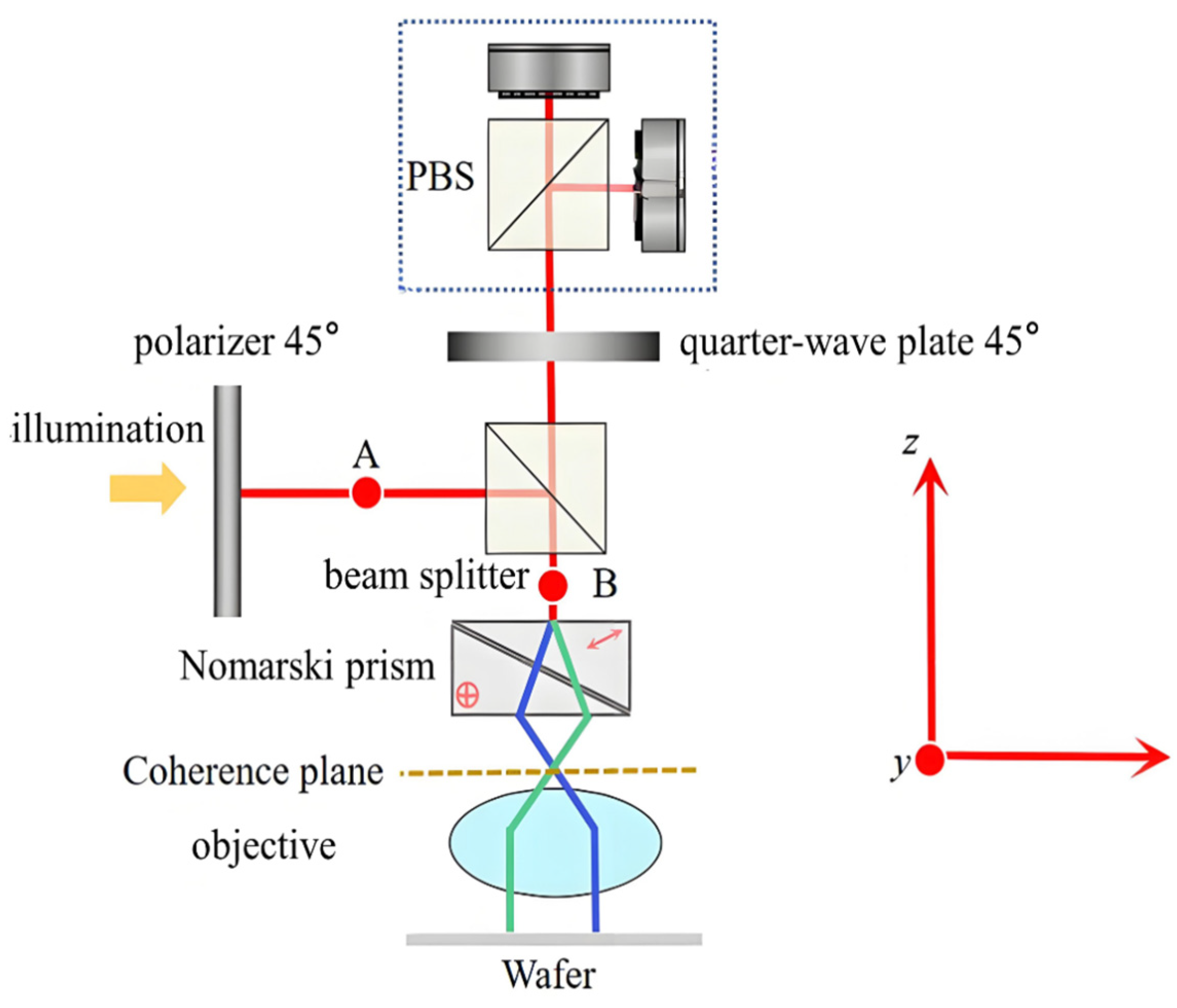
Conventional DIC images provide only phase gradient information. To achieve quantitative measurement of wafer surface defects, precise phase distribution maps can be reconstructed from the acquired intensity images. This system employs a two-step phase-shifting principle [13,14] for phase calculation, with its optical path illustrated in Figure 3.
Establish a rectangular coordinate system using the axes shown in Figure 3. After the light emitted by the source is polarized by the polarizer, its complex amplitude can be expressed as (at point A):
U 0 = A 0   exp ( i τ ) ,
A 0 represents the amplitude constant and τ denotes the initial phase introduced when light propagates to ‘point A’.
When the beam passes through the Nomarski prism along the x-axis direction of the shear axis, it is split into light beams o and e, which are spatially separated by a minute distance ( Δ x ). Both beams are collected by the objective lens and projected onto the wafer surface. If a defect of height ( h ) exists on the wafer, the phase change φ ( x , y ) in the wavefront caused by the defect can be expressed as
φ ( x , y ) = 4 π h λ ,
λ is the wavelength of the incident light.
After being reflected by the wafer and collected by the objective lens, the two light beams are combined by the Nomarski prism. The phase changes in the wavefront caused by the sample can be expressed as
φ 1 = φ ( x Δ x 2 , y ) , φ 2 = φ ( x + Δ x 2 , y ) .
Assuming the initial phase of the light beam τ = 0 , the complex amplitudes U x , U y of the two light beams emerging from the Nomarski prism can be expressed as (at point B)
U x = A 0 cos ψ exp i φ 1 exp i θ , U y = A 0 sin ψ exp i φ 2 ,
ψ represents the angle between the polarizer and the x-axis, while θ denotes the phase difference introduced by the Nomarski prism between the two light beams.
Two light beams pass through a quarter-wave plate and a polarizing beam splitter (PBS), the light intensities at the transmission and reflection surfaces of the PBS can be expressed, respectively, as
I 1 = 1 2 A 0 2 cos 2 ( 2 α ) cos 2 ψ 1 2 A 0 2 cos 2 ( 2 α ) sin 2 ψ + 1 2 A 0 2 cos 2 ψ + 1 2 A 0 2 sin 2 ψ         + A 0 2 cos ψ sin ψ sin 2 ( 2 α ) sin ( ϕ 1 ϕ 2 + θ )         + A 0 2 cos ψ sin ψ sin 2 ( 2 α ) cos 2 ( 2 α ) cos ( ϕ 1 ϕ 2 + θ )
I 2 = 1 2 A 0 2 cos 2 ( 2 α ) cos 2 ψ + 1 2 A 0 2 cos 2 ( 2 α ) sin 2 ψ + 1 2 A 0 2 cos 2 ψ + 1 2 A 0 2 sin 2 ψ         A 0 2 cos ψ sin ψ sin 2 ( 2 α ) sin ( ϕ 1 ϕ 2 + θ )         A 0 2 cos ψ sin ψ sin 2 ( 2 α ) cos 2 ( 2 α ) cos ( ϕ 1 ϕ 2 + θ )
I1 and I2 denote the light intensity at the transmission surface and reflection surface of the PBS (corresponding to the interference result of the two orthogonally polarized components).
Assuming the quarter-wave plate is oriented at 45°, I1 and I2 can be simplified to
I 1 = 1 2 A 0 2 cos 2 ψ + 1 2 A 0 2 sin 2 ψ A 0 2 cos ψ sin ψ cos ( φ 1 φ 2 + θ + π 2 ) , I 2 = 1 2 A 0 2 cos 2 ψ + 1 2 A 0 2 sin 2 ψ + A 0 2 cos ψ sin ψ cos ( φ 1 φ 2 + θ + π 2 ) ,
I 2 I 1 I 2 + I 1 = sin 2 ψ cos φ 1 φ 2 + θ + π 2
When ψ = π 4 , the differential phase of the sample can be determined using the inverse cosine function:
Δ φ x = a r c c o s ( I 2 I 1 I 2 + I 1 ) θ π 2 ,
Δ φ x is the differential phase corresponding to the sample under test. This completes the precise quantitative inversion of the DIC image.
The accuracy of extracting phase information from samples using a DIC microscopic imaging system is primarily influenced by the following factors:
The angle of the polarizer in the system determines the beam-splitting ratio of the illuminating light after passing through the Nomarski prism. The ideal angle is 45° relative to the Nomarski prism. Any angular deviation will affect the interference contrast of DIC images and reduce their SNR. According to Equation (9), if the angle between the polarizer and the Nomarski prism is not 45°, the phase cannot be solved using the arccos function, leading to inaccurate phase retrieval.
The quarter-wave plate in the system is mainly used to alter the phase of the orthogonally polarized light exiting the Nomarski prism. If its angle relative to the Nomarski prism is not 45°, the interference is described by Equations (6) and (7). Therefore, the angle of the quarter-wave plate not only affects the contrast of the interference pattern but also influences computational accuracy.
The dominant noise source in the acquired intensity images I1 and I2 is shot noise. The impact of this noise on the demodulated phase error Δ can be modeled by analyzing the variance propagation through the arccos function in Equation (7). The phase error can be approximated from the expression
Δ = arccos I 2 I 1 + n o i s e _ 1 I 2 + I 1 + n o i s e _ 2 arccos I 2 I 1 I 2 + I 1
where the standard deviation of both n o i s e _ 1 and n o i s e _ 2 are equal to I 1 + I 2 .
The derivative of the arccos function reveals that its sensitivity to input changes is not uniform across its domain. Specifically, the derivative approaches zero when the argument of arccos is near ±1. Consequently, phase calculations become highly insensitive in these regions, meaning minute actual phase variations cannot be accurately resolved. To maximize measurement sensitivity, it is therefore necessary to ensure that the phase difference to be measured is biased to operate near odd multiples of π/2, where the cosine function—and thus the arccos argument—has its maximum slope. A practical implication of this analysis is that the measurement error for a defect’s step height is minimized when the height is offset from integer multiples of λ/8.
The Time-Delay Integration (TDI) operation of the line-scan camera effectively suppresses this noise. By performing N-stage integration, the standard deviations of n o i s e _ 1 and n o i s e _ 2 are reduced to approximately I 1 + I 2 / N , thereby proportionally decreasing the phase uncertainty and enhancing height measurement precision. Furthermore, the same analysis framework indicates that illumination non-uniformity, which introduces systematic standard deviations in the denominator I 1 + I 2 across the field of view, also perturbs the phase calculation. This underscores the importance of achieving high illumination uniformity, as validated in Section 3.2.1, since a larger and more consistent signal level directly contributes to lower height measurement error.

3. Experiment and Analysis

To validate the performance of the novel line-scan DIC inspection system and assess its industrial feasibility, we built an experimental platform based on the system design. A series of performance tests and measurements were conducted. This chapter outlines the apparatus components, details the validation process and key performance results, and presents data from standard samples with in-depth analysis.

3.1. Introduction to Experimental Setup

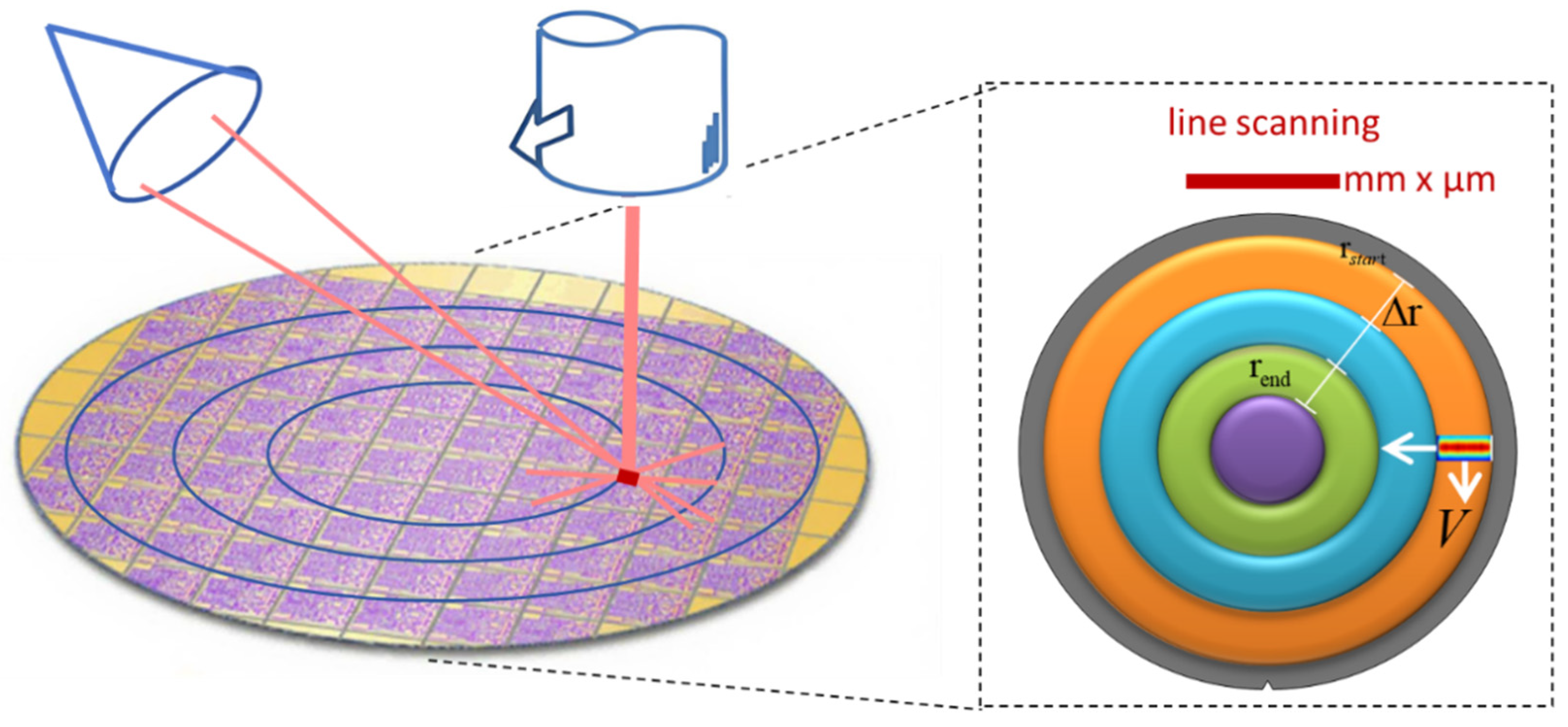
The experimental setup is mounted on an actively vibration-isolated optical platform to minimize environmental disturbances during sub-nanometer measurements. To enable rapid, seamless, and efficient full-area coverage of the circular wafer, the system employs a low-step rotary line-scan configuration. The overall system architecture is illustrated in Figure 4. Although the optical path remains unchanged, the primary innovation resides in the motion control system: the wafer is secured on a high-precision rotary stage, with the line detector precisely aligned parallel to the direction of linear stage movement—corresponding to the radial axis of the wafer.
The system achieves sequential, circular coverage scanning of the wafer surface through coordinated rotational and linear stepping motion control. The primary workflow is as follows:
1. Initial positioning: The precision scanning imaging system moves to the starting radial position ( r s t a r t ) for wafer scanning, typically near the outer edge of the wafer.
2. Single-lap line scanning: The rotary platform is activated to drive wafer rotation at a constant linear velocity ( V ). Simultaneously, the line-scan camera continuously acquires data at a preset line frequency ( f l i n e ). Upon completion of a full 360° rotation, the camera captures a complete annular image.
3. Radial stepping: The rotary stage comes to a stop or decelerates, while the precision scanning imaging system advances radially by a fixed step increment ( r ).
4. Repeat scanning: At the new radial position ( r s t a r t r ), repeat steps 2 and 3.
5. Scanning completion: This process iterates continuously until the imaging system reaches the termination radius ( r e n d ) at the inner edge of the wafer, thereby completing the scan of the entire wafer surface. All acquired annular data are subsequently reconstructed and stitched together using dedicated algorithms to generate a complete image of the wafer surface.
To ensure experimental stability and precision, the ambient temperature was maintained at 22 ± 0.5 °C with relative humidity kept below 50%. The core opto-mechanical components of the system consisted of industry-standard or custom-designed, high-performance elements, with specific models and applications listed in Table 1. The radial stepping motion of the scanning stage, fundamental to the rotary line-scan architecture, inherently carries the risk of introducing minor positioning errors. These could propagate into geometric inaccuracies and visible seams during the circumferential image stitching process. To mitigate this, we can implement a high-precision air-bearing stage to minimize motion errors and a line trigger mechanism for the camera. This synchronizes image acquisition with the stage’s angular position, effectively compensating for any minor rotational speed non-uniformity and enabling sub-pixel accuracy in image registration.

3.2. System Performance Verification

This section focuses on the core performance metrics of the system, including imaging uniformity and lateral resolution, and presents quantitative test results to verify whether the system design meets its intended objectives.

3.2.1. Imaging Uniformity

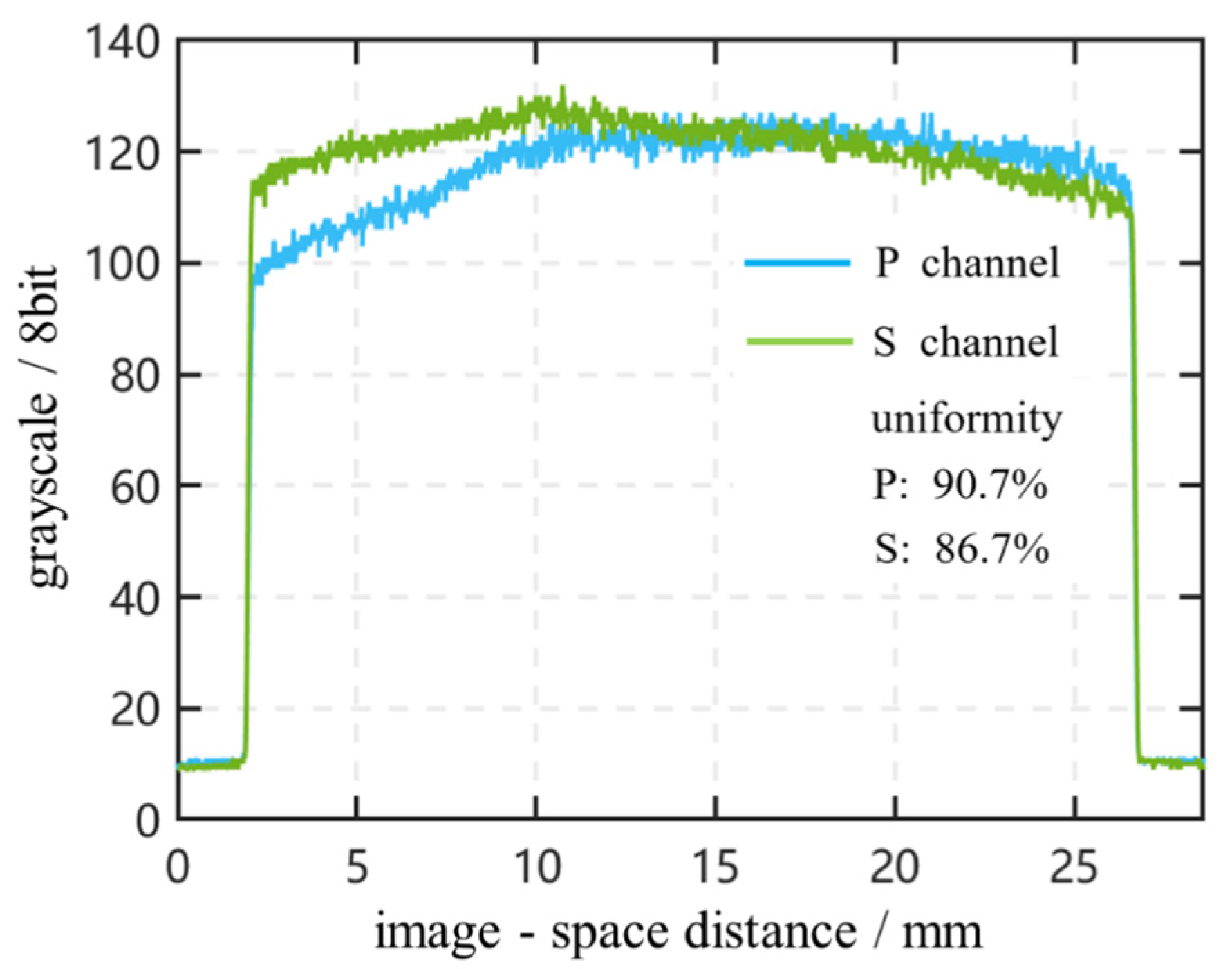
Imaging uniformity is essential for accurate quantitative measurements. Illumination variations between the central and peripheral regions result in significant SNR discrepancies. For micro- or nano-scale structures of identical dimensions, such as step features, the central region typically exhibits strong signals due to adequate illumination, whereas peripheral areas generate weaker signals owing to light attenuation, thereby increasing the likelihood of missed or false detections. These inconsistencies adversely affect the system’s reliability and measurement accuracy. To evaluate imaging uniformity, background images are acquired in orthogonal shear directions using an ultra-smooth mirror as a reference standard. The gray-level distributions along the central row and column are analyzed to compute the degree of non-uniformity, which can be expressed as 1 − (Imax-Imin)/(Imax + Imin), where Imax and Imin are the maximum and minimum gray levels of the full interference images, across the core field of view. This subsection presents the imaging uniformity performance for both P and S polarization channels.
Figure 5 illustrates the gray-scale value distribution along the image-side distance for both channels. Analysis of the uniformity metrics reveals that the imaging uniformity achieves 90.7% for the P channel and 86.7% for the S channel, respectively. The curves demonstrate a flat and stable gray-scale response across the majority of the field of view. This high level of imaging uniformity ensures a reliable and consistent background signal, supporting the system’s high-precision phase decoding and quantitative measurements, while effectively minimizing the adverse effects of imaging inhomogeneities on overall detection reliability.
This line-scan system offers structural advantages for uniformity correction. As the sensor consists of a one-dimensional array, illumination and optical correction are predominantly confined to a single dimension, thereby simplifying the correction process. In contrast, area-scan systems must address non-uniformity across a two-dimensional plane, making correction significantly more complex. By optimizing one-dimensional line illumination, the system achieves a uniformity level exceeding 85%, providing a robust foundation for the accuracy and consistency of full-range phase measurements across the wafer. This performance level is difficult to achieve with area-array scanning solutions at comparable cost and complexity.

3.2.2. Lateral Resolution

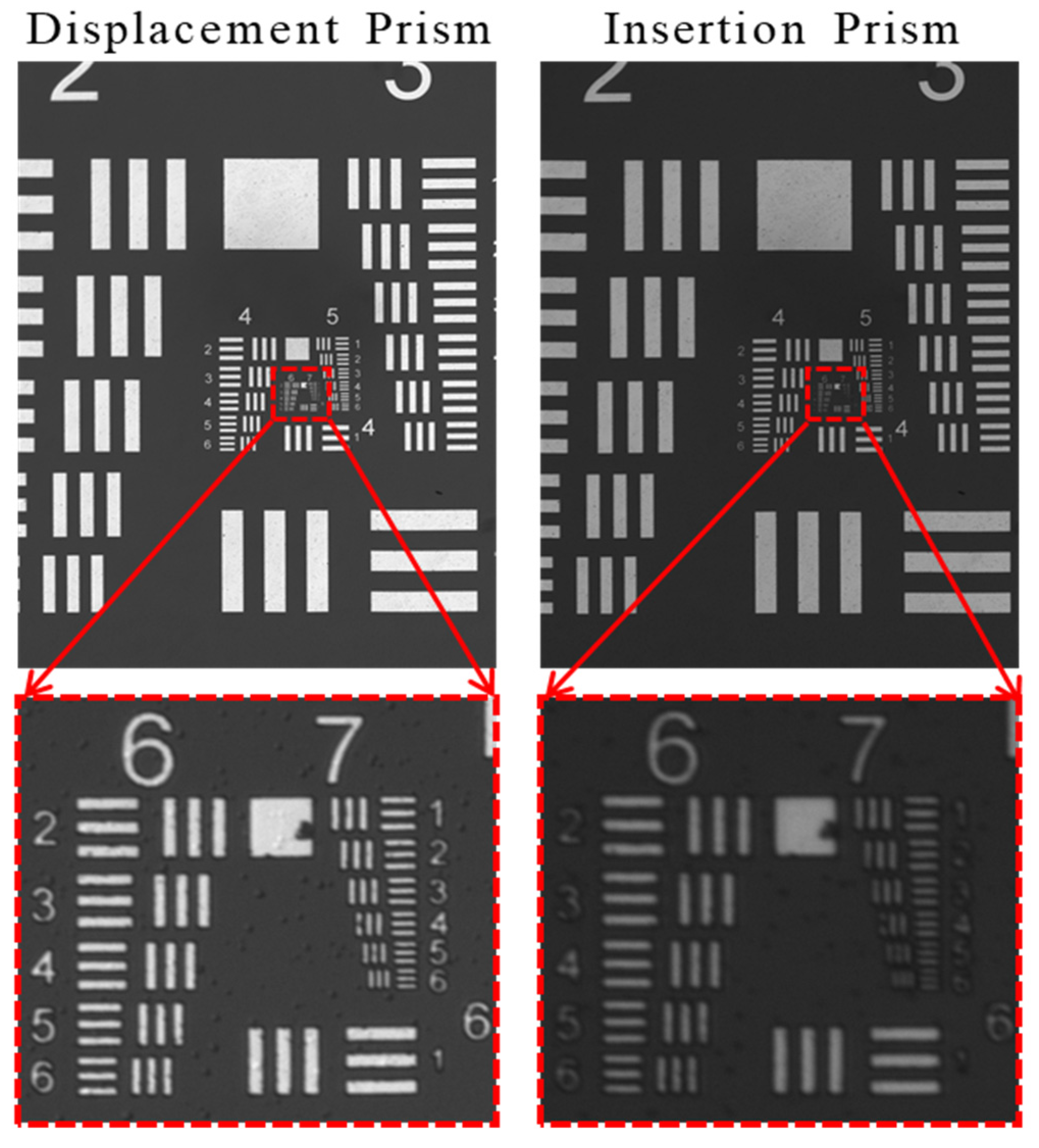
The lateral resolution defines the smallest resolvable feature size of the system. The Modulation Transfer Function (MTF) was measured precisely using the USAF 1951 resolution chart by traditional bar-pattern Fourier analysis method. To evaluate the influence of the DIC prism on system resolution, imaging of the resolution target was compared under two conditions: with the DIC prism removed and with the DIC prism inserted.
As shown in Figure 6, both the prism-equipped and prism-free configurations provide clear resolution imaging. Upon insertion of the prism, the fineness of fine lines and edge sharpness in the target area exhibit a slight reduction, which is consistent with the engineered performance expected during system design. Furthermore, measurements were conducted at multiple positions across the entire field of view—specifically, the top left, bottom left, center, top right, and bottom right—and averaged. The results are presented in Table 2, where the system’s average measured MTF at 71.8 lp/mm reaches 0.595.
In addition to the aforementioned measurements, tests were conducted at in-focus and out-of-focus positions (±20 μm), with average values calculated. The results are presented in Table 3, where the system’s average measured MTF at 71.8 lp/mm reaches 0.583.
The system’s resolution is primarily determined by the optical design and the sensor’s pixel size. The precision of the line-scan motion ensures that no resolution loss occurs during subsequent image processing. In contrast, the resolution of area-scan systems is limited by the total number of pixels on a single sensor. Achieving equivalent high resolution over large areas with an area-scan camera typically requires either high-resolution sensors—which entail higher costs—or reducing the field of view through the use of a microscope objective. However, the latter approach increases both the number of scanning steps and the total inspection time. While point-scanning systems offer exceptional lateral resolution at the nanometer scale, their application is generally to detailed defect re-inspection. Therefore, line-scan technology represents an effective solution for balancing high resolution and operational efficiency in large-area, high-throughput online inspection.

3.3. Analysis of Measured Results

This section presents the system’s imaging capabilities and measurement accuracy in processing industrial-grade samples. Using standard reference samples, the system’s phase detection performance is rigorously evaluated, and its quantitative analysis accuracy and reliability are validated.

3.3.1. Phase Detection Sensitivity

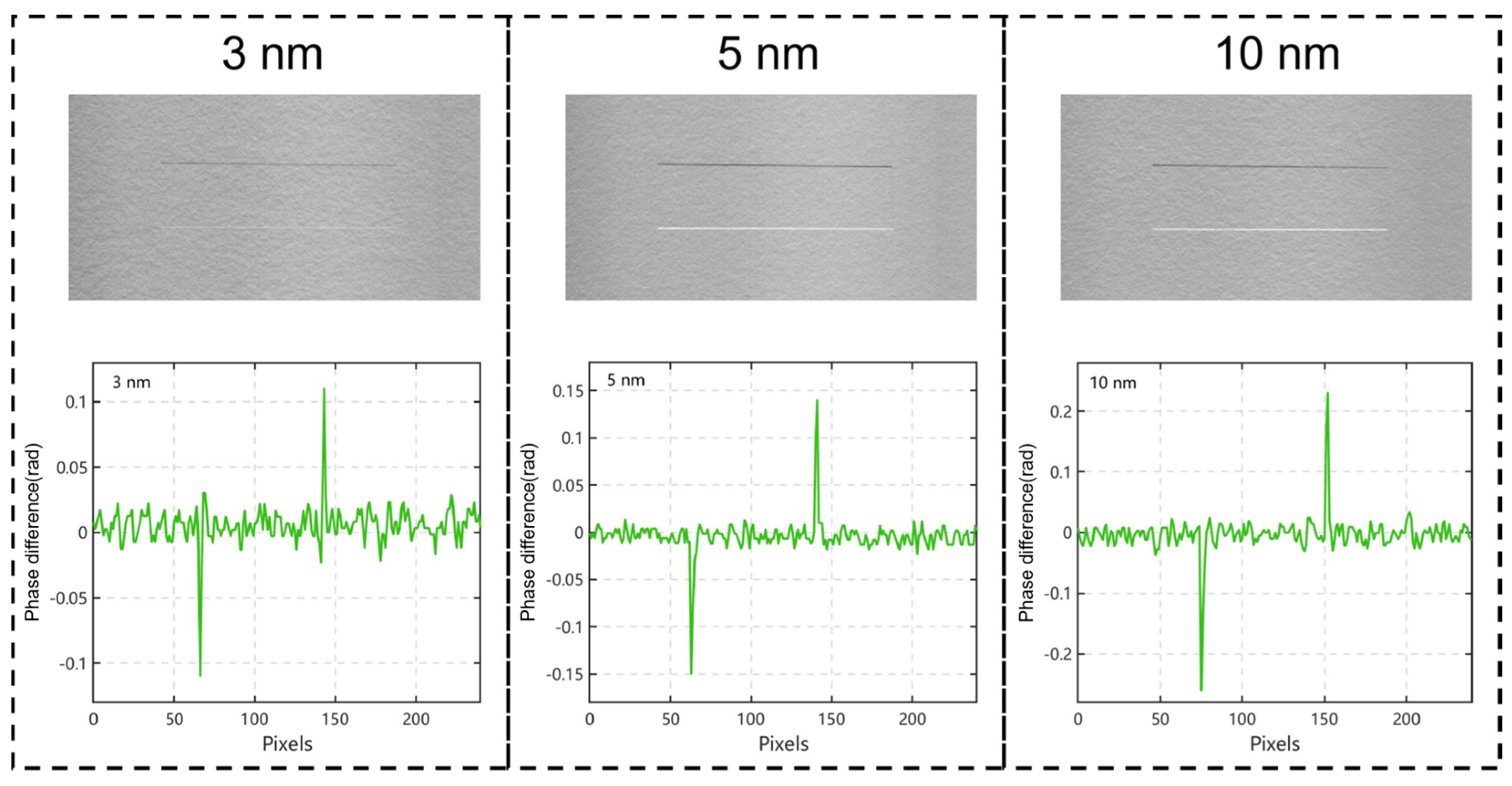
The core advantage of this line-scan DIC inspection system is its high sensitivity to minute phase changes. To determine the minimum resolvable step height, tests were conducted on a series of standard silicon wafers with nominal heights of 3 nm, 5 nm and 10 nm.
As shown in Figure 7, step plates of different heights generated distinct signal peaks in the phase value profile. A comparative analysis of signals from 3 nm, 5 nm and 10 nm step plates revealed that signal intensity, defined as the peak-to-valley phase difference, decreased with decreasing step height, accompanied by a corresponding reduction in SNR. SNR is defined by Ipeak/(Bmax − Bmin), where Ipeak is the signal peak value, and Bmax and Bmin are the maximum and minimum values of the background noise. The peak and valley SNR of 3 nm, 5 nm and 10 nm step plates are (1.24, −0.96), (1.90, −1.64) and (2.69, −2.74), respectively. In measurements on the 3 nm silicon wafer, although background noise was relatively high, the step-related signal peaks remained clearly discernible and exhibited sufficient SNR for reliable detection. These results demonstrate that the system can resolve micro-scale steps down to 3 nm, confirming its capability to detect ultra-shallow surface defects in advanced semiconductor process nodes.
Detecting 3 nm steps requires a high SNR. This is achieved using a line-scan camera with TDI, which accumulates the weak signal over multiple stages while averaging and suppressing random noise, enabling clear extraction of low phase contrast from background noise. Conventional area-scan cameras, limited by short exposure times and no signal accumulation, are difficult to reliably detect such faint features with stable SNR. While point-scan confocal microscopy offers comparable or better sensitivity, its point-by-point scanning is too slow for industrial throughput. TDI line-scan technology thus provides a balanced solution combining high sensitivity and high efficiency.

3.3.2. Industrial Reference Slide Imaging

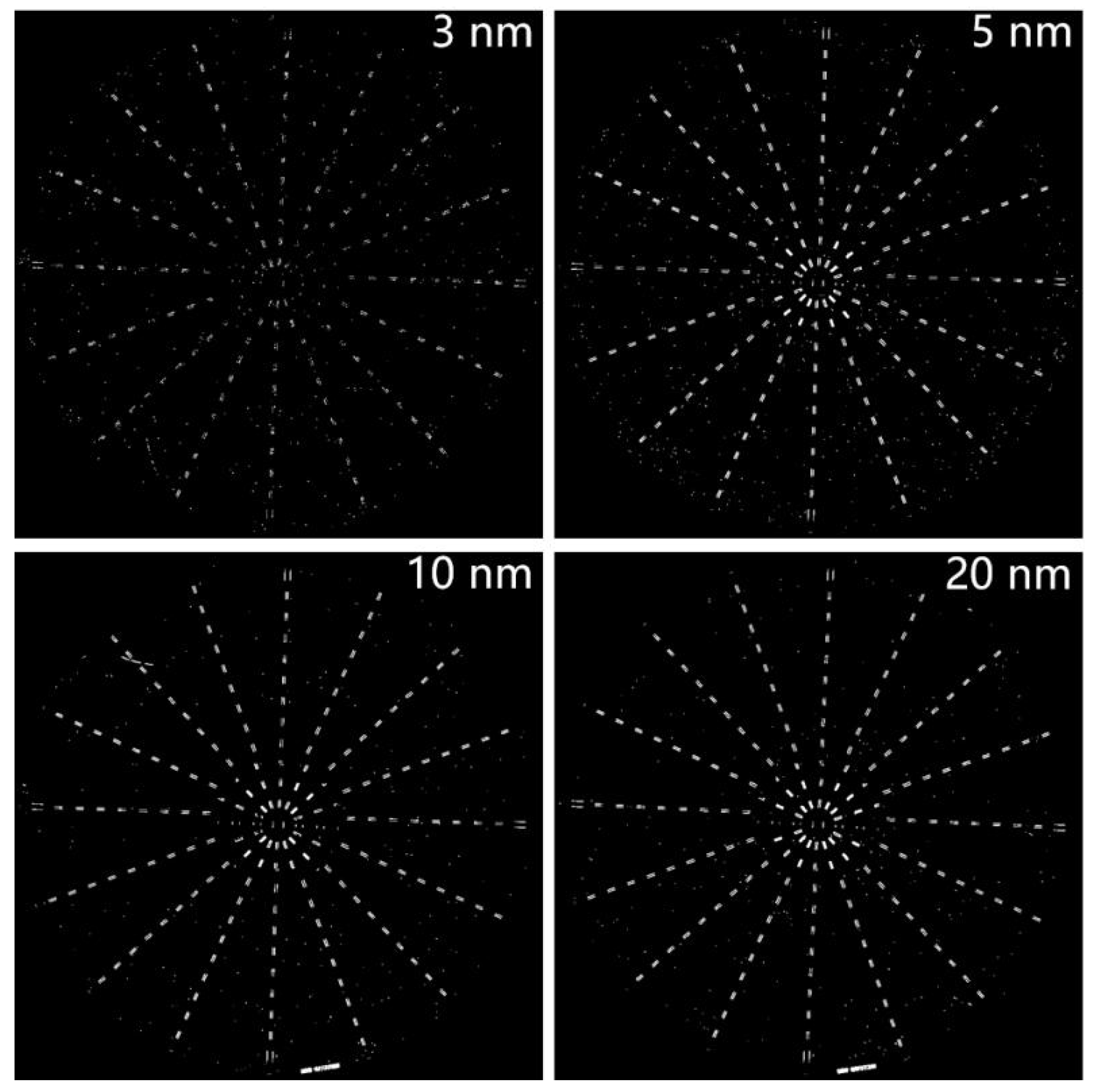
To validate the system’s capability for macroscopic scanning and imaging of diverse microstructures, full-range scanning tests were conducted on a series of industrial reference specimens containing defects of standard dimensions. The results are presented in the figure below, which shows phase images of specimens with pit sizes of 3 nm, 5 nm, 10 nm, and 20 nm.
As shown in Figure 8, the star-shaped pattern remains clearly discernible with well-defined features even at a scale of 3 nm. As defect size increases, image contrast improves significantly. These results provide clear evidence that the system can detect nanometer-level height variations while maintaining imaging consistency and accuracy at the macroscale, thereby establishing a reliable foundation for subsequent defect localization and analysis.
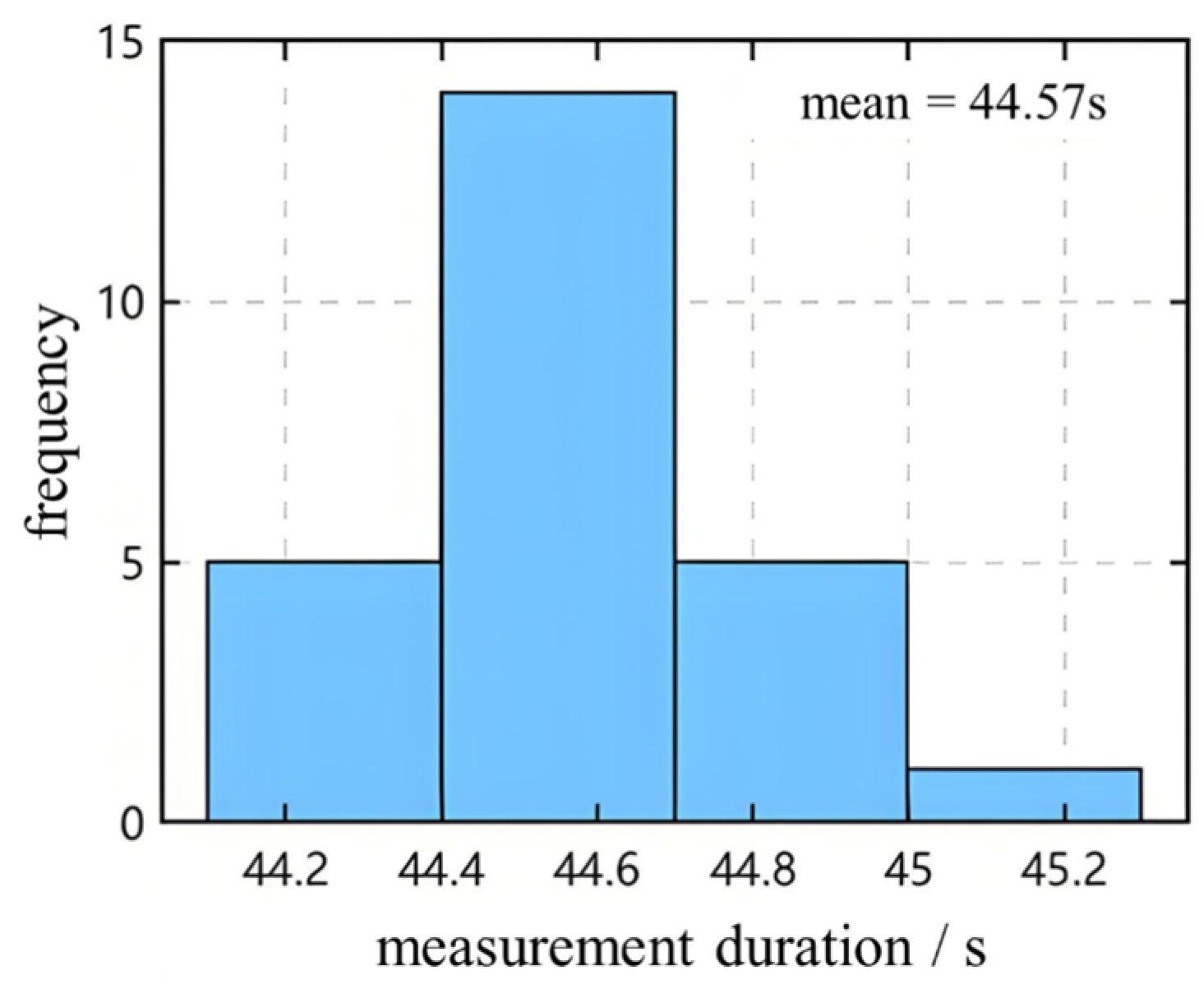
In addition to comparing imaging results, this study performed 25 replicate measurements under identical conditions, with the duration of each measurement fully recorded. The results are presented in Figure 9. The arithmetic mean duration per measurement was 44.57 s, corresponding to a throughput of 80 wafers per hour. This level of efficiency meets the performance requirements for online inspection in high-throughput semiconductor production lines, indicating strong potential for practical engineering applications.

3.3.3. Height Measurement Accuracy

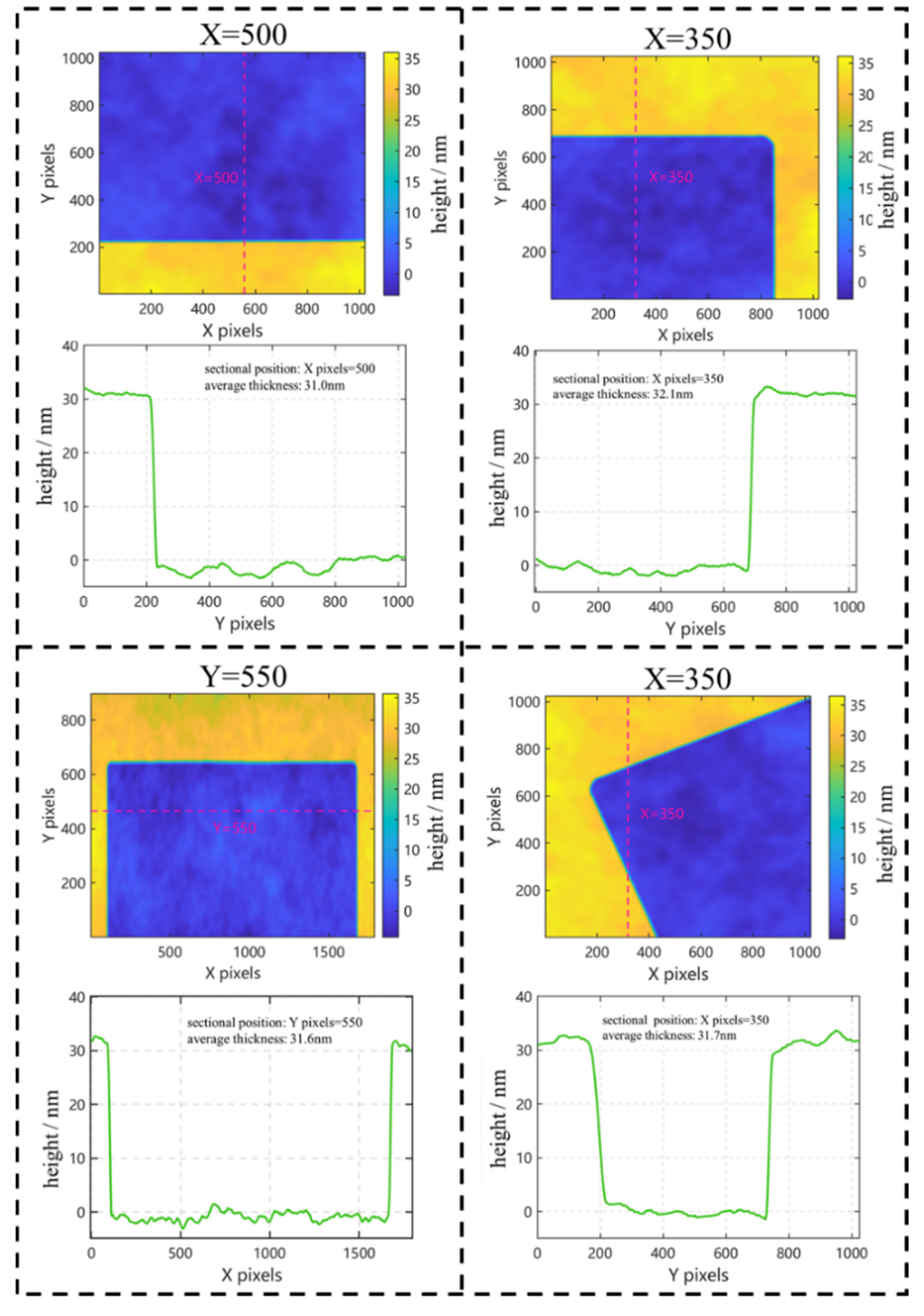
To quantitatively evaluate the height measurement accuracy of the system, we conducted practical measurements using a VLSI standard wafer (12-inch, 30 nm step) and compared the results with those obtained from a step profiler.
As shown in Figure 10, the system precisely reconstructed the three-dimensional height variation in a 30 nm step using a phase-resolving algorithm. Measurements were taken across multiple regions of the sample, yielding average height values of 31.0 nm, 32.1 nm, 31.8 nm, and 31.7 nm, respectively. The mean of these measurements was 31.65 nm, exhibiting negligible relative error compared to the 31.8 nm step height measured by the profilometer. This demonstrates the exceptional accuracy of the system’s measurement results.

3.3.4. Defect Detection on Production Wafers

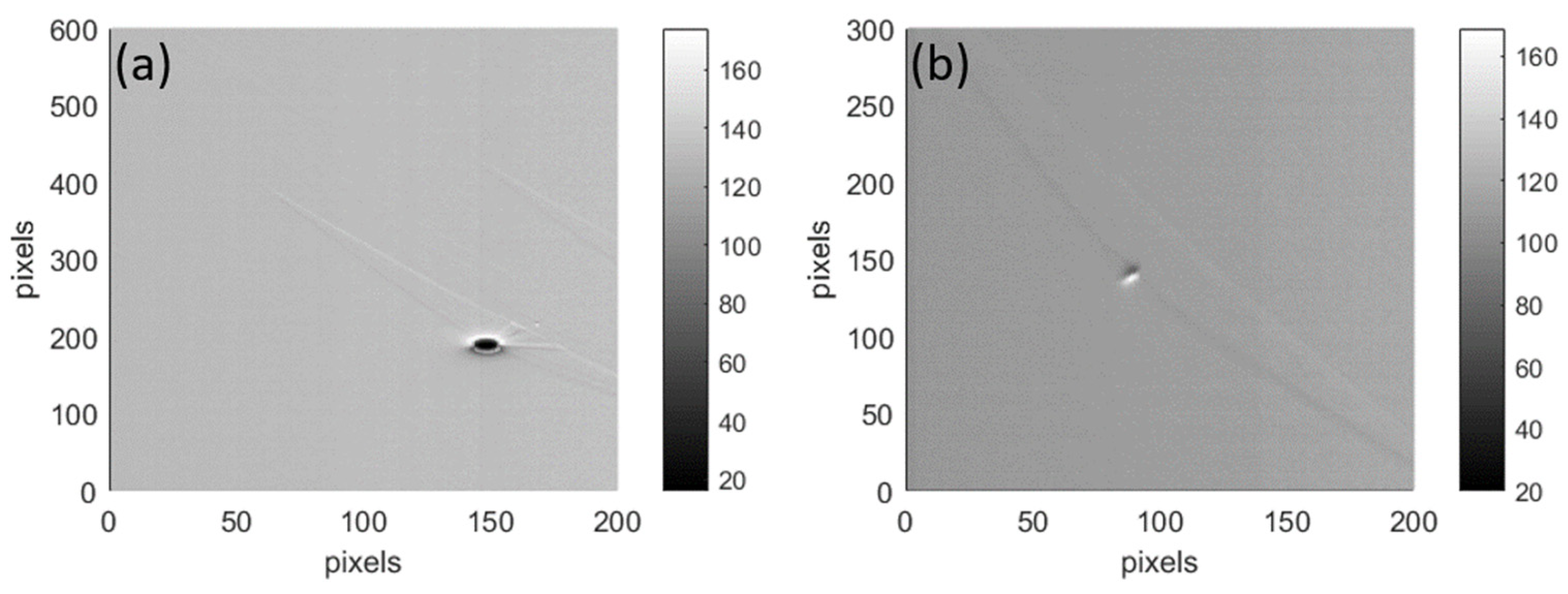
To further validate the system’s performance in a scenario closer to industrial application, preliminary tests were conducted on actual unpatterned silicon wafers containing various process-induced defects. Figure 11 presents two representative phase maps retrieved by our line-scan DIC system. In Figure 11a, a large-area, shallow planar defect (e.g., a residue or stain) is clearly resolved, demonstrating the core strength of DIC in detecting low-topography features that typically generate weak scattering signals. Notably, a deep pit adjacent to this planar defect is also detected. However, as the phase gradient across its steep edge exceeds the linear range assumed by the phase-unwrapping algorithm, the absolute height measurement for this pit is inaccurate. This illustrates a known limitation of the current two-step phase-shifting method when encountering discontinuous height steps larger than approximately λ/8. Figure 11b shows another large-area anomaly alongside a small, localized protrusion. The system successfully differentiates these morphologically distinct features, confirming its capability to resolve both extended and point-like defects. In addition to these examples, other common defect types such as subtle CMP residues and scratch-like anomalies were also reliably detected in separate scans, highlighting the broad detection coverage. These results provide a direct, qualitative demonstration of the system’s complementary value to traditional dark-field inspection, particularly for planar and morphologically complex defects. We acknowledge that this is a preliminary validation, and a more systematic statistical study involving a larger cohort of wafers with classified defects will be essential future work to fully quantify the detection probability and classification capability.

4. Discussion and Prospects

As illustrated in Table 4, point-scan, area-scan, and line-scan techniques are three common scanning and detection modes in wafer optical inspection. A comparison of these three methods reveals the following [10]: line-scan employs a line detector to acquire data from an entire row in parallel, combined with continuous uniform motion of the sample, enabling highly efficient coverage. Its efficiency far surpasses methods that require point-by-point scanning or step-and-repeat imaging of sub-regions. Furthermore, the line-scan system features a simpler and more rigid mechanical structure, avoiding vibrations and errors, which significantly enhances stability and reduces maintenance costs. Simultaneously, data acquisition in line-scanning exhibits inherent consistency, effectively avoiding the image stitching artifacts common in area-scanning. When integrated with TDI technology, line-scanning can significantly improve the SNR and dynamic range during high-speed scanning, thereby ensuring higher imaging quality. Consequently, the design of the line-scan architecture is inherently compatible with the geometric characteristics of the wafers under inspection, markedly enhancing inspection efficiency and the level of scanning path optimization.
This paper presents a novel unpatterned wafer inspection system based on line-scan DIC. The system employs a rotating line-scan design that integrates modular DIC components and standardized industrial hardware. This integration achieves high-precision measurement while significantly reducing hardware costs and maintenance complexity, resulting in a cost-effective, high-performance solution. Experimental results confirm excellent stability, strong interference resistance, and high throughput, demonstrating the architecture’s superiority and enabling the transition of high-precision DIC from laboratory research to production lines.
While the proposed line-scan DIC system demonstrates excellent performance on standard calibration samples, several limitations warrant consideration for its application under more complex, real-world conditions. The system’s detection performance may be constrained on surfaces with high roughness, low reflectivity, or multi-layer thin-film structures. For wafers with high roughness (haze), the increased diffuse scattering elevates the standard deviation of noise terms in the image acquisition, leading to greater phase retrieval errors and a heightened risk of missing low-signal defects. On wafers with low reflectivity, the inherent signal level is diminished, necessitating higher illumination intensity or longer integration times to maintain an adequate SNR. For samples with complex multi-layer film stacks, the simple phase-to-height conversion model may become invalid due to light interference within the films, introducing errors in absolute height measurement. Furthermore, the robustness of the current phase-unwrapping algorithm could be improved for environments with extreme noise or regions of high defect density. Finally, while the system provides valuable three-dimensional height information, distinguishing between defect types that share similar morphologies but consist of different materials remains a challenge.
To address the challenges identified in prior research, future studies can advance in several directions. First, integrating deep learning-based classification algorithms (such as convolutional neural networks or Transformers, a vision-language cyclic interaction model [15]) can enable intelligent recognition and precise classification of complex defects, improving detection automation. Second, combining multi-modal sensing technologies (like dark-field scattering imaging, multi-wavelength illumination, and spectral analysis) can enrich defect property information and enhance characterization of diverse defect types. Third, efforts should focus on enhancing hardware performance by adopting faster line-scan cameras and higher-precision motion control systems to meet the speed and stability demands of large-scale wafer manufacturing. Additionally, the cost-effective solutions proposed here can be extended to other high-precision manufacturing areas (such as MEMS devices, optical components, and flat-panel displays) to validate their versatility and engineering applicability.
In summary, this research has established a defect detection platform with high performance, excellent stability, and strong cost-effectiveness. It meets current detection needs in standard scenarios and provides a solid technical foundation for the intelligent advancement and cross-industry application of the technology, showing broad industrial potential.

5. Conclusions

This paper presents a novel line-scan DIC-based optical inspection system. By combining a stepping-rotation line-scan architecture with a precision phase-shifting algorithm, the system significantly enhances the efficiency of traditional DIC systems in high-speed, large-area inspection. It enables fast, accurate detection of surface defects on unpatterned wafers and quantitative defect height measurement. The system’s core contribution is transforming high-sensitivity, laboratory-grade DIC technology into a stable, efficient, and cost-effective solution for industrial use. Theoretically, this work advances quantitative line-scan DIC by integrating multi-step phase shifting and developing dedicated de-phase algorithms, overcoming the qualitative constraints of conventional DIC imaging and achieving nanometer-level vertical resolution. These improvements strengthen the application of optical surface inspection in high-precision industries and expand the field’s technical framework.
From an application standpoint, this study’s detection system offers a powerful non-contact method for quality control in semiconductor front-end processes. Its strong performance demonstrates high reliability and practicality in industrial environments, meeting the industry’s urgent need for efficient, cost-effective inspection. However, the study focused primarily on unpatterned wafers. Future work can explore the system’s applicability and limits in other materials and scenarios—such as patterned wafers, flexible electronics, or transparent films—to expand its use.

Author Contributions

Conceptualization, Y.H. and K.Z.; methodology, L.C.; software, L.Z.; validation, Y.L., Y.Z. and J.W.; formal analysis, L.Z.; investigation, J.Z.; resources, X.T., Z.L. and G.W.; data curation, L.Z.; writing—original draft preparation, Y.H. and K.Z.; writing—review and editing, L.C.; visualization, Y.L.; supervision, Y.Z., Z.L. and G.W.; project administration, K.Z.; funding acquisition, X.T. All authors have read and agreed to the published version of the manuscript.

Funding

This research was funded by Guangdong Province Key Field R&D Program Project (No. 2022B0303010002).

Data Availability Statement

Processed representative data supporting the findings of this study (e.g., phase images, MTF curve data points, step-height measurement profiles) are available from the corresponding author upon reasonable request. Raw line-scan stream data are not publicly available due to commercial confidentiality agreements.

Conflicts of Interest

Authors Y.H., K.Z., L.C., L.Z., Y.L., Y.Z., J.W., J.Z. and X.T. were employed by the company Skyverse Technology Co., Ltd. The remaining authors declare that the research was conducted in the absence of any commercial or financial relationships that could be construed as a potential conflict of interest.

Abbreviations

The following abbreviations are used in this manuscript:
DICDifferential Interference Contrast
MTFModulation Transfer Function
SNRSignal-to-Noise Ratios
OPDOptical Path Difference
PBSPolarizing Beam Splitter
TDITime-Delay Integration
VLSIVery Large Scale Integration
MEMSMicro-Electro-Mechanical Systems

References

  1. Shi, Z.; Qin, M.; Chen, W.; Gao, S.; Shi, L. Wafer defect inspection optimization: Models, analysis and algorithms. Analysis and Algorithms, 6 April 2019. [Google Scholar]
  2. Liu, J.; Zhao, H.; Wu, Q.; Feng, X.; Zhao, X.; Zhang, Z.; Zhang, C.; Huang, S.; Zhu, J.; Liu, S. Patterned Wafer Defect Inspection at Advanced Technology Nodes. Laser Optoelectron. Prog. 2023, 60, 0312003. [Google Scholar]
  3. Luo, C. Development of an Unpatterned Wafer Inspection System Based on Dark Field Scattering. Master’s Thesis, Huazhong University of Science and Technology, Wuhan, China, 2021. [Google Scholar] [CrossRef]
  4. Li, Z. Study on Detection Technology of Optical Element Surface Defects Based on Laser Scattering. Master’s Thesis, Zhejiang University, Hangzhou, China, 2021. [Google Scholar] [CrossRef]
  5. Nativ, A.; Feldman, H.; Shaked, N.T. Wafer defect detection by a polarization-insensitive external differential interference contrast module. Appl. Opt. 2018, 57, 3534–3538. [Google Scholar] [CrossRef] [PubMed]
  6. Wang, Y.; Zhong, L.; Xing, X.; Lu, X.; Chen, Q.; Tao, Q.; Qin, Y. Off-axis differential interference contrast (DIC) microscopy enabled by polarization gratings pair and synthetic aperture technology for integrational and sectional quantitative phase imaging. Opt. Lasers Eng. 2023, 163, 107441. [Google Scholar] [CrossRef]
  7. Xu, X. Design of Nomarski Prism for Differential Interference Contrast Metallographic Microscope. Master’s Thesis, Nanjing Normal University, Nanjing, China, 2014. [Google Scholar] [CrossRef]
  8. Zhou, Z. Research on Spot-Scanning Multi-Mode Unpatterned Wafer Defect inspection Technology and Signal Processing Method. Ph.D. Thesis, University of Science and Technology of China, Hefei, China, 2014. [Google Scholar]
  9. Wang, H.; Li, C.; Li, Y. Large-Scale Visual Language Model Boosted by Contrast Domain Adaptation for Intelligent Industrial Visual Monitoring. IEEE Trans. Ind. Inform. 2024, 20, 14114–14123. [Google Scholar] [CrossRef]
  10. Jin, Q.; Jiang, Y.; Lu, X.; Liu, Y.; Chen, Y.; Gao, D.; Sun, Q.; Zhuo, C. SEM-CLIP: Precise Few-Shot Learning for Nanoscale Defect Detection in Scanning Electron Microscope Image. In Proceedings of the 43rd IEEE/ACM International Conference on Computer-Aided Design, Newark, NJ, USA, 27–31 October 2024; Association for Computing Machinery: New York, NY, USA, 2025; pp. 1–8. [Google Scholar] [CrossRef]
  11. Dai, C.; Gong, Y.; Zhang, H.; Li, D.; Xue, J. Detection system of multilayer coating microstructure defects based on differential interference contrast confocal microscopy. Chin. Opt. 2018, 11, 255–264. [Google Scholar] [CrossRef]
  12. Xu, F. Principle and Calculation Methods of Nomarski Prism in Semiconductor Wafer Optical Inspection. Opt. Instrum. 1983, 5, 13–19. [Google Scholar]
  13. Gao, F.; Jiang, Z.; Li, B.; Tian, A. Multi-step Phase-shifting Algorithm Based on Extended Averaging Technique and its Error Suppression Characteristics Comparison. Acta Photonica Sin. 2013, 43, 0426001. [Google Scholar]
  14. Zhang, Z.; Zhang, Q.; Cheng, T.; Gao, J.; Wu, X. Wave-plate phase shifting method. Opt. Eng. 2013, 52, 103109. [Google Scholar] [CrossRef][Green Version]
  15. Shen, X.; Li, L.; Ma, Y.; Xu, S.; Liu, J.; Yang, Z. VLCIM: A Vision-Language Cyclic Interaction Model for Industrial Defect Detection. IEEE Trans. Instrum. Meas. 2025, 74, 2538713. [Google Scholar] [CrossRef]
Figure 1. Beam shearing model of a conventional DIC microscopic imaging system.
Electronics 15 00518 g001
Figure 2. Beam shearing process in a Nomarski prism.
Electronics 15 00518 g002
Figure 3. Optical path configuration of the DIC microscopy system.
Electronics 15 00518 g003
Figure 4. System architecture and working principle schematic of rotational line-scanning configuration.
Electronics 15 00518 g004
Figure 5. Uniformity characterization of dual-channel imaging system in polarization-scattering (P&S).
Electronics 15 00518 g005
Figure 6. Comparative imaging analysis of resolution test targets with and without DIC prism.
Electronics 15 00518 g006
Figure 7. Phase detection results and SNR analysis for silicon wafers with varying thickness profiles.
Electronics 15 00518 g007
Figure 8. Phase imaging calibration results of silicon wafers with varying thickness profiles.
Electronics 15 00518 g008
Figure 9. Time-resolved measurement statistics of the wafer inspection system.
Electronics 15 00518 g009
Figure 10. Vertical profile analysis and precision validation for 30 nm VLSI structures.
Electronics 15 00518 g010
Figure 11. Typical defects of (a) pit and (b) protrusion.
Electronics 15 00518 g011
Table 1. Critical component specifications of the experimental optical inspection system.
CategoryComponent NameModel/SpecificationsPurpose
Light SourceLight Emitting Diode (LED) 405 nm Light Source405 ± 10 nmIllumination source for the system
DIC Prism Differential Interference PrismSeparation Angle ~0.0037°Splits and recombines the beam for differential interference
Objective LensObjective LensNumerical Aperture (NA) 0.1, Focal Length 100 mm, Field of view 12 mmIllumination and light collection
Tube LensTube LensFocal Length 200 mmFocuses the collimated beam onto the camera in an infinity-corrected optical system
CameraPolarization CameraMax Line Rate > 60 kHz, Typical Line Rate~30 kHz, Pixel Size 14 µm, Resolution 2048 × 2, 12 bitThe built-in PBS performs polarization splitting for P and S channel separation and imaging
Scanning StageAir-bearing Vacuum Adsorption Motion StageRadial runout <±1 µm, Axial runout <±1 µm for rotationControls wafer movement to accomplish scanning and imaging
Beam SplitterPolarizing Beam SplitterCustom-madeSplits the illumination light
Quarter-Wave PlateQuarter-Wave Plate Custom-madeIn the phase-shifting method, it converts phase information by introducing a bias OPD
Table 2. Multi-field multi-directional MTF variation analysis.
Reference Line Pairs (lp/mm)MTF
Top-LeftBottom-LeftCenterTop-RightBottom-RightAverage
71.80.5890.5740.6050.6150.5940.595
101.60.5870.5850.5690.5740.6040.584
143.70.4960.5270.5320.5660.5400.532
203.20.4240.4630.4500.5120.4960.469
Table 3. MTF variation with focus position and defocus offset.
Reference Line Pairs (lp/mm)MTF
Defocus (−20 µm)In-Focus PlaneDefocus (+20 µm)Average
71.80.5570.6050.5860.583
101.60.5260.5690.5680.554
143.70.4860.5320.5360.518
203.20.4060.4500.4580.438
Table 4. Comparison of three scan methods.
Point-ScanArea-ScanLine-Scan
Working PrincipleFocus, move, and acquire signal point by point2D sensor single exposure, step-and-repeat imagingLinear sensor moves continuously, acquiring and stitching line by line
Inspection EfficiencyExtremely slowLowVery high
AccuracyExtremely high, can reach nanometer levelHigh, especially with extremely high resolution in the scanning directionHigh
AdvantagesHigh precision and SNR, suitable for fine characterization of micro-defectsRelatively simple architecture, intuitive images, suitable for static/small-area rapid imaging, cost-effectiveExtremely high inspection throughput, suitable for high-speed inspection of large-area, continuous surfaces; combines with TDI technology to achieve high sensitivity
DisadvantagesVery low throughput in conventional mode, usually requires vacuum environment, high equipment costComplex processing for stitching large-size images, overall resolution limited, additional overhead from sensor step-and-repeat motionHigh requirements for mechanical motion precision, relatively high system complexity; images may be affected by motion artifacts
Disclaimer/Publisher’s Note: The statements, opinions and data contained in all publications are solely those of the individual author(s) and contributor(s) and not of MDPI and/or the editor(s). MDPI and/or the editor(s) disclaim responsibility for any injury to people or property resulting from any ideas, methods, instructions or products referred to in the content.