1. Introduction
Ground-penetrating radar (GPR) is a highly efficient non-destructive testing technology. It offers centimeter-level resolution and real-time detection capabilities. These advantages make it irreplaceable in infrastructure assessment, road inspection, and underground anomaly identification [
1,
2,
3]. By transmitting high-frequency electromagnetic pulses into the subsurface and capturing the reflected echoes, GPR can reliably detect internal defects in complex media, buried pipes, concealed voids or landmines. In two-dimensional B-scan images, these targets typically appear as hyperbolic signatures. To improve imaging quality, the Back Propagation (BP) algorithm is widely employed. This algorithm processes the received echo signals through time-delay superposition and focusing. Consequently, it accurately reconstructs both the spatial location and geometry of subsurface targets [
4,
5,
6,
7]. Furthermore, in GPR systems, the antenna serves as a core component whose performance determines the efficiency of electromagnetic wave transmission and reception. This directly impacts the detection depth and resolution of the system [
8,
9,
10,
11,
12]. To reliably detect targets or improve their discernibility, practical detection systems employ various signal processing techniques. These include background removal and clutter suppression, which help to mitigate clutter and enhance the distinguishability of the target signal. It should be noted that post-processing algorithms, such as mean subtraction and SVD, can mitigate antenna direct coupling [
13,
14,
15,
16,
17]. However, they do not address the fundamental issue of limited antenna isolation. Due to current hardware limitations, these algorithms can only be applied during post-processing. Therefore, there is an urgent need for a real-time decoupling method.
The applicability of traditional ground-coupled GPR is becoming limited, while vehicle-mounted and UAV-based systems have advanced rapidly due to their operational efficiency [
18,
19,
20,
21,
22]. Compared to ground-based GPR, vehicle-mounted GPR requires greater penetration depth, which involves increasing the energy of the received signal as much as possible. In this case, antenna isolation becomes one of the key factors affecting detection performance [
23,
24,
25]. At present, decoupling for vehicle-mounted GPR antennas faces numerous challenges. For instance, compact layouts result in insufficient isolation for traditional antennas, while the ultra-wideband characteristics of GPR systems pose even more severe challenges for achieving effective decoupling across broad frequency bands. Consequently, researching decoupling for vehicle-mounted GPR antennas is one of the key elements driving the advancement of vehicle-mounted GPR technology.
In recent years, scholars have proposed numerous methods to enhance the isolation of radar antennas. These approaches can be broadly categorized into three types: modifying the antenna structure around the envelope, creating additional decoupling structures between antennas, and utilizing channel characteristics such as antenna polarization for decoupling.
The first approach focuses on the antenna radiator to minimize impact on overall dimensions. Zhuo et al. [
26] adopted a choke structure on the dipole radiating arm, creating partial open-circuit and short-circuit configurations. This effectively suppressed mutual coupling of the antenna, achieving isolation exceeding 20 dB within the 3.25–3.61 GHz range. Although this method is simple to implement, it provides narrow decoupling bandwidth. Laxmikant et al. [
27] designed a choke-loaded horn antenna for UAV detection. By formulating an aperture equation with a gradually varying slope, they positioned the choke at the zero point of a Bessel function distribution. Finally, a level of almost perfect decoupling of the transmitting and receiving antennas is achieved.
The second method is the most common decoupling method. It involves placing additional structures between antennas. One involves directly shielding the mutual coupling between antenna units, such as the electromagnetic band gap structure (EBG) designed by Hossein et al. [
28]. The results confirm that a two-layer EBG structure reduces antenna mutual coupling by 11 dB, while a three-layer EBG achieves a 14 dB reduction. Zhu et al. [
29] designed a frequency-selective surface (FSS) by shaping FSS units to achieve an artificial reflective interface. This reflects a portion of the electromagnetic wave energy, ultimately achieving an antenna isolation exceeding 25 dB. However, the performance of such artificial electromagnetic materials (AEMs) is often narrowband, which hinders their compatibility with the ultra-wideband requirements of GPR. Additionally, the inherent dielectric loss of AEMs could reduce antenna radiation efficiency. Seyed et al. [
30] placed a metal cavity behind the antenna to ensure unidirectional radiation and narrow the beamwidth, thereby effectively suppressing coupling between antennas. It achieved antenna isolation exceeding 20 dB across an ultra-wideband range of 0.17–1.74 GHz. However, this approach inevitably increases the size and weight of the radar system. Werner [
31] demonstrated the decoupling effectiveness of absorptive materials, typically resistive coatings, in GPR systems. When electromagnetic waves pass through, they are partially absorbed, reducing mutual coupling and achieving isolation exceeding 40 dB within the 0.7–4 GHz band. However, this method reduces the radiated power, thereby compromising the detection depth.
Another approach is to introduce a new coupling path to neutralize the existing coupling between antenna elements. Zhang [
32] implemented this with a broadband neutralization line that diverts the strong coupling field to a decoupling path, achieving isolation better than 22 dB isolation within 3.12–5 GHz. While this method extends the decoupling bandwidth, it is only effective for specific microstrip patch antennas. A different solution from Li et al. [
33] uses a custom dielectric block attached to the antenna, lowering its profile. The block establishes a permittivity gradient from the antenna to free space, enabling the control of space-wave coupling to cancel surface waves. Finally, antenna isolation greater than 20 dB is achieved within a relative bandwidth of 27%.
Polarization diversity represents a third approach to improving isolation. Liu et al. [
34] demonstrated this with a hybrid dual-polarized GPR system using a spiral transmitter and orthogonal Vivaldi receivers. Their measurements showed markedly suppressed direct coupling and successful target detection. However, this method significantly increases the complexity and cost of the system. In [
35], a method utilizing a receive–transmit–receive configuration to improve antenna isolation has been proposed, but more in-depth work has not been explored.
This paper proposes a universal GPR antenna decoupling method. This approach is independent of specific antenna structures, offering greater implementation flexibility. Moreover, decoupling can be achieved during radar acquisition, ensuring the potential for enhanced sensitivity of the radar receiver. This paper first verifies that improving isolation for conventional antennas becomes challenging at relatively compact distances. While maintaining the overall antenna dimensions, an additional antenna is introduced between the two antennas to form a 1-transmit-2-receive configuration. This configuration theoretically enables perfect decoupling. Distinct from previous approaches, this method addresses the bimodal response of the target under decoupled configuration and achieves superior reconstruction of the target imaging results; a BP imaging method based on coherent differential is proposed. Finally, the antenna isolation exceeds 37.2 dB, and the method achieves well-focused imaging results for the target.
The rest of this paper is organized as follows:
Section 2 shows the analysis of the antenna differential decoupling model. The mechanism of coherent differential BP imaging algorithm is presented in
Section 3. The simulation and test results are displayed in
Section 4 and
Section 5, respectively. The conclusions are discussed in
Section 6.
2. Antenna Differential Decoupling Model
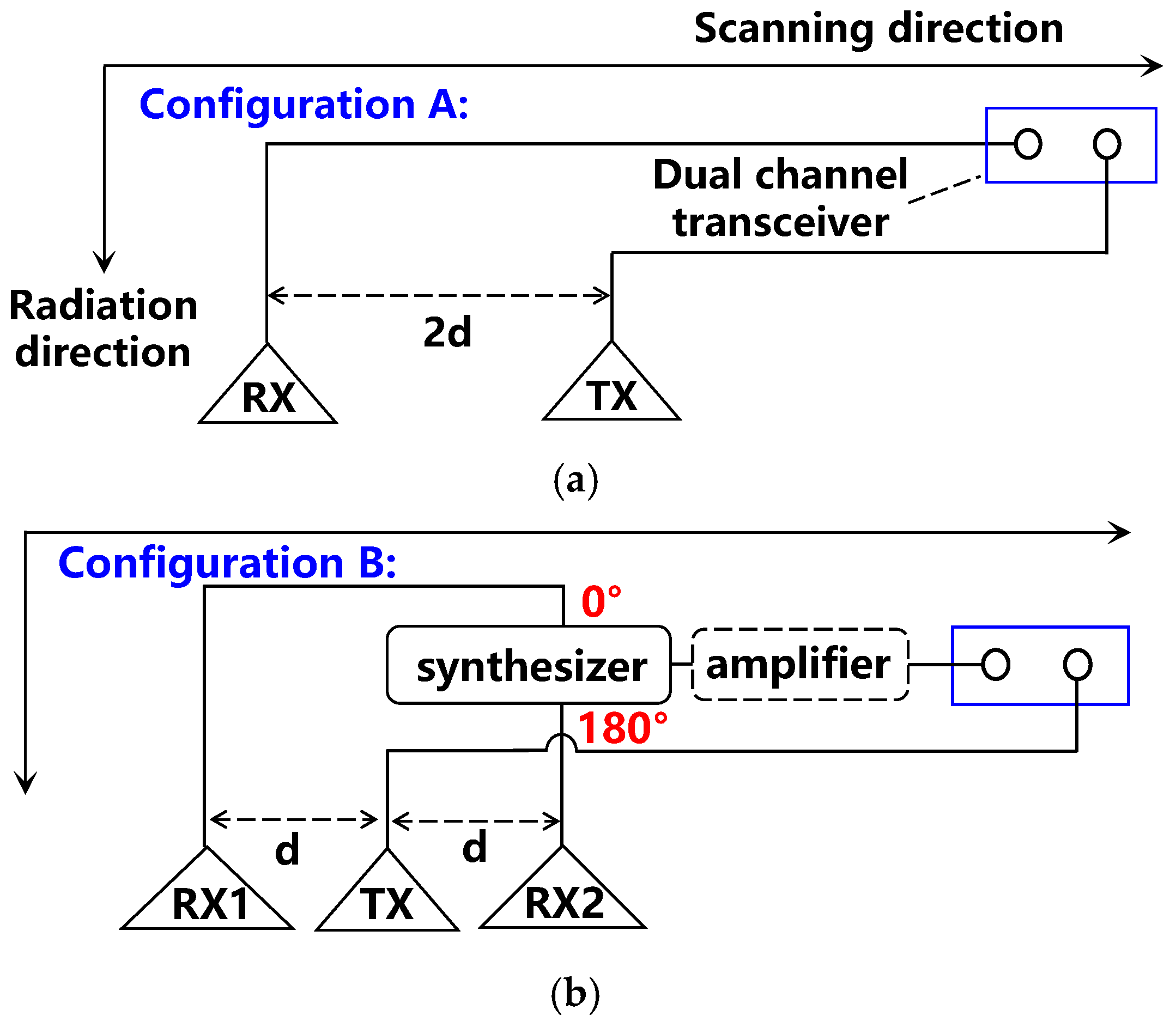
The conventional GPR antenna configuration is typically a single transmitter–single receiver setup, as shown in
Figure 1a. The antenna isolation in Configuration A (Config. A) is affected by the antenna distance. To achieve antenna decoupling while maintaining the overall antenna dimensions, this paper proposes a differential decoupling method, as shown in Configuration B (Config. B) in
Figure 1b. In Config. B, the total antenna length remains the same as Config. A, which is still 2
d. Compared to Config. A, Config. B adopts a 1-transmit-2-receive antenna configuration. The central antenna is the transmitter, and the two side antennas are receivers. The feed directions of the two receiving antennas are kept consistent, meaning that both antennas initially receive signals with the same phase. These two receiving antennas are then connected to an inverse power synthesizer, performing a differential operation on the two signals. This capability theoretically allows for the complete elimination of antenna direct coupling. Please note that Config. B includes an additional amplifier at the receiver end compared to Config. A. This does not constitute unfairness. Rather, Config. B achieves better isolation, allowing for greater receiver gain to enhance the dynamic range of the system. This will be verified in
Section 5 at the end of this paper.
To better understand the differences in target detection between the two configurations,
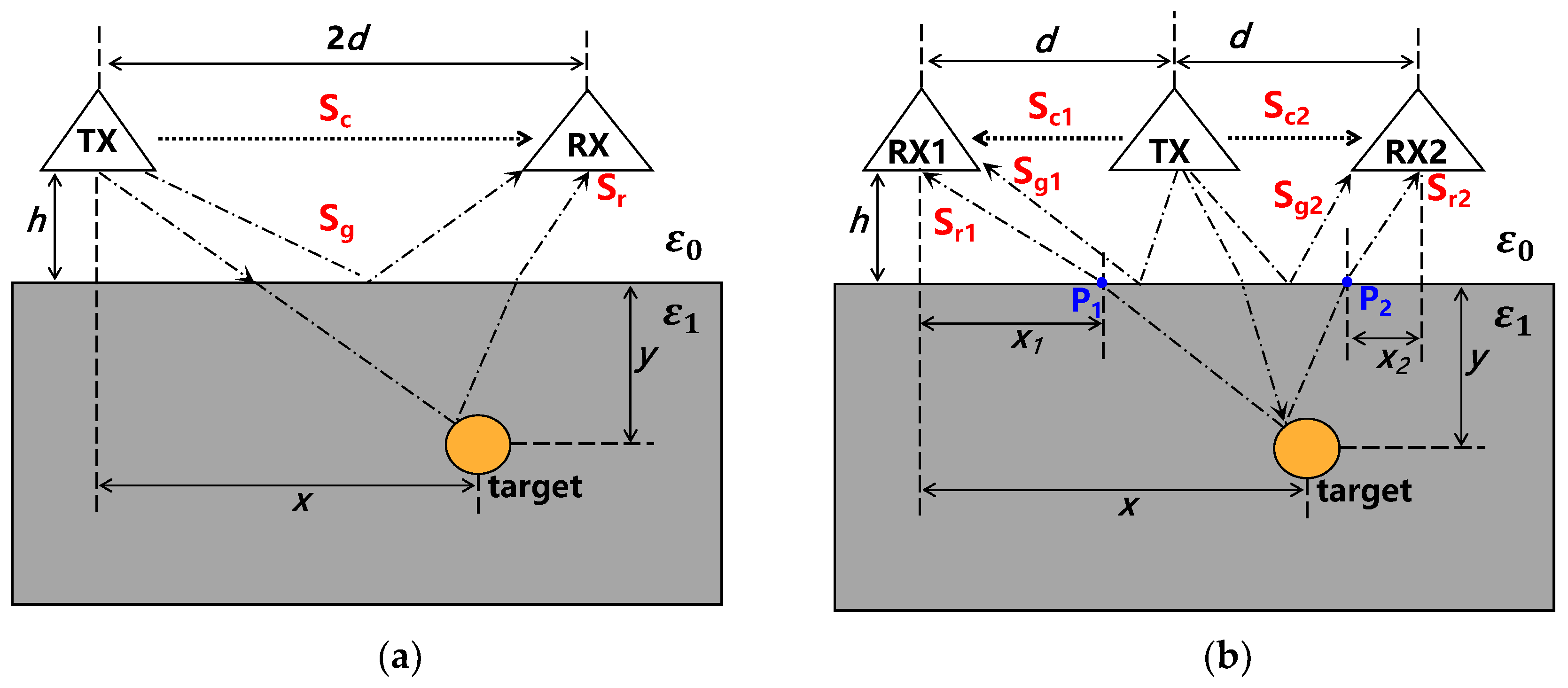
Figure 2 presents a modeling analysis of both setups.
Figure 2a corresponds to the traditional Config. A shown in
Figure 1. The direct coupling wave from the transmit antenna to the receive antenna is denoted as S
c, while the electromagnetic wave reflected off the ground surface is represented as S
g. The signal scattered by the target and subsequently reaching the receive antenna is labeled as S
r. Furthermore,
Figure 2b corresponds to the novel Config. B introduced in
Figure 1. The direct coupling waves from the two sides receiving antennas to the central transmitting antenna are denoted as S
c1 and S
c2, while the ground surface reflection waves are represented as S
g1 and S
g2. The received signals from the target scattering waves at the two receiving antennas are denoted as S
r1 and S
r2, respectively. It follows that S
c1 = S
c2. Furthermore, when the ground surface is ideal and flat, S
g1 = S
g2 is also satisfied. The advantage of Config. B is that, after performing differential processing, it can completely eliminate both the direct wave from the antenna and reflections from the medium surface. Therefore, compared to traditional Config. A, Config. B can theoretically achieve better target detection results. It should be noted that, when the target is directly below the transmit antenna, S
r1 = S
r2, meaning that the target echo is also eliminated. Therefore, to comprehensively evaluate the target echo characteristics of both configurations, the relationship between the signals will be derived as below.
In
Figure 2a, the distance between the transmitter antenna and the receiver antenna is 2
d. Let the transmitted signal from the transmitter antenna be
s(
t). This signal reaches the target after time
t1 and the scattered wave then reaches the receiver antenna after time
t2. The signal received at the receiving antenna can then be expressed as
sA(
t)
= s(
t −
t1 −
t2). Its corresponding Fourier transform is denoted as
SA(
w) and can be represented as
where
S(
w) is the Fourier transform of
s(
t).
In
Figure 2b, let the transmitted signal remain
s(
t), arriving at the target after time
t0. The scattered waves arrive at receiving antenna 1 (RX1) and receiving antenna 2 (RX2) after times
t1′ and
t2′, respectively. Thus, the signal at the RX1 channel is
s(
t −
t0 −
t1′) and the signal in the RX2 channel is
s(
t −
t0 −
t2′), assuming the target has uniform reflectivity. The difference between these two received signals is denoted as
sB(
t)
= s(
t −
t0 −
t1′) −
s(
t −
t0 −
t2′). Its corresponding Fourier transform is denoted as
SB(
w) and can be expressed as
From Equation (1), it can be seen that the signal amplitude
remains constant across different angular frequencies. Equation (2) indicates that the amplitude
varies for signals with different angular frequencies. Since ground-penetrating radar transmits an ultra-wideband signal, the energy of both signal configurations is calculated to measure the overall intensity of the ultra-wideband signal. According to Parseval’s theorem,
From Equations (3) and (4), it can be seen that
EA is independent of target delays
t1 and
t2. Meanwhile,
EB depends on target delays
t1′ and
t2′. Therefore, the primary distinction between
EA and
EB lies in the
term. Both
t1′ and
t2′ are related to both antenna position and target position. To establish the relationship between these parameters, the following can be calculated from
Figure 2b:
where
x1 denotes the horizontal distance from refraction point P1 to RX1 and
x2 denotes the horizontal distance from refraction point P2 to RX2. The variable
h denotes the distance between the antenna and the ground surface;
y represents the burial depth of the target. The variable
ε1 denotes the relative permittivity of the medium containing the target. The parameter
c is the speed of light in a vacuum. To solve the refraction points
x1 and
x2, the conventional approach involves applying the law of refraction and then solving a quartic equation. However, this method is computationally inefficient [
36]. Based on a calculation method provided in [
37], an approximate solution can be obtained as follows:
Substitute the calculated values of x1 and x2 into Equations (5) and (6) to obtain t1′ and t2′. Finally, substitute these values into Equation (4) to determine the signal energy for Config. B.
We obtained the signal energy for Config. A and Config. B at a specific antenna position. However, in GPR applications, as the antenna moves, the target echoes vary accordingly. Therefore, to enhance the reliability of the proposed algorithm, the influence of the antenna radiation pattern is incorporated here. For the sake of simplicity, we adopt the classical cosine-power approximation model, expressed as
=
[
38]. Here,
q denotes the beamwidth factor, and its relationship with the half-power beamwidth (HPBW) is given as follows:
When the antenna exhibits an omnidirectional radiation pattern, the factor
q = 0. For other specific antenna designs, the corresponding value of
q can be determined by substituting the given HPBW. Consequently, the integrated energy along the entire survey line can be expressed as
Here, () accounts for both the transmitting and receiving antenna patterns, assuming that the two patterns are identical. To quantitatively compare the energy strengths of the two configurations, we define the energy coefficient k = EBtotal/EAtotal. By combining Equations (3)–(11) and substituting the corresponding parameters, the value of k can be calculated. If k is greater than 1, it indicates that Config. B exhibits superior echo energy compared to Config. A. If k is less than 1, it indicates that Config. B exhibits less echo energy than Config. A.
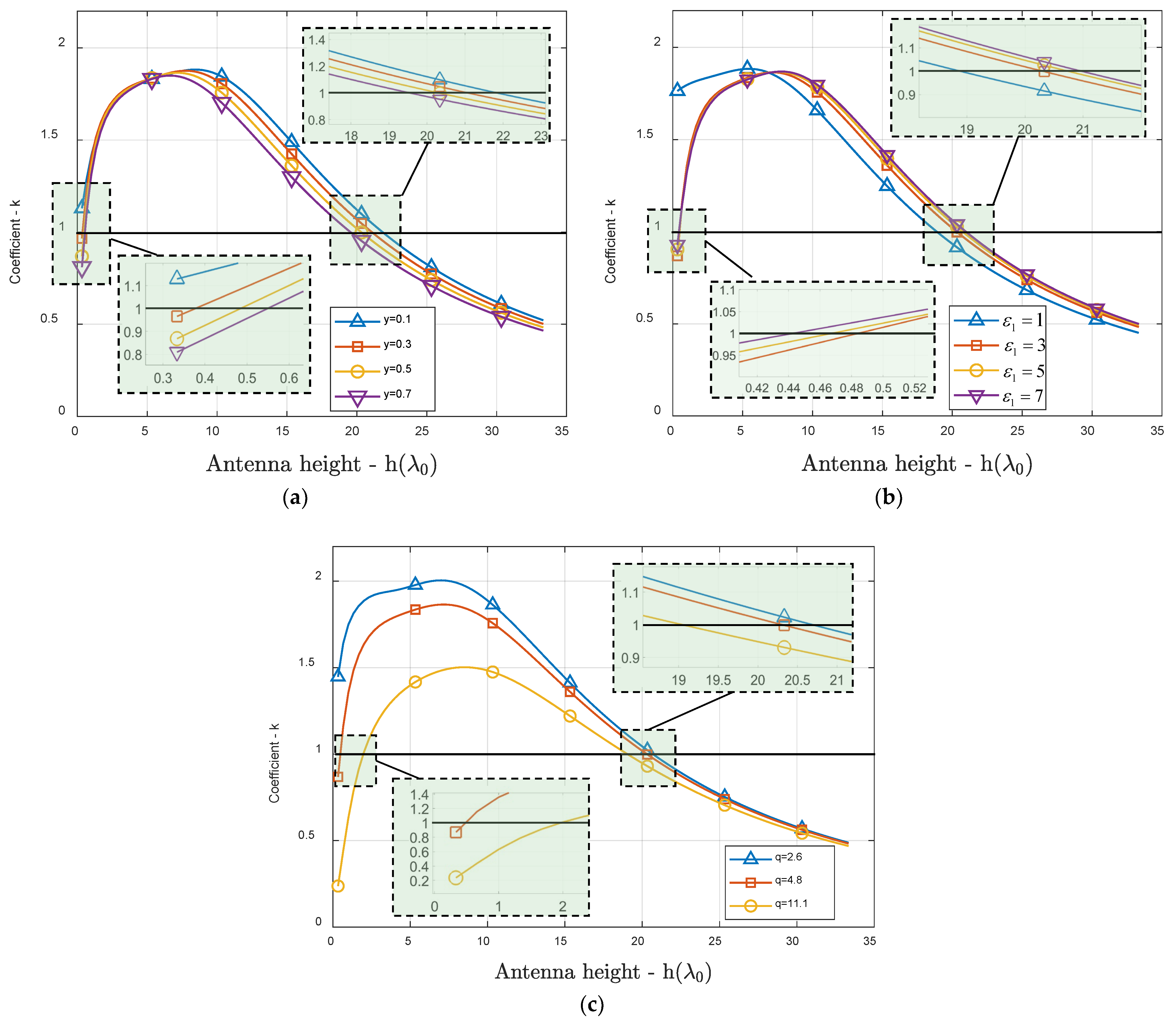
To validate the effectiveness of Config. B, we focus on the antenna height range corresponding to an energy coefficient k greater than 1. Therefore, we plot the curve with antenna height h as the independent variable and coefficient k as the dependent variable. Based on the actual radar system conditions, we set wL and wH to 2π × 1 × 109 and 2π × 3 × 109, respectively, meaning that the antenna bandwidth is 1–3 GHz. The antenna spacing d is set to 0.13 m. Furthermore, we investigated different scenarios with radiation pattern factors q = 2.6, 4.8, and 11.1. These values correspond to the typical beamwidths of the Bow-tie antenna, Vivaldi antenna, and double-ridged horn antenna commonly used in GPR at their respective center frequencies, as calculated by Equation (9). Next, we examine the influence of target depth y, relative permittivity ε1, and the pattern factor q on the k − h curve, respectively.
In the first case, when
q = 4.8 and
ε1 = 3, we studied the
k −
h curves corresponding to different target depths
y, as shown in
Figure 3a. The analysis leads to two conclusions:
- (1)
When , the k − h curves for different y are all greater than 1, indicating that the proposed method outperforms the traditional one within this range.
- (2)
When or , the value of k begins to fall below 1. Furthermore, k decreases as the target depth y increases, indicating that, within this antenna height range, the performance of the proposed method degrades with increasing target depth.
In the second case, setting
q = 4.8,
we examined the
k −
h curves corresponding to different
ε1, as shown in
Figure 3b. The results can be summarized as follows:
- (1)
When , the k − h curves for different ε1 all remain above 1, indicating that the proposed method outperforms the traditional one within this antenna height range.
- (2)
When , the condition k > 1 still holds for ε1 = 1. For higher permittivity values, k increases as ε1 rises. This suggests that, for subsurface media detection, the effectiveness of the proposed method improves with higher dielectric constants.
- (3)
When , a larger ε1 leads to a higher k value, further confirming that the proposed method is more advantageous in media with higher permittivity.
In the third case, when
y = 0.5 m and
ε1 = 3, we investigated the
k −
h curves for different
q values, as shown in
Figure 3c. The conclusions are as follows:
- (1)
When the k − h curves for different q factors remain consistently above 1, indicating that the proposed method outperforms the traditional one within this antenna height range.
- (2)
When or , cases where k < 1 begin to emerge. In these instances, a larger q value leads to a smaller k, suggesting that, within this height range, a narrower antenna beamwidth results in degraded performance of the proposed method.
In summary, provided that the antenna height
is selected within an appropriate range, the proposed method consistently outperforms the traditional approach, even across varying target depths
y and relative permittivities
ε1. According to [
39], to ensure the antenna operates within the proper transition zone or far-field region, the height of air-coupled GPR antennas typically ranges between
and
. This further demonstrates that the proposed method covers the vast majority of practical application scenarios.
For extreme cases—such as using a narrow-beam antenna at a very low clearance (e.g., )—where k ≤ 0.6, indicating a decline in the effectiveness of the method. However, a decrease in k does not necessarily imply that the proposed method is inapplicable; rather, it must be evaluated in conjunction with the actual signal-to-clutter ratio (SCR) of the target. This will be further validated using subsequent simulations and experimental measurements.
3. Coherent Differential BP Imaging Algorithm
The traditional Back Propagation (BP) algorithm employed in GPR is a time-domain imaging method. Numerous optimized BP algorithms have since emerged. For instance, the local BP algorithm targeting higher-order moments can enhance imaging accuracy [
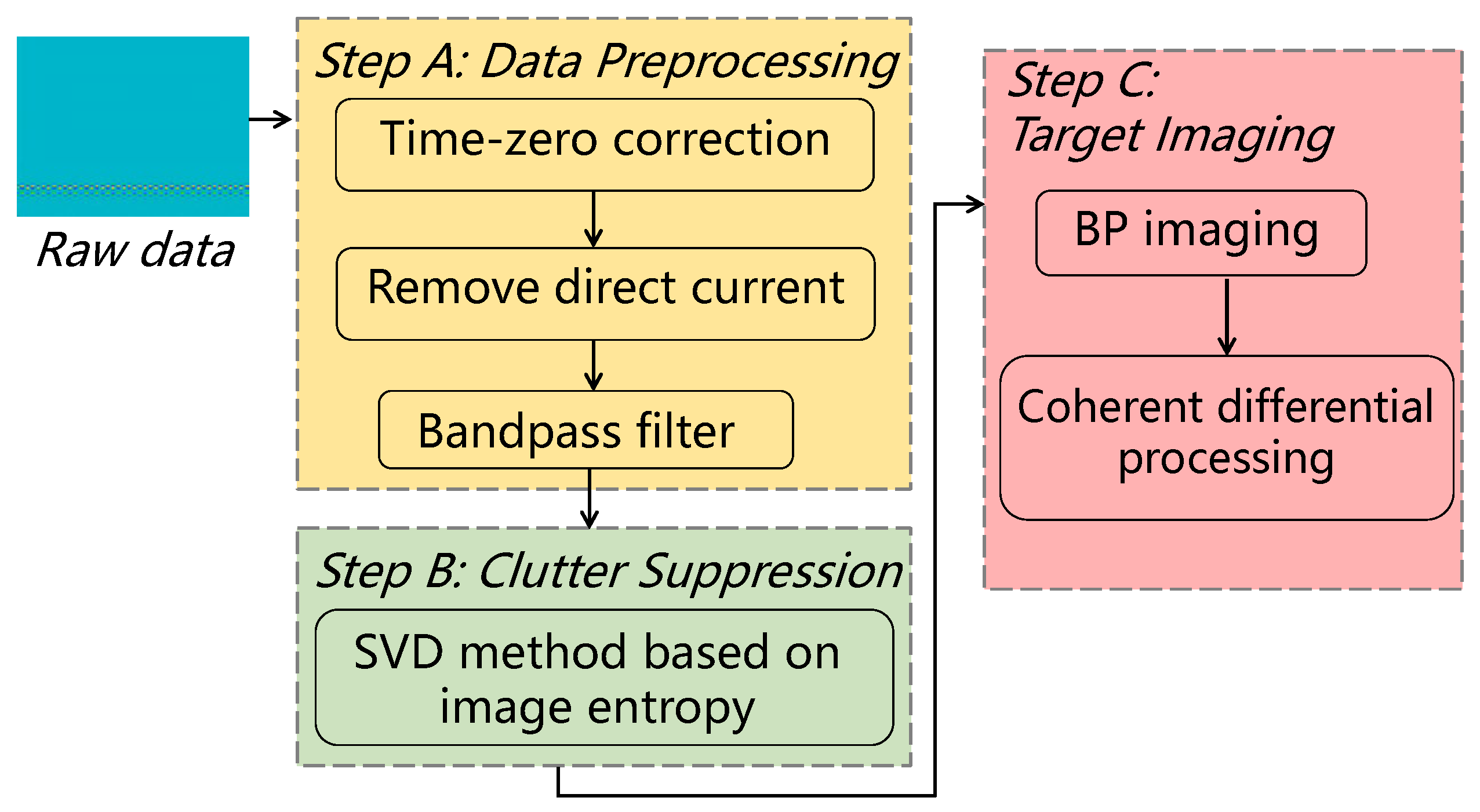
40]. This paper addresses the dual-peak response issue encountered during B-scan configuration. In this section, we propose a BP imaging algorithm procedure based on coherent differential processing, as illustrated in
Figure 4.
In Step A, the time-zero correction refers to calibrating the time origin to the starting point of the feedline. Specifically for Config. B described herein, an inverse power synthesizer and additional coaxial cable are employed. To ensure accurate display during subsequent data processing, compensation for the length of this cable segment is required to align its timing with that of Config. A. Removing the direct current eliminates DC signals to prevent weak signals from being masked by strong DC interference. Step B employs the image entropy-based SVD clutter suppression method [
41] (SVD-IE). GPR data involves various types of clutter, necessitating the selection of the most suitable clutter processing method for different scenarios. SVD-IE not only suppresses surface reflection waves, but also mitigates certain noise components, significantly enhancing the signal-to-clutter ratio (SCR) of radar images and facilitating target identification. Step C involves BP imaging of the target, where the coherent differential processing constitutes the proposed method in this paper. The algorithmic steps are outlined below.
First, define a sliding search window:
where (
x0,
y0) represents the center coordinates of the window and
is the width of the search window. It is related to antenna spacing and radar horizontal resolution
. Among them,
h and
y are the antenna height and target depth, respectively, as indicated in
Figure 2b.
is the height of the search window. Its value is taken as the distance rate of the radar
.
c is the speed of light in vacuum,
B is the radar bandwidth, and
is the relative dielectric constant of the medium. For different radar systems and target information, substitute the corresponding values.
The data matrix is then processed through the search window to locate the target matrix
IBP(
x,
y). This matrix represents the data after BP imaging. Peak detection is used to locate the target region:
where
denotes the imaging region. The target region extracted from this is denoted as
Since the signal will produce a symmetrical double-peak response under Config. B, we apply sliding coherent differential processing to the target area:
The resulting
Icoherent(
x,
y) retains some original response on both sides of the imaging point, which is generated during the leftward and rightward movements of
Itarget(
x,
y). To address this issue, spatial filters are applied to suppress the original response, yielding the final target imaging result:
where
G(
x,
y) represents a two-dimensional Gaussian filter function. Please refer to Formulas (21)–(23) for specific calculations. We have chosen the
here, and, according to statistical knowledge, within this range, Gaussian functions can already cover the vast majority of energy.
4. Simulation Results
In
Section 2, we demonstrated the
k −
h variation curve relationship under different target depths and dielectric constants of various media. This section will simulate a set of target parameters commonly encountered in practical radar detection. We also investigate the imaging effects of configurations A and B at three different heights. A detailed introduction follows below.
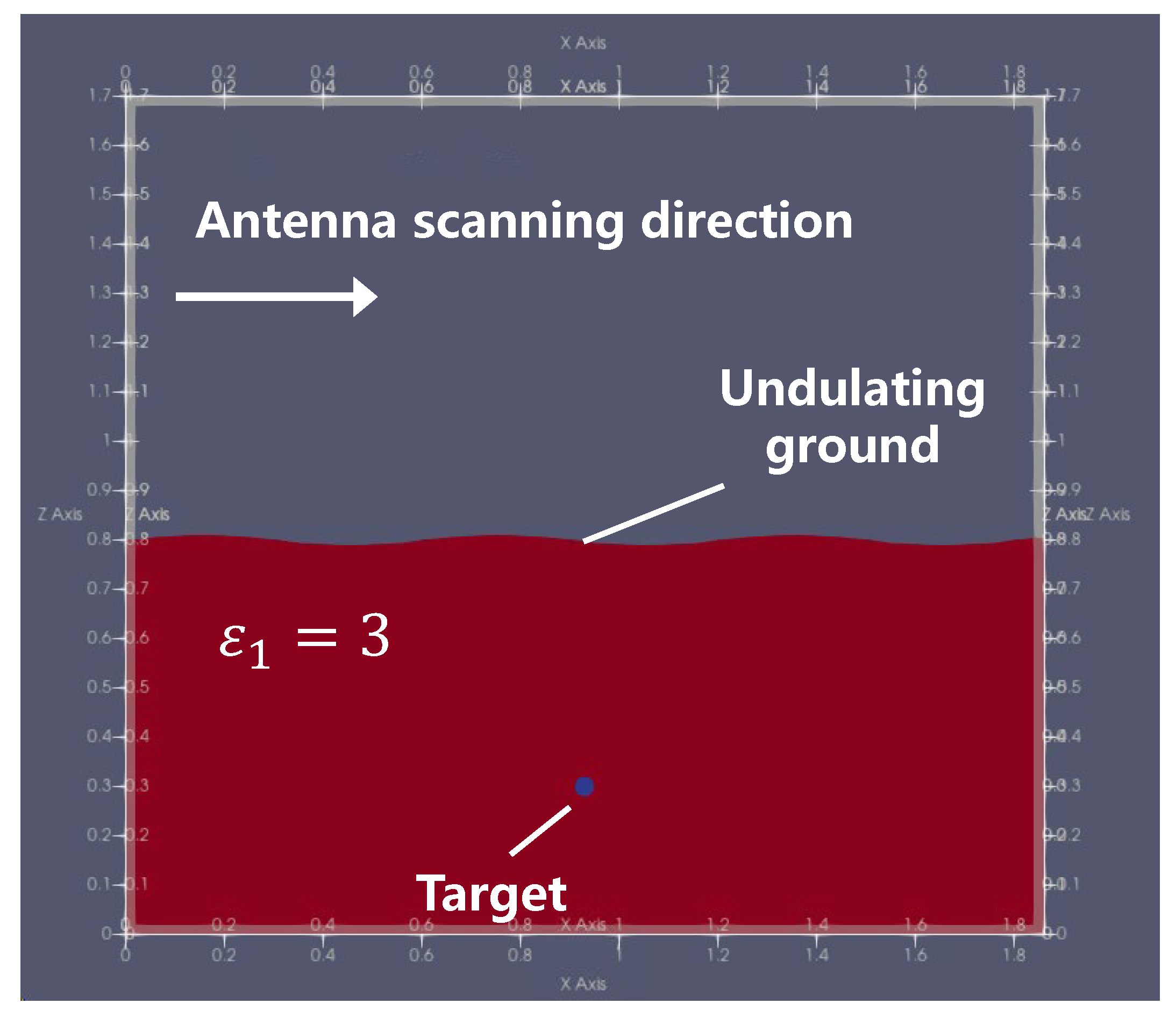
Simulation of the target was performed using the electromagnetic simulation software gprMax (v3.1.7) with the simulation area set to 1.86 m × 1.7 m in length and width, as shown in
Figure 5. The dielectric constant
of the medium was set to 3 and the conductivity σ was set to 10
−4 S/m. A metal cylinder with a radius of 4 cm was placed at a burial depth of
. The transmitted signal was a Ricker wavelet with a center frequency of 2 GHz and a signal amplitude of 1V. For simplicity, a dipole antenna was used for simulation. The antenna spacing was set to
. Considering practical vehicle-mounted GPR applications, the simulations were primarily conducted at three antenna heights:
(2
), 0.5 m (3.3
), and 0.7 m (4.7
).
Config. A was set up in the simulation as a single transmitter and single receiver antenna configuration. Config. B was set as a transmit-one-receive-two configuration, with inverted superposition of signals from two receiving antennas. Both configurations were simulated under identical parameters. To simulate real-world conditions, we added some noise and set the surface of the medium to contain sinusoidal undulations. The simulation results were then processed according to the flowchart shown in
Figure 4. Note that the simulation employed a relatively ideal scenario, so the jitter suppression process in Step B was omitted. Jitter suppression will be applied in the subsequent experimental section.
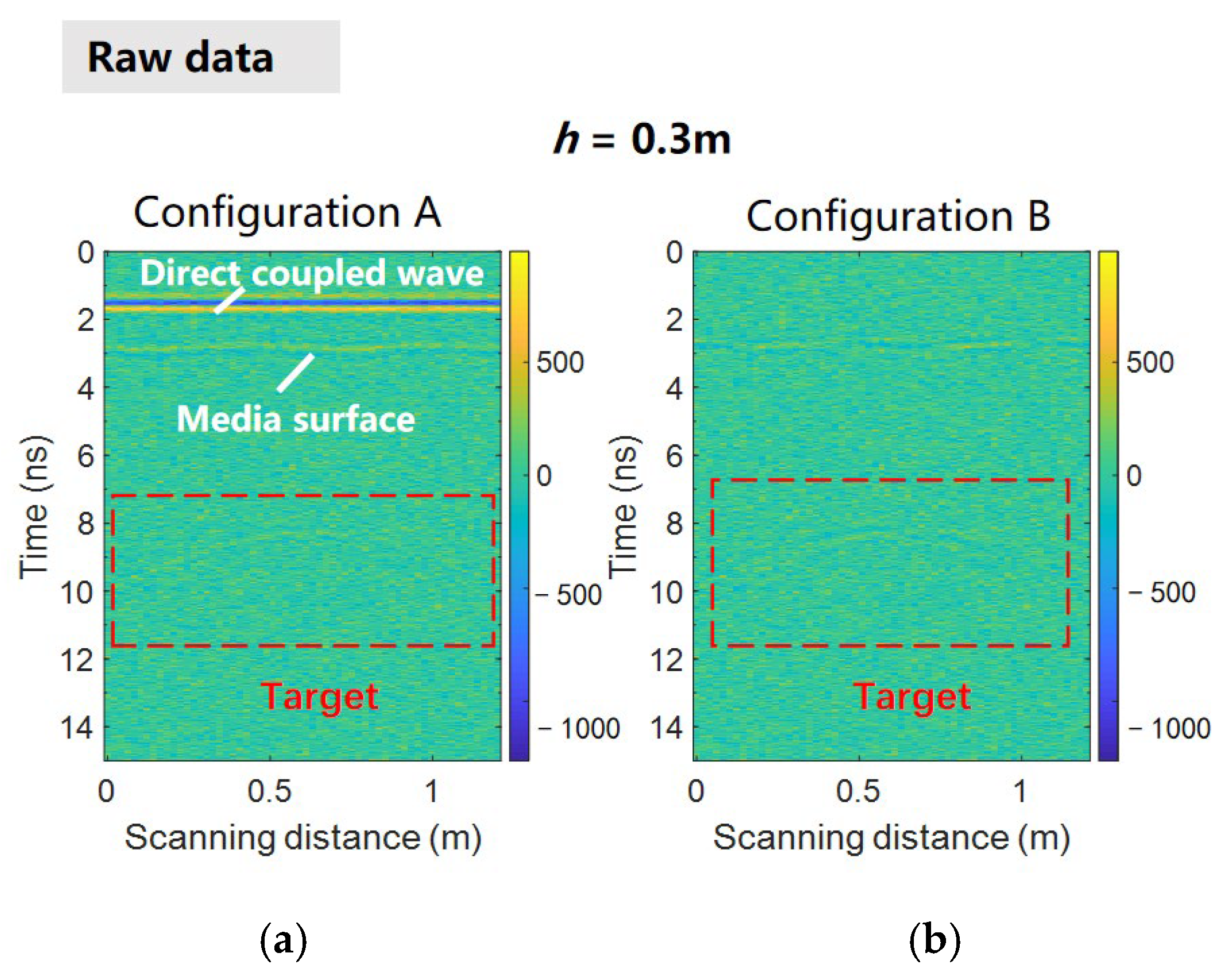
In the following section, we analyze the distinct results obtained at three different heights. First, for h = 0.3 m, the original simulation results for Configs. A and B are shown in
Figure 6a and
Figure 6b, respectively. It is evident that Config. A clearly displays both the direct coupling wave from the target and the reflected wave from the medium surface. Under the same contrast view, due to the undulations on the simulated medium surface, Config. B left behind the reflected waves on the medium surface and the target hyperbola. This phenomenon was already demonstrated in the preceding theoretical analysis. Due to the strong direct coupling wave of the original data antenna, it is difficult to observe the target characteristics. And similar results have also been observed at other heights, so we will not list them one by one here.
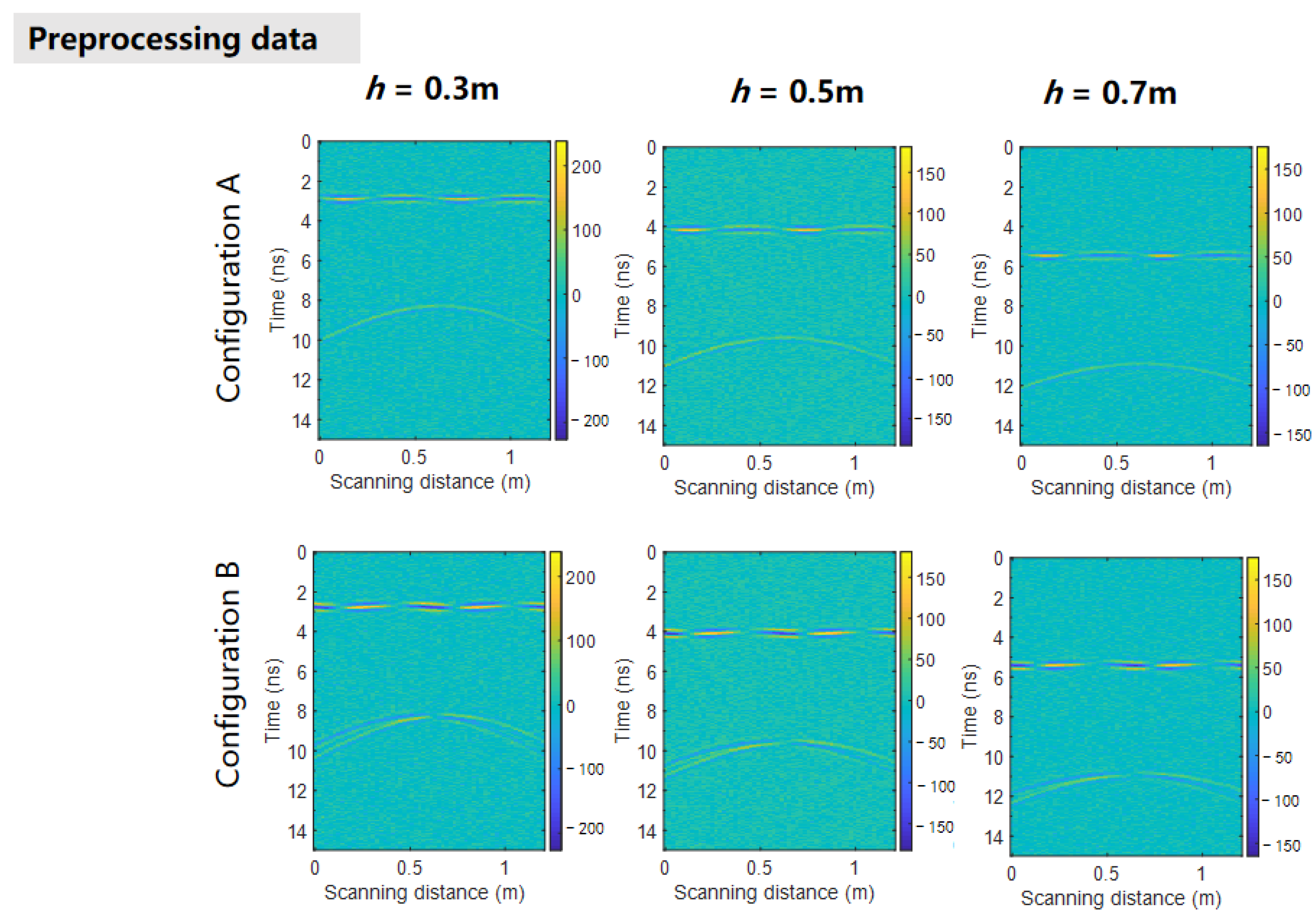
In the following section, we focus on analyzing the results after preprocessing, as shown in
Figure 7. The figure compares the results of two configurations at three different heights. It should be noted that, in the simulation, we do not use a clutter suppression algorithm, but rather employ mean subtraction.
It can be observed that the direct coupling wave from the antenna can be eliminated due to the absence of relative motion between them. A quantitative comparison of three heights will be provided in the following text. Note that a zero point appears at the peak of the hyperbola in Config. B. This aligns with the theoretical prediction in
Section 2. We will present a solution during subsequent imaging process.
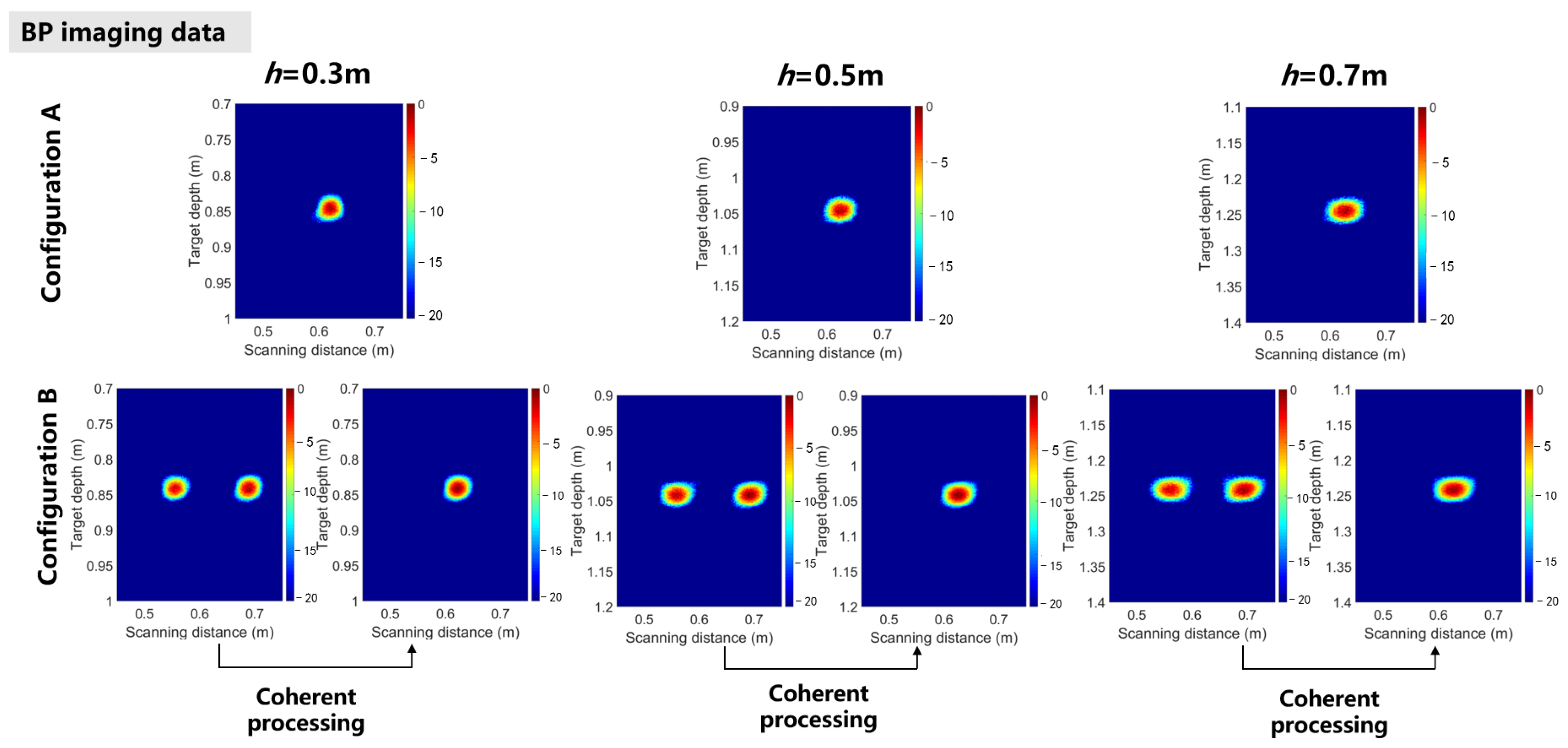
Figure 8 presents the results of BP imaging processing for two configurations. The results indicate that the target image in Config. A is focused. The target position aligns well with the simulation settings, with errors primarily stemming from simulation boundary conditions and excitation signal configurations. In contrast, Config. B yields two imaging points. This occurs because, when the target is directly beneath the antenna, it lies symmetrically between the two receiving antennas of Config. B, resulting in cancelation. During focusing, the target appears split into left and right components.
In order to quantitatively compare the results of the two configurations, we used peak amplitude (PA), target signal-to-clutter ratio (SCR), and Full Width at Half Maximum (FWHM) to evaluate. Among them, the calculation rules for PA and target SCR are shown in Formulas (24) and (25). Among them,
is the BP imaging matrix of the target echo.
is the region where the target is located in the matrix.
is the amplitude of the target signal and
is the amplitude of the signal other than the target in the BP imaging matrix.
FWHM represents the spatial distance corresponding to a 3 dB decrease in the peak energy of the target BP imaging point, which can actually be taken as the average of the longitudinal and transverse spatial distances [
42]. It can be seen that the peak amplitude describes the peak value of the target BP imaging point. According to the BP imaging theory, the imaging point is the superposition of echoes corresponding to different frame rates, which is essentially the same as Formulas (10) and (11). Therefore, the energy coefficient
k can also be expressed as the peak amplitude ratio of Config. B to Config. A.
The results calculated according to Formulas (24) and (25) are shown in
Table 1. The results indicate that, as the antenna height increases, the
k value also increases, which is consistent with the pattern in
Figure 3. Moreover, both the PA and SCR of Config. B are superior to Config. A, with a maximum improvement of 0.9 dB for SCR. However, the FWHM of Config. B is wider than that of Config. A, which means that the resolution performance is slightly worse. However, since the focus of this article is to address the bimodal response of a single objective, Config. B is effective overall.
After simulating multiple antenna heights, we observed that the separation between these two distinct imaging points consistently remained around 0.13 m at these heights. This precisely corresponds to the antenna spacing value d. To restore accurate imaging results, we applied the coherent differential processing method described in Equations (11)–(18). The processed result can also be seen in
Figure 8, where the imaging results of the target have been effectively restored. In summary, compared to Config. A, Config. B achieves comparable target imaging performance while simultaneously realizing antenna decoupling. These simulation results provide sufficient basis for subsequent practical testing.
5. Experimental Results
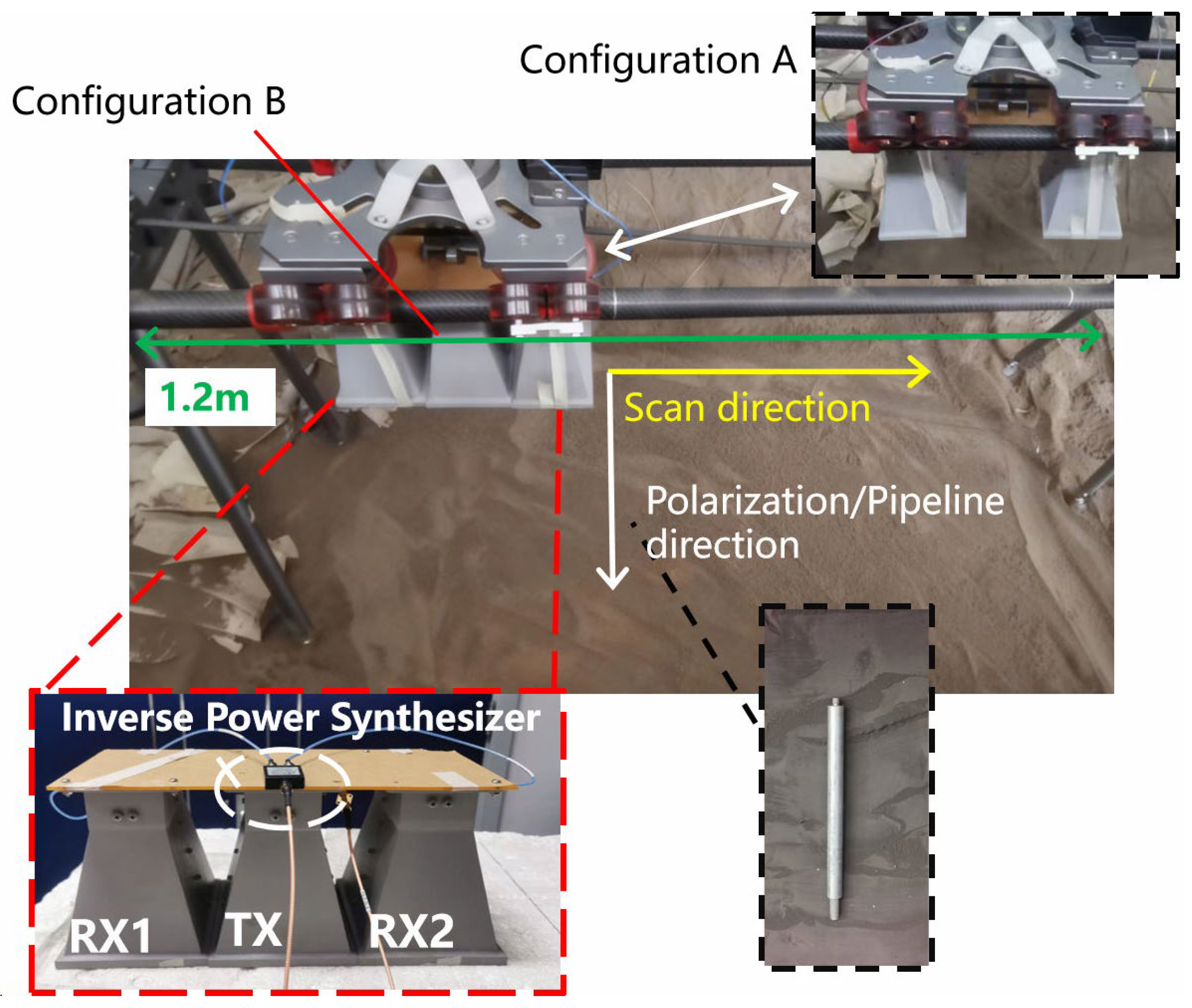
To validate the practical effectiveness of the proposed method, we constructed a radar experimental setup as illustrated in
Figure 9. The radar and antennas were mounted on a rail platform to emulate the operational environment of an in-vehicle GPR. The rail height was adjustable to test scenarios with varying antenna heights. The detection medium was volcanic ash with a dielectric constant of approximately 3. It should be noted that, due to construction activities, the tested medium contained numerous interferences. The target was a 4 cm diameter metal pipe buried 0.5 m beneath the volcanic ash layer. The antenna polarization was aligned along the direction of the metal tube and perpendicular to the direction of the survey line. This configuration aligns with practical applications [
43].
The radar transmits a frequency-stepped signal range of 1–3 GHz. The antenna adopts the HD-1060DRHA10N standard horn antenna produced by Hengda Company (Xi’an, China), with a bandwidth of 1–6 GHz [
44]. The inverse power synthesizer used in this work is the SYPJ-2-33+ model from Mini-Circuits. In Config. A, as shown in
Figure 9, the spacing between two antennas is 0.26 m. In Config. B, the spacing between each pair of antennas is 0.13 m, while the total spacing remains 0.26 m. This spacing is chosen to ensure the antennas are as compact as possible, meeting the dimensional requirements of the designed radar.
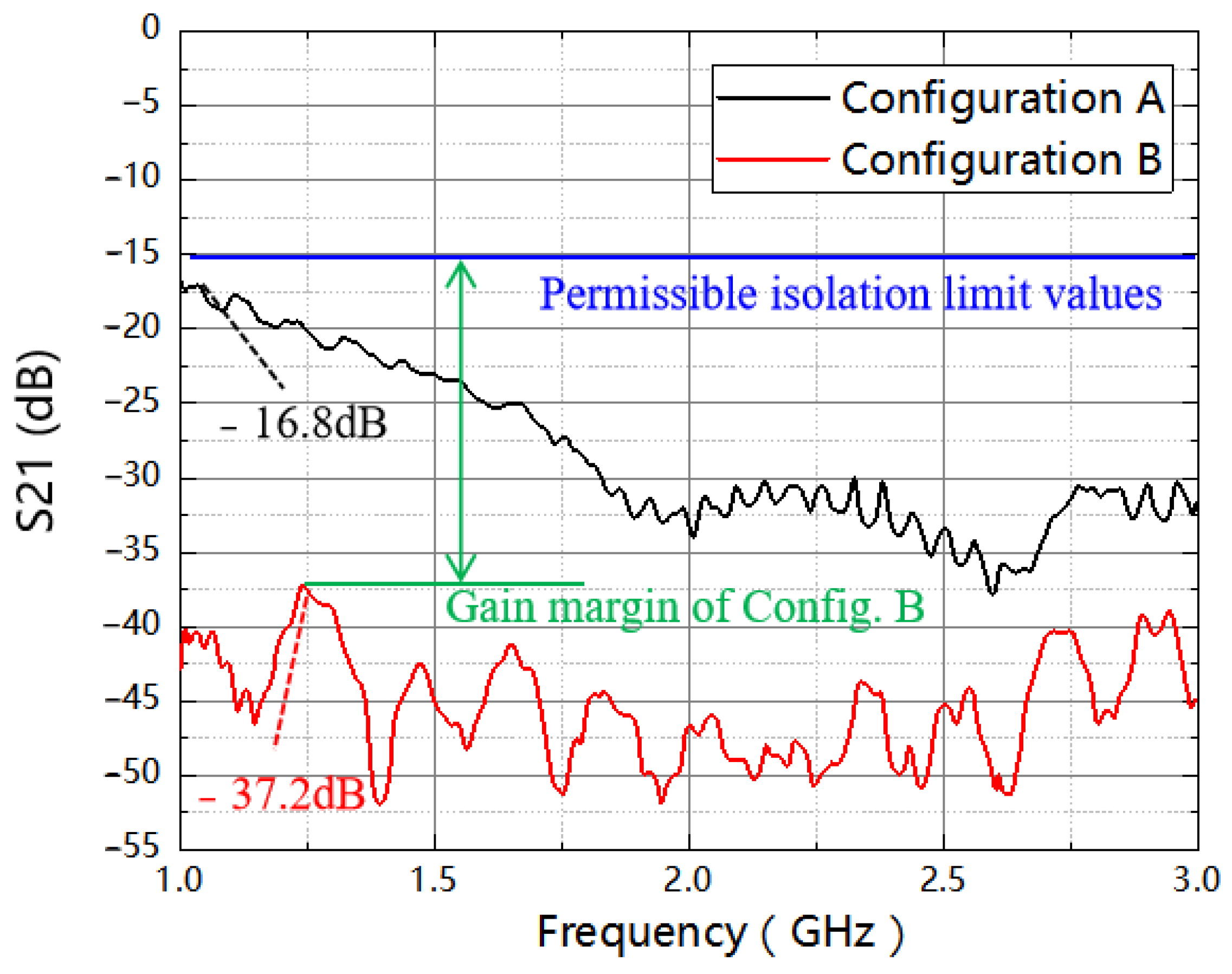
The antenna isolation test results are shown in
Figure 10. To ensure sufficient radar detection depth without exceeding the receiver’s dynamic range, the antenna isolation must meet specific criteria [
45,
46]. In the radar designed in this article, the maximum unsaturation of the receiver corresponds to an antenna isolation of 15 dB. This indicates that the isolation of Config. A (corresponding to an isolation level of |S21| = 16.8 dB) nearly reaches the maximum unsaturation point. In contrast, Config. B achieves over 37.2 dB of isolation across the entire frequency band, maintaining a 22.2 dB margin relative to the maximum unsaturation point. It should be noted that, due to phase errors in the feedline, perfect antenna symmetry cannot be achieved, resulting in the isolation of Config. B not reaching the ideal level.
We summarize the isolation results of the two configurations in
Table 2. The results indicate that Config. B can achieve a better level of isolation. Therefore, the gain at the receiving end allows for further improvement, and this result will provide guidance for subsequent experiments.
Subsequently, we employed the aforementioned radar system to test buried targets within volcanic ash. The acquired echo data is processed according to the workflow depicted in
Figure 4. Below are the comparative results for antenna heights
h = 0.3 m (2
), 0.5 m (3.3
), and 0.7 m (4.7
). First,
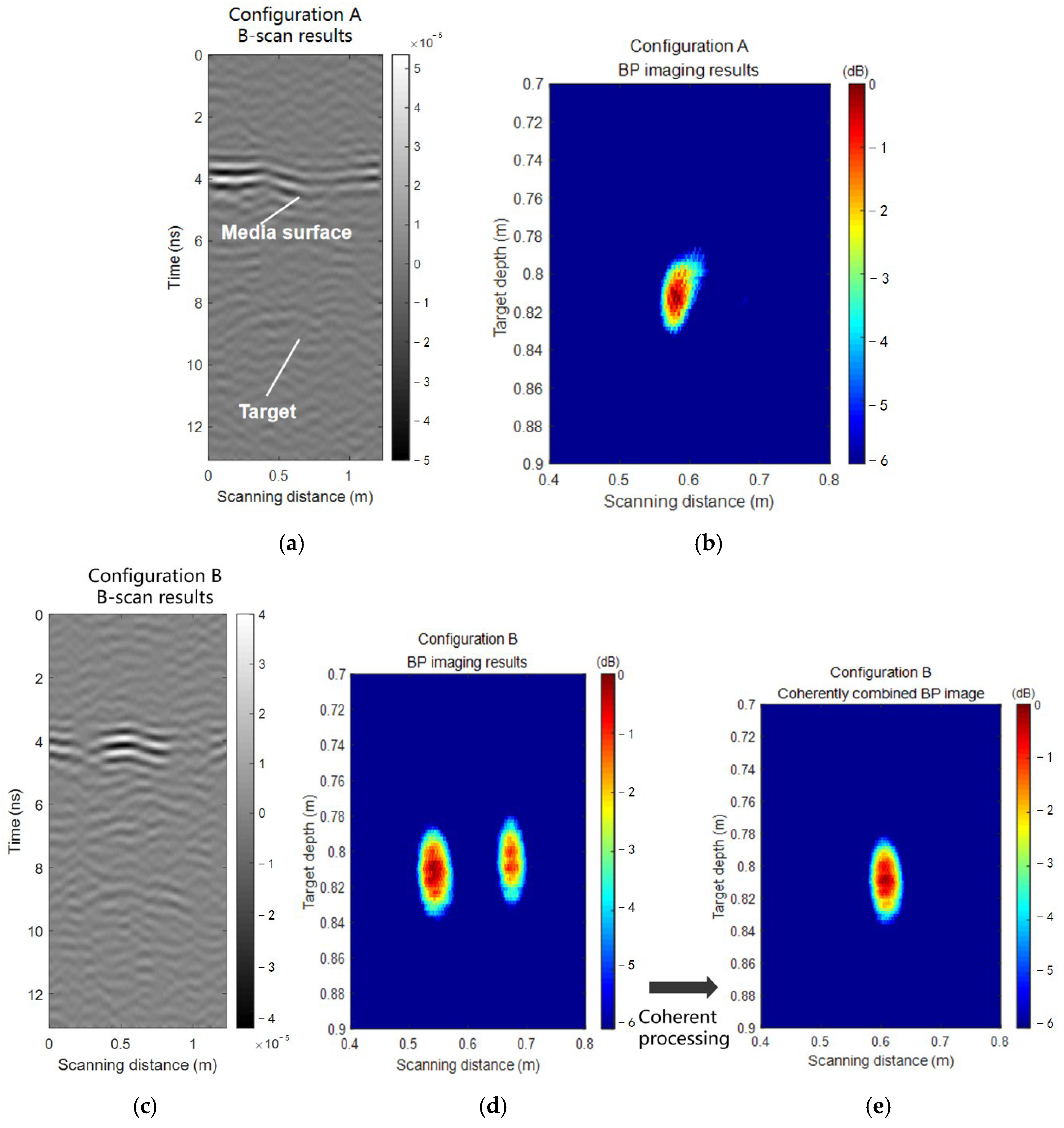
Figure 11 presents the test results for Config. A and Config. B at
h = 0.3 m. Both sets of results are processed using the same Step A and Step B as in
Figure 4. The results indicate that both configurations can successfully detect the target at this altitude. Furthermore, as shown in
Figure 11d, Config. B exhibits a bimodal response. To restore the target imaging results,
Figure 11e employs coherent differential processing. However, Config. B demonstrates slightly better target focusing performance compared to Config. A. This result is consistent with the pattern obtained from the simulations in
Figure 7 and
Figure 8.
We continued to increase the antenna height. When
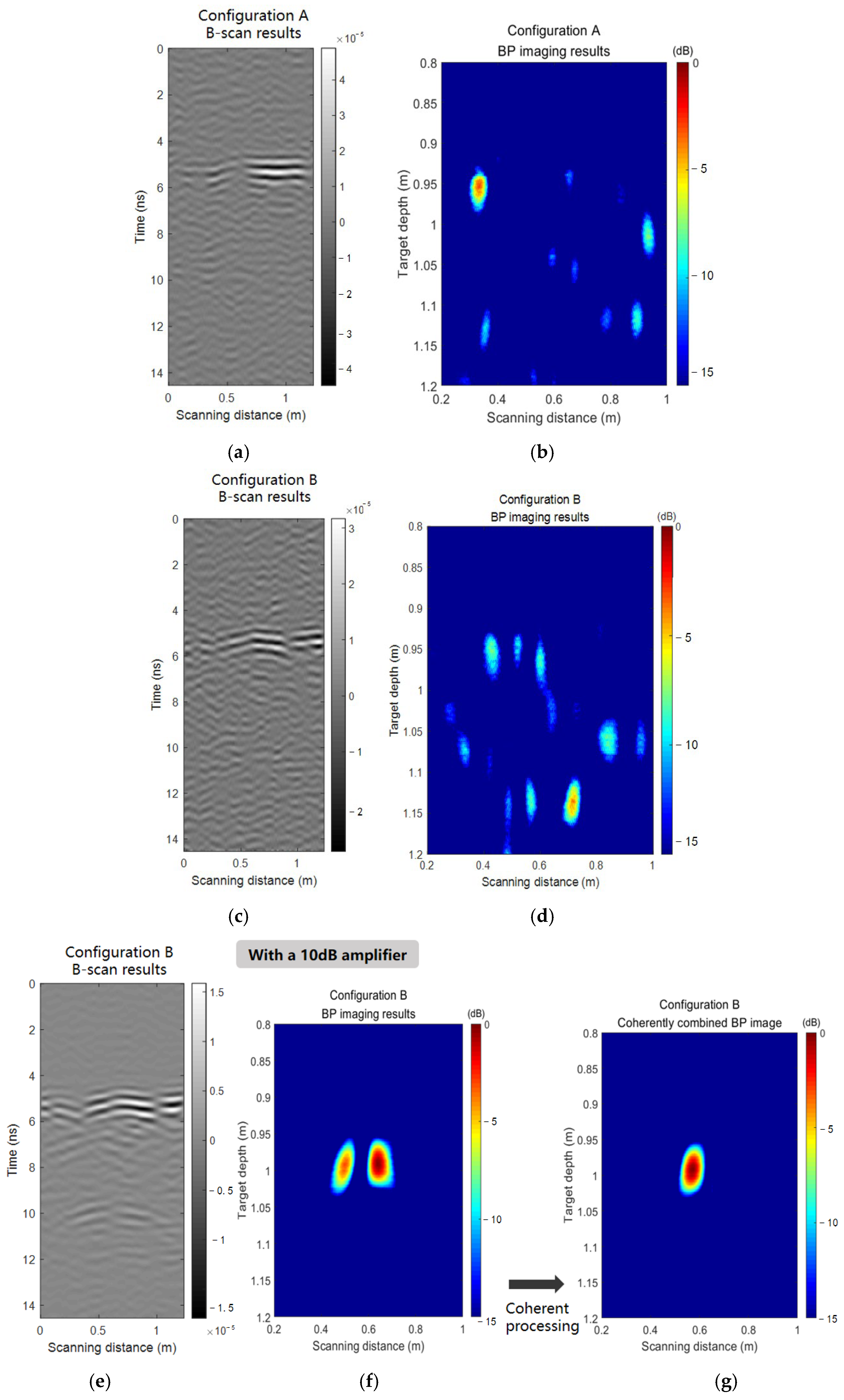
h = 0.5 m, the test results for the two configurations are shown in
Figure 12. As the antenna height increases, the attenuation of electromagnetic waves also increases. At this point,
Figure 12a,c indicates that neither configuration can detect the target. The target has been obscured by clutter and noise. Consequently, neither
Figure 12b nor
Figure 12d obtain the imaging results of target focus, and some clutter acts as false targets, seriously affecting the actual detection of targets. According to the noise Formula (26) of the cascaded system, increasing the first-stage gain
G1 can reduce the noise coefficient
, which is beneficial for extracting weak targets. However, according to the test results in
Figure 10, further increasing the receiver gain in Config. A leads to signal saturation. In contrast, Config. B allows for the continued enhancement of receiver gain.
Consequently, we further adjusted the amplifier in the receiver of Config. B. When the amplifier was set to 10 dB, as shown in
Figure 12e, the target trajectory became clearly visible. Furthermore, through the coherent differential processing method proposed in this paper, satisfactory target focusing results are ultimately achieved, as shown in
Figure 12g. The target depth is located at approximately 1 m (antenna height 0.5 m plus target depth 0.5 m), and the horizontal position is around 0.6 m, closely matching the actual location.
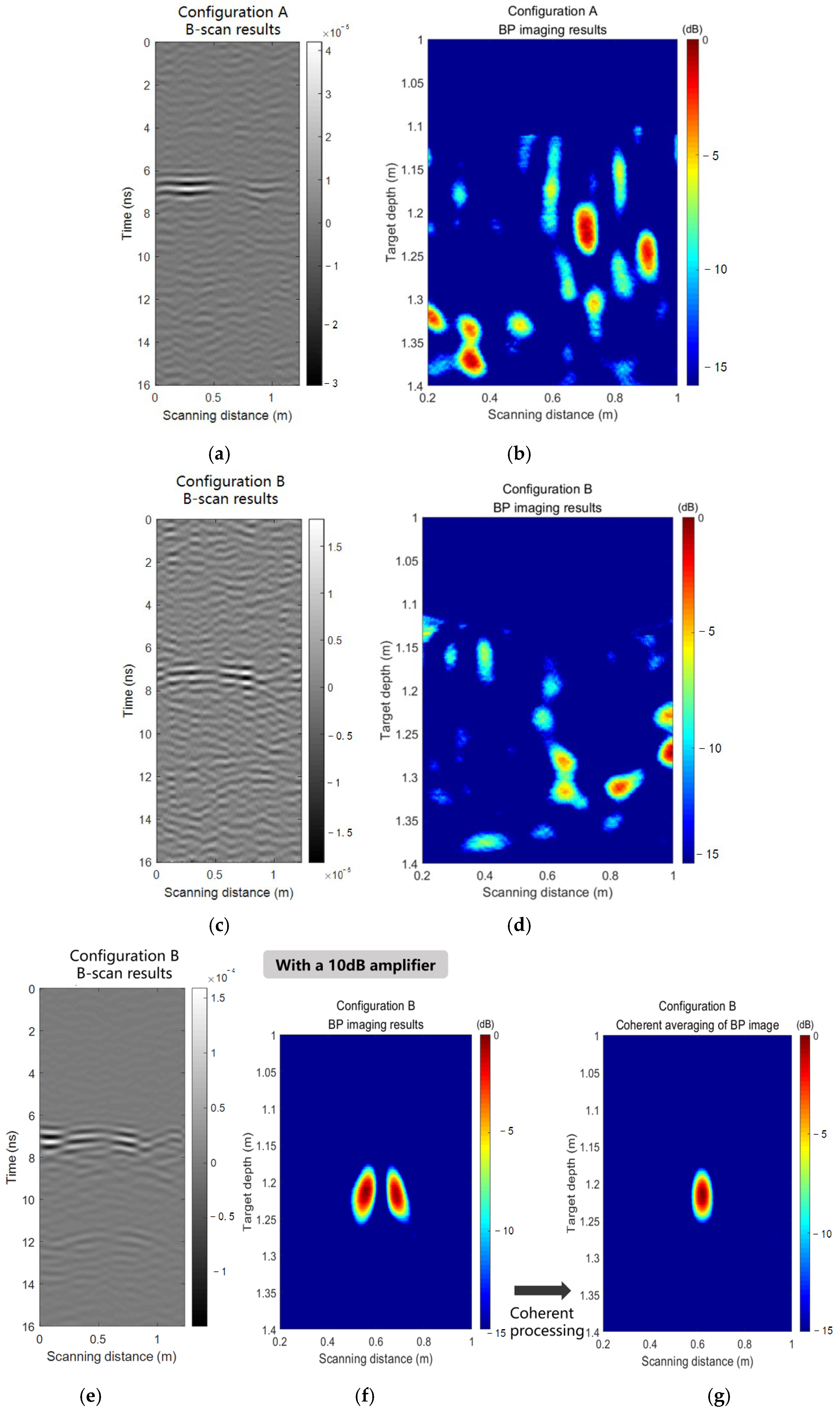
Finally, when
h = 0.7 m, the measured results for both configurations are compared as shown in
Figure 13. Similar to the analysis for
h = 0.5 m, the clutter energy is now stronger. As shown in
Figure 13b,d, both configurations produce numerous clutter images instead of the true target location. Config. A is constrained by isolation limitations and cannot further increase receiver gain. Config. B, however, can continue adjusting the amplifier. With the amplifier gain set to 10 dB, the results in
Figure 13e show that it successfully detected the target. After coherent differential processing,
Figure 13g shows a satisfactory focusing result. The target was located at a depth of 1.2 m and a horizontal position of 0.6 m, which is in good agreement with the actual results.
Finally, we will organize the results as shown in
Table 3. The symbol “-” in the table shows that the target has not been detected. When
h = 0.3 m, the target can be detected. At this point, the PA and SCR of Config. B are both higher than Config. A, and SCR can be improved by 1.9 dB. However, the FWHM of Config. B is slightly worse than Config. A. When
h = 0.5 m and
h = 0.7 m, both Config. A and Config. B cannot effectively detect targets, while Config. B, which allows for an increase of 10 dB, can effectively detect targets and maintained a considerable SCR value.
Furthermore, to assess the practicality of the proposed configuration,
Table 4 presents a comparison between the proposed method and other methods reported in the literature. Among these, the isolation improvement value indicates the enhancement at the peak isolation point. Extra size indicates whether the antenna dimensions will be increased. It can be observed that the proposed method achieves higher isolation improvement and wider decoupling bandwidth without increasing the physical dimensions of the antenna.




 ,
,