Article

Graph-Based Differential Equation Network for Medium-Range Temperature Forecasting

by
Jinjing Cai
1,
Xiaoran Fu
2,*,†,
Binting Su
3,*,† and
He Fang
3
1
Fujian Province Warning Information Release Center, Fuzhou 350001, China
2
National Institute of Natural Hazards, Ministry of Emergency Management of China, Beijing 100085, China
3
College of Computer and Cyber Security, Fujian Normal University, Fuzhou 350108, China
*
Authors to whom correspondence should be addressed.
These authors contributed equally to this work.
Electronics 2026, 15(2), 391; https://doi.org/10.3390/electronics15020391
Submission received: 1 December 2025 / Revised: 27 December 2025 / Accepted: 4 January 2026 / Published: 15 January 2026

Abstract

Medium-range temperature forecasts are of critical importance for a diverse range of economic activities, e.g., agricultural production, transportation, and industrial operations. The most significant challenge in accurately predicting temperature lies in effectively characterizing the spatiotemporal evolution of temperature characteristics. In this paper, we design a spatial feature module and a gating temporal module based on the location-oriented directed adjacency matrix. Dynamic evolution of both spatial and temporal features is characterized by a graph-based differential equation module. The spatial and temporal feature sequences are integrated by an output fusion module to achieve medium-range temperature prediction. The proposed graph-based differential equation network has been validated on the dataset of South China, which shows superior performance in medium-range temperature prediction.

1. Introduction

Temperature is a key meteorological factor influencing human life and socioeconomic development, exerting direct and significant impacts on vital sectors such as agricultural production (tea, fruit tree cultivation, and protected agriculture), coastal shipping and transportation, the prevention of typhoon-related secondary disasters, scheduling in the tourism industry, and the regulation of energy supply and demand [1]. The ability to make accurate medium-range temperature forecasts will have a significant impact on a range of decisions made by governments and individuals. For example, precise five-day temperature forecasts could help major tea-producing regions (such as Wuyishan and Anxi in Fujian, China) avoid frost or heat damage caused by low or high temperatures. They could also provide a meteorological basis for shipping schedules at coastal ports such as Xiamen Port and Fuzhou Port, support the targeted release of high/low-temperature warning information and thereby offer scientific support for government emergency management, corporate production decisions and public life arrangements.This has led to considerable research interests in this field.
Numerical weather prediction models are mathematical models designed to forecast temperatures, which are based on physical principles and take current weather conditions into account [2]. To be specific, the fundamental principle of numerical weather prediction involves the estimation of future temperature based on the current state of temperature and the application of thermodynamic equations, where the thermodynamic equations are modeled by partial differential equations. The scientific foundation of numerical weather prediction lies in the principles of physics and thermodynamics. Employing these principles enables a more objective and scientific basis for forecasting. Consequently, it has become the foundation for large-scale and medium-to-long-range temperature forecasts. The predictive accuracy of numerical weather prediction models is contingent upon the resolution of the grids employed in numerical simulations, with higher resolutions necessitating substantial computational resources. Concurrently, due to the occurrence of chaotic phenomena, even negligible computational errors have the capacity to exert a considerable effect on ultimate forecast outcomes. These factors exert a direct influence on the predictive accuracy of numerical models [3]. Although numerical weather prediction models form the basis of traditional medium-range temperature forecasts, they struggle to meet the operational demands of South China’s (e.g., Fujian Province) advanced meteorological services due to limitations in grid resolution and computational resources.
Data-driven methods can effectively overcome the computational limitations of traditional numerical weather prediction methods. Traditional methods for temperature forecasting include the autoregressive integrated moving average model [4], the nonlinear autoregressive exogenous model [5], and the support vector regression algorithm [6]. While the value of these statistical and empirical approaches is evident, they frequently encounter difficulties in capturing the complex, non-linear patterns that are characteristic of high-dimensional meteorological data. The advent of artificial intelligence has led to significant advancements in the field of temperature forecasting, thereby overcoming the limitations that previously existed.
Neural networks are capable of effectively capturing nonlinear relationships in temperature data, making them a valuable tool for temperature forecasting. A recurrent neural network-based method [7] has been developed to predict local weather based on the combination of public data and local measurements by utilizing the advantages of recurrent neural networks in sequence prediction problems. A long short-term memory network [8] has been proposed for predicting abnormal ocean water temperature around Korea. A conditional deep convolutional generative adversarial network-based proxy model [9] was designed for rapid temperature prediction by utilizing a combination of permeability fields and temporal data as inputs to facilitate accurate prediction of temperature distributions.
Deep learning-based methods are limited in their ability to model global and cross-regional temperature dependencies for the purpose of prediction. Conversely, graph neural network-based approaches have demonstrated a stronger capacity to inherently capture the intricate spatial relationships and inter-dependencies present in data sets. A time series network [10] was proposed for ocean temperature forecasting, where spatial correlation and temporal dynamics are modeled by graphs and a long short-term module is applied to aggregate the spatial features and temporal features. A spatial–temporal graph attention network [11] was designed for sea surface temperature forecasting, where a graph learning module was designed to learn a static adjacency matrix and an attention module with dynamic coefficients was designed to capture dynamic spatial correlations. A 3D spatial–temporal attention network [12] was designed for ocean temperature forecasting. The spatial correlations of temperature data have been decomposed into static features and dynamic features, which are built based on three-dimensional graph structures. An adaptive graph convolutional network [13] has been proposed for rapid indoor temperature prediction, which enables high-resolution temperature prediction based on sparse measurements by utilizing adaptive graph learning for optimal sensor placement. In [14], a dynamic spatio-temporal network has been proposed for 3D ocean temperature prediction, where dependencies among temperature data are modeled by graph module. This model integrates static learning with dynamic graphs, enabling automatic extraction of two unknown dependencies between temperature data, obviating the need for any prior knowledge.
In order to further leverage the spatio-temporal characteristics of temperature data, physics-informed neural network models have been widely applied in temperature forecasting. A physics-informed model [15] has been designed to predict multi-depth lake temperatures, where long short-term memory modules are developed to model temporal relationships. A physical module provides simulation data based on physical knowledge, thereby ensuring consistency between prediction results and physical mechanisms. In [16], a physics-assisted deep learning network has been proposed for weather prediction, where the advection process has been considered based on Navier–Stokes equation. The training of the weather prediction model is based on the spherical manifold rather than the planar latitude–longitude grid. A physics-guided attention-based network [17] has been designed for forecasting ocean surface temperature, where a constraint module is designed based on physical rules to emulate the transport dynamics in fluids. This model then develops a cross-attention mechanism to integrate data-driven spatio-temporal convolution operations and the physical dynamics of sea surface temperatures. In [18], a hybrid physics-informed network has been designed to predict temperatures of rivers. The effects of advection, diffusion and reaction are incorporated by a physical constraint module in a manner that guarantees physical consistency in the representation of river thermal dynamics. A partial differential equation network [19] has been proposed for predicting sea surface temperature, where the heat sources and sinks of sea surface temperatures are modeled by a mixed-layer heat budget differential equation. In [20], a physics-informed neural network has been proposed for the purpose of predicting lake water temperature. This approach is based on Koopman embedding, whereby temperature data is transformed into high-dimensional embedding vectors. The evolution of the dynamical system over time is modelled by an infinite-dimensional Koopman operator. This approach enables a simplified representation of the complex thermal dynamics problem.
A highly precise, adaptive medium-range temperature forecasting model is urgently required (e.g., by the Meteorological Warning Center) so that the accuracy and effectiveness of its services can be improved. Despite the application of physical principles to neural network-based temperature prediction, there is considerable scope for enhancement in both predictive models and accuracy. In most physics-inspired temperature prediction models, they consider the physical rules as a constraint module to guarantee the consistency between the predicted temperature and the physical laws. The dynamic evolution characteristics of temperature remain to be thoroughly modeled. In this paper, we will construct a directed adjacency matrix using location information of stations to explicitly model the evolution of temperature. A spatial feature module and a temporal feature module are designed based on the graph adjacency matrix, respectively. A differential equation module is proposed based on graphs to model the evolution of spatial and temporal features, which are integrated by a module for medium-range temperature prediction, by feeding the spatial and temporal information into the output module. The proposed network model based on graph differential equations has been specifically designed to address the spatio-temporal evolution characteristics of temperatures in South China (including Fujian Province), addressing the issues of insufficient forecast accuracy in traditional models under complex conditions and the influence of multiple meteorological factors. The contributions of this paper is summarized as follows.
(1)
A graph-guided module and a gating module have been designed using a directed adjacency matrix to capture spatial and temporal features of temperature data, improving temperature prediction accuracy.
(2)
A graph-based differential equation module has been designed to explicitly characterize the dynamic evolution of the spatial and temporal features, thus enabling medium-range temperature predictions of a higher degree of accuracy.
(3)
A graph-based output module has been proposed for fusing spatial and temporal features for predicting medium-term temperature, which has demonstrated superior performance over datasets collected in South China.

2. Data Used and Methods

2.1. Study Area and Data Used

We investigate the medium-range temperature forecasting in southern China [21,22]. The data are located within the latitude range [21.483, 34.85] and the longitude range [105.067, 122.45]. Our goal is to predict the medium-range temperature for a given city over the next few days based on its recent historical data and its correlation with neighboring cities. The daily maximum temperatures for these cities over 365 days from January 2018 to December 2018 are collected from [21,22].

2.2. Problem Formulation

Temperature data are denoted by X , which is of size N-by-T. N = 100 is the number of stations, and T = 365 is the length of data. The temperatures collected over the n-th station v n are denoted by x n = X ( n , : ) , and we denote the temperature collected in time instant k by x k = X ( : , k ) . The historical data is used to study the temperature prediction problem, i.e.,
X ( k ) = [ x k , x k 1 , , x k M + 1 ] ,
where M is the length of the input temperature data. The latitudes and longitudes of the temperature monitoring stations
Y = [ y 1 , y 2 , , y N ]
are considered in the temperature forecasting problem, where y i denotes the location of the i-th station.
X τ ( k ) = [ x k + 1 , x k + 2 , , x k + τ ] ,
where τ is the length of temperature data to be predicted. The medium-range temperature prediction problem can be modeled by
min X τ ( k ) f ( X ( k ) , A ( Y ) ) ,
where A ( Y ) is a directed adjacency matrix that is oriented towards physical information and is based on the site’s latitude and longitude data, and f ( · ) is the medium-range prediction model to be developed.

2.3. Methods

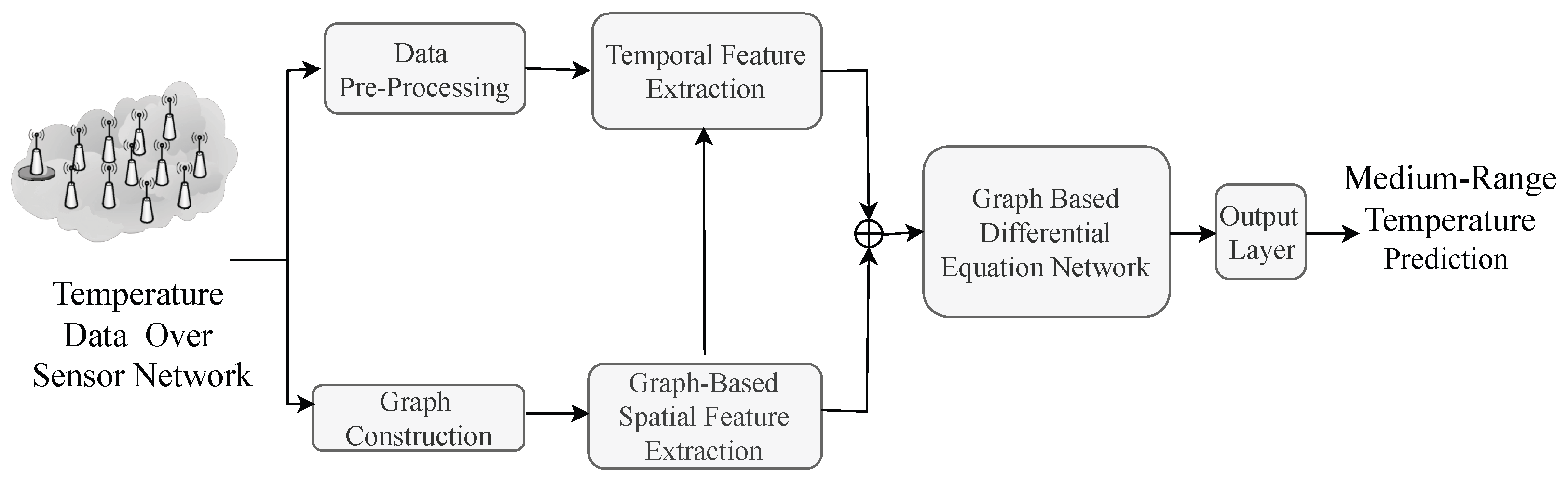
This section presents the graph-based differential equation network for medium-range temperature prediction. The model is shown in Figure 1, where the directed adjacency matrix is designed in Section 2.3.1. The graph-based spatial feature and temporal feature modules are presented in Section 2.3.2 and Section 2.3.3, respectively. The graph-based differential equation module is shown in Section 2.3.4, and finally the graph-based fusion module is presented in Section 2.3.4.

2.3.1. Latitude- and Longitude-Based Directed Adjacency Matrix

We denote the distance between the i-th station and the j-th station by
d i , j = h a v e r s i n e ( y i , y j )
where h a v e r s i n e ( · ) indicates the haversine function to calculate the distance d i , j using the latitudes and longitudes of stations y i and y j , and 1 i , j N . We denote a directed adjacency matrix by A , with its entry a i , j defined by [21]
a i , j = e d ˜ i , j 2 e d ˜ i , j 2 k N i e d ˜ i , k 2 l N j e d ˜ j , l 2 k N i e d ˜ i , k 2 l N j e d ˜ j , l 2 ,
where a i , j is the entry in the i-th row and j-th column, and d ˜ i , j is denoted by
d ˜ i , j = d i , j / σ ,
with σ being a coefficient. N i and N j are the neighboring sets of the i-th station and the j-th station.

2.3.2. Spatial Feature Extraction Module

x ˜ i , k = A i x k
represents the i-th order spatial feature of temperature data at time instant k, x k . i is the spatial feature order. The i-th order spatial feature for medium-range temperature prediction can be defined by
S i , k = [ x ˜ i , k , x ˜ i , k 1 , , x ˜ i , k M + 1 ] ,
where S i , k is a matrix of size N × M . We apply a linear transform Z to the i-th order spatial feature, i.e.,
S ˜ i , k = S i , k Z ,
where Z is of size M × R .
G k = c 0 S ˜ 0 , k + c 1 S ˜ 1 , k + + c L S ˜ L , k
represents the graph-based spatial feature at time instant k. The k-th feature G k is of size N-by-R, and c 0 , , c L are coefficients to be determined.

2.3.3. Temporal Feature Extraction Module

X ˜ ( k ) = X ( k ) Z ,
and
P k = σ ( S p G k 1 + U p H k 1 + V p X ˜ ( k ) + D p ) ,
where S p , U p , and V p are matrices to be designed, and D p is a bias matrix to be designed. σ is the Sigmoid function, and R e L U is the activation function. The temporal feature is calculated by [23,24]
H k = ( 1 P k ) H k 1 + P k H ^ k ,
where
H ^ k = tanh ( S h G k 1 + U h Q k H k 1 + V h X ˜ ( k ) + D h ) ,
Q k = R e L U ( S q G k 1 + U q H k 1 + V q X ˜ ( k ) + D q ) ,
S h , U h , V h , S q , U q , V q , V q , and D q are coefficient matrices to be determined.

2.3.4. Graph-Based Differential Equation Module

The diagonal degree matrix of A is denoted by D , and
L ˜ = I D 1 / 2 A D 1 / 2 .
The scaled graph Laplacian matrix L can be defined by
L = 2 L ˜ / λ m a x I ,
where λ m a x is the largest eigenvalue of matrix L ˜ .
The dynamic evolution of spatial feature G k can be modeled by the ordinary differential equation
G k t = k g R g T a n h ( L G k ) ,
where R g is a matrix defined by
R g = σ ( ( j = 0 J θ j L j ) W g ) .
k g , W g , and θ j for j = 0 , , J are coefficients to be determined, and the Sigmoid function is used to introduce non-linearity, thereby facilitating the management of complex modeling. ⊙ indicates the element-wise multiplication of two matrices. The evolution of temporal features can be defined by the the differential equation
H k t = k h R h T a n h ( L H k ) ,
where R h is a matrix defined by
R h = σ ( ( j = 0 J θ ˜ j L j ) W h ) .
k h , W h , and θ ˜ j for j = 0 , , J are coefficients to be designed.
The spatial feature sequence G ˜ k and the temporal feature sequence H ˜ k can be obtained by solving the differential equations using neural ODE solver, i.e.,
G ˜ k = O D E ( G k , G k t , [ k 1 , k 2 , , k β ] ) ,
and
H ˜ k = O D E ( H k , H k t , [ k 1 , k 2 , , k β ] ) ,
where β is the time steps of feature sequences to be calculated.
The evolution of spatial features and temporal features is modeled based on ODE by (23) and (24) together with (19)–(22) that represent the temperature diffusion process.

2.3.5. Output Fusion Module

U k , the fusion spatio-temporal feature, is denoted as
U k = H ˜ k G ˜ k ,
where ⊕ indicates the concatenation of two matrices. That is, U k is the fusion of temporal feature H ˜ k and spatial feature G ˜ k . Thereafter, a multilayer module is designed for the medium-range temperature forecast, i.e.,
X ^ τ ( k ) = M L P ( U ^ k ) ,
where
U ^ k = R e L U ( C U k ) ,
and C is a linear coefficient matrix to be designed.
In [25], we proposed a graph network for one-day temperature prediction. In this paper, however, the model is specifically designed for medium-term temperature prediction. The graph ordinary differential equation module has been designed to model the evolution of spatial and temporal features within a medium-term temporal horizon. Furthermore, the graph-based spatial and temporal feature extraction modules have been redesigned to provide a more accurate characterization of the features based on physical-informed directed graphs.

3. Results and Discussions

3.1. Numerical Experiments

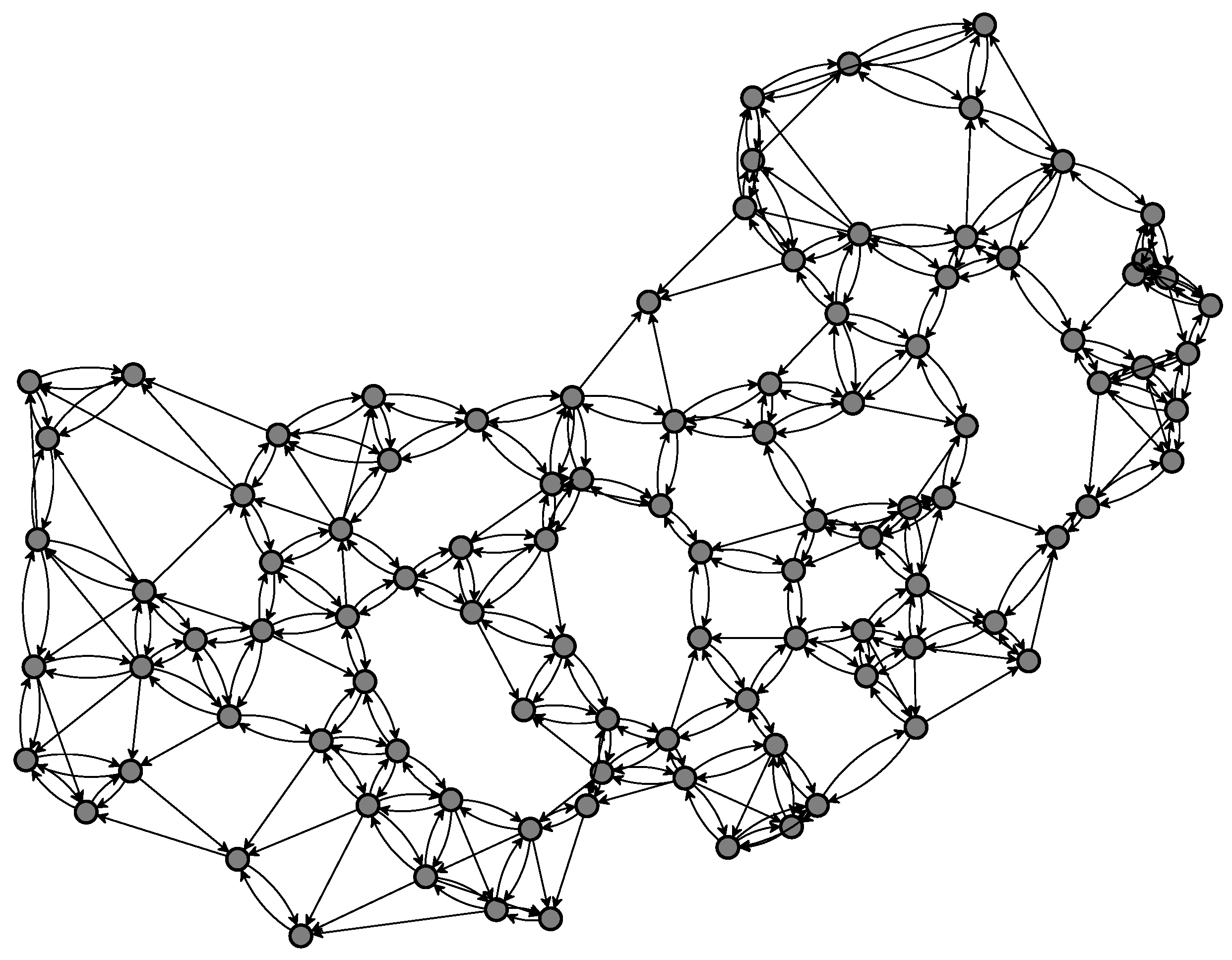
This section will illustrate the proposed graph-based differential equation network for medium-range temperature prediction on a dataset collected in 100 cities in South China [21,22]. The total 365 days of data are divided into the ratio of 0.45:0.05:0.5, where 45 percent of data are used in training, 5 percent in validation, and 50 percent for testing. The directed graph is computed by Equation (7). In order to make all the elements of the directed graph adjacency from 0 to 1, the coefficient σ is set to be 200. In Figure 2, the directed graph is represented by a set of stations, with each station selecting the four stations that are geographically closest to them, thereby constructing the adjacency matrix denoted by A . In the absence of a directed edge, the relationships between their temperatures are not taken into consideration in the process of temperature forecasting. The experimental configuration is given in Table 1. Training and validation on 50 percent of the data can be completed in three minutes for 50 training epochs, and inference can be completed in one minute.
Baseline model: The correlation-aware spatial–temporal model (CST-GL) [26], AirPhyNet [27], and Graph Deviation Network (GDN) [28] are considered as the baseline models for performance comparison. The graph of CST-GL is symmetrical because it is constructed based on the correlations of temperatures at different stations. The spatial features of the CST-GL model are characterized using a conventional convolution network. In CST-GL, both spatial and temporal features of temperatures are considered for the temperature forecasting, which serves as a reliable baseline model to demonstrate the efficacy of the proposed differential equation network model. AirPhyNet is a physics-informed network for air quality forecasting, which leverages the well-known principles of air particle movements to improve the prediction performance. The GDN approach is a graph attention-based forecasting model, where the relationships between sensors are learned based on attention-based mechanisms.
The Mean Absolute Error (MAE) is defined by [26]
M A E = 1 / ( K N τ ) k = 1 K X ^ τ ( k ) X τ ( k ) ,
where X ^ τ ( k ) is the predicted temperature of τ days over all N stations, and X τ ( k ) is the true temperature. K = 170 is the data length of the test dataset. The performances of the proposed model and baseline models, i.e., AirPhyNet, GDN, and CST-GL model, are shown in Table 2. The proposed model and the CST-GL model have the same performance in 1-day temperature prediction, but our proposed graph-based differential equation network has much better performance in medium-range temperature prediction, leading to a smaller average MAE. The proposed model performs much better than AirPhyNet and GDN approaches in all five-day predictions. This is primarily due to the characterisation of spatial and temporal information, as well as the modelling of feature evolution by the graph differential equation module. We denote by
x ^ n k = X ^ τ ( k ) ( n , : )
and
x n k = X τ ( k ) ( n , : )
the predicted data and the true temperature over station n. The MAE of station n can be defined by
M A E n = 1 / ( K τ ) k = 1 K x ^ n k x n k ,
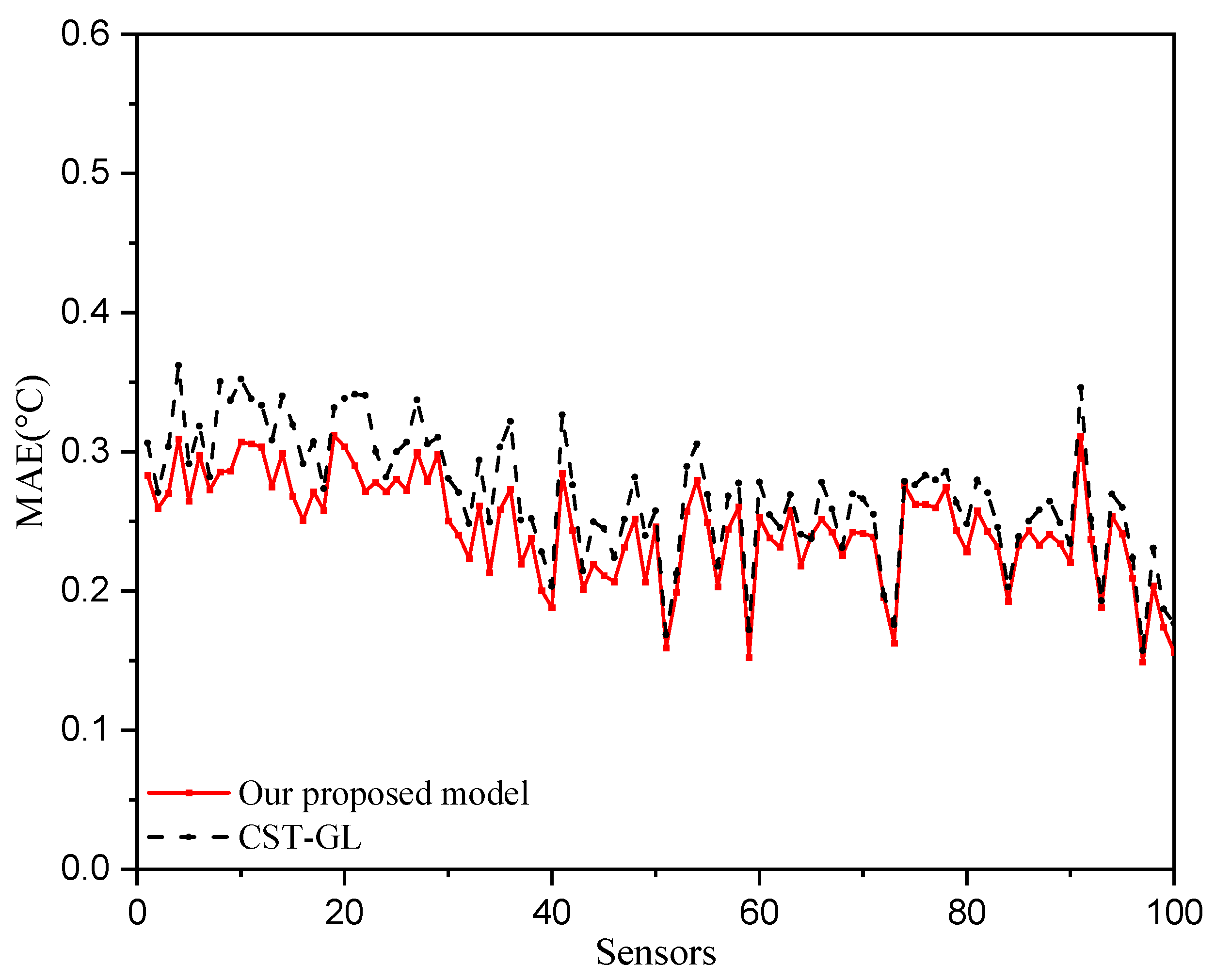
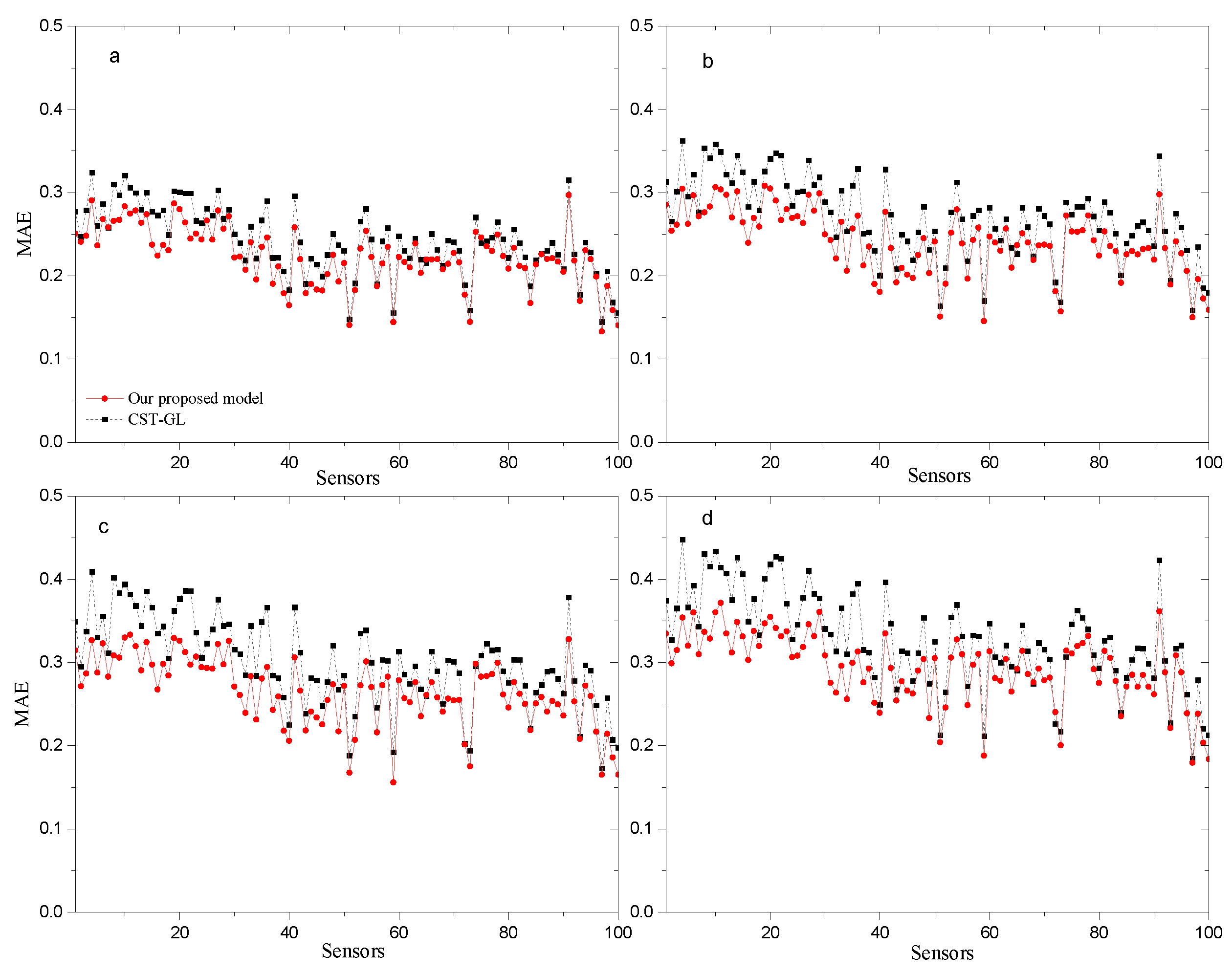
The mean absolute error is shown in Figure 3. It is evident that the proposed model enhances the temperature prediction accuracy across all 100 stations. A more detailed performance comparison is presented in Figure 4, where the MAEs of the 2-day, 3-day, 4-day, and 5-day predictions are shown. With an increase in prediction time step, there is clear improvement in performance.
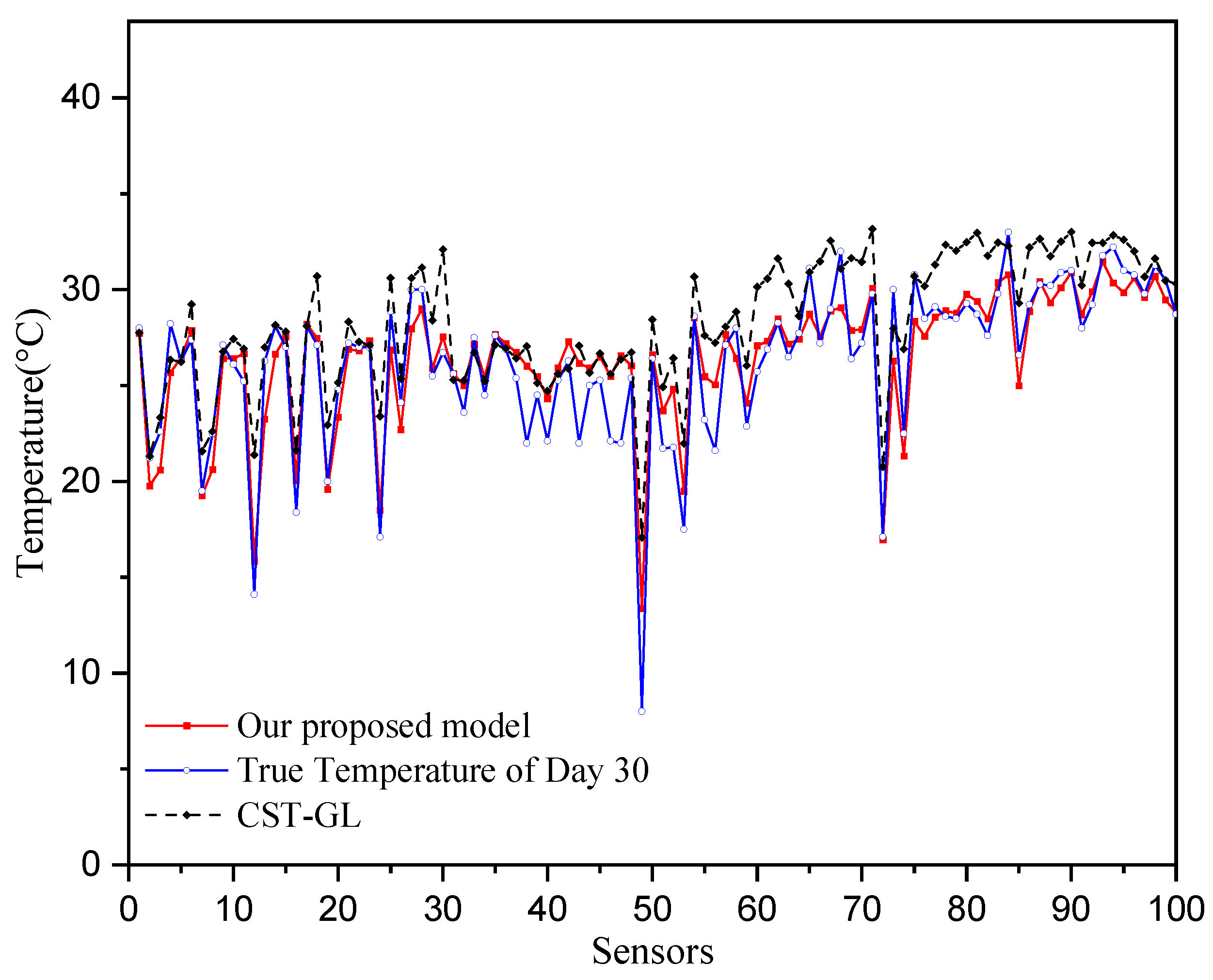
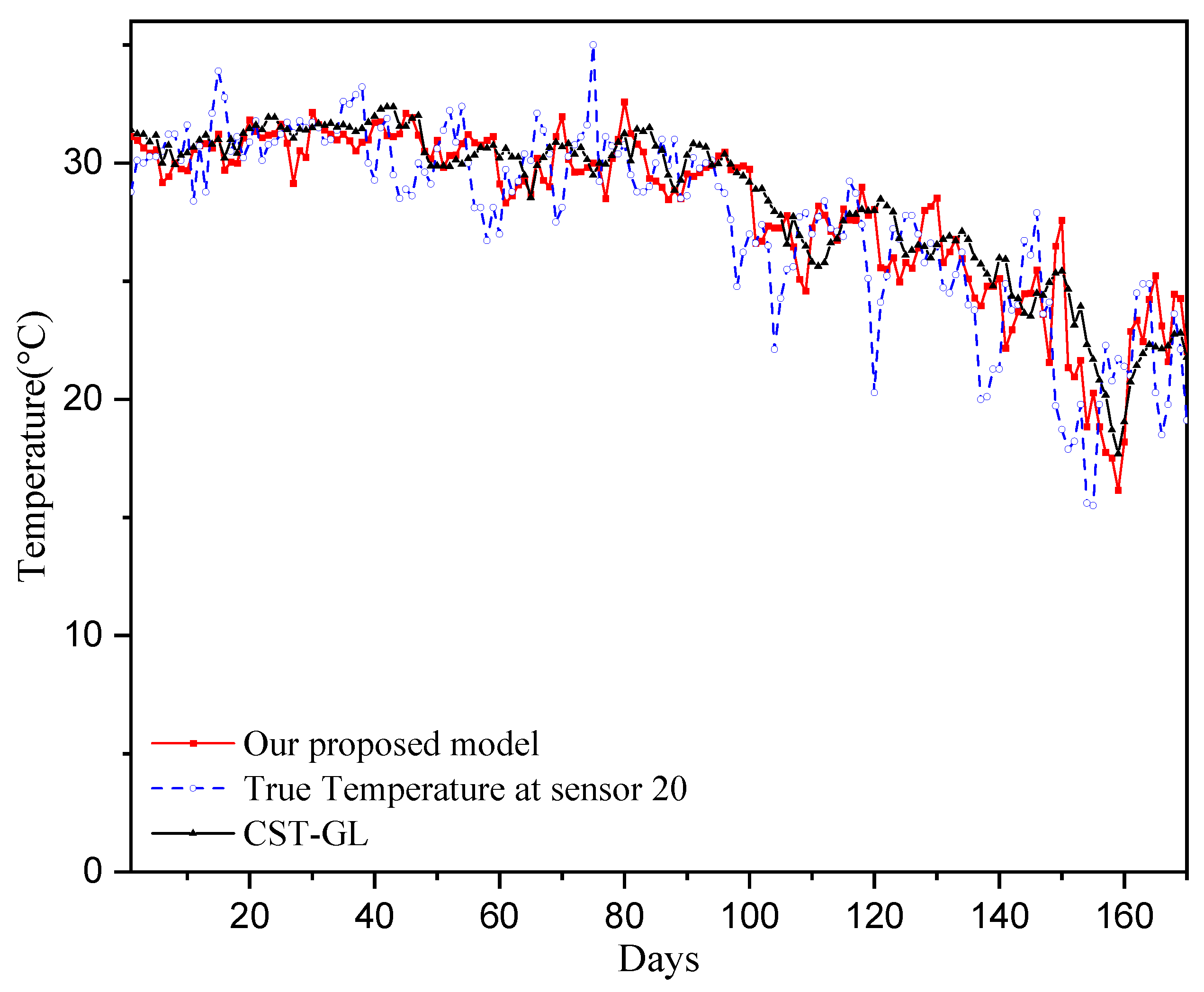
Figure 5 displays these comparisons for all sensors on Day 93 and Figure 6 shows them for Sensor 97 over the 170-day period. We can see that the predicted temperature over the next five days from our proposed differential equation network is much closer to the actual temperature at all stations, whereas the predicted data from CST-GL shows much greater variation. Improvements in performance compared to CST-GL can also be observed at station 97 throughout the 170 days of testing.

3.2. Discussions

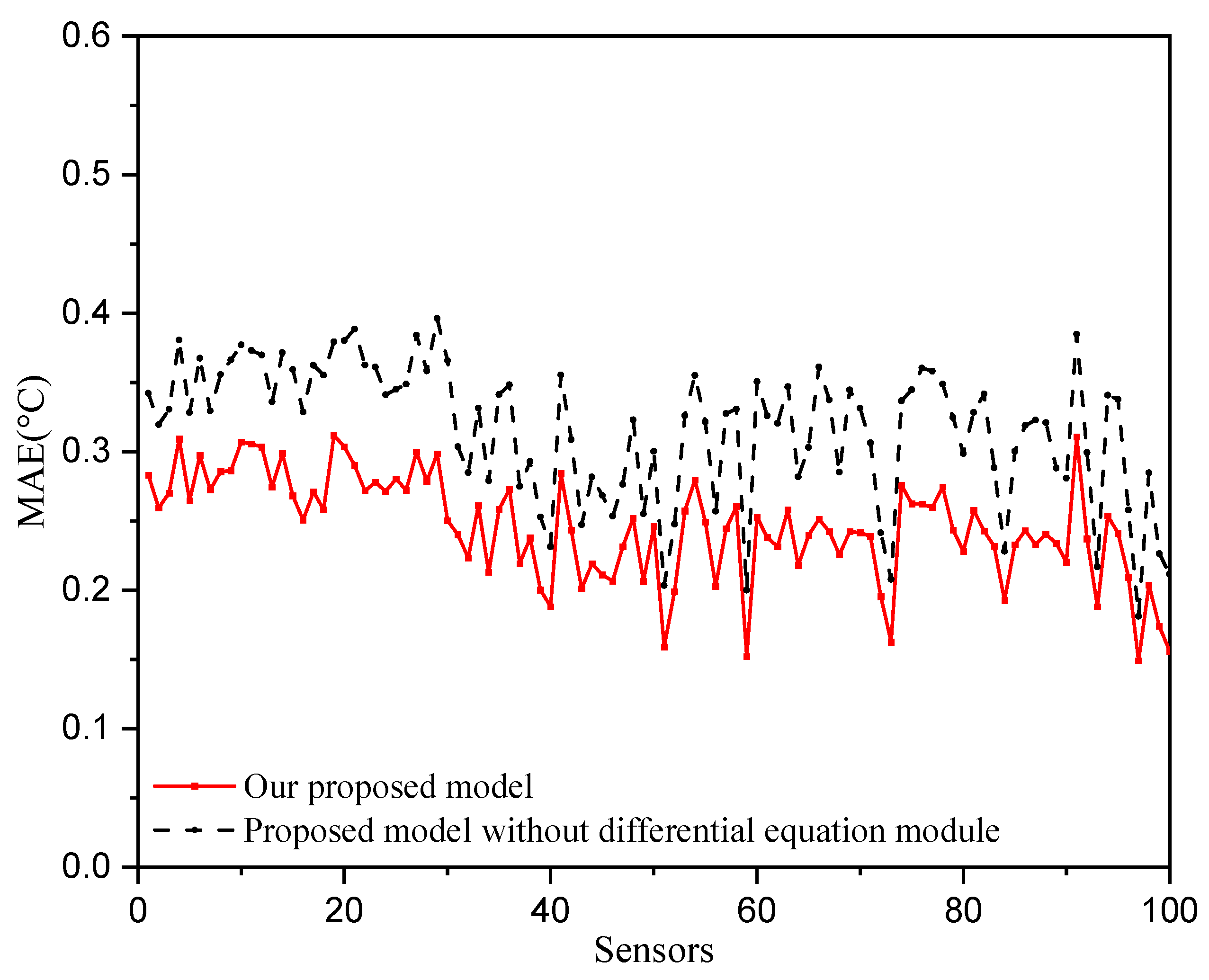
The comparison between the proposed model for medium-range temperature prediction and that without the differential equation module is shown in Figure 7. The differential equation module has led to a clear enhancement in performance across all 100 stations. The rationale behind this may be that the differential equation module has the capacity to characterize the dynamic evolution of both spatial features and temporal features, and the feature sequences provide more detailed information for medium-range temperature prediction, leading to enhanced performance in temperature prediction over the coming few days.
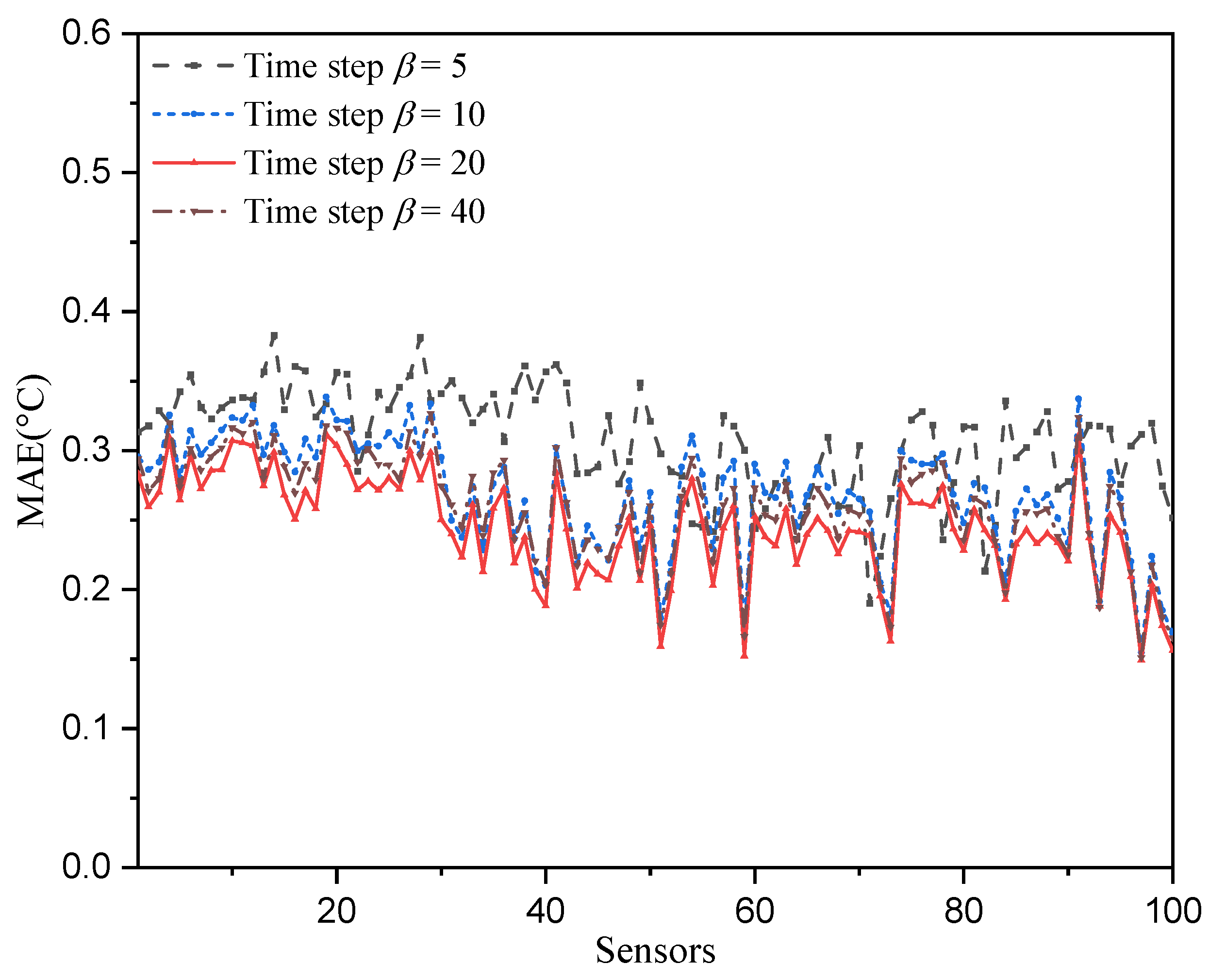
The comparison of the proposed model with different time steps in solving the differential equation is shown in Figure 8. As the time step increases, we can see that the medium-range temperature prediction performance also improves. This may be because a larger time step can provide a more accurate solution when solving the differential Equations (23) and (24). However, if the solution to the differential equations is already good enough, increasing the time steps will not improve the temperature prediction performance any further.

4. Conclusions

A graph-based differential equation network has been developed for medium-range temperature prediction by modeling spatial correlations among stations through a directed graph and capturing the spatio-temporal evolution of dynamic characteristics via differential equations. Firstly, a location-oriented graph adjacency matrix is constructed, which is then used to design a spatial feature module and a gating temporal module. A graph-based differential equation module is designed to characterize the dynamic evolution of the spatial features and temporal features, which are thereafter integrated by a graph-based output fusion module to provide medium-range temperature prediction. The proposed model has been validated using real temperature datasets in South China (including 100 key monitoring stations in Fujian), which has been tailored to Fujian’s mountainous coastal terrain and temperature patterns in a subtropical monsoon climate. With an average MAE accuracy of 0.289 °C (a 10 % improvement on baseline models), it is able to support the operations of the provincial meteorological bureau in disseminating early warning information as well as in refined meteorological services. The model does not require prior knowledge of physics and can perform medium-range forecasting directly based on the latitude and longitude of monitoring stations and historical temperature data. It can be easily integrated with the Fujian Provincial Meteorological Bureau’s existing monitoring network, comprising ground meteorological stations and automatic observation stations, thereby reducing the infrastructure required for data collection. The proposed model can provide temperature forecasts at station level and at multiple timescales for Fujian’s customized meteorological services, including the scheduling of agricultural production (such as tea, lychees and longans), the assurance of shipping safety (Xiamen and Quanzhou ports), and the planning of tourism activities (Wuyishan and Gulangyu), thereby driving the integrated development of ‘meteorology + industry’. In future work, we will consider the effects of wind, humidity and radiation on medium-range prediction performance. To further improve the proposed model, the longer temporal horizons for temperature prediction, domain transfer learning and generalization to other climatic zones will be taken into account.

Author Contributions

Methodology, B.S. and J.C.; investigation, X.F. and B.S.; resources, H.F. and X.F.; writing—original draft, J.C. and B.S. All authors have read and agreed to the published version of the manuscript.

Funding

This research was funded by Fujian Provincial Key Science and Technology Program of China under Grant 2024YZ040025, the Natural Science Foundation of Jiangsu Province under Grant BK20230479, Key Science and Technology Program Project of the Ministry of Emergency Management of China under Grant 2024EMST020202 and Research grants from the National Institute of Natural Hazards, Ministry of Emergency Management of China under Grant ZDJ2024-04.

Data Availability Statement

The raw data supporting the conclusions of this article will be made available by the authors on request.

Conflicts of Interest

The authors declare no conflicts of interest.

References

  1. Li, M.; Bai, Q.; Du, W. The World Is Different Because of You: Global Warming, Technological Progress and Economic Development. Struct. Change Econ. Dyn. 2025, 74, 202–211. [Google Scholar] [CrossRef]
  2. Ueyama, H. Compiling an Hourly Gridded Dataset for Surface Air Temperature at 50-M Resolution Using Radiative Cooling Scale and Numerical Weather Prediction Model Outputs. Agric. For. Meteorol. 2024, 350, 109991. [Google Scholar] [CrossRef]
  3. Huang, X.; Ding, A. Aerosol as a Critical Factor Causing Forecast Biases of Air Temperature in Global Numerical Weather Prediction Models. Sci. Bull. 2021, 66, 1917–1924. [Google Scholar] [CrossRef] [PubMed]
  4. Chen, X.; Jiang, Z.; Cheng, H.; Zheng, H.; Cai, D.; Feng, Y. A Novel Global Average Temperature Prediction Model Based on Gm-ARIMA Combination Model. Earth Sci. Inf. 2024, 17, 853–866. [Google Scholar] [CrossRef]
  5. Gao, M.; Wu, Q.; Li, J.; Wang, B.; Zhou, Z.; Liu, C.; Wang, D. Temperature Prediction of Solar Greenhouse Based on Narx Regression Neural Network. Sci. Rep. 2023, 13, 1563. [Google Scholar] [CrossRef]
  6. Paniagua-Tineo, A.; Salcedo-Sanz, S.; Casanova-Mateo, C.; Ortiz-García, E.G.; Cony, M.A.; Hernández-Martín, E. Prediction of Daily Maximum Temperature Using a Support Vector Regression Algorithm. Renew. Energy 2011, 36, 3054–3060. [Google Scholar] [CrossRef]
  7. Han, J.M.; Ang, Y.Q.; Malkawi, A.; Samuelson, H.W. Using Recurrent Neural Networks for Localized Weather Prediction with Combined Use of Public Airport Data and on-Site Measurements. Build. Environ. 2021, 192, 107601. [Google Scholar] [CrossRef]
  8. Yang, H.; Yoon, S.; Lee, H.-T.; Kim, K.S.; Han, H.-J.; Park, Y.-J. Abnormal High Water Temperature Prediction in Nearshore Waters around the Korean Peninsula Using Ecmwf Era5 Data and a Deep Learning Model. J. Sea Res. 2024, 202, 102546. [Google Scholar] [CrossRef]
  9. Deng, D.; Wang, Y.; Zhong, Z.; Wang, X.; Yao, Y. A Deep-Learning-Based Proxy Model for Fast Prediction of Temperature During Co2 Circulation in Hydrothermal Reservoir. Appl. Therm. Eng. 2025, 273, 126473. [Google Scholar] [CrossRef]
  10. Sun, Y.; Yao, X.; Bi, X.; Huang, X.; Zhao, X.; Qiao, B. Time-Series Graph Network for Sea Surface Temperature Prediction. Big Data Res. 2021, 25, 100237. [Google Scholar] [CrossRef]
  11. Gao, Z.; Li, Z.; Yu, J.; Xu, L. Global Spatiotemporal Graph Attention Network for Sea Surface Temperature Prediction. IEEE Geosci. Remote Sens. Lett. 2023, 20, 1500905. [Google Scholar] [CrossRef]
  12. Zhang, S.; Li, Z.; He, X.; Yu, J.; Xu, L. A Three-Dimensional Dynamic Spatial-Temporal Graph Neural Network for Ocean Temperature Field Prediction. Eng. Appl. Artif. Intell. 2025, 149, 110492. [Google Scholar] [CrossRef]
  13. Wen, S.; Zhang, W.; Zhou, N.; Yuan, L. Adaptive Spatio-Temporal Graph Convolutional Network for Rapid Indoor Temperature Field Prediction With Limited Sensors. Build. Environ. 2025, 283, 113346. [Google Scholar] [CrossRef]
  14. Nan, F.; Li, Z.; Yu, J.; Shi, S.; Wu, X.; Xu, L. Prediction of Three-Dimensional Ocean Temperature in The South China Sea Based on Time Series Gridded Data and a Dynamic Spatiotemporal Graph Neural Network. Acta Oceanol. Sin. 2024, 43, 26–39. [Google Scholar] [CrossRef]
  15. Chen, L.; Wang, L.; Ma, W.; Xu, X.; Wang, H. Pid4late: A Physics-Informed Deep Learning Model for Lake Multi-Depth Temperature Prediction. Earth Sci. Inf. 2024, 17, 3779–3795. [Google Scholar] [CrossRef]
  16. Zheng, J.; Ling, Q.; Feng, Y. Physics-Assisted and Topology-Informed Deep Learning for Weather Prediction. In Proceedings of the Thirty-Fourth International Joint Conference on Artificial Intelligence, Montreal, QC, Canada, 16–22 August 2025. [Google Scholar]
  17. Shi, B.; Feng, L.; He, H.; Hao, Y.; Peng, Y.; Liu, M.; Liu, J. A Physics-Guided Attention-Based Neural Network For Sea Surface Temperature Prediction. IEEE Trans. Geosci. Remote Sens. 2024, 62, 4210413. [Google Scholar] [CrossRef]
  18. Figueredo, M.; Ferreira, M.; Monteiro, R.; Silva, A.; Murari, T.; Neri, T. Hybrid PINN-LSTM Model for River Temperature Prediction: A Physics-Informed Deep Learning Approach. J. Comput. Commun. 2025, 13, 115–134. [Google Scholar] [CrossRef]
  19. Yuan, T.; Zhu, J.; Wang, W.; Lu, J.; Wang, X.; Li, X.; Ren, K. A Space-Time Partial Differential Equation Based Physics-Guided Neural Network For Sea Surface Temperature Prediction. Remote Sens. 2023, 15, 3498. [Google Scholar] [CrossRef]
  20. Vo, H.; Nguyen, V.; Luo, D.; Bobadilla, L. Lake Water Temperature Modeling Using Physics-Informed Neural Networks. In Proceedings of the Thirteenth International Conference on Learning Representations Workshop, Singapore, 24–28 April 2025. [Google Scholar]
  21. Xiao, Z.; Fang, H.; Wang, X. Distributed Nonlinear Polynomial Graph Filter and Its Output Graph Spectrum: Filter Analysis and Design. IEEE Trans. Signal Process. 2021, 69, 1725–1739. [Google Scholar] [CrossRef]
  22. National Climatic Data Center. 2018. Available online: ftp://ftp.ncdc.noaa.gov/pub/data/gsod (accessed on 1 February 2025).
  23. Veličković, P.; Cucurull, G.; Casanova, A.; Romero, A.; Liò, P.; Bengio, Y. Graph Attention Networks. Stat 2017, 20, 10-48550. [Google Scholar]
  24. Feng, X.; Chen, Y.; Li, H.; Ma, T.; Ren, Y. Gated Recurrent Graph Convolutional Attention Network for Traffic Flow Prediction. Sustainability 2023, 15, 7696. [Google Scholar] [CrossRef]
  25. Cai, J.; Su, B.; Fang, H. Physics-Informed Directed Graph Network-Based Temperature Forecasting Model. Sensors 2025, 25, 5295. [Google Scholar] [CrossRef]
  26. Zheng, Y.; Koh, H.; Jin, M.; Chi, L.; Phan, K.; Pan, S. Correlation-Aware Spatial–Temporal Graph Learning for Multivariate Time-Series Anomaly Detection. IEEE Trans. Neural Netw. 2023, 35, 11802–11816. [Google Scholar] [CrossRef] [PubMed]
  27. Hettige, K.H.; Ji, J.; Xiang, S.; Long, C.; Cong, G.; Wang, J. AirPhyNet: Harnessing Physics-Guided Neural Networks for Air Quality Prediction. In Proceedings of the Twelfth International Conference on Learning Representations, Vienna, Austria, 7 May 2024. [Google Scholar]
  28. Deng, A.; Hooi, B. Graph neural network-based anomaly detection in multivariate time series. In Proceedings of the Thirty-Fifth AAAI Conference on Artificial Intelligence, Virtual, 2–9 February 2021. [Google Scholar]
Figure 1. The framework of the graph-based differential equation network for medium-range temperature prediction.
Electronics 15 00391 g001
Figure 2. The directed graph designed using the latitudes and longitudes of 100 stations.
Electronics 15 00391 g002
Figure 3. Temperature prediction over 100 stations.
Electronics 15 00391 g003
Figure 4. Prediction performance of all 100 stations: (a) 2-day prediction, (b) 3-day prediction, (c) 4-day prediction, and (d) 5-day prediction.
Electronics 15 00391 g004
Figure 5. True temperatures and the 5-day predictions over all 100 stations on Day 93.
Electronics 15 00391 g005
Figure 6. True temperatures and the 5-day prediction of station 97.
Electronics 15 00391 g006
Figure 7. Performance comparison between the proposed model and that without the differential equation module.
Electronics 15 00391 g007
Figure 8. Performance comparison of the proposed model using different time steps in solving the differential equation.
Electronics 15 00391 g008
Table 1. Experimental configuration.
ParametersValue
Slide Window Length M10
Number of Cities N100
Output Dimension τ 5
Feature Order L3
Feature Order J3
Feature Length R20
Time Steps β 20
Learning Rate1 × 10 3
Number of Epochs1000
Weight-Decay Parameters0.02
Batch Size10
σ 200
Table 2. Prediction performance metrics (MAE).
Model1-Day2-Day3-Day4-Day5-DayAverage MAE
AirPhyNet [27]0.3940.4180.4370.4550.4720.436
GDN [28]0.3270.3750.3920.4020.4230.384
CST-GL [26]0.2510.2960.3250.3530.3790.321
Proposed Method0.2510.2670.2850.3080.3340.289
Disclaimer/Publisher’s Note: The statements, opinions and data contained in all publications are solely those of the individual author(s) and contributor(s) and not of MDPI and/or the editor(s). MDPI and/or the editor(s) disclaim responsibility for any injury to people or property resulting from any ideas, methods, instructions or products referred to in the content.