Article

Low-Frequency Oscillation Suppression Strategy for Ship Microgrid Based on Virtual PSS Adaptive Damping Control with Supercapacitor


School of Electrical Engineering and Automation, Harbin Institute of Technology, Harbin 150001, China
*
Author to whom correspondence should be addressed.
Electronics 2026, 15(2), 390; https://doi.org/10.3390/electronics15020390
Submission received: 25 December 2025 / Revised: 11 January 2026 / Accepted: 12 January 2026 / Published: 15 January 2026
(This article belongs to the Special Issue Cyber-Physical System Applications in Smart Power and Microgrids)

Abstract

A virtual power system stabilizer (PSS) adaptive damping control strategy based on a supercapacitor is used to suppress oscillations in a ship microgrid. The energy transmission path of the proposed strategy is to apply the equivalent damping power to the rotor by varying the electromagnetic power of the generator. Compared with conventional PSSs based on supercapacitors, storage devices not only enhance the capacity of damping power injected into the microgrid but also have more flexible configurations applicable to the size constraints of the ship microgrid. In addition, the adaptive control ensures that the DC bus voltage of the converter of the energy storage device is controlled within the neighborhood of the steady-state operating point, ensuring the asymptotic stability of the damping system. Finally, an experimental platform was built to verify the correctness and validity of the above theory.

1. Introduction

The integrated power system (IPS) has become the core direction for the development of the power systems of modern ships [1], especially offshore engineering ships and military ships [2,3], due to its significant advantages in the comprehensive utilization of ship energy, propulsion efficiency, layout flexibility and future compatibility with new energy access, etc. Comprehensive power systems will combine power generation, power distribution, propulsion and daily electricity integration in one; a high degree of power electronics makes the inertia of the ship microgrid (SM) relatively low [4,5], and all kinds of pulse loads, propulsion loads of frequent casting and cutting and violent fluctuations very easily trigger the system power oscillations [6,7], especially LFOs, threatening the stable operation of the system. Therefore, ensuring the dynamic stability of IPS has attracted extensive attention from both academia and industry.
In order to suppress the LPF issue in IPS, the damping control methods can be divided into two major categories, localized electrical damping control [8] and adaptive control based on wide-area information [9], and each type of method has its own scope of application and limitations. Among them, the localized electrical damping control method is the most classic and widely used technique for suppressing LFOs in power systems. The core principle is to configure the power system stabilizer (PSS) on the synchronous generator (SG) to provide positive electrical damping by introducing additional feedback signals to modulate the excitation [10,11]. In [12], a hybrid controlled PSS was proposed to enhance the stability of interconnected renewable power systems. The experimental results show that the designed controller reduces 6% under different renewable energy source conditions, respectively. In [13], J. Kim et al. proposed a Jacobi gain control strategy. The property that the Jacobi function (JF) is the sensitivity between the unbalanced power in the SM and the state variables of the SG is utilized. An integrated controller for the SG is constructed by applying the JF to models of excitation systems and PSSs, respectively. Finally, a case-by-case time domain simulation is performed on the IEEE39 bus system to verify the effectiveness of the proposed control strategy.
With the wide application of high-penetration power electronic interface devices (e.g., energy storage, wind power converters), power oscillation damping controllers based on active power (POD-P) modulation or reactive power modulation have become an important addition [14]. It has been shown that, in new energy high-penetration scenarios, POD-P controllers tend to exhibit higher adaptability and effectiveness due to their direct intervention in power balance through active power. In [15], the researchers investigated the performance of grid-forming inverters and auxiliary POD controllers in suppressing LFO in power systems. The researchers performed complementary modulation by simultaneously injecting active and reactive power into the converter, and the proposed control strategy is simple in structure and does not require additional measurement links.
In addition, the supercapacitor as an energy storage device for damping control is considered as an ideal power-based energy storage element for wide-band, fast damping control tasks [15,16,17]. Compared with the traditional generator excitation-based damping methods or battery-based energy storage schemes, supercapacitors exhibit the following irreplaceable advantages in suppressing LFOs in the IPS. A traditional PSS provides damping indirectly by modulating the generator excitation, and its effectiveness is constrained by the mechanical inertia and response delay of the prime mover. The supercapacitor connected to the microgrid through the converter is a completely independent and controllable power port, which can be directly adjusted according to the grid frequency or power oscillation signals in “four quadrants”, and the degree of freedom and flexibility of control is significantly improved [18,19]. In [20], a control algorithm incorporating a dynamic event-triggered mechanism for frequency/voltage restoration and optimal power allocation is proposed for applications in an islanded AC microgrid. In [21], a hierarchical robust strategy combining model-free prediction and fixed-time control is proposed for solving the parameter uncertainty and perturbation problem of islanded AC microgrids in harsh environments, which realizes fast frequency/voltage restoration and precise power allocation. The above inertia-based damping control approach is a novel scheme suitable for distributed microgrids.
In summary, the relevant studies and characteristics of damping control strategies applied to microgrids are summarized as follows: (1) The PSS achieves the injection of damping power through the excitation action path, and the damping power it provides is affected by the reactive capacity of the generator. (2) The combination of ESS and STATCOM into POD-Q suppresses voltage oscillations through reactive power compensation. The essence is to indirectly change the reactive power to realize LFO suppression, but for the more rigid microgrid the change in reactive power needs a huge ESS capacity as support. (3) The combination of ESS and VSC into POD-P is the most effective for microgrids, which achieves LFO suppression by indirectly changing the active output of the SG. (3) The virtual PSS adaptive controller proposed has the same damping action path as the POD-P, but the CSC mode starts operation only when LFOs occur, which avoids the problem of the excessive storage capacity demand caused by prolonged on-grid operation.
The work and contribution of this paper can be summarized as follows: (1) A virtual PSS adaptive damping gain control strategy based on supercapacitors is proposed. The proposed framework is able to maximize the capacity saving of the ESS while achieving LFO suppression. (2) Based on the quasi-steady-state model of the SG, the nature of LFOs occurring in SMs is analyzed, and the damping gain parameters are positively determined according to the residue method. (3) The proposed adaptive controller is improved to a simplified adaptive law suitable for the engineering field.
The rest of the paper is organized as follows. Section 2 analyzes the nature of the SM-appearing LFOs, the proof of the path of action and the expectation equation for the damping power. Section 3 designs the control architecture of the ESS and the damping gain adaptive controller for the virtual PSS. In addition, this section improves the self-designed adaptive controller into control equations suitable for engineering applications. Section 4 establishes an experimental platform to simulate the SM and verifies the effectiveness of the proposed control strategy. Finally, Section 5 summarizes and concludes the research work of this paper.

2. Analysis of SM Model and LFO

LFOs are periodic oscillations resulting from an imbalance between the mechanical power and the electrical power of the generator rotor. The prime mover provides the driving torque, and the AVR and microgrid power provide the electromagnetic torque. The rotor maintains synchronous speed when the two torques are balanced; on the contrary, the rotor will deviate from synchronous speed. The causes of LFOs in SMs are analyzed through the rotor model of the SG, and the design concept of damping control is proposed in this section.

2.1. Description of Transient Mathematical Models of SG

The model of SG considers both mechanical and electromagnetic transient processes. Therefore, quasi-steady-state assumptions are made for the model:
A1: Ignore the electromagnetic transients in the stator windings.
A2: Neglect the effect of damped windings; their effect is approximated equivalently by the damping coefficients.
A3: The magnetic chain of the excitation winding cannot change suddenly, and the process of change is described by a first order differential equation.
A4: The mechanical transients of the rotor are described by the rotor equation.
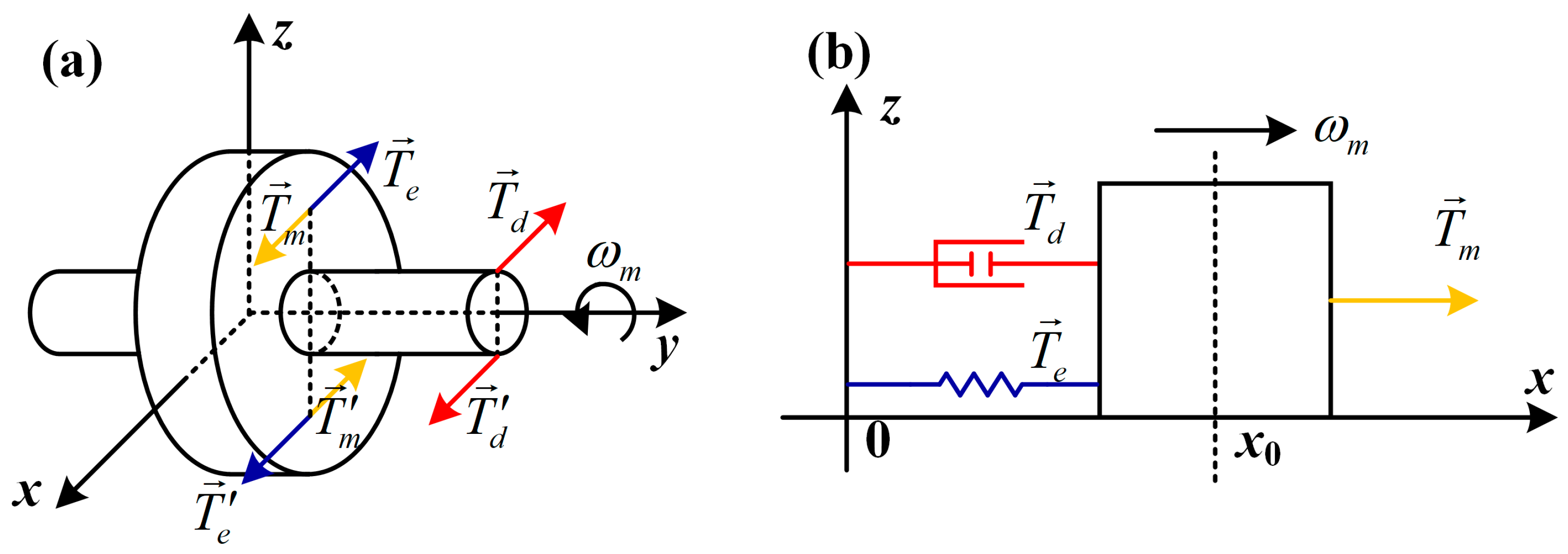
Figure 1 shows the rotor model of the SG. In the figure, T e and T m are the electromagnetic and mechanical torque and T d is the equivalent damping torque generated by the generator damping winding. According to Newton’s second law, the rotor dynamics equation is as follows:
J d ω d t = T m T e c Δ ω , ( T d = c Δ ω , Δ ω = ω ω 0 )
where J is the rotational inertia. c is representative of the natural damping of the system, including the mechanical and approximately equivalent electrical damping, and the damping torque is modeled as first order viscous damping. ω is the mechanical speed of the rotor; ω 0 is the synchronous speed of the SM.
We introduce the power angle of the SG, and its representation equation is as follows:
δ = θ ω 0 t d δ d t = d θ d t ω 0 = ω ω 0
Equations (1) and (2) contain more than a system of units; in order to achieve the numerical stability of the equation solution, the two equations are secularized as follows:
d δ d t = ( ω 1 ) ω 0 H d ω d t = P m P e P d
In order to keep the calculation process simple later on, the subsequent equations are not labeled with the “ ”, but their physical meaning is the per unit value. Furthermore, let P d = D ( ω 1 ) ; the final rotor equation of motion can be expressed as follows:
d δ d t = ( ω 1 ) ω 0 H d ω d t = P m P e D ( ω 1 )
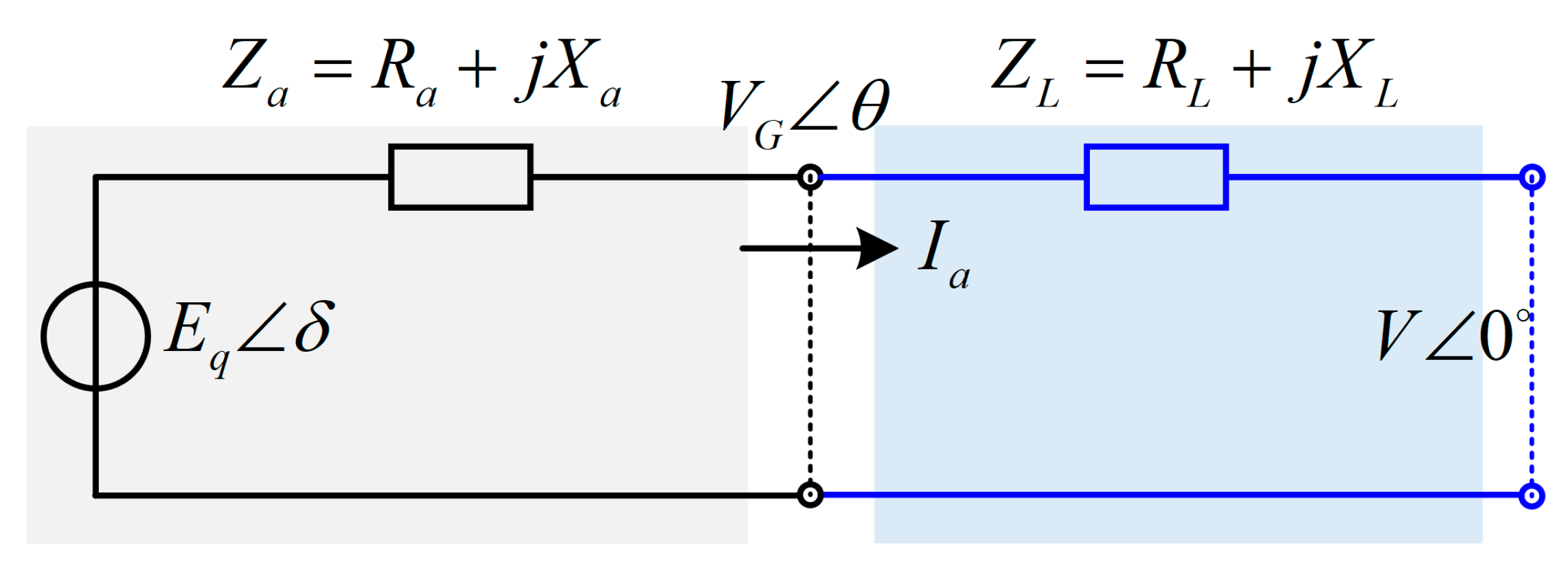
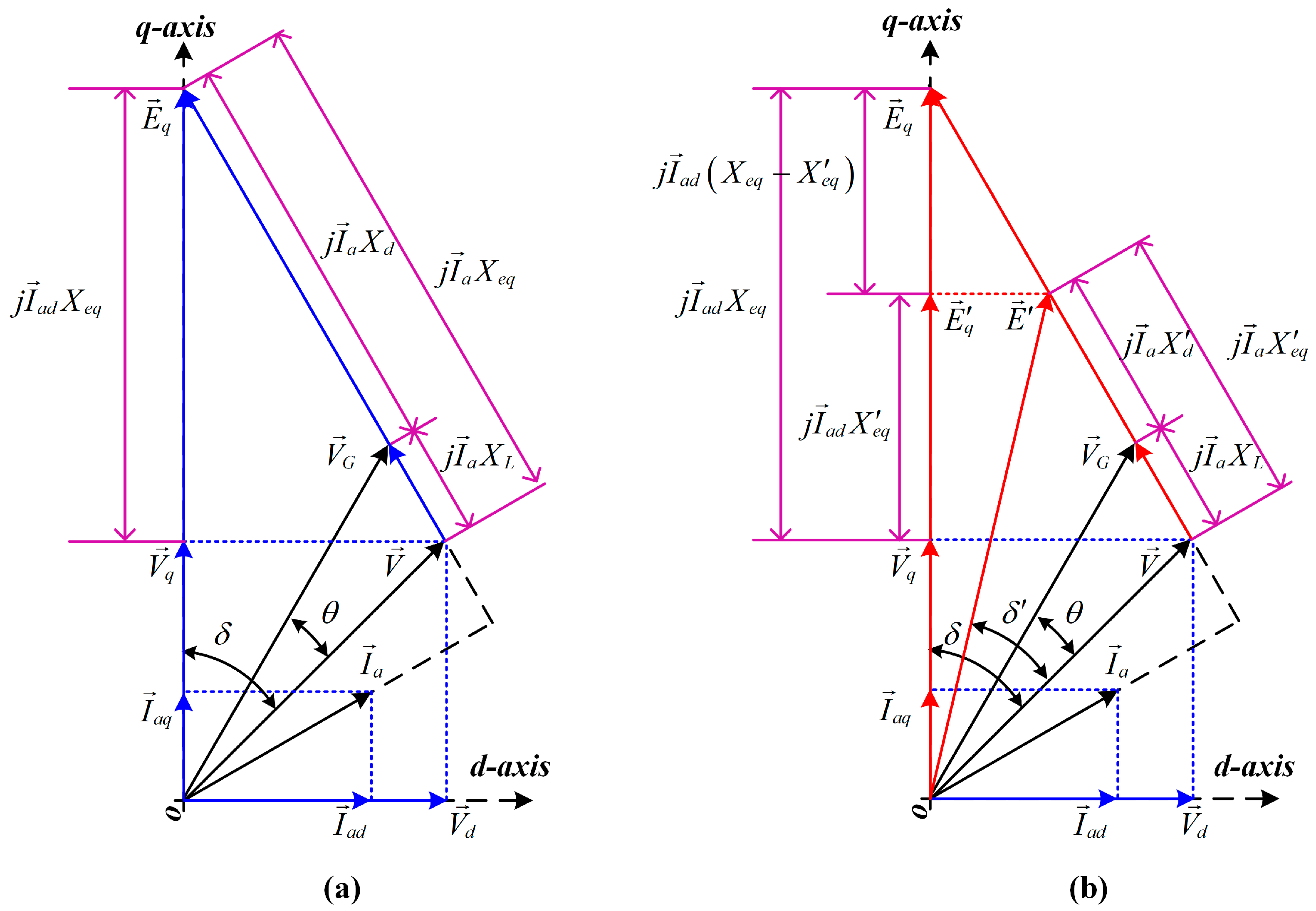
Note that P e in Equation (4) is a function of the power angle and voltage. Therefore, it is necessary to replace P e with the display expression for the power angle and voltage. Figure 2 shows the equivalent circuit of the SG connected to the SM, and Figure 3 shows the phase diagrams of the steady state and transient states of the SG. The power equations of the SG are written based on the above images as follows.
According to Figure 2, the voltage equation of the SG in the d-q coordinate system is as follows:
E q = V q + I a d X 0 = V d + I a q X
where d and q represent the d-axis and q-axis components of the physical quantity in the dq coordinate system, respectively. E q , V q and V d are the no-load electromotive force of the SG and the voltage at the infinity bus. I a q and I a d are the stator currents. X is the equivalent reactance.
According to Equation (5), the computational formula for A can be expressed as follows:
P e = V q I a q + V d I a d
Substituting Equation (5) into Equation (6), the power equation with A as the internal potential is as follows:
P e ( E q ) = E q V q X e q V d + V d X e q V q = E q V X e q sin δ
According to the geometrical relationship in Figure 3b, the relationship between the voltage and current of the transient process can be expressed as follows:
E q = V q + I a d X 0 = V d + I a q X
where the “ ′ “ superscript indicates the transient value of the corresponding state quantity. Substituting Equation (18) into Equation (6), the power equation with E q as the internal potential is as follows:
P e ( E q ) = E q V q X V d + V d X V q = E q V X sin δ V 2 2 X X X X sin 2 δ
The transient processes δ and δ are not significantly different, and the power equation simplifies to the following:
P e ( E q ) = E q V X sin δ
Equation (10) assumes that A, B and C can be kept constant during the transient process. The assumption is based on the premise that the AVR of the SG is sufficiently powerful, and the idealized condition is difficult to achieve in practice, so it is necessary to analyze the response of the excitation winding during the transient process. The equations for the excitation winding are as follows:
T d 0 d E q d t = E f d X e q X e q E q + X d X d X e q V cos δ
where E f d is the forced no-load electromotive force. T d 0 is the time constant of the excitation winding.
In Equation (11), A varies with the excitation voltage, so it is necessary to supplement the equation of the state of the AVR of the excitation device. According to “IEEE Std. 421.5-2005 [22]”, the first order inertia is chosen to simulate the dynamic behavior of the AVR as follows:
T e d E f d d t + E f d = E f d 0 K e V G V G _ r e f
where E f d 0 is the steady-state value of the forced no-load electromotive force. K e is the gain of the AVR. T e is the time constant of the AVR.
Equations (4) and (10)–(12) constitute the transient model of the SG. After linearizing the above equations, they are organized in matrix form as follows:
Δ δ ˙ Δ ω ˙ Δ E ˙ q Δ E ˙ f d = 0 ω 0 0 0 K 1 / H D / H K 2 / H 0 K 4 / T d 0 0 K 3 / T d 0 1 / T d 0 K e K 5 / T e 0 K e K 6 / T e 1 / T e Δ δ Δ ω Δ E q Δ E f d
where “ Δ ” denotes the increment of the state quantity. Equation (13) establishes a linear model with Δ δ and Δ ω as core variables, and the transfer function corresponding to the equation is the Philips–Heffron model.
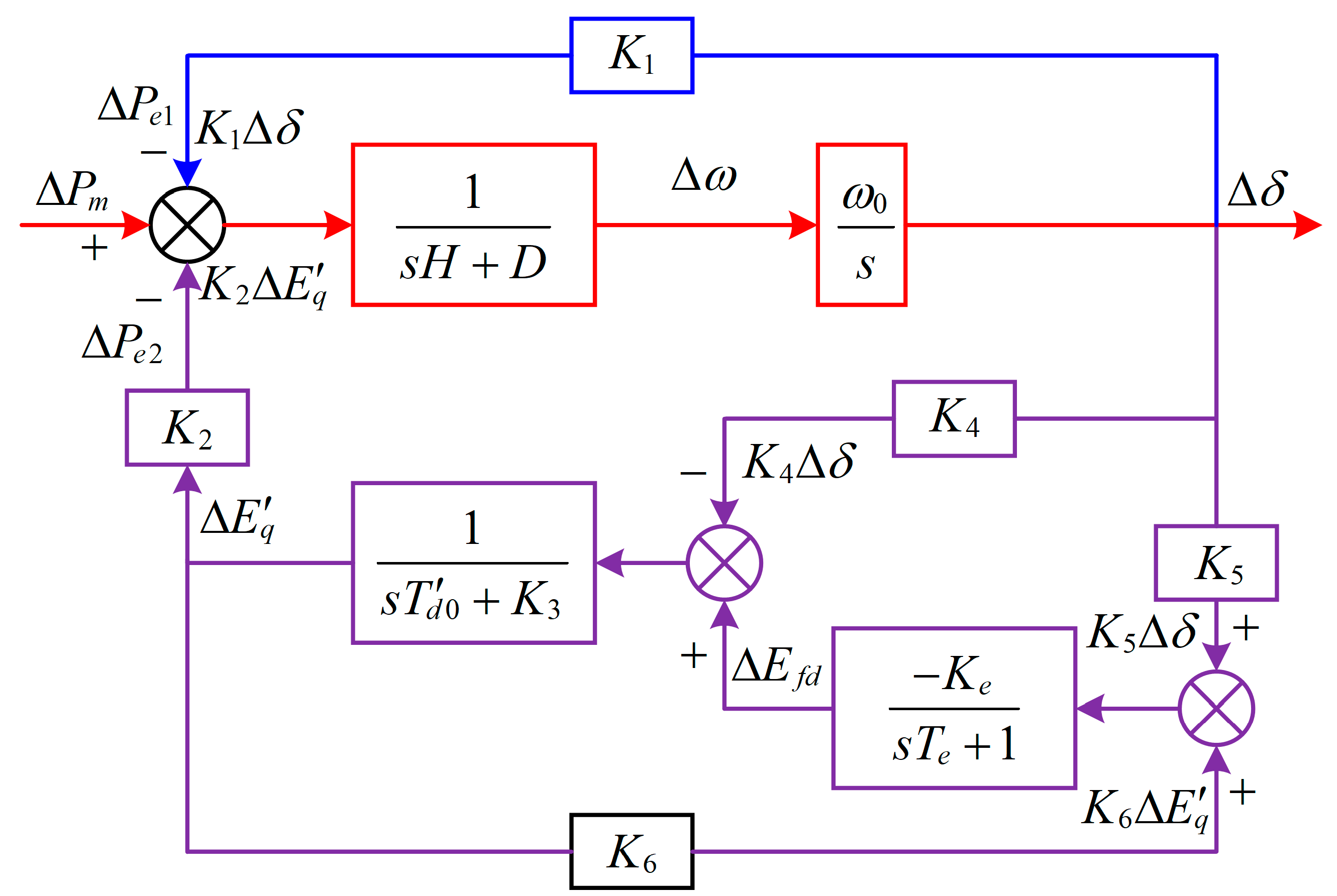
The transfer function block diagram is shown in Figure 4. There are three powers present on the rotor of the transient process in Figure 4, i.e., Δ P e 1 , Δ P e 2 and Δ P m . The transfer functions of Δ P e 1 and Δ P e 2 can be read directly from the figure, and their respective transfer functions are represented as follows:
Δ P e 1 ( s ) = K 1 Δ δ = G 1 ( s ) Δ δ Δ P e 2 ( s ) = K 2 K e K 5 + K 4 ( s T e + 1 ) s T d 0 + K 3 s T e + 1 + K e K 6 Δ δ K 2 G 2 ( s ) Δ δ
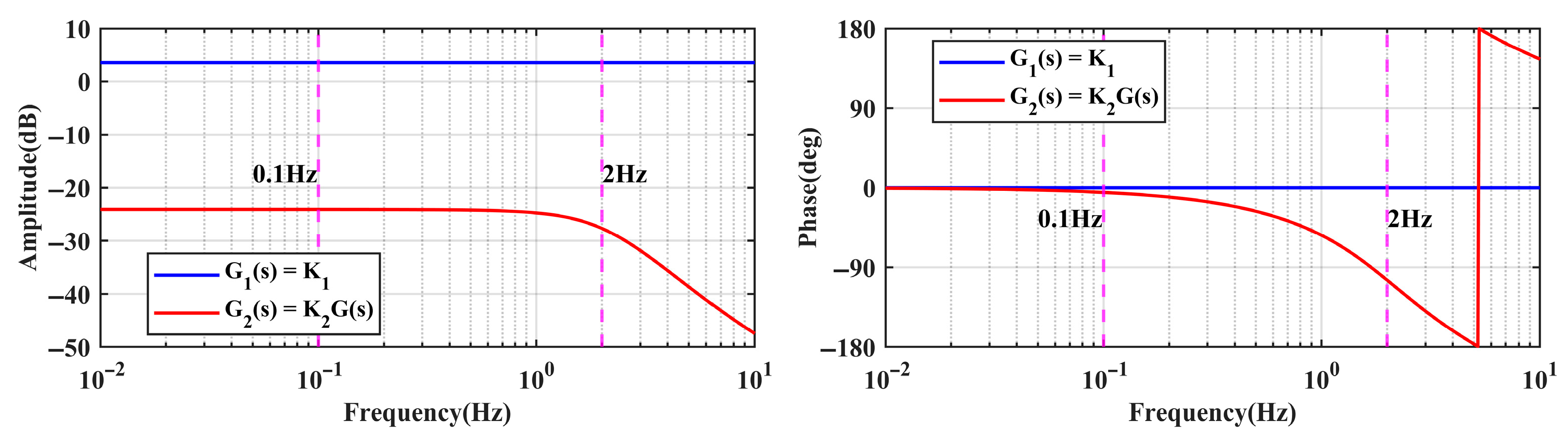
The phase–frequency characteristics in Figure 5 show that the phase angle of Δ P e 2 always lags behind Δ δ . As the oscillation frequency increases, the Δ P e 2 lag angle gradually increases. According to the Bode diagram and the Philips–Heffron model, it can be seen that the Δ P e acting on the rotor has a physical and control loop time lag with respect to Δ δ and Δ ω . In summary, the Philips–Heffron model of the SG accounting for AVR is developed in this section. The dynamic behavior of Δ P e during an LFO is analyzed in the medium of the rotor equations of motion. Therefore, the transient behavior of the diesel engine is modeled in the next section.

2.2. Description of Power Model of DG

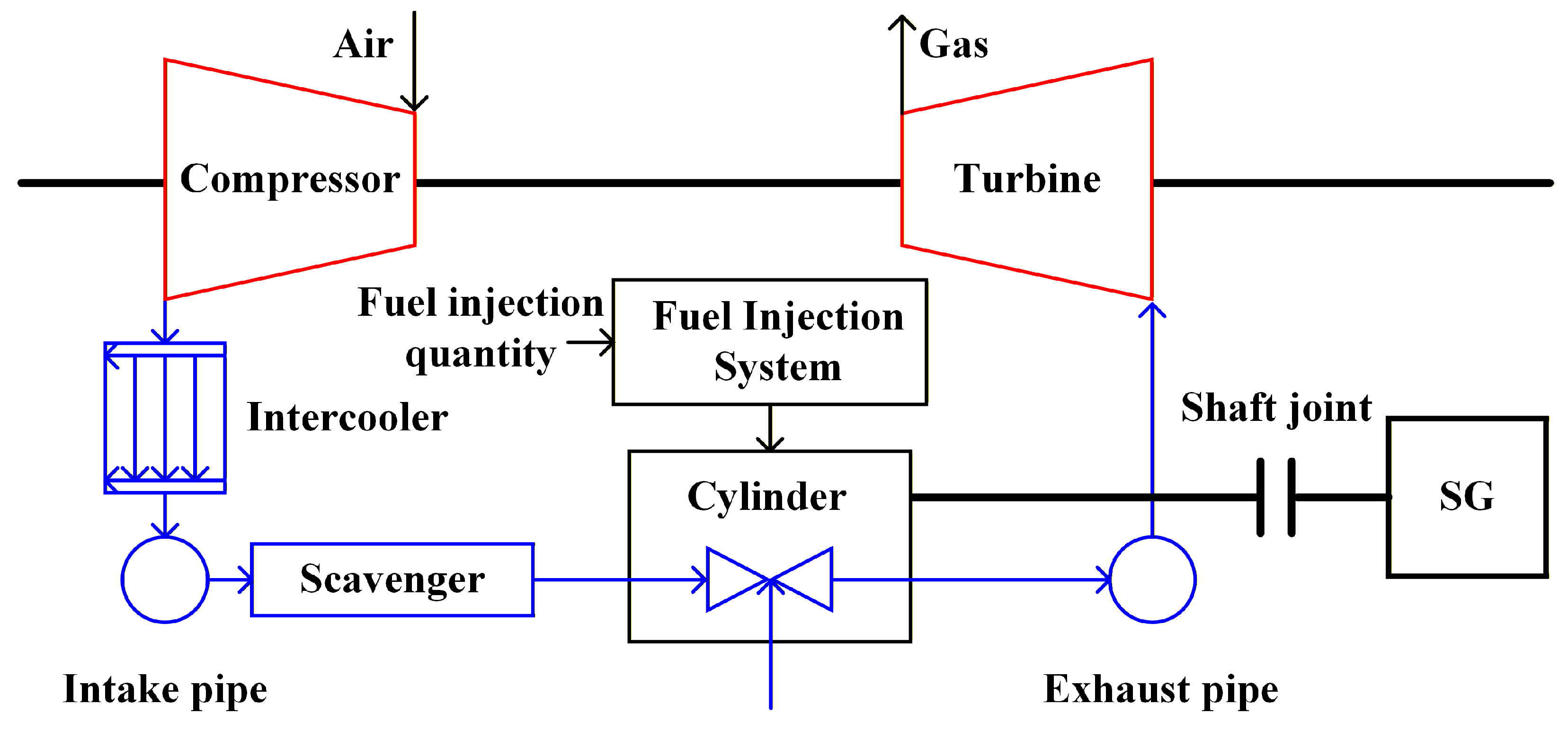
The DG model includes several sub-units such as the turbocharger, cylinder, crank linkage, intercooler, fuel injection system, cooling system and control system. Figure 6 depicts the operating principle of a supercharged DG. The mean value model of diesel engines was proposed by Hendricks in 1989. The mean value model circumvents the combustion process in the cylinder and models an approximation of the fuel injection system to the output mechanical power.
According to Figure 6, it can be seen that the DG regulates the output power through the fuel injection. The openings of the intake and exhaust valves are kept constant at the set values. The output power includes turbine input power and diesel combustion power. Therefore, the modeling mainly considers these two power segments.
The dynamic equations of the turbine rotor are as follows:
H t c d ω t c d t = P t m P t c
where H t c is the inertial time constant of the rotor; ω t c is the mechanical speed; P t m is the mechanical power; and P t c is the power consumed by the pressurizer. The physical significance of P t m and P t c can be approximated and expressed as follows:
P t m = α m ˙ f β ω t c ,   P t c = γ ω t c 3
where m ˙ f is the fuel flow rate; α , β and γ are the proportionality coefficients. Substituting the above expression into Equation (15) and linearizing the equation gives the following:
H t c d Δ ω t c d t = α Δ m ˙ f ( β + 3 γ ω t c 0 2 ) Δ ω t c
Next, the real-time power of diesel is derived from the energy produced by the combustion of the fuel in the cylinder, and after deducting losses the total power is as follows:
P f u e l = η i η m m ˙ f Q L H V
where Q L H V is the low calorific value of diesel fuel; η i is the indicated efficiency; and η m is the mechanical efficiency. The linearization of Equation (18) yields the expression as follows:
Δ P m ( s ) = η 0 ω t c 0 2 Δ m ˙ f ( s ) + 2 η 0 m ˙ f 0 ω t c 0 Δ ω t c ( s )
By combining Equations (17) and (19) and solving the equations, the transfer function of the DG is obtained as follows.
Δ P m ( s ) Δ m ˙ f ( s ) = K t z 1 + s T t z 1 + s T t c
where
c = η 0 ω t c 0 2 ,   d = 2 η 0 m ˙ f 0 ω t c 0 ,   K t z = c + d K t c ,   T t z = c c + d K t c T t c
Now, Equation (20) constructs the transfer function model of the DG from Δ m ˙ f ( s ) to Δ P m ( s ) . This regulates the fuel injection system through the feedback speed signal to realize the control of the output speed and output power of the DG. Digital speed regulators are used for all diesel units in SM, and the control block diagram of the digital speed regulator and its transfer function are depicted in Figure 7.
A second-order system is used to model the characteristics of the digital speed regulator in Figure 7. K is the steady-state gain of the controller. ω n is the natural frequency, which reflects the speed of the response of the governor actuator. The electronic governor actuator is usually 30 to 100 rad/s (4.8 to 16 Hz). ς is the damping ratio of the actuator, reflecting the smoothness of the actuator motion, with typical values ranging from 0.5 to 1.0, and usually the design goal is to make it close to 0.7. The corresponding transfer function of the simplified incremental model according to Figure 7 is as follows:
Δ P m Δ ω = k p s + k i s K t z 1 s / ω n 2 + 2 ς / ω n s + 1 1 + s T t z 1 + s T t c
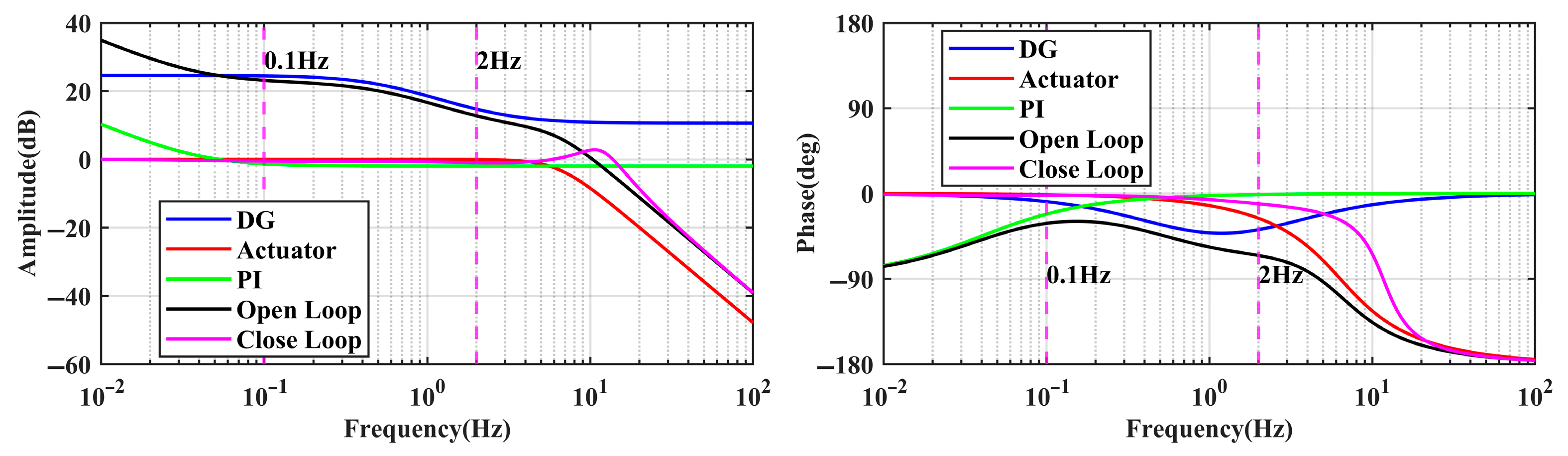
Figure 8 shows the bode plot corresponding to Equation (21), and the PI controller parameters are k p = 0.8 and k i = 0.2 . In addition, the stability of the system with P M = 45 deg and G M = 40 dB can be seen in the figure, and the gain of the signal is 10–20 dB in the frequency band range of 0.1 Hz to 2 Hz. This means that, for a diesel engine, the oscillating signal of Δ ω is captured and amplified by the DG controller in the low- or ultra-low-frequency band. The Philips–Heffron model of the SG and the power model of the DG are established in the above two sections, respectively. Equation (4) is used as a basis of analyzing the dynamic behavior of P m and P e on the rotor during LFOs.

2.3. Description of LFO Suppression Method for SM

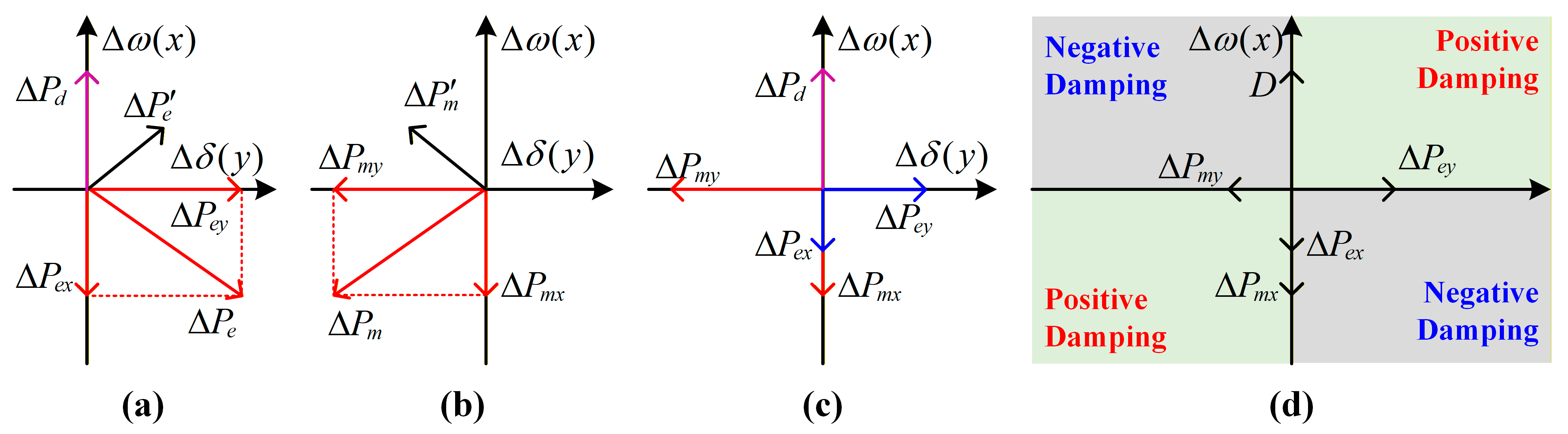
Δ P m , Δ P e and Δ P d are analyzed as vectors in the Δ ω Δ δ plane. The vector form is chosen to describe the transient behavior; on the one hand, the state quantities all show sinusoidal fluctuations during low-frequency oscillations. On the other hand, the state quantities are all functions of Δ ω . Therefore, the Δ ω Δ δ plane uses Δ ω as a reference axis. In addition, the phase difference between the Δ ω and Δ δ axes is equal to 90°. As a result, this section will analyze the effect of the phase difference in the state quantities on the LFO from the Δ ω Δ δ plane.
Figure 9 displays the phase relations of the state variables in the F plane. Figure 9a,b show the generalized phase relations of A, B and C at moments of LFO. The orthogonal decomposition of the above vectors in the F-plane yields the following quantitative relationships for the x-axis and y-axis, respectively.
Δ P m x = a m Δ ω ,   Δ P e x = a e Δ ω ,   Δ P d x = D Δ ω
Δ P m y = b m Δ δ ,   Δ P e y = b e Δ δ ,   Δ P d y = 0
Δ ω and Δ δ are unit vectors, and the scale factors a and b denote the modulus of the vectors Δ P m , Δ P e and Δ P d when projected onto the Δ ω ( x ) and Δ ω ( y ) axes, respectively.
According to Figure 9c, the projections of each variable are synthesized from the x-axis and y-axis as follows.
Δ P x = Δ P m x Δ P e x Δ P d x = a m + a e D Δ ω Δ P y = Δ P m y Δ P e y Δ P d y = b m b e Δ δ
The final sum vector is
Δ P = Δ P x + Δ P y = ( b m + b e ) Δ δ ( a m a e + D ) Δ ω
Equation (25) is organized into the standard form of the second order differential equation with respect to Δ δ as follows:
d 2 Δ δ d t + ( a m a e + D ) d Δ δ d t + ω 0 ( b m + b e ) Δ δ = 0
The characteristic equation corresponding to Equation (26) is as follows:
r 2 + A r + B = 0 , [ A = a m a e + D , B = ω 0 ( b m + b e ) ]
Parameters A and B determine the damping level and oscillatory models of the SG.
Case 1: Variation in parameter A : a m denotes the projection of Δ P m onto the negative half-axis of Δ ω , and a m is an increasing effect on A . D denotes the projection of Δ P d onto the positive semi-axis of Δ ω , and the effect on A is an increase. In summary, Δ P e and Δ P d in the positive semi-axial component of the Δ ω -axis make the damping level of the system increase; the contribution of Δ P m has the opposite effect, and the projection of Δ P m in the negative semi-axis of Δ ω makes the damping of the system increase.
Case 2: Variation in parameter B : b m denotes the projection of Δ P m onto the negative half-axis of Δ δ , and b m is an increasing effect on B . In summary, the projection of Δ P e and Δ P m on the positive semi-axis of Δ δ increases the frequency of oscillation of the system. According to the physical significance of the response in Figure 1b, B represents the elasticity coefficient of the spring, reflecting the level of restoring force of the system. For the SG, B corresponds to the synchronizing torque coefficient, reflecting the stiffness of the SG and its ability to maintain synchronizing speed.
Combined with the above analysis, the rotor will experience acceleration and deceleration when Δ P e and Δ P m are mismatched in the dynamic process, which externally becomes oscillations in speed and power. Therefore, the essence of the centralized damping compensation strategy is to inject damping power into the microgrid through the ESS.

3. Design of Damping Control Strategy Based on Virtual PSS

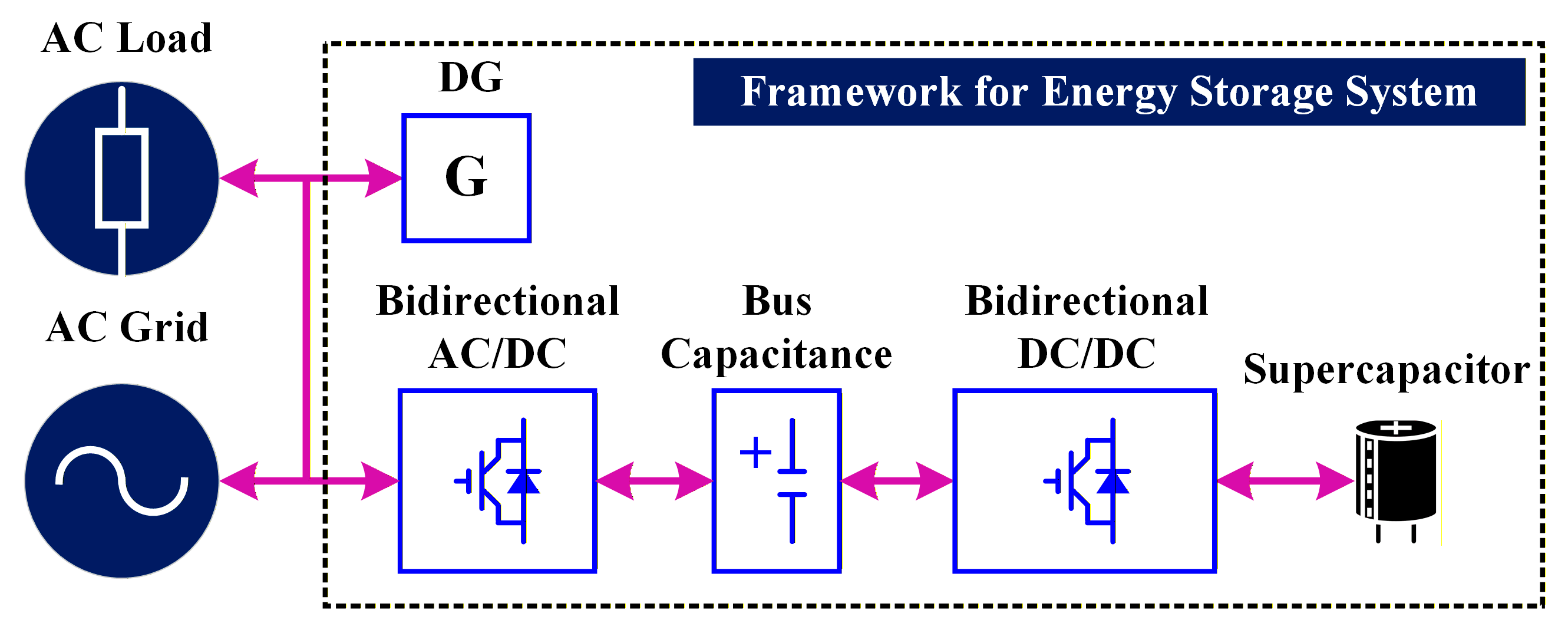
The control goal of the damping compensation strategy has been accomplished and justified in Figure 9. In the figure, D Δ ω is on the one hand an intrinsic damping property of the SG, but at the same time its physical properties make the direction and form of D Δ ω the direction of the damping increase. Therefore, by adding the same damping component in Δ P e as in the direction of D Δ ω , the damping level of the system can be enhanced. Based on the above ideas, this chapter provides a discussion on the control strategy and architecture of damping control. Figure 10 shows the damping control architecture of the supercapacitor energy storage system. The system contains a supercapacitor, a bidirectional DC/DC and a grid-connected converter. Among them, the DC/DC converter is responsible for the bidirectional flow of energy from the supercapacitor. The AC/DC converter acts as an interface between the ESS and the SM and is responsible for regulating the damping power injected into the SM. Therefore, this chapter focuses on the control strategy of the AC/DC converter.

3.1. Bidirectional AC/DC Converter Modeling and Controller Design

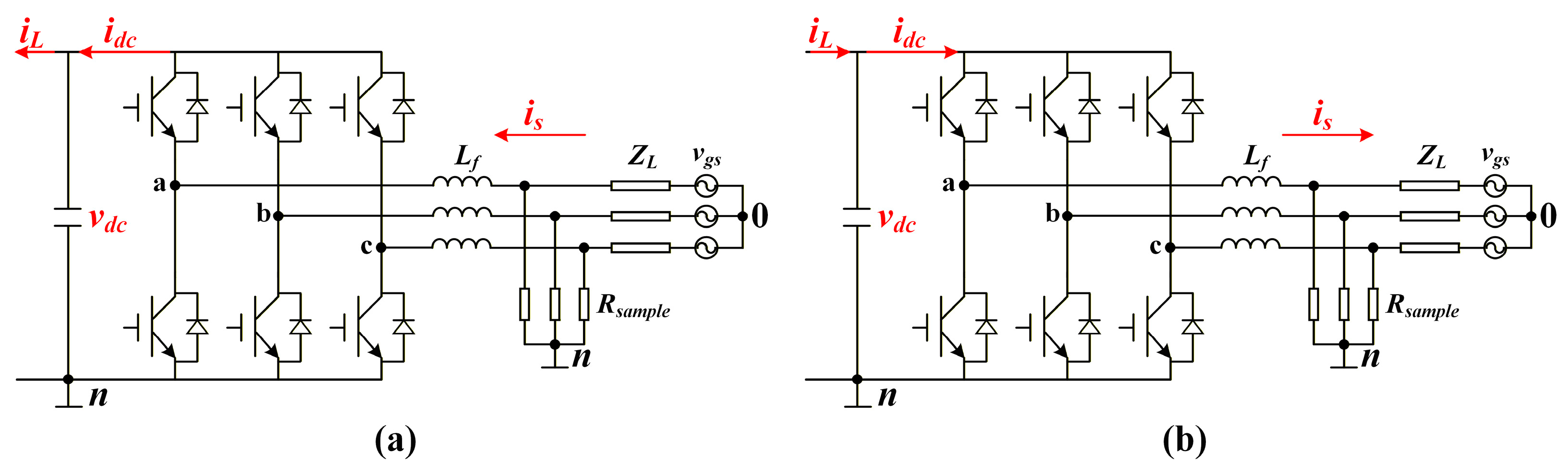
Figure 11 shows the main topology circuit of the L-type bidirectional AC/DC converter. Note that the front-stage supercapacitor with a bidirectional Buck/Boost converter is not discussed in this paper, and i L is used to represent the charging and discharging process of the ESS.
The state space equations for the topology shown in Figure 11 are expressed as follows:
L f d i g a / d t + [ s a ( s a + s b + s c ) / 3 ] v d c = v g a L f d i g b / d t + [ s b ( s a + s b + s c ) / 3 ] v d c = v g b L f d i g c / d t + [ s c ( s a + s b + s c ) / 3 ] v d c = v g c C d v d c / d t = i a s a + i b s b + i c s c i L
where L f represents the filter inductor, C is the DC bus capacitance, i g is the current injected into the SM, v g is the grid side voltage and v d c is the DC bus voltage. The transformation of Equation (28) yields the state equation and transfer function in the dq coordinate system as follows:
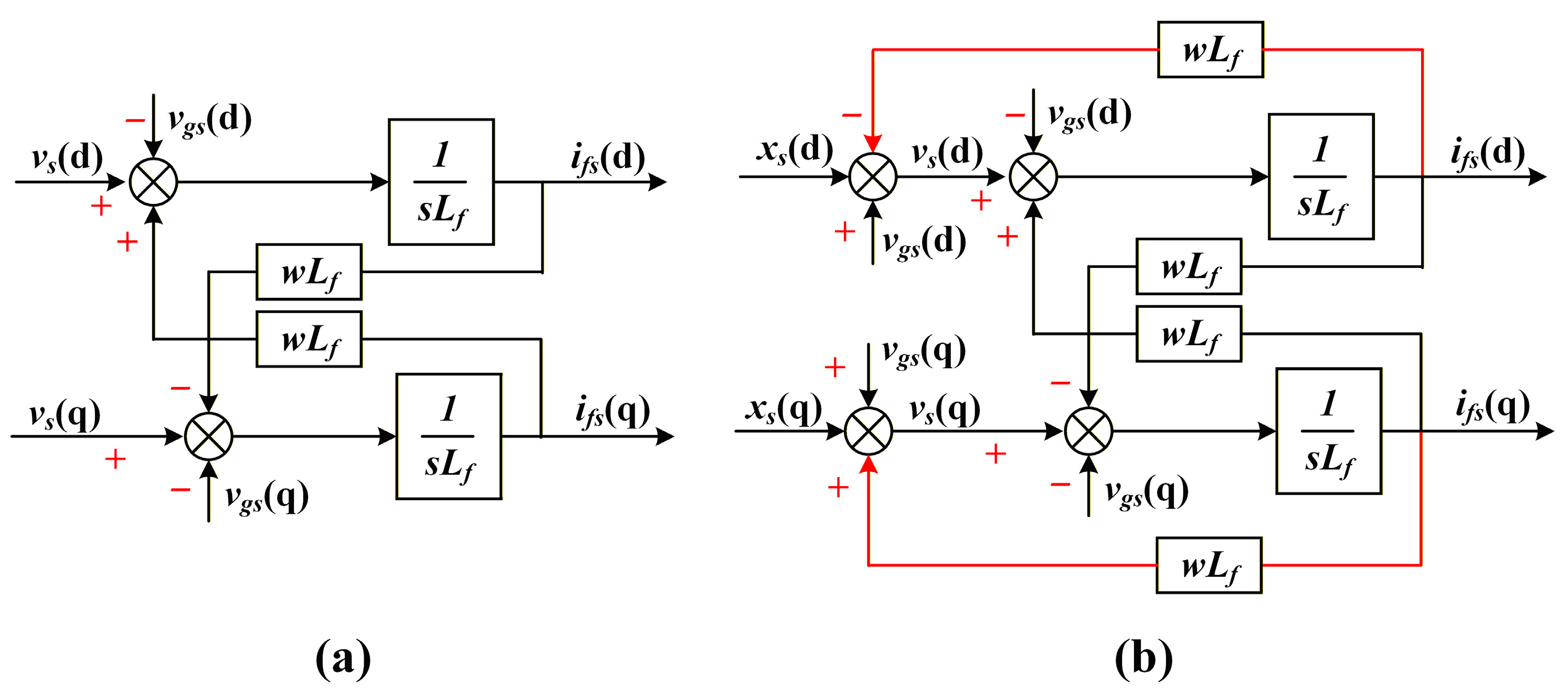
v s ( d ) = L f ( d i f s ( d ) / d t ) ω L f i f s ( q ) + v g s ( d ) v s ( q ) = L f ( d i f s ( q ) / d t ) + ω L f i f s ( d ) + v g s ( q )
and
v s ( d ) ( s ) = s L f i f s ( d ) ( s ) ω L f i f s ( q ) ( s ) + v g s ( d ) ( s ) v s ( q ) ( s ) = s L f i f s ( q ) ( s ) + ω L f i f s ( d ) ( s ) + v g s ( q ) ( s )
where the subscripts “ d ” and “ q ” represent the d-axis and q-axis components of the state variable, respectively.
Equations (29) and (30) establish the mathematical model of the bidirectional AC/DC in the dq coordinate system. Figure 12 shows the block diagram of the transfer function corresponding to Equation (30). Next, we design the current and power tracking controllers.
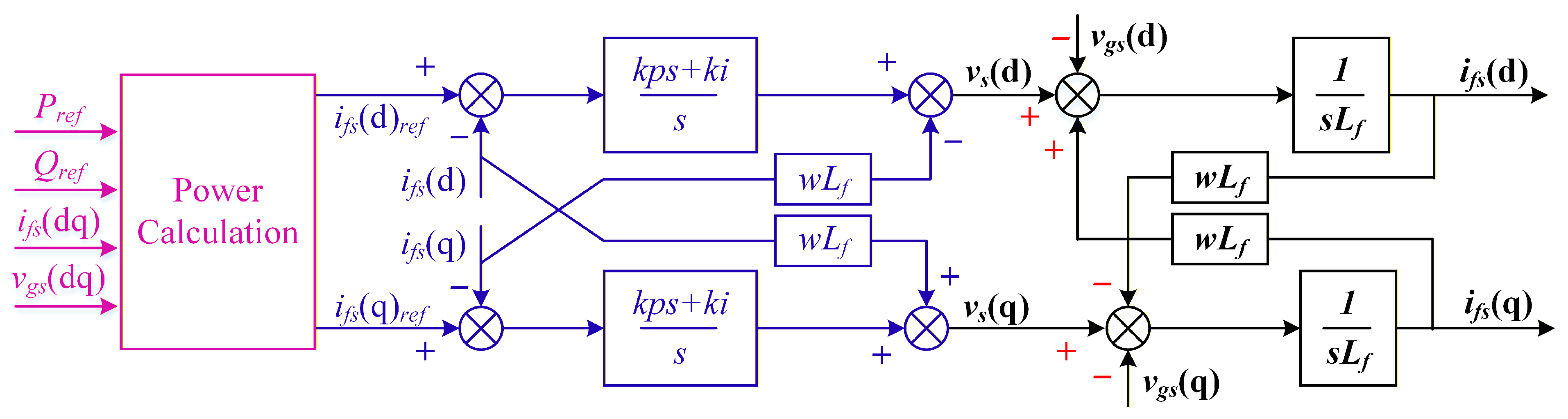
The essence of the damping control strategy is to inject the desired damping power into the SM. Therefore, on the basis of the current controller realizing a current tracking control, the current needs to be converted to a power control. For the d-q coordinate system, the power injected or absorbed into the grid is calculated as follows:
P = v g s ( d ) i f s ( d ) + v g s ( q ) i f s ( q ) Q = v g s ( q ) i f s ( d ) v g s ( d ) i f s ( q ) P = v g s ( d ) i f s ( d ) Q = v g s ( d ) i f s ( q )
where P and Q represent the power exchanged between the converter and the SM, respectively.
In summary, Figure 13 shows the control block diagram of the bidirectional AC/DC, and the voltage loop is not designed in the figure, which is due to the fact that the stabilization control of the DC bus voltage is attributed to the bidirectional DC/DC module of the energy storage system. While the conventional PSS injects damping power into the generator rotor shaft system through the path of the excitation loop, the virtual PSS of this thesis acts through the equivalent electromagnetic power output from the generator to the rotor shaft system, and reactive power is not involved in the regulation during the whole process. Therefore, both the rectifier and inverter modes ensure that the converter operates at a unit power factor to maximize the energy storage capacity for damping control. Therefore, the control reactive current is equal to 0, and, looking from the AC side to the DC side, the ESS is like a purely resistive load with exactly the same phase of voltage and current.

3.2. Virtual PSS Equivalent Damping Gain Coefficient Design

Equation (13) establishes the state matrix of the SG, and Δ P c m d ( t ) = Δ P d a m p ( t ) = Δ P e is constant under the conditions of an ideal energy storage system. Therefore, B can be considered as an independent output, and the state space matrix is established as follows:
x ˙ g = A g x g + B Δ P c m d Δ ω = C x g
where B is the input matrix, and B = [ 0 , 1 / H , 0 , 0 ] T ; C is the output matrix, and C = [ 0 , 1 , 0 , 0 ] . It should be added that the coefficient 1 / H in B takes a positive value, which corresponds to the reference direction of the decrease in the electromagnetic power output of the generator. Therefore, + 1 / H corresponds to the ESS operating in inverter mode. The Laplace transform of Equation (29) with zero initial conditions yields the transfer function as follows:
G ( s ) = Δ ω ( s ) Δ P c m d ( s ) = C [ s I A g ] 1 B
Introducing the concomitant matrix of [ s I A g ] , Equations (4)–(28) are simplified and collapsed to obtain the following:
G ( s ) = C [ s I A g ] B | s I A g | N ( s ) D ( s ) = i = 1 n j = 1 m i R e s [ i j ] ( s p i ) j
where p i is the i -th pole of D ( s ) , and each pole corresponds to a mode λ i . m i is the reweight of each pole. R e s [ i j ] is the residue of λ i . Based on the Laurent series, the formula for R e s [ i j ] can be obtained as follows:
R e s [ i j ] = 1 ( m i j ) ! lim s p i d ( m i j ) d s ( m i j ) [ ( s p i ) m i G ( s ) ]
Let j = m i ; then, Equation (35) can be simplified as follows:
R e s [ i , m i ] = lim s p i [ ( s p i ) m i G ( s ) ]
The residue describes the strength of the transfer function C from the input signal Δ P c m d to the output signal Δ ω at an oscillatory mode. Its physical significance suggests that a larger retention number indicates a greater influence of Δ P c m d on Δ ω in this mode.
The eigenvalues corresponding to the dominant oscillatory modes appear as conjugate complexes when LFOs occur in the SM. For the transfer function G ( s ) , it is essentially a pair of unipolar points. If the i -th oscillatory mode is such that D ( s ) = 0 and D ( s ) 0 , then the Laurent series of D ( s ) at s = λ is as follows:
D ( s ) = D ( λ i ) [ s λ i ] + D ( λ i ) 2 [ s λ i ] 2 + = D ( λ i ) [ s λ i ] + o [ s λ i ] 2
Substituting Equation (37) into Equation (35), we solve the formula for the residue of the monopole as follows:
R e s [ i , 1 ] = lim s p i [ ( s p i ) G ( s ) ] = N ( p i ) D ( p i )
Figure 14 is the schematic diagram of the damping control structure. The rotational speed signal Δ ω is input into the damping controller, and the low-pass, high-pass and phase-compensated links in the virtual PSS filter out the non-LFO links in Δ ω . The equivalent damping gain D e q regulates the damping power injected into the SM. Therefore, the transfer function of the damping controller structure in Figure 14 is expressed as follows:
Δ P c m d = H ( s ) Δ ω = D G L P F G H P F G C o m p Δ ω
where G L P F , G H P F and G C o m p represent the transfer functions of the signal conditioning link in the virtual PSS, respectively.
The target oscillatory mode ( λ 0 , λ ¯ 0 ) is identified by a wide-area measurement, followed by a residue at ( λ 0 , λ ¯ 0 ) according to Equation (13). With the above known conditions, the problem of solving D e q is transformed into choosing an appropriate D e q to raise the damping ratio ς 0 to ς d .
Firstly, the standard type of the differential equation for a second-order system can be expressed as follows:
d 2 Δ δ d t 2 + 2 ς ω n d Δ δ d t + ω n 2 Δ δ = 0
where ω n is the natural oscillation frequency, and ω n ω d / 1 ς 2 . ς is the damping ratio. The combination of Equations (13) and (40) is solved according to the coefficients to be determined as follows:
ς 0 = D e q 2 H K 1
where H and K 1 are the equivalent inertia constants and synchronizing torque coefficients of the SG, respectively. For an SM, both can be considered as constants, so Δ ς 0 and Δ D e q are approximately proportional to each other, i.e., Δ D e q = 2 H K 1 Δ ς 0 .
Assuming, the system is weakly damped at LFO and the conjugate pole of the oscillatory mode is p 1 , 2 = σ 0 ± j ω 0 , the contribution of the conjugate pole to the steady-state gain is as follows:
G ( s ) = R e s [ 0 ] s ( σ 0 + j ω 0 ) + R ¯ e s [ 0 ] s ( σ 0 j ω 0 )
Let s = j ω 0 ; then, Equation (37) can be further simplified as follows:
G ( j ω 0 ) = R e s [ 0 ] j ω 0 ( σ 0 + j ω d ) + R ¯ e s [ 0 ] j ω 0 ( σ 0 j ω d ) R e s [ 0 ] σ 0 + R ¯ e s [ 0 ] σ 0 + j 2 ω 0
Equation (42) exists with | σ 0 | | ω 0 | under weak damping conditions, so the equation can be approximated as follows:
| G ( j ω 0 ) | | R e s [ 0 ] | | σ 0 | + | R ¯ e s [ 0 ] | | j 2 ω 0 | | R e s [ 0 ] | | σ 0 | | R e s [ 0 ] | 2 | σ 0 |
It should be added that, since the poles corresponding to the oscillatory modes occur in pairs, the gain of A is superimposed at B and requires a factor 1 / 2 .
The feedback closed loop is established according to Figure 14. It is known that the SM generates LFOs with state quantities Δ ω , and the initial amplitude is A ω . Δ P c m d is injected into the SM as damping power to produce an additional frequency response. Conversely, after the oscillatory state reaches stabilization, the injected power is equal to the damping power required to suppress the oscillations, which is mathematically described as follows:
D e q M A ω Δ D e q A ω D e q M Δ D e q
where M is the gain | H ( j ω 0 ) | after virtual PSS compensation.
Also, in a second order system, the transfer function in the low-frequency band can be approximated as follows:
G ( s ) = 1 2 H s + D R e s = lim s D / ( 2 H ) ( s + D 2 H ) G ( s ) = 1 2 H
Substituting R e s into Equation (46), the initial equation for D e q is solved as follows:
D i n i t i a l = D e q ( 0 + ) = Δ σ R e s [ 0 ] M = ω 0 ( ς d ς 0 ) R e s [ 0 ] M
Now, Equation (47) is the initial gain equation for D e q .

3.3. Improved Model Reference Adaptive Damping Gain Design Based on the Gradient Method

Now, we recall the four assumptions of Equation (1), which form the basis of the modeling. The SG model relies on a number of assumptions. And these assumptions may not hold true in a wide range of situations. Therefore, the model reference adaptive control strategy is proposed to avoid the effect of model error in this section.
The three-phase VSR is used as a power transfer channel to inject damping power into the SM to realize the LFO suppression of the SM. However, keeping D i n i t i a l constant as Δ ω converges or the load power varies in the SM during LFO can negatively affect the stability of the SM.
First, the transfer function of the damping controller described in Figure 14 and Equation (39) is as follows:
Δ P c m d Δ ω = H ( s ) = D e q ( t ) G P S S ( s )
where the additional damping torque provided by the damping controller can be expressed from the time domain point of view as follows:
Δ T D ( t ) = D e q ( t ) Δ ω ( t ) + ε ( t )
where ε ( t ) is the higher order dynamic term, which represents all the additional terms caused by the dynamic characteristics of the system. It contains the links Δ T d ( t τ ) , d Δ T d / d t and d Δ ω / d t , d 2 Δ ω / d t 2 .
Let θ ( t ) = D 0 + D e q ( t ) ; Equation (42) can be further rewritten as follows:
2 H d Δ ω d t + θ ( t ) Δ ω = Δ T m Δ T e
Second, the reference model that defines the ideal damping characteristics is the second-order classical system, i.e., the following:
2 H d Δ ω 0 d t + θ Δ ω 0 = Δ T m Δ T e
where θ is the ideal total damping coefficient and θ = D 0 + D e q . ς ( t ) stands for the damping ratio. The frequency tracking error and the damping parameter tracking error are defined as follows:
e ω ( t ) = Δ ω Δ ω 0 and   e θ ( t ) = θ ( t ) θ .
By combining and subtracting Equations (43) and (44), the state equation of the error signal is obtained after collation as follows:
2 H d e ω d t + θ e ω = e θ Δ ω
The construction of the Lyapunov function is as follows:
V ( e ω , e θ ) = 1 2 ( 2 H e ω 2 + 1 α e θ 2 )
Then, the adaptive law is inverted based on Lyapunov stability, and the designed adaptive law is as follows:
e ˙ θ = α e ω Δ ω e ˙ θ = θ ˙ = D ˙ e q D e q = α e ω ( t ) Δ ω ( t )
Equation (54) is the adaptive control law for the D e q .
Reanalyzing the form of Equation (54), the adaptive control rate designed based on the Lyapunov function is perfect in mathematical form, but the adaptive law strictly depends on the output signal of the reference model. For a real microgrid system, the accuracy of the reference model is difficult to guarantee. Therefore, it is necessary to transform the stability problem of the Lyapunov function into an optimization problem, and the specific process is as follows.
Firstly, the energy function of the oscillatory process is defined as
J ( D e q ) = 1 2 t T t Δ ω 2 ( τ ) d τ
where J ( D e q ) is the oscillatory energy of the system; T denotes the time scale. The oscillation amplitude of Δ ω is chosen to characterize the current oscillatory state of the system, instead of directly introducing e ω .
Equation (48) represents the integral of the square of Δ ω over the last T time periods. As a result, the larger and longer Δ ω is, the larger the value of J ( D e q ) is, implying that the oscillatory energy in the system is stronger. Therefore, the problem transforms the regulation D e q to make M i n [ J ( D e q ) ] .
Next, J / D e q is used to find the M i n [ J ( D e q ) ] that satisfies D e q . The process is as follows:
J D e q = t T t Δ ω ( τ ) Δ ω ( τ ) Δ D e q d τ
Let S = Δ ω / D e q and S represent the sensitivity of Δ ω with respect to D e q , which is here approximated as a linear relationship as S = Δ ω / t β Δ ω ( β > 0 ) . Note that the approximation of S holds only for dominant modes. In summary, Equation (49) can be reduced to the following:
J D e q t T t Δ ω ( τ ) [ β Δ ω ( τ ) ] d τ = β t T t Δ ω 2 ( τ ) d τ
To find M i n [ J ( D e q ) ] such that D e q is updated along the inverse gradient direction of J ( D e q ) , we have the following:
D ˙ e q = γ J D e q = β γ t T t Δ ω 2 ( τ ) d τ = η t T t Δ ω 2 ( τ ) d τ
where η stands for Adaptive Gain. Equation (58) is an adaptive law that eliminates the parameters of the reference model, and the equation contains only the history squared of Δ ω . Since for low-frequency oscillations the frequency range is equal to 0.2 Hz–2 Hz, the approximation is performed again, i.e., the squared value of the signal at the current moment is used to approximate the integral effect on behalf of the past period of time, i.e.,
t T t Δ ω 2 ( τ ) d τ Δ ω 2 ( t )
Substituting Equation (59) into Equation (58), the simplified adaptive law is as follows:
D ˙ e q = η Δ ω 2 ( t )
Analyzing the form of Equation (60) again, Equation (60) directly introduces the measured instantaneous value of Δ ω into the controller by taking the square of the measured value; thus, Equation (60) amplifies the noise in the signal. In addition, when the A signal converges, it is desirable to have D slowly return to the initial set value rather than continuously connecting to the microgrid due to the limited capacity of the ESS. Therefore, in order to discuss the above two issues, the band pass filter and a forgetting factor are introduced, and the adaptive law is improved as follows:
D ˙ e q = λ D e q ( t ) + η Δ ω B P F 2 ( t )
where Δ ω B P F 2 ( t ) is the frequency deviation signal after the band pass filter. λ is the forgetting factor. In Equation (54), η Δ ω B P F 2 ( t ) is the dominant term in the dynamic process, and its value drives D e q to increase and suppress the oscillation. During the steady-state process, Δ ω B P F ( t ) converges to zero and the equation becomes D ˙ e q = λ D e q ( t ) , with a solution of the form D e q ( t ) = D e q ( 0 ) exp ( λ t ) . As a result, after the steady state, D e q is able to converge to zero and automatically exits the damping control, where the value of λ determines the speed of regression of D e q .
Now, Equation (61) completes the design of the adaptive control rate. As a supplement, the stability of the adaptive controller is proven, and the proof procedure is as follows:
According to Equation (61), the Lyapunov function is designed as follows:
V ( D e q ) = 1 2 ( D e q D e q * ) 2
Equation (62) is a positive definite function, and its corresponding derivative function is as follows:
V ˙ ( D e q ) = ( D e q D e q * ) D ˙ e q = ( D e q D e q * ) [ λ D e q ( t ) + η Δ ω B P F 2 ( t ) ]
Let Δ ω ( t ) = A sin ( ω n t ) ; Δ ω B P F ( t ) can be written as follows:
Δ ω B P F ( t ) = | G ( j ω n ) | A sin ( ω n t + ϕ ) Δ ω B P F 2 ( t ) = K 2 A 2 2 [ 1 cos 2 ( ω n t + ϕ ) ]
The main concern is the steady-state characteristics of the parameter, so only its DC component is considered in the above equation; we then have the following:
Δ ω ¯ B P F ( t ) = 1 2 K 2 A 2
Approximating the steady state of Δ ω B P F ( t ) as a DC component, Equation (61) has a parametric relationship at the equilibrium point as follows:
η = 2 λ D e q * A 2 K 2
Let D e q = D e q * + D ˜ e q , and substitute D e q into Equation (63).
V ˙ ( D e q ) = λ D ˜ e q 2 λ D ˜ e q D e q * + η D ˜ e q Δ ω B P F 2 = λ D ˜ e q 2 0
Equation (67) shows that A is negatively characterized in the neighborhood of the equilibrium point D, and that the adaptive control law is asymptotically stable in the neighborhood of the equilibrium point.

4. Result and Discussion

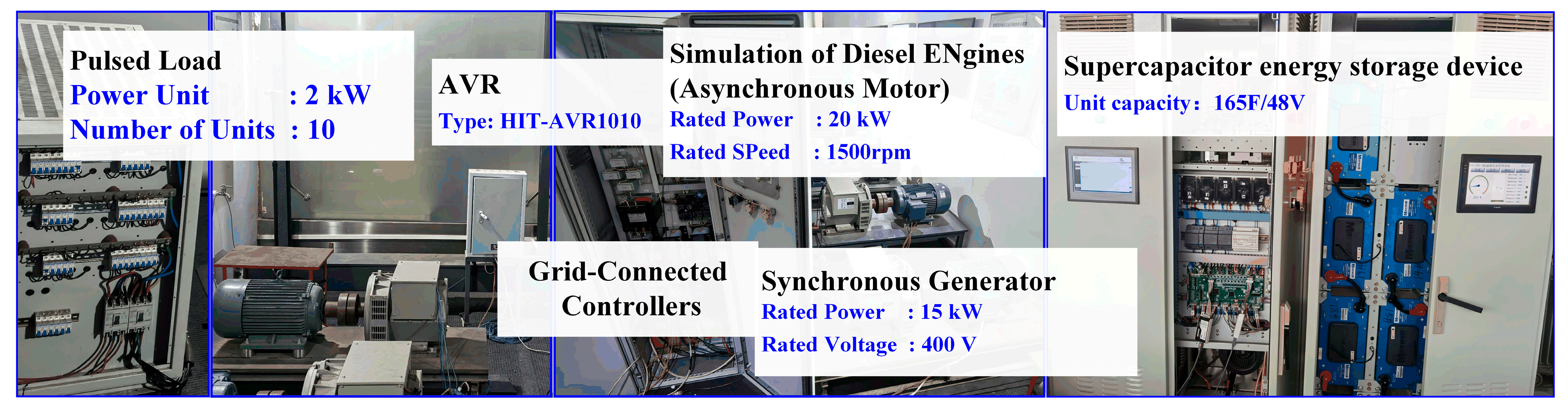
This section focuses on simulations and experiments to verify the correctness and effectiveness of the proposed adaptive control strategy based on virtual PSS to suppress LFO. In the above analysis, it is the theoretical model in Section 2 that is used to solve the oscillation modes of the system. However, in a real SM environment, the LFO modes need to be determined through wide-area modal identification. Therefore, in this section, the effect on the damping coefficients when there is noise or error in the results of the wide-domain modal identification is first analyzed. Finally, the dynamic response of the proposed controller and the performance of the damping control are experimentally verified and discussed. Figure 15 shows the constructed experimental platform.

4.1. Residue Sensitivity Analysis Based on Modal Identification

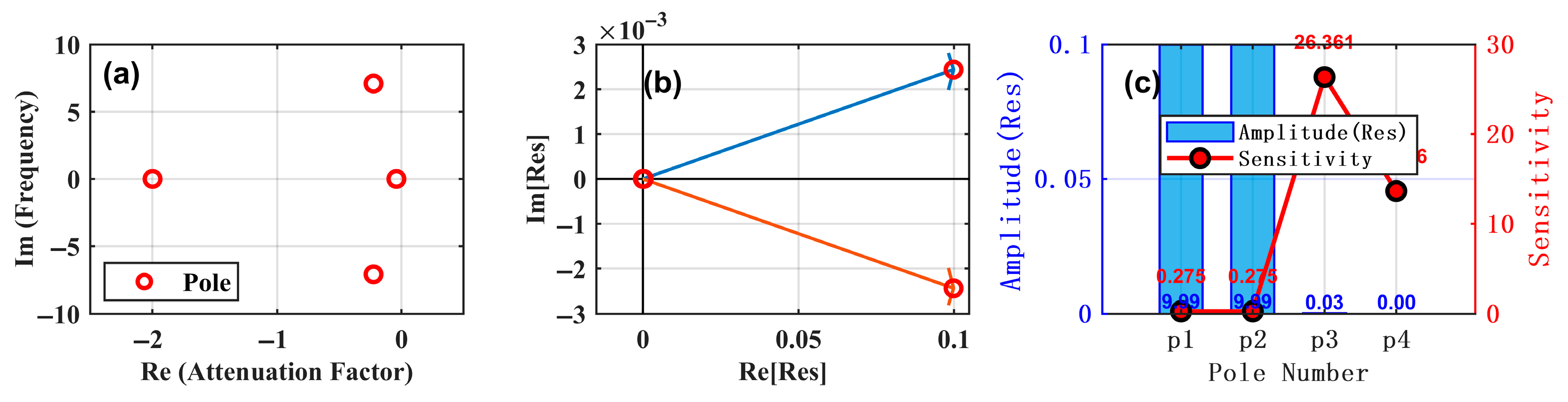
Figure 16 shows the residue for the oscillatory modes of the Philips–Heffron model, and there are four poles in the figure. Table 1 shows the information about the values of the poles shown in the figure. In Table 1, the residues R [ 1 ] and R [ 2 ] of p 1 , 2 are much larger than those of the non-oscillatory modes R [ 3 ] and R [ 4 ] . This means that p 1 , 2 plays a dominant role in the oscillatory behavior of the system. Table 2 shows the residue sensitivities corresponding to each pole of Figure 16c.
In Table 2, the sensitivities of p 3 and p 4 appear anomalous and are much larger than the sensitivity of p 1 , 2 . This also implies that, for p 3 and p 4 , a small pole error can cause a large deviation in the retention number. However, for the oscillatory modes, the numerical stability of the retention number is high. The main reason for this sensitivity pathology is that p 3 and p 4 are unobservable modes, and the derivatives N of the molecular polynomials are too small to make the sensitivity anomalous.
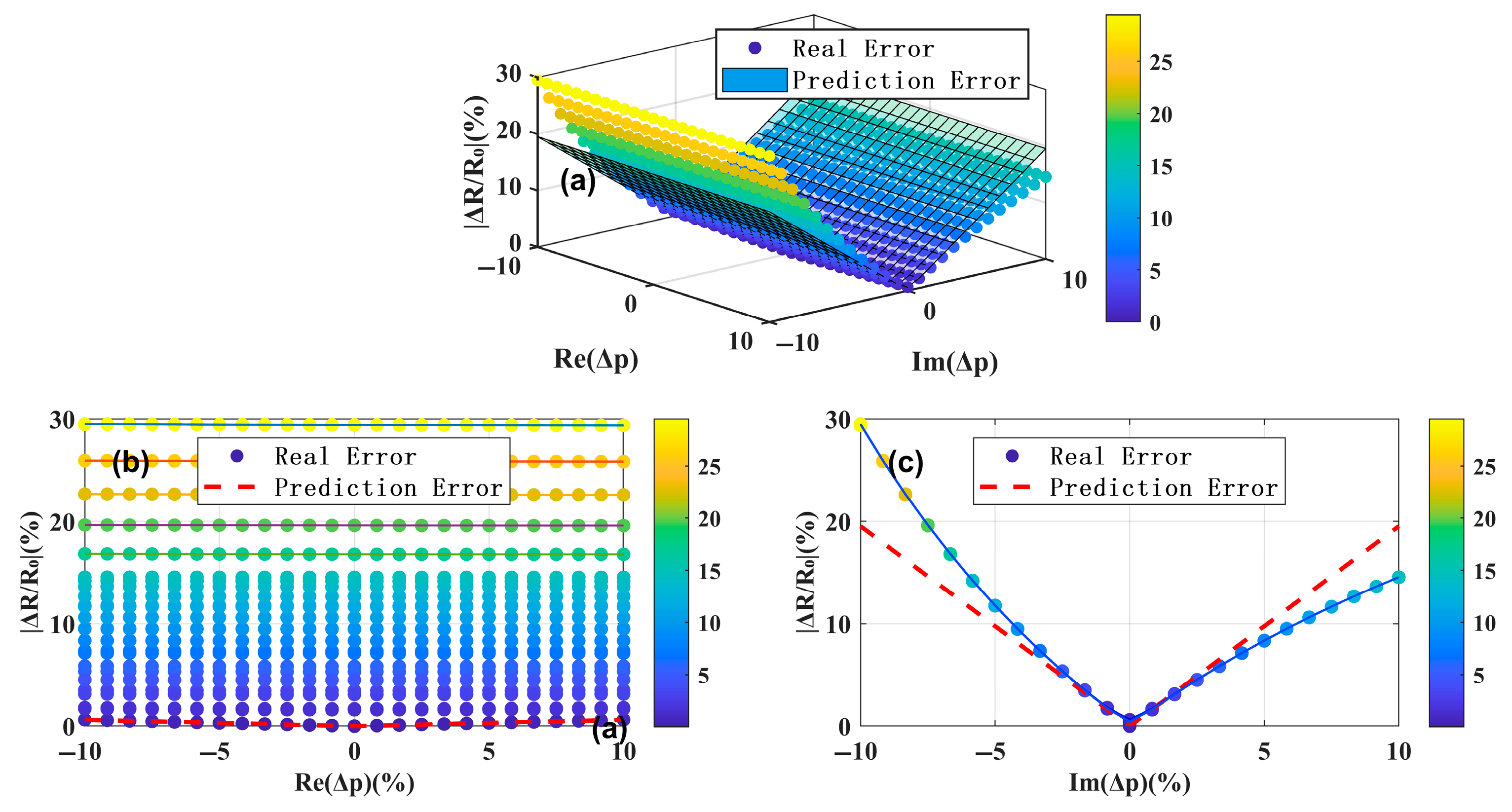
In Figure 17, the relationship between the error in the true number of retentions and the first-order prediction deviation is quantitatively analyzed when there are deviations in the oscillatory modes. In Figure 17b, when Re ( Δ p ) exists with ± 10 % error, the change in the number of retentions is not significant, and the real error and the one-section deviation basically coincide. In Figure 17c, when there is Im ( Δ p ) error in ± 10 % , the error in the number of retentions varies with Im ( Δ p ) . At the same time, the figure shows that the first-order prediction bias model holds based on | Im ( Δ p ) | < 5 % .
Of course, the sensitivity of the modal parameters is not high in the above analysis obtained only for the dominant oscillation mode. Therefore, for the dominant oscillation mode parameters within 5%, the error is tolerable. However, this error is not closed-loop, i.e., if there is a deviation in the identification of the dominant mode, then the high residual sensitivity can make the value of D i n i t i a l huge and cause a power overload in the ESS. Therefore, a limit is set according to the maximum power of the ESS device to avoid this problem.

4.2. Dynamic Response Analysis of Damping Controllers Based on Experimental Waveforms

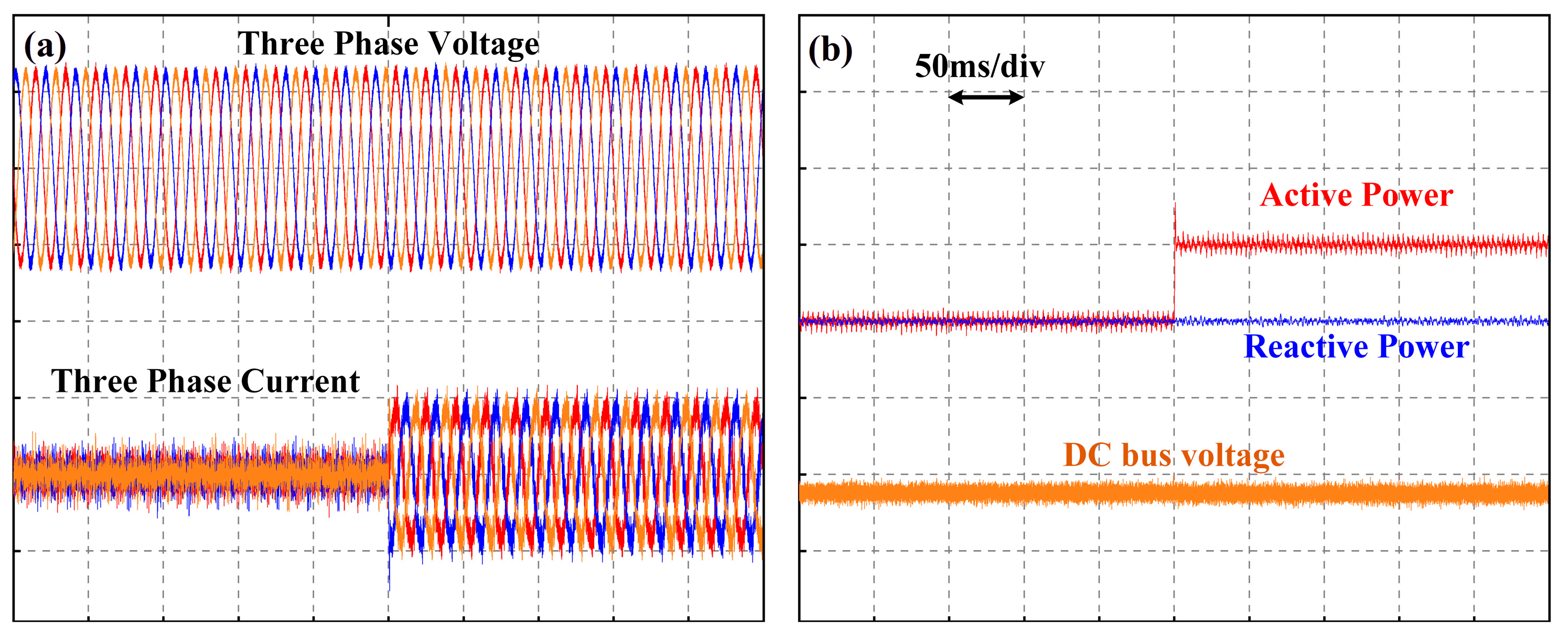
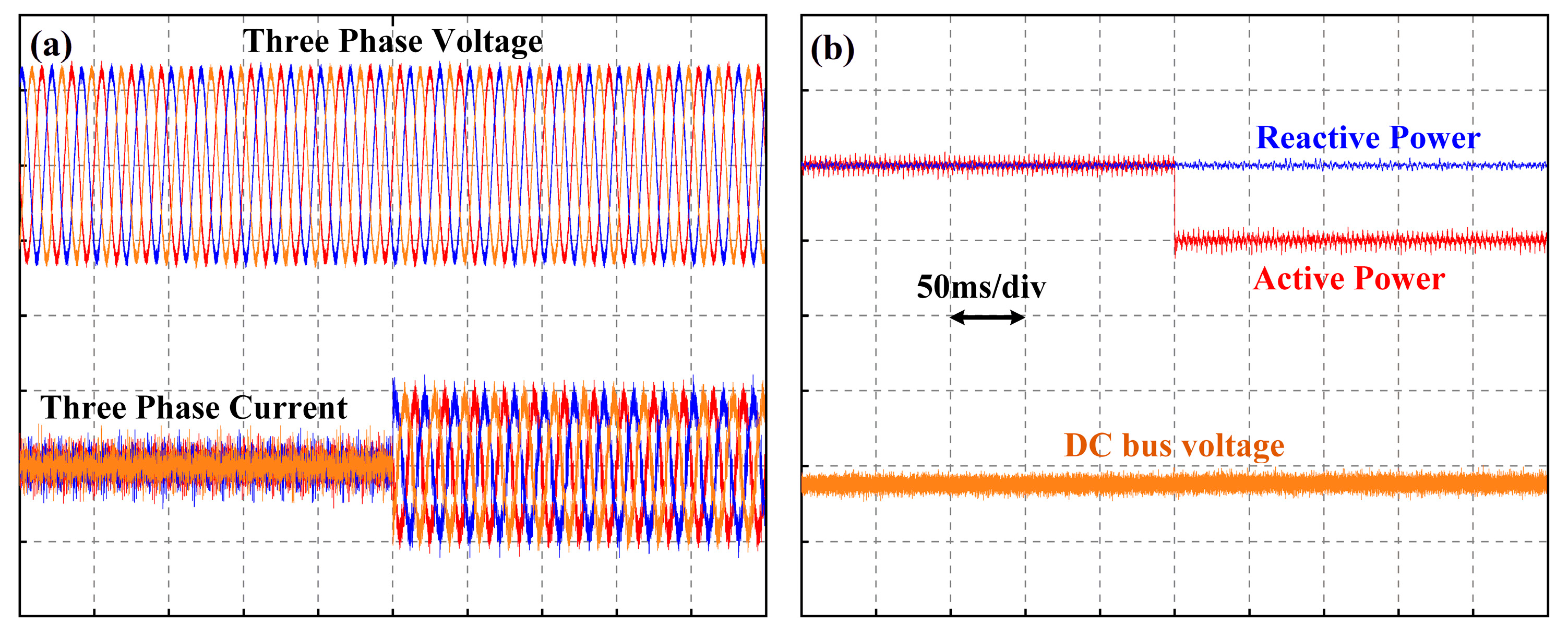
Figure 18, Figure 19, Figure 20 and Figure 21 verify the dynamic response of the designed ESS during cyclic switching in inverter mode and rectifier mode in dual mode, respectively. Specifically, the VSR in Figure 18 is shifted from standby to inverter mode, with a set active power step equal to 10 kW, and the dc bus voltage did not fluctuate significantly during the modal switching process. Correspondingly, the dynamic response of a VSR cutting from standby to rectifier mode is depicted in Figure 19. Therefore, Figure 18 and Figure 19 exhibit the same pattern. And the essential reason for this characteristic is due to the fact that the VSR under the PWM control strategy is able to realize the smooth switching of the two modes.
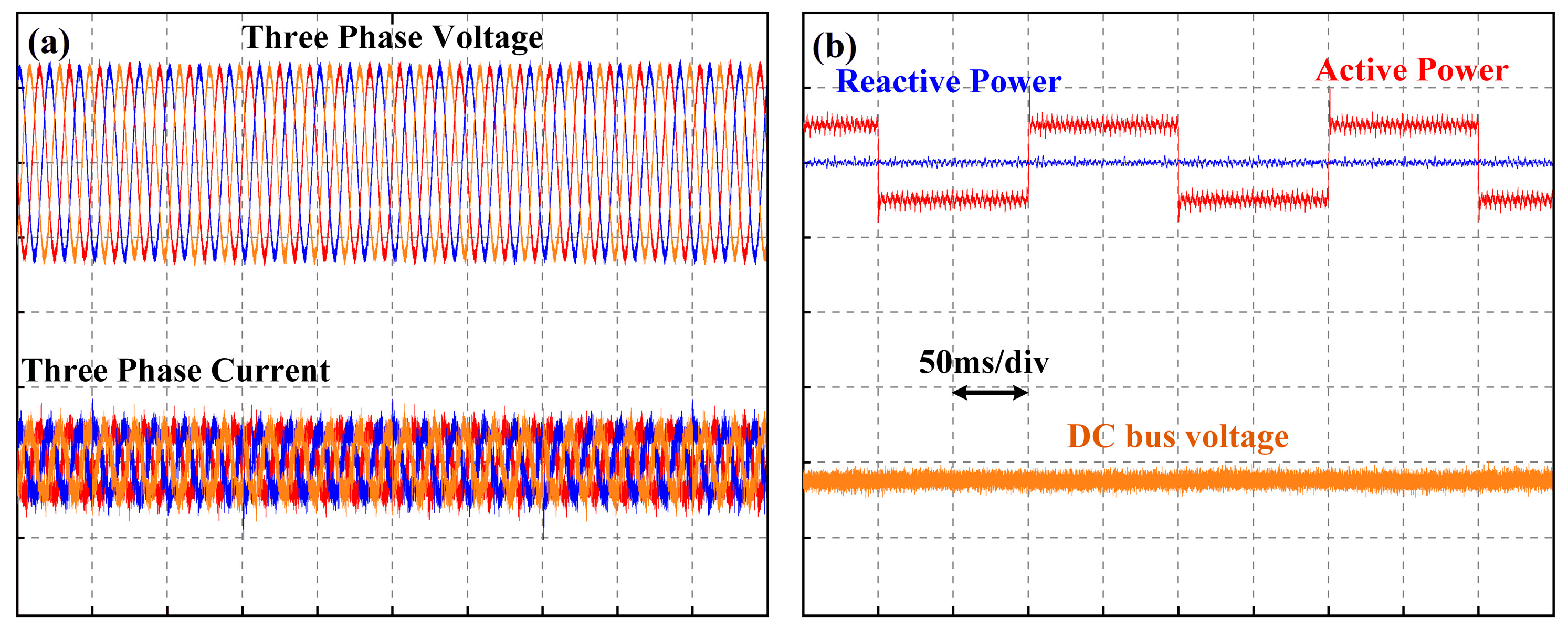
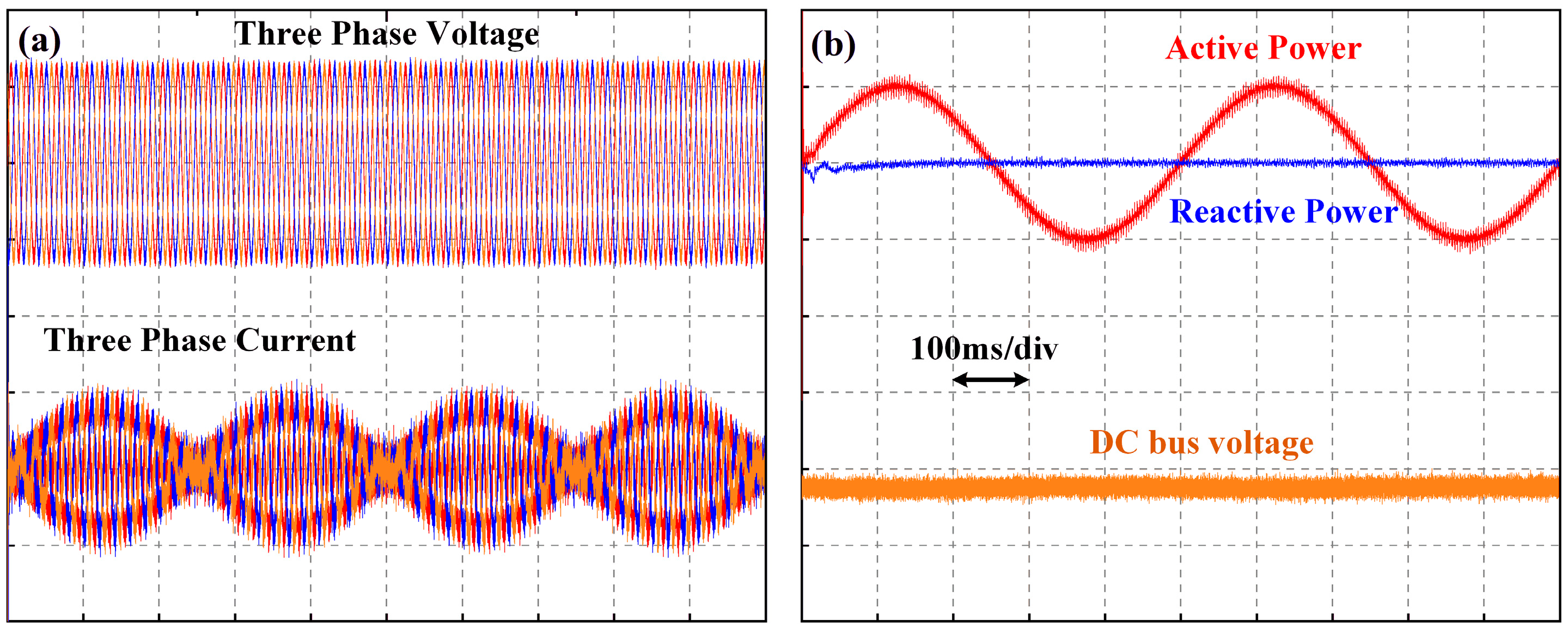
On the basis of Figure 18 and Figure 19, Figure 20 and Figure 21 verify the dynamic response of the VSR with the SM periodic power exchange during low-frequency oscillation cycles. Figure 20 demonstrates that the amplitude of the current does not change during the switching of the two modes. With the process of switching between the two modes, only the phase of the current on the grid side changes. This indicates that the VSR operates in unit factor power conditions in damped control. This is also argued by the phenomenon that the reactive power is approximately equal to 0 in the figure. Figure 21 fully simulates the dynamic response of the VSR during a low-frequency oscillation. When the oscillation occurs, the damping controller has the ability to inject damping power into the grid that is in phase with A. The damping controller has the ability to inject damping power into the grid that is in phase with A.
Combining the above experimental data, the designed architecture of the virtual PSS damping control strategy is capable of injecting the missing damping power into the SM according to the set active power, thus improving the damping level of the SM.
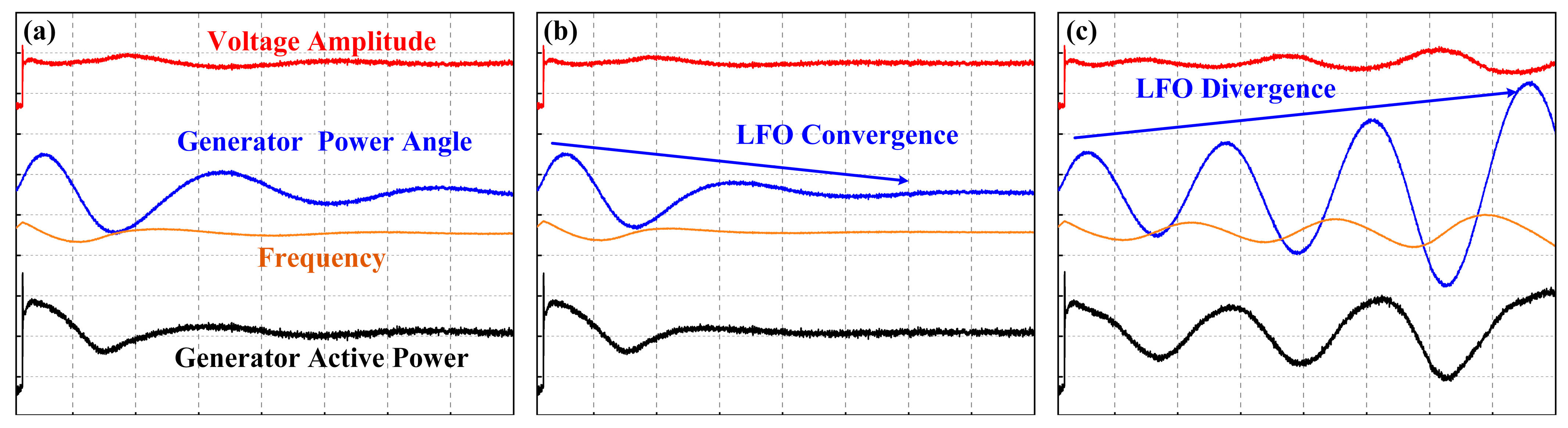
Figure 22 shows the system response after the damping controller is engaged after LFOs occur in the SM, where the LFOs are generated by the pulsed load excitation in 15. The initial value of D is set equal to 2.5 in Figure 22a, which shows that the LFO is able to converge very quickly. As a control, the initial value of D is set equal to 5 in Figure 22b, and the LFO converges faster compared to the former. In Figure 22c, D is always set equal to 0, which also means that the damping controller is not connected to the SM. As a result, the LFO in Figure 22c shows a tendency to diverge.
Figure 23 compares the power response with the fixed damping factor and adaptive damping factor. Figure 23a shows the oscillations generated by a 5% step power, and Figure 23b shows the oscillations generated by a 10% step power. Both are able to make the oscillations converge quickly, but the adaptive damping converges faster. This means that the damping power injected under adaptive damping control is larger. However, for supercapacitor energy storage, this makes the storage system capable of suppressing LFO for a shorter period of time. Therefore, the SOC of the supercapacitor is considered for optimal control in future studies.
In summary, the virtual PSS damping control framework and adaptive control strategy proposed in this paper are capable of realizing the LFO suppression of SM. However, the capacity setting of the energy storage system in this experiment is much larger than the capacity of the generator set of the microgrid, so the effect of the capacity of the energy storage system on the control performance is not discussed during the experiment, and this part will be developed in future work.

5. Conclusions

In this paper, a damping control strategy for LFO suppression in SMs is proposed. The essence of the proposed control strategy is to design a virtual PSS based on the control idea of the PSS, which differs from the traditional PSS in essence by applying a damping torque to the rotor and changing the output active power. The energy storage system based on a supercapacitor can respond quickly to the oscillating power on the one hand, and, on the other hand, the energy storage system makes the injected damping power larger and causes the active channel to act on the rotor of the generator to achieve oscillation suppression.
Although the proposed control strategy is experimentally proven to be able to achieve better LFO suppression, the ability of the damped power to stably track the power set point depends on the SOC of the supercapacitor, and the MPPT curves and capacity configurations of the energy storage system have become key research directions for the future of the modified strategy.

Author Contributions

Conceptualization, methodology, investigation, formal analysis, validation, visualization, writing—original draft, data curation, Y.D.; supervision, project administration, funding acquisition, resources, writing—review and editing, validation, K.Z.; methodology, software, investigation, J.D.; formal analysis, resources, L.S. All authors have read and agreed to the published version of the manuscript.

Funding

This research was funded by the China National Natural Science Foundation Grant No. 52177211 and Heilongjiang Postdoctoral Research Starting Foundation Grant No. LBH-Q20020.

Data Availability Statement

Dataset available on request from the authors. The raw data supporting the conclusions of this article will be made available by the authors on request.

Conflicts of Interest

The authors declare no conflicts of interest.

References

  1. Chen, P.; Liu, J.; Xiao, F.; Zhu, Z.; Ren, Q. Cascaded Stability Analysis of Modular Triple-Port DC/DC Converter for Next Generation of Vessel Integrated Power System. Presented at the 2021 IEEE 12th Energy Conversion Congress & Exposition-Asia (ECCE-Asia), Singapore, 24–27 May 2021. [Google Scholar]
  2. Lei, C.; Li, S.; Chen, Y.C. Optimal Ship-to-Grid Dispatch Considering Battery Thermal and Voltage Electrochemical-Thermal-Coupled Constraints. IEEE Trans. Smart Grid 2025, 16, 5681–5684. [Google Scholar] [CrossRef]
  3. Fei, Z.; Yang, H.; Du, L.; Guerrero, J.M.; Meng, K.; Li, Z. Two-Stage Coordinated Operation of a Green Multi-Energy Ship Microgrid With Underwater Radiated Noise by Distributed Stochastic Approach. IEEE Trans. Smart Grid 2025, 16, 1062–1074. [Google Scholar] [CrossRef]
  4. Haddadi, M.; Gorji, S.A.; Yu, S.S. An Overview of Inertia Emulation Strategies for DC Microgrids: Stability Analysis and AC Microgrid Analogies. IEEE Open J. Ind. Electron. Soc. 2025, 6, 491–521. [Google Scholar] [CrossRef]
  5. Chang, G.W.; Nguyen, K.T. A New Adaptive Inertia-Based Virtual Synchronous Generator with Even Inverter Output Power Sharing in Islanded Microgrid. IEEE Trans. Ind. Electron. 2024, 71, 10693–10703. [Google Scholar] [CrossRef]
  6. Xu, J.; Xie, X.; Dong, W.; Yu, P.; Xing, J. Investigation of New Low-Frequency Oscillation Caused by Converter-Interfaced Generations With MMC-HVDC Transmission. IEEE Trans. Power Deliv. 2025, 40, 1067–1077. [Google Scholar] [CrossRef]
  7. Zhou, Y.; Hu, H.; Yang, X.; Meng, Z.; He, Z. Impacts of Quadrature Signal Generation-Based PLLs on Low-Frequency Oscillation in an Electric Railway System. IEEE Trans. Transp. Electrif. 2021, 7, 3124–3136. [Google Scholar] [CrossRef]
  8. Liu, R.; Zhang, H.; Xue, C.; Li, Y.R. Distributed Low-Frequency Oscillation Damping in Low-Voltage Islanded Multi-Bus Microgrids with Virtual Synchronous Generators. IEEE Trans. Smart Grid 2024, 15, 5331–5345. [Google Scholar] [CrossRef]
  9. Hauer, J.F.; Mittelstadt, W.A.; Martin, K.E.; Burns, J.W.; Lee, H.; Pierre, J.W. Use of the WECC WAMS in Wide-Area Probing Tests for Validation of System Performance and Modeling. IEEE Trans. Power Syst. 2009, 24, 250–257. [Google Scholar] [CrossRef]
  10. Shair, J.; Xie, X.; Li, H.; Terzija, V. New-Type Power System Stabilizers (NPSS) for Damping Wideband Oscillations in Converter-Dominated Power Systems. CSEE J. Power Energy Syst. 2025, 11, 1186–1198. [Google Scholar]
  11. Du, B.; Zhu, J.; Hu, J.; Guo, Z.; Li, Y.; Guo, J. Electromagnetic Oscillation Stabilizer for Large-Scale Power Electronics-Dominated Power Systems in LTP Framework–Part II: Generalized Periodic Stabilization Control and Design. IEEE Trans. Power Electron. 2025, 40, 17186–17202. [Google Scholar] [CrossRef]
  12. Prakasa, M.A.; Robandi, I.; Nishimura, R.; Djalal, M.R. A Hybrid Controlling Parameters of Power System Stabilizer and Virtual Inertia Using Harris Hawk Optimizer in Interconnected Renewable Power Systems. IEEE Access 2024, 12, 76219–76243. [Google Scholar] [CrossRef]
  13. Kim, J.; Kim, S.; Park, J.H. A Novel Control Strategy to Improve Stability and Performance of a Synchronous Generator Using Jacobian Gain Control. IEEE Trans. Power Syst. 2023, 38, 302–315. [Google Scholar] [CrossRef]
  14. Rodriguez-Amenedo, J.L.; Gomez, S.A. Damping Low-Frequency Oscillations in Power Systems Using Grid-Forming Converters. IEEE Access 2021, 9, 158984–158997. [Google Scholar] [CrossRef]
  15. Hossain, M.B.; Islam, M.R.; Muttaqi, K.M.; Sutanto, D.; Agalgaonkar, A.P. A Probabilistic Approach for Sizing the Components of Hybrid Energy Storage Used in Wind Energy Conversion System. Presented at the 2023 IEEE International Conference on Energy Technologies for Future Grids (ETFG), Wollongong, Australia, 3–6 December 2023. [Google Scholar]
  16. Jackson, D.; Cao, Y. A Universal Modeling Framework for Real and Virtual Energy Storage. Presented at the 2023 IEEE Energy Conversion Congress and Exposition (ECCE), Nashville, TN, USA, 29 October–2 November 2023. [Google Scholar]
  17. Prince, M.K.K.; Arif, M.T.; Gargoom, A.; Altaf, M.W.; Muttaqi, K.M.; Haque, M.E. Coordinated Control of Grid-connected PMSG Based Wind Energy System with STATCOM and Supercapacitor Energy Storage. Presented at the 2022 IEEE Industry Applications Society Annual Meeting (IAS), Detroit, MI, USA, 9–14 October 2022. [Google Scholar]
  18. Zhang, Y.; Shan, J.; Song, T.; Huang, Z.; Zhu, X. Back Propagation Artificial Neural Network Based DC Bus Capacitance Identification Method in Three-Phase PWM Rectifier for Charging System of EVs. IEEE Trans. Ind. Electron. 2024, 71, 4830–4839. [Google Scholar] [CrossRef]
  19. Deng, X.; Wan, C.; Jiang, L.; Gao, G.; Huang, Y. Open-Switch Fault Diagnosis of Three-Phase PWM Converter Systems for Magnet Power Supply on EAST. IEEE Trans. Power Electron. 2023, 38, 1064–1078. [Google Scholar] [CrossRef]
  20. Huang, S.; Wang, Q.; Xiong, L.; Zhou, Y.; Gao, F.; Huang, W. Dynamic Event-Triggered-Based Privacy-Preserving Secondary Control for AC Microgrids with Optimal Power Allocation via State Decomposition. IEEE Trans. Ind. Appl. 2025, 1–13. [Google Scholar] [CrossRef]
  21. Huang, S.; Wang, L.; Xiong, L.; Zhou, Y.; Gao, F.; Huang, W. Hierarchical Robustness Strategy Combining Model-Free Prediction and Fixed-Time Control for Islanded AC Microgrids. IEEE Trans. Smart Grid 2025, 16, 4380–4394. [Google Scholar] [CrossRef]
  22. IEEE Std 421.5-1992; IEEE Recommended Practice for Excitation System Models for Power System Stability Studies. IEEE Power Engineering Society: New York, NY, USA, 1992.
Figure 1. Shaft system model of SG. (a) Rigid model of the SG rotor. (b) Spring proton damping model.
Electronics 15 00390 g001
Figure 2. Equivalent circuits for steady-state operation of SG.
Electronics 15 00390 g002
Figure 3. Steady-state and transient-phase diagrams of the SG. (a) Steady state. (b) Transient state.
Electronics 15 00390 g003
Figure 4. Block diagram of transfer function of the SG transient model.
Electronics 15 00390 g004
Figure 5. Δ P e 1 Δ δ bode diagram of synchronous generator.
Electronics 15 00390 g005
Figure 6. Principle of operation of a supercharged DG.
Electronics 15 00390 g006
Figure 7. Control block diagram of a digital speed regulator and its transfer function.
Electronics 15 00390 g007
Figure 8. Δ P e 1 Δ δ bode diagram of steam turbine.
Electronics 15 00390 g008
Figure 9. Phase relations of state variables in the Δ ω Δ δ plane. (a) Δ P e and Δ P d . (b) Δ P m . (c) Synchronous torque components and damped torque components. (d) Plane of state under generator conventions.
Electronics 15 00390 g009
Figure 10. The damping control architecture of the supercapacitor ESS.
Electronics 15 00390 g010
Figure 11. The damping control architecture of the supercapacitor ESS. (a) rectification mode. (b) inverter modes.
Electronics 15 00390 g011
Figure 12. Block diagram of a bidirectional AC/DC system in inverter mode reference direction. (a) Equation (26) corresponds to the block diagram of the system. (b) Block diagram of the system after feed-forward elimination of the coupling term.
Electronics 15 00390 g012
Figure 13. Block diagram of voltage-directed vector-based power control strategy.
Electronics 15 00390 g013
Figure 14. Control block diagram of the proposed damping control.
Electronics 15 00390 g014
Figure 15. Experimental test platform.
Electronics 15 00390 g015
Figure 16. Oscillatory modes and modal residue for the Philips–Heffron model. (a) Pole (modal) distribution. (b) Residue number of poles. (c) Pole residue and sensitivity.
Electronics 15 00390 g016
Figure 17. Analysis of oscillatory mode identification bias and retention errors. (a) The corresponding residual error of the discrimination error of ± 10 % . (b) Re ( Δ p ) Δ R / R . (c) Im ( Δ p ) Δ R / R .
Electronics 15 00390 g017
Figure 18. Dynamic response waveform of the VSR with set step power. (a) Voltage and current. (b) Grid-side power and DC bus voltage.
Electronics 15 00390 g018
Figure 19. Dynamic response waveforms in VSR rectification mode. (a) Voltage and current. (b) Grid-side power and DC bus voltage.
Electronics 15 00390 g019
Figure 20. VSR rectifier mode and inverter mode period change waveforms. (a) Voltage and current. (b) Grid-side power and DC bus voltage.
Electronics 15 00390 g020
Figure 21. Response waveforms of simulated LFOs. (a) Voltage and current. (b) Grid-side power and DC bus voltage.
Electronics 15 00390 g021
Figure 22. Response waveforms of LFOs suppressed by damping control. (a) D e q = 2.5 . (b) D e q = 5 . (c) D e q = 0 .
Electronics 15 00390 g022
Figure 23. Comparison of fixed damping and adaptive damping power responses: (a) 5% power step; (b) 10% step power.
Electronics 15 00390 g023
Table 1. Pole information and corresponding residue for the Phillips–Heffron model.
p ( i ) Re ( p ) Im ( p ) f d ( H z ) ς Re ( R [ i ] ) Im ( R [ i ] ) | R [ i ] | R [ i ]
1−0.22467.09251.130.03170.09980.00240.09991.40°
2−0.2246−7.09251.130.03170.0998−0.00240.0999−1.40°
3−1.99770.00000.001.00000.00020.00000.00030.00°
4−0.04060.00000.001.0000−0.00000.00000.0000180°
Table 2. Residue sensitivity values corresponding to poles.
R [ i ] S N S D N N D D
10.2753−14.22 − 72.12j−30.29 + 4.01j−159.88 − 718.18j−503.69 + 67.62j
20.2753−14.22 + 72.12j−30.29 − 4.01j−159.88 + 718.18j−503.69 − 67.62j
326.361−0.03 + 0.00j0.78 + 0.00j−104.60 + 0.00j120.78 + 0.00j
413.6456−0.00 + 0.00j0.02 + 0.00j98.52 + 0.00j102.12 + 0.00j
Disclaimer/Publisher’s Note: The statements, opinions and data contained in all publications are solely those of the individual author(s) and contributor(s) and not of MDPI and/or the editor(s). MDPI and/or the editor(s) disclaim responsibility for any injury to people or property resulting from any ideas, methods, instructions or products referred to in the content.