FPGA-Accelerated ECG Analysis: Narrative Review of Signal Processing, ML/DL Models, and Design Optimizations


 , and
, and
Abstract
1. Introduction
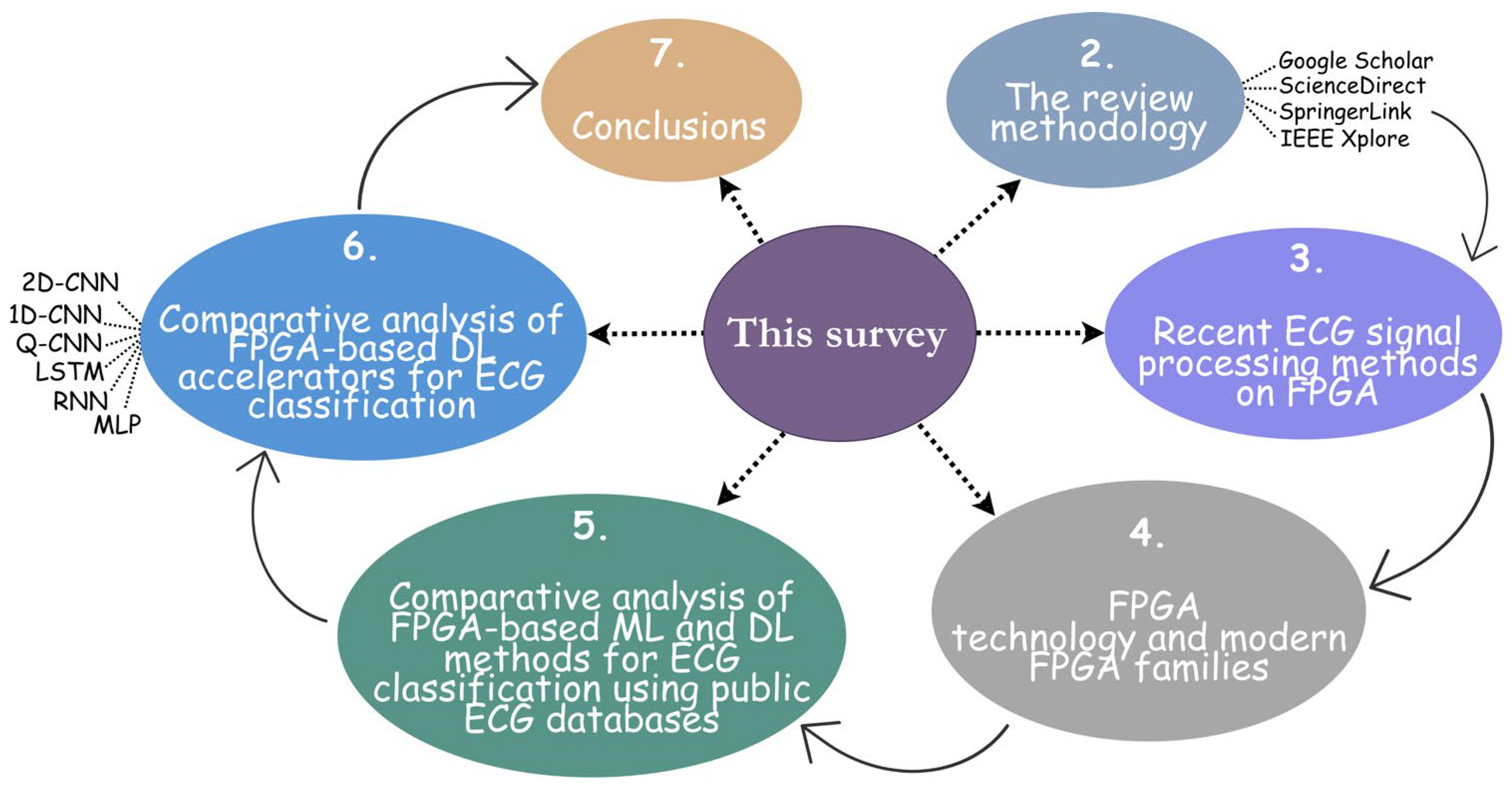
- A review of recent ECG signal processing techniques on FPGA platforms, highlighting trends in filtering methods and feature extraction.
- An overview of FPGA families, including a table summarizing relevant features for the development of AI algorithms in real-time medical diagnostic applications.
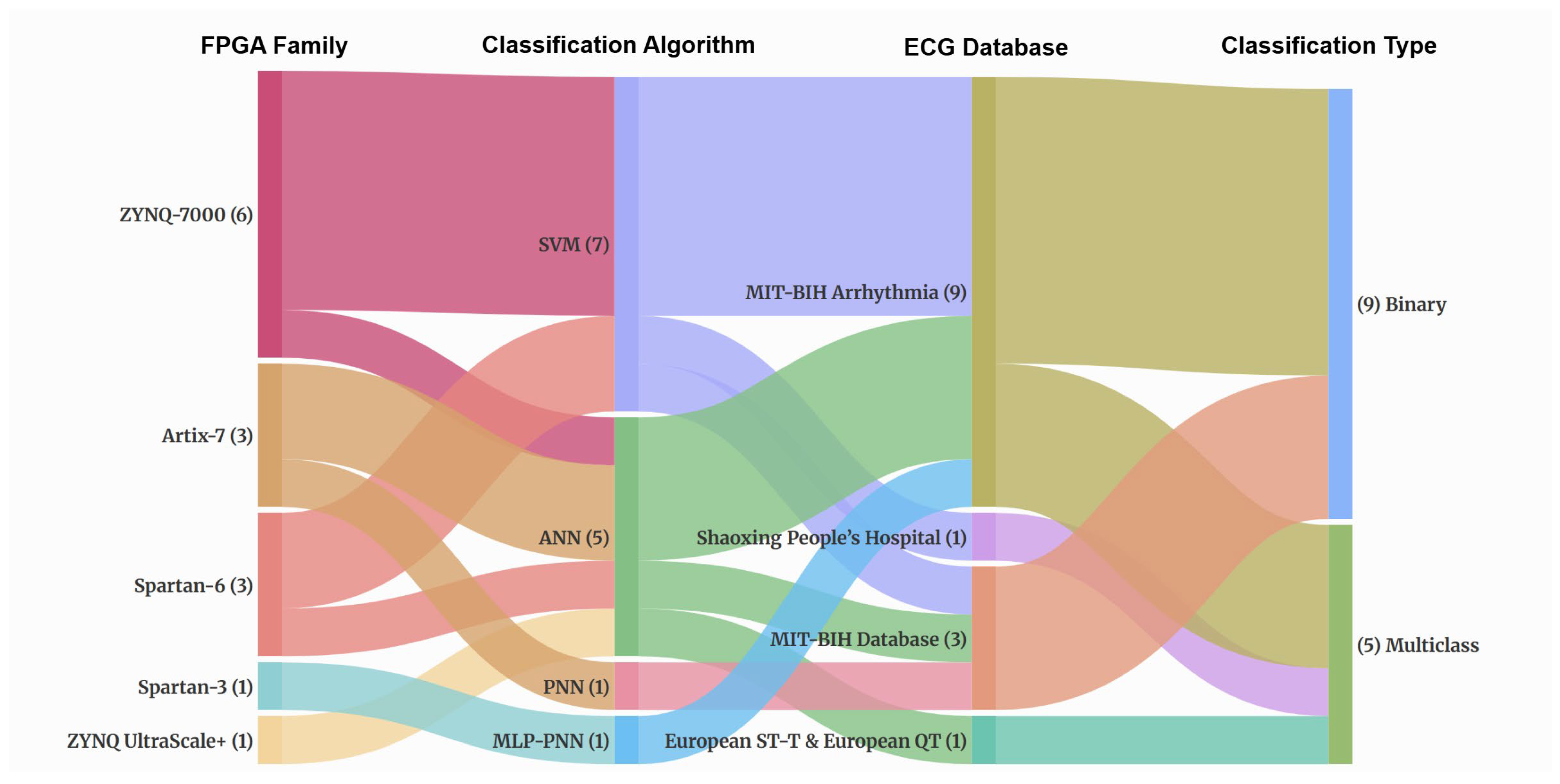
- The analysis and comparison of the most recent machine learning applications implemented on FPGAs for ECG classification, highlighting the widespread use of the MIT-BIH database and the preference for SVM and ANN architectures.
- The evaluation of the most recent deep learning networks implemented on FPGA platforms for cardiac anomaly detection, emphasizing the preference for using the Zynq-7000 family for hardware implementation.
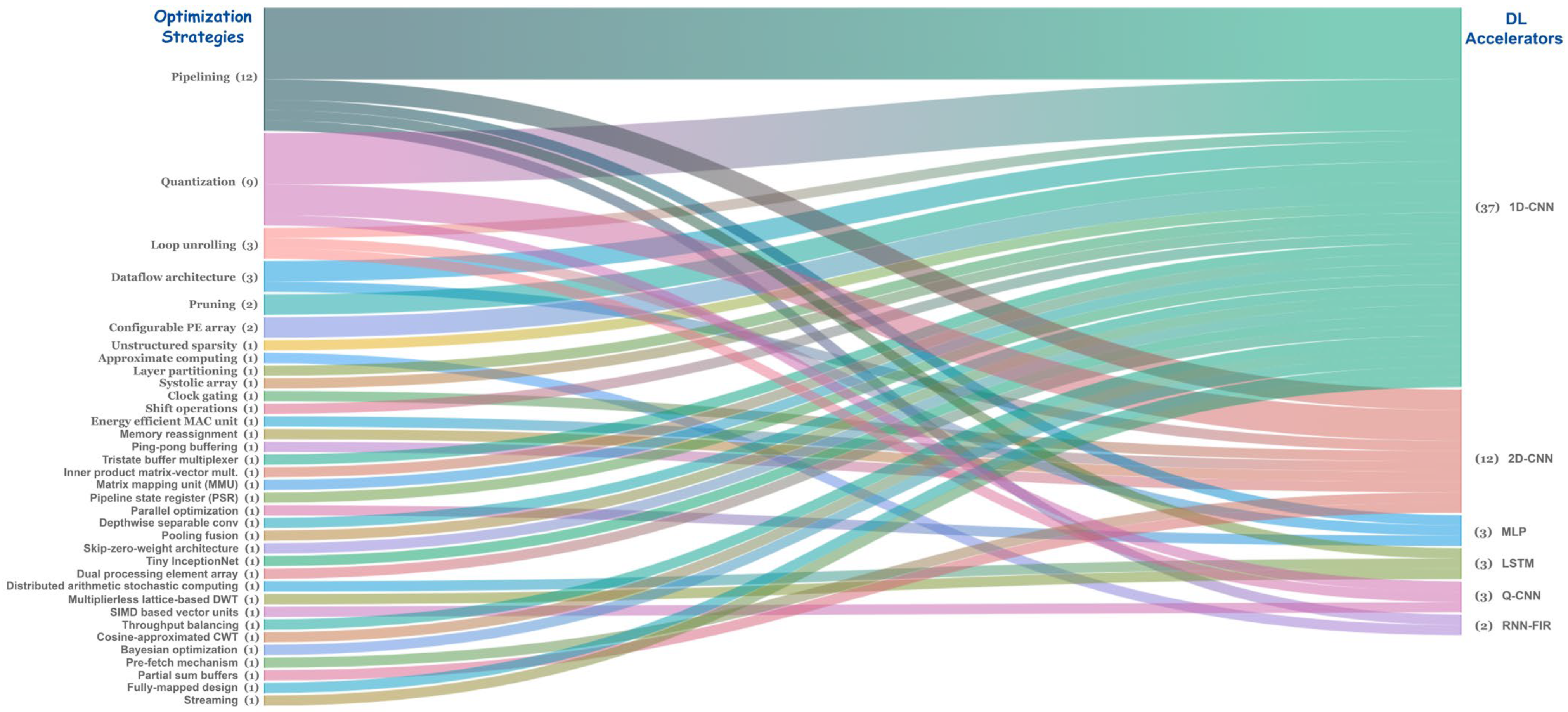
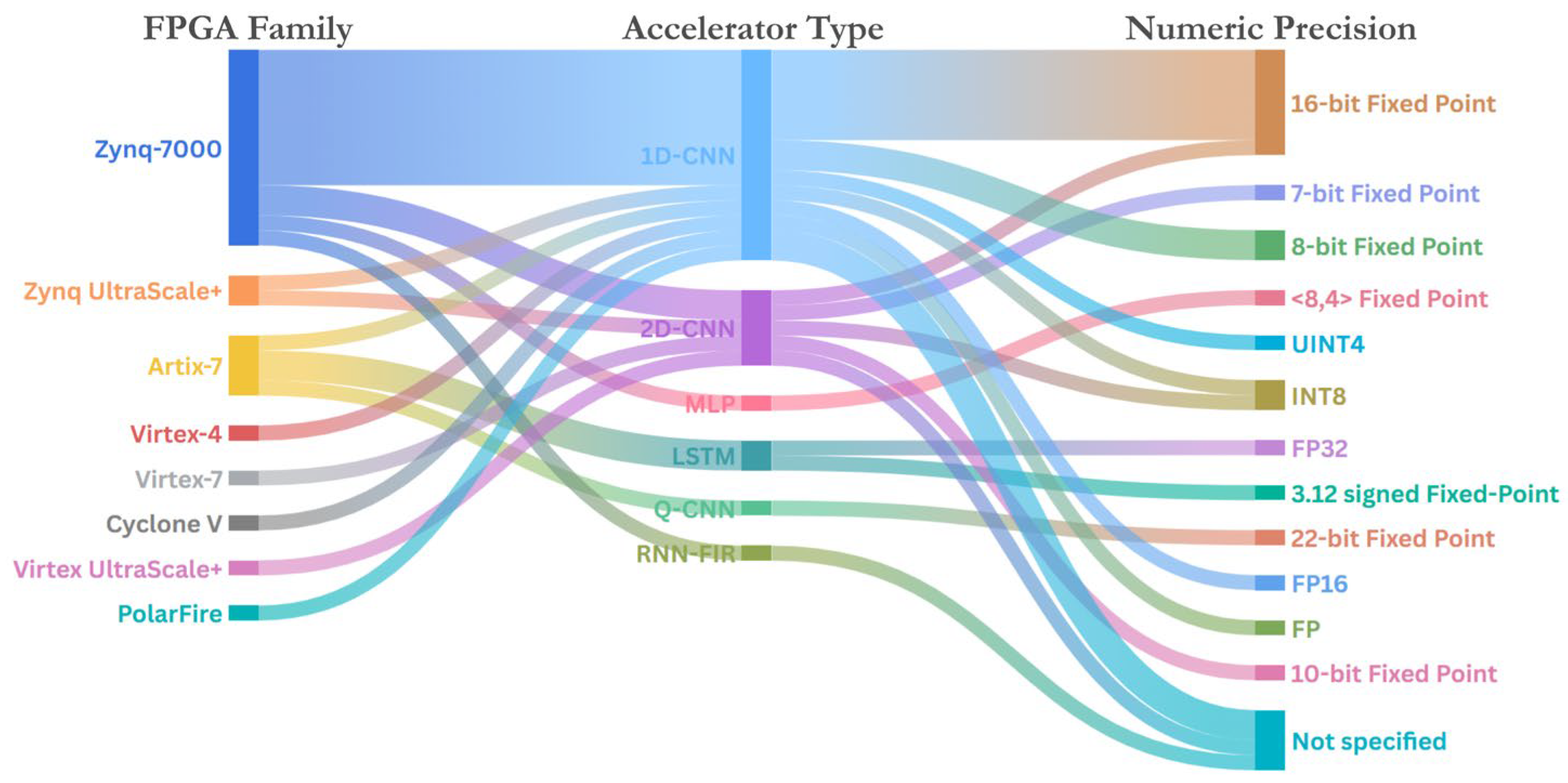
- The comparison of FPGA accelerators dedicated to deep neural networks used in ECG classification, considering hardware performance (power, latency, frequency, and accuracy). The analysis of optimization strategies highlights the frequent use of pipelining, quantization, dataflow optimization, pruning, loop unrolling, and PE arrays, with 1D-CNN accelerators representing the dominant solution.
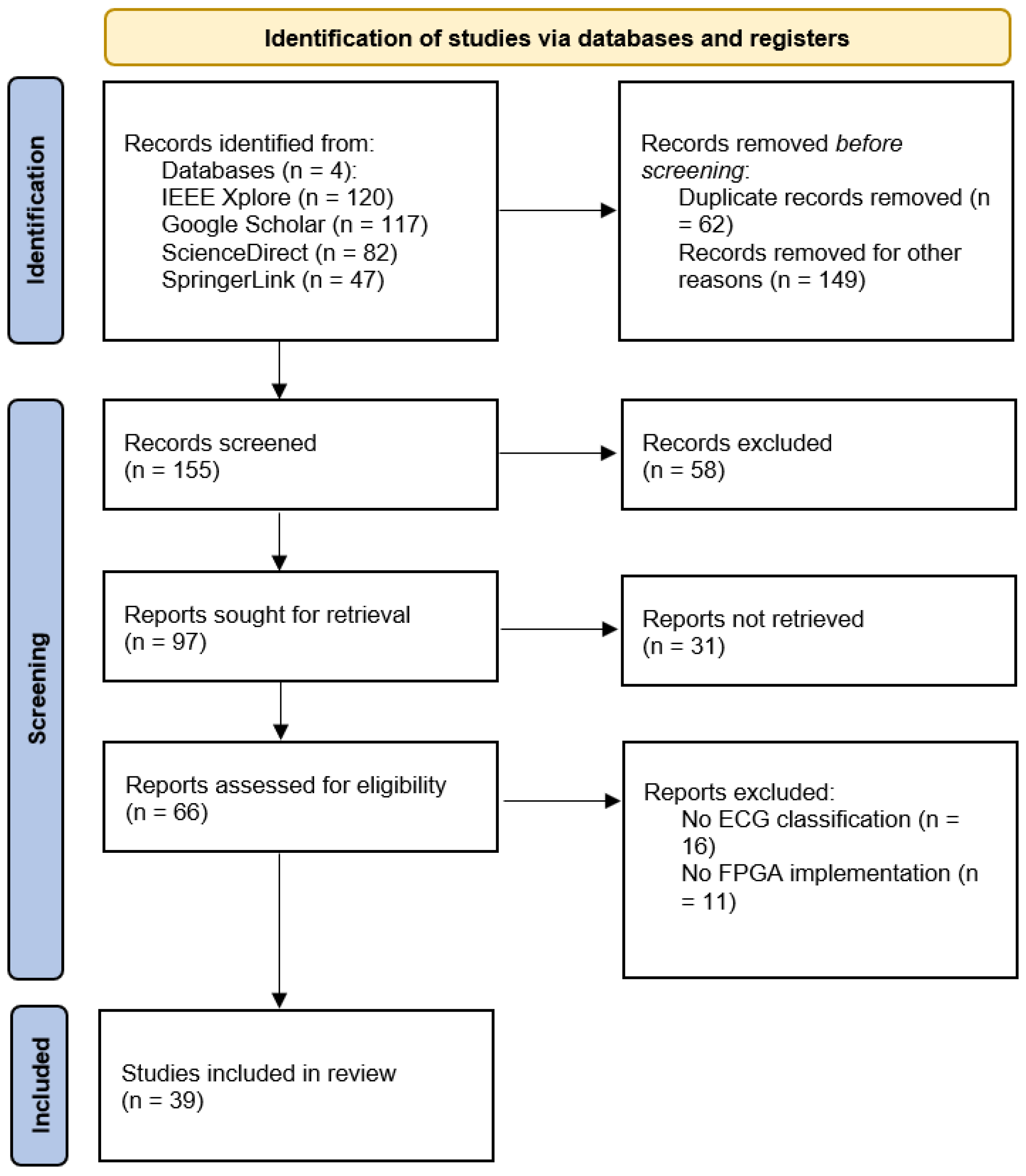
2. Review Methodology
3. Existing Implementations of ECG Signal Processing
FPGA-Based ECG Signal Processing for Real-Time Monitoring
4. Fundamentals of FPGA Technology
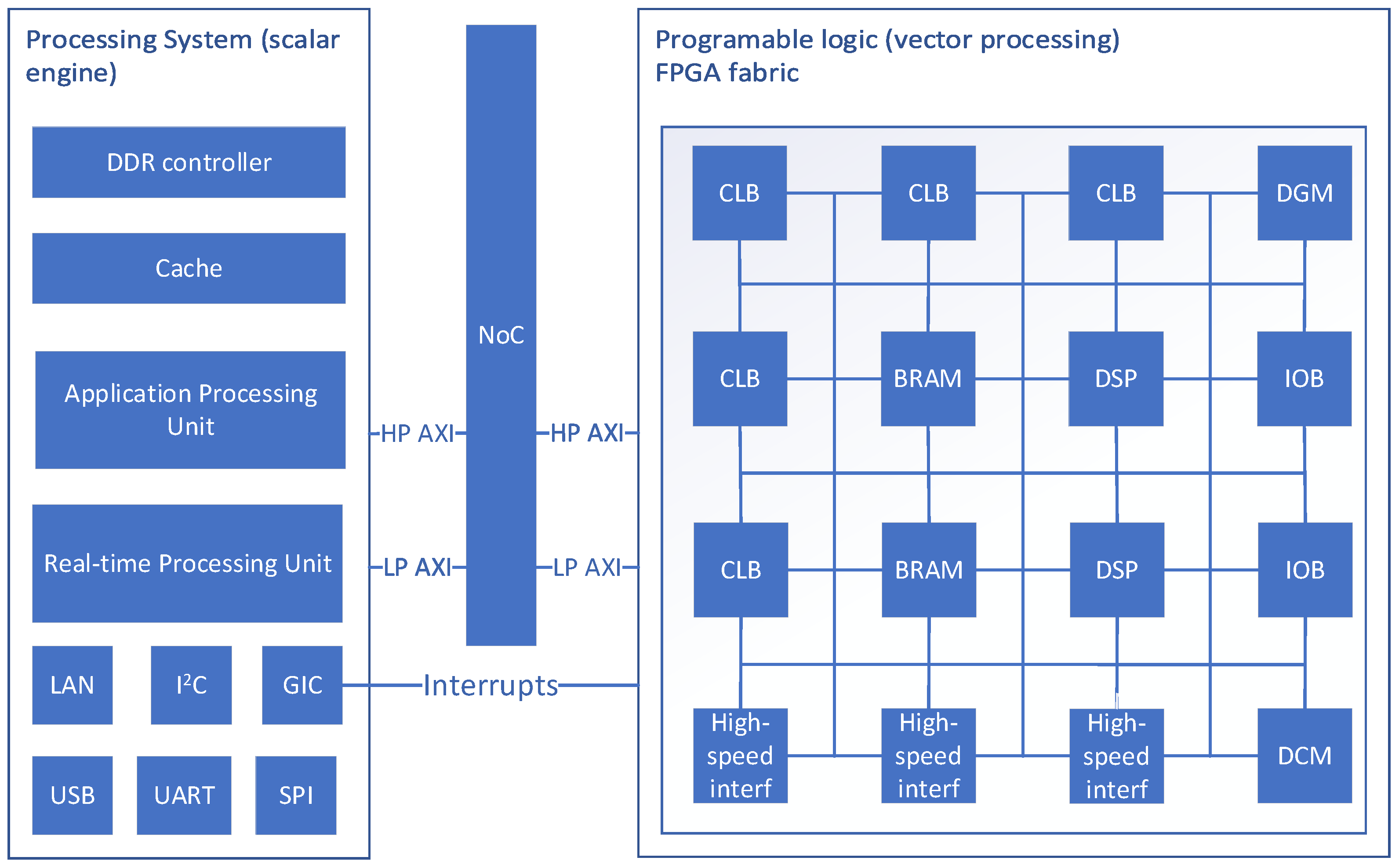
4.1. FPGA Architecture
4.2. Overview of Modern FPGA Families
5. Integrating AI Techniques into FPGA-Based ECG Processing
5.1. Application of Machine Learning Based on FPGA for ECG Classification
5.1.1. Support Vector Machines (SVMs)
5.1.2. Artificial Neural Networks (ANNs)
5.2. Application of Deep Learning Based on FPGA for ECG Classification
5.2.1. Deep Neural Networks (DNNs)
5.2.2. Recurrent Neural Networks (RNNs)
5.2.3. Long Short-Term Memory Networks (LSTMs)
5.2.4. Convolutional Neural Networks (CNNs)
6. FPGA Acceleration of Deep Learning Models
7. Conclusions
Author Contributions
Funding
Informed Consent Statement
Data Availability Statement
Conflicts of Interest
Abbreviations
| 1D | One dimensional |
| ACAP | Adaptive compute acceleration platform |
| ADTF | Adaptive dual threshold filter |
| AI | Artificial intelligence |
| AIA | Artificial intelligence accelerator |
| AIE | AI engine |
| AMBA | Advanced microcontroller bus architecture |
| AMD | Advanced Micro Devices |
| ANN | Artificial neural network |
| ARM | Advanced RISC machine |
| ASIC | Application-specific integrated circuit |
| ASIP | Application-specific instruction set processor |
| BLWDF | Bi-reciprocal lattice wave digital filter |
| BRAM | Block random access memory |
| Bi-RCS | Bidirectional recurrent chimp search |
| CLB | Configurable logic block |
| CNN | Convolutional neural network |
| CPSC2018 | China physiological signal challenge 2018 |
| CPU | Central processing unit |
| CVD | Cardiovascular disease |
| DA | Distributed arithmetic |
| DL | Deep learning |
| DNN | Deep neural network |
| D-PEA | Dual processing element assembly |
| DSP | Digital signal processor |
| DSC | Distributed arithmetic stochastic computing |
| DWT | Discrete wavelet transform |
| ECG | Electrocardiogram |
| EEG | Electroencephalogram |
| EMG | Electromyogram |
| ENLMS | Error-normalized least mean square |
| FIR | Finite impulse response |
| FP | Floating point |
| FPGA | Field-programmable gate array |
| GPU | Graphics processing units |
| HBM | High bandwidth memory |
| HLS | High-level synthesis |
| InFO | Integrated fan-out |
| IPMVM | Inner product matrix–vector multiplication |
| LMS | Least mean square |
| LSTM | Long short-term memory |
| LUT | Look-up table |
| MAC | Multiply–accumulate |
| MIT-BIH | Massachusetts Institute of Technology–Beth Israel Hospital |
| ML | Machine learning |
| MLP | Multi-layer perceptron |
| MMU | Matrix mapping unit |
| MPSoC | Multiprocessor system-on-chip |
| NoC | Network-on-chip |
| PCA | Principal component analysis |
| PCG | Phonocardiogram |
| PE | Processing element |
| PL | Programmable logic |
| PLA | Programmable logic array |
| PNN | Probabilistic neural network |
| P-SCADA | Pipelined stochastic adaptive distributed architecture |
| PS | Processing system |
| PSPEAA | Parallel shift processing element array arrangement |
| PSR | Pipeline state register |
| QAT | Quantization-aware training |
| Q-CNN | Quantized convolutional neural network |
| ReLU | Rectified linear unit |
| RNN | Recurrent neural network |
| SE-NLMS | Sequential error-normalized least mean square |
| SNR | Signal-to-noise ratio |
| SIMD | Single instruction multiple data |
| SiP | System-in-package |
| SoC | System-on-chip |
| SPD | Shared pixel distributor |
| SVM | Support vector machine |
| UINT4 | Unsigned 4-bit integer |
| VLSI | Very-large-scale integration |
| ZCU | Zynq UltraScale |
References
- Mohan, N.; Hosni, A.; Atef, M. Neural networks implementations on FPGA for biomedical applications: A review. SN Comput. Sci. 2024, 5, 1004. [Google Scholar] [CrossRef]
- Talib, M.A.; Majzoub, S.; Nasir, Q.; Jamal, D. A systematic literature review on hardware implementation of artificial intelligence algorithms. J. Supercomput. 2021, 77, 1897–1938. [Google Scholar] [CrossRef]
- Wei, Y.; Zhou, J.; Wang, Y.; Liu, Y.; Liu, Q.; Luo, J.; Wang, C.; Ren, F.; Huang, L. A review of algorithm & hardware design for AI-based biomedical applications. IEEE Trans. Biomed. Circuits Syst. 2020, 14, 145–163. [Google Scholar] [CrossRef]
- Serhani, M.A.; El Kassabi, H.T.; Ismail, H.; Nujum Navaz, A. ECG monitoring systems: Review, architecture, processes, and key challenges. Sensors 2020, 20, 1796. [Google Scholar] [CrossRef]
- Marani, R.; Perri, A.G. An intelligent system for continuous blood pressure monitoring on remote multi-patients in real time. arXiv 2012, arXiv:1212.0651. [Google Scholar] [CrossRef]
- Singhal, S.; Kumar, M. A systematic review on artificial intelligence-based techniques for diagnosis of cardiovascular arrhythmia diseases: Challenges and opportunities. Arch. Comput. Methods Eng. 2023, 30, 865–888. [Google Scholar] [CrossRef]
- Johnson, A.; Bulgarelli, L.; Pollard, T.; Gow, B.; Moody, B.; Horng, S.; Celi, L.A.; Mark, R. MIMIC-IV, version 3.1; PhysioNet, 2024. [CrossRef]
- Johnson, A.; Lungren, M.; Peng, Y.; Lu, Z.; Mark, R.; Berkowitz, S.; Horng, S. MIMIC-CXR-JPG—Chest Radiographs with Structured Labels, version 2.1.0; PhysioNet, 2024. [CrossRef]
- Goldberger, A.; Amaral, L.; Glass, L.; Hausdorff, J.; Ivanov, P.C.; Mark, R.; Mietus, J.E.; Moody, G.B.; Peng, C.-K.; Stanley, H.E. PhysioBank, PhysioToolkit, and PhysioNet: Components of a new research resource for complex physiologic signals. Circulation 2000, 101, e215–e220. [Google Scholar] [CrossRef]
- Altman, M.B.; Wan, W.; Hosseini, A.S.; Nowdeh, S.A.; Alizadeh, M. Machine learning algorithms for FPGA Implementation in biomedical engineering applications: A review. Heliyon 2024, 10, e26652. [Google Scholar] [CrossRef] [PubMed]
- Farooq, U.; Marrakchi, Z.; Mehrez, H. FPGA architectures: An overview. In Tree-Based Heterogeneous FPGA Architectures: Application Specific Exploration and Optimization; Springer: New York, NY, USA, 2012; pp. 7–48. [Google Scholar] [CrossRef]
- Xilinx. Vivado Design Suite User Guide: High-Level Synthesis, UG902, v2020.1, Xilinx, 2021. Available online: https://www.xilinx.com/support/documents/sw_manuals/xilinx2020_1/ug902-vivado-high-level-synthesis.pdf (accessed on 18 December 2025).
- Roth, C.H., Jr.; John, L.K. Digital Systems Design Using VHDL, 2nd ed.; Cengage Learning: Boston, MA, USA, 2008. [Google Scholar]
- Kaeslin, H. Digital Integrated Circuit Design from VLSI Architectures to CMOS Fabrication; Cambridge University Press: Cambridge, UK, 2008. [Google Scholar]
- John, L.K.; Roth, C.H., Jr.; Lee, B.K. Digital Systems Design Using Verilog, 1st ed.; Cengage Learning: Boston, MA, USA, 2015. [Google Scholar]
- Khan, M.I.; Da Silva, B. Harnessing FPGA technology for energy-efficient wearable medical devices. Electronics 2024, 13, 4094. [Google Scholar] [CrossRef]
- Wang, C.; Luo, Z. A review of the optimal design of neural networks based on FPGA. Appl. Sci. 2022, 12, 10771. [Google Scholar] [CrossRef]
- Chong, B.; Jayabaskaran, J.; Jauhari, S.M.; Chan, S.P.; Goh, R.; Kueh, M.T.W.; Li, H.; Chin, Y.H.; Kong, G.; Anand, V.V.; et al. Global burden of cardiovascular diseases: Projections from 2025 to 2050. Eur. J. Prev. Cardiol. 2025, 32, 1001–1015. [Google Scholar] [CrossRef]
- Liu, W.; Guo, Q.; Chen, S.; Chang, S.; Wang, H.; He, J.; Huang, Q. A fully-mapped and energy-efficient FPGA accelerator for dual-function AI-based analysis of ECG. Front. Physiol. 2023, 14, 1079503. [Google Scholar] [CrossRef]
- Wang, N.; Zhou, J.; Dai, G.; Huang, J.; Xie, Y. Energy-efficient intelligent ECG monitoring for wearable devices. IEEE Trans. Biomed. Circuits Syst. 2019, 13, 1112–1121. [Google Scholar] [CrossRef] [PubMed]
- Demirel, B.U.; Bayoumy, I.A.; Al Faruque, M.A. Energy-efficient real-time heart monitoring on edge–fog–cloud internet of medical things. IEEE Internet Things J. 2021, 9, 12472–12481. [Google Scholar] [CrossRef]
- Pineda-López, F.; Martínez-Fernández, A.; Rojo-Álvarez, J.L.; García-Alberola, A.; Blanco-Velasco, M. A flexible 12-Lead/Holter device with compression capabilities for low-bandwidth mobile-ECG telemedicine applications. Sensors 2018, 18, 3773. [Google Scholar] [CrossRef] [PubMed]
- Dore, H.; Aviles-Espinosa, R.; Rendon-Morales, E. FPGA implementation of ECG signal processing for use in a neonatal heart rate monitoring system. Eng. Proc. 2022, 27, 70. [Google Scholar] [CrossRef]
- Zhu, M.; Kuang, Q.; Yang, C.; Lin, J. Optimization of convolutional neural network hardware structure based on FPGA. In Proceedings of the 13th IEEE Conference on Industrial Electronics and Applications (ICIEA), Wuhan, China, 31 May–2 June 2018; pp. 1797–1802. [Google Scholar] [CrossRef]
- Uttraphan, C.; Ardani, M.I.A.; Heng, C.W.; Ahmad, N.; Ching, K.B.; Raj, A.A.E. Hardware Implementation of FIR Filter for ECG Signal Processing: Design Optimization and Performance Analysis on an FPGA. J. Adv. Res. Appl. Sci. Eng. Technol. 2024, 40, 50–61. [Google Scholar] [CrossRef]
- Keerthiga, G.; Kumar, S.P. Evaluating FPGA-based denoising techniques for improved signal quality in electrocardiograms. Analog Integr. Circuits Signal Process. 2024, 120, 93–107. [Google Scholar] [CrossRef]
- Thannoon, H.H.; Hashim, I.A. FPGA Implementation of Efficient Adaptive Filter Incorporating Systolic Architecture. Eng. Technol. J. 2024, 42, 261–275. [Google Scholar] [CrossRef]
- Kalaiselvi, A.; Jayadharshine, S.; Geeth, R.K.; Tamizhmani, T. FPGA Based Power Efficient ECG Heartbeat Detection System For Wearable Devices With Enhanced Noise Filtering. In Proceedings of the 2025 3rd International Conference on Advancements in Electrical, Electronics, Communication, Computing and Automation (ICAECA), Coimbatore, India, 4–5 April 2025; pp. 1–7. [Google Scholar] [CrossRef]
- ElFerdaoussi, H.; Jenkal, W.; Laaboubi, M.; Latif, R. Memory Optimization Strategies for Real-Time ECG Denoising on FPGA: A DWT–ADTF Hybrid Architecture. In Proceedings of the 2025 International Conference on Circuit, Systems and Communication (ICCSC), Fez, Morocco, 19–20 June 2025; pp. 1–5. [Google Scholar] [CrossRef]
- Madiraju, N.S.; Kurella, N.; Valapudasu, R. FPGA Implementation of ECG feature extraction using Time domain analysis. arXiv 2018, arXiv:1802.03310. [Google Scholar] [CrossRef]
- Dhyani, S.; Kumar, A.; Choudhury, S.; Verma, C.; Illés, Z. Assessing ECG-QRS signal detection algorithm chip and simulation on several FPGAs. Discov. Comput. 2025, 28, 13. [Google Scholar] [CrossRef]
- Trabes, E.; Zayed, A.; Valderrama, C.; Tarrillo, J. Design Exploration of DWT-Based Feature Extraction Using FPGA for High-Performance Signal Processing. In Proceedings of the 2025 IEEE 16th Latin America Symposium on Circuits and Systems (LASCAS), Bento Gonçalves, Brazil, 25–28 February 2025; pp. 1–5. [Google Scholar] [CrossRef]
- Gon, A.; Mukherjee, A. FPGA-based low-cost architecture for R-peak detection and heart-rate calculation using lifting-based discrete wavelet transform. Circuits Syst. Signal Process. 2023, 42, 580–600. [Google Scholar] [CrossRef]
- Nandini, K.P.; Seshikala, G. Efficient ECG Arrhythmia Detection on FPGA using Machine Learning and Fiducial Windowing. Eng. Technol. Appl. Sci. Res. 2025, 15, 21100–21105. [Google Scholar] [CrossRef]
- Desai, M.P.; Caffarena, G.; Jevtic, R.; Márquez, D.G.; Otero, A. A Low-Latency, Low-Power FPGA Implementation of ECG Signal Characterization Using Hermite Polynomials. Electronics 2021, 10, 2324. [Google Scholar] [CrossRef]
- Purkayastha, B.B.; Barma, S. Hybrid CPU-FPGA Accelerated Architecture for Hurst Surface Feature Extraction and SVM Classification of ECG Signals. In Proceedings of the 2024 IEEE 31st International Conference on High Performance Computing, Data and Analytics Workshop (HiPCW), Bangalore, India, 18–21 December 2024; pp. 33–39. [Google Scholar] [CrossRef]
- Villasenor, J.; Mangione-Smith, W.H. Configurable computing. Sci. Am. 1997, 276, 66–71. [Google Scholar] [CrossRef]
- Shawahna, A.; Sait, S.M.; El-Maleh, A. FPGA-based accelerators of deep learning networks for learning and classification: A review. IEEE Access 2018, 7, 7823–7859. [Google Scholar] [CrossRef]
- AMD. Zynq-7000 All Programmable SoC Technical Reference Manual. Available online: https://docs.amd.com/r/en-US/ug585-zynq-7000-SoC-TRM (accessed on 27 November 2025).
- Design & Reuse. Xilinx Introduces Zynq-7000 Family, Industry’s First Extensible Processing Platform. Available online: https://www.design-reuse.com/news/202519851-xilinx-introduces-zynq-7000-family-industry-s-first-extensible-processing-platform-/ (accessed on 27 November 2025).
- AMD. Zynq™ 7000 SoCs. Available online: https://www.amd.com/en/products/adaptive-socs-and-fpgas/soc/zynq-7000.html (accessed on 27 November 2025).
- AMD. Zynq UltraScale+ MPSoC Data. Sheet: Overview, DS891 (v1.11.1) March 18, 2025. Available online: https://docs.amd.com/api/khub/documents/sbPbXcMUiRSJ2O5STvuGNQ/content (accessed on 18 December 2025).
- Hansen, L. Unleash the Unparalleled Power and Flexibility of Zynq UltraScale+ MPSoCs. Cell 2015, 2, 3–4. [Google Scholar]
- AMD. Zynq™ UltraScale+™ MPSoCs. Available online: https://www.amd.com/en/products/adaptive-socs-and-fpgas/soc/zynq-ultrascale-plus-mpsoc.html (accessed on 27 November 2025).
- AMD. Versal: The First Adaptive Compute Acceleration Platform (ACAP). Available online: https://docs.amd.com/v/u/en-US/wp505-versal-acap (accessed on 27 November 2025).
- Zhang, W.; Liu, Y.; Bao, Z. Cat: Customized transformer accelerator framework on versal acap. arXiv 2024, arXiv:2409.09689. [Google Scholar] [CrossRef]
- AMD. Versal™ AI Core Series. Available online: https://www.amd.com/en/products/adaptive-socs-and-fpgas/versal/ai-core-series.html (accessed on 27 November 2025).
- AMD. Versal™ AI Edge Series. Available online: https://www.amd.com/en/products/adaptive-socs-and-fpgas/versal/ai-edge-series.html (accessed on 27 November 2025).
- Ahmad, A.; Al Busaidi, S.S.; Al-Maashri, A.; Awadalla, M.; Hussain, S. FPGAs–Chronological developments and challenges. Int. J. Electr. Eng. Technol. 2021, 12, 60–72. [Google Scholar]
- AMD Artix™ UltraScale+™ FPGAs, Cost- and Power-Optimized FPGAs with Exceptional Performance/Watt. Available online: https://www.amd.com/en/products/adaptive-socs-and-fpgas/fpga/artix-ultrascale-plus.html (accessed on 27 November 2025).
- AMD. Virtex™ UltraScale+™ FPGAs. Available online: https://www.amd.com/en/products/adaptive-socs-and-fpgas/fpga/virtex-ultrascale-plus.html (accessed on 27 November 2025).
- AMD. Kintex™ UltraScale+™ FPGAs. Available online: https://www.amd.com/en/products/adaptive-socs-and-fpgas/fpga/kintex-ultrascale-plus.html (accessed on 27 November 2025).
- AMD. Artix™ 7 FPGAs. Available online: https://www.amd.com/en/products/adaptive-socs-and-fpgas/fpga/artix-7.html (accessed on 27 November 2025).
- AMD. Spartan™ 7 FPGAs. Available online: https://www.amd.com/en/products/adaptive-socs-and-fpgas/fpga/spartan-7.html (accessed on 27 November 2025).
- Altera. Cyclone® V FPGA and SoC FPGA. Available online: https://www.altera.com/products/fpga/cyclone/v (accessed on 27 November 2025).
- Altera. Cyclone® 10 FPGA. Available online: https://www.altera.com/products/fpga/cyclone/10 (accessed on 27 November 2025).
- Altera. Arria® 10 FPGAs and SoC FPGAs. Available online: https://www.altera.com/products/fpga/arria/10 (accessed on 27 November 2025).
- Altera. Stratix® 10 FPGA and SoC FPGA. Available online: https://www.altera.com/products/fpga/stratix/10 (accessed on 27 November 2025).
- Altera. Agilex™ 9 SoC FPGA Direct RF-Series. Available online: https://www.altera.com/products/fpga/agilex/9/rf-series (accessed on 27 November 2025).
- Hearst, M.A.; Dumais, S.T.; Osuna, E.; Platt, J.; Scholkopf, B. Support vector machines. IEEE Intell. Syst. Their Appl. 1998, 13, 18–28. [Google Scholar] [CrossRef]
- Nayak, J.; Naik, B.; Behera, H.S. A comprehensive survey on support vector machine in data mining tasks: Applications & challenges. Int. J. Database Theory Appl. 2015, 8, 169–186. [Google Scholar] [CrossRef]
- Tsoutsouras, V.; Koliogeorgi, K.; Xydis, S.; Soudris, D. An exploration framework for efficient high-level synthesis of support vector machines: Case study on ecg arrhythmia detection for xilinx zynq soc. J. Signal Process. Syst. 2017, 88, 127–147. [Google Scholar] [CrossRef]
- Koliogeorgi, K.; Zervakis, G.; Anagnostos, D.; Zompakis, N.; Siozios, K. Optimizing svm classifier through approximate and high level synthesis techniques. In Proceedings of the 2019 8th International Conference on Modern Circuits and Systems Technologies (MOCAST), Thessaloniki, Greece, 13–15 May 2019; pp. 1–4. [Google Scholar] [CrossRef]
- Tang, X.; Tang, W. An ECG delineation and arrhythmia classification system using slope variation measurement by ternary second-order delta modulators for wearable ECG sensors. IEEE Trans. Biomed. Circuits Syst. 2021, 15, 1053–1065. [Google Scholar] [CrossRef] [PubMed]
- Swetha, R.; Ramakrishnan, S. Unfolding VLSI architecture for mixed noise removal and multiple classification of ECG signals. Circuits Syst. Signal Process. 2024, 43, 1993–2015. [Google Scholar] [CrossRef]
- Liu, Y.; Dong, L.; Zhang, B.; Xin, Y.; Geng, L. Real time ECG classification system based on DWT and SVM. In Proceedings of the 2020 IEEE International Conference on Integrated Circuits, Technologies and Applications (ICTA), Nanjing, China, 23–25 November 2020; pp. 155–156. [Google Scholar] [CrossRef]
- Murthy, D.; Sudhanya, P. Optimized ECG Processing System using FPGA with Polyphase Filter for Arrhythmia Classification. In Proceedings of the 2025 Third International Conference on Microwave, Antenna and Communication (MAC), Bhopal, India, 27–29 June 2025; pp. 1–6. [Google Scholar] [CrossRef]
- Jain, A.K.; Mao, J.; Mohiuddin, K.M. Artificial neural networks: A tutorial. Computer 1996, 29, 31–44. [Google Scholar] [CrossRef]
- Abiodun, O.I.; Jantan, A.; Omolara, A.E.; Dada, K.V.; Mohamed, N.A.; Arshad, H. State-of-the-art in artificial neural network applications: A survey. Heliyon 2018, 4, e00938. [Google Scholar] [CrossRef]
- Dal, B.; Aşkar, M. Fixed-point fpga implementation of ecg classification using artificial neural network. In Proceedings of the 2022 Medical Technologies Congress (TIPTEKNO), Antalya, Turkey, 31 October–2 November 2022; pp. 1–4. [Google Scholar] [CrossRef]
- Vinaykumar, S.; Thilagavathy, R. Fpga implementation of artificial neural network (ann) for ecg signal classification. In Proceedings of the 2022 IEEE International IOT, Electronics and Mechatronics Conference (IEMTRONICS), Toronto, ON, Canada, 1–4 June 2022; pp. 1–6. [Google Scholar] [CrossRef]
- Srivastava, R.; Kumar, B.; Alenezi, F.; Alhudhaif, A.; Althubiti, S.A.; Polat, K. Automatic arrhythmia detection based on the probabilistic neural network with FPGA implementation. Math. Probl. Eng. 2022, 2022, 7564036. [Google Scholar] [CrossRef]
- Zairi, H.; Kedir Talha, M.; Meddah, K.; Ould Slimane, S. FPGA-based system for artificial neural network arrhythmia classification. Neural Comput. Appl. 2020, 32, 4105–4120. [Google Scholar] [CrossRef]
- Mari, K.J.; Mariammal, K.; Bobby, K.C.; Mohamed, A.A.S. Harnessing FPGA Technology to Classify ECG Signal with Neural Networks. In Proceedings of the 2024 International Conference on Advances in Computing, Communication and Applied Informatics (ACCAI), Chennai, India, 9–10 May 2024; pp. 1–4. [Google Scholar] [CrossRef]
- Saadi, O.N.; Abdulkader, Z.N.; Abdul-Jabbar, J.M. Implementation of ECG Classification Xilinx System Generator. In Proceedings of the2019 2nd International Conference on Electrical, Communication, Computer, Power and Control Engineering (ICECCPCE), Mosul, Iraq, 13–14 February 2019; pp. 1–6. [Google Scholar] [CrossRef]
- Sharada, P.; Mahesh, K.T. Neural Network based ECG Anomaly Detection on FPGA. Asian J. Converg. Technol. (AJCT) 2019, 5. Available online: https://www.asianssr.org/index.php/ajct/article/view/883 (accessed on 18 December 2025).
- Schmidhuber, J. Deep learning in neural networks: An overview. Neural Netw. 2015, 61, 85–117. [Google Scholar] [CrossRef]
- Sze, V.; Chen, Y.H.; Yang, T.J.; Emer, J.S. Efficient processing of deep neural networks: A tutorial and survey. Proc. IEEE 2017, 105, 2295–2329. [Google Scholar] [CrossRef]
- Chen, C.; da Silva, B.; Yang, C.; Ma, C.; Li, J.; Liu, C. AutoMLP: A framework for the acceleration of multi-layer perceptron models on FPGAs for real-time atrial fibrillation disease detection. IEEE Trans. Biomed. Circuits Syst. 2023, 17, 1371–1386. [Google Scholar] [CrossRef]
- Medsker, L.R.; Jain, L. Recurrent neural networks. Des. Appl. 1999, 5, 2. [Google Scholar]
- Shanthi, K.G.; Kinol, A.; Joy, M.; Santhi, S.; Kannan, K. Real-time FPGA Integration for ECG Monitoring: Bidirectional Recurrent Chimp Search Model. IETE J. Res. 2024, 70, 6848–6863. [Google Scholar] [CrossRef]
- Sathiya, A.; Prabhavathy, B.; Balasupramani, A.; Kavitha, L.; Saravanakumar, R. Low-Power Approximate Computing-based VLSI Architecture for Biomedical Signal Processing. In Proceedings of the 2025 International Conference on Visual Analytics and Data Visualization (ICVADV), Tirunelveli, India, 4–6 March 2025; pp. 541–548. [Google Scholar] [CrossRef]
- Hochreiter, S.; Schmidhuber, J. Long short-term memory. Neural Comput. 1997, 9, 1735–1780. [Google Scholar] [CrossRef]
- Van Houdt, G.; Mosquera, C.; Nápoles, G. A review on the long short-term memory model. Artif. Intell. Rev. 2020, 53, 5929–5955. [Google Scholar] [CrossRef]
- Molina, R.S.; Ninkovic, V.; Vukobratovic, D.; Crespo, M.L.; Zennaro, M. Efficient Split Learning LSTM Models for FPGA-based Edge IoT Devices. arXiv 2025, arXiv:2502.08692. [Google Scholar] [CrossRef]
- Varadharajan, S.K.; Nallasamy, V. P-SCADA-a novel area and energy efficient FPGA architectures for LSTM prediction of heart arrthymias in BIoT applications. Expert Syst. 2022, 39, e12687. [Google Scholar] [CrossRef]
- Akhtar, N.; Fan, J.; Buzdar, A.R.; Ahmed, M.; Raza, A. VLSI Design of LSTM-Based ECG Classification for Continuous Cardiac Monitoring on Wearable Devices. Electron. Lett. 2025, 61, e70269. [Google Scholar] [CrossRef]
- Gu, J.; Wang, Z.; Kuen, J.; Ma, L.; Shahroudy, A.; Shuai, B.; Liu, T.; Wang, X.; Wang, G.; Cai, J.; et al. Recent advances in convolutional neural networks. Pattern Recognit. 2018, 77, 354–377. [Google Scholar] [CrossRef]
- Taye, M.M. Theoretical understanding of convolutional neural network: Concepts, architectures, applications, future directions. Computation 2023, 11, 52. [Google Scholar] [CrossRef]
- Jaramillo-Rueda, A.F.; Vargas-Pacheco, L.Y.; Fajardo, C.A. A computational architecture for inference of a quantized-CNN for detecting atrial fibrillation. Ing. Cienc. 2020, 16, 135–149. [Google Scholar] [CrossRef]
- Cao, T.; Ng, W.S.; Goh, W.L.; Gao, Y.; Huang, H.W. FPGA-Based Real-Time ECG Classification System Using Quantized Inception-ResNeXt Neural Network and CWT Approximation. IEEE Trans. Very Large Scale Integr. (VLSI) Syst. 2025, 34, 167–178. [Google Scholar]
- Wei, L.; Liu, D.; Lu, J.; Zhu, L.; Cheng, X. A low-cost hardware architecture of convolutional neural network for ECG classification. In Proceedings of the 2021 9th International Symposium on Next Generation Electronics (ISNE), Changsha, China, 9–11 July 2021; pp. 1–4. [Google Scholar] [CrossRef]
- Greco, L.; Moscato, F.; Ritrovato, P.; Vento, M. Fast and low cost FPGA-based architecture for arrhythmia detection with CNN. Internet Things 2025, 33, 101705. [Google Scholar] [CrossRef]
- Lu, J.; Liu, D.; Cheng, X.; Wei, L.; Hu, A.; Zou, X. An efficient unstructured sparse convolutional neural network accelerator for wearable ECG classification device. IEEE Trans. Circuits Syst. I Regul. Pap. 2022, 69, 4572–4582. [Google Scholar] [CrossRef]
- Akshayraj, M.R.; PC, M.R.; Gopi, V.P.; Lakshminarayanan, G.; Gangadharan, G.R.; Kidav, J.U. Energy-efficient hardware design for CNN-based ECG signal classification in wearable bio-medical devices. In Proceedings of the 2024 28th International Symposium on VLSI Design and Test (VDAT), Vellore, India, 1–3 September 2024; pp. 1–7. [Google Scholar] [CrossRef]
- Mangaraj, S.; Mahapatra, K.; Ari, S. HLS-compiled PYNQ-based cardiac arrhythmia detection system leveraging quantized ECG beat images. Biomed. Signal Process. Control 2025, 109, 108063. [Google Scholar] [CrossRef]
- Jameil, A.K.; Al-Raweshidy, H. Efficient cnn architecture on fpga using high level module for healthcare devices. IEEE Access 2022, 10, 60486–60495. [Google Scholar] [CrossRef]
- Ku, M.Y.; Zhong, T.S.; Hsieh, Y.T.; Lee, S.Y.; Chen, J.Y. A high performance accelerating CNN inference on FPGA with arrhythmia classification. In Proceedings of the 2023 IEEE 5th International Conference on Artificial Intelligence Circuits and Systems (AICAS), Hangzhou, China, 11–13 June 2023; pp. 1–4. [Google Scholar] [CrossRef]
- Alfaro-Ponce, M.; Chairez, I.; Etienne-Cummings, R. Automatic detection of electrocardiographic arrhythmias by parallel continuous neural networks implemented in FPGA. Neural Comput. Appl. 2019, 31, 363–375. [Google Scholar] [CrossRef]
- Wang, K.C.; Ku, M.Y.; Lee, S.Y.; Chen, J.Y. A Programmable Systolic-Array AI Accelerator System with High-Performance Model Quantization and Heart Disease Classification Algorithm Design. In Proceedings of the 2025 IEEE International Symposium on Circuits and Systems (ISCAS), London, UK, 25–28 May 2025; pp. 1–5. [Google Scholar] [CrossRef]
- Lee, D.; Lee, S.; Oh, S.; Park, D. Energy-efficient FPGA accelerator with fidelity-controllable sliding-region signal processing unit for abnormal ECG diagnosis on IoT edge devices. IEEE Access 2021, 9, 122789–122800. [Google Scholar] [CrossRef]
- Mangaraj, S.; Oraon, P.; Ari, S.; Swain, A.K.; Mahapatra, K. FPGA accelerated convolutional neural network for detection of cardiac arrhythmia. In Proceedings of the 4th IEEE International Conference on VLSI Systems, Architecture, Technology and Applications (VLSI SATA), Bengaluru, India, 17–18 May 2024. [Google Scholar]
- Liu, Z.; Ling, X.; Zhu, Y.; Wang, N. FPGA-based 1D-CNN accelerator for real-time arrhythmia classification. J. Real-Time Image Process. 2025, 22, 66. [Google Scholar] [CrossRef]
- Aruna, V.B.K.L.; Chitra, E.; Padmaja, M. Accelerating deep convolutional neural network on FPGA for ECG signal classification. Microprocess. Microsyst. 2023, 103, 104939. [Google Scholar] [CrossRef]
- Pham, H.L.; Tran, T.D.; Le, V.T.D.; Vu, T.H.; Nakashima, Y. A Fast and Memory-Efficient CNN Accelerator for ECG Classification in Remote Healthcare Systems. In Proceedings of the 2025 22nd International Conference on Electrical Engineering/Electronics, Computer, Telecommunications and Information Technology (ECTI-CON), Bangkok, Thailand, 20–23 May 2025; pp. 1–6. [Google Scholar] [CrossRef]
- Lu, J.; Liu, D.; Liu, Z.; Cheng, X.; Wei, L.; Zhang, C.; Zou, X.; Liu, B. Efficient hardware architecture of convolutional neural network for ECG classification in wearable healthcare device. IEEE Trans. Circuits Syst. I Regul. Pap. 2021, 68, 2976–2985. [Google Scholar] [CrossRef]
- Podugu, J.S.; Kondragunta, V.; Bhavirisetty, P.P.; Aruna, V.B.K.L. FPGA Enabled Deep Learning Accelerator for Multiclass Electrocardiogram Classification. In Proceedings of the 2023 IEEE Asia Pacific Conference on Postgraduate Research in Microelectronics and Electronics (PRIMEAsia), Hyderabad, India, 19–22 November 2023; pp. 46–47. [Google Scholar] [CrossRef]
- Ting, Y.C.; Lo, F.W.; Tsai, P.Y. Implementation for fetal ECG detection from multi-channel abdominal recordings with 2D convolutional neural network. J. Signal Process. Syst. 2021, 93, 1101–1113. [Google Scholar] [CrossRef]
- Kalapothas, S.; Flamis, G.; Kitsos, P. Efficient edge-AI application deployment for FPGAs. Information 2022, 13, 279. [Google Scholar] [CrossRef]



| Producer | Family | Initial Release Year | Device Type | Fabrication Technology | ARM CPU | Integrated AI Engine | Features |
|---|---|---|---|---|---|---|---|
| Xilinx (AMD) | Zynq-7000 [40] | 2011 | SoC | 28 nm | Dual-Core ARM Cortex-A9 MPCore | - | It provides reduced latency in deep neural network implementations, designed for high-level embedded applications, hardware acceleration, and real-time control. |
| Artix-7 [53] | 2012 | FPGA | 28 nm | - | - | Cost-optimized, it is dedicated to power-sensitive medical applications. | |
| Virtex UltraScale+ [51] | 2016 | FPGA | 16 nm | - | - | Its 3D architecture makes it ideal for compute-intensive applications in the field of ML and for accelerated workloads. | |
| Kintex UltraScale+ [52] | 2016 | FPGA | 16 nm | - | - | An intermediate solution offering an optimal cost-performance-power balance, ideal for DSP-intensive applications and neural network acceleration. | |
| Zynq UltraScale+ MPSoC [44] | 2016 | SoC | 16 nm | ARM Cortex-R5, ARM Cortex-A53 Dual/Quad-Core | - | It includes a dedicated AI/ML unit optimized for CNNs and an advanced memory hierarchy, enabling scalable and efficient embedded systems. | |
| Spartan-7 [54] | 2017 | FPGA | 28 nm | - | - | It provides an optimal cost-perfomance-power balance, targeting applications with moderate performance requirements. | |
| Versal AI Core [47] | 2019 | ACAP | 7 nm | Dual-Core ARM Cortex-A72 | ✓ | It delivers exceptional computing power with strong CNN inference and acceleration performance, targeting complex real-time control applications such as biomedical image processing for faster diagnostics. | |
| Artix UltraScale+ [50] | 2021 | FPGA | 16 nm | - | - | Based on InFO technology, it delivers unrivaled compute density for Edge applications and cost-sensitive neural network deployment. | |
| Versal AI Edge [48] | 2021 | ACAP | 7 nm | Dual-Core ARM Cortex-A72 | ✓ | It offers breakthrough AI performance per watt for real-time systems and enables rapid development of sensor-fusion methods with AI algorithms, supporting diverse performance and power profiles from edge to endpoint. | |
| Altera (Intel) | Cyclone-V [55] | 2012 | FPGA | 28 nm | - | - | Well-suited for edge computing applications. |
| Arria-10 [57] | 2013 | FPGA | 20 nm | - | - | Classified as mid-range, it is dedicated to real-time diagnostic applications based on imaging and scanning. | |
| Stratix-10 [58] | 2016 | FPGA | 14 nm | - | - | Based on the HyperFlex architecture, the platform offers superior performance over Arria-10 and Stratix-10 in terms of energy efficiency and systems integration. | |
| Cyclone-10 [56] | 2017 | FPGA | 20 nm | - | - | Based on the Quartus design environment, it provides twice the performance of Cyclone-V, making it suitable for portable medical devices. | |
| Agilex-9 [59] | 2024 | SoC | 10 nm | Quad-Core ARM Cortex-A53 | - | The heterogeneous 3D system-in-package design and Hyperflex architecture guarantee a 45% increase in performance and a 40% reduction in power consumption compared to Stratix-10. This ensures high compute capacity, targeting edge computing applications, advanced signal processing, and neural network inference. |
| Ref., Year | FPGA Family | Algorithm | ECG Database | Accuracy |
|---|---|---|---|---|
| [62], 2017 | Zynq-7000 | SVM | MIT-BIH Arrhythmia | - |
| [36], 2024 | SVM | Shaoxing People’s Hospital | 97.30% | |
| [63], 2019 | SVM | MIT-BIH Arrhythmia | 96.70% | |
| [66], 2020 | SVM | MIT-BIH Database | 98.70% | |
| [67], 2025 | SVM | MIT-BIH Arrhythmia | - | |
| [70], 2022 | ANN | MIT-BIH Arrhythmia | 97.00% | |
| [74], 2024 | Zynq UltraScale+ | ANN | MIT-BIH Database | 94.08% |
| [64], 2021 | Spartan-6 | SVM | MIT-BIH Arrhythmia | 95.10% |
| [65], 2024 | SVM | MIT-BIH Arrhythmia | 96.50% | |
| [75], 2019 | ANN | European ST-T & QT Database | 81.90% | |
| [76], 2019 | Spartan-3 | MLP-PNN | MIT-BIH Arrhythmia | 99.82% |
| [72], 2022 | Artix-7 | PNN | MIT-BIH Database | 98.27% |
| [71], 2022 | ANN | MIT-BIH Arrhythmia | 85.60% | |
| [73], 2020 | ANN | MIT-BIH Arrhythmia | 95.00% |
| Ref., Year | FPGA Family | Device | Algorithm | ECG Database | Accuracy |
|---|---|---|---|---|---|
| [81], 2024 | - | - | Bi-RNN | MIT-BIH Arrhythmia | 99.00% |
| [82], 2025 | Zynq-7000 | - | RNN-FIR | PhysioNet | - |
| [92], 2021 | ZC706 | 1D-CNN | MIT-BIH Arrhythmia | 98.94% | |
| [93], 2025 | Zybo Z7-20 | 2D-CNN | MIT-BIH Arrhythmia | 91.90% | |
| [94], 2022 | ZC706 | 1D-CNN | - | 98.99% | |
| [95], 2024 | PYNQ-Z2 | 2D-CNN | MIT-BIH Arrhythmia | - | |
| [97], 2022 | ZC706 | 1D-CNN | UCI Machine Learning Repository | 99.00% | |
| [98], 2023 | PYNQ-Z2 | 1D-CNN | MIT-BIH Arrhythmia | 96.60% | |
| [100], 2025 | PYNQ-Z2 | 1D-CNN | MIT-BIH Arrhythmia HVD | 97.40% 99.10% | |
| [79], 2023 | PYNQ-Z2 | MLP | MIT-BIH Atrial Fibrillation CPSC2018 | 93.00% 97.00% | |
| [103], 2025 | 7Z020 | 1D-CNN | MIT-BIH Database | 96.55% | |
| [99], 2019 | Zedboard | 1D-CNN | MIT-BIH Arrhythmia European ST-T | 93.80% | |
| [106], 2021 | ZC706 | 1D-CNN | MIT-BIH Arrhythmia | 99.10% | |
| [96], 2025 | PYNQ-Z2 | 1D-CNN | MIT-BIH Arrhythmia | 97.79% | |
| [105], 2025 | Zynq UltraScale+ | ZCU102 | 1D-CNN | MIT-BIH Database | 99.49% |
| [102], 2024 | ZCU104 | 2D-CNN | MIT-BIH Arrhythmia | 98.64% | |
| [86], 2022 | Artix-7 | XC7A200T | LSTM | MIT-BIH Arrhythmia | 98.00% |
| [87], 2025 | - | LSTM | MIT-BIH Arrhythmia | 99.00% | |
| [90], 2020 | Basys 3 | Q-CNN | MIT-BIH Atrial Fibrillation | 94.00% | |
| [91], 2025 | Arty A7-35 | 1D-CNN | MIT-BIH Database | 99.50% | |
| [104], 2023 | Virtex-4 | XC4VLX200 | 1D-CNN | MIT-BIH Arrhythmia and PTB | 98.60% |
| [108], 2021 | Virtex-7 | XC7VX690T | 2D-CNN | PhysioNet/Computing in Cardiology Challenge | 95.20% |
| [19], 2023 | Cyclone V | Terasic De10-Nano | 1D-CNN | Shaoxing People’s Hospital | 93.24% |
| [107], 2023 | PolarFire | PolarFire SoC Icicle | 1D-CNN | MIT-BIH Arrhythmia | 98.60% |
| [101], 2021 | Virtex UltraScale+ | Alveo U200 | 2D-CNN | MIT-BIH Arrhythmia | - |
| FPGA Family | Ref., Year | Accelerator Type | Methodology | Freq. (MHz) | Numeric Precision | Power (W) | Latency (ms) |
|---|---|---|---|---|---|---|---|
| Zynq-7000 | [82], 2025 | RNN-FIR | FIR distributed arithmetic, Pipeline parallelism, Approximate computing | - | - | Reduced by 41.9% | Reduced by 33% |
| [92], 2021 | 1D-CNN | Pipelining in the PE array, Parallel loop unrolling | 200 | 16-bit Fixed-Point | 0.79 | - | |
| [93], 2025 | 2D-CNN | A data-flow architecture, Partially parallel and sequential, Layer partitioning, Quantization | 50 | 7-bit Fixed-Point | - | - | |
| [94], 2022 | 1D-CNN | Unstructured sparsity, Tile-first dataflow with compressed data storage, Two-level weight index matching, Configurable PE array controlled by 32-bit instructions | 2 | 16-bit Fixed-Point | - | - | |
| [95], 2024 | 2D-CNN | Enhanced clock gating, Local explicit clock gating, Energy efficient MAC unit, Bus-specific clock gating, Memory reassignment technique, Ping-pong buffering for input/weights/output, DMA-based intelligent data dispatching module | 150 | 16-bit Fixed-Point | 2.10 | 9.06 | |
| [97], 2022 | 1D-CNN | Fully pipelined architecture, Tristate buffer multiplexer, Replacement of multipliers with shift operations | 442.94 | 16-bit Fixed-Point | 0.17 | - | |
| [98], 2023 | 1D-CNN | Tensor-tensor multiplication, Weight stationary, Inner product matrix-vector multiplication (IPMVM), Input stationary, Parallel shift processing element array arrangement (PSPEAA), Quantization, Pruning | 10 | 8-bit Fixed-Point | 0.13 | 0.23 | |
| [100], 2025 | 1D-CNN | Quantization, Application-specific instruction set processor (ASIP) to facilitate efficient cross-layer and cross-model computations, Systolic array, Matrix mapping unit (MMU), Pipeline state register (PSR) | 1 | 8-bit Fixed-Point | 0.10 | 7.2 | |
| [79], 2023 | MLP | Parallel Optimization, Pipeline or unroll strategies, and combinations | 100 666.70 | FxP <8,4> | 0.01 1.52 | ||
| [103], 2025 | 1D-CNN | Residual connections, Depthwise separable conv, Unstructured pruning, Incremental network quantization | 50 | - | 1.78 | 63 | |
| [99], 2019 | 1D-CNN | Parallel CoNN | - | 16-bit Fixed-Point | - | - | |
| [106], 2021 | 1D-CNN | Global average pooling, Fully pipelined processing unit, Dynamic activation | 200 | 16-bit Fixed-Point | - | - | |
| [96], 2025 | 1D-CNN | Parallel-quantized-pixel wise convolution module, Pooling fusion, Skip-zero-weight architecture | - | 4-bit UINT | - | 236 | |
| Zynq UltraScale+ | [105], 2025 | 1D-CNN | Tiny InceptionNet Accelerator, Dual processing element array, Shared pixel distributor, Shared pixel memory | 250 | 16-bit Fixed-Point | - | 0.017 |
| [102], 2024 | 2D-CNN | Channel-wise addition, Array partitioning and pipelining, INT8 quantization | - | 8-bit INT | 4.17 | 219 | |
| Artix-7 | [86], 2022 | LSTM | Pipelined stochastic adaptive distributed architectures (P-SCADA), Distributed arithmetic stochastic computing (DSC), Pipelining | 450 | FP32 | - | |
| [87], 2025 | LSTM | LSTM architecture using finite state machine, Multiplierless lattice-based DWT architecture, Hard-sigmoid and hard-tanh functions | 54 | 3.12 signed Fixed-Point | 0.04 | under 100 | |
| [90], 2020 | Q-CNN | Quantization, SIMD-based vector units, Loop unrolling strategy, Hard-limit function | 22-bit Fixed-Point | - | 1.35 | ||
| [91], 2025 | 1D-CNN | Quantization-aware training, Streaming architecture, Throughput balancing, Cosine-approximated CWT | - | 16-bit Floating- Point | 0.2 | 0.35 | |
| Virtex-4 | [104], 2023 | 1D-CNN | Pipeline parallelism, Bayesian optimization algorithm | 185.42 | Floating- Point | ||
| Virtex-7 | [108], 2021 | 2D-CNN | Pre-fetch mechanism, Partial sum buffers, Quantization | 10–17 bit Fixed-Point | 0.01 | - | |
| Cyclone V | [19], 2023 | 1D-CNN | Fully mapped design, Pipelining, Quantization | 50 | 8-bit INT | 0.06 | 0.06 |
| PolarFire | [107], 2023 | 1D-CNN | DWT feature extraction method, Pipeline parallelism | 175.40 | - | - | |
| Virtex UltraScale+ | [101], 2021 | 2D-CNN | Hardware-level pipelining | 100 | - | - | 572 |
Disclaimer/Publisher’s Note: The statements, opinions and data contained in all publications are solely those of the individual author(s) and contributor(s) and not of MDPI and/or the editor(s). MDPI and/or the editor(s) disclaim responsibility for any injury to people or property resulting from any ideas, methods, instructions or products referred to in the content. |
© 2026 by the authors. Licensee MDPI, Basel, Switzerland. This article is an open access article distributed under the terms and conditions of the Creative Commons Attribution (CC BY) license.
Share and Cite
Mihăilă, L.-I.; Barbura, C.-G.; Faragó, P.; Hintea, S.; Kirei, B.S.; Fazakas, A. FPGA-Accelerated ECG Analysis: Narrative Review of Signal Processing, ML/DL Models, and Design Optimizations. Electronics 2026, 15, 301. https://doi.org/10.3390/electronics15020301
Mihăilă L-I, Barbura C-G, Faragó P, Hintea S, Kirei BS, Fazakas A. FPGA-Accelerated ECG Analysis: Narrative Review of Signal Processing, ML/DL Models, and Design Optimizations. Electronics. 2026; 15(2):301. https://doi.org/10.3390/electronics15020301
Chicago/Turabian StyleMihăilă, Laura-Ioana, Claudia-Georgiana Barbura, Paul Faragó, Sorin Hintea, Botond Sandor Kirei, and Albert Fazakas. 2026. "FPGA-Accelerated ECG Analysis: Narrative Review of Signal Processing, ML/DL Models, and Design Optimizations" Electronics 15, no. 2: 301. https://doi.org/10.3390/electronics15020301
APA StyleMihăilă, L.-I., Barbura, C.-G., Faragó, P., Hintea, S., Kirei, B. S., & Fazakas, A. (2026). FPGA-Accelerated ECG Analysis: Narrative Review of Signal Processing, ML/DL Models, and Design Optimizations. Electronics, 15(2), 301. https://doi.org/10.3390/electronics15020301