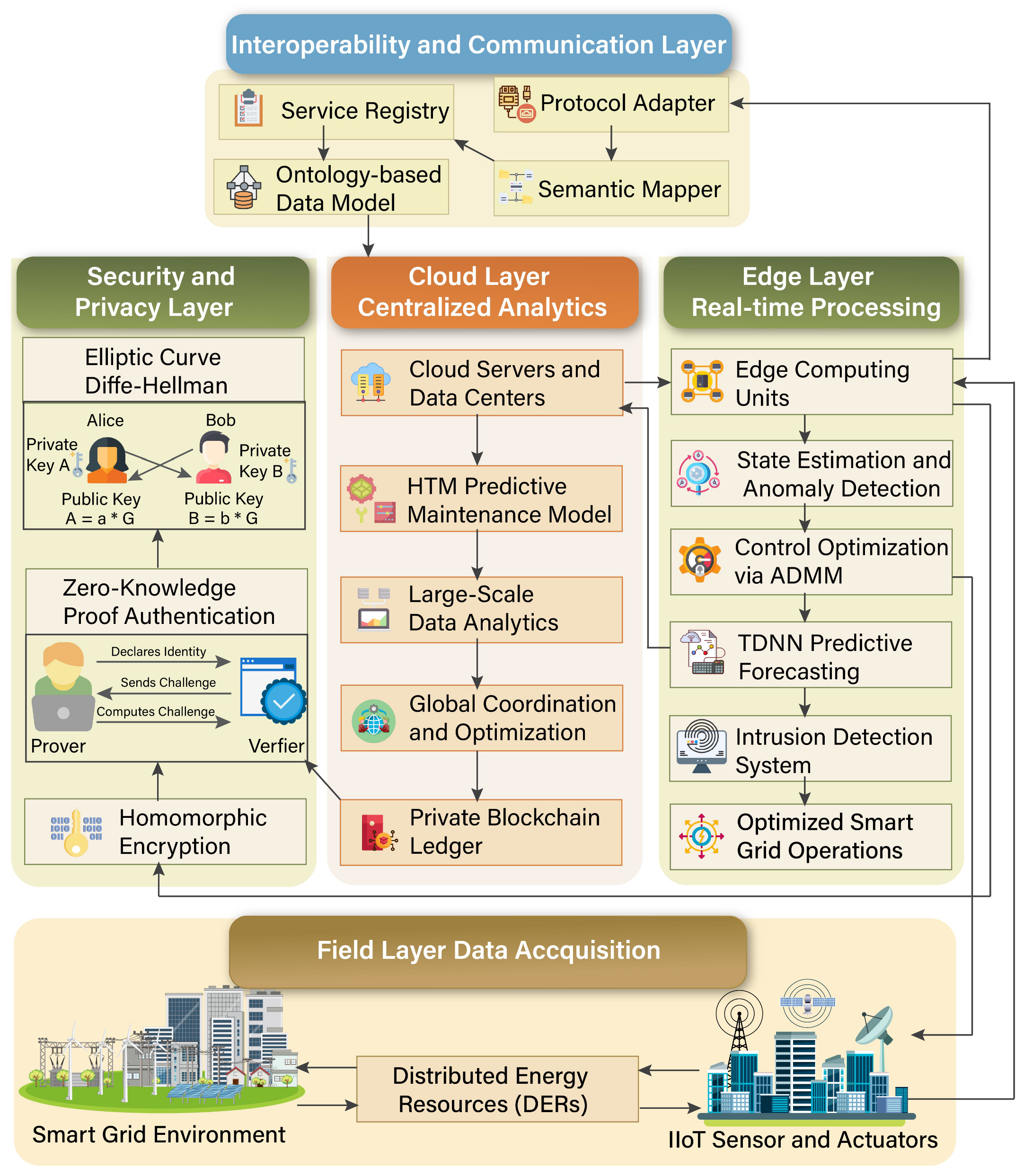
Adaptive Edge–Cloud Framework for Real-Time Smart Grid Optimization with IIoT Analytics


Abstract
1. Introduction
- Develop a scalable and efficient architecture that balances computational loads between edge and cloud resources to optimize real-time operations in smart grids.
- Create advanced machine learning models to enhance predictive maintenance capabilities, improving grid reliability and reducing operational costs.
- Introduce adaptive security measures and establish interoperability frameworks to secure communications and device integration within the grid.
2. Literature Review
3. Proposed Framework
3.1. Real-Time Edge Analytics
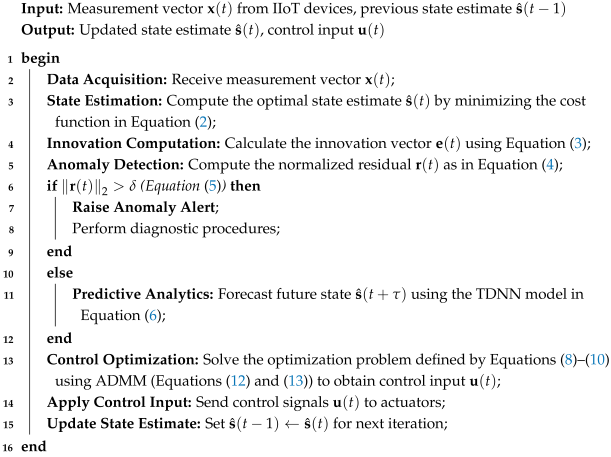
| Algorithm 1: Real-time edge analytics procedure. |
 |
3.2. AI-Driven Predictive Maintenance
3.3. Enhanced Security Protocols
- The prover selects a random and computes the commitment:
- The verifier sends a random challenge .
- The prover calculates the response:
- The verifier checks the equality:
Computational Complexity Analysis
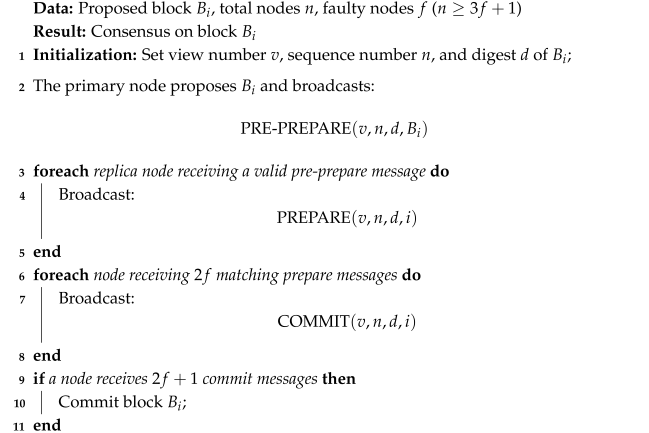
| Algorithm 2: PPBFT consensus mechanism. |
 |
3.4. Interoperability Framework
- -
- is a unique identifier;
- -
- specifies the data type (e.g., voltage, current, and power);
- -
- contains the measurement value;
- -
- records the time of data acquisition;
- -
- includes metadata such as units and quality indicators.
- -
- denotes the collection of concepts;
- -
- represents the network of relationships among concepts;
- -
- includes the set of instances. Concepts are structured in a taxonomy using a partial order relation ≤:
- A Protocol Adapterthat translates proprietary device protocols into the unified communication protocol.
- A Semantic Mapper that aligns data elements to the standardized data model using mapping functions :where is the device-specific data set.
- A Service Registry that maintains information about available services and devices.
- 1.
- The problem admits a unique primal minimizer and a dual solution (KKT pair).
- 2.
- The ADMM iterates converge to the KKT point:
- 3.
- Moreover, convergence is linear. There exists and such that for all k,A valid factor isand is the spectral condition number.
4. Simulation Outcomes
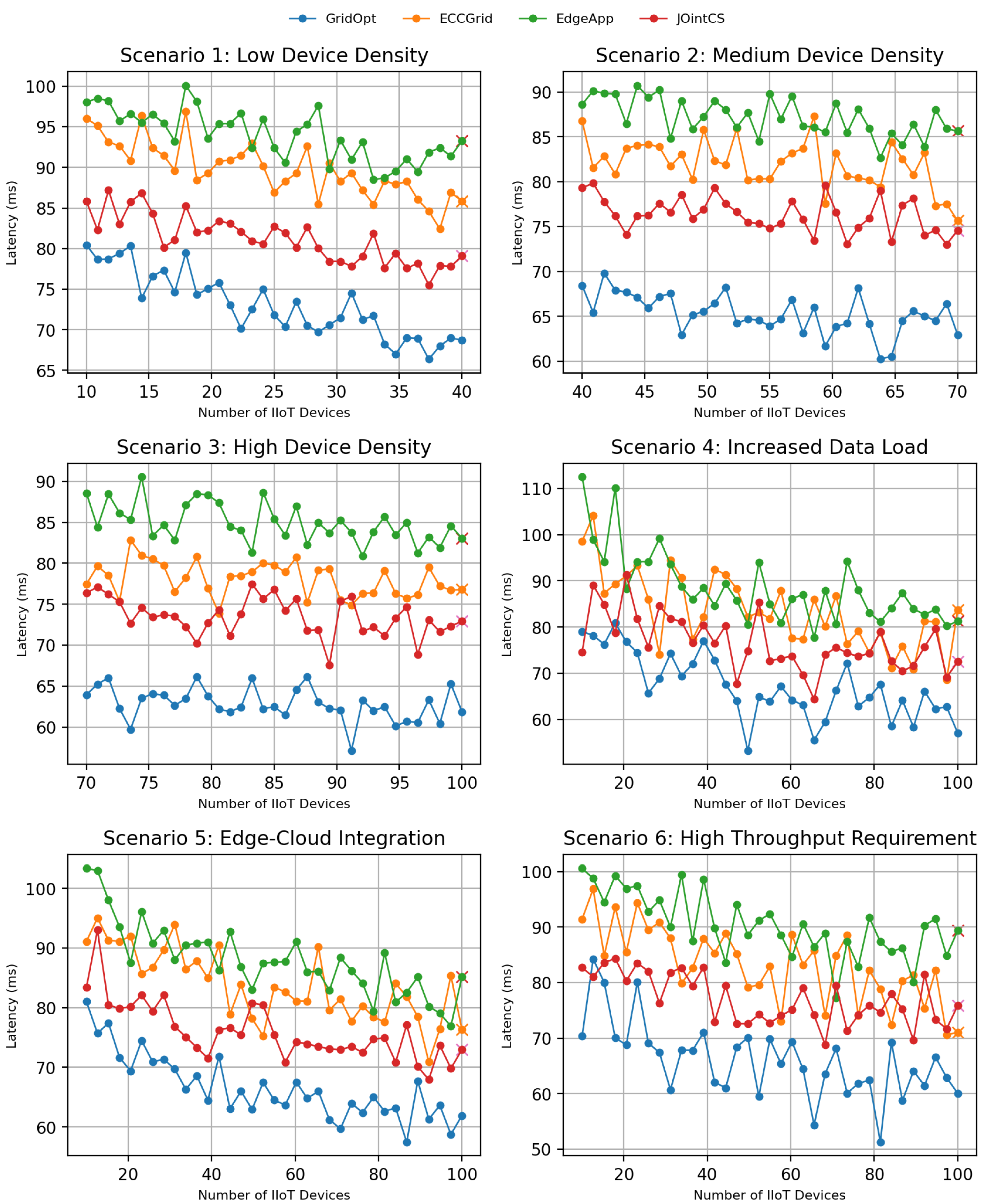
4.1. Latency Reduction
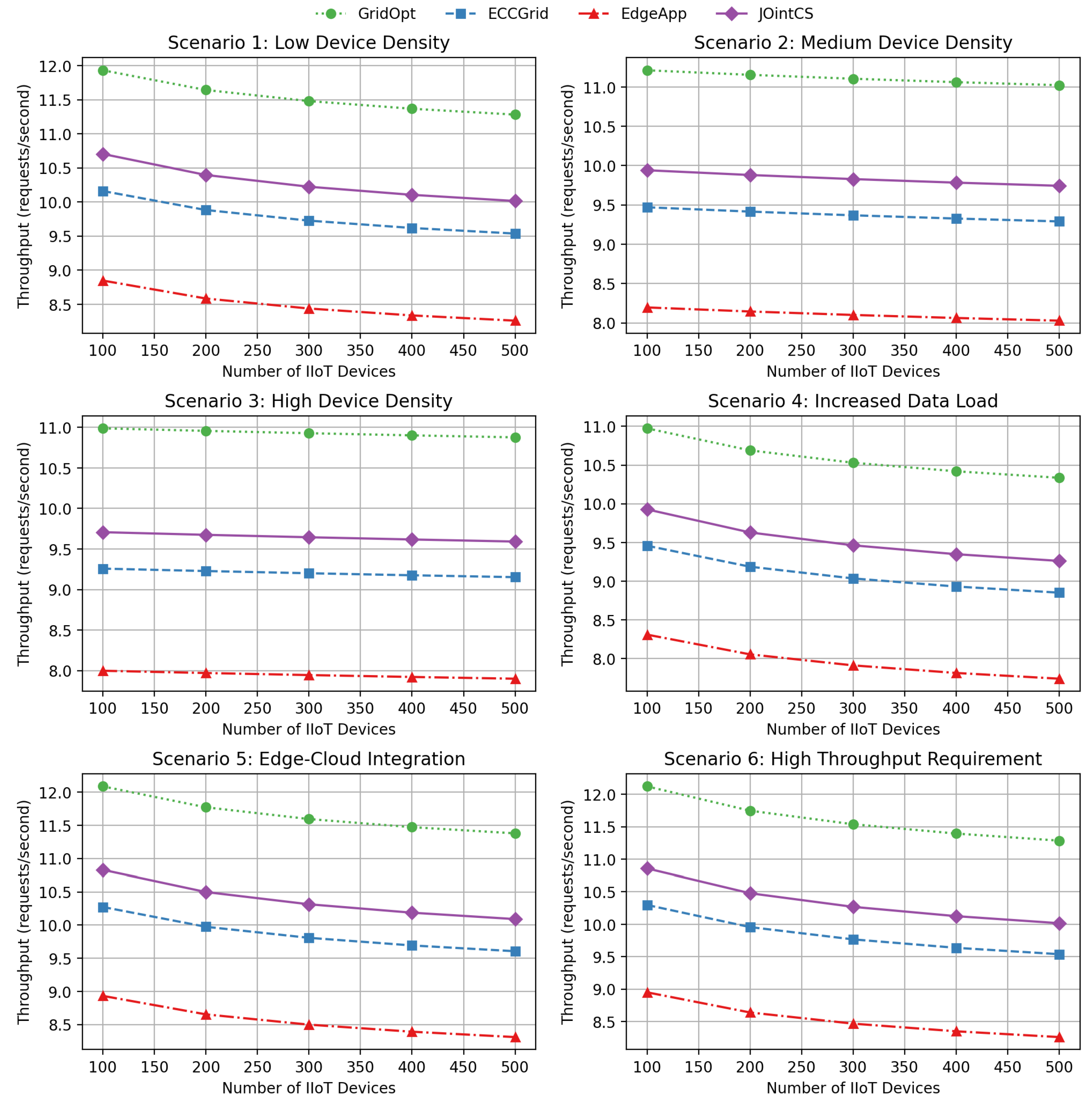
4.2. Scalability Evaluation
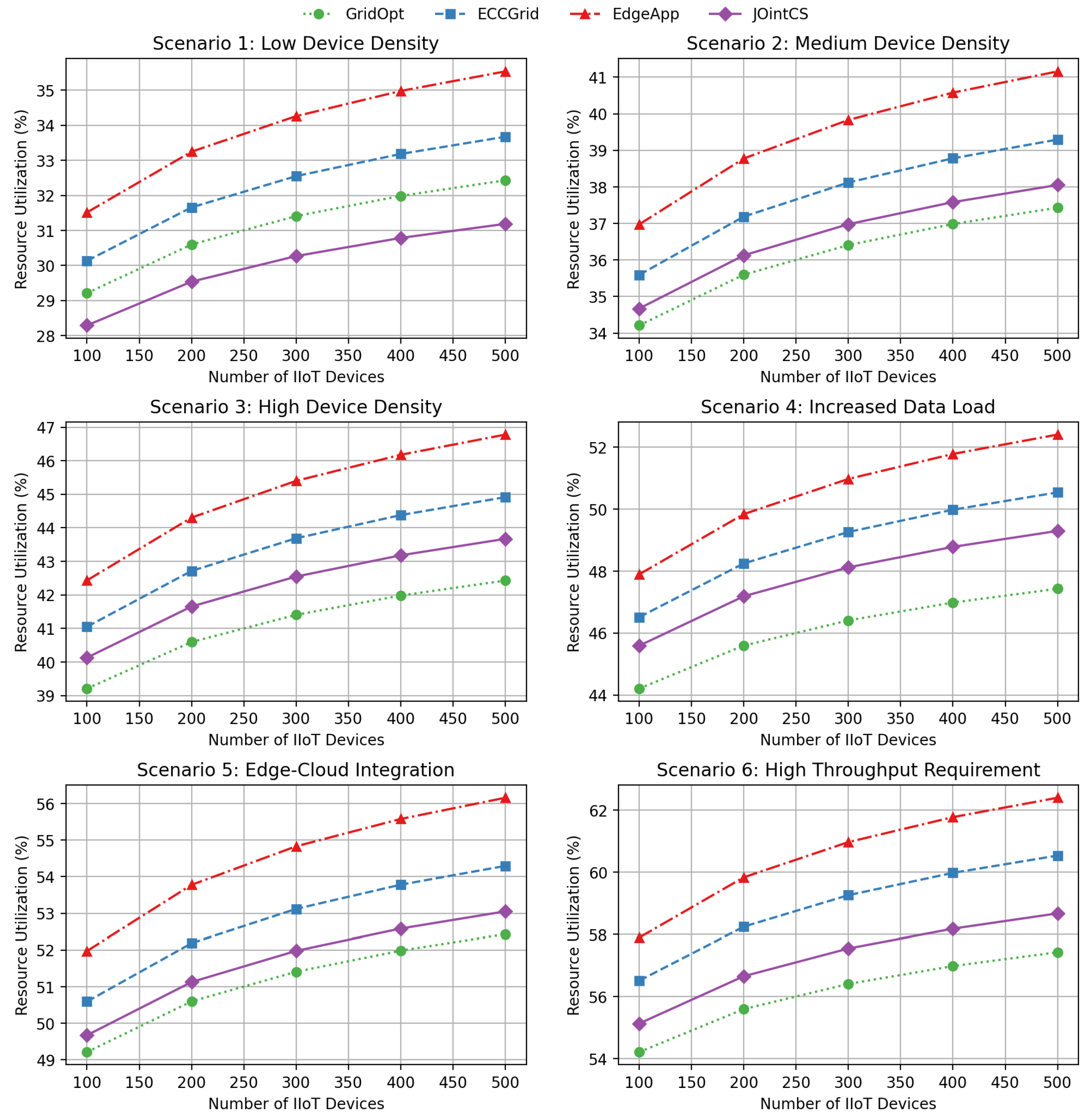
4.3. Resource Utilization
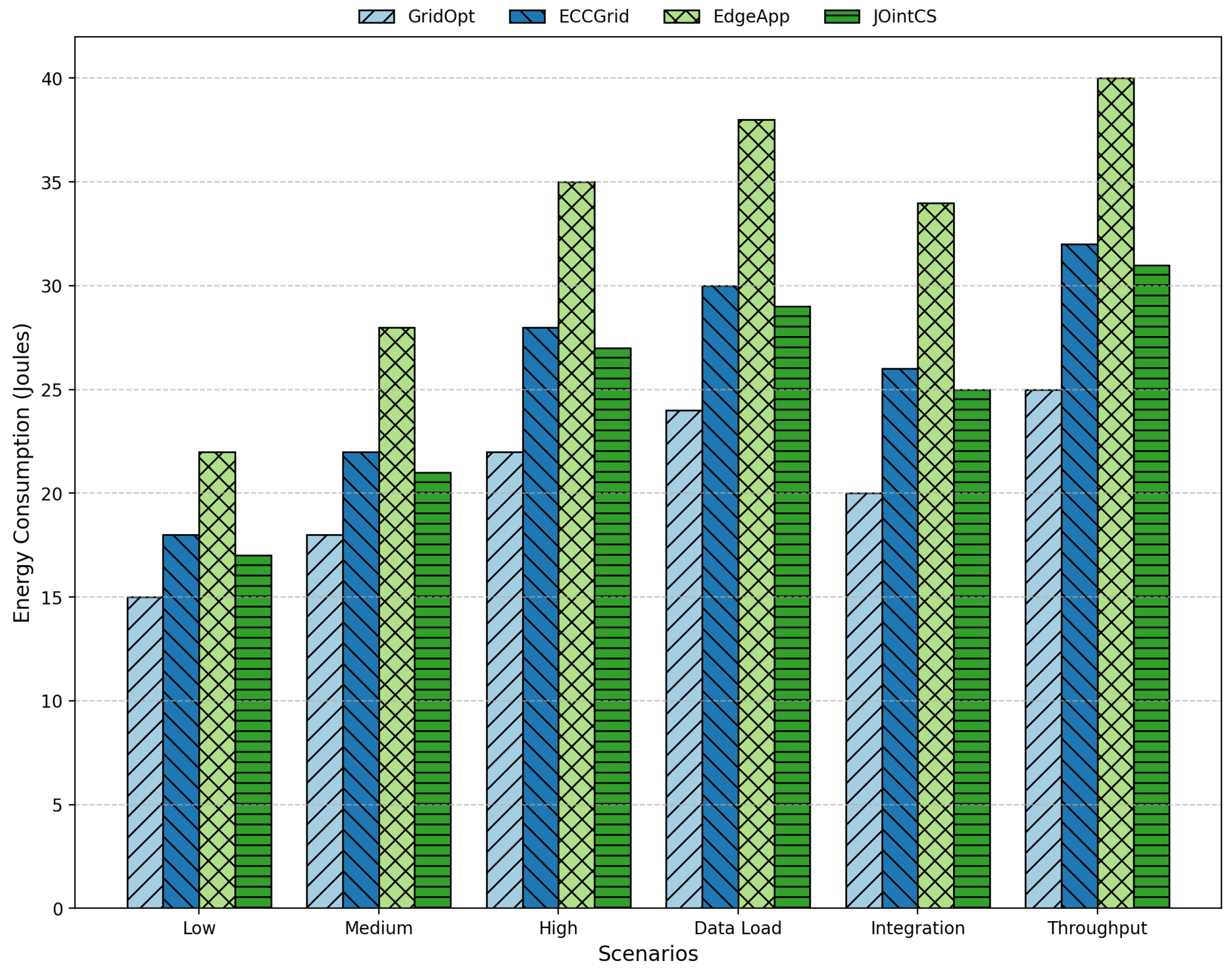
4.4. Energy Consumption
5. Defense Applications and Future Research Directions
6. Conclusions
Funding
Institutional Review Board Statement
Informed Consent Statement
Data Availability Statement
Acknowledgments
Conflicts of Interest
Abbreviations
| ADMM | Alternating Direction Method of Multipliers |
| ASICs | Application-specific integrated circuits |
| PBFT | Practical Byzantine Fault Tolerance |
| FPGAs | Field-programmable gate arrays |
| HTM | Hierarchical Temporal Memory |
| CNNs | Convolutional neural networks |
| DERs | Distributed Energy Resources |
| IIoT | Industrial internet of things |
| LSTM | Long Short-Term Memory |
| ZKPs | Zero-knowledge proofs |
| PoW | Proof of Work |
References
- Bhattacharjee, S.; Nandi, C. Implementation of industrial internet of things in the renewable energy sector. In The Internet of Things in the Industrial Sector: Security and Device Connectivity, Smart Environments, and Industry 4.0; Springer: Cham, Swizterland, 2019; pp. 223–259. [Google Scholar]
- Mahesh, R.; Anilkumar, K.; Shwetha, S.; Kumar, D.K.; Santhosh, B.; Patil, H. IoT and Blockchain-Based Smart Grid Energy Management: Innovations and Applications. In Applying Internet of Things and Blockchain in Smart Cities: Industry and Healthcare Perspectives; IGI Global: Hershey, PA, USA, 2024; pp. 99–130. [Google Scholar]
- Kong, X.; Wu, Y.; Wang, H.; Xia, F. Edge computing for internet of everything: A survey. IEEE Internet Things J. 2022, 9, 23472–23485. [Google Scholar] [CrossRef]
- Sangeetha, K.; Vishnu Raja, P. Fault and Delay Tolerant IoT Smart Grid. In Smart Grids and Internet of Things: An Energy Perspective; Scrivener Publishing LLC: Beverly, MA, USA, 2023; pp. 207–233. [Google Scholar]
- Fan, J.; Yang, W.; Liu, Z.; Kang, J.; Niyato, D.; Lam, K.Y.; Du, H. Understanding security in smart city domains from the ANT-centric perspective. IEEE Internet Things J. 2023, 10, 11199–11223. [Google Scholar] [CrossRef]
- Ghimire, B.; Rawat, D.B. Recent advances on federated learning for cybersecurity and cybersecurity for federated learning for internet of things. IEEE Internet Things J. 2022, 9, 8229–8249. [Google Scholar] [CrossRef]
- Deng, X.; Yin, J.; Guan, P.; Xiong, N.N.; Zhang, L.; Mumtaz, S. Intelligent delay-aware partial computing task offloading for multiuser industrial Internet of Things through edge computing. IEEE Internet Things J. 2021, 10, 2954–2966. [Google Scholar] [CrossRef]
- Bhuiyan, M.N.; Rahman, M.M.; Billah, M.M.; Saha, D. Internet of things (IoT): A review of its enabling technologies in healthcare applications, standards protocols, security, and market opportunities. IEEE Internet Things J. 2021, 8, 10474–10498. [Google Scholar] [CrossRef]
- Mishra, S.; Tyagi, A.K. The role of machine learning techniques in internet of things-based cloud applications. In Artificial iNtelligence-Based Internet of Things Systems; Springer: Cham, Swizterland, 2022; pp. 105–135. [Google Scholar]
- Nguyen, T.A.; Min, D.; Choi, E.; Lee, J.W. Dependability and security quantification of an internet of medical things infrastructure based on cloud-fog-edge continuum for healthcare monitoring using hierarchical models. IEEE Internet Things J. 2021, 8, 15704–15748. [Google Scholar] [CrossRef]
- Bera, B.; Saha, S.; Das, A.K.; Vasilakos, A.V. Designing blockchain-based access control protocol in IoT-enabled smart-grid system. IEEE Internet Things J. 2020, 8, 5744–5761. [Google Scholar] [CrossRef]
- Moore, E.; Imteaj, A.; Rezapour, S.; Amini, M.H. A survey on secure and private federated learning using blockchain: Theory and application in resource-constrained computing. IEEE Internet Things J. 2023, 10, 21942–21958. [Google Scholar] [CrossRef]
- Zhang, X.; Li, R.; Zhao, H. A parallel consensus mechanism using PBFT based on DAG-lattice structure in the Internet of Vehicles. IEEE Internet Things J. 2022, 10, 5418–5433. [Google Scholar] [CrossRef]
- Salama, R.; Alturjman, S.; Al-Turjman, F. Internet of Things and AI in Smart Grid Applications. NEU J. Artif. Intell. Internet Things 2023, 1, 44–58. [Google Scholar]
- Pliatsios, A.; Kotis, K.; Goumopoulos, C. A systematic review on semantic interoperability in the IoE-enabled smart cities. Internet Things 2023, 22, 100754. [Google Scholar] [CrossRef]
- Wu, H.; Zhang, Z.; Guan, C.; Wolter, K.; Xu, M. Collaborate edge and cloud computing with distributed deep learning for smart city internet of things. IEEE Internet Things J. 2020, 7, 8099–8110. [Google Scholar] [CrossRef]
- Alabadi, M.; Habbal, A.; Guizani, M. An Innovative Decentralized and Distributed Deep Learning Framework for Predictive Maintenance in the Industrial Internet of Things. IEEE Internet Things J. 2024, 11, 20271–20286. [Google Scholar] [CrossRef]
- Molina, M.; Mendez, J.; Morales, D.P.; Castillo, E.; Vallejo, M.L.; Pegalajar, M. Power-Efficient Implementation of Ternary Neural Networks in Edge Devices. IEEE Internet Things J. 2022, 9, 20111–20121. [Google Scholar] [CrossRef]
- Jerkovic, F.; Sarkar, N.I.; Ali, J. Smart Grid IoT Framework for Predicting Energy Consumption Using Federated Learning Homomorphic Encryption. Sensors 2025, 25, 3700. [Google Scholar] [CrossRef]
- Ali, M.; Suchismita, M.; Ali, S.S.; Choi, B.J. Privacy-Preserving Machine Learning for IoT-Integrated Smart Grids: Recent Advances, Opportunities, and Challenges. Energies 2025, 18, 2515. [Google Scholar] [CrossRef]
- Ahmed, R.A.; Abdelraouf, M.; Elsaid, S.A.; ElAffendi, M.; El-Latif, A.A.A.; Shaalan, A.; Ateya, A.A. Internet of things-based robust green smart grid. Computers 2024, 13, 169. [Google Scholar] [CrossRef]
- Palmintier, B.; Mateo Domingo, C.; Emilio Postigo Marcos, F.; Gomez San Roman, T.; de Cuadra, F.; Gensollen, N.; Elgindy, T.; Duenas, P. SMART-DS Synthetic Electrical Network Data OpenDSS Models for SFO, GSO, and AUS; National Laboratory of the Rockies: Golden, CO, USA, 2020. [Google Scholar]
- Li, J.; Gu, C.; Xiang, Y.; Li, F. Edge-cloud computing systems for smart grid: State-of-the-art, architecture, and applications. J. Mod. Power Syst. Clean Energy 2022, 10, 805–817. [Google Scholar] [CrossRef]
- Alshuwair, S.A. Edge Computing Applications for Smart Grid and Distributed Systems. In Proceedings of the 2022 Saudi Arabia Smart Grid (SASG), Riyadh, Saudi Arabia, 12–14 December 2022; pp. 1–7. [Google Scholar]
- Zhou, H.; Zhang, Z.; Li, D.; Su, Z. Joint optimization of computing offloading and service caching in edge computing-based smart grid. IEEE Trans. Cloud Comput. 2022, 11, 1122–1132. [Google Scholar] [CrossRef]
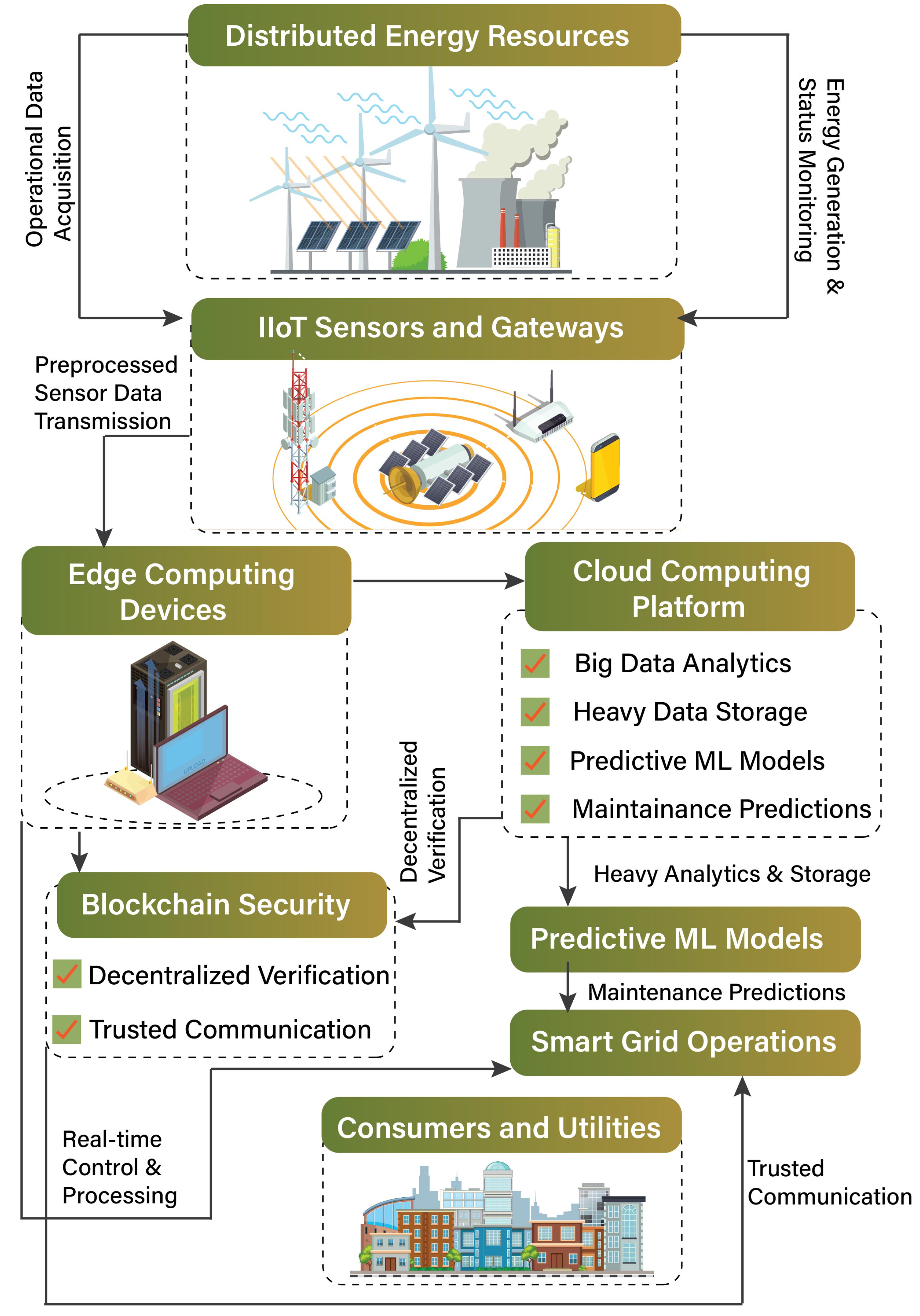


| Ref. | Previous Work | Proposed Work (GridOpt) |
|---|---|---|
| [7] | Edge systems reduce latency but lack scalability for large DER networks. | Scalable edge–cloud coordination suitable for expanding DER environments. |
| [9] | Cloud-based ML improves prediction but delays real-time responses. | Real-time tasks handled at the edge; cloud reserved for large data processing. |
| [11] | Blockchain secures communication but traditional consensus is computationally heavy. | Lightweight consensus and encryption to reduce processing cost at devices. |
| [14] | IoT improves connectivity but lacks unified interoperability across device types. | Interoperability layer to coordinate heterogeneous device environments. |
| [17] | ML enhances prediction but becomes resource-intensive for continuous workloads. | TDNN/HTM design lowers processing overhead during streaming operation. |
| [19] | Privacy models exist but lack unified optimization across system layers. | Integrated optimization with privacy and coordination in one operational framework. |
| Parameter | Setting |
|---|---|
| Simulation platform | MATLAB/Simulink R2023b |
| Dataset | NREL SMART-DS (SFO, GSO, AUS feeders) |
| Grid components | DERs, transmission lines, controllable loads, IIoT sensors |
| TDNN architecture | Three-layer network |
| TDNN temporal window | 5 time steps |
| TDNN optimizer | Adam |
| TDNN learning rate | 0.001 |
| HTM columns | 2048 |
| HTM sparsity level | 2% |
| HTM permanence threshold | 0.21 |
| Data split ratio | 70% training, 15% validation, 15% testing |
| Evaluation metrics | Accuracy, Precision, Recall, F1-score, RMSE |
| Comparative methods | ECCGrid, EdgeApp, JOintCS |
Disclaimer/Publisher’s Note: The statements, opinions and data contained in all publications are solely those of the individual author(s) and contributor(s) and not of MDPI and/or the editor(s). MDPI and/or the editor(s) disclaim responsibility for any injury to people or property resulting from any ideas, methods, instructions or products referred to in the content. |
© 2026 by the author. Licensee MDPI, Basel, Switzerland. This article is an open access article distributed under the terms and conditions of the Creative Commons Attribution (CC BY) license.
Share and Cite
Alharbi, O. Adaptive Edge–Cloud Framework for Real-Time Smart Grid Optimization with IIoT Analytics. Electronics 2026, 15, 300. https://doi.org/10.3390/electronics15020300
Alharbi O. Adaptive Edge–Cloud Framework for Real-Time Smart Grid Optimization with IIoT Analytics. Electronics. 2026; 15(2):300. https://doi.org/10.3390/electronics15020300
Chicago/Turabian StyleAlharbi, Omar. 2026. "Adaptive Edge–Cloud Framework for Real-Time Smart Grid Optimization with IIoT Analytics" Electronics 15, no. 2: 300. https://doi.org/10.3390/electronics15020300
APA StyleAlharbi, O. (2026). Adaptive Edge–Cloud Framework for Real-Time Smart Grid Optimization with IIoT Analytics. Electronics, 15(2), 300. https://doi.org/10.3390/electronics15020300