A Multi-Time-Scale Coordinated Scheduling Model for Multi-Energy Complementary Power Generation System Integrated with High Proportion of New Energy Including Electricity-to-Hydrogen System


Abstract
1. Introduction
- (1)
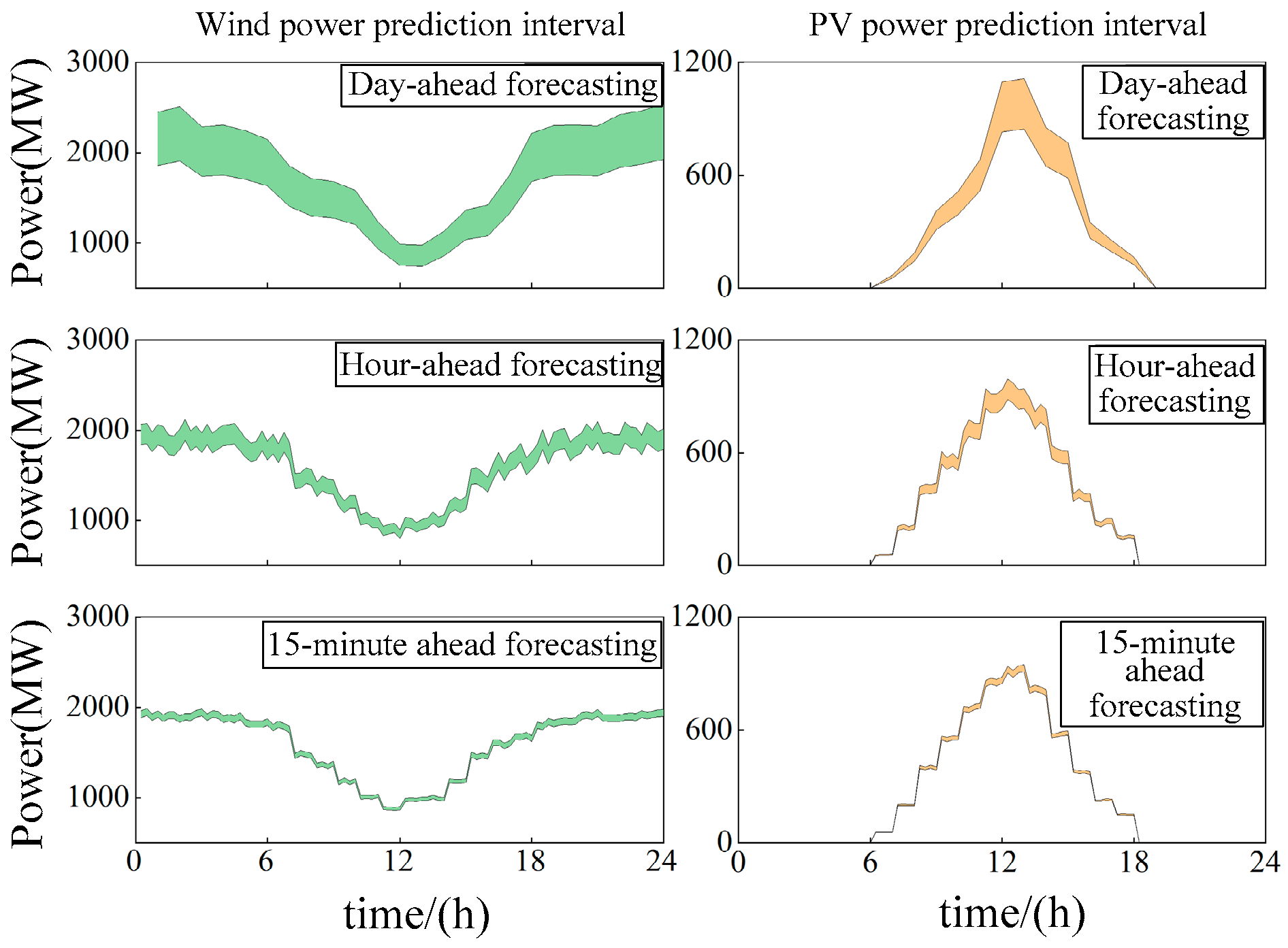
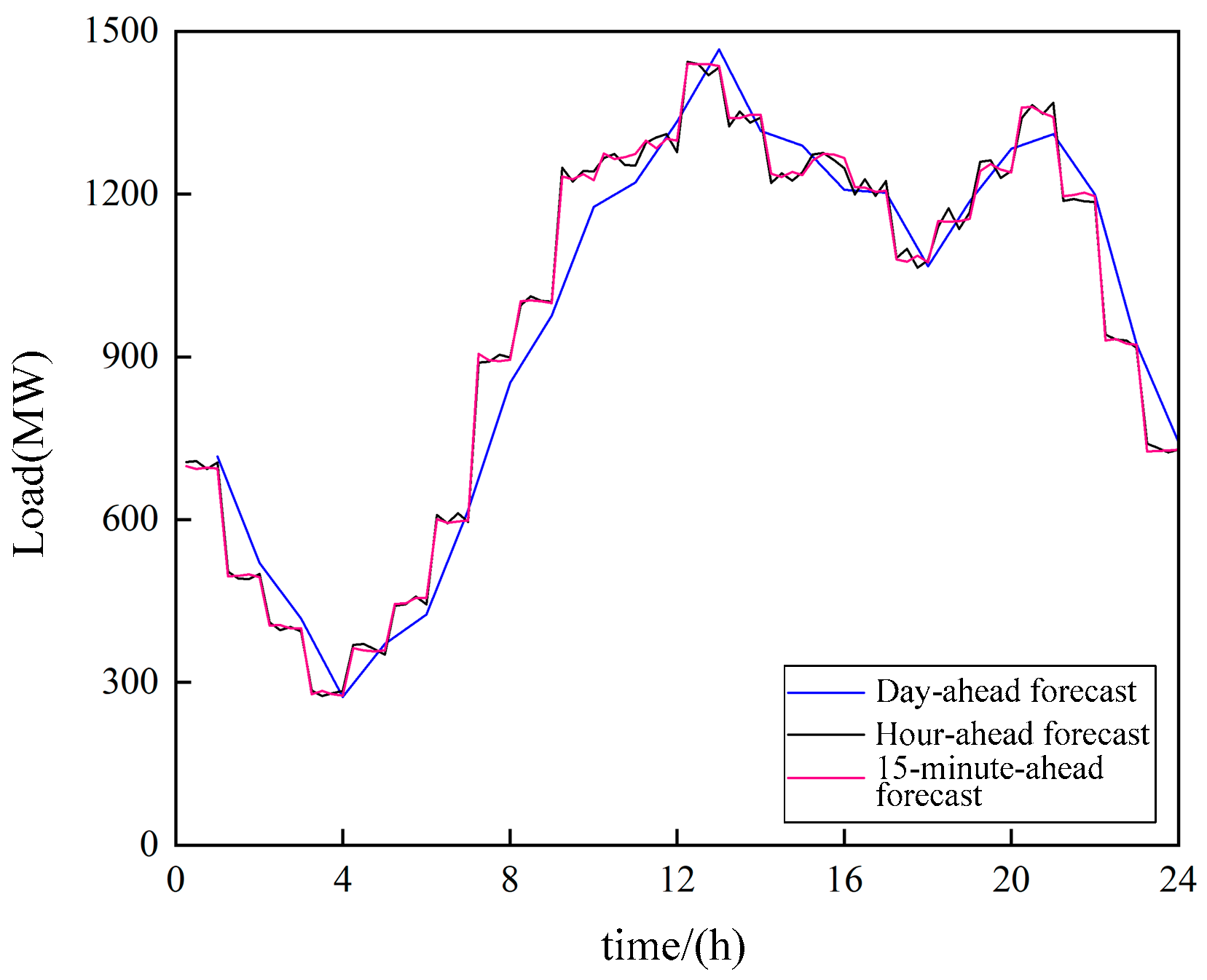
- A unified multi-time-scale coordinated scheduling framework is proposed for a high-renewable multi-energy complementary power generation system that simultaneously integrates pumped storage units and a power-to-hydrogen (P2H) system. Different from existing studies that mainly focus on single time-scale scheduling or integrated energy systems, the proposed framework explicitly coordinates day-ahead (24 h), intra-day (1 h), and real-time (15 min) scheduling stages, fully exploiting the progressive improvement of wind power, photovoltaic power, and load forecasting accuracy across time-scales.
- (2)
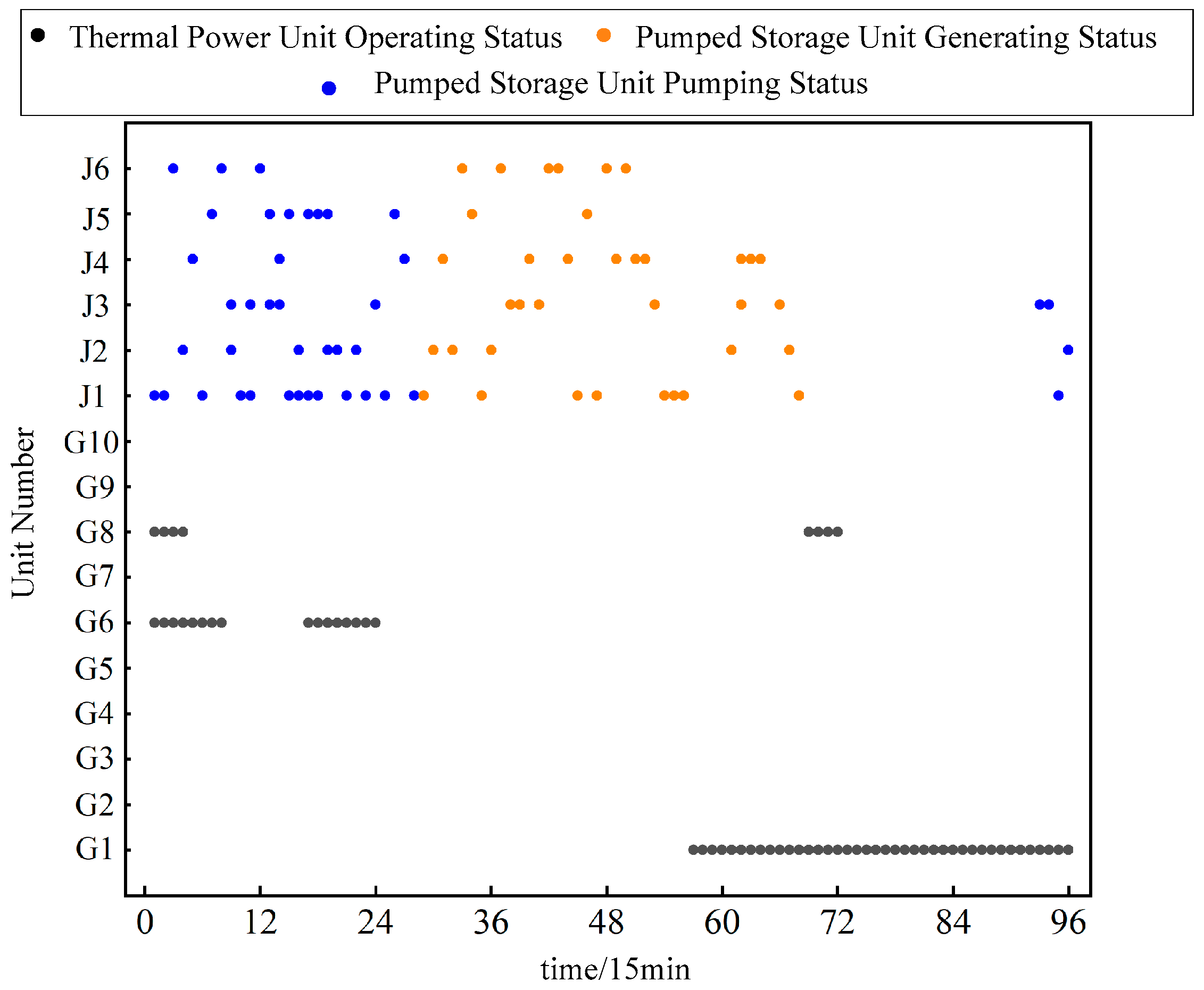
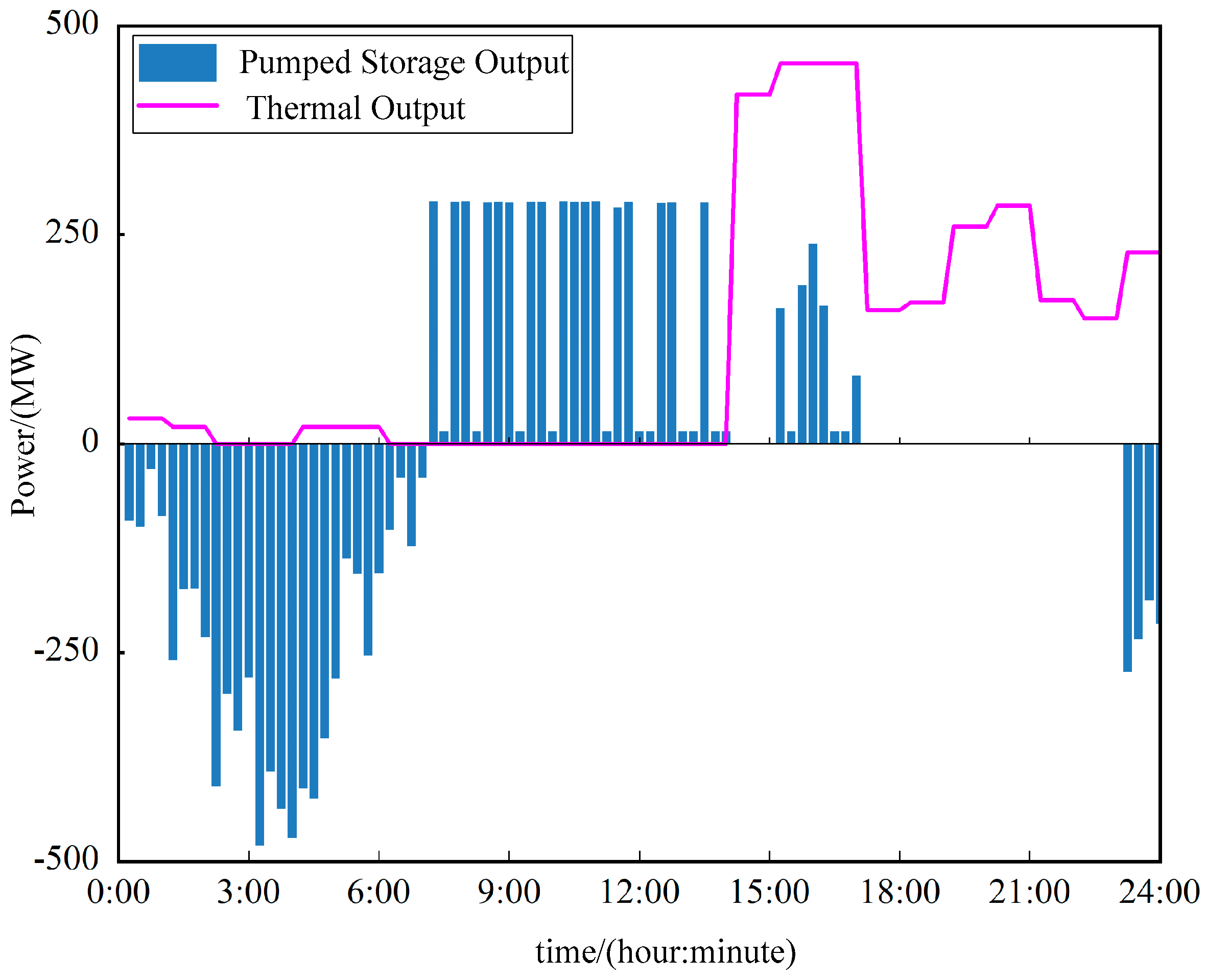
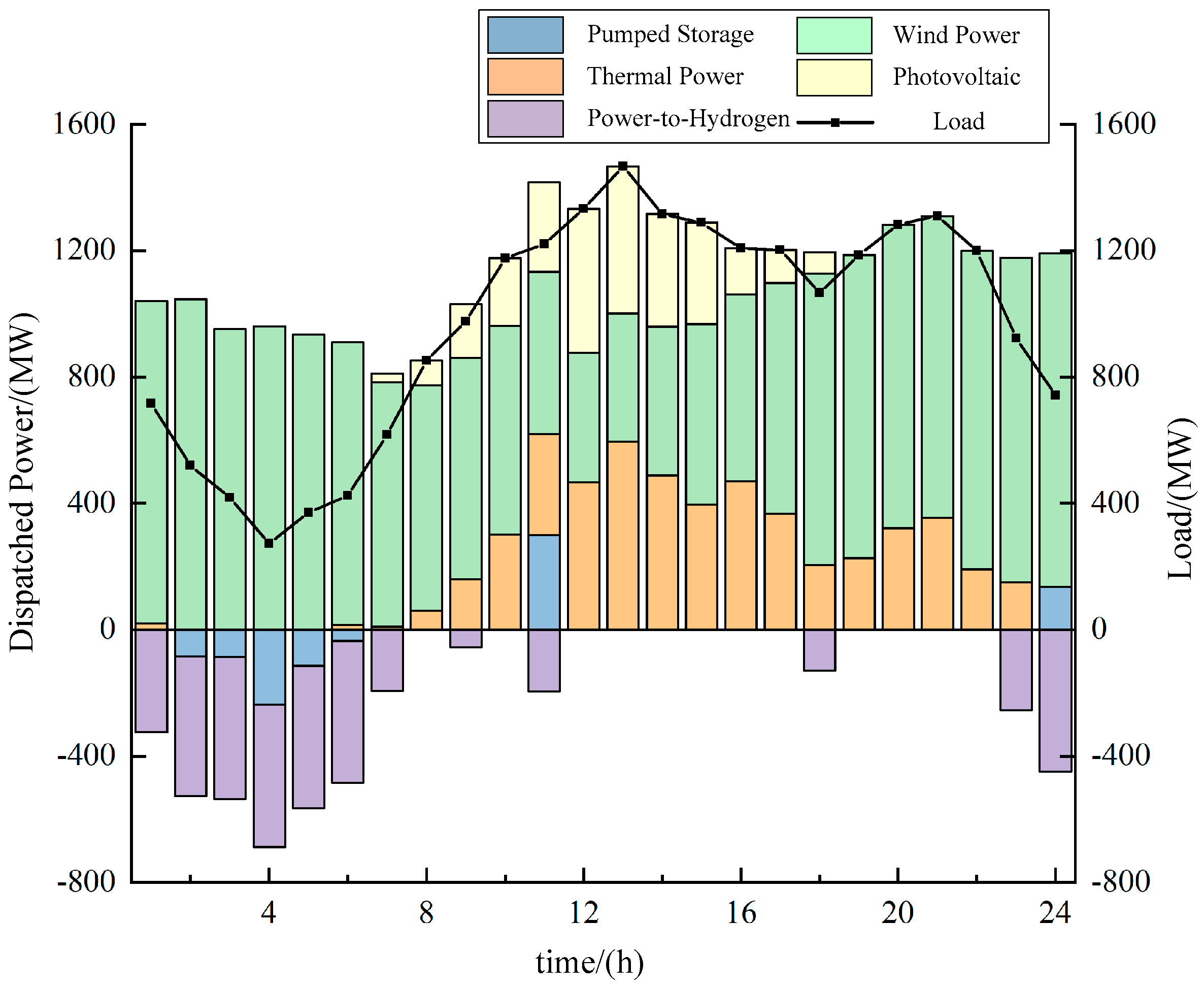
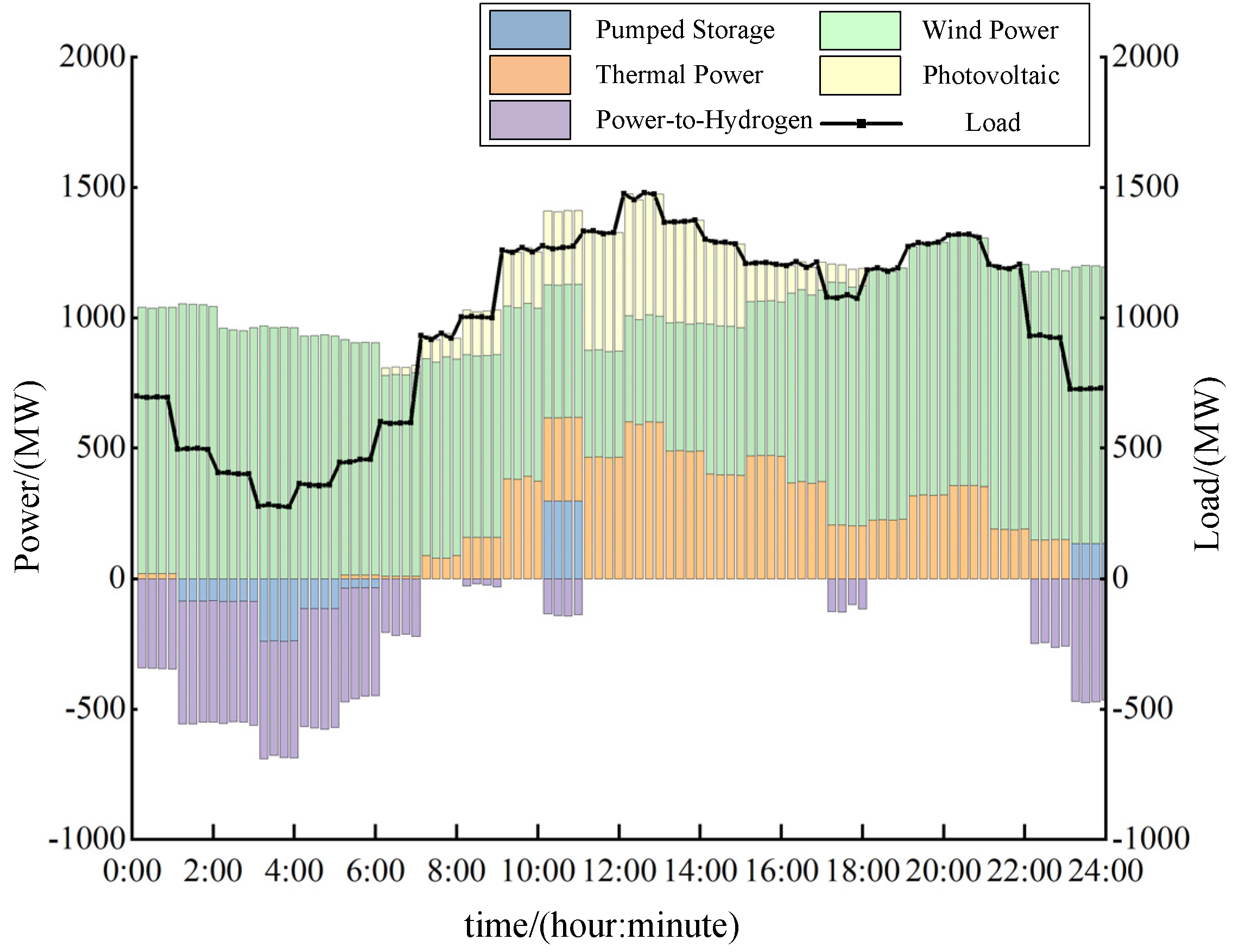
- The complementary roles of pumped storage and P2H are jointly modeled within the same power system scheduling framework. Pumped storage units are treated as fast-response bidirectional regulation resources on the generation side, while the P2H system is modeled as a flexible demand-side resource that can rapidly adjust its power consumption through hydrogen production and storage. Their coordinated participation in multi-time-scale scheduling is quantitatively analyzed in terms of renewable energy curtailment, spinning reserve requirements, and thermal unit operating costs.
- (3)
- To ensure computational tractability, the nonlinear operating characteristics of thermal power units and pumped storage units, including start-up/shutdown costs and operating costs, are reformulated into a mixed-integer linear programming (MILP) model through a unified linearization approach. This allows the proposed multi-time-scale scheduling problem to be efficiently solved using commercial solvers, making the framework suitable for practical power system applications.
- (4)
- Comprehensive case studies based on a modified IEEE 10-unit system are conducted to validate the effectiveness of the proposed approach. Multiple operational scenarios and different wind–solar penetration levels are investigated, demonstrating the advantages of the proposed multi-time-scale coordinated scheduling framework in enhancing renewable energy accommodation, reducing system operating costs, and improving overall system flexibility.
2. Basic Framework of Multi-Time-Scale Coordinated Scheduling
- (1)
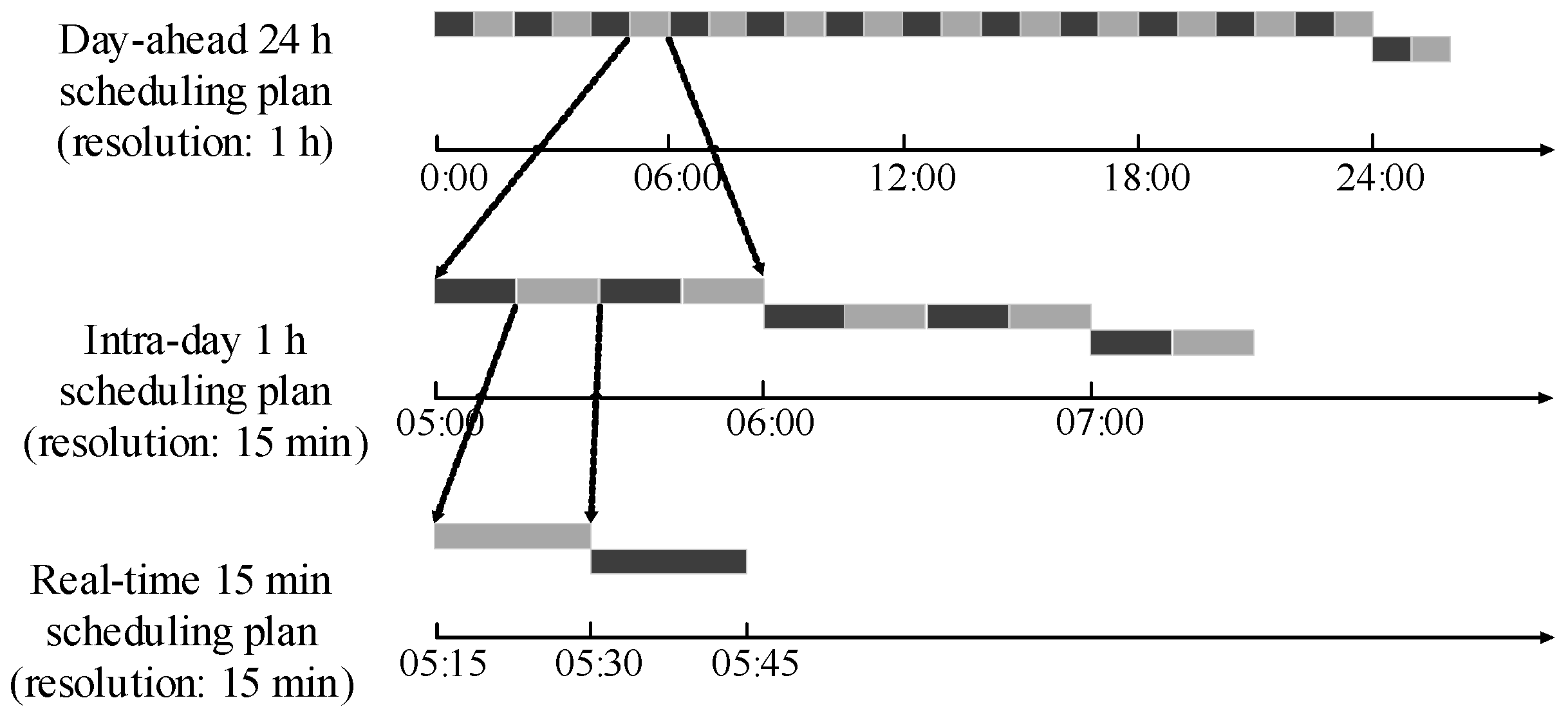
- Day-ahead scheduling model: Executed once every 24 h with a resolution of 1 h. Based on one-day-ahead forecast data of wind power, photovoltaic generation, and load, the generation plans of wind, solar, thermal, pumped storage, and power-to-hydrogen units for the next 24 h are optimized. The start-up and shutdown plans of thermal power units are treated as known parameters and are input into the intra-day and real-time scheduling models.
- (2)
- Intra-day 1 h scheduling model: Executed once every hour with a resolution of 15 min, totaling 24 executions per day. Based on one-hour-ahead forecast data of wind power, photovoltaic generation, and load, and using the start-up and shutdown plans of thermal units determined in the day-ahead scheduling, this model takes the day-ahead thermal generation plan as a reference and optimizes the generation plans of wind, solar, and power-to-hydrogen units for the next hour, as well as the start-up, shutdown, and generation plans of pumped storage units and the intra-day correction plan for thermal unit output. The intra-day start-up, shutdown, and generation plans of pumped storage units and the output correction plan of thermal units are treated as known parameters and are input into the real-time scheduling model.
- (3)
- Real-time 15 min scheduling model: Executed once every 15 min with a resolution of 15 min, totaling 96 executions per day. Based on 15 min ahead forecast data of wind power, photovoltaic generation, and load, as well as the start-up and shutdown plans of thermal units determined in the day-ahead scheduling and those of pumped storage units determined in the intra-day scheduling, this model takes the intra-day output correction plans of thermal and pumped storage units as references and optimizes the generation plans of wind, solar, and power-to-hydrogen units for the next 15 min, as well as the real-time output correction plans of thermal and pumped storage units.
3. Multi-Time-Scale Coordinated Scheduling Model
3.1. Day-Ahead Scheduling Model
3.1.1. Objective Function
3.1.2. Constraints
- (1)
- Constraints on wind and solar power output
- (2)
- Operational constraints of thermal power units
- (3)
- Operational constraints of pumped storage power stations
- (4)
- Constraints of the electric hydrogen production system
- (5)
- System constraints
3.2. Intra-Day Scheduling Model
3.2.1. Objective Function
3.2.2. Constraints
- (1)
- Constraints on wind and solar power output
- (2)
- Operational constraints of thermal power units
- (3)
- Operational constraints of pumped storage power stations
- (4)
- Constraints of the electric hydrogen production system
- (5)
- System constraints
3.3. Real-Time Scheduling Model
3.3.1. Objective Function
3.3.2. Constraints
- (1)
- Constraints of wind and solar power output
- (2)
- Operational constraints of thermal power units
- (3)
- Operational constraints of pumped storage power stations
- (4)
- Constraints of the electric hydrogen production system
- (5)
- System operation constraints
4. Case Analysis
4.1. Case Parameters
4.2. Solution Method
4.3. Analysis of Scheduling Results
4.3.1. Impact Analysis of Pumped Storage on System Scheduling
4.3.2. Analysis of the Impact of Power-to-Hydrogen on System Scheduling
4.3.3. Analysis of the Impact of Time-Scales on System Scheduling
4.3.4. Impact Analysis of Wind–Solar Penetration on System Scheduling
5. Conclusions
- (1)
- The P2H system can rapidly follow fluctuations in wind and solar generation to meet overall system load requirements, thereby enhancing system flexibility from the demand side.
- (2)
- The joint participation of pumped storage and P2H systems in multi-time-scale coordinated scheduling effectively balances grid security and economic performance. This cooperation substantially reduces renewable energy curtailment and improves the overall utilization of clean energy.
Author Contributions
Funding
Data Availability Statement
Conflicts of Interest
References
- Pastore, L.M.; de Santoli, L. Socio-economic implications of implementing a carbon-neutral energy system: A Green New Deal for Italy. Energy 2025, 322, 135682. [Google Scholar] [CrossRef] [Scilit]
- Mararakanye, N.; Bekker, B. Renewable energy integration impacts within the context of generator type, penetration level and grid characteristics. Renew. Sustain. Energy Rev. 2019, 108, 441–451. [Google Scholar] [CrossRef] [Scilit]
- Xu, M.; Li, W.B.; Feng, Z.J.; Wang, J.X.; Yu, G.Z.; Li, W.T.; Li, Z.Y. Economic dispatch model of high proportional new energy grid-connected consumption considering source load uncertainty. Energies 2023, 16, 1696. [Google Scholar] [CrossRef] [Scilit]
- Wang, Y.S.; Liu, Y.Z.; Kirschen, D.S. Scenario reduction with submodular optimization. IEEE Trans. Power Syst. 2017, 32, 2479–2480. [Google Scholar] [CrossRef] [Scilit]
- Bertsimas, D.; Litvinov, E.; Sun, X.A.; Zhao, J.Y.; Zheng, T.X. Adaptive robust optimization for the security constrained unit com-mitment problem. IEEE Trans. Power Syst. 2013, 28, 52–63. [Google Scholar] [CrossRef] [Scilit]
- Lu, L.; Yuan, W.; Xu, H.Y.; Li, Y.B.; Lin, K.R.; Wang, H.Y.; Zhang, M.M.; Zhang, J. Evaluation of the complementary characteristics for Wind-Photovoltaic-Hydro hybrid system considering multiple uncertainties in the medium and long term. Water Resour. Manag. 2024, 38, 793–814. [Google Scholar] [CrossRef] [Scilit]
- Yan, J.; Qu, T.; Han, S.; Liu, Y.; Lei, X.; Wang, H. Reviews on characteristic of renewables: Evaluating the variability and complementarity. Int. Trans. Electr. Energy Syst. 2020, 30, e12281. [Google Scholar] [CrossRef] [Scilit]
- Hrinchenko, H.; Kupriyanov, O.; Khomenko, V.; Khomenko, S.; Kniazieva, V. An approach to ensure operational safety for renewable energy equipment. In Circular Economy for Renewable Energy; Springer Nature: Cham, Switzerland, 2023; pp. 1–17. [Google Scholar]
- Xiang, C.; Xu, X.; Zhang, S. Current situation of small and medium-sized pumped storage power stations in Zhejiang Province. J. Energy Storage 2024, 78, 110070. [Google Scholar] [CrossRef] [Scilit]
- Yuan, W.; Xin, W.; Su, C.; Cheng, C.; Yan, D.; Wu, Z. Cross-regional integrated transmission of wind power and pumped-storage hydropower considering the peak shaving demands of multiple power grids. Renew. Energy 2022, 190, 1112–1126. [Google Scholar] [CrossRef] [Scilit]
- Naval, N.; Yusta, J.M.; Sánchez, R. Optimal scheduling and management of pumped hydro storage integrated with grid-connected renewable power plants. J. Energy Storage 2023, 73, 108993. [Google Scholar] [CrossRef] [Scilit]
- Wu, Z.; Wang, J.Z.; Peng, S.; Liu, Y.F.; Liu, D.; Li, X.; Ma, Z.Q.; Zhang, L.P. Flexibility Assessment of Ternary Pumped Storage in Day-Ahead Optimization Scheduling of Power Systems. Appl. Sci. 2024, 14, 8820. [Google Scholar] [CrossRef] [Scilit]
- Shash, A.Y.; Abdeltawab, N.M.; Hassan, D.M.; Hassan, M.A.; Salem, M.M.; Mohamed, A.M.; Mohamed, H.A.; EI-Sebaie, M.M. Computational methods, artificial intelligence, modeling, and simulation applications in green hydrogen production through water electrolysis: A review. Hydrogen 2025, 6, 21. [Google Scholar] [CrossRef] [Scilit]
- Huang, H.; Sun, G.; Chen, S.; Wei, Z.; Zang, H. Peer-to-peer energy trading of hydrogen-producing prosumers in power distribution network. Sustain. Energy Technol. Assess. 2025, 75, 104221. [Google Scholar] [CrossRef] [Scilit]
- Zhang, D.; Du, T.; Yin, H.; Xia, S.; Zhang, H. Multi-time-scale coordinated operation of a combined system with wind-solar-thermal-hydro power and battery units. Appl. Sci. 2019, 9, 3574. [Google Scholar] [CrossRef] [Scilit]
- He, J.; Sun, B.; Jia, Q.; Xu, F.; Gao, B. Research on intraday rolling optimal dispatch including pumped storage power station. In Proceedings of the 2020 International Conference on Intelligent Computing, Automation and Systems (ICICAS), Chongqing, China, 11–13 December 2020; pp. 261–265. [Google Scholar]
- Li, D.S.; Qian, K.; Xu, Y.Y.; Zhou, J.S.; Wang, Z.F.; Peng, Y.F.; Xing, Q. A Multi-Time Scale Optimal Scheduling Strategy for the Electro-Hydrogen Coupling System Based on the Modified TCN-PPO. Energies 2025, 18, 1926. [Google Scholar] [CrossRef] [Scilit]
- Tang, J.; Liu, J.F.; Sun, T.X.; Kang, H.R.; Hao, X.Q. Multi-time-scale optimal scheduling of integrated energy system considering demand response. IEEE Access 2023, 11, 135891–135904. [Google Scholar] [CrossRef] [Scilit]
- Kim, W.J.; Lee, Y.S.; Chun, Y.H.; Ro, K.S. Reserve-constrained unit commitment considering adjustable-speed pumped-storage hydropower and its economic effect in Korean power system. Energies 2022, 15, 2386. [Google Scholar] [CrossRef] [Scilit]
- Zhou, B.; Geng, G.; Jiang, Q. Hydro-thermal-wind coordination in day-ahead unit commitment. IEEE Trans. Power Syst. 2016, 31, 4626–4637. [Google Scholar] [CrossRef] [Scilit]
- Chen, P.; Tian, Z.; Zhang, Y.; Wang, H.; Wang, W.; Liu, J. Research on new energy consumption methods using optimized dispatch of thermal power units. In Journal of Physics: Conference Series, 2024 3rd International Conference on Smart Energy and Electrical Engineering (SEEE 2024), Harbin, China, 20–22 December 2024; IOP Publishing: Bristol, UK, 2025; Volume 3000, p. 12057. [Google Scholar] [CrossRef] [Scilit]
- Kulyk, M.; Zgurovets, O. Modeling of power systems with wind, solar power plants and energy storage. In Systems, Decision and Control in Energy I; Springer International Publishing: Cham, Switzerland, 2020; pp. 231–245. [Google Scholar]
- Ding, H.J.; Hu, Z.C.; Song, Y.H. Stochastic optimization of the daily operation of wind farm and pumped-hydro-storage plant. Renew. Energy 2012, 48, 571–578. [Google Scholar] [CrossRef] [Scilit]
- Rosenlieb, E.; Heimiller, D.; Cohen, S. Closed-Loop Pumped Storage Hydropower Resource Assessment for the United States; Final Report on HydroWIRES Project D1: Improving Hydropower and PSH Representations in Capacity Expansion Models; National Renewable Energy Lab (NREL): Golden, CO, USA, 2022. [Google Scholar]
- Guisández, I.; Pérez-Díaz, J.I. Mixed integer linear programming formulations for the hydro production function in a unit-based short-term scheduling problem. Int. J. Electr. Power Energy Syst. 2021, 128, 106747. [Google Scholar] [CrossRef] [Scilit]




| /MW | 15 | /[m3(MWh)−1] | 780 |
| /MW | 300 | /107 m3 | 2 |
| /MW | 30 | /107 m3 | 1.06 |
| /MW | 300 | /107 m3 | 4.38 |
| /[m3(MWh)−1] | 999 | NJ | 6 |
| Scenarios | Thermal Power Generation Cost/USD | Wind Curtailment Penalty Cost/USD | Solar Curtailment Penalty Cost/USD | Thermal Power Upward Spinning Reserve Capacity/MW | Thermal Power Downward Spinning Reserve Capacity/MW |
|---|---|---|---|---|---|
| scenario 1 | 1,284,200 | 350,730 | 0 | 12,165 | 40,398 |
| scenario 2 | 635,770 | 6890 | 0 | 7460 | 22,459 |
| scenario 3 | 876,680 | 0 | 0 | 3447 | 8113 |
| scenario 4 | 42,130 | 0 | 0 | 1030 | 2660 |
| Total Installed Capacity of Wind and Solar PV/MW | Wind and Solar PV Penetration Rate | Total System Operating Cost (×104)/USD | Thermal Power Generation Cost (×104)/USD | Pumped Storage Operating Cost (×104)/USD | Renewable Curtailment Penalty Cost (×104)/USD | Total Up and Down Spinning Reserve Capacity from Thermal Power /MW |
|---|---|---|---|---|---|---|
| 3960 | 53.4% | 56.44 | 35.22 | 20.97 | 2.54 | 116,883 |
| 3300 | 48.8% | 84.73 | 63.58 | 21.08 | 0.69 | 91,639 |
| 2750 | 44.3% | 144.9 | 123.11 | 21.79 | 0 | 65,903 |
| 2200 | 38.8% | 208.19 | 186.64 | 21.55 | 0 | 39,903 |
| 1650 | 32.3% | 279.59 | 258.9 | 20.69 | 0 | 22,029 |
| 1100 | 24.1% | 387.64 | 367.55 | 20.09 | 0 | 15,487 |
Disclaimer/Publisher’s Note: The statements, opinions and data contained in all publications are solely those of the individual author(s) and contributor(s) and not of MDPI and/or the editor(s). MDPI and/or the editor(s) disclaim responsibility for any injury to people or property resulting from any ideas, methods, instructions or products referred to in the content. |
© 2026 by the authors. Licensee MDPI, Basel, Switzerland. This article is an open access article distributed under the terms and conditions of the Creative Commons Attribution (CC BY) license.
Share and Cite
Wu, F.; Cui, Y.; He, H.; Huo, Q.; Yao, J. A Multi-Time-Scale Coordinated Scheduling Model for Multi-Energy Complementary Power Generation System Integrated with High Proportion of New Energy Including Electricity-to-Hydrogen System. Electronics 2026, 15, 294. https://doi.org/10.3390/electronics15020294
Wu F, Cui Y, He H, Huo Q, Yao J. A Multi-Time-Scale Coordinated Scheduling Model for Multi-Energy Complementary Power Generation System Integrated with High Proportion of New Energy Including Electricity-to-Hydrogen System. Electronics. 2026; 15(2):294. https://doi.org/10.3390/electronics15020294
Chicago/Turabian StyleWu, Fuxia, Yu Cui, Hongjie He, Qiantao Huo, and Jinming Yao. 2026. "A Multi-Time-Scale Coordinated Scheduling Model for Multi-Energy Complementary Power Generation System Integrated with High Proportion of New Energy Including Electricity-to-Hydrogen System" Electronics 15, no. 2: 294. https://doi.org/10.3390/electronics15020294
APA StyleWu, F., Cui, Y., He, H., Huo, Q., & Yao, J. (2026). A Multi-Time-Scale Coordinated Scheduling Model for Multi-Energy Complementary Power Generation System Integrated with High Proportion of New Energy Including Electricity-to-Hydrogen System. Electronics, 15(2), 294. https://doi.org/10.3390/electronics15020294