Article

Conversions Among Z, Y, H, F, T, and S Parameters, Which Are Highly Beneficial for the Analysis of Two-Port Circuits and Filters

Electrical Engineering Faculty, National University of Science and Technology POLITEHNICA Bucharest, 060042 Bucharest, Romania
*
Author to whom correspondence should be addressed.
Electronics 2026, 15(2), 255; https://doi.org/10.3390/electronics15020255
Submission received: 18 November 2025 / Revised: 23 December 2025 / Accepted: 25 December 2025 / Published: 6 January 2026

Abstract

This study presents a unified symbolic–numerical framework for the automatic generation and conversion of two-port network parameters, including Z, Y, H, F, T (A, B, C, and D), and S matrices. The method integrates Modified Nodal Analysis (MNA) with exact symbolic computation to derive transfer functions, poles, zeros, and parameter sensitivities directly from the circuit topology, eliminating the need for manual algebraic manipulation. Unlike conventional tools such as PSpice 9.1 or RF simulation software* which operate primarily on numerical models, the proposed approach provides closed-form expressions suitable for analytical design, optimization, and parameter-tolerance evaluation. The implemented software routines generate all parameter sets within a single workflow and enable bidirectional conversion between low-frequency formulations and high-frequency scattering representations. Numerical case studies on band-pass filters confirm the correctness of the generated expressions, with deviations below 1% relative to reference simulation results.

1. Introduction

Two-port parameters such as impedance (Z), admittance (Y), hybrid (H), inverse hybrid (F), and transmission (T) representations are fundamental tools in analog circuit analysis [1]. At high frequencies, however, measurement constraints favor the use of scattering parameters (S parameters), which describe wave interactions directly in the transmission-line regime. Although analytical conversion formulas among these parameter families are known, performing conversions and deriving transfer functions manually becomes cumbersome for complex circuits. When these devices operate at high and very high frequencies, these parameters cannot be used, because they require circuits with certain branches short-circuited or left open to perform the measurements so that the currents and voltages in the circuit can be determined. For example, to calculate the input impedance of a two-port, the output port must be short-circuited, which in practice makes it impossible to perform measurements at high frequencies [2]. In this case, the equipment is not capable of measuring the total voltage and total current at the circuit ports. Also, many active devices, such as transistors and tunnel diodes, often cannot operate stably under short-circuit or open-circuit (no-load) conditions. The logical variables that must be used at these frequencies are transverse waves [3,4].
At low frequencies, the transfer coefficient matrices and those of impedances or admittances are commonly used, but in the microwave domain [5], where the frequencies are high, they are difficult to measure, and as a result, at these high frequencies, the scattering parameters S are preferred [6]. The S parameters are measured by inserting a two-port circuit into a transmission line whose ends are connected to the network analyzer. A network analyzer can measure the S parameters for a wide range of frequencies; for example, the vector network analyzer (VNA–Vector Network Analyzer) HP 8720D can measure the S parameters for frequency values in the range of 50 MHz–40 GHz. The frequency sampling is 1 Hz, and the results can be displayed either on a Smith diagram or as a conventional gain graph as a function of frequency [7].
The scattering (distribution) parameters, denoted S, are complex quantities, frequency-dependent, associated with a linear multiport system operating in harmonic regime. At first, the S parameters were used in the theory of long electrical lines, for their definition being used the incident (forward), reflected (reverse), or transmitted voltage waves. In general, the S parameters can be defined in information transmission systems, such as microwave systems (waveguides), where they can be studied using electric circuit theory [8].
Conversion formulas exist between S parameters and traditional circuit theory parameters, including impedances (Z), admittances (Y), H parameters, fundamental transfer parameters T (A, B, C, and D), and F parameters, among others. Comprehension of S parameters is crucial for high-frequency applications involving both active and passive components from integrated circuits, including micro-electro-mechanical systems (MEMS) and wireless power transfer systems [9].
Starting from the definition relations of the parameters Z, Y, T (A, B, C, and D), H, and F, the present paper proposes simple procedures for fully symbolic, partially symbolic, or fully numerical generation of the transfer functions found in the definition relations of these parameters [10]. For the automatic generation of the parameters Z, Y, T (A, B, C, and D), H, F, and S, and for different structures of passive linear two-ports, one can use either the modified nodal equations, generated by the our programs—ACAP, CSAP, and TFSYG—or the state equations, generated by the program SYSEG. Also, an important role in the generation of transfer functions is played by the programs MAPLE, ANSYS 2022, and MATLAB R2025a [11,12,13,14]. Obviously, as shown in the presented example, the parameters that require the generation of the simplest transfer functions are generated, such as those used in the generation of the fundamental (transfer) parameters; then, the other parameters describing passive linear two-ports circuits and filters, in harmonic or operational regime, are calculated using the formulas described in Section 2.
The S parameter is presented in increasing the efficiency of the processes of information transmission and propagation and of the transfer of active power from the input of passive linear two-ports circuits to the loads connected at their output. Based on the theorem of maximum active power transfer, the maximum active power transmitted by a two-port circuit to the load is calculated [15].
Based on the parameters Z, Y, T (A, B, C, and D), H, F, and S, the parameters characterizing two-ports circuits and analogue filters are determined, and the passband and stopband frequency ranges of the analyzed filters are calculated, and obviously, implicitly, the nature of these filters.
In Section 2, the theoretical aspects of generating the parameters Z, Y, T (A, B, C, and D), H, F, and S are presented for: two-ports circuit circuits and analogue filters, systems of magnetically coupled coils used in wireless power transfer, with the purpose of determining the optimal load impedance parameters that ensure a maximum active power transfer in WPTS (Wireless Power Transfer Systems).
In Section 5, based on the developed procedures, routines were implemented in the MAPLE and MATLAB programming environments to calculate all the parameters mentioned above and to compare the simulation results with those found in the specialized literature and with experimental results. Significant examples are presented that confirm the validity of the procedures presented in the paper.
The principal innovation of this study lies in establishing a fully automated, unified workflow that generates and converts all major two-port parameter families—Z, Y, H, F, T, and S—directly from a circuit’s symbolic nodal equations. Unlike traditional tools such as SPICE or RF simulation environments, which operate primarily in the numerical domain, the proposed framework performs exact symbolic derivation of transfer functions, parameter matrices, poles and zeros, and element-wise sensitivities. This enables analytical inspection of circuit behavior, closed-form interpretation of parameter interactions, and direct integration of low-frequency network models with high-frequency S parameter representations. The workflow additionally incorporates automatic consistency checking, conversion accuracy validation, and sensitivity-based identification of critical components. Existing computational tools reported in the literature typically address symbolic and numerical capabilities separately or with limited integration; however, none currently provide an equally integrated symbolic–numerical capability covering all major parameter sets within a single computational environment.

2. Theoretical Aspects

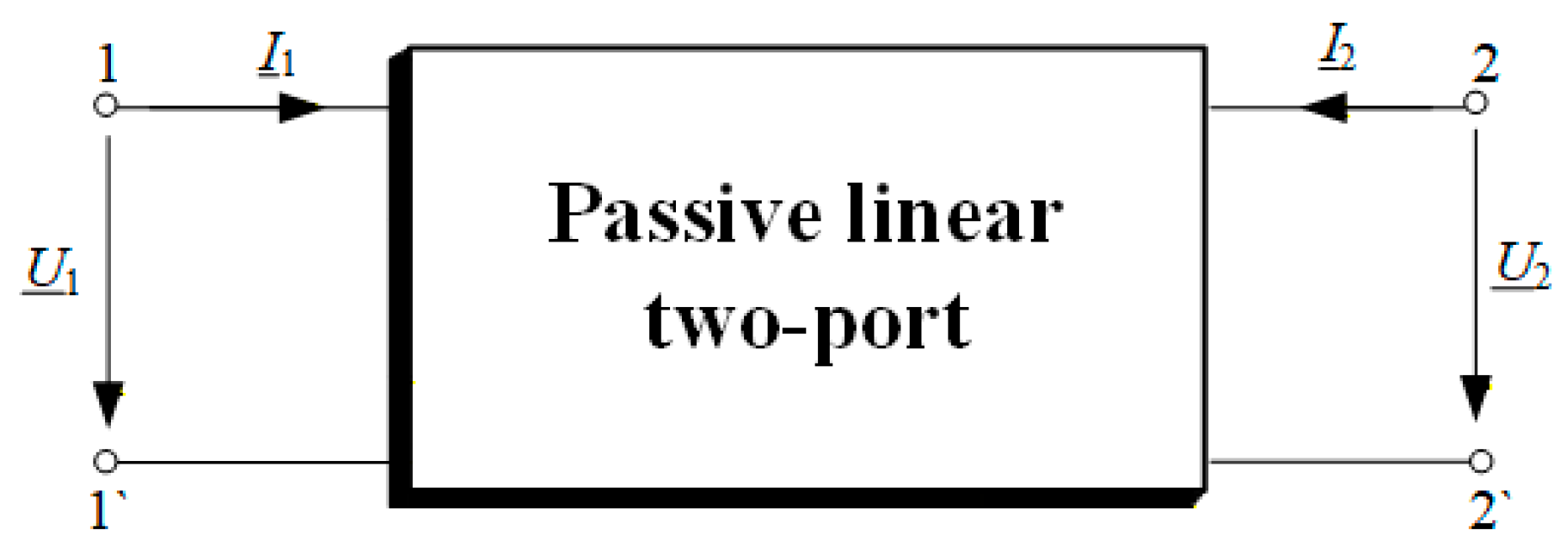
The equations of a passive linear two-port (Figure 1) expressed in terms of fundamental (transfer) parameters, in the harmonic regime, are as follows [1]:
U _ 1 I _ 1 = A _ B _ C _ D _ U _ 2 I _ 2 .
Fundamental parameters have, by definition, the following expressions:
A _ = d U _ 1 U _ 2 I _ 2 = 0 = 1 A _ o i ;   B _ = d U _ 1 I _ 2 U _ 2 = 0 = 1 Y _ o i ;   C _ = d I _ 1 U _ 2 I _ 2 = 0 = 1 Z _ o i ;   D _ = d I _ 1 I _ 2 U _ 2 = 0 = 1 B _ o i .
The impedance equations of a passive linear two-port in harmonic regime have the expressions:
U _ 1 U _ 2 = Z _ 11 Z _ 12 Z _ 21 Z _ 22 I _ 1 I _ 2 ,
where the complex transfer impedances are defined as follows:
Z _ 11 = d U _ 1 I _ 1 I _ 2 = 0 = Z _ i i ;   Z _ 12 = d U _ 1 I _ 2 I _ 1 = 0 = Z _ i o ;   Z _ 21 = d U _ 2 I _ 1 I _ 2 = 0 = Z _ o i ;   Z _ 22 = d U _ 2 I _ 2 I _ 1 = 0 =   Z _ o o .
The admittance equations of a passive linear two-port have the form:
I _ 1 I _ 2 = Y _ 11 Y 12 Y _ 21 Y _ 22 U _ 1 U _ 2 ,
where the complex transfer admittances are defined as follows [2,3]:
Y _ 11 = d I _ 1 U _ 1 U _ 2 = 0 = Y _ i i ;   Y _ 12 = d I _ 1 U _ 2 U _ 1 = 0 = Y _ i o ;   Y _ 21 = d I _ 2 U _ 1 U _ 2 = 0 = Y _ o i ;   Y _ 22 = d I _ 2 U 2 U _ 1 = 0 =   Y _ o o .
Because the Z and Y parameters do not always exist, it is necessary to create a third set of parameters, in which U1 and I2 are used as dependent variables, that is, the circuit response to an excitation caused by I1 and U2. The equations in H parameters of a passive linear two-port, in the harmonic regime, have the form:
U _ 1 I _ 2 = H _ 11 H _ 12 H _ 21 H _ 22 I _ 1 U _ 2 ,
These parameters are very useful in the description of electronic devices, such as transistors and others. The complex hybrid parameters can be defined as follows:
H _ 11 = d U _ 1 I _ 1 U _ 2 = 0 = Z _ i i U _ 2 = 0 = Z _ 11 U _ 2 = 0 –the complex input impedance with the output short-circuited; H _ 12 = d U _ 1 U _ 2 I _ 1 = 0 = A _ i o I _ 1 = 0 –the voltage transfer (gain) factor from output to input with the input open; H _ 21 = d I _ 2 I _ 1 U _ 2 = 0 = B i o U _ 2 = 0 –the current transfer (gain) factor with the output short-circuited; and   H _ 22 = d I _ 2 U _ 2 I _ 1 = 0 = Y _ o o I _ 1 = 0 = Y _ 22 I _ 1 = 0 –the complex output admittance with the input open.
In the case when I1 and U2 are used as dependent variables, that is, the circuit’s response to an excitation caused by U1 and I2. The equations in F parameters (inverses of the hybrid parameters) of a passive linear two-port, in the harmonic regime, have the form:
I _ 1 U _ 2 = F _ 11 F _ 12 F _ 21 F _ 22 U _ 1 I _ 2 ,
These parameters are very useful in the description of electronic devices, such as transistors and others. The complex F parameters can be defined as follows:
F _ 11 = d I _ 1 U _ 1 I _ 2 = 0 = Y _ i i I _ 2 = 0 = Y _ 11 I _ 2 = 0 –the complex input admittance with the output open; F _ 12 = d I _ 1 I _ 2 U _ 1 = 0 = 1 B _ o i U _ 1 = 0 –the inverse of the current transfer (gain) factor from output to input with the input short-circuited; H _ 21 = d U _ 2 U _ 1 I _ 2 = 0 = A o i I _ 2 = 0 –the voltage transfer (gain) factor from output to input with the output open; and   F _ 22 = d U _ 2 I _ 2 U _ 1 = 0 = Z _ o o U _ 1 = 0 = Z _ 22 U _ 1 = 0 –the complex output impedance with the input short-circuited.
From Equations (1), (3), (5), (7), and (9), it is observed that the parameters fundamental (transfer) parameters (Equation (1)), complex transfer impedances (Equation (3)), complex transfer admittances (Equation (5)), hybrid parameters (Equation (7)), and F parameters (Equation (9)) use transfer functions for their generation.
A passive linear two-port is, in the harmonic regime, reciprocal if the following relation is satisfied [1,3]:
I _ 1 U _ 1 = 0 U _ 2 = E _ = I _ 2 U _ 1 = E _ U _ 2 = 0 .
Considering Equations (1), (3), and (5), relation (11) is equivalent to the following relations between the two-port parameters:
A _ D _ B _ C _ = 1 ;   Z _ 12 = Z _ 12   si ,   respectiv   Y _ 12 = Y 12 .
If port 2′–2″ is considered as the input port, with the input quantities (U1, I1), and port 1′–1″ as the output port, with the output quantities (U2, I2), using Equation (1), the input quantities (U2, I2) have, as a function of the output quantities (U1, I1), the following expressions:
U _ 2 I _ 2 = D _ A _ D _ B _ C _ B _ A _ D _ B _ C _ C _ A _ D _ B _ C _ A _ A _ D _ B _ C _ U _ 1 I _ 1 ,
If the considered passive linear two-port is reciprocal, Equation (11) become:
U _ 2 I _ 2 = D _ B _ C _ A _ U _ 1 I _ 1 ,
which shows that, when considering port 2′–2″ as the input port and port 1′–1″ as the output port, the constants A and D switch places.
A passive and reciprocal linear two-port is symmetric if the two ports can be interchanged such that the equations in terms of the fundamental parameters remain the same. Obviously, to satisfy this condition, it is required that A = D.
As highlighted above, the S parameters can be measured at high frequencies using the Vector Network Analyzer (VNA–Vector Network Analyzer) HP 8720D [10,11].
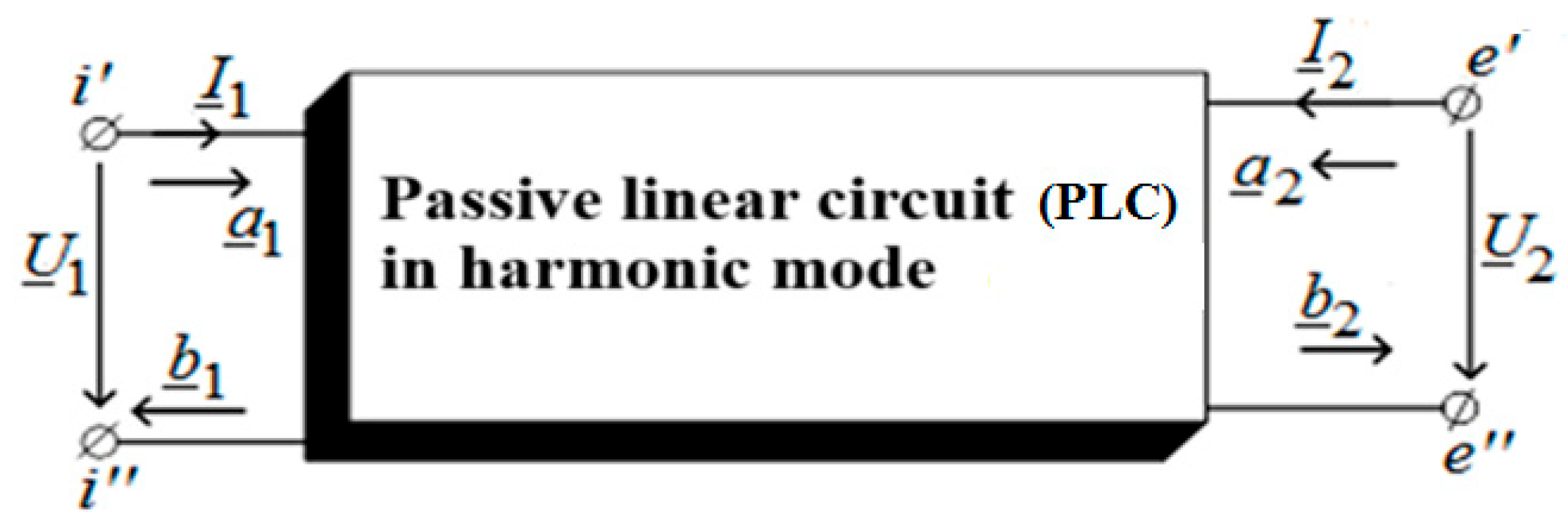
Since the other parameters Z, Y, T (A, B, C, and D), H, and F cannot be measured at high and very high frequencies, they must be expressed as functions of the S parameters [15,16]. For this, one starts from the equations of the passive linear two-port, in the harmonic regime, in S parameters (Figure 2):
b _ 1 = S _ 11 a _ 1 + S _ 12 a _ 2 b _ 2 = S _ 21 a _ 1 + S _ 22 a _ 2 ,
where
a _ 1 = 1 2 Z 0 U _ 1 + Z 0 I _ 1 ,   b _ 1 = 1 2 Z 0 U _ 1 Z 0 I _ 1 ; a _ 2 = 1 2 Z 0 U _ 2 + Z 0 I _ 2 ,   b _ 2 = 1 2 Z 0 U _ 2 Z 0 I _ 2 .
By substituting Equation (26) into Equation (25), the following equations are obtained:
1 2 Z 0 U _ 1 Z 0 I _ 1 = S _ 11 1 2 Z 0 U _ 1 + Z 0 I _ 1 + S _ 12 1 2 Z 0 U _ 2 + Z 0 I _ 2 1 2 Z 0 U _ 2 Z 0 I _ 2 = S _ 21 1 2 Z 0 U _ 1 + Z 0 I _ 1 + S _ 22 1 2 Z 0 U _ 2 + Z 0 I _ 2 .
Equation (17) represent the equations of the passive linear two-port, in the harmonic regime, from Figure 1, in S parameters, in which appear the variables at the input (output) of the two-port (U1, I1) ((U2, I2)).
To obtain the matrices of the parameters Z, Y, T (A, B, C, and D), H, and F as functions of the S parameters, Equation (17) are solved with respect to the dependent variables of these parameters, according to the procedures described in paragraph 3.
In, the equations of a passive linear two-port (Figure 1), in the harmonic regime, are presented in detail, as functions of the other parameters T, Z, Y, H, and F, showing the method for calculating all the coefficients using the transfer functions present in their definition relations.

3. Automatic Generation of Transfer Functions

In the case of linear, time-invariant circuits with lumped parameters, symbolic analysis generates the circuit equations in symbolic form and the circuit functions (transfer functions), in either fully symbolic or partially symbolic form [17,18,19].
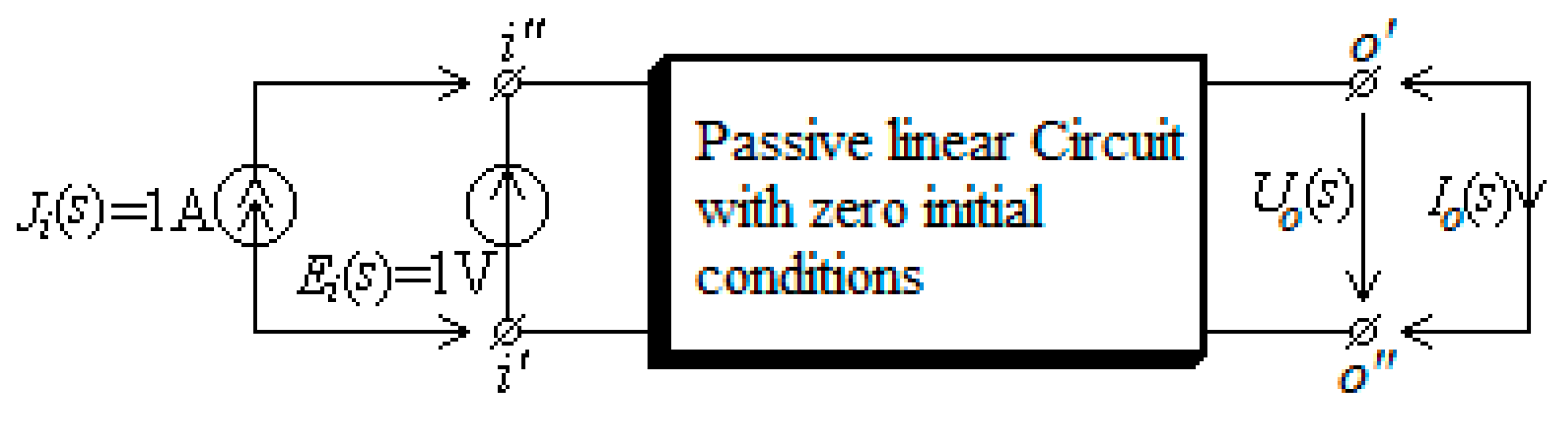
A passive linear circuit in operational regime is considered, with zero initial conditions (Figure 3). By applying, at the input, a voltage or current (depending on the circuit function to be generated) with a Laplace image equal to one, the output quantity represents precisely the desired circuit (transfer) function. Controlled (dependent) sources are fully supported and play a key role in modeling active devices and in representing transfer relations required for symbolic analysis. All four-standard controlled-source types are admissible within the modified nodal analysis formulation.
The transfer functions in the Laplace domain are defined as follows:
Z o i = d U o s J i s I o s = 0 , Y o i = d I o s E i s U o s = 0 , A o i = d U o s E i s I 0 s = 0   and   B o i = d I o s J i s U 0 s = 0 .
Depending on whether s is the only variable of the transfer function or not, and depending on whether some or all circuit elements are represented by symbols, there are three levels of symbolic representation:
Rational function in sss with numerical coefficients.
Partially symbolic transfer function.
Fully symbolic transfer function.
In [20,21,22], a symbolic analysis procedure was developed, based on the method MNA, which, in the case of linear, time-invariant circuits with lumped parameters, allows the generation of the circuit equations in symbolic form and of the circuit functions (transfer impedance, transfer admittance, voltage transfer (gain) factor and, respectively, current transfer (gain) factor) in symbolic, partially symbolic, or numerical form [23,24,25].
Based on this procedure, two calculation programs were developed, named CSAP–Circuit Symbolic Analysis Program and TFSYG–Transfer Function SYmbolic Generation [21], which can assist with exceptional efficiency in the design of linear and/or nonlinear analog circuits, linearized piecewise around the operating point. The CSAP and TFSYG programs can generate transfer functions for SISO—Single Input–Single Output analog circuits (one input and one output) [called: CSAP—Circuit Symbolic Analysis Program and TFSYG—Transfer Function SYmbolic Generation [22,23].
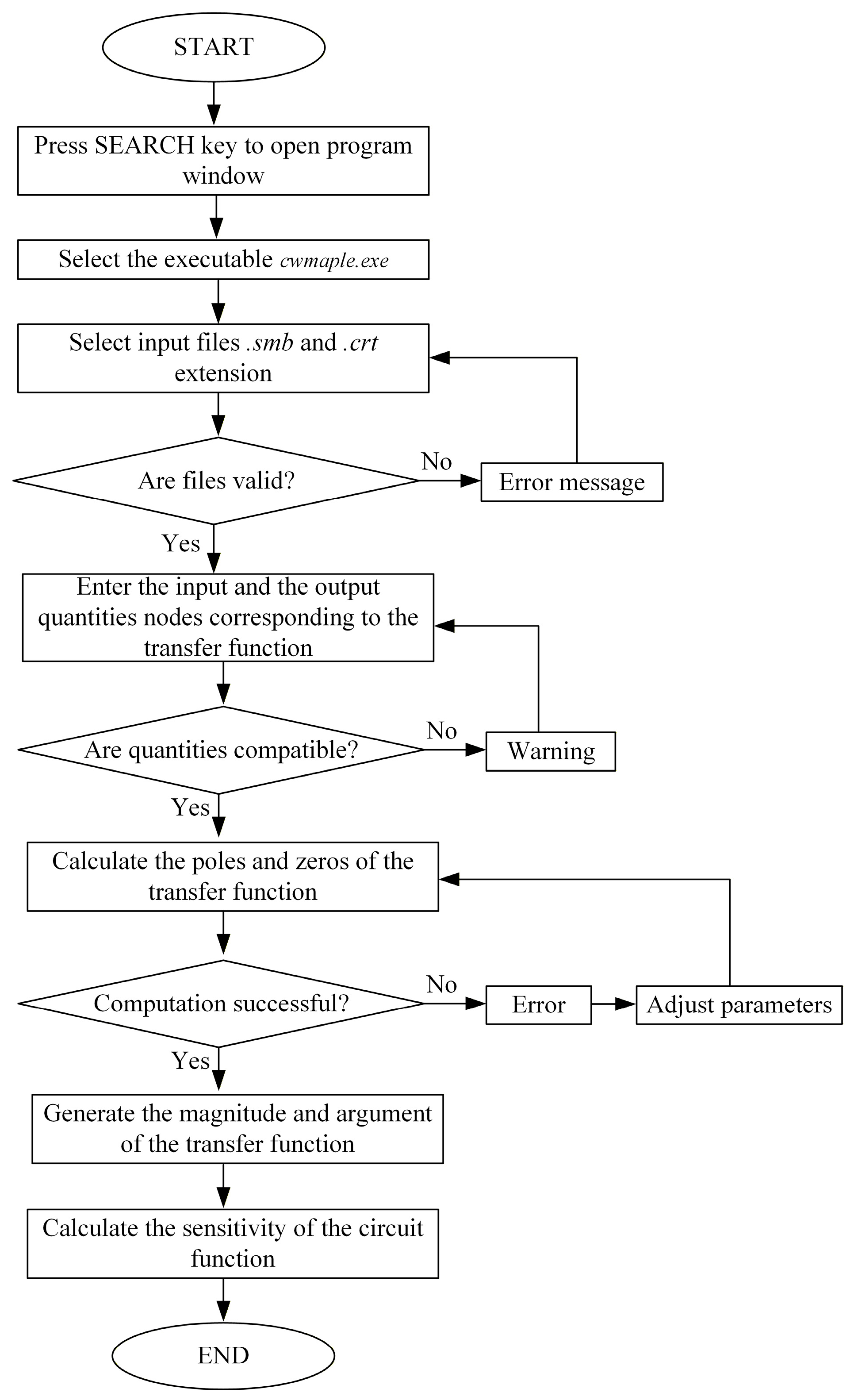
The CSAP and TFSYG programs involves the following steps in Figure 4:
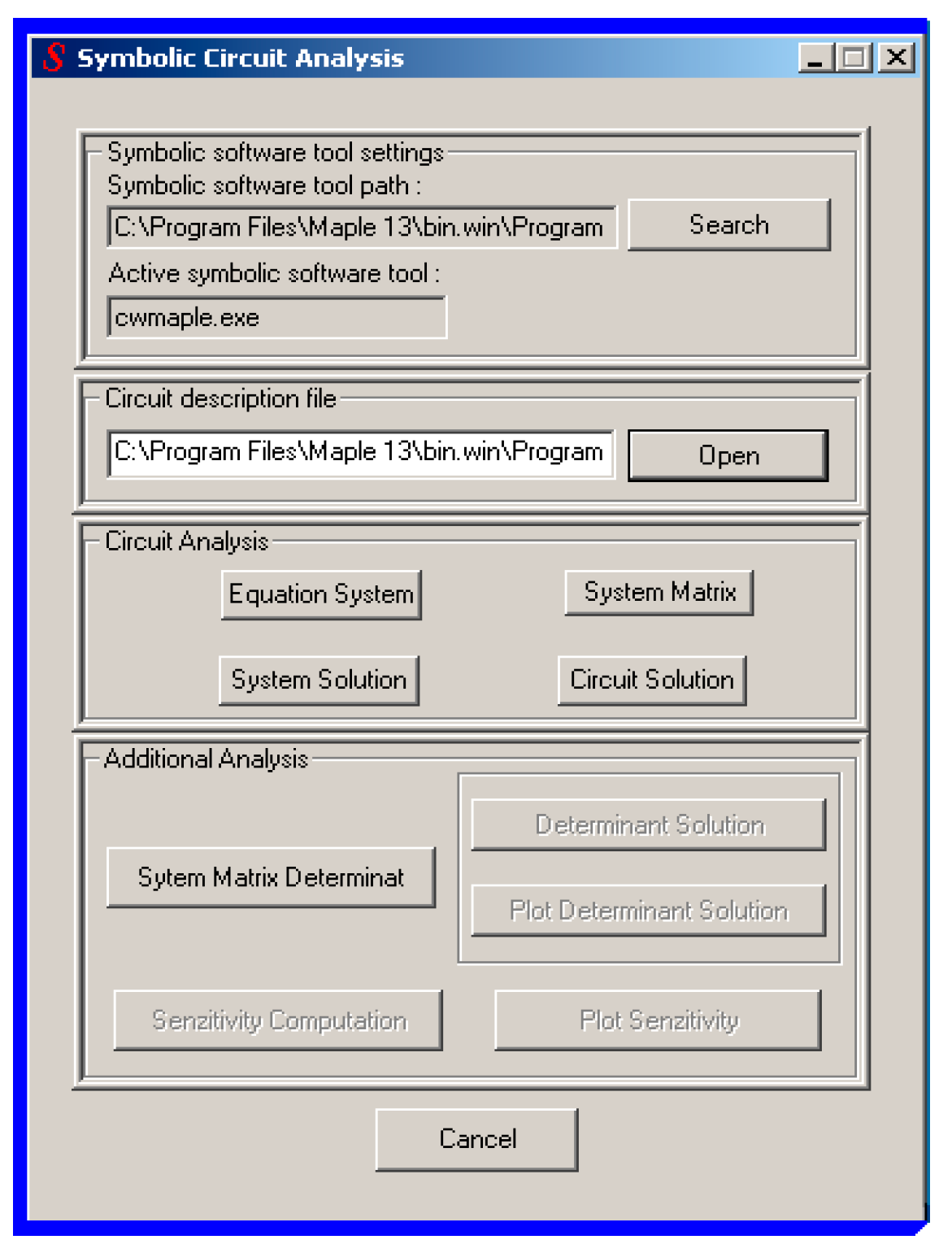
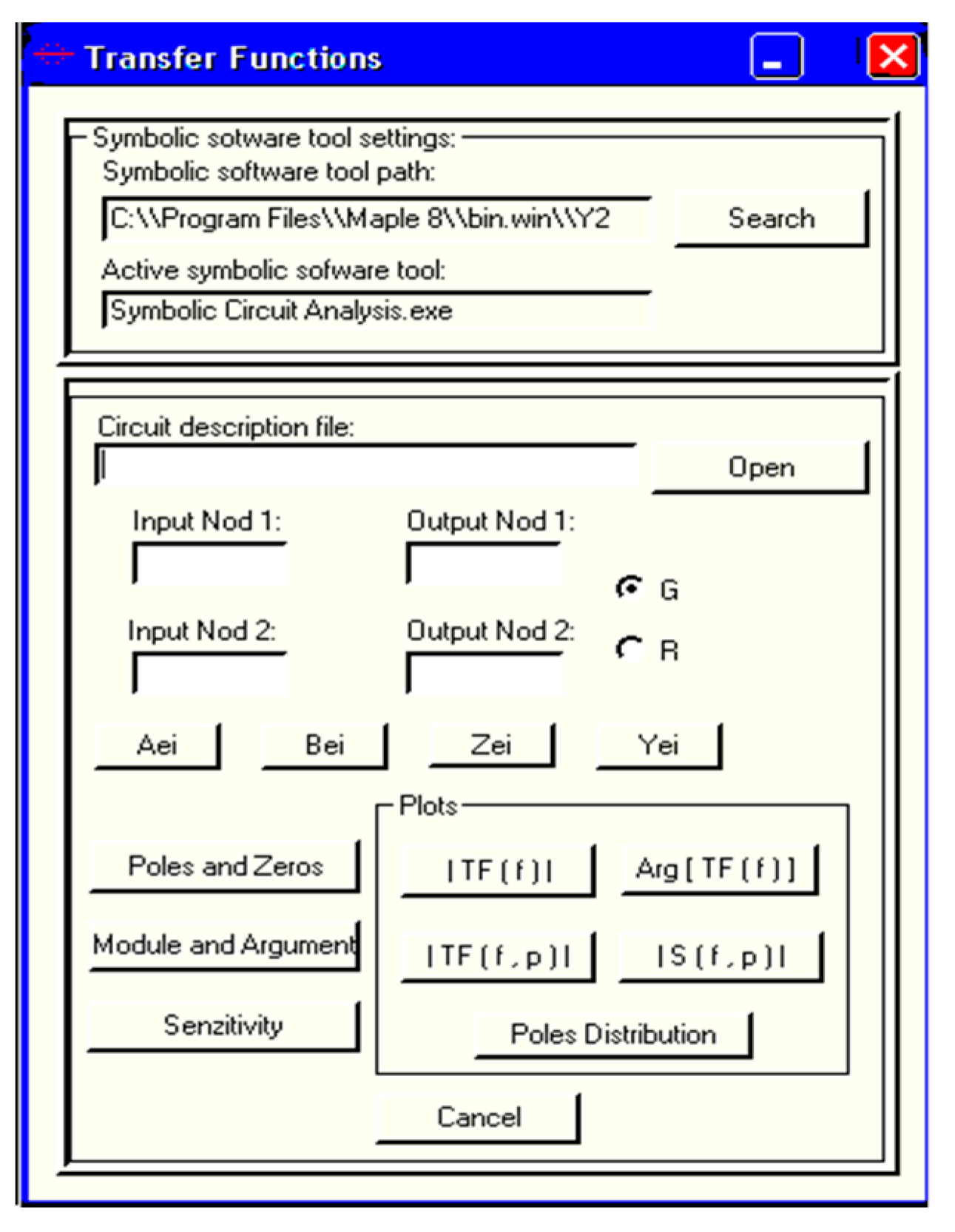
The user interface window of the CSAP (TFSYG) program is shown in Figure 5 and Figure 6). Since, at the time when the CSAP and TFSYG programs were first launched, the symbolic simulator Maple had a different version (version 5), it now uses Maple 16 or Maple 18. Therefore, the CSAP (TFSYG) program generates an output file named 5.r, which it places in the directory
  • C:\\Program Files\\Maple 16\\bin.win\\Program_CSAP (TFSYG)\\. Accordingly, the first command line, after launching the CSAP (TFSYG) program in the MAPLE programming environment, is the following:
read “C:\\Program Files\\Maple 16\\bin.win\\Program_CSAP\\5.r”;
and
read “C:\\Program Files\\Maple 16\\bin.win\\Program_TFSYG\\5.r”;
In file 5.r are stored the modified nodal equations, the command lines for solving these equations, and the calculation relations for the currents and voltages of the branches of the analyzed circuit. After launching the command line above, two output files rez and rez1 are generated, in which the simulation (analysis) results are stored. In the rez file, the solution of the system of modified nodal equations is stored, while in the rez1 file, the expressions of the currents and voltages of the branches of the analyzed circuit are provided (the expression—symbolic, numeric-symbolic, or numeric—of the transfer function desired by the user).
The analyzed circuits may contain: linear resistors, voltage-controlled (v.c.) or current-controlled (c.c.) nonlinear resistors, linear inductors, current-controlled or flux-controlled (f.c.) nonlinear inductors, linear capacitors, nonlinear capacitors v.c. or charge-controlled (q.c.), linear magnetic couplings, all four types of controlled sources, and any multipole or multiport circuit that has an equivalent diagram composed only of dipolar circuit elements and controlled sources. The characteristics of the nonlinear elements are piecewise linearized, and the parameters of each nonlinear characteristic are considered as symbols [26,27,28,29].
For the input data, for each analyzed circuit, an input file is created with the extension .smb (.crt) of the form filename.smb (.crt).
The input file filename.smb (.crt) is edited using the edit program from MSDOS (F4 key) and has the structure (identical to that of the input files corresponding to the ACAP program [18]; only the extension is different):
  • Number of branches.
  • Number of nodes.
    • A set of l lines follow (l being the number of branches of the circuit) which describe the circuit branches as follows: initial node, final node, type (r, re, j, j, l, c, j(u), j(i), e(i), e(u) etc.), and the numerical values of the branch parameters.

4. Generation of Conversion Relations Between the Parameters of Two-Port Circuits and Filters

Obviously, as shown in the example presented, the parameters requiring the generation of the simplest transfer functions are generated first, and then the other parameters describing passive linear two-port circuits and filters, in the harmonic or operational regime, are calculated using the formulas described in what follows [30,31,32,33,34].
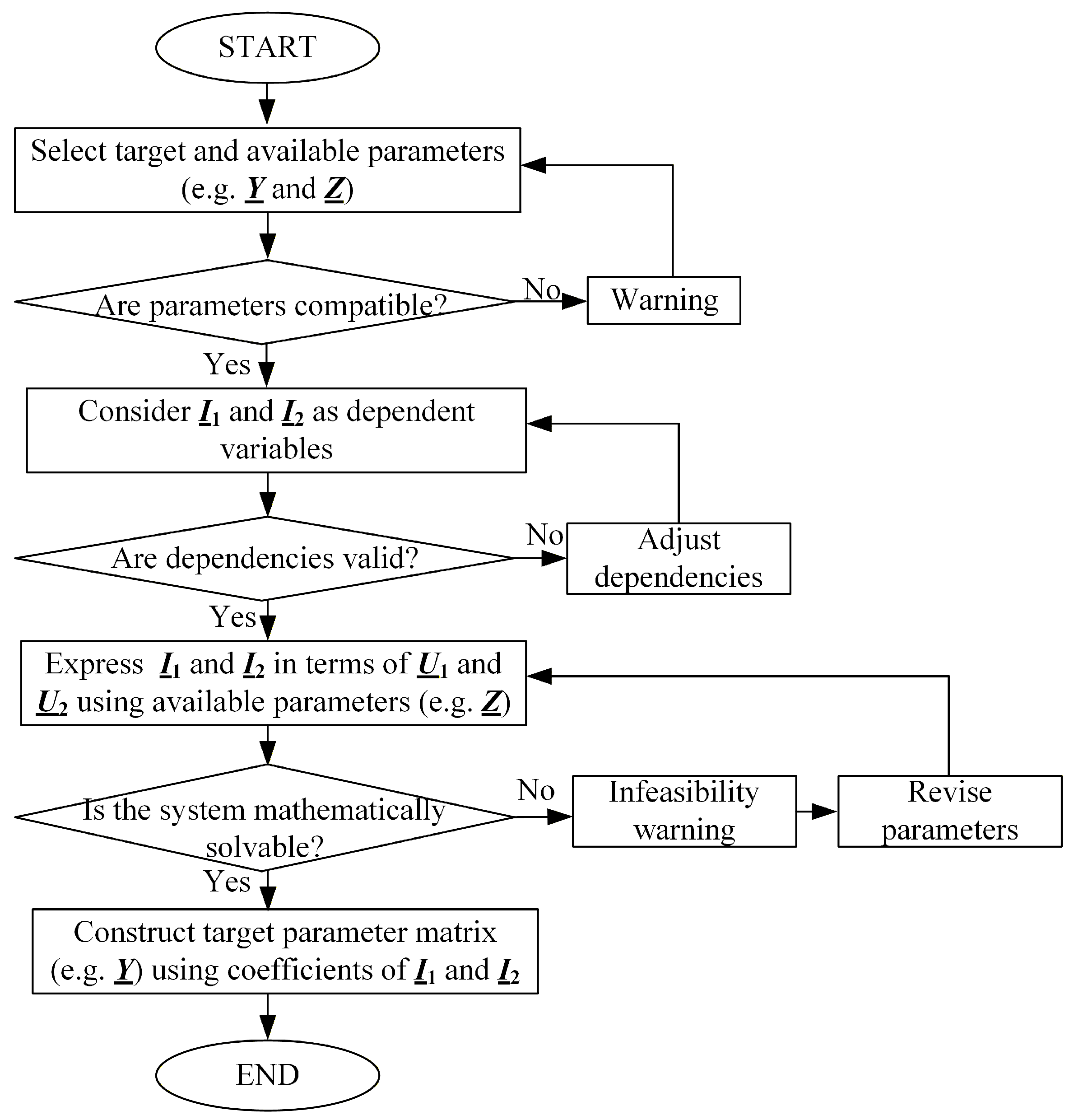
To convert the parameters Z, Y, T (A, B, C, and D), H, and F one according to the other, proceed as follows in Figure 7:
Similarly, proceed as above to convert any pair of parameters Z, Y, T (A, B, C, and D), H, and F.
To convert the S parameters in terms of the parameters Z, Y, T (A, B, C, and D), H, and F and to convert the parameters, Y, T (A, B, C, and D), H, and F in terms of the S parameters, proceed as follows:
  • Procedure for generating the scattering parameter matrix S as a function of the elements of the fundamental (transfer) parameter matrix T
In generating the S parameters as a function of the elements of the parameter matrix determined by calling the CSAP and/or TFSYG programs, for example, as a function of the elements of the fundamental parameter matrix T, the procedure in the MAPLE programming environment is as follows:
  • > restart;Digits:=4;with(linalg):
  • D i g i t s 4
Using Equation (17), the variables U1, U2, I1, and I2 are expressed as functions of the variables a1, a2, b1, b2, and Z0.
  • >I1:=1/Z0^(1/2)∗(-1.∗b1+a1); I2:=1./Z0^(1/2)∗(-1.∗b2+a2); U1:=a1∗Z0^(1/2)+b1∗Z0^(1/2);U2:= a2∗Z0^(1/2)+b2∗Z0^(1/2);
  • I 1 = 1 . b 1 + a 1 Z 0 ;   U 1 = a 1 · Z 0 + b 1 · Z 0 ;
  • I 2 = 1 . 1 . b 2 + a 2 Z 0 ;   U 2 = a 2 · Z 0 + b 2 · Z 0 ;
The two-port equations in fundamental parameters are used
  • > ecs_T:={A∗U2-B∗I2-U1=0.0,C∗U2-D∗I2-I1=0.0};
      e c s _ T C a 2 Z 0 + b 2 Z 0 1 . D 1 . b 2 + a 2 Z 0 1 . b 1 + a 1 Z 0 = 0 . ,   A a 2 Z 0 + b 2 Z 0 1 . B 1 . b 2 + a 2 Z 0 a 1 Z 0 b 1 Z 0 = 0 .
The variables {b1, b2} are considered as unknowns
  • > nec_S:={b1,b2};
                n e c _ S = b 1 , b 2
  • > Solution_S_T:=solve(ecs_T,nec_S);
    S o l u t i o n _ S _ T b 1 = 2 . C Z 0 B a 2 1 . C Z 0 2 a 1 + 2 . D Z 0 A a 2 2 . D a 1 Z 0 + a 1 A Z 0 + a 1 B A Z O + B + C Z 0 2 + Z 0 D , b 2 = 1 . A Z 0 a 2 1 . B a 2 2 . a 1 Z 0 + C Z 0 2 a 2 1 . Z 0 D a 2 A Z O + B + C Z 0 2 + Z 0 D
  • > b1:=collect(subs(Solution_S_T,b1),{a1,a2});b2:=collect(subs(Solution_S_T,b2),{a1,a2});
        b 1 1 . C Z 0 2 1 . Z 0 D + A Z 0 + B a 1 A Z O + B + C Z 0 2 + Z 0 D + 2 . C Z 0 B + 2 . D A Z 0 a 2 A Z O + B + C Z 0 2 + Z 0 D ;
        b 2 2 . Z 0 a 1 A Z O + B + C Z 0 2 + Z 0 D 1 . A Z 0 1 . B + C Z 0 2 1 . Z 0 D a 2 A Z O + B + C Z 0 2 + Z 0 D ;
  • >S11_T:=simplify(coeff(b1,a1,1));S12_T:=simplify(coeff(b1,a2,1));S21_T:=simplify(coeff(b2,a1,1));S22_T:=simplify(coeff(b2,a2,1));
        S 11 _ T 1 . C Z 0 2 1 . Z 0 D + A Z 0 + B A Z O + B + C Z 0 2 + Z 0 D ; S 12 _ T 2 . Z 0 1 . C B + D A A Z O + B + C Z 0 2 + Z 0 D ;
        S 21 T 2 . Z 0 A Z O + B + C Z 0 2 + Z 0 D ; S 22 T 1 . A Z 0 1 . B + C Z 0 2 1 . Z 0 D A Z O + B + C Z 0 2 + Z 0 D ;
  • > If we denote C:=C_complex și D:=D_complex, the parameters of the S matrix, as a function of the elements of the T matrix, have the expressions:
  • S 11 _ T 1 . C c o m p l e x Z 0 2 1 . Z 0 D c o m p l e x + A Z 0 + B A Z O + B + C c o m p l e x Z 0 2 + Z 0 D c o m p l e x ;
  • S 12 _ T 2 . Z 0 1 . C c o m p l e x B + D c o m p l e x A A Z O + B + C c o m p l e x Z 0 2 + Z 0 D c o m p l e x ;
  • S 21 _ T 2 . Z 0 A Z O + B + C C c o m p l e x Z 0 2 + Z 0 D c o m p l e x ;
  • S 22 _ T 1 . A Z 0 1 . B + C c o m p l e x Z 0 2 1 . Z 0 D A Z O + B + C c o m p l e x Z 0 2 + Z 0 D c o m p l e x ;
  • > SS_T:=[[0,0],[0,0]];
  • S S T 0,0 , 0,0
  • > S_T:=convert(SS_T,Matrix);
  • S T 0 0 0 0
  • > S_T [1,1]:=S11_T;S_T [1,2]:=S12_T;S_T [2,1]:=S21_T;S_T [2,2]:=S22_T;
S T 1,1 1 . C c o m p l e x Z 0 2 1 . Z 0 D c o m p l e x + A Z 0 + B A Z O + B + C c o m p l e x Z 0 2 + Z 0 D c o m p l e x ;       S T 1,2 2 . Z 0 1 . C c o m p l e x B + D c o m p l e x A A Z O + B + C c o m p l e x Z 0 2 + Z 0 D c o m p l e x ;
S T 2,1 2 . Z 0 A Z O + B + C C c o m p l e x Z 0 2 + Z 0 D c o m p l e x ; S T 2,2 1 . A Z 0 1 . B + C c o m p l e x Z 0 2 1 . Z 0 D A Z O + B + C c o m p l e x Z 0 2 + Z 0 D c o m p l e x ;
  • > S_T:=evalm(S_T); The scattering parameter matrix S_T, as a function of the fundamental parameters A, B, C, and D, has the following structure:
  • S T 1 . C c o m p l e x Z 0 2 1 . Z 0 D c o m p l e x + A Z 0 + B A Z O + B + C c o m p l e x Z 0 2 + Z 0 D c o m p l e x 2 . Z 0 1 . C c o m p l e x B + D c o m p l e x A A Z O + B + C c o m p l e x Z 0 2 + Z 0 D c o m p l e x 2 . Z 0 A Z O + B + C C c o m p l e x Z 0 2 + Z 0 D c o m p l e x 1 . A Z 0 1 . B + C c o m p l e x Z 0 2 1 . Z 0 D A Z O + B + C c o m p l e x Z 0 2 + Z 0 D c o m p l e x
b.
Procedure for generating the fundamental (transfer) parameter matrix T from the scattering parameter matrix S
To generate the elements of the matrices Z, Y, T (A, B, C, and D), H, and F as functions of the elements of the scattering parameter matrix S, for example, the generation of the elements of the fundamental parameter matrix T as a function of the S parameters, the procedure in the MAPLE programming environment is as follows:
  • > restart;Digits:=4;with(linalg):
  •                 D i g i t s 4
The definition Equation (16) of the variables a1, a2, b1, and b2 as functions of the variables U1, I1, U2, and I2 are used.
  • >a1:=(U1+Z0∗I1)/(2.0∗sqrt(Z0));b1:=(U1-Z0∗I1)/(2.0∗sqrt(Z0));a2:=(U2 Z0∗I2)/(2.0∗sqrt(Z0));b2:=(U2+Z0∗I2)/(2.0∗sqrt(Z0));
       a 1 0.5000 U 1 + Z 0 I 1 Z 0 ;   b 1 0.5000 U 1 Z 0 I 1 Z 0 ;
       a 2 0.5000 U 2 Z 0 I 2 Z 0 ; b 2 0.5000 U 2 + Z 0 I 2 Z 0 ;
The two-port equations in S parameters are used.
  • > ecs_S:={S11∗a1+S12∗a2-b1=0.0,S21∗a1+S22∗a2-b2=0.0};
e c s _ S 0.5000 S 11 U 1 + Z 0 I 1 Z 0 + 0.5000 S 12 U 2 Z 0 I 2 Z 0 0.5000 U 1 Z 0 I 1 Z 0 = 0 . , 0.5000 S 21 U 1 + Z 0 I 1 Z 0 + 0.5000 S 22 U 2 Z 0 I 2 Z 0 0.5000 U 2 + Z 0 I 2 Z 0 = 0 .
The variables {U1, I1} are considered as unknowns.
  • > nec_T:={U1,I1};
  • n e c _ T : = I 1 , U 1
  • > Solution_T_S:=solve(ecs_S,nec_T);
S o l u t i o n _ T _ S I 1 = 0.5000 1 . S 11   S 22   U 2 + S 11   S 22   Z 0   I 2 + S 11   U 2 + S 11   Z 0   I 2 1 . Z 0 I 2 + S 22 U 2 1 . S 22   Z 0   I 2 1 . U 2 + S 21   S 12   U 2 1 . S 21   S 12   Z 0   I 2 S 21 Z 0 , U 1 = 0.5000 1 . S 11   S 22   U 2 + S 11   S 22   Z 0   I 2 + S 11 U 2 + S 11 Z 0 I 2 + S 21   S 12   U 2 1 . S 21   S 12   Z 0   I 2 1 . S 22 U 2 + S 22 Z 0 I 2 + U 2 + Z 0 I 2 S 21
  • > U1:=collect(subs(Solution_T_S,U1),{U2,I2});I1:=collect(subs(Solution_T_S,I1),{U2,I2});
  • U 1 0.5000 S 11   S 22   Z 0 + S 11 Z 0 1 . S 21   S 12   Z 0 + S 22   Z 0 + Z 0 I 2 S 21 + 0.5000 1 . S 11   S 22   + S 11 S 21   S 12   + 1 . U 2 S 21
  • I 1 0.5000 S 11   S 22   Z 0 1 . S 22   Z 0 + S 11   Z 0 1 . Z 0 1 . S 21   S 12   Z 0 I 2 S 21   Z 0 + 0.5000 1 . S 11   S 22 + S 22 + S 11 1 . +   S 21   S 12   U 2 S 21   Z 0
  • >T11_S:=simplify(coeff(U1,U2,1));T12_S:=simplify(coeff(U1,I2,1));T21_S:=simplify(coeff(I1,U2,1));T22_S:=simplify(coeff(I1,I2,1));
    T 11 _ S : = 0.5000 S 11   S 22 1 . S 11 1 . S 21   S 12 + S 22 1 . S 21 ;
    T 12 _ S : = 0.5000   Z 0 S 11   S 22 + S 11 1 . S 21   S 12 + S 22 + 1 . S 21 ;
    T 21 _ S : = 0.5000 S 11   S 22 1 . S 22 1 . S 11 + 1 . 1 . S 21   S 12 S 21   Z 0 ;
    T 22 _ S : = 0.5000 S 11   S 22 1 . S 22 + S 11 1 . 1 . S 21   S 12 S 21 ;
  • >T11_S:=−0.5000∗(S11∗S22-1.∗S11-1.∗S21∗S12+S22-1.)/S21;T12_S:= 0.5000∗Z0∗(S11∗S22+S11-1.∗S21∗S12+S22+1.)/S21;T21_S:= 0.5000∗(S11∗S22-1.∗S22-1.∗S11+1.-1.∗S21∗S12)/S21/Z0;T22_S:= −0.5000∗(S11∗S22-1.∗S22+S11-1.-1.∗S21∗S12)/S21;
    T 11 S : = 0.5000 S 11   S 22 1 . S 11 1 . S 21   S 12 + S 22 1 . S 21 ;
    T 12 S : = 0.5000   Z 0 S 11   S 22 + S 11 1 . S 21   S 12 + S 22 + 1 . S 21 ;
    T 21 S : = 0.5000 S 11   S 22 1 . S 22 1 . S 11 + 1 . 1 . S 21   S 12 S 21   Z 0 ;
    T 22 S : = 0.5000 S 11   S 22 1 . S 22 + S 11 1 . 1 . S 21   S 12 S 21 ;
  • > TT_S:=[[0,0],[0,0]];
  • T T _ S 0,0 , 0,0
  • > T_S:=convert(TT_S,Matrix);
  • T _ S 0 0 0 0
  • > T_S [1,1]:=T11_S;T_S [1,2]:=T12_S;T_S [2,1]:=T21_S;T_S [2,2]:=T22_S;
    T _ S 1,1 : = 0.5000 S 11   S 22 1 . S 11 1 . S 21   S 12 + S 22 1 . S 21 ;
    T _ S 1.2 : = 0.5000   Z 0 S 11   S 22 + S 11 1 . S 21   S 12 + S 22 + 1 . S 21 ;
    T _ S 2.1 : = 0.5000 S 11   S 22 1 . S 22 1 . S 11 + 1 . 1 . S 21   S 12 S 21   Z 0 ;
    T _ S 2,2 : = 0.5000 S 11   S 22 1 . S 22 + S 11 1 . 1 . S 21   S 12 S 21 ;
  • > T_S:=T_S;
T _ S 0.5000 S 11   S 22 1 . S 11 1 . S 21   S 12 + S 22 1 . S 21 0.5000   Z 0 S 11   S 22 + S 11 1 . S 21   S 12 + S 22 + 1 . S 21 0.5000 S 11   S 22 1 . S 22 1 . S 11 + 1 . 1 . S 21   S 12 S 21   Z 0 0.5000 S 11   S 22 1 . S 22 + S 11 1 . 1 . S 21   S 12 S 21
Using the procedures presented above, all the formulas for converting the parameters Z, Y, T (A, B, C, and D), H, F, and S one according to the other are shown in Table 1.
Obviously, all transformation formulas of the parameters Z, Y, T (A, B, C, and D), H, F, and S, one in terms of the others, are derived according to the procedures presented above [8,9].

5. Example

To reduce the pronounced frequency dependence of the image impedances, which is a drawback of k-type filters, the so-called m-type filters are derived from them.
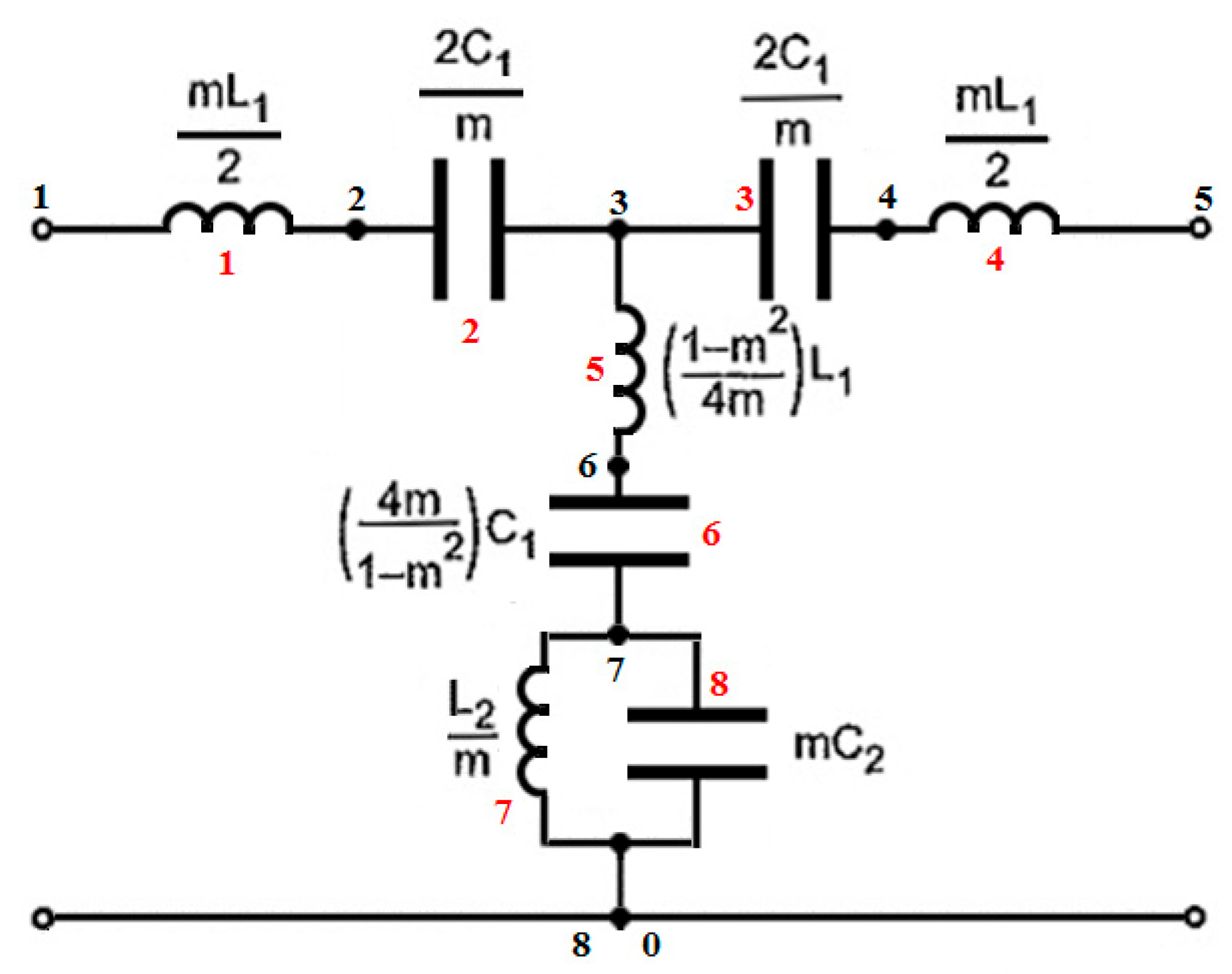
Figure 8 shows an m-type band-pass filter with the corresponding frequency characteristics.
For this, one of the TFSYG, SCAP, or SYSEG programs [21] was used to analyze the non-dissipative filter in Figure 8. Call the TFSYG program (by clicking on its icon) and determine the fundamental parameters as follows [22,23]. The numerical values of the parameters of the circuit elements in Figure 8 are: Z0 = 50 Ω, L1 = 1.0 × 10⁻⁴ H, L2 = 2.0 × 10⁻⁴ H, C1 = 1.0 × 10⁻⁶ F, C2 = 2.0 × 10⁻⁶ F, and m = 0.5.
  • Parameter A was calculated using the TFSYG program, the transfer factor (amplification) in voltage Aoi, and was extracted to the file rez1 from the directory c:\maple\bin.win\. The input–output gates were n1–n8 and n5–n8, respectively.
  • > restart;Digits:=4;with(linalg):
  • D i g i t s 4
  • > read “C:\\Program Files\\Maple 16\\bin.win\\Program_TFSYG\\FTB_m_5.r”:
  • > A:=subs(rez1,1/Aoi);
A 1 . C 1   C 2   L 1   L 2   m 2 + C 1   C 2   L 1   L 2 s 4 + C 1   L 1   m 2 + C 2   L 2   m 2 + C 1   L 1 + 4 . C 1   L 2 + C 2   L 2   s 2 + m 2 + 1 . C 1   C 2   L 1   L 2   m 2 1 .   C 1   C 2   L 1   L 2 s 4 + C 1   L 1   m 2 + C 2   L 2   m 2 1 . C 1   L 1 4 . C 1   L 2 1 . C 2   L 2   s 2 + m 2 1 .
A _ f 1 . 7.775 · 10 17 f 4 5.620 · 10 8 f 2 + 1.25 4.665 · 10 17 f 4 + 4.634 · 10 8 f 2 0.75
2.
Parameter B was calculated using the TFSYG program, the transfer admittance Yoi, and extracted to the file rez1 from the directory c:\maple\bin.win\. The input–output gates were n1–n8 and n5–n8, respectively.
  • > restart;Digits:=4;with(linalg):
  • D i g i t s 4
  • > read “C:\\Program Files\\Maple 16\\bin.win\\Program_TFSYG\\FTB_m_Yoi_5.r”:
  • > B:=subs(rez1,1/Yoi);
B 1 . m s 2 L 1   C 1 + 1 . 1 . + C 1   C 2   L 1   L 2   s 4 + L 1 C 1 + 4 . C 1 L 2 + L 2 C 2 s 2 C 1   C 2   L 1   L 2   m 2 1 .   C 1   C 2   L 1   L 2 s 4 + C 1   L 1   m 2 + C 2   L 2   m 2 1 . C 1   L 1 4 . C 1   L 2 1 . C 2   L 2   s 2 + m 2 1 . C 1 · s
B _ f 7960 . I 3.944 · 10 9 · f 2 + 1 . 1 . + 6.220 · 10 17 · f 4 5.127 · 10 8 · f 2 4.665 · 10 17 f 4 + 4.634 · 10 8 f 2 0.75 f
3.
Parameter C was calculated using the TFSYG program, the Zoi transfer impedance, and extracted to the rez1 file from the c:\maple\bin.win\ directory. The input–output gates were n1–n8 and n5–n8, respectively.
  • > restart;Digits:=4;with(linalg):
  • D i g i t s 4
  • > read “C:\\Program Files\\Maple 16\\bin.win\\Program_TFSYG\\FTB_m_Zoi_5.r”:
  • > C_complex:=subs(rez1,1/Zoi);
C 4.000 s s 2 C 2 L 2 + 1 m C 1 C 1   C 2   L 1   L 2   m 2 1 . C 1   C 2   L 1 L 2 s 4 + C 1   L 1   m 2 + C 2   L 2   m 2 1 . C 1   L 1 4 . C 1   L 2 1 . C 2   L 2   s 2 + m 2 1 C _ f 0.00001256   · I · f 1.578 · 10 8 · f 2 + 1 . 4.665 · 10 17 f 4 + 4.634 · 10 8 f 2 0.75
Parameter C was changed to C_complex to avoid the “many recursive parameters in expression” error.
4.
Parameter D was calculated using the TFSYG program, the transfer factor (amplification) in current Boi, and extracted to the rez1 file from the c:\maple\bin.win\ directory. The input–output ports were n1–n8 and n5–n8, respectively.
  • > restart;Digits:=4; with(linalg):
  • D i g i t s 4
  • > read “C:\\Program Files\\Maple 16\\bin.win\\Program_TFSYG\\FTB_m_Boi_5.r”:
  • > D_complex:=subs(rez1,1/Boi);
D _ c o m p l e x 1 . C 1   C 2   L 1   L 2   m 2 + C 1   C 2   L 1   L 2   s 4 + C 1   L 1   m 2 + C 2   L 2   m 2 + C 1   L 1 + 4 . C 1   L 2 + C 2   L 2 s 2 m 2 + 1 C 1   C 2   L 1   L 2   m 2 1 . C 1   C 2   L 1   L 2 s 4 + C 1   L 1   m 2 + C 2   L 2   m 2 1 . C 1   L 1 4 . C 1   L 2 1 . C 2   L 2   s 2 + m 2 1 D _ f 1 . 7.775 · 10 17 · f 4 5.620 · 10 8 · f 2 + 1.25 4.665 · 10 17 f 4 + 4.634 · 10 8 f 2 0.75
  • > RABCD:=simplify(A∗D_complex-C_complex∗B);RAD:=simplify(A-D_complex);
    RABCD:= 1. RAD:= 0
Since the relationship is verified A∗DB∗C = 1, the filter in Figure 6 is reciprocal and symmetric because A = D.
The matrix T_f of the transfer (fundamental) parameters, depending on the frequency, has the structure:
T _ f 1 . 7.775 · 10 17 · f 4 5.620 · 10 8 · f 2 + 1.25 4.665 · 10 17 f 4 + 4.634 · 10 8 f 2 0.75 , 7960 . I 3.944 · 10 9 · f 2 + 1 . 1 . + 6.220 · 10 17 · f 4 5.127 · 10 8 · f 2 4.665 · 10 17 f 4 + 4.634 · 10 8 f 2 0.75 f 0.00001256   · I · f 1.578 · 10 8 · f 2 + 1 . 4.665 · 10 17 f 4 + 4.634 · 10 8 f 2 0.75 1 . 7.775 · 10 17 f 4 5.620 · 10 8 f 2 + 1.25 4.665 · 10 17 f 4 + 4.634 · 10 8 f 2 0.75
  • Z-matrix of complex transfer impedances, as a function of frequency:
The Z-matrix of complex transfer impedances, calculated as a function of the fundamental parameters A, B, C, and D (see Table 1), has the form:
Z _ T _ f 79,600 . I 7.775 · 10 17 · f 4 5.621 · 10 8 · f 2 + 1.25 f 1.578 · 10 8 f 2 + 1 , 79,600 . I 4.665 · 10 17 f 4 + 4.634 · 10 8 f 2 0.75 f 1.578 · 10 8 f 2 + 1 79,600 . I · 4.665 · 10 17 f 4 + 4.634 · 10 8 f 2 0.75 f 1.578 · 10 8 f 2 + 1 79,600 . I 7.775 · 10 17 f 4 5.621 · 10 8 f 2 + 1.25 f 1.578 · 10 8 f 2 + 1
It is noted that Z11 = Z22 and Z12 = −Z21, which shows that the two-port circuit (the filter) in Figure 6 is symmetrical.
  • Matrix Y of the complex transfer admittances:
According to the relation in Table 1, the expression of the matrix of complex admittances Y _ = Y _ 11 Y _ 12 Y _ 21 Y _ 22 as a function of parameters A, B, C, and D is:
Y _ T _ f 0.00001256 . I 7.775 · 10 17 · f 4 5.621 · 10 8 · f 2 + 1.25 f 3.944 · 10 9 f 2 + 1 1 . + 6.220 · 10 17 f 4 1.578 · 10 8 f 2 , 0.0001256 · I · f · 4.665 · 10 17 f 4 + 4.634 · 10 8 f 2 0.75 3.944 · 10 9 f 2 + 1 1 . + 6.220 · 10 17 f 4 1.578 · 10 8 f 2 0.0001256 · I · f · 4.665 · 10 17 f 4 + 4.634 · 10 8 f 2 0.75 3.944 · 10 9 f 2 + 1 1 . + 6.220 · 10 17 f 4 1.578 · 10 8 f 2 0.00001256 . I 7.775 · 10 17 · f 4 5.621 · 10 8 · f 2 + 1.25 f 3.944 · 10 9 f 2 + 1 1 . + 6.220 · 10 17 f 4 1.578 · 10 8 f 2
It can be observed that Y11 = −Y22 and Y12 = −Y21, which shows that the two-port circuit in Figure 6 is symmetrical.
  • Hybrid parameter matrix H:
The hybrid parameter matrix H can be calculated, according to the relationship (see Table 1), depending on the fundamental parameters A, B, C, and D and has the expression:
H _ T _ f 79,600 . I 3.944 · 10 9 f 2 + 1 1 . + 6.220 · 10 17 f 4 1.578 · 10 8 f 2 f 7.775 · 10 17 · f 4 5.621 · 10 8 · f 2 + 1.25 , 1 . 4.665 · 10 17 f 4 + 4.634 · 10 8 f 2 0.75 7.775 · 10 17 · f 4 5.621 · 10 8 · f 2 + 1.25 1 . 4.665 · 10 17 f 4 + 4.634 · 10 8 f 2 0.75 7.775 · 10 17 · f 4 5.621 · 10 8 · f 2 + 1.25 0.000004186 · I · f 1.578 · 10 8 · f 2 + 1 1 . 157.8   f 2 C   L 4.665 · 10 17 f 4 + 4.634 · 10 8 f 2 0.75 3 . 78.88 f 2 C   L
From relation (22), it is found that H12 = H21.
  • The matrix F, in complex form, of the inverse hybrid parameters is:
F _ T _ f 0.00001256 . I · f 1.578 · 10 8 f 2 + 1 7.775 · 10 17 · f 4 5.621 · 10 8 · f 2 + 1.25 , 1 . 4.665 · 10 17 f 4 + 4.634 · 10 8 f 2 0.75 7.775 · 10 17 · f 4 5.621 · 10 8 · f 2 + 1.25 1.0 4.665 · 10 17 f 4 + 4.634 · 10 8 f 2 0.75 7.775 · 10 17 · f 4 5.621 · 10 8 · f 2 + 1.25 79,600 . I 3.944 · 10 9 f 2 + 1 1 . + 6.220 · 10 17 f 4 1.578 · 10 8 f 2 f 7.775 · 10 17 · f 4 5.621 · 10 8 · f 2 + 1.25
From relation (23), it is found that F12 = F21. det_F = −1.
  • The matrix of scattering parameters S, S _ = S _ 11 S _ 12 S _ 21 S _ 22 , is expressed in terms of the matrix T by the following expression (see Table 1):
S _ f 0.5000 2.454 · 10 25 f 6 5.956 · 10 15 f 4 + 3.392 · 10 7 f 2 + 1 1.227 · 10 25 f 6 3.530 · 10 11 f 3 + 4.885 · 10 20 f 5 + 3.242 · 10 15 f 4 + 0.0007850 · I · f 2.249 · 10 7 f 2 + 0.5 , 0.0005280 ·   I · 4.665 · 10 17 f 4 + 4.634 · 10 8 f 2 0.75 · f 1.227 · 10 25 f 6 3.530 · 10 11 f 3 + 4.885 · 10 20 f 5 + 3.242 · 10 15 f 4 + 0.0007850 · I · f 2.249 · 10 7 f 2 + 0.5 0.0005280 ·   I · 4.665 · 10 17 f 4 + 4.634 · 10 8 f 2 0.75 · f 1.227 · 10 25 f 6 3.530 · 10 11 f 3 + 4.885 · 10 20 f 5 + 3.242 · 10 15 f 4 + 0.0007850 · I · f 2.249 · 10 7 f 2 + 0.5 0.5000 2.454 · 10 25 f 6 5.956 · 10 15 f 4 + 3.392 · 10 7 f 2 + 1 1.227 · 10 25 f 6 3.530 · 10 11 f 3 + 4.885 · 10 20 f 5 + 3.242 · 10 15 f 4 + 0.0007850 · I · f 2.249 · 10 7 f 2 + 0.5
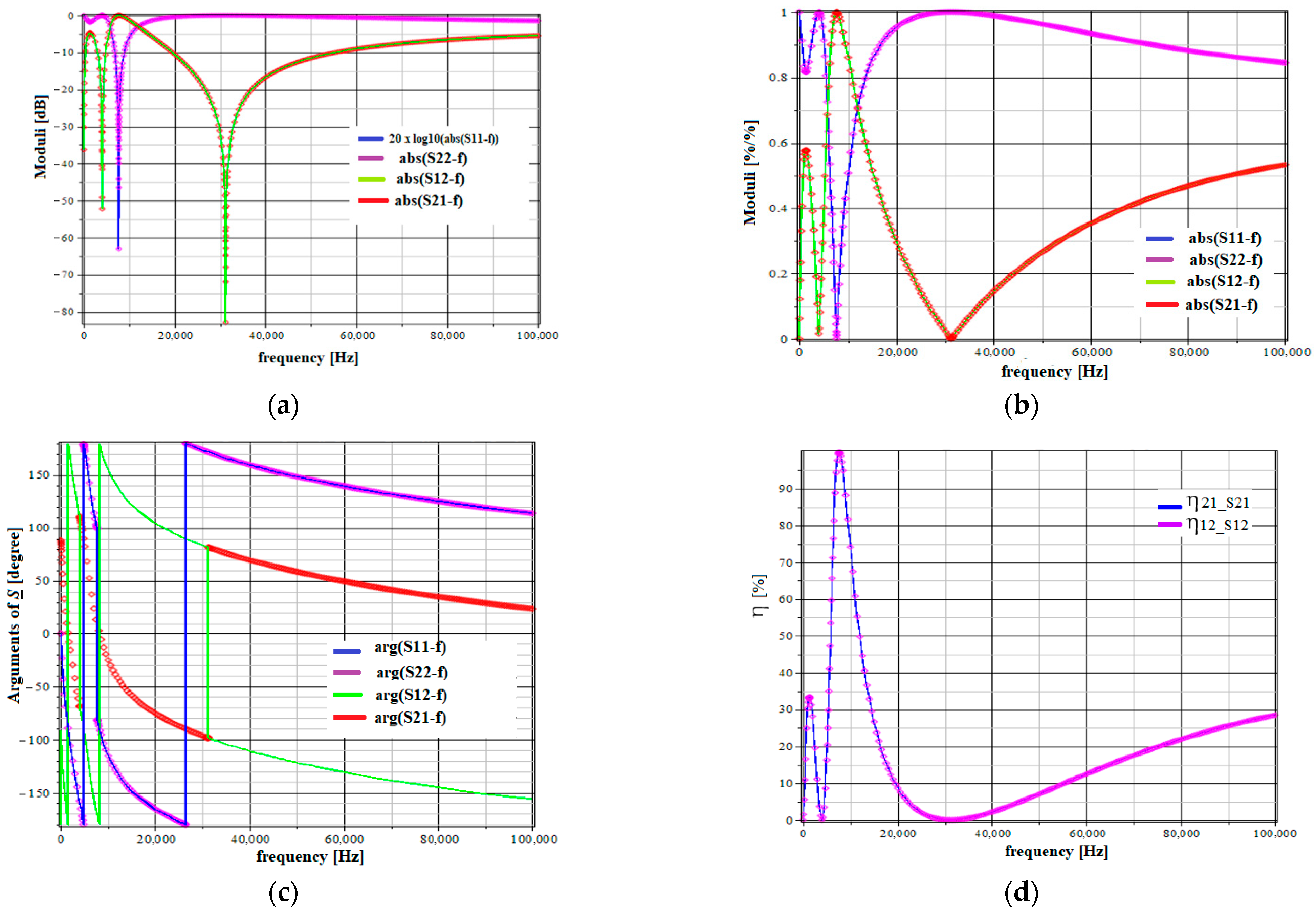
The frequency variations of the S parameter moduli and signal transmission efficiencies for the filter in Figure 8 are presented in Figure 9: (a) Moduli expressed in [dB]; (b) Moduli expressed in [%/%]; (c) Arguments of the S parameters; (d) Signal transmission efficiencies from input to output η21_S21 and from output to input output η12_S12. Figure 9, d shows that the variations with frequency of the signal transmission efficiencies from input to output η21_S21 and from output to input output η12_S12 are identical [24].
So, first, the fundamental parameters A, B, C, and D are generated; then, depending on them, the S parameters are calculated; and finally, at any frequency, depending on the S parameters, all the other characteristic parameters of any passive linear two-port circuit can be generated.
The voltage transfer factor (AFTB_m = 1/A) is obtained from the equations in the fundamental parameters of passive linear two-port circuits:
A F T B _ m 1.0 C 1   C 2   L 1   L 2 + C 1   C 2   L 1   L 2   m 2 s 4 + C 1   L 1   m 2 + 4 . C 1   L 2 + C 1   L 1 + C 2   L 2   m 2 + C 2   L 2 s 2 + m 2 + 1 . 1 . C 1   C 2   L 1   L 2 + C 1   C 2   L 1   L 2   m 2 s 4 + 1 . C 1   L 1 1 . C 2   L 2 4 . C 1   L 2 +   C 1   L 1   m 2 + C 2   L 2   m 2 s 2 1 + m 2 .
For numerical parameter values L1 = 1.0 × 10⁻⁴ H, L2 = 2.0 × 10⁻⁴ H, C1 = 1.0 × 10⁻⁶ F, and C2 = 2.0 × 10⁻⁶ F and m = 0.5 are obtained:
A _ F T B _ m 1 . 0.3000000 · 10 19 · s 4 0.11750 · 10 8 · s 2 0.75 0.5000000 · 10 19 · s 4 0.142500 · 10 8 · s 2 + 1.25 ;
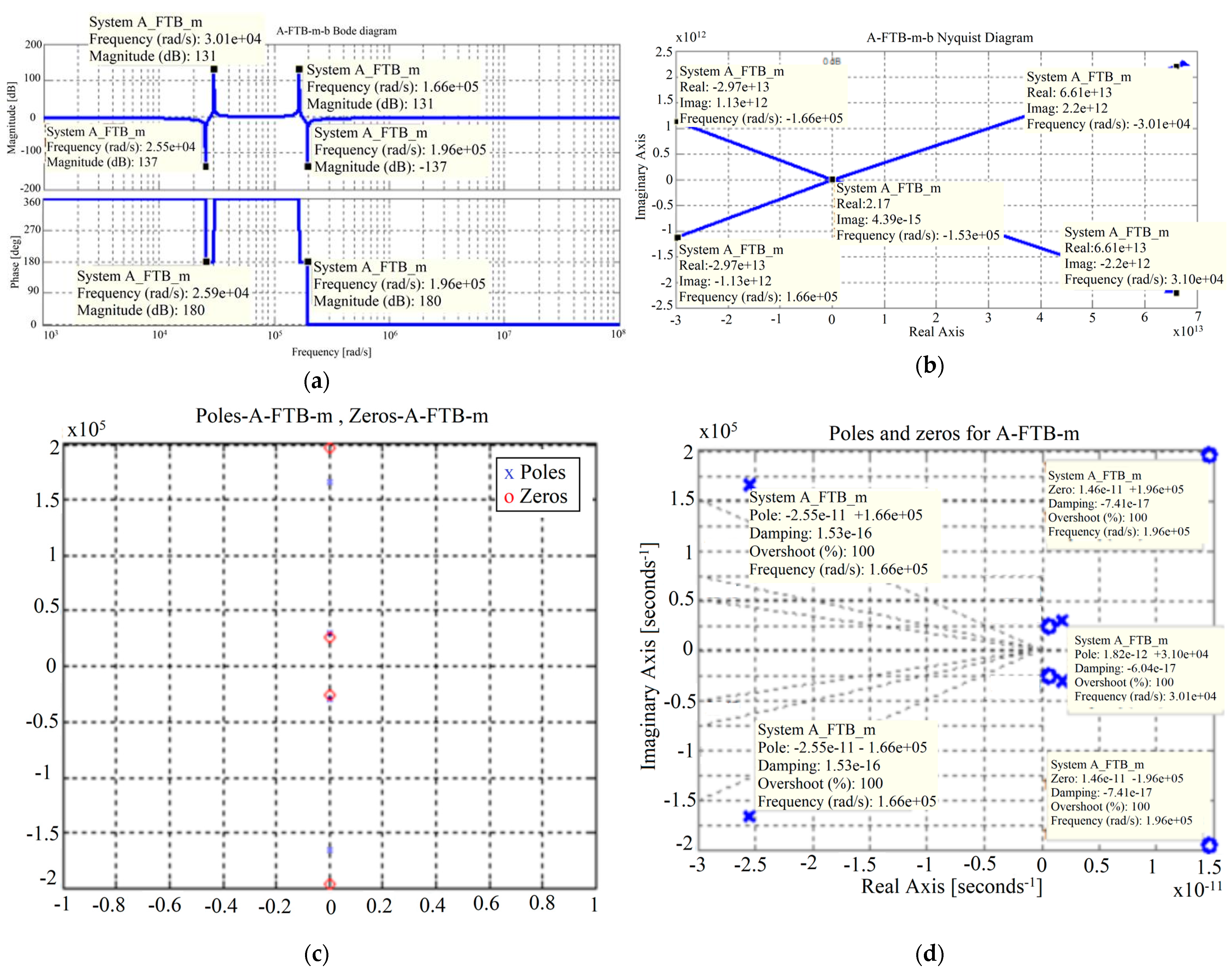
Z e r o s _ A _ F T B _ m : = 196,259.05 · I , 196259.05 · I , 25,476.533 · I , 25,476.533 · I ;
P o l e s _ A _ F T B _ m : = 166,114.44 · I , 166114.44 · I , 30,099.732 · I , 30,099.732 · I .
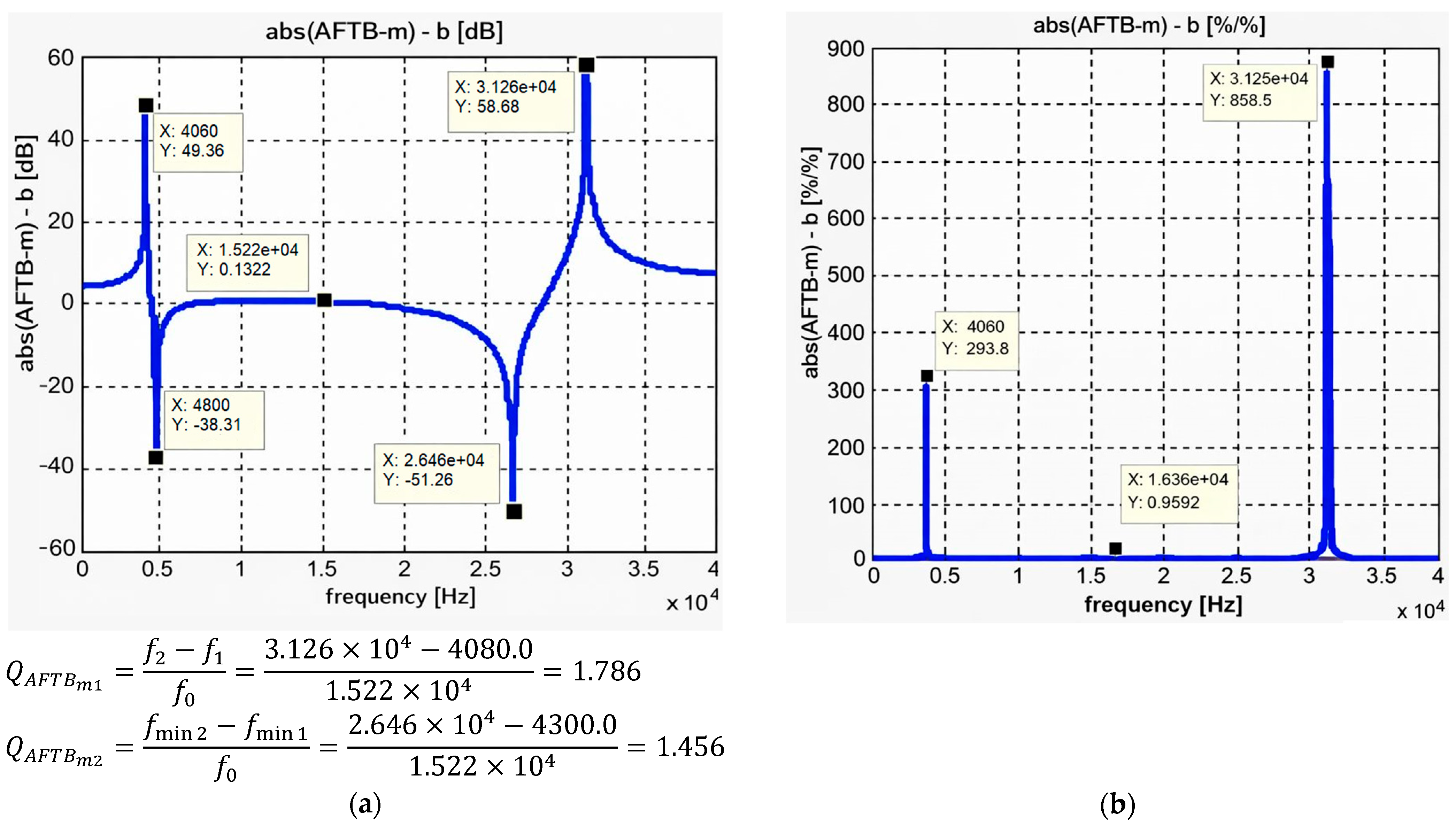
Figure 10 shows the frequency characteristics of the m-type band-pass filter from Figure 8, as follows: the variation with frequency of the voltage transfer factor modulus (amplification) abs(AFTB_m) expressed in [dB] in Figure 10a and expressed in [V/V] in Figure 10b.
The expression, as a function of frequency f, of the voltage transfer factor (amplification), AFTB_m = 1/A, from the equations in the fundamental parameters of passive linear two-port circuits, is:
A _ F T B _ m _ f 1 . 0.77769370 · 10 16 · f 4 0.56199720 · 10 7 · f 2 + 1.25 0.46661622 · 10 16 · f 4 + 0.46340120 · 10 7 · f 2 0.25
To determine the pass and stop bands of the lossless FTB, the inequality is solved:
s o l v e ( { A F T B _ m _ f   +   1   >   0 , A F T B _ m _ f     1   <   0 } , { f } ) .
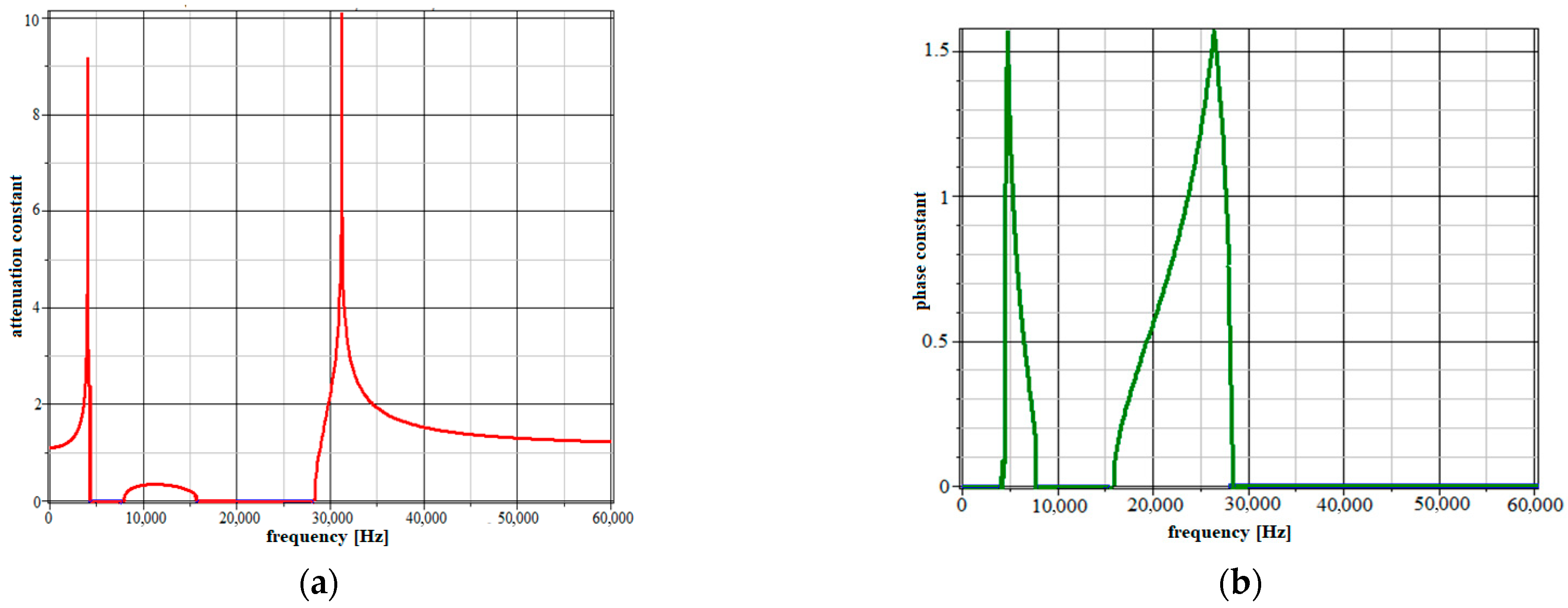
Solving the inequalities in (30) results in the pass bands relative to the frequency [ 4470.962 ,   7961.7834 ] U   [ 15,923.567 ,   28,356.3121 ] Hz and the stop bands [ 0.0 ,   4470.961 ) U ( 7961.7834 ,   15,923.567 ) U ( 28,356.3121 ,   80,098.231   ( t h e o r e t i c a l l y   i n f i n i t e ) ) Hz.
The variations with frequency f of the attenuation factor a and the phase constant b are shown in Figure 11a and in Figure 11b, respectively.
Figure 12a–d present the Bode characteristics of the bandpass filter from Figure 8, as follows: in Figure 12a, the Bode diagram; in Figure 12b, the Nyquist diagram; in Figure 12c, the representation of the poles and zeros in the complex plane; and in Figure 12d, the poles and zeros for AFTB_m.

6. Conclusions

This work presents an automated and unified procedure for generating symbolic and numerical representations of two-port network parameters. Benchmark comparisons with SPICE-level simulations confirm that the symbolic derivations yield accurate transfer functions and S parameters, with deviations below 0.1 dB across the tested frequency range. The method successfully extracts poles, zeros, and sensitivities for multilayer resonant structures and wireless power-transfer models, demonstrating its ability to identify dominant circuit elements and predict frequency shifts caused by parameter variations.
A unified Z/Y/H/F/T/S conversion framework enables streamlined analysis across low- and high-frequency domains, reducing design time and supporting analytical optimization workflows. Although symbolic complexity limits scalability for very large circuits, the approach provides significant advantages for medium-scale networks where insight, transparency, and accuracy are essential.
The paper also introduces efficient procedures for generating parameters of linear and piecewise-linearized nonlinear two-port circuits. These parameters support qualitative analysis and the design of analog circuits and filters. The method accommodates redundant elements and multiport components that can be represented using dipolar elements and controlled sources.
Equations for converting between Z, Y, H, F, T, and S parameters are derived directly from their definitions and basic transmission-line theory, ensuring full generality for complex source and load impedances. The CSAP and TFSYG programs implement these formulations and provide automatic generation of modified nodal equations in symbolic, partially symbolic, or numerical form. They support DC, AC, and operational analysis; computation of poles and zeros; generation of SISO transfer functions; and sensitivity evaluation with respect to any circuit parameter. Sensitivity analysis enables detection of critical components and determination of acceptable parameter variation ranges to maintain required performance.
Circuit descriptions are supplied through SPICE-like netlists, including simplified specification of controlled two-port sources. Additional tools such as MAPLE, MATLAB, and ANSYS assist in symbolic manipulation, numerical evaluation, model order reduction, and graphical visualization of frequency responses and sensitivity characteristics.
The procedures developed for generating Z, Y, T (A, B, C, D), H, F, and S parameters were implemented in MAPLE and MATLAB. The results obtained using these routines were validated through comparison with the existing literature and simulations [31,32,33,34].
Future work aims to improve computational scalability, incorporate distributed-element models, and extend the framework to fully automated N-port systems with model-order reduction. Additionally, future developments will focus on creating a corresponding physical prototype to enable the experimental validation of the proposed methodology.


Author Contributions

Conceptualization, M.R. and M.I.; methodology, M.R.; software, M.R., G.Z. and S.P.; validation, M.I. and D.N.; formal analysis, D.N., G.Z. and S.P.; investigation, D.N.; resources, M.I., G.Z. and S.P.; data curation, M.R.; writing—original draft preparation, M.I., D.N. and S.P.; writing—review and editing, M.I., A.G., D.N., G.Z. and S.P.; visualization, M.R. and A.G.; supervision, M.I.; project administration, M.I.; funding acquisition, M.R. and A.G. All authors have read and agreed to the published version of the manuscript.

Funding

This work receives no external funding.

Data Availability Statement

The original contributions presented in this study are included in the article. Further inquiries can be directed to the corresponding author.

Conflicts of Interest

The authors declare no conflicts of interest.

References

  1. Chua, L.O.; Desoer, C.A.; Kuh, E.S. Linear and Nonlinear Circuits; McGraw-Hill Book Company: New York, NY, USA, 1987. [Google Scholar]
  2. Schwarz, A.F. Computer-Aided Design of Microelectronic Circuits and Systems: Fundamentals, Methods and Tools; Academic Press: New York, NY, USA, 1987. [Google Scholar]
  3. Shokouhifar, M.; Yazdanjouei, H.; Weber, G.-W. DSSA: Direct Simplified Symbolic analysis Using Metaheuristic-Driven Circuit Modelling. J. Dyn. Games 2024, 11, 232–248. [Google Scholar] [CrossRef]
  4. Fakhfakh, M.; Tlelo-Cuautle, E.; Fernández, F.V. Design of Analog Circuits Through Symbolic Analysis; Bentham Science Publishers: Sharjah, United Arab Emirates, 2015. [Google Scholar]
  5. Orfanidis, S.J. Electromagnetic Waves and Antennas. 2008. Available online: https://www.ece.rutgers.edu/orfanidis/ewa/ (accessed on 1 September 2025).
  6. Frickey, D.A. Conversions Between S, Z, Y, H, ABCD, and T parameters Which are Valid for Complex Source and Load Impedances. IEEE Trans. Microw. Theory Tech. 1994, 42, 205–211. [Google Scholar] [CrossRef]
  7. Marks, R.B.; Williams, D.F. Comments on Conversions Between S, Z, Y, H, ABCD, and T Parameters Which are Valid for Complex Source and Load Impedances. IEEE Trans. Microw. Theory Tech. 1995, 43, 914–915. [Google Scholar] [CrossRef]
  8. Bird, J. Bird’s Electrical Circuit Theory and Technology; Routledge: London, UK, 2021. [Google Scholar]
  9. Reingold, L.; Pavel, B. RF Circuit Design—Theory and Applications; Prentice Hall: Upper Saddle River, NJ, USA, 2000; ISBN 0-13-0. [Google Scholar]
  10. Available online: http://www.keysight.com/en/pc-1297113/advanced-design-system-ads?cc=US&lc=eng (accessed on 1 September 2025).
  11. Agilent Technologies. Large-Signal S-Parameter Simulation; Agilent Technologies: Santa Clara, CA, USA, 2004. [Google Scholar]
  12. Ansoft Q3d Extractor, User Guide. Available online: https://www.ANSOFT.com (accessed on 1 September 2025).
  13. Available online: https://2025.help.altair.com/2025/feko (accessed on 1 September 2025).
  14. Pozar, D.M. Microwave and RF Design of Wireless Systems; Wiley: Hoboken, NJ, USA, 2000; ISBN 0471322822. [Google Scholar]
  15. Grib, M.; Sirbu, I.G.; Mandache, L.; Stanculescu, M.; Iordache, M.; Bobaru, L.; Niculae, D. Generation Algorithms for Thévenin and Norton Equivalent Circuits. Energies 2025, 18, 1344. [Google Scholar] [CrossRef]
  16. Tlelo-Cuautle, E.; Sánchez-López, C.; Martínez-Romero, E.; Tan, S.X.-D. Symbolic analysis of analog circuits containing voltage mirrors and current mirrors. Analog. Integr. Circuits Signal Process. 2010, 65, 89–95. [Google Scholar] [CrossRef]
  17. Iordache, M.; Dumitriu, L.; Delion, D. Automatic Formulation of Symbolic State Equations for Analog Circuits with Degeneracies. In Proceedings of the 6th International Workshop on Symbolic Methods and Applications in Circuit Design, SMACD 2000, Lisboa, Portugal, 12–13 October 2000; pp. 65–72. [Google Scholar]
  18. Hassoun, M.M.; Lin, P.-M. A hierarchical network approach to symbolic analysis of large-scale networks. IEEE Trans. Circuits Syst. I Fundam. Theory Appl. 1995, 42, 201–211. [Google Scholar] [CrossRef]
  19. Alleyne, B.D. Comparisons Between Maple, Mathematica and Macsyma; University of California: Irvine, CA, USA, 1993. [Google Scholar]
  20. Gielen, G.; Wambacq, P.; Sansen, W.M. Symbolic Analysis Methods and Applications for Analog Circuits: A Tutorial Overview. Proc. IEEE 1994, 82, 287–303. [Google Scholar] [CrossRef]
  21. Georgescu, A.F.; Niculae, D.; Iordache, M.; Stănculescu, M.; Bumbeneci, A.M.; Bobaru, L.; Zainea, G.; Rotaru, M. Automatic Procedure and the Use of the Smith Chart in Impedance Matching in Analog Circuits. Electronics 2025, 14, 2746. [Google Scholar] [CrossRef]
  22. Iordache-Coordonator, M.; Stanculescu, M.; Asanache, R.; Bobaru, L.; Deleanu, S.; Niculae, D.; Rezmeriță, G. Analog Circuit Analysis Using S-Parameters and Smith Chart; Publishing House MATRIX ROM: Bucharest, Romania, 2022; ISBN 978-606-25-0771-8. [Google Scholar]
  23. Yang, S.; Xu, Z.; Ren, K. An improved parameter extraction optimization algorithm for RF devices. Micromachines 2025, 16, 432. [Google Scholar] [CrossRef] [PubMed]
  24. Liakos, K.G.; Plessas, F. Analog design and machine learning: A review. Electronics 2025, 14, 3541. [Google Scholar] [CrossRef]
  25. Chen, Y.-Y.; Fang, S.-Y. Optimizing analog circuit design through a machine learning-assisted evolutionary algorithm. Electron. Lett. 2025, 61, e70331. [Google Scholar] [CrossRef]
  26. Pozar, D.M. Microwave Engineering, 4th ed.; Wiley: Hoboken, NJ, USA, 2012. [Google Scholar]
  27. Razavi, B. RF Microelectronics, 2nd ed.; Prentice Hall: Upper Saddle River, NJ, USA, 2012. [Google Scholar]
  28. Ali, M.; Kachouri, A.; Samet, M. Novel method for planar microstrip antenna matching impedance. arXiv 2010, arXiv:1006.0856. [Google Scholar] [CrossRef]
  29. Sanchez-Lopez, C.; Ruiz-Pastor, A.; Ochoa-Montiel, R.; Carrasco-Aguilar, M.Á. Symbolic nodal analysis of analog circuits with modern multiport functional blocks. Radioengineering 2013, 22, 518–525. [Google Scholar]
  30. Kumar, A.R.A.; Singh, S.G.; Dutta, A. Analytical design technique for real-to-real single- and dual-frequency impedance matching networks in lossy passive environment. IET Microw. Antennas Propag. 2018, 12, 1013–1020. [Google Scholar] [CrossRef]
  31. Despotović, Ž.; Reljić, D.; Vasić, V.; Oros, D. Power transfer analysis of an asymmetric wireless transmission system using the scattering parameters. Electronics 2021, 10, 906. [Google Scholar] [CrossRef]
  32. Mina, R.; Jabbour, C.; Sakr, G.E. A review of machine learning techniques in analog integrated circuit design automation. Electronics 2022, 11, 435. [Google Scholar] [CrossRef]
  33. Yu, J.; Ma, H.; Tao, T. S-parameter extraction for electromagnetic modelling of memristor-based crossbar array circuits. Electron. Lett. 2024, 60, e13089. [Google Scholar] [CrossRef]
  34. Michaildis, A.; Sad, C.; Noulis, T.; Siozios, K. A machine learning-based design automation framework for differential mmWave LNAs. Integration 2025, 104, 102435. [Google Scholar] [CrossRef]
Figure 1. Diagram of the passive linear two-port.
Electronics 15 00255 g001
Figure 2. Circuit used for the definition of S parameters.
Electronics 15 00255 g002
Figure 3. Definition of the four types of controlled sources.
Electronics 15 00255 g003
Figure 4. Flowchart of steps for using the CSAP and TFSYG software tools.
Electronics 15 00255 g004
Figure 5. User interface window of the CSAP program.
Electronics 15 00255 g005
Figure 6. User interface window of the TFSYG program.
Electronics 15 00255 g006
Figure 7. Flowchart for converting two-port circuit parameters.
Electronics 15 00255 g007
Figure 8. M-type bandpass filter.
Electronics 15 00255 g008
Figure 9. Frequency variations of the S parameter moduli and signal transmission efficiencies for the filter in Figure 8: (a) Moduli expressed in [dB]; (b) Moduli expressed in [%/%]; (c) Arguments of the S-parameters; (d) Signal transmission efficiencies from input to output η21_S21 and from output to input output η12_S12.
Electronics 15 00255 g009
Figure 10. Frequency characteristics of the m-type band-pass filter in Figure 8, as follows: the variation with frequency of the voltage transfer factor modulus abs(AFTB_m) expressed in [dB] (a), and, respectively, expressed in [V/V] in (b).
Electronics 15 00255 g010
Figure 11. (a) Variation in respect to frequency of the attenuation constant a. (b) Variation in respect to frequency of the phase constant b.
Electronics 15 00255 g011
Figure 12. Bode characteristics of the band-pass filter in Figure 8, as follows: (a) Bode diagram; (b) Nyquist diagram; (c) Representation of poles and zeros in the complex plane; and (d) Poles and zeros for AFTB_m.
Electronics 15 00255 g012
Table 1. Relationships between the parameters of two-port analog circuits.
T _ i n v D 1 . B C + D A 1 . B 1 . B C + D A 1 . C 1 . B C + D A A 1 . B C + D A Z _ T A C 1 . A D 1 . B C C 1 C 1 . D C
Y _ T D B 1 . 1 . B   C + D   A B 1 B 1 . A B H _ T B D 1 . B   C + D   A D 1 D 1 . C D
F _ T C _ c o m p l e x A 1 . A   D c o m p l e x 1 B   C _ c o m p l e x A 1 . A 1 . B A S 11 _ T A Z 0 + B 1 . C c o m p l e x Z 0 2 1 . Z 0 D c o m p l e x C c o m p l e x Z 0 2 + Z 0 D c o m p l e x + A Z O + B
S 12 _ T 2 . Z 0 A   D c o m p l e x 1 . B   C c o m p l e x C c o m p l e x Z 0 2 + Z 0 D c o m p l e x + A Z O + B
S 21 _ T 2 . Z 0 C c o m p l e x Z 0 2 + Z 0 D c o m p l e x + A Z O + B
S 22 _ T 1 . C c o m p l e x Z 0 2 1 . Z 0 D c o m p l e x + A   Z 0 1 . B C c o m p l e x Z 0 2 + Z 0 D c o m p l e x + A Z O + B
A _ S : = 0.5000 S 11   S 22 1 . S 11 1 . S 21   S 12 + S 22 1 . S 21
B _ S : = 0.5000   Z 0 S 11   S 22 + S 11 1 . S 21   S 12 + S 22 + 1 . S 21
C _ S : = 0.5000 S 11   S 22 1 . S 22 1 . S 11 + 1 . 1 . S 21   S 12 S 21   Z 0
D _ S : = 0.5000 S 11   S 22 1 . S 22 + S 11 1 . 1 . S 21   S 12 S 21
Z 11 _ S : = 1 . Z 0 1 . S 12   S 21 + S 22 S 11 + S 22 1 . S 11 1 . 1 . S 12   S 21 + S 22   S 11 1 . S 22 1 . S 11 + 1 .
Z 12 _ S : = 2 . Z 0   S 12 1 . S 12   S 21 + S 22   S 11 1 . S 22 1 . S 11 + 1 .
Z 21 _ S : = 2 . Z 0   S 21 1 . S 12   S 21 + S 22   S 11 1 . S 22 1 . S 11 + 1 .
Z 22 _ S : = Z 0 S 11 1 . S 22 1 1 . S 12   S 21 + S 22   S 11 1 . S 12   S 21 + S 22   S 11 1 . S 22 1 . S 11 + 1 .
Y 11 _ S : = 1 . 1 . S 12   S 21 + S 22 S 11 + S 11 1 . S 22 1 . Z 0 1 . S 12   S 21 + S 22   S 11 + S 22 + S 11 + 1 .
Y 12 _ S : = 2 .   S 12 Z 0 1 . S 12   S 21 + S 22   S 11 + S 22 + S 11 + 1 .
Y 21 _ S : = 2 .   S 21 Z 0 1 . S 12   S 21 + S 22   S 11 + S 22 + S 11 + 1 .
Y 22 _ S : = 1 . S 11 + S 22 1 1 . S 12   S 21 + S 22   S 11 Z 0 1 . S 12   S 21 + S 22   S 11 + S 22 + S 11 + 1 .
H 11 _ S : = 1 . Z 0 S 22 S 11 1 . S 12   S 21 + S 22 + S 11 + 1 . 1 . S 12   S 21 + S 22   S 11 1 . S 22 + S 11 1 .
H 12 _ S : = 2 .   S 12 1 . S 12   S 21 + S 22   S 11 1 . S 22 + S 11 1 .
H 21 _ S : = 2 .   S 21 1 . S 12   S 21 + S 22   S 11 1 . S 22 + S 11 1 .
H 22 _ S : = S 22   S 11 + 1 . 1 . S 11 1 . S 12   S 21 1 . S 22 1 . S 12   S 21 + S 22   S 11 1 . S 22 + S 11 1 . Z 0
F 11 _ S : = 1 . 1 . S 12   S 21 + S 22 S 11 1 . S 11 1 . S 22 + 1 . Z 0 1 . S 12   S 21 + S 22   S 11 + S 22 1 . S 11 1 .
F 12 _ S : = 2 .   S 12 1 . S 12   S 21 + S 22   S 11 + S 22 1 . S 11 1 .
F 21 _ S : = 2 .   S 21 1 . S 12   S 21 + S 22   S 11 + S 22 1 . S 11 1 .
F 22 _ S : = Z 0 S 11 + 1 . 1 . S 12   S 21 + S 22   S 11 + S 22 1 . S 12   S 21 + S 22   S 11 + S 22 1 . S 11 1
S 11 _ T : = 1 . F 11   F 22 Z 0 F 11   Z 0 2 F 12   F 21 Z 0 F 22 + Z 0 F 11   F 22   Z 0 F 11   Z 0 2 F 12   F 21 Z 0 + F 22 Z 0
S 12 _ T : = 2 . F 12   Z 0 F 11   F 22   Z 0 F 11   Z 0 2 F 12   F 21 Z 0 + F 22 Z 0
S 21 _ T : = 2 . F 21   Z 0 F 11   F 22   Z 0 F 11   Z 0 2 F 12   F 21 Z 0 + F 22 Z 0
S 22 _ T : = 1 . F 11   F 22   Z 0 F 11   Z 0 2 F 12   F 21   Z 0 + F 22 + Z 0 F 11   F 22   Z 0 F 11   Z 0 2 F 12   F 21 Z 0 + F 22 Z 0
Z _ Y Y 22 Y 11 Y 22 1 . Y 21 Y 12 1 . Y 12 Y 11 Y 22 1 . Y 21 Y 12 1 . Y 21 Y 11 Y 22 1 . Y 21 Y 12 Y 11 Y 11 Y 22 1 . Y 21 Y 12 Y _ Z Z 22 Z 11 Z 22 1 . Z 21 Z 12 1 . Z 12 Z 11 Z 22 1 . Z 21 Z 12 1 . Z 21 Z 11 Z 22 1 . Z 21 Z 12 Z 11 Z 11 Z 22 1 . Z 21 Z 12
T _ Y 1 . Y 22 Y 21 1 Y 21 1 . Y 11   Y 22 1 . Y 12 Y 21 Y 21 Y 11 Y 21 T _ Z Z 11 Z 21 1 . Z 11 Z 22 1 . Z 12 Z 21 Z 21 1 Z 21 1 . Z 22 Z 21
T _ H 1 . H 11 H 22 1 . H 12 H 21 H 21 H 11 H 21 1 . H 22 H 21 1 H 21 T F 1 F 21 1 . F 22 F 21 F 11 F 21 1 . F 11 F 22 1 . F 12 F 21 F 21
H _ Z Z 11 Z 22 1 . Z 12 H Z 21 Z 22 Z 12 Z 22 1 . Z 21 Z 22 1 Z 22 F _ Z 1 Z 11 1 . Z 12 Z 11 Z 21 Z 11 Z 11   Z 22 1 . Z 21   Z 12 Z 11
S 11 _ Z : = 1 . 1 . Z 12   Z 21 1 . Z 22   Z 0 + Z 22   Z 11 + Z 0 2 1 . Z 0   Z 11 Z 12   Z 21 1 . Z 22   Z 11 1 . Z 22   Z 0 Z 0   Z 11 + Z 0 2
S 12 _ Z : = 2 . Z 12   Z 0 Z 12   Z 21 1 . Z 22   Z 11 1 . Z 22   Z 0 Z 0   Z 11 + Z 0 2
S 21 _ Z : = 2 . Z 0   Z 21   Z 12   Z 21 1 . Z 22   Z 11 1 . Z 22   Z 0 Z 0   Z 11 + Z 0 2
S 22 _ Z : = 1 .   Z 0   Z 11 + Z 22   Z 0 + Z 0 2 1 . Z 12   Z 21 + Z 22 Z 11 Z 12   Z 21 1 . Z 22   Z 11 1 . Z 22   Z 0 Z 0   Z 11 + Z 0 2
S 11 _ Y 1 . 1 . Y 12   Z 0 2   Y 21 + Y 22   Z 0 2 Y 11 1 . Y 11   Z 0 1 . Y 22   Z 0 + 1 1 . Y 12   Z 0 2   Y 21 + Y 22   Z 0 2 Y 11 + Y 22   Z 0 1 . Y 11   Z 0 1
S 12 _ Y : = 2 . Y 12   Z 0 1 . Y 12   Z 0 2   Y 21 + Y 22   Z 0 2 Y 11 + Y 22   Z 0 1 . Y 11   Z 0 1
S 21 _ Y : = 2 . Y 21   Z 0 1 . Y 12   Z 0 2   Y 21 + Y 22   Z 0 2 Y 11 + Y 22   Z 0 1 . Y 11   Z 0 1
S 22 _ Y : = 1 . Y 11   Z 0 + Y 22   Z 0 + 1 . 1 . Y 12   Z 0 2 Y 21 + Y 22   Z 0 2   Y 11   1 . Y 12   Z 0 2   Y 21 + Y 22   Z 0 2 Y 11 + Y 22   Z 0 1 . Y 11   Z 0 1
Disclaimer/Publisher’s Note: The statements, opinions and data contained in all publications are solely those of the individual author(s) and contributor(s) and not of MDPI and/or the editor(s). MDPI and/or the editor(s) disclaim responsibility for any injury to people or property resulting from any ideas, methods, instructions or products referred to in the content.