1. Introduction
Driven by intelligent manufacturing and smart logistics, AGVs are increasingly used in manufacturing plants and logistics systems [
1]. Their application scenarios are gradually extending from traditional indoor environments to factory roads, logistics parks, industrial parks, and other outdoor road environments. In these outdoor scenarios, AGVs need to detect dynamic obstacles such as pedestrians, vehicles, bicycles, and trucks while dealing with perception interference caused by complex backgrounds and changing weather conditions. In particular, under low-visibility conditions such as fog, rain, snow, and sandstorms, images captured by onboard cameras often suffer from reduced contrast, blurred boundaries, and loss of texture details, making distant, small, and occluded objects more difficult to detect accurately. These problems increase missed detections and false alarms, thereby affecting obstacle-avoidance decisions and operational safety [
2,
3]. Therefore, object detection models for outdoor AGVs should not only adapt to low-visibility environments but also meet the lightweight and low-computation requirements of onboard edge devices.
With the development of intelligent perception technology, object detection has been widely applied in computer vision and intelligent transportation. According to sensing modalities, existing perception methods can be roughly divided into LiDAR-based and vision-based approaches. Although LiDAR-based methods can provide accurate spatial information, their high cost and deployment complexity limit their large-scale practical application. In contrast, camera-based visual detection methods are less costly and more flexible to deploy, making them an important technical route for visual perception. Representative visual detection frameworks include one-stage detectors such as YOLO [
4] and two-stage detectors such as R-CNN [
5]. Two-stage detectors generally achieve high detection accuracy but suffer from relatively slow inference speed, whereas YOLO-based detectors have attracted extensive attention because of their real-time performance and deployment efficiency. To meet the requirements of real-time road perception, researchers have proposed various improved YOLO methods for obstacle detection and traffic-object recognition tasks. Wang et al. [
6] proposed YOLO-OD for vision-assisted obstacle detection, improving the practicality of obstacle perception. Cui et al. [
7] proposed DAN-YOLO for adverse-weather autonomous driving scenarios, achieving a good balance between detection accuracy and inference speed. Cai et al. [
8] proposed MFMAM-YOLO for pole-like obstacle detection in complex environments, improving the detection capability for slender road objects. Sun et al. [
9] proposed an improved YOLOv5 model for pedestrian and vehicle detection, enhancing detection accuracy in road scenes. These studies show that YOLO-based detectors have good application potential in practical perception tasks. However, most methods are mainly designed for general traffic scenarios or specific obstacle categories, and their adaptability to outdoor AGV visual perception under low-visibility conditions remains insufficiently investigated.
In recent years, AGV-oriented perception and obstacle-avoidance methods have also attracted increasing attention. Yang et al. [
10] proposed a global-vision-based multi-AGV tracking system that combines April Tag and an Extended Kalman Filter to improve localization and scheduling efficiency in intelligent warehouses. Yang et al. [
11] designed an improved YOLOv5n6 model for shelter identification in shelter-transporting AGVs, improving detection accuracy with only a slight increase in detection time. Zhang et al. [
12] proposed an improved YOLOv5s detector for complex traffic environments, achieving real-time AGV-related target detection. Tan et al. [
13] proposed a multi-sensor fusion obstacle-avoidance method based on improved YOLOv8 to enhance autonomous obstacle avoidance for AGVs. Cai et al. [
14] proposed LSOD-YOLO for AGV perception systems, reducing model parameters while improving detection accuracy. In addition, Tai et al. [
15] proposed an optimized YOLOv3-based dynamic recognition algorithm to reduce model complexity and computational cost, while Wu et al. [
16] explored multi-sensor perception optimization for AGV navigation. Although these methods improve AGV perception performance in terms of localization, detection accuracy, inference efficiency, or model complexity, most of them are still evaluated under normal imaging conditions or relatively structured environments. For outdoor AGVs operating in low-visibility road scenes, degraded images introduce blurred contours, weak textures, low contrast, and weather-induced noise, making it difficult for lightweight detectors to extract discriminative features from distant, blurred, or partially occluded objects. Therefore, it is still necessary to develop a lightweight object detection model that can enhance degraded visual features while maintaining low computational cost for edge deployment.
To address the above challenges, this study proposes DMSM-YOLO, a lightweight object detection model based on YOLOv11n for outdoor AGV visual perception under low-visibility conditions. To address feature degradation caused by low-visibility imaging, targeted improvements are introduced at the feature extraction, feature fusion, and prediction stages. Specifically, an Enhanced Pinwheel Convolution (EPConv) is proposed to improve blurred-boundary representation. Different from the independent directional branches in PConv, EPConv introduces diagonal residual interaction before feature fusion, enabling complementary directional information to compensate for weakened contour responses. A Multi-scale Degradation-aware Feature Interaction (MDFI) block is designed and embedded into C3k2 to construct C3k2-MDFI. By combining multi-scale dilated spatial modeling with multiplicative feature interaction, it strengthens the representation of weak, small, and scale-varying targets under low-visibility conditions. A stage-specific feature refinement scheme is constructed in the neck and detection head. MLCA is selectively introduced after multi-scale feature fusion, while SimAM is embedded into the regression and classification branches to construct SMDetect, extending degraded-feature enhancement from feature extraction to feature fusion and final prediction. Experiments on the DAWN and RTTS datasets show that DMSM-YOLO improves mAP@0.5 by 5.36 and 3.26 percentage points over YOLOv11n, respectively. Additional experiments on the BDD100K low-light subset further achieve a 3.12 percentage-point improvement in mAP@0.5. These results indicate that DMSM-YOLO can effectively improve object detection performance under different low-visibility conditions while maintaining its lightweight characteristics, making it more suitable for outdoor AGV object detection in degraded visual environments.
2. Method
2.1. Baseline Model and Improvements
YOLOv11 [
17], developed on the YOLOv8 framework [
18], achieves a favorable balance between parameter size and computational efficiency compared to YOLOv9 [
19] and YOLOv10 [
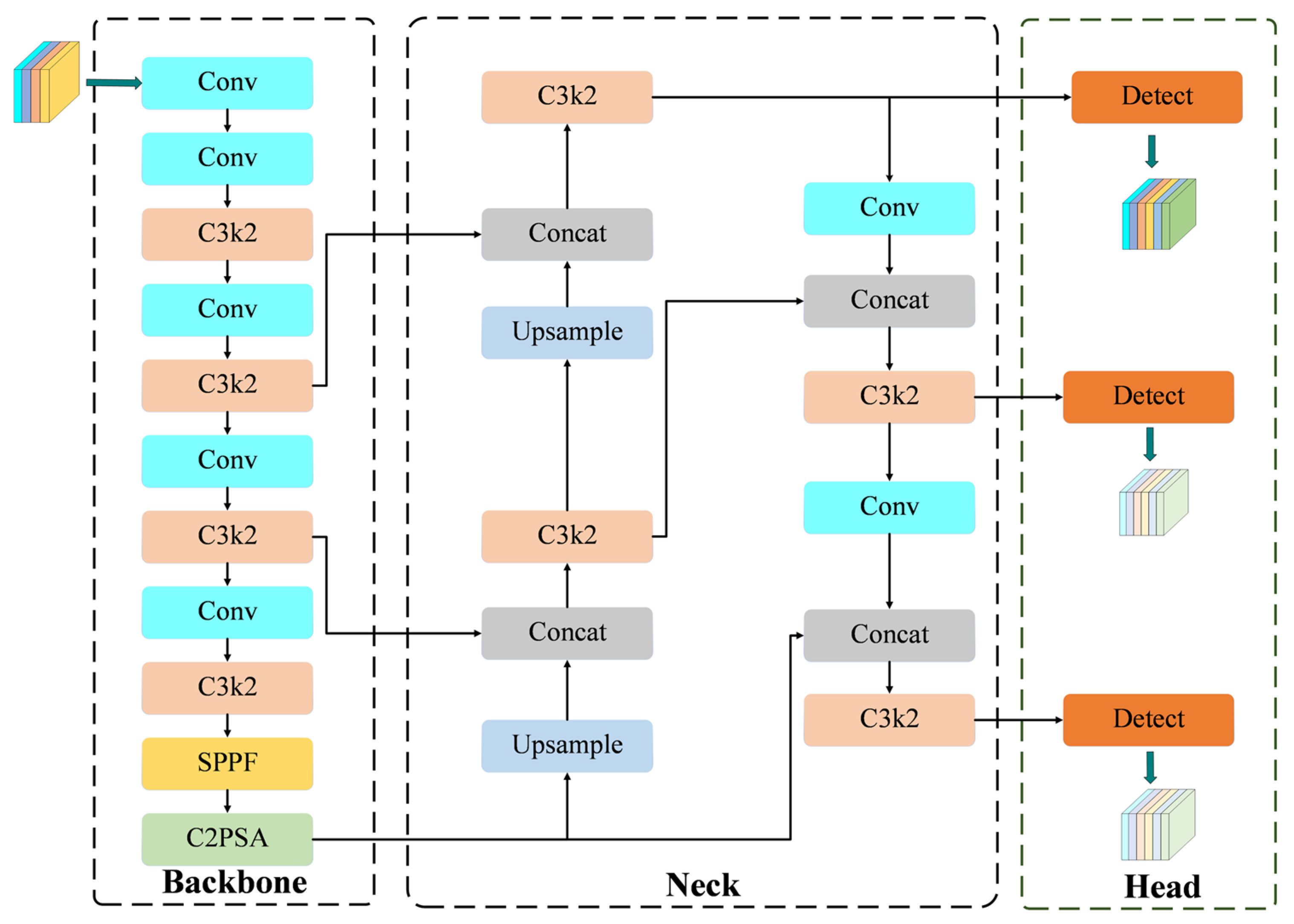
20]. YOLOv11n balances performance, cost, and speed, suiting resource-constrained edge devices, thus serving as the baseline, with its overarching architecture presented in
Figure 1.
The architecture comprises a backbone, neck, and detection head. The backbone integrates convolutions, C3k2 blocks, SPPF, and C2PSA. The C3k2 module succeeds YOLOv8’s C2f to improve feature extraction, while the post-SPPF C2PSA enhances representation via position-sensitive attention. The neck fuses P3/8, P4/16, and P5/32 scales via top-down FPN and bottom-up PAN using C3k2 blocks. The detection head employs an anchor-free decoupled layout for multi-scale end-to-end predictions.
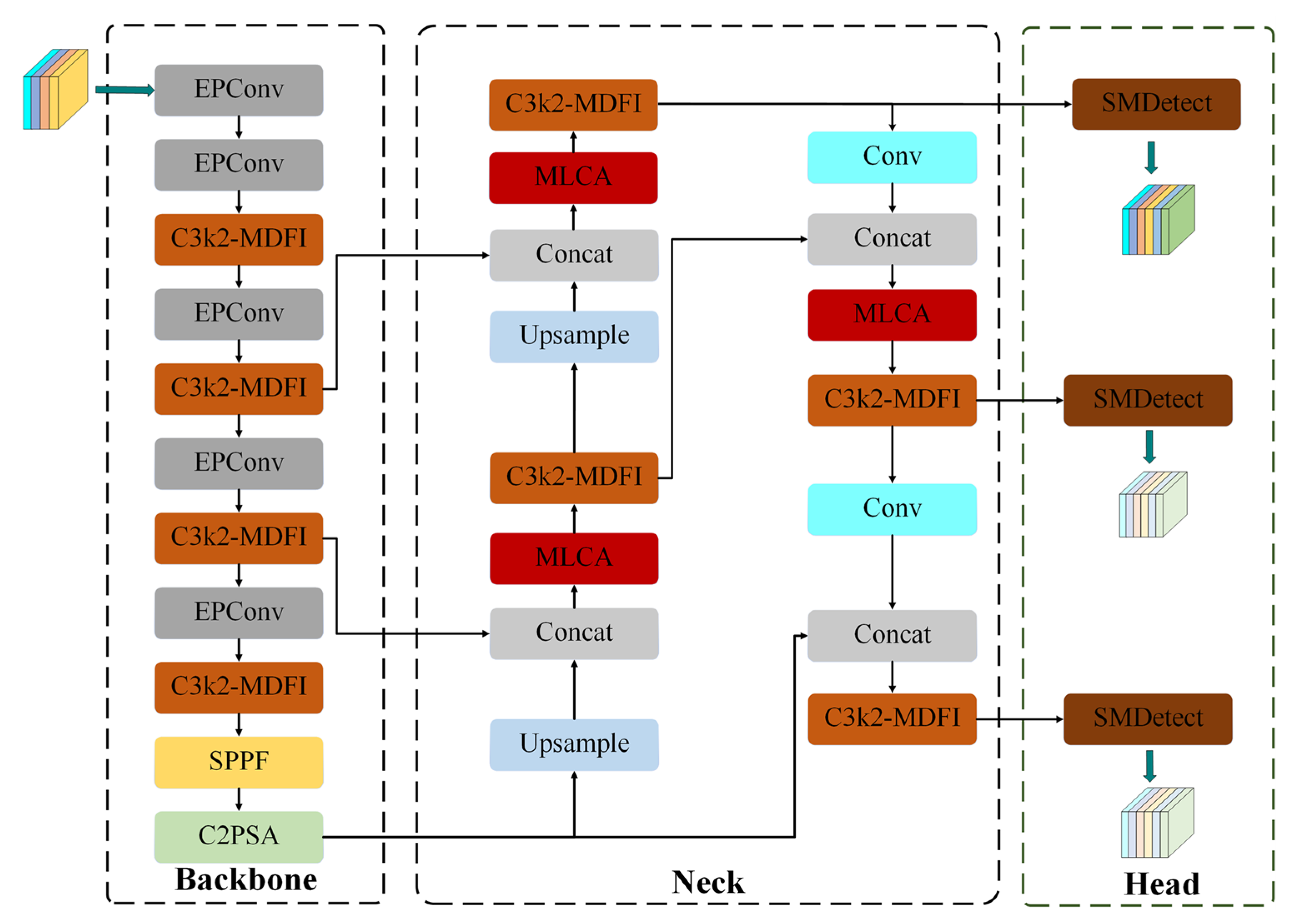
Based on YOLOv11n, four improvements are introduced into the backbone, neck, and detection head to enhance object detection under low-visibility conditions. First, EPConv is used to replace part of the standard convolutional operations in the backbone, thereby strengthening multi-directional feature extraction and improving the representation of blurred object boundaries. Second, the C3k2-MDFI module is constructed by embedding the proposed MDFI Blocks into the C3k2 structure, which improves the extraction of weak and small targets. Third, MLCA is embedded after neck feature fusion to enhance the interaction between local spatial features and global channel information. Finally, SMDetect is designed by introducing SimAM into the classification and regression branches of the detection head, improving the localization and confidence prediction of degraded targets. The overall architecture of DMSM-YOLO is shown in
Figure 2.
2.2. EPConv Design
Under low-visibility conditions, weather degradation such as fog, rain, and snow weakens object contours, reduces boundary contrast, and introduces direction-dependent interference. Conventional convolution samples features in a symmetric local window, which is effective for general texture extraction but is insufficient for modeling directional contour cues in degraded images. PConv [
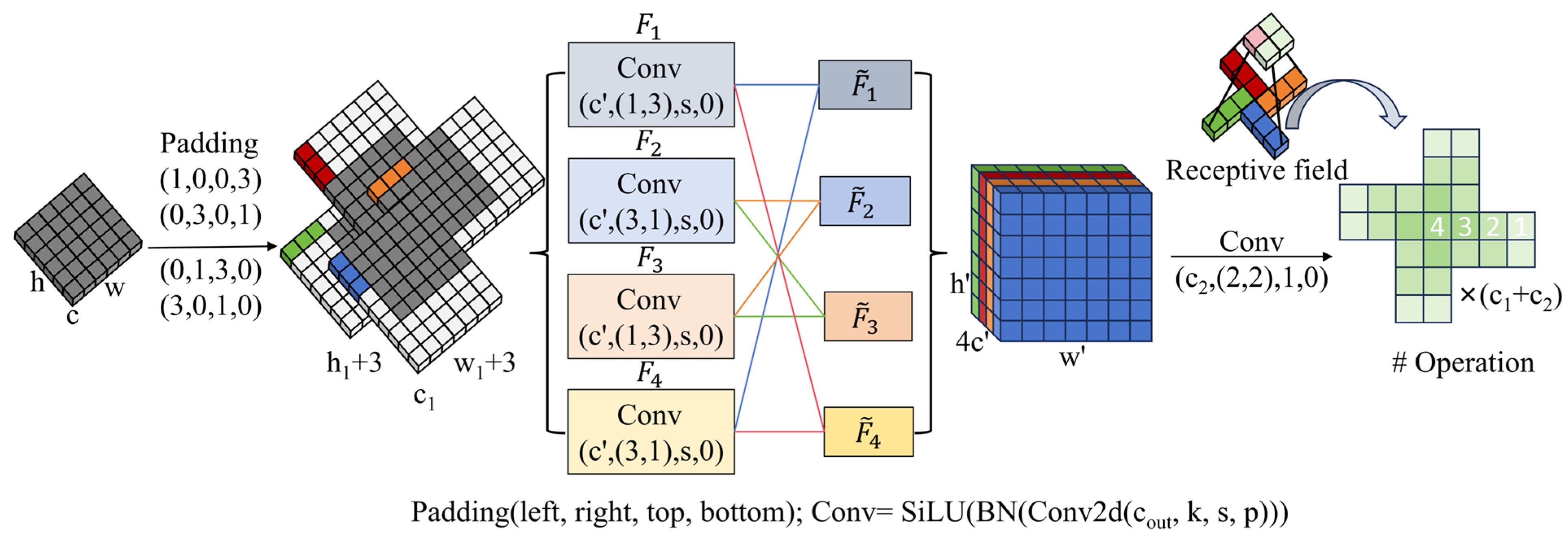
21] improves directional perception by using four asymmetric padding strategies to extract features from different spatial directions. However, the directional branches in the original PConv are processed independently and are fused only by channel concatenation. This independent-then-concatenate strategy limits information exchange among directional responses, especially when object boundaries are blurred or partially missing. To address this limitation, this study proposes Enhanced Pinwheel Convolution (EPConv), as shown in
Figure 3. Different from the original PConv, EPConv introduces a diagonal residual interaction strategy before channel concatenation. Specifically, the four directional branches are divided into two diagonal complementary pairs, namely branches (1, 4) and branches (2, 3). For each pair, the response of one branch is enhanced by a weighted residual response from its diagonal counterpart. In this way, weak directional features can be compensated by complementary diagonal information before final feature fusion.
The forward propagation of EPConv is formulated as follows:
where
X denotes the input feature map,
Pi represents the
i-th asymmetric directional branch, and
Fi is the corresponding directional feature. where
is the diagonal fusion weight, and
C denotes the channel fusion operation.
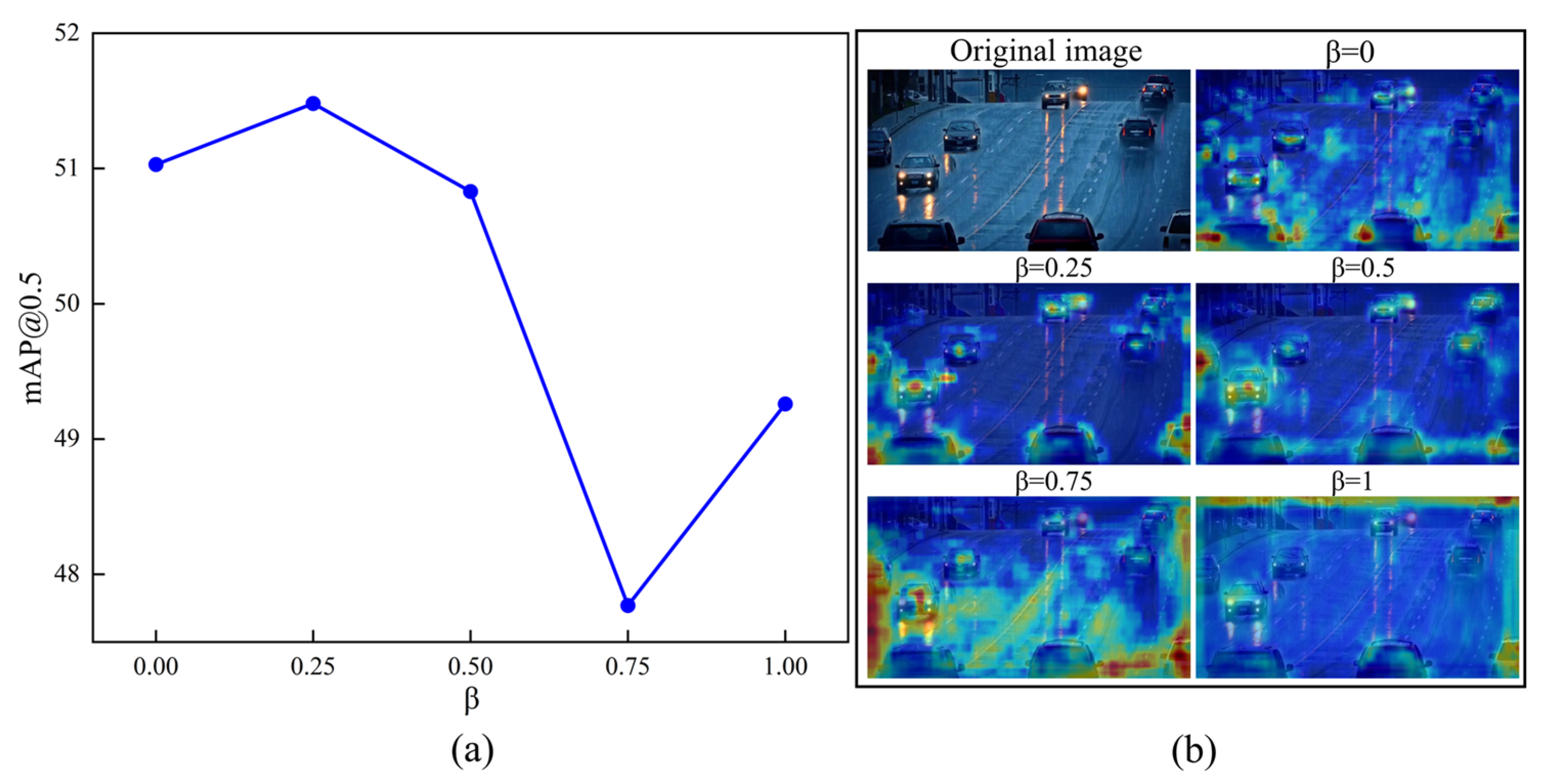
An appropriate value of β is expected to balance the preservation of directional feature specificity and the introduction of complementary diagonal information. When β = 0, no cross-branch compensation is performed, and the structure is equivalent to the original PConv. In contrast, an excessively large β may introduce excessive cross-branch information and weaken the original directional asymmetry. By enabling diagonal information compensation before feature fusion, EPConv reduces the loss of weak contour cues caused by independent branch extraction. This helps the backbone obtain more stable boundary-aware features for blurred, low-contrast, and partially occluded objects, while the fixed fusion weight keeps the module lightweight.
2.3. C3k2-MDFI Design
Under low-visibility conditions, object features are easily degraded by blurred contours, weak texture responses, reduced contrast, and scale variation. These degradation factors are more obvious for small, distant, and partially occluded objects, making it difficult for lightweight detectors to extract discriminative features. In YOLOv11n, C3k2 is used as an efficient feature extraction module to improve gradient flow and feature reuse. Its internal Bottleneck units can effectively extract local features under normal imaging conditions. However, in low-visibility scenes, object contours are often blurred, texture details are weakened, and targets show obvious scale variation.
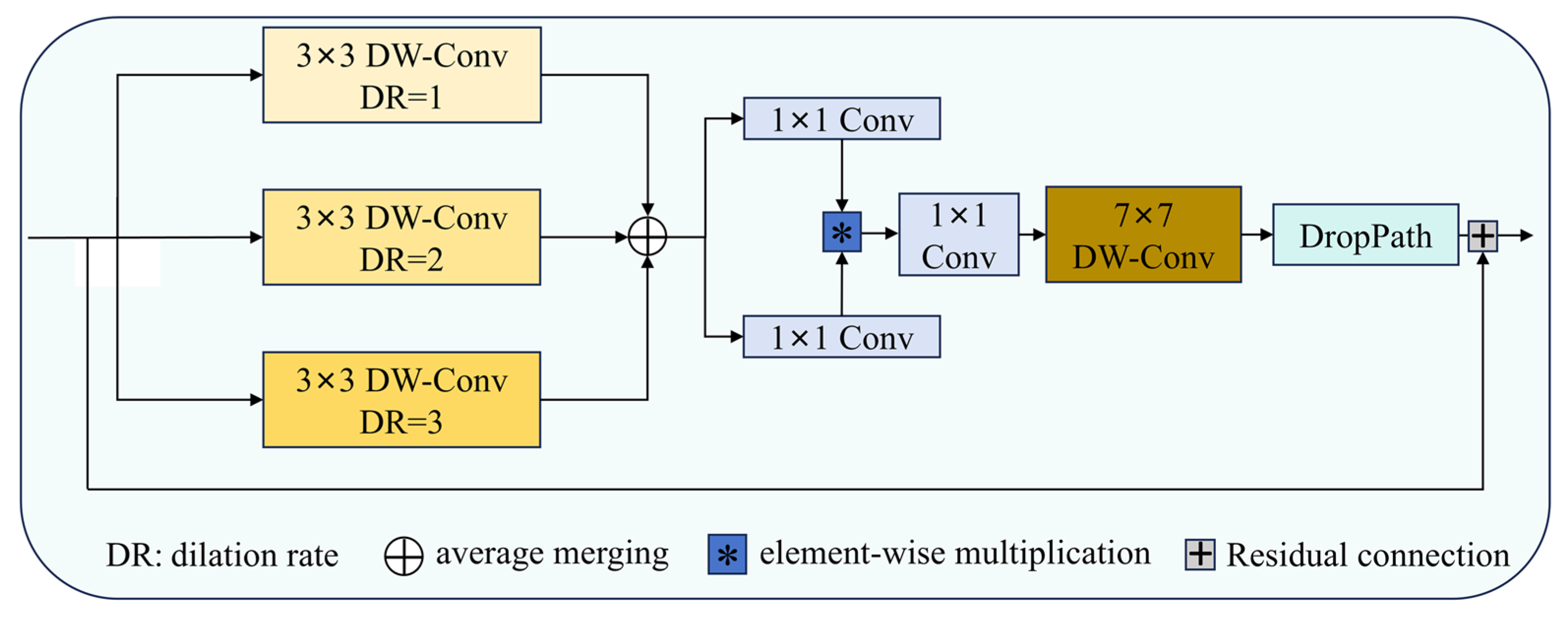
To overcome these limitations, this study proposes a Multi-scale Degradation-aware Feature Interaction (MDFI) Block. The internal structure of MDFI is shown in
Figure 4. MDFI first constructs a multi-scale degradation-aware spatial mapping to enhance its adaptability to degraded images. Specifically, three lightweight spatial branches with different dilation rates are used to capture contextual information from different receptive fields. The aggregated multi-scale features are then transformed into two independent feature mappings through lightweight channel mappings. Based on the multiplicative feature-interaction strategy [
22], the two feature mappings are further interacted in an element-wise manner to enhance nonlinear feature representation. After spatial refinement, a residual connection is introduced to preserve original feature information and stabilize feature propagation. The multi-scale mapping is defined as
where
X is the input feature map,
M(X) is the multi-scale aggregated feature, and
Ds(X) denotes the output of the
s-th spatial branch. The three branches adopt dilation rates of 1, 2, and 3, corresponding to effective receptive fields of 3 × 3, 5 × 5, and 7 × 7, respectively.
After multi-scale contextual aggregation, MDFI performs multiplicative nonlinear feature interaction:
where
U and
V are two independently mapped features,
F is the interacted feature, and
Y is the output of the MDFI Block.
P1,
P2, and
Po denote 1 × 1 convolutional layers,
is the ReLU activation function,
denotes element-wise multiplication, and T represents spatial contextual refinement comprising a 7 × 7 depthwise convolution and DropPath regularization.
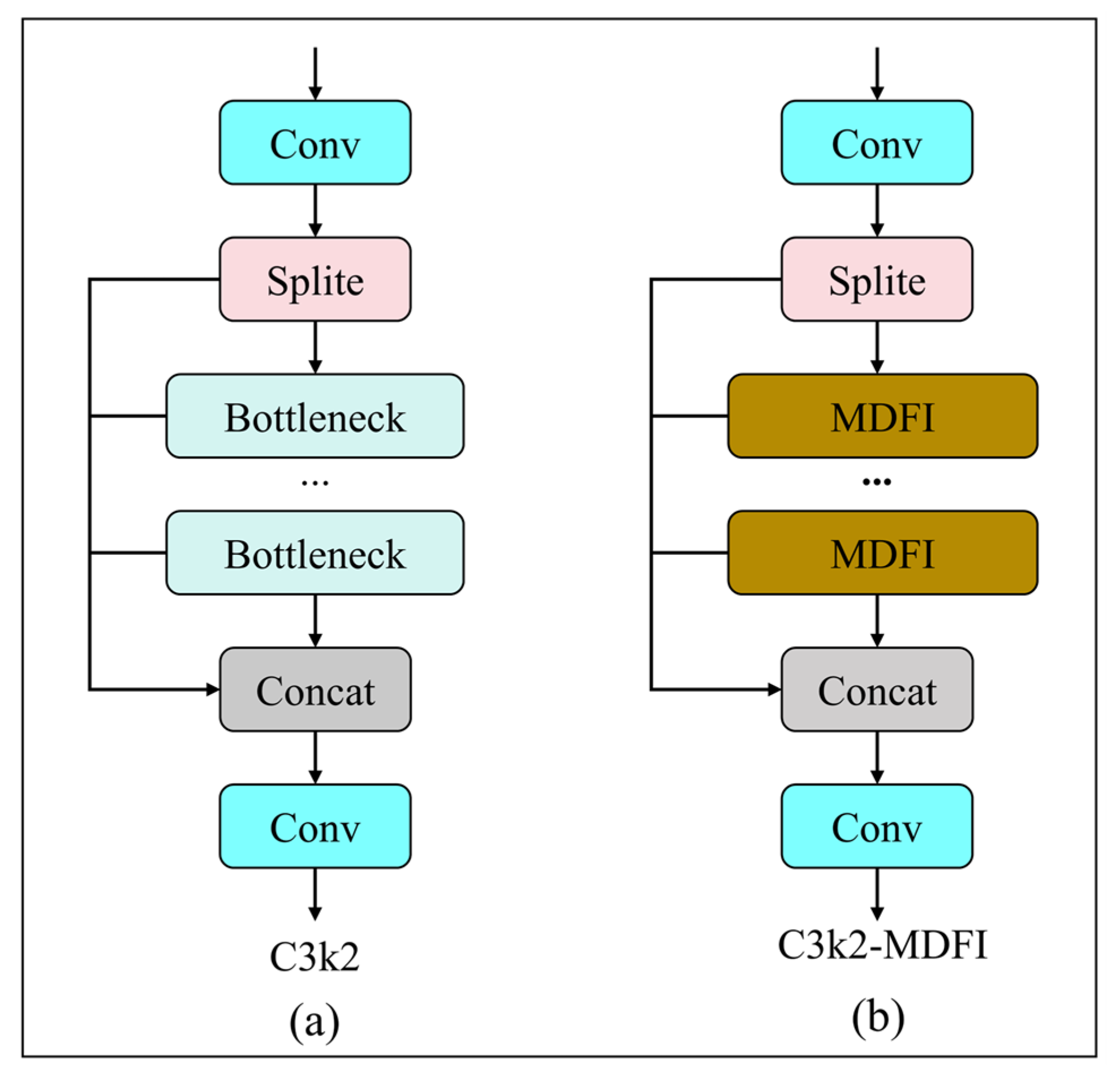
As shown in
Figure 5, the proposed C3k2-MDFI module is obtained by embedding MDFI Blocks into the original C3k2 structure. This design retains the efficient feature reuse framework of C3k2 while introducing multi-scale degradation-aware spatial modeling and nonlinear feature interaction. Compared with the original C3k2 module, C3k2-MDFI can better enhance weak-target features, low-contrast regions, and blurred object boundaries under low-visibility conditions. Meanwhile, the lightweight design of MDFI enables feature representation to be improved without significantly increasing model complexity.
2.4. MLCA Mechanism
Under low-visibility conditions, reduced contrast and weather-induced degradation weaken target responses and increase background interference. Although the neck network fuses multi-scale features, the fused features may still contain redundant background information in low-contrast regions. To improve feature discrimination after feature fusion, the Mixed Local Channel Attention (MLCA) module proposed by Wan et al. [
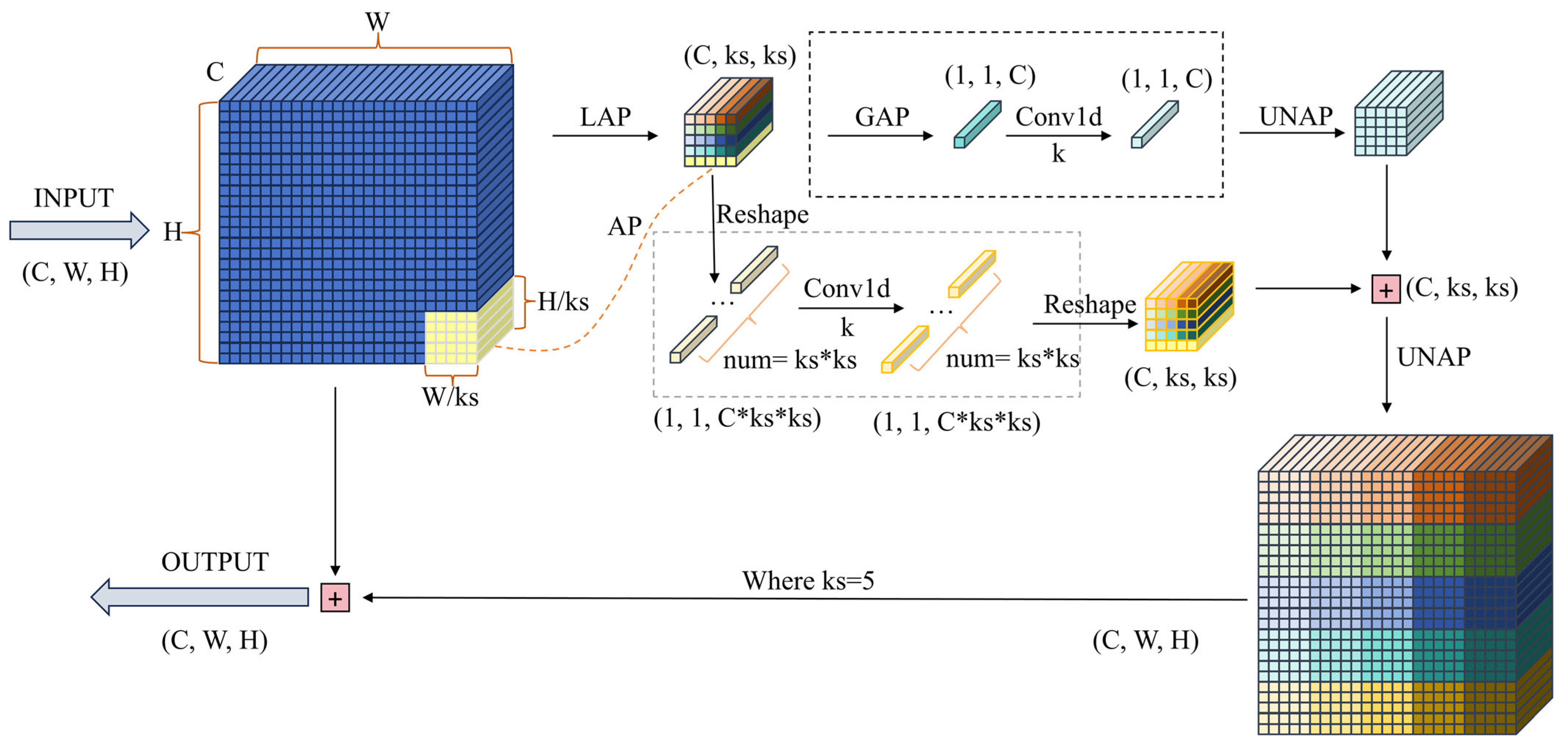
23] is introduced into the neck, as shown in
Figure 6. MLCA jointly models local spatial information and global channel context. It first obtains local descriptors through local average pooling and then extracts global descriptors from the local representation. One-dimensional convolution is used to model cross-channel interactions without dimensionality reduction.
In the proposed network architecture, the insertion locations of MLCA are strictly governed by the trade-off between spatial resolution and computational efficiency. Specifically, MLCA is explicitly positioned after the first three multi-scale feature-fusion operations in the neck. This strategic placement is driven by the fact that shallow and mid-level fusion maps retain rich, high-resolution spatial details, making the local-global attention calibration highly effective in recovering weak object responses against weather interference. Conversely, forcing MLCA into deeper fusion layers—where spatial resolution is highly compressed—yields marginal calibration benefits while introducing redundant computational overhead. This selective insertion scheme balances feature enhancement and computational overhead while preserving the lightweight characteristics of the model.
2.5. SMDetect
In low-visibility scenes, target textures are often weakened, object boundaries become blurred, and background noise may interfere with the final prediction. Although the original YOLOv11 detection head adopts a decoupled structure to separately perform classification and bounding box regression, the feature responses before prediction may still be insufficient for blurred, occluded, and low-contrast objects. This can reduce classification confidence and weaken localization accuracy.
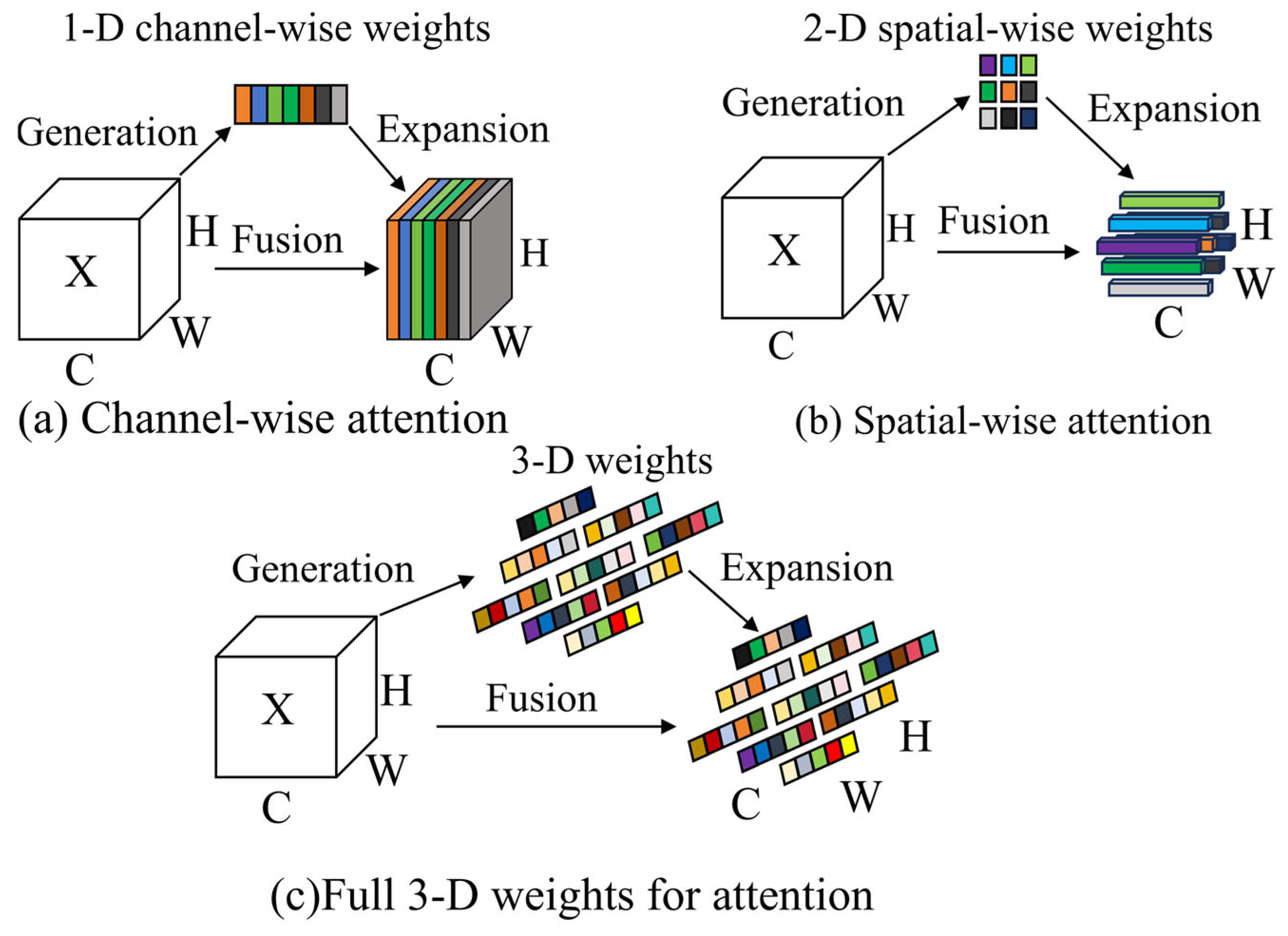
To enhance the prediction ability of the detection head under degraded imaging conditions, this study introduces the SimAM attention mechanism [
24], whose structure is shown in
Figure 7. SimAM is a parameter-free attention mechanism that estimates neuron importance through an energy function and generates three-dimensional attention weights without introducing additional learnable parameters. Its attention weight can be calculated as
where
X denotes the input feature map,
and
represent the mean and variance of the feature map, respectively,
is a smoothing coefficient, and
denotes the sigmoid activation function. The recalibrated feature is then obtained by
where
denotes element-wise multiplication.
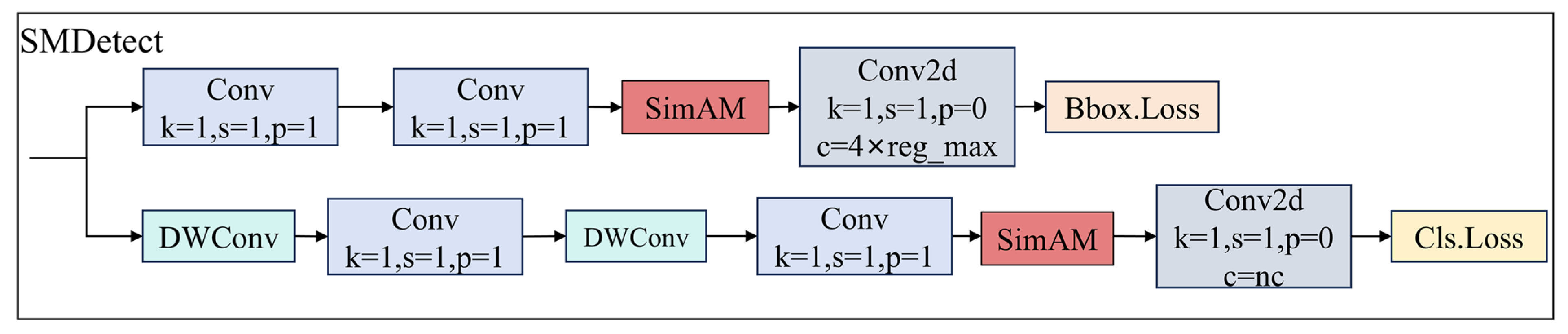
Based on SimAM, an improved detection head named SMDetect is designed by embedding SimAM into both the classification and regression branches, as shown in
Figure 8. In SMDetect, SimAM is placed after the feature convolution layers and before the final prediction convolution in both branches. In the regression branch, SimAM enhances boundary-related and localization-sensitive responses before bounding box prediction, which is beneficial for blurred and partially occluded objects. In the classification branch, SimAM strengthens discriminative target responses and suppresses background interference before category prediction, thereby improving confidence estimation for low-contrast objects. Since SimAM does not introduce additional learnable parameters, SMDetect improves the detection head’s feature recalibration ability while preserving the lightweight property of the model.