A Systematic Review of Hyper-Heuristics in Power System Optimization: Theory, Applications, and Future Directions

 ,
,  ,
,  ,
, 

Abstract
1. Introduction
- What specific types of power system optimization problems are currently being addressed using hyper-heuristics? Answering this question helps identify the current landscape and scope of hyper-heuristic applications across different power system tasks, such as unit commitment (UC), economic dispatch (ED), and optimal power flow (OPF), while highlighting critical research gaps where these adaptive algorithms have not yet been applied, or have been applied only to a limited extent.
- How do hyper-heuristics impact the optimization of power system performance, and how effective are they compared to conventional optimization techniques, standard metaheuristics, or other well-established intelligent methods in this domain? Answering this provides empirical evidence regarding the capability of hyper-heuristics to enhance baseline system performance. It also evaluates their robustness, efficiency, and algorithmic generality compared to traditional mathematical methods, modern metaheuristics, and other intelligent techniques when handling highly complex, nonlinear optimization problems.
2. Review Methodology
2.1. PRISMA Compliance and Protocol Registration
2.2. Search Strategy
2.3. Study Selection Process
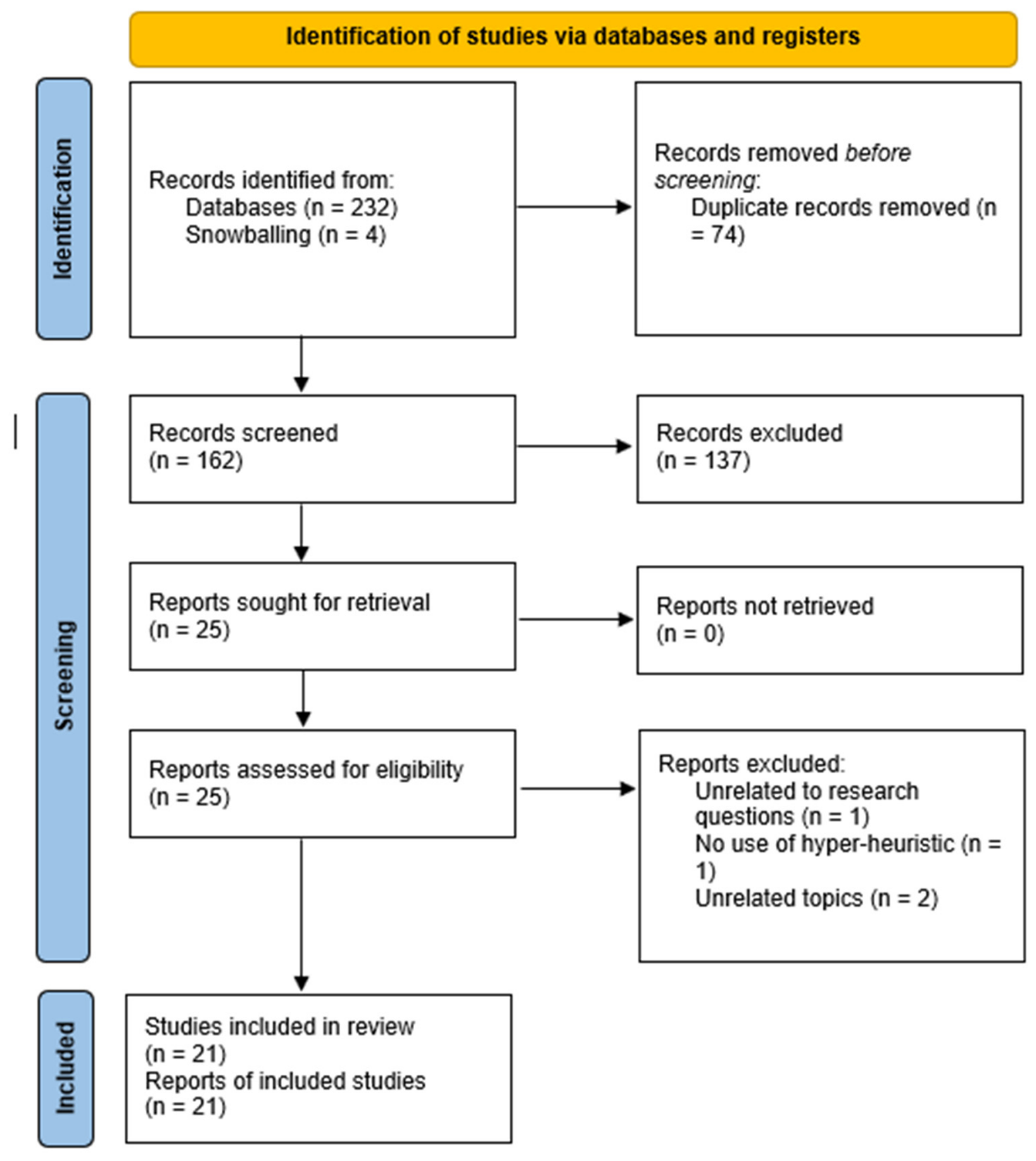
- Phase 1—Identification: Comprehensive search strings were executed across primary databases to identify relevant literature. To supplement the database searches, manual backward snowballing was applied to the reference lists of selected papers to reveal additional eligible studies. Duplicate records were then identified and removed to formulate the initial screening pool.
- Phase 2—Screening: Titles and abstracts were first evaluated according to the inclusion criteria. Subsequently, detailed full-text assessments for eligibility were performed on the retrieved reports using predetermined parameters.
- Phase 3—Inclusion: The final set of eligible papers was officially selected for the review. These included articles were then categorized into groups based on the objective function, decision variables, and the operational constraints characterizing each power system optimization problem.
2.4. Eligibility Criteria
- Availability: The complete text is available and can be downloaded.
- Language: The paper is published in English.
- Conceptual boundary and scope: The study must explicitly focus on applying a true hyper-heuristic methodology to a power system optimization problem. To satisfy this conceptual boundary [30], the algorithm must feature a high-level management mechanism operating over a search space of low-level heuristics rather than searching the solution space directly. Eligible studies include selection-based hyper-heuristics (combining high-level selection mechanisms such as reinforcement learning, choice functions, or metaheuristics with low-level heuristic pools) and generative hyper-heuristics (such as genetic programming automatically creating or evolving search operators). Conversely, standard metaheuristics, self-adaptive metaheuristics that merely adjust low-level numerical parameters (e.g., adaptive inertia weights or mutation rates without selecting/generating heuristics), and hybrid metaheuristics lacking high-level heuristic selection rules are strictly excluded.
- Peer review: The article is peer-reviewed.
2.5. Data Collection and Extraction
- Optimization problem characteristics: Objective functions and decision variables of the problem.
- Algorithmic characteristics: Hyper-heuristic’s high-level mechanism and low-level heuristics.
- Test system characteristics: Dimensions, scale, and specific configurations.
- Performance metrics: Solution effectiveness, robustness, and comparison results which are discussed throughout the text of the review.
2.6. Study Quality Assessment
- QA1 (Algorithmic reproducibility): Are the high-level hyper-heuristic mechanism, low-level heuristic pool, and control parameters explicitly specified?
- QA2 (Problem formulation clarity): Are the power system objective functions, decision variables, and operational constraints clearly defined?
- QA3 (Comparative rigor): Is the proposed algorithm evaluated against intelligent methods or conventional optimization techniques using clear performance metrics?
2.7. Data Synthesis
3. Background
4. Principles of Hyper-Heuristics
4.1. Hyper-Heuristic Architecture
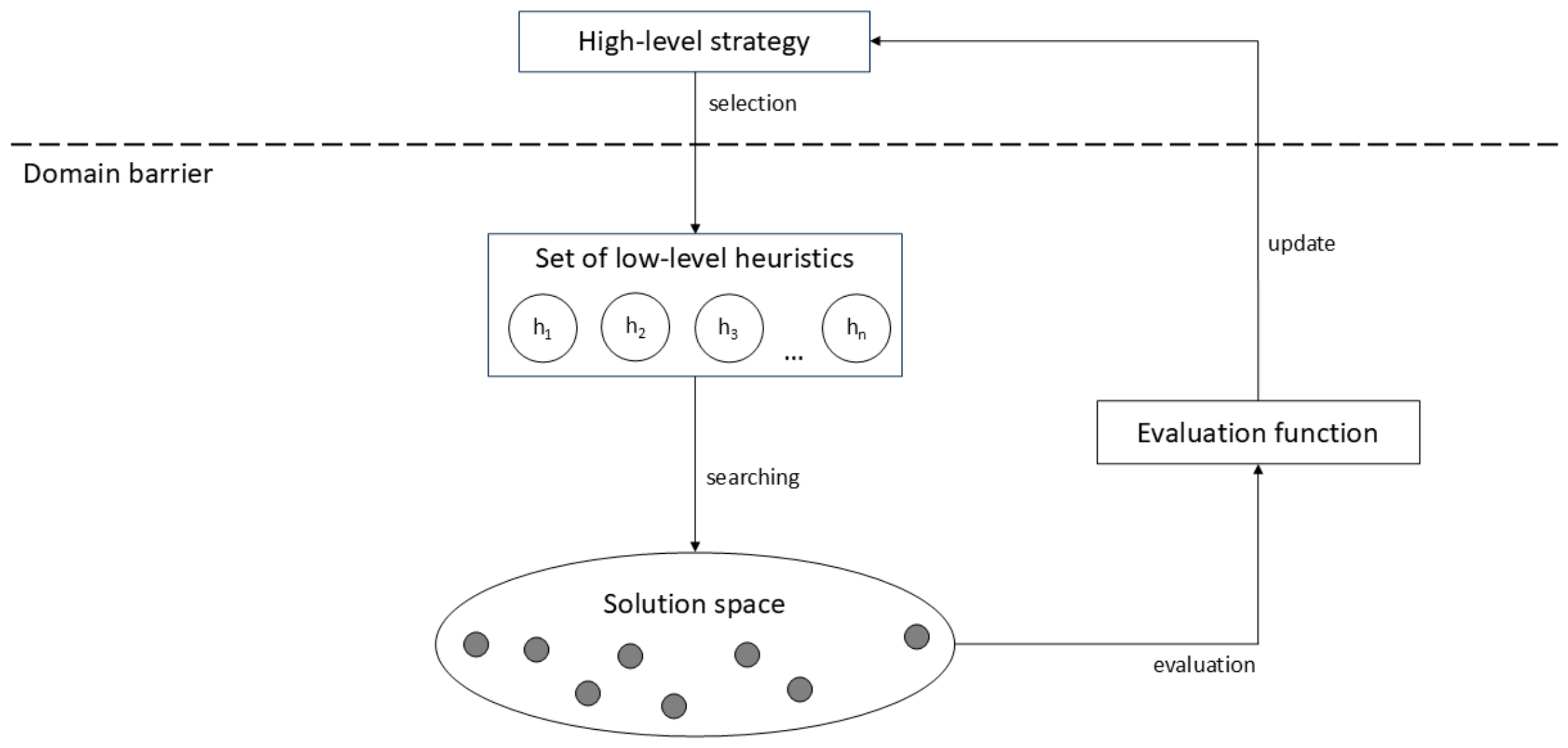
- High-level strategy (heuristic selection mechanism): This component acts as the supervisor, deciding which low-level heuristic to apply at each step of the search usually based on past performance, learning mechanisms, or other decision-making criteria.
- Low-level heuristics (heuristic pool): This set consists of domain-specific procedures that directly operate on problem solutions. The term “heuristic” is used generically and does not necessarily refer to a heuristic as conventionally defined. A low-level heuristic can range from a simple local search operator (such as a swap or insertion operator) to a complete optimization method (such as a metaheuristic).
4.2. Classification of Hyper-Heuristics
4.2.1. Nature of the Heuristic Space
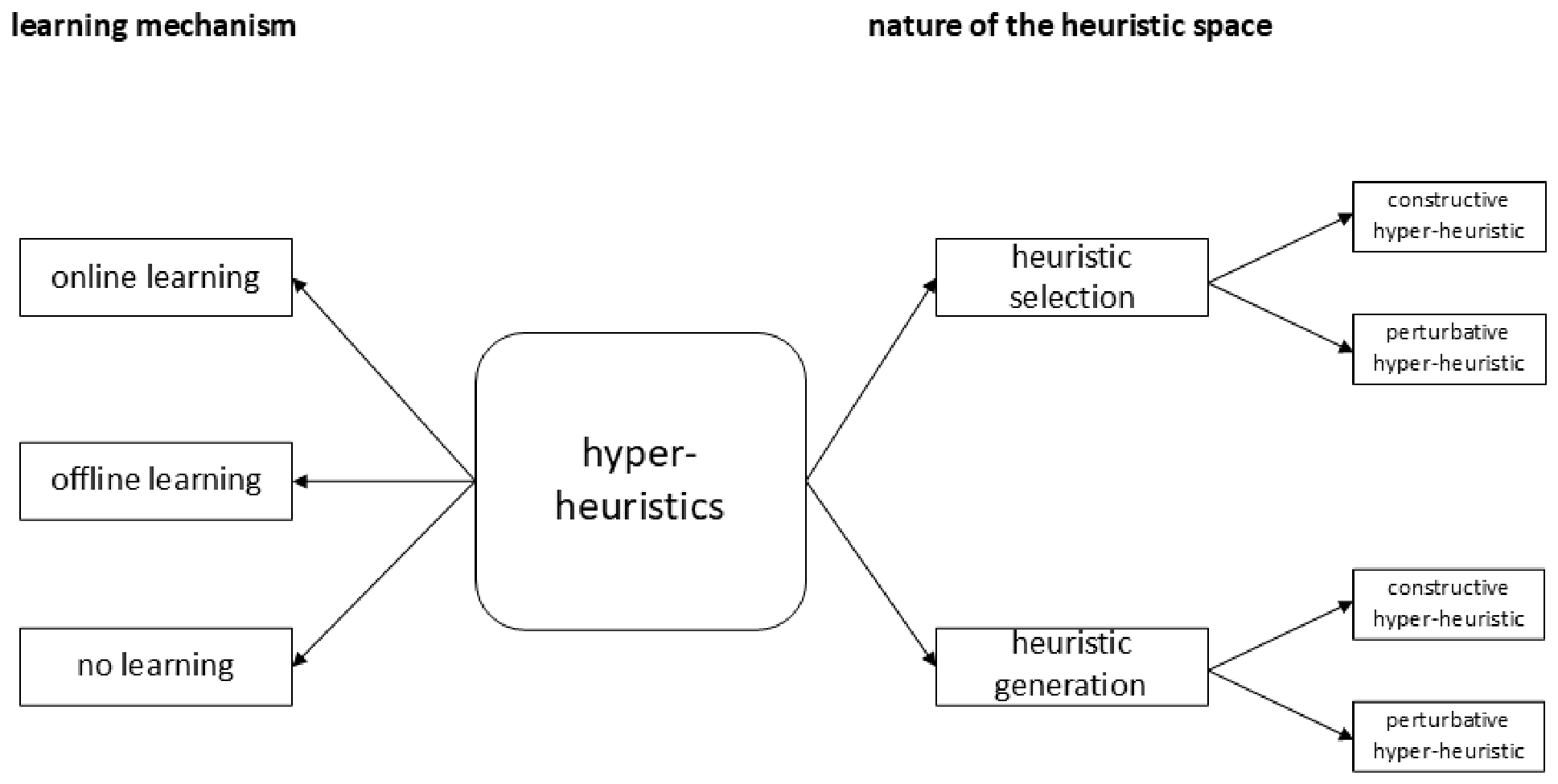
- Heuristic selection: Methodologies that choose from a predefined pool of existing low-level heuristics. In power system optimization, heuristic selection is commonly used, as many successful algorithms already exist for finding solutions in this field.
- Heuristic generation: Methodologies that generate new heuristics by combining or evolving existing algorithmic sub-components.
- Constructive methods: They start with empty or partial solutions and iteratively add components until a complete solution is built.
- Perturbative methods: They start with a complete existing solution and iteratively modify or improve it by making small, local changes.
4.2.2. Learning Mechanisms
- Online learning: Learning occurs dynamically during the problem-solving process. The high-level strategy uses real-time feedback from the current search process to reinforce successful heuristics and reduce the influence of the less effective ones.
- Offline learning: Learning is performed prior to problem-solving. The hyper-heuristic is trained on historical data or representative problem instances to develop general rules or strategies that are later applied to new instances without further learning.
4.3. Applications of Hyper-Heuristics
5. Hyper-Heuristics on Power System Optimization
5.1. Power System Operation
5.1.1. Unit Commitment
- Commitment decision: This is a binary decision which specifies for each generator at each time step (such as hourly over a 24-h period) whether it should operate or remain offline. This decision is significant since switching units on or off incurs substantial costs.
- Dispatch decision: Once the set of committed units is established for a specific time period, the ED problem is addressed to determine the optimal power output for each active unit. This sub-problem aims to minimize the operating costs of the active units while satisfying the system demand. ED can also be considered a standalone problem and it will be analyzed further in the next subsection.
- is the number of generating units.
- is the planning horizon.
- is commitment status with binary values 0 (unit is off) and 1 (unit is on)
- is the power output from generator at hour .
- is the production (or fuel) cost which is usually computed by the quadratic expression where the , are the fuel coefficients of the -th generating unit.
- is the start-up cost which corresponds to the fuel consumed when a unit starts up before becoming fully operational. It shows exponential behavior based on how long the unit had been offline. However, it is often approximated by a stepwise linear function.
- is the shut-down cost which is incurred when a thermal unit is shut down. It is typically represented as a fixed cost.
- is the maintenance cost. It is the additional operational cost that arises when a thermal unit operates for extended periods. It is typically expressed as a linear function of the unit’s power output. For simplicity, maintenance costs are often embedded within the total production cost.
- is the financial penalty associated with pollutant emissions, and it follows a quadratic curve multiplied by the emission tax rate.
- Load demand constraint: The total power generated by all committed units must meet the forecasted electricity demand for every time period. It is represented by the following linear equation with continuous variables:
- Generation capacity limits: The power output of each generator must be within its specified minimum and maximum operating limits. Linear inequalities are used with discrete and continuous variables:
- Reserve constraint: The system must provide extra available generation capacity reserved for unexpected events and sudden changes. It is a linear inequality involving both continuous and binary variables.
- Ramp rate limits: The change in power output of a thermal unit between consecutive time periods does not exceed its technical ramp-up or ramp-down limits. These constraints are linear and involve continuous variables.
- Minimum up/down time constraints: A generating unit must remain on or off for at least its specified minimum up or down time. These constraints are expressed using linear equations with binary variables.
- Offline learning phase: Eight training environments are created by adding random noise to the demand and reserve data from the system dataset. Then, a population-based incremental learning (PBIL) algorithm runs on the environments to learn a set of optimal probability vectors, which are stored for later use.
- Online learning phase: A dual-population approach is used. The first sub-population is sampled using the PBIL approach, while the second sub-population is sampled using a probability vector selected by a selection hyper-heuristic from the list of probability vectors learned offline. The following selection methods are tested: SR, RD, RP, RPD, reinforcement learning (RL), and ant-based selection (AbS). The hyper-heuristic does not employ a move acceptance criterion, which is equivalent to an accept AM strategy.
5.1.2. Economic Dispatch
- is the total generating cost.
- is the active power output of the -th generator.
- , , are the fuel cost coefficients.
- Power balance constraint: The total power generated by all units must be equal to the total power demand plus the total power losses in the transmission network. This is the single equality constraint and the most crucial one, as any imbalance can cause instability or a blackout. It is described by the following equation:where is the total system load and are the total transmission losses.
- Generation capacity limits: Each generator must operate within its minimum and maximum power output limits. This can be expressed mathematically as:
- Ramp rate limits: The change in power output between two consecutive dispatch intervals must not exceed specified limits for each generator.
- Prohibited operating zones: Certain generators are not allowed to operate within specific ranges of power output due to technical or operational restrictions.
- Spinning reserve requirements: Connected generators are required to hold a portion of their available capacity unutilized as backup to ensure extra power is immediately available during sudden generator outages or load spikes.
- Multi-objective environmental/economic dispatch: The earliest attempt reported in the literature where a hyper-heuristic is applied to solve a variation in ED appears in [66], namely the environmental/economic dispatch (EED). Unlike the single-objective ED problem, which typically focuses solely on minimizing total fuel cost, the EED problem is formulated as a nonlinear constrained multi-objective optimization model. It addresses the simultaneous minimization of two conflicting objectives: total fuel cost and pollutant emissions, thereby requiring a trade-off between economic and environmental performance. In the paper, the conventional polynomial fuel cost function is augmented with a sinusoidal term to account for the valve-point effect, as shown below:
- 2.
- Large-scale economic load dispatch: A hyper-heuristic for handling large-scale economic load dispatch (ELD) models (an alternative name for ED) is presented in [67]. Large-scale ELD models are characterized by a higher number of generating units (typically more than 40) and involve more complex operational constraints, making them considerably more challenging to solve than lower-dimensional ELD problems. In this study, in addition to the two basic constraints, ramp rate limits and prohibited operating zones are also taken into account. The proposed method, called hyper-heuristic large-scale global optimization (HH-LSGO), is based on the island model concept. It operates by managing five basic LSGO heuristics—random dynamic grouping, differential grouping, delta grouping, EDA-GA, and adaptive variable-size random grouping (AVS-RG)—which are responsible for problem decomposition. Each of these heuristics is paired with its own evolutionary algorithm on a separate “island”. HH-LSGO performs an online selection process where the performance of each “island” is evaluated. The hyper-heuristic then increases the population size of the most efficient islands and reduces the size of the less efficient ones, synthesizing an effective optimization algorithm during the problem-solving process. The approach is applied to a real-world ELD problem with 140 generators. HH-LSGO does not improve upon GA with multi-parent crossover (GA-MPC) and self-adaptive multi-operator DE (SAMODE) when looking strictly at the absolute lowest-cost schedule found in any single run. Proposed method is slightly outperformed by the competitors, but its strength lies in providing a much more stable and better average performance.
- 3.
- Dynamic economic and environmental load dispatch (DEED): In [68], the authors propose a selection hyper-heuristic algorithm (SHHA) for solving the dynamic economic and environmental load dispatch (DEED) problem, which extends the static EED by considering multiple time periods. The DEED model in the study includes not only conventional thermal generators but also wind generators, photovoltaic generators, and energy storage. Beyond the two basic constraints, the model incorporates further operational constraints, including ramp rate limits, spinning reserve requirements, and energy storage state of charge (SOC) bounds. The low-level structure of the proposed method consists of three mutation operators—one derived from a genetic algorithm and two derived from differential evolution. The high-level structure manages the low-level operators by evaluating their performance and dynamically adjusting the probability of choosing each one. This is achieved using an evaluation strategy based on a sliding time window and a selection mechanism that employs the roulette method. The proposed SHHA is applied to four different power systems. The first two systems are classical models with 5 and 10 thermal units. The third system is a more complex IEEE 57-bus system that incorporates 7 thermal units, 3 wind generators, and 2 photovoltaic generators, while the fourth system adds energy storage to the components of the third case. The results show that the proposed selection hyper-heuristic is effective, outperforming other methods while also demonstrating fast convergence and greater robustness. In terms of computational execution speed, the proposed SHHA outpaces all other compared multi-objective methods and is slower than only two simpler, single-objective algorithms.
5.1.3. Optimal Power Flow
- Total generation cost: Similar to the previous problems, this is the most common objective. It typically involves a sum of the quadratic cost functions of all generators, but more complex functions can also be used.
- Total power loss: It is the sum of the power losses of all transmission lines, and it is formulated as a nonlinear function of the voltage magnitudes and angles, which are the state variables of the power system:where is the number of buses; is the conductance of the line connecting bus and ; and are the voltage magnitudes at bus and ; and are the voltage angles at buses and .
- Total voltage deviation: It attempts to keep bus voltages as close as possible to their nominal values, which improves system stability and quality. It is formulated as the sum of either the absolute or the squared difference between the actual voltage magnitudes at each bus and their reference values:where is the target nominal voltage magnitude (usually set to 1.0 per unit).
- Pollutant emissions: It is the total amount of pollutants released from power generators. Similar to the cost function, the most common form of the emission objective function is a sum of quadratic functions, but more complex expressions may be employed.
- Active and reactive power balance: At each bus in a power system, the difference between the active power generation and the active power load must equal the sum of active power flows to neighboring buses, as determined by the network power flow equations. These equations are nonlinear and depend on the voltage magnitudes and phase angles at the buses. The reactive power balance follows the same principle as active power balance. Both are expressed as follows:where , are the active and reactive power generation respectively at bus ; , are the active and reactive load demand at bus ; and are the conductance and susceptance between buses and .
- Generator active and reactive power limits: Each generator’s active and reactive power outputs must be within their minimum and maximum limits.
- Bus voltage magnitude limits: The voltage magnitude at every bus must be kept within an accepted range to ensure power quality and system stability.
- Transformer tap ratio limits: Tap changers on transformers can only be adjusted within their physical limits.
- Transmission line limits: The power flow on each transmission line must not exceed its thermal capacity to prevent overheating and potential damage. This is often expressed as an upper limit on the apparent power flowing through the line.
- Shunt compensator limits: The reactive power injected or absorbed by devices like capacitor banks and reactors must remain within the specified limits.
- Q-learning (QL): Utilizes a “Ql-bench” RL schema to select low-level algorithms based on Q-values updated dynamically with rewards or penalties from historical search performance.
- Hyper-heuristic (H): Updates the selection probabilities of the low-level algorithms based on their recent search success, measured by an “enhancement” metric that tracks solution improvements, and applies a cumulative probabilistic selector to choose the active operator.
- Random: Selects a low-level heuristic randomly.
- Sequential (seq): Selects the low-level heuristic in a predefined, fixed sequence.
- For continuous variables (generator terminal voltage), the heuristics are a bird foraging search, random variation, and an animal-inspired odor concentration strategy.
- For discrete variables (taps of the on-load regulator transformer and the reactive power compensation device), the heuristics are a single-point crossover, a two-point crossover, and a partial fragment inversion strategy (noted as “reversal of footage” in the paper’s flowchart).
5.2. Specialized Sub-Domains
5.2.1. Discharge Scheduling of Energy Storage Systems
- is the total energy consumption from the utility grid,
- is the load demand at time ,
- is the renewable energy generation at time ,
- is the power discharged by the battery to supply to the MG during period . Battery can be discharged in a period , if .
- stands for the power used to charge the battery. In a specific period when battery is charged with a power .
- accounts for the excess generation that occurs when the battery has almost reached its full capacity.
- Interconnection assumption: The study assumes that power cannot be exported back to the utility grid.
- Grid dependency assumption: It is also assumed that which means that total energy demand over the entire period is greater than the total renewable energy produced. This constraint ensures that the system requires energy from the utility grid.
- Discharge limit: The maximum power that can be extracted from the battery during period is given by . It should be noted that discharging at the full level is not the optimal energy management strategy.
- Energy storage limit: The battery is not charged once it reaches its SOC and is near its full capacity.
- : Discharges (no discharge)
- to : Represent decreasing discharge percentages in 4% increments (, , …, ).
5.2.2. Demand Side Management of Plug-In Electric Vehicles
- Total cost (): The raw electricity generation costs and the costs associated with implementing the DSM program (where saving a unit of electricity is mathematically treated as equivalent to generation):
- Total greenhouse gas emissions (): Emissions from all active generator options:where is the set of generators within the smart grid, is the set of PEVs, is the electricity generation cost of resource when used by the -th PEV, is the optimal amount of energy from the -th resource option for -th PEV, is the optimal amount of energy saved for the -th PEV through the implemented DSM program, is the electricity saving cost using the implemented DSM program for -th PEV and is the greenhouse gas emissions of the -th generator associated with the grid.
- Demand satisfaction: The sum of physical energy provided by all generators plus the shifted energy savings must meet the vehicle’s total demand as described below.
- Generation source capacity: To guarantee physical feasibility, the total electricity drawn from any individual generation resource by all connected vehicles cannot exceed its physical supply capacity (:where is the conversion efficiency associated with the -th resource option for the -th vehicle
- Saving limits: The optimal energy savings for each vehicle must fall within a minimum required target saving and a realistic maximum limit (
- A decentralized multi-agent system: This component is controlled by a market-based agent architecture where decisions are made through competitive bidding over 48 half-hourly trading periods. The architecture consists of several agents. PEV (consumer) agents optimize energy consumption for individual vehicles to maximize savings and user comfort. Source agents provide availability and pricing pairs for renewable energy resources. These interactions are coordinated by the auctioneer agent, which aggregates supply and demand data to determine a global equilibrium price. Finally, the optimizing agent executes the hyper-heuristic algorithm and communicates the resulting schedules to the various PEV agents. The optimization process occurs within the DSM Window, the idle timeframe between a vehicle completing its charge and its disconnection time. Within this window, the optimizing agent iteratively shifts charging blocks in 30-min intervals to identify the best charging schedule.
- A centralized multi-objective hyper-heuristic optimizer: The core of this component is a tabu search-based roulette wheel multi-objective hyper-heuristic. High-level strategy consists of a choice function that adaptively ranks the performance of three low-level heuristics which are not described in the paper. If a selected heuristic improves the objective value its rank is increased. If it fails to improve the solution, the rank is decreased. A tabu list acts as short-term memory that prevents heuristics with low performance from being chosen very soon. Since the problem is multi-objective, the performance of each heuristic is evaluated with respect to individual objectives (cost and emissions). At each iteration, a roulette wheel selection is used to choose which individual objective to focus on. This selection depends on how far an objective is from its ideal optimal value. Finally, the framework employs the AM acceptance strategy.
5.2.3. Reliability Optimization in Distribution Systems
- System average interruption frequency index (SAIFI): Evaluates how often the average customer loses power per year and is calculated as:where is the number of customers experiencing a supply interruption and is the total number of customers in the system.
- System average interruption duration index (SAIDI): Evaluates the total annual time (in hours per year) that an average customer is without power and is calculated as:where is the interruption time of failure event .
- Momentary average interruption frequency index (MAIFI): Tracks the average frequency of short-lived or momentary supply flickers and is calculated as:where is number of momentary customer supply interruptions.
- Expected energy not supplied (EENS): Measures the total amount of energy that fails to reach the system’s nodes due to interruptions, calculated as:where is the expected power demanded at node , is the time the node is interrupted and is the total number of system nodes.
- Total annual cost (TAC): Evaluates the annual investment and maintenance cost for the protection hardware, calculated as:where is annual cost of sectioning/protection equipment and is the annual cost for operation and maintenance for this equipment.
5.2.4. Controller Design
5.2.5. Power Forecasting
- Simple exponential smoothing (SES): This model is designed for data without trends or seasonal changes. It assigns higher weights to recent data points and lower weights to older ones, balancing them with a smoothing coefficient . The basic formula of SES is:where is the forecasted electricity consumption value for time , is the actual observed electricity consumption value at time , is the forecast at time , and is the smoothing coefficient from 0 to 1 to balance the weights between new and old data.
- Double exponential smoothing (DES): It is suitable for data with trends but without seasonal variations. DES consists of two main components: the level and the trend as described by the following equations:where is the smoothed level value at time , is the smoothed trend value at time , is the actual observed value at time , is the forecast value at time , and are smoothing coefficients, both ranging from 0 to 1 for level and trend smoothing, respectively.
- Holt-Winters model: It is used for data that contain both trends and seasonal variations and it is formulated as follows:where is the smoothed level value at time , is the smoothed trend value at time , is the smoothed seasonal value at time , is the actual observed value at time , is the forecast value at time . , and γ are smoothing coefficients ranging from 0 to 1, and is the length of the seasonal period.
- Weight moving averaging (WMA): It assigns specific weights to different historical periods, with more recent observations typically given higher weights. This model is mathematically formulated as follows:where is the weighted moving average at time , is the actual observed value at time , is the weight assigned to the observed value and is the number of periods used in the calculation.
- Auto regression (AR): It predicts future values of a variable using previous values known as lags. This model is effective when there is a strong correlation between past and presents values. The general form of this model is based on a linear expression as presented below:where is the number of lags incorporated, is an optional constant term, are the coefficients of the model and represents an error term.
- Long short-term memory (LSTM): It is a specialized architecture within recurrent neural networks (RNNs) specifically designed to process sequential data and overcome the limitations of traditional RNNs. It is highly effective at capturing long-term dependencies, making it valuable for tasks like time series forecasting, language modeling, and sequence prediction. To manage the flow of information, the LSTM uses a system of gates, specifically an input gate, a forget gate and an output gate. This gating mechanism acts as a filter that allows the network to selectively retain important past data and remove irrelevant information, enabling it to learn complex temporal relationships. During its training process, the LSTM continuously updates its internal parameters to improve its accuracy. Compared to previous models, LSTM uses significantly more complex equations which are described in [84]. The equation that dictates how the model updates its weights is:where W represents the weight parameter, is the learning rate which controls how much the weights are adjusted and is the gradient of the loss function with respect to that weight parameter.
5.3. Wind Farm Layout Optimization
5.3.1. Multi-Objective Wind Farm Layout Optimization
- Inverse of energy production (): It is the total expected annual energy production () by minimizing its reciprocal. The total energy production is calculated by combining the Park model and a sigmoid power curve to incorporate the efficiency losses caused by the wake effect.
- Minimum spanning tree (MST): It is the total cable length required to connect all turbines to each other, calculated using Prim’s MST algorithm.
- A: It is the used land area of the farm determined by the convex hull of all turbine locations which are computed using Graham’s Algorithm
- Wind farm boundary constraint: No turbine can be placed outside the given wind farm area.
- Minimum spacing constraint: The distance between any two turbines cannot be smaller than eight times the rotor radius.
5.3.2. Optimal Wind Turbine Placement
5.3.3. Discrete Wind Farm Layout Optimization
5.3.4. Simultaneous Optimization of Turbine Placement and Cable Routing Within Offshore Wind Farms
- Turbine placement problem: It aims to determine the optimal locations for turbines on a grid to maximize total power production. This process focuses heavily on the reduction in the wake effect, which occurs when upwind turbines disrupt wind flow and reduce the energy available to those downstream. Additionally, the placement must maintain a minimum separation distance between turbines.
- Cable routing problem: It involves finding the optimal power routing between turbines and the substation. This can be achieved by selecting the correct cable type, minimizing the power losses to resistivity in cables and minimizing the cost of cabling.
6. Discussion
6.1. Architectural Characteristics and Literature Gaps
- Constraint handling complexity: Power system optimization problems are governed by highly non-linear equality constraints (e.g., active and reactive balance equations) and strict operational inequality limits (e.g., generator ramp rates and voltage bounds). Automatically generating new operators that reliably maintain solution feasibility while exploring such constrained landscapes presents extreme algorithmic complexity.
- Early-stage adoption: Given the nascent state of hyper-heuristics in power system engineering, researchers have prioritized selection frameworks that readily leverage established heuristics rather than generating new operators from scratch.
6.2. Quantitative Bibliometric Analysis
- Temporal evolution and accelerating output: Publication activity has risen significantly over the last 15 years. After a pioneering foundational phase from 2010 to 2012, output has surged, peaking in 2023–2025 (holding 28.6% of all reviewed literature). This temporal trend indicates a highly active, expanding, and mature field that has shifted from basic single-objective models to self-adaptive and auto-evolutionary systems.
- Application frequency: The quantitative distribution of the reviewed literature reveals that traditional power system optimization remains the dominant application domain, accounting for over half of the corpus (52.38%, 11 papers). Specialized sub-domains represent the second most frequent category (28.57%, six papers) which extends hyper-heuristics into renewable/load forecasting, microgrid control and energy storage scheduling, decentralized demand-side management of PEVs and medium-voltage grid reliability. Lastly, WFLO and cabling problems constitute a highly specialized spatial-routing category 19.05.% demonstrating how hyper-heuristic search operators can be effectively tailored to complex geometric and wake-deficit constraints.
- Selection heuristics (high-level): The taxonomical distribution of high-level selection mechanisms across the reviewed literature reveals a clear divergence between non-learning baseline strategies, parameter-tuning metaheuristics, and advanced cognitive learning-based selectors. Random and permutation-based rules form the largest share (28.57%, 6 papers), bypassing active online tracking to minimize selection latency in tightly constrained scheduling and continuous OPF search spaces. High-level metaheuristics (23.81%, 5 papers) and score-based choice functions (23.81%, 5 papers) are equally prominent; the former utilize evolutionary algorithms to adaptively self-adapt population configurations offline, while the latter track real-time performance indicators to reward active operators online. The remaining portion of the corpus leverages advanced learning-based architectures, including reinforcement/Q-learning vector updates (9.52%, 2 papers), Thompson sampling (4.76%, 1 paper), back-propagation neural networks (4.76%, 1 paper), and sequence-based switching (4.76%, 1 paper), demonstrating a clear research progression toward highly cognitive and real-time adaptive grid coordination.
6.3. Cross Study Synthesis
6.3.1. Solution Quality
6.3.2. Convergence Behavior and Stagnation Avoidance
6.3.3. Computational Complexity
6.3.4. Scalability to Large-Scale Power Systems
6.3.5. Statistical Stability and Operational Robustness
6.4. Evaluation Benchmarks and Practical Limitations
- Algorithm effort (): To measure search speed independently of specific hardware architectures, future studies should report algorithm effort, defined as the total number of objective function evaluations executed per CPU second:
- Computational specifications: Authors must explicitly report the CPU model, clock speed, core counts, RAM capacity, operating system, and software tools (e.g., MATLAB or Python) to ground the recorded execution times.
- Statistical search rigor: Reporting solely “best-run” values should be avoided. Instead, studies must report the mean, worst, and standard deviation (std) of final objective values and CPU execution times over a minimum of 20 to 30 independent trials, verified using non-parametric statistical significance tests (such as Wilcoxon Rank-Sum, ANOVA, or Tukey HSD tests at a 95% confidence level).
- Control latency margin: In active microgrid or substation operation, control decisions must be calculated within strict physical time limits ()—such as 100 ms for controller switching or 1 s for demand response. The control latency margin () quantifies the algorithm’s time safety buffer relative to that physical grid deadline:
6.5. Review Limitations
- Database and Publication Scope: The search strategy was confined to specific academic databases and restricted to English-language peer-reviewed journals, conference papers, and book chapters. This introduces potential indexing and language biases, potentially excluding relevant technical reports or non-English studies.
- Terminology Constraints: Because search strings explicitly required “hyper-heuristic” terms, relevant frameworks utilizing alternative terminology—such as “adaptive parameter control” or “hybrid metaheuristics”—may have been omitted.
- Sample size and conference inclusion: The relatively small number of available primary studies (21 papers) limits the generalizability of broad trends. Furthermore, the inclusion of conference proceedings—while necessary to capture early emerging trends in a nascent field—introduces variability in peer-review depth and experimental reporting completeness compared to full-length journal articles.
- Synthesis approach and metric incomparability: A formal quantitative meta-analysis was not feasible due to heterogeneous mathematical problem formulations, non-standardized test grid scales, and missing reporting metrics (such as execution times). Furthermore, even where performance metrics such as computational time, convergence iteration counts, or function evaluations were reported, direct cross-study quantitative comparison remains fundamentally invalid. These metrics are inherently hardware-dependent (varying by processor architecture, RAM, and compiler optimizations), software-dependent (e.g., MATPOWER vs. custom power flow solvers), and tied to the specific algorithmic mechanics of each approach. Consequently, a qualitative narrative synthesis was conducted. While this analysis successfully highlights critical algorithmic mechanisms, operational trade-offs, and domain mappings, it cannot statistically aggregate numerical performance metrics to quantify exact effect sizes or universal algorithmic superiority across application domains.
7. Conclusions
- Online learning and automated operator generation: Coupling online learning with automated heuristic generation to synthesize problem-specific search operators in real time as grid topologies evolve.
- Explainability (XAI): Formulating transparent high-level selection policies that provide an audit trail for utility operators to interpret decision logic during critical operational states.
- Decentralization and digital twin environments: Embedding multi-agent hyper-heuristic architectures within real-time grid digital twins to enable decentralized control (e.g., across microgrids) and perform stochastic, uncertainty-aware optimization under high renewable volatility.
Author Contributions
Funding
Data Availability Statement
Conflicts of Interest
Abbreviations
| ABC | Artificial bee colony |
| AbS | Ant-based selection |
| AC | Alternating current |
| AI | Artificial intelligence |
| AM | All moves |
| ANN | Artificial neural network |
| AR | Auto regression |
| AVS-RG | Adaptive variable-size random grouping |
| BA | Bat algorithm |
| BDE | Binary differential evolution |
| BMO | Barnacles mating optimizer |
| BPANN | Back-propagation ANN |
| BRHY | Reasoning-based hyper-heuristic |
| CF | Choice function |
| CI | Computational intelligence |
| COE | Cost of energy |
| DE | Differential evolution |
| DEED | Dynamic economic and environmental load dispatch |
| DES | Double exponential smoothing |
| DP | Dynamic programming |
| DSESP | Discharge scheduling of energy storage systems problem |
| DSM | Demand side management |
| ED | Economic dispatch |
| EDA | Estimation of distribution algorithms |
| EED | Environmental/economic dispatch |
| EENS | Expected energy not supplied |
| ELD | Economic load dispatch |
| EMCQ | Exponential Monte Carlo with counter |
| ES | Evolutionary strategies |
| ESS | Enhanced salp swarm |
| FACTS | Flexible alternating current transmission system |
| FDB | Fitness-distance balance |
| FS | Fixed sequence |
| GA | Genetic algorithm |
| GA-MPC | GA with multi-parent crossover |
| GBO | Gradient-based optimizer |
| GD | Great deluge |
| GDA | Great deluge with the D-metric |
| GNN | Graph neural networks |
| GRA | Greedy randomized search |
| GWO | Grey wolf optimizer |
| HH-EDA2 | Hyper-heuristic based dual population EDA |
| HH-LSGO | Hyper-heuristic large-scale global optimization |
| IBEA | Indicator-based evolutionary algorithm |
| ICF | Intrinsic cost of failure |
| IE | Improve and/or equal |
| ILS | Iterated local search |
| INFO | weIghted meaN oF vectOrs |
| LA | Late acceptance |
| LLM | Large language model |
| LP | Linear programming |
| LQR | Linear quadratic regulator |
| LR | Lagrangian relaxation |
| LSHADE | Linear Population Reduction Success History-based Adaptive DE |
| LSTM | Long short-term memory |
| MA | Memetic algorithm |
| MAIFI | Momentary average interruption frequency index |
| MAPE | Mean absolute percentage error |
| MFO | Moth-flame optimizer |
| MG | MicroGrid |
| MOA | Mobulidae optimization algorithm |
| MOEA/D | Multi-objective evolutionary algorithm based on decomposition |
| MOEA/D-HHSW | MOEA/D-hyper-heuristic with sliding window |
| MST | Minimum spanning tree |
| MV PDS | Medium voltage power distribution systems |
| NFL | No Free Lunch |
| NSGA-II | Non-dominated sorting genetic algorithm-II |
| OI | Only improving |
| OOO | Orcinus orca optimization |
| OPF | Optimal power flow |
| ORPD | Optimal reactive power dispatch |
| PBIL | Population-based incremental learning |
| PDP | Possibilistic dynamic programming |
| PEV | Plug-in electric vehicle |
| PI | Proportional-integral |
| PRISMA | Preferred Reporting Items for Systematic Reviews and Meta-Analyses |
| PSO | Particle swarm optimization |
| QH | Q-learning and hyper-heuristic |
| RC | Random choice |
| RD | Random descent |
| RL | Reinforcement learning |
| RNN | Recurrent neural network |
| RP | Random permutation |
| RPD | Random permutation descent |
| SA | Simulated annealing |
| SAIDI | System average interruption duration index |
| SAIFI | System average interruption frequency index |
| SAMODE | Self-adaptive multi-operator differential evolution |
| SEPGS | Short-term electrical power generation scheduling |
| SES | Simple exponential smoothing |
| SHHA | Selection hyper-heuristic algorithm |
| SLR | Systematic literature review |
| SMA | Seeded memetic algorithm |
| SOC | State of charge |
| SPEA-2 | Strength pareto evolutionary algorithm 2 |
| SR | Simple random |
| SS | Sequence-based selection |
| TAC | Total annual cost |
| TLBO | teaching-learning-based optimization |
| UC | Unit commitment |
| WFLO | Wind farm layout optimization |
| WMA | Weight moving averaging |
| WOA | Whale optimization algorithm |
References
- Ongsakul, W.; Petcharaks, N. Unit Commitment by Enhanced Adaptive Lagrangian Relaxation. IEEE Trans. Power Syst. 2004, 19, 620–628. [Google Scholar] [CrossRef] [Scilit]
- Xu, Y.; Zhang, W.; Liu, W. Distributed Dynamic Programming-Based Approach for Economic Dispatch in Smart Grids. IEEE Trans. Ind. Inf. 2015, 11, 166–175. [Google Scholar] [CrossRef] [Scilit]
- Al-Muhawesh, T.A.; Qamber, I.S. The Established Mega Watt Linear Programming-Based Optimal Power Flow Model Applied to the Real Power 56-Bus System in Eastern Province of Saudi Arabia. Energy 2008, 33, 12–21. [Google Scholar] [CrossRef] [Scilit]
- Gonidakis, D. Symbiotic Organisms Search Algorithm for Different Economic Load Dispatch Problems. IJBIC 2018, 12, 139. [Google Scholar] [CrossRef] [Scilit]
- Papadimitrakis, M.; Giamarelos, N.; Stogiannos, M.; Zois, E.N.; Livanos, N.A.-I.; Alexandridis, A. Metaheuristic Search in Smart Grid: A Review with Emphasis on Planning, Scheduling and Power Flow Optimization Applications. Renew. Sustain. Energy Rev. 2021, 145, 111072. [Google Scholar] [CrossRef] [Scilit]
- Yang, X.-S. Nature-Inspired Metaheuristic Algorithms, 2nd ed.; Luniver Press: Frome, UK, 2010. [Google Scholar]
- Bakirtzis, A.G.; Biskas, P.N.; Zoumas, C.E.; Petridis, V. Optimal Power Flow by Enhanced Genetic Algorithm. IEEE Trans. Power Syst. 2002, 17, 229–236. [Google Scholar] [CrossRef] [Scilit]
- Zacharia, P.; Menti, A.; Zacharias, T. Genetic Algorithm-Based Optimal Design of Shunt Compensators in the Presence of Harmonics. Electr. Power Syst. Res. 2008, 78, 728–735. [Google Scholar] [CrossRef] [Scilit]
- Park, J.-B.; Jeong, Y.-W.; Shin, J.-R.; Lee, K.Y. An Improved Particle Swarm Optimization for Nonconvex Economic Dispatch Problems. IEEE Trans. Power Syst. 2010, 25, 156–166. [Google Scholar] [CrossRef] [Scilit]
- Gkaidatzis, P.A.; Bouhouras, A.S.; Doukas, D.I.; Sgouras, K.I.; Labridis, D.P. Load Variations Impact on Optimal DG Placement Problem Concerning Energy Loss Reduction. Electr. Power Syst. Res. 2017, 152, 36–47. [Google Scholar] [CrossRef] [Scilit]
- Simopoulos, D.N.; Kavatza, S.D.; Vournas, C.D. Unit Commitment by an Enhanced Simulated Annealing Algorithm. IEEE Trans. Power Syst. 2006, 21, 68–76. [Google Scholar] [CrossRef] [Scilit]
- Ela, A.A.A.E.; Abido, M.A.; Spea, S.R. Differential Evolution Algorithm for Optimal Reactive Power Dispatch. Electr. Power Syst. Res. 2011, 81, 458–464. [Google Scholar] [CrossRef] [Scilit]
- Rabiee, A.; Jamadi, M.; Mohammadi-Ivatloo, B.; Ahmadian, A. Optimal Non-Convex Combined Heat and Power Economic Dispatch via Improved Artificial Bee Colony Algorithm. Processes 2020, 8, 1036. [Google Scholar] [CrossRef] [Scilit]
- Abdo, M.; Kamel, S.; Ebeed, M.; Yu, J.; Jurado, F. Solving Non-Smooth Optimal Power Flow Problems Using a Developed Grey Wolf Optimizer. Energies 2018, 11, 1692. [Google Scholar] [CrossRef] [Scilit]
- Pang, A.; Liang, H.; Lin, C.; Yao, L. A Binary Bat Algorithm with Improved Crossover Operators and Cauchy Mutation for Unit Commitment Problem. J. Supercomput. 2024, 80, 11261–11292. [Google Scholar] [CrossRef] [Scilit]
- Ozkaya, B.; Duman, S.; Kahraman, H.T.; Guvenc, U. Optimal Solution of the Combined Heat and Power Economic Dispatch Problem by Adaptive Fitness-Distance Balance Based Artificial Rabbits Optimization Algorithm. Expert Syst. Appl. 2024, 238, 122272. [Google Scholar] [CrossRef] [Scilit]
- Jamal, R.; Khan, N.H.; Ebeed, M.; Zeinoddini-Meymand, H.; Shahnia, F. An Improved Pelican Optimization Algorithm for Solving Stochastic Optimal Power Flow Problem of Power Systems Considering Uncertainty of Renewable Energy Resources. Results Eng. 2025, 26, 104553. [Google Scholar] [CrossRef] [Scilit]
- Atawi, I.E.; Wadood, A.; Albalawi, H.; Albalawi, O.H.; Khan, B.S. Fractional Memory-Driven Marine Predator Optimization for Nonconvex Economic Load Dispatch in Renewable-Integrated Power Systems. Fractal Fract. 2026, 10, 363. [Google Scholar] [CrossRef] [Scilit]
- Wang, S.; Duan, J.; Shi, D.; Xu, C.; Li, H.; Diao, R.; Wang, Z. A Data-Driven Multi-Agent Autonomous Voltage Control Framework Using Deep Reinforcement Learning. IEEE Trans. Power Syst. 2020, 35, 4644–4654. [Google Scholar] [CrossRef] [Scilit]
- Kahouli, O.; Alsaif, H.; Bouteraa, Y.; Ben Ali, N.; Chaabene, M. Power System Reconfiguration in Distribution Network for Improving Reliability Using Genetic Algorithm and Particle Swarm Optimization. Appl. Sci. 2021, 11, 3092. [Google Scholar] [CrossRef] [Scilit]
- Chicco, G.; Mazza, A. Metaheuristic Optimization of Power and Energy Systems: Underlying Principles and Main Issues of the ‘Rush to Heuristics’. Energies 2020, 13, 5097. [Google Scholar] [CrossRef] [Scilit]
- Wolpert, D.H.; Macready, W.G. No Free Lunch Theorems for Optimization. IEEE Trans. Evol. Comput. 1997, 1, 67–82. [Google Scholar] [CrossRef] [Scilit]
- Page, M.J.; Moher, D.; McKenzie, J.E. Introduction to PRISMA 2020 and Implications for Research Synthesis Methodologists. Res. Synth. Methods 2022, 13, 156–163. [Google Scholar] [CrossRef] [Scilit] [PubMed]
- Page, M.J.; McKenzie, J.E.; Bossuyt, P.M.; Boutron, I.; Hoffmann, T.C.; Mulrow, C.D.; Shamseer, L.; Tetzlaff, J.M.; Akl, E.A.; Brennan, S.E.; et al. The PRISMA 2020 Statement: An Updated Guideline for Reporting Systematic Reviews. BMJ 2021, n71. [Google Scholar] [CrossRef] [Scilit] [PubMed]
- Cao, Y.; Zhong, R.; Yu, J. Forecasting Renewable Energy and Electricity Consumption Using Evolutionary Computation. Stud. Comput. Intell. 2026, 1240, 53–67. [Google Scholar] [CrossRef] [Scilit]
- Deshmukh, R.K.; Shrivastav, M. Hyper Heuristic Memetic-Algorithm Based Optimization of Solar Photovoltaic Systems. E3S Web Conf. 2024, 564, 05017. [Google Scholar] [CrossRef] [Scilit]
- Bohm, P.; Yang, C.; Menon, A.; Zhang, Z. Thermophotovoltaic Emitter Design with a Hyper-Heuristic Custom Optimizer Enabled by Deep Learning Surrogates. Energy 2024, 291, 130424. [Google Scholar] [CrossRef] [Scilit]
- Ma, Y.; Zhang, W.; Branke, J. Genetic Programming Hyper-Heuristic for Evolving a Maintenance Policy for Wind Farms. J. Heuristics 2024, 30, 423–451. [Google Scholar] [CrossRef] [Scilit]
- Moher, D.; Liberati, A.; Tetzlaff, J.; Altman, D.G.; The PRISMA Group. Preferred Reporting Items for Systematic Reviews and Meta-Analyses: The PRISMA Statement. PLoS Med. 2009, 6, e1000097. [Google Scholar] [CrossRef] [Scilit] [PubMed]
- Burke, E.K.; Gendreau, M.; Hyde, M.; Kendall, G.; Ochoa, G.; Özcan, E.; Qu, R. Hyper-Heuristics: A Survey of the State of the Art. J. Oper. Res. Soc. 2013, 64, 1695–1724. [Google Scholar] [CrossRef] [Scilit]
- Kitchenham, B.; Brereton, P. A Systematic Review of Systematic Review Process Research in Software Engineering. Inf. Softw. Technol. 2013, 55, 2049–2075. [Google Scholar] [CrossRef] [Scilit]
- Rahman, I.; Mohamad-Saleh, J. Hybrid Bio-Inspired Computational Intelligence Techniques for Solving Power System Optimization Problems: A Comprehensive Survey. Appl. Soft Comput. 2018, 69, 72–130. [Google Scholar] [CrossRef] [Scilit]
- Nassef, A.M.; Abdelkareem, M.A.; Maghrabie, H.M.; Baroutaji, A. Review of Metaheuristic Optimization Algorithms for Power Systems Problems. Sustainability 2023, 15, 9434. [Google Scholar] [CrossRef] [Scilit]
- Pandey, U.; Pathak, A.; Kumar, A.; Mondal, S. Applications of Artificial Intelligence in Power System Operation, Control and Planning: A Review. Clean Energy 2023, 7, 1199–1218. [Google Scholar] [CrossRef] [Scilit]
- Kaya, A.; Conejo, A.J.; Rebennack, S. Fifty Years of Power Systems Optimization. Eur. J. Oper. Res. 2026, 329, 1–23. [Google Scholar] [CrossRef] [Scilit]
- Krishnamurthy, S.; Adewuyi, O.B.; Salimon, S.A. Recent Advances in Artificial Intelligence-Based Optimization for Power System Applications: A Review of Techniques, Challenges, and Future Directions. Renew. Sustain. Energy Rev. 2026, 226, 116340. [Google Scholar] [CrossRef] [Scilit]
- Swiercz, A. Hyper-Heuristics and Metaheuristics for Selected Bio-Inspired Combinatorial Optimization Problems. In Heuristics and Hyper-Heuristics—Principles and Applications; Lorente, J.D.S., Ed.; InTech: London, UK, 2017. [Google Scholar]
- Swan, J.; De Causmaecker, P.; Martin, S.; Özcan, E. A Re-Characterization of Hyper-Heuristics. In Recent Developments in Metaheuristics; Amodeo, L., Talbi, E.-G., Yalaoui, F., Eds.; Operations Research/Computer Science Interfaces Series; Springer International Publishing: Cham, Switzerland, 2018; Volume 62, pp. 75–89. [Google Scholar]
- Aziz, Z.A. Ant Colony Hyper-Heuristics for Travelling Salesman Problem. Procedia Comput. Sci. 2015, 76, 534–538. [Google Scholar] [CrossRef] [Scilit]
- Sánchez-Díaz, X.; Ortiz-Bayliss, J.C.; Amaya, I.; Cruz-Duarte, J.M.; Conant-Pablos, S.E.; Terashima-Marín, H. A Feature-Independent Hyper-Heuristic Approach for Solving the Knapsack Problem. Appl. Sci. 2021, 11, 10209. [Google Scholar] [CrossRef] [Scilit]
- Dokeroglu, T.; Cosar, A. A Novel Multistart Hyper-Heuristic Algorithm on the Grid for the Quadratic Assignment Problem. Eng. Appl. Artif. Intell. 2016, 52, 10–25. [Google Scholar] [CrossRef] [Scilit]
- Zhou, Y.; Yang, J.-J.; Zheng, L.-Y. Multi-Agent Based Hyper-Heuristics for Multi-Objective Flexible Job Shop Scheduling: A Case Study in an Aero-Engine Blade Manufacturing Plant. IEEE Access 2019, 7, 21147–21176. [Google Scholar] [CrossRef] [Scilit]
- Lin, J.; Wang, Z.-J.; Li, X. A Backtracking Search Hyper-Heuristic for the Distributed Assembly Flow-Shop Scheduling Problem. Swarm Evol. Comput. 2017, 36, 124–135. [Google Scholar] [CrossRef] [Scilit]
- Pillay, N. Evolving Hyper-Heuristics for the Uncapacitated Examination Timetabling Problem. J. Oper. Res. Soc. 2012, 63, 47–58. [Google Scholar] [CrossRef] [Scilit]
- Soria-Alcaraz, J.A.; Ochoa, G.; Swan, J.; Carpio, M.; Puga, H.; Burke, E.K. Effective Learning Hyper-Heuristics for the Course Timetabling Problem. Eur. J. Oper. Res. 2014, 238, 77–86. [Google Scholar] [CrossRef] [Scilit]
- Bai, R.; Burke, E.K.; Kendall, G.; Li, J.; McCollum, B. A Hybrid Evolutionary Approach to the Nurse Rostering Problem. IEEE Trans. Evol. Comput. 2010, 14, 580–590. [Google Scholar] [CrossRef] [Scilit]
- Qin, W.; Zhuang, Z.; Huang, Z.; Huang, H. A Novel Reinforcement Learning-Based Hyper-Heuristic for Heterogeneous Vehicle Routing Problem. Comput. Ind. Eng. 2021, 156, 107252. [Google Scholar] [CrossRef] [Scilit]
- Khamassi, I.; Hammami, M.; Ghedira, K. Ant-Q Hyper-Heuristic Approach for Solving 2-Dimensional Cutting Stock Problem. In Proceedings of the 2011 IEEE Symposium on Swarm Intelligence, Paris, France, 11–15 April 2011; IEEE: New York, NY, USA, 2011; pp. 1–7. [Google Scholar]
- Guerriero, F.; Saccomanno, F.P. A Hierarchical Hyper-Heuristic for the Bin Packing Problem. Soft Comput. 2023, 27, 12997–13010. [Google Scholar] [CrossRef] [Scilit]
- Hunt, R.; Neshatian, K.; Zhang, M. A Genetic Programming Approach to Hyper-Heuristic Feature Selection. In Simulated Evolution and Learning; Bui, L.T., Ong, Y.S., Hoai, N.X., Ishibuchi, H., Suganthan, P.N., Eds.; Lecture Notes in Computer Science; Springer: Berlin/Heidelberg, Germany, 2012; Volume 7673, pp. 320–330. [Google Scholar]
- Alshareef, H.; Maashi, M. Application of Multi-Objective Hyper-Heuristics to Solve the Multi-Objective Software Module Clustering Problem. Appl. Sci. 2022, 12, 5649. [Google Scholar] [CrossRef] [Scilit]
- De Jesús Estrella Ramírez, J.; Gomez, J.C. Evolutionary Learning of Selection Hyper-Heuristics for Text Classification. Appl. Soft Comput. 2023, 147, 110721. [Google Scholar] [CrossRef] [Scilit]
- Kampouridis, M.; Alsheddy, A.; Tsang, E. On the Investigation of Hyper-Heuristics on a Financial Forecasting Problem. Ann. Math. Artif. Intell. 2013, 68, 225–246. [Google Scholar] [CrossRef] [Scilit]
- Cui, T.; Du, N.; Yang, X.; Ding, S. Multi-Period Portfolio Optimization Using a Deep Reinforcement Learning Hyper-Heuristic Approach. Technol. Forecast. Soc. Change 2024, 198, 122944. [Google Scholar] [CrossRef] [Scilit]
- Blazewicz, J.; Burke, E.K.; Kendall, G.; Mruczkiewicz, W.; Oguz, C.; Swiercz, A. A Hyper-Heuristic Approach to Sequencing by Hybridization of DNA Sequences. Ann. Oper. Res. 2013, 207, 27–41. [Google Scholar] [CrossRef] [Scilit]
- Misir, M. Selection-Based Per-Instance Heuristic Generation for Protein Structure Prediction of 2D HP Model. In Proceedings of the 2021 IEEE Symposium Series on Computational Intelligence (SSCI), Orlando, FL, USA, 5–7 December 2021; IEEE: New York, NY, USA, 2021; pp. 1–6. [Google Scholar]
- Navajas-Guerrero, A.; Manjarres, D.; Portillo, E.; Landa-Torres, I. A Hyper-Heuristic Inspired Approach for Automatic Failure Prediction in the Context of Industry 4.0. Comput. Ind. Eng. 2022, 171, 108381. [Google Scholar] [CrossRef] [Scilit]
- Montero, L.; Bello, A.; Reneses, J. A Review on the Unit Commitment Problem: Approaches, Techniques, and Resolution Methods. Energies 2022, 15, 1296. [Google Scholar] [CrossRef] [Scilit]
- Zhu, J. Optimization of Power System Operation, 1st ed.; Wiley: Hoboken, NJ, USA, 2015. [Google Scholar]
- Berberoğlu, A.; Uyar, A.Ş. A Hyper-Heuristic Approach for the Unit Commitment Problem. In Applications of Evolutionary Computation; Di Chio, C., Brabazon, A., Di Caro, G.A., Ebner, M., Farooq, M., Fink, A., Grahl, J., Greenfield, G., Machado, P., O’Neill, M., et al., Eds.; Lecture Notes in Computer Science; Springer: Berlin/Heidelberg, Germany, 2010; Volume 6025, pp. 121–130. [Google Scholar]
- Berberoǧlu, A.; Uyar, A.Ş. Experimental Comparison of Selection Hyper-Heuristics for the Short-Term Electrical Power Generation Scheduling Problem. In Applications of Evolutionary Computation; Di Chio, C., Brabazon, A., Di Caro, G.A., Drechsler, R., Farooq, M., Grahl, J., Greenfield, G., Prins, C., Romero, J., Squillero, G., et al., Eds.; Lecture Notes in Computer Science; Springer: Berlin/Heidelberg, Germany, 2011; Volume 6625, pp. 444–453. [Google Scholar]
- Uludağ, G.; Kiraz, B.; Etaner-Uyar, A.Ş.; Özcan, E. A Hybrid Multi-Population Framework for Dynamic Environments Combining Online and Offline Learning. Soft Comput. 2013, 17, 2327–2348. [Google Scholar] [CrossRef] [Scilit]
- Kothari, D.P.; Dhillon, J.S. Power System Optimization, 2nd ed.; PHI Learning Private Ltd.: New Delhi, India, 2012. [Google Scholar]
- Li, Y.-P.; Zhang, L.-X.; Feng, Z.-J. Arithmetic Optimization Algorithm Based on Cauchy Mutation Trigonometric Function Search to Solve Combined Economic Emission Dispatch Problem. IEEE Access 2023, 11, 136885–136909. [Google Scholar] [CrossRef] [Scilit]
- Wang, H.; Xu, Y.; Yi, Z.; Xu, J.; Xie, Y.; Li, Z. A Review on Economic Dispatch of Power System Considering Atmospheric Pollutant Emissions. Energies 2024, 17, 1878. [Google Scholar] [CrossRef] [Scilit]
- Goncalves, R.A.; Almeida, C.P.; Venske, S.M.; Kuk, J.N.; Pavelski, L.M.; Delgado, M.R. A Hyper-Heuristic for the Environmental/Economic Dispatch Optimization Problem. In Proceedings of the 2015 Brazilian Conference on Intelligent Systems (BRACIS), Natal, Brazil, 4–7 November 2015; IEEE: New York, NY, USA, 2015; pp. 7–12. [Google Scholar]
- Sopov, E.; Videnin, S. Online Selective Evolutionary Hyperheuristic for Large Scale Economic Load Dispatch Problem. In Proceedings of the 2019 International Conference on Information Technologies (InfoTech), Varna, Bulgaria, 19–20 September 2019; IEEE: New York, NY, USA, 2019; pp. 1–4. [Google Scholar]
- Yang, L.; He, D.; Li, B. A Selection Hyper-Heuristic Algorithm for Multiobjective Dynamic Economic and Environmental Load Dispatch. Complexity 2020, 2020, 1–18. [Google Scholar] [CrossRef] [Scilit]
- Naderi, E.; Narimani, H.; Pourakbari-Kasmaei, M.; Cerna, F.V.; Marzband, M.; Lehtonen, M. State-of-the-Art of Optimal Active and Reactive Power Flow: A Comprehensive Review from Various Standpoints. Processes 2021, 9, 1319. [Google Scholar] [CrossRef] [Scilit]
- Das, P.; Dawn, S.; Gope, S.; Das, D.; Salata, F. Optimal Reactive Power Dispatch and Demand Response in Electricity Market Using Multi-Objective Grasshopper Optimization Algorithm. Processes 2024, 12, 2049. [Google Scholar] [CrossRef] [Scilit]
- Adegoke, S.A.; Sun, Y.; Wang, Z.; Stephen, O. A Mini Review on Optimal Reactive Power Dispatch Incorporating Renewable Energy Sources and Flexible Alternating Current Transmission System. Electr. Eng. 2024, 106, 3961–3982. [Google Scholar] [CrossRef] [Scilit]
- Kanagasabai, L. Real Power Loss Reduction by Q-Learning and Hyper-Heuristic Method. Int. J. Syst. Assur. Eng. Manag. 2022, 13, 1607–1622. [Google Scholar] [CrossRef] [Scilit]
- Sulaiman, M.H.; Mustaffa, Z. Chapter 19—Optimal Power Flow with Renewable Power Generations Using Hyper-Heuristic Technique. In Handbook of Whale Optimization Algorithm; Mirjalili, S., Ed.; Academic Press: Cambridge, MA, USA, 2024; pp. 253–264. ISBN 978-0-323-95365-8. [Google Scholar]
- Sulaiman, M.; Mustaffa, Z. Hyper-Heuristic Strategies for Optimal Power Flow Problem with FACTS Devices Allocation in Wind Power Integrated System. Results Control Optim. 2024, 14, 100373. [Google Scholar] [CrossRef] [Scilit]
- Cong, M.; Zhao, Y. Coordinated Active-Reactive Power Optimisation of a Distribution System Based on a Hyper-Heuristic Algorithm. J. Phys. Conf. Ser. 2024, 2820, 012106. [Google Scholar] [CrossRef] [Scilit]
- Altun, B.; Kaymaz, E.; Dursun, M.; Guvenc, U. Hyper-FDB-INFO Algorithm for Optimal Placement and Sizing of FACTS Devices in Wind Power-Integrated Optimal Power Flow Problem. Energies 2024, 17, 6087. [Google Scholar] [CrossRef] [Scilit]
- Ahmed, S.; D’Angola, A. Energy Storage Systems: Scope, Technologies, Characteristics, Progress, Challenges, and Future Suggestions—Renewable Energy Community Perspectives. Energies 2025, 18, 2679. [Google Scholar] [CrossRef] [Scilit]
- Mallol-Poyato, R.; Salcedo-Sanz, S.; Jiménez-Fernández, S.; Díaz-Villar, P. Optimal Discharge Scheduling of Energy Storage Systems in MicroGrids Based on Hyper-Heuristics. Renew. Energy 2015, 83, 13–24. [Google Scholar] [CrossRef] [Scilit]
- Mohanty, S.; Panda, S.; Parida, S.M.; Rout, P.K.; Sahu, B.K.; Bajaj, M.; Zawbaa, H.M.; Kumar, N.M.; Kamel, S. Demand Side Management of Electric Vehicles in Smart Grids: A Survey on Strategies, Challenges, Modeling, and Optimization. Energy Rep. 2022, 8, 12466–12490. [Google Scholar] [CrossRef] [Scilit]
- Ramachandran, B.; Ramanathan, A. Decentralized Demand Side Management and Control of PEVs Connected to a Smart Grid. In Proceedings of the 2015 Clemson University Power Systems Conference (PSC), Clemson, SC, USA, 10–13 March 2015; IEEE: New York, NY, USA, 2015; pp. 1–7. [Google Scholar]
- Schweickardt, G.; Bucci, C. A Reasoning-Based Hyper-Heuristic Model for Reliability Optimization in Medium Voltage Power Distribution Systems. In Proceedings of the 2024 IEEE Biennial Congress of Argentina (ARGENCON), San Nicolás de los Arroyos, Argentina, 18–20 September 2024; IEEE: New York, NY, USA, 2024; pp. 1–8. [Google Scholar]
- Valencia-Rivera, G.H.; Ortiz-Bayliss, J.C.; Cruz-Duarte, J.M.; Amaya, I.; Avina-Cervantes, J.G. Hyper-Heuristics Meet Controller Design: Improving Electrical Grid Performance through Microgrids. In Proceedings of the 2023 IEEE Congress on Evolutionary Computation (CEC), Chicago, IL, USA, 1–5 July 2023; IEEE: New York, NY, USA, 2023; pp. 1–8. [Google Scholar]
- Cao, Y.; Zhong, R.; Yu, J.; Munetomo, M. Optimization of Electricity Consumption Forecasting Models via Hyper-Heuristic Algorithm. In Proceedings of the 2024 6th International Conference on Data-driven Optimization of Complex Systems (DOCS), Hangzhou, China, 16–18 August 2024; IEEE: New York, NY, USA, 2024; pp. 114–120. [Google Scholar]
- Cao, Y.; Yu, J.; Zhong, R.; Munetomo, M. Forecasting Renewable Energy and Electricity Consumption Using Evolutionary Hyperheuristic Algorithm. Sci. Rep. 2025, 15, 2565. [Google Scholar] [CrossRef] [Scilit] [PubMed]
- Li, W.; Özcan, E.; John, R. Multi-Objective Evolutionary Algorithms and Hyper-Heuristics for Wind Farm Layout Optimisation. Renew. Energy 2017, 105, 473–482. [Google Scholar] [CrossRef] [Scilit]
- Yin, P.-Y.; Li, G.-S. A Hyper-Heuristic of Artificial Bee Colony and Simulated Annealing for Optimal Wind Turbine Placement. In Advances in Swarm Intelligence; Tan, Y., Shi, Y., Tang, Q., Eds.; Lecture Notes in Computer Science; Springer International Publishing: Cham, Switzerland, 2018; Volume 10941, pp. 145–152. [Google Scholar]
- Abdulaziz, H.; Elnahas, A.; Daffalla, A.; Noureldien, Y.; Kheiri, A.; Ozcan, E. Late Acceptance Selection Hyper-Heuristic for Wind Farm Layout Optimisation Problem. In Proceedings of the 2018 International Conference on Computer, Control, Electrical, and Electronics Engineering (ICCCEEE), Khartoum, Sudan, 12–14 August 2018; IEEE: New York, NY, USA, 2018. [Google Scholar]
- Butterwick, T.; Kheiri, A.; Lulli, G.; Gromicho, J.; Kreeft, J. Application of Selection Hyper-Heuristics to the Simultaneous Optimisation of Turbines and Cabling within an Offshore Windfarm. Renew. Energy 2023, 208, 1–16. [Google Scholar] [CrossRef] [Scilit]



| Database | Search in | String | Records |
|---|---|---|---|
| Scopus | Title-Abstract-Keywords | (“hyper heuristic” OR hyperheuristic) AND power | 80 |
| Web of Science | All fields | (“hyper heuristic” OR hyperheuristic) AND power | 42 |
| ScienceDirect | Title-Abstract-Keywords | (“hyper heuristic” OR hyperheuristic) AND power | 17 |
| IEEE Xplore | Title-Abstract-Keywords | (“hyper heuristic” OR hyperheuristic) AND power | 45 |
| Springer Nature Link | Title-Abstract-Body text | (“hyper heuristic” OR hyperheuristic) AND power | 48 |
| Taylor & Francis Online | Title-Abstract-Keywords | (“hyper heuristic” OR hyperheuristic) AND power | 0 |
| Reference | Primary Focus & Scope | Methods Reviewed | Literature Synthesis Gaps |
|---|---|---|---|
| [32] | Survey of hybrid bio-inspired CI techniques for traditional power system optimization problems | Neural network, Fuzzy system, and Population bio-inspired Hybrids; Memetic algorithms | Focuses on ad-hoc, pairwise hybridizations rather than automated hyper-heuristic selection/generation frameworks |
| [21] | Critical analysis of metaheuristic underlying principles, multi-objective formulations, metrics, and methodological pitfalls regarding the “rush to heuristics” | Trajectory, Population and multi-objective search, Hybrid metaheuristics, Multi-criteria decision-making tools, Benchmarking metrics | Critiques arbitrary metaheuristic creation conceptually, but lacks an SLR on hyper-heuristics in power systems |
| [5] | Metaheuristic search methods in smart grids, focusing on OPF, scheduling, and planning | Evolutionary computation, Swarm intelligence, Artificial immune systems, Non-population-based metaheuristics | Identifies parameter tuning limits but lacks a systematic review of hyper-heuristics for automated algorithm selection/generation |
| [33] | Survey of metaheuristic optimization algorithms applied to major power system problems | Trajectory, Evolutionary, Swarm, Physics-based, and Human-based algorithms | Reviews standalone metaheuristics; fails to address how hyper-heuristics overcome manual tuning and NFL limits |
| [34] | Applications of AI across power system operation, control, and planning | Neural/neuro-fuzzy networks, Fuzzy logic, Swarm/evolutionary algorithms Machine learning regression, Hybrid AI approaches | Surveys soft computing & ad-hoc hybrids, omitting automated hyperparameter tuning and high-level selection frameworks |
| [35] | Historical 50-year evolution of centralized and decentralized power system optimization across investment, operational planning, operations, control, and forecasting | Mathematical programming, Stochastic decomposition, Equilibrium modeling, Convex relaxations, Stochastic optimization, Statistical forecasting | Focuses on classical/convex operations research, omitting heuristic search algorithms and hyper-heuristic frameworks |
| [36] | Applications of AI and machine learning techniques across power system operation, control, distribution, and long-term planning horizons | Classical methods, Metaheuristics. Machine learning (supervised, unsupervised, and semi-supervised), Deep learning and deep reinforcement learning | Emphasizes predictive & individual ML/DL/metaheuristic models without synthesizing hyper-heuristic frameworks |
| Study | Optimization Problem | Objective Functions | High-Level Strategy | Low-Level Heuristics | Test Systems | Methods Compared to | Solution Improvement |
|---|---|---|---|---|---|---|---|
| [60] | UC | Generation cost | RPD with OI acceptance | 7 operators (mutations, swap, hill climbers) | 10, 20, & 40-unit (24-h), 8-unit Turkish system (8-h) | LR, GRA, GA, BDE, MA, ES, SMA | −0.0003% to 0.455% |
| [61] | SEPGS | Generation cost | 24 combinations of 6 selections and 4 move acceptances | 7 operators (mutations, swap, hill climbers) | 10 & 20-unit (24-h) | Internal comparison of 24 hyper-heuristics | 0–5.67% (the best combination compared to the best results of the other 23 combinations) |
| [62] | UC | Generation cost | SR, RD, RP, RPD, RL, AbS | Probability vectors | 8-unit Turkish system with 8-h horizon | 4 PBIL variants, Sentinel8, Known best | 0.23% to 5.85% |
| [66] | EED | Fuel cost, Pollutant emissions | MOEA/D-HHSW | 5 DE operators | 6, 10, & 40-unit systems | 14 methods (4 GA/ESs, 3 DEs, 2 TLBOs, 2 HSAs, PSO, BBO, GSA) | 0.002% to 1.30% |
| [67] | ELD | Fuel cost | Online selective method using evolutionary algorithms within an island model concept (HH-LGSO) | Random dynamic grouping, Differential grouping, Delta grouping, EDA-GA, AVS-RG | Real-world 140-unit system | GA-MPC, SAMODE | −0.16% to 0.11% |
| [68] | DEED | Fuel cost, Pollutant Emissions | Selection mechanism with sliding time window | 3 mutation operators (1 GA, 2 DE) | 5, 10-unit systems, 2 IEEE 57-bus systems with PV and wind units-one adds storage | 13 methods (10 metaheuristics and 3 conventional methods) | 0.41% to 9.15% |
| [72] | Power loss reduction | Power loss, Voltage Deviation, Maximum L-index | QH | ABC, MOA, ESS, OOO | Standard IEEE 30-bus system | 47 methods (6 internal components and 41 external algorithms) | 0.079% to 21.48% |
| [73] | OPF | Power loss | EMCQ | GWO, BMO, WOA | IEEE 57-bus system with 4 thermal, 1 wind, 1 solar and 1 hydro-solar generator | GWO, BMO, WOA | 0.096% to 2.66% |
| [74] | OPF | Power loss, Generation cost | EMCQ and randomly select-OI | MFO, BMO, TLBO, GBO | IEEE 30-bus system with 4 thermal, 2 wind generators and 6 FACTS devices | MFO, BMO, TLBO, GBO | 0.024% to 9.1% |
| [75] | Active-reactive power optimization | Power loss, Voltage offset | Thompson sampling | 8 search strategies (Foraging, Random, Odor search, 1/2-Point crossover, Inversion, Adaptive variation, Gaussian perturbation) | IEEE-30 bus system | Directly against the pre-optimized baseline state | 30.01% to 38.77% |
| [76] | OPF | Generation cost, Power loss | LSHADE | Chaotic maps, Opposition-based learning methods, Population ratio | IEEE 30-bus system with 4 thermal, 2 wind generators and 6 FACTS devices | SHADE-SF, INFO, INFO-FDB, Hyper-INFO | 0.000034% to 6.46% |
| [78] | DSESP | Energy consumption from the utility grid | Evolutionary algorithm | 26 heuristics (H0 to H25), each representing a specific percentage of power to discharge from the battery | Two MGs in Alcalá, Spain (PV-powered Botanic Garden office, Micro-wind powered household) | No battery baseline, Non-optimized battery baseline | 8.00% to 72.10% |
| [80] | DSM of PEVs | Generation cost, Greenhouse gas emissions | Tabu search with roulette wheel and AM acceptance | 3 unnamed low-level heuristics | Test system with 2516 domestic consumers, 296 small consumption firms, 150 medium firms, 4 large firms and 1000 Chevy Volt PEVs | 2 baseline models (No DSM, Centralized DSM) | 2.20% to 6.82% |
| [81] | Reliability optimization problem in medium voltage power distribution | TAC, SAIFI, SAIDI, MAIFI, EENS | Reasoning-based Selection Function implemented via a BPANN | 4 fuzzy PSO variants | Bariloche medium voltage grid in Bariloche Argentina (16 sections, 16 sub-stations) | PDP | 1.92% to 13.28% |
| [82] | Power quality optimization | Harmonic distortion, Current unbalance | SS hyper-heuristics | Two base hybrid controllers pre-tuned by a GA | 13 simulated electrical grid scenarios combining linear/nonlinear and balanced/unbalanced loads | Standalone C1/C2, Directly tuned controller, No control | 0.02% to 11.74% |
| [83] | Electricity consumption forecasting | MAPE | GA-PB | Velocity and position updates from PSO; Frequency, velocity, position updates and local search from BA | Electricity consumption datasets from Hokkaido, Japan and the United States | PSO, BA, DE | 0% to 36.07% |
| [84] | Electricity consumption forecasting | MAPE | AE-GAPB | Velocity and position updates from PSO; Frequency, velocity, position updates and local search from BA | Real datasets of renewable energy generation and electricity consumption from the Hokkaido, Kyushu and Tohoku regions of Japan | GA-PB, PSO, BA, DE, GWO, WOA | 0% to 80.99% |
| [85] | Multi-objective wind farm layout optimization | Inverse of energy production, Cable length, Land area usage | 9 combinations of selection (RC, FS and CF) and acceptance (AM, GDA and best acceptance) strategies | NSGA-II, SPEA2, IBEA | Real world wind scenario to a 3 × 3 km2 land area with 30 turbines (scaled from 20 to 100 turbines) | NSGA-II, SPEA2, IBEA | 0% to 41.50% |
| [86] | Optimal wind turbine placement | COE, Efficiency of Production (maximize) | An ABC algorithm framework combined with probabilistic heuristic selection and the SA acceptance criterion. | Matrix improvement operators acting on grid rows/columns: Row-swap, Row-copy, Row-flip, Column-swap, Column-copy and Column-flip. | 10 × 10 grid wind farm across Problem A (multiple wind directions/speeds) and Problem B (incorporating land usage constraints) | 2 GAs | 2.26% to 147.47% |
| [87] | Discrete wind farm layout optimization | COE | SR selection with LA strategy | 7 operators: Cell value inversion, Cell swapping, Random/Specific reconstruction, First improvement local search, Row/Column crossover | Five problem scenarios from the WindFLO repository | ILS, GA | −0.01% to 4.86% |
| [88] | Simultaneous optimization of turbine placement and cable routing within offshore windfarms. | Total cabling and turbine costs relative to net power produced | SR, SS, and 4 “best choice” variants paired with OI, IE, GD and SA | 10 defined operational heuristics: LLH1–LLH4 (turbine positions/movement), LLH5–LLH10 (cabling layout modifiers) | Four problem instances of varying sizes derived from the real-world Borssele 4 windfarm in the Dutch part of the North Sea | 3 distinct structural models: sequential, simultaneous (random start), simultaneous (optimized start) | 3.48% to 60.16% |
Disclaimer/Publisher’s Note: The statements, opinions and data contained in all publications are solely those of the individual author(s) and contributor(s) and not of MDPI and/or the editor(s). MDPI and/or the editor(s) disclaim responsibility for any injury to people or property resulting from any ideas, methods, instructions or products referred to in the content. |
© 2026 by the authors. Licensee MDPI, Basel, Switzerland. This article is an open access article distributed under the terms and conditions of the Creative Commons Attribution (CC BY) license.
Share and Cite
Gonidakis, D.; Zacharia, P.; Drosos, C.; Papoutsidakis, M.; Chatzopoulos, A. A Systematic Review of Hyper-Heuristics in Power System Optimization: Theory, Applications, and Future Directions. Electronics 2026, 15, 3991. https://doi.org/10.3390/electronics15173991
Gonidakis D, Zacharia P, Drosos C, Papoutsidakis M, Chatzopoulos A. A Systematic Review of Hyper-Heuristics in Power System Optimization: Theory, Applications, and Future Directions. Electronics. 2026; 15(17):3991. https://doi.org/10.3390/electronics15173991
Chicago/Turabian StyleGonidakis, Dimitrios, Paraskevi Zacharia, Christos Drosos, Michail Papoutsidakis, and Avraam Chatzopoulos. 2026. "A Systematic Review of Hyper-Heuristics in Power System Optimization: Theory, Applications, and Future Directions" Electronics 15, no. 17: 3991. https://doi.org/10.3390/electronics15173991
APA StyleGonidakis, D., Zacharia, P., Drosos, C., Papoutsidakis, M., & Chatzopoulos, A. (2026). A Systematic Review of Hyper-Heuristics in Power System Optimization: Theory, Applications, and Future Directions. Electronics, 15(17), 3991. https://doi.org/10.3390/electronics15173991