Article

Single-Image 3D Mesh Reconstruction for Stylized Side-Face Characters via Prompt-Driven Multi-View Diffusion and Consistency Optimization

1
Department of Smart Experience Design, Graduate School of Techno Design, Kookmin University, Seoul 02707, Republic of Korea
2
Faculty of Humanities and Arts, Macau University of Science and Technology, Avenida Wai Long, Taipa, Macau 999078, China
3
Department of AI Design, College of Design, Kookmin University, Seoul 02707, Republic of Korea
*
Author to whom correspondence should be addressed.
These authors contributed equally to this work.
Electronics 2026, 15(13), 2963; https://doi.org/10.3390/electronics15132963
Submission received: 4 June 2026 / Revised: 1 July 2026 / Accepted: 3 July 2026 / Published: 6 July 2026
(This article belongs to the Special Issue Image/Video Processing and Computer Vision)

Abstract

Single-image 3D reconstruction of stylized side-face characters remains challenging because profile-view inputs contain severe self-occlusion, missing frontal geometry, and stylized appearance cues that differ from the assumptions of generic reconstruction models. Because the unseen facial geometry cannot be uniquely determined from a single profile-view input, this study focuses on generating plausible and visually consistent 3D completions rather than uniquely recovering the unobserved geometry. When CRM is directly applied to stylized profile inputs, the outputs often exhibit unstable facial completion, local mesh collapse, UV misalignment, texture discontinuity, and other reconstruction artifacts. Rather than introducing a new reconstruction backbone, this study first diagnoses the task-specific limitations of CRM in this setting. We identify eight characteristic failure modes that occur when CRM is directly applied to stylized profile inputs and use this diagnosis to guide a retraining-free inference-time intervention strategy. The proposed strategy combines reconstruction-compatible auxiliary-view generation with failure-mode-oriented CRM refinement, including candidate verification, adaptive facial cropping, geometric stabilization, local detail enhancement, normal correction, UV repair, and texture continuity improvement. Experiments on a rendered stylized-character dataset and a cross-style adaptation set show that the proposed intervention improves frontal-view plausibility, mesh usability, texture continuity, and rendered appearance compared with direct reconstruction baselines. The seven-configuration progressive ablation and parameter sensitivity analyses further support the complementary role of the main intervention stages and the stability of the selected settings. These findings suggest that systematic failure-mode diagnosis, followed by task-specific inference-time intervention, provides a practical way to extend public image-to-3D models to stylized profile reconstruction scenarios, within the scope of the evaluated stylized-character datasets, while extreme viewpoints and highly abstract styles remain challenging.

1. Introduction

Single-image 3D reconstruction has become an important topic in computer vision and computer graphics, driven by rapid advances in diffusion models, implicit 3D representations, and differentiable rendering [1,2,3]. Compared with conventional pipelines relying on multi-view acquisition, laser scanning, or depth sensors, single-image-based reconstruction offers advantages in data cost, flexibility, and scalability. Recent image-to-3D methods have significantly improved the reconstruction of generic objects and canonical-view targets, and public reconstruction backbones have made 3D content generation more accessible [4,5,6,7]. However, their performance often degrades when the input is not a regular object or a canonical-view face, but a stylized side-face character with severe viewpoint ambiguity and non-realistic visual cues.
Stylized side-face character reconstruction is substantially more difficult than conventional single-image reconstruction. A profile-view input inherently lacks frontal facial information, and severe self-occlusion makes the mapping from a single 2D image to a complete 3D mesh highly under-constrained. At the same time, stylized characters often exhibit exaggerated facial proportions, simplified local structures, non-realistic contours, and painterly or cartoon-like appearance cues. These properties differ from the data distributions assumed by generic reconstruction models and may lead to unstable facial completion, local mesh collapse, abnormal surface normals, UV misalignment, and texture discontinuity. Although recent studies have begun to explore 3D reconstruction for anime and stylized portraits, stylized profile input remains insufficiently studied, especially from the perspective of reconstruction-compatible view completion and explicit mesh consistency optimization [8].
The central challenge is therefore not only how to reconstruct a plausible 3D object from a single image, but how to adapt public image-to-3D backbones to stylized profile inputs in a reconstruction-compatible manner. Directly applying existing reconstruction models to such inputs often produces visually unstable or geometrically unusable meshes. Conversely, simply generating additional views is also insufficient if the generated auxiliary images are not structurally compatible with downstream mesh reconstruction. This motivates a task-specific inference-time framework that links auxiliary-view completion with failure-mode-oriented mesh correction.
To address this problem, we treat stylized profile reconstruction as a failure-mode-driven adaptation problem rather than as a new-backbone design problem. The method is built on public multi-view diffusion and explicit mesh reconstruction backbones, but it does not retrain these networks. We first analyze how CRM fails under stylized profile inputs and summarize eight recurring failure modes, including collapsed local facial components, over-smoothed nose and mouth regions, irregular topology, abnormal normals, UV misalignment, blurred texture details, texture discontinuity, and rendering artifacts. This diagnosis then guides a retraining-free inference-time intervention strategy. In the auxiliary-view stage, an Image-Prompt Multi-View Diffusion (IPMD) module generates reconstruction-compatible frontal cues through prompt refinement, candidate assessment, landmark-based frontal verification, and adaptive facial cropping. In the CRM refinement stage, the reconstructed mesh is corrected according to the diagnosed geometry, topology, normal, UV, and texture-related failure modes. Accordingly, the output of the proposed pipeline should be understood as a plausible completion of the missing profile-view information rather than a unique recovery of the unobserved geometry.
The main contribution of this work does not lie in introducing a new end-to-end reconstruction backbone. Rather, it lies in providing a systematic diagnosis of CRM failure behavior on stylized profile inputs and showing how this diagnosis can guide retraining-free inference-time intervention. The main contributions are summarized as follows.
(1)
We identify and organize eight characteristic failure modes that arise when CRM is directly applied to stylized profile inputs. As summarized in Table 1, these failure modes cover geometry, topology, UV mapping, texture, and rendering-level problems and provide a task-specific diagnosis of why direct CRM reconstruction is unstable in this setting.
(2)
We design a retraining-free inference-time intervention strategy that responds to this diagnosis. The IPMD stage improves the input condition by generating reconstruction-compatible auxiliary frontal views, while the CRM refinement stage applies targeted geometry, topology, normal, UV, and texture corrections according to the diagnosed failure modes.
(3)
We conduct experiments on both a rendered stylized-character dataset and a cross-style adaptation set to evaluate frontal prediction quality, 3D reconstruction quality, and style adaptability. In addition to the main quantitative and qualitative comparisons, we include a seven-configuration progressive ablation study and parameter sensitivity analyses to examine the contribution of the main intervention stages and the stability of key implementation settings. The results show that the proposed intervention improves practical reconstruction behavior across geometric fidelity, mesh usability, texture continuity, and rendered appearance.
(4)
We clarify the evaluation scope of the proposed framework, including the limited size of the quantitative dataset, yaw-focused testing, and the need for broader benchmark validation.
The remainder of this paper is organized as follows. Section 2 reviews related work on single-image multi-view generation, single-image 3D reconstruction, and geometry–texture consistency optimization. Section 3 presents the failure-mode-driven inference-time intervention pipeline, including problem formulation, IPMD-based auxiliary-view generation, and CRM-based consistency refinement. Section 4 reports the experimental setup, qualitative and quantitative comparisons, progressive ablation study, failure-case analysis, and parameter sensitivity analysis. Section 5 discusses the main findings, methodological implications, limitations, and future research directions. Section 6 concludes the paper.

2. Related Work

2.1. Single-Image-Based Multi-View Generation

Generating multi-view images from a single input has become an important strategy for alleviating the information deficiency of single-view 3D reconstruction. With the rapid development of conditional diffusion models, multi-view generation has gradually become a key intermediate step between 2D input and 3D reconstruction. Its goal is to infer plausible unseen viewpoints while preserving identity cues, geometric structure, and visual style as consistently as possible.
Representative work in this direction includes MVDream and its extensions. MVDream introduced a multi-view diffusion formulation that generates viewpoint-consistent images under a shared 3D prior, providing more stable conditions for downstream 3D generation. Building on this idea, ImageDream further incorporates image prompting into the multi-view diffusion process, enabling the model to inherit structural and appearance information directly from the input image rather than relying only on text conditions. This makes it particularly suitable for image-to-3D view completion. Later studies further emphasized controllability, adaptability, and modular extensibility. For example, MV-Adapter extends pretrained image diffusion models into multi-view generators through lightweight adapter modules, improving geometric and appearance consistency across generated views with relatively low additional parameter cost [9]. In parallel, the Zero123 family shows that explicitly modeling viewpoint variation under a single-image condition can significantly improve novel-view synthesis and provide more direct priors for downstream 3D recovery [10].
These advances suggest that the value of multi-view generation lies not only in increasing the number of views but also in producing stable and mutually alignable observations for subsequent reconstruction. However, most existing methods are developed for generic objects, canonical faces, or open-domain targets, and remain limited for stylized profile characters. Profile input inherently lacks frontal geometric information, stylized characters often deviate from real-face statistics, and visually plausible 2D results do not necessarily provide stable support for explicit 3D mesh reconstruction. Therefore, generating auxiliary views that are both structurally plausible and reconstruction-compatible remains a critical problem. Motivated by this limitation, our method uses multi-view diffusion as a preprocessing module and combines it with subsequent consistency optimization to improve the practical utility of auxiliary views for 3D reconstruction.

2.2. Single-Image 3D Reconstruction

Single-image 3D reconstruction aims to recover the 3D geometry and appearance of an object from a single 2D image. Recent methods can be broadly grouped into three categories.
The first category is represented by neural radiance field methods and their extensions. These approaches use continuous scene representations and volume rendering to enable novel-view synthesis and 3D structure recovery. Subsequent work has extended this line toward sparse-input adaptation and single-view reconstruction. For example, RegNeRF improves geometric stability under sparse-view conditions through regularization mechanisms [11], while SinNeRF explores the recovery of complex scenes from a single image [12]. Although such methods offer strong geometric expressiveness, they usually rely on dense sampling, iterative optimization, and computationally expensive rendering, and they remain sensitive to geometric ambiguity under limited or incomplete views.
The second category consists of diffusion-driven 3D generation frameworks. DreamFusion was the first to systematically transfer 2D diffusion priors into 3D optimization, opening a new direction for text-to-3D generation. Building on this framework, ProlificDreamer improves generation quality and diversity through variational score distillation [13], while Magic123 combines 2D and 3D diffusion priors to improve fidelity and multi-view consistency in single-image-to-3D generation [14]. Although these methods show strong potential for open-domain 3D content generation, most still depend on complex test-time optimization and remain limited in efficiency, local controllability, and geometric consistency. For stylized character modeling, where fine facial proportions and local structural details are important, maintaining both visual quality and structural stability remains difficult.
The third category places greater emphasis on efficient explicit representations, such as triplane- and Gaussian-based frameworks. LRM directly predicts a NeRF representation from a single image using a large-scale Transformer architecture, improving both generalization and reconstruction efficiency through large-scale training [15]. CRM, in contrast, combines multi-view orthographic image generation, convolutional encoding, and explicit textured mesh prediction to enable fast reconstruction from a single image. GRM further introduces Gaussian representations and a feed-forward architecture, achieving a better balance between speed and quality [16]. These methods offer clear practical advantages in efficiency and editability, and explicit mesh outputs provide a more direct basis for geometric refinement and texture optimization.
Overall, existing single-image 3D reconstruction methods have made steady progress on generic objects and canonical face modeling. However, stylized profile character reconstruction remains much more challenging because it is affected not only by missing observations but also by deviations from natural shape distributions, exaggerated local proportions, and irregular texture styles. As a result, generic reconstruction networks often fail to produce meshes that are both structurally complete and visually coherent. This limitation directly motivates our introduction of prompt-driven multi-view completion and consistency optimization.

2.3. Geometry and Texture Consistency Optimization for 3D Reconstruction

In single-image 3D reconstruction, a locally plausible fit to the visible region is often insufficient to guarantee overall 3D quality. Under single-view input, the model must infer invisible geometry, maintain consistency across latent viewpoints, and produce reasonable texture mapping over the reconstructed surface. For this reason, geometric and texture consistency have become increasingly important issues in 3D reconstruction research.
From the perspective of geometry, existing studies have improved structural stability through explicit surface representations, surface constraints, and mesh optimization strategies. In addition to implicit surface methods, recent progress in differentiable mesh extraction has provided stronger support for high-quality explicit surface recovery. For example, FlexiCubes introduces optimizable degrees of freedom during isosurface extraction, improving geometric fidelity and local feature preservation while offering a more flexible basis for end-to-end mesh optimization [17].
From the perspective of cross-view consistency, a common discrepancy remains between 2D visual consistency and 3D geometric consistency in the connection between multi-view generation and 3D reconstruction. Prior work shows that even when multi-view images appear perceptually consistent, the final textured mesh may still exhibit mismatch and structural inconsistency if view alignment, selection, and stitching are not explicitly constrained. To address this issue, recent work has begun to optimize textured meshes directly from the viewpoint of multi-view consistency, emphasizing the importance of view alignment and stitching for final texture quality [18].
From the texture perspective, inconsistency often appears as texture stretching, regional misalignment, local blurring, and unstable appearance across viewpoints. These problems are especially evident in explicit mesh-based pipelines: even when the geometric outline is reasonable, the final result may still contain obvious artifacts if texture mapping is not jointly optimized with the underlying surface. Recent research on mesh texturing from single images has therefore explored edge preservation, UV unwrapping adaptation, and view-dependent texture propagation to alleviate texture discontinuity and surface blurring under sparse observation [19].
Despite substantial progress in multi-view generation, single-image 3D reconstruction, and local mesh refinement, there is still limited research on how to adapt public reconstruction backbones to stylized side-face character inputs in a task-specific and reconstruction-oriented manner. Existing multi-view diffusion methods mainly aim to generate visually plausible 2D views, whereas existing 3D reconstruction pipelines often lack dedicated mechanisms to handle profile-induced ambiguity, stylized deformation, and explicit mesh instability in a unified way. To address this gap, we combine prompt-driven multi-view completion with failure-mode-oriented consistency optimization to improve both the robustness and practical usability of single-image 3D mesh reconstruction for stylized side-face characters.
This gap motivates the present work: instead of retraining a new reconstruction backbone, we investigate how public multi-view diffusion and explicit mesh reconstruction models can be adapted at inference time through reconstruction-compatible auxiliary-view generation and failure-mode-oriented consistency refinement.

3. Method

3.1. Problem Formulation

Our goal is to reconstruct a textured 3D mesh of a stylized profile character from a single input image while preserving plausible geometry, local structural stability, and coherent texture mapping. This task is under-constrained because profile-view inputs provide only partial facial evidence, and stylized characters often deviate from the shape and appearance distributions assumed by generic reconstruction models. Thus, the objective is not to uniquely recover invisible facial geometry, but to generate a plausible and visually coherent completion that can support explicit mesh reconstruction.
Formally, let the input be a stylized profile image I , and let the desired output be a textured 3D mesh M . A direct single-image reconstruction process can be written as
M   = F ( I )
where M includes mesh vertices, topology, and the associated texture maps. Since a single profile image cannot directly provide complete frontal geometry, this mapping is inherently under-constrained.
To reduce this ambiguity, we first expand the original observation into a set of auxiliary views:
V   = G ( I )
where V denotes the auxiliary view set generated from the input image. The final textured mesh is then obtained as
M   = H ( I , V )
where H denotes the CRM-based explicit mesh reconstruction and consistency refinement module. In this formulation, the auxiliary views are not introduced simply to increase the number of images, but to provide reconstruction-compatible structural cues for downstream mesh recovery. The subsequent refinement stage then corrects the geometric and texture-level failure modes that remain after initial reconstruction.

3.2. Consistency Objectives

In this work, consistency refers to whether the reconstructed result remains coherent across the auxiliary-view generation stage and the explicit mesh reconstruction stage. We define three consistency objectives for stylized profile reconstruction.
First, structural consistency refers to the stability of the inferred facial structure in the generated auxiliary views. Because stylized profile inputs often lack frontal facial information, the generated views should preserve plausible facial alignment, symmetry, and basic component layout for downstream reconstruction.
Second, geometric consistency refers to the stability of the recovered mesh, including local shape preservation, surface continuity, topology quality, and normal reliability. This objective is important because stylized profile inputs often lead to local facial collapse, over-smoothed details, irregular triangle distribution, and abnormal surface normals.
Third, texture and appearance consistency refers to the coherence of UV mapping, local texture continuity, cross-view appearance, and rendered shading. Under stylized inputs, texture errors can appear as seam artifacts, color displacement, blurred details, or inconsistent illumination.
Based on these objectives, the inference-time intervention pipeline first improves structural consistency through auxiliary-view generation and then improves geometric and appearance consistency through CRM-based mesh refinement.

3.3. Inference-Time Intervention Pipeline and Failure-Mode Analysis

The inference-time intervention pipeline consists of two sequential stages: prompt-driven auxiliary-view generation and CRM-based mesh refinement. The first stage, termed Image-Prompt Multi-View Diffusion (IPMD), is built on ImageDream and aims to generate reconstruction-compatible auxiliary views from a single stylized profile input. The second stage uses CRM as the explicit mesh reconstruction backbone and applies targeted refinements to improve geometry, topology, texture mapping, and rendered appearance.
The overall design is organized around two sources of failure in stylized side-face reconstruction. The first is input-side ambiguity caused by severe self-occlusion, missing frontal information, and stylized facial abstraction. The second is output-side instability during explicit mesh recovery, which may appear as local facial collapse, over-smoothed details, rough topology, UV misalignment, and shading artifacts. Therefore, the method first improves the reconstruction condition through auxiliary-view completion and then corrects the recovered mesh according to observed failure patterns.
Before applying the refinement steps, we conducted preliminary CRM reconstructions on stylized profile samples across the tested profile angles and visual style categories. The initial outputs were inspected to identify recurring failure patterns. These errors were grouped into geometry-related, topology-related, texture-related, and rendering-related failures. As summarized in Table 1, the most frequent problems include collapsed local facial components, over-smoothed nose and mouth regions, uneven triangle distribution, UV misalignment, blurred texture details, and rendering artifacts caused by abnormal normals. These empirically observed failure modes define the optimization targets of the CRM-based refinement stage.
In this pipeline, the refinement operations are applied as targeted corrections to these recurring failure modes. They are not treated as independent reconstruction modules, but as coordinated steps that connect auxiliary-view completion with explicit mesh correction.
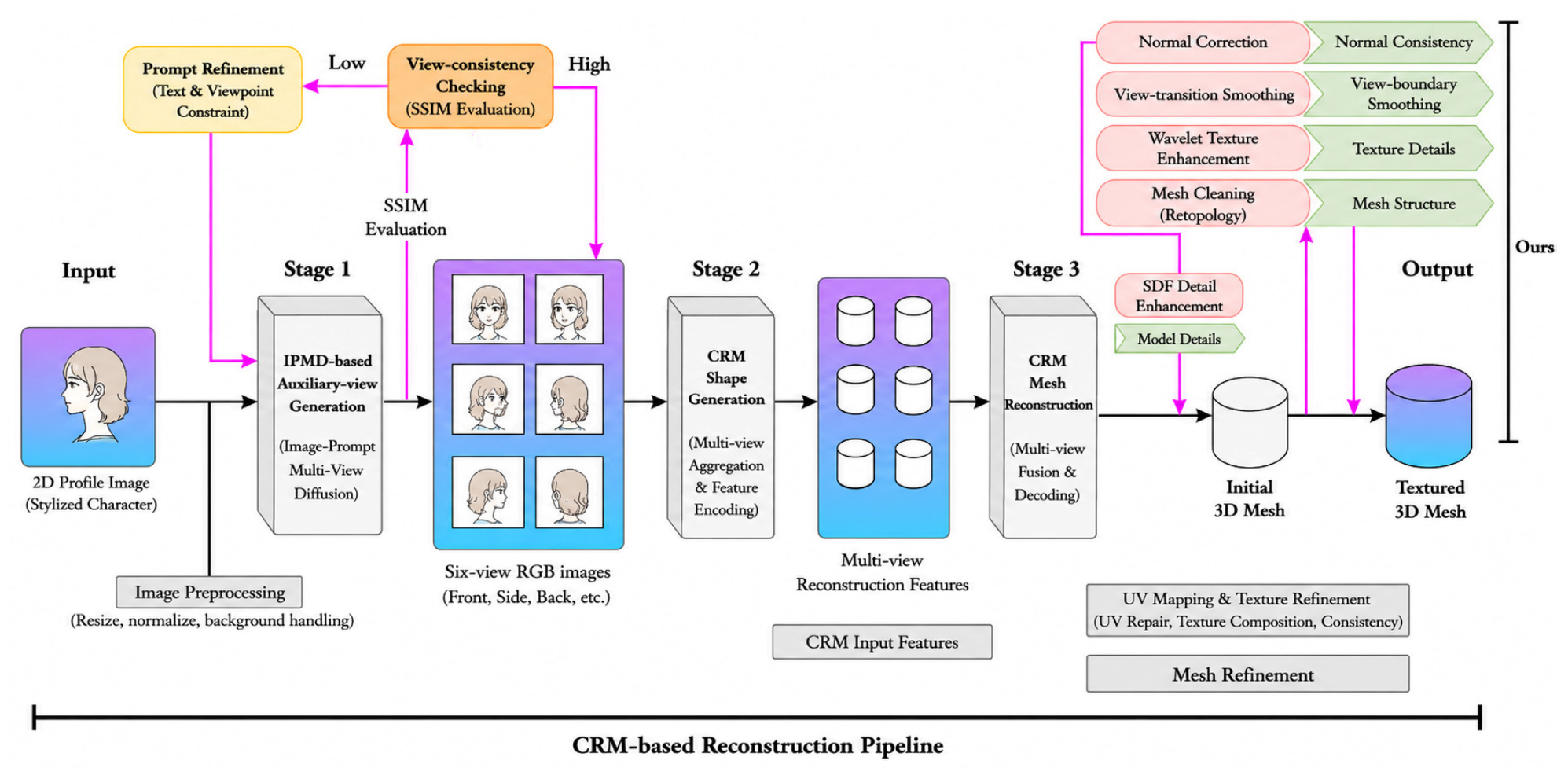
As shown in Figure 1, the intervention pipeline consists of two stages. The input image I is first processed by the IPMD module to generate a verified auxiliary view set V . The original input image and the auxiliary views are then passed to the CRM-based reconstruction stage to recover an initial textured 3D mesh M . This mesh is subsequently refined through failure-mode-oriented consistency optimization, including geometry stabilization, mesh and normal correction, UV repair, and texture refinement.

3.4. IPMD-Based Auxiliary View Generation

To alleviate the lack of frontal geometric information and severe viewpoint ambiguity in stylized profile reconstruction, we introduce an Image-Prompt Multi-View Diffusion module. Built on ImageDream, IPMD generates auxiliary views that provide additional structural cues for downstream CRM-based reconstruction. The purpose of this stage is not simply to synthesize visually plausible images, but to obtain auxiliary observations that are more suitable for explicit mesh recovery.
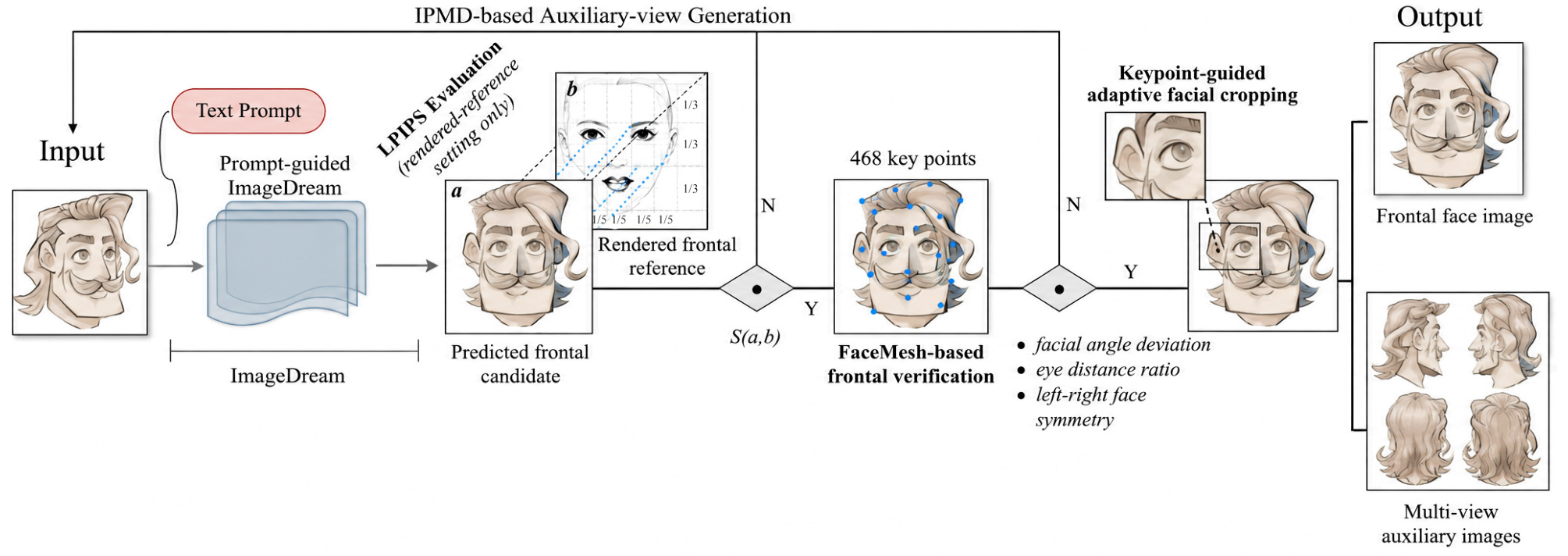
As shown in Figure 2, the IPMD stage consists of three operations: prompt refinement, candidate quality assessment, and keypoint-guided adaptive cropping.

3.4.1. Prompt Refinement and Candidate Quality Assessment

In diffusion-based multi-view generation, the text prompt directly influences structural stability, viewpoint control, and visual consistency. To address generation noise, viewpoint drift, and incomplete facial structure under stylized profile input, we refine the prompts to impose stronger constraints on frontal symmetry, facial alignment, and style consistency across views. The prompt does not directly optimize the final mesh geometry; instead, it guides the auxiliary-view generation stage, which may indirectly affect geometry and texture through subsequent candidate filtering and CRM-based refinement. To reduce prompt-induced variability, the evaluation uses a fixed prompt template, while systematic prompt-sensitivity analysis is left for future work. This choice keeps prompt variation controlled during evaluation and avoids introducing an additional uncontrolled variable.
After generating candidate multi-view results, we use different quality checks according to the data condition. For the rendered quantitative dataset, where each profile input has a corresponding frontal reference view, LPIPS (Learned Perceptual Image Patch Similarity) is used to measure the perceptual similarity between the predicted frontal view and the reference frontal image [19]. This provides a quantitative criterion for analyzing frontal prediction quality under controlled evaluation conditions.
For practical single-image inputs without a ground-truth frontal view, candidate selection does not rely on a reference frontal image. Instead, unreliable candidates are filtered using landmark-based frontal verification and cross-view consistency checking, as described in Section 3.4.2 and Section 3.5.3. In this setting, LPIPS is used as an evaluation metric rather than as a ground-truth-dependent filtering requirement.
For the quantitative dataset, LPIPS is computed as:
S ( I a , I b ) = l w l ϕ l ( I a ) ϕ l ( I b ) 2 2
where I a denotes the predicted frontal image, I b denotes the reference stylized frontal image, ϕ l is the feature map extracted from layer I of a deep network, and w l is the corresponding layer weight. Lower LPIPS values indicate stronger perceptual similarity between the predicted frontal view and the reference frontal view. The threshold value used in the controlled experiments is reported in the experimental setup.

3.4.2. FaceMesh-Based Frontal Verification

Although prompt refinement and candidate quality assessment improve the visual plausibility of generated views, perceptual similarity alone is insufficient to guarantee plausible facial geometry for stylized profile characters. We therefore use MediaPipe FaceMesh to verify the generated frontal candidates. Specifically, each candidate is assessed from three aspects: face orientation, inter-eye distance ratio, and left–right facial symmetry.
The inter-eye ratio is defined as
r e y e = d e y e d f a c e
where d e y e is the Euclidean distance between the inner eye corners, and d f a c e denotes facial width. In our setting, a candidate is rejected when r e y e ≤ 0.2, which indicates severe pose deviation or incomplete frontal structure, or when r e y e ≥ 0.5, which indicates abnormal facial distortion or residual side-view bias. In addition, the displacement of corresponding left–right facial landmarks is used to assess structural symmetry. A candidate is accepted only when face orientation, inter-eye ratio, and landmark symmetry satisfy the predefined constraints.

3.4.3. Keypoint-Guided Adaptive Facial Cropping

Even when a generated frontal candidate passes the above verification, it may still contain excessive background regions. These regions can interfere with downstream reconstruction, especially for stylized character images that include blank margins, large uniform color areas, or decorative background elements. To reduce this interference, we use FaceMesh landmarks to perform adaptive facial cropping.
Instead of using a fixed crop size, the crop region is determined according to the detected facial landmarks:
C   = ( x min , y min , x max , y max )
where x min , y min , x max , y max are computed from the landmark distribution. This adaptive crop is designed to include the forehead, eyes, nose bridge, mouth, and jawline while removing irrelevant background content. The resulting face-centered images provide more compact and structurally focused inputs for the CRM-based reconstruction stage.

3.5. CRM-Based Mesh Refinement

Although CRM can efficiently generate explicit textured meshes through feed-forward inference, its direct application to stylized profile inputs often produces unstable geometry, weak local details, irregular topology, abnormal normals, and texture discontinuity. We therefore refine the CRM output from three aspects: geometric stabilization, mesh and normal correction, and texture-view consistency refinement.
As shown in Figure 3, the refinement stage follows the failure-mode analysis described in Table 1 and applies targeted corrections to the initial CRM output.

3.5.1. Geometry Stabilization and Local Detail Enhancement

The first refinement target is local geometric stability. In CRM-based explicit mesh generation, deformation-related weights influence the stability of the recovered shape. Under stylized profile inputs, exaggerated facial contours and non-standard local proportions may cause unstable deformation, leading to collapsed eyes, distorted facial components, or unclear contours. To reduce this effect, we apply adaptive weight scaling using sigmoid normalization:
σ ( x ) = 1 1 + e x
w = w   σ ( w )
where w denotes the original deformation-related weight, and w denotes the scaled weight. This operation suppresses excessively large weights that may cause mesh distortion while preserving local adjustment capacity.
In addition, the original CRM output may over-smooth local facial structures such as the nose bridge, eye sockets, and mouth corners. To strengthen local detail response while maintaining global surface continuity, we apply signed distance field (SDF)-based local detail enhancement:
S D ~ F = SDF μ SDF λ ReLU SDF
where μ SDF denotes the mean of the current SDF distribution, and λ is the detail enhancement coefficient. In our implementation, λ = 0.1, which provides a practical balance between local detail enhancement and global smoothness.

3.5.2. Mesh Cleaning and Normal Correction

The initial CRM mesh may contain redundant faces, uneven triangle distribution, and non-manifold elements. These issues affect not only mesh editability but also subsequent UV mapping and normal estimation. Therefore, after initial reconstruction, we apply a lightweight mesh-cleaning step to remove redundant faces, repair non-manifold regions, and improve triangle distribution. This step is used to stabilize downstream texture repair and rendering, rather than to introduce a new topology-generation algorithm.
After mesh cleaning, surface normals are recomputed to reduce shading artifacts and local illumination instability. For each vertex v , the normal is computed as the area-weighted average of adjacent face normals:
n v = f N v   A f n f f N v   A f n f
where N v denotes the set of faces adjacent to vertex v , A f is the area of face f , and n f is its normal. This operation improves local normal smoothness and reduces abnormal highlights or shadow artifacts caused by irregular geometry.

3.5.3. Texture and View Consistency Refinement

Geometry refinement alone is insufficient for stylized profile reconstruction because explicit textured meshes may still contain UV seams, local color displacement, blurred texture details, and inconsistent shading across views. We therefore apply texture and view consistency refinement after the initial CRM output.
First, local smoothing is applied near view-transition regions to reduce abrupt color discontinuities before texture composition. Then, defective UV regions are corrected through seam filling and local patch repair. The UV repair process can be written as
U V repair = UV ( 1 Mask ) + Region fill Mask
where UV denotes the original UV map, Mask denotes the binary mask of defective regions, Region fill denotes the local filling result, and represents element-wise multiplication.
Second, to reduce over-smoothing caused by diffusion-based generation and texture composition, we apply a lightweight wavelet-based enhancement to the luminance channel of the UV texture map [20]. Only high-frequency components are enhanced, while the low-frequency structure and chrominance channels are preserved. This operation improves the visibility of local details such as hair boundaries, facial contours, and clothing edges without changing the global texture layout.
Third, we use the structural similarity index (SSIM) as a screening indicator for severe discontinuity among adjacent generated views [21]. In this work, SSIM is not used as proof of geometric correctness but as a practical indicator of obvious structural or illumination inconsistency between synthesized views. When the average adjacent-view similarity falls below the preset threshold, the prompt is refined by adding constraints related to facial symmetry, surface smoothness, and cross-view coherence. This produces a generation–checking–refinement loop for reducing severe view-level inconsistency before final reconstruction.

3.6. Inference Procedure

The complete inference procedure is summarized as follows.
Given a stylized profile input image, IPMD first generates candidate auxiliary views using prompt-driven multi-view diffusion. Candidate frontal views are then evaluated using dataset-dependent quality checks. In the rendered quantitative setting, LPIPS is used to evaluate similarity to the corresponding frontal reference. For practical single-image inputs, landmark-based frontal verification and view-consistency checking are used instead. Verified candidates are cropped adaptively according to facial landmarks and then passed to the CRM-based reconstruction stage.
CRM generates the initial textured mesh. The mesh is then refined through geometry stabilization, local detail enhancement, mesh cleaning, normal correction, UV repair, texture enhancement, and view-consistency checking. The final output is a textured 3D mesh with improved structural completeness, local surface stability, UV continuity, and rendered appearance consistency.
Implementation details, parameter settings, threshold values, and dataset-specific configurations are reported in the Section 4.1 to separate the method design from the evaluation protocol.

4. Experiments and Results

4.1. Experimental Setup and Evaluation Protocol

The experiments were designed to evaluate two stages of the proposed pipeline: profile-to-frontal prediction generated by the IPMD module and final 3D mesh reconstruction produced by the CRM-based refinement stage. The IPMD module was built on the public implementation of ImageDream, and the reconstruction stage was built on the public implementation of CRM. The backbone networks were not retrained. All modifications were applied at inference time through candidate view selection, reconstruction-oriented preprocessing, and post-reconstruction refinement. CRM was selected as the reconstruction backbone because it provides an explicit and practical image-to-3D pipeline suitable for testing whether inference-time auxiliary-view generation and refinement can improve stylized profile reconstruction. Compared with direct CRM inference, the proposed pipeline introduces additional computational overhead mainly from auxiliary-view generation, candidate verification, and post-reconstruction refinement. Because the additional cost depends on the number of generated auxiliary-view candidates, it is described as a stage-level overhead rather than a fixed universal runtime. The main implementation details and experimental settings are summarized in Table 2.
Supplementary statistical validation is provided in Appendix A. Because complete per-sample baseline outputs are not available for all compared methods, the validation is reported as angle-level baseline support and subset-level support for the seven-configuration progressive ablation rather than as a full per-sample significance test for every baseline. Where paired angle-level observations were available, Wilcoxon signed-rank tests were used to provide cautious supplementary statistical support.
Two datasets were used for different evaluation purposes. The first was an Objaverse-based quantitative dataset containing 25 stylized 3D character models and 175 rendered images. Each model was rendered from seven viewpoints centered on the frontal view: 0°, 20°, 30°, 60°, 70°, 80°, and 90°. This dataset provides ground-truth 3D models and rendered frontal references and was therefore used for metric-based evaluation. The second dataset was a style-adaptation test set containing 115 collected stylized images. Since these collected images do not provide ground-truth 3D models, they were used only for qualitative style-adaptation analysis. The 70°, 80°, and 90° inputs correspond to near-profile or complete-profile conditions, giving 75 near-profile samples in the rendered evaluation set. Because this dataset contains paired rendered views and ground-truth meshes but only 25 character models, it is intended for controlled feasibility evaluation rather than broad statistical generalization. Public benchmarks specifically designed for stylized side-face character reconstruction with paired ground-truth meshes remain limited, so broader benchmark validation is left for future work.
All methods were evaluated using the same input resolution, viewpoint partitions, and reference models in the quantitative dataset. Baseline methods were reproduced using their public inference settings as closely as possible. The proposed method was evaluated as a complete pipeline because IPMD-based auxiliary-view generation is part of the method design rather than an external preprocessing step.
For profile-to-frontal prediction, CRM, LGM [22], MV-Adapter, and the proposed method were compared using SSIM, signal-to-noise ratio (PSNR), LPIPS, and keypoint error. For final 3D reconstruction, all methods were compared using Hausdorff distance [23], Chamfer distance [24], normal consistency, normal deviation, surface area change rate, volume change rate, vertex count change rate, and face count change rate. The compared reconstruction methods included CRM, LGM, DPTDepth [25], Hunyuan3D [26], ZoeDepth [27], SF3D [28], GaussianAnything [29], and the proposed method. The quantitative dataset was derived from Objaverse [30], which provides the ground-truth 3D models used for metric-based evaluation.
No single metric fully captures the quality of stylized profile reconstruction. A method with a low geometric error may still produce oversimplified meshes, unstable texture mapping, or visually incoherent rendering. Therefore, the results are interpreted jointly across geometric fidelity, mesh complexity, shape preservation, surface behavior, and appearance-related indicators. The threshold values used in this study were selected to balance structural stability and reconstruction completeness in preliminary controlled trials, and are treated as implementation settings for the present pipeline rather than universal constants.
To further examine the influence of key implementation parameters, we conducted a subset-level parameter sensitivity analysis for three representative settings: the LPIPS threshold, the SSIM threshold, and the SDF detail coefficient. The detailed results and trend visualization are provided in Appendix B. Overall, the analysis shows that these parameters should be understood as practical trade-off settings for candidate quality control, view-consistency refinement, and local geometric stabilization, rather than as universally optimal constants.

4.2. Qualitative Results

4.2.1. Reconstruction Across Different Profile Angles

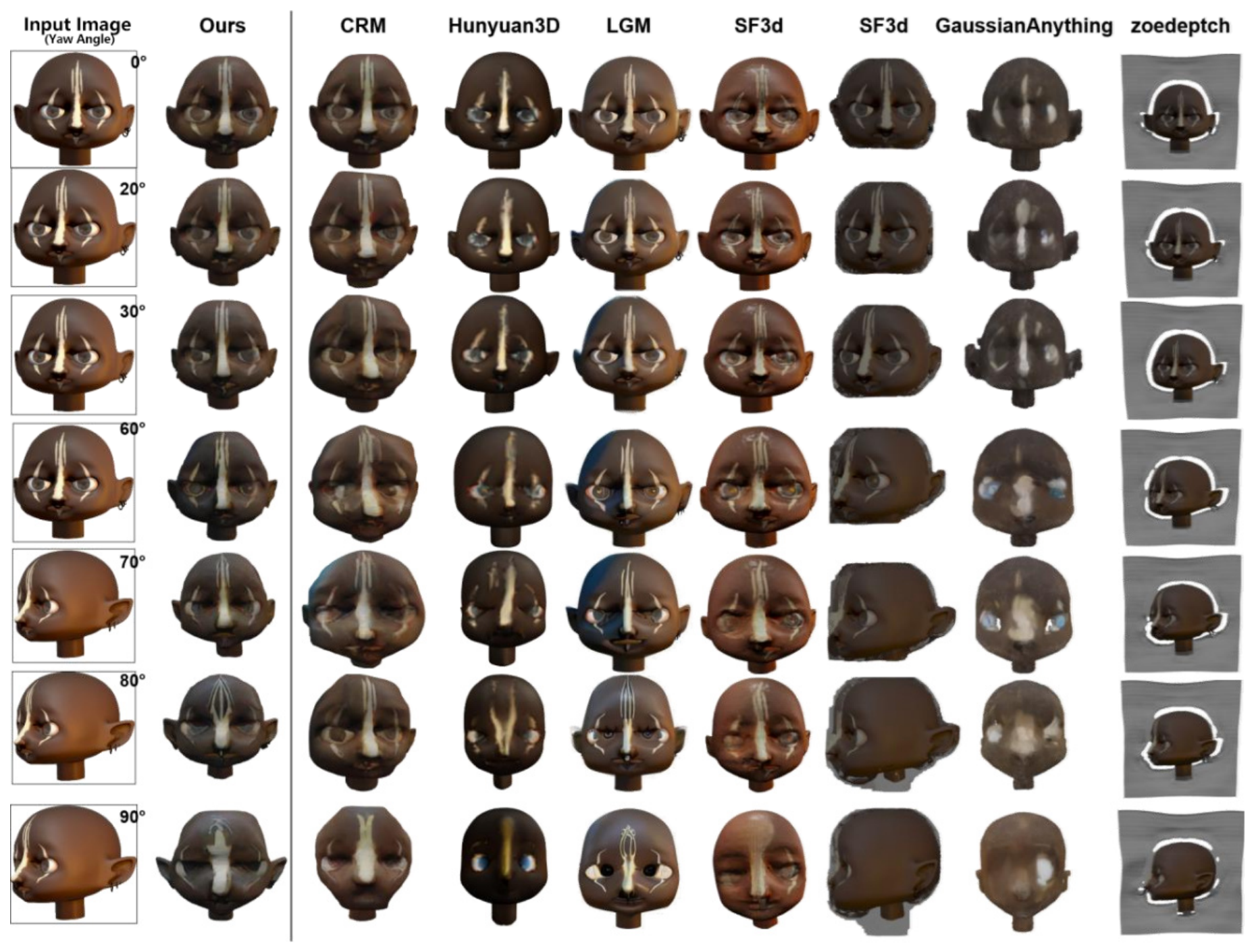
To examine the effect of profile angle, we compared reconstruction results under 20°, 30°, 60°, 70°, 80°, and 90° profile inputs. As shown in Figure 4, the proposed method remains comparatively stable across most tested angles. The advantage is more visible between 0° and 60°, where the reconstructed models exhibit clearer facial structure and more plausible global shape. Under larger profile angles, especially 80° and 90°, visible degradation still appears in regions such as the eyes, mouth, and side contours, but the global structure remains more stable than several direct reconstruction baselines.
CRM directly reconstructs 3D models from profile input and tends to produce stronger deformation at medium and large offsets. Beyond 60°, the reconstructed faces become less symmetric, and texture distortion becomes more evident. LGM and SF3D preserve relatively complete global structure under some moderate angles, but they also show missing local details under near-complete profile input. These observations suggest that auxiliary-view completion is useful for reducing profile-induced ambiguity, although extreme profile views remain challenging.

4.2.2. Local Detail Quality

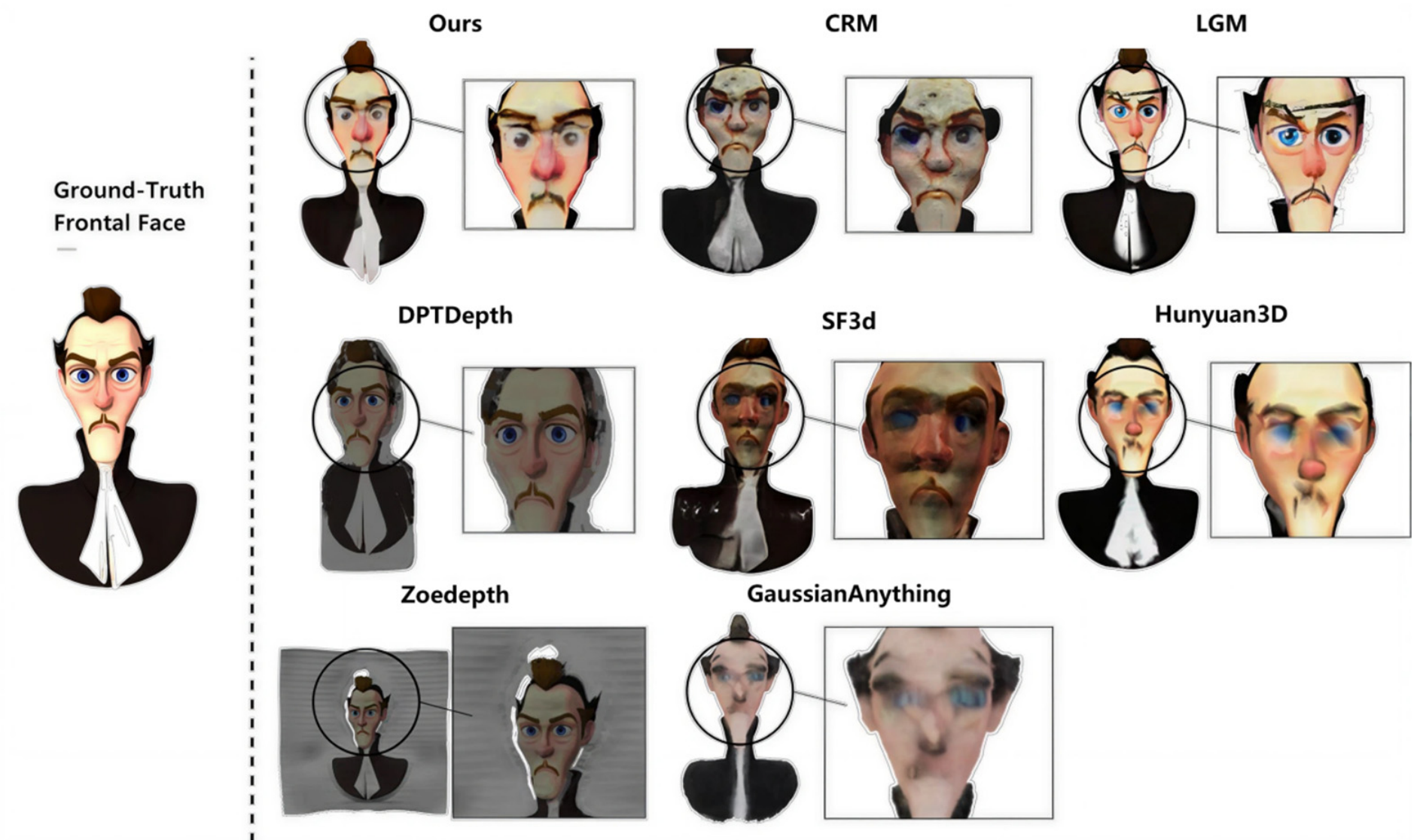
Local facial detail is important for stylized character reconstruction because small components such as the eyes, nose, mouth, eyebrows, and sideburns strongly affect recognizability. As shown in Figure 5, the proposed method preserves facial contours and component structure more consistently in the tested samples, while still showing degradation under extreme profile conditions. Compared with CRM and SF3D, the reconstructed models produced by the proposed method show fewer cases of local collapse and weaker texture mixing. LGM preserves sharper local texture in some cases, but it may introduce texture projection errors around the eyebrow and eye regions. Hunyuan3D produces relatively stable texture mapping, but local blur and stitching artifacts are still visible.
In terms of illumination and rendered appearance, the proposed method generally produces a more stable tonal distribution in the tested samples. By contrast, some baselines tend to produce overly bright, overly dark, or diffuse shading. DPTDepth and ZoeDepth often preserve background remnants because they are not designed for explicit stylized character mesh reconstruction, making their outputs less suitable for this task.

4.2.3. Adaptation to Different Visual Styles

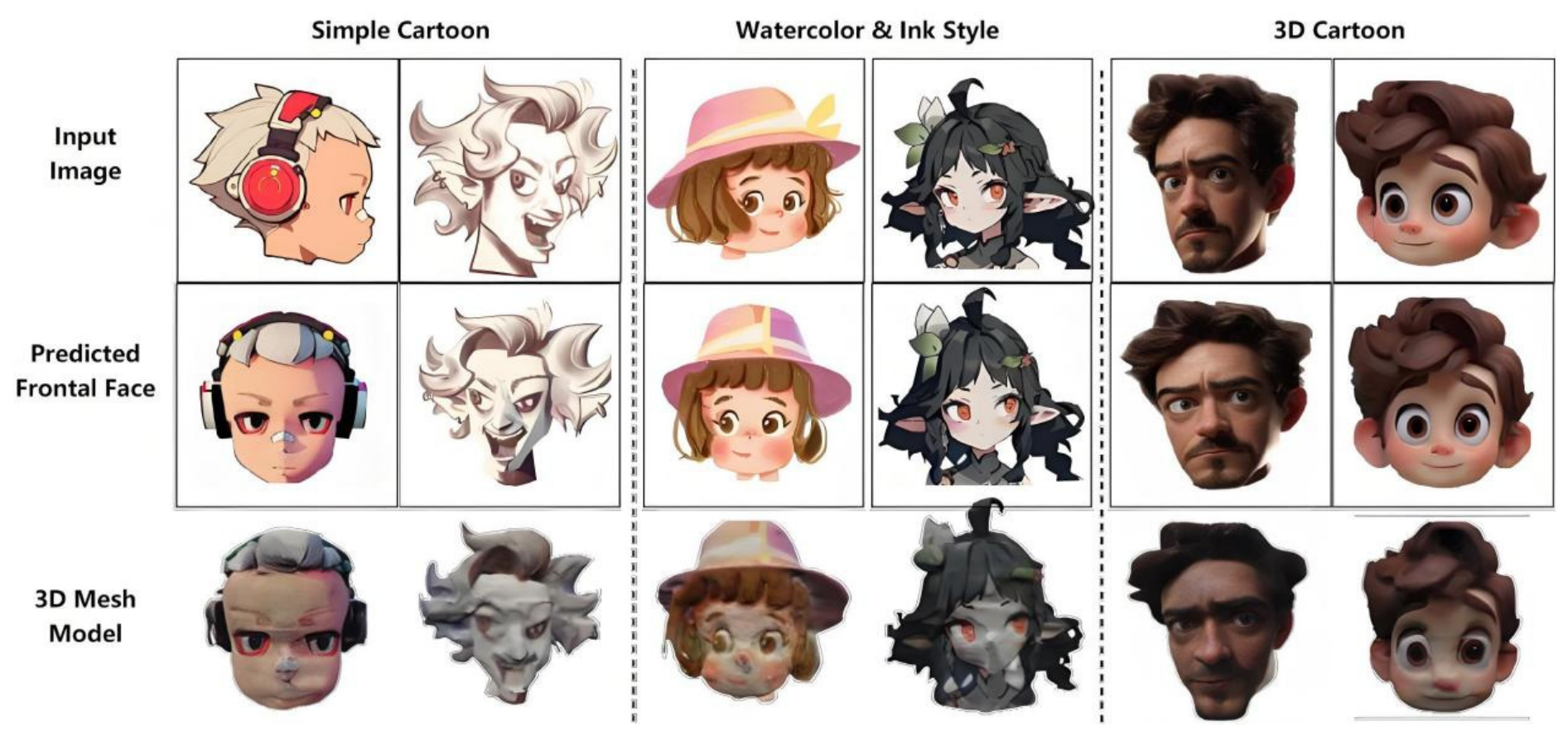
We further evaluated the method on three representative style categories: simple cartoon, watercolor or ink-wash, and 3D cartoon. As shown in Figure 6, the IPMD module can generate visually plausible frontal predictions in many cases, and the subsequent CRM-based refinement stage generally maintains recognizable facial structure and broad texture consistency.
Different styles nevertheless lead to different levels of difficulty. Watercolor and ink-wash inputs often contain soft boundaries, diffuse brush patterns, and weak depth cues, which may result in relief-like geometry and blurred local surfaces. Simple cartoon inputs rely heavily on line contours and flat color regions, making noses, mouths, or eyes represented by only a few strokes easy to misinterpret. 3D cartoon inputs are generally more favorable because they provide clearer contours, stronger shading hierarchy, and more explicit spatial structure. Even in this category, however, local lighting relationships may still be flattened during reconstruction. Since these collected images do not provide ground-truth meshes, the cross-style results are interpreted as qualitative style-adaptation evidence rather than conclusive benchmark-level generalization.

4.3. Quantitative Results

The quantitative dataset was used as a controlled benchmark for analyzing reconstruction behavior under defined profile-angle conditions. Because it contains a limited number of stylized 3D models, the results are interpreted as controlled evidence rather than as an exhaustive claim of universal robustness.

4.3.1. Profile-to-Frontal Prediction

Table 3 reports SSIM and PSNR for profile-to-frontal prediction. The proposed method outperforms CRM and MV-Adapter in mean SSIM and mean PSNR across the tested angles. Although LGM obtains higher values on these two metrics, the proposed method remains relatively stable, with SSIM ranging from 0.71 to 0.76 and PSNR ranging from 7.62 to 8.92 dB.
Higher values indicate better performance for SSIM and PSNR. SSIM values closer to 1 indicate stronger structural similarity to the reference frontal image, whereas higher PSNR values indicate better image quality [31].
Table 4 reports LPIPS and keypoint error. The proposed method obtains lower mean LPIPS than CRM and MV-Adapter, indicating reduced perceptual distortion under the controlled rendered setting. For keypoint error, CRM obtains the lowest mean value, while the proposed method performs better than LGM and MV-Adapter under larger profile angles from 60° to 90°. This suggests that keypoint error alone does not fully capture frontal completion quality under stylized profile input; it should be interpreted together with perceptual and structural metrics.

4.3.2. Final 3D Reconstruction

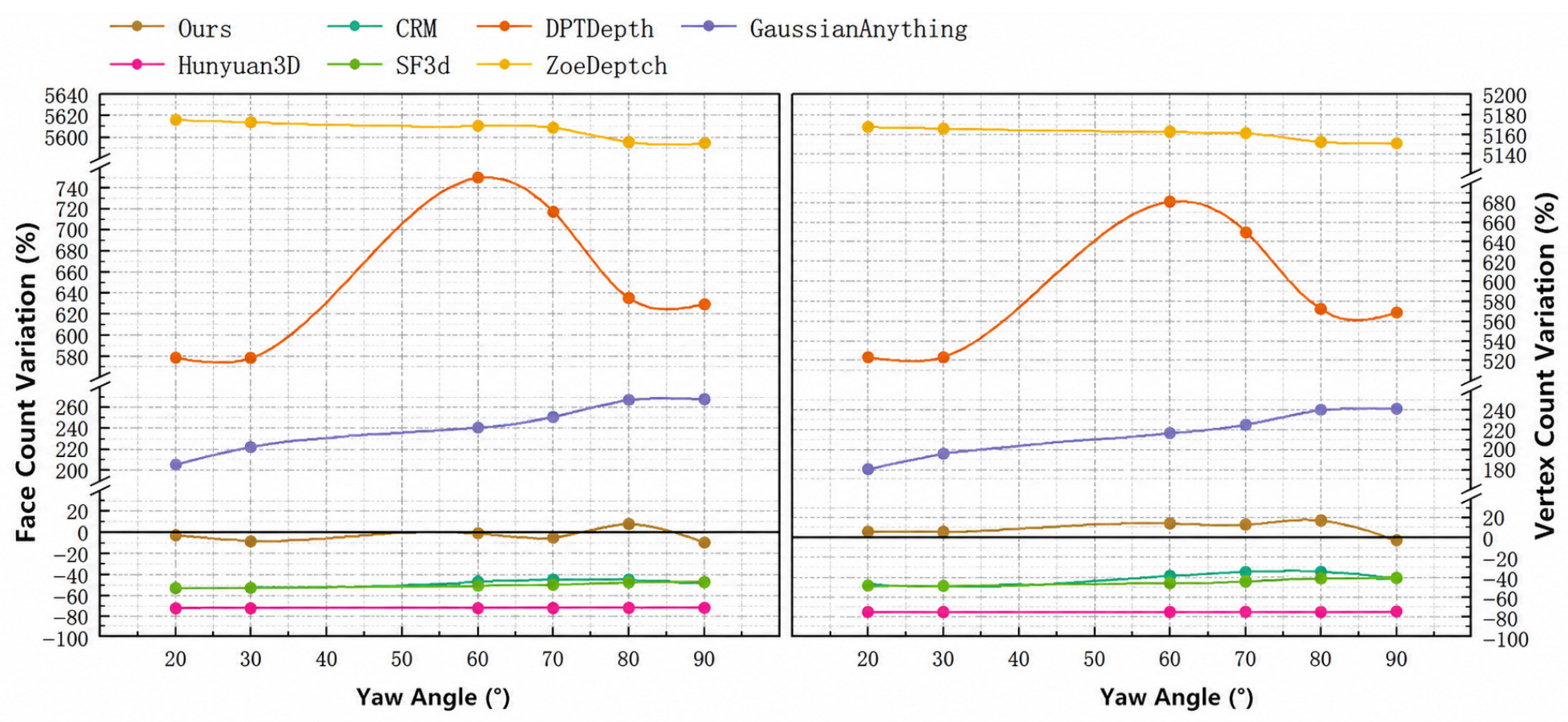
For the final 3D reconstruction, we evaluated mesh complexity, geometric error, global shape preservation, and normal behavior. Figure 7 shows the vertex count change rate and the face count change rate. The proposed method avoids both extreme simplification and abnormal mesh growth, while several baselines show either strong mesh compression or excessive mesh expansion. This indicates that the proposed method maintains a more usable mesh structure under stylized profile input.
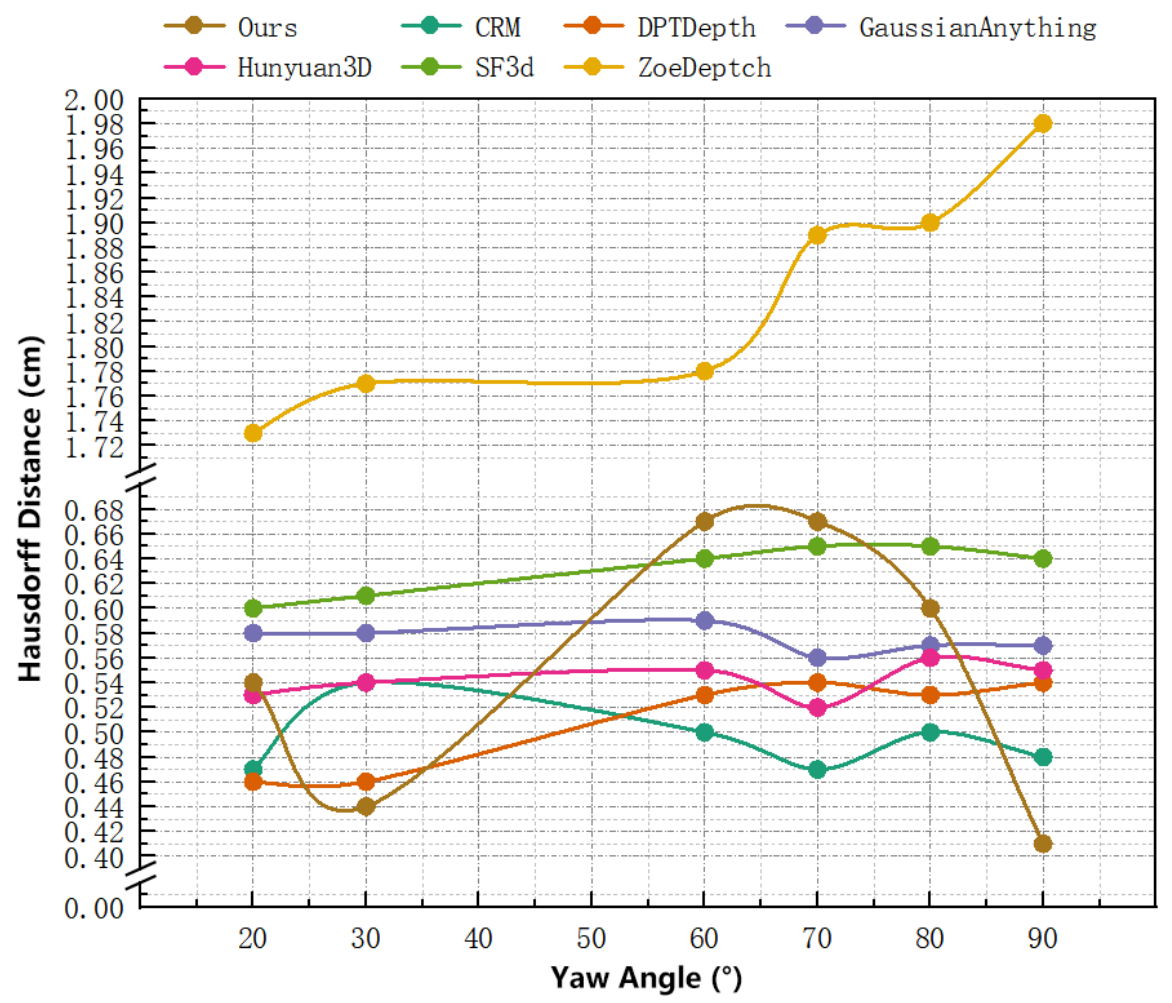
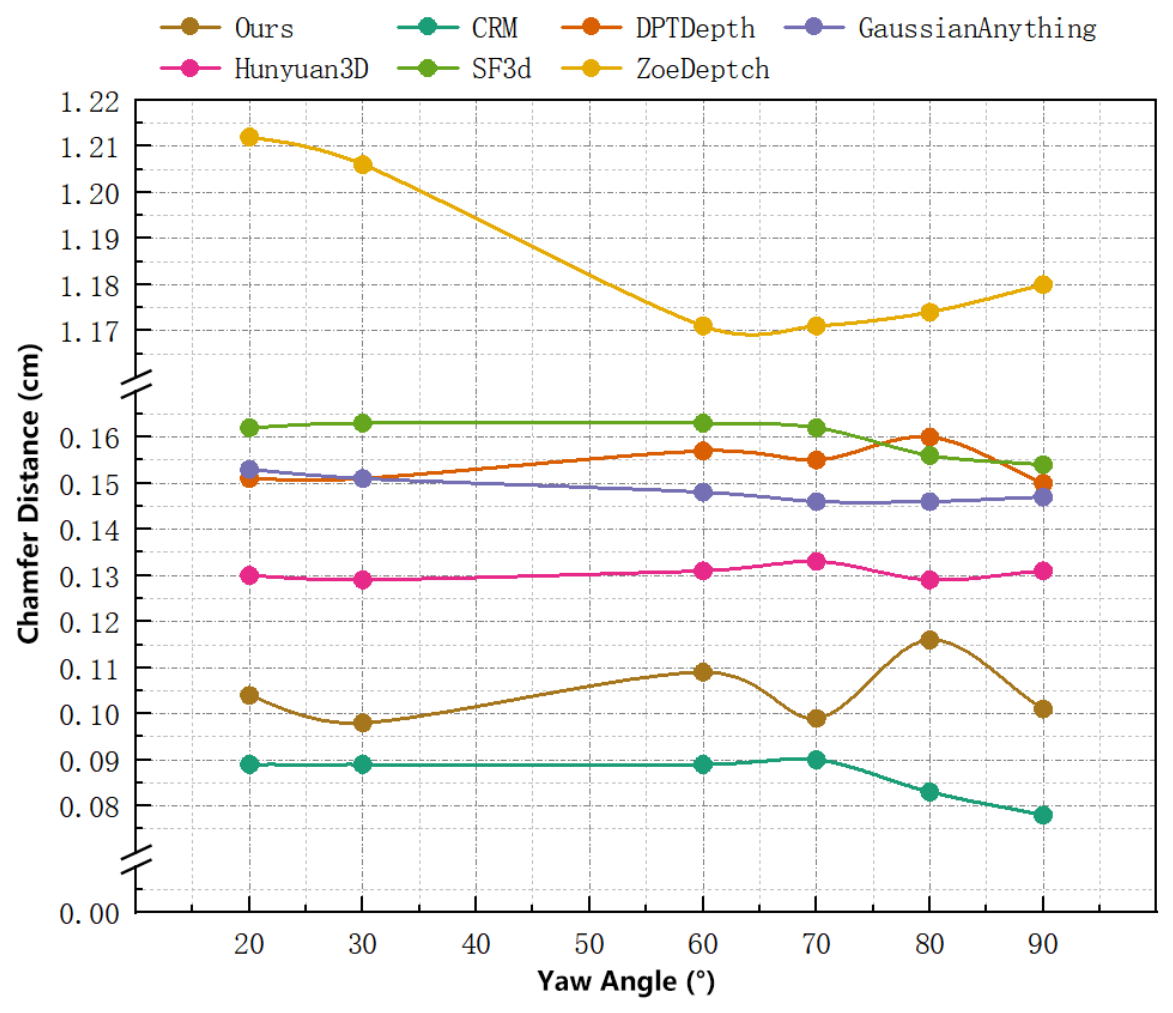
Figure 8 and Figure 9 show Hausdorff distance and Chamfer distance. The proposed method is not the best on every single geometric metric, but it maintains a comparable error range while avoiding the severe oversimplification or mesh expansion observed in several baselines. CRM achieves lower Chamfer distance at some angles, but this should be interpreted together with mesh complexity because lower geometric error may partly result from compressed or simplified geometry.
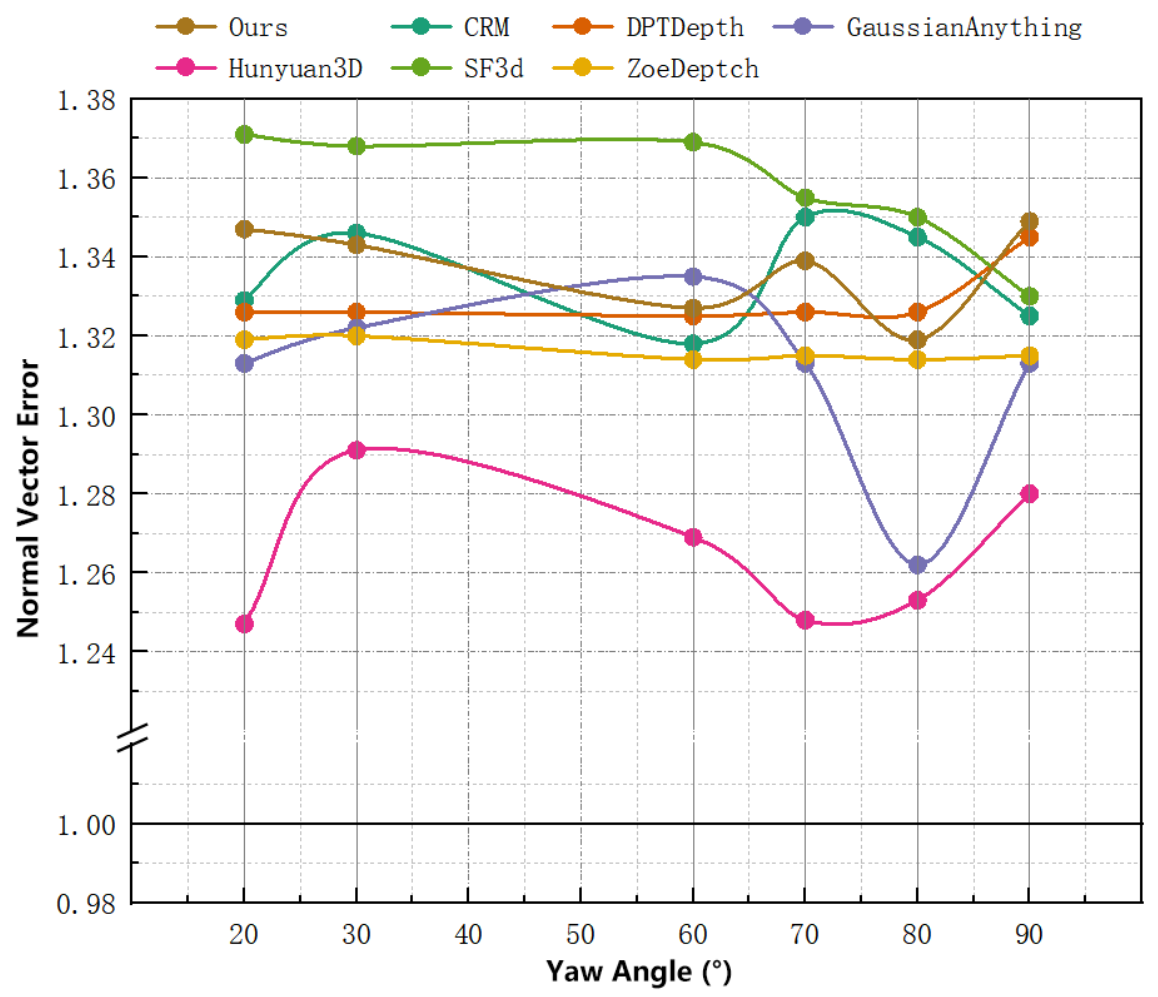
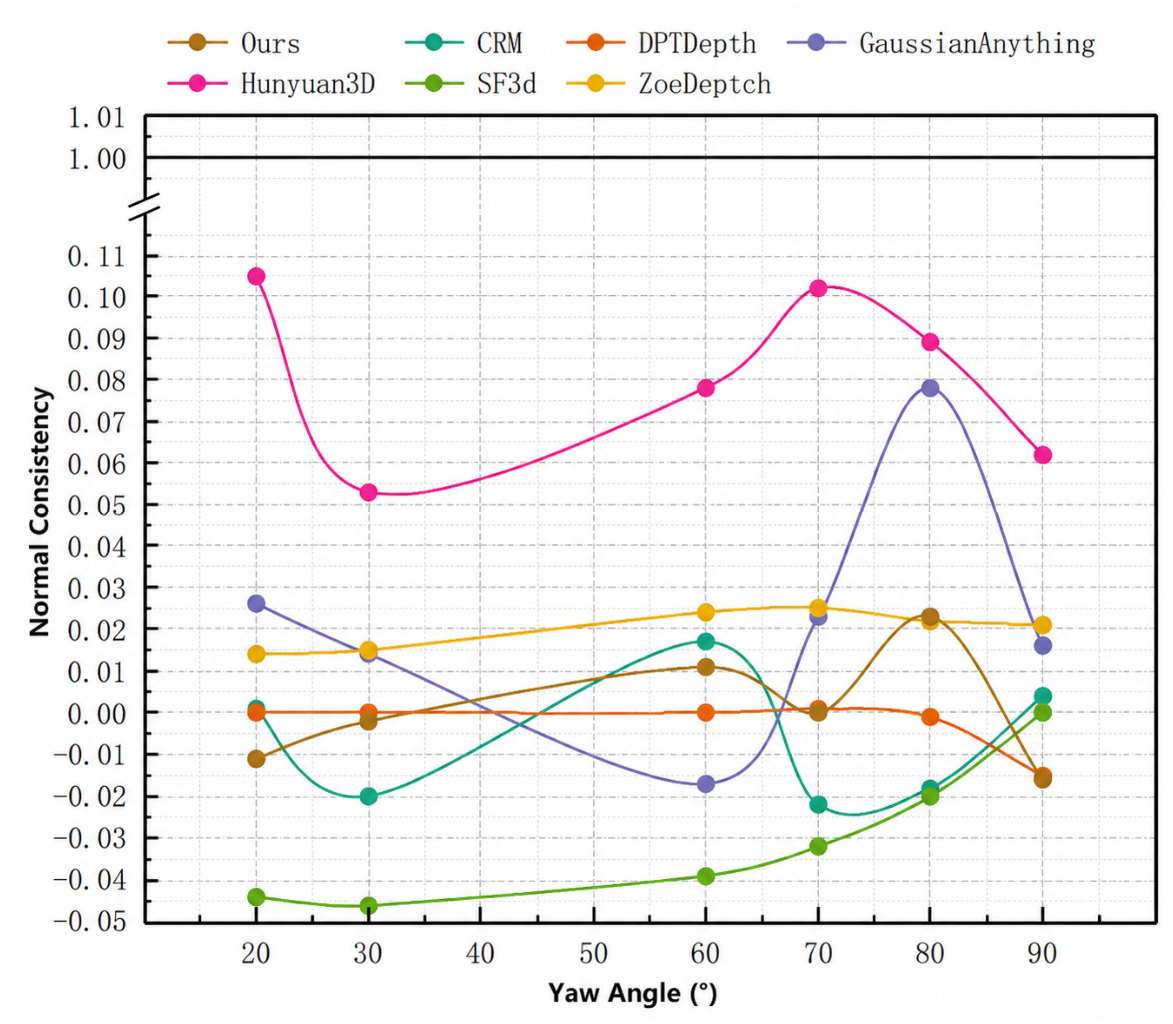
Figure 10 and Figure 11 report normal consistency and normal deviation. The proposed method remains relatively stable under moderate profile angles, while performance decreases at 80° and 90°, confirming that near-complete profile input remains difficult. Hunyuan3D obtains favorable normal-related values in some cases, but this often co-occurs with strong surface or volume compression. Therefore, normal metrics should also be interpreted jointly with global shape-preservation indicators.
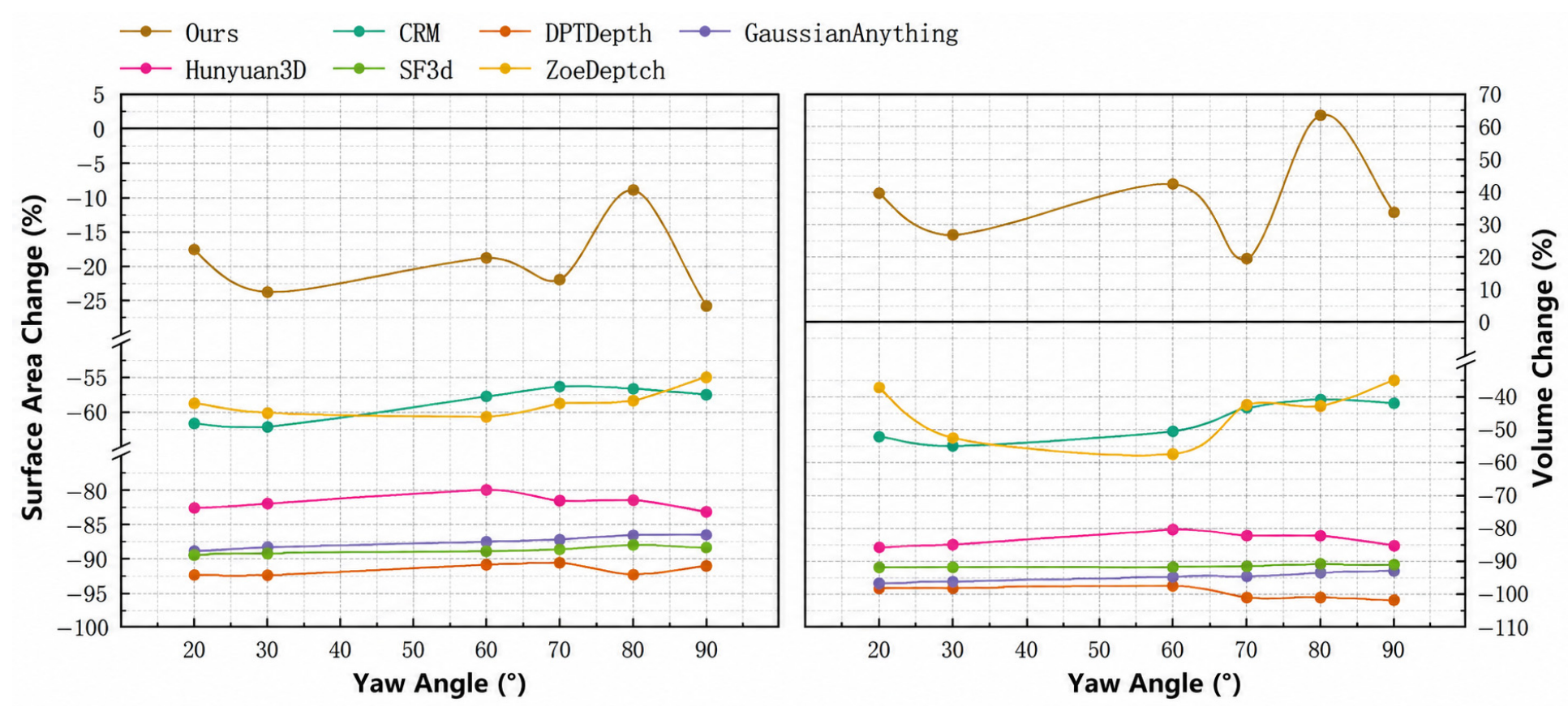
Figure 12 shows the surface area change rate and the volume change rate. The proposed method stays closer to the reference structure in surface-area behavior and avoids the extreme negative values observed in several direct baselines. Although the volume change rate remains imperfect, the overall result suggests improved practical stability between global shape preservation and structural completeness.
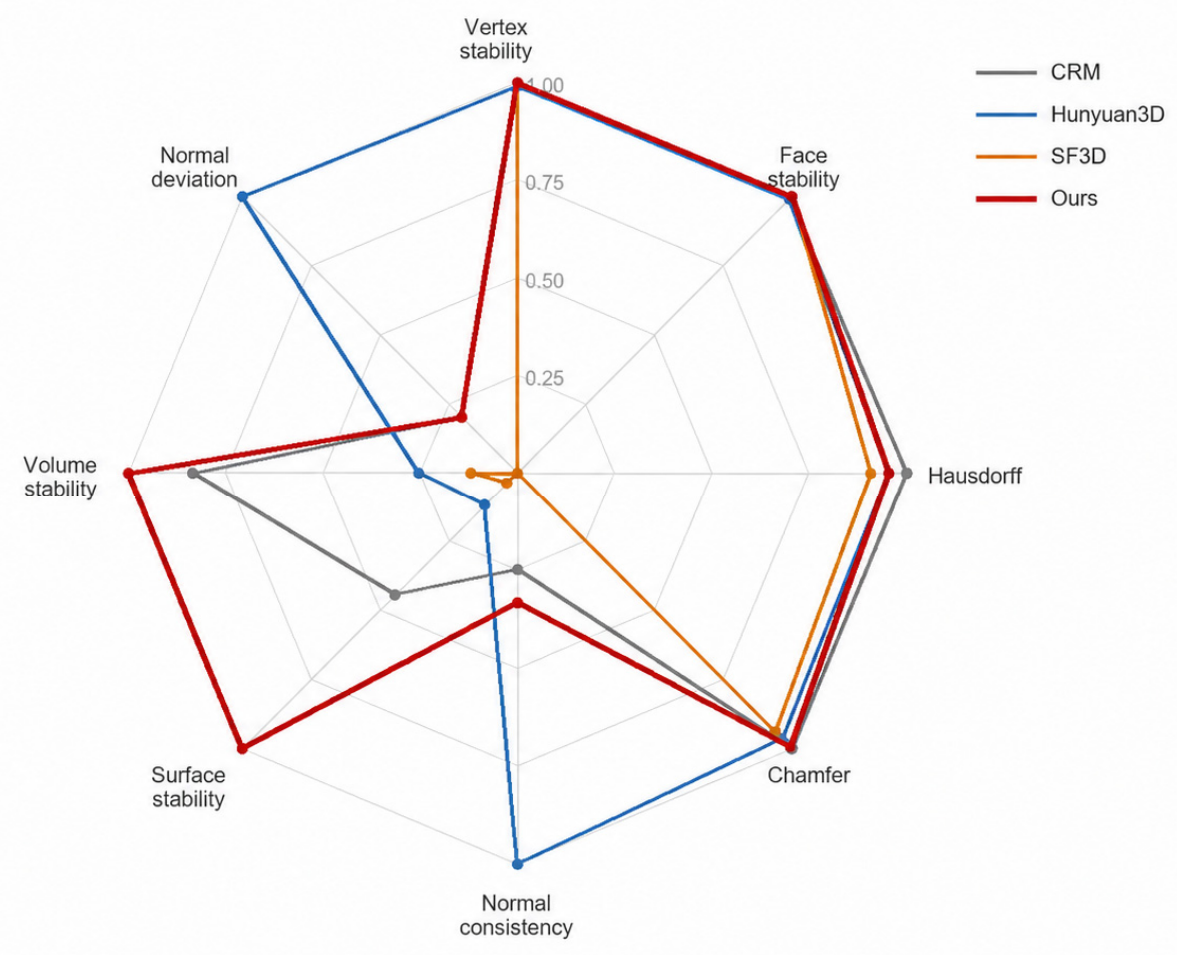
Table 5 summarizes the mean geometric metrics across all tested profile angles. To avoid relying on subjective wording, Figure 13 further visualizes the normalized metric profile across eight evaluation dimensions. The proposed method does not dominate every single metric, but it maintains a comparatively stable profile in mesh complexity, geometric error, and global shape preservation relative to most direct reconstruction baselines.
Overall, the quantitative results and the normalized radar visualization indicate that the proposed method should be interpreted as improving practical reconstruction usability rather than achieving universal single-metric dominance. This is important for stylized profile reconstruction, where practical usability depends not only on geometric error minimization but also on mesh complexity, shape preservation, texture continuity, and rendered appearance.

4.4. Ablation Study

To further examine the contribution of the main intervention stages using the available subset runs, we conducted a seven-configuration progressive ablation study on five representative samples. Starting from the original CRM backbone, we progressively added the IPMD module, FaceMesh-based frontal verification, keypoint-guided adaptive cropping, geometry refinement, texture refinement, and view-consistency checking. This design should be distinguished from a full leave-one-out ablation of every internal operation. The available experiments do not separately remove prompt refinement, LPIPS filtering, adaptive weight scaling, retopology, SDF enhancement, or normal correction as isolated conditions. Therefore, Table 6 is used to analyze stage-level evidence for the intervention pipeline rather than to claim complete operation-level attribution.
The results show stage-level contributions across different aspects of reconstruction quality. Compared with the CRM-only baseline, adding IPMD reduces Chamfer distance from 0.003660 to 0.003633 and improves normal consistency from 0.659289 to 0.672963, suggesting that auxiliary-view completion improves the reconstruction condition under profile input. After adding FaceMesh-based verification, keypoint error decreases from 52.794193 to 47.269151, indicating that frontal-candidate filtering improves candidate stability and reduces structurally unreliable predictions.
Adaptive cropping further reduces Chamfer distance to 0.003445, the lowest value among the seven groups. This suggests that face-centered cropping reduces background interference and improves geometric alignment in the evaluated subset. Geometry and texture refinements do not produce the best value on every single metric, but they progressively reduce the Hausdorff distance from 0.154338 after adaptive cropping to 0.149408 in the full configuration. This trend supports the interpretation that CRM-based refinement improves surface continuity and reconstruction stability, while the current data remain stage-level rather than operation-level evidence.
These results should not be interpreted as evidence that the full configuration dominates all individual metrics or that every internal operation has been independently isolated. Instead, the ablation study shows complementary stage-level contributions: IPMD improves the reconstruction condition, FaceMesh verification improves frontal-candidate stability, adaptive cropping reduces background interference, and the CRM-based refinement stages improve surface continuity and overall stability. The full configuration is therefore interpreted as a practically stable intervention pipeline rather than as a single-metric optimum.

4.5. Failure Analysis and Summary

The proposed method still fails in several challenging conditions. The first is near-complete profile input, especially at 80° and 90°, where frontal facial evidence is almost absent. In such cases, auxiliary-view completion becomes more dependent on diffusion priors and may produce facial asymmetry, unstable eyes, or missing mouth details. The second is a highly abstract visual style, such as watercolor, ink-wash, or minimal line-art characters. These inputs often contain weak depth cues, diffuse boundaries, and ambiguous landmarks, resulting in relief-like geometry or blurred local surfaces. The third is complex accessory interference. Hats, headphones, collars, or heavy hair ornaments may be confused with facial structure, causing accessories to be preserved while fine facial details are weakened. In some difficult cases, the proposed pipeline may not outperform direct CRM if diffusion-generated auxiliary views introduce misleading facial structure, unstable symmetry, or inconsistent texture cues.
These failure cases explain why the proposed method performs more reliably under moderate profile angles and 3D cartoon-like styles than under extreme viewpoints or highly abstract inputs. The method is most effective when the input provides sufficient contour, shading, and facial component information for IPMD to generate structurally useful auxiliary views. When these cues are absent or severely ambiguous, CRM-based refinement can reduce mesh and texture artifacts but cannot fully recover missing semantic structure.
Taken together, the qualitative and quantitative results show that the proposed intervention pipeline improves the applicability of public reconstruction backbones to stylized side-face character reconstruction. The IPMD stage improves the reconstruction condition by providing auxiliary frontal cues, while CRM-based refinement improves mesh stability, texture continuity, and rendered appearance. The results should be interpreted within the current evaluation scope: the quantitative dataset provides controlled evidence based on 25 stylized 3D models and 175 rendered images, while the 115 collected stylized images provide supplementary qualitative evidence of style adaptability. Extreme viewpoints, highly abstract styles, and complex accessories remain open challenges.


5. Discussion

5.1. Main Findings and Methodological Implications

The experimental results show that stylized side-face character reconstruction cannot be sufficiently addressed by directly applying generic single-image 3D reconstruction backbones. The difficulty lies in the combined effect of missing frontal information, stylized facial abstraction, and explicit mesh instability, which together lead to local facial collapse, unstable texture mapping, abnormal normals, or excessive mesh simplification.
The proposed intervention addresses this problem through task-specific inference-time adaptation rather than backbone retraining. IPMD provides reconstruction-compatible auxiliary frontal cues, while FaceMesh verification and adaptive cropping improve candidate stability and face-centered geometric alignment in the representative subset.
The progressive ablation supports this interpretation at the stage level: IPMD, verification, cropping, and CRM-based refinement each improve different aspects of reconstruction behavior. Because the available runs do not isolate every internal operation, the results should be read as stage-level evidence rather than complete operation-level attribution.
The subset-level sensitivity analysis further shows that LPIPS, SSIM, and SDF settings are practical trade-off parameters rather than universally optimal constants.

5.2. Limitations and Failure Cases

Although the proposed intervention improves stylized side-face reconstruction, it remains limited under extreme profile input, especially at 80° and 90°. When frontal facial evidence is almost absent, auxiliary-view generation becomes highly prior-dependent, and CRM-based refinement cannot fully recover missing semantic structure.
The method is also sensitive to highly abstract or weakly structured styles, such as watercolor, ink-wash, and simplified line-art inputs. Soft boundaries, diffuse color transitions, and weak depth cues can lead to relief-like surfaces, blurred facial components, or inaccurate texture correspondence.
Complex accessories and decorative elements remain another challenge because they may be confused with facial or head geometry during auxiliary-view generation and mesh recovery.
The evaluation also remains limited in scale. Although the rendered dataset, collected stylized images, progressive ablation, sensitivity analysis, and supplementary statistical validation strengthen the evidence, broader datasets, complete operation-level ablation, and full per-sample baseline validation are still needed. Pitch and roll variations, such as views from above, below, or with substantial head tilt, were not systematically evaluated in this study. Robustness under different image resolutions, illumination conditions, and rendering artifacts was also not exhaustively tested. The reported failure modes are based on representative empirical observations; a more systematic failure-mode validation protocol should be developed in future work.

5.3. Practical Implications and Future Work

From a practical perspective, the proposed intervention pipeline is useful for stylized character asset generation workflows where designers often start from a single concept image rather than multi-view scans or standardized 3D assets.
The results also suggest that adapting public image-to-3D models to specialized input domains requires attention to the connection between input completion and mesh usability: generated views must provide reliable structural cues, and mesh refinement should improve texture continuity, surface stability, and practical editability.
Future work should extend the dataset, add per-sample validation across larger model sets, improve semantic separation between facial structures and accessories, and develop more robust strategies for extreme profile views and highly abstract styles. Future work should also include pitch/roll and robustness tests under resolution degradation, illumination changes, and rendering artifacts.

6. Conclusions

This study investigated single-image 3D mesh reconstruction for stylized side-face characters. Rather than introducing a new reconstruction backbone, it provides a failure-mode diagnosis of CRM behavior on stylized profile inputs and uses this diagnosis to guide a retraining-free inference-time intervention pipeline.
The pipeline combines IPMD-based auxiliary-view generation with CRM-based consistency refinement. Experiments on a rendered stylized-character dataset and a cross-style adaptation set show improved practical reconstruction usability across frontal-view plausibility, geometric fidelity, mesh usability, texture continuity, and rendered appearance compared with direct reconstruction baselines.
The progressive ablation and parameter sensitivity analyses further support the stage-level contribution of the main intervention steps and the stability of the selected practical settings.
The method still struggles with extreme profile views, highly abstract styles, and complex accessories, and the current evaluation remains limited in scale. Future work will expand the dataset, add operation-level leave-one-out tests, improve semantic separation between facial structures and accessories, and strengthen per-sample validation across baseline methods. These findings should therefore be interpreted within the scope of the controlled stylized-character evaluation rather than as evidence of broad generalization across all artistic styles or reconstruction scenarios.

Author Contributions

Conceptualization, K.Z. and J.L.; methodology, K.Z., J.L. and Z.Z.; software, K.Z.; validation, K.Z., J.L. and Z.Z.; formal analysis, K.Z., J.L. and Z.Z.; investigation, K.Z., J.L. and Z.Z.; data curation, K.Z. and J.L.; writing—original draft preparation, K.Z.; writing—review and editing, J.L., Z.Z. and J.H.; visualization, K.Z. and Z.Z.; supervision, J.H.; project administration, J.H.; resources, J.H., K.Z. and J.L. contributed equally to this work. All authors have read and agreed to the published version of the manuscript.

Funding

This research received no external funding.

Data Availability Statement

The datasets generated and/or analyzed during the current study are archived in the Open Science Framework (OSF). They are not publicly available at this stage but may be obtained from the first author upon reasonable request.

Conflicts of Interest

The authors declare no conflicts of interest.

Abbreviations

The following abbreviations are used in this manuscript:
AbbreviationFull Term
IPMDImage-Prompt Multi-View Diffusion
CRMConvolutional Reconstruction Model
LPIPSLearned Perceptual Image Patch Similarity
SSIMStructural Similarity Index Measure
SDFSigned Distance Function
UVTexture Coordinates
MLPMultilayer Perceptron
PSNRPeak Signal-to-Noise Ratio
OSFOpen Science Framework

Appendix A. Supplementary Statistical Validation

To further support the quantitative results, we provide supplementary statistical validation based on the available experimental data. Because complete per-sample outputs for all baseline methods were not available, the validation is reported as supplementary angle-level and subset-level evidence rather than as full per-sample paired testing or complete operation-level ablation.

Appendix A.1. Angle-Level Validation of the Main Quantitative Results

For the main quantitative comparison, the six tested profile angles, namely 20°, 30°, 60°, 70°, 80°, and 90°, were treated as paired observations. Because the number of paired angle-level observations is small, Wilcoxon signed-rank tests were used for the baseline comparisons. For metrics where values closer to zero indicate better behavior, such as surface area change rate and volume change rate, absolute deviation from zero was used. The resulting evidence is reported cautiously as supplementary angle-level statistical support rather than as complete per-sample significance validation.
The results are consistent with the main text: the proposed method does not achieve statistical superiority on every metric, but shows advantages on several shape-preservation and reconstruction-stability indicators. For profile-to-frontal prediction, it improves over CRM and MV-Adapter on SSIM, PSNR, and LPIPS, while LGM remains stronger on several image-level metrics.
For the final 3D reconstruction, the proposed method shows a lower Chamfer distance than most non-CRM baselines and stronger support for global shape-preservation metrics. Normal-related metrics remain mixed. These findings support the main conclusion that the proposed intervention improves practical reconstruction usability rather than optimizing every single metric.
Table A1. Summary of supplementary angle-level statistical validation.
Evaluation AspectMain Statistical ObservationInterpretation
Profile-to-frontal predictionOurs outperforms CRM and MV-Adapter on SSIM, PSNR, and LPIPS, while LGM remains stronger on several image-level metrics.The proposed method improves frontal prediction compared with several direct baselines, but does not dominate all image-level indicators.
Chamfer distanceOurs is lower than DPTDepth, GaussianAnything, Hunyuan3D, SF3D, and ZoeDepth but not lower than CRM.The proposed method improves geometric error over most baselines, while CRM remains competitive on Chamfer distance.
Hausdorff distanceOurs is clearly lower than ZoeDepth but does not show consistent superiority over all other baselines.Surface-distance improvement is present but not universal across all baselines.
Surface area change rateOurs is closer to zero than all compared baselines.The proposed method provides stronger global surface-area preservation.
Volume change rateOurs is closer to zero than DPTDepth, GaussianAnything, Hunyuan3D, and SF3D but not consistently better than CRM or ZoeDepth.The proposed method improves volume preservation over several baselines, but not all.
Normal-related metricsResults are mixed; Hunyuan3D performs better on some normal indicators.The proposed method should be interpreted as practical reconstruction usability rather than normal-metric dominance.

Appendix A.2. Subset-Level Support for the Seven-Configuration Progressive Ablation Study

For the progressive ablation study, five representative samples were evaluated under seven configurations. Because the subset is limited and the runs are progressive rather than leave-one-out, the results are used only as supplementary support for stage-level contributions.
The ablation results show directionally consistent stage-level effects: IPMD improves reconstruction conditions, frontal verification reduces keypoint error, adaptive cropping improves geometric alignment, and later refinements progressively reduce Hausdorff distance.
Overall, the progressive ablation supports complementary stage-level contributions, while avoiding a claim that every internal operation is independently necessary.

Appendix A.3. Statistical Support for SDF Coefficient Sensitivity

For the SDF detail coefficient, subset-level sensitivity analysis was conducted under five coefficient values: 0.00, 0.05, 0.10, 0.15, and 0.20. The available results were summarized from 15 representative samples for each setting. Since only summary-level statistics were available for this experiment, we report descriptive statistical support rather than paired significance testing.
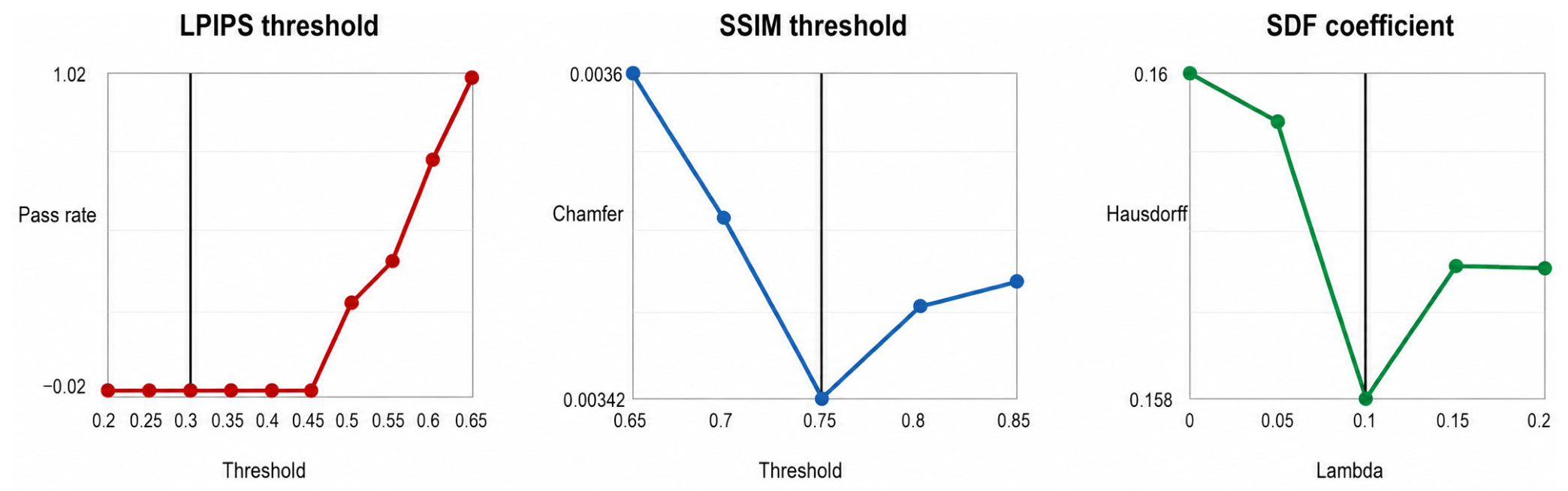
Across the tested range, the Chamfer distance and normal-related metrics remain relatively close, indicating that the SDF coefficient does not cause large instability within the selected interval. Among the tested values, λ = 0.10 yields the lowest mean Hausdorff distance in the representative subset, while maintaining stable Chamfer distance, normal consistency, and normal deviation. This supports the use of λ = 0.10 as a practical trade-off between local detail enhancement and global surface stability.
Table A2. Summary of SDF coefficient sensitivity.
SDF Coefficient λMain ObservationInterpretation
0.00Weaker local detail enhancement.Insufficient enhancement of local facial geometry.
0.05Similar behavior to λ = 0.00, with slightly improved stability.Mild enhancement but limited detail recovery.
0.10Lowest mean Hausdorff distance among the tested settings.Stable trade-off between local detail and surface continuity.
0.15Comparable reconstruction behavior, but no clear improvement over λ = 0.10.Stronger enhancement does not lead to proportional gain.
0.20Metrics remain stable but do not clearly outperform λ = 0.10.Larger coefficient may introduce unnecessary surface disturbance.
The results indicate that λ = 0.10 should not be interpreted as a universally optimal value. Instead, it is used as a practical and stable setting within the tested coefficient range.

Appendix A.4. Summary

The supplementary validation supports the main interpretation of the paper: the proposed intervention improves several profile-to-frontal prediction and 3D reconstruction indicators, especially shape-preservation-related metrics, without dominating every individual metric.
These supplementary results strengthen the quantitative support for the proposed intervention while preserving a cautious interpretation.

Appendix B. Parameter Sensitivity Analysis

Figure A1. Parameter sensitivity analysis for the LPIPS threshold, SSIM threshold, and SDF coefficient. The black vertical lines indicate the selected parameter values used in the final implementation.
Electronics 15 02963 g0a1

Appendix B.1. LPIPS Threshold Sensitivity

The LPIPS threshold was evaluated to examine its effect on frontal candidate filtering under the controlled setting where rendered frontal reference images are available. The tested range included the originally considered values of 0.20, 0.25, 0.30, 0.35, and 0.40 and was further extended to 0.45, 0.50, 0.55, 0.60, and 0.65 according to the observed LPIPS distribution in the representative subset.
The results show that lower LPIPS thresholds impose stricter candidate selection in the current subset. The 0.30 setting was therefore used as a conservative criterion in the rendered-reference setting, prioritizing frontal-view reliability and perceptual consistency over candidate acceptance rate. As the threshold increased, candidate acceptance became less restrictive, but overly relaxed thresholds could introduce structurally less reliable frontal predictions.
This result also supports the methodological distinction made in the main text: LPIPS is used only when a frontal reference image is available in the rendered quantitative dataset. For practical single-image inputs without ground-truth frontal references, candidate reliability should be assessed through landmark-based frontal verification and cross-view consistency checking rather than through LPIPS-based reference filtering.

Appendix B.2. SSIM Threshold Sensitivity

The SSIM threshold was evaluated to examine the trade-off between view-consistency enforcement and regeneration cost. The tested values were 0.65, 0.70, 0.75, 0.80, and 0.85. A lower threshold accepts more generated multi-view candidates, but may retain predictions with weaker cross-view consistency. A higher threshold enforces stricter view consistency, but increases the frequency of prompt refinement and regeneration.
The subset results indicate that SSIM = 0.75 provides a reasonable balance between reconstruction stability and computational cost. Lower thresholds reduce the number of regeneration attempts, but may preserve less consistent multi-view predictions. Higher thresholds trigger more frequent refinement, but do not necessarily produce proportional improvement in the final reconstruction metrics. Therefore, SSIM = 0.75 is adopted as a practical trigger for view-consistency refinement in the proposed pipeline.

Appendix B.3. SDF Detail Coefficient Sensitivity

The SDF detail coefficient controls the balance between local geometric enhancement and global surface stability. We tested five values: 0.00, 0.05, 0.10, 0.15, and 0.20. The evaluation was conducted on representative samples, and the resulting meshes were assessed using Chamfer distance, Hausdorff distance, normal consistency, and normal deviation.
The results show that very small coefficients provide insufficient local detail enhancement, especially in regions such as the nose bridge, mouth contour, and eye area. Larger coefficients can strengthen local geometric response, but may also introduce additional surface disturbance and reduce mesh stability. The value of 0.10 provides a stable trade-off across the evaluated geometric and normal-related metrics. Therefore, λ = 0.10 is adopted as the default setting for SDF-based local detail enhancement in the proposed refinement pipeline.

Appendix B.4. Summary of Sensitivity Analysis

Overall, the sensitivity analysis shows that the selected LPIPS, SSIM, and SDF settings act as practical trade-offs among candidate quality control, view-consistency refinement, and geometric stability, as visualized in Figure A1. These parameters are treated as implementation settings for the current pipeline rather than as universally optimal constants.

References

  1. Mildenhall, B.; Srinivasan, P.P.; Tancik, M.; Barron, J.T.; Ramamoorthi, R. Nerf: Representing scenes as neural radiance fields for view synthesis. Commun. ACM 2021, 65, 99–106. [Google Scholar]
  2. Wang, P.; Liu, L.; Liu, Y.; Theobalt, C.; Komura, T.; Wang, W. NeuS: Learning Neural Implicit Surfaces by Volume Rendering for Multi-view Reconstruction. arXiv 2023, arXiv:2106.10689. [Google Scholar] [CrossRef]
  3. Poole, B.; Jain, A.; Barron, J.T.; Mildenhall, B. DreamFusion: Text-to-3D using 2D Diffusion. arXiv 2022, arXiv:2209.14988. [Google Scholar] [CrossRef]
  4. Shi, Y.; Wang, P.; Ye, J.; Long, M.; Li, K.; Yang, X. MVDream: Multi-view Diffusion for 3D Generation. arXiv 2024, arXiv:2308.16512. [Google Scholar] [CrossRef]
  5. Long, X.; Guo, Y.-C.; Lin, C.; Liu, Y.; Dou, Z.; Liu, L.; Ma, Y.; Zhang, S.-H.; Habermann, M.; Theobalt, C.; et al. Wonder3D: Single image to 3D using cross-domain diffusion. In Proceedings of the IEEE/CVF Conference on Computer Vision and Pattern Recognition, Seattle, WA, USA, 16–22 June 2024; pp. 9970–9980. Available online: http://openaccess.thecvf.com/content/CVPR2024/html/Long_Wonder3D_Single_Image_to_3D_using_Cross-Domain_Diffusion_CVPR_2024_paper.html (accessed on 17 March 2026).
  6. Hong, Y.; Zhang, K.; Gu, J.; Bi, S.; Zhou, Y.; Liu, D.; Liu, F.; Sunkavalli, K.; Bui, T.; Tan, H. Large Reconstruction Model for Single Image to 3D. arXiv 2024, arXiv:2311.04400. [Google Scholar] [CrossRef]
  7. Wang, Z.; Wang, Y.; Chen, Y.; Xiang, C.; Chen, S.; Yu, D.; Li, C.; Su, H.; Zhu, J. CRM: Single Image to 3D Textured Mesh with Convolutional Reconstruction Model. In European Conference on Computer Vision; Leonardis, A., Ricci, E., Roth, S., Russakovsky, O., Sattler, T., Varol, G., Eds.; Springer: Cham, Switzerland, 2024; pp. 57–74. [Google Scholar] [CrossRef]
  8. Chen, S.; Zhang, K.; Shi, Y.; Wang, H.; Zhu, Y.; Song, G.; An, S.; Kristjansson, J.; Yang, X.; Zwicker, M. Panic-3D: Stylized single-view 3D reconstruction from portraits of anime characters. In Proceedings of the IEEE/CVF Conference on Computer Vision and Pattern Recognition, Vancouver, BC, Canada, 17–24 June 2023; pp. 21068–21077. Available online: http://openaccess.thecvf.com/content/CVPR2023/html/Chen_PAniC-3D_Stylized_Single-View_3D_Reconstruction_From_Portraits_of_Anime_Characters_CVPR_2023_paper.html (accessed on 17 March 2026).
  9. Huang, Z.; Guo, Y.-C.; Wang, H.; Yi, R.; Ma, L.; Cao, Y.-P.; Sheng, L. Mv-adapter: Multi-view consistent image generation made easy. In Proceedings of the IEEE/CVF International Conference on Computer Vision, Honolulu, HI, USA, 19–23 October 2025; pp. 16377–16387. Available online: https://openaccess.thecvf.com/content/ICCV2025/html/Huang_MV-Adapter_Multi-View_Consistent_Image_Generation_Made_Easy_ICCV_2025_paper.html (accessed on 17 March 2026).
  10. Liu, R.; Wu, R.; Van Hoorick, B.; Tokmakov, P.; Zakharov, S.; Vondrick, C. Zero-1-to-3: Zero-shot one image to 3D object. In Proceedings of the IEEE/CVF International Conference on Computer Vision, Paris, France, 1–6 October 2023; pp. 9298–9309. Available online: http://openaccess.thecvf.com/content/ICCV2023/html/Liu_Zero-1-to-3_Zero-shot_One_Image_to_3D_Object_ICCV_2023_paper.html (accessed on 17 March 2026).
  11. Niemeyer, M.; Barron, J.T.; Mildenhall, B.; Sajjadi, M.S.; Geiger, A.; Radwan, N. Regnerf: Regularizing neural radiance fields for view synthesis from sparse inputs. In Proceedings of the IEEE/CVF Conference on Computer Vision and Pattern Recognition, New Orleans, LA, USA, 18–24 June 2022; pp. 5480–5490. Available online: http://openaccess.thecvf.com/content/CVPR2022/html/Niemeyer_RegNeRF_Regularizing_Neural_Radiance_Fields_for_View_Synthesis_From_Sparse_CVPR_2022_paper.html (accessed on 17 March 2026).
  12. Xu, D.; Jiang, Y.; Wang, P.; Fan, Z.; Shi, H.; Wang, Z. Sinnerf: Training neural radiance fields on complex scenes from a single image. In European Conference on Computer Vision; Avidan, S., Brostow, G., Cissé, M., Farinella, G.M., Hassner, T., Eds.; Springer: Cham, Switzerland, 2022; pp. 736–753. [Google Scholar] [CrossRef]
  13. Wang, Z.; Lu, C.; Wang, Y.; Bao, F.; Li, C.; Su, H.; Zhu, J. Prolificdreamer: High-fidelity and diverse text-to-3d generation with variational score distillation. Adv. Neural Inf. Process. Syst. 2023, 36, 8406–8441. [Google Scholar]
  14. Qian, G.; Mai, J.; Hamdi, A.; Ren, J.; Siarohin, A.; Li, B.; Lee, H.-Y.; Skorokhodov, I.; Wonka, P.; Tulyakov, S.; et al. Magic123: One Image to High-Quality 3D Object Generation Using Both 2D and 3D Diffusion Priors. arXiv 2023, arXiv:2306.17843. [Google Scholar] [CrossRef]
  15. Szymanowicz, S.; Rupprecht, C.; Vedaldi, A. Splatter image: Ultra-fast single-view 3D reconstruction. In Proceedings of the IEEE/CVF Conference on Computer Vision and Pattern Recognition, Seattle, WA, USA, 16–22 June 2024; pp. 10208–10217. Available online: http://openaccess.thecvf.com/content/CVPR2024/html/Szymanowicz_Splatter_Image_Ultra-Fast_Single-View_3D_Reconstruction_CVPR_2024_paper.html (accessed on 30 March 2026).
  16. Shen, T.; Munkberg, J.; Hasselgren, J.; Yin, K.; Wang, Z.; Chen, W.; Gojcic, Z.; Fidler, S.; Sharp, N.; Gao, J. Flexible isosurface extraction for gradient-based mesh optimization. ACM Trans. Graph. (ToG) 2023, 42, 1–16. [Google Scholar] [CrossRef]
  17. Luo, Y.; Zhou, S.; Lan, Y.; Pan, X.; Loy, C.C. 3DEnhancer: Consistent multi-view diffusion for 3D enhancement. In Proceedings of the Computer Vision and Pattern Recognition Conference, Nashville, TN, USA, 11–15 June 2025; pp. 16430–16440. Available online: https://openaccess.thecvf.com/content/CVPR2025/html/Luo_3DEnhancer_Consistent_Multi-View_Diffusion_for_3D_Enhancement_CVPR_2025_paper.html (accessed on 30 March 2026).
  18. Ho, I.; Song, J.; Hilliges, O. Sith: Single-view textured human reconstruction with image-conditioned diffusion. In Proceedings of the IEEE/CVF Conference on Computer Vision and Pattern Recognition, Seattle, WA, USA, 16–22 June 2024; pp. 538–549. Available online: https://openaccess.thecvf.com/content/CVPR2024/html/Ho_SiTH_Single-view_Textured_Human_Reconstruction_with_Image-Conditioned_Diffusion_CVPR_2024_paper.html (accessed on 30 March 2026).
  19. Zhang, R.; Isola, P.; Efros, A.A.; Shechtman, E.; Wang, O. The unreasonable effectiveness of deep features as a perceptual metric. In Proceedings of the IEEE Conference on Computer Vision and Pattern Recognition, Salt Lake City, UT, USA, 18–22 June 2018; pp. 586–595. Available online: http://openaccess.thecvf.com/content_cvpr_2018/html/Zhang_The_Unreasonable_Effectiveness_CVPR_2018_paper.html (accessed on 17 March 2026).
  20. Mallat, S.G. A theory for multiresolution signal decomposition: The wavelet representation. IEEE Trans. Pattern Anal. Mach. Intell. 2002, 11, 674–693. [Google Scholar]
  21. Wang, Z.; Bovik, A.C.; Sheikh, H.R.; Simoncelli, E.P. Image quality assessment: From error visibility to structural similarity. IEEE Trans. Image Process. 2004, 13, 600–612. [Google Scholar] [CrossRef] [PubMed]
  22. Tang, J.; Chen, Z.; Chen, X.; Wang, T.; Zeng, G.; Liu, Z. Lgm: Large multi-view gaussian model for high-resolution 3D content creation. In European Conference on Computer Vision; Leonardis, A., Ricci, E., Roth, S., Russakovsky, O., Sattler, T., Varol, G., Eds.; Springer: Cham, Switzerland, 2024; pp. 1–18. [Google Scholar] [CrossRef]
  23. Dubuisson, M.-P.; Jain, A.K. A modified Hausdorff distance for object matching. In Proceedings of 12th International Conference on Pattern Recognition; IEEE: New York, NY, USA, 1994; pp. 566–568. [Google Scholar] [CrossRef]
  24. Fan, H.; Su, H.; Guibas, L.J. A point set generation network for 3D object reconstruction from a single image. In Proceedings of the IEEE Conference on Computer Vision and Pattern Recognition, Honolulu, HI, USA, 21–26 July 2017; pp. 605–613. Available online: http://openaccess.thecvf.com/content_cvpr_2017/html/Fan_A_Point_Set_CVPR_2017_paper.html (accessed on 17 March 2026).
  25. Ranftl, R.; Bochkovskiy, A.; Koltun, V. Vision transformers for dense prediction. In Proceedings of the IEEE/CVF International Conference on Computer Vision, Montreal, QC, Canada, 11–17 October 2021; pp. 12179–12188. Available online: http://openaccess.thecvf.com/content/ICCV2021/html/Ranftl_Vision_Transformers_for_Dense_Prediction_ICCV_2021_paper.html (accessed on 17 March 2026).
  26. Zhao, Z.; Lai, Z.; Lin, Q.; Zhao, Y.; Liu, H.; Yang, S.; Feng, Y.; Yang, M.; Zhang, S.; Yang, X.; et al. Hunyuan3D 2.0: Scaling Diffusion Models for High Resolution Textured 3D Assets Generation. arXiv 2023, arXiv:2501.12202. [Google Scholar] [CrossRef]
  27. Bhat, S.F.; Birkl, R.; Wofk, D.; Wonka, P.; Müller, M. ZoeDepth: Zero-shot Transfer by Combining Relative and Metric Depth. arXiv 2023, arXiv:2302.12288. [Google Scholar] [CrossRef]
  28. Boss, M.; Huang, Z.; Vasishta, A.; Jampani, V. Sf3D: Stable fast 3D mesh reconstruction with uv-unwrapping and illumination disentanglement. In Proceedings of the Computer Vision and Pattern Recognition Conference, Nashville, TN, USA, 11–15 June 2025; pp. 16240–16250. Available online: https://openaccess.thecvf.com/content/CVPR2025/html/Boss_SF3D_Stable_Fast_3D_Mesh_Reconstruction_with_UV-unwrapping_and_Illumination_CVPR_2025_paper.html (accessed on 17 March 2026).
  29. Lan, Y.; Zhou, S.; Lyu, Z.; Hong, F.; Yang, S.; Dai, B.; Pan, X.; Loy, C.C. GaussianAnything: Interactive Point Cloud Flow Matching For 3D Object Generation. arXiv 2025, arXiv:2411.08033. [Google Scholar] [CrossRef]
  30. Deitke, M.; Schwenk, D.; Salvador, J.; Weihs, L.; Michel, O.; VanderBilt, E.; Schmidt, L.; Ehsani, K.; Kembhavi, A.; Farhadi, A. Objaverse: A universe of annotated 3D objects. In Proceedings of the IEEE/CVF Conference on Computer Vision and Pattern Recognition, Vancouver, BC, Canada, 17–24 June 2023; pp. 13142–13153. Available online: http://openaccess.thecvf.com/content/CVPR2023/html/Deitke_Objaverse_A_Universe_of_Annotated_3D_Objects_CVPR_2023_paper.html (accessed on 17 March 2026).
  31. Hore, A.; Ziou, D. Image quality metrics: PSNR vs. SSIM. In 2010 20th International Conference on Pattern Recognition; IEEE: New York, NY, USA, 2010. [Google Scholar] [CrossRef]
Figure 1. Overview of the failure-mode-driven inference-time intervention pipeline.
Electronics 15 02963 g001
Figure 2. Framework of the ImageDream-based image-prompted multi-view generation module. In the LPIPS evaluation, (a) denotes the predicted frontal candidate and (b) denotes the rendered frontal reference.
Electronics 15 02963 g002
Figure 3. Failure-mode-guided CRM refinement strategy for stylized profile reconstruction.
Electronics 15 02963 g003
Figure 4. Comparison of stylized profile 3D reconstruction results under different profile angles.
Electronics 15 02963 g004
Figure 5. Detailed comparison of reconstructed stylized profile 3D models.
Electronics 15 02963 g005
Figure 6. Stylized profile inputs, IPMD-predicted frontal views, and final 3D reconstruction results.
Electronics 15 02963 g006
Figure 7. Vertex count change rate and face count change rate of reconstructed models. The black horizontal line indicates the zero-change baseline, where values above and below the line represent increases and decreases, respectively.
Electronics 15 02963 g007
Figure 8. Hausdorff distance of reconstructed models across different profile angles.
Electronics 15 02963 g008
Figure 9. Chamfer distance of reconstructed models across different profile angles.
Electronics 15 02963 g009
Figure 10. Normal consistency of reconstructed models across different profile angles. The black horizontal line indicates the reference baseline.
Electronics 15 02963 g010
Figure 11. Normal deviation of reconstructed models across different profile angles. The black horizontal line indicates the reference baseline.
Electronics 15 02963 g011
Figure 12. Surface area change rate and volume change rate of reconstructed models across different profile angles. The black horizontal line indicates the zero-change baseline, where values above and below the line represent increases and decreases, respectively.
Electronics 15 02963 g012
Figure 13. Normalized radar chart of reconstruction behavior across eight evaluation metrics. All metrics are scaled to [0, 1], and lower-is-better metrics are direction-aligned so that higher values consistently indicate better reconstruction behavior.
Electronics 15 02963 g013
Table 1. Optimization analysis of CRM outputs for stylized profile character reconstruction.
Failure ModeLikely CauseOptimization Target
Collapsed eyes, abnormal morphology, and unclear contoursUnstable geometric recovery, distorted facial proportions, and insufficient structural supportImprove MLP weight scaling to stabilize facial structure
Over-smoothed nose bridge with reduced depthSDF estimation fails to preserve local geometric detailEnhance SDF-based detail preservation in key regions
Blurred mouth contour and weak structural definitionInaccurate local mouth modelingImprove local geometric recovery of the mouth region
Uneven texture on the forehead and cheeks, with cracks or artifactsInaccurate texture mapping and poor UV adaptation to the meshImprove UV mapping accuracy
Rough surface and local geometric deformationIrregular topology and uneven triangle distributionApply automatic retopology to improve mesh density distribution and surface continuity
UV color misalignment and local discontinuitiesErrors in UV unwrapping and texture projectionRefine UV unfolding and repair local seams
Blurred hair and clothing details with low texture qualityLimited texture resolution and insufficient enhancement of material detailIntroduce wavelet-based texture enhancement
Unstable illumination, uneven shadows, and shading artifactsInaccurate normal estimationRecompute normals to improve rendering consistency
Table 2. Main implementation details and experimental settings.
ItemSetting
Backbone modelsImageDream; CRM
RetrainingNo
Runtime environmentUbuntu 20.04; Python 3.8; PyTorch 2.0.0; CUDA 11.8
HardwareNVIDIA RTX 3090 or above, 24 GB VRAM
Input format and resolutionPNG; 682 × 582
Quantitative dataset25 stylized 3D character models; 175 rendered images
Style-adaptation test set115 collected stylized images
Style categories19 3D cartoon; 53 simple cartoon; 43 watercolor or ink-wash
Test angles0°, 20°, 30°, 60°, 70°, 80°, 90°
Random seed1234
Guidance scale/sampling steps3/100
Background processingAutomatic background removal
Candidate assessmentLPIPS for rendered quantitative evaluation; FaceMesh and SSIM checking for single-image inputs
LPIPS threshold0.30, used only with rendered frontal references
SSIM threshold0.75
CRM loss weightsλdepth = 0.5, λmask = 0.5, λLPIPS = 0.1
Automation boundaryManual cross-server transfer; other inference and analysis steps automated
Table 3. SSIM and PSNR of profile-to-frontal prediction under different profile angles.
Angle (Degrees)CRM SSIMLGM SSIMMV-Adapter SSIMOurs SSIMCRM PSNRLGM PSNRMV-Adapter PSNROurs PSNR
200.650.760.710.735.879.087.128.16
300.680.810.650.736.2510.246.238.13
600.690.790.690.716.209.286.777.62
700.690.780.670.726.139.236.547.94
800.710.790.650.736.339.516.368.11
900.710.800.640.766.359.506.148.92
Mean0.690.790.670.736.199.476.538.15
Table 4. LPIPS and keypoint error of profile-to-frontal prediction under different profile angles.
Angle (Degrees)CRM LPIPSLGM LPIPSMV-Adapter LPIPSOurs LPIPSCRM Keypoint ErrorLGM Keypoint ErrorMV-Adapter Keypoint ErrorOurs Keypoint Error
200.400.240.390.2665.1254.9342.1846.33
300.380.180.440.2668.9457.20176.3364.78
600.380.200.400.2872.7787.6284.9077.49
700.380.210.420.2757.4786.38145.3973.78
800.380.200.430.2830.1984.76167.0453.01
900.380.200.430.2417.35116.33157.7651.25
Mean0.380.210.420.2651.9781.20128.9361.11
Lower values indicate better performance for LPIPS and keypoint error.
Table 5. Mean geometric metrics of reconstructed models across all profile angles.
MetricCRMDPTDepthGaussianAnythingHunyuan3DSF3DZoeDepthOurs
Vertex count change rate (%)−40.71573.09216.87−74.94−44.475167.329.23
Face count change rate (%)−50.02664.38230.39−72.63−5.485607.9−6.0
Hausdorff distance (cm)0.490.520.580.550.611.80.55
Chamfer distance (cm)0.090.150.150.130.161.180.1
Normal consistency−0.010.00.020.08−0.040.020.0
Surface area change rate (%)−58.99−91.23−88.21−82.75−88.39−58.89−18.9
Volume change rate (%)−47.64−99.05−94.57−83.47−91.69−44.3237.36
Normal deviation1.341.331.321.261.361.321.34
Table 6. Seven-configuration progressive ablation results on the representative subset.
GroupConfigurationChamfer ↓Hausdorff ↓Normal Consistency ↑Normal Deviation ↓SSIM ↑Keypoint Error ↓
ACRM only0.003660 ± 0.0011740.158506 ± 0.0549240.659289 ± 0.1016040.761410 ± 0.1664420.556079 ± 0.06978355.468391 ± 6.561604
BIPMD + CRM0.003633 ± 0.0014960.165986 ± 0.0474910.672963 ± 0.1085210.741331 ± 0.1735740.551483 ± 0.07021252.794193 ± 7.556440
CB + FaceMesh verification0.003599 ± 0.0013860.159957 ± 0.0418200.679732 ± 0.1209030.729420 ± 0.1937900.553465 ± 0.07519247.269151 ± 2.545197
DC + Adaptive cropping0.003445 ± 0.0012460.154338 ± 0.0452860.678534 ± 0.0997070.733707 ± 0.1661420.548387 ± 0.07707948.453360 ± 1.477383
ED + Geometry refinement0.003609 ± 0.0010790.152576 ± 0.0461860.671681 ± 0.1040910.743101 ± 0.1678760.548387 ± 0.07707948.453360 ± 1.477383
FE + Texture refinement0.003584 ± 0.0010190.151674 ± 0.0463650.672156 ± 0.1036610.742778 ± 0.1691510.548387 ± 0.07707948.453360 ± 1.477383
GFull configuration0.003582 ± 0.0010370.149408 ± 0.0481490.671255 ± 0.1053500.744013 ± 0.1698790.548387 ± 0.07707948.453360 ± 1.477383
Note: ↑ denotes that higher values are better, whereas ↓ denotes that lower values are better. The results show stage-level contributions across different aspects of reconstruction quality.
Disclaimer/Publisher’s Note: The statements, opinions and data contained in all publications are solely those of the individual author(s) and contributor(s) and not of MDPI and/or the editor(s). MDPI and/or the editor(s) disclaim responsibility for any injury to people or property resulting from any ideas, methods, instructions or products referred to in the content.