1. Introduction
As a result of accelerated technological development, the global trend of digitization, and the growing complexity of legal regulations, the quality of public communication by state bodies has perhaps never been more crucial than it is today. This is especially true for legal and administrative texts that help individuals understand their obligations and enforce their rights.
The quality of such communication can be evaluated from multiple perspectives, including clarity, timeliness, accessibility, and trustworthiness, all of which are key elements of effective government communication during crises [
1]. However, these factors are no less important outside of emergency contexts. In fact, they are essential for enabling citizens to navigate everyday bureaucratic processes and to exercise their legal rights.
One of the most significant obstacles to this goal is the linguistic complexity of legal and administrative texts, which often creates barriers to understanding. In the absence of clear and accessible language, such documents can be misinterpreted, turning a communication issue into a matter of social justice. Improving the clarity of legal texts is therefore closely tied to the principle of Access to Justice [
2,
3,
4], a fundamental requirement of the rule of law [
5,
6].
Access to Justice depends not only on the availability and reliability of information but also on whether people can understand official documents addressed to them, and how quickly they can do so [
7]. These documents include, for example, informational materials from public offices and the texts of laws and regulations.
This concern has given rise to the Plain Language Movement (PLM), which has advocated since the 1970s for clearer public and legal communication [
8]. According to the U.S. government’s official guidelines, “a communication is in Plain Language if its wording, structure, and design are so clear that the intended audience can easily find what they need, understand what they find, and use that information” (
https://www.plainlanguage.gov/guidelines/ (accessed on 30 May 2026)). The primary aim of the movement is to make public and legal documents more comprehensible, thereby helping citizens understand their rights and obligations.
Plain Language efforts have inspired a range of national and international initiatives, including the ISO 24495-1 standard [
9] (
https://www.iso.org/standard/78907.html (accessed on 30 May 2026)), which sets out formal criteria for clarity and accessibility. The development of this standard is coordinated by the International Plain Language Federation, an umbrella organization that includes Clarity International and the Plain Language Association International (
https://www.iplfederation.org/iso-standard/ (accessed on 30 May 2026)).
Although awareness of Plain Language (PL) has grown significantly in recent years, legal documents often remain linguistically complex. Long sentences, archaic terminology, and nested clauses continue to hinder comprehension. Revising texts that were not originally written in PL is particularly challenging, as it demands both specialized expertise and substantial time. This is especially true in the legal and administrative domain, where precision and clarity must coexist, making manual simplification both labor-intensive and costly. To address this, Natural Language Processing (NLP) techniques have gained increasing relevance. They offer the potential for semi-automated simplification, improving efficiency and enhancing access to legal information.
While PL-oriented tools and initiatives have made considerable progress internationally, they have mostly focused on English-language texts. Advanced clarity testers (e.g., Readability Consensus, Flesch–Kincaid) and artificial intelligence (AI)-driven writing assistants (e.g., Grammarly, Hemingway Editor) are readily available in English, combining rule-based and machine learning approaches to identify and improve complex sentence structures.
In contrast, smaller languages like Hungarian remain under-served in this area. Foundational NLP tools such as HuSpaCy [
10] support basic linguistic processing, but do not offer capabilities for simplification or paraphrasing. Furthermore, the only publicly available Hungarian simplification corpus, huPWKP [
11], is based on the English Parallel Wikipedia Simplification Corpus [
12] and reflects the principles of Simple English rather than the stricter clarity and accessibility requirements needed for legal and administrative communication.
To address these limitations, another Hungarian-language corpus specifically designed for PL processing has recently been introduced [
13]. This dataset contains parallel versions of legal and administrative documents from the domain of tax administration in their original form and their PL reformulations, created by linguistic experts. The parallel structure provides a unique opportunity for machine-learning-based adaptation, enabling models to learn how complex, technical language can be transformed into clearer and more accessible text. Preliminary experiments using this corpus have already demonstrated its potential for automated classification and simplification tasks [
14].
Nevertheless, the development of robust machine learning models for PL adaptation in Hungarian legal–administrative texts remains an open research challenge; while large language models (LLMs) such as GPT-4 have shown considerable success in generating PL summaries in English (especially in structured domains like biomedical literature [
15]), their effectiveness in legal contexts is less established. In particular, the need to preserve precise normative content while enhancing clarity introduces unique difficulties that general-purpose models are not yet fully equipped to resolve.
This technological gap underscores the need for localized solutions that can support PL adaptation in non-English contexts. Although international efforts have advanced PL processing in major languages, domain-specific tools for underrepresented languages like Hungarian are still largely missing. Bridging this gap is essential to ensure that the benefits of Plain Language, enhanced comprehensibility, efficiency, and Access to Justice, are available across linguistic boundaries.
In response to this challenge, the present study aims to develop a machine-learned component for a Hungarian legal–administrative writing assistant. This component is designed to automatically classify each sentence as either “Plain Language”or “not Plain Language”, thereby providing real-time feedback during drafting and revision. Such functionality can significantly reduce the time and expertise required for manual simplification, while supporting legal professionals in producing more accessible documents.
To this end, we investigate the potential of sentence-level PL classification through fine-tuning several state-of-the-art transformer-based models, including XLM-RoBERTa, the Bidirectional Encoder Representations from Transformers (BERT) model, Gemini 1.0 Pro, and GPT-4o-mini. These models are trained and evaluated on Hungarian legal and administrative corpora that contain parallel PL annotations, enabling supervised learning. Our approach not only assesses the binary classification performance of each model but also examines their ability to identify complex sentence structures that are likely to require simplification.
This study is methodologically focused on sentence-level classification, rather than generative rewriting or translation-based simplification. We argue that this approach is more feasible for low-resource settings and legally sensitive domains, where preserving meaning and minimizing distortion are paramount.
In addition to benchmarking model performance, we also address the interpretability of classification decisions using SHAP (SHapley Additive Explanations) analysis [
16]. By visualizing the contribution of individual tokens to the model’s predictions, we provide linguistic insight into how legal complexity is operationalized in transformer-based classifiers. This supports both error analysis and the development of transparent, domain-aware NLP applications in legal settings.
Although the empirical focus of this study is on Hungarian legal texts, the proposed methods and challenges addressed here are applicable to other under-resourced languages and domains that require precision-driven simplification.
The main contributions of this study are therefore:
- 1.
We motivate the use of sentence-level classification as a viable alternative to machine translation, particularly in contexts where parallel PL corpora are limited in size.
- 2.
We release and evaluate transformer-based PL classifiers optimized for integration into a future Hungarian legal writing assistant.
The remainder of this paper is structured as follows.
Section 2 provides a review of the relevant literature on Plain Language and Text Simplification (TS).
Section 3 reviews machine learning approaches to TS.
Section 4 describes the dataset and preprocessing procedures.
Section 5 presents the methodological framework.
Section 6 reports the experimental results, followed by a discussion in
Section 7. Finally,
Section 8 concludes the paper, and outlines directions for future work.
4. Data
This study leverages a curated Hungarian dataset specifically developed for PL adaptation in legal and administrative contexts. The dataset, previously introduced by [
13], contains parallel texts from the Hungarian National Tax and Customs Administration (Nemzeti Adó- és Vámhivatal, NAV). These texts were originally drafted in complex legalese and subsequently reformulated by linguistic experts to adhere to PL principles, with the aim of enhancing comprehensibility for the general public.
The corpus comprises various types of administrative communication, including informational brochures, guidance documents, and public service announcements. Each document appears in two distinct forms: the original, legally complex version, and a PL version rewritten for improved clarity and accessibility. Although these texts are not formal legislative acts, they are authoritative administrative communications that serve a quasi-legal function in informing citizens about rights, obligations, and procedures.
The original dataset consisted of 203 document pairs. During preprocessing, all texts were segmented into sentences and aligned at the sentence level. However, only sentence pairs that exhibited meaningful differences between the original and the PL version were retained. Sentences that appeared verbatim in both versions were excluded to ensure that the remaining corpus genuinely reflects stylistic and structural simplification.
The resulting corpus contains 5445 sentences from the Non-Plain documents and 5438 sentences from their PL counterparts. Each sentence was assigned a binary label based on its origin: “Non-Plain” if it appeared only in the original version, and “Plain” if it appeared only in the simplified version. These binary labels serve as the foundation for the sentence-level classification task described in the subsequent sections.
The statistics reported in
Table 2 refer to the complete sentence-level corpus before partitioning. For model development and evaluation, the 203 document pairs were divided into training, validation, and test sets using an 80/10/10 ratio. The split was performed at the document-pair level rather than at the individual sentence level. Each pair consisted of an original administrative document and its corresponding Plain Language reformulation, and all sentences originating from the same document pair were assigned to the same subset. This procedure ensured that neither parallel sentence variants nor other sentences from the same source document could occur across the training, validation, and test sets.
This dataset represents a rare resource for Hungarian legal–administrative PL research and serves as a key contribution to low-resource language settings. It is particularly suitable for classification-based approaches, as its sentence-level structure provides clean, interpretable training examples without requiring large-scale generative modeling.
5. Methods
This section outlines the methodological framework employed to classify Hungarian legal texts based on their adherence to PL principles. Our approach combines zero-shot prompting, supervised fine-tuning of multiple pretrained language models, and data augmentation. Each component is detailed below, with a focus on their implementation for sentence-level classification in a low-resource, domain-specific context.
5.1. Zero-Shot Classification Setup
As a baseline, we employed the GPT-4o model [
71] using a zero-shot prompting strategy. This approach allowed the model to classify legal texts without prior task-specific fine-tuning, relying entirely on natural language instructions. The primary goal was to evaluate the model’s inherent understanding of PL principles in Hungarian texts, independent of extensive prompt engineering.
Zero-shot prompting is particularly relevant in low-resource language settings, such as Hungarian, where annotated domain-specific corpora are scarce [
72], while LLMs show strong zero-shot performance in English [
73], their effectiveness in smaller, underrepresented languages is limited [
74]. Thus, zero-shot evaluation serves as a useful diagnostic tool to assess whether a model implicitly captures PL-related features in Hungarian.
To ensure task clarity and reduce output variability, we constructed a concise classification prompt:
You are a legal text classifier. Your task is to determine whether a legal text is written in Plain Language or not Plain Language. A text is considered ′Plain Language′ if it is simple, clear, and easy to understand for a general audience without requiring legal expertise. Otherwise, it is ′not Plain Language′. Respond only with ′Plain Language′ or ′not Plain Language′. Here is the text:
This prompt was deliberately kept simple to avoid dependence on complex prompt-engineering strategies. It enabled deterministic, interpretable outputs that were benchmarked against supervised classifiers.
5.2. Fine-Tuning Setup
Fine-tuning involves adapting pretrained language models to a specific task through further training on labeled data. It enables the model to better capture domain-specific language use, making it especially valuable in low-resource and technical domains, such as legal text classification [
75,
76].
We fine-tuned four models selected for their relevance to multilingual and legal NLP tasks: huBERT, XLM-RoBERTa (XLM-R), GPT-4o-mini, and Gemini 1.0 Pro.
The huBERT model [
77] is a Hungarian BERT-base model trained on a 9-billion-token Hungarian corpus. It contains 110M parameters and was fine-tuned for binary sentence classification. We used the Hugging Face Trainer API for training (max. 10 epochs, batch size 16, learning rate
). Tokenization used the pretrained huBERT tokenizer with a 512-token maximum sequence length. Optimization was performed with AdamW and early stopping after two stagnant epochs.
XLM-R [
78] (base and large) was selected for its strong multilingual capabilities and cross-lingual alignment. Both variants were fine-tuned for a maximum of 10 epochs with a per-device training and evaluation batch size of 16, a learning rate of (
), a maximum sequence length of 512 tokens, and a random seed of 42. The default AdamW optimizer of the Hugging Face Trainer was used. Evaluation and checkpoint saving were performed at the end of each epoch. Early stopping was applied with a patience of two consecutive evaluation cycles without improvement in validation loss. The checkpoint with the lowest validation loss was reloaded at the end of training, and only one checkpoint was retained.
OpenAI’s GPT-4o-mini model [
79] was fine-tuned via the OpenAI API using JSONL-formatted data. Prompts were sentence-level inputs as user prompts, paired with their corresponding labels (ie., Plain vs. Non-Plain). Default fine-tuning parameters were used, with convergence monitored through API-provided metrics.
Google’s Gemini 1.0 Pro model [
80] was fine-tuned via Google Cloud Vertex AI using the
gemini-1.0-pro-002 variant. Training occurred in the
europe-west2 region over 5 epochs with a learning rate multiplier of 1 and adapter size of 4. Distributed training ensured memory efficiency and faster convergence.
5.3. Data Augmentation
To mitigate the limitations of a relatively small training set, we employed translation-based data augmentation. Data augmentation is a well-established method in NLP to artificially expand datasets, and it is particularly effective in low-resource language scenarios where annotated corpora are scarce [
81].
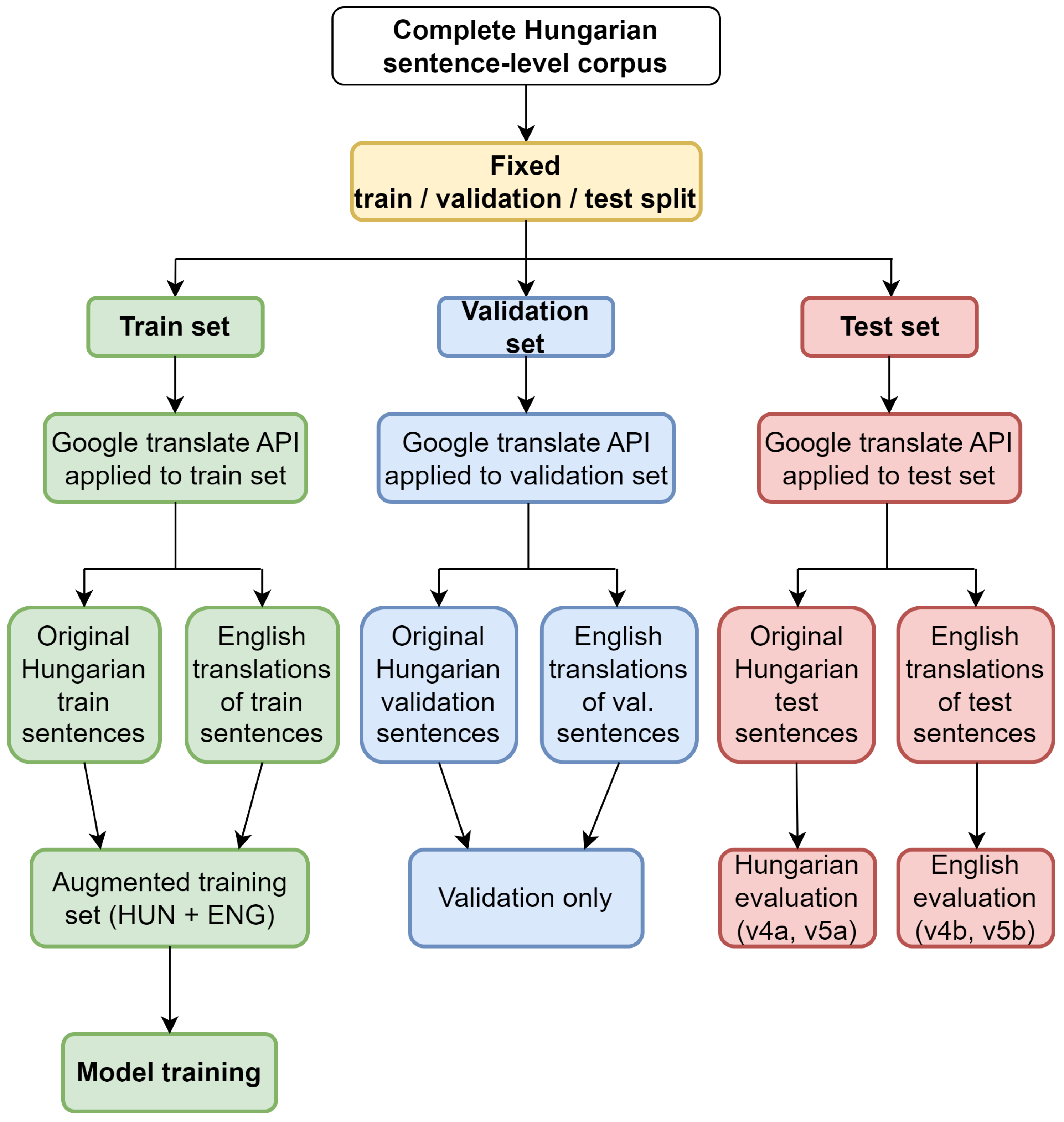
In our setup, Hungarian sentences were translated into English using the Google Translate API (
https://cloud.google.com/translate (accessed on 30 May 2026)), creating additional training examples that are semantically equivalent but linguistically distinct from the originals. To prevent information leakage, the Hungarian corpus was first divided into fixed train, validation, and test subsets. Machine translation was then applied separately within each already-fixed subset, rather than to the complete corpus before splitting. This order is methodologically important because translating the complete corpus before splitting could allow a Hungarian sentence and its English translation to appear in different subsets. The resulting leakage-safe augmentation pipeline is shown in
Figure 1.
This approach leverages the multilingual capabilities of models like XLM-RoBERTa, allowing them to learn from syntactic and lexical variation across languages [
82,
83]. Since English is over-represented in the pretraining corpora of most transformer models, the translated texts also align more closely with the models’ internal representations, effectively enriching their understanding of clarity-related features [
84].
This strategy offers three main benefits. First, it increases the volume of training data without requiring manual annotation. Second, it introduces diverse sentence structures and vocabulary that help the model generalize better. Third, it implicitly bridges the gap between underrepresented languages and better-resourced ones by aligning training data with the model’s strongest linguistic priors.
However, translation-based augmentation is not without risks. Legal texts are particularly sensitive to semantic nuances, and machine translation may introduce artifacts that alter or obscure the original meaning. To mitigate this, we manually reviewed a subset of the translated texts to ensure that critical legal distinctions were preserved.
To further assess whether translation-based augmentation altered the linguistic feature space relevant to Plain Language classification, we conducted a lightweight diagnostic comparison between the original Hungarian sentences and their machine-translated English counterparts. We computed a set of surface-level proxy features for both languages, including sentence length, character count, comma density, long-word ratio, formal legal–administrative marker frequency, relative marker frequency, and a simple nominalization proxy. These features were not intended to provide a complete grammatical comparison between Hungarian and English sentences of the corpus. Rather, they were used to examine whether the contrast between Plain and Non-Plain sentences was preserved, weakened, or reconfigured after translation. For each feature, we compared class-wise means and Cohen’s d effect sizes in the Hungarian and English versions of the corpus.
The metrics were calculated using simple and reproducible surface-level procedures. Sentence length was measured as the number of regex-based word tokens in each sentence, while character count was computed from the raw sentence string. Long-word ratio was defined as the proportion of tokens containing at least twelve characters. Comma density was calculated as the number of commas per 100 tokens. Formal legal–administrative marker frequency was based on a manually defined list of language-specific expressions that frequently occur in bureaucratic or legal–administrative prose. The Hungarian list included, among others, amennyiben [provided that/if], esetén [in case of/in the event of], során [during/in the course of], tekintettel [with regard to/taking into account], vonatkozásában [with respect to/regarding], értelmében [pursuant to/under], történő [being performed/carried out], and minősül [qualifies as/is deemed to be]. These items were selected because they often function as markers of formal administrative style, nominalized constructions, or light-verb-like bureaucratic phrasing. The English list included comparable administrative and legal expressions, such as provided that, in the case of, during, with regard to, in respect of, pursuant to, concerning, and qualifies as. Relative marker frequency was computed from occurrences of relative or subordinator-like markers, such as Hungarian amely [which], amelynek [whose/of which], ahol [where], and amelyben [in which], and English which, that, and where. The nominalization proxy was based on suffix-pattern matching for common nominal or gerund-like endings in each language.
For frequency-based features, raw counts were normalized per 100 tokens, calculated as follows:
where
denotes the normalized frequency of the relevant marker per 100 tokens,
denotes the number of occurrences of that marker, and
denotes the total number of tokens in the sentence.
For each feature, we compared class-wise means and Cohen’s
d effect sizes in the Hungarian and English versions of the corpus. Cohen’s
d was calculated within each language as follows:
where
and
denote the mean feature values for the Non-Plain and Plain classes, respectively, and
denotes the pooled standard deviation of the two classes within the same language. These measures are therefore not intended as language-independent grammatical annotations, but as transparent diagnostic proxies for assessing whether class-separating surface cues are preserved or weakened after translation.
Incorporating translated data into the training pipeline ultimately improved the models’ ability to detect stylistic and structural patterns characteristic of PL, even when applied to Hungarian content.
5.4. Contextual Baseline Reference
The main experimental comparison in the present study focuses on zero-shot prompting and fine-tuned transformer-based models. However, to avoid interpreting the zero-shot GPT-4o setup as the only non-fine-tuned point of reference, we also relate our findings to previously published lightweight machine learning baselines developed on the same corpus and sentence-level Plain Language classification task [
13]. That earlier study evaluated term frequency–inverse document frequency (TF-IDF) features combined with a support vector machine (SVM), as well as fastText models using the same core corpus construction logic, namely the distinction between original administrative-legal sentences and their expert-rewritten Plain Language counterparts.
These previously published results are used here as contextual baselines rather than as strict head-to-head comparisons. This distinction is important because the earlier experiments were not re-run under the exact same train–test split and evaluation pipeline as the transformer models reported in the present study. Nevertheless, they provide a relevant lightweight supervised reference point, especially because the earlier SVM and fastText experiments included systematic hyperparameter optimization. The numerical comparison with these baselines is therefore presented in the Discussion after the current transformer-based results have been reported.
6. Results
This section presents the evaluation results of six different model configurations applied to the task of PL classification in Hungarian legal/official texts. The analysis begins with a zero-shot prompting baseline using the GPT-4o model, followed by fine-tuned model variants including huBERT, XLM-RoBERTa (base and large), GPT-4o-mini, and Gemini 1.0 Pro. We also assess the impact of data augmentation via Hungarian-to-English machine translation on model performance. The results are compared using standard classification metrics, with a focus on macro F1-scores, accuracy, and model robustness. Finally, we discuss observed trade-offs between model size, training strategy, and inference efficiency.
6.1. Zero-Shot Classification Results
As a baseline, we evaluated the GPT-4o model using a zero-shot prompting approach, in which the model was asked to classify legal sentences as either Plain or Non-Plain based solely on a natural language instruction. No task-specific fine-tuning or training examples were provided. To ensure deterministic outputs, the model was queried with temperature=0, which allowed for consistent and reproducible classification.
Table 3 summarizes the results. The model achieved an overall accuracy of 52%, which is only marginally better than random guessing for a balanced binary task. A breakdown by class reveals asymmetries: the model was somewhat better at identifying
Plain Language texts, with a precision of 53% and a recall of 58%, resulting in an F1-score of 55%. By contrast, performance on
Non-Plain sentences was weaker (F1 = 48%), with both precision and recall below 52%.
This mild bias toward the Plain category may stem from the phrasing of the prompt or from the model’s general preference for more neutral or accessible formulations when uncertainty arises. Similar tendencies have been observed in prior studies, where instruction-tuned language models without domain supervision tend to produce or favor simpler outputs in ambiguous contexts [
85,
86].
While zero-shot prompting offers practical advantages, such as eliminating the need for annotated training data, its performance here demonstrates the limitations of generic language models in domain-specific classification tasks. The low F1-scores and near-chance accuracy indicate that GPT-4o lacks a sufficiently nuanced representation of legal linguistic complexity when operating without additional guidance.
These results underscore the necessity of supervised fine-tuning for effective PL detection in legal texts. In the following sections, we explore how model performance improves when trained on aligned Hungarian corpora containing Plain and Non-Plain versions of legal–administrative content.
6.2. Fine-Tuning Results
To evaluate the effect of supervised adaptation, we fine-tuned a series of transformer-based models using Hungarian legal texts annotated for PL.
Table 4 provides an overview of the model configurations, training regimes, and evaluation languages. Each setup is assigned a version identifier (v1–v7) to facilitate consistent cross-reference in the
Section 6 and
Section 7.
Table 4 describes the main parameters of the carried out experiments. In v4 and v5, data augmentation was applied after the train/validation/test split had been fixed. The validation and test subsets were translated separately and were not added to the training data. The Hungarian evaluation settings, v4a and v5a, used the original Hungarian held-out test sentences, whereas the English evaluation settings, v4b and v5b, used the machine-translated English counterparts of the same fixed test split. This setup enabled models to benefit from multilingual representations, particularly in XLM-RoBERTa, which was pretrained on over 100 languages, without data leakage. Evaluating on machine-translated English sentences offers insight into the model’s cross-lingual robustness, especially given that English is significantly over-represented in the pretraining corpus of multilingual transformers like XLM-RoBERTa.
Before fine-tuning, we assessed whether the 512-token input limit imposed by huBERT and XLM-RoBERTa would lead to data loss. Empirical analysis showed this was negligible: only 15 sentences (0.13%) in huBERT and 23 sentences (0.21%) in XLM-RoBERTa exceeded the limit out of 10,928 examples. Average input lengths were 47.63 and 57.82 tokens, respectively, confirming that truncation had minimal effect on semantic coverage.
Table 5 summarizes evaluation scores for each model version. The best-performing setup, v5a (XLM-RoBERTa-large with multilingual training, evaluated on Hungarian), achieved the highest macro-average F1-score (0.79). This confirms that large multilingual transformers benefit from cross-lingual fine-tuning, even when evaluation remains monolingual.
In contrast, evaluations performed on the English translations (v4b, v5b) yielded slightly lower macro-average F1-scores (0.64 and 0.67, respectively). These results suggest that while cross-lingual fine-tuning can improve general robustness, model performance remains sensitive to the language of evaluation. Machine-translated English inputs may introduce subtle inconsistencies or stylistic artifacts that negatively impact classification accuracy. Furthermore, although XLM-RoBERTa was pretrained on English data extensively, the original sentence structure and legal phrasing are rooted in Hungarian, which may reduce semantic fidelity when evaluated in English. This reinforces the importance of training and evaluating PL classifiers primarily in the language of deployment.
Compared to the zero-shot GPT-4o baseline (macro F1 = 0.52), all fine-tuned models demonstrate substantial performance gains, underlining the importance of domain-specific adaptation.
Among all configurations, the v5a model (i.e., XLM-RoBERTa-large trained on both Hungarian texts and their machine-translated English counterparts) achieves the strongest overall performance. It obtains a macro-average F1-score of 0.79, with balanced results across both classes. Notably, it also performs best at detecting Non-Plain sentences, achieving the highest F1-score (0.81) and precision (0.77) in this category.
The improvement from v3 to v5a (both using XLM-RoBERTa-large, but with and without data augmentation) illustrates the effectiveness of cross-lingual fine-tuning, while v3 reaches a macro F1-score of 0.72, v5a improves this to 0.79. Similar gains are observed when comparing v2 and v4a (XLM-RoBERTa-base with and without data augmentation), where the macro F1-score increases from 0.69 to 0.74. This demonstrates that data augmentation not only boosts overall accuracy but is particularly effective for identifying complex, inaccessible sentence structures.
The GPT-4o-mini model (v6), trained and evaluated entirely on Hungarian data, delivers competitive results (macro F1 = 0.70). This suggests that instruction-tuned LLMs can generalize reasonably well to PL classification, even in a monolingual, domain-specific setting, without access to multilingual augmentation.
The Gemini 1.0 Pro model (v7), also trained on Hungarian-only data, performs moderately (macro F1 = 0.61). It shows better recall for Non-Plain cases (0.70), but underperforms on Plain sentences (F1 = 0.57), indicating a conservative bias towards complexity. Compared to open-weight alternatives with data augmentation, its generalization appears more limited in this legal domain.
To summarize, fine-tuning large multilingual transformer models with data augmentation yields the best results. However, lightweight monolingual models like huBERT still offer competitive performance (macro F1 = 0.73), and minimal token truncation was observed in less than 0.2% of the inputs, indicating robustness across all configurations.
6.3. Model Size, Efficiency, and Deployment Trade-Offs
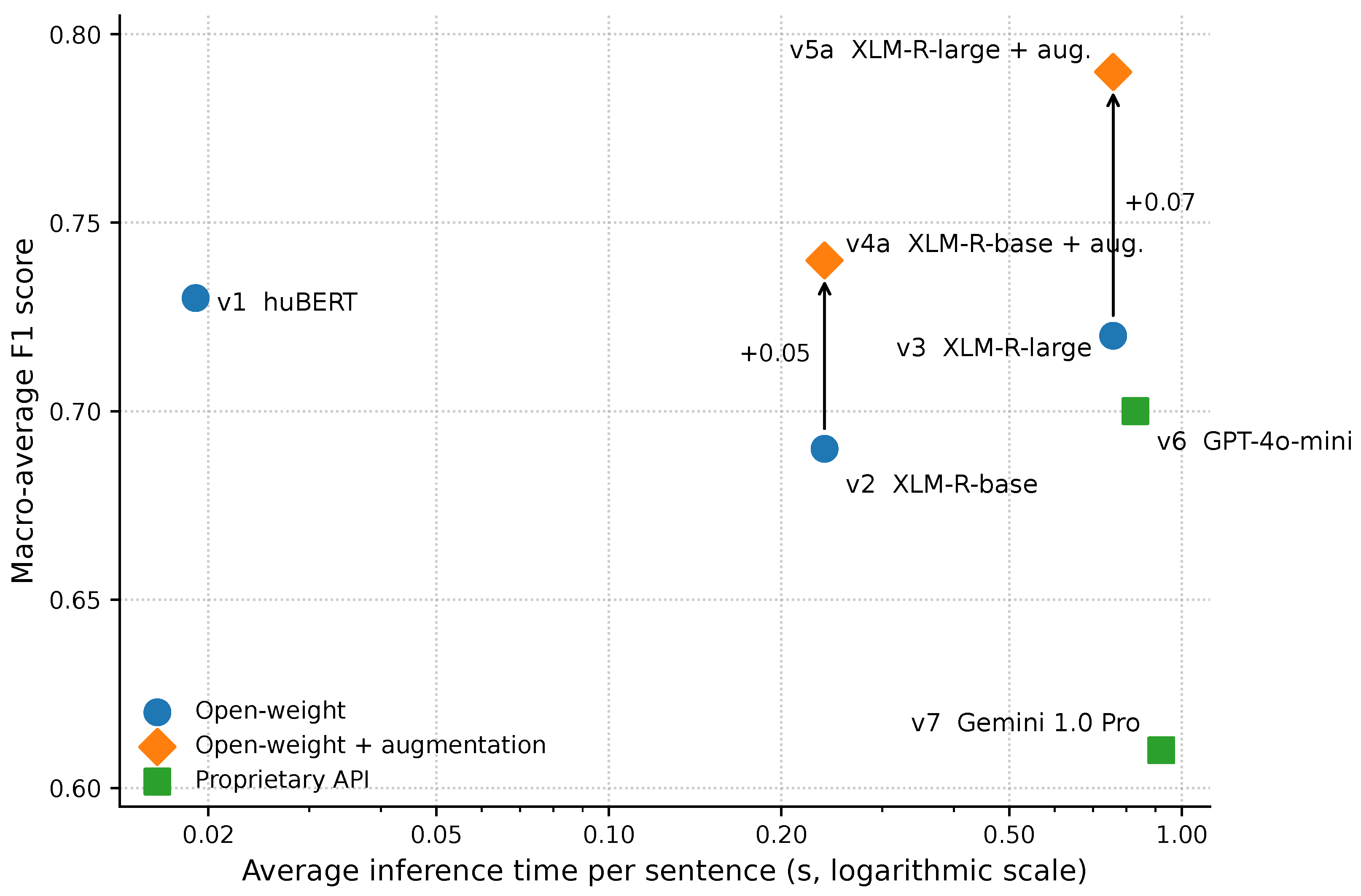
Figure 2 visualizes the trade-off between model size (in millions of parameters), classification performance (macro-average F1 score), and inference time. Each bubble represents a fine-tuned model. This combined visualization supports practical trade-off decisions between accuracy, latency, and model scalability, especially in domains with strict resource constraints.
The results highlight key considerations in the ongoing debate between Small and Large Language Models [
87]. On the one hand, larger models such as v5a(XLM-RoBERTa-large trained on Hungarian and translated English texts) achieve the best overall performance (macro F1 = 0.79), while still maintaining acceptable inference times. However, the high computational demands of these models pose challenges for deployment, particularly in resource-constrained or latency-sensitive environments.
Smaller models, including v1 (huBERT) and v4a (XLM-RoBERTa-base with data augmentation), demonstrate competitive performance (macro F1 = 0.73 and 0.74, respectively), while offering clear advantages in cost-efficiency, and deployability. These characteristics are particularly relevant in legal and institutional settings where data privacy, auditability, and infrastructure constraints are non-negotiable. Notably, v1 (huBERT) achieves strong performance despite having the fewest parameters and the lowest inference latency, illustrating that small models can remain viable when domain-specific training is applied.
The proprietary GPT-4o-mini (v6) model, while performing reasonably well (macro F1 = 0.70), is accessible only through OpenAI’s API, limiting its applicability due to permanent usage costs, lack of transparency, and restrictions on model customization. Similar considerations apply to the Gemini 1.0 Pro model (v7), which also operates as a closed-source system. Despite its smaller training scope and absence of data augmentation, Gemini achieves a macro F1 of 0.61, reflecting moderate generalization capabilities within the Hungarian official domain.
Inference times (as detailed in
Table 6) for each model were measured during prediction on the held-out test set used for evaluation. Average latency values were computed over all test examples, reflecting realistic end-to-end response times under practical deployment conditions. These values capture the combined effect of model architecture, inference environment, and backend optimizations. Inference was performed using a single NVIDIA A100 GPU unit (NVIDIA Corporation, Santa Clara, CA, USA) with batch size = 1 to approximate real-time API usage scenarios. For proprietary models (v6 and v7), which are only accessible via API, latency measurements also include request transmission time and server-side processing delays. This makes them less predictable and potentially less suitable for latency-critical environments.
These findings underline the recurring trade-offs between model accuracy, latency, and deployability; while instruction-tuned proprietary LLMs can offer strong performance, they introduce challenges in terms of cost, access, and long-term sustainability. Conversely, open-weight models hosted on platforms such as Hugging Face enable fine-tuning on task-specific data and self-hosted deployment at the same time, providing greater control over data security, compliance, and customization.
In summary, results suggest that mid-sized multilingual models with augmentation (e.g., v4a, v5a) offer a promising compromise, meriting further attention in practical deployments. They combine strong performance with manageable resource requirements, making them especially well-suited for high-stakes domains like legal text classification, where accuracy must be balanced with interpretability, compliance, and technical viability.
7. Discussion
This section synthesizes the empirical results presented above to derive theoretical and practical insights. We examine the relative effectiveness of different model architectures, the role of data augmentation, and the challenges associated with PL classification in low-resource legal domains. Limitations and implications for future research and deployment are also discussed.
7.1. Interpretation of Model Performance
The evaluation results presented in
Table 5 indicate that multilingual transformer models, particularly XLM-RoBERTa-large trained with augmented Hungarian–English data (v5a), outperform other configurations in classifying legal and administrative texts according to PL standards. These findings support prior evidence that multilingual pretraining can enhance downstream task performance in low-resource languages through improved representation learning and domain transfer [
83].
The v5a model achieved a macro-average F1-score of 0.79, indicating a strong ability to distinguish between Plain and Non-Plain sentence constructions. Its consistent performance across precision and recall, especially for Non-Plain sentences, suggests reliable identification of linguistically complex inputs. This likely reflects the model’s exposure to syntactically and lexically diverse inputs, enabled by machine-translated English augmentations, which may have promoted more generalized representations of sentence clarity.
By contrast, the zero-shot GPT-4o model achieved only near-random performance (macro F1 = 0.52), underscoring the limitations of relying solely on general-purpose instruction-tuned pretraining without task-specific adaptation. Despite its extensive multilingual training, GPT-4o lacked supervised exposure to Hungarian legal texts, which appears essential for accurate PL classification.
Notably, the huBERT model (v1), a monolingual, compact model pretrained on Hungarian corpora, achieved a macro F1-score of 0.73. This performance demonstrates the value of domain-specific pretraining, showing that even relatively small models can approach the effectiveness of larger architectures when fine-tuned on curated in-domain data. Given its low inference latency and open-weight availability, huBERT represents a viable solution for deployment in resource-constrained or regulated environments, such as legal or institutional settings.
7.2. Comparison with Previously Published Lightweight Baselines
The present results can also be interpreted in relation to previously published lightweight baselines on the same corpus and sentence-level Plain Language classification task [
13]. This comparison is useful because the zero-shot GPT-4o result alone would provide only a weak baseline for assessing the value of supervised transformer fine-tuning. The earlier study evaluated two non-transformer approaches: TF-IDF + SVM and fastText. Although these models were not re-run under the exact same split as the current experiments, they were trained and evaluated on the same corpus and therefore provide a meaningful contextual reference point.
In the earlier TF-IDF + SVM experiment, the regularization parameter C, the parameter, and the kernel type were systematically optimized. The tested values were , , and the rbf, poly, sigmoid, and linear kernels. Model performance was evaluated using 10-fold cross-validation. The best SVM configurations achieved an average two-class F1-score of approximately 0.68.
The same earlier study also evaluated fastText models with both pretrained Hungarian vectors and vectors trained on the task-specific corpus. The fastText experiments included hyperparameter testing for the learning rate, word n-gram size, minimum token count, embedding dimensionality, and number of epochs. The best configuration used a learning rate of 0.1, unigram features, a minimum token count of 20, and 50-dimensional embeddings. However, the best fastText models reached only approximately 0.62 F1-score, underperforming the optimized SVM baseline.
Taken together, these earlier results show that the task is learnable with lightweight supervised methods, but they also suggest a lower performance ceiling for traditional approaches. The comparison is summarized in
Table 7. The present best-performing transformer model, XLM-RoBERTa-large trained with Hungarian–English augmentation, achieved a macro-average F1-score of 0.79. This indicates that the performance gain of supervised transformer fine-tuning is not limited to the comparison with zero-shot GPT-4o; it also exceeds previously published lightweight supervised baselines that had already undergone hyperparameter optimization.
7.3. Impact of Data Augmentation
Translation-based data augmentation significantly enhanced model performance across multiple configurations. Both XLM-RoBERTa-base (v2 vs. v4a) and XLM-RoBERTa-large (v3 vs. v5a) exhibited measurable improvements when trained on augmented corpora, with macro F1-scores increasing by 0.05 and 0.07, respectively. These gains suggest that exposing models to syntactic variability, even via machine-translated text, improves their capacity to abstract the linguistic features that define PL.
These gains should be interpreted in light of the leakage-safe augmentation design described in
Section 5.3. Since the split was fixed before translation, the observed improvement cannot be attributed to the model seeing translated variants of validation or test sentences during training. Instead, the improvement reflects the additional cross-lingual training signal provided by the English translations of the training split only.
To better understand the linguistic consequences of this augmentation strategy, we examined whether selected surface-level PL-related proxy features behaved similarly in the Hungarian originals and in their English translations. The results are summarized in
Table 8. The diagnostic comparison suggests that translation did not simply shorten or simplify the sentences in a uniform way. On average, the English translations contained more tokens than the Hungarian originals, with an English-to-Hungarian token ratio of 1.36 for Plain sentences and 1.34 for Non-Plain sentences. However, the class-separating effect of certain Hungarian legal–administrative markers became substantially weaker after translation. In Hungarian, formal markers per 100 tokens showed a clear difference between Plain and Non-Plain sentences: 1.36 in Plain sentences and 2.86 in Non-Plain sentences, with a Cohen’s
d of 0.47. In English, the corresponding values were 2.29 and 2.64, with a much smaller Cohen’s
d of 0.10. This indicates that the translation process may smooth out some of the surface-level cues that distinguish Non-Plain Hungarian legal–administrative style from Plain Language.
This shift is linguistically plausible. Hungarian is an agglutinative language in which case suffixes, possessive constructions, verbal prefixes, nominalizations, and flexible word order can encode dense legal–administrative relations compactly. In English, these relations are often rendered through prepositional phrases, more fixed word order, and explicit subordination. As a result, machine translation may preserve the general semantic content while redistributing the formal and structural cues that the classifier can use. The increase in relative markers in English further supports this interpretation: some compact Hungarian constructions appear to be mapped into more explicit analytic structures, such as relative or subordinator-based formulations. These findings do not invalidate translation-based augmentation, but they show that its benefits should be interpreted as cross-lingual regularization rather than as a neutral expansion of the Hungarian feature space.
However, the performance drop in evaluations conducted on English-translated test data (v4b, v5b) highlights an important caveat: data augmentation is most effective when limited to the training phase. Evaluation in the language of deployment (in this case, Hungarian) remains crucial. Translation artifacts, such as altered idiomaticity or inconsistent legal terminology, may distort model predictions and reduce ecological validity. Consequently; while augmentation supports model generalization, deployment pipelines should preserve original language inputs to ensure faithful classification.
In practice, this means that multilingual models like XLM-RoBERTa can benefit substantially from English augmentations during training, but inference and validation should rely on the source-language corpus for accuracy and domain fidelity.
7.4. Model Bias and Label Imbalance
Across fine-tuned configurations, a recurring pattern emerged: models generally performed better at detecting Non-Plain constructions than Plain ones. This asymmetry suggests the presence of underlying biases in either the data or the model representations.
One plausible explanation is that Non-Plain sentences tend to exhibit more salient structural markers (nested clauses, nominalizations, or passive constructions) that are readily captured by transformer-based encoders. These features may act as strong signals for “complexity,” facilitating classification.
Another contributing factor could be annotation bias. If human annotators were more confident in identifying complex sentences (e.g., based on surface difficulty or bureaucratic tone) than in positively labeling clear, accessible formulations, the resulting data distribution might have skewed the learning process. This would lead models to develop a heightened sensitivity to markers of Non-Plainness, while under-representing the diverse features of effective PL.
Addressing this imbalance will likely require both data-level and model-level interventions. On the data side, targeted augmentation of underrepresented Plain examples, especially those with varied syntax and professional phrasing, could help balance the distribution. On the model side, techniques from explainable AI (XAI), such as gradient-based saliency maps or SHAP analyses, could be employed to better understand and potentially correct internal biases by revealing the features most influential in classification decisions.
Finally, future work may also explore cost-sensitive training or calibrated loss functions to explicitly account for asymmetries in label distribution and decision importance, especially in real-world deployments where misclassifying a Plain sentence might have lower risk than overlooking a complex one.
7.5. Interpretability via SHAP Analysis
To better understand the decision-making heuristics of the best-performing model (v5–XLM-RoBERTa-large with augmented data), we conducted local interpretability analysis using SHAP (SHapley Additive exPlanations) [
16]. SHAP is a model-agnostic framework based on cooperative game theory that attributes to each input token a contribution value toward the model’s prediction. This enables quantifying and visualizing the influence of individual tokens, thereby enhancing transparency and linguistic interpretability.
In addition to the local SHAP explanations, we also performed an aggregated word-level SHAP analysis on the full Hungarian held-out test set. This additional analysis was conducted for the two open-weight models most relevant to deployment and comparison:
Sentences were grouped according to the models’ own predicted class labels. For each model and predicted class, we aggregated only positive SHAP contributions toward the predicted class. To avoid tokenizer-specific artifacts, contributions were aggregated at the surface-word level rather than at the subword-token level. Only words with at least five positive SHAP occurrences were retained, and both models’ predictions were evaluated solely on the Hungarian test set.
7.5.1. True Positive Example: Nominalized and Bureaucratic Constructions
Here, the term true positive is used with Non-Plain as the positive class. To illustrate linguistic complexity in Hungarian legal–administrative style, consider the following example:
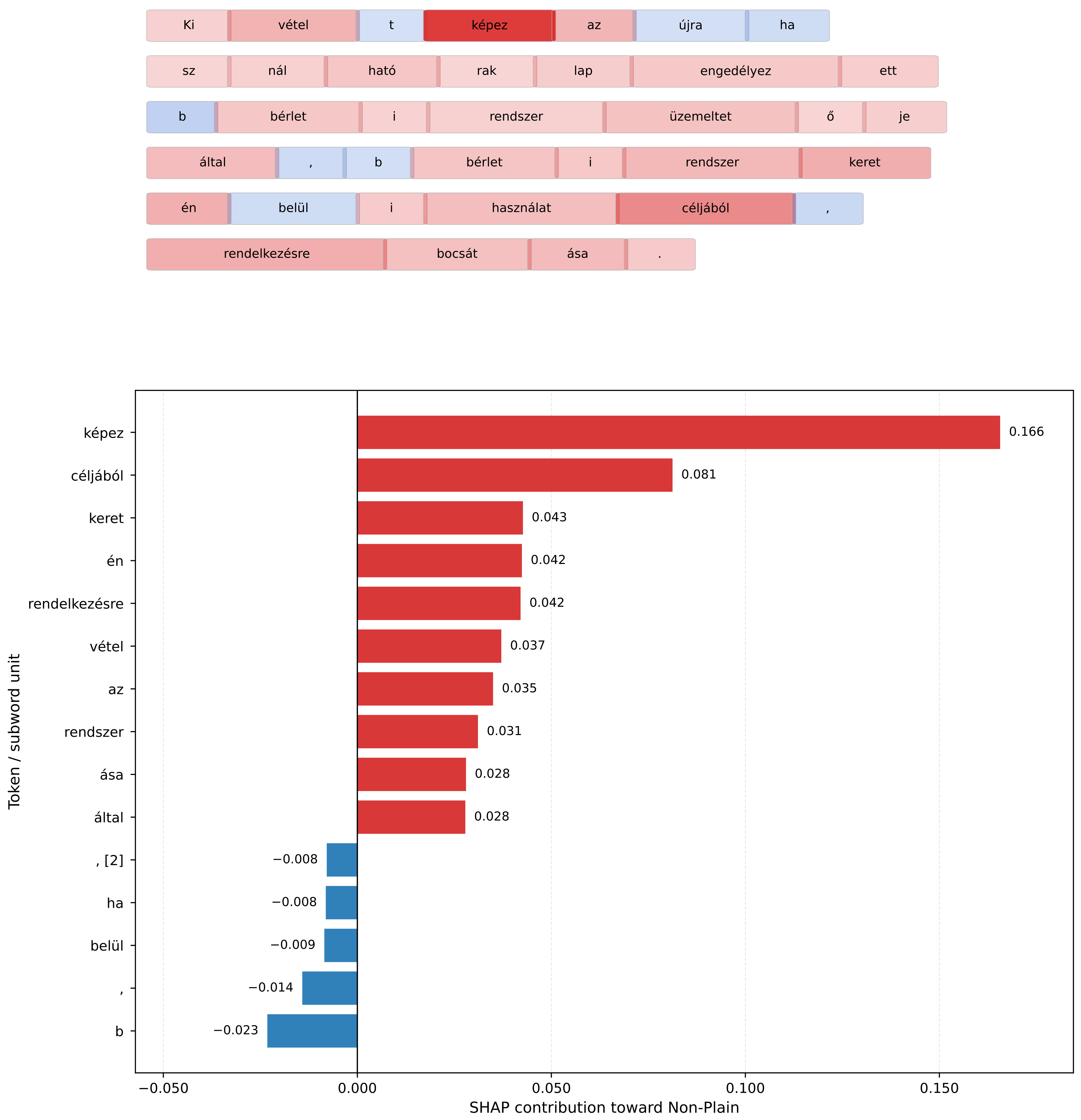
Kivételt képez az újrahasználható raklap engedélyezett bérleti rendszer üzemeltetője által, bérleti rendszer keretén belüli használat céljából, rendelkezésre bocsátása.
[Literal translation: An exception is constituted by the making available of the reusable pallet by the operator of the authorized leasing system, for the purpose of use within the framework of the leasing system].
The sentence exhibits features typical of legal–bureaucratic registers. Here, extended nominal constructions, such as keretén belüli használat [use within the framework], abstract nominal expressions, such as rendelkezésre bocsátása [making available], and oblique syntactic structures that hinder comprehension.
Figure 3 presents the local SHAP explanation for the model’s prediction. The sentence was correctly classified as
Non-Plain, with a predicted probability of 0.9963 for the
Non-Plain class. This probability was derived by applying a softmax function to the model’s logits. The explanation uses the verified class-index mapping used in the SHAP analysis, where
output_0 corresponds to the
Non-Plain class. The figure uses a hybrid visualization. The upper panel preserves the full token sequence and colors each token or subword unit according to its local SHAP contribution. The lower panel ranks the strongest positive and negative local SHAP contributors. Red elements increase the model’s confidence in the
Non-Plain prediction, while blue elements push the prediction in the opposite direction.
The strongest positive contributors include token and subword units belonging to expressions such as kivételt képez [constitutes an exception], bérleti rendszer keretén belüli használat céljából [for the purpose of use within the framework of the leasing system], and rendelkezésre bocsátása [making available]. In the ranked panel, particularly strong contributions are associated with units such as képez, céljából, keret, rendelkezésre, rendszer, ása, and által. These items should not be interpreted as isolated lexical triggers. Because the local explanation is produced at token or subword level, some units become linguistically meaningful only when they are read as parts of complete surface words or larger constructions. Their relevance is therefore best understood in the context of nominalized, periphrastic, and bureaucratic phrasing.
Such expressions typify bureaucratic language patterns that reduce accessibility. First, nominalizations like rendelkezésre bocsátása [making available] introduce abstraction that could often be avoided with verb-based forms, such as elérhetővé teszi [makes it accessible]. Second, embedded syntactic structures, such as keretén belüli használat [use within the framework], increase cognitive load. Third, institutional and purpose-marking expressions such as céljából [for the purpose of] distance the text from everyday usage.
Especially notable is the light verb construction [
88]
kivételt képez [constitutes an exception], which makes the sentence more indirect and could be more plainly expressed, for example as
nem tartozik bele [is not included]. Such periphrastic patterns are prevalent in legal drafting and contribute significantly to perceived textual complexity.
These linguistic features align with the patterns the model identified as characteristic of the Non-Plain class. The hybrid visualization makes this relationship clear because it preserves the token sequence while also presenting the strongest SHAP contributors in a readable ranked form.
7.5.2. Correctly Classified Plain Example: Domain-Specific Terminology Without Non-Plain Classification
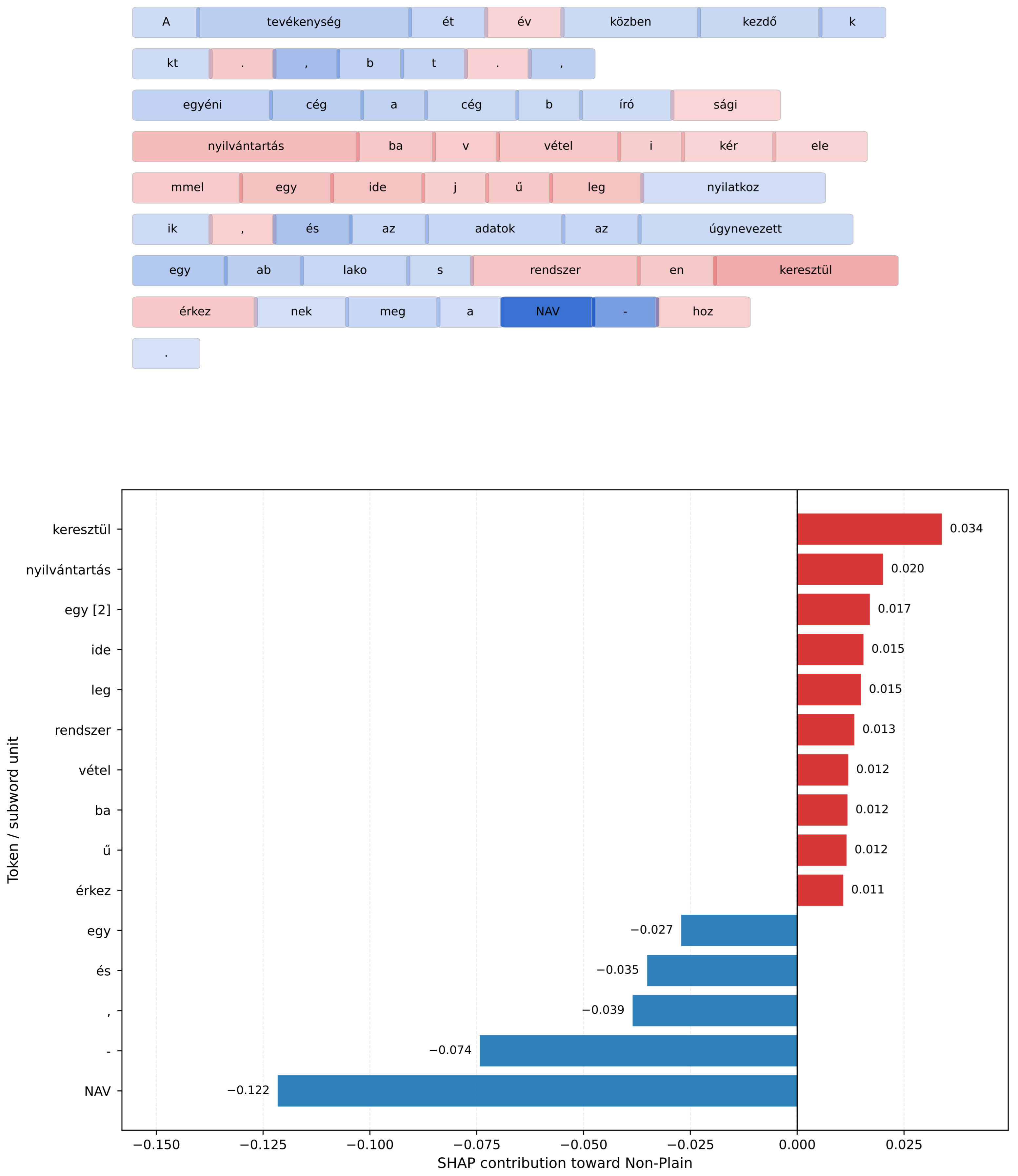
Figure 4 presents a correctly classified
Plain sentence containing several domain-specific legal–administrative terms. The example illustrates that the presence of technical or institutional vocabulary does not necessarily result in a
Non-Plain prediction. Instead, the model appears to evaluate such lexical cues in combination with the broader syntactic and contextual structure of the sentence.
A tevékenységét év közben kezdő kkt., bt., egyéni cég a cégbírósági nyilvántartásba vételi kérelemmel egyidejűleg nyilatkozik, és az adatok az úgynevezett egyablakos rendszeren keresztül érkeznek meg a NAV-hoz.
[Translation: A general partnership (kkt.), limited partnership (bt.), or sole proprietorship starting its activities during the year makes a declaration along with its company registration application, and the data are transmitted to the tax authority (NAV) through the so-called one-stop system].
The sentence contains formal administrative vocabulary, including company-law abbreviations, cégbírósági nyilvántartásba vételi kérelem [company registration application], egyablakos rendszer [one-stop system], and NAV [National Tax and Customs Administration]. However, these terms appear in a relatively linear and interpretable sentence structure. The model classified the sentence as Plain, with a predicted probability of 0.9898 for the Plain class.
For comparability with the previous example,
Figure 4 explains local SHAP contributions toward the
Non-Plain class rather than toward the predicted
Plain class. Therefore, red elements indicate token or subword units that would increase the model’s confidence in a
Non-Plain classification, while blue elements indicate units that push against the
Non-Plain class. This makes it possible to examine why the sentence contains some local evidence associated with administrative complexity, but still does not cross the model’s decision boundary for
Non-Plain language.
The SHAP values show a mixed pattern. Some units, such as keresztül [through], nyilvántartás [registration/register], vétel [taking/registration-related nominal element], and rendszer [system], contribute positively toward the Non-Plain class. These items plausibly reflect formal administrative register and institutional procedure. At the same time, other elements counteract a Non-Plain interpretation. Most importantly, NAV appears as a strong negative contributor with respect to the Non-Plain class in this local explanation. This indicates that the acronym did not operate here as a simple lexical trigger for Non-Plain classification.
This contrastive example refines the interpretation of model behavior. The model does not appear to rely exclusively on isolated domain-specific terms. Instead, it combines lexical register cues with broader contextual and structural signals. The presence of institutional vocabulary alone is therefore not sufficient to produce a Non-Plain classification. This is important for legal–administrative Plain Language detection, because genuinely plain public-facing texts may still need to contain precise institutional and legal terminology.
At the same time, the example also shows why model auditing remains necessary. Several administrative terms still provide positive local evidence toward the Non-Plain class, even though the final prediction is Plain. This suggests that additional training data containing clear sentences with domain-specific terminology would be valuable. Such data could help the model further distinguish between unavoidable technical vocabulary and genuinely inaccessible legal–bureaucratic constructions.
Moreover, it is important to note that the dataset used for fine-tuning was constructed from sentence-level edits aimed at improving clarity; while the primary objective of these edits was to promote compliance with PL principles, the underlying editorial workflow may have introduced additional linguistic modifications not strictly tied to PL criteria. As a result, certain training examples may reflect broader stylistic or structural changes, inadvertently introducing noise into the label distribution. Recognizing this helps contextualize individual model decisions and guides future corpus design toward more annotation-consistent data curation.
7.5.3. Aggregated Word-Level SHAP Analysis
The two local SHAP examples above illustrate how individual model decisions can be explained in linguistically meaningful terms. However, local explanations alone do not show whether the same patterns are used systematically across the test set. To address this limitation, we complemented the local explanations with an aggregated word-level SHAP analysis on the full Hungarian held-out test set. The analysis was conducted for the two most relevant open-weight models: v1, the huBERT-based model, and v5, the XLM-RoBERTa-large model trained with Hungarian–English augmentation.
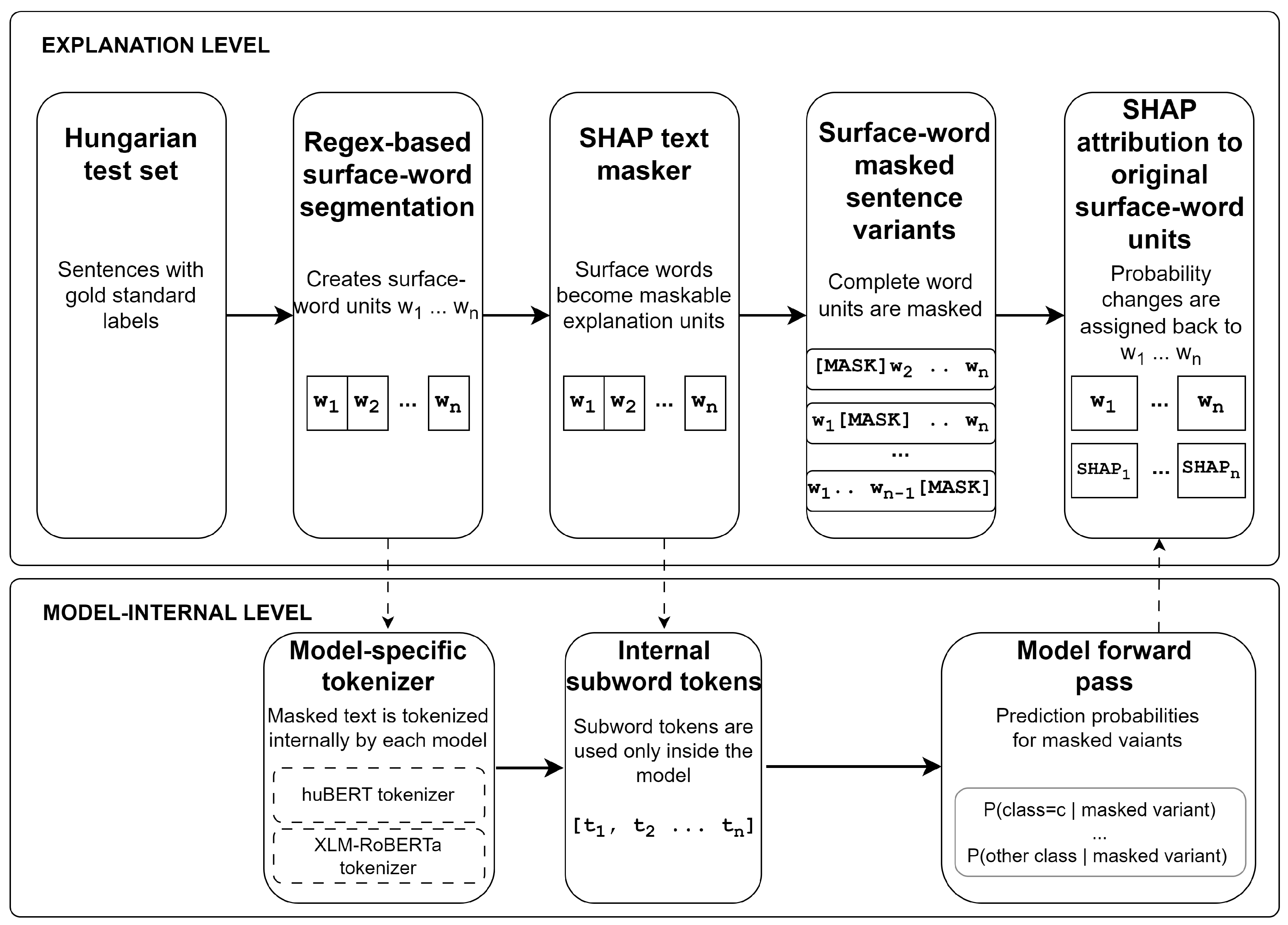
The aggregation was performed at the surface-word level. We did not aggregate the models’ internal subword tokens directly after tokenization. Instead, SHAP explanations were generated with a text masker that segmented the original input string into surface-word units using a regular-expression-based segmentation pattern. These surface-word units served as the maskable explanation units. During SHAP estimation, complete surface-word segments were masked in the original input string, producing surface-word-masked sentence variants. Each masked variant was then passed to the model’s own tokenizer. Consequently, the transformer model still processed the input through its model-specific internal tokenization scheme, but the SHAP values were assigned back to the original surface-word units.
This distinction is important because huBERT and XLM-RoBERTa use different internal tokenizers. A direct comparison at the subword-token level would therefore partly reflect tokenizer-specific artifacts rather than linguistically interpretable units. The word-level masking strategy makes the two models more comparable. Here, surface words define the explanation units, while model-specific subword tokenization remains part of the normal forward pass. In this way, the procedure preserves the prediction behavior of each model while producing SHAP values that can be interpreted and aggregated at the word level.
Figure 5 summarizes this architecture. The figure separates the explanation level from the model-internal level. At the explanation level, surface words are identified and used as SHAP masking units. At the model-internal level, the surface-word-masked variants are tokenized and processed by each model according to its own tokenizer. The resulting changes in prediction probabilities are then attributed back to the original surface-word units, which allows word-level SHAP contributions to be accumulated across the test set.
For each sentence, we first identified the model’s predicted class. We then retained only those SHAP values that contributed positively toward that predicted class. These positive word-level contributions were accumulated across all sentences assigned to the same predicted class. For each word, we calculated the mean positive SHAP contribution by dividing the sum of its positive SHAP values by the number of positive occurrences. We also recorded the total number of positive occurrences and the number of distinct sentences in which the word contributed positively. To reduce the influence of unstable rare items, only words with at least five positive SHAP occurrences were included in the final ranking.
The aggregated results (see
Table 9) show a clear and linguistically interpretable pattern for Non-Plain predictions. In both models, several of the strongest contributors toward the Non-Plain class are formal legal–administrative expressions, including
tekintettel [with regard to],
amennyiben [insofar as/if],
során [during],
történő [performed/carried out],
vonatkozásában [with respect to],
esetében [in the case of], and
értelmében [pursuant to/under]. These items are not necessarily incomprehensible in isolation, but they frequently occur in dense administrative constructions, nominalized phrases, and formal legal formulae. Their high aggregated SHAP values suggest that the models learned indicators associated with bureaucratic and legally formal sentence construction.
At the same time, the Plain-oriented lists contain several domain-specific or institutional terms, such as NAV, SZJA, ÁFA, AEO, and OSS. This does not mean that these terms are inherently plain. Rather, it reflects the nature of the corpus. Plain Language in this domain does not require the elimination of legal or tax administrative terminology, but the use of such terminology within clearer and more reader-oriented sentence structures. In other words, the models appear to distinguish not only between technical and non-technical vocabulary, but also between different ways in which technical vocabulary is embedded in administrative prose.
These findings refine the interpretation of the local SHAP examples. The models do not rely exclusively on isolated lexical shortcuts, nor do they purely capture abstract syntactic complexity. Instead, they combine register-sensitive linguistic cues with corpus-specific lexical signals. This mixed behavior is especially important for deployment. The models can identify recurring markers of legal–administrative complexity, but their predictions may also remain sensitive to the taxation-specific terminology present in the training data.
7.6. Limitations
While our findings offer strong support for fine-tuned multilingual transformers in Hungarian PL classification, several limitations must be acknowledged to contextualize the results and guide future improvements.
The size and scope of the training corpus present inherent constraints. Although sentence-level alignment and preprocessing ensured a high-quality dataset, the overall volume remains modest by modern deep learning standards. This restricts the capacity of very large models to generalize reliably and increases the risk of overfitting, particularly in high-parameter architectures such as XLM-RoBERTa-large; while machine-translated English augmentations partially mitigated data sparsity, they may introduce noise due to mismatches in syntax, terminology, or stylistic register. This risk is especially relevant in the legal domain, where small linguistic shifts can alter semantic intent.
The binary classification framework adopted in this study may oversimplify the inherently gradient nature of linguistic clarity. Sentences do not always fall neatly into either “Plain” or “Non-Plain” categories. Intermediate cases are common and often context-dependent. Although dichotomous labels facilitate supervised learning and evaluation, they may obscure fine-grained stylistic or structural improvements. Future work could explore regression or ordinal classification schemes to better model the continuum of clarity.
In a real-time writing assistant, the classifier should not be interpreted as providing a definitive legal or linguistic judgment. Instead, its output could be used to rank sentences according to revision priority, with the decision threshold adjusted to favor higher recall for potentially Non-Plain sentences. Cases with scores close to the decision boundary should be referred for human review rather than automatically flagged as requiring revision. The system should also avoid automatic rewriting of legally sensitive content, and domain-specific terminology alone should not be treated as sufficient evidence of Non-Plainness.
Our evaluation framework relies on conventional classification metrics (precision, recall, F1-score), which, although useful for benchmarking, may not fully reflect practical value in legal drafting. A classifier may correctly flag structurally complex sentences while failing to identify opaque but syntactically simple constructions. Furthermore, high aggregate scores may mask the misclassification of particularly salient or high-stakes clauses. Incorporating human-centered metrics, such as revision effort, reading time, or user-rated clarity, could provide richer insight into real-world applicability.
Limitations also arise from the domain-specific nature of the corpus. All texts originate from the Hungarian Tax and Customs Administration (NAV), representing a narrow segment of bureaucratic legal discourse. The degree to which these results generalize to other legal subdomains, e.g., judicial decisions, legislative texts, or contractual language remains uncertain. Domain-adaptive pretraining or few-shot learning may be necessary to accommodate stylistic variation across genres. The aggregated SHAP analysis further supports this domain-related limitation; while Non-Plain predictions were strongly associated with linguistically interpretable administrative formulae, Plain predictions also showed sensitivity to NAV-specific tax and institutional terminology. This indicates that part of the models’ decision making is tied to the lexical distribution of the source corpus. Consequently, cross-domain use in statutory legislation, court judgments, or contractual texts would require additional validation and, ideally, domain-adaptive data.
We also acknowledge potential label inconsistencies arising from the corpus construction process. Since the dataset was built from sentence-level edits, each change was assumed to reflect a move toward greater clarity. However, editorial interventions may not always have been driven solely by PL criteria. Some edits might reflect structural corrections, content clarification, or stylistic preferences unrelated to PL. This introduces a degree of annotation noise that could affect model learning and explain certain classification errors, particularly false positives involving domain-specific vocabulary. Future corpus design should therefore include annotation protocols that distinguish PL-driven edits from broader revisions.
Finally, practical deployment raises concerns about reproducibility, transparency, and infrastructure compatibility. Proprietary models like GPT-4o-mini and Gemini 1.0 Pro, while achieving respectable results, are accessible only via third-party APIs, limiting long-term usability, auditability, and control. Even open-weight models become dependent on specific hardware and software stacks once fine-tuned. Ensuring model versioning, containerized environments, and accessible documentation is essential for reproducibility and institutional trust.
Recognizing these limitations provides an important context for the study’s findings and outlines actionable directions to build more robust, generalizable, and ethically deployable PL classification systems in legal and administrative domains.
8. Conclusions
This study explored the feasibility of applying transformer-based models for sentence-level classification of legal and administrative texts in Hungarian according to PL standards. Addressing a critical resource gap in Hungarian NLP, we benchmarked zero-shot and fine-tuned variants across monolingual and multilingual architectures, leveraging translation-based data augmentation to enhance performance in a low-resource legal setting.
Our results demonstrate that fine-tuning multilingual models (particularly XLM-RoBERTa-large trained with Hungarian–English parallel data) yields substantial improvements in classification accuracy. The best-performing configuration (v5a) achieved a macro-average F1-score of 0.79, significantly outperforming both monolingual baselines and advanced zero-shot prompting with GPT-4o. This improvement is also meaningful in relation to earlier lightweight supervised baselines on the same corpus family, since the best fine-tuned transformer configuration significantly outperformed both zero-shot GPT-4o and previously published TF-IDF + SVM and fastText approaches. This supports prior evidence that task-specific adaptation and cross-lingual exposure can greatly benefit classification tasks in under-resourced languages.
We also evaluated deployment-relevant dimensions such as model size, inference time, and accessibility. Although the largest models generally achieved high performance, our results show that mid-sized open-weight architectures (particularly XLM-RoBERTa-base with augmented data) can match or even surpass larger models when evaluated on the original Hungarian texts. Combined with their lower latency and infrastructure requirements, these models offer a compelling trade-off between effectiveness and practical constraints such as reproducibility, regulatory compliance, and deployment feasibility in institutional settings.
Importantly, our work illustrates that translation-based data augmentation can meaningfully expand training coverage and improve generalization, especially when applied during training rather than evaluation. This strategy is particularly useful for domains like legal drafting, where annotated corpora are costly and stylistic variation is high.
Beyond aggregate metrics, we applied SHAP-based local interpretability techniques to examine the behavior of the model on both true and false classifications. The analysis revealed that the best-performing model reliably identified linguistic features associated with syntactic complexity and nominalization. At the same time, SHAP helped uncover limitations in model generalization—such as false positives triggered by frequent domain-specific expressions such as institutional acronyms or formal terminology. These insights not only confirmed the linguistic validity of the model’s decision boundaries but also revealed sources of bias and annotation noise in the corpus, underscoring the value of interpretability tools in model auditing and refinement.
Ultimately, the findings lay the foundation for the building of automated Plain Language assistance tools that help legal professionals and public institutions identify inaccessible language in real time. In practical deployment, such a system should function as a human-in-the-loop prioritization tool rather than as an automated authority on legal clarity. By integrating such models into document drafting workflows, we can support more transparent and citizen-friendly communication, thereby advancing the broader goal of Access to Justice.
Future directions include extending the framework to graded classification (e.g., clarity scoring), adapting the models to other public-facing domains such as healthcare or education, and integrating human-in-the-loop systems for collaborative editing. Additionally, refining interpretability and bias-detection techniques will be essential for ensuring that Plain Language tools are not only accurate but also trustworthy in sensitive legal contexts.