1. Introduction
Urban air mobility (UAM) is currently one of the most promising areas in the development of transport systems. This trend is driven by rising urban population density, road network congestion, and constraints on expanding existing ground infrastructure [
1]. Electric vertical takeoff and landing (eVTOL) aircraft are among the solutions being considered to address these challenges [
2]. Their deployment enables new passenger and cargo transport scenarios, such as establishing direct links between city centers, airports, industrial zones, and outlying urban districts [
3]. However, the implementation of eVTOLs depends not only on the aircraft’s technical specifications but also on the readiness of ground infrastructure—including charging stations, maintenance facilities, preflight inspection capabilities, system and component health monitoring, and safe operational management.
These constraints are particularly important for the Republic of Kazakhstan. Major urban agglomerations, such as Almaty, Astana, and Shymkent, face heavy traffic congestion, uneven urban development, and variable weather conditions. Given these factors, a vertiport is viewed as a complex facility that integrates electric power, diagnostic, and information-control systems [
4]. Consequently, ensuring flight safety depends on reliable power supply, battery health, and high-quality monitoring and inspection of eVTOL subsystems [
5]. Accordingly, planning vertiport locations requires shifting from traditional spatial site-selection methods to a risk-based assessment of the external environment. This approach ensures transport accessibility while complying with noise regulations and urban planning standards [
6]. Furthermore, assessing the likelihood of technical degradation in eVTOLs involves analyzing the effects of climatic, energy-related, hardware–software, and diagnostic factors.
An intelligent robotic system for preflight control is crucial in this regard. Such a system enables automated aircraft inspection, identifies hidden defects, assesses flight readiness, and reduces the likelihood of performance degradation [
7]. However, eVTOLs is energy- and climate-dependent systems and have hardware and software limitations. Thus, preflight inspection is an additional safety barrier and is formalized in the proposed model through diagnostic coverage parameters and maintenance effectiveness assessment.
Recognizing the scale of the technological and regulatory challenges of creating transport infrastructure for eVTOLs, aviation regulators (e.g., in the US, Europe, and China [
8]) and leading aerospace companies (e.g., Airbus, Embraer-X, and EHang Intelligent Technology) have been developing regulatory standards for creating sustainable infrastructure for their operation for several years [
9,
10].
In parallel, scientific research focusing on monitoring safety and addressing complex aviation systems has intensified. Sun et al. considered probabilistic model-based safety analysis as a way to identify individual combinations of failures at the level of the entire system, including software, hardware, failure modes, and the external environment [
11]. They emphasized that an analysis of the full system model provides more accurate results than long-term approaches. Gradel et al. examined the application of model-based safety assessment based on a conceptual design of aviation systems [
12]. Their work demonstrated that safety requirements can already be considered during the selection of architectural solutions, not only in the late stages of verification and certification. Zhang and Mahadevan used Bayesian networks to analyze reports from aviation units and identify cause-and-effect relationships in continuous events [
13]. They developed a technology for constructing a Bayesian network based on data from the National Transportation Safety Board; this network was then used to assess the likelihood of various events and their impact on the development of the aviation authority. Fitrikananda et al. analyzed aviation risk using Monte Carlo simulation and scenario analysis [
14]. This approach allows for analyses of declaration denials and the development of safety-critical scenarios under uncertainty. Dang et al. developed a method for modeling causal risk in aviation that uses fault tree analysis, failure modes and effects analysis or failure modes, effects, and criticality analysis, and Bayesian networks, linking the causal risk factor to management decisions and future scenarios [
15].
In recent years, an area of research is the use of UAVs for automated infrastructure inspection. These applied studies are important in reviewing the literature for this work as eVTOLs and vertiports will be integrated with unmanned platforms, vision systems, and robotic preflight inspection tools in the future [
16]. Thus, Guan and Cheng proposed an approach for managing a group of UAVs based on a modified pigeon-inspired optimization and the Metropolis criterion [
17]. The use of this approach increases the stability of collective mission planning and helps to avoid making local decisions when controlling a swarm of UAVs. This approach is also applicable to our work in providing joint movement of eVTOLs, a group of inspection drones, and ground mobile robots under UAM conditions. Duan et al. addressed the problems of intelligent detection and real-time monitoring when UAVs are used for 10 kV power-line inspection [
18]. The approach proposed by the authors shows the importance of integrating electronics, sensor systems, computer vision, and diagnostic algorithms.
Existing research shows that infrastructure safety for eVTOLs should be considered not as isolated technical requirements but as a result of the interaction of multiple factors such as aircraft characteristics, infrastructure architecture, operating conditions, the external environment, human factors, and the urban context [
19]. Selection of proper location can reduce the likelihood of hazardous scenarios, ensure safe takeoff and landing trajectories, minimize the impact of eVTOLs on populations and the environment, and improve the resilience of the entire UAM system. Therefore, further risk analysis should be based on the technical characteristics of eVTOLs as well as the spatial, infrastructural, and operational conditions of vertiport locations.
In search of a solution to this problem, scientific research has also become quite active. Brunelli et al. studied the determination of vertiport sizes and locations and discussed a procedure for vertiport placement in urban environments and multicriteria decision-making (MCDM) methods [
20]. Hijazeen et al. reviewed the regulatory, operational, and infrastructural requirements for integrating vertiports into urban transport environments [
21]. Liu et al. highlighted the issues of facility placement, network planning, airspace management, scalable infrastructure, and their integration into ground transport systems [
22]. Rane et al. focused on vertiport power supply, whose construction may significantly increase the electrical load on existing power supply systems and require power grid modernization to support vertiports [
23]. Di Mascio et al. approached the issue of vertiports from a multidisciplinary perspective, focusing on their role in the integration of multimodal transportation and in safety requirements, airspace (U-space) coordination, and current European regulatory trends [
24]. Preis et al. emphasized that the sizes and weights of eVTOLs are crucial for vertiport design, as they directly determine vertiport architectures and operational parameters [
25]. Mendonca et al. discussed the placement of vertiports in urban and suburban environments through the lens of operational requirements and regulatory compliance, emphasizing the need to consider urban planning constraints, safety factors, and vertiport integration with existing ground transportation infrastructure [
26]. Jeong et al. noted that vertiport locations in highly urbanized environments should be determined by environmental pollution factors, especially noise pollution [
27]. Lim et al. argued that vertiport placement and design should be determined by the expected operational efficiency resulting from the demand and supply of transportation services [
28]. Schweiger and Preis justified the need for planning, designing, and constructing vertiports based on current regulatory frameworks (particularly those developed by the National Aeronautics and Space Administration [NASA], European Union Aviation Safety Agency [EASA], Federal Aviation Administration [FAA], International Civil Aviation Organization [ICAO], etc.), noting their dynamic nature due to the evolution of the UAM concept [
29]. In particular, NASA developed requirements for vertiport automation systems, defining functions such as resource allocation, flight path management, and communication interfaces between operators and service providers [
30]. EASA prepared the “Vertiports in the Urban Environment”—the world’s first official design specification for vertiports [
31]. The FAA developed “Engineering Brief No. 105, Vertiport Design,” which provides recommendations for the design of vertiports and surface markings [
32]. The National Renewable Energy Laboratory has defined requirements for the electrical infrastructure and eco-power supply of vertiports [
33]. The ICAO has not issued specific standards for vertiports, but the provisions of ICAO Annex 14, Volume II (Helicopters), are an important reference point for their specifications [
22].
In addition to the abovementioned measures from international institutions and organizations, planning, design, and construction standards for vertiports have been developed by individual civil aviation associations and aviation corporations. In particular, the China Civil Airports Association has developed a technical standard for eVTOL landing pads [
34]. In South Korea, UrbanV, Ltd. (Rome, Italy), together with the Korea Airports Corporation (Seoul, South Korea), has launched regional standards for the UAM ecosystem, covering vertiport design, construction, and operation [
35]. Numerous such examples are available worldwide.
With continuous population growth and the acceleration of urbanization, transportation systems have become a major problem of urban spatial development [
36], and it can be solved by implementing the UAM concept and using eVTOLs. However, despite its significant potential, the development of UAM faces significant challenges, especially regarding the development of ground infrastructure [
22]. NASA emphasizes that vertiport planning and construction are critical for the large-scale deployment of UAM and RAM [
30]. The EASA’s “Guidebook for Urban Air Mobility Integration” emphasizes the lack of ground infrastructure as a crucial challenge in UAM implementation in megacities [
37]. Representatives of the Single European Sky Air Traffic Management Research program argue that vertiports are not only the fundamental physical support of UAM operations but also the main nodes ensuring the safety, efficiency, and sustainability of low-altitude urban travel [
38]. Therefore, academic research is focusing on ground-based infrastructure, finding various key factors that determine vertiport locations. These include noise impact, regulatory frameworks, and market factors (including supply and demand) [
22].
The diversity of factors influencing decisions regarding vertiport siting, design, and construction has led to the development of MCDM methods. For example, Mercan et al. used the “best–worst” method to evaluate the selection of vertiport locations [
39]. Feldhoff et al. combined the analytical hierarchy process and the Delphi method to develop a site evaluation system based on criteria such as passenger accessibility, physical barriers, and noise [
40].
The safety of eVTOLs within UAM does not rely solely on aircraft design or vertiport infrastructure. Instead, it is structured around four key safety barriers: aircraft fault tolerance, airworthiness assurance and effective maintenance, preflight inspection, and monitoring with decision-support functions [
41]. This multilayered safety framework supports the use of a state-transition model rather than a purely statistical risk index. The proposed SC-VTOL model specifically addresses fault-tolerant architectures, aiming to eliminate single points of failure that could lead to accidents. Regulatory frameworks such as Part-M/145 govern airworthiness monitoring and maintenance processes, including organizational measures for predictive fault detection and corrective actions. Additionally, DO-178C ensures the safety and reliability of avionics software, supporting monitoring systems and automated fault diagnostics.
Despite extensive research on UAM, eVTOLs, and vertiports, the authors have identified a gap in models that integrate vertiport siting, reliable power supply, climatic factors, battery degradation, diagnostic coverage, and preflight checks. Existing studies on power supply, maintenance, monitoring, and automation often address these issues in isolation—focusing, for instance, solely on infrastructure design, general safety requirements, or autonomous inspection. However, these components constitute an integrated risk system in UAM operations. Consequently, the development of such a stochastic model represents a remarkable scientific contribution. This model must quantitatively assess the climatic, energy-related, and hardware–software operational factors that influence transitions between eVTOL states.
On this basis, this study aim is to develop and validate—through scenario-based testing—a stochastic model for assessing risks associated with eVTOL operations and vertiport planning, accounting for climatic factors, reliable power supply, battery states, diagnostic factors, and effective preflight inspections. To achieve this objective, the authors address the following tasks:
Formulate a risk-based model of eVTOL operations as a dynamic process of transitions between possible operational states.
Describe the effects of climatic factors, reliable power supply, maintenance, and diagnostic electronics on transition rates within a continuous-time Markov model framework.
Conduct scenario-based risk modeling for eVTOL operations under regulatory maturity conditions, in compliance with SC-VTOL [
42], Part-M/145 [
43], and DO-178C [
44] standards.
Demonstrate how the results of the model can be applied to vertiport siting, energy infrastructure design, and the implementation of onboard monitoring, preflight inspections, and decision support systems.
2. Materials and Methods
The study used a probabilistic–statistical approach to assess the operational safety of eVTOLs. This approach is based on a continuous-time Markov state process that describes the evolution of the technical condition of the vehicle and its operating environment under the influence of climatic factors, power supply reliability indicators, and battery technology trends. The operational states of the eVTOL systems were considered a random process with a finite number of discrete states, reflecting various levels of technical and operational performance of the aircraft under real-world infrastructure and climatic conditions.
Within this approach, a link is established between the Markov model and the observed operational and climatic series by defining transition intensities as a multiplicative risk model and then aggregating temperature, wind, and precipitation factors using annual extreme indicators for the city of Almaty, Kazakhstan. Climate indicators were developed using daily meteorological data for the period of 2018–2025: minimum air temperatures, average and maximum wind speeds, wind gusts, and daily precipitation totals. These data were precleaned and aggregated into annual values. Thresholds for adverse conditions were selected based on eVTOL operational limitations, recommendations from battery system manufacturers, and regulatory requirements for safe aircraft operation at high and low altitudes. These were used to construct climate trajectories describing the impact of climate variability on energy supply reliability and the Markov model parameters for eVTOL operational safety.
For a scenario analysis of the climate trajectories, we introduced the aggregated energy maturity coefficient and the integrated battery risk coefficient . The eVTOL battery systems were considered key subsystems, determining flight energy reliability and directly influencing the likelihood of operational state degradation. Within the Markov model, this influence of the battery systems is considered through the parameters of energy density, their degradation, and temperature sensitivity. Battery system parameters were selected based on current commercial lithium-ion technologies used in eVTOL prototypes and pilot projects. Lithium-ion battery wear was modeled as the reduction in the remaining battery lifespan over equivalent charge–discharge cycles. Scenario analysis was conducted by modifying transition rates according to the implementation levels of the SC-VTOL, Part-M/145, and DO-178C standards.
The influence of intelligent preflight monitoring systems is considered within the Markov model as an external barrier to safe operation. Automated preflight inspection, which relies on data from machine vision, anomaly detection algorithms, and decision support, improves the efficiency of detecting latent failures and precritical conditions before mission commencement. The model demonstrates this effect through increased maintenance rates and diagnostic coverage and reduced rates of state transitions.
The integrated probability of a catastrophic outcome per flight was calculated to assess the reliability risk of eVTOL power supplies. Based on this calculation, a logarithmic ISI was introduced, transforming extremely low catastrophic probability values into a logarithmic scale comparable to aviation safety standards. Unlike traditional metrics, which focus on instantaneous failure rates, the ISI characterizes the cumulative nature of risk and allows for its temporal evolution.
In constructing the model, we regard the operational states of the eVTOL systems as random processes with finite numbers of discrete states, reflecting various levels of aircraft technical and operational performance under real-world infrastructure and climate conditions. A continuous-time Markov state process is used to describe the eVTOL dynamics formally [
45].
We define the state space as a finite set (1).
where each state is assigned physical and operational interpretations:
is the nominal operational state, characterized by the full functionality of all critical eVTOL subsystems (power train, battery system, avionics, and software) and acceptable external flight conditions;
is the operational state, in which the system retains controllability and mission continuation capability but operates with limitations due to partial failures, adverse weather conditions, or infrastructure limitations (e.g., reduced available battery power at low temperatures or increased wind loads).
is not interpreted in the model as a completed safe abort.
represents an abort condition during flight or an in-flight emergency alert, i.e., cases where the mission is aborted before achieving the objective. Given this interpretation,
justifies the transition from
to
, as an unsuccessful emergency return, power shortage, unfavorable landing conditions, or failure of fault recovery could be fatal. Therefore, the transition between these modes represents a residual risk of the abort procedure.
Note that states and are aggregated operational states encompassing several types of adverse events, including battery system degradation, adverse climatic conditions, power supply limitations, and specific operational disruptions. This aggregation was deliberately selected to maintain the compactness of the Markov model and ensure its applicability given the limited availability of statistical data on eVTOL operations. Differences between individual risk mechanisms are accounted for through transition rates and corresponding sensitivity coefficients that depend on climatic, energy-related, technological, and regulatory factors.
is the system state at time
.
is assumed to be a Markov state process with an intensity matrix
, and the probability vector
satisfies (2).
The generator matrix
has the form
where
is the transition rate from state
to state
at time
.
State 3 (disaster) is absorbing: for all . In the applied setting, the transitions are divided into two groups for convenience: (a) deterioration transitions ––– and “direct” severe outcomes –, –, and –; (b) recovery through maintenance/diagnostics – and partial recovery –.
In this study, the electronic engineering approach is implemented through transitions between modes in the model that are associated with maintenance, as well as the operation of onboard and ground-based condition diagnostic tools. These tools include monitoring the state of the battery pack, temperature, current, voltage, and vibration sensors and monitoring tools for power electronics, avionics self-diagnosis systems, failure detection mechanisms, and preflight inspection data. The concept of diagnostic coverage in the model reflects a set of electronic and hardware–software systems for identifying deviations before transitioning to critical modes.
The continuous-time Markov (CTMC) framework models the operational logic of an eVTOL mission as a sequence of discrete conditions that influence safety (such as nominal/constrained operation, mission abort, and catastrophic failure). These states reflect real-world eVTOL operational conditions and can be interpreted as safety barriers. Transitions between nominal and catastrophic states are typically not direct; instead, risk accumulates progressively through system degradation, reduced safety margins, emergency reconfiguration, or unsuccessful abort attempts. The CTMC approach is therefore well suited to capturing degradation and recovery processes within a unified state-transition structure (a single matrix), while enabling the calculation of the cumulative probability of reaching a catastrophic state.
Within the system, control factors are not direct indicators of compliance with regulatory requirements; rather, they represent engineering variables that translate the maturity of control system behavior into parameters of the risk model. The factor reflects the implementation of SC-VTOL architectural requirements—including redundancy and single-failure tolerance—and directly influences the probabilities of direct transitions to severe outcomes and of local subsystem failures escalating into catastrophic events. The factor captures the maturity of airworthiness processes—maintenance, defect elimination, and inspection—in accordance with Part-M/145. This factor primarily affects system recovery rates; while maintenance, repair, and overhaul (MRO) organizations cannot control external conditions (e.g., weather conditions, battery load, or aerodynamic stress), they improve the likelihood of defect detection and elimination prior to departure and enable faster restoration of safe operation following emergency or interrupted conditions. The factor represents the coverage and effectiveness of onboard diagnostics, as well as the quality of software supporting inspection and monitoring functions. This factor influences the likelihood of latent faults not being detected before takeoff and determines how effectively performance degradation is identified during flight before it progresses into critical failures.
Thus, the requirements of Part-M/145 and automated preflight inspection are incorporated into the model through two complementary mechanisms. First, robotic inspection prior to departure reduces the prevalence of latent defects by improving diagnostic coverage. Second, in the event of operational limitations or interruptions, Part-M/145 contributes to faster recovery of a safe state through structured maintenance and defect rectification processes. Within the model, the DO-178C standard is not treated as a maintenance framework but as a basis for parameterizing the reliability of software functions, including anomaly detection, sensor data integration, decision support, and robotic inspection. Using this standard helps prevent duplication of maintenance requirements and software reliability assurance.
The Markov model is linked with the observed operational and climate series by specifying the transition rates as a multiplicative risk model (4).
where
is the baseline transition intensity;
is the vector of observed risk factors;
is the vector of sensitivity coefficients;
is the regulatory compliance function, parameterized by the vector π, reflecting the implementation level of the SC-VTOL, Part-M/145, pre-flight inspection and DO-178C standards (
Table 1).
The factor vector
is formed based on available data and includes aggregated climate indicators, power supply reliability indicators, and battery performance characteristics. Daily meteorological observations are accurately accounted for by introducing annual extreme indicators. Specifically, the following aggregates are used for temperature, wind, and precipitation factors (5):
where
is the minimum daily air temperature (°C) on day
;
is the threshold temperature, or the lowest temperature favorable for eVTOL operation;
is an indicator function that assumes the value 1 if the condition in the parentheses is met and assumes 0 otherwise;
is the maximum wind gust speed (m/s) on day
;
is the wind gust threshold, or the maximum permissible wind gust speed for takeoff, landing, or sustained eVTOL flight;
is the daily precipitation amount (mm) on day
;
is the intense precipitation threshold; and
is the average wind speed (m/s) on day
.
is the total number of days in year with extremely low temperatures, potentially impacting battery efficiency, energy balance, and the reliability of onboard systems. The indicator reflects the frequency of days with hazardous wind conditions, increasing the load on the distributed electric propulsion system and the risk of emergency conditions. characterizes the number of days with heavy precipitation, which can compromise eVTOL operation safety, including their takeoff and landing conditions, and the operation of ground charging infrastructure. The indicator, which reflects the average wind background for the operating region throughout the year, is used to account for the constant aerodynamic load on eVTOLs in the baseline transition intensities of the Markov model.
Herein, the threshold values of the climate indicators are set as follows:
, or the lower limit of the permissible operating range of modern Li-ion batteries, is −10 °C;
, or the maximum wind gust value, over which eVTOL takeoff and landing are limited, is 15 m/s;
, or the threshold of intense precipitation, which can degrade operating conditions and ground infrastructure functioning, is 20 mm/day (
Table 2). These thresholds are selected based on the typical operational limitations of vertical takeoff and landing vehicles and the characteristics of lithium-ion battery systems.
The climate trajectories presented in
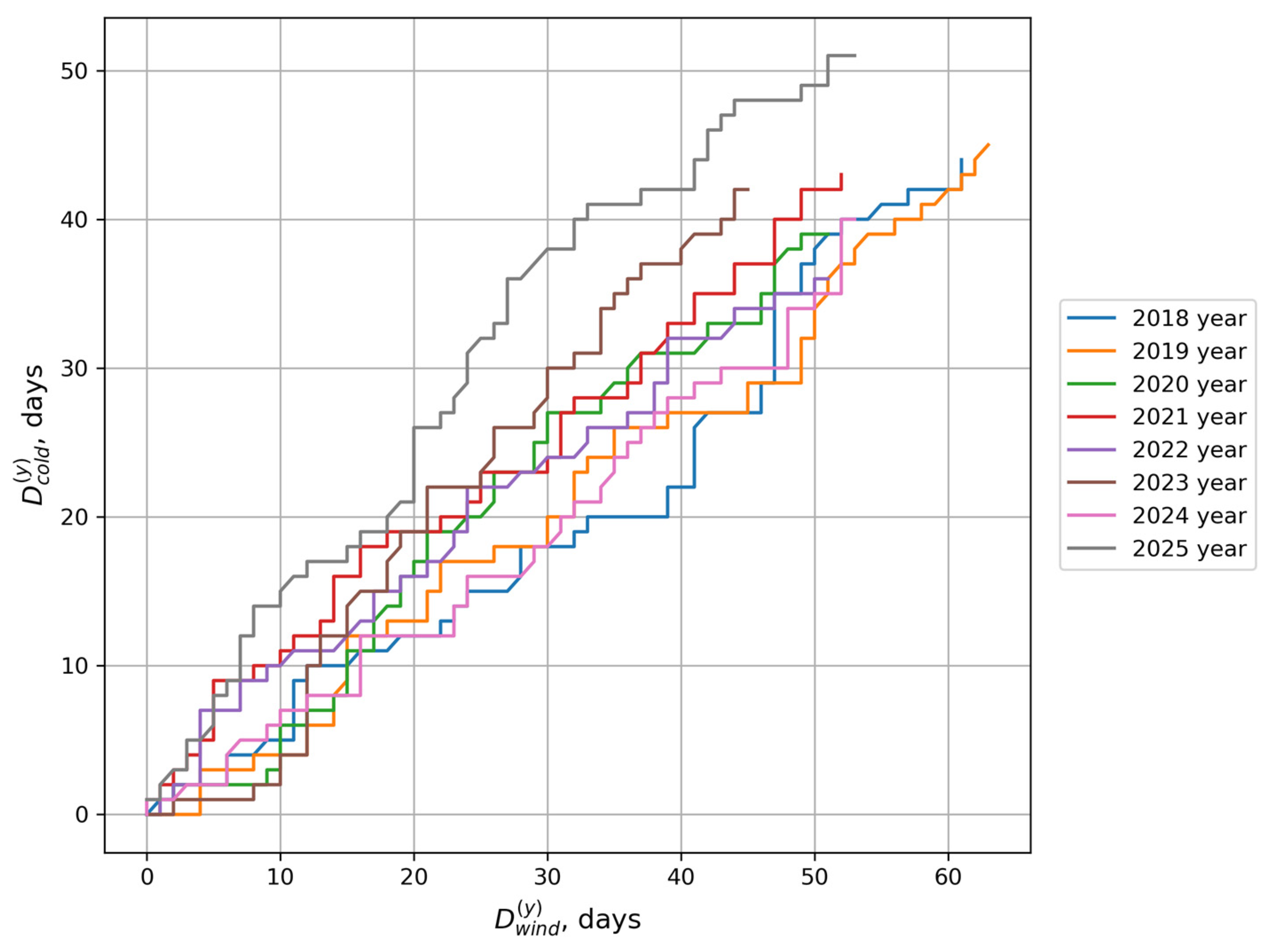
Figure 1 are constructed using the statistical characteristics of daily meteorological data specific to the Almaty region. These trajectories are based on daily meteorological data from the Almaty state station for 2018–2025. Each trajectory corresponds to one calendar year of observations and reflects the accumulation of days with unfavorable wind conditions and extremely low temperatures throughout the year. These annual trajectories are used to consider the interannual variability of regional climate conditions and move from using average indicators to analyzing the actual variability of climate impacts on the Markov model parameters for eVTOL operational safety.
The annual climate trajectories shows that the accumulation of unfavorable climate conditions in the Almaty region is characterized by pronounced interannual variability. All trajectories begin at the initial coordinate point, which corresponds to the absence of accumulated unfavorable days at the beginning of the calendar year, and diverge in indicator space over time to and . The trajectory shape and slope differences reflect the varying frequencies of wind and temperature extremes across observation years. Individual trajectories with high values for both indicators indicate years with high concentrations of adverse climatic factors, which are crucial for assessing the resilience of the eVTOL operating system to extreme conditions.
Annual climate trajectories were used to construct representative climate load scenarios for the subsequent analysis of eVTOL operational safety. Each trajectory in
Figure 1 corresponds to a specific annual realization of climatic conditions in the Almaty region during the study period. On the basis of a comparative analysis of the accumulated values of the indicators
and
, characteristic climate impact regimes were identified, reflecting various combinations of wind and temperature loads. Subsequently, these regimes were consolidated into five scenarios (C1–C5) to analyze the sensitivity of the stochastic model and assess the effect of climatic factors on the ISI.
The aggregated climate indicators are used as components of the risk factor vector , which determines the intensities of transitions between states of the Markov process. This approach links high-frequency (daily) meteorological data with the annual and scenario structure of the model, preserving the physical interpretability and reproducibility of the results. Next, power supply reliability indicators are considered exogenous stochastic factors influencing the rates of transitions between eVTOL operational states. In the model, they are included in the risk factor vector through aggregated annual indicators.
Climate and power supply reliability indicators and battery degradation parameters are used in the model not as instantaneous values but as operating environment parameters that determine the background conditions for eVTOL operation. It is assumed that during one flight lasting from 10 to 60 min, these indicators remain quasi-stationary and affect the intensity of transitions through the corresponding sensitivity coefficients. Annual climatic and infrastructure indicators are interpreted as characteristics of the operating environment that determine the average level of external load on the system in the period under review. Consequently, the intensity of Markov process transitions does not reflect individual meteorological events or power outages but rather their integral effect on the probability of eVTOL operational state degradation and recovery.
The energy factor vector is
where
is the average outage frequency in year y,
is the total outage duration (min/year),
is the average duration of one outage,
is the specific undersupply of electricity (kWh/consumer or GWh/year, normalized).
In this study, the SAIFI, SAIDI, and CAIDI metrics are used as aggregated characteristics of the external energy operating environment. Their effects on eVTOL safety are accounted for through the availability of charging processes, preflight preparation, and energy supply for vertiport operations. However, the internal topology of the vertiport microgrid, energy storage systems, and local power supply redundancy are not separately considered within this model.
For scale comparability, the indicators are normalized relative to the reference values
where
are the standard or target values.
The operational state degradation transitions depend on the stability of the energy supply, primarily –, –, and –. Thus, power supply parameters for the transitional phases are interpreted as dependent on flight operations under poor power infrastructure conditions. However, this does not mean that a power outage directly impacts flight safety. Such outages before a flight will cancel it or delay its departure. A deterioration in safety parameters depends only on reductions in the aircraft power reserve, system recovery delays, battery health degradation, or deviations from a safe landing for a future flight.
The intensities of these transitions are
where
is the baseline intensity for the reference infrastructure and
is the transition sensitivity coefficient to power outages.
Restoration transitions
–
and
–
depend on the speed of power restoration and the availability of redundancy. The following inverse relationship is introduced for these transitions:
where
and
are the recovery deceleration factors with an increasing outage duration.
Increasing the value, which characterizes the average duration of a power outage, decreases the rates of recovery transitions – and –, as the system loses the external energy support necessary for restarting, charging, and stabilizing the eVTOL operating modes for a longer period. This prolongs the average time the system spends in the restricted operation state and mission abort state , thus increasing the likelihood of the accumulation of adverse factors and the occurrence of sequential failures. Extending the operation degradation period increases the cumulative probability of transitioning to the absorbing catastrophic state , thereby indirectly amplifying risk. Here, even with unchanged baseline failure rates, deteriorating infrastructure conditions increase the integral flight safety indicator.
For scenario analysis, the following aggregated energy maturity factor is introduced:
The battery systems of the eVTOLs are key subsystems, determining flight energy stability and directly influencing the probability of operational state degradation. Within the Markov model, this influence of the battery systems is considered through the parameters of energy density, degradation, and temperature sensitivity.
The available energy of the battery pack at time
is
where
is the battery’s specific energy (Wh/kg),
is the battery pack’s mass,
is the temperature efficiency coefficient, and
is a coefficient reflecting the permissible state-of-charge (SoC) range.
is introduced to consider operational limitations associated with prohibiting the use of the full charge range to prolong battery life.
A decrease in reduces the flight energy reserve and increases the likelihood of the system transitioning from the nominal state to the limited operational state , especially under unfavorable weather conditions and high loads on the distributed electric traction system.
The intensity of energy-induced model degradation is
where
is the reference value of effective energy, compliant with SC-VTOL requirements and NASA recommendations, and
> 0 is the sensitivity coefficient of the transition rate to a decrease in energy reserve.
The wear of lithium-ion batteries is modeled as the reduction in their remaining lifespan over equivalent charge–discharge cycles. The remaining number of cycles at time
is:
where
is the rated battery life,
is the number of flights completed by time
, and
is the depth of discharge in the
th flight.
The low depth of discharge per flight of eVTOLs allows for a significant increase in the total number of cycles compared with those of ground-based electric vehicles. However, with intensive use, battery degradation becomes a significant risk factor. The rate of transition to the abort state
–
caused by battery degradation is
where
reflects the accelerated growth of risk as the battery approaches its wear limit.
The operating temperature has a dual effect on eVTOL battery systems. On the one hand, low temperatures reduce the available power and capacity of batteries; on the other hand, they can slow down their degradation during storage. The key factors under operating conditions are the reduction in energy output and the increase in internal resistance. The battery’s temperature efficiency coefficient is
where
is the ambient temperature,
is the optimal battery operating temperature, and
is the temperature sensitivity parameter.
This coefficient is directly included in the expression for
and indirectly affects all energy-dependent transition intensities of the Markov process. For scenario analysis and calculation simplicity, the following integral battery risk coefficient is introduced:
which is used for the compact recording of battery intensities (21).
With this coefficient, various technological scenarios for battery development (increasing the specific energy, increasing the cycle life, and introducing heating and thermal control) can be compared within a single mathematical model.
For the reproducibility of the proposed stochastic model, all sensitivity coefficients in Equations (4), (11), (12), (16) and (18)–(20) are specified numerically and presented in
Table 3.
The sensitivity parameters presented in
Table 3 were used for scenario analysis and to reflect the relative response of transition intensities to changes in climatic, energy, and technological factors. Given the limited availability of publicly accessible eVTOL operational data, these values were derived on the basis of engineering analogies with existing aviation systems, published specifications for lithium-ion batteries, power supply reliability metrics, and expert parameterization designed to ensure realistic model behavior across the range of scenarios considered. As eVTOL operational statistics accumulate, these parameters may be refined through statistical calibration.
The baseline numerical values of the model parameters were recorded, characterizing the operational, infrastructural, and technological environments for eVTOL operation in Kazakhstan. These parameters were used to construct a Markov process intensity matrix and served as the starting point for all subsequent scenario calculations.
The baseline parameter set included the power supply reliability indicators, aggregated climate indicators, lithium-ion battery characteristics, and scenario coefficients reflecting the current regulatory maturity of the operational environment.
The proposed model was numerically implemented using the Almaty region as an example. The climate indicators were developed using daily meteorological data for 2018–2025: the minimum air temperatures, average and maximum wind speeds, wind gusts, and daily precipitation totals. These data were precleaned and aggregated to annual values according to (5). Thresholds for adverse conditions were selected based on eVTOL operational limitations, recommendations from battery system manufacturers, and regulatory requirements for the safe operation of small and medium aircraft.
The power supply reliability indicators (
SAIFI,
SAIDI,
CAIDI, and undersupply), reflecting the typical level of infrastructure maturity of the urban environment, were defined based on statistical data from the regional power grid of Kazakhstan for a comparable time period. The battery system parameters corresponded to modern commercial lithium-ion technologies used in eVTOL prototypes and pilot projects; these parameters served as representative baseline values for the scenario analysis. Together, the abovementioned values formed the numerical basis for assessing the probability of a catastrophic outcome and the ISI (
Table 4).
The baseline scenario was characterized by moderate power grid reliability and a lack of full power supply redundancy, which is typical of most urban regions in Kazakhstan (
Table 4). The climatic conditions included a significant number of days with low temperatures and increased wind activity, which place additional stress on the battery systems and distributed electric propulsion of eVTOLs. The adopted battery parameters corresponded to the current level of commercial lithium-ion technology and provided a realistic basis for quantitatively assessing operational risks. The scenario coefficients
and
were interpreted not only as indicators of overall regulatory maturity but also as quantitative characteristics of the automation level of maintenance and intelligent preflight monitoring.
The integral probability of a catastrophic outcome,
, is introduced within the Markov model to quantify the accumulated risk over a single flight. Due to the absorbing nature of
, which corresponds to a catastrophe, the probability
is a nondecreasing function of time and reflects the cumulative effect of successive degradation transitions during the flight. The integral probability of a catastrophic outcome over a flight of duration
is
where
is the flight duration.
The flight duration range of 10–60 min was selected on the basis of typical eVTOL operational profiles considered in UAM and regional air mobility concepts. Short flights lasting 10–20 min correspond to intracity routes, whereas 30- to 60 min intervals cover the suburban and interdistrict transport operations envisioned in most modern eVTOL application concepts. The use of multiple flight duration values makes it possible to assess the effect of the system’s operational time on risk accumulation and the probability of reaching a catastrophic state. The proposed model is not limited to the considered time range. Because the probability of a catastrophic outcome is a function of time, the model can be applied to any eVTOL operational regime by specifying the appropriate flight duration and scenario parameters.
Unlike instantaneous transition rates, which characterize the local risks of individual failures or degradation events, reflects the cumulative effect of all possible system development trajectories during flight and is thus an adequate metric of integrated operational safety. This indicator is directly comparable to the regulatory target safety levels used in international aviation practice and enables a quantitative comparison of alternative architectural and operational solutions.
For an aggregated assessment of the safety level of eVTOL operation, the ISI (20) is introduced:
which allows for logarithmic-scale risk interpretation and comparisons of the resulting values with aviation safety regulatory benchmarks.
The regulatory compliance coefficients in the proposed model are not interpreted as events occurring directly during the flight. Instead, they are viewed as characteristics of the operational environment established through design, maintenance, diagnostics, and certification processes. Specifically, adherence to Part-M/145 requirements influences the likelihood of latent defects being present at the start of the flight and the effectiveness of subsequent recovery actions, whereas SC-VTOL and DO-178C requirements are reflected in the level of architectural fault tolerance and reliability of onboard systems.
Within the Markov model, these factors are represented by modifying transition rates and are treated as operational environment parameters that determine the system’s probabilistic behavior during flight. Thus, preparation, maintenance, and operation processes are not modeled separately in a temporal sequence; rather, they are accounted for through their resulting effect on the probabilities of eVTOL operational state degradation and recovery.
3. Results
Based on the parameters in
Table 4, a numerical matrix of Markov process transition intensities was generated for the baseline operational scenario (
Table 5). The degradation and recovery rates accounted for the influence of the climatic factors, power supply reliability indicators, battery characteristics, and the current level of regulatory implementation.
The matrix is presented as a continuous Markov chain generator. The element defines the intensity of the transition from states to . The diagonal element is equal to the negative sum of all outgoing intensities from state . They are not explicitly listed in the table and are determined as .
According to the intensity matrix, in the baseline operating scenario, which corresponds to current infrastructural, climatic, and technological conditions (realistic power supply reliability indicators, serial lithium-ion battery levels, and partial implementation of SC-VTOL regulatory requirements), – transitions predominate, reflecting normal fluctuations in operating conditions. Recovery transitions – and – have significantly higher intensities than degradation transitions, consistent with the assumption that controlled, reversible failures predominate during eVTOL operation. Furthermore, the nonzero probability of direct transition to the catastrophic state , albeit small in absolute value, generates a nonzero integrated risk per flight, which is further quantified using the indicator.
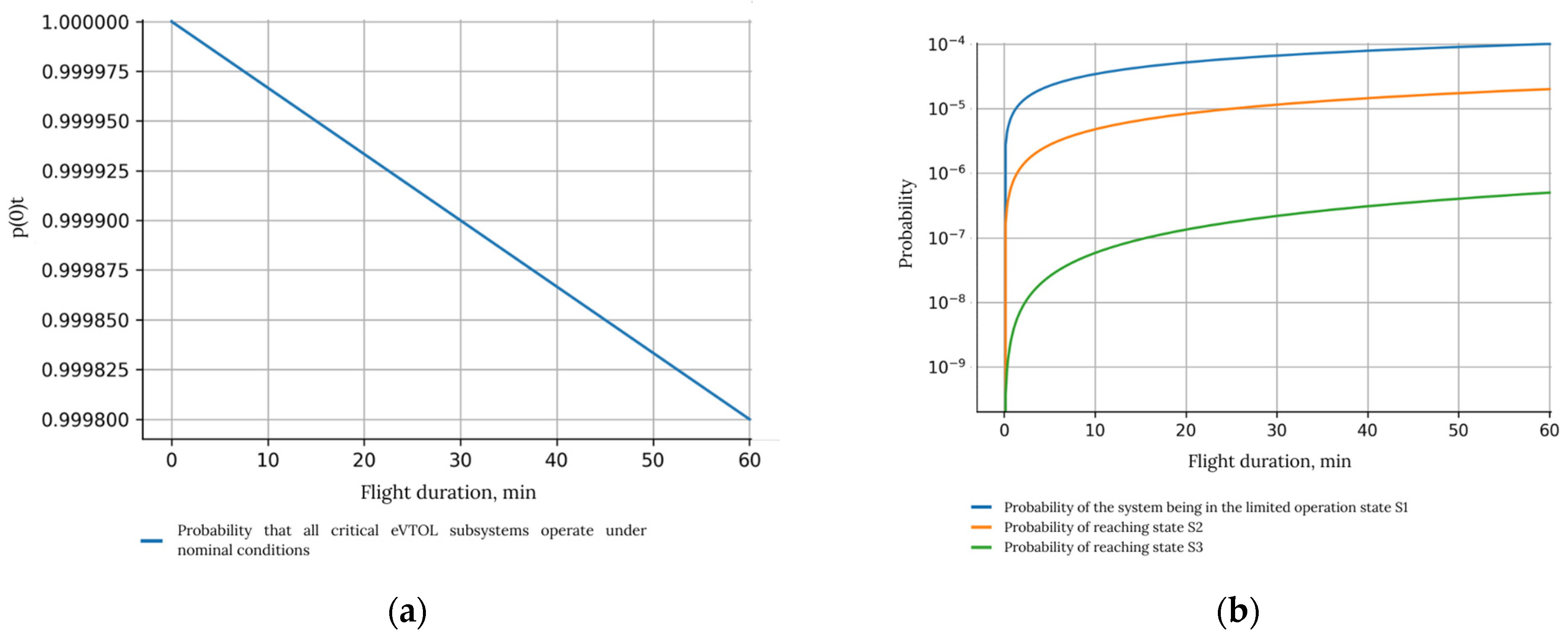
Analyses of the dynamics of the probabilities of eVTOL operational states are presented in
Figure 2a,b. These results are used to evaluate system behavior during one flight within the framework of the basic operating scenario, which corresponds to current infrastructural, climatic, and technological maturity.
The initial state of the system at the start of a flight is characterized by full nominal operability, as reflected by the initial conditions and .
The probability of the system being in the nominal operational state
is close to 1 throughout the considered time interval (
Figure 2a).
smoothly, monotonically decreases due to the presence of nonzero intensities of degradation transitions, reflecting the influence of the climatic factors, power supply limitations, and internal failures of the eVTOL subsystems. The absence of sharp jumps in probability indicates stable dynamics and the absence of dominant instantaneous failures in the baseline scenario.
Figure 2b presents the probabilities of the degraded operational states
and
and the absorbing catastrophic state
on a logarithmic scale. The probability of a restricted operational state,
, increases faster than that of an emergency mission termination
, reflecting the predominance of partial and potentially reversible failures over more severe operational events. This is consistent with the assumed high efficiency of monitoring, diagnostics, and maintenance systems, ensuring timely failure detection and localization.
The probability of reaching a catastrophic state, , is several orders of magnitude lower than those of the degraded states throughout the flight interval. Nevertheless, steadily increases over time, albeit with small absolute values; this increase is associated with the absorbing nature of state and the cumulative effect of successive degraded transitions. This result emphasizes the fundamental impossibility of completely eliminating catastrophic risk, even when nominal operating modes predominate.
Based on the transition intensity matrix
(
Table 5), (2) was solved for a continuous-time Markov state process. The probability vector of states
was calculated for fixed time instants corresponding to typical durations of one eVTOL flight (
Table 6).
The impact of regulatory requirements and operational maturity on the transition rates of the Markov process is quantitatively considered by incorporating a vector of scenario coefficients
, which reflects the degree of implementation of key international standards in the design, maintenance, and software of eVTOLs (
Table 7). Each coefficient assumes a value in the range (0;1], where 1 corresponds to full regulatory compliance and values less than 1 correspond to partial or no implementation of requirements. These coefficients scale the baseline failure and recovery rates according to (4), forming a scenario-based modification of the
generator matrix.
The architectural fault tolerance coefficient reflects the level of redundancy and distributed electric propulsion and indicates compliance with SC-VTOL requirements for single-point-of-failure prevention. The operational maintenance coefficient characterizes the maturity of maintenance, repair, and inspection procedures, which are regulated by Part-M and Part-145 standards using intelligent robotic inspection. The automated preflight inspection level coefficient reflects the reliability of onboard control, monitoring systems, and software that comply with DO-178C requirements. In this study, the factor includes the quality of data received from electronic battery monitoring systems, power electronics, communication links, environmental sensors, and inspection tools. The higher the diagnostic coverage becomes, the lower the likelihood of defect accumulation and the higher the likelihood of detecting system degradation in the preparation for departure.
The values presented in
Table 7 are interpreted as levels of safety barrier implementation rather than direct multipliers of transition rates between system states. Their effects are transition-specific. For transitions associated with system degradation or catastrophic failure, higher levels of implementation reduce the effective transition rate by a factor of
. In contrast, recovery-related transitions compliant with Part-M/145 requirements increase the recovery rate by a factor of
. Thus, the same compliance factor has opposite mathematical effects depending on the transition state between modes. This distinction is important because MRO and inspection procedures do not reduce the impact of external limiting factors. However, they have a positive effect on preflight defect detection and limit further system degradation after detection.
Scenario matrices of the Markov process transition rates are generated based on the introduced regulatory compliance coefficients. For each scenario, the baseline rates are modified based on architectural fault tolerance, maintenance quality, and diagnostic coverage.
The coefficient values presented in
Table 7 are derived from the parameterization of the regulatory maturity levels of the system and are used for scenario-based modeling of how regulatory requirements influence the transition rates of the Markov process. Full compliance with the SC-VTOL, Part-M/145, and DO-178C requirements serves as the reference state, corresponding to coefficient values of unity. Values < 1 reflect varying degrees of partial compliance with regulatory requirements and reduced effectiveness of associated safety mechanisms. Specific coefficient values were selected to create contrasting regulatory compliance scenarios and to assess the model’s sensitivity to changes in architectural fault tolerance, maintenance quality, and diagnostic coverage.
Unlike parameters directly estimated from operational statistics, the regulatory compliance coefficients in
Table 7 represent scenario-based characteristics of the regulatory maturity of the system. Although the SC-VTOL, Part-M/145, and DO-178C regulations define safety, maintenance, and software requirements, they do not provide a quantitative scale for directly converting the degree of compliance into coefficient values. These coefficients serve as a tool for scenario-based parameterization of regulatory factors. A value of 1.0 corresponds to a scenario of full compliance with regulatory requirements, whereas lower values reflect varying levels of redundancy, maintenance, and diagnostic monitoring mechanism implementation. This approach enables a comparative analysis of the effect of regulatory maturity on eVTOL operational safety metrics.
A comparison of the scenario rate matrices (
Table 5,
Table 8 and
Table 9) shows that an increase in regulatory maturity systematically reduces catastrophic risks. This reduction does not result from a single parameter; it is the combined impact of architectural solutions, maintenance procedures, and diagnostic coverage. Moreover, the effect is nonlinear: the greatest reduction in the transition rate to
is achieved by simultaneously implementing SC-VTOL and DO-178C requirements, whereas maintenance enhancement primarily accelerates recovery transitions.
The integrated probability of a catastrophic outcome for a flight of duration is the probability of reaching the absorbing state (19).
The integrated probability of a catastrophic outcome increases almost linearly with the flight duration for all scenarios, reflecting the cumulative nature of risk in a continuous-time Markov model (
Table 10). Furthermore, an increase in the regulatory maturity of the operational environment significantly decreases
throughout the range of flight durations. Thus, for a 60 min flight, transitioning from the baseline scenario to full regulatory compliance reduces the integrated risk by more than 2.9 times. This effect is achieved by simultaneously reducing the intensities of direct catastrophic transitions and accelerating recovery processes, which reduces the likelihood of the accumulation of degradation states over the course of the mission.
The
(
Table 11), widely used in aviation risk assessment practice, allows for a transition from small absolute probability values to a more illustrative scale. An increase in
corresponds to an increase in safety level. The results demonstrate that SC-VTOL, Part-M/145, and DO-178C implementation sustainably increases the integrated safety level, regardless of flight duration. Specifically, for eVTOL operations, the SC-VTOL standard targets a catastrophic outcome probability of approximately
per flight, which corresponds to
.
The presented data show that all scenarios reach or exceed the SC-VTOL regulatory threshold within the flight duration of 10 min. However, during the 60 min flight, the ISI in the baseline scenario decreases below the regulatory level, indicating a need for enhanced regulatory compliance measures and technical oversight during long-duration operations.
The resulting values for the integral probability of a catastrophic outcome, , and the corresponding safety index (ISI) should not be interpreted as actual aviation accident probabilities or eVTOL safety certification metrics. Given the limited availability of operational statistics, these indicators serve as scenario-based measures of relative risk, enabling the comparison of various combinations of climatic, infrastructural, technological, and regulatory operating conditions.
The primary value of the proposed approach lies in identifying the factors that most remarkably influence safety levels and in conducting a comparative analysis of alternative operational environment scenarios rather than predicting the absolute number of accidents. As statistical data on eVTOL operations accumulate, the model parameters and corresponding risk estimates can be further refined.
Deterministic sensitivity analysis was conducted to assess the robustness of the results to parametric uncertainty. Here, the
,
, and
coefficients were varied by ±20% from their baseline values. The resulting ranges of the integrated probability of a catastrophic outcome
and the corresponding safety index
are presented in
Table 12.
Changes in key parameters cause a 10–15% variation in and modify the index by less than 0.1 log units. This demonstrates the structural robustness of the stochastic model and the preservation of qualitative conclusions under moderate parameter uncertainty.
The tabular values of the
reflect the average operational safety level assessment for fixed flight durations and regulatory compliance scenarios. However, the safety level in real-world eVTOL operations is determined by a sequence of climatic events and can vary significantly over time.
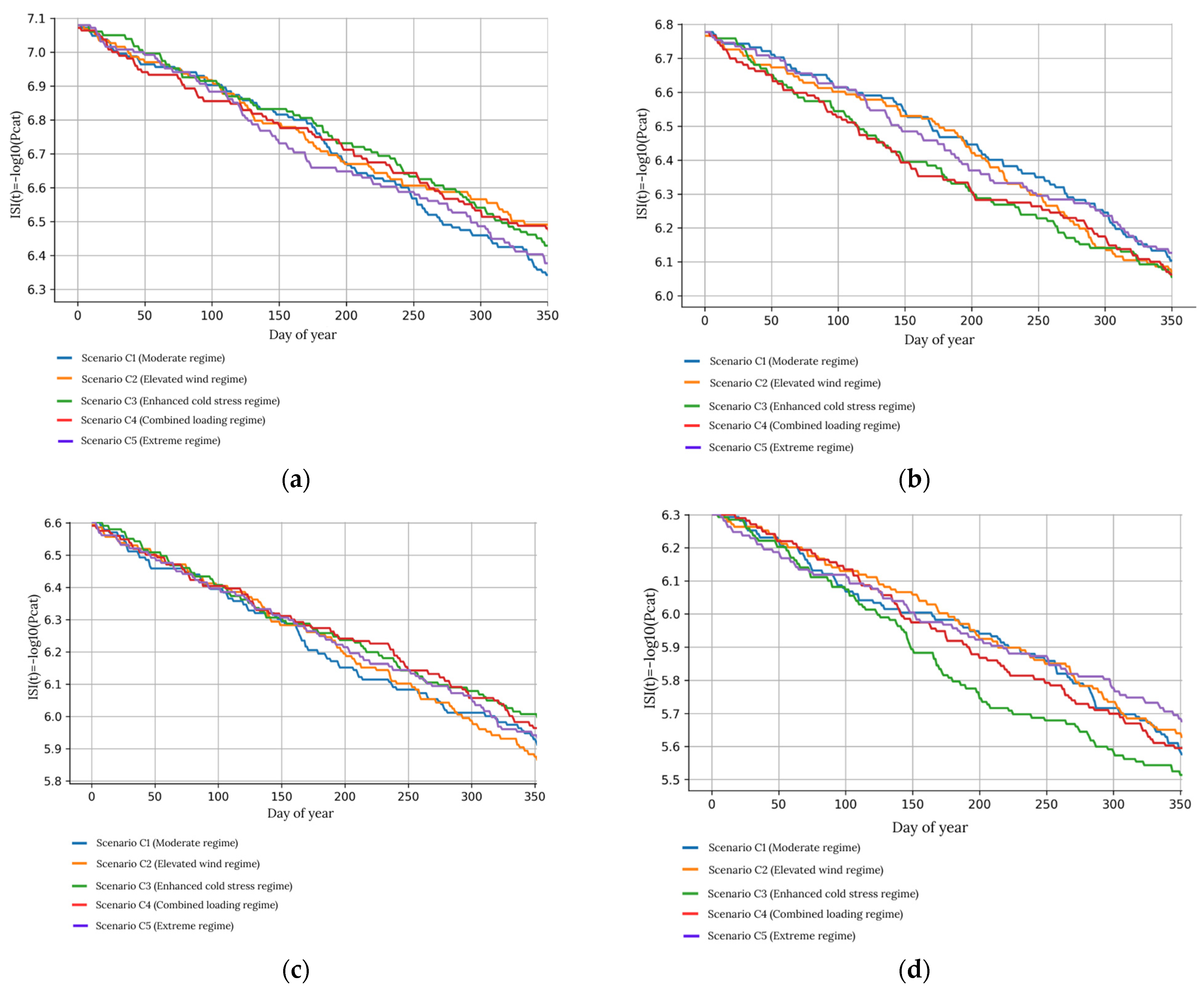
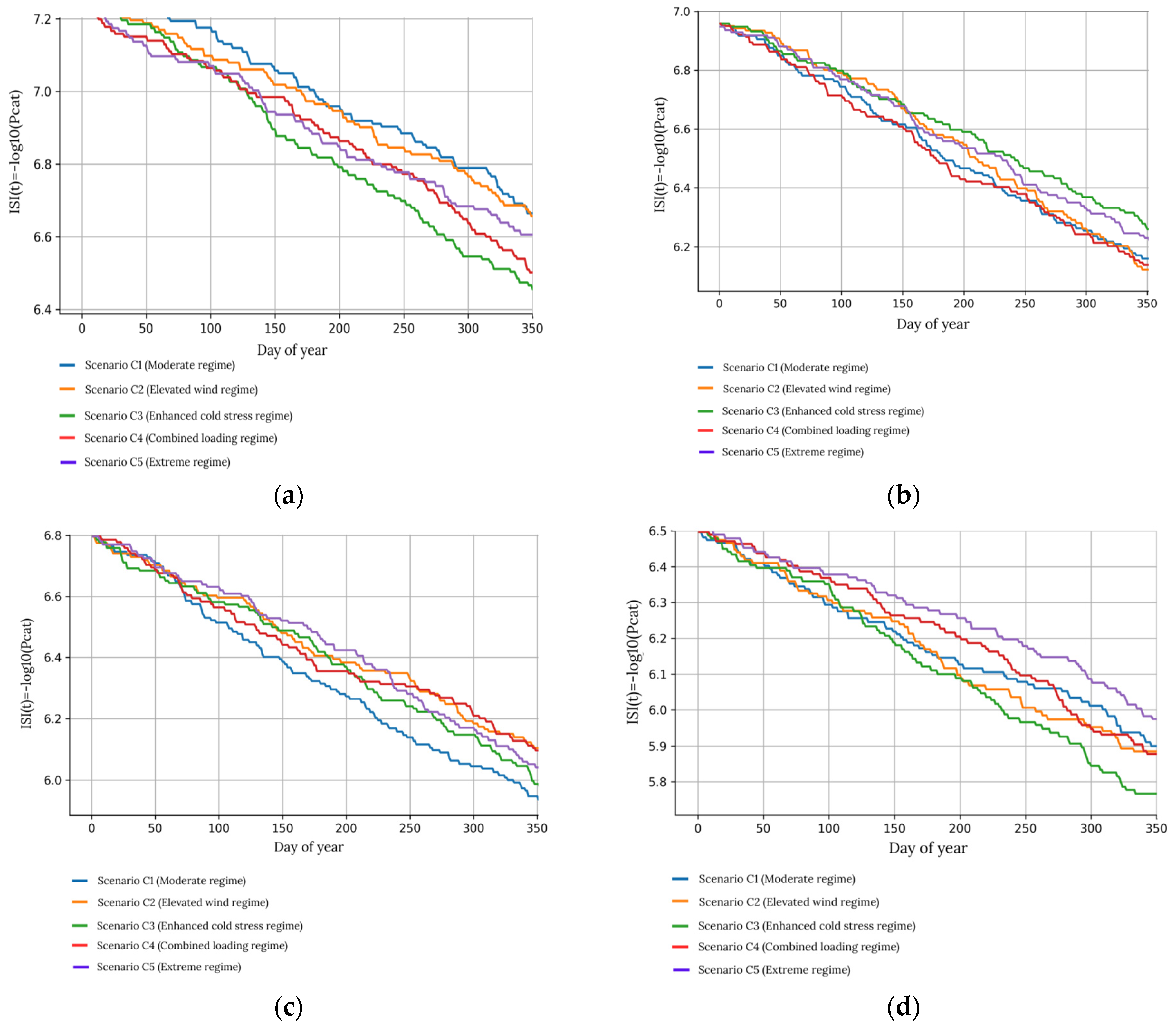
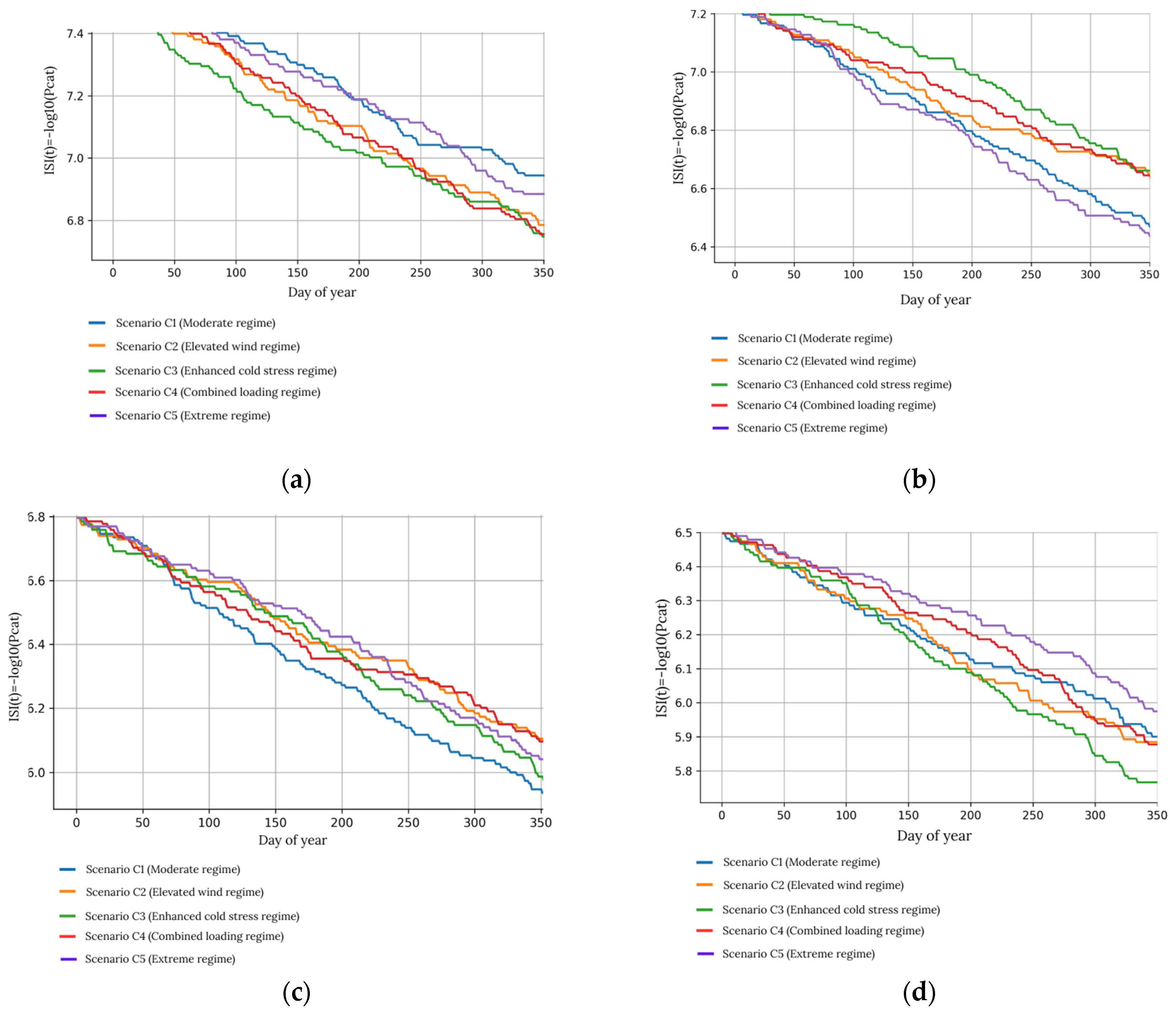
Figure 3,
Figure 4 and
Figure 5 illustrate the dynamic nature of the
by showing its evolution along several representative climatic trajectories in the Almaty region.
The initial value of the ISI, , is determined by the parameterization of the corresponding scenario and the baseline transition intensities in the generator matrix. It is not related to the order of the subfigures, which do not follow a chronological sequence. The variations between subfigures are owing to differences in the initial scenario coefficients of regulatory compliance and climate load.
This study used five representative climate scenarios reflecting different accumulation modes of adverse meteorological factors (moderate, increased wind, increased cold, combined, and extreme). These scenarios were not a random sample from an ensemble of all possible realizations for 2018–2025. Instead, they were used as typical input configurations for the sensitivity analysis of a stochastic Markov model to assess the robustness of dynamics to variability in climatic loads instead of constructing a statistical distribution of the safety index. For each year, the following were assessed: the total number of days exceeding the wind threshold, the frequency of extremely low temperatures, and the nature of their temporal distribution.
Five typical modes differing in the intensity and combination of adverse factors were identified based on a comparative analysis of annual accumulation profiles. The classification criteria were the final annual value of accumulated indicators, their growth rate during the year, and the ratio of wind and temperature components. The corresponding trajectories were selected as representative scenarios reflecting moderate, increased wind, increased cold, combined, and extreme climatic stress regimes.
An analysis of the dynamics across various scenarios reveals that the degradation of the ISI is systematic and depends on the type of climatic stress. In the baseline scenario C1 (moderate regime), the decreases most gradually, corresponding to a minimal accumulation of unfavorable factors and less acceleration of transitions to risky model states.
Scenario C2 (increased wind load) demonstrates a more pronounced decrease than C1, reflecting the increased intensity of transitions associated with increased aerodynamic loads and the probability of failures in distributed electric traction. However, the degradation remains relatively uniform, indicating the cumulative nature of wind impacts.
Scenario C3 (increased cold regime) shows an accelerated decrease in , especially in the second half of the year. This is owing to the temperature sensitivity of battery systems, which increases the degradation of the energy resource and increases the probability of failure.
The combined scenario C4 demonstrates a nonlinear amplification of ISI degradation; the combined effects of wind and temperature factors accelerate reduction compared with the individual effects. This confirms the synergistic effect of climatic loads within CTMC parameterization.
The extreme scenario C5 is characterized by the most intense degradation of safety indicators and forms the lower envelope of trajectories. The results confirm the model sensitivity to increasing external loads and demonstrate the ability of the CTMC approach to reflect the dynamic evolution of risk depending on the operating mode.
The decrease along the climatic trajectories does not reflect a deterioration in safety within a flight; instead, it is due to the cumulative nature of risk assessment during repeated eVTOL operations under various climatic conditions. The magnitude of the decrease is determined by the risk accumulation rate, which increases (decreases) during periods with (without) unfavorable climatic conditions.
For all considered climatic trajectories, the
monotonically decreases over time due to the cumulative nature of the probability of a catastrophic outcome within the Markov model with an absorbing state (
Figure 3,
Figure 4 and
Figure 5). However, the trajectory shapes and
decrease rates vary significantly because of the temporal structure of the occurrence of unfavorable climatic conditions.
For short flights, values remain close to the SC-VTOL benchmark and are weakly sensitive to climatic variability, corresponding to the power supply. As the flight duration increases, the spread between trajectories increases, indicating a stronger impact of the sequence of climatic events on operational safety. In certain scenarios, adverse climatic periods sharpen the decline. With a uniform distribution of extreme conditions, the index dynamics are smoother.
A comparison of evolution in various regulatory compliance scenarios reveals consistent differences in safety level and sensitivity to climatic variability and vertiport placement. An increase in regulatory maturity systematically shifts trajectories toward higher values and reduces the spread between climatic realizations. This indicates a reduction in the impact of the sequence of adverse climatic events and confirms the role of SC-VTOL, Part-M/145, and DO-178C in decision-making on vertiport planning, design, and placement; these standards improve not only the average safety level but also the resilience of eVTOL operations under climate uncertainty.
4. Discussion
Contemporary research in the field of UAM generally regards safety issues as a key limiting factor in the large-scale deployment of eVTOL vehicles in urban environments. According to a review by Shuaibu et al., despite the active development of UAM concepts and last-mile optimization models, quantitative assessments of operational risks and their dynamics over time are insufficiently addressed [
46]. Similar conclusions were published by Straubinger et al., who noted that existing research primarily focuses on architectural, infrastructural, and regulatory aspects while formalized stochastic models of eVTOL operational safety remain in the early stages of development [
47].
Numerous researchers have analyzed the safety of aviation systems using extreme value theory (EVT) and statistical methods for tail risk assessment. Das and Dey demonstrated that the probability of extremely rare but catastrophic aviation events cannot be adequately described using standard distributions, instead requiring the use of EVT approaches [
48]. Figuet et al. used EVT methods to model the risk of mid-air collisions, demonstrating the effectiveness of these methods for estimating low probabilities of critical events [
49]. In Geng et al.’s work, EVT was applied to conflict analysis problems in ground transportation, confirming the universality of this approach across transportation systems [
50].
However, the abovementioned studies are predominantly static in nature and focus on analyzing the distributions of extreme values, without describing the dynamics of risk accumulation during operation. Moreover, they typically do not establish a formal connection between the observed external factors and the internal state of the system through a dynamic model of transitions between operating modes. The use of copula models to account for the joint influence of meteorological factors, as shown by Huang et al., allows for a more accurate description of the dependence of extreme wind characteristics; however, such models are not directly integrated into aircraft operational safety models [
36].
The proposed Markov model of eVTOL operational safety formalizes the dependence of the transition intensities between operational states on observed climatic and infrastructural factors, enabling a transition from static, averaged risk assessments to a dynamic probabilistic description of the operational process. Unlike most existing studies, which consider the influence of the external environment through scenario assumptions or aggregated coefficients, this work directly integrates climatic indicators and energy supply reliability indicators into the structure of the Markov process generator. This ensures the physical interpretability of the model parameters and allows for a quantitative assessment of the contribution of individual factors to the formation of operational risk.
The ISI introduction is an important methodological element transforming extremely low values of catastrophic probability into a logarithmic scale comparable with aviation safety regulatory benchmarks. This approach makes modeling results illustrative for engineering analysis and management decision-making while ensuring accurate comparisons of alternative compliance scenarios, architectural solutions, and technology levels. Unlike traditional metrics, focusing on instantaneous failure rates, the ISI reflects the cumulative nature of risk and allows for an analysis of its temporal evolution.
A key feature of the proposed Markov model is the explicit parameterization of the influence of international regulatory requirements on the rates of transitions between eVTOL operational states. Compared with most existing studies, which examine aviation safety standards qualitatively or use fixed assumptions, this model formalizes the SC-VTOL, Part-M/145, and DO-178C requirements through scenario-based compliance coefficients directly incorporated into the Markov process generator matrix. This establishes a quantitative link between the level of architectural fault tolerance, maintenance maturity, and software quality and the likelihood of degradative and catastrophic transitions.
This approach enables quantitative comparisons of different levels of regulatory maturity of the operational environment and enables a transition from declarative compliance with standards to a measurable assessment of their impact on flight safety. Scenario analysis results show that the effect of standard implementation is systemic and nonlinear: the greatest reduction in overall risk is achieved by jointly implementing architecture, maintenance, and software requirements. By contrast, isolated improvements to individual elements exert a considerably smaller effect. This confirms the need for an integrated regulatory approach to eVTOL certification and operation.
For the target audience in the fields of electronics and hardware–software systems, A key takeaway from this study is the ability to interpret eVTOL safety assessment results using diagnostic electronics, onboard monitoring, and software reliability metrics. In practical implementation, the derived model parameters are primarily related to power electronic controllers, temperature and vibration sensors, electric motor control systems, communication channels, computer vision, and self-diagnostic capabilities. Robotic inspection complements this monitoring by providing external data regarding the condition of the airframe and its components, landing pad, charging infrastructure, and vertiport environment. The CTMC model proposed in this study serves as an analytical layer within an electronic decision support system, integrating data from sensors, diagnostic modules, software, and monitoring systems to assess eVTOL mission readiness.
EVT methods, focused on modeling the tails of observed value distributions, are widely used in the quantitative assessment of rare events in transport and aviation systems. For the studied problem, EVT can be used to estimate the probability of exceeding critical climatic thresholds based on the same meteorological data for the Almaty region. This assessment yields the probability of an extreme external impact; however, it is not equivalent to the probability of a catastrophic outcome of eVTOL operation, as it does not consider the system internal structure, its degradation and recovery mechanisms, or the impact of regulatory maturity.
In the proposed CTMC, the cumulative probability of a catastrophic outcome forms as a result of the system’s evolution through states during a flight of duration . The corresponding ISI reflects the logarithmic transformation of the cumulative probability of reaching the absorbing state . Thus, unlike the EVT assessments of the tail probabilities of extreme climatic events, the ISI integrates the combined effects of climatic factors, power supply reliability, battery system degradation, and regulatory compliance level. Given the same climatic data, EVT and CTMC answer different research questions: EVT estimates the probability of an extreme external impact, whereas CTMC models the probability of system failure considering the operational states’ dynamics.
From a methodological perspective, the main limitation of EVT in this task is its static nature. EVT does not describe transitions between operational states, consider the sequence of degradation events, and formalize the influence of engineering and regulatory levers on transition rates. In particular, the EVT approach does not allow for the parameterization of architectural fault tolerance, maintenance quality, or software diagnostic coverage. These aspects are directly included in the rate matrix in the CTMC model through scenario-based regulatory compliance coefficients. This enables the quantitative analyses of controllable safety factors, which are fundamental to vertiport planning, design, and placement.
In comparisons of quantitative results, an EVT model calibrated using climate data will provide an estimate of the probability of exceeding specified meteorological thresholds over the studied period. However, this value cannot be directly interpreted as the probability of a catastrophic outcome as it does not consider the system’s resilience to extreme impacts, the presence of redundancy, recovery processes, and gradual battery degradation. The ISI values obtained within the CTMC framework using the same climate data will constitute a highly comprehensive metric reflecting system safety, not only the statistical rarity of an external event. Thus, instead of replacing EVT, the CTMC approach extends the analysis, providing a transition from assessing extreme factors to assessing dynamic operational risk.
To facilitate a clearer comparison between the proposed approach and existing risk assessment methods, a comparative summary of the key characteristics of the most common probabilistic models used in safety analysis for transport and aviation systems has been prepared (
Table 13).
As shown in
Table 13, EVT methods are effective tools for assessing extreme climatic effects; however, they do not allow for modeling the evolution of a system’s operational state over time. Bayesian networks provide a representation of causal relationships between risk factors but require a complex interconnection structure and a considerable amount of a priori information to be specified. The proposed CTMC model focuses on modeling the dynamics of transitions between eVTOL operational states and simultaneously considers climatic, infrastructural, and regulatory factors within a unified probabilistic framework. This allows for the direct assessment of the probability of a catastrophic outcome,
, and ISI under various operating conditions.
The practical calibration of the sensitivity parameters β, γ, and α should be considered separately. In its current stage of development, the eVTOL industry has a limited amount of empirical operational data, which complicates the statistical assessments of transition rates based on large-scale fleet observations. Herein, the numerical values of the coefficients are defined based on engineering analogies with existing aviation systems; SC-VTOL, Part-M/145, and DO-178C regulatory guidelines; and the characteristics of commercial lithium-ion technologies. This approach is consistent with preliminary modeling in the early stages of new technology implementation, when an analytical platform is being developed for scenario and sensitivity assessment before sufficient data are accumulated.
The proposed model can be further calibrated and validated using data from FAA and NASA AAM industry programs, as well as other sources containing information on the reliability and safety of next-generation aerial platforms, as operational data on eVTOLs accumulate. The key methodological assumption of the proposed model is that the regulatory framework is incorporated into the CTMC formulation as an engineering mechanism that modifies transition intensities between system states (rather than as a regulatory constraint). Within this framework, Part-M/145—regulating efficient processes for recording, evaluating, correcting, and releasing defects after preflight inspections—is represented at the organizational level, governing airworthiness assurance processes; accordingly, the mathematical impact on the model is associated with assessing the intensity of repair and maintenance work, rather than the impact of physical wear due to wind loads, temperature, battery aging, or power supply limitations. Automated preflight inspection is treated as the technical realization of these processes, increasing the probability of detecting latent defects prior to flight and reducing the likelihood of initiating a mission with undetected critical faults. In contrast, the DO-178C standard is modeled separately, as it pertains to the reliability of software supporting onboard monitoring, anomaly detection, and robotic inspection functions. Within the model it is represented as a diagnostic coverage parameter that reduces the probability of undetected degradation and unsafe system evolution. Together, the integrated SC-VTOL–Part-M/145–DO-178C model enables a unified assessment of aircraft design robustness, MRO operational maturity, and software reliability during inspection.
The proposed model has a modular, adaptive structure, allowing for subsequent empirical calibration. As eVTOL operational data accumulate, the transition rate parameters can be refined based on the observed frequency of degradation and recovery events using maximum-likelihood or Bayesian updating methods. Continuous-time Markov formalization enables direct correlation between empirically observed state transitions and the elements of the generator matrix, making the model suitable for stepwise validation and refinement. Thus, the current version of the model should be considered a parametrically sound analytical framework designed for further refinement as the industry evolves and the operational database expands.
Notably, the practical validation of the model is currently constrained by the availability of operational data for eVTOLs. Unlike traditional aviation, the eVTOL industry is in its early development stages. Consequently, publicly available databases containing statistics on failures, operational incidents, and long-term fleet performance observations for this class of aircraft are either nonexistent or limited in scope. Therefore, the model was parameterized using actual climatic data from the Almaty region, energy infrastructure reliability metrics, characteristics of modern lithium-ion battery systems, and current regulatory requirements (SC-VTOL, Part-M/145, and DO-178C). The obtained results should be viewed as a quantitative risk assessment based on specific scenarios, intended for model sensitivity analysis and the comparative evaluation of various operating conditions. The proposed model can be further calibrated and validated using real-world data regarding transitions between operational states and fleet reliability metrics as operational statistics for eVTOLs accumulate.
In this study, the effect of temperature on the battery system was modeled primarily by focusing on low-temperature effects. This choice was driven by the climatic characteristics of the Almaty region, where low temperatures are a major factor affecting the available battery capacity, internal resistance, and eVTOL energy efficiency. The effect of high temperatures on battery system degradation and thermal safety during flight was not explicitly modeled in this study. However, high-temperature conditions can also remarkably influence battery performance and warrant separate consideration. Extending the model to incorporate the effects of overheating and thermal aging of batteries is a promising avenue for future research.
The proposed battery subsystem model is designed to account for energy availability, cycle degradation, and the temperature sensitivity of batteries. Several factors of importance to eVTOL operations were not explicitly modeled in this study. These include high energy consumption during vertical takeoff and landing phases, requirements for reserve energy to ensure safe flight termination, battery charging rates, thermal management algorithms for battery systems, and various charge control strategies.
These factors can remarkably affect the energy efficiency and operational risk profile of eVTOL aircraft. However, accounting for them requires more detailed modeling of energy flows, flight modes, and specific platform characteristics. Within the scope of this study, they are treated as model constraints and identified as a promising area for future research.
Such robotic platforms are capable of providing automated construction site monitoring, inspecting structural elements, controlling the quality of work performed, collecting operational data, and executing specific auxiliary tasks. Consequently, the deployment of mid-sized mobile robotics (LoS 3) during vertiport construction should be viewed as a considerable extension of the risk-based approach to ensuring eVTOL safety. These systems will enhance the quality of construction oversight, ensure regular monitoring of the facility’s condition, reduce the effect of the human factor, and create a digital database for the subsequent assessment of operational risks. Their application is particularly relevant for vertiports—as critical infrastructure facilities—where flight safety is directly linked to construction precision, the reliability of engineering solutions, and the timely detection of deviations.
The presented provisions confirm that the use of the CTMC framework is methodologically sound for eVTOL operational risk assessment under climatic and infrastructural uncertainties. The model integrates extreme climate factors into the system’s state dynamics, considers controlled safety parameters, and allows for adaptive updating as data accumulate, ensuring its applicability in the infrastructure design stage and subsequent operational monitoring phase.




 ,
,