2.1. Operating Principle
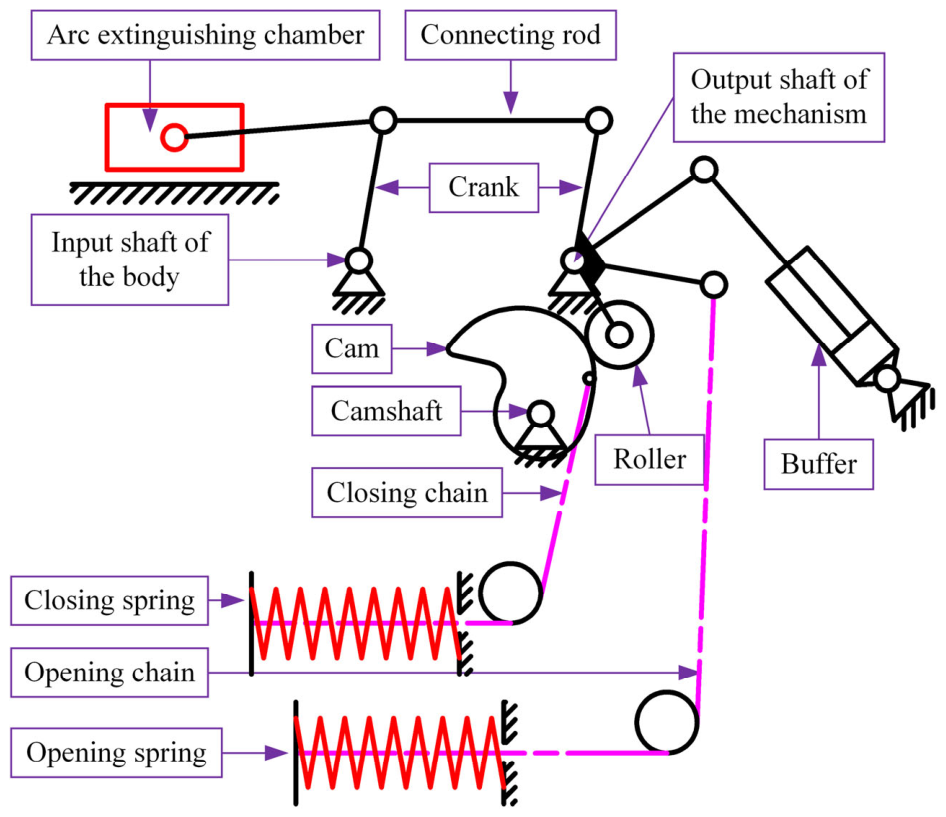
Although the structural configuration of spring mechanisms may vary among different types, their fundamental principle remains the same, as follows. (a) The opening and closing springs are utilized as energy storage elements to drive the mechanical transmission system, enabling the movement of the contacts; (b) cam transmission is employed to regulate and control the mechanical characteristics during the closing process; (c) a buffer is used to ensure a smooth stop at the end of the opening operation.
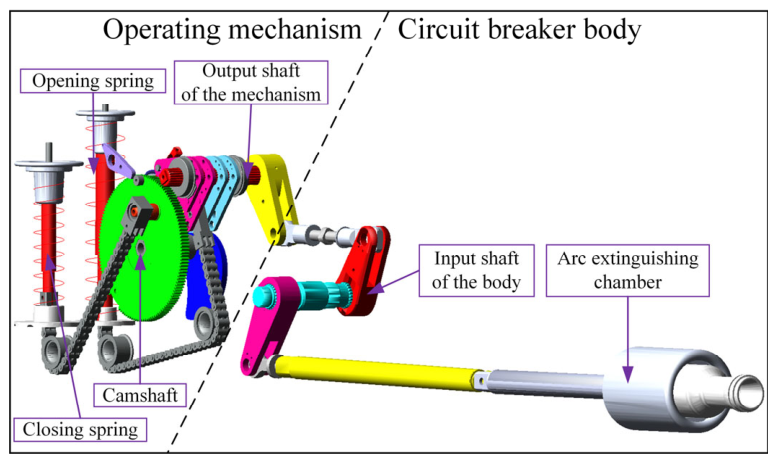
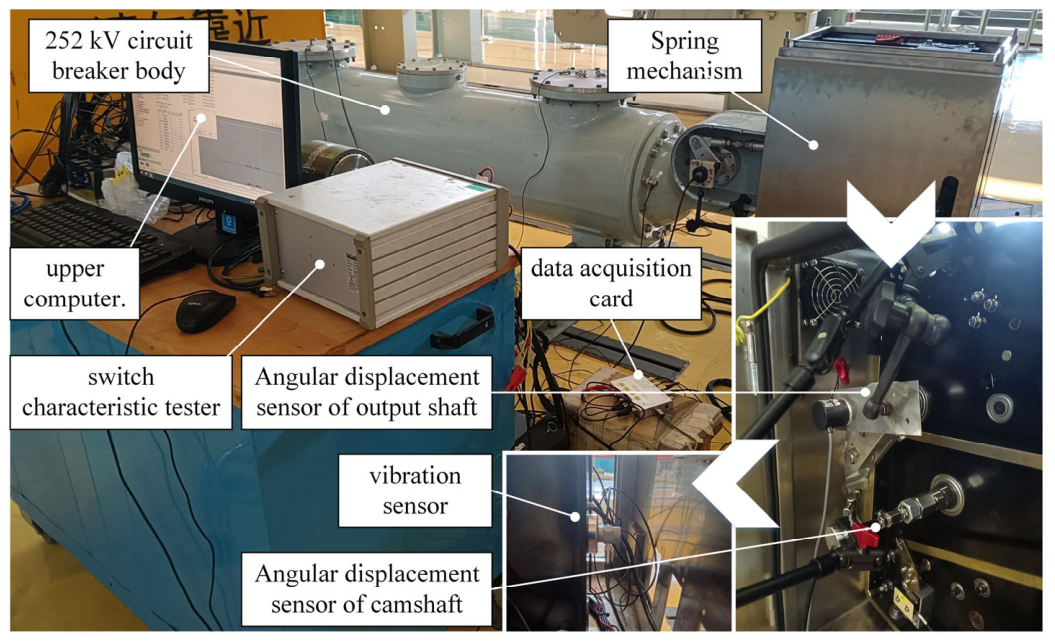
A typical spring mechanism mainly consists of a closing spring and its transmission unit, an opening spring and its transmission unit (including the buffer), a camshaft, a cam, a roller, and an output shaft. The mechanical power is transmitted via connecting rods to a circuit breaker body to execute the opening and closing of the contacts. The structure is illustrated in
Figure 1.
The opening and closing operating system comprises two subsystems: the closing spring–camshaft system (CS–CS) and the opening spring–output shaft system (OS–OS). The former includes the closing spring with its transmission assembly, the cam, and the camshaft. The latter consists of the opening spring, roller, output shaft, cranks, connecting rods, and the arc-extinguishing chamber. Force and motion transmission between the two subsystems are achieved through a cam mechanism formed by the interaction of the cam and the roller.
To improve transmission efficiency, the rotation angle of the crank in the four-bar linkage of the OS–OS is typically limited to no more than 60°. Under this condition, the following assumptions are made to simplify calculations:
- (1)
Linear motion assumption: During the opening and closing operations, the motion of the OS–OS is considered linear. The transmission ratios among the output shaft of the mechanism, the input shaft of the circuit breaker body, and the moving contact remain constant and do not change with the rotation of the crank.
- (2)
Constant inertia assumption: During the opening and closing operations, the equivalent inertia of the OS–OS remains constant and does not vary with the rotation of the crank. Consequently, the total inertia of the OS–OS can be equivalently concentrated onto the output shaft of the operation mechanism using the lumped parameter method, thereby simplifying the dynamic model.
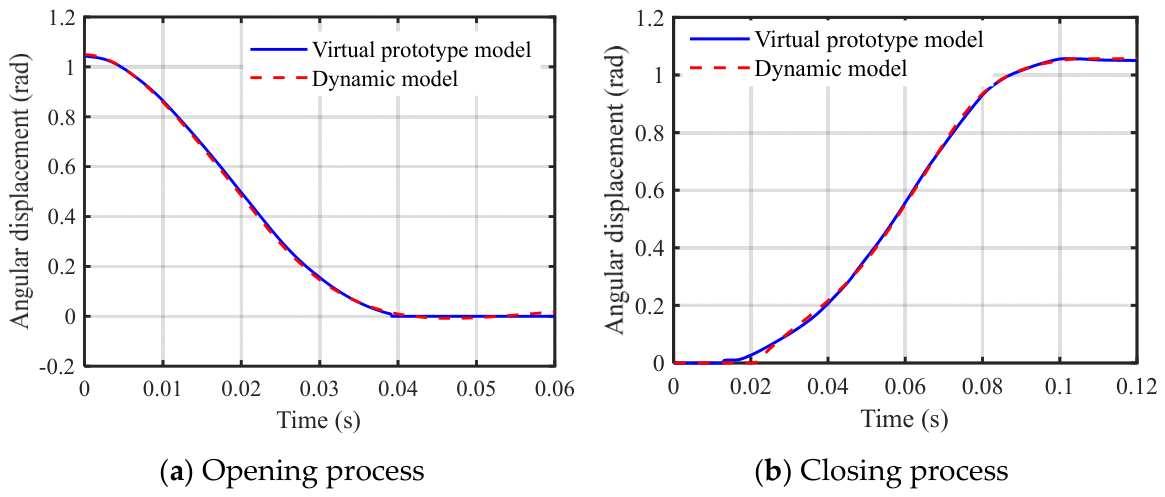
The influence of the above linear motion and constant inertia assumptions on the accuracy of the dynamic model and parameter estimation will be discussed later in conjunction with experimental results in the sections on parameter estimation accuracy analysis. It should be noted that when the crank rotation angle becomes large, these assumptions may no longer hold. For such cases, one of the following two approaches is recommended: (i) a refined analytical model, i.e., establishing a rotation-angle-dependent variable transmission ratio model based on specific crank and connecting rod dimensions; (ii) a virtual prototype model, i.e., developing a detailed virtual prototype of the circuit breaker using multibody dynamics software such as ADAMS. In this case, the model will exhibit significantly increased dependence on structural dimensions.
2.2. Dynamic Model of the Closing Operation
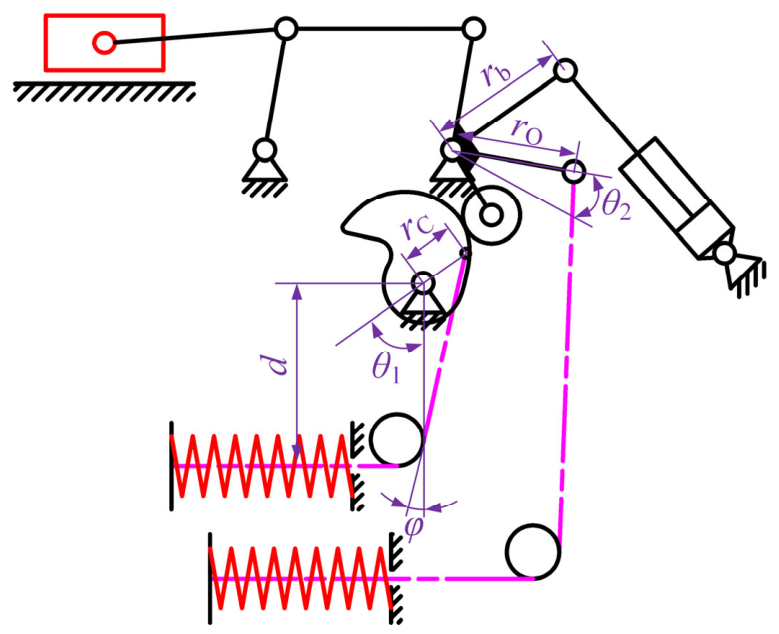
The dynamic model of the closing operation incorporates three key aspects: the CS–CS, the OS–OS, and the force and motion transmission relationship between them. The schematic diagram with key geometric parameters is provided in
Figure 2.
The CS–CS moves under the combined action of the driving force from the closing spring and the resistance from the roller. With the angular displacement of the camshaft as the state variable, its dynamic model is established as follows:
where
kC is the stiffness of the closing spring,
xC0 is the compression of the closing spring after energizing,
d is the distance from the camshaft to the axis of the closing spring,
rC is the length of the crank actuated by the closing spring,
φ is the angle between the closing chain and the vertical direction,
θ1 is the angular displacement of the camshaft,
T21 is the resisting torque generated by the roller,
J1 is the equivalent moment of inertia of the CS–CS, and
t is the operating time of the camshaft. Under the condition of a small
φ, Equation (1) can be transformed into the following form:
The motion of the OS–OS is governed by the driving force from the cam on the roller, the force from the opening spring, the transmission resistance, and the pneumatic resistance. With the angular displacement of the mechanism’s output shaft as the state variable, its dynamic model is given by the following:
where
T12 is the driving torque from the cam acting on the output shaft (note that
T12 T21);
TCf is the equivalent resistance torque, which includes the transmission and pneumatic resistances and is considered constant during the closing process;
kO is the stiffness of the opening spring;
xO0 is the pre-compression of the opening spring before energy storage;
θ2 is the angular displacement of the output shaft;
rO is the length of the crank actuated by the closing spring; and
J2 is the equivalent moment of inertia of the OS–OS.
The kinematic relationship between the camshaft and the mechanism’s output shaft is described as follows:
where
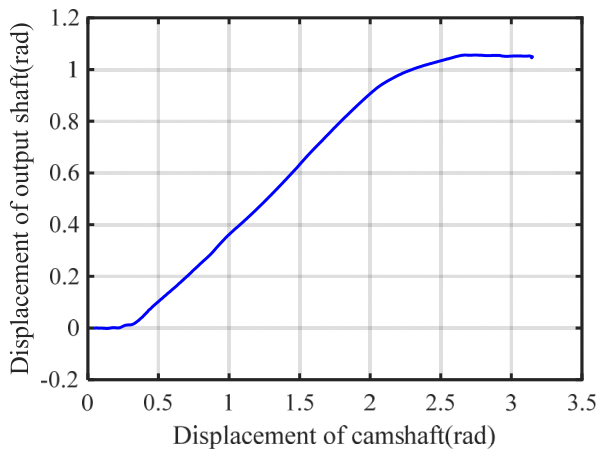
h denotes the mapping relationship between the angular displacement of the camshaft and that of the output shaft, determined by the cam profile curve, which is the key factor governing the closing travel curve.
The cam transmission in spring mechanisms typically employs rolling contact. Neglecting energy loss in the cam transmission, the relationship between the resisting torque on the camshaft and the driving torque on the output shaft is derived from power conservation, as follows:
In conclusion, the complete dynamic model of a mechanical transmission system during the closing process is comprehensively given below:
The aforementioned dynamic model describes the dynamic process of the closing operation of the circuit breaker driven by the spring mechanism. Here, θ1 and θ2 are the state variables, while kC, kO, TCf, and J2 may change with system degradation and can thus be used to characterize the system state, and are referred to as state parameters. The remaining parameters, which are determined by the mechanical structure, are termed structural parameters.
To reduce the dependence of the parameter identification process on structural parameters and enhance the engineering applicability of the method, parameter reorganization is performed on the dynamic model. The structural parameters and state parameters are collectively treated as integrated model parameters for estimation. As structural parameters remain invariant during system degradation, variations in the estimated model parameters directly reflect changes in the corresponding state parameters. The direction and magnitude of deviations in the estimated model parameters from their normal-state values indicate variations in the state parameters. The reorganized parameter set for the closing dynamic model is as follows:
The defining equations for the parameters of the dynamic model, which consist of structural parameters and state parameters, are as follows:
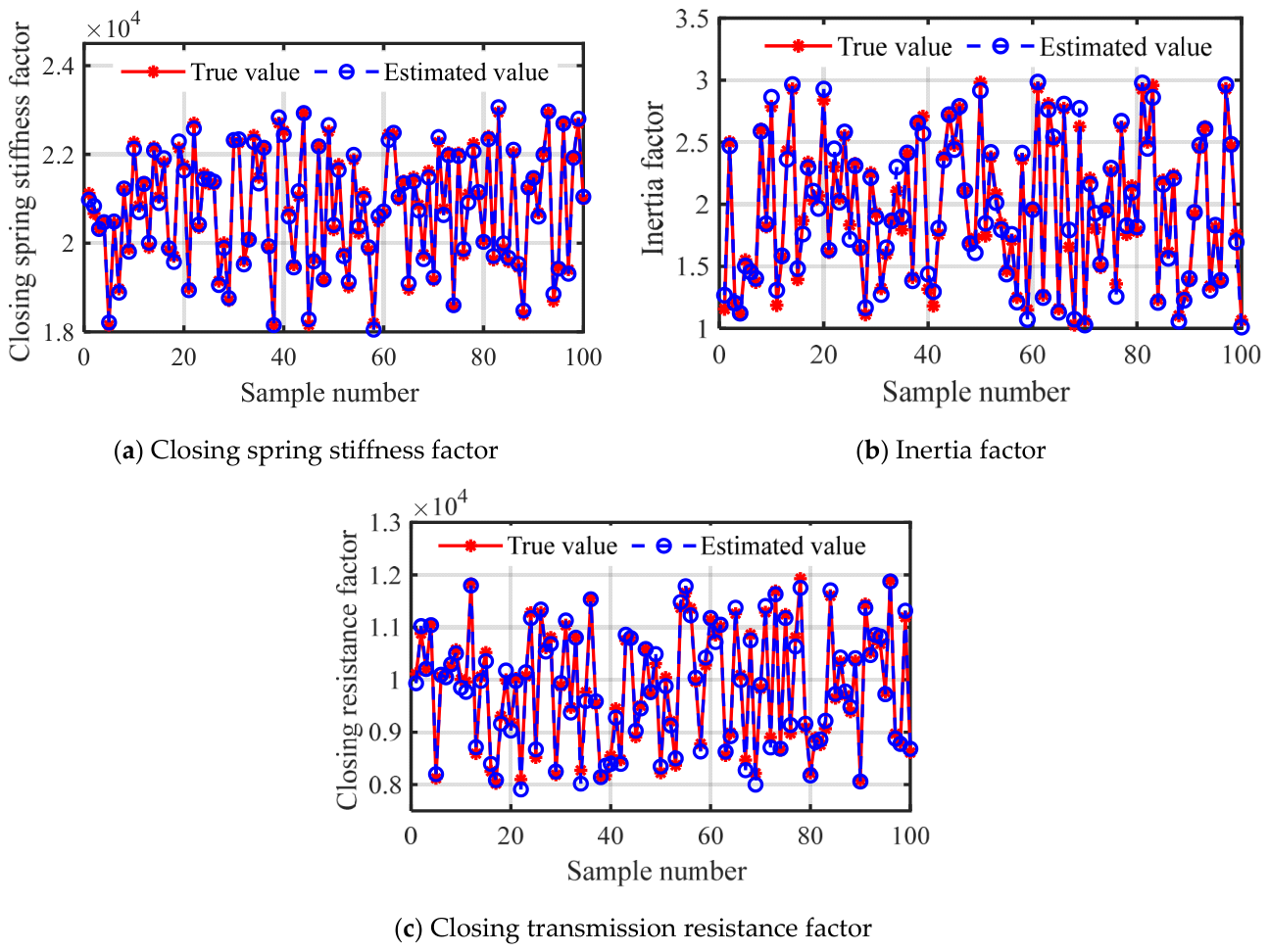
The model parameters AC, BC, CC, and DC are termed closing spring stiffness factor, inertia factor, closing resistance factor, and opening spring stiffness factor, respectively. These parameters collectively determine the dynamic response of the mechanical system, which represents the closing mechanical characteristics of the circuit breaker. Any variation in the closing mechanical characteristics implies changes in these model parameters. Therefore, by analyzing the closing mechanical characteristics, these model parameters can be estimated.
2.3. Dynamic Model of the Opening Operation
The opening process involves only the motion of the OS–OS and is independent of the CS–CS. However, the complexity lies in the engagement of the buffer.
Prior to buffer engagement, the OS–OS moves under the action of the opening spring force, transmission resistance, and the gas compression resistance from the arc-extinguishing chamber. This gas compression resistance acts through the puffer cylinder and exhibits damping characteristics, equivalently modeled as a linear damping force in this study. Thus, the dynamic model of the OS–OS at this stage is given by the following:
where
xO1 is the compression of the opening spring after energization,
TOf denotes the transmission resistance torque during the opening process,
caec represents the damping coefficient of the arc-extinguishing chamber during opening process, and
raec is the force arm of the arc-extinguishing chamber resistance relative to the output shaft.
Upon buffer engagement, the force exerted by the buffer is superimposed on the aforementioned forces acting on the OS–OS. Spring mechanisms commonly employ a hydraulic buffer, and a rigid mechanical stop is used at the final stage of the opening motion to ensure accurate breaking position. Therefore, the buffer resistance is equivalently modeled as a damper–spring system. The dynamic model of the OS–OS at this stage is, thus, given by the following:
where
cb is the damping coefficient of the buffer,
rb is the force arm of the buffer resistance relative to the output shaft,
kb is the stiffness coefficient of the buffer, and
α0 denotes the rotational angle of the mechanism’s output shaft at the instant of buffer engagement. In the opening dynamic model,
θ2 is the state variable, while
kO,
TOf,
J2,
cb and
kb are taken as the state parameters. The remaining parameters are structural parameters. The parameters of the opening dynamic model are reorganized as follows:
The defining equations for the dynamic model parameters are as follows:
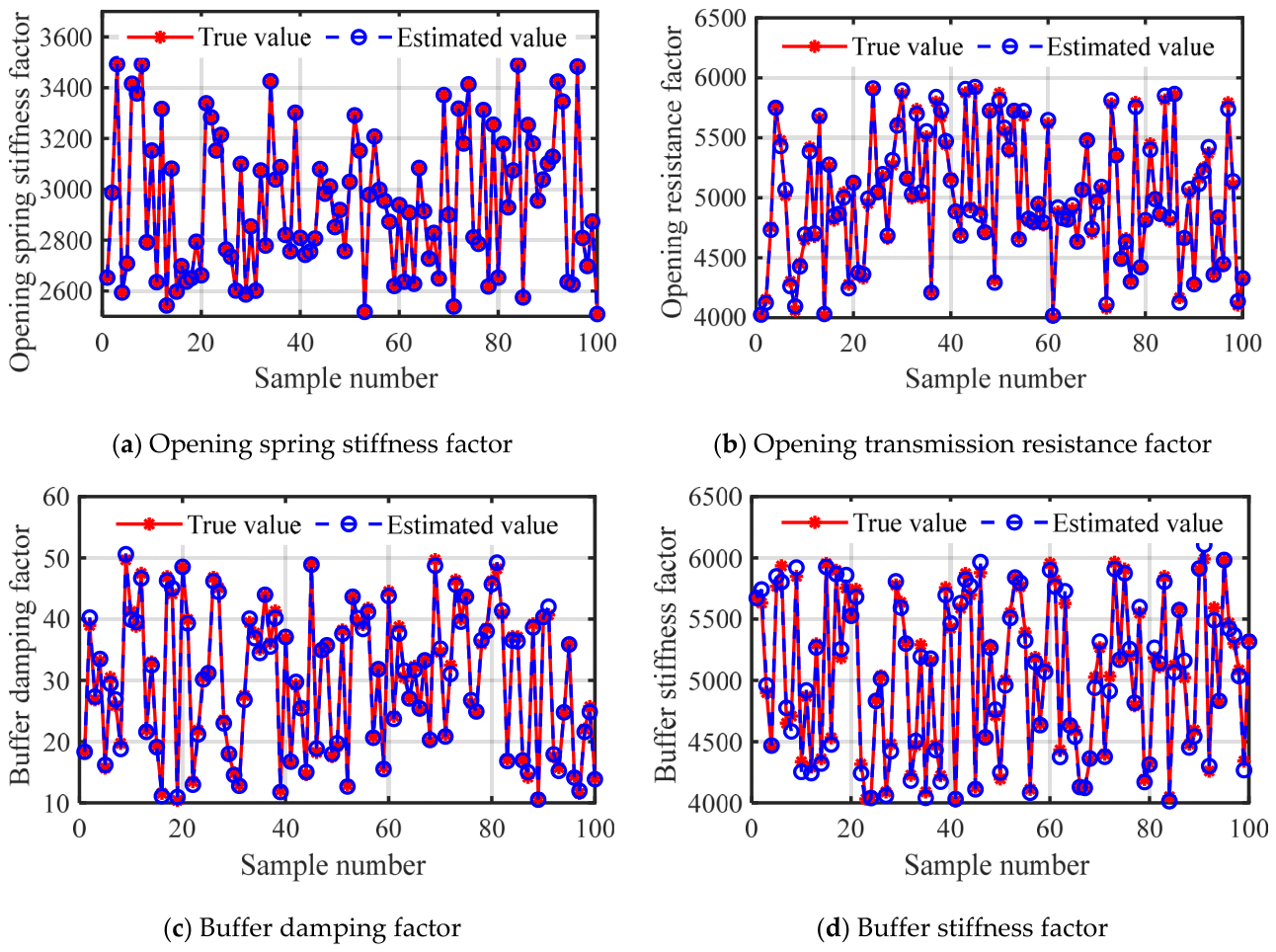
The dynamic model parameters AO, BO, CO, DO, and EO are referred to as opening spring stiffness factor, opening resistance factor, arc-extinction chamber damping factor, buffer damping factor, and buffer stiffness factor, respectively. These parameters collectively determine the state response θ2 of the model, which represents the opening mechanical characteristics of the circuit breaker. By analyzing the opening mechanical characteristics, these parameters can be estimated.