Article

Uncertainty-Aware Neural Network-Based Adaptive Bitrate Streaming over LTE and 5G NR

1
Department of Computer Engineering, Sungkyul University, Anyang 14097, Republic of Korea
2
Department of Convergence Security Engineering, Sungshin Women’s University, Seoul 02844, Republic of Korea
*
Author to whom correspondence should be addressed.
Electronics 2026, 15(13), 2821; https://doi.org/10.3390/electronics15132821 (registering DOI)
Submission received: 26 May 2026 / Revised: 17 June 2026 / Accepted: 23 June 2026 / Published: 26 June 2026
(This article belongs to the Section Computer Science & Engineering)

Abstract

Adaptive bitrate (ABR) streaming over 4G LTE and 5G New Radio (NR) must cope with rapid, nonlinear throughput variations caused by LTE handovers and 5G beam-management events. Conventional prediction-based ABR schemes often rely on smoothing or history-based throughput predictors, which can exhibit prediction lag under sudden state changes. This paper presents NeUA, an uncertainty-aware ABR framework for mobile networks with transient throughput disruptions. NeUA employs a bidirectional LSTM throughput predictor with Monte Carlo Dropout to quantify epistemic uncertainty in future throughput estimates, allowing the controller to increase the safety margin when predictions are unreliable and reduce it when predictions are stable. NeUA further integrates a single-step model predictive control layer and counter-based hysteresis to reduce unnecessary bitrate oscillations. Evaluations using publicly available LTE and 5G traces show that NeUA achieves the highest QoE among the evaluated prediction-based ABR schemes, improving QoE by up to 8.0% and reducing bitrate-switching frequency by up to 28.8% over the evaluated baselines.

1. Introduction

Video streaming constitutes more than 65% of the total Internet traffic [1], and video dominates mobile downstream consumption with over 70% share in most regions [2]. To sustain playback quality under time-varying network conditions, major streaming platforms such as YouTube, Netflix, and Disney+ rely on Dynamic Adaptive Streaming over HTTP (DASH) [3]. In DASH, each video is encoded into multiple bitrate representations, and the client selects one representation for every video chunk, typically every 5–10 s. This adaptive bitrate (ABR) decision directly affects the user’s Quality of Experience (QoE), primarily through video quality, rebuffering duration, and bitrate-switching frequency.
The deployment of 4G LTE and 5G New Radio (NR) has made ABR control increasingly challenging. Although LTE and 5G NR provide substantially higher average throughput than earlier mobile networks, their throughput dynamics are far from smooth. In urban LTE traces, handovers can induce sharp throughput drops that persist for several seconds [4]. In 5G NR, beam-management events and beam blockage can cause even more abrupt and nonlinear disruptions, including short near-outage periods [5]. The collected mobile trace datasets exhibit the same behavior: the LTE dataset [4] yields 15–60 Mbps throughput, whereas the 5G datasets [5] spans 7–121 Mbps, and both contain transient disruptions that are severe enough to affect chunk-level bitrate decisions. Thus, modern mobile ABR must simultaneously exploit high available bandwidth during stable periods and avoid over-aggressive decisions during sudden state changes.
Existing ABR schemes address this trade-off from different perspectives but still have limitations in mobile LTE/5G environments. For example, although buffer-based schemes such as BBA [6] are robust to transient bandwidth drops because they rely primarily on buffer occupancy, this robustness comes at the cost of conservative bitrate selection and underutilized channel capacity. Prediction-based and model-predictive control schemes [7,8] achieve higher bandwidth utilization by explicitly forecasting near-future throughput, but their decisions are sensitive to prediction errors. In particular, smoothing- or history-based predictors can lag behind abrupt throughput transitions, causing the controller to overestimate available bandwidth at the moment of handovers or beam-related disruptions. Deep reinforcement learning (DRL) approaches such as Pensieve [9] learn bitrate policies directly from data, but their neural policies incur non-negligible per-chunk inference overhead on mobile devices and still produce frequent bitrate oscillations under rapidly changing wireless conditions.
To address these issues, an ABR controller must assess not only the predicted throughput value but also the reliability of that prediction. This reliability is particularly important in concurrent LTE and 5G environments, where a short sequence of recent throughput samples may be consistent with either a stable channel or the onset of a handover or beam-blockage event. Many prediction-based ABR controllers therefore apply a safety margin to the predicted throughput before selecting a bitrate so that the chosen bitrate remains below the estimated available bandwidth. However, a fixed safety margin cannot handle these cases simultaneously: a large margin wastes capacity during stable periods, whereas a small margin increases the risk of rebuffering during transient disruptions. Therefore, an ABR framework needs to adapt this safety margin based on the reliability of the current throughput prediction while remaining lightweight enough for per-chunk execution on mobile clients.
This paper presents NeUA, a framework using a neural network with Uncertainty Awareness for mobile video streaming over LTE and 5G NR. NeUA employs a bidirectional LSTM throughput predictor with Monte Carlo (MC) Dropout to quantify epistemic uncertainty in future throughput estimates. This uncertainty is translated into a dynamic safety factor: when the predictor is uncertain, NeUA selects bitrates more conservatively to reduce rebuffering risk; when the prediction is stable, it relaxes the safety margin to improve bandwidth utilization. The uncertainty-aware predictor is coupled with a single-step model predictive control layer for bitrate selection and a counter-based hysteresis mechanism to suppress unnecessary bitrate oscillations.
The main contributions of this paper are as follows:
  • We formulate per-chunk epistemic uncertainty as a control signal for ABR by estimating prediction uncertainty with MC Dropout and mapping it to a dynamic safety factor for throughput-aware bitrate selection.
  • We propose NeUA, an ABR framework that integrates an uncertainty-aware BiLSTM throughput predictor with single-step MPC and counter-based hysteresis to improve bandwidth utilization while reducing rebuffering risk and bitrate oscillations.
  • We conduct trace-driven evaluations using two public mobile LTE/5G datasets and show that NeUA achieves the highest QoE among the evaluated prediction-based ABR schemes, improving QoE by up to 8.0% and reducing bitrate-switching frequency by up to 28.8% relative to the evaluated baselines.
The remainder of this paper is organized as follows. Section 2 reviews related work on adaptive video streaming. Section 3 introduces the DASH streaming model and motivates throughput uncertainty-aware ABR in LTE/5G environments. Section 4 presents the design of the proposed NeUA framework. Section 5 describes the experimental setup and evaluates NeUA using public LTE/5G traces. Finally, Section 6 concludes the paper and discusses future research directions.

2. Related Work

2.1. Buffer-Based and Lyapunov-Optimal ABR

BBA [6] maps buffer occupancy to a bitrate tier without throughput estimation, absorbing short-term bandwidth fluctuations by exploiting the playback buffer as a shock absorber. BOLA [10] applies Lyapunov optimization to provide near-optimal theoretical QoE guarantees. However, BOLA-BASIC is designed for bitrate ladders whose maximum rate is close to the mean channel capacity. When the maximum ladder rate greatly exceeds capacity, it exhibits known bimodal bitrate-selection behavior. Festive [11] introduces randomised bitrate updates for cross-client fairness. Li et al. [12] propose a probing mechanism to estimate fair-share bandwidth, addressing the discrete nature of available bitrate tiers.

2.2. Control-Theoretic ABR

RobustMPC [7] applies a safety factor to a harmonic-mean throughput estimate within a model-predictive control (MPC) framework, providing robustness against short-term throughput overestimation. ELASTIC [13] uses a PI controller with the playback buffer as the feedback signal. SODA [8] formulates bitrate selection as a Smoothed Online Convex Optimization (SOCO) problem with a squared log-utility switching penalty, providing theoretical competitive-ratio guarantees for QoE smoothness. LQE [14] pre-computes optimal PI gains via the discrete algebraic Riccati equation [15] and uses Holt–Winters exponential smoothing for throughput estimation.

2.3. LSTM and Deep Learning for Throughput Prediction

The LSTM architecture [16] has been widely adopted for network throughput prediction due to its ability to capture long-range temporal dependencies. CS2P [17] models session-level throughput variation using Hidden Markov Models for predictive bitrate selection. LSTM-based predictors have been shown to consistently outperform formula-based estimators on LTE and 5G traces [18]. GRU-based prediction [19] has been integrated with buffer-based ABR to reduce rebuffering on real 4G traces. Transformer-based [20] sequence models have recently been explored for throughput prediction. Multi-stage attention predictors have been shown to improve accuracy in cellular adaptive streaming compared with single-step LSTM [21]. Lv et al. [22] investigate the components of accurate per-chunk throughput prediction for mobile adaptive streaming, demonstrating that input feature design and output target selection dominate prediction accuracy across diverse cellular traces.

2.4. Deep Reinforcement Learning ABR

Pensieve [9] introduces A3C-based end-to-end DRL for ABR and remains the canonical DRL baseline. COMYCO [23] and its lifelong-learning successor [24] reduce training data requirements via imitation learning. GENET [25] proposes automatic curriculum generation to improve the generalization of RL-based networking algorithms, including ABR, to out-of-distribution network conditions. NetLLM [26] adapts a large language model (Llama2-7B) to networking tasks including ABR, demonstrating strong QoE improvements on in-distribution traces but requires over 1 B parameters, which is impractical for mid-range mobile devices.

2.5. Low-Latency and 5G Streaming

Low-latency DASH (LL-DASH) [27] targets live-streaming latency below 2 s by using chunked transfer encoding and partial-segment downloading, which impose tighter per-chunk prediction windows than the 5-second chunks assumed in this work. For 5G environments, Raca et al. [5] and van der Hooft et al. [4] provide the foundational datasets that characterize 5G and LTE channel dynamics respectively. Raca et al. [5] characterize throughput variability in commercial 5G deployments and show that beam-management events cause more abrupt bandwidth disruptions than LTE handovers. Hu et al. [28] address the challenge of ABR streaming over 5G mmWave channels, where beam-blockage events cause severe throughput fluctuations that degrade QoE under conventional ABR schemes.

2.6. Real-World LTE and 5G Datasets

The Belgium 4G/LTE dataset [4] provides 40 per-second throughput traces from Ghent across static, pedestrian, bus, and car mobility, with throughput ranging from 0.3 to 78 Mbps. Riiser et al. [29] provide an earlier 3G mobility trace dataset that established the methodology of multi-scenario, multi-mobility trace collection subsequently followed by van der Hooft et al. The 5G dataset reported in [5] extends this to 5G traces from a commercial Irish operator, of which 18 pass our quality filter (>6 Mbps active mean).

2.7. AI-Native Network Optimization

Deep learning has been applied not only at the application layer but also within the radio access network itself. For instance, DNN-based approaches have been proposed to estimate PRACH traffic load and infer network congestion conditions in massive IoT scenarios, enabling more efficient resource allocation at the MAC layer [30]. While such network-layer inference operates on different inputs and optimization targets than application-layer ABR control, both lines of work share a common theme: replacing hand-crafted heuristics with learned predictors that adapt to dynamic wireless conditions. NeUA operates exclusively at the application layer, relying on per-chunk throughput samples without access to radio-layer measurements. This design allows deployment on off-the-shelf mobile clients without any cooperation from the network infrastructure, which distinguishes it from network-assisted approaches that require operator-side modifications.

3. Background

3.1. DASH Streaming Model

In Dynamic Adaptive Streaming over HTTP (DASH) [3], a video of duration T is divided into K = T / L chunks, each with playback duration L s. Each chunk is encoded into multiple bitrate representations V = { v 1 < < v m } , and a client selects one bitrate r k V before downloading chunk k. If the selected representation has size S ( r k ) and the average throughput realized during the download is C k , the download time is given by D k = S ( r k ) / C k . Thus, larger bitrate choices improve visual quality but may increase download time when the available throughput is limited. Let B k denote the playback buffer occupancy, measured in seconds, at the beginning of chunk k. After chunk k is downloaded, the buffer evolves as
B k + 1 = min max ( B k D k , 0 ) + L , B max ,
where B max is the maximum buffer capacity [7]. During the download, the player consumes D k seconds of buffered video. If the download time exceeds the available buffer, playback stalls and the rebuffering duration is
γ k = max ( D k B k , 0 ) .
After the download completes, L seconds of playable video are appended to the buffer, but the buffer cannot exceed B max . If the resulting buffer occupancy would exceed B max , the client enters an OFF period, during which it temporarily pauses downloading until enough buffer space becomes available. The OFF-period duration is
δ k = max max ( B k D k , 0 ) + L B max , 0 .
This model captures the central ABR trade-off: selecting a high bitrate increases video quality but may increase D k and cause rebuffering when throughput drops, whereas conservative bitrate choices reduce stall risk but may underutilize available bandwidth. The ABR controller must therefore select r k at each chunk to balance video quality, rebuffering avoidance, and bitrate stability.

3.2. Throughput Prediction for ABR in LTE and 5G Environments

Throughput prediction is a critical component of prediction-based ABR because the selected bitrate for chunk k is determined before the actual download throughput C k is observed. In mobile networks, this prediction problem is difficult not because the average throughput is low but because the channel can change abruptly within a few chunks. For example, the 4G/LTE dataset reported in [4] has a mean throughput of 31.8 Mbps, with session-level mean throughput ranging from 15 to 60 Mbps and strong temporal correlation ( ϕ 0.90 ), while the 5G dataset from [5] has a mean throughput of 44.3 Mbps, with a wider session-level range of 7–121 Mbps and slightly lower temporal correlation ( ϕ 0.85 ). Despite these high average rates, both datasets contain transient disruption events associated with LTE handovers and 5G beam management, which can produce throughput drops and near-outage periods lasting several seconds. These disruptions are severe enough to affect chunk-level ABR decisions, particularly when the controller relies on throughput estimates that lag behind sudden regime changes.
A representative lightweight predictor for ABR is Holt–Winters, which is used in LQE [14] and has been shown to be effective among conventional throughput predictors while preserving short decision latency. Given the measured throughput c k at chunk k, Holt–Winters maintains a smoothed level k and trend b k as
k = α c k + ( 1 α ) ( k 1 + b k 1 ) ,
b k = β ( k k 1 ) + ( 1 β ) b k 1 ,
y ^ k + h = k + h b k ,
where α and β are the level and trend smoothing parameters, respectively, and y ^ k + h is the h-step-ahead throughput prediction. This formulation is computationally attractive, but its smoothing mechanism can lag behind abrupt regime changes. For example, during a Belgium 4G handover where the observed throughput drops from 30 Mbps to 1 Mbps within one chunk, Holt–Winters still produces a smoothed level of approximately k = 9.9 Mbps, which can lead the ABR controller to select a bitrate that is no longer sustainable.
An LSTM is a recurrent neural network unit designed to process sequential data by maintaining a persistent cell state controlled by three learned gates [16]. The forget gate determines what portion of the previous cell state to discard, the input gate controls what new information is written into the cell state, and the output gate produces the hidden representation used for prediction. This gating mechanism allows an LSTM to model variable-length temporal dependencies in throughput sequences, such as the gradual recovery trend following a handover event, while suppressing uninformative variation during stable high-throughput periods.
A bidirectional LSTM (BiLSTM) extends this structure by processing the same input sequence in both forward and backward directions and concatenating the resulting hidden states [31]. The forward pass encodes how throughput has evolved from older to more recent observations, capturing rising or falling trends, while the backward pass captures contextual patterns within the same window, such as whether a current throughput drop is preceded by a plateau or a gradual decline. Because both passes operate only over the already observed input window without accessing future throughput values, the bidirectional encoding is fully compatible with online per-chunk ABR operation.
The Transformer encoder [20] has recently been applied to time-series prediction by replacing recurrent computation with multi-head self-attention, which assigns a learned weight to every pair of positions in the input sequence. This global receptive field is advantageous for long sequences where distant past observations carry predictive value. For mobile throughput prediction, however, the relevant context is confined to a short window of recent observations ( w = 8 samples in our setting), because throughput at earlier time steps has little statistical relationship with the next-chunk value after a handover or beam disruption.
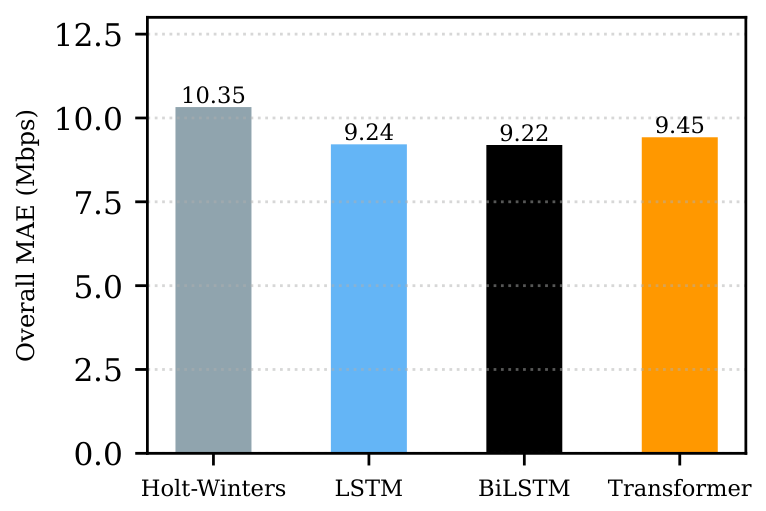
Table 1 and Figure 1 compare the prediction accuracy of four throughput predictors trained and evaluated on the same 58 public mobile traces under identical conditions. After per-trace de-normalization, BiLSTM achieves the lowest overall MAE at 9.22 Mbps, followed by the unidirectional LSTM (9.24 Mbps, +0.2%), Transformer (9.45 Mbps, +2.5%), and Holt–Winters (10.35 Mbps, +12.2%).
The unidirectional LSTM matches BiLSTM closely on overall MAE, but the bidirectional structure allows BiLSTM to capture contextual patterns within the observed window, such as whether a current throughput drop is part of a gradual trend or an isolated spike, which is not captured by a single forward pass. BiLSTM is therefore selected as the throughput predictor in NeUA. The residual errors under abrupt transitions across all models confirm that ABR decisions should account for not only the predicted throughput value but also the reliability of that prediction.
The marginal MAE difference between BiLSTM and LSTM (0.2%) does not by itself explain the QoE gains reported in Section 5. The primary source of improvement in NeUA is not the reduction in point-prediction error but the ability to quantify epistemic uncertainty through MC Dropout. Even when BiLSTM and LSTM produce similar mean predictions c ¯ ( k ) , their MC Dropout ensembles can yield substantially different standard deviations σ ( k ) around abrupt regime changes such as handovers or beam-blockage events. A higher σ ( k ) drives α dyn ( k ) toward α min , producing a more conservative calibrated estimate C ^ 0 ( k ) that prevents over-aggressive bitrate selections precisely when the channel is most unstable. This uncertainty-driven conservatism is the mechanism that translates a modest prediction accuracy advantage into meaningful QoE and rebuffering improvements as confirmed by the conclusion in Section 6 that MAE improvement alone is insufficient for ABR QoE gains.

4. Proposed Scheme: NeUA

4.1. Architecture Overview

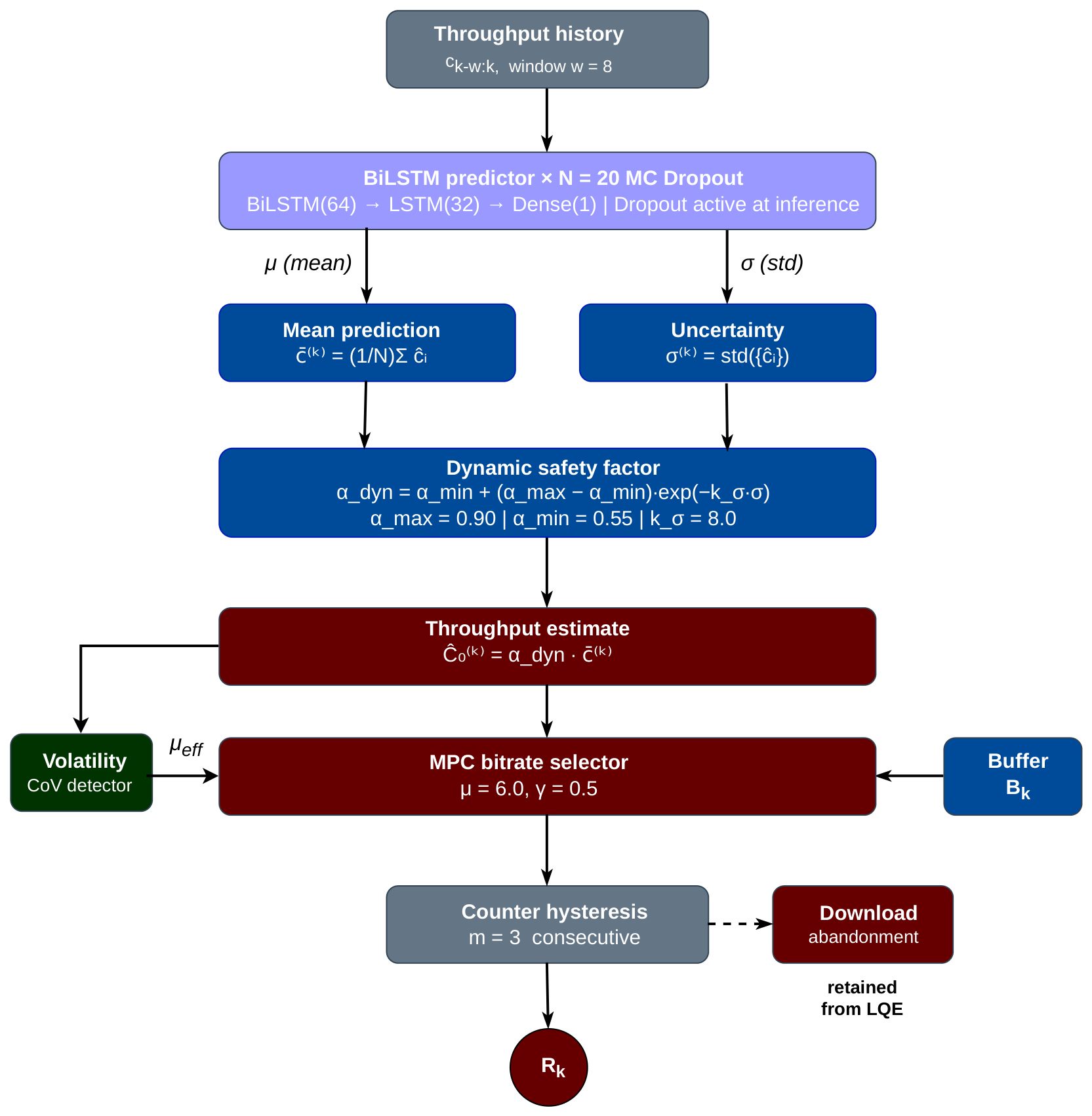
NeUA is an uncertainty-aware ABR framework designed for LTE and 5G environments with abrupt throughput disruptions. Its design follows a simple principle: the bitrate controller should not rely only on a point estimate of future throughput but should also account for the reliability of that estimate. To this end, NeUA replaces the smoothing-based Holt–Winters predictor with a BiLSTM throughput predictor equipped with Monte Carlo (MC) Dropout uncertainty estimation. The resulting predictive distribution is converted into a dynamic safety factor, which calibrates the predicted throughput before bitrate selection. The calibrated estimate is then passed to a single-step model predictive control (MPC) selector so that uncertainty directly affects the bitrate decision. NeUA also retains the counter-based hysteresis and download-abandonment mechanisms of LQE [14] to suppress rapid quality oscillations and recover from mid-download bandwidth collapses.
Figure 2 illustrates the NeUA architecture. For each chunk k, the predictor takes a window of recent throughput samples and produces N stochastic predictions through MC Dropout. Their mean c ¯ ( k ) represents the point estimate, while their standard deviation σ ( k ) represents epistemic uncertainty. NeUA maps this uncertainty to a dynamic safety factor α dyn ( k ) , producing a calibrated throughput estimate C ^ 0 ( k ) for bitrate selection. The single-step MPC layer evaluates candidate bitrates using expected quality, rebuffering risk, and switching penalty, after which counter-based hysteresis filters unstable tier changes.

4.2. Throughput Predictor

Given a sliding window of w = 8 past throughput samples c k w + 1 : k = [ c k w + 1 , , c k ] , the BiLSTM predictor estimates the next-chunk throughput. The input window contains only already observed throughput samples, so the predictor is compatible with online ABR operation. The bidirectional structure encodes this observed window in both temporal directions: the forward LSTM captures how throughput evolves from older to newer samples, while the backward LSTM captures contextual patterns within the same observed window. Importantly, the backward LSTM does not access future throughput samples beyond chunk k; it only processes the past input window in reverse order. The resulting sequence representation is passed through a lightweight dense layer and a Softplus output layer to produce a non-negative throughput estimate.
The predictor architecture is summarized in Table 2. We use a compact recurrent model because ABR decisions must be made at every chunk on mobile clients, where inference latency and memory footprint are important. Compared with larger sequence models such as Transformer encoders [20], the BiLSTM provides a favorable accuracy–latency trade-off for the short history windows used in chunk-level throughput prediction. In our experiments, the BiLSTM yields its best accuracy with w = 8 , which limits both inference cost and the use of stale samples during rapid channel transitions.
Training uses the 58 public mobile traces described in Section 3, consisting of 40 LTE traces and 18 5G traces. The traces are split into 70%/15%/15% training, validation, and test sets. The model is trained using the Adam optimizer with learning rate 10 3 and early stopping with patience 10. We use Huber loss with δ = 1.0 to reduce the influence of extreme blockage and handover outliers while preserving sensitivity to ordinary prediction errors.

4.3. Uncertainty-Aware Dynamic Safety Factor

A fixed safety factor cannot distinguish a reliable prediction in a stable channel from an unreliable prediction at the onset of a handover or beam-blockage event. NeUA therefore estimates per-chunk epistemic uncertainty using MC Dropout [33]. At inference time, dropout remains active and the predictor performs N stochastic forward passes for the same input window, producing an ensemble of predictions { c ^ 1 ( k ) , , c ^ N ( k ) } . NeUA computes the ensemble mean and standard deviation as
c ¯ ( k ) = 1 N i = 1 N c ^ i ( k ) , σ ( k ) = 1 N i = 1 N c ^ i ( k ) c ¯ ( k ) 2 .
Here, c ¯ ( k ) is the next-chunk throughput point estimate, and σ ( k ) is a proxy for epistemic uncertainty. A larger σ ( k ) indicates that the predictor is less confident about the next throughput value, which is common around abrupt regime changes where recent samples can be consistent with multiple channel states.
NeUA converts this uncertainty into a dynamic safety factor:
α dyn ( k ) = α min + ( α max α min ) e λ σ σ ( k ) ,
where α min and α max define the lower and upper bounds of the safety factor, and λ σ is the uncertainty sensitivity coefficient that controls how rapidly the safety factor decreases as uncertainty increases. The values α min = 0.55 and α max = 0.90 were determined through empirical evaluation across a range of candidate values on the training traces. α min = 0.55 is chosen so that NeUA remains sufficiently conservative when prediction uncertainty is high, without degrading bandwidth utilization during stable channel periods when the predictor is confident, and α max = 0.90 allows efficient bandwidth utilization when prediction uncertainty is low.
Then, the calibrated throughput estimate used for bitrate selection is
C ^ 0 ( k ) = α dyn ( k ) c ¯ ( k ) .
When the predictor is confident, σ ( k ) is small and α dyn ( k ) approaches α max , allowing NeUA to exploit available bandwidth. When uncertainty increases, α dyn ( k ) decreases toward α min , making the controller more conservative before selecting a bitrate. For example, when σ ( k ) 0.02 in a stable LTE period, α dyn ( k ) is approximately 0.85, whereas when σ ( k ) 0.15 near a handover moment, it decreases to approximately 0.66. This adaptive calibration differs from fixed safety factors used by conventional prediction-based ABR schemes [14,17], which apply the same conservativeness regardless of prediction reliability.
A formal calibration curve relating σ ( k ) to empirical prediction error was not generated in this study. The exponential decay mapping in Equation (8) enforces a monotone relationship by design so that a larger σ ( k ) always produces a lower α dyn ( k ) and a smaller calibrated throughput estimate C ^ 0 ( k ) , which generally leads to more conservative bitrate selection through the MPC objective in Equation (13).

4.4. Volatility-Aware Adaptive Penalty

The uncertainty-aware safety factor calibrates the throughput estimate according to model uncertainty, but short-term throughput variability can also increase rebuffering risk even when the point estimate is not extremely low. To account for this effect, NeUA adjusts the rebuffering penalty in the MPC objective using the coefficient of variation (CoV) of the recent throughput window. Let CoV ( c k w + 1 : k ) denote the standard deviation divided by the mean of the recent throughput samples. NeUA maps this volatility measure to
α v ( k ) = clip CoV ( c k w + 1 : k ) CoV lo CoV hi CoV lo , 0 , 1 ,
and then computes
q 0 ( k ) = q 0 base + α v ( k ) q 0 max q 0 base ,
where q 0 base = 70 s, q 0 max = 82 s, CoV lo = 0.20 , and CoV hi = 0.55 in our implementation. The effective rebuffering penalty is
μ ( k ) = μ q 0 ( k ) q 0 base .
Thus, when recent throughput is volatile, NeUA increases the penalty on choices that may cause rebuffering; when the channel is stable and CoV < CoV lo , the additional volatility penalty is inactive.
The value q 0 max = 82 s was determined through empirical evaluation across a range of candidate values on the training traces. This upper bound amplifies the rebuffering penalty under volatile conditions relative to the base level q 0 base = 70 s, which was found sufficient to suppress aggressive bitrate selections without over-penalizing moderate throughput variation.

4.5. Bitrate Selection via Single-Step MPC

Given the calibrated throughput estimate C ^ 0 ( k ) , NeUA selects the bitrate for chunk k by evaluating each candidate bitrate r V using a single-step MPC objective adapted from [7,9]:
r k = arg max r V [ log r v 1 μ ( k ) max 0 , r L C ^ 0 ( k ) B k η log r v 1 log r k 1 v 1 ] ,
where the first term rewards video quality, the second term penalizes expected rebuffering, and the third term penalizes bitrate switching. The expected download time is approximated as r L / C ^ 0 ( k ) , and rebuffering is predicted when this value exceeds the current buffer B k . This single-step MPC formulation directly exposes the effect of the calibrated throughput estimate on the current bitrate decision, which is important when the predictor changes rapidly around handovers or beam-related disruptions.
A multi-step horizon would require accurate forecasts over multiple future chunks, which is unreliable in LTE and 5G environments where handover and beam-management events can change channel state abruptly within one chunk. In practice, when a disruption causes σ ( k ) to remain elevated over several consecutive chunks, α dyn ( k ) stays low throughout this period, providing sustained conservative bitrate selection without requiring explicit multi-step planning.
After the MPC selector proposes a bitrate, NeUA applies counter-based hysteresis with threshold M. A switch to a different bitrate tier is committed only after the same direction of change is recommended for M consecutive chunks. This mechanism suppresses short-lived oscillations caused by noisy predictions while still allowing sustained quality changes when the channel state persistently improves or degrades.

4.6. Download Abandonment

NeUA retains the download-abandonment mechanism from LQE [14] to handle sudden bandwidth drops that occur after a chunk download has already started. Without abandonment, a chunk selected at bitrate r k may take much longer to download than expected, causing the playback buffer to drain before the chunk arrives.
During the download of chunk k, NeUA monitors the current buffer level B ( t ) at wall-clock time t. Let B k start be the buffer level at the start of the download, d rem ( t ) be the remaining data volume, and c ^ ( t ) be the instantaneous throughput estimate. NeUA aborts the ongoing download if the buffer falls below a fraction of its initial level and the remaining download time is likely to exceed the available buffer:
B ( t ) < 2 3 B k start and d rem ( t ) c ^ ( t ) > B ( t ) .
When this condition happens, NeUA cancels the current request and requests a replacement representation for the same chunk at the highest bitrate expected to complete before buffer depletion. This mechanism prevents stalls that would otherwise occur when the original bitrate decision becomes unsustainable during the download. It is particularly useful during LTE handovers and 5G beam-blockage events, where throughput can collapse within a single chunk download window.

5. Evaluation

5.1. Experimental Setup

Trace datasets. We evaluate all schemes using two public mobile throughput datasets. The LTE evaluation uses the 4G/LTE dataset from [4], which contains 40 traces collected in Ghent under static, pedestrian, bus, and car mobility scenarios. The dataset has an overall mean throughput of 31.8 Mbps, with session-level mean throughput ranging from 15.2 to 59.7 Mbps. The 5G evaluation uses the 5G dataset reported in [5], from which we select 18 commercial Vodafone Ireland 5G traces after applying a minimum-throughput quality filter of 6 Mbps. The selected 5G traces have an overall mean throughput of 44.3 Mbps, with session-level mean throughput ranging from 6.9 to 121.0 Mbps. All traces are parsed at 1-second resolution. Traces shorter than the playback horizon are tiled to support a 1800 s streaming session, following common practice in trace-driven ABR evaluation. Tiling is applied uniformly to all schemes, so any artificial periodicity affects all schemes equally and does not systematically favour NeUA. For the shorter 5G traces that require tiling, the resulting periodicity is acknowledged as a limitation shared with prior ABR work [7,9].
Video configuration. Each simulation streams a 1800 s video with chunk length L = 5 s and maximum playback buffer B max = 60 s. We use a 12-tier bitrate ladder consisting of 0.27, 0.70, 1.20, 2.50, 4.30, 8.90, 15.00, 25.00, 40.00, 60.00, 85.00, and 120.00 Mbps, covering a wide range from low-resolution mobile video to high-bitrate UHD content. This ladder intentionally extends beyond the average throughput of both datasets so that ABR algorithms must avoid over-aggressive selections during transient LTE/5G disruptions while still exploiting high-capacity periods.
Compared schemes. We compare NeUA with six representative ABR schemes: BBA [6], BOLA-E [10], RobustMPC [7], SODA [8], LQE [14], and Pensieve [9]. BBA uses reservoir and cushion parameters of 20 s and 70 s, respectively. BOLA-E follows the Lyapunov-based BOLA formulation with a Holt–Winters efficiency cap. RobustMPC uses harmonic-mean throughput prediction with a 0.9 safety factor. SODA uses squared log-utility switching-cost optimization with λ = 0.06 . LQE uses q 0 = 70 s and hysteresis threshold M = 2 .
NeUA Parameters. NeUA uses history window w = 8 , N = 20 MC Dropout passes, the uncertainty sensitivity coefficient λ σ = 8.0 , and MPC parameters μ = 6.0 , η = 0.5 , and hysteresis threshold M = 3 , selected by an exhaustive parameter sweep on the training traces, which are held separate from the test traces used in the final evaluation reported in Table 3 and Table 4. The search space covers λ σ { 4.0 , 6.0 , 8.0 , 10.0 } , μ { 4.3 , 6.0 , 8.0 } , η { 0.3 , 0.5 , 0.8 } , and M { 2 , 3 } , for a total of 72 combinations evaluated on both LTE and 5G traces using the same video configuration and QoE metric defined in Section 5.1. The final configuration is the combination that achieves the highest mean QoE averaged over all training-set sessions. A sensitivity analysis of each parameter is reported in Section 5.2.
Metrics. We evaluate streaming performance using the QoE metric adopted by Pensieve [9]:
QoE = k log r k v 1 4.3 k γ k 0.3 k Δ log r k ,
where r k is the bitrate selected for chunk k, v 1 is the minimum bitrate in the ladder, γ k is the rebuffering duration, and Δ log R k = log ( R k / v 1 ) log ( R k 1 / v 1 ) measures bitrate variation between consecutive chunks. The penalty coefficients, 4.3 for rebuffering duration and 0.3 for quality variation, are fixed constants adopted from [9] and are applied identically to all evaluated schemes. These evaluation coefficients are independent of the scheme-specific decision parameters used internally by each ABR algorithm.
In addition to QoE, we report the rebuffering rate, defined as the percentage of simulated sessions in which at least one rebuffering event ( γ k > 0 for some chunk k) occurred, as a session-level indicator of stall prevalence.

5.2. Parameter Sensitivity Analysis

The four control parameters of NeUA, such as the uncertainty sensitivity coefficient λ σ , the rebuffering penalty μ , the smoothness penalty η , and the hysteresis threshold M, were selected by an exhaustive parameter sweep on the training traces. The sweep evaluates λ σ { 4.0 , 6.0 , 8.0 , 10.0 } , μ { 4.3 , 6.0 , 8.0 } , η { 0.3 , 0.5 , 0.8 } , and M { 2 , 3 } , for a total of 72 combinations. The final configuration ( λ σ = 8.0 , μ = 6.0 , η = 0.5 , M = 3 ) was selected as the combination that achieves the highest mean QoE averaged over both LTE and 5G sessions on the training set. The risk of overfitting the sweep to the training traces is mitigated by keeping the training and test trace sets completely disjoint. The final evaluation results are computed solely on held-out test traces that were not used during parameter selection.
The uncertainty sensitivity coefficient λ σ controls the steepness of the mapping from MC Dropout standard deviation σ ( k ) to the dynamic safety factor α dyn ( k ) . A larger λ σ causes the safety factor to drop more sharply as uncertainty increases, resulting in more conservative bitrate selections during high-variance periods such as handovers and beam-blockage events. Values below the selected λ σ = 8.0 produce insufficient conservatism and fail to suppress over-aggressive bitrate selections, while values above 8.0 introduce excessive conservatism that reduces average bitrate even under stable channel conditions.
The rebuffering penalty μ and smoothness penalty η control the MPC objective weighting. Increasing μ causes the MPC layer to prioritize rebuffering avoidance more aggressively, reducing average bitrate at the cost of fewer stall events. Increasing η penalizes bitrate oscillation more heavily, resulting in fewer switches but slower adaptation to improving channel conditions. The selected values μ = 6.0 and η = 0.5 achieve the best QoE by balancing these competing objectives across the full evaluation trace set.
The hysteresis threshold M has the most direct effect on bitrate-switch count. Reducing M from 3 to 2 allows faster upward bitrate transitions after disruption recovery, improving average bitrate at the cost of more frequent oscillations. The selected M = 3 prioritizes bitrate stability, consistent with the paper’s design goal of reducing unnecessary switching while preserving competitive QoE.

5.3. QoE Performance in LTE Environments

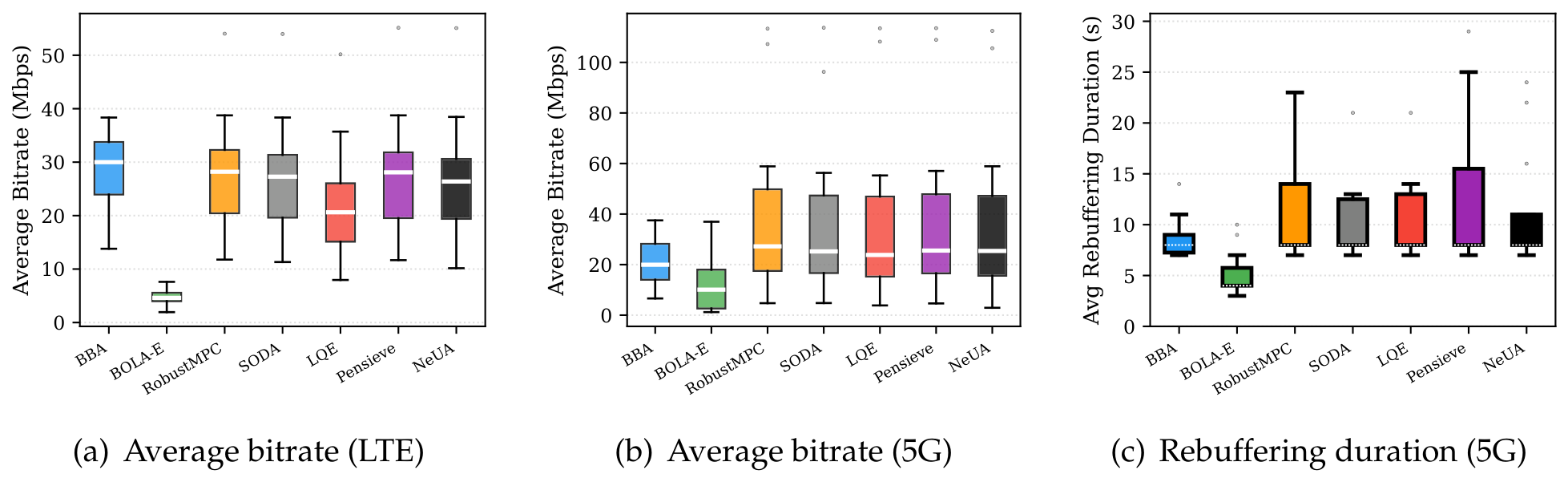
Table 3 presents the LTE evaluation, and Figure 3 shows the per-session bitrate and rebuffering distributions. BBA achieves the highest QoE (1547.0) by conservative bitrate selection (26.68 Mbps median vs. 31.8 Mbps mean channel), effectively exploiting the 60 s buffer to absorb handover events.
Table 3. Performance comparison: LTE dataset.
SchemeBitrate Med. (Mbps)Rebuf. Dur. Med. (s)Changes Med.Rebuf. Rate (%)QoE Mean
BBA [6]26.681.012240.01547.0
BOLA-E [10]4.091.02872.5273.3
RobustMPC [7]21.321.020942.51397.8
SODA [8]20.071.021537.51380.5
LQE [14]18.081.010940.01386.0
Pensieve [9]20.451.022240.01385.5
NeUA22.381.09440.01418.2
NeUA rank (excl. BBA):QoE: 1st/Switches: 1st  (fewest)
Figure 3. Whisker plots (min/Q1/median/Q3/max) of per-session average bitrate (a,b) and 5G rebuffering duration (c).
Electronics 15 02821 g003
Among throughput-prediction-based schemes, NeUA leads in QoE (1418.2) and achieves the fewest bitrate switches (94), compared with 109 for LQE, 209 for RobustMPC, and 222 for Pensieve. Relative to LQE, NeUA improves QoE by 32.2 (+2.3%), median bitrate by 4.30 Mbps (+23.8%), and reduces switches by 15 (−13.8%) while maintaining the same 40.0% rebuffering rate.
The 40.0% rebuffering rate is uniform across most schemes, indicating that rebuffering is driven by the LTE channel characteristics (handover-induced bandwidth drops) rather than by ABR scheme choice. The NeUA uncertainty-driven conservative estimate prevents premature upward transitions during post-handover recovery, reducing unnecessary switches without increasing rebuffering.
The QoE advantage of NeUA over LQE originates from two complementary mechanisms. The BiLSTM window captures temporal patterns that precede handover events in the LTE traces, such as gradually declining throughput over several consecutive chunks. When these patterns appear, the MC Dropout ensemble produces diverging predictions across the N = 20 forward passes, raising σ ( k ) and driving α dyn ( k ) toward α min = 0.55 . The MPC layer then selects a bitrate tier that remains viable even under a substantial throughput reduction, avoiding the over-selection that contributes to the higher switch counts observed in RobustMPC and SODA. When the channel recovers after a handover, σ ( k ) remains elevated for several chunks as the predictor converges to the new stable throughput level. The counter-based hysteresis ( M = 3 ) further delays upward tier transitions until three consecutive recommendations agree, suppressing the oscillatory switches observed in LQE and Pensieve.

5.4. QoE Performance in 5G Environments

Table 4 presents the 5G evaluation. All seven schemes experience 100% session rebuffering in the 5G trace, reflecting the severity of beam-management disruptions. In this regime, QoE differentiation is driven primarily by average bitrate during non-disruptive periods and rebuffering duration. NeUA achieves the second-highest QoE (1201.0) and the fewest bitrate switches of all prediction-based schemes (99), compared with 139 for LQE and 259 for Pensieve. Relative to LQE, the proposed scheme improves QoE by 88.8 (+8.0%) while reducing changes by 40 (−28.8%). BBA leads in QoE (1256.5) through conservative selection (17.98 Mbps), while NeUA delivers 25.71 Mbps, representing 43% more bitrate than BBA with only 4.4% lower QoE.
Table 4. Performance comparison: 5G dataset.
SchemeBitrate Med. (Mbps)Rebuf. Dur. Med. (s)Changes Med.Rebuf. Rate (%)QoE Mean
BBA [6]17.988.0164100.01256.5
BOLA-E [10]8.994.061100.0384.4
RobustMPC [7]25.4210.0244100.01125.9
SODA [8]25.939.5254100.01051.3
LQE [14]24.8111.5139100.01112.2
Pensieve [9]25.0812.0259100.01064.8
NeUA25.718.099100.01201.0
NeUA rank (excl. BBA):QoE: 1st/Switches: 1st (fewest)
The QoE advantage of BBA reflects its conservative buffer-based philosophy. BBA deliberately underutilizes bandwidth to maintain a large buffer that absorbs disruptions without rebuffering, thereby avoiding the large rebuffering penalty in the QoE metric. NeUA, by design, pursues bandwidth utilization during stable periods at the cost of occasional rebuffering, yielding 43% higher median bitrate than BBA with 4.4% lower QoE in 5G. Integrating buffer-state feedback as a secondary signal when prediction uncertainty is high represents a promising direction to narrow this gap.
The larger QoE gain in 5G (8.0%) compared with LTE (2.3%) reflects the wider throughput variation in the 5G traces (6.9–121.0 Mbps session range versus 15.2–59.7 Mbps for LTE). During a beam-blockage event, the N = 20 MC Dropout passes produce a wide spread of predictions, yielding a high σ ( k ) that drives α dyn ( k ) to its minimum. The resulting conservative bitrate selection reduces chunk size, which accelerates buffer recovery after the zero-throughput period ends, directly reducing median rebuffering duration from 11.5 s (LQE) to 8.0 s. Once the beam is restored, NeUA delays upward switches until both prediction uncertainty subsides and the hysteresis counter reaches M = 3 , preventing the burst of transitions that drives LQE and Pensieve to 139 and 259 switches, respectively.

5.5. Bitrate Switching Behavior

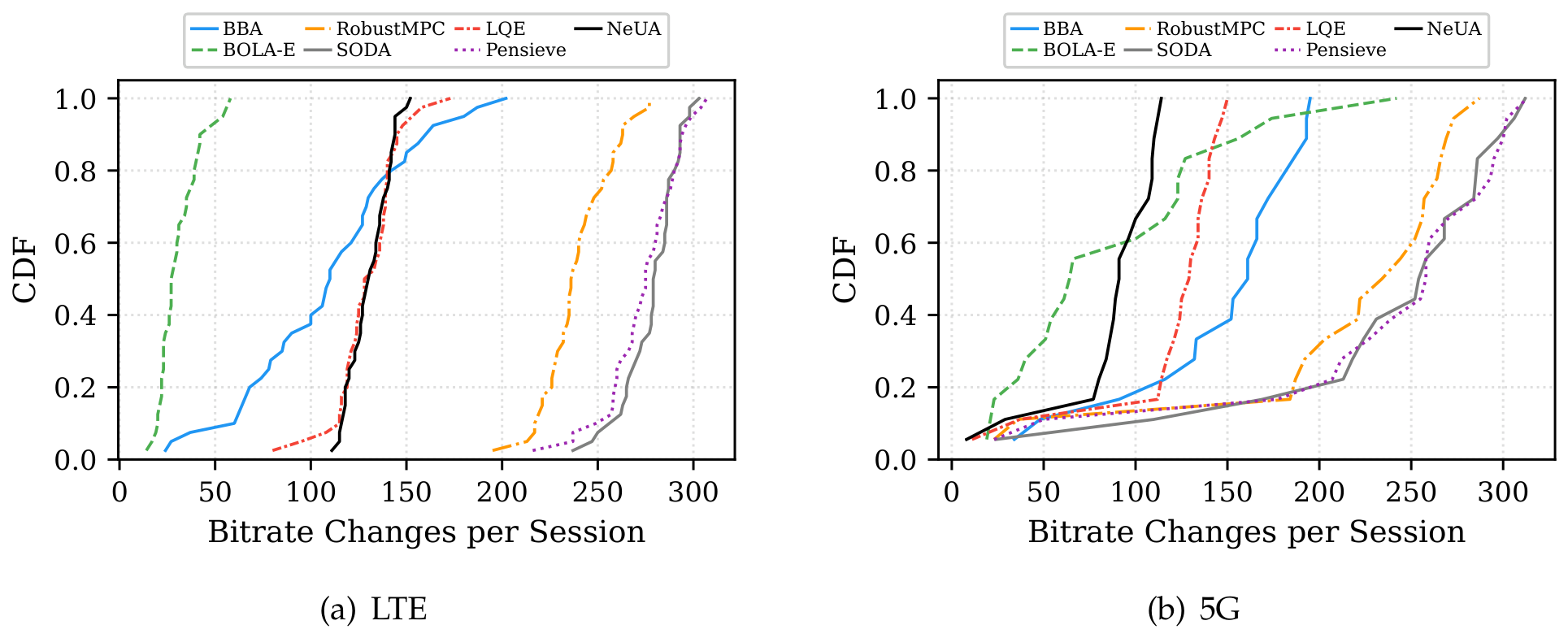
Figure 4 shows the distribution of per-session bitrate-change counts across all traces. NeUA achieves median 94 and 99 changes in LTE and 5G, respectively, the lowest of all prediction-based schemes in both environments. In LTE, NeUA reduces change counts from 109 (LQE) to 94 ( 13.8 % ), indicating that the conservative estimate of LSTM prevents premature up-switches during handover recovery while maintaining the same overall switch frequency as controlled by the channel-driven rebuffering events. In 5G, the 28.8% reduction in changes relative to LQE is more pronounced because the higher-bandwidth 5G environment provides more opportunities for the BiLSTM regime-change detection to prevent unnecessary transitions.
The asymmetry between the LTE and 5G reduction rates reflects the difference in disruption character between the two environments. In LTE, handovers produce recognizable throughput trajectories that the BiLSTM partially anticipates, so uncertainty rises moderately and the hysteresis mechanism drives most of the switch reduction. In 5G, beam disruptions are more abrupt and produce sharper uncertainty spikes, causing α dyn ( k ) to drop more steeply and remain low for longer post-disruption periods. This stronger and more sustained conservatism is the primary driver of the larger relative reduction in 5G.

5.6. Statistical Validation

To assess whether the QoE differences between NeUA and the prediction-based baselines are statistically significant, we apply a paired two-sided t-test over per-session QoE values. Because every scheme is evaluated on the same set of traces, the per-session QoE differences form matched pairs; the paired design removes trace-level throughput variation as a confound and yields higher statistical power than an independent-samples test. BBA is excluded from significance testing because it operates under a fundamentally different control philosophy (buffer based rather than prediction based) and consistently dominates on this metric, making the comparison uninformative. Table 5 reports the mean QoE with standard deviation and the paired t-test outcome for NeUA against each prediction-based baseline.
In LTE, NeUA achieves a mean QoE of 1418.2 ± 186.7 and significantly outperforms all four prediction-based baselines ( p < 0.01 in every case). The largest gap occurs against RobustMPC ( t = 15.42 , p < 0.001 ), which accumulates excessive bitrate switches under handover-induced throughput fluctuations. In 5G, NeUA achieves a mean QoE of 1201.0 ± 627.0 and significantly outperforms RobustMPC ( t = 5.75 , p < 0.001 ) and LQE ( t = 4.46 , p < 0.001 ). The comparison with SODA ( t = + 1.72 , p = 0.10 ) and Pensieve ( t = + 0.11 , p = 0.92 ) does not reach statistical significance. This outcome reflects the high variance of the 5G environment: beam-management disruptions produce large per-session QoE swings that reduce test power with only 18 traces. Importantly, NeUA achieves the shortest median rebuffering duration in 5G (8.0 s vs. 9.5–12.0 s for all prediction-based schemes), a difference that directly benefits user experience even when mean QoE differences are not statistically distinguishable.

5.7. QoE–Bitrate Switching Trade-Off

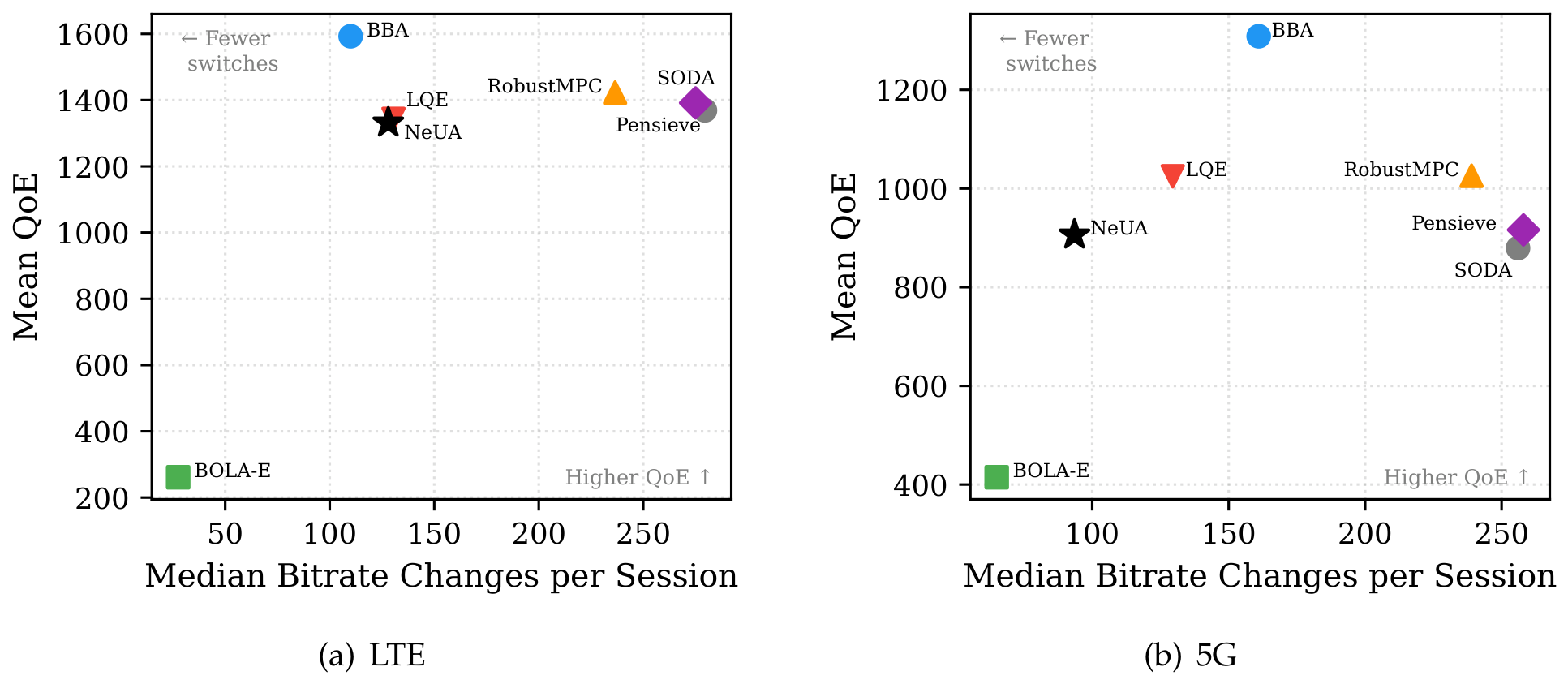
Figure 5 compares the evaluated ABR schemes in terms of mean QoE and median bitrate-switching count per session on the LTE and 5G datasets. The upper-left region is the ideal operating region, corresponding to high QoE with few bitrate switches. In practice, however, ABR schemes often exhibit an empirical QoE–switching trade-off: moving toward higher QoE typically requires more bitrate changes, while reducing switches often lowers QoE by forcing more conservative bitrate choices. Therefore, schemes closer to the upper-left region of this trade-off plane provide a better balance between quality improvement and bitrate stability.
On the LTE dataset, BBA achieves the highest mean QoE and a low switching count, reflecting its conservative buffer-based behavior. Because BBA primarily relies on buffer occupancy rather than throughput prediction, it avoids many aggressive bitrate decisions during LTE handovers. Among prediction-based schemes, NeUA achieves competitive QoE relative to LQE, RobustMPC, SODA, and Pensieve, while producing fewer bitrate switches. This result demonstrates that NeUA provides the best balance among prediction-based schemes by maintaining competitive QoE while improving bitrate stability.
The 5G results show a similar QoE–switching trade-off. BBA achieves the highest mean QoE, but it also incurs a large number of bitrate switches, indicating that its high QoE is obtained at the expense of bitrate stability. RobustMPC yields higher QoE than NeUA but requires substantially more bitrate changes. In contrast, NeUA produces fewer bitrate switches than the other prediction-based schemes while maintaining competitive QoE. Both SODA and Pensieve exhibit more bitrate switches and lower QoE than NeUA. These results suggest that, in 5G traces with high peak throughput and sudden beam-related disruptions, controllers that pursue higher instantaneous quality can easily produce frequent bitrate oscillations, whereas NeUA suppresses unnecessary switching by incorporating prediction uncertainty into bitrate selection.
Overall, Figure 5 demonstrates that NeUA improves the QoE–switching trade-off of prediction-based ABR. Rather than maximizing QoE by allowing frequent quality changes, NeUA reduces unnecessary bitrate oscillations while preserving competitive QoE. This behavior stems from the uncertainty-aware dynamic safety factor, which mitigates over-aggressive bitrate choices when prediction confidence is low, and from counter-based hysteresis, which filters short-lived bitrate recommendations. Although BBA achieves high absolute QoE in both environments, its bitrate-switching behavior differs across LTE and 5G and does not consistently represent the best QoE–stability balance. In contrast, NeUA achieves the most favorable QoE–stability balance among the evaluated prediction-based schemes in both LTE and 5G environments.

5.8. Inference Overhead and Mobile Deployability

In neural ABR frameworks such as NeUA and Pensieve, the machine learning predictor is the sole computationally intensive component: once the predictor produces a throughput estimate, the remaining MPC optimization involves only lightweight arithmetic. Consequently, the inference latency and memory footprint of the bandwidth predictor account for virtually all of the computational overhead associated with mobile deployment.
Deploying NeUA on mobile clients therefore reduces to assessing whether a lightweight, quantized version of the BiLSTM predictor is practically feasible without sacrificing prediction accuracy. TensorFlow Lite (TFLite) post-training INT8 quantization converts FP32 weights to 8-bit integers without retraining, reducing model size and inference latency by up to 4× while exploiting the higher arithmetic density of 128-bit ASIMD registers (16 INT8 values vs. 4 FP32 values per instruction [34,35]).
Table 6 summarizes the estimated inference latency, model size, and prediction accuracy (MAE on the held-out test traces) of the NeUA bandwidth predictor in FP32 and INT8 configurations, derived analytically from the Snapdragon 778G SoC specification (Cortex-A78, 2.4 GHz) [36]. FP32 latency is estimated from the predictor’s operation count (17.2 MFLOPs for N = 20 MC Dropout passes) divided by the Cortex-A78 peak FP32 throughput, with a 30% SIMD utilization factor applied to account for the sequential data dependency of LSTM recurrent computation.
The INT8 predictor reduces per-chunk inference latency from 3.6 ms to 0.9 ms, representing less than 0.02% of the 5-second chunk interval and confirming negligible playback pipeline overhead. The 60 KB footprint fits within the L2 cache of mid-range Android SoCs, eliminating memory-bandwidth bottlenecks during inference. Post-training INT8 quantization introduces only 0.4 % MAE degradation relative to the FP32 baseline on the held-out test traces, confirming that the BiLSTM throughput predictor is robust to 8-bit weight quantization [34]. By contrast, the Pensieve actor network comprises approximately 265,000 parameters [9], occupying roughly 1038 KB in FP32—more than 17× the size of the NeUA INT8 variant—which makes direct on-device deployment substantially more challenging on memory-constrained mobile clients. Since inference energy scales proportionally with latency, the 4× latency reduction implies a corresponding reduction in per-inference energy consumption; quantitative on-device profiling is left for future work. For further validation of practical on-device deployment, we are preparing an experimental Android prototype that integrates the INT8-quantized predictor with androidx.media3 library; the repository for this preliminary work-in-progress implementation is hosted at https://github.com/neua-abr/neua-android (accessed on 22 June 2026).

6. Conclusions

We proposed NeUA, an ABR scheme built around an uncertainty-aware BiLSTM predictor that estimates per-chunk epistemic uncertainty via Monte Carlo Dropout and couples it to a dynamic safety factor, replacing the fixed safety margins of prior prediction-based ABR, together with an MPC rate-selection layer and counter-based hysteresis. Validated on 40 real LTE and 18 5G traces, NeUA is the highest-QoE scheme among all prediction-based baselines in both environments, achieving QoE gains of 2.3% (LTE) and 8.0% (5G) over LQE with 13.8% and 28.8% fewer bitrate switches, respectively.
Among all seven evaluated schemes including BBA, NeUA ranks second in QoE in both environments, achieves the highest QoE and fewest bitrate switches among all prediction-based schemes in both LTE and 5G, and delivers substantially higher median bitrate than BBA in 5G (25.71 Mbps vs. 17.98 Mbps), reflecting the bandwidth utilization advantage of prediction-based control. The INT8-quantized BiLSTM variant occupies approximately 60 KB and completes per-chunk inference in 0.9 ms on a Snapdragon 778G SoC (Cortex-A78, spec-based estimate), making NeUA deployable on mid-range mobile clients with substantially lower inference overhead than DRL-based baselines; quantitative energy characterization is left for future on-device profiling.
An empirical finding of independent interest is that MAE improvement alone is insufficient for ABR QoE gains. A calibrated safety factor that induces controlled conservatism during disruption recovery is essential. This suggests future neural ABR predictors should incorporate asymmetric loss functions that penalize over-prediction more heavily than under-prediction.
Four directions remain open for future work. First, asymmetric Huber loss training will be explored to reduce reliance on the hand-tuned safety factor by penalizing over-prediction more heavily during model training. Second, Transformer-based predictors will be investigated to capture longer-range channel dependencies than the BiLSTM window allows. Third, the QoE gap with BBA will be further analyzed to understand whether it can be closed through improved buffer modeling while preserving the bandwidth utilization advantage of prediction-based control. Fourth, a calibration study will be conducted to assess whether the MC Dropout standard deviation σ ( k ) is positively correlated with actual per-chunk prediction error across diverse channel conditions, using rank correlation analysis on held-out traces.


Author Contributions

Conceptualization, Y.-m.K.; methodology, Y.-m.K. and Y.-s.L.; software, Y.-m.K.; validation, Y.-s.L.; formal analysis, Y.-m.K.; writing—original draft preparation, Y.-m.K.; writing—review and editing, Y.-m.K. and Y.-s.L.; visualization, Y.-m.K.; supervision, Y.-s.L.; project administration, Y.-s.L.; funding acquisition, Y.-s.L. All authors have read and agreed to the published version of the manuscript.

Funding

This work was supported by the Sungshin Women’s University Research Grant of H20250051.

Informed Consent Statement

Not applicable.

Data Availability Statement

The datasets for the experiments are available in the repositories pointed out in the corresponding references. The entire result datasets from the experiments are not made public since the manuscript already includes corresponding numbers in the tables and figures, but they are available from the corresponding author upon reasonable request.

Conflicts of Interest

The authors declare no conflicts of interest.

References

  1. AppLogic Networks (Formerly Sandvine). The Global Internet Phenomena Report. Tech. Rep. 2025. Available online: https://www.applogicnetworks.com/download-the-2025-global-internet-phenomena-report (accessed on 25 May 2026).
  2. Ericsson. Ericsson Mobility Report. Tech. Rep. November 2024. Available online: https://www.ericsson.com/4ad0df/assets/local/reports-papers/mobility-report/documents/2024/ericsson-mobility-report-november-2024.pdf (accessed on 25 May 2026).
  3. Stockhammer, T. Dynamic Adaptive Streaming over HTTP—Standards and Design Principles. In Proceedings of the Second Annual ACM Conference on Multimedia Systems, Santa Clara, CA, USA, 23–25 February 2011; Association for Computing Machinery: New York, NY, USA, 2011; pp. 133–144. [Google Scholar] [CrossRef]
  4. van der Hooft, J.; Petrangeli, S.; Wauters, T.; Huysegems, R.; Rondao Alface, P.; Bostoen, T.; De Turck, F. HTTP/2-Based Adaptive Streaming of HEVC Video over 4G/LTE Networks. IEEE Commun. Lett. 2016, 20, 2177–2180. [Google Scholar] [CrossRef]
  5. Raca, D.; Leahy, D.; Sreenan, C.J.; Quinlan, J.J. Beyond Throughput, The Next Generation: A 5G Dataset with Channel and Context Metrics. In Proceedings of the 11th ACM Multimedia Systems Conference, Istanbul, Turkey, 8–11 June 2020; Association for Computing Machinery: New York, NY, USA, 2020; pp. 303–308. [Google Scholar] [CrossRef]
  6. Huang, T.-Y.; Johari, R.; McKeown, N.; Trunnell, M.; Watson, M. A Buffer-Based Approach to Rate Adaptation: Evidence from a Large Video Streaming Service. In Proceedings of the 2014 ACM Conference on SIGCOMM, Chicago, IL, USA, 17–22 August 2014; Association for Computing Machinery: New York, NY, USA, 2014; pp. 187–198. [Google Scholar] [CrossRef]
  7. Yin, X.; Jindal, A.; Sekar, V.; Sinopoli, B. A Control-Theoretic Approach for Dynamic Adaptive Video Streaming over HTTP. In Proceedings of the 2015 ACM Conference on Special Interest Group on Data Communication, London, UK, 17–21 August 2015; Association for Computing Machinery: New York, NY, USA, 2015; pp. 325–338. [Google Scholar] [CrossRef]
  8. Chen, T.; Lin, Y.; Christianson, N.; Akhtar, Z.; Dharmaji, S.; Hajiesmaili, M.; Wierman, A.; Sitaraman, R.K. SODA: An Adaptive Bitrate Controller for Consistent High-Quality Video Streaming. In Proceedings of the ACM SIGCOMM 2024 Conference, Sydney, NSW, Australia, 4–8 August 2024; Association for Computing Machinery: New York, NY, USA, 2024; pp. 613–644. [Google Scholar] [CrossRef]
  9. Mao, H.; Netravali, R.; Alizadeh, M. Neural Adaptive Video Streaming with Pensieve. In Proceedings of the ACM Special Interest Group on Data Communication, Los Angeles, CA, USA, 21–25 August 2017; Association for Computing Machinery: New York, NY, USA, 2017; pp. 197–210. [Google Scholar] [CrossRef]
  10. Spiteri, K.; Urgaonkar, R.; Sitaraman, R.K. BOLA: Near-Optimal Bitrate Adaptation for Online Videos. IEEE/ACM Trans. Netw. 2020, 28, 1698–1711. [Google Scholar] [CrossRef]
  11. Jiang, J.; Sekar, V.; Zhang, H. Improving Fairness, Efficiency, and Stability in HTTP-Based Adaptive Video Streaming with Festive. IEEE/ACM Trans. Netw. 2014, 22, 326–340. [Google Scholar] [CrossRef]
  12. Li, Z.; Zhu, X.; Gahm, J.; Pan, R.; Hu, H.; Begen, A.C. Probe and Adapt: Rate Adaptation for HTTP Video Streaming at Scale. IEEE J. Sel. Areas Commun. 2014, 32, 719–733. [Google Scholar] [CrossRef]
  13. De Cicco, L.; Caldaralo, V.; Palmisano, V.; Mascolo, S. ELASTIC: A Client-Side Controller for Dynamic Adaptive Streaming over HTTP (DASH). In Proceedings of the 2013 20th International Packet Video Workshop, San Jose, CA, USA, 12–13 December 2013; IEEE: New York, NY, USA, 2013; pp. 1–8. [Google Scholar] [CrossRef]
  14. Kang, Y.-m.; Lim, Y.-s. Bit Rate Adaptation Using Linear Quadratic Optimization for Mobile Video Streaming. Appl. Sci. 2021, 11, 99. [Google Scholar] [CrossRef]
  15. Goodwin, G.C.; Graebe, S.F.; Salgado, M.E. Control System Design; Prentice Hall PTR: Upper Saddle River, NJ, USA, 2000. [Google Scholar]
  16. Hochreiter, S.; Schmidhuber, J. Long Short-Term Memory. Neural Comput. 1997, 9, 1735–1780. [Google Scholar] [CrossRef] [PubMed]
  17. Sun, Y.; Yin, X.; Jiang, J.; Sekar, V.; Lin, F.; Wang, N.; Liu, T.; Sinopoli, B. CS2P: Improving Video Bitrate Selection and Adaptation with Data-Driven Throughput Prediction. In Proceedings of the 2016 ACM SIGCOMM Conference, Florianopolis, Brazil, 22–26 August 2016; Association for Computing Machinery: New York, NY, USA, 2016; pp. 272–285. [Google Scholar] [CrossRef]
  18. Minovski, D.; Ögren, N.; Mitra, K.; Åhlund, C. Throughput Prediction Using Machine Learning in LTE and 5G Networks. IEEE Trans. Mob. Comput. 2023, 22, 1825–1840. [Google Scholar] [CrossRef]
  19. Woo, J.; Hong, S.; Kang, D.; An, D. Improving the Quality of Experience of Video Streaming Through a Buffer-Based Adaptive Bitrate Algorithm and Gated Recurrent Unit-Based Network Bandwidth Prediction. Appl. Sci. 2024, 14, 10490. [Google Scholar] [CrossRef]
  20. Vaswani, A.; Shazeer, N.; Parmar, N.; Uszkoreit, J.; Jones, L.; Gomez, A.N.; Kaiser, L.; Polosukhin, I. Attention Is All You Need. In Proceedings of the NeurIPS, Long Beach, CA, USA, 4–9 December 2017; pp. 5998–6008. [Google Scholar]
  21. Nolan, K.; Raca, D.; Provan, G.; Zahran, A. MATURE: Multistage Throughput Prediction for Adaptive Video Streaming in Cellular Networks. In Proceedings of the ACM NOSSDAV, Bari, Italy, 15–18 April 2024; Association for Computing Machinery: New York, NY, USA, 2024; pp. 15–21. [Google Scholar] [CrossRef]
  22. Lv, G.; Wu, Q.; Tan, Q.; Wang, W.; Li, Z.; Xie, G. Accurate Throughput Prediction for Improving QoE in Mobile Adaptive Streaming. IEEE Trans. Mob. Comput. 2024, 23, 5835–5850. [Google Scholar] [CrossRef]
  23. Huang, T.; Zhou, C.; Zhang, R.; Wu, C.; Yao, X.; Sun, L. Comyco: Quality-Aware Adaptive Video Streaming via Imitation Learning. In Proceedings of the 27th ACM International Conference on Multimedia, Nice, France, 21–25 October 2019; Association for Computing Machinery: New York, NY, USA, 2019; pp. 429–437. [Google Scholar] [CrossRef]
  24. Huang, T.; Zhou, C.; Yao, X.; Zhang, R.; Wu, C.; Yu, B. Quality-Aware Neural Adaptive Video Streaming with Lifelong Imitation Learning. IEEE J. Sel. Areas Commun. 2020, 38, 2324–2342. [Google Scholar] [CrossRef]
  25. Xia, Z.; Zhou, Y.; Yan, F.Y.; Jiang, J. GENET: Automatic Curriculum Generation for Learning Adaptation in Networking. In Proceedings of the ACM SIGCOMM 2022 Conference, Amsterdam, The Netherlands, 22–26 August 2022; Association for Computing Machinery: New York, NY, USA, 2022; pp. 397–413. [Google Scholar] [CrossRef]
  26. Wu, D.; Wang, X.; Qiao, Y.; Wang, Z.; Jiang, J.; Cui, S.; Wang, F. NetLLM: Adapting Large Language Models for Networking. In Proceedings of the ACM SIGCOMM 2024 Conference, Sydney, NSW, Australia, 4–8 August 2024; Association for Computing Machinery: New York, NY, USA, 2024; pp. 661–678. [Google Scholar] [CrossRef]
  27. Bentaleb, A.; Taani, B.; Begen, A.C.; Timmerer, C.; Zimmermann, R. A Survey on Bitrate Adaptation Schemes for Streaming Media Over HTTP. IEEE Commun. Surv. Tutor. 2019, 21, 562–585. [Google Scholar] [CrossRef]
  28. Hu, X.; Ghosh, A.; Liu, X.; Zhang, Z.-L.; Shroff, N. COREL: Constrained Reinforcement Learning for Video Streaming ABR Algorithm Design Over mmWave 5G. In Proceedings of the 2023 IEEE International Workshop Technical Committee on Communications Quality and Reliability (CQR), Washington, DC, USA, 23–27 October 2023; IEEE: New York, NY, USA, 2023; pp. 1–6. [Google Scholar] [CrossRef]
  29. Riiser, H.; Vigmostad, P.; Griwodz, C.; Halvorsen, P. Commute Path Bandwidth Traces from 3G Networks: Analysis and Applications. In Proceedings of the MMSys ’13: Proceedings of the 4th ACM Multimedia Systems Conference, Oslo, Norway, 28 February–1 March 2013; Association for Computing Machinery: New York, NY, USA, 2013; pp. 114–118. [Google Scholar] [CrossRef]
  30. Miuccio, L.; Panno, D.; Riolo, S. A DNN-based Estimate of the PRACH Traffic Load for Massive IoT Scenarios in 5G Networks and Beyond. Comput. Netw. 2021, 201, 108608. [Google Scholar] [CrossRef]
  31. Schuster, M.; Paliwal, K.K. Bidirectional Recurrent Neural Networks. IEEE Trans. Signal Process. 1997, 45, 2673–2681. [Google Scholar] [CrossRef]
  32. Brockwell, P.J.; Davis, R.A. Introduction to Time Series and Forecasting, 2nd ed.; Springer: New York, NY, USA, 2002. [Google Scholar]
  33. Gal, Y.; Ghahramani, Z. Dropout as a Bayesian Approximation: Representing Model Uncertainty in Deep Learning. In Proceedings of the ICML, New York, NY, USA, 19–24 June 2016; pp. 1050–1059. Available online: http://proceedings.mlr.press/v48/gal16.html (accessed on 25 May 2026).
  34. Jacob, B.; Kligys, S.; Chen, B.; Xu, M.; Sandler, M.; Howard, A.; Adam, H.; Kalenichenko, D. Quantization and Training of Neural Networks for Efficient Integer-Arithmetic-Only Inference. In Proceedings of the 2018 IEEE/CVF Conference on Computer Vision and Pattern Recognition, Salt Lake City, UT, USA, 18–23 June 2018; IEEE: New York, NY, USA, 2018; pp. 2704–2713. [Google Scholar] [CrossRef]
  35. Arm Limited. Arm® Cortex®-A78 Core Software Optimization Guide; Document PJDOC-466751330-9691; Issue 5.0; August 2022. Available online: https://developer.arm.com/documentation/102160/latest/ (accessed on 25 May 2026).
  36. Qualcomm Technologies, Inc. Snapdragon™ 778G 5G Mobile Platform: Specifications & Features; Product Brief; 2021. Available online: https://www.qualcomm.com/content/dam/qcomm-martech/dm-assets/documents/Snapdragon-778G-5G-Product-Brief.pdf (accessed on 25 May 2026).
Figure 1. Overall MAE comparison of four throughput predictors on 58 public mobile traces (40 LTE and 18 5G).
Electronics 15 02821 g001
Figure 2. NeUA architecture.
Electronics 15 02821 g002
Figure 4. CDF of per-session bitrate-change count for all seven schemes.
Electronics 15 02821 g004
Figure 5. Mean QoE versus median bitrate-switching count per session on the LTE and 5G datasets.
Electronics 15 02821 g005
Table 1. Throughput prediction accuracy of four predictors on 58 public mobile traces (40 LTE and 18 5G).
PredictorOverall MAE (Mbps)Latency (ms)Params
Holt–Winters [32]10.35<0.1
LSTM [16]9.240.3330,241
BiLSTM [31]9.220.5555,585
Transformer [20]9.450.4767,137
Table 2. BiLSTM predictor architecture.
LayerConfigurationParameters
Input ( 8 , 1 )
BiLSTM64 units, dropout 0.217,920
LSTM32 units, dropout 0.212,416
Dense16 units, ReLU528
Dropout p = 0.2
Output1 unit, Softplus17
Table 5. Paired t-test results: NeUA vs. prediction-based baselines. The number of asterisks indicates the level of statistical significance, and ”ns” denotes not significant.
           LTE          5G
SchemeQoE Mean ± Std t SigQoE Mean ± Std t Sig
RobustMPC 1397.8 ± 170.0 15.42 *** 1125.9 ± 508.6 5.75 ***
SODA 1380.5 ± 188.6 4.39 *** 1051.3 ± 519.9 + 1.72 ns
LQE 1386.0 ± 150.5 3.07 ** 1112.2 ± 467.4 4.46 ***
Pensieve 1385.5 ± 188.6 8.65 *** 1064.8 ± 558.9 + 0.11 ns
NeUA 1418.2 ± 186.7 1201.0 ± 627.0
Table 6. Estimated inference latency, model size, and prediction accuracy (MAE) of the NeUA bandwidth predictor on a Snapdragon 778G SoC (Cortex-A78, 2.4 GHz) [36].
MetricFP32INT8Diff
Latency (ms)3.60.9 75 %
Model size (KB)21765 70 %
MAE (normalized)                   FP32 ≈ INT8 0.4 %
Disclaimer/Publisher’s Note: The statements, opinions and data contained in all publications are solely those of the individual author(s) and contributor(s) and not of MDPI and/or the editor(s). MDPI and/or the editor(s) disclaim responsibility for any injury to people or property resulting from any ideas, methods, instructions or products referred to in the content.