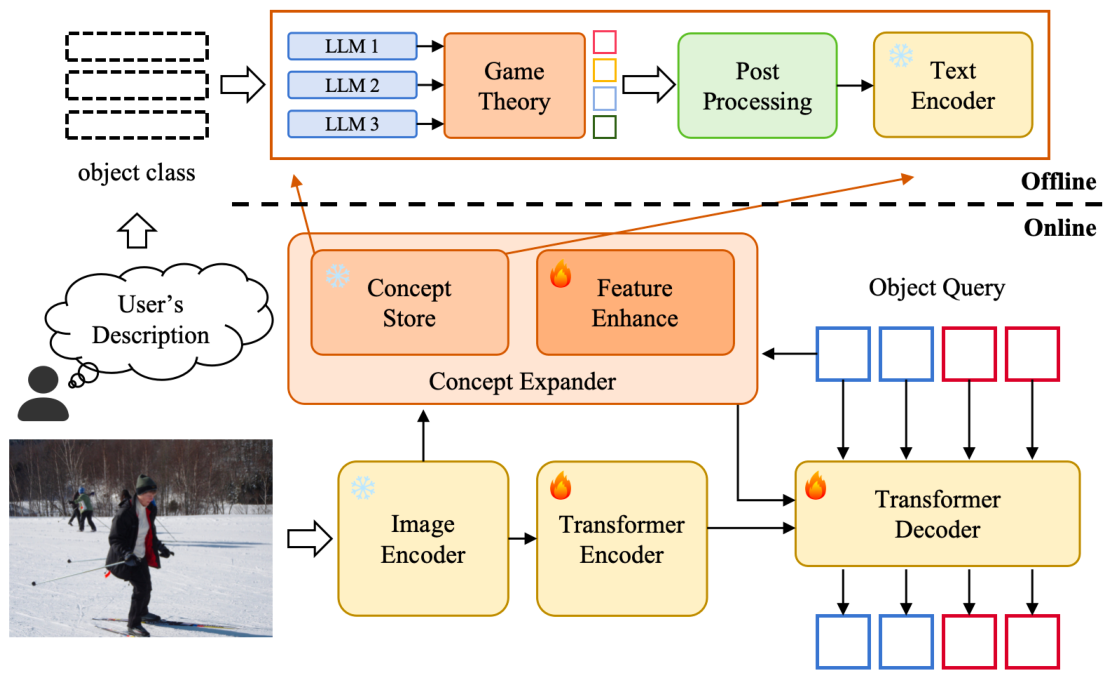
The visual encoder uses CLIP ViT-B/16 as the backbone network. The input image is divided into patches and combined with positional encodings and is then passed through multiple Transformer encoder layers to extract global features . The detection architecture is based on the end-to-end DETR framework and maintains a set of learnable object queries , which interact with the encoded features through the decoder. The decoder adopts standard self-attention and cross-attention mechanisms, and the enhanced features produced by the Concept Expander are injected into the object queries through an additional cross-attention layer. The prediction head consists of a bounding-box regression branch and a classification branch: the former outputs normalized coordinates , while the latter projects the queries into the CLIP embedding space and computes similarity with text embeddings to obtain confidence scores. The detailed implementation of these standard components follows DETR and CLIP. In the following sections, we focus on the core innovations of our method.
3.1. Concept Repository
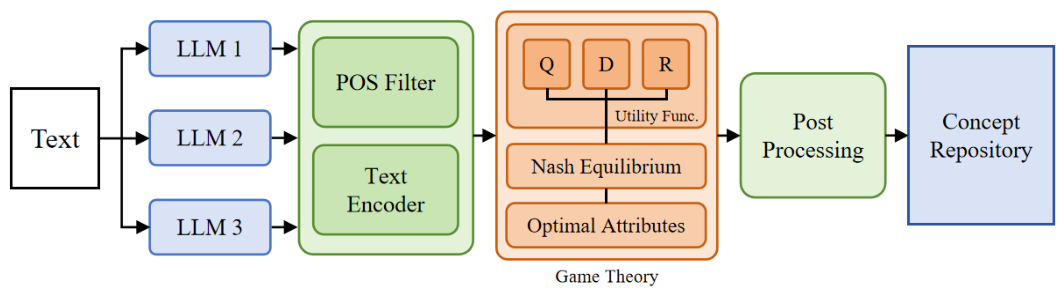
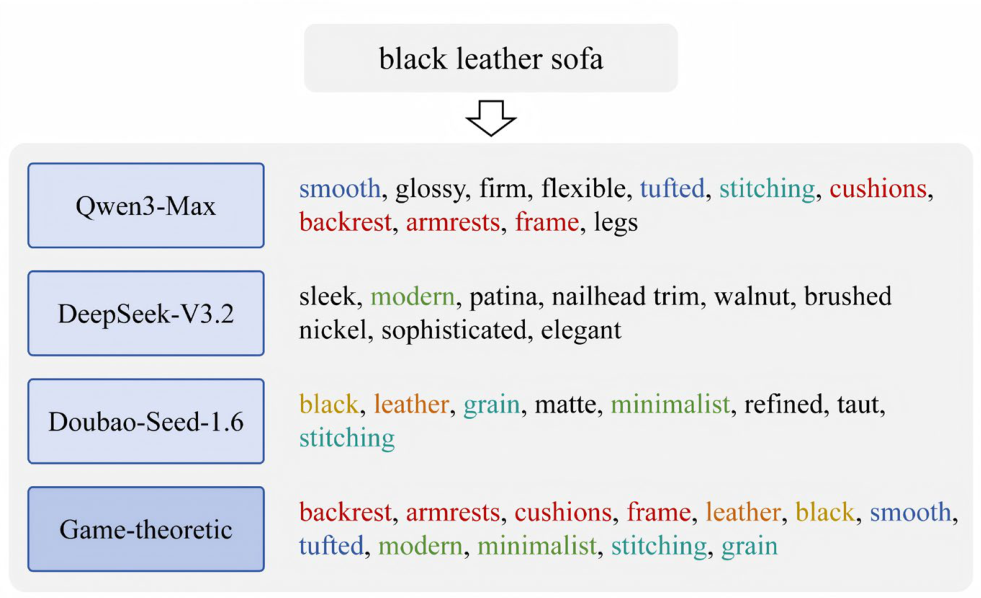
Attribute descriptions generated by a single LLM are constrained by the model’s training data and Inductive Bias. Different models show significant differences when describing the same category. For example, in our experiments, Qwen3-Max tends to generate details about texture and structure, DeepSeek-V3.2 focuses more on aesthetic and decorative descriptions, and Doubao-Seed-1.6 emphasizes core visual features. Using a single source makes it difficult to ensure that attributes are both comprehensive and consistently high-quality. This section presents a game-theoretic Multi-LLM Collaboration framework to build the Concept Store, with the overall process shown in
Figure 2.
For a category set
, we select three Large Language Model (LLM) with different training corpora,
, to generate attributes in parallel. Four task-oriented prompt templates guide the outputs toward identification cues, appearance descriptions, part structures, and scale information:
Specifically, is “How can you identify a(n) {class}?”, which guides the model to output discriminative features; is “Describe the visual appearance of a(n) {class}”, emphasizing surface features such as color and texture; is “What are the main parts of a(n) {class}?”, asking the model to list local components; and is “Describe the size and proportions of a(n) {class}”, guiding the model to generate relative scale information. These prompt templates are intentionally designed to elicit visually grounded and region-observable attributes, because such attributes are most compatible with the downstream region-level retrieval and semantic injection process. This design further reflects our focus on appearance semantics rather than on relation-heavy or context-heavy reasoning cues.
For each model, the attribute set generated for category
is
The generated responses are complete sentences containing many functional words. Using part-of-speech tagging, adjectives (JJ), nouns (NN/NNS), and gerunds (VBG) are retained, while prepositions, articles, and other functional words are filtered out:
The cleaned attribute words are mapped to 768-dimensional embeddings using a frozen CLIP text encoder and then L2-normalized. Freezing ensures encoding determinism and prevents embedding-space drift during training.
For each category
, the three attribute sets
, and
generated by
exhibit different strengths in quality and diversity. Direct merging may introduce redundancy, while simple voting could discard high-quality attributes. We model attribute selection as a multi-agent cooperative game, where each model is a participant aiming to find an attribute subset that jointly maximizes the utility of all participants. Each participants utility function considers three dimensions:
To explicitly clarify, the utility components are quantitatively measured based on the cross-modal cosine similarity of the attributes within the pre-trained CLIP text embedding space, rather than relying on an external pre-trained reward model. This ensures the selected attributes are naturally aligned with the semantic space used by the downstream visual encoder.
The semantic quality term measures whether the selected attributes are semantically coherent with the target category and with the attribute set contributed by the corresponding LLM. The diversity term measures the semantic complementarity between attributes generated by different LLMs, encouraging the final subset to cover different visual aspects such as color, material, texture, shape, and part structure. The redundancy term penalizes attributes that are highly similar to already selected attributes from the same source. Therefore, the attribute utility is a CLIP-embedding-based semantic utility rather than a reward-model score.
During the evolution process, the marginal gain of a candidate attribute a with respect to the current selected set S is defined as follows: Here,
denotes the candidate final attribute set. The quality term
measures the average cohesion of the attributes contributed by
within
:
The diversity term
quantifies this model’s contribution to the semantic coverage of
by computing the semantic dissimilarity between the selected attributes and the attributes from other models:
The redundancy term
penalizes internal repetition among the attributes contributed by this model:
The cooperative Nash equilibrium corresponds to the attribute set that maximizes the minimum utility across all models, thereby ensuring fairness:
This optimization problem is approximated via an iterative greedy max–min algorithm. Starting from
, at each step we add the attribute that yields the largest gain in the minimum utility:
Exhaustive search over all possible attribute subsets is computationally intractable. Therefore, for each category, we approximate the cooperative Nash solution with an iterative greedy max–min procedure. Let
denote the candidate pool obtained by merging the filtered attributes from all LLMs, and let
be the selected subset at iteration
. For each candidate attribute
, we compute its marginal contribution to the minimum agent utility as
We then select
and update
if
. Otherwise, the algorithm terminates. In practice, the iteration stops when either the selected subset reaches a preset maximum size
or the best marginal gain falls below the threshold
. In our implementation,
. Since each accepted step monotonically increases the minimum utility and the candidate pool is finite, the procedure terminates in a finite number of iterations. We therefore refer to the resulting subset as an approximate cooperative Nash solution used for concept repository construction.
The process is repeated until reaches a preset size or the utility gain falls below a threshold. The above game-theoretic optimization procedure is applied to all categories, producing an optimal attribute set for each category . After removing duplicates using a similarity threshold of 0.85, the optimal attribute sets across all categories are merged into the Concept Store , which contains around 5000 attribute concepts.
The attributes are converted into embedding vectors through the CLIP text encoder and stored in the Concept Store. Specifically, each attribute corresponds to a 768-dimensional L2-normalized CLIP embedding , referred to as an attribute embedding or concept. For convenient retrieval and matching, the attribute embeddings in the store are indexed sequentially as , where represents the embedding of the -th attribute.
Unlike naive aggregation or fixed-weight fusion, the cooperative game framework reaches a joint equilibrium—specifically a cooperative Nash equilibrium—where no single model’s distribution bias can dominate the output. Each LLM acts as a cooperative agent: the max–min objective ensures that even the least-represented model retains meaningful coverage in the final attribute set, simultaneously optimizing semantic quality and cross-source diversity within a compact semantic space.
3.2. Concept Expander
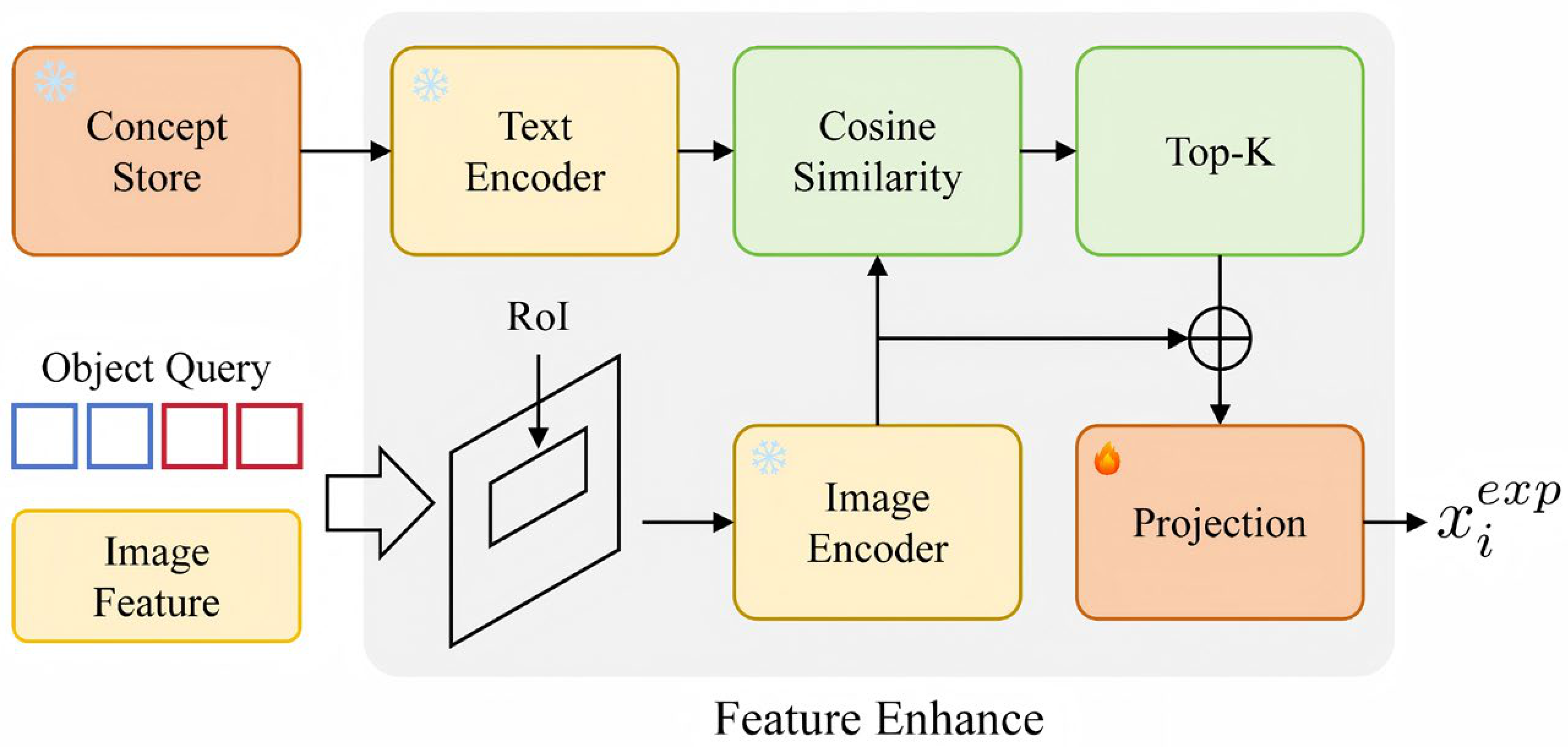
The Concept Expander injects attribute semantics from the Concept Store into region-level visual features, as shown in
Figure 3. Given region features
extracted via RoIAlign [
33] and a store containing
attribute embeddings
, the goal is to dynamically retrieve the concepts most relevant to the current region and integrate them into the visual representation.
We intentionally adopt a lightweight retrieval design rather than introducing a heavily customized learnable retrieval architecture. This choice is deliberate for two reasons. First, the goal of this work is to isolate and validate the contribution of the collaboratively constructed attribute priors, rather than to entangle it with additional retrieval engineering. Second, cosine-similarity retrieval in the frozen CLIP-aligned semantic space preserves the pretrained vision-language geometry, which is important for stable transfer across categories and datasets. Therefore, the retrieval module is kept simple and interpretable, while the main methodological novelty is placed on multi-LLM attribute construction and game-theoretic selection.
To compute feature similarity in the pre-trained CLIP semantic space, the region features are first mapped to the CLIP text space using an alignment projection layer
.
For each projected region feature, we compute the cosine similarity with all attribute embeddings:
The resulting similarity matrix score
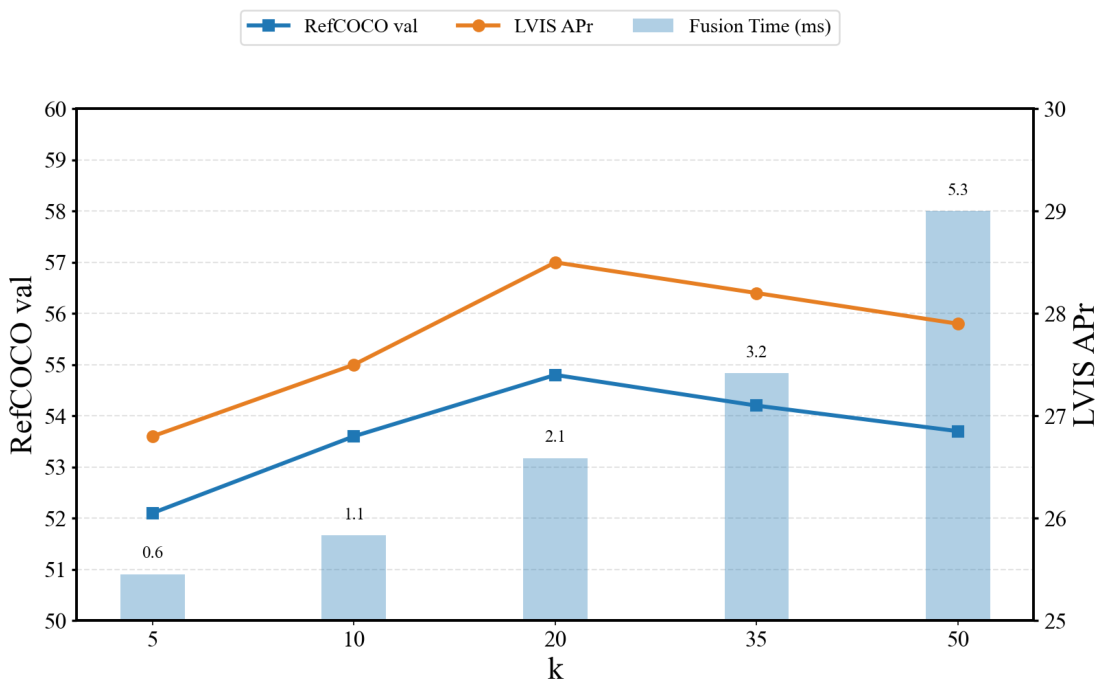
describes the semantic association strength between each region and each concept. We use a Top-
operation to select the
concepts with the highest similarity, filtering out noise from irrelevant concepts. The selected concepts are then normalized via softmax to compute a weight distribution:
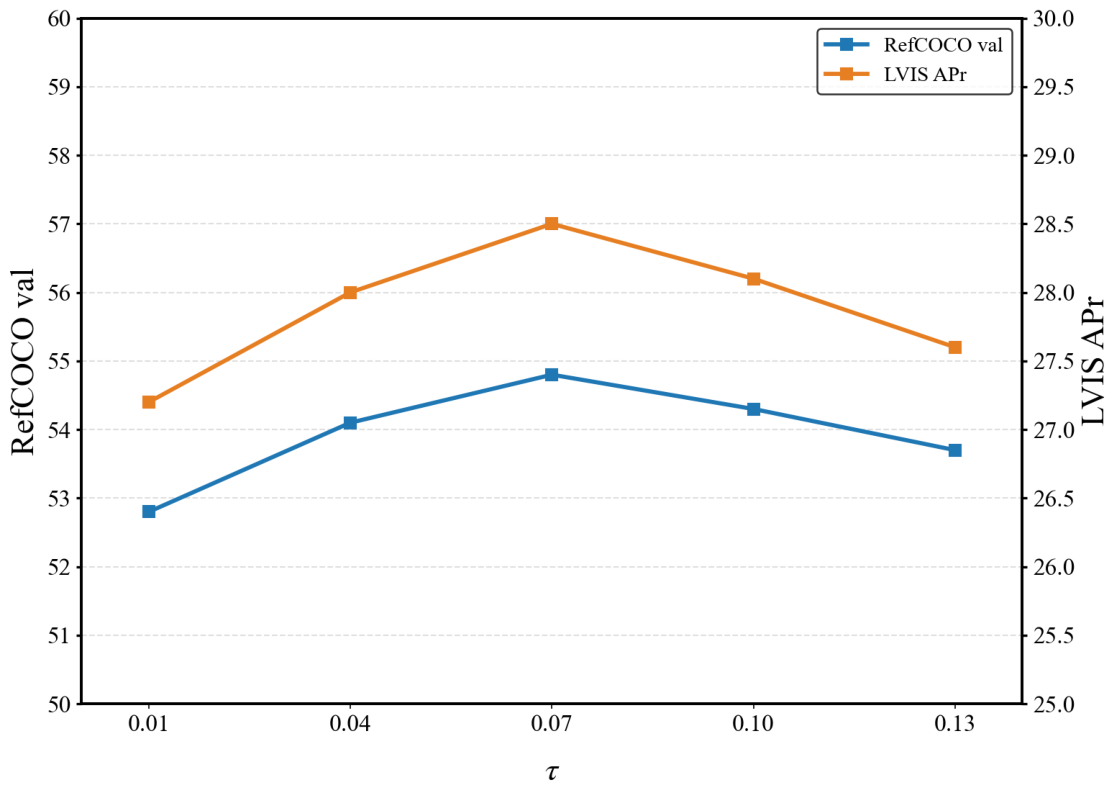
where
is a temperature parameter controlling the concentration of the weight distribution. After obtaining the normalised weights, a semantic prototype vector is generated by weighted aggregation:
This semantic prototype aggregates the attributes most relevant to the current region. Through a residual connection, the semantic prototype is injected into the aligned feature, enhancing the feature in the CLIP space:
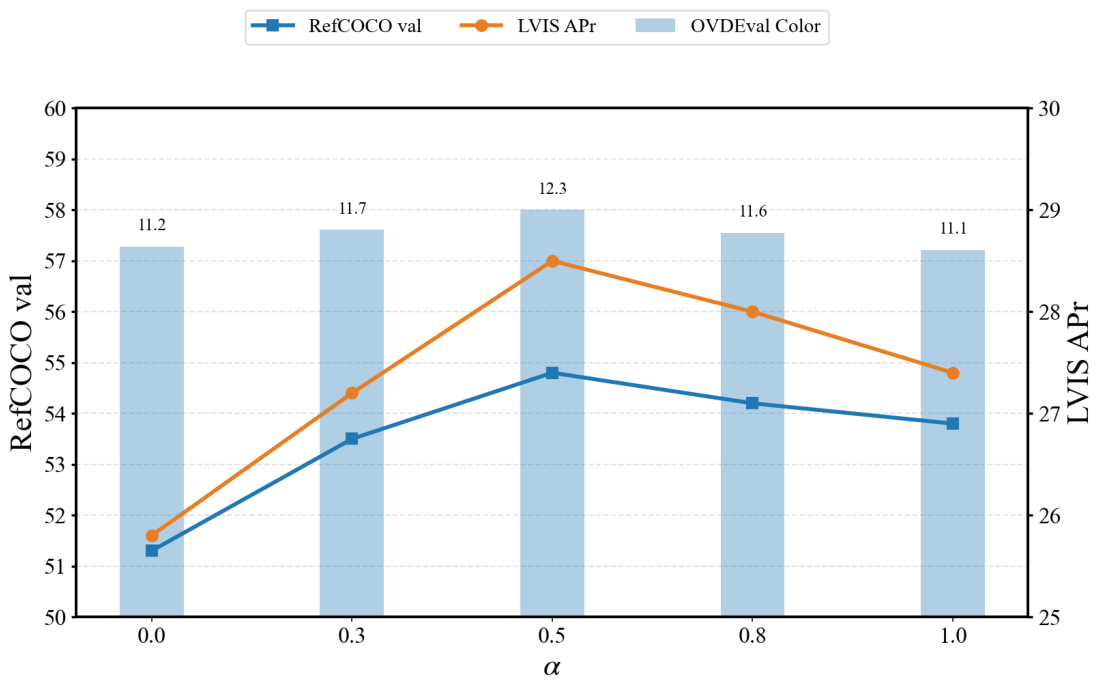
Here,
controls the strength of semantic injection. The residual structure ensures that, even if semantic retrieval is unstable at the early training stage, gradients can still propagate along the visual path. Finally, the enhanced feature is mapped back to the detector feature space through a projection layer
:
The enhanced features are fed into the Transformer decoder, where cross-attention with object queries is used to perform classification and localization. In this sense, the Concept Expander should be viewed as a semantic injection interface built on a simple retrieval pipeline, rather than as a standalone contribution in retrieval architecture design. Because the retrieved concepts are matched to RoI-level features, the module is naturally best suited to appearance-grounded attributes that have direct local visual evidence, rather than to semantic relations that require broader scene-level reasoning.
3.3. Training
The training objective is a multi-task joint optimisation, with the total loss composed of classification, localization, and semantic alignment terms:
The classification loss uses Focal Loss [
34] to alleviate class imbalance in long-tailed distributions. The localization loss combines L1 and GIoU [
35] to ensure coordinate accuracy and scale invariance, following standard detection frameworks. The semantic consistency loss constrains the enhanced features to remain consistent with the true class. For foreground predictions
that are correctly matched, the concept center of the true class
is obtained by averaging the embeddings of its attributes:
The alignment loss is implemented by maximising the cosine similarity between the enhanced features and the concept center:
This constraint ensures that the transformation learned by the semantic projection layer does not deviate from the category semantic space, allowing attributes to enhance rather than replace visual discriminative power.
Training is performed on the 48 base classes of OV-COCO, and the CLIP encoder weights are frozen to preserve pre-trained vision–language alignment knowledge. Training is performed on the 48 base classes of OV-COCO, while evaluation on LVIS rare classes is used to measure transfer to a broader cross-domain long-tail vocabulary. The two projection layers in the Concept Expander are trained from random initialization: learns the alignment mapping from detection features to the CLIP space using a smaller learning rate to ensure training stability, whereas learns the projection from enhanced features to the detection space using a standard learning rate.