


Abstract
In response to the challenges associated with suboptimal route efficiency, insufficient environmental adaptability as well as unsmooth paths in global path planning for mobile robots using the conventional A* algorithm, this paper introduces an adaptive A* algorithm. Initially, an adaptive estimation function is put forward by utilizing the positional relationship between the robot’s current and target position. Through tuning the coefficients with the heuristic function dynamically, path generation time is curtailed. Subsequently, the distance function model is optimized. The arithmetic mean of Euclidean distance and Manhattan distance is utilized to enhance the algorithm’s adaptability to diverse environmental maps. Ultimately, the redundant point deletion strategy is implemented to remove unnecessary nodes along the route, thereby enhancing path smoothness. Experimental results show that across three varying maps, the proposed algorithm, relative to the conventional A* algorithm, on average achieves a 69% reduction in path generation time, a decrease in path length of 2.66 m, and a decline in the quantity of mean steering angles exceeding or equaling 45 degrees of 38.1%. Moreover, when compared with several classic A* algorithm variants and recent improved algorithms, the proposed approach is capable of generating the shortest and most smooth path, confirming its superior planning performance while fulfilling both efficiency and smoothness demands.
1. Introduction
The mobile robot represents an intelligent system that leverages its onboard multi-source sensors to sense the ambient environment and integrates cartographic information to accomplish autonomous navigation and mission execution. Currently, driven by the progress of artificial intelligence technologies, these mobile robots have found extensive utilization across diverse sectors including industrial manufacturing [1], agricultural production [2], and rail transportation [3]. For example, in orchards or substations, by collecting real-time environmental data and monitoring equipment status, certain tasks can be completed, consequently enhancing the operational efficiency of the robots.
Path planning constitutes a fundamental and indispensable technique for facilitating autonomous locomotion in robotic systems. This procedure demands expeditiously pinpointing the optimal route from the starting point to the destination, whilst ensuring the safety of robots and evading collisions with nearby obstacles. The effectiveness of a robot’s path planning is fundamentally dependent on the selection of algorithm, as different algorithms generate diverse planning outcomes. Currently, according to the degree of environmental perception, path planning approaches can be classified into global and local categories. Among the extensively utilized global path planning techniques are the Dijkstra algorithm [4], the A* algorithm [5], the rapidly-exploring random tree method [6], the probabilistic roadmap approach [7], the ant colony optimization algorithm [8], the genetic algorithm [9], and the particle swarm optimization algorithm [10]. Notably, the A* algorithm continues to dominate in practical deployment. The A* algorithm represents a global planning strategy grounded in heuristic search principles. It ascertains the optimal route by computing the cost estimates of visited nodes until the destination node is reached [11].
The performance of the A* algorithm is governed by the choice of the heuristic function, mandating a judicious selection to address diverse categories of environmental maps. Should the model selection prove unsuitable, it could result in the failure to identify the optimal solution for the path. Furthermore, the conventional A* algorithm is plagued by several deficiencies, including low planning efficiency, an abundance of redundant nodes, and excessively large turning angles along the path, all of which fail to satisfy the kinematic constraints of mobile robots. To address the limitations inherent in the traditional A* algorithm, numerous researchers have put forward various enhanced variants of the A* algorithm. These endeavors are predominantly directed toward optimizing heuristic functions, modifying search strategies, and eliminating superfluous path nodes.
Firstly, regarding the heuristic function in the A* algorithm, by increasing the weight of the heuristic function, the planning speed of the algorithm can be accelerated. Zeng et al. [12] proposed an adaptive weighting method based on the ratio of distances, using the Floyd method to eliminate redundant path points from the generated paths. Meanwhile, Wang et al. [13] added the weight of the target position to the heuristic function, thereby avoiding infeasible path costs when the automatic guided vehicle (AGV) travels in the obstacle area. As for the exploration strategy, various improvement methods have been proposed. The bidirectional A* algorithm [14] starts from both the starting position and the destination position and explores the paths in the environment. When the two directions meet at the same node, the path is generated. The multi-layer route planning A* (HPA*) [15] mainly uses hierarchical abstraction to divide the terrain into different regional groups. It first calculates an approximate solution on the abstract representation and then optimizes the road sections within each sub-region. Any A* algorithm [16] achieves this goal by adjusting the heuristic amplification parameters in real time; it can quickly obtain a result close to the optimal one. In the initial stage, the system can quickly lock onto a nearly optimal path. When there is sufficient time resources, it will gradually refine the solution until it finally stabilizes at the optimal state. Additionally, Ou et al. [17] proposed a method that combines curve smoothing technology with a collision avoidance protection mechanism, removing unnecessary waypoints and minimum angle turning positions from the trajectory, thereby improving the efficiency of path exploration. Huang et al. [18] then proposed an improved variant of A*. This method can automatically expand the boundary of obstacles in the grid representation, enabling the robot to maintain a certain safe distance from the obstacles while reducing redundant points on the path.
Furthermore, with the advancement of machine learning technology, scholars have been working on combining deep reinforcement learning with the A* algorithm. Ryo et al. [19] introduced a neural network A* algorithm, transforming the A* algorithm into a differentiable variant and integrating it with a convolutional encoder to build an end-to-end neural network planner for path planning tasks. Liu et al. [20] devised a bidirectional search hybrid A* method, which was embedded into the deep reinforcement learning framework for local path planning and reward function optimization, thereby improving the overall planning performance. Zhang et al. [21] put forward a hierarchical path planning scheme, merging the A* algorithm with deep reinforcement learning. With the framework, the A* algorithm functions as the global path planning module, whereas a density function is employed to identify critical points along high-value trajectories for extracting relevant information. These aforementioned approaches are primarily tailored for single-robot scenarios. However, when multiple robots coexist in the same environment, the complexity of path search increases significantly. Consequently, guaranteeing that multiple robots can achieve coordinated control and tracking becomes particularly important. Dimos V et al. [22] presented a distributed potential field technique, leveraging attractive and repulsive potential fields to achieve coordinated control among multiple robots while maintaining system connectivity. For multi-robot systems with incomplete constraints, Boda Ning et al. [23] formulated a nonlinear control protocol, which remedies the deficiencies of conventional approaches regarding dynamic response speed and guarantees that multiple robots can accomplish collaborative tasks within the designated timeframe. Huang et al. [24] introduced a multi-robot path planning framework grounded in an enhanced partition method (dividing regions according to the initial positions of the robots, DARP). By integrating the refined DARP with the A* algorithm, each robot is assigned to a specific planning task. Moreover, in conjunction with the coverage path generation algorithm, the objective of achieving complete coverage of the task area is fulfilled.
Although the aforementioned improvements have achieved certain results, there are still several challenges. Firstly, the weight configuration of the heuristic function mainly relies on fixed proportions or linear weighting schemes, failing to fully utilize the spatial positional relationship between the mobile robot and its target. Additionally, relying solely on a single distance metric makes it difficult to adapt to the transition between four-direction and eight-direction motion scenarios, thereby affecting the guarantee of the optimal path. Also, during the process of eliminating redundant points, the safety of the robot is often overlooked, potentially making the generated path difficult to actually execute. Currently, most existing studies only focus on optimizing a single dimension, while neglecting the collaborative effect among the three strategic elements. Therefore, this research proposes an adaptive A* method to settle the problems existing in the A* algorithm, including low search efficiency, poor environmental adaptability, and excessive node redundancy. The main contributions include the following aspects:
(1) An adaptive estimation function is designed, which enables flexible tuning of heuristic weight parameters. By taking into account the dynamic positional information between the present node and the goal node, the estimated cost of the robot’s planning is made to be close to the true cost, thereby significantly reducing the planning duration of the A* algorithm.
(2) The distance calculation model has been changed from the traditional Euclidean distance to a hybrid model, which combines the arithmetic mean of Euclidean distance and Manhattan distance. This improvement enables the robot to select the appropriate direction for the next step based on different environments, which strengthens the robustness of the path planning methodology.
(3) Path adjustment and optimization are achieved by applying the collinearity principle. By evaluating the collinearity between adjacent nodes in the path, unnecessary intermediate points are eliminated and the frequency of turns is decreased. The smoothness of the path is enhanced. This helps prevent the robot from colliding with obstacles and from making excessive turns.
The subsequent sections of this paper are structured as follows. Section 2 establishes the theoretical foundation, mainly elaborating on the path planning modeling method for mobile robots based on environmental maps, and introducing the basic principles of the traditional A* algorithm; Section 3 elaborates in detail on the specific content of the adaptive A* algorithm; Section 4 presents the introduction of the environmental map, the experimental results of the algorithm, and the analysis; Section 5 is the summary part of this research.
2. Foundation of Research
2.1. Environmental Map Modeling
Environmental modeling is a crucial component of the navigation stage for mobile robots. Currently, environmental modeling methods mainly include the visual graph method, the grid map method, and the topological graph method. The grid map method has a regular structure and high execution efficiency, which effectively simplifies the intricacy of the surrounding environment. Thus, this study adopts the grid map approach for map environmental modeling [25]. Fundamentally, the grid map approach partitions the robot’s operational space into uniformly sized square cells, thereby generating a two-dimensional grid map.
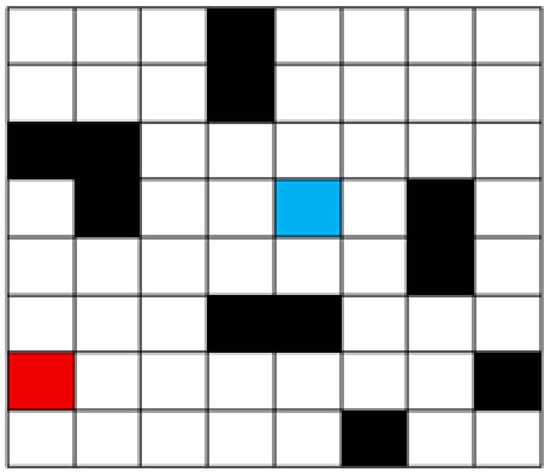
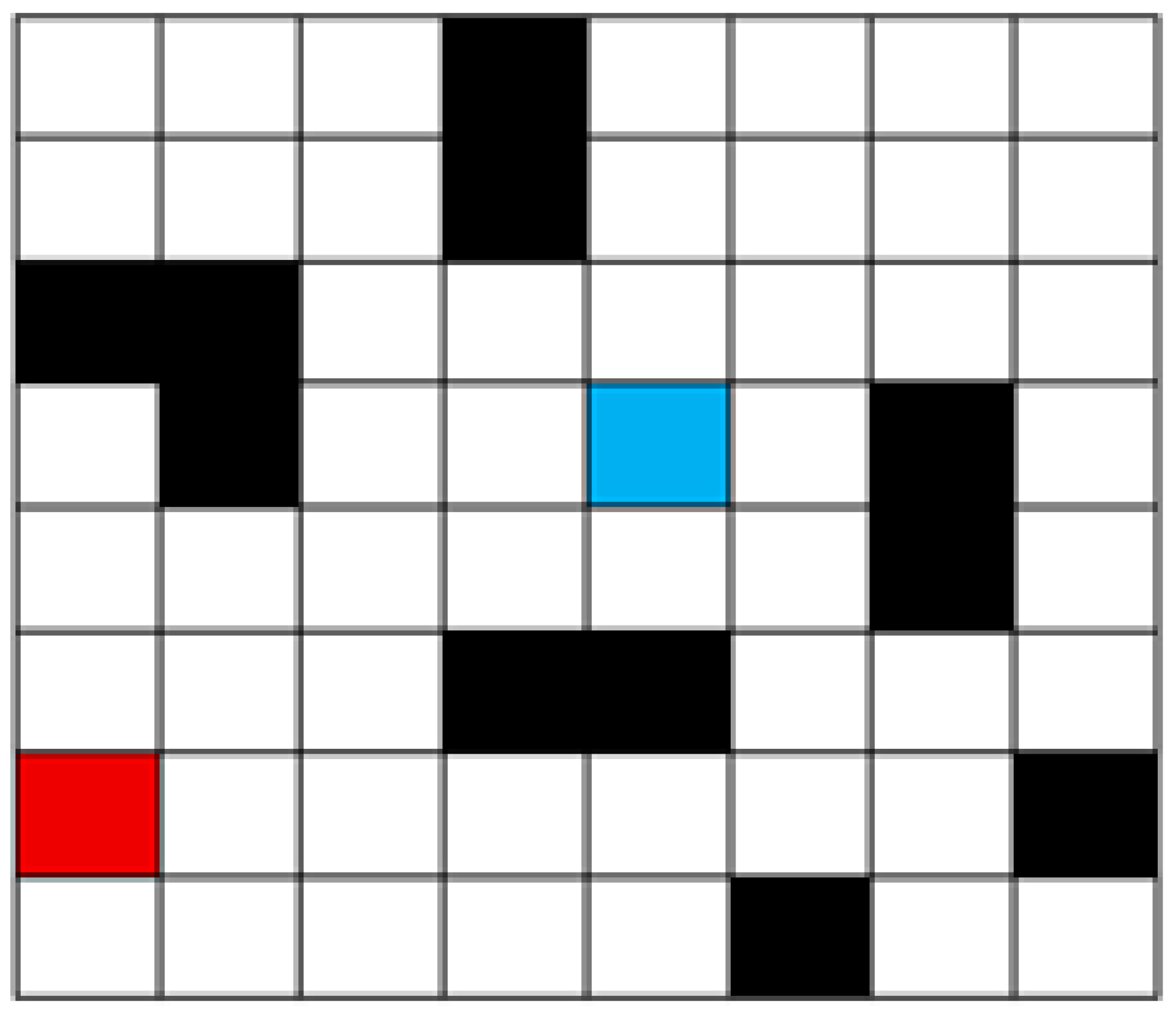
A two-dimensional grid map is established as shown in Figure 1. Each grid’s location is denoted by a two-dimensional coordinate . The length of each grid is 1 m. For example, the red grid is located at coordinates , whereas the blue grid corresponds to coordinates . Moreover, different grid colors represent different environments. Among them, the white grid represents an accessible area, indicating that the robot can safely enter; the black grid represents an environmental obstacle, indicating an inaccessible area where the robot cannot proceed.
Figure 1.
Two-dimensional grid map.
2.2. Traditional A* Algorithm
Serving as a heuristic search method, the A* algorithm synthesizes the merits of both the breadth-first search algorithm and Dijkstra algorithm, which finds widespread utilization across diverse domains, encompassing robotic path planning, cartographic navigation, and industrial logistics. The principal strength of the A* algorithm resides in its employment of a heuristic function to approximate the separation between the present node and the destination node, thus productively steering the exploration orientation and expediently identifying the most favorable route from the initial to the terminal position.
The cost estimation function applied in the traditional A* algorithm is defined as follows:
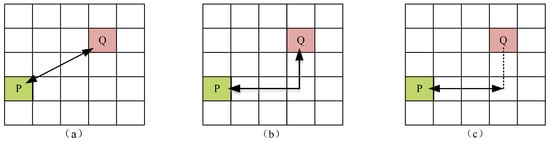
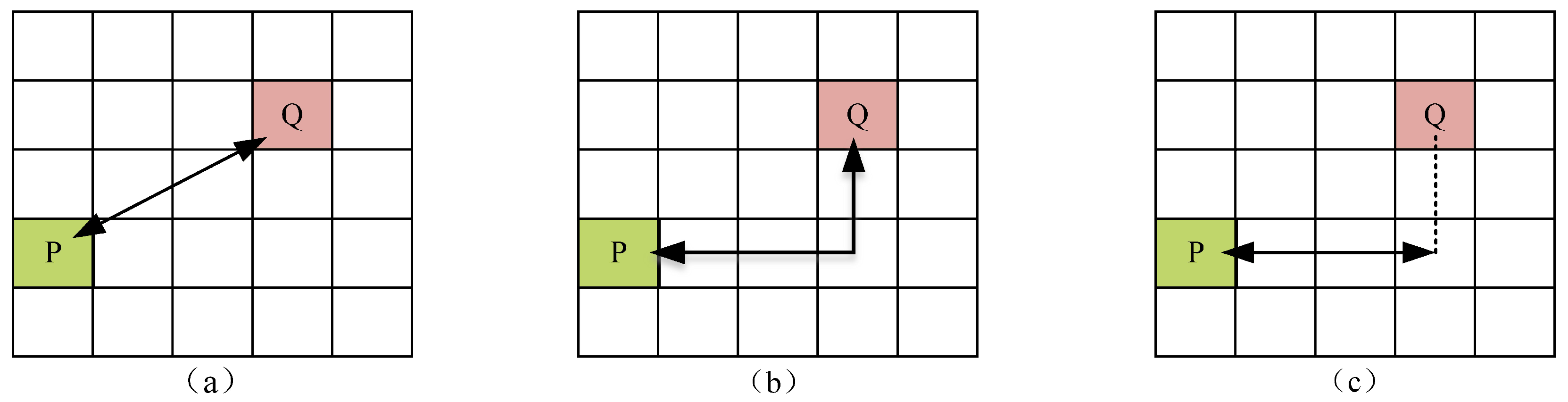
where n represents the current node, represents the total cost estimate, represents the cost from the starting point to the current node, represents the heuristic function, which indicates the estimated cost for the shortest path from the current node to the target node [26]. Common heuristic function distance models include Euclidean distance, Manhattan distance, Chebyshev distance, etc. [27]. Assuming the current node is and the target node is , then schematic diagrams of the three distances are shown in Figure 2.
Figure 2.
Three different distance diagrams: (a) Euclidean distance. (b) Manhattan distance. (c) Chebyshev distance.
(1) Euclidean distance
The Euclidean distance quantifies the straight-line separation between two points. It is defined as
(2) Manhattan distance
The Manhattan distance, commonly referred to as the city block distance, computes the total of absolute deviations between two points across every coordinate axis. It is denoted as
(3) Chebyshev distance
The Chebyshev distance is the maximum value of the absolute difference between the numerical values of the two coordinate axes, which is defined as
The Chebyshev distance is often applicable to grid maps that allow movement in all directions. When the map environment is narrow and long, the estimated value calculated by this distance increases, resulting in more redundant nodes being generated by the A* algorithm and a decrease in the efficiency of path planning. The A* algorithm is demonstrated in Algorithm 1.
In the path planning scenario of the mobile robot, although the traditional A* algorithm can ensure the optimality of the path, it still has limitations. For instance, during the search process, the traditional A* algorithm has the problem of excessive redundant nodes, which requires the algorithm to traverse a large number of nodes, thereby increasing the computing time. At the same time, when there are dense obstacles in the surrounding environment, the number of open list nodes increases sharply, resulting in a decrease in search efficiency. Moreover, the planned path by the algorithm may have many right-angle turns, which do not match the smoothness requirements of the robot’s actual movement.
| Algorithm 1 Traditional A* algorithm |
|
3. Adaptive A* Algorithm
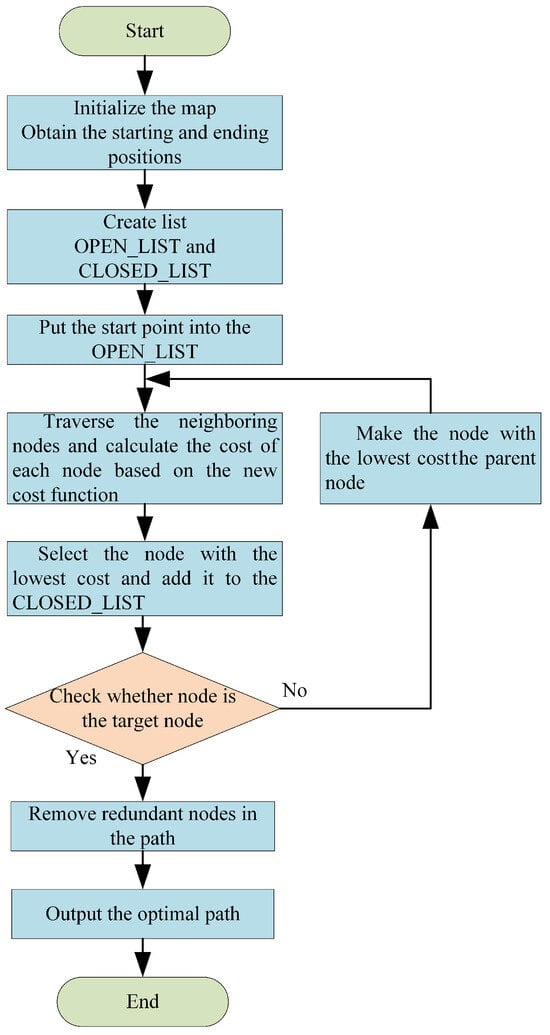
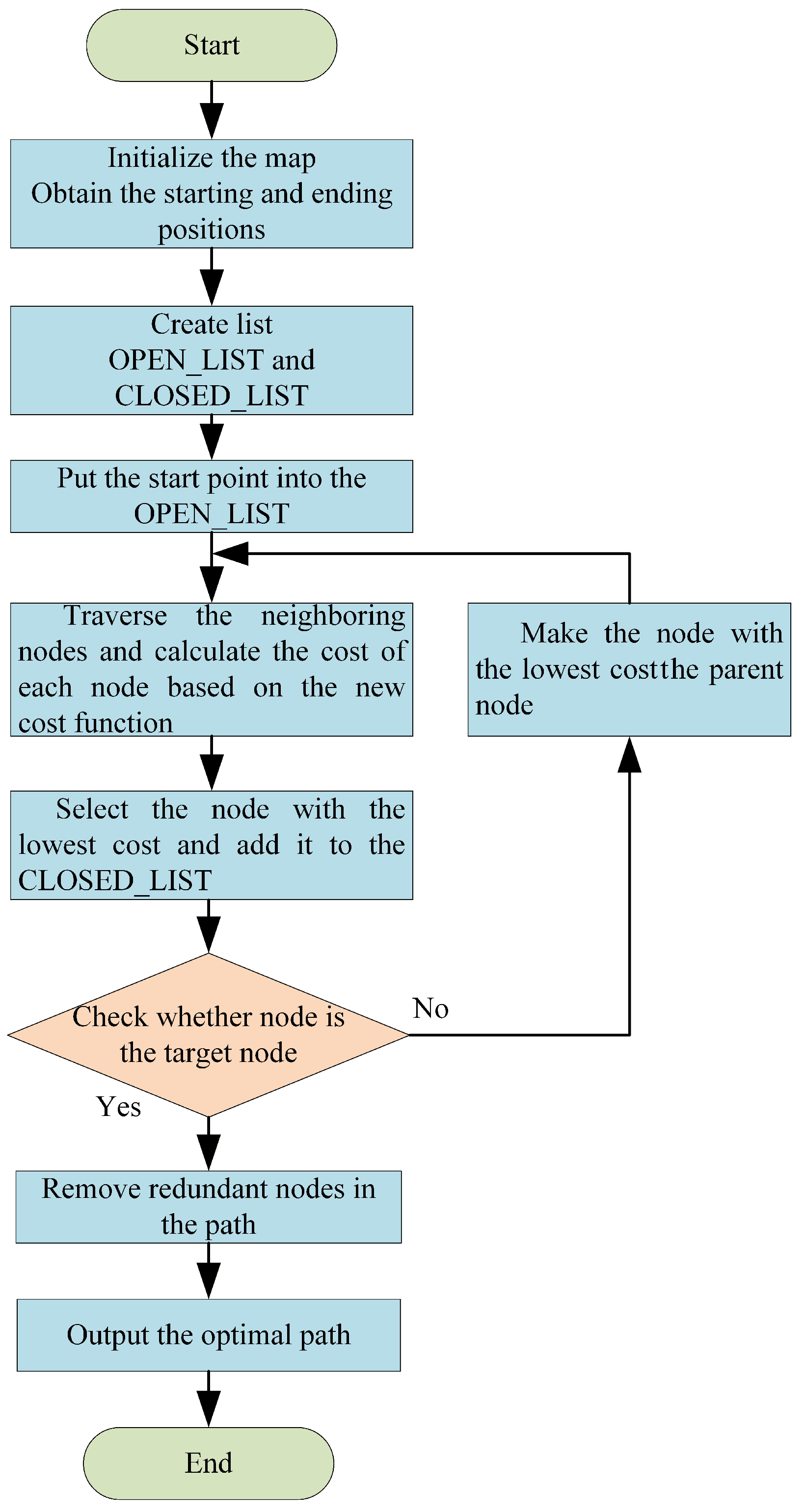
The A* algorithm is capable of planning the global minimal route that conforms to the kinematics of the robot in a static environment. Its implementation is simple, and the expansion is flexible. However, it has some drawbacks such as long planning time, poor environmental adaptability and numerous superfluous nodes along the path. Therefore, an adaptive A* algorithm for global path planning of mobile robots is introduced. Firstly, an adaptive estimation function is used to reduce the planning time. Then, the arithmetic mean of Euclidean distance and Manhattan distance is adopted as the metric framework to enhance the adaptability towards diverse settings. Finally, redundant nodes are deleted to enhance the path smoothness. The workflow diagram of this adaptive A* algorithm is illustrated in Figure 3.
Figure 3.
The flowchart of the adaptive A* algorithm.
3.1. Adaptive Estimation Function
For the path planning of mobile robots, the computational performance of the traditional A* algorithm’s path search mainly depends on the estimated value of the path cost by the heuristic function. When the estimated value of the distance cost is different from the actual value, the planning effect will also be different. If the heuristic function estimate underestimates the true traversal expense, the method’s exploration speed deteriorates; if it overestimates the true traversal expense, the explored region of the method enlarges; if it precisely matches the true traversal expense, the method achieves accelerated exploration without sacrificing route optimality; and when is 0, the method degenerates into Dijkstra.
The estimated distance between two points is usually less than the actual value in the traditional A* algorithm, which may lead to ineffective reduction of the search scope in complex environments. To address this issue, this paper proposes an adaptive estimation function, where the weight of the function changes dynamically based on the ratio of the distance between the current node and the starting point to the distance to the destination. The improved A* algorithm’s estimation function is
where represents the adaptive weight, d represents the distance between the current node and the target node, and D represents the distance between the starting node and the target node.
At the commencement of route exploration, when the robot is situated at a considerable distance from the destination vertex, the estimate value remains substantially elevated, and the corresponding heuristic function weight assumes magnitude. The search is more focused on the target node, Expediting the computational velocity of the A* algorithm. As the robot gets closer to the destination, the weight of the heuristic function diminishes progressively, and the search becomes more dependent on the actual situation to avoid overestimation, ensuring the accurate arrival at the target node and generating the optimal path. Throughout the complete procedure, the adaptive estimation function dynamically adjusts the weights of the heuristic function by evaluating the distance relationship between the current robot and the target node, thereby effectively curtailing the search time of the A* algorithm. This approach demonstrates exceptional efficacy within complex environments, exemplified by areas with dense environmental obstacles. Through real-time modification of the heuristic function, the algorithm can avoid getting stuck in local optima.
3.2. Distance Model Optimization
Across diverse map environments, the traditional A* algorithm typically employs a solitary function distance model; it makes it difficult for the robot to choose the appropriate movement direction. While Euclidean distance guarantees route optimality through direct linear measurement between paired coordinates, this distance involves square root operations, and accordingly, the planning time will increase. Moreover, the Euclidean distance allows diagonal movement, resulting in a significant difference between the estimated distance and the actual movement cost of the robot. The Manhattan distance is only applicable in environments where movement is allowed in four directions. If the map allows diagonal movement, this distance may underestimate the actual cost, thereby leading to the generation of redundant path costs.
In response to the aforementioned issues, this present study proposes the use of the arithmetic mean of the Euclidean distance and the Manhattan distance as a new distance function model. Its mathematical formulation is presented below.
where represents the current node coordinate, and represents the target node coordinate.
From the perspective of adaptability, this model does not require prior determination of the robot’s movement direction. It can be applied in maps with four directions, or in an eight-directional environment map, while maintaining the optimal trend of Euclidean distance. From the perspective of computational efficiency, by balancing the estimation deviations of the two distances and reducing the invalid node expansion caused by inaccurate estimates, this approach enables the distance function model to be changed to the arithmetic mean of Euclidean distance and Manhattan distance, allowing the algorithm to better adapt to different environments and scenarios, thereby providing the robot with better selectivity for the next movement direction.
3.3. Redundant Point Deletion Strategy
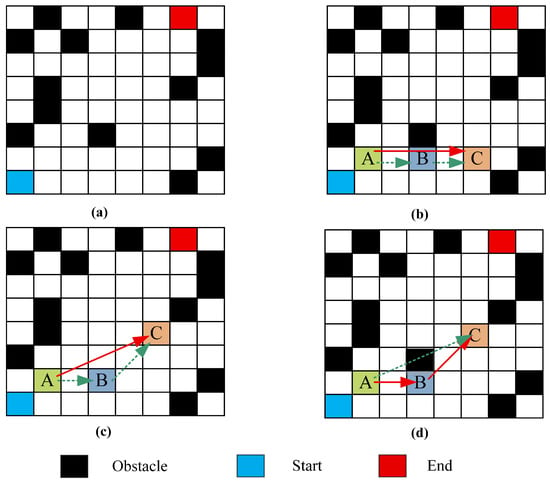
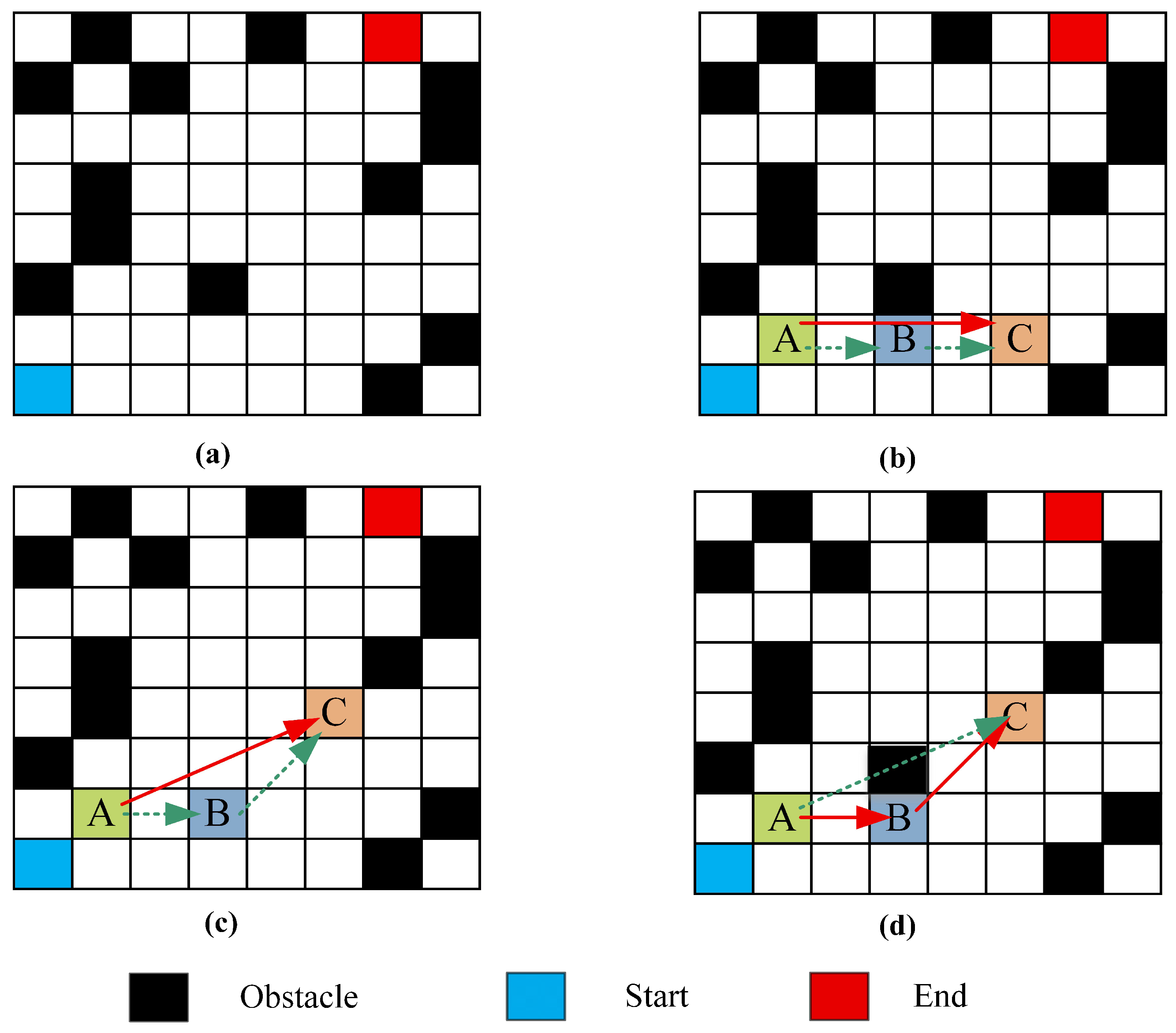
Due to the nature of grid-based search, the conventional A* algorithm often frequently generates routes with numerous superfluous path nodes. This, to some extent, increases the path length, causing the robot to constantly adjust its forward direction, thereby diminishing the motion fluidity of the designed path. Drawing upon collinearity principles, the present study adopts a superfluous node elimination means to remove unnecessary nodes, reducing the robot’s movement, and thus enhancing the smoothness of the route. The superfluous node elimination strategy is illustrated in Figure 4, and specific steps are described subsequently.
Figure 4.
Redundant point deletion strategy diagram: (a) Initial map. (b) Collinearity determination. (c) Delete redundant nodes. (d) Encounter an obstacle.
Step 1: Acquire the collection of path nodes generated through the algorithm.
Step 2: Collinearity determination: As shown in Figure 3b, starting from the origin, select three nodes from the path node set, and determine whether these three nodes are collinear. If the three nodes are collinear and there are no obstacles between them, delete the intermediate node, retain the nodes, and continue to judge the next node; if the three nodes are not collinear, proceed to Step 3.
Step 3: As shown in Figure 4c,d, if the three nodes are not collinear, link the nodes and ascertain whether the connection line traverses the obstacle. When it does not traverse the obstacle, eliminate the intermediate node and preserve the nodes. Supposing it traverses the obstacle, preserve the intermediate node; proceed to judge the next node.
Step 4: Inspect all the nodes in the path node set and eliminate all superfluous nodes from the path to link the remaining path nodes to form a new path.
This strategy eliminates the invalid and redundant nodes generated during the initial path generation, thereby guaranteeing path safety throughout the procedure. It is capable of substantially decreasing the quantity of path nodes, simultaneously improving the smoothness and coherence of the path. Moreover, the refined path aligns more closely with the practical locomotion attributes of mobile robots, markedly lowering power usage, and proves especially applicable to expansive organized environments including substations, workshops, warehouses, and greenhouse facilities.
4. Experimental Verification and Analysis
To verify the effectiveness and reliability of the proposed adaptive A* algorithm, experiments were conducted on three different sizes of raster maps. The algorithm was compared with several classic algorithms and existing improved methods. Additionally, the algorithm’s adaptability was further verified by changing the robot’s start and end points on the map. The simulation was carried out using MATLAB R2023b, and the configuration of the simulation environment is as follows: the computer system is Windows 11, the processor is Inter (R) Core (TM) i5-1340P @ 1.9 GHz, and the memory is 16 GB. This paper selects the time, length, the number of traversed nodes, and the number of corners with angles degrees to evaluate the planning quality of the algorithm. The shortest path is usually considered the optimal path in practical path planning.
4.1. Comparison of Different Maps
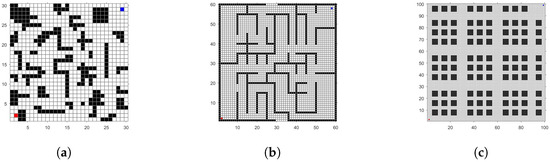
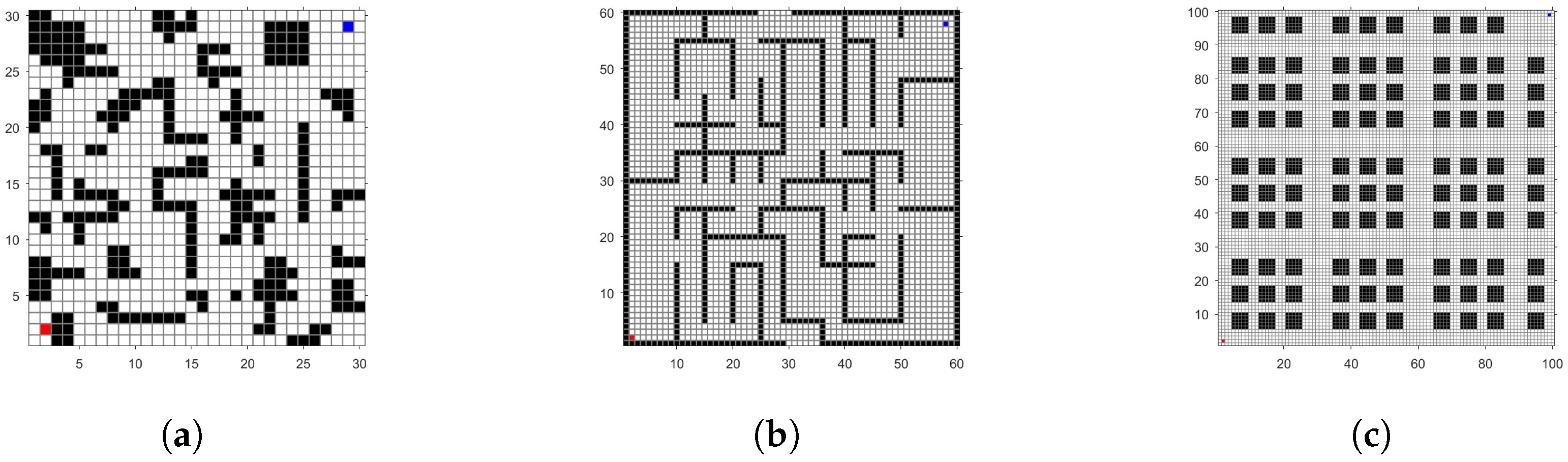
In MATLAB, three different-sized grid maps are constructed, as shown in Figure 5. The first map, depicted in Figure 5a, measures 30 m × 30 m, mainly representing the irregular outdoor scenes, while the second, illustrated in Figure 5b, spans 60 m × 60 m, representing structured indoor scenes, such as mazes and corridors. The last grid map presented in Figure 5c covers 100 m × 100 m, representing large array-like scenes such as photovoltaic power stations and dense warehouses. The starting points of the three-sized maps are all (2, 2), and the endpoints are (28, 28), (58, 58), and (99, 99), respectively. In the grid map, white cells signify passable areas, whereas black ones correspond to environmental obstacles which prevent the robot from passing through, red cell marks path origin, blue ones denote destinations, and red lines represent the shortest path planned by the robot.
Figure 5.
Three different sizes of maps: (a) map1: 30 × 30; (b) map2: 60 × 60; (c) map3: 100 × 100.
4.2. Simulation Comparison of Ablation
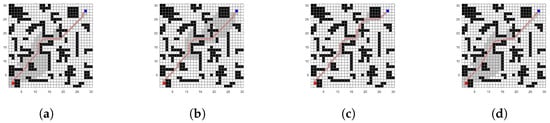
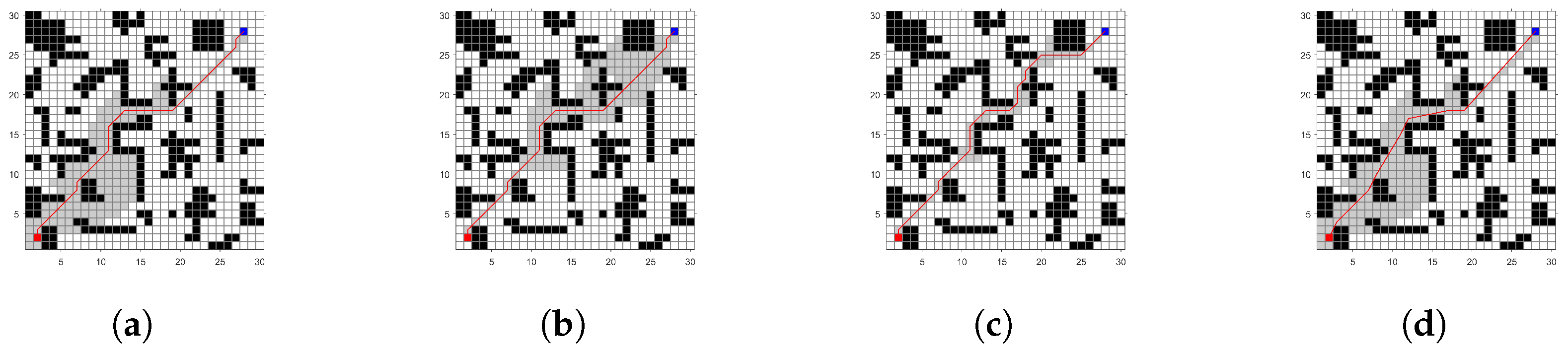
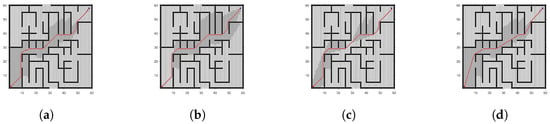
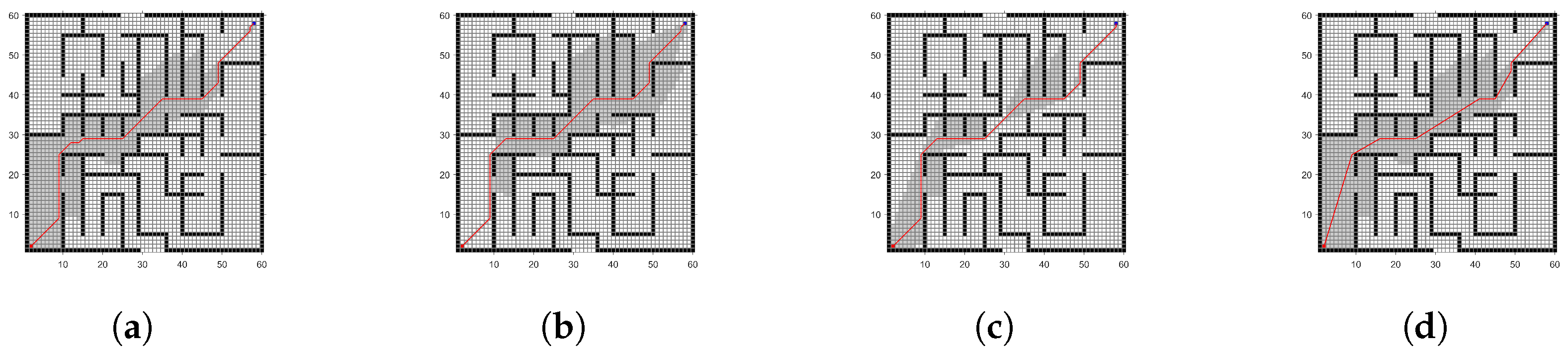
The three improved methods proposed in this paper were simulated individually, benchmarking them against the traditional A* algorithm. The experiments were performed using two map sizes: map1: and map2: . Figure 6 and Figure 7 show the experimental results of the three improved strategies, respectively.
Figure 6.
Simulation outcomes of algorithm improvement on map: (a) A* algorithm, (b) adaptive estimation function, (c) distance model optimization, (d) redundant point deletion.
Figure 7.
Simulation outcomes of algorithm improvement on map: (a) A* algorithm, (b) adaptive estimation function, (c) distance model optimization, (d) redundant point deletion.
As shown in Figure 6 and Figure 7, on the and maps, the conventional A* algorithm exhibits several drawbacks, including an excessive number of explored nodes and frequent directional changes along the generated path. Nevertheless, the enhanced approach proposed herein effectively addresses these limitations.
According to Table 1, on the map, when the adaptive estimation function is adopted, the path planning time is reduced from 0.04 s to 0.03 s, a decrease of 25%; the number of nodes dropped to 86.2%, while the path length remains basically unchanged, approximately 40 m. When the arithmetic mean derived from both Euclidean and Manhattan distance serves as the heuristic for evaluating traversal expenses, the time shrinks from 0.04 s to 0.02 s, a reduction of 50%, and the number of nodes falls by 65.4%. Finally, through implementation of the redundant waypoint elimination approach, the total of turning points with an angle of greater than or equal to 45 degrees in the path is reduced from the original 9 to 5, yielding a 44.4% reduction, while route length shortens by 1.67 m, markedly improving the path smoothness. When the map expands to , the algorithm still maintains excellent planning performance. Especially after adopting the adaptive estimation function, the planning time is reduced by 50%, indicating that the adaptive estimation function has a certain path planning adjustment ability in large-scale maps. Secondly, by using the redundant point deletion strategy, turning point quantity is substantially diminished.
Table 1.
Comparison of A* algorithm improvements on and maps.
In conclusion, the trio of enhancements introduced offer distinct benefits. When the A* algorithm adopts the adaptive estimation function, the path it generates traverses fewer nodes, effectively improving the planning efficiency. By using the arithmetic mean of the Euclidean distance and Manhattan distance as the heuristic distance model for the A* algorithm, the robot can reasonably choose the direction during the planning process according to the environment. Ultimately, the redundant point elimination strategy is deployed to circumvent traversal of no-valid nodes, consequently enhancing route smoothness.
4.3. Simulation Comparison of Different Algorithms
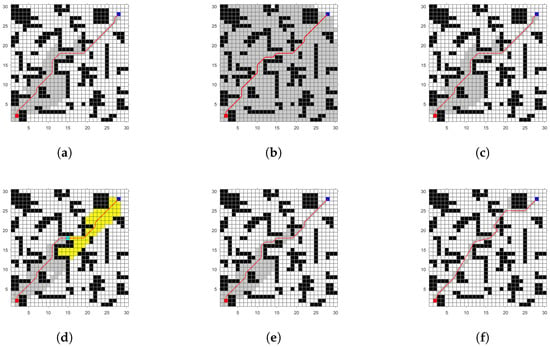
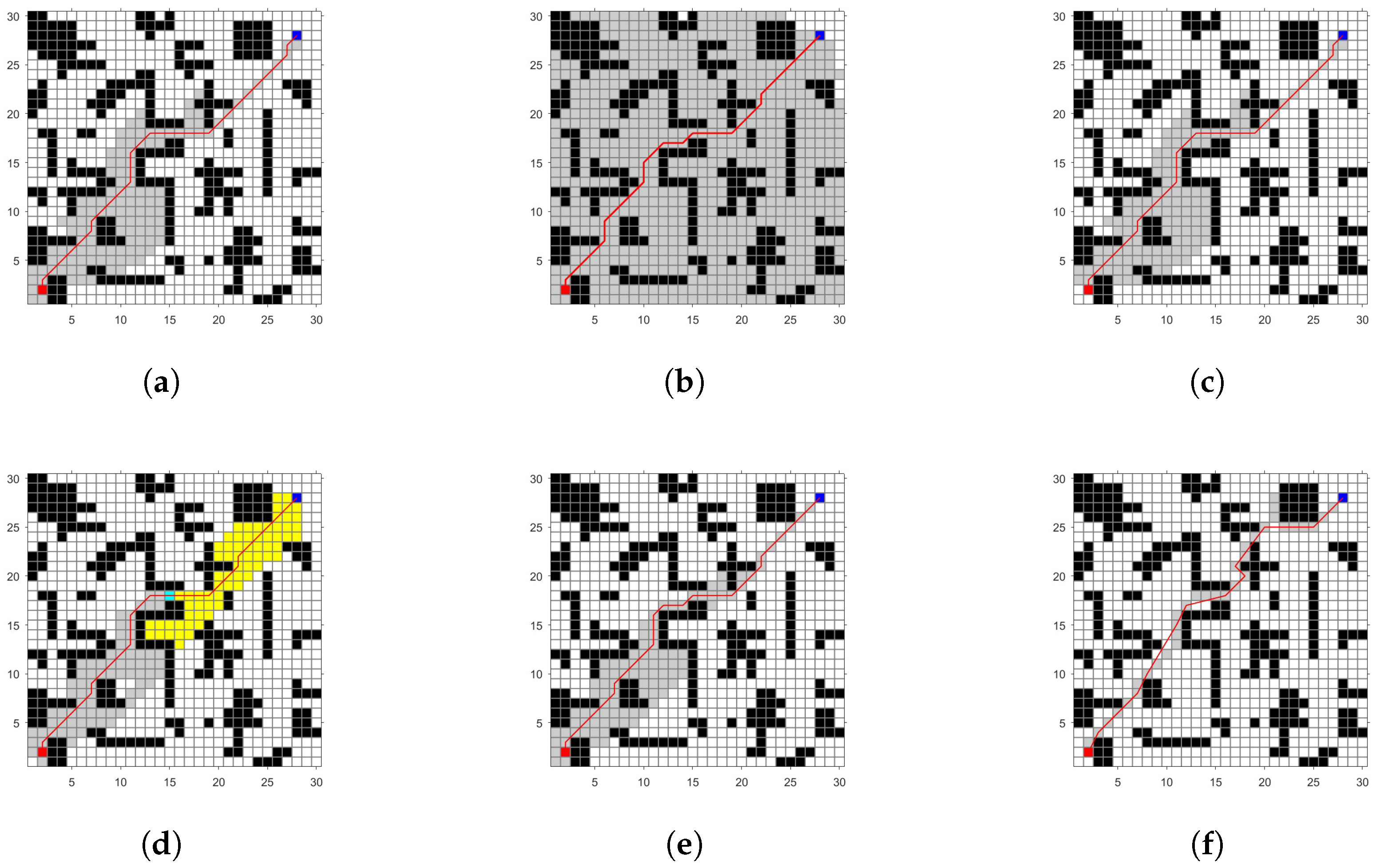
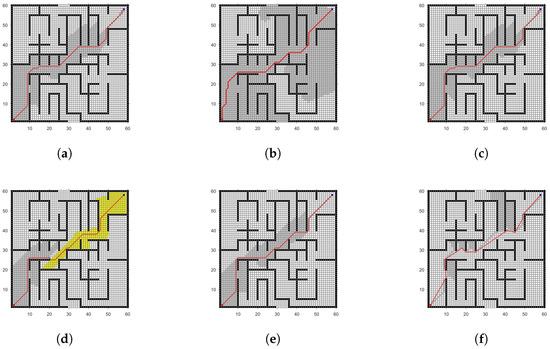
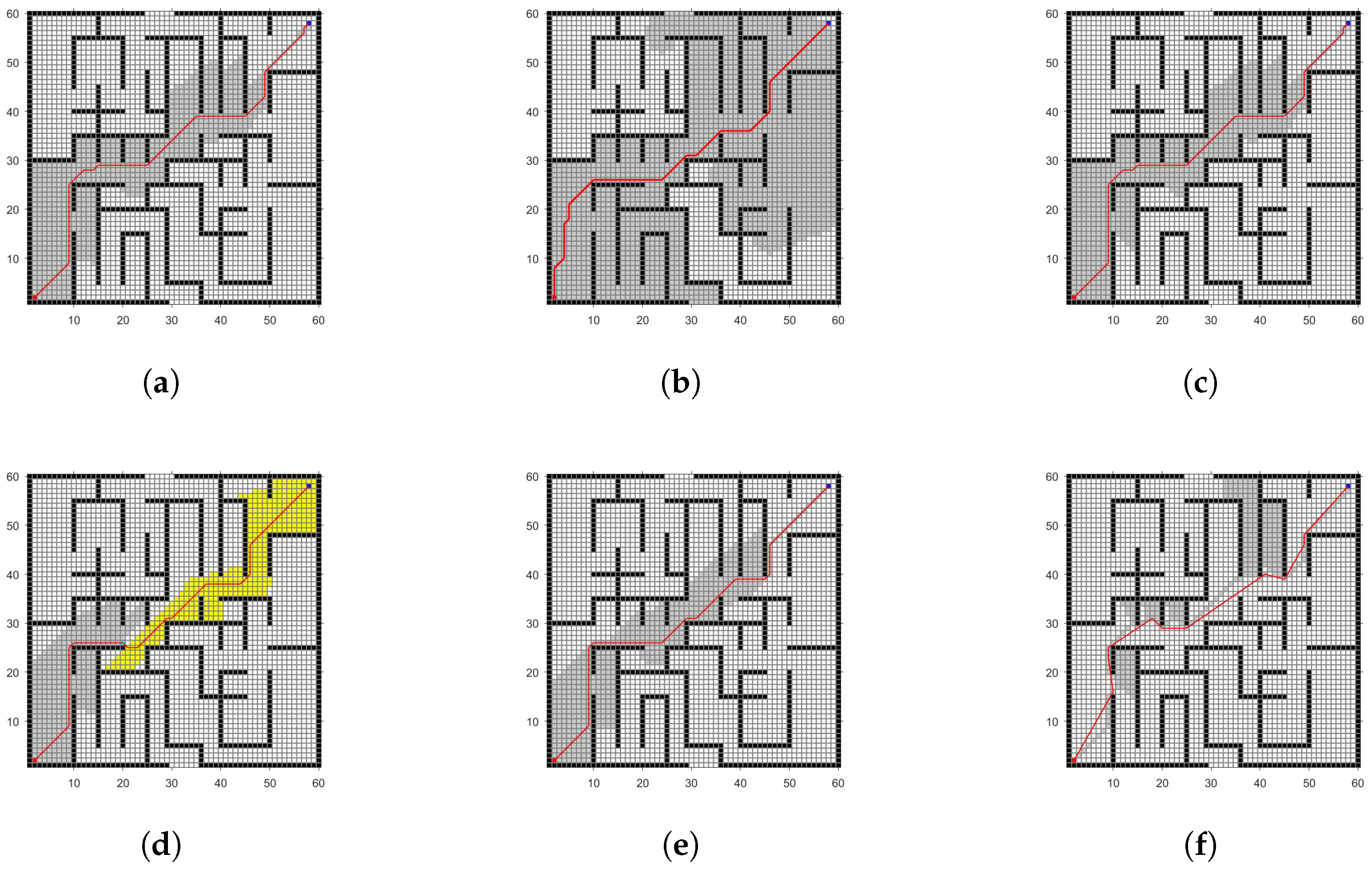
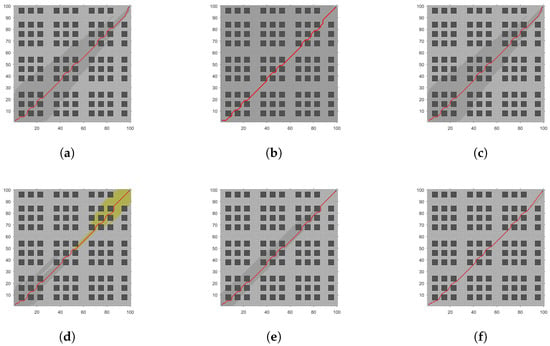
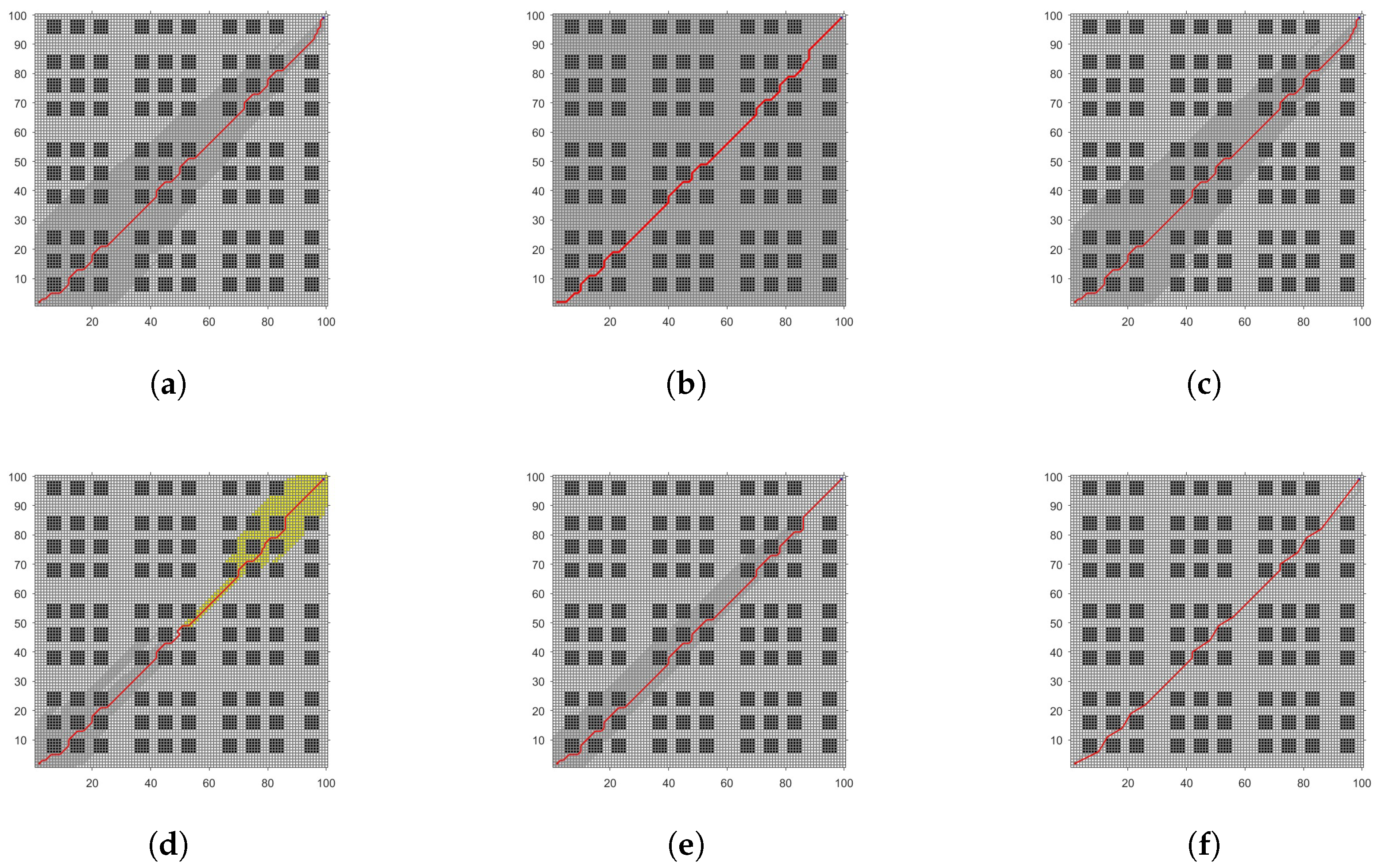
To validate the effectiveness of the enhanced approach, the adaptive A* algorithm developed was benchmarked against the A* algorithm, Dijkstra algorithm, Chen’s method, Bidirectional A* algorithm, and Zhang’s method. Simulation outcomes for distinct algorithms across three varying map sizes are presented in Figure 8, Figure 9 and Figure 10. It is easy to see that, compared with the other five algorithms, the path produced by the adaptive A* algorithm exhibits minimal length and superior smoothness.
Figure 8.
Comparison of outcomes from different algorithms on map: (a) A*; (b) Dijkstra; (c) Chen’s method; (d) Bidirectional A*; (e) Zhang’s method; (f) Adaptive A*.
Figure 9.
Comparison of outcomes from different algorithms on map: (a) A*; (b) Dijkstra; (c) Chen’s method; (d) Bidirectional A*; (e) Zhang’s method; (f) Adaptive A*.
Figure 10.
Comparison of outcomes from different algorithms on map: (a) A*; (b) Dijkstra; (c) Chen’s method; (d) Bidirectional A*; (e) Zhang’s method; (f) Adaptive A*.
As shown in Table 2, on the 30 × 30 map, the adaptive A* algorithm exhibits remarkable performance, featuring the shortest running time and the fewest traversed nodes. The planning duration has dropped from 0.04 s to 0.01 s, representing a 75% improvement; the path length has fallen from 40.41 m to 39.72 m, a reduction of 0.69 m; the traversed node count has declined from 130 to 36, a decrease of 72.3%. This is primarily attributed to the enhanced A* algorithm, which employs an adaptive estimation function to adjust the heuristic weight dynamically, substantially boosting search efficiency and curtailing the planning duration. Furthermore, the adaptive A* algorithm achieves optimal results regarding turning angles exceeding or equal to 45 degrees, dropping from the original 9 to 7, indicating superior path smoothness. In contrast, the Dijkstra algorithm does not utilize heuristic information and lacks directionality, expanding in all directions, resulting in a larger search space, requiring a total of 632 nodes and a planning time of 0.14 s, which is an increase of 79.4% and 71.4% compared to the A* algorithm. Moreover, Chen’s method, Bidirectional A* algorithm, and Zhang’s method have made some improvements to the A* algorithm, but the planning effect is limited, with only improvements in certain indicators. Regarding the planning time and the number of turning points with an angle greater than 45 degrees, the three methods are similar to the traditional A* algorithm. However, due to BA* searching simultaneously from both the start and terminal points, the path it generates is longer.
Table 2.
Comparison of different algorithms on 30 × 30 map.
When the map expands to and , the adaptive A* algorithm still demonstrates excellent planning performance and scalability. As shown in Table 3 and Table 4, compared with the five algorithms, the paths generated by the adaptive A* algorithm are both the shortest and the smoothest, effectively verifying its outstanding performance in environments represented by three different types of maps. In summary, the adaptive A* algorithm presented in this work can shorten the planning duration and path length effectively. Meanwhile, it enhances the route smoothness by eliminating redundant nodes along the route, ensuring that the robot can arrive at the target location rapidly and securely.
Table 3.
Comparison of different algorithms on 60 × 60 map.
Table 4.
Comparison of different algorithms on 100 × 100 map.
4.4. Simulation Comparison of Different Start and End Points
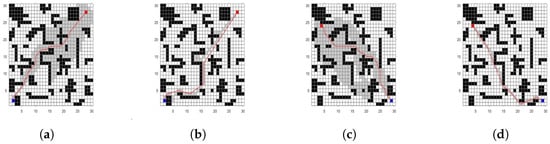
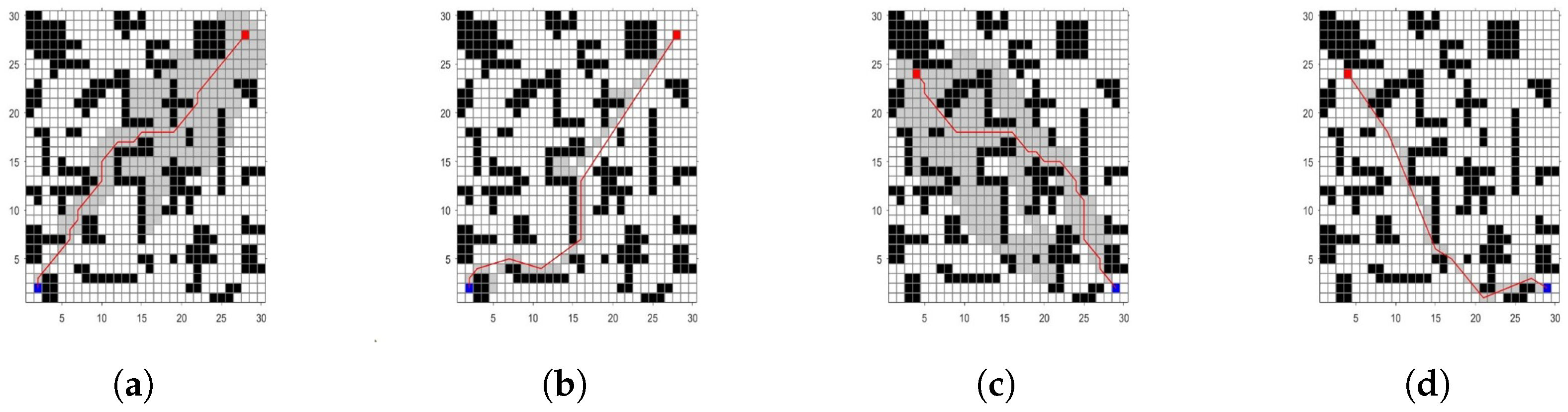
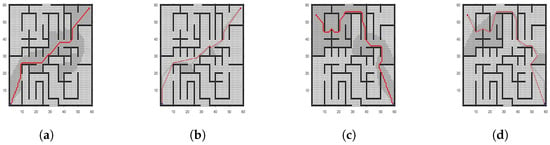
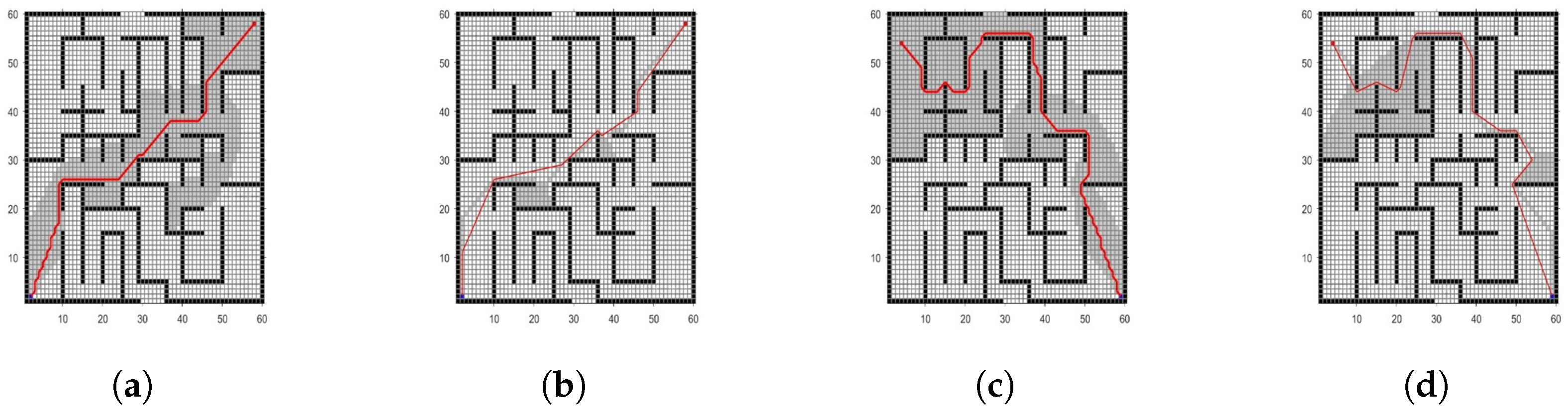
To further verify the effectiveness of the adaptive A* algorithm, the start and end points in the two map sizes of map1: and map2: have been changed to avoid randomness in the experimental results. In map1 and map2, the original start and end points are first swapped. The starting points are , , and the end points are all ; then a set of random start and end points is set, the start points are , , and the ending points are , . The specific simulation results are shown in Figure 11 and Figure 12 described above.
Figure 11.
Simulation outcomes of different start and end points on a map: from (28, 28) to (2, 2): (a) A*, (b) Adaptive A*; from (4, 24) to (29, 2): (c) A*, (d) Adaptive A*.
Figure 12.
Simulation outcomes of different start and end points on a map: from (58, 58) to (2, 2): (a) A*, (b) Adaptive A*; from (4, 54) to (59, 2): (c) A*, (d) Adaptive A*.
As shown in Table 5, under both map sizes, even if the robot’s initial and terminal positions differ, the proposed adaptive A* algorithm still delivers outstanding planning performance. Compared with the conventional A*, after interchanging the start and end positions, the planning duration of the algorithm decreases by 66.7% and 88.9%, respectively, the route length shortens by 0.38 m and 3.27 m, and the quantity of explored nodes drops by 86.8% and 86.3%. The count of turning points featuring a rotation angle of 45 degrees or more falls by 7 and 12, respectively, indicating that the generated path is smoother. When the initial and terminal positions are randomly assigned, where the start coordinates are (4, 24), (4, 54), and the corresponding end coordinates are (29, 2), (59, 2), all path assessment metrics of the adaptive A* algorithm show enhancement. By establishing diverse beginning and destination positions for the robot path, the randomness introduced by the experimental outcomes is diminished, further confirming the robustness and scalability of the adaptive A* algorithm.
Table 5.
Comparison of different start point and end point on and maps.
5. Conclusions
This study introduces an adaptive A* algorithm, aiming to enhance path generation efficiency as well as motion smoothness for mobile robots operating in complicated settings. Firstly, an adaptive estimation function is incorporated to dynamically modulate the heuristic weight based on the spatial relationship between present and target position, thus boosting planning efficiency. Next, the arithmetic mean of Euclidean distance and Manhattan distance is utilized as the metric framework, which enables the robot to determine its moving direction according to the environment characteristics. Meanwhile, redundant nodes along the path are eliminated to refine the motion smoothness. MATLAB simulation outcomes indicate that the improved A* approach demonstrates favorable performance in three different types of maps. Compared with conventional and recently optimized algorithms, the proposed method yields the minimal path length and optimal smoothness.
However, all experiments were conducted via simulations in static environments. Thus, the algorithm’s performance in real-world complex settings requires further validation. Future work will concentrate on deploying this approach onto physical robotic platforms and evaluating it under both static and dynamic conditions. The algorithm’s robustness will be systematically evaluated to strengthen its applicability and stability in practical scenarios. Moreover, as the working scenarios of robots become more complex, the path planning effect brought by a single algorithm may be limited. Local path planning algorithms can be incorporated. Meanwhile, for multi-robot collaborative planning scenarios, task allocation and conflict resolution mechanisms will be devised to elevate path optimization in complex environments.
Author Contributions
Conceptualization, Z.L.; methodology, H.C. and Z.G.; validation, Z.G.; writing, Z.G.; resources: H.C.; formal analysis: Z.G. and Z.L.; supervision, Y.Z. and L.J.; funding acquisition, Y.Z. All authors have read and agreed to the published version of the manuscript.
Funding
This research was funded by the Jiangsu Agricultural Science and Technology Independent Innovation Fund (CX(24)1022).
Data Availability Statement
The data supporting the conclusions of this article will be made available by the authors upon request.
Acknowledgments
We sincerely thank everyone who supported us in the preparation of this manuscript.
Conflicts of Interest
The authors declare no conflicts of interest.
References
- López-Arrabal, A.; Guzmán-Bautista, Á.; Solórzano-Requejo, W.; Franco-Martínez, F.; Villaverde, M. Axisymmetric non-planar slicing and path planning strategy for robot-based additive manufacturing. Mater. Des. 2024, 241, 112915. [Google Scholar]
- Ye, L.; Wu, F.; Zou, X.; Li, J. Path planning for mobile robots in unstructured orchard environments: An improved kinematically constrained bi-directional RRT approach. Comput. Electron. Agric. 2023, 215, 108453. [Google Scholar] [CrossRef] [Scilit]
- Duan, Z.; Zhang, Y.; Shao, Z.; Xu, Z.; Xiang, Z. Advanced robot path planning on rough terrain: A Q-learning-based multi-objective PSO algorithm. Appl. Soft Comput. 2025, 184, 113798. [Google Scholar]
- Alshammrei, S.; Boubaker, S.; Kolsi, L. Improved Dijkstra algorithm for mobile robot path planning and obstacle avoidance. Comput. Mater. Contin. 2022, 72, 5939–5954. [Google Scholar] [CrossRef] [Scilit]
- Huang, J.; Chen, C.; Shen, J.; Liu, G.; Xu, F. A self-adaptive neighborhood search A-star algorithm for mobile robots global path planning. Comput. Electr. Eng. 2025, 123, 110018. [Google Scholar]
- Wang, J.; Li, B.; Meng, M.Q.H. Kinematic constrained bi-directional RRT with efficient branch pruning for robot path planning. Expert Syst. Appl. 2021, 170, 114541. [Google Scholar] [CrossRef] [Scilit]
- Zhou, X.; Wang, X.; Xie, Z.; Gao, J.; Li, F.; Gu, X. A collision-free path planning approach based on rule guided lazy-PRM with repulsion field for gantry welding robots. Robot. Auton. Syst. 2024, 174, 104633. [Google Scholar]
- Wu, L.; Huang, X.D.; Cui, J.G.; Liu, C.; Xiao, W. Modified adaptive ant colony optimization algorithm and its application for solving path planning of mobile robot. Expert Syst. Appl. 2023, 215, 119410. [Google Scholar]
- Yang, N.; Zhang, F.; Jin, B.; Wang, M. Three-dimensional path planning for a novel sediment sampler in ocean environment based on an improved mutation operator genetic algorithm. Ocean Eng. 2023, 289, 116142. [Google Scholar] [CrossRef] [Scilit]
- Pandey, A.; Panwar, V.S.; Hasan, M.E.; Parhi, D.R. V-REP-based navigation of automated wheeled robot between obstacles using PSO-tuned feedforward neural network. J. Comput. Des. Eng. 2020, 7, 427–434. [Google Scholar]
- Guo, H.; Li, Y.; Wang, H.; Wang, C.; Zhang, J.; Wang, T.; Rong, L.; Wang, H.; Wang, Z.; Huo, Y.; et al. Path planning of greenhouse electric crawler tractor based on the improved A* and DWA algorithms. Comput. Electron. Agric. 2024, 227, 109596. [Google Scholar] [CrossRef] [Scilit]
- Zeng, X.; Zhang, J.; Yin, W.; Yang, H.; Yu, H.; Liang, Y.; Tong, J. Path planning strategies for logistics robots: Integrating enhanced A-star algorithm and DWA. Electron. Lett. 2024, 60, e70090. [Google Scholar]
- Wang, X.; Lu, J.; Ke, F.; Wang, X.; Wang, W. Research on AGV task path planning based on improved A* algorithm. Virtual Real. Intell. Hardw. 2023, 5, 249–265. [Google Scholar] [CrossRef] [Scilit]
- Li, C.; Huang, X.; Ding, J.; Song, K.; Lu, S. Global path planning based on a bidirectional alternating search A* algorithm for mobile robots. Comput. Ind. Eng. 2022, 168, 108123. [Google Scholar] [CrossRef] [Scilit]
- Botea, A.; Müller, M.; Schaeffer, J. Near optimal hierarchical path-finding. J. Game Dev. 2004, 1, 1–30. [Google Scholar]
- Likhachev, M.; Gordon, G.; Thrun, S. ARA*: Anytime A* with provable bounds on sub-optimality. Adv. Neural Inf. Process. Syst. 2003, 16, 767–774. [Google Scholar]
- Ou, Y.; Fan, Y.; Zhang, X.; Lin, Y.; Yang, W. Improved A* path planning method based on the grid map. Sensors 2022, 22, 6198. [Google Scholar] [CrossRef] [Scilit] [PubMed]
- Huang, C.; Luo, L.; Wei, X.; Chen, J. Safe priority path planning for robots based on improved A* algorithm. In Proceedings of the 2024 11th International Forum on Electrical Engineering and Automation (IFEEA); IEEE: Piscataway, NJ, USA, 2024; pp. 1207–1211. [Google Scholar]
- Yonetani, R.; Taniai, T.; Barekatain, M.; Nishimura, M.; Kanezaki, A. Path planning using neural A* search. In Proceedings of the 38th International Conference on Machine Learning (ICML), Virtual, 18–24 July 2021; pp. 12029–12039. [Google Scholar]
- Liu, H.; Shen, Y.; Yu, S.; Gao, Z.; Wu, T. Deep reinforcement learning for mobile robot path planning. arXiv 2024, arXiv:2404.06974. [Google Scholar]
- Zhang, J.; Qiao, J.; Huang, K.; Zhang, M. An optimized hierarchical path planning method based on deep reinforcement learning for mobile robots. Expert Syst. Appl. 2026, 298, 129736. [Google Scholar]
- Dimarogonas, D.V.; Kyriakopoulos, K.J. Connectedness preserving distributed swarm aggregation for multiple kinematic robots. IEEE Trans. Robot. 2008, 24, 1213–1223. [Google Scholar] [CrossRef] [Scilit]
- Ning, B.; Han, Q.L. Prescribed finite-time consensus tracking for multiagent systems with nonholonomic chained-form dynamics. IEEE Trans. Autom. Control 2018, 64, 1686–1693. [Google Scholar]
- Huang, Y.; Li, M.; Zhao, T. A multi-robot coverage path planning algorithm based on improved DARP algorithm. arXiv 2023, arXiv:2304.09741. [Google Scholar]
- Wang, W.; Li, J.; Bai, Z.; Peng, J. Toward optimization of AGV path planning: An RRT*-ACO algorithm. IEEE Access 2024, 12, 18387–18399. [Google Scholar] [CrossRef] [Scilit]
- Wu, D.; Li, Y. Mobile robot path planning based on improved smooth A* algorithm and optimized dynamic window approach. In Proceedings of the 2024 2nd International Conference on Signal Processing and Intelligent Computing (SPIC), Shenzhen, China, 20–22 December 2024; pp. 345–348. [Google Scholar]
- Liu, S.; Qian, Z.; Jiang, S.; Miao, Q. Improved A* algorithm based on artificial potential field method for global path planning of unmanned surface vessels in complex environments. IEEE Access 2025, 13, 107055–107066. [Google Scholar] [CrossRef] [Scilit]
- Dijkstra, E.W. A note on two problems in connexion with graphs. Numer. Math. 1959, 1, 269–271. [Google Scholar] [CrossRef] [Scilit]
- Chen, S.; Ji, J.; Su, H.; Yang, Y. Improved A-star method for collision avoidance and path smoothing. In Proceedings of the 2023 IEEE International Conference on Control, Electronics and Computer Technology (ICCECT), Jilin, China, 12–14 May 2023; pp. 32–35. [Google Scholar]
- Xu, D.; Yang, J.; Zhou, X.; Xu, H. Hybrid path planning method for USV using bidirectional A* and improved DWA considering the manoeuvrability and COLREGs. Ocean Eng. 2024, 298, 117210. [Google Scholar] [CrossRef] [Scilit]
- Zhang, H.; Tao, Y.; Zhu, W. Global path planning of unmanned surface vehicle based on improved A-star algorithm. Sensors 2023, 23, 6647. [Google Scholar] [CrossRef] [Scilit] [PubMed]

Disclaimer/Publisher’s Note: The statements, opinions and data contained in all publications are solely those of the individual author(s) and contributor(s) and not of MDPI and/or the editor(s). MDPI and/or the editor(s) disclaim responsibility for any injury to people or property resulting from any ideas, methods, instructions or products referred to in the content. |
© 2026 by the authors. Licensee MDPI, Basel, Switzerland. This article is an open access article distributed under the terms and conditions of the Creative Commons Attribution (CC BY) license.