1. Introduction
Electricity has long been regarded as one of the most challenging topics in science education because many electrical phenomena are abstract, invisible, and difficult for students to observe directly [
1]. Students frequently experience difficulties understanding the relationships among electric current, voltage, resistance, and circuit behavior, and often develop misconceptions regarding electric circuits and electrical phenomena [
2,
3,
4]. For example, some students believe that electric current is consumed as it passes through circuit components, whereas others fail to recognize that a complete closed circuit is required for a bulb to emit light. Because underlying electrical processes cannot be directly observed, students often develop misconceptions that are resistant to change and may persist even after formal instruction [
5]. Recent research has further shown that students continue to experience substantial difficulties understanding even relatively simple electrical circuit concepts [
6].
Traditional electricity instruction commonly relies on textbook explanations, static diagrams, teacher demonstrations, and worksheet-based activities. However, such instructional approaches may not adequately support students in visualizing unobservable electrical phenomena, exploring dynamic circuit behavior, or constructing scientifically accurate mental models of electricity-related concepts. Consequently, students may continue to rely on intuitive explanations rather than scientifically accepted conceptions. Previous studies have suggested that visualization- and simulation-based learning environments may facilitate conceptual understanding by supporting interactive exploration, experimentation, and observation of invisible scientific phenomena [
7,
8,
9].
Among emerging educational technologies, augmented reality (AR) has been increasingly applied to support contextualized visualization, real-world interaction, and hands-on learning experiences in science education [
8,
10]. By integrating virtual information with physical environments, AR enables learners to visualize otherwise invisible phenomena while maintaining interaction with real-world objects. In electricity learning, AR is suitable for supporting circuit construction and visualization of electrical phenomena because learners can physically manipulate circuit components while simultaneously observing virtual representations of underlying electrical processes.
Virtual reality (VR) technology has been widely adopted in science education to support simulation-based learning, experimentation, and interactive exploration of scientific phenomena [
9,
11]. In the present study, VR refers specifically to a non-immersive virtual simulation environment operated through tablet-based interaction rather than head-mounted displays (HMDs). Compared with immersive VR environments, non-immersive VR may provide greater classroom accessibility while supporting repeated experimentation, variable manipulation, immediate feedback, and exploration of quantitative relationships among scientific variables. In electricity learning, such affordances may be particularly useful for supporting voltage measurement and Ohm’s law experimentation because learners can repeatedly manipulate variables, observe measurement results, and conduct experimental exploration within controllable learning environments.
Recent perspectives in educational technology have suggested that the effectiveness of digital learning environments depends not only on the technologies employed but also on how their instructional affordances are aligned with specific learning objectives, conceptual characteristics, and cognitive processing demands. Consistent with the Cognitive Theory of Multimedia Learning [
12], Cognitive Load Theory [
13], and Conceptual Change Theory [
14], visualization, interaction, experimentation, and conceptual change play important roles in supporting meaningful science learning. These theoretical perspectives further suggest that different technologies may support different conceptual learning processes and therefore should be selected according to the characteristics of the learning task rather than technological novelty alone.
Although previous studies have reported positive educational effects of AR and VR in science learning, most research has examined AR- and VR-based learning environments independently. Existing studies have generally emphasized technology implementation rather than examining how different technological affordances can be systematically aligned with different conceptual learning requirements. In electricity learning, different concepts involve distinct learning difficulties. Basic circuit learning requires students to connect observable circuit structures with invisible electrical processes, while voltage measurement and Ohm’s law learning require repeated experimentation, variable manipulation, and interpretation of quantitative relationships among electrical variables. However, relatively few studies have proposed concept-oriented instructional frameworks that systematically align different technological affordances with electricity-learning tasks and conceptual processing demands. Consequently, it remains unclear how AR and non-immersive VR simulation may function as complementary instructional tools when aligned with different conceptual learning tasks and processing demands in electricity learning.
To address this gap, the present study developed a concept-oriented AR/VR instructional framework for electricity learning that systematically aligned different technological affordances with different electricity-learning tasks and conceptual processing demands. Specifically, AR was employed to support hands-on circuit construction and real-time visualization of otherwise invisible electrical phenomena, whereas non-immersive VR simulation was used to support voltage measurement and Ohm’s law experimentation through repeated and controllable experimental exploration. Accordingly, the present study addressed the following research questions:
RQ1: Does the concept-oriented AR/VR instructional framework improve ninth-grade students’ science achievement compared with conventional instruction?
RQ2: Does the concept-oriented AR/VR instructional framework improve ninth-grade students’ science learning motivation compared with conventional instruction?
2. Literature Review
2.1. Electricity Misconceptions and Learning Difficulties
Electricity has long been regarded as one of the most challenging topics in science education because many electrical phenomena are abstract, invisible, and difficult to observe directly [
1,
5]. Unlike directly observable phenomena, electrical processes occur within circuits and cannot be readily visualized by learners. As a result, students often rely on intuitive reasoning, everyday experiences, and observable features of electric circuits to explain electrical phenomena, which frequently leads to the development of misconceptions and alternative conceptions about electricity.
Previous studies have consistently shown that students experience substantial difficulties understanding fundamental electricity concepts, including electric current, voltage, resistance, and circuit behavior [
1,
2]. One of the most frequently reported misconceptions is the current-consumption model, in which students believe that electric current is gradually consumed as it passes through bulbs or other circuit components [
1,
3]. Students often fail to recognize that electric circuits operate as interconnected systems and instead employ sequential reasoning, assuming that circuit components located closer to the battery receive more current than components located farther away.
Additionally, many students experience difficulties distinguishing between current and voltage and may incorrectly regard voltage as a consequence of current rather than understanding voltage as the potential difference that drives charge flow in a circuit [
2]. These misconceptions suggest that students often construct intuitive mental models of electricity that differ substantially from scientifically accepted models. Moreover, understanding electric circuits requires systems-level reasoning because electrical circuits function as interconnected systems in which changes in one component may influence the behavior of the entire circuit. Research conducted across different countries, educational levels, and learning contexts has reported remarkably similar misconceptions, suggesting that these learning difficulties are widespread across diverse educational settings rather than being confined to specific contexts [
6].
These misconceptions are often resistant to change because students cannot directly observe the underlying electrical processes occurring within circuits. Consequently, learners frequently construct explanations based on visible circuit components and everyday experiences rather than scientifically accepted models of electricity. Previous studies have shown that even after formal instruction, many students continue to retain misconceptions about electric circuits, indicating that traditional instructional approaches are often insufficient for promoting conceptual change [
5].
Because electricity learning requires students to understand invisible processes and relationships among multiple abstract concepts, instructional approaches that rely primarily on verbal explanations, formulas, or static diagrams may not adequately support conceptual understanding. Therefore, effective electricity instruction requires learning environments that support visualization of otherwise invisible electrical phenomena, conceptual interaction, and repeated exploration of circuit behavior.
AR and VR technologies may provide meaningful support for electricity learning because they enable learners to observe representations of electrical processes, manipulate circuit variables, and explore cause–effect relationships that are difficult to observe through conventional instruction. Through visualization, interactive exploration, and repeated experimentation, AR and non-immersive VR simulations may help learners construct more scientifically accurate mental models of current flow, voltage, resistance, and circuit behavior while facilitating conceptual understanding and conceptual change in electricity learning.
2.2. Theoretical Foundations
2.2.1. Cognitive Theory of Multimedia Learning
The Cognitive Theory of Multimedia Learning (CTML) proposed by Mayer [
12] suggests that meaningful learning occurs when learners actively process and integrate verbal and visual information. According to CTML, learners process information through separate visual–pictorial and auditory–verbal channels, each of which has limited processing capacity. Meaningful learning is achieved when learners actively select relevant information, organize it into coherent mental representations, and integrate it with prior knowledge. Effective multimedia instructional design should therefore facilitate these cognitive processes while minimizing unnecessary cognitive processing demands.
Visual representations and simulation-based learning environments may facilitate learners’ understanding of complex and abstract concepts by making difficult-to-observe phenomena more accessible and enabling interactive exploration of scientific phenomena [
7,
15]. Furthermore, AR-supported learning environments may facilitate conceptual knowledge acquisition by presenting virtual information in close spatial proximity to physical learning materials, thereby supporting learners’ integration of related information across multiple representations [
16].
Electricity learning often involves invisible electrical processes and complex relationships among current, voltage, resistance, and circuit components that are difficult for students to directly observe or mentally visualize [
1]. Consequently, learners may experience difficulties constructing scientifically accurate mental models of electrical phenomena. From a CTML perspective, visualizations and interactive representations may facilitate conceptual understanding by making invisible processes observable and by supporting the integration of verbal explanations with visual representations.
Previous studies have suggested that physical and virtual laboratory environments support science learning by enabling learners to explore scientific phenomena through interactive experimentation and dynamic visual representations [
17]. Therefore, CTML provides an important theoretical foundation for explaining how visualization, interaction, and multiple representations may support conceptual understanding and mental model development in electricity learning. In the present study, this perspective informed the concept-oriented AR/VR instructional framework, where AR was used to support visualization of otherwise invisible electrical phenomena and non-immersive VR simulation was used to support repeated experimentation and exploration of quantitative relationships among electrical variables.
2.2.2. Cognitive Load Theory
Cognitive Load Theory (CLT), proposed by Sweller [
13], suggests that learners’ working memory capacity is limited during learning. Learning performance may be negatively affected when instructional materials impose excessive cognitive demands that exceed learners’ available cognitive resources. Therefore, effective instructional design should minimize unnecessary cognitive processing while supporting learners’ allocation of cognitive resources to meaningful learning activities.
Electricity learning often requires students to simultaneously process multiple forms of information, including circuit diagrams, symbolic representations, mathematical relationships, experimental observations, and conceptual explanations. Such learning tasks may impose substantial cognitive demands, particularly when the underlying electrical processes cannot be directly observed [
1]. Previous studies have suggested that simulation-based learning environments may support conceptual understanding and scientific inquiry through interactive experimentation, variable manipulation, and dynamic visualization of scientific phenomena [
7,
18]. Appropriately designed instructional supports may reduce unnecessary cognitive processing and facilitate more efficient learning.
From the perspective of CLT, the educational effectiveness of digital learning technologies depends not only on their technological sophistication but also on how effectively they support learners’ cognitive processing. Previous research has shown that higher levels of technological immersion do not necessarily lead to superior learning outcomes. For example, Makransky et al. [
19] reported that immersive VR environments generated higher cognitive load, which may negatively affect learning performance. These findings suggest that effective technology integration requires careful consideration of learners’ cognitive processing demands rather than simply increasing levels of technological immersion [
20].
Recent studies have further suggested that AR-supported learning environments may facilitate learning when multimedia design principles, visual information, and interactive functions are appropriately integrated to support learners’ cognitive processing and reduce unnecessary cognitive demands [
21]. Accordingly, this study adopted a concept-oriented AR/VR instructional framework where different technological affordances were aligned with different conceptual learning tasks. AR was employed to support real-time visualization of electron flow and hands-on circuit interaction during basic circuit learning, whereas non-immersive VR simulation was used to support voltage measurement and Ohm’s law experimentation through repeated and controllable exploration. From a CLT perspective, such an instructional framework may help learners focus on conceptual understanding and experimental reasoning by providing learning supports that are aligned with the cognitive demands of different electricity-learning tasks.
2.2.3. Conceptual Change Theory
Conceptual Change Theory suggests that students often enter science classrooms with prior knowledge and intuitive beliefs that may differ from scientifically accepted concepts [
14]. Meaningful science learning therefore involves not only acquiring new information but also restructuring existing conceptual frameworks and revising prior conceptions. According to Posner et al. [
14], conceptual change is more likely to occur when learners become dissatisfied with their existing conceptions and perceive new conceptions as intelligible, plausible, and fruitful for explaining phenomena.
In electricity learning, students frequently develop misconceptions regarding electric current, voltage, resistance, and circuit behavior [
1,
2,
4]. These misconceptions are often persistent because electrical processes are abstract, invisible, and difficult to observe directly. Consequently, students may continue to rely on intuitive explanations even after formal instruction [
5]. Research on conceptual change has further suggested that misconceptions are often resistant to change and that conceptual restructuring is typically a gradual process rather than an immediate replacement of prior knowledge [
22].
Previous studies have shown that conceptual change can be facilitated through instructional approaches that encourage learners to examine their existing conceptions, confront contradictory evidence, and construct more scientifically acceptable explanations. A recent meta-analysis synthesizing 218 studies involving more than 18,000 students reported significant positive effects of conceptual change interventions on science learning outcomes, providing substantial empirical support for the use of conceptual change-oriented instruction in science education [
23].
From the perspective of Conceptual Change Theory, effective electricity instruction should provide learning experiences that help students compare their intuitive beliefs with scientific explanations of electrical phenomena. In the present study, this perspective informed the concept-oriented AR/VR instructional framework, in which different technological affordances were aligned with different conceptual learning tasks. Specifically, AR was employed to support real-time visualization of electron flow and hands-on circuit interaction, enabling students to observe otherwise invisible electrical phenomena within authentic learning contexts. In contrast, non-immersive VR simulation was used to support voltage measurement and Ohm’s law experimentation through repeated and controllable exploration. From a conceptual change perspective, such learning experiences may help learners recognize limitations in their prior conceptions, construct more coherent mental models, and progressively develop scientifically accepted understandings of electricity-related phenomena.
2.3. Virtual Reality in Science Learning
Virtual reality (VR) refers to computer-generated environments that enable learners to interact with simulated objects and learning contexts in real time [
24]. According to the level of immersion, VR systems are commonly categorized as immersive, semi-immersive, and non-immersive VR environments [
11,
25]. Immersive VR typically employs head-mounted displays (HMDs) and fully simulated three-dimensional environments, whereas non-immersive VR environments, also referred to as desktop VR, utilize conventional displays and standard interaction devices to support interaction with virtual content.
In science education, VR technology has been widely applied to support the learning of abstract, dynamic, and difficult-to-observe scientific phenomena and concepts [
26]. VR-based learning environments may facilitate conceptual understanding by enabling learners to visualize scientific phenomena, manipulate virtual objects, and explore simulated environments through interactive experiences. In addition, VR simulations may support inquiry and experimental learning by providing opportunities for repeated experimentation, variable manipulation, and safe exploration of scientific phenomena that may be difficult, costly, or impractical to implement in real-world classrooms [
9].
Non-immersive VR environments may offer practical advantages for classroom implementation because they typically require less specialized equipment and can be more readily integrated into existing instructional settings while still supporting positive learning outcomes [
11,
25]. In electricity learning, non-immersive VR simulations may support voltage measurement and Ohm’s law experimentation by allowing learners to repeatedly manipulate variables, observe measurement results, and conduct controllable experimental exploration in simulated environments. Such learning experiences may facilitate learners’ exploration of quantitative relationships among voltage, current, and resistance through interactive experimentation and observation of circuit behavior.
The VR environment adopted in this study belongs to the category of non-immersive VR simulation because students interacted with virtual objects through tablet-based interfaces rather than head-mounted displays. Therefore, the discussion of VR in this study focuses primarily on simulation, experimentation, and interactive exploration. From a concept-oriented instructional perspective, non-immersive VR simulations may provide opportunities for repeated measurement, variable manipulation, immediate feedback, and controllable experimentation within classroom settings. Such affordances may enable learners to systematically examine relationships among electrical variables, test predictions, compare outcomes across different scenarios, and observe the consequences of experimental manipulations. By supporting repeated experimentation and real-time observation of outcomes, non-immersive VR simulations may facilitate learners’ understanding of abstract electricity concepts and contribute to the development of more coherent mental models of electrical phenomena.
2.4. Augmented Reality in Science Learning
Augmented reality (AR) refers to a technology that integrates virtual information or digital objects into real-world environments, allowing users to interact with real and virtual elements in real time [
27]. Unlike VR, which places learners in fully simulated environments, AR integrates digital content with real-world contexts while maintaining learners’ awareness of their physical surroundings. Previous studies have suggested that AR may support science learning by enhancing visualization, contextual interaction, and interactive exploration of scientific concepts [
10].
In science education, AR has been widely applied to support the learning of abstract, dynamic, and difficult-to-observe scientific phenomena [
8]. By superimposing virtual representations onto physical environments, AR enables learners to visualize otherwise invisible processes and establish connections between observable phenomena and underlying scientific concepts. Recent reviews have suggested that AR is particularly valuable in science learning because it facilitates the visualization of invisible or submicroscopic phenomena, supports spatial reasoning, and promotes conceptual connections across multiple levels of scientific representation [
28]. In addition, AR may facilitate learning through multiple representations by integrating real-world objects, 3D visualizations, and contextualized information within a single learning environment. Such affordances may help learners construct more coherent mental models of complex scientific concepts.
Furthermore, AR environments designed according to multimedia learning principles may facilitate conceptual knowledge acquisition by presenting virtual information in close spatial proximity to physical learning materials, thereby reducing split attention and supporting conceptual processing [
16]. Previous studies have also suggested that AR learning environments may support students’ interest, engagement, and science learning by providing interactive and meaningful learning experiences that connect scientific concepts with authentic contexts [
29].
However, previous findings regarding the educational effects of AR have not always been consistent. Review studies have suggested that the effectiveness of AR depends not only on the technology itself but also on instructional design, learning tasks, the quality of visual representations, and the degree of learner interaction provided by the learning environment [
8,
28]. These findings indicate that AR’s educational value lies in aligning its affordances with specific learning objectives and conceptual demands.
Different forms of AR may provide different instructional affordances for science learning. In this study, AR was used to support circuit construction activities and the visualization of electrical phenomena during basic circuit learning. From a concept-oriented instructional perspective, AR may provide opportunities for hands-on circuit construction, real-time visualization of otherwise invisible electrical processes, and integration of physical circuit manipulation with virtual representations of electrical phenomena. Such affordances may enable learners to connect observable circuit configurations with underlying electrical concepts, examine relationships between circuit structures and electrical phenomena, and interpret abstract electricity concepts through multiple forms of representation. By supporting the integration of hands-on interaction and real-time visualization, AR may facilitate learners’ understanding of fundamental electricity concepts and contribute to the development of more coherent mental models of electrical phenomena.
2.5. AR/VR Integration in Science Learning
Previous studies have extensively investigated the educational applications of AR and VR in science learning. Although many studies have reported positive educational effects, prior research has primarily focused on AR-only or VR-only learning environments. Consequently, relatively limited attention has been paid to how different technologies may be strategically combined to support different conceptual learning tasks and cognitive processing demands.
The effectiveness of digital learning environments depends not merely on the technologies employed but on how their instructional affordances are aligned with specific learning objectives, conceptual characteristics, and cognitive processing demands. From the perspectives of the Cognitive Theory of Multimedia Learning (CTML), Cognitive Load Theory (CLT), and Conceptual Change Theory, different educational technologies may support different learning processes and conceptual tasks. Accordingly, the educational value of AR/VR integration may not arise simply from combining multiple technologies but from strategically aligning different technological affordances with different conceptual learning requirements.
In electricity learning, different concepts involve distinct learning difficulties and instructional needs. Basic circuit learning requires students to connect observable circuit structures with invisible electrical processes, whereas voltage measurement and Ohm’s law learning require repeated experimentation, variable manipulation, and observation of quantitative relationships among electrical variables. These conceptual characteristics suggest that different technologies may provide different forms of instructional support.
From a concept-oriented instructional perspective, AR and non-immersive VR simulation may serve complementary rather than redundant instructional functions. AR is particularly suitable for supporting circuit construction and visualization of electrical phenomena because it integrates virtual representations with physical circuit manipulation in authentic learning contexts. In contrast, non-immersive VR simulation is particularly suitable for supporting voltage measurement and Ohm’s law exploration because it enables repeated experimentation, controllable variable manipulation, immediate feedback, and safe exploration of circuit behavior. Therefore, different technological affordances may support different conceptual processing demands during electricity learning.
To better position the present study within the existing literature,
Table 1 summarizes representative AR-based, VR-based, and integrated AR/VR studies and compares their instructional affordances and contributions with those of the present study.
As shown in
Table 1, previous studies have suggested that AR and VR provide distinct instructional affordances for supporting science learning. AR-based studies have primarily emphasized visualization, contextualized interaction, and the integration of virtual representations with real-world environments, whereas VR-based studies have mainly focused on simulation, experimentation, and interactive exploration of scientific phenomena. Furthermore, recent VR research has suggested that higher levels of immersion do not necessarily result in superior learning outcomes and that the educational effectiveness of VR depends largely on instructional design and cognitive processing demands.
The comparison further indicates that AR and non-immersive VR simulation may provide complementary instructional affordances for supporting different conceptual processing demands and learning tasks. AR may be particularly suitable for helping learners connect observable real-world contexts with otherwise invisible scientific phenomena, whereas non-immersive VR simulation may be particularly suitable for supporting repeated experimentation, variable manipulation, and exploration of quantitative relationships among scientific variables. These complementary affordances suggest that different technologies may support different conceptual processing demands and learning processes during science learning.
However, relatively few studies have systematically aligned technological affordances with conceptual learning requirements within a unified instructional framework. In particular, limited research has examined how AR and non-immersive VR simulation may be strategically combined to support different conceptual processing demands within the same science-learning context. Most previous studies have examined AR- or VR-based learning environments independently, with limited attention to how different technologies may complement one another in supporting learning activities and conceptual processing demands. Consequently, the theoretical basis for selecting and combining technologies to support specific conceptual learning tasks remains insufficiently explored.
To address this gap, the present study proposes a concept-oriented AR/VR instructional framework for electricity learning that aligns specific technological affordances with specific conceptual learning tasks and conceptual processing demands. Specifically, AR was employed to support circuit construction and visualization of otherwise invisible electrical phenomena, whereas non-immersive VR simulation was employed to support voltage measurement and Ohm’s law experimentation through repeated and controllable exploration. Rather than emphasizing technology integration itself, the proposed framework focuses on the pedagogical alignment between technological affordances and conceptual learning requirements.
Building upon the Cognitive Theory of Multimedia Learning (CTML), Cognitive Load Theory (CLT), and Conceptual Change Theory, the proposed framework explains how different technological affordances may support different conceptual learning processes in electricity education. CTML informed the use of AR-based visualizations and multiple representations to support the integration of verbal explanations, visual information, and hands-on circuit manipulation when learning invisible electrical phenomena. Furthermore, meaningful learning may be facilitated when learners actively integrate visual, verbal, and dynamic representations during the learning process [
29]. CLT informed the use of non-immersive VR simulations for measurement and experimentation activities by providing opportunities for repeated practice, variable manipulation, and immediate feedback while reducing unnecessary cognitive demands. Conceptual Change Theory informed the design of learning activities that encourage learners to compare their existing conceptions with observable evidence generated through AR visualizations and VR-based experimentation, thereby facilitating conceptual reconstruction.
Based on the preceding analysis and theoretical foundations,
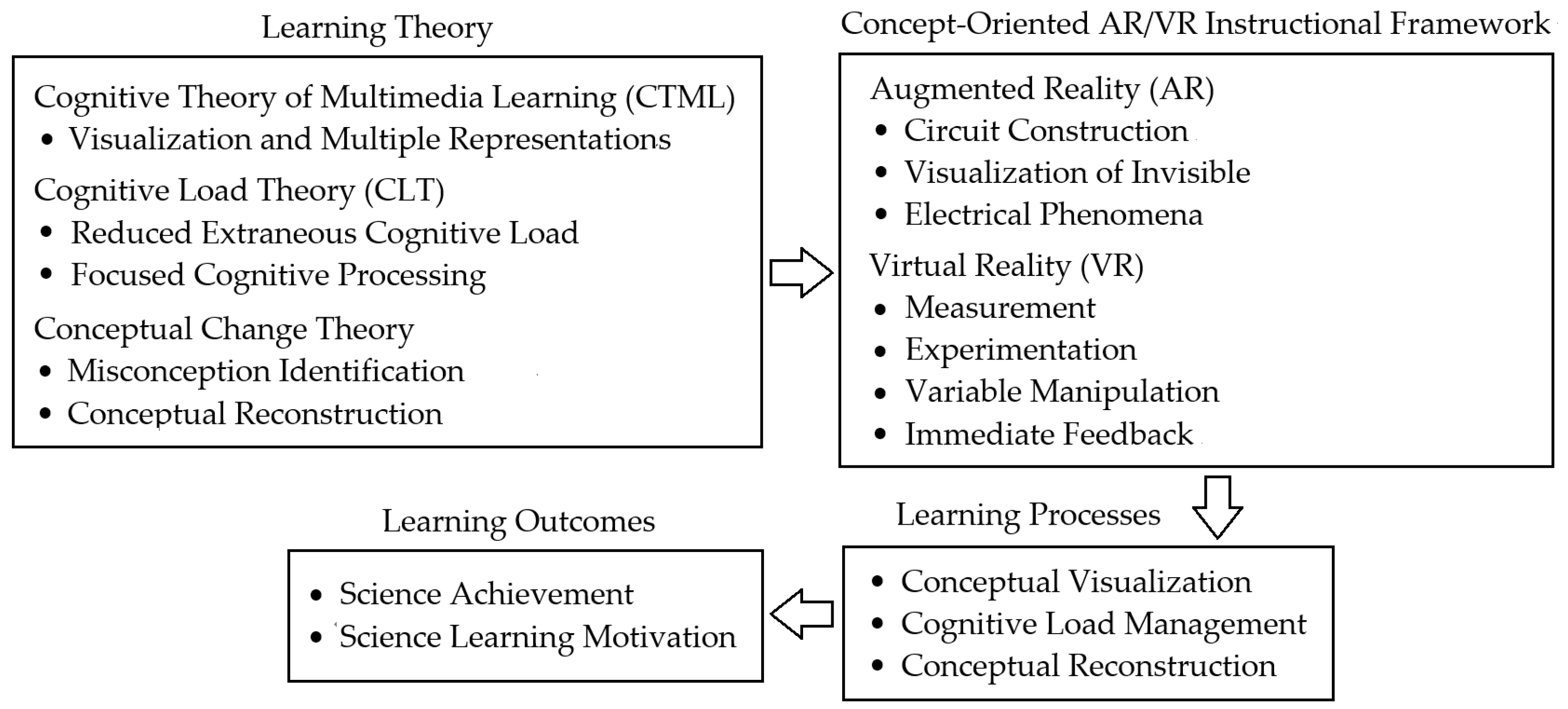
Figure 1 presents the proposed concept-oriented AR/VR instructional framework for electricity learning, which was developed not merely as a technology integration approach but as a theoretically grounded instructional model linking learning theories, technological affordances, conceptual learning tasks, learning processes, and expected learning outcomes. The framework proposes that AR and non-immersive VR simulation support learning through different but complementary instructional functions that address distinct conceptual processing demands in electricity learning. By aligning specific technological affordances with specific conceptual learning demands, the framework provides a theoretical rationale for integrating AR and non-immersive VR simulation and is expected to support students’ science achievement and science learning motivation in electricity learning.
3. Method
3.1. Participants
The participants in this study were 87 ninth-grade students (aged 14–15 years) from a junior high school in Taiwan. Among the participants, 44 students were assigned to the experimental group, including 20 males and 24 females, whereas 43 students were assigned to the control group, including 21 males and 22 females.
The experimental group learned electricity concepts using the concept-oriented AR/VR electricity learning system, whereas the control group received conventional instruction. To minimize potential teacher-related effects, both groups were instructed by the same science teacher throughout the study.
All participants had prior experience using tablet computers in school learning activities. Participation in the study was voluntary. The study was approved by an Institutional Review Board (IRB) prior to data collection, and written informed consent was obtained from both students and their parents or legal guardians before participation.
3.2. Experimental Design
This study adopted a quasi-experimental pretest–posttest control-group design to investigate the effects of a concept-oriented AR/VR instructional framework on ninth-grade students’ science achievement and science learning motivation. Four ninth-grade classes from a junior high school in Taiwan participated in the study. Two classes were assigned to the experimental group, and two classes were assigned to the control group. The experimental group learned electricity using the concept-oriented AR/VR electricity learning system, whereas the control group received conventional teacher-centered instruction using textbooks, worksheets, classroom demonstrations, and discussion activities. Both groups were taught by the same science teacher and followed the same curriculum content, learning objectives, instructional duration, and assessment schedule.
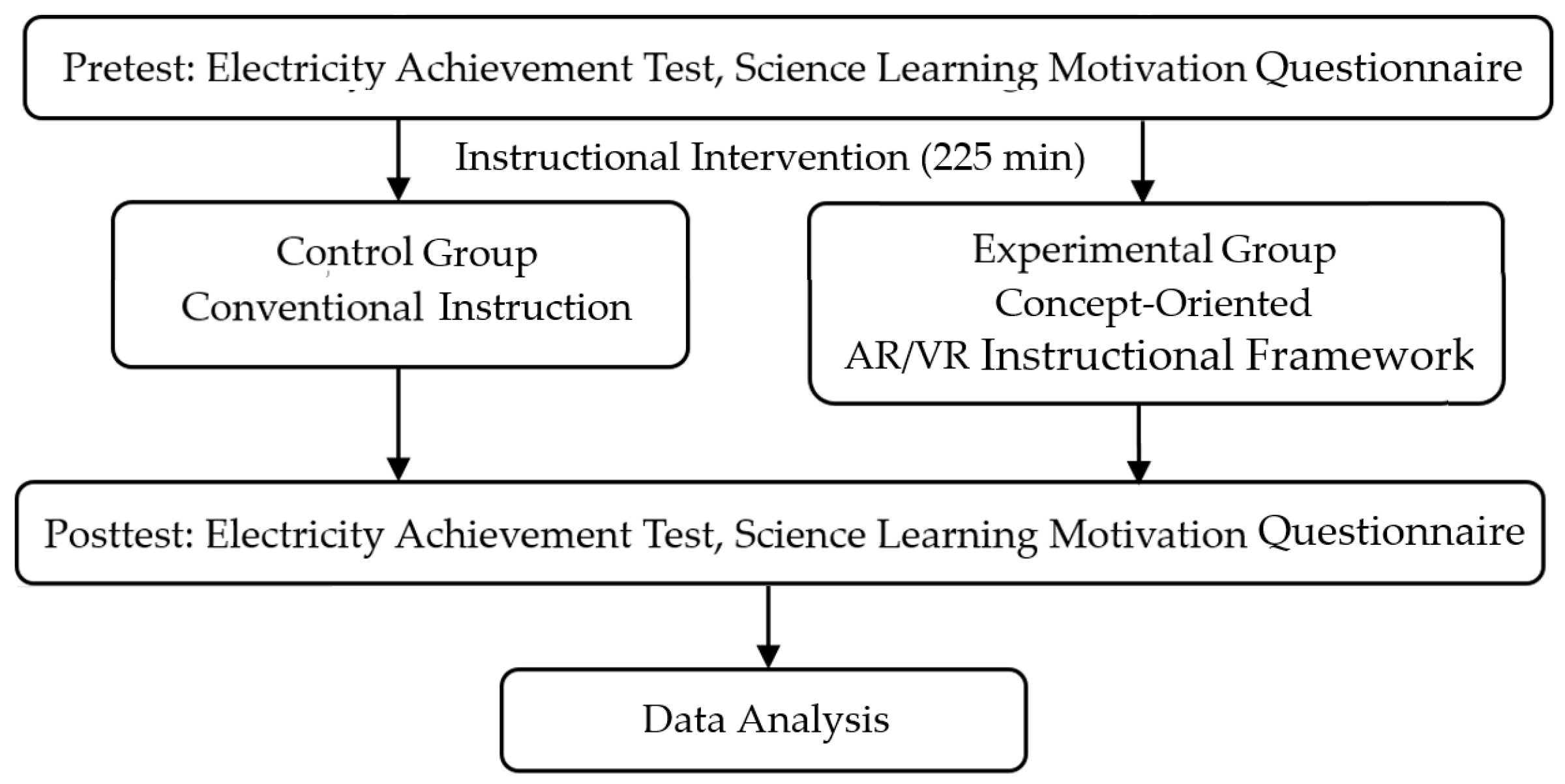
The instructional intervention was conducted over five class periods (225 min) and covered three major electricity topics: (1) basic circuit concepts, (2) voltage and current measurement, and (3) resistance and Ohm’s law concepts. Before the intervention, all participants completed the Electricity Achievement Test and the Science Learning Motivation Questionnaire as pretests. Following the instructional intervention, the same instruments were administered as posttests to evaluate students’ learning outcomes.
Figure 2 presents the overall research design of this study.
Table 2 summarizes the instructional sequence, learning topics, instructional technologies, and major learning activities implemented during the intervention.
Table 3 further compares the instructional activities implemented in the experimental and control groups and illustrates how different technological affordances were aligned with specific electricity concepts and learning activities within the proposed concept-oriented instructional framework.
3.3. Concept-Oriented AR/VR Instructional Framework
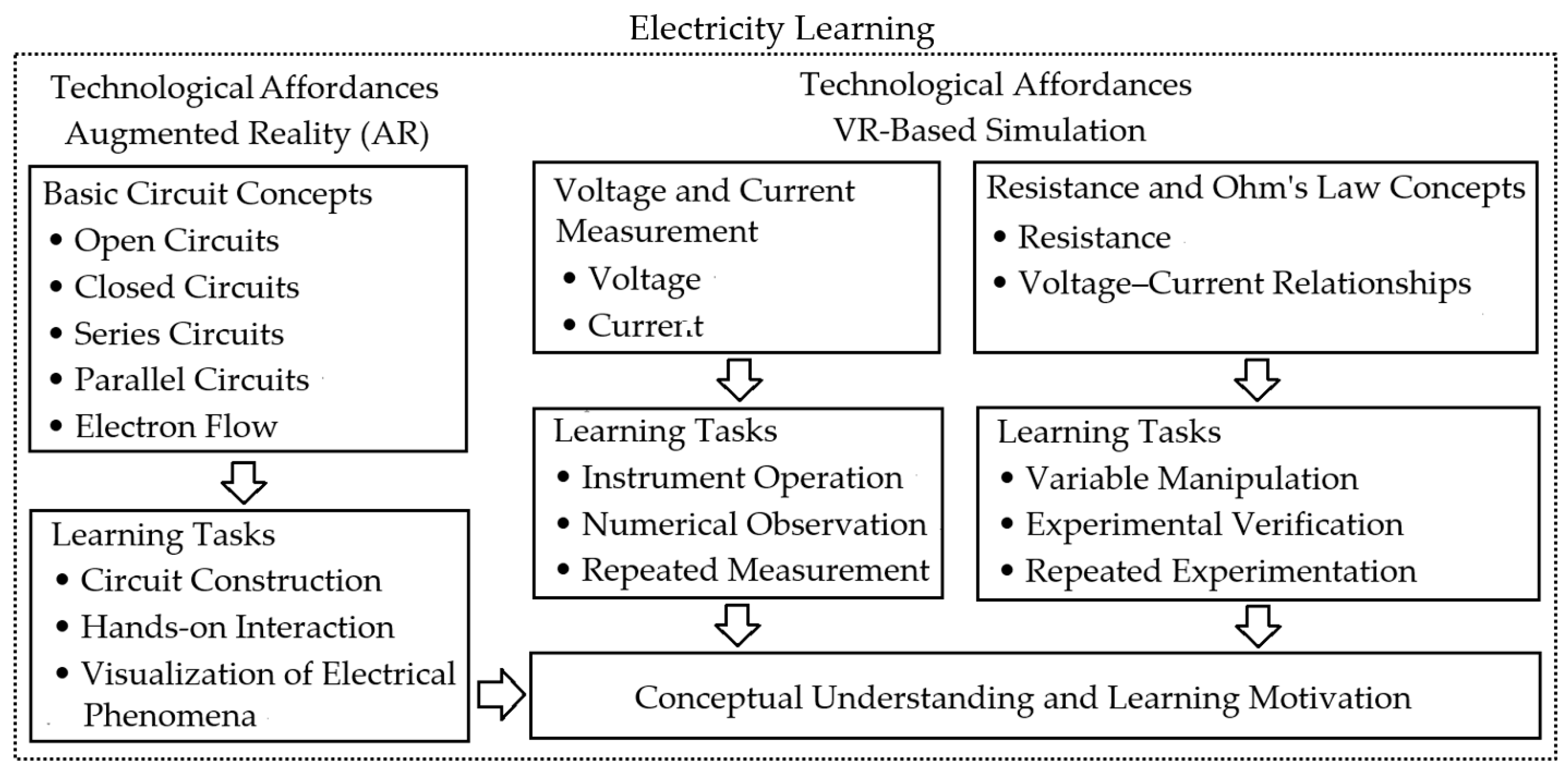
The concept-oriented instructional framework adopted in this study was developed based on the conceptual characteristics and learning requirements of different electricity topics. As shown in
Figure 3, different electricity concepts were aligned with corresponding learning tasks and technological affordances according to their conceptual processing demands. Rather than integrating AR and VR solely for technological enhancement, the present study employed different technologies to support different conceptual requirements in electricity learning.
As illustrated in the above figure, basic circuit concepts were supported through AR because these learning activities require hands-on interaction and visualization of otherwise invisible electrical phenomena. Through marker-based interaction and real-time visualization, students were able to construct different circuit configurations and observe circuit behavior within authentic learning contexts.
In contrast, voltage and current measurement, as well as resistance and Ohm’s law concepts, were supported through VR-based simulation. These topics involve instrument operation, numerical observation, repeated experimentation, and variable manipulation. The VR environment provided opportunities for repeated practice, immediate feedback, and experimental verification within a safe and controllable learning environment.
Accordingly, the instructional design aligned different technological affordances with different conceptual processing demands. AR was employed when visualization and real-world interaction were required, whereas VR-based simulation was employed when measurement, repeated experimentation, and variable manipulation were required. This concept-oriented design served as the pedagogical foundation of the AR/VR electricity learning system. The system was developed using Unity 2019 and deployed on Android-based tablet computers (ASUSTeK Computer Inc., Taipei, Taiwan). The AR module employed marker-based image recognition to trigger corresponding learning content, whereas the VR modules provided interactive simulations for voltage and current measurement as well as Ohm’s law experimentation. The AR/VR electricity learning system operated offline after installation and was implemented in a one-tablet-per-two-students classroom setting.
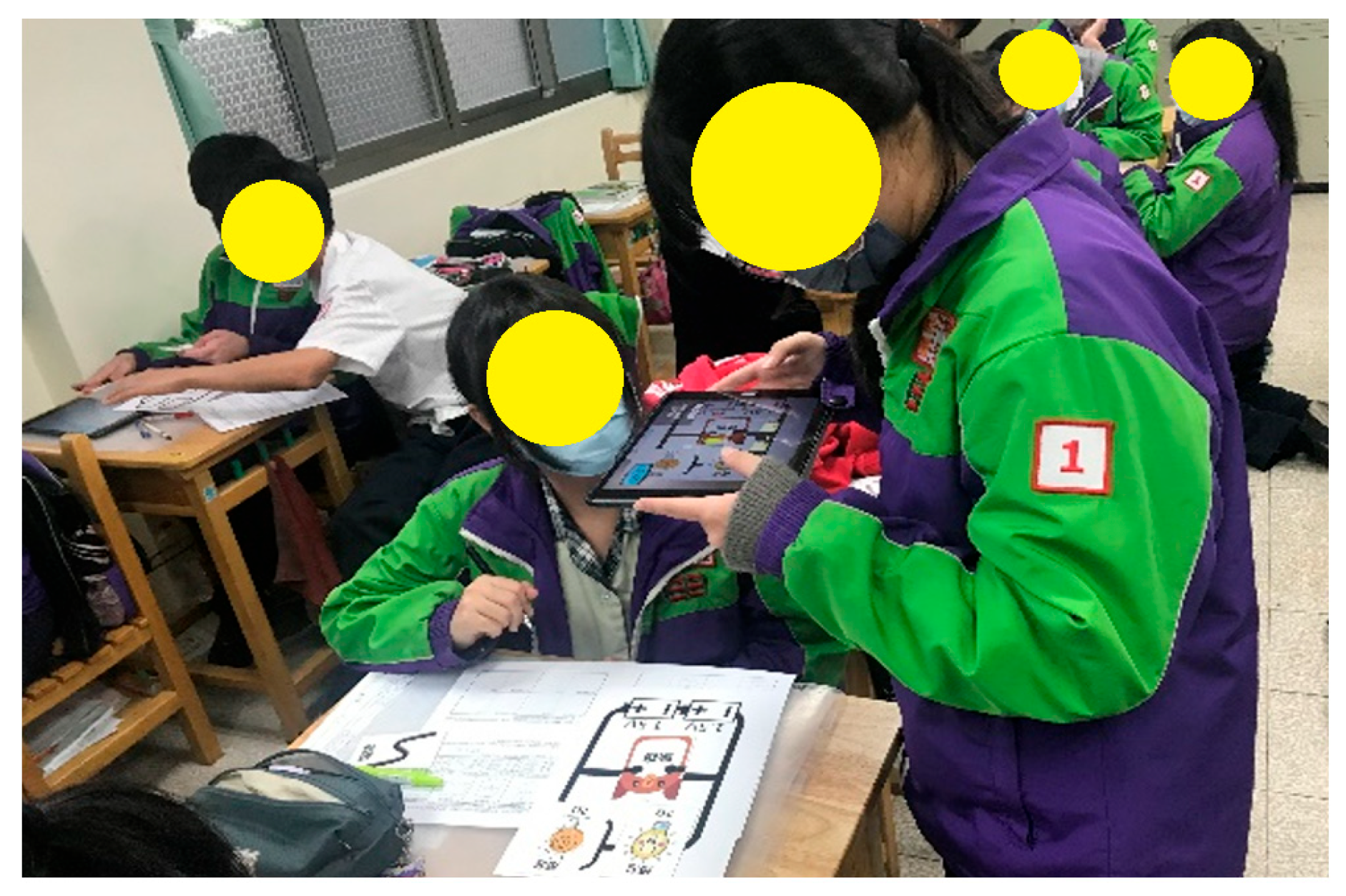
The system was designed through an iterative design process involving experts in science education, technology education, and software engineering. Three-dimensional models of electrical components (e.g., bulbs and electrons) were created using Cinema 4D R23, and interactive environments were implemented in Unity 2020 by integrating AR and VR functions. The system includes card-based interaction, event-driven feedback, audio narration, and visual effects to represent both macroscopic circuit behavior and microscopic electron dynamics. The application runs on mobile devices (e.g., tablets and smartphones) with touchscreen interaction (
Figure 4).
To implement the concept-oriented instructional framework, electricity topics were aligned with corresponding learning tasks and technological affordances. As shown in
Table 4, AR-supported learning activities required real-world interaction and visualization of electrical phenomena, whereas VR-based simulation supported current and voltage measurement, experimentation, and variable manipulation. This alignment was intended to match the conceptual processing demands of different electricity topics rather than merely integrate multiple technologies.
3.3.1. AR Module for Basic Circuit Learning
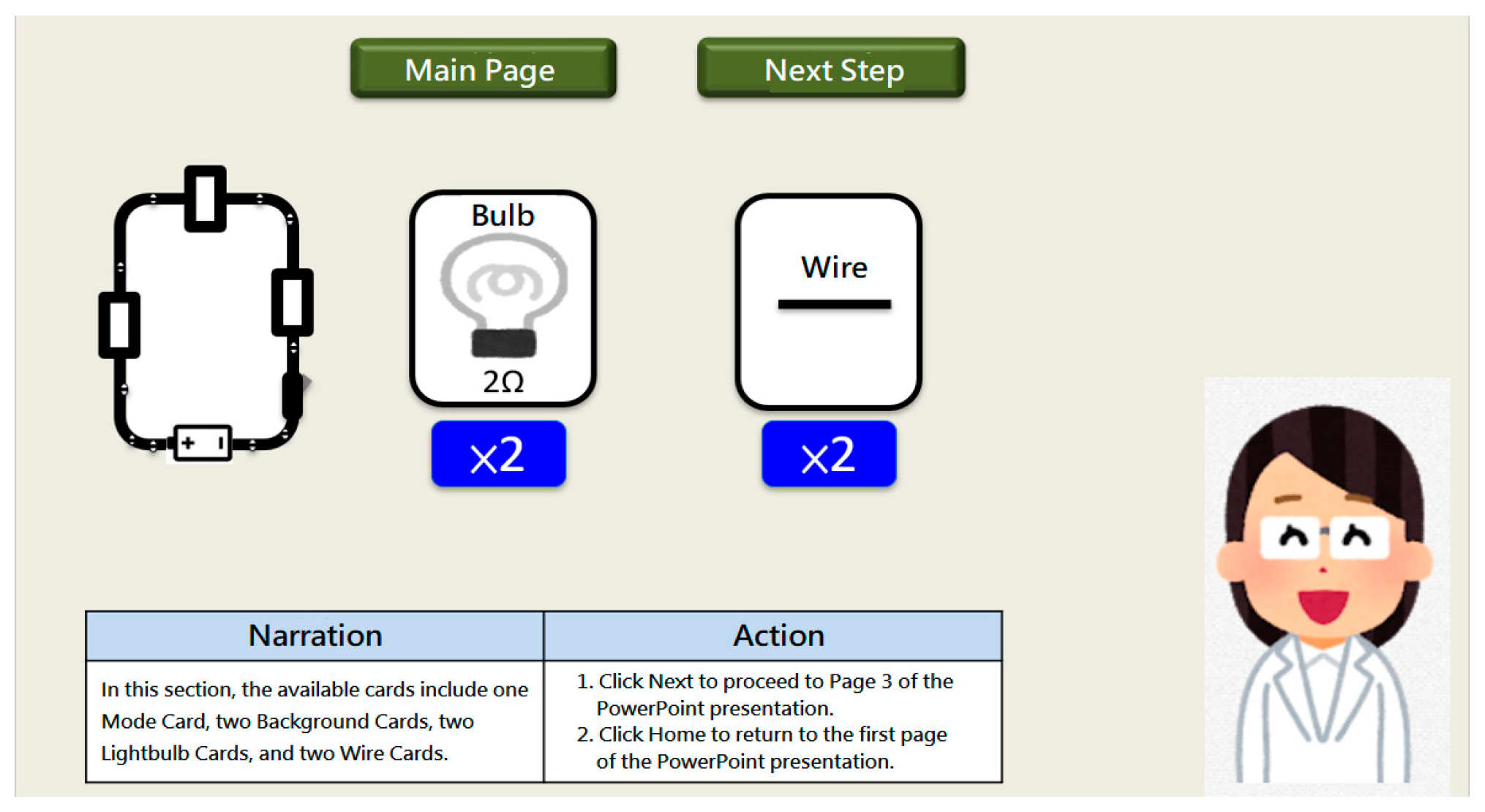
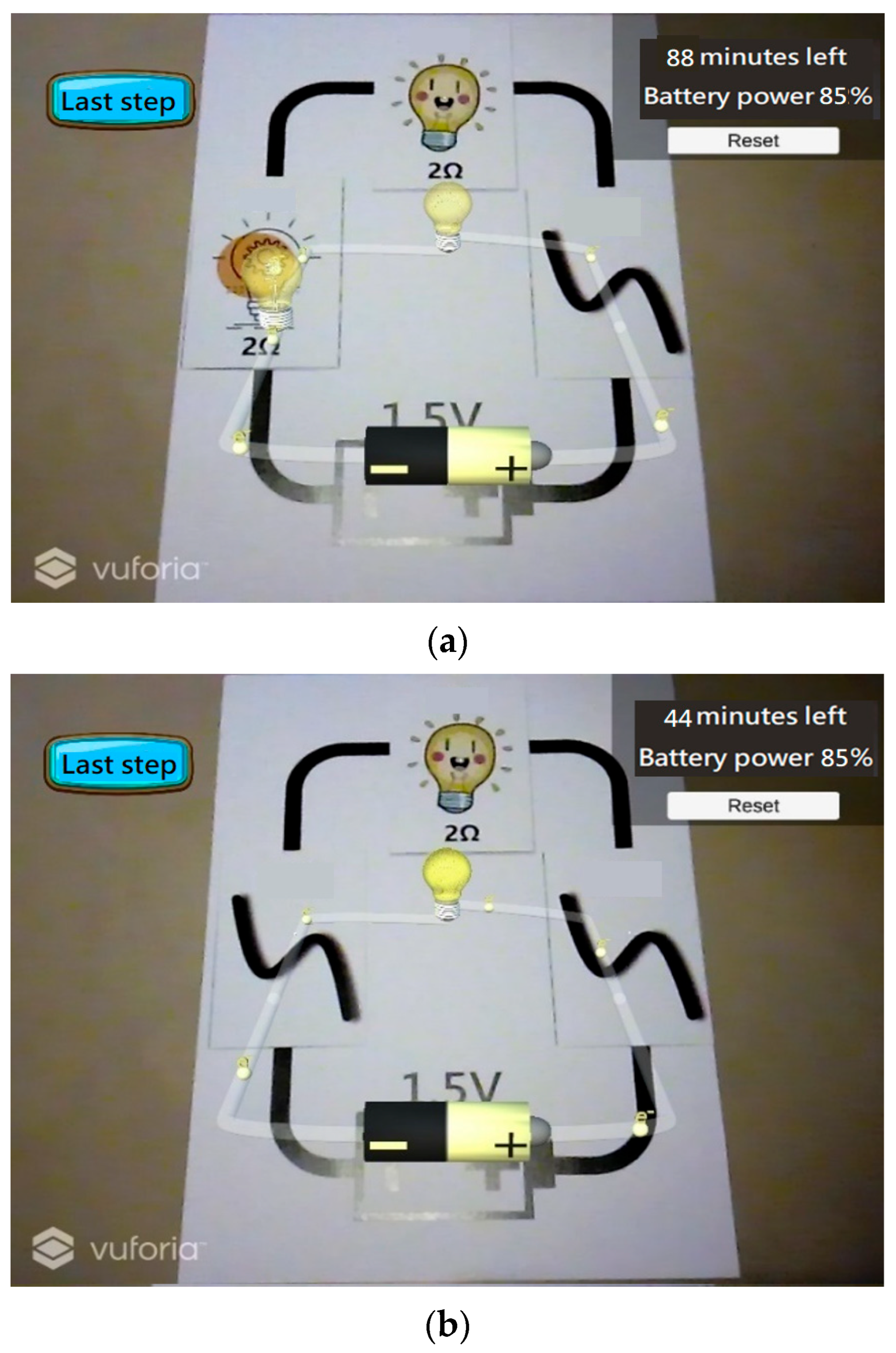
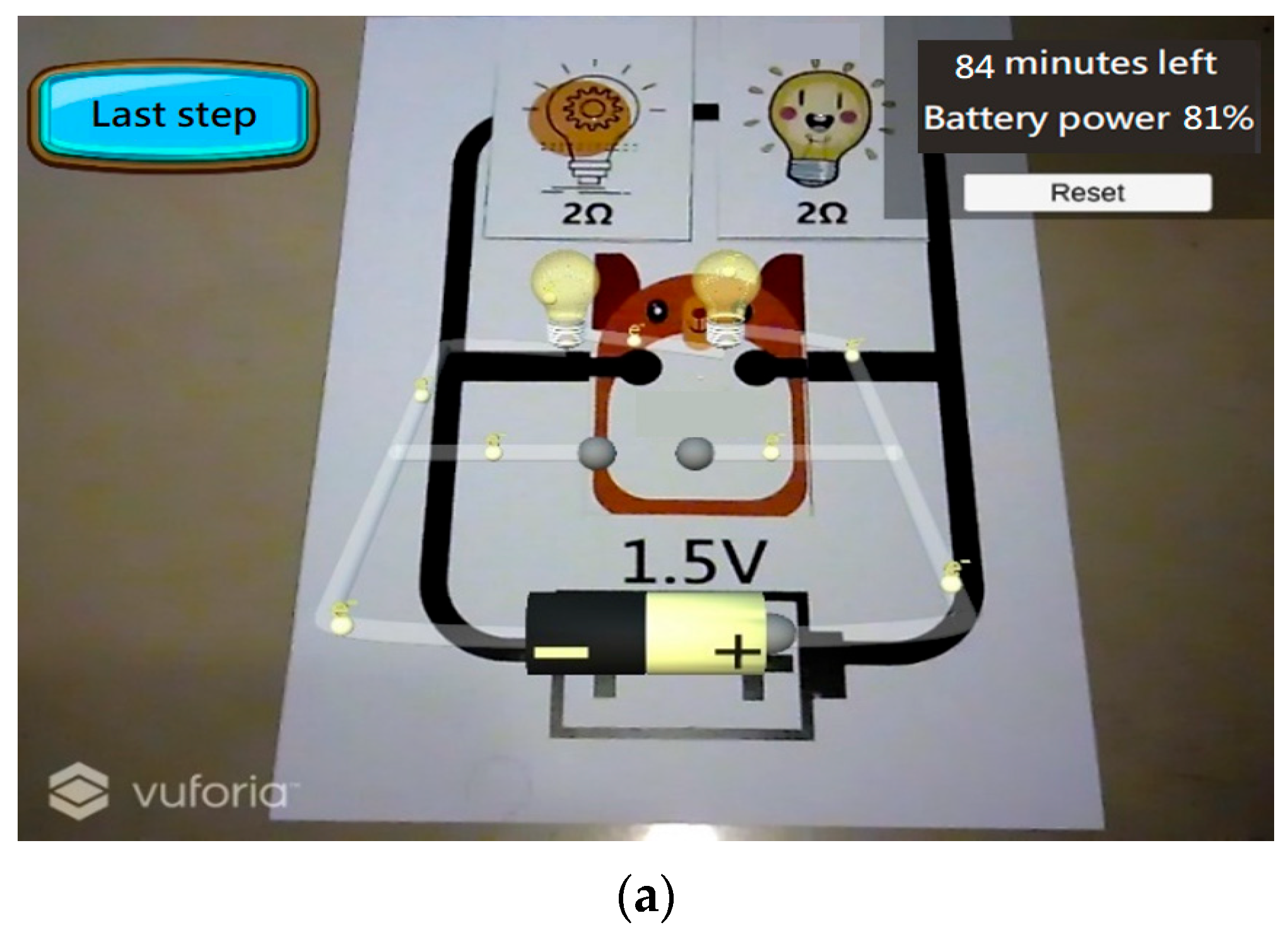
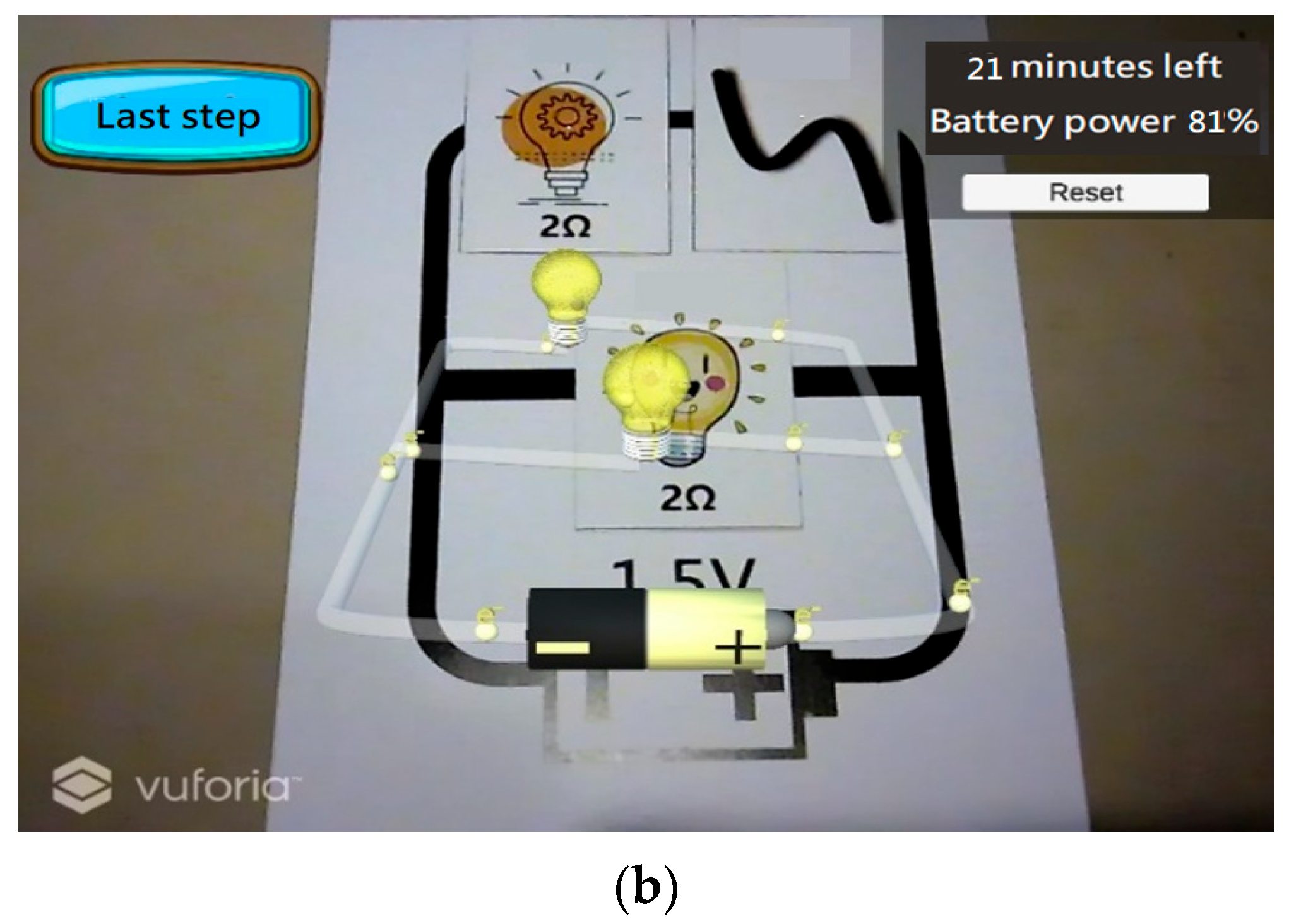
The AR module was designed to support learning activities related to basic circuit concepts, including circuit construction, electron-flow visualization, and comparisons between series and parallel circuits. As illustrated in
Figure 5,
Figure 6 and
Figure 7, students constructed circuit configurations and observed corresponding circuit behaviors through real-time AR visualization. The system enabled learners to visualize invisible electrical phenomena, including electron movement, current magnitude, bulb brightness, and battery consumption. By integrating hands-on interaction with dynamic visualization, the AR module supported students’ understanding of circuit operation and facilitated the correction of common misconceptions related to electric current and circuit connections.
Students constructed different circuit configurations using marker-based circuit cards within the AR learning environment (
Figure 5).
Students observed real-time visualizations of electron flow, current magnitude, bulb brightness, and battery consumption under different circuit conditions.
Figure 6a shows the case of adding a bulb card and a wire card, whereas
Figure 6b shows the case of adding two wire cards. Accordingly, the former has lower resistance and therefore a longer time before the battery is depleted.
Students compared bulb brightness, current distribution, and battery consumption between series and parallel circuits.
Figure 7a shows the case of adding an open-circuit card in the series circuit, whereas
Figure 7b shows the case of adding a bulb card and a wire card in the parallel circuit. Students can compare the power consumption of the two circuits resulting from different circuit connections.
3.3.2. VR Module for Voltage and Current Measurement
The VR measurement module was developed to support electrical measurement activities. As shown in
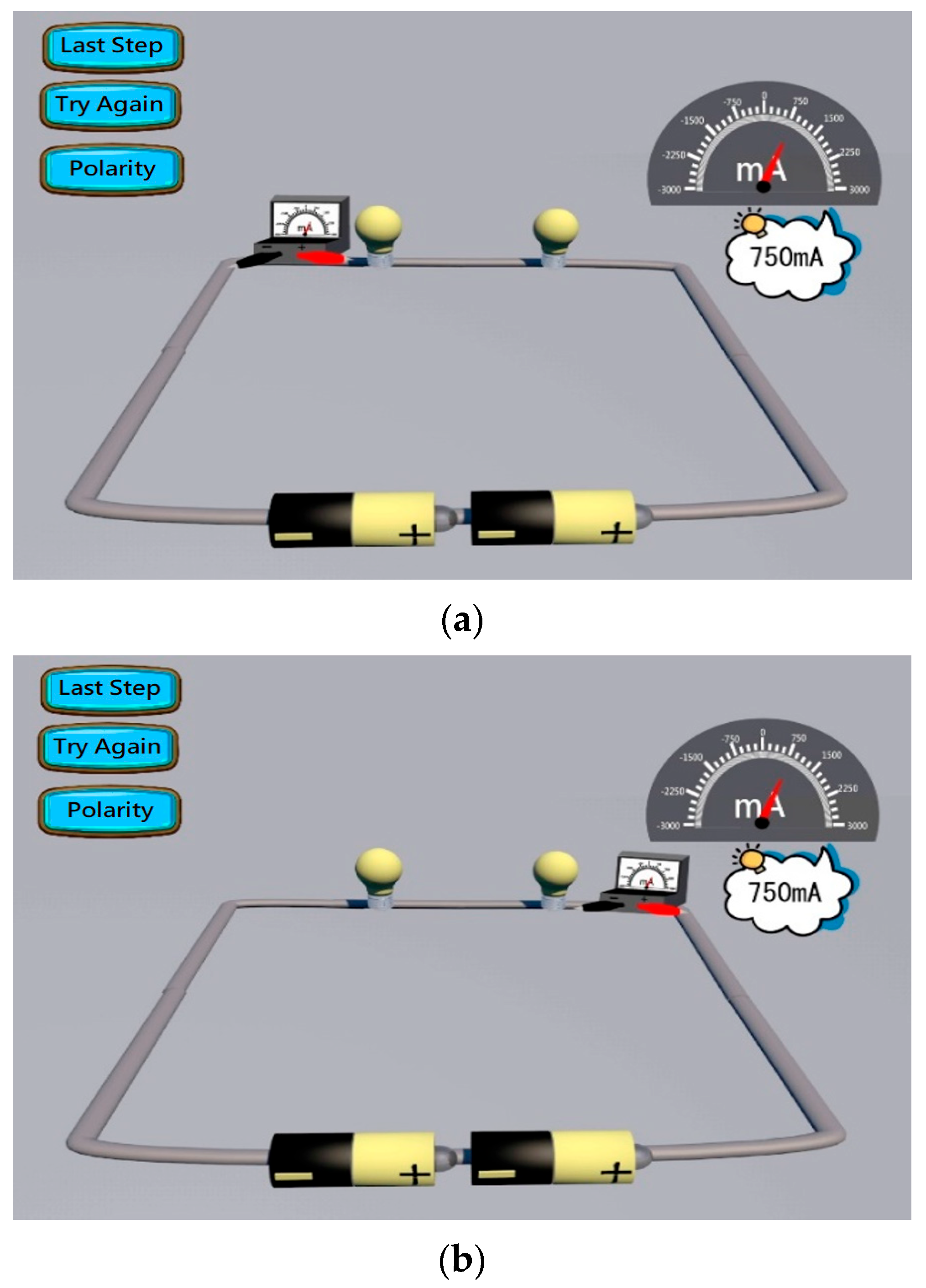
Figure 8, students operated a virtual ammeter and conducted measurements at different circuit locations within a simulated environment. The system provided immediate numerical feedback and allowed repeated experimentation without concerns about equipment damage or incorrect instrument connections. These affordances enabled students to verify measurement results, understand current conservation in series circuits, and develop a deeper understanding of electrical measurement concepts.
Students measured electrical current at different locations within a series circuit using a virtual ammeter and observed identical current values at all measurement points, as shown in
Figure 8a,b.
3.3.3. VR Module for Resistance and Ohm’s Law Learning
The VR module was designed to support resistance exploration, variable manipulation, and experimental verification. As illustrated in
Figure 9 and
Figure 10, students manipulated resistance-related variables, observed corresponding changes in electrical measurements, and explored voltage–current relationships through repeated experimentation. Experimental results were automatically visualized and plotted, enabling students to examine proportional relationships and verify Ohm’s law through data-based reasoning. The module transformed formula-based learning into an inquiry-oriented learning process and supported students’ conceptual understanding of electrical resistance and Ohm’s law.
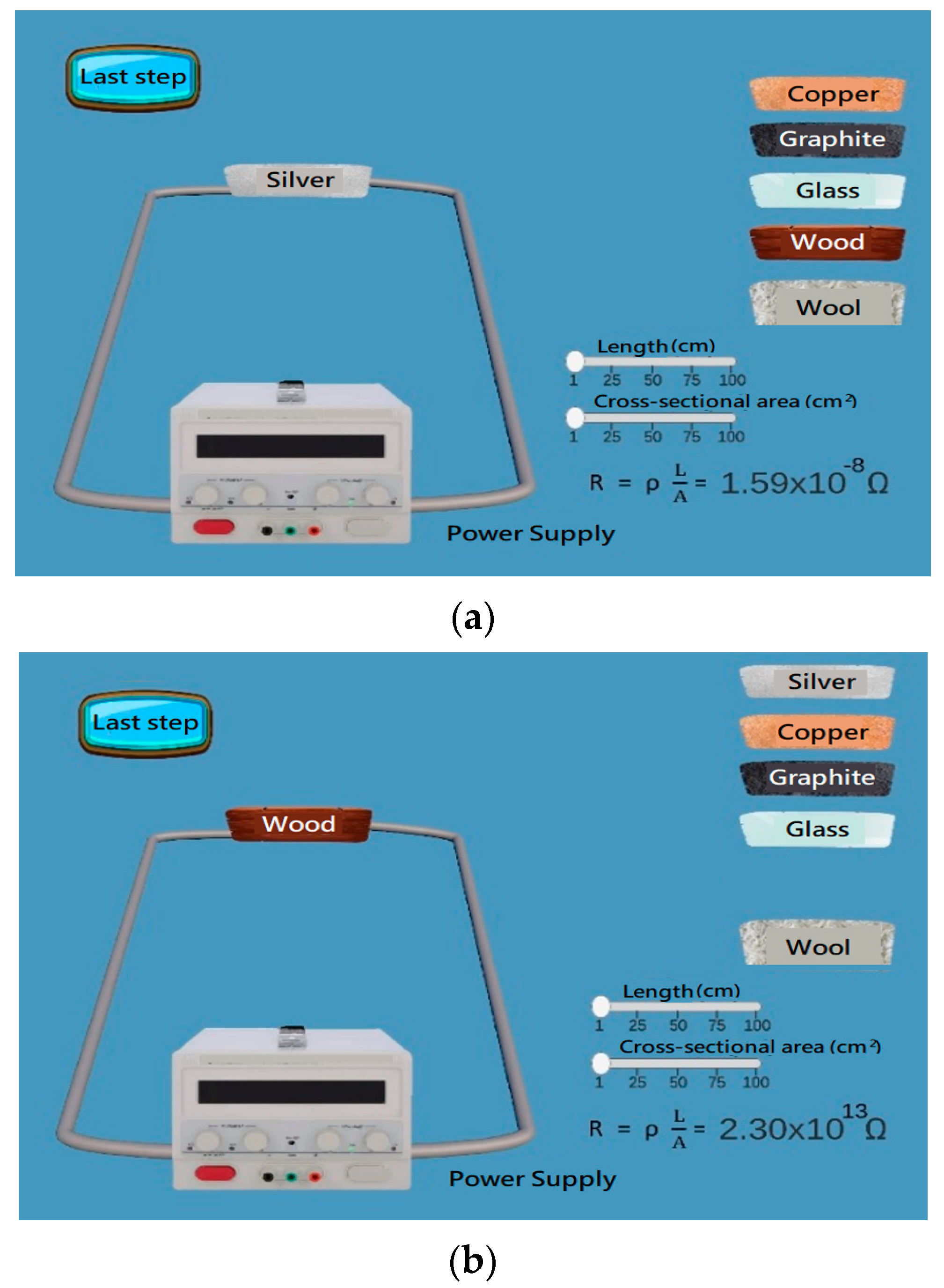
Students manipulated material type, conductor length, and cross-sectional area to investigate factors affecting electrical resistance.
Figure 9a illustrates the use of a silver conductor, whereas
Figure 9b illustrates the use of a wooden conductor. Students can compare differences in resistance between different materials.
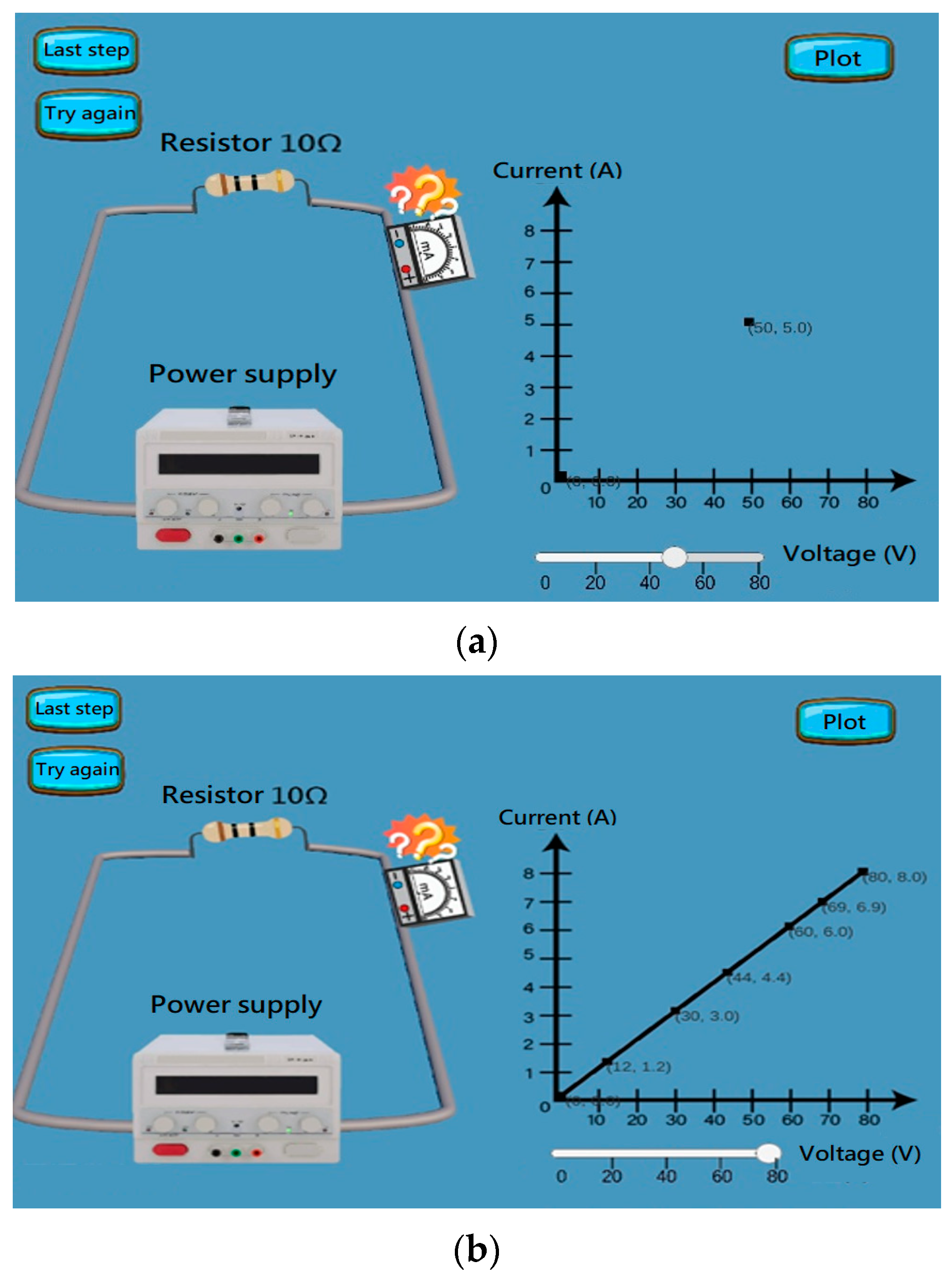
Students collected voltage–current data and generated graphs to verify Ohm’s law through the analysis of the voltage–current relationship.
Figure 10a shows a single voltage–current data point, whereas
Figure 10b shows multiple data points forming a straight line, from which the resistance of the resistor can be determined.
3.4. Instructional Procedure
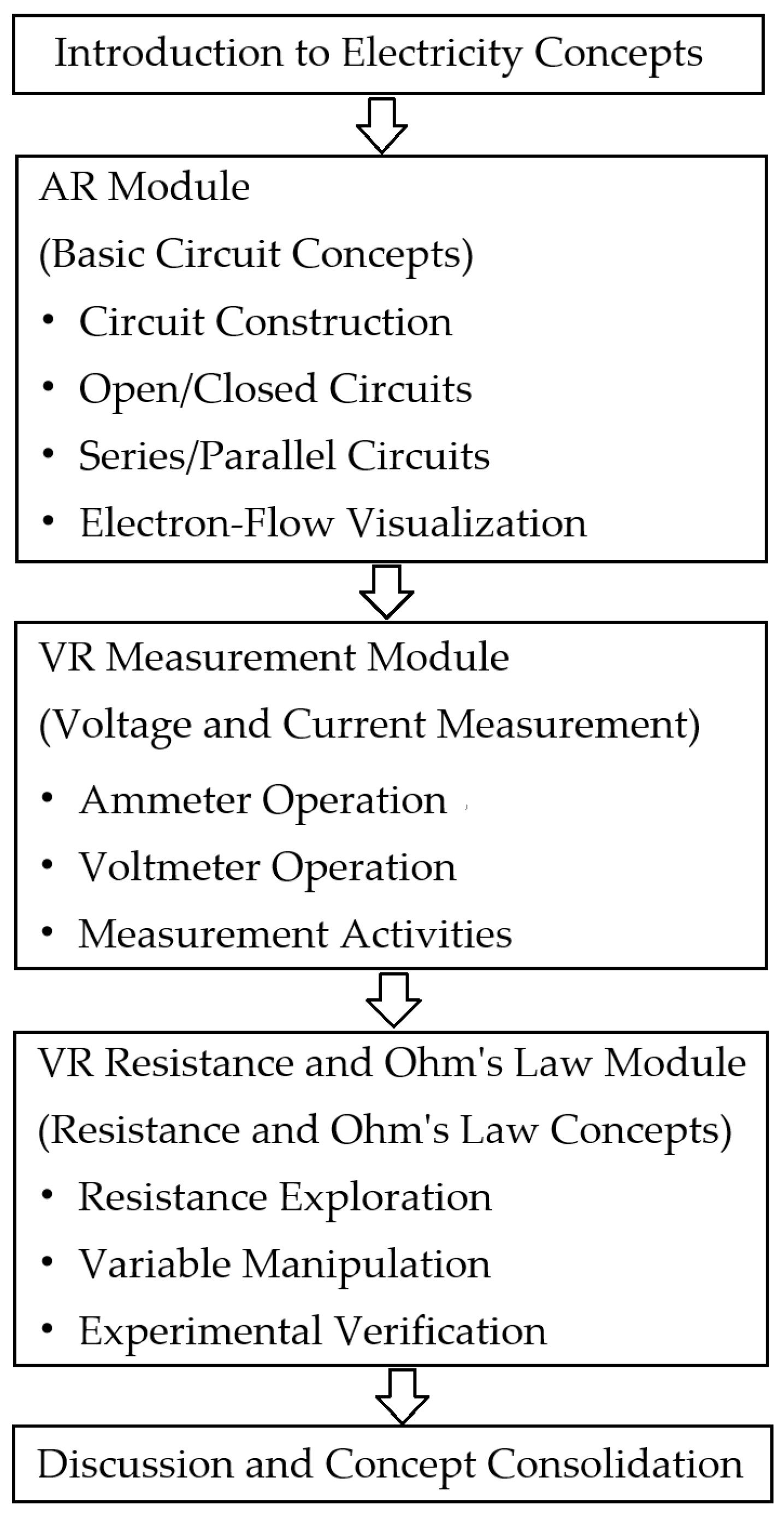
The instructional intervention was conducted over five class periods (225 min) and followed a concept-oriented learning sequence that aligned different electricity topics with appropriate technological affordances. The learning activities began with the AR module, which focused on basic circuit concepts, including circuit construction, open and closed circuits, series and parallel circuits, and electron-flow visualization. Through marker-based interaction and real-time visualization, students constructed different circuit configurations and observed corresponding electrical phenomena within authentic learning contexts (see
Appendix A).
After completing the AR activities, students proceeded to the first VR module, which focused on voltage and current measurement. Students operated virtual ammeters and voltmeters, conducted measurements in different circuit configurations, and received immediate numerical feedback. These activities enabled students to verify measurement results and develop an understanding of electrical measurement concepts.
The second VR module focused on resistance and Ohm’s law concepts. Students explored factors affecting electrical resistance, manipulated circuit variables, and observed corresponding changes in electrical measurements. Through repeated experimentation and graphical analysis of voltage–current relationships, students investigated resistance-related phenomena and verified Ohm’s law within a simulated environment.
The instructional sequence was designed according to increasing conceptual complexity. Students first established a foundational understanding of circuit operation through AR-supported visualization and interaction, followed by VR-supported measurement activities and experimental verification. This progression enabled students to move from concrete circuit experiences to quantitative measurement and scientific reasoning. More importantly, the sequence reflected the concept-oriented instructional framework by aligning different technological affordances with the conceptual processing demands of different electricity topics.
Figure 11 illustrates the overall instructional flow of the AR/VR electricity learning system.
3.5. Instruments
3.5.1. Electricity Achievement Test
The Electricity Achievement Test was developed to assess students’ conceptual understanding and learning achievement in the electricity unit. The test was based on the ninth-grade electricity curriculum outlined in the 12-Year Basic Education Curriculum Guidelines and covered three major instructional topics: (1) basic circuit concepts, (2) voltage and current measurement, and (3) resistance and Ohm’s law concepts.
The achievement test consisted of 25 four-option multiple-choice items. Each correct answer received one point, whereas incorrect answers received zero points, resulting in a total score ranging from 0 to 25. To ensure adequate coverage of the instructional content, a table of specifications was developed based on the targeted electricity concepts and four cognitive levels adapted from Bloom’s taxonomy: knowledge, comprehension, application, and analysis. The distribution of test items across instructional topics and cognitive levels is presented in
Table 5 to demonstrate the alignment between the assessment content and instructional objectives. In addition, representative sample items are provided in
Appendix B to illustrate the content coverage and cognitive demands of the instrument and provide additional evidence of alignment between the assessment and instructional objectives.
To establish content validity, the initial test items and table of specifications were reviewed by an expert panel consisting of one science education scholar and three junior high school science teachers, each with more than ten years of teaching experience. Item revisions were made until consensus on content relevance and appropriateness was achieved. To establish reliability, a pilot study was conducted with 150 tenth-grade students who had previously completed the junior high school electricity curriculum. The internal consistency reliability of the test, measured using the KR-20 coefficient, was 0.836, indicating satisfactory reliability. In the present study, the KR-20 coefficient obtained from the ninth-grade study sample (n = 87) was 0.832, indicating satisfactory internal consistency.
3.5.2. Science Learning Motivation Questionnaire
The Science Learning Motivation Questionnaire was used to assess students’ motivation toward science learning. The questionnaire was adapted from the Motivation to Learn Science Questionnaire (MLSQ) employed by Barak et al. [
30], which was originally based on the Science Motivation Questionnaire (SMQ) developed by [
31]. The original MLSQ consisted of four dimensions: self-efficacy, interest and enjoyment, connection to daily life, and importance to the student. Each dimension consisted of five items, yielding a total of 20 items. Representative items for each dimension are shown in
Appendix C.
For the present study, the questionnaire was adapted for Taiwanese junior high school students while preserving the original constructs and item meanings. The original English version was translated into Chinese by a bilingual expert. The translated version was subsequently back-translated into English by another bilingual expert who was not involved in the original translation process. The original and back-translated versions were compared to ensure linguistic accuracy and conceptual equivalence. The adapted questionnaire was then reviewed by one science education expert and two experienced junior high school science teachers to evaluate content relevance, construct appropriateness, clarity, and age appropriateness. Revisions were made based on their suggestions until consensus was achieved.
Responses were rated on a five-point Likert scale ranging from 1 (strongly disagree) to 5 (strongly agree). Negatively worded items were reverse-coded prior to analysis. The total score ranged from 20 to 100, with higher scores indicating higher levels of science learning motivation.
A pilot study involving 76 seventh-grade students yielded a Cronbach’s alpha coefficient of 0.93. In the present study, reliability analysis based on the responses of 87 ninth-grade students produced a Cronbach’s alpha coefficient of 0.92, indicating excellent internal consistency. Because the primary purpose of this study was to evaluate instructional effectiveness rather than validate a measurement instrument, exploratory or confirmatory factor analysis was not conducted. Future studies with larger samples are recommended to further examine the factor structure and construct validity of the adapted Chinese version of the questionnaire.
4. Results
4.1. System Effects on Students’ Science Achievement
4.1.1. Overall Science Achievement in Electricity Learning
Before conducting ANCOVA, the assumptions of homogeneity of variance and homogeneity of regression slopes were examined. Levene’s test indicated that the assumption of homogeneity of variance was met, F = 0.03, p = 0.87. In addition, the test of homogeneity of regression slopes was not significant, F = 1.74, p = 0.19, indicating that the relationship between the covariate (pretest scores) and the dependent variable (posttest scores) did not differ significantly across groups. Therefore, the assumptions required for ANCOVA were met, and ANCOVA was considered appropriate for examining the effects of the instructional intervention.
An ANCOVA was subsequently conducted to examine the effect of instructional group on students’ overall science achievement in electricity learning. The pretest scores on the Electricity Achievement Test were treated as the covariate, the instructional group (experimental vs. control) as the independent variable, and the posttest scores as the dependent variable.
Table 6 presents the descriptive statistics for both groups. After controlling for pretest differences, the experimental group obtained a higher adjusted posttest mean score (
M = 18.64,
SE = 0.51) than the control group (
M = 16.37,
SE = 0.51).
As shown in
Table 7, a significant main effect of instructional group was found, F(1, 84) = 10.03,
p = 0.002, partial η
2 = 0.11. According to Cohen’s guidelines [
2], this value represents a medium effect size. These findings indicate that, after controlling for pretest differences, students in the experimental group achieved significantly higher science achievement scores than those in the control group.
4.1.2. Science Achievement in Basic Circuit Concepts
Before conducting ANCOVA, the assumptions of homogeneity of variance and homogeneity of regression slopes were examined. Levene’s test indicated that the assumption of homogeneity of variance was satisfied, F = 0.02, p = 0.88. In addition, the test of homogeneity of regression slopes was not significant, F = 0.29, p = 0.59, indicating that the relationship between the covariate (pretest scores) and the dependent variable (posttest scores) did not differ significantly across groups. Therefore, the assumptions required for ANCOVA were satisfied, and ANCOVA was considered appropriate for examining the effects of the instructional intervention.
An ANCOVA was subsequently conducted to examine the effect of instructional group on students’ science achievement in basic circuit concepts. The pretest scores for this topic were treated as the covariate, the instructional group (experimental vs. control) as the independent variable, and the posttest scores as the dependent variable.
Table 8 presents the descriptive statistics for both groups. After controlling for pretest differences, the experimental group obtained a higher adjusted posttest mean score (
M = 7.20,
SE = 0.29) than the control group (
M = 6.26,
SE = 0.29).
As shown in
Table 9, a significant main effect of instructional group was found, F(1, 84) = 5.10,
p = 0.03, partial η
2 = 0.06. According to Cohen’s guidelines [
2], this value represents a medium effect size. These findings indicate that, after controlling for pretest differences, students in the experimental group achieved significantly higher science achievement scores in basic circuit concepts than those in the control group.
4.1.3. Science Achievement in Voltage and Current Measurement
Before conducting ANCOVA, the assumptions of homogeneity of variance and homogeneity of regression slopes were examined. Levene’s test indicated that the assumption of homogeneity of variance was met, F = 2.99, p = 0.09. In addition, the test of homogeneity of regression slopes was not significant, F = 1.49, p = 0.23, indicating that the relationship between the covariate (pretest scores) and the dependent variable (posttest scores) did not differ significantly across groups. Therefore, the assumptions required for ANCOVA were met, and ANCOVA was considered appropriate for examining the effects of the instructional intervention.
An ANCOVA was subsequently conducted to examine the effect of instructional group on students’ science achievement in voltage and current measurement. The pretest scores for this topic were treated as the covariate, the instructional group (experimental vs. control) as the independent variable, and the posttest scores as the dependent variable.
Table 10 presents the descriptive statistics for both groups. After controlling for pretest differences, the experimental group obtained a higher adjusted posttest mean score (
M = 6.74,
SE = 0.22) than the control group (
M = 6.08,
SE = 0.22).
As shown in
Table 11, a significant main effect of instructional group was found,
F(1, 84) = 4.50,
p = 0.04, partial η
2 = 0.05. According to Cohen’s guidelines [
2], this value represents a small effect size. These findings indicate that, after controlling for pretest differences, students in the experimental group achieved significantly higher science achievement scores in voltage and current measurement than those in the control group.
4.1.4. Science Achievement in Resistance and Ohm’s Law Concepts
Before conducting ANCOVA, the assumptions of homogeneity of variance and homogeneity of regression slopes were examined. Levene’s test indicated that the assumption of homogeneity of variance was met, F = 0.51, p = 0.48. In addition, the test of homogeneity of regression slopes was not significant, F = 1.99, p = 0.16, indicating that the relationship between the covariate (pretest scores) and the dependent variable (posttest scores) did not differ significantly across groups. Therefore, the assumptions required for ANCOVA were met, and ANCOVA was considered appropriate for examining the effects of the instructional intervention.
An ANCOVA was subsequently conducted to examine the effect of instructional group on students’ science achievement in resistance and Ohm’s law concepts. The pretest scores for this topic were treated as the covariate, the instructional group (experimental vs. control) as the independent variable, and the posttest scores as the dependent variable.
Table 12 presents the descriptive statistics for both groups. After controlling for pretest differences, the experimental group obtained a higher adjusted posttest mean score (
M = 4.73,
SE = 0.19) than the control group (
M = 4.00,
SE = 0.19).
As shown in
Table 13, a significant main effect of instructional group was found,
F(1, 84) = 7.36,
p = 0.008, partial η
2 = 0.08. According to Cohen’s guidelines [
2], this value represents a medium effect size. These findings indicate that, after controlling for pretest differences, students in the experimental group achieved significantly higher science achievement scores in resistance and Ohm’s law concepts than those in the control group.
4.2. System Effects on Students’ Science Learning Motivation
Before conducting ANCOVA, the assumptions of homogeneity of variance and homogeneity of regression slopes were examined. Levene’s test indicated that the assumption of homogeneity of variance was met, F = 0.58, p = 0.45. In addition, the test of homogeneity of regression slopes was not significant, F = 0.14, p = 0.71, indicating that the relationship between the covariate (pretest motivation scores) and the dependent variable (posttest motivation scores) did not differ significantly across groups. Therefore, the assumptions required for ANCOVA were met, and ANCOVA was considered appropriate for examining the effects of the instructional intervention on science learning motivation.
An ANCOVA was subsequently conducted to examine the effect of instructional group on students’ science learning motivation. The pretest scores on the Science Learning Motivation Questionnaire were treated as the covariate, the instructional group (experimental vs. control) as the independent variable, and the posttest scores as the dependent variable.
Table 14 presents the descriptive statistics for both groups. After controlling for pretest differences, the experimental group obtained a higher adjusted posttest mean score (
M = 64.46,
SE = 0.73) than the control group (
M = 62.34,
SE = 0.74).
As shown in
Table 15, a significant main effect of instructional group was found,
F(1, 84) = 4.09,
p = 0.046, partial η
2 = 0.05. According to Cohen’s guidelines [
2], this value represents a small effect size. These findings indicate that, after controlling for pretest differences, students who learned with the concept-oriented AR/VR electricity learning system demonstrated significantly higher levels of science learning motivation than those who received conventional instruction. Although the magnitude of the effect was modest, the results suggest that the system may contribute to enhancing students’ motivation toward learning electricity concepts.
5. Discussion
5.1. Effects on Overall Science Achievement
The findings suggest that the concept-oriented AR/VR instructional framework may have contributed to students’ improved science achievement by strategically aligning different technological affordances with different conceptual learning requirements in electricity education. Rather than assuming that a single technology is equally effective for all learning tasks, the present study employed AR to support circuit construction and visualization of otherwise invisible electrical phenomena, whereas non-immersive VR simulation was used to support measurement, experimentation, and exploration of quantitative relationships among electrical variables. This concept-oriented alignment may have enabled students to receive different forms of instructional support according to the conceptual demands of different electricity topics, thereby facilitating more effective conceptual understanding. Because the present study evaluated an integrated instructional condition, these interpretations should be regarded as plausible theoretical explanations rather than causal evidence regarding the independent contributions of AR and non-immersive VR simulation.
This interpretation is broadly consistent with the Cognitive Theory of Multimedia Learning [
12], which suggests that meaningful learning occurs when learners actively integrate verbal and visual information into coherent mental representations. The instructional environment provided multiple forms of representation that may have supported students in organizing and integrating abstract electricity concepts. This explanation is also consistent with research on multiple representations and technology-enhanced science learning, which suggests that visualization and interactive representations can facilitate learners’ understanding of complex scientific phenomena [
8,
10,
15].
The findings may also be interpreted through the perspective of Conceptual Change Theory. Students often hold misconceptions regarding electric circuits, current flow, voltage, and circuit behavior [
1,
4]. By making electrical processes visible and providing opportunities for repeated experimentation, the instructional framework may have enabled students to compare their prior conceptions with scientifically appropriate representations and observations. Such experiences may have supported conceptual change by encouraging learners to reconstruct existing conceptions rather than simply memorizing electricity concepts [
14,
22].
Furthermore, the findings are broadly consistent with Cognitive Load Theory. The combination of visualization, immediate feedback, guided experimentation, and simplified interfaces may have reduced unnecessary cognitive processing demands and allowed learners to allocate more cognitive resources to understanding the conceptual relationships among voltage, current, resistance, and circuit behavior [
13,
18].
Overall, the findings suggest that the observed learning gains may be associated not merely with the use of AR and non-immersive VR technologies themselves, but with the concept-oriented alignment between technological affordances and conceptual learning requirements.
5.2. Topic-Specific Effects on Electricity Learning
The findings revealed significant improvements across all three electricity topics, although the magnitude of the effects varied. The strongest effect was observed for resistance and Ohm’s law concepts (partial η2 = 0.08), followed by basic circuit concepts (partial η2 = 0.06), whereas the smallest effect was observed for voltage and current measurement (partial η2 = 0.05).
For basic circuit concepts, the observed improvement may be associated with the AR-supported learning activities that combined circuit construction with visualization of electrical phenomena. During these activities, students physically assembled circuits while simultaneously observing representations of electron flow and circuit behavior. Such learning experiences may have facilitated connections between observable circuit structures and underlying electrical processes, thereby making otherwise invisible electrical phenomena more accessible. From the perspective of Conceptual Change Theory, these experiences may have supported conceptual change by enabling students to compare their existing conceptions with scientifically appropriate representations of circuit behavior and reconstruct existing conceptions accordingly [
14,
22].
The relatively smaller effect observed for voltage and current measurement may reflect the procedural nature of the topic. Conventional instruction often provides opportunities for measurement practice through teacher demonstrations and laboratory activities. Consequently, the additional benefit provided by non-immersive VR simulation may have been more limited. Nevertheless, repeated practice, immediate feedback, and controllable experimental conditions may still have supported students’ understanding of measurement procedures and electrical relationships.
The strongest effect observed for resistance and Ohm’s law concepts may be related to the opportunities for repeated experimentation, variable manipulation, and graphical verification provided by the non-immersive VR simulation environment. Students were able to systematically modify voltage and resistance values, observe corresponding changes in current, and verify quantitative relationships through data collection and graphical analysis. Such inquiry-oriented learning experiences may have facilitated students’ understanding of relationships among electrical variables and supported the development of more coherent conceptual representations of resistance and Ohm’s law concepts. However, future studies employing process-oriented measures are needed to verify these explanatory mechanisms.
Although these topic-specific findings are theoretically consistent with the intended instructional functions of AR and non-immersive VR simulation, the present study evaluated an integrated instructional condition rather than separate AR-only and VR-only interventions. Therefore, the findings should not be interpreted as evidence of the independent effects of either technology but rather as evidence supporting the effectiveness of the overall concept-oriented instructional framework.
5.3. Effects on Science Learning Motivation
The findings suggest that the concept-oriented AR/VR instructional framework may have contributed to students’ science learning motivation. However, the observed effect size was small (partial η2 = 0.05). Therefore, the findings should be interpreted as indicating a positive but modest motivational benefit associated with the instructional condition rather than evidence of a substantial increase in science learning motivation.
One possible explanation is that the learning environment provided opportunities for active participation, experimentation, interaction, and immediate feedback. Unlike conventional teacher-centered instruction, students were able to construct circuits, manipulate variables, conduct experiments, and observe electrical phenomena through multiple forms of interaction. Such experiences may have increased students’ involvement and engagement during learning activities.
This interpretation is broadly consistent with previous studies reporting positive effects of AR-supported science learning on students’ motivation and engagement [
32,
33]. It is also consistent with review studies suggesting that technology-enhanced science learning environments can support student motivation when instructional strategies are appropriately aligned with technological affordances [
8].
Nevertheless, learning motivation is influenced by multiple factors, including instructional design, classroom interaction, collaborative learning processes, prior learning experiences, novelty, and individual learner characteristics. Therefore, the observed motivational gains should not be attributed solely to the technological features of the learning environment. Additional longitudinal studies are needed to determine whether the observed motivational benefits can be sustained over time and whether they are influenced by novelty effects associated with technology-enhanced learning environments.
5.4. Alternative Explanations and Interpretation of Findings
Several alternative explanations should be considered when interpreting the findings. First, novelty effects associated with technology-enhanced learning may have contributed to students’ attention, engagement, and willingness to participate in learning activities. Previous research has suggested that newly introduced educational technologies may temporarily enhance students’ engagement, interest, and motivation because of their novelty rather than solely because of their instructional effectiveness [
34]. In the present study, many students had limited prior experience with AR- and VR-supported electricity learning activities. Therefore, part of the observed motivational benefit may have been influenced by the novelty and attractiveness of the technology-enhanced learning environment. Furthermore, because the present study only measured immediate posttest outcomes and did not include a delayed retention assessment, it remains unclear whether the observed motivational benefits would persist after the novelty effect diminished. Consequently, the motivational findings should be interpreted with caution, particularly with respect to their long-term sustainability. Future studies are encouraged to incorporate delayed posttests and longitudinal designs to examine the long-term sustainability of motivational outcomes associated with concept-oriented AR/VR instructional environments.
Second, collaborative learning may have contributed to the observed outcomes. Students frequently worked in pairs, discussed circuit configurations, exchanged ideas, and jointly completed experimental activities. Such peer interaction may have supported conceptual understanding and learning motivation through explanation, reflection, and collaborative knowledge construction.
Third, teacher-related factors may also have influenced the results. Although both groups were taught by the same teacher, instructional support, classroom management, and teacher–student interactions may have contributed to students’ learning experiences.
Therefore, the observed outcomes should be interpreted as reflecting the combined influences of concept-oriented instructional design, technological affordances, collaborative learning processes, teacher support, and classroom implementation conditions rather than the independent effect of any single instructional component.
5.5. Educational and Theoretical Implications
The present study provides several theoretical and practical implications for technology-enhanced science learning. Its primary contribution lies not merely in integrating AR and VR technologies, but in developing and empirically evaluating a concept-oriented instructional framework that systematically aligns technological affordances with conceptual processing demands in electricity learning.
From a theoretical perspective, the findings extend previous AR-only and VR-only research by demonstrating how different technologies may support different conceptual learning processes. The results are broadly consistent with the proposed theoretical framework based on the Cognitive Theory of Multimedia Learning, Cognitive Load Theory, and Conceptual Change Theory. The findings suggest that science achievement and science learning motivation may be supported when visualization, experimentation, cognitive load management, and conceptual reconstruction are strategically aligned with the conceptual processing demands of different electricity-learning tasks.
From an instructional design perspective, the findings suggest that educational technologies should be selected according to conceptual learning requirements rather than technological novelty alone. Different technologies may provide different forms of support for different conceptual challenges. Consequently, effective technology integration may depend on concept–technology alignment rather than technology integration itself.
From an educational perspective, the proposed framework may provide a theoretically grounded reference for designing technology-enhanced learning environments that systematically align technological affordances with conceptual learning requirements, thereby supporting more effective concept-oriented instructional design across different science domains.
6. Limitations and Future Research
Several limitations should be considered when interpreting the findings of this study.
First, the study was conducted in a single public junior high school in Taiwan using intact classes. Although the quasi-experimental design reflected authentic classroom conditions, the findings may not be fully generalizable to students from different educational contexts, grade levels, regions, or cultural settings. Furthermore, because all participants were recruited from the same school, informal communication among students from different classes outside the classroom could not be completely controlled. Although the intervention was completed within a relatively short instructional period, which likely limited extensive cross-class information exchange, potential classroom interaction effects cannot be entirely ruled out. Therefore, both the single-school context and possible classroom interaction effects should be considered when interpreting the findings. In addition, the present study involved only four intact classes (two experimental and two control classes). Because of the limited number of clusters, multilevel modeling was not statistically appropriate. Therefore, ANCOVA was employed as the primary analytical approach. Nevertheless, students were nested within classrooms, and classroom-level influences cannot be completely ruled out. Future studies should include more diverse samples, multiple schools, and a larger number of classes to enhance the generalizability of the findings. Future studies are also encouraged to employ multilevel analyses and estimate ICC values to further examine potential clustering effects.
Second, the instructional intervention lasted only five class periods, and the study evaluated students’ learning outcomes immediately after the intervention. Consequently, the present study was unable to determine whether the observed improvements in science achievement and learning motivation would be maintained over longer periods of time. Future research should incorporate delayed posttests to examine the long-term effects of concept-oriented AR/VR instructional design on conceptual retention and motivational development.
Third, although the present study was designed around a concept-oriented AR/VR instructional framework, the research design evaluated the integrated instructional condition as a whole. Therefore, the study cannot determine the independent contributions of AR, non-immersive VR simulation, or their interaction effects. Future studies may employ multi-group experimental designs to compare AR-only, VR-only, integrated AR/VR, and conventional instructional conditions in order to better understand the relative contributions of different technological affordances.
Fourth, several alternative explanations may have influenced the observed outcomes. In addition to the technological features of the learning environment, collaborative learning processes, peer interaction, teacher support, classroom implementation factors, and novelty effects may have contributed to students’ learning experiences. Future studies should further investigate how these instructional and contextual factors interact with technology-supported learning environments to influence learning outcomes and incorporate delayed posttests to examine the long-term sustainability of motivational effects.
Fifth, although the proposed instructional framework was theoretically grounded in the Cognitive Theory of Multimedia Learning, Cognitive Load Theory, and Conceptual Change Theory, the present study did not directly measure learners’ cognitive processing, cognitive load, conceptual change processes, mental model development, or technology-supported inquiry behaviors. Consequently, the mechanisms underlying the observed learning improvements remain inferential rather than directly verified. Future studies may incorporate cognitive load measures, conceptual change assessments, learning analytics, eye-tracking techniques, or think-aloud protocols to provide deeper insights into the cognitive mechanisms underlying concept-oriented AR/VR learning.
Finally, the present study focused specifically on electricity learning. Although the concept-oriented framework was developed to align technological affordances with conceptual learning requirements, its applicability to other science domains remains to be examined. Future research may extend this framework to other abstract, dynamic, and difficult-to-observe science topics, such as electromagnetism, molecular science, chemical reactions, astronomy, or biological systems, in order to evaluate its broader educational applicability.
Despite these limitations, the findings provide preliminary empirical evidence that a concept-oriented AR/VR instructional framework may support students’ science achievement and science learning motivation by strategically aligning different technological affordances with different conceptual learning requirements. Future research should continue to investigate how concept–technology alignment can be applied across different scientific domains and educational contexts to support meaningful conceptual learning in science education.
7. Conclusions
This study developed and evaluated a concept-oriented AR/VR instructional framework for electricity learning that systematically aligns different technological affordances with different conceptual learning requirements. Specifically, AR was employed to support hands-on circuit construction and visualization of otherwise invisible electrical phenomena, whereas non-immersive VR simulation was used to support voltage measurement and Ohm’s law experimentation through repeated and controllable exploration.
The results indicated that students who learned with the concept-oriented AR/VR instructional framework achieved significantly higher science achievement and science learning motivation than those who received conventional instruction. Significant improvements were observed in overall science achievement as well as across the three electricity topics investigated in this study, while the observed motivational benefit was positive but relatively modest.
The findings suggest that the observed learning benefits may be associated with the pedagogical alignment between technological affordances and conceptual learning requirements. Consistent with the Cognitive Theory of Multimedia Learning, Cognitive Load Theory, and Conceptual Change Theory, the instructional framework may have supported learning by facilitating visualization of invisible electrical phenomena, reducing unnecessary cognitive processing demands, promoting interactive experimentation, and supporting conceptual change. Rather than relying solely on technology integration, the instructional design strategically aligned different technological affordances with different conceptual learning tasks in electricity education.
The primary contribution of this study lies not merely in integrating AR and VR technologies but in proposing and empirically evaluating a concept-oriented instructional framework that systematically aligns technological affordances with conceptual learning requirements. This contribution addresses a gap identified in previous AR and VR research, where technologies have often been examined independently and where relatively limited attention has been devoted to systematically aligning technological affordances with different conceptual processing demands. The findings provide preliminary empirical support for the potential value of concept-oriented technology integration through the alignment of technological affordances with conceptual learning requirements. Nevertheless, the findings should be interpreted within the limitations of the study, including the relatively short intervention period, the use of a single-school sample, and the inability to isolate the independent effects of AR and non-immersive VR simulation.
Future research should investigate the applicability of concept-oriented technology integration across different science domains, educational contexts, and learner populations. Studies employing AR-only, VR-only, integrated AR/VR, and conventional instructional conditions would further clarify the relative contributions of different technological affordances. In addition, future research should incorporate delayed posttests and measures of cognitive processing, cognitive load, conceptual change, and technology-supported inquiry behaviors to better understand the mechanisms underlying technology-supported conceptual learning.
Overall, the findings suggest that effective technology-enhanced science learning may depend not simply on the adoption of advanced technologies, but on how technological affordances are strategically aligned with conceptual learning requirements. The concept-oriented AR/VR framework proposed in this study may therefore provide a theoretically grounded reference for designing future technology-enhanced science learning environments that systematically align technological affordances with conceptual learning requirements and support concept-oriented instructional design across diverse science learning contexts.