1. Introduction
Autonomous mobile robots (AMRs) have been widely deployed in outdoor environments such as industrial logistics, smart campuses, and urban service applications [
1,
2,
3]. Reliable localization is a fundamental requirement for autonomous navigation, and the Global Navigation Satellite System (GNSS) is commonly used to provide global positioning information [
4,
5,
6]. However, in real-world outdoor environments, GNSS signals are often degraded due to occlusions, multipath effects, and environmental interference, especially in urban canyons and industrial areas [
7,
8,
9]. These challenges can lead to significant positioning errors and instability in navigation systems. Recent studies have shown that sensor degradation and environmental complexity remain critical challenges for robust localization in outdoor robotics [
10]. Therefore, it is essential to develop localization methods that remain reliable under weak or degraded GNSS conditions.
Conventional GNSS-based localization methods typically assume stable signal quality and rely heavily on GNSS measurements. However, when GNSS signals become unreliable, such approaches often suffer from sudden position jumps, drift, and inaccurate heading estimation [
11]. Although wheel odometry provides high-frequency motion estimation, it accumulates drift over time [
12]. LiDAR-based localization methods can achieve high accuracy, but their performance may degrade in open or feature-sparse outdoor environments [
13,
14]. Moreover, accurate heading estimation is crucial for stable path tracking [
15,
16]. Without reliable orientation information, even small position errors can lead to large tracking deviations, particularly during turning maneuvers. As highlighted in recent multi-sensor SLAM surveys, the heterogeneity of sensor characteristics and environmental variability make robust fusion a challenging problem [
17]. Therefore, a key challenge lies in how to effectively fuse multiple complementary sensors while adapting to dynamically changing GNSS signal quality.
To address the limitations of individual sensors, multi-sensor fusion has become a widely adopted solution in mobile robotics. Classical approaches employ Extended Kalman Filters (EKF) to integrate IMU, odometry, and LiDAR measurements for state estimation. For instance, recent studies have demonstrated that combining IMU, odometry, and LiDAR can significantly improve localization accuracy and robustness [
18,
19,
20]. In addition, hybrid and learning-based fusion frameworks have been proposed to further enhance performance in complex environments. For example, EKF combined with deep learning methods has been used to mitigate sensor noise and improve positioning accuracy in dynamic scenarios [
21,
22,
23,
24]. Furthermore, adaptive sensor fusion strategies have been explored, where sensor confidence is adjusted based on measurement uncertainty. Recent works indicate that weighting sensor inputs according to their reliability can significantly improve robustness, particularly in degraded sensing conditions [
25,
26]. Despite these advances, many existing methods either assume reliable GNSS signals or focus primarily on indoor environments. Limited attention has been given to outdoor scenarios where GNSS signals are weak but still partially available [
27]. In addition, few works consider the combined impact of localization and path tracking performance under such conditions.
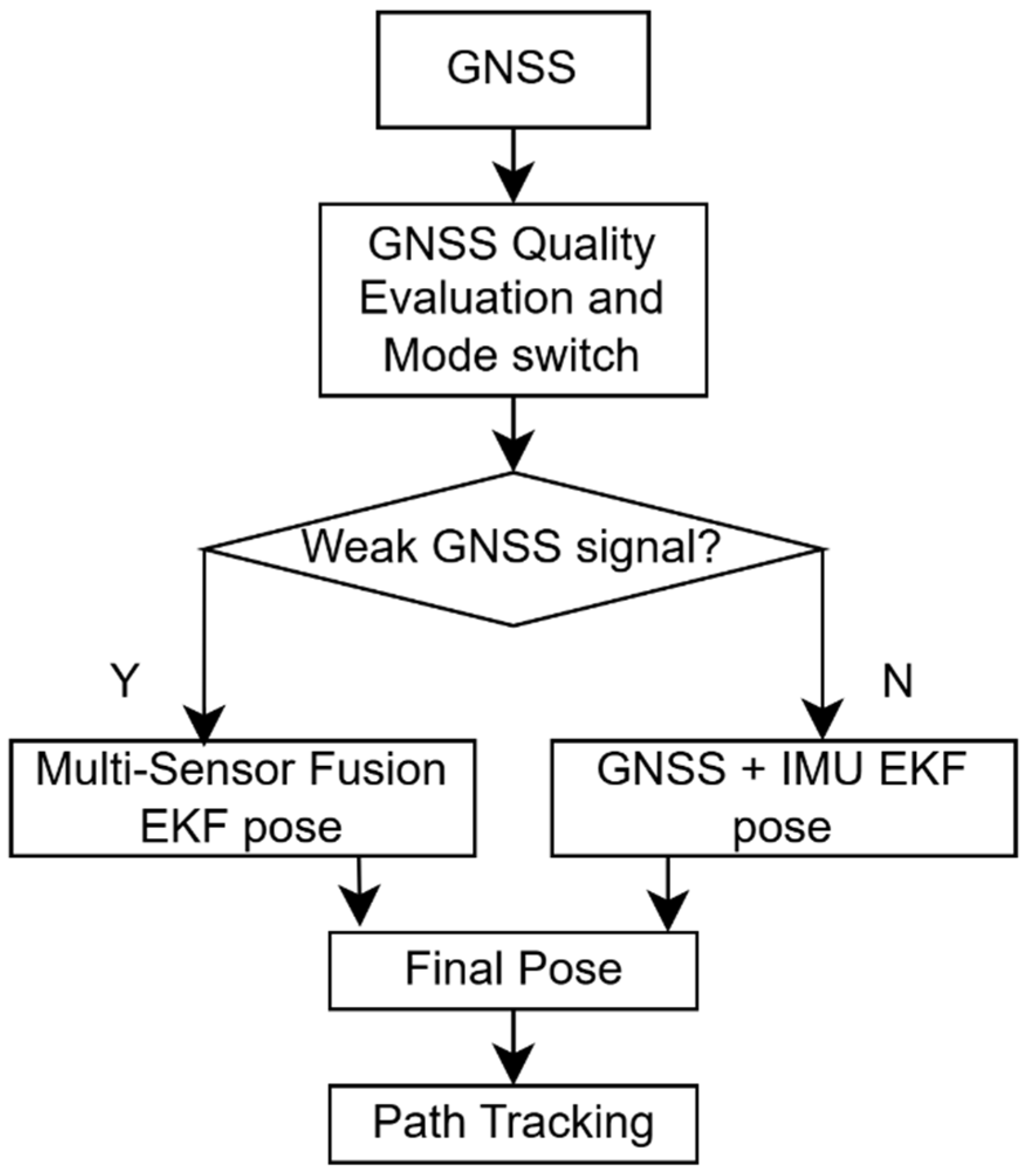
In this paper, we propose an adaptive multi-sensor fusion framework for robust outdoor localization and path tracking under weak GNSS conditions. The proposed system integrates GNSS, LiDAR, wheel odometry, and IMU measurements within an Extended Kalman Filter (EKF) framework. Unlike conventional methods that treat GNSS measurements with fixed confidence, we introduce an adaptive weighting mechanism that dynamically adjusts the influence of GNSS observations based on signal quality indicators such as covariance and dilution of precision (DOP). Furthermore, the proposed system incorporates a mode-switching strategy based on GNSS signal quality. When GNSS signals are reliable, the system primarily relies on GNSS measurements for localization and path tracking. In contrast, when GNSS signals are degraded, the system seamlessly transitions to a fusion-based localization mode, where GNSS, LiDAR, odometry, and IMU measurements are jointly utilized to ensure robustness and continuity. This adaptive switching mechanism enables the system to maintain stable performance across varying environmental conditions. In addition, the IMU provides reliable heading estimation, which improves orientation stability and enhances path tracking performance. By combining the short-term accuracy of odometry and IMU with the long-term consistency of LiDAR and GNSS, the proposed framework achieves robust and stable localization in challenging outdoor environments. The fused pose is further utilized for trajectory tracking, enabling smooth and accurate navigation.
The main contributions of this paper are summarized as follows: (1) To address localization instability caused by degraded GNSS signals in outdoor environments, a GNSS quality-aware adaptive localization framework is proposed for robust outdoor navigation under weak GNSS conditions. (2) An adaptive mode-switching strategy is developed to seamlessly transition between GNSS-dominant localization and multi-sensor fusion localization according to real-time GNSS quality, thereby maintaining localization continuity under varying signal conditions. (3) Unlike conventional approaches that completely reject unreliable GNSS measurements, the proposed framework retains degraded GNSS observations as weak global constraints through adaptive covariance scaling, improving robustness while preserving long-term global consistency. (4) LiDAR scan matching is integrated with wheel odometry and IMU measurements within the EKF framework to compensate for accumulated drift and provide robust and continuous pose estimation under weak GNSS conditions. (5) The proposed framework is validated through real-world outdoor experiments, demonstrating improved localization accuracy, localization smoothness, and path tracking stability compared with conventional GNSS-based localization.
The remainder of this paper is organized as follows.
Section 2 reviews the related work.
Section 3 describes the adaptive localization method.
Section 4 presents the path tracking and motion control method.
Section 5 shows the experimental setup and results. Finally,
Section 6 concludes the paper and outlines future work.
2. Related Words
GNSS has been widely used for outdoor robot localization because it provides globally referenced positioning information. However, GNSS performance can be significantly degraded by signal blockage, multipath effects, and non-line-of-sight (NLOS) propagation in urban canyons and complex outdoor environments. To improve localization robustness, recent studies have investigated GNSS quality evaluation and multi-sensor fusion techniques. Zhang et al. proposed a GNSS/multi-sensor fusion framework based on continuous-time factor graph optimization, demonstrating improved localization accuracy under degraded GNSS conditions [
10]. Angelats et al. [
27] investigated seamless indoor–outdoor tracking using GNSS positioning error time series and highlighted the importance of adaptive handling of GNSS degradation. These studies demonstrate the importance of incorporating sensor reliability into localization frameworks. To overcome the limitations of individual sensors, multi-sensor fusion approaches have become a standard solution for autonomous localization. Extended Kalman Filters (EKF), factor graph optimization (FGO), and tightly coupled LiDAR–IMU odometry frameworks have been extensively employed to integrate GNSS, LiDAR, IMU, and wheel odometry measurements. Huang et al. [
25] proposed an adaptive multi-sensor fusion framework that dynamically adjusts sensor confidence according to degradation detection indicators. Wang et al. [
28] developed an adaptive ESKF-based localization framework for complex environments. More recently, UniMSF introduced a unified factor graph framework capable of integrating heterogeneous sensors while handling time-varying uncertainty [
29]. Although these approaches significantly improve localization accuracy and robustness, most studies either assume reliable GNSS availability or focus primarily on adaptive weighting strategies.
Despite these advances, several limitations remain. First, many existing approaches completely suppress degraded GNSS observations when signal quality deteriorates. Second, optimization-based methods often require increased computational complexity and computational resources. Third, relatively limited attention has been given to outdoor environments where GNSS signals are degraded but still partially available. Motivated by these limitations, this paper proposes a GNSS quality-aware adaptive localization framework that dynamically switches between GNSS-dominant and multi-sensor fusion modes. Unlike conventional approaches, degraded GNSS measurements are retained as weak global constraints through adaptive covariance scaling, thereby improving localization robustness while maintaining long-term global consistency and supporting stable path tracking performance under weak GNSS conditions.
4. Path Tracking and Motion Control
To achieve stable outdoor navigation, the localization result obtained from the proposed adaptive sensor fusion framework is utilized for real-time path tracking of the robot system. The state is expressed as (39), where
represents the current robot pose obtained from the EKF localization framework. The reference trajectory is represented as a sequence of waypoints in the global coordinate frame:
. To perform trajectory tracking, a Pure Pursuit controller is adopted due to its simplicity and robustness for outdoor robot navigation. The controller selects a target point located at a predefined look-ahead distance
along the reference trajectory. The steering angle is computed as:
where
is the steering angle,
is the wheelbase of the robot,
is the heading error between the robot orientation and the target point, and
is the look-ahead distance. The heading error is calculated as:
where
denotes the selected target point on the reference path. The localization result generated by the proposed adaptive sensor fusion framework is continuously used as feedback for path tracking. Under weak GNSS conditions, LiDAR-corrected localization helps maintain stable trajectory tracking performance despite degraded GNSS measurements.
For path tracking, the robot is controlled using a constant commanded linear velocity
and an angular velocity command
. The constant linear velocity is predefined according to the navigation task, while the angular velocity is computed by the Pure Pursuit controller based on the heading error between the robot and the target point.
Based on discussion on
Section 3 and
Section 4, the algorithm of GNSS quality-aware adaptive multi-sensor fusion localization and path tracking is organized in Algorithm 1 as below:
| Algorithm 1: GNSS Quality-Aware Adaptive Multi-Sensor Fusion and Path Tracking |
Input: GNSS measurement, LiDAR scan points, wheel odometry, IMU measurement, GNSS quality thresholds and , look-ahead distance , and wheelbase L.
Output: Fused state , linear velocity and angular velocity.
Initialization: Initialize state vector, covariance. Define process noise covariance. Define measurement noise covariance. |
1. while robot is navigating do:
2. Perform EKF prediction using motion model:
3.
4.
5. Read sensor data: GNSS, LiDAR, odometry, IMU at time
6. Compute GNSS quality metric
7. Determine localization mode using hysteresis:
8. if then
9. else if then
10. else
11. if then
12. Build observation vector
13. Build observation matrix
14. Build measurement covariance
15. else if then
16. Compute adaptive GNSS covariance:
17. Perform LiDAR scan matching to get
18. Build observation vector =
19. Build observation matrix
20. Build measurement covariance
21. end
22. Compute Kalman gain
23. Update state:
24. Update covariance:
25. Extract current pose ( ) from
26. Compute target point on reference path at look-ahead distance
27. Compute heading error
28. Compute angular velocity command
29. Send control command (, ) to robot
30. end while |
5. Experiments
This section presents the experimental platform, sensor configuration, and evaluation scenarios used to validate the proposed adaptive multi-sensor fusion framework for outdoor localization and path tracking under weak GNSS conditions.
The experimental platform is an outdoor robot equipped with multiple sensors for localization and navigation. The experimental platform consisted of a u-blox ZED-F9P dual-frequency RTK GNSS receiver, a Velodyne VLP-16 16-channel LiDAR, a CH100 MEMS IMU, and wheel encoders. All sensor data were processed on an Intel NUC mini PC running Ubuntu 20.04 and ROS Noetic. Multi-sensor fusion was implemented using the robot_localization package based on an Extended Kalman Filter (EKF). Sensor measurements were synchronized using ROS timestamps before being fused within the localization framework. GNSS measurements are obtained from the/gps/fix topic using the sensor_msgs/NavSatFix message type. The latitude and longitude data are converted into planar coordinates using the UTM coordinate transformation. Wheel odometry and IMU measurements are used for motion propagation, while LiDAR scan matching is used for pose correction under degraded GNSS conditions.
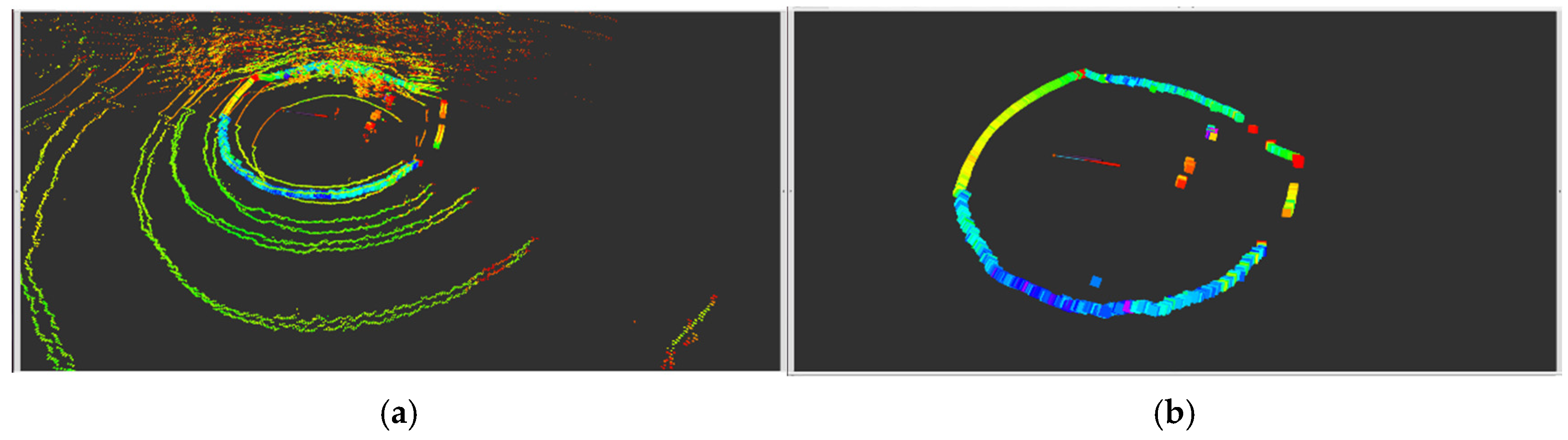
Figure 2a illustrates the 3D LiDAR point cloud collected during the outdoor experiment. The surrounding environmental structures, including road boundaries and obstacles, can be observed from the point cloud distribution.
Figure 2b shows the filtered 2D laser scan points generated from the 3D LiDAR point cloud for scan matching and localization. In the figure, the purple arrow represents the robot pose estimated from the GNSS measurements, while the red arrow denotes the pose estimated by the proposed Fusion Mode localization framework. The heading direction of both poses is calculated using the IMU measurements. These results demonstrate the integration of GNSS, LiDAR, odometry, and IMU information within the proposed adaptive fusion localization system.
Experiments are conducted in outdoor environments containing both reliable and degraded GNSS conditions. The reliable GNSS scenario includes open outdoor areas with sufficient satellite visibility. The weak GNSS scenario includes environments affected by signal degradation, such as areas near buildings, trees, or narrow passages, where GNSS measurements become unstable due to signal blockage and multipath effects. During the experiments, the robot follows predefined trajectories while continuously estimating its pose using the proposed adaptive sensor fusion framework. In the experimental implementation, the lower and upper GNSS quality thresholds were empirically set to () and (), respectively. The GNSS quality metric is defined as the trace of the GNSS covariance matrix. When (), the system switches from GNSS-dominant localization to fusion mode. When (), the system returns to GNSS-dominant localization. The hysteresis band between () and () prevents frequent mode switching caused by short-term GNSS covariance fluctuations. In fusion mode, the GNSS covariance matrix was scaled using a linear weighting factor with (), allowing degraded GNSS measurements to be retained as weak global constraints while reducing their influence on the EKF update. The EKF parameters were selected according to the characteristics of the employed sensors and refined through preliminary experimental tuning. The process noise covariance matrix was configured as ), corresponding to the uncertainties of position, heading, linear velocity, and angular velocity in the motion model. For LiDAR observations, the measurement covariance matrix was set to ). The wheel odometry and IMU measurement noise variances were set to () and (), respectively. Unlike the other sensors, the GNSS measurement covariance matrix was obtained directly from the position covariance field of the ROS NavSatFix message and updated online according to the estimated GNSS uncertainty. These parameter values remained fixed throughout all experiments.
The rosbag video (
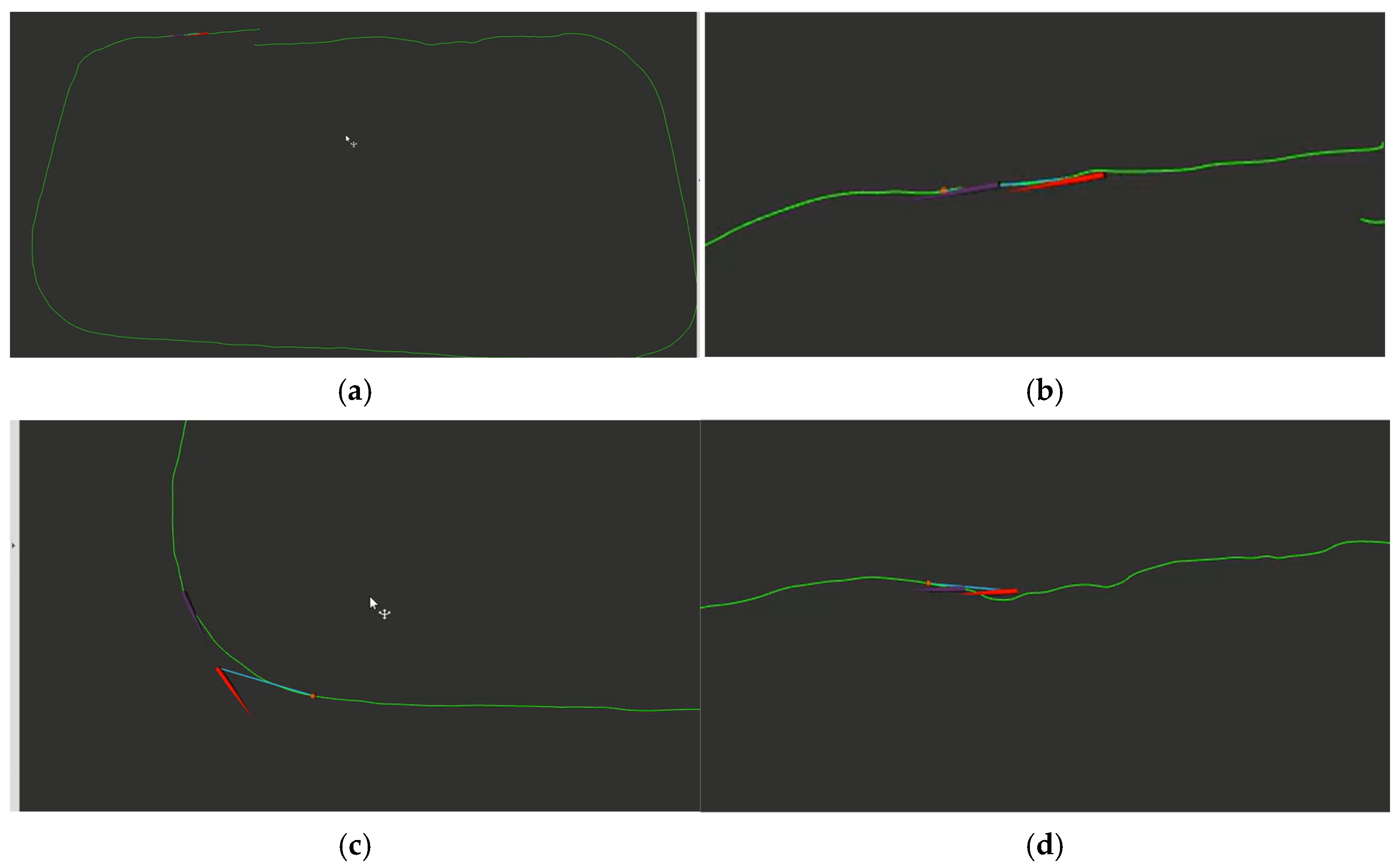
https://drive.google.com/file/d/1BdYgpcQ7gU1UrznpPVko9dlHMECmG6qG/view?usp=sharing) (accessed on 15 May 2026) recorded the complete process of robot localization and path tracking during the outdoor experiment. As shown in
Figure 3a, the green line represents the reference trajectory that the robot is required to follow. The reference path was generated by first recording GNSS points in advance and then applying the cubic spline interpolation method to obtain uniformly distributed waypoints.
Figure 3b illustrates the localization results during the experiment. The purple arrow represents the robot pose estimated from the raw GNSS measurements, while the red arrow denotes the pose estimated using the proposed Fusion Mode localization framework. The heading direction of both poses is calculated from the IMU measurements. During navigation, the robot performs path tracking based on the Fusion Mode localization result. As shown in
Figure 3c, during the time interval from
to
min
, the GNSS positioning points become sparse due to degraded satellite signal conditions. In this segment, the Fusion Mode localization result remains ahead of the GNSS positioning result and provides smoother and more continuous localization output. Consequently, the robot is able to maintain stable localization and accurately follow the reference trajectory using the proposed Fusion Mode localization.
Figure 3d further demonstrates robot navigation under degraded GNSS conditions and uneven path geometry. Although the GNSS localization becomes unstable, the proposed Fusion Mode localization maintains a smoother trajectory and enables more stable path tracking performance throughout the experiment.
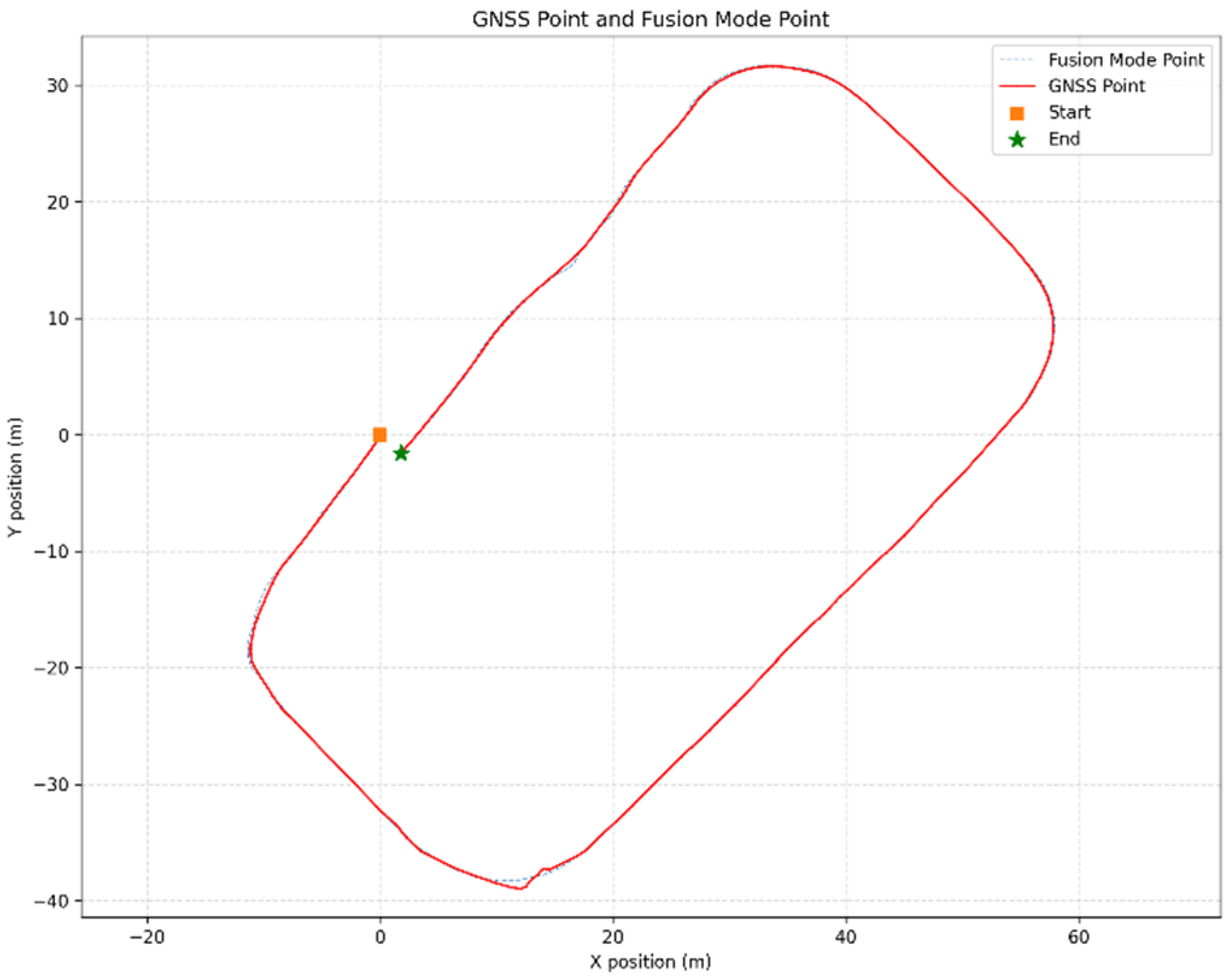
Figure 4 illustrates the overall localization trajectories obtained from the raw GNSS measurements and the proposed fusion localization method. The GNSS points represent the direct positioning results converted from latitude and longitude into the UTM coordinate frame, while the Fusion Mode points correspond to the localization results generated by the proposed adaptive EKF-based multi-sensor fusion framework. The results show that both trajectories maintain global consistency throughout the experiment. However, the proposed fusion trajectory exhibits smoother and more continuous motion compared with the raw GNSS measurements. This is because the fusion framework utilizes wheel odometry and IMU measurements for short-term motion propagation, while LiDAR scan matching provides pose correction under weak GNSS conditions. As a result, the proposed method effectively suppresses local GNSS fluctuation and maintains stable localization performance.
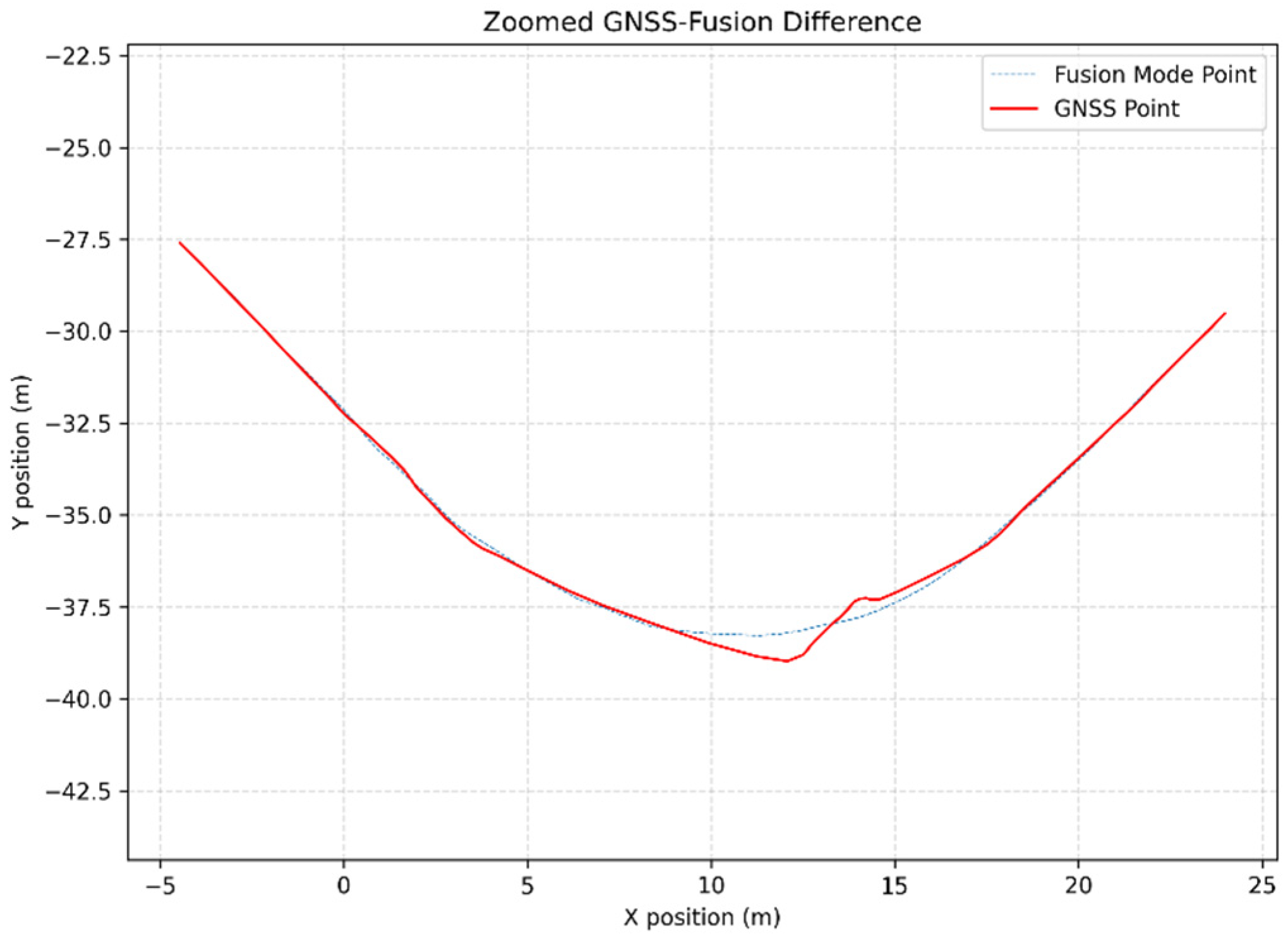
Figure 5 presents a zoomed-in view of a representative weak GNSS segment from the experiment. In this region, the raw GNSS localization exhibits noticeable discontinuities and sparse positioning updates in the weak GNSS region. In contrast, the proposed fusion localization maintains continuous pose estimation through the integration of LiDAR scan matching, wheel odometry, and IMU measurements. This behavior indicates that the proposed framework reduces the sensitivity of the localization result to GNSS degradation and improves localization continuity.
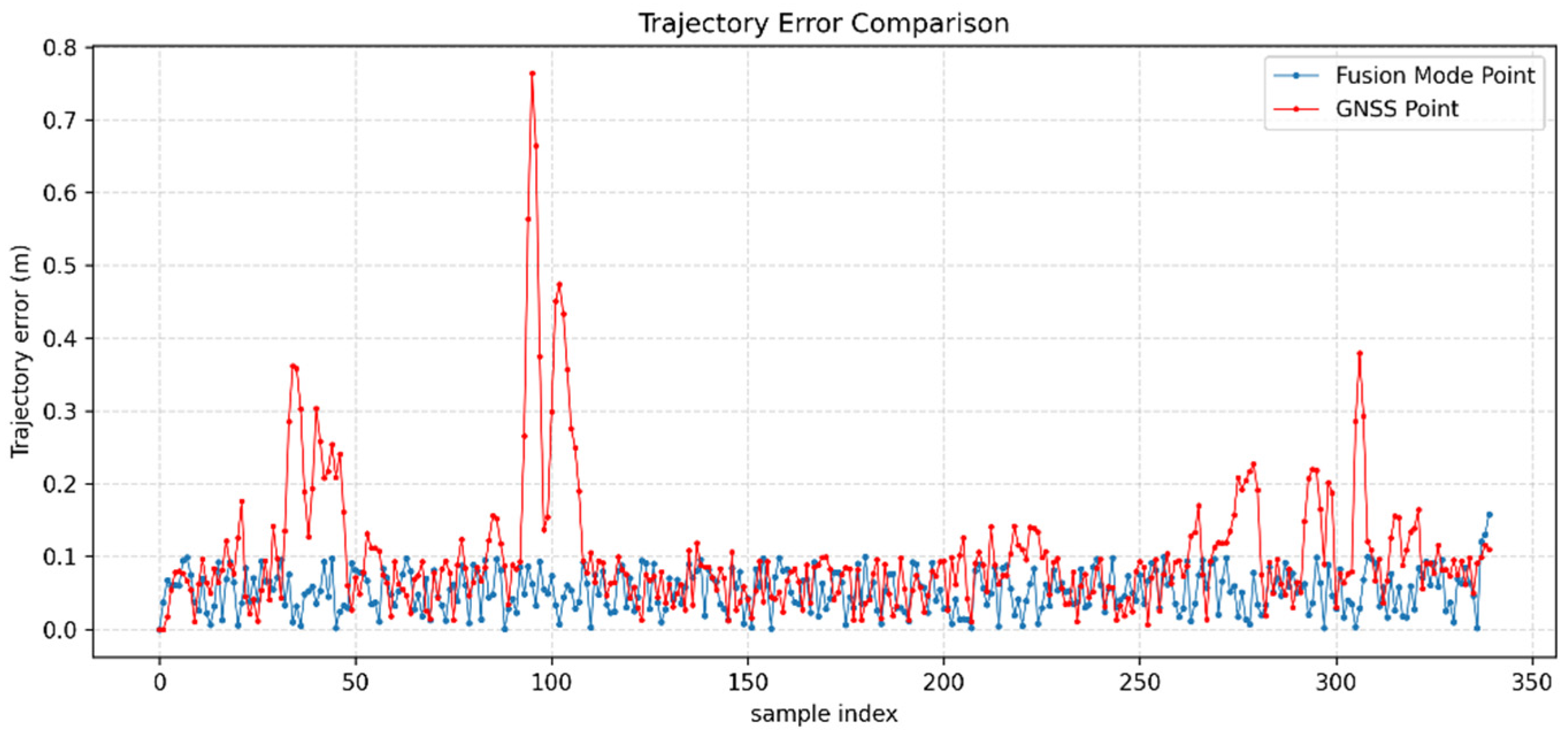
Figure 6 shows the localization error relative to each target point along the experimental trajectory. The error at each target point is computed as the Euclidean distance between the localization result and the corresponding reference target point. Compared with the raw GNSS measurements, the proposed fusion localization method maintains consistently lower and more stable localization error throughout the experiment. Although the GNSS-based localization occasionally exhibits large error spikes due to signal degradation and positioning fluctuation, the proposed fusion framework significantly suppresses these variations by combining GNSS, LiDAR, odometry, and IMU information within the adaptive EKF framework. These results demonstrate the improved localization stability and robustness of the proposed method in weak GNSS conditions.