Article

Successive Reference-Pose Tracking for Delay-Robust Vehicle Teleoperation: A Real-World Experimental Evaluation


Department of Mechanical Engineering, Politecnico Di Milano, 20156 Milan, Italy
*
Author to whom correspondence should be addressed.
Electronics 2026, 15(12), 2743; https://doi.org/10.3390/electronics15122743 (registering DOI)
Submission received: 13 May 2026 / Revised: 18 June 2026 / Accepted: 18 June 2026 / Published: 22 June 2026

Abstract

Network latency remains a fundamental bottleneck in vehicle teleoperation, inducing instability and performance degradation in conventional control methods, while predictive techniques like the Smith Predictor offer a theoretical solution, their efficacy is often compromised by unmodelled dynamics and real-world disturbances. This paper presents the first experimental validation of the Successive Reference-Pose Tracking (SRPT) architecture. By streaming future reference poses rather than direct steering commands, SRPT leverages an onboard Nonlinear Model Predictive Controller to compute optimal vehicle actions while inherently accounting for dynamic constraints and network delays. Real-world human-in-the-loop experiments were conducted with four drivers on a test track featuring cornering, double lane-change, and slalom manoeuvres. Quantitative comparisons at 10 km/h across four modes—manual driving, direct teleoperation, a Smith Predictor, and SRPT—demonstrate that SRPT significantly outperforms other teleoperation methods, reducing cross-track error by up to 66% and yielding smoother, more stable control inputs. Furthermore, SRPT uniquely maintained stability during a proof-of-concept trial at 13 km/h, where it proactively moderated vehicle speed to respect actuator limits—a critical safety behavior absent in other modes. This work provides the first tangible evidence that SRPT is a robust and superior framework for delay-resilient vehicle teleoperation in real-world conditions.

1. Introduction

Vehicle teleoperation is emerging as a potential technology to bridge the gap between manual and fully autonomous driving, enabling remote human assistance for autonomous vehicles in complex scenarios [1] or serving as a primary control method for logistics and hazardous environment operations. However, the practical deployment of direct teleoperation is fundamentally hindered by network latency. The unavoidable time delay between the operator’s command and the vehicle’s response, often amounting to hundreds of milliseconds, can desynchronize the human–machine control loop. This frequently leads to operator overcorrection, inducing oscillations that degrade path-tracking performance and can ultimately destabilize the vehicle.
The successful deployment of this technology is contingent upon surmounting several critical hurdles. These include designing an intuitive human–machine interface that minimizes operator cognitive load, mitigating the control instability caused by variable network delays, and ensuring the system’s overall safety and reliability through robust fault detection and recovery protocols.

1.1. Related Work

These limitations motivate a careful re-examination of where the boundary between human and machine responsibility should be drawn. Following the taxonomy of Majstorović et al. [1], remote-driving concepts can be grouped into three categories with respect to the AD pipeline’s Sense–Plan–Act structure.
Direct control [2,3] passes steering and throttle commands through the latency-affected communication channel, placing the operator inside the feedback loop; every delay increment degrades closed-loop stability.
Shared  control [4,5,6] adds an automated safety layer that can override the transmitted commands in real time; however, the operator’s intent is still communicated as high-frequency actuation commands, so the method remains susceptible to delay-induced lag.
The principal challenge for direct and shared control paradigms, where steering inputs are transmitted to the vehicle, is network latency. To counteract this, predictive displays have been widely investigated, using a vehicle model to forecast its future state and provide the operator with delay-compensated feedback [7,8,9,10,11,12]. The classic Smith Predictor is a prime example of such a model-based strategy [13]. However, the efficacy of these methods fundamentally depends on model accuracy; their performance deteriorates significantly in the presence of real-world environmental disturbances, such as low-adhesion surfaces or crosswinds, which are not captured by the predictive model.
Trajectory  guidance [14,15] removes actuation commands from the communication channel entirely by transmitting a full trajectory (path and velocity profile) to an onboard trajectory-following module; this achieves latency decoupling but reduces the operator to sporadic planning updates and requires the vehicle’s trajectory-planning module to be operational. Trajectory guidance approaches are also susceptible to latency, as a delayed trajectory can lead to instability, and the real-time generation of optimal trajectories remains a non-trivial challenge.
Recent analytical and numerical studies, such as the comprehensive model presented by [16], have elegantly demonstrated how the coupling of overall latency, longitudinal vehicle velocity, and path curvature fundamentally limits the stability boundaries of conventional teleoperated driving. Successfully deploying remote driving requires a paradigm that actively decouples these variables to prevent delay-induced instability.

1.2. Previous Work and the SRPT Approach

To resolve the trade-offs inherent in predictive displays and trajectory guidance, and to safely navigate the theoretical stability boundaries identified by [16], our work physically validates the Successive Reference-Pose Tracking (SRPT) architecture. Conceptualised in simulation [17], SRPT introduces a fourth paradigm that sits between direct control and trajectory guidance in the sense-plan-act pipeline. The fundamental premise relies on a strategic control decomposition. Like direct control, the operator remains continuously and actively engaged at every control cycle (approximately 30 Hz), preserving real-time human agency over the intended path. However, rather than sending high-frequency steering and throttle commands across a latency-prone network, the remote operator acts as a strategic path planner, generating a low-bandwidth stream of continuous future reference poses. This pose stream is transmitted to the vehicle, effectively removing network delay from the inner control loop. An onboard, high-frequency Nonlinear Model Predictive Control (NMPC) unit then autonomously computes both the optimal trajectory and the velocity modulation needed to reach that pose. In the vocabulary of [1], SRPT replaces the full PLAN block with a single pose interface, with the NMPC substituting for the trajectory-generation and trajectory-following sub-blocks onboard. By computing control actions locally, the system inherently accounts for real-world dynamic constraints and absorbs variability in network delay without suffering from feedback latency loops. While prior simulation studies [17] have elegantly demonstrated the theoretical resilience of this framework against variable delays, its operational viability demands real-world physical verification.

1.3. Contribution of Paper

Despite promising simulation results, the practical viability of any novel control architecture ultimately requires real-world validation. The primary contribution of this work is the first experimental, human-in-the-loop validation of the SRPT architecture on a physical vehicle. We present the results of real-world driving tests comparing the performance of SRPT against a baseline of manual driving and two established teleoperation methods: a direct No-Controller mode and a Smith Predictor implementation. By analysing quantitative performance metrics across a series of challenging manoeuvres, this paper provides definitive evidence of SRPT’s practical viability and its superiority over conventional delay-compensation techniques.

1.4. Outline of Paper

The rest of the paper is organised as follows. Section 2 presents the experimental methodology, including the test platform, driving modes, and network characterization. Section 3 details the experimental results and analysis across all manoeuvres and performance metrics. Finally, Section 4 concludes the work and discusses future research directions.

2. Methodology

To empirically validate the SRPT architecture, a human-in-the-loop experiment was conducted on a physical test track. The methodology was designed to create a controlled environment for comparing the performance of SRPT against established benchmarks under challenging dynamic conditions.

2.1. Experimental Platform

The test platform comprised three main components: a remote vehicle, a control station, and a communication link.
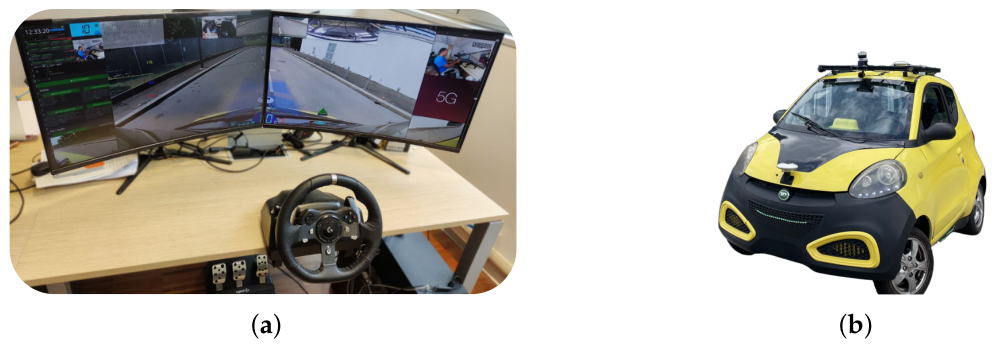
  • Control Station: The remote operator was provided with a standard automotive interface, including a force-feedback steering wheel and pedals. A monitor displayed a first-person video feed from the vehicle, providing the operator with their primary visual feedback, as shown in Figure 1a.
  • Remote Vehicle: A test vehicle was equipped for drive-by-wire operation, allowing for electronic control of steering and speed, as shown in Figure 1b.
  • Communication Link: A 5G mobile communication network is utilised for bidirectional data transmission. This link carried video data from the vehicle to the station (downlink) and control commands from the station to the vehicle (uplink), introducing real-world network latency into the system.

2.2. Test Track and Manoeuvres

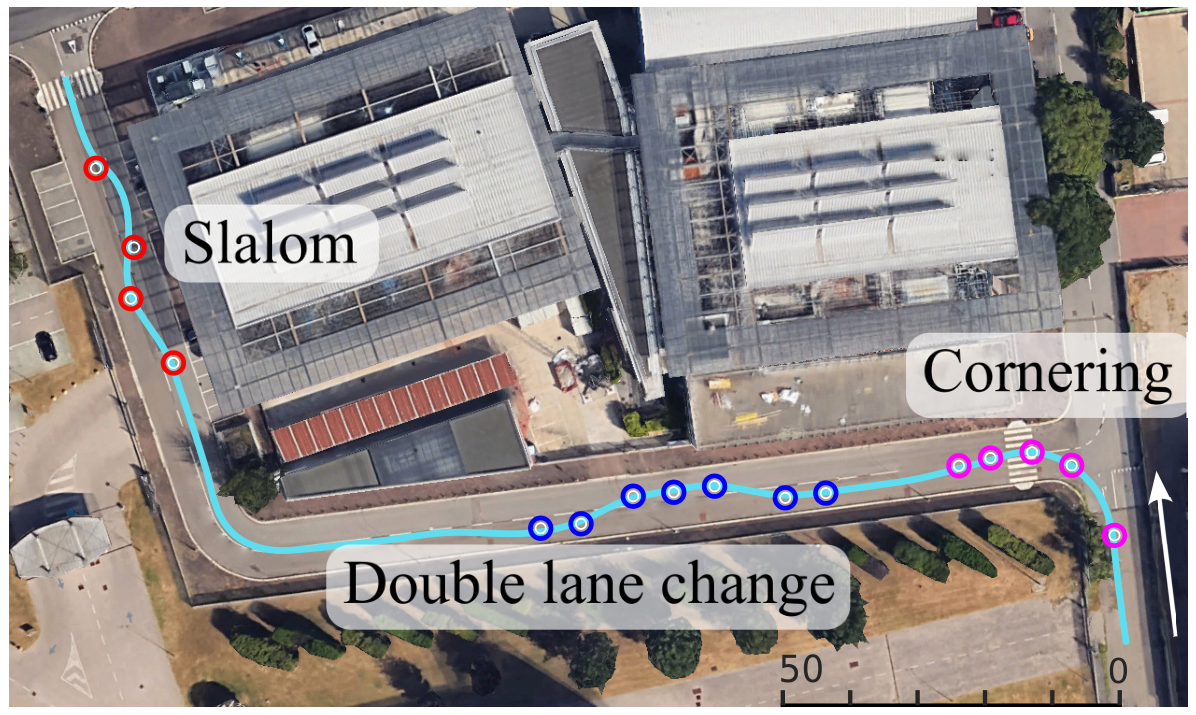
A closed-loop test track was designed with a sequence of manoeuvres specifically chosen to challenge the stability and precision of the teleoperation control loop, as shown in Figure 2. The key sections included:
Cornering: An almost constant-radius corner to assess steady-state tracking performance.
Double Lane Change: A rapid lane-change manoeuvre to evaluate transient response and stability under high-frequency steering inputs.
Slalom: A series of alternating turns designed to induce oscillatory behavior in delay-affected systems. The length of this section and the number of turns are restricted due to the limited length of the road. However, significant oscillation induced by delay is observed during the test with the No-Controller mode.

2.3. Driving and Vehicle Teleoperation Modes

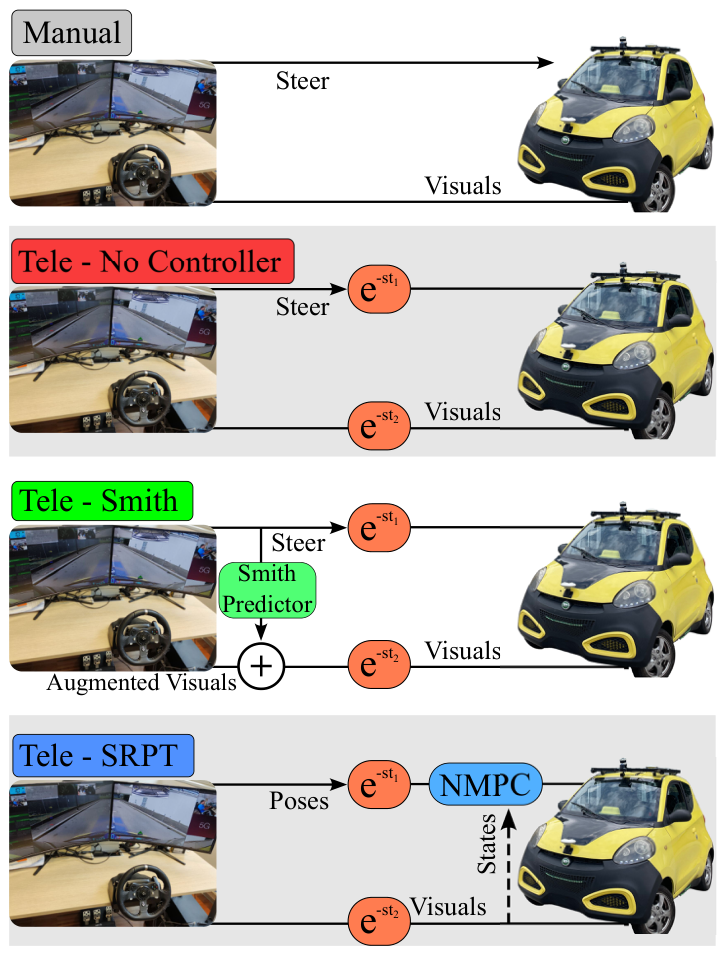
Four distinct driving modes as in Figure 3, were implemented to provide a comprehensive comparison:
  • Manual-In-Vehicle: The operator drove the vehicle from inside the vehicle. This mode served as the performance baseline, representing control with zero latency.
  • Tele-No Controller: Steering commands from the operator were transmitted directly to the vehicle and executed after incurring network delay. This represents the baseline teleoperation challenge.
  • Tele-Smith Predictor: The predictive control mode [13,17] was implemented as a benchmark for delay compensation techniques. A model-based predictor was used to provide the operator with feedback that compensated for the round-trip network delay.
    The Smith Predictor uses the same 7-state slip-based single-track model as the NMPC—states [ β , ψ ˙ , ψ , F y f , F y r , X , Y ] (sideslip, yaw rate, heading, front and rear axle forces, CG position). Both the predictor and the NMPC share the vehicle parameters in Table 1, ensuring a symmetric and fair comparison. The predictor operates in two stages. In the propagation stage, the model state is integrated using the current vehicle speed v and joystick angle δ w ; the result is stored in a circular buffer indexed by the current timestamp. In the display stage, at each video frame received, the predictor predicts the state for time t frame + t net , as per Equation (3) of Prakash et al. [18].
  • Tele-SRPT: In the new architecture [18], the operator’s steering inputs were used to generate a sequence of future reference poses at the control station. These poses were transmitted to (rover) vehicle, where the onboard NMPC calculated the optimal steering and speed commands to track them, subject to the vehicle’s dynamic constraints.
    Control station: Converting operator steering input into reference poses involves generating a look-ahead pose for the vehicle relative to the received pose, while accounting for the joystick steering angle, executed at the video frame rate (≈30 Hz).
    Delay-compensated lookahead distance is set to
    d = v · ( T lh + t net ) , T lh = 0.8 s , t net = t 1 + t 2
    where v is the latest measured vehicle speed and T lh is deliberately set equal to the NMPC prediction horizon ( N · T s = 40 × 20 ms = 0.8 s ). This choice gives SRPT a fundamental delay-compensation property: the vehicle advances v · t net metres during the network transit, so when the pose arrives, it is exactly d v · t net = v · T lh metres ahead—the desired terminal state of the NMPC planning horizon—regardless of the instantaneous value of t net (provided the speed is approximately constant during round-trip network delay). At the nominal round-trip delay of t net 206  ms, this property holds with a T lh / t net 3.9 × safety margin, meaning network delay can increase nearly fourfold before the pose falls outside the planning horizon. In the event of extreme delay spikes, the onboard NMPC naturally moderates vehicle speed to bring the distant pose back within its kinematic reach, providing a graceful degradation of performance rather than instability. This mechanism directly explains the adaptive speed moderation behaviour as will be discussed in Section 3.2.
    Rover: While the comprehensive mathematical framework of the slip-based vehicle model is detailed in our previous simulation study [18], the core parameters configured for this physical deployment are vital for experimental reproducibility. The onboard NMPC manages a state vector of n x = 9 variables— x = [ β , ψ ˙ , ψ , F f , F r , v , X , Y , δ ] T —and a control vector of n u = 2 inputs— u = [ δ ˙ , a ] T . The optimization problem is solved using the real-time ACADOS solver over a prediction horizon of Δ t Horizon = 0.8 s, discretised into N = 40 shooting nodes with a sampling interval of T s = 20 ms. The stage cost matrix is parameterised as R = diag ( [ 3.0 , 0.1 , 0.1 ] ) to penalise steering rate, acceleration, and  tracking velocity deviations, deliberately giving the NMPC the flexibility to moderate speed to maintain lateral stability, while the terminal Mayer cost matrix is set to Q = diag ( [ 100.0 , 0.01 ] ) to enforce alignment of reference pose with vehicle path. Physical actuator boundaries are strictly handled via hard constraints matching the drive-by-wire system limits: steering angle is capped at ± 20 , front-wheel steering rate is limited to ± 10 deg / s (corresponding to the ± 180 deg / s steering-wheel rate constraint). Vehicle acceleration is bounded between a comfort limit of 0.4 m / s 2 and a maximum braking limit of 3.0 m / s 2 .

2.4. Network Delay and Data Transmission

The communication latency can be divided into two parts from the perspective of the control station.
  • Uplink Delay ( t 1 ): This is the delay for control data (reference poses for SRPT; steering commands for other modes) to travel from the control station to the vehicle. It primarily includes network transmission latency.
  • Downlink Delay ( t 2 ): This is the delay for the vehicle’s sensor data (primarily the video feed) to reach the control station. It is a composite of camera exposure and readout time, video encoding latency, network transmission delay, and the final decoding and display latency at the operator’s interface. The downlink delay is typically larger and has a greater impact on the operator’s situational awareness.
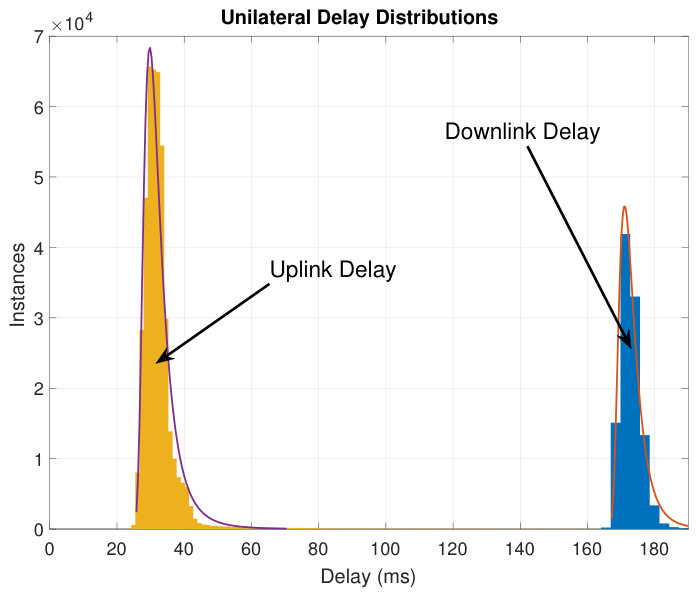
For this study, a public 5G network was used to emulate a realistic teleoperation scenario. The unilateral latency is logged throughout the test campaign. The mean uplink and downlink delays observed were 33 ms and 173 ms, respectively. The distribution of these delays over the course of the test runs is shown in Figure 4.

Clock Synchronisation and Delay Measurement

Both platforms run Ubuntu 24.04 with the chrony NTP daemon using the default configuration, which disciplines the system clock to publicly accessible internet NTP servers. Since the control station and rover are both geographically co-located and connected to an internet time source, synchronisation was verified empirically, rather than relying solely on chrony statistics, by monitoring the delay when both the rover and the base station transmit simple ROS 2 header messages to each other.
The data transmission framework was built on ROS2 for its robust inter-process communication. All teleoperation commands and vehicle state data were transmitted as ROS2 messages. To ensure a stable and low-latency video stream, the SRT protocol was employed for video packet transmission from the vehicle to the control station, mitigating the effects of packet loss and jitter inherent in wireless networks.
The rover’s 5G connection aggregates two independent network interfaces using a proprietary channel-bonding mechanism that allocates traffic dynamically according to instantaneous channel health. The control station connects via the university’s wired campus LAN through a VPN tunnel to the rover, providing a secure and consistently low-jitter uplink.

2.5. Experimental Protocol

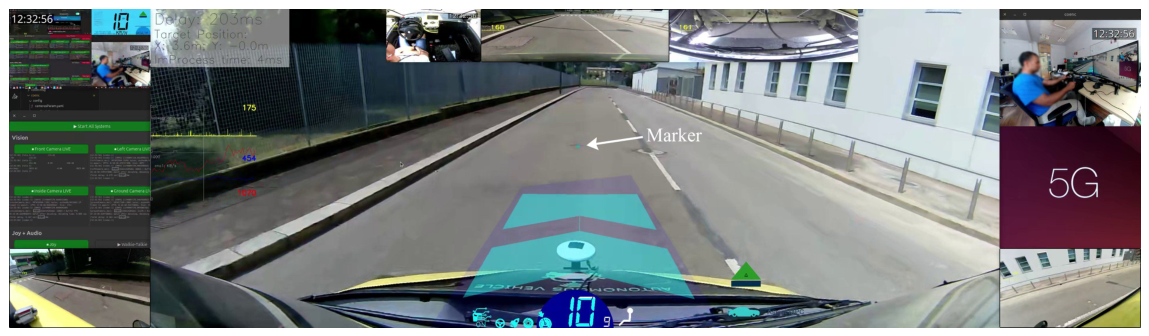
Four drivers participated in the study. Each participant was tasked with driving the vehicle around the test track for three consecutive laps in each of the three teleoperation modes (No-Controller, Smith Predictor, SRPT) at a reference speed of 10 km/h. Additionally, each participant completed one lap in manual mode to establish their individual baseline performance. Figure 5 is the visual feedback provided to the remote operator.
Following the main experiment, an additional exploratory trial was conducted using SRPT at an elevated target speed of 13 km/h. This high-speed validation was performed exclusively with SRPT because all operators expressed that attempting this speed with conventional teleoperation modes (direct control and Smith Predictor) would be unsafe due to apparent delay-induced oscillations and control instability.
Each participant completed one manual (in-vehicle) lap before their teleoperation session to establish their individual performance baseline and familiarise themselves with the track layout, marker positions, and vehicle handling, thereby decoupling spatial familiarity from the subsequent mode comparison.
The three teleoperation modes were presented in a fixed order—Tele-No Controller → Tele-Smith → Tele-SRPT—with three consecutive laps per mode. This sequence was chosen to progress from the most challenging condition (uncompensated delay) to the most assisted (SRPT), mirroring a natural disclosure of system capabilities and avoiding the disorientation that could arise if participants encountered SRPT’s unfamiliar pose-based interface first.
Importantly, this fixed ordering is conservative with respect to SRPT: drivers accumulate greater track familiarity as the session progresses, so any benefit from practice-induced improvement accrues preferentially to the later modes. The decisive evidence against a practice confound is the Smith Predictor result: Tele-Smith was always driven after Tele-No Controller (six laps of prior track experience), yet it showed no statistically significant improvement over direct teleoperation in any manoeuvre ( p > 0.40 , Tukey HSD). If accumulated familiarity were the primary driver of the performance hierarchy, Smith should have appeared superior to No-Controller—which it did not. The large effect sizes for SRPT (Hedges’ g = 0.69 1.08 ) therefore reflect the architecture’s mechanical advantage over delay-induced instability rather than a practice-order artefact.

2.6. Data Analysis and Metrics

To quantitatively assess performance, the following key performance metrics were calculated for each manoeuvre:
  • Mean Cross-Track Error (m): The average deviation of the vehicle’s front from the track’s centreline.
  • Max Cross-Track Error (m): The max deviation of the vehicle’s front from the track’s centreline.
  • Completion Time (s): Manoeuvre completion time.

3. Results and Discussion

The experimental results demonstrate a consistent performance hierarchy across the tested driving modes, with the SRPT architecture exhibiting superior path-tracking accuracy and control stability under realistic network delays. The quantitative and qualitative data presented below validate SRPT’s ability to maintain robust teleoperation performance even during demanding manoeuvres where conventional approaches fail.

3.1. Path Tracking Performance in the Demanding Slalom

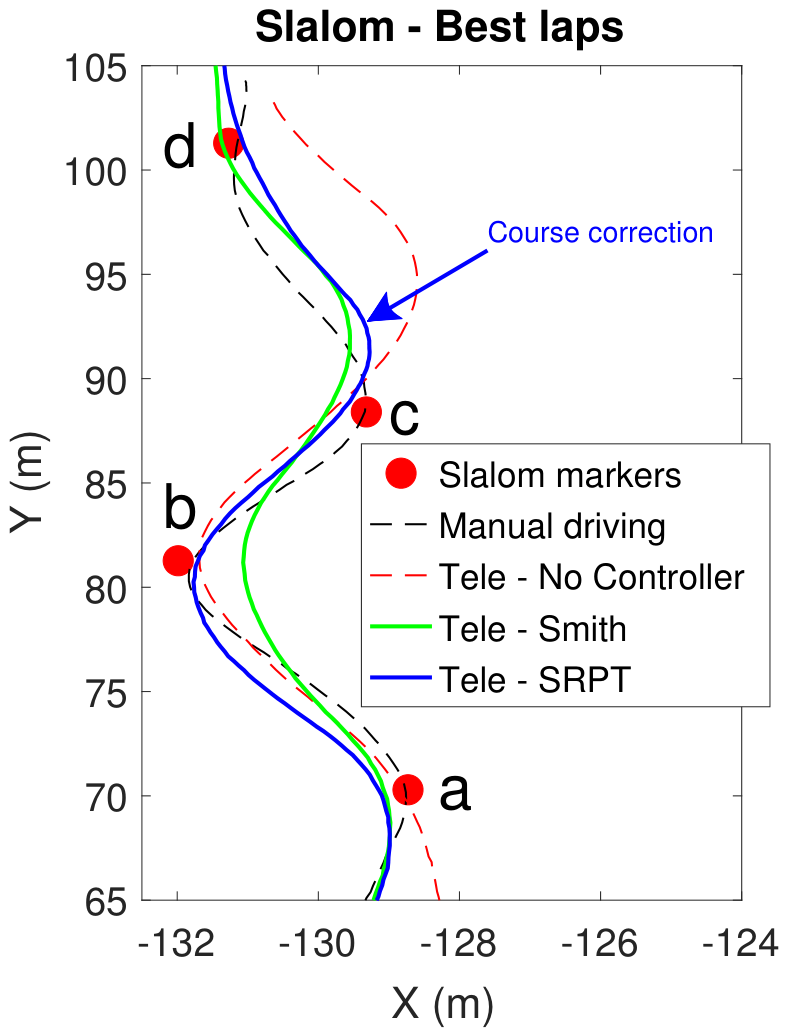
The slalom manoeuvre, characterised by rapid and alternating directional changes, presents a fundamental challenge for teleoperation due to the vehicle’s steering rate constraint of ± 180 deg/s. Figure 6 visually compares the traversed paths for the best laps of each driving mode through this challenging section.
Manual driving, free from control-loop delays and actuation constraints, serves as the performance baseline. The No-Controller mode exemplifies the core challenge of delayed teleoperation, exhibiting significant overshooting after marker ‘c’ due to the operator’s delayed corrections compounded by steer rate saturation.
The Smith Predictor approach shows partial mitigation of this issue, reducing overshoot but introducing substantial lateral deviations (particularly around markers ‘b’ and ‘c’). This indicates a fundamental trade-off in model-based predictors, where stability is improved at the expense of tracking accuracy. In contrast, the SRPT approach successfully mitigates both overshooting and lateral deviation, closely adhering to the intended path.
The better performance of SRPT stems from its onboard Nonlinear Model Predictive Controller (NMPC), which possesses explicit knowledge of the vehicle’s dynamic constraints. The controller proactively optimises both steering and speed commands to track the operator’s reference poses without violating these constraints. The adaptive trajectory correction observed after marker ‘c’ in Figure 6 results directly from this optimization: when the controller predicts that current speed would lead to constraint violation and path deviation, it modulates vehicle velocity to allocate sufficient time for the steering system to execute required manoeuvres.

3.2. Analysis of Steer and Speed Demands During Slalom

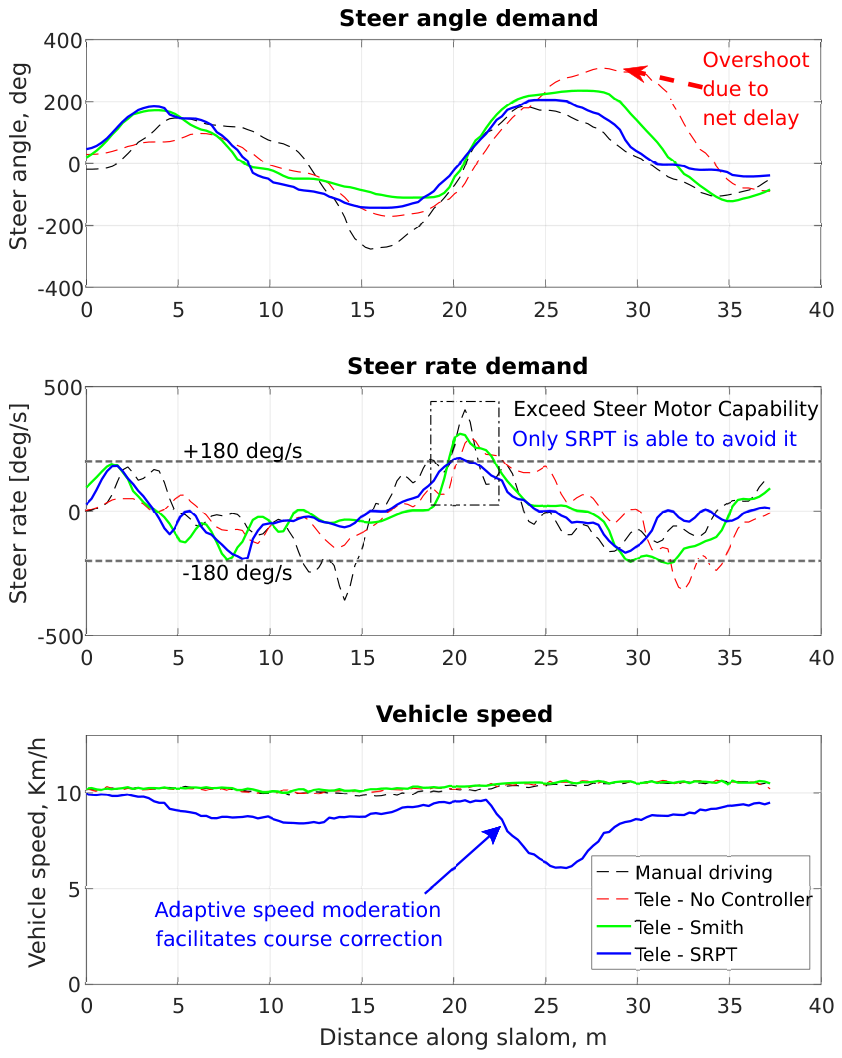
Figure 7 provides deeper insight into the control strategies by plotting demanded steer and speed commands during the same laps. The data corroborates the hypothesis derived from the trajectories: all teleoperation modes except SRPT issue steering commands that saturate the ± 180 deg/s rate limit during the second half of the slalom, directly causing the observed instability and overshoot.
SRPT is the only mode that avoids this saturation. It achieves this not by reducing the aggressiveness of the intended path, but by adaptively modulating the vehicle speed. The third subplot of Figure 7 clearly shows that the SRPT controller commands a moderation of speed precisely when high steering rates are required. This speed reduction provides the steering actuator with the necessary time to achieve the desired wheel angle without exceeding its rate limit, thereby enabling the precise and stable path tracking observed in Figure 6.

3.3. Comprehensive Performance Metrics Across All Three Manoeuvres

The effectiveness of SRPT’s integrated steering and speed optimization extends beyond the slalom to all tested manoeuvres. To quantitatively validate these performance advantages, a two-way analysis of variance (ANOVA) was conducted on all 36 teleoperation laps, with teleoperation mode (Tele-No Controller, Tele-Smith, Tele-SRPT) and driver treated as fixed factors. Including the driver as a factor removes inter-operator variance from the error term—equivalent to a Randomised Complete Block Design—ensuring that mode effects are not confounded by individual differences in operator skill.
The analysis revealed a statistically significant main effect of teleoperation mode on cross-track error for all three manoeuvres: cornering [F(2, 24) = 15.37, p < 0.001], double lane change [F(2, 24) = 6.86, p = 0.004], and slalom [F(2, 24) = 7.48, p = 0.003]. A significant driver main effect was confirmed for cornering [F(3, 24) = 3.31, p = 0.037] and double lane change [F(3, 24) = 4.50, p = 0.012], validating the two-way design. These results were independently corroborated by a non-parametric Friedman test on per-driver mean errors, which also reached significance for all three manoeuvres ( χ 2 6.00 , df = 2, p 0.050 ), providing a distribution-free confirmation that requires no normality assumption.
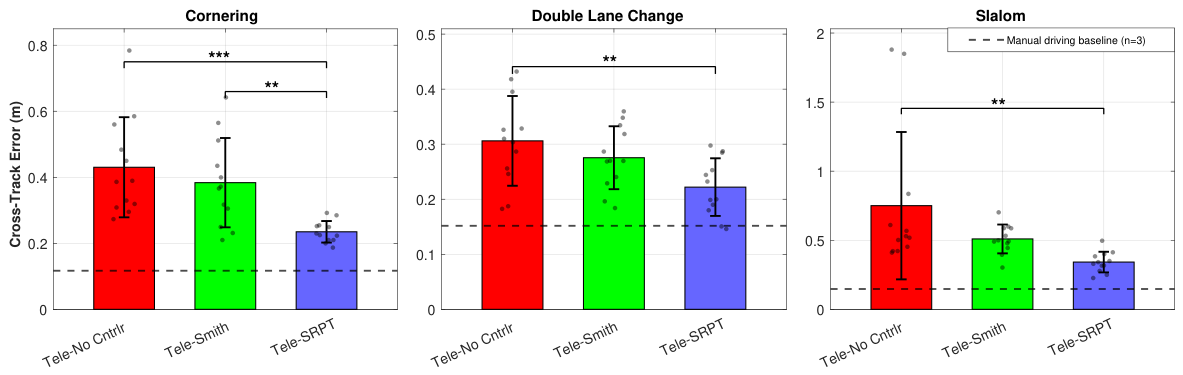
As illustrated in Figure 8, a subsequent Tukey’s Honestly Significant Difference (HSD) post hoc test showed that SRPT achieved significantly lower cross-track errors than Tele-No Controller in all three manoeuvres (cornering: Δ = 0.195 m, p < 0.001; double lane change: Δ = 0.084 m, p = 0.003; slalom: Δ = 0.408 m, p = 0.002), and significantly outperformed the Smith Predictor in the cornering manoeuvre (Δ = 0.149 m, p = 0.001), where precise sustained lateral tracking makes actuator constraint management most consequential. Critically, no statistically significant difference was detected between Tele-No Controller and Tele-Smith in any manoeuvre (p > 0.40 in all cases), indicating that the Smith Predictor does not reliably reduce mean tracking error relative to uncompensated direct teleoperation under the experimental conditions. Effect sizes for all SRPT comparisons were medium to large (Hedges’ g = 0.69–1.08 versus Tele-No Controller; g = 0.67–1.02 versus Tele-Smith in manoeuvres reaching Tukey significance), confirming the practical relevance of these differences beyond their statistical significance.
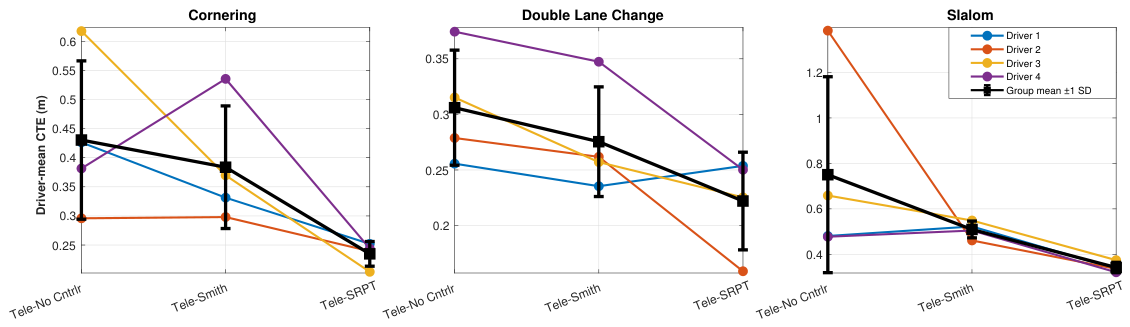
Beyond the reduction in mean error, SRPT substantially compressed cross-track error variance across operators. In cornering, the coefficient of variation for SRPT was 13.9%, compared with 35.2% for both Tele-No Controller and Tele-Smith. In the slalom, Tele-No Controller produced a coefficient of variation of 71.1%—reflecting the severe and driver-dependent instability induced by network delay, as visible in the outlying data points of Figure 8—while SRPT maintained a controlled variance of 21.8%. As shown in Figure 9, this performance advantage was consistent across all four individual operators: each driver exhibited a clear reduction in mean cross-track error from Tele-No Controller to Tele-SRPT, confirming that the result is not attributable to any single high-performing operator. The small residual spread at the driver level—particularly visible in the double lane change panel—reflects genuine inter-individual differences in the benefit obtained from each mode, rather than any systematic failure of SRPT, and is consistent with the driver effect detected by the ANOVA.
To contextualise these statistical findings within the broader system architecture, Table 2 provides a qualitative summary of the operational strengths and implementation requirements of each teleoperation mode.
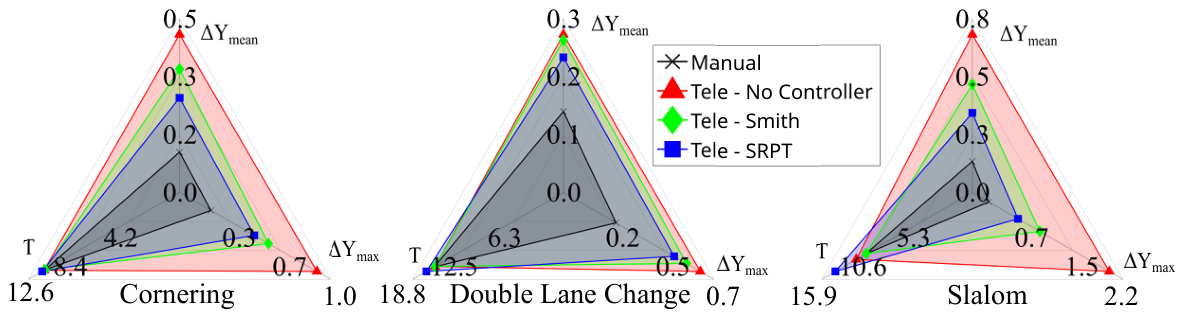
Figure 10 visualises the macroscopic trade-off between path-tracking accuracy (mean and maximum cross-track error) and manoeuvre completion time. A smaller enclosed area denotes better overall multi-objective performance, while manual driving naturally defines the optimal baseline; SRPT (blue) achieves a significantly smaller area than both the Tele-No Controller (red) and Smith Predictor (green) modes. This confirms that SRPT yields substantial improvements in lateral stability and maximum error containment with only a marginal increase in completion time—a highly favorable and necessary trade-off for safety-critical remote driving applications.

3.4. Extended Validation at Slightly Higher Speed

To further validate SRPT’s robustness, additional testing was conducted at an increased reference speed of 13 km/h. This speed was deemed infeasible for the other teleoperation modes by all operators, who reported significant instability and risk. SRPT, however, maintained confident operation at this challenging speed.
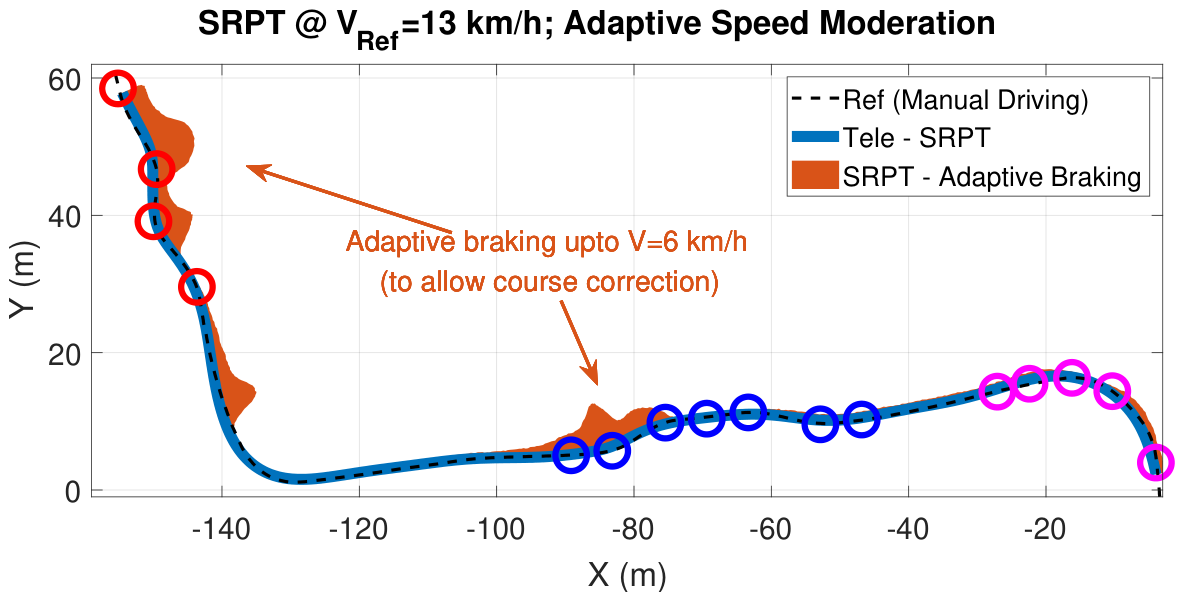
Figure 11 shows the trajectory and corresponding braking profile during this higher-speed validation. The measured mean cross-track errors—0.33 m in the first cornering section, 0.29 m in the double lane change, and 0.39 m in the slalom—demonstrate that SRPT maintains precise path tracking even at elevated speeds. Critically, SRPT sustained the reference speed through most of the track while applying adaptive braking only when necessary at the most demanding sections: the exits of the double lane change, the aggressive second corner, and the slalom manoeuvres. This demonstrates SRPT’s capability to dynamically balance speed and precision, maintaining stability even when operating at performance limits that render conventional teleoperation methods unusable.

3.5. Limitations of the Current Study

While the experimental results validate the efficacy of the SRPT architecture, several limitations of the current study must be acknowledged. First, the experimental validation was conducted at relatively low reference speeds (10–13 km/h). While these speeds were sufficient to saturate the steering actuators and induce delay instability in tight manoeuvres, further high-speed track testing is required to assess SRPT’s aerodynamic and high-dynamic stability. Second, the statistical analysis relies on a small sample size of four operators. Although the blocked ANOVA design and within-subject consistency plots mitigate this concern mathematically, larger cohort studies are needed to fully generalise the human-factors benefits. Finally, the experiments relied on a commercial, public 5G network; while this accurately reflects real-world deployment conditions—incorporating genuine variable jitter and packet delay—it prevents perfect repeatability of the exact delay conditions between individual test runs.

4. Conclusions

This paper presented the first experimental validation of the SRPT architecture for vehicle teleoperation under real-world network delays. Through human-in-the-loop testing across multiple challenging manoeuvres, SRPT demonstrated consistent statistical superiority over conventional teleoperation approaches.
The quantitative results demonstrate that SRPT achieves significantly lower cross-track errors compared to both uncompensated direct teleoperation and model-based Smith Predictor approaches. The system compresses performance variance across different drivers, providing a more robust and predictable control interface. Critically, we observed that SRPT’s proactive speed modulation successfully prevents steer rate saturation—the primary cause of delay-induced instability—allowing the vehicle to maintain aggressive path tracking even during tight curvatures and at elevated speeds (13 km/h) where conventional modes were deemed unsafe by operators.
While this study establishes SRPT’s vehicle-centric kinematic advantages, future work will focus on expanding the operational envelope to higher speeds and larger participant cohorts. Furthermore, subsequent experimental campaigns will integrate formal subjective workload metrics (e.g., NASA-TLX) and physiological monitoring to explicitly quantify the reduction in operator cognitive load afforded by the pose-tracking paradigm.

Author Contributions

Conceptualisation, methodology, validation, data curation, and writing—review and editing, J.P.; formal analysis and software, M.B.; Supervision, validation, project administration, and review, M.V.; Supervision, project administration, review, resources, and funding acquisition, E.S. All authors have read and agreed to the submitted version of the manuscript.

Funding

This work was financed by the “Sustainable Mobility Center (Centro Nazionale per la Mobilità Sostenibile–CNMS)” project funded by the European Union NextGenerationEU programme within the PNRR, Mission 4 Component 2 Investment 1.4.

Data Availability Statement

The original contributions presented in this study are included in the article. Further inquiries can be directed to the corresponding author.

Acknowledgments

The authors are grateful to all the 4 volunteer drivers for their participation in the experimental campaign. Their identities are anonymised.

Conflicts of Interest

The authors declare no conflict of interest.

Abbreviations

The following abbreviations are used in this manuscript:
ADAutomated Driving
DOFDegree of Freedom
FOVField Of View
IMUInertial Measurement Unit
NMPCNon-linear Model-Predictive Control
ROS2Robot Operating System 2
SRTSecure Reliable Transport
SRPTSuccessive Reference-Pose Tracking
Δ Y m a x Maximum Cross-Track Error
Δ Y m e a n Mean Cross-Track Error
TCompletion time
t 1 Uplink Delay
t 2 Downlink Delay
μ Mean

References

  1. Majstorović, D.; Hoffmann, S.; Pfab, F.; Schimpe, A.; Wolf, M.M.; Diermeyer, F. Survey on Teleoperation Concepts for Automated Vehicles. In Proceedings of the 2022 IEEE International Conference on Systems, Man, and Cybernetics (SMC); IEEE: New York, NY, USA, 2022; pp. 1290–1296. [Google Scholar]
  2. Mutzenich, C.; Durant, S.; Helman, S.; Dalton, P. Updating our understanding of situation awareness in relation to remote operators of autonomous vehicles. Cogn. Res. Princ. Implic. 2021, 6, 9. [Google Scholar] [CrossRef] [PubMed]
  3. Hoffmann, S.; Diermeyer, F. Systems-theoretic Safety Assessment of Teleoperated Road Vehicles. In Proceedings of the 7th International Conference on Vehicle Technology and Intelligent Transport Systems-Volume 1: VEHITS. INSTICC; SciTePress: Setúbal, Portugal, 2021; pp. 446–456. [Google Scholar]
  4. Saparia, S.; Schimpe, A.; Ferranti, L. Active Safety System for Semi-Autonomous Teleoperated Vehicles. In Proceedings of the 2021 IEEE Intelligent Vehicles Symposium Workshops (IV Workshops); IEEE: New York, NY, USA, 2021; pp. 141–147. [Google Scholar]
  5. Qiao, B.; Li, H.; Wu, X. Intelligent-Assist Algorithm for Remote Shared-Control Driving Based on Game Theory. J. Shanghai Jiaotong Univ. (Sci.) 2021, 26, 615–625. [Google Scholar]
  6. Schitz, D.; Graf, G.; Rieth, D.; Aschemann, H. Model-Predictive Cruise Control for Direct Teleoperated Driving Tasks. In Proceedings of the 2021 European Control Conference (ECC); IEEE: New York, NY, USA, 2021; pp. 1808–1813. [Google Scholar]
  7. Chucholowski, F.; Büchner, S.; Reicheneder, J.; Lienkamp, M. Prediction methods for teleoperated road vehicles. In Proceedings of the Conference on Future Automotive Technology-Focus Electromobility, Garching bei München, Germany; Springer Vieweg: Wiesbaden, Germany, 2013. [Google Scholar]
  8. Hosseini, A.; Richthammer, F.; Lienkamp, M. Predictive Haptic Feedback for Safe Lateral Control of Teleoperated Road Vehicles in Urban Areas. In Proceedings of the 2016 IEEE 83rd Vehicular Technology Conference (VTC Spring); IEEE: New York, NY, USA, 2016; pp. 1–7. [Google Scholar]
  9. Brudnak, M.J. Predictive displays for high latency teleoperation. In Proceedings of the 2016 Ground Vehicle Systems Engineering and Technology Symposium; National Defense Industrial Association: Arlington, VA, USA, 2016. [Google Scholar]
  10. Chen, T. Methods for Improving the Control of Teleoperated Vehicles. Ph.D. Thesis, Technical University of Munich, Munich, Germany, 2015. [Google Scholar]
  11. Zheng, Y.; Brudnak, M.J.; Jayakumar, P.; Stein, J.L.; Ersal, T. A Delay Compensation Framework for Predicting Heading in Teleoperated Ground Vehicles. IEEE/ASME Trans. Mechatron. 2019, 24, 2365–2376. [Google Scholar] [CrossRef]
  12. Zheng, Y.; Brudnak, M.J.; Jayakumar, P.; Stein, J.L.; Ersal, T. Evaluation of a Predictor-Based Framework in High-Speed Teleoperated Military UGVs. IEEE Trans. Hum.-Mach. Syst. 2020, 50, 561–572. [Google Scholar]
  13. Smith, J.M. Closer Control of Loops with Dead Time. Chem. Eng. Prog. 1957, 53, 217–219. [Google Scholar]
  14. Hoffmann, S.; Majstorović, D.; Diermeyer, F. Safe Corridor: A Trajectory-Based Safety Concept for Teleoperated Road Vehicles. In Proceedings of the 2022 International Conference on Connected Vehicle and Expo (ICCVE); IEEE: New York, NY, USA, 2022; pp. 1–6. [Google Scholar]
  15. Schitz, D.; Graf, G.; Rieth, D.; Aschemann, H. Interactive Corridor-Based Path Planning for Teleoperated Driving. In Proceedings of the 2021 7th International Conference on Mechatronics and Robotics Engineering (ICMRE); IEEE: New York, NY, USA, 2021. [Google Scholar]
  16. Ji, X.A.; Avedisov, S.S.; Khan, M.I.; Vörös, I.; Altintas, O.; Orosz, G. On the effects of latency in teleoperated driving: Stability and performance analysis. Veh. Syst. Dyn. 2025, 1–23. [Google Scholar] [CrossRef]
  17. Prakash, J.; Vignati, M.; Sabbioni, E. Performance of Successive Reference Pose Tracking vs. Smith Predictor Approach for Direct Vehicle Teleoperation under Variable Network Delays. IEEE Trans. Veh. Technol. 2024, 73, 4636–4645. [Google Scholar]
  18. Prakash, J.; Vignati, M.; Sabbioni, E.; Cheli, F. Vehicle Teleoperation: Human in the Loop Performance Comparison of Smith Predictor with Novel Successive Reference-Pose Tracking Approach. Sensors 2022, 22, 9119. [Google Scholar] [CrossRef] [PubMed]
Figure 1. Real-life vehicle teleoperation system consists of (a) control station and (b) instrumented vehicle, Zhidou D2.
Electronics 15 02743 g001
Figure 2. The experimental track consists of a cornering section, a double-lane-change section and a slalom section. These manoeuvres are formed using markers placed on the track.
Electronics 15 02743 g002
Figure 3. Driving and vehicle teleoperation modes tested.
Electronics 15 02743 g003
Figure 4. Observed data transmission delays over 5G during vehicle teleoperation for all laps. (Uplink delay instances are more frequent as the command transmission rate is higher than the video transmission rate.)
Electronics 15 02743 g004
Figure 5. Snapshot of visual feedback at the control station. Displaying left, front, cabin, rear, ground, right, and control-station footage.
Electronics 15 02743 g005
Figure 6. Vehicle trajectories for the best laps of each driving mode during the slalom manoeuvre. The SRPT method demonstrates a significant reduction in overshoot and cross-track error compared to the other teleoperation modes.
Electronics 15 02743 g006
Figure 7. Evolution of steering rate and vehicle speed during the slalom manoeuvre. The dotted black lines indicate the ± 180 deg/s steer rate constraint. Only the SRPT mode avoids constraint violation through proactive speed modulation.
Electronics 15 02743 g007
Figure 8. Cross-track error across teleoperation modes and manoeuvres (12 laps per teleoperation mode; 4 drivers × 3 laps). Bars represent the mode mean; error bars denote ±1 standard deviation. Raw data points are overlaid to show the within-mode distribution. The horizontal dashed line indicates the mean cross-track error of in-vehicle manual driving, averaged over three reference laps across three drivers. Brackets indicate pairwise comparisons from Tukey’s HSD post hoc test following a statistically significant two-way ANOVA mode main effect (see text); *** p < 0.001, ** p < 0.01, * p < 0.05. Comparisons without brackets did not reach statistical significance. Note the high variance and outlying data points in the Tele-No Controller condition of the slalom (CV = 71.1%), reflecting driver-dependent delay-induced oscillations.
Electronics 15 02743 g008
Figure 9. Per-driver mean cross-track error across teleoperation modes. Each coloured line connects one driver’s mean cross-track error (averaged over three laps per mode) across the three teleoperation modes. The bold black line with error bars denotes the group mean ± 1 standard deviation (4 drivers). All four operators exhibit a net reduction in mean error from Tele-No Controller to Tele-SRPT, confirming that the performance advantage is consistent across individual drivers and is not attributable to a single operator. Residual inter-driver spread in the double lane change panel reflects the significant driver main effect detected by the ANOVA [F(3, 24) = 4.50, p = 0.012].
Electronics 15 02743 g009
Figure 10. Radar chart comparing three performance indices across driving modes and manoeuvres. A smaller area indicates better overall performance, combining tracking accuracy and completion time.
Electronics 15 02743 g010
Figure 11. SRPT performance at 13 km/h: traversed trajectory showing maintained tracking accuracy; corresponding braking profile demonstrating adaptive braking only where necessary.
Electronics 15 02743 g011
Table 1. Experimental (Zhidou D2) vehicle parameters, shared by the Smith Predictor and the onboard NMPC.
ParameterSymbolValueUnit
Total massm740.0kg
Front axle mass m f 314.0kg
Rear axle mass m r 426.0kg
WheelbaseL1.770m
CG to front axle l f 0.792m
CG to rear axle l r 0.973m
Yaw moment of inertiaJ635.4kg m2
Front cornering stiff. C f 27,673N/rad
Rear cornering stiff. C r 38,738N/rad
Tyre relaxation length L y 0.30m
Steering ratio τ sw 18
Table 2. Qualitative comparison of the three teleoperation architectures across key operational dimensions.
DimensionTele-No CtrlTele-SmithTele-SRPT
Latency robustnessNoneModerateHigh
Model accuracy dependenceNoneCriticalLow
Path-tracking accuracyPoorModerateBest
Actuator constraint awarenessNoNoYes
Proactive speed modulationNoNoYes
Onboard compute requirementNoneNoneNMPC
HMI modification requiredNoneDisplay overlayDisplay overlay
Stable at 13 km/h (this study)Unsafe *Unsafe *Yes
* All four operators declined to attempt 13 km/h in non-SRPT modes due to perceived instability. Thus, 13 km/h speed is only attempted once with SRPT mode.
Disclaimer/Publisher’s Note: The statements, opinions and data contained in all publications are solely those of the individual author(s) and contributor(s) and not of MDPI and/or the editor(s). MDPI and/or the editor(s) disclaim responsibility for any injury to people or property resulting from any ideas, methods, instructions or products referred to in the content.