Article

Multiagent Multilayer Control Strategy for Microgrid Clusters with Cross-Coordinated Control and Conflict Coordination


1
CSG Electric Power Research Institute Co., Ltd., Guangzhou 510663, China
2
School of Electrical Engineering and Automation, Wuhan University, Wuhan 430072, China
*
Author to whom correspondence should be addressed.
Electronics 2026, 15(12), 2640; https://doi.org/10.3390/electronics15122640 (registering DOI)
Submission received: 11 May 2026 / Revised: 10 June 2026 / Accepted: 11 June 2026 / Published: 15 June 2026
(This article belongs to the Special Issue Wireless Power Transfer: Modeling, Optimization and Applications)

Abstract

To address fault-induced boundary variations and conflicting commands among heterogeneous controllers in microgrid clusters with high distributed generation penetration, this paper proposes a multilayer multiagent control strategy based on cross-coordinated multiagent control and conflict coordination. The method uses a hierarchical distributed hybrid architecture. Local grid-forming (GFM) energy storage and photovoltaic (PV) converters provide autonomous voltage source support, microgrid coordination controllers generate distributed candidate commands, and the system-level coordination controller performs event-triggered arbitration. Unlike consensus-based cooperative control with fixed exchanged variables, the proposed method enables overlapping supervisory authority, weighted command fusion, explicit conflict classification, and feasible command projection under resource, state-of-charge (SOC), ramping, and load priority constraints. Direction, capacity, and objective conflicts are resolved through system-level arbitration, which converts multiple candidate commands into a single executable command. Comparative simulations show that the proposed method reduces frequency and voltage deviations, shortens power recovery time, improves SOC balancing among energy storage units, and enhances constrained hydropower coordination compared with conventional droop control and one-to-one hierarchical control. These results verify its effectiveness in improving dynamic stability and coordinated support capability in microgrid clusters.

1. Introduction

With the increasing integration of distributed photovoltaic (PV) generation, wind power, energy storage, small hydropower, and flexible loads into distribution systems, conventional distribution networks are evolving from passive power supply networks into active distribution systems characterized by complementary multisource operation, coordinated participation of multiple entities, and autonomous control across multiple levels [1,2,3]. As an important carrier for distributed resource aggregation and local autonomous operation, microgrids have received extensive attention in grid connected and islanded transitions, renewable energy accommodation, and secure supply for critical loads [4,5,6]. In practical distribution scenarios, however, multiple microgrids usually do not operate in isolation. They are electrically coupled through feeders, tie switches, and medium- and low-voltage transformers, thereby forming microgrid clusters with multiple regions, voltage levels, and control entities [7]. Compared with a single microgrid, a microgrid cluster must address not only voltage regulation, frequency regulation, and power balance within each region, but also more complex issues, including power support among different microgrids [8], overlapping control authority [9], variation in fault-induced operating boundaries [10], and coordinated regulation of heterogeneous resources [11].
The engineering problem addressed in this paper is that the electrical and control boundaries of a microgrid cluster vary during faults, switching operations, and local islanding events. A feeder fault or tie switch action may divide one operating region into several weakly coupled microgrids, while the available support resources also vary with PV output, energy storage SOC, and small hydropower ramping capability. During this process, GFM converters must provide millisecond-level voltage support, whereas small hydropower and controllable loads can contribute only over slower time scales. Therefore, a practical control strategy must coordinate heterogeneous resources under time varying boundaries and prevent incompatible commands from being issued by different controllers.
Existing microgrid control methods mainly include centralized control, distributed control, and hierarchical control [12,13,14]. Centralized control can use global information and offers advantages in unified operating objectives and consistent optimization results [12,15]. However, it strongly depends on complete communication links, an accurate network topology, and a unified dispatching center. Under fault disturbances, communication delays, or local islanding conditions, centralized control may not respond promptly to the rapid dynamic processes that occur during the initial stage of a fault [13,14]. Distributed control achieves autonomous regulation through local information exchange and neighborhood coordination, and therefore offers favorable scalability and robustness. Nevertheless, in strongly coupled multi-microgrid scenarios, it may produce local optima, inconsistent control objectives, and unbalanced resource allocation [16,17]. Conventional hierarchical control generally adopts a one-to-one management structure based on upper-level optimization and lower-level execution, in which a specific microgrid controller is assigned to a fixed microgrid. Although this structure is explicit and simple to implement, it is difficult to satisfy the requirements of overlapping control authority, dynamic interregional support, and joint decision making among multiple control entities in microgrid clusters.
Multiagent systems provide an effective approach for cooperative control among multiple entities in microgrid clusters [18,19,20]. By representing the system-level control center, microgrid coordination controllers, distributed generators, energy storage systems, flexible loads, and local controllers as agents with state perception, local decision making, and information exchange capabilities, a flexible control structure can be established between local autonomy and global coordination. Existing multiagent studies mainly focus on energy management, economic dispatch, and distributed consensus control, whereas grid-forming (GFM) support under fault disturbances, cross-coordinated control among multiple microgrids, and coordination of conflicting control commands remain insufficiently addressed [21,22,23,24]. In particular, in microgrid clusters containing GFM energy storage, PV generation, and constrained small hydropower, different regulation resources exhibit significantly different dynamic response characteristics [25]. Energy storage and PV converters can rapidly establish local voltage source external characteristics through GFM control, whereas small hydropower is constrained by hydraulic inertia, governor response, and ramping capability, making it more suitable for sustained power compensation over short and medium time scales [26]. Therefore, the control strategy for microgrid clusters should simultaneously consider fast GFM support at the bottom layer, cooperative decision making among multiple entities at the middle layer, and global conflict coordination at the upper layer [27].
To address these issues, this paper proposes CCMAC for microgrid clusters with cross-coordinated control and conflict coordination. The theoretical and operational gap addressed by CCMAC is the absence of an explicit mechanism that allows several coordination controllers to hold overlapping control authority over the same bottom-layer microgrid and transform their potentially inconsistent candidate commands into a feasible reference. Existing centralized schemes rely on a single global decision maker, distributed consensus schemes mainly drive neighboring agents toward agreement on predefined variables, and conventional hierarchical schemes usually retain a fixed one-to-one controller microgrid mapping. In contrast, CCMAC permits non-exclusive participation of multiple coordination controllers in the same microgrid decision; classifies the resulting command conflicts into direction, capacity, and objective conflicts; and performs system-level arbitration as a constrained projection onto the feasible resource domain. Therefore, the proposed architecture is a hierarchical distributed hybrid scheme rather than a fully decentralized scheme. Local GFM controllers provide decentralized fast support, middle-layer agents generate distributed candidate commands, and the system-level controller is activated for arbitration when cross commands conflict.
The main contributions of this paper are summarized as follows. First, a hierarchical distributed hybrid architecture is proposed for microgrid clusters with non-exclusive supervisory authority. This architecture differs from conventional one-to-one hierarchical control by allowing several microgrid coordination controllers to generate candidate commands for the same bottom-layer microgrid while preserving autonomous GFM execution at the local layer. Second, a command-level coordination method is developed, including adaptive weighted fusion, direction conflict identification, capacity conflict identification, objective conflict identification, and constrained arbitration. This method provides a mathematically explicit path from multiple candidate commands to a feasible executable reference, which is not directly provided by conventional consensus-based cooperative control. Third, a multiple-time-scale coordination strategy is established by combining millisecond- to second-level GFM support from energy storage and PV with ramp-constrained short- and medium-time-scale compensation from small hydropower. This design avoids treating hydropower as an ideal fast-response source and improves the physical consistency of supervisory control for heterogeneous resources.
The remainder of this paper is organized as follows. Section 2 presents the system model and mechanism analysis of the proposed multiagent hierarchical structure. Section 3 develops the cross-coordinated control strategy, including candidate command generation, conflict identification, coordination arbitration, and local execution. Section 4 reports the case studies and comparative results. Section 5 concludes the paper and discusses future work.

2. System Model and Mechanism Analysis

2.1. Multiagent Hierarchical Structure

Consider a microgrid cluster system composed of three bottom-layer microgrids, whose set is defined as follows:
M = { M G 1 , M G 2 , M G 3 }
Each bottom-layer microgrid comprises GFM energy storage, PV, local loads, and a low-voltage AC bus. The microgrids are electrically coupled through medium-voltage feeders and tie switches, and are connected to the upstream distribution network. Three microgrid coordination controllers are deployed at the middle layer:
A c = { A c , 1 , A c , 2 , A c , 3 }
where Ac,i denotes the ith coordination controller. At the top layer, the system-level coordination controller As is deployed to perform global coordination and conflict arbitration. At the bottom layer, the set of local control agents is defined as follows:
A l , j = { A ess , j , A pv , j , A load , j }
where Aess,j, Apv,j, and Aload,j are the GFM energy storage agent, PV agent, and load agent in the jth microgrid, respectively.
The active power balance of each microgrid can be expressed as
Δ P j = P L , j P ess , j P pv , j P h , j P tie , j
where j is the microgrid index; Pess,j, Ppv,j, Ph,j, Ptie,j, and PL,j are the active power output of the energy storage, the active power output of the PV unit, the small hydropower support assigned to the jth microgrid, the tie-line input power, and the load demand of the jth microgrid, respectively; and ΔPj is the active power deficit of the jth microgrid. Under this sign convention, ΔPj = 0 indicates active power balance, ΔPj > 0 indicates an active power deficit, and ΔPj < 0 indicates an active power surplus.
The reactive power balance can be expressed as
Δ Q j = Q L , j Q ess , j Q pv , j Q tie , j
where Qess,j, Qpv,j, Qtie,j, and QL,j are the reactive power output of the energy storage, the reactive power output of the PV unit, the reactive power input from the tie line, and the reactive power demand of the jth microgrid, respectively. ΔQj is defined as the reactive power deficit of the jth microgrid. Thus, ΔQj = 0 indicates reactive power balance, ΔQj > 0 indicates insufficient local reactive power support, and ΔQj < 0 indicates a reactive power surplus. This convention is used in the voltage support and reactive power allocation logic.
The multiagent system developed in this paper consists of three layers. The first layer is the system-level coordination layer. This layer consists of the system-level coordination controller As, which is responsible for identifying the overall operating state of the microgrid cluster, analyzing global power balance, detecting control conflicts among multiple coordination controllers, performing coordination arbitration, and correcting global control commands. The system-level coordination layer does not directly participate in the fast voltage and current control of bottom-layer converters. Instead, it provides global consistency constraints for the intermediate coordination layer.
The second layer is the microgrid coordination layer. This layer consists of multiple microgrid coordination controllers Ac,i and constitutes the core of the proposed multiagent cooperative control scheme. In contrast to the conventional one-to-one control structure, this paper adopts a cross-coordinated control mechanism, in which each coordination controller can generate candidate control commands for multiple bottom-layer microgrids. The candidate command generated by the ith coordination controller for the jth microgrid is defined as follows:
u i , j ref = P ess , i , j ref , P pv , i , j ref , P h , i , j ref , P load , i , j ref
where P ess , i , j ref , P pv , i , j ref , P h , i , j ref , and P load , i , j ref are the energy storage power reference, PV power reference, small hydropower compensation reference, and load regulation reference generated by coordination controller Ac,i for the jth microgrid, respectively.
The third layer is the local control layer. This layer is designed for the GFM energy storage, PV, and local load controllers within the bottom-layer microgrids. It is responsible for fast regulation of voltage magnitude, phase angle, frequency, and power during dynamic processes from milliseconds to seconds. The local layer can provide autonomous support over short time scales without relying on real-time upper-layer commands, thereby improving operational stability during the initial stage of a fault.
The GFM energy storage provides primary voltage support in the local control layer. Its control objective is not to passively track the grid voltage phase angle, but to actively establish the external characteristics of a local voltage source. The phase angle dynamics of the GFM energy storage in the jth microgrid can be expressed as follows:
θ ˙ ess , j = ω ess , j ω ess , j = ω 0 k p , ess P ess , j P ess , j ref
where θess,j is the output voltage phase angle of the energy storage converter, ωess,j is the output angular frequency, ω0 is the nominal angular frequency, kp,ess is the active power frequency regulation coefficient, and P ess , j ref is the active power reference of the energy storage.
The output voltage magnitude of the energy storage can be expressed as follows:
V ess , j ref = V 0 k q , ess Q ess , j Q ess , j ref
where V ess , j ref is the output voltage reference of the energy storage, V0 is the nominal voltage magnitude, kq,ess is the reactive power voltage regulation coefficient, and Q ess , j ref is the reactive power reference of the energy storage.
The PV participates in local support through voltage source control. However, its active power output is constrained by the available PV power and the corresponding power margin:
0 P pv , j P pv , j ref ,     P pv , j ref P pv , j ava P pv , j res
where Ppv,j is the actual active power of the PV unit in the jth microgrid, P pv , j ref is its active power reference, P pv , j ava is the available PV active power, and P pv , j res is the reserved active power margin retained for GFM support. Therefore, the PV reference must not exceed the available power after the required support margin is reserved. If the available PV power or the reserved margin is insufficient, the GFM support capability of the PV unit is supplemented by the energy storage.
Small hydropower can provide sustained active power support, but its dynamic regulation capability is constrained by hydraulic inertia, governor response, ramping rate, and power output limits [26]. Therefore, this paper incorporates small hydropower into the microgrid coordination layer rather than the bottom layer for fast GFM control. For the hydropower support allocated to the jth microgrid, the active power output constraints are expressed as follows:
P h , j min P h , j ( t ) P h , j max R h , j down Δ t P h , j ( t ) P h , j ( t Δ t ) R h , j up Δ t
where Ph,j(t) is the small hydropower active power allocated to the jth microgrid at time t; P h , j min and P h , j max are the lower and upper output limits, respectively; R h , j up and R h , j down are the upward and downward ramping rate limits, respectively; and Δt is the coordination period. The subscripts min, max, up, and down denote physical limits and are treated as upright descriptive subscripts in the mathematical notation.
When small hydropower participates in power compensation at the coordination layer, its regulation command should satisfy the following condition:
P h , j ref Ω h , j
where Ωh,j is the feasible regulation set jointly defined by the output limits, ramping constraints, and operational security constraints of the hydropower support assigned to the jth microgrid. This constraint ensures that small hydropower is not represented as an ideal regulation source with zero response delay and unlimited ramping capability.
The ramp-constrained hydropower representation is selected because this paper focuses on supervisory power allocation among heterogeneous resources rather than on the internal electromechanical dynamics of the hydro turbine governor. The governor, waterway, and turbine dynamics are aggregated into the feasible regulation set Ωh,j, which constrains the admissible active power trajectory through output limits, ramping limits, and security margins. If a higher-order hydro turbine governor model is used, its closed-loop power tracking capability can be embedded into Ωh,j through an equivalent delay, a reduced ramping envelope, or an additional linear dynamic constraint. Hence, the proposed arbitration logic remains valid provided that the hydropower command is feasible within this envelope. A slower governor mainly increases the duration over which GFM energy storage must provide temporary support, whereas it does not change the command conflict taxonomy or the feasibility projection used by CCMAC.

2.2. Cross-Coordinated Control and Conflict Coordination

In conventional one-to-one hierarchical control, the ith coordination controller generally controls only the ith microgrid. This structure can be expressed as follows:
A c , i M G j
This mode is applicable when the coupling among microgrids is weak, the operating boundaries are clearly defined, and sufficient local regulation resources are available [28,29]. However, when the internal resources of a microgrid are insufficient, local faults alter the operating boundaries, or other microgrids have available support capability, the one-to-one control structure cannot fully exploit the overall regulation potential of the microgrid cluster [30,31].
This paper adopts a cross-coordinated control mechanism, which allows multiple coordination controllers to generate candidate control commands for multiple bottom-layer microgrids simultaneously:
A c , i { M G 1 , M G 2 , M G 3 } ,     i = 1 , 2 , 3
The jth microgrid may simultaneously receive a set of candidate control commands from multiple coordination controllers, which is expressed as follows:
U j ref = { u 1 , j ref , u 2 , j ref , u 3 , j ref }
If no significant conflict exists among the candidate control commands, a preliminary control command can be obtained through weighted fusion as follows:
u j f = i = 1 3 ω i , j u i , j ref
where ωi,j is the control weight assigned to coordination controller Ac,i for the jth microgrid and satisfies
i = 1 3 ω i , j = 1 ,     0 ω i , j 1
When direction conflict, capacity conflict, or objective conflict exists among the candidate control commands, the system-level coordination controller activates the conflict arbitration mechanism and generates the final control command:
u j * = F s U j ref , x j , Ω j , Γ s
where u j * is the final control command executed by the jth microgrid, xj represents the operating state of the microgrid, Ωj is the feasible resource domain, and Γs is the set of system-level operating objectives and security constraints.
The essence of the cross-coordinated control mechanism is to eliminate the fixed control boundary. Accordingly, multiple agents can perform cooperative perception, coordinated decision making, and coordinated execution around common operating objectives [32,33]. The conflict coordination mechanism further ensures that cross-coordinated control does not produce disordered control commands. Under system-level global constraints, this mechanism produces a unique and executable control scheme that satisfies the prescribed security boundaries.
The above mechanism differs fundamentally from consensus-based distributed cooperative control. In a consensus framework, neighboring agents exchange state estimates or incremental control variables and converge to a common value under a predefined communication graph. Such a process is effective for distributed agreement, but it does not explicitly describe how different supervisors with overlapping authority should issue commands to the same physical microgrid, nor does it provide a direct mechanism for resolving opposite command directions, capacity violations, or objective priority conflicts. CCMAC instead operates at the command level. It accepts multiple candidate references for a target microgrid, evaluates them against resource feasibility and system-level objectives, and generates a single executable reference for the local GFM controllers.
To provide a consistent SOC coordination metric for both the control objective and the case study evaluation, the maximum SOC deviation from the cluster average is defined in the mechanism analysis as follows:
Δ S O C dev max = max t T Δ S O C dev ( t ) Δ S O C dev ( t ) = max j M S O C j ( t ) S O C ¯ ( t ) S O C ¯ ( t ) = 1 | M | j M S O C j ( t )
where SOCj(t) is the SOC of the energy storage unit in the jth microgrid at time t, S O C ¯ ( t ) is the cluster average SOC of all energy storage units at time t, M is the set of microgrids equipped with energy storage, and T is the simulation interval.

3. Multiagent-Based Control Strategy for Microgrid Clusters

3.1. Multilayer Multiagent Control Framework

The proposed control strategy adopts a three-layer structure consisting of system-level coordination, microgrid cooperative control, and local control.
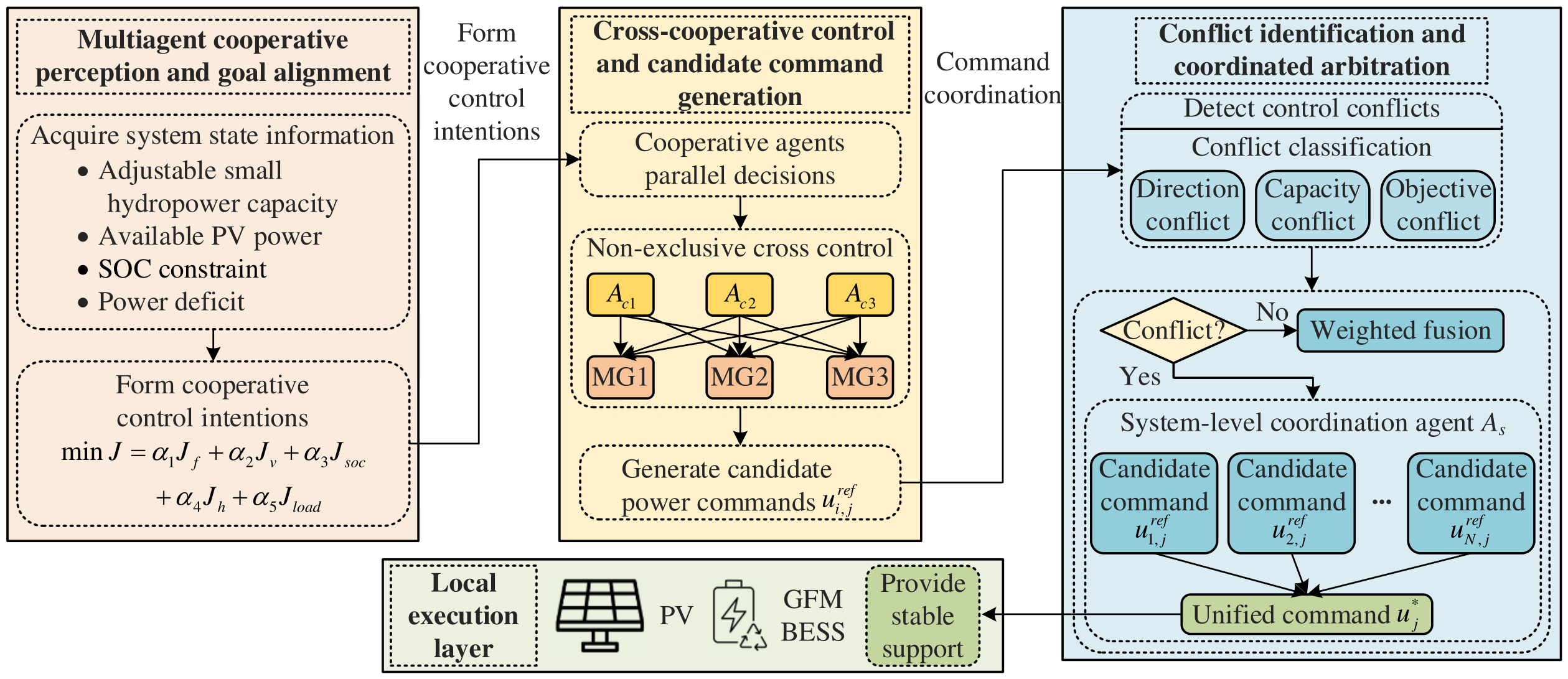
The system-level coordination layer is designed to ensure global operational security and power balance. Its main inputs include the voltage and frequency of each microgrid, load power, energy storage SOC, available PV power, adjustable capacity of small hydropower, tie-line power, and candidate commands from the cooperative control layer. Its outputs include conflict coordination results, cross-microgrid support commands, regulation boundaries of small hydropower, and the final power allocation scheme. The complete control procedure and information flow are summarized in Figure 1.
The microgrid cooperative control layer is responsible for regional power balance and cross-microgrid support. Each coordination controller generates candidate control commands according to the operating states of local and neighboring microgrids and exchanges information with other coordination controllers through the communication network. The core functions of this layer include power deficit identification, regulation capability assessment, candidate command generation, preliminary cooperative allocation, and conflict reporting.
The local control layer provides fast dynamic stability support. According to the power references issued by the upper layer and local measurements, this layer controls the voltage magnitude, phase angle, and frequency of GFM energy storage and PV, thereby realizing fast autonomous support within each microgrid. When upper-layer communication is interrupted or a command delay occurs, the local layer can still maintain basic operational stability based on local voltage, frequency, and power deviations.

3.2. Multiagent Cooperation Mechanism

The cooperation mechanism is reflected in state sharing and objective alignment among multiple agents. For the ith coordination controller, the accessible state vector is defined as follows:
x c , i = Δ P 1 , Δ P 2 , Δ P 3 , S O C 1 , S O C 2 , S O C 3 , P pv , 1 ava , P pv , 2 ava , P pv , 3 ava , P h ava
where ΔPj is the active power deficit of the jth microgrid, SOCj is the SOC of the energy storage in the jth microgrid, P pv , j ava is the available PV power, and P h , j ava is the adjustable small hydropower capacity allocated to the jth microgrid.
The common control objective of the coordination controllers can be expressed as follows:
min J : = α 1 J f n + α 2 J v n + α 3 J SOC n + α 4 J h n + α 5 J load n
where J f n , J v n , J SOC n , J h n , and J load n are the normalized frequency deviation index, normalized voltage deviation index, normalized SOC imbalance index, normalized penalty term for small hydropower ramping constraints, and normalized load shedding penalty, respectively. The coefficients α1 to α5 are dimensionless weighting factors.
These coefficients can be further defined as follows:
J f n = 1 N j = 1 N f j f 0 Δ f max 2 J v n = 1 N j = 1 N V j V 0 Δ V max 2 J SOC n = 1 N j = 1 N S O C j S O C ¯ Δ S O C max 2 J h n = i max 0 , P h , i ( t ) P h , i ( t Δ t ) R h , i Δ t 1 2 J load n = j = 1 N λ L , j P shed , j P L , j
where fj and Vj are the frequency and voltage of the jth microgrid, respectively; f0 and V0 are the nominal frequency and nominal voltage; S O C ¯ is the average SOC of all energy storage units; Pshed,j is the amount of load shedding; λL,j is the load priority weight; and Δfmax, ΔVmax, and ΔSOCmax are the admissible normalization bases for frequency deviation, voltage deviation, and SOC deviation, respectively.
All indices in (20) and (21) are dimensionless after normalization. The weights are selected according to the security priority of the microgrid cluster operation. Voltage and frequency deviations are assigned the highest priority, SOC balancing and hydropower ramping are assigned medium priority, and load shedding is penalized through λL,j according to load importance. The same weighting coefficients and normalization bases are used for all comparative methods to ensure that the reported performance differences are not caused by retuning of the objective function.
Through the above normalized objective function, different coordination controllers form a common and dimensionally consistent control intention for global operational security based on local state perception.
The core task of the cross-coordinated control layer is to generate candidate control commands for multiple bottom-layer microgrids. For coordination controller Ac,i, the candidate power regulation command generated for the jth microgrid can be expressed as follows:
Δ P i , j ref = K i , j p Δ P j + K i , j soc S O C j S O C ¯ + K i , j pv Δ P pv , j ava + K i , j h P h ava
where K i , j p , K i , j soc , K i , j pv , and K i , j h are the cooperative weights associated with the active power deficit, the SOC margin, the available PV power, and the adjustable capacity of small hydropower, respectively.
The candidate control command is further decomposed into energy storage power regulation, PV power regulation, small hydropower power compensation, and load regulation as follows:
Δ P i , j ref = Δ P ess , i , j ref + Δ P pv , i , j ref + Δ P h , i , j ref Δ P load , i , j ref
where Δ P ess , i , j ref is the energy storage regulation component, Δ P pv , i , j ref is the PV regulation component, Δ P h , i , j ref is the small hydropower compensation component, and Δ P load , i , j ref is the load curtailment or load transfer component.
To reflect differences in resource response characteristics, candidate commands are generated according to the following priority rules. First, during the initial fault stage and under fast power disturbances, GFM energy storage is prioritized for rapid power support. Second, when the PV unit has a sufficient power margin and satisfies the DC-side support conditions, PV generation participates in auxiliary power regulation. Third, over short and medium time scales, small hydropower gradually takes over part of the power support initially provided by energy storage in accordance with its ramping constraints. Fourth, controllable load curtailment is implemented according to load priority only when energy storage, PV generation, and small hydropower cannot fully cover the power deficit.
This strategy prevents small hydropower from receiving fast power commands that exceed its physical regulation capability, while mitigating rapid SOC deviation caused by sustained use of energy storage to cover power deficits.

3.2.1. Control Conflict Identification Method

Under the cross-coordinated control mechanism, multiple coordination controllers may generate different candidate commands for the same microgrid. Therefore, conflict identification is required for these candidate commands. In this paper, control conflicts are classified into direction conflict, capacity conflict, and objective conflict.
Direction conflict refers to the case in which different coordination controllers issue power regulation commands with opposite directions for the same microgrid. For the jth microgrid, if (24) holds, coordination controllers Ac,m and Ac,n are considered to have a direction conflict with respect to the jth microgrid.
Δ P m , j ref · Δ P n , j ref < 0 ,     m n
Capacity conflict indicates that the superposition of candidate commands exceeds the regulation boundary of the controllable resources in the microgrid. If (25) holds, a capacity conflict occurs.
i = 1 3 Δ P i , j ref > P j ava
where P j ava is the available regulation capacity of the jth microgrid, which can be expressed as follows:
P j ava = P ess , j ava + P pv , j res + P h , j ava + P load , j ctrl
Objective conflict indicates that the candidate commands are feasible in both direction and capacity but lead to inconsistent priorities among control objectives. For example, one command may reduce frequency deviation but cause excessive deviation in the SOC of the energy storage, whereas another command may improve SOC balancing but reduce the supply reliability of critical loads. Objective conflict can be identified through the increment of the objective function as follows:
Δ J i , j = J u i , j ref J u j base
If the objective function increments corresponding to different candidate commands exhibit significantly opposite trends across different indices, an objective conflict occurs.

3.2.2. Control Conflict Coordination Method

When no significant conflict exists, the system generates the final command using the weighted fusion method shown in (28).
u j * = u j f = i = 1 3 ω i , j u i , j ref
The weight ωi,j can be dynamically determined according to the state perception accuracy of the coordination controller, communication quality, resource correlation, and historical control performance:
ω i , j = η i , j i = 1 3 η i , j η i , j = β 1 C i , j com + β 2 C i , j res + β 3 C i , j his
where C i , j com is the communication reliability index, C i , j res is the resource correlation index, C i , j his is the historical control performance index, and β1 to β3 are the corresponding weighting coefficients.
The weights ωi,j are updated online at each coordination interval rather than treated as fixed empirical constants. The communication reliability term decreases when message delay, packet loss, or stale data are detected; the resource correlation term reflects the electrical and operational relevance between the assisting microgrid and the target microgrid; and the historical performance term records whether previous commands from the same coordination controller reduced the objective function without violating constraints. After these indices are calculated, the weights are normalized to satisfy (16). The coefficients β1 to β3 are design parameters selected offline according to the desired emphasis on communication quality, resource coupling, and historical command effectiveness. If communication from Ac,i to the jth microgrid is unavailable, C i , j com is set to zero and the corresponding command weight is automatically suppressed.
When a conflict is detected, the system-level coordination controller solves the following coordination optimization problem:
min u j * J s = α 1 J f + α 2 J v + α 3 J soc + α 4 J h + α 5 J load + α 6 J conf
where Jconf is the conflict penalty term used to quantify the deviation between the final command and the candidate commands:
J conf = i = 1 3 ρ i u j * u i , j ref 2
where ρi is the confidence weight assigned to the candidate command generated by the ith coordination controller.
The optimization problem is subject to the following constraints:
P ess , j min P ess , j * P ess , j max S O C j min S O C j S O C j max 0 P pv , j * P pv , j ava P h min P h * P h max P h * ( t ) P h ( t Δ t ) R h Δ t V j min V j V j max f j min f j f j max
Through the above coordination and arbitration process, the system-level controller can revise multiple candidate commands into final executable commands that satisfy resource boundaries, security constraints, and global operational objectives.
The feasibility of (30) is guaranteed under the following conditions. First, the feasible resource domain Ωj is non-empty and includes at least the zero-regulation command or a load curtailment slack variable. Second, the requested command is bounded by the aggregate regulation capability of energy storage, PV reserve, hydropower ramping capacity, and allowable controllable load adjustment. Third, all hard security constraints, including voltage, current, SOC, active power, reactive power, and hydropower ramping limits, are expressed as convex box or linear constraints in the supervisory allocation layer. Under these conditions, (30) becomes a constrained projection problem with a feasible solution. If the required support exceeds the available controllable resources, the load shedding slack term is activated according to the load priority weight, and the controller returns the closest feasible command rather than an infeasible reference.

3.3. Local Execution Control Strategy

After the final control command is delivered to the local control layer, GFM energy storage and PV perform fast power regulation. The power reference of the energy storage is updated as follows:
P ess , j ref ( t ) = P ess , j 0 + Δ P ess , j * Q ess , j ref ( t ) = Q ess , j 0 + Δ Q ess , j *
The PV power reference is updated as follows:
P pv , j ref ( t ) = min P pv , j ava , P pv , j 0 + Δ P pv , j *
The local GFM controller generates the voltage phase angle and voltage magnitude references according to the dispatched power references and implements converter power output through cascaded inner control loops. For the jth microgrid, the local output voltage can be expressed as follows:
v j ( t ) = V j ref sin θ j ( t )
where V j ref is generated by the reactive power voltage loop and θj(t) is generated by the active power phase angle loop. This control mode enables the bottom-layer microgrid to establish autonomous voltage source characteristics during the initial stage of a fault without relying on the voltage phase angle of the external grid.
The simplified relations in (7), (8), and (33) to (35) are used as the cluster-level representation of the local GFM behavior rather than as an isolated droop model. In the simulation implementation, the GFM energy storage and PV converters are modeled with a cascaded structure that includes an outer power loop, a voltage loop, a current loop, virtual impedance, current limiting, DC-side dynamics, and SOC dynamics. The measured active and reactive powers are filtered before entering the power loop. The voltage loop generates dq current references, and the current loop tracks these references with feedforward decoupling terms. A virtual impedance term is inserted at the converter terminal to shape the voltage source external characteristics. The current reference satisfies | i d q , j ref |     I j max ; when this constraint is activated, the active power reference is adjusted while voltage support is retained within the converter current capability. The DC-side energy balance and SOC update are considered through
C dc , i U dc , i d U dc , i d t = P dc , i P ac , i ,         d S O C i d t = P ess , i E ess , i
Therefore, the adopted model is sufficient to represent fast autonomous voltage source support while keeping the upper-layer multiagent coordination problem tractable.
In GFM microgrid clusters, frequency is not a simple direct proxy for system power deficit. Instead, it is a control state formed by the dynamic evolution of the phase angle in the local controller. The port frequency of different microgrids may be jointly affected by local power-loop parameters, virtual impedance, tie-line power flow, and phase angle coupling. Therefore, this paper does not use frequency deviation as the sole basis for power allocation. Instead, it comprehensively considers power imbalance, energy storage SOC, available PV power, the ramping capability of small hydropower, and load priority, thereby achieving coordinated control that is more consistent with the physical characteristics of microgrid clusters.

3.4. Communication and Implementation Assumptions

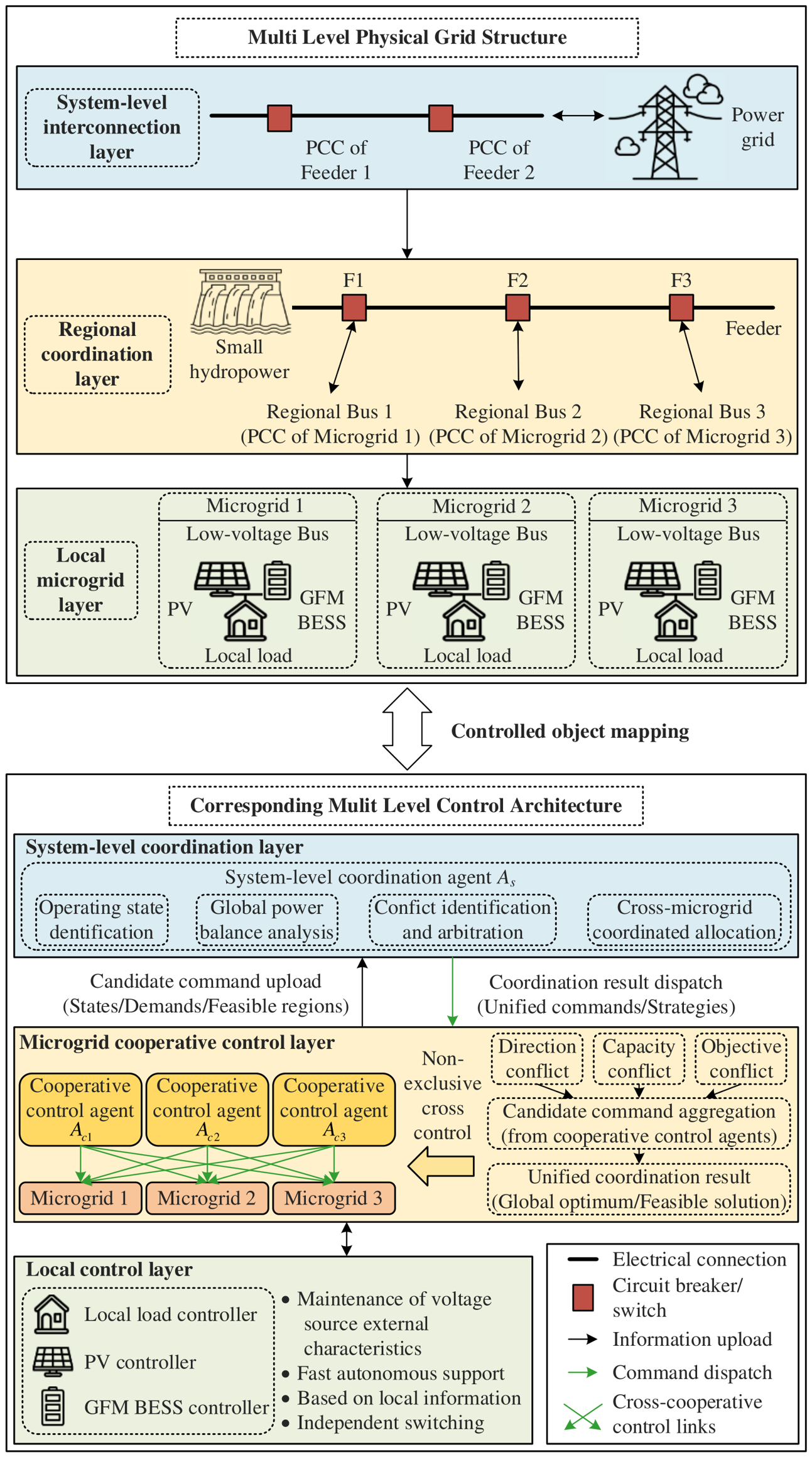
Figure 2 illustrates the correspondence between the physical microgrid cluster and the proposed multilevel control architecture. The upper part describes the physical grid structure, including the system interconnection layer; the regional coordination layer with feeder PCCs and small hydropower; and the local microgrid layer composed of PV, GFM BESS, and local loads. The lower part maps these physical objects to the control architecture. The system-level coordination agent receives uploaded operating states, demand information, and feasible resource regions, and then performs global power balance analysis, conflict identification, arbitration, and cross-microgrid allocation. The microgrid cooperative control agents generate candidate commands for different microgrids through non-exclusive cross-control links, while the local controllers execute the final references and maintain voltage source characteristics using local measurements. This mapping clarifies that the proposed CCMAC does not rely on a fixed one-to-one control boundary. Instead, it combines local autonomous support, distributed candidate command generation, and system-level arbitration to obtain unified and feasible control results under changing operating boundaries.
The proposed architecture is a hierarchical distributed hybrid control scheme. The local GFM layer does not rely on real-time communication for voltage source formation and remains operational under temporary upper-layer communication interruption. The microgrid coordination layer exchanges operating states and candidate commands among coordination controllers, whereas the system-level coordination controller performs arbitration only when multiple candidate commands target the same microgrid or when a security boundary is approached. Therefore, the architecture is neither fully centralized in fast converter control nor fully decentralized in supervisory conflict resolution.
The supervisory communication interval is assumed to be slower than the local converter control cycle and faster than the short- and medium-time-scale power recovery process. In the simulations, communication delay is represented within the coordination update process, while converter-level voltage and current loops are executed locally. If a message is delayed beyond the admissible coordination window or fails the data freshness check, the corresponding reliability index Ci,j com is reduced, thereby lowering the weight of that candidate command. If all upper-layer commands are unavailable, the local GFM controllers retain their last feasible references and continue autonomous voltage and frequency support within converter capability limits.

4. Case Studies and Result Analysis

4.1. Simulation System and Comparative Methods

To verify the effectiveness of the proposed control strategy, a microgrid cluster simulation system consisting of three bottom-layer microgrids is established. The system includes three microgrids, denoted as MG1, MG2, and MG3. Each microgrid is equipped with GFM energy storage, PV, and local loads. The intermediate coordination layer is configured with three microgrid coordination controllers, namely, Ac,1, Ac,2, and Ac,3. In addition, a small hydropower unit with limited regulation capability is incorporated to provide power compensation over short and medium time scales. The system-level coordination controller As is responsible for global conflict identification and coordination arbitration.
The main simulation parameters are set as follows. The rated AC voltage of each microgrid is 0.4 kV, and the rated frequency is 60 Hz. The initial loads of the three microgrids are 0.85 MW, 0.75 MW, and 0.65 MW, respectively. The rated powers of the GFM energy storage units are 0.6 MW, 0.5 MW, and 0.5 MW, respectively, and their initial SOC values are 70%, 65%, and 60%, respectively. The rated powers of the PV units are 0.8 MW, 0.7 MW, and 0.6 MW, respectively. The rated power of the small hydropower unit is 1.2 MW, and its maximum ramping rate is 0.08 MW/s. The allowable voltage range is 0.95 to 1.05 p.u., and the allowable frequency range is 59.5 to 60.5 Hz. For the normalized objective function, Δfmax = 0.5 Hz, ΔVmax = 0.05 p.u., and ΔSOCmax = 10%, and the weighting coefficients are set as α1 = 0.30, α2 = 0.30, α3 = 0.15, α4 = 0.15, and α5 = 0.10. These parameters are kept unchanged in all comparative cases.
To demonstrate the advantages of the proposed method, three comparative methods are considered. Method A is conventional droop control (CDC). In this method, each microgrid mainly relies on local energy storage and PV droop control to maintain voltage and frequency, without cross-coordination among multiple coordination controllers or system-level conflict coordination. Method B is one-to-one hierarchical control (OOHC). Each microgrid coordination controller regulates only its corresponding microgrid, and small hydropower participates in regulation according to the power deficit of a single region, without cross coordination among microgrids. Method C is the proposed cross-coordinated multiagent control (CCMAC), which combines cross-coordinated control and conflict coordination. In Method C, multiple coordination controllers can generate candidate control commands for multiple microgrids, and the system-level coordination controller performs arbitration when command conflicts occur.

4.2. Simulation Cases and Performance Analysis

Case A: Simultaneous load step disturbances in multiple microgrids
This case verifies the power coordination capability under multiregion load disturbances. The loads of MG1 and MG2 increase by 25% and 20% at t = 3 s, respectively, while the load of MG3 remains unchanged.
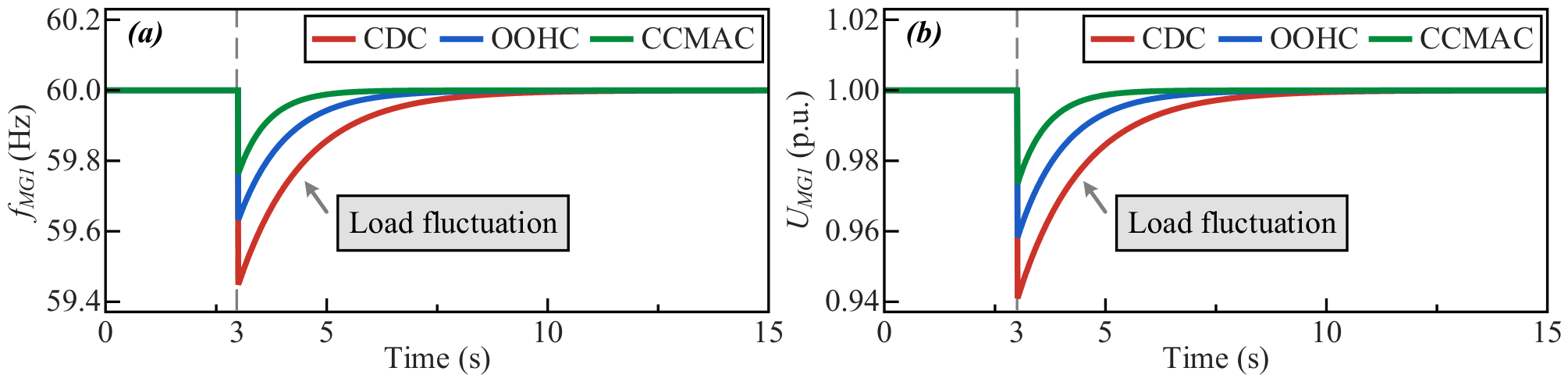
Under CDC, each microgrid responds to the load disturbance independently. Since the initial SOC values of the energy storage units in MG1 and MG2 are different, the power support capabilities of the two regions are unbalanced, resulting in a relatively large frequency deviation in MG1. The maximum frequency deviation reaches 0.42 Hz. Under OOHC, the coordination layer provides power compensation for the corresponding microgrid. However, because the coordination relationship is fixed, the remaining regulation margin of MG3 cannot be fully used to support MG1 and MG2. Under CCMAC, the system identifies the overall regulation capability of the three microgrids through cross-coordinated control and incorporates part of the energy storage margin of MG3 and the adjustable capacity of small hydropower into global coordination. Thus, the load disturbance is cooperatively shared among multiple microgrids. CCMAC reduces the maximum frequency deviation to 0.18 Hz and the maximum voltage deviation to 0.026 p.u. while maintaining a critical load supply rate of 100%. The representative frequency and voltage responses are shown in Figure 3. This case demonstrates that the cross-coordinated control mechanism overcomes the limitation of a fixed one-to-one jurisdictional structure and enables the microgrid cluster to shift from local self-balance to coordinated support within the cluster.
Case B: Coordination command conflict and system-level arbitration
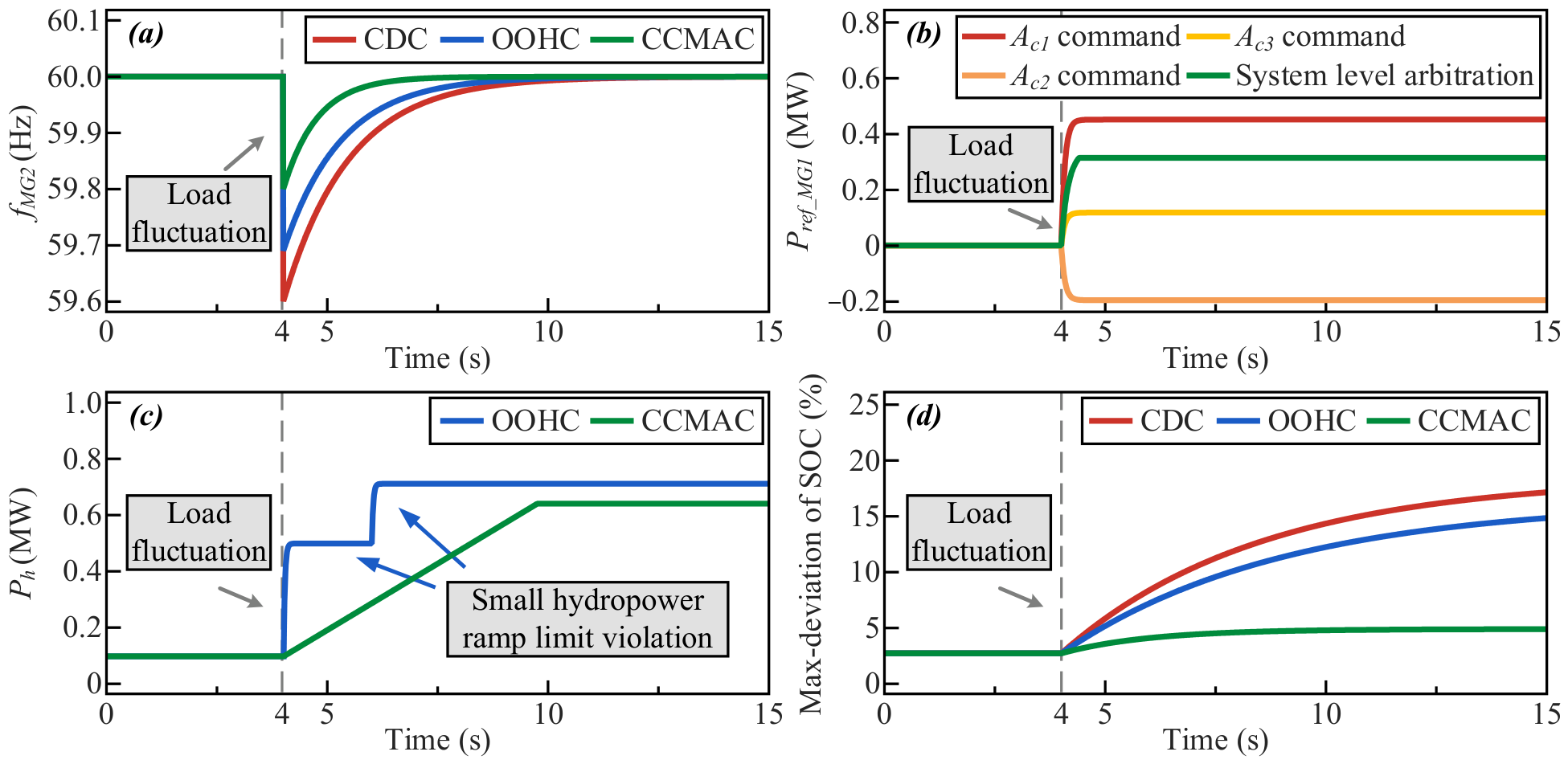
This case verifies the proposed conflict identification and coordination arbitration mechanism. A sudden load increase is imposed on MG2 at t = 4 s, while the PV output of MG3 decreases. In this condition, coordination controller Ac,1 issues a command to increase the energy storage output of MG2 according to the frequency deviation of MG2. Coordination controller Ac,2 issues a command to reduce the energy storage output of MG2 and request small hydropower support according to the low SOC of the energy storage in MG2. Meanwhile, Ac,3 issues a command to reserve the support margin of small hydropower in response to the PV output reduction in MG3. These three candidate commands produce objective conflicts in terms of energy storage output, small hydropower support, and load priority.
Without system-level coordination, the direct superposition of multiple candidate commands would cause the energy storage power reference of MG2 to exceed its available capacity and would also cause the ramping command of small hydropower to exceed its constraint boundary. Under OOHC, although no obvious conflict occurs due to the fixed coordination structure, the state information from other coordination controllers cannot be fully utilized, leading to a rapid decrease in the SOC of the energy storage in MG2. Under CCMAC, the system-level coordination controller identifies both objective conflict and capacity conflict. It constrains the energy storage power of MG2 within the allowable range, gradually increases the hydropower output according to the ramping capability of small hydropower, and assigns the short-term support demand to the energy storage margins of MG1 and MG3. The simulation results show that no ramping constraint violation occurs in small hydropower under CCMAC. The maximum SOC deviation is reduced from 13.8% under OOHC to 6.4% under CCMAC, corresponding to a reduction of 53.6%, and the power recovery time is shortened from 5.1 s to 3.0 s.
This case verifies the effectiveness of the closed-loop process of cross-coordinated control, conflict identification, and system-level coordination arbitration in the proposed control strategy. In Figure 4d, the y axis denotes the instantaneous maximum SOC deviation from the cluster average of all energy storage units rather than the SOC variation of a single unit. Cross-coordinated control improves the flexibility of multiagent participation in control, while system-level arbitration ensures the consistency and executability of the final control commands.
Case C: Sustained Power Recovery Under Constrained Small Hydropower Regulation
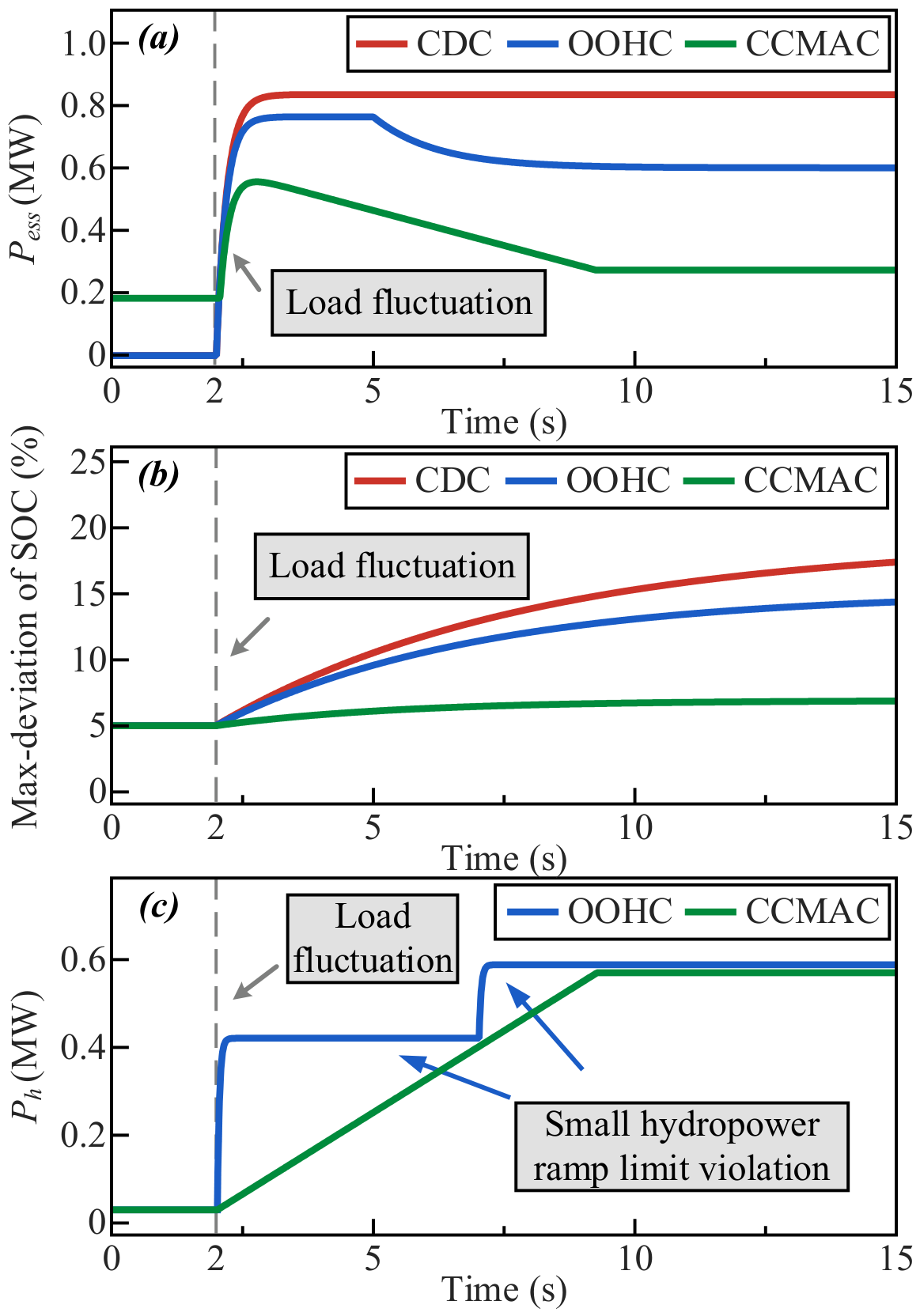
This case examines the physical consistency of using small hydropower as a constrained regulation resource at the intermediate layer for sustained power compensation. Power deficits are imposed simultaneously on MG1 and MG2 at t = 2 s. Energy storage first provides fast power support, whereas small hydropower gradually increases its output according to the ramping constraint.
Under CDC, coordinated compensation from small hydropower is not considered, and the energy storage units must cover the power deficit for an extended period, which causes continuous SOC depletion. Under OOHC, small hydropower is activated, but the hydropower command changes too rapidly because the fixed one-to-one coordination structure does not fully enforce the ramping envelope during inter-microgrid support. Under CCMAC, small hydropower is dispatched at the coordination layer, and its active power trajectory is constrained by the feasible ramping set. As shown in Figure 5a,c, the energy storage units provide the initial fast support immediately after the disturbance, whereas the small hydropower output increases gradually and then assumes the sustained compensation component. Figure 5b shows that this coordinated transfer also suppresses SOC divergence among the energy storage units. The simulation results show that CCMAC reduces the peak sustained discharging power of energy storage by approximately 21.6% and decreases the maximum SOC deviation of the microgrid cluster by approximately 48.3%, while no ramping constraint violation occurs in small hydropower.
This case indicates that small hydropower should not be modeled as a bottom-layer fast GFM control resource. Instead, it should participate in short- and medium-time-scale power recovery as a constrained regulation resource at the intermediate coordination layer. The hydropower output curve in Figure 5c directly demonstrates the gradual takeover process: the initial deficit is absorbed by GFM energy storage, and the sustained component is subsequently transferred to small hydropower within its ramping limit. This treatment is more consistent with the physical regulation characteristics of small hydropower.
The sensitivity of the results to hydropower dynamics is mainly reflected in the transition speed from fast storage support to sustained hydropower compensation. When the equivalent ramping envelope is reduced to represent a slower governor response, the energy storage units must sustain a larger temporary power contribution and the recovery time increases. When the hydropower response is faster, the sustained storage burden decreases. However, the superiority of CCMAC over CDC and OOHC is retained because CCMAC explicitly enforces the hydropower feasible set during arbitration, whereas CDC does not coordinate hydropower support and OOHC cannot fully use cross-microgrid support under fixed authority. Thus, using a higher-order hydro turbine governor model would refine the hydropower trajectory but would not invalidate the proposed cross-command arbitration mechanism.
In the case study analysis, Figure 4d and Figure 5b, and the fourth column of Table 1 all use the SOC metric defined in Equation (18). Specifically, Figure 4d and Figure 5b show the instantaneous index, whereas Table 1 reports its maximum value over the corresponding case interval. For the initial SOC values of 70%, 65%, and 60%, the initial value of this index is 5%, which is consistent with the curves.
As shown in Table 1, CCMAC outperforms the comparative methods in dynamic stability, resource balancing, and control executability. The fourth column of Table 1 reports ΔSOCdevmax, that is, the maximum value of the instantaneous maximum SOC deviation from the cluster average calculated from the original SOC trajectories of all energy storage units. This index is not the absolute SOC decrease in one energy storage unit and is not the maximum difference between the highest and lowest SOC values. Instead, it is obtained from the time-varying trajectories of all energy storage units according to Equation (18). According to the simulation records, ΔSOCdevmax is 17.2% for CDC, 14.8% for OOHC, and 6.4% for CCMAC. Compared with CDC, CCMAC reduces the maximum frequency deviation by 57.1%, the maximum voltage deviation by 55.2%, the power recovery time by 51.9%, and ΔSOCdevmax by 62.8%. Compared with OOHC, CCMAC further reduces these four indices by 35.7%, 36.6%, 38.1%, and 56.8%, respectively, while avoiding small hydropower ramping constraint violations and maintaining a critical load supply rate of 100%.
This improvement can be attributed to the following factors. CDC mainly relies on autonomous responses based on local measurements and lacks resource coordination at the microgrid cluster level. Although OOHC introduces a coordination layer, its fixed control authority prevents the support capability of other microgrids from being fully utilized. In contrast, CCMAC enables multiple coordination controllers to generate candidate control schemes for the same microgrid through the cross-coordinated control mechanism. The system-level coordination controller further resolves conflicts among these candidate commands, thereby forming a complete multiagent control process from cooperative perception and coordinated decision making to coordinated execution.

5. Conclusions

To address multi-entity cooperation, heterogeneous resource coordination, and command conflicts in microgrid clusters, this paper proposes CCMAC, a hierarchical distributed hybrid control strategy based on cross-coordinated control and conflict coordination. Local GFM controllers provide fast autonomous support, microgrid coordination controllers generate candidate commands, and the system-level controller performs event-triggered arbitration to obtain feasible final references. Compared with consensus-based and conventional hierarchical methods, CCMAC introduces overlapping supervisory authority, adaptive weighted fusion, conflict classification, and constrained feasibility projection. It also coordinates fast GFM support with ramp-constrained small hydropower, enabling sustained power recovery without treating hydropower as an ideal fast-response source. Simulation results show that CCMAC reduces the maximum frequency deviation, maximum voltage deviation, power recovery time, and ΔSOCdevmax by 57.1%, 55.2%, 51.9%, and 62.8% compared with CDC and by 35.7%, 36.6%, 38.1%, and 56.8% compared with OOHC, respectively. It also eliminates hydropower ramp-limit violations and maintains a 100% critical load supply rate. Future work will incorporate detailed hydro turbine governor dynamics, communication latency, and cyber-resilient coordination.

Author Contributions

S.J.: Methodology, resources, and data curation. H.B.: Formal analysis, investigation, and data curation. S.C.: Experiment design and implementation. T.L.: Experimental data analysis and comparative validation. R.Z.: Original draft preparation and conceptualization. L.S.: Academic guidance and supervision. Z.D.: Writing, review, and editing. All authors have read and agreed to the published version of the manuscript.

Funding

This research was funded by the Smart Grid-National Science and Technology Major Project, grant number 2024ZD0800600.

Data Availability Statement

Data are contained within the article. Any supplementary data presented in this study are available on request from the corresponding author.

Conflicts of Interest

Authors Shiqi Jiang, Hao Bai, Shengbin Chen, Tong Liu were employed by the company CSG Electric Power Research Institute Co., Ltd., Guangzhou 510663 Guangdong, China. All authors declare that the research was conducted in the absence of any commercial or financial relationships that could be construed as a potential conflict of interest. The authors declare that this study received funding from the Smart Grid-National Science and Technology Major Project, grant number 2024ZD0800600. The funder was not involved in the study design, collection, analysis, interpretation of data, the writing of this article or the decision to submit it for publication.

Abbreviations

The following abbreviations are used in this manuscript:
PVPhotovoltaic
GFMGrid forming
CDCConventional droop control
OOHCOne-to-one hierarchical control
CCMACCross-coordinated multiagent control

References

  1. Rastgou, A. Distribution network expansion planning: An updated review of current methods and new challenges. Renew. Sustain. Energy Rev. 2024, 189, 114062. [Google Scholar] [CrossRef]
  2. Alam, M.S.; Hossain, M.A.; Shafiullah, M.; Islam, A.; Choudhury, M.S.; Faruque, M.O.; Abido, M.A. Renewable energy integration with DC microgrids: Challenges and opportunities. Electr. Power Syst. Res. 2024, 234, 110548. [Google Scholar] [CrossRef]
  3. Muhtadi, A.; Pandit, D.; Nguyen, N.; Mitra, J. Distributed energy resources based microgrid: Review of architecture, control, and reliability. IEEE Trans. Ind. Appl. 2021, 57, 2223–2235. [Google Scholar] [CrossRef]
  4. Cagnano, A.; De Tuglie, E.; Mancarella, P. Microgrids: Overview and guidelines for practical implementations and operation. Appl. Energy 2020, 258, 114039. [Google Scholar] [CrossRef]
  5. Ahmad, S.; Shafiullah, M.; Ahmed, C.B.; Alowaifeer, M. A review of microgrid energy management and control strategies. IEEE Access 2023, 11, 21729–21757. [Google Scholar] [CrossRef]
  6. Zhu, J.; Yuan, Y.; Wang, W. An exact microgrid formation model for load restoration in resilient distribution system. Int. J. Electr. Power Energy Syst. 2020, 116, 105568. [Google Scholar] [CrossRef]
  7. Yassim, H.M.; Abdullah, M.N.; Gan, C.K.; Ahmed, A. A review of hierarchical energy management system in networked microgrids for optimal inter-microgrid power exchange. Electr. Power Syst. Res. 2024, 231, 110329. [Google Scholar] [CrossRef]
  8. Bandeiras, F.; Pinheiro, E.; Gomes, M.; Coelho, P.; Fernandes, J. Review of the cooperation and operation of microgrid clusters. Renew. Sustain. Energy Rev. 2020, 133, 110311. [Google Scholar] [CrossRef]
  9. Xie, P.; Jia, Y.; Chen, H.; Wu, J.; Cai, Z. Mixed-stage energy management for decentralized microgrid cluster based on enhanced tube model predictive control. IEEE Trans. Smart Grid 2021, 12, 3780–3792. [Google Scholar] [CrossRef]
  10. Dizioli, F.A.S.; Barra, P.H.A.; Menezes, T.S.; Lacerda, V.A.; Coury, D.V.; Fernandes, R.A.S. Multi-agent system-based microgrid protection using angular variation: An embedded approach. Electr. Power Syst. Res. 2023, 220, 109324. [Google Scholar] [CrossRef]
  11. Nawaz, A.; Zhou, M.; Wu, J.; Long, C. A comprehensive review on energy management, demand response, and coordination schemes utilization in multi-microgrids network. Appl. Energy 2022, 323, 119596. [Google Scholar] [CrossRef]
  12. Beus, M.; Banis, F.; Pandžić, H.; Poulsen, N.K. Three-level hierarchical microgrid control: Model development and laboratory implementation. Electr. Power Syst. Res. 2020, 189, 106758. [Google Scholar] [CrossRef]
  13. Salehi, N.; Martínez-García, H.; Velasco-Quesada, G.; Guerrero, J.M. A comprehensive review of control strategies and optimization methods for individual and community microgrids. IEEE Access 2022, 10, 15935–15955. [Google Scholar] [CrossRef]
  14. Juma, S.A.; Ayeng’o, S.P.; Kimambo, C.Z.M. A review of control strategies for optimized microgrid operations. IET Renew. Power Gener. 2024, 18, 2785–2818. [Google Scholar] [CrossRef]
  15. Dragičević, T.; Vazquez, S.; Wheeler, P. Advanced control methods for power converters in DG systems and microgrids. IEEE Trans. Ind. Electron. 2021, 68, 5847–5862. [Google Scholar] [CrossRef]
  16. Chakraborty, S.; Kar, S. Hierarchical control of networked microgrid with intelligent management of TCLs: A case study approach. Electr. Power Syst. Res. 2023, 224, 109787. [Google Scholar] [CrossRef]
  17. Zhou, Q.; Shahidehpour, M.; Paaso, A.; Bahramirad, S.; Alabdulwahab, A.; Abusorrah, A. Distributed control and communication strategies in networked microgrids. IEEE Commun. Surv. Tutor. 2020, 22, 2586–2633. [Google Scholar] [CrossRef]
  18. Xiong, L.; Li, P.; Wang, Z.; Wang, J. Multi-agent based multi objective renewable energy management for diversified community power consumers. Appl. Energy 2020, 259, 114140. [Google Scholar] [CrossRef]
  19. Islam, M.; Yang, F.; Amin, M. Control and optimisation of networked microgrids: A review. IET Renew. Power Gener. 2021, 15, 1133–1148. [Google Scholar] [CrossRef]
  20. Xu, X.; Xu, K.; Zeng, Z.; Tang, J.; He, Y.; Shi, G.; Zhang, T. Collaborative optimization of multi-energy multi-microgrid system: A hierarchical trust-region multi-agent reinforcement learning approach. Appl. Energy 2024, 375, 123923. [Google Scholar] [CrossRef]
  21. Xu, Z.; Wang, Y.; Dong, R.; Li, W. Research on multi-microgrid power transaction process based on blockchain technology. Electr. Power Syst. Res. 2022, 213, 108649. [Google Scholar] [CrossRef]
  22. Azizivahed, A.; Gholami, K.; Arefi, A.; Li, L.; Arif, M.T.; Haque, M.E. Stochastic scheduling of energy sharing in reconfigurable multi-microgrid systems in the presence of vehicle-to-grid technology. Electr. Power Syst. Res. 2024, 231, 110285. [Google Scholar] [CrossRef]
  23. Shi, Z.; Zhang, T.; Liu, Y.; Feng, Y.; Wang, R.; Huang, S. Optimal design and operation of islanded multi-microgrid system with distributionally robust optimization. Electr. Power Syst. Res. 2023, 221, 109437. [Google Scholar] [CrossRef]
  24. Li, D.; Qiu, Z.; Wang, Q.; Zeng, Z.; Que, X.; Huang, Z. Dual-time scales coordination operation strategy of photovoltaic storage microgrid source-grid-load-storage. South. Power Syst. Technol. 2025, 19, 4–14. [Google Scholar]
  25. Musca, R.; Vasile, A.; Zizzo, G. Grid-forming converters: A critical review of pilot projects and demonstrators. Renew. Sustain. Energy Rev. 2022, 165, 112551. [Google Scholar] [CrossRef]
  26. Ojo, Y.; Alam, S.M.S.; Balliet, W.H.; Mosier, T.M. Frequency response improvement in a standalone small hydropower plant using battery storage. IEEE Trans. Energy Convers. 2024, 39, 2701–2717. [Google Scholar] [CrossRef]
  27. Westman, J.; Hadidi, R. Overload mitigation for grid-forming inverters in islanded microgrids with synchronous generators. Electr. Power Syst. Res. 2025, 239, 111231. [Google Scholar] [CrossRef]
  28. Li, F.; Cao, W.; Yu, D.; Su, Y.; Huang, Z.; Zhang, Y. Multi-objective hierarchical active optimization method for active distribution networks considering bidirectional coordination of transmission and distribution networks. South. Power Syst. Technol. 2024, 18, 138–150. [Google Scholar]
  29. Yang, X.; Huang, Z.; Wang, X.; Hu, Z.; Yang, P.; Zhong, R. Hierarchical optimization of new energy microgrid based on interval information fuzzy planning model. South. Power Syst. Technol. 2025, 19, 150–159. [Google Scholar]
  30. Khan, M.W.; Li, G.; Wang, K.; Numan, M.; Xiong, L.; Khan, M.A. Optimal control and communication strategies in multi-energy generation grid. IEEE Commun. Surv. Tutor. 2023, 25, 2599–2653. [Google Scholar] [CrossRef]
  31. Liu, J.; Zhuan, X.; Shang, L.; Su, S.; Xie, Q. The hierarchical structure and control signal transmission of microgrid hierarchical control: A review. IET Power Electron. 2025, 18, e70057. [Google Scholar] [CrossRef]
  32. Cunha, P.H.; Saavedra, O.R.; Ribeiro, L.A.S.; Oliveira, D.Q. Cluster operation of microgrids: Assessing economic and resilience gains. Electr. Power Syst. Res. 2025, 239, 111220. [Google Scholar] [CrossRef]
  33. Ahsan, S.M.; Gholizadeh, N.; Musilek, P. Multi-agent systems in networked microgrids: Reinforcement learning and strategic pricing mechanisms. Renew. Energy 2025, 254, 123678. [Google Scholar] [CrossRef]
Figure 1. Algorithm flowchart of the proposed multiagent microgrid cluster control strategy.
Electronics 15 02640 g001
Figure 2. Multilevel microgrid cluster control architecture.
Electronics 15 02640 g002
Figure 3. Dynamic responses of system variables: (a) frequency of MG1; (b) PCC voltage of MG1.
Electronics 15 02640 g003
Figure 4. Dynamic responses of system variables in Case B: (a) frequency of MG2; (b) active power reference of MG1; (c) active power reference of small hydropower; (d) instantaneous maximum SOC deviation from the cluster average of all energy storage units.
Electronics 15 02640 g004
Figure 5. Dynamic responses in Case C: (a) total active power of energy storage; (b) instantaneous maximum SOC deviation from the cluster average of all energy storage units; (c) active power output of small hydropower.
Electronics 15 02640 g005
Table 1. Quantitative performance comparison of different control strategies over the reported cases.
Control Strategy Δ f max (Hz) Δ V max (p.u.)Power Recovery Time, Trec (s)Maximum SOC Deviation, ΔSOCdevmax (%)Small Hydropower Ramp-Limit ViolationCritical Load Supply Rate (%)
CDC0.420.0585.417.2096.4
OOHC0.280.0414.214.8298.1
CCMAC0.180.0262.66.40100
Disclaimer/Publisher’s Note: The statements, opinions and data contained in all publications are solely those of the individual author(s) and contributor(s) and not of MDPI and/or the editor(s). MDPI and/or the editor(s) disclaim responsibility for any injury to people or property resulting from any ideas, methods, instructions or products referred to in the content.