Article

Design of 8-Plate Mixed-Coupling Wireless Power Transfer Coupler with Complementary Modes for AGV Charging Under Rotational Misalignment

1
Department of ICT Convergence, Soonchunhyang University, Asan 31538, Republic of Korea
2
Department of Electronic Engineering, Soonchunhyang University, Asan 31538, Republic of Korea
*
Author to whom correspondence should be addressed.
Electronics 2026, 15(12), 2589; https://doi.org/10.3390/electronics15122589
Submission received: 3 May 2026 / Revised: 2 June 2026 / Accepted: 9 June 2026 / Published: 11 June 2026

Abstract

This paper proposes a coupling-path reconfigurable mixed-coupling wireless power transfer (CPRMPT) coupler for improving coupler-level transmission stability under rotational misalignment. The proposed coupler forms two coupling modes, namely the adjacent coupling path (ACP) and diagonal coupling path (DCP), by changing the feeding polarity arrangement within the same physical structure. An equivalent-circuit model is used to describe the mode-dependent synthesis of self and mutual LC components, and 3D full-wave analysis is performed under a 100 mm transfer distance and 0–180° rotational conditions. The ACP mode maintains a near-unity maximum transmission coefficient over most rotation angles but shows a transmission null at 90 ° . In contrast, the DCP mode maintains near-unity transmission at 0 ° , 90 ° , and 180 ° , while null points occur at 45 ° and 135 ° . The extracted mutual parameters show that the ACP L m and C m decrease from 5.35   μ H and 0.052   p F at 0 ° to nearly zero at 90 ° , whereas the DCP mutual parameters decrease to nearly zero at 45 ° and 135 ° . These results demonstrate that coupling-path reconfiguration can provide complementary transmission paths for rotation-tolerant MPT coupler design.

1. Introduction

In smart factory and logistics automation environments, autonomous mobile robots (AMRs) and automated guided vehicles (AGVs) are widely used as key platforms for material transport, sorting, and inter-process delivery. Compared with conventional AGVs, AMRs provide advantages in distributed decision-making and dynamic path planning. However, long-term autonomous operation requires periodic energy replenishment and reliable docking-based charging [1,2]. During docking, the robot must maintain an appropriate position and posture with respect to the charging station, and this alignment requirement can restrict path-planning flexibility and overall operational efficiency [3,4]. Therefore, a wireless charging coupler that can maintain stable power transfer even when the approach direction or yaw angle varies is required.
Wireless power transfer (WPT) has been studied as a suitable charging technology for automated equipment and electric mobility applications because it can deliver energy through electromagnetic fields without direct electrical contact [5,6]. In particular, magnetic-resonance-based WPT has demonstrated near-field power transfer using strongly coupled resonant structures, and various coupler geometries and compensation circuits have since been developed for electric-vehicle and automated charging applications [7]. Among conventional WPT approaches, inductive wireless power transfer (IPT) has been widely investigated because it transfers power through mutual inductance between transmitter and receiver coils. Although IPT can achieve high power density and high transfer efficiency, its performance strongly depends on the coupling coefficient. Therefore, changes in mutual inductance caused by transfer distance, lateral misalignment, or rotational misalignment can degrade the transmission and resonance characteristics [8,9,10,11].
As an alternative or complementary approach, capacitive wireless power transfer (CPT) has also been investigated. CPT uses mutual capacitance between transmitter and receiver plates and enables a thin and simple metal-plate-based coupler structure [12,13]. However, because the coupling capacitance formed through air is generally small, high operating frequency, high plate voltage, and precise compensation are required for sufficient power transfer [13,14,15]. In addition, CPT is sensitive to the resonance condition determined by the plate-to-plate capacitance and compensation components; thus, distance variation, misalignment, rotation, and surrounding dielectric conditions can shift the resonant frequency and change the transmission response [16,17]. In plate-based couplers, the electric-field path is also strongly affected by the relative plate position and polarity arrangement, and rotational misalignment can reduce mutual capacitance or cancel the effective coupling path, resulting in a transmission null at specific angles [18,19].
To overcome the limitations of single-coupling approaches, mixed-coupling wireless power transfer (MPT), which simultaneously utilizes magnetic- and electric-field coupling, has been proposed. In MPT couplers, coils and plates are integrated so that mutual inductance from coupled inductors and mutual capacitance from coupled capacitors contribute to power transfer together [19,20]. This provides additional coupling degrees of freedom compared with IPT-only or CPT-only couplers [21,22]. Building on these foundations, it is meaningful to further examine how the effective coupling path changes when the receiver approaches the charging pad with different yaw angles. In particular, because MPT allows magnetic- and electric-field coupling to coexist within the same coupler, the rotation-dependent change in the coupling path should be analyzed at the coupler level. Therefore, this study focuses on how mixed magnetic- and electric-field coupling is maintained, weakened, or canceled under rotational misalignment.
In this paper, a Coupling-Path Reconfigurable Mixed Power Transfer (CPRMPT) coupler is proposed to improve coupler-level transmission stability under rotational misalignment. The novelty of the proposed coupler lies in its 8-plate mixed-coupling structure, which forms two different coupling paths within the same physical geometry by changing the feeding-polarity arrangement. Specifically, the adjacent coupling path (ACP) and diagonal coupling path (DCP) are formed as mode-dependent transfer paths, and these modes produce different rotation-dependent mutual-coupling characteristics, represented by changes in C m   and L m . As a result, ACP and DCP exhibit different transmission-null angles and can operate as complementary transfer paths under rotational misalignment. The purpose of this work is not to demonstrate a complete system-level AGV charger, but to clarify the coupler-level electromagnetic behavior of the proposed 8-plate CPRMPT structure through equivalent-circuit analysis and 3D full-wave simulation.
The remainder of this paper is organized as follows. Section 2 presents the coupler model and equivalent-circuit analysis of the CPRMPT coupler. Section 3 describes the physical structure and simulation model of the coupler, and Section 4 presents the simulation-based results. And Section 4 describes the simulation-based results. Finally, Section 5 concludes the paper.

2. Theoretical Method of CPRMPT Coupler

2.1. Scenario of CPRMPT Coupler

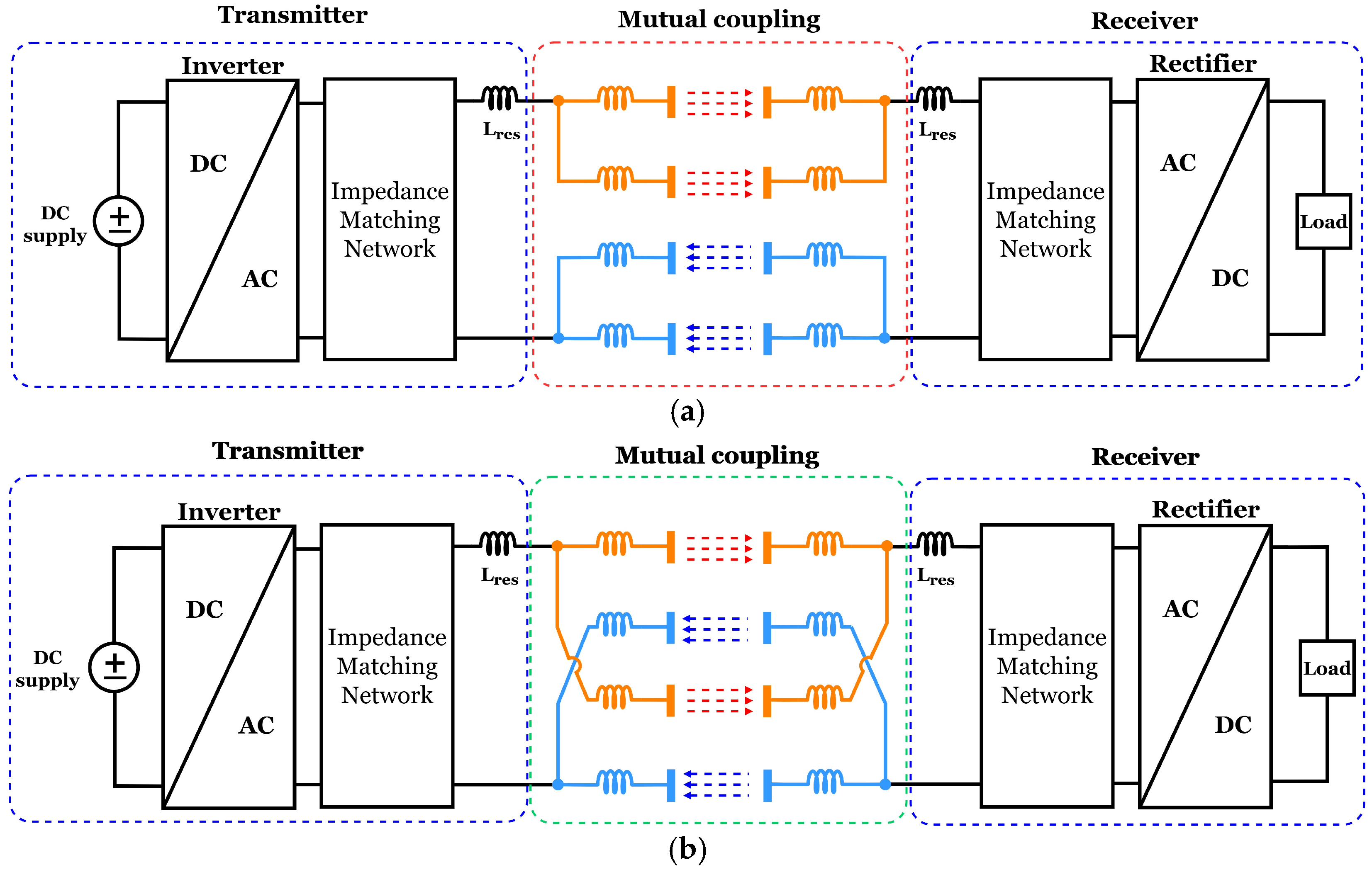
This section defines the two coupling paths formed in the proposed CPRMPT coupler. In this study, the coupling path does not refer to a physically separated independent circuit, but to the effective direction of electric-field and magnetic-field coupling determined by the feeding polarity arrangement. Thus, even within the same coupler structure, the coupling direction between the transmitter and receiver can be reconfigured into either an adjacent or diagonal direction according to the feeding condition.
Figure 1a shows the ACP mode. In this mode, coupling regions with the same polarity are arranged in the adjacent direction, forming an adjacent electric-field coupling path between the transmitter and receiver. The magnetic coupling path is also formed according to the current distribution corresponding to this feeding condition. Therefore, the ACP mode can be interpreted as a coupling mode in which the electric- and magnetic-field coupling are mainly established through adjacent coupling regions.
Figure 1b shows the DCP mode. In this mode, the feeding polarity arrangement is changed so that coupling regions with the same polarity are positioned diagonally. As a result, the electric-field coupling path is reconfigured from the adjacent direction to the diagonal direction, and the magnetic coupling path generated by the coil current also exhibits a spatial distribution different from that of the ACP mode. Therefore, the DCP mode forms an effective diagonal coupling path within the same coupler structure.
Consequently, the CPRMPT coupler can be described by two feeding-polarity-defined coupling paths, ACP and DCP. These two paths provide the basis for the mode-dependent mutual LC synthesis discussed in the following equivalent-circuit analysis. Under rotational misalignment, the relative strength of each coupling path varies with the receiver angle, which leads to different transmission-null conditions for the two modes.

2.2. Equivalent Circuit Modeling and Theoretical Analysis

In this section, the proposed CPRMPT coupler is modeled from an equivalent-circuit perspective, and the synthesis process of the self and mutual LC components is described. Since each coupling region contains both a plate and a coil, it can be represented as a mixed unit branch in which inductive and capacitive components coexist. The branch impedance relation is first defined, and the mode-dependent synthesis of mutual inductance and mutual capacitance is then formulated for the ACP and DCP modes.
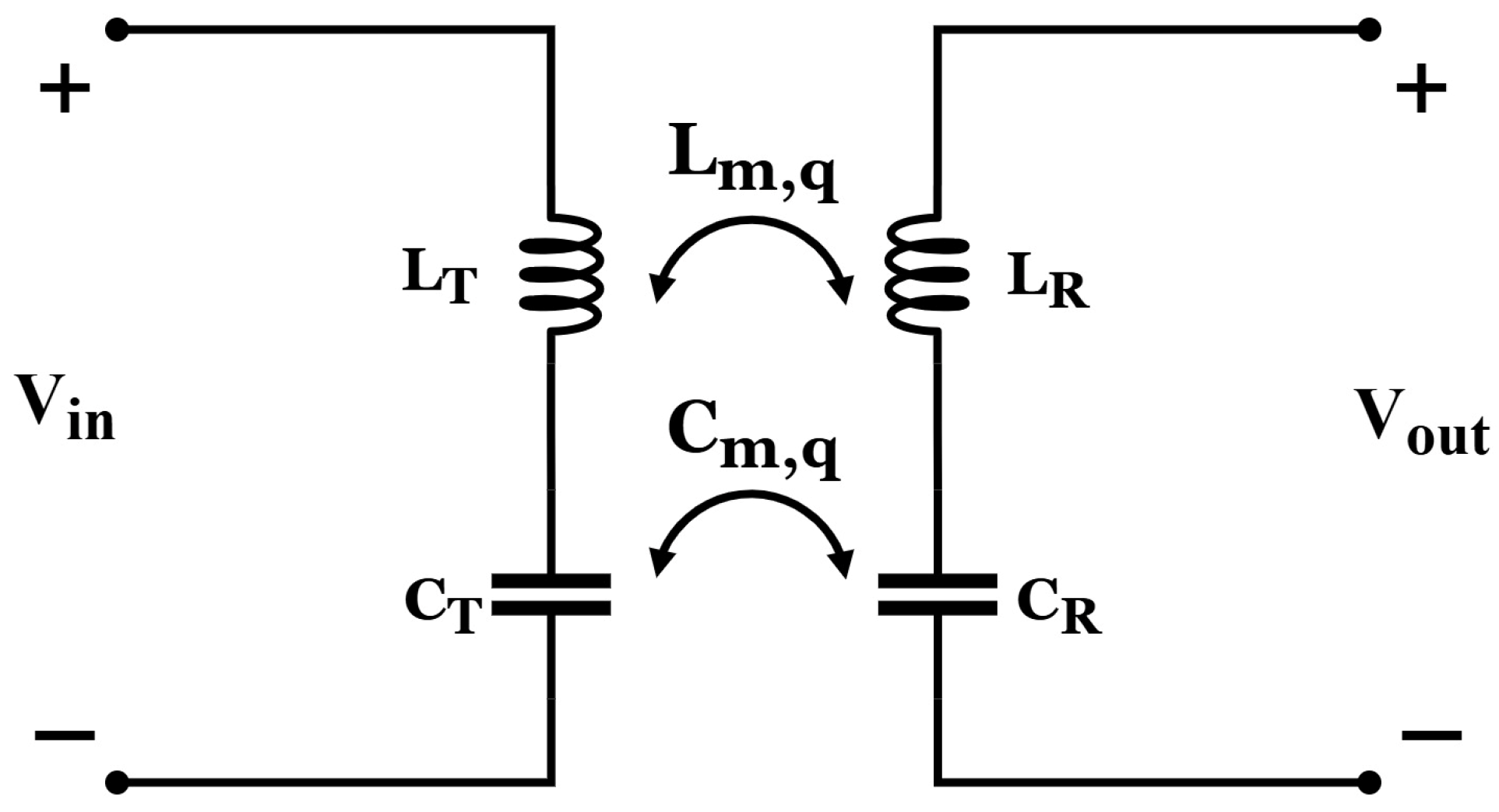
Figure 2 shows the equivalent circuit of the basic MPT coupler. In the basic MPT coupler, the magnetic-field coupling between the transmitter and receiver is represented by the mutual inductance L m , whereas the electric-field coupling is represented by the mutual capacitance C m . The proposed CPRMPT coupler can be interpreted as an extended structure of this basic MPT coupler. In particular, the basic four-plate MPT concept is extended to an 8-plate mixed-coupling structure in which each coupling region includes both a plate and a coil. Therefore, the mutual parameters of the basic MPT coupler are expressed in this work as the mode-level effective mutual parameters L m , q and C m , q , where q { A , D } denotes the ACP and DCP modes, respectively.
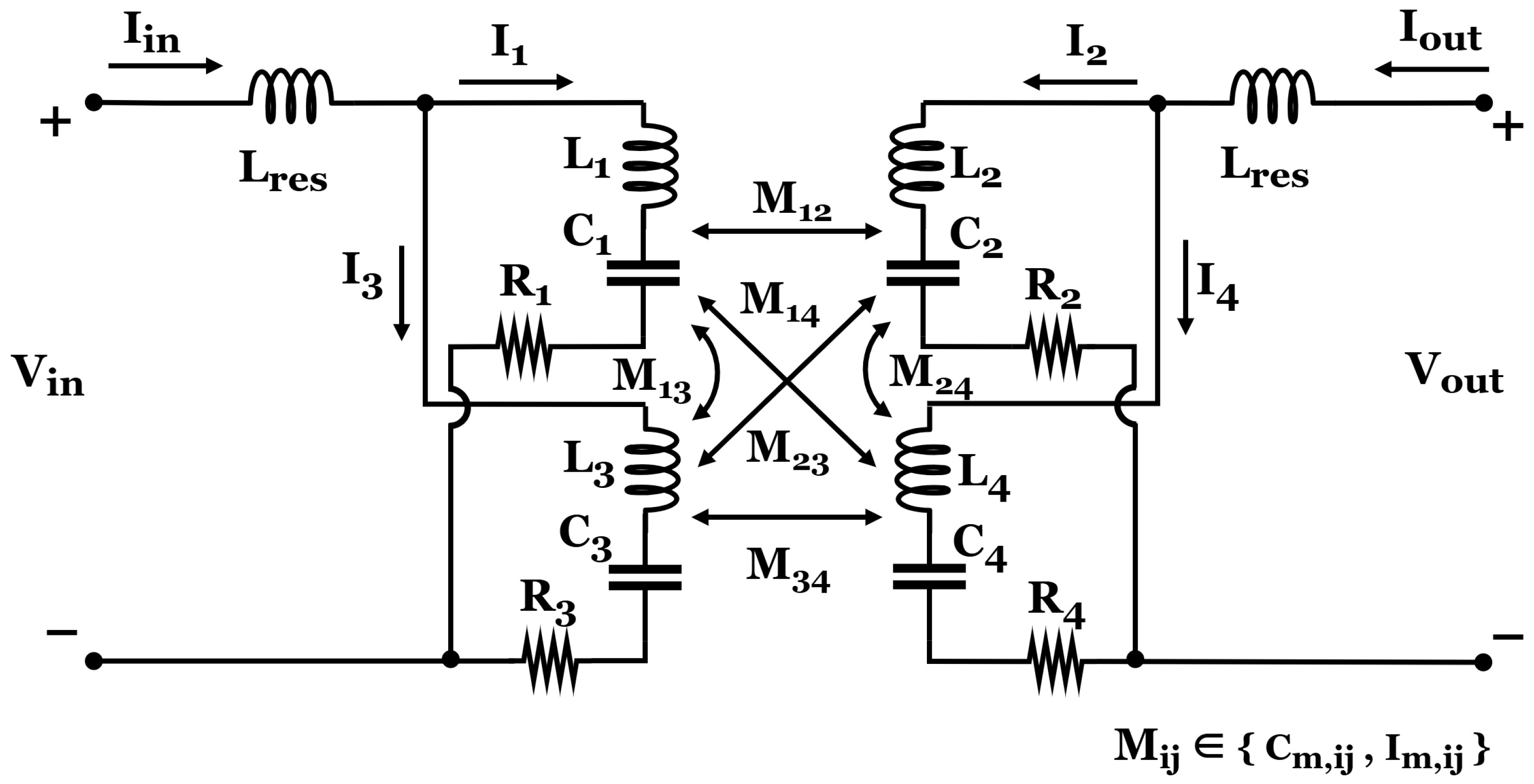
The equivalent circuit in Figure 3 represents the common circuit topology of the proposed CPRMPT coupler for both ACP and DCP modes. Since the physical structure is identical, the circuit topology is also identical. The difference between ACP and DCP is reflected in the mode-dependent synthesis of the mutual inductance and mutual capacitance terms, which are determined by the feeding-polarity arrangement and the resulting coupling path.
In Figure 3, the four mixed branches are numbered according to their physical positions in the equivalent circuit. Branch 1 denotes the upper-left branch, branch 2 denotes the upper-right branch, branch 3 denotes the lower-left branch, and branch 4 denotes the lower-right branch. Accordingly, branches 1 and 3 are located on the transmitter side, while branches 2 and 4 are located on the receiver side. The branch parameters are therefore denoted as L 1 C 1 R 1 , L 2 C 2 R 2 , L 3 C 3 R 3 , and L 4 C 4 R 4 . The corresponding branch currents are denoted as I 1 , I 2 , I 3 , and I 4 .
The mutual elements in Figure 3 are expressed using branch-pair indices. Here, M i j denotes the magnetic mutual component between branches i and j , and C m , i j denotes the electric mutual component between branches i and j . The indices i and j take values in 1 2 3 4 , with j i . For example, M 12 and C m , 12 represent the mutual coupling between branches 1 and 2, whereas M 34 and C m , 34 represent the mutual coupling between branches 3 and 4. In this notation, the previous a , b -based branch labels are removed, and all mutual components are described using the branch-pair numbering shown in Figure 3.
Because all branches are excited from a single port, the port-referenced currents I i n , q and I o u t , q are the sums of the branch currents:
I i n , q = I 1 + I 2   ,     I o u t , q = I 1 + I 2   ,     q { A , D }
Each branch is a series connection of a resistance, an inductance, and a capacitance, so the branch impedances are
Z 1 = R 1 + j ω L 1 + 1 j ω C 1   ,     Z 2 = R 2 + j ω L 2 + 1 j ω C 2 Z 3 = R 3 + j ω L 3 + 1 j ω C 3   ,     Z 4 = R 4 + j ω L 4 + 1 j ω C 4
Since the objective of this analysis is to explain the synthesis of reactive components and the resonance condition rather than to predict loss-induced power degradation, the branch resistances are neglected, leaving a lossless branch model focused on reactive components and mutual synthesis.
Applying Kirchhoff’s voltage law (KVL) to a single mixed unit cell i , the port voltage equals the sum of the coil voltage drop V L , i and the plate potential V p , i :
V i n =   V L , i + V p , i V L , i = j ω L i I i + j i j ω L m ,   i j I j ,     V L , i = 1 j ω C m , i j I i + j i 1 j ω C m , i j I i    
where L i is the self-inductance of cell i , C i is the self-capacitance of cell i , M i j is the magnetic mutual component between cells i and j , and C m , i j is the electric mutual component between cells i and j . The cell current I i is determined by the current division within the symmetric structure. The condition j i is used because the self components of cell i are already included in L i and C i .
The mode transition does not originate from any change in self parameters but from the way mutual terms are added to or canceled from the port quantities according to the feeding polarity. A sign coefficient λ i q { + 1 , 1 } is assigned to each mixed unit cell i { 1,2 , 3,4 } in mode q { A , D } , taking + 1 for a unit cell connected to the positive port terminal and 1 for the negative terminal. Therefore, the branch numbers 1–4 identify the physical branch positions, whereas the polarity sign is represented by λ i q .
Collecting the positive- and negative-group voltage drops together with the inter-plate potential difference Δ V C gives
V i n = i { P o s } j ω L i I i + j i j ω L m , i j I j i N e g j ω L n I n + m n j ω L m , n m I m + V c
Separating (4) into self, mutual, and capacitive contributions yields
V i n = V s e l f _ L + V m u t u a l _ t o t a l + V c a p
V s e l f _ L = j ω i = 1 4 λ i L i I i
V m u t u a l _ t o t a l = i = 1 4 λ i j i j ω L m , i j I j + i = 1 4 λ i j i 1 j ω C m , i j I i
Under the assumed symmetric excitation condition, the feeding vector determines whether mutual components are reinforced or partially canceled in each mode. In the ACP mode q A , the current distribution is I 1 = I 2 , I 3 = I 4 with λ A = [ + 1 , + 1 , 1 , 1 ] , whereas in the DCP mode q D , the current distribution is I 2 = I 3 , I 1 = I 4 with λ D = [ 1 , + 1 , + 1 , 1 ] .
Reducing the four-cell network of (4)–(7) to the port reference, the effective inductance and capacitance of each mode separate into self and mutual parts:
L e f f , q = L s e l f , q + L m , q   ,     C e f f , q = C s e l f , q + C m , q   ,     q A ,   D
where L m , q and C m , q denote the mode-level effective mutual parameters corresponding to the extracted L m and C m reported in the results section, synthesized from the two path-wise mutual contributions in Figure 3 as
L m ,   q = α q , 12 L m , 12 + α q , 34 L m , 34 + α q , 14 L m , 14 + α q , 23 L m , 23   , C m , q = β q , 12 C m , 12 + β q , 34 C m , 34 + β q , 14 C m , 14 + β q , 23 C m , 23
The coefficients α and β are not arbitrary fitting parameters. Consistent with the sign-weighted KVL grouping in (4)–(7), each coefficient is determined by the product of the feeding signs of the two coupled unit-cell groups that constitute the corresponding path-wise contribution:
α q , i j = β q , i j = λ i ( q ) λ j ( q )   ,     α q , i j = β q , i j = λ i ( q ) λ j ( q )   ,     i j
Thus, polarity-matched pairs yield a + 1 product, reinforcing terms, whereas opposite-polarity pairs yield a 1 product, canceling terms. The branch pair i j represents the unit-cell pair associated with each mutual component shown in Figure 3, and its sign product determines how the ACP and DCP feeding arrangements reinforce or cancel the effective mutual terms at the port level.
Synthesizing all KVL terms with respect to the input current I i n , q reduces the network to a single mode-dependent series RLC input impedance:
Z i n , q = R e f f , q + j ω L r e s , q + L e f f , q + 1 j ω C e f f , q
Resonance is defined as the frequency at which these inductive and capacitive reactances cancel each other, so the input impedance becomes purely real and the port reactance vanishes. Therefore, the resonance condition is expressed by forcing the imaginary part of the input impedance to zero as in (12).
I m Z i n , q = 0
Because L e f f , q and C e f f , q differ between the ACP and DCP modes due to the mode-dependent mutual synthesis in (8)–(10), the required compensation inductance L r e s , q can also differ by mode even when both modes are tuned to the same target operating frequency. Solving (12) yields the mode-dependent resonant frequency expression in (13).
f r e s , q = 1 2 π L r e s , q + L e f f , q C e f f , q
Equations (11)–(13) show that the ACP and DCP modes can possess different input impedances and resonance characteristics despite sharing one physical geometry, with the difference arising entirely from the mode-dependent compensation inductance and the signed mutual synthesis in (9).
Finally, because each branch-pair mutual component in Figure 3 is governed by the geometric overlap and the relative field orientation between a transmitter region and a receiver region, rotating the receiver by an angle θ modulates the branch-pair mutual components as M i j ( θ ) and C m , i j ( θ ) . Therefore, the mode-level effective mutual parameters become
L m , q θ = α q , 12 L m , 12 θ + α q , 34 L m , 34 θ + α q , 14 L m , 14 θ + α q , 23 L m , 23 θ , C m , q θ = α q , 12 C m , 12 θ + α q , 34 C m , 34 θ + α q , 14 C m , 14 θ + α q , 23 C m , 23 θ
where q { A , D } denotes the ACP and DCP modes, and α and β follow the same sign convention defined in (9)–(10).
According to the sign patterns of (10), the adjacent arrangement of the ACP mode and the diagonal arrangement of the DCP mode produce different angular dependences in the signed sums of (14). Therefore, the rotation angle at which the effective mutual components become weak can differ between the two modes. This provides a qualitative analytical basis for the complementary tendency summarized in the predictive evaluation of coupling performance under rotational misalignment conditions. Consequently, the rotation-dependent variation in the effective mutual components provides a way to examine whether the signed mutual synthesis described above is consistent with the full-wave simulation results. In the following section, the mode-level effective L m and C m extracted for the ACP and DCP modes at each rotation angle are compared with the predicted coupling-path tendency. This comparison is used to examine whether the equivalent-circuit interpretation in Figure 3 consistently represents the coupling-path reconfiguration observed in the 3D full-wave analysis.
Table 1 summarizes the equivalent parameters of the ACP and DCP modes, including the compensation inductance, effective inductance, effective capacitance, and resonance condition. In this study, the target operating frequency was set to 6.78 MHz. This frequency corresponds to the center of the 6.765–6.795 MHz ISM band and has been widely used as a resonant operating frequency for wireless power transfer. In addition, 6.78 MHz is suitable for evaluating the proposed compact mixed-coupling structure because it allows the coil-based magnetic coupling and plate-based electric-field coupling to be integrated within a 200 mm × 200 mm coupler area while maintaining the intended resonance condition. Therefore, 6.78 MHz was selected as a practical reference frequency for analyzing the coupler-level electromagnetic behavior of the proposed CPRMPT coupler, rather than as a universal operating frequency for all AGV/AMR wireless charging. In particular, L m and C m are the key parameters used to represent the magnetic- and electric-field mutual coupling between the transmitter and receiver. Their variations with respect to the rotation angle are analyzed in the results section to verify the coupling-path difference between the ACP and DCP modes.

3. Simulation Model

In this section, the 3D full-wave analysis model and conditions of the proposed CPRMPT coupler are defined. Since the ACP and DCP modes are distinguished by their feeding polarity arrangement, their transmission characteristics under rotational misalignment cannot be fully explained by circuit parameters alone. The electric-field distribution, magnetic-field distribution, fringing field, and surface current path must also be considered. Therefore, Ansys HFSS 2021 R2 was used to analyze the S -parameter response and electromagnetic-field distribution formed in the actual three-dimensional coupler geometry.
The coil and plate were modeled as copper, and the surrounding region was assigned as air. A radiation boundary condition was applied to the outer simulation region. The transmitter and receiver feeding terminals were defined using lumped ports, and the S -parameters of the ACP and DCP modes were extracted under the same port-reference condition. No separate external load circuit was included because this study focuses on the port-referenced coupler-level transmission response. Adaptive meshing was applied to both the air region and conductor regions, and the maximum Δ S convergence criterion was set to 0.01. The receiver coupler was rotated with respect to the fixed transmitter while maintaining a transfer distance of 100 mm. The L m and C m values were extracted from the simulated port response as mode-level effective mutual reactive parameters and were used to interpret the rotation-dependent magnetic- and electric-field coupling behavior.
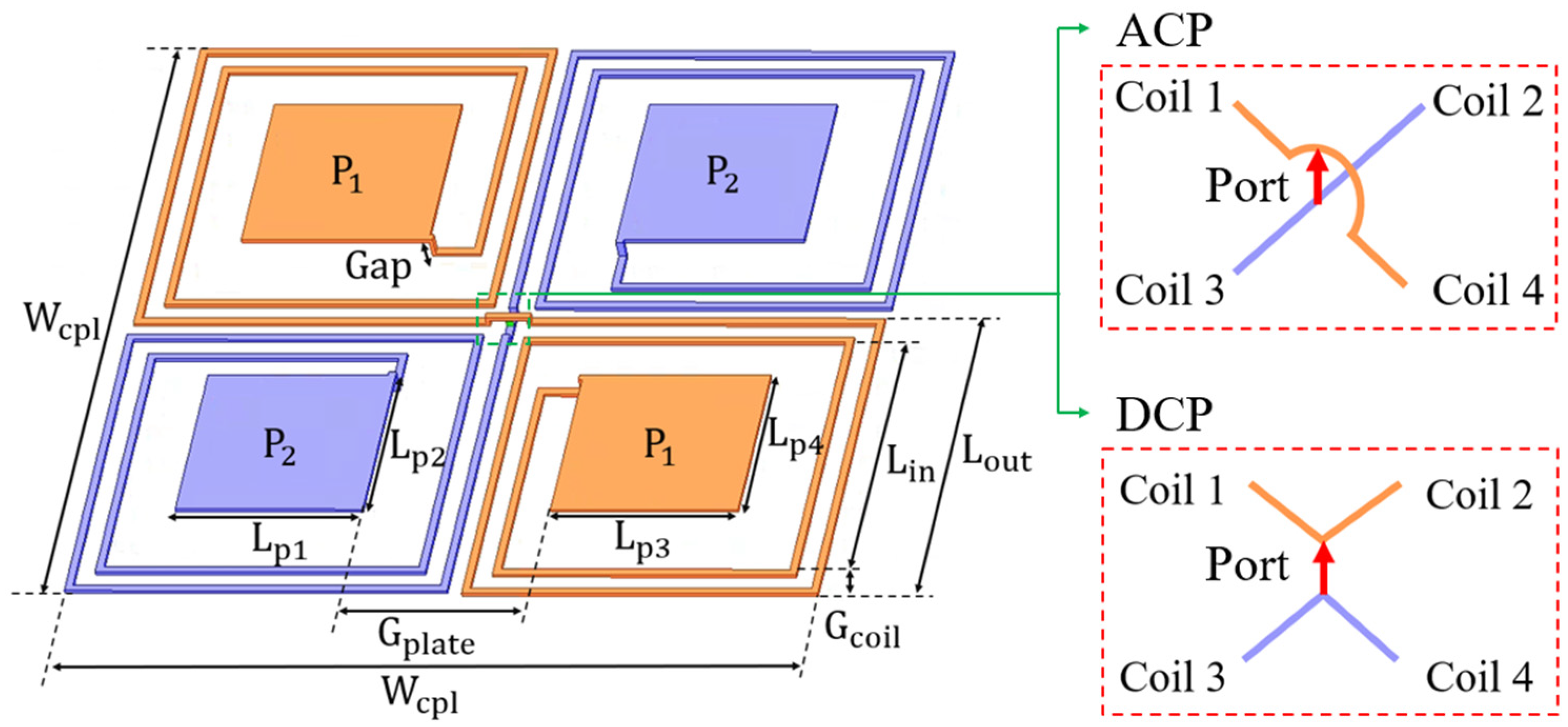
Figure 4 shows the 3D simulation model of the proposed CPRMPT coupler and its main structural parameters. Although the DCP configuration is presented as a representative example, ACP and DCP differ only in the feeding-polarity arrangement and coupling path, while the physical dimensions and overall structure remain identical. In this figure, the indicated port and polarity arrangement is used to define the excitation condition for each coupling mode in the simulation, not to represent a practical switching circuit for automatic mode selection. Therefore, Figure 4 represents the common baseline geometry and simulation-based feeding configuration of the proposed coupler. The detailed dimensions and design parameters are summarized in Table 2.
The design parameters in Table 2 were selected to establish a consistent reference baseline for the coupler-level electromagnetic analysis at 6.78 MHz, rather than as the result of a full numerical optimization. The overall coupler area was fixed at 200   m m   ×   200   m m ( W c p l ) as a practical envelope for a docking-type charging pad, and within this footprint, the 8-plate configuration was formed by dividing each plate of a conventional four-plate CPT coupler into two, with a 50   m m plate width ( L p 1 L p 4 ) and a 50   m m inter-plate gap ( G p l a t e ) chosen to fit the eight plates and the integrated coils symmetrically while preserving the polarity arrangements required for the ACP and DCP modes.
The coil dimensions ( L i n   =   100   m m ,   L o u t   =   80 m m ) and the 5   m m clearances ( G a p ,     G c o i l ) were set to maximize the magnetic aperture within the same area while preventing coil-to-plate shorting. Two turns were adopted as the minimum providing sufficient self-inductance to reach the target resonance together with the compensation inductance Lres, and the 0.5   m m conductor thickness, being more than an order of magnitude larger than the skin depth of copper at 6.78 MHz ( 25   µ m ), ensures that the thickness does not limit the surface-current paths. The 100 mm transfer distance reflects a practical pad gap and was held fixed so that rotational misalignment remained the single variable under study.
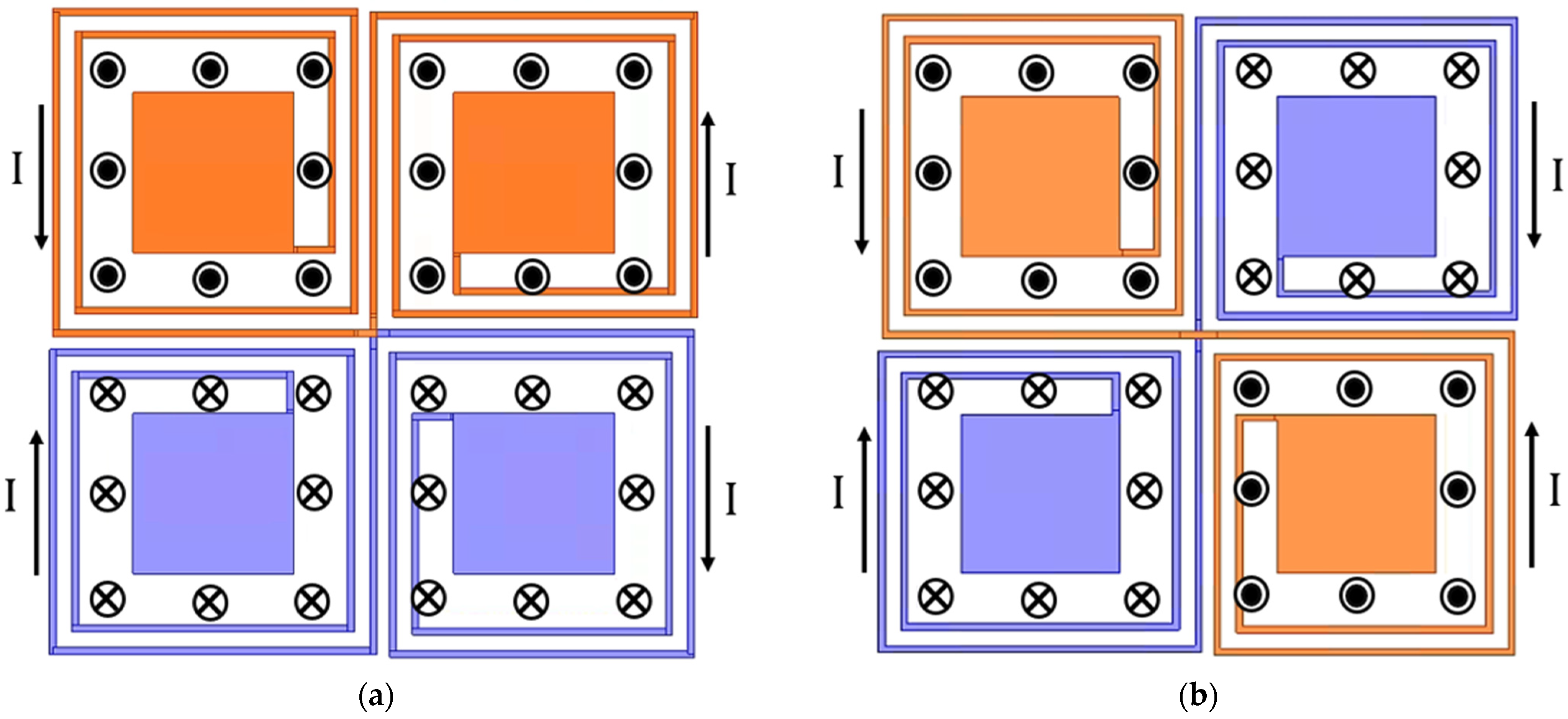
To clearly distinguish the operating characteristics of ACP and DCP, the electromagnetic-field directions formed in each mode must also be considered. Although both modes share the same physical geometry, the feeding polarity arrangement changes the potential distribution between the plates and the magnetic-field direction generated by the coil current. As a result, the mutual reactance between the transmitter and receiver varies according to the selected mode, leading to different transmission characteristics under rotational misalignment. For this reason, the intended electric- and magnetic-field directions of each mode are illustrated together with the coupler layout.
Figure 5 shows the top views and electromagnetic-field directions of the ACP and DCP modes. Figure 5a represents the ACP mode, whereas Figure 5b represents the DCP mode. In the figure, the circular symbols indicate the magnetic-field direction: a dot inside the circle denotes a magnetic field directed out of the page, whereas an X denotes a magnetic field directed into the page. Based on the magnetic-field direction and plate polarity arrangement, the ACP mode is designed to form an adjacent coupling path, while the DCP mode forms a diagonal coupling path.
In Figure 5, the same color indicates the same instantaneous feeding polarity, whereas different colors indicate opposite instantaneous polarity. Therefore, the ACP mode is implemented by assigning the same polarity to adjacent coupling regions, while the DCP mode is implemented by assigning the same polarity to diagonal coupling regions. Although the instantaneous polarity alternates with the excitation phase, the relative polarity relationship between the coupling regions determines whether the effective coupling path is formed in the adjacent or diagonal direction.
The field directions defined in Figure 5 also provide a basis for predicting the coupling tendency under rotational misalignment. Since ACP and DCP have different same-polarity arrangements and magnetic-field orientations, the strengthened and weakened coupling paths vary with the rotation angle. Accordingly, there are rotation angles at which ACP is weakened while DCP maintains relatively strong coupling, and vice versa. The predicted coupling tendencies based on this field-direction analysis are summarized in Table 3.
To examine these qualitative predictions, the rotational analysis range was extended from 0 ° to 180 ° . The 0 ° 90 ° range was used for direct comparison with the predicted results in Table 3, whereas the 90 ° 180 ° range was used to examine whether the predicted coupling tendency is repeated due to structural symmetry. Thus, the 0–180° rotational analysis was used to check whether the electromagnetic-field-based tendencies derived from Figure 5 and Table 3 are consistent with the 3D full-wave analysis results.
In addition, the transfer distance between the transmitter and receiver was set to 100 mm by considering a practical wireless charging pad scenario. To analyze the effect of rotational misalignment, the receiver coupler was rotated with respect to the transmitter, and the corresponding S -parameters were extracted. Because the structure is symmetric, the response beyond 180 ° is expected to repeat the tendency observed in the 0 ° 180 ° range. Therefore, the rotational analysis in this paper was limited to 0 ° 180 ° . Based on these conditions, the transmission degradation regions and null points of ACP and DCP were investigated, and the complementary behavior of the two coupling paths under rotation was analyzed.

4. Results and Discussion

Based on the simulation conditions defined above, the transmission characteristics of the proposed CPRMPT coupler are analyzed in the next section. First, the S -parameters of the ACP and DCP modes are compared in terms of the reflection coefficient S 11 and transmission coefficient S 21 , and the transmission characteristics and null-point conditions under rotational misalignment are examined. In this analysis, S 21 is used as a coupler-level transmission coefficient that indicates how effectively the RF signal applied to the transmitter port is delivered to the receiver port through the coupler. Therefore, a high S 21 value implies that an effective transmission path is formed, whereas a null in S 21 indicates that the coupling path is weakened and the transferable power through the coupler is significantly reduced. Next, the variations in L m and C m with respect to the rotation angle are analyzed to quantitatively investigate the difference in mutual coupling between the two modes. In the rotational analysis, the transmitter was fixed, and the receiver was rotated with respect to the transmitter around the center axis of the coupler. The ACP case denotes an ACP-ACP configuration, in which both the transmitter and receiver follow the ACP feeding-polarity arrangement. Similarly, the DCP case denotes a DCP-DCP configuration. Mixed configurations such as ACP-DCP or DCP-ACP were not considered in this study because they produce different polarity matching conditions and require a separate resonance and coupling-path analysis.
Finally, the surface current density J s u r f distribution is examined to verify whether the intended electromagnetic-field directions and coupling paths of ACP and DCP are consistently formed in the full-wave simulation results.
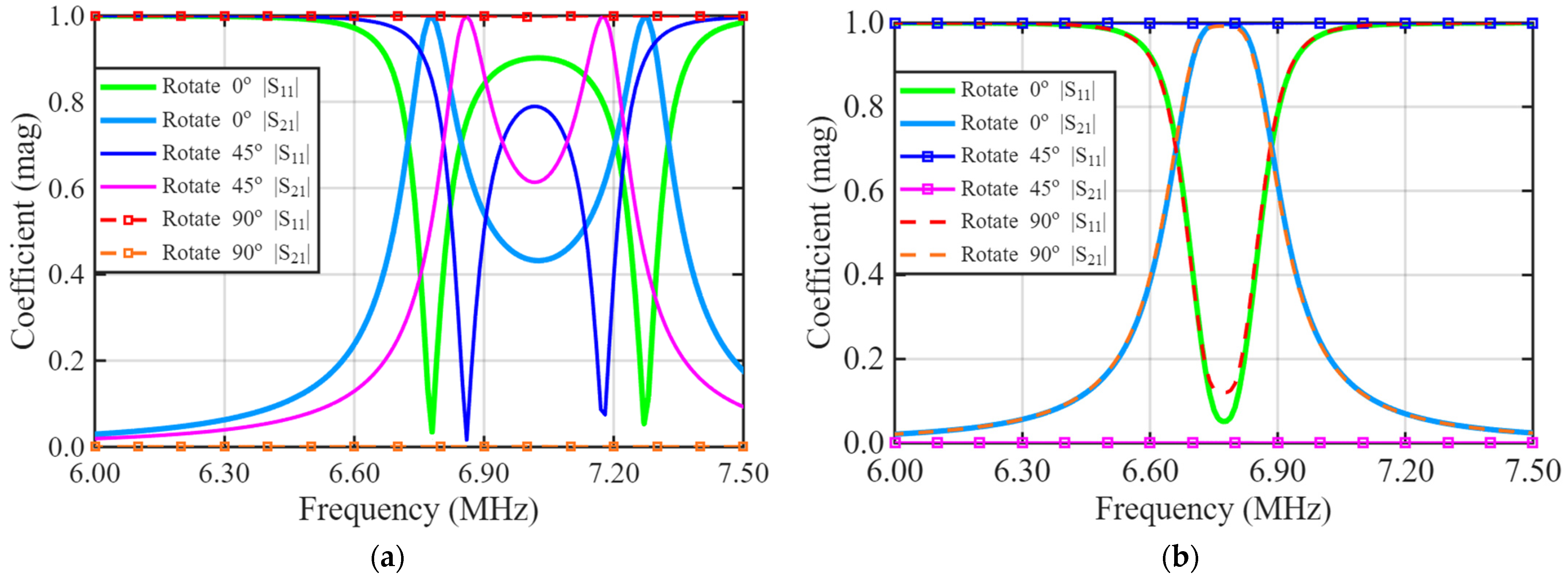
Figure 6 shows the S -parameter characteristics of the ACP and DCP modes under 0 ° , 45 ° , and 90 ° rotational conditions. Here, S 11 represents the reflection characteristic at the input port, whereas S 21 represents the transmission characteristic from the transmitter port to the receiver port. Therefore, the resonance dip of S 11 and the peak or null of S 21 are compared to determine whether an effective coupling path is formed at each rotation angle.
The ACP-mode result is shown in Figure 6a. At 0 ° , S 11 decreases near 6.75 MHz and 7.25 MHz, while S 21 reaches a value close to unity around the two resonant points. This indicates that strong mutual coupling is formed in the ACP mode, resulting in an over-coupled response and frequency splitting. At 45 ° , S 21 still maintains high transmission near 6.9 MHz and 7.2 MHz, although the response is changed by rotation. In contrast, at 90 ° , S 21 remains nearly zero over the entire frequency range, while S 11 stays close to unity. This indicates that the adjacent coupling path in the ACP mode is strongly weakened under the 90° rotation condition.
The DCP-mode result is shown in Figure 6b. At 0 ° and 90 ° , S 11 decreases near 6.78 MHz, and S 21 reaches a near-unity maximum value. The almost overlapped responses at these two angles indicate that the diagonal coupling path of the DCP mode is maintained by structural symmetry. However, at 45 ° , S 21 becomes nearly zero over the entire frequency range, while S 11 remains close to unity. Therefore, the DCP mode exhibits a transmission null at 45 ° , where the diagonal coupling path is effectively canceled.
Consequently, ACP and DCP exhibit transmission nulls at different rotation angles, even though they use the same physical coupler. The ACP mode shows a null condition at 90 ° , whereas the DCP mode shows a null condition at 45 ° . This result indicates that the feeding-polarity arrangement changes the effective coupling path, allowing the two modes to exhibit complementary transmission characteristics under rotational misalignment.
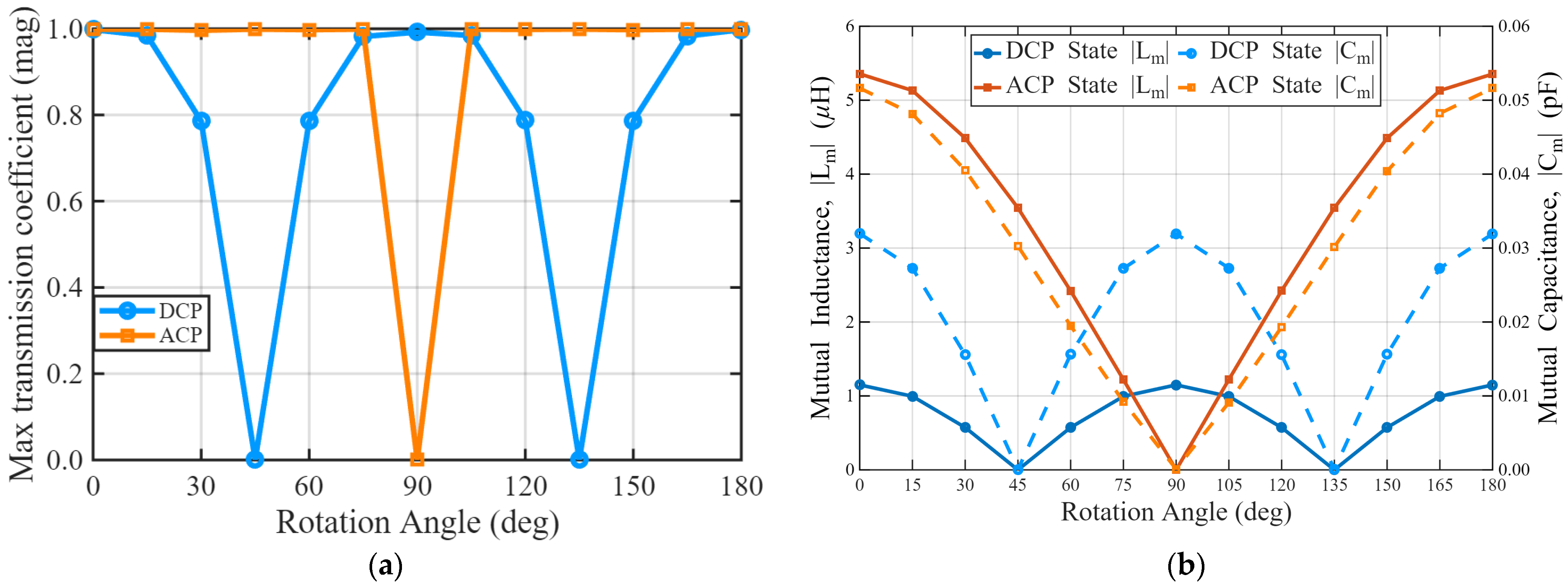
Figure 7 shows the maximum transmission coefficient and mutual LC parameters of the ACP and DCP modes over the 0 ° 180 ° rotation range. Here, the extracted L m and C m values represent the mode-level effective mutual reactive components obtained from the simulated port response. In Figure 7a, the ACP mode maintains S 21 m a x close to unity in the 0 ° 75 ° and 105 ° 180 ° ranges, but it decreases to nearly zero at 90 ° , indicating a clear transmission null. In contrast, the DCP mode exhibits S 21 m a x   1 at 0 ° , 90 ° , and 180 ° , while null points occur at 45 ° and 135 ° . At 30 ° , 60 ° , 120 ° , and 150 ° , the DCP mode maintains an intermediate transmission coefficient of approximately 0.78, showing that the diagonal coupling path is gradually weakened and then recovered with rotation.
Figure 7b shows that the rotation-dependent transmission behavior is closely related to the variations in L m and C m . In the ACP mode, L m and C m have their maximum values of 5.35   μ H and 0.052   p F , respectively, at 0 ° . As the rotation angle approaches 90 ° , both values decrease progressively and become nearly zero at 90 ° . They then increase again in the 105 ° 180 ° range and recover to values similar to those at 0 ° . This trend indicates that the adjacent coupling path of the ACP mode is canceled at 90 ° and restored after further rotation.
The DCP mode shows a different rotation dependence. Its L m and C m remain relatively high at 0 ° , 90 ° , and 180 ° , but decrease to nearly zero at 45 ° and 135 ° . Specifically, L m is approximately 1.15   μ H at 0 ° and 1.14   μ H at 90 ° , whereas it nearly vanishes at 45 ° and 135 ° . Similarly, C m remains around 0.032   p F at 0 ° , 90 ° , and 180 ° , but decreases to nearly zero at the DCP null angles. These results show that the transmission nulls are directly associated with the reduction in the effective mutual inductance and mutual capacitance in each mode. The extracted L m and C m values for each rotation angle are summarized in Table 4 and Table 5.
It should be noted that the extracted C m values in Table 4 and Table 5 are effective mutual capacitances between the transmitter and receiver coupling regions. They are not external compensation capacitors and do not represent the total capacitance of the coupler. Parasitic capacitances may affect the absolute resonance condition and practical tuning in a fabricated prototype; however, the C m values extracted in this study are used to compare the relative electric-field mutual coupling behavior of ACP and DCP under the same geometry and simulation setup.
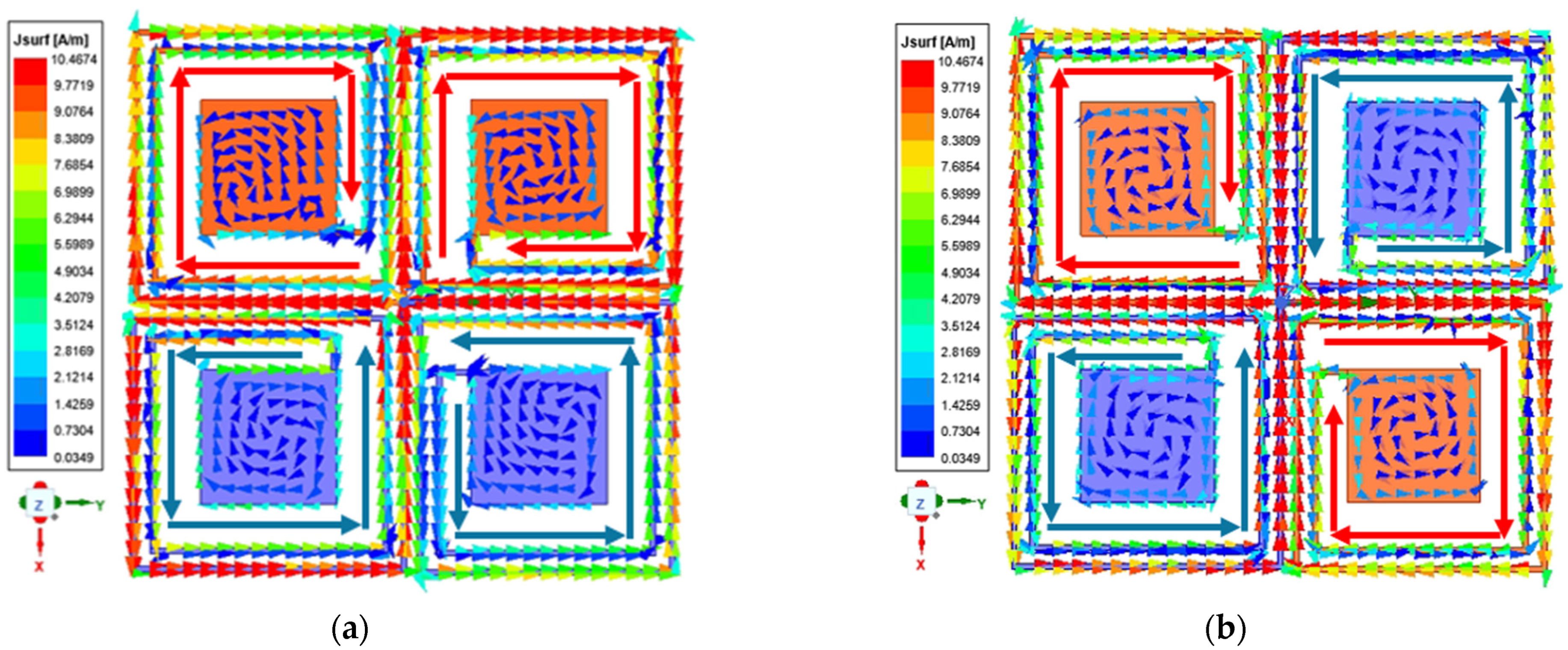
Figure 8 shows the surface current density distribution, J s u r f , in the ACP and DCP modes. The color indicates the magnitude of the current density, and the arrows represent the direction of the current flowing along the conductor surface. These results are presented to confirm how the actual current paths are reconfigured according to the feeding mode.
In Figure 8a, corresponding to the ACP mode, the current forms parallel circulating paths along the adjacent direction in the upper and lower coupling regions. This current distribution shows that the intended adjacent coupling path in the ACP mode is indeed formed on the actual conductor surface. In addition, the current density is relatively high near the outer coil conductors and the central connection region, indicating that these regions act as the main magnetic-coupling paths in the ACP mode.
In Figure 8b, corresponding to the DCP mode, the current paths are rearranged differently from those of the ACP mode, being centered on the diagonally positioned coupling regions. Similar circulating current patterns appear in the diagonal coupling regions, indicating that the intended diagonal coupling path of the DCP mode is properly formed. In particular, since the current density is high in the central region and along the conductor paths connected diagonally, it can be interpreted that diagonal electromagnetic coupling plays a dominant role in the DCP mode rather than adjacent-direction coupling.
Therefore, the J s u r f   results in Figure 8 show that, although the ACP and DCP modes use the same coupler structure, they form different current paths depending on the feeding polarity arrangement. This result is consistent with the electromagnetic-field directionality predicted in Figure 5 and supports the interpretation that the variation of L m observed in Figure 7 is related to the reconfiguration of the surface current paths.

5. Conclusions

The proposed coupler was evaluated through equivalent-circuit analysis and 3D full-wave simulation under a 100 mm transfer distance and a 0–180° rotation range. The ACP mode showed a transmission null at 90 ° , whereas the DCP mode showed null points at 45 ° and 135 ° . In terms of mutual parameters, the ACP L m and C m decreased from 5.35   μ H and 0.052   p F at 0 ° to nearly zero at 90 ° , while the DCP mutual parameters decreased to nearly zero at 45 ° and 135 ° . These results indicate that the transmission nulls are directly related to the weakening of effective mutual electromagnetic coupling and that ACP and DCP can operate as complementary coupling paths.
These results suggest that the proposed coupler has potential applicability to wireless charging pads in which the receiver can approach with different yaw angles. By reducing the dependence on a single alignment-sensitive coupling path, the CPRMPT coupler can improve rotational robustness at the coupler level. However, the present study focuses on the coupler-level electromagnetic transmission behavior of the proposed structure, and quantitative charging performance, such as output power, DC efficiency, rectifier behavior, and load-dependent operation, is not included within the scope of this paper. Future work will include prototype-based experimental validation of the proposed CPRMPT coupler. In addition, practical excitation circuitry, mode-selection circuits, compensation networks, load conditions, and system-level power-transfer measurements will be investigated to extend the present coupler-level analysis toward an implementable AGV/AMR wireless charging system.

Author Contributions

Conceptualization, S.P. and G.K.; methodology, S.P.; software, G.K.; validation, G.K.; formal analysis, G.K.; investigation, G.K.; resources, S.P.; data curation, G.K.; writing—original draft preparation, G.K.; writing—review and editing, G.K. and S.P.; visualization, G.K.; supervision, S.P.; project administration, S.P.; funding acquisition, S.P. All authors have read and agreed to the published version of the manuscript.

Funding

This work was supported by the Soonchunhyang University Research Fund.

Data Availability Statement

The raw data supporting the conclusions of this article will be made available by the authors upon request.

Conflicts of Interest

The authors declare no conflicts of interest.

References

  1. Fragapane, G.; de Koster, R.; Sgarbossa, F.; Strandhagen, J.O. Planning and control of autonomous mobile robots for intralogistics: Literature review and research agenda. Eur. J. Oper. Res. 2021, 294, 405–426. [Google Scholar] [CrossRef]
  2. Zhang, J.; Yang, X.; Wang, W.; Guan, J.; Ding, L.; Lee, V.C.S. Automated guided vehicles and autonomous mobile robots for recognition and tracking in civil engineering. Autom. Constr. 2023, 146, 104699. [Google Scholar] [CrossRef]
  3. Tomy, M.; Lacerda, B.; Hawes, N.; Wyatt, J.L. Battery charge scheduling in long-life autonomous mobile robots via multi-objective decision making under uncertainty. Robot. Auton. Syst. 2020, 133, 103629. [Google Scholar] [CrossRef]
  4. Jia, F.; Afaq, M.; Ripka, B.; Huda, Q.; Ahmad, R. Vision- and Lidar-Based Autonomous Docking and Recharging of a Mobile Robot for Machine Tending in Autonomous Manufacturing Environments. Appl. Sci. 2023, 13, 10675. [Google Scholar] [CrossRef]
  5. Kurs, A.; Karalis, A.; Moffatt, R.; Joannopoulos, J.D.; Fisher, P.; Soljačić, M. Wireless power transfer via strongly coupled magnetic resonances. Science 2007, 317, 83–86. [Google Scholar] [CrossRef]
  6. Karalis, A.; Joannopoulos, J.D.; Soljačić, M. Efficient wireless non-radiative mid-range energy transfer. Ann. Phys. 2008, 323, 34–48. [Google Scholar] [CrossRef]
  7. Li, S.; Mi, C.C. Wireless Power Transfer for Electric Vehicle Applications. IEEE J. Emerg. Sel. Top. Power Electron. 2015, 3, 4–17. [Google Scholar] [CrossRef]
  8. Covic, G.A.; Boys, J.T. Modern Trends in Inductive Power Transfer for Transportation Applications. IEEE J. Emerg. Sel. Top. Power Electron. 2013, 1, 28–41. [Google Scholar] [CrossRef]
  9. Bi, Z.; Kan, T.; Mi, C.C.; Zhang, Y.; Zhao, Z.; Keoleian, G.A. A review of wireless power transfer for electric vehicles: Prospects to enhance sustainable mobility. Appl. Energy 2016, 179, 413–425. [Google Scholar] [CrossRef]
  10. Budhia, M.; Boys, J.T.; Covic, G.A.; Huang, C.-Y. Development of a Single-Sided Flux Magnetic Coupler for Electric Vehicle IPT Charging Systems. IEEE Trans. Ind. Electron. 2013, 60, 318–328. [Google Scholar] [CrossRef]
  11. Vu, V.-B.; Ramezani, A.; Triviño, A.; González-González, J.M.; Kadandani, N.B.; Dahidah, M.; Pickert, V. Operation of Inductive Charging Systems under Misalignment Conditions: A Review for Electric Vehicles. IEEE Trans. Transp. Electrif. 2023, 9, 1857–1887. [Google Scholar] [CrossRef]
  12. Lu, F.; Zhang, H.; Hofmann, H.; Mi, C.C. A Double-Sided LCLC-Compensated Capacitive Power Transfer System for Electric Vehicle Charging. IEEE Trans. Power Electron. 2015, 30, 6011–6014. [Google Scholar] [CrossRef]
  13. Zhang, H.; Lu, F.; Hofmann, H.; Liu, W.; Mi, C.C. A Four-Plate Compact Capacitive Coupler Design and LCL-Compensated Topology for Capacitive Power Transfer in Electric Vehicle Charging Application. IEEE Trans. Power Electron. 2016, 31, 8541–8551. [Google Scholar] [CrossRef]
  14. Lu, F.; Zhang, H.; Hofmann, H.; Mi, C.C. A Double-Sided LC-Compensation Circuit for Loosely Coupled Capacitive Power Transfer. IEEE Trans. Power Electron. 2018, 33, 1633–1643. [Google Scholar] [CrossRef]
  15. Lu, F.; Zhang, H.; Mi, C.C. A Review on the Recent Development of Capacitive Wireless Power Transfer Technology. Energies 2017, 10, 1752. [Google Scholar] [CrossRef]
  16. Erel, M.Z.; Bayindir, K.C.; Aydemir, M.T. A Comprehensive Review on Wireless Capacitive Power Transfer Technology: Fundamentals and Applications. IEEE Access 2022, 10, 3116–3143. [Google Scholar] [CrossRef]
  17. Lin, C.-H.; Hsu, C.-H.; Lee, T.-H.; Liaw, C.-M. Comprehensive Analysis of IPT v/s CPT for Wireless EV Charging and Effect of Capacitor Plate Shape and Foreign Particle on CPT. Processes 2021, 9, 1619. [Google Scholar] [CrossRef]
  18. Erel, M.Z.; Bayindir, K.C.; Aydemir, M.T. A New Capacitive Coupler Design for Wireless Capacitive Power Transfer Applications. Eng. Sci. Technol. Int. J. 2023, 40, 101364. [Google Scholar] [CrossRef]
  19. Lu, F.; Zhang, H.; Hofmann, H.; Mi, C.C. An Inductive and Capacitive Combined Wireless Power Transfer System with LC-Compensated Topology. IEEE Trans. Power Electron. 2016, 31, 8471–8482. [Google Scholar] [CrossRef]
  20. Luo, B.; Zhou, X.; Long, T.; Mai, R.; He, Z. Misalignment tolerance wireless power transfer system combining inductive and capacitive coupling. IET Electr. Power Appl. 2020, 14, 1925–1932. [Google Scholar] [CrossRef]
  21. Zhu, J.-Q.; Ban, Y.-L.; Xu, R.-M.; Mi, C.C. An NFC-Connected Coupler Using IPT-CPT-Combined Wireless Charging for Metal-Cover Smartphone Applications. IEEE Trans. Power Electron. 2021, 36, 6323–6338. [Google Scholar] [CrossRef]
  22. Vincent, D.; Huynh, P.S.; Azeez, N.A.; Patnaik, L.; Williamson, S.S. Evolution of Hybrid Inductive and Capacitive AC Links for Wireless EV Charging—A Comparative Overview. IEEE Trans. Transp. Electrif. 2019, 5, 1060–1077. [Google Scholar] [CrossRef]
Figure 1. Topology of the CPRMPT: (a) ACP mode and (b) DCP mode. The red and blue arrows indicate the outgoing and in-coming electromagnetic-field directions, respectively, defined according to the polarity of the voltage source.
Electronics 15 02589 g001
Figure 2. Equivalent circuit of the basic MPT coupler.
Electronics 15 02589 g002
Figure 3. Equivalent circuit of the proposed CPRMPT coupler under different coupling paths.
Electronics 15 02589 g003
Figure 4. Configuration of 3D simulation model.
Electronics 15 02589 g004
Figure 5. Top-view configuration and field direction of the CPRMPT coupler: (a) ACP mode and (b) DCP mode.
Electronics 15 02589 g005
Figure 6. S-parameter characteristics of the proposed CPRMPT coupler under different coupling paths and rotation angles: (a) ACP mode (b) DCP mode.
Electronics 15 02589 g006
Figure 7. Rotation-dependent transmission and mutual coupling characteristics of the proposed CPRMPT coupler: (a) maximum transmission coefficient and (b) extracted mutual inductance and mutual capacitance.
Electronics 15 02589 g007
Figure 8. Surface current density distribution of the proposed CPRMPT coupler: (a) ACP mode (b) DCP mode.
Electronics 15 02589 g008
Table 1. Equivalent parameter of CPRMPT.
NotationComponentsValue
ACPDCP
L r e s Resonance inductance 47.92   μ H 68.2   μ H
L T ,   L R Self-inductance of Tx, Rx 1.51   μ H 3.39   μ H
C T ,   C R Self-capacitance of Tx, Rx 0.29   p F 0.39 pF
f Resonance frequency6.78 MHz6.78 MHz
Table 2. Configuration parameters of simulation model.
ComponentsNotationValue
Copper Plate Width L p 1 ,   L p 2 ,   L p 3 ,   L p 4 50 mm
Outer length of the coil L o u t 80 mm
Inner length of the coil L i n 100 mm
Overall width of the coupler W c p l 200 mm
Gap between the two plates G p l a t e 50 mm
Gap of coil conductors G c o i l 5 mm
Gap between the coil and the plate G a p 5 mm
Number of turns of the coil-2
Thickness of the coil and the plate-0.5 mm
Table 3. Predictive evaluation of coupling performance under rotational misalignments.
Rotation AngleACPDCP
0 ° OO
45 ° OX
90 ° XO
O indicates a rotational angle at which coupling can be maintained, whereas X indicates a rotational angle at which a null point occurs.
Table 4. Extracted mutual inductance and mutual capacitance parameters under rotational misalignment from 0 ° to 90 ° .
ComponentsMutual C or L of Rotation Angle
15°30°45°60°75°90°
L m ACP5.35 µH5.13 µH4.48 µH3.54 µH2.42 µH1.22 µH0
DCP1.15 µH0.99 µH0.57 µH00.57 µH0.99 µH1.14 µH
C m ACP0.052 pF0.048 pF0.041 pF0.030 pF0.019 pF0.009 pF0
DCP0.032 pF0.027 pF0.016 pF00.016 pF0.027 pF0.032 pF
Table 5. Extracted mutual inductance and mutual capacitance parameters under rotational misalignment from 90 ° to 180 ° .
ComponentsMutual C or L of Rotation Angle
90°105°120°135°150°165°180°
L m ACP01.22 µH2.42 µH3.54 µH4.48 µH5.13 µH5.35 µH
DCP1.14 µH0.99 µH0.57 µH00.57 µH0.99 µH1.14 µH
C m ACP00.009 pF0.019 pF0.03 pF0.04 pF0.048 pF0.052 pF
DCP0.032 pF0. 027 pF0.016 pF00.016 pF0.027 pF0.032 pF
Disclaimer/Publisher’s Note: The statements, opinions and data contained in all publications are solely those of the individual author(s) and contributor(s) and not of MDPI and/or the editor(s). MDPI and/or the editor(s) disclaim responsibility for any injury to people or property resulting from any ideas, methods, instructions or products referred to in the content.